Are you better off today than you were four, no, forty years ago?
February 23, 2011 6:49 PM Subscribe
The Most Shocking/Depressing/Enraging Interactive Infographic You Will See Today unless you've been in the "top 10%" since 1969. Move the sliders for other interesting/surprising/sad perspectives into parts of the past century.
Disclaimer: "Income Growth" is just one data point of many regarding economic well-being in the USofA, some of which appear elsewhere in non-interactive form elsewhere on the site. Your personal mileage may vary. Remember, if you've done well despite not being in the "top 10%", then somebody else has done worse.
Disclaimer: "Income Growth" is just one data point of many regarding economic well-being in the USofA, some of which appear elsewhere in non-interactive form elsewhere on the site. Your personal mileage may vary. Remember, if you've done well despite not being in the "top 10%", then somebody else has done worse.
Again, I believe this is a symptom of infinite dollars from nothing; it has become much more lucrative to manipulate paper tokens than to generate wealth. The people making the wealth, the things we actually eat and drive and live in, are being destroyed; the people manipulating the wealth tokens are living like Croesus.
posted by Malor at 7:04 PM on February 23, 2011 [12 favorites]
posted by Malor at 7:04 PM on February 23, 2011 [12 favorites]
Malor: If it's that simple, why isn't there a single country in the world that has a commodity-backed currency?
posted by East Manitoba Regional Junior Kabaddi Champion '94 at 7:14 PM on February 23, 2011
posted by East Manitoba Regional Junior Kabaddi Champion '94 at 7:14 PM on February 23, 2011
Because we're not googling Ron Paul enough.
posted by clarknova at 7:21 PM on February 23, 2011 [5 favorites]
posted by clarknova at 7:21 PM on February 23, 2011 [5 favorites]
"When income grows, who gains?"
The fat gut of the rich gains most, amiright or what? I once heard the wealthy are the stomach, the poor are the miles of intestines.
posted by CNNInternational at 7:21 PM on February 23, 2011
The fat gut of the rich gains most, amiright or what? I once heard the wealthy are the stomach, the poor are the miles of intestines.
posted by CNNInternational at 7:21 PM on February 23, 2011
Because we're not googling Ron Paul enough.
Right. Because then we'd have no money, and it'd be much more difficult to create these sorts of graphs.
posted by schmod at 7:22 PM on February 23, 2011
Right. Because then we'd have no money, and it'd be much more difficult to create these sorts of graphs.
posted by schmod at 7:22 PM on February 23, 2011
Tax the oligarchs bloodless. It's the only way to be sure.
posted by Iridic at 7:23 PM on February 23, 2011 [7 favorites]
posted by Iridic at 7:23 PM on February 23, 2011 [7 favorites]
Interestingly, Marketplace had a story tonight about how the problem with Social Security is caused by wealth concentrating at the top.
posted by revgeorge at 7:37 PM on February 23, 2011 [2 favorites]
posted by revgeorge at 7:37 PM on February 23, 2011 [2 favorites]
The fat gut of the rich gains most, amiright or what? I once heard the wealthy are the stomach, the poor are the miles of intestines.
That metaphor assumes a severe case of pyloric stenosis.
posted by clarknova at 7:38 PM on February 23, 2011 [2 favorites]
That metaphor assumes a severe case of pyloric stenosis.
posted by clarknova at 7:38 PM on February 23, 2011 [2 favorites]
If it's that simple, why isn't there a single country in the world that has a commodity-backed currency?
Our currency is backed by the commodity that is the cumulative production output of each American citizen and corresponding tax receipts. The production of these Americans is being leveraged to sponsor security derivatives and financial institutions whose risk and fallout has landed squarely on the shoulders of a struggling middle class.
posted by clearly at 7:38 PM on February 23, 2011 [10 favorites]
Our currency is backed by the commodity that is the cumulative production output of each American citizen and corresponding tax receipts. The production of these Americans is being leveraged to sponsor security derivatives and financial institutions whose risk and fallout has landed squarely on the shoulders of a struggling middle class.
posted by clearly at 7:38 PM on February 23, 2011 [10 favorites]
So, according to their numbers, the top 10% is $107,540 (income only) in 2008, is that right?
The graph makes it somewhat unclear.
posted by madajb at 7:40 PM on February 23, 2011
The graph makes it somewhat unclear.
posted by madajb at 7:40 PM on February 23, 2011
Several reasons. The primary one is simply that most countries based their currency on the US dollar during Bretton Woods; the US would base its currency on gold, and everyone else would base their currencies on ours. When we took ourselves off the gold standard in 1971, in essence declaring that we were unable to meet our obligations, we took most of the world with us.
Second, being on a fixed currency when everyone around you is on a floating one is a serious short-term competitive disadvantage; the countries around you will grow much faster than you will. The problem is, they grow wrong, shifting more and more of their economy to serving the people making wealth tokens, instead of the people making wealth. But our primitive metrics are mostly driven by currency availability, so it looks like they're doing way better than you are. Further, 'bad money chases out good'; if your money is actually good, people will hoard it, and spend the crappy stuff, impairing your economic growth.
Third, they haven't imploded yet. Countries all over the world are in terrible financial trouble. I think of all the First World countries, only Germany is in fairly good shape, and they're being dragged down by the poor fiscal policies of the rest of the EU.
I think both China and India are in pretty good shape, although China in particular is not nearly as strong as it thinks it is. Its wild economic growth is also based on the false economic messages sent by the easy money policies and vast credit expansion of the last couple decades. They will never, ever, ever get back value equaling what they've sent us. Not even close.
For what it's worth, I don't care about the gold standard in particular. Even a virtual commodity currency might work, where the central banks couldn't intervene in the economy, and could only expand the monetary base by a fixed percentage each year. Something along that line, at least, I haven't thought my way through it very far.
The only real reason I think some kind of commodity system is important to act as a check and balance on central bankers. Alan Greenspan drove us off a freaking cliff. We're going to be finding out just how steep this cliff is for at least another decade. Nobody should have that much power. Banks and governments worldwide have gone completely off the rails, because they have no hard limits on what they can promise, and an awful lot of cause-effect chains end up back at Alan Greenspan's tenure at the Federal Reserve. "Interest rate targeting", where the Fed picked an interest rate, and provided any amount of money the market wanted to hold short-term debt at that rate, was probably the most toxic and destructive monetary policy ever implemented, from the perspective of worldwide well-being.
These terrible ideas are just taking a long time to kill us, because we were once so immensely robust.
posted by Malor at 7:49 PM on February 23, 2011 [22 favorites]
Second, being on a fixed currency when everyone around you is on a floating one is a serious short-term competitive disadvantage; the countries around you will grow much faster than you will. The problem is, they grow wrong, shifting more and more of their economy to serving the people making wealth tokens, instead of the people making wealth. But our primitive metrics are mostly driven by currency availability, so it looks like they're doing way better than you are. Further, 'bad money chases out good'; if your money is actually good, people will hoard it, and spend the crappy stuff, impairing your economic growth.
Third, they haven't imploded yet. Countries all over the world are in terrible financial trouble. I think of all the First World countries, only Germany is in fairly good shape, and they're being dragged down by the poor fiscal policies of the rest of the EU.
I think both China and India are in pretty good shape, although China in particular is not nearly as strong as it thinks it is. Its wild economic growth is also based on the false economic messages sent by the easy money policies and vast credit expansion of the last couple decades. They will never, ever, ever get back value equaling what they've sent us. Not even close.
For what it's worth, I don't care about the gold standard in particular. Even a virtual commodity currency might work, where the central banks couldn't intervene in the economy, and could only expand the monetary base by a fixed percentage each year. Something along that line, at least, I haven't thought my way through it very far.
The only real reason I think some kind of commodity system is important to act as a check and balance on central bankers. Alan Greenspan drove us off a freaking cliff. We're going to be finding out just how steep this cliff is for at least another decade. Nobody should have that much power. Banks and governments worldwide have gone completely off the rails, because they have no hard limits on what they can promise, and an awful lot of cause-effect chains end up back at Alan Greenspan's tenure at the Federal Reserve. "Interest rate targeting", where the Fed picked an interest rate, and provided any amount of money the market wanted to hold short-term debt at that rate, was probably the most toxic and destructive monetary policy ever implemented, from the perspective of worldwide well-being.
These terrible ideas are just taking a long time to kill us, because we were once so immensely robust.
posted by Malor at 7:49 PM on February 23, 2011 [22 favorites]
revgeorge, I can hear it now, "Of course that's what that commie Robert Reich would say on ultra socialist NPR!"
posted by Daddy-O at 7:50 PM on February 23, 2011
posted by Daddy-O at 7:50 PM on February 23, 2011
Again, I believe this is a symptom of infinite dollars from nothing
I am not being sarcastic when I ask this...what would it take for you to change your mind on this? The people that are making the things we eat and drive are being paid less and less to make them. The people that are extracting out that labor value are becoming more politically powerful, a vicious circle that further disempowers the makers of things.
I feel like you don't need a flexible currency sustem to describe why money isn't going to the bottom. I'd like to know what it would examples you'd need to see to disprove that hypothesis.
posted by Hypnotic Chick at 7:53 PM on February 23, 2011 [5 favorites]
I am not being sarcastic when I ask this...what would it take for you to change your mind on this? The people that are making the things we eat and drive are being paid less and less to make them. The people that are extracting out that labor value are becoming more politically powerful, a vicious circle that further disempowers the makers of things.
I feel like you don't need a flexible currency sustem to describe why money isn't going to the bottom. I'd like to know what it would examples you'd need to see to disprove that hypothesis.
posted by Hypnotic Chick at 7:53 PM on February 23, 2011 [5 favorites]
Disclaimer indeed. Between 1924 and 2008, the growth-per-capita of $39,440 was shared 50/50 by the top 10% and the bottom 90%. I'm not denying that many, many non-well-off people, one way or another, have a raw deal in this country, but this infographic seems good for no more than starting a "who can cherry-pick the year most favorable to his/her argument" contest.
posted by doubleozaphod at 7:53 PM on February 23, 2011 [5 favorites]
posted by doubleozaphod at 7:53 PM on February 23, 2011 [5 favorites]
And remember, the exact same people telling you that commodity-backed currencies are stupid and destructive are the ones that told you that houses would go up forever. They also happen to be the immensely wealthy 1%.
The debt-based economy is growing like crazy, and they get to keep all of it, while you get poorer every year. Might I suggest that, perhaps, they're selling you ideas that are not good for your well-being?
posted by Malor at 7:54 PM on February 23, 2011 [4 favorites]
The debt-based economy is growing like crazy, and they get to keep all of it, while you get poorer every year. Might I suggest that, perhaps, they're selling you ideas that are not good for your well-being?
posted by Malor at 7:54 PM on February 23, 2011 [4 favorites]
Some site had a graph the other day of all the money that wasn't mine. Viewed between the values of -1 and 1, it was pretty much just a straight line across the middle for me. It hovered between -0.000000000112 and 0.000000117 over the last 10 years, depending upon my various receipts of the time. I cannot wait to have .000000000024 of all money and look upon that fact in a nicely presented graph.
posted by localhuman at 7:59 PM on February 23, 2011
posted by localhuman at 7:59 PM on February 23, 2011
And they don't want you to google Ron Paul!
Please stop.
I have no idea whether Malor is right, but I'm pretty sure you can have concerns about a debt-based economy without being a Ron Paul wingut, and I'm absolutely certain that snarky recurring jokes have no place in reasonable discussion.
So stop hurting the internet.
posted by regicide is good for you at 8:01 PM on February 23, 2011 [18 favorites]
Please stop.
I have no idea whether Malor is right, but I'm pretty sure you can have concerns about a debt-based economy without being a Ron Paul wingut, and I'm absolutely certain that snarky recurring jokes have no place in reasonable discussion.
So stop hurting the internet.
posted by regicide is good for you at 8:01 PM on February 23, 2011 [18 favorites]
The problem with a fiat currency system is that you have control over money supply.
The problem with a commodity-based currency system is that you have no control over money supply.
posted by storybored at 8:10 PM on February 23, 2011 [2 favorites]
The problem with a commodity-based currency system is that you have no control over money supply.
posted by storybored at 8:10 PM on February 23, 2011 [2 favorites]
And remember, the exact same people telling you that commodity-backed currencies are stupid and destructive are the ones that told you that houses would go up forever. They also happen to be the immensely wealthy 1%.
Isn't.. everyone saying that though?
That'd be like saying, "There are a bunch of fundamentalist Christians who believe in gravity! You don't want to be like them, so let's all fly through the air on pixie dust."
posted by TypographicalError at 8:15 PM on February 23, 2011
Isn't.. everyone saying that though?
That'd be like saying, "There are a bunch of fundamentalist Christians who believe in gravity! You don't want to be like them, so let's all fly through the air on pixie dust."
posted by TypographicalError at 8:15 PM on February 23, 2011
So stop hurting the internet.
Won't someone please think of the Internets?
posted by clarknova at 8:21 PM on February 23, 2011
Won't someone please think of the Internets?
posted by clarknova at 8:21 PM on February 23, 2011
I'm looking forward to a day where the Internet culture is controlled by TMZ.com, I mean the top percent of income earners.
posted by CNNInternational at 8:24 PM on February 23, 2011 [1 favorite]
posted by CNNInternational at 8:24 PM on February 23, 2011 [1 favorite]
Who really cares what other people make? Either advance your career, or enjoy your life.
posted by blargerz at 8:29 PM on February 23, 2011 [2 favorites]
posted by blargerz at 8:29 PM on February 23, 2011 [2 favorites]
Malor, thanks for your answers. You acknowledge that switching to a commodity-based currency impairs economic growth and causes a serious competitive disadvantage in the short-term. Approximately how long is the short-term? And after we have switched to a commodity standard and deliberately caused this short-term economic disaster, what happens next? What is going to happen that will make us better off than we would have been, or at least better off than the other countries that have remained on fiat money?
posted by East Manitoba Regional Junior Kabaddi Champion '94 at 8:30 PM on February 23, 2011
posted by East Manitoba Regional Junior Kabaddi Champion '94 at 8:30 PM on February 23, 2011
Malor, your comments are interesting, but I feel like I'm having a hard time understanding them. You're using some pretty abstract terms, and I'm having a really hard time tying them to either what we're looking at in the graph or other real-world phenomena we're interested in. For example, these sentences:
The problem is, they grow wrong, shifting more and more of their economy to serving the people making wealth tokens, instead of the people making wealth. But our primitive metrics are mostly driven by currency availability, so it looks like they're doing way better than you are.
are completely opaque to me. Can you possibly illustrate this with a real-world example? (Sorry, this may be my overly-concrete brain at work, or I may just not be familiar with the terminology you're using.)
For what it's worth, I don't care about the gold standard in particular. Even a virtual commodity currency might work, where the central banks couldn't intervene in the economy, and could only expand the monetary base by a fixed percentage each year.
Let's say that happened. Can you explain, again with concrete examples if possible, how that would reduce income inequality?
(Absolutely no snark intended here -- I'm really trying to understand the thrust of your argument. Thanks!)
posted by thehandsomecamel at 8:33 PM on February 23, 2011 [1 favorite]
The problem is, they grow wrong, shifting more and more of their economy to serving the people making wealth tokens, instead of the people making wealth. But our primitive metrics are mostly driven by currency availability, so it looks like they're doing way better than you are.
are completely opaque to me. Can you possibly illustrate this with a real-world example? (Sorry, this may be my overly-concrete brain at work, or I may just not be familiar with the terminology you're using.)
For what it's worth, I don't care about the gold standard in particular. Even a virtual commodity currency might work, where the central banks couldn't intervene in the economy, and could only expand the monetary base by a fixed percentage each year.
Let's say that happened. Can you explain, again with concrete examples if possible, how that would reduce income inequality?
(Absolutely no snark intended here -- I'm really trying to understand the thrust of your argument. Thanks!)
posted by thehandsomecamel at 8:33 PM on February 23, 2011 [1 favorite]
We had great income inequality during the Gilded Age when we had a currency backed with gold. Back then, conservatives railed against the inflationary Silverite agenda. Now, we have a fiat currency and we have great income inequality so maybe the money supply is not the place to look for causes. It seems to me that we made the greatest strides towards social justice when we had more progressive taxation and more generous social programs and educational assistance for the poor and working class.
posted by Tashtego at 8:33 PM on February 23, 2011 [25 favorites]
posted by Tashtego at 8:33 PM on February 23, 2011 [25 favorites]
If only I had time to test whether mathematical expectation supports the subjective whining.
posted by Ardiril at 8:37 PM on February 23, 2011
posted by Ardiril at 8:37 PM on February 23, 2011
Who really cares what other people make? Either advance your career, or enjoy your life.
I think if you're a member of the working poor, and that top 10% is getting richer and richer off of you, you might care. And "advance your career" might sound like the gibberish it is.
posted by regicide is good for you at 8:39 PM on February 23, 2011 [20 favorites]
I think if you're a member of the working poor, and that top 10% is getting richer and richer off of you, you might care. And "advance your career" might sound like the gibberish it is.
posted by regicide is good for you at 8:39 PM on February 23, 2011 [20 favorites]
I think if you're a member of the working poor, and that top 10% is getting richer and richer off of you, you might care.
Yes, by definition, businesses have to pay people less than the value they produce. So, all businesses can only get rich off the labor of their employees, including those employees of the working poor.
And "advance your career" might sound like the gibberish it is.
How so?
posted by blargerz at 8:46 PM on February 23, 2011
Yes, by definition, businesses have to pay people less than the value they produce. So, all businesses can only get rich off the labor of their employees, including those employees of the working poor.
And "advance your career" might sound like the gibberish it is.
How so?
posted by blargerz at 8:46 PM on February 23, 2011
How about soak the rich. Bring back truly progressive taxation and corporate taxes.
Observe competitive advantages of european countries (germany, nordics, etc) with high tax rates and low income disparity.
It's because culturally there's a basic understanding that being a member of a society takes sacrifice from both sides. It's not a one-way street.
Taxes aren't evil. Government itself isn't evil. Sharing isn't evil.
It's like we've created an entire country of people that never went to preschool and learned how to share and not be an asshole.
posted by Lord_Pall at 8:49 PM on February 23, 2011 [27 favorites]
this infographic seems good for no more than starting a "who can cherry-pick the year most favorable to his/her argument" contest.
Let's pick a start year with some significance: 1970 was the peak for private sector union membership in America. From 1970 to 2008, the rich got 89% of income growth. Coincidence? Probably not.
posted by danblaker at 8:50 PM on February 23, 2011
Let's pick a start year with some significance: 1970 was the peak for private sector union membership in America. From 1970 to 2008, the rich got 89% of income growth. Coincidence? Probably not.
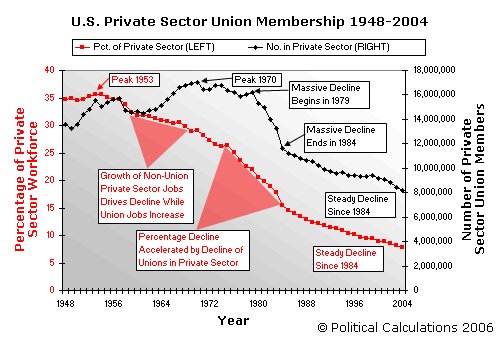
posted by danblaker at 8:50 PM on February 23, 2011
Yes, by definition, businesses have to pay people less than the value they produce.
I think there's a huge difference between paying someone less than the value they produce, and paying people $10/hour when your company is taking in some huge amount of money every fiscal quarter.
It's not about whether the business is making a fair profit. It's about whether they're sharing fairly with the workers who are the basic backbone of production.
Of course, one's definition of "fairly" depends on whether you believe workers are people or simply grist for the mill which churns human lives into numbers in bank accounts.
What we need most of all in this country? A strong labor / union base, and a lot more worker-owned cooperatives, where there is no Big Boss getting rich off the sweat of minimum wage slaves.
posted by hippybear at 8:55 PM on February 23, 2011 [10 favorites]
I think there's a huge difference between paying someone less than the value they produce, and paying people $10/hour when your company is taking in some huge amount of money every fiscal quarter.
It's not about whether the business is making a fair profit. It's about whether they're sharing fairly with the workers who are the basic backbone of production.
Of course, one's definition of "fairly" depends on whether you believe workers are people or simply grist for the mill which churns human lives into numbers in bank accounts.
What we need most of all in this country? A strong labor / union base, and a lot more worker-owned cooperatives, where there is no Big Boss getting rich off the sweat of minimum wage slaves.
posted by hippybear at 8:55 PM on February 23, 2011 [10 favorites]
I tried to avoid cherry-picking dates for the post, but focused on a point in time (1968-69) which seemed to be a 'turning point'. If the total of the 50 years before showed the Top 10% getting 30% of the income growth and the 40 years since showed them getting 100%, (and the years immediately before and after showed a big change), then THAT looked like a turning point to me. And I was surprised that it happened exactly when it did, not realizing how much the "Inflationary 70s" did to redistribute income before the more obvious "Supply Side 80s".
As for "advance your career", if the entire economy is growing, why wouldn't a person with the same job for 40 years be better off? And considering so many of the other economic changes of the last 40 years, it's fairly obvious that millions of Americans who did advance their careers got almost nothing for it.
posted by oneswellfoop at 9:00 PM on February 23, 2011 [6 favorites]
As for "advance your career", if the entire economy is growing, why wouldn't a person with the same job for 40 years be better off? And considering so many of the other economic changes of the last 40 years, it's fairly obvious that millions of Americans who did advance their careers got almost nothing for it.
posted by oneswellfoop at 9:00 PM on February 23, 2011 [6 favorites]
considering so many of the other economic changes of the last 40 years, it's fairly obvious that millions of Americans who did advance their careers got almost nothing for it.
QFMFT.
posted by hippybear at 9:02 PM on February 23, 2011 [2 favorites]
QFMFT.
posted by hippybear at 9:02 PM on February 23, 2011 [2 favorites]
> Observe competitive advantages of european countries (germany, nordics, etc) with high tax rates and low income disparity.
I wonder if this story is true; it's being re-posted all over the internet, but I can't find any reference to the name of the businessman or the radio show.
posted by The Card Cheat at 9:04 PM on February 23, 2011 [1 favorite]
I wonder if this story is true; it's being re-posted all over the internet, but I can't find any reference to the name of the businessman or the radio show.
posted by The Card Cheat at 9:04 PM on February 23, 2011 [1 favorite]
Income inequity: pardon me if you've seen this one recently.
Sad to those of us with parents enriched by the GI Bill who sent their many kids through college. They did not complain about paying twice as much in income taxes as have we.
posted by kozad at 9:05 PM on February 23, 2011
Sad to those of us with parents enriched by the GI Bill who sent their many kids through college. They did not complain about paying twice as much in income taxes as have we.
posted by kozad at 9:05 PM on February 23, 2011
oneswellfoop: My apologies, I didn't realize that you could adjust the end date as well - that is, I guess only clicked the first link. Silly of me, and yes, I see a lot more value in comparing periods as you describe.
posted by doubleozaphod at 9:09 PM on February 23, 2011
posted by doubleozaphod at 9:09 PM on February 23, 2011
I think there's a huge difference between paying someone less than the value they produce, and paying people $10/hour when your company is taking in some huge amount of money every fiscal quarter.
As a business owner, the more I pay the lowest worker, the fewer workers I hire. I have a budget, you know.
It's not about whether the business is making a fair profit. It's about whether they're sharing fairly with the workers who are the basic backbone of production.
What risk have my $10/hr workers taken in working for my company? They can walk out the door tomorrow, and I am SOL. I bear all the risk. I am legally and financially liable for all of their actions. For bearing 100% of the risk, should I not receive the lion's share of the reward?
Of course, one's definition of "fairly" depends on whether you believe workers are people or simply grist for the mill which churns human lives into numbers in bank accounts.
I pay them the appropriate wage for the difficulty of the work they do. Should I pay them more than that? If I am unhappy with the quality of workers I am attracting at that wage, I will consider raising the wage. It is a cost/benefit analysis.
What we need most of all in this country? A strong labor / union base, and a lot more worker-owned cooperatives, where there is no Big Boss getting rich off the sweat of minimum wage slaves.
Yes, unions increase wages, but unions can also be a barrier to entry into their particular field. Many unions like to limit their membership numbers to inflate wages. Plus, in many cases, the increased wages are just passed on to the consumer. And unions provide extra incentive for corporations to resort to overseas, non-unionized labor. Basically, people can unionize all they want, but if their demands are unreasonable and unsustainable, they only shoot themselves in the foot.
Worker-owned cooperatives are great, when they work. Unfortunately, oftentimes some members do more/more difficult work than others, and eventually demand a greater slice of the pie. They are great for teams of like-skilled professionals, as you see in medical and legal partnerships.
posted by blargerz at 9:23 PM on February 23, 2011 [5 favorites]
As a business owner, the more I pay the lowest worker, the fewer workers I hire. I have a budget, you know.
It's not about whether the business is making a fair profit. It's about whether they're sharing fairly with the workers who are the basic backbone of production.
What risk have my $10/hr workers taken in working for my company? They can walk out the door tomorrow, and I am SOL. I bear all the risk. I am legally and financially liable for all of their actions. For bearing 100% of the risk, should I not receive the lion's share of the reward?
Of course, one's definition of "fairly" depends on whether you believe workers are people or simply grist for the mill which churns human lives into numbers in bank accounts.
I pay them the appropriate wage for the difficulty of the work they do. Should I pay them more than that? If I am unhappy with the quality of workers I am attracting at that wage, I will consider raising the wage. It is a cost/benefit analysis.
What we need most of all in this country? A strong labor / union base, and a lot more worker-owned cooperatives, where there is no Big Boss getting rich off the sweat of minimum wage slaves.
Yes, unions increase wages, but unions can also be a barrier to entry into their particular field. Many unions like to limit their membership numbers to inflate wages. Plus, in many cases, the increased wages are just passed on to the consumer. And unions provide extra incentive for corporations to resort to overseas, non-unionized labor. Basically, people can unionize all they want, but if their demands are unreasonable and unsustainable, they only shoot themselves in the foot.
Worker-owned cooperatives are great, when they work. Unfortunately, oftentimes some members do more/more difficult work than others, and eventually demand a greater slice of the pie. They are great for teams of like-skilled professionals, as you see in medical and legal partnerships.
posted by blargerz at 9:23 PM on February 23, 2011 [5 favorites]
blargerz, your perspective as a business owner obviously has merit. The issue is, most small businesses are relatively unaffected by unions. In larger companies, however, without unions the lion's share of salary increases go to management—executives in particular.
posted by danblaker at 9:29 PM on February 23, 2011 [3 favorites]
posted by danblaker at 9:29 PM on February 23, 2011 [3 favorites]
"this page requires adobe flash 9.x or higher"
That wasn't the most shocking or depressing thing I saw all day, but thanks for trying.
posted by illovich at 9:38 PM on February 23, 2011 [1 favorite]
That wasn't the most shocking or depressing thing I saw all day, but thanks for trying.
posted by illovich at 9:38 PM on February 23, 2011 [1 favorite]
Well, no. As a business owner, the money you pay your lowest worker is part of your business budget. If you can't afford to pay the workers, then you're pricing your product too low.
And your $10/hour workers are taking a daily risk with their quality of life every time they walk in the door and agree to work for $80/day, minus taxes. Do you really think making under $1600/month ($80/day x 20 working days in a month) is a real quality of life? It's not.
And yes, they can walk out the door tomorrow and you're SOL. That's because you're not paying them enough to stay at your place of business. In fact, that's the power of unions and striking. It's the only power that workers have against those who control the means of production. Either you figure out how to treat those doing the actual labor for you as real human beings worthy of a life of dignity, or you lose. Too bad, so sad.
And who says you're bearing 100% of the risk? If your business goes under, the workers lose their place of employment. That's not a lack of risk. That's perhaps even more dire than your situation, because as a business owner, if you're properly incorporated, the losses aren't your personal losses, but instead belong to the business. I've known many business owners who have gone bankrupt several times and they always seem to still have the big houses and the boats for summer recreation. A minimum-wage worker without work doesn't have food.
"Appropriate wage" is a pretty loaded phrase, and nearly always determined by the business owner without really consulting the workforce. If you really want to race to the bottom, then you deserve to get only the minimum quality worker you get with minimum wage. If you pay people more, you will find they rise to the occasion.
Unions limit their membership? I'd like to see a citation for that. I've never encountered a union which didn't want more members. And I think you'll find that unions are as aware of the need to have a functioning business as the business owners, and would rather work to find a happy middle ground than demand more than the business can support.
A lot of the "unreasonable and unsustainable" union demands are legacy contracts which have wage scales which were devised back in a time when people lived fewer years and worked fewer years in their lifetimes. I don't deny that some of those legacy contracts may not work today, but to say that unions are going to shoot themselves in the foot simply out of greed sounds like a business owner projecting his own desires upon an entire class of people and demonizing them for it.
And no, worker-owned cooperatives don't only work in medical/legal partnerships. In fact, there are a good number of factories and retail establishments which are worker owned. And worker-owned cooperative isn't a euphemism for "everyone is paid exactly the same". Quite the opposite -- the worker-owners have a very clear view of who has the difficult jobs and who doesn't, and they structure their compensation accordingly.
posted by hippybear at 9:40 PM on February 23, 2011 [41 favorites]
And your $10/hour workers are taking a daily risk with their quality of life every time they walk in the door and agree to work for $80/day, minus taxes. Do you really think making under $1600/month ($80/day x 20 working days in a month) is a real quality of life? It's not.
And yes, they can walk out the door tomorrow and you're SOL. That's because you're not paying them enough to stay at your place of business. In fact, that's the power of unions and striking. It's the only power that workers have against those who control the means of production. Either you figure out how to treat those doing the actual labor for you as real human beings worthy of a life of dignity, or you lose. Too bad, so sad.
And who says you're bearing 100% of the risk? If your business goes under, the workers lose their place of employment. That's not a lack of risk. That's perhaps even more dire than your situation, because as a business owner, if you're properly incorporated, the losses aren't your personal losses, but instead belong to the business. I've known many business owners who have gone bankrupt several times and they always seem to still have the big houses and the boats for summer recreation. A minimum-wage worker without work doesn't have food.
"Appropriate wage" is a pretty loaded phrase, and nearly always determined by the business owner without really consulting the workforce. If you really want to race to the bottom, then you deserve to get only the minimum quality worker you get with minimum wage. If you pay people more, you will find they rise to the occasion.
Unions limit their membership? I'd like to see a citation for that. I've never encountered a union which didn't want more members. And I think you'll find that unions are as aware of the need to have a functioning business as the business owners, and would rather work to find a happy middle ground than demand more than the business can support.
A lot of the "unreasonable and unsustainable" union demands are legacy contracts which have wage scales which were devised back in a time when people lived fewer years and worked fewer years in their lifetimes. I don't deny that some of those legacy contracts may not work today, but to say that unions are going to shoot themselves in the foot simply out of greed sounds like a business owner projecting his own desires upon an entire class of people and demonizing them for it.
And no, worker-owned cooperatives don't only work in medical/legal partnerships. In fact, there are a good number of factories and retail establishments which are worker owned. And worker-owned cooperative isn't a euphemism for "everyone is paid exactly the same". Quite the opposite -- the worker-owners have a very clear view of who has the difficult jobs and who doesn't, and they structure their compensation accordingly.
posted by hippybear at 9:40 PM on February 23, 2011 [41 favorites]
I pay them the appropriate wage for the difficulty of the work they do.
Somehow I doubt you apply this same metric when deciding how much to pay yourself.
I'm a line-item on someone's "budget"! This motivates me to work more efficiently and reliably!
posted by Brocktoon at 9:40 PM on February 23, 2011 [3 favorites]
Somehow I doubt you apply this same metric when deciding how much to pay yourself.
I'm a line-item on someone's "budget"! This motivates me to work more efficiently and reliably!
posted by Brocktoon at 9:40 PM on February 23, 2011 [3 favorites]
Worker-owned cooperatives are great, when they work. Unfortunately, oftentimes some members do more/more difficult work than others, and eventually demand a greater slice of the pie.
We don't want a bigger piece of the pie! We want the whole damn bakery!
Somewhat more seriously, there's some interesting research out there showing that intellectual (and by this I mean, non-physical) work and monetary rewards don't correlate. Here's a fantastic talk on the topic, 11 minutes, beautifully animated.
Compensations in worker-owned cooperatives are by no means required to be uniform regardless of seniority, investment, or ability. But what cooperatives create is (ideally) a structure in which members are all investing in the place they work, and in turn picking up a broader range of skills than would necessarily be available otherwise. For example, a cooperative baker, I imagine, comes out of their experience far better prepared to start their own bakery than one who simply gets paid a wage. By being exposed to the decision making process and planning process, everyone gets a better taste of how the organization runs; these organizations create leadership and entrepreneurship in a way that big business fundamentally cannot.
And to bring it back to topic, it's ultimately the community that gets the 'lion's share' in the cooperative model, and the community that shares the risk.
There are also various levels of risk. It's a relatively small risk for the McDonalds corporation to front the cash to get a franchise started, but a much, much larger risk for the person owning the franchised store, even if the monetary quantities are the same. Having the resources to start a business doesn't make you any better a person than the workers; it simply means that a risk that was acceptable to you was unacceptable or even unavailable to the worker.
posted by kaibutsu at 9:54 PM on February 23, 2011 [2 favorites]
We don't want a bigger piece of the pie! We want the whole damn bakery!
Somewhat more seriously, there's some interesting research out there showing that intellectual (and by this I mean, non-physical) work and monetary rewards don't correlate. Here's a fantastic talk on the topic, 11 minutes, beautifully animated.
Compensations in worker-owned cooperatives are by no means required to be uniform regardless of seniority, investment, or ability. But what cooperatives create is (ideally) a structure in which members are all investing in the place they work, and in turn picking up a broader range of skills than would necessarily be available otherwise. For example, a cooperative baker, I imagine, comes out of their experience far better prepared to start their own bakery than one who simply gets paid a wage. By being exposed to the decision making process and planning process, everyone gets a better taste of how the organization runs; these organizations create leadership and entrepreneurship in a way that big business fundamentally cannot.
And to bring it back to topic, it's ultimately the community that gets the 'lion's share' in the cooperative model, and the community that shares the risk.
There are also various levels of risk. It's a relatively small risk for the McDonalds corporation to front the cash to get a franchise started, but a much, much larger risk for the person owning the franchised store, even if the monetary quantities are the same. Having the resources to start a business doesn't make you any better a person than the workers; it simply means that a risk that was acceptable to you was unacceptable or even unavailable to the worker.
posted by kaibutsu at 9:54 PM on February 23, 2011 [2 favorites]
I'm going to second the motion for Malor to expand on what he said earlier. In particular, about this idea of Chinese wealth imbalance?
posted by hellslinger at 9:54 PM on February 23, 2011
posted by hellslinger at 9:54 PM on February 23, 2011
What risk have my $10/hr workers taken in working for my company? They can walk out the door tomorrow, and I am SOL.
Or you can fire them tomorrow, and they're SOL. I don't know where you live, but where I live $10/hr is barely (if at all) a living wage. A person working for you for those wages almost certainly carries no cushion month-to-month, and if fired from your company would have to find another job immediately -- literally within a day or two -- in order to avoid defaulting on his or her financial obligations. That person, if he or she works for you long-term, is certainly taking an enormous risk -- gambling that you as an employer will (a) not go out of business and (b) not downsize, move overseas, automate, etc., etc.
As danblaker says, your perspective has merit, but I think it's inaccurate to say that employees are not at risk in this exchange. And there's a terrible inequality to the risk being taken, since a $10-dollar worker is less likely than you to have the resources to bounce back in the event of failure.
What does this mean for you as a business owner? Well, if you universalize it, what that means is that the greater the income inequalities, and the lower the incomes are at the bottom end, the more you'll pay in taxes and other hidden costs (like increased health care costs to pay for people who don't have insurance) to keep the people at the bottom at least minimally alive. (And also maybe to pay the police and the prison system to keep the poor from robbing your house or shooting you like a dog in the street.) It also means, of course, that the consumer market is weaker -- fewer people can afford to buy your product, and they buy much less of it. (Barring unsustainable use of credit, which is another discussion.)
Given that, it's not unreasonable to ask whether some percentage of the profit you make from their labor should not be redirected into a social safety net, pensions, etc. in order to make society and the overall economy stronger. Obviously, these are not decisions you as a business owner can make unilaterally, which is why society-at-large generally ends up making them and implementing such programs through the mechanism of government. And while I agree with the OP that these stats represent only a small portion of the total picture, it's still worth having these discussions in order to figure out how, as a society, we can take action to ameliorate the problems that income inequality causes. To the degree that some of these actions have already been taken, you as a business owner already benefit from them, and the risk you bear is less because of them.
posted by thehandsomecamel at 9:58 PM on February 23, 2011 [21 favorites]
Or you can fire them tomorrow, and they're SOL. I don't know where you live, but where I live $10/hr is barely (if at all) a living wage. A person working for you for those wages almost certainly carries no cushion month-to-month, and if fired from your company would have to find another job immediately -- literally within a day or two -- in order to avoid defaulting on his or her financial obligations. That person, if he or she works for you long-term, is certainly taking an enormous risk -- gambling that you as an employer will (a) not go out of business and (b) not downsize, move overseas, automate, etc., etc.
As danblaker says, your perspective has merit, but I think it's inaccurate to say that employees are not at risk in this exchange. And there's a terrible inequality to the risk being taken, since a $10-dollar worker is less likely than you to have the resources to bounce back in the event of failure.
What does this mean for you as a business owner? Well, if you universalize it, what that means is that the greater the income inequalities, and the lower the incomes are at the bottom end, the more you'll pay in taxes and other hidden costs (like increased health care costs to pay for people who don't have insurance) to keep the people at the bottom at least minimally alive. (And also maybe to pay the police and the prison system to keep the poor from robbing your house or shooting you like a dog in the street.) It also means, of course, that the consumer market is weaker -- fewer people can afford to buy your product, and they buy much less of it. (Barring unsustainable use of credit, which is another discussion.)
Given that, it's not unreasonable to ask whether some percentage of the profit you make from their labor should not be redirected into a social safety net, pensions, etc. in order to make society and the overall economy stronger. Obviously, these are not decisions you as a business owner can make unilaterally, which is why society-at-large generally ends up making them and implementing such programs through the mechanism of government. And while I agree with the OP that these stats represent only a small portion of the total picture, it's still worth having these discussions in order to figure out how, as a society, we can take action to ameliorate the problems that income inequality causes. To the degree that some of these actions have already been taken, you as a business owner already benefit from them, and the risk you bear is less because of them.
posted by thehandsomecamel at 9:58 PM on February 23, 2011 [21 favorites]
Well, no. As a business owner, the money you pay your lowest worker is part of your business budget. If you can't afford to pay the workers, then you're pricing your product too low.
If I priced my product higher, there would not be a business. I could produce a higher quality product that requires more skilled labor to manufacture, in which case, I would spend more money on wages.
Do you really think making under $1600/month ($80/day x 20 working days in a month) is a real quality of life? It's not.
I provide a clean, safe, fair, and honest workplace for mostly immigrants, teens, and retirees. Some do exceptionally well and want to stay aboard, and I give them raises and promotions. Others move on, and are frequently able to find better paying jobs applying the skills they learned. I am not a charity.
That's because you're not paying them enough to stay at your place of business. In fact, that's the power of unions and striking. It's the only power that workers have against those who control the means of production.
In my particular business, if turnover becomes problematic, I will consider raising wages.
If you really want to race to the bottom, then you deserve to get only the minimum quality worker you get with minimum wage. If you pay people more, you will find they rise to the occasion.
In my particular business, I only need minimum quality workers. Training takes 10 minutes.
Unions limit their membership? I'd like to see a citation for that.
Apprenticeships. There are a finite number available, and there are particular requirements to be filled, including licensing examinations. This can certainly be a good thing, especially in the more dangerous trades. Unions can be useful in this regard as "seals of approval", which makes everyone better off.
posted by blargerz at 10:26 PM on February 23, 2011 [1 favorite]
If I priced my product higher, there would not be a business. I could produce a higher quality product that requires more skilled labor to manufacture, in which case, I would spend more money on wages.
Do you really think making under $1600/month ($80/day x 20 working days in a month) is a real quality of life? It's not.
I provide a clean, safe, fair, and honest workplace for mostly immigrants, teens, and retirees. Some do exceptionally well and want to stay aboard, and I give them raises and promotions. Others move on, and are frequently able to find better paying jobs applying the skills they learned. I am not a charity.
That's because you're not paying them enough to stay at your place of business. In fact, that's the power of unions and striking. It's the only power that workers have against those who control the means of production.
In my particular business, if turnover becomes problematic, I will consider raising wages.
If you really want to race to the bottom, then you deserve to get only the minimum quality worker you get with minimum wage. If you pay people more, you will find they rise to the occasion.
In my particular business, I only need minimum quality workers. Training takes 10 minutes.
Unions limit their membership? I'd like to see a citation for that.
Apprenticeships. There are a finite number available, and there are particular requirements to be filled, including licensing examinations. This can certainly be a good thing, especially in the more dangerous trades. Unions can be useful in this regard as "seals of approval", which makes everyone better off.
posted by blargerz at 10:26 PM on February 23, 2011 [1 favorite]
Not sure you can get much more in that knapsack.
posted by maxwelton at 10:34 PM on February 23, 2011 [3 favorites]
posted by maxwelton at 10:34 PM on February 23, 2011 [3 favorites]
Apprenticeships. There are a finite number available, and there are particular requirements to be filled, including licensing examinations.
Don't conflate unions with licensing. That's pretty much apples and oranges.
There are plenty of unions which don't require anything like that for membership. And apparently, none of this applies to your business anyway.
posted by hippybear at 10:40 PM on February 23, 2011 [4 favorites]
Don't conflate unions with licensing. That's pretty much apples and oranges.
There are plenty of unions which don't require anything like that for membership. And apparently, none of this applies to your business anyway.
posted by hippybear at 10:40 PM on February 23, 2011 [4 favorites]
If I priced my product higher, there would not be a business.
And the lies begin. Many of the items that we can get for $5 at Wal-Mart would still be purchased for $8. In fact, excessively low prices for crap can create a cycle where resources are disproportionately spent on cheap trinkets instead of important things like healthcare. So if your trinket is too unimportant to be bought for $8, maybe we don't need your trinket and will buy a product from someone who can produce them and still pay a living wage.
Germany does just great with a heavily unionized workforce. They remain (among larger nations) a top per-capita exporter, which lays to rest the argument that "unions cause outsourcing!"
posted by Tehhund at 10:44 PM on February 23, 2011 [5 favorites]
And the lies begin. Many of the items that we can get for $5 at Wal-Mart would still be purchased for $8. In fact, excessively low prices for crap can create a cycle where resources are disproportionately spent on cheap trinkets instead of important things like healthcare. So if your trinket is too unimportant to be bought for $8, maybe we don't need your trinket and will buy a product from someone who can produce them and still pay a living wage.
Germany does just great with a heavily unionized workforce. They remain (among larger nations) a top per-capita exporter, which lays to rest the argument that "unions cause outsourcing!"
posted by Tehhund at 10:44 PM on February 23, 2011 [5 favorites]
I am not a charity.
Don't worry, we would never insult you and accuse you of being charitable!
posted by Brocktoon at 11:18 PM on February 23, 2011 [3 favorites]
Don't worry, we would never insult you and accuse you of being charitable!
posted by Brocktoon at 11:18 PM on February 23, 2011 [3 favorites]
Many of the items that we can get for $5 at Wal-Mart would still be purchased for $8.
Maybe this works in a command economy, but this doesn't really fly in a capitalist system. Many of the items which start getting priced at $8 immediately stop selling in favor of the competing item which is selling for $5. People aren't idiots, even at Wal-Mart. It's $5 because everyone else is charging $5 and even raising your price to $5.50 will effectively shut you out of the market.
I know it's really tempting to think blargerz can raise his prices, raise his wages, suffer no adverse competition from other businesses in the marketplace, and single-handedly fix wage inequality in America, but it's not happening no matter how much we all pile on. The incentive structure comes from the system; mocking someone for following those incentives is counter-productive and just makes you look ignorant.
If you want higher wages for entry-level work, raise the goddamn minimum wage. If you want universal health care, pass a fucking single-payer system bill. If you want business owners to shoot themselves in the foot because you think hiring at the prevailing wage and charging the price the market will bear is some corporatist plot to destroy the middle class, you're barking up the wrong tree. You'd do just as well standing outside Wal-Mart yelling at people for buying the cheapest goods that meet their needs.
posted by 0xFCAF at 11:29 PM on February 23, 2011 [12 favorites]
Maybe this works in a command economy, but this doesn't really fly in a capitalist system. Many of the items which start getting priced at $8 immediately stop selling in favor of the competing item which is selling for $5. People aren't idiots, even at Wal-Mart. It's $5 because everyone else is charging $5 and even raising your price to $5.50 will effectively shut you out of the market.
I know it's really tempting to think blargerz can raise his prices, raise his wages, suffer no adverse competition from other businesses in the marketplace, and single-handedly fix wage inequality in America, but it's not happening no matter how much we all pile on. The incentive structure comes from the system; mocking someone for following those incentives is counter-productive and just makes you look ignorant.
If you want higher wages for entry-level work, raise the goddamn minimum wage. If you want universal health care, pass a fucking single-payer system bill. If you want business owners to shoot themselves in the foot because you think hiring at the prevailing wage and charging the price the market will bear is some corporatist plot to destroy the middle class, you're barking up the wrong tree. You'd do just as well standing outside Wal-Mart yelling at people for buying the cheapest goods that meet their needs.
posted by 0xFCAF at 11:29 PM on February 23, 2011 [12 favorites]
Don't conflate unions with licensing.
Electricians? Aren't they made up of license-only union members?
posted by hellslinger at 11:32 PM on February 23, 2011
Electricians? Aren't they made up of license-only union members?
posted by hellslinger at 11:32 PM on February 23, 2011
Don't worry, we would never insult you and accuse you of being charitable!
He said he doesn't run a charity, he runs a business. Maybe you enjoy it when people give money to you, for free, because they feel sorry for you, because you are a charity case. That would be insulting to most people.
posted by stbalbach at 11:36 PM on February 23, 2011 [3 favorites]
He said he doesn't run a charity, he runs a business. Maybe you enjoy it when people give money to you, for free, because they feel sorry for you, because you are a charity case. That would be insulting to most people.
posted by stbalbach at 11:36 PM on February 23, 2011 [3 favorites]
The debt-based economy is growing like crazy, and they get to keep all of it, while you get poorer every year. Might I suggest that, perhaps, they're selling you ideas that are not good for your well-being?
This a classic mefi quote. Thanks Malor.
posted by dglynn at 11:38 PM on February 23, 2011 [2 favorites]
This a classic mefi quote. Thanks Malor.
posted by dglynn at 11:38 PM on February 23, 2011 [2 favorites]
Don't conflate unions with licensing.
Electricians? Aren't they made up of license-only union members?
Sure they are. But licensed union members are not the sum total of all union members everywhere. Having an example doesn't define the entire class.
posted by hippybear at 11:44 PM on February 23, 2011
Electricians? Aren't they made up of license-only union members?
Sure they are. But licensed union members are not the sum total of all union members everywhere. Having an example doesn't define the entire class.
posted by hippybear at 11:44 PM on February 23, 2011
Many of the items which start getting priced at $8 immediately stop selling in favor of the competing item which is selling for $5. People aren't idiots, even at Wal-Mart. It's $5 because everyone else is charging $5 and even raising your price to $5.50 will effectively shut you out of the market.
Well, yes and no. I try to buy quality products, even if they cost more, than simply buying the cheapest. If I want a quality step-lid wastebasket, for example, I will avoid WalMart because, despite their prices being cheaper, I know from experience and research that they drive their suppliers to use cheaper and thinner plastic, and the life-span of what I buy there will be much less than if I go to someplace and buy Rubbermaid (who largely won't do business with WalMart anymore because of their race to the bottom), and I will have a quality product that will last me a lot longer.
Consumers know that the "best deal" doesn't always mean "lowest price". Assuming that they do is painting the consumer with a large brush of stupid, and that's not honest or correct.
posted by hippybear at 11:49 PM on February 23, 2011 [1 favorite]
Well, yes and no. I try to buy quality products, even if they cost more, than simply buying the cheapest. If I want a quality step-lid wastebasket, for example, I will avoid WalMart because, despite their prices being cheaper, I know from experience and research that they drive their suppliers to use cheaper and thinner plastic, and the life-span of what I buy there will be much less than if I go to someplace and buy Rubbermaid (who largely won't do business with WalMart anymore because of their race to the bottom), and I will have a quality product that will last me a lot longer.
Consumers know that the "best deal" doesn't always mean "lowest price". Assuming that they do is painting the consumer with a large brush of stupid, and that's not honest or correct.
posted by hippybear at 11:49 PM on February 23, 2011 [1 favorite]
Hippybear, do you own or manage a business?
posted by hellslinger at 11:50 PM on February 23, 2011
posted by hellslinger at 11:50 PM on February 23, 2011
I have owned a very small business, and have worked in management in two of them. Why do you ask?
Do you assume that someone having a strong interest in worker's rights simply cannot relate to the plight of a business owner?
posted by hippybear at 11:52 PM on February 23, 2011 [2 favorites]
Do you assume that someone having a strong interest in worker's rights simply cannot relate to the plight of a business owner?
posted by hippybear at 11:52 PM on February 23, 2011 [2 favorites]
I think all Malor is saying is that fiat currencies give the elite an easy way to apply a horribly regressive tax across society. A tax that most people don't really understand and a tax that most people think is just a force of nature.
If you increase the money supply and cause the value of everyone's wages to go down you are taking value away from them. The usual side effect is that asset prices go up in value. So a group of people do benefit from inflation. It's just an increasingly smaller group
Of course that is going to lead to increasing income inequality. How could it do anything but? Nobody but the small group benefiting from rising asset prices would vote for these policies if they understood them.
posted by aychedee at 11:56 PM on February 23, 2011 [1 favorite]
If you increase the money supply and cause the value of everyone's wages to go down you are taking value away from them. The usual side effect is that asset prices go up in value. So a group of people do benefit from inflation. It's just an increasingly smaller group
Of course that is going to lead to increasing income inequality. How could it do anything but? Nobody but the small group benefiting from rising asset prices would vote for these policies if they understood them.
posted by aychedee at 11:56 PM on February 23, 2011 [1 favorite]
I did not assume. I just hoped that you could relate your experiences with wages and labor in contrast to blargerz. It seems reasonable that blue collar and menial labor might be under more pressure to keep wages low in order to stay in business than skilled or professional labor.
posted by hellslinger at 12:06 AM on February 24, 2011
posted by hellslinger at 12:06 AM on February 24, 2011
What risk have my $10/hr workers taken in working for my company? They can walk out the door tomorrow, and I am SOL. I bear all the risk.
Risk? What risk? The risk of hiring someone else at $10/hr? That's not a risk.
I pay them the appropriate wage for the difficulty of the work they do. Should I pay them more than that?
Yes, you should pay them a living wage, or get out of business.
posted by IvoShandor at 1:46 AM on February 24, 2011 [2 favorites]
Risk? What risk? The risk of hiring someone else at $10/hr? That's not a risk.
I pay them the appropriate wage for the difficulty of the work they do. Should I pay them more than that?
Yes, you should pay them a living wage, or get out of business.
posted by IvoShandor at 1:46 AM on February 24, 2011 [2 favorites]
And who says you're bearing 100% of the risk? If your business goes under, the workers lose their place of employment. That's not a lack of risk. That's perhaps even more dire than your situation, because as a business owner, if you're properly incorporated, the losses aren't your personal losses, but instead belong to the business. I've known many business owners who have gone bankrupt several times and they always seem to still have the big houses and the boats for summer recreation. A minimum-wage worker without work doesn't have food.
QFMFT.
The reason why this is important is because workers don't have a comparable insulation against risk.
The corporation protects its owner from personal bankruptcy. As such, it encourages investment etc., which is a good thing because it keeps the economy moving and encourages entrepreneurs and so forth.
The problem is, at the moment, the rewards for founding a corporation - assuming you are good at your job and build it up into a successful business that, say, a bigger business wants to buy - can be tremendous. The two richest men I know - real multi-millionaires - made their money that way.
They had to work really hard, be smart and get lucky. But the thing is, I don't think they worked substantially harder than a doctor or a corporate lawyer or a teacher or really anybody else who was dedicated and good at their job.
It's just that that one specific thing that they were doing is rewarded disproportionately well in our current society. It doesn't seem fair. Work really hard for ten years and be good at your job - and then live the rest of your life in massive luxury? That seems like an incredibly good deal!
posted by lucien_reeve at 1:54 AM on February 24, 2011 [4 favorites]
QFMFT.
The reason why this is important is because workers don't have a comparable insulation against risk.
The corporation protects its owner from personal bankruptcy. As such, it encourages investment etc., which is a good thing because it keeps the economy moving and encourages entrepreneurs and so forth.
The problem is, at the moment, the rewards for founding a corporation - assuming you are good at your job and build it up into a successful business that, say, a bigger business wants to buy - can be tremendous. The two richest men I know - real multi-millionaires - made their money that way.
They had to work really hard, be smart and get lucky. But the thing is, I don't think they worked substantially harder than a doctor or a corporate lawyer or a teacher or really anybody else who was dedicated and good at their job.
It's just that that one specific thing that they were doing is rewarded disproportionately well in our current society. It doesn't seem fair. Work really hard for ten years and be good at your job - and then live the rest of your life in massive luxury? That seems like an incredibly good deal!
posted by lucien_reeve at 1:54 AM on February 24, 2011 [4 favorites]
I originally read the website URL as www.stateoffuckingamerica.com
Apt, really.
posted by ladybird at 4:22 AM on February 24, 2011
Apt, really.
posted by ladybird at 4:22 AM on February 24, 2011
Okay, honestly at this point I really need some kind of explanation as to what you actually do because
See: AskMe, July 13, 2010
Job interview in Houston for major insurance company. Entry level job.
posted by dragonsi55 at 4:43 AM on February 24, 2011 [1 favorite]
See: AskMe, July 13, 2010
Job interview in Houston for major insurance company. Entry level job.
posted by dragonsi55 at 4:43 AM on February 24, 2011 [1 favorite]
I don't understand your collective outrage. Incomes since 1960 have grown for everyone according to this chart. Are you just upset that the top 10% has done better? Or that the current economic downturn like all the others has affected the bottom 90% more. Every one is wealthier overall most people feel insecure including those in the upper 10%. Just saying look at how much richer those people of there are compared to me isn't a valid argument when most of us have apparently done quite well.
It seems to me the only issue here is that we are currently entering an era of significant cutbacks in government programs because of our chronic deficits. We will have to raise revenues to make things work. There is no way to do this land sustain current income tax rates. The alternatives are cutting into key goverent services (pick whichever one is your sacred cow social security, defense, roads, education. Upping taxes on the richest is the fairest way to address this given that this is where the money is.
posted by humanfont at 5:02 AM on February 24, 2011
It seems to me the only issue here is that we are currently entering an era of significant cutbacks in government programs because of our chronic deficits. We will have to raise revenues to make things work. There is no way to do this land sustain current income tax rates. The alternatives are cutting into key goverent services (pick whichever one is your sacred cow social security, defense, roads, education. Upping taxes on the richest is the fairest way to address this given that this is where the money is.
posted by humanfont at 5:02 AM on February 24, 2011
What risk have my $10/hr workers taken in working for my company? They can walk out the door tomorrow, and I am SOL. I bear all the risk.
Risk? What risk? The risk of hiring someone else at $10/hr? That's not a risk.
I believe he's referring to the risk of losing all of the money he invested in the business.
Listen, there are small businesses, and then there are very small businesses. I am a very small business owner, my businesses have less than 10 employees each. They were created by money that I had worked for and saved myself. When one of my businesses goes under, as one did this year, it's all of my investment that I lose. Money that other people would use as a down payment on a house, or to fund their retirement. I'm taking a risk and betting my future stability that I will get all of this money back, and more, and have the priviledge of working hard to make that happen.
I'd like to disabuse everyone here of the notion that just because you are a business owner you are making the big bucks. Some do, many don't. Many provide a liveable wage for the owner, and not much more, and most of us (anecdotal, based on other small business owners that I know) pay as much as we can to keep the good people working for us. Losing a good employee is one of the things that very small business owners dread the most, and most will do what they can to keep their employees happy, including giving them more money.
Even though I am a business owner, I am pro-union, I am for more regulation/oversight on business. I am for progressive taxation, and for the fair taxation of corporate profits, I am for single payer health care.
In essence, I am for all the things that in my opinion would make everyones quality of life better in this country, not just mine.
Even though my businesses are all separately incorporated, I am not one of the lucky 90% of corporations who pay no tax. I am not big enough to take advantage of the loopholes. I pay a shit ton of taxes every month. It kills me (in the not having any money left in the bank after the accountant has visited sense, not in the outrage that I have to pay them sense). This is true of almost all very small businesses.
And for those who say that there is no risk of personal bankruptcy when protected by the corporate veil, just try to to start a new business and get the goods/services you need to run the business without putting up a personal guarantee. I am personally on the hook for almost everything that comes in the door.
The point that I'm trying to make is that it's not so black and white. Not all small business owners are evil greedy bastards trying to wring every last cent out of the sweat of our beholden laborers.
posted by newpotato at 5:21 AM on February 24, 2011 [8 favorites]
Risk? What risk? The risk of hiring someone else at $10/hr? That's not a risk.
I believe he's referring to the risk of losing all of the money he invested in the business.
Listen, there are small businesses, and then there are very small businesses. I am a very small business owner, my businesses have less than 10 employees each. They were created by money that I had worked for and saved myself. When one of my businesses goes under, as one did this year, it's all of my investment that I lose. Money that other people would use as a down payment on a house, or to fund their retirement. I'm taking a risk and betting my future stability that I will get all of this money back, and more, and have the priviledge of working hard to make that happen.
I'd like to disabuse everyone here of the notion that just because you are a business owner you are making the big bucks. Some do, many don't. Many provide a liveable wage for the owner, and not much more, and most of us (anecdotal, based on other small business owners that I know) pay as much as we can to keep the good people working for us. Losing a good employee is one of the things that very small business owners dread the most, and most will do what they can to keep their employees happy, including giving them more money.
Even though I am a business owner, I am pro-union, I am for more regulation/oversight on business. I am for progressive taxation, and for the fair taxation of corporate profits, I am for single payer health care.
In essence, I am for all the things that in my opinion would make everyones quality of life better in this country, not just mine.
Even though my businesses are all separately incorporated, I am not one of the lucky 90% of corporations who pay no tax. I am not big enough to take advantage of the loopholes. I pay a shit ton of taxes every month. It kills me (in the not having any money left in the bank after the accountant has visited sense, not in the outrage that I have to pay them sense). This is true of almost all very small businesses.
And for those who say that there is no risk of personal bankruptcy when protected by the corporate veil, just try to to start a new business and get the goods/services you need to run the business without putting up a personal guarantee. I am personally on the hook for almost everything that comes in the door.
The point that I'm trying to make is that it's not so black and white. Not all small business owners are evil greedy bastards trying to wring every last cent out of the sweat of our beholden laborers.
posted by newpotato at 5:21 AM on February 24, 2011 [8 favorites]
I can invest my money in a steel company or a manufacturing company that may pay a few percentage poinst every year. I can also invest my money in a company which invests in many said companies, deversifying my risk, generally that company goes a few steps further and has a significant portion of their investments in similarly non-manufacturing based companies. The wealth of these companies is strictly generated from their created perception that they have a clue. The manufacturing companies, in an effort to maintain their appeal, cheapen their operating costs - generally by finding the cheapest labor. This relationship continually rewards the purchase of companies worth nothing, and the dismantling of a solid manufacturing base.
Monetary policy has been in favor of this get rich quick scheme - gut companies which produce things so that their balance sheet is pretty, then make the proffit by selling them and yourself in the process. Ny fixing short ten interest rates, you allow companies which have no real product the produce to quickly reallocate their own imaginary assets and acquire other intangible companies. Without a gold brick or ten thousand widgets, there is nothing that gives this company value.
Furthermore, by continually pumping money into the market, you actually force the company to expand its practice, because if it stops growing, it becomes worth less. So we've mow gutted manufacturing, created companies which base their balance sheets on themselves and not on products they produce, forced those companies to continually grow or die, and the workers are left out of the equation.
Want to understand why unions and big business hisorically didn't get along? Unions presented a financial impedence to the business policy of profit before people. By demonizin unions in the 80s, after uncoupling our currency in the 70s, the ground work was laid for our financial crisis.
posted by Nanukthedog at 5:25 AM on February 24, 2011 [2 favorites]
Monetary policy has been in favor of this get rich quick scheme - gut companies which produce things so that their balance sheet is pretty, then make the proffit by selling them and yourself in the process. Ny fixing short ten interest rates, you allow companies which have no real product the produce to quickly reallocate their own imaginary assets and acquire other intangible companies. Without a gold brick or ten thousand widgets, there is nothing that gives this company value.
Furthermore, by continually pumping money into the market, you actually force the company to expand its practice, because if it stops growing, it becomes worth less. So we've mow gutted manufacturing, created companies which base their balance sheets on themselves and not on products they produce, forced those companies to continually grow or die, and the workers are left out of the equation.
Want to understand why unions and big business hisorically didn't get along? Unions presented a financial impedence to the business policy of profit before people. By demonizin unions in the 80s, after uncoupling our currency in the 70s, the ground work was laid for our financial crisis.
posted by Nanukthedog at 5:25 AM on February 24, 2011 [2 favorites]
Damn the power being out, a phone is hell to type on...
posted by Nanukthedog at 5:27 AM on February 24, 2011
posted by Nanukthedog at 5:27 AM on February 24, 2011
I believe he's referring to the risk of losing all of the money he invested in the business.
Owning a business is risky. It's not for everyone. It is still my opinion that if one cannot afford to pay living wages one should not be hiring additional workers.
Not all small business owners are evil greedy bastards trying to wring every last cent out of the sweat of our beholden laborers.
So then it comes back to the is, what is a small business and what isn't, this is an important distinction in terms of taxes.
I am not one of the lucky 90% of corporations who pay no tax. I am not big enough to take advantage of the loopholes. I pay a shit ton of taxes every month. It kills me (in the not having any money left in the bank after the accountant has visited sense, not in the outrage that I have to pay them sense).
I hear you. I do. But the very fact that you own a very small business, and many small businesses are very small, kinda dispels the notion that all small businesses need big tax breaks because they "create jobs" (i'm not saying you said this or anything). But honestly, I pay a lot of taxes too. A lot. Compared to my overall income, I pay a shit load of taxes. I can almost never afford food, for instance. But I pay my taxes happily because it buys society. All I think anyone is asking for is that the rich (businesses and individuals) pay their fair share too. Instead we get huge tax breaks for the ultra-wealthy and shit loads of corporate tax loopholes.
But then we get business owners like the above who provide the clean, safe, fair, and honest workplace where the definition of fair is $10/hr. I'm not handing out medals because someone decided they should obey labor laws and provide a clean, safe, fair, and honest workplace when the definition of fair is "my employees can't afford groceries".
I don't understand your collective outrage. Incomes since 1960 have grown for everyone according to this chart. Are you just upset that the top 10% has done better?
I can't speak to the collective but I am upset because I have a college degree and I can't afford groceries. FTW.
posted by IvoShandor at 5:53 AM on February 24, 2011 [1 favorite]
Owning a business is risky. It's not for everyone. It is still my opinion that if one cannot afford to pay living wages one should not be hiring additional workers.
Not all small business owners are evil greedy bastards trying to wring every last cent out of the sweat of our beholden laborers.
So then it comes back to the is, what is a small business and what isn't, this is an important distinction in terms of taxes.
I am not one of the lucky 90% of corporations who pay no tax. I am not big enough to take advantage of the loopholes. I pay a shit ton of taxes every month. It kills me (in the not having any money left in the bank after the accountant has visited sense, not in the outrage that I have to pay them sense).
I hear you. I do. But the very fact that you own a very small business, and many small businesses are very small, kinda dispels the notion that all small businesses need big tax breaks because they "create jobs" (i'm not saying you said this or anything). But honestly, I pay a lot of taxes too. A lot. Compared to my overall income, I pay a shit load of taxes. I can almost never afford food, for instance. But I pay my taxes happily because it buys society. All I think anyone is asking for is that the rich (businesses and individuals) pay their fair share too. Instead we get huge tax breaks for the ultra-wealthy and shit loads of corporate tax loopholes.
But then we get business owners like the above who provide the clean, safe, fair, and honest workplace where the definition of fair is $10/hr. I'm not handing out medals because someone decided they should obey labor laws and provide a clean, safe, fair, and honest workplace when the definition of fair is "my employees can't afford groceries".
I don't understand your collective outrage. Incomes since 1960 have grown for everyone according to this chart. Are you just upset that the top 10% has done better?
I can't speak to the collective but I am upset because I have a college degree and I can't afford groceries. FTW.
posted by IvoShandor at 5:53 AM on February 24, 2011 [1 favorite]
But honestly, I pay a lot of taxes too. A lot. Compared to my overall income, I pay a shit load of taxes.
All I think anyone is asking for is that the rich (businesses and individuals) pay their fair share too. Instead we get huge tax breaks for the ultra-wealthy and shit loads of corporate tax loopholes.
I'm with you 100%. Your situation is my situation, but for me it's doubly true. Not only do I pay a disproportionate amount (compared to the wealthy) on my personal taxes to essentially subsidize the tax breaks for the wealthiest, but the same happens to my businesses. I get to subsidize big businesses corporate loopholes. The money has to come from somewhere, and it's coming from those of us at the bottom.
posted by newpotato at 6:12 AM on February 24, 2011 [1 favorite]
All I think anyone is asking for is that the rich (businesses and individuals) pay their fair share too. Instead we get huge tax breaks for the ultra-wealthy and shit loads of corporate tax loopholes.
I'm with you 100%. Your situation is my situation, but for me it's doubly true. Not only do I pay a disproportionate amount (compared to the wealthy) on my personal taxes to essentially subsidize the tax breaks for the wealthiest, but the same happens to my businesses. I get to subsidize big businesses corporate loopholes. The money has to come from somewhere, and it's coming from those of us at the bottom.
posted by newpotato at 6:12 AM on February 24, 2011 [1 favorite]
Yes, you should pay them a living wage, or get out of business.
In reality, they must take the wage I am offering, negotiate a higher one, or pursue another opportunity. I am not in the business of employing people, I am in the business of producing a product at an attractive price for my customer, where I can also make a profit.
Okay, honestly at this point I really need some kind of explanation as to what you actually do because I'm fascinated with how perfectly formulaic your answers have become.
We provide binding services for local print shops. I am not the sole owner, which makes it possible for me to have a full time job.
posted by blargerz at 6:43 AM on February 24, 2011
In reality, they must take the wage I am offering, negotiate a higher one, or pursue another opportunity. I am not in the business of employing people, I am in the business of producing a product at an attractive price for my customer, where I can also make a profit.
Okay, honestly at this point I really need some kind of explanation as to what you actually do because I'm fascinated with how perfectly formulaic your answers have become.
We provide binding services for local print shops. I am not the sole owner, which makes it possible for me to have a full time job.
posted by blargerz at 6:43 AM on February 24, 2011
I am in the business of producing a product at an attractive price for my customer, where I can also make a profit.
And what, fuck everyone else? Part of this country's problem is its singular obsession with greed and profit at all costs. Thus the income disparity we see infographicized over and over and over again on MeFi. The only reason this country was ever great was because we were all in it together. Now it's all "I'm John Galt, FTW". Bleh.
posted by IvoShandor at 6:49 AM on February 24, 2011 [3 favorites]
And what, fuck everyone else? Part of this country's problem is its singular obsession with greed and profit at all costs. Thus the income disparity we see infographicized over and over and over again on MeFi. The only reason this country was ever great was because we were all in it together. Now it's all "I'm John Galt, FTW". Bleh.
posted by IvoShandor at 6:49 AM on February 24, 2011 [3 favorites]
Found this very interesting, but to my non-statistician eyes, the data seems to lie depending on the date range you choose. If I choose the 1974-2008 range, for example, I'm told that "the richest 10% got all the growth." But if I look at 1990-2008, the "richest 10% got 95% of that growth." How could the richest 10% get ALL the growth in a given period of time, but less than all the growth during a smaller portion of that same period?
Maybe I'm doing it wrong?
posted by Rykey at 6:49 AM on February 24, 2011
Maybe I'm doing it wrong?
posted by Rykey at 6:49 AM on February 24, 2011
It's just that that one specific thing that they were doing is rewarded disproportionately well in our current society. It doesn't seem fair. Work really hard for ten years and be good at your job - and then live the rest of your life in massive luxury? That seems like an incredibly good deal!
Yes, it does. Don't let the fact that it almost never happens lessen your GRAR. I'll go out on a limb here and say (based upon absolutely no research whatsoever), the vast vast vast majority, I don't know, I'm thinking in the high 90's percentage range, of those who start their own businesses see no such payoff. Not even close. Though if you're able to come up with some hard numbers that say otherwise, I will of course take that into consideration.
I know we read about things like this happening everyday, and many of us know a person or two that this has happened to, but to think that it's the norm strikes me as ridiculous. The reason it's written about is because it's NEWS.
They had to work really hard, be smart and get lucky. But the thing is, I don't think they worked substantially harder than a doctor or a corporate lawyer or a teacher or really anybody else who was dedicated and good at their job.
You are forgetting a very important factor. They had to take a risk. The risk part is the thing that many people aren't willing to do. Those who are willing to do sometimes (rarely) reap those vast rewards you talk about, but it's much more likely they are either more modestly rewarded or lose everything.
posted by newpotato at 7:02 AM on February 24, 2011 [1 favorite]
Yes, it does. Don't let the fact that it almost never happens lessen your GRAR. I'll go out on a limb here and say (based upon absolutely no research whatsoever), the vast vast vast majority, I don't know, I'm thinking in the high 90's percentage range, of those who start their own businesses see no such payoff. Not even close. Though if you're able to come up with some hard numbers that say otherwise, I will of course take that into consideration.
I know we read about things like this happening everyday, and many of us know a person or two that this has happened to, but to think that it's the norm strikes me as ridiculous. The reason it's written about is because it's NEWS.
They had to work really hard, be smart and get lucky. But the thing is, I don't think they worked substantially harder than a doctor or a corporate lawyer or a teacher or really anybody else who was dedicated and good at their job.
You are forgetting a very important factor. They had to take a risk. The risk part is the thing that many people aren't willing to do. Those who are willing to do sometimes (rarely) reap those vast rewards you talk about, but it's much more likely they are either more modestly rewarded or lose everything.
posted by newpotato at 7:02 AM on February 24, 2011 [1 favorite]
What risk have my $10/hr workers taken in working for my company?
So risk taking is supposed to be what we assign the most economic value to in our society now? This attitude gets right to the root of the problem in our economy today.
And yet you're still obtuse enough to wonder why the financial collapse happened or to blame it on the working poor?
Risk taking should not be overly incentivized in our economy, though I know that's blasphemy to the Wall Street fundamentalists and oligarchs.
Rewarding risk taking encourages risk-taking. Risk-taking does not necessarily equal delivering more value or genuinely innovating, and excess risk taking has serious wide spread social and economic costs (as we've recently seen). So
posted by saulgoodman at 7:10 AM on February 24, 2011 [3 favorites]
So risk taking is supposed to be what we assign the most economic value to in our society now? This attitude gets right to the root of the problem in our economy today.
And yet you're still obtuse enough to wonder why the financial collapse happened or to blame it on the working poor?
Risk taking should not be overly incentivized in our economy, though I know that's blasphemy to the Wall Street fundamentalists and oligarchs.
Rewarding risk taking encourages risk-taking. Risk-taking does not necessarily equal delivering more value or genuinely innovating, and excess risk taking has serious wide spread social and economic costs (as we've recently seen). So
posted by saulgoodman at 7:10 AM on February 24, 2011 [3 favorites]
(Sorry--I didn't mean you personally are obtuse, just that those who frequently espouse this view seem to be obtuse on this point.)
posted by saulgoodman at 7:12 AM on February 24, 2011
posted by saulgoodman at 7:12 AM on February 24, 2011
I pay them the appropriate wage for the difficulty of the work they do.
So everybody who isn't educated or skillful enough to have a "complex" job should screw themselves because they weren't born in the right family or with the right capabilities, huh? Their only choice is to be underemployed because life dealt them a bad hand, then? Perhaps, they deserve to be miserably poor because they aren't smart? They are not entitled to stability, dreams, and security?
I'm sorry, but this whole logic sickens me. We have the technology and the resources for everyone to be happy and safe. Simple business skill does not entitle you to accumulate the planet's (or magic paper) wealth.
posted by Tarumba at 7:12 AM on February 24, 2011 [3 favorites]
So everybody who isn't educated or skillful enough to have a "complex" job should screw themselves because they weren't born in the right family or with the right capabilities, huh? Their only choice is to be underemployed because life dealt them a bad hand, then? Perhaps, they deserve to be miserably poor because they aren't smart? They are not entitled to stability, dreams, and security?
I'm sorry, but this whole logic sickens me. We have the technology and the resources for everyone to be happy and safe. Simple business skill does not entitle you to accumulate the planet's (or magic paper) wealth.
posted by Tarumba at 7:12 AM on February 24, 2011 [3 favorites]
They had to take a risk. The risk part is the thing that many people aren't willing to do.
First of all, I hear and agree with saulgoodman on re-thinking the value of risk. There is another point to think about, though.
One of the points that many on the left are making is whether or not the American economic context gives room for people to realistically take risks. It seems very likely to me that actual risk-taking entrepreneurs are often (but not always) in a social/economic position that allows them to take a risk. Set aside the important issue of being able to accumulate capital, is it reasonable to think that an entrepreneurial single mother will leave her job and open a business? I would suggest no, and I further suggest that such a move would be largely condemned as irresponsible should the business fail (and the heart of this is the risk of failure).
The ability to even take a risk is often a luxury that is afforded to those who have a safety net of their own devices.
posted by Hypnotic Chick at 7:38 AM on February 24, 2011 [6 favorites]
First of all, I hear and agree with saulgoodman on re-thinking the value of risk. There is another point to think about, though.
One of the points that many on the left are making is whether or not the American economic context gives room for people to realistically take risks. It seems very likely to me that actual risk-taking entrepreneurs are often (but not always) in a social/economic position that allows them to take a risk. Set aside the important issue of being able to accumulate capital, is it reasonable to think that an entrepreneurial single mother will leave her job and open a business? I would suggest no, and I further suggest that such a move would be largely condemned as irresponsible should the business fail (and the heart of this is the risk of failure).
The ability to even take a risk is often a luxury that is afforded to those who have a safety net of their own devices.
posted by Hypnotic Chick at 7:38 AM on February 24, 2011 [6 favorites]
Yes! Top 5%! Screw you bottom 95%ers
posted by planet at 7:39 AM on February 24, 2011 [1 favorite]
posted by planet at 7:39 AM on February 24, 2011 [1 favorite]
//is it reasonable to think that an entrepreneurial single mother will leave her job and open a business?//
I submit that if she didn't have to worry about staying on a corporate health insurance plan she would be much more likely to take the risk.
posted by COD at 7:42 AM on February 24, 2011 [2 favorites]
I submit that if she didn't have to worry about staying on a corporate health insurance plan she would be much more likely to take the risk.
posted by COD at 7:42 AM on February 24, 2011 [2 favorites]
He said he doesn't run a charity, he runs a business. Maybe you enjoy it when people give money to you, for free, because they feel sorry for you, because you are a charity case. That would be insulting to most people.
Oh is that what charities do? Just hand out wads of cash? Do charities just give money to their employees and ask nothing in return?
posted by Brocktoon at 7:44 AM on February 24, 2011
Oh is that what charities do? Just hand out wads of cash? Do charities just give money to their employees and ask nothing in return?
posted by Brocktoon at 7:44 AM on February 24, 2011
So everybody who isn't educated or skillful enough to have a "complex" job should screw themselves because they weren't born in the right family or with the right capabilities, huh?
Not at all. Those who want more should negotiate for it -- not expect the management/ownership to negotiate with themselves on the workers' behalf. If a union would help you negotiate, then form a union.
posted by blargerz at 7:44 AM on February 24, 2011 [1 favorite]
Not at all. Those who want more should negotiate for it -- not expect the management/ownership to negotiate with themselves on the workers' behalf. If a union would help you negotiate, then form a union.
posted by blargerz at 7:44 AM on February 24, 2011 [1 favorite]
So risk taking is supposed to be what we assign the most economic value to in our society now?
Yes. This is a fundamental assumption of wealth creation in a capitalistic or quasi-capitalistic societies.
Yes, you should pay them a living wage, or get out of business.
What, exactly, is a living wage? Should men make more because have a statistically higher number of dependents as a gender? Should elderly people make less because the opposite is true? What if you live at home with your parents and don't pay rent? Should you get a raise every time you have a new child and a demotion when a child graduates college? Should your wage depend on how many coupons you use or whether your car needs new tires?
posted by gagglezoomer at 7:45 AM on February 24, 2011 [1 favorite]
Yes. This is a fundamental assumption of wealth creation in a capitalistic or quasi-capitalistic societies.
Yes, you should pay them a living wage, or get out of business.
What, exactly, is a living wage? Should men make more because have a statistically higher number of dependents as a gender? Should elderly people make less because the opposite is true? What if you live at home with your parents and don't pay rent? Should you get a raise every time you have a new child and a demotion when a child graduates college? Should your wage depend on how many coupons you use or whether your car needs new tires?
posted by gagglezoomer at 7:45 AM on February 24, 2011 [1 favorite]
Yes. This is a fundamental assumption of wealth creation in a capitalistic or quasi-capitalistic societies.
Wow, that's a new one. Have you discussed this view with Adam Smith, or any of the other thinkers who first established the fundamental assumptions of the economic theories you know so well? Because I'm pretty sure they all repeatedly warned about the dangers of excess speculation--i.e. risk taking--for an economy.
posted by saulgoodman at 7:48 AM on February 24, 2011
Wow, that's a new one. Have you discussed this view with Adam Smith, or any of the other thinkers who first established the fundamental assumptions of the economic theories you know so well? Because I'm pretty sure they all repeatedly warned about the dangers of excess speculation--i.e. risk taking--for an economy.
posted by saulgoodman at 7:48 AM on February 24, 2011
What, exactly, is a living wage?
You don't even have to speculate about that. Someone has created a handy webtool to help you learn exactly what that is.
posted by hippybear at 7:48 AM on February 24, 2011 [4 favorites]
You don't even have to speculate about that. Someone has created a handy webtool to help you learn exactly what that is.
posted by hippybear at 7:48 AM on February 24, 2011 [4 favorites]
COD,
In case I wasn't clear, that is point I am trying to make. To be clear, a robust social safety net encourages risk-taking. In the absence of a robust social safety net, risk-taking is restricted. Which is to say, risk-taking should be properly valued and it should be understood within the web of social and economic contexts that underlie one's ability to responsibly take risks.
posted by Hypnotic Chick at 7:51 AM on February 24, 2011 [1 favorite]
In case I wasn't clear, that is point I am trying to make. To be clear, a robust social safety net encourages risk-taking. In the absence of a robust social safety net, risk-taking is restricted. Which is to say, risk-taking should be properly valued and it should be understood within the web of social and economic contexts that underlie one's ability to responsibly take risks.
posted by Hypnotic Chick at 7:51 AM on February 24, 2011 [1 favorite]
Wow, that's a new one.
Have you consulted a dictionary lately? Last time a checked "risk taking" was not the same as to "excess speculation"? Do you not understand that virtually every executive-level business decision is a calculated risk or "risk-taking"?
posted by gagglezoomer at 7:52 AM on February 24, 2011
0xFCAF: If you want higher wages for entry-level work, raise the goddamn minimum wage. If you want universal health care, pass a fucking single-payer system bill. If you want business owners to shoot themselves in the foot because you think hiring at the prevailing wage and charging the price the market will bear is some corporatist plot to destroy the middle class, you're barking up the wrong tree. You'd do just as well standing outside Wal-Mart yelling at people for buying the cheapest goods that meet their needs.
To clarify my position, I agree entirely with what you just said. There changes must be structural, broadly-applied, and coordinated nationally. You are correct that a few business owners paying more won't fix anything, and what we need is legislation that protects workers as powerfully as we protect businesses - somehow we understand that making a business owner destitute is wrong, but fail to understand that making a worker destitute is wrong.
I was just pointing out holes in his argument because business owners vote too, and because they like to sway votes with cries of "Oh noes! If I pay my workers $12.50/hr, I'll go out of business!" Really, what will happen is margins for investors and owners will go down a little bit. Investments will keep coming because America is a large, stable, business-friendly place, and there are lots of reasons to invest in American companies (political stability, liquid capital markets, access to domestic markets) besides squeezing workers with lower wages. If the cots of doing business in America goes up a little, investors and owners will cry foul, and then get on with making money. As a market, the American consumer reigns in the world today, and increasing wages in America (not decreasing) is the way that we keep that going.
posted by Tehhund at 7:54 AM on February 24, 2011
To clarify my position, I agree entirely with what you just said. There changes must be structural, broadly-applied, and coordinated nationally. You are correct that a few business owners paying more won't fix anything, and what we need is legislation that protects workers as powerfully as we protect businesses - somehow we understand that making a business owner destitute is wrong, but fail to understand that making a worker destitute is wrong.
I was just pointing out holes in his argument because business owners vote too, and because they like to sway votes with cries of "Oh noes! If I pay my workers $12.50/hr, I'll go out of business!" Really, what will happen is margins for investors and owners will go down a little bit. Investments will keep coming because America is a large, stable, business-friendly place, and there are lots of reasons to invest in American companies (political stability, liquid capital markets, access to domestic markets) besides squeezing workers with lower wages. If the cots of doing business in America goes up a little, investors and owners will cry foul, and then get on with making money. As a market, the American consumer reigns in the world today, and increasing wages in America (not decreasing) is the way that we keep that going.
posted by Tehhund at 7:54 AM on February 24, 2011
You don't even have to speculate about that.
Yes, I do. I don't care about someone's "web tool." I want to know what the definition of living wage is, according to someone who believes in it, and how it gets adjusted for personal life situations. Also, answer the question "must every job pay a living wage and, if so, is it the same for each person and, if not, how do you determine what an individualized living wage should be beyond geographical location?"
posted by gagglezoomer at 7:55 AM on February 24, 2011
Yes, I do. I don't care about someone's "web tool." I want to know what the definition of living wage is, according to someone who believes in it, and how it gets adjusted for personal life situations. Also, answer the question "must every job pay a living wage and, if so, is it the same for each person and, if not, how do you determine what an individualized living wage should be beyond geographical location?"
posted by gagglezoomer at 7:55 AM on February 24, 2011
What, exactly, is a living wage? Should men make more because have a statistically higher number of dependents as a gender? Should elderly people make less because the opposite is true? What if you live at home with your parents and don't pay rent? Should you get a raise every time you have a new child and a demotion when a child graduates college? Should your wage depend on how many coupons you use or whether your car needs new tires?
You're conflating my argument with your nonsense. A living wage is exactly what it sounds like and it differs by area. It has nothing to do with all the bullshit strawmen you introduce here. It does have to with being able to afford essentials for survival in a first world nation.
posted by IvoShandor at 7:55 AM on February 24, 2011 [3 favorites]
You're conflating my argument with your nonsense. A living wage is exactly what it sounds like and it differs by area. It has nothing to do with all the bullshit strawmen you introduce here. It does have to with being able to afford essentials for survival in a first world nation.
posted by IvoShandor at 7:55 AM on February 24, 2011 [3 favorites]
Pay rent. Eat food. Pay utitlities. It's pretty damn simple.
posted by IvoShandor at 7:56 AM on February 24, 2011 [1 favorite]
posted by IvoShandor at 7:56 AM on February 24, 2011 [1 favorite]
That living wage calculator is sort of frightening. Here I thought a $70K income in my area was solidly middle class. With two kids, it's a living wage. Which is not a criticism of the calculator, when I look at the expenses they list, nothing seems out of line for this area.
Or is living wage the new term for what we used to call middle class?
posted by COD at 7:58 AM on February 24, 2011
Or is living wage the new term for what we used to call middle class?
posted by COD at 7:58 AM on February 24, 2011
Or is living wage the new term for what we used to call middle class?
From the text at the bottom of the front page of the living wage calculator:
From the text at the bottom of the front page of the living wage calculator:
Our tool is designed to provide a minimum estimate of the cost of living for low wage families. The estimates do not reflect a middle class standard of living.posted by hippybear at 8:01 AM on February 24, 2011
gagglezoomer, according to the webtool (provided by PSU),
posted by Hypnotic Chick at 8:01 AM on February 24, 2011
The living wage shown is the hourly rate that an individual must earn to support their family, if they are the sole provider and are working full-time (2080 hours per year). The state minimum wage is the same for all individuals, regardless of how many dependents they may have. The poverty rate is typically quoted as gross annual income. We have converted it to an hourly wage for the sake of comparison. Wages that are less than the living wage are shown in red.If your question was in good faith, than part of your answer is there as it breaks out figures for the scenarios you laid out.
posted by Hypnotic Chick at 8:01 AM on February 24, 2011
You don't even have to speculate about that. Someone has created a handy webtool to help you learn exactly what that is.When people talk about paying a living wage, are they really talking about paying wages that depend on how many dependents the wage-earner has? Because that's what your webtool shows.
If so, that's the funniest thing I've heard today.
posted by planet at 8:02 AM on February 24, 2011
No, they aren't talking about the wages varying according to the size of someone's family.
They ARE talking about what the expenses are according to the size of one's family, and calculating what one must earn in order to cover those expenses.
It's about the outlay and what wage that requires, not about varying wages based on each worker's dependents.
posted by hippybear at 8:04 AM on February 24, 2011 [1 favorite]
They ARE talking about what the expenses are according to the size of one's family, and calculating what one must earn in order to cover those expenses.
It's about the outlay and what wage that requires, not about varying wages based on each worker's dependents.
posted by hippybear at 8:04 AM on February 24, 2011 [1 favorite]
The living wage shown is the hourly rate that an individual must earn to support their family
So, basically, if I am a business owner that pays a living wage to my employees, I should pay Joe Smith more for the same work than Sally Sue because Joe has three kids and Sally and one, due to the fact that it costs Joe more to support his family? This is a good faith question.
posted by gagglezoomer at 8:04 AM on February 24, 2011
So, basically, if I am a business owner that pays a living wage to my employees, I should pay Joe Smith more for the same work than Sally Sue because Joe has three kids and Sally and one, due to the fact that it costs Joe more to support his family? This is a good faith question.
posted by gagglezoomer at 8:04 AM on February 24, 2011
Ah, the definition is not repeated on the actual location pages, or isn't for my county anyway.
posted by COD at 8:05 AM on February 24, 2011
posted by COD at 8:05 AM on February 24, 2011
Income equality has nothing to do with small business owners, so we don't we stop trotting out that little piece of propaganda?
Fiat currency does not cause these problems by itself either. That's another red herring.
The issue is very simple. Capitalism unchecked by laws and regulations leads to this outcome. It's inevitable. Progressive taxation and social spending correct for a lot of the problems, but Republicans in power won't let us have those and Republican voters are ignorant and/or spiteful enough to cheer them on.
Until the left starts dragging the country back towards the rest of the civilized world, ideologically, we're basically screwed. That's not going to happen as long as we let the right set the framing.
posted by callmejay at 8:06 AM on February 24, 2011 [5 favorites]
Fiat currency does not cause these problems by itself either. That's another red herring.
The issue is very simple. Capitalism unchecked by laws and regulations leads to this outcome. It's inevitable. Progressive taxation and social spending correct for a lot of the problems, but Republicans in power won't let us have those and Republican voters are ignorant and/or spiteful enough to cheer them on.
Until the left starts dragging the country back towards the rest of the civilized world, ideologically, we're basically screwed. That's not going to happen as long as we let the right set the framing.
posted by callmejay at 8:06 AM on February 24, 2011 [5 favorites]
No, they aren't talking about the wages varying according to the size of someone's family.Then how does an employer "pay a living wage"? Some of the living wages on that site were three times other living wages, in the same county. That's a big difference. And presumably the living wage just keeps going up with more dependents.
posted by planet at 8:06 AM on February 24, 2011
Well, if you want to structure your business that way, that would be admirable.
But that isn't at all what the living wage tool is saying.
What it's saying is, if you want to be able to cover your bare minimum expenses to live in an area, you need to be able to make THIS much an hour to do that.
It has nothing to do with the employer at all, and more to do with what the worker needs to seek out as far as wages go in order to cover basic low-income expenses. If you, as a business owner, are only paying enough for single adults to work there, then anyone who isn't a single adult working there who doesn't have another source of income is shooting themselves in the foot by taking that job.
posted by hippybear at 8:08 AM on February 24, 2011
But that isn't at all what the living wage tool is saying.
What it's saying is, if you want to be able to cover your bare minimum expenses to live in an area, you need to be able to make THIS much an hour to do that.
It has nothing to do with the employer at all, and more to do with what the worker needs to seek out as far as wages go in order to cover basic low-income expenses. If you, as a business owner, are only paying enough for single adults to work there, then anyone who isn't a single adult working there who doesn't have another source of income is shooting themselves in the foot by taking that job.
posted by hippybear at 8:08 AM on February 24, 2011
I am all totally for having a tool to calculate what basic expenses are in a geographic location. However, some people were advancing an argument that employers should structure their business to pay a living wage and I was asking how one would account for family size and other individual circumstances in doing this. Also, it's probably illegal.
posted by gagglezoomer at 8:17 AM on February 24, 2011
posted by gagglezoomer at 8:17 AM on February 24, 2011
I think it's a pretty legitimate question. Some people like to suggest that the minimum wage be raised to a "living wage". How many dependents do they want assumed in calculating this "living wage"?
posted by Perplexity at 8:21 AM on February 24, 2011
posted by Perplexity at 8:21 AM on February 24, 2011
I think there are two things going on here.
1. We are presented with figures for what it takes to live, basically, in America.
2. We are exhorting business owners to pay workers what they need to live.
I can see how this will seem straight up ridiculous to many. It, sort of, is ridiculous. But everything goes back to the social safety net concept again. In some of the pages, the webtool breaks out categories and values that make up the figures. You can see, for example, that children lead to a spike in healthcare costs.
The question I'd like to ask to those who are dumbfounded by the webtool (not a criticism, it's shocking info), is this - can you see how completely relieving healthcare costs of your employees (say, through a socialized system) would resolve some of the absurdity of paying living wages? How about a subsidized transit system, wouldn't that stabilize transportation costs?
My point is that social safety nets not only encourage risk taking but stabilize living wage concerns that employees and socially-minded business owners have.
posted by Hypnotic Chick at 8:22 AM on February 24, 2011 [5 favorites]
1. We are presented with figures for what it takes to live, basically, in America.
2. We are exhorting business owners to pay workers what they need to live.
I can see how this will seem straight up ridiculous to many. It, sort of, is ridiculous. But everything goes back to the social safety net concept again. In some of the pages, the webtool breaks out categories and values that make up the figures. You can see, for example, that children lead to a spike in healthcare costs.
The question I'd like to ask to those who are dumbfounded by the webtool (not a criticism, it's shocking info), is this - can you see how completely relieving healthcare costs of your employees (say, through a socialized system) would resolve some of the absurdity of paying living wages? How about a subsidized transit system, wouldn't that stabilize transportation costs?
My point is that social safety nets not only encourage risk taking but stabilize living wage concerns that employees and socially-minded business owners have.
posted by Hypnotic Chick at 8:22 AM on February 24, 2011 [5 favorites]
some people were advancing an argument that employers should structure their business to pay a living wage and I was asking how one would account for family size and other individual circumstances in doing this.
Oh, I think in that case, you would probably want to aim for a happy middle ground, say two adults and two children with only one working adult in the family, and then pay everyone a wage based around that. Single people or those with fewer children would come out ahead, but at least you'd know you're paying a wage which can support the mythical American Nuclear Family and then sleep well at night knowing you're doing the best you can for your workers.
posted by hippybear at 8:22 AM on February 24, 2011
Oh, I think in that case, you would probably want to aim for a happy middle ground, say two adults and two children with only one working adult in the family, and then pay everyone a wage based around that. Single people or those with fewer children would come out ahead, but at least you'd know you're paying a wage which can support the mythical American Nuclear Family and then sleep well at night knowing you're doing the best you can for your workers.
posted by hippybear at 8:22 AM on February 24, 2011
Given the child care costs, the web tool also seems to assume that both parents are working. So no individual necessarily needs to earn the living wage. However, the family must bring in that much together. Also, if only one parent works, the living wage goes down. Child care costs drop to near zero, transportation costs go down, etc. This is something that seems to be not understood every time somebody claims their family can't get by on one income.
This also explains why people drive 60 miles each way around here for a $9 an hour job. That may be the living wage out in the sticks where they live, but they have to drive into town to make that much.
posted by COD at 8:32 AM on February 24, 2011
This also explains why people drive 60 miles each way around here for a $9 an hour job. That may be the living wage out in the sticks where they live, but they have to drive into town to make that much.
posted by COD at 8:32 AM on February 24, 2011
sleep well at night knowing you're doing the best you can for your workers.
Hopefully, the peace of mind gained by paying 18-year-olds $60,000/yr to make espresso at my hypothetical coffee shop would outweigh the fact that I just had to file chapter 7 bankruptcy for Cup 'O Living Wage Joe, Inc.
posted by gagglezoomer at 8:33 AM on February 24, 2011 [2 favorites]
Hopefully, the peace of mind gained by paying 18-year-olds $60,000/yr to make espresso at my hypothetical coffee shop would outweigh the fact that I just had to file chapter 7 bankruptcy for Cup 'O Living Wage Joe, Inc.
posted by gagglezoomer at 8:33 AM on February 24, 2011 [2 favorites]
Hopefully, the peace of mind gained by paying 18-year-olds $60,000/yr to make espresso at my hypothetical coffee shop would outweigh the fact that I just had to file chapter 7 bankruptcy for Cup 'O Living Wage Joe, Inc.
That's fine. At the same time that we're worrying about a coffee shop closing down, engineering firms are having difficulty finding enough qualified talent and high-tech manufacturing firms are having difficulty finding workers to handle the complicated processes demanded by the job.
By overemphasizing the consumption of trinkets like a cup of coffee, we've moved our economy away from things that create real value. Many talented people are creating less value than they could because they're managing coffee shops instead of managing production lines. We need to focus on jobs that create something and pay a decent wage instead of coffee shops. Workers rights, a decent wage, and a highly-skilled workers go hand-in-hand because workers with rights and some money can get the training they need to do complicated jobs.
Don't want to work for a big engineering firm, or maybe you're not very technical? The world need independent contractors and project managers too. I would submit that there are very few people whose only true calling in life is to open a coffee shop.
posted by Tehhund at 9:34 AM on February 24, 2011 [3 favorites]
That's fine. At the same time that we're worrying about a coffee shop closing down, engineering firms are having difficulty finding enough qualified talent and high-tech manufacturing firms are having difficulty finding workers to handle the complicated processes demanded by the job.
By overemphasizing the consumption of trinkets like a cup of coffee, we've moved our economy away from things that create real value. Many talented people are creating less value than they could because they're managing coffee shops instead of managing production lines. We need to focus on jobs that create something and pay a decent wage instead of coffee shops. Workers rights, a decent wage, and a highly-skilled workers go hand-in-hand because workers with rights and some money can get the training they need to do complicated jobs.
Don't want to work for a big engineering firm, or maybe you're not very technical? The world need independent contractors and project managers too. I would submit that there are very few people whose only true calling in life is to open a coffee shop.
posted by Tehhund at 9:34 AM on February 24, 2011 [3 favorites]
Workers rights, a decent wage, and a highly-skilled workers go hand-in-hand because workers with rights and some money can get the training they need to do complicated jobs.
I forgot to add: for more on this phenomenon, see modern Germany.
posted by Tehhund at 9:36 AM on February 24, 2011
I forgot to add: for more on this phenomenon, see modern Germany.
posted by Tehhund at 9:36 AM on February 24, 2011
By overemphasizing the consumption of trinkets like a cup of coffee, we've moved our economy away from things that create real value.
I wholeheartedly support not only this sentiment but your entire comment.
I will even go further and say, just to be inflammatory, that in spite of all the hating against the wall street executives who were responsible for the toxic securitized mortgages and other derivatives products partially responsible for the 2008-09 economic collapse, which hating is fully deserved, speculation in complex financial products and all the other hocus pocus that occurs in finance (one result of which is making certain individuals very, VERY wealthy) actually DOES create real value in a tangible way. In my opinion, the real problem is that the regulatory environment has broken down and, in a sense, was and is being hijacked by the players for selfish purposes out of alignment with the economy in general. While there will always be a "revolving door" of sorts between the regulatory and profit-seeking worlds, the interplay has become too incentuous and resulted in the dismantling of necessary protections. Dodd-Frank is a very important step in tilting the pendulum in the other direction. That said, when banks, hedge funds and other investing syndicates are able to manage risk with ultra-complex products that are thoroughly and properly regulated and understood, it allows capital to be allocated more precisely, and hypothetically, frees up more cash for loans to the "real" creators of value, your engineers, product managers and so on. I know this is a half-baked analysis, and I do believe that executive compensation way to fucking high.
posted by gagglezoomer at 10:02 AM on February 24, 2011
I wholeheartedly support not only this sentiment but your entire comment.
I will even go further and say, just to be inflammatory, that in spite of all the hating against the wall street executives who were responsible for the toxic securitized mortgages and other derivatives products partially responsible for the 2008-09 economic collapse, which hating is fully deserved, speculation in complex financial products and all the other hocus pocus that occurs in finance (one result of which is making certain individuals very, VERY wealthy) actually DOES create real value in a tangible way. In my opinion, the real problem is that the regulatory environment has broken down and, in a sense, was and is being hijacked by the players for selfish purposes out of alignment with the economy in general. While there will always be a "revolving door" of sorts between the regulatory and profit-seeking worlds, the interplay has become too incentuous and resulted in the dismantling of necessary protections. Dodd-Frank is a very important step in tilting the pendulum in the other direction. That said, when banks, hedge funds and other investing syndicates are able to manage risk with ultra-complex products that are thoroughly and properly regulated and understood, it allows capital to be allocated more precisely, and hypothetically, frees up more cash for loans to the "real" creators of value, your engineers, product managers and so on. I know this is a half-baked analysis, and I do believe that executive compensation way to fucking high.
posted by gagglezoomer at 10:02 AM on February 24, 2011
1. Pay rent. Eat food. Pay utilities. It's pretty damn simple.
1a. Eat Food. Not too much. Mostly plants.
1a(1). Mostly plants. Some dairy. A little meat.
1a(1)a. A little meat. Local farmers. Mostly grass fed.
1a(1)a(1). Mostly grass fed. Free range. Organic.
1a(1)a(1)a. Organic. Fair trade. Gluten free.
1a(1)a(1)a(1). Gluten free. Raw. Local.
posted by stbalbach at 10:10 AM on February 24, 2011 [1 favorite]
1a. Eat Food. Not too much. Mostly plants.
1a(1). Mostly plants. Some dairy. A little meat.
1a(1)a. A little meat. Local farmers. Mostly grass fed.
1a(1)a(1). Mostly grass fed. Free range. Organic.
1a(1)a(1)a. Organic. Fair trade. Gluten free.
1a(1)a(1)a(1). Gluten free. Raw. Local.
posted by stbalbach at 10:10 AM on February 24, 2011 [1 favorite]
By overemphasizing the consumption of trinkets like a cup of coffee, we've moved our economy away from things that create real value.
People demand coffee or else they wouldn't pay for it -- as such, it IS real value, to somebody. Coffee shops are actually positive for the economy, because a hot cup of coffee isn't something you can outsource. If only we had more "cups of coffee".
The economy got away from producing things of real value because it is cheaper to make them in China. So, unionize and increase wages and legislate new workers' rights all you want -- until the American worker can compete with the Chinese on price, there will be insufficient jobs for the uneducated/poorly educated.
posted by blargerz at 10:12 AM on February 24, 2011
People demand coffee or else they wouldn't pay for it -- as such, it IS real value, to somebody. Coffee shops are actually positive for the economy, because a hot cup of coffee isn't something you can outsource. If only we had more "cups of coffee".
The economy got away from producing things of real value because it is cheaper to make them in China. So, unionize and increase wages and legislate new workers' rights all you want -- until the American worker can compete with the Chinese on price, there will be insufficient jobs for the uneducated/poorly educated.
posted by blargerz at 10:12 AM on February 24, 2011
gagglezoomer,
First, most of what I know about the crisis, about economics generally, and finance specifically, I learned here (shout out to Mutant, you rock!). Let me quote this, "complex financial products...actually DOES create real value in a tangible way."
Complex is tough to define, a mortgage may be considered complex. I think the key is how much of complexity is engineered to obscure the risk. Here is an AskMe that is an example of what I mean.
To the extent that finance serves an economy by re-distributing money more efficiently through better knowledge and skills, I would agree that finance does provide value. I would suggest that complexity within financial products, however, is at some point indicative of an effort to take advantage of clients Now what is that point? I can tell you for sure that am neither able to articulate or detect, for that matter when that is.
All I can tell you is that credit card legalese was too difficult for Elizabeth Warren to understand. If that doesn't give you a sense about how deeply finance has pushed its obscured products down into the American economy, I don't what would.
posted by Hypnotic Chick at 10:26 AM on February 24, 2011
First, most of what I know about the crisis, about economics generally, and finance specifically, I learned here (shout out to Mutant, you rock!). Let me quote this, "complex financial products...actually DOES create real value in a tangible way."
Complex is tough to define, a mortgage may be considered complex. I think the key is how much of complexity is engineered to obscure the risk. Here is an AskMe that is an example of what I mean.
To the extent that finance serves an economy by re-distributing money more efficiently through better knowledge and skills, I would agree that finance does provide value. I would suggest that complexity within financial products, however, is at some point indicative of an effort to take advantage of clients Now what is that point? I can tell you for sure that am neither able to articulate or detect, for that matter when that is.
All I can tell you is that credit card legalese was too difficult for Elizabeth Warren to understand. If that doesn't give you a sense about how deeply finance has pushed its obscured products down into the American economy, I don't what would.
posted by Hypnotic Chick at 10:26 AM on February 24, 2011
until the American worker can compete with the Chinese on price, there will be insufficient jobs for the uneducated/poorly educated.
When the American worker can compete with the Chinese on price, they will not be able to afford anything more than trinkets. This is not economic development.
posted by Hypnotic Chick at 10:40 AM on February 24, 2011 [3 favorites]
When the American worker can compete with the Chinese on price, they will not be able to afford anything more than trinkets. This is not economic development.
posted by Hypnotic Chick at 10:40 AM on February 24, 2011 [3 favorites]
I think all Malor is saying is that fiat currencies give the elite an easy way to apply a horribly regressive tax across society. A tax that most people don't really understand and a tax that most people think is just a force of nature.
If you increase the money supply and cause the value of everyone's wages to go down you are taking value away from them. The usual side effect is that asset prices go up in value. So a group of people do benefit from inflation. It's just an increasingly smaller group
Thanks for the explanation, aychedee. I think I get it -- if there's more money, money is worth less, so people whose wealth is in assets (which can't be inflated), rather than currency, have benefited. Is that more-or-less it?
posted by thehandsomecamel at 10:58 AM on February 24, 2011 [2 favorites]
If you increase the money supply and cause the value of everyone's wages to go down you are taking value away from them. The usual side effect is that asset prices go up in value. So a group of people do benefit from inflation. It's just an increasingly smaller group
Thanks for the explanation, aychedee. I think I get it -- if there's more money, money is worth less, so people whose wealth is in assets (which can't be inflated), rather than currency, have benefited. Is that more-or-less it?
posted by thehandsomecamel at 10:58 AM on February 24, 2011 [2 favorites]
If all money in the world were distributed evenly starting today, I guarantee you that in X number of years, a majority of the money would end up distributed similarly to what we have today. The best and brightest will, over time, figure out a way to acquire more wealth, period.
posted by eas98 at 11:03 AM on February 24, 2011
posted by eas98 at 11:03 AM on February 24, 2011
I would suggest that complexity within financial products, however, is at some point indicative of an effort to take advantage of clients
I think we're talking about two different investor bases. You're referring to retail or unsophisticated investors, who, if I had my way would never invest in anything other than mutual funds and other diversified investments. I'm referring to professional investors with hundreds of millions in assets that are hedging their risk with derivatives and other complex investments. To be sure, it is absolutely necessary that we have individuals like Elizabeth Warren to really crack down on this credit card and home-mortgage nonsense, but that's an entirely different discussion.
posted by gagglezoomer at 11:08 AM on February 24, 2011
I think we're talking about two different investor bases. You're referring to retail or unsophisticated investors, who, if I had my way would never invest in anything other than mutual funds and other diversified investments. I'm referring to professional investors with hundreds of millions in assets that are hedging their risk with derivatives and other complex investments. To be sure, it is absolutely necessary that we have individuals like Elizabeth Warren to really crack down on this credit card and home-mortgage nonsense, but that's an entirely different discussion.
posted by gagglezoomer at 11:08 AM on February 24, 2011
If all money in the world were distributed evenly starting today, I guarantee you that in X number of years, a majority of the money would end up distributed similarly to what we have today. The best and brightest will, over time, figure out a way to acquire more wealth, period.
I think this formulation has some unpleasant (and, as far as I can tall, unfounded) corollaries, such as the idea that Africans are poor because they're stupid, whereas North Americans are rich because they're "the best and brightest." I'm not disagreeing with you that, if unchecked, certain people will arrogate more and more wealth to themselves, but I'm not sure those people are either the most deserving or those with the most intellectual potential.
posted by thehandsomecamel at 11:11 AM on February 24, 2011 [2 favorites]
I think this formulation has some unpleasant (and, as far as I can tall, unfounded) corollaries, such as the idea that Africans are poor because they're stupid, whereas North Americans are rich because they're "the best and brightest." I'm not disagreeing with you that, if unchecked, certain people will arrogate more and more wealth to themselves, but I'm not sure those people are either the most deserving or those with the most intellectual potential.
posted by thehandsomecamel at 11:11 AM on February 24, 2011 [2 favorites]
I guarantee you would imagine that in X number of years, a majority of the money would end up distributed similarly to what we have today in the hands of less than a majority of individuals. The best and brightest There will always be people who, through violence, ingenuity or deception, will, over time, figure out a way to acquire more wealth, period.
posted by gagglezoomer at 11:14 AM on February 24, 2011 [3 favorites]
posted by gagglezoomer at 11:14 AM on February 24, 2011 [3 favorites]
The best and brightest will, over time, figure out a way to acquire more wealth, period.
Not "period." There are perfectly adequate ways of correcting for this inherent problem of capitalism. We've known what they are for decades -- progressive taxation, minimum wages, workers' rights, and some kind of protectionism. (The latter has its downsides, unfortunately.)
Globalization is one large factor that doesn't have an easy answer. All of the other factors, though, do have easy answers. Or they would be "easy" if the Republicans didn't manage to convince NASCAR families that those answers are identical to installing Stalin as dictator forever.
posted by callmejay at 11:15 AM on February 24, 2011 [3 favorites]
Not "period." There are perfectly adequate ways of correcting for this inherent problem of capitalism. We've known what they are for decades -- progressive taxation, minimum wages, workers' rights, and some kind of protectionism. (The latter has its downsides, unfortunately.)
Globalization is one large factor that doesn't have an easy answer. All of the other factors, though, do have easy answers. Or they would be "easy" if the Republicans didn't manage to convince NASCAR families that those answers are identical to installing Stalin as dictator forever.
posted by callmejay at 11:15 AM on February 24, 2011 [3 favorites]
The simple fact of the matter is that Capital is mobile these days. There simply aren't barriers in place that force a factory owner to keep a factory in place in the US when the cost of doing business in China, or India, or Malaysia, etc is cheaper.
If I'm a factory owner in the US and my competitors can undercut my price by relocating their factory then I'm vulnerable to marketplace. My only real recourse is to either relocate my factory, lower my costs (layoffs and wage cuts), or increase worker productivity to a level where my cost per unit is equivalent. In theory I could try to market my product based upon some sort of value added feature "Made in the US" or something like that but the monetary value of such choices are often pretty limited.
Long-term the rising costs of doing business overseas (higher wages, higher transportation costs, etc) will lead to higher prices across the board, which might help in terms of real wage growth, but US Workers in the short term aren't likely to receive a ton of relief.
posted by vuron at 11:28 AM on February 24, 2011 [1 favorite]
If I'm a factory owner in the US and my competitors can undercut my price by relocating their factory then I'm vulnerable to marketplace. My only real recourse is to either relocate my factory, lower my costs (layoffs and wage cuts), or increase worker productivity to a level where my cost per unit is equivalent. In theory I could try to market my product based upon some sort of value added feature "Made in the US" or something like that but the monetary value of such choices are often pretty limited.
Long-term the rising costs of doing business overseas (higher wages, higher transportation costs, etc) will lead to higher prices across the board, which might help in terms of real wage growth, but US Workers in the short term aren't likely to receive a ton of relief.
posted by vuron at 11:28 AM on February 24, 2011 [1 favorite]
I think we're talking about two different investor bases.
Let me clarify my point(s):
I suspect that workers in finance industry are very keen to use the self-regard (and even the reality) of "sophistication" of certain investors in order to sell them on complex products that they, nonetheless, do not understand. That seems to be the strategy.
posted by Hypnotic Chick at 11:45 AM on February 24, 2011
Let me clarify my point(s):
1. Finance can be add value.The point I implied but now want to state explicitly is this...
2. At some point, the players in the finance industry recognized that they could do more than add value through their knowledge. Instead they could take advantage of investor/client ignorance by touting poor quality products.
3. This strategy is so widespread it includes even the least sophisticated consumers of financial products (credit card holders). FWIW, this is no criticism. It's where I'd place myself.
4. This "complexity" strategy ultimately came to include sophisticated investors.Here is what I believe is a fair set of statements. Unsophisticated investors were probably not responsible, themselves, for putting money into CDOs. Decision-makers at AIG-FP were probably not considered to be unsophisticated, but were still responsible for irresponsible CDSs. Ambac decion-makers probably saw themselves as sophisticated, probably with reason. The sophisticated investor, to this day, may very well not understand the deficiencies of the Gaussian Coupla.
I suspect that workers in finance industry are very keen to use the self-regard (and even the reality) of "sophistication" of certain investors in order to sell them on complex products that they, nonetheless, do not understand. That seems to be the strategy.
posted by Hypnotic Chick at 11:45 AM on February 24, 2011
The best and brightest will, over time, figure out a way to acquire more wealth, period.
Show me one hard piece of evidence that this is true other than your own firm conviction that you and other successful individuals you know must rank among the best and brightest.
Did you know that currently we have less social mobility in the US than in most of Europe? We've seen significant measurable declines in upward social mobility across generations in the US over the last 20 years as well (and in recent years, more downward mobility).
If your unexamined claim above is true, how do you account for these trends? The lower economic classes are less capable of producing the best and brightest than they used to be? Well, maybe in a sense, they are--because we've been systematically dismantling the social systems that gave them the opportunity to become the best and brightest for years now (which, BTW, unless you believe in the transmission of nobility by blood or the hardest form of genetic determinism, you must admit is at least partly--if not mostly--determined by one's social circumstances).
posted by saulgoodman at 12:14 PM on February 24, 2011 [7 favorites]
Show me one hard piece of evidence that this is true other than your own firm conviction that you and other successful individuals you know must rank among the best and brightest.
Did you know that currently we have less social mobility in the US than in most of Europe? We've seen significant measurable declines in upward social mobility across generations in the US over the last 20 years as well (and in recent years, more downward mobility).
If your unexamined claim above is true, how do you account for these trends? The lower economic classes are less capable of producing the best and brightest than they used to be? Well, maybe in a sense, they are--because we've been systematically dismantling the social systems that gave them the opportunity to become the best and brightest for years now (which, BTW, unless you believe in the transmission of nobility by blood or the hardest form of genetic determinism, you must admit is at least partly--if not mostly--determined by one's social circumstances).
posted by saulgoodman at 12:14 PM on February 24, 2011 [7 favorites]
Long-term the rising costs of doing business overseas (higher wages, higher transportation costs, etc) will lead to higher prices across the board, which might help in terms of real wage growth, but US Workers in the short term aren't likely to receive a ton of relief.
One of the first things Washington did after the revolution was to impose certain import tariffs. We have a long tradition in the US of what neoliberal economists pejoratively call "protectionism," and while it may not have served our trade competitors in the global markets well over the years, it has in the past served us well. We may share some responsibility in the health of the global economy, but we can't very well play a leading role if our own economic house isn't in order.
You know how in the videos of airplane emergency procedures they always tell parents to put the oxygen masks on their own faces before their children? It's the same principle. A little bit of US protectionism not only wouldn't be the end of the global economy, it could actually strengthen it in the long run.
posted by saulgoodman at 12:28 PM on February 24, 2011 [1 favorite]
One of the first things Washington did after the revolution was to impose certain import tariffs. We have a long tradition in the US of what neoliberal economists pejoratively call "protectionism," and while it may not have served our trade competitors in the global markets well over the years, it has in the past served us well. We may share some responsibility in the health of the global economy, but we can't very well play a leading role if our own economic house isn't in order.
You know how in the videos of airplane emergency procedures they always tell parents to put the oxygen masks on their own faces before their children? It's the same principle. A little bit of US protectionism not only wouldn't be the end of the global economy, it could actually strengthen it in the long run.
posted by saulgoodman at 12:28 PM on February 24, 2011 [1 favorite]
When did this place get colonized by Randroids?
posted by entropicamericana at 12:40 PM on February 24, 2011 [2 favorites]
posted by entropicamericana at 12:40 PM on February 24, 2011 [2 favorites]
Risk taking should not be overly incentivized in our economy
Maybe this has already been addressed (long thread) but there is a difference between productive risk-taking and unproductive risk-taking. The Wall Street version is the latter, the kind that small businesspeople do every day is the former.
The incentive structure our country has created has ALWAYS incentivized productive risk-taking because that's what keeps economies vital.
posted by downing street memo at 12:43 PM on February 24, 2011
Maybe this has already been addressed (long thread) but there is a difference between productive risk-taking and unproductive risk-taking. The Wall Street version is the latter, the kind that small businesspeople do every day is the former.
The incentive structure our country has created has ALWAYS incentivized productive risk-taking because that's what keeps economies vital.
posted by downing street memo at 12:43 PM on February 24, 2011
Has anyone ever just considered that post-war economic equality was an aberration from the norm - a result of the US becoming more or less the only industrial exporter because Europe and Asia were rebuilding from the war? That broadly shared prosperity was dependent on the higher prices American enterprises could charge, without competition from abroad? Has anyone ever noticed that the decline in unionization (and acceleration of inequality) almost precisely coincides with the entry of Japanese manufactured goods onto the American market?
As a progressive I'm almost reflexively in favor of any institution that challenges TPTB, and unions usually qualify. But what if the underlying economic reality (increased mechanization, industrialization abroad, easier outsourcing due to improved communications) simply make mass unionization an unworkable proposition?
posted by downing street memo at 12:52 PM on February 24, 2011 [1 favorite]
As a progressive I'm almost reflexively in favor of any institution that challenges TPTB, and unions usually qualify. But what if the underlying economic reality (increased mechanization, industrialization abroad, easier outsourcing due to improved communications) simply make mass unionization an unworkable proposition?
posted by downing street memo at 12:52 PM on February 24, 2011 [1 favorite]
Maybe this has already been addressed (long thread) but there is a difference between productive risk-taking and unproductive risk-taking. The Wall Street version is the latter, the kind that small businesspeople do every day is the former.
The incentive structure our country has created has ALWAYS incentivized productive risk-taking because that's what keeps economies vital.
A fair point. We want people to start small businesses to create wealth. One way to make that possible is to create a coherent social safety net, including sensible pensions and universal access to health care that can't be taken away. I, for one, would be more willing to follow my dream and start a business if I knew that my family would still have decent health insurance and that I wouldn't be destitute in my old age. But since I don't know that, I find myself stuck depending on large institutions (corporations, the government) for employment. Social spending, if done right, is actually a kind of incentive program for risky investment.
posted by thehandsomecamel at 12:52 PM on February 24, 2011 [4 favorites]
The incentive structure our country has created has ALWAYS incentivized productive risk-taking because that's what keeps economies vital.
A fair point. We want people to start small businesses to create wealth. One way to make that possible is to create a coherent social safety net, including sensible pensions and universal access to health care that can't be taken away. I, for one, would be more willing to follow my dream and start a business if I knew that my family would still have decent health insurance and that I wouldn't be destitute in my old age. But since I don't know that, I find myself stuck depending on large institutions (corporations, the government) for employment. Social spending, if done right, is actually a kind of incentive program for risky investment.
posted by thehandsomecamel at 12:52 PM on February 24, 2011 [4 favorites]
One way to make that possible is to create a coherent social safety net, including sensible pensions and universal access to health care that can't be taken away.
I agree, and I'm continually shocked that this is not the main selling point for a stronger safety net.
posted by downing street memo at 12:55 PM on February 24, 2011
I agree, and I'm continually shocked that this is not the main selling point for a stronger safety net.
posted by downing street memo at 12:55 PM on February 24, 2011
Protectionism might be a viable alternative economically but it seems unlikely that we are ever going to have the political will to pull out of various free trade agreements like the WTO and NAFTA. I'm not even sure that it would have anywhere the desired effect as it would lead to all sorts of reciprocal tariffs and duties on US exports.
It sounds good in theory but we aren't in the 18th Century anymore.
I think efforts should be made to increase equity because while Capitalism is great at growing wealth it sucks at equitable distribution. That means we should be doing more stuff with progressive taxation and inheritance taxes and moving away from a dependence on regressive forms of taxation (property taxes and sales tax).
Yes we should put pressure on economic partners to provide adequate protections for their workers and the environment. Being able to ignore the sort of regulation present in the US puts third world labor markets at a competitive advantage vis-a-vis the US worker. I'm just not convinced that tariffs and other forms of protectionism actually benefit the US consumer, a prime example being the US Sugar Industry.
posted by vuron at 12:59 PM on February 24, 2011 [1 favorite]
It sounds good in theory but we aren't in the 18th Century anymore.
I think efforts should be made to increase equity because while Capitalism is great at growing wealth it sucks at equitable distribution. That means we should be doing more stuff with progressive taxation and inheritance taxes and moving away from a dependence on regressive forms of taxation (property taxes and sales tax).
Yes we should put pressure on economic partners to provide adequate protections for their workers and the environment. Being able to ignore the sort of regulation present in the US puts third world labor markets at a competitive advantage vis-a-vis the US worker. I'm just not convinced that tariffs and other forms of protectionism actually benefit the US consumer, a prime example being the US Sugar Industry.
posted by vuron at 12:59 PM on February 24, 2011 [1 favorite]
Maybe we should be doing more to promote labor movements worldwide. That might help.
posted by saulgoodman at 1:05 PM on February 24, 2011 [4 favorites]
posted by saulgoodman at 1:05 PM on February 24, 2011 [4 favorites]
Protectionism might be a viable alternative economically but it seems unlikely that we are ever going to have the political will to pull out of various free trade agreements like the WTO and NAFTA.
Right, and would the inevitable increase in prices (due to higher labor costs) simply eat away the surplus for re-hired workers?
Tax and transfer. That's how you fix the problem, not unionization.
posted by downing street memo at 1:08 PM on February 24, 2011
Right, and would the inevitable increase in prices (due to higher labor costs) simply eat away the surplus for re-hired workers?
Tax and transfer. That's how you fix the problem, not unionization.
posted by downing street memo at 1:08 PM on February 24, 2011
Why is the situation so different now than when the US first began, really? I realize goods can move more quickly, but there were already broadly established trade routes, and the US has always had more than enough natural resources of its own to get along without depending on outside help.
If we were being protectionist at the outset and it benefited us and stimulated domestic economic growth without creating these impossible to overcome obstacles that are always vaguely suggested now, then what specifically is so different about this historical moment? I'm not looking for the same old "hey man, it's the 80's! times have changed" kind of non-answer. Give me some specifics.
Germany is, in many respects, fiercely protectionist. When the collapse began, the neoliberal purists insisted that this was going to be Germany's downfall in short order, and yet, Germany weathered the economic collapse better than almost all of us.
I'm personally still not persuaded that the absolute rejection of even modest protectionist measures isn't motivated more by neoliberal dogmatism, or worse, the personal financial interest of elites who currently make a mint off of exploiting the fact that developing world labor can reduce operating costs enough to create magical profits (with only a little quality of life and human dignity lost in the process).
posted by saulgoodman at 1:26 PM on February 24, 2011 [1 favorite]
If we were being protectionist at the outset and it benefited us and stimulated domestic economic growth without creating these impossible to overcome obstacles that are always vaguely suggested now, then what specifically is so different about this historical moment? I'm not looking for the same old "hey man, it's the 80's! times have changed" kind of non-answer. Give me some specifics.
Germany is, in many respects, fiercely protectionist. When the collapse began, the neoliberal purists insisted that this was going to be Germany's downfall in short order, and yet, Germany weathered the economic collapse better than almost all of us.
I'm personally still not persuaded that the absolute rejection of even modest protectionist measures isn't motivated more by neoliberal dogmatism, or worse, the personal financial interest of elites who currently make a mint off of exploiting the fact that developing world labor can reduce operating costs enough to create magical profits (with only a little quality of life and human dignity lost in the process).
posted by saulgoodman at 1:26 PM on February 24, 2011 [1 favorite]
When did this place get colonized by Randroids?
Um, a cursory understanding of microeconomics does not a Randroid make. I love this "just double your prices and pay your workers more!" argument. What the hell?
I'd love it if everybody made more money, but this line of reasoning is called "bankruptcy" and shrieking at individual business owners like they're the devil is not a productive strategy.
posted by zvs at 1:27 PM on February 24, 2011 [3 favorites]
Um, a cursory understanding of microeconomics does not a Randroid make. I love this "just double your prices and pay your workers more!" argument. What the hell?
I'd love it if everybody made more money, but this line of reasoning is called "bankruptcy" and shrieking at individual business owners like they're the devil is not a productive strategy.
posted by zvs at 1:27 PM on February 24, 2011 [3 favorites]
But companies in the US most certainly can afford to pay their workforce more without going bankrupt. Especially now when they are seeing record profits. But when they do see increased profits and decide to spread the love around, those benefits invariably go almost exclusively to management.
The vast majority of the US workforce do not work for struggling little mom and pops. In fact, even a lot of the mom and pop business owners also have day jobs. And the big corporations have been and will continue to do fine.
posted by saulgoodman at 1:35 PM on February 24, 2011
The vast majority of the US workforce do not work for struggling little mom and pops. In fact, even a lot of the mom and pop business owners also have day jobs. And the big corporations have been and will continue to do fine.
posted by saulgoodman at 1:35 PM on February 24, 2011
Tax and transfer. That's how you fix the problem, not unionization.
Tax and transfer doesn't work in the US anymore.
Well, it does, but not in the right direction.
posted by saulgoodman at 1:37 PM on February 24, 2011 [1 favorite]
Tax and transfer doesn't work in the US anymore.
Well, it does, but not in the right direction.
posted by saulgoodman at 1:37 PM on February 24, 2011 [1 favorite]
I love this "just double your prices and pay your workers more!" argument. What the hell?
I'd love it if everybody made more money, but this line of reasoning is called "bankruptcy" and shrieking at individual business owners like they're the devil is not a productive strategy.
I think the point is that not all the wealth should be flowing upward all the time. So it's not about doubling your prices, it's about the business owners taking a smaller piece of the pie overall.
I know, it is a horrible thing to think... but maybe those who own businesses shouldn't be getting quite so rich as they are on the backs of those who do the actual labor. The record profits corporations have been raking in aren't being shared in any kind of equitable way, even accounting for the supposed risks taken by the owners.
So, pay your workers more, take a little less for yourself, and you'll find that more people can afford to buy whatever you're selling and you might even come out ahead in the end anyway.
(Note: "you" isn't being aimed at any individual. It's just a convenient word.)
posted by hippybear at 1:43 PM on February 24, 2011 [3 favorites]
I'd love it if everybody made more money, but this line of reasoning is called "bankruptcy" and shrieking at individual business owners like they're the devil is not a productive strategy.
I think the point is that not all the wealth should be flowing upward all the time. So it's not about doubling your prices, it's about the business owners taking a smaller piece of the pie overall.
I know, it is a horrible thing to think... but maybe those who own businesses shouldn't be getting quite so rich as they are on the backs of those who do the actual labor. The record profits corporations have been raking in aren't being shared in any kind of equitable way, even accounting for the supposed risks taken by the owners.
So, pay your workers more, take a little less for yourself, and you'll find that more people can afford to buy whatever you're selling and you might even come out ahead in the end anyway.
(Note: "you" isn't being aimed at any individual. It's just a convenient word.)
posted by hippybear at 1:43 PM on February 24, 2011 [3 favorites]
We want people to start small businesses to create wealth. One way to make that possible is to create a coherent social safety net, including sensible pensions and universal access to health care that can't be taken away.
If you require a sensible pension and guaranteed health care in order to start your own business, I am not certain you have the entrepreneurial streak.
posted by blargerz at 2:12 PM on February 24, 2011 [1 favorite]
If you require a sensible pension and guaranteed health care in order to start your own business, I am not certain you have the entrepreneurial streak.
posted by blargerz at 2:12 PM on February 24, 2011 [1 favorite]
The problem is, the force that control wages isn't what business owners think is fair or equitable. If I own a low-margin retail outlet, it doesn't matter if I think the employees deserve more than $7 an hour if I can profitably run the company by paying them that much. If I pay them more, another retail outlet (maybe one started by my own former employee, fed up with making $8.50/hr!) will step in and pay their workers $7 an hour and in turn be able to charge less for their goods, which will eventually shut me out of the market. Wagers are determined not by how profitable a company is, but by supply and demand in the labor pool. If working at my (hypothetical) company required more specialized knowledge, was physically or mentally demanding or was more dangerous and so on or so forth, I would have to pay higher wagers to attract employees to those jobs. In other words, a company must pay the lowest price the labor market will bear in order sell their goods at a competitive price and remain in business.
I know, it is a horrible thing to think... but, at a macro level, workers (at any level) are just another commodity used in running a business. This is stark, I know. If I need X to produce Y, I will buy the cheapest X I can find. The government can always step in and cause X to be more expensive (minimum wage, mandatory health care benefits), which is another discussion.
posted by gagglezoomer at 2:16 PM on February 24, 2011
I know, it is a horrible thing to think... but, at a macro level, workers (at any level) are just another commodity used in running a business. This is stark, I know. If I need X to produce Y, I will buy the cheapest X I can find. The government can always step in and cause X to be more expensive (minimum wage, mandatory health care benefits), which is another discussion.
posted by gagglezoomer at 2:16 PM on February 24, 2011
.
whoo-boy. if this level of self-delusion is what we're up against, maybe the civil approach really isn't going to settle this after all.
I know, it is a horrible thing to think... but, at a macro level, workers (at any level) are just another commodity used in running a business.
Yeah, that's what workers without unions are. It's time to get organized again people.
posted by saulgoodman at 2:19 PM on February 24, 2011 [4 favorites]
whoo-boy. if this level of self-delusion is what we're up against, maybe the civil approach really isn't going to settle this after all.
I know, it is a horrible thing to think... but, at a macro level, workers (at any level) are just another commodity used in running a business.
Yeah, that's what workers without unions are. It's time to get organized again people.
posted by saulgoodman at 2:19 PM on February 24, 2011 [4 favorites]
So, pay your workers more, take a little less for yourself, and you'll find that more people can afford to buy whatever you're selling and you might even come out ahead in the end anyway.
If every worker in America was brought up to a living wage overnight, out of the profits of owners, how would this decrease unemployment? How would this spur entrepreneurial innovation? Sure, those workers would have more dollars in their pocket. But where do they shop? Wal-Mart and Dollar Stores. China. Not creating jobs here.
posted by blargerz at 2:25 PM on February 24, 2011
If every worker in America was brought up to a living wage overnight, out of the profits of owners, how would this decrease unemployment? How would this spur entrepreneurial innovation? Sure, those workers would have more dollars in their pocket. But where do they shop? Wal-Mart and Dollar Stores. China. Not creating jobs here.
posted by blargerz at 2:25 PM on February 24, 2011
I wasn't trying to make a moral statement, just trying to illustrate how I understand what determines the level of prevailing wages. When you go to work, you are selling your employer a good--your labor. There are unique aspects to this transactions because you are human, and not a piece of machinery. A union, in that respect, is simply a method used by the sellers (the laborers) to require a higher price for their services.
posted by gagglezoomer at 2:27 PM on February 24, 2011
posted by gagglezoomer at 2:27 PM on February 24, 2011
If I own a low-margin retail outlet, it doesn't matter if I think the employees deserve more than $7 an hour if I can profitably run the company by paying them that much. If I pay them more, another retail outlet (maybe one started by my own former employee, fed up with making $8.50/hr!) will step in and pay their workers $7 an hour and in turn be able to charge less for their goods, which will eventually shut me out of the market. Wagers are determined not by how profitable a company is, but by supply and demand in the labor pool.
Then you can see how labor unions solve this problem, right? If all the retail workers in an area are union, and if union participation is universal, no retailer has the option of coming in and undercutting the other nearby retailers in the way you describe.
Organized Capital, meet your long lost friend Organized Labor. Shake his hand. Sit a spell and have a little chat.
posted by saulgoodman at 2:27 PM on February 24, 2011 [3 favorites]
Then you can see how labor unions solve this problem, right? If all the retail workers in an area are union, and if union participation is universal, no retailer has the option of coming in and undercutting the other nearby retailers in the way you describe.
Organized Capital, meet your long lost friend Organized Labor. Shake his hand. Sit a spell and have a little chat.
posted by saulgoodman at 2:27 PM on February 24, 2011 [3 favorites]
If all the retail workers in an area are union, and if union participation is universal, no retailer has the option of coming in and undercutting the other nearby retailers in the way you describe.
What about the retailer that hires non-union labor? Or, in your fantasy world, would their be some sort of law that said you must belong to a union in order to work?
posted by gagglezoomer at 2:33 PM on February 24, 2011
What about the retailer that hires non-union labor? Or, in your fantasy world, would their be some sort of law that said you must belong to a union in order to work?
posted by gagglezoomer at 2:33 PM on February 24, 2011
Then you can see how labor unions solve this problem, right? If all the retail workers in an area are union, and if union participation is universal, no retailer has the option of coming in and undercutting the other nearby retailers in the way you describe.
This does not decrease unemployment. It may even increase it, if the retailers choose to get by with fewer workers. The retailer would have more incentive to invest in automated checkout machines and RFID inventory systems for example.
posted by blargerz at 2:41 PM on February 24, 2011
This does not decrease unemployment. It may even increase it, if the retailers choose to get by with fewer workers. The retailer would have more incentive to invest in automated checkout machines and RFID inventory systems for example.
posted by blargerz at 2:41 PM on February 24, 2011
If all the retail workers in an area are union, and if union participation is universal, no retailer has the option of coming in and undercutting the other nearby retailers in the way you describe.
Read up on the concept of consumer surplus. What you're describing leads to higher wages for a few people (retail workers) and higher prices for everyone else.
That is the fruit of protectionism. If that's what you want, then fine; but realize that the average family of the 1950's had dramatically less discretionary income (due to higher prices!) than the average family of the 2000's, income inequality besides.
Also, it's hilarious how you call people "delusional" and yet don't even grasp the notion that unionization does not, in any serious way, lead to higher rates of employment. Some of the most unionized states in the country have the highest rates of unemployment. However, demand (i.e. the success or failure of a company's products) does lead to higher rates of employment. Unions can keep people employed at a company that doesn't need the labor for a time, but that's it - once it comes time for the contract to be renegotiated, employment levels usually approach equilibrium.
posted by downing street memo at 2:52 PM on February 24, 2011
Read up on the concept of consumer surplus. What you're describing leads to higher wages for a few people (retail workers) and higher prices for everyone else.
That is the fruit of protectionism. If that's what you want, then fine; but realize that the average family of the 1950's had dramatically less discretionary income (due to higher prices!) than the average family of the 2000's, income inequality besides.
Also, it's hilarious how you call people "delusional" and yet don't even grasp the notion that unionization does not, in any serious way, lead to higher rates of employment. Some of the most unionized states in the country have the highest rates of unemployment. However, demand (i.e. the success or failure of a company's products) does lead to higher rates of employment. Unions can keep people employed at a company that doesn't need the labor for a time, but that's it - once it comes time for the contract to be renegotiated, employment levels usually approach equilibrium.
posted by downing street memo at 2:52 PM on February 24, 2011
Um, a cursory understanding of microeconomics does not a Randroid make. I love this "just double your prices and pay your workers more!" argument. What the hell?
Oh, so you're in strawman business. Congrats, I hear that's a growth industry; the new Monsanto GMO straw plant is supposed to be 50% more flammable.
posted by entropicamericana at 3:07 PM on February 24, 2011 [1 favorite]
Oh, so you're in strawman business. Congrats, I hear that's a growth industry; the new Monsanto GMO straw plant is supposed to be 50% more flammable.
posted by entropicamericana at 3:07 PM on February 24, 2011 [1 favorite]
What about the retailer that hires non-union labor? Or, in your fantasy world, would their be some sort of law that said you must belong to a union in order to work?
No law, just people all looking after themselves together for a change.
This does not decrease unemployment. It may even increase it, if the retailers choose to get by with fewer workers.
Admit it: The thought terrifies you. All of us being just as unified and aggressive in pursuing our interests as all of you are in pursuing yours.
Well, that day just might be coming, whether your economic theory says it makes sense or not. So think about it.
posted by saulgoodman at 3:14 PM on February 24, 2011 [4 favorites]
No law, just people all looking after themselves together for a change.
This does not decrease unemployment. It may even increase it, if the retailers choose to get by with fewer workers.
Admit it: The thought terrifies you. All of us being just as unified and aggressive in pursuing our interests as all of you are in pursuing yours.
Well, that day just might be coming, whether your economic theory says it makes sense or not. So think about it.
posted by saulgoodman at 3:14 PM on February 24, 2011 [4 favorites]
eas98: "If all money in the world were distributed evenly starting today, I guarantee you that in X number of years, a majority of the money would end up distributed similarly to what we have today. The best and brightest will, over time, figure out a way to acquire more wealth, period"
If Scott Walker has his way, sure.
And if you're telling me that Wall Street is "the best and brightest" I would highly recommend to have whatever barometer your using to be recalibrated.
Or rather, clarify that what you mean by "best and brightest" doesn't mean "humans" in general, but "swindlers".
Kinda like this.
posted by symbioid at 3:22 PM on February 24, 2011
If Scott Walker has his way, sure.
And if you're telling me that Wall Street is "the best and brightest" I would highly recommend to have whatever barometer your using to be recalibrated.
Or rather, clarify that what you mean by "best and brightest" doesn't mean "humans" in general, but "swindlers".
Kinda like this.
Mr coke said to mr mayor "you know we got a process like ice t's hairNote: any misspelling/grammar issues are from the lyrics site, not mine...
We put up the fund for your election campaign
And oh um waiter can you bring the champagne"
A real estate fronts as opportunities arousing
To make some condos out of low income housing
Immediately we need some media heat
To say that gangs run the street and then we bring in the police fleet
Harrasing me everbody till they look inebriated
when we bought the land motherfuckas will appreciate it
Don't worry about the urban league or jesse jackson
My man that owns marlboros
Donated a fat sum
That's when i step back some to contemplate what few know
Sat down wrestle with my thoughts like a sumo
Aint no one player that could beat this lunancy
Aint no hustler on the street could do a whole community
posted by symbioid at 3:22 PM on February 24, 2011
So risk taking is supposed to be what we assign the most economic value to in our society now?
Yes. This is a fundamental assumption of wealth creation in a capitalistic or quasi-capitalistic societies.
One last thing, and then I'll stop being such a gadfly.
Think about this: If it's risk-taking we're meant to incentivize, then suppose an entrepreneur came up with a virtually risk-free business model that built slowly and incrementally on small short-term revenue gains, gradually building a larger pool of capital until a critical threshold was reached, at which point the operation could begin operating on a much larger scale--even though it began with only a minimal investment.
If we only incentivize risk-taking, this more traditional, slow-growth oriented form of business model shouldn't be incentivized at all, and yet, surely it represents a more optimal and stable form of wealth creation than other more speculative models? In short, it isn't risk taking, but sensible and prudent wealth creating investment we should incentivize.
posted by saulgoodman at 3:26 PM on February 24, 2011
Yes. This is a fundamental assumption of wealth creation in a capitalistic or quasi-capitalistic societies.
One last thing, and then I'll stop being such a gadfly.
Think about this: If it's risk-taking we're meant to incentivize, then suppose an entrepreneur came up with a virtually risk-free business model that built slowly and incrementally on small short-term revenue gains, gradually building a larger pool of capital until a critical threshold was reached, at which point the operation could begin operating on a much larger scale--even though it began with only a minimal investment.
If we only incentivize risk-taking, this more traditional, slow-growth oriented form of business model shouldn't be incentivized at all, and yet, surely it represents a more optimal and stable form of wealth creation than other more speculative models? In short, it isn't risk taking, but sensible and prudent wealth creating investment we should incentivize.
posted by saulgoodman at 3:26 PM on February 24, 2011
Admit it: The thought terrifies you. All of us being just as unified and aggressive in pursuing our interests as all of you are in pursuing yours.
Well, that day just might be coming, whether your economic theory says it makes sense or not. So think about it.
It doesn't terrify me. Unions are fine and inevitable, even though they don't improve unemployment. Considering that I negotiate with suppliers all the time, it's no stretch to also negotiate for labor. Although, fair warning, I may decline the offer. I would be less likely to decline if my workers were skilled.
posted by blargerz at 3:27 PM on February 24, 2011
Well, that day just might be coming, whether your economic theory says it makes sense or not. So think about it.
It doesn't terrify me. Unions are fine and inevitable, even though they don't improve unemployment. Considering that I negotiate with suppliers all the time, it's no stretch to also negotiate for labor. Although, fair warning, I may decline the offer. I would be less likely to decline if my workers were skilled.
posted by blargerz at 3:27 PM on February 24, 2011
suppose an entrepreneur came up with a virtually risk-free business model
Also, suppose the moon were made out of green cheese.
posted by downing street memo at 3:32 PM on February 24, 2011
Also, suppose the moon were made out of green cheese.
posted by downing street memo at 3:32 PM on February 24, 2011
Oh, the thing about "more discretionary income" now vs the 50s... How much of that is related to consumer debt/increase in lending/credit...
posted by symbioid at 3:37 PM on February 24, 2011
posted by symbioid at 3:37 PM on February 24, 2011
Okay, maybe that's a bit harsh, since (I'm not saying this pejoratively) you don't seem to know a whole lot about economics. But the point isn't that "the system" would somehow refuse to reward your hypothetical risk-free business owner with higher returns; it's that other business owners would either copy or simultaneously enter this hypothetical risk-free market, thus lowering margins.
Capitalism, in general, rewards successful business owners who took bigger risks to reach success (this is not always true, but broadly).
posted by downing street memo at 3:40 PM on February 24, 2011
Capitalism, in general, rewards successful business owners who took bigger risks to reach success (this is not always true, but broadly).
posted by downing street memo at 3:40 PM on February 24, 2011
How much of that is related to consumer debt/increase in lending/credit...
Some of it, no doubt. But it's not all monetary (and "discretionary income" was maybe a bad way to put it) - it's higher consumer surplus due to lower prices and improved technology. The closest equivalent of the MacBook I'm typing this one would have cost millions of dollars in 1950; I bought this one for orders of magnitude less.
This is why the "income inequality" problem isn't nearly as cut and dry as much of Metafilter would like to believe; even though incomes are largely flat, we can buy much more (and cooler) stuff with those incomes. To what degree does the income gap reflect lowered qualities of life? That's less certain.
posted by downing street memo at 3:46 PM on February 24, 2011
Some of it, no doubt. But it's not all monetary (and "discretionary income" was maybe a bad way to put it) - it's higher consumer surplus due to lower prices and improved technology. The closest equivalent of the MacBook I'm typing this one would have cost millions of dollars in 1950; I bought this one for orders of magnitude less.
This is why the "income inequality" problem isn't nearly as cut and dry as much of Metafilter would like to believe; even though incomes are largely flat, we can buy much more (and cooler) stuff with those incomes. To what degree does the income gap reflect lowered qualities of life? That's less certain.
posted by downing street memo at 3:46 PM on February 24, 2011
One thing I do know for certain: I spend way too much time thinking about making money.
posted by gagglezoomer at 3:53 PM on February 24, 2011
posted by gagglezoomer at 3:53 PM on February 24, 2011
wealth disparity you say?
Chiild poverty map for the UK
1.6 million children in 'Severe Poverty'
posted by marienbad at 3:53 PM on February 24, 2011 [1 favorite]
Chiild poverty map for the UK
1.6 million children in 'Severe Poverty'
posted by marienbad at 3:53 PM on February 24, 2011 [1 favorite]
Why are products cheaper?
Yes improvements in production technology and organization are some factors, but I think it's also because international trade has shipped jobs overseas to a cheaper labor market? And by cheaper labor market, I'm not just talking wages here, I'm talking all those pesky things like child labor laws and rules that limit how many hours one works and things like that.
And I know your counterargument will then be "ah, but now they have jobs where they wouldn't have before" or even that "these jobs pay better than the old ones"... Which may or may not be true (but again -- pay isn't the only factor).
I really dislike some of the nationalism game that can be played by workers who see China as a threat... But I can understand the logic, if they're seeing jobs going overseas for cheaper labor.
I'm kinda tired out (been at home, sick all day so not much spare mental energy), but I can get that we're probably not gonna come to an agreement on this issue. I appreciate you sticking it out and sharing your thoughts.
posted by symbioid at 3:56 PM on February 24, 2011
Yes improvements in production technology and organization are some factors, but I think it's also because international trade has shipped jobs overseas to a cheaper labor market? And by cheaper labor market, I'm not just talking wages here, I'm talking all those pesky things like child labor laws and rules that limit how many hours one works and things like that.
And I know your counterargument will then be "ah, but now they have jobs where they wouldn't have before" or even that "these jobs pay better than the old ones"... Which may or may not be true (but again -- pay isn't the only factor).
I really dislike some of the nationalism game that can be played by workers who see China as a threat... But I can understand the logic, if they're seeing jobs going overseas for cheaper labor.
I'm kinda tired out (been at home, sick all day so not much spare mental energy), but I can get that we're probably not gonna come to an agreement on this issue. I appreciate you sticking it out and sharing your thoughts.
posted by symbioid at 3:56 PM on February 24, 2011
To bring the discussion full circle, I offer for your consideration that, from a public policy perspective, income inequality is not nearly the crisis that unemployment is.
posted by blargerz at 4:24 PM on February 24, 2011
posted by blargerz at 4:24 PM on February 24, 2011
Capitalism, in general, rewards successful business owners who took bigger risks to reach success
And it is the purpose of unions to try to keep the worker from simply becoming grist for the mill which churns human lives into numbers in business owner bank accounts. Solidarity is the only weapon workers have against greedy capitalists.
Why are products cheaper?
Sometimes, if you're WalMart (for example), you demand that your suppliers achieve ever-lower price points for the products they give you to sell, so you actually degrade the quality of your product in order to meet the demands of such a huge customer. Cheap products don't necessarily always mean only that the price is lower. Sometimes it means that the actual product is made at a lower standard than before.
posted by hippybear at 4:48 PM on February 24, 2011 [3 favorites]
And it is the purpose of unions to try to keep the worker from simply becoming grist for the mill which churns human lives into numbers in business owner bank accounts. Solidarity is the only weapon workers have against greedy capitalists.
Why are products cheaper?
Sometimes, if you're WalMart (for example), you demand that your suppliers achieve ever-lower price points for the products they give you to sell, so you actually degrade the quality of your product in order to meet the demands of such a huge customer. Cheap products don't necessarily always mean only that the price is lower. Sometimes it means that the actual product is made at a lower standard than before.
posted by hippybear at 4:48 PM on February 24, 2011 [3 favorites]
Mark Ames on the Dylan Ratigan show discusses how inflation is being hidden by cuts in product quality.
posted by clarknova at 5:29 PM on February 24, 2011
posted by clarknova at 5:29 PM on February 24, 2011
And it is the purpose of unions to try to keep the worker from simply becoming grist for the mill which churns human lives into numbers in business owner bank accounts. Solidarity is the only weapon workers have against greedy capitalists.
Fair enough, but unionization in the US has decreased to the point where "solidarity" is largely the relic of a bygone era. Why?
(My interpretation is that manufacturing has, as it inevitably would, shifted to lower-cost locales; that the workers that remained had less room to negotiate because of the lower margins their employers enjoyed due to international competition; and that the jobs that replaced manufacturing ones largely are "management" and knowledge-industry type careers that do not - for whatever reason - lend themselves to unionization.)
posted by downing street memo at 6:22 PM on February 24, 2011
Fair enough, but unionization in the US has decreased to the point where "solidarity" is largely the relic of a bygone era. Why?
(My interpretation is that manufacturing has, as it inevitably would, shifted to lower-cost locales; that the workers that remained had less room to negotiate because of the lower margins their employers enjoyed due to international competition; and that the jobs that replaced manufacturing ones largely are "management" and knowledge-industry type careers that do not - for whatever reason - lend themselves to unionization.)
posted by downing street memo at 6:22 PM on February 24, 2011
Okay, maybe that's a bit harsh, since (I'm not saying this pejoratively) you don't seem to know a whole lot about economics.
Very nice. That didn't come across pejoratively in the slightest. It just made you seem really smug and condescending.
And yet, in the same breath you basically conceded my point: There are relative levels of risk at play in any investment decision, sure, but the point of entrepreneurship isn't supposed to be the risk taking. The point is the prudent and productive use of capital. Sure, prudent risk-taking should be rewarded when it results in productive uses of capital, but risk-taking for its own sake should not be encouraged. By compensating risk-taking too much, we inflate it.
This fixation the contemporary entrepreneurial classes have with risk taking isn't a fundamental feature of capitalism, it's a cultural phenomenon. Yes, there's always some element of risk in any entrepreneurial venture (but risk can be reduced to extremely negligible levels in slow-growth oriented business models--so why discourage those?), but the risk taking itself isn't supposed to be the point. Prudent risk-taking that creates public wealth is supposed to be the point. We're supposed to pay attention to risk to make risk-taking possible while minimizing it, not maximizing it. But modern entrepreneurs tend toward adrenaline addiction, like gamblers.
The broader point is markets can be optimized to incentivize virtually anything. Sure, they can be optimized to reward risk-taking (and no doubt, they currently are). But they don't have to be and they shouldn't be.
You can optimize markets for any arbitrary goals; these particular optimizations you are taking as axiomatic ("risk, risk, risk!") are not.
posted by saulgoodman at 7:26 PM on February 24, 2011 [1 favorite]
Very nice. That didn't come across pejoratively in the slightest. It just made you seem really smug and condescending.
And yet, in the same breath you basically conceded my point: There are relative levels of risk at play in any investment decision, sure, but the point of entrepreneurship isn't supposed to be the risk taking. The point is the prudent and productive use of capital. Sure, prudent risk-taking should be rewarded when it results in productive uses of capital, but risk-taking for its own sake should not be encouraged. By compensating risk-taking too much, we inflate it.
This fixation the contemporary entrepreneurial classes have with risk taking isn't a fundamental feature of capitalism, it's a cultural phenomenon. Yes, there's always some element of risk in any entrepreneurial venture (but risk can be reduced to extremely negligible levels in slow-growth oriented business models--so why discourage those?), but the risk taking itself isn't supposed to be the point. Prudent risk-taking that creates public wealth is supposed to be the point. We're supposed to pay attention to risk to make risk-taking possible while minimizing it, not maximizing it. But modern entrepreneurs tend toward adrenaline addiction, like gamblers.
The broader point is markets can be optimized to incentivize virtually anything. Sure, they can be optimized to reward risk-taking (and no doubt, they currently are). But they don't have to be and they shouldn't be.
You can optimize markets for any arbitrary goals; these particular optimizations you are taking as axiomatic ("risk, risk, risk!") are not.
posted by saulgoodman at 7:26 PM on February 24, 2011 [1 favorite]
To the question why has unionization diminished in power, the 1947 Taft-Hartley Act may offer an answer:
posted by Hypnotic Chick at 8:05 PM on February 24, 2011 [2 favorites]
First, it ended organizing on the grand, 1930s scale. It outlawed mass picketing, secondary strikes of neutral employers, sit downs: in short, everything [Congress of Industrial Organizations founder John L.] Lewis did in the 1930s.In other words, the government weighed in on the side of capital.
[…]
The second effect of Taft-Hartley was subtler and slower-working. It was to hold up any new organizing at all, even on a quiet, low-key scale. For example, Taft-Hartley ended "card checks." … Taft-Hartley required hearings, campaign periods, secret-ballot elections, and sometimes more hearings, before a union could be officially recognized.
It also allowed and even encouraged employers to threaten workers who want to organize. Employers could hold "captive meetings," bring workers into the office and chew them out for thinking about the Union.
And Taft-Hartley led to the "union-busting" that started in the late 1960s and continues today. It started when a new "profession" of labor consultants began to convince employers that they could violate the [pro-labor 1935] Wagner Act, fire workers at will, fire them deliberately for exercising their legal rights, and nothing would happen. The Wagner Act had never had any real sanctions.
[…]
So why hadn't employers been violating the Wagner Act all along? Well, at first, in the 1930s and 1940s, they tried, and they got riots in the streets: mass picketing, secondary strikes, etc. But after Taft-Hartley, unions couldn't retaliate like this, or they would end up with penalty fines and jail sentences.
posted by Hypnotic Chick at 8:05 PM on February 24, 2011 [2 favorites]
The point is the prudent and productive use of capital.
The way to do this is to take risks with the capital.
Yes, there's always some element of risk in any entrepreneurial venture (but risk can be reduced to extremely negligible levels in slow-growth oriented business models--so why discourage those?)
First, I don't know that any one person or group is "discouraging" anything. Capital flows to the place it can get the highest returns. The highest returns tend to come from the highest-risk ventures, which get the lion's share of the capital.
When an industry is fairly low-risk (think, for instance, a dry cleaner's) it attracts many entrants, which drives down margins. Why would I invest in a dry cleaner's when I can invest in an index fund? My capital goes to the place where I believe it can get the highest returns, and unless there is something seriously wrong with the economy, a dry cleaner ain't it.
Trust me when I tell you that your notion of entrepreneurs maximizing risk is silly. There is a cost/benefit calculation involved in any risk taking, and many entrepreneurs get that calculation wrong and take on too much risk. But the idea that entrepreneurs as a class are out for an adrenaline rush is a ridiculous caricature.
The broader point is markets can be optimized to incentivize virtually anything.
Understanding that it as near as possible to an economic law that capital flows towards high returns, and that high returns almost always entail higher degrees of risk, I'd be interested in your plan to optimize the economy towards low-risk enterprises while maintaining anything resembling a "market".
posted by downing street memo at 8:06 PM on February 24, 2011
The way to do this is to take risks with the capital.
Yes, there's always some element of risk in any entrepreneurial venture (but risk can be reduced to extremely negligible levels in slow-growth oriented business models--so why discourage those?)
First, I don't know that any one person or group is "discouraging" anything. Capital flows to the place it can get the highest returns. The highest returns tend to come from the highest-risk ventures, which get the lion's share of the capital.
When an industry is fairly low-risk (think, for instance, a dry cleaner's) it attracts many entrants, which drives down margins. Why would I invest in a dry cleaner's when I can invest in an index fund? My capital goes to the place where I believe it can get the highest returns, and unless there is something seriously wrong with the economy, a dry cleaner ain't it.
Trust me when I tell you that your notion of entrepreneurs maximizing risk is silly. There is a cost/benefit calculation involved in any risk taking, and many entrepreneurs get that calculation wrong and take on too much risk. But the idea that entrepreneurs as a class are out for an adrenaline rush is a ridiculous caricature.
The broader point is markets can be optimized to incentivize virtually anything.
Understanding that it as near as possible to an economic law that capital flows towards high returns, and that high returns almost always entail higher degrees of risk, I'd be interested in your plan to optimize the economy towards low-risk enterprises while maintaining anything resembling a "market".
posted by downing street memo at 8:06 PM on February 24, 2011
If you require a sensible pension and guaranteed health care in order to start your own business, I am not certain you have the entrepreneurial streak.
Granted this is presented as opinion, but it's bullshit. The idea that entrepreneurialism in America doesn't often include a heaping serving of privilege is thoughtless and wrong.
posted by Hypnotic Chick at 8:12 PM on February 24, 2011 [2 favorites]
Granted this is presented as opinion, but it's bullshit. The idea that entrepreneurialism in America doesn't often include a heaping serving of privilege is thoughtless and wrong.
posted by Hypnotic Chick at 8:12 PM on February 24, 2011 [2 favorites]
I don't agree with Geoghegan's characterization of the Taft-Hawley passage. You're telling me that Walter Reuther, fresh off of extracting concessions that would more or less build the midwestern middle class, couldn't have put the kibosh on a lot of those new restrictions had he wanted to?
I think it makes more sense to assume that he didn't mind giving that bone to management, because he had better tactics - access to the Oval Office, for one. And then, for some reason, labor's political power waned in the late sixties and 70's - at the same time American manufacturing hegemony weakened.
I don't mean to beanplate a whole lot about this but it's a hobby horse of mine - I think labor revivalism is to progressives as founder romanticism is to the Tea Party set, an effort to respond to extremely complex modern reality with evocations of a past that would be unworkable today. It's also a way to skip out on the hard work of designing and building the future institutions that will ensure broad prosperity as labor did in the past.
posted by downing street memo at 8:42 PM on February 24, 2011
I think it makes more sense to assume that he didn't mind giving that bone to management, because he had better tactics - access to the Oval Office, for one. And then, for some reason, labor's political power waned in the late sixties and 70's - at the same time American manufacturing hegemony weakened.
I don't mean to beanplate a whole lot about this but it's a hobby horse of mine - I think labor revivalism is to progressives as founder romanticism is to the Tea Party set, an effort to respond to extremely complex modern reality with evocations of a past that would be unworkable today. It's also a way to skip out on the hard work of designing and building the future institutions that will ensure broad prosperity as labor did in the past.
posted by downing street memo at 8:42 PM on February 24, 2011
First, I don't know that any one person or group is "discouraging" anything.
Of course no person or group is. The market is, if risk taking is disproportionately compensated.
I'm not saying someone who starts a company shouldn't be first in line to recover their investment, or shouldn't get a continuing return. I'm just questioning the idea that the willingness to take the risk itself should be valued so highly, in general. If more people could start businesses, then our hypothetical risk-taking entrepreneur investor wouldn't be able to extract a disproportionate amount of wealth out of the economy for basically just having access to more money. The innovation would be what we rewarded, not just the basic ability to actually bring a product or service to market or to out-compete others on the basis of market fixing.
That initial step of taking a risk by making an investment is only valued so highly because most people don't have the resources to take it. How many good ideas go undeveloped because we overvalue that first step so much? But if we could mitigate the risks of doing business for everyone, it would disincentivize investment as rent-seeking. You probably see that as a negative, but for most people, it would be a positive.
What risk have my $10/hr workers taken in working for my company?
Well, it might not seem like much to you, but if they end up with only enough of a wage to barely scrape by for the rest of their lives, with little prospect for self-improvement or social advancement because that ten dollar wage is just barely enough for them and their families to survive on, let alone to make a move to a better job market, they're taking a pretty serious risk of ending up in a de facto state of debt bondage. A full-time job that doesn't lead to any possibility of social advancement or personal betterment represents massive time and opportunity losses for the worker.
posted by saulgoodman at 8:44 PM on February 24, 2011 [2 favorites]
Of course no person or group is. The market is, if risk taking is disproportionately compensated.
I'm not saying someone who starts a company shouldn't be first in line to recover their investment, or shouldn't get a continuing return. I'm just questioning the idea that the willingness to take the risk itself should be valued so highly, in general. If more people could start businesses, then our hypothetical risk-taking entrepreneur investor wouldn't be able to extract a disproportionate amount of wealth out of the economy for basically just having access to more money. The innovation would be what we rewarded, not just the basic ability to actually bring a product or service to market or to out-compete others on the basis of market fixing.
That initial step of taking a risk by making an investment is only valued so highly because most people don't have the resources to take it. How many good ideas go undeveloped because we overvalue that first step so much? But if we could mitigate the risks of doing business for everyone, it would disincentivize investment as rent-seeking. You probably see that as a negative, but for most people, it would be a positive.
What risk have my $10/hr workers taken in working for my company?
Well, it might not seem like much to you, but if they end up with only enough of a wage to barely scrape by for the rest of their lives, with little prospect for self-improvement or social advancement because that ten dollar wage is just barely enough for them and their families to survive on, let alone to make a move to a better job market, they're taking a pretty serious risk of ending up in a de facto state of debt bondage. A full-time job that doesn't lead to any possibility of social advancement or personal betterment represents massive time and opportunity losses for the worker.
posted by saulgoodman at 8:44 PM on February 24, 2011 [2 favorites]
I don't mean to beanplate a whole lot about this but it's a hobby horse of mine - I think labor revivalism is to progressives as founder romanticism is to the Tea Party set, an effort to respond to extremely complex modern reality with evocations of a past that would be unworkable today.
That's crap, and you're not even trying to conceal your motives anymore. Nearly all of Europe disproves this farcical statement, as unions remain quite powerful politically and socially there. Having seen the contrast in the standards of living between Germany and the US myself firsthand, I'd also point out that coincidentally, workers there are doing pretty well.
posted by saulgoodman at 8:49 PM on February 24, 2011 [2 favorites]
That's crap, and you're not even trying to conceal your motives anymore. Nearly all of Europe disproves this farcical statement, as unions remain quite powerful politically and socially there. Having seen the contrast in the standards of living between Germany and the US myself firsthand, I'd also point out that coincidentally, workers there are doing pretty well.
posted by saulgoodman at 8:49 PM on February 24, 2011 [2 favorites]
That's crap, and you're not even trying to conceal your motives anymore. Nearly all of Europe disproves this farcical statement, as unions remain quite powerful politically and socially there.
Sure they do - under different economic, social, and political circumstances than the United States. Also, not everything's entirely hunky-dory in Germany. But you still haven't figured out that demand, rather than levels of unionization, determines living standards.
I'm just questioning the idea that the willingness to take the risk itself should be valued so highly, in general.
Okay, and I'd love to see your ideas for creating a system that lowers the value of taking risks, while having that system be, in any way, a "market".
I really think you are confused between Wall Street risk-taking and Main Street risk-taking, to use a tired turn of phrase. Wall Street risk-taking, when done by large enough companies, can create systemic risk. But Main Street risk-taking affects the entrepreneur, his investors and his employees only. If Twitter goes belly-up tomorrow, some VC's are out a lot of money, about 200 people have to look for a new job - but western civilization remains intact. I see no reason to disincentivize the risk taken by Twitter's founders - do you?
posted by downing street memo at 5:49 AM on February 25, 2011
Sure they do - under different economic, social, and political circumstances than the United States. Also, not everything's entirely hunky-dory in Germany. But you still haven't figured out that demand, rather than levels of unionization, determines living standards.
I'm just questioning the idea that the willingness to take the risk itself should be valued so highly, in general.
Okay, and I'd love to see your ideas for creating a system that lowers the value of taking risks, while having that system be, in any way, a "market".
I really think you are confused between Wall Street risk-taking and Main Street risk-taking, to use a tired turn of phrase. Wall Street risk-taking, when done by large enough companies, can create systemic risk. But Main Street risk-taking affects the entrepreneur, his investors and his employees only. If Twitter goes belly-up tomorrow, some VC's are out a lot of money, about 200 people have to look for a new job - but western civilization remains intact. I see no reason to disincentivize the risk taken by Twitter's founders - do you?
posted by downing street memo at 5:49 AM on February 25, 2011
The dot.com bubble was a pretty compelling illustration of my point, actually, if you want to bring tech startups into it. But yes, there are two different issues here, as you say. The traditional start-up investor risk taker vs. the wall street speculative risk taker. And obviously, both cases are too different not to address more specifically. But as a general principle, I don't think unqualified risk taking is what we should be incentivizing most, and I think even you would agree with that. This whole discussion began for me in response to a comment that seemed to suggest we view risk-taking itself in the abstract as inherently the most economically valuable activity. But anything is only valuable as long as there is more demand than supply for it. If more people were in a position to take more calculated risks, there'd be less demand for the big risk takers and we wouldn't think their role was so valuable. That would be bad for wealthy rent-seeking investor capitalists, but good for smaller scale, economically productive entrepreneurs.
posted by saulgoodman at 6:52 AM on February 25, 2011
posted by saulgoodman at 6:52 AM on February 25, 2011
Sure they do - under different economic, social, and political circumstances than the United States.
Yes, the kind we might create in part with the kind of moderate protectionist policies (IMO) you've suggested could never work in the US because those conditions aren't currently in place. Basically, you're arguing for a self-perpetuating, immutable status quo that no combination of policy change, cultural shift, or labor activism can affect. That's just economic fatalism.
posted by saulgoodman at 7:09 AM on February 25, 2011 [1 favorite]
Yes, the kind we might create in part with the kind of moderate protectionist policies (IMO) you've suggested could never work in the US because those conditions aren't currently in place. Basically, you're arguing for a self-perpetuating, immutable status quo that no combination of policy change, cultural shift, or labor activism can affect. That's just economic fatalism.
posted by saulgoodman at 7:09 AM on February 25, 2011 [1 favorite]
If more people could start businesses, then our hypothetical risk-taking entrepreneur investor wouldn't be able to extract a disproportionate amount of wealth out of the economy for basically just having access to more money. The innovation would be what we rewarded, not just the basic ability to actually bring a product or service to market or to out-compete others on the basis of market fixing.
saulgoodman, I wish I could favorite this twice. The US's current structure drives up the risk of entrepreneurial activity, and then we say people who take on that large risk deserve a huge slice of the pie - when the real problem is we have effectively shut out others from getting in the game. Instead of 200 entrepreneurs getting into a market, we have 50 - most of whom took the risk because they had assets to fall back on, thus leaving the 150 who had the idea but didn't have the assets increasingly disenfranchised.
Basically, you're arguing for a self-perpetuating, immutable status quo that no combination of policy change, cultural shift, or labor activism can affect. That's just economic fatalism.
Nailed it. This is a remarkably common issue with today's right-wingers: the US has designed a system, and now everyone acts like that's just how it works when actually that's how it was designed to work.
I really think you are confused between Wall Street risk-taking and Main Street risk-taking
downing, while you and I disagree you are right about this point. This thread (including my comments) hasn't distinguished between huge companies and small-business entrepreneurs, and that's something that would have to be sorted out in any sensible policy. Perhaps there would be less-stringent protections for labor for small shops, since the biggest potential to abuse employees in the name of lining investors' pockets comes in very large companies with lots of bargaining power. We still need strong worker right protections in every business, but the concern about unions is mostly for larger shops.
But at the same time, small business owners make the same mistake in confusing wall street and main street. Whenever we hear about strong labor protections, small business owners go up in arms about how they'll be crushed and (here's the problem) align themselves with large businesses and the right-wing politicians who support large businesses. So it makes sense that we're conflating small business owners with big time CEOs, because in the news and at the polls owners go along with the big time CEOs. If there were some kind of "screw big business, protect small business (and labor)" movement out there, that would be a different story altogether.
posted by Tehhund at 4:18 PM on February 25, 2011 [2 favorites]
saulgoodman, I wish I could favorite this twice. The US's current structure drives up the risk of entrepreneurial activity, and then we say people who take on that large risk deserve a huge slice of the pie - when the real problem is we have effectively shut out others from getting in the game. Instead of 200 entrepreneurs getting into a market, we have 50 - most of whom took the risk because they had assets to fall back on, thus leaving the 150 who had the idea but didn't have the assets increasingly disenfranchised.
Basically, you're arguing for a self-perpetuating, immutable status quo that no combination of policy change, cultural shift, or labor activism can affect. That's just economic fatalism.
Nailed it. This is a remarkably common issue with today's right-wingers: the US has designed a system, and now everyone acts like that's just how it works when actually that's how it was designed to work.
I really think you are confused between Wall Street risk-taking and Main Street risk-taking
downing, while you and I disagree you are right about this point. This thread (including my comments) hasn't distinguished between huge companies and small-business entrepreneurs, and that's something that would have to be sorted out in any sensible policy. Perhaps there would be less-stringent protections for labor for small shops, since the biggest potential to abuse employees in the name of lining investors' pockets comes in very large companies with lots of bargaining power. We still need strong worker right protections in every business, but the concern about unions is mostly for larger shops.
But at the same time, small business owners make the same mistake in confusing wall street and main street. Whenever we hear about strong labor protections, small business owners go up in arms about how they'll be crushed and (here's the problem) align themselves with large businesses and the right-wing politicians who support large businesses. So it makes sense that we're conflating small business owners with big time CEOs, because in the news and at the polls owners go along with the big time CEOs. If there were some kind of "screw big business, protect small business (and labor)" movement out there, that would be a different story altogether.
posted by Tehhund at 4:18 PM on February 25, 2011 [2 favorites]
« Older It's a secret to everybody. | The Definition of a Full Motion Video Game, Prior... Newer »
This thread has been archived and is closed to new comments
Average incomes in the US grew $2,388
All growth went to the richest 10%
Income for the bottom 90% declined
posted by heathkit at 6:53 PM on February 23, 2011 [2 favorites]