Activism should not have to be anti-scientific.
July 14, 2011 5:33 AM Subscribe
Greenpeace activists, following through on Greenpeace's opposition of Genetically Modified Organisms, have dismayed Australian scientists by raiding a CSIRO experimental farm in Canberra and destroying the station's entire experimental crop of genetically modified wheat.
Sounds like a lawsuit waiting to happen, if not actual criminal prosecution.
posted by valkyryn at 5:55 AM on July 14, 2011 [1 favorite]
posted by valkyryn at 5:55 AM on July 14, 2011 [1 favorite]
"WE'RE AGAINST VIOLENCE AGAINST NATURE....SO WE'RE GOING TO COMMIT VIOLENCE AGAINST HUMANS WHO LIVE IN THAT NATURE!!!"
posted by Fizz at 5:57 AM on July 14, 2011 [3 favorites]
posted by Fizz at 5:57 AM on July 14, 2011 [3 favorites]
You know who else experimented with senseless genetic selection? Your parents.
posted by fatllama at 6:02 AM on July 14, 2011 [21 favorites]
posted by fatllama at 6:02 AM on July 14, 2011 [21 favorites]
'Violence' is overstating what happened here.
posted by ryanrs at 6:02 AM on July 14, 2011 [7 favorites]
posted by ryanrs at 6:02 AM on July 14, 2011 [7 favorites]
What is the exact basis for their concern about this crop's genetic modifications? Do they actually have evidence that we should be worried about health effects, cross contamination and secret experimentation?
posted by Coventry at 6:04 AM on July 14, 2011 [10 favorites]
"It's always very controversial these sorts of actions, but you have to stand up for what you believe in sometimes," [a former Greenpeace member] said....and usually the best way to stand up for what you believe in is to make a convincing case for it in rational discourse.
posted by Coventry at 6:04 AM on July 14, 2011 [10 favorites]
Sounds like a lawsuit waiting to happen, if not actual criminal prosecution.
I think you've got it backwards.
posted by spicynuts at 6:04 AM on July 14, 2011
Do they actually have evidence that we should be worried about health effects, cross contamination and secret experimentation?
Don't forget (further) corporate hi-jacking of agriculture, such as patented "you can't keep the seeds of the plants you plant" Roundup Ready stuff.
That's the real elephant in the room here: corporate control. Messing with genetics is not dangerous per se but then giving medicine to people is not dangerous per se either. We still need the FDA to make sure the for-profit people don't lie to or kill us.
posted by DU at 6:14 AM on July 14, 2011 [17 favorites]
Don't forget (further) corporate hi-jacking of agriculture, such as patented "you can't keep the seeds of the plants you plant" Roundup Ready stuff.
That's the real elephant in the room here: corporate control. Messing with genetics is not dangerous per se but then giving medicine to people is not dangerous per se either. We still need the FDA to make sure the for-profit people don't lie to or kill us.
posted by DU at 6:14 AM on July 14, 2011 [17 favorites]
Did they oppose the Damson plum, too? Or triticale, which is of course blessed wheat crossed with accursed rye? Or all other domesticated plants and animals, every single one of which was genetically modified by our forebears?
posted by 1adam12 at 6:15 AM on July 14, 2011 [9 favorites]
posted by 1adam12 at 6:15 AM on July 14, 2011 [9 favorites]
Stupid assholes. Genetically modifying plants is potentially a really good technology for all sorts of reasons, and if the brief description of the intention of the experiment is the whole truth, this is one of the better examples of that.
What a waste. For fuck's sake, just go sink whaling boats instead, or plant bombs in the cars of people who drop cosmetics into rabbits' eyes, or go to China and sabotage pretty much any Chinese industry that involves animals at all. At least that'd be somewhat justifiable.
Oh, wait. That'd be difficult. My bad.
posted by aeschenkarnos at 6:16 AM on July 14, 2011 [5 favorites]
What a waste. For fuck's sake, just go sink whaling boats instead, or plant bombs in the cars of people who drop cosmetics into rabbits' eyes, or go to China and sabotage pretty much any Chinese industry that involves animals at all. At least that'd be somewhat justifiable.
Oh, wait. That'd be difficult. My bad.
posted by aeschenkarnos at 6:16 AM on July 14, 2011 [5 favorites]
That's the real elephant in the room here: corporate control.
Maybe in some other room, but not this one. The CSIRO is a Federal Government agency that is generally benign. This is actually about science, this time, not about corporate control over 'genetic IP'.
The wheat's genes have been modified to lower the glycemic index and increase fibre to create a product which will improve bowel health and increase nutritional value.
Yeah, Greenpeace! Better not let idealistic scientists actually HELP people.
posted by His thoughts were red thoughts at 6:17 AM on July 14, 2011 [7 favorites]
Maybe in some other room, but not this one. The CSIRO is a Federal Government agency that is generally benign. This is actually about science, this time, not about corporate control over 'genetic IP'.
The wheat's genes have been modified to lower the glycemic index and increase fibre to create a product which will improve bowel health and increase nutritional value.
Yeah, Greenpeace! Better not let idealistic scientists actually HELP people.
posted by His thoughts were red thoughts at 6:17 AM on July 14, 2011 [7 favorites]
Don't forget (further) corporate hi-jacking of agriculture, such as patented "you can't keep the seeds of the plants you plant" Roundup Ready stuff.Was the crop they were testing weakened in this way?
posted by Coventry at 6:19 AM on July 14, 2011
Did they oppose the Damson plum, too?
If the Damson plum was the only fruit you could grow economically (and you needed to buy seed for it every year, then yes, they would oppose it.
posted by mobunited at 6:22 AM on July 14, 2011 [2 favorites]
If the Damson plum was the only fruit you could grow economically (and you needed to buy seed for it every year, then yes, they would oppose it.
posted by mobunited at 6:22 AM on July 14, 2011 [2 favorites]
Was the crop they were testing weakened in this way?
No, it wasn't. Here is the application the CSIRO submitted to the Office of the Gene Technology Regulator when they were seeking permission to plant the test site. The genetic modifications are clearly set out, and do not include inbuilt sterility.
posted by His thoughts were red thoughts at 6:27 AM on July 14, 2011 [4 favorites]
No, it wasn't. Here is the application the CSIRO submitted to the Office of the Gene Technology Regulator when they were seeking permission to plant the test site. The genetic modifications are clearly set out, and do not include inbuilt sterility.
posted by His thoughts were red thoughts at 6:27 AM on July 14, 2011 [4 favorites]
Thanks, red thoughts.
posted by Coventry at 6:30 AM on July 14, 2011 [1 favorite]
posted by Coventry at 6:30 AM on July 14, 2011 [1 favorite]
Greenpeace is like that totally awesome show from your youth, you now cringe at having loved.
posted by HFSH at 6:40 AM on July 14, 2011 [5 favorites]
posted by HFSH at 6:40 AM on July 14, 2011 [5 favorites]
Yeah, Greenpeace! Better not let idealistic scientists actually HELP people.
There are scientists who are very, very worried about GMO and its implications for human health and agricultural sustainability. Characterizing people who are opposed to GMO as ANTI-SCIENCE! is inaccurate and misleading.
Monsanto's Roundup Ready Crops Contain Organism Causing Animal Miscarriages, Scientist Says
More from Don Huber here.
posted by flapjax at midnite at 6:46 AM on July 14, 2011 [5 favorites]
There are scientists who are very, very worried about GMO and its implications for human health and agricultural sustainability. Characterizing people who are opposed to GMO as ANTI-SCIENCE! is inaccurate and misleading.
Monsanto's Roundup Ready Crops Contain Organism Causing Animal Miscarriages, Scientist Says
More from Don Huber here.
posted by flapjax at midnite at 6:46 AM on July 14, 2011 [5 favorites]
Plants themselves can become RoundUp resistant all on their lonesome.
posted by zeoslap at 6:48 AM on July 14, 2011
posted by zeoslap at 6:48 AM on July 14, 2011
That looks like a legitimate concern, flapjax, but totally irrelevant to the crop CSIRO was testing.
posted by Coventry at 6:50 AM on July 14, 2011 [2 favorites]
posted by Coventry at 6:50 AM on July 14, 2011 [2 favorites]
There are scientists who are very, very worried about GMO and its implications for human health and agricultural sustainability.
And people should be worried. There is risk in any new technology, and it needs to be carefully evaluated and studied, and the risks need to be assessed.
The CSIRO are the people who are doing precisely that. They are certainly NOT Monsanto.
Characterizing people who are opposed to GMO as ANTI-SCIENCE! is inaccurate and misleading.
It would be, had I done that. But I didn't. I criticised Greenpeace for attacking the CSIRO.
Monsanto are evil, no doubt. But characterising all GM scientists as ANTI-NATURE! AND ANTI-HUMAN! is inaccurate and misleading.
posted by His thoughts were red thoughts at 6:52 AM on July 14, 2011 [9 favorites]
And people should be worried. There is risk in any new technology, and it needs to be carefully evaluated and studied, and the risks need to be assessed.
The CSIRO are the people who are doing precisely that. They are certainly NOT Monsanto.
Characterizing people who are opposed to GMO as ANTI-SCIENCE! is inaccurate and misleading.
It would be, had I done that. But I didn't. I criticised Greenpeace for attacking the CSIRO.
Monsanto are evil, no doubt. But characterising all GM scientists as ANTI-NATURE! AND ANTI-HUMAN! is inaccurate and misleading.
posted by His thoughts were red thoughts at 6:52 AM on July 14, 2011 [9 favorites]
Rejecting genetic engineering in general because Monsanto is trying to use it to develop a predatory business model is a bit like rejecting chemical engineering in general because it's used to make chemical weapons.
posted by Coventry at 6:59 AM on July 14, 2011 [14 favorites]
posted by Coventry at 6:59 AM on July 14, 2011 [14 favorites]
This new plant they want to introduce into the environment is designed to help Australian wheat farmers make a lot more money. The research is funded by the Bureau of Sugar Experiment Stations. No, wait. That was the research group that introduced the cane toad to Australia to help farmers make a lot more money. This crop was designed by the Grains Research and Development Corporation, a different corporate-backed research group that sees no way any harm could come from its innocent little proposal.
Australia has a long history of trouble with invasive species. I see more than enough reason to be a bit wary of the latest joint government-industry research group saying you've got absolutely nothing to worry about their latest scheme to make pots of cash.
And the simple fact that Greenpeace was able to pull this off makes me wonder whether the researchers are cautious enough to be trusted.
Not that this crop appears at first glance to be all that big of a threat to anyone or anything, but go slowly when environmental mistakes are so hard to reverse.
posted by pracowity at 7:01 AM on July 14, 2011 [5 favorites]
Australia has a long history of trouble with invasive species. I see more than enough reason to be a bit wary of the latest joint government-industry research group saying you've got absolutely nothing to worry about their latest scheme to make pots of cash.
And the simple fact that Greenpeace was able to pull this off makes me wonder whether the researchers are cautious enough to be trusted.
Not that this crop appears at first glance to be all that big of a threat to anyone or anything, but go slowly when environmental mistakes are so hard to reverse.
posted by pracowity at 7:01 AM on July 14, 2011 [5 favorites]
Which corporations back the GRDC, pracowity? According to wikipedia, it's a statutory corporation, which means it's government backed, so it's not immediately clear which commercial interests it represents.
Also, I haven't come across anything indicating that the GRDC is involved. Could you give me a pointer?
posted by Coventry at 7:11 AM on July 14, 2011 [1 favorite]
Also, I haven't come across anything indicating that the GRDC is involved. Could you give me a pointer?
posted by Coventry at 7:11 AM on July 14, 2011 [1 favorite]
Greenpeace's opposition of Genetically Modified Organisms
These guys are a little late to the game. Last time I checked humans have been genetically modifying organisms for at least 15,000 years. Neolithic revolution...ever heard of it.
posted by AElfwine Evenstar at 7:19 AM on July 14, 2011 [3 favorites]
These guys are a little late to the game. Last time I checked humans have been genetically modifying organisms for at least 15,000 years. Neolithic revolution...ever heard of it.
posted by AElfwine Evenstar at 7:19 AM on July 14, 2011 [3 favorites]
This new plant they want to introduce into the environment is designed to help Australian wheat farmers make a lot more money.
By growing more wheat with less cost I presume? It seems hard to argue against higher yields and less use of energy unless you are just against money in general.
posted by three blind mice at 7:23 AM on July 14, 2011
By growing more wheat with less cost I presume? It seems hard to argue against higher yields and less use of energy unless you are just against money in general.
posted by three blind mice at 7:23 AM on July 14, 2011
A little more context:
Greenpeace page on GM crops in Australia
Choice article on GM crops in Australia
I don't know much about this particular trial (although thanks to His thoughts were red thoughts for linking to CSIRO's application) but I'm really in two minds about this.
On one hand if anyone in the country is going to do this kind of thing properly it's probably CSIRO, and the modifications don't sound nasty. This isn't a Terminator gene or even herbicide resistance.
On the other hand, all levels of Australian government have a pretty piss-poor history of dealing with the issues presented by GM crops, generally taking the same fingers-in-ears LA LA LA WE'RE NOT LISTENING approach that they take to any form of long-term risk that can't be easily explained using words of fewer than three syllables (aided by the News Ltd press with its fuck-you-greeny attitude and its campaign to paint the precautionary principle as a gateway drug to bolshevism). Is this experiment safe? Probably. Should anyone assume that the government regulator has conducted an intelligent assessment of the risks and will be keeping tabs on the conduct of the research to make sure it continues to be safe? Hell no.
So I can kind of see Greenpeace's point in doing what they've done. There's no way to have legitimate concerns about GM crops properly addressed, so they're forced to choose between doing nothing or doing things like this. Sucks for the researchers, though.
posted by A Thousand Baited Hooks at 7:23 AM on July 14, 2011 [7 favorites]
Greenpeace page on GM crops in Australia
Choice article on GM crops in Australia
I don't know much about this particular trial (although thanks to His thoughts were red thoughts for linking to CSIRO's application) but I'm really in two minds about this.
On one hand if anyone in the country is going to do this kind of thing properly it's probably CSIRO, and the modifications don't sound nasty. This isn't a Terminator gene or even herbicide resistance.
On the other hand, all levels of Australian government have a pretty piss-poor history of dealing with the issues presented by GM crops, generally taking the same fingers-in-ears LA LA LA WE'RE NOT LISTENING approach that they take to any form of long-term risk that can't be easily explained using words of fewer than three syllables (aided by the News Ltd press with its fuck-you-greeny attitude and its campaign to paint the precautionary principle as a gateway drug to bolshevism). Is this experiment safe? Probably. Should anyone assume that the government regulator has conducted an intelligent assessment of the risks and will be keeping tabs on the conduct of the research to make sure it continues to be safe? Hell no.
So I can kind of see Greenpeace's point in doing what they've done. There's no way to have legitimate concerns about GM crops properly addressed, so they're forced to choose between doing nothing or doing things like this. Sucks for the researchers, though.
posted by A Thousand Baited Hooks at 7:23 AM on July 14, 2011 [7 favorites]
1adam12: Did they oppose the Damson plum, too? Or triticale, which is of course blessed wheat crossed with accursed rye? Or all other domesticated plants and animals, every single one of which was genetically modified by our forebears?
One difference between non-GM hybrid crops and GM crops is that organic farmers whose fields are contaminated by GM crops lose their certification. You might argue that this is a problem with the certification rules, but the rules are what they are and unless they change there are real concerns about the economic damage that GM crops could cause to organic farmers.
His thoughts were red thoughts: Maybe in some other room, but not this one. The CSIRO is a Federal Government agency that is generally benign. This is actually about science, this time, not about corporate control over 'genetic IP'.
CSIRO is generally benign, but it's entirely capable of exercising corporate control over all kinds of IP. It's been accused of being a patent troll for its wi-fi patent, for example. It makes a lot of money out of that and everyone with a wi-fi capable device (at least in the patent-respecting parts of the world) has paid some of it.
posted by A Thousand Baited Hooks at 7:41 AM on July 14, 2011 [2 favorites]
One difference between non-GM hybrid crops and GM crops is that organic farmers whose fields are contaminated by GM crops lose their certification. You might argue that this is a problem with the certification rules, but the rules are what they are and unless they change there are real concerns about the economic damage that GM crops could cause to organic farmers.
His thoughts were red thoughts: Maybe in some other room, but not this one. The CSIRO is a Federal Government agency that is generally benign. This is actually about science, this time, not about corporate control over 'genetic IP'.
CSIRO is generally benign, but it's entirely capable of exercising corporate control over all kinds of IP. It's been accused of being a patent troll for its wi-fi patent, for example. It makes a lot of money out of that and everyone with a wi-fi capable device (at least in the patent-respecting parts of the world) has paid some of it.
posted by A Thousand Baited Hooks at 7:41 AM on July 14, 2011 [2 favorites]
Anyone who believes genetic engineering of plants is just the same as the old-fashioned sort of breeding selection used by humans for thousands of years to create better food crops, and presents a similar level of risk, should really read Michael Pollan's book, The Botany of Desire for a good introduction into why this is absolutely untrue. The process is different; its effects are different; the risks are greater. GMO foods could absolutely make a positive impact on the world but right now too many scientists and regulators are failing to understand the risks involved, let alone take them seriously.
Not to mention the fact that, as others noted, the GM process increasingly is being used (and not just by Monsanto) to exercise economic control over farmers, forcing them to purchase seed from certain sources and denying them the ability to save seeds or try creating their own naturally crossbred hybrids. This is actually destroying people's ability to use the age-old selective breeding tricks that led to the original creation of modern food crops like wheat and corn.
But actions like this attack on a lab are woefully counterproductive (as violence so often is). If you want the public to consider your evidence and take your argument seriously, the last thing you should do is act like crazy people.
posted by BlueJae at 7:52 AM on July 14, 2011 [11 favorites]
Not to mention the fact that, as others noted, the GM process increasingly is being used (and not just by Monsanto) to exercise economic control over farmers, forcing them to purchase seed from certain sources and denying them the ability to save seeds or try creating their own naturally crossbred hybrids. This is actually destroying people's ability to use the age-old selective breeding tricks that led to the original creation of modern food crops like wheat and corn.
But actions like this attack on a lab are woefully counterproductive (as violence so often is). If you want the public to consider your evidence and take your argument seriously, the last thing you should do is act like crazy people.
posted by BlueJae at 7:52 AM on July 14, 2011 [11 favorites]
I still await Greenpeace's foray into puppy-killing if they really oppose GM.
That's how these corporations should market their 'scary' science food -- "GM Wheat: The Puppies of Bread"
posted by Chipmazing at 7:56 AM on July 14, 2011 [1 favorite]
That's how these corporations should market their 'scary' science food -- "GM Wheat: The Puppies of Bread"
posted by Chipmazing at 7:56 AM on July 14, 2011 [1 favorite]
AElfwine Evenstar, legitimate scientific concerns about GMO foods include:
Unknown, unplanned for effects of introduced genes: The process of gene expression is much messier than Mendel understood, and modern science really still hasn't fully decoded it. Oftentimes one gene does more than one thing. Obviously natural mutations and hybridizations can also have unpredictable effects, and some of those could even be bad for human health. But the effect of pasting, say, a gene from a fish into a tomato seems much less predictable than the effect of crossing one known-safe variety of tomato with another.
Animal studies have already indicated GM corn may cause organ damage in mammals. Other studies have indicated possible health problems with GM soy.
Disease susceptibility due to decreased genetic variety: Remember the Irish Potato Famine? It happened because an entire country was growing the same variety of potato. When a pathogen came along that that variety was susceptible to, the entire nation's crop was wiped out. Right now, 90 percent of the soybeans grown in the U.S. are genetically engineered RoundUp ready soybeans.
GM encourages widespread monoculture (growing only one kind of plant) through the nature of its IP rules that make farmers who grow GM crops dependent on a single source for their seeds, and can harm farmers who choose not to grow GM crops through cross-contamination. In many countries, if a gene patent holder finds plants containing their patented gene on a non-GMO farm, they can sue the farmer or confiscate the crop, even if the contamination happened through natural crossbreeding that was out of the farmer's control. Thus many farmers find growing non-GM crops too risky and convert to GM even though they would rather grow something else.
Genetic engineering isn't evil. I've met scientists who do it and the ones I've met for the most part are smart people who genuinely want to use science to create good things to help the world. But every cool new technology carries with it the potential for unexpected risks, and I think it's important that we treat GM as what it is -- a new technology that is still in development and hasn't been fully safety tested.
posted by BlueJae at 8:18 AM on July 14, 2011 [10 favorites]
Unknown, unplanned for effects of introduced genes: The process of gene expression is much messier than Mendel understood, and modern science really still hasn't fully decoded it. Oftentimes one gene does more than one thing. Obviously natural mutations and hybridizations can also have unpredictable effects, and some of those could even be bad for human health. But the effect of pasting, say, a gene from a fish into a tomato seems much less predictable than the effect of crossing one known-safe variety of tomato with another.
Animal studies have already indicated GM corn may cause organ damage in mammals. Other studies have indicated possible health problems with GM soy.
Disease susceptibility due to decreased genetic variety: Remember the Irish Potato Famine? It happened because an entire country was growing the same variety of potato. When a pathogen came along that that variety was susceptible to, the entire nation's crop was wiped out. Right now, 90 percent of the soybeans grown in the U.S. are genetically engineered RoundUp ready soybeans.
GM encourages widespread monoculture (growing only one kind of plant) through the nature of its IP rules that make farmers who grow GM crops dependent on a single source for their seeds, and can harm farmers who choose not to grow GM crops through cross-contamination. In many countries, if a gene patent holder finds plants containing their patented gene on a non-GMO farm, they can sue the farmer or confiscate the crop, even if the contamination happened through natural crossbreeding that was out of the farmer's control. Thus many farmers find growing non-GM crops too risky and convert to GM even though they would rather grow something else.
Genetic engineering isn't evil. I've met scientists who do it and the ones I've met for the most part are smart people who genuinely want to use science to create good things to help the world. But every cool new technology carries with it the potential for unexpected risks, and I think it's important that we treat GM as what it is -- a new technology that is still in development and hasn't been fully safety tested.
posted by BlueJae at 8:18 AM on July 14, 2011 [10 favorites]
BlueJae the "GM" link is broken.
posted by AElfwine Evenstar at 8:24 AM on July 14, 2011
posted by AElfwine Evenstar at 8:24 AM on July 14, 2011
Farmers in India trusted in this kind of Franken-tech. They bought the GM seeds and poisonous chemicals because it was going to "feed more people" and lift them out of poverty by making them more productive. Untold harvests for a starving people were promised.
Today their lands are poisoned, the miracle crops have failed, they're drowning in debt (GM miracles [even failed ones] ain't cheap), and all they have left is to commit suicide by drinking the pesticides that were supposed to be their salvation.
So yeah, some of us look at the "We can feed more starving people with more high-tech/petrochemical inputs" argument as not having a stellar Real World record.
legitimate concerns
Such as?
Some unforeseen interaction between the frankenwheat and the regular food wheat causes massive crop failures and Australians starve. The bad frankengene pollinates regular wheat and the bad effects don't show up for a season or two, by which time it's infested the crops over a huge swath of the continent, and Australian farmers start mixing up a cocktail the locals call "The Last Round-Up", which is a shot of pesticide chased down with a can of lager.
Something like that would be real bad and has a real-world precedent.
Why doesn't Dr. Frankenfood have to provide convincing evidence that that won't cause a foodpocalypse? Why do the anti-GMO folx have to prove that it will happen?
posted by Pirate-Bartender-Zombie-Monkey at 8:27 AM on July 14, 2011 [2 favorites]
Today their lands are poisoned, the miracle crops have failed, they're drowning in debt (GM miracles [even failed ones] ain't cheap), and all they have left is to commit suicide by drinking the pesticides that were supposed to be their salvation.
So yeah, some of us look at the "We can feed more starving people with more high-tech/petrochemical inputs" argument as not having a stellar Real World record.
legitimate concerns
Such as?
Some unforeseen interaction between the frankenwheat and the regular food wheat causes massive crop failures and Australians starve. The bad frankengene pollinates regular wheat and the bad effects don't show up for a season or two, by which time it's infested the crops over a huge swath of the continent, and Australian farmers start mixing up a cocktail the locals call "The Last Round-Up", which is a shot of pesticide chased down with a can of lager.
Something like that would be real bad and has a real-world precedent.
Why doesn't Dr. Frankenfood have to provide convincing evidence that that won't cause a foodpocalypse? Why do the anti-GMO folx have to prove that it will happen?
posted by Pirate-Bartender-Zombie-Monkey at 8:27 AM on July 14, 2011 [2 favorites]
I'm not anti-GMO, in fact I work directly for a company that is producing GMO plants. But there are legitimate concerns, including monoculture, allergenicity, and gene transfer. Tight regulation does a decent (but not failsafe) job on some of those potential issues, but monoculture remains a concern.
posted by statolith at 8:57 AM on July 14, 2011 [3 favorites]
posted by statolith at 8:57 AM on July 14, 2011 [3 favorites]
Monoculture is a problem with IP systems and modern capitalism, not GMs.
posted by arboles at 9:01 AM on July 14, 2011 [1 favorite]
posted by arboles at 9:01 AM on July 14, 2011 [1 favorite]
Maybe, but I'd bet GMOs are the driver behind most companies doing research into crop traits these days. A consequence of having highly improved seed varieties may well be a smaller number of different varieties planted in the world.
posted by statolith at 9:10 AM on July 14, 2011
posted by statolith at 9:10 AM on July 14, 2011
I'm sorry, I missed the part where "There are very real problems that may be associated with GMO crops" validated "raiding government property and burning down other people's stuff." I have a big problem with a lot of US military contractors, but I'd still call it morally indefensible to bomb Blackwater's corporate offices after hours.
posted by Tomorrowful at 9:23 AM on July 14, 2011 [2 favorites]
posted by Tomorrowful at 9:23 AM on July 14, 2011 [2 favorites]
Meanwhile, in the US: Welcome to the Age of GMO Industry Self-Regulation
posted by homunculus at 9:43 AM on July 14, 2011 [1 favorite]
posted by homunculus at 9:43 AM on July 14, 2011 [1 favorite]
So they burned a field of frankenstein wheat that was designed to make Monsanto more money. Good for them.
posted by weezy at 10:19 AM on July 14, 2011
posted by weezy at 10:19 AM on July 14, 2011
"I'm sorry, I missed the part where "There are very real problems that may be associated with GMO crops" validated "raiding government property and burning down other people's stuff." "
That's because no one said it here.
posted by klangklangston at 10:20 AM on July 14, 2011 [2 favorites]
That's because no one said it here.
posted by klangklangston at 10:20 AM on July 14, 2011 [2 favorites]
I'm sorry, I missed the part where "There are very real problems that may be associated with GMO crops" validated "raiding government property and burning down other people's stuff." I have a big problem with a lot of US military contractors, but I'd still call it morally indefensible to bomb Blackwater's corporate offices after hours.
It would be completely moral to bomb Xe's offices after hours if you took care to avoid human injury. It would merely be illegal.
posted by mobunited at 11:41 AM on July 14, 2011 [3 favorites]
It would be completely moral to bomb Xe's offices after hours if you took care to avoid human injury. It would merely be illegal.
posted by mobunited at 11:41 AM on July 14, 2011 [3 favorites]
I support Greenpeace (with money) and have no problem with this incident. Read the article carefully on what they did and why they did it. Much of the GMO stuff is happening in secret and with little regulatory oversight. What's being grown in Australia is outright banned in many other countries.
posted by stbalbach at 11:48 AM on July 14, 2011 [2 favorites]
posted by stbalbach at 11:48 AM on July 14, 2011 [2 favorites]
Monoculture is a problem with IP systems and modern capitalism, not GMs.
I'll be furious when somebody destroys a commune-grown, open source GM crop.
posted by mobunited at 12:12 PM on July 14, 2011
I'll be furious when somebody destroys a commune-grown, open source GM crop.
posted by mobunited at 12:12 PM on July 14, 2011
There's no way to have legitimate concerns about GM crops properly addressed, so they're forced to choose between doing nothing or doing things like this.
Life is so easy in a binary world.
posted by storybored at 12:22 PM on July 14, 2011
Life is so easy in a binary world.
posted by storybored at 12:22 PM on July 14, 2011
A little more context:
Greenpeace page on GM crops in Australia
Choice article on GM crops in Australia
Thanks very much for that. I was tired when I made this post, and knew I hadn't really done a great job of giving the issue adequate context for everyone to comment on.
posted by Silverdragonanon at 12:27 PM on July 14, 2011 [1 favorite]
If you're interested in diving into the politics of GMOs/Monsanto/seed sovereignty etcetera, this 45min talk by Vandana Shiva is an excellent primer. The reality of the situation is that multinational corporations are moving extremely quickly on this front, and there are very few avenues for democratic intervention. This was the first legitimate trial worldwide of a GM wheat to be fed to humans, and was being done in direct collaboration with transnational biotech companies, though the details were kept secret. It was also approved by the CSIRO at a time when two Nufarm executives were serving on its board. Frankly, I think that a subject of such great scientific importance should be run in a transparent manner using existing regulatory agencies. Good riddance to this crop.
The Australian Wheat Board originally shared the Canadian Wheat Board's opinion that the possibility of GM contamination of existing crops was too dangerous to the industry to permit GM wheat to be grown in the country. The AWB has since been privatized. Disturbingly, Canada is considering doing the same. But I'm sure our moratorium on GM wheat will remain intact, right? It's a bitter pill to swallow, but if the Harper government moves to allow GM trials, direct action initiatives like this one in Australia will be the only means of resistance for Canadians opposed to GM crops.
posted by mek at 1:01 PM on July 14, 2011 [7 favorites]
The Australian Wheat Board originally shared the Canadian Wheat Board's opinion that the possibility of GM contamination of existing crops was too dangerous to the industry to permit GM wheat to be grown in the country. The AWB has since been privatized. Disturbingly, Canada is considering doing the same. But I'm sure our moratorium on GM wheat will remain intact, right? It's a bitter pill to swallow, but if the Harper government moves to allow GM trials, direct action initiatives like this one in Australia will be the only means of resistance for Canadians opposed to GM crops.
posted by mek at 1:01 PM on July 14, 2011 [7 favorites]
I love how every GM plant is lumped together as some member of the magical GM class (roll d20 to save vs. Poison). Every GM plant is different and needs to be evaluated as such. Roundup Ready crops which encourage the use of more pesticides and monoculture are not the same as a vaccine potato.
if the Harper government moves to allow GM trials, direct action initiatives like this one in Australia will be the only means of resistance for Canadians opposed to GM crops.
Yes, there would be no other ways of making your point other than donning pointless hazmat suits and staging a photo op in a greenhouse.
posted by benzenedream at 2:35 PM on July 14, 2011 [4 favorites]
if the Harper government moves to allow GM trials, direct action initiatives like this one in Australia will be the only means of resistance for Canadians opposed to GM crops.
Yes, there would be no other ways of making your point other than donning pointless hazmat suits and staging a photo op in a greenhouse.
posted by benzenedream at 2:35 PM on July 14, 2011 [4 favorites]
This stupid shit is all too common in France and Germany. Hey, activists, do you want me to take seriously your concerns about GM crops? Then refrain from sabotaging scientific research and destroying other people's work unless that research is intrinsically evil. Morons.
posted by Skeptic at 3:17 PM on July 14, 2011
posted by Skeptic at 3:17 PM on July 14, 2011
Then refrain from sabotaging scientific research and destroying other people's work unless that research is intrinsically evil
*cough*
posted by kuatto at 3:53 PM on July 14, 2011 [2 favorites]
*cough*
posted by kuatto at 3:53 PM on July 14, 2011 [2 favorites]
HOLY SHIT.
you know how I rant about dangerous Australian Luddites? I didn't know how dangerous they were. The hippies are LITERALLY fighting scientific progress.
This terrifies me. What's next? Communication? Nuclear medicine?
posted by Lovecraft In Brooklyn at 3:59 PM on July 14, 2011 [2 favorites]
you know how I rant about dangerous Australian Luddites? I didn't know how dangerous they were. The hippies are LITERALLY fighting scientific progress.
This terrifies me. What's next? Communication? Nuclear medicine?
posted by Lovecraft In Brooklyn at 3:59 PM on July 14, 2011 [2 favorites]
Testing whether a new wheat variety is safe to eat is intrinsically evil, kuatto?
Frankly, this is stupid, dogmatic fanaticism at its worst.
posted by Skeptic at 4:01 PM on July 14, 2011 [1 favorite]
Frankly, this is stupid, dogmatic fanaticism at its worst.
posted by Skeptic at 4:01 PM on July 14, 2011 [1 favorite]
you know how I rant about dangerous Australian Luddites?
Actually, I hadn't noticed, but I'll take your word for it.
The hippies are LITERALLY fighting scientific progress.
Yeah, keep reducing "environmental activist" to "hippie". Monsanto et al. love that.
posted by flapjax at midnite at 4:06 PM on July 14, 2011 [6 favorites]
Actually, I hadn't noticed, but I'll take your word for it.
The hippies are LITERALLY fighting scientific progress.
Yeah, keep reducing "environmental activist" to "hippie". Monsanto et al. love that.
posted by flapjax at midnite at 4:06 PM on July 14, 2011 [6 favorites]
As for government prosecutions - the government tacitly supports the Sea Shephard eco-terrorists and crippled the beef industry due to complaints about mistreated cows. The Greens have actual power here. These freaks will probably get off with a slap on the wrist.
The level of anti-scientific fear here is insane. Even the Sydney Morning Herald runs rants about GM food is bad, because we don't know what it might do so it's probably evil.
Humans have always enhanced and changed our environment. This is nothing new.
posted by Lovecraft In Brooklyn at 4:11 PM on July 14, 2011
The level of anti-scientific fear here is insane. Even the Sydney Morning Herald runs rants about GM food is bad, because we don't know what it might do so it's probably evil.
Humans have always enhanced and changed our environment. This is nothing new.
posted by Lovecraft In Brooklyn at 4:11 PM on July 14, 2011
And Lovecraft, I'm sorry to pop your anti-Australian bubble, but this particular brand of idiocy (the "Green Reapers" or "Volunteer Reapers") has its origins in France and Germany, in particular with French activist and politician José Bové (whose estranged father was a leading biochemist..there are certainly some Freudian issues involved...)
posted by Skeptic at 4:13 PM on July 14, 2011
posted by Skeptic at 4:13 PM on July 14, 2011
This is nothing new.
Actually, you're wrong. It is very, very new.
Read Bluejay's comment upthread.
posted by flapjax at midnite at 4:17 PM on July 14, 2011
Actually, you're wrong. It is very, very new.
Read Bluejay's comment upthread.
posted by flapjax at midnite at 4:17 PM on July 14, 2011
And Lovecraft, I'm sorry to pop your anti-Australian bubble, but this particular brand of idiocy (the "Green Reapers" or "Volunteer Reapers") has its origins in France and Germany, in particular with French activist and politician José Bové (whose estranged father was a leading biochemist..there are certainly some Freudian issues involved...)
Except that the environment here encourages it. The mainstream papers talk about the dangers of GM crops. The ABC runs footage of cows being mistreated and the whole country freaks out. Developers are demonized. Every bit of progress is examined for signs that it might be too forward thinking or corporate.
posted by Lovecraft In Brooklyn at 4:18 PM on July 14, 2011
Except that the environment here encourages it. The mainstream papers talk about the dangers of GM crops. The ABC runs footage of cows being mistreated and the whole country freaks out. Developers are demonized. Every bit of progress is examined for signs that it might be too forward thinking or corporate.
posted by Lovecraft In Brooklyn at 4:18 PM on July 14, 2011
Yeah, keep reducing "environmental activist" to "hippie".
I wouldn't call these people hippies, but I wouldn't honor their acts by calling them "environmental activists". "Blockheads", "morons", and "imbeciles" seems more accurate.
posted by Skeptic at 4:20 PM on July 14, 2011 [1 favorite]
I wouldn't call these people hippies, but I wouldn't honor their acts by calling them "environmental activists". "Blockheads", "morons", and "imbeciles" seems more accurate.
posted by Skeptic at 4:20 PM on July 14, 2011 [1 favorite]
The level of anti-scientific fear here is insane.
As opposed to where? Amongst whom?
Australians not a monolith, you don't know what you're talking about...etc, etc.
posted by His thoughts were red thoughts at 4:25 PM on July 14, 2011
As opposed to where? Amongst whom?
Australians not a monolith, you don't know what you're talking about...etc, etc.
posted by His thoughts were red thoughts at 4:25 PM on July 14, 2011
I wouldn't honor their acts by calling them "environmental activists".
By definition, I repeat, by definition they are environmental activists. They are precisely and unequivocally environmental activists.
"Blockheads", "morons", and "imbeciles" seems more accurate.
This is entirely a judgment call on your part, informed by your political views, and is in no way "more accurate". If you are truly interested in accuracy, you will all them "environmental activists".
posted by flapjax at midnite at 4:30 PM on July 14, 2011 [2 favorites]
By definition, I repeat, by definition they are environmental activists. They are precisely and unequivocally environmental activists.
"Blockheads", "morons", and "imbeciles" seems more accurate.
This is entirely a judgment call on your part, informed by your political views, and is in no way "more accurate". If you are truly interested in accuracy, you will all them "environmental activists".
posted by flapjax at midnite at 4:30 PM on July 14, 2011 [2 favorites]
This is entirely a judgment call on your part, informed by your political views, and is in no way "more accurate". If you are truly interested in accuracy, you will all them "environmental activists".
I call everyone who cares about the environment a 'hippie'. Same way I call any form of dance music 'disco'. It's one of my more endearing qualities.
As opposed to where? Amongst whom?
What paper do you read? The Four Corner report on some cows being mistreated crippled an entire industry (I should really make a post on that)! The Greens have power in the government! The Herald regurally runs anti-tech editorials!
posted by Lovecraft In Brooklyn at 4:33 PM on July 14, 2011
If you are truly interested in accuracy, you will call them "environmental activists".
As long as I can call them fundamentally misguided environmental activists, I'm cool with that.
So they burned a field of frankenstein wheat that was designed to make Monsanto more money. Good for them.
No, they didn't. There's no evidence that Monsanto is related at all to this situation. They destroyed a research project run by an Australian government agency, that didn't have anything to do with Monsanto as far as I can tell.
Had they actually attacked Monsanto, then I doubt we would be having this argument. That's like attacking the Death Star.
posted by His thoughts were red thoughts at 4:40 PM on July 14, 2011 [3 favorites]
As long as I can call them fundamentally misguided environmental activists, I'm cool with that.
So they burned a field of frankenstein wheat that was designed to make Monsanto more money. Good for them.
No, they didn't. There's no evidence that Monsanto is related at all to this situation. They destroyed a research project run by an Australian government agency, that didn't have anything to do with Monsanto as far as I can tell.
Had they actually attacked Monsanto, then I doubt we would be having this argument. That's like attacking the Death Star.
posted by His thoughts were red thoughts at 4:40 PM on July 14, 2011 [3 favorites]
What paper do you read? The Four Corner report on some cows being mistreated crippled an entire industry (I should really make a post on that)! The Greens have power in the government! The Herald regurally runs anti-tech editorials!
That's not a response tot he questions posed.
But to respond to your questions, I form my opinions based on evidence, not editorials, and certainly not the editorials of a single news outlet.
posted by His thoughts were red thoughts at 4:42 PM on July 14, 2011
That's not a response tot he questions posed.
But to respond to your questions, I form my opinions based on evidence, not editorials, and certainly not the editorials of a single news outlet.
posted by His thoughts were red thoughts at 4:42 PM on July 14, 2011
Had they actually attacked Monsanto, then I doubt we would be having this argument. That's like attacking the Death Star.
I would. A company being 'evil' is no reason to attack it and set back scientific progress.
posted by Lovecraft In Brooklyn at 4:42 PM on July 14, 2011
I would. A company being 'evil' is no reason to attack it and set back scientific progress.
posted by Lovecraft In Brooklyn at 4:42 PM on July 14, 2011
Do you believe there are reasons to set back scientific progress, or do you think scientific knowledge is inherently good?
posted by mek at 4:43 PM on July 14, 2011
posted by mek at 4:43 PM on July 14, 2011
Do you believe there are reasons to set back scientific progress, or do you think scientific knowledge is inherently good?
Scientific knowledge is inherently good. Even nuclear power gave us, well, nuclear power plants. The arguments I hear against GM crops are 'oh, it MIGHT go bad'.
When I was a kid I wanted to grow up to become a genetic engineer. Admittedly it was so I could give myself bat wings, but it was still a dream.
posted by Lovecraft In Brooklyn at 4:46 PM on July 14, 2011
Scientific knowledge is inherently good. Even nuclear power gave us, well, nuclear power plants. The arguments I hear against GM crops are 'oh, it MIGHT go bad'.
When I was a kid I wanted to grow up to become a genetic engineer. Admittedly it was so I could give myself bat wings, but it was still a dream.
posted by Lovecraft In Brooklyn at 4:46 PM on July 14, 2011
If you are truly interested in accuracy, you will all them "environmental activists".
There's no evidence whatsoever that their actions benefit the environment in any way whatsoever. There's however solid evidence that they are, as others have pointed out, "fundamentally misguided". So, I still consider "blockhead" the more accurate definition. Mind you, perhaps they aren't all that stupid: Greenpeace is in the news, which will result in an increase in donations, which I suspect is their prime concern. And some entrenched agribusinesses, with much to lose from the introduction of disruptive technologies, can maintain the status quo for a while longer.
posted by Skeptic at 4:49 PM on July 14, 2011 [1 favorite]
There's no evidence whatsoever that their actions benefit the environment in any way whatsoever. There's however solid evidence that they are, as others have pointed out, "fundamentally misguided". So, I still consider "blockhead" the more accurate definition. Mind you, perhaps they aren't all that stupid: Greenpeace is in the news, which will result in an increase in donations, which I suspect is their prime concern. And some entrenched agribusinesses, with much to lose from the introduction of disruptive technologies, can maintain the status quo for a while longer.
posted by Skeptic at 4:49 PM on July 14, 2011 [1 favorite]
Mind you, perhaps they aren't all that stupid: Greenpeace is in the news, which will result in an increase in donations, which I suspect is their prime concern.
Why can't the government freeze donations, or prosecute them as a terrorist organization?
posted by Lovecraft In Brooklyn at 4:53 PM on July 14, 2011
Why can't the government freeze donations, or prosecute them as a terrorist organization?
posted by Lovecraft In Brooklyn at 4:53 PM on July 14, 2011
Do you believe there are reasons to set back scientific progress, or do you think scientific knowledge is inherently good?
Neither. I consider the quest of knowledge an aim in and by itself, but the knowledge we gain is morally neutral. What we do with that knowledge is a different matter.
posted by Skeptic at 4:53 PM on July 14, 2011
Neither. I consider the quest of knowledge an aim in and by itself, but the knowledge we gain is morally neutral. What we do with that knowledge is a different matter.
posted by Skeptic at 4:53 PM on July 14, 2011
Scientific knowledge is inherently good.
Knowledge, including scientific knowledge, is value neutral. The use of that knowledge may be "good" or "bad" subject to a number of factors, including your particular belief system and how you define those terms.
A hammer is neither benevolent or evil. A hammer is an object. Whether you use it to build a house for a young family or beat a child's head in with it, is up to you, the indiviudal.
posted by His thoughts were red thoughts at 4:54 PM on July 14, 2011 [6 favorites]
Knowledge, including scientific knowledge, is value neutral. The use of that knowledge may be "good" or "bad" subject to a number of factors, including your particular belief system and how you define those terms.
A hammer is neither benevolent or evil. A hammer is an object. Whether you use it to build a house for a young family or beat a child's head in with it, is up to you, the indiviudal.
posted by His thoughts were red thoughts at 4:54 PM on July 14, 2011 [6 favorites]
Why can't the government freeze donations, or prosecute them as a terrorist organization?
Oh, I'm sure some of Monsanto's lobbyists have been pushing for that for a while now.
posted by flapjax at midnite at 4:55 PM on July 14, 2011
Oh, I'm sure some of Monsanto's lobbyists have been pushing for that for a while now.
posted by flapjax at midnite at 4:55 PM on July 14, 2011
Why can't the government freeze donations, or prosecute them as a terrorist organization?
The universally accepted world government? The Australian Government taking action against Greenpeace won't affect the donations taken in by its branches in other countries.
posted by His thoughts were red thoughts at 4:56 PM on July 14, 2011
The universally accepted world government? The Australian Government taking action against Greenpeace won't affect the donations taken in by its branches in other countries.
posted by His thoughts were red thoughts at 4:56 PM on July 14, 2011
The universally accepted world government? The Australian Government taking action against Greenpeace won't affect the donations taken in by its branches in other countries.
They could at least drive them out of this country. And maybe America could put them on some form of watch list.
These people and their ilk literally terrify me.
posted by Lovecraft In Brooklyn at 4:57 PM on July 14, 2011
...is up to you, the indiviudal.
Ah yes, the noble individual. Where all arguments begin and end. But you could argue, then, that acts of civil disobedience, like say, refusing to leave the back of the bus, or destroying GMO crops are, though often illegal, precisely the way for the "individual" to try to make a change for the better. For what he believes is the better, in the face of the overwhelmingly powerful and monied interests that he opposes.
These people and their ilk literally terrify me.
I'd say exactly the same thing about Monsanto and their ilk, and would love nothing more than to see them dismantled and drastically deprived of the enormous economic sway they hold over politicians and governments.
posted by flapjax at midnite at 5:04 PM on July 14, 2011 [3 favorites]
Ah yes, the noble individual. Where all arguments begin and end. But you could argue, then, that acts of civil disobedience, like say, refusing to leave the back of the bus, or destroying GMO crops are, though often illegal, precisely the way for the "individual" to try to make a change for the better. For what he believes is the better, in the face of the overwhelmingly powerful and monied interests that he opposes.
These people and their ilk literally terrify me.
I'd say exactly the same thing about Monsanto and their ilk, and would love nothing more than to see them dismantled and drastically deprived of the enormous economic sway they hold over politicians and governments.
posted by flapjax at midnite at 5:04 PM on July 14, 2011 [3 favorites]
Lovecraft In Brooklyn Admittedly it was so I could give myself bat wings, but it was still a dream.
Well, you've driven yourself bat shit, so you're partway there.
Evil Science.
posted by aeschenkarnos at 5:05 PM on July 14, 2011
Well, you've driven yourself bat shit, so you're partway there.
Evil Science.
posted by aeschenkarnos at 5:05 PM on July 14, 2011
Lovecraft In Brooklyn: "I call everyone who cares about the environment a 'hippie'."
You say that like it's a bad thing. I understand mistrusting people who fanaticize nature to the point of inflexible fundamentalism, but being concerned about the ability of the only planet capable of supporting human life to continue supporting human life is not some whackadoodle fringe proposition.
Look into the immense financial value of ecosystem services we usually take for granted. Look into the danger of regional or global monocultures, where one blight in the right place at the right time can lead to the starvation of millions. These "hippies" made their point in a really stupid and counterproductive way, but that doesn't mean it's not dangerous to blithely tinker with (or outright abuse) the underpinnings of the ecosystem civilization sustains itself on at a scale we've never attempted before.
posted by Rhaomi at 5:10 PM on July 14, 2011 [1 favorite]
You say that like it's a bad thing. I understand mistrusting people who fanaticize nature to the point of inflexible fundamentalism, but being concerned about the ability of the only planet capable of supporting human life to continue supporting human life is not some whackadoodle fringe proposition.
Look into the immense financial value of ecosystem services we usually take for granted. Look into the danger of regional or global monocultures, where one blight in the right place at the right time can lead to the starvation of millions. These "hippies" made their point in a really stupid and counterproductive way, but that doesn't mean it's not dangerous to blithely tinker with (or outright abuse) the underpinnings of the ecosystem civilization sustains itself on at a scale we've never attempted before.
posted by Rhaomi at 5:10 PM on July 14, 2011 [1 favorite]
acts of civil disobedience, like say, refusing to leave the back of the bus, or destroying GMO crops
There should be some kind of anti-Godwin for using Rosa Parks in your argument (BTW, she refused to leave the front). Destroying crops, GM or otherwise, is not civil disobedience. It's vandalism. Rosa Parks didn't harm anybody by refusing to move. These people did.
posted by Skeptic at 5:12 PM on July 14, 2011
There should be some kind of anti-Godwin for using Rosa Parks in your argument (BTW, she refused to leave the front). Destroying crops, GM or otherwise, is not civil disobedience. It's vandalism. Rosa Parks didn't harm anybody by refusing to move. These people did.
posted by Skeptic at 5:12 PM on July 14, 2011
How is the Stamford Prison Experiment evil?
posted by Lovecraft In Brooklyn at 5:12 PM on July 14, 2011
posted by Lovecraft In Brooklyn at 5:12 PM on July 14, 2011
Ah yes, the noble individual. Where all arguments begin and end.
Flapjax, I think you're pretty awesome, but please don't put words in my mouth. I didn't say that the individual was noble, or inherently good. My point was that it is the uses to which technology is put which is good or evil, not the technology itself.
But you could argue, then, that acts of civil disobedience, like say, refusing to leave the back of the bus, or destroying GMO crops are, though often illegal, precisely the way for the "individual" to try to make a change for the better. For what he believes is the better, in the face of the overwhelmingly powerful and monied interests that he opposes.
Yes, that's a valid argument. Just because something is legal, doesn't make it right. That's why laws change (ideally).
However, in this case, I think Greenpeace attacked people who had little to do with their point. The CSIRO are not the bad guys. It's like attacking actual whale researchers (who don't kill whales) because Japanese whale 'researchers' do kill whales.
I probably wouldn't give a damn had they attacked Monsanto, whom I believe are pretty damn evil, irrespective of whether the attack was legal or not.
posted by His thoughts were red thoughts at 5:14 PM on July 14, 2011
Flapjax, I think you're pretty awesome, but please don't put words in my mouth. I didn't say that the individual was noble, or inherently good. My point was that it is the uses to which technology is put which is good or evil, not the technology itself.
But you could argue, then, that acts of civil disobedience, like say, refusing to leave the back of the bus, or destroying GMO crops are, though often illegal, precisely the way for the "individual" to try to make a change for the better. For what he believes is the better, in the face of the overwhelmingly powerful and monied interests that he opposes.
Yes, that's a valid argument. Just because something is legal, doesn't make it right. That's why laws change (ideally).
However, in this case, I think Greenpeace attacked people who had little to do with their point. The CSIRO are not the bad guys. It's like attacking actual whale researchers (who don't kill whales) because Japanese whale 'researchers' do kill whales.
I probably wouldn't give a damn had they attacked Monsanto, whom I believe are pretty damn evil, irrespective of whether the attack was legal or not.
posted by His thoughts were red thoughts at 5:14 PM on July 14, 2011
Sorry; "Ah yes, the noble individual. Where all arguments begin and end", is Flaxjax's quote, and should have been italicised.
posted by His thoughts were red thoughts at 5:17 PM on July 14, 2011
posted by His thoughts were red thoughts at 5:17 PM on July 14, 2011
forcing them to purchase seed from certain sources and denying them the ability to save seeds or try creating their own naturally crossbred hybrids
The bad frankengene pollinates regular wheat and the bad effects don't show up for a season or two
This is an interesting double bind. If you make the plant able to crossbreed, it is therefore dangerous and could cross-contaminate other seed stocks. If you make the plant sterile, you are preventing farmers from making hybrids.
Not a surprise that most of the crops tested have viable pollen when there is a worldwide moratorium on terminator seeds (see: genetic use restriction technologies). A possible answer to this is open sourced reversible sterility traits, but then the complaint will be that any farmer with a vat of tetracycline will be able to make a frankenhybrid.
posted by benzenedream at 5:21 PM on July 14, 2011
The bad frankengene pollinates regular wheat and the bad effects don't show up for a season or two
This is an interesting double bind. If you make the plant able to crossbreed, it is therefore dangerous and could cross-contaminate other seed stocks. If you make the plant sterile, you are preventing farmers from making hybrids.
Not a surprise that most of the crops tested have viable pollen when there is a worldwide moratorium on terminator seeds (see: genetic use restriction technologies). A possible answer to this is open sourced reversible sterility traits, but then the complaint will be that any farmer with a vat of tetracycline will be able to make a frankenhybrid.
posted by benzenedream at 5:21 PM on July 14, 2011
Q&A on wheat trial action. (Sample question - "Why is Greenpeace targeting CSIRO?")
posted by mek at 5:23 PM on July 14, 2011 [1 favorite]
posted by mek at 5:23 PM on July 14, 2011 [1 favorite]
arrest them and sentence them to a public televised quiz on GMOs, so that their ignorance will be made patently clear to everyone. it would be the ultimate anti-propaganda.
posted by jmegawarne at 5:25 PM on July 14, 2011
posted by jmegawarne at 5:25 PM on July 14, 2011
Ugh, this luddite nonsense is so irresponsible. Not only does it display the woefully one-dimensional thinking of Greenpeace, but it materially contributes to the poverty of public discourse in our country, forever being populated with heroes and villains, shocking twists and dramatic betrayals. LiB and Greenpeace are two sides of the same coin to me - loath as either would be to hear that; both convinced some kind of "common sense" reason, fiery denunciations and hyperbolic proclamations serve a public good of some description. Ugh. At least LiB is just a kid. Greenpeace have been around for decades.
I understand the warm glow that righteous denunciation and action can deliver, but guess what? Public policy is complicated. GMO may indeed be "bad" when Monsanto uses it to drench crops in round-up, killing bees, butterflies, bats and other letters of the alphabet, yet it can be "good" when Norman Borlaug uses it to improve food security in Pakistan, India and Mexico by orders of magnitude. Arguments should be assessed on their merits, not what the rulebook says.
Further, GreenPeace have no objections at all in breaking the law and disrespecting civil institutions in Australia and around the world, and yet when those same institutions charge them and treat them as criminals, the howls of outrage can be heard from Antarctica to Svalbard. It pisses me off. If you have a problem, in Australia at least, there are courts and parliaments and inquiries and committees to hear it. To pretend the rules everyone abides by can't and shouldn't apply to you because you're "right" is exceptionalism of the worst kind, and arrant hypocrisy when you (inevitably) complain that others have broken them.
posted by smoke at 5:34 PM on July 14, 2011 [5 favorites]
I understand the warm glow that righteous denunciation and action can deliver, but guess what? Public policy is complicated. GMO may indeed be "bad" when Monsanto uses it to drench crops in round-up, killing bees, butterflies, bats and other letters of the alphabet, yet it can be "good" when Norman Borlaug uses it to improve food security in Pakistan, India and Mexico by orders of magnitude. Arguments should be assessed on their merits, not what the rulebook says.
Further, GreenPeace have no objections at all in breaking the law and disrespecting civil institutions in Australia and around the world, and yet when those same institutions charge them and treat them as criminals, the howls of outrage can be heard from Antarctica to Svalbard. It pisses me off. If you have a problem, in Australia at least, there are courts and parliaments and inquiries and committees to hear it. To pretend the rules everyone abides by can't and shouldn't apply to you because you're "right" is exceptionalism of the worst kind, and arrant hypocrisy when you (inevitably) complain that others have broken them.
posted by smoke at 5:34 PM on July 14, 2011 [5 favorites]
> Animal studies have already indicated GM corn may cause organ damage in mammals.It's worth noting that these studies pertain to specific Monsanto lines. If they have found a problem, it's not with GMO in general. Two of the lines studies are engineered to express a pesticide, so toxicity from them is hardly surprising. The other one is engineered to be roundup resistant, so toxicity from that is pretty surprising, and casts doubt on the study, at least in my mind. (Roundup resistance is conferred by splicing in a bacterial homolog of the enzyme which roundup attacks. There could be more going on than that (as Greenpeace says at length), but it would be pretty surprising.)
I only read the 2009 paper closely (they are by essentially the same authors, one of whom appears to be affiliated with Greenpeace.) The most remarkable change is the drop in creatinine clearance in the mice on NK603. But if you look at the graph (cases on the left, controls on the right), both groups saw a significant drop, to approximately the same levels. The longitudinal result is presumably statistically siginficant because for some reason the rats in the case group started out with higher variance in this measurement. If you look at the kinetic plots for the other measurements (figs 3-7), there's nothing very interesting going on there.
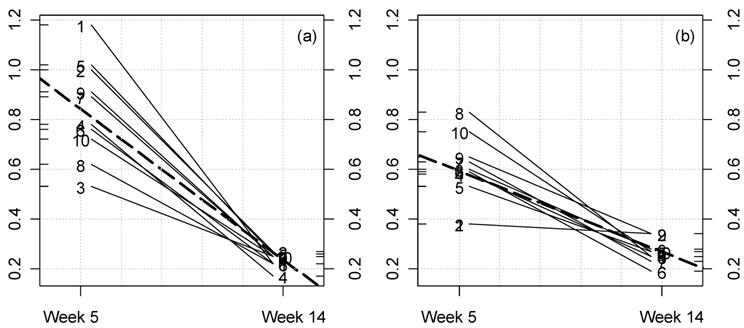
Generally speaking, statistical significance from data like this is not going to be very convincing to a critical observer. The NK603 creatinine clearance result is interesting, but probably a laboratory artifact, given the direction of the change. My biggest complaint with this analysis is, this is an easy, fast, cheap experiment for which you could easily get a grant to do on a larger sample. If they think they've found an effect, they should repeat it in a larger sample, and the world will beat a path to their door if it replicates the claimed effect. If they were really convinced by the correlations they claim, that's what they would be doing. They haven't published such a result, yet, and that makes me very suspicious. I have not yet read it carefully, but this meta-analysis by them of multiple feeding studies suggests that they are not working on such an experiment, and also suggests that the combined data in the meta-analysis does not support the claim they made in the 2009 paper:
The 90-day-long tests are insufficient to evaluate chronic toxicity, and the signs highlighted in the kidneys and livers could be the onset of chronic diseases.It's easy to create a statistical "effect" by choosing the right test to do. Much harder to use statistics to guide you in assessing the strength of your inferences, as it's intended to be used.
posted by Coventry at 5:39 PM on July 14, 2011 [4 favorites]
From the FAQ Mek linked to:
How does Greenpeace expect CSIRO to test for health risks if they don’t test it on humans?
It is never safe to test GM products on humans, because GM crops are subject to unexpected and unpredictable results. That means that no amount of preliminary testing can guarantee the ongoing safety of GM products.
Snort.
posted by smoke at 5:39 PM on July 14, 2011
How does Greenpeace expect CSIRO to test for health risks if they don’t test it on humans?
It is never safe to test GM products on humans, because GM crops are subject to unexpected and unpredictable results. That means that no amount of preliminary testing can guarantee the ongoing safety of GM products.
Snort.
posted by smoke at 5:39 PM on July 14, 2011
arrest them and sentence them to a public televised quiz on GMOs, so that their ignorance will be made patently clear to everyone. it would be the ultimate anti-propaganda.
That might backfire on you, as you might find that the Greenpeace activists are much more knowledgeable than you think. But jmegawarne, in the absence of your suggested "televised quiz", you might want to read the link that appears in the comment just above yours. It does essentially what you suggest.
posted by flapjax at midnite at 5:41 PM on July 14, 2011
That might backfire on you, as you might find that the Greenpeace activists are much more knowledgeable than you think. But jmegawarne, in the absence of your suggested "televised quiz", you might want to read the link that appears in the comment just above yours. It does essentially what you suggest.
posted by flapjax at midnite at 5:41 PM on July 14, 2011
I also liked this part of the Greenpeace Q&A linked by mek:
The CSIRO is working with foreign GM companies to release unsafe GM wheat into our food supply.
I hate sounding like LiB, but why is it relevant that those companies are "foreign"? Also, the whole point of the experiments is preventing that unsafe GM wheat be released into the food supply. Greenpeace implies that the result of the research was already decided. This is a very serious accusation, do they have any evidence?
The whole Q&A has a very low science and a very high fake outrage content. This action was either a very misguided or a very cynical exercise: the advantage of attacking such public bodies as CSIRO is that, unlike corporations with large PR departments, they rarely have the means (or even the authorization) to fight back in a PR battle.
posted by Skeptic at 5:53 PM on July 14, 2011 [1 favorite]
The CSIRO is working with foreign GM companies to release unsafe GM wheat into our food supply.
I hate sounding like LiB, but why is it relevant that those companies are "foreign"? Also, the whole point of the experiments is preventing that unsafe GM wheat be released into the food supply. Greenpeace implies that the result of the research was already decided. This is a very serious accusation, do they have any evidence?
The whole Q&A has a very low science and a very high fake outrage content. This action was either a very misguided or a very cynical exercise: the advantage of attacking such public bodies as CSIRO is that, unlike corporations with large PR departments, they rarely have the means (or even the authorization) to fight back in a PR battle.
posted by Skeptic at 5:53 PM on July 14, 2011 [1 favorite]
Flapjax: If you don't mind, could you outline what environmental and safety trials would have to be done so that you, personally, would be willing to endorse use of the GM plant? I'm curious what your standards are.
posted by benzenedream at 6:01 PM on July 14, 2011
posted by benzenedream at 6:01 PM on July 14, 2011
Flapjax: If you don't mind, could you outline what environmental and safety trials would have to be done so that you, personally, would be willing to endorse use of the GM plant? I'm curious what your standards are.
Testing that lasts much longer than a few months, for starters. The linked article states, for example, that animal trials have been underway for a scant three months. The start for human trials, the article says, is about six months away. I maintain that what we are dealing with in modern-day GMO technology is simply way, waaaaay too unknown, with way too many variables that we as yet have no way of truly understanding, that I think we'd need to look at years of human "testing". Which is impracticable, of course, from a business point of view. Which leads me to my next point (and here is where I will most surely diverge sharply and irrevocably from many of you in this thread), which is:
GMO should be banned, period. End.
Now, any of you who want to call me a moron, imbecile, luddite, ANTI-SCIENCE, whatever... hey, knock yourselves out!
posted by flapjax at midnite at 6:14 PM on July 14, 2011
Testing that lasts much longer than a few months, for starters. The linked article states, for example, that animal trials have been underway for a scant three months. The start for human trials, the article says, is about six months away. I maintain that what we are dealing with in modern-day GMO technology is simply way, waaaaay too unknown, with way too many variables that we as yet have no way of truly understanding, that I think we'd need to look at years of human "testing". Which is impracticable, of course, from a business point of view. Which leads me to my next point (and here is where I will most surely diverge sharply and irrevocably from many of you in this thread), which is:
GMO should be banned, period. End.
Now, any of you who want to call me a moron, imbecile, luddite, ANTI-SCIENCE, whatever... hey, knock yourselves out!
posted by flapjax at midnite at 6:14 PM on July 14, 2011
SO WE'RE GOING TO COMMIT VIOLENCE AGAINST HUMANS WHO LIVE IN THAT NATURE!!!"
um, that's a lie.
This thread is full of Monsanto's talking points.
posted by eustatic at 6:16 PM on July 14, 2011 [1 favorite]
um, that's a lie.
This thread is full of Monsanto's talking points.
posted by eustatic at 6:16 PM on July 14, 2011 [1 favorite]
This thread is full of Monsanto's talking points.
Yes, and that is sad. Stupid crap like this Greenpeace stunt lends legitimacy to Monsanto's odious position.
posted by His thoughts were red thoughts at 6:26 PM on July 14, 2011 [1 favorite]
Yes, and that is sad. Stupid crap like this Greenpeace stunt lends legitimacy to Monsanto's odious position.
posted by His thoughts were red thoughts at 6:26 PM on July 14, 2011 [1 favorite]
It's pretty simple to understand why GM food should be tested at least as thoroughly as medicine is - you're going to be injesting it daily for years, and it's never been done before, so the health risks and benefits are unknown without testing. Again and again we have seen insufficient testing of medicines resulting in the too-late discovery of terrible unexpected side-effects.
The added complication is that GM food, unlike medicine, can contaminate existing crops while it is being field tested, which was Greenpeace's primary concern here. This stuff is self-propagating. So we could spend a lot of time doing these experiments and determine that GM wheat strain X is cancer-causing in 3% of the experimental group over a 10-year period, and so ban the sale of it. But whoops, during that 10-year period strain X drifted out of our field test and the modified gene that caused cancer in our experimental group is now present in 33% of Australia's wheat crop.
Moreover, the entire concept of "nutrient-enhanced" GM crops is extremely suspect, given our poor and constantly-revised scientific model of nutrition.
posted by mek at 6:29 PM on July 14, 2011 [3 favorites]
The added complication is that GM food, unlike medicine, can contaminate existing crops while it is being field tested, which was Greenpeace's primary concern here. This stuff is self-propagating. So we could spend a lot of time doing these experiments and determine that GM wheat strain X is cancer-causing in 3% of the experimental group over a 10-year period, and so ban the sale of it. But whoops, during that 10-year period strain X drifted out of our field test and the modified gene that caused cancer in our experimental group is now present in 33% of Australia's wheat crop.
Moreover, the entire concept of "nutrient-enhanced" GM crops is extremely suspect, given our poor and constantly-revised scientific model of nutrition.
posted by mek at 6:29 PM on July 14, 2011 [3 favorites]
This thread is full of Monsanto's talking points.I'm no friend of Monsanto, I'm thinking for myself. Please take my comments on their own terms.
posted by Coventry at 6:32 PM on July 14, 2011 [1 favorite]
But whoops, during that 10-year period strain X drifted out of our field test and the modified gene that caused cancer in our experimental group is now present in 33% of Australia's wheat crop.
Thank you. Thank you very much. This is exactly where analogies like 'hammers in and of themselves are not dangerous' and 'technology is neutral' and 'all science is progress' completely fall apart.
But it's the steadfast belief in science itself, period, end of discussion, that had people being sprayed with DDT in the 50s, in chemical company propaganda films, while some voiceover said "Look! It's perfectly safe!". And a thousand other similar examples. Why are there still so many people unable to admit or grasp that many new technologies are in fact potentially very, very bad? And that, at the very least may need a few more brakes applied here and there?
posted by flapjax at midnite at 6:46 PM on July 14, 2011
Thank you. Thank you very much. This is exactly where analogies like 'hammers in and of themselves are not dangerous' and 'technology is neutral' and 'all science is progress' completely fall apart.
But it's the steadfast belief in science itself, period, end of discussion, that had people being sprayed with DDT in the 50s, in chemical company propaganda films, while some voiceover said "Look! It's perfectly safe!". And a thousand other similar examples. Why are there still so many people unable to admit or grasp that many new technologies are in fact potentially very, very bad? And that, at the very least may need a few more brakes applied here and there?
posted by flapjax at midnite at 6:46 PM on July 14, 2011
Yes, and that is sad. Stupid crap like this Greenpeace stunt lends legitimacy to Monsanto's odious position.
Yes, because if we're not on the side of a bunch of misguided environmental acitvists spewing half-thought out talking points we're on the side of the corporaitons.
I WANT genetically modified food. I want everything that can be modified modified. I want plants, animals, and humans themselves alter so that they can best serve humanity. There may be mistakes, and there may be errors, but the benefits outweigh the risks.
posted by Lovecraft In Brooklyn at 6:48 PM on July 14, 2011
Yes, because if we're not on the side of a bunch of misguided environmental acitvists spewing half-thought out talking points we're on the side of the corporaitons.
I WANT genetically modified food. I want everything that can be modified modified. I want plants, animals, and humans themselves alter so that they can best serve humanity. There may be mistakes, and there may be errors, but the benefits outweigh the risks.
posted by Lovecraft In Brooklyn at 6:48 PM on July 14, 2011
It's pretty simple to understand why GM food should be tested at least as thoroughly as medicine is - you're going to be injesting it daily for years, and it's never been done before, so the health risks and benefits are unknown without testing.For some GM foods, you're right, but this should be evaluated on a case-by-case basis. If the engineering has induced expression of well-understood, low-risk compounds, as appears to be the case in the CSIRO trial, that reasoning doesn't apply. If it's induced poorly understood, potentially high-risk compounds like pesticides or bacterial homologs to plant enzymes (like the Monsanto corn lines), your caution makes sense. It does take a modest intellectual effort to draw this distinction (you have to actually look at each case), but that thinking would cost Greenpeace a lot less than their current simplistic position does. By ignoring this distinction, they are diluting their efforts and discrediting their position.
posted by Coventry at 6:49 PM on July 14, 2011 [3 favorites]
Flapjax and Mek, your comments aren't separating the argument against GMO with the actions taken by GreenPeace.
I may be against GMO and completely for banning it (I'm not, but I could be, I'm not a huge fan, per se), but what GreenPeace did was wrong, ignorant, and unhelpful. All it means is that the fences of the next trial paddock will be higher and its location remoter. Good one guys, really kicked some goals there.
This is what I hate about their feel-good activism. Real activism is about effecting change, not taking your bat and ball and going home. They took the easy way out.
posted by smoke at 6:51 PM on July 14, 2011 [3 favorites]
I may be against GMO and completely for banning it (I'm not, but I could be, I'm not a huge fan, per se), but what GreenPeace did was wrong, ignorant, and unhelpful. All it means is that the fences of the next trial paddock will be higher and its location remoter. Good one guys, really kicked some goals there.
This is what I hate about their feel-good activism. Real activism is about effecting change, not taking your bat and ball and going home. They took the easy way out.
posted by smoke at 6:51 PM on July 14, 2011 [3 favorites]
...but the benefits outweigh the risks.
This is nothing more than an opinion, with absolutely no way of determining its veracity, given that the risks are as yet largely not understood. However, early evidence is beginning to point toward very real risks that may in time prove to dramatically outweigh benefits.
posted by flapjax at midnite at 6:53 PM on July 14, 2011
This is nothing more than an opinion, with absolutely no way of determining its veracity, given that the risks are as yet largely not understood. However, early evidence is beginning to point toward very real risks that may in time prove to dramatically outweigh benefits.
posted by flapjax at midnite at 6:53 PM on July 14, 2011
Flapjax, I think we agree that GM food is dangerous, and requires extensive testing before it can be deemed 'safe'. If that cannot happen, then people shouldn't be eating GM food.
We are now arguing sematics.
This is exactly where analogies like 'hammers in and of themselves are not dangerous' and 'technology is neutral' and 'all science is progress' completely fall apart.
It really isn't. Technology is netural =/= all science is progress. In fact, they are diametrically opposed.
People being sprayed with DDT in the 50s would not have happened if they did sufficient testing, which they didn't. Using untested technology without considering the risks is stupid. It was (IMO) a bad use of a new technology.
posted by His thoughts were red thoughts at 6:56 PM on July 14, 2011 [1 favorite]
We are now arguing sematics.
This is exactly where analogies like 'hammers in and of themselves are not dangerous' and 'technology is neutral' and 'all science is progress' completely fall apart.
It really isn't. Technology is netural =/= all science is progress. In fact, they are diametrically opposed.
People being sprayed with DDT in the 50s would not have happened if they did sufficient testing, which they didn't. Using untested technology without considering the risks is stupid. It was (IMO) a bad use of a new technology.
posted by His thoughts were red thoughts at 6:56 PM on July 14, 2011 [1 favorite]
There may be mistakes, and there may be errors, but the benefits outweigh the risks.
Sez you.
But the 'mistakes' and 'errors' in this instance are peoples lives, and the health of the environment. Not something you want to mess about with. You seem very eager to sacrifice the lives of strangers so you can get your bat wings.
posted by His thoughts were red thoughts at 7:02 PM on July 14, 2011 [4 favorites]
Sez you.
But the 'mistakes' and 'errors' in this instance are peoples lives, and the health of the environment. Not something you want to mess about with. You seem very eager to sacrifice the lives of strangers so you can get your bat wings.
posted by His thoughts were red thoughts at 7:02 PM on July 14, 2011 [4 favorites]
Flapjax and Mek, your comments aren't separating the argument against GMO with the actions taken by GreenPeace.
I'm not defending Greenpeace nor do I intend to. I'm not calling for their heads, either. I'm just trying to explain the nuances of the GMO controversy so we can get beyond the lol-hippies level of discussion. At mefi the "anti-GM community" tends to get lumped in with anti-vacciners and other genuine Luddites, which is unfortunate, because it's actually the site of some sophisticated skepticism and controversial science.
It does take a modest intellectual effort to draw this distinction (you have to actually look at each case), but that thinking would cost Greenpeace a lot less than their current simplistic position does. By ignoring this distinction, they are diluting their efforts and discrediting their position.
This is the strongest argument so far in this thread. Unfortunately it overlooks the fact that Greenpeace did in fact try to do due diligence here, but their freedom of information requests were rejected by the CSIRO as too burdensome. If that information had been made public, it's quite possible they would have not done what they did. I think we can all agree that maintaining transparency in government organizations like this is essential for the public trust, yes? Given the timeline here, where Greenpeace's requests were rejected only last week, I imagine they decided on direct action as a last resort.
posted by mek at 7:11 PM on July 14, 2011 [4 favorites]
I'm not defending Greenpeace nor do I intend to. I'm not calling for their heads, either. I'm just trying to explain the nuances of the GMO controversy so we can get beyond the lol-hippies level of discussion. At mefi the "anti-GM community" tends to get lumped in with anti-vacciners and other genuine Luddites, which is unfortunate, because it's actually the site of some sophisticated skepticism and controversial science.
It does take a modest intellectual effort to draw this distinction (you have to actually look at each case), but that thinking would cost Greenpeace a lot less than their current simplistic position does. By ignoring this distinction, they are diluting their efforts and discrediting their position.
This is the strongest argument so far in this thread. Unfortunately it overlooks the fact that Greenpeace did in fact try to do due diligence here, but their freedom of information requests were rejected by the CSIRO as too burdensome. If that information had been made public, it's quite possible they would have not done what they did. I think we can all agree that maintaining transparency in government organizations like this is essential for the public trust, yes? Given the timeline here, where Greenpeace's requests were rejected only last week, I imagine they decided on direct action as a last resort.
posted by mek at 7:11 PM on July 14, 2011 [4 favorites]
I WANT genetically modified food. I want everything that can be modified modified. I want plants, animals, and humans themselves alter so that they can best serve humanity. There may be mistakes, and there may be errors, but the benefits outweigh the risks.
And when the human vs transhuman war comes, it's the bat-winged freaks we'll hunt down first.
And we will point to all the poisoned land and stillborn mutant babies and indegestible plants we used to grow as food when they ask why we've been driven into rage at
When the haemonculus class ask "Why", we'll scream "THE PRICE OF YOUR BAT WINGS WAS TOO HIGH AND WE HAD TO PAY!"
Long before y'all have gotten the laser-eyes thing figured out, while you're still tweaking the biomechanics of your new toys, we'll already have sticks and rocks and thousands of generations of understanding of how push-ups work.
posted by Pirate-Bartender-Zombie-Monkey at 7:27 PM on July 14, 2011 [2 favorites]
And when the human vs transhuman war comes, it's the bat-winged freaks we'll hunt down first.
And we will point to all the poisoned land and stillborn mutant babies and indegestible plants we used to grow as food when they ask why we've been driven into rage at
When the haemonculus class ask "Why", we'll scream "THE PRICE OF YOUR BAT WINGS WAS TOO HIGH AND WE HAD TO PAY!"

Long before y'all have gotten the laser-eyes thing figured out, while you're still tweaking the biomechanics of your new toys, we'll already have sticks and rocks and thousands of generations of understanding of how push-ups work.

posted by Pirate-Bartender-Zombie-Monkey at 7:27 PM on July 14, 2011 [2 favorites]
Thanks, mek. That was interesting. The details are confusing, though. Why didn't Greenpeace come back with a request all CSIRO documents pertaining to all nutritional tests of GM food (rather than the test in progress?) Did the ''documents that related to a project CSIRO was undertaking on a commercial footing'' which CSIRO suggested they remove from the request pertain to the test in progress?
posted by Coventry at 7:30 PM on July 14, 2011
This Thursday, Greenpeace will issue a report detailing a scathing assessment of the trial program, and labelling the partnership between the CSIRO and international GM companies ''clear potential conflict of interest''.That was Thursday of last week. Is the report out? It sounds interesting.
posted by Coventry at 7:30 PM on July 14, 2011
Unfortunately it overlooks the fact that Greenpeace did in fact try to do due diligence here, but their freedom of information requests were rejected by the CSIRO as too burdensome.
The Freedom of Information Act 1982 (Cth) provides for appeals and reviews (at a number of levels, including by the FOI Commissioner) of decisions relating to FOI requests.
Greenpeace got rejected at the first hurdle, then decided to not avail themselves of the numerous lawful options available to them to get the information - instead, they went straight for the vandalism.
Did they try to do their due dilligence? Yes, but not very hard.
posted by His thoughts were red thoughts at 7:35 PM on July 14, 2011 [2 favorites]
The Freedom of Information Act 1982 (Cth) provides for appeals and reviews (at a number of levels, including by the FOI Commissioner) of decisions relating to FOI requests.
Greenpeace got rejected at the first hurdle, then decided to not avail themselves of the numerous lawful options available to them to get the information - instead, they went straight for the vandalism.
Did they try to do their due dilligence? Yes, but not very hard.
posted by His thoughts were red thoughts at 7:35 PM on July 14, 2011 [2 favorites]
Coventry, I think the report referred to is the document downloadable from this page: Australia's wheat scandal.
posted by mek at 7:37 PM on July 14, 2011 [1 favorite]
posted by mek at 7:37 PM on July 14, 2011 [1 favorite]
Greenpeace felt there was a short time limit before the DNA could spread (accidentally or not) and they wanted to bring public attention to the problem ASAP before damage was done.
posted by stbalbach at 7:44 PM on July 14, 2011 [2 favorites]
posted by stbalbach at 7:44 PM on July 14, 2011 [2 favorites]
Last time I checked humans have been genetically modifying organisms for at least 15,000 years.
Craig Venter in 2007 or so created the first 100% artificial life, only the second time in 5 billion years on Earth that life has arisen from inanimate chemicals. There are some quibbles about if it was truly artificial but the genie is out, in our lifetimes we will see people designing life on a computer and then pushing the "birth" button. These debates about GMO are nothing compared to where we are soon headed, in terms of possibilities and dangers. So put aside history as a guide, this is totally new territory. Well, if history is any guide, there will be great leaps forward, and horrific unintended consequences. Let's hope we survive it.
posted by stbalbach at 8:27 PM on July 14, 2011 [1 favorite]
Craig Venter in 2007 or so created the first 100% artificial life, only the second time in 5 billion years on Earth that life has arisen from inanimate chemicals. There are some quibbles about if it was truly artificial but the genie is out, in our lifetimes we will see people designing life on a computer and then pushing the "birth" button. These debates about GMO are nothing compared to where we are soon headed, in terms of possibilities and dangers. So put aside history as a guide, this is totally new territory. Well, if history is any guide, there will be great leaps forward, and horrific unintended consequences. Let's hope we survive it.
posted by stbalbach at 8:27 PM on July 14, 2011 [1 favorite]
Greenpeace felt there was a short time limit before the DNA could spread (accidentally or not) and they wanted to bring public attention to the problem ASAP before damage was done.
Bingo. And to those upthread talking about the 'proper channels' and 'due process' and all, well, that is, I'd say, generally correct, but there are some issues where the problem requires speedier and more direct action than that. I mean, to revisit my earlier analogy of the "back of the bus", there were any number of people at the dawn of the American civil rights era who suggested that what Rosa Parks did, and the lunch counter sit-ins and the marches and such were illegal, and therefore doing a disservice to the black community, and therefore rendering their message invalid or hurting their own cause. But urgent measures were required, and urgent measures were taken. It's called civil disobedience, and it has a long and proud tradition.
Always going back to the simple argument that a protest action is against the law, and that protests should always, without exception, work completely within the limits of the law ignores that proud tradition and shows a distinct lack of understanding of political realities and the genuine need for protest actions to sometimes step outside the boundaries of the law. For, as we know, the law is all too often at the service of elite, monied interests and the governments they support, and not at the service of the true common good.
posted by flapjax at midnite at 8:30 PM on July 14, 2011
Bingo. And to those upthread talking about the 'proper channels' and 'due process' and all, well, that is, I'd say, generally correct, but there are some issues where the problem requires speedier and more direct action than that. I mean, to revisit my earlier analogy of the "back of the bus", there were any number of people at the dawn of the American civil rights era who suggested that what Rosa Parks did, and the lunch counter sit-ins and the marches and such were illegal, and therefore doing a disservice to the black community, and therefore rendering their message invalid or hurting their own cause. But urgent measures were required, and urgent measures were taken. It's called civil disobedience, and it has a long and proud tradition.
Always going back to the simple argument that a protest action is against the law, and that protests should always, without exception, work completely within the limits of the law ignores that proud tradition and shows a distinct lack of understanding of political realities and the genuine need for protest actions to sometimes step outside the boundaries of the law. For, as we know, the law is all too often at the service of elite, monied interests and the governments they support, and not at the service of the true common good.
posted by flapjax at midnite at 8:30 PM on July 14, 2011
For, as we know, the law is all too often at the service of elite, monied interests and the governments they support, and not at the service of the true common good.
Its possible that mobile phone towers might cause cancer, and we know that all the mobile phone companies are rich international conglomerates. Therefore, its justified to smash mobile phone towers. Those ships in the harbour? They might be transporting cows to Indonesia to be tortured! Your computer is built by slave labour out of environmentally unsafe components! Airplanes? Disturbing migratory bird patterns!
We must stop all of them.
I've thought about this as hard as you have, only in my version it's a combination Wicker Man nightmare and a technothriller.
posted by Lovecraft In Brooklyn at 8:41 PM on July 14, 2011
Its possible that mobile phone towers might cause cancer, and we know that all the mobile phone companies are rich international conglomerates. Therefore, its justified to smash mobile phone towers. Those ships in the harbour? They might be transporting cows to Indonesia to be tortured! Your computer is built by slave labour out of environmentally unsafe components! Airplanes? Disturbing migratory bird patterns!
We must stop all of them.
I've thought about this as hard as you have, only in my version it's a combination Wicker Man nightmare and a technothriller.
posted by Lovecraft In Brooklyn at 8:41 PM on July 14, 2011
The Hazmat suits were a smart move. Some of the newer hippie-resistant strains have agents in them that can burn straight through a fair trade hemp t-shirt.
posted by abcde at 8:41 PM on July 14, 2011 [1 favorite]
posted by abcde at 8:41 PM on July 14, 2011 [1 favorite]
I've thought about this as hard as you have
It's clearly apparent that you have done no such thing.
posted by His thoughts were red thoughts at 8:42 PM on July 14, 2011 [1 favorite]
It's clearly apparent that you have done no such thing.
posted by His thoughts were red thoughts at 8:42 PM on July 14, 2011 [1 favorite]
It's clearly apparent that you have done no such thing.
I'm not the one justifying terrorist action against government scientific facilities.
The Hazmat suits were a smart move. Some of the newer hippie-resistant strains have agents in them that can burn straight through a fair trade hemp t-shirt.
I'll add that to my novel notes. My main problem has been figuring out how to give the heroes laser guns.
posted by Lovecraft In Brooklyn at 8:44 PM on July 14, 2011
I'm not the one justifying terrorist action against government scientific facilities.
The Hazmat suits were a smart move. Some of the newer hippie-resistant strains have agents in them that can burn straight through a fair trade hemp t-shirt.
I'll add that to my novel notes. My main problem has been figuring out how to give the heroes laser guns.
posted by Lovecraft In Brooklyn at 8:44 PM on July 14, 2011
Bingo. And to those upthread talking about the 'proper channels' and 'due process' and all, well, that is, I'd say, generally correct, but there are some issues where the problem requires speedier and more direct action than that.
The application I posted upthread stated that the proposed release dates were July 2009- June 2012.
The media reports quote the CSIRO as claiming the resultant setback may be up to a year.
The video shows some fairly mature wheat.
It looks to me like the test crop was planted some time ago, maybe up to a year ago. Why was it suddenly so urgent now?
Maybe because it doesn't look so good on film to burn what appears to be an empty field. Maybe because a successful FOI request isn't as big a media splash.
But because the precise timing was necessary to protect the biosphere? I don't think so. Even if that was the case, tramping in on foot, then tramping out again, carrying all that biomass and seed on your boots past the 500m buffer zone would be a silly thing to do, wouldn't it?
posted by His thoughts were red thoughts at 8:53 PM on July 14, 2011 [1 favorite]
The application I posted upthread stated that the proposed release dates were July 2009- June 2012.
The media reports quote the CSIRO as claiming the resultant setback may be up to a year.
The video shows some fairly mature wheat.
It looks to me like the test crop was planted some time ago, maybe up to a year ago. Why was it suddenly so urgent now?
Maybe because it doesn't look so good on film to burn what appears to be an empty field. Maybe because a successful FOI request isn't as big a media splash.
But because the precise timing was necessary to protect the biosphere? I don't think so. Even if that was the case, tramping in on foot, then tramping out again, carrying all that biomass and seed on your boots past the 500m buffer zone would be a silly thing to do, wouldn't it?
posted by His thoughts were red thoughts at 8:53 PM on July 14, 2011 [1 favorite]
We must stop all of them.
Never said any such thing. But, please, do continue in this vein, for it's really helping everyone to understand how childish and irrational your thinking is on this subject.
batwings! batwings!
posted by flapjax at midnite at 8:57 PM on July 14, 2011
Never said any such thing. But, please, do continue in this vein, for it's really helping everyone to understand how childish and irrational your thinking is on this subject.
batwings! batwings!
posted by flapjax at midnite at 8:57 PM on July 14, 2011
For, as we know, the law is all too often at the service of elite, monied interests and the governments they support, and not at the service of the true common good.
This is all very noble, but you're using it to justify action against a government lab.
posted by Lovecraft In Brooklyn at 9:01 PM on July 14, 2011
This is all very noble, but you're using it to justify action against a government lab.
posted by Lovecraft In Brooklyn at 9:01 PM on July 14, 2011
OK, full disclosure, I'm a city boy and don't know what fully grown wheat looks like.
This is what Greenpeace cut down.
Sorry about that. Presumably it's a year's worth of work because they have to wait until next year to replant in the right season.
posted by His thoughts were red thoughts at 9:01 PM on July 14, 2011

This is what Greenpeace cut down.

Sorry about that. Presumably it's a year's worth of work because they have to wait until next year to replant in the right season.
posted by His thoughts were red thoughts at 9:01 PM on July 14, 2011
This is all very noble, but you're using it to justify action against a government lab.
Since when did the fact that you're protesting government actions or programs mean that civil disobedience and direct action is unjustified? I mean, it's almost always against governments, in case you hadn't noticed.
posted by flapjax at midnite at 9:11 PM on July 14, 2011
Since when did the fact that you're protesting government actions or programs mean that civil disobedience and direct action is unjustified? I mean, it's almost always against governments, in case you hadn't noticed.
posted by flapjax at midnite at 9:11 PM on July 14, 2011
Since when did the fact that you're protesting government actions or programs mean that civil disobedience and direct action is unjustified? I mean, it's almost always against governments, in case you hadn't noticed.
These are scientists experimenting on wheat. They're not experimenting on humans. They're not even experimenting on animals, since that seems to bother some people. They're working on healthier wheat to grow in our desert climate.
posted by Lovecraft In Brooklyn at 9:34 PM on July 14, 2011
LiB, if you actually read the questions posed to you, and answer those questions instead of the ones you seems to be making up in your head, the thread will make a lot more sense.
posted by His thoughts were red thoughts at 9:40 PM on July 14, 2011
posted by His thoughts were red thoughts at 9:40 PM on July 14, 2011
They're not experimenting on humans. They're not even experimenting on animals, since that seems to bother some people. They're working on healthier wheat to grow in our desert climate.
You are, in addition to everything else, wrong on all counts here. From this link:
The intention was to produce a grain with higher starch content which would contribute to greater dietary fibre intake, thus improving nutrition and digestive bowel health.
Once the crop was harvested it was to be fed to rats and pigs in controlled laboratory experiments to determine whether the altered grains do, in fact, possess different nutritional properties.
It was also to be fed to a small group of volunteers as part of a controlled nutritional study. However, no material from the trial was to enter the commercial food or feed supply chain.
posted by His thoughts were red thoughts at 9:43 PM on July 14, 2011 [1 favorite]
You are, in addition to everything else, wrong on all counts here. From this link:
The intention was to produce a grain with higher starch content which would contribute to greater dietary fibre intake, thus improving nutrition and digestive bowel health.
Once the crop was harvested it was to be fed to rats and pigs in controlled laboratory experiments to determine whether the altered grains do, in fact, possess different nutritional properties.
It was also to be fed to a small group of volunteers as part of a controlled nutritional study. However, no material from the trial was to enter the commercial food or feed supply chain.
posted by His thoughts were red thoughts at 9:43 PM on July 14, 2011 [1 favorite]
...the thread will make a lot more sense.
I'm starting to wonder if making sense is what some folks here are really after. Honestly, the level of discourse is falling very, very low around these parts lately.
By contrast, I'd like to thank you for your thoughtful and reasoned contributions here, red thoughts, for although there are certainly points on which we disagree, at least you are actually trying to remain focussed and cogent. But I gotta bow out of this thread, at least for awhile, cause I'm talking to some people here who honestly just aren't equipped to carry on a lucid conversation.
posted by flapjax at midnite at 9:48 PM on July 14, 2011
I'm starting to wonder if making sense is what some folks here are really after. Honestly, the level of discourse is falling very, very low around these parts lately.
By contrast, I'd like to thank you for your thoughtful and reasoned contributions here, red thoughts, for although there are certainly points on which we disagree, at least you are actually trying to remain focussed and cogent. But I gotta bow out of this thread, at least for awhile, cause I'm talking to some people here who honestly just aren't equipped to carry on a lucid conversation.
posted by flapjax at midnite at 9:48 PM on July 14, 2011
But I gotta bow out of this thread, at least for awhile, cause I'm talking to some people here who honestly just aren't equipped to carry on a lucid conversation.
Ditto. Catch you 'round the traps.
posted by His thoughts were red thoughts at 9:51 PM on July 14, 2011
Ditto. Catch you 'round the traps.
posted by His thoughts were red thoughts at 9:51 PM on July 14, 2011
Once the crop was harvested it was to be fed to rats and pigs in controlled laboratory experiments to determine whether the altered grains do, in fact, possess different nutritional properties.
It was also to be fed to a small group of volunteers as part of a controlled nutritional study. However, no material from the trial was to enter the commercial food or feed supply chain.
I'm still okay with this
posted by Lovecraft In Brooklyn at 10:03 PM on July 14, 2011
Greenpeace felt there was a short time limit before the DNA could spread (accidentally or not) and they wanted to bring public attention to the problem ASAP before damage was done.Maybe they felt there was a risk of that, but if so they could have looked at the empirical evidence. See page 2 of the report, which details the precautions they took to prevent cross-contamination in this experiment. According to slide 9 of the first link, wheat pollen is heavy and is viable for only a few minutes. In addition, wheat is generally self-pollinating. For these reasons, you don't have to take many precautions to make cross fertilization extremely unlikely.
Not sure what you mean by "accidentally or not." Are you implying that there may have been a conspiracy to deliberately contaminate the Australian wheat gene pool with GMO variants? What would be the incentive?
I think the report referred to is the document downloadable from this page: Australia's wheat scandal.Thanks, I read the first six pages. Not very informative or convincing. Lots of sly insinuation, though, which is always fun.
posted by Coventry at 11:32 PM on July 14, 2011 [3 favorites]
OK, full disclosure here: I used to work for a public body which is regularly visited by Greenpeace-led demonstrations and other actions (not for anything that had the remotest link to my own line of work). So, after having regularly seen my former employer's not-particularly-professional spokepeople haplessly deal with people chanting slogans in stupid costumes to gain a few seconds of prime time TV coverage, I've come to the conclusion that Greenpeace are just a bunch of PR bullies.
Their aggressiveness towards public bodies is particularly galling when compared with how they schmooze the lawmakers that set the rules which those public bodies have to follow.
I also find it quite rich to see people in this thread complain about the shrillness of some of Greenpeace's critics. If Greenpeace was keen on rationale, considered discourse, it wouldn't pull this kind of stunt on a regular basis. It is however all too consistent with an organisation which depends on continued media exposure for its self-preservation.
posted by Skeptic at 1:42 AM on July 15, 2011 [1 favorite]
Their aggressiveness towards public bodies is particularly galling when compared with how they schmooze the lawmakers that set the rules which those public bodies have to follow.
I also find it quite rich to see people in this thread complain about the shrillness of some of Greenpeace's critics. If Greenpeace was keen on rationale, considered discourse, it wouldn't pull this kind of stunt on a regular basis. It is however all too consistent with an organisation which depends on continued media exposure for its self-preservation.
posted by Skeptic at 1:42 AM on July 15, 2011 [1 favorite]
"GRAR WE'RE AGAINST THIS!"
"Why?"
"GRAR IT HASN'T BEEN TESTED!"
"We're testing it now."
"GRAR THEY'RE TESTING IT!"
"But..."
"GRAR NOBODY CALLS ME STUPID!"
So 'dumb Mum'? You called it. Right on the fucking button. Nice of you to wear your real motivation on a t-shirt like that.
posted by obiwanwasabi at 2:28 AM on July 15, 2011 [2 favorites]
"Why?"
"GRAR IT HASN'T BEEN TESTED!"
"We're testing it now."
"GRAR THEY'RE TESTING IT!"
"But..."
"GRAR NOBODY CALLS ME STUPID!"
So 'dumb Mum'? You called it. Right on the fucking button. Nice of you to wear your real motivation on a t-shirt like that.
posted by obiwanwasabi at 2:28 AM on July 15, 2011 [2 favorites]
obiwanwasabi As several commenters in that link point out, the "Dumb Mum" is actually a Greenpeace employee ("Sidney Office Manager"). When corporations pull out that kind of stunt they are rightfully vilified, I don't know why Greenpeace should get a free pass for using employees in testimonials.
posted by Skeptic at 3:59 AM on July 15, 2011
posted by Skeptic at 3:59 AM on July 15, 2011
In retrospect, that joke probably came off a little mean spirited. I just liked the idea of GMO scientists getting fed up and putting in resistance factors for overzealous environmentalists. Didn't mean to imply that hippies are pests!
smoke: For what it's worth, Borlaug didn't actually use genetic engineering to produce any of his high-yield varieties, but he was a strong proponent of GMO as it came to the forefront in later decades.
posted by abcde at 10:14 AM on July 15, 2011
smoke: For what it's worth, Borlaug didn't actually use genetic engineering to produce any of his high-yield varieties, but he was a strong proponent of GMO as it came to the forefront in later decades.
posted by abcde at 10:14 AM on July 15, 2011
Monsanto-Resistant Weeds Take Root, Raising Food Prices
posted by homunculus at 11:07 AM on July 21, 2011 [2 favorites]
posted by homunculus at 11:07 AM on July 21, 2011 [2 favorites]
« Older CTRL-ALT-MEOW | Curiously useful things, courtesy of a breath mint Newer »
This thread has been archived and is closed to new comments
posted by Anonymous at 5:36 AM on July 14, 2011