Beauty, Virtue and Vice
September 30, 2011 9:01 PM Subscribe
Most of the prints in the exhibit "Beauty, Virtue and Vice: Images of Women in Nineteenth-Century American Prints" were designed simply to please the eye, but they are also useful to historians who would like to understand how nineteenth-century Americans thought about the world in which they lived. Although prints are often works of imagination (even when they are grounded in fact), they still have much to tell us about the time and place in which they were created.
Highlights from this online exhibit include:
True Womanhood — with a Map of the Open Country of a Woman's Heart. This map of a woman's heart tells us much about what the artist and his society believed about women. This illustration perfectly captures nineteenth-century ideas about womanhood.
Women as Objects of Beauty and Desire — Prints depicting beautiful women were often influenced by other forms of popular culture. Some of the finest prints produced in the United States were copies of admired European and American paintings. Print artists also created their own original representations of heroic characters from novels and theatrical presentations.
Ideal Beauty — Many nineteenth-century Americans believed that women had unique abilities, talents, and propensities that were natural attributes of their sex. Women were thought to be naturally dependent, nurturing, and well suited for domestic labor. Such ideas complemented the notion that men were defined by opposite characteristics, which included independence and bravery; strength of character, mind, and body; and a natural talent for mastery and dominance over their environments.
Threats to the Ideals of True Womanhood: Slavery — Slavery was almost unquestionably the most important issue of the nineteenth century. Women were frequently at the center when slavery debates were translated into visual images.
Highlights from this online exhibit include:
True Womanhood — with a Map of the Open Country of a Woman's Heart. This map of a woman's heart tells us much about what the artist and his society believed about women. This illustration perfectly captures nineteenth-century ideas about womanhood.
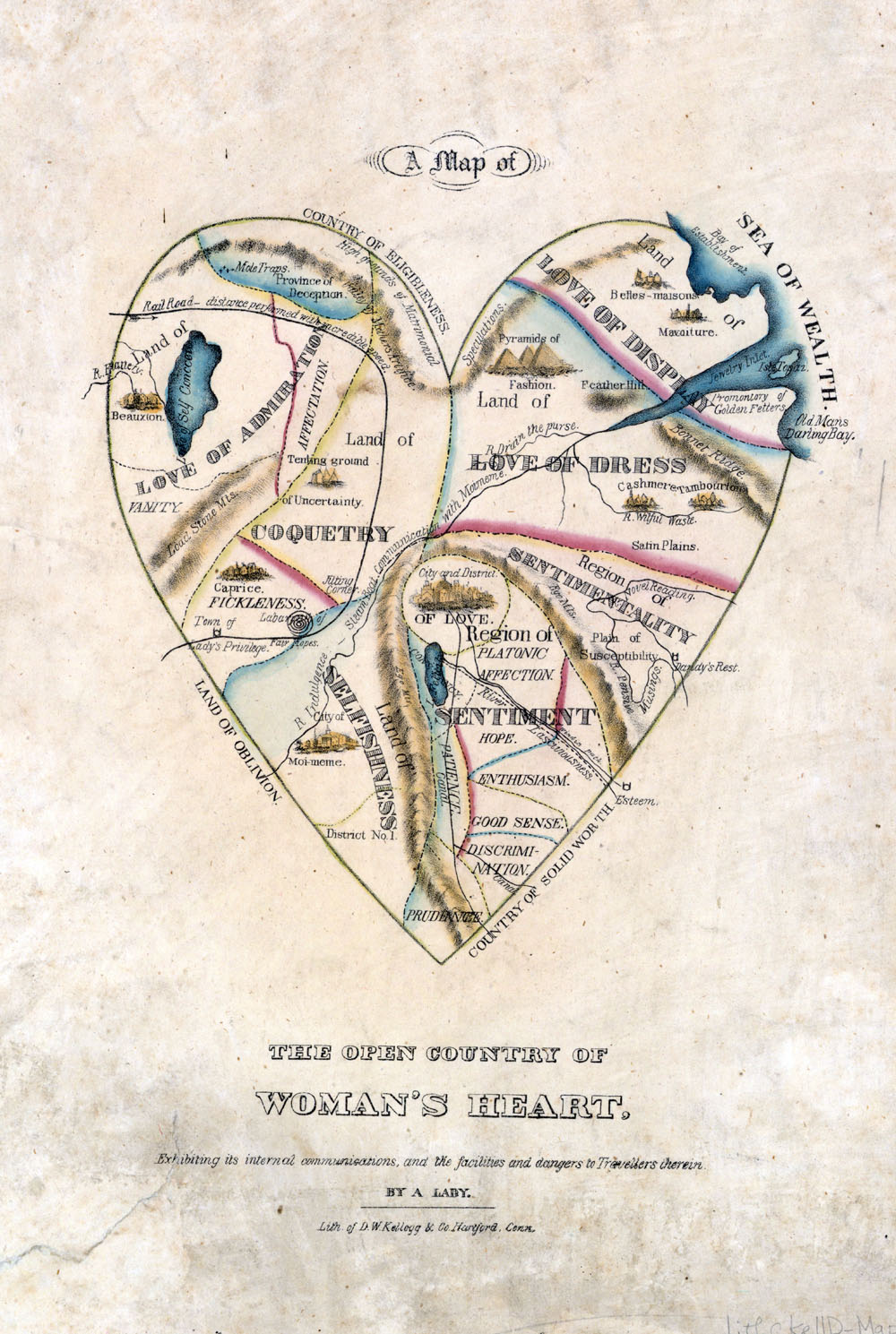
Women as Objects of Beauty and Desire — Prints depicting beautiful women were often influenced by other forms of popular culture. Some of the finest prints produced in the United States were copies of admired European and American paintings. Print artists also created their own original representations of heroic characters from novels and theatrical presentations.
Ideal Beauty — Many nineteenth-century Americans believed that women had unique abilities, talents, and propensities that were natural attributes of their sex. Women were thought to be naturally dependent, nurturing, and well suited for domestic labor. Such ideas complemented the notion that men were defined by opposite characteristics, which included independence and bravery; strength of character, mind, and body; and a natural talent for mastery and dominance over their environments.
Threats to the Ideals of True Womanhood: Slavery — Slavery was almost unquestionably the most important issue of the nineteenth century. Women were frequently at the center when slavery debates were translated into visual images.
Funny how that Map of the Open Country of a Woman's Heart reminded me of (a) the maps of Florin & Guilder in the Princess Bride (book) and (b) the Map of Human Sexuality. The common element, I suppose, being visual tour of elaborate fantasy lands.
posted by nakedcodemonkey at 10:32 PM on September 30, 2011 [1 favorite]
posted by nakedcodemonkey at 10:32 PM on September 30, 2011 [1 favorite]
I thought it was funny how the Map of the Open Country of a Woman's Heart includes a precisely-located 'friend zone'.
It does each generation good to re-learn that there's nothing new under the sun…
posted by Pinback at 10:47 PM on September 30, 2011 [2 favorites]
It does each generation good to re-learn that there's nothing new under the sun…
posted by Pinback at 10:47 PM on September 30, 2011 [2 favorites]
Good stuff, thanks. I like this idealised family group (particularly the jaunty moustache). This performance one is good too. And how wonderful to have a document certifying one as a member of the New England Female Moral Reform Society. And the Lion Queen is great. I'd never heard of Helen Potter, famous for her imitations of celebrities - this is all really interesting, thanks for posting.
posted by paduasoy at 1:12 AM on October 1, 2011


posted by paduasoy at 1:12 AM on October 1, 2011
Reading this, I felt a pang of being cheated out of the conventional babe status I could haveheld in the 19th century. Then, I read on:"pseudo -scientific notions that equated inner virtue with physical beauty and associated corrupted character with beauty’s absence".
So I guess once word got out that I was having extramarital sex out the wazoo and talking back, I'd be back to niche babe status. No escaping your fate!
posted by Lisitasan at 7:07 AM on October 1, 2011 [1 favorite]
So I guess once word got out that I was having extramarital sex out the wazoo and talking back, I'd be back to niche babe status. No escaping your fate!
posted by Lisitasan at 7:07 AM on October 1, 2011 [1 favorite]
"I thought it was funny how the Map of the Open Country of a Woman's Heart includes a precisely-located 'friend zone'."
I think I'll call it the Region of Platonic Affection too from now on, I like that.
posted by Blasdelb at 10:23 AM on October 1, 2011
I think I'll call it the Region of Platonic Affection too from now on, I like that.
posted by Blasdelb at 10:23 AM on October 1, 2011
I call it the Platons, as in "lost in the."
posted by wemayfreeze at 11:01 AM on October 1, 2011
posted by wemayfreeze at 11:01 AM on October 1, 2011
Say what you will about how Victorians screwed things such as up history, anthropology and economics, at least they had their sexism down cold.
posted by happyroach at 12:52 PM on October 1, 2011 [2 favorites]
posted by happyroach at 12:52 PM on October 1, 2011 [2 favorites]
« Older Fake | GlassPipes.org Newer »
This thread has been archived and is closed to new comments
posted by Katjusa Roquette at 9:59 PM on September 30, 2011