Tying it all together for those on the right
October 22, 2011 9:45 AM Subscribe
Karl Denninger (founding Tea Party member, origin of teabag idea, Obama-voter, supporter of OWS) breaks it down for his right wing readers: Even better, the press reaction, especially from the right wing, can be counted on to get this wrong and claim that the government had stolen capitalism. The truth is much simpler: The taxpayer was just plain robbed by the government and banks acting together.
Sorry, but I've heard this guy say too many things that are just way too batshit insane and wingnuttish to pay any more attention to him.
posted by mikeand1 at 10:29 AM on October 22, 2011 [2 favorites]
posted by mikeand1 at 10:29 AM on October 22, 2011 [2 favorites]
You know what annoys me the most about the Tea Party? They have no sense of history.
The original Boston Tea Party was not about taxation levied on the common man - it was about corporatism and tax writeoffs for companies. Due to boycotts, the East India Tea Company’s excess tea was being dumped on the colonies at near-cost prices to encourage consumption. The early revolutionaries didn’t want anyone breaking the boycott, so they scared dockmasters into not offloading the tea, then destroyed it on the ships in an early version of a false flag operation, disguised as Indians.
The Boston Tea Party was not called that for 50 years: it was simply referred to “the Destruction of the Tea”, and roundly condemned. Benjamin Franklin called the attack “a violent injustice” and offered to pay British East India Company for the loss personally, as did a number of non-loyalist businessmen from other cities. As a whole the event was considered so inconsequential at the time that the location of the “Boston Tea Party” is unknown, and the area has almost certainly been turned into landfill and paved over.
Given their moniker, what the Tea Party should be protesting is the corrupting influence of corporations on politics. What they should be demanding is the overturning of “money is speech” and the elimination of all collective campaign contributions to politicians, limiting donations to $5000 from each individual per campaign, matched with government funds. If they want truly independent politicians, support a public subsidy for anyone running as such.
Tea Partiers are not a “third party” - they are overwhelmingly white, xenophobic, middle class extremist Republicans who have been subject to a remarkable double hijacking, simultaneously co-opted by Republicans while taking over the party, regressing it 100 years to the period of the “Know Nothings”. They decry “big government” while having no idea of what government does for them, or how it benefits their lives. They, along with the rise of religious fundamentalists, have the majority of Republican candidates denying both global warming and evolution.... even Bush didn’t go that far.
They’re angry, because their comfortable middle-class existence has been hollowed out by the United States’ declining economic status since the 1970’s. They are terrified at the prospect of joining “those people” that they regard as being below them - immigrants and minorities - who are on track to become a demographic majority in the country.
If the Tea Party wanted to name themselves after a movement that is actually relevant to their goals, they could have used the Whiskey Rebellion: an insurrection against taxes levied by the US government to pay the costs of the Revolution won almost three decades previously. (The protest was particularly vigorous in states such as Virginia, which objected to contributing to the costs incurred by smaller, poorer former colonies in winning the revolution that had gained their freedom.) Of course, they won’t do that - the Whiskey Rebellion has far less “brand awareness”, in part because it was unsuccessful.
But heck, even I would be tempted to join an organisation named The Whiskey Party.
posted by Bora Horza Gobuchul at 10:32 AM on October 22, 2011 [168 favorites]
The original Boston Tea Party was not about taxation levied on the common man - it was about corporatism and tax writeoffs for companies. Due to boycotts, the East India Tea Company’s excess tea was being dumped on the colonies at near-cost prices to encourage consumption. The early revolutionaries didn’t want anyone breaking the boycott, so they scared dockmasters into not offloading the tea, then destroyed it on the ships in an early version of a false flag operation, disguised as Indians.
The Boston Tea Party was not called that for 50 years: it was simply referred to “the Destruction of the Tea”, and roundly condemned. Benjamin Franklin called the attack “a violent injustice” and offered to pay British East India Company for the loss personally, as did a number of non-loyalist businessmen from other cities. As a whole the event was considered so inconsequential at the time that the location of the “Boston Tea Party” is unknown, and the area has almost certainly been turned into landfill and paved over.
Given their moniker, what the Tea Party should be protesting is the corrupting influence of corporations on politics. What they should be demanding is the overturning of “money is speech” and the elimination of all collective campaign contributions to politicians, limiting donations to $5000 from each individual per campaign, matched with government funds. If they want truly independent politicians, support a public subsidy for anyone running as such.
Tea Partiers are not a “third party” - they are overwhelmingly white, xenophobic, middle class extremist Republicans who have been subject to a remarkable double hijacking, simultaneously co-opted by Republicans while taking over the party, regressing it 100 years to the period of the “Know Nothings”. They decry “big government” while having no idea of what government does for them, or how it benefits their lives. They, along with the rise of religious fundamentalists, have the majority of Republican candidates denying both global warming and evolution.... even Bush didn’t go that far.
They’re angry, because their comfortable middle-class existence has been hollowed out by the United States’ declining economic status since the 1970’s. They are terrified at the prospect of joining “those people” that they regard as being below them - immigrants and minorities - who are on track to become a demographic majority in the country.
If the Tea Party wanted to name themselves after a movement that is actually relevant to their goals, they could have used the Whiskey Rebellion: an insurrection against taxes levied by the US government to pay the costs of the Revolution won almost three decades previously. (The protest was particularly vigorous in states such as Virginia, which objected to contributing to the costs incurred by smaller, poorer former colonies in winning the revolution that had gained their freedom.) Of course, they won’t do that - the Whiskey Rebellion has far less “brand awareness”, in part because it was unsuccessful.
But heck, even I would be tempted to join an organisation named The Whiskey Party.
posted by Bora Horza Gobuchul at 10:32 AM on October 22, 2011 [168 favorites]
Anything measured in dollars will have it's price go up significantly in the next few years, of course the value of it won't change a bit. Any savings you have will be stolen by inflation of 20% or more per year, while the official numbers hover around 1-2%, resulting in a real return on savings of about -15% per annum.
I'm not sure if the physical possession of precious metals and other commodities is really going to be any better, as the markets depend on someone having funds to buy when you decide to sell.
There is nowhere left for savers, thus no reason to save up for the future... at least in economic terms.
I think the real way to save right now is to build relationships with others, which you can rely on to survive in spite of the best efforts of the government and banks to crater the world.
We'll still have money (you know, the shiny stuff that people have used for 6000+ years), but the idea of currency may take a bit of a vacation.
We'll also have debt, which we've always had, before even the idea of money... you always owe someone a favor, for example. The idea of abstract credit may also take a bit of a vacation.
So, make good friends, help each other out, figure out how to survive without 3000+ mile long supply chains for your daily meals, and other needs.
I've known for a long time that we're at the start of a GREATER depression, but always held out home that I was wrong... and now it's time for the other stages of grief.
I doubt we'll ever see anything like Justice for this theft, but I hope we can learn to prevent it again.
This reboot of society isn't going to be pretty... most of us will be worried about food, shelter, and health care to a much greater extent than our families have in 2 generations.
I'm worried that the power grid will be lost, along with the internet, and most of the other infrastructure that makes civilization on a vast scale possible.
London, for example, was the first city of a million people, and nobody was sure it would work. There are a lot of people doing some very specialized things to keep us afloat... and with a collapsing economy comes a reduction in specialization...
It might not happen until our Grandchildren's time, but these things are pretty much baked in the cake... we still have time to gather up the tools and technologies and especially the SKILLS required to do these things, and replicate them a bit broader than they would normally be spread if it were strictly up to market forces.
We need to be able to have all of the necessities for civilizaiton either stockpiled, or withing a reasonable shipping distance.
Wow... I've rambled on... but that's what I worry about... thanks for reading this far.
posted by MikeWarot at 10:45 AM on October 22, 2011 [5 favorites]
I'm not sure if the physical possession of precious metals and other commodities is really going to be any better, as the markets depend on someone having funds to buy when you decide to sell.
There is nowhere left for savers, thus no reason to save up for the future... at least in economic terms.
I think the real way to save right now is to build relationships with others, which you can rely on to survive in spite of the best efforts of the government and banks to crater the world.
We'll still have money (you know, the shiny stuff that people have used for 6000+ years), but the idea of currency may take a bit of a vacation.
We'll also have debt, which we've always had, before even the idea of money... you always owe someone a favor, for example. The idea of abstract credit may also take a bit of a vacation.
So, make good friends, help each other out, figure out how to survive without 3000+ mile long supply chains for your daily meals, and other needs.
I've known for a long time that we're at the start of a GREATER depression, but always held out home that I was wrong... and now it's time for the other stages of grief.
I doubt we'll ever see anything like Justice for this theft, but I hope we can learn to prevent it again.
This reboot of society isn't going to be pretty... most of us will be worried about food, shelter, and health care to a much greater extent than our families have in 2 generations.
I'm worried that the power grid will be lost, along with the internet, and most of the other infrastructure that makes civilization on a vast scale possible.
London, for example, was the first city of a million people, and nobody was sure it would work. There are a lot of people doing some very specialized things to keep us afloat... and with a collapsing economy comes a reduction in specialization...
It might not happen until our Grandchildren's time, but these things are pretty much baked in the cake... we still have time to gather up the tools and technologies and especially the SKILLS required to do these things, and replicate them a bit broader than they would normally be spread if it were strictly up to market forces.
We need to be able to have all of the necessities for civilizaiton either stockpiled, or withing a reasonable shipping distance.
Wow... I've rambled on... but that's what I worry about... thanks for reading this far.
posted by MikeWarot at 10:45 AM on October 22, 2011 [5 favorites]
It's an interesting POV on some familiar history, and I do think Denninger's telling highlights some important details which contradict a popular right-ish idea that the market couldn't have gone down without state interference, but it doesn't seem to me that this is going to bend familiar frames for most readers. I think a lot of austrians, tea party members, libertarians, and other assorted right-wing types already see the situation as a collusion between the government and the banks, just as a lot of the left does.
The difference is that at lot of the left thinks that we could have done better if we'd done better general interest policy (say, the nationalization that the banks could have reasonably expected), while the right thinks that's only likely to further mess up the situation, and the *only* thing that will help is less government involvement -- or less government, period, the end.
posted by weston at 10:47 AM on October 22, 2011
The difference is that at lot of the left thinks that we could have done better if we'd done better general interest policy (say, the nationalization that the banks could have reasonably expected), while the right thinks that's only likely to further mess up the situation, and the *only* thing that will help is less government involvement -- or less government, period, the end.
posted by weston at 10:47 AM on October 22, 2011
TARP gets all the heat, but the big money came from the Federal Reserve (pdf), something like $16 Trillion according to Bernie Sanders.
posted by caddis at 10:49 AM on October 22, 2011 [2 favorites]
posted by caddis at 10:49 AM on October 22, 2011 [2 favorites]
Bora Horza Gobuchul: But heck, even I would be tempted to join an organisation named The Whiskey Party.
Call it the bourbon party, and I'm with you.
posted by Mcable at 10:51 AM on October 22, 2011 [1 favorite]
Call it the bourbon party, and I'm with you.
posted by Mcable at 10:51 AM on October 22, 2011 [1 favorite]
Coffee gets no respect.
posted by caddis at 10:56 AM on October 22, 2011 [2 favorites]
posted by caddis at 10:56 AM on October 22, 2011 [2 favorites]
There is nowhere left for savers, thus no reason to save up for the future... at least in economic terms.
If you really believe this, then give all of your worthless US dollars to me.
posted by goethean at 11:00 AM on October 22, 2011 [4 favorites]
If you really believe this, then give all of your worthless US dollars to me.
posted by goethean at 11:00 AM on October 22, 2011 [4 favorites]
Yeah, he's pretty much right. That's pretty much exactly what happened. The most important takeaway: we took on trillions of dollars in debt that our kids will have to repay, with the explicit purpose of not really changing anything. We left all the bad players in place, still doing the same stuff, except that we nationalized the companies that accumulate risk (Fannie Mae, Freddie Mac, and AIG), while leaving profit-generating companies in private hands.
They offload their risk to the government, and walk away with tens of billions, while the risk piles up on the taxpayer's balance sheet.
This is looting on a scale that would make Halliburton blush. Too Big To Fail is probably the single most toxic government policy ever enacted, with an eventual total bill of $ALL.
posted by Malor at 11:01 AM on October 22, 2011 [10 favorites]
They offload their risk to the government, and walk away with tens of billions, while the risk piles up on the taxpayer's balance sheet.
This is looting on a scale that would make Halliburton blush. Too Big To Fail is probably the single most toxic government policy ever enacted, with an eventual total bill of $ALL.
posted by Malor at 11:01 AM on October 22, 2011 [10 favorites]
Coffee Party - wake up and stand up:
Three years after the 2008 financial crisis and months after the debt-ceiling crisis, the American people are finally awakening and speaking out loudly and clearly about our broken political process and the cycle of corruption afflicting our financial and political system. By exercising our First Amendment rights, we are taking a critical first step toward reclaiming our democracy from powerful special interests.
posted by 445supermag at 11:02 AM on October 22, 2011 [1 favorite]
Three years after the 2008 financial crisis and months after the debt-ceiling crisis, the American people are finally awakening and speaking out loudly and clearly about our broken political process and the cycle of corruption afflicting our financial and political system. By exercising our First Amendment rights, we are taking a critical first step toward reclaiming our democracy from powerful special interests.
posted by 445supermag at 11:02 AM on October 22, 2011 [1 favorite]
Oh, and note, that's extracting tens of billions in profit, while leaving behind hundreds of billions in liabilities. The scale in this stuff is just enormous.
One number I saw suggested that AIG's (and, therefore, the Federal Government's) total liabilities are somewhere around $10 trillion, although I've never verified that for myself. How much of that we'll have to pay out, I don't know. But considering how much the rest of the system is a Ponzi scheme of issuing new debt to cover the fact that old debt can't actually be paid, I suspect the real fraction the government will eventually be on the hook for could exceed 50%.
posted by Malor at 11:06 AM on October 22, 2011
One number I saw suggested that AIG's (and, therefore, the Federal Government's) total liabilities are somewhere around $10 trillion, although I've never verified that for myself. How much of that we'll have to pay out, I don't know. But considering how much the rest of the system is a Ponzi scheme of issuing new debt to cover the fact that old debt can't actually be paid, I suspect the real fraction the government will eventually be on the hook for could exceed 50%.
posted by Malor at 11:06 AM on October 22, 2011
I read the Market Ticker all the time. Not having the time or expertise to decipher the obfuscations of large media, financial elites, or right/left paradigms of reality, I read his blog. It seems to me that his analysis of economic events is largely accurate. 6-10 years before the government is forced to default. 50% retraction in overall government spending in order to reach a sustainable level of government based on the actual ability of the economy to sustain it based on actual growth rather than Ponzi credit schemes. The necessary retraction will cause enormous pain and difficulty only exceeded by the pain and problems of an actual default. Eat the medicine now or die later. Exponential growth of the debt over actual GDP makes this an imperative. These are some of Karl's memes, along with what seems to me very lucid examinations of how large financial institutions have captured the government in order to f**k us all over for the past 30 years of Ponzi economic policy.
On the other hand, you have economists like Paul Krugman or Robert Reich whose themes seem to be that we just aren't spending enough debt to stimulate demand, or recent stories about the 'wingnut' austerity radicals. Throw in right wing 'kill the government' types, and left wing 'let's spend more on any problem we see' and what a fine kettle of fish we have here.
posted by diode at 11:24 AM on October 22, 2011 [4 favorites]
On the other hand, you have economists like Paul Krugman or Robert Reich whose themes seem to be that we just aren't spending enough debt to stimulate demand, or recent stories about the 'wingnut' austerity radicals. Throw in right wing 'kill the government' types, and left wing 'let's spend more on any problem we see' and what a fine kettle of fish we have here.
posted by diode at 11:24 AM on October 22, 2011 [4 favorites]
Water with lemon party. Austerity ticket.
posted by stbalbach at 11:25 AM on October 22, 2011 [3 favorites]
posted by stbalbach at 11:25 AM on October 22, 2011 [3 favorites]
I read the Market Ticker all the time.
I do too and like you I think Denninger gets it mostly right, though he does occasionally go off on a right-wing culture war rant. But over the past couple months in particular he's written a bunch of posts like, "This is our last chance to set things right," "Time's running out" and "Time's up," that sort of thing. When it's become obvious to anyone, including Denninger himself, that we're not going to set things right, that we're going to pursue the Ponzi scheme all the way to its inevitable end.
We're not gonna take the medicine now. So long as there are those who tell us we don't have to take the medicine, we can grow/cut our way out of this - reality's always going to be the secondary option.
posted by kgasmart at 11:34 AM on October 22, 2011
I do too and like you I think Denninger gets it mostly right, though he does occasionally go off on a right-wing culture war rant. But over the past couple months in particular he's written a bunch of posts like, "This is our last chance to set things right," "Time's running out" and "Time's up," that sort of thing. When it's become obvious to anyone, including Denninger himself, that we're not going to set things right, that we're going to pursue the Ponzi scheme all the way to its inevitable end.
We're not gonna take the medicine now. So long as there are those who tell us we don't have to take the medicine, we can grow/cut our way out of this - reality's always going to be the secondary option.
posted by kgasmart at 11:34 AM on October 22, 2011
Lemon party. Old men mutually masturbasting ticket
posted by Meatbomb at 11:37 AM on October 22, 2011 [5 favorites]
posted by Meatbomb at 11:37 AM on October 22, 2011 [5 favorites]
I like how this blog post basically identifies the guilty parties in this looting of the taxpayer: Bernanke and Paulson. However, I'm totally mystified by why he thinks it's so odd that the banks avoided getting nationalized. There was no way there was going to be bank nationalization under a Republican administration, not even in an "only Nixon can go to China" way. Besides, George W. Bush was a Republican governor of Texas. Texas may not have invented crony capitalism in the United States, but the political establishment in that state has perfected into a science. On top of that, you have the Fed's dual mandate of stabilizing the macroeconomic environment and representing the interests of the banking industry, with the latter mandate winning out basically every time there's a conflict.
posted by jonp72 at 11:39 AM on October 22, 2011
posted by jonp72 at 11:39 AM on October 22, 2011
On the other hand, you have economists like Paul Krugman or Robert Reich whose themes seem to be that we just aren't spending enough debt to stimulate demand
I think there's a confusion here between government debt and private debt. If I read Denninger correctly, he seems to be placing more emphasis on private debt (especially overleveraged banks in the "too big to fail" category) than on government debt in causing the 2008 financial crisis. Although Denninger notes that Fannie and Freddie had to be propped up in order to prevent the situation from getting worse, wasn't the amount of debt held by Fannie and Freddie quite a bit smaller than that held by the banks?
Perhaps we need better macroeconomic theories about the relationship between government debt and private debt. If government debt can be used to reduce private debt burdens, I think the rise in aggregate demand predicted by the Keynesians will occur. But if government debt is not spent with the goal of reducing private debt burdens, I'm not sure that Keynesian demand stimulus policies will work.
posted by jonp72 at 11:50 AM on October 22, 2011 [3 favorites]
I think there's a confusion here between government debt and private debt. If I read Denninger correctly, he seems to be placing more emphasis on private debt (especially overleveraged banks in the "too big to fail" category) than on government debt in causing the 2008 financial crisis. Although Denninger notes that Fannie and Freddie had to be propped up in order to prevent the situation from getting worse, wasn't the amount of debt held by Fannie and Freddie quite a bit smaller than that held by the banks?
Perhaps we need better macroeconomic theories about the relationship between government debt and private debt. If government debt can be used to reduce private debt burdens, I think the rise in aggregate demand predicted by the Keynesians will occur. But if government debt is not spent with the goal of reducing private debt burdens, I'm not sure that Keynesian demand stimulus policies will work.
posted by jonp72 at 11:50 AM on October 22, 2011 [3 favorites]
It really goes back to Greenspan and his policy of activist central banking; anytime the economy signaled pain, he'd ride to the rescue with tons of liquidity. So nothing ever got fixed, and problems just kept accumulating. A lot of these really terrible ideas would have been washed out in the regular minor recessions we used to get, but because we refused to allow any recessions at all for a period of about fifteen years, during one of the biggest economic changes ever (globalization), we didn't adapt to the new reality of cheap Chinese and Indian labor.
We should have been upset and angry at the world for about the last fifteen years, as we struggled to figure out how to compete with the Chinese, and by now, we'd be succeeding. We'd be angry, and our living standards would be lower than they are right now, but we'd be more or less healthy... lean, mean, and competitive. We'd actually be paying for what we're using.
Instead, we've been drifting along in a narcotized haze of money printing, while the real economy rotted out from underneath us. TARP is another step in a long process. It didn't come from nowhere, and the necessity for it didn't come from nowhere either. There's a whole series of interventions that led up to it, each setting off another wave of larger problems and larger interventions. The major source of the fuel for the fire came from activist central banking, the hubris of thinking that anyone can determine The Correct Interest Rate for an entire economy. Ridiculous, ridiculous, ridiculous.
I've said many times, but I'll repeat it once again: if Alan Greenspan had personally visited your house, piled half of everything you own on the lawn, and set it on fire, he would have done less damage to you than he did during his tenure at the Fed. And I think Bernanke has burned half of what's left.
posted by Malor at 11:53 AM on October 22, 2011 [16 favorites]
We should have been upset and angry at the world for about the last fifteen years, as we struggled to figure out how to compete with the Chinese, and by now, we'd be succeeding. We'd be angry, and our living standards would be lower than they are right now, but we'd be more or less healthy... lean, mean, and competitive. We'd actually be paying for what we're using.
Instead, we've been drifting along in a narcotized haze of money printing, while the real economy rotted out from underneath us. TARP is another step in a long process. It didn't come from nowhere, and the necessity for it didn't come from nowhere either. There's a whole series of interventions that led up to it, each setting off another wave of larger problems and larger interventions. The major source of the fuel for the fire came from activist central banking, the hubris of thinking that anyone can determine The Correct Interest Rate for an entire economy. Ridiculous, ridiculous, ridiculous.
I've said many times, but I'll repeat it once again: if Alan Greenspan had personally visited your house, piled half of everything you own on the lawn, and set it on fire, he would have done less damage to you than he did during his tenure at the Fed. And I think Bernanke has burned half of what's left.
posted by Malor at 11:53 AM on October 22, 2011 [16 favorites]
He's right about private debt, very wrong about public debt. The US government cannot go bankrupt, full stop.
posted by wuwei at 11:59 AM on October 22, 2011 [1 favorite]
posted by wuwei at 11:59 AM on October 22, 2011 [1 favorite]
The major source of the fuel for the fire came from activist central banking, the hubris of thinking that anyone can determine The Correct Interest Rate for an entire economy. Ridiculous, ridiculous, ridiculous.
It's the idea that man can control nature or a natural process, if you think of an economy in those terms, as I've come to do. It really is pretty much the ultimate in hubris, but the thing is - it seemed to work for a while, didn't it? I mean, anyone who looked closely could have detected the cracks well before things fell apart in 2007/2008, but from the general public's point of view, what we had long about 2004 or 2005 was genuine prosperity - rather than manipulated, false "prosperity."
posted by kgasmart at 12:01 PM on October 22, 2011
It's the idea that man can control nature or a natural process, if you think of an economy in those terms, as I've come to do. It really is pretty much the ultimate in hubris, but the thing is - it seemed to work for a while, didn't it? I mean, anyone who looked closely could have detected the cracks well before things fell apart in 2007/2008, but from the general public's point of view, what we had long about 2004 or 2005 was genuine prosperity - rather than manipulated, false "prosperity."
posted by kgasmart at 12:01 PM on October 22, 2011
Even after all of this doom and gloom, you might think it couldn't get any worse.
You would be wrong.
tl;dr: BofA is moving $75 trillion in derivatives from its hemmorhaging Merrill Lynch investment unit to its FDIC insured retail operation.
If those things blow...
US GDP is somewhere around $14.5 trillion.
That makes about five years' worth of the United States' entire economic output.
All of which the taxpayers will be on the hook for.
posted by no relation at 1:12 PM on October 22, 2011 [5 favorites]
You would be wrong.
tl;dr: BofA is moving $75 trillion in derivatives from its hemmorhaging Merrill Lynch investment unit to its FDIC insured retail operation.
If those things blow...
US GDP is somewhere around $14.5 trillion.
That makes about five years' worth of the United States' entire economic output.
All of which the taxpayers will be on the hook for.
posted by no relation at 1:12 PM on October 22, 2011 [5 favorites]
Anything measured in dollars will have it's price go up significantly in the next few years, of course the value of it won't change a bit. Any savings you have will be stolen by inflation of 20% or more per year, while the official numbers hover around 1-2%, resulting in a real return on savings of about -15% per annum.
There's no evidence for this claim.
posted by one more dead town's last parade at 1:37 PM on October 22, 2011 [3 favorites]
There's no evidence for this claim.
posted by one more dead town's last parade at 1:37 PM on October 22, 2011 [3 favorites]
Bora Horza Gobuchul: “You know what annoys me the most about the Tea Party?”
That they didn't read the article?
posted by koeselitz at 1:39 PM on October 22, 2011 [2 favorites]
That they didn't read the article?
posted by koeselitz at 1:39 PM on October 22, 2011 [2 favorites]
There's no evidence for this claim.
It's been the standard libertarian line for the last few years: crazy hyper-inflation is just around the corner!
There are continual excuses for why it hasn't happened, of course.
posted by Sangermaine at 1:46 PM on October 22, 2011 [4 favorites]
It's been the standard libertarian line for the last few years: crazy hyper-inflation is just around the corner!
There are continual excuses for why it hasn't happened, of course.
posted by Sangermaine at 1:46 PM on October 22, 2011 [4 favorites]
There's a whole lotta crazy in the comments on that blog.
posted by dave78981 at 1:54 PM on October 22, 2011
posted by dave78981 at 1:54 PM on October 22, 2011
BofA is moving $75 trillion in derivatives from its hemmorhaging Merrill Lynch investment unit to its FDIC insured retail operation.
Jesus Motherfucking Christ. Would Glass-Steagall have prevented that?
posted by fleetmouse at 2:26 PM on October 22, 2011
Jesus Motherfucking Christ. Would Glass-Steagall have prevented that?
posted by fleetmouse at 2:26 PM on October 22, 2011
There's TONS of inflation, all over the world, as countries try to keep their currencies at par with ours. In essence, to maintain parity as we flood the world with dollars, they print their own currencies to mop up the excess. This means that, in essence, they end up importing our inflation.
We're in a weird spot where the economy is desperately trying to both deflate and inflate at the same time; much of the total systemic debt is unserviceable, and we're printing money like crazy to try to cover that up. So we have the drag of bad debt, and the push of currency flooding the system from underneath.
Ultimately, I believe we'll end up either in a deflationary crash or a hyperinflation; the system is simply not stable as it is. Left alone, it would deflate massively, and they're using every trick in the book to stop that from happening. But that would actually be the better outcome -- as horrible as deflation is, hyperinflation is much worse. Deflation hurts like crazy for a few years and stops, but inflation just keeps eating wealth for as long as the government keeps spending more than it's taking in. And while deflation moves wealth to the truly productive, inflation primarily moves it to those who manipulate currency tokens.
Ultimately, everyone has to pay for what they use. You can't play games with money to escape that fundamental truth. You can defraud your creditors by printing money for awhile, but they eventually catch on, and stop lending to you at such attractive rates, or at all.
posted by Malor at 2:32 PM on October 22, 2011 [3 favorites]
We're in a weird spot where the economy is desperately trying to both deflate and inflate at the same time; much of the total systemic debt is unserviceable, and we're printing money like crazy to try to cover that up. So we have the drag of bad debt, and the push of currency flooding the system from underneath.
Ultimately, I believe we'll end up either in a deflationary crash or a hyperinflation; the system is simply not stable as it is. Left alone, it would deflate massively, and they're using every trick in the book to stop that from happening. But that would actually be the better outcome -- as horrible as deflation is, hyperinflation is much worse. Deflation hurts like crazy for a few years and stops, but inflation just keeps eating wealth for as long as the government keeps spending more than it's taking in. And while deflation moves wealth to the truly productive, inflation primarily moves it to those who manipulate currency tokens.
Ultimately, everyone has to pay for what they use. You can't play games with money to escape that fundamental truth. You can defraud your creditors by printing money for awhile, but they eventually catch on, and stop lending to you at such attractive rates, or at all.
posted by Malor at 2:32 PM on October 22, 2011 [3 favorites]
Ultimately, I believe we'll end up either in a deflationary crash or a hyperinflation; the system is simply not stable as it is.
If you ever read The Automatic Earth (great blog), the authors predict a deflationary crash first - followed by hyperinflation.
posted by kgasmart at 2:41 PM on October 22, 2011
If you ever read The Automatic Earth (great blog), the authors predict a deflationary crash first - followed by hyperinflation.
posted by kgasmart at 2:41 PM on October 22, 2011
"But over the past couple months in particular he's written a bunch of posts like, "This is our last chance to set things right," "Time's running out" and "Time's up," that sort of thing."
He's been saying that for years now.
posted by mikeand1 at 3:20 PM on October 22, 2011 [1 favorite]
He's been saying that for years now.
posted by mikeand1 at 3:20 PM on October 22, 2011 [1 favorite]
TARP gets all the heat, but the big money came from the Federal Reserve (pdf), something like $16 Trillion according to Bernie Sanders.
If your point is "The Fed Gave Away $16 TRILLION Dollars To The Banks", then no, no it didn't. Go read page 4/266 of your first link. Pay careful attention to the column that reads "Balance as of 6/29/11". Notice all the zeros.
The $16 trillion was almost entirely repo and almost all of it was quickly paid back. Sure, a lot of institutions got repo when they probably shouldn't have, and a lot of collateral used was non-investment grade junk, but the report doesn't have any real dirt in up in the trillion-dollar stratosphere.
posted by kithrater at 3:25 PM on October 22, 2011 [1 favorite]
If your point is "The Fed Gave Away $16 TRILLION Dollars To The Banks", then no, no it didn't. Go read page 4/266 of your first link. Pay careful attention to the column that reads "Balance as of 6/29/11". Notice all the zeros.
The $16 trillion was almost entirely repo and almost all of it was quickly paid back. Sure, a lot of institutions got repo when they probably shouldn't have, and a lot of collateral used was non-investment grade junk, but the report doesn't have any real dirt in up in the trillion-dollar stratosphere.
posted by kithrater at 3:25 PM on October 22, 2011 [1 favorite]
London, for example, was the first city of a million people
First of five million I think. We had Rome, Chang'an, and Bagdad hit the million mark before that. Maybe "Second Rome" too. (no this isn't really relevant)
posted by Winnemac at 3:31 PM on October 22, 2011
First of five million I think. We had Rome, Chang'an, and Bagdad hit the million mark before that. Maybe "Second Rome" too. (no this isn't really relevant)
posted by Winnemac at 3:31 PM on October 22, 2011
Ubu roi
Sit, ubu roi, sit. Good merdre.
posted by delfin at 3:55 PM on October 22, 2011 [2 favorites]
Sit, ubu roi, sit. Good merdre.
posted by delfin at 3:55 PM on October 22, 2011 [2 favorites]
Jesus Motherfucking Christ. Would Glass-Steagall have prevented that?
It was specifically intended to prevent that.
posted by no relation at 4:02 PM on October 22, 2011 [3 favorites]
It was specifically intended to prevent that.
posted by no relation at 4:02 PM on October 22, 2011 [3 favorites]
I'm not convinced that he's a OWS supporter. If you look at his blog entry for Oct. 20, he encourages his readers to "engage" with the OWS protesters because... well, with all the bold underlined italics it's hard to read, but I think it's because if the OWS form their own party, and thus the Republican party goes down in flames, then we'll get another Hitler.
posted by Houstonian at 4:09 PM on October 22, 2011 [1 favorite]
posted by Houstonian at 4:09 PM on October 22, 2011 [1 favorite]
Ultimately, I believe we'll end up either in a deflationary crash or a hyperinflation; the system is simply not stable as it is. Left alone, it would deflate massively, and they're using every trick in the book to stop that from happening.
Like I said, this has been the standard line that I've read over and over since at least 2008. I guess we'll see what happens.
Deflation hurts like crazy for a few years and stops, but inflation just keeps eating wealth for as long as the government keeps spending more than it's taking in. And while deflation moves wealth to the truly productive, inflation primarily moves it to those who manipulate currency tokens.
You've got it backwards. Deflation is far more inisidious than inflation. Deflation makes the dollar you have more valuable the longer you hold onto it. Therefore, you don't want to spend or invest, you want to save. This severely hinders growth. You can see exactly this in Japan, which is stuck in a huge deflationary spiral. Inflation, on the other hand, means it would be stupid to just hold on to your cash or keep it in a bank, since it's losing value all the time. It encourages you to invest and use it. Deflation is the fate to be feared.
posted by Sangermaine at 4:28 PM on October 22, 2011 [3 favorites]
Like I said, this has been the standard line that I've read over and over since at least 2008. I guess we'll see what happens.
Deflation hurts like crazy for a few years and stops, but inflation just keeps eating wealth for as long as the government keeps spending more than it's taking in. And while deflation moves wealth to the truly productive, inflation primarily moves it to those who manipulate currency tokens.
You've got it backwards. Deflation is far more inisidious than inflation. Deflation makes the dollar you have more valuable the longer you hold onto it. Therefore, you don't want to spend or invest, you want to save. This severely hinders growth. You can see exactly this in Japan, which is stuck in a huge deflationary spiral. Inflation, on the other hand, means it would be stupid to just hold on to your cash or keep it in a bank, since it's losing value all the time. It encourages you to invest and use it. Deflation is the fate to be feared.
posted by Sangermaine at 4:28 PM on October 22, 2011 [3 favorites]
Anything measured in dollars will have it's price go up significantly in the next few years, of course the value of it won't change a bit. Any savings you have will be stolen by inflation of 20% or more per year, while the official numbers hover around 1-2%, resulting in a real return on savings of about -15% per annum.Yeah just look at all the inflation we've already had since 2008!
Seriously the "inflation will kill us!!!!" argument is so old and so discredited by now. It's ridiculous.
6-10 years before the government is forced to default. 50% retraction in overall government spending in order to reach a sustainable level of government based on the actual ability of the economy to sustain it based on actual growth rather than Ponzi credit schemes.What's with all the crazy in this thread? The U.S. government won't default unless insane republicans take over and decide to default for fun. All the U.S. government has to do is raise taxes by a few percentage points to cover the current deficits.
tl;dr: BofA is moving $75 trillion in derivatives from its hemmorhaging Merrill Lynch investment unit to its FDIC insured retail operation.This is completely wrong. FDIC insurance is $250k per customer. If BoA does go bankrupt, The FDIC will not be responsible for all of the derivatives.
If those things blow...
US GDP is somewhere around $14.5 trillion.
That makes about five years' worth of the United States' entire economic output.
All of which the taxpayers will be on the hook for.
BoA has 57 million customers, if each of them had over $250k that would be 14 trillion total, but that's pretty unlikely.
posted by delmoi at 4:32 PM on October 22, 2011 [3 favorites]
He's terrified of liberals; the man thinks they're slavering villains. But he's also fundamentally right in his analysis of the situation, and note that he's renounced the Tea Party. He's extremely conservative, and he buys into the 'liberal conspiracy' nonsense, but he's got a good grasp of the bailout situation and what it actually means, was calling it corrupt even when Bush was doing it, and was smart enough to realize the Tea Party was being hijacked by exactly the people closest to the financial mess.
But today's anti-Ron Paul screed is completely off the rails, because he doesn't understand Paul's position -- he's blasting Paul for believing things he doesn't believe. They're actually pretty close in outlook, but Denninger hasn't taken the time to actually understand what Paul's real arguments are. Paul goes deeper than Denninger, to the liquidity injections and general mismanagement by the Fed, as being the core driver of the bubbles. (in this regard, Paul and I think very much alike.) Denninger, for all his other ranting about the corruption in the financial system, doesn't seem to think the Federal Reserve is the central driver. He appears to think it's all just fraudsters and bad banking, and doesn't seem to agree that these things wouldn't be possible without complicity by the people who can print endless torrents of money. I could be misreading him here, but that's how I interpret today's rant.
You've really gotta read him carefully, and with a saltshaker in your back pocket, but he can really nail stuff sometimes. He's very right about the bailouts. He's wrong today, embarrassingly so, and Lord only knows what tomorrow will look like. Consistency is not his best feature.
posted by Malor at 4:42 PM on October 22, 2011 [1 favorite]
But today's anti-Ron Paul screed is completely off the rails, because he doesn't understand Paul's position -- he's blasting Paul for believing things he doesn't believe. They're actually pretty close in outlook, but Denninger hasn't taken the time to actually understand what Paul's real arguments are. Paul goes deeper than Denninger, to the liquidity injections and general mismanagement by the Fed, as being the core driver of the bubbles. (in this regard, Paul and I think very much alike.) Denninger, for all his other ranting about the corruption in the financial system, doesn't seem to think the Federal Reserve is the central driver. He appears to think it's all just fraudsters and bad banking, and doesn't seem to agree that these things wouldn't be possible without complicity by the people who can print endless torrents of money. I could be misreading him here, but that's how I interpret today's rant.
You've really gotta read him carefully, and with a saltshaker in your back pocket, but he can really nail stuff sometimes. He's very right about the bailouts. He's wrong today, embarrassingly so, and Lord only knows what tomorrow will look like. Consistency is not his best feature.
posted by Malor at 4:42 PM on October 22, 2011 [1 favorite]
This severely hinders growth. You can see exactly this in Japan, which is stuck in a huge deflationary spiral
They're stuck in that long, long deflation because they refuse to let bad companies fail. They're doing what we've been doing, shoveling huge amounts of debt into their system to prop up old debt, and they have lost twenty years of economic growth because of it. They've gone from the most powerful economy in the world (due to their bubble, so a lot of it was false prosperity) to one of the most indebted governments on the planet, because they just refuse to take their lumps.
If they'd just get the hell out of the way, let their markets and economy clear, and let the bad companies go bankrupt, they'd experience a lot of pain over a couple of years, and then resume robust growth. As long as they stay on the bailout track, they'll only get sicker.
If they'd done this when their bubble first popped, they'd have suffered terribly, and would today dwarf every other economy on the planet.
posted by Malor at 4:48 PM on October 22, 2011
They're stuck in that long, long deflation because they refuse to let bad companies fail. They're doing what we've been doing, shoveling huge amounts of debt into their system to prop up old debt, and they have lost twenty years of economic growth because of it. They've gone from the most powerful economy in the world (due to their bubble, so a lot of it was false prosperity) to one of the most indebted governments on the planet, because they just refuse to take their lumps.
If they'd just get the hell out of the way, let their markets and economy clear, and let the bad companies go bankrupt, they'd experience a lot of pain over a couple of years, and then resume robust growth. As long as they stay on the bailout track, they'll only get sicker.
If they'd done this when their bubble first popped, they'd have suffered terribly, and would today dwarf every other economy on the planet.
posted by Malor at 4:48 PM on October 22, 2011
Yeah just look at all the inflation we've already had since 2008!
There's a lot of inflation in the system now. Measure what you're actually buying each week for yourself, and it should be pretty visible. Grocery prices in particular have been climbing steadily. Portion sizes are dropping, boxes are getting smaller, prices are going up. Quality is dropping in many imported goods; Toyotas are a good example, where a Toyota you buy today will have an interior that is very noticeably inferior to the ones you could buy in 2008.
There's a lot of inflation, but the government stats are deliberately juked to hide it. And the inflation overseas is getting pretty crazy, because they're importing so much. China is particularly bad, to the point that they're tightening a bunch on their bank reserve requirements, trying to reduce their money multipliers as they sop up all those dollars.
Seriously, if you want to keep talking about inflation, you really should take the time to go find out how that headline number is computed. You will be appalled at the games they play with those numbers. (Look up "owner's equivalent rent" if you want a particularly egregious example -- this was how they ignored the incredible housing inflation during the bubble.)
posted by Malor at 4:56 PM on October 22, 2011 [3 favorites]
There's a lot of inflation in the system now. Measure what you're actually buying each week for yourself, and it should be pretty visible. Grocery prices in particular have been climbing steadily. Portion sizes are dropping, boxes are getting smaller, prices are going up. Quality is dropping in many imported goods; Toyotas are a good example, where a Toyota you buy today will have an interior that is very noticeably inferior to the ones you could buy in 2008.
There's a lot of inflation, but the government stats are deliberately juked to hide it. And the inflation overseas is getting pretty crazy, because they're importing so much. China is particularly bad, to the point that they're tightening a bunch on their bank reserve requirements, trying to reduce their money multipliers as they sop up all those dollars.
Seriously, if you want to keep talking about inflation, you really should take the time to go find out how that headline number is computed. You will be appalled at the games they play with those numbers. (Look up "owner's equivalent rent" if you want a particularly egregious example -- this was how they ignored the incredible housing inflation during the bubble.)
posted by Malor at 4:56 PM on October 22, 2011 [3 favorites]
What's with all the crazy in this thread?
MeFi's typical struggle with anything not covered in a liberal arts major.
Measure what you're actually buying each week for yourself, and it should be pretty visible.
If you want to play the "the government lies to your , use your eyes sheeple!" card, at least have the good graces to provide some links substantiating your supposedly obvious examples so they can be properly discussed.
posted by kithrater at 5:16 PM on October 22, 2011
MeFi's typical struggle with anything not covered in a liberal arts major.
Measure what you're actually buying each week for yourself, and it should be pretty visible.
If you want to play the "the government lies to your , use your eyes sheeple!" card, at least have the good graces to provide some links substantiating your supposedly obvious examples so they can be properly discussed.
posted by kithrater at 5:16 PM on October 22, 2011
Paranoiacs gonna paranoi.
posted by Kwine at 5:52 PM on October 22, 2011 [2 favorites]
posted by Kwine at 5:52 PM on October 22, 2011 [2 favorites]
"Yeah, he's pretty much right. That's pretty much exactly what happened. The most important takeaway: we took on trillions of dollars in debt that our kids will have to repay, with the explicit purpose of not really changing anything. We left all the bad players in place, still doing the same stuff, except that we nationalized the companies that accumulate risk (Fannie Mae, Freddie Mac, and AIG), while leaving profit-generating companies in private hands.
They offload their risk to the government, and walk away with tens of billions, while the risk piles up on the taxpayer's balance sheet."
Malor is absolutely right.
Say what you want about Karl, I've had plenty of disagreements with his writings, but on the topic of the fundamental reasons for the economy and politics in this country being broken, he's spot on.
posted by tgrundke at 7:00 PM on October 22, 2011 [1 favorite]
They offload their risk to the government, and walk away with tens of billions, while the risk piles up on the taxpayer's balance sheet."
Malor is absolutely right.
Say what you want about Karl, I've had plenty of disagreements with his writings, but on the topic of the fundamental reasons for the economy and politics in this country being broken, he's spot on.
posted by tgrundke at 7:00 PM on October 22, 2011 [1 favorite]
When it's become obvious to anyone, including Denninger himself, that we're not going to set things right, that we're going to pursue the Ponzi scheme all the way to its inevitable end.
And this, IMHO, is part of the reason for the sorry state of affairs in this country: those who kind of-sorta-get-it have come to believe that come hell or high water, we're just riding this puppy straight into the ground, ala Doctor Strangelove.
I hate to admit it myself, but I do believe that this is where we are headed: we have a system of governance that has become so utterly corrupted, so completely misaligned and an electorate so disillusioned and disheartened that the inevitable outcome is what Denninger outlines.
As of late he has been on his "defcon 1" level of hysteria, but I think there is some merit to the alarm: the financial system really is on the brink and all it is going to take is some oddball black swan event to cause everything to breakdown. My personal opinion is that this is going to come in the form of some major scandal/backlash against the Euro, likely triggered in Greece or another part of Eastern Europe.
posted by tgrundke at 7:05 PM on October 22, 2011 [1 favorite]
And this, IMHO, is part of the reason for the sorry state of affairs in this country: those who kind of-sorta-get-it have come to believe that come hell or high water, we're just riding this puppy straight into the ground, ala Doctor Strangelove.
I hate to admit it myself, but I do believe that this is where we are headed: we have a system of governance that has become so utterly corrupted, so completely misaligned and an electorate so disillusioned and disheartened that the inevitable outcome is what Denninger outlines.
As of late he has been on his "defcon 1" level of hysteria, but I think there is some merit to the alarm: the financial system really is on the brink and all it is going to take is some oddball black swan event to cause everything to breakdown. My personal opinion is that this is going to come in the form of some major scandal/backlash against the Euro, likely triggered in Greece or another part of Eastern Europe.
posted by tgrundke at 7:05 PM on October 22, 2011 [1 favorite]
Left alone, it would deflate massively, and they're using every trick in the book to stop that from happening. But that would actually be the better outcome -- as horrible as deflation is, hyperinflation is much worse. Deflation hurts like crazy for a few years and stops, but inflation just keeps eating wealth for as long as the government keeps spending more than it's taking in. And while deflation moves wealth to the truly productive, inflation primarily moves it to those who manipulate currency tokens.
Hear Malor now, believe Malor later: I'm in 100% agreement with this statement. Deflation hurts, but it purges the bad blood and directs wealth toward more productive enterprises.
Also, +1 on The Automatic Earth. Great blog.
posted by tgrundke at 7:10 PM on October 22, 2011
Hear Malor now, believe Malor later: I'm in 100% agreement with this statement. Deflation hurts, but it purges the bad blood and directs wealth toward more productive enterprises.
Also, +1 on The Automatic Earth. Great blog.
posted by tgrundke at 7:10 PM on October 22, 2011
"You've really gotta read him carefully, and with a saltshaker in your back pocket, but he can really nail stuff sometimes. He's very right about the bailouts. He's wrong today, embarrassingly so, and Lord only knows what tomorrow will look like. Consistency is not his best feature."
There are other people out there who have made many of the same points about the bailouts, but without the crazy.
posted by mikeand1 at 7:12 PM on October 22, 2011 [2 favorites]
There are other people out there who have made many of the same points about the bailouts, but without the crazy.
posted by mikeand1 at 7:12 PM on October 22, 2011 [2 favorites]
mikeand1 -
I can't believe I'm actually going to side with Denninger on this, but the fact is: there are lots of people with whom I disagree on lots of stuff, but that doesn't make them wrong about the things that they fundamentally get right. If I asked for 100% consistency out of anyone, I'd never have any associations with anybody.
He's right on the bailouts and the root causes of the crisis. As Malor says, you need to read him carefully because he can veer into hyperbole and hysteria at times.
No need to throw the baby out with the bathwater.
posted by tgrundke at 7:15 PM on October 22, 2011
I can't believe I'm actually going to side with Denninger on this, but the fact is: there are lots of people with whom I disagree on lots of stuff, but that doesn't make them wrong about the things that they fundamentally get right. If I asked for 100% consistency out of anyone, I'd never have any associations with anybody.
He's right on the bailouts and the root causes of the crisis. As Malor says, you need to read him carefully because he can veer into hyperbole and hysteria at times.
No need to throw the baby out with the bathwater.
posted by tgrundke at 7:15 PM on October 22, 2011
I hate to admit it myself, but I do believe that this is where we are headed: we have a system of governance that has become so utterly corrupted, so completely misaligned and an electorate so disillusioned and disheartened that the inevitable outcome is what Denninger outlines.
Wealth begets power, which begets more wealth, which begets more power.
No - no, we're not going to reform this beast. We're going to hit the fucking wall at about 100 mph, is what we're going to do. Been following events in Europe, it's almost laughable at this point, now they're talking about haircuts on Greek debt up to 60 percent, which will be labeled "voluntary" but if the ratings agencies decide that it's involuntary then it triggers credit default swaps. And you know what? That's going to hammer American financial institutions. And so they will need more bailouts, but it won't happen the way it did last time, no more (relatively) straightforward TARPs, it will have to be backdoor bailouts this time, and look - how timely of BofA to move its derivatives.
Things fall apart. And per Malor, and Denninger, that is the argument; the longer you try to hold it together, artificially, the worse the eventual crack-up is.
posted by kgasmart at 7:47 PM on October 22, 2011 [2 favorites]
Wealth begets power, which begets more wealth, which begets more power.
No - no, we're not going to reform this beast. We're going to hit the fucking wall at about 100 mph, is what we're going to do. Been following events in Europe, it's almost laughable at this point, now they're talking about haircuts on Greek debt up to 60 percent, which will be labeled "voluntary" but if the ratings agencies decide that it's involuntary then it triggers credit default swaps. And you know what? That's going to hammer American financial institutions. And so they will need more bailouts, but it won't happen the way it did last time, no more (relatively) straightforward TARPs, it will have to be backdoor bailouts this time, and look - how timely of BofA to move its derivatives.
Things fall apart. And per Malor, and Denninger, that is the argument; the longer you try to hold it together, artificially, the worse the eventual crack-up is.
posted by kgasmart at 7:47 PM on October 22, 2011 [2 favorites]
Another US Debt Downgrade Is Coming In Just A Few Weeks
"The “not-so-super” Deficit Commission is very unlikely to come up with a credible deficit-reduction plan. The committee is more divided than the overall Congress. Since the fall-back plan is sharp cuts in discretionary spending, the whole point of the Committee is to put taxes and entitlements on the table. However, all the Republican members have signed the Norquist “no taxes” pledge and with taxes off the table it is hard to imagine the liberal Democrats on the Committee agreeing to significant entitlement cuts. The credit rating agencies have strongly suggested that further rating cuts are likely if Congress does not come up with a credible long-run plan. Hence, we expect at least one credit downgrade in late November or early December when the super Committee crashes."
posted by 445supermag at 8:06 PM on October 22, 2011 [1 favorite]
"The “not-so-super” Deficit Commission is very unlikely to come up with a credible deficit-reduction plan. The committee is more divided than the overall Congress. Since the fall-back plan is sharp cuts in discretionary spending, the whole point of the Committee is to put taxes and entitlements on the table. However, all the Republican members have signed the Norquist “no taxes” pledge and with taxes off the table it is hard to imagine the liberal Democrats on the Committee agreeing to significant entitlement cuts. The credit rating agencies have strongly suggested that further rating cuts are likely if Congress does not come up with a credible long-run plan. Hence, we expect at least one credit downgrade in late November or early December when the super Committee crashes."
posted by 445supermag at 8:06 PM on October 22, 2011 [1 favorite]
Dollars are still worth something now... if I have any left in 20 years, perhaps I'll share them with you, or just stuff them with my Million Mark notes from Weinmar Germany.There is nowhere left for savers, thus no reason to save up for the future... at least in economic terms. -- meIf you really believe this, then give all of your worthless US dollars to me.-- goethean
I'm saying they will rapidly depreciate compared to the necessities of life, so spend them now before they aren't worth anything except kindling.
As for the inflation isn't really 20% argument... I have NO hard numbers, but I've noticed more inflation than 20%, so I'm backing off of that number because of suspected confirmation bias.
For example, Paper Towels used to be about $1/roll about a year ago... now they are about $1.50/roll. There are lots of things like that I'm noticing. It's not a few percent each year, its far more than that.
I'm starting to think of Paper Towels and Toilet Paper as investment grade, because you can save a ton of future income buying it now before it doubles in price.
posted by MikeWarot at 8:18 PM on October 22, 2011 [2 favorites]
I've noticed more inflation than 20%... For example, Paper Towels used to be about $1/roll about a year ago... now they are about $1.50/roll. There are lots of things like that I'm noticing. It's not a few percent each year, its far more than that.
Let's find more examples of hyperinflation/deflation using the MikeWarot Method (tm)!
* Australia experiences mega hyperinflation of 470 per cent in six months over the 2010 June Quarter as evidenced by the increase in banana prices! Government issues million-dollar bills to pensioners! Chaos in the streets!
* Germany experiences unprecedented, bowel-shaking deflation of 50 per cent since 2005, as evidenced by the fall in the price of computer monitors! Fifth Reich declared, France invaded!
* Canada afflicted by 24 per cent inflation in twelve months to September 2011, as evidenced by the increase in the price of potatoes. US shuts northern borders in fear of a repeat of the Irish famine - only this time with less amusing accents!
* Japan suffers 30 per cent inflation from 2009 to 2010 as evidenced by the increase in the price of persimmons. Scientists work feverishly to raise Godzilla from the ocean to combat this threat!
posted by kithrater at 8:52 PM on October 22, 2011 [6 favorites]
Let's find more examples of hyperinflation/deflation using the MikeWarot Method (tm)!
* Australia experiences mega hyperinflation of 470 per cent in six months over the 2010 June Quarter as evidenced by the increase in banana prices! Government issues million-dollar bills to pensioners! Chaos in the streets!
* Germany experiences unprecedented, bowel-shaking deflation of 50 per cent since 2005, as evidenced by the fall in the price of computer monitors! Fifth Reich declared, France invaded!
* Canada afflicted by 24 per cent inflation in twelve months to September 2011, as evidenced by the increase in the price of potatoes. US shuts northern borders in fear of a repeat of the Irish famine - only this time with less amusing accents!
* Japan suffers 30 per cent inflation from 2009 to 2010 as evidenced by the increase in the price of persimmons. Scientists work feverishly to raise Godzilla from the ocean to combat this threat!
posted by kithrater at 8:52 PM on October 22, 2011 [6 favorites]
As for hard numbers, look at the Federal Reserve's latest H.6 release, and you'll see the current inflation rate of M1 is 20.4%, and M2 is up 10.1%
What's worse though, is that based on the last 3 months, we're heading into 38.2% M1 inflation for the next year, and 21.6% M2 inflation.
In contrast, M3 seems to be holding at about 8%.
posted by MikeWarot at 8:56 PM on October 22, 2011 [1 favorite]
What's worse though, is that based on the last 3 months, we're heading into 38.2% M1 inflation for the next year, and 21.6% M2 inflation.
In contrast, M3 seems to be holding at about 8%.
posted by MikeWarot at 8:56 PM on October 22, 2011 [1 favorite]
There's a lot of inflation in the system now. Measure what you're actually buying each week for yourself, and it should be pretty visible. Grocery prices in particular have been climbing steadily. Portion sizes are dropping, boxes are getting smaller, prices are going up. Quality is dropping in many imported goods; Toyotas are a good example, where a Toyota you buy today will have an interior that is very noticeably inferior to the ones you could buy in 2008.Anecdotes. Ignorable. The idea that somehow Toyota cutting costs somehow equates to "inflation" is ridiculous. It could simply be an example of their trying to increase profits, if it's even true (how would you even objectively measure that?)
Since the inflation you said would happen never happened, rather then accepting the fact that you were wrong, you're acting like a global warming denier and trying to claim that the observable data is fake.
Look at, for example, the billion prices project, which uses billions of high frequency price information from the web to measure inflation in real time. their data closely matches the CPI and shows about 4% inflation since 7/1/2008.
As for hard numbers, look at the Federal Reserve's latest H.6 release, and you'll see the current inflation rate of M1 is 20.4%, and M2 is up 10.1%O. M. G. It's a "hard number" but it's not attached to the variable you claim it is. I mean, the thing you linked too says nothing about inflation. Christ. The size of the money supply is not called "inflation"
This is what's so exasperating about arguing with economic nutbars. They don't even understand the basics of what they're talking about.
posted by delmoi at 9:48 PM on October 22, 2011 [9 favorites]
That is 4% inflation over 3 years, so 1.3% average annual inflation.
posted by delmoi at 9:48 PM on October 22, 2011
posted by delmoi at 9:48 PM on October 22, 2011
I mean, the thing you linked too says nothing about inflation.
To be fair, there is a reasonable debate to be had as to the empirical veracity of the Quantitative Theory of Money. However, there is little direct correlation between the M2 and CPI - struggling to find any decent charts or post mine in an easily readable format, but playing with the data from here and here shows a fairly low correlation (less than 0.2, greater than -0.2) between the annual growth of two measures for all of 1980-to-now, 1990-to-now, and 2000-to-now.
None of this makes pointing to M1 as proof of a magical 20 per cent inflation figure make any sense, though.
posted by kithrater at 10:52 PM on October 22, 2011
To be fair, there is a reasonable debate to be had as to the empirical veracity of the Quantitative Theory of Money. However, there is little direct correlation between the M2 and CPI - struggling to find any decent charts or post mine in an easily readable format, but playing with the data from here and here shows a fairly low correlation (less than 0.2, greater than -0.2) between the annual growth of two measures for all of 1980-to-now, 1990-to-now, and 2000-to-now.
None of this makes pointing to M1 as proof of a magical 20 per cent inflation figure make any sense, though.
posted by kithrater at 10:52 PM on October 22, 2011
Anecdotes. Ignorable. The idea that somehow Toyota cutting costs somehow equates to "inflation" is ridiculous. It could simply be an example of their trying to increase profits, if it's even true (how would you even objectively measure that?)
But people see it at the grocery store - I've seen it at the grocery store. Hardly hyperinflation but prices for food and fuel - commodities - have gone up. And try to argue that there's been no inflation at a gathering with elderly relatives, they'll quickly set you straight. They may be wrong in the broad, technical sense - but that's their experience or at least their perception, rising prices.
No, inflation isn't raging out of control and it won't. Now. Debt deflation is going to continue because we're not going to cancel debts - God forbid investors should have to take a major haircut on any debt at all. But there simply ain't enough to pay it all off, and if we're going to print money the question is, how can you be sure people will actually spend it, and "stimulate" the economy, rather than just pay off debt? And if they do simply pay off debts with it - you might not get hyperinflation, but you've just further enriched the banks, with the debts they were "owed," and you haven't done a damn thing for the real economy.
What this country needs isn't more inflation, it's a debt holiday.
But however the debts are finally paid off, as if they can or will be, do we stop printing money then? Or are we forced to keep doing so specifically in order to kick-start the economy? That's when the inflation kicks in
posted by kgasmart at 11:04 PM on October 22, 2011 [2 favorites]
But people see it at the grocery store - I've seen it at the grocery store. Hardly hyperinflation but prices for food and fuel - commodities - have gone up. And try to argue that there's been no inflation at a gathering with elderly relatives, they'll quickly set you straight. They may be wrong in the broad, technical sense - but that's their experience or at least their perception, rising prices.
No, inflation isn't raging out of control and it won't. Now. Debt deflation is going to continue because we're not going to cancel debts - God forbid investors should have to take a major haircut on any debt at all. But there simply ain't enough to pay it all off, and if we're going to print money the question is, how can you be sure people will actually spend it, and "stimulate" the economy, rather than just pay off debt? And if they do simply pay off debts with it - you might not get hyperinflation, but you've just further enriched the banks, with the debts they were "owed," and you haven't done a damn thing for the real economy.
What this country needs isn't more inflation, it's a debt holiday.
But however the debts are finally paid off, as if they can or will be, do we stop printing money then? Or are we forced to keep doing so specifically in order to kick-start the economy? That's when the inflation kicks in
posted by kgasmart at 11:04 PM on October 22, 2011 [2 favorites]
tgrundke: “No need to throw the baby out with the bathwater.”
Sorry, but his political theories and his economic theories can't be entirely separate. The two things intertwine. So when Karl Denninger tells me that Occupy Wall Street will lead to Hitler – or, okay, let's be charitable – when he tells me that Occupy Wall Street will lead to either George Washington or Hitler, that's going to cast a sort of shadow on the other stuff of his that I read.
I see what you mean, I think; he has the stink of rationality about him, and he says many things that seem insightful. But often he seems overcome by a certain kind of smug doomsday condescension. That is: he's a classical libertarian, the type that overran the internet in its early days but seem to have all but disappeared. (As far as I can tell, the earth opened up and swallowed all the libertarians on September 11, 2001.) You can even see it in the 1999-classy design of his web site.
Yeah, he's interesting to read. But don't expect me to trust him on financial issues, which I don't really understand fully. Given what he says about political issues (which I believe I have a fairly good grasp on) I think I have grounds for a healthy amount of distrust.
posted by koeselitz at 12:05 AM on October 23, 2011 [4 favorites]
Sorry, but his political theories and his economic theories can't be entirely separate. The two things intertwine. So when Karl Denninger tells me that Occupy Wall Street will lead to Hitler – or, okay, let's be charitable – when he tells me that Occupy Wall Street will lead to either George Washington or Hitler, that's going to cast a sort of shadow on the other stuff of his that I read.
I see what you mean, I think; he has the stink of rationality about him, and he says many things that seem insightful. But often he seems overcome by a certain kind of smug doomsday condescension. That is: he's a classical libertarian, the type that overran the internet in its early days but seem to have all but disappeared. (As far as I can tell, the earth opened up and swallowed all the libertarians on September 11, 2001.) You can even see it in the 1999-classy design of his web site.
Yeah, he's interesting to read. But don't expect me to trust him on financial issues, which I don't really understand fully. Given what he says about political issues (which I believe I have a fairly good grasp on) I think I have grounds for a healthy amount of distrust.
posted by koeselitz at 12:05 AM on October 23, 2011 [4 favorites]
kgasmart: “But people see it at the grocery store - I've seen it at the grocery store. Hardly hyperinflation but prices for food and fuel - commodities - have gone up. And try to argue that there's been no inflation at a gathering with elderly relatives, they'll quickly set you straight. They may be wrong in the broad, technical sense - but that's their experience or at least their perception, rising prices.”
If they're wrong in the technical sense, how are they right? Either there's hyperinflation, or a larger amount of inflation before – or there's not. They are right or they are wrong.
As far as food inflation goes – I see no reason whatsoever to conclude that inflation in the price of food has anything to do with some market-wide inflation. There are far too many factors that have much more direct bearing on the situation: multinational food producing corporations, for instance, manipulating markets; farm subsidies that have been manipulated in unfortunate ways, producing unwanted surpluses or shortages of food; further refinements in the production line and changes in our eating habits overall. These are trends that have been at work since well before the crash in 2008.
In short: I'm going to have to see direct evidence before I believe there's a market-wide inflation of any kind going on. And that involves disproving the more obvious, more immediate, more direct explanations for the inflation in various sectors. As it is, claiming that this is some ominous trend that every part of the market is experiencing because of a unified cause is a bit like saying that people are cruel to each other because of a global conspiracy of cruelty. It makes a hell of a lot more sense to say that every cruel person has their own reasons, and that there is no grand unifying force at work. It makes the whole picture harder to deal with and try to fix, but it's much, much more reasonable.
MikeWarot: “For example, Paper Towels used to be about $1/roll about a year ago... now they are about $1.50/roll.”
Balderdash. I bought them (on sale, admittedly) yesterday at Walmart for 75¢ – but mostly I buy them at the dollar store, where they cost (wonder of wonders) a dollar. I guess I'm only saying this to say: you should totally shop at the dollar store, it's awesome.
posted by koeselitz at 12:18 AM on October 23, 2011 [2 favorites]
If they're wrong in the technical sense, how are they right? Either there's hyperinflation, or a larger amount of inflation before – or there's not. They are right or they are wrong.
As far as food inflation goes – I see no reason whatsoever to conclude that inflation in the price of food has anything to do with some market-wide inflation. There are far too many factors that have much more direct bearing on the situation: multinational food producing corporations, for instance, manipulating markets; farm subsidies that have been manipulated in unfortunate ways, producing unwanted surpluses or shortages of food; further refinements in the production line and changes in our eating habits overall. These are trends that have been at work since well before the crash in 2008.
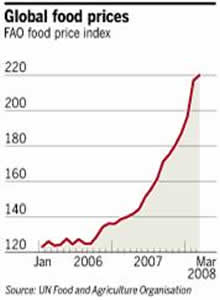
In short: I'm going to have to see direct evidence before I believe there's a market-wide inflation of any kind going on. And that involves disproving the more obvious, more immediate, more direct explanations for the inflation in various sectors. As it is, claiming that this is some ominous trend that every part of the market is experiencing because of a unified cause is a bit like saying that people are cruel to each other because of a global conspiracy of cruelty. It makes a hell of a lot more sense to say that every cruel person has their own reasons, and that there is no grand unifying force at work. It makes the whole picture harder to deal with and try to fix, but it's much, much more reasonable.
MikeWarot: “For example, Paper Towels used to be about $1/roll about a year ago... now they are about $1.50/roll.”
Balderdash. I bought them (on sale, admittedly) yesterday at Walmart for 75¢ – but mostly I buy them at the dollar store, where they cost (wonder of wonders) a dollar. I guess I'm only saying this to say: you should totally shop at the dollar store, it's awesome.
posted by koeselitz at 12:18 AM on October 23, 2011 [2 favorites]
Inflation:
- Good for wage earners - housing debt is inflated away, real wages increase.
- Bad for asset holders - cash/bond asset values decline.
Austerity budgets:
- Bad for wage earners - they increase unemployment.
- Good for asset holders - ensuring the money they lent will be repaid.
Hence we are told:
- Inflation BAD. Wiemar Germany!
- Austerity GOOD. Must take lumps!
Suprised?
posted by dave99 at 1:22 AM on October 23, 2011 [2 favorites]
- Good for wage earners - housing debt is inflated away, real wages increase.
- Bad for asset holders - cash/bond asset values decline.
Austerity budgets:
- Bad for wage earners - they increase unemployment.
- Good for asset holders - ensuring the money they lent will be repaid.
Hence we are told:
- Inflation BAD. Wiemar Germany!
- Austerity GOOD. Must take lumps!
Suprised?
posted by dave99 at 1:22 AM on October 23, 2011 [2 favorites]
kgasmart - Things fall apart. And per Malor, and Denninger, that is the argument; the longer you try to hold it together, artificially, the worse the eventual crack-up is.
Nothing more to say other than "yeup, you got that right."
posted by tgrundke at 4:25 AM on October 23, 2011
Nothing more to say other than "yeup, you got that right."
posted by tgrundke at 4:25 AM on October 23, 2011
delmoi -
I'm going to quote some passages out of The Automatic Earth about this discussion, which has been a prominent one at their site:
The major hurdle in the debate hinged on the definition of inflation, as such debates often do. Financial analysts who expect deflation typically do so because they recognize the critical role of credit in the effective money supply and the effects of credit implosion. With a natural focus on the money supply, they typically (but not universally) define inflation and deflation as monetary phenomena - as an increase or decrease in the effective money (and credit) supply relative to available goods and services.
My view is that movements in nominal prices are of limited interest by themselves, as nominal prices say nothing about changes in affordability. It is not how much something costs that matters, but how much it costs in relation to how much purchasing power people have, and that will depend largely on changes in the effective money supply. In order to understand what is happening to affordability, one has to adjust nominal prices for changes in the money supply and thereby express price changes in real terms.
There are many drivers of prices, but changes in the money supply constitute a major one, often the primary one in fact. Changes are an effect, not a cause, and a lagging effect at that. In order to understand the world, it is better to look at the causes than the effects, and to look at leading indicators rather than lagging ones.
Deflation involves a massive change in the money supply due to the collapse of credit, which constitutes in excess of 95% of the effective money supply. Credit expansion is a ponzi scheme, and like all ponzi schemes will reach a maximum and then implode. Unlike currency hyperinflation, which divides the underlying real wealth pie into more and more pieces, credit hyper-expansion creates multiple and mutually exclusive claims to the same pieces of pie through leverage.
posted by tgrundke at 4:45 AM on October 23, 2011
I'm going to quote some passages out of The Automatic Earth about this discussion, which has been a prominent one at their site:
The major hurdle in the debate hinged on the definition of inflation, as such debates often do. Financial analysts who expect deflation typically do so because they recognize the critical role of credit in the effective money supply and the effects of credit implosion. With a natural focus on the money supply, they typically (but not universally) define inflation and deflation as monetary phenomena - as an increase or decrease in the effective money (and credit) supply relative to available goods and services.
My view is that movements in nominal prices are of limited interest by themselves, as nominal prices say nothing about changes in affordability. It is not how much something costs that matters, but how much it costs in relation to how much purchasing power people have, and that will depend largely on changes in the effective money supply. In order to understand what is happening to affordability, one has to adjust nominal prices for changes in the money supply and thereby express price changes in real terms.
There are many drivers of prices, but changes in the money supply constitute a major one, often the primary one in fact. Changes are an effect, not a cause, and a lagging effect at that. In order to understand the world, it is better to look at the causes than the effects, and to look at leading indicators rather than lagging ones.
Deflation involves a massive change in the money supply due to the collapse of credit, which constitutes in excess of 95% of the effective money supply. Credit expansion is a ponzi scheme, and like all ponzi schemes will reach a maximum and then implode. Unlike currency hyperinflation, which divides the underlying real wealth pie into more and more pieces, credit hyper-expansion creates multiple and mutually exclusive claims to the same pieces of pie through leverage.
posted by tgrundke at 4:45 AM on October 23, 2011
For example, Paper Towels used to be about $1/roll about a year ago... now they are about $1.50/roll.
EVERYBODY PANIC!!!!!
posted by goethean at 7:05 AM on October 23, 2011
EVERYBODY PANIC!!!!!
posted by goethean at 7:05 AM on October 23, 2011
Hey, if there's inflation, Americans might actually lose their irrational attachment to the $1 bill and allow it to be replaced with a coin.
Probably not, though.
posted by one more dead town's last parade at 8:22 AM on October 23, 2011 [1 favorite]
Probably not, though.
posted by one more dead town's last parade at 8:22 AM on October 23, 2011 [1 favorite]
If they're wrong in the technical sense, how are they right? Either there's hyperinflation, or a larger amount of inflation before – or there's not. They are right or they are wrong.
I'm not using the term hyperinflation, first, I'm referencing inflation. And second - from a political perspective, it doesn't matter whether people's perception of inflation is "right" in the technical sense. What matters is they believe they are paying higher prices at the grocery store and it frightens them/pisses them off.
Seen the price of milk lately vs. where it was a year or so ago? You can say, yes but the price of X fell over the same period, but if I'm on a fixed income and my grocery bill now costs $75 where I specifically remember it being $50 not so long ago - that is the stuff out of which political unrest is made. And it especially pisses them off when you say - well you're wrong, look at this technical measurement of what inflation really is, shut your yap because whatever your experience I have these here figures to disprove it.
Perception is reality, in this case. And I do suspect that perception is based in experience. People don't think things cost more at the grocery store because Fox News tells them so - they think it because it is getting harder for them to afford their grocery bills.
posted by kgasmart at 9:15 AM on October 23, 2011 [2 favorites]
I'm not using the term hyperinflation, first, I'm referencing inflation. And second - from a political perspective, it doesn't matter whether people's perception of inflation is "right" in the technical sense. What matters is they believe they are paying higher prices at the grocery store and it frightens them/pisses them off.
Seen the price of milk lately vs. where it was a year or so ago? You can say, yes but the price of X fell over the same period, but if I'm on a fixed income and my grocery bill now costs $75 where I specifically remember it being $50 not so long ago - that is the stuff out of which political unrest is made. And it especially pisses them off when you say - well you're wrong, look at this technical measurement of what inflation really is, shut your yap because whatever your experience I have these here figures to disprove it.
Perception is reality, in this case. And I do suspect that perception is based in experience. People don't think things cost more at the grocery store because Fox News tells them so - they think it because it is getting harder for them to afford their grocery bills.
posted by kgasmart at 9:15 AM on October 23, 2011 [2 favorites]
A lot of the increase in food prices is tied to the increase in oil price, brent oil has gone from $50/barrel in 2007 to over $100/barrel now.
Up until now a lot of food suppliers have just absorbed the increase in their costs, but after 4 years, most have got to the stage where they need to start passing on the price rises, even though the oil price is now falling.
I suspect these things are not unconnected - a lot of big food producers will use hedging to insulate themselves from fluctuations in oil price and currency changes. So it takes a few years for changes to feed through to consumers and then reduced demand can start to bring the price back down again.
Hedging is great if your company is the only one doing it, but once everyone hedges a market the overall effect is wild swings in price - boom and bust.
posted by Lanark at 9:43 AM on October 23, 2011
Up until now a lot of food suppliers have just absorbed the increase in their costs, but after 4 years, most have got to the stage where they need to start passing on the price rises, even though the oil price is now falling.
I suspect these things are not unconnected - a lot of big food producers will use hedging to insulate themselves from fluctuations in oil price and currency changes. So it takes a few years for changes to feed through to consumers and then reduced demand can start to bring the price back down again.
Hedging is great if your company is the only one doing it, but once everyone hedges a market the overall effect is wild swings in price - boom and bust.
posted by Lanark at 9:43 AM on October 23, 2011
People don't think things cost more at the grocery store because Fox News tells them so - they think it because it is getting harder for them to afford their grocery bills.
And that has far more to do with the fact that wages have been stagnant, except at the top, for three decades, than it does with the money supply.
posted by one more dead town's last parade at 10:53 AM on October 23, 2011
And that has far more to do with the fact that wages have been stagnant, except at the top, for three decades, than it does with the money supply.
posted by one more dead town's last parade at 10:53 AM on October 23, 2011
And that has far more to do with the fact that wages have been stagnant, except at the top, for three decades, than it does with the money supply.
Sure, when prices rise and wages don't, you're hammered. And that's my problem with the inflation/hyperinflation argument - I see no situation where wages actually rise, regardless of how much new money is pumped into the system.
posted by kgasmart at 5:17 PM on October 23, 2011
Sure, when prices rise and wages don't, you're hammered. And that's my problem with the inflation/hyperinflation argument - I see no situation where wages actually rise, regardless of how much new money is pumped into the system.
posted by kgasmart at 5:17 PM on October 23, 2011
Hey, if there's inflation, Americans might actually lose their irrational attachment to the $1 bill and allow it to be replaced with a coin.I'll gladly take all the 90% silver US Dollars (Halves, Quarters and Dimes too) you care to give me in exchange for Federal Reserve Notes of the same denomination. I'll even do the same with 90% Gold US dollars, Half Eagles, Eagles, and Double-Eagles. ;-)
Probably not, though.
Seeing that the current Currency / Money ratio is somewhere near 23:1 for silver, and 80:1 for Gold, I doubt you'd be willing to do the deal.
Money is very hard to inflate away, currency is quite easy.
posted by MikeWarot at 10:19 PM on October 23, 2011
Well, here's an interesting article from the Telegraph that takes basically the complete opposite approach to the situation as we did:
“The American phoenix is slowly rising again. Within five years or so, the US will be well on its way to self-sufficiency in fuel and energy. Manufacturing will have closed the labour gap with China in a clutch of key industries. The current account might even be in surplus.”
Maybe you have to be a 'furriner' to see how rosy things really are for the US – and maybe it's just more comfortable for us to act like doomsday prophets, even when we're actually in a pretty good spot. Given the direction that it seems Europe is going, and the beginning of a slowdown in China's recent growth, it seems like this might be a rational outlook to have.
posted by koeselitz at 10:29 PM on October 23, 2011
“The American phoenix is slowly rising again. Within five years or so, the US will be well on its way to self-sufficiency in fuel and energy. Manufacturing will have closed the labour gap with China in a clutch of key industries. The current account might even be in surplus.”
Maybe you have to be a 'furriner' to see how rosy things really are for the US – and maybe it's just more comfortable for us to act like doomsday prophets, even when we're actually in a pretty good spot. Given the direction that it seems Europe is going, and the beginning of a slowdown in China's recent growth, it seems like this might be a rational outlook to have.
posted by koeselitz at 10:29 PM on October 23, 2011
@delmoi
This is completely wrong. FDIC insurance is $250k per customer. If BoA does go bankrupt, The FDIC will not be responsible for all of the derivatives.
Have you read about the recent changes in FDIC deposit insurance?
Changes in FDIC Deposit Insurance Coverage
--------------------------------------------------------------------------------
November 9, 2010
On November 9, 2010, the FDIC issued a Final Rule implementing section 343 of the Dodd-Frank Wall Street Reform and Consumer Protection Act that provides for unlimited insurance coverage of noninterest-bearing transaction accounts. Beginning December 31, 2010, through December 31, 2012, all noninterest-bearing transaction accounts are fully insured, regardless of the balance of the account, at all FDIC-insured institutions. The unlimited insurance coverage is available to all depositors, including consumers, businesses, and government entities. This unlimited insurance coverage is separate from, and in addition to, the insurance coverage provided to a depositor’s other deposit accounts held at an FDIC-insured institution.
A noninterest-bearing transaction account is a deposit account where interest is neither accrued nor paid; depositors are permitted to make an unlimited number of transfers and withdrawals; and the bank does not reserve the right to require advance notice of an intended withdrawal.
Please note that Money Market Deposit Accounts (MMDAs) and Negotiable Order of Withdrawal (NOW) accounts are not eligible for this unlimited insurance coverage, regardless of the interest rate, even if no interest is paid on the account.
For more information, visit: http://www.fdic.gov/news/news/financial/2010/fil10076.html
--------------------------------------------------
As long as your money is in a non-interest bearing account, for the next year no limit to FDIC coverage exists. And with interest rates at 0.30% who wants the risk? And do derivatives even count as interest bearing?
posted by GregorWill at 11:36 PM on October 23, 2011
This is completely wrong. FDIC insurance is $250k per customer. If BoA does go bankrupt, The FDIC will not be responsible for all of the derivatives.
Have you read about the recent changes in FDIC deposit insurance?
Changes in FDIC Deposit Insurance Coverage
--------------------------------------------------------------------------------
November 9, 2010
On November 9, 2010, the FDIC issued a Final Rule implementing section 343 of the Dodd-Frank Wall Street Reform and Consumer Protection Act that provides for unlimited insurance coverage of noninterest-bearing transaction accounts. Beginning December 31, 2010, through December 31, 2012, all noninterest-bearing transaction accounts are fully insured, regardless of the balance of the account, at all FDIC-insured institutions. The unlimited insurance coverage is available to all depositors, including consumers, businesses, and government entities. This unlimited insurance coverage is separate from, and in addition to, the insurance coverage provided to a depositor’s other deposit accounts held at an FDIC-insured institution.
A noninterest-bearing transaction account is a deposit account where interest is neither accrued nor paid; depositors are permitted to make an unlimited number of transfers and withdrawals; and the bank does not reserve the right to require advance notice of an intended withdrawal.
Please note that Money Market Deposit Accounts (MMDAs) and Negotiable Order of Withdrawal (NOW) accounts are not eligible for this unlimited insurance coverage, regardless of the interest rate, even if no interest is paid on the account.
For more information, visit: http://www.fdic.gov/news/news/financial/2010/fil10076.html
--------------------------------------------------
As long as your money is in a non-interest bearing account, for the next year no limit to FDIC coverage exists. And with interest rates at 0.30% who wants the risk? And do derivatives even count as interest bearing?
posted by GregorWill at 11:36 PM on October 23, 2011
For example, Paper Towels used to be about $1/roll about a year ago... now they are about $1.50/roll.
EVERYBODY PANIC!!!!!
OK, so he should have said Toilet Paper.
posted by srboisvert at 4:54 AM on October 24, 2011
EVERYBODY PANIC!!!!!
OK, so he should have said Toilet Paper.
posted by srboisvert at 4:54 AM on October 24, 2011
In short: I'm going to have to see direct evidence before I believe there's a market-wide inflation of any kind going on.
Who cares about the claim of market-wide inflation?
It means nothing to me that house prices are dropping because I am not buying one. The drop in LEO flights from Virgin Space doesn't matter to me either. Nor does the drop in prices of computers, TVs, appliances, or even anything other than food. These things may be in an economist's theoretical basket of goods but they sure as hell aren't in mine. Nor are they in a pensioner's or a poor person's. I can put all those purchase off until better times but I have to eat right now.
Now my situation is different because I live in the UK where prices for stuff were already higher and where manufactures almost instantly adopted the shrinking product strategy in 2009 where things all still cost the same but had about 20% fewer calories (which was very handy while I was trying to lose weight). Now the prices have started steadily creeping up and I have really been feeling the pinch. I've trimmed just about every ounce of inefficient fat I can from my grocery budget. I've made all the within category switches like switching from real ales to french fighting lagers, coca-cola to generics, soft and fluffy toilet paper to generic sandpaper. I've compared stores and pay attention to sales, coupons and offers. My next step is to not only reduce consumption but to even drop non-essential food classes altogether - no more cola, booze, chorizo, etc... and I am living off about 2.5 to 3 times the medium UK salary. Now I am pretty tight with my money and this is more pre-emptive than an emergency but I know a lot of people who are seriously doing without.
So yeah, go ahead and throw abstracted economic statistics based on 'entire markets' or politicized government department's misleading indicators at me. I'll just think you are living on the moon and that your servants haven't been showing you your grocery bills. You'll say my experience is an anecdote but until some averaged economic somebody picks up my tab this anecdotard is the one paying the bills.
posted by srboisvert at 5:21 AM on October 24, 2011 [1 favorite]
Who cares about the claim of market-wide inflation?
It means nothing to me that house prices are dropping because I am not buying one. The drop in LEO flights from Virgin Space doesn't matter to me either. Nor does the drop in prices of computers, TVs, appliances, or even anything other than food. These things may be in an economist's theoretical basket of goods but they sure as hell aren't in mine. Nor are they in a pensioner's or a poor person's. I can put all those purchase off until better times but I have to eat right now.
Now my situation is different because I live in the UK where prices for stuff were already higher and where manufactures almost instantly adopted the shrinking product strategy in 2009 where things all still cost the same but had about 20% fewer calories (which was very handy while I was trying to lose weight). Now the prices have started steadily creeping up and I have really been feeling the pinch. I've trimmed just about every ounce of inefficient fat I can from my grocery budget. I've made all the within category switches like switching from real ales to french fighting lagers, coca-cola to generics, soft and fluffy toilet paper to generic sandpaper. I've compared stores and pay attention to sales, coupons and offers. My next step is to not only reduce consumption but to even drop non-essential food classes altogether - no more cola, booze, chorizo, etc... and I am living off about 2.5 to 3 times the medium UK salary. Now I am pretty tight with my money and this is more pre-emptive than an emergency but I know a lot of people who are seriously doing without.
So yeah, go ahead and throw abstracted economic statistics based on 'entire markets' or politicized government department's misleading indicators at me. I'll just think you are living on the moon and that your servants haven't been showing you your grocery bills. You'll say my experience is an anecdote but until some averaged economic somebody picks up my tab this anecdotard is the one paying the bills.
posted by srboisvert at 5:21 AM on October 24, 2011 [1 favorite]
srboisvert: “Who cares about the claim of market-wide inflation?”
Well, everybody else in this thread, basically; anyway, everybody here who's making doomsday predictions about the collapse of society as we know it and living underground in caves and stockpiling necessities. But that was kind of my point, anyway. I fully expect things will cost more. And I fully expect it will be harder and harder for normal people to afford things. That doesn't mean that I need to build a bomb shelter stocked with canned goods because people will revert to a state of nature and start looting and pillaging and law and order will collapse and we'll enter another dark age. Those two things are miles apart.
I think you may not have to face this as much living in the UK. Here in the US, we're often obsessed with this crazed doomsday prophecy stuff where we fantasize about how cool it would be to have to rely on our own "survival skills" (never admitting that we find this fantasy fun, of course.) Maybe there's a UK equivalent; I have no idea. I'm only saying here that I think it's worth it to let go of that idea.
Really: there will be no great collapse. Things will not suddenly fall apart. There will not be looting in the streets, and every-person-for-themselves, and hiding in basements, and guarding your house with a shotgun. Gosh, wouldn't that be grand? But no. What will happen will be the same old mundane boring thing that's always happened, except perhaps worse (or perhaps better) – lots of people won't have enough food to eat, lots of people won't be able to afford necessities, and lots of us will struggle to get by.
“So yeah, go ahead and throw abstracted economic statistics based on 'entire markets' or politicized government department's misleading indicators at me. I'll just think you are living on the moon and that your servants haven't been showing you your grocery bills. You'll say my experience is an anecdote but until some averaged economic somebody picks up my tab this anecdotard is the one paying the bills.”
Data is just an accumulation of anecdotes on this front. It matters, it really does, what your experience is. I'm only trying to determine if our parents or grandparents were right when they say "I had it much worse than you do! You'll be fine if you just work hard and do your best to make it!" I suspect they were not quite right, but figuring that out is not simple or easy. And thinking about it not only for you and me but for our neighbors and friends and everyone else in society – well, that's even tougher.
As I said above, it depends on a lot of things. And it would be really nice and neat and simple to tie it up with a bow and say that it's all due to this one cause and everything will be solved if certain people just do this one thing. But life isn't that simple, I don't think.
posted by koeselitz at 7:48 AM on October 24, 2011
Well, everybody else in this thread, basically; anyway, everybody here who's making doomsday predictions about the collapse of society as we know it and living underground in caves and stockpiling necessities. But that was kind of my point, anyway. I fully expect things will cost more. And I fully expect it will be harder and harder for normal people to afford things. That doesn't mean that I need to build a bomb shelter stocked with canned goods because people will revert to a state of nature and start looting and pillaging and law and order will collapse and we'll enter another dark age. Those two things are miles apart.
I think you may not have to face this as much living in the UK. Here in the US, we're often obsessed with this crazed doomsday prophecy stuff where we fantasize about how cool it would be to have to rely on our own "survival skills" (never admitting that we find this fantasy fun, of course.) Maybe there's a UK equivalent; I have no idea. I'm only saying here that I think it's worth it to let go of that idea.
Really: there will be no great collapse. Things will not suddenly fall apart. There will not be looting in the streets, and every-person-for-themselves, and hiding in basements, and guarding your house with a shotgun. Gosh, wouldn't that be grand? But no. What will happen will be the same old mundane boring thing that's always happened, except perhaps worse (or perhaps better) – lots of people won't have enough food to eat, lots of people won't be able to afford necessities, and lots of us will struggle to get by.
“So yeah, go ahead and throw abstracted economic statistics based on 'entire markets' or politicized government department's misleading indicators at me. I'll just think you are living on the moon and that your servants haven't been showing you your grocery bills. You'll say my experience is an anecdote but until some averaged economic somebody picks up my tab this anecdotard is the one paying the bills.”
Data is just an accumulation of anecdotes on this front. It matters, it really does, what your experience is. I'm only trying to determine if our parents or grandparents were right when they say "I had it much worse than you do! You'll be fine if you just work hard and do your best to make it!" I suspect they were not quite right, but figuring that out is not simple or easy. And thinking about it not only for you and me but for our neighbors and friends and everyone else in society – well, that's even tougher.
As I said above, it depends on a lot of things. And it would be really nice and neat and simple to tie it up with a bow and say that it's all due to this one cause and everything will be solved if certain people just do this one thing. But life isn't that simple, I don't think.
posted by koeselitz at 7:48 AM on October 24, 2011
As long as your money is in a non-interest bearing account, for the next year no limit to FDIC coverage exists. And with interest rates at 0.30% who wants the risk? And do derivatives even count as interest bearing?Of course derivatives are 'interest bearing', that's the whole point. They're an investment. And beyond that they are not even accounts, that's the key point. The FDIC change has nothing to do with derivatives. I suppose there is a higher risk that the bank. Derivatives are a financial product. You buy one the same way you would a lump of gold. If the price of gold goes to zero, you can't collect FDIC insurance on it. If a derivative blows up you can't collect FDIC insurance on it either. It's like a stock or a bond.
I'm going to quote some passages out of The Automatic Earth about this discussion, which has been a prominent one at their site:Whatever. You can't just re-define terms so that you can win arguments. Inflation is when the cost of items and wages goes up in a currency. If the 'supply' of money goes up but no one spends it then prices can stay the same or even go down. That's why "inflation" and "money supply" are different words. Just because some random idiot with a geo-cities esq blog says otherwise doesn't matter.
And second - from a political perspective, it doesn't matter whether people's perception of inflation is "right" in the technical sense. What matters is they believe they are paying higher prices at the grocery store and it frightens them/pisses them off.From a "political perspective" People thought that Obama was born in Kenya and 9/11 was an inside job. What the hell does that have to do with anything? I would imagine that most people out there don't understand very much about economics at all. In fact, it's pretty clear that most people who think they understand economics don't.
Hedging is great if your company is the only one doing it, but once everyone hedges a market the overall effect is wild swings in price - boom and bust.Uh, no. It actually leads to more stability. An oil company can sell all it's oil over the next 4 years at a fixed price, and someone else can buy it. From then on, both the customer and buyer have removed all risk from the system for the two of them. The "market" price might be more volatile because there is less to buy and sell at the margin, but for the people who have hedged it's a non-issue.
Now my situation is different because I live in the UK where prices for stuff were already higher and where manufactures almost instantly adopted the shrinking product strategy in 2009 where things all still cost the same but had about 20% fewer calories (which was very handy while I was trying to lose weight). Now the prices have started steadily creeping up and I have really been feeling the pinch.Well, obviously the price of things in UK pounds is largely irrelevant to the discussion of the price of things in dollars. I mean, it's a completely different currency, with different policies, different budget deficit issues, and so on.
But one reason why food prices have been going up actually has to do with global warming. There have been droughts and other problems growing crops around the world due to the temperature changes. This is a serious problem, but it's not one that's going to be fixed by going back to the gold standard.
posted by delmoi at 11:47 AM on October 24, 2011
From then on, both the customer and buyer have removed all risk from the system for the two of them.
The nature of hedging is that it transfers risk, but never lessens it. In fact, there's very good evidence that it increases the total systemic risk, because companies that HAVE wealth tend to want to hedge against losing it, and companies that WANT wealth tend to be willing to run risks to get more. Overall, hedging transfers risk from the entities that CAN handle it to the entities that CAN'T. (see: AIG failure.)
Net result: the system gets packed full of risk, and then the whole thing goes up like dynamite with even a small input of the wrong type at the wrong time. It's a Ponzi scheme of risk-swapping, where the total systemic risk increases until something explodes.
And that's why we want some kind of commodity currency, so that this kind of absolute nonsense will quickly be exposed for what it is. Right now, we can bail out ANY idea to ANY extent, no matter how bad it is. There's no way to prune bad but popular ideas from the system, like derivatives and securitized loans. Risk ends up loaded all on the taxpayer, while private entities keep all profits related to incurring that risk.
That kind of bullshit would never fly on a true commodity currency, because at a point far, far sooner than where we're at right now, the central authority loses power to intervene. Ideas that are sufficiently bad simply cannot be preserved, no matter what the politicians want.
posted by Malor at 4:51 PM on October 25, 2011
The nature of hedging is that it transfers risk, but never lessens it. In fact, there's very good evidence that it increases the total systemic risk, because companies that HAVE wealth tend to want to hedge against losing it, and companies that WANT wealth tend to be willing to run risks to get more. Overall, hedging transfers risk from the entities that CAN handle it to the entities that CAN'T. (see: AIG failure.)
Net result: the system gets packed full of risk, and then the whole thing goes up like dynamite with even a small input of the wrong type at the wrong time. It's a Ponzi scheme of risk-swapping, where the total systemic risk increases until something explodes.
And that's why we want some kind of commodity currency, so that this kind of absolute nonsense will quickly be exposed for what it is. Right now, we can bail out ANY idea to ANY extent, no matter how bad it is. There's no way to prune bad but popular ideas from the system, like derivatives and securitized loans. Risk ends up loaded all on the taxpayer, while private entities keep all profits related to incurring that risk.
That kind of bullshit would never fly on a true commodity currency, because at a point far, far sooner than where we're at right now, the central authority loses power to intervene. Ideas that are sufficiently bad simply cannot be preserved, no matter what the politicians want.
posted by Malor at 4:51 PM on October 25, 2011
« Older Throwing molten iron for fun and profit | The Big Shroom Newer »
This thread has been archived and is closed to new comments
posted by telstar at 10:06 AM on October 22, 2011