Time, Forward!
September 13, 2012 8:05 PM Subscribe
It's the turn of the 90s and you're back in the USSR, sitting on the Persian carpet that covers every inch of your Soviet living room and facing the old Rubin-714 set. As the clock strikes nine, you hear those familiar strains…
The motif comes from Время, вперед! or Time, Forward! by Georgy Sviridov. Part of a suite, the piece was written for the film after which it is named, which itself is based on the eponymous Soviet Realist novel. The musical passage is familiar to every citizen of the former USSR. Rather fewer, however, know the piece of which it's part, or the remaining works of this notable composer. Here is the 1965 film for which the piece was originally written, courtesy of Mosfilm (part 1, part 2, English subtitles). The novel it's based on is about concrete-pouring records.
If you want to hear the whole suite, a South Korean orchestra performs it for you (finale begins at 14:50). Just the stirring finale?
Sviridov's creative output was ongoing and regular until the early 80s, when his health began to fail. Composing in a bold and accessible style, Sviridov met with party approval and enjoyed considerable success, occupying a sinecure as the head of the Composers' Union from 1968–1973. Throughout his lifetime he received numerous accolades and state awards, including the Lenin prize and the Order of Lenin. With few exceptions, Sviridov's work concerns themes of nativism and folk life, providing musical arrangements and settings for works by authors and poets who range from bucolic to proletarian to Romantic.
Here is a short catalogue of some of Sviridov's works that are available on YouTube:
Bonus: other idents for Soviet (and now Russian) news broadcast «Время»
The motif comes from Время, вперед! or Time, Forward! by Georgy Sviridov. Part of a suite, the piece was written for the film after which it is named, which itself is based on the eponymous Soviet Realist novel. The musical passage is familiar to every citizen of the former USSR. Rather fewer, however, know the piece of which it's part, or the remaining works of this notable composer. Here is the 1965 film for which the piece was originally written, courtesy of Mosfilm (part 1, part 2, English subtitles). The novel it's based on is about concrete-pouring records.
If you want to hear the whole suite, a South Korean orchestra performs it for you (finale begins at 14:50). Just the stirring finale?
- in St. Petersburg's Tauride Palace
- for solo piano
- quartet with piano and flute
- quartet with contrabass balalaika
- folk orchestral ensemble with piano
- for Belorussian folk ensemble with piano
- psychedelic rock cover
- same, live in 2005
Sviridov's creative output was ongoing and regular until the early 80s, when his health began to fail. Composing in a bold and accessible style, Sviridov met with party approval and enjoyed considerable success, occupying a sinecure as the head of the Composers' Union from 1968–1973. Throughout his lifetime he received numerous accolades and state awards, including the Lenin prize and the Order of Lenin. With few exceptions, Sviridov's work concerns themes of nativism and folk life, providing musical arrangements and settings for works by authors and poets who range from bucolic to proletarian to Romantic.
Here is a short catalogue of some of Sviridov's works that are available on YouTube:
- Several musical settings for poems by Lermontov (1938) — 1 | 2 | 3
- From the works of Robert Burns, translated by Samuil Marshak (1955) — 1 | 2 | 3 | 4 | 5 | 6
- In Memory of Sergey Yesenin, a poem for orchestra and voice (1956)
- Oratorio Pathetique for chorus and orchestra, from Mayakovsky's poetry (1959, awarded Lenin Prize in 1960) — 1 | 2 | 3 | 4 | 5
- Suite for Pushkin's The Blizzard (1964) — 1 | 2 | 3 | 4 | 5 | 6 | 7 | 8 | 9
- The Little Triptych (1964)
- Petersburg Songs, from the poetry of Aleksandr Blok (1965) — 1 | 2 | 3 | 4
- The Snow is Falling, cantata for choir with orchestra based on the poetry of Boris Pasternak (1965) — 1 | 2
- Choruses from the musical setting for A. K. Tolstoy's Tsar Feodor Ioannovich (1973) — 1 | 2 | 3
- Concerto in Memory of A. A. Yurlov for unaccompanied mixed chorus (1973) — 1 | 2 | 3
- Departed Russia, for voice and orchestra, with words by Sergey Yesenin (1977) — 1 | 2 | 3 | 4 | 5 | 6 | 7 | 8 | 9 | 10 | 11 | 12
- From Hymns to the Motherland (1978) — 1 | 2 | 3 | 4
- Pushkin's Wreath, choir with orchestra (1979) — 1 | 2 | 3 | 4 | 5 | 6 | 7 | 8 | 9 | 10
- Night Clouds, cantata with words by Aleksandr Blok (1979) —1 | 2 | 3 | 4 | 5
- Lake Ladoga, poem for chorus, words by Aleksandr Prokofiev (1980) — 1 | 2 | 3 | 4 | 5
Bonus: other idents for Soviet (and now Russian) news broadcast «Время»
- 1972–1975 — untitled piano melody
- 1975–1983 — same
- 1984–1985 — Glinka's Patriotic Song
Very very nice, Nomyte.
posted by Foci for Analysis at 8:52 PM on September 13, 2012
posted by Foci for Analysis at 8:52 PM on September 13, 2012
Holy shit. "Familiar strains" indeed.
You know that feeling when you used to hear a thing every night as a child, and then you go far away and don't hear it even once for 20 years, and then suddenly, unbidden, you hear it again? No? Well I do, now.
posted by eugenen at 9:39 PM on September 13, 2012 [5 favorites]
You know that feeling when you used to hear a thing every night as a child, and then you go far away and don't hear it even once for 20 years, and then suddenly, unbidden, you hear it again? No? Well I do, now.
posted by eugenen at 9:39 PM on September 13, 2012 [5 favorites]
Oh, man, an Autograph cover. Lots to listen to here. Nice post.
posted by Isadorady at 10:29 PM on September 13, 2012
posted by Isadorady at 10:29 PM on September 13, 2012
why does the female newscaster keep saying something like "es-es-es-uh"? sorry, not a russian speaker.
posted by readyfreddy at 10:47 PM on September 13, 2012
posted by readyfreddy at 10:47 PM on September 13, 2012
I don't speak Russian but I think she's saying "es-es-es-ar" or CCCP (in English USSR). CCCP is Cryllic, in Roman letters it's SSSR.
posted by Cyclopsis Raptor at 11:06 PM on September 13, 2012 [1 favorite]
posted by Cyclopsis Raptor at 11:06 PM on September 13, 2012 [1 favorite]
Fascinating broadcast (although I can't help but think that 54min of Soviet telly in the original Russian is tl;dr even for MeFi).
posted by Wrinkled Stumpskin at 11:30 PM on September 13, 2012
posted by Wrinkled Stumpskin at 11:30 PM on September 13, 2012
eugenen, try this as well: http://www.youtube.com/watch?v=hzenUQXvauA - Radio Mayak.
last time I heard it 10 years ago.
posted by usertm at 11:46 PM on September 13, 2012
last time I heard it 10 years ago.
posted by usertm at 11:46 PM on September 13, 2012
My ISP has blocked that first link for hosting malware. Given that this has never happened to me before & they're a pretty good bunch, perhaps don't click on anything on that site.
posted by pharm at 1:18 AM on September 14, 2012
posted by pharm at 1:18 AM on September 14, 2012
This post is excelsior -- my only complaint is that I have to go to work too soon to peruse all of the links.
posted by mr. digits at 5:09 AM on September 14, 2012
posted by mr. digits at 5:09 AM on September 14, 2012
Wow what a post. I can't wait to dig in - especially to the choral pieces. 20th Century Russian composers are my jam. Thanks, Nomyte!
posted by jph at 6:10 AM on September 14, 2012
posted by jph at 6:10 AM on September 14, 2012
pharm: firefox is doing the same thing for me on that link.
posted by leotrotsky at 6:12 AM on September 14, 2012
posted by leotrotsky at 6:12 AM on September 14, 2012
I love this post but not for the reasons you intended. In 1991 I was an American college student who was stranded alone in Moscow when the coup against Gorbachev occurred. I had nowhere to go and was staying with the family of a taxi driver who took pity on me, trying to figure out how to get home. During this already stressful event, the coup happened. We watched the eight men on TV announce the coup the morning of the 19th, but then spent the rest of the day in front of the white house watching people climb on tanks. I never saw any "official" soviet commentary on the coup, and so this broadcast is just fascinating. Thanks, Nomtye.
posted by staggering termagant at 6:43 AM on September 14, 2012 [1 favorite]
posted by staggering termagant at 6:43 AM on September 14, 2012 [1 favorite]
readyfreddy: why does the female newscaster keep saying something like "es-es-es-uh"? sorry, not a russian speaker.
Cyclopsis Raptor has it. CCCP (pronounced "SSSR") is short for Союз Советских Социалистических Республик ("Soyuz Sovietskich Sotsyalisticheskich Respublik" -- in English, Union of Soviet Socialist Republics).
As an English lit/Russian double major, and a former (sigh) Russian speaker, the opening strains of «Время» kicked me right back to summer school in Leningrad in 1987. Nomyte, I love this post (and yes, the choice of the "coup" broadcast was terrific!). Now I need to find the clip of Подмосковные вечера that was used as a time signal on the radio...
posted by bakerina at 7:28 AM on September 14, 2012
Cyclopsis Raptor has it. CCCP (pronounced "SSSR") is short for Союз Советских Социалистических Республик ("Soyuz Sovietskich Sotsyalisticheskich Respublik" -- in English, Union of Soviet Socialist Republics).
As an English lit/Russian double major, and a former (sigh) Russian speaker, the opening strains of «Время» kicked me right back to summer school in Leningrad in 1987. Nomyte, I love this post (and yes, the choice of the "coup" broadcast was terrific!). Now I need to find the clip of Подмосковные вечера that was used as a time signal on the radio...
posted by bakerina at 7:28 AM on September 14, 2012
Incredible post. Bookmarking for future enjoyment.
posted by chicxulub at 8:41 AM on September 14, 2012
posted by chicxulub at 8:41 AM on September 14, 2012
Very cool video, and very revealing in terms of the difference in production values between this broadcast and the standard American Eyewitness News format. Clearly absent in this news studio are teleprompters mounted beneath the cameras. It's amazing how accustomed one can get to news anchors 'looking' at the viewer through the screen via the prompters.
posted by DrSawtooth at 8:55 AM on September 14, 2012
posted by DrSawtooth at 8:55 AM on September 14, 2012
Is it possible for an American to acquire one of these Rubin television sets? The 710/A and 714/D are pretty darn cool looking to me.
Full disclosure: I am the long-time maintainer/user of the family's 1986 Zenith console set. Wooden furniture TVs are the best, and these are awesome.
posted by palindromic at 9:27 AM on September 14, 2012 [1 favorite]
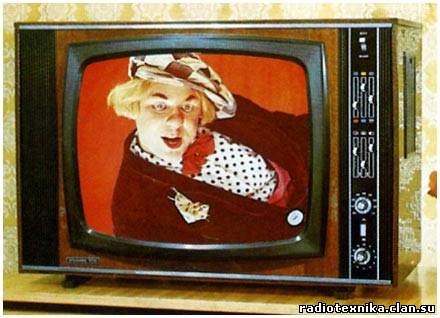
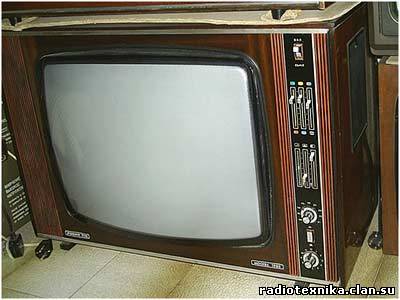
Full disclosure: I am the long-time maintainer/user of the family's 1986 Zenith console set. Wooden furniture TVs are the best, and these are awesome.
posted by palindromic at 9:27 AM on September 14, 2012 [1 favorite]
Fantastic post, and I sat glued to the screen after clicking on the 1991 news broadcast—watched over eight minutes before I could tear myself away. It'll take me quite a while to assimilate even a part of these links! My copy of Время, вперед! (the novel) is beckoning to me from the shelf to my right...
(Were you by any chance inspired by this post by Anatoly Vorobey, or is that just synchronicity?)
posted by languagehat at 11:25 AM on September 14, 2012
(Were you by any chance inspired by this post by Anatoly Vorobey, or is that just synchronicity?)
posted by languagehat at 11:25 AM on September 14, 2012
Yes, a belated tip of the hat is in order. In the past, I think, MeFi also saw the Canadian animated short.
posted by Nomyte at 11:43 AM on September 14, 2012 [1 favorite]
posted by Nomyte at 11:43 AM on September 14, 2012 [1 favorite]
I played "The Blizzard" with my college orchestra several years ago, when we did an All-Russian program with a Russian conductor. The Blizzard is almost never performed in America and he wanted to give it a chance to shine. The whole orchestra fell in love with the piece. I was recently thinking about it, and I missed it so much I requested a recording of the concert!
Also, I've lately been learning Russian, and while I'm still in the very beginning stages, it was totally a thrill to be able to understand like 1% of the words in that news broadcast :) Mostly numbers, but hey!
posted by Cygnet at 4:51 PM on September 14, 2012 [1 favorite]
Also, I've lately been learning Russian, and while I'm still in the very beginning stages, it was totally a thrill to be able to understand like 1% of the words in that news broadcast :) Mostly numbers, but hey!
posted by Cygnet at 4:51 PM on September 14, 2012 [1 favorite]
Incredible post, thanks. In fact, an English translation of Time, Forward! fell into my hands many years ago, and I've found it difficlt to get into -- perhaps, the catalyst I've been needing is this Sviridov soundtrack.
posted by Rash at 9:07 AM on September 15, 2012
posted by Rash at 9:07 AM on September 15, 2012
« Older The Illustrated Guide to Criminal Law | Foods That Will Win The War And How To Cook Them Newer »
This thread has been archived and is closed to new comments
posted by Behemoth at 8:25 PM on September 13, 2012 [3 favorites]