A Very Still Life
November 1, 2012 9:44 AM Subscribe
The paintings are the work of none other than Jack Kevorkian, the late Armenian-American pathologist, philosopher, assisted suicide advocate, and convicted felon otherwise known as Dr. Death. They are strikingly well executed. Unlike the works of other improbable painters — Adolf Hitler’s multicolored bouquets and elegant nudes or Winston Churchill’s pastoral sceneries — Kevorkian’s canvases are markedly obvious and gruesomely, almost risibly, literal. And the man in the coma, the man on fire, and the man with the brains by his side look a lot like the auteur himself.
Interesting that all of the paintings shown deal with loss of control over ones body. People are manipulated like marionettes, moved like a puppet by what looks like a centurion, clearly a symbol of governmental power, or their bodies simply fall apart.
posted by Ad hominem at 9:59 AM on November 1, 2012 [4 favorites]
posted by Ad hominem at 9:59 AM on November 1, 2012 [4 favorites]
Very literal. Bunnies with Easter bonnets and angel wings controlling people is pretty damn obvious.
posted by Ad hominem at 10:02 AM on November 1, 2012 [2 favorites]
posted by Ad hominem at 10:02 AM on November 1, 2012 [2 favorites]
Well executed, Mr Kevorkian.
posted by BlackLeotardFront at 10:12 AM on November 1, 2012 [12 favorites]
posted by BlackLeotardFront at 10:12 AM on November 1, 2012 [12 favorites]
Bunnies with Easter bonnets and angel wings controlling people is pretty damn obvious.
The marionette strings are attached to a cross with INRI written on it.
More photography than painting.
posted by DU at 10:15 AM on November 1, 2012 [1 favorite]
The marionette strings are attached to a cross with INRI written on it.
More photography than painting.
posted by DU at 10:15 AM on November 1, 2012 [1 favorite]
As he pressed on in his fight to legalize assisted suicide, Kevorkian again turned to art as a means to communicate his message, as a solace, and as a way to fund his crusade. He played smooth, spooky jazz on the flute with a group called the Morpheus Quintet, and produced an album called A Very Still Life. He hand painted hundreds of novelty sun visors with the logos of major sports teams to sell at games.
Novelty... sun visors?
I'm not particularly moved by these paintings - the subject matter is approached unsubtly, to say the least, but finding out more about Dr. Kevorkian is fascinating.
Favorite other Dr. Kevorkian story: There's a dental surgeon in Va. also called "Dr. Kevorkian", and I thought it'd be an amusing anecdote to have him remove my wisdom teeth. I decided before I went in that I wasn't going to make a joke about his name, figuring the poor guy had probably heard every possible joke on the topic. Best just to leave it alone. Anyway, we had our consultation, the appointment was made, and my extraction went as well as can be expected.
Then I got my souvenir shirt... it said "I SURVIVED DR. KEVORKIAN'S ANESTHESIA" on the front, and had his contact info on the back.
I gave it to my grandmother, who wore it on a retirees' cruise, where it apparently was a big hit.
posted by dubold at 10:19 AM on November 1, 2012 [47 favorites]
Novelty... sun visors?
I'm not particularly moved by these paintings - the subject matter is approached unsubtly, to say the least, but finding out more about Dr. Kevorkian is fascinating.
Favorite other Dr. Kevorkian story: There's a dental surgeon in Va. also called "Dr. Kevorkian", and I thought it'd be an amusing anecdote to have him remove my wisdom teeth. I decided before I went in that I wasn't going to make a joke about his name, figuring the poor guy had probably heard every possible joke on the topic. Best just to leave it alone. Anyway, we had our consultation, the appointment was made, and my extraction went as well as can be expected.

Then I got my souvenir shirt... it said "I SURVIVED DR. KEVORKIAN'S ANESTHESIA" on the front, and had his contact info on the back.
I gave it to my grandmother, who wore it on a retirees' cruise, where it apparently was a big hit.
posted by dubold at 10:19 AM on November 1, 2012 [47 favorites]
They are strikingly well executed
I see what you did there.
posted by Tanizaki at 10:19 AM on November 1, 2012 [6 favorites]
I see what you did there.
posted by Tanizaki at 10:19 AM on November 1, 2012 [6 favorites]
dont know the artist but they are interesting drawings HOWEVER they comes of as "a bit unfinished" with boring colors. could also need a bit more POP! and ACTION like this. no copyright infrigment intended
posted by Foci for Analysis at 10:20 AM on November 1, 2012
posted by Foci for Analysis at 10:20 AM on November 1, 2012
Well executed, Mr Kevorkian.That joke was dead on arrival.
posted by rouftop at 10:20 AM on November 1, 2012 [4 favorites]
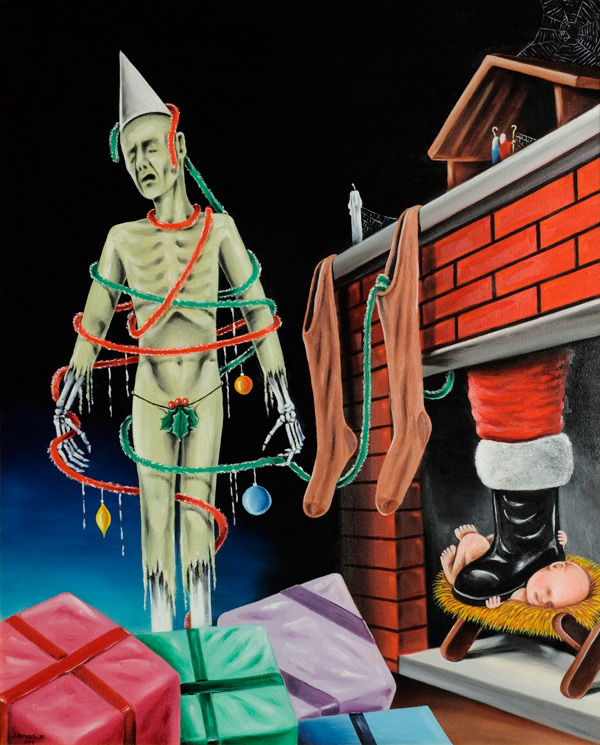
I do like Santa Claus crushing the baby Jesus while man-as-tree stands there bound as in some pagan ritual. Couple different levels to that one. Commercialization of Christmas on one hand but also an acknowledgement of the deep pagan roots of the holiday.
The colors look like every Kostabi painting to me.
posted by Ad hominem at 10:24 AM on November 1, 2012 [1 favorite]
The colors look like every Kostabi painting to me.
posted by Ad hominem at 10:24 AM on November 1, 2012 [1 favorite]
I have always loved the late Dr. Kevorkian. I remember following his trials when I was younger and him launching Fiegers political run for MI governor.
I always have enjoyed his art. In fact my uncle has an original that he purchased prior to Kevorkians death.
Edited to add one of my favorite bands had to change part of its name due to using Kevorkians name.
posted by handbanana at 10:25 AM on November 1, 2012
I always have enjoyed his art. In fact my uncle has an original that he purchased prior to Kevorkians death.
Edited to add one of my favorite bands had to change part of its name due to using Kevorkians name.
posted by handbanana at 10:25 AM on November 1, 2012
One of the problematic things about Kevorkian is that he was sort of an anti-Rosa Parks. If the right-to-die movement had set out to find the perfect defendant — someone to engage in carefully planned civil disobedience, draw prosecution, and make strategic appeals hoping to change the law — ....well, it sure as shit wouldn't have been him. But the right-to-die movement didn't do that in an organized way, and so Kevorkian stepped up on his own and dared the court to charge him.
I don't know whether he was a good doctor, or a good person. But he clearly had an intense, almost morbid fascination with death and suffering. And he clearly liked provoking people.
Those can be good qualities in an artist. They're neutral at best in a doctor. They're terrible qualities to have in the Public Face Of Your Political Movement.
posted by nebulawindphone at 10:34 AM on November 1, 2012 [5 favorites]
I don't know whether he was a good doctor, or a good person. But he clearly had an intense, almost morbid fascination with death and suffering. And he clearly liked provoking people.
Those can be good qualities in an artist. They're neutral at best in a doctor. They're terrible qualities to have in the Public Face Of Your Political Movement.
posted by nebulawindphone at 10:34 AM on November 1, 2012 [5 favorites]
Four of these paintings will remain at ALMA, but after a lawsuit the rest will go back to Kevorkian's estate, probably to be sold. So, you too could own a Kevorkian original. ALMA also has prints for sale on its website.
posted by Jugwine at 10:35 AM on November 1, 2012 [1 favorite]
posted by Jugwine at 10:35 AM on November 1, 2012 [1 favorite]
I agree that he kinda shot himself in the foot and defending himself in court is never a good idea. Yet I have to give the man credit for standing up for something he believed in. He may not have been the best spokes person but no one else has been a voice for those seeking compassion during death.
posted by handbanana at 10:39 AM on November 1, 2012 [3 favorites]
posted by handbanana at 10:39 AM on November 1, 2012 [3 favorites]
"A suicide machine belonging to Dr. Jack Kevorkian was withdrawn Friday from an auction of the assisted-suicide advocate’s possessions after failing to draw a high enough bid, while 17 of his paintings tied up in a legal dispute with a suburban Boston museum found no takers.
The paintings, including one Kevorkian did with a pint of his blood, and about 100 other personal items went on sale at the New York Institute of Technology. The estate had estimated the value of the 17 paintings at $2.5 million to $3.5 million.
...
"Only twenty-four of the ninety-six listed items sold, grossing $8,795."
...
wah wah wah waaaaaaaaaaaaah ...
I ♥ Dr. Jack. A good man, but different than most.
posted by mrgrimm at 10:54 AM on November 1, 2012 [1 favorite]
The paintings, including one Kevorkian did with a pint of his blood, and about 100 other personal items went on sale at the New York Institute of Technology. The estate had estimated the value of the 17 paintings at $2.5 million to $3.5 million.
...
"Only twenty-four of the ninety-six listed items sold, grossing $8,795."
...
wah wah wah waaaaaaaaaaaaah ...
I ♥ Dr. Jack. A good man, but different than most.
posted by mrgrimm at 10:54 AM on November 1, 2012 [1 favorite]
...clearly liked provoking people....[a] terrible qualit[y] to have in the Public Face Of Your Political Movement.
How much more wrong could it be? None. None more wrong.
posted by DU at 10:59 AM on November 1, 2012 [3 favorites]
How much more wrong could it be? None. None more wrong.
posted by DU at 10:59 AM on November 1, 2012 [3 favorites]
I'd never seen Hitler's nudes (and hesitated only slightly in googling "hitler nudes"). They're like his architectural landscapes... barely competent. It's the same stumbling block that nearly all barely competent realist artists get stuck on, but it seems so much more prophetic that he couldn't get past reducing people and parts of people to symbols.
My orignal point is: Hitler's nudes are not elegant.
posted by cmoj at 11:04 AM on November 1, 2012 [2 favorites]
My orignal point is: Hitler's nudes are not elegant.
posted by cmoj at 11:04 AM on November 1, 2012 [2 favorites]
It's weird, I recognize some of the imagery here. About this time a year ago I was very depressed and I was using art as an outlet. In my case, the symbols were as blatant as the feelings behind them, because in that state of mind it really isn't about being subtle, but as some form of catharsis. Sometimes, it's just about having feelings being made into something tangible, as if to legitimize them. I wonder if Kevorkian was in a similar place.
posted by hellojed at 11:11 AM on November 1, 2012 [3 favorites]
posted by hellojed at 11:11 AM on November 1, 2012 [3 favorites]
Geez I did not even see that they already did the executed thing in the post. Also it is Dr Kevorkian. Nevertheless, I appreciate this post and the paintings Dr K created, although they are terribly creepy.
posted by BlackLeotardFront at 11:15 AM on November 1, 2012
posted by BlackLeotardFront at 11:15 AM on November 1, 2012
Re: Hitler's art
I believe most of what we see of Hitler's portfolio consists of work he did when he was about 18-20 years old. From that standpoint, he drew and painted a heckuva lot better than most 18-year-olds do today, even those who are applying for art schools.
Kervorkian's paintings are sort of uncanny in a tasteless way. I like them in spite of how ugly they are.
posted by overeducated_alligator at 11:22 AM on November 1, 2012 [2 favorites]
I believe most of what we see of Hitler's portfolio consists of work he did when he was about 18-20 years old. From that standpoint, he drew and painted a heckuva lot better than most 18-year-olds do today, even those who are applying for art schools.
Kervorkian's paintings are sort of uncanny in a tasteless way. I like them in spite of how ugly they are.
posted by overeducated_alligator at 11:22 AM on November 1, 2012 [2 favorites]
...clearly liked provoking people....[a] terrible qualit[y] to have in the Public Face Of Your Political Movement.
How much more wrong could it be? None. None more wrong.
Heh. Touché.
In an Act Up-type activist situation, he could have been great. He sure did know how to draw attention.
posted by nebulawindphone at 11:26 AM on November 1, 2012
How much more wrong could it be? None. None more wrong.
Heh. Touché.
In an Act Up-type activist situation, he could have been great. He sure did know how to draw attention.
posted by nebulawindphone at 11:26 AM on November 1, 2012
This one startled me when I scrolled down over it.
These are ripe for posting elsewhere on the internet without context beyond "painted by Dr. Kevorkian." I imagine them dumped in sequence, paired with fresh creepypasta.
posted by postcommunism at 11:29 AM on November 1, 2012 [1 favorite]

These are ripe for posting elsewhere on the internet without context beyond "painted by Dr. Kevorkian." I imagine them dumped in sequence, paired with fresh creepypasta.
posted by postcommunism at 11:29 AM on November 1, 2012 [1 favorite]
"Nearer My God To Thee" is an amazing piece of horror art, but my wife would never allow it in the house. In an alternate universe, Jack Kevorkian painted covers for EC Comics.
posted by Faint of Butt at 11:59 AM on November 1, 2012 [4 favorites]
posted by Faint of Butt at 11:59 AM on November 1, 2012 [4 favorites]
These are kinda great. I appreciate being given a visceral sort of terror and disgust that slowly gives way to contemplation of the elements & interrelated themes, then draws back into the initial terror and disgust for the finish. That goes for all of them, some more than others.
'For He Is Raised'-- the first one shown-- was used as an album cover for the 'Paegan Terrorism Tactics' album by the band Acid Bath. That was my introduction to it a decade and a half ago, actually.
posted by herbplarfegan at 12:03 PM on November 1, 2012
'For He Is Raised'-- the first one shown-- was used as an album cover for the 'Paegan Terrorism Tactics' album by the band Acid Bath. That was my introduction to it a decade and a half ago, actually.
posted by herbplarfegan at 12:03 PM on November 1, 2012
and defending himself in court is never a good ideaKeep in mind that his intention was to point out that the 'laws' in that scenario are/were completely borked. A defense attorney would go out there with the intention of either getting him proved not guilty, or at best mitigating the sentences handed down.
That was not what he wanted to accomplish. And someone who was very familiar with the very interesting dichotomy of individual ending (death) and what happens afterwards to/with/for the rest of the world, this seems to follow that goal.
posted by Blue_Villain at 12:08 PM on November 1, 2012 [3 favorites]
nebulawindphone: But he clearly had an intense, almost morbid fascination with death and suffering. And he clearly liked provoking people.Wouldn't it be fair to say those qualities were present in Jesus, Buddha, Gandhi, Churchill, Malcolm X, and many other leaders in history?
Those can be good qualities in an artist. They're neutral at best in a doctor. They're terrible qualities to have in the Public Face Of Your Political Movement.
posted by IAmBroom at 1:55 PM on November 1, 2012
My God, what an awful, tragic, and grotesque life.
I knew the Armenian genocide must somehow be the cause of Kevorkian's madness, but until I read the linked piece, I had very little idea of a mechanism.
As children often will.
The rest, as they say, is his story.
posted by jamjam at 2:27 PM on November 1, 2012 [4 favorites]
I knew the Armenian genocide must somehow be the cause of Kevorkian's madness, but until I read the linked piece, I had very little idea of a mechanism.
Kevorkian once told a reporter, “I wish my forefathers went through what the Jews did. The Jews were gassed. Armenians were killed in every conceivable way. Pregnant women were split open with bayonets and babies taken out. They were drowned, burned, heads were smashed in vices. They were chopped in half.” The Jews, according to Kevorkian, “had a lot of publicity, but they didn’t suffer as much.”Growing up steeped in this unimaginable horror, hearing boy and man the unspeakable abuses perpetrated against his family and his people, Kevorkian-- all against his will and against everything he and his held dear-- identified not with the victims, but with their killers.
...
Back in the States after the war, he found work as an autopsist at the University of Michigan Medical Center and began to pursue unorthodox research in his free time. Dr. Kevorkian would sit for hours staring into the eyes of the dead. When an electrocardiogram in the hospital ward signaled that a patient’s heart was about to stop, Kevorkian would tape open his or her eyes and snap photographs. With an almost painterly eye, the doctor captured the retina’s color over time as it shifted to a pale orange-red, then yellow, and finally gray. His findings — invaluable for medical examiners looking to determine time of death, after the fact — were published in a scholarly article in the American Journal of Pathology whose tone betrays an unnerving enthusiasm: “Let me emphasize one point: a drop or two of water or saline must be put on the exposed cornea before postmortem opthalmoscopy is ever attempted!… If this is done, one may observe leisurely and continuously for hours.”
As children often will.
On one occasion in which he was incarcerated, pending an appeal, the Doctor went on hunger strike for eighteen days. He nearly died. In his cell, a hallucinating, disoriented Kevorkian told Hugh Gale’s widow, “I will not be a slave. My people were slaves, and they were slaughtered.”And so the only choice left to him was to try to find a way of redeeming monstrosity itself, to try to find a way of becoming a good murderer, a good torturer-- a murderer and a torturer for the good.
The rest, as they say, is his story.
posted by jamjam at 2:27 PM on November 1, 2012 [4 favorites]
You call that identifying with their killers?! He wanted the victims to have suffered less, and for less time. "A good torturer"?! People tortured by their illnesses went to him for an end to their suffering.
posted by overeducated_alligator at 3:01 PM on November 1, 2012 [5 favorites]
posted by overeducated_alligator at 3:01 PM on November 1, 2012 [5 favorites]
They are strikingly well executed. Unlike the works of other improbable painters — Adolf Hitler’s multicolored bouquets and elegant nudes or Winston Churchill’s pastoral sceneries — Kevorkian’s canvases are markedly obvious and gruesomely, almost risibly, literal.
Wow, Godwinned from the get-go.
Whatever you may think of him, Kevorkian ≠ Hitler.
posted by chavenet at 3:29 PM on November 1, 2012 [1 favorite]
Wow, Godwinned from the get-go.
Whatever you may think of him, Kevorkian ≠ Hitler.
posted by chavenet at 3:29 PM on November 1, 2012 [1 favorite]
I kind of like those paintings. Definitely brutally honest work, and I appreciate that.
Kevorkian was always polarizing for me. I agree with the ideas he put out there, but I just wish he himself had been more ... agreeable? Sort of a "hate the messenger, not the message" situation.
posted by Thorzdad at 3:38 PM on November 1, 2012
Kevorkian was always polarizing for me. I agree with the ideas he put out there, but I just wish he himself had been more ... agreeable? Sort of a "hate the messenger, not the message" situation.
posted by Thorzdad at 3:38 PM on November 1, 2012
Those are the most disturbing pieces of work I have ever seen, and I have seen me some disturbing artwork.
That first one seemed custom designed to offend me personally.
posted by St. Alia of the Bunnies at 3:54 PM on November 1, 2012 [2 favorites]
That first one seemed custom designed to offend me personally.
posted by St. Alia of the Bunnies at 3:54 PM on November 1, 2012 [2 favorites]
You call that identifying with their killers?! He wanted the victims to have suffered less, and for less time. "A good torturer"?! People tortured by their illnesses went to him for an end to their suffering.
posted by overeducated_alligator
Did you somehow miss his advocacy of vivisecting condemned prisoners, overeducated_alligator?
posted by overeducated_alligator
Did you somehow miss his advocacy of vivisecting condemned prisoners, overeducated_alligator?
he was thrilled to discover that thirteenth-century Armenian physicians had performed medical experiments on criminals condemned to execution. For Kevorkian, vivisection was no breach of medical ethics — on the contrary, the revelatory investigation of those condemned bodies furthered the development of medicines that would save lives in the future. In this way the convicts themselves had contributed enormously to the store of human knowledge; their deaths had not been meaningless.posted by jamjam at 3:58 PM on November 1, 2012
Why shouldn’t criminals on death row be given the opportunity to give back to society? It wasn’t just the Armenians; Alexandrian doctors in the days of Ptolemy had performed similar experiments on sentenced criminals. Kevorkian became obsessed with the idea of adapting this ancient practice to the modern American penal system. He insisted that he was personally opposed to the death penalty, but that if the state was going to be in the business of taking human lives, costing taxpayers millions of dollars every year, those deaths ought to be in the service of life. Instead of the electric chair, the gas chamber, or the firing squad, a consenting convict on the day of execution would be put under. His body, particularly his brain, would be experimented upon; then his organs would be carefully harvested for transplant surgeries. Finally, he would be put to death by a lethal dose of anesthesia. Kevorkian invoked Ptolemaic doctors in support of the practice, but the notion carried other, less remote echoes — whispers that Turkish doctors had performed medical experiments on live Armenians, just as Nazi doctors had done to Jews.
Excellent post! In addition to being pleasantly surprised at the quality of the paintings,
the commentary, quotes and descriptions are also great. For example:
Kevorkian writes: “Most of us will do anything to thwart the inevitable victory of biological
death… How forbidding that dark abyss. How stupendous the yearning to dodge its gaping
orifice. How inevitable the engulfment. Yet, below are the disintegrating hulks of those who
have gone before; they have made the insensible transition and wonder what the fuss is all
about. After all, how excruciating can nothingness be?”
posted by rmmcclay at 7:18 PM on November 1, 2012
the commentary, quotes and descriptions are also great. For example:
Kevorkian writes: “Most of us will do anything to thwart the inevitable victory of biological
death… How forbidding that dark abyss. How stupendous the yearning to dodge its gaping
orifice. How inevitable the engulfment. Yet, below are the disintegrating hulks of those who
have gone before; they have made the insensible transition and wonder what the fuss is all
about. After all, how excruciating can nothingness be?”
posted by rmmcclay at 7:18 PM on November 1, 2012
Those paintings are not at all to my taste. If you want morbid art, I think Fieda Kahlo was a better painter, with a better imagination.
I knew about Kevorkian being of Armenian descent. I did not know befoore the specific experience of his family before. It was horrific. No wonder he turned out the way he did!
We don't know when we are going to die. My kids know that I fall into the 'No Heroic Measures' camp. I also don't think it's right to hurry things along, and I suspect al ot of people would not want assisted suicide if they had better pain relief and over-all better quality of life at the end.
I had no idea Hitler ever painted people. I too googled 'nudes by Hitler'. Technically, given his age, they were not too bad. Very conventional work. No obvious signs of how he really turned out.
All the stuff I ever saw by Hitler was architecture and landscapes, both without any people or animals.
Kevorkian was not an especially apt painter.
posted by Katjusa Roquette at 8:36 PM on November 1, 2012
I knew about Kevorkian being of Armenian descent. I did not know befoore the specific experience of his family before. It was horrific. No wonder he turned out the way he did!
We don't know when we are going to die. My kids know that I fall into the 'No Heroic Measures' camp. I also don't think it's right to hurry things along, and I suspect al ot of people would not want assisted suicide if they had better pain relief and over-all better quality of life at the end.
I had no idea Hitler ever painted people. I too googled 'nudes by Hitler'. Technically, given his age, they were not too bad. Very conventional work. No obvious signs of how he really turned out.
All the stuff I ever saw by Hitler was architecture and landscapes, both without any people or animals.
Kevorkian was not an especially apt painter.
posted by Katjusa Roquette at 8:36 PM on November 1, 2012
Years ago my wife and I came all the way down from Lansing to see these on display at an art gallery in Ferndale. Close up they're fairly impressive. The funniest painting was just Dr. Kevorkian and Fieger sitting at a table in what looked to be Fieger's law library - no strange images, just two guys in suits. I also remember one that I think was called "Pain", which was of a human body with no skin - that was pretty horrible.
posted by rfs at 8:59 PM on November 1, 2012
posted by rfs at 8:59 PM on November 1, 2012
Technically, given his age, they were not too bad.
Given the era, for an art student, they're pretty awful. Consider that for an aspiring artist of the time there wasn't really anything but classicism to be considered. His proportions are wrong, his lines are heavy and his shading is mannered.
Given the state of art where he was at the time, he was like a welder who left lumpy seams.
posted by cmoj at 12:02 AM on November 2, 2012
Given the era, for an art student, they're pretty awful. Consider that for an aspiring artist of the time there wasn't really anything but classicism to be considered. His proportions are wrong, his lines are heavy and his shading is mannered.
Given the state of art where he was at the time, he was like a welder who left lumpy seams.
posted by cmoj at 12:02 AM on November 2, 2012
“I will not be a slave. My people were slaves, and they were slaughtered.”
Reminds me of Robert Anton Wilson's "Thirteen Choruses for the Divine Marquis".
"I dreamed I called D.A.F. de Sade on the phone and asked him, "Jesus told me that he and you agree on at least one thing and it explains freedom. What is that one thing?"
"Quite simple," he replied, "don't be afraid of the Cross. The fear of death is the beginning of slavery."
And the line went dead with a triumphant click like a barred door falling open."
Those actually make pretty good companion pieces, certainly there is a common thread in the drive for liberty and freedom from the constraints of this mortal coil, as well as some...publicity issues with the messenger and a drive to expose the darker parts of existence that we so often try to sweep under the rug.
Eventually we begin to realize that Sade has never been understood. He cried out for liberty, and we accuse him of being a forerunner of Hitler. He dreamed of a world without punishment, and we attribute brutality to him. He spoke for the spirit of love, and we project every viciousness onto him. [...] He showed us our own face in a mirror and we have screamed for 150 years that it was his face. -RAW // “I failed in securing my options for the choice [to die] for myself, but I succeeded in verifying the Dark Ages is still with us… When history looks back, it will prove what I’ll die knowing.” -Kevorkian
I didn't really know much about Jack Kevorkian, but he's quite the fascinating person. I enjoy the art for different reasons than I enjoy most art.
posted by nTeleKy at 8:55 AM on November 2, 2012 [1 favorite]
Reminds me of Robert Anton Wilson's "Thirteen Choruses for the Divine Marquis".
"I dreamed I called D.A.F. de Sade on the phone and asked him, "Jesus told me that he and you agree on at least one thing and it explains freedom. What is that one thing?"
"Quite simple," he replied, "don't be afraid of the Cross. The fear of death is the beginning of slavery."
And the line went dead with a triumphant click like a barred door falling open."
Those actually make pretty good companion pieces, certainly there is a common thread in the drive for liberty and freedom from the constraints of this mortal coil, as well as some...publicity issues with the messenger and a drive to expose the darker parts of existence that we so often try to sweep under the rug.
Eventually we begin to realize that Sade has never been understood. He cried out for liberty, and we accuse him of being a forerunner of Hitler. He dreamed of a world without punishment, and we attribute brutality to him. He spoke for the spirit of love, and we project every viciousness onto him. [...] He showed us our own face in a mirror and we have screamed for 150 years that it was his face. -RAW // “I failed in securing my options for the choice [to die] for myself, but I succeeded in verifying the Dark Ages is still with us… When history looks back, it will prove what I’ll die knowing.” -Kevorkian
I didn't really know much about Jack Kevorkian, but he's quite the fascinating person. I enjoy the art for different reasons than I enjoy most art.
posted by nTeleKy at 8:55 AM on November 2, 2012 [1 favorite]
Massachusetts Vote May Change How the Nation Dies: Why it matters that Death With Dignity is poised to become the new norm.
posted by homunculus at 3:35 PM on November 2, 2012
posted by homunculus at 3:35 PM on November 2, 2012
« Older Factor Conga | Wax Tailor/Dusty Rainbow from the Dark Newer »
This thread has been archived and is closed to new comments
Somehow that seems appropriate, given my similar divided feelings about his life's work. (As in, I agree people should have a right to die, but hated the way he enabled the exercise of that right.)
posted by bearwife at 9:51 AM on November 1, 2012 [6 favorites]