The Atrocity Museum
April 6, 2003 5:46 AM Subscribe
The 30 Worst Atrocities of the 20th Century
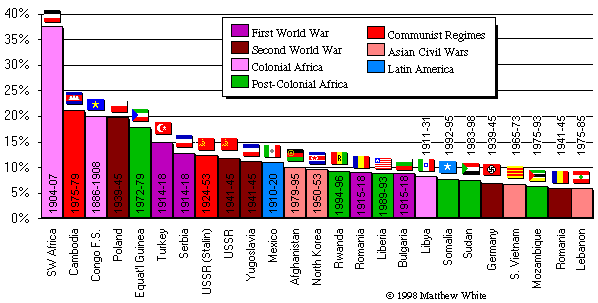
A graph of The 25 highest percentages of national populations killed during periods of mass brutality
Question: Who was the Bloodiest Tyrant of the 20th Century?
Answer: We don't know.
Sidenote: Do Democracies Make War on One Another? (More Inside)
A graph of The 25 highest percentages of national populations killed during periods of mass brutality
Question: Who was the Bloodiest Tyrant of the 20th Century?
Answer: We don't know.
Sidenote: Do Democracies Make War on One Another? (More Inside)
Dunno about democracies making war on one another, but wasn't the Falklands War the first time two nations crossed swords that both had McDonald's, KFC etc?
posted by alumshubby at 5:53 AM on April 6, 2003
posted by alumshubby at 5:53 AM on April 6, 2003
leaves out the spanish flu epidemic ~ at 21 million or so it should be in the top 3.
posted by tiamat at 6:57 AM on April 6, 2003
posted by tiamat at 6:57 AM on April 6, 2003
reminds me of an old bumper sticker:
"Death: Trillions of people can't be wrong!"
posted by tiamat at 6:57 AM on April 6, 2003
"Death: Trillions of people can't be wrong!"
posted by tiamat at 6:57 AM on April 6, 2003
Any ideology can lead to atrocities when its followers see the ideology as being more importants than humanity. Which is worse, the trans-Atlantic slave trade or the Cultural Revolution? Tough call.
Great post, y2karl.
posted by plep at 7:37 AM on April 6, 2003
Great post, y2karl.
posted by plep at 7:37 AM on April 6, 2003
Hm. Watching y2karl post a link to a Hoover Institution report is sort of like watching Pat Buchanan march in a PrideFest parade. Have I stumbled into the Bizarro world?
The Hoover report looks like an attempt to refute the obvious, by various rhetorical slights of hand. For example:
The authors are sometimes just hilarious:
The authors admit that if you use a reasonable definition of 'democracy':
Look. If you look hard enough, you can probably find some example of two democratic states that fought each other. The idea that 'democracies do not war on each other' is not a natural law, like the gravitational constant. It's an observation made from history. War between democracies is not forbidden, it's just very rare, much more rare than despotic regimes warring on each other, or on democracies. It suggests that if you don't want war, democracy is a very powerful tool, and the more democracies we have, the fewer wars.
posted by Slithy_Tove at 8:16 AM on April 6, 2003
The Hoover report looks like an attempt to refute the obvious, by various rhetorical slights of hand. For example:
In the latter case, President Polk, who wanted to fight Mexico, had to resist popular pressure to fight Britain, too, over the U.S.-Canada boundary. In 1898 President McKinley gave in to popular pressure for war with Spain. In 1917 President Wilson easily ignited mass belligerency after campaigning against war the year before.These are all cases that prove the opposite of the authors' point: Polk did not fight Britain; and neither Spain in 1898 nor Germany in 1917 were democracies. (If they had been, they might have stepped back from the brink, or in the case of Germany, never entered into a war to begin with.)
The authors are sometimes just hilarious:
Assuming lax enough tests of democracy, exceptions to democratic pacifism abound.Uh, yeah. And assuming lax enough tests of cats, I can prove that cats are dogs. C'mon guys. Trying to convince us that Kaiser Wilhem's Germany or George III's England were democracies is just perverse. Neither was anything of the kind.
The authors admit that if you use a reasonable definition of 'democracy':
That pretty much shrinks the democratic category to the Cold War democracies, to those states that have continuously enjoyed high-class democratic regimes since soon after World War II.And then they come up with a grabbag of exceptions that prove why every single one of those states never had a war with another one. Just by accident.
Look. If you look hard enough, you can probably find some example of two democratic states that fought each other. The idea that 'democracies do not war on each other' is not a natural law, like the gravitational constant. It's an observation made from history. War between democracies is not forbidden, it's just very rare, much more rare than despotic regimes warring on each other, or on democracies. It suggests that if you don't want war, democracy is a very powerful tool, and the more democracies we have, the fewer wars.
posted by Slithy_Tove at 8:16 AM on April 6, 2003

I guess President Truman just missed out on that killing-of-innocents list. Or doesn't he count?
posted by Pretty_Generic at 8:46 AM on April 6, 2003
posted by Pretty_Generic at 8:46 AM on April 6, 2003
Thanks for the links. These are without a doubt the funniest words I've ever read about war, democracy, tyrants and millions of tragic deaths.
(The guy should learn how to spell the name of the world's premier purveyor of beef patties, though.)
posted by kozad at 8:55 AM on April 6, 2003
(The guy should learn how to spell the name of the world's premier purveyor of beef patties, though.)
posted by kozad at 8:55 AM on April 6, 2003
I guess President Truman just missed out on that killing-of-innocents list.
Make sure to add Churchill and Roosevelt and any other national leader in a time of war just to make sure that dead horse gets beaten thoroughly.
posted by Cyrano at 9:03 AM on April 6, 2003
Make sure to add Churchill and Roosevelt and any other national leader in a time of war just to make sure that dead horse gets beaten thoroughly.
posted by Cyrano at 9:03 AM on April 6, 2003
And what have we learned here today kids?
That ideologies of all kinds do nothing in the end but create adherents, who eventually either (if they have some balls)heretics, or oppressors in their own right.
posted by jonmc at 9:07 AM on April 6, 2003
That ideologies of all kinds do nothing in the end but create adherents, who eventually either (if they have some balls)heretics, or oppressors in their own right.
posted by jonmc at 9:07 AM on April 6, 2003
ummm. insert a "become" after"either"
Damed hangover....In case you were wondering Smirnoff Ice tastes like watered-down vodka, just a little something I learned.
posted by jonmc at 9:09 AM on April 6, 2003
Damed hangover....In case you were wondering Smirnoff Ice tastes like watered-down vodka, just a little something I learned.
posted by jonmc at 9:09 AM on April 6, 2003
Cyrano - Churchill and Roosevelt didn't describe a major city as a military base. So far as I know.
posted by Pretty_Generic at 9:22 AM on April 6, 2003
posted by Pretty_Generic at 9:22 AM on April 6, 2003
What I mean is, they didn't deliberately kill innocents to weaken the enemy's resolve.
posted by Pretty_Generic at 9:23 AM on April 6, 2003
posted by Pretty_Generic at 9:23 AM on April 6, 2003
Yeah, I kind of... forgot about... that one...
posted by Pretty_Generic at 9:51 AM on April 6, 2003
posted by Pretty_Generic at 9:51 AM on April 6, 2003
Why We Will Soon Miss The Cold War
Wonder why the author didn't ask the people of the former Soviet Eastern Bloc countries to chime in on that topic?
posted by MrBaliHai at 10:08 AM on April 6, 2003
Wonder why the author didn't ask the people of the former Soviet Eastern Bloc countries to chime in on that topic?
posted by MrBaliHai at 10:08 AM on April 6, 2003
To the Allies, air power was a strategic weapon aimed almost totally at the destruction of the means of production on the one hand, and of enemy towns, cities and morale on the other.
A bit more info.
posted by Cyrano at 10:27 AM on April 6, 2003
A bit more info.
posted by Cyrano at 10:27 AM on April 6, 2003
Great find, y2karl. Really interesting charts.
Eddie Izzard's got some interesting perspective on genocides and massacres (the charts reminded me):
"Pol Pot killed one point seven million Cambodians, died under house arrest, well done there. Stalin killed many millions, died in his bed, aged seventy-two, well done indeed. And the reason we let them get away with it is they killed their own people. And we're sort of fine with that. Hitler killed people next door. Oh, stupid man. After a couple of years we won’t stand for that, will we?"
And something to the effect of: "You kill one person, you get locked up in jail. You kill 10, 20 people, you get locked up in a mental institution. But you kill 1 million... it's such an unfathomable number, 1 million... we start to think, 'Wow, great job! You killed one million people? You must get up pretty early in the morning!'"
posted by gramcracker at 10:44 AM on April 6, 2003
Eddie Izzard's got some interesting perspective on genocides and massacres (the charts reminded me):
"Pol Pot killed one point seven million Cambodians, died under house arrest, well done there. Stalin killed many millions, died in his bed, aged seventy-two, well done indeed. And the reason we let them get away with it is they killed their own people. And we're sort of fine with that. Hitler killed people next door. Oh, stupid man. After a couple of years we won’t stand for that, will we?"
And something to the effect of: "You kill one person, you get locked up in jail. You kill 10, 20 people, you get locked up in a mental institution. But you kill 1 million... it's such an unfathomable number, 1 million... we start to think, 'Wow, great job! You killed one million people? You must get up pretty early in the morning!'"
posted by gramcracker at 10:44 AM on April 6, 2003
I don't know. Most of the "democracies don't fight" arguments classify only those states with universal suffrage for citizens above a certain age as being "democracies". I see little reason that a state with a limited suffrage is not a democracy so long as power is vested in those voters and mechanisms exist to arbitrate and legitimise the outcomes of those votes. Athens just prior to the Peloponnesian War was both a democracy _and_ a brutal imperial power in the Aegean, because being so provided the Athenian populace with things that they wanted, and therefore inclined them to vote for measures which created and strengthened their empire.
posted by Pseudoephedrine at 10:55 AM on April 6, 2003
posted by Pseudoephedrine at 10:55 AM on April 6, 2003
Great link, doesn't seem to leave anyone out.
I remember a few years ago when one of the secondary mass murderers, Suharto from Indonesia, visited Canada and the goverment removed and peppar-sprayed all these protestors so he wouldn't be embarrassed. That still pisses me off.
posted by bobo123 at 11:06 AM on April 6, 2003
I remember a few years ago when one of the secondary mass murderers, Suharto from Indonesia, visited Canada and the goverment removed and peppar-sprayed all these protestors so he wouldn't be embarrassed. That still pisses me off.
posted by bobo123 at 11:06 AM on April 6, 2003
Wonder why the author didn't ask the people of the former Soviet Eastern Bloc countries to chime in on that topic?
Perhaps you have heard of Serbia, Croatia, Bosnia-Herzcegovina and Kosovo.
As for the Hoover Institution, I should have read closer. I was up late. My bad.
Aaronshaf's contribution is interesting--He reminds of a number of people I've known. I can think of an individual who's an anti-communist in the sense that he's a mirror image of a communist--a zealot who demonizes cartoon monsters of received opinion, and turns a blind eye when these designated evildoers are butchered. Kill the Kulaks: genocide. Kill the commies: doing God's work. It's all simple and laid out in black and white with no tones in between. He is what he hates.
If you go by the numbers, yeah, the communists killed more people because, White points out, in taking over two of the largest empires of the Twentieth Century, they had power over the most people.
But if you go by per capita genocide, Germany's Herero War of 1904-1907 in South West Africa, wins hands down. And the German Empire was neither socialist nor communist--heck, there weren't any communists in power anywhere for another ten years.
I agree with Matthew White: no nation, race, religion or political ideology has the corner on the atrocity market. It's in our blood to spill blood. I mean, look at his Death Tolls for the Man-made Megadeaths of the Twentieth Century--read it and weep, or go numb.
Here's a name for you, Pretty_Generic: Sir Arthur 'Bomber' Harris
posted by y2karl at 12:18 PM on April 6, 2003
Perhaps you have heard of Serbia, Croatia, Bosnia-Herzcegovina and Kosovo.
As for the Hoover Institution, I should have read closer. I was up late. My bad.
Aaronshaf's contribution is interesting--He reminds of a number of people I've known. I can think of an individual who's an anti-communist in the sense that he's a mirror image of a communist--a zealot who demonizes cartoon monsters of received opinion, and turns a blind eye when these designated evildoers are butchered. Kill the Kulaks: genocide. Kill the commies: doing God's work. It's all simple and laid out in black and white with no tones in between. He is what he hates.
If you go by the numbers, yeah, the communists killed more people because, White points out, in taking over two of the largest empires of the Twentieth Century, they had power over the most people.
But if you go by per capita genocide, Germany's Herero War of 1904-1907 in South West Africa, wins hands down. And the German Empire was neither socialist nor communist--heck, there weren't any communists in power anywhere for another ten years.
I agree with Matthew White: no nation, race, religion or political ideology has the corner on the atrocity market. It's in our blood to spill blood. I mean, look at his Death Tolls for the Man-made Megadeaths of the Twentieth Century--read it and weep, or go numb.
Here's a name for you, Pretty_Generic: Sir Arthur 'Bomber' Harris
posted by y2karl at 12:18 PM on April 6, 2003
Nevertheless, because there is so much in the Uber site, I thought that the links extracted for this post are unique enough to be link worthy.
and you were right. informative as always, y2karl.
posted by Ignatius J. Reilly at 12:38 PM on April 6, 2003
and you were right. informative as always, y2karl.
posted by Ignatius J. Reilly at 12:38 PM on April 6, 2003
What I mean is, they [Churchill and Roosevelt] didn't deliberately kill innocents to weaken the enemy's resolve.
Tokyo?
posted by dhoyt at 1:15 PM on April 6, 2003
Tokyo?
posted by dhoyt at 1:15 PM on April 6, 2003
Another good presentation, y2karl.
And it is always refreshing to see a list of the top tragedies of the last one hundred years that does not make a special dispensation and insist on including September 11th. In the most horrific hundred years in the history of the known universe, there is (terrifyingly) no room on that list for 3000 people.
My vote for bloodiest tyrant of the century has to be Mao, even though the link notes that maybe he should get some credit for not intending to kill all 40 million of those people. I think it's more sinister to alter a system in such a way that 30 million people die as a matter of course than to outright kill 10 million, especially considering that the system that did it is still basically entrenched. Talk about a legacy!
posted by Hildago at 1:28 PM on April 6, 2003
And it is always refreshing to see a list of the top tragedies of the last one hundred years that does not make a special dispensation and insist on including September 11th. In the most horrific hundred years in the history of the known universe, there is (terrifyingly) no room on that list for 3000 people.
My vote for bloodiest tyrant of the century has to be Mao, even though the link notes that maybe he should get some credit for not intending to kill all 40 million of those people. I think it's more sinister to alter a system in such a way that 30 million people die as a matter of course than to outright kill 10 million, especially considering that the system that did it is still basically entrenched. Talk about a legacy!
posted by Hildago at 1:28 PM on April 6, 2003
Y2karl, by the way, as an interesting follow-up to the Why We Will Miss the Cold War article you posted, here's an interview with John Mearsheimer from last April (a year ago Monday), in which he states, among other things, that "the Bush administration's policy [on terrorism] is wrong-headed because it places too much emphasis on using military force to deal with the problem, and not enough emphasis on diplomacy." He also discusses how his Realist theories have held up or evolved one decade after the end of the Cold War.
The interview is part of the UC Berkeley Institute of Historical Studies' Conversations With History series, an absolutely wonderful site including short interviews with hundreds of luminaries, from Kofi Annan to Oliver Stone.
posted by grrarrgh00 at 1:51 PM on April 6, 2003
The interview is part of the UC Berkeley Institute of Historical Studies' Conversations With History series, an absolutely wonderful site including short interviews with hundreds of luminaries, from Kofi Annan to Oliver Stone.
posted by grrarrgh00 at 1:51 PM on April 6, 2003
Perhaps you have heard of Serbia, Croatia, Bosnia-Herzcegovina and Kosovo.
Perhaps you've heard of Slovakia, the Czech Republic, Poland, Hungary, Latvia, Lithuania, Estonia, East Germany, and several other formerly communist countries that didn't dissolve into bloody chaos when the stranglehold of the Soviet Union was released? Do you really think that those people are pining for the return of the Cold War? Hell, I bet even the population of the former Yugoslavia, as bloody as their recent history has been, doesn't want that.
When you add in the fact that the article's author deliberately brushes aside the Korean War, the Cuban missile crisis, Vietnam, and the Soviet invasion of Afghanistan with a single sentence, his premise that the Cold War provided a stability in international relations that's somehow more desirable than a largely free and increasingly prosperous Europe becomes awfully hard to swallow for me.
The rest of your links were swell though.
posted by MrBaliHai at 1:53 PM on April 6, 2003
Perhaps you've heard of Slovakia, the Czech Republic, Poland, Hungary, Latvia, Lithuania, Estonia, East Germany, and several other formerly communist countries that didn't dissolve into bloody chaos when the stranglehold of the Soviet Union was released? Do you really think that those people are pining for the return of the Cold War? Hell, I bet even the population of the former Yugoslavia, as bloody as their recent history has been, doesn't want that.
When you add in the fact that the article's author deliberately brushes aside the Korean War, the Cuban missile crisis, Vietnam, and the Soviet invasion of Afghanistan with a single sentence, his premise that the Cold War provided a stability in international relations that's somehow more desirable than a largely free and increasingly prosperous Europe becomes awfully hard to swallow for me.
The rest of your links were swell though.
posted by MrBaliHai at 1:53 PM on April 6, 2003
Hidalgo, I would have to say Stalin's the worst. Not only did he kill millions of his own people, but you could argue that he indirectly caused the slaughter in China by serving as a role model for Mao.
posted by wrench at 2:11 PM on April 6, 2003
posted by wrench at 2:11 PM on April 6, 2003
It seems that any national leader is responsible for a great number of deaths - hell, even peaceful, little Norway have killed thousands of members of ethnic minorities trough the last century - even since WWII.
I support Adams' conclusion on this (slightly paraphrased):
"People who are willing to rule others should under no circumstances be allowed to do so."
posted by spazzm at 3:24 PM on April 6, 2003
I support Adams' conclusion on this (slightly paraphrased):
"People who are willing to rule others should under no circumstances be allowed to do so."
posted by spazzm at 3:24 PM on April 6, 2003
A central point of his, MrBaliHai, which is not without merit:
We know that from 1900 to 1945 some 50 million Europeans were killed in wars that were caused in great part by the instability of this state system. We also know that since 1945 only some 15,000 Europeans have been killed in wars: roughly 10,000 Hungarians and Russians, in what we might call the Russo-Hungarian War of October and November, 1956, and somewhere between 1,500 and 5,000 Greeks and Turks, in the July and August, 1974, war on Cyprus.
Your point, which is also not without merit:
When you add in the fact that the article's author deliberately brushes aside the Korean War, the Cuban missile crisis, Vietnam, and the Soviet invasion of Afghanistan with a single sentence, his premise that the Cold War provided a stability in international relations that's somehow more desirable than a largely free and increasingly prosperous Europe becomes awfully hard to swallow for me.
But note what a largely free and increasingly prosperous Europe did when Yugoslavia began to unravel into a series of ugly little wars.
If, by some miracle, the largely free and prosperous Europe truly comes together as a United States of Europe, will that be a good or bad thing? Will it be a friend or rival? Will they be a rival or will we all hold hands and sing It's a Small World After All? I just don't know.
I'm not comfortable with much of what he says in either the article or the interview grrarrgh00 linked but he does raise some questions. I was up late when I posted last night and I threw in those extra links which are offtopic and in some ways, I wish I hadn't. But in another way, directly related to the main topic here--atrocities, there is some relation.
Over in Warfilter I posted this link I found at the Agonist about the complexities of Iraqi opposition politics. Much of it is about the tension between Turkey and the Kurds, which may very well lead to war at some point. Turkey, and by extension Syria and Iran, have no wish to see a Kurdistan emerge. Turkey, for one, will go to war to stop it.
For all the hue and cry about Halabja and Saddam Hussein, the Turkish state has killed far more Kurds in this century than the all the Arabs or the Iranians put together and it is Turkey, this article linked argues, that is enemy number one to the Kurds. Turkey is an interesting case--they committed gencide/ethnic cleansing on the Armenians, Ionian Greeks and the Kurds and they still deny it.
We truly do live in interesting times.
But, MrBaliHai, Matthew White does an external line to a topic I am sure you will find to your taste:
The 100 Worst Songs of All Time (That Charted)--there is much there for us to loathe in common. Personally, I think #43 should be at least #3. I don't find Chestnut Mare all that awful. Love the title thingy for #41...
posted by y2karl at 3:52 PM on April 6, 2003
We know that from 1900 to 1945 some 50 million Europeans were killed in wars that were caused in great part by the instability of this state system. We also know that since 1945 only some 15,000 Europeans have been killed in wars: roughly 10,000 Hungarians and Russians, in what we might call the Russo-Hungarian War of October and November, 1956, and somewhere between 1,500 and 5,000 Greeks and Turks, in the July and August, 1974, war on Cyprus.
Your point, which is also not without merit:
When you add in the fact that the article's author deliberately brushes aside the Korean War, the Cuban missile crisis, Vietnam, and the Soviet invasion of Afghanistan with a single sentence, his premise that the Cold War provided a stability in international relations that's somehow more desirable than a largely free and increasingly prosperous Europe becomes awfully hard to swallow for me.
But note what a largely free and increasingly prosperous Europe did when Yugoslavia began to unravel into a series of ugly little wars.
If, by some miracle, the largely free and prosperous Europe truly comes together as a United States of Europe, will that be a good or bad thing? Will it be a friend or rival? Will they be a rival or will we all hold hands and sing It's a Small World After All? I just don't know.
I'm not comfortable with much of what he says in either the article or the interview grrarrgh00 linked but he does raise some questions. I was up late when I posted last night and I threw in those extra links which are offtopic and in some ways, I wish I hadn't. But in another way, directly related to the main topic here--atrocities, there is some relation.
Over in Warfilter I posted this link I found at the Agonist about the complexities of Iraqi opposition politics. Much of it is about the tension between Turkey and the Kurds, which may very well lead to war at some point. Turkey, and by extension Syria and Iran, have no wish to see a Kurdistan emerge. Turkey, for one, will go to war to stop it.
For all the hue and cry about Halabja and Saddam Hussein, the Turkish state has killed far more Kurds in this century than the all the Arabs or the Iranians put together and it is Turkey, this article linked argues, that is enemy number one to the Kurds. Turkey is an interesting case--they committed gencide/ethnic cleansing on the Armenians, Ionian Greeks and the Kurds and they still deny it.
We truly do live in interesting times.
But, MrBaliHai, Matthew White does an external line to a topic I am sure you will find to your taste:
The 100 Worst Songs of All Time (That Charted)--there is much there for us to loathe in common. Personally, I think #43 should be at least #3. I don't find Chestnut Mare all that awful. Love the title thingy for #41...
posted by y2karl at 3:52 PM on April 6, 2003
Matt White's page has been linked before; someone buy that dude a domain name, because users.erols.com just ain't cutting it; as an amateur historian, he's got a pretty kick-ass site.
posted by hincandenza at 1:47 AM on April 7, 2003
posted by hincandenza at 1:47 AM on April 7, 2003
Great discussion but I do wonder about the accuracy of some of these nubers f.e. East Timor should certainly be number 1 or 2 in the percentage of population killed link, as the same graph misses the fact that Greece lost much more than 5% of its population (~550 thousand, of a population around 7.4 million at the time = around 7.5%, a figure which includes those that died from starvation inflicted by the occupation forces).
posted by talos at 3:51 AM on April 7, 2003
posted by talos at 3:51 AM on April 7, 2003
Great post, y2karl. And although this was mentioned in the comments to the earlier thread, it's well worth a look by the many (like me) who weren't around here two years ago: the history of Moslem Australia. This guy is a genius.
Slithy Tove said this so well I have to copy it here for those who missed it:
And, y2karl, I'm glad to see your recent enthusiasm for posting breaking news was an aberration...
posted by languagehat at 9:01 AM on April 7, 2003
Slithy Tove said this so well I have to copy it here for those who missed it:
The idea that 'democracies do not war on each other' is not a natural law, like the gravitational constant. It's an observation made from history. War between democracies is not forbidden, it's just very rare, much more rare than despotic regimes warring on each other, or on democracies. It suggests that if you don't want war, democracy is a very powerful tool, and the more democracies we have, the fewer wars.Hildago, you have a good point about Mao and the system, but I suspect the reason for the omission of Sept. 11 may have something to do with this: "Last updated June 2000."
And, y2karl, I'm glad to see your recent enthusiasm for posting breaking news was an aberration...
posted by languagehat at 9:01 AM on April 7, 2003
« Older UN Membership for Palestine — Now | Hamlet 2471 Newer »
This thread has been archived and is closed to new comments
Matthew White:
If we're going to be pointing fingers of blame for the savageness of the Century--and you know you want to--raw numbers are probably not enough. There have been plenty of episodes of concentrated brutality that don't show up on the list above simply because the affected population is so small. Meanwhile, a major reason that Russia and China stand so prominently at the top of the list is that they have so many potential victims to begin with. Therefore, I've taken all the episodes of mass killing of the 20th Century and divided them by the population of the country that suffered the losses.
I did not manipulate the data... I did the math and let the chips fall where they would.
That's why I was so startled to discover that there is absolutely no pattern to the chart. If I had simply picked 25 countries out of a hat, I could not have gotten a more diverse spread than we've got here....
See also: The Myth of Democratic Pacifism
I have thought about this article at least once a week ever since I first read it in August of 1990 : Why We Will Soon Miss The Cold War
I don't know about you but I sure do...
Also, via Kliuless: Democide
posted by y2karl at 5:47 AM on April 6, 2003