Signs of the Apocalypse
February 6, 2004 8:35 AM Subscribe
Baby's 'second head' to be removed by surgery "This parasitic formation is fed by and drains off the blood supply system of [baby’s] head."
"This is medical history,"... The condition, known formally as Cranio Pagus Parasiticus, is extremely rare, with only seven other cases ever reported.
Oh my god, it's real. I caught a glance of this on the NYT "more news" righthand column, and then the page did it's weird little "auto-refresh" behavior and the story link was gone!
I thought I had hallucinated it.
A second, parasitic head....that's just so South Park.
posted by troutfishing at 8:42 AM on February 6, 2004
I thought I had hallucinated it.
A second, parasitic head....that's just so South Park.
posted by troutfishing at 8:42 AM on February 6, 2004
AAAAAHHHHHHHH!!!!!!
posted by BobFrapples at 8:43 AM on February 6, 2004
posted by BobFrapples at 8:43 AM on February 6, 2004
Then there's this poor little dude (no pic), who 'birthed' his brother. He'd better hope the internet never catches on in Kazakhstan, or the secret his parents are keeping will come out. (no pun intended).
posted by stonerose at 8:45 AM on February 6, 2004
posted by stonerose at 8:45 AM on February 6, 2004
The thing I found weirdest about this is that CNN reported that the mouth of the second head moves when the baby's being fed, and there's some brainwave activity in the second brain. Reminds me of Stephen King's The Dark Half. I can't imagine how upsetting this must be to new parents (they knew the kid had a tumour from prenatal ultrasounds, but they didn't know it was a twin-tumour). I hope the surgery goes well.
posted by biscotti at 9:06 AM on February 6, 2004
posted by biscotti at 9:06 AM on February 6, 2004
Time to call in the right-to-lifers for a little "god's will" protest info-tainment.
posted by Fupped Duck at 9:09 AM on February 6, 2004
posted by Fupped Duck at 9:09 AM on February 6, 2004
Fupped Duck - Great point, but isn't there some online Christian evangelical version of "Ask the Mufti", where we could email in the question, for doctrinal evaluation, Does the parasitic second head have an immortal soul ?
We'd have to get some clarification on that point first.
Maybe there's some spot in heaven which is reserved for parasitic heads ?
posted by troutfishing at 9:14 AM on February 6, 2004
We'd have to get some clarification on that point first.
Maybe there's some spot in heaven which is reserved for parasitic heads ?
posted by troutfishing at 9:14 AM on February 6, 2004
I, for one, welcome our new two-brained overlords.
posted by armoured-ant at 9:17 AM on February 6, 2004
posted by armoured-ant at 9:17 AM on February 6, 2004
Maybe there's some spot in heaven which is reserved for parasitic heads?
Reason enough not to believe in god right there.
The thing I found weirdest about this is that CNN reported that the mouth of the second head moves when the baby's being fed, and there's some brainwave activity in the second brain.
Oooh, now I'm queasy. So much for lunch...
posted by monju_bosatsu at 9:18 AM on February 6, 2004
Reason enough not to believe in god right there.
The thing I found weirdest about this is that CNN reported that the mouth of the second head moves when the baby's being fed, and there's some brainwave activity in the second brain.
Oooh, now I'm queasy. So much for lunch...
posted by monju_bosatsu at 9:18 AM on February 6, 2004
I'm a lot more concerned about this than most people here seem to be. The language of the story is heavily biased: why is this a "parasitic formation" rather than a consciousness-supporting head of a living being?
The New Scientist story seems to be reporting that a bunch of doctors have decided on the existential status of this being, and deemed it unfit to live.
On what basis?
Blue Stone is a non-christian non-right-to-lifer.
posted by Blue Stone at 9:34 AM on February 6, 2004
The New Scientist story seems to be reporting that a bunch of doctors have decided on the existential status of this being, and deemed it unfit to live.
On what basis?
Blue Stone is a non-christian non-right-to-lifer.
posted by Blue Stone at 9:34 AM on February 6, 2004
Once in a while, Google ads are way inappropriate. On this page: "Twin baby announcements. Unique announcements for your new twin babies."
posted by beagle at 9:38 AM on February 6, 2004
posted by beagle at 9:38 AM on February 6, 2004
It's parastic from a medical point of view -- it can't support itself or supply its life needs, so it's a parasite of the other child.
And on what basis ? It's a half-head, stuck on top a normal living child's head. What basis does it have to stay there? Can full-kid ever have anything of a life with a lump of head-likeness stuck to his forehead that moves when he eats? Wowee.
posted by bonaldi at 9:43 AM on February 6, 2004
And on what basis ? It's a half-head, stuck on top a normal living child's head. What basis does it have to stay there? Can full-kid ever have anything of a life with a lump of head-likeness stuck to his forehead that moves when he eats? Wowee.
posted by bonaldi at 9:43 AM on February 6, 2004
I can't imagine how upsetting this must be to new parents (they knew the kid had a tumour from prenatal ultrasounds, but they didn't know it was a twin-tumour).
Exactly. Apart from the worry of what lies ahead medically, it has to be pretty traumatic having pictures of your "two-headed baby" shared with every enquiring mind on the planet.
posted by 327.ca at 9:46 AM on February 6, 2004
Exactly. Apart from the worry of what lies ahead medically, it has to be pretty traumatic having pictures of your "two-headed baby" shared with every enquiring mind on the planet.
posted by 327.ca at 9:46 AM on February 6, 2004
On what basis?
The story I read had the parasitic head growing more quickly than the child's own head. I don't know if it's terminal, or if the parasite would "allow" the other brain to control the body--which would actually be symbiotic. Since they keep referring to it as a parasite, the doctors involved probably consider it a terminal condition.
posted by whatnot at 10:04 AM on February 6, 2004
The story I read had the parasitic head growing more quickly than the child's own head. I don't know if it's terminal, or if the parasite would "allow" the other brain to control the body--which would actually be symbiotic. Since they keep referring to it as a parasite, the doctors involved probably consider it a terminal condition.
posted by whatnot at 10:04 AM on February 6, 2004
How did they decide which head was the parasite?
posted by kirkaracha at 10:13 AM on February 6, 2004
posted by kirkaracha at 10:13 AM on February 6, 2004
My guess is they went with the one that wasn't attached to the neck.
posted by Cyrano at 10:33 AM on February 6, 2004
posted by Cyrano at 10:33 AM on February 6, 2004
I read that the parisitic head puts pressure on the baby's brain, which might prevent it from developing normally.
posted by orange swan at 10:57 AM on February 6, 2004
posted by orange swan at 10:57 AM on February 6, 2004
Does the parasitic second head have an immortal soul ?
Ask Doctor Angelicus!
posted by languagehat at 11:19 AM on February 6, 2004
Ask Doctor Angelicus!
Whether the intellectual principle is multiplied according to the number of bodiesSeveral objections and responses have been omitted in the interest of brevity; still, we here at Ask Aquinas hope this has satisfied your doubts on this matter. For further enlightenment, read Whether the soul is in each part of the body.
Objection 1: It would seem that the intellectual principle is not multiplied according to the number of bodies, but that there is one intellect in all men. For an immaterial substance is not multiplied in number within one species. But the human soul is an immaterial substance; since it is not composed of matter and form as was shown above (Question [75], Article [5]). Therefore there are not many human souls in one species. But all men are of one species. Therefore there is but one intellect in all men.
Objection 2: Further, when the cause is removed, the effect is also removed. Therefore, if human souls were multiplied according to the number of bodies, it follows that the bodies being removed, the number of souls would not remain; but from all the souls there would be but a single remainder. This is heretical; for it would do away with the distinction of rewards and punishments.
Objection 3: Further, if my intellect is distinct from your intellect, my intellect is an individual, and so is yours; for individuals are things which differ in number but agree in one species. Now whatever is received into anything must be received according to the condition of the receiver. Therefore the species of things would be received individually into my intellect, and also into yours: which is contrary to the nature of the intellect which knows universals. [...]
On the contrary, The Philosopher says (Phys. ii, 3) that the relation of universal causes to universals is like the relation of particular causes to individuals. But it is impossible that a soul, one in species, should belong to animals of different species. Therefore it is impossible that one individual intellectual soul should belong to several individuals.
I answer that, It is absolutely impossible for one intellect to belong to all men. This is clear if, as Plato maintained, man is the intellect itself. For it would follow that Socrates and Plato are one man; and that they are not distinct from each other, except by something outside the essence of each. The distinction between Socrates and Plato would be no other than that of one man with a tunic and another with a cloak; which is quite absurd.
It is likewise clear that this is impossible if, according to the opinion of Aristotle (De Anima ii, 2), it is supposed that the intellect is a part or a power of the soul which is the form of man. For it is impossible for many distinct individuals to have one form, as it is impossible for them to have one existence, for the form is the principle of existence. [...]
Reply to Objection 1: Although the intellectual soul, like an angel, has no matter from which it is produced, yet it is the form of a certain matter; in which it is unlike an angel. Therefore, according to the division of matter, there are many souls of one species; while it is quite impossible for many angels to be of one species.
Reply to Objection 2: Everything has unity in the same way that it has being; consequently we must judge of the multiplicity of a thing as we judge of its being. Now it is clear that the intellectual soul, by virtue of its very being, is united to the body as its form; yet, after the dissolution of the body, the intellectual soul retains its own being. In like manner the multiplicity of souls is in proportion to the multiplicity of the bodies; yet, after the dissolution of the bodies, the souls retain their multiplied being.
Reply to Objection 3: Individuality of the intelligent being, or of the species whereby it understands, does not exclude the understanding of universals; otherwise, since separate intellects are subsistent substances, and consequently individual, they could not understand universals. But the materiality of the knower, and of the species whereby it knows, impedes the knowledge of the universal. For as every action is according to the mode of the form by which the agent acts, as heating is according to the mode of the heat; so knowledge is according to the mode of the species by which the knower knows. Now it is clear that common nature becomes distinct and multiplied by reason of the individuating principles which come from the matter. Therefore if the form, which is the means of knowledge, is material---that is, not abstracted from material conditions---its likeness to the nature of a species or genus will be according to the distinction and multiplication of that nature by means of individuating principles; so that knowledge of the nature of a thing in general will be impossible. But if the species be abstracted from the conditions of individual matter, there will be a likeness of the nature without those things which make it distinct and multiplied; thus there will be knowledge of the universal. Nor does it matter, as to this particular point, whether there be one intellect or many; because, even if there were but one, it would necessarily be an individual intellect, and the species whereby it understands, an individual species.
posted by languagehat at 11:19 AM on February 6, 2004
Does the parasitic second head have an immortal soul ?
If the baby has a brain, in the Bible the Hebrew word for soul is mind iirc. Soul = Heart is a bad translation.
posted by thomcatspike at 11:54 AM on February 6, 2004
If the baby has a brain, in the Bible the Hebrew word for soul is mind iirc. Soul = Heart is a bad translation.
posted by thomcatspike at 11:54 AM on February 6, 2004
Theology and conjoined twins don't mix well and they tend to avoid each other at parties.
posted by meehawl at 12:01 PM on February 6, 2004
posted by meehawl at 12:01 PM on February 6, 2004
I read that the parasitic head puts pressure on the baby's brain, which might prevent it from developing normally.
I can't even believe I'm posting this, but here's a Yahoo Slideshow with more ... er ... detailed photos of the baby. As you'll see, the residual twin is already much larger than the baby's head, which has got to have all kinds of developmental effects, even if there is no pressure on the cranial vault.
Poor baby. Poor parents.
posted by anastasiav at 12:37 PM on February 6, 2004
I can't even believe I'm posting this, but here's a Yahoo Slideshow with more ... er ... detailed photos of the baby. As you'll see, the residual twin is already much larger than the baby's head, which has got to have all kinds of developmental effects, even if there is no pressure on the cranial vault.
Poor baby. Poor parents.
posted by anastasiav at 12:37 PM on February 6, 2004
Hard to articulate, but something of boundless compassion wells up in me when I look at the parasite's facial features. There's some kind of tragedy here, but I'm not sure what it is...something to do with foreclosure, with that ear and those lips.
I think, pretty clearly, this surgery is right and proper and necessary, and I feel the same way about most abortions, although that's a different topic. But I'll confess to being unutterably moved by that second face. Thanks, anastasiav.
posted by adamgreenfield at 1:04 PM on February 6, 2004
I think, pretty clearly, this surgery is right and proper and necessary, and I feel the same way about most abortions, although that's a different topic. But I'll confess to being unutterably moved by that second face. Thanks, anastasiav.
posted by adamgreenfield at 1:04 PM on February 6, 2004
The face-- the distortion of the features-- reminds me of something, what is it, what is it-- Oh yes.
One of the self portraits from Michelangelo's Last Judgement in the Sistine Chapel.
I agree, adamgreenfield, there is something moving about the second face, that sketchy mouth and ear.
posted by jokeefe at 1:46 PM on February 6, 2004
One of the self portraits from Michelangelo's Last Judgement in the Sistine Chapel.
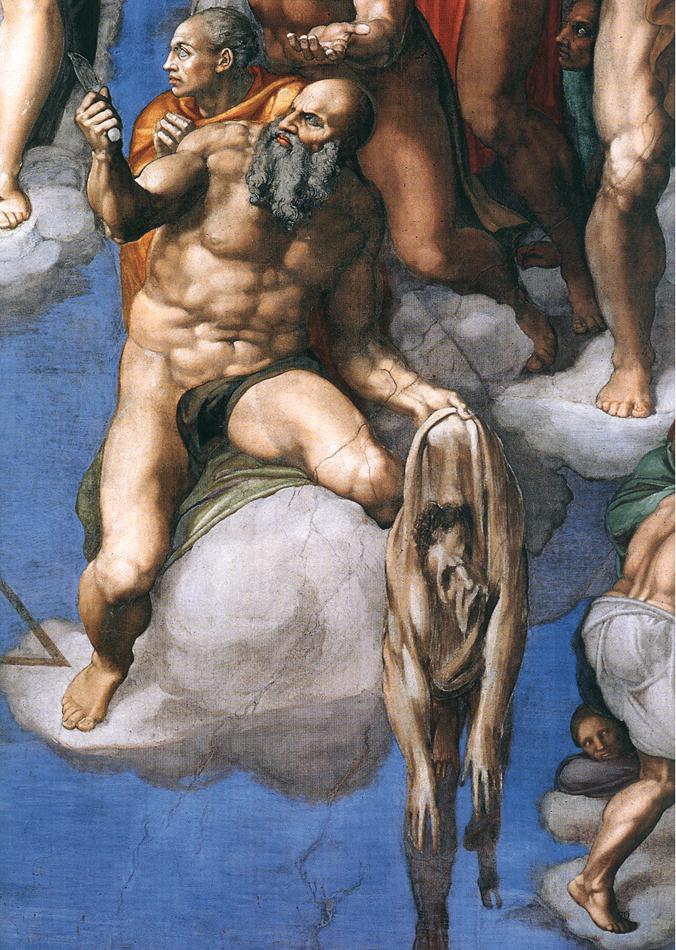
I agree, adamgreenfield, there is something moving about the second face, that sketchy mouth and ear.
posted by jokeefe at 1:46 PM on February 6, 2004
Crossword puzzle
Eight letters, (n) noun
CLUE: Nickname for fans and followers of the psychedelic music of Jerry Garcia
posted by Peter H at 1:57 PM on February 6, 2004
Eight letters, (n) noun
CLUE: Nickname for fans and followers of the psychedelic music of Jerry Garcia
posted by Peter H at 1:57 PM on February 6, 2004
Life imitates They Might Be Giants; also, paging Mojo Nixon.
posted by kirkaracha at 2:10 PM on February 6, 2004
posted by kirkaracha at 2:10 PM on February 6, 2004
I've seen most of the shock sites online, e.g. tubgirl and the inimitable goatse.cx, by for the life of me, I can't make myself click on the links to these pictures.
posted by monju_bosatsu at 2:16 PM on February 6, 2004
posted by monju_bosatsu at 2:16 PM on February 6, 2004
It's not as bad as tub and goat, just rather sad to watch, since there's an ear, a mouth and two shadows where eyes might have become if everything had gone right.
posted by dabitch at 2:28 PM on February 6, 2004
posted by dabitch at 2:28 PM on February 6, 2004
Did you hear the news about Edward?
On the back of his head he had another face
Was it a woman's face or a young girl?
They said to remove it would kill him
So poor Edward was doomed
The face could laugh and cry
It was his devil twin
And at night she spoke to him
Things heard only in hell
But they were impossible to separate
Chained together for life
Finally the bell tolled his doom
He took a suite of rooms
And hung himself and her from the balcony irons
Some still believe he was freed from her
But I knew her too well
I say she drove him to suicide
And took poor Edward to hell
posted by Oddly at 2:36 PM on February 6, 2004
On the back of his head he had another face
Was it a woman's face or a young girl?
They said to remove it would kill him
So poor Edward was doomed
The face could laugh and cry
It was his devil twin
And at night she spoke to him
Things heard only in hell
But they were impossible to separate
Chained together for life
Finally the bell tolled his doom
He took a suite of rooms
And hung himself and her from the balcony irons
Some still believe he was freed from her
But I knew her too well
I say she drove him to suicide
And took poor Edward to hell
posted by Oddly at 2:36 PM on February 6, 2004
You know, in any other century, the reaction would have been closer to 'kill it with a shovel!' than 'I'll confess to being unutterably moved'.
I'm not saying either is better, it just interests me.
posted by stavrosthewonderchicken at 6:50 PM on February 6, 2004
I'm not saying either is better, it just interests me.
posted by stavrosthewonderchicken at 6:50 PM on February 6, 2004
Our century's reaction is better. Trust me.
posted by Guy Smiley at 8:33 PM on February 6, 2004
posted by Guy Smiley at 8:33 PM on February 6, 2004
Little known fact: Garth Brooks has one of those.
posted by TimeFactor at 9:13 PM on February 6, 2004
posted by TimeFactor at 9:13 PM on February 6, 2004
The surgery was done today. So far, all is well.
posted by SisterHavana at 9:45 PM on February 6, 2004
posted by SisterHavana at 9:45 PM on February 6, 2004
"This parasitic formation is fed by and drains off the blood supply system of [Democracy's] head."
And it lives in the White H.........
I'm glad the baby's second parasitic head got lopped off successfully. Immortal soul or not.
posted by troutfishing at 7:19 AM on February 7, 2004
And it lives in the White H.........
I'm glad the baby's second parasitic head got lopped off successfully. Immortal soul or not.
posted by troutfishing at 7:19 AM on February 7, 2004
She died 12 hours after the surgery, it seems. (Follow SisterHavana's link.) :/
posted by sailoreagle at 8:42 AM on February 7, 2004
posted by sailoreagle at 8:42 AM on February 7, 2004
Did you hear the news about Edward?
Edward Mordake presumably?
posted by raygirvan at 8:23 AM on February 8, 2004
Edward Mordake presumably?
posted by raygirvan at 8:23 AM on February 8, 2004
« Older delete everything! burn your files! | B'aaah B'aaaaah B'aah B'aaaah..... Newer »
This thread has been archived and is closed to new comments
posted by stonerose at 8:38 AM on February 6, 2004