Bush vs. Kerry: Dead Heat or Blowout?
July 23, 2004 1:00 AM Subscribe
According to multiple recent nationwide polls, the
presidential race is a dead heat, with the spread
within the margin of error. Some have Bush by a
couple points, some say Kerry by a couple. But take a look at the way the race is represented by
www.electoral-vote.com, which tracks polls state-by-state and
takes electoral votes into account. Suddenly, the tally is Kerry 332, Bush 195.
At last, the Good Guy gets to steal the election through outmoded and illogical voting systems. Yay for us!
posted by Pretty_Generic at 1:10 AM on July 23, 2004
posted by Pretty_Generic at 1:10 AM on July 23, 2004
Yeah, but look how many states are "barely kerry" or "weakly kerry". but then again, with such a high EC vote count, bush dosn't very much farther to fall. He seems not to be doing well in swing states
I guess that's kind of the problem with Karl Rove's approach of 'motivating the base'. Gets people all fired up where it dosn't matter.
posted by delmoi at 1:32 AM on July 23, 2004
I guess that's kind of the problem with Karl Rove's approach of 'motivating the base'. Gets people all fired up where it dosn't matter.
posted by delmoi at 1:32 AM on July 23, 2004
Hmm... Bush seems to have lots of large single-digit states on that map, but Kerry has a ton of tiny ones that come with double-digit electoral votes. Even if the guy you're backing wins this time, the American presidential voting system is still thoroughly screwed up, really.
posted by reklaw at 2:00 AM on July 23, 2004
posted by reklaw at 2:00 AM on July 23, 2004
the Good Guy
I'm gonna assume you mean Kerry. If he is the 'good guy', why? Is it because the other guy is a whole lotta evil VS lesser of 2 evils?
posted by rough ashlar at 2:13 AM on July 23, 2004
I'm gonna assume you mean Kerry. If he is the 'good guy', why? Is it because the other guy is a whole lotta evil VS lesser of 2 evils?
posted by rough ashlar at 2:13 AM on July 23, 2004
Um, yes? Have you been listening?
posted by Pretty_Generic at 2:20 AM on July 23, 2004
posted by Pretty_Generic at 2:20 AM on July 23, 2004
"Bush's military records can be found intact and disclosed fully."
an achievement that would rival the Dead Sea Scrolls discovery, to say the least
posted by matteo at 2:28 AM on July 23, 2004
an achievement that would rival the Dead Sea Scrolls discovery, to say the least
posted by matteo at 2:28 AM on July 23, 2004
The polls do not show a "dead heat" "within the margin for error". They show Bush behind. The important polling is of independent voters and voters in swing states, and it is in these cases that Bush is trailing by a large margin.
The EC and popular vote margins are almost always disproportionate this way. It's how the system works.
Go to Pollkatz for comprehensive comparisons and graphs of polls. When looking at poll results, be clear on if it's "registered voters" or "likely voters". Be clear that methodolgy on determining "likely voters" varies a great deal and is generally not very reliable. Be clear that polls of "registered voters" are not that reliable when estimates of turnout are not that reliable.
Look at a variety of polls, and discard the outliers. Don't put much stock in individual poll results; instead, the only reliable information, really, is medium and long-term trending. Put poll results in historical context of prior election cycles.
And, finally, stick a fork in dubya. He's done.
posted by Ethereal Bligh at 2:40 AM on July 23, 2004
The EC and popular vote margins are almost always disproportionate this way. It's how the system works.
Go to Pollkatz for comprehensive comparisons and graphs of polls. When looking at poll results, be clear on if it's "registered voters" or "likely voters". Be clear that methodolgy on determining "likely voters" varies a great deal and is generally not very reliable. Be clear that polls of "registered voters" are not that reliable when estimates of turnout are not that reliable.
Look at a variety of polls, and discard the outliers. Don't put much stock in individual poll results; instead, the only reliable information, really, is medium and long-term trending. Put poll results in historical context of prior election cycles.
And, finally, stick a fork in dubya. He's done.
posted by Ethereal Bligh at 2:40 AM on July 23, 2004
reklaw, far be it from me to defend the electoral college, but you seem to be criticizing it on exactly backwards grounds. It's (mostly) population that matters, and land area doesn't enter into it.
Electoral votes are doled out roughly by population (every state starts with 3 and moves up from there). "Little" Massachusetts gets 12 votes because it has more people than "big" North Dakota, South Dakota, and Nebraska put together. Similar for "little" Maryland and "big" Idaho, Wyoming, and Montana.
You can see similar effects in county-by-county maps of the 2000 election returns -- Bush took some huge percentage of counties, so the map is almost all red, but that ignores the fact that Los Angeles County alone has more people in it than all the counties of North Dakota, South Dakota, Nebraska, Kansas, and Oklahoma put together.
posted by ROU_Xenophobe at 2:55 AM on July 23, 2004
Electoral votes are doled out roughly by population (every state starts with 3 and moves up from there). "Little" Massachusetts gets 12 votes because it has more people than "big" North Dakota, South Dakota, and Nebraska put together. Similar for "little" Maryland and "big" Idaho, Wyoming, and Montana.
You can see similar effects in county-by-county maps of the 2000 election returns -- Bush took some huge percentage of counties, so the map is almost all red, but that ignores the fact that Los Angeles County alone has more people in it than all the counties of North Dakota, South Dakota, Nebraska, Kansas, and Oklahoma put together.
posted by ROU_Xenophobe at 2:55 AM on July 23, 2004
Don't open the champagne yet, gentlemen.
posted by Keyser Soze at 3:18 AM on July 23, 2004
posted by Keyser Soze at 3:18 AM on July 23, 2004
It's (mostly) population that matters
That's the problem with it. Why not just have one person one vote, now it's possible to count with such accuracy? But, if it stops Bush, I'm pragmatically happy.
posted by Pretty_Generic at 3:25 AM on July 23, 2004
That's the problem with it. Why not just have one person one vote, now it's possible to count with such accuracy? But, if it stops Bush, I'm pragmatically happy.
posted by Pretty_Generic at 3:25 AM on July 23, 2004
William Saletan says you might as well stick a fork in Bush, and Saletan is rarely wrong.
posted by shoos at 3:35 AM on July 23, 2004
posted by shoos at 3:35 AM on July 23, 2004
That's very funny shoos. Well done!
posted by Pretty_Generic at 3:40 AM on July 23, 2004
posted by Pretty_Generic at 3:40 AM on July 23, 2004
"As long as Kerry has an actual spine, I'm game."
Please, someone tell me if i am wrong....
You know those commercials that say Kerry can't make his mind up? Here the deal:
There is a bill (I don't know) that was made to give a large fund to military spending. The original bill is what Kerry voted for.
The bill was revised and Kerry voted against the new bill. The reason was that the original bill used a tax on the very rich, and the new bill did not. Kerry did not want to increase the deficit, so he voted against the revised bill.
posted by Keyser Soze at 3:51 AM on July 23, 2004
Please, someone tell me if i am wrong....
You know those commercials that say Kerry can't make his mind up? Here the deal:
There is a bill (I don't know) that was made to give a large fund to military spending. The original bill is what Kerry voted for.
The bill was revised and Kerry voted against the new bill. The reason was that the original bill used a tax on the very rich, and the new bill did not. Kerry did not want to increase the deficit, so he voted against the revised bill.
posted by Keyser Soze at 3:51 AM on July 23, 2004
I wasn't trying to say anything about the 'waffling' issue. Just my overall impression of his personality. I bet his wife could absolutely rack his balls.
posted by shoos at 4:03 AM on July 23, 2004
posted by shoos at 4:03 AM on July 23, 2004
The "waffling issue" is only for people who are distracted by shiny objects and piledriven RNC talking points.
posted by Reverend Mykeru at 4:13 AM on July 23, 2004
posted by Reverend Mykeru at 4:13 AM on July 23, 2004
Why not just have one person one vote
I assume you mean why not elect the candidate with the most votes nationwide, since we already have one person one vote, but popular vote wins the state. It is this way because the United States has a Federal system of government, in which authority is shared between the central, national government and the individual states. You can't just ignore the states when it suits you.
Keyser: I don't think Kerry's waffling is due to an inability to make up his mind. I think he just likes telling people what they want to hear, and sometimes that means changing his position to suit his audience. I call it "Kerrying Favor".
posted by techgnollogic at 4:15 AM on July 23, 2004
I assume you mean why not elect the candidate with the most votes nationwide, since we already have one person one vote, but popular vote wins the state. It is this way because the United States has a Federal system of government, in which authority is shared between the central, national government and the individual states. You can't just ignore the states when it suits you.
Keyser: I don't think Kerry's waffling is due to an inability to make up his mind. I think he just likes telling people what they want to hear, and sometimes that means changing his position to suit his audience. I call it "Kerrying Favor".
posted by techgnollogic at 4:15 AM on July 23, 2004
I like waffles! Who here likes waffles?
posted by stavrosthewonderchicken at 4:21 AM on July 23, 2004
posted by stavrosthewonderchicken at 4:21 AM on July 23, 2004
Why not just have one person one vote, now it's possible to count with such accuracy?
You do remember the 2000 presidential election, yes? Think about the dispute over the vote tally in Florida (among other states; Florida just got the most attention). First off, that should give some indication about our ability to "count with such accuracy." Second, if the presidency had been up for grabs based on popular vote alone, with the nationwide vote as close as it was, we'd have faced nationwide recount after recount after recount for months (years?).
California's only "Weak Kerry"? Cripes.
posted by ChrisTN at 4:29 AM on July 23, 2004
You do remember the 2000 presidential election, yes? Think about the dispute over the vote tally in Florida (among other states; Florida just got the most attention). First off, that should give some indication about our ability to "count with such accuracy." Second, if the presidency had been up for grabs based on popular vote alone, with the nationwide vote as close as it was, we'd have faced nationwide recount after recount after recount for months (years?).
California's only "Weak Kerry"? Cripes.
posted by ChrisTN at 4:29 AM on July 23, 2004
Possible Bush slogans, from Josh Marshall:
1. Not as terrible as it could have been!
2. Four more years and we'll be safe!
3. Peace!
4. Incompetence and exaggeration, not bad-faith or lying, as shown in two recent reports!
5. Are you better off today than you would have been today assuming that that idiot Al Gore had won four years ago and he was president instead of me?
posted by the fire you left me at 4:39 AM on July 23, 2004
1. Not as terrible as it could have been!
2. Four more years and we'll be safe!
3. Peace!
4. Incompetence and exaggeration, not bad-faith or lying, as shown in two recent reports!
5. Are you better off today than you would have been today assuming that that idiot Al Gore had won four years ago and he was president instead of me?
posted by the fire you left me at 4:39 AM on July 23, 2004
If you look at the map, there are exactly four states that Bush won last time that are "barely" Kerry right now: Missouri, Ohio, Arizona and Florida (please....I don't want to debate whether Bush or Gore "won" Florida) and one "tie' -- Tennessee. One Bush state (New Hampshire) looks strong for Kerry right now. Four states that Gore won -- Michigan, Maine, Minnesota and Iowa, however, are only "barely" for Kerry. My hunch (and I'm a Bush guy) is that Kerry probably has the edge right now. If Kerry wins all the states that Gore did, all he really has to do is pick up one more, but who knows what will happen in the next few months......
posted by Durwood at 4:39 AM on July 23, 2004
posted by Durwood at 4:39 AM on July 23, 2004
Here's Scott Rasmussen's EV tally, updated semi regularly.
Keyser, you have it almost right. The $87 billion bill was offered, but Kerry backed an alternative version that would have eliminated tax cuts for the rich to pay for it. That version died, so he ultimately voted no. He says he knew it was guaranteed to pass, so he was making a point. (He was also facing an unexpected challenge from Howard Dean at the time and wanted to appeal to the anti war left.)
if the presidency had been up for grabs based on popular vote alone, with the nationwide vote as close as it was, we'd have faced nationwide recount after recount after recount for months
Actually, the national vote in 2000 wasn't that close - Gore won by half a million. It's *this year* that the national vote appears split 50-50.
posted by CunningLinguist at 4:56 AM on July 23, 2004
Keyser, you have it almost right. The $87 billion bill was offered, but Kerry backed an alternative version that would have eliminated tax cuts for the rich to pay for it. That version died, so he ultimately voted no. He says he knew it was guaranteed to pass, so he was making a point. (He was also facing an unexpected challenge from Howard Dean at the time and wanted to appeal to the anti war left.)
if the presidency had been up for grabs based on popular vote alone, with the nationwide vote as close as it was, we'd have faced nationwide recount after recount after recount for months
Actually, the national vote in 2000 wasn't that close - Gore won by half a million. It's *this year* that the national vote appears split 50-50.
posted by CunningLinguist at 4:56 AM on July 23, 2004
Waffles are sooo much better than pancakes!
So, what position does my man Howard Dean get? HHS? Education? Cracking insurance and pharma corporate balls? Chief of Staff?
I nominate Spitzer for Attorney General! Let's get the cabinet formation started today! Who would you like to see in what position?
posted by nofundy at 5:01 AM on July 23, 2004
So, what position does my man Howard Dean get? HHS? Education? Cracking insurance and pharma corporate balls? Chief of Staff?
I nominate Spitzer for Attorney General! Let's get the cabinet formation started today! Who would you like to see in what position?
posted by nofundy at 5:01 AM on July 23, 2004
Two weeks ago, this same site had Bush barely ahead in electoral votes. There are an awful lot of "barely kerry" states.
Yes, things look to be leaning kerryward, but let's at least wait until after the conventions before calling this one.
posted by jpoulos at 5:08 AM on July 23, 2004
Yes, things look to be leaning kerryward, but let's at least wait until after the conventions before calling this one.
posted by jpoulos at 5:08 AM on July 23, 2004
Actually, the national vote in 2000 wasn't that close - Gore won by half a million. It's *this year* that the national vote appears split 50-50.
Except that Bush is quickly becoming 40 and not 50--he's turning off moderates, independents and swing voters, from what i read. Kerry's challenge is to keep the base energized and also grab some of those people--it's an easier thing to do than what Bush needs to do, because Bush's base is smaller to begin with, and we're very motivated.
I'd definitely love Spitzer for AG or something important in Justice, and Education needs someone that doesn't believe teachers are terrorists. I'd like to see Pelosi get something, if she doesn't replace Daschle. And Waxman.
posted by amberglow at 5:11 AM on July 23, 2004
Except that Bush is quickly becoming 40 and not 50--he's turning off moderates, independents and swing voters, from what i read. Kerry's challenge is to keep the base energized and also grab some of those people--it's an easier thing to do than what Bush needs to do, because Bush's base is smaller to begin with, and we're very motivated.
I'd definitely love Spitzer for AG or something important in Justice, and Education needs someone that doesn't believe teachers are terrorists. I'd like to see Pelosi get something, if she doesn't replace Daschle. And Waxman.
posted by amberglow at 5:11 AM on July 23, 2004
It's interesting to note the effect that Edwards has had--the idea that the Carolinas aren't bright red is pretty astounding, IMO.
posted by jpoulos at 5:12 AM on July 23, 2004
posted by jpoulos at 5:12 AM on July 23, 2004
I assume you mean why not elect the candidate with the most votes nationwide, since we already have one person one vote, but popular vote wins the state. It is this way because the United States has a Federal system of government, in which authority is shared between the central, national government and the individual states
The system is designed to protect the interests of the states with smaller popultation just as having two senators from each state regardless of population does. The electoral system has very rarely caused grave problems in over 200 years of elections and I would argue that the last election was not fucked by the electoral system, which worked the way it was designed to (except none of the Republican electors had the moral clarity to change their votes in light of what happened in Florida), but rather by the partisan SCOTUS which basically spit in the eye of state rights (and of 50 million democratic voters) when it contradicted the Florida Supreme Court's decision that there must be a recount. Now granted a recount is a tricky and time consuming business, just look at what happened in Florida. Now imagine an election where instead of using the current system, with separate state elections the US had a single massive election where a recount was necessary. Recounting 100 million plus votes across the whole USA would be, um, difficult.
By the way cunninglinguist half a million votes in an election where over 100 million votes were cast is a VERY slim margin (half of 1%) and, in my opinion would have required a recount if the election were not by electoral votes.
More on topic, the race is still too close to call, the US may declare war on Iran before November!
posted by sic at 5:16 AM on July 23, 2004
The system is designed to protect the interests of the states with smaller popultation just as having two senators from each state regardless of population does. The electoral system has very rarely caused grave problems in over 200 years of elections and I would argue that the last election was not fucked by the electoral system, which worked the way it was designed to (except none of the Republican electors had the moral clarity to change their votes in light of what happened in Florida), but rather by the partisan SCOTUS which basically spit in the eye of state rights (and of 50 million democratic voters) when it contradicted the Florida Supreme Court's decision that there must be a recount. Now granted a recount is a tricky and time consuming business, just look at what happened in Florida. Now imagine an election where instead of using the current system, with separate state elections the US had a single massive election where a recount was necessary. Recounting 100 million plus votes across the whole USA would be, um, difficult.
By the way cunninglinguist half a million votes in an election where over 100 million votes were cast is a VERY slim margin (half of 1%) and, in my opinion would have required a recount if the election were not by electoral votes.
More on topic, the race is still too close to call, the US may declare war on Iran before November!
posted by sic at 5:16 AM on July 23, 2004
let's at least wait until after the conventions before calling this one.
And if the Samuel Berger thing is just the tip of the dirt iceberg, not even then.
posted by CunningLinguist at 5:23 AM on July 23, 2004
And if the Samuel Berger thing is just the tip of the dirt iceberg, not even then.
posted by CunningLinguist at 5:23 AM on July 23, 2004
Still waiting for Kerry to say: "Two minutes after I'm elected, Michael Powell is gone."
posted by RavinDave at 5:26 AM on July 23, 2004
posted by RavinDave at 5:26 AM on July 23, 2004
The system is designed to protect the interests of the states with smaller popultation just as having two senators from each state regardless of population does.
Yes, but why should "states" have interests that supersede those of the nation's general population? We could get into a whole debate about states rights, and how they've eroded over the last two hundred years, but clearly the idea of "protecting" states meant a lot more then than it does in today's world. Maybe it's time to reconsider.
posted by jpoulos at 5:32 AM on July 23, 2004
Yes, but why should "states" have interests that supersede those of the nation's general population? We could get into a whole debate about states rights, and how they've eroded over the last two hundred years, but clearly the idea of "protecting" states meant a lot more then than it does in today's world. Maybe it's time to reconsider.
posted by jpoulos at 5:32 AM on July 23, 2004
(Don't know what's up with the scare quotes around "states".)
posted by jpoulos at 5:32 AM on July 23, 2004
posted by jpoulos at 5:32 AM on July 23, 2004
OK, Full Stop.
The original link does not go to the latest page at this electoral college tracking site. Go the the Historical Trend page, linked at the bottom, and you'll see that the 322-195 score, in effect July 21 and 22, has now swung back to 285-242, as mapped on this page. The difference? Florida and Ohio, 47 votes. The July 23 page is now the site's home page.
posted by beagle at 5:36 AM on July 23, 2004
The original link does not go to the latest page at this electoral college tracking site. Go the the Historical Trend page, linked at the bottom, and you'll see that the 322-195 score, in effect July 21 and 22, has now swung back to 285-242, as mapped on this page. The difference? Florida and Ohio, 47 votes. The July 23 page is now the site's home page.
posted by beagle at 5:36 AM on July 23, 2004
Also, the "votemaster" has added some interesting info about site development and methodology.
posted by beagle at 5:39 AM on July 23, 2004
posted by beagle at 5:39 AM on July 23, 2004
Yes, but why should "states" have interests that supersede those of the nation's general population?
"States" (cue ominous music) most certainly do have particular interests due to the fact that particular state economies are generally based in specific sectors that at times can be at odds with the desires of other states. The framers of the US Constitution wisely wanted to make sure that the Presidential candidates were forced to campaign in all states, thus ensuring that the eventual president would be more or less representative of all of the states. There are pros and cons to every system, and the current system has some definite cons (the fact that a candidate can win the popular vote and lose the electoral college vote, the fact that an elector can go back on his word and vote for a different candidate when it counts...although this can also be a strength given certain circumstances) but so does the other option (a candidate could simply campaign in the populous states and basically thumb his nose at the less important states. It also leads us to the Senator question, if state's rights is no longer an issue, should the US senate be divided equally between the states?
Once again I want to underline the fact that the last election was not fucked by the quirky system. Imagine if the recount, legal and even required by state law, would have been allowed to continue and that Gore had won the Florida election. Then he would have won the popular vote and the electoral college vote in an unusually close election. It was the SCOTUS decision that screwed the 2000 election, no question (in my mind).
posted by sic at 5:47 AM on July 23, 2004
"States" (cue ominous music) most certainly do have particular interests due to the fact that particular state economies are generally based in specific sectors that at times can be at odds with the desires of other states. The framers of the US Constitution wisely wanted to make sure that the Presidential candidates were forced to campaign in all states, thus ensuring that the eventual president would be more or less representative of all of the states. There are pros and cons to every system, and the current system has some definite cons (the fact that a candidate can win the popular vote and lose the electoral college vote, the fact that an elector can go back on his word and vote for a different candidate when it counts...although this can also be a strength given certain circumstances) but so does the other option (a candidate could simply campaign in the populous states and basically thumb his nose at the less important states. It also leads us to the Senator question, if state's rights is no longer an issue, should the US senate be divided equally between the states?
Once again I want to underline the fact that the last election was not fucked by the quirky system. Imagine if the recount, legal and even required by state law, would have been allowed to continue and that Gore had won the Florida election. Then he would have won the popular vote and the electoral college vote in an unusually close election. It was the SCOTUS decision that screwed the 2000 election, no question (in my mind).
posted by sic at 5:47 AM on July 23, 2004
and don't forget the Bush isn't doing well with Latinos (or African-Americans, or Cubans, etc).
A poll by the groups shows the Massachusetts Democrat leading Bush by a ratio of nearly 2 to 1 among Latino voters — a group whose numbers have grown 20% since 2000 but whose breakdown by party has stayed virtually the same since the last presidential election.
posted by amberglow at 5:51 AM on July 23, 2004
A poll by the groups shows the Massachusetts Democrat leading Bush by a ratio of nearly 2 to 1 among Latino voters — a group whose numbers have grown 20% since 2000 but whose breakdown by party has stayed virtually the same since the last presidential election.
posted by amberglow at 5:51 AM on July 23, 2004
The framers of the US Constitution wisely wanted to make sure that the Presidential candidates were forced to campaign in all states
Yeah, but the way the EC works, with solid red states and solid blue states salted with a few tossups, virtually guarantees that the candidates are only going to campaign in Fla and the midwest this year.
posted by CunningLinguist at 6:02 AM on July 23, 2004
Yeah, but the way the EC works, with solid red states and solid blue states salted with a few tossups, virtually guarantees that the candidates are only going to campaign in Fla and the midwest this year.
posted by CunningLinguist at 6:02 AM on July 23, 2004
The polls do not show a "dead heat" "within the margin for error". They show Bush behind.
Yes, isn't it interesting how the press has been reporting this? Damned liberal media...
The framers of the US Constitution wisely wanted to make sure that the Presidential candidates were forced to campaign in all states
LOLOL
posted by rushmc at 6:30 AM on July 23, 2004
Yes, isn't it interesting how the press has been reporting this? Damned liberal media...
The framers of the US Constitution wisely wanted to make sure that the Presidential candidates were forced to campaign in all states
LOLOL
posted by rushmc at 6:30 AM on July 23, 2004
That's a good point CunningLinguist, from what I understand the Democrats do little campaigning in the South where Republicans rule. But if the US were to use a direct election do you think this would change significantly? In states where 70% of the voters were solidly Repbulican or Democrat would the candidates spend much time there?
posted by sic at 6:31 AM on July 23, 2004
posted by sic at 6:31 AM on July 23, 2004
You know Rushmc, if you don't agree, or want to contribute to the discussion there are other, less obnoxious ways than writing that so very tired LOLOL. If you make a tiny effort you can communicate your disagreement much more effectively and productively.
posted by sic at 6:34 AM on July 23, 2004
posted by sic at 6:34 AM on July 23, 2004
California may indeed be weak for teh democrats if the governator tries pushing his weight around this fall. He is having trouble forcing his budget through and may try to create a stir in the November elections. That would be very troubling for the democrats as he is v popular right now.
posted by jmgorman at 6:35 AM on July 23, 2004
posted by jmgorman at 6:35 AM on July 23, 2004
CL, that's true this year, but the fact that many of the states are already decided one way or the other isn't automatically a function of the electoral college system--it's a result of the current circumstances. Also, historically, which states have been blue or red has also shifted dramatically over time,. So while, yes, the system is flawed, I think sic's point that it still discourages out-and-out demagoguery still holds.
posted by LairBob at 6:44 AM on July 23, 2004
posted by LairBob at 6:44 AM on July 23, 2004
You know Rushmc, if you don't agree, or want to contribute to the discussion there are other, less obnoxious ways than writing that so very tired LOLOL. If you make a tiny effort you can communicate your disagreement much more effectively and productively.
ROTFL
posted by mkultra at 6:53 AM on July 23, 2004
ROTFL
posted by mkultra at 6:53 AM on July 23, 2004
There's another EV projection at race2004.net. It shows projections for both with/without Nader, and what strikes me as very odd is that Kerry wins withNader in the race, but it's an EV tie without Nader. I'm not sure how that'd work--it shows (for example) Michigan going blue with Nader, red without. Now, I know how much Michigan Republicans love Nader, but I have a hard time believing he'd split their vote.
posted by adamrice at 7:00 AM on July 23, 2004
posted by adamrice at 7:00 AM on July 23, 2004
Sic and LB - I'm just pointing out the EC makes a handful of battlegrounds the focus of the election.
If it was a direct vote, it wouldn't force the candidates to campaign more widely - just differently. Right now, for example, there is no point in any of them going to Rhode Island or Texas. But if 40% of Texas was up for grabs, you know the Dem would go there. The problem then is no one would ever go to Rhode Island because it's too small.
Right now, New Mexico is getting attention (and lots of ad dollars) because it's a toss up and even 5 EVs count. But in a direct system, the candidates would ignore it completely and spend all their time in NY, CA, Texas and Florida.
On preview: that new EC link shows a fucking tie! Can you imagine? Bush gets elected once through the Supreme Court and twice through the GOP-controlled House?
Maybe this EC thing DOES need to be rethought!
posted by CunningLinguist at 7:05 AM on July 23, 2004
If it was a direct vote, it wouldn't force the candidates to campaign more widely - just differently. Right now, for example, there is no point in any of them going to Rhode Island or Texas. But if 40% of Texas was up for grabs, you know the Dem would go there. The problem then is no one would ever go to Rhode Island because it's too small.
Right now, New Mexico is getting attention (and lots of ad dollars) because it's a toss up and even 5 EVs count. But in a direct system, the candidates would ignore it completely and spend all their time in NY, CA, Texas and Florida.
On preview: that new EC link shows a fucking tie! Can you imagine? Bush gets elected once through the Supreme Court and twice through the GOP-controlled House?
Maybe this EC thing DOES need to be rethought!
posted by CunningLinguist at 7:05 AM on July 23, 2004
The Los Angeles Times has a cool interactive electoral vote map, although their polls lag behind the ones listed in this post. They also have a complete history of all US elections. It's interesting to see the colors shift over time. (The South shifts from blue to red in 1964.)
The red state/blue state thing really distorts the picture, since they should be shades of purple to show the split between the candidates. This map has county-by-county results from 2000 cross-referenced with population density. This one (which switches the typical blue/red mapping) shows shaded of red or blue based on the winner's percentage.
posted by kirkaracha at 7:15 AM on July 23, 2004
The red state/blue state thing really distorts the picture, since they should be shades of purple to show the split between the candidates. This map has county-by-county results from 2000 cross-referenced with population density. This one (which switches the typical blue/red mapping) shows shaded of red or blue based on the winner's percentage.

posted by kirkaracha at 7:15 AM on July 23, 2004
CL, granted, but there's still an important qualification, I think--the firmly "red" and "blue" states are locked up right now because they feel strongly, overall, that their interests would be best served by one candidate or another. So sure, the candidates don't have to campaign there, but it's because they've already managed to secure the confidence of those voters. If neither candidate manages to do that, then it's a battleground state (big or small).
In a pure popular vote, candidates wouldn't have to worry whether voters in a less-populous region felt well-served or not. The electoral college system at least forces their attention to where there's still a debate. You could almost make an argument (I wouldn't, but you could) that it's a useful constraint on where campaigning has to happen--there's only a finite amount of candidate time and resources, after all, so if you've got to cross off some areas of the map, why not cross off the areas that are well-decided one way or the other, rather than just the less-populous ones?
posted by LairBob at 7:28 AM on July 23, 2004
In a pure popular vote, candidates wouldn't have to worry whether voters in a less-populous region felt well-served or not. The electoral college system at least forces their attention to where there's still a debate. You could almost make an argument (I wouldn't, but you could) that it's a useful constraint on where campaigning has to happen--there's only a finite amount of candidate time and resources, after all, so if you've got to cross off some areas of the map, why not cross off the areas that are well-decided one way or the other, rather than just the less-populous ones?
posted by LairBob at 7:28 AM on July 23, 2004
But if the US were to use a direct election do you think this would change significantly?
If it was a direct vote, it wouldn't force the candidates to campaign more widely - just differently.
I think it would force them to campaign more widely, and by more widely I mean to more people and not more land mass. I'm in Texas, we don't get political ads, or people campaigning here, despite the fact that we routinely elect democratic congress-people, Houston, Austin etc are all democratic at the city center, yet we get no campaign because our votes don't matter. So, in a total population system yes, I think it would be wider, because more of the population would be exposed to the campaign.
I also think exposing as many people as possible to the campaign is a good idea because it starts debate, and informs people about what's going on around them, even if all the ads do is make you curious.
on preview: LairBob, I think you're underestimating the diversity of views in large states that have mixed urban and rural areas. Sure overall texas is republican, but that doesn't mean that there are not significant areas within all red states that are not republican.
And you know what, candidates shouldn't worry about less-populous regions as much as they should about more populous regions, because more populous regions have more citizens, is that really so contentious?
posted by rhyax at 7:34 AM on July 23, 2004
LB - I disagree with the notion that a strongly red or blue state feels "overall" that they are behind one candidate or another.
NY, for example, is primarily Bush country if you look at detailed maps showing how Republican the not-very-populous upstate is. But there are so many people in New York City backing Kerry that it's no contest.
So in that sense, less populous areas are being ignored all the time.
posted by CunningLinguist at 7:38 AM on July 23, 2004
NY, for example, is primarily Bush country if you look at detailed maps showing how Republican the not-very-populous upstate is. But there are so many people in New York City backing Kerry that it's no contest.
So in that sense, less populous areas are being ignored all the time.
posted by CunningLinguist at 7:38 AM on July 23, 2004
There have been many updates, additions and clarifications to my post, and I appreciate all of them.
dagny, my post wasn't about polls, per se, it's about a site that tracks mutliple polls and shows the race a different way than a single, simple poll. It's a meta-poll site, if you will.
posted by msacheson at 7:41 AM on July 23, 2004
dagny, my post wasn't about polls, per se, it's about a site that tracks mutliple polls and shows the race a different way than a single, simple poll. It's a meta-poll site, if you will.
posted by msacheson at 7:41 AM on July 23, 2004
Interesting that the seats of civilization in this country -- that is, the major cities -- where there is more art & culture, a higher-educated workforce, more universities... it's these places that always go for the Democrats. Whereas the insular, never-been-out-of-their-own-state, under-educated, overly-religous folk who tend to fear cities and stay in the countryside -- they tend to vote Republican.
Are there any major cities that a Republican can hold? What does that say about the party?
posted by Civil_Disobedient at 7:46 AM on July 23, 2004
Are there any major cities that a Republican can hold? What does that say about the party?
posted by Civil_Disobedient at 7:46 AM on July 23, 2004
There are a lot of urban areas that are Republican. You just have to seperate them from the urban poor areas. Orange County, CA. Sugar Land, TX. These are "suburban", but they're urban. In other cases, say Cincinnati, if you subtract the racial minorities it's pretty conservative. I'm not saying that it makes sense (to talk about things that way—minority voters count just as much as anyone else—I'm just saying that this shows that Civil_Disobediant's hypothesis must be false. There are a lot of urban Repubs. Being urban is no guarantee for being liberal.
Trharlan, if I had any money, I'd do what you recommend. Alas, I don't. I can spare $20 for a bet with you, though. By the way, the Iowa Market hasn't had a better track record than the polls have at prediction.
posted by Ethereal Bligh at 8:03 AM on July 23, 2004
Trharlan, if I had any money, I'd do what you recommend. Alas, I don't. I can spare $20 for a bet with you, though. By the way, the Iowa Market hasn't had a better track record than the polls have at prediction.
posted by Ethereal Bligh at 8:03 AM on July 23, 2004
A recent Los Angeles Times poll shows:
Kerry needs to win two of these three: Florida, Ohio, and Pennylvania. And why not split the states' Electoral College votes, like Nebraska and Maine do?
posted by kirkaracha at 8:09 AM on July 23, 2004
Fully 54% say the nation is moving in the wrong direction. Nearly half say Bush's economic policies have made the country worse off--almost twice as many as say his agenda has improved conditions.These aren't keep-the-incumbent numbers, and the trends are all going against Bush. It's taking a long time to turn around because many people will have to admit to themselves that they were wrong to support Bush and the Iraq war. Kerry's challenge is to let people get to know him (which he'll do in the convention and the debates), because the more they know about him, the more they like him:
A slim majority says the war in Iraq was not justified. Perhaps most ominously for Bush, nearly three-fifths say the country should not "continue in the direction he set out," and "needs to move in a new direction."
Among the 59% who say they know enough about Kerry to evaluate him, the Massachusetts senator leads Bush by 10 percentage points; among the 34% who say they don't know Kerry well, Bush leads by 12 percentage points.I think Kerry's going to win pretty big in the Electoral College. The last election was close, most people who voted for Gore or Nader will vote for Kerry, and some people who voted for Bush won't because more people will be put off by his hard turn to the right once he became president than will approve of it. Also, the "are you better off now than you were four years ago?" question will really go against Bush this year.
Kerry needs to win two of these three: Florida, Ohio, and Pennylvania. And why not split the states' Electoral College votes, like Nebraska and Maine do?
posted by kirkaracha at 8:09 AM on July 23, 2004
CL and rhyax, don't your points on NY state and TX actually conflict with your overall premise? (I'm not arguing their validity--I see what you mean--but I think they introduce an interesting internal conflict.)
I mean, the precise reason that NY and TX demonstrates those characteristics is that because, within each state, it's exactly the sort of "winner-take-all" popular vote that you're advocating nation-wide. The only way to address the fact that there's actually a lot more internal diversity would be to introduce some way to separate actual representation from a pure vote-count (a la the electoral college, although again, that's not perfect).
[I'll address your main points in the next post, promise]
posted by LairBob at 8:26 AM on July 23, 2004
I mean, the precise reason that NY and TX demonstrates those characteristics is that because, within each state, it's exactly the sort of "winner-take-all" popular vote that you're advocating nation-wide. The only way to address the fact that there's actually a lot more internal diversity would be to introduce some way to separate actual representation from a pure vote-count (a la the electoral college, although again, that's not perfect).
[I'll address your main points in the next post, promise]
posted by LairBob at 8:26 AM on July 23, 2004
Why not just have one person one vote, now it's possible to count with such accuracy?
But it's not. Margin of error in voting is between 0.5% and 2% depending on the technology -- on average, about 1%.
Actually, the national vote in 2000 wasn't that close - Gore won by half a million.
That's actually very close. In fact, it's essentially a tie. If you got about 50 million votes, and the margin of error is on average 1%, that's 500,000 votes -- more than enough to cover the difference. Actually, even if all states used the less error-prone voting methods, a 0.5% margin of error means Bush might have got 250,000 more than were counted and Gore 250,000 less, again resulting in a tie.
Of course in most instances you'd expect error to average out due to the number of independent counts being made, but statistically speaking, 2000 was a popular vote tie.
posted by kindall at 8:28 AM on July 23, 2004
But it's not. Margin of error in voting is between 0.5% and 2% depending on the technology -- on average, about 1%.
Actually, the national vote in 2000 wasn't that close - Gore won by half a million.
That's actually very close. In fact, it's essentially a tie. If you got about 50 million votes, and the margin of error is on average 1%, that's 500,000 votes -- more than enough to cover the difference. Actually, even if all states used the less error-prone voting methods, a 0.5% margin of error means Bush might have got 250,000 more than were counted and Gore 250,000 less, again resulting in a tie.
Of course in most instances you'd expect error to average out due to the number of independent counts being made, but statistically speaking, 2000 was a popular vote tie.
posted by kindall at 8:28 AM on July 23, 2004
The New York Times, for those signed up online, has some good information too in their election guide, including being able to switch between a geographical display and EC vote display, historical results back to '60, and a "paint your own states" option so you can play out different scenarios.
posted by GhostintheMachine at 8:33 AM on July 23, 2004
posted by GhostintheMachine at 8:33 AM on July 23, 2004
I'm just saying that this shows that Civil_Disobediant's hypothesis must be false. There are a lot of urban Repubs.
My assertion was about Republicans carrying cities in general, not city-dwellers specifically. In any city you have your share of extremely wealthy people who benefit directly from Bush's economic policies, but as yet they haven't figured out a way to make their votes count for anything more than one. But I hadn't thought about places like Dallas, or Sacremento, where the population is racially and economically homogenous, for the most part.
In other cases, say Cincinnati, if you subtract the racial minorities it's pretty conservative.
I see.
posted by Civil_Disobedient at 8:34 AM on July 23, 2004
My assertion was about Republicans carrying cities in general, not city-dwellers specifically. In any city you have your share of extremely wealthy people who benefit directly from Bush's economic policies, but as yet they haven't figured out a way to make their votes count for anything more than one. But I hadn't thought about places like Dallas, or Sacremento, where the population is racially and economically homogenous, for the most part.
In other cases, say Cincinnati, if you subtract the racial minorities it's pretty conservative.
I see.
posted by Civil_Disobedient at 8:34 AM on July 23, 2004
You can play with various electoral vote calculators to come up with scenarios in which Kerr loses both Ohio and Pa like Gore did and still win. Say, by winning Arizona and W Va. instead.
LB - I'm actually not arguing for either side, just picking on you!
Both systems seems to have drawbacks. It sort of seems to come down to rural versus urban. I guess on a larger scale, the EC makes the candidates address rural concerns. Then again, as a city girl, watching them pander on ethanol in Iowa is pathetic, especially when a vast majority of citizens couldn't give a fig about ethanol subsidies.
(You guys are right about Gore's slim margin in 2000. I guess it just looked decisive compared to 537.)
posted by CunningLinguist at 8:36 AM on July 23, 2004
LB - I'm actually not arguing for either side, just picking on you!
Both systems seems to have drawbacks. It sort of seems to come down to rural versus urban. I guess on a larger scale, the EC makes the candidates address rural concerns. Then again, as a city girl, watching them pander on ethanol in Iowa is pathetic, especially when a vast majority of citizens couldn't give a fig about ethanol subsidies.
(You guys are right about Gore's slim margin in 2000. I guess it just looked decisive compared to 537.)
posted by CunningLinguist at 8:36 AM on July 23, 2004
"And why not split the states' Electoral College votes, like Nebraska and Maine do?"
I'm for that. It would force politicians to really campaign in every state, and make the logistics that much more complex, (sapping the power of the Karl Roves out there) and possibly encourage more citizens to vote, since they get a chance to see their vote count for something, even if they're outnumbered 3-1 in their state.
I think the reported inevitability of so many state's voting trends makes the whole process seem like a parade people have to go through.
I don't see it benefiting either party, specifically. Just a baby-step towards a more direct democracy.
posted by Busithoth at 8:53 AM on July 23, 2004
I'm for that. It would force politicians to really campaign in every state, and make the logistics that much more complex, (sapping the power of the Karl Roves out there) and possibly encourage more citizens to vote, since they get a chance to see their vote count for something, even if they're outnumbered 3-1 in their state.
I think the reported inevitability of so many state's voting trends makes the whole process seem like a parade people have to go through.
I don't see it benefiting either party, specifically. Just a baby-step towards a more direct democracy.
posted by Busithoth at 8:53 AM on July 23, 2004
To your larger points, I'm not really sure I understand how you can object that a state that's locked up one way or the other isn't "overall" for that candidate. I mean, "overall" doesn't mean "universally"--I was pretty careful to pick a term that implied that the majority of folks were solidly for a candidate, not the entire populace. Those states are locked up precisely because a solid majority of their voting citizens seem to prefer a given candidate.
In a sense, this is an extension of the previous point I just made, but I mean it genuinely--isn't that "winner-take-all" problem that you've pointed out at the state level one of the basic arguments that the framers of the Constitution had when they set up the electoral college?
Granted, there were also practical issues like:
1) The fact that would've been almost impossible to conduct a nationwide vote back then--convening a bunch of representatives on horseback to a centralized convention was really the only practical answer in a country that was already as big as it was back then.
2) They intended the electoral process to be just as "reprentational" as the Congress and the Senate. In the beginning, at least, the electoral college was meant to be a deliberative body, to the framers, this whole "statistical" analysis of the electoral vote would've been moot.
But overall, the issue still does come down to mitigating "the tyranny of the majority", and intentionally divorcing representation from the popular vote. Sure, they were also doing it out of a sense of snobbery, but a lot of their basic reasoning was sound, and, I think, actually reflected in your comments.
posted by LairBob at 9:04 AM on July 23, 2004
In a sense, this is an extension of the previous point I just made, but I mean it genuinely--isn't that "winner-take-all" problem that you've pointed out at the state level one of the basic arguments that the framers of the Constitution had when they set up the electoral college?
Granted, there were also practical issues like:
1) The fact that would've been almost impossible to conduct a nationwide vote back then--convening a bunch of representatives on horseback to a centralized convention was really the only practical answer in a country that was already as big as it was back then.
2) They intended the electoral process to be just as "reprentational" as the Congress and the Senate. In the beginning, at least, the electoral college was meant to be a deliberative body, to the framers, this whole "statistical" analysis of the electoral vote would've been moot.
But overall, the issue still does come down to mitigating "the tyranny of the majority", and intentionally divorcing representation from the popular vote. Sure, they were also doing it out of a sense of snobbery, but a lot of their basic reasoning was sound, and, I think, actually reflected in your comments.
posted by LairBob at 9:04 AM on July 23, 2004
It is hard to dream up a realistic scenario where the whole thing does not come down to Ohio or Florida. If both stay in the Bush column, Kerry is almost certainly toast. MO might also be a swinger, but I don't think it is realistic for Kerry to win by getting MO but losing both OH and FL.
Because of this, national opinion polls are worthless, except in how they indirectly show what is going on in OH and FL.
posted by Mid at 9:04 AM on July 23, 2004
Because of this, national opinion polls are worthless, except in how they indirectly show what is going on in OH and FL.
posted by Mid at 9:04 AM on July 23, 2004
Nader has some large numbers on electoral-vote.com, and not just in Blue states (AK: 5%, NV 6%, CA: 5%, WI: 4%, PA: 5%, IA: 3%).
Kucinich endorsed Kerry today.
If Nader drops out, this could be decisive in many states.
posted by goethean at 9:18 AM on July 23, 2004
Kucinich endorsed Kerry today.
If Nader drops out, this could be decisive in many states.
posted by goethean at 9:18 AM on July 23, 2004
Why can't we have proportional representation, like some of Europe has?
posted by amberglow at 9:27 AM on July 23, 2004
posted by amberglow at 9:27 AM on July 23, 2004
Why do we basically compartmentalize the presidential election into 50 separate state elections? I realize the point about the federal system of gov't. and not ignoring the states and such, but a true popular vote—one person, one vote—wouldn't necessarily have to take into consideration where that voter lives and the population of that state. Am I crazy, or would that not be so bad?
posted by emelenjr at 9:38 AM on July 23, 2004
posted by emelenjr at 9:38 AM on July 23, 2004
As an Iowan, let me just say: I wish there were more swingers in these swing states.
I guess on a larger scale, the EC makes the candidates address rural concerns. Then again, as a city girl, watching them pander on ethanol in Iowa is pathetic, especially when a vast majority of citizens couldn't give a fig about ethanol subsidies.
Ethnol forever!
posted by delmoi at 9:43 AM on July 23, 2004
I guess on a larger scale, the EC makes the candidates address rural concerns. Then again, as a city girl, watching them pander on ethanol in Iowa is pathetic, especially when a vast majority of citizens couldn't give a fig about ethanol subsidies.
Ethnol forever!
posted by delmoi at 9:43 AM on July 23, 2004
In other cases, say Cincinnati, if you subtract the racial minorities it's pretty conservative.
And if you take away the nut jobs and ditto heads and racists its very liberal.
Why would anyone want to "subtract the "racial" minorities" unless they have a racist mindset?
So what's your point?
That minorities have enough sense to not vote Bush?
posted by nofundy at 10:05 AM on July 23, 2004
And if you take away the nut jobs and ditto heads and racists its very liberal.
Why would anyone want to "subtract the "racial" minorities" unless they have a racist mindset?
So what's your point?
That minorities have enough sense to not vote Bush?
posted by nofundy at 10:05 AM on July 23, 2004
Proportional representation is really the way to go. I understand the idea of geographic diversity and making sure small states get a say—that's why the Senate still makes sense; it combines with the House to (ideally) make sure every bill satisfies each state and the majority of the population. But with the EC, my vote counts for less than a North Dakotan's and that's just fucked. With proportional representation, everyone gets a chance. I would only support splitting electoral votes as a stopgap, as it doesn't undo the basic unfairness of the system.
posted by dame at 10:14 AM on July 23, 2004
posted by dame at 10:14 AM on July 23, 2004
Civil_Disobediant and nofundy:
Please reread what I wrote. Reconsider reckless accusations of racism.
posted by Ethereal Bligh at 10:33 AM on July 23, 2004
Please reread what I wrote. Reconsider reckless accusations of racism.
posted by Ethereal Bligh at 10:33 AM on July 23, 2004
If you make a tiny effort you can communicate your disagreement much more effectively and productively.
On the contrary, I think I communicated it very clearly. You simply don't like the fact that I communicated it, so now you are pouting about it.
posted by rushmc at 10:45 AM on July 23, 2004
On the contrary, I think I communicated it very clearly. You simply don't like the fact that I communicated it, so now you are pouting about it.
posted by rushmc at 10:45 AM on July 23, 2004
With proportional representation, everyone gets a chance. I would only support splitting electoral votes as a stopgap, as it doesn't undo the basic unfairness of the system.
I'd prefer proportional representation, but that would require an amendment, and the small states' senators wouldn't let it pass. Splitting the states' electoral votes could be done by the individual states.
posted by kirkaracha at 10:53 AM on July 23, 2004
WRPTDA!
posted by The God Complex at 10:53 AM on July 23, 2004
posted by The God Complex at 10:53 AM on July 23, 2004
I'd prefer proportional representation, but that would require an amendment, and the small states' senators wouldn't let it pass.
You mean least populous. But yeah, that's the point isn't it? They wouldn't let it pass because they would then lose an unfair advantage wherein the votes of their constituents are worth more than the votes of urban folks (and lets not even start in on census undercounts, which further erode the worth of urban votes).
Sounds like a court case to me. Equal protection and whatnot.
Besides, why do we want the most cosmopolitan votes to count the least? You're educated, you know about the world? Less votes for you so our country can be its best. Fucking brilliant.
posted by dame at 11:13 AM on July 23, 2004
You mean least populous. But yeah, that's the point isn't it? They wouldn't let it pass because they would then lose an unfair advantage wherein the votes of their constituents are worth more than the votes of urban folks (and lets not even start in on census undercounts, which further erode the worth of urban votes).
Sounds like a court case to me. Equal protection and whatnot.
Besides, why do we want the most cosmopolitan votes to count the least? You're educated, you know about the world? Less votes for you so our country can be its best. Fucking brilliant.
posted by dame at 11:13 AM on July 23, 2004
And why not split the states' Electoral College votes, like Nebraska and Maine do?
There's no reason not to. Just convince the other 48 states to follow Nebraska's and Maine's lead.
posted by kindall at 11:13 AM on July 23, 2004
There's no reason not to. Just convince the other 48 states to follow Nebraska's and Maine's lead.
posted by kindall at 11:13 AM on July 23, 2004
I'm not accusing you ethereal, just asking the question that needs asked in response to your statement.
I don't think you are racist but such questions DO fit the mold very well as I have often heard very similar statements by "southern strategy" type GOP operatives.
So, why would anyone want to "exclude minorities" from consideration?
posted by nofundy at 11:17 AM on July 23, 2004
I don't think you are racist but such questions DO fit the mold very well as I have often heard very similar statements by "southern strategy" type GOP operatives.
So, why would anyone want to "exclude minorities" from consideration?
posted by nofundy at 11:17 AM on July 23, 2004
For those of you interested, Businessweek had a really excellent special section about a month ago about what was wrong with the current electoral system -- including problems with the EC, gerrymandering, and the political contribution structure -- and how it can be fixed:
Does Your Vote Matter? (overview)
The Few Decide for the Many (the EC)
A Partisan Game of Gotcha! (today's gerrymandering)
No Way to Pick a Nominee (the primary system)
Why Florida Can Happen Again (voting machines)
How to Fix a Rigged System (duh)
posted by dogmatic at 11:25 AM on July 23, 2004
Does Your Vote Matter? (overview)
The Few Decide for the Many (the EC)
A Partisan Game of Gotcha! (today's gerrymandering)
No Way to Pick a Nominee (the primary system)
Why Florida Can Happen Again (voting machines)
How to Fix a Rigged System (duh)
posted by dogmatic at 11:25 AM on July 23, 2004
So, why would anyone want to "exclude minorities" from consideration?
EB just used it as a means of demonstrating that there are significant numbers of conservative voters in urban areas.
As for why anyone would want to "exclude minorities":
Pollsters will often present results "excluding minorities" because ethnic minorities (particularly African Americans) are a solid part of the Democratic base. As you might imagine, being able to distinguish swing voters from base voters is important to any campaigner. If a Kerry pollster were to say, "excluding minorities, we're 5 points behind in Cincinnati", it would indicate that Kerry's losing the swing vote in Cincinnati, and it might be time for more campaigning there.
Which is why EB would be aware of a fact like, "excluding minorities, Cincinnati votes Republican."
posted by mr_roboto at 11:36 AM on July 23, 2004
EB just used it as a means of demonstrating that there are significant numbers of conservative voters in urban areas.
As for why anyone would want to "exclude minorities":
Pollsters will often present results "excluding minorities" because ethnic minorities (particularly African Americans) are a solid part of the Democratic base. As you might imagine, being able to distinguish swing voters from base voters is important to any campaigner. If a Kerry pollster were to say, "excluding minorities, we're 5 points behind in Cincinnati", it would indicate that Kerry's losing the swing vote in Cincinnati, and it might be time for more campaigning there.
Which is why EB would be aware of a fact like, "excluding minorities, Cincinnati votes Republican."
posted by mr_roboto at 11:36 AM on July 23, 2004
Again, if you read my comment, C_D was claiming that living in an urban area means that one votes Democratic. Well, no. What you actually see is that urban areas are divided between Repub and Dem and the minority areas are Dem and the white areas are Repub. This is only a generalization, although there are some areas, like Orange County, where it's very true. So, QED, being urban doesn't mean being Dem. Note that C_D wasn't just claiming a correlation (which itself only holds if you take large urban areas as a whole and not as smaller units), but with the hick-folks-who've-never-been-anywhere comment, it's clear he was implying a cause-and-effect relationship. However, there's about a bazillion cases of urban people, who've been places, who are Republicans. Kinda screws up that theory.
I'm quite aware that there's a great deal of veiled racism when Repubs talk about how the Dems "couldn't win without the black vote". Josh Marshall has written about this a lot, and I feel very strongly about it. As Marshall has said, the implication is that somehow black voters aren't "real" voters. Or something. This is why I included an entire half-paragraph to make it clear I was neither making anything like that argument nor endorsing it.
Nevertheless, both you and C_D missed the entire point—which was refuting C_D's attractive (to lefties like us) but ultimately absurd claim and, instead, zeroed in on an incorrectly inferred racist subtext that I had even taken the trouble of explicitly disavowing.
That kind of thing, about that subject, makes me a bit testy.
posted by Ethereal Bligh at 11:42 AM on July 23, 2004
I'm quite aware that there's a great deal of veiled racism when Repubs talk about how the Dems "couldn't win without the black vote". Josh Marshall has written about this a lot, and I feel very strongly about it. As Marshall has said, the implication is that somehow black voters aren't "real" voters. Or something. This is why I included an entire half-paragraph to make it clear I was neither making anything like that argument nor endorsing it.
Nevertheless, both you and C_D missed the entire point—which was refuting C_D's attractive (to lefties like us) but ultimately absurd claim and, instead, zeroed in on an incorrectly inferred racist subtext that I had even taken the trouble of explicitly disavowing.
That kind of thing, about that subject, makes me a bit testy.
posted by Ethereal Bligh at 11:42 AM on July 23, 2004
The page has been updated with new polling data including a shift in Florida and Ohio to slightly Bush. PA and CA shifting more heavily to Kerry
Old map (note FPP link is now broken...)
Still Kerry 285 Bush 242
posted by aaronscool at 11:57 AM on July 23, 2004
Old map (note FPP link is now broken...)
Still Kerry 285 Bush 242
posted by aaronscool at 11:57 AM on July 23, 2004
EB: I grew up in the OC. It is not urban. Period. It contains nothing that would make anything urban. A lot of people in a big sprawl does not a city make.
Furthermore, of course not everyone in a city is liberal. Not everyone who is rural is conservative. However, the average urbanite is more likely to be liberal than the average ruralist, yes? And in the truly cosmopolitan cities, (Boston, New York, San Francisco—not Cincinnati) there are plenty of liberal whites. Have you been to Brooklyn? The Upper West Side? To claim that cities are only Dem because of minorities is more than a generalization; it's absurd.
posted by dame at 12:15 PM on July 23, 2004
Furthermore, of course not everyone in a city is liberal. Not everyone who is rural is conservative. However, the average urbanite is more likely to be liberal than the average ruralist, yes? And in the truly cosmopolitan cities, (Boston, New York, San Francisco—not Cincinnati) there are plenty of liberal whites. Have you been to Brooklyn? The Upper West Side? To claim that cities are only Dem because of minorities is more than a generalization; it's absurd.
posted by dame at 12:15 PM on July 23, 2004
Still Kerry 285 Bush 242
Right, if Kerry carries MO and AZ. Good luck!
The problem with the EV Predictor page, as far as I can tell, is that it uses whatever the most current poll is in a particular state, without regard to the qualty of the poll.
Ohio, for example, is shown as "weak Bush" on the basis of a 7/19 poll by "Strategic Vision." Wtf is Strategic Vision.
posted by Mid at 12:39 PM on July 23, 2004
Right, if Kerry carries MO and AZ. Good luck!
The problem with the EV Predictor page, as far as I can tell, is that it uses whatever the most current poll is in a particular state, without regard to the qualty of the poll.
Ohio, for example, is shown as "weak Bush" on the basis of a 7/19 poll by "Strategic Vision." Wtf is Strategic Vision.
posted by Mid at 12:39 PM on July 23, 2004
C_D: Interesting that the seats of civilization in this country -- that is, the major cities -- where there is more art & culture, a higher-educated workforce, more universities... it's these places that always go for the Democrats. Whereas the insular, never-been-out-of-their-own-state, under-educated, overly-religous folk who tend to fear cities and stay in the countryside -- they tend to vote Republican.
Wow, one heck of a lot of sweeping generalizations and stereotypes. Lets go through them:
Cities
"more art and culture:" I think one of the problems with this stereotype is accessibility. I can easily imagine that there are large numbers of people in the Chicago metro area who never go into the art institute. Part of it is what I see to be a no true scotsman fallacy that art and culture is what is produced (or exploited) in urban settings, and if it is not produced (or exploited) in urban settings, it isn't art or culture. But on the other side of the equation, there seems to be as many of the great artists who preferred to work outside of a metropolitan environment. So that is an interesting observation.
"Higher-educated workforce:" Again, this is questionable. I just attended conference in LA in which the keynote speaker argued quite convincingly that the majority of LA schools are have serious problems ranging from a lack of trained teachers, to vermin problems. Students who attend Urban schools are 50% more likely to drop out than students in suburban or rural schools. My anecdotal experiences looking at teachers in urban and rural schools seems to bear this out. The rural schools I've visited have better student/teacher ratios, fewer obvious crime problems, and better facilties.
In terms of post-secondary education, the results are a bit mixed. One issue with this is that post-secondary education is not necessarily the most valuable form of learning experience for running an agricultural business. One can't assume that a lack of formal education translates into "ignorant hick." I've found that farmers pay quite a bit more attention to national and international politics overall because their livelihood depends on it.
"more universities": Granted. However, the end result of this is mixed. Rural students put in fewer college applications but urban students are less likely to complete college, or be employed 8 years down the road. And there are a suprising number of colleges and universities located in smaller communities around the U.S..
[b]Rural[/b]
"insular, never-been-out-of-their-own-state": This is something I'd really like to see evidence for sometime. I know people who came out of Chicago suburbia who consider that the only world worth living in. I know lots of people who live in the country who think nothing of spending their vacations on the road.
The more I think about these contrasts, the more I'm thinking that this is not about rural/urban but about social class. I can't imagine that many urban poor have many opportunities to just hop a plane to another city for a while. I did a pretty stupid thing in going to LA for a conference. While I'm not destitute, the costs of travel were a serious strain on my working-poor budget.
"under-educated,": I covered this earlier. But I would like to point out again that students in rural communities are more likely to graduate from high school, and more likely to complete college if they apply.
"who tend to fear cities and stay in the countryside": Now this is an ungrounded statement. I don't know of anybody who fears cities who does not live in one. I know quite a few people who established rural homesteads to get out of the city, not out of fear, but out of preference.
What next, "flyover country?"
dame: EB: I grew up in the OC. It is not urban. Period. It contains nothing that would make anything urban. A lot of people in a big sprawl does not a city make.
Actually, urban is defined by organization and population density. Orange county is urban by definition although it seems to me here that "urban" is being used as "places that I like, as opposed to places I don't like." There are also quite a few liberal whites in Cincinnati but again, Cosmopolitan seems to be tossed around as a "places I like, as opposed to places I don't like."
There are good reasons why Democrats do better in cities and Republicans do better in rural areas. However, it does not have much to do with the myth of the sophisticated, cosmopolitan, well-traveled urbanite or the myth of the ignorant, xenophobic, homebound hick.
posted by KirkJobSluder at 12:47 PM on July 23, 2004
Wow, one heck of a lot of sweeping generalizations and stereotypes. Lets go through them:
Cities
"more art and culture:" I think one of the problems with this stereotype is accessibility. I can easily imagine that there are large numbers of people in the Chicago metro area who never go into the art institute. Part of it is what I see to be a no true scotsman fallacy that art and culture is what is produced (or exploited) in urban settings, and if it is not produced (or exploited) in urban settings, it isn't art or culture. But on the other side of the equation, there seems to be as many of the great artists who preferred to work outside of a metropolitan environment. So that is an interesting observation.
"Higher-educated workforce:" Again, this is questionable. I just attended conference in LA in which the keynote speaker argued quite convincingly that the majority of LA schools are have serious problems ranging from a lack of trained teachers, to vermin problems. Students who attend Urban schools are 50% more likely to drop out than students in suburban or rural schools. My anecdotal experiences looking at teachers in urban and rural schools seems to bear this out. The rural schools I've visited have better student/teacher ratios, fewer obvious crime problems, and better facilties.
In terms of post-secondary education, the results are a bit mixed. One issue with this is that post-secondary education is not necessarily the most valuable form of learning experience for running an agricultural business. One can't assume that a lack of formal education translates into "ignorant hick." I've found that farmers pay quite a bit more attention to national and international politics overall because their livelihood depends on it.
"more universities": Granted. However, the end result of this is mixed. Rural students put in fewer college applications but urban students are less likely to complete college, or be employed 8 years down the road. And there are a suprising number of colleges and universities located in smaller communities around the U.S..
[b]Rural[/b]
"insular, never-been-out-of-their-own-state": This is something I'd really like to see evidence for sometime. I know people who came out of Chicago suburbia who consider that the only world worth living in. I know lots of people who live in the country who think nothing of spending their vacations on the road.
The more I think about these contrasts, the more I'm thinking that this is not about rural/urban but about social class. I can't imagine that many urban poor have many opportunities to just hop a plane to another city for a while. I did a pretty stupid thing in going to LA for a conference. While I'm not destitute, the costs of travel were a serious strain on my working-poor budget.
"under-educated,": I covered this earlier. But I would like to point out again that students in rural communities are more likely to graduate from high school, and more likely to complete college if they apply.
"who tend to fear cities and stay in the countryside": Now this is an ungrounded statement. I don't know of anybody who fears cities who does not live in one. I know quite a few people who established rural homesteads to get out of the city, not out of fear, but out of preference.
What next, "flyover country?"
dame: EB: I grew up in the OC. It is not urban. Period. It contains nothing that would make anything urban. A lot of people in a big sprawl does not a city make.
Actually, urban is defined by organization and population density. Orange county is urban by definition although it seems to me here that "urban" is being used as "places that I like, as opposed to places I don't like." There are also quite a few liberal whites in Cincinnati but again, Cosmopolitan seems to be tossed around as a "places I like, as opposed to places I don't like."
There are good reasons why Democrats do better in cities and Republicans do better in rural areas. However, it does not have much to do with the myth of the sophisticated, cosmopolitan, well-traveled urbanite or the myth of the ignorant, xenophobic, homebound hick.
posted by KirkJobSluder at 12:47 PM on July 23, 2004
However, there's about a bazillion cases of urban people, who've been places, who are Republicans. Kinda screws up that theory.
Hey genius, do I have to repeat myself again?
I'm not talking about individuals. There are plenty of rich, white folk in just about any major city, so obviously there are going to be some votes for Republicans there.
My point is that the districts that have large population centers (aka "the cities") almost always go with Democrats.
which was refuting C_D's attractive (to lefties like us) but ultimately absurd claim
Absurd, eh?
posted by Civil_Disobedient at 12:56 PM on July 23, 2004
Hey genius, do I have to repeat myself again?
I'm not talking about individuals. There are plenty of rich, white folk in just about any major city, so obviously there are going to be some votes for Republicans there.
My point is that the districts that have large population centers (aka "the cities") almost always go with Democrats.
which was refuting C_D's attractive (to lefties like us) but ultimately absurd claim
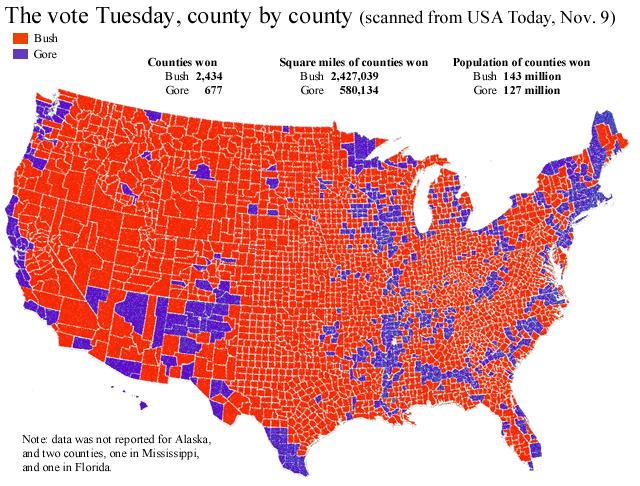
posted by Civil_Disobedient at 12:56 PM on July 23, 2004
KJS: The thing with the comparison of rural to urban schools is you seem to be comparing public schools. For California especially that is sort-of tilted; after Prop 13, everyone I know who could manage private school went, even kids from families without lots of money. (My mother didn't buy herself anything for three years to pay for my schooling.) Besides, many people who now live in cities are not products of those cities' schools.
And the difference to me between urban and suburban (especially as regards OC) isn't what I like (though it does tend to break down that way). Rather it's more ineffable but certainly real things like how likely you are to come into contact with strangers in general, how diverse those strangers are likely to be, how much control you have over the spaces you tend to be in, etc.
In OC, you go from home in car to store/office park/school. There are not many mixed-use areas (homes are in tracts, offices are clustered in parks), etc. Parking is easier than walking. Call it exurban if you want, but there is a definite difference between OC and a "real"/traditional city. That's why I left.
And no, not everyone who lives in a place is the same. There are well-informed folks in the sticks and narrow-minded people in Park Slope. But people who live in big cities tend to be more open-minded and tolerant of difference. That's why all us weirdos who felt stifled in noncosmo places moved to cosmo places. That's not a hallucination.
posted by dame at 1:10 PM on July 23, 2004
And the difference to me between urban and suburban (especially as regards OC) isn't what I like (though it does tend to break down that way). Rather it's more ineffable but certainly real things like how likely you are to come into contact with strangers in general, how diverse those strangers are likely to be, how much control you have over the spaces you tend to be in, etc.
In OC, you go from home in car to store/office park/school. There are not many mixed-use areas (homes are in tracts, offices are clustered in parks), etc. Parking is easier than walking. Call it exurban if you want, but there is a definite difference between OC and a "real"/traditional city. That's why I left.
And no, not everyone who lives in a place is the same. There are well-informed folks in the sticks and narrow-minded people in Park Slope. But people who live in big cities tend to be more open-minded and tolerant of difference. That's why all us weirdos who felt stifled in noncosmo places moved to cosmo places. That's not a hallucination.
posted by dame at 1:10 PM on July 23, 2004
So some good reasons for the urban/rural split that don't depend on contrasting the sophistocated urbanite against the rural hick:
1: there is a strong streak of individualism among rural populations. As a result, Republicans do better on issues like deregulation.
2: rural areas benefit the least from federal social service projects.
3: Republicans tend to fall on the side of rural economic interests when there are conflicts over development and environment.
dame: For California especially that is sort-of tilted; after Prop 13, everyone I know who could manage private school went, even kids from families without lots of money.
Except that this speaker also provided some hard evidence that this trend is not just within California. I've noticed this myself in South Bend for example that the quality of the school is inversely proportional to the population of the neighborhood and the number of non-white students.
And the difference to me between urban and suburban (especially as regards OC) isn't what I like (though it does tend to break down that way). Rather it's more ineffable but certainly real things like how likely you are to come into contact with strangers in general, how diverse those strangers are likely to be, how much control you have over the spaces you tend to be in, etc.
This is nice, it may be real. But completely irrelevant. Cities and urban areas are not defined by frequency of contact, and diversity of strangers. You are still setting up a no true scottsman in which those places you like are cities, and those places you don't like are not.
But people who live in big cities tend to be more open-minded and tolerant of difference. That's why all us weirdos who felt stifled in noncosmo places moved to cosmo places. That's not a hallucination.
I call bullshit on this in general. For example, lets take racism. In the last 80 years the big cities have dealt with racism by self-segregation. Certainly, saying something to your face is rude but having a minority person as a neighbor is a decline in property values and good reason to move out. Cities are good in that you can have enclaves where people who are comfortable with each other can congregate, that does not equate to open-mindedness in my mind though.
I think in general the "cities as the cradle of our civilization" folks confuse celebration with tolerance. In many rural areas that I've been to there is a strong ethos of MYOB. In fact, there seems to be a trend of weirdos who move to the country for this very reason.
posted by KirkJobSluder at 1:36 PM on July 23, 2004
1: there is a strong streak of individualism among rural populations. As a result, Republicans do better on issues like deregulation.
2: rural areas benefit the least from federal social service projects.
3: Republicans tend to fall on the side of rural economic interests when there are conflicts over development and environment.
dame: For California especially that is sort-of tilted; after Prop 13, everyone I know who could manage private school went, even kids from families without lots of money.
Except that this speaker also provided some hard evidence that this trend is not just within California. I've noticed this myself in South Bend for example that the quality of the school is inversely proportional to the population of the neighborhood and the number of non-white students.
And the difference to me between urban and suburban (especially as regards OC) isn't what I like (though it does tend to break down that way). Rather it's more ineffable but certainly real things like how likely you are to come into contact with strangers in general, how diverse those strangers are likely to be, how much control you have over the spaces you tend to be in, etc.
This is nice, it may be real. But completely irrelevant. Cities and urban areas are not defined by frequency of contact, and diversity of strangers. You are still setting up a no true scottsman in which those places you like are cities, and those places you don't like are not.
But people who live in big cities tend to be more open-minded and tolerant of difference. That's why all us weirdos who felt stifled in noncosmo places moved to cosmo places. That's not a hallucination.
I call bullshit on this in general. For example, lets take racism. In the last 80 years the big cities have dealt with racism by self-segregation. Certainly, saying something to your face is rude but having a minority person as a neighbor is a decline in property values and good reason to move out. Cities are good in that you can have enclaves where people who are comfortable with each other can congregate, that does not equate to open-mindedness in my mind though.
I think in general the "cities as the cradle of our civilization" folks confuse celebration with tolerance. In many rural areas that I've been to there is a strong ethos of MYOB. In fact, there seems to be a trend of weirdos who move to the country for this very reason.
posted by KirkJobSluder at 1:36 PM on July 23, 2004
"To claim that cities are only Dem because of minorities is absurd."
I didn't claim that. I claimed that a significant number of urban areas would vote Republican were it not for minorities. I don't know how many. I'm sure that this isn't true for a bunch. I know it's true for a bunch. I really only need one example to refute the absurd idea that urban=liberal.
You can define "urban" as "city-center urban", but that's sort of stacking the deck. And, furthermore, if you like I could define "urban" as "upper West Side" and then we'll see how well your correlation holds.
I mean, c'mon. KJS is right. We liberal city dwellers, especially those of us in liberal metropolises, have the conceit that we're cosmopolitan and therefore liberal and the hicks in the sticks are hidebound, ignorant, and therefore conservative. It's a self-satisfied conceit, though, that's not true.
It's like the idea that education means liberalism. Well, no, actually. An undergraduate degree corresponds more strongly to conservatism than no degree at all does. On the other hand, an advanced degree corresponds to liberalism more than only an undergraduate. Hmm. I can come up with a story that explains that and is flattering to liberals and insulting to conservatives. In fact, I probably believe such a story. But the facts belie the idea that education equals liberalism. Well, the same is true for urban equals liberalism. In some ways it does. In some ways, it doesn't.
And the ways that it doesn't are damn important if you're going to go around hypothesizing cause-and-effect relationships between these things. If being in a big ole' city and seeing the big ole' world is what makes people more likely to be liberal, then this would hold across all relationships. But it doesn't.
On Preview: Yes, absurd. I didn't dispute that large urban areas were, in general, more Dem than Repub. I disputed the absurd idea that they're more Dem for the reasons you implied. In many of those cities, if you take out the minority voters, you'd get very Republican counties. So all those white folk are immune to the mysterious "cosmoplitan liberalisation" effect, I guess?
Also On Preview: "But people who live in big cities tend to be more open-minded and tolerant of difference." And country folk are honest and real and hard-workers. Uh-huh. Right.
posted by Ethereal Bligh at 1:40 PM on July 23, 2004
I didn't claim that. I claimed that a significant number of urban areas would vote Republican were it not for minorities. I don't know how many. I'm sure that this isn't true for a bunch. I know it's true for a bunch. I really only need one example to refute the absurd idea that urban=liberal.
You can define "urban" as "city-center urban", but that's sort of stacking the deck. And, furthermore, if you like I could define "urban" as "upper West Side" and then we'll see how well your correlation holds.
I mean, c'mon. KJS is right. We liberal city dwellers, especially those of us in liberal metropolises, have the conceit that we're cosmopolitan and therefore liberal and the hicks in the sticks are hidebound, ignorant, and therefore conservative. It's a self-satisfied conceit, though, that's not true.
It's like the idea that education means liberalism. Well, no, actually. An undergraduate degree corresponds more strongly to conservatism than no degree at all does. On the other hand, an advanced degree corresponds to liberalism more than only an undergraduate. Hmm. I can come up with a story that explains that and is flattering to liberals and insulting to conservatives. In fact, I probably believe such a story. But the facts belie the idea that education equals liberalism. Well, the same is true for urban equals liberalism. In some ways it does. In some ways, it doesn't.
And the ways that it doesn't are damn important if you're going to go around hypothesizing cause-and-effect relationships between these things. If being in a big ole' city and seeing the big ole' world is what makes people more likely to be liberal, then this would hold across all relationships. But it doesn't.
On Preview: Yes, absurd. I didn't dispute that large urban areas were, in general, more Dem than Repub. I disputed the absurd idea that they're more Dem for the reasons you implied. In many of those cities, if you take out the minority voters, you'd get very Republican counties. So all those white folk are immune to the mysterious "cosmoplitan liberalisation" effect, I guess?
Also On Preview: "But people who live in big cities tend to be more open-minded and tolerant of difference." And country folk are honest and real and hard-workers. Uh-huh. Right.
posted by Ethereal Bligh at 1:40 PM on July 23, 2004
That's the problem with it. Why not just have one person one vote, now it's possible to count with such accuracy?
The problem with all of the talk about altering the electoral college is that it's basically wasted breath. The only way to change it is through a constitutional amendment, which would have to pass through 38 states to take effect. Which is to say, you're not doing this without the consent of the small states themselves.
I dunno, but it seems unlikely that you'd be able to convince a whole bunch of people in, frex, Montana, to say "You know what? I do have to much power. I should have less of a say in government, and I should let Manhattanites, Angelenos, and San Franciscans have more say in government."
And why not split the states' Electoral College votes, like Nebraska and Maine do?
Irrespective of the moral worth of the idea... In a state with 10 electoral votes, that would probably mean five going to one party with more-or-less certainty, four going to the other party with more-or-less certainty, and only one really in play*. Shifting to a winner-take-all system in that state, though, might well put all ten votes in play at once, and so attract campaign promises.
What would have been smart** would have been for state governments in states that were trending Republican at the Presidential level but controlled by Democratic legislatures to adopt a NE/ME system before the Republicans took over the state legislature too, in order to get at least some Democratic electoral votes flowing. Ditto the other way 'round, of course.
*the way NE and ME actually do it, it would end up being the two representing the Senate seats being up for grabs, but hey.
**or at least "what would have had a certain low cunning"
posted by ROU_Xenophobe at 2:04 PM on July 23, 2004
The problem with all of the talk about altering the electoral college is that it's basically wasted breath. The only way to change it is through a constitutional amendment, which would have to pass through 38 states to take effect. Which is to say, you're not doing this without the consent of the small states themselves.
I dunno, but it seems unlikely that you'd be able to convince a whole bunch of people in, frex, Montana, to say "You know what? I do have to much power. I should have less of a say in government, and I should let Manhattanites, Angelenos, and San Franciscans have more say in government."
And why not split the states' Electoral College votes, like Nebraska and Maine do?
Irrespective of the moral worth of the idea... In a state with 10 electoral votes, that would probably mean five going to one party with more-or-less certainty, four going to the other party with more-or-less certainty, and only one really in play*. Shifting to a winner-take-all system in that state, though, might well put all ten votes in play at once, and so attract campaign promises.
What would have been smart** would have been for state governments in states that were trending Republican at the Presidential level but controlled by Democratic legislatures to adopt a NE/ME system before the Republicans took over the state legislature too, in order to get at least some Democratic electoral votes flowing. Ditto the other way 'round, of course.
*the way NE and ME actually do it, it would end up being the two representing the Senate seats being up for grabs, but hey.
**or at least "what would have had a certain low cunning"
posted by ROU_Xenophobe at 2:04 PM on July 23, 2004
And part of this mythology of the cities as the open-minded melting pot runs smack up against the historical reality. Throughout the 20th century, cities have been Balkanized enclaves of neighborhoods in which the strict rules of race, ethnicity and class dominated who you were and what you did. This has not changed much since WWII. Since Brown vs. Board of Education, cities and schools (especially in the North) have become more segregated, not less segregated. Your access to banks, groceries, and insurance depends on the color of skin of the neighborhood you live in. Going into the wrong neighborhood may not result in anything being said directly to your face, but you might have to wait an extra 20 minutes to get the attention of the store clerk.
Now of course, there is prejudice and discrimination in rural communities as well. People are ugly all over. What I don't buy is the no true scotsman fallacy that people are open-minded in cities, because cities are defined by open-minded people. The demographics of the cities hailed as so progressive and liberal reveal that their inhabitants are neither so open-minded or progressive as is claimed.
EB: I mean, c'mon. KJS is right. We liberal city dwellers, especially those of us in liberal metropolises, have the conceit that we're cosmopolitan and therefore liberal and the hicks in the sticks are hidebound, ignorant, and therefore conservative. It's a self-satisfied conceit, though, that's not true.
My position is that the evolution of the contemporary American city is dominated by people who might pretend to be liberal, they might even vote liberal, but under the surface are quite hidebound and ignorant. A while back someone said that the classic movie Guess Who's Coming to Dinner, which documented how a crusading white Democrat played by Spencer Tracey might flip out when his daughter becomes engaged to a perfectly acceptable black man. I don't see that as the case. I know far to many nice, liberal people from urban environments who conspicuously lock their car doors when in the wrong neighborhood, and who will pack up and move into a more friendly ethnic enclave "for the sake of the children."
If you look at the demographics of American cities over the last 20 years, they are just as balkanized, if even more so than they were at the turn of the century. If in fact American cities are loaded with such open-minded people, then who is packing up at the first economic opportunity to live in the nice suburbs accross county lines?
I find this insistance on putting an artificial line between Orange County and LA for example to be missing the point. Last year I had another conference it Anaheim and it was quite obvious to me that the separation between LA and Orange was not as great as the separation between neighborhoods in Chicago. If we are going to talk about voting patterns in California, it seems reasonable to think of the two as one colonial ecosystem.
posted by KirkJobSluder at 2:15 PM on July 23, 2004
Now of course, there is prejudice and discrimination in rural communities as well. People are ugly all over. What I don't buy is the no true scotsman fallacy that people are open-minded in cities, because cities are defined by open-minded people. The demographics of the cities hailed as so progressive and liberal reveal that their inhabitants are neither so open-minded or progressive as is claimed.
EB: I mean, c'mon. KJS is right. We liberal city dwellers, especially those of us in liberal metropolises, have the conceit that we're cosmopolitan and therefore liberal and the hicks in the sticks are hidebound, ignorant, and therefore conservative. It's a self-satisfied conceit, though, that's not true.
My position is that the evolution of the contemporary American city is dominated by people who might pretend to be liberal, they might even vote liberal, but under the surface are quite hidebound and ignorant. A while back someone said that the classic movie Guess Who's Coming to Dinner, which documented how a crusading white Democrat played by Spencer Tracey might flip out when his daughter becomes engaged to a perfectly acceptable black man. I don't see that as the case. I know far to many nice, liberal people from urban environments who conspicuously lock their car doors when in the wrong neighborhood, and who will pack up and move into a more friendly ethnic enclave "for the sake of the children."
If you look at the demographics of American cities over the last 20 years, they are just as balkanized, if even more so than they were at the turn of the century. If in fact American cities are loaded with such open-minded people, then who is packing up at the first economic opportunity to live in the nice suburbs accross county lines?
I find this insistance on putting an artificial line between Orange County and LA for example to be missing the point. Last year I had another conference it Anaheim and it was quite obvious to me that the separation between LA and Orange was not as great as the separation between neighborhoods in Chicago. If we are going to talk about voting patterns in California, it seems reasonable to think of the two as one colonial ecosystem.
posted by KirkJobSluder at 2:15 PM on July 23, 2004
Well, a double team, eh? I suppose I should just thank you for helping me procrastinate a rainy afternoon away.
Anyway, in no particular order:
EB: I'm sure that this isn't true for a bunch. I know it's true for a bunch. I really only need one example to refute the absurd idea that urban=liberal.
Why do you have so much trouble with "tend to"? With propensity? I'm not saying all urbanites are liberal. I am saying urbanites *tend to* be more tolerant of differences are more cosmopolitan. This is not a fucking revolutionary assertion.
Based on the super-scientific focus group of me and people I've known (because my google-fu sucks), those who come into contact with people different from them on a regular basis tend to be more tolerant. (Not better, happier, shinier, etc. I am asserting only one quality here, for now.) Yes, people in urban areas don't always live next door to others different from them. But they do go out into public spaces where they are thrown together with others. (Been on public transport lately? In OC, only incredibly poor people. In New York, everyone but the astronomically rich.)
are hidebound, ignorant, and therefore conservative
Um, no, I didn't say that. Less cosmopolitan. Which is really begging the question, isn't it, because people who live in cosmopolitan areas are by definition cosmopolitan. Non-urban folks aren't necessarily ignorant, in the sense of being unaware. But there are differences between knowing something abstractly and knowing difference because it's always there. If you spend loads of time on Atlantic Avenue in Brooklyn and your local deli guy is Arab it's a lot harder to just "hate Arabs," right? When the Pakistani who worked at your favorite restaurant gets detained, it's different from reading about it in a paper, even if you're totally well informed, right? Because it's right there, happening to people you come in contact with. If you live in a traditional city, these kinds of things are more likely to happen. And that is likely to be one of the things that make urbanites more liberal.
If you disagree so vehemently, why don't you come up with a better reason than "them darkies like the Dems"? Because I can tell you now, one of these arguments takes the vagaries of human thought in mind more than the other.
And you know what, I don't feel superior to rural folks. It's more that I don't like the assholes they elect, and looking at our government these days, giving them a disproportionate share of decisionmaking power doesn't seem to be working out too well, does it?
Jeebus that's long. KJS, let me do some work and I will reply to you too.
posted by dame at 2:35 PM on July 23, 2004
Anyway, in no particular order:
EB: I'm sure that this isn't true for a bunch. I know it's true for a bunch. I really only need one example to refute the absurd idea that urban=liberal.
Why do you have so much trouble with "tend to"? With propensity? I'm not saying all urbanites are liberal. I am saying urbanites *tend to* be more tolerant of differences are more cosmopolitan. This is not a fucking revolutionary assertion.
Based on the super-scientific focus group of me and people I've known (because my google-fu sucks), those who come into contact with people different from them on a regular basis tend to be more tolerant. (Not better, happier, shinier, etc. I am asserting only one quality here, for now.) Yes, people in urban areas don't always live next door to others different from them. But they do go out into public spaces where they are thrown together with others. (Been on public transport lately? In OC, only incredibly poor people. In New York, everyone but the astronomically rich.)
are hidebound, ignorant, and therefore conservative
Um, no, I didn't say that. Less cosmopolitan. Which is really begging the question, isn't it, because people who live in cosmopolitan areas are by definition cosmopolitan. Non-urban folks aren't necessarily ignorant, in the sense of being unaware. But there are differences between knowing something abstractly and knowing difference because it's always there. If you spend loads of time on Atlantic Avenue in Brooklyn and your local deli guy is Arab it's a lot harder to just "hate Arabs," right? When the Pakistani who worked at your favorite restaurant gets detained, it's different from reading about it in a paper, even if you're totally well informed, right? Because it's right there, happening to people you come in contact with. If you live in a traditional city, these kinds of things are more likely to happen. And that is likely to be one of the things that make urbanites more liberal.
If you disagree so vehemently, why don't you come up with a better reason than "them darkies like the Dems"? Because I can tell you now, one of these arguments takes the vagaries of human thought in mind more than the other.
And you know what, I don't feel superior to rural folks. It's more that I don't like the assholes they elect, and looking at our government these days, giving them a disproportionate share of decisionmaking power doesn't seem to be working out too well, does it?
Jeebus that's long. KJS, let me do some work and I will reply to you too.
posted by dame at 2:35 PM on July 23, 2004
And I think dame and C_D reveal another very basic reason why Democrats don't do well in rural areas: attitude.
People with years of experience putting up with urbanite elitist pretense and hypocracy can smell it a mile away. The Republicans can smell it also, and see an opportunity to exploit. So the Republicans can make a big show out of championing rural interests against elitist big-city liberals. An example of this is how carefully Republicans framed the inheretance tax around the issue of small farms and businesses.
On the local level, Democrats who don't talk down to their rural constituents do quite well. On the national level however, there is this definite attitude of urban snobbery at work that is infuriating.
I'm speaking here as a member of the loony left, Democrats need to really examine their own attitudes towards rural voters before writing them off as ignorant hicks.
posted by KirkJobSluder at 2:40 PM on July 23, 2004
People with years of experience putting up with urbanite elitist pretense and hypocracy can smell it a mile away. The Republicans can smell it also, and see an opportunity to exploit. So the Republicans can make a big show out of championing rural interests against elitist big-city liberals. An example of this is how carefully Republicans framed the inheretance tax around the issue of small farms and businesses.
On the local level, Democrats who don't talk down to their rural constituents do quite well. On the national level however, there is this definite attitude of urban snobbery at work that is infuriating.
I'm speaking here as a member of the loony left, Democrats need to really examine their own attitudes towards rural voters before writing them off as ignorant hicks.
posted by KirkJobSluder at 2:40 PM on July 23, 2004
I have compiled all of the historical data from electoral-vote.com in an Excel spread sheet. You can find a copy here. Included with the data are the following graphs:
1) An area graph, ordered to show which candidate wins the majority.
2) A line graph for each of the catagories (Strong, Weak and Barely) with a seven day moving average and a polynomial trend, with a three day prediction.
3) A line graph for total EC votes, with a seven day moving average and a polynomial trend, with a three day moving average.
My quick summary of the historical data is that it tends to indicate a Kerry victory.
Of the strong polls, they have ben virtually identical, though just today Kerry had a huge jump in strong support.
Of the weak polls, Bush tends to maintain a more stable base of supports, fluxuating very little in the past two months. Kerry fluxuates wildly, pulling more from his strong supporters than from even states or barely bush supporters.
The barely polls indicate that this election is far from locked up, with approximately 150 EC votes in flux.
Current trends and short term predictions are nearly valueless, but included none the less.
Kerry is the only candidate to finish a day of polling with a comfortable margin of strong and weak voters, but it was only a single day.
Enjoy.
On preview, spot on KirkJobSluder. Thank you.
posted by sequential at 2:51 PM on July 23, 2004
1) An area graph, ordered to show which candidate wins the majority.
2) A line graph for each of the catagories (Strong, Weak and Barely) with a seven day moving average and a polynomial trend, with a three day prediction.
3) A line graph for total EC votes, with a seven day moving average and a polynomial trend, with a three day moving average.
My quick summary of the historical data is that it tends to indicate a Kerry victory.
Of the strong polls, they have ben virtually identical, though just today Kerry had a huge jump in strong support.
Of the weak polls, Bush tends to maintain a more stable base of supports, fluxuating very little in the past two months. Kerry fluxuates wildly, pulling more from his strong supporters than from even states or barely bush supporters.
The barely polls indicate that this election is far from locked up, with approximately 150 EC votes in flux.
Current trends and short term predictions are nearly valueless, but included none the less.
Kerry is the only candidate to finish a day of polling with a comfortable margin of strong and weak voters, but it was only a single day.
Enjoy.
On preview, spot on KirkJobSluder. Thank you.
posted by sequential at 2:51 PM on July 23, 2004
A few short things:
KJS: I think that may be in-group bias (is that the right term—things are less familiar with seem more similar) with the Anaheim/LA thing. I'm not white, I grew up in OC, and I have always always always been treated better by strangers in LA proper, regardless of class difference. I get treated better in New York. There is a difference.
I also find that people here (middle-class and mostly white) are way less scared of "bad" neighborhoods the longer they live here. It was true for me and plenty of others. (Not everyone, obviously. But we've covered that.) Why? Because they couldn't avoid them the way they can in more car-driven areas, and through habituation discovered that the tales of the wicked ghetto weren't true. Can you live in a city and be totally uncurious? Sure. But can you satisfy your curiosity or have it fired up by accident in a more homogenous rural area? Not so much.
Also, I find it interesting that the people defending "ruralists" (I can't think of a better term), are so happy to tar urban dwellers with tags of pretentiousness. Self-satisfaction prickers, puncture thyself.
posted by dame at 3:11 PM on July 23, 2004
KJS: I think that may be in-group bias (is that the right term—things are less familiar with seem more similar) with the Anaheim/LA thing. I'm not white, I grew up in OC, and I have always always always been treated better by strangers in LA proper, regardless of class difference. I get treated better in New York. There is a difference.
I also find that people here (middle-class and mostly white) are way less scared of "bad" neighborhoods the longer they live here. It was true for me and plenty of others. (Not everyone, obviously. But we've covered that.) Why? Because they couldn't avoid them the way they can in more car-driven areas, and through habituation discovered that the tales of the wicked ghetto weren't true. Can you live in a city and be totally uncurious? Sure. But can you satisfy your curiosity or have it fired up by accident in a more homogenous rural area? Not so much.
Also, I find it interesting that the people defending "ruralists" (I can't think of a better term), are so happy to tar urban dwellers with tags of pretentiousness. Self-satisfaction prickers, puncture thyself.
posted by dame at 3:11 PM on July 23, 2004
KJS says it all better than I could. The idea that metropolises are inherently liberal really annoys me. Only a relatively privileged, usually well-educated type of urbanite would believe this. For those of us that are liberal/progressive, especially those of us raised in conservative/reactionary areas, it's part of the seductive myth of large cities. We go there to find other "weirdos" (dame's word) like us. And we do, of course. So we live in our little enclaves of progressive weirdos and make the same damn mistake those ignorant hicks made that we ran from: assuming everyone else is like us. When you can often just go eight blocks to a neighborhood you never visit and see people who mistrust you and you mistrust them.
You, in your fantasy world, are determined to see my counterclaim of there being a stronger correlation between race and Democratic affiliation in urban centers (than there is between urbanism and Democratic affiliation) as some subconsciously racist denial of the true progressive spirit of large cities. When, in fact, the truth is that I'm denying this idea of the progressive nature of large cities because I'm quite sure that almost every one of them are inhabited by large clusters of racist, small-minded white people who are conservative. I don't really think of the rural hicks as the enemy anymore, though I once did.
The enemy is Tom DeLay and the people he represents. And those aren't rural people. Those are large city people. There are more of them than there are rural people. And, anyway, if you're paying any attention at all, you'll see that outside of national elections, locally in cities, this is the real red and blue national divide.
posted by Ethereal Bligh at 3:17 PM on July 23, 2004
You, in your fantasy world, are determined to see my counterclaim of there being a stronger correlation between race and Democratic affiliation in urban centers (than there is between urbanism and Democratic affiliation) as some subconsciously racist denial of the true progressive spirit of large cities. When, in fact, the truth is that I'm denying this idea of the progressive nature of large cities because I'm quite sure that almost every one of them are inhabited by large clusters of racist, small-minded white people who are conservative. I don't really think of the rural hicks as the enemy anymore, though I once did.
The enemy is Tom DeLay and the people he represents. And those aren't rural people. Those are large city people. There are more of them than there are rural people. And, anyway, if you're paying any attention at all, you'll see that outside of national elections, locally in cities, this is the real red and blue national divide.
posted by Ethereal Bligh at 3:17 PM on July 23, 2004
On preview: that new EC link shows a fucking tie! Can you imagine? Bush gets elected once through the Supreme Court and twice through the GOP-controlled House?
Maybe this EC thing DOES need to be rethought!
It is almost statistically impossible for there to be a tie in modern US presidential elections. It has happened in the past in the 19th century when there were more than 2 viable candidates. Nowadays it is impossible for a Nadar or Independent party candidate to carry a state so forget about a House vote (thankfully!).
posted by sic at 3:24 PM on July 23, 2004
Maybe this EC thing DOES need to be rethought!
It is almost statistically impossible for there to be a tie in modern US presidential elections. It has happened in the past in the 19th century when there were more than 2 viable candidates. Nowadays it is impossible for a Nadar or Independent party candidate to carry a state so forget about a House vote (thankfully!).
posted by sic at 3:24 PM on July 23, 2004
2: rural areas benefit the least from federal social service projects.
But them tax-hating red states sure do rack up the federal spending dollars! Damn big federal goverment! When will it stop redistributing tax payments to all the welfare queens in Montana!
posted by Mid at 3:31 PM on July 23, 2004
But them tax-hating red states sure do rack up the federal spending dollars! Damn big federal goverment! When will it stop redistributing tax payments to all the welfare queens in Montana!
posted by Mid at 3:31 PM on July 23, 2004
dame: I also find that people here (middle-class and mostly white) are way less scared of "bad" neighborhoods the longer they live here. It was true for me and plenty of others. (Not everyone, obviously. But we've covered that.) Why? Because they couldn't avoid them the way they can in more car-driven areas, and through habituation discovered that the tales of the wicked ghetto weren't true.
I'm wondering then, who is moving around to create all of these highly-segregated cities then?
Can you live in a city and be totally uncurious? Sure. But can you satisfy your curiosity or have it fired up by accident in a more homogenous rural area? Not so much.
There is what I see as a big whopping assumption, that rural=homogenous. Perhaps its an in-group bias on your part that you look at rural areas and see a homogenous mass of humanity. By all means, I do see a big value in regards to curiosity, but I also see a big value in the laid back MYOB values I see around me. I know a lot of freaks that have left cities to homestead out in the country. Almost all of them have been pleasantly suprised to find that their neighbors really didn't care as long as it didn't involve too much loud music. There are as many people out here who spent 20 years in an urban city, then cashed out for the home in the country as there are people who grew up, lived and died within 20 miles.
Also, I find it interesting that the people defending "ruralists" (I can't think of a better term), are so happy to tar urban dwellers with tags of pretentiousness. Self-satisfaction prickers, puncture thyself.
I'm not saying that urban dewellers are pretentious. I'm saying that people who cop an attitude that "ruralists" are xenophobic and ignorant are pretentious.
posted by KirkJobSluder at 3:32 PM on July 23, 2004
I'm wondering then, who is moving around to create all of these highly-segregated cities then?
Can you live in a city and be totally uncurious? Sure. But can you satisfy your curiosity or have it fired up by accident in a more homogenous rural area? Not so much.
There is what I see as a big whopping assumption, that rural=homogenous. Perhaps its an in-group bias on your part that you look at rural areas and see a homogenous mass of humanity. By all means, I do see a big value in regards to curiosity, but I also see a big value in the laid back MYOB values I see around me. I know a lot of freaks that have left cities to homestead out in the country. Almost all of them have been pleasantly suprised to find that their neighbors really didn't care as long as it didn't involve too much loud music. There are as many people out here who spent 20 years in an urban city, then cashed out for the home in the country as there are people who grew up, lived and died within 20 miles.
Also, I find it interesting that the people defending "ruralists" (I can't think of a better term), are so happy to tar urban dwellers with tags of pretentiousness. Self-satisfaction prickers, puncture thyself.
I'm not saying that urban dewellers are pretentious. I'm saying that people who cop an attitude that "ruralists" are xenophobic and ignorant are pretentious.
posted by KirkJobSluder at 3:32 PM on July 23, 2004
When, in fact, the truth is that I'm denying this idea of the progressive nature of large cities because I'm quite sure that almost every one of them are inhabited by large clusters of racist, small-minded white people who are conservative.
It's more of an segregation by income and class than by race, I find. And the only truly Racist (with a capital R) small-minded white enclave here is Howard Beach and its environs (maybe parts of Bay Ridge too), but even those people take the subway and work and go to school with all sorts. Most of the other "Archie Bunker" type places have been flipped and are now mixed and/or filled with new groups of immigrants. You can find clusters of smallminded racist people of all colors and ethnicities here, but don't assume all cities are like Cincinnati or Boston.
posted by amberglow at 3:44 PM on July 23, 2004
It's more of an segregation by income and class than by race, I find. And the only truly Racist (with a capital R) small-minded white enclave here is Howard Beach and its environs (maybe parts of Bay Ridge too), but even those people take the subway and work and go to school with all sorts. Most of the other "Archie Bunker" type places have been flipped and are now mixed and/or filled with new groups of immigrants. You can find clusters of smallminded racist people of all colors and ethnicities here, but don't assume all cities are like Cincinnati or Boston.
posted by amberglow at 3:44 PM on July 23, 2004
It is almost statistically impossible for there to be a tie in modern US presidential elections.
Actually, if you play with the calculator, it's very, very easy.
For example, just give Kerry all the Gore states and Bush all the Bush states, then flip Louisiana. Bingo. Tie.
It's not likely that La, of all the states, would be the only one to flip, but still. Look at the map at race2004.net. That is a plausible map. And it's a tie.
(Are you perhaps laboring under the misapprehension that the geniuses who came up with the Electoral College might have insisted on something as insanely outlandish as an odd number of electors to prevent a tie? Because they didn't.)
posted by CunningLinguist at 4:28 PM on July 23, 2004
Actually, if you play with the calculator, it's very, very easy.
For example, just give Kerry all the Gore states and Bush all the Bush states, then flip Louisiana. Bingo. Tie.
It's not likely that La, of all the states, would be the only one to flip, but still. Look at the map at race2004.net. That is a plausible map. And it's a tie.
(Are you perhaps laboring under the misapprehension that the geniuses who came up with the Electoral College might have insisted on something as insanely outlandish as an odd number of electors to prevent a tie? Because they didn't.)
posted by CunningLinguist at 4:28 PM on July 23, 2004
Thank you, Amberglow.
And KJS, it seems that your understanding of urban housing dynamics froze in 1968. Have you heard of gentrification? It's where white people move to neighborhoods inhabited by brown folks, often because they think it's cool, though in other cases because they are poor. Then too many come and the brown folks get pushed out. That's a problem in its own right, but it has nothing to do with brown people bringing down housing values.
I'm wondering then, who is moving around to create all of these highly-segregated cities then?
Very few people, actually. When people move to a new place, they tend to move to a place where people like them already live because people seek out similarity, especially in a diverse place. So Puerto Ricans move in next to Puerto Ricans and college kids move in next to college kids at first. (Sometimes they stay, sometimes they don't, based on a number of factors, usually economic or child-induced hypocritical.) But in the end it doesn't matter, because in their daily lives, unless they are incredibly poor, they go other places, usually on a subway filled with all sorts. As Amberglow has notes, people in far off parts of the city (Bay Ridge, Howard Beach) sometimes deviate from this.
I know far to many nice, liberal people from urban environments who conspicuously lock their car doors when in the wrong neighborhood, and who will pack up and move into a more friendly ethnic enclave "for the sake of the children."
Yeah, people turn into hypocrites where there kids are concerned. That is hardly an urban phenomenon.
they might even vote liberal, but under the surface are quite hidebound and ignorant.
These days that's good enough for me. I don't expect perfection.
posted by dame at 5:44 PM on July 23, 2004
And KJS, it seems that your understanding of urban housing dynamics froze in 1968. Have you heard of gentrification? It's where white people move to neighborhoods inhabited by brown folks, often because they think it's cool, though in other cases because they are poor. Then too many come and the brown folks get pushed out. That's a problem in its own right, but it has nothing to do with brown people bringing down housing values.
I'm wondering then, who is moving around to create all of these highly-segregated cities then?
Very few people, actually. When people move to a new place, they tend to move to a place where people like them already live because people seek out similarity, especially in a diverse place. So Puerto Ricans move in next to Puerto Ricans and college kids move in next to college kids at first. (Sometimes they stay, sometimes they don't, based on a number of factors, usually economic or child-induced hypocritical.) But in the end it doesn't matter, because in their daily lives, unless they are incredibly poor, they go other places, usually on a subway filled with all sorts. As Amberglow has notes, people in far off parts of the city (Bay Ridge, Howard Beach) sometimes deviate from this.
I know far to many nice, liberal people from urban environments who conspicuously lock their car doors when in the wrong neighborhood, and who will pack up and move into a more friendly ethnic enclave "for the sake of the children."
Yeah, people turn into hypocrites where there kids are concerned. That is hardly an urban phenomenon.
they might even vote liberal, but under the surface are quite hidebound and ignorant.
These days that's good enough for me. I don't expect perfection.
posted by dame at 5:44 PM on July 23, 2004
Fuck, that cut off. The rest of my screed:
There is what I see as a big whopping assumption, that rural=homogenous. Perhaps its an in-group bias on your part that you look at rural areas and see a homogenous mass of humanity.
Are they mostly white? Are they mostly American? Do they mostly speak English as a first language? Then yeah, it’s more freaking homogenous. Rural Montana is more homogenous than Cincinnati is more homogenous than Seattle is more homogenous than New York. How is this complicated? Do you think the income differential between your richest and poorest neighbor is greater or lesser than the income differential between Mayor Bloomberg and the Mexican family that lives in my building’s basement?
Because if this is your example of diversity: “There are as many people out here who spent 20 years in an urban city, then cashed out for the home in the country as there are people who grew up, lived and died within 20 miles,” I’m afriad we got you beat.
I'm saying that people who cop an attitude that "ruralists" are xenophobic and ignorant are pretentious.
Really, did you miss the part where I didn’t say that but made a more complex argument based on tendencies, proximity, and personal observation of people’s reactions?
And as for you EB, you pompous fuck,
You, in your fantasy world,
If Bushwick is a fantasy, I need a better imagination.
are determined to see my counterclaim of there being a stronger correlation between race and Democratic affiliation in urban centers (than there is between urbanism and Democratic affiliation) as some subconsciously racist denial of the
I don't think it's subconsciously racist. I think it's stupid and narrow. In fact, just to begin, you'll notice that often newer Americans and many blacks are not fond of the Democratic Party's social liberalism.
true progressive spirit of large cities.
I don't think there's some magical spirit. I think being exposed to people who are different, really different, makes tolerance of and concern for others more likely. More likely for everyone.
When, in fact, the truth is that I'm denying this idea of the progressive nature of large cities because I'm quite sure that almost every one of them are inhabited by large clusters of racist, small-minded white people who are conservative.
I'm so glad you know so much more about the people who live in my city than I do. Maybe with your omniscience, you could become wealthy or start your own cult. Especially since in the scale of evidence, gut feeling trumps personal experience, which of course aren't trumped by hard data at all.
I don't really think of the rural hicks as the enemy anymore, though I once did.
May I congratulate you on your brilliant enlightenment.
posted by dame at 6:06 PM on July 23, 2004
There is what I see as a big whopping assumption, that rural=homogenous. Perhaps its an in-group bias on your part that you look at rural areas and see a homogenous mass of humanity.
Are they mostly white? Are they mostly American? Do they mostly speak English as a first language? Then yeah, it’s more freaking homogenous. Rural Montana is more homogenous than Cincinnati is more homogenous than Seattle is more homogenous than New York. How is this complicated? Do you think the income differential between your richest and poorest neighbor is greater or lesser than the income differential between Mayor Bloomberg and the Mexican family that lives in my building’s basement?
Because if this is your example of diversity: “There are as many people out here who spent 20 years in an urban city, then cashed out for the home in the country as there are people who grew up, lived and died within 20 miles,” I’m afriad we got you beat.
I'm saying that people who cop an attitude that "ruralists" are xenophobic and ignorant are pretentious.
Really, did you miss the part where I didn’t say that but made a more complex argument based on tendencies, proximity, and personal observation of people’s reactions?
And as for you EB, you pompous fuck,
You, in your fantasy world,
If Bushwick is a fantasy, I need a better imagination.
are determined to see my counterclaim of there being a stronger correlation between race and Democratic affiliation in urban centers (than there is between urbanism and Democratic affiliation) as some subconsciously racist denial of the
I don't think it's subconsciously racist. I think it's stupid and narrow. In fact, just to begin, you'll notice that often newer Americans and many blacks are not fond of the Democratic Party's social liberalism.
true progressive spirit of large cities.
I don't think there's some magical spirit. I think being exposed to people who are different, really different, makes tolerance of and concern for others more likely. More likely for everyone.
When, in fact, the truth is that I'm denying this idea of the progressive nature of large cities because I'm quite sure that almost every one of them are inhabited by large clusters of racist, small-minded white people who are conservative.
I'm so glad you know so much more about the people who live in my city than I do. Maybe with your omniscience, you could become wealthy or start your own cult. Especially since in the scale of evidence, gut feeling trumps personal experience, which of course aren't trumped by hard data at all.
I don't really think of the rural hicks as the enemy anymore, though I once did.
May I congratulate you on your brilliant enlightenment.
posted by dame at 6:06 PM on July 23, 2004
Your rural experiences seem to be limited to the northeast and midwest.
Are they mostly white?
Depends on where you are. In the rural South, probably not. Rural Appalachia is very white (hell, it's very Scots-Irish, not just generic Anglo), but the coastal plains and lands cradling the Mississippi are heavily black. Not necessarily >50% black in every county, but still heavily black. There are also substantial numbers of Latinos moving into the rural and small-town South; enough that the rural area I lived in in NC had fairly extensive bilingual / ESL programs, and town signs in Carrboro were frequently bilingual.
In the western US, rural areas are likely to have large numbers of Latinos and Amerinds in them.
This isn't to say that podunk county, nowhere is as diverse as the New York metro area, but it's still downright false to say that "The Rural US" is homogenous to any useful extent. In large parts of the rural US, you'll still be very likely to run into people who don't look or act or even talk like you every day.
posted by ROU_Xenophobe at 7:33 PM on July 23, 2004
Are they mostly white?
Depends on where you are. In the rural South, probably not. Rural Appalachia is very white (hell, it's very Scots-Irish, not just generic Anglo), but the coastal plains and lands cradling the Mississippi are heavily black. Not necessarily >50% black in every county, but still heavily black. There are also substantial numbers of Latinos moving into the rural and small-town South; enough that the rural area I lived in in NC had fairly extensive bilingual / ESL programs, and town signs in Carrboro were frequently bilingual.
In the western US, rural areas are likely to have large numbers of Latinos and Amerinds in them.
This isn't to say that podunk county, nowhere is as diverse as the New York metro area, but it's still downright false to say that "The Rural US" is homogenous to any useful extent. In large parts of the rural US, you'll still be very likely to run into people who don't look or act or even talk like you every day.
posted by ROU_Xenophobe at 7:33 PM on July 23, 2004
dame: Hrm, I could go point by point but I'm not certain I really see the point.
In any given county in the United States, are you likely to have people from 100 different countries in square mile. Dobutful. But are there enough different people around so that people in rural communities are aware of issues of race and ethnicity, of course.
Are you likely to find speakers of two dozen different languages in a square mile. Not likely. But I'm willing to bet that in most parts of the country there will be enough ESL speakers to be aware of the issue.
Are you likely to find someone as rich as Mayor Bloomberg and poor homeless in most small communities. Not very likely. And yet, many small towns and small cities have to deal with huge disparities of income and SES.
Is there a Villiage in every small city or town in the United States? No, but there will be gay people, and people who talk about being gay.
So of course, small cities and towns don't have the subway, but they do have factories, groceries, and resturaunts where more than likely, you are going to rub shoulders with someone who does not look like you, might not talk like you, and probably does not think like you.
My point is that one does not need a hothouse of 100 nationalities on a small island to be aware of issues involving race. One does not need a hothouse of 24 languages on an island to be aware of issues involving language. One does not need to have the richest and poorest on on island to be aware of issues involving SES. One does not need to have two dozen gay bars on an island to be aware of sexuality.
If the point you are making is than New York is a better place for its 100s of nationalities, dozens of languages, and the richest and poorest. Well, that is a matter of debate.
But it seems your point is that people in small cities and towns never have to talk about racism, language and SES because it is "homogenous", well I have to challenge you to look again.
posted by KirkJobSluder at 7:50 PM on July 23, 2004
In any given county in the United States, are you likely to have people from 100 different countries in square mile. Dobutful. But are there enough different people around so that people in rural communities are aware of issues of race and ethnicity, of course.
Are you likely to find speakers of two dozen different languages in a square mile. Not likely. But I'm willing to bet that in most parts of the country there will be enough ESL speakers to be aware of the issue.
Are you likely to find someone as rich as Mayor Bloomberg and poor homeless in most small communities. Not very likely. And yet, many small towns and small cities have to deal with huge disparities of income and SES.
Is there a Villiage in every small city or town in the United States? No, but there will be gay people, and people who talk about being gay.
So of course, small cities and towns don't have the subway, but they do have factories, groceries, and resturaunts where more than likely, you are going to rub shoulders with someone who does not look like you, might not talk like you, and probably does not think like you.
My point is that one does not need a hothouse of 100 nationalities on a small island to be aware of issues involving race. One does not need a hothouse of 24 languages on an island to be aware of issues involving language. One does not need to have the richest and poorest on on island to be aware of issues involving SES. One does not need to have two dozen gay bars on an island to be aware of sexuality.
If the point you are making is than New York is a better place for its 100s of nationalities, dozens of languages, and the richest and poorest. Well, that is a matter of debate.
But it seems your point is that people in small cities and towns never have to talk about racism, language and SES because it is "homogenous", well I have to challenge you to look again.
posted by KirkJobSluder at 7:50 PM on July 23, 2004
I don't feel superior to rural folks. It's more that I don't like the assholes they elect, and looking at our government these days, giving them a disproportionate share of decisionmaking power doesn't seem to be working out too well, does it?
Hmm ... Jeanette Rankin, Mike Mansfield, Lee Metcalf ...
Thanks, dame. Your opinion is duly noted and summarily rejected.
posted by Wulfgar! at 8:01 PM on July 23, 2004
Hmm ... Jeanette Rankin, Mike Mansfield, Lee Metcalf ...
Thanks, dame. Your opinion is duly noted and summarily rejected.
posted by Wulfgar! at 8:01 PM on July 23, 2004
you know, I was initially bothered by what came off as pretentiousness re: cosmopolitan urbanites (I think civil_disobediant's comment), but I think dame has made a very cogent point about the actual effects of sharing a small space with a large number of people who are radically different from you. And I think it does have a lot to do with liberalism. KJS mentions he appreciates the MYOB attitude of rural populations, and this seems central: in a city, it's much harder to MYOB. In a city, there's a much greater tendency toward community and helping each other out, not least because we live on top of one another.
Of course, for people in either situation, there are times when you don't get involved and times when you do, but simply because of the likelihood of people's paths crossing in a city, strangers in urban environments are just slightly more familiar with scenarios that are different from their own (things that have never and even could never happen to them) and slightly more inclined to feel concern for their neighbor's well-being. It strikes me that this simple population issue could be the primary reason for europe being generally more liberal than we are.
posted by mdn at 9:12 PM on July 23, 2004
Of course, for people in either situation, there are times when you don't get involved and times when you do, but simply because of the likelihood of people's paths crossing in a city, strangers in urban environments are just slightly more familiar with scenarios that are different from their own (things that have never and even could never happen to them) and slightly more inclined to feel concern for their neighbor's well-being. It strikes me that this simple population issue could be the primary reason for europe being generally more liberal than we are.
posted by mdn at 9:12 PM on July 23, 2004
mdn: I think there are some very good points that dame brings up. However, I think that a lot of the thinking here is a bit too simplistic. "Rural areas are conservative because they are homogenous." Well, some are, some are not. Migrant labor, much of it including illegal immigrants from Latin America, is a pretty important factor that raises unique problems for rural school systems. And thinking of diversity in terms of shades of tan ignores the fact that rifts between worldviews and ideologies can be even greater than between ethnicities.
C_D's generalizations are even worse.
But another aspect of it is that New York is probably the worst city to use as a foil to expound the virtues of urbanism vs. pastoralism because it is such an idiosyncratic and extreme city. I just heard audio commentary by Jim Jarmusch in which he said that New Orleans and New York are the only two cities in the U.S. that are countries to themselves.
The basic bottom line is that you can write entire dissertations on the cultural and value differences between urban and rural. dame takes a step forward in at least recognizing that people outside of her precious cities are not all country bumpkins. But I still find her contrast to be a bit dismissive, and her no true scotsman definition of a "city" to be problematic.
posted by KirkJobSluder at 9:57 PM on July 23, 2004
C_D's generalizations are even worse.
But another aspect of it is that New York is probably the worst city to use as a foil to expound the virtues of urbanism vs. pastoralism because it is such an idiosyncratic and extreme city. I just heard audio commentary by Jim Jarmusch in which he said that New Orleans and New York are the only two cities in the U.S. that are countries to themselves.
The basic bottom line is that you can write entire dissertations on the cultural and value differences between urban and rural. dame takes a step forward in at least recognizing that people outside of her precious cities are not all country bumpkins. But I still find her contrast to be a bit dismissive, and her no true scotsman definition of a "city" to be problematic.
posted by KirkJobSluder at 9:57 PM on July 23, 2004
The basic bottom line is that you can write entire dissertations on the cultural and value differences between urban and rural. dame takes a step forward in at least recognizing that people outside of her precious cities are not all country bumpkins. But I still find her contrast to be a bit dismissive, and her no true scotsman definition of a "city" to be problematic.
I say thank god there are cities for people to escape to--they might not be country bumpkins in rural areas, but as long as there are people that have to escape--whether from homophobia, racism, or just plain "you're not like us, so we can treat you like shit" there are problems. Problems that, so far, are addressed thru ostracism, violence and excommunication. If those things did not happen to the queer kid in town, or the creative kid in town, or the half-breed in town, etc...then your point would have more validity.
When people aren't chased out of town, and can be part the community no matter what, then we'll see. I know too many people that had to escape whatever place they were from because they were too different, and excluded because of those differences. That's the true test, and why so many people have the attitude they do towards rural areas.
posted by amberglow at 10:26 PM on July 23, 2004
I say thank god there are cities for people to escape to--they might not be country bumpkins in rural areas, but as long as there are people that have to escape--whether from homophobia, racism, or just plain "you're not like us, so we can treat you like shit" there are problems. Problems that, so far, are addressed thru ostracism, violence and excommunication. If those things did not happen to the queer kid in town, or the creative kid in town, or the half-breed in town, etc...then your point would have more validity.
When people aren't chased out of town, and can be part the community no matter what, then we'll see. I know too many people that had to escape whatever place they were from because they were too different, and excluded because of those differences. That's the true test, and why so many people have the attitude they do towards rural areas.
posted by amberglow at 10:26 PM on July 23, 2004
Cunninglinguist, I'm not laboring under misaprehensions, in fact, I'm not laboring at all. However, when speaking of statistical impossibilities (perhaps the technical term would be less extreme, "statistically improbable"?), you can include things like winning the lottery twice in a row, being hit by lightning, everybody in Luxemburg jumping at the same time, etc. Things that are theoretically possible, but so improbable that they are considered very nearly statistically impossible. What that means is that it is not something you need to spend time worrying about. Now a tie in the EC with only two viable candidates is easy if you "play with the calculator", but in the real election we hope that nobody is going to play with the results (not something that I am entirely convinced of in the US). A tie is so unlikely in an election with only two candidates winning states that, yes, it should probably be considered virtually statistically impossible. Evidence? There has never been a tie in an election with only two candidates winning votes. The other possibility of the House deciding an election is if neither candidate wins a majority. Once again, barring the (very nearly) statistically impossible tie, this can't happen with only two candidates.
American voters should worry more about Diebold and the SCOTUS than a possible vote in the House of Representatives.
posted by sic at 4:02 AM on July 24, 2004
American voters should worry more about Diebold and the SCOTUS than a possible vote in the House of Representatives.
posted by sic at 4:02 AM on July 24, 2004
sic, first off, I was trying to be snotty about the guys who came up with a system that allowed a possible tie, not about you. I guess I got the tone wrong.
Second - I don't think I understand what you mean by statistically improbable. Just because it hasn't happened yet? We haven't had that many elections. Seriously, go look at the map at race2004. That is only one possibility based on current polls, but it's an entirely plausible map. Sure, it's not likely to happen, but my point is that this year, it really could. The electoral college is poised on a knife edge because of all sorts of factors, including population shifts (that exact map would not have produced a tie in 2000 because the numbers of electors each state gets has changed.) That map is not the only plausible tie scenario either. I've come up with three so far.
As to the ongoing debate about how cultured and diverse rural folk are, I'll state up front that I am an elitist cityfied snob, so you can discount anything I say. But I do get terribly claustrophic landing in an airport like say, Des Moines. All the white people wearing the same outfits! Freaky! When can I go home?
Obviously, city slicker/country bumpkin stereotypes are simplistic, but I just think it's deeply silly to say there is no truth to them at all.
posted by CunningLinguist at 4:26 AM on July 24, 2004
Second - I don't think I understand what you mean by statistically improbable. Just because it hasn't happened yet? We haven't had that many elections. Seriously, go look at the map at race2004. That is only one possibility based on current polls, but it's an entirely plausible map. Sure, it's not likely to happen, but my point is that this year, it really could. The electoral college is poised on a knife edge because of all sorts of factors, including population shifts (that exact map would not have produced a tie in 2000 because the numbers of electors each state gets has changed.) That map is not the only plausible tie scenario either. I've come up with three so far.
As to the ongoing debate about how cultured and diverse rural folk are, I'll state up front that I am an elitist cityfied snob, so you can discount anything I say. But I do get terribly claustrophic landing in an airport like say, Des Moines. All the white people wearing the same outfits! Freaky! When can I go home?
Obviously, city slicker/country bumpkin stereotypes are simplistic, but I just think it's deeply silly to say there is no truth to them at all.
posted by CunningLinguist at 4:26 AM on July 24, 2004
CL, although there have been over two centuries of elections, I can see your point as well. It's possible, just very unlikely. And, oh boy, if it does happen I shudder to think what the political climate will be like in the US...
ps) I didn't you read your post as overly snotty, nor was I trying to be (overly) snotty in my reply ;)
posted by sic at 5:23 AM on July 24, 2004
ps) I didn't you read your post as overly snotty, nor was I trying to be (overly) snotty in my reply ;)
posted by sic at 5:23 AM on July 24, 2004
By the way, I don't mean to "invoke" the framers as if they were demi-gods that could do no wrong. I think they were mostly lucky and even though they made many mistakes things turned out pretty well for the nascent USA. I also believe that if the 18th century context were a late 19th, 20th or 21st century context they most likely would have created another system. But the framers weren't dummies either, the electoral system is flawed, but all systems are flawed to some degree, and considering the size and complexity of the US I think it is an acceptable system and the (relatively) long history of US elections bears this out.
Personally, I prefer the European parliamentary system, but it's got warts as well....
posted by sic at 5:30 AM on July 24, 2004
Personally, I prefer the European parliamentary system, but it's got warts as well....
posted by sic at 5:30 AM on July 24, 2004
amberglow: I say thank god there are cities for people to escape to--they might not be country bumpkins in rural areas, but as long as there are people that have to escape--whether from homophobia, racism, or just plain "you're not like us, so we can treat you like shit" there are problems. Problems that, so far, are addressed thru ostracism, violence and excommunication. If those things did not happen to the queer kid in town, or the creative kid in town, or the half-breed in town, etc...then your point would have more validity.
But again, there seems to be a huge overgeneralization fallacy going on here. Can you really say that all places with a population of less than 25,000 are less accepting than the alternative? And how do you address the fact that you can't swing a stick in some rural counties without hitting someone who escaped from the city because they wanted to do their own thing? And then there is the whole thing of escaping from cities to other cities. Anybody who calls Louisville, Indianapolis, or for pete's sake Chicago "rural" has a serious lack of scale, and yet, I hear all the time about how people would rather be in New York, San Francisco or Seattle.
CunningLinguist: As to the ongoing debate about how cultured and diverse rural folk are, I'll state up front that I am an elitist cityfied snob, so you can discount anything I say. But I do get terribly claustrophic landing in an airport like say, Des Moines. All the white people wearing the same outfits! Freaky! When can I go home?
Obviously, city slicker/country bumpkin stereotypes are simplistic, but I just think it's deeply silly to say there is no truth to them at all.
Again, it seems that we have the "no true scotsman" definition of a city. Calling Des Moines "rural" reveals a lack of a sense of scale. It has 200,000 within city limits, a population density of over 2,600 per mile. And is probably more typical of American cities than New York or Los Angeles, both of which are curve busters.
Just for the sake of discussion, I've not found 2000 census figures but the 1990 census figures reveal how broad urban life in the United States is. Earlier, both Cincinnati and Anaheim were dismissed with a hand-wave but both of these are smack in the middle of the top 100 list. If we are going to talk about how wondefully nice, liberal, and cosmopolitan American city life is, it seems like we must be talking about Cincinnati, Fort Worth, Lexington, Indianapolis, Denver, Tampa, and Los Vegas as well as New York and Los Angeles.
posted by KirkJobSluder at 5:42 AM on July 24, 2004
But again, there seems to be a huge overgeneralization fallacy going on here. Can you really say that all places with a population of less than 25,000 are less accepting than the alternative? And how do you address the fact that you can't swing a stick in some rural counties without hitting someone who escaped from the city because they wanted to do their own thing? And then there is the whole thing of escaping from cities to other cities. Anybody who calls Louisville, Indianapolis, or for pete's sake Chicago "rural" has a serious lack of scale, and yet, I hear all the time about how people would rather be in New York, San Francisco or Seattle.
CunningLinguist: As to the ongoing debate about how cultured and diverse rural folk are, I'll state up front that I am an elitist cityfied snob, so you can discount anything I say. But I do get terribly claustrophic landing in an airport like say, Des Moines. All the white people wearing the same outfits! Freaky! When can I go home?
Obviously, city slicker/country bumpkin stereotypes are simplistic, but I just think it's deeply silly to say there is no truth to them at all.
Again, it seems that we have the "no true scotsman" definition of a city. Calling Des Moines "rural" reveals a lack of a sense of scale. It has 200,000 within city limits, a population density of over 2,600 per mile. And is probably more typical of American cities than New York or Los Angeles, both of which are curve busters.
Just for the sake of discussion, I've not found 2000 census figures but the 1990 census figures reveal how broad urban life in the United States is. Earlier, both Cincinnati and Anaheim were dismissed with a hand-wave but both of these are smack in the middle of the top 100 list. If we are going to talk about how wondefully nice, liberal, and cosmopolitan American city life is, it seems like we must be talking about Cincinnati, Fort Worth, Lexington, Indianapolis, Denver, Tampa, and Los Vegas as well as New York and Los Angeles.
posted by KirkJobSluder at 5:42 AM on July 24, 2004
Wulfgar: I was talking about the EC, where ruralists are given more weight and the geniuses that's put in the White House: from LBJ to W.
But thanks for that spanking, sir, and may I have another? I like the paddle with the holes.
KJS: Look, there is a qualatative difference between Anaheim and New York. I know both those places well (I spent years dreaming of escaping Anaheim, believe me), and one is essentially an overgrown suburb with no public space, the other is not. I don't care what you want to call one and the other, the term makes no difference, but to lump them together for any meaningful comparison is useless.
posted by dame at 9:14 AM on July 24, 2004
But thanks for that spanking, sir, and may I have another? I like the paddle with the holes.
KJS: Look, there is a qualatative difference between Anaheim and New York. I know both those places well (I spent years dreaming of escaping Anaheim, believe me), and one is essentially an overgrown suburb with no public space, the other is not. I don't care what you want to call one and the other, the term makes no difference, but to lump them together for any meaningful comparison is useless.
posted by dame at 9:14 AM on July 24, 2004
Futhermore (and then I gots shit to do):
KJS, look at the density column. That is really what we're talking about. The tops in there are: New York, San Franciso, Chicago (which I would always count), Philly, Boston and Newark. Of those, the oddest is Newark, which is clearly affected by being so close to New York.
As for measuring diversity in shades of tan: in general, people from different cultures are going to be more different from one another than people of different "world-views" but the same culture. Duh.
Look, you chose to move to the country for your own reasons. You don't like it when people condescend to the place you chose to live. That's totally fair. But when you left the city, you left some things behind. That was a choice. But to claim that there is no difference is to make a lie of people who chose the opposite route for their own reasons. It's to claim those reasons don't exist. And to not admit it's *less* diverse, that's delusional.
No, that doesn't mean you know nothing and can't talk about anything—of course not. But your comments about city housing situations seem to indicate that not living in one means you know less about how they work these days.
posted by dame at 9:49 AM on July 24, 2004
KJS, look at the density column. That is really what we're talking about. The tops in there are: New York, San Franciso, Chicago (which I would always count), Philly, Boston and Newark. Of those, the oddest is Newark, which is clearly affected by being so close to New York.
As for measuring diversity in shades of tan: in general, people from different cultures are going to be more different from one another than people of different "world-views" but the same culture. Duh.
Look, you chose to move to the country for your own reasons. You don't like it when people condescend to the place you chose to live. That's totally fair. But when you left the city, you left some things behind. That was a choice. But to claim that there is no difference is to make a lie of people who chose the opposite route for their own reasons. It's to claim those reasons don't exist. And to not admit it's *less* diverse, that's delusional.
No, that doesn't mean you know nothing and can't talk about anything—of course not. But your comments about city housing situations seem to indicate that not living in one means you know less about how they work these days.
posted by dame at 9:49 AM on July 24, 2004
I must have missed the part where KirkJobSluder said there was no difference between the city and the country or Anaheim and New York.
On the other hand, I do seem to recall him repeatedly, at length, with examples and analysis, refuting the very specific claim you made that urban environments, by their nature, encourage (and are bastions of) tolerance.
And you keep responding by merely restating your intuitive certainty of your claim.
I think that KJS is right and you're wrong; but it is interesting that both of you seem to have an emotional investment in believing in the moral superiority of your environs. His is somewhat defensive; yours is smug and drips with condescension.
posted by Ethereal Bligh at 11:20 AM on July 24, 2004
On the other hand, I do seem to recall him repeatedly, at length, with examples and analysis, refuting the very specific claim you made that urban environments, by their nature, encourage (and are bastions of) tolerance.
And you keep responding by merely restating your intuitive certainty of your claim.
I think that KJS is right and you're wrong; but it is interesting that both of you seem to have an emotional investment in believing in the moral superiority of your environs. His is somewhat defensive; yours is smug and drips with condescension.
posted by Ethereal Bligh at 11:20 AM on July 24, 2004
dame: KJS: Look, there is a qualatative difference between Anaheim and New York. I know both those places well (I spent years dreaming of escaping Anaheim, believe me), and one is essentially an overgrown suburb with no public space, the other is not. I don't care what you want to call one and the other, the term makes no difference, but to lump them together for any meaningful comparison is useless.
Of course there are differences between those two. Nowhere have I said that there are not significant differences between Anaheim and New York. However, they are both cities. Neither of them qualifies as a rural area by any stretch of the imagination. If you are going to talk about the liberalizing effect of city life, you have to deal with the fact that Cincinnati, Baltimore, and Anaheim are more typical of city life than New York.
You can't try to build this whole thesis about the liberalizing effect of cities and then hand pick the cities you want to use as examples, that is a classic "no true scottsman" fallacy.
And excuse me, if you are building your claims about how people in rural communities think and see the world based on growing up in Anaheim, CA. Then you are suffering from a serious lack of perspective.
But to claim that there is no difference is to make a lie of people who chose the opposite route for their own reasons. It's to claim those reasons don't exist. And to not admit it's *less* diverse, that's delusional.
Who is claiming that there is no difference. Go back and read what I've said: "The basic bottom line is that you can write entire dissertations on the cultural and value differences between urban and rural." How is that not suggesting that there are differences, perhaps even huge differences between urban and rural?
And where the heck did I deny that rural environments are not less diverse? In fact, I spent an entire post admitting that there are very few places in the United States that are as diverse as New York. What I am arguing is that small cities (and by small cities I don't mean Des Moines, IA) and towns are frequently diverse enough to make serious conversations about race, class, religion, language and sexuality necessary.
And just as you can't talk about cities only by talking about New York, you have to deal with the huge variations in population and demographics between small city and rural environments. Just as there are huge differences beween New York and Des Moines, there are huge differences between Chinle, AZ and Jasonville, IN.
EB: I think that KJS is right and you're wrong; but it is interesting that both of you seem to have an emotional investment in believing in the moral superiority of your environs. His is somewhat defensive; yours is smug and drips with condescension.
I'm not even arguing that rural communities are morally superior. Do many rural communities have serious flaws, of course. Instead, my arguments have boiled down to this:
1: you can't make claims about urban environments, then pull a "no true scottsman" and dismiss places like Anaheim, Des Moines and Cincinnati out of hand. My bullshit detector is leading me to believe that much of what is being said about rural communities here is based on stereotypes and overgerneralization.
2: the differences between rural and urban are quite a bit more complex than simple population density and "diversity." You are going to have to get into history, culture, identity and ideology as well.
I'll add a third argument here:
3: It seems astounding that many people (not naming names) who play up cities for their diversity are quite willing to dismiss the diversity that exists outside of city limits out of hand.
posted by KirkJobSluder at 1:39 PM on July 24, 2004
Of course there are differences between those two. Nowhere have I said that there are not significant differences between Anaheim and New York. However, they are both cities. Neither of them qualifies as a rural area by any stretch of the imagination. If you are going to talk about the liberalizing effect of city life, you have to deal with the fact that Cincinnati, Baltimore, and Anaheim are more typical of city life than New York.
You can't try to build this whole thesis about the liberalizing effect of cities and then hand pick the cities you want to use as examples, that is a classic "no true scottsman" fallacy.
And excuse me, if you are building your claims about how people in rural communities think and see the world based on growing up in Anaheim, CA. Then you are suffering from a serious lack of perspective.
But to claim that there is no difference is to make a lie of people who chose the opposite route for their own reasons. It's to claim those reasons don't exist. And to not admit it's *less* diverse, that's delusional.
Who is claiming that there is no difference. Go back and read what I've said: "The basic bottom line is that you can write entire dissertations on the cultural and value differences between urban and rural." How is that not suggesting that there are differences, perhaps even huge differences between urban and rural?
And where the heck did I deny that rural environments are not less diverse? In fact, I spent an entire post admitting that there are very few places in the United States that are as diverse as New York. What I am arguing is that small cities (and by small cities I don't mean Des Moines, IA) and towns are frequently diverse enough to make serious conversations about race, class, religion, language and sexuality necessary.
And just as you can't talk about cities only by talking about New York, you have to deal with the huge variations in population and demographics between small city and rural environments. Just as there are huge differences beween New York and Des Moines, there are huge differences between Chinle, AZ and Jasonville, IN.
EB: I think that KJS is right and you're wrong; but it is interesting that both of you seem to have an emotional investment in believing in the moral superiority of your environs. His is somewhat defensive; yours is smug and drips with condescension.
I'm not even arguing that rural communities are morally superior. Do many rural communities have serious flaws, of course. Instead, my arguments have boiled down to this:
1: you can't make claims about urban environments, then pull a "no true scottsman" and dismiss places like Anaheim, Des Moines and Cincinnati out of hand. My bullshit detector is leading me to believe that much of what is being said about rural communities here is based on stereotypes and overgerneralization.
2: the differences between rural and urban are quite a bit more complex than simple population density and "diversity." You are going to have to get into history, culture, identity and ideology as well.
I'll add a third argument here:
3: It seems astounding that many people (not naming names) who play up cities for their diversity are quite willing to dismiss the diversity that exists outside of city limits out of hand.
posted by KirkJobSluder at 1:39 PM on July 24, 2004
KJS: no, you're right, you really weren't. You do seem to favor the country, though.
posted by Ethereal Bligh at 1:49 PM on July 24, 2004
posted by Ethereal Bligh at 1:49 PM on July 24, 2004
Aww heck, I guess I'm not quite done yet:
3: It seems astounding that many people (not naming names) who play up cities for their diversity are quite willing to dismiss the diversity that exists outside of city limits out of hand.
I think this latter point is critical, and perhaps an example of media bias. I think that for every article I see that mentions the existence of African Americans, Asians, and Latinos in smaller communities there is at least 10 that focuses on a top-20 urban environment. And yet, this is the kinds of discourse that we need to start engaging in.
EB: KJS: no, you're right, you really weren't. You do seem to favor the country, though.
It's partly because I feel smaller communities are being systematically misrepresented, and underrepresented in ways that the big-20 cities are not.
posted by KirkJobSluder at 1:54 PM on July 24, 2004
3: It seems astounding that many people (not naming names) who play up cities for their diversity are quite willing to dismiss the diversity that exists outside of city limits out of hand.
I think this latter point is critical, and perhaps an example of media bias. I think that for every article I see that mentions the existence of African Americans, Asians, and Latinos in smaller communities there is at least 10 that focuses on a top-20 urban environment. And yet, this is the kinds of discourse that we need to start engaging in.
EB: KJS: no, you're right, you really weren't. You do seem to favor the country, though.
It's partly because I feel smaller communities are being systematically misrepresented, and underrepresented in ways that the big-20 cities are not.
posted by KirkJobSluder at 1:54 PM on July 24, 2004
The more I think about it, the more I think that someone was quite brilliant in developing the Senate and the EC. It is not only that the urbanists here don't have a clue as to what exists beyond the chain resturaunts that line the interstates, but it seems like they just don't care.
Majority rule works only as long as the majority does not decide to take advantage of minorities.
posted by KirkJobSluder at 2:16 PM on July 24, 2004
Majority rule works only as long as the majority does not decide to take advantage of minorities.
posted by KirkJobSluder at 2:16 PM on July 24, 2004
KJS: There are two arguments, which may lead you to think I am conflating Anaheim and rural. One is about rural/urban and one is about a useful definition of urban. I don't think Anaheim is rural. I think it is a suburban or exurban city, which is to say there are lots of people not so very densly packed into an place with a dearth of public spaces in which they are forced to interact with people unlike them. Like I told you, we can use whatever word you want since you insist that a city just contain X number of people no matter how spread out they are. Whatever.
What I am arguing is that small cities (and by small cities I don't mean Des Moines, IA) and towns are frequently diverse enough to make serious conversations about race, class, religion, language and sexuality necessary.
Necessary but impoverished in comparison by their limits.
I did find a place where we agree though: 2: the differences between rural and urban are quite a bit more complex than simple population density and "diversity." You are going to have to get into history, culture, identity and ideology as well.
Like I said, I think density and diversity are just a small part of it. But an important part, because they refract into the bigger differences.
So let's leave it where we agree then, shall we? I have a lot more places where I feel you're wrong and you, I'm sure, where I am. But I feel limited by the argument at this point; we both have our stereotypes, we both, I hope have learned something from the other. I hope you don't feel like I was condescending to you; it wasn't my aim. You always have interesting things to say, so I'm sure we'll argue again soon.
And EB: Fuck off you stuff-shirted, useless piece of shit. The condescension you imagine must simply be the residue of your own superior spittle clinging to your monitor.
posted by dame at 2:46 PM on July 24, 2004
What I am arguing is that small cities (and by small cities I don't mean Des Moines, IA) and towns are frequently diverse enough to make serious conversations about race, class, religion, language and sexuality necessary.
Necessary but impoverished in comparison by their limits.
I did find a place where we agree though: 2: the differences between rural and urban are quite a bit more complex than simple population density and "diversity." You are going to have to get into history, culture, identity and ideology as well.
Like I said, I think density and diversity are just a small part of it. But an important part, because they refract into the bigger differences.
So let's leave it where we agree then, shall we? I have a lot more places where I feel you're wrong and you, I'm sure, where I am. But I feel limited by the argument at this point; we both have our stereotypes, we both, I hope have learned something from the other. I hope you don't feel like I was condescending to you; it wasn't my aim. You always have interesting things to say, so I'm sure we'll argue again soon.
And EB: Fuck off you stuff-shirted, useless piece of shit. The condescension you imagine must simply be the residue of your own superior spittle clinging to your monitor.
posted by dame at 2:46 PM on July 24, 2004
Dame, if your opinion of me is as carefully considered as your other opinions, it is but a trifle. No worries.
posted by Ethereal Bligh at 3:21 PM on July 24, 2004
posted by Ethereal Bligh at 3:21 PM on July 24, 2004
dame: KJS: There are two arguments, which may lead you to think I am conflating Anaheim and rural. One is about rural/urban and one is about a useful definition of urban. I don't think Anaheim is rural. I think it is a suburban or exurban city, which is to say there are lots of people not so very densly packed into an place with a dearth of public spaces in which they are forced to interact with people unlike them. Like I told you, we can use whatever word you want since you insist that a city just contain X number of people no matter how spread out they are. Whatever.
I think you are missing my point here. I don't know LA/Anaheim well. But I do know Chicago fairly well including western suburbs like Naperville. I don't think I can talk about Chicago without its symbiotic partners such as Naperville. Likewise, when I visted LA the relationship between LA proper and Anaheim was very much like the relationship between Chicago and Naperville.
I don't think you can talk about urbanism in isolation from suburbia. Every American city I've been to has an Anaheim or something like it.
Necessary but impoverished in comparison by their limits.
Well, here is the problem. It would be really nice to talk about the relationship between a high ESL migrant agricultural workforce and social services in smaller communities. But I don't think that is possible if the discussion is prefaced by evaluative phrases like "imporverished in comparison." Right there, you have established that rural areas have nothing to add to discussions of race, ethnicity and language.
My fundamental suggestion is that because of the many economic, cultural, historical, and geographical differences between urban and rural, that urbanists might actually have something to learn from the land outside of their city borders. If we dismiss these experiences as "impoverished" then there is not much room for discussion.
posted by KirkJobSluder at 3:32 PM on July 24, 2004
I think you are missing my point here. I don't know LA/Anaheim well. But I do know Chicago fairly well including western suburbs like Naperville. I don't think I can talk about Chicago without its symbiotic partners such as Naperville. Likewise, when I visted LA the relationship between LA proper and Anaheim was very much like the relationship between Chicago and Naperville.
I don't think you can talk about urbanism in isolation from suburbia. Every American city I've been to has an Anaheim or something like it.
Necessary but impoverished in comparison by their limits.
Well, here is the problem. It would be really nice to talk about the relationship between a high ESL migrant agricultural workforce and social services in smaller communities. But I don't think that is possible if the discussion is prefaced by evaluative phrases like "imporverished in comparison." Right there, you have established that rural areas have nothing to add to discussions of race, ethnicity and language.
My fundamental suggestion is that because of the many economic, cultural, historical, and geographical differences between urban and rural, that urbanists might actually have something to learn from the land outside of their city borders. If we dismiss these experiences as "impoverished" then there is not much room for discussion.
posted by KirkJobSluder at 3:32 PM on July 24, 2004
"Urbanists might actually have something to learn from the land outside of their city borders."
Kirk, I don't know if your attitude toward rural America is just condescending, counter-elitist, or if you're the Fox Network executive that greenlighted "The Simple Life", but your argument fails to explain why a person in Wyoming (pop. 500,000) should have 71 times the influence in the U.S. Senate than a Californian (pop. 35,500,000). Or one Electoral Vote for each 167,000 people in Wyoming to one Electoral Vote for each 645,000 people in California. (that's 4X the EC power in WY than CA) That disenfranchises liberals in Santa Monica, conservatives in Anaheim, farmers and farmworkers in Fresno and everybody in Sierra City, maybe the smallest city in America. There is so much more diversity in the big-population states of California, New York and Texas than in the overrepresented 'small states' like Wyoming, Vermont, South Dakota, and the no-congressional-representation-but-three-electoral-votes of the District of Columbia, barely more populous than WY. (Yep, the injustice doesn't just favor rural conservatives)
I came to the conclusion that the U.S.A. desperately needed a major constitutional overhaul the first year I voted for Congress (1974), and, until Ronald Reagan became the model for the Perfect American Politician, I believed the elected officials we had were capable of making a better government than the perpectually-overrated "Founding Fathers", if the electorate was smart enough to push them in the right direction. Those days are long gone.
Two parties are clearly not enough to represent a diverse nation, and our system handles potential 'third parties' like they are a threat to the system's very survival. Which they really are. I've been personally represented by a congresscritter that I actually supported less than one-third of my voting life (my primary candidates don't tend to please the Party bosses).
America's political system works about as well as my '75 Chevy Vega did after its aluminum block exploded. We have the technology to rebuild it, but we have neither the political will nor the leadership anywhere in the current heirarchy. (And ego-driven 'political outsiders' like Ralph Nader and Ross Perot do no good for anybody but themselves.)
But using the "impoverished" rural voters as poster children for a campaign to defend "the American system" is as intellectually dishonest as anything I've read here at MetaFilter this year.
Excuse me, was I ranting?
posted by wendell at 5:53 PM on July 24, 2004
Kirk, I don't know if your attitude toward rural America is just condescending, counter-elitist, or if you're the Fox Network executive that greenlighted "The Simple Life", but your argument fails to explain why a person in Wyoming (pop. 500,000) should have 71 times the influence in the U.S. Senate than a Californian (pop. 35,500,000). Or one Electoral Vote for each 167,000 people in Wyoming to one Electoral Vote for each 645,000 people in California. (that's 4X the EC power in WY than CA) That disenfranchises liberals in Santa Monica, conservatives in Anaheim, farmers and farmworkers in Fresno and everybody in Sierra City, maybe the smallest city in America. There is so much more diversity in the big-population states of California, New York and Texas than in the overrepresented 'small states' like Wyoming, Vermont, South Dakota, and the no-congressional-representation-but-three-electoral-votes of the District of Columbia, barely more populous than WY. (Yep, the injustice doesn't just favor rural conservatives)
I came to the conclusion that the U.S.A. desperately needed a major constitutional overhaul the first year I voted for Congress (1974), and, until Ronald Reagan became the model for the Perfect American Politician, I believed the elected officials we had were capable of making a better government than the perpectually-overrated "Founding Fathers", if the electorate was smart enough to push them in the right direction. Those days are long gone.
Two parties are clearly not enough to represent a diverse nation, and our system handles potential 'third parties' like they are a threat to the system's very survival. Which they really are. I've been personally represented by a congresscritter that I actually supported less than one-third of my voting life (my primary candidates don't tend to please the Party bosses).
America's political system works about as well as my '75 Chevy Vega did after its aluminum block exploded. We have the technology to rebuild it, but we have neither the political will nor the leadership anywhere in the current heirarchy. (And ego-driven 'political outsiders' like Ralph Nader and Ross Perot do no good for anybody but themselves.)
But using the "impoverished" rural voters as poster children for a campaign to defend "the American system" is as intellectually dishonest as anything I've read here at MetaFilter this year.
Excuse me, was I ranting?
posted by wendell at 5:53 PM on July 24, 2004
wendell: Kirk, I don't know if your attitude toward rural America is just condescending, counter-elitist, or if you're the Fox Network executive that greenlighted "The Simple Life",
Hopefully, none of the above.
but your argument fails to explain why a person in Wyoming (pop. 500,000) should have 71 times the influence in the U.S. Senate than a Californian (pop. 35,500,000). Or one Electoral Vote for each 167,000 people in Wyoming to one Electoral Vote for each 645,000 people in California. (that's 4X the EC power in WY than CA)
I'm not fond of the EC myself. I think the best possible solution would be if there was an overall consensus that everyone regardless of geographic location are stakeholders that deserve a voice in our democratic process. However, what I hear every day on mefi is a set of attutudes about the "hinterlands" ranging from complete disinterest to active contempt. This suggests to me that the initial rationale for the EC and Senate, the fear that big states might use their congressional clout to disenfranchise smaller states, was not ungrounded.
posted by KirkJobSluder at 7:09 PM on July 24, 2004
Hopefully, none of the above.
but your argument fails to explain why a person in Wyoming (pop. 500,000) should have 71 times the influence in the U.S. Senate than a Californian (pop. 35,500,000). Or one Electoral Vote for each 167,000 people in Wyoming to one Electoral Vote for each 645,000 people in California. (that's 4X the EC power in WY than CA)
I'm not fond of the EC myself. I think the best possible solution would be if there was an overall consensus that everyone regardless of geographic location are stakeholders that deserve a voice in our democratic process. However, what I hear every day on mefi is a set of attutudes about the "hinterlands" ranging from complete disinterest to active contempt. This suggests to me that the initial rationale for the EC and Senate, the fear that big states might use their congressional clout to disenfranchise smaller states, was not ungrounded.
posted by KirkJobSluder at 7:09 PM on July 24, 2004
KJS: But that concern has resulted in the opposite—the less populous states have disebfranchised us. And if you wanted to be utilitarian, you could argue that is worse. Personally, it pisses me off because it makes things harder for my side.
I have to say though, that your point about cities spawning their own exurban negatives is interesting, and I haven't really thought about that. Thanks.
EB: It doesn't have to be carefully mulled over. It's an opinion— not a thesis, not a moral decision, not a philosophy, not even an essay—a fucking argument for the sake of argument. I take one slightly untenable side, KJS takes another, we learn something. It isn't the proving ground of my self worth (or, as in your case, evidence of my innate superiority). Take off the white suit, get dirty, be human.
posted by dame at 10:41 PM on July 24, 2004
I have to say though, that your point about cities spawning their own exurban negatives is interesting, and I haven't really thought about that. Thanks.
EB: It doesn't have to be carefully mulled over. It's an opinion— not a thesis, not a moral decision, not a philosophy, not even an essay—a fucking argument for the sake of argument. I take one slightly untenable side, KJS takes another, we learn something. It isn't the proving ground of my self worth (or, as in your case, evidence of my innate superiority). Take off the white suit, get dirty, be human.
posted by dame at 10:41 PM on July 24, 2004
KJS: you have to understand that it is difficult for some of us to understand what a city is to the rest of the country. I live in North-Central New Jersey. I frequently take the bus to Elizabeth, population 120,000, which is just a few miles down a few major streets. We're not talking highways here -- just a steady increase in population density down frequently residential roads. From downtown Elizabeth, it's just a few more minutes on the bus till you're deep into Newark, population 270,000. Newark is a "city" in that it has a lot of highrises and I suppose a lot of people, but you can stare across the river at New York, and it just doesn't seem like one. How am I supposed to have a sense of scale when Newark seems like a suburb of New York, and Elizabeth is barely worth mentioning?
posted by Ptrin at 1:13 PM on July 25, 2004
posted by Ptrin at 1:13 PM on July 25, 2004
« Older Selections from Parameters - US Army War College... | The Velvet Underground's White Light White Heat Newer »
This thread has been archived and is closed to new comments
posted by msacheson at 1:02 AM on July 23, 2004