B'Tselem's Map of Jewish Settlements in the West Bank
September 3, 2004 10:38 PM Subscribe
B'Tselem's Map of Jewish Settlements in the West Bank is an incredible graphic. It'sa 612 KB jpeg but the PDF, which is 1,609 KB has even more amazing detail. Here is the directory for all their images and maps. As you can see, it is quite comprehensive. Here is the Full Fence Mag in English, for instance. Again, the PDF is even more detailed. Here is the summary of B'Tselem's May 2002 report Land Grab: Israel's Settlement Policy in the West Bank. The report is to the summary as the PDF is to the jpeg.
B'Tselem is The Israeli Information Center for Human Rights in the Occupied Territories. Warning: While the pages linked are in English, the site itself is bi-lingual, so expect many a prompt for a Hebrew text download.
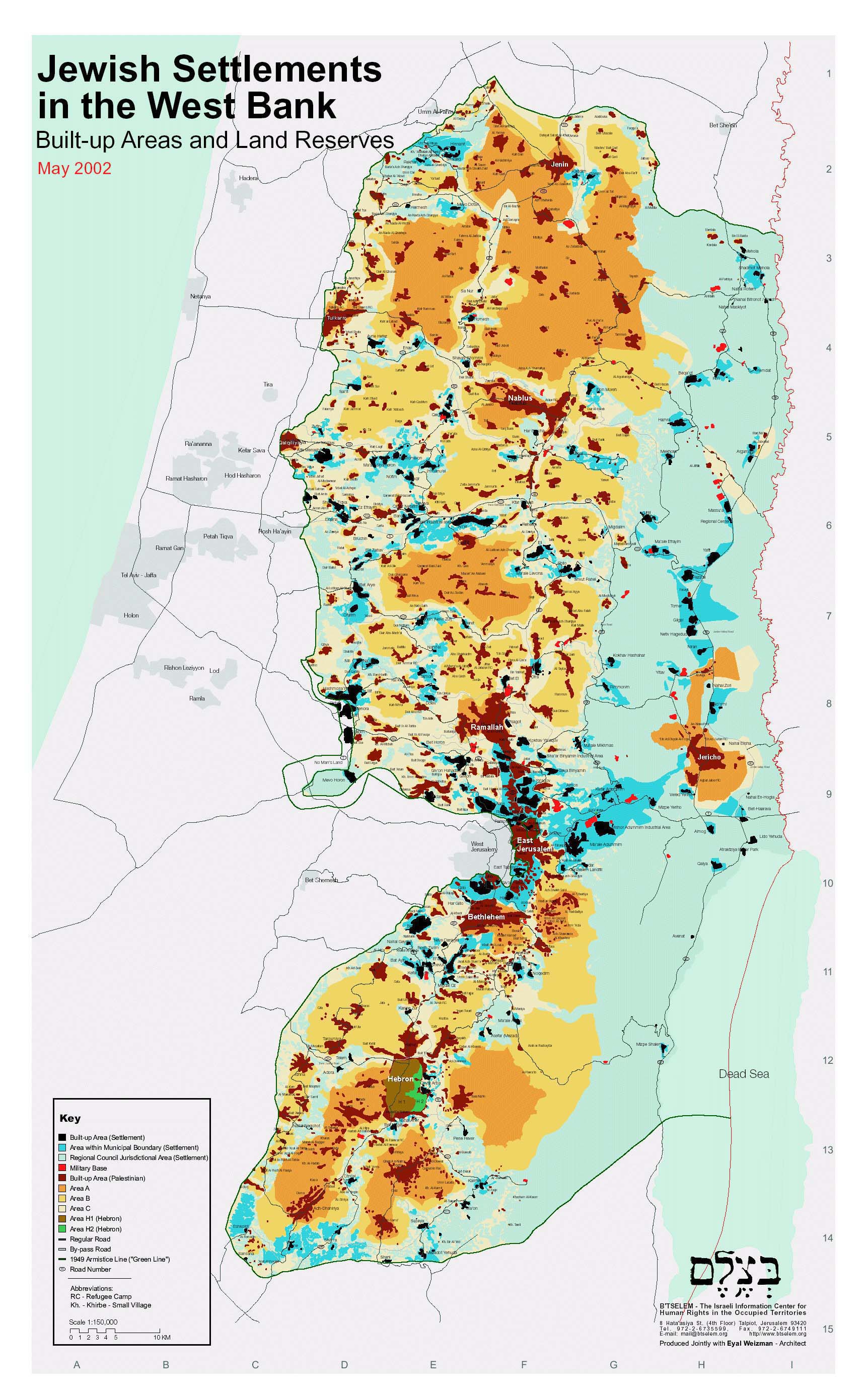

B'Tselem is The Israeli Information Center for Human Rights in the Occupied Territories. Warning: While the pages linked are in English, the site itself is bi-lingual, so expect many a prompt for a Hebrew text download.
I really had no idea that the land-grabbing by Israel is so systematical (breaking up the palestinian land) and that the settlements take up such a huge percentage of "occupied territories". Thanks for a good set of links.
posted by hoskala at 9:04 AM on September 4, 2004
posted by hoskala at 9:04 AM on September 4, 2004
Anyone who calls themselves a "Zionist" in this day and age needs a slap.
posted by Pretty_Generic at 9:55 AM on September 4, 2004
posted by Pretty_Generic at 9:55 AM on September 4, 2004
One can be a Zionist and oppose the expansion of the settlements.
posted by Asparagirl at 10:03 AM on September 4, 2004
posted by Asparagirl at 10:03 AM on September 4, 2004
Do you oppose the wall too?
posted by Pretty_Generic at 10:39 AM on September 4, 2004
posted by Pretty_Generic at 10:39 AM on September 4, 2004
Cause if so you're My Kinda Zionist.
posted by Pretty_Generic at 10:40 AM on September 4, 2004
posted by Pretty_Generic at 10:40 AM on September 4, 2004
One can be a Zionist and oppose the expansion of the settlements.
Some would claim otherwise. Many hardcore settlers feel that they are the only true Zionists, and that those who would accept the existence of a Palestinian state on the West Bank ("Judea and Samaria") are sellouts, Hellenized, self-hating Jews, what have you.
I understand political Zionism, in its abstract, to be about Jewish nationalism and the right of the Jewish people to exist within a clearly defined, self-governing state. But the unfortunate fact is that Jews did not exist anywhere as a majority, at least not anywhere that was acceptable to Zionism's founders, and thus the objective reality of Zionism has always necessarily involved the expulsion of an indigenous population and the expropriation of their land. It is arguable that the settlers are the true inheritors of this legacy.
What is inarguable, though, is that the settlements, and the suffering and resentment which they have created among the land's original inhabitants, have proven completely counterproductive to Israel's true security, and may eventually, ironically, lead to the end to the idea of Israel as a Jewish State.
posted by Ty Webb at 11:06 AM on September 4, 2004
Some would claim otherwise. Many hardcore settlers feel that they are the only true Zionists, and that those who would accept the existence of a Palestinian state on the West Bank ("Judea and Samaria") are sellouts, Hellenized, self-hating Jews, what have you.
I understand political Zionism, in its abstract, to be about Jewish nationalism and the right of the Jewish people to exist within a clearly defined, self-governing state. But the unfortunate fact is that Jews did not exist anywhere as a majority, at least not anywhere that was acceptable to Zionism's founders, and thus the objective reality of Zionism has always necessarily involved the expulsion of an indigenous population and the expropriation of their land. It is arguable that the settlers are the true inheritors of this legacy.
What is inarguable, though, is that the settlements, and the suffering and resentment which they have created among the land's original inhabitants, have proven completely counterproductive to Israel's true security, and may eventually, ironically, lead to the end to the idea of Israel as a Jewish State.
posted by Ty Webb at 11:06 AM on September 4, 2004
When Israel has borders and a constitution, and when the Palestinians have a stable, non-corrupt national leadership, there will be a chance of peace. Until that time, it will very difficult.
posted by cell divide at 11:31 AM on September 4, 2004
posted by cell divide at 11:31 AM on September 4, 2004
I will always support my people's right to a clearly defined self-governing secular state that treats people of different religions as equals. But unfortunately I don't think that qualifies me as a Zionist.
posted by Pretty_Generic at 11:38 AM on September 4, 2004
posted by Pretty_Generic at 11:38 AM on September 4, 2004
Me too. Of course, pursuant to the Fourteenth Amendment of the United States Constitution, "my people" are American citizens and residents of the State of Connecticut. These are my only allegiances. I sympathize with those who share my bloodline, only to the extent that they exercise the same restraint that accompanies the privileges of citizenship as I do with mine.
posted by PrinceValium at 11:48 AM on September 4, 2004
posted by PrinceValium at 11:48 AM on September 4, 2004
No need to get into a big and nasty give and take on this but simply to ask, till that land became occupied, who "owned" it? Not the people you call Palestinians--it was Jordan and it was Egypt,and they gave it up rather than try to get it back after the '67 war. The Palestinians were offered a state in 1947 under the UN and they refused the offer, prefering instead to go along with Arba states to exterminate Israel. Since that time, there has been no agreement that has been signed giving the lad presently occupied back.
posted by Postroad at 12:01 PM on September 4, 2004
posted by Postroad at 12:01 PM on September 4, 2004
No need to get into a big and nasty give and take on this but simply to ask, till that land became occupied, who "owned" it?
That's cute, but it was recognized as Palestinian land under the mandate system, and was then occupied by Egypt (Gaza) and Jordan (West Bank) after the 1948 war.
The Palestinians were offered a state in 1947 under the UN and they refused the offer,
Which was entirely reasonable, as the "offer" required them to give up half of their land.
"Hey, nice pie you've got there. How about we give half of it to that guy? Sound like a good offer?"
posted by Ty Webb at 12:17 PM on September 4, 2004
That's cute, but it was recognized as Palestinian land under the mandate system, and was then occupied by Egypt (Gaza) and Jordan (West Bank) after the 1948 war.
The Palestinians were offered a state in 1947 under the UN and they refused the offer,
Which was entirely reasonable, as the "offer" required them to give up half of their land.
"Hey, nice pie you've got there. How about we give half of it to that guy? Sound like a good offer?"
posted by Ty Webb at 12:17 PM on September 4, 2004
From B'Tselem's summary:
Particularly evident is Israel's manipulative use of legal tools in order to give the settlement enterprise an impression of legality. When Jordanian legislation served Israel's goals, Israel adhered to this legislation, arguing that international law obliges it to respect the legislation in effect prior to the occupation; in practice, this legislation was used in a cynical and biased manner. On the other hand, when this legislation interfered with Israel's plans, it was changed in a cavalier manner through military legislation and Israel established new rules to serve its interests. In so doing, Israel trampled on numerous restrictions and prohibitions established in the international conventions to which it is party, and which were intended to limit infringement of human rights and to protect populations under occupation.
The settlements are unlawful, and their presence leads to the violation of human rights. Accordingly, B'Tselem demands that the Israeli government act to vacate all the settlements. This process must take place while respecting the human rights of the settlers, including payment of compensation.
Vacating all the settlements is obviously a complex and protracted task. However, a number of interim steps can be taken to minimize the violation of human rights and international law. Among other steps, the Israeli government should:
Particularly evident is Israel's manipulative use of legal tools in order to give the settlement enterprise an impression of legality. When Jordanian legislation served Israel's goals, Israel adhered to this legislation, arguing that international law obliges it to respect the legislation in effect prior to the occupation; in practice, this legislation was used in a cynical and biased manner. On the other hand, when this legislation interfered with Israel's plans, it was changed in a cavalier manner through military legislation and Israel established new rules to serve its interests. In so doing, Israel trampled on numerous restrictions and prohibitions established in the international conventions to which it is party, and which were intended to limit infringement of human rights and to protect populations under occupation.
The settlements are unlawful, and their presence leads to the violation of human rights. Accordingly, B'Tselem demands that the Israeli government act to vacate all the settlements. This process must take place while respecting the human rights of the settlers, including payment of compensation.
Vacating all the settlements is obviously a complex and protracted task. However, a number of interim steps can be taken to minimize the violation of human rights and international law. Among other steps, the Israeli government should:
Cease all new construction in the settlements, either to build new settlements or to expand existing settlements;posted by y2karl at 12:28 PM on September 4, 2004
Freeze the planning and construction of new by-pass roads, and cease expropriation and seizure of land for this purpose;
Return to the Palestinian communities all the non-built-up areas within the municipal boundaries of the settlements and the local councils;
Abolish the special planning committees in the settlements, and hence the powers of the local authorities to prepare outline plans and issue building permits;
Cease the policy of providing incentives that encourage Israeli citizens to move to the settlements, and direct the resources to encourage settlers to relocate to areas within the borders of the State of Israel
fwiw, i went to see mazin qumsiyeh, a palestinian christian and a professor of genetics at duke and yale, speak a few weeks ago about his book sharing the land of canaan in which he laid out, i thought, a sensible* vision for peace. altho, like cell divide sez, it's easy to be discouraged.
btw, there was an editorial in the FT the other day updating where northern ireland was in the peace process that reminded me of what and an enduring settlement might look like:
---
*if by sensible, you think a 'one-state' solution is even feasible
posted by kliuless at 1:49 PM on September 4, 2004
btw, there was an editorial in the FT the other day updating where northern ireland was in the peace process that reminded me of what and an enduring settlement might look like:
Ten years after the Irish Republican Army declared its ceasefire, the political future of Northern Ireland looks as far as ever from settlement. The peace process has been on hold since Ulster's devolved assembly was suspended in October 2002. The impasse worsened when last year's assembly elections handed victory to the Democratic Unionist party and Sinn Féin, the more hard-line parties on each side.in short, it's a long road, even with a road map...
Next month, all the parties will gather for talks at Leeds Castle in Kent, under the joint chairmanship of Tony Blair and Bertie Ahern, his Irish counterpart. The obstacles to further progress remain formidable: Ian Paisley's Democratic Unionists refuse to talk to Sinn Féin unless the IRA is disbanded and demand complete renegotiation of the Good Friday agreement. Sinn Féin has failed to complete the decommissioning of republican arms promised under the agreement, insisting that unionists recognise its electoral mandate.
Yet there are reasons for optimism. The most important is that there is no sign of backsliding on the ceasefire - in fact, a return to hostilities seems almost unthinkable. Sufficient progress has been made for neither side to be ready to countenance a return to the violence of the Troubles.
Life in the province is far from normal, as the continuing low-level sectarian conflict shows. Protestants are still being driven out of Catholic areas, Catholics are still leaving Protestant areas. None of this improves the chances of Northern Ireland's becoming a normal place to live, and it feeds disillusion with the peace process.
However, there are signs of movement on the political front. Gerry Adams, Sinn Féin president, floated the disbandment of the IRA earlier this month, if it would remove an obstacle to a deal with unionists concerned about the continuing existence of paramilitaries. He has also said that republicans could support the Northern Ireland police service once the reforms to democratise its control were completed - which the British government promises when a deal is done.
On the unionist side, Jeffrey Donaldson, whose opposition to the Good Friday agreement led him to defect from David Trimble's Ulster Unionists to the DUP, has made conciliatory moves. Mr Trimble was always constrained in negotiating with Sinn Féin by the threat of attack from the Democratic Unionists - a threat the DUP leadership does not have to worry about.
None of this makes reaching a deal easy. But the two sides have much to gain from putting the peace process back on track. The Democratic Unionists know their election victory can be translated into power only if the assembly is restored. Sinn Féin has gained great kudos from what followed the IRA ceasefire, but needs to complete the transition from the Armalite to the ballot box. For both, the Good Friday agreement remains the only show in town.
---
*if by sensible, you think a 'one-state' solution is even feasible
posted by kliuless at 1:49 PM on September 4, 2004
No need to get into a big and nasty give and take on this but simply to ask, till that land became occupied, who "owned" it? Not the people you call Palestinians--it was Jordan and it was Egypt,and they gave it up rather than try to get it back after the '67 war.
This is an absolutely nonsensical claim, which has roots in Golda Meir's claim that there's no such thing as Palestinians. The area under the British Mandate was called Palestine for much longer than it was called Israel. Here's a Google image search of antique maps of Palestine if you don't believe me. The attempt to define Palestine out of existence is just about as ludicrous as Saddam Hussein's claims that Kuwait was a province of Iraq.
posted by jonp72 at 6:09 PM on September 4, 2004
This is an absolutely nonsensical claim, which has roots in Golda Meir's claim that there's no such thing as Palestinians. The area under the British Mandate was called Palestine for much longer than it was called Israel. Here's a Google image search of antique maps of Palestine if you don't believe me. The attempt to define Palestine out of existence is just about as ludicrous as Saddam Hussein's claims that Kuwait was a province of Iraq.
posted by jonp72 at 6:09 PM on September 4, 2004
All of history is about people's settling on land, developing and defending it.
posted by semmi at 8:38 PM on September 4, 2004
posted by semmi at 8:38 PM on September 4, 2004
The problem, Semmi, if you take the "history is just as bad" approach is that it opens you up to the reverse happening. Since 1945, the world has generally tried to stay away from repeating the conquest mode of land development. I'm sure if the tables were turned you wouldn't want people posting comments like that if it was your family in Israel being thrown out of their homes for 'development and defense'. I do know what you're saying, and it is true, but times do change. The history of humanity is a history of slavery, and yet we don't use that as an excuse for modern day slave traders.
posted by cell divide at 9:45 PM on September 4, 2004
posted by cell divide at 9:45 PM on September 4, 2004
Semmi and Cell Divide: the politicians of 2004, like the Romans, the Franks, the Warsaw Pact powers, and so on, imagine that the land divisions and cultural changes they make now will stand for all time, and do so with that intention in mind. They're equally wrong. But on the other hand, what else can they do?
Anyway, I predict a major trend over the next thirty years will be the rise of 'jurisdiction shopping' (or culture shopping, more appropriately) for individuals. Already, anyone with more than US$50K per annum earning power can pretty much choose which nation they want to live in, and hence what kind of cultural environment they must be subject to. In the specific case of Israel/Palestine, barring a drastic change, I think a lot of young and worldly people will start asking themselves "it sucks here, why do we stay?" and moving to somewhere that sucks a whole lot less. I predict the force that brings peace to that region, in the long term, will be market-driven lifestyle choice, which has brought peace to a lot of other regions in the past, and will in the future.
posted by aeschenkarnos at 6:35 AM on September 5, 2004
Anyway, I predict a major trend over the next thirty years will be the rise of 'jurisdiction shopping' (or culture shopping, more appropriately) for individuals. Already, anyone with more than US$50K per annum earning power can pretty much choose which nation they want to live in, and hence what kind of cultural environment they must be subject to. In the specific case of Israel/Palestine, barring a drastic change, I think a lot of young and worldly people will start asking themselves "it sucks here, why do we stay?" and moving to somewhere that sucks a whole lot less. I predict the force that brings peace to that region, in the long term, will be market-driven lifestyle choice, which has brought peace to a lot of other regions in the past, and will in the future.
posted by aeschenkarnos at 6:35 AM on September 5, 2004
The problem, Semmi, if you take the "history is just as bad"
CD: I don't. I take his-story as it is, well knowing that it's always the winners who are writing it. People who are personally involved get wherever the'll get with it. The real issue here has to do with people outside of the situation for whom nothing is really at stake, yet nothing is too expensive as hardship and suffering on distant people, and who keep inciting more conflict. Peace means just that: peace, no hostilities.
aeschenkarnos:: What you say is possible, but I think the area has a more viable chance for economic prosperity with Israel running the show and sharing the prosperity with the Palestinians. It seems to me Israel is prepared to do this, as long as its safety is secure.
posted by semmi at 1:06 PM on September 5, 2004
CD: I don't. I take his-story as it is, well knowing that it's always the winners who are writing it. People who are personally involved get wherever the'll get with it. The real issue here has to do with people outside of the situation for whom nothing is really at stake, yet nothing is too expensive as hardship and suffering on distant people, and who keep inciting more conflict. Peace means just that: peace, no hostilities.
aeschenkarnos:: What you say is possible, but I think the area has a more viable chance for economic prosperity with Israel running the show and sharing the prosperity with the Palestinians. It seems to me Israel is prepared to do this, as long as its safety is secure.
posted by semmi at 1:06 PM on September 5, 2004
good point aeschenkarnos! part of the 'multitude' concept that hardt and negri outline in empire (397-399) is the right to some sort of global citizenship or migration facility (that allows people to effectively vote with their feet; a 'truer' sign of democracy than representative gov't, imo) -- basically the idea being that if capital is afforded certain freedoms and protections across borders then so also should people be put on the same footing as citizens :D
unfortunately (or fortunately depending on your POV :) people are not as 'fungible' as capital (language for one; money talks afterall, and translates too!) else we'd have a global gov't by now to match the (largely) global economy! (transaction costs, see coase :) but as more and more people cross borders in a 'global labor arbitrage' (curiously roach neglects diasporas in his formulation) it seems appropriate to regulate it better, or at least coordinate it more comprehensively, than it is now (to allow for 'true' globalization)... as opposed to blanket 'refugee' or 'illegal alien' status for so many people around the world.
i guess i'm thinking of 'jurisdiction shopping' kinda like a menu gov'ts could provide, just like you would when choosing an opensource license for your code or a creative commons license for IP or something. what kind of citizen would you like to be? and having something like this would provide the framework (or at least the semblance thereof :) for global governance, um, like an openly exposed web API! having well-defined protocols (handshakes) for human transfer would make things run a lot smoother; people as packets! sorta like richard florida's 'plug-and-play' societies writ large. i dunno :D
i mean if google can crawl and index 4,285,199,774 pages, while alexa can archive that much more, or like scientists can model the interactions of 10 billion particles you'd think keeping track of people (all six and a half billion of them) with a more nuanced set of metadata, other than merely 'country of origin', is at least possible and imo worthwhile.
and what does this do, if people are not held hostage to their 'nation'? it forces govt's to be that much more responsive to its citizenry :D yay!
take for instance the recently established 'meta-nation' of the EU. where once the roma (nee gypsies) were stateless with little in the way of rights, protections and avenues toward redress of grievances, in a 'super-state' they at least now have nominal legal status, representation and the benefits thereof. or like france, now part of the EU, finds it much easier to devolve, e.g. allowing corsican autonomy, where once it'd been a rather sore spot. in contrast, see dan's post on chechnya! (that matt pointed out in the sidebar :)
oh, and in a further iteration of this idea, george saunders provides a 'survey of the literature' (from the future :)
finally (and to stay OT :) i forgot about these other (harsh!) FT editorials recently:
posted by kliuless at 7:32 PM on September 5, 2004
unfortunately (or fortunately depending on your POV :) people are not as 'fungible' as capital (language for one; money talks afterall, and translates too!) else we'd have a global gov't by now to match the (largely) global economy! (transaction costs, see coase :) but as more and more people cross borders in a 'global labor arbitrage' (curiously roach neglects diasporas in his formulation) it seems appropriate to regulate it better, or at least coordinate it more comprehensively, than it is now (to allow for 'true' globalization)... as opposed to blanket 'refugee' or 'illegal alien' status for so many people around the world.
i guess i'm thinking of 'jurisdiction shopping' kinda like a menu gov'ts could provide, just like you would when choosing an opensource license for your code or a creative commons license for IP or something. what kind of citizen would you like to be? and having something like this would provide the framework (or at least the semblance thereof :) for global governance, um, like an openly exposed web API! having well-defined protocols (handshakes) for human transfer would make things run a lot smoother; people as packets! sorta like richard florida's 'plug-and-play' societies writ large. i dunno :D
i mean if google can crawl and index 4,285,199,774 pages, while alexa can archive that much more, or like scientists can model the interactions of 10 billion particles you'd think keeping track of people (all six and a half billion of them) with a more nuanced set of metadata, other than merely 'country of origin', is at least possible and imo worthwhile.
and what does this do, if people are not held hostage to their 'nation'? it forces govt's to be that much more responsive to its citizenry :D yay!
take for instance the recently established 'meta-nation' of the EU. where once the roma (nee gypsies) were stateless with little in the way of rights, protections and avenues toward redress of grievances, in a 'super-state' they at least now have nominal legal status, representation and the benefits thereof. or like france, now part of the EU, finds it much easier to devolve, e.g. allowing corsican autonomy, where once it'd been a rather sore spot. in contrast, see dan's post on chechnya! (that matt pointed out in the sidebar :)
oh, and in a further iteration of this idea, george saunders provides a 'survey of the literature' (from the future :)
The Patriotic Studies discipline may properly be said to have begun with the work of Jennison et al., which first established the existence of the so-called “fluid-nations,” entities functionally identical to the more traditional geographically based nations (“geo-nations”), save for their lack of what the authors termed “spatial/geographic contiguity.” Citizenship in a fluid-nation was seen to be contingent not upon residence in some shared physical space (i.e., within “borders”) but, rather, upon commonly held “values, loyalties, and/or habitual patterns of behavior” seen to exist across geo-national borders.these communities of interest, group identities and multiple affinities are also given some thought by benedict anderson; like neal stephenson's 'burbclaves' and 'phyles'!
finally (and to stay OT :) i forgot about these other (harsh!) FT editorials recently:
The plan to build more than 2,000 new homes on land confiscated from Palestinians mocks the so-called road map to a final settlement endorsed by the international community. It confirms once again that Mr Sharon's intention to withdraw from Gaza is not a prelude to Palestinian statehood, but a tactical retreat in pursuit of his ambition to annex large swaths of the West Bank for a Greater Israel.which i guess is also the silver lining? as economists like to say, "if a trend can't be sustained forever it won't be."
Mr Bush's rhetorical commitment to a two-state solution in the region - a secure Israel side-by-side with a viable Palestinian state - rings ever more hollow. Put the latest expansion of settlements alongside the security wall cutting into territory well beyond Israel's 1967 borders and the facts on the ground created by Mr Sharon ridicule the US administration's declared intent.
The rest of us are reminded again of how often Mr Sharon's intransigence has given Mr Arafat his excuse, and how the Palestinian leader's obstinacy has provided the Israeli prime minister with his justification.
[...]
So the dance has become a deathly shuffle. Both leaders may shrug off their present troubles. Who knows, perhaps one or other will fall. The certainty is that they lack the courage and vision to restart serious peace talks. Mr Sharon's claim is that he has greatly weakened the Palestinians; Mr Arafat's that he has survived every onslaught. In that, each has been the other's most important ally.
Realities, though, have not changed. Israel cannot achieve security by annexation; the Palestinians cannot demand self-government until they are ready to exercise power. Obvious enough, you might say. But first, tragically, we must wait for the music finally to stop.
posted by kliuless at 7:32 PM on September 5, 2004
« Older Chris P. Carrot for President | Israeli Offshore Radio Newer »
This thread has been archived and is closed to new comments
posted by y2karl at 10:47 PM on September 3, 2004