Pushing for open elections in Egypt
February 27, 2005 2:28 PM Subscribe
Earlier this month, Condoleezza Rice discussed reforms and democracy with Egyptian foreign minister Abu al-Ghait, and joined the international voices urging the release of Ayman Nour. Nour's opposition party—al-Ghad ("Tommorrow")—supports open elections and limiting President Mubarak's terms in office, which has garnered unprecedented activist support in Cairo. When Rice canceled her trip to Cairo three days ago to protest Nour's imprisonment, President Hosni Mubarak did a surprising thing: he revised the Egyptian constitution to allow for multi-party presidential elections—the first since succeeding Anwar Sadat in 1981. (some links via BigPharaoh)
I'm pretty sure this is a sop to the "freedom is on the march" crowd. Hosni Mubarak hasn't held on to power this long to give it up so easily. Still, it's worth hoping that this lights a fire under the pro-democracy opposition. My guess is that this affects his son Gamal's hopes to succeed his father more than it impacts Mubarak himself.
An interesting question to chew over, though, is what Bush and Rice propose to do about Islamist opposition groups like the Muslim Brotherhood. Currently outlawed by Mubarak, a fully functioning democracy would obviously require that they be given a seat at the table. My guess is that they'll avoid ratcheting their rhetoric up too highly for fear of having their bluff called.
posted by felix betachat at 2:54 PM on February 27, 2005
An interesting question to chew over, though, is what Bush and Rice propose to do about Islamist opposition groups like the Muslim Brotherhood. Currently outlawed by Mubarak, a fully functioning democracy would obviously require that they be given a seat at the table. My guess is that they'll avoid ratcheting their rhetoric up too highly for fear of having their bluff called.
posted by felix betachat at 2:54 PM on February 27, 2005
Karl-
Full democracy supports Israel's interests because a freely democratic Arab state which represents the will of its people would find it more difficult to engage in anti-Israeli scapegoating to distract its population from internal corruption.
posted by felix betachat at 2:57 PM on February 27, 2005
Full democracy supports Israel's interests because a freely democratic Arab state which represents the will of its people would find it more difficult to engage in anti-Israeli scapegoating to distract its population from internal corruption.
posted by felix betachat at 2:57 PM on February 27, 2005
Well, y2karl, at least it's a step in the right direction. I'll hold off on criticisms until an election with more than one choice is conducted, to see how the populace actually votes.
So far, this looks like a very good thing.
posted by mathowie at 3:00 PM on February 27, 2005
So far, this looks like a very good thing.
posted by mathowie at 3:00 PM on February 27, 2005
Felix:
I somewhat agree with your point, but I laughed at "because a freely democratic ________ which represents the will of its people would find it more difficult to engage in anti-______ scapegoating to distract its population from internal corruption." I don't know why.
posted by dougunderscorenelso at 3:00 PM on February 27, 2005
I somewhat agree with your point, but I laughed at "because a freely democratic ________ which represents the will of its people would find it more difficult to engage in anti-______ scapegoating to distract its population from internal corruption." I don't know why.
posted by dougunderscorenelso at 3:00 PM on February 27, 2005
d_n:
Ack. Point taken.
Maybe I'd say that this card, which has ever been ready at hand for Arab despots, would get a little harder to play.
posted by felix betachat at 3:03 PM on February 27, 2005
Ack. Point taken.
Maybe I'd say that this card, which has ever been ready at hand for Arab despots, would get a little harder to play.
posted by felix betachat at 3:03 PM on February 27, 2005
Full democracy supports Israel's interests because a freely democratic Arab state which represents the will of its people would find it more difficult to engage in anti-Israeli scapegoating to distract its population from internal corruption.
You ever wonder if it's the governments throwing a sop to a vehemently anti-Israeli populace instead ? I do. Consider the Angry Arab Guide to Middle East Media :
Al-Jazeera’s orientations are largely vague Arab nationalist, although people in the West would be surprised to learn that people in the Middle East are convinced that Al-Jazeera is run by the Mossad. People in the Middle East do not find Al-Jazeera to be "nationalist" enough. Furthermore, they do not like how Al-Jazeera features Israeli guests/propagandists. The news broadcasts are largely straightforward; the shouting and the anti-American sentiments are expressed on, or confined to, AlJazeera’s talk shows that are widely watched. But they always match the anti-American guest with a pro-American guest.
Then there is the whole Islamic republic potential inherent in open elections. For example, consider Riverbend on the recent election in Iraq:
Then there’s Abdul Aziz Al-Hakim, head of the Supreme Council for the Islamic Revolution in Iraq (SCIRI). He got to be puppet president for the month of December and what was the first thing he did? He decided overburdened, indebted Iraq owed Iran 100 billion dollars. What was the second thing he did? He tried to have the “personal status” laws that protect individuals (and especially women) eradicated.
They try to give impressive interviews to western press but the situation is wholly different on the inside. Women feel it the most. There’s an almost constant pressure in Baghdad from these parties for women to cover up what little they have showing. There’s a pressure in many colleges for the segregation of males and females. There are the threats, and the printed and verbal warnings, and sometimes we hear of attacks or insults.
You feel it all around you. It begins slowly and almost insidiously. You stop wearing slacks or jeans or skirts that show any leg because you don’t want to be stopped in the street and lectured by someone who doesn’t approve. You stop wearing short sleeves and start preferring wider shirts with a collar that will cover up some of you neck. You stop letting your hair flow because you don’t want to attract attention to it. On the days when you forget to pull it back into a ponytail, you want to kick yourself and you rummage around in your handbag trying to find a hair band… hell, a rubber band to pull back your hair and make sure you attract less attention from *them*.
We were seriously discussing this situation the other day with a friend. The subject of the veil and hijab came up and I confessed my fear that while they might not make it a law, there would be enough pressure to make it a requirement for women when they leave their homes. He shrugged his shoulders and said, “Well women in Iran will tell you it’s not so bad- you know that they just throw something on their heads and use makeup and go places, etc.” True enough. But it wasn’t like that at the beginning. It took them over two decades to be able to do that. In the eighties, women were hauled off the streets and detained or beaten for the way they dressed.
Unintended consequences.
posted by y2karl at 3:08 PM on February 27, 2005
You ever wonder if it's the governments throwing a sop to a vehemently anti-Israeli populace instead ? I do. Consider the Angry Arab Guide to Middle East Media :
Al-Jazeera’s orientations are largely vague Arab nationalist, although people in the West would be surprised to learn that people in the Middle East are convinced that Al-Jazeera is run by the Mossad. People in the Middle East do not find Al-Jazeera to be "nationalist" enough. Furthermore, they do not like how Al-Jazeera features Israeli guests/propagandists. The news broadcasts are largely straightforward; the shouting and the anti-American sentiments are expressed on, or confined to, AlJazeera’s talk shows that are widely watched. But they always match the anti-American guest with a pro-American guest.
Then there is the whole Islamic republic potential inherent in open elections. For example, consider Riverbend on the recent election in Iraq:
Then there’s Abdul Aziz Al-Hakim, head of the Supreme Council for the Islamic Revolution in Iraq (SCIRI). He got to be puppet president for the month of December and what was the first thing he did? He decided overburdened, indebted Iraq owed Iran 100 billion dollars. What was the second thing he did? He tried to have the “personal status” laws that protect individuals (and especially women) eradicated.
They try to give impressive interviews to western press but the situation is wholly different on the inside. Women feel it the most. There’s an almost constant pressure in Baghdad from these parties for women to cover up what little they have showing. There’s a pressure in many colleges for the segregation of males and females. There are the threats, and the printed and verbal warnings, and sometimes we hear of attacks or insults.
You feel it all around you. It begins slowly and almost insidiously. You stop wearing slacks or jeans or skirts that show any leg because you don’t want to be stopped in the street and lectured by someone who doesn’t approve. You stop wearing short sleeves and start preferring wider shirts with a collar that will cover up some of you neck. You stop letting your hair flow because you don’t want to attract attention to it. On the days when you forget to pull it back into a ponytail, you want to kick yourself and you rummage around in your handbag trying to find a hair band… hell, a rubber band to pull back your hair and make sure you attract less attention from *them*.
We were seriously discussing this situation the other day with a friend. The subject of the veil and hijab came up and I confessed my fear that while they might not make it a law, there would be enough pressure to make it a requirement for women when they leave their homes. He shrugged his shoulders and said, “Well women in Iran will tell you it’s not so bad- you know that they just throw something on their heads and use makeup and go places, etc.” True enough. But it wasn’t like that at the beginning. It took them over two decades to be able to do that. In the eighties, women were hauled off the streets and detained or beaten for the way they dressed.
Unintended consequences.
posted by y2karl at 3:08 PM on February 27, 2005
I'm all for the concept of Mid East democracy but there is no magic bullet inherent in it. Mid East peace will not come until Israel and its American supporters seriously face up to the settlements issue--and I don't mean weak willed sissified negative affirmations like Well, I'm against expansion of the settlements, either. And that is simply politically impossible in Israel and American right now. Mention the dismantling the settlements in the West Bank and ears disappear.
posted by y2karl at 3:18 PM on February 27, 2005
posted by y2karl at 3:18 PM on February 27, 2005
> The thing I am curious about is where all the advocates for democracy in the
> Mid East get the idea that it will make things easier for Israel.
It is to be desired even if it doesn't.
posted by jfuller at 3:19 PM on February 27, 2005
> Mid East get the idea that it will make things easier for Israel.
It is to be desired even if it doesn't.
posted by jfuller at 3:19 PM on February 27, 2005
karl-- No doubt that Arab/Islamic publics have many deeply held views that, shall we say, lack nuance.
But I don't think that negate's Felix's point. If the range of views that can be expressed in public grows beyond nationalist/chauvinist ones, people will start talking about underdevelopment.
You're right that there's no magic bullet in democracy, but it sure seems to be a better option than anything else. Also, I think that democracy is a good thing in itself-- I bet you agree.
And I don't agree that the settlement issue is the magic bullet that's holding us back from peace. It's just something obnoxious that Israel has done, and for whatever reason, liberals such as yourself have decided in the past 10 years or so that criticizing Israel is more fun than criticizing Palestinians.
posted by ibmcginty at 3:27 PM on February 27, 2005
But I don't think that negate's Felix's point. If the range of views that can be expressed in public grows beyond nationalist/chauvinist ones, people will start talking about underdevelopment.
You're right that there's no magic bullet in democracy, but it sure seems to be a better option than anything else. Also, I think that democracy is a good thing in itself-- I bet you agree.
And I don't agree that the settlement issue is the magic bullet that's holding us back from peace. It's just something obnoxious that Israel has done, and for whatever reason, liberals such as yourself have decided in the past 10 years or so that criticizing Israel is more fun than criticizing Palestinians.
posted by ibmcginty at 3:27 PM on February 27, 2005
a freely democratic Arab state which represents the will of its people would find it more difficult to engage in anti-Israeli scapegoating to distract its population from internal corruption.
I'm as pro-freedom as they come, but I have to warn against suffering delusions that democracy is a magic cure for everything. In democratic countries there is a clear tendency for politicians to do whatever they can to get elected, whether that includes things like outright lying or stirring up the electorate with demagogical speeches.
We already know from the Iraqi example that those whom people like ourselves here would like to see in power -- pro-western, pro-freedom, secular types not strongly associated with ethnic labels -- don't do as well as is hoped (the secularists had a dismal showing in Iraq and are effectively shut out of government there). It seems a little foolish to expect the contrary in a country with a history of trouble with the religionist/secularist debate, like Egypt.
posted by clevershark at 3:28 PM on February 27, 2005
I'm as pro-freedom as they come, but I have to warn against suffering delusions that democracy is a magic cure for everything. In democratic countries there is a clear tendency for politicians to do whatever they can to get elected, whether that includes things like outright lying or stirring up the electorate with demagogical speeches.
We already know from the Iraqi example that those whom people like ourselves here would like to see in power -- pro-western, pro-freedom, secular types not strongly associated with ethnic labels -- don't do as well as is hoped (the secularists had a dismal showing in Iraq and are effectively shut out of government there). It seems a little foolish to expect the contrary in a country with a history of trouble with the religionist/secularist debate, like Egypt.
posted by clevershark at 3:28 PM on February 27, 2005
fuller wrote:
> It is to be desired even if it doesn't.
I'll go farther. It is to be desired particularly if it doesn't. Any number of things concerning Israel might change for the better if that country no longer benefitted from the "only democracy in the middle east" trope.
posted by jfuller at 3:30 PM on February 27, 2005
> It is to be desired even if it doesn't.
I'll go farther. It is to be desired particularly if it doesn't. Any number of things concerning Israel might change for the better if that country no longer benefitted from the "only democracy in the middle east" trope.
posted by jfuller at 3:30 PM on February 27, 2005
clevershark -- the pro-democracy case is that democratic culture leads to change over time. The first vote ever in somewhere like Iraq or Egypt will not necessarily produce the more pragmatist outlook that we've been talking about. But over time, revolutionary/religious fervor doesn't hold up as a governing philosophy. Iran provides a good example-- and shows that whoever winds up in power in Iraq/Egypt will likely have powerful incentives and abilities to resist democratization.
posted by ibmcginty at 3:33 PM on February 27, 2005
posted by ibmcginty at 3:33 PM on February 27, 2005
Mention the dismantling the settlements in the West Bank and ears disappear
Sorry karl, but what planet are you living on? It's actively being discussed in the Israeli and the American press. Arab states are bracing for it. Hell, didn't King Abdullah just predict a Palestinian state in the West Bank by 2006?
I get that democracy is a difficult issue, especially in the absence of a stable, centrist electorate. But I think the US, the EU, and Israel are going to have to ride the tiger for about a decade or two before the dust settles. The best thing that could happen would be for the Islamists to get power and have to deal with making the trains run on time.
posted by felix betachat at 3:33 PM on February 27, 2005
Sorry karl, but what planet are you living on? It's actively being discussed in the Israeli and the American press. Arab states are bracing for it. Hell, didn't King Abdullah just predict a Palestinian state in the West Bank by 2006?
I get that democracy is a difficult issue, especially in the absence of a stable, centrist electorate. But I think the US, the EU, and Israel are going to have to ride the tiger for about a decade or two before the dust settles. The best thing that could happen would be for the Islamists to get power and have to deal with making the trains run on time.
posted by felix betachat at 3:33 PM on February 27, 2005
I'll go farther. It is to be desired particularly if it doesn't. Any number of things concerning Israel might change for the better if that country no longer benefitted from the "only democracy in the middle east" trope.
There we agree, jfuller.
posted by y2karl at 3:34 PM on February 27, 2005
There we agree, jfuller.
posted by y2karl at 3:34 PM on February 27, 2005
Sorry karl, but what planet are you living on?
This one:
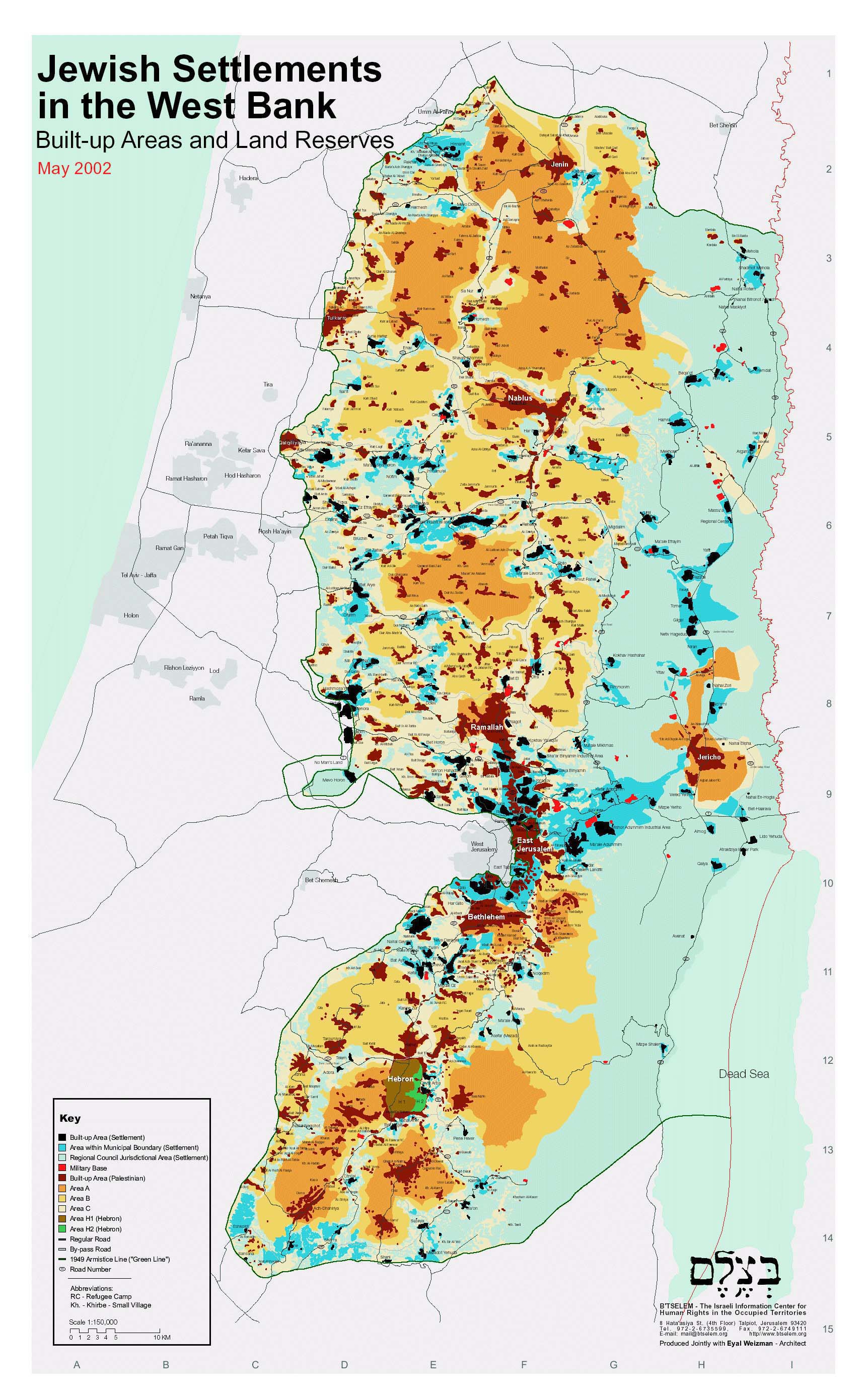
As appears from the map, while the built-up area of the settlements in the West Bank covers 1.7 percent of the West Bank, the settlements control 41.9 percent of the entire West Bank. The separation barrier imprisons more than 250,000 Palestinians situated west and east of the main barrier. When completed, the separation barrier will separate some 200,000 Palestinians living in East Jerusalem from the rest of the West Bank. Residents of more than one hundred Palestinian communities are separated from their farmland. About 16 percent of the West Bank is fenced in.
posted by y2karl at 3:37 PM on February 27, 2005
This one:
As appears from the map, while the built-up area of the settlements in the West Bank covers 1.7 percent of the West Bank, the settlements control 41.9 percent of the entire West Bank. The separation barrier imprisons more than 250,000 Palestinians situated west and east of the main barrier. When completed, the separation barrier will separate some 200,000 Palestinians living in East Jerusalem from the rest of the West Bank. Residents of more than one hundred Palestinian communities are separated from their farmland. About 16 percent of the West Bank is fenced in.
posted by y2karl at 3:37 PM on February 27, 2005
The separation barrier imprisons more than...
The idea is, Karl, that people are less likely to view a functional, democratic Palestine as a prison.
Leaving aside the "God gave us this land" issue. For a moment.
posted by ibmcginty at 3:41 PM on February 27, 2005
The idea is, Karl, that people are less likely to view a functional, democratic Palestine as a prison.
Leaving aside the "God gave us this land" issue. For a moment.
posted by ibmcginty at 3:41 PM on February 27, 2005
y2karl's general point really needs to be taken seriously.
Which groups in Egypt -- and other Arab countries in the region -- are currently the most capable of adapting to political campaigning? Which have the grassroots organisation, the most loyal base, the best capacity to mobilise supporters?
(Possible very loose points of comparison: the French Revolution and the Russian Revolution, in which moderates were quickly marginalised and/or shot by better organised radical groups who didn't have democracy at the top of their priority lists. Or post-colonial Africa, for that matter, when armed resistance groups had the upper hand.)
Now, reform has to begin somewhere, obviously. But the path to reform doesn't always begin with elections. The question that the US faces, in promoting democracy 'from within' in the Middle East, is whether it's prepared to support a fast transition, with its potential to hand victory to populist parties with grassroots in the mosques, or a slower transition (like that in Jordan) which establishes an artificial political debate that is more moderate in character. The problem with such a slower transition, of course, is that of legitimacy. So, there's no easy answer: do you look for a Turkish model, where the army defends the nation's founding principles against the popular will? In Algeria, that sparked a civil war which still rumbles on:
A new constitution was adopted in 1989 that allowed the formation of political associations other than the FLN. It also removed the armed forces, which had run the government since the days of Boumediene, from a designated role in the operation of the government. Among the scores of parties that sprang up under the new constitution, the militant Islamic Salvation Front (FIS) was the most successful, winning more than 50% of all votes cast in municipal elections in June 1990 as well as in first stage of national legislative elections held in December 1991.
Faced with the real possibility of a sweeping FIS victory, the government canceled the second stage of elections in January 1992. This action, coupled with political uncertainty and economic turmoil, led to a violent reaction on the part of the Islamists.
The best thing that could happen would be for the Islamists to get power and have to deal with making the trains run on time.
Would the US -- or Israel, for that matter -- be prepared to ride that tiger, though? Iraq will be the first test.
posted by riviera at 3:41 PM on February 27, 2005
Which groups in Egypt -- and other Arab countries in the region -- are currently the most capable of adapting to political campaigning? Which have the grassroots organisation, the most loyal base, the best capacity to mobilise supporters?
(Possible very loose points of comparison: the French Revolution and the Russian Revolution, in which moderates were quickly marginalised and/or shot by better organised radical groups who didn't have democracy at the top of their priority lists. Or post-colonial Africa, for that matter, when armed resistance groups had the upper hand.)
Now, reform has to begin somewhere, obviously. But the path to reform doesn't always begin with elections. The question that the US faces, in promoting democracy 'from within' in the Middle East, is whether it's prepared to support a fast transition, with its potential to hand victory to populist parties with grassroots in the mosques, or a slower transition (like that in Jordan) which establishes an artificial political debate that is more moderate in character. The problem with such a slower transition, of course, is that of legitimacy. So, there's no easy answer: do you look for a Turkish model, where the army defends the nation's founding principles against the popular will? In Algeria, that sparked a civil war which still rumbles on:
A new constitution was adopted in 1989 that allowed the formation of political associations other than the FLN. It also removed the armed forces, which had run the government since the days of Boumediene, from a designated role in the operation of the government. Among the scores of parties that sprang up under the new constitution, the militant Islamic Salvation Front (FIS) was the most successful, winning more than 50% of all votes cast in municipal elections in June 1990 as well as in first stage of national legislative elections held in December 1991.
Faced with the real possibility of a sweeping FIS victory, the government canceled the second stage of elections in January 1992. This action, coupled with political uncertainty and economic turmoil, led to a violent reaction on the part of the Islamists.
The best thing that could happen would be for the Islamists to get power and have to deal with making the trains run on time.
Would the US -- or Israel, for that matter -- be prepared to ride that tiger, though? Iraq will be the first test.
posted by riviera at 3:41 PM on February 27, 2005
Revisiting The Arab Street
Revisiting The Arab Street Executive Summary (pdf)
Overview of Findings The study draws seven conclusions:
1) Arabs hold coherent notions of what constitute the values of Western and Arabsocieties. They associate the West with individual liberty and wealth, while theyview themselves as emphasizing religion and family.
2) Arab perceptions of Western societal and cultural values do not determine their attitudes toward Western foreign policies.
3) Religion is not the basis of tension between Arabs and the West.
4) The Arab world does not reject the professed goals of the West’s foreign policies toward the Arab World, but rather objects to the discrepancy between professed ideals and perceived reality.
5) Arabs disagree fundamentally with US positions on issues such as the definition of terrorism, the Arab-Israeli conflict, and war in Iraq.
6) Despite disagreements and disillusionments, many Arabs desire stronger relations between their countries and the West.
7) Arab dissatisfaction with US policies is unlikely to diminish in the absence of significant US foreign policy changes.
posted by y2karl at 3:43 PM on February 27, 2005
Revisiting The Arab Street Executive Summary (pdf)
Overview of Findings The study draws seven conclusions:
1) Arabs hold coherent notions of what constitute the values of Western and Arabsocieties. They associate the West with individual liberty and wealth, while theyview themselves as emphasizing religion and family.
2) Arab perceptions of Western societal and cultural values do not determine their attitudes toward Western foreign policies.
3) Religion is not the basis of tension between Arabs and the West.
4) The Arab world does not reject the professed goals of the West’s foreign policies toward the Arab World, but rather objects to the discrepancy between professed ideals and perceived reality.
5) Arabs disagree fundamentally with US positions on issues such as the definition of terrorism, the Arab-Israeli conflict, and war in Iraq.
6) Despite disagreements and disillusionments, many Arabs desire stronger relations between their countries and the West.
7) Arab dissatisfaction with US policies is unlikely to diminish in the absence of significant US foreign policy changes.
posted by y2karl at 3:43 PM on February 27, 2005
Not this one?
Then there is this one...
But the most striking thing is the steel mesh screens (see photo) that the Arabs have installed just above the heads of pedestrians to protect them from the garbage and excrement routinely dumped by the settlers from their second floor windows. The screens catch all sorts of disgusting stuff and lethal objects like cinder blocks, although liquid debris does make its way to the ground or on the heads of anyone below.
It’s an appalling sight. Imagine looking up and seeing and smelling the foulest debris just above your head, stopped only by mesh. But then everything about H-2 is appalling, including the fact that Israeli soldiers are forced to serve there.
Last summer a group of 70 soldiers who had served in Hebron created a photographic and video exhibit at a Tel Aviv college about their experiences there called, “Breaking Silence.” The exhibit, which was a huge success, described from the soldiers’ point of view, the dehumanizing experience that serving there had on them. Many spoke of the fear they had – not only of the Arabs or of the Jews – but of being terribly transformed as human beings by the experience.
posted by y2karl at 3:47 PM on February 27, 2005
Then there is this one...
But the most striking thing is the steel mesh screens (see photo) that the Arabs have installed just above the heads of pedestrians to protect them from the garbage and excrement routinely dumped by the settlers from their second floor windows. The screens catch all sorts of disgusting stuff and lethal objects like cinder blocks, although liquid debris does make its way to the ground or on the heads of anyone below.
It’s an appalling sight. Imagine looking up and seeing and smelling the foulest debris just above your head, stopped only by mesh. But then everything about H-2 is appalling, including the fact that Israeli soldiers are forced to serve there.
Last summer a group of 70 soldiers who had served in Hebron created a photographic and video exhibit at a Tel Aviv college about their experiences there called, “Breaking Silence.” The exhibit, which was a huge success, described from the soldiers’ point of view, the dehumanizing experience that serving there had on them. Many spoke of the fear they had – not only of the Arabs or of the Jews – but of being terribly transformed as human beings by the experience.
posted by y2karl at 3:47 PM on February 27, 2005
Is democracy a good thing in itself? No, but liberal democracy is.
posted by raysmj at 3:52 PM on February 27, 2005
posted by raysmj at 3:52 PM on February 27, 2005
riviera:
> (Possible very loose points of comparison: the French Revolution and the
> Russian Revolution, in which moderates were quickly marginalised and/or
> shot by better organised radical groups who didn't have democracy at the top
> of their priority lists. Or post-colonial Africa, for that matter, when armed
> resistance groups had the upper hand.)
All in stark contrast to the American revolution, which just goes to show that, to avoid a post-revolution bloodbath, A. the people you're revolting against should be safely on the other side of a large body of water, and B. your revolution should be handled by a bunch of English-speaking white guys in powdered wigs.
posted by jfuller at 4:01 PM on February 27, 2005
> (Possible very loose points of comparison: the French Revolution and the
> Russian Revolution, in which moderates were quickly marginalised and/or
> shot by better organised radical groups who didn't have democracy at the top
> of their priority lists. Or post-colonial Africa, for that matter, when armed
> resistance groups had the upper hand.)
All in stark contrast to the American revolution, which just goes to show that, to avoid a post-revolution bloodbath, A. the people you're revolting against should be safely on the other side of a large body of water, and B. your revolution should be handled by a bunch of English-speaking white guys in powdered wigs.
posted by jfuller at 4:01 PM on February 27, 2005
Karl-
Thanks for the link. Scary stuff.
Do you actually read your posts all the way through, though? The article you link to ends with this:
posted by felix betachat at 4:03 PM on February 27, 2005
Thanks for the link. Scary stuff.
Do you actually read your posts all the way through, though? The article you link to ends with this:
The Sharm el-Sheikh summit was a start toward a full ceasefire and the end of the Intifada. But it won’t change much in Hebron or in the rest of the West Bank either. As for Gaza, Ariel Sharon is getting out. That is if extremists in the Knesset, and settlers very much like their brethren in Hebron, let him. But a start is certainly better than the status quo.Pretty much my thoughts exactly.
If anyone tells you that the status quo is tolerable, just tell them about Hebron.
posted by felix betachat at 4:03 PM on February 27, 2005
Mid East peace will not come until Israel and its American supporters seriously face up to the settlements issue--and I don't mean weak willed sissified negative affirmations like Well, I'm against expansion of the settlements, either.
It wouldn't work. Look at conflicts like the fighting in Iraq, which has very little to do with Israel. Anti-Kurd violence has nothing to do with Israel. The Iraq-Iran war had nothing to do with Israel. Sure, they'll fight Jews or other Westerners when we're available, but they turn on each other the minute we aren't.
It's not the religion, either. Non-Islamic arabs have been linked to severe violence, like the christian Lebanese. Shi'ites and Sunnis are pefectly happy to fight each other. Warlords are perfectly willing to attack competing warlords, even those of identical religious sects. Most muslims who aren't from the area are reasonably peaceful.
The problem, as I see it, is that the whole Arab region is under a severe culture of violence. Being a warrior is held up as the highest goal of life, pride and 'honor' are important, vengeance is encouraged, and grudges are held for generations. Life is insufficiently valued, and killing enemies considered more worthwhile than staying alive yourself.
Warlords, religious leaders, and governments, who wanted to use their people as pawns in their pathetic struggles, have imprinted this culture on the region for generations, and it's pretty much ingrained. Now, they essentially fight for the fighting, regardless of goal. Most of those who grow up sensibly either leave, hide under the radar, or get killed by people who want the violence to be perpetuated.
The elimination of any specific enemy from the area, or the cessation of any specific wrong, won't stop the violence. They will simply move on to the group that's next on their hate list. The only two solutions I see are time, allowing their culture to eventually change naturally, and a complete and utter destruction of national pride, showing the horrors of war to their fullest (such as happened to Japan during WWII.) I personally think the first solution, time, is the best (the other being worse than the status quo), and there's nothing to do with the region but seal it off for a while and let the hate burn itself off.
posted by Mitrovarr at 4:39 PM on February 27, 2005
It wouldn't work. Look at conflicts like the fighting in Iraq, which has very little to do with Israel. Anti-Kurd violence has nothing to do with Israel. The Iraq-Iran war had nothing to do with Israel. Sure, they'll fight Jews or other Westerners when we're available, but they turn on each other the minute we aren't.
It's not the religion, either. Non-Islamic arabs have been linked to severe violence, like the christian Lebanese. Shi'ites and Sunnis are pefectly happy to fight each other. Warlords are perfectly willing to attack competing warlords, even those of identical religious sects. Most muslims who aren't from the area are reasonably peaceful.
The problem, as I see it, is that the whole Arab region is under a severe culture of violence. Being a warrior is held up as the highest goal of life, pride and 'honor' are important, vengeance is encouraged, and grudges are held for generations. Life is insufficiently valued, and killing enemies considered more worthwhile than staying alive yourself.
Warlords, religious leaders, and governments, who wanted to use their people as pawns in their pathetic struggles, have imprinted this culture on the region for generations, and it's pretty much ingrained. Now, they essentially fight for the fighting, regardless of goal. Most of those who grow up sensibly either leave, hide under the radar, or get killed by people who want the violence to be perpetuated.
The elimination of any specific enemy from the area, or the cessation of any specific wrong, won't stop the violence. They will simply move on to the group that's next on their hate list. The only two solutions I see are time, allowing their culture to eventually change naturally, and a complete and utter destruction of national pride, showing the horrors of war to their fullest (such as happened to Japan during WWII.) I personally think the first solution, time, is the best (the other being worse than the status quo), and there's nothing to do with the region but seal it off for a while and let the hate burn itself off.
posted by Mitrovarr at 4:39 PM on February 27, 2005
I seem to be a little behind in this discussion but my concern lies in the issue of time and patience. Concerning the middle east there is nothing that has convinced me that the elections and the shift of power has proven to be a stable example and the democratic forefather of all Islamic countries. Countries such as Iraq, Pakistan, and Saudi must prove they have their s**t together before America weakens its power and security to defend other nations.
The encouragement from Europe is too slim and unreliable for America to take world democracy into its own hands. For a shift in government that attacks theocracy, the political factions should be unified (as much as they can) and the powers of instigation highly concentrated.
Has any movement been so successful in the Middle East to afford further inclusion of other countries? I am waiting for some strong pillars that would support this highly aggressive Islamic world, giving them the ability to chew and shallow their new brand of political orientation. Maybe Egypt and North Africa should remain a second priority.
If America wants to reform all corrupt nations and capture all the bad-guys, they have a very long list.
posted by Viomeda at 4:49 PM on February 27, 2005
The encouragement from Europe is too slim and unreliable for America to take world democracy into its own hands. For a shift in government that attacks theocracy, the political factions should be unified (as much as they can) and the powers of instigation highly concentrated.
Has any movement been so successful in the Middle East to afford further inclusion of other countries? I am waiting for some strong pillars that would support this highly aggressive Islamic world, giving them the ability to chew and shallow their new brand of political orientation. Maybe Egypt and North Africa should remain a second priority.
If America wants to reform all corrupt nations and capture all the bad-guys, they have a very long list.
posted by Viomeda at 4:49 PM on February 27, 2005
Now, they essentially fight for the fighting, regardless of goal.
So they are... the Klingons?
Seriously, though, I like how the reaction to news of an internal Egyptian issue consists largely of: "Well it won't help those Israeli bastards, if that's what you're hoping."
The reason I hope for more democracies in the Middle East is not because I expect them to immediately run towards Israel with flowers and teddy bears - it is because, as mentioned above, a democratic regime, assuming it persists for a reasonable amount of time, will make it more difficult for corrupt warmongers to continue hoarding power through use of fear and scapegoating. Such a transition would be far more beneficial for the host nation than for Israel, Europe, or America.
posted by Krrrlson at 6:38 PM on February 27, 2005
So they are... the Klingons?
Seriously, though, I like how the reaction to news of an internal Egyptian issue consists largely of: "Well it won't help those Israeli bastards, if that's what you're hoping."
The reason I hope for more democracies in the Middle East is not because I expect them to immediately run towards Israel with flowers and teddy bears - it is because, as mentioned above, a democratic regime, assuming it persists for a reasonable amount of time, will make it more difficult for corrupt warmongers to continue hoarding power through use of fear and scapegoating. Such a transition would be far more beneficial for the host nation than for Israel, Europe, or America.
posted by Krrrlson at 6:38 PM on February 27, 2005
will make it more difficult for corrupt warmongers to continue hoarding power through use of fear and scapegoating.
ah, the deep, unintended irony in this self-congratulating silliness would be very funny -- if only it didn't have very bloody consequences on brown people who live in distant lands
posted by matteo at 3:07 AM on February 28, 2005
ah, the deep, unintended irony in this self-congratulating silliness would be very funny -- if only it didn't have very bloody consequences on brown people who live in distant lands
posted by matteo at 3:07 AM on February 28, 2005
That's what I thought, matteo.
In Mefispeak: What matteo said.
As if western democracy is immune to corruption and machiavelian 'realpolitik'.
All this casting the first stone without addressing our own democratic shortcomings is itself scapegoating, or at least distraction.
posted by asok at 3:57 AM on February 28, 2005
In Mefispeak: What matteo said.
As if western democracy is immune to corruption and machiavelian 'realpolitik'.
All this casting the first stone without addressing our own democratic shortcomings is itself scapegoating, or at least distraction.
posted by asok at 3:57 AM on February 28, 2005
First: great post, great discussion. This is why I come here every day. Awesome.
Second, asok: what the hell is wrong with machiavelli? Enough slander on the good gentleman's name. And there doesn't seem to be any real "stone-throwing" going on; no one here seems to be under the strange notion that corruption doesn't touch the west; it's not hypocrisy to hope that people in other nations are freer and happier whilst working to perfect our own consititutions. Hell, that is 'realpolitik.'
Third, and finally: there was an interesting article about parallel events happening in Saudi Arabia in the Economist last week. It's reserved, but hopeful-- as am I. Liberal democracy tends to bring peace with it, and peace in the mideast right now would be a very, very good thing.
posted by koeselitz at 8:58 AM on February 28, 2005
Second, asok: what the hell is wrong with machiavelli? Enough slander on the good gentleman's name. And there doesn't seem to be any real "stone-throwing" going on; no one here seems to be under the strange notion that corruption doesn't touch the west; it's not hypocrisy to hope that people in other nations are freer and happier whilst working to perfect our own consititutions. Hell, that is 'realpolitik.'
Third, and finally: there was an interesting article about parallel events happening in Saudi Arabia in the Economist last week. It's reserved, but hopeful-- as am I. Liberal democracy tends to bring peace with it, and peace in the mideast right now would be a very, very good thing.
posted by koeselitz at 8:58 AM on February 28, 2005
Mr. Koeselitz you seem to be a good authoritarian and although unexplained, well versed in your Italian politics, ummm wonder why.
However, are we capable of this position in Egypt as of right now? With a good toss, can we successfully hit two birds with one stone? We have the location to bring peace through our actions in the Middle East but is this appropriate without yielding conclusions presently?
posted by Viomeda at 4:50 PM on February 28, 2005
However, are we capable of this position in Egypt as of right now? With a good toss, can we successfully hit two birds with one stone? We have the location to bring peace through our actions in the Middle East but is this appropriate without yielding conclusions presently?
posted by Viomeda at 4:50 PM on February 28, 2005
« Older I'll see you in MetaTalk, supak! | Eat crow! Newer »
This thread has been archived and is closed to new comments
According to al Hayat's coverage of Mubarak's latest speech, Egypt's new multiparty elections "are considered the beginning of real political reform in Egypt." They will not, however, include the Muslim Brotherhood. Mohamed Salah points out that Mubarak's dramatic decision kills two birds with one stone: it deflects foreign pressure on Egypt to begin real political reforms, while also clearing the way for his son Gamal Mubarak to come to power through elections and thus avoid any stigma which might have attached to his seeming to have inherited the office.
The Arabist Network - Reflections On Arabist Reform:
Now for the politics of it. People are interpreting this very differently on the ground here in Cairo. The official opposition seems to have embraced it unequivocally, often praising Mubarak in the process. The reaction from activists from movement such as Kefaya seem to be saying that a) it's not enough and b) reject that it comes from American pressure. Political scientists such Al Ahram Center for Strategic and Political Studies Director Abdel Moneim Said, who is close to Gamal Mubarak and the ruling National Democratic Party, say it was planned all along as part of the NDP's new platform (if so, they never mentioned anything about it.) Independent political analysts are being cautious, welcoming the step but saying that it will take more than constitutional reform to make Egypt democratic. They are also suspicious of the restrictions on independent candidates. I haven't heard of any reaction from the leader of the Muslim Brotherhood, Muhammad Akef. Pro-American liberals say it's all thanks to Bush and the cancellation of Condoleeza Rice's trip.
The thing I am curious about is where all the advocates for democracy in the Mid East get the idea that it will make things easier for Israel. I suspect that if you put two ballot referendums up in any Arab nation, one being Resolved, We Move That Peace Be Established And Diplomatic Relations Be Opened Between Our Nation and Israel as opposed to, say, Resolved, The Zionist Entity Should Destroyed In a Rain Of Fire, that the latter resolution has a far better chance of passing in a landslide--most especially in the Occupied Territories. Despite all the wishful spin in the world, instant democracy in any Arab state just does not equal instantly friendly to American and Israeli interests secular Arab state.
posted by y2karl at 2:53 PM on February 27, 2005