I am become death, the destroyer of worlds
August 5, 2005 10:11 PM Subscribe
It has now been 60 years since the awesome terror of nuclear weapons was revealed to the world. Whether the decision to use such a fearsome weapon was right or wrong is still being debated. Much of that debate now centers around the intercepts of Japanese communications under the Ultra [British code name] or Magic [US code name] program and whether Japan was ready to surrender under acceptable terms. Some of these intercepts can be read here and here.
Well said Saydur. I tend to fall on the side that it should not have been used. Much less twice. But all of your points are valid. It is quite true that the Tokyo and Dresden fire bombing where more destructive initially, but there is something about a weapon that continues to kill and mess with genetic structure long after the use that twists inside me.
I fully believe at some point it will be used again, either by a "stable" state, or part of some "terrorist" operation. The probability curve approaches 1.0 the longer they exist. I only hope we have calmer heads of state in charge at that time.
posted by edgeways at 12:12 AM on August 6, 2005
I fully believe at some point it will be used again, either by a "stable" state, or part of some "terrorist" operation. The probability curve approaches 1.0 the longer they exist. I only hope we have calmer heads of state in charge at that time.
posted by edgeways at 12:12 AM on August 6, 2005
I hereby nominate Saydur for one of the most thoughtful and balanced comments I have ever seen on MetaFilter. Well said.
Also:
.
posted by dirtynumbangelboy at 12:20 AM on August 6, 2005
Also:
.
posted by dirtynumbangelboy at 12:20 AM on August 6, 2005
The National Security Archive just released "the most comprehensive on-line collection to date of declassified U.S. government documents on the atomic bomb and the end of the war in the Pacific."
The Truman Library has a collection of documents on the decision to drop the bomb, as does Atom Bomb: Decision.
This page links an MP3 of Emperor Hirohito's surrender announcement and to the English translation.
posted by kirkaracha at 12:57 AM on August 6, 2005
Besides material from the files of the Manhattan Project, this collection includes formerly "Top Secret Ultra" summaries and translations of Japanese diplomatic cable traffic intercepted under the "Magic" program. Moreover, the collection includes for the first time translations from Japanese sources of high level meetings and discussions in Tokyo, including the conferences when Emperor Hirohito authorized the final decision to surrender.The darkened area in this aerial photo shows the extent of the damage in Hiroshima; before-and-after photos of Nagasaki.
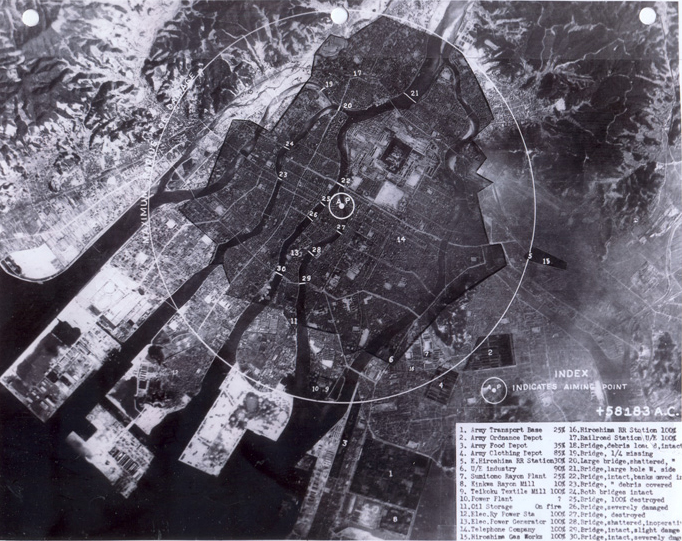
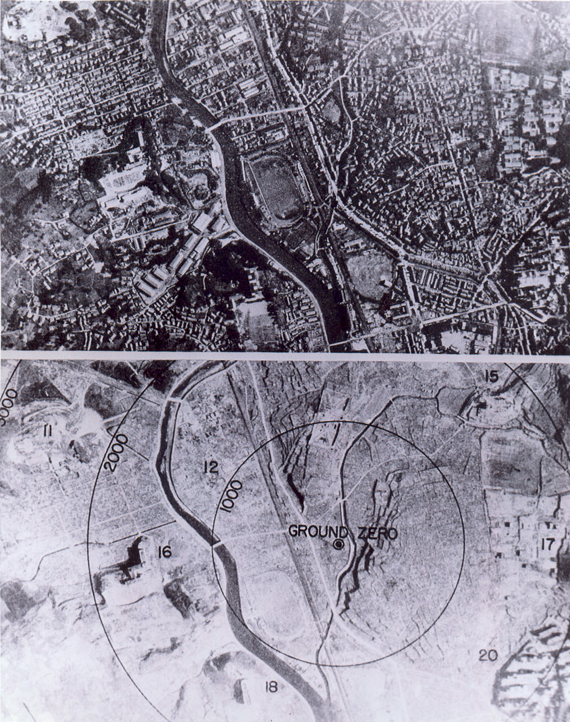
The Truman Library has a collection of documents on the decision to drop the bomb, as does Atom Bomb: Decision.
This page links an MP3 of Emperor Hirohito's surrender announcement and to the English translation.
posted by kirkaracha at 12:57 AM on August 6, 2005
Saydur: We will have nobody to remind us firsthand of the terror unleashed, and someone, somewhere, somehow, will think that maybe the inhumanity is justified somehow.
And then they will say: "It was right for _______. It was wrong for humanity."
posted by Termite at 4:25 AM on August 6, 2005
And then they will say: "It was right for _______. It was wrong for humanity."
posted by Termite at 4:25 AM on August 6, 2005
yet blockade and starvation of Japan would have been remarkably effective within a relatively short timeAnd how would starving millions of Japanese to death have been in any way more humane than nuking Hiroshima and Nagasaki? What about the hundreds of thousands of people all over Asia who were being killed every month Japanese occupation of their lands lasted? Don't their lives matter too in this calculus?
All this handwringing over Truman's decision to drop the bomb is frankly absurd, especially considering that it took not just one but two bombs to convince Hirohito to overrule the "death to the last man, woman and child" members of his cabinet..It says a great deal about the merits of revisionist posturing on this issue that not even the leading Japanese scholars and diplomats with an intimate familiarity with the issue are willing to back it:
While American scholarship has undercut the U.S. moral position, Japanese historical research has bolstered it. The Japanese scholarship, by historians like Sadao Asada of Doshisha University in Kyoto, notes that Japanese wartime leaders who favored surrender saw their salvation in the atomic bombing. The Japanese military was steadfastly refusing to give up, so the peace faction seized upon the bombing as a new argument to force surrender.But hey, what do they know? They were only members of the Imperial Cabinet, after all ... Let the self-flagellation recommence!
"We of the peace party were assisted by the atomic bomb in our endeavor to end the war," Koichi Kido, one of Emperor Hirohito's closest aides, said later.
Wartime records and memoirs show that the emperor and some of his aides wanted to end the war by summer 1945. But they were vacillating and couldn't prevail over a military that was determined to keep going even if that meant, as a navy official urged at one meeting, "sacrificing 20 million Japanese lives."
The atomic bombings broke this political stalemate and were thus described by Mitsumasa Yonai, the navy minister at the time, as a "gift from heaven."
Hopefully, civilization is far along enough that we truly are remorseful, and they truly forgive us.Speak for yourself, buddy: I feel no remorse whatsoever, am not asking for Japanese "forgiveness", and wouldn't want it if they were offering it. If Japan didn't want to suffer the consequences of war, it shouldn't have gone raping and pillaging all over Asia trying to build its "Co-Prosperity Sphere" [sic], and its leadership certainly shouldn't have been crazy enough to carry out a sneak attack on the world's greatest industrial power.
Frankly, I find it pathetic that Americans should be so eager to play the remorseful aggressor to a nation of people who still find it virtually impossible to honestly acknowledge the extent of the crimes they committed against their neighbors. Whenever they're confronted by Korean and Chinese demands for remorse, the Japanese routinely insist that World War 2 is "ancient" history, and they then have the gall to turn around and demand that America "reflect" on an episode which capped the very "ancient" history they try so hard to forget? What a load of B.S!
posted by Goedel at 4:36 AM on August 6, 2005
If a country declares war on the United States, then it can expect a fair fight. OTOH, if a country decides to be dishonorable weasels and launch a sneak attack, then all bets are off, no quarter asked and none given, i.e. the Bataan Death March. Also, you can't say that the Japanese weren't warned about their "prompt and utter destruction" if they didn't lay down their arms.
posted by Scoo at 5:47 AM on August 6, 2005
posted by Scoo at 5:47 AM on August 6, 2005
And yet we spend millions and ten years to restore and polish the Enola Gay and enshrine it. One nation's unremorsefulness and failure to see their own hand in things doesn't preclude another from being obligated to do the same.
And yet we seem to learn very little from the experience and proceed to instigate and foster a Cold War, a pervasive culture of fear and paranoia in which the death and destruction of major portions of the world hang in the balance. We directly inspire and amplify an arms race unlike any previously known, pitting one entire side of the planet against another in a dangerous battle of childish ego and will.
We proceed to make more and more of these bombs. Exponentially larger yields, more radiation, more fallout, designs doped with cobalt for more terrifying side effects. We spend hundreds of trillions of dollars over decades constructing an arsenal that could very possibly end civilization, if not human life itself.
And yet we haphazardly gamble with the lives of billions and the very future of mankind.
But that's ok, because we have the bomb, and we are safe. And we fetishize this terror, ushering in this fearful atomic age in the most infantile ways, completely and utterly failing to grasp the true terror and scope of what we've wrought, and utterly failing to confront the real fears and sicknesses within us.
We then proceed to pollute our own air, water and soil in terrible ways at Oak Ridge, Rocky Flats and other places so terribly that we'll be dealing with the consequences of it for hundreds and thousands and even hundreds of thousands of years.
And then our direct rivals do the same, and worse. Finding money sparse but human life cheap, using far more lax procedures and causing even more sickness and death.
Even if no more warheads are ever used in anger, how many have already died from this pollution? How many died from sickness in the Pacific near Bikini Atoll? How many died around the world from increased background radiation? How many more will die in the future? How do we even begin to count these miseries and deaths? How do we even begin to account for it?
How will we ever justify spending so much incomprehensible time and energy and wealth to create things that kill so many people so quickly with such terrible lingering effects? How will we ever justify not spending those same resources on solving poverty, starvation, disease and human suffering? How will we ever justify going to such lengths to be enemies first, and friends never?
We haven't even begun to pay for our mistakes or for this foolish madness. There isn't remorse enough. There isn't forgiveness enough.
"Pathetic" doesn't even begin to describe it. There are no winners here. We all lost decades ago. We fight only with shadows of ourselves in utter darkness.
posted by loquacious at 6:01 AM on August 6, 2005
And yet we seem to learn very little from the experience and proceed to instigate and foster a Cold War, a pervasive culture of fear and paranoia in which the death and destruction of major portions of the world hang in the balance. We directly inspire and amplify an arms race unlike any previously known, pitting one entire side of the planet against another in a dangerous battle of childish ego and will.
We proceed to make more and more of these bombs. Exponentially larger yields, more radiation, more fallout, designs doped with cobalt for more terrifying side effects. We spend hundreds of trillions of dollars over decades constructing an arsenal that could very possibly end civilization, if not human life itself.
And yet we haphazardly gamble with the lives of billions and the very future of mankind.
But that's ok, because we have the bomb, and we are safe. And we fetishize this terror, ushering in this fearful atomic age in the most infantile ways, completely and utterly failing to grasp the true terror and scope of what we've wrought, and utterly failing to confront the real fears and sicknesses within us.
We then proceed to pollute our own air, water and soil in terrible ways at Oak Ridge, Rocky Flats and other places so terribly that we'll be dealing with the consequences of it for hundreds and thousands and even hundreds of thousands of years.
And then our direct rivals do the same, and worse. Finding money sparse but human life cheap, using far more lax procedures and causing even more sickness and death.
Even if no more warheads are ever used in anger, how many have already died from this pollution? How many died from sickness in the Pacific near Bikini Atoll? How many died around the world from increased background radiation? How many more will die in the future? How do we even begin to count these miseries and deaths? How do we even begin to account for it?
How will we ever justify spending so much incomprehensible time and energy and wealth to create things that kill so many people so quickly with such terrible lingering effects? How will we ever justify not spending those same resources on solving poverty, starvation, disease and human suffering? How will we ever justify going to such lengths to be enemies first, and friends never?
We haven't even begun to pay for our mistakes or for this foolish madness. There isn't remorse enough. There isn't forgiveness enough.
"Pathetic" doesn't even begin to describe it. There are no winners here. We all lost decades ago. We fight only with shadows of ourselves in utter darkness.
posted by loquacious at 6:01 AM on August 6, 2005
Great find Kirkaracha. I had trouble locating source documents and you have found the treasure trove.
posted by publius at 6:08 AM on August 6, 2005
posted by publius at 6:08 AM on August 6, 2005
Can I just go on record as saying, I don't care? As the post points out, it's been 60 years. The bombing, and all its aftermath, is a FACT. Not a hypothetical.
You can sit here running down theoretical alternative histories all day and it's not going to make a lick of difference. Maybe Japan would have surrendered. Maybe it was a bluff. Maybe the Soviets would've immediately gone on the warpath. Maybe they wouldn't. Hell, maybe the cold war wouldn't've happened at all if we hadn't began the brinksmanship.
*We will never know.*
So why don't we just let the subject drop and focus on understanding the *reality* of it? Let's just make sure we understand WHY we did it, so that we will never have to do it again.
Otherwise, we might as well be debating whether Alexander's conquests were ethical or if the assassination of Caesar was a just act.
posted by InnocentBystander at 6:22 AM on August 6, 2005
You can sit here running down theoretical alternative histories all day and it's not going to make a lick of difference. Maybe Japan would have surrendered. Maybe it was a bluff. Maybe the Soviets would've immediately gone on the warpath. Maybe they wouldn't. Hell, maybe the cold war wouldn't've happened at all if we hadn't began the brinksmanship.
*We will never know.*
So why don't we just let the subject drop and focus on understanding the *reality* of it? Let's just make sure we understand WHY we did it, so that we will never have to do it again.
Otherwise, we might as well be debating whether Alexander's conquests were ethical or if the assassination of Caesar was a just act.
posted by InnocentBystander at 6:22 AM on August 6, 2005
It's possible if we hadn't used it at the end of a long war, and seen its power, we might have used it later and thereby lowered the bar.
posted by atchafalaya at 6:49 AM on August 6, 2005
posted by atchafalaya at 6:49 AM on August 6, 2005
I know I link to Democracy Now a lot but this is good solid reporting and yesterday they did a heck of a show on the effects of what happened sixty years ago. More content here here, and more on www.democracynow.org
posted by wheelieman at 6:50 AM on August 6, 2005
posted by wheelieman at 6:50 AM on August 6, 2005
Goedel you've got a point; the decision taken by Truman probably was, in the context of what he knew at the time, the most humane one - but the way you express it is a bit tasteless.
First, you so vehemently state that you can't and won't feel remorse, that you present yourself as someone who doesn't regret even the necessity of killing so many and destroying so much. Maybe you don't actually believe that but it's an ugly impression to give.
Second, the guilt or otherwise of present-day Americans for the destruction at Hiroshima and Nagasaki is an entirely separate issue from Japan's failure as a nation to express remorse for her wartime crimes. This is not to say that such a failure isn't an important issue; just that raising it as you do, you imply that your willingness to criticise the actions of your government is dependent on the victims' subsequent behaviour. That's not a sound basis for self-criticism.
InnocentBystander: I kinda agree with your disdain for counter-factual or "what if?" history in the sense that it is a directionless, unlimited form of analysis, but to then wonder at the point of debating the ethics of Alexander's conquests, etc is a non sequitur. Surely, such debate is the entire point of historical study? Ascertaining the motivations behind our ancestors behaviour, discovering the factors that shaped those motivations and attempting to understand why things went as they did (wrong normally!) is as you say, "to make sure we understand WHY we did it, so that we will never have to do it again."
Is this not true?
posted by pots at 7:03 AM on August 6, 2005
First, you so vehemently state that you can't and won't feel remorse, that you present yourself as someone who doesn't regret even the necessity of killing so many and destroying so much. Maybe you don't actually believe that but it's an ugly impression to give.
Second, the guilt or otherwise of present-day Americans for the destruction at Hiroshima and Nagasaki is an entirely separate issue from Japan's failure as a nation to express remorse for her wartime crimes. This is not to say that such a failure isn't an important issue; just that raising it as you do, you imply that your willingness to criticise the actions of your government is dependent on the victims' subsequent behaviour. That's not a sound basis for self-criticism.
InnocentBystander: I kinda agree with your disdain for counter-factual or "what if?" history in the sense that it is a directionless, unlimited form of analysis, but to then wonder at the point of debating the ethics of Alexander's conquests, etc is a non sequitur. Surely, such debate is the entire point of historical study? Ascertaining the motivations behind our ancestors behaviour, discovering the factors that shaped those motivations and attempting to understand why things went as they did (wrong normally!) is as you say, "to make sure we understand WHY we did it, so that we will never have to do it again."
Is this not true?
posted by pots at 7:03 AM on August 6, 2005
So if a bunch of people from the Middle East believe that the US presence in their countries is leading to the direct and indirect death of many of their people and they conclude that killing 3000 or so US citizens will lead to less killing overall if it leads (as maybe they hope it will) to the US withdrawal from their land, then isn't the killing of those 3000 justified on the same grounds as Hiroshima? That is to say: kill a bunch of innocents to scare the opposition into terminating actions which will ultimately lead to far more deaths?
posted by flarbuse at 7:15 AM on August 6, 2005
posted by flarbuse at 7:15 AM on August 6, 2005
Pots
There's a line there. When a person makes a decision, the point he's at is the culmination of many other factors that have all led to that decision. When you understand those factors, you truly understand WHY the decision came about, and can keep it from happening again.
Or, more bluntly, by the time we were seriously contemplating dropping the A-bomb, things were so well and truly fucked up that there was NO "good" choice. Just a whole lot of bad ones.
Ergo, focusing on why we chose one particular bad option out of many is a pointless endeavor. Instead should we look at how and why we ended up on that road in the first place. You look for the point, somewhere earlier in the timeline, where we could have stopped things from going so wrong, and we ask, why didn't we do something different THEN?
In the case of WWII, for example, it was allowing Hitler to land grab that really started the war. But going back even further, we look at the crushing repairations that Europe placed upon Germany in the wake of WWI that left its people poor, miserable, and oppressed - the perfect state for someone like Hitler to take over. But then going back further, we look into the maze of treaties and counter-treaties that allowed a single assassination to become the bloodiest war in history up to that point.
THOSE are the places where, had we made different choices, history would have been substantially better. Thus, those are the choices we should identify and examine through hindsight, the ones that BEGAN a new chapter, rather than ending one.
And that's how progress happens.
posted by InnocentBystander at 7:18 AM on August 6, 2005
There's a line there. When a person makes a decision, the point he's at is the culmination of many other factors that have all led to that decision. When you understand those factors, you truly understand WHY the decision came about, and can keep it from happening again.
Or, more bluntly, by the time we were seriously contemplating dropping the A-bomb, things were so well and truly fucked up that there was NO "good" choice. Just a whole lot of bad ones.
Ergo, focusing on why we chose one particular bad option out of many is a pointless endeavor. Instead should we look at how and why we ended up on that road in the first place. You look for the point, somewhere earlier in the timeline, where we could have stopped things from going so wrong, and we ask, why didn't we do something different THEN?
In the case of WWII, for example, it was allowing Hitler to land grab that really started the war. But going back even further, we look at the crushing repairations that Europe placed upon Germany in the wake of WWI that left its people poor, miserable, and oppressed - the perfect state for someone like Hitler to take over. But then going back further, we look into the maze of treaties and counter-treaties that allowed a single assassination to become the bloodiest war in history up to that point.
THOSE are the places where, had we made different choices, history would have been substantially better. Thus, those are the choices we should identify and examine through hindsight, the ones that BEGAN a new chapter, rather than ending one.
And that's how progress happens.
posted by InnocentBystander at 7:18 AM on August 6, 2005
Publius, do you realize the last link in your post is to Holocaust denier David Irving's website?
posted by LarryC at 7:20 AM on August 6, 2005
posted by LarryC at 7:20 AM on August 6, 2005
If a country declares war on the United States, then it can expect a fair fight. OTOH, if a country decides to be dishonorable weasels and launch a sneak attack, then all bets are off
That is some staggeringly stupid reasoning. A fair fight. Like World War I.
Frankly, I find it pathetic that Americans should be so eager to play the remorseful aggressor to a nation of people who still find it virtually impossible to honestly acknowledge the extent of the crimes they committed against their neighbors
I think this really applies to all nations, including ourselves. I don't see much recognition of our activities during the occupation of the Phillipines, either, let alone our large-scale genocide of Indian groups on the eastern seaboard. England has far from come to terms with its colonial history, though at times quite violent (especially when its neighbors were involved- witness the colonization of Ireland in the seventeenth century, where the commander Humphrey Gilbert decorated the path leading up to his tent with human heads).
posted by Dr_Johnson at 7:32 AM on August 6, 2005
That is some staggeringly stupid reasoning. A fair fight. Like World War I.
Frankly, I find it pathetic that Americans should be so eager to play the remorseful aggressor to a nation of people who still find it virtually impossible to honestly acknowledge the extent of the crimes they committed against their neighbors
I think this really applies to all nations, including ourselves. I don't see much recognition of our activities during the occupation of the Phillipines, either, let alone our large-scale genocide of Indian groups on the eastern seaboard. England has far from come to terms with its colonial history, though at times quite violent (especially when its neighbors were involved- witness the colonization of Ireland in the seventeenth century, where the commander Humphrey Gilbert decorated the path leading up to his tent with human heads).
posted by Dr_Johnson at 7:32 AM on August 6, 2005
Stories from survivors, and from the crew of the Enola Gay.
posted by dilettante at 7:37 AM on August 6, 2005
posted by dilettante at 7:37 AM on August 6, 2005
Oh, and why am I so vehement about this being a pointless argument? Consider this:
At the time we dropped the bomb, scientists - even those on the Manhattan Project - had very little idea how terrible the radiation was going to be. They thought it was just going to be really big bomb that took out a town - not one that spread sickness and death everywhere.
It took Hiroshima and Nagasaki to teach us - and the world - how terrible nukes really were.
Had we KNOWN, or even strongly suspected, what the bombs would have done beforehand, we almost certainly would not have dropped them.
But if we had not have dropped them, then there would have been no real incentive for the cold war to have NOT become hot, and therefore, Alas Babylon.
Thus, to argue that we shouldn't have dropped the bomb on Japan pretty much opens up the very real probability that we would have destroyed the world 20 years later. Without knowing it at the time, one terrible evil prevented a far worse one.
And, of course, this sets up a moral quagmire where, I feel, the only thing you can do is say "hang it" and, as I've said, look further back to a point things weren't so screwed up.
posted by InnocentBystander at 7:42 AM on August 6, 2005
At the time we dropped the bomb, scientists - even those on the Manhattan Project - had very little idea how terrible the radiation was going to be. They thought it was just going to be really big bomb that took out a town - not one that spread sickness and death everywhere.
It took Hiroshima and Nagasaki to teach us - and the world - how terrible nukes really were.
Had we KNOWN, or even strongly suspected, what the bombs would have done beforehand, we almost certainly would not have dropped them.
But if we had not have dropped them, then there would have been no real incentive for the cold war to have NOT become hot, and therefore, Alas Babylon.
Thus, to argue that we shouldn't have dropped the bomb on Japan pretty much opens up the very real probability that we would have destroyed the world 20 years later. Without knowing it at the time, one terrible evil prevented a far worse one.
And, of course, this sets up a moral quagmire where, I feel, the only thing you can do is say "hang it" and, as I've said, look further back to a point things weren't so screwed up.
posted by InnocentBystander at 7:42 AM on August 6, 2005
Stories link from the earlier post should go here, damn it.
posted by dilettante at 7:44 AM on August 6, 2005
posted by dilettante at 7:44 AM on August 6, 2005
I don't see much recognition of our activities during the occupation of the Phillipines, either, let alone our large-scale genocide of Indian groups on the eastern seaboard.I don't see America asking for apology from the Filipinos for their resistance either. In fact, I don't see America demanding apologies from anyone over past conflicts, so the relevance of your reference here is unclear.
England has far from come to terms with its colonial historyThis is a point I have made elsewhere, but it's irrelevant to this discussion. Where are the hordes of English opinionators demanding apologies from those who helped local liberation movements inflict casualties on their colonial troops?
The fact is that the Japanese want apologies for the harm done to them in the course of a war they initiated, and this despite their refusal to forthrightly proffer apologies for the much more egregious sufferings they inflicted on others. Go to Yasukuni Jinja and you see nothing whatsoever about the savagery of Imperial Japanese soldiers, just lots of dishonest nonsense depicting Japan as innocently attempting to "liberate" willing fellow Asians; go to the Hiroshima "Peace" Museum and an even more egregiously dishonest message is portrayed: one would think the Japanese were quietly going about their business when one day those evil racist Yankees capriciously decided to drop the big one on them. Such behavior is the height of effrontery, and a tremendous insult to all the Asian countries which experienced unspeakable cruelties under Japan's yoke, but are nevertheless expected to let the past lie.
posted by Goedel at 7:44 AM on August 6, 2005
Here is an interesting Weekly Standard article by historian Richard B. Franks on the most recent declassified documents. Apparently one reason why complete declassification has been so slow is that the US Ultra project was spying on everyone--including our allies in WW2! Another interesting point is that the planned invasion of Japan's home islands was looking worse and worse and the Japanese moved more forces into place:
From mid-July onwards, Ultra intercepts exposed a huge military buildup on Kyushu. Japanese ground forces exceeded prior estimates by a factor of four. Instead of 3 Japanese field divisions deployed in southern Kyushu to meet the 9 U.S. divisions, there were 10 Imperial Army divisions plus additional brigades. Japanese air forces exceeded prior estimates by a factor of two to four. Instead of 2,500 to 3,000 Japanese aircraft, estimates varied between about 6,000 and 10,000. One intelligence officer commented that the Japanese defenses threatened "to grow to [the] point where we attack on a ratio of one (1) to one (1) which is not the recipe for victory."
The atomic bombing was a horrible act, but it is hard to imagine any other course for ending the war that would have produced fewer casualties, even civilian casualties.
posted by LarryC at 7:49 AM on August 6, 2005
From mid-July onwards, Ultra intercepts exposed a huge military buildup on Kyushu. Japanese ground forces exceeded prior estimates by a factor of four. Instead of 3 Japanese field divisions deployed in southern Kyushu to meet the 9 U.S. divisions, there were 10 Imperial Army divisions plus additional brigades. Japanese air forces exceeded prior estimates by a factor of two to four. Instead of 2,500 to 3,000 Japanese aircraft, estimates varied between about 6,000 and 10,000. One intelligence officer commented that the Japanese defenses threatened "to grow to [the] point where we attack on a ratio of one (1) to one (1) which is not the recipe for victory."
The atomic bombing was a horrible act, but it is hard to imagine any other course for ending the war that would have produced fewer casualties, even civilian casualties.
posted by LarryC at 7:49 AM on August 6, 2005
I don't see America asking for apology from the Filipinos for their resistance either
You would have made a stellar colonialist, but let's pass that.
I am not sure one can collapse the issue of Japanese treatment of their neighbors with that of the nuclear attack and its aftermath. This is not the sort of moral economy where their actions in any way exonerate ours. I have mixed feelings about the decision to drop the Hiroshima and Nagasaki bombs, but whatever the historical rationale, the moral rationale cannot reside in the fact that the Japanese were unrepentant and brutal aggressors.
posted by Dr_Johnson at 8:19 AM on August 6, 2005
You would have made a stellar colonialist, but let's pass that.
I am not sure one can collapse the issue of Japanese treatment of their neighbors with that of the nuclear attack and its aftermath. This is not the sort of moral economy where their actions in any way exonerate ours. I have mixed feelings about the decision to drop the Hiroshima and Nagasaki bombs, but whatever the historical rationale, the moral rationale cannot reside in the fact that the Japanese were unrepentant and brutal aggressors.
posted by Dr_Johnson at 8:19 AM on August 6, 2005
(Hence arguments that the moral rationale lies in the fact that the decision saved lives).
posted by Dr_Johnson at 8:21 AM on August 6, 2005
posted by Dr_Johnson at 8:21 AM on August 6, 2005
You would have made a stellar colonialist, but let's pass that.What an idiotic piece of ad hominem! Do you realize that my origins lie in one of those colonies, or are you just proceeding from the stupid assumption that my views can only be what they are if I'm a white Anglo-Saxon or something? I don't know why I should have expected better from someone who's clearly lost the argument.
I am not sure one can collapse the issue of Japanese treatment of their neighbors with that of the nuclear attack and its aftermath.Yeah, neither issue has anything to do with the other, and America just went to war with Japan because it felt like it. We ought to have given the Japanese all the time in the world they needed to surrender, even if a million or two more Chinese, Koreans and others would have perished in the meantime - it's not like their lives matter or anything!
the moral rationale cannot reside in the fact that the Japanese were unrepentant and brutal aggressorsWhat a weird statement! What else can it lie in, if not that? Do you think we'd have been more justified or less, if the Japanese had actually been marching across East Asia handing out puppies, apple pie and chrysanthemums, rather than engaging in the raping and massacring they actually were?
I don't know why I bother: some people are simply too in love with self-mortification, holier-than-thou moralizing and anti-establishment posturing to think with a clear head.
posted by Goedel at 8:45 AM on August 6, 2005
I don't know why I should have expected better from someone who's clearly lost the argument.
???
I believe I was suggesting that people defending themselves from an aggressive imperialist presence have every right in the world to respond, and need not offer apologies for defending themselves. Since you were talking about unapologetic aggression, I was pointing out that such an accusation would be pretty much universal. Oh, and not all colonialists are WASPs.
Yeah, neither issue has anything to do with the other, and America just went to war with Japan because it felt like it.
It is naive to think that our primary motivation for entering war with Japan was concern over their actions in East Asia. This did make the U.S. very nervous in the years preceding 1941 (as our activities on wake island make apparent), but certainly did not constitute the central catalyst for our entry into war, any more than the extermination of the Jews motivated our entry into the European theater.
I don't know why I bother: some people are simply too in love with self-mortification, holier-than-thou moralizing and anti-establishment posturing to think with a clear head.
You were saying something about ad hominem attacks?
I believe I said I had mixed feelings about dropping the atomic bombs, not that I opposed the decision. However, the rationale for the decision CANNOT dervive from the idea that 'The Japanese were bad,' and I cannot think of no ethical thinker (save perhaps the old testament God) who would use such a reason. It has to lie, as I believe the moral rationale has, on the idea that the decision to destroy the cities was ultimately motivated by a desire to save lives in the long run, and that this constituted the best course of action for doing so, regardless of the moral status of our enemy.
posted by Dr_Johnson at 8:59 AM on August 6, 2005
???
I believe I was suggesting that people defending themselves from an aggressive imperialist presence have every right in the world to respond, and need not offer apologies for defending themselves. Since you were talking about unapologetic aggression, I was pointing out that such an accusation would be pretty much universal. Oh, and not all colonialists are WASPs.
Yeah, neither issue has anything to do with the other, and America just went to war with Japan because it felt like it.
It is naive to think that our primary motivation for entering war with Japan was concern over their actions in East Asia. This did make the U.S. very nervous in the years preceding 1941 (as our activities on wake island make apparent), but certainly did not constitute the central catalyst for our entry into war, any more than the extermination of the Jews motivated our entry into the European theater.
I don't know why I bother: some people are simply too in love with self-mortification, holier-than-thou moralizing and anti-establishment posturing to think with a clear head.
You were saying something about ad hominem attacks?
I believe I said I had mixed feelings about dropping the atomic bombs, not that I opposed the decision. However, the rationale for the decision CANNOT dervive from the idea that 'The Japanese were bad,' and I cannot think of no ethical thinker (save perhaps the old testament God) who would use such a reason. It has to lie, as I believe the moral rationale has, on the idea that the decision to destroy the cities was ultimately motivated by a desire to save lives in the long run, and that this constituted the best course of action for doing so, regardless of the moral status of our enemy.
posted by Dr_Johnson at 8:59 AM on August 6, 2005
rather, 'I cannot think of any'
posted by Dr_Johnson at 9:00 AM on August 6, 2005
posted by Dr_Johnson at 9:00 AM on August 6, 2005
i caught a survivor talking about the use of the atomic bomb on civilians in japan a day or so ago.... he called it the "ultimate evil" - killing many to supposedly save others ... i found his words to ring true.
if hiroshima and nagasaki were justified - based on japan's aggression (like this moron for example) - then wouldn't a suitcase nuke toting iraqi heading for washington dc who's family had been annhiliated by the ongoing unjust war (regime change has already happened mind you) on the civilians of iraq - also be justified? or the same nuke toting chechen heading for moscow?
war on civilians and the innocent can never be justified.
"Do not kill. Do not let others kill. Find whatever means possible to protect life and to prevent war. "
posted by specialk420 at 9:04 AM on August 6, 2005
if hiroshima and nagasaki were justified - based on japan's aggression (like this moron for example) - then wouldn't a suitcase nuke toting iraqi heading for washington dc who's family had been annhiliated by the ongoing unjust war (regime change has already happened mind you) on the civilians of iraq - also be justified? or the same nuke toting chechen heading for moscow?
war on civilians and the innocent can never be justified.
"Do not kill. Do not let others kill. Find whatever means possible to protect life and to prevent war. "
posted by specialk420 at 9:04 AM on August 6, 2005
If a country declares war on the United States, then it can expect a fair fight. OTOH, if a country decides to be dishonorable weasels and launch a sneak attack, then all bets are off
That is some staggeringly stupid reasoning. A fair fight. Like World War I.
What does WWI have to do with this anything? I know that this is MetaFilter, but you still can't simply callmy arguments stupid, you have to explain why you think they are stupid.
I'd use the same reasoning for one on one fighting. If someone calls me out, insists on fighting with me despite my objections, then I shall do my best to defend myself and inflict enough damage to make him stop attacking me. If he sucker-punches me to the back of the head however, he gets sent to the fucking hospital. Eye-witnesses make a note not to sucker-punch me.
posted by Scoo at 9:06 AM on August 6, 2005
That is some staggeringly stupid reasoning. A fair fight. Like World War I.
What does WWI have to do with this anything? I know that this is MetaFilter, but you still can't simply callmy arguments stupid, you have to explain why you think they are stupid.
I'd use the same reasoning for one on one fighting. If someone calls me out, insists on fighting with me despite my objections, then I shall do my best to defend myself and inflict enough damage to make him stop attacking me. If he sucker-punches me to the back of the head however, he gets sent to the fucking hospital. Eye-witnesses make a note not to sucker-punch me.
posted by Scoo at 9:06 AM on August 6, 2005
This is one of the most facinating articles on WWII that I've ever read. It was also very heavy reading. Hopefully I read it correctly in saying that basically Japan was never going to surrender the way the A-Bomb critics crowd say they were going to, but were actually preparing, and saving for a mainland invasion, and in fact, actually wanted America to invade the mainland hoping that America would suffer such large casualties that she would be forced into negotiations with Japan to end the war, and that such negotions would try to ensure the continuation of the royal family and the current order of government (of which, they ultimately did not end up getting the latter). And America, knowing full well that Japan was building a "secret" force on the mainland, felt that the only way to end the war was either, a) to blockaid Japan and force the people into starvation (while an estimated 400,000 people in other Asian countries die per month), or b) drop the bombs. Facinating.
What I don't get is why 400,000 Asians were dying per month? Was Japan still occupying other nations by the end of the war?
posted by Jase_B at 9:11 AM on August 6, 2005
What I don't get is why 400,000 Asians were dying per month? Was Japan still occupying other nations by the end of the war?
posted by Jase_B at 9:11 AM on August 6, 2005
InnocentBystander - I'm not sure that I agree that "Had we KNOWN, or even strongly suspected, what the bombs would have done beforehand, we almost certainly would not have dropped them." First off, we were quite aware of the devestation and the civilian toll that large-scale firebombing took in places like Dresden and Tokyo, and that certainly didn't stop us from using the technique on other cities. Secondly, after they were aware of the effects of the bomb, scientists and politicians didn't decide to abandon the bomb in a horrified fit of conscience - on the contrary, they soon shifted work to the development of the hydrogen bomb, and the creation of nuclear warheads. Had the full extent of the devestation and the effect on humans been known, it seems likely to me that the bomb still would've been used.
The Making of the Atomic Bomb and Dark Sun: The Making of the Hydrogen Bomb by Richard Rhodes are a pair of incredible books on the scientists involved and the way they developed those awesome and terrible weapons. Well worth checking out if you're interested in this stuff.
posted by ubersturm at 9:13 AM on August 6, 2005
The Making of the Atomic Bomb and Dark Sun: The Making of the Hydrogen Bomb by Richard Rhodes are a pair of incredible books on the scientists involved and the way they developed those awesome and terrible weapons. Well worth checking out if you're interested in this stuff.
posted by ubersturm at 9:13 AM on August 6, 2005
specialk420 - what would you have done had you been in the position of the American leaders? You had a choice, either let a huge amount of innocent people die by continuing the war, or allow a significantly less number of other innocent people die by dropping two atomic bombs? If you would have chosen the former I would have called you a moron.
posted by Jase_B at 9:25 AM on August 6, 2005
posted by Jase_B at 9:25 AM on August 6, 2005
If a country declares war on the United States, then it can expect a fair fight. OTOH, if a country decides to be dishonorable weasels and launch a sneak attack, then all bets are off
This seems, if I am not mistaken, to be a general argument, no? Shouldn't one be able to apply the point to other wars, or is this a claim that applies exclusively to WW2?
posted by Dr_Johnson at 10:42 AM on August 6, 2005
This seems, if I am not mistaken, to be a general argument, no? Shouldn't one be able to apply the point to other wars, or is this a claim that applies exclusively to WW2?
posted by Dr_Johnson at 10:42 AM on August 6, 2005
The Making of the Atomic Bomb and Dark Sun: The Making of the Hydrogen Bomb by Richard Rhodes are a pair of incredible books on the scientists involved and the way they developed those awesome and terrible weapons. Well worth checking out if you're interested in this stuff.
Seconded. He was also interviewed on C-Span this morning.
posted by Dr_Johnson at 10:48 AM on August 6, 2005
Seconded. He was also interviewed on C-Span this morning.
posted by Dr_Johnson at 10:48 AM on August 6, 2005
what would you have done had you been in the position of the American leaders?
i think i at least would have waited to see if the posted surrender hints played out... next steps would have been the only vaguely moral thing to do which is continue attacking japanese combatants - as a last straw ... perhaps a nuclear attack on a military target - might concievably been justified.
now answer my question... would and iraqi or chechen who's family had been anhilliated and who's country and way of life was under violent attack... be justified in exploding a nuclear device in washington dc, london, or moscow?
posted by specialk420 at 12:04 PM on August 6, 2005
i think i at least would have waited to see if the posted surrender hints played out... next steps would have been the only vaguely moral thing to do which is continue attacking japanese combatants - as a last straw ... perhaps a nuclear attack on a military target - might concievably been justified.
now answer my question... would and iraqi or chechen who's family had been anhilliated and who's country and way of life was under violent attack... be justified in exploding a nuclear device in washington dc, london, or moscow?
posted by specialk420 at 12:04 PM on August 6, 2005
specialk420:
I'll answer. No. The issues of time, scale of violence, reasonably possible outcomes, proportionate response, and nearly all other methods of comparison are so different I think it should be obvious. Think about the differences between your scenarios, and try to post any similarities you can see, beyond "unjust war" and "being attacked."
And in regards to the "ultimate evil" quote, if you're going to start scaling evils, the idea that "killing others to supposdly save lives" is somehow more evil than killing and enslaving others (namely civilains) for a combination of racial arrogance, greed, imperialistic aims and general bloodthirstyness makes no sense no matter how you slice it, and has an air of self-servingness about it.
posted by Snyder at 12:38 PM on August 6, 2005
I'll answer. No. The issues of time, scale of violence, reasonably possible outcomes, proportionate response, and nearly all other methods of comparison are so different I think it should be obvious. Think about the differences between your scenarios, and try to post any similarities you can see, beyond "unjust war" and "being attacked."
And in regards to the "ultimate evil" quote, if you're going to start scaling evils, the idea that "killing others to supposdly save lives" is somehow more evil than killing and enslaving others (namely civilains) for a combination of racial arrogance, greed, imperialistic aims and general bloodthirstyness makes no sense no matter how you slice it, and has an air of self-servingness about it.
posted by Snyder at 12:38 PM on August 6, 2005
Six decades of limited wars have diluted the understanding of total war . That's what WW2 was: total, no holds barred warfare on all sides (well, not Italy)...I believe we used the bombs out of revenge, not necessity, not "saving lives"; we were always going to punish and teach a lesson to Japan. What's the legacy? The horror of nukes, along with their proliferation have made total war unreasonable, consequently millions have since been killed the old fashioned way.
posted by Mack Twain at 1:06 PM on August 6, 2005
posted by Mack Twain at 1:06 PM on August 6, 2005
What I don't get is why 400,000 Asians were dying per month? Was Japan still occupying other nations by the end of the war?
Yes. I can't google up a map, but at the end of the war the Japanese army was still in control of vast regions of China, Vietnam, Korea, and I believe Indonesia.
posted by LarryC at 1:41 PM on August 6, 2005
Yes. I can't google up a map, but at the end of the war the Japanese army was still in control of vast regions of China, Vietnam, Korea, and I believe Indonesia.
posted by LarryC at 1:41 PM on August 6, 2005
Wow, Goedel, could you spit a bit more venom? I think you missed a spot over here... We get it, you hate the Japs. You want we oughtta bomb them again, just for good measure? Y'know, so they don't go after our battleships again?
Holy Mackerel.
That opinion aside, when I subtract your inner violence from what you've said, I do agree that - unfortunately for everyone involved, and the world - the use of the weapons was warranted, given the intransigence of the Japanese militarists. It's pretty clear that the war would have dragged on with many many more deaths on both sides, whether because of an invasion or a blockade.
It was a terrible, angry, fearful time, and any end it could have come to would have been ugly.
May it never happen again!
.
posted by zoogleplex at 1:42 PM on August 6, 2005
Holy Mackerel.
That opinion aside, when I subtract your inner violence from what you've said, I do agree that - unfortunately for everyone involved, and the world - the use of the weapons was warranted, given the intransigence of the Japanese militarists. It's pretty clear that the war would have dragged on with many many more deaths on both sides, whether because of an invasion or a blockade.
It was a terrible, angry, fearful time, and any end it could have come to would have been ugly.
May it never happen again!
.
posted by zoogleplex at 1:42 PM on August 6, 2005
That's what WW2 was: total, no holds barred warfare on all sides
Not quite, and not really. During WW2, both the Allies and the Euro Axis Powers possessed sufficient chemical weaponry to annihilate most of the major urban centres. Millions of casualties were possible. The Allies maintained vast stocks of "conventional" weapons, while the Germans built up stocks of the newer nerve agents.
Mindful of the effects of mass chemical attacks during WW1, both sides chose not to use such weapons on each other. It was their version of MAD. It was sufficient to deter even the Nazis.
Not quite, and not really. During WW2, both the Allies and the Euro Axis Powers possessed sufficient chemical weaponry to annihilate most of the major urban centres. Millions of casualties were possible. The Allies maintained vast stocks of "conventional" weapons, while the Germans built up stocks of the newer nerve agents.
Mindful of the effects of mass chemical attacks during WW1, both sides chose not to use such weapons on each other. It was their version of MAD. It was sufficient to deter even the Nazis.
As the war turned against Nazi Germany and Allied bombers pounded German cities to rubble, the incentive to use CW increased. By 1944, the Nazis had enough tabun to kill everyone in London, as well as large stockpiles of more traditional chemical agents. They did not use them, not even at Normandy, where the Allied invasion forces were almost completely defenseless against gas attack.posted by meehawl at 2:11 PM on August 6, 2005
We get it, you hate the Japs.Yeah, so much I spent years learning their language and culture. 呆け!
posted by Goedel at 3:38 PM on August 6, 2005
somehow more evil
the ultimate evil - wasn't my quote friend... it was from a man who experienced hiroshima - and has lived with that experience for the last 60 years.
radioactivity and what it does to the survivors, the location of the event, and world in general for this and future generations .... is but one tiny part of the "ultimate evil".
how about young man who's family was killed in the wholesale destruction of falluja? justified in hitting the pentagon with a small nuclear weapn - and the collateral damage that might be caused? or a palestinian who is part of the ethnic cleansing of the west bank? small nuke on tel aviv ok?
by saying hiroshima and nagasaki were ok.... we are telling future war makers that if they feel their cause is just - nukes are acceptable. and next time i fear it may be american/british/russian/israeli/indian etc... civilians who will be washing their skins off in rivers of nuclear fallout.... i hope for your and your families sake - it doesn't happen near you
"If we'd lost the war, we'd all have been prosecuted as war criminals.' And I think he's right. He, and I'd say I, were behaving as war criminals. LeMay recognized that what he was doing would be thought immoral if his side had lost. But what makes it immoral if you lose and not immoral if you win?""
posted by specialk420 at 4:02 PM on August 6, 2005
the ultimate evil - wasn't my quote friend... it was from a man who experienced hiroshima - and has lived with that experience for the last 60 years.
radioactivity and what it does to the survivors, the location of the event, and world in general for this and future generations .... is but one tiny part of the "ultimate evil".
how about young man who's family was killed in the wholesale destruction of falluja? justified in hitting the pentagon with a small nuclear weapn - and the collateral damage that might be caused? or a palestinian who is part of the ethnic cleansing of the west bank? small nuke on tel aviv ok?
by saying hiroshima and nagasaki were ok.... we are telling future war makers that if they feel their cause is just - nukes are acceptable. and next time i fear it may be american/british/russian/israeli/indian etc... civilians who will be washing their skins off in rivers of nuclear fallout.... i hope for your and your families sake - it doesn't happen near you
"If we'd lost the war, we'd all have been prosecuted as war criminals.' And I think he's right. He, and I'd say I, were behaving as war criminals. LeMay recognized that what he was doing would be thought immoral if his side had lost. But what makes it immoral if you lose and not immoral if you win?""
posted by specialk420 at 4:02 PM on August 6, 2005
実は、昭和時代の歴史はそろほど良くないけど、今時の日本人は好きです。判り難いですか、これ?
It is precisely because there's so much else to admire in Japanese culture and history that their foul imperial record and subsequent unwillingness to own up to it rankles so badly, not because one's some sort of simple-minded "Jap hater": the fact is that the Japanese know better, but seem too wrapped up in their own self pity to do the right thing - hence the simultaneous demand that the world pay obeisance to the "lesson" of Hiroshima and Nagasaki even as Japan itself refuses to acknowledge the reasons why they got bombed. Perhaps if you knew more about Japan's history during the period in question you too would adopt a rather more critical tone than seems to be dominant on here.
posted by Goedel at 4:24 PM on August 6, 2005
It is precisely because there's so much else to admire in Japanese culture and history that their foul imperial record and subsequent unwillingness to own up to it rankles so badly, not because one's some sort of simple-minded "Jap hater": the fact is that the Japanese know better, but seem too wrapped up in their own self pity to do the right thing - hence the simultaneous demand that the world pay obeisance to the "lesson" of Hiroshima and Nagasaki even as Japan itself refuses to acknowledge the reasons why they got bombed. Perhaps if you knew more about Japan's history during the period in question you too would adopt a rather more critical tone than seems to be dominant on here.
posted by Goedel at 4:24 PM on August 6, 2005
Interesting point. I do know something of that history, though probably not in the same depth that you do. It should probably be pointed out that there's a lesson in that history for the modern United States, as in our current period of military adventure, we may be repeating some of Imperial Japan's mistakes. Certainly there's great potential to do so... and this time we have nukes, a great many of them.
And of course, the US has the same exact "refusal to acknowledge" problem as regards the Native Americans and the slavery of the Africans, neh?
As (the fictional) Salvor Hardin once said: "An atom-blaster is a good weapon, but it can point both ways."
posted by zoogleplex at 5:31 PM on August 6, 2005
And of course, the US has the same exact "refusal to acknowledge" problem as regards the Native Americans and the slavery of the Africans, neh?
As (the fictional) Salvor Hardin once said: "An atom-blaster is a good weapon, but it can point both ways."
posted by zoogleplex at 5:31 PM on August 6, 2005
Without taking sides, zoogleplex, isn't that just turning the argument around? Goebel's says that because Japan refuses to acknowledge the immorality of its acts in the past, its status as a moral agent in the debate is dubious. You, while in course of saying that this is a bad argument, then proceed to say that America, because of its unwillingness to acknowledge the immorality of its acts in the past, also has a dubious claim to being moral.
Personally, I feel that in a situation of total war, there is no such thing as an illegitimate target - the nature of total war is that the total socio-economic system is engaged in war, and is at stake. Bombing civilians is the same thing as bombing "military" targets, because both are involved in the war effort and are necessary to the pursuance of the war effort. Now, whether we are engaged in a "total war" with Islamic fundamentalists, as another poster proposed, is an entirely different question (I would, not to derail the thread, argue that because the Islamic fundamentalists who engage in terrorism are not broad-based movements commanding entire societies, that it is not, though the kind of engagement going on is similar to total war in some few respects).
posted by Pseudoephedrine at 8:32 PM on August 6, 2005
Personally, I feel that in a situation of total war, there is no such thing as an illegitimate target - the nature of total war is that the total socio-economic system is engaged in war, and is at stake. Bombing civilians is the same thing as bombing "military" targets, because both are involved in the war effort and are necessary to the pursuance of the war effort. Now, whether we are engaged in a "total war" with Islamic fundamentalists, as another poster proposed, is an entirely different question (I would, not to derail the thread, argue that because the Islamic fundamentalists who engage in terrorism are not broad-based movements commanding entire societies, that it is not, though the kind of engagement going on is similar to total war in some few respects).
posted by Pseudoephedrine at 8:32 PM on August 6, 2005
Hirohito was a "god-king" figure to the Japanese, and civilians were willing to fight to the death in the event of a land invasion - the outcome would have been far, far worse than two A-bombs. I've lived in Tokyo and met some survivors of the fire-bombing that took place there (and along the Tokyo bay, as far as Chiba) - far more died in the fire-bombing raids than the two A-bombs put together. After 3 years in Japan, I understand and believe it when historians say the Japanese would never have surrendered unless they were faced with the possibility of complete destruction of their country - they would have fought to the death, one by one in a land invasion.
I've seen the extent of the Japanese occupation too around SE Asia and China - their barbarism knew no limits. Your average opinion from a Chinese, Korean, SE Asian citizen? They have a coldness towards the Japanese because they (the Japanese) have never accepted the reality of their acts nor shown any remorse to any nation. Koizumi has offered the odd apology during some of his speeches (as have previous PMs) - but there's never been a collective, strong show of humility and remorse from Japan. Their textbooks still lie to their students. WWII is a non-topic of conversation in Japan, unlike it is in Germany where people have long accepted their country's blame (not that they, the modern Germans, are to blame of course, but they accept the historical facts). The Japanese psyche can be instransigent and down-right stubborn when faced with the truth they don't like - hence their 60 years of denial that followed WWII. There will be no remembrance in Japan of the dead Fillipinos, Koreans, Chinese, Indonedian people, the allied western forces who were there to defend and stop the growth of the Japanese occupation - yet such an event would go a long way in healing the relationships Japan has with its neighbours, but don't hold your breath. However, the west can look back at its own actions and remember the dead Japanese civilians. I just think people should stop hand-wringing and always blaming the west and letting other countries off the hook.
I'm not a "jap-hater" either - I have made many friends from there and can speak their language, understand their culture and mentality very well - it is possible to criticise some things about Japan without the "hater" label being used.
posted by FieldingGoodney at 3:09 AM on August 7, 2005
I've seen the extent of the Japanese occupation too around SE Asia and China - their barbarism knew no limits. Your average opinion from a Chinese, Korean, SE Asian citizen? They have a coldness towards the Japanese because they (the Japanese) have never accepted the reality of their acts nor shown any remorse to any nation. Koizumi has offered the odd apology during some of his speeches (as have previous PMs) - but there's never been a collective, strong show of humility and remorse from Japan. Their textbooks still lie to their students. WWII is a non-topic of conversation in Japan, unlike it is in Germany where people have long accepted their country's blame (not that they, the modern Germans, are to blame of course, but they accept the historical facts). The Japanese psyche can be instransigent and down-right stubborn when faced with the truth they don't like - hence their 60 years of denial that followed WWII. There will be no remembrance in Japan of the dead Fillipinos, Koreans, Chinese, Indonedian people, the allied western forces who were there to defend and stop the growth of the Japanese occupation - yet such an event would go a long way in healing the relationships Japan has with its neighbours, but don't hold your breath. However, the west can look back at its own actions and remember the dead Japanese civilians. I just think people should stop hand-wringing and always blaming the west and letting other countries off the hook.
I'm not a "jap-hater" either - I have made many friends from there and can speak their language, understand their culture and mentality very well - it is possible to criticise some things about Japan without the "hater" label being used.
posted by FieldingGoodney at 3:09 AM on August 7, 2005
At Plunge Pontificates there is a fairly well-written essay on the necessity of and reasoning behind dropping the atomic bombs on Japan. I highly recommend reading it, no matter what your opinion on the subject is.
posted by armage at 5:36 AM on August 7, 2005
posted by armage at 5:36 AM on August 7, 2005
But wasn't conventional bombing already working? We didn't drop it on Tokyo because we had already destroyed the majority of the city thru conventional means.
"...the Japanese were ready to surrender and it wasn't necessary to hit them with that awful thing."--Eisenhower
""It is my opinion that the use of this barbarous weapon at Hiroshima and Nagasaki was of no material assistance in our war against Japan.--Admiral Leahy
He replied that he saw no military justification for the dropping of the bomb. The war might have ended weeks earlier, he said, if the United States had agreed, as it later did anyway, to the retention of the institution of the emperor."--about MacArthur (all from here)
Just yesterday, the head of the lower house? of Japan's government spoke about those things, Fielding, and how it's time to acknowledge their own past misdeeds at the time.
A wonderful documentary was on last night as well--Original Child Bomb.
posted by amberglow at 7:47 AM on August 7, 2005
"...the Japanese were ready to surrender and it wasn't necessary to hit them with that awful thing."--Eisenhower
""It is my opinion that the use of this barbarous weapon at Hiroshima and Nagasaki was of no material assistance in our war against Japan.--Admiral Leahy
He replied that he saw no military justification for the dropping of the bomb. The war might have ended weeks earlier, he said, if the United States had agreed, as it later did anyway, to the retention of the institution of the emperor."--about MacArthur (all from here)
Just yesterday, the head of the lower house? of Japan's government spoke about those things, Fielding, and how it's time to acknowledge their own past misdeeds at the time.
A wonderful documentary was on last night as well--Original Child Bomb.
posted by amberglow at 7:47 AM on August 7, 2005
amberglow, you should read armage's link.....
posted by FieldingGoodney at 8:20 AM on August 7, 2005
posted by FieldingGoodney at 8:20 AM on August 7, 2005
Crap. I wrote a long post to respond to Pseudo and then hit Backspace with the cursor outside the comment box by mistake... and lost the whole thing. Argh.
To try to summarize...
I don't disagree with Goedel's assertions, interpretation of history, or entirely with his opinion. I was just very disturbed by the vehemence and violent undertone of his posts. From what he posted since, I understand his frustration better.
I just know that the Japanese cultural psychology makes it very hard to admit, as a nation, that they were wrong to do what they did before and during the war in Asia and elsewhere; they would have to admit to very deep-rooted prejudices and arrogances toward everyone who isn't Japanese, and nobody would want to admit such a thing. In mentioning our problems in the US with overrunning the Native population and with slavery, I'm not trying to disqualify us (or the Japanese) as moral judges, but rather pointing out that to understand how hard it is for the Japanese to admit they were wrong, we only need look at our own cultural psyche as regards that part of our history.
To the use of the bombs, I think it was the best-case scenario for the end of the Pacific war. It's just a pretty awful "best case." I don't really dwell on the morality of it, because in a war morality gets terribly muddy. Vengeance and punishment are two-edged swords (or blasters that point both ways); wholesale death and destruction are awful things to do, even when there are compelling reasons to do so.
Note that I don't say "good reasons," because "good" becomes very relative in a war. In terms of military goals and strategy, it might be "good" to firebomb a city down to its foundations (or vaporize it), but I wouldn't call it a "good" thing to do, and it warrants no glory.
All sides in that war were terribly injured and still bear the wounds, some of them not quite healed. We should remember that well, and do our best to not do it again.
posted by zoogleplex at 10:41 AM on August 7, 2005
To try to summarize...
I don't disagree with Goedel's assertions, interpretation of history, or entirely with his opinion. I was just very disturbed by the vehemence and violent undertone of his posts. From what he posted since, I understand his frustration better.
I just know that the Japanese cultural psychology makes it very hard to admit, as a nation, that they were wrong to do what they did before and during the war in Asia and elsewhere; they would have to admit to very deep-rooted prejudices and arrogances toward everyone who isn't Japanese, and nobody would want to admit such a thing. In mentioning our problems in the US with overrunning the Native population and with slavery, I'm not trying to disqualify us (or the Japanese) as moral judges, but rather pointing out that to understand how hard it is for the Japanese to admit they were wrong, we only need look at our own cultural psyche as regards that part of our history.
To the use of the bombs, I think it was the best-case scenario for the end of the Pacific war. It's just a pretty awful "best case." I don't really dwell on the morality of it, because in a war morality gets terribly muddy. Vengeance and punishment are two-edged swords (or blasters that point both ways); wholesale death and destruction are awful things to do, even when there are compelling reasons to do so.
Note that I don't say "good reasons," because "good" becomes very relative in a war. In terms of military goals and strategy, it might be "good" to firebomb a city down to its foundations (or vaporize it), but I wouldn't call it a "good" thing to do, and it warrants no glory.
All sides in that war were terribly injured and still bear the wounds, some of them not quite healed. We should remember that well, and do our best to not do it again.
posted by zoogleplex at 10:41 AM on August 7, 2005
the ultimate evil - wasn't my quote friend... it was from a man who experienced hiroshima - and has lived with that experience for the last 60 years.
Well, you did quote it and agree with it. I didn't just pull it from the ether. All violence has fallout, not just the nuclear kind.
how about young man who's family was killed in the wholesale destruction of falluja? justified in hitting the pentagon with a small nuclear weapn - and the collateral damage that might be caused? or a palestinian who is part of the ethnic cleansing of the west bank? small nuke on tel aviv ok?
I answered that. You still haven't responded to my request: tell me the similarities between your hypotheticals in reagrds to reasonably possible outcomes, proportionate response, any other methods of comparison, besides "unjust war" and "being attacked." I want to see how your scenarios are similar to World War II and Japan's and America's actions in that war. I've answered your question, and gave short explanation, now answer mine.
posted by Snyder at 5:49 PM on August 7, 2005
Well, you did quote it and agree with it. I didn't just pull it from the ether. All violence has fallout, not just the nuclear kind.
how about young man who's family was killed in the wholesale destruction of falluja? justified in hitting the pentagon with a small nuclear weapn - and the collateral damage that might be caused? or a palestinian who is part of the ethnic cleansing of the west bank? small nuke on tel aviv ok?
I answered that. You still haven't responded to my request: tell me the similarities between your hypotheticals in reagrds to reasonably possible outcomes, proportionate response, any other methods of comparison, besides "unjust war" and "being attacked." I want to see how your scenarios are similar to World War II and Japan's and America's actions in that war. I've answered your question, and gave short explanation, now answer mine.
posted by Snyder at 5:49 PM on August 7, 2005
Fielding, i've read parts of it--what in particular should i know from it? I actually learned that the Japanese commanders weren't consulting the Emperor (the sticking point to a surrender) throughout the negotiations, which was a surprise, just as the fact that many important military people here weren't for the bomb being used, which was also a surprise, given that we weren't told that in school.
posted by amberglow at 6:52 PM on August 7, 2005
posted by amberglow at 6:52 PM on August 7, 2005
yo snyder..
reasonably possible outcomes, proportionate response, any other methods of comparison, besides "unjust war" and "being attacked."
in the mind of our hypothetical terrorist from falluja or grozny .... would he care at all about "reasonably possible outcomes, porportionate response" etc? ... i doubt it.
with you and others justifying/rationalizing the nuclear bombing of hiroshima and nagasaki as reasonable - it enables others in the future the same - this is not an option. all of humanity needs to reject the use of nuclear weapons and demand their destruction - lest it happen again.... if when it does / part of the blood and horror of that future event will be on your hands.
i hope you can sleep with that idea.
posted by specialk420 at 8:26 PM on August 7, 2005
reasonably possible outcomes, proportionate response, any other methods of comparison, besides "unjust war" and "being attacked."
in the mind of our hypothetical terrorist from falluja or grozny .... would he care at all about "reasonably possible outcomes, porportionate response" etc? ... i doubt it.
with you and others justifying/rationalizing the nuclear bombing of hiroshima and nagasaki as reasonable - it enables others in the future the same - this is not an option. all of humanity needs to reject the use of nuclear weapons and demand their destruction - lest it happen again.... if when it does / part of the blood and horror of that future event will be on your hands.
i hope you can sleep with that idea.
posted by specialk420 at 8:26 PM on August 7, 2005
« Older ... to the M*taF*lter... | Ben Stiller is as funny as a dead christmas puppy Newer »
This thread has been archived and is closed to new comments
Preventing an invasion of the Japanese mainland could be considered a noble goal, yet blockade and starvation of Japan would have been remarkably effective within a relatively short time. They had nearly no war capacity left, let alone peacetime infrastructure.
However, it was to show the Soviets. It was to scare Stalin. The fear of Stalin's massive war machine was well-founded, yet the sacrifice of Japanese civilians in this rivalry was unjust.
In this situation, even the clearest of hindsight does not alter the simple facts. America wanted to drop that bomb. Vengeance for Pearl Harbor, cultural fear of an unfamiliar enemy, scaring our uneasy ally into staying in line just a bit longer. We had reasons, not justification.
It was right for America. It was wrong for humanity. Even then, we knew not what we had unleashed until the first bomb had been dropped. A mistake to never be repeated, a sin we knew we had to atone for. Then, the second bomb was dropped, right on our collective humanity.
Perhaps fewer lives were lost in this path, but at what price? We helped rebuild Japan, and they took our hand up and climbed right back to the top. Hopefully, civilization is far along enough that we truly are remorseful, and they truly forgive us.
I fear the day that the last bomb survivor dies. We will have nobody to remind us firsthand of the terror unleashed, and someone, somewhere, somehow, will think that maybe the inhumanity is justified somehow. I only hope they will never have the opportunity to follow through.
posted by Saydur at 12:02 AM on August 6, 2005