Why Iraq Has No Army
December 5, 2005 11:18 AM Subscribe
America's hopes today for an orderly exit from Iraq depend completely on the emergence of a viable Iraqi security force. There is no indication that such a force is about to emerge. As a matter of unavoidable logic, the United States must therefore choose one of two difficult alternatives: It can make the serious changes including certain commitments to remain in Iraq for many years that would be necessary to bring an Iraqi army to maturity. Or it can face the stark fact that it has no orderly way out of Iraq, and prepare accordingly.Why Iraq Has No Army [pdf]
via Small Wars Center of Excellence, an Official Marine Corps Web Site
See also Why the Strong Lose [pdf] More Inside
In apparent agreement, The Small Arms Center For Excellence emboldened the following paragraph of their reprint of Fallow's article:posted by y2karl at 11:19 AM on December 5, 2005
See also:
U.S. army analysts on target on Iraqi invasion foresee bleak road ahead
The subject of that article is--
Precedents, Variables, and Options in Planning a U.S. Military Disengagement Strategy from Iraq
And then there is this--
posted by y2karl at 11:20 AM on December 5, 2005
U.S. army analysts on target on Iraqi invasion foresee bleak road ahead
The subject of that article is--
Precedents, Variables, and Options in Planning a U.S. Military Disengagement Strategy from Iraq
And then there is this--
On June 8, 1969, President Richard M. Nixon announced the withdrawal of 25,000 American troops from Vietnam. Within the next few months, he would declare that tens of thousands more were coming home. "He was reluctant to withdraw," says John Mueller, a political scientist at Ohio State University and the author of several books on war and public opinion, "but he kept being pushed by politics."All Over but the Pullback
Nixon recognized that, without U.S. military support, the government of South Vietnam would fall to the communist insurgency, and he believed that such a fall would represent a humiliating and costly defeat for the United States. "But Nixon realized that his approval ratings would slip fast unless he made progress in bringing the boys home," writes Stanley Karnow in "Vietnam: A History." American officials searching for a "breaking point" in Vietnam had found one, but what had broken was not the insurgency. It was U.S. public opinion: Americans no longer believed the war was worth it.
President Bush may not know it yet -- or, then again, he may -- but in Iraq he is about to do a Nixon. Psychologically and politically, the withdrawal phase has already begun. Militarily, the pullback will start within weeks, or at most months, of the Dec. 15 Iraqi parliamentary elections.
...Support for the Vietnam War never recovered once a majority came to believe in 1968 that the war was a mistake. According to Gallup, last month a higher percentage of Americans called for an Iraq withdrawal immediately or within a year (52 percent) than wanted a comparably speedy withdrawal from Vietnam in the summer of 1970 (48 percent).
posted by y2karl at 11:20 AM on December 5, 2005
It's about Iran, y2karl, I think you're barking up the wrong tree. Your fervor is tremendous, but the real threat has always been nukes in Iran.
Iraq can fall, but the United States must not let Iran get nukes.
posted by The Jesse Helms at 11:22 AM on December 5, 2005
Iraq can fall, but the United States must not let Iran get nukes.
posted by The Jesse Helms at 11:22 AM on December 5, 2005
I think the real problem is that Iraq has too many armies already.
posted by furiousxgeorge at 11:23 AM on December 5, 2005
posted by furiousxgeorge at 11:23 AM on December 5, 2005
I think we should not turn this into a big flame fest.
posted by wheelieman at 11:35 AM on December 5, 2005
posted by wheelieman at 11:35 AM on December 5, 2005
i think the real problem is y2karl.
--------------------
Yes y2karl, why do you hate state-sanctioned bolshevik propaganda so much?
posted by mk1gti at 11:36 AM on December 5, 2005
--------------------
Yes y2karl, why do you hate state-sanctioned bolshevik propaganda so much?
posted by mk1gti at 11:36 AM on December 5, 2005
Why do the Strong lose?
Interesting that the paper suggests that a significant reason would be because of a lack of political will. Perhaps that thesis gives credence to the allegations that people who are constantly critical and trying to sway public opinion against the war really are giving comfort to our enemies and not supporting the troops. That is, trying to turn public opinion against a military operations is to work actively to the defeat of the military.
posted by dios at 11:37 AM on December 5, 2005
Interesting that the paper suggests that a significant reason would be because of a lack of political will. Perhaps that thesis gives credence to the allegations that people who are constantly critical and trying to sway public opinion against the war really are giving comfort to our enemies and not supporting the troops. That is, trying to turn public opinion against a military operations is to work actively to the defeat of the military.
posted by dios at 11:37 AM on December 5, 2005
thanks for the post, y2karl. I didn't dl the pdf files but the excerpts you've provided give two stark alternatives. I think that if the administration were serious about bringing democracy to the middle east, they would be well served to come to the American people and argue for the serious commitment strategy. Tell us that there were miscalculations about how easy this war was going to be and that it would be irresponsible to leave Iraq in shambles now.
I think, instead, they will opt to "cut and run" (they always seem to do whatever they accuse others of doing [as in "I won't play the blame game" before blaming everyone in sight]) leaving Iraqis to fend for themselves and proclaim loudly that they would have succeeded if there only weren't so many week-willed whiners holding them back.
The good I see out of the latter position is that it won't take them the twenty years it took the Soviet Union to get out of Afghanistan (which failure did as much to weaken the CCCP as anything Reagan said or did) or the 15 or so it took us to get out of Vietnam.
"Victory" would be nice, but we have to be careful that we want victory so that the people of Iraq can, for once, arrive at peaceful existence, not victory so that we can salve our national pride.
posted by beelzbubba at 11:38 AM on December 5, 2005
I think, instead, they will opt to "cut and run" (they always seem to do whatever they accuse others of doing [as in "I won't play the blame game" before blaming everyone in sight]) leaving Iraqis to fend for themselves and proclaim loudly that they would have succeeded if there only weren't so many week-willed whiners holding them back.
The good I see out of the latter position is that it won't take them the twenty years it took the Soviet Union to get out of Afghanistan (which failure did as much to weaken the CCCP as anything Reagan said or did) or the 15 or so it took us to get out of Vietnam.
"Victory" would be nice, but we have to be careful that we want victory so that the people of Iraq can, for once, arrive at peaceful existence, not victory so that we can salve our national pride.
posted by beelzbubba at 11:38 AM on December 5, 2005
It's about Iran, y2karl, I think you're barking up the wrong tree. Your fervor is tremendous, but the real threat has always been nukes in Iran.
If that was always the real threat, why are there troops in Iraq and not Iran?
posted by chunking express at 11:42 AM on December 5, 2005
If that was always the real threat, why are there troops in Iraq and not Iran?
posted by chunking express at 11:42 AM on December 5, 2005
weak willed.
Dios, I am about as leftie as they come, but I don't accept your thesis. If the administration would stop their pollyana bs about how we're winning, we're winning, we've already won, and instead call for a national sacrifice instead of trying to fight this war by contractor, they would find that most Americans. whatever stripe, are willing to support their country in fighting tyranny and oppression.
Instead, we get half-truths, dissembling, character assassination and bumbling and bungling. The war on Iraq was started under false pretenses, but that is done. If the administration wants support, it is time for them to come clean, apologize, and, in humility, ask the nation to do the right thing--if their opinion is that the right thing is to commit to Iraq and bring true stability, then so be it. But let's have a national debate, not this cherry-picked audience bullshit that we get from Bush and Cheney.
posted by beelzbubba at 11:45 AM on December 5, 2005
Dios, I am about as leftie as they come, but I don't accept your thesis. If the administration would stop their pollyana bs about how we're winning, we're winning, we've already won, and instead call for a national sacrifice instead of trying to fight this war by contractor, they would find that most Americans. whatever stripe, are willing to support their country in fighting tyranny and oppression.
Instead, we get half-truths, dissembling, character assassination and bumbling and bungling. The war on Iraq was started under false pretenses, but that is done. If the administration wants support, it is time for them to come clean, apologize, and, in humility, ask the nation to do the right thing--if their opinion is that the right thing is to commit to Iraq and bring true stability, then so be it. But let's have a national debate, not this cherry-picked audience bullshit that we get from Bush and Cheney.
posted by beelzbubba at 11:45 AM on December 5, 2005
Interesting that the paper suggests that a significant reason would be because of a lack of political will. Perhaps that thesis gives credence to the allegations that people who are constantly critical and trying to sway public opinion against the war really are giving comfort to our enemies and not supporting the troops. That is, trying to turn public opinion against a military operations is to work actively to the defeat of the military.
Well, that's the price you pay for running a free society and going off on hair-brained military adventures.
posted by delmoi at 11:46 AM on December 5, 2005
Well, that's the price you pay for running a free society and going off on hair-brained military adventures.
posted by delmoi at 11:46 AM on December 5, 2005
Dios, I am about as leftie as they come, but I don't accept your thesis.
It was the paper's thesis, not mine.
posted by dios at 11:47 AM on December 5, 2005
It was the paper's thesis, not mine.
posted by dios at 11:47 AM on December 5, 2005
Dios, the only people not supporting the troops are the ones cheering from the sidelines as they get slaughtered for an unwinnable, unethical war we shouldn't have fought in the first place.
The only justice will be when you and others like you begin to understand in the years to come, exactly how much blood is on your hands for continuing to advocate for this immoral mess. When that time comes, I hope that you take that knowledge, that responsibilty, and yes, that personal guilt, and put it to good and charitable work so that you can in some measure make amends to the Americans you betrayed.
Prosthetic limbs are expensive - I advise you to start fundraising now.
posted by stenseng at 11:51 AM on December 5, 2005
The only justice will be when you and others like you begin to understand in the years to come, exactly how much blood is on your hands for continuing to advocate for this immoral mess. When that time comes, I hope that you take that knowledge, that responsibilty, and yes, that personal guilt, and put it to good and charitable work so that you can in some measure make amends to the Americans you betrayed.
Prosthetic limbs are expensive - I advise you to start fundraising now.
posted by stenseng at 11:51 AM on December 5, 2005
It's pretty amazing to note that it was four months before there was a single multiple-fatality bomb going off in Iraq.
There truly was a chance that things could have gone well after the invasion, and bush and his neo-con ideological wankers fucked the whole place up. Paul Bremer will go down in Iraqi history as one of the worst leaders of all time.
posted by delmoi at 11:52 AM on December 5, 2005
There truly was a chance that things could have gone well after the invasion, and bush and his neo-con ideological wankers fucked the whole place up. Paul Bremer will go down in Iraqi history as one of the worst leaders of all time.
posted by delmoi at 11:52 AM on December 5, 2005
dios, that wasn't the papers' thesis. He said nothing about public dissent, the "lack of will" he referenced was on the part of the policy makers.
Read it again.
The strong, especially democracies, lose to the weak when the latter brings to the test of war a stronger will and superior strategy reinforced by external assistance. In the case of the United States in Vietnam, a weaker will and inferior strategy was reinforced by an apolitical conception of war itself and a specific professional military aversion to counterinsurgency. In the case of Iraq, the jury remains out on the issues of will and strategy, but the unexpected political and military difficulties the United States has encountered there seem to have arisen in part because of a persistent view of war as a substitute for policy and an antipathy to preparing for war with irregular adversaries.
posted by Floydd at 11:54 AM on December 5, 2005
Read it again.
The strong, especially democracies, lose to the weak when the latter brings to the test of war a stronger will and superior strategy reinforced by external assistance. In the case of the United States in Vietnam, a weaker will and inferior strategy was reinforced by an apolitical conception of war itself and a specific professional military aversion to counterinsurgency. In the case of Iraq, the jury remains out on the issues of will and strategy, but the unexpected political and military difficulties the United States has encountered there seem to have arisen in part because of a persistent view of war as a substitute for policy and an antipathy to preparing for war with irregular adversaries.
posted by Floydd at 11:54 AM on December 5, 2005
The strong lose because they are weak.
Black is white, right is wrong, War is Peace!
That is all.
posted by blue_beetle at 11:56 AM on December 5, 2005
Black is white, right is wrong, War is Peace!
That is all.
posted by blue_beetle at 11:56 AM on December 5, 2005
dios, that wasn't the papers' thesis. He said nothing about public dissent, the "lack of will" he referenced was on the part of the policy makers.
Read it again.
And we all know that in a democratic system, political will is tied to opinion polls. How is the thesis different that what I said?
posted by dios at 11:58 AM on December 5, 2005
Read it again.
And we all know that in a democratic system, political will is tied to opinion polls. How is the thesis different that what I said?
posted by dios at 11:58 AM on December 5, 2005
"Read Korematsu". What a fucking idiot.
posted by phaedon at 1:48 PM CST on December 5
Huh? How did Korematsu get into this conversation?
posted by dios at 11:59 AM on December 5, 2005
posted by phaedon at 1:48 PM CST on December 5
Huh? How did Korematsu get into this conversation?
posted by dios at 11:59 AM on December 5, 2005
"political will is tied to opinion polls."
Invalid thesis - See Bush II Administration
posted by stenseng at 12:00 PM on December 5, 2005
Invalid thesis - See Bush II Administration
posted by stenseng at 12:00 PM on December 5, 2005
And we all know that in a democratic system, political will is tied to opinion polls. How is the thesis different that what I said?
Quite possibly the dumbest reduction of the democratic politic i've ever read.
posted by phaedon at 12:00 PM on December 5, 2005
Quite possibly the dumbest reduction of the democratic politic i've ever read.
posted by phaedon at 12:00 PM on December 5, 2005
Perhaps that thesis gives credence to the allegations that people who are constantly critical and trying to sway public opinion against the war really are giving comfort to our enemies and not supporting the troops. That is, trying to turn public opinion against a military operations is to work actively to the defeat of the military.
Interesting, indeed. Perhaps, by the same token, it gives credence to the idea that whenever the Executive decides to do something, we ought to just knuckle under and support it -- since any objections would "give aid and comfort".
In other words: Dissent is always bad.
posted by lodurr at 12:01 PM on December 5, 2005
Interesting, indeed. Perhaps, by the same token, it gives credence to the idea that whenever the Executive decides to do something, we ought to just knuckle under and support it -- since any objections would "give aid and comfort".
In other words: Dissent is always bad.
posted by lodurr at 12:01 PM on December 5, 2005
And we all know that in a democratic system, political will is tied to opinion polls. How is the thesis different that what I said?
Well, in any event why is that a problem? Why is it important for us to fight wars the public doesn't want us too? I mean, the people who wanted us to leave Vietnam succeeded, and the people who wanted us to leave Iraq will probably succeed as well. The obvious lesson is that if a war bothers you, protest your ass off and you'll get your way eventually.
posted by delmoi at 12:02 PM on December 5, 2005
Well, in any event why is that a problem? Why is it important for us to fight wars the public doesn't want us too? I mean, the people who wanted us to leave Vietnam succeeded, and the people who wanted us to leave Iraq will probably succeed as well. The obvious lesson is that if a war bothers you, protest your ass off and you'll get your way eventually.
posted by delmoi at 12:02 PM on December 5, 2005
phaedon, do you have any substance to add to this discussion? Or is contribution limited to calling things dumb?
posted by dios at 12:02 PM on December 5, 2005
posted by dios at 12:02 PM on December 5, 2005
Well, it was the dumbest reduction of the democratic politic i've ever read.
posted by stenseng at 12:03 PM on December 5, 2005
posted by stenseng at 12:03 PM on December 5, 2005
Interesting, indeed. Perhaps, by the same token, it gives credence to the idea that whenever the Executive decides to do something, we ought to just knuckle under and support it -- since any objections would "give aid and comfort".
In other words: Dissent is always bad.
posted by lodurr at 2:01 PM CST on December 5
I'm not saying I agree with the author. I'm just saying that is what he is effectively saying. Public support leads to political will; the US can only lose a war because of a lack of political will. As a matter of syllogism, the US can only lose the war if public support declines. The logical conclusion: those that engage in activity to diminish public support are actively contributing to the defeat of the US.
It's that guy's argument, not mine. I just found it interesting that y2karl of all people would have posted it because certainly he is heavily vested in contributing to opposition to the war.
posted by dios at 12:07 PM on December 5, 2005
In other words: Dissent is always bad.
posted by lodurr at 2:01 PM CST on December 5
I'm not saying I agree with the author. I'm just saying that is what he is effectively saying. Public support leads to political will; the US can only lose a war because of a lack of political will. As a matter of syllogism, the US can only lose the war if public support declines. The logical conclusion: those that engage in activity to diminish public support are actively contributing to the defeat of the US.
It's that guy's argument, not mine. I just found it interesting that y2karl of all people would have posted it because certainly he is heavily vested in contributing to opposition to the war.
posted by dios at 12:07 PM on December 5, 2005
And we all know that in a democratic system, political will is tied to opinion polls.
Not really, or we'd be out of Iraq by now. Try again, Dios.
posted by Rothko at 12:07 PM on December 5, 2005
Not really, or we'd be out of Iraq by now. Try again, Dios.
posted by Rothko at 12:07 PM on December 5, 2005
Well, by all means don't bother to contribute to the thread and explain why you think it is an incorrect reduction of "the democratic politic." Instead just let us know that you think it is dumb. That should be sufficient to settle the matter.
posted by dios at 12:08 PM on December 5, 2005
posted by dios at 12:08 PM on December 5, 2005
Bush can't "do a Nixon". Nixon was elected and re-elected on the premise that he could end a war started by his predecessors. The politics that were pushing him were his promises to end the war. If he hadn't shot himself in the foot with Watergate, he would have looked relatively good for actually ending it.
Bush doesn't have any predecessors in this war; he created it himself. Whether he ends it or not, he'll still look like shit, because of that.
posted by Kirth Gerson at 12:10 PM on December 5, 2005
Bush doesn't have any predecessors in this war; he created it himself. Whether he ends it or not, he'll still look like shit, because of that.
posted by Kirth Gerson at 12:10 PM on December 5, 2005
dios,
if the people who are constantly critical and trying to sway public opinion against the war did in fact, find themselves tied into the political in any way relating to any straight-forward notion of causation, (i.e. the constantly critical being the cause, the weakening of the political will being the effect), then we wouldnt be at war.
but of course we *are* at war, and current public opinion is the *result* of political will, not its root cause.
posted by phaedon at 12:11 PM on December 5, 2005
if the people who are constantly critical and trying to sway public opinion against the war did in fact, find themselves tied into the political in any way relating to any straight-forward notion of causation, (i.e. the constantly critical being the cause, the weakening of the political will being the effect), then we wouldnt be at war.
but of course we *are* at war, and current public opinion is the *result* of political will, not its root cause.
posted by phaedon at 12:11 PM on December 5, 2005
It would be more accurate to say that political will is a function of personal will on behalf of the leadership, and external political pressure. Even the most spineless wimp would stay in if 90% of the public supported the war, and only the most craven solipsist would stay in a war opposed by 90% of the public.
posted by delmoi at 12:13 PM on December 5, 2005
posted by delmoi at 12:13 PM on December 5, 2005
Perhaps that thesis gives credence to the allegations that people who are constantly critical and trying to sway public opinion against the war really are giving comfort to our enemies and not supporting the troops.
No, it doesn't. Stop being wrong so damn much.
posted by wakko at 12:13 PM on December 5, 2005
No, it doesn't. Stop being wrong so damn much.
posted by wakko at 12:13 PM on December 5, 2005
er, I think dios meant the political will of the leadership, not the political will of the people.
posted by delmoi at 12:13 PM on December 5, 2005
posted by delmoi at 12:13 PM on December 5, 2005
Well for starters, this administration and their unwavering supporters have done their best to lump any legitimate critique of their handling of this war in with the anti-any-war set. Look at the comparisons being drawn between John Murtha and Michael Moore.
posted by kableh at 12:13 PM on December 5, 2005
posted by kableh at 12:13 PM on December 5, 2005
"Well, by all means don't bother to contribute to the thread and explain why you think it is an incorrect reduction of "the democratic politic." Instead just let us know that you think it is dumb. That should be sufficient to settle the matter."
I'm glad you agree. This should cut down on thread lengths greatly!
posted by stenseng at 12:14 PM on December 5, 2005
I'm glad you agree. This should cut down on thread lengths greatly!
posted by stenseng at 12:14 PM on December 5, 2005
wakko: well, since you say it like that, I see your point.
delmoi: The two aren't unrelated. I think Bush's political will may be detached from the political will of the people. I don't think the same is true with Congress. It seems quite clear to me that as the numbers have dropped over the last year, support in Congress has receded. There is constant talk now of getting out of there. And that talk is directly tied to the reduction of public support. If there was unanimous public support, there would be (near)unanimous political will by Congress to stay there.
posted by dios at 12:17 PM on December 5, 2005
delmoi: The two aren't unrelated. I think Bush's political will may be detached from the political will of the people. I don't think the same is true with Congress. It seems quite clear to me that as the numbers have dropped over the last year, support in Congress has receded. There is constant talk now of getting out of there. And that talk is directly tied to the reduction of public support. If there was unanimous public support, there would be (near)unanimous political will by Congress to stay there.
posted by dios at 12:17 PM on December 5, 2005
As a matter of syllogism, the US can only lose the war if public support declines.
This is an invalid syllogism ("all dogs are animals; all animals have four legs; therefore all dogs have four legs"). Given that's the case, how is a democracy supposed to extricate itself from a war that can't be won? Are people supposed to just sit on their hands until the government stops sending people to die?
posted by Armitage Shanks at 12:18 PM on December 5, 2005
This is an invalid syllogism ("all dogs are animals; all animals have four legs; therefore all dogs have four legs"). Given that's the case, how is a democracy supposed to extricate itself from a war that can't be won? Are people supposed to just sit on their hands until the government stops sending people to die?
posted by Armitage Shanks at 12:18 PM on December 5, 2005
Why is it an invalid syllogism? (Assuming the author's point is correct).
Given that's the case, how is a democracy supposed to extricate itself from a war that can't be won?
Uh, I dunno. Ask the author. It's his point, not mine. My guess is that he'd say there is no war that can't be won. There are only wars that we can lose based on a failing of political will.
posted by dios at 12:24 PM on December 5, 2005
Given that's the case, how is a democracy supposed to extricate itself from a war that can't be won?
Uh, I dunno. Ask the author. It's his point, not mine. My guess is that he'd say there is no war that can't be won. There are only wars that we can lose based on a failing of political will.
posted by dios at 12:24 PM on December 5, 2005
dios, the idea that peaceniks have an effect on the actual day-to-day efficacy of the military force is laughable. We have a professionaly and superbly competent military; if they can't shoot straight because they're unnerved by the fact that not everybody at home agrees with what they're doing, they shouldn't be there in the first place.
Democracies lose because they don't have "will" it takes to win. This "will" is not about attaching 50 cent stickers to your car, or impugning the character of people who disagree with you. It's the will to fight a total war. To put all of your economic might into the war effort. To put all able bodies onto the battlefield. To estabish a monopoly on violence by demonstrating an unlimited capacity for brutality and terror. Democracies lose because they're not willing to sacrifice everything, including -- especially -- their ideals, to win.
In this respect, I think US war supporters are a bunch of sniveling pussies.
posted by bjrubble at 12:26 PM on December 5, 2005
Democracies lose because they don't have "will" it takes to win. This "will" is not about attaching 50 cent stickers to your car, or impugning the character of people who disagree with you. It's the will to fight a total war. To put all of your economic might into the war effort. To put all able bodies onto the battlefield. To estabish a monopoly on violence by demonstrating an unlimited capacity for brutality and terror. Democracies lose because they're not willing to sacrifice everything, including -- especially -- their ideals, to win.
In this respect, I think US war supporters are a bunch of sniveling pussies.
posted by bjrubble at 12:26 PM on December 5, 2005
It's a bollocks of an argument anyway. The US can only lose a war through losing political will? I'm pretty sure it has historically demonstrated it's perfectly capable of losing a war through ignoring the tactics and underestimating the resourcefulness of the enemy and trying to fight the war on its own terms, by killing or torturing sufficient innocents to create more enemies from whole cloth, by assuming that the biggest guns will win and also that they can win by making long-suffering peoples, well, suffer.
Even idiots get tired of losing all the time. A few actual, non-manufactured successes and 'political will' wouldn't be a problem.
posted by Sparx at 12:27 PM on December 5, 2005
Even idiots get tired of losing all the time. A few actual, non-manufactured successes and 'political will' wouldn't be a problem.
posted by Sparx at 12:27 PM on December 5, 2005
Why is it an invalid syllogism? (Assuming the author's point is correct).
If country A kills every solider from country B, doesn't B lose, regardless of "political support"?
posted by Armitage Shanks at 12:30 PM on December 5, 2005
If country A kills every solider from country B, doesn't B lose, regardless of "political support"?
posted by Armitage Shanks at 12:30 PM on December 5, 2005
Rome never looks where she treads.
Always her heavy hooves fall
On our stomachs, our hearts or our heads;
And Rome never heeds when we bawl.
Her sentries pass on -- that is all,
And we gather behind them in hordes,
And plot to reconquer the Wall,
With only our tongues for our swords.
This poem details a time, 1800 years ago, when an imperial power invaded a smaller, backward nation. The natives refused to stay subdued; they fought continually against the imperial power. The imperial power's troops were far from home and the war was quite expensive, imposing a significant strain on the imperial treasury. The leader of the empire built massive walls to keep the insurgents away from the "civilized", tamed areas.
Think about what a "viable Iraqi security force" means: you'd need to hire Iraqis whose job is to shoot at other Iraqis - and the other Iraqis are trying to free their country from invaders. Totally impossible. Anyone who takes this job is going to be shot as a traitor - and rightfully so - when the U.S. pulls out. They have to wear masks on the job, trying not to be recognized so they'll survive the U.S. pullout!
The best available information is that the Iraqi army is nearly non-existent, except on paper. Most battalions have almost no members - the battalion commanders get to keep the pay of troops under them who do not actually exist, so they report being at full strength. The only Iraqi troops that actually fight are sectarian death squads, and only against the other of the two main sects.
posted by jellicle at 12:30 PM on December 5, 2005
Always her heavy hooves fall
On our stomachs, our hearts or our heads;
And Rome never heeds when we bawl.
Her sentries pass on -- that is all,
And we gather behind them in hordes,
And plot to reconquer the Wall,
With only our tongues for our swords.
This poem details a time, 1800 years ago, when an imperial power invaded a smaller, backward nation. The natives refused to stay subdued; they fought continually against the imperial power. The imperial power's troops were far from home and the war was quite expensive, imposing a significant strain on the imperial treasury. The leader of the empire built massive walls to keep the insurgents away from the "civilized", tamed areas.
Think about what a "viable Iraqi security force" means: you'd need to hire Iraqis whose job is to shoot at other Iraqis - and the other Iraqis are trying to free their country from invaders. Totally impossible. Anyone who takes this job is going to be shot as a traitor - and rightfully so - when the U.S. pulls out. They have to wear masks on the job, trying not to be recognized so they'll survive the U.S. pullout!
The best available information is that the Iraqi army is nearly non-existent, except on paper. Most battalions have almost no members - the battalion commanders get to keep the pay of troops under them who do not actually exist, so they report being at full strength. The only Iraqi troops that actually fight are sectarian death squads, and only against the other of the two main sects.
posted by jellicle at 12:30 PM on December 5, 2005
the US can only lose the war if public support declines
Au contraire. If the US launches a conventional war against, say, China, it will lose for reasons of military logistics and practicality, not reasons of public support.
The same is true of Vietnam. The US lost militarily. To begin with, most Americans supported the war, but as the military defeat became clear (particularly after the Tet offensive) more and more Americans dropped their support for the war.
And in Iraq, too, the number of Americans supporting the war was high after the initially successful invasion. It has dropped as a result of the military defeats inflicted by the various strands of the Iraqi resistance - the Baathists, the Sadrist Shiites, the Al-Qaeda nuts, and the local people who just want revenge for the deaths of their loved ones.
Armchair critics don't cause the US to lose, but military defeat does increase the number of armchair critics.
The Iraqis have defeated Bush, not the Democrats.
posted by cleardawn at 12:35 PM on December 5, 2005
Au contraire. If the US launches a conventional war against, say, China, it will lose for reasons of military logistics and practicality, not reasons of public support.
The same is true of Vietnam. The US lost militarily. To begin with, most Americans supported the war, but as the military defeat became clear (particularly after the Tet offensive) more and more Americans dropped their support for the war.
And in Iraq, too, the number of Americans supporting the war was high after the initially successful invasion. It has dropped as a result of the military defeats inflicted by the various strands of the Iraqi resistance - the Baathists, the Sadrist Shiites, the Al-Qaeda nuts, and the local people who just want revenge for the deaths of their loved ones.
Armchair critics don't cause the US to lose, but military defeat does increase the number of armchair critics.
The Iraqis have defeated Bush, not the Democrats.
posted by cleardawn at 12:35 PM on December 5, 2005
Re: the various win/lose comments above: dios has an incorrect definition of "winning the war". His incorrect definition of "winning" is: "Doing what the President of the United States wants to do".
The correct definition of "winning a war" is: "doing what is best for the United States of America at the current time". By that definition, it is perfectly possible to win a war by retreating, surrendering, withdrawing, brokering a deal, etc. etc. In the business world, dios's definition of "winning" leads to the situation known as throwing good money after bad.
posted by jellicle at 12:37 PM on December 5, 2005
The correct definition of "winning a war" is: "doing what is best for the United States of America at the current time". By that definition, it is perfectly possible to win a war by retreating, surrendering, withdrawing, brokering a deal, etc. etc. In the business world, dios's definition of "winning" leads to the situation known as throwing good money after bad.
posted by jellicle at 12:37 PM on December 5, 2005
War used to be simple. Kill, Rape, Pillage, Burn, Salt, Go home. Just remember to pillage and rape before you burn and salt.
That is the sort of war you can win, if you're of a mind to.
There are still better things possible than winning this war, despite all the opportunities we've wasted.
posted by Richard Daly at 12:40 PM on December 5, 2005
That is the sort of war you can win, if you're of a mind to.
There are still better things possible than winning this war, despite all the opportunities we've wasted.
posted by Richard Daly at 12:40 PM on December 5, 2005
I'm pretty sure it has historically demonstrated it's perfectly capable of losing a war through ignoring the tactics and underestimating the resourcefulness of the enemy and trying to fight the war on its own terms, by killing or torturing sufficient innocents to create more enemies from whole cloth, by assuming that the biggest guns will win and also that they can win by making long-suffering peoples, well, suffer.
It would certainly help with aligning political will with public opinion polls. So I'll ask Dios and other Bush sympathizers the same question I asked him in this thread:
[I]f we are strict about not torturing suspects, and enforce this view from top to bottom, and we're transparent to the world about enforcing this policy, wouldn't that pay dividends in the "hearts and minds" part of the war on terrorism?
That is, isn't there a more tangible and beneficial effect on national security from having a better human rights record than the enemy?
That we're losing the war has nothing to do with public opinion polls, and it's pretty disingenuous to suggest that's the case.
Certainly the authors are not saying this, either, but are making the same point that I outlined above: our leadership is not thinking about this issue with a "hearts and minds" perspective, to our long-term detriment and that of Iraqi civilians.
posted by Rothko at 12:40 PM on December 5, 2005
It would certainly help with aligning political will with public opinion polls. So I'll ask Dios and other Bush sympathizers the same question I asked him in this thread:
[I]f we are strict about not torturing suspects, and enforce this view from top to bottom, and we're transparent to the world about enforcing this policy, wouldn't that pay dividends in the "hearts and minds" part of the war on terrorism?
That is, isn't there a more tangible and beneficial effect on national security from having a better human rights record than the enemy?
That we're losing the war has nothing to do with public opinion polls, and it's pretty disingenuous to suggest that's the case.
Certainly the authors are not saying this, either, but are making the same point that I outlined above: our leadership is not thinking about this issue with a "hearts and minds" perspective, to our long-term detriment and that of Iraqi civilians.
posted by Rothko at 12:40 PM on December 5, 2005
Serious question - what, exactly, would "winning" this war entail?
posted by kyrademon at 12:45 PM on December 5, 2005
posted by kyrademon at 12:45 PM on December 5, 2005
calling dios disingenuous is an understatement. try disappointing. fallacious. non-normative. unequivocal thread killer.
posted by phaedon at 12:46 PM on December 5, 2005
posted by phaedon at 12:46 PM on December 5, 2005
Serious question - what, exactly, would "winning" this war entail?
I don't know how you can win a war started by the deliberate use of falsified intelligence, continued under the pretext of a non-existent connection to fundamentalist Islam, and concluded with guerilla warfare and prison torture.
We're well past winning and now on to the question of how we get the fuck out of there without bankrupting the US for the next 50-100 years.
posted by Rothko at 12:51 PM on December 5, 2005
I don't know how you can win a war started by the deliberate use of falsified intelligence, continued under the pretext of a non-existent connection to fundamentalist Islam, and concluded with guerilla warfare and prison torture.
We're well past winning and now on to the question of how we get the fuck out of there without bankrupting the US for the next 50-100 years.
posted by Rothko at 12:51 PM on December 5, 2005
dios, I don't know if you've noticed it, but I certainly have. The dissent is mostly coming from troops on the ground and their commanders, not from 'liberal lefties'.
Why do you hate our troops so much and their commanders?
When I see comments like 'the wheels will come off the army in 24 months' (comment now 12 months old) it makes me very concerned about the safety of our troops. What is a military going to be like with worn-out weapons running for it's life?
I would think you would be much more concerned about all the congresscritters in D.C. fattening themselves off of taxpayer dollars at the expense of the safety of our troops (and our country)
posted by mk1gti at 12:51 PM on December 5, 2005
Why do you hate our troops so much and their commanders?
When I see comments like 'the wheels will come off the army in 24 months' (comment now 12 months old) it makes me very concerned about the safety of our troops. What is a military going to be like with worn-out weapons running for it's life?
I would think you would be much more concerned about all the congresscritters in D.C. fattening themselves off of taxpayer dollars at the expense of the safety of our troops (and our country)
posted by mk1gti at 12:51 PM on December 5, 2005
kyrademon - The war in Iraq will be won when all of the terrorists are dead. No, wait...that's the War On Terror. The war in Iraq will be won when Saddam has been removed from power. No, wait...the war in Iraq will be won when we've defeated the insurgents. No, wait...the war in Iraq will be won when Iraqi oil production reaches high enough levels that the war will pay for itself. No, wait...the war in Iraq will be won when we've established democracy and a free press. No, wait...the war in Iraq will be won when....
The war in Iraq will be won when Bush goes on tv and says it's been won.
posted by you just lost the game at 12:52 PM on December 5, 2005
The war in Iraq will be won when Bush goes on tv and says it's been won.
posted by you just lost the game at 12:52 PM on December 5, 2005
kyrademon, to answer that, we need to assume it's winnable. I don't actually think it is, but let's play a game and stipulate that it's winnable.
"Winning" in any rational foreign policy analysis means that the good of the United States is served. Again, opinions will vary on what that is, but here are a few outcomes that would be good:
In a nutshell, I think "winning" means we have fewer enemies coming out than we had going in.
posted by lodurr at 12:54 PM on December 5, 2005
"Winning" in any rational foreign policy analysis means that the good of the United States is served. Again, opinions will vary on what that is, but here are a few outcomes that would be good:
- We recover to a pre-war status (or better) in world opinion.
- We don't lose ready access to oil.
- Iran becomes less radicalized.
- Iraq is no longer a breeding ground or safe-haven for terrorists.
- Our actions no longer serve to inspire new generations of terrorists.
- The morale of our armed forces is restored to pre-war status (or better).
In a nutshell, I think "winning" means we have fewer enemies coming out than we had going in.
posted by lodurr at 12:54 PM on December 5, 2005
Serious question - what, exactly, would "winning" this war entail?
I'm not sure, but for hardcore enthusiasts, somewhere along the line you definitely cite Korematsu to explain away the wonderful inroads the Bush administration is making against habeas corpus.
Plessy is a precedent too, you know.
posted by phaedon at 12:56 PM on December 5, 2005
I'm not sure, but for hardcore enthusiasts, somewhere along the line you definitely cite Korematsu to explain away the wonderful inroads the Bush administration is making against habeas corpus.
Plessy is a precedent too, you know.
posted by phaedon at 12:56 PM on December 5, 2005
If there was unanimous public support, there would be (near)unanimous political will by Congress to stay there.
And, since such support no longer exists-- actually, since most people are against the war now -- shouldn't we be getting out of there?
I mean, I guess, taking the little train of thought you've been dumping all over this thread one stop further up the line, one could argue that, since such support never existed in the first place, we should've stayed the hell out of Iraq. Wouldn't you agree?
posted by wakko at 12:58 PM on December 5, 2005
And, since such support no longer exists-- actually, since most people are against the war now -- shouldn't we be getting out of there?
I mean, I guess, taking the little train of thought you've been dumping all over this thread one stop further up the line, one could argue that, since such support never existed in the first place, we should've stayed the hell out of Iraq. Wouldn't you agree?
posted by wakko at 12:58 PM on December 5, 2005
We should've cut to the chase long ago. This situation would've been far more rational and cost-effective if we'd simply renamed the country 'West Iran' and immediately withdrawn after we disbanded the original Iraqi military.
posted by mullingitover at 12:58 PM on December 5, 2005
posted by mullingitover at 12:58 PM on December 5, 2005
Winning seems easily identifiable. Whether the mission is achieved. Seems that was pretty clear since Bush's state of the union in 2002. The mission has two parts (1) remove Saddam; and (2) help the formation of a free, independent, and democratic Iraq. Part one was clearly successful, and part two seems on its way to success assuming we don't leave the thing to collapse.
On preview: ah, fuck it. I don't have the patience for the constant insults today (or demands that I answer for everything that a poster thinks is wrong with the world that serve no substantive purpose other than to insult me). So have fun with one hand clapping in this thread without me. Ciao.
posted by dios at 1:00 PM on December 5, 2005
On preview: ah, fuck it. I don't have the patience for the constant insults today (or demands that I answer for everything that a poster thinks is wrong with the world that serve no substantive purpose other than to insult me). So have fun with one hand clapping in this thread without me. Ciao.
posted by dios at 1:00 PM on December 5, 2005
dios baby, you're like a wet dream gone horribly wrong. im really sorry i made my point *and* i dont like you. tough for you.
posted by phaedon at 1:03 PM on December 5, 2005
posted by phaedon at 1:03 PM on December 5, 2005
what, exactly, would "winning" this war entail?
In one sense, the war isn't "US v Iraq" so much as "Corporate Profits v Humanity."
The Bush family and friends have already won this war, just as they did in Vietnam. They have destroyed a country's infrastructure, impoverished and humiliated its people, and demonstrated to the rest of the world that American corporate power can do this with complete impunity.
The huge cost of the war (in lives and dollars) has been borne by the US taxpayer, not by Bush and his corporate masters, who merely ordered it, and have profited from it immensely - particularly the oil companies. They've won, but ordinary Americans certainly haven't, let alone Iraqis.
posted by cleardawn at 1:08 PM on December 5, 2005
In one sense, the war isn't "US v Iraq" so much as "Corporate Profits v Humanity."
The Bush family and friends have already won this war, just as they did in Vietnam. They have destroyed a country's infrastructure, impoverished and humiliated its people, and demonstrated to the rest of the world that American corporate power can do this with complete impunity.
The huge cost of the war (in lives and dollars) has been borne by the US taxpayer, not by Bush and his corporate masters, who merely ordered it, and have profited from it immensely - particularly the oil companies. They've won, but ordinary Americans certainly haven't, let alone Iraqis.
posted by cleardawn at 1:08 PM on December 5, 2005
Why do the Strong lose?
Interesting that the paper suggests that a significant reason would be because of a lack of political will.
Nonsense, Jeffery Record wrote no such thing. His actual point is that a military geared to win, with overwheming force, a conventional war against a nation state opponent fielding another conventional army can not win against an insurgency of irregulars fighting an unconventional war of resistance. From Why the Strong Lose :
It will need to spend money for interpreters. It will need to create large new training facilities for American troops, as happened within a few months of Pearl Harbor, and enroll talented people as trainees. It will need to make majors and colonels sit through language classes. It will need to broaden the Special Forces ethic to much more of the military, and make clear that longer tours will be the norm in Iraq. It will need to commit air, logistics, medical, and intelligence services to Iraq and understand that this is a commitment for years, not a temporary measure.
An insurgency can not be defeated by an army geared to fight conventional wars. Trying to fight an unnecessary war of regime change on the cheap with absolutely no consideration of how to conduct an occupation and pacification, or the troops, financial and temporal commitment and expertise required for such an occupation--and what the likely consequences of such wishful, willful ignorance would be--led us to where we are. The American public seems to understand this point quite well.
posted by y2karl at 1:08 PM on December 5, 2005
Interesting that the paper suggests that a significant reason would be because of a lack of political will.
Nonsense, Jeffery Record wrote no such thing. His actual point is that a military geared to win, with overwheming force, a conventional war against a nation state opponent fielding another conventional army can not win against an insurgency of irregulars fighting an unconventional war of resistance. From Why the Strong Lose :
Perhaps worse still, conventional wisdom is dangerously narcissistic. It completely ignores the enemy, assuming that what we do alone determines success or failure. It assumes that only the United States can defeat the United States, an outlook that set the United States up for failure in Vietnam and for surprise in Iraq. Custer may have been a fool, but the Sioux did, after all, have something to do with his defeat along the Little Big Horn.Which was Martin van Creveld's very point.
Military victory is a beginning, not an end. Approaching war as an apolitical enterprise encourages fatal inattention to the challenges of converting military wins into political successes. It thwarts recognition that insurgencies are first and foremost political struggles that cannot be defeated by military means alone—indeed, that effective counterinsurgency entails the greatest discretion in the use of force. Pursuit of military victory for its own sake also discourages thinking about and planning for the second and by far the most difficult half of wars for regime change: establishing a viable replacement for the destroyed regime. War’s object is, after all, a better peace.
There can be no other justification for war...
The US military’s historical aversion to counterinsurgency is a function of 60 years of preoccupation with high-technology conventional warfare against other states and accelerated substitution of machines for combat manpower, most notably aerial standoff precision firepower for large ground forces. Indeed, past evidence suggests a distance between the kind of war the United States prepared to fight and the kinds of war it has actually fought in recent decades. Hostile great powers, once the predominant threats to American security, have been supplanted by rogue states, failed states, and non-state actors—all of them pursuing asymmetrical strategies to offset US military strengths. This new threat environment places a premium on stability and support operations—i.e., operations other than the powerful conventional force-on-force missions for which the US military is optimized. Such operations include peace enforcement, counterinsurgency, stability, and state-building.
The need for such stability operations has been reinforced in the Iraq War, which, once again, has exposed the limits of conventional military power in unconventional settings. Operation Iraqi Freedom achieved a quick victory over Iraqi conventional military resistance, such as it was, but did not secure decisive political success. An especially vicious and seemingly ineradicable insurgency arose, in part because Coalition forces did not seize full control of the country and impose the security necessary for Iraq’s peaceful economic and political reconstruction. Operation Iraqi Freedom followed not only three decades of determined US Army concentration on conventional operations but also over a decade of steady cuts in active-duty US ground forces, especially Army infantry. Most stability and support operations, however, including counterinsurgency, are inherently manpower-intensive and rely heavily on special skills—e.g., human intelligence, civil affairs, police, public health, foreign language, foreign force training, psychological warfare—that are secondary to the prosecution of conventional warfare. Forces postured to achieve swift conventional military victory thus may be quantitatively and qualitatively unsuited for post-victory tasks of the kind that the United States has encountered in Iraq.
In other words, he who fights against the weak — and the rag-tag Iraqi militias are very weak indeed — and loses, loses. He who fights against the weak and wins also loses. To kill an opponent who is much weaker than yourself is unnecessary and therefore cruel; to let that opponent kill you is unnecessary and therefore foolish. As Vietnam and countless other cases prove, no armed force however rich, however powerful, however, advanced, and however well motivated is immune to this dilemma.The following necessary steps cited and quoted above have nothing to do with political will:
It will need to spend money for interpreters. It will need to create large new training facilities for American troops, as happened within a few months of Pearl Harbor, and enroll talented people as trainees. It will need to make majors and colonels sit through language classes. It will need to broaden the Special Forces ethic to much more of the military, and make clear that longer tours will be the norm in Iraq. It will need to commit air, logistics, medical, and intelligence services to Iraq and understand that this is a commitment for years, not a temporary measure.
An insurgency can not be defeated by an army geared to fight conventional wars. Trying to fight an unnecessary war of regime change on the cheap with absolutely no consideration of how to conduct an occupation and pacification, or the troops, financial and temporal commitment and expertise required for such an occupation--and what the likely consequences of such wishful, willful ignorance would be--led us to where we are. The American public seems to understand this point quite well.
posted by y2karl at 1:08 PM on December 5, 2005
So even though Iraq now has only 1 battalion that is category 4, which is fully operational as an independent battalion, and has 30 that are category 3, which means fully operational with external combat support and combat service support, and 80 category 2 battalions that require some US support to be fully operational, Iraq has no army?
Compare with the US army, which has very few category 4 battalions, itself. Most are category 3, with some critical equipment or support unavailable that is only issued when they are in a combat theater, with many being category 2, because they are temporarily short of some required TO&E, are awaiting replacement personnel, failed to accomplish mandatory training in a required subject within the given window of time, or are suffering a backlogged maintenance schedule.
You see, the false assumption is that the Iraqi army is not yet ready to fight the insurgency. This is totally, utterly false. They are far beyond that point. Their current goal is to be a fully functional military capable of defending their country against the one threat in the region, Iran.
There is disinformation by omission, however. That is, the US military carefully describing the task organization of the Iraqi military only in terms of separate battalions. This task organization is found throughout the Middle East, yet is not the optimal organization for fighting a conventional war.
Quietly, the US has been training the Iraqis to operate as organic Brigades and has even trained them to perform at the Division level in at least two major exercises. While the rest of the ME has *paper* Divisions, they are uncoordinated, and thus no match for Brigades trained in Division operations. A fully operational Divisional HQ, composing four or five Brigades can fight and beat between two and five paper divisions of 10 to 20 separate Brigades acting independently.
That training is that powerful. And Iraq is the only nation in the region that has it, other than Israel.
So what of the Iranian threat? One scenario is that the Iranians plan to initiate hostilities by attacking a US fleet in either the Arabian Sea, the Mediterranean, or the Persian Gulf, most likely the latter. This would be a nuclear attack either using a nuclear missile, a naval mine, or a fire ship, probably in the Straits of Hormuz, a bottleneck forcing the fleet to concentrate. It would be done only when it was the only fleet in the area.
This would be accompanied by a massive conventional missile attack against US airbases in Iraq and Afghanistan, with a threat to Turkey not to permit the use of its airbases.
Then, the Iranian army Corps currently stationed along the border with Iraq would put its northern forces into a defensive posture, while the southern forces would sweep into southern Iraq to engage either the British forces there and/or the three American Divisions, tying them down in southern Iraq, which would delay them from invading Iran.
With that accomplished, Iran could then begin a systematic campaign using conventional and nuclear weapons. The purpose of this campaign would be to drive the US from the region. Ironically, Tel Aviv may not be targeted in the initial onslaught, as long as it did not attack Iran.
Granted, this plan has many deficiencies, and is based on the assumption that the only way the US would attack Iran would be using the same tactics that it used in Gulf War I. However, the obvious counter to this is straightforward: to neutralize the Iranian missile attack.
This would be done with the creation of layered missile defenses against the primary targets of missiles in the region. Israel, protected in exchange for its not using its nuclear weapons. The US fleets and airbases, European cities, and the Saudi oilfields. This would require perhaps a 135 degree coverage, or 3/4ths of the Iranian border.
By the creation of a powerful conventional Iraqi military, any efforts to invade southern Iraq would be severely punished, and by the Iraqis, leaving the US Divisions to invade Iran through their northern front, most likely joined with all available Kurdish Peshmurga, into the Iranian Kurdish northwest. This would effectively neutralize one to two Corps of Iranian army forces within a few days.
From that point on, tactical decisions would most likely be at the discretion of the Commander, Middle East Command, headquartered in Iraq. The Iranian situation would not be a good one.
posted by kablam at 1:12 PM on December 5, 2005
Compare with the US army, which has very few category 4 battalions, itself. Most are category 3, with some critical equipment or support unavailable that is only issued when they are in a combat theater, with many being category 2, because they are temporarily short of some required TO&E, are awaiting replacement personnel, failed to accomplish mandatory training in a required subject within the given window of time, or are suffering a backlogged maintenance schedule.
You see, the false assumption is that the Iraqi army is not yet ready to fight the insurgency. This is totally, utterly false. They are far beyond that point. Their current goal is to be a fully functional military capable of defending their country against the one threat in the region, Iran.
There is disinformation by omission, however. That is, the US military carefully describing the task organization of the Iraqi military only in terms of separate battalions. This task organization is found throughout the Middle East, yet is not the optimal organization for fighting a conventional war.
Quietly, the US has been training the Iraqis to operate as organic Brigades and has even trained them to perform at the Division level in at least two major exercises. While the rest of the ME has *paper* Divisions, they are uncoordinated, and thus no match for Brigades trained in Division operations. A fully operational Divisional HQ, composing four or five Brigades can fight and beat between two and five paper divisions of 10 to 20 separate Brigades acting independently.
That training is that powerful. And Iraq is the only nation in the region that has it, other than Israel.
So what of the Iranian threat? One scenario is that the Iranians plan to initiate hostilities by attacking a US fleet in either the Arabian Sea, the Mediterranean, or the Persian Gulf, most likely the latter. This would be a nuclear attack either using a nuclear missile, a naval mine, or a fire ship, probably in the Straits of Hormuz, a bottleneck forcing the fleet to concentrate. It would be done only when it was the only fleet in the area.
This would be accompanied by a massive conventional missile attack against US airbases in Iraq and Afghanistan, with a threat to Turkey not to permit the use of its airbases.
Then, the Iranian army Corps currently stationed along the border with Iraq would put its northern forces into a defensive posture, while the southern forces would sweep into southern Iraq to engage either the British forces there and/or the three American Divisions, tying them down in southern Iraq, which would delay them from invading Iran.
With that accomplished, Iran could then begin a systematic campaign using conventional and nuclear weapons. The purpose of this campaign would be to drive the US from the region. Ironically, Tel Aviv may not be targeted in the initial onslaught, as long as it did not attack Iran.
Granted, this plan has many deficiencies, and is based on the assumption that the only way the US would attack Iran would be using the same tactics that it used in Gulf War I. However, the obvious counter to this is straightforward: to neutralize the Iranian missile attack.
This would be done with the creation of layered missile defenses against the primary targets of missiles in the region. Israel, protected in exchange for its not using its nuclear weapons. The US fleets and airbases, European cities, and the Saudi oilfields. This would require perhaps a 135 degree coverage, or 3/4ths of the Iranian border.
By the creation of a powerful conventional Iraqi military, any efforts to invade southern Iraq would be severely punished, and by the Iraqis, leaving the US Divisions to invade Iran through their northern front, most likely joined with all available Kurdish Peshmurga, into the Iranian Kurdish northwest. This would effectively neutralize one to two Corps of Iranian army forces within a few days.
From that point on, tactical decisions would most likely be at the discretion of the Commander, Middle East Command, headquartered in Iraq. The Iranian situation would not be a good one.
posted by kablam at 1:12 PM on December 5, 2005
Ah, another episode of Tom Clancy vs. Reality.
Unfortunately real life does not resemble Tom Clancy wet dreams.
posted by y2karl at 1:25 PM on December 5, 2005
Unfortunately real life does not resemble Tom Clancy wet dreams.
posted by y2karl at 1:25 PM on December 5, 2005
Their current goal is to be a fully functional military capable of defending their country against the one threat in the region, Iran
Oh give me a fucking break. Their current goal is not getting blowed up, their throats slashed, their children abducted and tortured, etc etc.
Iran moving one foot over the border would give the US a blank check to pound the snot out of them.
posted by Heywood Mogroot at 1:28 PM on December 5, 2005
Oh give me a fucking break. Their current goal is not getting blowed up, their throats slashed, their children abducted and tortured, etc etc.
Iran moving one foot over the border would give the US a blank check to pound the snot out of them.
posted by Heywood Mogroot at 1:28 PM on December 5, 2005
In a nutshell, I think "winning" means we have fewer enemies coming out than we had going in.
In that case, man, we're screwed!
posted by Cycloptichorn at 1:30 PM on December 5, 2005
the Iranians plan to initiate hostilities by attacking a US fleet
Kablam = batshit insane.
posted by cleardawn at 1:33 PM on December 5, 2005
Kablam = batshit insane.
posted by cleardawn at 1:33 PM on December 5, 2005
So have fun with one hand clapping in this thread without me. Ciao.
We certainly do appreciate all the feces you've left behind, though, as always.
posted by wakko at 1:33 PM on December 5, 2005
We certainly do appreciate all the feces you've left behind, though, as always.
posted by wakko at 1:33 PM on December 5, 2005
kablam, for the record, that's probably the stupidest comment made here in quite a long time. Are you being sarcastic? Or are you just a loon? Anybody wth half a brain understands than an offensive manuever would Iran would spell utter destruction for the current regime. Such an offensive manuever would be greeted with by a massive UN (not US) response. That is, all the nations in the world would get together with the sole purpose of destroying the Iran regime and restoring the Middle East status quo. Also, do you really think Iran needs to invade Iraq in order to control the state politically? Gah, what nonsense.
posted by nixerman at 1:33 PM on December 5, 2005
posted by nixerman at 1:33 PM on December 5, 2005
There is a major contradiction in the second article, which at first argues that the way to win a war against a weaker insurgency is to commit crimes of barbarism:
posted by cbrody at 1:37 PM on December 5, 2005
It seems no less reasonable to conclude that highly motivated and skilled insurgents can be defeated if denied access to external assistance and confronted by a stronger side pursuing a strategy of barbarism against the insurgency’s civilian population base. Here, the militarily defeated insurgencies of the Boers in South Africa, the Insurrectos in the Philippines, and the National Liberation Front in Algeria come to mind.The article then goes on to say:
...insurgencies are first and foremost political struggles that cannot be defeated by military means alone—indeed, that effective counterinsurgency entails the greatest discretion in the use of force.Which does the author believe? And what is meant by:
War’s object is, after all, a better peace. There can be no other justification for war.Better for whom? Economic gain for the victor has almost exclusively been the driving force behind going to war, despite "worthier" causes being cited for public consumption.
posted by cbrody at 1:37 PM on December 5, 2005
While the rest of the ME has *paper* Divisions, they are uncoordinated, and thus no match for Brigades trained in Division operations. A fully operational Divisional HQ, composing four or five Brigades can fight and beat between two and five paper divisions of 10 to 20 separate Brigades acting independently. That training is that powerful. And Iraq is the only nation in the region that has it, other than Israel.So... uh...
I guess they're really prepared if they decide to invade Kuwait, again? Your description seems particularly telling when held up against the original article's criticism:
Hostile great powers, once the predominant threats to American security, have been supplanted by rogue states, failed states, and non-state actors—all of them pursuing asymmetrical strategies to offset US military strengths. This new threat environment places a premium on stability and support operations—i.e., operations other than the powerful conventional force-on-force missions for which the US military is optimized.Are we remaking the Iraqi army in our own flawed image?
posted by verb at 1:41 PM on December 5, 2005
“...Trying to fight an unnecessary war of regime change on the cheap with absolutely no consideration of how to conduct an occupation and pacification, or the troops, financial and temporal commitment and expertise required for such an occupation--and what the likely consequences of such wishful, willful ignorance would be--led us to where we are....”
posted by y2karl
Well thanks y2karl. Here I was thinking no one knew what the hell “political will” meant. Mostly due to dios’ poor extrapolation of the central ideas.
Spending the money for interpreters, etc. etc. is in fact political will. I suspect the problem is there is a great deal of bullshit as to the objectives here. As such, it is hard to achieve any objective.
This has little to do with public support. People will pay taxes whether they like it or not. That’s what fuels your army, not good feelings. And the other end of that stick is getting the politicians to put the defense contractors and corporations in line, not vice versa.
As is typical I seem to agree and disagree with cleardawn. Although here we differ on minor points. We lost in Vietnam because we were fighting in the communists’ (China and the Soviets) backyard. It was always going to be a holding action either way. We inflicted more casualties and were in several senses “winning.”
Of course, just because I draw a royal flush one hand doesn’t mean I’m going home with the whole game.
Nice to see someone else post something from the Small Wars Center of Excellence too. I felt like John the Baptist here (lone voice in the wilderness).
Never occured to me to do a front page post. I suppose I didn’t know how to do it well. I think you did though.
posted by Smedleyman at 1:45 PM on December 5, 2005
posted by y2karl
Well thanks y2karl. Here I was thinking no one knew what the hell “political will” meant. Mostly due to dios’ poor extrapolation of the central ideas.
Spending the money for interpreters, etc. etc. is in fact political will. I suspect the problem is there is a great deal of bullshit as to the objectives here. As such, it is hard to achieve any objective.
This has little to do with public support. People will pay taxes whether they like it or not. That’s what fuels your army, not good feelings. And the other end of that stick is getting the politicians to put the defense contractors and corporations in line, not vice versa.
As is typical I seem to agree and disagree with cleardawn. Although here we differ on minor points. We lost in Vietnam because we were fighting in the communists’ (China and the Soviets) backyard. It was always going to be a holding action either way. We inflicted more casualties and were in several senses “winning.”
Of course, just because I draw a royal flush one hand doesn’t mean I’m going home with the whole game.
Nice to see someone else post something from the Small Wars Center of Excellence too. I felt like John the Baptist here (lone voice in the wilderness).
Never occured to me to do a front page post. I suppose I didn’t know how to do it well. I think you did though.
posted by Smedleyman at 1:45 PM on December 5, 2005
Better for whom?
"face" too. By late 1941 Japan had been manuevered into a diplomatic box, faced with either backing out of China or taking on the Dutch, British, and Americans.
Japan had a very strong "die on your feet rather than live on one's knees" outlook.
Once the President's UN play fizzled, the US was left in a somewhat similar lurch. Go in without UN blessing, or back out.
Backing out had costs, too. Such as losing any chance at reelection in 2004.
posted by Heywood Mogroot at 1:46 PM on December 5, 2005
"face" too. By late 1941 Japan had been manuevered into a diplomatic box, faced with either backing out of China or taking on the Dutch, British, and Americans.
Japan had a very strong "die on your feet rather than live on one's knees" outlook.
Once the President's UN play fizzled, the US was left in a somewhat similar lurch. Go in without UN blessing, or back out.
Backing out had costs, too. Such as losing any chance at reelection in 2004.
posted by Heywood Mogroot at 1:46 PM on December 5, 2005
kablam's post struck me not so much as tom clancy-ish as cut-and-pasted from a command and conquer or warcraft manual with "iran" "iraq" and the "usa" placed appropriately throughout the text. especially this part: A fully operational Divisional HQ, composing four or five Brigades can fight and beat between two and five paper divisions of 10 to 20 separate Brigades acting independently.
he should have gone on to add "omg zerg rush!111!!11"
posted by lord_wolf at 1:54 PM on December 5, 2005
he should have gone on to add "omg zerg rush!111!!11"
posted by lord_wolf at 1:54 PM on December 5, 2005
The war in Iraq will be won when Bush goes on tv and says it's been won.
He already did.
Winning this war - as far the neocon vision imagined it - has nothing to do with making fewer enemies, etc. They could care less if the entire world hates their sorry asses. It's about projecting power, getting a hedge on resources, then retreating behind your walls. THEY have walls. The fact that rest of us don't and are exposed to frothing hatred and ignorance they whipped up never entered the neocon mind. Fuck it - if you don't have a gated secure private compound with a ready made goon squad then you must be a weak, poor, and irrelevant life form.
Winning this war was about propping up the petro dollar, securing a strategic proximity to the last of the worlds oil, shedding cold War alliances, and projecting unilateral power. And they DID pretty much win THAT war. But they got another one on top of it.
And why the strong fail? Well somebody said it - unleashing the dogs of war used to be about killing every fucker on the other side - man, woman, child, dog, chicken... everything... until they all say "enough." We don't do that anymore. We can't do that anymore. We shouldn't do that anymore.
The problem is a motivated enemy can utilizing modern communication, small arms and explosives. Therefore it only takes less than 5-10% of the population to keep fighting intensely enough to make looting the occupied area messy and un-profitable.
posted by tkchrist at 1:56 PM on December 5, 2005
He already did.
Winning this war - as far the neocon vision imagined it - has nothing to do with making fewer enemies, etc. They could care less if the entire world hates their sorry asses. It's about projecting power, getting a hedge on resources, then retreating behind your walls. THEY have walls. The fact that rest of us don't and are exposed to frothing hatred and ignorance they whipped up never entered the neocon mind. Fuck it - if you don't have a gated secure private compound with a ready made goon squad then you must be a weak, poor, and irrelevant life form.
Winning this war was about propping up the petro dollar, securing a strategic proximity to the last of the worlds oil, shedding cold War alliances, and projecting unilateral power. And they DID pretty much win THAT war. But they got another one on top of it.
And why the strong fail? Well somebody said it - unleashing the dogs of war used to be about killing every fucker on the other side - man, woman, child, dog, chicken... everything... until they all say "enough." We don't do that anymore. We can't do that anymore. We shouldn't do that anymore.
The problem is a motivated enemy can utilizing modern communication, small arms and explosives. Therefore it only takes less than 5-10% of the population to keep fighting intensely enough to make looting the occupied area messy and un-profitable.
posted by tkchrist at 1:56 PM on December 5, 2005
The Iranian people seem very pro-US. The regime, not so much. If anyone were to use a nuke on us, right now, I’d put my money on them. (And mebbe they’ve been dealing with the Russians? I don’t know for sure).
But I doubt that game is at all on. I’d concur with others here. Waaay too self-destructive.
“ A fully operational Divisional HQ, composing four or five Brigades can fight and beat between two and five paper divisions of 10 to 20 separate Brigades acting independently.”
Sounds like Dunnigan. He’s mighty dry.
posted by Smedleyman at 1:57 PM on December 5, 2005
But I doubt that game is at all on. I’d concur with others here. Waaay too self-destructive.
“ A fully operational Divisional HQ, composing four or five Brigades can fight and beat between two and five paper divisions of 10 to 20 separate Brigades acting independently.”
Sounds like Dunnigan. He’s mighty dry.
posted by Smedleyman at 1:57 PM on December 5, 2005
I'm puzzled as to why Dios would feel such empathy for his strawman. Regardless of how much y'all beat the stuffing out of it.
posted by Haruspex at 1:58 PM on December 5, 2005
posted by Haruspex at 1:58 PM on December 5, 2005
This is pretty much kablam's M.O., to say something stupid and then never post in that thread again.
posted by Optimus Chyme at 1:59 PM on December 5, 2005
posted by Optimus Chyme at 1:59 PM on December 5, 2005
to make looting the occupied area messy and un-profitable.
not to mention suicidal. I remember reading a blog of some IT contractors setting up LANs in Baghdad for the CPA in the summer of 2003, enjoying their swanky penthouse apartments in SE Baghdad... That world is far, far away now.
As for petrodollars, Oh shit.
posted by Heywood Mogroot at 2:09 PM on December 5, 2005
not to mention suicidal. I remember reading a blog of some IT contractors setting up LANs in Baghdad for the CPA in the summer of 2003, enjoying their swanky penthouse apartments in SE Baghdad... That world is far, far away now.
As for petrodollars, Oh shit.
posted by Heywood Mogroot at 2:09 PM on December 5, 2005
“Which does the author believe? And what is meant by:
War’s object is, after all, a better peace. There can be no other justification for war.”
cbrody there’s no contradiction. He is speaking in purely strategic terms. He states earlier:
“For democracies, the strategy of “barbarism” against the weaker side’s noncombatant social and political support base is neither morally acceptable nor, over time, politically sustainable.”
Secondly - a better peace would mean exactly that. A more peaceful, more stable peace. There are many conditions we call “peace” which are in fact low intensity conflicts or states of oppression, or similar states of instability or imbalance which will ultimately lead to war or insurrection of some type. The analogy might be that a big earthquake which collapses a whole region of strata and ends the possibility of further earthquakes is preferable to constant tension and continued smaller earthquakes with no resolution in sight.
posted by Smedleyman at 2:09 PM on December 5, 2005
War’s object is, after all, a better peace. There can be no other justification for war.”
cbrody there’s no contradiction. He is speaking in purely strategic terms. He states earlier:
“For democracies, the strategy of “barbarism” against the weaker side’s noncombatant social and political support base is neither morally acceptable nor, over time, politically sustainable.”
Secondly - a better peace would mean exactly that. A more peaceful, more stable peace. There are many conditions we call “peace” which are in fact low intensity conflicts or states of oppression, or similar states of instability or imbalance which will ultimately lead to war or insurrection of some type. The analogy might be that a big earthquake which collapses a whole region of strata and ends the possibility of further earthquakes is preferable to constant tension and continued smaller earthquakes with no resolution in sight.
posted by Smedleyman at 2:09 PM on December 5, 2005
I'm puzzled as to why Dios would feel such empathy for his strawman. Regardless of how much y'all beat the stuffing out of it.
----------------------
I'm puzzled by it too, if one reads the article it's pretty clear it's the guys out on the front line, especially the commanders and former commanders out there who are raising the stink (and justifiably so) about the big disconnect between fantasy and reality. Regardless of how the deluded right wants to spin it, they are the reason the troops are being worn down and that is the reason security overseas (and eventually here) is falling by the wayside. Because they're cutting the throats of those they claim to 'support'.
posted by mk1gti at 2:17 PM on December 5, 2005
----------------------
I'm puzzled by it too, if one reads the article it's pretty clear it's the guys out on the front line, especially the commanders and former commanders out there who are raising the stink (and justifiably so) about the big disconnect between fantasy and reality. Regardless of how the deluded right wants to spin it, they are the reason the troops are being worn down and that is the reason security overseas (and eventually here) is falling by the wayside. Because they're cutting the throats of those they claim to 'support'.
posted by mk1gti at 2:17 PM on December 5, 2005
Related: Just how insane is Rumsfeld anyway? "One needs to stop defining success in Iraq as the absence of terrorist attacks,"
posted by amberglow at 3:19 PM on December 5, 2005
posted by amberglow at 3:19 PM on December 5, 2005
Optimus Chyme, you beat me to it. I'm not sure which comment is more stupid.
posted by Eekacat at 3:23 PM on December 5, 2005
posted by Eekacat at 3:23 PM on December 5, 2005
Well, despite the sneering contempt the ignorant here offer, and offer in quantity, I speak both from experience as a military historian, from currently available open source military journals, and from reading current news which those critics seem to be blissfully unaware of, caught up in the petty friviolities of the Daily Kos and Moveon.org.
I am utterly thrilled by reading your insightful military speculations, that show all the gravitas of a high-school essay polemic on "Why War is Bad". Devoid of data, analysis or understanding, but filled with righteous indignation.
Were any of you aware that Israel has basically issued an ultimatum to Iran, coming due this March next?
Comprehend the implications of that ultimatum?
Fortunately, there are a large number of military personnel who spend their day, every day, thinking up situations that could happen in the future. They develop strategies that would make your little heads hurt, and they do so knowing that it is their lives on the line, not just some jerkwad blog in virtual reality and its petty bickering at play.
Personally, I find y2karl to be a comedic basket case, a Moonbat of the highest order, willing to waste years of his life in defense of the indefensible, in utter denial and hatred of facts to the contrary. Thankfully, he does not use an overabundance of dialectic, though I'm sure he could--a minor saving grace.
Do I expect the US to get into a war with Iran? Let me qualify that. I expect Iran to start a war with the US. It will not, no how, never be the fault of the US that they attack our fleet or our ground or air forces. It will be them, and them alone, who are to blame.
But I can say with almost utmost certainty one thing. That y2karl will blame the United States and its government for being attacked. He would blame the US for being attacked at Pearl Harbor on December 7th, 1941. And were you there, excepting those who were die-hard Roosevelt supporters, I'm sure many of you would agree with him.
This still doesn't make it right. But it does make you something.
posted by kablam at 4:07 PM on December 5, 2005
I am utterly thrilled by reading your insightful military speculations, that show all the gravitas of a high-school essay polemic on "Why War is Bad". Devoid of data, analysis or understanding, but filled with righteous indignation.
Were any of you aware that Israel has basically issued an ultimatum to Iran, coming due this March next?
Comprehend the implications of that ultimatum?
Fortunately, there are a large number of military personnel who spend their day, every day, thinking up situations that could happen in the future. They develop strategies that would make your little heads hurt, and they do so knowing that it is their lives on the line, not just some jerkwad blog in virtual reality and its petty bickering at play.
Personally, I find y2karl to be a comedic basket case, a Moonbat of the highest order, willing to waste years of his life in defense of the indefensible, in utter denial and hatred of facts to the contrary. Thankfully, he does not use an overabundance of dialectic, though I'm sure he could--a minor saving grace.
Do I expect the US to get into a war with Iran? Let me qualify that. I expect Iran to start a war with the US. It will not, no how, never be the fault of the US that they attack our fleet or our ground or air forces. It will be them, and them alone, who are to blame.
But I can say with almost utmost certainty one thing. That y2karl will blame the United States and its government for being attacked. He would blame the US for being attacked at Pearl Harbor on December 7th, 1941. And were you there, excepting those who were die-hard Roosevelt supporters, I'm sure many of you would agree with him.
This still doesn't make it right. But it does make you something.
posted by kablam at 4:07 PM on December 5, 2005
kablam, your military and (in another thread) religious knowledge is highly suspect. Care to quote/cite at least one authority that us maroons could look to for support of your ideas?
Simple question: Why would Iran attack Iraq and/or US forces in Iraq? It's not in their interest, considering that Iraq is shaping up to be, at best, a Shiite quasi-theocracy. Many of the members of the nascent Iraqi congress were either born in or have spent significant amounts of time in Iran, not to mention their families and mentors. You might think Muslims are dumb, but I can assure you that nation states act out of self-interest beyond all else, and it doesn't make sense for them to stir up a fight that they've already won, your loony hard-on for Mossad aside.
posted by bardic at 4:19 PM on December 5, 2005
Simple question: Why would Iran attack Iraq and/or US forces in Iraq? It's not in their interest, considering that Iraq is shaping up to be, at best, a Shiite quasi-theocracy. Many of the members of the nascent Iraqi congress were either born in or have spent significant amounts of time in Iran, not to mention their families and mentors. You might think Muslims are dumb, but I can assure you that nation states act out of self-interest beyond all else, and it doesn't make sense for them to stir up a fight that they've already won, your loony hard-on for Mossad aside.
posted by bardic at 4:19 PM on December 5, 2005
Kablam, I am utterly agog with starry-eyed wonder at the "strategies that would make my little head hurt," as proposed by American military planners who have accomplished little in this war but abject failure.
Try again.
posted by Haruspex at 4:41 PM on December 5, 2005
Try again.
posted by Haruspex at 4:41 PM on December 5, 2005
Haruspex - I'm very much opposed to this war but your over stating your case. The largest failure of this war has not been military - rather it has been political. I'm surprised given the naivete of the civilian neocons who planned this war in their little free-market GOP fairyland that the military has done as well as they have.
IE: Routing a foreign army in four days and capturing it's leaders is no small accomplishment. Nor is tamping down civilian casualties as much as they have. Despite the immoral and false pretense of this war, the casualties have been fairly low considering the foot-print of the forces. Not excusing the occupation - or accepting the premise - just giving you the facts.
posted by tkchrist at 4:50 PM on December 5, 2005
IE: Routing a foreign army in four days and capturing it's leaders is no small accomplishment. Nor is tamping down civilian casualties as much as they have. Despite the immoral and false pretense of this war, the casualties have been fairly low considering the foot-print of the forces. Not excusing the occupation - or accepting the premise - just giving you the facts.
posted by tkchrist at 4:50 PM on December 5, 2005
kablam: So, you're a military historian. Interesting. Did you work for Cheney in the first Gulf War? Where do you teach? What service were you in?
And why restrict yourself to open-source journals? Surely, as a military historian, you have access to those requiring a paid subscription.... But as long as you are referring to "open source" journals, perhaps you could cite a few, or even provide links?
The problem I personally had with your little fantasy is that it seems to be quite divorced from what we read of the opinions of military men who wear the uniform, or (heaven forfend) spend time in-country. It focused on paper exercises -- on games. Not much attention to factors outside of strategy and tactics. Not much attention to the fact that big Division-level movements aren't a heck of a lot of use in battles against insurgents.
It paid no attention to the fact, that we all know (because we read the news, wherein journalists do silly things like interview people who actually live there and in-country military officers and experts on the region), that the Iraqi military units are severely compromised by the fact that their training hasn't yet overcome their loyalty to their own militias. You don't address that, of course; it's not of interest to you, since it doesn't conform to the rules of your game.
It also paid little attention to the fact that if the militia-loyalty isn't broken, the Iranians won't need to fight a war: They'll just install a friendly government and call it a day. Hell, son, they're doing it now, and we're not even trying to stop them.
Some of us, too, are actually aware of the history of the Republican Guard: We know that it was formed because the Ayatollah's army (trained, of course, by teh Shah, but fiercely nationalistic nonetheless) was kicking the Iraqi's freakin' asses. That happened because Saddam had hobbled training in his armies to prevent them from coordinating against him. Hence, the Republican Guard: An "elite" group of units, which would be ideologically pure and held under tight control, who could be trusted to function in large units. But that was a big war, where big unit actions were important. This is a small war, where independence is important.
And then you do things like rate the battle-readiness of American units on the 4-point scale to imply that the Iraqis are actually not much worse than we are. What a strange thing to say. It took a willful misunderstanding of the 4 point scale, of course, but you did it anyway.
Oh, and: You are an arrogant s.o.b., aren't you?
posted by lodurr at 4:51 PM on December 5, 2005
And why restrict yourself to open-source journals? Surely, as a military historian, you have access to those requiring a paid subscription.... But as long as you are referring to "open source" journals, perhaps you could cite a few, or even provide links?
The problem I personally had with your little fantasy is that it seems to be quite divorced from what we read of the opinions of military men who wear the uniform, or (heaven forfend) spend time in-country. It focused on paper exercises -- on games. Not much attention to factors outside of strategy and tactics. Not much attention to the fact that big Division-level movements aren't a heck of a lot of use in battles against insurgents.
It paid no attention to the fact, that we all know (because we read the news, wherein journalists do silly things like interview people who actually live there and in-country military officers and experts on the region), that the Iraqi military units are severely compromised by the fact that their training hasn't yet overcome their loyalty to their own militias. You don't address that, of course; it's not of interest to you, since it doesn't conform to the rules of your game.
It also paid little attention to the fact that if the militia-loyalty isn't broken, the Iranians won't need to fight a war: They'll just install a friendly government and call it a day. Hell, son, they're doing it now, and we're not even trying to stop them.
Some of us, too, are actually aware of the history of the Republican Guard: We know that it was formed because the Ayatollah's army (trained, of course, by teh Shah, but fiercely nationalistic nonetheless) was kicking the Iraqi's freakin' asses. That happened because Saddam had hobbled training in his armies to prevent them from coordinating against him. Hence, the Republican Guard: An "elite" group of units, which would be ideologically pure and held under tight control, who could be trusted to function in large units. But that was a big war, where big unit actions were important. This is a small war, where independence is important.
And then you do things like rate the battle-readiness of American units on the 4-point scale to imply that the Iraqis are actually not much worse than we are. What a strange thing to say. It took a willful misunderstanding of the 4 point scale, of course, but you did it anyway.
Oh, and: You are an arrogant s.o.b., aren't you?
posted by lodurr at 4:51 PM on December 5, 2005
We won the war on November 2, 2004, when Bush was re-elected. The invasion of Iraq was the most expensive campaign commercial in history.
Since London counts as "over there" in the "fighting them over there so we don't have to fight them over here" strategy, I think the definition of "over there" could eventually narrow until it means "over there, outside the walls."
The vice president of Iraq says the training's not going well:
THEY have walls. The fact that rest of us don't and are exposed to frothing hatred and ignorance they whipped up never entered the neocon mind.
Since London counts as "over there" in the "fighting them over there so we don't have to fight them over here" strategy, I think the definition of "over there" could eventually narrow until it means "over there, outside the walls."
The vice president of Iraq says the training's not going well:
The training of Iraqi security forces has suffered a big "setback" in the last six months, with the army and other forces being increasingly used to settle scores and make other political gains, Iraqi Vice President Ghazi al-Yawer said Monday.posted by kirkaracha at 4:58 PM on December 5, 2005
Al-Yawer disputed contentions by U.S. officials, including President Bush, that the training of security forces was gathering speed, resulting in more professional troops.
tkchrist, you're probably correct that I overstated my point — reading kablam's outpouring of irrelevance unsettled me to a degree. But, I'm curious, politics by other means and all that, and not decrying the tactical manuvers and superb logistics that facilitated the invasion, how can this be anything but a failure, strategically, given the long-term goals of America in this region?
No snark intended, quite sincerely.
posted by Haruspex at 5:02 PM on December 5, 2005
No snark intended, quite sincerely.
posted by Haruspex at 5:02 PM on December 5, 2005
“He would blame the US for being attacked at Pearl Harbor on December 7th, 194.”
I dunno kablam. Someone grabs my nuts I tend to respond violently. A military historian would know the U.S. was cutting off the Japanese oil supply.
Accepting the theory that Roosevelt knew an attack was coming, I still think it’s a good move. Moral? Different story. But it’s the move if you want to prevent Japanese domination of the east. Get us in and get us in before they have a solid foothold, force an early attack and feign weakness.
I can’t debate this “Moonbat” business because it’s a matter of opinion, but I’m not clear how referencing the Marine Corps Small Wars Center of Excellence,
makes y2karl’s statements “Devoid of data, analysis or understanding.”
I disagree with your take on Iran. I see (and saw) your reasoning for it. I assumed you were well read enough to know James Dunnigan’s work (’How to Make War’ - et. al.). Iran has plenty to gain by keeping a defensive posture - given that they’ve aquired some nukes from the Rooskis.
But - given their leaders are more desparate and Israel can’t be reigned in by the U.S. (which it has been in the past, conceding that what’s past is not prologue), then they might risk something.
Perhaps they would try to overextend U.S. forces. But I doubt they would do something so ham fisted as a direct assault when there are plenty of asymmetric methods they could use and ample opportunities to use them given we’re right next door.
posted by Smedleyman at 5:03 PM on December 5, 2005
I dunno kablam. Someone grabs my nuts I tend to respond violently. A military historian would know the U.S. was cutting off the Japanese oil supply.
Accepting the theory that Roosevelt knew an attack was coming, I still think it’s a good move. Moral? Different story. But it’s the move if you want to prevent Japanese domination of the east. Get us in and get us in before they have a solid foothold, force an early attack and feign weakness.
I can’t debate this “Moonbat” business because it’s a matter of opinion, but I’m not clear how referencing the Marine Corps Small Wars Center of Excellence,
makes y2karl’s statements “Devoid of data, analysis or understanding.”
I disagree with your take on Iran. I see (and saw) your reasoning for it. I assumed you were well read enough to know James Dunnigan’s work (’How to Make War’ - et. al.). Iran has plenty to gain by keeping a defensive posture - given that they’ve aquired some nukes from the Rooskis.
But - given their leaders are more desparate and Israel can’t be reigned in by the U.S. (which it has been in the past, conceding that what’s past is not prologue), then they might risk something.
Perhaps they would try to overextend U.S. forces. But I doubt they would do something so ham fisted as a direct assault when there are plenty of asymmetric methods they could use and ample opportunities to use them given we’re right next door.
posted by Smedleyman at 5:03 PM on December 5, 2005
“...Despite the immoral and false pretense of this war, the casualties have been fairly low considering the foot-print of the forces...”
tkchrist, why do people keep taking things and stating them better that I would have? Well said.
posted by Smedleyman at 5:10 PM on December 5, 2005
tkchrist, why do people keep taking things and stating them better that I would have? Well said.
posted by Smedleyman at 5:10 PM on December 5, 2005
...strategically, given the long-term goals of America in this region?
Ah. Are you asking about "$A$merica" or "america" with the little "a"?
After WWII america with the little "a", and europe with a little "e" had the audacity to stand up after winning a war with their blood and try make the world a little better for the little guy. It was called progress. And look what we achieved! some people didn't like that. Progress makes some people - people who like to feel "special" - not feel special anymore.
So the backlash to progress is a reocurring movement that sets about making a certain set historical ends that favors only a small minority of people. At any cost.
And wars like this one, though obviously hard to pull off in the modern age, achieve those ends for that group. It's messy. But it works.
That is the counter strategy to progress. It's called the dark ages, my friend. And like Vonnegut said - they never ended. They just got suspended.
Well. They're back.
That you and I, our children, and the animals of the forest and the fish of the sea are ground up in the machine matters not at all to these fuckers. That WE see the insanity of this war is irrelevant. Because a lot of other people got rich.
Until we can change THAT we are gonna see a whole lot more of these wars in the near future. And they won't JUST be American wars - fans of the dark ages are everywhere.
posted by tkchrist at 5:37 PM on December 5, 2005
Ah. Are you asking about "$A$merica" or "america" with the little "a"?
After WWII america with the little "a", and europe with a little "e" had the audacity to stand up after winning a war with their blood and try make the world a little better for the little guy. It was called progress. And look what we achieved! some people didn't like that. Progress makes some people - people who like to feel "special" - not feel special anymore.
So the backlash to progress is a reocurring movement that sets about making a certain set historical ends that favors only a small minority of people. At any cost.
And wars like this one, though obviously hard to pull off in the modern age, achieve those ends for that group. It's messy. But it works.
That is the counter strategy to progress. It's called the dark ages, my friend. And like Vonnegut said - they never ended. They just got suspended.
Well. They're back.
That you and I, our children, and the animals of the forest and the fish of the sea are ground up in the machine matters not at all to these fuckers. That WE see the insanity of this war is irrelevant. Because a lot of other people got rich.
Until we can change THAT we are gonna see a whole lot more of these wars in the near future. And they won't JUST be American wars - fans of the dark ages are everywhere.
posted by tkchrist at 5:37 PM on December 5, 2005
Thanks smed. I'm not used to people saying that without including "you histrionic ass" some where in there.
posted by tkchrist at 5:39 PM on December 5, 2005
posted by tkchrist at 5:39 PM on December 5, 2005
The same is true of Vietnam. The US lost militarily. To begin with, most Americans supported the war, but as the military defeat became clear (particularly after the Tet offensive) more and more Americans dropped their support for the war.
The Tet Offensive resulted in a crushing operational defeat for the Vietnamese, crippling the PLAF.
Just sayin'
posted by Cyrano at 5:41 PM on December 5, 2005
The Tet Offensive resulted in a crushing operational defeat for the Vietnamese, crippling the PLAF.
Just sayin'
posted by Cyrano at 5:41 PM on December 5, 2005
Iraq keeps their armies - up their sleevies....you histrionic ass.
posted by Smedleyman at 5:45 PM on December 5, 2005
posted by Smedleyman at 5:45 PM on December 5, 2005
I'm interested in the effect Saddam's trial may have on the situation in Iraq. Certianly at Nuremburg, the ex-Nazi's being tried, and judged, one by one, had a powerful effect on the German populace, and some think these trials were an essential component in enabling the German people to solidify as a democratic body politic committed to a peaceable and constructive social order in ways the peace agreements made at the end of the First World War never did.
If, as Bush now claims, the U.S. is actively pursuing a 3 track plan in Iraq, the day by day progress of this trial is a prime opportunity for the Iraqi people to re-visit their national past, and see that there is a civil government now in place that is able, if all goes well at the trial, in fairly trying Saddam, and meeting out justice (to the extent those things are humanly possible).
This trial is a prime test of the 3 track idea. If the Iraqi people see the trial working, not as a show trial, but as an examination of Saddam's particular hold over them, and how they allowed that to happen, and at the same time, see movement towards some type of representative government in excercises like the upcoming December 15 elections, support for insurgency may go down sharply in coming months. In a very real sense, I believe it is the Iraqi people who can still decide if this "war" can be "won" by anyone, but I also think that their window of opportunity for doing so does not extend much past next spring.
And it is strongly in their interest, more than it is in the U.S.'s interests even, that this conflict produce some kind of stable and civilized society. What the trial may provide, that is sorely needed by Iraqis, is a stream of courageous but common people coming forward to testify about the horrors that were under Saddam, who, by their simple presence and honesty, inspire their countrymen to equal courage. By such means are hearts and minds truly won, and the destinies of countries changed.
The U.S. has gone through a lot to make it possible for some Iraqi court to bring Saddam to tria. Let's hope it is worth it, and see what the Iraqi people make of this.
posted by paulsc at 5:53 PM on December 5, 2005
If, as Bush now claims, the U.S. is actively pursuing a 3 track plan in Iraq, the day by day progress of this trial is a prime opportunity for the Iraqi people to re-visit their national past, and see that there is a civil government now in place that is able, if all goes well at the trial, in fairly trying Saddam, and meeting out justice (to the extent those things are humanly possible).
This trial is a prime test of the 3 track idea. If the Iraqi people see the trial working, not as a show trial, but as an examination of Saddam's particular hold over them, and how they allowed that to happen, and at the same time, see movement towards some type of representative government in excercises like the upcoming December 15 elections, support for insurgency may go down sharply in coming months. In a very real sense, I believe it is the Iraqi people who can still decide if this "war" can be "won" by anyone, but I also think that their window of opportunity for doing so does not extend much past next spring.
And it is strongly in their interest, more than it is in the U.S.'s interests even, that this conflict produce some kind of stable and civilized society. What the trial may provide, that is sorely needed by Iraqis, is a stream of courageous but common people coming forward to testify about the horrors that were under Saddam, who, by their simple presence and honesty, inspire their countrymen to equal courage. By such means are hearts and minds truly won, and the destinies of countries changed.
The U.S. has gone through a lot to make it possible for some Iraqi court to bring Saddam to tria. Let's hope it is worth it, and see what the Iraqi people make of this.
posted by paulsc at 5:53 PM on December 5, 2005
kablam, by 'military historian', you mean you read soldier of fortune magazine, don't you?
Truly fantastic, what you wrote.
posted by wilful at 5:58 PM on December 5, 2005
Truly fantastic, what you wrote.
posted by wilful at 5:58 PM on December 5, 2005
bardic: Why would Iran attack Iraq and/or US forces in Iraq?
Actually, that *is* a good question. The answer is that they want the US out of the Middle East. Of course, the minimum means they could use to accomplish this goal are what they would prefer, but this is their goal.
Their rationale has some reasonable elements, and some far-fetched elements, but all hinge on there being no significant opposition by the US to stand in their way.
To start with, they feel, and with some justification, that they should be a world class power, dominant in their region, and a player on the international stage. Truthfully, they do have this potential, and if they were a representative real democracy, they would achieve this goal naturally in perhaps a decade or two. However, they see the US containing them and suppressing their development in this regard, ignoring their governmental incompetence.
A good comparison would be to pre-World War II Japan, which sought its "place in the sun", and which needed only two things, the oil available in southern Asia, and steel, for its war machine. The US eventually prohibited steel from being sent to Japan, and the Japanese were resentful. They calculated that the attack on Pearl Harbor would given them dominance over the entire Pacific Ocean, allowing them to act in the absence of a threat from the US. Ironic that after the war they achieved much of what they wanted, but peacefully.
A less realistic desire is the creation of an Iranian dominated "Shiite crescent". Not a territorial conquest, but a religious unification of Shiites under the auspices of Tehran, or properly, perhaps Qom, the religious center. This would require that Sunni governments be overthrown, with Shiites installed in their place.
But no objective observer believes this to be possible. It is a romantic pipe dream, the creation of a pseudo Caliphate, but a Shiite one.
Technology enters the situation in odd ways. For example, though the west often assumes that the pursuit of nuclear weapons is the singular desire of the Mullahs, that is incorrect. If there is any popular issue in Iran, it is the development of nuclear power, and possibly weapons. It covers most of the political spectrum, as an end in itself, a symbol of national pride and strength. In a way, it is the centerpiece of their "place in the sun" attitude. Strangely, there are a number of nuclear physicists in their parliament, but scientists that are a politically reactionary, ultra-conservative faction.
Another technological oddity is their advanced missile program. As a brief search in the Federation of American Scientists website will show, they see missiles as a primary defensive and offensive weapon. The more, the better. And these are good missiles, especially the later version SHAHAB missiles. They are close to achieving missiles that can carry objects to a stationary orbit. They have very competent missile engineers. And believe in the value of sheer numbers.
The Israelis provided the US recently with a laptop computer stolen from Iran that included Chinese technical data for the miniaturization of nuclear weapons, for use in an entirely new class of smaller, harder to shoot down Iranian missiles. This scared the Israelis, because though they have been testing their Arrow anti-missile missile successfully, it is designed to take down SHAHAB class, not this new class.
The USs most damning data is other missile software that was obtained from Iran, which was specifically designed to trigger the detonation of a nuclear device at the optimum height above a target--no other purpose. This has been presented to the other nuclear powers as evidence of Iran's ill intent as far as making nukes.
A big question is the timetable for all of this to happen. There are several points of view on this. For one, the Iranians have been comfortable in the past with supplying arms and money to proxy fighters, such as the Hizbullah, to attack Israel. Considerable evidence exists that they have also been recently supplying more advanced arms to the Iraqi and Afghani insurgents, especially shaped charges for IEDs.
The new Iranian President, however, has been systematically purging the old guard both from the government and the diplomatic corps. There is some considerable concern that he is a follower of an enigmatic apocalyptic Imam, obsessed with the return of the Mahdi, which fits uncomfortably with widespread destruction in the world. "Lake of fire" and all that. Very disturbing.
He has also turned their entire nuclear program over to the Iranian military, eliminating all civilian controls.
The head of the IAEA just announced that he was in agreement with Israel that Iran would be capable of having a nuclear weapon by March of next year. Though Israel could not conventionally destroy enough of the Iranian nuclear program to matter, this places the US in a troublesome situation. We have to promise Israel that no Iranian missiles will hit them, in exchange for which, Israel will not retaliate with its Jericho II missiles, destroying much of the Mideast.
The new Israeli Arrow AMM program is part of this, but the US almost certainly has planned for Aegis defenses in the region, our own AMM defenses, and most likely 747-based airborne lasers. The big question is, if they are enough to overcome sheer numbers of missiles.
Since even the US probably does not have the assets to wipe out the Iranian nuclear program either, the next choice would be to create a layered anti-missile defensive shield around Iran, thus neutralizing a key part of their war machine. If they cannot get a missile to its target, then they have to back off.
Since the Cold War, there have been numerous nuclear protocols agreed to by nuclear powers at the UN. The most important of these is the Fail-Safe protocol, but more and more binding agreements were reached over the years to try and preclude nuclear war of any kind. One such, concerns starting a preemptive nuclear war--starting a war of aggression with nukes.
This contains harsh international sanctions for doing so, sanctions for any nation in the world, making it a pariah for doing so, as a minimum, perhaps even offering nuclear retaliation, if any of the nuclear powers are interested.
If Iran were to launch a missile with a nuclear weapon, and the US was to shoot it down, the US would immediately invoke one or more of these protocols, wiping out any support for Iran in the international community. From that point, the US would be freed to do whatever it felt appropriate to neutralize all nuclear and missile threats from Iran.
Two other timetables would be a significant draw-down of US forces in Iraq from three to perhaps one Division. But the Iranians would be more concerned from the threat posed by one of our carrier fleets. Having seen what it could do in Gulf War I, it would be their primary target.
But US fleets are not an easy target. They are dispersed in open water, and do not permit other ships or aircraft to get anywhere near. Except when passing through somewhere like the Straits of Hormuz. A heavily trafficked waterway that would both forth them to concentrate their ships, and be in close with commercial shipping.
The Iranians figure that if they could eliminate a US fleet, then destroy the US air bases in Iraq and Afghanistan, they would have air superiority at least until the next US fleet arrived. In that time, they would hope to have overrun southern Iraq, and create enough diplomatic noise that other countries would interfere with US retaliation.
Again, all of this depends on the final goal: what will get the US out of the Middle East? If the US just goes, then there is no more need of much of this, and Iran can fulfill much of its regional ambitions, at the expense of the other nations in the area. They can even ignore Israel for a long time, at that point.
Their nuclear program never ends, though. And nobody will enjoy the prospect of them using their nukes to intimidate others--whether they launch them or not.
posted by kablam at 6:07 PM on December 5, 2005
Actually, that *is* a good question. The answer is that they want the US out of the Middle East. Of course, the minimum means they could use to accomplish this goal are what they would prefer, but this is their goal.
Their rationale has some reasonable elements, and some far-fetched elements, but all hinge on there being no significant opposition by the US to stand in their way.
To start with, they feel, and with some justification, that they should be a world class power, dominant in their region, and a player on the international stage. Truthfully, they do have this potential, and if they were a representative real democracy, they would achieve this goal naturally in perhaps a decade or two. However, they see the US containing them and suppressing their development in this regard, ignoring their governmental incompetence.
A good comparison would be to pre-World War II Japan, which sought its "place in the sun", and which needed only two things, the oil available in southern Asia, and steel, for its war machine. The US eventually prohibited steel from being sent to Japan, and the Japanese were resentful. They calculated that the attack on Pearl Harbor would given them dominance over the entire Pacific Ocean, allowing them to act in the absence of a threat from the US. Ironic that after the war they achieved much of what they wanted, but peacefully.
A less realistic desire is the creation of an Iranian dominated "Shiite crescent". Not a territorial conquest, but a religious unification of Shiites under the auspices of Tehran, or properly, perhaps Qom, the religious center. This would require that Sunni governments be overthrown, with Shiites installed in their place.
But no objective observer believes this to be possible. It is a romantic pipe dream, the creation of a pseudo Caliphate, but a Shiite one.
Technology enters the situation in odd ways. For example, though the west often assumes that the pursuit of nuclear weapons is the singular desire of the Mullahs, that is incorrect. If there is any popular issue in Iran, it is the development of nuclear power, and possibly weapons. It covers most of the political spectrum, as an end in itself, a symbol of national pride and strength. In a way, it is the centerpiece of their "place in the sun" attitude. Strangely, there are a number of nuclear physicists in their parliament, but scientists that are a politically reactionary, ultra-conservative faction.
Another technological oddity is their advanced missile program. As a brief search in the Federation of American Scientists website will show, they see missiles as a primary defensive and offensive weapon. The more, the better. And these are good missiles, especially the later version SHAHAB missiles. They are close to achieving missiles that can carry objects to a stationary orbit. They have very competent missile engineers. And believe in the value of sheer numbers.
The Israelis provided the US recently with a laptop computer stolen from Iran that included Chinese technical data for the miniaturization of nuclear weapons, for use in an entirely new class of smaller, harder to shoot down Iranian missiles. This scared the Israelis, because though they have been testing their Arrow anti-missile missile successfully, it is designed to take down SHAHAB class, not this new class.
The USs most damning data is other missile software that was obtained from Iran, which was specifically designed to trigger the detonation of a nuclear device at the optimum height above a target--no other purpose. This has been presented to the other nuclear powers as evidence of Iran's ill intent as far as making nukes.
A big question is the timetable for all of this to happen. There are several points of view on this. For one, the Iranians have been comfortable in the past with supplying arms and money to proxy fighters, such as the Hizbullah, to attack Israel. Considerable evidence exists that they have also been recently supplying more advanced arms to the Iraqi and Afghani insurgents, especially shaped charges for IEDs.
The new Iranian President, however, has been systematically purging the old guard both from the government and the diplomatic corps. There is some considerable concern that he is a follower of an enigmatic apocalyptic Imam, obsessed with the return of the Mahdi, which fits uncomfortably with widespread destruction in the world. "Lake of fire" and all that. Very disturbing.
He has also turned their entire nuclear program over to the Iranian military, eliminating all civilian controls.
The head of the IAEA just announced that he was in agreement with Israel that Iran would be capable of having a nuclear weapon by March of next year. Though Israel could not conventionally destroy enough of the Iranian nuclear program to matter, this places the US in a troublesome situation. We have to promise Israel that no Iranian missiles will hit them, in exchange for which, Israel will not retaliate with its Jericho II missiles, destroying much of the Mideast.
The new Israeli Arrow AMM program is part of this, but the US almost certainly has planned for Aegis defenses in the region, our own AMM defenses, and most likely 747-based airborne lasers. The big question is, if they are enough to overcome sheer numbers of missiles.
Since even the US probably does not have the assets to wipe out the Iranian nuclear program either, the next choice would be to create a layered anti-missile defensive shield around Iran, thus neutralizing a key part of their war machine. If they cannot get a missile to its target, then they have to back off.
Since the Cold War, there have been numerous nuclear protocols agreed to by nuclear powers at the UN. The most important of these is the Fail-Safe protocol, but more and more binding agreements were reached over the years to try and preclude nuclear war of any kind. One such, concerns starting a preemptive nuclear war--starting a war of aggression with nukes.
This contains harsh international sanctions for doing so, sanctions for any nation in the world, making it a pariah for doing so, as a minimum, perhaps even offering nuclear retaliation, if any of the nuclear powers are interested.
If Iran were to launch a missile with a nuclear weapon, and the US was to shoot it down, the US would immediately invoke one or more of these protocols, wiping out any support for Iran in the international community. From that point, the US would be freed to do whatever it felt appropriate to neutralize all nuclear and missile threats from Iran.
Two other timetables would be a significant draw-down of US forces in Iraq from three to perhaps one Division. But the Iranians would be more concerned from the threat posed by one of our carrier fleets. Having seen what it could do in Gulf War I, it would be their primary target.
But US fleets are not an easy target. They are dispersed in open water, and do not permit other ships or aircraft to get anywhere near. Except when passing through somewhere like the Straits of Hormuz. A heavily trafficked waterway that would both forth them to concentrate their ships, and be in close with commercial shipping.
The Iranians figure that if they could eliminate a US fleet, then destroy the US air bases in Iraq and Afghanistan, they would have air superiority at least until the next US fleet arrived. In that time, they would hope to have overrun southern Iraq, and create enough diplomatic noise that other countries would interfere with US retaliation.
Again, all of this depends on the final goal: what will get the US out of the Middle East? If the US just goes, then there is no more need of much of this, and Iran can fulfill much of its regional ambitions, at the expense of the other nations in the area. They can even ignore Israel for a long time, at that point.
Their nuclear program never ends, though. And nobody will enjoy the prospect of them using their nukes to intimidate others--whether they launch them or not.
posted by kablam at 6:07 PM on December 5, 2005
People between the ages of 18 and 50 who are in favor of any particular war should sign right up and go fight it then. At least try: tell that meanie-head recruiter that being legally blind and having limited use of your one remaining limb should not prevent you from serving your country and threaten an ADA suit unless they send you straight to Basic. "I can pull the trigger with my teeth! I know I can!"
Those who are clearly and obviously capable of augmenting our fighting forces and refuse to do so should kindly cease your hawkish propaganda. "Lets you & him fight" is for chickenshit hypocrites. Sign up or shut up.
Just sayin'.
/topic-tangential rant
posted by davy at 6:12 PM on December 5, 2005
Those who are clearly and obviously capable of augmenting our fighting forces and refuse to do so should kindly cease your hawkish propaganda. "Lets you & him fight" is for chickenshit hypocrites. Sign up or shut up.
Just sayin'.
/topic-tangential rant
posted by davy at 6:12 PM on December 5, 2005
So, kablam, what you're saying is that we have to stay to block the Iranian nuclear ploy.
Only you said it in several thousand words while making a lot of tangents designed to show off the fact that you read newspapers.
posted by lodurr at 6:18 PM on December 5, 2005
Only you said it in several thousand words while making a lot of tangents designed to show off the fact that you read newspapers.
posted by lodurr at 6:18 PM on December 5, 2005
The Tet Offensive resulted in a crushing operational defeat for the Vietnamese, crippling the PLAF.
Just sayin'
By 1969, Vietnam was looking distinctly like a disaster. With the Tet offensive of January 1968, the insurgents showed they could sustain immense losses and still strike all across the country. They were still in business after almost three years of massive American assault. Tet was a lopsided military victory for the United States, but also an equally lopsided psychological and political defeat. After Tet, the United States concluded it would have to negotiate terms with the North Vietnamese. Washington still hoped that military power could force Hanoi to accept a deal, but even that hope proved chimerical.
Jonathan Rausch
The turning point was the Tet Offensive, a military defeat for the Communists but a political shock for the United States. Tet, for all to see, popped the balloon of official optimism on the war. For the preceding half-year, Johnson administration spokesmen, in a White House orchestrated campaign, declared that the corner had been turned in Vietnam, that the Communists were in permanent retreat, and that the end of the war was in sight. The size and savagery of the Communist assault, which inflicted the highest weekly and monthly U.S. manpower loss rates of the war, belied these claims and suggested the prospect of an endless military stalemate, of more and more American bloodshed without convincing progress toward the declared U.S. objective of a Communist-free South Vietnam.
Large public and congressional majorities, as well as editorial opinion of such mainstream liberal newspapers as the Washington Post and New York Times, supported U.S. military intervention in the Vietnam War, and support for staying the course in Vietnam remained strong, notwithstanding rising casualties and a growing domestic anti-war movement, as long as the United States seemed, however slowly, to be winning the war in a reasonable amount of time. Underlying this support were high levels of trust in the competence and integrity of the U.S. Government, especially on matters of war and peace, a trust that diminished as the war continued, and opposition to the war within Americaâ's opinion-making elite increased.
By March 1969, a year after the Tet Offensive and 4 years after the deployment of U.S. ground combat forces to Vietnam, U.S. battle deaths equaled those of the highly unpopular 3-year Korean War, and nearly two out of three Americans polled said they would have opposed U.S. entry into the Vietnam War had they known what it would cost in American lives...
Iraq and Vietnam: Differences, Similarities, and Insights
Just sayin'
posted by y2karl at 6:20 PM on December 5, 2005
Just sayin'
By 1969, Vietnam was looking distinctly like a disaster. With the Tet offensive of January 1968, the insurgents showed they could sustain immense losses and still strike all across the country. They were still in business after almost three years of massive American assault. Tet was a lopsided military victory for the United States, but also an equally lopsided psychological and political defeat. After Tet, the United States concluded it would have to negotiate terms with the North Vietnamese. Washington still hoped that military power could force Hanoi to accept a deal, but even that hope proved chimerical.
Jonathan Rausch
The turning point was the Tet Offensive, a military defeat for the Communists but a political shock for the United States. Tet, for all to see, popped the balloon of official optimism on the war. For the preceding half-year, Johnson administration spokesmen, in a White House orchestrated campaign, declared that the corner had been turned in Vietnam, that the Communists were in permanent retreat, and that the end of the war was in sight. The size and savagery of the Communist assault, which inflicted the highest weekly and monthly U.S. manpower loss rates of the war, belied these claims and suggested the prospect of an endless military stalemate, of more and more American bloodshed without convincing progress toward the declared U.S. objective of a Communist-free South Vietnam.
Large public and congressional majorities, as well as editorial opinion of such mainstream liberal newspapers as the Washington Post and New York Times, supported U.S. military intervention in the Vietnam War, and support for staying the course in Vietnam remained strong, notwithstanding rising casualties and a growing domestic anti-war movement, as long as the United States seemed, however slowly, to be winning the war in a reasonable amount of time. Underlying this support were high levels of trust in the competence and integrity of the U.S. Government, especially on matters of war and peace, a trust that diminished as the war continued, and opposition to the war within Americaâ's opinion-making elite increased.
By March 1969, a year after the Tet Offensive and 4 years after the deployment of U.S. ground combat forces to Vietnam, U.S. battle deaths equaled those of the highly unpopular 3-year Korean War, and nearly two out of three Americans polled said they would have opposed U.S. entry into the Vietnam War had they known what it would cost in American lives...
Iraq and Vietnam: Differences, Similarities, and Insights
Just sayin'
posted by y2karl at 6:20 PM on December 5, 2005
lodurr: So, kablam, what you're saying is that we have to stay to block the Iranian nuclear ploy.
That's a major thing, but it's not everything. By being in Iraq we hold as strategic location in the Middle East as we did in Germany during the Cold War.
To start with, the Commander, Iraq, is a three-star general. Few people know that he is subordinate to a four-star general who is, in effect Middle East Commander, of equal rank to the Commanders of Centcom, Southcom and Northcom. Iraq is just one country in his area of interest.
Which takes in Central Asia, the entire Middle East, and eastern and northeastern Africa. The US has three Divisions in Iraq, able to perform any number of missions, and major naval and air forces. By being in Iraq, the US is right in the middle of where much of the trouble in the world is projected to be in the near term.
Our presence has forced every nation in that region to reevaluate their government in comparison with democracy, and most of them are making some movement in the direction of democracy with diplomatic pressure, which has been a major US goal since Jefferson. In doing so, it is helping to prevent violent revolutions and wars breaking out in the region.
Finally, due to the brilliance of J. Paul Bremer, Iraq has been economically set up to perform in the future faster and better than did MacArthur's Japan after WWII. If they keep his ideas, Iraq could become one of the top 10 wealthiest countries in the world in 15 years. And this leads to a very interesting supposition: that Iraq could become the core of a future Middle East Common Market, modeled on the EU.
Hand in hand with democratization, Iraq, perhaps Turkey if they continue to be mistreated by the EU, Egypt, Jordan, Yemen, and others could become a powerful trading bloc, throwing much of the Arab world into modernity and prosperity.
Just by being there, the US exerts pressure to democratize and liberalize. If federalism can be created and succeed in Iraq, an experiment that many states in the region are eyeing with curiosity, federalism could catch on as a unifying principal to a greater economic confederation.
It's a lot more than "blood for oil".
posted by kablam at 6:43 PM on December 5, 2005
That's a major thing, but it's not everything. By being in Iraq we hold as strategic location in the Middle East as we did in Germany during the Cold War.
To start with, the Commander, Iraq, is a three-star general. Few people know that he is subordinate to a four-star general who is, in effect Middle East Commander, of equal rank to the Commanders of Centcom, Southcom and Northcom. Iraq is just one country in his area of interest.
Which takes in Central Asia, the entire Middle East, and eastern and northeastern Africa. The US has three Divisions in Iraq, able to perform any number of missions, and major naval and air forces. By being in Iraq, the US is right in the middle of where much of the trouble in the world is projected to be in the near term.
Our presence has forced every nation in that region to reevaluate their government in comparison with democracy, and most of them are making some movement in the direction of democracy with diplomatic pressure, which has been a major US goal since Jefferson. In doing so, it is helping to prevent violent revolutions and wars breaking out in the region.
Finally, due to the brilliance of J. Paul Bremer, Iraq has been economically set up to perform in the future faster and better than did MacArthur's Japan after WWII. If they keep his ideas, Iraq could become one of the top 10 wealthiest countries in the world in 15 years. And this leads to a very interesting supposition: that Iraq could become the core of a future Middle East Common Market, modeled on the EU.
Hand in hand with democratization, Iraq, perhaps Turkey if they continue to be mistreated by the EU, Egypt, Jordan, Yemen, and others could become a powerful trading bloc, throwing much of the Arab world into modernity and prosperity.
Just by being there, the US exerts pressure to democratize and liberalize. If federalism can be created and succeed in Iraq, an experiment that many states in the region are eyeing with curiosity, federalism could catch on as a unifying principal to a greater economic confederation.
It's a lot more than "blood for oil".
posted by kablam at 6:43 PM on December 5, 2005
kablam writes 'The head of the IAEA just announced that he was in agreement with Israel that Iran would be capable of having a nuclear weapon by March of next year.'
Bullshit. The source of these claims is an interview with the Independent, where ElBaradei stated that this event is OVER TWO YEARS away:
"Military historian"?!? Reading a couple of warporn textbooks does not make you a military historian, my friend. Between this and your al-J post last week, you're looking much more like a military fantasist.
posted by blag at 6:51 PM on December 5, 2005
Bullshit. The source of these claims is an interview with the Independent, where ElBaradei stated that this event is OVER TWO YEARS away:
Although IAEA officials have said it would take at least two years for Natanz to become fully operational, Mr ElBaradei believes that once the facility is up and running, the Iranians could be "a few months" away from a nuclear weapon.Natanz is the underground enrichment plant essential for production of weapons-grade material. Israeli media - the J Post in particular - misquoted ElBaradei by leaving out the "two years" part of his quote. Seems you're doing the same thing.
"Military historian"?!? Reading a couple of warporn textbooks does not make you a military historian, my friend. Between this and your al-J post last week, you're looking much more like a military fantasist.
posted by blag at 6:51 PM on December 5, 2005
Remember, folks: this is how the Iraq buildup started. Look out for a lot more of these half-truths in coming months.
posted by blag at 6:52 PM on December 5, 2005
posted by blag at 6:52 PM on December 5, 2005
kablam writes 'Our presence has forced every nation in that region to reevaluate their government in comparison with democracy, and most of them are making some movement in the direction of democracy with diplomatic pressure...'
Absolutely. Take Azerbijan, for example. Or Uzbekistan.
kablam writes 'Just by being there, the US exerts pressure to democratize and liberalize.'
Indeed. All those women who are now forced to wear Jilbab for fear of reprisals must be silently thanking the US for their 'liberalising' influence.
posted by blag at 7:06 PM on December 5, 2005
Absolutely. Take Azerbijan, for example. Or Uzbekistan.
kablam writes 'Just by being there, the US exerts pressure to democratize and liberalize.'
Indeed. All those women who are now forced to wear Jilbab for fear of reprisals must be silently thanking the US for their 'liberalising' influence.
posted by blag at 7:06 PM on December 5, 2005
OK, here it is:
kablam: Finally, due to the brilliance of J. Paul Bremer, Iraq has been economically set up to perform in the future faster and better than did MacArthur's Japan after WWII.r
This is the part where I figured out that kablam is "dhoyt's" last remaining avatar.
But seriously, folks.... Kablam, there's just nothing there except assertions. You're not making an argument -- you're asserting things, without providing anythign to back them up.
And the funny part is that the stuff you put in there to make your argument -- it's mostly irrelevant to what you claim to be tryign to say. What's relevant is often either ludicrously out of phase with the facts on the ground, or just plain wrong.
For example, Jefferson really didn't give a shit about whether the Barbary Pirates practiced democracy. He just wanted them to stop hijacking American ships. It's true, the three US divisions in Iraq can surely make problems for other countries in the region -- they're better trained and equipped than any regional army outside of Israel, after all -- but anyone with rudimentary knowledge of logistics knows that they couldn't sustain anything, especially not in their current state of morale and repair. Folks round those parts may be country, but country don't mean stupid. And the nations in the region aren't "reevaluat[ing] their government in comparison with democracy" -- they're twitching nervously due to the fact that there are B-52s overhead with full loads of long-range, satellite-targeted weapons. (There is a difference. Macchiavelli notwithstanding, when you lead through fear, you have to lead from the rear, with a rifle; when you lead through loyalty, you can lead from teh front with an open back.)
Your narrative here is straight out of the neocon fantasy playbook circa 1999. And that's how I know that your studies of military history are strictly armchair, and that you'll eventually have to fess up to being in discord with actual experts from places like the War Colleges or people in the uniformed Pentagon.
And your evaluation of the economic potential in Iraq is... well, frankly, it's bizarre. You're on some serious shit, there, son. Either that, or you know absolutely nothing about post-war Japan, to have even thought of that comparison. Unless, of course, you really are engaging in a brilliant but grandly unhinged act of conceptual humor.
Also, it would be nice if you could cite some sources. Some of those open-source military journals would be a good start.
posted by lodurr at 7:16 PM on December 5, 2005
kablam: Finally, due to the brilliance of J. Paul Bremer, Iraq has been economically set up to perform in the future faster and better than did MacArthur's Japan after WWII.r
This is the part where I figured out that kablam is "dhoyt's" last remaining avatar.
But seriously, folks.... Kablam, there's just nothing there except assertions. You're not making an argument -- you're asserting things, without providing anythign to back them up.
And the funny part is that the stuff you put in there to make your argument -- it's mostly irrelevant to what you claim to be tryign to say. What's relevant is often either ludicrously out of phase with the facts on the ground, or just plain wrong.
For example, Jefferson really didn't give a shit about whether the Barbary Pirates practiced democracy. He just wanted them to stop hijacking American ships. It's true, the three US divisions in Iraq can surely make problems for other countries in the region -- they're better trained and equipped than any regional army outside of Israel, after all -- but anyone with rudimentary knowledge of logistics knows that they couldn't sustain anything, especially not in their current state of morale and repair. Folks round those parts may be country, but country don't mean stupid. And the nations in the region aren't "reevaluat[ing] their government in comparison with democracy" -- they're twitching nervously due to the fact that there are B-52s overhead with full loads of long-range, satellite-targeted weapons. (There is a difference. Macchiavelli notwithstanding, when you lead through fear, you have to lead from the rear, with a rifle; when you lead through loyalty, you can lead from teh front with an open back.)
Your narrative here is straight out of the neocon fantasy playbook circa 1999. And that's how I know that your studies of military history are strictly armchair, and that you'll eventually have to fess up to being in discord with actual experts from places like the War Colleges or people in the uniformed Pentagon.
And your evaluation of the economic potential in Iraq is... well, frankly, it's bizarre. You're on some serious shit, there, son. Either that, or you know absolutely nothing about post-war Japan, to have even thought of that comparison. Unless, of course, you really are engaging in a brilliant but grandly unhinged act of conceptual humor.
Also, it would be nice if you could cite some sources. Some of those open-source military journals would be a good start.
posted by lodurr at 7:16 PM on December 5, 2005
The Tet Offensive resulted in a crushing operational defeat for the Vietnamese, crippling the PLAF.
Con Thien.
Khe Sanh.
The A Shau Valley.
The Plain of Jars.
The Ia Drang Valley.
The Parrot's Beak.
The Fish Hook.
These were major battlefields of the war, and by 1972 they were controlled by the NVA. While the VC were largely crushed by 1972, the NVA were in a very strong strategic and logistic position vis-a-vis the Saigon regime.
Just sayin'
Likewise. With US airpower backing, the events of 1970-1972 showed the war was a stalemate, perhaps.
However, the US was not willing to spend a limitless amount of blood and treasure to keep the Saigon regime in power. By late 1972, we wanted our POWs back, and to get them back we regrettably had to remove our air power from the theater.
posted by Heywood Mogroot at 7:16 PM on December 5, 2005
Con Thien.
Khe Sanh.
The A Shau Valley.
The Plain of Jars.
The Ia Drang Valley.
The Parrot's Beak.
The Fish Hook.
These were major battlefields of the war, and by 1972 they were controlled by the NVA. While the VC were largely crushed by 1972, the NVA were in a very strong strategic and logistic position vis-a-vis the Saigon regime.
Just sayin'
Likewise. With US airpower backing, the events of 1970-1972 showed the war was a stalemate, perhaps.
However, the US was not willing to spend a limitless amount of blood and treasure to keep the Saigon regime in power. By late 1972, we wanted our POWs back, and to get them back we regrettably had to remove our air power from the theater.
posted by Heywood Mogroot at 7:16 PM on December 5, 2005
Jesus Christ, kablam, you write a fuckton of grammatically correct paras but make absolutely no semantic sense.
due to the brilliance of J. Paul Bremer
oh, I get it. Well played.
posted by Heywood Mogroot at 7:18 PM on December 5, 2005
due to the brilliance of J. Paul Bremer
oh, I get it. Well played.
posted by Heywood Mogroot at 7:18 PM on December 5, 2005
kablam, you are so out of touch with reality that it's kind of charming, really.
It's hard to know where to begin--I'll just ask this (since you didn't bother to read past the first few lines of my last post): If the real purpose for the US invasion of Iraq was to contain Iran, why have we (speaking as an American) allowed Iran to get pretty much everything it wants, politically?
Would it hurt you to link to some sources that would enlighten us to your *unique* take on the situation?
posted by bardic at 7:23 PM on December 5, 2005
It's hard to know where to begin--I'll just ask this (since you didn't bother to read past the first few lines of my last post): If the real purpose for the US invasion of Iraq was to contain Iran, why have we (speaking as an American) allowed Iran to get pretty much everything it wants, politically?
Would it hurt you to link to some sources that would enlighten us to your *unique* take on the situation?
posted by bardic at 7:23 PM on December 5, 2005
Finally, due to the brilliance of J. Paul Bremer, Iraq has been economically set up to perform in the future faster and better than did MacArthur's Japan after WWII. If they keep his ideas, Iraq could become one of the top 10 wealthiest countries in the world in 15 years.
hahahahhhaha. Keep it up, this is great.
posted by wilful at 7:30 PM on December 5, 2005
hahahahhhaha. Keep it up, this is great.
posted by wilful at 7:30 PM on December 5, 2005
We all need our own wind-up kablam for when we're feeling bored. This is better than The Daily Show.
posted by verb at 7:54 PM on December 5, 2005
posted by verb at 7:54 PM on December 5, 2005
due to the brilliance of J. Paul Bremer
------------------------------
I laughed so hard I shat myself . . .
posted by mk1gti at 8:08 PM on December 5, 2005
------------------------------
I laughed so hard I shat myself . . .
posted by mk1gti at 8:08 PM on December 5, 2005
Huzza Cheahs y2karl, loads of good commentary here this evening. Flights of fancy, good gut busting laughter, jolly good show!
posted by mk1gti at 8:09 PM on December 5, 2005
posted by mk1gti at 8:09 PM on December 5, 2005
If they keep his ideas, Iraq could become one of the top 10 wealthiest countries in the world in 15 years.
------------------------------------------
Oh please, stop, I'm laughing so hard the tears are flowing down my cheeks! Please stop! Hahahahahahahahahaha ! ! !
posted by mk1gti at 8:11 PM on December 5, 2005
------------------------------------------
Oh please, stop, I'm laughing so hard the tears are flowing down my cheeks! Please stop! Hahahahahahahahahaha ! ! !
posted by mk1gti at 8:11 PM on December 5, 2005
I suppose it must really aggravate that not only has the left been stripped from power in most of the US, because of its utterly Moonbat philosophies and ideas; but just the general rejection of everything it stood for, when it stood for something other than crude pragmatism to get elected.
Why I post here I suppose is for a little sadistic pleasure, in denying many of you the idea that your mutual admiration society has any relationship with reality. Being unable to argue, or refute with any substance leaves you to squirm and sputter invective. I find that amusing. But even your curses are ill-done, and several of you are purely derivative, in a "what he said!" manner.
So, time, not you, will justify or deny what I have written, as you have so few arguments of relevance. And I've no doubt that you will continue to tap-dance and deny reality as it comes, call an apple and orange and proclaim your mutual brilliance in seeing its inner orange-ness, cursing those who insist on calling it an apple.
At least you seem to have finally gotten over your over-use of the expressions "straw man" and "ad hominem", which was positively grating.
Ta.
posted by kablam at 8:29 PM on December 5, 2005
Why I post here I suppose is for a little sadistic pleasure, in denying many of you the idea that your mutual admiration society has any relationship with reality. Being unable to argue, or refute with any substance leaves you to squirm and sputter invective. I find that amusing. But even your curses are ill-done, and several of you are purely derivative, in a "what he said!" manner.
So, time, not you, will justify or deny what I have written, as you have so few arguments of relevance. And I've no doubt that you will continue to tap-dance and deny reality as it comes, call an apple and orange and proclaim your mutual brilliance in seeing its inner orange-ness, cursing those who insist on calling it an apple.
At least you seem to have finally gotten over your over-use of the expressions "straw man" and "ad hominem", which was positively grating.
Ta.
posted by kablam at 8:29 PM on December 5, 2005
Likewise. With US airpower backing, the events of 1970-1972 showed the war was a stalemate, perhaps.
Oh, I wouldn't dispute that. I was merely pointing out the error in logic of trying to make a point about "military defeats inflicted by the various strands of the Iraqi resistance" by trying to draw parallels to a battle that wasn't a defeat.
posted by Cyrano at 8:36 PM on December 5, 2005
Oh, I wouldn't dispute that. I was merely pointing out the error in logic of trying to make a point about "military defeats inflicted by the various strands of the Iraqi resistance" by trying to draw parallels to a battle that wasn't a defeat.
posted by Cyrano at 8:36 PM on December 5, 2005
Oooh, I think we have a member of the 'reality-based community' here.
posted by wilful at 9:22 PM on December 5, 2005
posted by wilful at 9:22 PM on December 5, 2005
Try reading chapter 33 of Seven Pillars of Wisdom. Much of this hash got settled a long time ago by Lawrence.
The whole notion of war as a contest of wills was the consensus of military leadership just prior to WWI -- and you can see how well that worked out.
posted by warbaby at 9:37 PM on December 5, 2005
The whole notion of war as a contest of wills was the consensus of military leadership just prior to WWI -- and you can see how well that worked out.
posted by warbaby at 9:37 PM on December 5, 2005
I suppose it must really aggravate that not only has the left been stripped from power in most of the US, because of its utterly Moonbat philosophies and ideas
is that all you got? and what the fuck is a moonbat, anyway? how is that even a proper insult?
several of you are purely derivative, in a "what he said!" manner
so 'fess up, smart guy -- where'd you get the pejorative "moonbat"? are you the originator? methinks it came from some other idiot instead, and you are using it in a "purely derivative 'what he said' manner."
you're arguing to your own authority on matters that you've in no way established yourself as authoritative about.
so here's a bit of advice: link to some credible shit, or be quiet.
posted by Hat Maui at 10:06 PM on December 5, 2005
is that all you got? and what the fuck is a moonbat, anyway? how is that even a proper insult?
several of you are purely derivative, in a "what he said!" manner
so 'fess up, smart guy -- where'd you get the pejorative "moonbat"? are you the originator? methinks it came from some other idiot instead, and you are using it in a "purely derivative 'what he said' manner."
you're arguing to your own authority on matters that you've in no way established yourself as authoritative about.
so here's a bit of advice: link to some credible shit, or be quiet.
posted by Hat Maui at 10:06 PM on December 5, 2005
by trying to draw parallels to a battle that wasn't a defeat.
Q: When were the Germans defeated in WW2?
A: When they gave up the fight.
Wars of option have a lower threshhold of pain than wars of national security, which have lower pain thresholds than wars of national defense, which have lower pain thresholds of wars of national survival.
By this rule, the US largely defeated itself in Vietnam. LBJ's generals had incurred ~20k casualties going into the bloody year of 1968, and the cost was beginning to be felt in middle-America.
With US airpower in the equation, the situation on the ground post-Easter 1972 was perhaps a stalemate, but only perhaps; towards the end of 1972 the Russians were supplying the NVA with more SAMs (SA-7B Grail) that could take out low-flying aircraft like transports.
The NVA were in a stronger position on the borders in 1972 than previously; unlimited bombing in Laos failed to cut the trail enough; the NVA were simply in the militarily beautiful position of owning ARVN's inland flank, from the Cambodian border area a day's march N of Saigon up to the DMZ.
ARVN could defend one of these areas (Saigon capital region, the Central Highlands, Hue/Danang) but lacked the mobility, leadership, doctrine, equipment, or ability to defend all three.
The USA could, but that was no longer our mission in 1973.
posted by Heywood Mogroot at 10:24 PM on December 5, 2005
Q: When were the Germans defeated in WW2?
A: When they gave up the fight.
Wars of option have a lower threshhold of pain than wars of national security, which have lower pain thresholds than wars of national defense, which have lower pain thresholds of wars of national survival.
By this rule, the US largely defeated itself in Vietnam. LBJ's generals had incurred ~20k casualties going into the bloody year of 1968, and the cost was beginning to be felt in middle-America.
With US airpower in the equation, the situation on the ground post-Easter 1972 was perhaps a stalemate, but only perhaps; towards the end of 1972 the Russians were supplying the NVA with more SAMs (SA-7B Grail) that could take out low-flying aircraft like transports.
The NVA were in a stronger position on the borders in 1972 than previously; unlimited bombing in Laos failed to cut the trail enough; the NVA were simply in the militarily beautiful position of owning ARVN's inland flank, from the Cambodian border area a day's march N of Saigon up to the DMZ.
ARVN could defend one of these areas (Saigon capital region, the Central Highlands, Hue/Danang) but lacked the mobility, leadership, doctrine, equipment, or ability to defend all three.
The USA could, but that was no longer our mission in 1973.
posted by Heywood Mogroot at 10:24 PM on December 5, 2005
...any argument for "staying course," or seeking more stability before we withdraw -- or pointing out tragic consequences that withdrawal will cause -- is bound to be wrong, or at least unpersuasive. Putting it bluntly, those who insist on staying in Iraq longer make the consequences of withdrawal more terrible and make it harder to find an alternative strategy for achieving regional stability.
Once the invasion began in March 2003, all of the ensuing unhappy results became inevitable. The invasion of Iraq may well turn out to be the greatest strategic disaster in American history. In any event, the longer we stay, the worse it will be. Until that is understood, we will make no progress with our allies or in devising a promising alternative strategy.
"Staying the course" may make a good sound bite, but it can be disastrous for strategy. Several of Hitler's generals told him that "staying the course" at Stalingrad in 1942 was a strategic mistake, that he should allow the Sixth Army to be withdrawn, saving it to fight defensive actions on reduced frontage against the growing Red Army. He refused, lost the Sixth Army entirely, and left his commanders with fewer forces to defend a wider front. Thus he made the subsequent Soviet offensives westward easier.
To argue, as some do, that we cannot leave Iraq because "we broke it and therefore we own it" is to reason precisely the way Hitler did with his commanders. Of course we broke it! But the Middle East is not a pottery store. It is the site of major military conflict with several different forces that the United States is galvanizing into an alliance against America. To hang on to an untenable position is the height of irresponsibility. Beware of anyone, including the president, who insists that this is "responsible" or "the patriotic" thing to do.
General William E. Odom: Want stability in the Middle East? Get out of Iraq!
At some point—whether sooner or later—U.S. troops will leave Iraq. I have spent much of the occupation reporting from Baghdad, Kirkuk, Mosul, Fallujah, and elsewhere in the country, and I can tell you that a growing majority of Iraqis would like it to be sooner. As the occupation wears on, more and more Iraqis chafe at its failure to provide stability or even electricity, and they have grown to hate the explosions, gunfire, and constant war, and also the daily annoyances: having to wait hours in traffic because the Americans have closed off half the city; having to sit in that traffic behind a U.S. military vehicle pointing its weapons at them; having to endure constant searches and arrests. Before the January 30 elections this year the Association of Muslim Scholars—Iraq's most important Sunni Arab body, and one closely tied to the indigenous majority of the insurgency—called for a commitment to a timely U.S. withdrawal as a condition for its participation in the vote. (In exchange the association promised to rein in the resistance.) It's not just Sunnis who have demanded a withdrawal: the Shiite cleric Muqtada al-Sadr, who is immensely popular among the young and the poor, has made a similar demand. So has the mainstream leader of the Shiites' Supreme Council for the Islamic Revolution in Iraq, Abdel Aziz al-Hakim, who made his first call for U.S. withdrawal as early as April 23, 2003.
If the people the U.S. military is ostensibly protecting want it to go, why do the soldiers stay? The most common answer is that it would be irresponsible for the United States to depart before some measure of peace has been assured. The American presence, this argument goes, is the only thing keeping Iraq from an all-out civil war that could take millions of lives and would profoundly destabilize the region. But is that really the case?
If America Left Iraq
posted by y2karl at 11:14 PM on December 5, 2005
Once the invasion began in March 2003, all of the ensuing unhappy results became inevitable. The invasion of Iraq may well turn out to be the greatest strategic disaster in American history. In any event, the longer we stay, the worse it will be. Until that is understood, we will make no progress with our allies or in devising a promising alternative strategy.
"Staying the course" may make a good sound bite, but it can be disastrous for strategy. Several of Hitler's generals told him that "staying the course" at Stalingrad in 1942 was a strategic mistake, that he should allow the Sixth Army to be withdrawn, saving it to fight defensive actions on reduced frontage against the growing Red Army. He refused, lost the Sixth Army entirely, and left his commanders with fewer forces to defend a wider front. Thus he made the subsequent Soviet offensives westward easier.
To argue, as some do, that we cannot leave Iraq because "we broke it and therefore we own it" is to reason precisely the way Hitler did with his commanders. Of course we broke it! But the Middle East is not a pottery store. It is the site of major military conflict with several different forces that the United States is galvanizing into an alliance against America. To hang on to an untenable position is the height of irresponsibility. Beware of anyone, including the president, who insists that this is "responsible" or "the patriotic" thing to do.
General William E. Odom: Want stability in the Middle East? Get out of Iraq!
At some point—whether sooner or later—U.S. troops will leave Iraq. I have spent much of the occupation reporting from Baghdad, Kirkuk, Mosul, Fallujah, and elsewhere in the country, and I can tell you that a growing majority of Iraqis would like it to be sooner. As the occupation wears on, more and more Iraqis chafe at its failure to provide stability or even electricity, and they have grown to hate the explosions, gunfire, and constant war, and also the daily annoyances: having to wait hours in traffic because the Americans have closed off half the city; having to sit in that traffic behind a U.S. military vehicle pointing its weapons at them; having to endure constant searches and arrests. Before the January 30 elections this year the Association of Muslim Scholars—Iraq's most important Sunni Arab body, and one closely tied to the indigenous majority of the insurgency—called for a commitment to a timely U.S. withdrawal as a condition for its participation in the vote. (In exchange the association promised to rein in the resistance.) It's not just Sunnis who have demanded a withdrawal: the Shiite cleric Muqtada al-Sadr, who is immensely popular among the young and the poor, has made a similar demand. So has the mainstream leader of the Shiites' Supreme Council for the Islamic Revolution in Iraq, Abdel Aziz al-Hakim, who made his first call for U.S. withdrawal as early as April 23, 2003.
If the people the U.S. military is ostensibly protecting want it to go, why do the soldiers stay? The most common answer is that it would be irresponsible for the United States to depart before some measure of peace has been assured. The American presence, this argument goes, is the only thing keeping Iraq from an all-out civil war that could take millions of lives and would profoundly destabilize the region. But is that really the case?
If America Left Iraq
posted by y2karl at 11:14 PM on December 5, 2005
but y2karl, if we leave now what will happen to the much-missed CPA's brilliant economic liberalization initiatives that are on track for making Iraq, a nation of 20-odd million, the majority of whom are under the age of 17, a G8 economic powerhouse within 10 years???
posted by Heywood Mogroot at 2:41 AM on December 6, 2005
posted by Heywood Mogroot at 2:41 AM on December 6, 2005
Would it hurt you to link to some sources that would enlighten us to your *unique* take on the situation?

posted by Heywood Mogroot at 2:49 AM on December 6, 2005
posted by Heywood Mogroot at 2:49 AM on December 6, 2005
kablam: Why I post here I suppose is for a little sadistic pleasure, in denying many of you the idea that your mutual admiration society has any relationship with reality.
Wow. So you admit that you're a troll.
Thing is, you cause more amusement (and unity) than you undermine. But since you seem to have a rather distanced and strained "relationship with reality", yourself, I don't suppose we ought to expect you to understand that....
So, time, not you, will justify or deny what I have written, as you have so few arguments of relevance.
Dude, very little of the thousands of words you wrote had any relevance. The sheer length was intended to hide the fact that you don't have any sources, and everything was just your "authoritative" opinion. Which, without sources, and without an explanation of the basis for your assertions, is all you've got.
Put another way: You wrote a lot so it would sound like you know what you're talking about.
Here's a start, kablam: On what do you base your wildly optimistic analysis of Bremer's fiscal vision? Or was that just sadism? And if the latter, how to we tell when you're just being sadistic and when you're actually saying something you mean? (The implication being, of course, that we ought never take you seriously, since you're most likely just trolling....)
posted by lodurr at 3:38 AM on December 6, 2005
Wow. So you admit that you're a troll.
Thing is, you cause more amusement (and unity) than you undermine. But since you seem to have a rather distanced and strained "relationship with reality", yourself, I don't suppose we ought to expect you to understand that....
So, time, not you, will justify or deny what I have written, as you have so few arguments of relevance.
Dude, very little of the thousands of words you wrote had any relevance. The sheer length was intended to hide the fact that you don't have any sources, and everything was just your "authoritative" opinion. Which, without sources, and without an explanation of the basis for your assertions, is all you've got.
Put another way: You wrote a lot so it would sound like you know what you're talking about.
Here's a start, kablam: On what do you base your wildly optimistic analysis of Bremer's fiscal vision? Or was that just sadism? And if the latter, how to we tell when you're just being sadistic and when you're actually saying something you mean? (The implication being, of course, that we ought never take you seriously, since you're most likely just trolling....)
posted by lodurr at 3:38 AM on December 6, 2005
Here's some linkage: The Revolt of the Generals. It's time to bring the troops home. To not do so only endangers them, it endangers the Iraqis, the middle east, and through the process of blowback, europe and *cough* 'the homeland'.
Listen once more to what the generals want the country to know:
"The future of our military is at risk. Our military and our families are stretched thin. Many say the Army is broken. Some of our troops are on a third deployment. Recruitment is down even as the military has lowered its standards. They expect to take 20 percent category 4, which is the lowest category, which they said they'd never take. They have been forced to do that to try to meet a reduced quota.
"Defense budgets are being cut. Personnel costs are skyrocketing, particularly in health care. Choices will have to be made. We cannot allow promises we have made to our military families in terms of service benefits, in terms of their health care to be negotiated away. Procurement programs that ensure our military dominance cannot be negotiated away. We must be prepared.
"The war in Iraq has caused huge shortfalls in our bases at home. I've been to three bases in the United States, and each one of them were short of things they need to train the people going to Iraq.
"Much of our ground equipment is worn out.
"Most importantly -- this is the most important point -- incidents have increased from 150 a week to over 700 in the last year. Instead of attacks going down over a time when we had additional more troops, attacks have grown dramatically. Since the revolution at Abu Ghraib, American casualties have doubled."
Yes, pot smoking liberal hippies all . . .
posted by mk1gti at 4:30 AM on December 6, 2005
Listen once more to what the generals want the country to know:
"The future of our military is at risk. Our military and our families are stretched thin. Many say the Army is broken. Some of our troops are on a third deployment. Recruitment is down even as the military has lowered its standards. They expect to take 20 percent category 4, which is the lowest category, which they said they'd never take. They have been forced to do that to try to meet a reduced quota.
"Defense budgets are being cut. Personnel costs are skyrocketing, particularly in health care. Choices will have to be made. We cannot allow promises we have made to our military families in terms of service benefits, in terms of their health care to be negotiated away. Procurement programs that ensure our military dominance cannot be negotiated away. We must be prepared.
"The war in Iraq has caused huge shortfalls in our bases at home. I've been to three bases in the United States, and each one of them were short of things they need to train the people going to Iraq.
"Much of our ground equipment is worn out.
"Most importantly -- this is the most important point -- incidents have increased from 150 a week to over 700 in the last year. Instead of attacks going down over a time when we had additional more troops, attacks have grown dramatically. Since the revolution at Abu Ghraib, American casualties have doubled."
Yes, pot smoking liberal hippies all . . .
posted by mk1gti at 4:30 AM on December 6, 2005
I suppose it must really aggravate that not only has the left...
Playing the you object to my groundless statements because you're lefties card eh? How unfathomnably original and how incredibly sad.
posted by juiceCake at 4:35 AM on December 6, 2005
Playing the you object to my groundless statements because you're lefties card eh? How unfathomnably original and how incredibly sad.
posted by juiceCake at 4:35 AM on December 6, 2005
mk1gti: ... The Revolt of the Generals. ....Ah, see, there's a finer point of kablam's presentation that you might not be getting: S/he's a neocon. Hard-core, died-in-the-wool, "Project for a New American Century" neocon.
Yes, pot smoking liberal hippies all . . .
One of the unwritten tenets of the neocon faith is that the Generals ought to just stick to generalling and keep their noses out of "politics by other means." It's OK for them to read those parts of von Clausewitz and Sun Tzu that talk about politics and motivation, but the generals should just point their men toward the battlements and tell them to march.
That's what "civilian control of the military" means to them.
People make fun of Macarthur, but it was his generation and him especially that really introduced the idea of an enlightened officer to the American military. They knew that they took orders from the civilians (though obviously, some did that better than others); but they also knew that war and politics -- war and popular will -- were inextricable. Especially since the early years of our involvement in the Phillipines, with an obvious brown-acid trip from about '59-'75, senior officers have been keenly aware that the human factors of war are the most important factors.
kablam thinks they should just stop thinking. He wants a return to the good old days of the early 19th century when you could just go on wars of adventure and conquer neighboring countries for no obvious reason, and your generals would just, you know, make it happen. [sigh /] Good times, good times....
posted by lodurr at 5:24 AM on December 6, 2005
I'm not going to jump on the J. Paul Bremer thing kablam, because there is a lot more there I take issue with (tactically as well as strategically) but some things I agree with. However, posting to deny peoplethe idea that your mutual admiration society has any relationship with reality is certainly wrongheaded, so I'm posting a response purely out of respect for understanding.
Obviously being in Iraq we hold as strategic location in the Middle East. And I agree with your take that our presence does start folks to thinking about democracy in a sort of "oh they're serious this time" sort of way we didn't have when we left the Kurds hanging.
But I wouldn't put a lot of stock in the intel we've been getting from Mossad. Partly as a matter of course (GP) but partly because - as you pointed out - they're already a little nervous.
Meanwhile Netanyahu is saying if he's elected he's going to balls out attack Iran, the IDF head of Military Intelligence saying we only have four months to stop Iran from getting nukes with Iran’s top nuclear negotiator Ali Larijani saying - in many instances: "Wha? What's the problem?"
In some respects Iran is aiming towards transparency while asserting their rights as a signatory to the Nuclear Non-Proliferation Treaty. While I don't believe for a minute they're not planning to build a nuke, I don't believe they're willing to risk annihilation by attacking the U.S. or Israel first.
The question of a time table becomes irrelevent when we recognize that - again as you pointed out - Iran is seeking domination in the region and wants to be a world class power.
They would then have to aquire nukes to make sure they're not invaded and can offer a nuclear response in kind and can start spending more on butter and less on guns. They don't need to attack. Their ascendancy in the region spells doom for Israel as a significant entity in the long term.
If an attack does occur it will be our fault because it will be our allies who do it.
The Iranians are already playing the jolly, fatherly tough guy the Soviets put the schizophrenic spin on.
“I advise you not to take it so seriously,” Larijani said of Netanyahu’s comments. “Iran is powerful enough. It is a difficult target. This is not the first time that Israelis make such comments. But it has never been taken seriously here. Those who quickly lose their temper will quickly get calm.
“Comparing Iran and Iraq is wrong. If they do such a mistake, they will add to their own problems. Attacking Iran will have a lot of consequences,” said Larijani, who is also secretary of Iran’s Supreme National Security Council.
Speaking of the Rooskis, it wasn't so long ago Russia and China warned the United States and European Union about fucking with Tehran on this (September? Anyone? $1 billion for their nuclear reactor? Bueller?).
Now Iran's fundies are apocalyptic nuts, I'll grant that. And so are many of ours in the U.S.
But it's Netanyahu rocking this boat and we know all the secondary players have serious firepower.
So it doesn't matter whether Bremer was brilliant or not or we can spread democracy or not or find a way to stabilize the region through prosperity and long term growth - or not, because it's the Iranians (and their allies) who seem (IMHO) to be playing for the long haul and it's the Israelis (and their allies) who seem to have the itchy trigger fingers.
posted by Smedleyman at 5:46 AM on December 6, 2005
Obviously being in Iraq we hold as strategic location in the Middle East. And I agree with your take that our presence does start folks to thinking about democracy in a sort of "oh they're serious this time" sort of way we didn't have when we left the Kurds hanging.
But I wouldn't put a lot of stock in the intel we've been getting from Mossad. Partly as a matter of course (GP) but partly because - as you pointed out - they're already a little nervous.
Meanwhile Netanyahu is saying if he's elected he's going to balls out attack Iran, the IDF head of Military Intelligence saying we only have four months to stop Iran from getting nukes with Iran’s top nuclear negotiator Ali Larijani saying - in many instances: "Wha? What's the problem?"
In some respects Iran is aiming towards transparency while asserting their rights as a signatory to the Nuclear Non-Proliferation Treaty. While I don't believe for a minute they're not planning to build a nuke, I don't believe they're willing to risk annihilation by attacking the U.S. or Israel first.
The question of a time table becomes irrelevent when we recognize that - again as you pointed out - Iran is seeking domination in the region and wants to be a world class power.
They would then have to aquire nukes to make sure they're not invaded and can offer a nuclear response in kind and can start spending more on butter and less on guns. They don't need to attack. Their ascendancy in the region spells doom for Israel as a significant entity in the long term.
If an attack does occur it will be our fault because it will be our allies who do it.
The Iranians are already playing the jolly, fatherly tough guy the Soviets put the schizophrenic spin on.
“I advise you not to take it so seriously,” Larijani said of Netanyahu’s comments. “Iran is powerful enough. It is a difficult target. This is not the first time that Israelis make such comments. But it has never been taken seriously here. Those who quickly lose their temper will quickly get calm.
“Comparing Iran and Iraq is wrong. If they do such a mistake, they will add to their own problems. Attacking Iran will have a lot of consequences,” said Larijani, who is also secretary of Iran’s Supreme National Security Council.
Speaking of the Rooskis, it wasn't so long ago Russia and China warned the United States and European Union about fucking with Tehran on this (September? Anyone? $1 billion for their nuclear reactor? Bueller?).
Now Iran's fundies are apocalyptic nuts, I'll grant that. And so are many of ours in the U.S.
But it's Netanyahu rocking this boat and we know all the secondary players have serious firepower.
So it doesn't matter whether Bremer was brilliant or not or we can spread democracy or not or find a way to stabilize the region through prosperity and long term growth - or not, because it's the Iranians (and their allies) who seem (IMHO) to be playing for the long haul and it's the Israelis (and their allies) who seem to have the itchy trigger fingers.
posted by Smedleyman at 5:46 AM on December 6, 2005
Screwed up the Larijani quote linkage there. Here's a yahoo link to the story.
posted by Smedleyman at 5:51 AM on December 6, 2005
posted by Smedleyman at 5:51 AM on December 6, 2005
I think it would be more accurate to compare kablam to a Stalinist Bolshevik, as examples I cite the movie 'The Manchurian Candidate', 'Seven Days in May', the McCarthy hearings and any bio on Stalin and Stalinism. These people claim to be anti-communists, but they're the closest thing this country has to hard-core commies.
posted by mk1gti at 6:27 AM on December 6, 2005
posted by mk1gti at 6:27 AM on December 6, 2005
lodurr I concur with that take on the neo-con front. Anyone remember those matching photos of the Pyongyang nuclear plant and the suspected Iranian plant?
Yeah...
Anyway, Henry Sokolski, executive director of the Nonproliferation Policy Education Center (He's not an, um, lefty, see?)
says the United States should learn from what's going on in Iraq.
"If we do not go through these steps, and we do anything like covert or overt military action, it is going to make Iraq look like a welcoming party. It's going to make our treatment of Iraq look incredibly mellow."
The problems with Iran are the same set of problems I had with Iraq. And why I initially supported the war. Iran supports terrorism, mostly in Saudi, mostly because of the oil, mostly to manipulate prices like everyone else, mostly for more money and more power.
(Gee, it'd be nice if Bush said that at least ONCE to sort of 'splain what he means when he says 'terr' in regard to some of the goings on in the middle east).
But yeah, it kinda isn't much more than "Blood for Oil."
But the obfuscation involved has to be for some asshole reason (like huge profits for corporate buddies).
Iran could also mine the Strait of Hormuz, etc. etc. or any number of low-intensity fuck with you ops in the shipping lanes that could invite a full on military response that seems to be our current one trick pony.
The diplomatic channels Sokolski is talking about include:
Going with France’s idea that the UN Secuity Council adopt set of a country-neutral rules for dealing with NPT violators, ask Russia to go along with that as temporarily suspending nuclear cooperation with Iran as required by the resolution (so they save face) give them the nuclear cooperative deal to store U.S. origin spent fuel from Asia and Europe (for about 10 to 20 billion dollars in revenue) which has been held up for the past 10 years and tie that deal to resolution made (by the IAEA or the UNSC) under the country-neutral rules.
Reduce the vulnerability of Saudi oil production and distribution system by building additional capacity. Pipelines as well as shipping here (naval exercises in an around the Persian Gulf such as mine-clearing, protection of commercial shipping, nuclear export and import interdictions, and reopening the Straits under a variety of “seizure” scenarios)
Call on Iran to agree to a Montreux Convention to demilitarize the Straits of Hormuz and an agreement to limit possible incidents at sea - the big Magilla here is to secure multinational guarantees to enhance Iran’s security as an incentive.An agreement regarding Hormuz could assure multi-power guarantees to prevent any foreign nation from closing the straits.
Encourage Israel to initiate a Middle East nuclear restraint effort that would help isolate Iran as a regional producer of fissile materials - start by mothballing Dimona. But make clear that Israel will only dismantle Dimona when at least two of three Middle Eastern nations (Algeria, Egypt, Iran, etc) follow Israel’s lead by mothballing their own
declared nuclear facilities that are capable of producing at least one bomb’s worth of plutonium or highly enriched uranium in one to three years. Canvass the European Union, international financial institutions, and
other nations, see if they're willing to back an Israeli nuclear restraint initiative.
Increase international cooperation to help Iran’s neighbors secure their borders against illicit commerce and illegal immigration.
All that would go a long way to frustrate Iran’s efforts to divide and deter the U.S. and its major allies from taking firm actions against the misdeeds Iran would otherwise be tempted to do once it becomes nuclear ready. And are much more likely in the near-term to restrain Iran’s nuclear enthusiasm and that of its neighbors than any effort to bargain over Tehran’s nuclear capabilities or to try to bomb them.
Sokolski's thinking. I agree with most of it. He had an even take on Iraq I thought as well. And he's ON THE RIGHT FOR THOSE OF YOU WHO INSIST ON LABELING ANY DISGREEMENT WITH YOUR IDEAS AS "LEFTIST."
For that matter so am I (with the usual concession that the idiots currently giving head to anything in red do not represent the principles and ideas I regard as conservative).
Again - thanks lodurr for recognizing that difference.
(Incidentally Sokolski was a member of the "Project for a New American Century"...seems to have let that membership slip though).
posted by Smedleyman at 6:58 AM on December 6, 2005
Yeah...
Anyway, Henry Sokolski, executive director of the Nonproliferation Policy Education Center (He's not an, um, lefty, see?)
says the United States should learn from what's going on in Iraq.
"If we do not go through these steps, and we do anything like covert or overt military action, it is going to make Iraq look like a welcoming party. It's going to make our treatment of Iraq look incredibly mellow."
The problems with Iran are the same set of problems I had with Iraq. And why I initially supported the war. Iran supports terrorism, mostly in Saudi, mostly because of the oil, mostly to manipulate prices like everyone else, mostly for more money and more power.
(Gee, it'd be nice if Bush said that at least ONCE to sort of 'splain what he means when he says 'terr' in regard to some of the goings on in the middle east).
But yeah, it kinda isn't much more than "Blood for Oil."
But the obfuscation involved has to be for some asshole reason (like huge profits for corporate buddies).
Iran could also mine the Strait of Hormuz, etc. etc. or any number of low-intensity fuck with you ops in the shipping lanes that could invite a full on military response that seems to be our current one trick pony.
The diplomatic channels Sokolski is talking about include:
Going with France’s idea that the UN Secuity Council adopt set of a country-neutral rules for dealing with NPT violators, ask Russia to go along with that as temporarily suspending nuclear cooperation with Iran as required by the resolution (so they save face) give them the nuclear cooperative deal to store U.S. origin spent fuel from Asia and Europe (for about 10 to 20 billion dollars in revenue) which has been held up for the past 10 years and tie that deal to resolution made (by the IAEA or the UNSC) under the country-neutral rules.
Reduce the vulnerability of Saudi oil production and distribution system by building additional capacity. Pipelines as well as shipping here (naval exercises in an around the Persian Gulf such as mine-clearing, protection of commercial shipping, nuclear export and import interdictions, and reopening the Straits under a variety of “seizure” scenarios)
Call on Iran to agree to a Montreux Convention to demilitarize the Straits of Hormuz and an agreement to limit possible incidents at sea - the big Magilla here is to secure multinational guarantees to enhance Iran’s security as an incentive.An agreement regarding Hormuz could assure multi-power guarantees to prevent any foreign nation from closing the straits.
Encourage Israel to initiate a Middle East nuclear restraint effort that would help isolate Iran as a regional producer of fissile materials - start by mothballing Dimona. But make clear that Israel will only dismantle Dimona when at least two of three Middle Eastern nations (Algeria, Egypt, Iran, etc) follow Israel’s lead by mothballing their own
declared nuclear facilities that are capable of producing at least one bomb’s worth of plutonium or highly enriched uranium in one to three years. Canvass the European Union, international financial institutions, and
other nations, see if they're willing to back an Israeli nuclear restraint initiative.
Increase international cooperation to help Iran’s neighbors secure their borders against illicit commerce and illegal immigration.
All that would go a long way to frustrate Iran’s efforts to divide and deter the U.S. and its major allies from taking firm actions against the misdeeds Iran would otherwise be tempted to do once it becomes nuclear ready. And are much more likely in the near-term to restrain Iran’s nuclear enthusiasm and that of its neighbors than any effort to bargain over Tehran’s nuclear capabilities or to try to bomb them.
Sokolski's thinking. I agree with most of it. He had an even take on Iraq I thought as well. And he's ON THE RIGHT FOR THOSE OF YOU WHO INSIST ON LABELING ANY DISGREEMENT WITH YOUR IDEAS AS "LEFTIST."
For that matter so am I (with the usual concession that the idiots currently giving head to anything in red do not represent the principles and ideas I regard as conservative).
Again - thanks lodurr for recognizing that difference.
(Incidentally Sokolski was a member of the "Project for a New American Century"...seems to have let that membership slip though).
posted by Smedleyman at 6:58 AM on December 6, 2005
There were a lot of members of the Project who seem interested in dis-associating themselves with the Kristol gang.
Smedleyman, I'm crypto-con on foreign relations, myself. But then, I see avoiding foreign wars and avoiding torture as "conservative." I love the ideal of "American interest" foreign policy, a la the Libertarians, but in practice I don't see how you get around playing with others in the international realm. I think the best thing to do is be helpful and courteous, don't ask for too many favors in return, and meanwhile keep the fleet on display and in good repair, so to speak. So that when we do ask for favors, people have the sense both that they can trust us, and ought to deal straight with us. But if we don't deal straight with them, or use our muscle too much -- well, I shouldn't need to finish that thought, but ....
The problem I see with the kinds of things you're talking about is not that they're bad in any way -- it's that they don't directly involve blowing things up and exercising force by proxy (i.e., via the Armed Forces). Which is another way of saying that it doesn't let the President show off his endowment and ejaculatory force.
(13 inches? c'mon...)
posted by lodurr at 7:23 AM on December 6, 2005
Smedleyman, I'm crypto-con on foreign relations, myself. But then, I see avoiding foreign wars and avoiding torture as "conservative." I love the ideal of "American interest" foreign policy, a la the Libertarians, but in practice I don't see how you get around playing with others in the international realm. I think the best thing to do is be helpful and courteous, don't ask for too many favors in return, and meanwhile keep the fleet on display and in good repair, so to speak. So that when we do ask for favors, people have the sense both that they can trust us, and ought to deal straight with us. But if we don't deal straight with them, or use our muscle too much -- well, I shouldn't need to finish that thought, but ....
The problem I see with the kinds of things you're talking about is not that they're bad in any way -- it's that they don't directly involve blowing things up and exercising force by proxy (i.e., via the Armed Forces). Which is another way of saying that it doesn't let the President show off his endowment and ejaculatory force.
(13 inches? c'mon...)
posted by lodurr at 7:23 AM on December 6, 2005
Dammit, Smed, I'm toiling at my honest labors and you keep teaching me stuff so I keep having to come back.
Put up a post about kittens or something so I can get some work done.
posted by Haruspex at 7:41 AM on December 6, 2005
Put up a post about kittens or something so I can get some work done.
posted by Haruspex at 7:41 AM on December 6, 2005
My fellow Americans, I'm pleased to tell you today that I've signed legislation that will outlaw Iraq forever. We begin bombing in five minutes.

posted by Smedleyman at 7:51 AM on December 6, 2005
posted by Smedleyman at 7:51 AM on December 6, 2005
lodurr, I too am in the "let's not kick each other in the nuts" school of foreign policy (to continual the gonadal metaphors). Works in game theory. Works historically. People are impatient I guess. Gotta get their war on.
posted by Smedleyman at 7:53 AM on December 6, 2005
posted by Smedleyman at 7:53 AM on December 6, 2005
Once again the hawks are wrecking the US military and blaming the doves for it.
This could be bad if we ever actually need the military, but that doesn't seem to bother anybody. Of course, it's a little hard to provide an example other than WWII of when we used the military for the purpose it was intended for.
posted by warbaby at 8:20 AM on December 6, 2005
This could be bad if we ever actually need the military, but that doesn't seem to bother anybody. Of course, it's a little hard to provide an example other than WWII of when we used the military for the purpose it was intended for.
posted by warbaby at 8:20 AM on December 6, 2005
That's the thing that gets me. These people are wrecking the military and if it's wrecked, and this country does end up in a 'blowback' situation, what the hell are we going to rely on then? Lollipops? Empty promises from discredited neocons?
I just wish these people didn't hate freedom and the troops so much, even while they claim to support them. . .
posted by mk1gti at 8:31 AM on December 6, 2005
I just wish these people didn't hate freedom and the troops so much, even while they claim to support them. . .
posted by mk1gti at 8:31 AM on December 6, 2005
Try reading chapter 33 of Seven Pillars of Wisdom.
You can read it here (contents).
posted by kirkaracha at 9:27 AM on December 6, 2005
GREAT frigg'n thread. Smed. Heywood. Everybody.
And my take on Iran? Well I said it before: They will get nukes. By hook or by crook. I'd say it's a 89% certainty.
I see no motivation currently provided (or even possible) by the international community making worth Iran's while NOT to develop nukes. Bush has shown the world that the number one way to avoid getting fucked with by an irrational US administration is having nukes.
However, my main reason for thinking so, I must admit, boils down to this: I would if I was them.
Call me crazy - but I hope they DO. I think there needs to be some kind of wild card to the regional powers. A disruption to the status quo in the region that is not initiated by hamfisted neocons and US military forces. Something to shake up how the world deals with the region beyond the US, Israel and Saudi dysfunctional family that will force diplomatic solutions that are not one sided.
Signed
todd "histrionic ass" Kchrist
posted by tkchrist at 10:45 AM on December 6, 2005
And my take on Iran? Well I said it before: They will get nukes. By hook or by crook. I'd say it's a 89% certainty.
I see no motivation currently provided (or even possible) by the international community making worth Iran's while NOT to develop nukes. Bush has shown the world that the number one way to avoid getting fucked with by an irrational US administration is having nukes.
However, my main reason for thinking so, I must admit, boils down to this: I would if I was them.
Call me crazy - but I hope they DO. I think there needs to be some kind of wild card to the regional powers. A disruption to the status quo in the region that is not initiated by hamfisted neocons and US military forces. Something to shake up how the world deals with the region beyond the US, Israel and Saudi dysfunctional family that will force diplomatic solutions that are not one sided.
Signed
todd "histrionic ass" Kchrist
posted by tkchrist at 10:45 AM on December 6, 2005
I have to agree with you on that one tkchrist , I think that Iran will eventually get nukes and whether one wants to accept it or not, this country better start learning to get along better with others or eventually get it's ass handed to it with painful consequences we couldn't even begin to imagine.
During the days of the Cold War the U.S. and Russia worked on making sure they didn't go to nuclear war with one another on the premise of 'Mutual Assured Destruction'. Perhaps that 'Damocles Sword' is a good thing. Don't rattle swords lest you have them rattled back at you. Let's all wish for more peaceful and all-inclusive times. . .
posted by mk1gti at 11:04 AM on December 6, 2005
During the days of the Cold War the U.S. and Russia worked on making sure they didn't go to nuclear war with one another on the premise of 'Mutual Assured Destruction'. Perhaps that 'Damocles Sword' is a good thing. Don't rattle swords lest you have them rattled back at you. Let's all wish for more peaceful and all-inclusive times. . .
posted by mk1gti at 11:04 AM on December 6, 2005
Great thread. It was even nice to see the trolls get their comeuppance. Good times, y'all.
posted by squirrel at 12:13 PM on December 6, 2005
posted by squirrel at 12:13 PM on December 6, 2005
Camp Shelby, Mississippi, where my battalion trained, is thickly vegetated and brutally humid – and the principal place the army is using to prepare National Guard and reserve troops for combat in the cities and deserts of Iraq. I was constantly reminded of the late David Hackworth's discussion of his training for combat in Vietnam, which took place in a mock Vietnamese village in the snow of the Pacific Northwest.
These tensions between idea and action – between the thing needed and the thing chosen – have also been all over the newspaper for quite some time. I remember reading in September that the U.S. and Iraqi militaries were sweeping the Iraqi village of Tal Afar clear of insurgents for the second time in a year. The operation was, of course, a total success. By October I was reading about suicide bombings in Tal Afar. We are, as the military axiom has it, mistaking motion for action.
That's a choice I hope we won't continue to make. The current choice is not, as it is so often represented, between staying the course or quitting; the choice is between quitting or raising the fight to the level of its rhetoric. Staying the course is just a slower and more carefully veiled way of giving up, a retreat on longer terms. Stern talk is as cheap as any other form of talk.
Assuming the validity of the goal, we would have defeated the insurgency in Iraq with steps that we have never apparently begun to take in earnest. One would have been to declare a national emergency in language skills, rapidly building a training infrastructure to expand our pool of highly proficient Arabic speakers in the military and the diplomatic corps. Another would have been to quickly develop and sustain an intellectually disciplined counterinsurgency doctrine that showed up every day in the training or ordinary soldiers and their leaders. Did we mean to do all of this, or any of it, or did we not?
Sitting these days on an army forward operating base in Kuwait, I have weekly access to hip-hop nights and spa days; I have ice cream at every meal, and Burger King in the mini-mall. Couples pair off in the movie room, blinking at the light and untangling their bodies as the movies end. And we all wait for the next move, in a setting that feels more like high school than a war. To frame this effort as critical to our national well-being while simultaneously allowing it to shamble along lethargic and undefined is to suggest that we never really meant what we said about the meaning of our curiously desultory war in the first place.
Our Curiously Desultory War
posted by y2karl at 7:41 PM on December 6, 2005
These tensions between idea and action – between the thing needed and the thing chosen – have also been all over the newspaper for quite some time. I remember reading in September that the U.S. and Iraqi militaries were sweeping the Iraqi village of Tal Afar clear of insurgents for the second time in a year. The operation was, of course, a total success. By October I was reading about suicide bombings in Tal Afar. We are, as the military axiom has it, mistaking motion for action.
That's a choice I hope we won't continue to make. The current choice is not, as it is so often represented, between staying the course or quitting; the choice is between quitting or raising the fight to the level of its rhetoric. Staying the course is just a slower and more carefully veiled way of giving up, a retreat on longer terms. Stern talk is as cheap as any other form of talk.
Assuming the validity of the goal, we would have defeated the insurgency in Iraq with steps that we have never apparently begun to take in earnest. One would have been to declare a national emergency in language skills, rapidly building a training infrastructure to expand our pool of highly proficient Arabic speakers in the military and the diplomatic corps. Another would have been to quickly develop and sustain an intellectually disciplined counterinsurgency doctrine that showed up every day in the training or ordinary soldiers and their leaders. Did we mean to do all of this, or any of it, or did we not?
Sitting these days on an army forward operating base in Kuwait, I have weekly access to hip-hop nights and spa days; I have ice cream at every meal, and Burger King in the mini-mall. Couples pair off in the movie room, blinking at the light and untangling their bodies as the movies end. And we all wait for the next move, in a setting that feels more like high school than a war. To frame this effort as critical to our national well-being while simultaneously allowing it to shamble along lethargic and undefined is to suggest that we never really meant what we said about the meaning of our curiously desultory war in the first place.
Our Curiously Desultory War
posted by y2karl at 7:41 PM on December 6, 2005
Eerie and disturbing, y2karl. It only gets more unsettling when you read the whole thing.
posted by lodurr at 7:52 PM on December 6, 2005
posted by lodurr at 7:52 PM on December 6, 2005
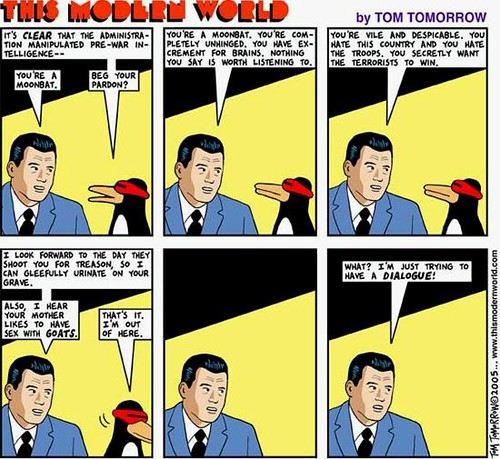
Personally, I find y2karl to be a comedic basket case, a Moonbat of the highest order, willing to waste years of his life in defense of the indefensible, in utter denial and hatred of facts to the contrary.
- kablam
I find this tactic of describing yourself by attributing your characterstics, in complete error of course, to someone else to be rather fascinating.
posted by juiceCake at 7:42 AM on December 7, 2005
- kablam
I find this tactic of describing yourself by attributing your characterstics, in complete error of course, to someone else to be rather fascinating.
posted by juiceCake at 7:42 AM on December 7, 2005
Yeh, it's a strange thing: People so often behold what they have become -- or simply, what they are. And the more uneasy they are with some particular idea -- the more they fear it -- the more eager they are to project it onto a demonized "other". It's rare, though, that people who do that the most often are able to see that they're doing it. kablam clearly values the idea of intellect, and wants people to think highly of his; I literally shudder to think of what will happen to him if he ever realizes that he's been staring into a mirror this whole time.
posted by lodurr at 7:47 AM on December 7, 2005
posted by lodurr at 7:47 AM on December 7, 2005
« Older A Peek Under the PR Mask | Hey Ricky you're so fine... Newer »
This thread has been archived and is closed to new comments