"Perspectives of Russian Art"
January 24, 2006 12:53 AM Subscribe
Perspectives of Russian Art Prior to the dissolution of the Soviet Union in 1991 Americans had limited opportunities to view Russian art of the 20th century. The political pressures of the Cold War era resulted in the mutual cultural isolation of Russia from western Europe and the United States that also created an atmosphere of aesthetic mystery regarding Russian art . .
Thanks for all these links, hortense, although I get the feeling that ‘aesthetic mystery’ was something worth avoiding for Soviet artists keen to stay out of trouble, and is understandably quite absent from many of the works featured here.
Slightly related: the on-line Russian Avant-Garde Gallery which concentrates on art from the earlier 20th Century (and which I thought had been posted here before, but if it has, I can't find it).
posted by misteraitch at 3:15 AM on January 24, 2006
Slightly related: the on-line Russian Avant-Garde Gallery which concentrates on art from the earlier 20th Century (and which I thought had been posted here before, but if it has, I can't find it).
posted by misteraitch at 3:15 AM on January 24, 2006
enjoy.
Enjoy socialist realism? Eh, sorry, some of it's pretty, but the fact that you can hear the screaming just beyond the edge of the picture kind of makes it hard to lose yourself in contemplation of the heroic vistas and handsome youths.
Here's some real "Russian art of the 20th century."
posted by languagehat at 5:55 AM on January 24, 2006
Enjoy socialist realism? Eh, sorry, some of it's pretty, but the fact that you can hear the screaming just beyond the edge of the picture kind of makes it hard to lose yourself in contemplation of the heroic vistas and handsome youths.
Here's some real "Russian art of the 20th century."
posted by languagehat at 5:55 AM on January 24, 2006
Heh, you post this two weeks after the Guggenheim Museum's RUSSIA! exhibition closes?
posted by furtive at 6:20 AM on January 24, 2006
posted by furtive at 6:20 AM on January 24, 2006
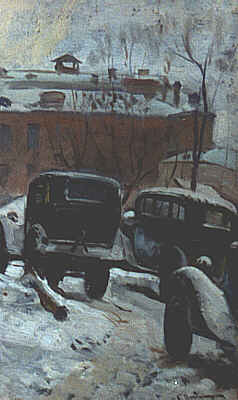
Black Ravens. Stalin-era (unknown, proabably 1930s). Black Ravens was the nickname for Stalin's Secret Police cars, who came at night, surrounding death. Suprisingly, this painting passed by censors, and like all of Wladimirskij's bleak paintings, was displayed throughout the Soviet Union.
Great post, hortense; I especially liked the Moscow Times article at the end.
posted by mediareport at 6:42 AM on January 24, 2006
Great post, hortense; I especially liked the Moscow Times article at the end.
posted by mediareport at 6:42 AM on January 24, 2006
Here's some real "Russian art of the 20th century."
Dang, languagehat, you've sure been quick on the draw to define "real" poetry/art lately. Anyway, I prefer constructivism myself, but can indeed still "enjoy" the tension between the government rules of socialist realism and the resulting art.
posted by mediareport at 6:46 AM on January 24, 2006
Dang, languagehat, you've sure been quick on the draw to define "real" poetry/art lately. Anyway, I prefer constructivism myself, but can indeed still "enjoy" the tension between the government rules of socialist realism and the resulting art.
posted by mediareport at 6:46 AM on January 24, 2006
" Anyway, I prefer constructivism myself",
second image a portrait of GWB
posted by hortense at 9:38 AM on January 24, 2006
second image a portrait of GWB
posted by hortense at 9:38 AM on January 24, 2006
constuctivism here Thanks for all the great supporting links .
posted by hortense at 9:46 AM on January 24, 2006
posted by hortense at 9:46 AM on January 24, 2006
Hey, hortense, great post. I gotta side with languagehat a bit though; it's sort of like reading 'Quiet Flows the Don' or pretty much any other social realist stuff, artists being told this is how you must do it or we will shoot tends to piss me off. All the same, it's integral to understanding the way Russian culture and society works and worth studying.
posted by Football Bat at 10:07 AM on January 24, 2006
posted by Football Bat at 10:07 AM on January 24, 2006
can indeed still "enjoy" the tension between the government rules of socialist realism and the resulting art.
To each his own. It creeps me right out. But I wasn't trying to define art; I didn't mean this isn't "real art," I meant it wasn't the real "Russian art of the 20th century." If you see what I mean. And I guess it bothers me that people are so much more willing to be indulgent towards official Communist art than official Nazi art. (I'm not Godwinning the thread, I swear!)
it's sort of like reading 'Quiet Flows the Don'
I wouldn't exactly call Sholokhov "socialist realism," although he got lumped in there by Soviet critics desperate to find respectable examples of the form Gorky and Zhdanov dreamed up in their ideological hubris. There's a good discussion here:
To each his own. It creeps me right out. But I wasn't trying to define art; I didn't mean this isn't "real art," I meant it wasn't the real "Russian art of the 20th century." If you see what I mean. And I guess it bothers me that people are so much more willing to be indulgent towards official Communist art than official Nazi art. (I'm not Godwinning the thread, I swear!)
it's sort of like reading 'Quiet Flows the Don'
I wouldn't exactly call Sholokhov "socialist realism," although he got lumped in there by Soviet critics desperate to find respectable examples of the form Gorky and Zhdanov dreamed up in their ideological hubris. There's a good discussion here:
Significantly, the selected canon of works admissible under the umbrella of Socialist Realism had, all along, to achieve any literary credibility, to be extended to include works from doubtful categories. These include works written before the term had been invented: Gorky’s Mother (which dates from 1906); and works from the 1920s, held up as models for what Socialist Realism should be: Serafimovich’s The Iron Flood (1924) and Fadeev’s The Rout (1927) were two examples. Also exalted in this way were works which in fact had a historical (rather than a contemporary) setting, such as Valentin Kataev’s A White Sail Gleams (published in 1936, but set in the 1905 period) and Aleksei Tolstoy’s Peter the First (1929-45, set much further back in the past). Among other officially favoured examples of works patently not fitting strictly the tenets of Socialist Realism (though they can be interpreted, given the will, as ideologically sound enough to pass muster), but of sufficient literary quality to constitute prestigious inclusions, we might mention the poetry of Maiakovsky (once he was safely dead), Sholokhov’s The Quiet Don, and the early novels of Leonid Leonov. The later novels of Leonov are regarded, by some critics at least, as among the few relatively successful Socialist Realist novels, although he was at pains, through his somewhat barren later years, to revise his earlier works – more, rather than less, in the fashion of Socialist Realism.posted by languagehat at 10:27 AM on January 24, 2006
Guggenheim Shmuggenheim. We in Twin Cities are proud of Museum of the Russian Art.
Great post, gives a lot of insight into Russian culture from Soviet aesthetic objectives.
I'm no art historian, but doesn't Soviet Socialist Realism look alot like WPA-sponsored American art? In theme and style. Although this seems to be before the period of Russian socialist realism...
What would be real interesting would be some comparative studies of Russian and American art during the cold war...
posted by mammary16 at 11:12 AM on January 24, 2006
Great post, gives a lot of insight into Russian culture from Soviet aesthetic objectives.
I'm no art historian, but doesn't Soviet Socialist Realism look alot like WPA-sponsored American art? In theme and style. Although this seems to be before the period of Russian socialist realism...
What would be real interesting would be some comparative studies of Russian and American art during the cold war...
posted by mammary16 at 11:12 AM on January 24, 2006
Ah, one of my favorite Russian artists from the early 1900s is Mikhail Vrubel--I look at paintings like The Swan Princess and I'm shocked by how gorgeous and original they are, especially when you consider the time period it was painted in. He's also a great example of genius accompanying insanity--I found his early paintings unimpressive, but it seems the crazier he got the better the artwork became.
I look at the Soviet-era artwork and it just breaks my heart. Before the October Revolution the Russian art world had been undergoing a massive revolution itself--its art, music, and especially dance were light-years ahead of any other European country. There was so much more potential. But now, eighty years later they're still recovering, and it's depressing to think about what could have been.
posted by Anonymous at 11:51 AM on January 24, 2006

I look at the Soviet-era artwork and it just breaks my heart. Before the October Revolution the Russian art world had been undergoing a massive revolution itself--its art, music, and especially dance were light-years ahead of any other European country. There was so much more potential. But now, eighty years later they're still recovering, and it's depressing to think about what could have been.
posted by Anonymous at 11:51 AM on January 24, 2006
I look at the Soviet-era artwork and it just breaks my heart. Before the October Revolution the Russian art world had been undergoing a massive revolution itself--its art, music, and especially dance were light-years ahead of any other European country. There was so much more potential. But now, eighty years later they're still recovering, and it's depressing to think about what could have been.
Amen.
posted by languagehat at 2:02 PM on January 24, 2006
Amen.
posted by languagehat at 2:02 PM on January 24, 2006
that you can hear the screaming just beyond the edge of the picture
This museum's two blocks away from my house, and I can vouch that, at that distance, I hear no screaming.
And, to get serious for a moment, I've always had a weird weakness for Soviet graphic design, even though I was horrified by the system that produced it. Not sure why. My favorite biking jersey is a Soviet Air Force job.
posted by COBRA! at 2:21 PM on January 24, 2006
This museum's two blocks away from my house, and I can vouch that, at that distance, I hear no screaming.
And, to get serious for a moment, I've always had a weird weakness for Soviet graphic design, even though I was horrified by the system that produced it. Not sure why. My favorite biking jersey is a Soviet Air Force job.
posted by COBRA! at 2:21 PM on January 24, 2006
enjoy, irony. the cia response to soviet realism was to pour massive amounts of money into abstract expressionism, more native, organic art styles got pushed out of the way,and america's sense of beauty, warped a bit.
posted by hortense at 5:22 PM on January 24, 2006
posted by hortense at 5:22 PM on January 24, 2006
language hat: thanks for the other link. No, I suppose Sholokhov isn't quite a social realist, though I find (and it's been a while since I've read him) his works to be constrained by who he was writing for; he does toe the party line. Contrasted to, say, Babel.
posted by Football Bat at 6:28 PM on January 24, 2006
posted by Football Bat at 6:28 PM on January 24, 2006
Thanks for the interesting links. I admit that I find it hard to "enjoy" some of these in the sense that one might enjoy Keith Haring or Dégas or Matisse, but it is worthwhile to at least see what some of the so-called soviet "realism" looks like.
Schroedinger, I agree that there was immense artistic potential before 1917 and perhaps in some ways after. It is hard for me, honestly speaking, to divorce the politics of Russia at the time from the rest of its culture.
For millions of others in and around the Russian Empire, such as Romanians, Georgians, Ukrainians and Finns, the years surrounding that infamous date were filled with cultural oppression, russification and a lost of cultural identity.
The 30-50 years before 1917 and the following 70 were marked by suffering, weakness and a loss of cultural identity throughout Russia's former empire in the so-called "near abroad." For every year of the USSR's existence, hundreds of thousands of non-Russians were russified, deported and robbed of their cultural treasures. I find it hard to bemoan any loss to the Russian culture that 1917 might have presented in light of Europe's much greater loss of many unique cultural and linguistic groups that vanished during the cold war.
posted by vkxmai at 10:43 PM on January 24, 2006
Schroedinger, I agree that there was immense artistic potential before 1917 and perhaps in some ways after. It is hard for me, honestly speaking, to divorce the politics of Russia at the time from the rest of its culture.
For millions of others in and around the Russian Empire, such as Romanians, Georgians, Ukrainians and Finns, the years surrounding that infamous date were filled with cultural oppression, russification and a lost of cultural identity.
The 30-50 years before 1917 and the following 70 were marked by suffering, weakness and a loss of cultural identity throughout Russia's former empire in the so-called "near abroad." For every year of the USSR's existence, hundreds of thousands of non-Russians were russified, deported and robbed of their cultural treasures. I find it hard to bemoan any loss to the Russian culture that 1917 might have presented in light of Europe's much greater loss of many unique cultural and linguistic groups that vanished during the cold war.
posted by vkxmai at 10:43 PM on January 24, 2006
Before the October Revolution the Russian art world had been undergoing a massive revolution itself--its art, music, and especially dance were light-years ahead of any other European country. There was so much more potential.
if you pretend that revolution is not an art form, yes. the fact is, after 1917 they were still light-years ahead, but in a different field. look at it as performace art, even as, well, architecture in a way (I hate "social engineering" and anyway it's too dry a word for what was accomplished) -- all gone horribly awry, OK, but that's the point of experiments. you never know in advance.
posted by matteo at 3:35 AM on January 25, 2006
if you pretend that revolution is not an art form, yes. the fact is, after 1917 they were still light-years ahead, but in a different field. look at it as performace art, even as, well, architecture in a way (I hate "social engineering" and anyway it's too dry a word for what was accomplished) -- all gone horribly awry, OK, but that's the point of experiments. you never know in advance.
posted by matteo at 3:35 AM on January 25, 2006
if you pretend that revolution is not an art form, yes. the fact is, after 1917 they were still light-years ahead, but in a different field. look at it as performace art, even as, well, architecture in a way (I hate "social engineering" and anyway it's too dry a word for what was accomplished) -- all gone horribly awry, OK, but that's the point of experiments. you never know in advance.
Christ, I would be revolted by that if I felt compelled to take it seriously. Fortunately, I've decided that your political comments on MeFi are themselves a form of performance art, designed to get a rise out of what you perceive as the smug, bourgeois American public (because, let's face it, MeFi is largely American).
For anyone without matteo's intensely tangled irony: revolution is not art. Murder is not art. Repression is not art. And taking such things seriously is not a sign of smug bourgeois nature, it's a sign of basic humanity.
posted by languagehat at 4:59 AM on January 25, 2006
Christ, I would be revolted by that if I felt compelled to take it seriously. Fortunately, I've decided that your political comments on MeFi are themselves a form of performance art, designed to get a rise out of what you perceive as the smug, bourgeois American public (because, let's face it, MeFi is largely American).
For anyone without matteo's intensely tangled irony: revolution is not art. Murder is not art. Repression is not art. And taking such things seriously is not a sign of smug bourgeois nature, it's a sign of basic humanity.
posted by languagehat at 4:59 AM on January 25, 2006
and, all jokes aside, I'm afraid that you guys also think that the French Revolution was a bad thing because, shit, they probably ruined some of that lovely Hôtel de Ville furniture.
posted by matteo at 8:39 AM on January 25, 2006
posted by matteo at 8:39 AM on January 25, 2006
« Older Herr Goering: Self-Hating Nazi? | Little Alfredo Didn't Look So "Little" Anymore Newer »
This thread has been archived and is closed to new comments
posted by hortense at 12:57 AM on January 24, 2006