I suddenly have an intense desire to watch a Jimmy Stewart film. And take a shower.
April 11, 2007 9:09 AM Subscribe
"It wasn't scary, it was just gratuitous, as if they thought, 'I know, let's have a rape,' and that made me quite angry." The question will be asked often in the coming weeks, as "Vacancy" and "Hostel 2" approach: Do modern horror films ("gorno," or gore pornography) go too far, particularly when it comes to women? Who said violent misogyny was entertaining? Is this just a retread of the exploitation wave of the 1970s/80s? (Most links NSFW, sensitive souls, people who detest violence)
"It wasn't scary, it was just gratuitous..."
Talking about the genre or just the rape?
posted by DU at 9:26 AM on April 11, 2007
Talking about the genre or just the rape?
posted by DU at 9:26 AM on April 11, 2007
I didn't see any mention of "gorno" in your "gorno" link.
posted by horsemuth at 9:28 AM on April 11, 2007
posted by horsemuth at 9:28 AM on April 11, 2007
I didn't see any mention of "gorno" in your "gorno" link.
I think you might have followed the wrong link then...
posted by Dr-Baa at 9:30 AM on April 11, 2007
I think you might have followed the wrong link then...
posted by Dr-Baa at 9:30 AM on April 11, 2007
There's a certain satisfaction - all politics, weight, and meaning aside - to seeing something tangible and solid get destroyed: violence. And when it's presented in the right way, it can be as cathartic as any form of post-modernism - the same way we enjoy genres being skewered or exposed - but when it's overdone or done without thought it just becomes painful and uncomfortable, the only goal of the filmmaker being to make the audience squirm, with no satisfaction on the audiences part - just the director having the satisfaction of having made the audience squirm.
And the same director can sometimes swing both ways - look at Takashi Miike's Audition vs. Imprint (the "banned" Masters of Horror episode he did for Showtime.
posted by SmileyChewtrain at 9:34 AM on April 11, 2007
And the same director can sometimes swing both ways - look at Takashi Miike's Audition vs. Imprint (the "banned" Masters of Horror episode he did for Showtime.
posted by SmileyChewtrain at 9:34 AM on April 11, 2007
Has anyone seen Grindhouse? can you weigh in on this score with regard to that film? I'm particularly interested in whether Rodriguez and Tarantino manage to subvert the exploitation model or simply repeat the misogyny of that era?
posted by anotherpanacea at 9:44 AM on April 11, 2007
posted by anotherpanacea at 9:44 AM on April 11, 2007
You know who else is violent and misogynistic?
America
posted by Mister_A at 9:47 AM on April 11, 2007
America
posted by Mister_A at 9:47 AM on April 11, 2007
Good point by Roth and Craven in the "gorno" linked article about the true horror being front page news everyday. But how are slasher movies inspired by the breakdown of the nuclear family?
posted by hydrophonic at 9:48 AM on April 11, 2007
posted by hydrophonic at 9:48 AM on April 11, 2007
SmileyChewtrain, what about the part of the audience that finds satisfaction in squirming and having squirmed? I like to squirm.
posted by Evstar at 9:50 AM on April 11, 2007
posted by Evstar at 9:50 AM on April 11, 2007
Did you know that there is an entire genre of film dedicated to the realization of rape/torture/murder fantasies?
I fucking hate that this shit exists, tawdry crap like Turistas and Hostel, and am disgusted/saddened that people are entertained by such trash, but what's to be done about it? Censorship? Banning? Public shaming? Extradition to Uzbekistan? The cost of a free society, I guess.
I suppose it is not worse than what happens in the headlines on a daily basis, but there's something kind of gross about pandering to an audience who wants to see a hyper realistic version of it for entertainment purposes.
posted by psmealey at 9:52 AM on April 11, 2007 [1 favorite]
I fucking hate that this shit exists, tawdry crap like Turistas and Hostel, and am disgusted/saddened that people are entertained by such trash, but what's to be done about it? Censorship? Banning? Public shaming? Extradition to Uzbekistan? The cost of a free society, I guess.
I suppose it is not worse than what happens in the headlines on a daily basis, but there's something kind of gross about pandering to an audience who wants to see a hyper realistic version of it for entertainment purposes.
posted by psmealey at 9:52 AM on April 11, 2007 [1 favorite]
The first link in the FPP intrigued me in decrying the relative dearth of female film directors in this genre. Maybe the gals who want to stand behind cameras have better taste than to make these kinds of films?
Another thought: Are these films getting worse -- more graphic and brutal in their depictions? A lady I knew once told me of a friend who'd visited a restaurant or nightclub in Tokyo that had tabletop jukeboxes that would show you a video of ... well, a rape. That kind of freaked me out to hear, but this sounds like the same thing, only in the dark with popcorn.
posted by pax digita at 9:54 AM on April 11, 2007
Another thought: Are these films getting worse -- more graphic and brutal in their depictions? A lady I knew once told me of a friend who'd visited a restaurant or nightclub in Tokyo that had tabletop jukeboxes that would show you a video of ... well, a rape. That kind of freaked me out to hear, but this sounds like the same thing, only in the dark with popcorn.
posted by pax digita at 9:54 AM on April 11, 2007
In my view every Saw film should be NC-17, as should any rape/exploitation film.
Irreversible still makes me sick.
posted by four panels at 9:55 AM on April 11, 2007
Irreversible still makes me sick.
posted by four panels at 9:55 AM on April 11, 2007
how are slasher movies inspired by the breakdown of the nuclear family?
As I understand it, the loss of the rituals of family life create many more moments of isolation, which are presented as dangerous because slashers only attack individuals, not groups. You can also see this in the inevitable attacks on sexually active teenagers, who must be punished for their part in misaligning the traditional sequence of marriage, then sexuality, then reproduction.
posted by anotherpanacea at 9:58 AM on April 11, 2007 [2 favorites]
As I understand it, the loss of the rituals of family life create many more moments of isolation, which are presented as dangerous because slashers only attack individuals, not groups. You can also see this in the inevitable attacks on sexually active teenagers, who must be punished for their part in misaligning the traditional sequence of marriage, then sexuality, then reproduction.
posted by anotherpanacea at 9:58 AM on April 11, 2007 [2 favorites]
But how are slasher movies inspired by the breakdown of the nuclear family?
The slashers in the movies usually come from severely f'ed-up families, and this allows those of us from less dysfunctional families to say "We may be messed up, but we're not as messed up as those guys."
posted by infinitewindow at 10:00 AM on April 11, 2007
The slashers in the movies usually come from severely f'ed-up families, and this allows those of us from less dysfunctional families to say "We may be messed up, but we're not as messed up as those guys."
posted by infinitewindow at 10:00 AM on April 11, 2007
There's a certain satisfaction - all politics, weight, and meaning aside - to seeing something tangible and solid get destroyed: violence.
Interesting; isn't it usually some person getting destroyed in these films? And maybe that's why they are more troubling than, say, footage of a building being blown up?
I like being scared. I detest torture as entertainment, because I have a pretty high amount of empathy...I squirm even when someone just gets humiliated on screen. And I kind of like that about myself, actually.
The redeeming feature of some of the older flicks was that the violence was so fake you didn't really believe the characters were getting killed. THe more fake, the more fun the movie was, really.
But yeah, misogyny is pretty rampant through all the more violent genres, (except for the occasional Jamie Lee Curtis/Sigourney Weaver/Linda Hamilton triumph) it's just that the increased brutality of this last bunch of torture flicks has brought it into greater focus.
posted by emjaybee at 10:02 AM on April 11, 2007 [3 favorites]
Slasher films are just a stopgap measure until we have cameras installed everywhere and can tap into our personal streaming media feeds, where we can watch Real disasters, murders, rapes, decapitations, and other violent deaths in Real Time, in the comfort of our own homes, alone. The transition has already begun.
posted by Blazecock Pileon at 10:06 AM on April 11, 2007 [5 favorites]
posted by Blazecock Pileon at 10:06 AM on April 11, 2007 [5 favorites]
I find enough horror in my daily life - no need to pay for it or watch it.
posted by homodigitalis at 10:06 AM on April 11, 2007 [2 favorites]
posted by homodigitalis at 10:06 AM on April 11, 2007 [2 favorites]
So just let me say that the ad campaign for "Captivity" is not only a literal sign of the collapse of humanity, it's an assault. [...] It's like being mugged (and I have been).
Et tu, Joss? That otherwise sensible people turn so righteously frothy over words and images is the single best argument for the first amendment we could ask for.
posted by kid ichorous at 10:07 AM on April 11, 2007 [2 favorites]
Et tu, Joss? That otherwise sensible people turn so righteously frothy over words and images is the single best argument for the first amendment we could ask for.
posted by kid ichorous at 10:07 AM on April 11, 2007 [2 favorites]
I think Roth's take is a bit of a cop out. Of course real horror occurs in reality. That's why it's reality, Eli. Surpringly, real comedy and real romance can also be found in the real world. But then, Craven says that crossing the line for him would be to create a snuff film...
I think what makes this all disturbing, at least for me, is that these films appeal to the least empathic, and the least socially adjusted among us. This is speaking from my own personal experience, I'm sure there are exceptions, but kids watch these movies, or the adults I know who are just a little weird.
posted by Doug at 10:10 AM on April 11, 2007 [1 favorite]
I think what makes this all disturbing, at least for me, is that these films appeal to the least empathic, and the least socially adjusted among us. This is speaking from my own personal experience, I'm sure there are exceptions, but kids watch these movies, or the adults I know who are just a little weird.
posted by Doug at 10:10 AM on April 11, 2007 [1 favorite]
Terrible, gratuitous stuff on film is enjoyed by people who have never had any real terror in their lives. Those of us who have had real evil happen to us avoid such crap, as a rule.
posted by SaintCynr at 10:17 AM on April 11, 2007 [5 favorites]
posted by SaintCynr at 10:17 AM on April 11, 2007 [5 favorites]
anotherpanacea: I saw Grindhouse the other day. In my opinion, it's not even in the same catagory as the likes of Saw and Hostel. It's a combination homage/parody of various genres. Rodriquez' being a zombie/infection movie much like Evil Dead, and Tarantino's "girl power" exploitation much like Switchblade Sisters (for my lack of a better example). And in between are short "preview" flicks (my favorite part of the whole show) spoofing all the ridiculous cliches horror films have. Check out Thanksgiving on Youtube (NSFW!).
Grindhouse never takes itself seriously but puts on a front like it does- which may annoy the shit out of some, but I loved it.
posted by Dr-Baa at 10:17 AM on April 11, 2007
Grindhouse never takes itself seriously but puts on a front like it does- which may annoy the shit out of some, but I loved it.
posted by Dr-Baa at 10:17 AM on April 11, 2007
Has anyone seen Grindhouse? can you weigh in on this score with regard to that film?
(minor spoilers follow)
There isn't any nudity in either of the features. The Rodriguez movie, which is quite clearly a send-up, seems more directly influenced by action thrillers of the '80s than low-budget exploitation movies of the '70s. As for the Tarantino movie, after a lot of talky scenes, it takes a left turn about halfway through and becomes a grrl-power revenge film. One might easily argue that his treatment of race in the movie is problematic, but that's nothing new for Tarantino.
The fake trailers, on the other hand, are pretty good at implying that the films they're advertising would be chock-full of wall-to-wall misogyny, if they existed. (Eli Roth's trailer for Thanksgiving is the standout here.) But those are all done with a wink and a nod and ironic distance.
As for whether the movie should be considered subversive--I'd argue no, not because they aren't attempting to comment on their heritage in a postmodern sense (they clearly are), but because their audience has most likely already been subverted, if you know what I mean--if you know the slightest thing about Grindhouse beforehand, you go into it expecting to see a movie that's "subversive." So whatever cultural politics the films contain (which are pretty slight) are already repeating the party line.
On preview: Doug's comment reminds me that when I saw Grindhouse, there was one person in the theater who was clearly mentally ill--he was sitting by himself, and laughed loudly at the most inappropriate times, like whenever a character mentioned the subject of oral sex in passing: "HAW HAW HAW! OH, SHIT! A HAW HAH!" So maybe the paragraph immediately above this one isn't completely true.
posted by Prospero at 10:17 AM on April 11, 2007
(minor spoilers follow)
There isn't any nudity in either of the features. The Rodriguez movie, which is quite clearly a send-up, seems more directly influenced by action thrillers of the '80s than low-budget exploitation movies of the '70s. As for the Tarantino movie, after a lot of talky scenes, it takes a left turn about halfway through and becomes a grrl-power revenge film. One might easily argue that his treatment of race in the movie is problematic, but that's nothing new for Tarantino.
The fake trailers, on the other hand, are pretty good at implying that the films they're advertising would be chock-full of wall-to-wall misogyny, if they existed. (Eli Roth's trailer for Thanksgiving is the standout here.) But those are all done with a wink and a nod and ironic distance.
As for whether the movie should be considered subversive--I'd argue no, not because they aren't attempting to comment on their heritage in a postmodern sense (they clearly are), but because their audience has most likely already been subverted, if you know what I mean--if you know the slightest thing about Grindhouse beforehand, you go into it expecting to see a movie that's "subversive." So whatever cultural politics the films contain (which are pretty slight) are already repeating the party line.
On preview: Doug's comment reminds me that when I saw Grindhouse, there was one person in the theater who was clearly mentally ill--he was sitting by himself, and laughed loudly at the most inappropriate times, like whenever a character mentioned the subject of oral sex in passing: "HAW HAW HAW! OH, SHIT! A HAW HAH!" So maybe the paragraph immediately above this one isn't completely true.
posted by Prospero at 10:17 AM on April 11, 2007
I saw Grindhouse, and while I am extremely uncomfortable with all of these other films (and the whole "genre") and can't bring myself to watch them, Grindhouse doesn't fit in with them at all.
The violence in "Planet Terror", though gross, is so campy and unrealistic that the punch is usually pulled, while rape is only threatened; and the violence in "Death-Proof" is ghoulishly realistic, but it's just one color in Tarantino's palette. Meanwhile his female characters cover a pretty broad spectrum from victim to badass, and what's more important, they are allowed to talk and be real characters-- so much so that most of the negative reviews I've read cite the girls' chatty exposition as merely an inconvenient obstacle to the rampant violence that many people seem to feel entitled to.
posted by hermitosis at 10:18 AM on April 11, 2007
The violence in "Planet Terror", though gross, is so campy and unrealistic that the punch is usually pulled, while rape is only threatened; and the violence in "Death-Proof" is ghoulishly realistic, but it's just one color in Tarantino's palette. Meanwhile his female characters cover a pretty broad spectrum from victim to badass, and what's more important, they are allowed to talk and be real characters-- so much so that most of the negative reviews I've read cite the girls' chatty exposition as merely an inconvenient obstacle to the rampant violence that many people seem to feel entitled to.
posted by hermitosis at 10:18 AM on April 11, 2007
I'll defend the rights of adults to make and view films like these, though I have no interest in seeing them myself.
It is another story, though, to prominently display something like this (actual billboard but may be NSFW anyway), in public places where everyone is exposed to them (and it's pretty hard to look away when you're on a freeway and the thing's right on top of you.)
posted by evilcolonel at 10:18 AM on April 11, 2007 [1 favorite]
It is another story, though, to prominently display something like this (actual billboard but may be NSFW anyway), in public places where everyone is exposed to them (and it's pretty hard to look away when you're on a freeway and the thing's right on top of you.)
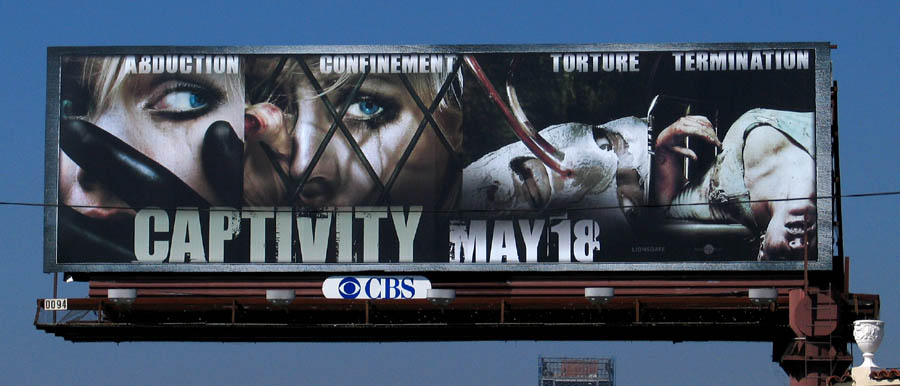
posted by evilcolonel at 10:18 AM on April 11, 2007 [1 favorite]
(Oh yeah, also of note- the Thanksgiving bit I linked to is directed by Eli Roth. He also makes an appearance in it.)
posted by Dr-Baa at 10:19 AM on April 11, 2007
posted by Dr-Baa at 10:19 AM on April 11, 2007
Since I failed to preview before my last comment, I say durrrrrrrrrrrrrrrrrrrr.
posted by Dr-Baa at 10:23 AM on April 11, 2007
posted by Dr-Baa at 10:23 AM on April 11, 2007
The problem isn't that these movies exist, it's the degree with which this stuff is accepted as mainstream.
A lot of my friends pointed out in movies, tv, and books when you need people to -hate- a villain, just have them rape a woman (or threaten to). It's not rape about rape- it's an easy marker to make something evil, but it's always a woman.
My usual litmus test for problematic imagery is this: do you see a mix of heroes, villains and victims? Or do you always get relegated to the latter two? It says a lot when you can never have both power and the moral right on your side. :/
posted by yeloson at 10:24 AM on April 11, 2007
A lot of my friends pointed out in movies, tv, and books when you need people to -hate- a villain, just have them rape a woman (or threaten to). It's not rape about rape- it's an easy marker to make something evil, but it's always a woman.
My usual litmus test for problematic imagery is this: do you see a mix of heroes, villains and victims? Or do you always get relegated to the latter two? It says a lot when you can never have both power and the moral right on your side. :/
posted by yeloson at 10:24 AM on April 11, 2007
Horror movies have always been objectionable. The problem has always been that the main argument against them—that it's morally wrong to watch or enjoy them—has fallen by the wayside. Nowadays, we don't care much for morals. People laugh when you say you have a moral objection.
It's interesting that there might now be a trend of using feminism to defeat the horror movies. Political objections have simply replaced moralism. Somehow we're better able to accept a political argument, even if its outcome is the same as a moral argument.
Personally, I still believe in the moral argument. You can't tell me that a collection of 200 people gathered in a dark room to watch depictions of brutal cruelty is somehow a decent or 'right' thing. It's pornography, pure and simple. It's just organised and above-board.
I despair of horror movies, and I don't watch them. When I read about them I feel as if my soul is being slowly dissolved, especially now horror films have become mainstream. My Sunday newspaper carries reviews of such movies and the reviewer praises them for their violence and gore. What the f*** is going on?
I despair of the people who create horror movies (how does one create a script with directions like, "His head is destroyed?"), and of the people who want to watch them. I don't even watch many Hollywood films nowadays because of the fashion for random harsh violence (aka the Tarrantino Effect).
Ban horror films? No. But put them underground, where they belong. They shouldn't be mainstream, any more than hard porn should be.
posted by humblepigeon at 10:25 AM on April 11, 2007 [1 favorite]
It's interesting that there might now be a trend of using feminism to defeat the horror movies. Political objections have simply replaced moralism. Somehow we're better able to accept a political argument, even if its outcome is the same as a moral argument.
Personally, I still believe in the moral argument. You can't tell me that a collection of 200 people gathered in a dark room to watch depictions of brutal cruelty is somehow a decent or 'right' thing. It's pornography, pure and simple. It's just organised and above-board.
I despair of horror movies, and I don't watch them. When I read about them I feel as if my soul is being slowly dissolved, especially now horror films have become mainstream. My Sunday newspaper carries reviews of such movies and the reviewer praises them for their violence and gore. What the f*** is going on?
I despair of the people who create horror movies (how does one create a script with directions like, "His head is destroyed?"), and of the people who want to watch them. I don't even watch many Hollywood films nowadays because of the fashion for random harsh violence (aka the Tarrantino Effect).
Ban horror films? No. But put them underground, where they belong. They shouldn't be mainstream, any more than hard porn should be.
posted by humblepigeon at 10:25 AM on April 11, 2007 [1 favorite]
I can kind of understand the rationale behind rape in horror movies. (but I could be way off base in my understanding) The makers of the movie want to scare the audience. The audience wants to be scared. Rape is one of the most terrifying things for both females and males, in the role of victim. Where it goes wrong is that females don't seem to enjoy being frightened in this way. (and I say that based on the articles that say that women prefer psychological thrillers to gorefests) They end up attracting those who enjoy the mysogeny of it and disgusting those who don't. As in, not causing the intended (maybe?) fear through the onscreen rape but "gorno" for guys to leer at.
posted by bobobox at 10:28 AM on April 11, 2007
posted by bobobox at 10:28 AM on April 11, 2007
I certainly think that people are within their rights to make these movies, but really it's the prominence of them that I find really surprising. Especially since the story-telling skills of the people who make these films have not exactly evolved at the same pace as their special effects.
When you only have one note to blow, I guess you have to blow it pretty hard to keep people from being able to ignore it. Hence I get to stand and look at severed fingers for ten minutes while waiting for the subway.
posted by hermitosis at 10:32 AM on April 11, 2007 [1 favorite]
When you only have one note to blow, I guess you have to blow it pretty hard to keep people from being able to ignore it. Hence I get to stand and look at severed fingers for ten minutes while waiting for the subway.
posted by hermitosis at 10:32 AM on April 11, 2007 [1 favorite]
What need does the horror genre have for the manichee conception of "Good v. Evil?
posted by davy at 10:32 AM on April 11, 2007
posted by davy at 10:32 AM on April 11, 2007
Political objections have simply replaced moralism. Somehow we're better able to accept a political argument, even if its outcome is the same as a moral argument. Personally, I still believe in the moral argument. You can't tell me that a collection of 200 people gathered in a dark room to watch depictions of brutal cruelty is somehow a decent or 'right' thing. It's pornography, pure and simple. It's just organised and above-board.
These same sorts of moral arguments were, not long ago, used to criminalize men who owned homoerotic porn. Not to mention shutting (or shouting) down works of art as diverse as Desire Under the Elms and Clockwork Orange.
What makes your moralisms okay to push on other people's thoughts and writing?
posted by kid ichorous at 10:32 AM on April 11, 2007 [1 favorite]
These same sorts of moral arguments were, not long ago, used to criminalize men who owned homoerotic porn. Not to mention shutting (or shouting) down works of art as diverse as Desire Under the Elms and Clockwork Orange.
What makes your moralisms okay to push on other people's thoughts and writing?
posted by kid ichorous at 10:32 AM on April 11, 2007 [1 favorite]
As for rating misogyny, a helpful guide is always the Mo Movie Measure;
[Alison Bechdel's strip] popularized what is now known as the Bechdel Test, also named the Mo Movie Measure or Bechdel's Law. Bechdel credits Liz Wallace for the test. The test appears in a 1985 strip entitled The Rule in which a character says that she only watches a movie if it satisfies the following requirements:
1. It has to have at least two women in it, who
2. talk to each other about,
3. something besides a man.
You would be amazed, once you start watching for it, how very very rare this kind of scene is in movies, violent and non-.
posted by emjaybee at 10:32 AM on April 11, 2007 [13 favorites]
[Alison Bechdel's strip] popularized what is now known as the Bechdel Test, also named the Mo Movie Measure or Bechdel's Law. Bechdel credits Liz Wallace for the test. The test appears in a 1985 strip entitled The Rule in which a character says that she only watches a movie if it satisfies the following requirements:
1. It has to have at least two women in it, who
2. talk to each other about,
3. something besides a man.
You would be amazed, once you start watching for it, how very very rare this kind of scene is in movies, violent and non-.
posted by emjaybee at 10:32 AM on April 11, 2007 [13 favorites]
Miike and Roth do not make the same kind of movies:
Eli Roth talks a lot of smack about all the lines he crosses, how they'll have to create another rating for him (sorry not cite), but hasn't even come close. Cabin Fever was excellent--well crafted gore and all the best stuff from the lost in the woods genre; but Hostel was laughable.
Miike is not laughable. His movies are absolutely disturbing but almost never gratuitous. The films mentioned above, Imprint and Audition, are two of his most accessible and both bring up important ideas about life's very usual horrors, voyeurism, love, revenge etc.
Neither Miike nor Roth are "pornographic" gore.
posted by ibeji at 10:34 AM on April 11, 2007
Eli Roth talks a lot of smack about all the lines he crosses, how they'll have to create another rating for him (sorry not cite), but hasn't even come close. Cabin Fever was excellent--well crafted gore and all the best stuff from the lost in the woods genre; but Hostel was laughable.
Miike is not laughable. His movies are absolutely disturbing but almost never gratuitous. The films mentioned above, Imprint and Audition, are two of his most accessible and both bring up important ideas about life's very usual horrors, voyeurism, love, revenge etc.
Neither Miike nor Roth are "pornographic" gore.
posted by ibeji at 10:34 AM on April 11, 2007
I'd always believed that violence was an aspect of nature, and that we humans, as a product of nature, would accept at least a certain level of violence around us. Perhaps even find it necessary.
But now I'm the father of a two-and-a-half year old boy. I've seen him react very strongly to depictions of violence on the television screen. I'm thinking of his loud demands that we "turn it off! turn it off!" when Woody and Buzz get into a pushy-shovey disagreement in Toy Story. I'm afraid of how he'll react to my Looney Tunes Collection when/if we get around to watching it with him.
I'm feeling very strongly that our natural reaction to violence is to retreat/withdraw. I'm feeling very strongly that our natural reaction is strong aversion to violence, and that when we "learn to accept it," we've actually lost something important to us.
I was a young teenager when we got our family's first VCR. And my parents used to babysit us when they went out by renting a few horror flicks and ordering a pizza. To their credit, however, one time they were watching The Toolbox Murders with us, and very quickly turned it off. I've seen dozens of those "classic" late-70s and 80s slasher flicks, and I always felt like they didn't do me much harm.
My son is changing my mind.
"It is no measure of health to be well-adjusted in a profoundly sick society." - Krishnamurti.
posted by I, Credulous at 10:35 AM on April 11, 2007 [5 favorites]
But now I'm the father of a two-and-a-half year old boy. I've seen him react very strongly to depictions of violence on the television screen. I'm thinking of his loud demands that we "turn it off! turn it off!" when Woody and Buzz get into a pushy-shovey disagreement in Toy Story. I'm afraid of how he'll react to my Looney Tunes Collection when/if we get around to watching it with him.
I'm feeling very strongly that our natural reaction to violence is to retreat/withdraw. I'm feeling very strongly that our natural reaction is strong aversion to violence, and that when we "learn to accept it," we've actually lost something important to us.
I was a young teenager when we got our family's first VCR. And my parents used to babysit us when they went out by renting a few horror flicks and ordering a pizza. To their credit, however, one time they were watching The Toolbox Murders with us, and very quickly turned it off. I've seen dozens of those "classic" late-70s and 80s slasher flicks, and I always felt like they didn't do me much harm.
My son is changing my mind.
"It is no measure of health to be well-adjusted in a profoundly sick society." - Krishnamurti.
posted by I, Credulous at 10:35 AM on April 11, 2007 [5 favorites]
"Ban horror films? No. But put them underground, where they belong. They shouldn't be mainstream, any more than hard porn should be."
Because of course America is a Christian country, where mainstream is Disney. E.g., Times Square, Michael Jackson and Rush Limbaugh.
posted by davy at 10:35 AM on April 11, 2007
Because of course America is a Christian country, where mainstream is Disney. E.g., Times Square, Michael Jackson and Rush Limbaugh.
posted by davy at 10:35 AM on April 11, 2007
Who said violent misogyny was entertaining?
Pretty much the entirety of post-agriculture society. It may not be a nice thing to say about modern human beings, but we might as well admit it.
Anyway, I think these films have a pretty obvious purpose. They provide catharsis along with a chance to temporarily ditch our taboos and connect with death and pain, two important facets of life that our modern society is in denial about (and if you ask, "why the misogyny", consider that female death and pain is even more taboo than the male kind). Within a handful of generations, we've gone from being people who lived every day with pain and death to people who hide pain and death away in specialized buildings, so that no one will have to see them. It's no wonder that some people seek them out, in one form or another.
I'm not much for horror films, myself, but I definitely understand the appeal of dark subject matter in other forms of art. For me, it's a reaffirmation of life, and of death's important place in life. It's a rejection of unnatural, denial-ridden, indoctrinated "morality", in favor of the world as it is. It's clearly not for everybody, but I think some of you are overstating how horrible it really is. Much, much worse things are going on in real life, right now, at our behest, and yet horror films ought to be driven into the underground? Bah.
posted by vorfeed at 10:35 AM on April 11, 2007 [3 favorites]
Pretty much the entirety of post-agriculture society. It may not be a nice thing to say about modern human beings, but we might as well admit it.
Anyway, I think these films have a pretty obvious purpose. They provide catharsis along with a chance to temporarily ditch our taboos and connect with death and pain, two important facets of life that our modern society is in denial about (and if you ask, "why the misogyny", consider that female death and pain is even more taboo than the male kind). Within a handful of generations, we've gone from being people who lived every day with pain and death to people who hide pain and death away in specialized buildings, so that no one will have to see them. It's no wonder that some people seek them out, in one form or another.
I'm not much for horror films, myself, but I definitely understand the appeal of dark subject matter in other forms of art. For me, it's a reaffirmation of life, and of death's important place in life. It's a rejection of unnatural, denial-ridden, indoctrinated "morality", in favor of the world as it is. It's clearly not for everybody, but I think some of you are overstating how horrible it really is. Much, much worse things are going on in real life, right now, at our behest, and yet horror films ought to be driven into the underground? Bah.
posted by vorfeed at 10:35 AM on April 11, 2007 [3 favorites]
And my "moral objection" to watching films like these is that I refuse to participate in a cultural glorification of torture that is, now more than ever, informed by the real-life torture that our country inflicts on actual human beings.
We only pay to participate in torture fantasies because our government inconsiderately protects us from reality.
posted by hermitosis at 10:37 AM on April 11, 2007 [1 favorite]
We only pay to participate in torture fantasies because our government inconsiderately protects us from reality.
posted by hermitosis at 10:37 AM on April 11, 2007 [1 favorite]
From a recent interview with Eli Roth (emphasis mine):
... wish I could take any credit for the Hostel 2 poster. That is wild boar meat. That’s the marketing at Lionsgate. They just put that meat. I thought that was brilliant, because the genius of that poster is that if it were hanging at the supermarket, you'd go ‘oh, let's have steak tonight,’ but in a movie theater with the words Hostel 2 – ‘that is the sickest thing I've ever seen!’ And it's all the power of suggestion and I like that. There is obviously comparisons....it's mostly aware that anytime people see women in a horror film, all they say is that all these girls are just pieces of meat and literally in Hostel Part 2, they are. They are the bait, they are the meat for these ....they are the grist for the mill. I thought it was a really smart poster and really, really disgusting. I love it.
Like most people here, my biggest problem is the fact that this level of severity is going mainstream. Witness the fact that at Target, Wolf Creek and Hostel DVDs appear on the bottom shelves - where children can easily pick them up. A blase attitude toward cruelty has taken hold, which makes me sad, more than anything else.
posted by jbickers at 10:38 AM on April 11, 2007
... wish I could take any credit for the Hostel 2 poster. That is wild boar meat. That’s the marketing at Lionsgate. They just put that meat. I thought that was brilliant, because the genius of that poster is that if it were hanging at the supermarket, you'd go ‘oh, let's have steak tonight,’ but in a movie theater with the words Hostel 2 – ‘that is the sickest thing I've ever seen!’ And it's all the power of suggestion and I like that. There is obviously comparisons....it's mostly aware that anytime people see women in a horror film, all they say is that all these girls are just pieces of meat and literally in Hostel Part 2, they are. They are the bait, they are the meat for these ....they are the grist for the mill. I thought it was a really smart poster and really, really disgusting. I love it.
Like most people here, my biggest problem is the fact that this level of severity is going mainstream. Witness the fact that at Target, Wolf Creek and Hostel DVDs appear on the bottom shelves - where children can easily pick them up. A blase attitude toward cruelty has taken hold, which makes me sad, more than anything else.
posted by jbickers at 10:38 AM on April 11, 2007
Yes, I. Credulous, I agree: we should let your 2 year old make the rules for our civilization. Please ask him if I'm allowed spinach.
posted by davy at 10:39 AM on April 11, 2007 [2 favorites]
posted by davy at 10:39 AM on April 11, 2007 [2 favorites]
I'm not sure what the term "gorno" expresses that "exploitation film" didn't already.
Roth and Zombie are leagues ahead of Aja and those god-awful men behind Saw. I actually found High Tension and the Saw flicks to be rather wholly corrupt in their modest pretensions and rampant misogyny, whereas The Devil's Rejects and Cabin Fever were witty exercises in gory weirdness.
I love cultish horror movies, but the slasher form isn't something that interests me. I've never had any interest in gore for its own sake. That said, I strongly suggest people read Carol Clover's Men, Women, and Chainsaws.
And as for female-directed remixes of horror movies - check out Near Dark, Titus, and American Psycho. And while not directed by a woman, The Descent is an interesting view in and of itself. And yeah, I know Titus isn't a horror movie per se, but check how Taymor uses Shakespeare's over-the-top gore.
As for Grindhouse, I absolutely loved it. As for any misogyny - well, in the features, Planet Terror didn't seem any more or less misogynistic than any other movie ever made, and Death Proof quite self-consciously deflates the villain's macho posturing. Your affection for (or patience with) Tarantino's dialog is going to be a big determiner of how much you like it, but it's also probably the major studio release with the most footage of women just...talking. And it was interesting, on the walk back from the theater, talking with our friends about the differences between the women who survive in that story and the women who don't, and what that said thematically.
Oh, also, the car chase was cuckoo-bananas.
I say give it a whirl and tell me what you think.
...
That Ebert bit is highly entertaining, but what does it tell us that Chaos is a tiny, obscure, faintly remembered movie that almost no one, as far as I know, enjoyed? What does it tell us that horror movies like The Grudge and The Ring are seen by many, many more people - and not just due to the major studio push?
posted by Sticherbeast at 10:39 AM on April 11, 2007
Roth and Zombie are leagues ahead of Aja and those god-awful men behind Saw. I actually found High Tension and the Saw flicks to be rather wholly corrupt in their modest pretensions and rampant misogyny, whereas The Devil's Rejects and Cabin Fever were witty exercises in gory weirdness.
I love cultish horror movies, but the slasher form isn't something that interests me. I've never had any interest in gore for its own sake. That said, I strongly suggest people read Carol Clover's Men, Women, and Chainsaws.
And as for female-directed remixes of horror movies - check out Near Dark, Titus, and American Psycho. And while not directed by a woman, The Descent is an interesting view in and of itself. And yeah, I know Titus isn't a horror movie per se, but check how Taymor uses Shakespeare's over-the-top gore.
As for Grindhouse, I absolutely loved it. As for any misogyny - well, in the features, Planet Terror didn't seem any more or less misogynistic than any other movie ever made, and Death Proof quite self-consciously deflates the villain's macho posturing. Your affection for (or patience with) Tarantino's dialog is going to be a big determiner of how much you like it, but it's also probably the major studio release with the most footage of women just...talking. And it was interesting, on the walk back from the theater, talking with our friends about the differences between the women who survive in that story and the women who don't, and what that said thematically.
Oh, also, the car chase was cuckoo-bananas.
I say give it a whirl and tell me what you think.
...
That Ebert bit is highly entertaining, but what does it tell us that Chaos is a tiny, obscure, faintly remembered movie that almost no one, as far as I know, enjoyed? What does it tell us that horror movies like The Grudge and The Ring are seen by many, many more people - and not just due to the major studio push?
posted by Sticherbeast at 10:39 AM on April 11, 2007
I'm for freedom of speech...which includes talking about how toxic these films are and the impact they have on the people who watch them. I don't mean they go out and commit violence , I mean they become more frightened, more anxious and more insensitive to actual feeling.
Parts of the brain do not discriminate so well between what is fake and what is real in terms of trauma. And some of these films are flat out trauma-inducing for those who see them...including the short and long-term effects.
I have yet to meet someone really connected to genuine emotions (or even their physical body) who watches horror films. But plenty of "tough", hip, caffeinated, urban folks do. They may seem just fine, but they really aren't. They're suffering. But it's hard to tell if those are the only people you spend time with.
posted by django_z at 10:42 AM on April 11, 2007 [1 favorite]
Parts of the brain do not discriminate so well between what is fake and what is real in terms of trauma. And some of these films are flat out trauma-inducing for those who see them...including the short and long-term effects.
I have yet to meet someone really connected to genuine emotions (or even their physical body) who watches horror films. But plenty of "tough", hip, caffeinated, urban folks do. They may seem just fine, but they really aren't. They're suffering. But it's hard to tell if those are the only people you spend time with.
posted by django_z at 10:42 AM on April 11, 2007 [1 favorite]
Have a scene where a man approaches a woman and uses her sexually against her will = X rating and controversy.
Have a scene where a man approaches a woman , tortures her, and saws off her head = R rating and potential box office gold.
Lesson? Raping a woman is far worse than torturing and killing her.
posted by flarbuse at 10:44 AM on April 11, 2007
Have a scene where a man approaches a woman , tortures her, and saws off her head = R rating and potential box office gold.
Lesson? Raping a woman is far worse than torturing and killing her.
posted by flarbuse at 10:44 AM on April 11, 2007
oh, and one of the most terrifying movies I've ever seen was Funny Games, written and directed (and, it seems, about to be remade) by Michael Haneke.
I shan't spoil it for you, because it's an incredible movie, but the director knew exactly how much to show you, and when to stage things off-screen...
Please-Please-Please don't let Hollywood do to it what it did to The Vanishing (remake)
posted by I, Credulous at 10:45 AM on April 11, 2007
I shan't spoil it for you, because it's an incredible movie, but the director knew exactly how much to show you, and when to stage things off-screen...
Please-Please-Please don't let Hollywood do to it what it did to The Vanishing (remake)
posted by I, Credulous at 10:45 AM on April 11, 2007
Davy: how pithy and helpful. Thanks. You've put me in my place.
posted by I, Credulous at 10:47 AM on April 11, 2007
posted by I, Credulous at 10:47 AM on April 11, 2007
We only pay to participate in torture fantasies because our government inconsiderately protects us from reality.
I actually think the opposite is true. Our culture is obsessed with torture because, well, we torture. It's obviously on everyone's minds, and it needs to be explored in art. Now, I happen to feel that Hostel was a piece of shit, and Saw was just okay. But I'm not sure I can blame these movies for exploring what needs to be explored right now.
(And it really isn't fair to put Zombie, Tarrentino and Rodriguez in the same category as Saw and Hostel. Different worlds).
posted by Bookhouse at 10:48 AM on April 11, 2007
I actually think the opposite is true. Our culture is obsessed with torture because, well, we torture. It's obviously on everyone's minds, and it needs to be explored in art. Now, I happen to feel that Hostel was a piece of shit, and Saw was just okay. But I'm not sure I can blame these movies for exploring what needs to be explored right now.
(And it really isn't fair to put Zombie, Tarrentino and Rodriguez in the same category as Saw and Hostel. Different worlds).
posted by Bookhouse at 10:48 AM on April 11, 2007
Don't mind Davy, Credulous... He's having a rough week.
posted by psmealey at 10:52 AM on April 11, 2007
posted by psmealey at 10:52 AM on April 11, 2007
I think it is right to compare these types of films to porn. There are lots of different levels of porn from Skinemax all the way down to DADV with "practically inside the vagina cam." We all have different levels of what interests us. Yay, freedom of choice!
I've personally watched and sort of enjoyed all three of the Saw movies, but I draw the line there. I own Hostel, but I've just accepted that I'm never going to watch it. For me, the simulated brutal deaths and over-the-top violence in Saw was OK, but actual simulated torture apparently is where I draw the line.
And although it is through the imperfect filter of my memory, I've yet to see a movie more disturbing than "I Spit On Your Grave."
posted by BeReasonable at 10:52 AM on April 11, 2007
I've personally watched and sort of enjoyed all three of the Saw movies, but I draw the line there. I own Hostel, but I've just accepted that I'm never going to watch it. For me, the simulated brutal deaths and over-the-top violence in Saw was OK, but actual simulated torture apparently is where I draw the line.
And although it is through the imperfect filter of my memory, I've yet to see a movie more disturbing than "I Spit On Your Grave."
posted by BeReasonable at 10:52 AM on April 11, 2007
I find enough horror in my daily life - no need to pay for it or watch it.
posted by homodigitalis at 12:06 PM on April 11
This is precisely, and succinctly, my point of view as well.
*Possible (?) spoiler below*
I watched the trailer for the original Saw, and couldn't believe anyone would voluntarily watch something like that. Boy, was I wrong.
My "horror" taste skews towards "Evil Dead 2" or Troma stuff. If it takes itself at all seriously, I can't watch it.
I've not seen Grindhouse yet, but intend to, as basically I'd give Tarantino a chance even if he were directing a Gilbert and Sullivan vehicle, or even gay porn. He's earned my trust. And from the comments above, it doesn't sound like a typical "horror" movie at all.
Random violence, like the accidental shooting in Pulp Fiction, is quite different from random gore. At least to me it is.
posted by Ynoxas at 10:52 AM on April 11, 2007
posted by homodigitalis at 12:06 PM on April 11
This is precisely, and succinctly, my point of view as well.
*Possible (?) spoiler below*
I watched the trailer for the original Saw, and couldn't believe anyone would voluntarily watch something like that. Boy, was I wrong.
My "horror" taste skews towards "Evil Dead 2" or Troma stuff. If it takes itself at all seriously, I can't watch it.
I've not seen Grindhouse yet, but intend to, as basically I'd give Tarantino a chance even if he were directing a Gilbert and Sullivan vehicle, or even gay porn. He's earned my trust. And from the comments above, it doesn't sound like a typical "horror" movie at all.
Random violence, like the accidental shooting in Pulp Fiction, is quite different from random gore. At least to me it is.
posted by Ynoxas at 10:52 AM on April 11, 2007
Also, when we say "horror" movie, are we really going to pretend that Slither, Shivers, The Birds, Don't Look Now, The Sixth Sense,, Rosemary's Baby, The Tenant, The Ring, Cabin Fever, Chaos, I Spit On Your Grave, Wolf Creek and "Tales From The Crypt" are all the same?
For those of you who don't watch horror movies - and that's fine, I'm not saying you ought to - I could put it more basically by comparing Don't Look Now to Wolf Creek. Is Don't Look Now structurally similar to, or in any way as offensive to some, as Wolf Creek?
I'm biased here because I loathe Wolf Creek and movies like it, but Don't Look Now is one of my very favorites.
posted by Sticherbeast at 10:53 AM on April 11, 2007
For those of you who don't watch horror movies - and that's fine, I'm not saying you ought to - I could put it more basically by comparing Don't Look Now to Wolf Creek. Is Don't Look Now structurally similar to, or in any way as offensive to some, as Wolf Creek?
I'm biased here because I loathe Wolf Creek and movies like it, but Don't Look Now is one of my very favorites.
posted by Sticherbeast at 10:53 AM on April 11, 2007
I own Hostel, but I've just accepted that I'm never going to watch it.
This is very interesting ... did you buy it with the intention of never watching it? I'm curious as to why you own it, if it unsettles you.
posted by jbickers at 10:55 AM on April 11, 2007
This is very interesting ... did you buy it with the intention of never watching it? I'm curious as to why you own it, if it unsettles you.
posted by jbickers at 10:55 AM on April 11, 2007
I don't like those kinds of movies, so I don't watch them.
I don't see how that's to hard. Let people make whatever kind of movies they want, and if you don't like it, don't watch it.
posted by delmoi at 10:57 AM on April 11, 2007
I don't see how that's to hard. Let people make whatever kind of movies they want, and if you don't like it, don't watch it.
posted by delmoi at 10:57 AM on April 11, 2007
I can't even watch movies like this because they make me fucking ill, and I'm not ashamed to admit that. There are no redeeming qualities to a movie such as Hostel and I laugh to myself reading the malapropism that is "gorno" - after turning that piece of shit film off and picking myself up off the floor I looked at my SO and said "This is nothing but porn, the majority of it violent, who would pay to see this?"
It's not even the special effects that make me sick (I considered them highly subpar in the aformentioned case), it's the idea that I'm supposed to enjoy watching some asshole scream and flop around in a chair like a fish out of water as some other asshole pokes him with a stick.
Also, I'm in my mid twenties so you can save the "Get off my lawn" comments for another time when you're feeling real saucy.
posted by prostyle at 10:57 AM on April 11, 2007 [1 favorite]
It's not even the special effects that make me sick (I considered them highly subpar in the aformentioned case), it's the idea that I'm supposed to enjoy watching some asshole scream and flop around in a chair like a fish out of water as some other asshole pokes him with a stick.
Also, I'm in my mid twenties so you can save the "Get off my lawn" comments for another time when you're feeling real saucy.
posted by prostyle at 10:57 AM on April 11, 2007 [1 favorite]
Women in Refrigerators was made to demonstrate the sort of super-hero shenanigans XQUZYPHYR was talking about way upthread (some previous discussion here).
As for horror movies, I watch a lot of them and I'm a fairly well-adjusted person, and I resent the implication that I'm hip, urban, and caffeinated. C'mon, just because someone likes things you don't like they're dead inside?
I think what Roth and Craven are pointing to in the linked interview is that these movies are reflections of our culture at large, and they are often fascinating ones; see for instance, the Onion's list of horror films for right-wingers and left-wingers. I'm not a huge fan of either director, but Roth is on to something when he points out the link between these films becoming more mainstream and the news from the colonies.
I will say that the casual misogyny and sexual violence in evidence in a lot of these movies really bothers me, although that sort of thing bothers me in a lot of other genres as well.
posted by whir at 11:00 AM on April 11, 2007
As for horror movies, I watch a lot of them and I'm a fairly well-adjusted person, and I resent the implication that I'm hip, urban, and caffeinated. C'mon, just because someone likes things you don't like they're dead inside?
I think what Roth and Craven are pointing to in the linked interview is that these movies are reflections of our culture at large, and they are often fascinating ones; see for instance, the Onion's list of horror films for right-wingers and left-wingers. I'm not a huge fan of either director, but Roth is on to something when he points out the link between these films becoming more mainstream and the news from the colonies.
I will say that the casual misogyny and sexual violence in evidence in a lot of these movies really bothers me, although that sort of thing bothers me in a lot of other genres as well.
posted by whir at 11:00 AM on April 11, 2007
Rodriguez and Tarantino manage to subvert the exploitation model or simply repeat the misogyny of that era?
it's not even about repeating the misogyny of the era, it's just a bad idea in itself -- Tarantino has (used to have?) a special talent for turning pulp into great -- if shallow -- fun. but Grindhouse is a movie on the private-joke level, it's Mars Attacks! with mutilation.
I'm glad it's doing badly at the box office, the last thing Hollywood needed was a huge trend of Grindhouse copycats the way Pulp Fiction spawned a thousand shit copycats
posted by matteo at 11:02 AM on April 11, 2007
it's not even about repeating the misogyny of the era, it's just a bad idea in itself -- Tarantino has (used to have?) a special talent for turning pulp into great -- if shallow -- fun. but Grindhouse is a movie on the private-joke level, it's Mars Attacks! with mutilation.
I'm glad it's doing badly at the box office, the last thing Hollywood needed was a huge trend of Grindhouse copycats the way Pulp Fiction spawned a thousand shit copycats
posted by matteo at 11:02 AM on April 11, 2007
(and by the way, the only good thing in Grindhouse is the trailer shot by Eli Roth, who gave us that horrible torture flick about the American students traveling to Eastern Europe)
posted by matteo at 11:04 AM on April 11, 2007
posted by matteo at 11:04 AM on April 11, 2007
I don't like those kinds of movies, so I don't watch them.
I don't either, but I am a SciFi fan, so I watch a few shows on SpikeTV and the SciFi channel. As such I am constantly bombarded by some pretty graphic ads for them during commercial breaks.
As much as I'd like to support the idea that an artist has right to express his vision in that way, the idea of someone getting a vicarious thrill through seeing someone else being tortured (real, fake, whatever) makes me sick.
As for Tarantino, I enjoyed the relentless phony gore in Kill Bill vol 1, and I probably will see Grindhouse on DVD. However, I still think he's an asshole for his gratuitous use of the "n" word in the scene with the headless guy in the back seat of Travolta's car. It made me wish that Samuel Jackson would have picked up somethign heavy and hit him with it.
posted by psmealey at 11:05 AM on April 11, 2007
I don't either, but I am a SciFi fan, so I watch a few shows on SpikeTV and the SciFi channel. As such I am constantly bombarded by some pretty graphic ads for them during commercial breaks.
As much as I'd like to support the idea that an artist has right to express his vision in that way, the idea of someone getting a vicarious thrill through seeing someone else being tortured (real, fake, whatever) makes me sick.
As for Tarantino, I enjoyed the relentless phony gore in Kill Bill vol 1, and I probably will see Grindhouse on DVD. However, I still think he's an asshole for his gratuitous use of the "n" word in the scene with the headless guy in the back seat of Travolta's car. It made me wish that Samuel Jackson would have picked up somethign heavy and hit him with it.
posted by psmealey at 11:05 AM on April 11, 2007
jbickers, I went through a stage where I got curious about all of these over-the-top sort of horror movies and I went out and picked up a set. I got the Saw movies, Cabin Fever and Hostel. Cabin Fever was cool, Saw I definitely was interesting, Saw II was kinda interesting. Saw III seemed like more of the same, but when I got down to watching Hostel, I just always seemed to find something else I'd rather do, including go to bed early.
Enough nights of that, and I realized I just didn't want to see it.
I've heard it isn't a good movie, but I sat through Jesus Christ Vampire Hunter. I can watch a bad movie, especially if people seem to think it is special in some way. So logically, there must be seem other reason I've been avoiding it.
posted by BeReasonable at 11:07 AM on April 11, 2007
Enough nights of that, and I realized I just didn't want to see it.
I've heard it isn't a good movie, but I sat through Jesus Christ Vampire Hunter. I can watch a bad movie, especially if people seem to think it is special in some way. So logically, there must be seem other reason I've been avoiding it.
posted by BeReasonable at 11:07 AM on April 11, 2007
One thing people seem to be saying here is that woman aren't being exploited in horror films so long as they're strong, and fight back. But all that's happening is that women are being given a masculine overlay, nearly always by masculine script writers and directors. The same kinda things still happen to them. In some ways, from a feminist point of view, these kinds of films are even worse. The female characters are still created for the pornographic enjoyment of certain kind of men.
posted by humblepigeon at 11:08 AM on April 11, 2007
posted by humblepigeon at 11:08 AM on April 11, 2007
Back in the first wave of slasher gore in the mid to late '70s, you knew that if a girl was naked and/or having sex, she was going to die a particularly gruesome death, whereas the heroine would remain chaste while being chased. I have not seen these new-jack horror movies (Hostel, etc.), but I wonder if this hypocritical puritanical virgin/slut titillation/punishment dichotomy still exists in these films.
posted by Mister_A at 11:22 AM on April 11, 2007
posted by Mister_A at 11:22 AM on April 11, 2007
If people who see horror films do so because they nurture a closeted desire to watch their fellow humans be tortured and killed, does that mean the critics who lauded, say, United 93 and Schindler's List nurture secret boners/ladywood for plane crashes and concentration camps? I don't doubt it.
posted by kittens for breakfast at 11:23 AM on April 11, 2007 [1 favorite]
posted by kittens for breakfast at 11:23 AM on April 11, 2007 [1 favorite]
But all that's happening is that women are being given a masculine overlay
I'm not sure what you mean here. Are being strong and fighting back strictly masculine attributes? Or do you mean that genuinely feminine characters would approach their situations differently?
(BTW, Hostel is a pretty bad movie, though it's interesting in the way it reflects American anxiety about world opinion.)
posted by whir at 11:23 AM on April 11, 2007
I'm not sure what you mean here. Are being strong and fighting back strictly masculine attributes? Or do you mean that genuinely feminine characters would approach their situations differently?
(BTW, Hostel is a pretty bad movie, though it's interesting in the way it reflects American anxiety about world opinion.)
posted by whir at 11:23 AM on April 11, 2007
OK, here's a list of a few things that happened in Sin City, which was celebrated by just about everyone who saw it:
(1) Mickey Rourke wakes up in a room whose walls were covered in women's heads, like hunting trophies.
(2) Nick Stahl beats Jessica Alba with a whip because it's the only way he can get a boner. When that doesn't work he takes out a knife.
(3) A crowd of sex-obsessed prostitutes kills a cop, and have to be rescued from their misdeed by a man.
(4) Carla Gugino, who is blatantly sexualized in her very first shot, is shot repeatedly with a machine gun after she's already dead.
(5) Bruce Willis symbolically reverses Nick Stahl's gender: He castrates him with his bare hands, then penetrates him with a knife. Only after he does these things does he kill him, by completely obliterating his head.
This is just the stuff I can remember. As far as I can remember, nobody really seemed to talk much about the copious amounts of mysogyny in this movie in the mainstream press. But here we are, talking about horror films and their blatant hatred of women. Shit like the Captivity billboard is bad news, but the problem is clearly a lot deeper.
posted by hifiparasol at 11:23 AM on April 11, 2007 [5 favorites]
(1) Mickey Rourke wakes up in a room whose walls were covered in women's heads, like hunting trophies.
(2) Nick Stahl beats Jessica Alba with a whip because it's the only way he can get a boner. When that doesn't work he takes out a knife.
(3) A crowd of sex-obsessed prostitutes kills a cop, and have to be rescued from their misdeed by a man.
(4) Carla Gugino, who is blatantly sexualized in her very first shot, is shot repeatedly with a machine gun after she's already dead.
(5) Bruce Willis symbolically reverses Nick Stahl's gender: He castrates him with his bare hands, then penetrates him with a knife. Only after he does these things does he kill him, by completely obliterating his head.
This is just the stuff I can remember. As far as I can remember, nobody really seemed to talk much about the copious amounts of mysogyny in this movie in the mainstream press. But here we are, talking about horror films and their blatant hatred of women. Shit like the Captivity billboard is bad news, but the problem is clearly a lot deeper.
posted by hifiparasol at 11:23 AM on April 11, 2007 [5 favorites]
I still say that Eli Roth is a no-talent ass clown. He is to horror what Riki Rachtman was to metal; completely unremarkable and annoying and yet somehow he's in with the big boys.
Showing a bunch of gore is a weak cop out to creating a genuine suspense and frightening atmosphere. Any hack can use a spring loaded cat to make an audience jump or cut an eyeball to make the audience squirm.
Watch "Rosemary's Baby" or "The Changeling", then "Hostel" and tell me which one you think took more talent to produce.
posted by Gamblor at 11:24 AM on April 11, 2007
Showing a bunch of gore is a weak cop out to creating a genuine suspense and frightening atmosphere. Any hack can use a spring loaded cat to make an audience jump or cut an eyeball to make the audience squirm.
Watch "Rosemary's Baby" or "The Changeling", then "Hostel" and tell me which one you think took more talent to produce.
posted by Gamblor at 11:24 AM on April 11, 2007
humblepigeon writes "I despair of the people who create horror movies (how does one create a script with directions like, 'His head is destroyed?'), and of the people who want to watch them. I don't even watch many Hollywood films nowadays because of the fashion for random harsh violence (aka the Tarrantino Effect).
"Ban horror films? No. But put them underground, where they belong. They shouldn't be mainstream, any more than hard porn should be."
Wow. I despair of people who write things like that last paragraph. I don't think one should make moral arguments about fake violence -- arguments that get more strident the better the FX guys do their job. Then again, I make horror movies, so I'm obviously a drooling pervert or something.
For the record, I don't like Saw, Hostel or Turistas because they're damn boring. There is one movie that did make me uncomfortable with its violence: Bad Boys II. You know how I reacted? I just didn't watch it again.
posted by brundlefly at 11:25 AM on April 11, 2007 [1 favorite]
"Ban horror films? No. But put them underground, where they belong. They shouldn't be mainstream, any more than hard porn should be."
Wow. I despair of people who write things like that last paragraph. I don't think one should make moral arguments about fake violence -- arguments that get more strident the better the FX guys do their job. Then again, I make horror movies, so I'm obviously a drooling pervert or something.
For the record, I don't like Saw, Hostel or Turistas because they're damn boring. There is one movie that did make me uncomfortable with its violence: Bad Boys II. You know how I reacted? I just didn't watch it again.
posted by brundlefly at 11:25 AM on April 11, 2007 [1 favorite]
I'm trying to get up the stomach to see S&Man (pronounced, "Sandman") at the Philly Film Festival this week. A lot of the horror they pick for their Danger After Dark series is way beyond my gore and torture tolerance but this sounds more thoughtful than average, especially regarding the subject at hand.
Has anyone seen this or heard anything about it?
While most genre fans' perception of the cutting edge of "underground" horror begins and ends with the likes of The Texas Chain Saw Massacre and Henry: Portrait of a Serial Killer, Petty's film takes the viewer far below the surface, into a hell of torture and fetish films that seem to cater to sociopaths and fuel their potentially dangerous desires. Or do they? That's the question the movie poses as Petty talks to subjects that range from articulate academics (Carol Clover, author of "Men, Women, and Chainsaws") to simple and delusional actresses ("scream queen" Debbie D.) to the seemingly demented outsiders who create the gruesome films that depict the rape, torture and humiliation of (almost exclusively) female victims. There are no easy answers when filmmakers Bill Zebub, Fred Vogel and the creator of S&Man himself, Eric Rost, discuss their work (along with extremely graphic clips) and explain what motivates them to put their fans' -- and, indeed, their own -- most revolting fantasies onto film. But beware: just as you're getting your head around what these men are saying, Petty's got a stunning surprise in store..."
posted by The Straightener at 11:26 AM on April 11, 2007
Has anyone seen this or heard anything about it?
While most genre fans' perception of the cutting edge of "underground" horror begins and ends with the likes of The Texas Chain Saw Massacre and Henry: Portrait of a Serial Killer, Petty's film takes the viewer far below the surface, into a hell of torture and fetish films that seem to cater to sociopaths and fuel their potentially dangerous desires. Or do they? That's the question the movie poses as Petty talks to subjects that range from articulate academics (Carol Clover, author of "Men, Women, and Chainsaws") to simple and delusional actresses ("scream queen" Debbie D.) to the seemingly demented outsiders who create the gruesome films that depict the rape, torture and humiliation of (almost exclusively) female victims. There are no easy answers when filmmakers Bill Zebub, Fred Vogel and the creator of S&Man himself, Eric Rost, discuss their work (along with extremely graphic clips) and explain what motivates them to put their fans' -- and, indeed, their own -- most revolting fantasies onto film. But beware: just as you're getting your head around what these men are saying, Petty's got a stunning surprise in store..."
posted by The Straightener at 11:26 AM on April 11, 2007
Speaking as a woman and fan of horror fillms, I'm less troubled by the goryness of the Hostel/Saw torture films than I am by the fact that they're bad films and more importantly, not really scary. Part of that may derive from the fact that fake blood is fake blood, after a time, you do get sort of bored of it. Part of it comes from the fact that gratuitousness is not as interesting as suspense What you don't know is always infinitely scarier than what you do, which may account, in large part, for the success of the first "Blair Witch Project." There was a never a reveal and that, to my mind, was the cleverest thing about an otherwise pretty stupid movie. Horror movies don't have to be smart (and when they are, they usually become "thrillers," which to my way of thinking, is a different genre altogether, and why we generally don't talk about the original "Texas Chainsaw Massacre" and "Silence of the Lambs" in the same sentence), but it helps if they're scary. And seriously, I can't recall the last time I saw something billed as a horror film that kept me up at night. And maybe that's because there are at least ten more terrifying stories appearing everyday on the front page of the NYT, especially if you are inclined, as I am, to envision worst case scenarios.
I'd give Tarantino a chance even if he were directing a Gilbert and Sullivan vehicle,
I would totally go see that. "I am the motherfucking pirate king, motherfucker!"
posted by thivaia at 11:33 AM on April 11, 2007 [1 favorite]
I'd give Tarantino a chance even if he were directing a Gilbert and Sullivan vehicle,
I would totally go see that. "I am the motherfucking pirate king, motherfucker!"
posted by thivaia at 11:33 AM on April 11, 2007 [1 favorite]
delmoi writes "I don't like those kinds of movies, so I don't watch them.
"I don't see how that's to hard. Let people make whatever kind of movies they want, and if you don't like it, don't watch it."
Well, I don't think anybody can really disagree with this, but I also think there's an interesting conversation to be had about what is going on in our society that makes these films (commercially) successful. The theory that it's a reflection of our society's anxiety about torture is interesting. I also think there's an interesting discussion about these films as art; just because of the conversation in this thread, I'm curious about Eli Roth. I'd like to know what made Cabin Fever good and Hostel bad. I'll probably never watch either film, though, since I don't have the stomach for this stuff.
posted by mr_roboto at 11:37 AM on April 11, 2007
"I don't see how that's to hard. Let people make whatever kind of movies they want, and if you don't like it, don't watch it."
Well, I don't think anybody can really disagree with this, but I also think there's an interesting conversation to be had about what is going on in our society that makes these films (commercially) successful. The theory that it's a reflection of our society's anxiety about torture is interesting. I also think there's an interesting discussion about these films as art; just because of the conversation in this thread, I'm curious about Eli Roth. I'd like to know what made Cabin Fever good and Hostel bad. I'll probably never watch either film, though, since I don't have the stomach for this stuff.
posted by mr_roboto at 11:37 AM on April 11, 2007
I couldn't agree more about Hostel/Saw, thivaia, but I think "smartness" is an inaccurate and arbitrary way to assign genre. It's a fuzzy line between thriller and horror film, to be sure, but the distinction is certainly not intelligence.
posted by brundlefly at 11:41 AM on April 11, 2007
posted by brundlefly at 11:41 AM on April 11, 2007
So just let me say that the ad campaign for "Captivity" is not only a literal sign of the collapse of humanity, it's an assault. [...] It's like being mugged (and I have been).
Et tu, Joss? That otherwise sensible people turn so righteously frothy over words and images is the single best argument for the first amendment we could ask for
Words and images. You mean culture, language, and ideas. People often fall back on the canard "it's just a word" or "it's just a image", but words and images are ideas and communication. What else do we have? They are not just important, they are central to our sentience and understanding of the world. I read that letter from Joss-- someone who, I'm guessing, has a pretty good idea of the power of images and words-- and my reaction was "And here I didn't think it was possible for me to love him any more." The festishing of "free speech" as a way to shut down conversation over what such movies or, in this case, the Captivity billboard might mean in our culture is a little bit intellectually dishonest. I believe in free speech, but I don't care much for those who lean on the First Amendment like it's a holy shield and refuse to consider the consequences of acts of hatred such as the Captivity billboard. In Canada we have laws against Hate Speech: what hate speech actually is defined as requires constant discussion, but I'm glad they're there.
posted by jokeefe at 11:41 AM on April 11, 2007
Et tu, Joss? That otherwise sensible people turn so righteously frothy over words and images is the single best argument for the first amendment we could ask for
Words and images. You mean culture, language, and ideas. People often fall back on the canard "it's just a word" or "it's just a image", but words and images are ideas and communication. What else do we have? They are not just important, they are central to our sentience and understanding of the world. I read that letter from Joss-- someone who, I'm guessing, has a pretty good idea of the power of images and words-- and my reaction was "And here I didn't think it was possible for me to love him any more." The festishing of "free speech" as a way to shut down conversation over what such movies or, in this case, the Captivity billboard might mean in our culture is a little bit intellectually dishonest. I believe in free speech, but I don't care much for those who lean on the First Amendment like it's a holy shield and refuse to consider the consequences of acts of hatred such as the Captivity billboard. In Canada we have laws against Hate Speech: what hate speech actually is defined as requires constant discussion, but I'm glad they're there.
posted by jokeefe at 11:41 AM on April 11, 2007
It says something funny about the human condition such that some people can watch the relentlessly brutal violence in Hostel and Saw and be bored by it, and I can see a PG-13 movie like "The Ring" and have nightmares about it for a week.
posted by psmealey at 11:45 AM on April 11, 2007 [2 favorites]
posted by psmealey at 11:45 AM on April 11, 2007 [2 favorites]
Sin City, which was celebrated by just about everyone who saw it:
I saw it and I think it's possibly the worst American movie of the last twenty years. dobbs hated it too.
posted by matteo at 11:46 AM on April 11, 2007 [1 favorite]
I saw it and I think it's possibly the worst American movie of the last twenty years. dobbs hated it too.
posted by matteo at 11:46 AM on April 11, 2007 [1 favorite]
Apparently everyone else saw a different cut of Cabin Fever, to me it seemed to try to be both a comedy and horror and failed at both.
I try to avoid horror movies. When I was a kid, I had trouble sleeping for a month because of The Amityville Horror and since then I just try not to watch them.
It's strange though, because I'm fine with the occasional horrific book (most recent Chuck Palahniuk's "Rant"). Novels seem to create a more personal and less visceral horror though, and without the blatant misogyny.
posted by drezdn at 11:47 AM on April 11, 2007
I try to avoid horror movies. When I was a kid, I had trouble sleeping for a month because of The Amityville Horror and since then I just try not to watch them.
It's strange though, because I'm fine with the occasional horrific book (most recent Chuck Palahniuk's "Rant"). Novels seem to create a more personal and less visceral horror though, and without the blatant misogyny.
posted by drezdn at 11:47 AM on April 11, 2007
jokeefe: I find it interesting that you ridicule those who "lean on the First Amendment" then immediately praise legal limitation of speech. The First Amendment is there to protect us from people who make the argument that you're making. You're right that there are consequences to words and images, and there should be. If you're going to say something offensive enough to the rest of society, you're going to have to deal with society's scorn. But I don't want any government enforcing those consequences. Part of being an adult in the world is putting up with shit that pisses you off.
I'd like to point out that, IIRC, books were banned in F. 451 because people kept getting offended by them. Race. Sex. Violence. The whole shebang.
posted by brundlefly at 11:55 AM on April 11, 2007
I'd like to point out that, IIRC, books were banned in F. 451 because people kept getting offended by them. Race. Sex. Violence. The whole shebang.
posted by brundlefly at 11:55 AM on April 11, 2007
The Straightman, I saw S&Man at last year's South by Southwest in Austin, and it was bad. Seemed to be going in an interesting direction at first, but after awhile just boring and definitely no new enlightening or shocking ideas about voyeurism in horror or related topics. The synopsis mentioned Henry: Portrait of a Serial Killer in a dismissive way, but actually that movie, in a single scene, did what S&Man was trying to do in a movie. (The scene: Henry & his roomie sit down to watch a killing they had videotaped)
Oddly, there were a decent number of horror films that year at SXSW that tried (unsuccessfully) to address similar issues. The best, most shocking and most intelligent horror film at the festival by far was The Lost by Chris Sivertson, produced by Lucky McKee (who made the excellent May). Anyone seriously interested in seeing good horror film should watch it, then read the Jack Ketchum novel.
posted by ibeji at 11:56 AM on April 11, 2007
Oddly, there were a decent number of horror films that year at SXSW that tried (unsuccessfully) to address similar issues. The best, most shocking and most intelligent horror film at the festival by far was The Lost by Chris Sivertson, produced by Lucky McKee (who made the excellent May). Anyone seriously interested in seeing good horror film should watch it, then read the Jack Ketchum novel.
posted by ibeji at 11:56 AM on April 11, 2007
"Have a scene where a man approaches a woman and uses her sexually against her will = X rating and controversy.
Have a scene where a man approaches a woman , tortures her, and saws off her head = R rating and potential box office gold.
Lesson? Raping a woman is far worse than torturing and killing her"
Have a scene where a man and woman agree to have sex, and then do so = XXX rating
Lesson? Consensual sex is worse than rape?
posted by mr_crash_davis at 11:56 AM on April 11, 2007 [1 favorite]
Have a scene where a man approaches a woman , tortures her, and saws off her head = R rating and potential box office gold.
Lesson? Raping a woman is far worse than torturing and killing her"
Have a scene where a man and woman agree to have sex, and then do so = XXX rating
Lesson? Consensual sex is worse than rape?
posted by mr_crash_davis at 11:56 AM on April 11, 2007 [1 favorite]
I'd like to know what made Cabin Fever good and Hostel bad.
They were both bad.
Apparently everyone else saw a different cut of Cabin Fever, to me it seemed to try to be both a comedy and horror and failed at both.
Exactly. Was it a satire of bad horror movies, or actually a bad horror movie? Roth kept saying how it was a return to "real" horror, but he was just replaying the same cliches. It's possible to do comedy and horror (see Shaun of the Dead, for example), but Cabin Fever wasn't it.
posted by Gamblor at 11:57 AM on April 11, 2007
They were both bad.
Apparently everyone else saw a different cut of Cabin Fever, to me it seemed to try to be both a comedy and horror and failed at both.
Exactly. Was it a satire of bad horror movies, or actually a bad horror movie? Roth kept saying how it was a return to "real" horror, but he was just replaying the same cliches. It's possible to do comedy and horror (see Shaun of the Dead, for example), but Cabin Fever wasn't it.
posted by Gamblor at 11:57 AM on April 11, 2007
You're giving Sin City a lot more credit than it deserves. A lot of people didn't like it (77% on RT), and almost every positive review mentions the violence.
posted by graventy at 11:58 AM on April 11, 2007
posted by graventy at 11:58 AM on April 11, 2007
Apologies, brundlefly
"Smart" was probably not the right word to use, certainly from my perspective. But I do think that concept plays into the way films are marketed My mother claims to hate horror films. I cannot imagine a scenario in which she would go see anything billed as such, but she saw "Silence of the Lambs" (which was critically deemed a good film) and "Hannibal" (which wasn't really) in the theater, because she believed the presence of Antony Hopkins and Jodie Foster/Julianne Moore meant the movie would be "smarter." And certainly not horror, you understand, because for her, horror is synonymous with slasher flicks and theaters full of loud teenaged boys.
And taking this out a step, the way we define film and genre, in part, explains how some films that could be could be seen as extremely misogynistic (see the comment about "Sin City" above) seldom incur the same level of controversy that shit like "Captivity" obviously does.
FWIW, I really liked "Sin City" but there you go.
posted by thivaia at 12:00 PM on April 11, 2007
"Smart" was probably not the right word to use, certainly from my perspective. But I do think that concept plays into the way films are marketed My mother claims to hate horror films. I cannot imagine a scenario in which she would go see anything billed as such, but she saw "Silence of the Lambs" (which was critically deemed a good film) and "Hannibal" (which wasn't really) in the theater, because she believed the presence of Antony Hopkins and Jodie Foster/Julianne Moore meant the movie would be "smarter." And certainly not horror, you understand, because for her, horror is synonymous with slasher flicks and theaters full of loud teenaged boys.
And taking this out a step, the way we define film and genre, in part, explains how some films that could be could be seen as extremely misogynistic (see the comment about "Sin City" above) seldom incur the same level of controversy that shit like "Captivity" obviously does.
FWIW, I really liked "Sin City" but there you go.
posted by thivaia at 12:00 PM on April 11, 2007
By the way, those who were disappointed by the awful Hostels and Turistas of the world might find a better answer in Wolf Creek... Beautifully shot and genuinely terrifying.
posted by ibeji at 12:04 PM on April 11, 2007
posted by ibeji at 12:04 PM on April 11, 2007
Like most people here, my biggest problem is the fact that this level of severity is going mainstream.
Again, these are movies, and a lot of people are echoing hte sentiment "I can't believe people see this" but you need to consider who sees them and why.
These movies are the antithesis of new "chick lit" - novels, and movies, that revolve around three dimensional self-actualized women who do NOT always get married to the rich hunk at the end of the story, but rather learn something about themselves and what they want out of life and end the story walking off into the sunset of a great career or new city alone after having decided they don't need or want the rich guy.
The idea that women are like this is a threat to men who were raised on the 80's pap of guy gets rich and marries trophy hot girl. Hostel (and to a lesser extent saw) is about reigning the women in. The audience is comfortable with the notion of these women as sexual traps because that means that on some level they can get these women when in real life of course they can't.
That is why these gorefests rely so heavily on sex but not on the overt sexual morality stated in Halloween and followed religiously in the 80's slashers, that the good and pure girl would be the object of the killer survive, but the morally decandent would be the ones who actually got killed along the way. Then, the audience wanted (or subconsciously assumed) the pure girl would survive because that was what they were taught.
Now, the audience for these movies sides more with the killers. The films are amoral, not immoral. They are more about restoring in the disaffected male the power he perceives himself to have lost to women (and well adjusted guys who are not threatened by these women).
Before I talk about the Asian takeover of "smart" horror, I'm going to link to the film Colic but please do not click on this if you are a normal human being and the notion of violence towards babies sickens you. Also here.
What makes the Asian films attractive to US audiences is similar to what attracts them to Hostel-style dreck, which is that the formula is new and unexpected. In the case of Asian cinema, there is a morality structure at work, but it is different than what US audiences are used to.
In both the Ring and the Grudge, for example, there is the notion of children being cursed or carrying a sin of their parents. That notion as a general matter is absent in western culture, and in fact the opposite is believed to be true - children are not burdened with the sins of their parents, but get a blank slate. They begin with original sin (thfrom the predominant judeo-christian mythology operative in western culture), but this does not extend from their immediate parents.
But for the psychopath that relishes the gore fest, these films are largely unsatisfactory because they don't deliver the raw meat the way these other films do.
For me personally, I'm ashamed to admit that I have seen a lot of these gorno movies (I'm stealing that term, by the way) only because I see a lot of all kinds of movies, and they are never scary. Gore is not supposed to be scary, it's supposed to be exciting and arousing in a sick way.
I have never been as scared watching a movies as when this image appeared for a split second in the Exorcist. The face is so geometrically wrong and it appears for so little time that your brain only has time to register it's wrongness. A prolonged viewing of the picture reveals a rather sloppy make-up job, but when you only have four frames to see it, you don't notice that. The face sits squarely at the bottom of the uncanny valley.
For a truly modern American horror film, you need look no further than David Lynch's Lost Highway.
posted by Pastabagel at 12:13 PM on April 11, 2007 [1 favorite]
Again, these are movies, and a lot of people are echoing hte sentiment "I can't believe people see this" but you need to consider who sees them and why.
These movies are the antithesis of new "chick lit" - novels, and movies, that revolve around three dimensional self-actualized women who do NOT always get married to the rich hunk at the end of the story, but rather learn something about themselves and what they want out of life and end the story walking off into the sunset of a great career or new city alone after having decided they don't need or want the rich guy.
The idea that women are like this is a threat to men who were raised on the 80's pap of guy gets rich and marries trophy hot girl. Hostel (and to a lesser extent saw) is about reigning the women in. The audience is comfortable with the notion of these women as sexual traps because that means that on some level they can get these women when in real life of course they can't.
That is why these gorefests rely so heavily on sex but not on the overt sexual morality stated in Halloween and followed religiously in the 80's slashers, that the good and pure girl would be the object of the killer survive, but the morally decandent would be the ones who actually got killed along the way. Then, the audience wanted (or subconsciously assumed) the pure girl would survive because that was what they were taught.
Now, the audience for these movies sides more with the killers. The films are amoral, not immoral. They are more about restoring in the disaffected male the power he perceives himself to have lost to women (and well adjusted guys who are not threatened by these women).
Before I talk about the Asian takeover of "smart" horror, I'm going to link to the film Colic but please do not click on this if you are a normal human being and the notion of violence towards babies sickens you. Also here.
What makes the Asian films attractive to US audiences is similar to what attracts them to Hostel-style dreck, which is that the formula is new and unexpected. In the case of Asian cinema, there is a morality structure at work, but it is different than what US audiences are used to.
In both the Ring and the Grudge, for example, there is the notion of children being cursed or carrying a sin of their parents. That notion as a general matter is absent in western culture, and in fact the opposite is believed to be true - children are not burdened with the sins of their parents, but get a blank slate. They begin with original sin (thfrom the predominant judeo-christian mythology operative in western culture), but this does not extend from their immediate parents.
But for the psychopath that relishes the gore fest, these films are largely unsatisfactory because they don't deliver the raw meat the way these other films do.
For me personally, I'm ashamed to admit that I have seen a lot of these gorno movies (I'm stealing that term, by the way) only because I see a lot of all kinds of movies, and they are never scary. Gore is not supposed to be scary, it's supposed to be exciting and arousing in a sick way.
I have never been as scared watching a movies as when this image appeared for a split second in the Exorcist. The face is so geometrically wrong and it appears for so little time that your brain only has time to register it's wrongness. A prolonged viewing of the picture reveals a rather sloppy make-up job, but when you only have four frames to see it, you don't notice that. The face sits squarely at the bottom of the uncanny valley.

For a truly modern American horror film, you need look no further than David Lynch's Lost Highway.
posted by Pastabagel at 12:13 PM on April 11, 2007 [1 favorite]
I saw it and I think it's possibly the worst American movie of the last twenty years. dobbs hated it too.
posted by matteo at 1:46 PM on April 11
Oh come on. This is absurd on its face. I understand exaggerating going for effect, but come on. Ridiculous.
The last 20 years have contained multiples of Police Academy, Home Alone, Beethoven (the dog), Friday the 13th, Nightmare on Elm Street, and The Never Ending Story.
Without even stopping to think very hard, you could come up with 50 movies in the last 20 years that are worse than Sin City.
Sin City was brilliant in my estimation, I figure mostly due to the source material (which I've not read).
It was impeccably shot, edited, and scored. It was unlike anything else I've seen, and I appreciated it. I disliked some of the hyper-violent scenes, but overall, the effect was so good, and so well done, that I approve.
Get over yourself. Sin City was worse than Honey I Shrank the ________? Come the fuck on.
posted by Ynoxas at 12:14 PM on April 11, 2007 [1 favorite]
posted by matteo at 1:46 PM on April 11
Oh come on. This is absurd on its face. I understand exaggerating going for effect, but come on. Ridiculous.
The last 20 years have contained multiples of Police Academy, Home Alone, Beethoven (the dog), Friday the 13th, Nightmare on Elm Street, and The Never Ending Story.
Without even stopping to think very hard, you could come up with 50 movies in the last 20 years that are worse than Sin City.
Sin City was brilliant in my estimation, I figure mostly due to the source material (which I've not read).
It was impeccably shot, edited, and scored. It was unlike anything else I've seen, and I appreciated it. I disliked some of the hyper-violent scenes, but overall, the effect was so good, and so well done, that I approve.
Get over yourself. Sin City was worse than Honey I Shrank the ________? Come the fuck on.
posted by Ynoxas at 12:14 PM on April 11, 2007 [1 favorite]
Am I the only person who liked Hostel? Brutal movie, but I actually thought it was one of the smartest horror movies in the last couple years.
posted by mkultra at 12:17 PM on April 11, 2007
posted by mkultra at 12:17 PM on April 11, 2007
jokeefe: The festishing of "free speech" as a way to shut down conversation over what such movies or, in this case, the Captivity billboard might mean in our culture is a little bit intellectually dishonest. I believe in free speech, but I don't care much for those who lean on the First Amendment like it's a holy shield and refuse to consider the consequences of acts of hatred such as the Captivity billboard. In Canada we have laws against Hate Speech: what hate speech actually is defined as requires constant discussion, but I'm glad they're there.
I'm certainly not trying to silence you, Jokeefe, and I wonder where in my words you might have found that meaning. It does strike me as contradictory that you might in the same breath advocate censorship against "hate speech," and then accuse the other side of "shouting down conversation," but this is another matter.
If we're going to talk about intellectual honesty here, I find Whedon's age-old hyperbole about cultural collapse unmoving. His MacKinnon-inspired analogy between an image and a violent mugging is rhetoric, not resemblance. If your side is right, why not make a pragmatic argument?
1. What are the demonstrable, clear consequences of the Captivity billboard being visible in public?
2. What are the legal and political consequences of laws that prohibit such billboards? What precedence do they set?
3. Why should the arguments in 1 prevail against the arguments in 2?
Words and images. You mean culture, language, and ideas. People often fall back on the canard "it's just a word" or "it's just a image", but words and images are ideas and communication. What else do we have?
Jokeefe, I completely agree - and this is precisely why I don't believe in a government's right to legislate thought.
posted by kid ichorous at 12:18 PM on April 11, 2007 [1 favorite]
I'm certainly not trying to silence you, Jokeefe, and I wonder where in my words you might have found that meaning. It does strike me as contradictory that you might in the same breath advocate censorship against "hate speech," and then accuse the other side of "shouting down conversation," but this is another matter.
If we're going to talk about intellectual honesty here, I find Whedon's age-old hyperbole about cultural collapse unmoving. His MacKinnon-inspired analogy between an image and a violent mugging is rhetoric, not resemblance. If your side is right, why not make a pragmatic argument?
1. What are the demonstrable, clear consequences of the Captivity billboard being visible in public?
2. What are the legal and political consequences of laws that prohibit such billboards? What precedence do they set?
3. Why should the arguments in 1 prevail against the arguments in 2?
Words and images. You mean culture, language, and ideas. People often fall back on the canard "it's just a word" or "it's just a image", but words and images are ideas and communication. What else do we have?
Jokeefe, I completely agree - and this is precisely why I don't believe in a government's right to legislate thought.
posted by kid ichorous at 12:18 PM on April 11, 2007 [1 favorite]
And to think I was kicking myself for not getting into the theater to catch Sin City when it was there...y'all are making me glad I didn't go, considering my frame of mind at the time. I understand there's a lot of similarly gratuitous violence against women in 300, so I guess I'll save the eight bucks and settle for Thucydides' version, since nobody ever mentioned it in conjunction with rape-porn.
posted by pax digita at 12:20 PM on April 11, 2007
posted by pax digita at 12:20 PM on April 11, 2007
If people who see horror films do so because they nurture a closeted desire to watch their fellow humans be tortured and killed, does that mean the critics who lauded, say, United 93 and Schindler's List nurture secret boners/ladywood for plane crashes and concentration camps? I don't doubt it.
That is a completely valid analogy, since the events of Saw III are matters of well-documented historical fact, whose re-enactment accomplishes something positive.
For the record: I think United 93 is a snuff film, in much the same way that the new wave of shock horror films are snuff films. There's no message imparted, no attempt by the filmmakers to do anything but rub their hands in glee as they cackle merrily about the fistfuls of dollars they make by tugging woodenly at the basest level of human emotion. They don't even go so far as to establish the basic elements of story-telling; what are we possibly supposed to take away from either film? The only difference is their target market: Hostel aims mostly for the ever-so-slightly-sociopathic 17-year-old guy who used to torture the neighbor's cats.
posted by Mayor West at 12:21 PM on April 11, 2007
That is a completely valid analogy, since the events of Saw III are matters of well-documented historical fact, whose re-enactment accomplishes something positive.
For the record: I think United 93 is a snuff film, in much the same way that the new wave of shock horror films are snuff films. There's no message imparted, no attempt by the filmmakers to do anything but rub their hands in glee as they cackle merrily about the fistfuls of dollars they make by tugging woodenly at the basest level of human emotion. They don't even go so far as to establish the basic elements of story-telling; what are we possibly supposed to take away from either film? The only difference is their target market: Hostel aims mostly for the ever-so-slightly-sociopathic 17-year-old guy who used to torture the neighbor's cats.
posted by Mayor West at 12:21 PM on April 11, 2007
My problem with Hostel was that the first twenty or thirty minutes of it (or however long it was) was incredibly boring and did nothing but portray the main characters as dickwads. Then, uninspired gore. Then, in the last five minutes (spoiler, I guess) you learn that there's actually a pretty interesting story going on with the idea that rich people are paying for their chance to kill someone, and then, quick, end the movie before it might actually get interesting!
posted by Bookhouse at 12:22 PM on April 11, 2007
posted by Bookhouse at 12:22 PM on April 11, 2007
The idea that women are like this is a threat to men who were raised on the 80's pap of guy gets rich and marries trophy hot girl. Hostel (and to a lesser extent saw) is about reigning the women in. The audience is comfortable with the notion of these women as sexual traps because that means that on some level they can get these women when in real life of course they can't.
I can't speak for the Saw films, but this strikes me as a pretty reductive reading of Hostel. I don't think gender is even really that important concern to the film; it's more about the haves and the have-nots.
posted by kittens for breakfast at 12:31 PM on April 11, 2007
I can't speak for the Saw films, but this strikes me as a pretty reductive reading of Hostel. I don't think gender is even really that important concern to the film; it's more about the haves and the have-nots.
posted by kittens for breakfast at 12:31 PM on April 11, 2007
That is a completely valid analogy, since the events of Saw III are matters of well-documented historical fact, whose re-enactment accomplishes something positive.
I'd argue it's valid because "accomplishing something positive" is surely in the eye of the beholder, right? No cite, sadly, but I remember hearing an interview with John Waters years ago wherein he said something like, "Saving Private Ryan? I got more out of [pron epic] Shaving Ryan's Privates." That one's subject is powerful and important doesn't necessarily mean that one has made a film that's worth a damn, and I defy a few reels of celluloid to accomplish anything more impressive than going 'round and 'round for a couple hours in the dark.
posted by kittens for breakfast at 12:40 PM on April 11, 2007
I'd argue it's valid because "accomplishing something positive" is surely in the eye of the beholder, right? No cite, sadly, but I remember hearing an interview with John Waters years ago wherein he said something like, "Saving Private Ryan? I got more out of [pron epic] Shaving Ryan's Privates." That one's subject is powerful and important doesn't necessarily mean that one has made a film that's worth a damn, and I defy a few reels of celluloid to accomplish anything more impressive than going 'round and 'round for a couple hours in the dark.
posted by kittens for breakfast at 12:40 PM on April 11, 2007
Like some others in this thread, I must also mention that lumping together every movie in a genre is simply ridiculous. Saying "all horror movie fans are X" is incredibly small-minded, and furthemore, is hurtful to the real issues. Putting Hostel together with Rosemary's Baby, or Jacob's Ladder, or any other SMART horror movie is reactionary and ignorant.
While this may not be the biggest issue at hand, it really frustrates me.
posted by ORthey at 12:42 PM on April 11, 2007
While this may not be the biggest issue at hand, it really frustrates me.
posted by ORthey at 12:42 PM on April 11, 2007
While this may not be the biggest issue at hand, it really frustrates me.
It's not even an issue in this thread.. As far as it goes, the contentions here are about misogyny, rape and graphic torture. The horror genre issue is incidental.
posted by psmealey at 12:48 PM on April 11, 2007
It's not even an issue in this thread.. As far as it goes, the contentions here are about misogyny, rape and graphic torture. The horror genre issue is incidental.
posted by psmealey at 12:48 PM on April 11, 2007
I'm reminded that the posters and billboards for Road to Gauntanamo were pulled for being too explicit, while Saw II was being advertised with this.
posted by anotherpanacea at 12:50 PM on April 11, 2007
posted by anotherpanacea at 12:50 PM on April 11, 2007
And to think I was kicking myself for not getting into the theater to catch Sin City when it was there... I understand there's a lot of similarly gratuitous violence against women in 300, so I guess I'll save the eight bucks and settle for Thucydides' version, since nobody ever mentioned it in conjunction with rape-porn.
Sin City was a good film, though after seeing 300 I am fairly certain that wasn't on account of Frank Miller. However, I will weigh in and say that 300 wasn't bad because of any violence against women it may have included--and there was some--but because of the rampant racism and homophobia. The portrayal of Xerxes and his army took this to cartoonish extremes.
It's also the only movie that I've ever seen that literally twisted lines from Bertrand Russell into George-Bushian "freedom isn't free, you have to kill and die for it" rhetoric. That bit came near the end, unfortunately, because if it had come at the beginning, my subsequent departure would have saved me an hour and a half of my life.
posted by voltairemodern at 1:00 PM on April 11, 2007
Sin City was a good film, though after seeing 300 I am fairly certain that wasn't on account of Frank Miller. However, I will weigh in and say that 300 wasn't bad because of any violence against women it may have included--and there was some--but because of the rampant racism and homophobia. The portrayal of Xerxes and his army took this to cartoonish extremes.
It's also the only movie that I've ever seen that literally twisted lines from Bertrand Russell into George-Bushian "freedom isn't free, you have to kill and die for it" rhetoric. That bit came near the end, unfortunately, because if it had come at the beginning, my subsequent departure would have saved me an hour and a half of my life.
posted by voltairemodern at 1:00 PM on April 11, 2007
Indeed, the protagonists of Hostel are men, and most of the women in the film are actually antagonists, not victims, so I don't really see how Hostel can be seen as reigning women in. I also don't see how one could easily side with the killers in Hostel, which is all about having squirmy sympathy with the characters being tortured.
(Hostel spoilers ahoy) One of the tropes in Hostel that is common to slashers of its type (which is to say that Roth ripped it off from the likes of Last House on the Left and The Hills Have Eyes) is the reversal at the end, where the victim takes on the role of his attacker. I think there is a potential here for these movies to make some interesting statements about the nihilism of violence, although in my experience they mostly gesture vaguely in that direction rather than really exploring it. (Park Chan-wook's Sympathy for Mr Vengeance is an excellent take on this theme, though it's not a genre-typical horror film.)
Regarding the many different types of horror, I agree that we shouldn't oversimplify the genre, though I think in the context of this thread most folks have been using "horror" as a shorthand for the mainstream torture-centric films such as Saw, Hostel, and so on. (I can only hope that the term "gorno" will drift quietly from the public discourse, never to be seen again.)
posted by whir at 1:04 PM on April 11, 2007
(Hostel spoilers ahoy) One of the tropes in Hostel that is common to slashers of its type (which is to say that Roth ripped it off from the likes of Last House on the Left and The Hills Have Eyes) is the reversal at the end, where the victim takes on the role of his attacker. I think there is a potential here for these movies to make some interesting statements about the nihilism of violence, although in my experience they mostly gesture vaguely in that direction rather than really exploring it. (Park Chan-wook's Sympathy for Mr Vengeance is an excellent take on this theme, though it's not a genre-typical horror film.)
Regarding the many different types of horror, I agree that we shouldn't oversimplify the genre, though I think in the context of this thread most folks have been using "horror" as a shorthand for the mainstream torture-centric films such as Saw, Hostel, and so on. (I can only hope that the term "gorno" will drift quietly from the public discourse, never to be seen again.)
posted by whir at 1:04 PM on April 11, 2007
Boy, that "Colic" shit takes this to a whole 'nother place. I've always wondered when that one last, blessed taboo would be deep-sixed, and it appears that it's about to be. Can't wait to see the furious rationalizing that will surely take place over that; about how it represents some post-modern reaction to the ennui we all feel about the war on terror and how the baby's hand represents our own lost innocence and all the usual bullshit. That crosses a fucking line.
posted by jbickers at 1:15 PM on April 11, 2007
posted by jbickers at 1:15 PM on April 11, 2007
Am I the only person who liked Hostel? Brutal movie, but I actually thought it was one of the smartest horror movies in the last couple years.
No, I liked it too. But I wouldn't call it "smart." Clever, perhaps. I could only say it was one of the smartest/cleverest of the past couple years by virtue of the fact that I only see 1-2 horror movies each year.
posted by Martin E. at 1:17 PM on April 11, 2007
No, I liked it too. But I wouldn't call it "smart." Clever, perhaps. I could only say it was one of the smartest/cleverest of the past couple years by virtue of the fact that I only see 1-2 horror movies each year.
posted by Martin E. at 1:17 PM on April 11, 2007
Oh, and Pastabagel: I think this is the image you were trying to link to? (The site seems to block direct linking.)
I'm not sure if I agree with your analysis of the cultural roots of Asian horror movies, either, at least as far as the "sins of the fathers" idea. I can see a little of that in Ringu, but part of what made the Ju-On movies scary was that the violence was so random - ie, you just had to visit the house, or know someone who did, to incur the wrath of the ghosts.
posted by whir at 1:18 PM on April 11, 2007
I'm not sure if I agree with your analysis of the cultural roots of Asian horror movies, either, at least as far as the "sins of the fathers" idea. I can see a little of that in Ringu, but part of what made the Ju-On movies scary was that the violence was so random - ie, you just had to visit the house, or know someone who did, to incur the wrath of the ghosts.
posted by whir at 1:18 PM on April 11, 2007
I can't speak for the Saw films, but this strikes me as a pretty reductive reading of Hostel. I don't think gender is even really that important concern to the film; it's more about the haves and the have-nots.
posted by kittens for breakfast at 3:31 PM on April 11
The have/have nots dichotomy isn't a visceral appeal of the film. The students in hostel are "haves" - there is a mention that this is their last big blowout before grad school or work. So you have haves (the people paying to kill) using have-nots (the townspeople) to kill other haves (the students)?
In the movie, the women are the lure. Ever single woman in the film is easily accessible sexually - the prostitutes in Amsterdam, the girls at the club, and the girls at the hotel.
Perhaps your suggesting that the women, who are have-nots will willingly have sex with the students, who are "haves"? I suppose so, but that isn't a universal structure of these kids of movies (and it certainly doesn't work for Saw, where there isn't really any sex).
In my opinion, these kinds of films, Saw, Hostel, etc. have a common ancestor in The Cube, which was basically a movie that walked the audience through various ways of killing people in a grisly fashion. But Cube at least had an internal moral structure - (SPOILER) the mentally handicapped guy is the only survivor because he is an uncorrupted childlike innocent. Everyone else in the film, including the smart math girl, are corrupted by something (in her case, it's knowledge). But the plot structure of the movie - constant brutal killing for no reason and no explained reason but which the audience very readily accepts - is a prototype of the Saw films, which in turn spawned others.
In fact, in Saw, the overly contrived killed methods make no sense unless you consider them from the audience's perspective. Why would a killer devise such elaborate and complex systems to kill people if the only one who will witness it is the victim. But of course those killings exist for our benefit, not for the benefit of anyone in the story.
I'm reminded that in the movie Halloween, only 4 people are killed, none of them graphically. The evil is really only implied through pacing and cinematography. Contrast this with Saw and Hostel, whose color palettes appear limited to wet green ichor and wet brown rust, respectively.
posted by Pastabagel at 1:18 PM on April 11, 2007
posted by kittens for breakfast at 3:31 PM on April 11
The have/have nots dichotomy isn't a visceral appeal of the film. The students in hostel are "haves" - there is a mention that this is their last big blowout before grad school or work. So you have haves (the people paying to kill) using have-nots (the townspeople) to kill other haves (the students)?
In the movie, the women are the lure. Ever single woman in the film is easily accessible sexually - the prostitutes in Amsterdam, the girls at the club, and the girls at the hotel.
Perhaps your suggesting that the women, who are have-nots will willingly have sex with the students, who are "haves"? I suppose so, but that isn't a universal structure of these kids of movies (and it certainly doesn't work for Saw, where there isn't really any sex).
In my opinion, these kinds of films, Saw, Hostel, etc. have a common ancestor in The Cube, which was basically a movie that walked the audience through various ways of killing people in a grisly fashion. But Cube at least had an internal moral structure - (SPOILER) the mentally handicapped guy is the only survivor because he is an uncorrupted childlike innocent. Everyone else in the film, including the smart math girl, are corrupted by something (in her case, it's knowledge). But the plot structure of the movie - constant brutal killing for no reason and no explained reason but which the audience very readily accepts - is a prototype of the Saw films, which in turn spawned others.
In fact, in Saw, the overly contrived killed methods make no sense unless you consider them from the audience's perspective. Why would a killer devise such elaborate and complex systems to kill people if the only one who will witness it is the victim. But of course those killings exist for our benefit, not for the benefit of anyone in the story.
I'm reminded that in the movie Halloween, only 4 people are killed, none of them graphically. The evil is really only implied through pacing and cinematography. Contrast this with Saw and Hostel, whose color palettes appear limited to wet green ichor and wet brown rust, respectively.
posted by Pastabagel at 1:18 PM on April 11, 2007
Sin City was worse than Honey I Shrank the ________? Come the fuck on.
much worse, as anybody with a vague grasp of what is cinema understands -- Honey I Shrank Whatever is family entertainment, lame, yes, but it is what it is, it's stuff to entertain children, not different from the Teletubbies or whatever, it's cinema as babysitting device. tame, inoffensive. stupid for adults, Ok for children.
Rodriguez, a spectacularly untalented director who mistakes fast cutting for storytelling and for whom even comics are way too subtle and difficult to follow, it's not a visceral filmmaker -- he's not Peckinpah. he's a hack who creates cartoonish ripoffs of Peckinpah movies with no recognizable human behavior and no value whatsoever, except as a tool to titillate horny geeks who actually get off the gleeful torture of women and as a tool to make a quick, cheap buck at the box office for his corporate masters.
what's even funnier, this so-called rebel is laughing all the way to the bank -- he thrives in the system that he pretends to be distant from. real rebels such as Welles and Fuller got ultimately kicked out by Hollywood, Rodriguez is perfect for the cynical industry he's serving -- he's the perfect hack.
Honey I Shrunk the Kids is much more honest than Sin City -- it's not trying to con anyone. the joke of course is on those who don't realize this.
posted by matteo at 1:23 PM on April 11, 2007 [2 favorites]
much worse, as anybody with a vague grasp of what is cinema understands -- Honey I Shrank Whatever is family entertainment, lame, yes, but it is what it is, it's stuff to entertain children, not different from the Teletubbies or whatever, it's cinema as babysitting device. tame, inoffensive. stupid for adults, Ok for children.
Rodriguez, a spectacularly untalented director who mistakes fast cutting for storytelling and for whom even comics are way too subtle and difficult to follow, it's not a visceral filmmaker -- he's not Peckinpah. he's a hack who creates cartoonish ripoffs of Peckinpah movies with no recognizable human behavior and no value whatsoever, except as a tool to titillate horny geeks who actually get off the gleeful torture of women and as a tool to make a quick, cheap buck at the box office for his corporate masters.
what's even funnier, this so-called rebel is laughing all the way to the bank -- he thrives in the system that he pretends to be distant from. real rebels such as Welles and Fuller got ultimately kicked out by Hollywood, Rodriguez is perfect for the cynical industry he's serving -- he's the perfect hack.
Honey I Shrunk the Kids is much more honest than Sin City -- it's not trying to con anyone. the joke of course is on those who don't realize this.
posted by matteo at 1:23 PM on April 11, 2007 [2 favorites]
Like most people here, my biggest problem is the fact that this level of severity is going mainstream.
Over a hundred comments, and only anotherpanacea's alluded to the answer: these films are popular at this moment in history because they're nothing other than the return of the repressed.
Just as all science fiction is really about this moment, it's sorta obvious to me that the current wave of torror (torture+horror, just made it up, sorry) flicks is a funhouse-mirror reflection of Gitmo and Abu Ghraib. You can't get this stuff out of the conscience once it takes up residence there: blood will always out.
posted by adamgreenfield at 1:24 PM on April 11, 2007
Over a hundred comments, and only anotherpanacea's alluded to the answer: these films are popular at this moment in history because they're nothing other than the return of the repressed.
Just as all science fiction is really about this moment, it's sorta obvious to me that the current wave of torror (torture+horror, just made it up, sorry) flicks is a funhouse-mirror reflection of Gitmo and Abu Ghraib. You can't get this stuff out of the conscience once it takes up residence there: blood will always out.
posted by adamgreenfield at 1:24 PM on April 11, 2007
what's even funnier, this so-called rebel is laughing all the way to the bank -- he thrives in the system that he pretends to be distant from. real rebels such as Welles and Fuller got ultimately kicked out by Hollywood, Rodriguez is perfect for the cynical industry he's serving -- he's the perfect hack.
posted by matteo at 4:23 PM on April 11
I completely agree that he doesn't have the eye, but the reason he thrives is because he can make movies on the cheap, often 5 times cheaper than the "system" would make them. It's amazing to me that he gets any credit at all for whatever about Sin city is interesting. He took the comic book and used it as a storyboard. He shot it exactly the way it appears in the book.
Far more difficult, and more brilliant, for Kubrick to take a book like the Shining, which at the time was considered a very scary book, and turn it into a masterpiece of cinema that was as scary as the book but for completely different reasons.
posted by Pastabagel at 1:37 PM on April 11, 2007
posted by matteo at 4:23 PM on April 11
I completely agree that he doesn't have the eye, but the reason he thrives is because he can make movies on the cheap, often 5 times cheaper than the "system" would make them. It's amazing to me that he gets any credit at all for whatever about Sin city is interesting. He took the comic book and used it as a storyboard. He shot it exactly the way it appears in the book.
Far more difficult, and more brilliant, for Kubrick to take a book like the Shining, which at the time was considered a very scary book, and turn it into a masterpiece of cinema that was as scary as the book but for completely different reasons.
posted by Pastabagel at 1:37 PM on April 11, 2007
To support matteo's point, consider this sin city trailer to this trailer for the aforementioned Exorcist.
Both have that a black & white look, the Exorcists being considerably lower-fi than sin City, but which one has more impact?
posted by Pastabagel at 1:42 PM on April 11, 2007
Both have that a black & white look, the Exorcists being considerably lower-fi than sin City, but which one has more impact?
posted by Pastabagel at 1:42 PM on April 11, 2007
That one's subject is powerful and important doesn't necessarily mean that one has made a film that's worth a damn, and I defy a few reels of celluloid to accomplish anything more impressive than going 'round and 'round for a couple hours in the dark.
Eh, that's true. I suppose it's hard to quantify the value of a film in any sort of objective, meaningful way, but there's just something so incredibly vapid about this entire genre. I guess, in a way, they're no different than slasher flicks of twenty years ago, but they just seem to much cheaper and more tawdry. There's no one to root for, and it feels like the underlying message is nothing but 'There exists in this world great evil. We're going to caricature it by eviscerating these co-eds.'
posted by Mayor West at 1:47 PM on April 11, 2007
Eh, that's true. I suppose it's hard to quantify the value of a film in any sort of objective, meaningful way, but there's just something so incredibly vapid about this entire genre. I guess, in a way, they're no different than slasher flicks of twenty years ago, but they just seem to much cheaper and more tawdry. There's no one to root for, and it feels like the underlying message is nothing but 'There exists in this world great evil. We're going to caricature it by eviscerating these co-eds.'
posted by Mayor West at 1:47 PM on April 11, 2007
I also don't see how one could easily side with the killers in Hostel, which is all about having squirmy sympathy with the characters being tortured.
If anyone has any doubt that the people who seek these movies out are relishing the violence as much as the killers, i.e. they want to see the people die, you need look no further than the comments posted on youtube clips of these movies. (note, restricted to logged in users).
posted by Pastabagel at 1:51 PM on April 11, 2007
If anyone has any doubt that the people who seek these movies out are relishing the violence as much as the killers, i.e. they want to see the people die, you need look no further than the comments posted on youtube clips of these movies. (note, restricted to logged in users).
posted by Pastabagel at 1:51 PM on April 11, 2007
I was hoping someone else would bring this up so I didn't have to, but Captivity, the billboard ads for which disturbed Jill Pollard so much in jbicker's first link (I share her outrage), has had a ten plus year run and many private showings in real life not so far away and no time at all ago, in and about Ciudad Juarez:
It is almost 12 years since the brutal cycle of abductions and murders of young women began in Ciudad Juarez in northern Mexico. Almost 400 women and girls have been murdered and more than 70 remain missing in the cities of Juarez and Chihuahua since 1993. Police and government officials consistently failed to adequately investigate the growing number of deaths....
The father of Maria Isabel Nava, for example, reported his daughter missing to the Special Prosecutor’s Office handling the Juarez murders on January 4, 2000...
Her body was found 23 days later. According to an autopsy, she had apparently been held in captivity for two weeks before being killed.
The service-minded and philanthropic creators of Captivity surely merely seek to make the delights previously the privilege only of the elite few who could afford to stage the spectacle of the abduction, rape, torture, sexual mutilation, and murder of these young women available to like-minded members of the general public.
posted by jamjam at 1:51 PM on April 11, 2007
It is almost 12 years since the brutal cycle of abductions and murders of young women began in Ciudad Juarez in northern Mexico. Almost 400 women and girls have been murdered and more than 70 remain missing in the cities of Juarez and Chihuahua since 1993. Police and government officials consistently failed to adequately investigate the growing number of deaths....
The father of Maria Isabel Nava, for example, reported his daughter missing to the Special Prosecutor’s Office handling the Juarez murders on January 4, 2000...
Her body was found 23 days later. According to an autopsy, she had apparently been held in captivity for two weeks before being killed.
The service-minded and philanthropic creators of Captivity surely merely seek to make the delights previously the privilege only of the elite few who could afford to stage the spectacle of the abduction, rape, torture, sexual mutilation, and murder of these young women available to like-minded members of the general public.
posted by jamjam at 1:51 PM on April 11, 2007
I've enjoyed, to some extent, most of the movies listed in this thread that I've seen. Some much more than others. Some made me very uncomfortable, but for some reason, I'm okay with that from time to time. I never tortured animals as a kid, never so much as took a magnifying glass to an insect, I even skipped the day we dissected frogs in high school.
But I do like my caffeine. I never realized that affected my enjoyment of horror movies until django_z pointed it out (not to mention it must mean I'm "suffering," even if I don't realize it). Thanks!
posted by Roommate at 1:51 PM on April 11, 2007
But I do like my caffeine. I never realized that affected my enjoyment of horror movies until django_z pointed it out (not to mention it must mean I'm "suffering," even if I don't realize it). Thanks!
posted by Roommate at 1:51 PM on April 11, 2007
It's not even an issue in this thread
Come on, man. Can we not discuss several things at once?
posted by ORthey at 1:53 PM on April 11, 2007
Come on, man. Can we not discuss several things at once?
posted by ORthey at 1:53 PM on April 11, 2007
And yeah, I've never understood the entire slasher-film genre in itself. I just don't get why people pay ten bucks to watch people brutally suffer and be tortured on-screen.
Catharsis. You've never dealt with an asshole boss/teacher/parent/pick your authority figure and fantasized about blowing their heads off in spectacualr fashion?
posted by jonmc at 2:02 PM on April 11, 2007
Catharsis. You've never dealt with an asshole boss/teacher/parent/pick your authority figure and fantasized about blowing their heads off in spectacualr fashion?
posted by jonmc at 2:02 PM on April 11, 2007
jamjam, the difference is that you are describing horrible, brutal events that occurred in real life, whereas horror movies generally involve horrible, brutal acts that did not occur in real life (and in most cases, never plausibly could). I like horror films but I'd never watch, say, those execution videos that are floating around online, and the idea of genuine violence and torture horrifies and sickens me. For that matter, I thought the United 93 movie was put out way too soon. But that doesn't mean I can't enjoy fictional work that addresses violence.
Oh, and Pastabagel, point taken, but surely it's not fair to judge any community by comments on YouTube posts.
posted by whir at 2:04 PM on April 11, 2007
Oh, and Pastabagel, point taken, but surely it's not fair to judge any community by comments on YouTube posts.
posted by whir at 2:04 PM on April 11, 2007
There's no one to root for, and it feels like the underlying message is nothing but 'There exists in this world great evil.[...]
Exactly. In other words, it's an open rejection of the great lie of our society: that there is always someone to root for, and that "evil" and "good" are intrinsic values rather than subjective labels we put on things. A movie in which torture is -- not "is good" or "is evil", just is -- subverts the dualistic worldview we've shoehorned the world into. This is the main difference between the horror movies of today and yesterday's slasher flicks. The latter were always thinly-veiled morality plays, but many of the former just are. Much like the world, and the real torture that exists within the world.
No wonder these movies bug the hell out of most people.
posted by vorfeed at 2:05 PM on April 11, 2007
Exactly. In other words, it's an open rejection of the great lie of our society: that there is always someone to root for, and that "evil" and "good" are intrinsic values rather than subjective labels we put on things. A movie in which torture is -- not "is good" or "is evil", just is -- subverts the dualistic worldview we've shoehorned the world into. This is the main difference between the horror movies of today and yesterday's slasher flicks. The latter were always thinly-veiled morality plays, but many of the former just are. Much like the world, and the real torture that exists within the world.
No wonder these movies bug the hell out of most people.
posted by vorfeed at 2:05 PM on April 11, 2007
Sorry, 3rd link, a great deal more (of greatly varying reliability) about the Ciudad Juarez murders from Anomaly Wiki.
The point I am making, whir, though I suspect it would take a surgical operation to get it into your understanding, is that Capitivity is a glamorization of real events, with point by point congruences to those real events, which appeals to the same monstrous lusts which caused other human beings to make those events real.
posted by jamjam at 2:15 PM on April 11, 2007
The point I am making, whir, though I suspect it would take a surgical operation to get it into your understanding, is that Capitivity is a glamorization of real events, with point by point congruences to those real events, which appeals to the same monstrous lusts which caused other human beings to make those events real.
posted by jamjam at 2:15 PM on April 11, 2007
Adamgreenfield and vorfeed nail it.
Just as we have had a string of presidents talk to us about morality in leadership, yet continue to do things that are at once wholly immoral and amoral, is it any wonder that we no longer see our world as being defined and shaped by conflicting forces of good and evil, just varying degrees of not very good.
These films definitely reflect that.
In a way it's how I think of the Kevin Spacey character in Seven, who manages to curry at least some sympathy in making the point that, our society is sick, why isn't anyone pissed off about that? Of course, he takes it to the extreme that he becomes an archvillian, but the message is still ambiguous.
There are definitely interesting (and completely unexplored) morality plays at the heart of Hostel and Saw, but one gets the feelings that they are just vehicles for torture pornography rather than truly interested in telling a good story.
posted by psmealey at 2:19 PM on April 11, 2007
Just as we have had a string of presidents talk to us about morality in leadership, yet continue to do things that are at once wholly immoral and amoral, is it any wonder that we no longer see our world as being defined and shaped by conflicting forces of good and evil, just varying degrees of not very good.
These films definitely reflect that.
In a way it's how I think of the Kevin Spacey character in Seven, who manages to curry at least some sympathy in making the point that, our society is sick, why isn't anyone pissed off about that? Of course, he takes it to the extreme that he becomes an archvillian, but the message is still ambiguous.
There are definitely interesting (and completely unexplored) morality plays at the heart of Hostel and Saw, but one gets the feelings that they are just vehicles for torture pornography rather than truly interested in telling a good story.
posted by psmealey at 2:19 PM on April 11, 2007
I don't mind shock and gore generally, I love zombie movies in particular. However this new spate of super cruel torture films make me very uncomfortable. I avoid them.
I walked out of Sin City after about 40 minutes. It was an enormous turd, somehow viscerally bad, fractally bad. I think it might be the only movie I've ever walked out on.
posted by Divine_Wino at 2:25 PM on April 11, 2007
I walked out of Sin City after about 40 minutes. It was an enormous turd, somehow viscerally bad, fractally bad. I think it might be the only movie I've ever walked out on.
posted by Divine_Wino at 2:25 PM on April 11, 2007
Pastabagel writes "Both have that a black & white look, the Exorcists being considerably lower-fi than sin City, but which one has more impact?"
Impact? The Exorcist one, because the technique looks cooler. Quality? Unfortunately, the Sin City one, because the Exorcist one was far, far, far too repetitive, and the scary face photo they used just isn't scary.
Now, put the polish and variety of the first together with the ideas and techniques of the second, and you'll have a good trailer.
posted by Bugbread at 2:30 PM on April 11, 2007
Impact? The Exorcist one, because the technique looks cooler. Quality? Unfortunately, the Sin City one, because the Exorcist one was far, far, far too repetitive, and the scary face photo they used just isn't scary.
Now, put the polish and variety of the first together with the ideas and techniques of the second, and you'll have a good trailer.
posted by Bugbread at 2:30 PM on April 11, 2007
Divine_Wino writes "It was an enormous turd, somehow viscerally bad, fractally bad."
If the first frame of Sin City were the size of your computer screen, the last frame would be bigger than the entire universe.
posted by Bugbread at 2:36 PM on April 11, 2007
If the first frame of Sin City were the size of your computer screen, the last frame would be bigger than the entire universe.
posted by Bugbread at 2:36 PM on April 11, 2007
The point I am making, whir, though I suspect it would take a surgical operation to get it into your understanding, is that Capitivity is a glamorization of real events [...] which appeals to the same monstrous lusts which caused other human beings to make those events real.
I think it's quite a leap of faith to suggest that the lust to observe is the same as the lust to create - else, everyone in this thread would be *making* films rather than sitting fascinated by them.
Nevertheless, even presupposing a world where your assumptions held - so what? Our imaginations and lusts are part of the complex tapestries of human experience, and you can't simply wish and bludgeon parts of them away. I find it incredibly telling that you joke about communicating with whir via a surgical operation, as if a disagreeable human mind were merely a broken machine that you could take a scalpel to and set straight.
How is the urge to *fix* people - against their own judgment - any different than the urge to break them? How is your own imagination essentially different from the things represented in these movies?
posted by kid ichorous at 2:38 PM on April 11, 2007
I think it's quite a leap of faith to suggest that the lust to observe is the same as the lust to create - else, everyone in this thread would be *making* films rather than sitting fascinated by them.
Nevertheless, even presupposing a world where your assumptions held - so what? Our imaginations and lusts are part of the complex tapestries of human experience, and you can't simply wish and bludgeon parts of them away. I find it incredibly telling that you joke about communicating with whir via a surgical operation, as if a disagreeable human mind were merely a broken machine that you could take a scalpel to and set straight.
How is the urge to *fix* people - against their own judgment - any different than the urge to break them? How is your own imagination essentially different from the things represented in these movies?
posted by kid ichorous at 2:38 PM on April 11, 2007
Sin City wasn't, to me, so much bad as it was boring. Sure, it was pretty and novel and whatnot, but it was god-awfully boring. THose who like it intended to like it and convinced themselves it was a treasure trove for the eyes.
It's frosting: good for a tiny snack, but absolute shit when you're hungry for something good.
posted by grubi at 2:45 PM on April 11, 2007
It's frosting: good for a tiny snack, but absolute shit when you're hungry for something good.
posted by grubi at 2:45 PM on April 11, 2007
The have/have nots dichotomy isn't a visceral appeal of the film.
You may be arguing that the film only has visceral appeal; I am not. I'm not going to argue that it's an artistic triumph (although I think it's quite good), but I don't think it completely lacks depth, either...it's not just a carnival ride (or a geek show), though it can be just that if that's all you're looking for. And by "you" I mean both the mouthbreathing segment of the audience and the critics to whom it's more politically useful to just skim the surface. (However many of those critics, you know, have actually bothered to watch the film they're criticizing.)
The students in hostel are "haves" - there is a mention that this is their last big blowout before grad school or work. So you have haves (the people paying to kill) using have-nots (the townspeople) to kill other haves (the students)?
Well...kinda. I would say that the haves are whomever has control of the situation at any given moment, and -- with deliberation -- that's not something that stays consistent throughout. The students are the haves, having a proverbial cheap holiday in other people's misery, until they're not.
In the movie, the women are the lure. Ever single woman in the film is easily accessible sexually - the prostitutes in Amsterdam, the girls at the club, and the girls at the hotel.
As of course they SHOULD be, as any sufficiently "entitled" red-blooded young American male would tell you! I guess there's two ways of seeing this...either it's a movie made for young guys, so naturally all the women are sexually available and just tripping over themselves to fuck our heroes, or...there's a somewhat deeper reading in which these guys are Americans in an economically depressed part of the world, and that sexual availability isn't happening (despite what our heroes may think) because these dudes are just so incredibly studly. It's happening because these people smell money on them, and they're in some pretty dire straits. I admit I may be inferring more than is actually there due to stories of coworkers who have gone to similarly squalid places overseas and have found themselves treated as rock stars wherever they went -- and these are guys significantly less studly than the stars of Hostel -- but there was never any question in my mind that these sexual encounters were about desperate people trying to latch onto wealth. (Obviously, the last ones were, but I mean all along.)
I think Hostel is about sex in the sense that it's about objectification, which takes all kinds of forms -- sex being only one. The students objectify the girls (sex objects), and the townspeople objectify them in turn (money objects, plus a generalized dislike of the ugly American...and however much the students embody it, that's just a label, not a person). The hunters certainly objectify their victims -- note the scene where the German hunter gags Paxton because he (the hunter) is uncomfortable understanding what his victim is saying (it's harshing his buzz, man!) -- and I think Roth is pretty clearly saying that objectification ultimately leads to both the total lack of empathy that allows one to chop people up, and soul-deadening personal isolation so great that chopping people up is the only emotional high one can get.
*whew*
Perhaps your suggesting that the women, who are have-nots will willingly have sex with the students, who are "haves"? I suppose so, but that isn't a universal structure of these kids of movies (and it certainly doesn't work for Saw, where there isn't really any sex).
Luckily for everyone who actually read all of that, I...have not seen any of the Saw movies.
posted by kittens for breakfast at 2:46 PM on April 11, 2007 [1 favorite]
You may be arguing that the film only has visceral appeal; I am not. I'm not going to argue that it's an artistic triumph (although I think it's quite good), but I don't think it completely lacks depth, either...it's not just a carnival ride (or a geek show), though it can be just that if that's all you're looking for. And by "you" I mean both the mouthbreathing segment of the audience and the critics to whom it's more politically useful to just skim the surface. (However many of those critics, you know, have actually bothered to watch the film they're criticizing.)
The students in hostel are "haves" - there is a mention that this is their last big blowout before grad school or work. So you have haves (the people paying to kill) using have-nots (the townspeople) to kill other haves (the students)?
Well...kinda. I would say that the haves are whomever has control of the situation at any given moment, and -- with deliberation -- that's not something that stays consistent throughout. The students are the haves, having a proverbial cheap holiday in other people's misery, until they're not.
In the movie, the women are the lure. Ever single woman in the film is easily accessible sexually - the prostitutes in Amsterdam, the girls at the club, and the girls at the hotel.
As of course they SHOULD be, as any sufficiently "entitled" red-blooded young American male would tell you! I guess there's two ways of seeing this...either it's a movie made for young guys, so naturally all the women are sexually available and just tripping over themselves to fuck our heroes, or...there's a somewhat deeper reading in which these guys are Americans in an economically depressed part of the world, and that sexual availability isn't happening (despite what our heroes may think) because these dudes are just so incredibly studly. It's happening because these people smell money on them, and they're in some pretty dire straits. I admit I may be inferring more than is actually there due to stories of coworkers who have gone to similarly squalid places overseas and have found themselves treated as rock stars wherever they went -- and these are guys significantly less studly than the stars of Hostel -- but there was never any question in my mind that these sexual encounters were about desperate people trying to latch onto wealth. (Obviously, the last ones were, but I mean all along.)
I think Hostel is about sex in the sense that it's about objectification, which takes all kinds of forms -- sex being only one. The students objectify the girls (sex objects), and the townspeople objectify them in turn (money objects, plus a generalized dislike of the ugly American...and however much the students embody it, that's just a label, not a person). The hunters certainly objectify their victims -- note the scene where the German hunter gags Paxton because he (the hunter) is uncomfortable understanding what his victim is saying (it's harshing his buzz, man!) -- and I think Roth is pretty clearly saying that objectification ultimately leads to both the total lack of empathy that allows one to chop people up, and soul-deadening personal isolation so great that chopping people up is the only emotional high one can get.
*whew*
Perhaps your suggesting that the women, who are have-nots will willingly have sex with the students, who are "haves"? I suppose so, but that isn't a universal structure of these kids of movies (and it certainly doesn't work for Saw, where there isn't really any sex).
Luckily for everyone who actually read all of that, I...have not seen any of the Saw movies.
posted by kittens for breakfast at 2:46 PM on April 11, 2007 [1 favorite]
The point I am making, whir, though I suspect it would take a surgical operation to get it into your understanding, is that Captivity is a glamorization of real events
You will find that reasoned argument is a perfectly adequate means of getting points across to me, but I still don't see where Captivity is a glamorization of real events. Its summary on Wikipedia goes roughly like this:
posted by whir at 3:07 PM on April 11, 2007
You will find that reasoned argument is a perfectly adequate means of getting points across to me, but I still don't see where Captivity is a glamorization of real events. Its summary on Wikipedia goes roughly like this:
A well-known, professional model is kidnapped by an unknown captor, who is also a deranged psychopath and her biggest fan. As she is locked in an unknown location, she meets a chauffeur who has also been kidnapped. As their captor plays deadly, psychological mind games with them, they fall in love and try to survive their ordeal.Far be it from me to argue that this is going to be a remotely good movie, but I just don't see the connection to the Juarez murders - to be more specific, I don't think the makers of this movie intended to depict the Jaurez murders, or any real-life murders, in the slightest.
posted by whir at 3:07 PM on April 11, 2007
And to go back to what started all this, while I haven't (and, God willing, won't) see the sequel, The Hills Have Eyes '06 tried to make a political beast of itself by (spoilers?) throwing in crap like an American-flag-through-the-head killing, "meaningful" use of the national anthem, nuclear family imagery, etc., but it was all pretty transparently tampon-in-a-teacup to me. I really would consider that torture porn, by mouthbreathers for mouthbreathers, a thoroughly loathsome piece of shit that exists only in the hope of separating teenaged meth addicts from their money. I'm tempted to call the rape scene -- the most sickening thing in the film -- gratuitous and pointless, but really that implies that at some point something happened that wasn't gratuitous and pointless, all the way back to when the screenwriter first switched on First Draft and started hacking. Fucking VILE.
posted by kittens for breakfast at 3:10 PM on April 11, 2007
posted by kittens for breakfast at 3:10 PM on April 11, 2007
(Final Draft, I mean. Always make that mix-up...I can't imagine why...)
posted by kittens for breakfast at 3:12 PM on April 11, 2007
posted by kittens for breakfast at 3:12 PM on April 11, 2007
"Hostel aims mostly for the ever-so-slightly-sociopathic 17-year-old guy who used to torture the neighbor's cats."
Thank you ever so much for your in-depth psychological insight. Don't quit your day job.
posted by davy at 3:19 PM on April 11, 2007
Thank you ever so much for your in-depth psychological insight. Don't quit your day job.
posted by davy at 3:19 PM on April 11, 2007
kittens for breakfast writes "nuclear family imagery"
Hehe.
posted by Bugbread at 3:23 PM on April 11, 2007
Hehe.
posted by Bugbread at 3:23 PM on April 11, 2007
People who've seen Hostel (I haven't):
From reading this thread, I've read some synopses of Hostel (kinda difficult because most people avoid trying to post spoilers), and from what I can tell, it's a gorno film, and probably utterly valueless and reprehensible, but it does have buried in it some sort of moralism:
The first half of the movie has some Americans with money going to Amsterdam to take advantage of folks who don't have money (prostitutes).
The second half of the movie is a "tables turned" scenario, with other folks with money (wealthy torturers) taking advantage of those Americans for torture/murder.
Am I overreading things from the synopses?
posted by Bugbread at 3:38 PM on April 11, 2007
From reading this thread, I've read some synopses of Hostel (kinda difficult because most people avoid trying to post spoilers), and from what I can tell, it's a gorno film, and probably utterly valueless and reprehensible, but it does have buried in it some sort of moralism:
The first half of the movie has some Americans with money going to Amsterdam to take advantage of folks who don't have money (prostitutes).
The second half of the movie is a "tables turned" scenario, with other folks with money (wealthy torturers) taking advantage of those Americans for torture/murder.
Am I overreading things from the synopses?
posted by Bugbread at 3:38 PM on April 11, 2007
The first half of the movie has some Americans with money going to Amsterdam to take advantage of folks who don't have money (prostitutes).
The second half of the movie is a "tables turned" scenario, with other folks with money (wealthy torturers) taking advantage of those Americans for torture/murder.
Thats pretty much it.
posted by Reggie Knoble at 3:57 PM on April 11, 2007
The second half of the movie is a "tables turned" scenario, with other folks with money (wealthy torturers) taking advantage of those Americans for torture/murder.
Thats pretty much it.
posted by Reggie Knoble at 3:57 PM on April 11, 2007
The first half of the movie has some Americans with money going to Amsterdam to take advantage of folks who don't have money (prostitutes).
The second half of the movie is a "tables turned" scenario, with other folks with money (wealthy torturers) taking advantage of those Americans for torture/murder.
People gave a misleading synopsis.
The American's go over as a sort of last fling before getting their life underway with the hopes of hooking up with foreign women. They're given smarmy personas, but still it's just the fantasy that many have of going to a foreign land and finding their fantasies fulfilled, one that usually doesn't revolve around a poor land and in fact they don't start with any apparent intent of going to the poverty stricken back country.
A man tells them of a place where the dream is true some Utopia of hot women, they meet women there, and it turns out that the women were using the power from their sexuality to lure them to their deaths (for money).
Those tortured were not just Americans, in fact of the three men that go there, only two are American.
Further, the hotel seemed anything but impoverished though there's brief scenes of them noticing the run-down nature of the area before shit goes down. But if anything they seem disturbed when getting off the train at how run-down the train station is.
I'm not sure why/where this got distorted in this thread. It's a gore flick but the rape/sexual violence part isn't there.
posted by kigpig at 4:02 PM on April 11, 2007
The second half of the movie is a "tables turned" scenario, with other folks with money (wealthy torturers) taking advantage of those Americans for torture/murder.
People gave a misleading synopsis.
The American's go over as a sort of last fling before getting their life underway with the hopes of hooking up with foreign women. They're given smarmy personas, but still it's just the fantasy that many have of going to a foreign land and finding their fantasies fulfilled, one that usually doesn't revolve around a poor land and in fact they don't start with any apparent intent of going to the poverty stricken back country.
A man tells them of a place where the dream is true some Utopia of hot women, they meet women there, and it turns out that the women were using the power from their sexuality to lure them to their deaths (for money).
Those tortured were not just Americans, in fact of the three men that go there, only two are American.
Further, the hotel seemed anything but impoverished though there's brief scenes of them noticing the run-down nature of the area before shit goes down. But if anything they seem disturbed when getting off the train at how run-down the train station is.
I'm not sure why/where this got distorted in this thread. It's a gore flick but the rape/sexual violence part isn't there.
posted by kigpig at 4:02 PM on April 11, 2007
I don't believe in thought crime and I don't believe that watching these kinds of movies and relishing them from the killer's point of view makes one a killer. Just as, getting off on fictional rape porn doesn't make one a rapist. But I think it does mean something about one's character. Fantasies need not and often can not be suppressed, but certainly they can be reframed and better understood. A person with dark fantasies who doesn't seek to better understand these fantasy impulses is lacking a character and moral trait that is important to me. That is to say, they're one of those "unexamined life" folks at the very least and probably also scary in a "don't date my sister" kinda way. I also hold "be the change you want to see" people in high regard. Someone with unexamined violent fantasies does not meet that standard, although I admit many will say it is a high standard to begin with.
I guess another way that this stuff disturbs me is because I know, through my friends and my experience that honest-to-god rapists and sadists really are everywhere and represent all stripes in life. I've heard 1%-4% of the population is a psychopath or sociopath, but that still means that there's at least 40 of them within a square mile of me right now and that there were three or four of them in my high school graduating class. The prevalence of this doesn't really strike me as something to celebrate. A person who makes the choice to broadcast their dark fantasies is going to get a red flag by me, which will be weighed rationally and in moderation against other measures of trustworthiness.
posted by Skwirl at 4:52 PM on April 11, 2007
I guess another way that this stuff disturbs me is because I know, through my friends and my experience that honest-to-god rapists and sadists really are everywhere and represent all stripes in life. I've heard 1%-4% of the population is a psychopath or sociopath, but that still means that there's at least 40 of them within a square mile of me right now and that there were three or four of them in my high school graduating class. The prevalence of this doesn't really strike me as something to celebrate. A person who makes the choice to broadcast their dark fantasies is going to get a red flag by me, which will be weighed rationally and in moderation against other measures of trustworthiness.
posted by Skwirl at 4:52 PM on April 11, 2007
Parts of the brain do not discriminate so well between what is fake and what is real in terms of trauma.
Yes, but only in brains that are damaged.
I believe in free speech ... but I'm glad [hate speech laws] they're there.
Then you don't believe in free speech.
So just let me say that the ad campaign for "Captivity" is not only a literal sign of the collapse of humanity, it's an assault. [...] It's like being mugged (and I have been).
That's funny then, because seeing a billboard for a piece of fiction isn't like being mugged. Even a little bit.
posted by spaltavian at 5:09 PM on April 11, 2007
Yes, but only in brains that are damaged.
I believe in free speech ... but I'm glad [hate speech laws] they're there.
Then you don't believe in free speech.
So just let me say that the ad campaign for "Captivity" is not only a literal sign of the collapse of humanity, it's an assault. [...] It's like being mugged (and I have been).
That's funny then, because seeing a billboard for a piece of fiction isn't like being mugged. Even a little bit.
posted by spaltavian at 5:09 PM on April 11, 2007
sure, women and men both get beaten up and killed in movies... but you know what? i think there's just not enough sexual violation of men in american horror movies.
how about some equal victimization time, boys?! (besides marcellus wallace in "pulp fiction", and ned beatty in "deliverance".)
posted by rmd1023 at 5:14 PM on April 11, 2007
how about some equal victimization time, boys?! (besides marcellus wallace in "pulp fiction", and ned beatty in "deliverance".)
posted by rmd1023 at 5:14 PM on April 11, 2007
Skwirl, I see where you're coming from, but I think you should be careful with the equivalences of "likes horror movies" and "does not examine the reasons for this," or "likes horror movies" and "has a fantasy life that mirrors horror movies."
posted by whir at 5:22 PM on April 11, 2007 [1 favorite]
posted by whir at 5:22 PM on April 11, 2007 [1 favorite]
Skwirl, I have to be honest -- if I thought that the average person who watched horror movies was identifying with the killer, I'd be too terrified to go outside. I mean, we're talking about untold millions of people here. Thing is, I don't think anyone -- aside from maybe a few profoundly fucked up individuals -- does that.* Calling movies like this "fantasies" is, okay, strictly speaking accurate, in the sense that any work of fiction is a fantasy, but not in the sense that a normal person goes to see Hostel because they think, man, it'd be groovy to burn off somebody's face with an acetylene torch. They go to be scared. If you honestly think that we're surrounded by people who daydream about torturing people to death, then...well, I'm sorry, but I think that's your dark fantasy. I know that I don't live on that planet.
*If we're talking about horror films that have human villains here...it's a different story when it's vampires, Frankenstein's monster, etc. The more you abstract the story from reality, the easier it is to sympathize with the "bad" guys. Aside from movies like The Silence of the Lambs and (to a lesser degree) Seven, filmgoers are very rarely asked to feel any degree of sympathy for human killers, and even then they tend to be antiheroes at best.
posted by kittens for breakfast at 5:47 PM on April 11, 2007 [1 favorite]
*If we're talking about horror films that have human villains here...it's a different story when it's vampires, Frankenstein's monster, etc. The more you abstract the story from reality, the easier it is to sympathize with the "bad" guys. Aside from movies like The Silence of the Lambs and (to a lesser degree) Seven, filmgoers are very rarely asked to feel any degree of sympathy for human killers, and even then they tend to be antiheroes at best.
posted by kittens for breakfast at 5:47 PM on April 11, 2007 [1 favorite]
Hrm.. how about "likes horror movies" and "enjoys watching people suffer"?
posted by LordSludge at 5:55 PM on April 11, 2007
posted by LordSludge at 5:55 PM on April 11, 2007
Would "likes fluffy kitties and cake" and "enjoys watching people suffer" somehow be better?
posted by kittens for breakfast at 5:59 PM on April 11, 2007
posted by kittens for breakfast at 5:59 PM on April 11, 2007
whir already beat me to linking to the Women In Refrigerators link, so as for comics I'll just note that the violence shown in mainstream American superhero titles, as discussed in WIR, rarely even begins to approach the sort of things depicted in guro manga. (Link is worksafe -- no images, only discussion; however, click on the links within that page at your own risk.)
posted by Smilla's Sense of Snark at 6:04 PM on April 11, 2007
posted by Smilla's Sense of Snark at 6:04 PM on April 11, 2007
Hrm.. how about "likes horror movies" and "enjoys watching people suffer"?
Sure, so long as it's fair to say that people who go see war movies "enjoy seeing people die", and people who go see slapstick comedies "enjoy seeing people get humiliated". That is to say, there's an obvious qualitative difference between enjoying seeing something in a movie and enjoying seeing it in reality. Personally, I don't see why this should be any less true for horror than it is for any other genre.
The amount of actual, real-life violence and suffering in a horror movie is far below that in (American) football, boxing, or hockey -- do you think it's fair to say that all people who like boxing or hockey "enjoy watching people suffer"? If not, why not, and why is it fair to say this about horror movies?
posted by vorfeed at 6:14 PM on April 11, 2007 [2 favorites]
Sure, so long as it's fair to say that people who go see war movies "enjoy seeing people die", and people who go see slapstick comedies "enjoy seeing people get humiliated". That is to say, there's an obvious qualitative difference between enjoying seeing something in a movie and enjoying seeing it in reality. Personally, I don't see why this should be any less true for horror than it is for any other genre.
The amount of actual, real-life violence and suffering in a horror movie is far below that in (American) football, boxing, or hockey -- do you think it's fair to say that all people who like boxing or hockey "enjoy watching people suffer"? If not, why not, and why is it fair to say this about horror movies?
posted by vorfeed at 6:14 PM on April 11, 2007 [2 favorites]
Some people probably *do* go to football, boxing, & hockey specifically to see people get injured, bloody, and generally beat-the-fuck up. Those people suck, wouldn't you say? Most of us instead enjoy such sports for the competitive and athletic drama -- the injuries are an unfortunate risk.
Even in war movies, there's an underlying theme of tactical or strategy competition, personal drama, or historical context. I've never seen a war movie that was just people getting killed for the sake of watching people die -- but, then, I'm not a big fan of the genre, so I could be mistaken.
In horror movies, the gore and suffering is the whole point.
I'm not saying they should be banned, but it does say something about the viewer. Sorry if it's something you don't want to hear.
posted by LordSludge at 6:55 PM on April 11, 2007
Even in war movies, there's an underlying theme of tactical or strategy competition, personal drama, or historical context. I've never seen a war movie that was just people getting killed for the sake of watching people die -- but, then, I'm not a big fan of the genre, so I could be mistaken.
In horror movies, the gore and suffering is the whole point.
I'm not saying they should be banned, but it does say something about the viewer. Sorry if it's something you don't want to hear.
posted by LordSludge at 6:55 PM on April 11, 2007
Some people probably *do* go to football, boxing, & hockey specifically to see people get injured, bloody, and generally beat-the-fuck up. Those people suck, wouldn't you say? Most of us instead enjoy such sports for the competitive and athletic drama -- the injuries are an unfortunate side-effect, not the focus of the event.
Even in war movies, there's an underlying theme of tactical or strategy competition, personal drama, or historical context. But you can't have a realistic war movie without people getting killed. I've never seen a war movie that was just people getting blown up, just for the sake of watching people die -- but, then, I'm not a big fan of the genre, so I could be mistaken.
In horror movies, the gore and suffering is the whole point.
I'm not saying they should be banned, but it does say something about the viewer. Sorry if it's something you don't want to hear.
posted by LordSludge at 7:00 PM on April 11, 2007
Even in war movies, there's an underlying theme of tactical or strategy competition, personal drama, or historical context. But you can't have a realistic war movie without people getting killed. I've never seen a war movie that was just people getting blown up, just for the sake of watching people die -- but, then, I'm not a big fan of the genre, so I could be mistaken.
In horror movies, the gore and suffering is the whole point.
I'm not saying they should be banned, but it does say something about the viewer. Sorry if it's something you don't want to hear.
posted by LordSludge at 7:00 PM on April 11, 2007
(Sorry bout the double!)
posted by LordSludge at 7:01 PM on April 11, 2007
posted by LordSludge at 7:01 PM on April 11, 2007
In horror movies, the gore and suffering is the whole point.
They're called horror movies. Seems to imply that the intention is to be horrified, something which some get a thrill out of. This would suggest, perhaps just to me, that most don't specifically enjoy the suffering of others, but get a rush out of the scare.
Of course there's another point...some people think it's a good thing to continually push the buttons of the puritanical trend in the nation that thinks we're better off being sheltered from the evils of the worlds. There's a satisfaction in placing even the most remote notion in the back of Christians (and apparently the feminist left now too) heads of evil things out there.
I think it's safe to say that the power hungry, mysoginistic, and violent conservative base of this country actively protests these types of films.
posted by kigpig at 7:05 PM on April 11, 2007
They're called horror movies. Seems to imply that the intention is to be horrified, something which some get a thrill out of. This would suggest, perhaps just to me, that most don't specifically enjoy the suffering of others, but get a rush out of the scare.
Of course there's another point...some people think it's a good thing to continually push the buttons of the puritanical trend in the nation that thinks we're better off being sheltered from the evils of the worlds. There's a satisfaction in placing even the most remote notion in the back of Christians (and apparently the feminist left now too) heads of evil things out there.
I think it's safe to say that the power hungry, mysoginistic, and violent conservative base of this country actively protests these types of films.
posted by kigpig at 7:05 PM on April 11, 2007
1. The first amendment. You can yell about it all you want, but you can't take away the right to produce extremely violent and explicitly misogynist movies.
2. People crave the suffering of others. If they didn't get it on the evening news or in the movie theatres, they'd make some of their own.
posted by tehloki at 7:09 PM on April 11, 2007
2. People crave the suffering of others. If they didn't get it on the evening news or in the movie theatres, they'd make some of their own.
posted by tehloki at 7:09 PM on April 11, 2007
Some people probably *do* go to football, boxing, & hockey specifically to see people get injured, bloody, and generally beat-the-fuck up. Those people suck, wouldn't you say?
No, I wouldn't. As I said above, I think this sort of thing is an entirely healthy part of being human, one that we deny to our peril. I don't have a moral problem with violence per se. But if I did, I'm afraid I'd have to find violent sports much more morally troublesome than a fantasy movie in which nobody actually gets hurt. I've seen real people break real bones and bleed real blood in sport; I have yet to see it in the movie theater.
In horror movies, the gore and suffering is the whole point.
In your opinion. I suspect that, if you actually asked some horror movie fans, they'd be able to give you quite a few underlying themes that are just as interesting as those of war movies. For example, I and others gave more than a few up-thread. But hey, don't let that stop you from passing judgment on people without knowing the slightest bit of what they're about.
Sorry if that's something you don't want to hear.
posted by vorfeed at 7:15 PM on April 11, 2007
No, I wouldn't. As I said above, I think this sort of thing is an entirely healthy part of being human, one that we deny to our peril. I don't have a moral problem with violence per se. But if I did, I'm afraid I'd have to find violent sports much more morally troublesome than a fantasy movie in which nobody actually gets hurt. I've seen real people break real bones and bleed real blood in sport; I have yet to see it in the movie theater.
In horror movies, the gore and suffering is the whole point.
In your opinion. I suspect that, if you actually asked some horror movie fans, they'd be able to give you quite a few underlying themes that are just as interesting as those of war movies. For example, I and others gave more than a few up-thread. But hey, don't let that stop you from passing judgment on people without knowing the slightest bit of what they're about.
Sorry if that's something you don't want to hear.
posted by vorfeed at 7:15 PM on April 11, 2007
I suspect that, if you actually asked some horror movie fans, they'd be able to give you quite a few underlying themes that are just as interesting as those of war movies.
Hells yes, man. I try to tell my friends about how The Ring was really about fertility and classical feminine archetypes (Virgin/Mother/Crone), and guided by such imagery, but all I get are blear-eyed testimonials about how they're not going to sleep for a week now because I brought it up. So I wait a week and try again...
posted by kid ichorous at 7:27 PM on April 11, 2007 [1 favorite]
Hells yes, man. I try to tell my friends about how The Ring was really about fertility and classical feminine archetypes (Virgin/Mother/Crone), and guided by such imagery, but all I get are blear-eyed testimonials about how they're not going to sleep for a week now because I brought it up. So I wait a week and try again...
posted by kid ichorous at 7:27 PM on April 11, 2007 [1 favorite]
The American's go over as a sort of last fling before getting their life underway with the hopes of hooking up with foreign women. They're given smarmy personas...
(Slight spoilers)
Actually, they're not even all that smarmy. Of the three guys, the one you think (according to Halloween virginity rules) should be the last man standing is the first to go. The other two are far smarmier, but the fact that they kill of the one "nice" guy right from the start gives a clear message: "There is no message. This is a gore-fest."
posted by Civil_Disobedient at 7:32 PM on April 11, 2007
(Slight spoilers)
Actually, they're not even all that smarmy. Of the three guys, the one you think (according to Halloween virginity rules) should be the last man standing is the first to go. The other two are far smarmier, but the fact that they kill of the one "nice" guy right from the start gives a clear message: "There is no message. This is a gore-fest."
posted by Civil_Disobedient at 7:32 PM on April 11, 2007
In horror movies, the gore and suffering is the whole point.
In the immortal words of Jeff Lebowski, "Okay, but I mean, that's just like, your opinion, man."
posted by kittens for breakfast at 8:03 PM on April 11, 2007 [1 favorite]
In the immortal words of Jeff Lebowski, "Okay, but I mean, that's just like, your opinion, man."
posted by kittens for breakfast at 8:03 PM on April 11, 2007 [1 favorite]
For all time, people have existed who enjoy violence for violence's sake. And sex for sex's sake. And rape for rape's sake. And...well, you get the idea. What changes is how acceptable certain tastes are in the face of a society's standards.
What's new about all this -- and in this case, "new" is older than anyone reading this has been alive -- is that mass media has enabled ideas to surface quickly, and pervasively, that just the day before were considered unacceptable in "polite society"...and in so appearing, immediately attain a certain amount of credibility as a legitimate and acceptable taste, just by virtue of being so pervasive.
Until this form of mass communication existed, a person's first "audience" to which they could reveal an unacceptable taste was their family, their neighbors, and people in their immediate area. They had a face, and had to expose that face to their peers (and superiors, and subjugates) in order to see if their taste would be considered acceptable. That made exposure of "abnormal" (as far as that day's society was concerned) tastes quite risky and not for the faint of heart or weak of will. Also, you might have been stoned, or shot, or otherwise done in.
Now, a person can have a very abnormal, even abhorrent, taste (as far as this day's society is concerned) and if a company releases a film (with a pure profit motive, nothing more sinister) that caters to that taste and it does well, that person feels like their taste is legitimate and accepted in society. Heck, if the movie is controversial, they might even hear mainstream pundits giving their special secret some positive lip service.
Sometimes this is arguably a good thing -- racial acceptance, acceptance of homosexuality (remember, I said "arguably"!) -- and sometimes this is arguably harmful, as with the glorification and legitimizing of graphic violence.
Do I think this means "movies cause violence" or any such thing? No. However, I do very much believe that entertainment producers actively seek out niche markets like this, for the following reasons:
1. By definition, movies catering to and legitimizing "inappropriate" tastes will cause controversy, and controversy sells;
2. In a fringe -- but still huge -- demographic of taste where few (if any) mainstream films are being produced, a single movie catering to that audience will bring in a lot of money even if it's bad, just because it scratches a fringe itch that nobody else will touch.
So these movies don't create these inappropriate tastes -- people with those tastes have always been with us, and always will, because they're us -- but they do act as a catalyst for making people with such tastes feel comfortable coming out of the woodwork.
Whether that's good or bad, as with just about anything else, is up to the tastes of the people making the judgement.
posted by davejay at 8:16 PM on April 11, 2007 [1 favorite]
What's new about all this -- and in this case, "new" is older than anyone reading this has been alive -- is that mass media has enabled ideas to surface quickly, and pervasively, that just the day before were considered unacceptable in "polite society"...and in so appearing, immediately attain a certain amount of credibility as a legitimate and acceptable taste, just by virtue of being so pervasive.
Until this form of mass communication existed, a person's first "audience" to which they could reveal an unacceptable taste was their family, their neighbors, and people in their immediate area. They had a face, and had to expose that face to their peers (and superiors, and subjugates) in order to see if their taste would be considered acceptable. That made exposure of "abnormal" (as far as that day's society was concerned) tastes quite risky and not for the faint of heart or weak of will. Also, you might have been stoned, or shot, or otherwise done in.
Now, a person can have a very abnormal, even abhorrent, taste (as far as this day's society is concerned) and if a company releases a film (with a pure profit motive, nothing more sinister) that caters to that taste and it does well, that person feels like their taste is legitimate and accepted in society. Heck, if the movie is controversial, they might even hear mainstream pundits giving their special secret some positive lip service.
Sometimes this is arguably a good thing -- racial acceptance, acceptance of homosexuality (remember, I said "arguably"!) -- and sometimes this is arguably harmful, as with the glorification and legitimizing of graphic violence.
Do I think this means "movies cause violence" or any such thing? No. However, I do very much believe that entertainment producers actively seek out niche markets like this, for the following reasons:
1. By definition, movies catering to and legitimizing "inappropriate" tastes will cause controversy, and controversy sells;
2. In a fringe -- but still huge -- demographic of taste where few (if any) mainstream films are being produced, a single movie catering to that audience will bring in a lot of money even if it's bad, just because it scratches a fringe itch that nobody else will touch.
So these movies don't create these inappropriate tastes -- people with those tastes have always been with us, and always will, because they're us -- but they do act as a catalyst for making people with such tastes feel comfortable coming out of the woodwork.
Whether that's good or bad, as with just about anything else, is up to the tastes of the people making the judgement.
posted by davejay at 8:16 PM on April 11, 2007 [1 favorite]
As their captor plays deadly, psychological mind games with them, they fall in love and try to survive their ordeal.
"C'mon, honey, you'll love it. It's a romantic horror movie."
posted by graventy at 8:25 PM on April 11, 2007 [1 favorite]
"C'mon, honey, you'll love it. It's a romantic horror movie."
posted by graventy at 8:25 PM on April 11, 2007 [1 favorite]
"Inappropriate tastes." Great googly moogly. You know, speaking of inappropriate tastes, it slays me that this all got started because of a blog post by a writer/producer of "Six Feet Under" (graphic sex, graphic gay sex, graphic gay interracial sex) that ends with a bombastic letter from the creator of "Buffy" and "Angel" (graphic violence, some of the more memorable instances of which occur as a direct consequence of sex between an utterly sympathetic adult and a teenaged girl). I love the work of both of these people, but honestly, the hypocrisy is so thick that you could cut it with a fucking knife. Not to sound out of patience or anything.
posted by kittens for breakfast at 8:26 PM on April 11, 2007
posted by kittens for breakfast at 8:26 PM on April 11, 2007
graphic sex, graphic gay sex, graphic gay interracial sex
Wow, talk about Worst Comparison Ever Made.
SFU has consensual, harmless sex — people's heads aren't being ripped off for the odd, bloody skullfuck.
When there is one, single (oral) rape scene, it's off-camera. (And more shocking for being off-camera, no less.)
And interracial coupling isn't exactly Hostel or Saw, either.
posted by Blazecock Pileon at 8:33 PM on April 11, 2007
Wow, talk about Worst Comparison Ever Made.
SFU has consensual, harmless sex — people's heads aren't being ripped off for the odd, bloody skullfuck.
When there is one, single (oral) rape scene, it's off-camera. (And more shocking for being off-camera, no less.)
And interracial coupling isn't exactly Hostel or Saw, either.
posted by Blazecock Pileon at 8:33 PM on April 11, 2007
Understand why I'm making the comparison -- I think these are great shows, but could they have even been produced a few decades ago? No. HELL no. Because the moral crusaders who, you know, crusade against such things, would never have stood for it. And theirs is a position presently occupied by Joss Whedon and Jill Solloway, which is both sad and a little weird.
posted by kittens for breakfast at 8:36 PM on April 11, 2007
posted by kittens for breakfast at 8:36 PM on April 11, 2007
And yes, to such people, people's heads being ripped off for the odd, bloody skullfuck (hey, nobody said we were talking about High Tension! Man, I could go on all day about what a piece of trash THAT is...) would be much preferred to interracial coupling, much less between a couple of guys. Now mind you, I'm not arguing that one fine day skullfucking will be morally acceptable and we'll all look back on these unenlightened pre-skullfucking days and laugh, I'm just saying that to the old-school censors, there's a clear moral equivalence...and that, therefore, we may all wish to be mindful of the enormously slippery slope we find ourselves shimmying whenever we utter the words, "I believe in free speech, BUT."
posted by kittens for breakfast at 8:41 PM on April 11, 2007
posted by kittens for breakfast at 8:41 PM on April 11, 2007
Now mind you, I'm not arguing that one fine day skullfucking will be morally acceptable and we'll all look back on these unenlightened pre-skullfucking days and laugh....
Actually, that looks to me like exactly what you're saying. Not sure why though. Clearly, there was never anything ACTUALLY wrong with interracial sex, while there has always been, and will always be, something wrong with murder. In words of a single syllable: one these things is good, the other is bad. So, umm... let it go, right?
posted by anotherpanacea at 8:49 PM on April 11, 2007
Actually, that looks to me like exactly what you're saying. Not sure why though. Clearly, there was never anything ACTUALLY wrong with interracial sex, while there has always been, and will always be, something wrong with murder. In words of a single syllable: one these things is good, the other is bad. So, umm... let it go, right?
posted by anotherpanacea at 8:49 PM on April 11, 2007
Well, obviously, I'm saying it because I'm one of the army of lunatics whose existence was so clearly spelled out upthread. Skullfucking is coming, and man, I just can't wait.
But you're right -- murder is terrible, and if we'd just stop depicting it, obviously it would go away. Can we please get rid of all those murder books already? I'll get the matches...
Regardless of what it looks to you like I'm saying, what I AM saying is that a censor is a censor. Censorship isn't about quality, even when you think it is, because one person's trash is another person's art. All the over-the-top tropes and language -- the death of society, the sociopaths in our midst, all that bullshit -- is the ancient language of censorship, given new voice by the very people that language would have been used against not all that long ago. To me, that's a lot scarier than any horror movie.
posted by kittens for breakfast at 9:14 PM on April 11, 2007 [1 favorite]
But you're right -- murder is terrible, and if we'd just stop depicting it, obviously it would go away. Can we please get rid of all those murder books already? I'll get the matches...
Regardless of what it looks to you like I'm saying, what I AM saying is that a censor is a censor. Censorship isn't about quality, even when you think it is, because one person's trash is another person's art. All the over-the-top tropes and language -- the death of society, the sociopaths in our midst, all that bullshit -- is the ancient language of censorship, given new voice by the very people that language would have been used against not all that long ago. To me, that's a lot scarier than any horror movie.
posted by kittens for breakfast at 9:14 PM on April 11, 2007 [1 favorite]
I like scary movies. Horror movies, I guess they call them these days. (Oh, you crazy kids.)
Seems to me the difference between the movies I like and the stuff that's in the theatres presently is that today's filmmakers manifest no imagination at all. They seem to believe that the only way to give us the heebie-jeebies is to be gory, with the sole purpose of topping the last flick for sheer revulsion factor.
A little bit of gore can be shocking. A lot just inures us to gore. I guess that's the really scary part about these flicks.
I can take some solace in knowing that these makers of banal gorefests will be uterly forgotten in a few years... maybe even months. Whereas filmmakers like Hitchcock will live forever, 'cause no matter how many times I've seen it, I still get a thrill when I watch Psycho.
posted by deCadmus at 9:15 PM on April 11, 2007
Seems to me the difference between the movies I like and the stuff that's in the theatres presently is that today's filmmakers manifest no imagination at all. They seem to believe that the only way to give us the heebie-jeebies is to be gory, with the sole purpose of topping the last flick for sheer revulsion factor.
A little bit of gore can be shocking. A lot just inures us to gore. I guess that's the really scary part about these flicks.
I can take some solace in knowing that these makers of banal gorefests will be uterly forgotten in a few years... maybe even months. Whereas filmmakers like Hitchcock will live forever, 'cause no matter how many times I've seen it, I still get a thrill when I watch Psycho.
posted by deCadmus at 9:15 PM on April 11, 2007
Well, gosh, I'm an illiterate totalitarian, so what do I know.... Oh wait, I seem to recall you saying:
"You know, speaking of inappropriate tastes, it slays me that this all got started because of a blog post by a writer/producer of "Six Feet Under" (graphic sex, graphic gay sex, graphic gay interracial sex)"
Look: grisly murder is an inappropriate taste. Gay sex is not, nor is interracial sex. Twas always thus, and twill always be.
Apologize, and move on; you misspoke, we all do it. Stop trying to cover for yourself.
posted by anotherpanacea at 9:18 PM on April 11, 2007
"You know, speaking of inappropriate tastes, it slays me that this all got started because of a blog post by a writer/producer of "Six Feet Under" (graphic sex, graphic gay sex, graphic gay interracial sex)"
Look: grisly murder is an inappropriate taste. Gay sex is not, nor is interracial sex. Twas always thus, and twill always be.
Apologize, and move on; you misspoke, we all do it. Stop trying to cover for yourself.
posted by anotherpanacea at 9:18 PM on April 11, 2007
Has anyboy made a movie yet about a cave-dwelling net.curnudgeon who fantasizes about tickling pro-censorship activists until they pee themselves? (I did NOT say I still bear a grudge against Tipper Gore.)
And what kittens for breakfast said. Sometimes I'm especially glad I get to quote and second somebody else.
posted by davy at 9:23 PM on April 11, 2007
And what kittens for breakfast said. Sometimes I'm especially glad I get to quote and second somebody else.
posted by davy at 9:23 PM on April 11, 2007
Has anyboy made a movie yet about a cave-dwelling net.curnudgeon who fantasizes about tickling pro-censorship activists until they pee themselves?
How about this: Frank Zappa returns from the grave to confront an unholy alliance of theocrats and sociologistas?
Tentative title: My Corpse is Still Younger Than You.
posted by kid ichorous at 9:38 PM on April 11, 2007
How about this: Frank Zappa returns from the grave to confront an unholy alliance of theocrats and sociologistas?
Tentative title: My Corpse is Still Younger Than You.
posted by kid ichorous at 9:38 PM on April 11, 2007
I assure you I did not misspeak, but I do tend to forget I'm not talking to people I know (I usually am when online), so let me spell this out. I don't believe that depictions of gay sex, interracial sex, interracial gay sex, or grisly murder, are inappropriate, given the correct context. (I do, however, feel that only the first three are appropriate in real life.) However, it was fairly recently in the grand scheme of things that dealing with such subjects in popular entertainment would have placed creators like Joss Whedon and Jill Solloway at the receiving end of criticism and censure for their "moral lapses," their pandering to society's "deviant elements," etc. I would expect, then, that such creators would be particularly sensitive to the perils of launching such crusades. Put a different way...
I am not drawing a parallel between sex and murder.
I AM drawing a parallel between artists who create depictions of sex and artists who create depictions of murder, because -- ultimately -- these are both artists whose work is potentially embattled. They don't have to like each other's work, but they should know better than to point fingers and say the other's art is evil and the death of society. To say that it sucks...hey, I have no problem with that. To argue that it shouldn't exist...? Um...no. And if you do, and it comes back and bites you on the ass, don't look so surprised...because your newfound allies think YOUR work is evil and the death of society, too.
posted by kittens for breakfast at 9:45 PM on April 11, 2007 [2 favorites]
I am not drawing a parallel between sex and murder.
I AM drawing a parallel between artists who create depictions of sex and artists who create depictions of murder, because -- ultimately -- these are both artists whose work is potentially embattled. They don't have to like each other's work, but they should know better than to point fingers and say the other's art is evil and the death of society. To say that it sucks...hey, I have no problem with that. To argue that it shouldn't exist...? Um...no. And if you do, and it comes back and bites you on the ass, don't look so surprised...because your newfound allies think YOUR work is evil and the death of society, too.
posted by kittens for breakfast at 9:45 PM on April 11, 2007 [2 favorites]
I wanted to go on record to say that I wasn't supporting censorship.
To play devil's advocate, though: I did overcome some of my cognitive dissonance regarding free speech when I realized that there is a qualitative difference between speech, political speech and push-media commercial speech. Commercial speech traditionally has legal limits in our society and I'm not convinced that that's a bad thing. The people with money have all the power in the freedom of speech game. The money motive is a nihilistic, lowest common denominator motive and not a truth-seeking one. If we believe that free speech exists not just for the fun of it, but because it creates a marketplace of ideas that fosters truth, then afflicting the monopolists is exactly the way to make sure that small time players have a fair footing in the marketplace, thus insuring a diversity and innovation of product.
Combining the nihilistic profit motive with push-media, such as the billboard in question, is especially worrisome for obvious reasons already spelled out in the links above.
posted by Skwirl at 11:41 PM on April 11, 2007
To play devil's advocate, though: I did overcome some of my cognitive dissonance regarding free speech when I realized that there is a qualitative difference between speech, political speech and push-media commercial speech. Commercial speech traditionally has legal limits in our society and I'm not convinced that that's a bad thing. The people with money have all the power in the freedom of speech game. The money motive is a nihilistic, lowest common denominator motive and not a truth-seeking one. If we believe that free speech exists not just for the fun of it, but because it creates a marketplace of ideas that fosters truth, then afflicting the monopolists is exactly the way to make sure that small time players have a fair footing in the marketplace, thus insuring a diversity and innovation of product.
Combining the nihilistic profit motive with push-media, such as the billboard in question, is especially worrisome for obvious reasons already spelled out in the links above.
posted by Skwirl at 11:41 PM on April 11, 2007
I despair of the people who create horror movies (how does one create a script with directions like, "His head is destroyed?"), and of the people who want to watch them.
Ban horror films? No. But put them underground, where they belong. They shouldn't be mainstream, any more than hard porn should be.
posted by humblepigeon at 6:25 PM on April 11
Oh go fuck yourself. Some of the best films ever are horror movies. It's a genre that pushes boundaries and criticises the world we live in more direct, visceral ways than any fucking escapist Jennifer Lopez romcom.
The Shining, Night of the Living Dead, Dawn of the Dead, The Exorcist, Rosemary's Baby, Psycho, Don't Look Now, The Wicker Man. All of these films deal with serious, real life issues like isolation, race, consumerism, religion, family & grief. The genre happens to be horror because sometimes people need (or want) a slap in the face instead of a hug. Good horror movies takes a mirror to society and shows you the ugly side that most people want to avoid.
You might not care for horror, but no one is forcing you to watch it. Your 'don't ban it, hide it and make people ashamed' campaign sounds like something I would support for most of the insipid and intellectually vapid 'comedies' to come out of Hollywood in the last 20 years. These movies more than horror (which kids are not even supposed to be able to see) are corrupting and undermining the intelligence of children.
I'm not arguing that Hostel (an unashamedly exploitative film) is high art. Like any other artform the majority is shite, but to claim that all horror is without merit and comparing it all to 'hard porn' is more than a little idiotic.
posted by slimepuppy at 2:09 AM on April 12, 2007 [1 favorite]
Ban horror films? No. But put them underground, where they belong. They shouldn't be mainstream, any more than hard porn should be.
posted by humblepigeon at 6:25 PM on April 11
Oh go fuck yourself. Some of the best films ever are horror movies. It's a genre that pushes boundaries and criticises the world we live in more direct, visceral ways than any fucking escapist Jennifer Lopez romcom.
The Shining, Night of the Living Dead, Dawn of the Dead, The Exorcist, Rosemary's Baby, Psycho, Don't Look Now, The Wicker Man. All of these films deal with serious, real life issues like isolation, race, consumerism, religion, family & grief. The genre happens to be horror because sometimes people need (or want) a slap in the face instead of a hug. Good horror movies takes a mirror to society and shows you the ugly side that most people want to avoid.
You might not care for horror, but no one is forcing you to watch it. Your 'don't ban it, hide it and make people ashamed' campaign sounds like something I would support for most of the insipid and intellectually vapid 'comedies' to come out of Hollywood in the last 20 years. These movies more than horror (which kids are not even supposed to be able to see) are corrupting and undermining the intelligence of children.
I'm not arguing that Hostel (an unashamedly exploitative film) is high art. Like any other artform the majority is shite, but to claim that all horror is without merit and comparing it all to 'hard porn' is more than a little idiotic.
posted by slimepuppy at 2:09 AM on April 12, 2007 [1 favorite]
Also, the most misogynistic film I have seen in recent years is Love Actually. Mainly because of the underhanded way it presents itself as a romantic comedy aimed at women, but at its core it goes to show women as nothing but objects of sexual desire, romantic conquests and subservient to men in society and the workplace.
At least most horror movies are honest.
posted by slimepuppy at 2:15 AM on April 12, 2007
At least most horror movies are honest.
posted by slimepuppy at 2:15 AM on April 12, 2007
slimepuppy : "You might not care for horror, but no one is forcing you to watch it."
Well, technically, nobody is forcing the watching of the animated version of it, with audio, but they are forcing the watching of stills from it, by putting it on billboards in unpredictable locations.
posted by Bugbread at 3:42 AM on April 12, 2007
Well, technically, nobody is forcing the watching of the animated version of it, with audio, but they are forcing the watching of stills from it, by putting it on billboards in unpredictable locations.
posted by Bugbread at 3:42 AM on April 12, 2007
Fair enough. Advertising for one crap film != all horror movies. And besides, the billboard did get yanked. To condemn the entire genre to an 'out of sight, out of mind' existence because of it is excessive.
I didn't find the advertisement too abrasive. But I'm an internet-bred dissaffected twenty-something who basically needs to torture a hobo to death every time I want to have an erection.
It was only a matter of time before violence started showing up on billboards anyway. Sex has run its course as all but full-frontal nudity/hardcore sex has been exhausted by advertising. When people don't raise a fuss of pictures of people being tortured for real, it's not a stretch to imagine marketing execs taking the next step...
posted by slimepuppy at 4:16 AM on April 12, 2007
I didn't find the advertisement too abrasive. But I'm an internet-bred dissaffected twenty-something who basically needs to torture a hobo to death every time I want to have an erection.
It was only a matter of time before violence started showing up on billboards anyway. Sex has run its course as all but full-frontal nudity/hardcore sex has been exhausted by advertising. When people don't raise a fuss of pictures of people being tortured for real, it's not a stretch to imagine marketing execs taking the next step...
posted by slimepuppy at 4:16 AM on April 12, 2007
Since Hostel seems to have been done decent box office despite being reviled, here comes Hostel II, where the filmmakers correct their previous aesthetic and marketing shortcomings by concentrating on pretty college girls exclusively this time. Mmmmm, yummy college-girl bondage and torture. Wonder if there's some nice sexual abuse thrown in? That'd really sell to the young-male demographic, wouldn't it?
Apart from (a semblance of) plot, and sitting in the dark with strangers eating popcorn while watching it, how is this any different from the sort of rougher stuff you'd see on this family of websites (NSFW)?
posted by pax digita at 4:31 AM on April 12, 2007
Apart from (a semblance of) plot, and sitting in the dark with strangers eating popcorn while watching it, how is this any different from the sort of rougher stuff you'd see on this family of websites (NSFW)?
posted by pax digita at 4:31 AM on April 12, 2007
Sight unseen (at work -- no clicky!), I'm guessing the major difference is that one is a site or sites devoted to consensual sex acts between actual human beings, and the other is a work of fiction about people who never existed being tortured and killed against their will. You're right -- the parallels are staggering.
posted by kittens for breakfast at 5:03 AM on April 12, 2007
posted by kittens for breakfast at 5:03 AM on April 12, 2007
slimepuppy writes "It was only a matter of time before violence started showing up on billboards anyway."
Hehe. Benneton, on the cutting edge as always.
posted by Bugbread at 6:51 AM on April 12, 2007
Hehe. Benneton, on the cutting edge as always.
posted by Bugbread at 6:51 AM on April 12, 2007
I AM drawing a parallel between artists who create depictions of sex and artists who create depictions of murder, because -- ultimately -- these are both artists whose work is potentially embattled. They don't have to like each other's work, but they should know better than to point fingers and say the other's art is evil and the death of society. To say that it sucks...hey, I have no problem with that. To argue that it shouldn't exist...? Um...no. And if you do, and it comes back and bites you on the ass, don't look so surprised...because your newfound allies think YOUR work is evil and the death of society, too.
Well, this is a reasonable point, weighed carefully and clearly well thought out. I respect a good defense of free speech as much as the next political philosopher, and this is certainly one.
It is also wrong.
Your point depends on the proposition that something is being censored. This is false.
What was censored? The movie? No, that turd will sink on its own, because its audience will be able to see that it was made in bad faith, not out of love, not even for a sometimes subversive genre. The billboard? No, though it was removed at the request of the MPAA, because it depicts something that is against the rules that this private industry group has set up. That's not censorship; censorship is something states do. The producers knew that the MPAA would do this; they made sure of it by submitting the art to them. So they went ahead with their plan specifically to create the perception of censorship!
Let me elaborate: artists who depict things have motivations for doing so. This is obvious. Some depictions of interracial gay sex are no more than pornography, by which I mean that they are motivated wholly by profit, not by the desire to produce a work of art. I'm speaking, now, of motivations; not the effects, not the completely non-commercial enjoyments that their viewers derive. Certainly, motivations are difficult to weigh. But in Captivity the motivations are clearly financial rather than artistic: a poorly made movie, panned by critics, attempts to one-up its competitors in the marketplace by creating the perception of censorship.
So, are Soloway and Whedon turning on their artistic brethren when they called for the MPAA to uphold its rules? Only if the producers of Captivity are in fact artists. If they're financiers looking to make a quick buck... well, then Soloway and Whedon are just calling them inauthentic hacks They're not censors, they're snobs.
Even great artists produce stinkers. But they don't try to pawn them off as sublime works of subversive art. They don't pretend to be victims of the horribly totalitarian state. They suck it up and go back to work.
posted by anotherpanacea at 7:02 AM on April 12, 2007
Well, this is a reasonable point, weighed carefully and clearly well thought out. I respect a good defense of free speech as much as the next political philosopher, and this is certainly one.
It is also wrong.
Your point depends on the proposition that something is being censored. This is false.
What was censored? The movie? No, that turd will sink on its own, because its audience will be able to see that it was made in bad faith, not out of love, not even for a sometimes subversive genre. The billboard? No, though it was removed at the request of the MPAA, because it depicts something that is against the rules that this private industry group has set up. That's not censorship; censorship is something states do. The producers knew that the MPAA would do this; they made sure of it by submitting the art to them. So they went ahead with their plan specifically to create the perception of censorship!
Let me elaborate: artists who depict things have motivations for doing so. This is obvious. Some depictions of interracial gay sex are no more than pornography, by which I mean that they are motivated wholly by profit, not by the desire to produce a work of art. I'm speaking, now, of motivations; not the effects, not the completely non-commercial enjoyments that their viewers derive. Certainly, motivations are difficult to weigh. But in Captivity the motivations are clearly financial rather than artistic: a poorly made movie, panned by critics, attempts to one-up its competitors in the marketplace by creating the perception of censorship.
So, are Soloway and Whedon turning on their artistic brethren when they called for the MPAA to uphold its rules? Only if the producers of Captivity are in fact artists. If they're financiers looking to make a quick buck... well, then Soloway and Whedon are just calling them inauthentic hacks They're not censors, they're snobs.
Even great artists produce stinkers. But they don't try to pawn them off as sublime works of subversive art. They don't pretend to be victims of the horribly totalitarian state. They suck it up and go back to work.
posted by anotherpanacea at 7:02 AM on April 12, 2007
kittens, of course, I neglected to consider the fact that violent sex abuse, bondage and torture are all OK if consensual, therefore the similar imagery means something entirely different. (Sorry to trigger the sarcasm.) So, I guess OK if fictional too, therefore still similar?
posted by pax digita at 7:21 AM on April 12, 2007
posted by pax digita at 7:21 AM on April 12, 2007
There's not too much that I can say that vorfeed and others in this thread haven't already said better - but I'm going to say it anyway, because some of the points bear repeating:
- Horror films cover a huge range of subjects, address lots of important issues, and should not be lumped together the way many have done in this thread. And Hostel, a movie I hated NOT because it was violent, but because it was really badly made, is not a standard bearer for this genre.
- In my experience, horror films are generally designed so the audience identifies with (and feels the horror of) the victims - not so they get a vicarious thrill out of identifying with the villains (and the braggadocio of teenage audiences and YouTube comments don't really back up any counter to this). Most people go to see horror movies to be horrified. If you don't believe me, ask George Romero: “That’s why people go to horror flicks, laying out that good money: to be shocked, startled, to experience that buzz in a context that doesn’t threaten us with any real danger. You feel safe in a movie theatre, depending on who’s sitting next to you. You feel safe in your bed, reading a Stephen King novel, depending on who’s sleeping next to you. You can let yourself go, let your guard down. Some people intellectualize and get past all that without having problems. Others can get past all that and surrender—not to say that they should. Some people never experience orgasms or other real highs, for the same reason. Reading a novel or going to a scary movie, people can abandon themselves, because there seem to be no consequences.” This directly ties in with vorfeed's point: in some of the current crop of horror films discussed here, good doesn't triumph over evil, evil deeds aren't always committed by evil people, and there may be no explanation or reason why bad things happen in the world, and that scares some people more than anything else.
- The comments here along the lines of: I never watch this type of disgusting crap, but of course I know exactly why other (sick) people do and wholly understand their (perverted) reasons for enjoying it! are, of course, utter garbage. I am a huge fan of horror movies, and I actually have seen (almost) all of the movies mentioned in this thread. I do not think that this makes me "dead inside", sick, or a social outcast, and it definitely doesn't mean that I have never experienced great tragedy or suffering in my own real life. It means that I like horror movies. I don't generally try to make wild-ass guesses about why people like things that I can't stand and don't understand (for example: Weird Al, James Blunt, Family Guy, euchre, ), and I would appreciate the same level of courtesy.
- Regarding the current trend of torture/sadism in horror? adamgreenfield answered this question - it's a funhouse mirror of what people are currently worried about in the real world. Horror movies have explored the idea of role reversal (i.e., victim is terrorized, then victim turns the tables on the villain and terrorizes him) for years, and sometimes even addressed it in intelligent ways (does this role reversal make our victim just as bad as his tormentor?). Horror movie topics move in cycles that reflect the issues society addresses at the time (nuclear scare? radioactive monster movies. communist fears? Invasion of the Body Snatchers. ) in ways that more mainstream movies don't. It's interesting to note that the last time the sadism/torture subgenre was this popular was in the Vietnam era, when people started to ask questions about how our soldiers could be so violent and sadistic when we're supposed to be the good guys.
- And to the people who wonder why horror movies are mainstream now - the answer is incredibly simple. They're cheap to make, and they make lots of money at the box office. People like being scared.
Well -- and it's a separate issue, so I'll try not to linger here too long -- first of all, this is a pretty skewed view of pornography. There are any number of reasons why one might create pornography, the hope of financial gain being only one. (Not that there's anything wrong with financial gain. While a hypothetical independent filmmaker whose main preoccupation is art for art's sake might balk at, say, making a sequel to Fantastic Four, some project that doesn't speak to him/her at all as an artist but might well make him/her very, very rich, I highly doubt that same person -- if his/her highly personal film became a surprise hit -- would send back any checks uncashed. Some people's artistic preoccupations are bound to prove more lucrative than others, but everybody would like to get rich.) I am not about to argue that everyone who produces pornography in any medium is indeed a serious arteest, but let's not conflate hackery with genre. There are plenty of hacks and fakes on the more erudite end of the artistic spectrum, and plenty of very sincere people working in genres the average "serious" critic would consider beneath contempt.
But more to the point:
So, are Soloway and Whedon turning on their artistic brethren when they called for the MPAA to uphold its rules? Only if the producers of Captivity are in fact artists.
I am hugely uncomfortable with this line of thinking, as art -- to me -- is not a value judgment. There may be good art and bad art and art produced just to make money and a poem you'd only ever, EVER, want your significant other to see for fear you'd fall over dead from sheer humiliation, but when it becomes okay for me to draw a line and say "beyond this point lies something that is not art at all, by any definition," I think, quite frankly, that we're all fucked. Even if that door is opened in hopes of ushering out something most people can agree is shit (and never did I argue that Captivity doesn't look like a total piece of shit!), the fact remains, the door is now open. What goes next? I am positive that your ideas and mine would not match up. And that's a big, big problem, not because one of us is right and one of us is wrong, but because who's right or wrong in this instance can only ever be a subjective call. When we start elevating our subjective judgments to the realm of objective fact -- again -- fucked. It's amazing to me that artistic people can't see that clear as day, especially when their own work is provocative and could easily find itself the target of all manner of hoary old moral decency campaigns. It's not as though this kind of thing is, you know, unprecedented.
posted by kittens for breakfast at 7:41 AM on April 12, 2007
But more to the point:
So, are Soloway and Whedon turning on their artistic brethren when they called for the MPAA to uphold its rules? Only if the producers of Captivity are in fact artists.
I am hugely uncomfortable with this line of thinking, as art -- to me -- is not a value judgment. There may be good art and bad art and art produced just to make money and a poem you'd only ever, EVER, want your significant other to see for fear you'd fall over dead from sheer humiliation, but when it becomes okay for me to draw a line and say "beyond this point lies something that is not art at all, by any definition," I think, quite frankly, that we're all fucked. Even if that door is opened in hopes of ushering out something most people can agree is shit (and never did I argue that Captivity doesn't look like a total piece of shit!), the fact remains, the door is now open. What goes next? I am positive that your ideas and mine would not match up. And that's a big, big problem, not because one of us is right and one of us is wrong, but because who's right or wrong in this instance can only ever be a subjective call. When we start elevating our subjective judgments to the realm of objective fact -- again -- fucked. It's amazing to me that artistic people can't see that clear as day, especially when their own work is provocative and could easily find itself the target of all manner of hoary old moral decency campaigns. It's not as though this kind of thing is, you know, unprecedented.
posted by kittens for breakfast at 7:41 AM on April 12, 2007
kittens, of course, I neglected to consider the fact that violent sex abuse, bondage and torture are all OK if consensual, therefore the similar imagery means something entirely different. (Sorry to trigger the sarcasm.) So, I guess OK if fictional too, therefore still similar?
Sight unseen, I can only guess what those sites are, but if we're talking BDSM...well, what do those practices mean to you? Because we're talking about sex practices that many people engage in willingly, enthusiastically, and often. No victims there. The similar imagery does mean something entirely different.
posted by kittens for breakfast at 7:51 AM on April 12, 2007
Sight unseen, I can only guess what those sites are, but if we're talking BDSM...well, what do those practices mean to you? Because we're talking about sex practices that many people engage in willingly, enthusiastically, and often. No victims there. The similar imagery does mean something entirely different.
posted by kittens for breakfast at 7:51 AM on April 12, 2007
Nowadays, we don't care much for morals. People laugh when you say you have a moral objection.
I must run with a weird crowd, personally and professionally, because I do not find this to be remotely the case. The vast majority of people I interact with have convictions they are consistent with and are respectful of the convictions of others.
If you're speaking about reactions to the word 'morality' on the other hand, I think it does have a negative connotation, but that's a result of its use by control freaks who want to tell other people not only that they should have convictions but that the ones they're selling are the only correct ones.
posted by phearlez at 8:20 AM on April 12, 2007
I must run with a weird crowd, personally and professionally, because I do not find this to be remotely the case. The vast majority of people I interact with have convictions they are consistent with and are respectful of the convictions of others.
If you're speaking about reactions to the word 'morality' on the other hand, I think it does have a negative connotation, but that's a result of its use by control freaks who want to tell other people not only that they should have convictions but that the ones they're selling are the only correct ones.
posted by phearlez at 8:20 AM on April 12, 2007
when it becomes okay for me to draw a line and say "beyond this point lies something that is not art at all, by any definition," I think, quite frankly, that we're all fucked.
In the immortal words of the Dude: "Nothing is fucked here, man!"
What's so important about the label? In the bad old days, when only literary and artistic works had the protection of the First Amendment, I would see your point. But that was a jurisprudential problem, not a problem in the definition of art. Art will always be something we argue about, and part of that argument means saying: "This is not art!" and having other people respond: "No, that's art. It's -this other thing- that's not art." That's what I was doing in the dispute over pornography, differentiating it from erotica which is not just about money, and which I'll be happy to continue later, if you'd like.
If I claimed that my metafilter comments were art, people would rightfully snort derisively and walk away, or ignore me. The world would be just as good and just as bad as it was before. Somebody says something isn't art: who cares? Somebody I trust, who I take to be an artist, says something isn't art: okay, -I- care. But if you don't trust that person's taste, then you don't have to listen to them.
Nothing is fucked here, man.
The problem, for me, comes when you suggest that interracial sex is an inappropriate taste: doing it, watching it, whatever. There's clearly a difference, as you enunciate, between the things that you can do and the things you can't do. Horror plays with that difference, spends its time depicting things on the far side of the line, and erotica and pornography don't. That is all; they're different, but you confused them.
posted by anotherpanacea at 9:11 AM on April 12, 2007 [1 favorite]
In the immortal words of the Dude: "Nothing is fucked here, man!"
What's so important about the label? In the bad old days, when only literary and artistic works had the protection of the First Amendment, I would see your point. But that was a jurisprudential problem, not a problem in the definition of art. Art will always be something we argue about, and part of that argument means saying: "This is not art!" and having other people respond: "No, that's art. It's -this other thing- that's not art." That's what I was doing in the dispute over pornography, differentiating it from erotica which is not just about money, and which I'll be happy to continue later, if you'd like.
If I claimed that my metafilter comments were art, people would rightfully snort derisively and walk away, or ignore me. The world would be just as good and just as bad as it was before. Somebody says something isn't art: who cares? Somebody I trust, who I take to be an artist, says something isn't art: okay, -I- care. But if you don't trust that person's taste, then you don't have to listen to them.
Nothing is fucked here, man.
The problem, for me, comes when you suggest that interracial sex is an inappropriate taste: doing it, watching it, whatever. There's clearly a difference, as you enunciate, between the things that you can do and the things you can't do. Horror plays with that difference, spends its time depicting things on the far side of the line, and erotica and pornography don't. That is all; they're different, but you confused them.
posted by anotherpanacea at 9:11 AM on April 12, 2007 [1 favorite]
First, the last thing I wanna do is have a conversation about whether message board posts are art. If you think about it, I think you'll find you don't, either. It would, I promise, be the longest thread ever.
That said, I think we can generally agree that film is an art form, dismiss the notion that films made with the intent of making money aren't art as naive and kind of ridiculous, and move on from there.
I hate to be the kind of person who comes in with an assortment of little surgical tools and starts dissecting sentences clause by exhausting clause, but here I really do think it's necessary...
The problem, for me, comes when you suggest that interracial sex is an inappropriate taste: doing it, watching it, whatever.
Whoa whoa whoa whoa WHOA there, chief. I'm sorry if you got that out of what I said, but I'm afraid I must with the quickness disabuse you of the notion that this is what I meant. It's not. What I meant -- and I think this really ought to be clear by now, but I guess it isn't, so...-- is that to a certain class of people who are often quite vocal in terms of how you and I should immediately embrace their personal morality lest we burn in hell, these subjects are NEVER appropriate. To them, sex and violence are equally ill-suited to presentation in art. I am not drawing any kind of parallel, moral or otherwise, between sex and violence in life, but we're not talking about life.
There's clearly a difference, as you enunciate, between the things that you can do and the things you can't do.
Yes...in life. In life, I don't think sex between consenting adults is the business of anyone other than those adults (this is leaving aside such way off-topic considerations as infidelity, of course; but even so, unless I'm the person being cheated on, I still think that's none of my business), and murder should, you know, be thought of as really kinda bad. In art, though? Why should there be things you can do and things you can't do?
Horror plays with that difference, spends its time depicting things on the far side of the line, and erotica and pornography don't. That is all; they're different, but you confused them.
Not at all. Again, this line is subjective. You may place erotica/pornography on the groovy side of the line, and horror on...well...the other side of the line. And to me that's fine, as long as it's your line, and no attempt is made to make that the line everyone else should have, too, lest they be considered a cat torturing rapist or what have you. And again, I must stress, there are plenty of people who would place both erotica/pornography AND horror on the not so groovy side of the line, and I really do think people who care about artistic expression need to be careful about not giving such unsavory types any ammunition.
posted by kittens for breakfast at 9:45 AM on April 12, 2007
That said, I think we can generally agree that film is an art form, dismiss the notion that films made with the intent of making money aren't art as naive and kind of ridiculous, and move on from there.
I hate to be the kind of person who comes in with an assortment of little surgical tools and starts dissecting sentences clause by exhausting clause, but here I really do think it's necessary...
The problem, for me, comes when you suggest that interracial sex is an inappropriate taste: doing it, watching it, whatever.
Whoa whoa whoa whoa WHOA there, chief. I'm sorry if you got that out of what I said, but I'm afraid I must with the quickness disabuse you of the notion that this is what I meant. It's not. What I meant -- and I think this really ought to be clear by now, but I guess it isn't, so...-- is that to a certain class of people who are often quite vocal in terms of how you and I should immediately embrace their personal morality lest we burn in hell, these subjects are NEVER appropriate. To them, sex and violence are equally ill-suited to presentation in art. I am not drawing any kind of parallel, moral or otherwise, between sex and violence in life, but we're not talking about life.
There's clearly a difference, as you enunciate, between the things that you can do and the things you can't do.
Yes...in life. In life, I don't think sex between consenting adults is the business of anyone other than those adults (this is leaving aside such way off-topic considerations as infidelity, of course; but even so, unless I'm the person being cheated on, I still think that's none of my business), and murder should, you know, be thought of as really kinda bad. In art, though? Why should there be things you can do and things you can't do?
Horror plays with that difference, spends its time depicting things on the far side of the line, and erotica and pornography don't. That is all; they're different, but you confused them.
Not at all. Again, this line is subjective. You may place erotica/pornography on the groovy side of the line, and horror on...well...the other side of the line. And to me that's fine, as long as it's your line, and no attempt is made to make that the line everyone else should have, too, lest they be considered a cat torturing rapist or what have you. And again, I must stress, there are plenty of people who would place both erotica/pornography AND horror on the not so groovy side of the line, and I really do think people who care about artistic expression need to be careful about not giving such unsavory types any ammunition.
posted by kittens for breakfast at 9:45 AM on April 12, 2007
...we're talking about sex practices that many people engage in willingly, enthusiastically, and often. No victims there -- they're actively seeking to get raped, or whatever.
kittens -- no argument. Some people enjoy inflicting suffering and some other people enjoy having it inflicted on them. The mind boggles, but I'm sure kink.com would get put out of business if it were showing kidnap victims.
And yet a third group likes making films simulating the subject.
And yet a fourth -- paying customers who drive the market for all this -- likes looking at pretty girls getting restrained, tormented, used, whatever.
Movie-makers are engaging in their own simulations willingly and enthusiastically for the same sort of profit motive that the purveyors of kink.com et al. have. The common thread -- the crucial one -- is that third parties are viewing this imagery for the same kind of gratification.
The similar imagery does mean something entirely different.
In a highly abstract and artificial way, yes.
Basically, in either case, we're talking about images of brutal stuff being photographed/taped/filmed so that others can get their rocks off looking at it. Whether it's film crews and actors/actresses or people who genuinely enjoy pain, somebody's willing to pay to see it because, I suppose, it's a big turn-on. Which is why I assert they're pretty similar, if not exactly the same, in end product if not in secondary motivations. Whether we're talking about thespians who don't mind this kind of role for art/money/combo of the two, or genuine BDSM enthusiasts who don't mind playing to a camera (presumably to pick up a buck or two, or maybe it's "advertising" within the BSDM community), the bottom line for me is that somebody wants to look at it and it's all the same kinds of acts.
For me, when I think about stills and lobby cards for these movies and compare them with some of what I've seen on kink.com, it's difficult for me to tell that it's consensual in the one context or simulated in the other -- so, the effect on the viewer's going to be the same, no? Acting or consensual, but the stuff that's shown is all titillating in the same way, right?
(Whether violent porn is hackery or well-done seems to be a side issue in its own right, one about production values.)
posted by pax digita at 10:40 AM on April 12, 2007
kittens -- no argument. Some people enjoy inflicting suffering and some other people enjoy having it inflicted on them. The mind boggles, but I'm sure kink.com would get put out of business if it were showing kidnap victims.
And yet a third group likes making films simulating the subject.
And yet a fourth -- paying customers who drive the market for all this -- likes looking at pretty girls getting restrained, tormented, used, whatever.
Movie-makers are engaging in their own simulations willingly and enthusiastically for the same sort of profit motive that the purveyors of kink.com et al. have. The common thread -- the crucial one -- is that third parties are viewing this imagery for the same kind of gratification.
The similar imagery does mean something entirely different.
In a highly abstract and artificial way, yes.
Basically, in either case, we're talking about images of brutal stuff being photographed/taped/filmed so that others can get their rocks off looking at it. Whether it's film crews and actors/actresses or people who genuinely enjoy pain, somebody's willing to pay to see it because, I suppose, it's a big turn-on. Which is why I assert they're pretty similar, if not exactly the same, in end product if not in secondary motivations. Whether we're talking about thespians who don't mind this kind of role for art/money/combo of the two, or genuine BDSM enthusiasts who don't mind playing to a camera (presumably to pick up a buck or two, or maybe it's "advertising" within the BSDM community), the bottom line for me is that somebody wants to look at it and it's all the same kinds of acts.
For me, when I think about stills and lobby cards for these movies and compare them with some of what I've seen on kink.com, it's difficult for me to tell that it's consensual in the one context or simulated in the other -- so, the effect on the viewer's going to be the same, no? Acting or consensual, but the stuff that's shown is all titillating in the same way, right?
(Whether violent porn is hackery or well-done seems to be a side issue in its own right, one about production values.)
posted by pax digita at 10:40 AM on April 12, 2007
I haven't even finished your entry yet, but I'm going to ask you to refrain from putting words in my mouth. Seriously, with everything I've posted to this thread, if you can't make me sound like an asshole without appending cute little comments to what I wrote, you just aren't trying that hard.
posted by kittens for breakfast at 10:48 AM on April 12, 2007
posted by kittens for breakfast at 10:48 AM on April 12, 2007
And having it, this is just a bunch of loaded statements of the when-did-you-last-beat-your-wife variety, and not worthy of response. Maybe someone else will have this fight with you.
posted by kittens for breakfast at 10:58 AM on April 12, 2007
posted by kittens for breakfast at 10:58 AM on April 12, 2007
Basically, in either case, we're talking about images of brutal stuff being photographed/taped/filmed so that others can get their rocks off looking at it. ... For me, when I think about stills and lobby cards for these movies and compare them with some of what I've seen on kink.com, it's difficult for me to tell that it's consensual in the one context or simulated in the other -- so, the effect on the viewer's going to be the same, no? Acting or consensual, but the stuff that's shown is all titillating in the same way, right?
Your statement seems to indicate that you think that the context a given piece of content is viewed in has absolutely no effect on the message or meaning it conveys. Do you really believe this?
You're also making a pretty big assumption about what, exactly, the creator intended with their content, as well as what the movie's audience is there to see. The audience for any given major-release movie is there for a lot of different reasons - they might like the star, the director, the subject matter, or just randomly picked the movie because it started at the right time. I saw Hostel in the theater NOT because I was excited to see a violent torture scene, but because Cabin Fever was good, and because I'm a horror fan, and I thought it might be scary.
posted by sluggo at 11:19 AM on April 12, 2007
Your statement seems to indicate that you think that the context a given piece of content is viewed in has absolutely no effect on the message or meaning it conveys. Do you really believe this?
You're also making a pretty big assumption about what, exactly, the creator intended with their content, as well as what the movie's audience is there to see. The audience for any given major-release movie is there for a lot of different reasons - they might like the star, the director, the subject matter, or just randomly picked the movie because it started at the right time. I saw Hostel in the theater NOT because I was excited to see a violent torture scene, but because Cabin Fever was good, and because I'm a horror fan, and I thought it might be scary.
posted by sluggo at 11:19 AM on April 12, 2007
That said, I think we can generally agree that film is an art form, dismiss the notion that films made with the intent of making money aren't art as naive and kind of ridiculous, and move on from there.Well, if we're going to open the can of worms of what is and what is not art, I can actually think of one objective measure that makes sense: the author's own intent. Conversely, you might argue the viewer's own perception, but bear with me for a moment. In fact, any other definition of art is too broad to be useful or too narrow to be fair.
For the purposes of an ethical breakdown of a commercial film, considering author's intent makes a hell of a lot of sense. The makers of Cannibal Holocaust killed two monkeys for one scene and indigenous crew members later ate the meat. In a simple "ends justify the means" utilitarian worldview, these filmmakers had two good outcomes. And yet, we, rightfully, find them more ethically culpable than we would find documentarians filming a native feast. Intent affects this ethical outcome.
If we agree that speech is both consciously and subconsciously powerful in a "pen is mightier..." kind of way, then authors have an ethical obligation to use that power responsibly.
Judging from Rupert Murdoch's actions on both sides of the political fence: He is a sociopolitical mercenary. This was all fine and good when we got Married With Children, but it's arguable that Fox News Network has had huge repercussions in our political climate and social culture. They're not putting a mirror up to the worst part of society, they're creating a self-amplifying echo chamber.
When morality-free mercenaries start playing around with serious, prevalent, urgent issues like state sponsored torture and violence against women, they have no idea what the repercussions are going to be, but, more importantly, they don't care. Maybe it inspires already messed-up kids to shoot up schools. Maybe it makes people more fearful and willing to submit to a police state. Maybe both. Maybe neither. In any event, it is a worthwhile and important pursuit for those of us who do care to examine and, when necessary, counter, these ethically random messages. This should never take the form of state censorship, but free speech libertarians are fools to play fair in a marketplace of ideas where the monopolists are doing everything in their immense power to shut others out.
posted by Skwirl at 11:34 AM on April 12, 2007
Um...and we know the filmmakers' motivations how, exactly?
I agree that Rupert Murdoch is a complete douchebag, but I don't know how that's relevant to the discussion. Because it's a message that bears repeating (non sequitor or not), I can't really complain about its presence here, even if it did make me scratch my head.
When morality-free mercenaries start playing around with serious, prevalent, urgent issues like state sponsored torture and violence against women, they have no idea what the repercussions are going to be, but, more importantly, they don't care. Maybe it inspires already messed-up kids to shoot up schools. Maybe it makes people more fearful and willing to submit to a police state. Maybe both. Maybe neither.
Maybe it doesn't do shit! But...but...but let's worry about it anyway, because why not and anyway, fuck it. It's a lot easier than concerning ourselves with any of the real world causes of social ills, right? We can't get rid of Patrick Bateman or Humbert Humbert, but pissing on American Psycho and Lolita will make us feel like we did something. (Even though...we kinda didn't...) Take THAT, paper tigers!
This should never take the form of state censorship, but free speech libertarians are fools to play fair in a marketplace of ideas where the monopolists are doing everything in their immense power to shut others out.
So...what? Censorship is wrong, but we'd be fools not to censor things? Sure, that makes sense -- congrats, you've won me over. Can't argue with that logic.
posted by kittens for breakfast at 12:09 PM on April 12, 2007
I agree that Rupert Murdoch is a complete douchebag, but I don't know how that's relevant to the discussion. Because it's a message that bears repeating (non sequitor or not), I can't really complain about its presence here, even if it did make me scratch my head.
When morality-free mercenaries start playing around with serious, prevalent, urgent issues like state sponsored torture and violence against women, they have no idea what the repercussions are going to be, but, more importantly, they don't care. Maybe it inspires already messed-up kids to shoot up schools. Maybe it makes people more fearful and willing to submit to a police state. Maybe both. Maybe neither.
Maybe it doesn't do shit! But...but...but let's worry about it anyway, because why not and anyway, fuck it. It's a lot easier than concerning ourselves with any of the real world causes of social ills, right? We can't get rid of Patrick Bateman or Humbert Humbert, but pissing on American Psycho and Lolita will make us feel like we did something. (Even though...we kinda didn't...) Take THAT, paper tigers!
This should never take the form of state censorship, but free speech libertarians are fools to play fair in a marketplace of ideas where the monopolists are doing everything in their immense power to shut others out.
So...what? Censorship is wrong, but we'd be fools not to censor things? Sure, that makes sense -- congrats, you've won me over. Can't argue with that logic.
posted by kittens for breakfast at 12:09 PM on April 12, 2007
Can't argue with that...
Apparently you can, for two days, twenty one comments and 99.9% of your posting history.
posted by prostyle at 12:14 PM on April 12, 2007
Apparently you can, for two days, twenty one comments and 99.9% of your posting history.
posted by prostyle at 12:14 PM on April 12, 2007
Heh heh. Hey, it took me a long time to pony up that five bucks -- I had this sinking suspicion that an account would have me here all the time. But it appears I have more restraint than I ever realized!
posted by kittens for breakfast at 12:20 PM on April 12, 2007
posted by kittens for breakfast at 12:20 PM on April 12, 2007
Your statement seems to indicate that you think that the context a given piece of content is viewed in has absolutely no effect on the message or meaning it conveys. Do you really believe this?
Old joke about context: First mate on a whaling vessel has an SOB for a captain, so he wants to make sure the shipping line fires him. He writes in the log, "The captain was sober today." Those logs get reviewed by people who are monitoring the skipper's performance after each whaling expedition -- and don't know he's a teetotaler.
Sure, context matters to some people -- especially the sorts who get into these abstract sorts of conceptual arguments here in threads like this in the blue.
I'm saying, for the purposes that a hell of a lot of people are looking at this stuff, "context" is a bunch of film-school debate-fodder bull$hit. They're all about how a pretty girl's face contorts with pain and terror, how the rope bites into her skin, etc. They couldn't care less about whether it's simulated or whether somebody signed a release form -- they're all about feeding their fantasies. Thinking about an abstract concept like "context" is a distraction and a turn-off.
This thread has reminded me that some people really go to movies to deconstruct them (or to try to justify to themselves their enjoying them), and perhaps you're one, but a lot of people don't, and I bet damn few do who will go to see Hostel II or look at wiredpussy.com.
posted by pax digita at 12:35 PM on April 12, 2007
Old joke about context: First mate on a whaling vessel has an SOB for a captain, so he wants to make sure the shipping line fires him. He writes in the log, "The captain was sober today." Those logs get reviewed by people who are monitoring the skipper's performance after each whaling expedition -- and don't know he's a teetotaler.
Sure, context matters to some people -- especially the sorts who get into these abstract sorts of conceptual arguments here in threads like this in the blue.
I'm saying, for the purposes that a hell of a lot of people are looking at this stuff, "context" is a bunch of film-school debate-fodder bull$hit. They're all about how a pretty girl's face contorts with pain and terror, how the rope bites into her skin, etc. They couldn't care less about whether it's simulated or whether somebody signed a release form -- they're all about feeding their fantasies. Thinking about an abstract concept like "context" is a distraction and a turn-off.
This thread has reminded me that some people really go to movies to deconstruct them (or to try to justify to themselves their enjoying them), and perhaps you're one, but a lot of people don't, and I bet damn few do who will go to see Hostel II or look at wiredpussy.com.
posted by pax digita at 12:35 PM on April 12, 2007
As much I agree why images like the Captivity billboards don't belong on public streets ("Won't somebody think of the children?"), I have a giant problem with a group of people trying to use an already kind morally dubious industry board to remove a film from public circulation because...they don't like it? It disturbs them? They think it's irresponsible? I think adults can decide for themselves what is responsible. I mean, they went outside the MPAA rules (in not getting their ads approved) in a pretty naked attempt to generate "controversy" and make their film the centre of a debate about misogyny and violence in cinema, so I'm not especially sympathetic.
But, I don't think the solution to thinking something is ugly and disturbing is to try to make it disappear.
On preview: pax digita -- "for the purposes that a hell of a lot of people are looking at this stuff, "context" is a bunch of film-school debate-fodder bull$hit. They're all about how a pretty girl's face contorts with pain and terror, how the rope bites into her skin, etc. They couldn't care less about whether it's simulated or whether somebody signed a release form -- they're all about feeding their fantasies." You don't think that this sick straw-audience that's watching these films (or consensual porn, I guess, but there is a huge difference between a mainstream wide release film and a niche porn site) knows or cares whether the "victim" consented? You, of course, are sophisticated enough to understand and be aware of such concepts, but not these other people?
posted by SoftRain at 12:51 PM on April 12, 2007
But, I don't think the solution to thinking something is ugly and disturbing is to try to make it disappear.
On preview: pax digita -- "for the purposes that a hell of a lot of people are looking at this stuff, "context" is a bunch of film-school debate-fodder bull$hit. They're all about how a pretty girl's face contorts with pain and terror, how the rope bites into her skin, etc. They couldn't care less about whether it's simulated or whether somebody signed a release form -- they're all about feeding their fantasies." You don't think that this sick straw-audience that's watching these films (or consensual porn, I guess, but there is a huge difference between a mainstream wide release film and a niche porn site) knows or cares whether the "victim" consented? You, of course, are sophisticated enough to understand and be aware of such concepts, but not these other people?
posted by SoftRain at 12:51 PM on April 12, 2007
This thread has reminded me that some people really go to movies to deconstruct them (or to try to justify to themselves their enjoying them), and perhaps you're one, but a lot of people don't, and I bet damn few do who will go to see Hostel II or look at wiredpussy.com.
posted by pax digita at 3:35 PM on April 12
Don't forget that some people go to these movies because, as Hitchcock put it, they like to be scared. I think horror is different than porn in that for some people seeing a horror movie is a way to look into themselves, not so much to justify why they like it, but more to understand why they are scared or as a way to expel the feelings that actually originate with something disturbing in their own lives. Porn is more about instant gratification. You know what you are going to get out of it, people don't watch it to be surprised.
In that regard, horror pulls more of the unknown within the audience to the fore.
posted by Pastabagel at 1:17 PM on April 12, 2007
posted by pax digita at 3:35 PM on April 12
Don't forget that some people go to these movies because, as Hitchcock put it, they like to be scared. I think horror is different than porn in that for some people seeing a horror movie is a way to look into themselves, not so much to justify why they like it, but more to understand why they are scared or as a way to expel the feelings that actually originate with something disturbing in their own lives. Porn is more about instant gratification. You know what you are going to get out of it, people don't watch it to be surprised.
In that regard, horror pulls more of the unknown within the audience to the fore.
posted by Pastabagel at 1:17 PM on April 12, 2007
SoftRain, horrible as it sounds (or maybe not?), I don't think a lot of people care all that much.
Maybe I'm not giving the average theatergoer enough credit, but I just talked to a guy (he's fairly bright, troubleshoots our incoming data stream) who saw 300 last night and really dug the fight scenes without much caring how they were made, Thucydides' original account vs. the movie's plot, etc. Why should I assume that Joe PopcornMuncher cares how a rape and torture scene gets made? I may be "sophisticated" enough to know such concepts exist, but mainly I'm about characters and story myself when I watch a lot of movies -- only with films like The Natural or Pan's Labyrinth or The Right Stuff do I think about movies on more than one level. When I watch an old black-and-white Western or detective movie, I'm not channeling Joseph Campbell, believe me.
I believe we'll agree to disagree, anymore, about the difference between sites I've mentioned and niche porn films and something like Hostel II. Sure, there's a story to the latter, but some of the former have a semblance of plot, characters and theme too. It's just the sizzle to go along with the steak. The relative notoriety and respectability of the production company and crew? Same thing...some outfits have a veneer of respectability, some don't; terrified female torture victims all look more alike than different.
I think I agree with you about removing the billboards. It echoes the PC notion of "I don't like what you're saying, so NO ONE should be able to hear you say it."
posted by pax digita at 1:18 PM on April 12, 2007
Maybe I'm not giving the average theatergoer enough credit, but I just talked to a guy (he's fairly bright, troubleshoots our incoming data stream) who saw 300 last night and really dug the fight scenes without much caring how they were made, Thucydides' original account vs. the movie's plot, etc. Why should I assume that Joe PopcornMuncher cares how a rape and torture scene gets made? I may be "sophisticated" enough to know such concepts exist, but mainly I'm about characters and story myself when I watch a lot of movies -- only with films like The Natural or Pan's Labyrinth or The Right Stuff do I think about movies on more than one level. When I watch an old black-and-white Western or detective movie, I'm not channeling Joseph Campbell, believe me.
I believe we'll agree to disagree, anymore, about the difference between sites I've mentioned and niche porn films and something like Hostel II. Sure, there's a story to the latter, but some of the former have a semblance of plot, characters and theme too. It's just the sizzle to go along with the steak. The relative notoriety and respectability of the production company and crew? Same thing...some outfits have a veneer of respectability, some don't; terrified female torture victims all look more alike than different.
I think I agree with you about removing the billboards. It echoes the PC notion of "I don't like what you're saying, so NO ONE should be able to hear you say it."
posted by pax digita at 1:18 PM on April 12, 2007
So...what? Censorship is wrong, but we'd be fools not to censor things? Sure, that makes sense -- congrats, you've won me over. Can't argue with that logic.False dichotomy much? We don't need to pass laws to reaffirm in a social context that certain behaviors and messages are wrong. Creating sensational, PTSD-triggering push-media billboards with the purposeful intent of manipulating a public outrage and then mocking it to raise profits ranks decently high on the socially unacceptable scale.
I guess what I'm ultimately interested in is not suppression, but understanding. Hence the hard-to-follow logic of my first comment: People with dark fantasies (actually all people period) should have the internal conversations needed to bring to the conscious surface the subconscious origins and consequences of their fantasies. Likewise, society needs to have these conversations en masse as well.
However, thanks to the media monopoly's artificial barriers to entry, any conversation of substance is marginalized in favor of profitable sensationalism and lowest common denominator sound bites. The media monopoly doesn't play fair and it doesn't satisfy the needs of a democratic society.
For instance the horror movie outlet for fears about state sponsored torture distracts from the real issue. Nobody has ever walked away from an exploitation film and said, "I should write my congressman about the injustice of Gitmo." And yet we have serious media "debate" about whether or not water boarding and sexual humiliation is technically torture because, hey, at least we're not raping them with a chainsaw. For most of the population (and congresspeople for that matter) the only experience they have with informational torture is from fictional media. I really can not fathom how so many otherwise reasonable people can advocate torture unless I account for unspoken "TORTURE REALLY WORKS-I SAW JACK BAUER DO IT ON TV" reasoning. If that's the case, I want to know so I can deconstruct it and take away the fiction's real-life power.
I believe that if people were really honest about the motivation for torture in our society, it would have nothing to do with utilitarian motives and everything to do with vengeance. With the cloud of popular media sending people convenient denials ("Torture really works" or "We're not as bad as real torture, like in that movie"), they have no reason to face the ugliness of their true motivations. People will almost always take a convenient, if nonsensical, denial than face an ugly truth. This can be extrapolated to misogyny, racism and other easily hidden evils because people with biased life experience in a certain area will turn to fiction to fill in the missing gaps. The mind is an equal opportunity pattern matching machine if nothing else.
posted by Skwirl at 4:12 PM on April 12, 2007
I'm saying, for the purposes that a hell of a lot of people are looking at this stuff, "context" is a bunch of film-school debate-fodder bull$hit. They're all about how a pretty girl's face contorts with pain and terror, how the rope bites into her skin, etc. They couldn't care less about whether it's simulated or whether somebody signed a release form -- they're all about feeding their fantasies. Thinking about an abstract concept like "context" is a distraction and a turn-off.
First off - how exactly do you personally know how "a hell of a lot of people" look at this stuff, movie-wise? Second, maybe i'm thinking of context in a different way than you are, but in this situation I see context as everything surrounding the content - the place, the time, the people around you, the reason you're viewing the content, etc. This isn't some abstract concept that requires deep contemplation or theorizing (or even awareness of the word "context") by the audience to be pertinent - the context in which a work is viewed affects how any audience experiences that work.
Here's one example of what I mean: exhibit a would be the context of such a scene in a movie that contains lots of characters (and some actual character development), a plot - and (whether you like the plot or not) movies like Hostel do have relatively intricate plots - along with lots of scenes that do not contain torture/bondage/etc, shown in a theater, with lots of people surrounding you. You seem pretty damn confident (and pretty descriptive) in your insistence that you know exactly why everyone wants to see this movie, but again, I disagree. Some people might be there to get turned on, but I'd bet that people might choose to see this movie for a huge variety of reasons - they like the director/actors/key grip, they're a horror fan, whatever - and this affects how they experience the content as well.
exhibit b, where someone is viewing this torture/bondage scene/etc on a website, in very different surroundings, with (at the least) fewer people in the room, is pretty different, context-wise. Adding to this difference, my assumption - correct me if I'm wrong - is that a person would visit (and pay for access to) such a site for a single purpose: because it gets them off.
This thread has reminded me that some people really go to movies to deconstruct them (or to try to justify to themselves their enjoying them), and perhaps you're one, but a lot of people don't, and I bet damn few do who will go to see Hostel II or look at wiredpussy.com.
I'm definitely not the type that goes to see a movie just to hyper-analyze or deconstruct it. I do occasionally write about film, but my writings are far from any intellectual film school criticism. As I have said before, I go to horror movies because I enjoy them, I like being scared by horror films, and because I think some of the best, most innovative independent movies being made today are horror films.
posted by sluggo at 4:16 PM on April 12, 2007
First off - how exactly do you personally know how "a hell of a lot of people" look at this stuff, movie-wise? Second, maybe i'm thinking of context in a different way than you are, but in this situation I see context as everything surrounding the content - the place, the time, the people around you, the reason you're viewing the content, etc. This isn't some abstract concept that requires deep contemplation or theorizing (or even awareness of the word "context") by the audience to be pertinent - the context in which a work is viewed affects how any audience experiences that work.
Here's one example of what I mean: exhibit a would be the context of such a scene in a movie that contains lots of characters (and some actual character development), a plot - and (whether you like the plot or not) movies like Hostel do have relatively intricate plots - along with lots of scenes that do not contain torture/bondage/etc, shown in a theater, with lots of people surrounding you. You seem pretty damn confident (and pretty descriptive) in your insistence that you know exactly why everyone wants to see this movie, but again, I disagree. Some people might be there to get turned on, but I'd bet that people might choose to see this movie for a huge variety of reasons - they like the director/actors/key grip, they're a horror fan, whatever - and this affects how they experience the content as well.
exhibit b, where someone is viewing this torture/bondage scene/etc on a website, in very different surroundings, with (at the least) fewer people in the room, is pretty different, context-wise. Adding to this difference, my assumption - correct me if I'm wrong - is that a person would visit (and pay for access to) such a site for a single purpose: because it gets them off.
This thread has reminded me that some people really go to movies to deconstruct them (or to try to justify to themselves their enjoying them), and perhaps you're one, but a lot of people don't, and I bet damn few do who will go to see Hostel II or look at wiredpussy.com.
I'm definitely not the type that goes to see a movie just to hyper-analyze or deconstruct it. I do occasionally write about film, but my writings are far from any intellectual film school criticism. As I have said before, I go to horror movies because I enjoy them, I like being scared by horror films, and because I think some of the best, most innovative independent movies being made today are horror films.
posted by sluggo at 4:16 PM on April 12, 2007
I really can not fathom how so many otherwise reasonable people can advocate torture unless I account for unspoken "TORTURE REALLY WORKS-I SAW JACK BAUER DO IT ON TV" reasoning.
I confess that I am also completely flabbergasted that the subject of whether, or with what degree of severity, the US government should torture people is actually considered a serious policy question to be debated.
I don't really think it's fair to lay the blame at the feet of Jack Bauer and Eli Roth, though. For one thing, the violent movies in question are not really new - they have a rich history going back to the "video nasty" films of the 70's and various Eurotrash subgenres including Italian giallos, not to mention the many Asian varieties including Hong Kong Cat III's and Japanese Pinku films.
Likewise, US involvement in torture has a long and sickening history, dating back at least to CIA involvement in South America in the 80's (and much, much further than that, I'm sure). The fact that both of these things are coming back into the mainstream at the same time does not seem like a coincidence to me, but the idea that violent movies have somehow given rise to increased incidents of torture, or tolerance for it, implies causation that I just don't buy.
Also, just for the record, I personally don't have any problem with the Captivity billboards being taken down, for the reason that I believe that people should have the option not to be exposed to this sort of stuff if they don't like it, and billboards on the freeway don't offer anyone the choice not to.
posted by whir at 5:20 PM on April 12, 2007
I confess that I am also completely flabbergasted that the subject of whether, or with what degree of severity, the US government should torture people is actually considered a serious policy question to be debated.
I don't really think it's fair to lay the blame at the feet of Jack Bauer and Eli Roth, though. For one thing, the violent movies in question are not really new - they have a rich history going back to the "video nasty" films of the 70's and various Eurotrash subgenres including Italian giallos, not to mention the many Asian varieties including Hong Kong Cat III's and Japanese Pinku films.
Likewise, US involvement in torture has a long and sickening history, dating back at least to CIA involvement in South America in the 80's (and much, much further than that, I'm sure). The fact that both of these things are coming back into the mainstream at the same time does not seem like a coincidence to me, but the idea that violent movies have somehow given rise to increased incidents of torture, or tolerance for it, implies causation that I just don't buy.
Also, just for the record, I personally don't have any problem with the Captivity billboards being taken down, for the reason that I believe that people should have the option not to be exposed to this sort of stuff if they don't like it, and billboards on the freeway don't offer anyone the choice not to.
posted by whir at 5:20 PM on April 12, 2007
I've always liked John Goodman's explanation of horror in Matinee. Can't find a transcript, but I'll keep looking.
posted by brundlefly at 5:20 PM on April 12, 2007
posted by brundlefly at 5:20 PM on April 12, 2007
Creating sensational, PTSD-triggering push-media billboards with the purposeful intent of manipulating a public outrage and then mocking it to raise profits ranks decently high on the socially unacceptable scale.
But your triggers and my triggers are not necessarily the same. I think there's a great danger in trying to "protect" people in this way, especially in a climate where the line between entertainment and news is increasingly blurred. I'm not criticizing this line of thinking so much in the particular case of this film and its advertising, but out of fear for how this line of thinking may more generally be applied -- how it is applied already.
I guess what I'm ultimately interested in is not suppression, but understanding. Hence the hard-to-follow logic of my first comment: People with dark fantasies (actually all people period) should have the internal conversations needed to bring to the conscious surface the subconscious origins and consequences of their fantasies. Likewise, society needs to have these conversations en masse as well.
Like I said above, I think "fantasy" is a pretty loaded term -- to me, at least, it implies that somewhere out there millions of people are jacking off over Hostel, and honestly, I think that's a load of bullshit. I also don't personally see a consequence to fantasies of any kind, until one starts to mix fantasy up with reality. I would argue that fantasy is not the problem there, but rather one's ability to interface in a healthy fashion with the real world. Fantasizing, like dreaming, is pretty widely accepted as a means toward not going bugshit. Which I think it's safe to say one has done when one can no longer find the dividing line between the real world and a daydream.
However, thanks to the media monopoly's artificial barriers to entry, any conversation of substance is marginalized in favor of profitable sensationalism and lowest common denominator sound bites. The media monopoly doesn't play fair and it doesn't satisfy the needs of a democratic society.
Actually -- and I say this as a supporter of PBS, mind you! -- I think what you're seeing is exactly the product of a democratic society. Offer free admission to a town hall meeting about violence in the media, set the town hall up beside a theater that's showing...well...a violent film that people have to pay to see, and watch which room fills up faster. Profitable sensationalism (not loaded at all!) is only profitable because, you know, people pay for it. This may be an important conversation to have, but do people want to have it? I'm not arguing that they shouldn't want to, I'm just wondering whether they do. I have to be honest and say probably not.
For instance the horror movie outlet for fears about state sponsored torture distracts from the real issue. Nobody has ever walked away from an exploitation film and said, "I should write my congressman about the injustice of Gitmo."
I can honestly tell you my social conscience was very much informed by watching George Romero's Dead films as a teenager. That probably sounds like a joke unless you've actually seen the movies. I admit that the political subtext of these films (which isn't always even all that subtextual!) likely completely eluded anyone who didn't want to see it (including the director of the Dawn of the Dead remake, apparently), but I don't believe that's the failing of a filmmaker. Communication is a two-way street, after all.
posted by kittens for breakfast at 8:09 PM on April 12, 2007
But your triggers and my triggers are not necessarily the same. I think there's a great danger in trying to "protect" people in this way, especially in a climate where the line between entertainment and news is increasingly blurred. I'm not criticizing this line of thinking so much in the particular case of this film and its advertising, but out of fear for how this line of thinking may more generally be applied -- how it is applied already.
I guess what I'm ultimately interested in is not suppression, but understanding. Hence the hard-to-follow logic of my first comment: People with dark fantasies (actually all people period) should have the internal conversations needed to bring to the conscious surface the subconscious origins and consequences of their fantasies. Likewise, society needs to have these conversations en masse as well.
Like I said above, I think "fantasy" is a pretty loaded term -- to me, at least, it implies that somewhere out there millions of people are jacking off over Hostel, and honestly, I think that's a load of bullshit. I also don't personally see a consequence to fantasies of any kind, until one starts to mix fantasy up with reality. I would argue that fantasy is not the problem there, but rather one's ability to interface in a healthy fashion with the real world. Fantasizing, like dreaming, is pretty widely accepted as a means toward not going bugshit. Which I think it's safe to say one has done when one can no longer find the dividing line between the real world and a daydream.
However, thanks to the media monopoly's artificial barriers to entry, any conversation of substance is marginalized in favor of profitable sensationalism and lowest common denominator sound bites. The media monopoly doesn't play fair and it doesn't satisfy the needs of a democratic society.
Actually -- and I say this as a supporter of PBS, mind you! -- I think what you're seeing is exactly the product of a democratic society. Offer free admission to a town hall meeting about violence in the media, set the town hall up beside a theater that's showing...well...a violent film that people have to pay to see, and watch which room fills up faster. Profitable sensationalism (not loaded at all!) is only profitable because, you know, people pay for it. This may be an important conversation to have, but do people want to have it? I'm not arguing that they shouldn't want to, I'm just wondering whether they do. I have to be honest and say probably not.
For instance the horror movie outlet for fears about state sponsored torture distracts from the real issue. Nobody has ever walked away from an exploitation film and said, "I should write my congressman about the injustice of Gitmo."
I can honestly tell you my social conscience was very much informed by watching George Romero's Dead films as a teenager. That probably sounds like a joke unless you've actually seen the movies. I admit that the political subtext of these films (which isn't always even all that subtextual!) likely completely eluded anyone who didn't want to see it (including the director of the Dawn of the Dead remake, apparently), but I don't believe that's the failing of a filmmaker. Communication is a two-way street, after all.
posted by kittens for breakfast at 8:09 PM on April 12, 2007
Oh sure: There are also people -- quite manifestly, you seem to be one of them, for which I compliment you -- going to see Saw or Hostel -type movies for reasons other than because they enjoy looking at torture. Did anything I say contradict that notion?
I still think a hell of a lot of people -- overwhelmingly guys -- are choosing to see these movies because torture is kind of cool. And discriminating, aware-on-many-levels, let's-debate-this culture-vultures like yourself are in the minority, too, although I don't feel like standing outside the theater with a clipboard conducting.
So -- agree to disagree.
posted by pax digita at 11:36 AM on April 13, 2007
I still think a hell of a lot of people -- overwhelmingly guys -- are choosing to see these movies because torture is kind of cool. And discriminating, aware-on-many-levels, let's-debate-this culture-vultures like yourself are in the minority, too, although I don't feel like standing outside the theater with a clipboard conducting.
So -- agree to disagree.
posted by pax digita at 11:36 AM on April 13, 2007
There's another film that no one's talking about....
posted by Martin E. at 2:39 AM on April 14, 2007
posted by Martin E. at 2:39 AM on April 14, 2007
whir said: The fact that both of these things are coming back into the mainstream at the same time does not seem like a coincidence to me, but the idea that violent movies have somehow given rise to increased incidents of torture, or tolerance for it, implies causation that I just don't buy.I'm not arguing causation, although that might be a piece of the puzzle on the individual state torturer's level. I'm arguing that there was a trigger (terrorism) that caused the majority to wish for kneejerk vengeance. All of this would probably happen regardless of the mass media. But the problem is that the media has (inadvertently, randomly) given everybody a convenient (if nonsensical) logic loophole to stave any possibility of ethical enlightenment. The profit motive means that all of this happens totally by chance.
The media gave everyone a common language and cultural subtext to speak about state torture, but it's an incomplete language. You don't have to waste breath explaining why pistol whipping Joe Iraq is for the better good, because John Wayne already explained it. When Private I-Have-Doubts wants to speak up, he doesn't have the same super common, well understood, lowest common denominator language to do so. That's also what makes it possible for Lynddie England et al. to interpret orders from superiors telling them to commit their crimes while the superiors stay vague to maintain plausible deniability: Common language and subtext. "Do whatever you need to do to get Joe Iraq to reveal their next move," is simple, plausibly deniable double-speak that will get the message across if it's given at the right time to the right person.
Outside of a cultural context, that sentence makes no sense. When we talk about organizational transformation in the non-profit and for-profit sectors, one of the first things a facilitator will do is create a shared language for the organization to help facilitate that change.
Kittens said:Like I said above, I think "fantasy" is a pretty loaded term -- to me, at least, it implies that somewhere out there millions of people are jacking off over Hostel [...] I would argue that fantasy is not the problem there, but rather one's ability to interface in a healthy fashion with the real world.First of all, I think you're right about the town hall. I just hold creative content creators up to a higher standard than I hold up average people. I'm an elitist, delusional snob that way. John Milton arguably molded the idea of free speech in Western society and he was a big old snob who thought that free speech should be maintained for the educated class and kept away from the riff-raff and definitely kept away from the Catholics. I find that idea revolting, but I am also wary of letting lowest common denominator media go unanswered. I'm not totally sure what that would look like right now, but I don't think it's a binary between state censorship and freedom.
Profitable sensationalism (not loaded at all!) is only profitable because, you know, people pay for it. This may be an important conversation to have, but do people want to have it? I'm not arguing that they shouldn't want to, I'm just wondering whether they do. I have to be honest and say probably not.
The Web TWO POINT OH revolution is going to have some interesting implications to my snobbery, but I still hold up that if someone can utilize a video camera and understand video editing software, or if someone can string some sentences together and make a compelling, emotional (like fear) script, then they're probably pretty intelligent and they can probably foresee the consequences of their messages. Let them speak, but let's not reward their message.
As far as the fantasy-as-character rants I've been on, I'm basically channeling this quote from this article. I think there's also something to be said for garbage-in garbage-out. But, hey, I [heart] me the occasional zombie flick, but it mostly speaks to my delusional need to believe that I could survive everybody else's apocalypse.
posted by Skwirl at 5:55 PM on April 16, 2007
« Older at the crossroads - a photographic journey through... | It's alive! Newer »
This thread has been archived and is closed to new comments
posted by doctor_negative at 9:20 AM on April 11, 2007