The Beast of Omaha
June 6, 2007 6:54 PM Subscribe
63 years ago today, 20-year old German lance-corporal Hein Severloh was armed with a rifle, a machine gun and 16,000 rounds of ammo when American forces landed in the early morning hours off Omaha Beach on D-Day. During the next nine-hour "Longest Day", Severloh gunned down up to 3,000 Americans before running out of ammo, making him personally responsible for about three-quarters of all casualties at Omaha Beach, comparable in scale to 9/11 or the Iraq War. Nicknamed The Beast of Omaha, today he says "I never wanted to be in the war. I never wanted to be in France. I never wanted to be in that bunker firing a machine gun. Thinking about it makes me want to throw up."
oops.. should be 12,400 rounds of ammo (12,000 machine gun, 400 rifle)
posted by stbalbach at 6:58 PM on June 6, 2007
posted by stbalbach at 6:58 PM on June 6, 2007
"Lt-col Stuart Crawford, formerly of the Royal Tank Regiment, said [...] Americans made the mistake of not landing tanks"
Liberal editing courtesy me.
posted by nilihm at 7:08 PM on June 6, 2007 [2 favorites]
Liberal editing courtesy me.
posted by nilihm at 7:08 PM on June 6, 2007 [2 favorites]
This page says he was captured on June 7th...it's hard to believe the Americans who captured him didn't kill him, unless they didn't know he was the guy resonsible for so many casualties.
Oh, wait...this page says he wasn't captured at his post, and that he doesn't think he'd be alive if he had been.
posted by The Card Cheat at 7:08 PM on June 6, 2007
Oh, wait...this page says he wasn't captured at his post, and that he doesn't think he'd be alive if he had been.
posted by The Card Cheat at 7:08 PM on June 6, 2007
that would mean that, on average, every 4.13 rounds caused a death. on average he fired 22.96 rounds killing 5.5 men per minute.
posted by quonsar at 7:10 PM on June 6, 2007
posted by quonsar at 7:10 PM on June 6, 2007
Thank god there's no justice!
posted by humannaire at 7:11 PM on June 6, 2007
posted by humannaire at 7:11 PM on June 6, 2007
Wow, what a story. Thanks for the post.
posted by languagehat at 7:14 PM on June 6, 2007
posted by languagehat at 7:14 PM on June 6, 2007
That claim is completely bogus. There's absolutely no way any single machine gunner could be responsible for such a large percentage of the casualties. Omaha Beach is about 3.5 miles long, and two full infantry divisions landed on it. One guy with a machine gun nearly stopped all that? Most of the beach wasn't within range of his weapon.
posted by Steven C. Den Beste at 7:16 PM on June 6, 2007 [6 favorites]
posted by Steven C. Den Beste at 7:16 PM on June 6, 2007 [6 favorites]
I hate to say it, but the guy was a soldier in a war. If you're a machinegunner and the Bad Guys land on the beach in front of you, what are you supposed to do?
Surely the quantitative difference doesn't make him a beast? Seems to me you've got to say that every soldier is a Beast, or that he's not any worse than any other - he didn't torture folks, he didn't rape anyone or destroy any pieces of history.
What makes this guy a Beast?
posted by freebird at 7:17 PM on June 6, 2007
Surely the quantitative difference doesn't make him a beast? Seems to me you've got to say that every soldier is a Beast, or that he's not any worse than any other - he didn't torture folks, he didn't rape anyone or destroy any pieces of history.
What makes this guy a Beast?
posted by freebird at 7:17 PM on June 6, 2007
At 1200 rounds per minute that's only ten minutes of machine gun fire. Is that right?
posted by Floydd at 7:18 PM on June 6, 2007
posted by Floydd at 7:18 PM on June 6, 2007
Justice... I don't even know what justice means when I read about something like this.
Soldiers attack soldiers. It's what happens. I don't know if there's such a thing as justice in the trenches.
In Washington and Berlin and Moscow, that's another story.
posted by kbanas at 7:19 PM on June 6, 2007
Soldiers attack soldiers. It's what happens. I don't know if there's such a thing as justice in the trenches.
In Washington and Berlin and Moscow, that's another story.
posted by kbanas at 7:19 PM on June 6, 2007
I agree with freebird. This man is no more a beast than any ordinary soldier in any war. We give a bunch of kids weapons and send them out to kill each other.
posted by orange swan at 7:19 PM on June 6, 2007
posted by orange swan at 7:19 PM on June 6, 2007
I hear he plays a mean game of Counter-Strike.
posted by brain_drain at 7:20 PM on June 6, 2007 [2 favorites]
posted by brain_drain at 7:20 PM on June 6, 2007 [2 favorites]
I hear he plays a mean game of Counter-Strike.
Psssht. Hax!
posted by kbanas at 7:22 PM on June 6, 2007 [2 favorites]
Psssht. Hax!
posted by kbanas at 7:22 PM on June 6, 2007 [2 favorites]
We give a bunch of kids weapons and send them out to kill each other everyone.
Just wanted to point out one of the main differences in fighting strategies between that war and this one.
posted by hermitosis at 7:24 PM on June 6, 2007 [1 favorite]
Just wanted to point out one of the main differences in fighting strategies between that war and this one.
posted by hermitosis at 7:24 PM on June 6, 2007 [1 favorite]
I hear he plays a mean game of Counter-Strike. / Psssht. Hax!
All he did was camp the spawn point.
posted by pokermonk at 7:25 PM on June 6, 2007 [35 favorites]
All he did was camp the spawn point.
posted by pokermonk at 7:25 PM on June 6, 2007 [35 favorites]
freebird: What makes this guy a Beast?
His side lost.
posted by LordSludge at 7:28 PM on June 6, 2007 [21 favorites]
His side lost.
posted by LordSludge at 7:28 PM on June 6, 2007 [21 favorites]
I've always wondered, why didn't we land the main body at night? Seems like we could have saved some lives.
posted by atchafalaya at 7:31 PM on June 6, 2007
posted by atchafalaya at 7:31 PM on June 6, 2007
Most of the beach wasn't within range of his weapon.
. . . and I doubt the casualties on that beach were distributed evenly. IIRC most troops got to the seawall OK but dared not venture beyond it, until T Roosevelt Jr showed up.
Key thing about a good MG position is to have enfilading fire, shooting DOWN the beach, parallel to the break. This makes you invisible to ships & relatively impervious to naval gunfire (unless they bring in 6' draft gunboats) and allows you to really put the hurt on everyone within range.
posted by Heywood Mogroot at 7:47 PM on June 6, 2007 [2 favorites]
. . . and I doubt the casualties on that beach were distributed evenly. IIRC most troops got to the seawall OK but dared not venture beyond it, until T Roosevelt Jr showed up.
Key thing about a good MG position is to have enfilading fire, shooting DOWN the beach, parallel to the break. This makes you invisible to ships & relatively impervious to naval gunfire (unless they bring in 6' draft gunboats) and allows you to really put the hurt on everyone within range.
posted by Heywood Mogroot at 7:47 PM on June 6, 2007 [2 favorites]
That actually disturbs me far more than this guy
not me, since the Japanese war leadership had entered a pathological state by that summer. Remove the twin a-bombings and when & how the Japanese militarists running the show surrender [to our will & justice] is very debatable.
Also, the B-29s had been mass-murdering Japanese civilians for months by then. That was going to continue regardless of what Tibbets did.
posted by Heywood Mogroot at 7:51 PM on June 6, 2007 [3 favorites]
not me, since the Japanese war leadership had entered a pathological state by that summer. Remove the twin a-bombings and when & how the Japanese militarists running the show surrender [to our will & justice] is very debatable.
Also, the B-29s had been mass-murdering Japanese civilians for months by then. That was going to continue regardless of what Tibbets did.
posted by Heywood Mogroot at 7:51 PM on June 6, 2007 [3 favorites]
OKAY EVERYONE! THIS IS AN EMERGENCY! IGNORE HEYWOOD MOGROOT'S COMMENT AND STAY AND TOPIC!
JAPAN IS IRRELEVANT TO THIS DISCUSSION!!!
posted by Alex404 at 7:54 PM on June 6, 2007 [16 favorites]
JAPAN IS IRRELEVANT TO THIS DISCUSSION!!!
posted by Alex404 at 7:54 PM on June 6, 2007 [16 favorites]
Um, the Americans DID send tanks to Omaha, they just got stuck in the water.
posted by chlorus at 8:02 PM on June 6, 2007
posted by chlorus at 8:02 PM on June 6, 2007
Severloh was apparently stationed at the bunker complex (WN62) at the far east end of the invaded area, presumably with his gun pointed west thus gazing down on the entire invasion line. The guns were positioned to create crossing patterns of fire and likely to use the guns to their fullest potential. My guess would be that Severloh was on one of the most parrallel firing lines if not the most parrallel in the entire German defense, meaning that he would have been constantly firing from his sights into a long grouped column rather than shorter rows. (It's probably also worth noting that there were two MG42 guns in the WN62 bunker, and I imagine one was facing towards the east.) That alone is going to garner a high number of kills.
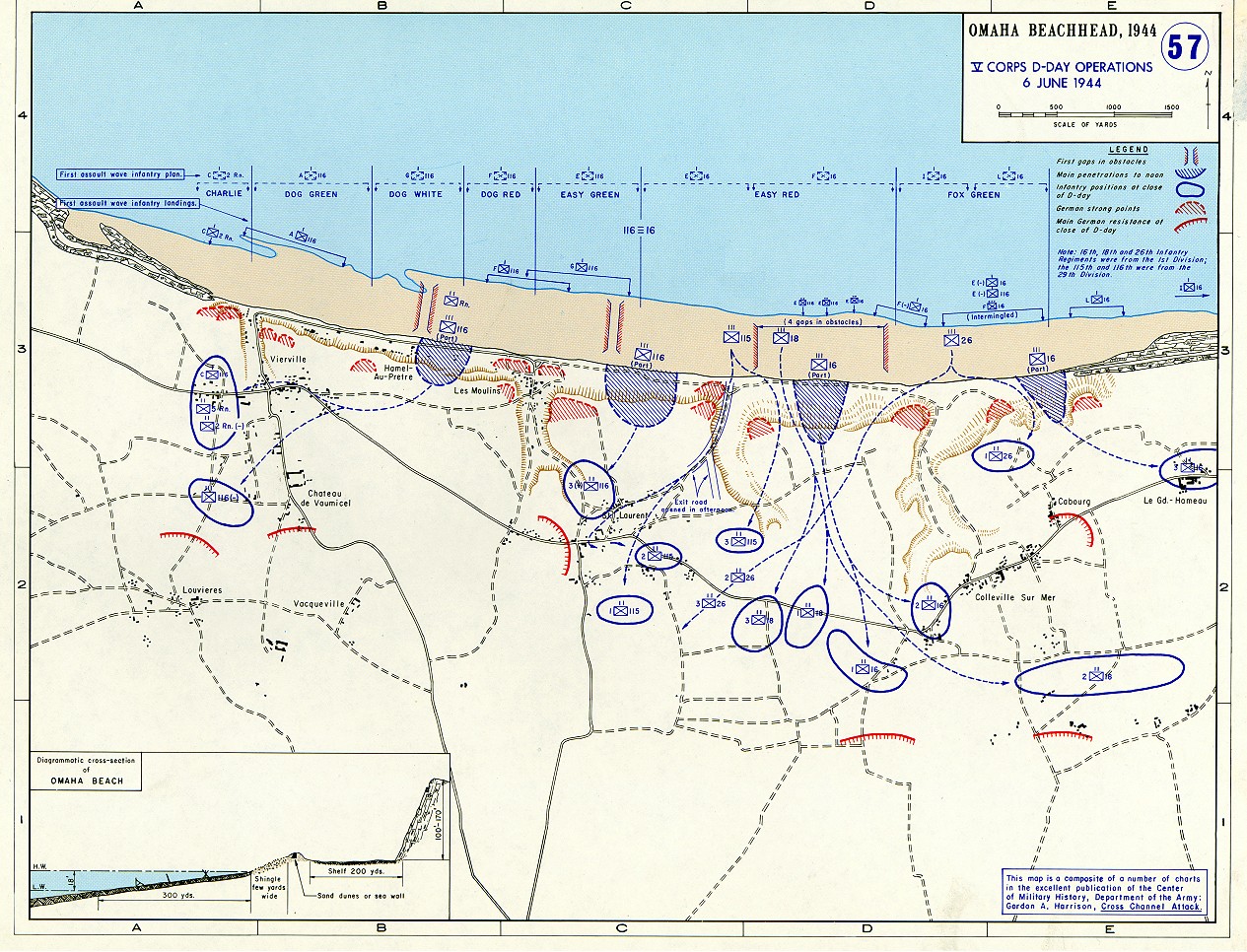
The troop movement on this map of the invasion's conclusion seems to indicate that the far east advance was by far the least successful. This report indicates that the 16th Infantry (in the Fox Green position) suffered the largest number of casualties on D-Day (although places the total casualty number much lower than referenced elsewhere). Both back the notion that Severloh was responsible for such a high percentage of the deaths.
So, I don't think we should be too quick to denounce the statistics claimed here.
posted by pokermonk at 8:06 PM on June 6, 2007 [7 favorites]
The troop movement on this map of the invasion's conclusion seems to indicate that the far east advance was by far the least successful. This report indicates that the 16th Infantry (in the Fox Green position) suffered the largest number of casualties on D-Day (although places the total casualty number much lower than referenced elsewhere). Both back the notion that Severloh was responsible for such a high percentage of the deaths.
So, I don't think we should be too quick to denounce the statistics claimed here.
posted by pokermonk at 8:06 PM on June 6, 2007 [7 favorites]
atchafalaya
The landing time was largely dependent on moving undetected across the channel during the night and arriving at the most opportune moment of the tide.
posted by X4ster at 8:14 PM on June 6, 2007 [1 favorite]
The landing time was largely dependent on moving undetected across the channel during the night and arriving at the most opportune moment of the tide.
posted by X4ster at 8:14 PM on June 6, 2007 [1 favorite]
Dasein: His kill : bullet ratio is more like 1 : 4. 4:1 would be a real trick.
posted by papakwanz at 8:19 PM on June 6, 2007
posted by papakwanz at 8:19 PM on June 6, 2007
from a translated page about WN62 and severloh i fell upon while researching:
"the hope of the Americans bled to come here to a fast success"
it is a horrifying poetry.
posted by pokermonk at 8:26 PM on June 6, 2007
"the hope of the Americans bled to come here to a fast success"
it is a horrifying poetry.
posted by pokermonk at 8:26 PM on June 6, 2007
Having been at WN32 (last year, not 63yrs ago), I can see how Severloh could certainly account for the high number of casaulties. Self-link to pictures
posted by Razzle Bathbone at 8:28 PM on June 6, 2007 [1 favorite]
posted by Razzle Bathbone at 8:28 PM on June 6, 2007 [1 favorite]
Damn, pokermonk, first the kickass spawn-point comment, and now detailed tactical info. You win at the internet, my man.
The number seems too large, but its enormity alone isn't enough to discount it. I think that both dasein and Steven C. Den Beste make good points against the claim. I doubt that there is enough information out there to come up with a good estimate, but I guess the number really isn't all that important.
posted by Tullius at 8:33 PM on June 6, 2007
The number seems too large, but its enormity alone isn't enough to discount it. I think that both dasein and Steven C. Den Beste make good points against the claim. I doubt that there is enough information out there to come up with a good estimate, but I guess the number really isn't all that important.
posted by Tullius at 8:33 PM on June 6, 2007
'casualty', I believe, denotes both killed and wounded. So it's not a kill:bullet ratio, but a hit:bullet ratio.
A hit:bullet ratio of 1:4 is still pretty amazing, but much more believable.
posted by nightwood at 8:33 PM on June 6, 2007
A hit:bullet ratio of 1:4 is still pretty amazing, but much more believable.
posted by nightwood at 8:33 PM on June 6, 2007
D'oh meant to say WN 62
posted by Razzle Bathbone at 8:38 PM on June 6, 2007
posted by Razzle Bathbone at 8:38 PM on June 6, 2007
Dude killed a lot of dudes.
Can we agree on that?
posted by wires at 8:41 PM on June 6, 2007 [2 favorites]
Can we agree on that?
posted by wires at 8:41 PM on June 6, 2007 [2 favorites]
At 1200 rounds per minute that's only ten minutes of machine gun fire. Is that right?
Mathematically, yes, but I'm pretty sure an MG42 wouldn't survive 10 minutes of constant fire. The barrel would heat up to the point of failure, that's why the ammo loader was also the barrel carrier, you had to stop and swap barrels pretty regularly. The one time I got to fire one (a friend in college had a collector for a father) we put about 100 rounds through it over 10 minutes or so, and were able to light smokes off the barrel fairly easily.
Also, the thousands of men landed on Omaha Beach weren't all rushed ashore in one fell swoop, it took some time for all the landing craft to come ashore.
As for Severloh, he was doing what he'd been trained and ordered to do, and probably wouldn't have survived if he'd refused. I find it hard to really hold any animosity for him 63 years after the fact.
posted by pupdog at 8:42 PM on June 6, 2007
Mathematically, yes, but I'm pretty sure an MG42 wouldn't survive 10 minutes of constant fire. The barrel would heat up to the point of failure, that's why the ammo loader was also the barrel carrier, you had to stop and swap barrels pretty regularly. The one time I got to fire one (a friend in college had a collector for a father) we put about 100 rounds through it over 10 minutes or so, and were able to light smokes off the barrel fairly easily.
Also, the thousands of men landed on Omaha Beach weren't all rushed ashore in one fell swoop, it took some time for all the landing craft to come ashore.
As for Severloh, he was doing what he'd been trained and ordered to do, and probably wouldn't have survived if he'd refused. I find it hard to really hold any animosity for him 63 years after the fact.
posted by pupdog at 8:42 PM on June 6, 2007
Hein Severloh killed nineteen ninjas in a cave in Tibet
posted by mattoxic at 8:45 PM on June 6, 2007 [1 favorite]
posted by mattoxic at 8:45 PM on June 6, 2007 [1 favorite]
Aww, it's like Brokeback Mountain, except with less lovin' and more killin'. "I wish I knew how to quit massacrin' you."
posted by kirkaracha at 8:47 PM on June 6, 2007

posted by kirkaracha at 8:47 PM on June 6, 2007
Careful there, freebird, that kind of talk leads to PLATE OF BEANS territory.
posted by redteam at 8:54 PM on June 6, 2007
posted by redteam at 8:54 PM on June 6, 2007
....................................................................................................
....................................................................................................
....................................................................................................
....................................................................................................
....................................................................................................
....................................................................................................
....................................................................................................
....................................................................................................
....................................................................................................
....................................................................................................
....................................................................................................
....................................................................................................
....................................................................................................
....................................................................................................
....................................................................................................
....................................................................................................
....................................................................................................
....................................................................................................
....................................................................................................
....................................................................................................
....................................................................................................
....................................................................................................
....................................................................................................
....................................................................................................
....................................................................................................
....................................................................................................
....................................................................................................
....................................................................................................
....................................................................................................
....................................................................................................
.
posted by cog_nate at 9:02 PM on June 6, 2007 [4 favorites]
....................................................................................................
....................................................................................................
....................................................................................................
....................................................................................................
....................................................................................................
....................................................................................................
....................................................................................................
....................................................................................................
....................................................................................................
....................................................................................................
....................................................................................................
....................................................................................................
....................................................................................................
....................................................................................................
....................................................................................................
....................................................................................................
....................................................................................................
....................................................................................................
....................................................................................................
....................................................................................................
....................................................................................................
....................................................................................................
....................................................................................................
....................................................................................................
....................................................................................................
....................................................................................................
....................................................................................................
....................................................................................................
....................................................................................................
.
posted by cog_nate at 9:02 PM on June 6, 2007 [4 favorites]
Regardless of the actual number of casualties and your particular position on the war, it looks like Severloh did some good soldiering that day. But the CO who set up the post deserves some credit too. Good eye.
posted by showmethecalvino at 9:05 PM on June 6, 2007
posted by showmethecalvino at 9:05 PM on June 6, 2007
I've always wondered, why didn't we land the main body at night? Seems like we could have saved some lives.
The invasion did start at night, with the 82nd and 101st Airborne divisions. It didn't work so well -- most of the men were scattered widely and some took hours to find their objectives. But others were able to secure bridges, strong points, and landing zones. This needed to take place before the main force got there and would not have been possible the day or dusk before.
D-Day was in fact a full moon (actually one day after a full moon). But the major determinant of the timing was the requirement to land at low tide. The hedgehogs, mines, and other hazards of the Atlantic Wall would be exposed and soldiers on foot could navigate around them, instead of the landing craft being blown up. This was also why there were so many soldiers on the beach to be enfiladed -- at low tide the beach is a wider expanse to cross.
The Tides of War
posted by dhartung at 9:31 PM on June 6, 2007
The invasion did start at night, with the 82nd and 101st Airborne divisions. It didn't work so well -- most of the men were scattered widely and some took hours to find their objectives. But others were able to secure bridges, strong points, and landing zones. This needed to take place before the main force got there and would not have been possible the day or dusk before.
D-Day was in fact a full moon (actually one day after a full moon). But the major determinant of the timing was the requirement to land at low tide. The hedgehogs, mines, and other hazards of the Atlantic Wall would be exposed and soldiers on foot could navigate around them, instead of the landing craft being blown up. This was also why there were so many soldiers on the beach to be enfiladed -- at low tide the beach is a wider expanse to cross.
The Tides of War
posted by dhartung at 9:31 PM on June 6, 2007
Ok, here's a few assorted links:
Map of Omaha Beach, showing location of the WN62 Strongpoint.
View from WN62 to the sea.
Looking West, down the beach.
MG42 Machine Gun
And here's a thread from a D-Day forum in which one member summarizes an interview with Severloh about the number of men he killed. An excerpt:
The story is pretty much what the various sources tell. WN 62 contained 30 men and the commander was Oberleutnant Frerking. The bunkers were pretty good I think, since Severloh said one naval shell hit 10 m from his position, but he wasn't afraid - he felt safe.
He had great respect for his commander (Frerking) who was like a father to him, although being only ten years older than him. The main reason for not pulling back earlier was to protect himself from the Americans, but also to protect his commander, Frerking. Another officer had brought him 12,000 rounds for his MG-42 with the order to hold that position.
He tells how he used his rifle, and that it was pretty easy to get a hit. He said that of 50 rounds, only 5 rounds missed. Good hit indicator was the water, and it was easy to correct aim by the splashes. He also stated, that when the GI's were wounded, to the arm for example, some of them just drowned since the water was to their waist.
Now, no more Googling for me!
posted by washburn at 9:47 PM on June 6, 2007 [1 favorite]
Map of Omaha Beach, showing location of the WN62 Strongpoint.
View from WN62 to the sea.

Looking West, down the beach.

MG42 Machine Gun
And here's a thread from a D-Day forum in which one member summarizes an interview with Severloh about the number of men he killed. An excerpt:
The story is pretty much what the various sources tell. WN 62 contained 30 men and the commander was Oberleutnant Frerking. The bunkers were pretty good I think, since Severloh said one naval shell hit 10 m from his position, but he wasn't afraid - he felt safe.
He had great respect for his commander (Frerking) who was like a father to him, although being only ten years older than him. The main reason for not pulling back earlier was to protect himself from the Americans, but also to protect his commander, Frerking. Another officer had brought him 12,000 rounds for his MG-42 with the order to hold that position.
He tells how he used his rifle, and that it was pretty easy to get a hit. He said that of 50 rounds, only 5 rounds missed. Good hit indicator was the water, and it was easy to correct aim by the splashes. He also stated, that when the GI's were wounded, to the arm for example, some of them just drowned since the water was to their waist.
Now, no more Googling for me!
posted by washburn at 9:47 PM on June 6, 2007 [1 favorite]
I took part in the invasion on Omaha and Hein Severloh killed me 5 or 6 times before I had to turn the difficulty down from 'Veteran' to 'Hardened.' Even after that it took another 3 or 4 tries before I got to the cliff and grabbed one of the climbing ropes. Another death or two from the Jerries cutting our ropes, plus a ton of quicksaves and eventually I was up there. Hein was making his way through the explosion craters by the time I tossed a 'nade into his bunker. Mom called me down for dinner at about that point so I had to pause but then when I came back I realized I had gone through all that just to find out the cannon barrels were melted!
Call of Duty 2 rocks.
posted by Demogorgon at 9:57 PM on June 6, 2007 [2 favorites]
Call of Duty 2 rocks.
posted by Demogorgon at 9:57 PM on June 6, 2007 [2 favorites]
It's not unreasonable that some farm boy who never asked to be there gunned down at least his own conservative estimate, 1000 (-25%), of our soldiers on that beach...maybe lots more...from a properly placed machine gun position.
I talked to my mom about this post. She remembers the 'breaking' news of D-Day on the radio and in the papers. We talked about that.
Then we talked about how this guy didn't have to be as cunning as Alvin York (just as good a shot) nor as aggressive as Audie Murphy.
Just trying to deal with what's confronting you:
I talked to my mom about this post. She remembers the 'breaking' news of D-Day on the radio and in the papers. We talked about that.
Then we talked about how this guy didn't have to be as cunning as Alvin York (just as good a shot) nor as aggressive as Audie Murphy.
Just trying to deal with what's confronting you:
Severloh, then just 20, gasped when he saw the ocean. He was confronted by what seemed to be a wall of Allied ships. He said: "My God. How am I going to get out of this mess?"posted by taosbat at 10:01 PM on June 6, 2007
The veteran explained: "What could I do? I just thought that I was never going to make it to the rear. I thought that I was going to shoot for my very life. It was them or me - that is what I thought."
...Severloh did some good soldiering that day...
y'know, he doesn't seem to think so. He's right, and it's not that the evaluation of good soldiering is off base. Good soldiering is bad humanity.
posted by mwhybark at 10:02 PM on June 6, 2007 [3 favorites]
y'know, he doesn't seem to think so. He's right, and it's not that the evaluation of good soldiering is off base. Good soldiering is bad humanity.
posted by mwhybark at 10:02 PM on June 6, 2007 [3 favorites]
The barrel would heat up to the point of failure, that's why the ammo loader was also the barrel carrier, you had to stop and swap barrels pretty regularly.
If you watch Saving Private Ryan, they use this as a strategy at one point. Distract the machine gunner until he has to change his barrels, and then everybody pounces and kills him.
I'm sure this fellow and his position knew how to keep their weapon working. I'm sure the gun positions took downtime for changing barrels into account. I'm sure the WWII historian took all the objections raised about the 3000 number into account, too.
The "beast" did his job. Just like he Americans landing did theirs, when they killed a shit load of Germans.
posted by teece at 10:11 PM on June 6, 2007
If you watch Saving Private Ryan, they use this as a strategy at one point. Distract the machine gunner until he has to change his barrels, and then everybody pounces and kills him.
I'm sure this fellow and his position knew how to keep their weapon working. I'm sure the gun positions took downtime for changing barrels into account. I'm sure the WWII historian took all the objections raised about the 3000 number into account, too.
The "beast" did his job. Just like he Americans landing did theirs, when they killed a shit load of Germans.
posted by teece at 10:11 PM on June 6, 2007
The numbers seems suspect to me. A 1:4 hit ratio with a fully automatic weapon is unlikely.
But not impossible.
Assuming that this is greatly exaggerated and he only got one tenth of the kills he was credited for, that is still 300 people.
300 people is the staff of an average American mall, or the head count of any given grade school.
Or maybe even that number was off, and he only killed 30 people.
Your favorite sports team might have 30 people on it. Also, your average office department.
Or possibly even that was overstated by a power of 10. Maybe he only actually killed three people.
Three people could be you, your wife, and your child.
And then, maybe the number is totally accurate. Maybe he actually killed three thousand people. It may be unrealistic, but it is theoretically possible.
Now you have killed a small mid-Western town.
Assuming there is even a chance that this guy believes that he is responsible for what people are claiming he is involved with, I'm really surprised he is even remotely sane.
I doubt that he killed a small town, but I really am sorry for a man who definitely harmed people and has had to live with that horror. I don't know that I would have been able to put it aside for the better part of six decades.
posted by quin at 10:54 PM on June 6, 2007
But not impossible.
Assuming that this is greatly exaggerated and he only got one tenth of the kills he was credited for, that is still 300 people.
300 people is the staff of an average American mall, or the head count of any given grade school.
Or maybe even that number was off, and he only killed 30 people.
Your favorite sports team might have 30 people on it. Also, your average office department.
Or possibly even that was overstated by a power of 10. Maybe he only actually killed three people.
Three people could be you, your wife, and your child.
And then, maybe the number is totally accurate. Maybe he actually killed three thousand people. It may be unrealistic, but it is theoretically possible.
Now you have killed a small mid-Western town.
Assuming there is even a chance that this guy believes that he is responsible for what people are claiming he is involved with, I'm really surprised he is even remotely sane.
I doubt that he killed a small town, but I really am sorry for a man who definitely harmed people and has had to live with that horror. I don't know that I would have been able to put it aside for the better part of six decades.
posted by quin at 10:54 PM on June 6, 2007
The invasion did start at night, with the 6th Airborne Division, 82nd and 101st Airborne divisions.
You forgot one. The one with the funny accents, admittedly.
posted by Mr Bismarck at 11:23 PM on June 6, 2007
You forgot one. The one with the funny accents, admittedly.
posted by Mr Bismarck at 11:23 PM on June 6, 2007
y'know, he doesn't seem to think so. He's right, and it's not that the evaluation of good soldiering is off base. Good soldiering is bad humanity.
Oh, come on. He was in a war -- in war, good soldiering is the very height of humanity. What was he supposed to do, put up his gun and sit there while thousands of Allied troopers were running up the beach toward his comrades, screaming and waving guns?
If he'd done that, they might have got Jaeger, just 16 and scared as hell, or Hartmann, with his funny way of putting on his cap brim-first, or the medic who went out in the open to drag the leutnant to safety two weeks ago. And the C.O. probably would have shot him and got somebody else to run the gun, anyway. It's war, not a self-esteem seminar.
I'm curious -- did those kids running up the beach count as "bad humans" too?
posted by vorfeed at 11:47 PM on June 6, 2007
Oh, come on. He was in a war -- in war, good soldiering is the very height of humanity. What was he supposed to do, put up his gun and sit there while thousands of Allied troopers were running up the beach toward his comrades, screaming and waving guns?
If he'd done that, they might have got Jaeger, just 16 and scared as hell, or Hartmann, with his funny way of putting on his cap brim-first, or the medic who went out in the open to drag the leutnant to safety two weeks ago. And the C.O. probably would have shot him and got somebody else to run the gun, anyway. It's war, not a self-esteem seminar.
I'm curious -- did those kids running up the beach count as "bad humans" too?
posted by vorfeed at 11:47 PM on June 6, 2007
"I took part in the invasion on Omaha and Hein Severloh killed me 5 or 6 times before I had to turn the difficulty down from 'Veteran' to 'Hardened.'"
On "Veteran," in my opinion, the only way you get past that beach and the cliff climb is by sheer luck.
Pretty much like real life, I'd think.
I think I did it 30 times before I survived that meat grinder; it's walking through a wall of flying lead. I have little difficulty believing that an accurate shooter with a good weapon and crew and the right field of fire could take out a regiment on his own, given the regiment had no choice but to keep moving up the beach through his gunsights.
"Call of Duty 2 rocks."
Amen to that, brother!
Which beach did the Canadians go up? Didn't Jimmy Doohan lose his finger going up the beach? Was that anywhere nearby?
posted by zoogleplex at 12:06 AM on June 7, 2007
On "Veteran," in my opinion, the only way you get past that beach and the cliff climb is by sheer luck.
Pretty much like real life, I'd think.
I think I did it 30 times before I survived that meat grinder; it's walking through a wall of flying lead. I have little difficulty believing that an accurate shooter with a good weapon and crew and the right field of fire could take out a regiment on his own, given the regiment had no choice but to keep moving up the beach through his gunsights.
"Call of Duty 2 rocks."
Amen to that, brother!
Which beach did the Canadians go up? Didn't Jimmy Doohan lose his finger going up the beach? Was that anywhere nearby?
posted by zoogleplex at 12:06 AM on June 7, 2007
Holy shit. I can't even comprehend what it would be like to be on either end of that gun.
Also, war shooters like Call of Duty really weird the piss out of me. It just seems screwy to make a game out of this kind of thing. Don't get me wrong: I'm not the censorial type at all (I make horror flicks for fuck's sake). But just imagine if they made a Call of Duty: Iraqi Dawn, or something. I played a demo of Medal of Honor once, and found it technically impressive, but I never touched it again. War is hell and all that. Hell isn't fun.
posted by brundlefly at 1:33 AM on June 7, 2007 [1 favorite]
Also, war shooters like Call of Duty really weird the piss out of me. It just seems screwy to make a game out of this kind of thing. Don't get me wrong: I'm not the censorial type at all (I make horror flicks for fuck's sake). But just imagine if they made a Call of Duty: Iraqi Dawn, or something. I played a demo of Medal of Honor once, and found it technically impressive, but I never touched it again. War is hell and all that. Hell isn't fun.
posted by brundlefly at 1:33 AM on June 7, 2007 [1 favorite]
Which beach did the Canadians go up?
Juno. There's a map here of the positions of the beaches. From my dodgy memory, I think they were each about four or five miles wide.
posted by vbfg at 1:47 AM on June 7, 2007
Juno. There's a map here of the positions of the beaches. From my dodgy memory, I think they were each about four or five miles wide.
posted by vbfg at 1:47 AM on June 7, 2007
DOOD. I THAWT YOU SAID THIS WAS A PISTOLZ ONLY MATCH!
posted by phaedon at 2:41 AM on June 7, 2007 [1 favorite]
posted by phaedon at 2:41 AM on June 7, 2007 [1 favorite]
It just seems screwy to make a game out of this kind of thing.
Amen to that. I know not when and how we decided that brutality is entertainment. I do know, exactly, when and how that was undecided in me: I was sitting at the feet of the late poet Leslie Norris as he recited The Ballad of Billy Rose. The scale, the pathos, and the guilt of which are in no wise comparable to anything that ever had anything to do with any war, anywhere.
Thanks for this post. Remembering the things of war, contemplating them, and then seeing what became of Hein Severloh and David Silva, I begin to think that maybe we did make some progress between the World Wars, and that maybe we may yet make Wilfred Owen a better prophet than he knew:
Amen to that. I know not when and how we decided that brutality is entertainment. I do know, exactly, when and how that was undecided in me: I was sitting at the feet of the late poet Leslie Norris as he recited The Ballad of Billy Rose. The scale, the pathos, and the guilt of which are in no wise comparable to anything that ever had anything to do with any war, anywhere.
Thanks for this post. Remembering the things of war, contemplating them, and then seeing what became of Hein Severloh and David Silva, I begin to think that maybe we did make some progress between the World Wars, and that maybe we may yet make Wilfred Owen a better prophet than he knew:
The Next Warposted by eritain at 2:45 AM on June 7, 2007 [1 favorite]
Out there, we've walked quite friendly up to Death;
Sat down and eaten with him, cool and bland;
Pardoned his spilling mess-tins in our hand.
We've sniffed the green thick odour of his breath—
Our eyes wept, but our courage didn't writhe.
He's spat at us with bullets and he's coughed
Shrapnel. We chorused when he sang aloft;
We whistled while he shaved us with his scythe.
Oh, Death was never enemy of ours!
We laughed at him, we leagued with him, old chum.
No soldier's paid to kick against his powers.
We laughed, knowing that better men would come,
And greater wars: When each proud fighter brags
He wars on Death—for lives; not men—for flags.
So, is it possible to fire an MG 42 in bursts of 4 or less bullets? If so, and if an American GI filed right past his bunker once every 10 seconds, then the figures are at least plausible, are they not?
posted by hoverboards don't work on water at 2:47 AM on June 7, 2007
posted by hoverboards don't work on water at 2:47 AM on June 7, 2007
But just imagine if they made a Call of Duty: Iraqi Dawn, or something.
They pretty much are: Call of Duty 4 trailer
posted by i_am_a_Jedi at 4:31 AM on June 7, 2007
They pretty much are: Call of Duty 4 trailer
posted by i_am_a_Jedi at 4:31 AM on June 7, 2007
altman, that site is not what I had in mind when thinking of "meat grinder." Even if there was much grinding, and meat.
Is it possible you were making subtle commentary on the Pacific war?
posted by bashos_frog at 5:14 AM on June 7, 2007
Is it possible you were making subtle commentary on the Pacific war?
posted by bashos_frog at 5:14 AM on June 7, 2007
There would have been two guys manning the MG42 - one to fire and the other to feed in the ammunition. It's strange that the other dude doesn't get a mention in these accounts.
posted by Flashman at 5:39 AM on June 7, 2007
posted by Flashman at 5:39 AM on June 7, 2007
Also I think, like the AK47 which it predates by a few years, variants of the MG 42 are still used today.
posted by Flashman at 5:41 AM on June 7, 2007
posted by Flashman at 5:41 AM on June 7, 2007
There would have been two guys manning the MG42 - one to fire and the other to feed in the ammunition. It's strange that the other dude doesn't get a mention in these accounts.
It was probably Tenzig Norgay, before he helped Edmund Hillary to the peak of Everest.
posted by Devils Rancher at 6:22 AM on June 7, 2007 [1 favorite]
It was probably Tenzig Norgay, before he helped Edmund Hillary to the peak of Everest.
posted by Devils Rancher at 6:22 AM on June 7, 2007 [1 favorite]
Somewhere in this is a really terrific Coca-Cola commercial.
posted by humannaire at 7:01 AM on June 7, 2007
posted by humannaire at 7:01 AM on June 7, 2007
I don't think it's an unreal number of casualties. Restricted maneuver areas lend themselves to bottlenecks which can be easily exploited. It's not unimaginable that a properly dialed in machine gunner could achive a 1:4 hit:round ratio when engaging a wall of flesh with sweeping fire. It also looks like Hein's position was well placed while bunker's other gunner's field of fire was largely redundant given the actual invasion points so it is possible that some of the other gunner's rounds / barrels / AG could have been put to Hein's use.
The question ultimately is moot in my mind though. Dude has been put through some serious hell and I'm willing to grant him a lot of leeway w/r/t his story if it helps him get through the day. I really think that sometimes it is better to die on the battlefield than to have to spend the next 60+ years reliving it.
posted by Fezboy! at 7:31 AM on June 7, 2007
The question ultimately is moot in my mind though. Dude has been put through some serious hell and I'm willing to grant him a lot of leeway w/r/t his story if it helps him get through the day. I really think that sometimes it is better to die on the battlefield than to have to spend the next 60+ years reliving it.
posted by Fezboy! at 7:31 AM on June 7, 2007
I've always mused, in a sci-fi kind of way, what the Civil War would have been like if one side had one gun like this MG42 thing. I guess I have an idea now.
Also, this guy makes Audie Murphy look like a slacker. History gets written by the winners, indeed.
posted by stupidsexyFlanders at 7:31 AM on June 7, 2007
Also, this guy makes Audie Murphy look like a slacker. History gets written by the winners, indeed.
posted by stupidsexyFlanders at 7:31 AM on June 7, 2007
Mmmmmmmm, warporn.
posted by signal at 7:40 AM on June 7, 2007 [1 favorite]
posted by signal at 7:40 AM on June 7, 2007 [1 favorite]
I know about the night air drops, and the tides. I still wonder, why didn't they just do the whole damn thing at night. Moving it a week or two one way or the other, the tides would have been right.
Maybe the disaster at Slapton Sands made them put it in daylight.
posted by atchafalaya at 7:50 AM on June 7, 2007
Maybe the disaster at Slapton Sands made them put it in daylight.
posted by atchafalaya at 7:50 AM on June 7, 2007
I can totally relate to LCpl Severloh's reaction to his day of combat.
My dad was disgusted at having had to kill Germans who, as he put it, "never did anything to me personally and I wasn't even particularly mad at." He spent decades grappling with it, chain-smoking alone in the dark at the kitchen table. He only talked about it -- the bad stuff, I mean -- after Mom was gone and he realized he didn't have all that much longer himself. As a public service to MeFi'ers everywhere, I'll spare you details.
-----
I've always mused, in a sci-fi kind of way, what the Civil War would have been like if one side had one gun like this MG42 thing. I guess I have an idea now.
How about AK-47s?
posted by pax digita at 8:05 AM on June 7, 2007
My dad was disgusted at having had to kill Germans who, as he put it, "never did anything to me personally and I wasn't even particularly mad at." He spent decades grappling with it, chain-smoking alone in the dark at the kitchen table. He only talked about it -- the bad stuff, I mean -- after Mom was gone and he realized he didn't have all that much longer himself. As a public service to MeFi'ers everywhere, I'll spare you details.
-----
I've always mused, in a sci-fi kind of way, what the Civil War would have been like if one side had one gun like this MG42 thing. I guess I have an idea now.
How about AK-47s?
posted by pax digita at 8:05 AM on June 7, 2007
Oh, come on. He was in a war -- in war, good soldiering
is the very height of humanity.
I disagree. In a just war, it may be fair to say that good soldiering is the very height of soldiering, but that's all you can say. For your assertion to hold, war itself would have to represent an ideal to which humanity aspires, which it doesn't. War represents an unfortunate breakdown in the normal moral order that humanity aspires to. When the cause of the war is just, it's an unpleasant necessity, like taking out the trash--never a noble pursuit in its own right. Good soldiering in no sense represents the "height of humanity," especially not when its done in pursuit of an unjust cause. Just because someone is capable of carrying out a particular human activity skillfully doesn't mean that the person is exemplifying "the best of humanity." Some serial killers are extraordinarily skilled at covering up their crimes (and there probably have always been and will always be serial killers in every human society until the end of time), and yet, we don't regard good serial killing as "the very height of humanity". (Don't misunderstand: I don't mean to compare soldiers to serial killers.) What makes the case of a good soldier special, especially one fighting on behalf of a government carrying out a campaign of genocide? War for war's sake isn't a noble activity, so heroic deeds in a time of war aren't intrinsically noble, while we may rightly respect the skill with those deeds are carried out, particularly in the case of a just war.
posted by saulgoodman at 8:09 AM on June 7, 2007 [3 favorites]
is the very height of humanity.
I disagree. In a just war, it may be fair to say that good soldiering is the very height of soldiering, but that's all you can say. For your assertion to hold, war itself would have to represent an ideal to which humanity aspires, which it doesn't. War represents an unfortunate breakdown in the normal moral order that humanity aspires to. When the cause of the war is just, it's an unpleasant necessity, like taking out the trash--never a noble pursuit in its own right. Good soldiering in no sense represents the "height of humanity," especially not when its done in pursuit of an unjust cause. Just because someone is capable of carrying out a particular human activity skillfully doesn't mean that the person is exemplifying "the best of humanity." Some serial killers are extraordinarily skilled at covering up their crimes (and there probably have always been and will always be serial killers in every human society until the end of time), and yet, we don't regard good serial killing as "the very height of humanity". (Don't misunderstand: I don't mean to compare soldiers to serial killers.) What makes the case of a good soldier special, especially one fighting on behalf of a government carrying out a campaign of genocide? War for war's sake isn't a noble activity, so heroic deeds in a time of war aren't intrinsically noble, while we may rightly respect the skill with those deeds are carried out, particularly in the case of a just war.
posted by saulgoodman at 8:09 AM on June 7, 2007 [3 favorites]
I like these stories when they remember how wars are utterly absured, pointless, useless , violent and generally paid by Joes with lives . There is absolutely no honor, no courage, no value ...it's totally useless and completely avoidable. Yet I bet those who survived and talk about a war as-if the experience was somehow "dreamy" actually didn't fight much or were safely hidden somewhere.
posted by elpapacito at 8:10 AM on June 7, 2007
posted by elpapacito at 8:10 AM on June 7, 2007
Also I think, like the AK47 which it predates by a few years, variants of the MG 42 are still used today.
M60 is based on it. The Rambo machine gun, not the tank.
posted by ROU_Xenophobe at 8:27 AM on June 7, 2007
M60 is based on it. The Rambo machine gun, not the tank.
posted by ROU_Xenophobe at 8:27 AM on June 7, 2007
Maybe this guy wasn't specifically evil, but surely his side (Nazis) was.
WWII must have been complete hell. The first soldiers storming the beach were running into a virtual death sentence and they knew it. As dangerous as it is in Iraq, it's nothing compared to this battle.
My grandfather had two older brothers who fought against the Japanese. There is a Japanese officer's sword and a photo of someone in my great uncle's unit holding the sword and a severed Japanese head. Not surprisingly, both veteran great uncles died before I was born. One pretty much drank himself to death and the other shot himself.
My in-laws are from the Indonesian island of Borneo. The Japanese invaded and planned to kill all the men over 12 and raise the kids as Japanese. Thus my father-in-law, being below the cut-off age, was spared and raised by his grandmother's sister. His dad, uncles and some brothers were executed by the Japanese.
posted by b_thinky at 8:45 AM on June 7, 2007
WWII must have been complete hell. The first soldiers storming the beach were running into a virtual death sentence and they knew it. As dangerous as it is in Iraq, it's nothing compared to this battle.
My grandfather had two older brothers who fought against the Japanese. There is a Japanese officer's sword and a photo of someone in my great uncle's unit holding the sword and a severed Japanese head. Not surprisingly, both veteran great uncles died before I was born. One pretty much drank himself to death and the other shot himself.
My in-laws are from the Indonesian island of Borneo. The Japanese invaded and planned to kill all the men over 12 and raise the kids as Japanese. Thus my father-in-law, being below the cut-off age, was spared and raised by his grandmother's sister. His dad, uncles and some brothers were executed by the Japanese.
posted by b_thinky at 8:45 AM on June 7, 2007
I disagree. In a just war, it may be fair to say that good soldiering is the very height of soldiering, but that's all you can say. For your assertion to hold, war itself would have to represent an ideal to which humanity aspires, which it doesn't. War represents an unfortunate breakdown in the normal moral order that humanity aspires to.
I have a very hard time believing this about something that's happening every second on one corner of the globe or another, and has been happening since humanity was first walking upright. Humanity clearly aspires to war; always has and probably always will. Hell, you could make the historical argument that war is the "normal moral order", and the occasional breakouts of peace are merely preparation for it.
And as for "just wars" and all that nonsense -- please define "just". What makes a "just war" in the eyes of history is a victory, bar none. Our own just war involved the largest single-action civilian slaughters in history... and if the Nazis had won, you can bet that we'd be discussing how the Dresden firebombing makes England a morally bankrupt nation. That's the way it goes, and pretending otherwise just puts an empty veneer of "justice" on all the nasty things we did in the war, ends-justify-the-means style. I think it's best to simply admit that war has a value of its own, rather than assigning value to this-or-that side of a war based on subjective hindsight.
posted by vorfeed at 9:35 AM on June 7, 2007 [1 favorite]
I have a very hard time believing this about something that's happening every second on one corner of the globe or another, and has been happening since humanity was first walking upright. Humanity clearly aspires to war; always has and probably always will. Hell, you could make the historical argument that war is the "normal moral order", and the occasional breakouts of peace are merely preparation for it.
And as for "just wars" and all that nonsense -- please define "just". What makes a "just war" in the eyes of history is a victory, bar none. Our own just war involved the largest single-action civilian slaughters in history... and if the Nazis had won, you can bet that we'd be discussing how the Dresden firebombing makes England a morally bankrupt nation. That's the way it goes, and pretending otherwise just puts an empty veneer of "justice" on all the nasty things we did in the war, ends-justify-the-means style. I think it's best to simply admit that war has a value of its own, rather than assigning value to this-or-that side of a war based on subjective hindsight.
posted by vorfeed at 9:35 AM on June 7, 2007 [1 favorite]
I have a very hard time believing this about something that's happening every second on one corner of the globe or another, and has been happening since humanity was first walking upright. Humanity clearly aspires to war; always has and probably always will.
So you hand out humanitarian achievement awards to the world's best rapists, murderers, thieves, liars and cowards, too? You can say exactly the same thing about those.
Humanity clearly aspires to rape, larceny, and stabbing people in the back; always has and probably always will.
posted by saulgoodman at 9:40 AM on June 7, 2007
So you hand out humanitarian achievement awards to the world's best rapists, murderers, thieves, liars and cowards, too? You can say exactly the same thing about those.
Humanity clearly aspires to rape, larceny, and stabbing people in the back; always has and probably always will.
posted by saulgoodman at 9:40 AM on June 7, 2007
humanity doesn't aspire to war. empathy-crippled, bored, spoiled psychopathic idiots might, but humanity as a whole certainly does not.
posted by saulgoodman at 9:43 AM on June 7, 2007
posted by saulgoodman at 9:43 AM on June 7, 2007
I don't think "humanity" has aspirations. I think it has instincts and impulses and I think one of its major impulses is to problem solve with violence.
posted by spicynuts at 10:00 AM on June 7, 2007 [2 favorites]
posted by spicynuts at 10:00 AM on June 7, 2007 [2 favorites]
I don't think "humanity" has aspirations. I think it has instincts and impulses and I think one of its major impulses is to problem solve with violence.
Individual humans have instincts and impulses. Human society ("humanity") has long-term goals, which sometimes require society to forcibly subvert the impulses and instincts of individual humans.
posted by saulgoodman at 10:06 AM on June 7, 2007
Individual humans have instincts and impulses. Human society ("humanity") has long-term goals, which sometimes require society to forcibly subvert the impulses and instincts of individual humans.
posted by saulgoodman at 10:06 AM on June 7, 2007
I like these stories when they remember how wars are utterly absured, pointless, useless , violent and generally paid by Joes with lives.
Same. When veterans from both sides meet and share stories at contemporary memorial ceremonies, there is such a tangible relationship between them, a weird bond that transcends history, hatred, logic, or politics, a bond so human, a bond that has no place in this world nowadays, that I can't help but cry.
posted by Alvy Ampersand at 10:23 AM on June 7, 2007
Same. When veterans from both sides meet and share stories at contemporary memorial ceremonies, there is such a tangible relationship between them, a weird bond that transcends history, hatred, logic, or politics, a bond so human, a bond that has no place in this world nowadays, that I can't help but cry.
posted by Alvy Ampersand at 10:23 AM on June 7, 2007
Human society ("humanity") has long-term goals, which sometimes require society to forcibly subvert the impulses and instincts of individual humans.
I don't interpret 'humanity' to mean human society. But, if we use that interpretation I still disagree. Who is in charge of setting these long term goals? Are all cultures and societies agreed upon what the main goal of Human Society should be? What mechanism or governing body is removed enought from the particular conflicting interests/desires of each separate culture/society to determine a mean direction for goals and aspirations? Humanity is too fickle and conflicted to have common goals/aspirations other than survival/propagation of the species. In my view anyway.
posted by spicynuts at 10:27 AM on June 7, 2007
I don't interpret 'humanity' to mean human society. But, if we use that interpretation I still disagree. Who is in charge of setting these long term goals? Are all cultures and societies agreed upon what the main goal of Human Society should be? What mechanism or governing body is removed enought from the particular conflicting interests/desires of each separate culture/society to determine a mean direction for goals and aspirations? Humanity is too fickle and conflicted to have common goals/aspirations other than survival/propagation of the species. In my view anyway.
posted by spicynuts at 10:27 AM on June 7, 2007
I like these stories when they remember how wars are utterly absured, pointless, useless , violent and generally paid by Joes with lives.
It seems to me that these 'absurd' wars can only be propagated with the complicity of the masses that are exploited in waging them. If Joes would tend to selecting and monitoring their governments as diligently as they tend to selecting and monitoring their Fantasy Football teams the perhaps they wouldn't pay with their lives for the games of the powerful. Plenty of German Josef's must have drunk Hitler's Kool Aid to allow him to wage such violence.
posted by spicynuts at 10:30 AM on June 7, 2007
It seems to me that these 'absurd' wars can only be propagated with the complicity of the masses that are exploited in waging them. If Joes would tend to selecting and monitoring their governments as diligently as they tend to selecting and monitoring their Fantasy Football teams the perhaps they wouldn't pay with their lives for the games of the powerful. Plenty of German Josef's must have drunk Hitler's Kool Aid to allow him to wage such violence.
posted by spicynuts at 10:30 AM on June 7, 2007
Someone shot Oetzi in the back with an arrow, then probably finished him off when they pulled it out, and that bestowed a certain sort of immortality on him. saulgoodman, I wonder how often Janus' Gates have been really closed...how many days out of all our generations? I wonder if 'humanity' really does have long-term goals beyond dominion?
posted by taosbat at 10:34 AM on June 7, 2007
posted by taosbat at 10:34 AM on June 7, 2007
Who is in charge of setting these long term goals?
Which particular cells in your brain were in charge of formulating this objection? Humanity's values and long-term aspirations are an emergent property of the collective sum of individual humans' long-term aspirations and values. The vast majority of people throughout history have not considered war to be a good in itself. There's a clear historical consensus that war actually kind of sucks. Whether every individual throughout history has agreed on that point or not is irrelevant.
posted by saulgoodman at 11:12 AM on June 7, 2007
Which particular cells in your brain were in charge of formulating this objection? Humanity's values and long-term aspirations are an emergent property of the collective sum of individual humans' long-term aspirations and values. The vast majority of people throughout history have not considered war to be a good in itself. There's a clear historical consensus that war actually kind of sucks. Whether every individual throughout history has agreed on that point or not is irrelevant.
posted by saulgoodman at 11:12 AM on June 7, 2007
("your not my daddy--you can't make me!" is not a legitimate alternative to social consensus.)
posted by saulgoodman at 11:14 AM on June 7, 2007
posted by saulgoodman at 11:14 AM on June 7, 2007
I wonder if 'humanity' really does have long-term goals beyond dominion?
I doubt humanity has any human characteristics, since it's a large, complex, dynamic mass entity that really can't be reduced to an analogy with individual human beings, no matter how hard poets and despots might try.
posted by hoverboards don't work on water at 11:17 AM on June 7, 2007
I doubt humanity has any human characteristics, since it's a large, complex, dynamic mass entity that really can't be reduced to an analogy with individual human beings, no matter how hard poets and despots might try.
posted by hoverboards don't work on water at 11:17 AM on June 7, 2007
I doubt humanity has any human characteristics, since it's a large, complex, dynamic mass entity
maybe not, but then, we're all individually large, complex, dynamic multicellular organisms but we routinely attribute intentions to ourselves and claim to be able to make analogies among different individuals (especially when we're waging war).
some of the erich fromm stuff discussed here seems kind of relevant to this side discussion. Especially what he has to say in this article.
posted by saulgoodman at 11:29 AM on June 7, 2007
maybe not, but then, we're all individually large, complex, dynamic multicellular organisms but we routinely attribute intentions to ourselves and claim to be able to make analogies among different individuals (especially when we're waging war).
some of the erich fromm stuff discussed here seems kind of relevant to this side discussion. Especially what he has to say in this article.
posted by saulgoodman at 11:29 AM on June 7, 2007
So you hand out humanitarian achievement awards to the world's best rapists, murderers, thieves, liars and cowards, too? You can say exactly the same thing about those.
No, you can't, mainly because humanity includes these, but does not aspire to them. In general, people do not write poems to exult rape, they do not give out medals for thievery (except in war, natch), and they do not spend their entire lives in watchful preparation for cowardice. War, however, fits very well in these sentences. The idea that war can be a positive action (or, at worst, a "necessary evil") is about as close to a universal human societal value as you can get. And for good reason, because those who don't have it won't keep their society for long when faced by those who do.
Dulce et decorum est was not written about the act of murder.
Individual humans have instincts and impulses. Human society ("humanity") has long-term goals, which sometimes require society to forcibly subvert the impulses and instincts of individual humans.
Exactly. And war is one process by which society forcibly subverts the impulses and instincts of individual humans. A fight or a skirmish might be based on nothing but human instinct, but a large-scale battle and especially a war is a deliberate, continual act of society. This is another reason why war is different from murder and other acts of "low instinct" -- as you yourself have said, society does not have instinct, and war is the strict domain of society.
The vast majority of people throughout history have not considered war to be a good in itself. There's a clear historical consensus that war actually kind of sucks.
This consensus is a relatively new thing, and even now wars go on despite it, given the slightest excuse. Also, I would say that "the vast majority of people throughout history" did indeed consider war to be a good -- or, at the least, they considered victory to be so. If humanity's values are an emergent function of human aspiration, how can you excuse away the celebration and glory associated with service in war throughout history? People have exulted war over and over again, across disparate societies and throughout the span of history. One could argue that the course of history itself has been shaped more by the war-making classes than by any other single group. How can this be if war is not a human value? That makes no sense to me.
posted by vorfeed at 11:35 AM on June 7, 2007
No, you can't, mainly because humanity includes these, but does not aspire to them. In general, people do not write poems to exult rape, they do not give out medals for thievery (except in war, natch), and they do not spend their entire lives in watchful preparation for cowardice. War, however, fits very well in these sentences. The idea that war can be a positive action (or, at worst, a "necessary evil") is about as close to a universal human societal value as you can get. And for good reason, because those who don't have it won't keep their society for long when faced by those who do.
Dulce et decorum est was not written about the act of murder.
Individual humans have instincts and impulses. Human society ("humanity") has long-term goals, which sometimes require society to forcibly subvert the impulses and instincts of individual humans.
Exactly. And war is one process by which society forcibly subverts the impulses and instincts of individual humans. A fight or a skirmish might be based on nothing but human instinct, but a large-scale battle and especially a war is a deliberate, continual act of society. This is another reason why war is different from murder and other acts of "low instinct" -- as you yourself have said, society does not have instinct, and war is the strict domain of society.
The vast majority of people throughout history have not considered war to be a good in itself. There's a clear historical consensus that war actually kind of sucks.
This consensus is a relatively new thing, and even now wars go on despite it, given the slightest excuse. Also, I would say that "the vast majority of people throughout history" did indeed consider war to be a good -- or, at the least, they considered victory to be so. If humanity's values are an emergent function of human aspiration, how can you excuse away the celebration and glory associated with service in war throughout history? People have exulted war over and over again, across disparate societies and throughout the span of history. One could argue that the course of history itself has been shaped more by the war-making classes than by any other single group. How can this be if war is not a human value? That makes no sense to me.
posted by vorfeed at 11:35 AM on June 7, 2007
"Call of Duty: Virginia Tech"
Too soon? Will sixty odd years make it OK?
There's a big difference in the situations being simulated, but not so much difference in the humanity.
posted by wires at 11:38 AM on June 7, 2007
Too soon? Will sixty odd years make it OK?
There's a big difference in the situations being simulated, but not so much difference in the humanity.
posted by wires at 11:38 AM on June 7, 2007
The vast majority of people throughout history have not considered war to be a good in itself.
And yet it keeps happening. Your statement above:
humanity doesn't aspire to war. empathy-crippled, bored, spoiled psychopathic idiots might, but humanity as a whole certainly does not.
neglects to consider my point that those psychopathic idiots could not succeed without the consent of vast majorities of humans. Humanity's behavior illustrates its true motivation. Actions speak louder than words. Hence, the collective aspiration of humanity does not appear to be peace.
posted by spicynuts at 11:43 AM on June 7, 2007
And yet it keeps happening. Your statement above:
humanity doesn't aspire to war. empathy-crippled, bored, spoiled psychopathic idiots might, but humanity as a whole certainly does not.
neglects to consider my point that those psychopathic idiots could not succeed without the consent of vast majorities of humans. Humanity's behavior illustrates its true motivation. Actions speak louder than words. Hence, the collective aspiration of humanity does not appear to be peace.
posted by spicynuts at 11:43 AM on June 7, 2007
"Sing, goddess, the rage of Achilles the son of Peleus, the destructive rage that sent countless pains on the Achaeans..."
posted by taosbat at 11:45 AM on June 7, 2007
posted by taosbat at 11:45 AM on June 7, 2007
People have exulted war over and over again, across disparate societies and throughout the span of history.
See also: War Is A Force That Gives Us Meaning
posted by spicynuts at 11:46 AM on June 7, 2007
See also: War Is A Force That Gives Us Meaning
posted by spicynuts at 11:46 AM on June 7, 2007
One could argue that the course of history itself has been shaped more by the war-making classes than by any other single group. How can this be if war is not a human value? That makes no sense to me.
Well, because most civilians throughout history have believed they were supporting wars for just causes. That's what politicians are for: To sell wars to decent people who'd otherwise object. The warrior classes may not care about the particulars of the cause, and that's fine, because they tend to be a minority of the population anyway (except in the case of the romans, huns, and a handful of other aberrantly war-like cultures--which do sometimes exert an influence on our own, but certainly don't reflect our core values).
Ah forget it. This discussion is too frustrating. I definitely agree that there have always been some elements within human society that have valued war in itself. However, the vast majority of people do not consider war to be a good in itself and I reject that claim utterly. As for their complicity in the war machinery, most people don't go along with wars because they think war is an end in itself, they go along with them because the minority of people who do think war is a good in itself are fanatics who cajole them, dupe them, buy them off, bully them and do whatever the hell else it takes to get them to go along simply because they're fucked up enough to do whatever it takes to get the momentary adrenaline kick their desperately numb emotional centers crave.
posted by saulgoodman at 11:54 AM on June 7, 2007 [1 favorite]
Well, because most civilians throughout history have believed they were supporting wars for just causes. That's what politicians are for: To sell wars to decent people who'd otherwise object. The warrior classes may not care about the particulars of the cause, and that's fine, because they tend to be a minority of the population anyway (except in the case of the romans, huns, and a handful of other aberrantly war-like cultures--which do sometimes exert an influence on our own, but certainly don't reflect our core values).
Ah forget it. This discussion is too frustrating. I definitely agree that there have always been some elements within human society that have valued war in itself. However, the vast majority of people do not consider war to be a good in itself and I reject that claim utterly. As for their complicity in the war machinery, most people don't go along with wars because they think war is an end in itself, they go along with them because the minority of people who do think war is a good in itself are fanatics who cajole them, dupe them, buy them off, bully them and do whatever the hell else it takes to get them to go along simply because they're fucked up enough to do whatever it takes to get the momentary adrenaline kick their desperately numb emotional centers crave.
posted by saulgoodman at 11:54 AM on June 7, 2007 [1 favorite]
spicynuts:
so victims of manipulative psychopaths are to blame for the existence of manipulative psychopaths? i guess i can see where you might make that argument, but it IMO it's a perversion of the truth.
posted by saulgoodman at 11:56 AM on June 7, 2007
so victims of manipulative psychopaths are to blame for the existence of manipulative psychopaths? i guess i can see where you might make that argument, but it IMO it's a perversion of the truth.
posted by saulgoodman at 11:56 AM on June 7, 2007
Actions speak louder than words. Hence, the collective aspiration of humanity does not appear to be peace.
War is a tool humans use to achieve a particular set of social or political objectives; in so far as war is an effective tool, it's used again and again throughout history. don't confuse the ladder with the wall its used to climb.
posted by saulgoodman at 12:09 PM on June 7, 2007
War is a tool humans use to achieve a particular set of social or political objectives; in so far as war is an effective tool, it's used again and again throughout history. don't confuse the ladder with the wall its used to climb.
posted by saulgoodman at 12:09 PM on June 7, 2007
“Humanity clearly aspires to war; always has and probably always will.”
They’d stop if they’d ever actually listened to the guys who come back.
Or if the profit was taken out of war. Or those who stood to profit were in the van.
posted by Smedleyman at 12:34 PM on June 7, 2007
They’d stop if they’d ever actually listened to the guys who come back.
Or if the profit was taken out of war. Or those who stood to profit were in the van.
posted by Smedleyman at 12:34 PM on June 7, 2007
War is a tool humans use to achieve a particular set of social or political objectives;
So how does this set of objectives differ from the aspirations of humanity? Where I'm having trouble with your argument is that I don't think there is a noble, lofty goal of humanity that exists above these social/political objectives that drive cultures/societies. What do you think this aspiration is? And can any aspiration that utilizes war as a legitimate tool really be seen as anything more than a desire for control or power?
I understand your sentiment that this is frustrating, but I'm pursuing this out of real intellectual curiosity - I'm not trying to belittle your point of view, in fact, I respect it and am enjoying your ability to argue well.
posted by spicynuts at 12:39 PM on June 7, 2007
So how does this set of objectives differ from the aspirations of humanity? Where I'm having trouble with your argument is that I don't think there is a noble, lofty goal of humanity that exists above these social/political objectives that drive cultures/societies. What do you think this aspiration is? And can any aspiration that utilizes war as a legitimate tool really be seen as anything more than a desire for control or power?
I understand your sentiment that this is frustrating, but I'm pursuing this out of real intellectual curiosity - I'm not trying to belittle your point of view, in fact, I respect it and am enjoying your ability to argue well.
posted by spicynuts at 12:39 PM on June 7, 2007
the collective aspiration of humanity does not appear to be peace.
this is kinda like saying that the collective aspiration of the human body does not appear to be health, due to the incidences of cancer.
Putting the interests of one's nation-group over one's humanity is a historic human norm but arguably not a defining one, since social norms are plastic and are evolving.
Looking at the polls, here in the home of freedom I see the age-old split of 1/3 considering themselves American over Human, 1/3 the other way, and 1/3 too apathetic/incompetent to think at all.
posted by Heywood Mogroot at 12:40 PM on June 7, 2007
this is kinda like saying that the collective aspiration of the human body does not appear to be health, due to the incidences of cancer.
Putting the interests of one's nation-group over one's humanity is a historic human norm but arguably not a defining one, since social norms are plastic and are evolving.
Looking at the polls, here in the home of freedom I see the age-old split of 1/3 considering themselves American over Human, 1/3 the other way, and 1/3 too apathetic/incompetent to think at all.
posted by Heywood Mogroot at 12:40 PM on June 7, 2007
Dulce et decorum est was not written about the act of murder.
You think that poem 'exults' war, or implies that it is a 'positive action', or that soldiering is the 'height of humanity'? Have you actually read it?
If in some smothering dreams you too could pace
Behind the wagon that we flung him in,
And watch the white eyes writhing in his face,
His hanging face, like a devil's sick of sin;
If you could hear, at every jolt, the blood
Come gargling from the froth-corrupted lungs,
Obscene as cancer, bitter as the cud
Of vile, incurable sores on innocent tongues,
My friend, you would not tell with such high zest
To children ardent for some desperate glory,
The old Lie; Dulce et Decorum est
Pro patria mori.
posted by reynir at 12:56 PM on June 7, 2007
You think that poem 'exults' war, or implies that it is a 'positive action', or that soldiering is the 'height of humanity'? Have you actually read it?
If in some smothering dreams you too could pace
Behind the wagon that we flung him in,
And watch the white eyes writhing in his face,
His hanging face, like a devil's sick of sin;
If you could hear, at every jolt, the blood
Come gargling from the froth-corrupted lungs,
Obscene as cancer, bitter as the cud
Of vile, incurable sores on innocent tongues,
My friend, you would not tell with such high zest
To children ardent for some desperate glory,
The old Lie; Dulce et Decorum est
Pro patria mori.
posted by reynir at 12:56 PM on June 7, 2007
"the vast majority of people do not consider war to be a good in itself and I reject that claim utterly."
Oh, that settles it. If Saulgoodman rejects it utterly it must be a false claim.
No argument is allowed. It has been rejected utterly!!
posted by Megafly at 12:59 PM on June 7, 2007
Oh, that settles it. If Saulgoodman rejects it utterly it must be a false claim.
No argument is allowed. It has been rejected utterly!!
posted by Megafly at 12:59 PM on June 7, 2007
Well, because most civilians throughout history have believed they were supporting wars for just causes.[...] However, the vast majority of people do not consider war to be a good in itself and I reject that claim utterly.
Wait, let me get this straight.
A. Humanity's collective beliefs and aspirations are an emergent property of the beliefs and aspirations of the majority of human beings.
B. Most civilians throughout history have supported war, believing that wars were waged for just causes.
C. Therefore, a belief in the general correctness of war is not a human value.
I don't think that C follows. If war isn't considered "good in itself", that means nothing -- very little in society is considered "good in itself". We use context to determine whether or not something is good. People want food because they expect they can eat it, people want gold because they expect they can buy food with it, people want iron and wood because they expect they can make things from them. And people want war, because they expect it's for a "just cause" (read: their ultimate benefit). Yes, the fight-for-fight's-sake people and societies are a minority (though I'd argue that they're not nearly as much of a historical minority as you seem to think, given the ubiquity of fighting games and stylized conflict), but I don't see how you can claim that the majority doesn't place value on war. Where do warriors come from? We see a little boy playing at Rape or Stealing or Columbine High, and it's time for a trip to the school counselor, but the boy who always wins at Nerf guns or GI Joes or Call of Duty will grow up to be a good man, will he not? Perhaps even a brave soldier, like his father!
I believe that war and conflict is the primary human value, second only to animal instincts like reproduction. It clearly eclipses family (since mothers and fathers will send their sons to die in it), country (since countless nations have extinguished themselves in it), and even self (in those who fight). Judging solely by the collective actions of humanity, the paramount human value is quite simple: might makes right, and woe betide the loser. Look at the way we live, even in peace -- the major innovation of the last 500 years or so has been the notion of occupying ourselves between major battles by conquering and killing each other indirectly with bits of colored paper. And just as in war, only a few take the lion's share of the benefit, yet all of society supports them.
What human beings want is simple. We want to win. Thus, justice belongs to the victor.
You think that poem 'exults' war, or implies that it is a 'positive action', or that soldiering is the 'height of humanity'? Have you actually read it?
Yes, I have. Wilfred Owen did not write the line in Latin -- Horace did, and he meant it. The original is what I was referencing, not the later poem.
posted by vorfeed at 1:04 PM on June 7, 2007
Wait, let me get this straight.
A. Humanity's collective beliefs and aspirations are an emergent property of the beliefs and aspirations of the majority of human beings.
B. Most civilians throughout history have supported war, believing that wars were waged for just causes.
C. Therefore, a belief in the general correctness of war is not a human value.
I don't think that C follows. If war isn't considered "good in itself", that means nothing -- very little in society is considered "good in itself". We use context to determine whether or not something is good. People want food because they expect they can eat it, people want gold because they expect they can buy food with it, people want iron and wood because they expect they can make things from them. And people want war, because they expect it's for a "just cause" (read: their ultimate benefit). Yes, the fight-for-fight's-sake people and societies are a minority (though I'd argue that they're not nearly as much of a historical minority as you seem to think, given the ubiquity of fighting games and stylized conflict), but I don't see how you can claim that the majority doesn't place value on war. Where do warriors come from? We see a little boy playing at Rape or Stealing or Columbine High, and it's time for a trip to the school counselor, but the boy who always wins at Nerf guns or GI Joes or Call of Duty will grow up to be a good man, will he not? Perhaps even a brave soldier, like his father!
I believe that war and conflict is the primary human value, second only to animal instincts like reproduction. It clearly eclipses family (since mothers and fathers will send their sons to die in it), country (since countless nations have extinguished themselves in it), and even self (in those who fight). Judging solely by the collective actions of humanity, the paramount human value is quite simple: might makes right, and woe betide the loser. Look at the way we live, even in peace -- the major innovation of the last 500 years or so has been the notion of occupying ourselves between major battles by conquering and killing each other indirectly with bits of colored paper. And just as in war, only a few take the lion's share of the benefit, yet all of society supports them.
What human beings want is simple. We want to win. Thus, justice belongs to the victor.
You think that poem 'exults' war, or implies that it is a 'positive action', or that soldiering is the 'height of humanity'? Have you actually read it?
Yes, I have. Wilfred Owen did not write the line in Latin -- Horace did, and he meant it. The original is what I was referencing, not the later poem.
posted by vorfeed at 1:04 PM on June 7, 2007
Putting the interests of one's nation-group over one's humanity is a historic human norm but arguably not a defining one, since social norms are plastic and are evolving.
But that is why I am saying there can't be any such thing as an 'aspiration of humanity'. What is the meaning of a phrase like "the aspirations of humanity" when the historic norm is for collective humanity's actions toward violence or domination or power to over-ride any inclination towards or personal espousal of love of peace by an individual human? What would you say isa defining norm if not the historical record of humanity's actions? You can't claim that there is a
posted by spicynuts at 1:11 PM on June 7, 2007
But that is why I am saying there can't be any such thing as an 'aspiration of humanity'. What is the meaning of a phrase like "the aspirations of humanity" when the historic norm is for collective humanity's actions toward violence or domination or power to over-ride any inclination towards or personal espousal of love of peace by an individual human? What would you say isa defining norm if not the historical record of humanity's actions? You can't claim that there is a
posted by spicynuts at 1:11 PM on June 7, 2007
crap...erased half my post. Vorfeed said what I mean better in any event.
posted by spicynuts at 1:14 PM on June 7, 2007
posted by spicynuts at 1:14 PM on June 7, 2007
fair enough - I think that Owen's take implies that the view of warfare has maybe changed in the two thousand years since Horace. Hence Owen's point: Horace's line is a lie.
You would have a slightly harder job finding one of Horace's twentieth or twenty-first century equivalents than you would Owen's. Which is surprising, if your argument holds. We've killed more people in more wars over the last couple of hundred years than ever before. If war is the primary human conflict, then why are we not singing hosannahs to the fulfilment of our aspirations by the million?
posted by reynir at 1:17 PM on June 7, 2007
You would have a slightly harder job finding one of Horace's twentieth or twenty-first century equivalents than you would Owen's. Which is surprising, if your argument holds. We've killed more people in more wars over the last couple of hundred years than ever before. If war is the primary human conflict, then why are we not singing hosannahs to the fulfilment of our aspirations by the million?
posted by reynir at 1:17 PM on June 7, 2007
You would have a slightly harder job finding one of Horace's twentieth or twenty-first century equivalents than you would Owen's.
I wonder. After all, Owen's poem was itself a reply to the work of a contemporary pro-war poet. There were plenty of pro-war poets in WWI and WWII, probably even more than there were anti-war poets -- we don't give them the same weight these days, because we choose to downplay their perspective, but at the time they were very popular. For example, Kipling was arguably the greatest war poet of the early 20th century (certainly the most popular), and even after his own son gave his life, his perspective was always that war was an often-necessary, sometimes-horrible-but-sometimes-glorious thing. He urged England to be vigilant right up until his death. I've always thought that his "Epitaphs of the War" beats the hell out of Owen.
"COMMON FORM
If any question why we died,
Tell them, because our fathers lied."
and
"EX-CLERK
Pity not! The Army gave
Freedom to a timid slave:
In which Freedom did he find
Strength of body, will, and mind:
By which strength he came to prove
Mirth, Companionship, and Love:
For which Love to Death he went:
In which Death he lies content."
If war is the primary human conflict, then why are we not singing hosannahs to the fulfilment of our aspirations by the million?
We are, in our every action. We've just become so mired in self-denial that we won't speak it aloud anymore. We admit one motivation, yet we live by another. Look at the tepid reaction to the massacres in Darfur, and at the continual nuclear saber rattling just about everywhere else, and tell me that we human beings are not just as pleased by the prospect of war as ever we were in the past. Don't be too quick to declare the era of peace; a minor tempest in Korea or the Middle East may yet be our Franz Ferdinand.
Besides, there's a certain cycle to war. Victory in war begets some measure of regret and rebuilding, up until the point where the power gained through war comes to over-weigh both. Then, eventually, comes war again; power spent in the pursuit of more power. It looks to me as if we're on the upswing, here -- modern people (and I gladly include myself) have no idea of the extent of the regret and disgust that Europe felt after both of the great wars, not unless they are old enough to have been there. Yet WWII still happened, even after "the war to end all wars", and WWIII will happen in time.
People forget, but power is eternal.
posted by vorfeed at 1:54 PM on June 7, 2007
I wonder. After all, Owen's poem was itself a reply to the work of a contemporary pro-war poet. There were plenty of pro-war poets in WWI and WWII, probably even more than there were anti-war poets -- we don't give them the same weight these days, because we choose to downplay their perspective, but at the time they were very popular. For example, Kipling was arguably the greatest war poet of the early 20th century (certainly the most popular), and even after his own son gave his life, his perspective was always that war was an often-necessary, sometimes-horrible-but-sometimes-glorious thing. He urged England to be vigilant right up until his death. I've always thought that his "Epitaphs of the War" beats the hell out of Owen.
"COMMON FORM
If any question why we died,
Tell them, because our fathers lied."
and
"EX-CLERK
Pity not! The Army gave
Freedom to a timid slave:
In which Freedom did he find
Strength of body, will, and mind:
By which strength he came to prove
Mirth, Companionship, and Love:
For which Love to Death he went:
In which Death he lies content."
If war is the primary human conflict, then why are we not singing hosannahs to the fulfilment of our aspirations by the million?
We are, in our every action. We've just become so mired in self-denial that we won't speak it aloud anymore. We admit one motivation, yet we live by another. Look at the tepid reaction to the massacres in Darfur, and at the continual nuclear saber rattling just about everywhere else, and tell me that we human beings are not just as pleased by the prospect of war as ever we were in the past. Don't be too quick to declare the era of peace; a minor tempest in Korea or the Middle East may yet be our Franz Ferdinand.
Besides, there's a certain cycle to war. Victory in war begets some measure of regret and rebuilding, up until the point where the power gained through war comes to over-weigh both. Then, eventually, comes war again; power spent in the pursuit of more power. It looks to me as if we're on the upswing, here -- modern people (and I gladly include myself) have no idea of the extent of the regret and disgust that Europe felt after both of the great wars, not unless they are old enough to have been there. Yet WWII still happened, even after "the war to end all wars", and WWIII will happen in time.
People forget, but power is eternal.
posted by vorfeed at 1:54 PM on June 7, 2007
Millions of young men die because a handful of old men can't get their dick hard and have to prove their manliness. And now we are at the precipice yet again...Some day I wish all the young men of the world will come together and tell the old men that if they want war - to go fight it themselves.
posted by any major dude at 2:14 PM on June 7, 2007
posted by any major dude at 2:14 PM on June 7, 2007
As dangerous as it is in Iraq, it's nothing compared to this battle.
For the Americans, yes. For the Iraqis? Nothing that approaches the scale of this, but the sureness of death? Pretty similar.
posted by cell divide at 2:15 PM on June 7, 2007
For the Americans, yes. For the Iraqis? Nothing that approaches the scale of this, but the sureness of death? Pretty similar.
posted by cell divide at 2:15 PM on June 7, 2007
C. Therefore, a belief in the general correctness of war is not a human value.
A general belief in the desirability of war as an end in itself is not a human value. That's my claim. I didn't advance a rigorous argument to support it because it's axiomatic. The means used to achieve an end don't become ends in themselves by definition, no matter how much you squint at them. To claim that war has ever been considered anything more than a means to an end outside of the warrior classes (who, let's face it, are only fed all that glory of war dogma so they'll be willing to die for whatever cause their emperor sees fit, not because anyone outside their ranks actually believes war is glorious)
No argument is allowed. It has been rejected utterly!!
Damn straight. Don't believe me? Take a poll. Ask people: "Do you think war is an inherently good thing?"
Call me again when you're up to 5% approval.
People forget, but power is eternal.
HA! HA! HA! HA! HA! HA! There's no such thing as power. It's a shell game, an illusion, a lie used to sell things, motivate people to lay down their lives, and otherwise keep things moving. There's nowhere to be, nowhere to go, and nothing to do! You're as much dead as alive, so how can you have power? And how could it be eternal? Nothing's eternal in this world; everything decays and falls apart. Where's Ghengis Khan now? Where's Caesar? Where's Hitler? What good is all that power doing them now? Conquerer worm turned out to be more powerful!
Even if people still whisper their names, they aren't even powerful enough to hear it. How's that for power?
posted by saulgoodman at 2:21 PM on June 7, 2007
A general belief in the desirability of war as an end in itself is not a human value. That's my claim. I didn't advance a rigorous argument to support it because it's axiomatic. The means used to achieve an end don't become ends in themselves by definition, no matter how much you squint at them. To claim that war has ever been considered anything more than a means to an end outside of the warrior classes (who, let's face it, are only fed all that glory of war dogma so they'll be willing to die for whatever cause their emperor sees fit, not because anyone outside their ranks actually believes war is glorious)
No argument is allowed. It has been rejected utterly!!
Damn straight. Don't believe me? Take a poll. Ask people: "Do you think war is an inherently good thing?"
Call me again when you're up to 5% approval.
People forget, but power is eternal.
HA! HA! HA! HA! HA! HA! There's no such thing as power. It's a shell game, an illusion, a lie used to sell things, motivate people to lay down their lives, and otherwise keep things moving. There's nowhere to be, nowhere to go, and nothing to do! You're as much dead as alive, so how can you have power? And how could it be eternal? Nothing's eternal in this world; everything decays and falls apart. Where's Ghengis Khan now? Where's Caesar? Where's Hitler? What good is all that power doing them now? Conquerer worm turned out to be more powerful!
Even if people still whisper their names, they aren't even powerful enough to hear it. How's that for power?
posted by saulgoodman at 2:21 PM on June 7, 2007
"Dulce et decorum est pro patria mori, sed dulcius pro patria vivere, et dulcissimum pro patria bibere. Ergo, bibamus pro salute patriae"
posted by taosbat at 2:31 PM on June 7, 2007
posted by taosbat at 2:31 PM on June 7, 2007
"Millions of young men die because a handful of old men can't get their dick hard and have to prove their manliness."
I think that's worth emphasizing. It seems to me that most of these wars are triggered by ego conflicts between relatively small groups of biological/psychological "alpha males" engaging in pretty predictable primate dominance behavior. I think the rest of the people just go along out of further predictable primate behavior, mainly wanting to be on the "right team."
From where I sit, this stuff looks like chimps throwing rocks at each other; all the talk and technology and various grand rationalizing statements of glorious braggadocio just doesn't cover any of that up to my eye.
It's just the same old crap primates have been doing all along, just with fancy new toys.
I think the vast majority of people just want to live their lives in peace without being bothered, and are quite capable of co-existing in relative community and cooperation. Somehow we keep getting... bamboozled? cowed? mind-tricked? into participating in the Aggressive Alpha dick-waving games, and we pay for it with our children's lives and our societal well-being.
I'm reminded of something I read a while ago about a troop of some kind of chimps or similar ape-types, where there was a small group of aggressive animals in a population of milder-tempered ones, doing what aggressive apes do: dominating the others with intimidation and violence. At some point they were short on food and looking for more, when the aggressive ones found some food that was behind some hazard, an electric fence or something like that. In typical Alpha fashion, these apes tried to get that food, and were all killed by the hazard. So, in one swoop, all the violent, intimidating "boss" chimps were removed from the troop; the mild-mannered ones were left to fend for themselves. Apparently, they were able to go on with their lives, cooperate to find more food and better living conditions, resolve conflicts via compromise and group action, and got along just fine, and more happily, without the aggressives.
This guy Hein, he sounds like a pretty mild, normal person who got caught up in Stupid Psychotic Alpha Monkey War (who were Hitler and his boys but the ultimate arrogant sociopathic alpha primates?), like millions of us do. The fact that he feels ill thinking about what he did says to me that he's not an alpha aggressor.
I feel bad that he, and so many other young men, have had to become, in effect, mass murderers because some other guys need to "win" so badly. It happened to a guy I knew a while back in Gulf War I, and he's never been the same since. He's still in treatment for it, PTSD and all that. Knowing that you were a good soldier doesn't seem to salve the conscience of a person who cares about other people.
I love playing Call of Duty games, but they're just games. I can only conceive of actually killing another person in the direst need of self-defense or defense of immediate loved ones, and maybe not even then. If I actually had to shoot a human being, I'd be seriously emotionally damaged, even if it was incontrovertibly justified. I hope most people feel the same way.
We really need to figure out why we keep getting tricked into hero-worshipping these egomaniacs, and becoming their penis extensions via blood sacrifice.
posted by zoogleplex at 2:53 PM on June 7, 2007 [1 favorite]
I think that's worth emphasizing. It seems to me that most of these wars are triggered by ego conflicts between relatively small groups of biological/psychological "alpha males" engaging in pretty predictable primate dominance behavior. I think the rest of the people just go along out of further predictable primate behavior, mainly wanting to be on the "right team."
From where I sit, this stuff looks like chimps throwing rocks at each other; all the talk and technology and various grand rationalizing statements of glorious braggadocio just doesn't cover any of that up to my eye.
It's just the same old crap primates have been doing all along, just with fancy new toys.
I think the vast majority of people just want to live their lives in peace without being bothered, and are quite capable of co-existing in relative community and cooperation. Somehow we keep getting... bamboozled? cowed? mind-tricked? into participating in the Aggressive Alpha dick-waving games, and we pay for it with our children's lives and our societal well-being.
I'm reminded of something I read a while ago about a troop of some kind of chimps or similar ape-types, where there was a small group of aggressive animals in a population of milder-tempered ones, doing what aggressive apes do: dominating the others with intimidation and violence. At some point they were short on food and looking for more, when the aggressive ones found some food that was behind some hazard, an electric fence or something like that. In typical Alpha fashion, these apes tried to get that food, and were all killed by the hazard. So, in one swoop, all the violent, intimidating "boss" chimps were removed from the troop; the mild-mannered ones were left to fend for themselves. Apparently, they were able to go on with their lives, cooperate to find more food and better living conditions, resolve conflicts via compromise and group action, and got along just fine, and more happily, without the aggressives.
This guy Hein, he sounds like a pretty mild, normal person who got caught up in Stupid Psychotic Alpha Monkey War (who were Hitler and his boys but the ultimate arrogant sociopathic alpha primates?), like millions of us do. The fact that he feels ill thinking about what he did says to me that he's not an alpha aggressor.
I feel bad that he, and so many other young men, have had to become, in effect, mass murderers because some other guys need to "win" so badly. It happened to a guy I knew a while back in Gulf War I, and he's never been the same since. He's still in treatment for it, PTSD and all that. Knowing that you were a good soldier doesn't seem to salve the conscience of a person who cares about other people.
I love playing Call of Duty games, but they're just games. I can only conceive of actually killing another person in the direst need of self-defense or defense of immediate loved ones, and maybe not even then. If I actually had to shoot a human being, I'd be seriously emotionally damaged, even if it was incontrovertibly justified. I hope most people feel the same way.
We really need to figure out why we keep getting tricked into hero-worshipping these egomaniacs, and becoming their penis extensions via blood sacrifice.
posted by zoogleplex at 2:53 PM on June 7, 2007 [1 favorite]
Power is the ability to define reality for other people and that's all about money.
posted by taosbat at 8:41 PM on June 7, 2007 [2 favorites]
posted by taosbat at 8:41 PM on June 7, 2007 [2 favorites]
First thing I thought of was Rambo, except, you know, Rambo was the "good" guy.
"I took part in the invasion on Omaha and Hein Severloh killed me 5 or 6 times before I had to turn the difficulty down from 'Veteran' to 'Hardened.'"
On "Veteran," in my opinion, the only way you get past that beach and the cliff climb is by sheer luck.
...I think I did it 30 times before I survived...
..."Call of Duty 2 rocks."
I had to google "call of duty 2" to confirm you guys weren't creating a deep/sick meta-joke about the superficial attitudes young americans have toward death and war by speaking about this as if it were a video game. But I guess the consumer market has already created that meta joke by actually selling the video game, and the question is only to what extent each player is aware of what they're doing.
posted by mdn at 11:00 AM on June 8, 2007
"I took part in the invasion on Omaha and Hein Severloh killed me 5 or 6 times before I had to turn the difficulty down from 'Veteran' to 'Hardened.'"
On "Veteran," in my opinion, the only way you get past that beach and the cliff climb is by sheer luck.
...I think I did it 30 times before I survived...
..."Call of Duty 2 rocks."
I had to google "call of duty 2" to confirm you guys weren't creating a deep/sick meta-joke about the superficial attitudes young americans have toward death and war by speaking about this as if it were a video game. But I guess the consumer market has already created that meta joke by actually selling the video game, and the question is only to what extent each player is aware of what they're doing.
posted by mdn at 11:00 AM on June 8, 2007
Not only have they created and sold the video game, but they've created and sold WWII video games over and over and over for the entire history of video games, starting (most likely) with the original Castle Wolfenstein for Apple II.
I will say that these recent versions of COD and other such games have gotten very good... the sound and images are more and more realistic and the experience is pretty convincing, especially if you've got surround sound and a good powerful audio system. Of course it's still nothing at all like the real thing, but I think one can gain some healthy respect for how scary and awful a real war is, upon reflection. Provided one actually reflects upon it.
posted by zoogleplex at 12:19 PM on June 8, 2007
I will say that these recent versions of COD and other such games have gotten very good... the sound and images are more and more realistic and the experience is pretty convincing, especially if you've got surround sound and a good powerful audio system. Of course it's still nothing at all like the real thing, but I think one can gain some healthy respect for how scary and awful a real war is, upon reflection. Provided one actually reflects upon it.
posted by zoogleplex at 12:19 PM on June 8, 2007
zoogleplex: I think the vast majority of people just want to live their lives in peace without being bothered, and are quite capable of co-existing in relative community and cooperation.
I'm afraid I have to disagree.
It's easy for people who accept the international status quo to forget that at any given time, there's a substantial number of people who are hostile to the status quo. (At the present time, for example, the Israeli-Palestinian conflict and the war in Iraq are two powerful grievances in the Arab and Muslim world.)
E. H. Carr, The Twenty Years' Crisis 1919-1939:
I don't think it's really about money. The problem is that it's not really possible to renounce power: this only opens the way for someone else to seize power over you. John Randolph: "You may cover whole skins of parchment with limitations, but power alone can limit power."
posted by russilwvong at 9:07 PM on June 8, 2007
I'm afraid I have to disagree.
It's easy for people who accept the international status quo to forget that at any given time, there's a substantial number of people who are hostile to the status quo. (At the present time, for example, the Israeli-Palestinian conflict and the war in Iraq are two powerful grievances in the Arab and Muslim world.)
E. H. Carr, The Twenty Years' Crisis 1919-1939:
Politically, the [incorrect] doctrine of the identity of interests has commonly taken the form of an assumption that every nation has an identical interest in peace, and that any nation which desires to disturb the peace is therefore both irrational and immoral. This view bears clear marks of its Anglo-Saxon origin. It was easy after 1918 to convince that part of mankind which lives in English-speaking countries that war profits nobody. The argument did not seem particularly convincing to Germans, who had profited largely from the wars of 1866 and 1870, and attributed their more recent sufferings, not to the war of 1914, but to the fact that they had lost it; or to Italians, who blamed not the war, but the treachery of allies who defrauded them in the peace settlement; or to Poles or Czecho-Slovaks who, far from deploring the war, owed their national existence to it; or to Frenchmen, who could not unreservedly regret a war which had restored Alsace-Lorraine to France; or to people of other nationalities who remembered profitable wars waged by Great Britain and the United States in the past. But these people had ... little influence over the formation of current theories of international relations, which emanated almost exclusively from the English-speaking countries. British and American writers continued to assume that the uselessness of war had been irrefutably demonstrated by the experience of 1914-18, and that an intellectual grasp of this fact was all that was necessary to induce the nations to keep the peace in the future; and they were sincerely puzzled as well as disappointed at the failure of other countries to share this view.taosbat: Power is the ability to define reality for other people and that's all about money.
The confusion was increased by the ostentatious readiness of other countries to flatter the Anglo-Saxon world by repeating its slogans. In the fifteen years after the first world war, every Great Power (except, perhaps, Italy) repeatedly did lip-service to the doctrine by declaring peace to be one of the main objects of its policy. But as Lenin observed long ago, peace in itself is a meaningless aim. "Absolutely everybody is in favor of peace in general," he wrote in 1915, "including Kitchener, Joffre, Hindenburg and Nicholas the Bloody, for everyone of them wishes to end the war." The common interest in peace masks the fact that some nations desire to maintain the status quo without having to fight for it, and others to change the status quo without having to fight in order to do so. The statement that it is in the interest of the world as a whole either that the status quo should be maintained, or that it should be changed, would be contrary to the facts. The statement that it is in the interest of the world as a whole that the conclusion eventually reached, whether maintenance or change, should be reached by peaceful means, would command general assent, but seems a rather meaningless platitude. The utopian assumption that there is a world interest in peace which is identifiable with the interest of each individual nation helped politicians and political writers everywhere to evade the unpalatable fact of a fundamental divergence of interest between nations desirous of maintaining the status quo and nations desirous of changing it.
I don't think it's really about money. The problem is that it's not really possible to renounce power: this only opens the way for someone else to seize power over you. John Randolph: "You may cover whole skins of parchment with limitations, but power alone can limit power."
posted by russilwvong at 9:07 PM on June 8, 2007
saulgoodman: There's no such thing as power. It's a shell game, an illusion, a lie used to sell things, motivate people to lay down their lives, and otherwise keep things moving.
You really ought to read Andrew Schmookler's parable of the tribes.
Historically, states have been able to maintain their independence through the balance of power. Each state attempts to protect itself against a perceived threat by allying itself with other states which face the same threat; if one state becomes powerful enough to threaten everyone, it will face a formidable alliance of opposing states. European history from 1500 to the Cold War is the history of successive powers, each the strongest European power of its time, attempting to conquer all the rest through war and being checked by an opposing alliance: Spain under Charles V and Philip II, France under Louis XIV and Napoleon, Germany under Wilhelm II and Hitler.
Self-link: I've sketched some of the basics of international politics in the alt.politics.international FAQ.
posted by russilwvong at 9:21 PM on June 8, 2007 [1 favorite]
You really ought to read Andrew Schmookler's parable of the tribes.
The meaning of "power," a concept central to this entire work, needs to be explored. Power may be defined as the capacity to achieve one's will against the will of another. The exercise of power thus infringes upon the exercise of choice, for to be the object of another's power is to have his choice substituted for one's own. Power becomes important where two actors (or more) would choose the same thing but cannot have it; power becomes important when the obstacles to the achievement of one's will come from the will of others....Hence the inevitability of power.
Imagine a group of tribes living within reach of one another. If all choose the way of peace, then all may live in peace. But what if all but one choose peace, and that one is ambitious for expansion and conquest? What can happen to the others when confronted by an ambitious and potent neighbor? Perhaps one tribe is attacked and defeated, its people destroyed and its lands seized for the use of the victors. Another is defeated, but this one is not exterminated; rather, it is subjugated and transformed to serve the conqueror. A third seeking to avoid such disaster flees from the area into some inaccessible (and undesirable) place, and its former homeland becomes part of the growing empire of the power-seeking tribe. Let us suppose that others observing these developments decide to defend themselves in order to preserve themselves and their autonomy. But the irony is that successful defense against a power-maximizing aggressor requires a society to become more like the society that threatens it. Power can be stopped only by power, and if the threatening society has discovered ways to magnify its power through innovations in organization or technology (or whatever), the defensive society will have to transform itself into something more like its foe in order to resist the external force.
I have just outlined four possible outcomes for the threatened tribes: destruction, absorption and transformation, withdrawal, and imitation. In every one of these outcomes the ways of power are spread throughout the system. This is the parable of the tribes.
Historically, states have been able to maintain their independence through the balance of power. Each state attempts to protect itself against a perceived threat by allying itself with other states which face the same threat; if one state becomes powerful enough to threaten everyone, it will face a formidable alliance of opposing states. European history from 1500 to the Cold War is the history of successive powers, each the strongest European power of its time, attempting to conquer all the rest through war and being checked by an opposing alliance: Spain under Charles V and Philip II, France under Louis XIV and Napoleon, Germany under Wilhelm II and Hitler.
Self-link: I've sketched some of the basics of international politics in the alt.politics.international FAQ.
posted by russilwvong at 9:21 PM on June 8, 2007 [1 favorite]
taosbat: Power is the ability to define reality for other people and that's all about money.
I don't think it's really about money. The problem is that it's not really possible to renounce power: this only opens the way for someone else to seize power over you. John Randolph: "You may cover whole skins of parchment with limitations, but power alone can limit power."
posted by russilwvong
Isn't money the medium of power?
posted by taosbat at 9:36 PM on June 8, 2007
I don't think it's really about money. The problem is that it's not really possible to renounce power: this only opens the way for someone else to seize power over you. John Randolph: "You may cover whole skins of parchment with limitations, but power alone can limit power."
posted by russilwvong
Isn't money the medium of power?
posted by taosbat at 9:36 PM on June 8, 2007
taosbat: Isn't money the medium of power?
Money is an important factor, but it's not the only one. It's possible for a country to be wealthy but not powerful (e.g. Switzerland), or for a country to have power despite being poor (Iran, North Korea).
Hans Morgenthau identifies the following elements of national power:
Geography
Natural resources
Industrial capacity
Military preparedness (military technology, military leadership, quantity and quality of armed forces)
Population (although a large population may be a weakness rather than a strength)
National character
National morale
Diplomacy
Quality of government
posted by russilwvong at 9:51 AM on June 9, 2007
Money is an important factor, but it's not the only one. It's possible for a country to be wealthy but not powerful (e.g. Switzerland), or for a country to have power despite being poor (Iran, North Korea).
Hans Morgenthau identifies the following elements of national power:
Geography
Natural resources
Industrial capacity
Military preparedness (military technology, military leadership, quantity and quality of armed forces)
Population (although a large population may be a weakness rather than a strength)
National character
National morale
Diplomacy
Quality of government
posted by russilwvong at 9:51 AM on June 9, 2007
That's really interesting, russilwvong, I think of Switzerland as a powerful nation and North Korea as far less so. It seems to me Iran is between.
If I had typed "applied wealth" rather than "money," do you think I would have met Morgenthau's criteria?
In your profile, your "About me" link is borked:
http://www.metafilter.com/bloglines/s.aspx/2/www.geocities.com/rwvong/about-me.html
posted by taosbat at 10:29 PM on June 9, 2007
If I had typed "applied wealth" rather than "money," do you think I would have met Morgenthau's criteria?
In your profile, your "About me" link is borked:
http://www.metafilter.com/bloglines/s.aspx/2/www.geocities.com/rwvong/about-me.html
posted by taosbat at 10:29 PM on June 9, 2007
Oops, not sure what happened there. I couldn't get the link working, so I just removed it.
taosbat: If I had typed "applied wealth" rather than "money," do you think I would have met Morgenthau's criteria?
Not really. A country may be poor but have a large army. Maybe a better example would be China in the 1950s, when it was able to fight the US to a standstill in Korea despite being very poor.
This isn't to say that there's no relationship between wealth and power. There's a good book by Paul Kennedy, The Rise and Fall of the Great Powers, which emphasizes the importance of economic strength as a basis for military strength. But Morgenthau's list points out that material factors are not the only thing that's important--there's immaterial or intangible factors which make a big difference as well. In the case of the US, for example, poor leadership has undermined US power despite its great economic and military strength.
posted by russilwvong at 12:28 AM on June 13, 2007
taosbat: If I had typed "applied wealth" rather than "money," do you think I would have met Morgenthau's criteria?
Not really. A country may be poor but have a large army. Maybe a better example would be China in the 1950s, when it was able to fight the US to a standstill in Korea despite being very poor.
This isn't to say that there's no relationship between wealth and power. There's a good book by Paul Kennedy, The Rise and Fall of the Great Powers, which emphasizes the importance of economic strength as a basis for military strength. But Morgenthau's list points out that material factors are not the only thing that's important--there's immaterial or intangible factors which make a big difference as well. In the case of the US, for example, poor leadership has undermined US power despite its great economic and military strength.
posted by russilwvong at 12:28 AM on June 13, 2007
But I'm saying "Power is the ability to define reality for other people..." & that's not as simple as raw national economic/military power to impose. Switzerland v North Korea: power? Switzerland v Iran: power?
posted by taosbat at 9:33 PM on June 13, 2007
posted by taosbat at 9:33 PM on June 13, 2007
I should have said the ability to define reality precedes the ability to impose it.
posted by taosbat at 9:39 PM on June 15, 2007
posted by taosbat at 9:39 PM on June 15, 2007
I'm a bit unclear on what you mean by defining reality, and its relationship to money.
Switzerland v North Korea:
Okay, I guess that's a match-up which isn't going to happen any time soon.
I think pre-1997 Hong Kong compared with China is a good example. Hong Kong was wealthy and China was poor, but China had power over Hong Kong, not vice versa.
posted by russilwvong at 11:48 PM on June 15, 2007
Switzerland v North Korea:
Okay, I guess that's a match-up which isn't going to happen any time soon.
I think pre-1997 Hong Kong compared with China is a good example. Hong Kong was wealthy and China was poor, but China had power over Hong Kong, not vice versa.
posted by russilwvong at 11:48 PM on June 15, 2007
Power is the ability to define reality for other people and that's all about money.
Thank you, russilwvong.
1st I think it's ironic that I made that statement in the very medium in which I have placed my own hope of a more democratic method for "defining reality."
2nd "You may cover whole skins of parchment with limitations, but power alone can limit power." Indeed.
I'm not talking about military confrontations in the sense of direct national match-ups (Switzerland v North Korea: FIGHT!). I'm talking about the fact that all kinds of national match-ups, including Switzerland v North Korea, are constantly on-going.
Switzerland has done a pretty good job of "defining reality" to mean that they don't suffer nearly so much as their neighbors when there is war. And when there is prosperity...they do pretty well.
North Korea seems to survive on suffering. In the long run, I bet on Switzerland to be more powerful: more able to continue doing what they are doing.
3rd "The problem is that it's not really possible to renounce power: this only opens the way for someone else to seize power over you." Indeed.
When I posted my comment I was thinking about how some folks in each generation come together in various clusters of self-interest to create the conditions which their contemporaries must survive.
posted by taosbat at 5:38 PM on June 19, 2007
Thank you, russilwvong.
1st I think it's ironic that I made that statement in the very medium in which I have placed my own hope of a more democratic method for "defining reality."
2nd "You may cover whole skins of parchment with limitations, but power alone can limit power." Indeed.
I'm not talking about military confrontations in the sense of direct national match-ups (Switzerland v North Korea: FIGHT!). I'm talking about the fact that all kinds of national match-ups, including Switzerland v North Korea, are constantly on-going.
Switzerland has done a pretty good job of "defining reality" to mean that they don't suffer nearly so much as their neighbors when there is war. And when there is prosperity...they do pretty well.
North Korea seems to survive on suffering. In the long run, I bet on Switzerland to be more powerful: more able to continue doing what they are doing.
3rd "The problem is that it's not really possible to renounce power: this only opens the way for someone else to seize power over you." Indeed.
When I posted my comment I was thinking about how some folks in each generation come together in various clusters of self-interest to create the conditions which their contemporaries must survive.
posted by taosbat at 5:38 PM on June 19, 2007
russilwvong & taosbat: i'm sure you've long abandoned this topic by now, but i just happened by and wanted to clarify something about my position.
this relates specifically to russilwvong's conception of power: even the kind of practical political power you describe is ultimately fleeting, in the broader sweep of history, and for that reason, i say it's illusory. no nation or empire lasts forever--all empires and nations collapse, so power and influence are short-term projects, which ultimately peter out according to their own self-destructive logic. to the extent this has been true throughout all recorded history, power is self-limiting--absolute power is a myth, because even the most powerful individuals, nations and empires known throughout history have been unable to preserve their hegemony indefinitely. power is like the bright line we see on the horizon--a thing everyone sees so clearly they think it must exist, but that only fools go around chasing. which is essentially the same as the sort of "power" i think taosbat is talking about, the kind of personal power someone like r. murdoch enjoys, only writ large. ultimately, successful as the roman empire was in its time, and as successful as r. murdoch may be in his own, in the broader sweep of things, it's an illusion. the roman government, for example, was far more powerful than the scattered bands of early christians it persecuted, and yet, it couldn't stop their religious thought and culture from eventually taking hold. which is why i say power is an illusion: in the end, the matters we think power (in all its forms) can settle are never really settled, so the exercise of power is just a form of struggling after nothing.
posted by saulgoodman at 2:00 PM on June 25, 2007
this relates specifically to russilwvong's conception of power: even the kind of practical political power you describe is ultimately fleeting, in the broader sweep of history, and for that reason, i say it's illusory. no nation or empire lasts forever--all empires and nations collapse, so power and influence are short-term projects, which ultimately peter out according to their own self-destructive logic. to the extent this has been true throughout all recorded history, power is self-limiting--absolute power is a myth, because even the most powerful individuals, nations and empires known throughout history have been unable to preserve their hegemony indefinitely. power is like the bright line we see on the horizon--a thing everyone sees so clearly they think it must exist, but that only fools go around chasing. which is essentially the same as the sort of "power" i think taosbat is talking about, the kind of personal power someone like r. murdoch enjoys, only writ large. ultimately, successful as the roman empire was in its time, and as successful as r. murdoch may be in his own, in the broader sweep of things, it's an illusion. the roman government, for example, was far more powerful than the scattered bands of early christians it persecuted, and yet, it couldn't stop their religious thought and culture from eventually taking hold. which is why i say power is an illusion: in the end, the matters we think power (in all its forms) can settle are never really settled, so the exercise of power is just a form of struggling after nothing.
posted by saulgoodman at 2:00 PM on June 25, 2007
...i say power is an illusion: in the end, the matters we think power (in all its forms) can settle are never really settled, so the exercise of power is just a form of struggling after nothing.
posted by saulgoodman
Are you saying power is an ability to hegemonize the social moment into some stream? Would that agree with russilwvong's assertion: "The problem is that it's not really possible to renounce power?"
posted by taosbat at 10:04 PM on June 27, 2007
posted by saulgoodman
Are you saying power is an ability to hegemonize the social moment into some stream? Would that agree with russilwvong's assertion: "The problem is that it's not really possible to renounce power?"
posted by taosbat at 10:04 PM on June 27, 2007
« Older The last samurai | It really is like Minority Report! Newer »
This thread has been archived and is closed to new comments
posted by darkpony at 6:57 PM on June 6, 2007