Why Bomb Iran?
September 24, 2007 7:35 PM Subscribe
This is the full, 81 min (embedded small screen vid) speech given today at Columbia University by President Ahmadinejad of Iran. Columbia University President, Lee Bollinger sets the stage with some critical statements about the President of Iran.
...but I bet a lot of people would be interested in learning more about how Iran was able to completely eliminate homosexuality!
posted by mullingitover at 7:39 PM on September 24, 2007
posted by mullingitover at 7:39 PM on September 24, 2007
In this country, nobody is allowed to exploit 9/11 for political gain unless they've got an (R) after their name.
Indeed.
posted by Poolio at 7:39 PM on September 24, 2007 [8 favorites]
Indeed.
posted by Poolio at 7:39 PM on September 24, 2007 [8 favorites]
...but I bet a lot of people would be interested in learning more about how Iran was able to completely eliminate homosexuality!
Narrow bathroom stalls.
posted by Poolio at 7:41 PM on September 24, 2007 [7 favorites]
Narrow bathroom stalls.
posted by Poolio at 7:41 PM on September 24, 2007 [7 favorites]
Man, from the way people act about this guy you'd think he'd committed the holocaust, not denied it. Is anything he's said any worse then, say, Mel Gibson?
He also doesn't have any real power in Iran, so the whole confabulation seems preposterous.
posted by delmoi at 7:45 PM on September 24, 2007 [7 favorites]
He also doesn't have any real power in Iran, so the whole confabulation seems preposterous.
posted by delmoi at 7:45 PM on September 24, 2007 [7 favorites]
I wonder if this discussion will be a bit more level, as the Fark one seemed to be full of gun-tootin' drunk red necks. Is the media filtering *that* effective in the states? I do not know much about him, but he came across level headed in Daily Show which some smart replies. When Bush comes across as a incompetent puppet.
From a non-US, non-Iran, POV, it seems Bush has created more fighting, and more death than the other. Even though Fark people seems to believe he flew the planes personally into those buildings...
posted by lundman at 7:49 PM on September 24, 2007 [1 favorite]
He also doesn't have any real power in Iran...
Yeah... it'd be nice if the media mentioned this once in a while.
posted by Poolio at 7:51 PM on September 24, 2007
Yeah... it'd be nice if the media mentioned this once in a while.
posted by Poolio at 7:51 PM on September 24, 2007
delmoi, yea that's pretty funny about his not really having power, the real power being behind their "clergy". But he still isn't a good representative. He's a pretty lame politician and not very good at spinning things.
posted by snsranch at 7:55 PM on September 24, 2007 [1 favorite]
posted by snsranch at 7:55 PM on September 24, 2007 [1 favorite]
"gun-tootin'"?
posted by mr_crash_davis at 7:56 PM on September 24, 2007 [2 favorites]
posted by mr_crash_davis at 7:56 PM on September 24, 2007 [2 favorites]
Bollinger was such an ass--i cannot believe he gave such an uncivil and GOP talking point filled "introduction/slurfest". I don't know if he was scared for his job (the right is already after him and Columbia), or just a dick. They shouldn't have invited him if they couldn't at least let him hang himself with his own words instead of having to set the stage with shit first. Very disappointing, and especially coming from the head of a reputable school.
posted by amberglow at 8:00 PM on September 24, 2007 [12 favorites]
posted by amberglow at 8:00 PM on September 24, 2007 [12 favorites]
I do not know much about him, but he came across level headed in Daily Show which some smart replies.
Level headed? Zero homosexuality in Iran?
Gotya.
posted by gtr at 8:00 PM on September 24, 2007
Level headed? Zero homosexuality in Iran?
Gotya.
posted by gtr at 8:00 PM on September 24, 2007
It's funny how states which are supposedly 'godly' like the United States (we have separation of church and state, but we sure do have 'in god we trust' all over our money) and Iran are as bellicose with each other as we are. You'd think we'd work things out because after all, we're all god's creations and we should love each other, or whatever. Sadly, nations of 'moral' people are usually frighteningly amoral.
posted by mullingitover at 8:00 PM on September 24, 2007 [2 favorites]
posted by mullingitover at 8:00 PM on September 24, 2007 [2 favorites]
Bollinger: Christ, what an asshole.
posted by TheOnlyCoolTim at 8:02 PM on September 24, 2007 [7 favorites]
posted by TheOnlyCoolTim at 8:02 PM on September 24, 2007 [7 favorites]
...but I bet a lot of people would be interested in learning more about how Iran was able to completely eliminate homosexuality!
I'm sure that if a representative of the Iranian government went door to door and asked everyone if they were gay, 100% would say no. Problem solved.
posted by mikesch at 8:04 PM on September 24, 2007
I'm sure that if a representative of the Iranian government went door to door and asked everyone if they were gay, 100% would say no. Problem solved.
posted by mikesch at 8:04 PM on September 24, 2007
I can't believe how blatantly Colombia tried to make him look like the second coming of Hitler. (Link goes to a wingnut site, but really why did they have to change to the Satan colors if they're ostensibly providing a neutral platform for the free exchange of views? Heavy handed much?)
And the 60 Miniutes interview is something from the twilight zone, straight from Cheney's talking points. It really has to be seen to be believed.
posted by T.D. Strange at 8:05 PM on September 24, 2007 [2 favorites]
And the 60 Miniutes interview is something from the twilight zone, straight from Cheney's talking points. It really has to be seen to be believed.
posted by T.D. Strange at 8:05 PM on September 24, 2007 [2 favorites]
Legislators threaten to cut funding to Columbia
And I meant to type "York," not "Your" in my previous comment.
posted by BeerFilter at 8:05 PM on September 24, 2007
And I meant to type "York," not "Your" in my previous comment.
posted by BeerFilter at 8:05 PM on September 24, 2007
I thought the New York Times did a more balanced job of covering the discussion.
posted by onalark at 8:05 PM on September 24, 2007
posted by onalark at 8:05 PM on September 24, 2007
Duncan Hunter (R & dipshit) was busy too, threatening Columbia. (and he says the very same things Bollinger said in his intro)
posted by amberglow at 8:05 PM on September 24, 2007
posted by amberglow at 8:05 PM on September 24, 2007
all those American communists who supported Stalin just because they were unhappy with the current US government felt a bit silly after the fact.
Just sayin'.
posted by drjimmy11 at 8:05 PM on September 24, 2007 [2 favorites]
Just sayin'.
posted by drjimmy11 at 8:05 PM on September 24, 2007 [2 favorites]
He also doesn't have any real power in Iran...
Yeah... it'd be nice if the media mentioned this once in a while.
....Can someone fill me in on this? I'm apparently very ignorant as far as Ahmadinejad goes.
posted by CitrusFreak12 at 8:06 PM on September 24, 2007
Yeah... it'd be nice if the media mentioned this once in a while.
....Can someone fill me in on this? I'm apparently very ignorant as far as Ahmadinejad goes.
posted by CitrusFreak12 at 8:06 PM on September 24, 2007
Can someone fill me in on this?
From Wikipedia:
From Wikipedia:
The Supreme Leader of Iran is responsible for delineation and supervision of "the general policies of the Islamic Republic of Iran". The Supreme Leader is Commander-in-Chief of the armed forces, controls the military intelligence and security operations; and has sole power to declare war.posted by Poolio at 8:09 PM on September 24, 2007 [1 favorite]
The President is responsible for the implementation of the Constitution and for the exercise of executive powers, except for matters directly related to the Supreme Leader, who has the final say in all matters.
(oops--beaten to it)
That 60 Minutes thing is pathetic.
At least the audience burst out laughing at the "no gays here" comment during the speech. (altho it's not at all funny--Direland has been covering it for a while, and it's happening in Iraq now too)
posted by amberglow at 8:12 PM on September 24, 2007
That 60 Minutes thing is pathetic.
At least the audience burst out laughing at the "no gays here" comment during the speech. (altho it's not at all funny--Direland has been covering it for a while, and it's happening in Iraq now too)
posted by amberglow at 8:12 PM on September 24, 2007
Poolio, isn't it the Ayatollahs who are really in charge there?
posted by amberglow at 8:14 PM on September 24, 2007
posted by amberglow at 8:14 PM on September 24, 2007
I'm sure that if a representative of the Iranian government went door to door and asked everyone if they were gay, 100% would say no. Problem solved.
...wait, are you implying they are?
posted by spiderwire at 8:15 PM on September 24, 2007
...wait, are you implying they are?
posted by spiderwire at 8:15 PM on September 24, 2007
He also doesn't have any real power in Iran...Yeah... it'd be nice if the media mentioned this once in a while....Can someone fill me in on this? I'm apparently very ignorant as far as Ahmadinejad goes.
"The leader of the Islamic Republic of Iran is Ayatollah Sayyid Ali Khamenei who, as the supreme religious authority, head of state and supreme military commander, is the guardian of the revolution."*
"The leader of the Islamic Republic of Iran is Ayatollah Sayyid Ali Khamenei who, as the supreme religious authority, head of state and supreme military commander, is the guardian of the revolution."*
"Although it is Iran’s president, Mahmoud Ahmadinejad, who has alarmed the world with threatening gestures, it is actually the Ayatollah Khamenei and the 12-man Guardian Council who control all decisions regarding Iran’s relations, its nuclear program and domestic freedoms."*posted by ericb at 8:15 PM on September 24, 2007 [3 favorites]
Poolio, isn't it the Ayatollahs who are really in charge there?
Err -- on preview -- yes!
posted by ericb at 8:16 PM on September 24, 2007
Err -- on preview -- yes!
posted by ericb at 8:16 PM on September 24, 2007
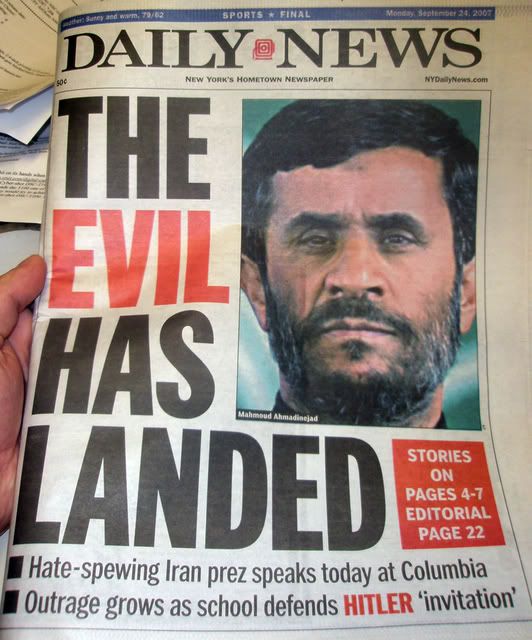
From reddit. The Evil has Landed - the cover of the New York Daily News.
How can there be Americans this bloodthirsty and determined to foment a war? I've lived there for a few years, I see all your comments on the net and almost all of you are reasonable, calm people who don't show the urge to go and cause the death and suffering of millions.
And yet you've invaded Iraq and are on the way to bombing or invading Iran.
America - what has happened?
posted by sien at 8:17 PM on September 24, 2007
How can there be Americans this bloodthirsty and determined to foment a war? I've lived there for a few years, I see all your comments on the net and almost all of you are reasonable, calm people who don't show the urge to go and cause the death and suffering of millions.
And yet you've invaded Iraq and are on the way to bombing or invading Iran.
America - what has happened?
posted by sien at 8:17 PM on September 24, 2007
amberglow - I don't know how it works in practice, but it appears that most of the powers are Constitutionally vested in the Supreme Leader.
posted by Poolio at 8:19 PM on September 24, 2007
posted by Poolio at 8:19 PM on September 24, 2007
It's so funny too--he does the same non-answering answer as our politicians. Bush must have looked "into his soul" or something too, i guess.
This whole visit has raised his stature enormously, and they'll be baying for us to bomb Iran more now than ever i bet.
posted by amberglow at 8:20 PM on September 24, 2007
This whole visit has raised his stature enormously, and they'll be baying for us to bomb Iran more now than ever i bet.
posted by amberglow at 8:20 PM on September 24, 2007
America - what has happened?
Us reasonable people don't have any money to buy politicians. And all the formerly reasonable politicians have been bought up by the war industry (which has also purchased the journalism industry).
posted by T.D. Strange at 8:20 PM on September 24, 2007 [3 favorites]
Us reasonable people don't have any money to buy politicians. And all the formerly reasonable politicians have been bought up by the war industry (which has also purchased the journalism industry).
posted by T.D. Strange at 8:20 PM on September 24, 2007 [3 favorites]
I see all your comments on the net and almost all of you are reasonable, calm people
You sound like you're looking at a different Internet than I am.
America - what has happened?
BOREDOM
posted by spiderwire at 8:20 PM on September 24, 2007 [1 favorite]
You sound like you're looking at a different Internet than I am.
America - what has happened?
BOREDOM
posted by spiderwire at 8:20 PM on September 24, 2007 [1 favorite]
Re: Poolio and ericb:
Wow. How come I haven't heard of this from the media?
Stuff like that makes me want to reconsider my decision to major in journalism.
posted by CitrusFreak12 at 8:21 PM on September 24, 2007
Wow. How come I haven't heard of this from the media?
Stuff like that makes me want to reconsider my decision to major in journalism.
posted by CitrusFreak12 at 8:21 PM on September 24, 2007
Wow. How come I haven't heard of this from the media?
Stuff like that makes me want to reconsider my decision to major in journalism.
Well, that question sure answered itself quick.
posted by spiderwire at 8:22 PM on September 24, 2007 [7 favorites]
Stuff like that makes me want to reconsider my decision to major in journalism.
Well, that question sure answered itself quick.
posted by spiderwire at 8:22 PM on September 24, 2007 [7 favorites]
How can there be Americans Newspaper Publishers this bloodthirsty and determined to foment a war?
If it bleeds, it leads. If it hasn't been bleeding enough lately, improvise. We're talking J. Jonah Jameson here.
posted by cortex at 8:23 PM on September 24, 2007 [1 favorite]
If it bleeds, it leads. If it hasn't been bleeding enough lately, improvise. We're talking J. Jonah Jameson here.
posted by cortex at 8:23 PM on September 24, 2007 [1 favorite]
How can there be Americans this bloodthirsty and determined to foment a war? I've lived there for a few years, I see all your comments on the net and almost all of you are reasonable, calm people who don't show the urge to go and cause the death and suffering of millions.
And yet you've invaded Iraq and are on the way to bombing or invading Iran.
America - what has happened?
There always have been 25-30% insane bloodthirsty warmongers, i think, but usually they're not in charge and not this overtly corrupt. We're sliding back into robber baron days, and our checks and balances have failed completely. (We've always been corrupt tho, and the Shah stuff is just one example of our dirty business in the region)
The American Century has ended for sure--we'll see if we survive at all as a democracy.
posted by amberglow at 8:24 PM on September 24, 2007 [1 favorite]
And yet you've invaded Iraq and are on the way to bombing or invading Iran.
America - what has happened?
There always have been 25-30% insane bloodthirsty warmongers, i think, but usually they're not in charge and not this overtly corrupt. We're sliding back into robber baron days, and our checks and balances have failed completely. (We've always been corrupt tho, and the Shah stuff is just one example of our dirty business in the region)
The American Century has ended for sure--we'll see if we survive at all as a democracy.
posted by amberglow at 8:24 PM on September 24, 2007 [1 favorite]
The worst of the worst is that Ahmadinejad's country is helping the Iraqis kill American soldiers. If Iran ever invades Canada, I think we'd agree the best course of action for the United States is to be constructive and let things sort themselves out. Otherwise we'd be just as evil
as the Iranians. Those fuckers.
from dilbertblog
posted by andywolf at 8:27 PM on September 24, 2007 [1 favorite]
as the Iranians. Those fuckers.
from dilbertblog
posted by andywolf at 8:27 PM on September 24, 2007 [1 favorite]
sien:
America - what has happened?This is what happened:
We got around to the subject of war again and I said that, contrary to his attitude, I did not think that the common people are very thankful for leaders who bring them war and destruction.posted by Flunkie at 8:27 PM on September 24, 2007 [28 favorites]
"Why, of course, the people don't want war," Goering shrugged. "Why would some poor slob on a farm want to risk his life in a war when the best that he can get out of it is to come back to his farm in one piece. Naturally, the common people don't want war; neither in Russia nor in England nor in America, nor for that matter in Germany. That is understood. But, after all, it is the leaders of the country who determine the policy and it is always a simple matter to drag the people along, whether it is a democracy or a fascist dictatorship or a Parliament or a Communist dictatorship."
"There is one difference," I pointed out. "In a democracy the people have some say in the matter through their elected representatives, and in the United States only Congress can declare wars."
"Oh, that is all well and good, but, voice or no voice, the people can always be brought to the bidding of the leaders. That is easy. All you have to do is tell them they are being attacked and denounce the pacifists for lack of patriotism and exposing the country to danger. It works the same way in any country."
I don't think Scott Adams of all people has anything constructive to add to the dialog.
posted by T.D. Strange at 8:28 PM on September 24, 2007 [1 favorite]
posted by T.D. Strange at 8:28 PM on September 24, 2007 [1 favorite]
One small bright spot on tv tonight tho--a devastating smackdown of a GOP Rep and her MoveOn fauxtrage
posted by amberglow at 8:29 PM on September 24, 2007 [1 favorite]
posted by amberglow at 8:29 PM on September 24, 2007 [1 favorite]
If it bleeds, it leads. If it hasn't been bleeding enough lately, improvise. We're talking J. Jonah Jameson here.
Hey, why not? At this point, the MSM is pretty much printing comic books, anyway.
posted by Blazecock Pileon at 8:30 PM on September 24, 2007 [2 favorites]
Hey, why not? At this point, the MSM is pretty much printing comic books, anyway.
posted by Blazecock Pileon at 8:30 PM on September 24, 2007 [2 favorites]
The worst of the worst is that Ahmadinejad's country is helping the Iraqis kill American soldiers.
Link?
So far as I know, there has been no evidence produced of Iranian [state-sponsored] attacks on American soldiers.
posted by Poolio at 8:31 PM on September 24, 2007 [3 favorites]
Link?
So far as I know, there has been no evidence produced of Iranian [state-sponsored] attacks on American soldiers.
posted by Poolio at 8:31 PM on September 24, 2007 [3 favorites]
amberglow, yea, you are asking the right questions.
1. Yes. The Ayatollahs are running everything there.
2. Not only has this raised his stature, he has put a human face to this predicament, human and flawed like all of us... Thus making it much more difficult for public opinion to side with the idea that it's too our benefit to attack.
posted by snsranch at 8:31 PM on September 24, 2007 [1 favorite]
1. Yes. The Ayatollahs are running everything there.
2. Not only has this raised his stature, he has put a human face to this predicament, human and flawed like all of us... Thus making it much more difficult for public opinion to side with the idea that it's too our benefit to attack.
posted by snsranch at 8:31 PM on September 24, 2007 [1 favorite]
Man, from the way people act about this guy you'd think he'd committed the holocaust, not denied it. Is anything he's said any worse then, say, Mel Gibson?
How quickly you forget. Ahmadinejad is the newErnst Blofeld Trotsky Snowflake Emmanuel Goldstein Bin Laden. They'll portray him as a holocaust denying weirdo Muslim [which I suppose is actually true], so we can all feel really good during the 2 minute hate and bomb his country without the slightest tinge of guilt.
Just watch as the media practically puts a fuzzy white kitty in his hands over the next few months. We'll "discover" information from "high-level officials" that he's been associated with every bad thing from 9/11 to your girlfriend's pregnancy scare.
Besides, the latest Bin Laden tape got sucky ratings anyway.
posted by Avenger at 8:31 PM on September 24, 2007 [3 favorites]
How quickly you forget. Ahmadinejad is the new
Just watch as the media practically puts a fuzzy white kitty in his hands over the next few months. We'll "discover" information from "high-level officials" that he's been associated with every bad thing from 9/11 to your girlfriend's pregnancy scare.
Besides, the latest Bin Laden tape got sucky ratings anyway.
posted by Avenger at 8:31 PM on September 24, 2007 [3 favorites]
Abizaid (who Bush forced out) was good the other day: World Could Abide Nuclear Iran
posted by amberglow at 8:32 PM on September 24, 2007
posted by amberglow at 8:32 PM on September 24, 2007
There always have been 25-30% insane bloodthirsty warmongers, i think, but usually they're not in charge and not this overtly corrupt
What I see with Iran, though is different.
On Iraq? Sure, the sides are clear. I can read Metafilter, and see a pack of people on the "Right" who support Bush and support the war in Iraq. And you can see a load of people on the "Left" who don't.
But on Iran? Different story. I can read Metafilter and see those same names - people on the "Right" calling for the US to bomb Iran back to the stone ages...people on the "Left" saying "Sure, yeah, why the hell not, he hates Jews"...and a bunch of non-Americans saying Hold on...what the fuck, guys?
The only explanation, I can see, is propaganda. See, the rest of the world still has diplomatic relations with Iran. We still trade with them. I've worked in university departments with PhD students from Iran, academics from Iran - and after they've gone back home to Iran (willingly, because they love their homeland) I still talk to them on Yahoo! messenger.
Americans, on the other hand, tend to view Iran as being the Islamic equivalent of North Korea. Really fucking hard to get through that.
posted by Jimbob at 8:32 PM on September 24, 2007 [2 favorites]
What I see with Iran, though is different.
On Iraq? Sure, the sides are clear. I can read Metafilter, and see a pack of people on the "Right" who support Bush and support the war in Iraq. And you can see a load of people on the "Left" who don't.
But on Iran? Different story. I can read Metafilter and see those same names - people on the "Right" calling for the US to bomb Iran back to the stone ages...people on the "Left" saying "Sure, yeah, why the hell not, he hates Jews"...and a bunch of non-Americans saying Hold on...what the fuck, guys?
The only explanation, I can see, is propaganda. See, the rest of the world still has diplomatic relations with Iran. We still trade with them. I've worked in university departments with PhD students from Iran, academics from Iran - and after they've gone back home to Iran (willingly, because they love their homeland) I still talk to them on Yahoo! messenger.
Americans, on the other hand, tend to view Iran as being the Islamic equivalent of North Korea. Really fucking hard to get through that.
posted by Jimbob at 8:32 PM on September 24, 2007 [2 favorites]
Re: Poolio and ericb: Wow. How come I haven't heard of this from the media? Stuff like that makes me want to reconsider my decision to major in journalism.
Stuff like that makes me want to 'double-down' on my decision to major in journalism -- so that I can shine a 'bright-light' on that which 'corporate journalists' ignore.
posted by ericb at 8:32 PM on September 24, 2007
Stuff like that makes me want to 'double-down' on my decision to major in journalism -- so that I can shine a 'bright-light' on that which 'corporate journalists' ignore.
posted by ericb at 8:32 PM on September 24, 2007
2. Not only has this raised his stature, he has put a human face to this predicament, human and flawed like all of us... Thus making it much more difficult for public opinion to side with the idea that it's too our benefit to attack.
I hope so, but it doesn't matter---the Administration is not listening to anyone except for Podhoretz (Podhoretz Granted Secret Access To Lobby Bush On ‘The Case For Bombing Iran’ ), and Freepers and other "loyal Bushies" who all want more war forever.
posted by amberglow at 8:38 PM on September 24, 2007
I hope so, but it doesn't matter---the Administration is not listening to anyone except for Podhoretz (Podhoretz Granted Secret Access To Lobby Bush On ‘The Case For Bombing Iran’ ), and Freepers and other "loyal Bushies" who all want more war forever.
posted by amberglow at 8:38 PM on September 24, 2007
people on the "Right" calling for the US to bomb Iran back to the stone ages...people on the "Left" saying "Sure, yeah, why the hell not, he hates Jews"
Er ... what? Who on the left is saying we should bomb Iran?
posted by Tlogmer at 8:40 PM on September 24, 2007
Er ... what? Who on the left is saying we should bomb Iran?
posted by Tlogmer at 8:40 PM on September 24, 2007
Americans, on the other hand, tend to view Iran as being the Islamic equivalent of North Korea. Really fucking hard to get through that.
Jimbob: not so anymore, according to all polls thankfully, i think
posted by amberglow at 8:43 PM on September 24, 2007
Jimbob: not so anymore, according to all polls thankfully, i think
posted by amberglow at 8:43 PM on September 24, 2007
Well, that question sure answered itself quick.
Forgive me--especially if I'm completely misreading the tone of your comment spidewire--but I'm not sure I follow (it's late and I'm quite tired). I'm a sophomore in college. I've taken a grand total of two journalism courses to date. How does that play into the fact that apparently the media fails to mention that Ahmadinejad has practically no power in Iran? The fact that the media fails to mention critical details like that, or takes slanted positions or obfuscates the truth in their articles so as to "sell" a story pisses me off and causes me to wonder "Do I really want to get involved in this?" The point of the media, I thought--and pardon me for being a dewy-eyed youth--was to inform, to give the best approximation of the truth. And often times it seems to me that they're doing a piss poor job of it.
On preview: ericb, you make a good point. Thank you for the perspective.
posted by CitrusFreak12 at 8:44 PM on September 24, 2007
Forgive me--especially if I'm completely misreading the tone of your comment spidewire--but I'm not sure I follow (it's late and I'm quite tired). I'm a sophomore in college. I've taken a grand total of two journalism courses to date. How does that play into the fact that apparently the media fails to mention that Ahmadinejad has practically no power in Iran? The fact that the media fails to mention critical details like that, or takes slanted positions or obfuscates the truth in their articles so as to "sell" a story pisses me off and causes me to wonder "Do I really want to get involved in this?" The point of the media, I thought--and pardon me for being a dewy-eyed youth--was to inform, to give the best approximation of the truth. And often times it seems to me that they're doing a piss poor job of it.
On preview: ericb, you make a good point. Thank you for the perspective.
posted by CitrusFreak12 at 8:44 PM on September 24, 2007
I'm hoping his visit paves the way for new opportunities. Maybe he can become a spokesman for Men's Warehouse.
posted by Roman Graves at 8:48 PM on September 24, 2007
posted by Roman Graves at 8:48 PM on September 24, 2007
He said Mr Ahmadinejad’s denial of the Holocaust might fool the illiterate and ignorant.
“’When you come to a place like this it makes you simply ridiculous,” he went on.
“The truth is that the Holocaust is the most documented event in human history.”
Ok, first of all the most documented event in human history is the attack on and collapse of the World Trade Center on 9-11.
Secondly, is the Holocaust really the thing to focus on here? Aren't we worried about Iran developing nuclear weapons or something? The Holocaust was sixty years ago, and Ahmenijad had nothing whatsoever to do with it. And I hate to be insensitive, but I'm guessing most of the people in the audience didn't experience it either.
He denies it happened? So what? People deny that planes crashed into the Pentagon or that NASA landed men on the moon. They deny man and apes evolved from a common ancestor. They deny the geological history of the planet. These are Americans I'm talking about. Some of these people may have spoken at Columbia. Some of them went to Columbia.
But if you deny the Holocaust, then you have no right to speak? That becomes the focus of everyone's scorn?
So let's be clear - you can deny evolution, geology, astrophysics, basic American history, and that either makes you a good Christian or at worst an eccentric, but if you deny the occurrence of an event that didn't happen in your lifetime in a war that didn't involve your country, then you are the worst sort of evil on the planet? Am I getting this right?
posted by Pastabagel at 8:50 PM on September 24, 2007 [44 favorites]
“’When you come to a place like this it makes you simply ridiculous,” he went on.
“The truth is that the Holocaust is the most documented event in human history.”
Ok, first of all the most documented event in human history is the attack on and collapse of the World Trade Center on 9-11.
Secondly, is the Holocaust really the thing to focus on here? Aren't we worried about Iran developing nuclear weapons or something? The Holocaust was sixty years ago, and Ahmenijad had nothing whatsoever to do with it. And I hate to be insensitive, but I'm guessing most of the people in the audience didn't experience it either.
He denies it happened? So what? People deny that planes crashed into the Pentagon or that NASA landed men on the moon. They deny man and apes evolved from a common ancestor. They deny the geological history of the planet. These are Americans I'm talking about. Some of these people may have spoken at Columbia. Some of them went to Columbia.
But if you deny the Holocaust, then you have no right to speak? That becomes the focus of everyone's scorn?
So let's be clear - you can deny evolution, geology, astrophysics, basic American history, and that either makes you a good Christian or at worst an eccentric, but if you deny the occurrence of an event that didn't happen in your lifetime in a war that didn't involve your country, then you are the worst sort of evil on the planet? Am I getting this right?
posted by Pastabagel at 8:50 PM on September 24, 2007 [44 favorites]
How does that play into the fact that apparently the media fails to mention that Ahmadinejad has practically no power in Iran?
Well, I was just kidding. :) I didn't know either.
The point of the media, I thought--and pardon me for being a dewy-eyed youth--was to inform, to give the best approximation of the truth.
I think I have identified your problem
posted by spiderwire at 8:53 PM on September 24, 2007
Well, I was just kidding. :) I didn't know either.
The point of the media, I thought--and pardon me for being a dewy-eyed youth--was to inform, to give the best approximation of the truth.
I think I have identified your problem
posted by spiderwire at 8:53 PM on September 24, 2007
Large state-sponsor of terrorism.
Taking American hostages in 1979.
Funding terrorists and IEDs in Syria, Iraq, and elsewhere.
Executes homosexuals.
Stones adulterers.
Seeking nuclear weapons - to use.
Wants to annihilate Israel and/or Jews.
Gee, seems like a real nice country, huh?
posted by davidmsc at 8:53 PM on September 24, 2007
Taking American hostages in 1979.
Funding terrorists and IEDs in Syria, Iraq, and elsewhere.
Executes homosexuals.
Stones adulterers.
Seeking nuclear weapons - to use.
Wants to annihilate Israel and/or Jews.
Gee, seems like a real nice country, huh?
posted by davidmsc at 8:53 PM on September 24, 2007
If it bleeds, it leads. If it hasn't been bleeding enough lately, improvise. We're talking J. Jonah JamesonWilliam Randolph Hearst here.
posted by amberglow at 8:54 PM on September 24, 2007
posted by amberglow at 8:54 PM on September 24, 2007

Pastabagel: Call me a nitpicker, but the majority of those events you listed didn't cause the death of somewhere around 10,000,000 people. That might have something to do with it.
posted by CitrusFreak12 at 8:54 PM on September 24, 2007
posted by CitrusFreak12 at 8:54 PM on September 24, 2007
And re: Holocaust.
There's a difference between "holocaust denial" and idiots who claim conspiracy theories for 9/11 and JFK. The wingnuts who deny that the holocaust took place are the ones who want to see it done to the very end, it seems.
posted by davidmsc at 8:56 PM on September 24, 2007 [1 favorite]
There's a difference between "holocaust denial" and idiots who claim conspiracy theories for 9/11 and JFK. The wingnuts who deny that the holocaust took place are the ones who want to see it done to the very end, it seems.
posted by davidmsc at 8:56 PM on September 24, 2007 [1 favorite]
How does that play into the fact that apparently the media fails to mention that Ahmadinejad has practically no power in Iran?
This is preposterous. Under Iranian law, the President, although subordinate to the Supreme Leader, has more power than our Vice President. And look how much power our Vice President has.
He has almost as much power as the most powerful person in Iran. But he more power than just about everyone else in Iran.
posted by Pastabagel at 8:56 PM on September 24, 2007
This is preposterous. Under Iranian law, the President, although subordinate to the Supreme Leader, has more power than our Vice President. And look how much power our Vice President has.
He has almost as much power as the most powerful person in Iran. But he more power than just about everyone else in Iran.
posted by Pastabagel at 8:56 PM on September 24, 2007
CitrusFreak12: How do you feel about people who deny the Armenian holocaust? Should Turks be banned from speaking in the U.S as well?
posted by delmoi at 8:57 PM on September 24, 2007 [1 favorite]
posted by delmoi at 8:57 PM on September 24, 2007 [1 favorite]
It’s past my bedtime so I don’t want to read all the comments here, but I saw the thing live and I found it alarming as hell that a major American university would bring in A Dinner Jacket just to rake him over the coals.
Columbia should have done a lot better.
If that’s the best Columbia can do we may as well bend over and kiss life as we like it goodbye because Dubaya Dubaya III is as good as here.
posted by Huplescat at 8:59 PM on September 24, 2007
Columbia should have done a lot better.
If that’s the best Columbia can do we may as well bend over and kiss life as we like it goodbye because Dubaya Dubaya III is as good as here.
posted by Huplescat at 8:59 PM on September 24, 2007
And look how much power our Vice President has.
The only power our Vice President has (per the Constitution) is to cast tie-breaking votes in the Senate.
posted by Poolio at 9:00 PM on September 24, 2007 [3 favorites]
The only power our Vice President has (per the Constitution) is to cast tie-breaking votes in the Senate.
posted by Poolio at 9:00 PM on September 24, 2007 [3 favorites]
This is preposterous. Under Iranian law, the President, although subordinate to the Supreme Leader, has more power than our Vice President. And look how much power our Vice President has.
Right, and under our law the V.P has almost zero power. He casts a tiebreaker vote in the senate, which is important but only manifest in very rare circumstances.
Now, Dick Cheney has a lot of influence, but his true "power" exists only when G.W. Bush is influenced.
No one cared what Dan Quayle thought.
posted by delmoi at 9:00 PM on September 24, 2007 [1 favorite]
Right, and under our law the V.P has almost zero power. He casts a tiebreaker vote in the senate, which is important but only manifest in very rare circumstances.
Now, Dick Cheney has a lot of influence, but his true "power" exists only when G.W. Bush is influenced.
No one cared what Dan Quayle thought.
posted by delmoi at 9:00 PM on September 24, 2007 [1 favorite]
Large state-sponsor of terrorism.
Funding terrorists and IEDs in Syria, Iraq, and elsewhere.
Seeking nuclear weapons - to use.
Prove it. There's no proof of it, and besides, the Saudis do far far more of it and always have--openly. Even if there is proof, it's not justification for war or bombing or invasion or anything. They're years and years away from nukes and i'd suggest you look to Pakistan for nuke weapons and materials first anyway.
posted by amberglow at 9:00 PM on September 24, 2007
Seeking nuclear weapons - to use.
Wants to annihilate Israel and/or Jews.
Huh?
posted by delmoi at 9:02 PM on September 24, 2007
Wants to annihilate Israel and/or Jews.
Huh?
posted by delmoi at 9:02 PM on September 24, 2007
Pastabagel: Call me a nitpicker, but the majority of those events you listed didn't cause the death of somewhere around 10,000,000 people. That might have something to do with it.
posted by CitrusFreak12 at 11:54 PM on September 24
Yes, 10 million people that he didn't know, and that most people didn't know. You're talking about something that happened 60 years ago. Do you care about people who died in Mao's long march, or the cultural revolution? Or the people who died at the hands of the KGB or in Soviet gulags? For nearly everyone, the answer to these questions is no, because it was a long time ago (though more recent than the Holocaust) and far away. I'm not excusing it his denial of it, but it needs to be kept in some perspective. The Untied States of America probably killed tens of millions of native Americans, and it rarely crosses anyone's mind.
And where is the 10 million number coming from?
posted by Pastabagel at 9:04 PM on September 24, 2007 [1 favorite]
posted by CitrusFreak12 at 11:54 PM on September 24
Yes, 10 million people that he didn't know, and that most people didn't know. You're talking about something that happened 60 years ago. Do you care about people who died in Mao's long march, or the cultural revolution? Or the people who died at the hands of the KGB or in Soviet gulags? For nearly everyone, the answer to these questions is no, because it was a long time ago (though more recent than the Holocaust) and far away. I'm not excusing it his denial of it, but it needs to be kept in some perspective. The Untied States of America probably killed tens of millions of native Americans, and it rarely crosses anyone's mind.
And where is the 10 million number coming from?
posted by Pastabagel at 9:04 PM on September 24, 2007 [1 favorite]
The only power our Vice President has (per the Constitution) is to cast tie-breaking votes in the Senate.
And crush your throat with the Force.
posted by spiderwire at 9:07 PM on September 24, 2007 [6 favorites]
And crush your throat with the Force.
posted by spiderwire at 9:07 PM on September 24, 2007 [6 favorites]
Large state-sponsor of terrorism.
Taking American hostages in 1979.
Funding terrorists and IEDs in Syria, Iraq, and elsewhere.
Executes homosexuals.
Stones adulterers.
Seeking nuclear weapons - to use.
Wants to annihilate Israel and/or Jews.
Large state-sponsor of terrorism.
Taking over Iran in 1953.
Funding terrorists and IEDs in Afghanistan and elsewhere.
Executes homosexuals.
Stones adulterers.
Seeking nuclear weapons - to use.
Wants to annihilate Islamic holy sites, states and/or Muslims.
posted by Blazecock Pileon at 9:09 PM on September 24, 2007 [22 favorites]
Taking American hostages in 1979.
Funding terrorists and IEDs in Syria, Iraq, and elsewhere.
Executes homosexuals.
Stones adulterers.
Seeking nuclear weapons - to use.
Wants to annihilate Israel and/or Jews.
Large state-sponsor of terrorism.
Taking over Iran in 1953.
Funding terrorists and IEDs in Afghanistan and elsewhere.
Executes homosexuals.
Stones adulterers.
Seeking nuclear weapons - to use.
Wants to annihilate Islamic holy sites, states and/or Muslims.
posted by Blazecock Pileon at 9:09 PM on September 24, 2007 [22 favorites]
Right, and under our law the V.P has almost zero power. He casts a tiebreaker vote in the senate, which is important but only manifest in very rare circumstances.
Now, Dick Cheney has a lot of influence, but his true "power" exists only when G.W. Bush is influenced.
No one cared what Dan Quayle thought.
posted by delmoi at 12:00 AM on September 25
Wait a second, the statement made was that Ahmedinijad himself had no power, not that his office had none. And though the Office of the Vice President has little express authority in the Constitution, Dick Cheney has a tremendous amount of actual demonstrable power. Not influence. Power.
If the man who is serving as President had no power over others in his own government, he wouldn't be speaking at Columbia University and making noise about conducting oil sales in euros instead of dollars. He is able to say and do the things he does because he wields power beyond the narrow scope of his office.
posted by Pastabagel at 9:10 PM on September 24, 2007
Now, Dick Cheney has a lot of influence, but his true "power" exists only when G.W. Bush is influenced.
No one cared what Dan Quayle thought.
posted by delmoi at 12:00 AM on September 25
Wait a second, the statement made was that Ahmedinijad himself had no power, not that his office had none. And though the Office of the Vice President has little express authority in the Constitution, Dick Cheney has a tremendous amount of actual demonstrable power. Not influence. Power.
If the man who is serving as President had no power over others in his own government, he wouldn't be speaking at Columbia University and making noise about conducting oil sales in euros instead of dollars. He is able to say and do the things he does because he wields power beyond the narrow scope of his office.
posted by Pastabagel at 9:10 PM on September 24, 2007
No one cared what Dan Quayle thought.
Au contraire, mon frère.
Single Moms and Potato(e) eaters cared what he thought -- and realized that he ("I am not part of the problem. I am a Republican") was and will always be a giant "asshole."
posted by ericb at 9:11 PM on September 24, 2007 [1 favorite]
Au contraire, mon frère.
Single Moms and Potato(e) eaters cared what he thought -- and realized that he ("I am not part of the problem. I am a Republican") was and will always be a giant "asshole."
posted by ericb at 9:11 PM on September 24, 2007 [1 favorite]
And though the Office of the Vice President has little express authority in the Constitution, Dick Cheney has a tremendous amount of actual demonstrable power. Not influence. Power.
UL-TI-MATE POWER!
OK, I'm done now.
hoh-purr
posted by spiderwire at 9:13 PM on September 24, 2007
UL-TI-MATE POWER!
OK, I'm done now.
hoh-purr
posted by spiderwire at 9:13 PM on September 24, 2007
The purpose of the Cheney is to flip out and nuke people.
posted by delmoi at 9:15 PM on September 24, 2007
posted by delmoi at 9:15 PM on September 24, 2007
He has no real power. He's essentially Iran's tv spokesperson. President is more like a marketing position than leadership position in Iran. The Supreme Leader has all the control, so while the constitution lays out certain powers and duties for the President, because every decision he makes is subject to reversal by his overlord, he is left with no official power, other than what he can wield through his personality. This guy ain't got a Cheney kind of sway.
I thought the laughter at the no gays in Iran statement was pretty funny, well that and man does this guy blip your gaydar or what?
posted by caddis at 9:19 PM on September 24, 2007 [1 favorite]
I thought the laughter at the no gays in Iran statement was pretty funny, well that and man does this guy blip your gaydar or what?
posted by caddis at 9:19 PM on September 24, 2007 [1 favorite]
The purpose of the Cheney is to flip out and nuke people.
He also serves as a prophylactic against impeachment.
posted by Poolio at 9:19 PM on September 24, 2007 [1 favorite]
He also serves as a prophylactic against impeachment.
posted by Poolio at 9:19 PM on September 24, 2007 [1 favorite]
He also serves as a prophylactic against impeachment.
Bush's impeachment, I mean.
posted by Poolio at 9:24 PM on September 24, 2007
Bush's impeachment, I mean.
posted by Poolio at 9:24 PM on September 24, 2007
Er ... what? Who on the left is saying we should bomb Iran?
I may have exaggerated with my claim they want to "bomb Iran" - certainly I do notice people who are opposed to the war in Iraq, who have also appeared to have drunk the kool-aid when it comes to Iran. People who believe Iran has been hiding / supporting Bin Laden. People who really think Iran's nuclear program is all about nuclear weapons (despite the evidence that points to Iran wanting alternative energy sources in order to secure it's oil reserves into the future). Of course, there's nothing stopping a country with nuclear power extending it to nuclear weapons. I just don't see much concern at all about the nuclear arsenal of Pakistan, a country led by a military dictator, which much, much closer ties to Al Queda.
I am sorry, however, that I can't research and deliver names. It's just the impression I get. Opposition to the Iraq war on Metafilter, these days, appears almost total except for a few well-known user-names. But people parroting the US administration's line on Iran is much more common.
posted by Jimbob at 9:24 PM on September 24, 2007
I may have exaggerated with my claim they want to "bomb Iran" - certainly I do notice people who are opposed to the war in Iraq, who have also appeared to have drunk the kool-aid when it comes to Iran. People who believe Iran has been hiding / supporting Bin Laden. People who really think Iran's nuclear program is all about nuclear weapons (despite the evidence that points to Iran wanting alternative energy sources in order to secure it's oil reserves into the future). Of course, there's nothing stopping a country with nuclear power extending it to nuclear weapons. I just don't see much concern at all about the nuclear arsenal of Pakistan, a country led by a military dictator, which much, much closer ties to Al Queda.
I am sorry, however, that I can't research and deliver names. It's just the impression I get. Opposition to the Iraq war on Metafilter, these days, appears almost total except for a few well-known user-names. But people parroting the US administration's line on Iran is much more common.
posted by Jimbob at 9:24 PM on September 24, 2007
He denies it happened? So what?
Well, to be fair, we're really not up to punishing pure throughtcrime yet. You have to admit this particular belief to be punished, in those progressive places where it is legally punishable.
But I'm sure we're working on it.
posted by dreamsign at 9:27 PM on September 24, 2007
Well, to be fair, we're really not up to punishing pure throughtcrime yet. You have to admit this particular belief to be punished, in those progressive places where it is legally punishable.
But I'm sure we're working on it.
posted by dreamsign at 9:27 PM on September 24, 2007
Well, to be fair, we're really not up to punishing pure throughtcrime yet.
Tell it to that tazered guy, and all the codepink protestors being thrown out of even Hillary rallies, and the airport screeners noting what books we read, and the NSA and others vacuuming our internet use and ...
posted by amberglow at 9:33 PM on September 24, 2007 [6 favorites]
Tell it to that tazered guy, and all the codepink protestors being thrown out of even Hillary rallies, and the airport screeners noting what books we read, and the NSA and others vacuuming our internet use and ...
posted by amberglow at 9:33 PM on September 24, 2007 [6 favorites]
I'm on the left, and I think Ahmadinejad is an odious man. He's closely associated with the Basij religious militants and apparently cut his teeth training child soldiers to clear paths through minefields with their bodies during the Iran-Iraq war. I would love to see the theocratic regime in Tehran replaced with a secular democracy in my lifetime.
I see no role for a US military attack in making that happen, of course (quite the reverse, I would think). It would likely set the prospects for regime change back a generation from all I read, quite apart from the horror of another war. The touted strategic reasons are spurious at best, and the actual strategy is as wrong-headed as the one that took us into Iraq.
posted by Abiezer at 9:41 PM on September 24, 2007 [6 favorites]
I see no role for a US military attack in making that happen, of course (quite the reverse, I would think). It would likely set the prospects for regime change back a generation from all I read, quite apart from the horror of another war. The touted strategic reasons are spurious at best, and the actual strategy is as wrong-headed as the one that took us into Iraq.
posted by Abiezer at 9:41 PM on September 24, 2007 [6 favorites]
And where is the 10 million number coming from?
6 million Jews + 4-6 million other 'undesirables' (Gypsies, LGBTs, political prisoners, disabled, etc).
posted by spaceman_spiff at 9:51 PM on September 24, 2007
6 million Jews + 4-6 million other 'undesirables' (Gypsies, LGBTs, political prisoners, disabled, etc).
posted by spaceman_spiff at 9:51 PM on September 24, 2007
Tell it to that tazered guy, and all the codepink protestors being thrown out of even Hillary rallies, and the airport screeners noting what books we read, and the NSA and others vacuuming our internet use and ...
I'm talking about drawing a line in the sand, dude.
posted by spiderwire at 9:58 PM on September 24, 2007 [3 favorites]
I'm talking about drawing a line in the sand, dude.
posted by spiderwire at 9:58 PM on September 24, 2007 [3 favorites]
Man, from the way people act about this guy you'd think he'd committed the holocaust, not denied it.
By his own account, he would like to commit a second Holocaust.
Dude is slime. And people who ally with him because he's all cool and anti-American are just as morally retarded as he is.
posted by Afroblanco at 9:59 PM on September 24, 2007 [2 favorites]
By his own account, he would like to commit a second Holocaust.
Dude is slime. And people who ally with him because he's all cool and anti-American are just as morally retarded as he is.
posted by Afroblanco at 9:59 PM on September 24, 2007 [2 favorites]
An attack on Iran would be illegal under the UN Charter, which only allows the use of force in cases of self-defense or when authorized by the Security Council.
December 2006: Saudis reportedly funding Iraqi Sunni insurgents (emphasis added): "Private Saudi citizens are giving millions of dollars to Sunni insurgents in Iraq and much of the money is used to buy weapons, including shoulder fired anti-aircraft missiles."
February 2007: Fifth U.S. chopper goes down in Iraq, killing 7.
The Iraq insurgency for beginners:
The worst of the worst is that Ahmadinejad's country is helping the Iraqis kill American soldiers.
December 2006: Saudis reportedly funding Iraqi Sunni insurgents (emphasis added): "Private Saudi citizens are giving millions of dollars to Sunni insurgents in Iraq and much of the money is used to buy weapons, including shoulder fired anti-aircraft missiles."
February 2007: Fifth U.S. chopper goes down in Iraq, killing 7.
The Iraq insurgency for beginners:
You have to distinguish between the Shiite militias and the actual insurgency, which is the Sunni groups. Most of the Shiite militia activity is not directed at the U.S., it's directed at the Sunnis. The Sunni insurgency, meanwhile, is directed at everyone -- the U.S., the Iraqi government, the militias.posted by kirkaracha at 10:01 PM on September 24, 2007 [2 favorites]
...
There have been over 3,000 U.S. soldiers killed in Iraq, which means more than 2,830 people were killed by Sunnis, the real insurgents. The way this has been advertised in the press is incredibly disingenuous. Money and weapons and personnel have been coming across the Saudi and Syrian borders for four years and have been directly aiding Sunni insurgents, who are responsible for the lion's share of U.S. casualties. It's the height of hypocrisy to attack Iran and not criticize Saudi Arabia.
...
But if you want to know who is responsible for the fact that al-Qaida is succeeding in Iraq, it's Saudi Arabia. The most common nationality of foreign insurgents in Iraq has been Saudis. Where do you think all the money comes from to pay for these operations? It's from Saudi donors.
Dude is slime. And people who ally with him because he's all cool and anti-American are just as morally retarded as he is.
You know who else is morally retarded?
Straw men.
posted by Poolio at 10:01 PM on September 24, 2007 [5 favorites]
You know who else is morally retarded?
Straw men.
posted by Poolio at 10:01 PM on September 24, 2007 [5 favorites]
Dude is slime. And people who ally with him because he's all cool and anti-American are just as morally retarded as he is.
posted by Afroblanco at 12:59 AM on September 25 [+] [!]
Agreed, but drop the "morally;" most of them took the short bus to school.
posted by caddis at 10:03 PM on September 24, 2007
posted by Afroblanco at 12:59 AM on September 25 [+] [!]
Agreed, but drop the "morally;" most of them took the short bus to school.
posted by caddis at 10:03 PM on September 24, 2007
You know who else is morally retarded?
Straw men.
And here all these years we've been looking to them for ethical guidance. It all makes so much more sense now...
posted by spiderwire at 10:04 PM on September 24, 2007
Straw men.
And here all these years we've been looking to them for ethical guidance. It all makes so much more sense now...
posted by spiderwire at 10:04 PM on September 24, 2007
Wants to annihilate Israel and/or Jews.
Iran has a large Jewish community. They even have parliamentary representation, for what it's worth. (Not much.)
It now seems to be received wisdom that Iran is sponsoring Sunni militias inside Iraq, despite the laughably weak "evidence" and the fact that it makes no damn sense. However, it is much more likely that the USA is supporting some extremely vicious and rather loopy terrorist groups operating inside Iran, including Jundullah (2), the Kurdistan Free Life Party, and MEK.
Since the 70s, MEK has been responsible for a long string of assassinations, bombings, and miscellaneous misdeeds, including helping Saddam suppress the Kurdish uprising in 1991. As Tom Tancredo, a big supporter, notes in this adoring article, there are almost 4,000 MEK fighters living under US protection in Iraq. Sam Brownback is also a fan/lobbyist.
Lt. Gen. David Odierno, commander of the Multinational Corps-Iraq, has described the MEK as "extremely cooperative" in ensuring security.
posted by stammer at 10:12 PM on September 24, 2007 [9 favorites]
Iran has a large Jewish community. They even have parliamentary representation, for what it's worth. (Not much.)
It now seems to be received wisdom that Iran is sponsoring Sunni militias inside Iraq, despite the laughably weak "evidence" and the fact that it makes no damn sense. However, it is much more likely that the USA is supporting some extremely vicious and rather loopy terrorist groups operating inside Iran, including Jundullah (2), the Kurdistan Free Life Party, and MEK.
Since the 70s, MEK has been responsible for a long string of assassinations, bombings, and miscellaneous misdeeds, including helping Saddam suppress the Kurdish uprising in 1991. As Tom Tancredo, a big supporter, notes in this adoring article, there are almost 4,000 MEK fighters living under US protection in Iraq. Sam Brownback is also a fan/lobbyist.
Lt. Gen. David Odierno, commander of the Multinational Corps-Iraq, has described the MEK as "extremely cooperative" in ensuring security.
posted by stammer at 10:12 PM on September 24, 2007 [9 favorites]
By his own account, he would like to commit a second Holocaust.
Perhaps you can provide a link to this account. He's a pretty lazy genocidaire; Iranian Jews don't seem to be in any immediate danger.
Although he took on Mr Ahmadinejad over the Holocaust, Mr Motamed supports the president on other issues, including the stand-off with the US, Europe and Israel over the country's nuclear programme. "I am an Iranian first and a Jew second," he said.
He acknowledged there were problems with being a Jew in Iran, as there were for the country's other minorities. But he said that Iran was relatively tolerant. "There is no pressure on the synagogues, no problems of desecration. I think the problem in Europe is worse than here. There is a lot of anti-semitism in other countries."
posted by stammer at 10:16 PM on September 24, 2007 [4 favorites]
Perhaps you can provide a link to this account. He's a pretty lazy genocidaire; Iranian Jews don't seem to be in any immediate danger.
Although he took on Mr Ahmadinejad over the Holocaust, Mr Motamed supports the president on other issues, including the stand-off with the US, Europe and Israel over the country's nuclear programme. "I am an Iranian first and a Jew second," he said.
He acknowledged there were problems with being a Jew in Iran, as there were for the country's other minorities. But he said that Iran was relatively tolerant. "There is no pressure on the synagogues, no problems of desecration. I think the problem in Europe is worse than here. There is a lot of anti-semitism in other countries."
posted by stammer at 10:16 PM on September 24, 2007 [4 favorites]
I wish I could frame Jimbob's earlier comment.
The coverage of this on the news tonight in Canada made me rather frightened. I think the US may in fact try to do something to Iran. One guy was yelling at the camera "he's our modern Hitler!" How does that even make sense?
This whole thing is horrible. The way Columbia treated him makes me sick. Why don't we just cut all the talk and make Ahmadinejad carry his cross all the way from the old WTC site to the lectern? You could probably all line up and throw stones.
Iran hasn't done a fucking thing, and I have been good friends with more than one good man from that country. It is not some new Nazi Germany.
Ugh.
posted by blacklite at 10:19 PM on September 24, 2007 [2 favorites]
The coverage of this on the news tonight in Canada made me rather frightened. I think the US may in fact try to do something to Iran. One guy was yelling at the camera "he's our modern Hitler!" How does that even make sense?
This whole thing is horrible. The way Columbia treated him makes me sick. Why don't we just cut all the talk and make Ahmadinejad carry his cross all the way from the old WTC site to the lectern? You could probably all line up and throw stones.
Iran hasn't done a fucking thing, and I have been good friends with more than one good man from that country. It is not some new Nazi Germany.
Ugh.
posted by blacklite at 10:19 PM on September 24, 2007 [2 favorites]
Dude is slime. And people who ally with him because he's all cool and anti-American are just as morally retarded as he is.
Man, I don't see many people allying with him.
I see a load of people saying, hey, Iran's a big country, a smart country, full of lots and lots of people with lives and families of their own, independent of the leadership of that country, and wondering why people are so willing to put them in the firing line. Because, you know, intervention in Iran has worked so well before. The Iranian people will find their own way - it's just a matter of time before the younger generation replaces the older. Unless, you know, we do something to radicalize them...
I see a load of people saying, hold on, what's this shit about funding the insurgency in Iraq? That makes no sense, and as others have pointed out above, more evidence links Saudi Arabia to that than Iran.
I see a load of people wondering why the US feigns concern about hypothetical nuclear weapons in Iran when they turn a blind eye to nuclear proliferation elsewhere. It's much more likely non-state actors will get their hands on a nuke somewhere in a former Soviet republic, and unlike Iran, they won't give a shit where they use it.
I see a load of people saying, hold on, what's this shit about Iran being linked to Bin Laden? That makes no sense. It would be like the Archbishop of Canterbury harboring Bobby Sands. That's a pretty lame comparison, but it's the first thing that came to mind.
As I said, the only explanation is propaganda. The US and Iran haven't got along in a long time. Resentment is deep and old, and that warps people's perspectives. If the US worked really really hard to sort things out with Iran, and to change the Iranian regime though dialog and diplomacy, instead of threatening to bomb the shit out of them every week, they might find themselves with a useful, stable ally in the region.
posted by Jimbob at 10:23 PM on September 24, 2007 [12 favorites]
Man, I don't see many people allying with him.
I see a load of people saying, hey, Iran's a big country, a smart country, full of lots and lots of people with lives and families of their own, independent of the leadership of that country, and wondering why people are so willing to put them in the firing line. Because, you know, intervention in Iran has worked so well before. The Iranian people will find their own way - it's just a matter of time before the younger generation replaces the older. Unless, you know, we do something to radicalize them...
I see a load of people saying, hold on, what's this shit about funding the insurgency in Iraq? That makes no sense, and as others have pointed out above, more evidence links Saudi Arabia to that than Iran.
I see a load of people wondering why the US feigns concern about hypothetical nuclear weapons in Iran when they turn a blind eye to nuclear proliferation elsewhere. It's much more likely non-state actors will get their hands on a nuke somewhere in a former Soviet republic, and unlike Iran, they won't give a shit where they use it.
I see a load of people saying, hold on, what's this shit about Iran being linked to Bin Laden? That makes no sense. It would be like the Archbishop of Canterbury harboring Bobby Sands. That's a pretty lame comparison, but it's the first thing that came to mind.
As I said, the only explanation is propaganda. The US and Iran haven't got along in a long time. Resentment is deep and old, and that warps people's perspectives. If the US worked really really hard to sort things out with Iran, and to change the Iranian regime though dialog and diplomacy, instead of threatening to bomb the shit out of them every week, they might find themselves with a useful, stable ally in the region.
posted by Jimbob at 10:23 PM on September 24, 2007 [12 favorites]
Another good little article about Iranian Jews. As with the few Iranians I've met, they seem to be both generally unhappy about the current regime and fiercely patriotic.
If America makes Iranians choose between the Supreme Leader and American occupiers/bombers, expect to have 70 million terrorists on your hands.
posted by stammer at 10:27 PM on September 24, 2007 [2 favorites]
If America makes Iranians choose between the Supreme Leader and American occupiers/bombers, expect to have 70 million terrorists on your hands.
posted by stammer at 10:27 PM on September 24, 2007 [2 favorites]
Dude is slime. Dude is also an easy -- and convenient -- target. We give him more power than he deserves the more obsessed we are with him. It's fascinating.
posted by blucevalo at 10:36 PM on September 24, 2007 [1 favorite]
posted by blucevalo at 10:36 PM on September 24, 2007 [1 favorite]
The way Columbia treated him makes me sick.... Iran... is not some new Nazi Germany.
He was treated better than he deserved to be. He's the middle east KKK, David Duke with a beard. Fuck him. Columbia was stupid to give such a hate monger a forum. Where are the KKK leaders at Ivy League schools? He is a Nazi in his rhetoric, although Iran is far from Nazi Germany in its actions. The way to fight hate speech is with more speech, and ridiculing him for the buffoon he is was a perfect example of that. Of course if you actually think he brings a message of peace, please see my last comment in this thread. Your bus has arrived.
posted by caddis at 10:41 PM on September 24, 2007
He was treated better than he deserved to be. He's the middle east KKK, David Duke with a beard. Fuck him. Columbia was stupid to give such a hate monger a forum. Where are the KKK leaders at Ivy League schools? He is a Nazi in his rhetoric, although Iran is far from Nazi Germany in its actions. The way to fight hate speech is with more speech, and ridiculing him for the buffoon he is was a perfect example of that. Of course if you actually think he brings a message of peace, please see my last comment in this thread. Your bus has arrived.
posted by caddis at 10:41 PM on September 24, 2007
By his own account, he would like to commit a second Holocaust.
Perhaps you can provide a link to this account.
He is widely quoted as saying that he would like to wipe Israel off the map.
And please, no specious arguments about how "wiping Israel off the map" could mean anything other than the deaths of millions of Jews.
posted by Afroblanco at 10:42 PM on September 24, 2007 [1 favorite]
Perhaps you can provide a link to this account.
He is widely quoted as saying that he would like to wipe Israel off the map.
And please, no specious arguments about how "wiping Israel off the map" could mean anything other than the deaths of millions of Jews.
posted by Afroblanco at 10:42 PM on September 24, 2007 [1 favorite]
If you consider the abolishment of Israel (which is what he called for) to be a "second Holocaust", all I can say is that you have an extremely broad definition of "Holocaust".
In any case, he did not say that he would like to wipe Israel off the map; he said "the regime that is occupying Qods must vanish from the page of time." He did not say: "And every Jew who lives in it must die." But even more importantly than that, nowhere did he say: "And I'm the man to do it!"
I support a one-state solution to the issue of Palestine, which would mean the end of Israel in its current form. Please no specious arguments that this is synonymous with a "second Holocaust". If you're thinking about making that argument, I can only suggest that you hit the books and learn what the Holocaust was.
posted by stammer at 10:51 PM on September 24, 2007 [2 favorites]
In any case, he did not say that he would like to wipe Israel off the map; he said "the regime that is occupying Qods must vanish from the page of time." He did not say: "And every Jew who lives in it must die." But even more importantly than that, nowhere did he say: "And I'm the man to do it!"
I support a one-state solution to the issue of Palestine, which would mean the end of Israel in its current form. Please no specious arguments that this is synonymous with a "second Holocaust". If you're thinking about making that argument, I can only suggest that you hit the books and learn what the Holocaust was.
posted by stammer at 10:51 PM on September 24, 2007 [2 favorites]
If that's what you want to believe Afroblanco. You appear aware that there is controversy on the statement but choose to ignore it.
Therefore, you'll probably also ignore that the official Iranian policy on Israel is that there should be a national referendum, with both Israelis and Palestinians voting, with the aim of a "one-state solution".
Just as the Soviet Union was wiped out and today does not exist, so will the Zionist regime soon be wiped out. - Ahmadinejad
And the "wiping out" of the Soviet Union killed how many millions of Russians, exactly?
There are many, many reasons why a "one-state" solution isn't a good plan. I just don't see how you can see the Iranian policy of supporting this idea as being equivalent to a new Holocaust. Unless, of course, you're of the opinion that all Arabs want to kill All Jews All The Time, or something.
posted by Jimbob at 10:52 PM on September 24, 2007 [6 favorites]
Therefore, you'll probably also ignore that the official Iranian policy on Israel is that there should be a national referendum, with both Israelis and Palestinians voting, with the aim of a "one-state solution".
Just as the Soviet Union was wiped out and today does not exist, so will the Zionist regime soon be wiped out. - Ahmadinejad
And the "wiping out" of the Soviet Union killed how many millions of Russians, exactly?
There are many, many reasons why a "one-state" solution isn't a good plan. I just don't see how you can see the Iranian policy of supporting this idea as being equivalent to a new Holocaust. Unless, of course, you're of the opinion that all Arabs want to kill All Jews All The Time, or something.
posted by Jimbob at 10:52 PM on September 24, 2007 [6 favorites]
Delmoi said it best right at the start of this thread:
He also doesn't have any real power in Iran, so the whole confabulation seems preposterous.
The guy is a figurehead and a clown.
posted by KokuRyu at 10:55 PM on September 24, 2007
He also doesn't have any real power in Iran, so the whole confabulation seems preposterous.
The guy is a figurehead and a clown.
posted by KokuRyu at 10:55 PM on September 24, 2007
I object to the characterization of Iranian president Mahmoud Ahmadinejad as having "threatened to wipe Israel off the map." I object to this translation of what he said on two grounds.
First, it gives the impression that he wants to play Hitler to Israel's Poland, mobilizing an armored corps to move in and kill people. But the actual quote, which comes from an old speech of [Ayatollah] Khomeini, does not imply military action, or killing anyone at all.
The second reason is that it is just an inexact translation. The phrase is almost metaphysical. He quoted Khomeini that "the occupation regime over Jerusalem should vanish from the page of time." It is in fact probably a reference to some phrase in a medieval Persian poem. It is not about tanks.
posted by Pater Aletheias at 11:01 PM on September 24, 2007
First, it gives the impression that he wants to play Hitler to Israel's Poland, mobilizing an armored corps to move in and kill people. But the actual quote, which comes from an old speech of [Ayatollah] Khomeini, does not imply military action, or killing anyone at all.
The second reason is that it is just an inexact translation. The phrase is almost metaphysical. He quoted Khomeini that "the occupation regime over Jerusalem should vanish from the page of time." It is in fact probably a reference to some phrase in a medieval Persian poem. It is not about tanks.
posted by Pater Aletheias at 11:01 PM on September 24, 2007
The USSR was wiped off the map quite easily without millions of deaths,why not the Zionist state and their expansion plans,
posted by hortense at 11:04 PM on September 24, 2007
posted by hortense at 11:04 PM on September 24, 2007
full text of the speech with the attacking introduction by Bollinger.
Ahmedinejad:
And more from Ahmadinejad:
posted by sien at 11:06 PM on September 24, 2007 [4 favorites]
Ahmedinejad:
Last year, I would say two years ago, I raised two questions. You know that my main job is a university instructor. Right now as president of Iran I still continue teaching graduate and Ph.D.-level courses on a weekly basis. My students are working with me in scientific fields. I believe that I am an academic myself, so I speak with you from an academic point of view.Who knew he was still teaching. That's impressive. Bush reads books about goats to children. Ahmedinejad teaches graduate level engineering courses.
And more from Ahmadinejad:
Last year, I wanted to go to the site of the September 11th tragedy to show respect to the victims of the tragedy, show my sympathy with their families, but our plans got overextended. We were involved in negotiations and meetings `till midnight, and they said it would be very difficult to go visit the site at that late hour of the night. So I told my friends then that we need to plan this for the following year, so that I can go and visit the site and to show my respects. Regretfully, some groups had very strong reactions, very bad reactions. It's bad for someone -- to prevent someone to show sympathy to the families of the victims of the September 11 event -- tragic event.No wonder the US powers that be want to avoid him getting airtime in the US.
This is a respect from my side. Somebody told me this is an insult. I said: What are you saying? This is my way of showing my respect. Why would you think that? Thinking like that, how do you expect to manage the world and world affairs? Don't you think that a lot of problems in the world come from the way you look at issues because of this kind of way of thinking, because of this sort of pessimistic approach towards a lot of people because of certain level of selfishness, self-absorption that needs to be put aside so that we can show respect to everyone, to allow an environment for friendship to grow, to allow all nations to talk with one another and move towards peace?
I wanted to speak with the press. There is 11 September -- September 11 tragic event was a huge event. It led to a lot of many other events afterwards. After 9/11, Afghanistan was occupied and then Iraq was occupied, and for six years in our region there is insecurity, terror and fear. If the root causes of 9/11 are examined properly -- why it happened, what caused it, what were the conditions that led to it, who truly was involved, who was really involved -- and put it all together to understand how to prevent the crisis in Iraq, fix the problem in Afghanistan and Iraq combined.
posted by sien at 11:06 PM on September 24, 2007 [4 favorites]
The guy is a figurehead and a clown.
If that is true, the discussion is still relevant beacuse he is the figurehead and clown that the people with the actual power over there want representing their government.
posted by milestogo at 11:13 PM on September 24, 2007
If that is true, the discussion is still relevant beacuse he is the figurehead and clown that the people with the actual power over there want representing their government.
posted by milestogo at 11:13 PM on September 24, 2007
If that is true, the discussion is still relevant beacuse he is the figurehead and clown that the people with the actual power over there want representing their government.
You appear to misunderstand how the Iranian government works. It is true that presidential candidates are vetted by the religious leaders, but ultimately the citizens vote for which one they want. The people with "actual power" didn't make him president.
And the clear differences between the current Iranian president and the previous president may indicate to you that it's not as cut-and-dry as you think.
posted by Jimbob at 11:21 PM on September 24, 2007
You appear to misunderstand how the Iranian government works. It is true that presidential candidates are vetted by the religious leaders, but ultimately the citizens vote for which one they want. The people with "actual power" didn't make him president.
And the clear differences between the current Iranian president and the previous president may indicate to you that it's not as cut-and-dry as you think.
posted by Jimbob at 11:21 PM on September 24, 2007
If that is true, the discussion is still relevant beacuse he is the figurehead and clown that the people with the actual power over there want representing their government.
I say put their clown up against our clown! We've got the biggest figurehead in the world over here! Whaddaya think of that, Iran? Nyaaah! Ours can't answer questions, and he even speaks the language (more or less)! Top that!
posted by spiderwire at 11:21 PM on September 24, 2007 [2 favorites]
I say put their clown up against our clown! We've got the biggest figurehead in the world over here! Whaddaya think of that, Iran? Nyaaah! Ours can't answer questions, and he even speaks the language (more or less)! Top that!
posted by spiderwire at 11:21 PM on September 24, 2007 [2 favorites]
Joe Lieberman declares war on Iran
Here is the language from the amendment:
(3) that it should be the policy of the United States to combat, contain, and roll back the violent activities and destabilizing influence inside Iraq of the Government of the Islamic Republic of Iran, its foreign facilitators such as Lebanese Hezbollah, and its indigenous Iraqi proxies;
(4) to support the prudent and calibrated use of all instruments of United States national power in Iraq, including diplomatic, economic, intelligence, and military instruments, in support of the policy described in paragraph (3) with respect to the Government of the Islamic Republic of Iran and its proxies
posted by hortense at 11:46 PM on September 24, 2007 [1 favorite]
Here is the language from the amendment:
(3) that it should be the policy of the United States to combat, contain, and roll back the violent activities and destabilizing influence inside Iraq of the Government of the Islamic Republic of Iran, its foreign facilitators such as Lebanese Hezbollah, and its indigenous Iraqi proxies;
(4) to support the prudent and calibrated use of all instruments of United States national power in Iraq, including diplomatic, economic, intelligence, and military instruments, in support of the policy described in paragraph (3) with respect to the Government of the Islamic Republic of Iran and its proxies
posted by hortense at 11:46 PM on September 24, 2007 [1 favorite]
Mr Bush said: “This (Columbia University) is a place of high learning and if the president thinks it’s a good idea to have the leader from Iran come and talk to the students as an educational experience, I guess it’s okay with me.”
He added: “I mean, when you really think about it, he’s the head of a state sponsor of terror – and yet an institution in our country gives him a chance to express his point of view, which really speaks to the freedoms of the country.”
Mr Bush said he was not sure whether he would have offered Mr Ahmadinejad the Columbia podium, “but nevertheless, it speaks volumes about really the greatness of America. We’re confident enough to let a person come and express his views. I just hope he tells everybody the truth.”
I...I...I agree with George W. Bush.
*head asplodes*
posted by zardoz at 12:10 AM on September 25, 2007 [5 favorites]
He added: “I mean, when you really think about it, he’s the head of a state sponsor of terror – and yet an institution in our country gives him a chance to express his point of view, which really speaks to the freedoms of the country.”
Mr Bush said he was not sure whether he would have offered Mr Ahmadinejad the Columbia podium, “but nevertheless, it speaks volumes about really the greatness of America. We’re confident enough to let a person come and express his views. I just hope he tells everybody the truth.”
I...I...I agree with George W. Bush.
*head asplodes*
posted by zardoz at 12:10 AM on September 25, 2007 [5 favorites]
Is it normal to ask the audience to note where the exits are before the speech starts? I felt like the Dean was kind of encouraging everyone to walk out on the speech.
posted by strangeguitars at 12:18 AM on September 25, 2007 [1 favorite]
posted by strangeguitars at 12:18 AM on September 25, 2007 [1 favorite]
Wow. I usually despise President Bush and Columbia University, for entirely different reasons. But, for once, I find myself agreeing with both of them. It's almost enough to make me find America livable again.
posted by Football Bat at 12:46 AM on September 25, 2007
posted by Football Bat at 12:46 AM on September 25, 2007
Gee. Maybe if Bush had taken up the Iranian offer of talks in 2003, maybe all of this could've been avoided.
Heh. Who am I kidding? War is good for the markets!
posted by black8 at 12:46 AM on September 25, 2007
Heh. Who am I kidding? War is good for the markets!
posted by black8 at 12:46 AM on September 25, 2007
No one cared what Dan Quayle thought.
That's only because it never happened.
Narrow bathroom stalls.
Extra wide gallows. Hold the rimshot. The real question: Does he support the execution of retarded homosexuals?
Ahmedinejad, as wacky as the CNN crawl would have you believe he is, and as wacky as may indeed be, is at least relatively moderate. He's no Ayatollah Khomeini. He wears a windbreaker!
At least he respects the authority of the UN, which is more than can be said of certain other world leaders. He might not like-like the UN, but at least he respects them enough to have a civil, anthrax-free discussion with them.
(You just know, though, that he's going to use his rejection from Ground Zero to bolster a flat-out denial of 9/11.)
posted by Reggie Digest at 12:56 AM on September 25, 2007
That's only because it never happened.
Narrow bathroom stalls.
Extra wide gallows. Hold the rimshot. The real question: Does he support the execution of retarded homosexuals?
Ahmedinejad, as wacky as the CNN crawl would have you believe he is, and as wacky as may indeed be, is at least relatively moderate. He's no Ayatollah Khomeini. He wears a windbreaker!
At least he respects the authority of the UN, which is more than can be said of certain other world leaders. He might not like-like the UN, but at least he respects them enough to have a civil, anthrax-free discussion with them.
(You just know, though, that he's going to use his rejection from Ground Zero to bolster a flat-out denial of 9/11.)
posted by Reggie Digest at 12:56 AM on September 25, 2007
All of this is not going to be avoided. It's hegemony or survival. And if the military industrial complex of the west wants to acheive world domination, Iran is key to that goal. Iran, China, & Russia, are the last three bastations which won't necessarily want to play the same tune as the rest of the free world. Iran is the main supplier of Oil and gas to China. So, if China has a strangle hold on the US because of the trade deficit, the plan is that eventually, it'll be desperate for energy. Notice all the upheaval in Africa? Same proxy wars. China & to some extent Iran, supporting various groups in Africa for future influence against the old colonial powers. Geopolitics is a complex thing, and it's never what we are fed in the main stream media. As for Ahmadinejad the bigot fanatic, he is not as powerless in Iranian politics as some of you mentioned. He used to be a high ranking Revolutionary guard, responsible for numerous high profile assassinations, and espionage in the domestic arena as well as abroad. The so-called leader, Khamenei, is an 85-year-old cripple, who although very influential, is mainly a symbolic leader. Let's face it, once the monarchies were swept aside world wide, democracy didn't prevail; especially, in a place like Iran. It has been the military class, the warriors, and Ahmadinejad is definitely a militarist technocrat with a fat resume like our old pal Rummy.
posted by koli at 1:01 AM on September 25, 2007 [1 favorite]
posted by koli at 1:01 AM on September 25, 2007 [1 favorite]
Ahmadinejad is definitely a militarist technocrat with a fat resume like our old pal Rummy.
Wow. Did Frank Luntz write that for you? It's a really brilliant ploy: The Left hates Rumsfeld, but likes Ahmedinejad; equate the two and the Left will hate both. Am I close?
posted by Reggie Digest at 1:09 AM on September 25, 2007
Wow. Did Frank Luntz write that for you? It's a really brilliant ploy: The Left hates Rumsfeld, but likes Ahmedinejad; equate the two and the Left will hate both. Am I close?
posted by Reggie Digest at 1:09 AM on September 25, 2007
Unfortunately, if the left is looking to people like Ahmadinejad for insight or fortitude....then the left is truly in bad shape. I'm not equating them. I'm simply pointing out that they are both militarist; though with quite different aims, yet similar results: WAR.
posted by koli at 1:12 AM on September 25, 2007
posted by koli at 1:12 AM on September 25, 2007
zardoz: "Mr Bush said: “This (Columbia University) is a place of high learning and if the president thinks it’s a good idea to have the leader from Iran come and talk to the students as an educational experience, I guess it’s okay with me.”
He added: “I mean, when you really think about it, he’s the head of a state sponsor of terror – and yet an institution in our country gives him a chance to express his point of view, which really speaks to the freedoms of the country.”
Mr Bush said he was not sure whether he would have offered Mr Ahmadinejad the Columbia podium, “but nevertheless, it speaks volumes about really the greatness of America. We’re confident enough to let a person come and express his views. I just hope he tells everybody the truth.”
I...I...I agree with George W. Bush.
*head asplodes*"
What he should now, is to go and speak in Columbia himself.
posted by zouhair at 1:18 AM on September 25, 2007
He added: “I mean, when you really think about it, he’s the head of a state sponsor of terror – and yet an institution in our country gives him a chance to express his point of view, which really speaks to the freedoms of the country.”
Mr Bush said he was not sure whether he would have offered Mr Ahmadinejad the Columbia podium, “but nevertheless, it speaks volumes about really the greatness of America. We’re confident enough to let a person come and express his views. I just hope he tells everybody the truth.”
I...I...I agree with George W. Bush.
*head asplodes*"
What he should now, is to go and speak in Columbia himself.
posted by zouhair at 1:18 AM on September 25, 2007
Re: Jimbob's bit:
I'm a anti-iraq war american lefty myself, and my knowledge of Iran is that their government, while pretty bad, is largely not representative at all of the people of Iran, who are a good seeming sort. Iran is one of the most westernized middle eastern populaces, government aside, with genuine living intellectual traditions that even the current regime hasn't managed to kill off entirely.
Given a choice between Iran, supposedly one of the most evil nations out there, and Saudi Arabia, our buddy-buddy alies, I'd choose Iran.
There's a lot of awful problems in Iran, but all of the US's gestures only serve to tighten the current regime's grip, when our number one goal in Iran should be the opposite.
Which is a long way of saying I rather strongly reject the kool-aid on offer, and I'm quite sure I'm not the only one.
posted by Arturus at 3:34 AM on September 25, 2007
I'm a anti-iraq war american lefty myself, and my knowledge of Iran is that their government, while pretty bad, is largely not representative at all of the people of Iran, who are a good seeming sort. Iran is one of the most westernized middle eastern populaces, government aside, with genuine living intellectual traditions that even the current regime hasn't managed to kill off entirely.
Given a choice between Iran, supposedly one of the most evil nations out there, and Saudi Arabia, our buddy-buddy alies, I'd choose Iran.
There's a lot of awful problems in Iran, but all of the US's gestures only serve to tighten the current regime's grip, when our number one goal in Iran should be the opposite.
Which is a long way of saying I rather strongly reject the kool-aid on offer, and I'm quite sure I'm not the only one.
posted by Arturus at 3:34 AM on September 25, 2007
Trying to be as objective as my subjective senses allow, I have to honestly say that Ahmadinejad hasn't said anything overtly irrational. He certainly wasn't the raving fanatic we're told to expect.
It seems to me that Iran is facing a lot of the same issues (both culturally and politically) that Egypt was facing in the 70's and 80's. Mainly, how do they preserve their own cultural integrity and their right to self-determination within a global economy?
Anwar Sadat had some things to say about it, but generally pissed off his entire country in the process (and got killed). Iran went from a draconian pro-western dictatorship to a violent revolution to a draconian anti-western theocracy, and is finally starting to sort itself out and be a bit less oppressive.
These things take time, and our government needs to own up to the fact that we (with the help of Europe) have spent decades helping the situation along. Unfortunately, it's easier to demonize political leaders we don't like and strap up for war than it is to use those darned slow-moving mechanisms of diplomacy and law.
Oh, and...
An attack on Iran would be illegal under the UN Charter, which only allows the use of force in cases of self-defense or when authorized by the Security Council.
That's what they said about Iraq, also.
posted by softriver at 4:20 AM on September 25, 2007 [2 favorites]
It seems to me that Iran is facing a lot of the same issues (both culturally and politically) that Egypt was facing in the 70's and 80's. Mainly, how do they preserve their own cultural integrity and their right to self-determination within a global economy?
Anwar Sadat had some things to say about it, but generally pissed off his entire country in the process (and got killed). Iran went from a draconian pro-western dictatorship to a violent revolution to a draconian anti-western theocracy, and is finally starting to sort itself out and be a bit less oppressive.
These things take time, and our government needs to own up to the fact that we (with the help of Europe) have spent decades helping the situation along. Unfortunately, it's easier to demonize political leaders we don't like and strap up for war than it is to use those darned slow-moving mechanisms of diplomacy and law.
Oh, and...
An attack on Iran would be illegal under the UN Charter, which only allows the use of force in cases of self-defense or when authorized by the Security Council.
That's what they said about Iraq, also.
posted by softriver at 4:20 AM on September 25, 2007 [2 favorites]
If you ask me the ""In Iran, we don’t have homosexuals like in your country," comment was worth the price of dude's plane ticket alone. That really took the whole thing to the brink of Borat territory.
posted by The Straightener at 5:09 AM on September 25, 2007 [2 favorites]
posted by The Straightener at 5:09 AM on September 25, 2007 [2 favorites]
i really find all the posturing about attacking iran very amusing (and tiresome). the US can't even pacify iraq, what is it going to do about iran?
as i see it, the only way (given the need to maintain a presence in iraq) the US will ever be able to start and finish a conflict with iran is if it well and truly kills everybody in the country. it can't be occupied because there aren't enough troops, even if there were enough troops the US wouldn't be able to pacify it, just look at iraq. so? solution? just kill everybody.
if the region completely falls apart then the US will be unbelievably fucked and nobody on the planet will be stupid enough to try and help (except maybe the moronic brits who still have delusions of grandeur).
i really don't understand the point of all this sabre-rattling. it just makes the US look pathetic.
posted by canned polar bear at 5:30 AM on September 25, 2007
as i see it, the only way (given the need to maintain a presence in iraq) the US will ever be able to start and finish a conflict with iran is if it well and truly kills everybody in the country. it can't be occupied because there aren't enough troops, even if there were enough troops the US wouldn't be able to pacify it, just look at iraq. so? solution? just kill everybody.
if the region completely falls apart then the US will be unbelievably fucked and nobody on the planet will be stupid enough to try and help (except maybe the moronic brits who still have delusions of grandeur).
i really don't understand the point of all this sabre-rattling. it just makes the US look pathetic.
posted by canned polar bear at 5:30 AM on September 25, 2007
I still don't know why they invited him - the whole thing, particularly Bollinger's introduction with its horse shit piety ('I am only a professor who is also university president...' Yeah, that's like humility2) and the audience's smugness, reminded me of nothing more than a professional wrestling beef where the babyface and the heel go toe to toe on the jumbotron while the audience hoots and hisses perfectly on cue. Insulting to the intelligence, and made Columbia look just as absurd as Ahmadinejad surely is.
Here's hoping they invite Cheney next time.
posted by Alvy Ampersand at 5:51 AM on September 25, 2007
Here's hoping they invite Cheney next time.
posted by Alvy Ampersand at 5:51 AM on September 25, 2007
Pastabagel: You compared one event that involved the deaths of a nearly incomprehensible number of innocent people with the concept of astrophysics, and you're trying to say that you don't get why people might respond in a different manner when you deny the first but not the latter? Truly?
But if you deny the Holocaust, then you have no right to speak? That becomes the focus of everyone's scorn?
If you deny the Holocaust, am I going to start sobbing and hurling insults dramatically in your direction or something? No. Because you're right, I wasn't involved in it, and I don't know anyone who was. I'll just have zero interest in whatever else you have to say because it really shows what kind of person you are.
posted by CitrusFreak12 at 6:03 AM on September 25, 2007 [1 favorite]
But if you deny the Holocaust, then you have no right to speak? That becomes the focus of everyone's scorn?
If you deny the Holocaust, am I going to start sobbing and hurling insults dramatically in your direction or something? No. Because you're right, I wasn't involved in it, and I don't know anyone who was. I'll just have zero interest in whatever else you have to say because it really shows what kind of person you are.
posted by CitrusFreak12 at 6:03 AM on September 25, 2007 [1 favorite]
I'll just have zero interest in whatever else you have to say because it really shows what kind of person you are.
Well, that's fine if you're talking about some guy who works with you or something.
If he's the leader of a foreign country, you don't really have that option.
posted by empath at 6:20 AM on September 25, 2007
Well, that's fine if you're talking about some guy who works with you or something.
If he's the leader of a foreign country, you don't really have that option.
posted by empath at 6:20 AM on September 25, 2007
I don't know how it works in practice, but it appears that most of the powers are Constitutionally vested in the Supreme Leader.
In Iran or Dick Cheney's model of executive power?
posted by jonp72 at 6:28 AM on September 25, 2007
In Iran or Dick Cheney's model of executive power?
posted by jonp72 at 6:28 AM on September 25, 2007
Don't nuke me, bro.
posted by mattholomew at 6:36 AM on September 25, 2007 [1 favorite]
posted by mattholomew at 6:36 AM on September 25, 2007 [1 favorite]
An attack on Iran would be illegal under the UN Charter, which only allows the use of force in cases of self-defense or when authorized by the Security Council.
Hell, even Clinton violated that one.
posted by mattholomew at 6:37 AM on September 25, 2007
Hell, even Clinton violated that one.
posted by mattholomew at 6:37 AM on September 25, 2007
i really find all the posturing about attacking iran very amusing (and tiresome). the US can't even pacify iraq, what is it going to do about iran?
as i see it, the only way (given the need to maintain a presence in iraq) the US will ever be able to start and finish a conflict with iran is if it well and truly kills everybody in the country. it can't be occupied because there aren't enough troops, even if there were enough troops the US wouldn't be able to pacify it, just look at iraq. so? solution? just kill everybody.
if the region completely falls apart then the US will be unbelievably fucked and nobody on the planet will be stupid enough to try and help (except maybe the moronic brits who still have delusions of grandeur).
i really don't understand the point of all this sabre-rattling. it just makes the US look pathetic.
Well, to play devil's advocate, I think the point is that a quick carpet bombing could destroy Iran's nuclear capability and it wouldn't particularly matter whether the country was 'pacified'. Look at what Israel did to Syria.
posted by mattholomew at 6:51 AM on September 25, 2007
as i see it, the only way (given the need to maintain a presence in iraq) the US will ever be able to start and finish a conflict with iran is if it well and truly kills everybody in the country. it can't be occupied because there aren't enough troops, even if there were enough troops the US wouldn't be able to pacify it, just look at iraq. so? solution? just kill everybody.
if the region completely falls apart then the US will be unbelievably fucked and nobody on the planet will be stupid enough to try and help (except maybe the moronic brits who still have delusions of grandeur).
i really don't understand the point of all this sabre-rattling. it just makes the US look pathetic.
Well, to play devil's advocate, I think the point is that a quick carpet bombing could destroy Iran's nuclear capability and it wouldn't particularly matter whether the country was 'pacified'. Look at what Israel did to Syria.
posted by mattholomew at 6:51 AM on September 25, 2007
And please, no specious arguments about how "wiping Israel off the map" could mean anything other than the deaths of millions of Jews.
Ahmadinejad never said anything about "wiping Israel off the map." According to the translation provided by the Middle East Media Research Institute, which was founded by two veterans of Israeli military intelligence, what Ahmadinejad really said was "[T]his regime that is occupying Qods [Jerusalem] must be eliminated from the pages of history." The Middle East expert Juan Cole also concurs with this translation, although he translated it as "...this regime occupying Jerusalem (een rezhim-e eshghalgar-e qods) must [vanish from] the page of time (bayad az safheh-ye ruzgar mahv shavad)." MEMRI and Juan Cole both agree that Ahmadinejad never said anything about "wiping Israel off the map," even though MEMRI has threatened lawsuits against Cole. If these two mutually disagreeing sources agree on this one point, then I'm liable to believe them.
Take Wikipedia with a grain of salt as always, but I found the Wikipedia discussion of how to translate what Ahmadinejad said very informative. In addition, the previous time Reuters translated a Persian phrase as "to wipe off the map" with respect to one of Ahmadinejad's speeches occurred in 2006 when Ahmadinejad was translated as saying:
Just as the Soviet Union was wiped out and today does not exist, so will the Zionist regime soon be wiped out.
We can't automatically assume that Ahmadinejad has genocidal intentions, unless we also assume that Ronald Reagan's desire to "wipe out" Soviet Russia meant that he had genocidal intentions or that Nelson Mandela's desire to "wipe out" the apartheid regime in South Africe meant that Mandela had genocidal intentions. Is Ahmadinejad an anti-Semite who thinks bad things about Israel? Absolutely. Is he wiping out Jews in his own country? No. Jews have more freedom in Iran than they do in Pakistan and Saudi Arabia, our allies. Does Ahmadinejad wish he could destroy Israel militarily? Quite probably. Can Ahmadinejad do anything about it? Probably not, when you consider that Israel is one of the most militarized societies on earth and will not go down without a big, big fight.
posted by jonp72 at 6:53 AM on September 25, 2007 [9 favorites]
Ahmadinejad never said anything about "wiping Israel off the map." According to the translation provided by the Middle East Media Research Institute, which was founded by two veterans of Israeli military intelligence, what Ahmadinejad really said was "[T]his regime that is occupying Qods [Jerusalem] must be eliminated from the pages of history." The Middle East expert Juan Cole also concurs with this translation, although he translated it as "...this regime occupying Jerusalem (een rezhim-e eshghalgar-e qods) must [vanish from] the page of time (bayad az safheh-ye ruzgar mahv shavad)." MEMRI and Juan Cole both agree that Ahmadinejad never said anything about "wiping Israel off the map," even though MEMRI has threatened lawsuits against Cole. If these two mutually disagreeing sources agree on this one point, then I'm liable to believe them.
Take Wikipedia with a grain of salt as always, but I found the Wikipedia discussion of how to translate what Ahmadinejad said very informative. In addition, the previous time Reuters translated a Persian phrase as "to wipe off the map" with respect to one of Ahmadinejad's speeches occurred in 2006 when Ahmadinejad was translated as saying:
Just as the Soviet Union was wiped out and today does not exist, so will the Zionist regime soon be wiped out.
We can't automatically assume that Ahmadinejad has genocidal intentions, unless we also assume that Ronald Reagan's desire to "wipe out" Soviet Russia meant that he had genocidal intentions or that Nelson Mandela's desire to "wipe out" the apartheid regime in South Africe meant that Mandela had genocidal intentions. Is Ahmadinejad an anti-Semite who thinks bad things about Israel? Absolutely. Is he wiping out Jews in his own country? No. Jews have more freedom in Iran than they do in Pakistan and Saudi Arabia, our allies. Does Ahmadinejad wish he could destroy Israel militarily? Quite probably. Can Ahmadinejad do anything about it? Probably not, when you consider that Israel is one of the most militarized societies on earth and will not go down without a big, big fight.
posted by jonp72 at 6:53 AM on September 25, 2007 [9 favorites]
Jimbob: If the US worked really really hard to sort things out with Iran, and to change the Iranian regime though dialog and diplomacy, instead of threatening to bomb the shit out of them every week, they might find themselves with a useful, stable ally in the region.
Not that I disagree with your overall point (why is the US threatening Iran?), but the idea that Iran would become a US ally seems extremely unrealistic. There's a basic divide between countries which support the status quo, like the US, and those which are opposed to it, like Iran. Why should Iran ally itself with the US?
A better model might be the Cold War in Europe. Even if there's antagonism, that doesn't mean there needs to be war. (The neo-conservatives pressing for war with Iran remind me of the advocates of "rollback" during the Cold War.)
Arturus: ... my knowledge of Iran is that their government, while pretty bad, is largely not representative at all of the people of Iran, who are a good seeming sort.
There was a good background article on Iran in the New York Review by Christopher de Bellaigue back in November 2006. Subscribers only, but a peace group has posted it in full. (They didn't like it.)
Cheney appears to be totally serious about pushing for war.
posted by russilwvong at 7:05 AM on September 25, 2007
Not that I disagree with your overall point (why is the US threatening Iran?), but the idea that Iran would become a US ally seems extremely unrealistic. There's a basic divide between countries which support the status quo, like the US, and those which are opposed to it, like Iran. Why should Iran ally itself with the US?
A better model might be the Cold War in Europe. Even if there's antagonism, that doesn't mean there needs to be war. (The neo-conservatives pressing for war with Iran remind me of the advocates of "rollback" during the Cold War.)
Arturus: ... my knowledge of Iran is that their government, while pretty bad, is largely not representative at all of the people of Iran, who are a good seeming sort.
There was a good background article on Iran in the New York Review by Christopher de Bellaigue back in November 2006. Subscribers only, but a peace group has posted it in full. (They didn't like it.)
At the beginning of 2002, President George W. Bush tried to punish Iran for supporting anti-Israel militants, for refusing to adopt a Western-style democracy, and for allegedly trying to produce weapons of mass destruction. He included Iran, along with Iraq and North Korea, in the "axis of evil." Among foreign diplomats and journalists in Tehran, it became fashionable to speak of the coming "implosion" of the Islamic Republic, Iran's revolutionary state. Weakened by a power struggle between reformists and conservative hard-liners, Iran was now, or so it was said, acutely vulnerable to the sort of threat that the United States, whose forces had easily toppled the Taliban and scattered al-Qaeda, seemed to represent.canned polar bear: i really don't understand the point of all this sabre-rattling. it just makes the US look pathetic.
The fear of intervention by the U.S. in Iran became more urgent among Iran's leaders when America invaded Iraq the following year. Indeed, it later became known that, in early 2003, the Iranian Foreign Ministry quietly sent Washington a detailed proposal for comprehensive negotiations, in which the Iranian government said it was prepared to make concessions about its nuclear program and to address concerns about its ties to groups such as Hezbollah and Islamic Jihad, in return for an agreement from the White House to refrain from destabilizing the Islamic Republic and start lifting long-in-effect sanctions. The U.S. rejected this overture out of hand. It seemed that Bush didn't want to offer guarantees to a regime that he intended, at a later date, to try to destroy.
Nowadays, it is hard to imagine the Iranian government repeating this sort of offer. Such is their apparent strength and good fortune that they take a provocatively long time to respond to diplomatic overtures, such as the proposal that the U.S., Britain, France, Germany, China, and Russia offered them in June, and which they rejected.
Cheney appears to be totally serious about pushing for war.
posted by russilwvong at 7:05 AM on September 25, 2007
If this thread is anything like a sample of the wider debate about Ahmadinejad in New York, it will at least, I suspect, make it a little more difficult for the US to bomb Iran and then give the usual excuses for having done it.
posted by donfactor at 7:12 AM on September 25, 2007
posted by donfactor at 7:12 AM on September 25, 2007
mattholomew: the professional assessment is that bombing wouldn't be able to destroy Iran's nuclear facilities. Joe Klein describes a December 2006 meeting with the Joint Chiefs of Staff:
Then Bush asked about the possibility of a successful attack on Iran's nuclear capability. He was told that the U.S. could launch a devastating air attack on Iran's government and military, wiping out the Iranian air force, the command and control structure and some of the more obvious nuclear facilities. But the Chiefs were--once again--unanimously opposed to taking that course of action.posted by russilwvong at 7:14 AM on September 25, 2007
Why? Because our intelligence inside Iran is very sketchy. There was no way to be sure that we could take out all of Iran's nuclear facilities. Furthermore, the Chiefs warned, the Iranian response in Iraq and, quite possibly, in terrorist attacks on the U.S. could be devastating. Bush apparently took this advice to heart and went to Plan B--a covert destabilization campaign reported earlier this week by ABC News. If Clemons is right, and I'm pretty sure he is, Cheney is still pushing Plan A.
Well, to play devil's advocate, I think the point is that a quick carpet bombing could destroy Iran's nuclear capability and it wouldn't particularly matter whether the country was 'pacified'. Look at what Israel did to Syria.
my understanding was that at least some of the iranian nuclear sites were hardened against conventional air strikes. i think going after iranian nuclear facilities would be a bit more involved than a carpet bombing.
i also think it might be a bit naive to think there eventually won't be any type of retaliation from iran if that ever happened.
the current US admin has completely lost its mind, trying to go after countries left and right. is it even trying to accomplish anything anymore or just trying to maximise chaos before having to relinquish the reins of power.
posted by canned polar bear at 7:28 AM on September 25, 2007
my understanding was that at least some of the iranian nuclear sites were hardened against conventional air strikes. i think going after iranian nuclear facilities would be a bit more involved than a carpet bombing.
i also think it might be a bit naive to think there eventually won't be any type of retaliation from iran if that ever happened.
the current US admin has completely lost its mind, trying to go after countries left and right. is it even trying to accomplish anything anymore or just trying to maximise chaos before having to relinquish the reins of power.
posted by canned polar bear at 7:28 AM on September 25, 2007
Just reading the comments in this board make me further convinced that society is doomed beyond recovery.
It's hard enough to get 5 people to agree on toppings on pizza, let alone getting millions to agree on anything.
This proves that no matter what dialog occurs, no one believes hard facts any more, and that this planet is doomed to continuous failure.
Despite the rhetoric that does come out of his mouth from time to time, at least he makes statements based upon truth from time to time as well. But since he is who he is, it falls on deaf ears.
posted by bobjohnsonmilw at 7:42 AM on September 25, 2007
It's hard enough to get 5 people to agree on toppings on pizza, let alone getting millions to agree on anything.
This proves that no matter what dialog occurs, no one believes hard facts any more, and that this planet is doomed to continuous failure.
Despite the rhetoric that does come out of his mouth from time to time, at least he makes statements based upon truth from time to time as well. But since he is who he is, it falls on deaf ears.
posted by bobjohnsonmilw at 7:42 AM on September 25, 2007
Will Iran Be Next? "Soldiers, spies, and diplomats conduct a classic Pentagon war game--with sobering results." 2.4MB PDF of PowerPoint slides from the war game.
Mock War Game Shows Limited U.S. Options on Iran
Where Congress Can Draw the Line: "War with Iran would be a catastrophe that would make us look back fondly on the minor inconvenience of being bogged down in Iraq."
posted by kirkaracha at 7:44 AM on September 25, 2007
Mock War Game Shows Limited U.S. Options on Iran
Where Congress Can Draw the Line: "War with Iran would be a catastrophe that would make us look back fondly on the minor inconvenience of being bogged down in Iraq."
posted by kirkaracha at 7:44 AM on September 25, 2007
Pastabagel: You compared one event that involved the deaths of a nearly incomprehensible number of innocent people with the concept of astrophysics, and you're trying to say that you don't get why people might respond in a different manner when you deny the first but not the latter? Truly?
The former (evolution, astrophysics (i.e. the age of the universe) represents a basic understanding of the world. It was true 60 years ago, and it will be true 60 from now. It applies to everyone equally.
The Second World War killed upwards of 70 million people, most of them civilians. It was the deadliest conflict in the history of the world. This whole debate is focusing on what one guy today thinks about the details of what happened to roughly 10 percent of that number.
Again, I'm not defending what he said, I'm questioning the attention we are giving to this one thing that he said. What bothers me about it is that it seems that our culture has decided that this is the worst thing that has ever happened. It isn't.
The United States government, your government, treated black people like animals for the first hundred years of its history. We don't know how many whites killed black slaves because no one even bothered to keep track, because at the time no one cared. Think about that for a second. People in the United States kept slaves. And you call them founding fathers. That's worse, because every year we teach kids how wonderful and enlightened these guys were.
I would like to remind you that using weapons of mass destruction, the US killed 250,000 Japanese civilians in a combined total of about 45 seconds. That feat has never been duplicated before or since, by man or nature. In other words, the moment we figured out how to build the bombs, we used them.
In 1994, the United States did nothing as 800,000 Rwandans were slaughtered in under 100 days. We knew it was happening, it was on the nightly news, and no one gave a shit. That's worse.
How much of our own history do we deny? In 1995 the Smithsonian wanted to include questioning the morality of the decision to drop atomic bombs on Japan in their exhibit, and the outcry was immediate - don't question the morality of it. Why not? What are we afraid of?
We put American citizens of Japanese descent into concentration camps (but let German-Americans serve as generals), and most Americans don't even know it happened. We know through our schools and culture more about the camps the Nazis operated than we know about the camps our own government ran for its own citizens.
What is Guantanamo bay if not a concentration camp? How many Americans are in denial about that? Do you really care what some idiot in Iran thinks about something that happened in Europe 60 years ago? Why do you care?
posted by Pastabagel at 7:49 AM on September 25, 2007 [20 favorites]
The former (evolution, astrophysics (i.e. the age of the universe) represents a basic understanding of the world. It was true 60 years ago, and it will be true 60 from now. It applies to everyone equally.
The Second World War killed upwards of 70 million people, most of them civilians. It was the deadliest conflict in the history of the world. This whole debate is focusing on what one guy today thinks about the details of what happened to roughly 10 percent of that number.
Again, I'm not defending what he said, I'm questioning the attention we are giving to this one thing that he said. What bothers me about it is that it seems that our culture has decided that this is the worst thing that has ever happened. It isn't.
The United States government, your government, treated black people like animals for the first hundred years of its history. We don't know how many whites killed black slaves because no one even bothered to keep track, because at the time no one cared. Think about that for a second. People in the United States kept slaves. And you call them founding fathers. That's worse, because every year we teach kids how wonderful and enlightened these guys were.
I would like to remind you that using weapons of mass destruction, the US killed 250,000 Japanese civilians in a combined total of about 45 seconds. That feat has never been duplicated before or since, by man or nature. In other words, the moment we figured out how to build the bombs, we used them.
In 1994, the United States did nothing as 800,000 Rwandans were slaughtered in under 100 days. We knew it was happening, it was on the nightly news, and no one gave a shit. That's worse.
How much of our own history do we deny? In 1995 the Smithsonian wanted to include questioning the morality of the decision to drop atomic bombs on Japan in their exhibit, and the outcry was immediate - don't question the morality of it. Why not? What are we afraid of?
We put American citizens of Japanese descent into concentration camps (but let German-Americans serve as generals), and most Americans don't even know it happened. We know through our schools and culture more about the camps the Nazis operated than we know about the camps our own government ran for its own citizens.
What is Guantanamo bay if not a concentration camp? How many Americans are in denial about that? Do you really care what some idiot in Iran thinks about something that happened in Europe 60 years ago? Why do you care?
posted by Pastabagel at 7:49 AM on September 25, 2007 [20 favorites]
i really find all the posturing about attacking iran very amusing (and tiresome). the US can't even pacify iraq, what is it going to do about iran?
See, this is really the best part of this whole discussion, because it goes to the heart of the U.S.'s place in the world.
Whenever this topic comes up, it's always phrased as "bomb" Iran. Have you noticed that? It's even in this thread about 7 times.
You want to know just how impotent this country is, replace "bomb" with "send troops into". The very notion is laughable.
So we say bomb because it let's us be macho. We can use our superior technology to drop a bomb on nothing and see a big boom on TV and pat ourselves on the back for our foresight in spending hundreds of billions on military hardware. That way, we don't have to face the fact that the billions we spent can't secure three consecutive city blocks in Baghdad.
And the best part? Every time we threaten Iran, the value of the oil Iran pumps goes up. All our saber rattling makes them richer and us poorer. But please, let's continue discussing how we're going to bomb them with ourbig dicks stealth bombers and JDAM's etc. because he said something mean about Israel.
Stop dancing everytime they play the same old music, and wake the fuck up.
posted by Pastabagel at 8:03 AM on September 25, 2007 [1 favorite]
See, this is really the best part of this whole discussion, because it goes to the heart of the U.S.'s place in the world.
Whenever this topic comes up, it's always phrased as "bomb" Iran. Have you noticed that? It's even in this thread about 7 times.
You want to know just how impotent this country is, replace "bomb" with "send troops into". The very notion is laughable.
So we say bomb because it let's us be macho. We can use our superior technology to drop a bomb on nothing and see a big boom on TV and pat ourselves on the back for our foresight in spending hundreds of billions on military hardware. That way, we don't have to face the fact that the billions we spent can't secure three consecutive city blocks in Baghdad.
And the best part? Every time we threaten Iran, the value of the oil Iran pumps goes up. All our saber rattling makes them richer and us poorer. But please, let's continue discussing how we're going to bomb them with our
Stop dancing everytime they play the same old music, and wake the fuck up.
posted by Pastabagel at 8:03 AM on September 25, 2007 [1 favorite]
This thread is a microcosm of the misinformation about Iran in this country. Amemememeajad is their George W Bush, he was elected in an upswell of nationalism and religious conservatism, and has maintained his power largely by invoking an external threat to national security. (read: that's us folk, our threats make him stronger)
Iran has a LARGE undercurrent of progressive thought (comparatively, they're not clamoring to legalize gay marriage) from the younger generations who WANT the success they see in the west and places like Dubai- and would likely be willing to move towards democracy to achieve it- sort of like China but probably with religious overtones in place of the communist party overtones.
If we invade or bomb Iran, we will FUCK UP any chance that generation has to bring about change in their own country. They will HATE us, for good reason. WE will be the invaders, WE WILL BE GERMANY in the great, misapplied WWII narrative, not them. They'll be France.
Iran may be the best hope for "real" democracy in the region- democracy doesn't just happen. It has to grow on its own. History bears that out, (look at South Africa vs other African 'democracies') and Iraq is further proof that imposition of democracy by force is unpossible. Iran could be a democracy on its own in 15-50 years and likely sooner with concentrated help, but not if we turn an entire generation into fanatical anti-American crusaders by launching an UNPROVOKED ATTACK.
Besides the UNIMAGINABLE stupidity of an invasion, we couldn't do it anyway. The numbers are unworkable- we don't have the troops people. Iran is TWICE as large as Iraq, 60mil people vs 30mil people. What the hell are we going to do against 60mil people? We can't control 30mil as it is, the army is stretched to breaking, troops are on their 4th deployment, parts reserves are low or empty, recruiting is being rushed and dumbed down, national guardsmen are acting as regular forces and oh yea, the economy is dying while we piss away billions in the desert (ask Russia what happens to an economy locked in an endless, expensive war)- we can't tackle another war if we tried. The best we could do is an aerial campaign, and if we roll into Iran like it's 1944 Tokyo, where does that leave our 160,000 troops in Iraq? Probably facing 60mil angry Persian Muslims with a demonstrable penchant for throwing away countless lives against an enemy when provoked. What do we have to gain by provoking them? We can't take their country, we can't impose lasting regime change from the outside, we can only piss them off.
posted by T.D. Strange at 8:07 AM on September 25, 2007 [8 favorites]
Iran has a LARGE undercurrent of progressive thought (comparatively, they're not clamoring to legalize gay marriage) from the younger generations who WANT the success they see in the west and places like Dubai- and would likely be willing to move towards democracy to achieve it- sort of like China but probably with religious overtones in place of the communist party overtones.
If we invade or bomb Iran, we will FUCK UP any chance that generation has to bring about change in their own country. They will HATE us, for good reason. WE will be the invaders, WE WILL BE GERMANY in the great, misapplied WWII narrative, not them. They'll be France.
Iran may be the best hope for "real" democracy in the region- democracy doesn't just happen. It has to grow on its own. History bears that out, (look at South Africa vs other African 'democracies') and Iraq is further proof that imposition of democracy by force is unpossible. Iran could be a democracy on its own in 15-50 years and likely sooner with concentrated help, but not if we turn an entire generation into fanatical anti-American crusaders by launching an UNPROVOKED ATTACK.
Besides the UNIMAGINABLE stupidity of an invasion, we couldn't do it anyway. The numbers are unworkable- we don't have the troops people. Iran is TWICE as large as Iraq, 60mil people vs 30mil people. What the hell are we going to do against 60mil people? We can't control 30mil as it is, the army is stretched to breaking, troops are on their 4th deployment, parts reserves are low or empty, recruiting is being rushed and dumbed down, national guardsmen are acting as regular forces and oh yea, the economy is dying while we piss away billions in the desert (ask Russia what happens to an economy locked in an endless, expensive war)- we can't tackle another war if we tried. The best we could do is an aerial campaign, and if we roll into Iran like it's 1944 Tokyo, where does that leave our 160,000 troops in Iraq? Probably facing 60mil angry Persian Muslims with a demonstrable penchant for throwing away countless lives against an enemy when provoked. What do we have to gain by provoking them? We can't take their country, we can't impose lasting regime change from the outside, we can only piss them off.
posted by T.D. Strange at 8:07 AM on September 25, 2007 [8 favorites]
Bollinger's remarks were completely out of line. That was such a tepid defense of free speech by a University President as to be no defense at all. The precedent calls into question whether Columbia can be considered to endorse by omission other speakers who don't get a pre-speech rebuttal.
Also, Bush is an idiot.
posted by Wood at 8:11 AM on September 25, 2007 [1 favorite]
Also, Bush is an idiot.
Mr Bush said he was not sure whether he would have offered Mr Ahmadinejad the Columbia podium, "but nevertheless, it speaks volumes about really the greatness of America. We're confident enough to let a person come and express his views. I just hope he tells everybody the truth."He can't really decide, it's sort of awesome that foreign monsters can speak at our universities but on the other hand if it were HIS decision he'd probably be against it. So, uh, it's this great thing about the US but if Bush were in charge we wouldn't be using it. What a surprise, in his ideal world we'd be a great free country in theory but people wouldn't actually use their freedoms.
posted by Wood at 8:11 AM on September 25, 2007 [1 favorite]
Pastabagel: "What is Guantanamo bay if not a concentration camp? How many Americans are in denial about that? Do you really care what some idiot in Iran thinks about something that happened in Europe 60 years ago? Why do you care?"
The point of accurately remembering things like the Holocaust is to make it harder for things like Guantanamo to happen. "Those who cannot learn from history are doomed to repeat it," and all that.
posted by Drexen at 8:14 AM on September 25, 2007
The point of accurately remembering things like the Holocaust is to make it harder for things like Guantanamo to happen. "Those who cannot learn from history are doomed to repeat it," and all that.
posted by Drexen at 8:14 AM on September 25, 2007
The point of accurately remembering things like the Holocaust is to make it harder for things like Guantanamo to happen. "Those who cannot learn from history are doomed to repeat it," and all that.
how's that working out?
posted by canned polar bear at 8:24 AM on September 25, 2007 [2 favorites]
how's that working out?
posted by canned polar bear at 8:24 AM on September 25, 2007 [2 favorites]
canned polar bear: "how's that working out?"
Not especially well, but at least Guantanamo et. al. have been under constant political attack since they were made known, and will eventually be decommissioned. This is thanks to various movements who, informed by history, can see past the tired old rhetoric of the fascists-du-jour and recognise these places for the abominations they are. When leaders muddy history by, e.g., denying the holocaust, they make this less likely to happen because we can no longer see in hindsight just what a bad idea things like concentration camps are.
... but having said that, I basically agree with the rest of Pastabagel's points, including that Ahmadinejad's anti-semitism is being blown out of proportion, i.e. he isn't "the Iranian Hitler".
posted by Drexen at 8:33 AM on September 25, 2007
Not especially well, but at least Guantanamo et. al. have been under constant political attack since they were made known, and will eventually be decommissioned. This is thanks to various movements who, informed by history, can see past the tired old rhetoric of the fascists-du-jour and recognise these places for the abominations they are. When leaders muddy history by, e.g., denying the holocaust, they make this less likely to happen because we can no longer see in hindsight just what a bad idea things like concentration camps are.
... but having said that, I basically agree with the rest of Pastabagel's points, including that Ahmadinejad's anti-semitism is being blown out of proportion, i.e. he isn't "the Iranian Hitler".
posted by Drexen at 8:33 AM on September 25, 2007
Pastabagel: I'm not denying any of those things happened. If someone were to deny that any of those evils took place, I hope that they would receive at least as much scorn as Ahmadinejad received for his holocaust-denial. I think they're horrible events, I'm not contesting that.
Do you really care what some idiot in Iran thinks about something that happened in Europe 60 years ago? Why do you care?
Denying the validity of evolution or astrophysics is most likely not based on an underlying racist belief. If I told someone that I didn’t think the sky was blue, they’d call me an idiot and not think much of it. If I told someone that nothing happened in Rwanda, they’d still call me an idiot but they’d also most likely take offense to my statements or at least make some sort of moral judgement as to how I should be viewed as a person. The death of innocent people understandably carries a bit of emotional weight, and denying that anyone was ever killed is much more inflammatory than saying you don’t believe humans and apes descended from a common ancestor.
The point of this exchange was because given all of this--denying the holocaust, reports of him saying that Israel should we wiped off the map, appearing to be in the position of utmost power in Iran--I can understand why people focused on his comments, why they were so concerned about it. But after learning that he isn't first in command, that he didn't say what we originally thought he did about Israel, his apparent antisemitism becomes sort of a non-issue, and it really becomes an issue of what some guy in Iran thinks of a 60-year-old event in Europe. You can still think he's a shitty person for it (and other things), but it doesn't really matter.
The problem is, a large number of people do not know this, so they think it matters. I was included in that group of people until finding out that it's not the president who has the power but the supreme leader. Hell, in my current events class in high school we had to discuss/learn about Ahmadinejad because he was in the news and he was apparently the leader of Iran, and not once was Khamenei mentioned. That says a lot about the media as well as education in some places...
(I had not heard of that Smithsonian thing before, btw. Christ.)
posted by CitrusFreak12 at 8:38 AM on September 25, 2007
Do you really care what some idiot in Iran thinks about something that happened in Europe 60 years ago? Why do you care?
Denying the validity of evolution or astrophysics is most likely not based on an underlying racist belief. If I told someone that I didn’t think the sky was blue, they’d call me an idiot and not think much of it. If I told someone that nothing happened in Rwanda, they’d still call me an idiot but they’d also most likely take offense to my statements or at least make some sort of moral judgement as to how I should be viewed as a person. The death of innocent people understandably carries a bit of emotional weight, and denying that anyone was ever killed is much more inflammatory than saying you don’t believe humans and apes descended from a common ancestor.
The point of this exchange was because given all of this--denying the holocaust, reports of him saying that Israel should we wiped off the map, appearing to be in the position of utmost power in Iran--I can understand why people focused on his comments, why they were so concerned about it. But after learning that he isn't first in command, that he didn't say what we originally thought he did about Israel, his apparent antisemitism becomes sort of a non-issue, and it really becomes an issue of what some guy in Iran thinks of a 60-year-old event in Europe. You can still think he's a shitty person for it (and other things), but it doesn't really matter.
The problem is, a large number of people do not know this, so they think it matters. I was included in that group of people until finding out that it's not the president who has the power but the supreme leader. Hell, in my current events class in high school we had to discuss/learn about Ahmadinejad because he was in the news and he was apparently the leader of Iran, and not once was Khamenei mentioned. That says a lot about the media as well as education in some places...
(I had not heard of that Smithsonian thing before, btw. Christ.)
posted by CitrusFreak12 at 8:38 AM on September 25, 2007
Advocates of bombing Iran seem to think that Iran will just take whatever we decided to dish out. Iran has the potential of causing us some serious trouble in Iraq and the Persian Gulf, for starters.
We tried to Shock and Awe Iraq into submission, and that didn't pan out.
posted by kirkaracha at 9:05 AM on September 25, 2007
We tried to Shock and Awe Iraq into submission, and that didn't pan out.
posted by kirkaracha at 9:05 AM on September 25, 2007
You make a good point, Pastabagel, but rather than asking why it is when Ahmadinejad is treated like an evildoer for denying the holocaust happened when others (sadly even Columbia grads) deny the Apollo landings, the geologic history of the Earth, and evolution are treated with respect or merely as crackpots, I would turn your point on its head and say that creationists and conspiracy-theorists are just as dangerous as Ahmadinejad -- even moreso, since they are active in the polity and influential to those who are ignorant enough of the process of science and documentable fact to be duped into believing outrageous things at odds with that very fact.
Holocaust deniers are dangerous. As are religious literalists of any stripe. As are conspiracy theorists.
I didn't find that they disallowed Ahmadinejad the opportunity to speak. I believe Bollinger did the right thing in calling Ahmadinejad out on his provably false statements, just as he should do if he were giving an introduction before the likes of Behe or other IDers speak.
I don't deny their right to speak, but allowing someone to speak falsehoods without contest in the name of "fairness" is part of what's wrong with America. Politics and ideologies and theories and practices and methods are all open for debate, but when it comes to fact, providing "equal time" for flat-earthers or IDers or Holocaust deniers is stupid and wrong and only legitimizes both their specific claims and legitimizes the foolish notion that ideology can have equal footing with fact.
I, for one, applaud Bollinger for not pulling his punches, and not letting someone go up onto the podium without at least being challenged on his lies.
posted by chimaera at 9:06 AM on September 25, 2007 [3 favorites]
Holocaust deniers are dangerous. As are religious literalists of any stripe. As are conspiracy theorists.
I didn't find that they disallowed Ahmadinejad the opportunity to speak. I believe Bollinger did the right thing in calling Ahmadinejad out on his provably false statements, just as he should do if he were giving an introduction before the likes of Behe or other IDers speak.
I don't deny their right to speak, but allowing someone to speak falsehoods without contest in the name of "fairness" is part of what's wrong with America. Politics and ideologies and theories and practices and methods are all open for debate, but when it comes to fact, providing "equal time" for flat-earthers or IDers or Holocaust deniers is stupid and wrong and only legitimizes both their specific claims and legitimizes the foolish notion that ideology can have equal footing with fact.
I, for one, applaud Bollinger for not pulling his punches, and not letting someone go up onto the podium without at least being challenged on his lies.
posted by chimaera at 9:06 AM on September 25, 2007 [3 favorites]
Haven't read most of this thread, but I have to say that after the sickening performance Ahmadinejad gave on Charlie Rose last night, if it wasn't for the fact that it would screw this nation up royally in the eyes of the western world even further and destroy the silent burgeoning democratic consciousness of Iranians, I would be all for bombing any and all military capability this man has (or might have) back to the stone age. I wouldn't trust the bastard to mow my lawn.
posted by Skygazer at 9:30 AM on September 25, 2007
posted by Skygazer at 9:30 AM on September 25, 2007
I, for one, applaud Bollinger for not pulling his punches, and not letting someone go up onto the podium without at least being challenged on his lies.
I hope Bush gets the same treatment next time he speaks.
All of you here speaking so confidently about what you know for sure about Ahmadinejad being slime, and what a lunatic he obviously is, and all the other glib generalizations, should take a minute to reflect on how you came to arrive at the beliefs you now hold about Ahmadinejad. First, consider this: Have you ever personally read and considered the meaning of any of his statements in their original language and context? If not, who is translating his statements for you, and is there any chance they could have an interest in subtly shading the meaning of his remarks, or in glossing over nuances in their meaning?
Finally, just to be safe, if your beliefs are based on information that came from the same sources you relied on when you were so confident that Saddam had weapons of mass destruction piled up to the ceilings in his rec room, or the same sources you relied on when you ran around parroting the administration line that the Iraq war would be a cakewalk that lasted a couple of weeks, paid for itself and triggered a domino effect of peace and stability throughout the middle-east, or if for that matter, they're the same sources you rely on whenever you casually repeat the official line about Iran being a dangerous state-sponsor of terror while Pakistan and Saudi Arabia are stalwart allies of democracy, then you might want to consider just keeping your mouth shut for a while, until the smoke from the information warfare we're currently engaged in settles down, at the risk of history judging you an even bigger fool than we are all, as Americans, already sure to be judged.
And I don't give a damn if this sounds sanctimonious or not. Give it a little serious thought before you pass along the conventional wisdom, or just shut up. The profusion of addle-brained punditry is only muddying the waters.
posted by saulgoodman at 9:33 AM on September 25, 2007 [4 favorites]
I hope Bush gets the same treatment next time he speaks.
All of you here speaking so confidently about what you know for sure about Ahmadinejad being slime, and what a lunatic he obviously is, and all the other glib generalizations, should take a minute to reflect on how you came to arrive at the beliefs you now hold about Ahmadinejad. First, consider this: Have you ever personally read and considered the meaning of any of his statements in their original language and context? If not, who is translating his statements for you, and is there any chance they could have an interest in subtly shading the meaning of his remarks, or in glossing over nuances in their meaning?
Finally, just to be safe, if your beliefs are based on information that came from the same sources you relied on when you were so confident that Saddam had weapons of mass destruction piled up to the ceilings in his rec room, or the same sources you relied on when you ran around parroting the administration line that the Iraq war would be a cakewalk that lasted a couple of weeks, paid for itself and triggered a domino effect of peace and stability throughout the middle-east, or if for that matter, they're the same sources you rely on whenever you casually repeat the official line about Iran being a dangerous state-sponsor of terror while Pakistan and Saudi Arabia are stalwart allies of democracy, then you might want to consider just keeping your mouth shut for a while, until the smoke from the information warfare we're currently engaged in settles down, at the risk of history judging you an even bigger fool than we are all, as Americans, already sure to be judged.
And I don't give a damn if this sounds sanctimonious or not. Give it a little serious thought before you pass along the conventional wisdom, or just shut up. The profusion of addle-brained punditry is only muddying the waters.
posted by saulgoodman at 9:33 AM on September 25, 2007 [4 favorites]
after the sickening performance Ahmadinejad gave on Charlie Rose last night
Skygazer: Specifically, what was sickening about it, in your view? (I can't watch the video right now, but would love to hear more of your case.)
posted by saulgoodman at 9:36 AM on September 25, 2007
Skygazer: Specifically, what was sickening about it, in your view? (I can't watch the video right now, but would love to hear more of your case.)
posted by saulgoodman at 9:36 AM on September 25, 2007
Who knew this "enemy of my enemy" shit would get so confusing, huh? This'll be a good thread to refer back to the next time we have a post about some American whack-job who denies the Holocaust happened.
posted by yerfatma at 9:38 AM on September 25, 2007
posted by yerfatma at 9:38 AM on September 25, 2007
has anybody yet shown a reliable cite that unequivocally shows that ahmadinejad really does deny the holocaust (as opposed to questioning its being a legitimate justification for the creation of israel) or is that one of those facts that's just too obvious and well-established to merit closer examination?
like the fact that yerfatma thinks the irish are the descendants of the survivors of the sinking of the mythological atlantis?
posted by saulgoodman at 9:52 AM on September 25, 2007
like the fact that yerfatma thinks the irish are the descendants of the survivors of the sinking of the mythological atlantis?
posted by saulgoodman at 9:52 AM on September 25, 2007
If Khamanei and the Qom elite are running the show then they're letting Ahmedinejad do the talking - if he's their representative, doesn't it still matter what Ahmedinejad is saying?
posted by YouRebelScum at 9:56 AM on September 25, 2007
posted by YouRebelScum at 9:56 AM on September 25, 2007
providing "equal time" for flat-earthers or IDers or Holocaust deniers is stupid and wrong and only legitimizes both their specific claims and legitimizes the foolish notion that ideology can have equal footing with fact.
This notion seems to me to be rooted in fear- the fear that the average person is not capable of listening to opposing viewpoints and making reasonable judgments about them. Giving people the opportunity to speak does not legitimize their viewpoint; it legitimizes the notion that human beings are free to make up their own minds.
posted by oneirodynia at 10:08 AM on September 25, 2007 [2 favorites]
This notion seems to me to be rooted in fear- the fear that the average person is not capable of listening to opposing viewpoints and making reasonable judgments about them. Giving people the opportunity to speak does not legitimize their viewpoint; it legitimizes the notion that human beings are free to make up their own minds.
posted by oneirodynia at 10:08 AM on September 25, 2007 [2 favorites]
Is it normal to ask the audience to note where the exits are before the speech starts? I felt like the Dean was kind of encouraging everyone to walk out on the speech.
It was security-driven--there were threats from the previously violent Kahane people and all those other protestors--besides the usual head-of-state security.
posted by amberglow at 10:24 AM on September 25, 2007
It was security-driven--there were threats from the previously violent Kahane people and all those other protestors--besides the usual head-of-state security.
posted by amberglow at 10:24 AM on September 25, 2007
well, either way, it looks like the hawks are making their move.
posted by saulgoodman at 10:31 AM on September 25, 2007
posted by saulgoodman at 10:31 AM on September 25, 2007
Who knew this "enemy of my enemy" shit would get so confusing, huh? This'll be a good thread to refer back to the next time we have a post about some American whack-job who denies the Holocaust happened.
Except that nobody here or anywhere is calling that fool a friend.
posted by amberglow at 10:32 AM on September 25, 2007
Very interesting, I already learned from mefites Ahmadinejad is just a puppet of clergy, but I held the belief he was somehow a bigshot in Iran. Now these two conflicting notions spark interest in knowing more, that's already a little success.
As for the behavior of the american hosts, I was completely appaled at hearing that kind of "hard talk" questioning from..university professors ? For a second I tought an average Farker stole the microphone, as even I as a very amateur debater could have done better. It's completely dissonant, expecially for a faculty that , as I learned today, claims to form -politicians-. Ahmadinejad responded on the same Fark level when he "bitchslapped" the speakers by revealing their own game of "inoculating with prejudice" and emotional language ; pot meet kettle indeed.
As for the speech himself, I would need to read a transcript accurately , but I'd say that Ahmadinejad as a rethor is appreciable and a rather dangerous one, probably underestimated as a religious zealot.
One point is so striking it's hard to forget:
No homosexual in Iran
Well that's obviously a very unlikely claim, maybe deliberate denial, but that also allowed him to avoid the question of repression of homosexual behaviors.
The final first impression was that of a beautiful trainwreck, a lot of rethorical posturing, tons of tricks such as answering a question with a question, forcing the opponent into a series of yes/no and then reversing the trick. That basically was a bunch of hot air, but finally coming from another direction , forcing the usual producers of bullshit to face up reality that somebody is as good as them and that YES we can hear their bullshit as well.
Obviously somebody will complain that Ahmadinejad was offered "a stage" , but at least we could hear directly what he had to say with no editing, which I still appreciate a lot.
posted by elpapacito at 10:33 AM on September 25, 2007
As for the behavior of the american hosts, I was completely appaled at hearing that kind of "hard talk" questioning from..university professors ? For a second I tought an average Farker stole the microphone, as even I as a very amateur debater could have done better. It's completely dissonant, expecially for a faculty that , as I learned today, claims to form -politicians-. Ahmadinejad responded on the same Fark level when he "bitchslapped" the speakers by revealing their own game of "inoculating with prejudice" and emotional language ; pot meet kettle indeed.
As for the speech himself, I would need to read a transcript accurately , but I'd say that Ahmadinejad as a rethor is appreciable and a rather dangerous one, probably underestimated as a religious zealot.
One point is so striking it's hard to forget:
No homosexual in Iran
Well that's obviously a very unlikely claim, maybe deliberate denial, but that also allowed him to avoid the question of repression of homosexual behaviors.
The final first impression was that of a beautiful trainwreck, a lot of rethorical posturing, tons of tricks such as answering a question with a question, forcing the opponent into a series of yes/no and then reversing the trick. That basically was a bunch of hot air, but finally coming from another direction , forcing the usual producers of bullshit to face up reality that somebody is as good as them and that YES we can hear their bullshit as well.
Obviously somebody will complain that Ahmadinejad was offered "a stage" , but at least we could hear directly what he had to say with no editing, which I still appreciate a lot.
posted by elpapacito at 10:33 AM on September 25, 2007
one last point: lyndon b. johnson and richard m. nixon, as irrefutably confirmed by their tape recorded white house conversations, were both raving anti-semitics who saw jewish conspiracies everywhere, like many other current world leaders both at home and abroad.
yet, somehow, israel not only survived but managed even to thrive with these men leading the nation with the most powerful military on earth.
posted by saulgoodman at 10:41 AM on September 25, 2007
yet, somehow, israel not only survived but managed even to thrive with these men leading the nation with the most powerful military on earth.
posted by saulgoodman at 10:41 AM on September 25, 2007
Pastabagel writes "Again, I'm not defending what he said, I'm questioning the attention we are giving to this one thing that he said."
And indeed his point wasn't holocaust denial either, as by paying attention (damn where are transcripts when one most needs them) one notices he doesn't directly DENY that holocaust happens, he question why one should STOP investigating and questioning because the matter was "investigated enough".
When is it enough ?
Then of course he tried an analogy with physics, claiming that there's ton of work on physics, but there is no demand to stop research on the topic. It's a weak analogy, but he exploited it well considering that all that the "opponent" was able to come up with was something to the tune "don't you think that asking for more questioning tantamouns to holocaust denial" which is utterly ridicolous, fark level asshattery.
posted by elpapacito at 10:47 AM on September 25, 2007
And indeed his point wasn't holocaust denial either, as by paying attention (damn where are transcripts when one most needs them) one notices he doesn't directly DENY that holocaust happens, he question why one should STOP investigating and questioning because the matter was "investigated enough".
When is it enough ?
Then of course he tried an analogy with physics, claiming that there's ton of work on physics, but there is no demand to stop research on the topic. It's a weak analogy, but he exploited it well considering that all that the "opponent" was able to come up with was something to the tune "don't you think that asking for more questioning tantamouns to holocaust denial" which is utterly ridicolous, fark level asshattery.
posted by elpapacito at 10:47 AM on September 25, 2007
Saulgoodman: Specifically, what was sickening about it, in your view?
Because if I didn't know better I would say Karl Rove has gone to work for the ruling theocratic elite and Ahmedinejad is their PR guy. Much as Bush is the PR guy for the oil companies. Ahmedinejad repeatedly refused to directly and plainly address Rose's questions regarding Israel, Intellectual freedom, and Iran's nuclear ambitions with enough plausible deniability to drive a truck through and a shit eating grin and phony conman smile.
Add to that viewing anything he says through the deeply stupid comment, he made at Columbia concerning Iran and homosexuals and it's difficult to take him seriously at all. It is insane the way that the Bush/Cheney admin. has gone about elevating his profile in the middle east, handing the Iranian theocrats the gift of the Iraq war and destabilizing the whole region.
So you have to choose your devil. saying you can't stand this guy plays into the hands of the neocon hawks because this pathetic administration does not have the ability to handle an Ahmedinejad any way other than militarily. Saying you can't stand the Bush admin. gives the Iran theocrats more grist for the mill as they go about methodically and effectively eroding and working at dismantling American influence in the middle east and putting Israel's back more and more against a wall raising the risk of an all out catastrophic war. Hope I've answered your question.
posted by Skygazer at 11:09 AM on September 25, 2007
Because if I didn't know better I would say Karl Rove has gone to work for the ruling theocratic elite and Ahmedinejad is their PR guy. Much as Bush is the PR guy for the oil companies. Ahmedinejad repeatedly refused to directly and plainly address Rose's questions regarding Israel, Intellectual freedom, and Iran's nuclear ambitions with enough plausible deniability to drive a truck through and a shit eating grin and phony conman smile.
Add to that viewing anything he says through the deeply stupid comment, he made at Columbia concerning Iran and homosexuals and it's difficult to take him seriously at all. It is insane the way that the Bush/Cheney admin. has gone about elevating his profile in the middle east, handing the Iranian theocrats the gift of the Iraq war and destabilizing the whole region.
So you have to choose your devil. saying you can't stand this guy plays into the hands of the neocon hawks because this pathetic administration does not have the ability to handle an Ahmedinejad any way other than militarily. Saying you can't stand the Bush admin. gives the Iran theocrats more grist for the mill as they go about methodically and effectively eroding and working at dismantling American influence in the middle east and putting Israel's back more and more against a wall raising the risk of an all out catastrophic war. Hope I've answered your question.
posted by Skygazer at 11:09 AM on September 25, 2007
Skygazer writes "hmedinejad repeatedly refused to directly and plainly address Rose's questions regarding Israel"
Have you stopped molesting childrens or do you plan to stop ? Please answer just yes or no !
posted by elpapacito at 11:23 AM on September 25, 2007 [2 favorites]
Have you stopped molesting childrens or do you plan to stop ? Please answer just yes or no !
posted by elpapacito at 11:23 AM on September 25, 2007 [2 favorites]
Nope. Rose's questions were not soaked through with chickenhawk propaganda. They were nuanced and reasonable. So much so that Ahmedinejad seemed a bit taken aback by the erudition. I don't think his talking points took into account anyone who had more than a surface understanding of the issues.
posted by Skygazer at 11:56 AM on September 25, 2007
posted by Skygazer at 11:56 AM on September 25, 2007
OMG!! A foreign politician avoided directly answering questions posed to him? Instead reiterated his own talking points??? No way!!! OMFG!!!!! Cue outrage!!! Story at 11.
posted by mano at 12:39 PM on September 25, 2007
posted by mano at 12:39 PM on September 25, 2007
btw, these questions made Ahmedinejad look worse than american politicians who have media training, only because they are tough, honest questions. the media doesnt dare ask the same caliber of question to homegrown politicians, so when, say, rudy or hillary avoid answering the question, they dont look as cagey.
posted by mano at 12:41 PM on September 25, 2007 [2 favorites]
posted by mano at 12:41 PM on September 25, 2007 [2 favorites]
Turning Ahmadinejad into public enemy No. 1
posted by homunculus at 1:06 PM on September 25, 2007 [1 favorite]
posted by homunculus at 1:06 PM on September 25, 2007 [1 favorite]
This notion seems to me to be rooted in fear- the fear that the average person is not capable of listening to opposing viewpoints and making reasonable judgments about them.
I would disagree. I believe that there is simply no place in public discourse for the intentional telling of falsehoods. Lies, plain and simple. The artificial manufacturing of "controversies" regarding straightforward, factual disputes is a fundamental tactic of those who hide their ideological agenda behind the smokescreen of some sort of "science."
I guess you could construe my opinion as based on fear, but I would say it does the average person a disservice, and as can be seen America, discourages the average person from "making reasonable judgments" when both a fact and a falsehood are permitted to be presented as facts -- or worse, when both a fact and a falsehood are presented as opinions.
I don't fear dishonesty, but I do fear what is becoming of a society where the line between fact and opinion become blurred.
Why do so many supporters of the administration say that climate change is bunk? Hint: it's not that they really doubt the fact that the climate is changing. It's because it's easier to change that fact into opinion and conjecture (thereby rendering a policy discussion moot) rather than deal with a much more formidable debate -- what to do about the policy.
Simply stated, if facts are debatable, America's (or any society's) slide to eventual ruin is well under way.
posted by chimaera at 1:15 PM on September 25, 2007
I would disagree. I believe that there is simply no place in public discourse for the intentional telling of falsehoods. Lies, plain and simple. The artificial manufacturing of "controversies" regarding straightforward, factual disputes is a fundamental tactic of those who hide their ideological agenda behind the smokescreen of some sort of "science."
I guess you could construe my opinion as based on fear, but I would say it does the average person a disservice, and as can be seen America, discourages the average person from "making reasonable judgments" when both a fact and a falsehood are permitted to be presented as facts -- or worse, when both a fact and a falsehood are presented as opinions.
I don't fear dishonesty, but I do fear what is becoming of a society where the line between fact and opinion become blurred.
Why do so many supporters of the administration say that climate change is bunk? Hint: it's not that they really doubt the fact that the climate is changing. It's because it's easier to change that fact into opinion and conjecture (thereby rendering a policy discussion moot) rather than deal with a much more formidable debate -- what to do about the policy.
Simply stated, if facts are debatable, America's (or any society's) slide to eventual ruin is well under way.
posted by chimaera at 1:15 PM on September 25, 2007
Sen. Webb blasts Lieberman/Kyl Amendment: “This proposal is Dick Cheney’s fondest pipe dream”
posted by homunculus at 1:18 PM on September 25, 2007
posted by homunculus at 1:18 PM on September 25, 2007
elpapacito: "One point is so striking it's hard to forget:
No homosexual in Iran
Well that's obviously a very unlikely claim, maybe deliberate denial"
Unlikely bordering on impossible. So, is it deliberate denial or does he genuinely believe this to be true?
posted by goodnewsfortheinsane at 2:33 PM on September 25, 2007
No homosexual in Iran
Well that's obviously a very unlikely claim, maybe deliberate denial"
Unlikely bordering on impossible. So, is it deliberate denial or does he genuinely believe this to be true?
posted by goodnewsfortheinsane at 2:33 PM on September 25, 2007
CNN is so onboard making Ahmadinejad into our new osama/saddam/boogeyman--they're giving him unlimited and unbroken airtime every day now.
posted by amberglow at 2:35 PM on September 25, 2007
posted by amberglow at 2:35 PM on September 25, 2007
So, is it deliberate denial or does he genuinely believe this to be true?
It's not gay if you didn't know he's a dude.
posted by Blazecock Pileon at 2:39 PM on September 25, 2007
It's not gay if you didn't know he's a dude.
posted by Blazecock Pileon at 2:39 PM on September 25, 2007
it's deliberate denial, gnfti. He and many others see open homosexuality as a purely western thing (while his Ayatollahs hang gay kids).
posted by amberglow at 2:41 PM on September 25, 2007
posted by amberglow at 2:41 PM on September 25, 2007
Canadian Broadcasting Company: Inside Iran's Secret Gay World.
posted by ericb at 3:20 PM on September 25, 2007
posted by ericb at 3:20 PM on September 25, 2007
while his Ayatollahs hang gay kids
Teenagers Hanged; Accused of Homosexual Acts.
Previous MeFi thread: Ayatollah Sistani says it's OK to kill gays.
posted by ericb at 3:24 PM on September 25, 2007
Teenagers Hanged; Accused of Homosexual Acts.
Previous MeFi thread: Ayatollah Sistani says it's OK to kill gays.
posted by ericb at 3:24 PM on September 25, 2007
Look at what Israel did to Syria.
What did it do to Syria? The only people who know aren't saying anything.
Think about that for a second. People in the United States kept slaves. And you call them founding fathers. That's worse, because every year we teach kids how wonderful and enlightened these guys were.
Relatively speaking, they were. Relative to Iqaluit, Vancouver is warm. Are we supposed to become a perfect society in a week? How quickly is good enough for you? Nobody's perfect, but the founding fathers were a cut above their contemporaries.
the US killed 250,000 Japanese civilians in a combined total of about 45 seconds
Try 155,000. Not that it makes it any better, but don't fudge the numbers for purely rhetorical purposes.
posted by oaf at 4:25 PM on September 25, 2007
What did it do to Syria? The only people who know aren't saying anything.
Think about that for a second. People in the United States kept slaves. And you call them founding fathers. That's worse, because every year we teach kids how wonderful and enlightened these guys were.
Relatively speaking, they were. Relative to Iqaluit, Vancouver is warm. Are we supposed to become a perfect society in a week? How quickly is good enough for you? Nobody's perfect, but the founding fathers were a cut above their contemporaries.
the US killed 250,000 Japanese civilians in a combined total of about 45 seconds
Try 155,000. Not that it makes it any better, but don't fudge the numbers for purely rhetorical purposes.
posted by oaf at 4:25 PM on September 25, 2007
If anybody's interested in a travelogue with some good insights into modern Iranian culture, "Poets & Pahlevans" by Marcello di Cintio is excellent.
posted by Jaybo at 4:27 PM on September 25, 2007
posted by Jaybo at 4:27 PM on September 25, 2007
amberglow: "it's deliberate denial, gnfti. He and many others see open homosexuality as a purely western thing (while his Ayatollahs hang gay kids)."
Listen, I'd be the last not to believe that politicians or statesmen are perfectly willing to disregard the blatant truth to further or support their agenda, but they usually tend to shroud their outlandish denials in some degree of vagueness.
As a statesman, to say "no gays whatsoever", wouldn't you kind of have to sincerely believe that, however deluded a notion it is?
posted by goodnewsfortheinsane at 5:43 PM on September 25, 2007
Listen, I'd be the last not to believe that politicians or statesmen are perfectly willing to disregard the blatant truth to further or support their agenda, but they usually tend to shroud their outlandish denials in some degree of vagueness.
As a statesman, to say "no gays whatsoever", wouldn't you kind of have to sincerely believe that, however deluded a notion it is?
posted by goodnewsfortheinsane at 5:43 PM on September 25, 2007
I wonder if Ahmedinejad's "no homosexuals in Iran" comment aimed to make American evangelicals and other fundies to bite their knuckles bloody in a wave of confused envy.
posted by Anything at 5:50 PM on September 25, 2007
posted by Anything at 5:50 PM on September 25, 2007
gnfti, sorry for jumping in, but his statement has to be taken with some cultural and linguistic insight.
When he's saying, "We don't have gays, we don't have them like you do". What he's really saying is that gays are an abomination to Islam and are not socially and culturally accepted. (Towing the party line so to speak.) And so they are seen and dealt with as the west deals with ants mosquitos and serial killers.
(At least that's the way I heard it.)
posted by snsranch at 6:18 PM on September 25, 2007
When he's saying, "We don't have gays, we don't have them like you do". What he's really saying is that gays are an abomination to Islam and are not socially and culturally accepted. (Towing the party line so to speak.) And so they are seen and dealt with as the west deals with ants mosquitos and serial killers.
(At least that's the way I heard it.)
posted by snsranch at 6:18 PM on September 25, 2007
Holocaust Denial?
WTF? Let me ask all of you something. When was the last time the mainstream press, a senator, or a candidate running for president ever mentioned how many innocent Iraqi's that have been killed as a result of OUR invasion and OUR occupation of Iraq?
You want to talk about DENIAL? Right now all of you go to a USE-NET group or a FREEPER site and post links to how many innocent Iraqi civilians have died since our invasion.
Witness the shit storm of denial you will stir.
What ever you do do not imply that any of the deaths were in any way innocent or as a result of a US criminal act.
The most intellectually honest Freeper or Bush supporter may cop to like 20,000 deaths but will usually echo the "you can't make omelette's" sort of thing.
What omelettes? For fuck sake we are in denial about our deliberate annihilation and destruction of an entire nation.
And WE are doing this appalling crime right now. Not some crazy German 60 years ago.
I read on LGF once this guy saying we were not as bad as Saddam or Osama because we don't deliberately target civilians. We don't kill babies. "There were babies on those planes on 9/11!" Really.
Well. It's agood thing that Iraqis reproduce by parthenogenic adult cloning and don't have children offspring, huh. Good thing. Other wise a few babies may have been killed when we BOMBED THE FUCK OUT OF THEM FOR THREE WEEKS.
Denial. Shit.
posted by tkchrist at 6:23 PM on September 25, 2007 [2 favorites]
WTF? Let me ask all of you something. When was the last time the mainstream press, a senator, or a candidate running for president ever mentioned how many innocent Iraqi's that have been killed as a result of OUR invasion and OUR occupation of Iraq?
You want to talk about DENIAL? Right now all of you go to a USE-NET group or a FREEPER site and post links to how many innocent Iraqi civilians have died since our invasion.
Witness the shit storm of denial you will stir.
What ever you do do not imply that any of the deaths were in any way innocent or as a result of a US criminal act.
The most intellectually honest Freeper or Bush supporter may cop to like 20,000 deaths but will usually echo the "you can't make omelette's" sort of thing.
What omelettes? For fuck sake we are in denial about our deliberate annihilation and destruction of an entire nation.
And WE are doing this appalling crime right now. Not some crazy German 60 years ago.
I read on LGF once this guy saying we were not as bad as Saddam or Osama because we don't deliberately target civilians. We don't kill babies. "There were babies on those planes on 9/11!" Really.
Well. It's agood thing that Iraqis reproduce by parthenogenic adult cloning and don't have children offspring, huh. Good thing. Other wise a few babies may have been killed when we BOMBED THE FUCK OUT OF THEM FOR THREE WEEKS.
Denial. Shit.
posted by tkchrist at 6:23 PM on September 25, 2007 [2 favorites]
tkchrist holy shit, you're on fire! Yea, I think I agree with you. The whole "holocaust" thing is and has been a very touchy subject. So it's really easy to pounce on. But the story here is really about Israel.
Ahmadinejad may be a big douche bag, but Jews are not persecuted in his country, as we've seen illustrated in this thread. What the Arabs/Islamics/Middle-Easterners hate is a Jewish state that is ever expanding on their territories.
As much as U.S. presidents and other politicos have tried with "peace talks" I think they've all missed the boat. There CAN be peace in the middle east, but lambasting foreign officials isn't the way of going about it.
I seriously believe that if I was given the opportunity to hang out with Israeli and Palestinian officials for a few weeks, this would be a done deal.
posted by snsranch at 6:44 PM on September 25, 2007
Ahmadinejad may be a big douche bag, but Jews are not persecuted in his country, as we've seen illustrated in this thread. What the Arabs/Islamics/Middle-Easterners hate is a Jewish state that is ever expanding on their territories.
As much as U.S. presidents and other politicos have tried with "peace talks" I think they've all missed the boat. There CAN be peace in the middle east, but lambasting foreign officials isn't the way of going about it.
I seriously believe that if I was given the opportunity to hang out with Israeli and Palestinian officials for a few weeks, this would be a done deal.
posted by snsranch at 6:44 PM on September 25, 2007
The whole "holocaust" thing is and has been a very touchy subject. So it's really easy to pounce on.
you're kidding, right?
Ahmadinejad may be a big douche bag, but Jews are not persecuted in his country, as we've seen illustrated in this thread.
no, seriously, you're kidding, right?
I seriously believe that if I was given the opportunity to hang out with Israeli and Palestinian officials for a few weeks, this would be a done deal.
i... never mind
posted by spiderwire at 6:55 PM on September 25, 2007
you're kidding, right?
Ahmadinejad may be a big douche bag, but Jews are not persecuted in his country, as we've seen illustrated in this thread.
no, seriously, you're kidding, right?
I seriously believe that if I was given the opportunity to hang out with Israeli and Palestinian officials for a few weeks, this would be a done deal.
i... never mind
posted by spiderwire at 6:55 PM on September 25, 2007
Holocaust Denial. Now Homosexual Denial. Doesn't he realize that 'denial' is a river in Egypt?
posted by ericb at 7:03 PM on September 25, 2007
posted by ericb at 7:03 PM on September 25, 2007
spiderwire, yea, I saw a couple of links in this thread about Iranian Jews that really changed my perspective.
I seriously believe that if I was given the opportunity to hang out with Israeli and Palestinian officials for a few weeks, this would be a done deal.
I'm kinda being a goof, but it reminds me of a story that was recently told, somewhere here on MeFi, about fighting with bikers. Real men, regardless of nationality, culture or belief can be shamed or loved, cajoled even, into putting those hands out for a shake. It's a matter of finding common cause. And since we are all human we have something in common.
I would LOVE to be given the opportunity to act as an ambassador for the U.S.
posted by snsranch at 7:19 PM on September 25, 2007
I seriously believe that if I was given the opportunity to hang out with Israeli and Palestinian officials for a few weeks, this would be a done deal.
I'm kinda being a goof, but it reminds me of a story that was recently told, somewhere here on MeFi, about fighting with bikers. Real men, regardless of nationality, culture or belief can be shamed or loved, cajoled even, into putting those hands out for a shake. It's a matter of finding common cause. And since we are all human we have something in common.
I would LOVE to be given the opportunity to act as an ambassador for the U.S.
posted by snsranch at 7:19 PM on September 25, 2007
Mano: OMG!! A foreign politician avoided directly answering questions posed to him? Instead reiterated his own talking points??? No way!!! OMFG!!!!! Cue outrage!!! Story at 11.
You're missing the point. Ahmadinejad is not only lying to the American people, but he's doing it in the most "F_ck You" way he possibly can. Why? because he is performing for the ruling theocrats back in Iran, the affiliated theocrats (Sadr) in Iraq. Hezbollah and the rest of the Middle East. His completely phony "I come in peace and look how I'm treated" is pure theater. And really how can you blame him in some ways. This is the country that has been cowed and reduced to a shivering fearful parody of itself at the hands of Bush and Cheney. Voting them into office TWICE and being completely scammed into attacking Iraq on the pretense of WMDs.
So this is what we get, tinpot dictators speaking to Americans like they're gullible and retarded children. Iran and BushCo couldn't possibly have a better counterparts to advance their goals. He baits them...they threaten the possibility of military action. Oil prices go through the roof. The U.S. oil Co's and the Iran Mullahs and theocrats make a fortune. Americans get in line behind the fear mongers and the Iran people quiet their quiet insistence for more democracy. If there's one reason Bush Co won't attack Iran, it's because they're so politically valuable. Minute they stop being so, is the minute that military action will be a go.
posted by Skygazer at 7:28 PM on September 25, 2007
You're missing the point. Ahmadinejad is not only lying to the American people, but he's doing it in the most "F_ck You" way he possibly can. Why? because he is performing for the ruling theocrats back in Iran, the affiliated theocrats (Sadr) in Iraq. Hezbollah and the rest of the Middle East. His completely phony "I come in peace and look how I'm treated" is pure theater. And really how can you blame him in some ways. This is the country that has been cowed and reduced to a shivering fearful parody of itself at the hands of Bush and Cheney. Voting them into office TWICE and being completely scammed into attacking Iraq on the pretense of WMDs.
So this is what we get, tinpot dictators speaking to Americans like they're gullible and retarded children. Iran and BushCo couldn't possibly have a better counterparts to advance their goals. He baits them...they threaten the possibility of military action. Oil prices go through the roof. The U.S. oil Co's and the Iran Mullahs and theocrats make a fortune. Americans get in line behind the fear mongers and the Iran people quiet their quiet insistence for more democracy. If there's one reason Bush Co won't attack Iran, it's because they're so politically valuable. Minute they stop being so, is the minute that military action will be a go.
posted by Skygazer at 7:28 PM on September 25, 2007
When he's saying, "We don't have gays, we don't have them like you do". What he's really saying is that gays are an abomination to Islam and are not socially and culturally accepted.
Weird. When the American military says it doesn't and never will allow gays in its ranks (and even President Clinton acknowledges that no honorable soldier should ever publicly admit to having teh gay), well, then it's all, you know, just a reasonable compromise position meant to appease the more radically conservative elements in American culture, given their rabidly negative attitude toward teh gays--in other words, an understandable, if odious, political necessity. But when the president of Iran says there aren't any gays in Iran, it's code for saying he wants to personally stone each and every one of those non-existent buggers to death.
Interesting thing, culture. Lots of contrasts.
posted by saulgoodman at 7:34 PM on September 25, 2007 [2 favorites]
Weird. When the American military says it doesn't and never will allow gays in its ranks (and even President Clinton acknowledges that no honorable soldier should ever publicly admit to having teh gay), well, then it's all, you know, just a reasonable compromise position meant to appease the more radically conservative elements in American culture, given their rabidly negative attitude toward teh gays--in other words, an understandable, if odious, political necessity. But when the president of Iran says there aren't any gays in Iran, it's code for saying he wants to personally stone each and every one of those non-existent buggers to death.
Interesting thing, culture. Lots of contrasts.
posted by saulgoodman at 7:34 PM on September 25, 2007 [2 favorites]
saulgoodman, yea, and I'm just as pissed of as you. But, honestly, I don't understand what you're railing against. What is your point? That the U.S. is just as fucked up as everyone else can be? I think we know that already.
The point now is to read between the lines.....
Oh, wait a minute, you're saying that "we" hate gays and "they" hate gays, so we have something in common, a common thread that we can share to someday become one.
That's actually what some few are thinking, but as long as people have different "Gods" and beliefs fighting, it won't happen.
Night night!
posted by snsranch at 9:12 PM on September 25, 2007
The point now is to read between the lines.....
Oh, wait a minute, you're saying that "we" hate gays and "they" hate gays, so we have something in common, a common thread that we can share to someday become one.
That's actually what some few are thinking, but as long as people have different "Gods" and beliefs fighting, it won't happen.
Night night!
posted by snsranch at 9:12 PM on September 25, 2007
If this thread is anything like a sample of the wider debate about Ahmadinejad in New York
As usual, it is not. I woke up to coverage of this in the morning paper, and it was depressing let me tell you.
posted by dreamsign at 11:25 PM on September 25, 2007
As usual, it is not. I woke up to coverage of this in the morning paper, and it was depressing let me tell you.
posted by dreamsign at 11:25 PM on September 25, 2007
Americans are so good at believing what they are told to. Deja-fucking-vu.
posted by cytherea at 5:31 AM on September 26, 2007
posted by cytherea at 5:31 AM on September 26, 2007
The United States pledges that it is and from now on will be the policy of the United States not to intervene, directly or indirectly, politically or militarily, in Iran's internal affairs.-- Algiers Accords, 1981
posted by kirkaracha at 7:32 AM on September 26, 2007
snsranch: i'm not railing against anything. it's just interesting to me to note how much more willing we are to give our own leaders leeway when they espouse bigoted attitudes or endorse patently regressive policy positions. it's in-group psychology at its most blatant: we give 'our guys' the benefit of the doubt while relentlessly vilifying the other.
it just seems to me there's an interesting double standard at work here. when we hear bigoted statements coming from 'conservative' republicans in the deep south, we discount them as not really reflecting american attitudes as a whole, but as merely isolated events. when a mob of angry drunks lynch a young gay man in some small southwestern town, and the jury lets them off with a nudge and a wink and a watered-down manslaughter charge that ultimately boils down to 10 or 15 years of time served, we insist that such things don't reflect america's real attitudes toward homosexuals.
when a 'moderate' democrat (center right-winger) goes on to make a public statement carefully couched in ambiguous language to court favor with these more conservative elements, we grit our teeth but accept it as a necessary though unpleasant political expediency.
you don't think a guy like ahmadenijad has to worry about appeasing hard-liners every bit as dangerous as we've got in the states?
posted by saulgoodman at 8:40 AM on September 26, 2007
it just seems to me there's an interesting double standard at work here. when we hear bigoted statements coming from 'conservative' republicans in the deep south, we discount them as not really reflecting american attitudes as a whole, but as merely isolated events. when a mob of angry drunks lynch a young gay man in some small southwestern town, and the jury lets them off with a nudge and a wink and a watered-down manslaughter charge that ultimately boils down to 10 or 15 years of time served, we insist that such things don't reflect america's real attitudes toward homosexuals.
when a 'moderate' democrat (center right-winger) goes on to make a public statement carefully couched in ambiguous language to court favor with these more conservative elements, we grit our teeth but accept it as a necessary though unpleasant political expediency.
you don't think a guy like ahmadenijad has to worry about appeasing hard-liners every bit as dangerous as we've got in the states?
posted by saulgoodman at 8:40 AM on September 26, 2007
well said, saul--and our own religious right who have actively been working towards making this a "Christian Nation" are completely obsessed with sex and sexuality--they would be just as draconian if they had the power the Ayatollahs have. We as a country have made "abstinence-only" a condition for foreign aid too--a direct result of their power. (I won't even get into the "faith-based" use of our tax money)
And we have rampant violence against us all over the country already--and against women's health clinics all over too. Just because it's not done by a ruling group of religious figures (but only inspired and justified by them here) doesn't make it better.
posted by amberglow at 9:37 AM on September 26, 2007
And we have rampant violence against us all over the country already--and against women's health clinics all over too. Just because it's not done by a ruling group of religious figures (but only inspired and justified by them here) doesn't make it better.
posted by amberglow at 9:37 AM on September 26, 2007
Our future religious police? Blackwater's Prince Has GOP, Christian Group Ties
posted by amberglow at 10:24 AM on September 26, 2007
posted by amberglow at 10:24 AM on September 26, 2007
A 2005 article in the Seatle Times may help shed a bit of light on the "no gays in Iran" issue. Basically, they reject overt homosexuality, thinking it instead to be a case of being born as the wrong gender, and offer free sex changes to such individuals. I'm not saying this is right, wrong, bad or good, but it adds some background information to Ahmadinejad's comments about no gays in Iran.
posted by BeerFilter at 11:26 AM on September 26, 2007
posted by BeerFilter at 11:26 AM on September 26, 2007
saul/amber, yea, I think my last comment last night was kinda dumb. Prior to that I think I was actually trying to illustrate, albeit lamely, the same double speak you guys are talking about.
BeerFilter's comment and link shed a lot of light on how gays are perceived there. Nice one!
posted by snsranch at 5:05 PM on September 26, 2007
BeerFilter's comment and link shed a lot of light on how gays are perceived there. Nice one!
posted by snsranch at 5:05 PM on September 26, 2007
Basically, they reject overt homosexuality, thinking it instead to be a case of being born as the wrong gender, and offer free sex changes to such individuals.
That's bizarrely progressive, albeit in a horrific dystopian sort of way. But then again, "offer free sex changes" sounds disturbingly like a propagandist's spin on "lop off their genitals with a sabre." Not that they would actually do that -- I'm sure they're great about it.
posted by Reggie Digest at 2:36 PM on September 27, 2007
That's bizarrely progressive, albeit in a horrific dystopian sort of way. But then again, "offer free sex changes" sounds disturbingly like a propagandist's spin on "lop off their genitals with a sabre." Not that they would actually do that -- I'm sure they're great about it.
posted by Reggie Digest at 2:36 PM on September 27, 2007
There must not be any military action against Iran. It will absolutely destroy what is, in fact, the most promising hope for democracy in the middle east, but just in case anyone had any doubts as to whether or not Ahmadinejad has the slightest shred of credibility talking points wise or any other way...
Earlier this week, on his return from New York, President Ahmadinejad was due to speak at Tehran University.
Students there wrote him a letter asking about the academic freedoms he had described to his New York audience. They complained about arrests of students and staff members and what they said were the appalling punishments handed out to critics of the president.
They asked to be allowed to meet Mr Ahmadinejad and when they received no reply, they threatened to stage a protest outside the hall, says John Leyne, a BBC correspondent in Tehran.
Shortly afterwards President Ahmadinejad cancelled his visit, though his office said it was because of the current religious festival being celebrated in Iran, our correspondent says.
Oh, and newsflash. Bush turns down invitation to speak at Iran's second oldest college.
posted by Skygazer at 11:24 AM on October 2, 2007
Earlier this week, on his return from New York, President Ahmadinejad was due to speak at Tehran University.
Students there wrote him a letter asking about the academic freedoms he had described to his New York audience. They complained about arrests of students and staff members and what they said were the appalling punishments handed out to critics of the president.
They asked to be allowed to meet Mr Ahmadinejad and when they received no reply, they threatened to stage a protest outside the hall, says John Leyne, a BBC correspondent in Tehran.
Shortly afterwards President Ahmadinejad cancelled his visit, though his office said it was because of the current religious festival being celebrated in Iran, our correspondent says.
Oh, and newsflash. Bush turns down invitation to speak at Iran's second oldest college.
posted by Skygazer at 11:24 AM on October 2, 2007
« Older Photos of Burma protests | Won't You Be My Virtual Neighbor? Newer »
This thread has been archived and is closed to new comments
posted by mullingitover at 7:37 PM on September 24, 2007 [38 favorites]