Loyalist and Nationalist Murals in Ulster
January 14, 2008 1:23 AM Subscribe
Photogalleries of Loyalist (UFF, UVF) and Nationalist (IRA) murals in Northern Ireland.
These are interesting folk art. The comments on the the Loyalist gallery in particular are astounding. Religious tensions are by no means over as the walls still stand (includes link to videos).
These are interesting folk art. The comments on the the Loyalist gallery in particular are astounding. Religious tensions are by no means over as the walls still stand (includes link to videos).
...it's also interesting how they've turned Iron Maiden's Eddie into Loyalist propaganda. Have Bruce and the boys ever commented on that, I wonder?
posted by soundofsuburbia at 2:18 AM on January 14, 2008
posted by soundofsuburbia at 2:18 AM on January 14, 2008
Ah, I wish my web gallery was still up. I spent two summers in Derry and Belfast studying the conflict.
Check out the Nerve Centre, really an artists collective that started out of the need of some highschool kids wanting a space for their band to practice, that wasn't part of the conflict. The guy who work there knew their stuff, and were awesome folks to hang out with. They had an amazing sound system and put on some great shows also.
Of note is that the nationalist murals are going away, while the loyalist murals are still as strong and violent (and it can even be seen in the number of images in the galleries). In one part that is because, unlike the nationalist groups which had tons of funding from American born Irish, the Loyalists had to sponsor a lot of their groups through drug and gun running. And in the traditional protestant fashion, the groups kept splitting. So a lot of the murals can not only be seen as anti Catholic, but as territory markers of the different loyalist factions. The UVF and UFF are just some of the, there is the UDA, and other groups. Often you would find one mural defaced by another group, after they had successfully eliminated an opponents factions leader.
Also, you can't link to anything about Irish Murals, without the infamous "You are now entering free Derry." And the guys who made the murals behind it, The Bogside Artists work with portraying historical events and informational murals, as a way to help heal the conflict, instead of violent sectarian murals.
Ill be back later this morning once I've gotten some sleep.
posted by mrzarquon at 3:01 AM on January 14, 2008 [8 favorites]
Check out the Nerve Centre, really an artists collective that started out of the need of some highschool kids wanting a space for their band to practice, that wasn't part of the conflict. The guy who work there knew their stuff, and were awesome folks to hang out with. They had an amazing sound system and put on some great shows also.
Of note is that the nationalist murals are going away, while the loyalist murals are still as strong and violent (and it can even be seen in the number of images in the galleries). In one part that is because, unlike the nationalist groups which had tons of funding from American born Irish, the Loyalists had to sponsor a lot of their groups through drug and gun running. And in the traditional protestant fashion, the groups kept splitting. So a lot of the murals can not only be seen as anti Catholic, but as territory markers of the different loyalist factions. The UVF and UFF are just some of the, there is the UDA, and other groups. Often you would find one mural defaced by another group, after they had successfully eliminated an opponents factions leader.
Also, you can't link to anything about Irish Murals, without the infamous "You are now entering free Derry." And the guys who made the murals behind it, The Bogside Artists work with portraying historical events and informational murals, as a way to help heal the conflict, instead of violent sectarian murals.
Ill be back later this morning once I've gotten some sleep.
posted by mrzarquon at 3:01 AM on January 14, 2008 [8 favorites]
Nothing, I tell you nothing is more relevant today than Oliver Cromwell, William of Orange and James the 2nd.
Nothing, apart from maybe the Battle of Kosovo of 1389.
posted by mattoxic at 3:02 AM on January 14, 2008 [5 favorites]
Nothing, apart from maybe the Battle of Kosovo of 1389.
posted by mattoxic at 3:02 AM on January 14, 2008 [5 favorites]
I'm delighted to see that the Nationalist murals are generally more aesthetically pleasing than the Loyalist ones, focusing more on bucolic, mytho-romantic depictions of history. I've always said that aggressively sectarian art is it its best when portraying a whimsical, oooh-me-lucky-charms conception of nationhood.
I feel very proud of my people.
posted by flashboy at 3:28 AM on January 14, 2008 [3 favorites]
I feel very proud of my people.
posted by flashboy at 3:28 AM on January 14, 2008 [3 favorites]
I think I will never forget this mural, or this wall sign. Also interesting are the curb markings which tell you that you are in a unionist or nationalist neighborhood.
posted by grouse at 3:34 AM on January 14, 2008
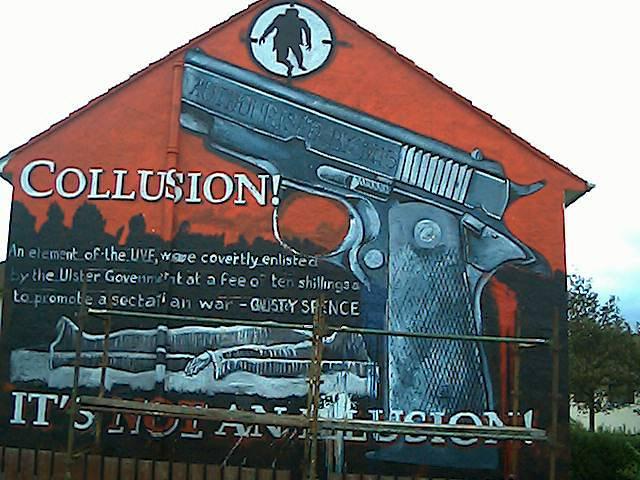

posted by grouse at 3:34 AM on January 14, 2008
There might be a bit of editorialising there flashboy. There are plenty of IRA murals with crossed AK's and balaclavas. To be sure to be sure.
posted by mattoxic at 3:43 AM on January 14, 2008
posted by mattoxic at 3:43 AM on January 14, 2008
And in the traditional protestant fashion, the groups kept splitting.
In fairness, there wasn't much love lost between OIRA and PIRA, the INLA and IPLO and others either.
posted by Abiezer at 3:47 AM on January 14, 2008
In fairness, there wasn't much love lost between OIRA and PIRA, the INLA and IPLO and others either.
posted by Abiezer at 3:47 AM on January 14, 2008
There might be a bit of editorialising there...
Yeah, I know - it just amused me that, from all the Armalite-wielding murals they could have chosen, they mostly included pictures of jolly little men dressed in green top-hats. And a picture of a taxi.
posted by flashboy at 4:00 AM on January 14, 2008
Yeah, I know - it just amused me that, from all the Armalite-wielding murals they could have chosen, they mostly included pictures of jolly little men dressed in green top-hats. And a picture of a taxi.
posted by flashboy at 4:00 AM on January 14, 2008
And let me tell you something: I've had enough of Irish Americans who haven't been back to their country in twenty or thirty years come up to me and talk about the resistance, the revolution back home; and the glory of the revolution, and the glory of dying for the revolution - fuck the revolution! They don't talk about the glory of killing for the revolution. What's the glory in taking a man from his bed and gunning him down in front of his wife and his children? Where's the glory in that? Where's the glory in bombing a Remembrance Day parade of old age pensioners, their medals taken out and polished up for the day? Where's the glory in that? To leave them dying, or crippled for life, or dead, under the rubble of the revolution that the majority of the people in my country don't want. No more! Sing no more!posted by Burger-Eating Invasion Monkey at 4:21 AM on January 14, 2008 [8 favorites]— Bono.
Haha, Bono.
posted by fire&wings at 4:40 AM on January 14, 2008 [1 favorite]
posted by fire&wings at 4:40 AM on January 14, 2008 [1 favorite]
Meh, I pretty much despise the man. But he happens to be right in this instance.
posted by Burger-Eating Invasion Monkey at 4:42 AM on January 14, 2008 [1 favorite]
posted by Burger-Eating Invasion Monkey at 4:42 AM on January 14, 2008 [1 favorite]
How strange to see Stephen Lawrence on an Ulster mural, I understand the correlation between the causes...but it feels like an odd reference to me.
Good post though - if you are in Belfast, you can actually take a black taxi tour of the city to see the murals, its an interesting and informative trip.
posted by mattr at 5:11 AM on January 14, 2008
Good post though - if you are in Belfast, you can actually take a black taxi tour of the city to see the murals, its an interesting and informative trip.
posted by mattr at 5:11 AM on January 14, 2008
I definitely prefer the ones in Derry, though that might be because I've seen those in real life. My favourites.
posted by nthdegx at 5:15 AM on January 14, 2008
posted by nthdegx at 5:15 AM on January 14, 2008
Claremont Colleges Digital Library: Murals of Northern Ireland includes more than 500 murals and an hour long lecture by english academic Tony Crowley.
posted by peacay at 5:27 AM on January 14, 2008 [1 favorite]
posted by peacay at 5:27 AM on January 14, 2008 [1 favorite]
I'm actually thinking about painting a non-sectarian mural on Bono. This will combine the Loyal and National factions into a gestalt, "Lotional" grouping, and I imagine myself painting this Lotion all over Bono while he sings one of his inspirational guitar-based peace-promoting hits with a modern bluesy feel.
As I massage this liquid of tolerance into his tired, aching muscles, he'll flash me that charismatic smile and make a cheeky quip about me rubbing him lower, lower ... then as I remove my shirt and unbutton my belt, Bono will turn onto his back and pull down *EXCUSE ME - "THE EDGE" HERE. AS A FOUNDER MEMBER OF THE GREATEST BAND IN THE WORLD™ U2 I HAVE TEMPORARILY USED MY MELODIC MAGICAL POWERS TO INSERT MYSELF INTO THIS COMMENT SPACE, IN ORDER TO PREVENT THE COMMISSION OF A CRIME AGAINST DECENCY. DO NOT THANK ME - MERELY SHOW YOUR APPRECIATION BY PURCHASING ONE OF OUR AWARD-WINNING ALBUMS OR GREATEST HITS COMPILATIONS! LARRY AND ADAM ARE ALSO HERE, BY THE WAY - HI EVERYONE!* sure is my idea of an "Unforgettable Fire", if you get me.
posted by the quidnunc kid at 5:57 AM on January 14, 2008 [3 favorites]
As I massage this liquid of tolerance into his tired, aching muscles, he'll flash me that charismatic smile and make a cheeky quip about me rubbing him lower, lower ... then as I remove my shirt and unbutton my belt, Bono will turn onto his back and pull down *EXCUSE ME - "THE EDGE" HERE. AS A FOUNDER MEMBER OF THE GREATEST BAND IN THE WORLD™ U2 I HAVE TEMPORARILY USED MY MELODIC MAGICAL POWERS TO INSERT MYSELF INTO THIS COMMENT SPACE, IN ORDER TO PREVENT THE COMMISSION OF A CRIME AGAINST DECENCY. DO NOT THANK ME - MERELY SHOW YOUR APPRECIATION BY PURCHASING ONE OF OUR AWARD-WINNING ALBUMS OR GREATEST HITS COMPILATIONS! LARRY AND ADAM ARE ALSO HERE, BY THE WAY - HI EVERYONE!* sure is my idea of an "Unforgettable Fire", if you get me.
posted by the quidnunc kid at 5:57 AM on January 14, 2008 [3 favorites]
It's enough to make even the stiffest-starched bodice rattle and hum, quid.
posted by Abiezer at 6:03 AM on January 14, 2008
posted by Abiezer at 6:03 AM on January 14, 2008
For reference, here's a link to the great (but heavily segmented on Youtube) documentary The Ulster Troubles
posted by destro at 6:54 AM on January 14, 2008
posted by destro at 6:54 AM on January 14, 2008
You know what would be cool? If The Alphabet Soup warriors of Ireland could declare war on people who think they can establish themselves as having some sort of cred by bashing some celebrity. I'd totally fund that.
posted by srboisvert at 7:35 AM on January 14, 2008
posted by srboisvert at 7:35 AM on January 14, 2008
Wow, the comments under the photos on that first link were so fucking scary that I didn't have the heart to click on the next one. Not recommended reading.
posted by chuckdarwin at 8:31 AM on January 14, 2008
posted by chuckdarwin at 8:31 AM on January 14, 2008
For some reason, there's a big-ass Irish Republican mural on 124th Street in East Harlem. I see it every time I take a cab from the Upper West Side to La Guardia, and I'm always a tad perplexed. It's relatively recent, and it's been a long time since East Harlem was an Irish-American neighborhood.
posted by craichead at 8:57 AM on January 14, 2008
posted by craichead at 8:57 AM on January 14, 2008
Erm, that's East Harlem, New York. If it were the East Harlem in Derry, that would make more sense. Here's a skeptical article about the mural from the Irish Echo, the more mainstream (and less-pro-IRA, when that was an issue) of the Irish-American newspapers.
posted by craichead at 9:01 AM on January 14, 2008
posted by craichead at 9:01 AM on January 14, 2008
And in the traditional protestant fashion, the groups kept splitting.
In fairness, there wasn't much love lost between OIRA and PIRA, the INLA and IPLO and others either.
posted by Abiezer at 3:47 AM on January 14
Very true. However when I was in Ireland in 2003 and 2005, the large majority of the active murals I had seen in both Belfast and Derry were of various Loyalist groups jockeying with each other. From people I had talked too, a lot of the *IRA groups were loosing foothold to political and social group movements.
Especially when you started looking at the social welfare and welfare to work programs, there are more independent social welfare groups in the Nationalist communities. In part because they weren't able to receive assistance from the government, so they had to form their own support network. The Loyalists are now the ones who are loosing out, they had the government to serve them, and many feel they have been abandoned.
In some ways, you can frame it as the Ulster Loyalists groups are feeling betrayed by the crown which they served, they don't have an identity outside of Ulster, they have their own Ulster Scots language, and they feel like they are the minority being pushed out (and eventually, there will be a victory of the cradle, with the catholics just out growing the protestant population). In addition, the members and supporters of these groups on both sides are not the upper class, high wage earners of these cities, but the lower economic classes. As aid and funding pour into these areas as part of the rehabilitation of the troubles, the better organized and structured groups get them, which happen to be Catholic.
What I took from my studies, and this is entirely anecdotal, is that the most violent part of the troubles are in the past (hopefully), but the real struggle will be the healing and reconciliation of that area. Maybe in a few generations, if the UK & Northern Ireland (full properly title) join the EU fully, it will become a mute point, but I still see factions developing. There is the psychological trauma of the conflict that is just being addressed. Imagine having to live in the same neighborhood with the two men who barged into their kitchen one night, and shot your husband in the face with a shotgun, and now both of them walk free as result of the reconciliation process.
Remember, Ireland as an island is about 5.5 million people, Northern Ireland is 1.6 million people, and for comparison, Pennsylvania is 12 Million. It is a small place, and they have had over 4,000 people murder or die because of the troubles in the last 30 years. You can't find someone who lives there who hasn't had a family member killed by one side or the other, or in some cases, both.
posted by mrzarquon at 9:19 AM on January 14, 2008
In fairness, there wasn't much love lost between OIRA and PIRA, the INLA and IPLO and others either.
posted by Abiezer at 3:47 AM on January 14
Very true. However when I was in Ireland in 2003 and 2005, the large majority of the active murals I had seen in both Belfast and Derry were of various Loyalist groups jockeying with each other. From people I had talked too, a lot of the *IRA groups were loosing foothold to political and social group movements.
Especially when you started looking at the social welfare and welfare to work programs, there are more independent social welfare groups in the Nationalist communities. In part because they weren't able to receive assistance from the government, so they had to form their own support network. The Loyalists are now the ones who are loosing out, they had the government to serve them, and many feel they have been abandoned.
In some ways, you can frame it as the Ulster Loyalists groups are feeling betrayed by the crown which they served, they don't have an identity outside of Ulster, they have their own Ulster Scots language, and they feel like they are the minority being pushed out (and eventually, there will be a victory of the cradle, with the catholics just out growing the protestant population). In addition, the members and supporters of these groups on both sides are not the upper class, high wage earners of these cities, but the lower economic classes. As aid and funding pour into these areas as part of the rehabilitation of the troubles, the better organized and structured groups get them, which happen to be Catholic.
What I took from my studies, and this is entirely anecdotal, is that the most violent part of the troubles are in the past (hopefully), but the real struggle will be the healing and reconciliation of that area. Maybe in a few generations, if the UK & Northern Ireland (full properly title) join the EU fully, it will become a mute point, but I still see factions developing. There is the psychological trauma of the conflict that is just being addressed. Imagine having to live in the same neighborhood with the two men who barged into their kitchen one night, and shot your husband in the face with a shotgun, and now both of them walk free as result of the reconciliation process.
Remember, Ireland as an island is about 5.5 million people, Northern Ireland is 1.6 million people, and for comparison, Pennsylvania is 12 Million. It is a small place, and they have had over 4,000 people murder or die because of the troubles in the last 30 years. You can't find someone who lives there who hasn't had a family member killed by one side or the other, or in some cases, both.
posted by mrzarquon at 9:19 AM on January 14, 2008
craichead-
that article is fairly interesting. One of the bigger issues I have see with the Pro IRA Americans (have they ever been to Ireland? or read of its history? or are they just joining the bandwagon) and groups like the Orange Men and Apprentice Boys, is that they don't actually live in or participate in Northern Ireland, but damned if someone makes them change X or Y. The PIRA and Nationalists have gotten quite upset with the US after 9/11 because we have made it harder to donate money to groups such as the PIRA and other organizations associated with terrorism.
And then you have the historic marches of the Orange Men, who come from all over the world, to show their pride, tending to ignore the presence and use of the Orange Men in the late 1800s as hired thugs to intimidate and prevent uprisings. It is akin to nonviolent descendants of the KKK having mock lynchings in celebration of their cultural history in Selma Alabama.
What I really got out of the trip and exposure there is the creation of the new myths, Saints (Bobby Sands, etc.), and folklore surrounding the troubles. It is storytelling in action, and murals are used as pieces in the plot, so people will "never forget" but soon people will forget why the should never forget, and new plots will fill in the story. To paraphrase from the stage play "the rat in the skull" one of my favorite lines is:
"It doesn't matter if the history is truth or fiction, what matters is if it is a good story"
posted by mrzarquon at 10:11 AM on January 14, 2008 [1 favorite]
that article is fairly interesting. One of the bigger issues I have see with the Pro IRA Americans (have they ever been to Ireland? or read of its history? or are they just joining the bandwagon) and groups like the Orange Men and Apprentice Boys, is that they don't actually live in or participate in Northern Ireland, but damned if someone makes them change X or Y. The PIRA and Nationalists have gotten quite upset with the US after 9/11 because we have made it harder to donate money to groups such as the PIRA and other organizations associated with terrorism.
And then you have the historic marches of the Orange Men, who come from all over the world, to show their pride, tending to ignore the presence and use of the Orange Men in the late 1800s as hired thugs to intimidate and prevent uprisings. It is akin to nonviolent descendants of the KKK having mock lynchings in celebration of their cultural history in Selma Alabama.
What I really got out of the trip and exposure there is the creation of the new myths, Saints (Bobby Sands, etc.), and folklore surrounding the troubles. It is storytelling in action, and murals are used as pieces in the plot, so people will "never forget" but soon people will forget why the should never forget, and new plots will fill in the story. To paraphrase from the stage play "the rat in the skull" one of my favorite lines is:
"It doesn't matter if the history is truth or fiction, what matters is if it is a good story"
posted by mrzarquon at 10:11 AM on January 14, 2008 [1 favorite]
I visited Derry and Belfast 10 years ago and was able to see many of these murals in person. It's a fascinating if disturbing tradition.
posted by Rarebit Fiend at 10:32 AM on January 14, 2008
posted by Rarebit Fiend at 10:32 AM on January 14, 2008
Interesting how this is painted (like other similar conflicts) as a religious conflict and not a political conflict. It's made out to be Catholics vs Protestants, when isn't it really Irish vs. Scotts and Brits? It just happens that most Irish are Catholic and most Scotts and Brits are Protestants. But really it's about a foreign power occupying 1/3 or 1/4 of an independent nation.
Really the U.K. gave up India, they gave up Australia, etc.. Why won't they let go of Ireland?
posted by MrBobaFett at 10:42 AM on January 14, 2008
Really the U.K. gave up India, they gave up Australia, etc.. Why won't they let go of Ireland?
posted by MrBobaFett at 10:42 AM on January 14, 2008
But really it's about a foreign power occupying 1/3 or 1/4 of an independent nation.
Really the U.K. gave up India, they gave up Australia, etc.. Why won't they let go of Ireland?
Because a majority of the territory's population don't want them to "give it up"? Far more people identify as Loyalists rather than Nationalists - which is why, for example, the First Minister is Ian Paisley rather than Gerry Adams.
And it's not really painted as religious conflict - not any more than it deserves, at least. Most discussions of it (as is the case here) will use the terms Nationalist and Loyalist, not Catholic and Protestant.
posted by flashboy at 11:04 AM on January 14, 2008
Really the U.K. gave up India, they gave up Australia, etc.. Why won't they let go of Ireland?
Because a majority of the territory's population don't want them to "give it up"? Far more people identify as Loyalists rather than Nationalists - which is why, for example, the First Minister is Ian Paisley rather than Gerry Adams.
And it's not really painted as religious conflict - not any more than it deserves, at least. Most discussions of it (as is the case here) will use the terms Nationalist and Loyalist, not Catholic and Protestant.
posted by flashboy at 11:04 AM on January 14, 2008
Great post, Rumple, thanks!
Just saw Anthony Bourdain's show in northern Ireland - in this segment, he took "bombs & bullets" taxi tours with both protestant and catholic cab drivers to see the murals. (For those interested in other aspects of his trip, parts 2-5).
posted by madamjujujive at 11:09 AM on January 14, 2008
Just saw Anthony Bourdain's show in northern Ireland - in this segment, he took "bombs & bullets" taxi tours with both protestant and catholic cab drivers to see the murals. (For those interested in other aspects of his trip, parts 2-5).
posted by madamjujujive at 11:09 AM on January 14, 2008
One of the bigger issues I have see with the Pro IRA Americans (have they ever been to Ireland? or read of its history? or are they just joining the bandwagon)I'll have to dig up the reference, but there was a book on Irish-American support of the IRA written sometime in the mid-90s that challenged the stereotype of Irish-American IRA supporters as nth generation Irish-Americans who were only distantly attached to Ireland. The book suggested that many active, as opposed to armchair, IRA supporters were relatively recent working-class Irish immigrants who used IRA support to act out their alienation both from both Irish and American society. Ireland hadn't offered them much other than a one-way ticket out of the country, and in America they were stuck in low-wage jobs with little status or prospect for advancement. (Remember, this was the era when there were tons of Irish illegal immigrants in the U.S.) The IRA's pseudo-Marxism, revolutionary rhetoric and solidarity with other oppressed people, including people of color in the U.S., appealed to people who saw themselves as members of an oppressed and marginalized underclass. And that sense of solidarity went both ways, which is why you see a Bobby Sands mural in a part of New York that's mostly Latino.
I'm not sure what this has to do with murals in Northern Ireland, though.
I've been to Northern Ireland a couple of times and have decided not to do the mural tours, because it seems a little maudlin and voyeuristic to me. I'm not sure how I feel about the whole troubles tourism thing, for the same reason that I haven't been to the WTC site in all the dozens of times that I've been in New York since Sept. 11, 2001. They are interesting, though.
Why won't they let go of Ireland?Most people in Northern Ireland want to remain part of Britain. That's true because the British government drew the boundaries of Northern Ireland to ensure a permanent unionist majority, but that doesn't change the fact that the majority of people in Northern Ireland prefer the status quo. Democracy can be a pesky thing.
posted by craichead at 11:19 AM on January 14, 2008
I think it is a useful indicator of change that the Irish goverment now supports with funding the dialect mrzarquon refers to:- Ullans.
posted by Wilder at 11:19 AM on January 14, 2008
posted by Wilder at 11:19 AM on January 14, 2008
/minor derail: -It is also worth pointing out to some posters that Eire gave up it's constitutional claim to the territory of Northern Ireland quite some years ago, and that the vast majority of the population of both sides voted in favour of the peace process.
/derail over.
Other identity markers used to be the colour of the barns in the countryside, you could see at a glance whether you were driving through a loyalist or a republican landscape. Don't know if that is still the case.
posted by Wilder at 11:25 AM on January 14, 2008
/derail over.
Other identity markers used to be the colour of the barns in the countryside, you could see at a glance whether you were driving through a loyalist or a republican landscape. Don't know if that is still the case.
posted by Wilder at 11:25 AM on January 14, 2008
Other identity markers used to be the colour of the barns in the countryside, you could see at a glance whether you were driving through a loyalist or a republican landscape. Don't know if that is still the case.That's interesting. I didn't notice that, but I was pretty clueless. What you couldn't miss was that in towns and cities, the curbs by the side of the road in unionist neighborhoods were painted red, white and blue, the colors of the British flag. In nationalist neighborhoods, the curbs were painted the colors of the Irish flag. People seemed to put a lot of effort into marking out whose territory was whose.
posted by craichead at 11:41 AM on January 14, 2008
From the "more inside": direct youtube links 1, 2, to the Al-Jazeera documentary on the Belfast "walls of shame" - an outsider view of the conflict, and part of their series on such walls worldwide, including the US-Mexico wall of shame and the West Bank wall of shame.
posted by Rumple at 11:44 AM on January 14, 2008 [1 favorite]
posted by Rumple at 11:44 AM on January 14, 2008 [1 favorite]
It is interesting to me that a couple of posters have mentioned taxi tours of the murals. When I was in Derry in the early nineties (can't remember exactly when, it was the 25th anniversary of something important to the troubles) my Catholic relatives wouldn't let me take a taxi home from the disco because they said the money the taxis made went to the IRA. Also, I remeber quite a few Catholics were happy with N.I./Eire split because they would live in Donegal (cheaper housing) but work in Derry (higher wages/medicare) and a few clever layabouts were on the dole on both sides of the border.
Apparently my Grandad from Kerry was in the IRA and blew up some bridge so he moved to England and lived the rest of his life there. I'd love to find out if the story is true but I don't imagine the IRA keeps very good records on who blew up what.
posted by saucysault at 11:50 AM on January 14, 2008
Apparently my Grandad from Kerry was in the IRA and blew up some bridge so he moved to England and lived the rest of his life there. I'd love to find out if the story is true but I don't imagine the IRA keeps very good records on who blew up what.
posted by saucysault at 11:50 AM on January 14, 2008
I'll have to dig up the reference, but there was a book on Irish-American support of the IRA written sometime in the mid-90s that challenged the stereotype of Irish-American IRA supporters as nth generation Irish-Americans who were only distantly attached to Ireland. The book suggested that many active, as opposed to armchair, IRA supporters were relatively recent working-class Irish immigrants who used IRA support to act out their alienation both from both Irish and American society
My father grew up in a heavily Irish-Catholic, working-class neighborhood in New York (this would be in the early to mid '60s) and he told me that when he was young, people would go door-to-door soliciting donations for the IRA. When I asked him if he gave anything, he said 'if it was a pretty girl collecting, sure."
posted by jonmc at 11:59 AM on January 14, 2008
My father grew up in a heavily Irish-Catholic, working-class neighborhood in New York (this would be in the early to mid '60s) and he told me that when he was young, people would go door-to-door soliciting donations for the IRA. When I asked him if he gave anything, he said 'if it was a pretty girl collecting, sure."
posted by jonmc at 11:59 AM on January 14, 2008
he said 'if it was a pretty girl collecting, sure.
A bombshell, in fact.
posted by Rumple at 12:47 PM on January 14, 2008 [1 favorite]
A bombshell, in fact.
posted by Rumple at 12:47 PM on January 14, 2008 [1 favorite]
A lot of the Ulster Scots identify themselves as "Scotch Irish." They are descendants of the of scottish settlers who were sent by the British to ensure that Ireland remained under the control of British protestants. They really had no power in Scotland, and saw moving to Ireland as a way to become landholders for once. They had lived there for 300 years, and at what point do you deny them their heritage also?
The Ulster Scots are quick to remind people that many of the US's founding fathers were Ulster Scots or descendants of them. There are other murals that depict not Eddie, but Washington, and others, with their memorable quotes about their Ulster Scot heritage.
Also, not every person protesting the established laws of Northern Ireland were members of the IRA or a terrorist group. There were independent groups, and Bloody Sunday itself was a demonstration for equal housing rights in the Bogside of Derry. It was led by Ivan Cooper, a protestant, and was modeled after the Civil Rights movement in the US. To group all of these activists in with the IRA is to ignore that people were working peacefully within the system for real political change, and to imply anyone who was working towards changing the established system is/was an terrorist.
As an aside to refer to the murals as in "Ulster" is to be misleading, as only 6 of 9 provinces of Ulster are in Northern Ireland, the other three are in the Republic.
[NOT sectarian-IST]
The Film Blood Sunday is extremely powerful, as is Omagh, if you want some movies to watch about the troubles also.
posted by mrzarquon at 1:05 PM on January 14, 2008 [2 favorites]
The Ulster Scots are quick to remind people that many of the US's founding fathers were Ulster Scots or descendants of them. There are other murals that depict not Eddie, but Washington, and others, with their memorable quotes about their Ulster Scot heritage.
Also, not every person protesting the established laws of Northern Ireland were members of the IRA or a terrorist group. There were independent groups, and Bloody Sunday itself was a demonstration for equal housing rights in the Bogside of Derry. It was led by Ivan Cooper, a protestant, and was modeled after the Civil Rights movement in the US. To group all of these activists in with the IRA is to ignore that people were working peacefully within the system for real political change, and to imply anyone who was working towards changing the established system is/was an terrorist.
As an aside to refer to the murals as in "Ulster" is to be misleading, as only 6 of 9 provinces of Ulster are in Northern Ireland, the other three are in the Republic.
[NOT sectarian-IST]
The Film Blood Sunday is extremely powerful, as is Omagh, if you want some movies to watch about the troubles also.
posted by mrzarquon at 1:05 PM on January 14, 2008 [2 favorites]
Maybe in a few generations, if the UK & Northern Ireland (full properly title) join the EU fully, it will become a mute point
Didnt your studies tell you it's the United Kingdom of Great Britain and Northern Ireland?
Think you drank too much Guinness, matey :)
pssst, and it's moot
posted by the cuban at 4:06 PM on January 14, 2008
Didnt your studies tell you it's the United Kingdom of Great Britain and Northern Ireland?
Think you drank too much Guinness, matey :)
pssst, and it's moot
posted by the cuban at 4:06 PM on January 14, 2008
From the comments:
Fuck Adair,Paisley,Adams and McGuinness. And quite frankly anyone who still buys into the whole religion bollocks should wake up and smell the coffee. If you believe a big supernatural being clapped his hands and created everything in 7 fucking days then you deserve to go and collect your dole check because your good for fuck all else. Without that work of fairytales people in your neck of the woods put so much stock in, a lot more people would still be alive. With no religion, the two tribes would have inter-married centuries ago and none of the recent past atrocities would have occurred. I mean seriously, you lot still buy the bible? Caused more deaths than disease.
posted by jason's_planet at 7:10 PM on January 14, 2008
Fuck Adair,Paisley,Adams and McGuinness. And quite frankly anyone who still buys into the whole religion bollocks should wake up and smell the coffee. If you believe a big supernatural being clapped his hands and created everything in 7 fucking days then you deserve to go and collect your dole check because your good for fuck all else. Without that work of fairytales people in your neck of the woods put so much stock in, a lot more people would still be alive. With no religion, the two tribes would have inter-married centuries ago and none of the recent past atrocities would have occurred. I mean seriously, you lot still buy the bible? Caused more deaths than disease.
posted by jason's_planet at 7:10 PM on January 14, 2008
Aye, you got me there the cuban.
I first saw the comments at 3am, and I think i drank too little guinness, or else I would have had a better nights sleep (says the doctor!).
posted by mrzarquon at 8:29 PM on January 14, 2008
I first saw the comments at 3am, and I think i drank too little guinness, or else I would have had a better nights sleep (says the doctor!).
posted by mrzarquon at 8:29 PM on January 14, 2008
And let me tell you something: I've had enough of Irish Americans who haven't been back to their country in twenty or thirty years come up to me and talk about the resistance, the revolution back home; and the glory of the revolution, and the glory of dying for the revolution - fuck the revolution! They don't talk about the glory of killing for the revolution. What's the glory in taking a man from his bed and gunning him down in front of his wife and his children? Where's the glory in that? Where's the glory in bombing a Remembrance Day parade of old age pensioners, their medals taken out and polished up for the day? Where's the glory in that? To leave them dying, or crippled for life, or dead, under the rubble of the revolution that the majority of the people in my country don't want. No more! Sing no more!
OK, Bono, howsabout you pay some tax, stop wearing those stupid fucking glasses, and put out a decent album rather than the dross you've been serving up, then we'll talk.
Until then, fuck you and your bleeding heart.
posted by mattoxic at 3:33 AM on January 15, 2008
Yeah, because the opinions of people wearing stupid glasses should be automatically dismissed, no matter how persuasive they are.
posted by grouse at 3:45 AM on January 15, 2008
posted by grouse at 3:45 AM on January 15, 2008
You know, Bono is really famous, so the things he says get publicity. But at the time he said that, you'd hear exactly the same thing from many ordinary Irish people with inoffensive eyewear and normal tax bills. I heard it so many times when I was in Ireland in 1989, 1991 and 1993-4 that I got in the habit of announcing that I wasn't Irish-American so that people wouldn't lecture me about how evil my evil, IRA-supporting relatives were. Whatever you think about Bono, in this case I think he was speaking for an awful lot of Irish people.
posted by craichead at 9:51 AM on January 15, 2008 [1 favorite]
posted by craichead at 9:51 AM on January 15, 2008 [1 favorite]
« Older "the destinies of ... the Israeli people and the... | epic lulz Newer »
This thread has been archived and is closed to new comments
posted by soundofsuburbia at 2:08 AM on January 14, 2008