This is Hank William's guitar. I try to do the right thing with the guitar. You don't want to stink with Hank's guitar.
October 25, 2008 11:54 AM Subscribe
The Martin D-28. You have heard it thousands of times before. Its modest appearance belies its history and influence; there have been several changes in its design and construction over the years, but it remains largely the same since its introduction in 1934.
It is known as the standard by which all steel-stringed deadnought-sized guitars are measured, made by C.F. Martin & Company in Nazareth, Pennsylvania (now in their 175th year).
Originally introduced with scalloped bracing to maximize bass response and volume in unamplified venues, the construction and positioning of the bracing moved away from the soundhole in the late 1930's, and the braces became non-scalloped in 1945. These changes served to strengthen the guitar in response to players' tendencies to use heavier and heavier strings to further increase volume.
The only other major change in the construction of the guitar came in 1969 when the availability of highly-prized Brazilian Rosewood, used in the back and sides, became scarce enough to force the switch to the (widely-regarded as a lesser tonewood) East Indian Rosewood.
Due to their age (guitars are generally regarded to improve with sound as the get older), their construction and their rarity, the pre-war D-28 is often referred to as a 'holy grail' of acoustic guitars. Models often sell for six-figure sums when they do appear on the market. Due to this demand, C.F. Martin & Company construct a D-28 Authentic 1937 guitar, made with the same methods and materials as were available in that year (including the use of horse hide glue).
Famous Martin D-28's in regular use include Hank Williams' 1941 model owned and still gigged by Neil Young, and Clarence White's unique 1934 model now owned and played by bluegrass guitarist Tony Rice.

It is known as the standard by which all steel-stringed deadnought-sized guitars are measured, made by C.F. Martin & Company in Nazareth, Pennsylvania (now in their 175th year).
Originally introduced with scalloped bracing to maximize bass response and volume in unamplified venues, the construction and positioning of the bracing moved away from the soundhole in the late 1930's, and the braces became non-scalloped in 1945. These changes served to strengthen the guitar in response to players' tendencies to use heavier and heavier strings to further increase volume.
The only other major change in the construction of the guitar came in 1969 when the availability of highly-prized Brazilian Rosewood, used in the back and sides, became scarce enough to force the switch to the (widely-regarded as a lesser tonewood) East Indian Rosewood.
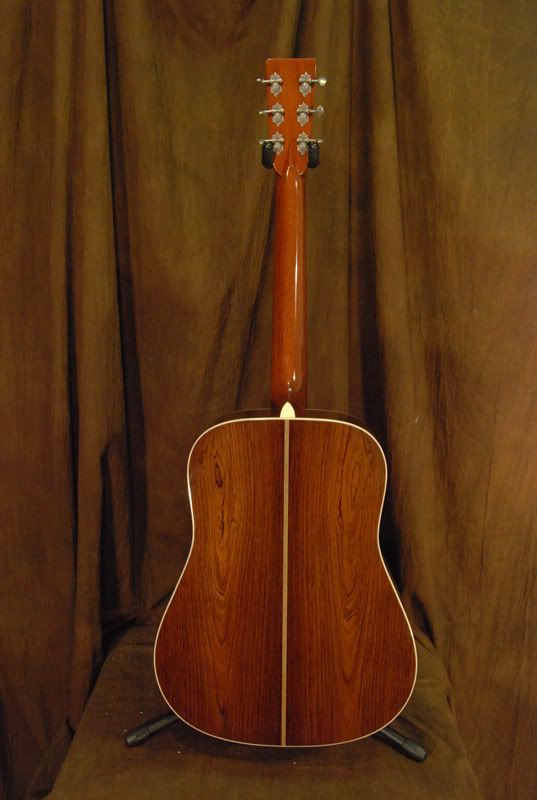

Due to their age (guitars are generally regarded to improve with sound as the get older), their construction and their rarity, the pre-war D-28 is often referred to as a 'holy grail' of acoustic guitars. Models often sell for six-figure sums when they do appear on the market. Due to this demand, C.F. Martin & Company construct a D-28 Authentic 1937 guitar, made with the same methods and materials as were available in that year (including the use of horse hide glue).
Famous Martin D-28's in regular use include Hank Williams' 1941 model owned and still gigged by Neil Young, and Clarence White's unique 1934 model now owned and played by bluegrass guitarist Tony Rice.

No reason to fuck with perfection. If anyone has a spare D-28 (any year) getting dusty in a closet, I can memail you my postal address.
posted by chuckdarwin at 12:23 PM on October 25, 2008
posted by chuckdarwin at 12:23 PM on October 25, 2008
The only other major change in the construction of the guitar came in 1969
Also 1965, when they went from Tortoiseshell to plastic for the pick guard -- which also altered the tone.
Dad had a 1966 D-28. We made sure it got to a player's hands when he passed away.
I still remember the deep blue pile in the case, contrasting the golden yellow of the top, and the dot he inlaid into the bridge as a signature (he was, amongst other things, a luthier)
posted by eriko at 12:37 PM on October 25, 2008 [1 favorite]
Also 1965, when they went from Tortoiseshell to plastic for the pick guard -- which also altered the tone.
Dad had a 1966 D-28. We made sure it got to a player's hands when he passed away.
I still remember the deep blue pile in the case, contrasting the golden yellow of the top, and the dot he inlaid into the bridge as a signature (he was, amongst other things, a luthier)
posted by eriko at 12:37 PM on October 25, 2008 [1 favorite]
Don't forget the Car Talk Special edition. Only $6499.00
posted by Eekacat at 12:41 PM on October 25, 2008 [1 favorite]
posted by Eekacat at 12:41 PM on October 25, 2008 [1 favorite]
This was always by far my favorite Martin. I played an HD-28 for years that was just about the loudest and most bassy conventional acoustic guitar I have ever played. Truly a sonic experience, and much richer to my ear than the generally more highly regarded D-35 and the grotesquely overpriced D-45.
When I stopped playing live a couple of years back, I sold my 28 and picked up a Taylor 710 instead, which I find has better all around tone. Still I sometimes miss having the throaty 28 in my quiver.
Great post!
posted by psmealey at 12:54 PM on October 25, 2008
When I stopped playing live a couple of years back, I sold my 28 and picked up a Taylor 710 instead, which I find has better all around tone. Still I sometimes miss having the throaty 28 in my quiver.
Great post!
posted by psmealey at 12:54 PM on October 25, 2008
psmealey,
I bought a standard 2008 D-28 in April (the inspiration for this post) and it's wonderful. I didn't try an HD-28, as the D-28 was just at the top range of my price point and I'd probably have been tempted to go higher. The nice balanced sound of the standard is pretty nice, though, and probably closer to what you get out of a Taylor. I actually went into the shop wanting a Gibson J-45 and really wanted to like it but it didn't compare at all to the Martin.
posted by jimmythefish at 1:03 PM on October 25, 2008
I bought a standard 2008 D-28 in April (the inspiration for this post) and it's wonderful. I didn't try an HD-28, as the D-28 was just at the top range of my price point and I'd probably have been tempted to go higher. The nice balanced sound of the standard is pretty nice, though, and probably closer to what you get out of a Taylor. I actually went into the shop wanting a Gibson J-45 and really wanted to like it but it didn't compare at all to the Martin.
posted by jimmythefish at 1:03 PM on October 25, 2008
When I first saw "Martin D-28" I thought, "Is that related to the Martin B-26"?
Sob, I'm not very hip.
posted by Class Goat at 1:38 PM on October 25, 2008
Sob, I'm not very hip.
posted by Class Goat at 1:38 PM on October 25, 2008
I wish I could afford one of these. Especially an old one. I haunted ebay for a year before giving up the dream. I did come away with a lovely 000-16GT (I like the little ones). Beautiful tone. Fine, fine intonation. Stays in tune for months and months. So, pretty happy.
Guitar lust, in general, is a terrible affliction. It's probably a good thing that I don't have more money.
posted by flotson at 1:56 PM on October 25, 2008 [1 favorite]
Guitar lust, in general, is a terrible affliction. It's probably a good thing that I don't have more money.
posted by flotson at 1:56 PM on October 25, 2008 [1 favorite]
I also went for the auditorium model over the dreadnought. Makes it difficult to compete when there's a banjo in the room but my OOOc-15e is the most mellow, tonally balanced guitar I've ever owned. Perfect for fingerstyle, though if I could do it again, I'd deep six the electronics and maybe the cutaway for the added resonance.
posted by The White Hat at 2:46 PM on October 25, 2008
posted by The White Hat at 2:46 PM on October 25, 2008
Haven't read it, but probably worth a look to those interested in this subject: American-studies scholar Philip Gura's history of the Martin guitar's early days.
posted by RogerB at 2:53 PM on October 25, 2008
posted by RogerB at 2:53 PM on October 25, 2008
Apparently, Gordon Giltrap was going on about G.A.S. (Guitar Acquisition Syndrome) at a recent show...
posted by chuckdarwin at 4:38 PM on October 25, 2008
posted by chuckdarwin at 4:38 PM on October 25, 2008
KICK. ASS. POST.
I built my first guitar last year. A damn near replica of a pre-war D-28. I shifted the braces forward according to the old specs. Didn't have any Brazilian rosewood, nor any red spruce...mine's sitka/East Indian rosewood.
The damn thing sings.
Did I mention this is a great post? This is a great post.
posted by dan g. at 4:39 PM on October 25, 2008 [1 favorite]
I built my first guitar last year. A damn near replica of a pre-war D-28. I shifted the braces forward according to the old specs. Didn't have any Brazilian rosewood, nor any red spruce...mine's sitka/East Indian rosewood.
The damn thing sings.
Did I mention this is a great post? This is a great post.
posted by dan g. at 4:39 PM on October 25, 2008 [1 favorite]
I thank you, my D-15 thanks you. Martin is a great maker, and this is a great post about a wonderful, historic guitar model.
posted by Miko at 5:05 PM on October 25, 2008
posted by Miko at 5:05 PM on October 25, 2008
I have an early 70's D-18. . . .the 28's are a lot brighter and louder.
posted by Danf at 5:54 PM on October 25, 2008
posted by Danf at 5:54 PM on October 25, 2008
Thanks for a great post jimmythefish, and a great selection of songs. What a fantastic way to spend an hour...this post makes me want to practice.
More amazing one-of-a-kind sounds from a master with a Martin Dreadnought: Michael Hedges - Aerial Boundaries.
posted by edverb at 6:17 PM on October 25, 2008
More amazing one-of-a-kind sounds from a master with a Martin Dreadnought: Michael Hedges - Aerial Boundaries.
posted by edverb at 6:17 PM on October 25, 2008
When I was in college, Fayetteville, Ark.... early 60's- and was just beginning to get interested in guitar, a friend owned his father's 1936 Herringbone. I thought it was the most beautiful thing I'd ever seen, and heard- he was good, too.
Later that year, around xmastime, I was looking for a first instrument. We went to Little Rock and scoured the pawnshops. I came up with a 1949 Martin 000-18. For $70. I almost didn't buy it- it was a lot of money for me then. But I did, and I still have it. I've since owned several D-28's, but none have ever sounded like that Herringbone.... the little 000-18 holds a lot of memories.
posted by drhydro at 8:28 PM on October 25, 2008
Later that year, around xmastime, I was looking for a first instrument. We went to Little Rock and scoured the pawnshops. I came up with a 1949 Martin 000-18. For $70. I almost didn't buy it- it was a lot of money for me then. But I did, and I still have it. I've since owned several D-28's, but none have ever sounded like that Herringbone.... the little 000-18 holds a lot of memories.
posted by drhydro at 8:28 PM on October 25, 2008
hmm, should have made clear that whenever I get the 000-18 out to play it, I think of that guy and his incredible guitar.
posted by drhydro at 8:31 PM on October 25, 2008
posted by drhydro at 8:31 PM on October 25, 2008
3k? i guess legends don't come cheap. i wouldn't pay that much for a guitar made out of the bones of jesus.
posted by breakfast_yeti at 9:52 PM on October 25, 2008
posted by breakfast_yeti at 9:52 PM on October 25, 2008
When tracking acoustic guitar parts for a new record over the summer, I was fortunate enough to borrow a friend's 1963 D-28. Holy shit. It's what I refer to as a one chord guitar - it's the kind of instrument where all you need to do is strum one chord on it, and the sound is so fantastically warm and huge that you simply BATHE in it. I had a tought time returning that one...
posted by fingers_of_fire at 10:04 PM on October 25, 2008
posted by fingers_of_fire at 10:04 PM on October 25, 2008
The problem with these great Martins is owning something cheap and toneless (as I do). Every time I strum it, I wish I could afford a real guitar!
posted by bonefish at 3:05 PM on October 26, 2008
posted by bonefish at 3:05 PM on October 26, 2008
Damn. Now I want to go home and cuddle my mahogany D-15 for a while instead of working. Fun fact: hum a D over the sound hole and all the strings will resonate. How can you not love a guitar that sings harmony with you?
posted by 1f2frfbf at 6:23 AM on October 27, 2008
posted by 1f2frfbf at 6:23 AM on October 27, 2008
A wonderful book many contributing to this thread would surely enjoy is Clapton's Guitar about master guitar builder, and Martin alum, Wayne Henderson.
posted by jmstephan at 8:49 AM on October 27, 2008 [1 favorite]
posted by jmstephan at 8:49 AM on October 27, 2008 [1 favorite]
3k? i guess legends don't come cheap. i wouldn't pay that much for a guitar made out of the bones of jesus.
Vintage 1920s and 30s Martins often run into the tens of thousands of dollars. It all depends on your resources and your priorities...but, having played a vintage Martin, I can say that if I had the resources, it's a splurge I would seriously consider.
posted by Miko at 9:31 AM on October 27, 2008
Vintage 1920s and 30s Martins often run into the tens of thousands of dollars. It all depends on your resources and your priorities...but, having played a vintage Martin, I can say that if I had the resources, it's a splurge I would seriously consider.
posted by Miko at 9:31 AM on October 27, 2008
« Older simple minded dream 79-80-81-82-83-84 | I Contain Multitudes Newer »
This thread has been archived and is closed to new comments
I've never owned a d-28 but I've played a few.
Very few guitars come close.
Eargasm.
posted by chillmost at 12:23 PM on October 25, 2008