Pass The Pigs
February 25, 2009 10:55 AM Subscribe
Anyone remember the game Pass The Pigs?
Our version was called Pig Mania. Kind of a dice game, but with these little rubber pigs. No? Well, thankfully, you can now play it online here. Or here. And for the iPhone. Since this is the internet, and all, I shouldn't be surprised that people have run the numbers. Oh, and I almost forgot the official site.
Our version was called Pig Mania. Kind of a dice game, but with these little rubber pigs. No? Well, thankfully, you can now play it online here. Or here. And for the iPhone. Since this is the internet, and all, I shouldn't be surprised that people have run the numbers. Oh, and I almost forgot the official site.
I like pigs. Dogs look up to us. Cats look down on us. Pigs treat us as equals. - Winston Churchill
posted by netbros at 11:03 AM on February 25, 2009 [1 favorite]
posted by netbros at 11:03 AM on February 25, 2009 [1 favorite]
YES. Pig Mania was the best. Thanks for the flashback.
posted by horsemuth at 11:10 AM on February 25, 2009
posted by horsemuth at 11:10 AM on February 25, 2009
Apparently this is not the kind of passing that you do the morning after a BBQ.
posted by Rhomboid at 11:10 AM on February 25, 2009
posted by Rhomboid at 11:10 AM on February 25, 2009
from the wikipedia article:
The approximate relative frequencies of the various positions (for a single pig) are:
* Side (no dot) - 6,139/17,581 = 34.9%
* Side (dot) ---- 5,372/17,581 = 30.6%
* Razorback ---- 3,852/17,581 = 21.9%
* Trotter ---------- 1,550/17,581 = 8.8%
* Snouter --------- 546/17,581 = 3.1%
* Leaning Jowler - 122/17,581 = 0.69%
Sample size: 17,581 (Note: results vary widely.)
awesome.
posted by farishta at 11:12 AM on February 25, 2009
The approximate relative frequencies of the various positions (for a single pig) are:
* Side (no dot) - 6,139/17,581 = 34.9%
* Side (dot) ---- 5,372/17,581 = 30.6%
* Razorback ---- 3,852/17,581 = 21.9%
* Trotter ---------- 1,550/17,581 = 8.8%
* Snouter --------- 546/17,581 = 3.1%
* Leaning Jowler - 122/17,581 = 0.69%
Sample size: 17,581 (Note: results vary widely.)
awesome.
posted by farishta at 11:12 AM on February 25, 2009
This is also a game on the DS now. I play it when I have 5 minutes.
posted by deezil at 11:14 AM on February 25, 2009
posted by deezil at 11:14 AM on February 25, 2009
Hells yes! I haven't thought about this game in like 15 years.
Thanks for the nostalgia, ORM. I really like the 3D version on the official site. Requires just the right amount of effort.
posted by EatTheWeek at 11:16 AM on February 25, 2009
Thanks for the nostalgia, ORM. I really like the 3D version on the official site. Requires just the right amount of effort.
posted by EatTheWeek at 11:16 AM on February 25, 2009
Pass the Pigs is symbolic of a what were possibly the two of the saddest, strangest, most awkward, most bizzare, most poignant days of my life.
Over the course of five days, when I was home for the summer at 19, my parents' ostensibly picture-perfect family crumbled. They found out I was gay, and they found out that my brother and his wife were divorcing and he was moving back home. (Sounds trivial now, but at the time it was two traumatic blows for them.) The following weekend, the four of us were scheduled to attend a family reunion in Branson, Missouri. There was talk of not going because of all that had happened, but we couldn't disappoint Grandma and Grandpa, so we went.
The four of us found ourselves in the car together for the first time since I was a kid. I think it was literally our first car trip together since I was 6. (My brother is 10 years older and he moved away to college when I was in 3rd grade.)
On the two-day trek to Branson, driving down the lush highways of the South (Adopt-a-Road signs sponsored by the KKK!), we passed the time in the car by playing Pass the Pigs, which my brother bought on a lark in an Arkansas truck stop.
We laughed our asses off. Pass the Pigs turned what could and should have been a really uncomfortable drive into one of those sappy journeys of reconnection that get turned into Lifetime movies starring Meredith Baxter Birney.
Thank you, plastic piglets.
And then we got to Branson and went to see Wayne Newton and we didn't need the little piggies to hold us together anymore.
posted by mudpuppie at 11:16 AM on February 25, 2009 [21 favorites]
Over the course of five days, when I was home for the summer at 19, my parents' ostensibly picture-perfect family crumbled. They found out I was gay, and they found out that my brother and his wife were divorcing and he was moving back home. (Sounds trivial now, but at the time it was two traumatic blows for them.) The following weekend, the four of us were scheduled to attend a family reunion in Branson, Missouri. There was talk of not going because of all that had happened, but we couldn't disappoint Grandma and Grandpa, so we went.
The four of us found ourselves in the car together for the first time since I was a kid. I think it was literally our first car trip together since I was 6. (My brother is 10 years older and he moved away to college when I was in 3rd grade.)
On the two-day trek to Branson, driving down the lush highways of the South (Adopt-a-Road signs sponsored by the KKK!), we passed the time in the car by playing Pass the Pigs, which my brother bought on a lark in an Arkansas truck stop.
We laughed our asses off. Pass the Pigs turned what could and should have been a really uncomfortable drive into one of those sappy journeys of reconnection that get turned into Lifetime movies starring Meredith Baxter Birney.
Thank you, plastic piglets.
And then we got to Branson and went to see Wayne Newton and we didn't need the little piggies to hold us together anymore.
posted by mudpuppie at 11:16 AM on February 25, 2009 [21 favorites]
I only play with pigs made by this guy.
posted by spikeleemajortomdickandharryconnickjrmints at 11:18 AM on February 25, 2009
posted by spikeleemajortomdickandharryconnickjrmints at 11:18 AM on February 25, 2009
If I read that probability analysis right, there are 2 possible optimum strategies:
1) Go for 26 every round, and quit when you get to 26.
2) Go for 26 every round, except quit as soon as you move ahead of your opponent.
I tried those and lost. Stupid pigs.
posted by joecacti at 11:21 AM on February 25, 2009
1) Go for 26 every round, and quit when you get to 26.
2) Go for 26 every round, except quit as soon as you move ahead of your opponent.
I tried those and lost. Stupid pigs.
posted by joecacti at 11:21 AM on February 25, 2009
The best thing that ever happened to a young girl coming into puberty that loved pigs! Thankfully, my parents could be THAT cool. And we played. And we played. And bacon got made.
posted by psylosyren at 11:28 AM on February 25, 2009
posted by psylosyren at 11:28 AM on February 25, 2009
Marisa - I thought that too, from the name! But Makin Bacon (or Oinker) is bad - you lose all previous points, and go back to zero!
And for the number of games I've played so far, it's happened to me about nine times, and to the computer once. So I wonder about the "randomness"...
posted by ObscureReferenceMan at 11:34 AM on February 25, 2009
And for the number of games I've played so far, it's happened to me about nine times, and to the computer once. So I wonder about the "randomness"...
posted by ObscureReferenceMan at 11:34 AM on February 25, 2009
Based on an old game of that when I must have been, like, 10 years old, my brain still wants to refer to any huge, game-changing moment of triumph as a "double-leaning-jowler tower of power."
It was something my friend said in a moment of desperation. It suck with me.
posted by Navelgazer at 11:34 AM on February 25, 2009
It was something my friend said in a moment of desperation. It suck with me.
posted by Navelgazer at 11:34 AM on February 25, 2009
the kind of passing that you do the morningfive days after a BBQ.
posted by uncleozzy at 11:41 AM on February 25, 2009
posted by uncleozzy at 11:41 AM on February 25, 2009
Oh, man. My husband introduced me to Pass the Pigs. It's great fun and small enough to pack in a purse or computer bag. Yes.
posted by sadiehawkinstein at 11:51 AM on February 25, 2009
posted by sadiehawkinstein at 11:51 AM on February 25, 2009
My roommate had the Winning Moves version which came in a convenient plastic carrying case.
Good times!
posted by aubilenon at 11:55 AM on February 25, 2009
Good times!
posted by aubilenon at 11:55 AM on February 25, 2009
my weirdo cousins from scottsbluff were into this game, and thought we were crazy for having never played it. they also learned the peanut butter and jelly song in school, and said "cool beans" a lot.
posted by camdan at 12:00 PM on February 25, 2009 [1 favorite]
posted by camdan at 12:00 PM on February 25, 2009 [1 favorite]
thanks a lot, camdan. now i know what i'll be singing for the next 8 hours.
posted by spinturtle at 12:19 PM on February 25, 2009
posted by spinturtle at 12:19 PM on February 25, 2009
We played it as a drinking game (like 3-Man) in college.
posted by stifford at 12:27 PM on February 25, 2009
posted by stifford at 12:27 PM on February 25, 2009
also played it as a drinking game...was better known as tequila pigs (for obvious reasons)
posted by ghost32 at 12:29 PM on February 25, 2009
posted by ghost32 at 12:29 PM on February 25, 2009
I had a little travel version when I was 12 and went traveling around Greece for the whole summer. I have many fond memories of playing it on various ferries and beaches.
posted by whoaali at 12:33 PM on February 25, 2009
posted by whoaali at 12:33 PM on February 25, 2009
Now I have "Peanut Butter Jelly Time" on the brain, too. And there's only one cure that.
posted by Marisa Stole the Precious Thing at 12:38 PM on February 25, 2009
posted by Marisa Stole the Precious Thing at 12:38 PM on February 25, 2009
Pig Mania!! We used to play that all the time when I was little! It was my older sister's favorite game.
posted by sarcasticah at 12:52 PM on February 25, 2009
posted by sarcasticah at 12:52 PM on February 25, 2009
I do remember this game, but I don't recall when or where I played it. The memory of this game is occupying storage space in my brain next to Cosmic Wimpout.
posted by not_on_display at 12:58 PM on February 25, 2009
posted by not_on_display at 12:58 PM on February 25, 2009
My family loved this game. We used to play it after dinner almost every night when I was a kid.
posted by solipsophistocracy at 1:17 PM on February 25, 2009
posted by solipsophistocracy at 1:17 PM on February 25, 2009
If I read that probability analysis right, there are 2 possible optimum strategies:
1) Go for 26 every round, and quit when you get to 26.
2) Go for 26 every round, except quit as soon as you move ahead of your opponent.
No; the analysis says only that if you consider only the strategies "Go for N every round, and quit when you get to N" and "Go for N every round, except quit as soon as you are ahead of your opponent" then one of those strategies is the best among that set of strategies.
But that analysis does not consider all possible strategies. Here is a graph of the full solution for the optimal strategy for "player 1" in a two-player game; it turns out to be rather complex. (From here.)
This paper [zip file which expands to PDF] explores the optimal strategy for a similar game played with dice, but some of the key quotes here equally explain why "Go for N every round, and quit when you get to N" or "Go for N every round, except quit as soon as you are ahead of your opponent" are not optimal strategies for Pass the Pigs:
posted by DevilsAdvocate at 1:30 PM on February 25, 2009 [3 favorites]
1) Go for 26 every round, and quit when you get to 26.
2) Go for 26 every round, except quit as soon as you move ahead of your opponent.
No; the analysis says only that if you consider only the strategies "Go for N every round, and quit when you get to N" and "Go for N every round, except quit as soon as you are ahead of your opponent" then one of those strategies is the best among that set of strategies.
But that analysis does not consider all possible strategies. Here is a graph of the full solution for the optimal strategy for "player 1" in a two-player game; it turns out to be rather complex. (From here.)
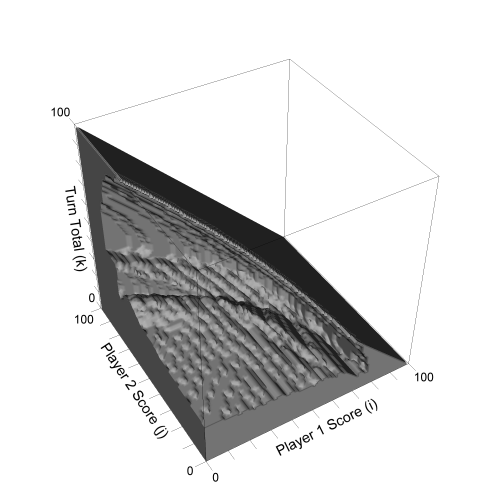
This paper [zip file which expands to PDF] explores the optimal strategy for a similar game played with dice, but some of the key quotes here equally explain why "Go for N every round, and quit when you get to N" or "Go for N every round, except quit as soon as you are ahead of your opponent" are not optimal strategies for Pass the Pigs:
[T]here are many circumstances in which one should deviate from this "hold at 20" policy. [The analogue to "hold at 26" for the game evaluated here.] Why does this reasoning not dictate an optimal policy for all play? The reason is thatAlso see this paper, where the same authors analyze other similar games, including Pass the Pigs itself.risking points is not the same as risking the probability of winning.Put another way, playing to maximize expected score for a single turn is different from playing to win....
Overall, we see that the "hold at 20" policy only serves as a good approximation to optimal play when both players have low scores. When either player has a high score, it is advisable on each turn to try to win. In between those extremes, play is unintuitive, deviating significantly from the "hold at 20" policy, and being highly discontinuous from one score to the next.
posted by DevilsAdvocate at 1:30 PM on February 25, 2009 [3 favorites]
I still have this game, and break it out every now and again when we've got a bunch of tipsy folks around who want to yell at tiny plastic pigs. And also holy SMOKES not_on_display, I haven't thought about Wimpout in like 10 years. Wow.
posted by FatherDagon at 1:33 PM on February 25, 2009
posted by FatherDagon at 1:33 PM on February 25, 2009
Oh, Jeeze! Thanks for the throw back! We used to play Pig Mania on road trips. Which the bumps and turns always got us into fights. One bump and you can go from a Makin' Bacon to a razorback.
posted by noriyori at 2:03 PM on February 25, 2009
posted by noriyori at 2:03 PM on February 25, 2009
DevilsAdvocate - I tried the "passing on 26", but still lost regularly. Tried passing after winning anything more than 5. That seemed to to better. But I don't have the math chops to see if this is the best strategy.
posted by ObscureReferenceMan at 4:46 PM on February 25, 2009
posted by ObscureReferenceMan at 4:46 PM on February 25, 2009
thanks! we enjoy the 'real' version, this is kind of fun too!
posted by kuppajava at 4:57 PM on February 25, 2009
posted by kuppajava at 4:57 PM on February 25, 2009
I have a set in the basement somewhere. Also, Skunk.
posted by eamondaly at 5:20 PM on February 25, 2009
posted by eamondaly at 5:20 PM on February 25, 2009
Damn. A while ago I was trying to find an OG Pigmania game. They were going for about $40 on Ebay. Even the pigs and the pad sold for $19 without the box.
I could get Pass the Pigs, but those pigs have dots on them. They are tainted pigs. I just don't know if I could have as much fun with marked impostors.
posted by louche mustachio at 5:28 PM on February 25, 2009
I could get Pass the Pigs, but those pigs have dots on them. They are tainted pigs. I just don't know if I could have as much fun with marked impostors.
posted by louche mustachio at 5:28 PM on February 25, 2009
Pass the Pigs might just be the greatest pig-based game of chance ever invented.
posted by OverlappingElvis at 5:38 PM on February 25, 2009 [2 favorites]
posted by OverlappingElvis at 5:38 PM on February 25, 2009 [2 favorites]
Yeah, we played it as a drinking game as well. Actually...
I just went and got 'em. Awesome.
posted by gaspode at 5:58 PM on February 25, 2009
I just went and got 'em. Awesome.
posted by gaspode at 5:58 PM on February 25, 2009
I once spent 4 weeks at a Park Service cabin with only Pass the Pigs and a trunk of old books for amusement.
Oh right, and the copious hiking.
Thanks for bringing back some fun memories!
posted by thewestinggame at 6:05 PM on February 25, 2009
Oh right, and the copious hiking.
Thanks for bringing back some fun memories!
posted by thewestinggame at 6:05 PM on February 25, 2009
This paper explores the optimal strategy for a similar game played with dice, but some of the key quotes here equally explain why "Go for N every round, and quit when you get to N" or "Go for N every round, except quit as soon as you are ahead of your opponent" are not optimal strategies for Pass the Pigs:
They are not optimal strategies for Pass the Pigs because none of us are going to be able to remember all that shit when we're drunk.
posted by louche mustachio at 7:27 PM on February 25, 2009
They are not optimal strategies for Pass the Pigs because none of us are going to be able to remember all that shit when we're drunk.
posted by louche mustachio at 7:27 PM on February 25, 2009
I still remember the day I rolled a double Leaning Jowler.
posted by PenDevil at 12:14 AM on February 26, 2009
posted by PenDevil at 12:14 AM on February 26, 2009
My mom consistently rolls for 20. My youngest brother will always, on every turn, try to shoot the moon, and every once in a while he blows past 100 in a single turn, ruining the game for everyone else. I remember streaks of 20+ rolls, people begging him to stop, him just smiling and rolling.
Dad is known for nudging the table, and one of my sisters is notorious for the double drop, resulting in many an accusatory yelling match. I personally have sought, over the years, to perfect the art of the drop roll, for maximum bounce and the highest possibility for a 5 or 10 point roll (while this sacrifices almost any hope at anything "leaning," I am also a firm believer that it simultaneously minimizes the risk of pig-outs.
I carry one around with me when I go out in the bush here, and its always an instant hit, and I'm always surprised how almost no one has ever played it before.
That said, if one of us kids turned out to be gay, I'm pretty sure it would take more than the pigs to console mom and dad.
posted by allkindsoftime at 4:06 AM on February 26, 2009 [1 favorite]
Dad is known for nudging the table, and one of my sisters is notorious for the double drop, resulting in many an accusatory yelling match. I personally have sought, over the years, to perfect the art of the drop roll, for maximum bounce and the highest possibility for a 5 or 10 point roll (while this sacrifices almost any hope at anything "leaning," I am also a firm believer that it simultaneously minimizes the risk of pig-outs.
I carry one around with me when I go out in the bush here, and its always an instant hit, and I'm always surprised how almost no one has ever played it before.
That said, if one of us kids turned out to be gay, I'm pretty sure it would take more than the pigs to console mom and dad.
posted by allkindsoftime at 4:06 AM on February 26, 2009 [1 favorite]
Cool. I didn't know that people knew of this outside Germany, where my extended family knows it as "Schweinerei", loosely translated as "pig pen". Some Googling tells me that it came out there in 1984, but I do think it was originally an American game.
posted by intermod at 8:20 PM on February 26, 2009
posted by intermod at 8:20 PM on February 26, 2009
« Older Mirror's Edge- 2D | *Now* have you found what you're looking for? Newer »
This thread has been archived and is closed to new comments
posted by Marisa Stole the Precious Thing at 11:02 AM on February 25, 2009 [2 favorites]