North Korea threatens, again
May 26, 2009 10:19 PM Subscribe
North Korea announces it will no longer abide by the ceasefire that ended the Korean war. Previously.
BreakingNews on Twitter announces this. Confirmed by Yonhap, Malaysian Insider and Reuters.
BreakingNews on Twitter announces this. Confirmed by Yonhap, Malaysian Insider and Reuters.
You had to expect that would happen once a weakling like obama got elected.
posted by michaelehline at 10:23 PM on May 26, 2009
posted by michaelehline at 10:23 PM on May 26, 2009
I wonder what the Chinese response will be.
posted by boo_radley at 10:23 PM on May 26, 2009
posted by boo_radley at 10:23 PM on May 26, 2009
Empty bullshit. They're upset about South Korea joining a non-proliferation program. Come on.
A lot of people think that NK is actually acting out now due to internal politics. Not surprisingly the Military there has a strong interest in keeping things tense.
posted by delmoi at 10:24 PM on May 26, 2009 [2 favorites]
A lot of people think that NK is actually acting out now due to internal politics. Not surprisingly the Military there has a strong interest in keeping things tense.
posted by delmoi at 10:24 PM on May 26, 2009 [2 favorites]
If you're going to war with one or more first-world military powers, don't you need, y'know...allies?
posted by mullingitover at 10:25 PM on May 26, 2009 [3 favorites]
posted by mullingitover at 10:25 PM on May 26, 2009 [3 favorites]
This really isn't news.
posted by Avenger at 10:25 PM on May 26, 2009 [3 favorites]
posted by Avenger at 10:25 PM on May 26, 2009 [3 favorites]
The statement said the DPRK would not guarantee the security of U.S. and South Korean warships and civil ships in the west sea of the DPRK.
OK, so, they're basically talking about a sea battle, right? I guess that's better - if such a word can be used - than a volley of death on the peninsula.
posted by Marisa Stole the Precious Thing at 10:26 PM on May 26, 2009
OK, so, they're basically talking about a sea battle, right? I guess that's better - if such a word can be used - than a volley of death on the peninsula.
posted by Marisa Stole the Precious Thing at 10:26 PM on May 26, 2009
Holy crap. My father is on a flight back to Korea right now. What's going to happen?
posted by tickingclock at 10:26 PM on May 26, 2009 [1 favorite]
posted by tickingclock at 10:26 PM on May 26, 2009 [1 favorite]
Whatever. North Korea is simply a forum troll in nation state form. Ignore them.
posted by furiousxgeorge at 10:26 PM on May 26, 2009 [70 favorites]
posted by furiousxgeorge at 10:26 PM on May 26, 2009 [70 favorites]
Kind of inevitable for North Korea to try and test the limits once we let them develop nuclear weaponry.
posted by BrotherCaine at 10:27 PM on May 26, 2009 [1 favorite]
posted by BrotherCaine at 10:27 PM on May 26, 2009 [1 favorite]
Holy crap. My father is on a flight back to Korea right now. What's going to happen?
His plane will probably land at it's destination without incident.
posted by Avenger at 10:28 PM on May 26, 2009 [19 favorites]
His plane will probably land at it's destination without incident.
posted by Avenger at 10:28 PM on May 26, 2009 [19 favorites]
Hmm. Reading the articles, they do seem more like empty threats. Still...
posted by tickingclock at 10:28 PM on May 26, 2009
posted by tickingclock at 10:28 PM on May 26, 2009
Reading the articles more carefully, I should say. I should know better than to type my gut reaction. And now I will stop adding comments.
posted by tickingclock at 10:30 PM on May 26, 2009 [1 favorite]
posted by tickingclock at 10:30 PM on May 26, 2009 [1 favorite]
from what i can see what they are saying is that if SK touches any of NK's ships, then NK will retaliate.
posted by empath at 10:32 PM on May 26, 2009
posted by empath at 10:32 PM on May 26, 2009
Look on the bright side. With reboots being the 'in' thing with TV and movie studios right now, we may get a M*A*S*H for the 21st century.
On the downside, we may all be dead. So that would kind of suck, I guess. Plus like all reboots, it'd probably suck. I mean, who could they get to do a modern day Alan Alda, really?
OK, there's no upside.
posted by Effigy2000 at 10:33 PM on May 26, 2009 [17 favorites]
On the downside, we may all be dead. So that would kind of suck, I guess. Plus like all reboots, it'd probably suck. I mean, who could they get to do a modern day Alan Alda, really?
OK, there's no upside.
posted by Effigy2000 at 10:33 PM on May 26, 2009 [17 favorites]
The war has technically been on-going since 1953. Tearing up the meaningless ceasefire is, well, meaningless.
This is North Korea trying to squeeze as much momentum as possible from the turmoil in the south over the suicide of former President Roh.
But hey, I live here so maybe it's all just wishful thinking on my part.
posted by bardic at 10:34 PM on May 26, 2009
This is North Korea trying to squeeze as much momentum as possible from the turmoil in the south over the suicide of former President Roh.
But hey, I live here so maybe it's all just wishful thinking on my part.
posted by bardic at 10:34 PM on May 26, 2009
damn, my gut reaction to this was "holy fuck, it's world war three." thank god for the metafilter apathy brigade!
posted by shmegegge at 10:34 PM on May 26, 2009 [18 favorites]
posted by shmegegge at 10:34 PM on May 26, 2009 [18 favorites]
thank god for the metafilter apathy brigade!
We yawn in the face of certain death so you don't have to!
posted by Avenger at 10:36 PM on May 26, 2009 [40 favorites]
We yawn in the face of certain death so you don't have to!
posted by Avenger at 10:36 PM on May 26, 2009 [40 favorites]
Me too, scmegegge. Sometimes it is best to post what you are panicking about here so you can be told to stop panicking.
posted by NoraReed at 10:40 PM on May 26, 2009 [5 favorites]
posted by NoraReed at 10:40 PM on May 26, 2009 [5 favorites]
The thing about issuing a constant stream of threats, though, is that you eventually have to carry through on one or two of them, or lose all credibility. I'm not suggesting that anything will happen in this current situation, but it's a really awful way to negotiate.
posted by Kevin Street at 10:46 PM on May 26, 2009 [1 favorite]
posted by Kevin Street at 10:46 PM on May 26, 2009 [1 favorite]
As long as the ensuing conflict isn't settled over Starcraft, then I think we'll be fine.
posted by TwelveTwo at 10:48 PM on May 26, 2009 [5 favorites]
posted by TwelveTwo at 10:48 PM on May 26, 2009 [5 favorites]
Unlike during the Korean War, when North Korea had the backing of both the Soviet Union and the newly minted People's Republic of China, there is much less backing up North Korea today. The Soviets are gone, and China, since it's no longer really communist and is much more interested in furthering its economic rise to prominence than any sort of ideology, sure as shit isn't going to back up anything North Korea might do.
posted by Caduceus at 10:56 PM on May 26, 2009
posted by Caduceus at 10:56 PM on May 26, 2009
It's worth remembering that, during the armistice period, North Korea continued to 1) dig tunnels under the DMZ through which they could launch an invasion that bypassed the SK/US lines, and 2) send commando infiltrators to do... I don't know, commando shit.
Number 2 sticks in my mind because as late as around 2003, one was detected entering South Korea along the coastline, and he managed to kill around 20 South Korean soldiers who were pursuing him before they killed him. It was like a Reverse Rambo or something.
This isn't worrisome insofar as it signals the start of a full-scale war, so much as an escalation of existing low level hostilities that have never ceased.
posted by fatbird at 10:57 PM on May 26, 2009
Number 2 sticks in my mind because as late as around 2003, one was detected entering South Korea along the coastline, and he managed to kill around 20 South Korean soldiers who were pursuing him before they killed him. It was like a Reverse Rambo or something.
This isn't worrisome insofar as it signals the start of a full-scale war, so much as an escalation of existing low level hostilities that have never ceased.
posted by fatbird at 10:57 PM on May 26, 2009
Same old brinkmanship. They had their panties in an uproar because the ROK were planning to join the anti-proliferation intitiative, Seoul held of in hopes that they'd come back to the six-party talks, Roh Moo Hyun takes a dive off a cliff and anti-government sentiment surges in the south, the DPRK as usual decides to stir the pot and blow off a nuke and a few missiles, Seoul announces today they're joining the anti-proliferation initiative, the DPRK fires back with a new tantrum.
One wonders how far tensions get ratcheted up before the spring breaks entirely. It's a familiar pattern, but it does seem like the intensity is a little higher. In large part because Kim Jong Il's on his last legs and there's dynastic uncertainty, and they feel a need to project the impression of power internally, perhaps.
The thing about issuing a constant stream of threats, though, is that you eventually have to carry through on one or two of them, or lose all credibility. I'm not suggesting that anything will happen in this current situation, but it's a really awful way to negotiate.
Most assuredly, but the really amusing (in a black humour kinda way) is that's the way they've always done things, at least for the last couple of decades, and it's always worked swimmingly. American and the ROK and the rest just let themselves get jerked back and forth because they think the DPRK is playing by the same rules. They're not.
posted by stavrosthewonderchicken at 10:57 PM on May 26, 2009 [3 favorites]
One wonders how far tensions get ratcheted up before the spring breaks entirely. It's a familiar pattern, but it does seem like the intensity is a little higher. In large part because Kim Jong Il's on his last legs and there's dynastic uncertainty, and they feel a need to project the impression of power internally, perhaps.
The thing about issuing a constant stream of threats, though, is that you eventually have to carry through on one or two of them, or lose all credibility. I'm not suggesting that anything will happen in this current situation, but it's a really awful way to negotiate.
Most assuredly, but the really amusing (in a black humour kinda way) is that's the way they've always done things, at least for the last couple of decades, and it's always worked swimmingly. American and the ROK and the rest just let themselves get jerked back and forth because they think the DPRK is playing by the same rules. They're not.
posted by stavrosthewonderchicken at 10:57 PM on May 26, 2009 [3 favorites]
Please to ignore multitude of typos kthxbai.
posted by stavrosthewonderchicken at 10:58 PM on May 26, 2009
posted by stavrosthewonderchicken at 10:58 PM on May 26, 2009
Let me assert my firm belief that the only thing we have to fear is a M*A*S*H reboot.
posted by mazola at 10:59 PM on May 26, 2009 [9 favorites]
posted by mazola at 10:59 PM on May 26, 2009 [9 favorites]
We're all riding in assigned seats on the same crowded subway car with windows that don't open. In one pair of seats, there's a pair of conjoined twins, one of whom everyone likes. The other one, however, is surly because he's the runt and no one likes him and he eats his boogers and ear wax. Every once in a while, the runt rises in his seat (dragging his brother up with him) and shouts something like, "If you do not give me what I want right now and stop playing favorites with my brother, I'm going to hit my brother in the face with this! [Waves big glass bottle marked with 'HCN' and skull and dead kittens] You just try and stop me, fuckers!"
posted by pracowity at 11:03 PM on May 26, 2009 [16 favorites]
posted by pracowity at 11:03 PM on May 26, 2009 [16 favorites]
Man, just imagine how bad things would be if we didn't stop Iraq from getting that Nigerian Yellow Cake from Osama Bin Laden, imprison and remove all those immigrant terrorists, circumnavigate the Geneva Conventions, and spend massive amounts of resources and time making sure our intelligence agencies spied on our own citizens.
Take that Axis of Evil! 8 years well spent! We're ready for you!
posted by yeloson at 11:16 PM on May 26, 2009 [4 favorites]
Take that Axis of Evil! 8 years well spent! We're ready for you!
posted by yeloson at 11:16 PM on May 26, 2009 [4 favorites]
As long as the ensuing conflict isn't settled over Starcraft, then I think we'll be fine.
What? Seriously? SK would demolish NK in Starcraft. I'd love for them to settle this with a little Zerg-on-Terrans action.
posted by spiderskull at 11:21 PM on May 26, 2009 [8 favorites]
What? Seriously? SK would demolish NK in Starcraft. I'd love for them to settle this with a little Zerg-on-Terrans action.
posted by spiderskull at 11:21 PM on May 26, 2009 [8 favorites]
You had to expect that would happen once a weakling like obama got elected.
Hilarious trolling! You'll fit right in on Metafilter!
posted by orville sash at 11:31 PM on May 26, 2009 [3 favorites]
Hilarious trolling! You'll fit right in on Metafilter!
posted by orville sash at 11:31 PM on May 26, 2009 [3 favorites]
Ironic commentary, I thik, orville.
posted by boo_radley at 11:43 PM on May 26, 2009 [1 favorite]
posted by boo_radley at 11:43 PM on May 26, 2009 [1 favorite]
yeloson: Take that Axis of Evil! 8 years well spent! We're ready for you!
As much as I hate the previous administration and all their works, I really don't know if we could have done anything productive to forestall this from happening. Diplomacy has never seemed to help, I would never have supported a pre-emptive attack, and I'm not really seeing a technological solution (and it's not as if military research programs haven't been funded.)
posted by Mitrovarr at 11:45 PM on May 26, 2009
As much as I hate the previous administration and all their works, I really don't know if we could have done anything productive to forestall this from happening. Diplomacy has never seemed to help, I would never have supported a pre-emptive attack, and I'm not really seeing a technological solution (and it's not as if military research programs haven't been funded.)
posted by Mitrovarr at 11:45 PM on May 26, 2009
I really don't know if we could have done anything productive to forestall this from happening.
Fred Kaplan at Slate has done a lot of good reporting on how the Bush Administration deliberately dismantled the deal that the Clinton administration struck (negotiated by Carter), which was essentially that South Korea and the U.S. would provide food and fuel aid in exchange for North Korea not continuing its program of nuclear weapons development. An explicit part of the deal was the NK's reactor and fissile materials were locked and placed under international inspection.
When NK became part of the Axis of Evil, and Bush stopped the flow of aid, NK did the obvious thing: start up its nuke program again. For several years, the refusal of the Bush administration to open diplomatic talks with NK meant that nuclear sabre rattling was all they had left, so they did. In the last couple years of the Bush Administration, they started talking to NK again, and basically struck the same deal that Carter had--only NK had already exploded a nuclear bomb.
Heckuvajob, Bushie!
posted by fatbird at 12:00 AM on May 27, 2009 [37 favorites]
Fred Kaplan at Slate has done a lot of good reporting on how the Bush Administration deliberately dismantled the deal that the Clinton administration struck (negotiated by Carter), which was essentially that South Korea and the U.S. would provide food and fuel aid in exchange for North Korea not continuing its program of nuclear weapons development. An explicit part of the deal was the NK's reactor and fissile materials were locked and placed under international inspection.
When NK became part of the Axis of Evil, and Bush stopped the flow of aid, NK did the obvious thing: start up its nuke program again. For several years, the refusal of the Bush administration to open diplomatic talks with NK meant that nuclear sabre rattling was all they had left, so they did. In the last couple years of the Bush Administration, they started talking to NK again, and basically struck the same deal that Carter had--only NK had already exploded a nuclear bomb.
Heckuvajob, Bushie!
posted by fatbird at 12:00 AM on May 27, 2009 [37 favorites]
fatbird: It's worth remembering that, during the armistice period, North Korea continued to 1) dig tunnels under the DMZ through which they could launch an invasion that bypassed the SK/US lines, and 2) send commando infiltrators to do... I don't know, commando shit.
Number 2 sticks in my mind because as late as around 2003, one was detected entering South Korea along the coastline, and he managed to kill around 20 South Korean soldiers who were pursuing him before they killed him. It was like a Reverse Rambo or something.
Also, they kidnapped a bunch of Japanese citizens, as well as South Koreans as recently as 2004.
In the tanks-rolling, bombers-flying sense, there is nothing to fear, here, but North Korea is such a mess that it really is a bit scary.
posted by paisley henosis at 12:05 AM on May 27, 2009
Number 2 sticks in my mind because as late as around 2003, one was detected entering South Korea along the coastline, and he managed to kill around 20 South Korean soldiers who were pursuing him before they killed him. It was like a Reverse Rambo or something.
Also, they kidnapped a bunch of Japanese citizens, as well as South Koreans as recently as 2004.
In the tanks-rolling, bombers-flying sense, there is nothing to fear, here, but North Korea is such a mess that it really is a bit scary.
posted by paisley henosis at 12:05 AM on May 27, 2009
Moments like this make me miss President Nixon. See, he'd try to out-crazy the North Koreans to keep them guessing. Some call it the Madman theory, but in light of recent coinage, I think we should just label it the Nixon Doctrine.
Anyway, were he president today, Nixon would have quite a foe in Kim Jong-Il. Still, I think he'd know what to do and pull out of the Treaty of Westphalia. Which we never joined. Because our country didn't exist. Try to wrap your head around that! USA! USA!
posted by allen.spaulding at 12:06 AM on May 27, 2009 [7 favorites]
Anyway, were he president today, Nixon would have quite a foe in Kim Jong-Il. Still, I think he'd know what to do and pull out of the Treaty of Westphalia. Which we never joined. Because our country didn't exist. Try to wrap your head around that! USA! USA!
posted by allen.spaulding at 12:06 AM on May 27, 2009 [7 favorites]
Fatbird, I have my doubts any of that would have helped. North Korea never negotiates in good faith and their intense secrecy and xenophobia would have kept us from directly verifying their nuclear disarmament. If we have pursued that route, I have no doubt they'd have kept working on their program in secret.
posted by Mitrovarr at 12:13 AM on May 27, 2009 [2 favorites]
posted by Mitrovarr at 12:13 AM on May 27, 2009 [2 favorites]
Diplomacy has never seemed to help
My knowledge is somewhat limited, but what you never hear on the media is that we always renege on the promises we make. We tell NK "turn off your reactor and we'll give you fuel oil and food and other things". They turn off their reactor, and maybe a partial shipment shows up, but we never actually do all what we say we'll do. From what I remember, without actually bothering to look it up, we have reneged partially or completely on every bargain we've struck, across at least two administrations.
Then we shriek to the global media about the evil North Koreans restarting their reactor. They're entirely justified in doing so, since we didn't fulfill our end of the bargain. But, completely mysteriously, you don't hear about that part.
As far as I can determine, if we actually fulfilled our commitments to them, we wouldn't be having this problem. And if we had a responsible media that actually did a modicum of investigation and held the government accountable in any way, we'd all know this.
posted by Malor at 12:28 AM on May 27, 2009 [8 favorites]
My knowledge is somewhat limited, but what you never hear on the media is that we always renege on the promises we make. We tell NK "turn off your reactor and we'll give you fuel oil and food and other things". They turn off their reactor, and maybe a partial shipment shows up, but we never actually do all what we say we'll do. From what I remember, without actually bothering to look it up, we have reneged partially or completely on every bargain we've struck, across at least two administrations.
Then we shriek to the global media about the evil North Koreans restarting their reactor. They're entirely justified in doing so, since we didn't fulfill our end of the bargain. But, completely mysteriously, you don't hear about that part.
As far as I can determine, if we actually fulfilled our commitments to them, we wouldn't be having this problem. And if we had a responsible media that actually did a modicum of investigation and held the government accountable in any way, we'd all know this.
posted by Malor at 12:28 AM on May 27, 2009 [8 favorites]
I have a Korean friend who emigrated to Canada a couple of years ago. He's a pretty level-headed guy, but he's really depressed about the state of things in North Korea at the moment - nuke tests, ballistic missile tests, short range missile tests, and now this. On top of it all, a former S Korea president committed suicide a few days ago.
posted by KokuRyu at 12:31 AM on May 27, 2009
posted by KokuRyu at 12:31 AM on May 27, 2009
Timeline of articles concerning fuel oil shipments to North Korea according to Google.
posted by armage at 12:34 AM on May 27, 2009
posted by armage at 12:34 AM on May 27, 2009
I knew we sucked, but damn - our punctuation & capitalization needs some serious work.
Man, that website is something else. They have a "forum", if you can call it that: everything on it is pretty clearly written by the same person or few people. It's the first forum I can recall seeing that consists entirely of sock puppets. I think I see some of the same names that send me exciting penis enlargement offers on it, all agreeing with each other about how great it is that the glorious DPRK completed another successful nuclear test so that it can stand up to the imperialist West.
posted by DecemberBoy at 12:40 AM on May 27, 2009 [5 favorites]
Man, that website is something else. They have a "forum", if you can call it that: everything on it is pretty clearly written by the same person or few people. It's the first forum I can recall seeing that consists entirely of sock puppets. I think I see some of the same names that send me exciting penis enlargement offers on it, all agreeing with each other about how great it is that the glorious DPRK completed another successful nuclear test so that it can stand up to the imperialist West.
posted by DecemberBoy at 12:40 AM on May 27, 2009 [5 favorites]
DecemberBoy, it sounds like you just described MetaFilter. Maybe with a bit less glorifying of the Great Leader.
posted by armage at 12:57 AM on May 27, 2009
posted by armage at 12:57 AM on May 27, 2009
everything on it is pretty clearly written by the same person or few people. It's the first forum I can recall seeing that consists entirely of sock puppets. I think I see some of the same names that send me exciting penis enlargement offers on it, all agreeing with each other.
posted by furiousxgeorge at 1:01 AM on May 27, 2009 [5 favorites]
posted by furiousxgeorge at 1:01 AM on May 27, 2009 [5 favorites]
It's like the goth kid in high school that keeps saying "i hate you all" and being ignored, until one day he loses it and pulls a jackknife and yells "i'm gonna kill you all" but was too busy ignoring the world to figure out he goes to school in South Central Los Angeles...
Except goth kids have better hair.
posted by qvantamon at 1:05 AM on May 27, 2009 [2 favorites]
Except goth kids have better hair.
posted by qvantamon at 1:05 AM on May 27, 2009 [2 favorites]
Someone better fix North Korea a snack and put him down for his nap. North Korea tends to get in worse trouble when he gets tuckered out and cranky like this.
posted by EatTheWeek at 1:26 AM on May 27, 2009 [1 favorite]
posted by EatTheWeek at 1:26 AM on May 27, 2009 [1 favorite]
Wow. That faux-rum (™) reads exactly like the oddly-worded BNP tracts I was trying to describe a few days ago. Is there some kind of Fascist Manual of Style that they hand out at Fascist Finishing School*?
*(Not to be confused with the Finishing School for Murderers).
posted by Rhaomi at 1:29 AM on May 27, 2009 [1 favorite]
*(Not to be confused with the Finishing School for Murderers).
posted by Rhaomi at 1:29 AM on May 27, 2009 [1 favorite]
If you're going to war with one or more first-world military powers, don't you need, y'know...allies?
Well, the Taliban seem to be doing OK without allies, and they aren't even a standing army.
posted by mattoxic at 1:31 AM on May 27, 2009 [3 favorites]
Well, the Taliban seem to be doing OK without allies, and they aren't even a standing army.
posted by mattoxic at 1:31 AM on May 27, 2009 [3 favorites]
Is there some kind of Fascist Manual of Style that they hand out at Fascist Finishing School*?
Well, the BNP do have a style manual.
posted by Happy Dave at 3:00 AM on May 27, 2009 [4 favorites]
Well, the BNP do have a style manual.
posted by Happy Dave at 3:00 AM on May 27, 2009 [4 favorites]
Well, the Taliban seem to be doing OK without allies, and they aren't even a standing army.
Oh, and the Iraqis
The difference being that North Korea is a small nation-state, and the one thing that the United States military is indisputably good at doing is destroying the armies, navies, and air forces of small nation-states, and otherwise totally wrecking such places.
posted by moonbiter at 3:11 AM on May 27, 2009 [3 favorites]
Right. The U.S. can fight a conventional war. Guerrilla-type wars, however, are incredibly hard to win, no matter how powerful your military. See: the American Revolution, the Boer War as well as Iraq and Afghanistan.
posted by orange swan at 3:56 AM on May 27, 2009 [1 favorite]
posted by orange swan at 3:56 AM on May 27, 2009 [1 favorite]
Fucking NKians.
posted by fourcheesemac at 4:04 AM on May 27, 2009 [3 favorites]
posted by fourcheesemac at 4:04 AM on May 27, 2009 [3 favorites]
I would guess that another harvest failed.
posted by PenDevil at 4:10 AM on May 27, 2009 [2 favorites]
posted by PenDevil at 4:10 AM on May 27, 2009 [2 favorites]
I would be upset if my panties were in an uproar.
posted by P.o.B. at 4:11 AM on May 27, 2009 [2 favorites]
posted by P.o.B. at 4:11 AM on May 27, 2009 [2 favorites]
This wall is hundreds of times bigger than the one that existed in Germany...
It's visible from space, then?
posted by Kirth Gerson at 4:15 AM on May 27, 2009
It's visible from space, then?
posted by Kirth Gerson at 4:15 AM on May 27, 2009
the one thing that the United States military is indisputably good at [...]
Maybe, but I'm pretty sure NK can't be taken without a horrendous fight that would leave half of the civilian population dead. There's a huge difference between killing everyone (something the US is probably pretty good at that) and killing just the bad guys from whom you're supposedly trying to save the rest of the population.
And if Kim Jong-il or his successor says "Fire everything!" there is going to be a hell of a mess in Seoul no matter who wins the war.
posted by pracowity at 4:21 AM on May 27, 2009
Maybe, but I'm pretty sure NK can't be taken without a horrendous fight that would leave half of the civilian population dead. There's a huge difference between killing everyone (something the US is probably pretty good at that) and killing just the bad guys from whom you're supposedly trying to save the rest of the population.
And if Kim Jong-il or his successor says "Fire everything!" there is going to be a hell of a mess in Seoul no matter who wins the war.
posted by pracowity at 4:21 AM on May 27, 2009
You know I hear all about how "closed" NK is and how "opaque" its government is, but then they start doing all this batshit stuff and the world's response is, and I quote, "meh?" Somebody inside NK talks and by somebody I mean nearly anyone. I don't know if they talk to the Chinese and the Chinese share info with us or they are talking directly to the US, but sombody talks. When the only response to nuclear atomic testing is a yawn, then somebody on the outside knows the reality of the full breadth and depth of their capabilities both atomically and politically.
posted by Pollomacho at 4:30 AM on May 27, 2009
posted by Pollomacho at 4:30 AM on May 27, 2009
This is where some other president would appoint John Bolton as "ambassador" to North Korea and the first words out of his mouth would be "I see no solution other than to use a first strike nuclear response against North Korea." Of course, that works better when the president has the crazy. Reagan had it, GW had it, Obama does not. Obama should speak softly and carry a big stick. He might actually have to nuke North Korea, but he should leave the talking about that possibility to the crazies on FOX.
posted by caddis at 4:36 AM on May 27, 2009 [3 favorites]
posted by caddis at 4:36 AM on May 27, 2009 [3 favorites]
Or is it a great underdog story? Now all are telling the star that "You're crazy, that can't possibly work. Just give up." and the star goes, "Yeah, maybe I am crazy, crazy like a fox! But I have to do this. For my family. And for all who ever had a dream." Kim Jong Il is a huge fan of movies, you know. Last years have been bad for stories we once wanted to believe.
posted by Free word order! at 4:41 AM on May 27, 2009
posted by Free word order! at 4:41 AM on May 27, 2009
You had to expect that would happen once a weakling like obama got elected.
You know who else had his military worn down by fighting an extended two front war?
(Obama, at least, inherited his train wreck, rather than crafting it personally.)
posted by Kid Charlemagne at 4:47 AM on May 27, 2009
You know who else had his military worn down by fighting an extended two front war?
(Obama, at least, inherited his train wreck, rather than crafting it personally.)
posted by Kid Charlemagne at 4:47 AM on May 27, 2009
Man, that website is something else.
Indeed. The 'DPRK Souvenirs' link leads to a cafepress page where they offer 13 pages of, in their own words, 'propaganda'.
If any of you would like some really sweet DPRK mobile wallpaper gifs, feel free to grab them from me.
posted by gman at 4:48 AM on May 27, 2009 [1 favorite]
Indeed. The 'DPRK Souvenirs' link leads to a cafepress page where they offer 13 pages of, in their own words, 'propaganda'.
If any of you would like some really sweet DPRK mobile wallpaper gifs, feel free to grab them from me.
posted by gman at 4:48 AM on May 27, 2009 [1 favorite]
Awwww.. no DPRK thongs.
posted by PenDevil at 4:51 AM on May 27, 2009 [1 favorite]
posted by PenDevil at 4:51 AM on May 27, 2009 [1 favorite]
Pay attention to meeeeeeeeeeeeeeeeeeee
Sincerely, Kim Jong-il
posted by shakespeherian at 5:27 AM on May 27, 2009 [1 favorite]
Sincerely, Kim Jong-il
posted by shakespeherian at 5:27 AM on May 27, 2009 [1 favorite]
really sweet DPRK mobile wallpaper gifs
Ha! Is that supposed to be W as a dog, panting and wearing a stars & stripes tie? And is the snowman supposed to be wearing a stars & stripes fez? Wow, those are great.
posted by dammitjim at 5:29 AM on May 27, 2009
Ha! Is that supposed to be W as a dog, panting and wearing a stars & stripes tie? And is the snowman supposed to be wearing a stars & stripes fez? Wow, those are great.
posted by dammitjim at 5:29 AM on May 27, 2009
the DPRK as usual decides to stir the pot and blow off a nuke and a few missiles, Seoul announces today they're joining the anti-proliferation initiative, the DPRK fires back with a new tantrum.
Which makes me wish the DPRK could just go have a few beers, maybe a lap dance or two (on us, of course) and stop scaring the fuck out of the rest of the world.
posted by KevinSkomsvold at 5:31 AM on May 27, 2009
Which makes me wish the DPRK could just go have a few beers, maybe a lap dance or two (on us, of course) and stop scaring the fuck out of the rest of the world.
posted by KevinSkomsvold at 5:31 AM on May 27, 2009
who could they get to do a modern day Alan Alda, really?
If we're lucky, David Duchovny. But more likely... Ben Stiller.
posted by orange swan at 5:31 AM on May 27, 2009
If we're lucky, David Duchovny. But more likely... Ben Stiller.
posted by orange swan at 5:31 AM on May 27, 2009
Pay attention to meeeeeeeeeeeeeeeeeeee
Sincerely, Kim Jong-il
Best drop-in ever.
posted by gman at 5:34 AM on May 27, 2009 [1 favorite]
Sincerely, Kim Jong-il
Best drop-in ever.
posted by gman at 5:34 AM on May 27, 2009 [1 favorite]
posted by Pollomacho at 5:41 AM on May 27, 2009 [2 favorites]
This is where some other president would appoint John Bolton as "ambassador" to North Korea and the first words out of his mouth would be "I see no solution other than to use a first strike nuclear response against North Korea."
About that: at least one person - former counselor to the Secretary of Commerce in the Reagan Administration and founder of Economic Strategy Institute Clyde Prestowitz - contends that it's engaging in sabre rattling with North Korea that has made the situation worse. Maybe some of Metafilter's own Korea pundits can weigh in on what he has to say. From his 2003 book Rogue Nation:
About that: at least one person - former counselor to the Secretary of Commerce in the Reagan Administration and founder of Economic Strategy Institute Clyde Prestowitz - contends that it's engaging in sabre rattling with North Korea that has made the situation worse. Maybe some of Metafilter's own Korea pundits can weigh in on what he has to say. From his 2003 book Rogue Nation:
Americans know that the United States has no intention to invade North Korea, but North Korea doesn't know that. ... Fundamental to the American view is that North Korea cannot be trusted to honor bilateral and multilateral commitments. That it initiated the uranium enrichment program in violation of agreements it made with the United States in 1994 is typically cited to support this view. Yet the specific provisions for the 1994 agreement were for the suspension of the North's plutonium production facilities, and those provisions had been honored. Moreover, the United States itself failed to honor key provisions of the deal. The promised installation of 2,000 megawatts of nuclear powered electric generation capacity by 2003 has not been delivered, nor has the "full normalization of political and economic relations" nor have the "formal assurances against the threat or use of nuclear weapons by the United States" been made. Thus, in the eyes of the North Koreans, while the United States got what it wanted up front - namely, the suspension of the North Korean plutonium program - North Korea got mostly empty promises.posted by Marisa Stole the Precious Thing at 5:43 AM on May 27, 2009 [16 favorites]
Moreover, when confronted with US knowledge of the enriched uranium program by Assistant Secretary of State James Kelly during his visit to Pyongyang in October 2002, the North Koreans offered to shut down the program in return for a US commitment not to attack and to go ahead with the promised normalization of relations. But Kelly told them they had to halt the program, period, and that there would be no negotiations. What North Korea wants most, according to South Korean negotiators, is US recognition and a non-aggression treaty to end the war. The South doesn't see why that is so difficult in view of the fact that virtually every country in the world, except for the United States, Japan and France, recognizes North Korea. The South believes Washington's policy is driven by hard-line ideological hawks who want to bring about the collapse of the North and maintain hostility in order justify broader US deployment in the Pacific. Thus, in the view of many South Koreans, the United States is as much an obstacle to resolution as the North.
...
Suppose instead of snubbing [then] South Korean President Kim Dae-jung we had invited him to Washington and asked his advice on how to deal with the North. Suppose instead of calling North Korea part of "the Axis of Evil", the president had maintained contact with North Korea's Kim Jong-il, and assured him delivery of the promised electricity- generating equipment. Suppose we had finally negotiated a peace treaty to finally end the Korean War, and had offered diplomatic recognition to North Korea as we promised, and hadn't made such a big deal about deploying a National Missile Defense Shield ro defend against "rogue nations like North Korea". Would we have a Korea crisis on our hands?
who could they get to do a modern day Alan Alda, really?
I know who. I will tell you in a moment, but I must warn you: This shocking revelation will make you cringe in horror and do that weird licking thing like when your cat eats something that tastes bad – you may even make the gas-face!
Stop now! Turn back! It's not too late! The horror lurks just beneath!
Pregnant women or men who get manicures should not read any further! The horror is too, too... too horrible!
OK, I warned you. The next thing I type is going to be the awesome revelation of cosmic, mind-numbing terror.
I mean it! Next thing after this one.
Zach Braff!
posted by Mister_A at 5:56 AM on May 27, 2009 [5 favorites]
I know who. I will tell you in a moment, but I must warn you: This shocking revelation will make you cringe in horror and do that weird licking thing like when your cat eats something that tastes bad – you may even make the gas-face!
Stop now! Turn back! It's not too late! The horror lurks just beneath!
Pregnant women or men who get manicures should not read any further! The horror is too, too... too horrible!
OK, I warned you. The next thing I type is going to be the awesome revelation of cosmic, mind-numbing terror.
I mean it! Next thing after this one.
Zach Braff!
posted by Mister_A at 5:56 AM on May 27, 2009 [5 favorites]
Zach Braff would stare at Kim Il-jong whistfully while some acoustic frat-band played. If Kim lasted longer than 30 seconds, Braff would up the ante by beginning some trite monologue about how "we all need someone or something we can reach out to when times are tough. Some of us laugh off our problems. Others, pretend nothing's wrong. And then there are those who-" at which point Kim would put a pistol in his own mouth and pull the trigger.
posted by Marisa Stole the Precious Thing at 6:04 AM on May 27, 2009 [12 favorites]
posted by Marisa Stole the Precious Thing at 6:04 AM on May 27, 2009 [12 favorites]
I am also refusing to abide by several cease-fires as of now.
posted by Ironmouth at 6:41 AM on May 27, 2009 [1 favorite]
posted by Ironmouth at 6:41 AM on May 27, 2009 [1 favorite]
As far as I can tell the only thing goin' on in North Korea is the "impending" US invasion. We have American Idol to give our lives meaning. They have American Imperialism.
posted by MarshallPoe at 6:44 AM on May 27, 2009
posted by MarshallPoe at 6:44 AM on May 27, 2009
It's always something with their crappy little country isn't it! I think it's China and Russia's turn to handle baby NK this time.
posted by Mastercheddaar at 6:50 AM on May 27, 2009
posted by Mastercheddaar at 6:50 AM on May 27, 2009
everything on it is pretty clearly written by the same person or few people. It's the first forum I can recall seeing that consists entirely of sock puppets. I think I see some of the same names that send me exciting penis enlargement offers on it, all agreeing with each other.
posted by jock@law at 6:53 AM on May 27, 2009
posted by jock@law at 6:53 AM on May 27, 2009
--Not a political scientist--
So not to be really blase about this, but so what?
Yes, DPRK is a bunch of fucknogs. Very loud fucknogs.
Let them dork around all the want. Just ignore them.
But if they step over the line, whomp em. Until then, pay no heed.
Is that going to make everything roses and sunshine? Nope. People will die, civilians will die, it will not be ideal..
But the alternative is to either deal with people who simply can't be dealt with, pre-emptively invade (blech), fund an insurgency(hello blowback), or .. err.. I dunno what else.
It's a fucked situation, so if we pick at it, I think it'll get more fucked. Just watch and see..
posted by Lord_Pall at 7:00 AM on May 27, 2009
So not to be really blase about this, but so what?
Yes, DPRK is a bunch of fucknogs. Very loud fucknogs.
Let them dork around all the want. Just ignore them.
But if they step over the line, whomp em. Until then, pay no heed.
Is that going to make everything roses and sunshine? Nope. People will die, civilians will die, it will not be ideal..
But the alternative is to either deal with people who simply can't be dealt with, pre-emptively invade (blech), fund an insurgency(hello blowback), or .. err.. I dunno what else.
It's a fucked situation, so if we pick at it, I think it'll get more fucked. Just watch and see..
posted by Lord_Pall at 7:00 AM on May 27, 2009
...only response to nuclear atomic...
huh?
NK's tests have been on fission reactions, like those found in the atomic bombs of the 1940's. They have not developed thermonuclear technology (the kind that could fit snugly in a missile) nor are they anywhere close. What they have, were it to function, would take a B-29 or a semi-truck to deliver anywhere outside of North Korea and it isn't likely that a huge plane is going to slowly sneak into Seoul without numerous SAM's taking it down.
posted by Pollomacho at 7:04 AM on May 27, 2009
huh?
NK's tests have been on fission reactions, like those found in the atomic bombs of the 1940's. They have not developed thermonuclear technology (the kind that could fit snugly in a missile) nor are they anywhere close. What they have, were it to function, would take a B-29 or a semi-truck to deliver anywhere outside of North Korea and it isn't likely that a huge plane is going to slowly sneak into Seoul without numerous SAM's taking it down.
posted by Pollomacho at 7:04 AM on May 27, 2009
So how does North Korea reconcile this 'Juche' self-sufficiency with receiving foreign aid?
posted by dunkadunc at 7:14 AM on May 27, 2009
posted by dunkadunc at 7:14 AM on May 27, 2009
Pollomacho, I'm sorry to break it to you, but fission reactions are also nuclear. Also, "Little Boy" and "Fat Man" both weighed about 4 tonnes. North Korea's Nodong-2 ballistic missiles are believed to have a payload of about 1 tonne, which is already too close for my taste. Considering that Seoul is very, very close to the DMZ, I don't think that we can rule out North Korea's ability to lob a nuke over there. Never mind the use of less conventional delivery methods...
posted by Skeptic at 7:39 AM on May 27, 2009
posted by Skeptic at 7:39 AM on May 27, 2009
So how does North Korea reconcile this 'Juche' self-sufficiency with receiving foreign aid?
The same way Americans reconcile "balsamic vinegar" with the caramel-colored red wine vinegar they sell by the liter at Costco.
It's so clearly not, but no one cares, since The Juche Ideal is great on fresh sliced tomatoes.
posted by dw at 7:41 AM on May 27, 2009 [2 favorites]
The same way Americans reconcile "balsamic vinegar" with the caramel-colored red wine vinegar they sell by the liter at Costco.
It's so clearly not, but no one cares, since The Juche Ideal is great on fresh sliced tomatoes.
posted by dw at 7:41 AM on May 27, 2009 [2 favorites]
Dude who names these missiles? Nodong? Come on. I'm not ascaird of that.
posted by Mister_A at 7:44 AM on May 27, 2009 [1 favorite]
posted by Mister_A at 7:44 AM on May 27, 2009 [1 favorite]
Also, lol, 'no dong'.
posted by kldickson at 7:48 AM on May 27, 2009 [2 favorites]
posted by kldickson at 7:48 AM on May 27, 2009 [2 favorites]
Holy crap. My father is on a flight back to Korea right now. What's going to happen?
posted by tickingclock at 10:26 PM on May 26 [+] [!]
Eponysterical. I laughed, at least.
posted by Navelgazer at 7:48 AM on May 27, 2009 [2 favorites]
posted by tickingclock at 10:26 PM on May 26 [+] [!]
Eponysterical. I laughed, at least.
posted by Navelgazer at 7:48 AM on May 27, 2009 [2 favorites]
Re: North Korea Forum Troll:
(sauce)
Hey /un/,
My name is Kim Jong-Il, and I hate every single one of you. All of you are fat, retarded, no-lifes who spend every second of their day looking at stupid ass satellite spy photos. You are everything bad in the world. Honestly, have any of you ever gotten any strategic military alliances? I mean, I guess it's fun making sanctions of sovereign states because of your own insecurities, but you all take to a whole new level. This is even worse than jerking off to statistics on the CIA World Fact Book.
Don't be isolationist. Just hit me with your best shot. I'm pretty much perfect. I got hundreds of child prodigies, and a soccer team that I say should have won. What sports do you play, other than "pretend genocides are not happening"? I also get nuclear physics, and have a series of Taepodong rockets (One just got launched; Shit was SO orbital). You are all capitalist swine who should just kill yourselves. Thanks for listening.
Pic Related: It's me and my nation
(PS: Sorry if this goes against the spirit of Metafilter, I know this isn't 4chan. I just wanted to reply to the "Forum Troll" comment with my initial thought.)
posted by mccarty.tim at 8:01 AM on May 27, 2009 [10 favorites]
(sauce)
Hey /un/,
My name is Kim Jong-Il, and I hate every single one of you. All of you are fat, retarded, no-lifes who spend every second of their day looking at stupid ass satellite spy photos. You are everything bad in the world. Honestly, have any of you ever gotten any strategic military alliances? I mean, I guess it's fun making sanctions of sovereign states because of your own insecurities, but you all take to a whole new level. This is even worse than jerking off to statistics on the CIA World Fact Book.

Don't be isolationist. Just hit me with your best shot. I'm pretty much perfect. I got hundreds of child prodigies, and a soccer team that I say should have won. What sports do you play, other than "pretend genocides are not happening"? I also get nuclear physics, and have a series of Taepodong rockets (One just got launched; Shit was SO orbital). You are all capitalist swine who should just kill yourselves. Thanks for listening.
Pic Related: It's me and my nation
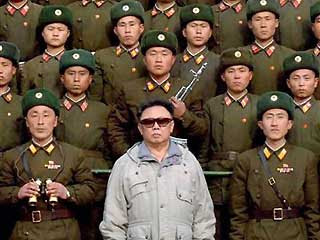
(PS: Sorry if this goes against the spirit of Metafilter, I know this isn't 4chan. I just wanted to reply to the "Forum Troll" comment with my initial thought.)
posted by mccarty.tim at 8:01 AM on May 27, 2009 [10 favorites]
...at which point Kim would put a pistol in his own mouth and pull the trigger.
And then: the Rerun dance.
posted by jquinby at 8:04 AM on May 27, 2009 [2 favorites]
And then: the Rerun dance.
posted by jquinby at 8:04 AM on May 27, 2009 [2 favorites]
No one has any idea why the DPRK is acting out right now, but it's not typical behavior for them.
Remember when they detonated their first nuke and everyone freaked out then? Suddenly a couple days later they issue a strange apology, detonate a second nuke, then six months later agree to big concessions at the six-party talks. We know now that China said something to North Korea that freaked North Korea out. Maybe they said they considered a nuclear North Korea to be a threat. Maybe they started to turn off the aid spigot. Who knows.
But this time, it doesn't seem like China is having an impact. It's worrying. At the same time, the DPRK knows that if they lob a nuke at Seoul, Pyongyang and every military base in their country will be a nuclear plain 20 minutes later (or sooner if the Chinese decide to toss in a few of their own nukes). Maybe this is a "blaze of glory" ending some wanted, but even for them it hardly makes sense. So maybe this is part of some broader narrative for them. Maybe this aids in their transition away from an increasingly fragile Kim Jong-Il. Maybe they feel like they need a bigger story in order to sell the people on Kim's son taking over.
But we really don't know, and I'm not sure they even know. But I think freaking out about them saying they see the Armistice null and void is silly. They've always seen it as void, in some way. They never have seen the Korean War as settled, more as in halftime for the last 50+ years.
posted by dw at 8:04 AM on May 27, 2009
Remember when they detonated their first nuke and everyone freaked out then? Suddenly a couple days later they issue a strange apology, detonate a second nuke, then six months later agree to big concessions at the six-party talks. We know now that China said something to North Korea that freaked North Korea out. Maybe they said they considered a nuclear North Korea to be a threat. Maybe they started to turn off the aid spigot. Who knows.
But this time, it doesn't seem like China is having an impact. It's worrying. At the same time, the DPRK knows that if they lob a nuke at Seoul, Pyongyang and every military base in their country will be a nuclear plain 20 minutes later (or sooner if the Chinese decide to toss in a few of their own nukes). Maybe this is a "blaze of glory" ending some wanted, but even for them it hardly makes sense. So maybe this is part of some broader narrative for them. Maybe this aids in their transition away from an increasingly fragile Kim Jong-Il. Maybe they feel like they need a bigger story in order to sell the people on Kim's son taking over.
But we really don't know, and I'm not sure they even know. But I think freaking out about them saying they see the Armistice null and void is silly. They've always seen it as void, in some way. They never have seen the Korean War as settled, more as in halftime for the last 50+ years.
posted by dw at 8:04 AM on May 27, 2009
> This wall is ... visible from space, then?
In some sense. North Korea is dark.
posted by ardgedee at 8:21 AM on May 27, 2009 [1 favorite]
In some sense. North Korea is dark.
posted by ardgedee at 8:21 AM on May 27, 2009 [1 favorite]
I normally heave a lengthy sigh when I see the Shit Was So Cash copypasta in any variation, but this was just beautifully done. Bravo.
posted by Marisa Stole the Precious Thing at 8:23 AM on May 27, 2009
posted by Marisa Stole the Precious Thing at 8:23 AM on May 27, 2009
wow. North Korea really wants some attention right now, I wonder what's up?
posted by Artw at 8:36 AM on May 27, 2009
posted by Artw at 8:36 AM on May 27, 2009
who could they get to do a modern day Alan Alda, really?
Did Alan Alda die since he did 30 Rock recently? I bet he could play Alan Alda! The nurse stuff might be a little weird I guess.
posted by freecellwizard at 8:40 AM on May 27, 2009
Did Alan Alda die since he did 30 Rock recently? I bet he could play Alan Alda! The nurse stuff might be a little weird I guess.
posted by freecellwizard at 8:40 AM on May 27, 2009
What they have, were it to function, would take a B-29 or a semi-truck to deliver anywhere outside of North Korea and it isn't likely that a huge plane is going to slowly sneak into Seoul without numerous SAM's taking it down.
Wrong. If Lost has taught me anything, it's that a nuke will fit into a backpack and can be easily carried and this whole thing is because Kim Jong Il is in love with Kate because she is so hot and I love her freckles but she has a thing for Sawyer even though he's shacked up with Juliette and OMG that whole season finale was so crazy and sad and maybe they time traveled but we don't know and won't know for another eight months and I think that's bullshit and so does Kim Jong Il.
posted by LordSludge at 8:55 AM on May 27, 2009
Wrong. If Lost has taught me anything, it's that a nuke will fit into a backpack and can be easily carried and this whole thing is because Kim Jong Il is in love with Kate because she is so hot and I love her freckles but she has a thing for Sawyer even though he's shacked up with Juliette and OMG that whole season finale was so crazy and sad and maybe they time traveled but we don't know and won't know for another eight months and I think that's bullshit and so does Kim Jong Il.
posted by LordSludge at 8:55 AM on May 27, 2009
Haha. I'm visiting my brother in Seoul in July, and just yesterday we were deciding to go to the DMZ. Clearly, this is in response to the dreaded Klang Klangston's travel plans.
posted by klangklangston at 8:56 AM on May 27, 2009 [1 favorite]
posted by klangklangston at 8:56 AM on May 27, 2009 [1 favorite]
Pollomacho, I'm sorry to break it to you, but fission reactions are also nuclear.
True, but we don't generally refer to such weaponry as nuclear , rather they are called atomic to distinguish them from more advanced, multi-stage, thermonuclear bombs, which North Korea has not developed. I'm not trying to be pedantic about this, I just think it's an important and overlooked distinction when talking about what North Korea is up to.
It's also important to note that North Korea's missiles can carry a payload of 1000 to 2000 pounds. Little Boy, the bomb dropped on Hiroshima, weighed over eighty five hundred pounds.
posted by Pollomacho at 8:56 AM on May 27, 2009
True, but we don't generally refer to such weaponry as nuclear , rather they are called atomic to distinguish them from more advanced, multi-stage, thermonuclear bombs, which North Korea has not developed. I'm not trying to be pedantic about this, I just think it's an important and overlooked distinction when talking about what North Korea is up to.
It's also important to note that North Korea's missiles can carry a payload of 1000 to 2000 pounds. Little Boy, the bomb dropped on Hiroshima, weighed over eighty five hundred pounds.
posted by Pollomacho at 8:56 AM on May 27, 2009
How many kilotons of asplode does that translate to, Pollomacho?
posted by kldickson at 9:51 AM on May 27, 2009
posted by kldickson at 9:51 AM on May 27, 2009
I'm most inclined to agree that this is the usual sabre-rattling business and that nothing would change. But I won't deny that there's a small part of me that hopes otherwise, that despite the ensuing bloodshed at least we would finally get this damn war over with, and bring to a close the regime of holocaust-level madness that reigns the North.
Similar sentiments were expressed in the script for the Korean movie Shiri, when the N.Korean antagonist finally confronts the S.Korean protagonist with his motivations. He's not trying to create a N.Korean victory. Rather, he's trying to re-ignite the war that he knows N.Korea will ultimately lose. He is unable to tolerate the situation where the leaders of both sides simply let things stand as they are, while his people are reduced to cannibalization less than a 100 miles away from their literal brother nation gorging itself on on cheeseburgers and cola. In his mind, the deaths from the resumed war would be a more than fair and just price to stop what is already happening. He's clearly gone mad, but there is a twisted method to his madness.
I have friends and relatives in S. Korea. I have immediate family who had to flee the North when the Korean War started. I know full well the terrible price that a resumed Korean war would exact, and I have nothing but contempt for the knuckle-dragging chickenhawks with no stake in matter who would view such a war as nothing more than another chance to repudiate their continuous proven failures in other bloody ventures. I have every reason to desire that this peace continues. But I can't enjoy this peace with a fully clean conscience, and every time I shrug off another "business as usual" incident from N.Korea, I can't help but also darkly wonder if the price for this peace is worth it.
/ at times like this I wish I drank
posted by PsychoKick at 10:15 AM on May 27, 2009 [9 favorites]
Similar sentiments were expressed in the script for the Korean movie Shiri, when the N.Korean antagonist finally confronts the S.Korean protagonist with his motivations. He's not trying to create a N.Korean victory. Rather, he's trying to re-ignite the war that he knows N.Korea will ultimately lose. He is unable to tolerate the situation where the leaders of both sides simply let things stand as they are, while his people are reduced to cannibalization less than a 100 miles away from their literal brother nation gorging itself on on cheeseburgers and cola. In his mind, the deaths from the resumed war would be a more than fair and just price to stop what is already happening. He's clearly gone mad, but there is a twisted method to his madness.
I have friends and relatives in S. Korea. I have immediate family who had to flee the North when the Korean War started. I know full well the terrible price that a resumed Korean war would exact, and I have nothing but contempt for the knuckle-dragging chickenhawks with no stake in matter who would view such a war as nothing more than another chance to repudiate their continuous proven failures in other bloody ventures. I have every reason to desire that this peace continues. But I can't enjoy this peace with a fully clean conscience, and every time I shrug off another "business as usual" incident from N.Korea, I can't help but also darkly wonder if the price for this peace is worth it.
/ at times like this I wish I drank
posted by PsychoKick at 10:15 AM on May 27, 2009 [9 favorites]
I've really enjoyed reading the "Inspector O" series that takes place in North Korea. Written by a former US intelligence agent, they at least made me feel like I sort of understood the internal turmoil in that country.
L.A. Times piece.
posted by mecran01 at 10:41 AM on May 27, 2009 [1 favorite]
L.A. Times piece.
posted by mecran01 at 10:41 AM on May 27, 2009 [1 favorite]
How many kilotons of asplode does that translate to, Pollomacho?
Around four apparently.
There are plenty of modern warheads that weigh in at less than one ton.
There are plenty of h-bomb or thermonuclear warheads that weigh less than a ton. To overcome the size/yeild ratio NK will need to develop a fusion weapon. That took the US in cold war mode about 7 years of work (and the Russians 7 years of espionage, thanks Julius and Ethel!)
posted by Pollomacho at 10:50 AM on May 27, 2009
Around four apparently.
There are plenty of modern warheads that weigh in at less than one ton.
There are plenty of h-bomb or thermonuclear warheads that weigh less than a ton. To overcome the size/yeild ratio NK will need to develop a fusion weapon. That took the US in cold war mode about 7 years of work (and the Russians 7 years of espionage, thanks Julius and Ethel!)
posted by Pollomacho at 10:50 AM on May 27, 2009
Pollomacho, according to this post on Arms Control Wonk, the North Koreans might be going for a 4kt design that might just fit on one of their missiles, instead of an "easy but massive" WWII 20kt design.
posted by moonbiter at 11:26 AM on May 27, 2009 [1 favorite]
posted by moonbiter at 11:26 AM on May 27, 2009 [1 favorite]
Something to think about: 1,000,000 people eat about 1.5 kilotons of TNT every day.
This translates to, if you factor in obesity vs. starvation, probably about 6 megatons of TNT eaten by every person.
posted by kldickson at 11:43 AM on May 27, 2009
This translates to, if you factor in obesity vs. starvation, probably about 6 megatons of TNT eaten by every person.
posted by kldickson at 11:43 AM on May 27, 2009
I know I'm late to this thread, but this article seems to sum up the strategic situation there quite succintly and thoroughly. It's from 2004, so it's interesting to note that not that much has changed, except that we now know for sure that they have atomic weapons, and our military is even more overstretched.
To sum: every situation that ends in military confrontation is lose-lose. The DPRK leadership (whoever that is right now) isn't too stupid to see that.
If they're A) looking to go out in a "blaze of glory" there's not much we can do to stop that except prepare a massive (probably nuclear) retaliation.
If they're B) looking for concessions, we shouldn't budge, because their threats are empty, unless they're willing to go through with it and create situation A), which we can't realistically stop anyway.
What we should do is basically ignore these threats, and talk to China, who has been feeding the DPRK populace for the past decades. They're the only ones with real leverage here. Convince them that they have an interest in reining in the crazy, and it'll happen. Until the DPRK wants something from the UN again.
posted by ScotchRox at 12:08 PM on May 27, 2009 [1 favorite]
To sum: every situation that ends in military confrontation is lose-lose. The DPRK leadership (whoever that is right now) isn't too stupid to see that.
If they're A) looking to go out in a "blaze of glory" there's not much we can do to stop that except prepare a massive (probably nuclear) retaliation.
If they're B) looking for concessions, we shouldn't budge, because their threats are empty, unless they're willing to go through with it and create situation A), which we can't realistically stop anyway.
What we should do is basically ignore these threats, and talk to China, who has been feeding the DPRK populace for the past decades. They're the only ones with real leverage here. Convince them that they have an interest in reining in the crazy, and it'll happen. Until the DPRK wants something from the UN again.
posted by ScotchRox at 12:08 PM on May 27, 2009 [1 favorite]
I think Kim Jong-Il is going senile.
posted by kldickson
Perhaps, but he reminds me of another belligerent fool who cares little what other people in the international community think.
posted by gman at 12:17 PM on May 27, 2009
posted by kldickson
Perhaps, but he reminds me of another belligerent fool who cares little what other people in the international community think.
posted by gman at 12:17 PM on May 27, 2009
When the only response to nuclear atomic testing is a yawn
What is supposed to be the reaction? Pre-emptive war?
The decision was made by the world years ago to allow for man to make it an allowable technological path. Imagine how the subs and carriers would operate without fission to grasp why such a path was not chosen.
And, do keep in mind that governments fall in and out of favor. If you allow a 'favored' nation to have fission power - what happens when they become un-favored?
Ad featuring the Shaw of Iran pimp'n for nuclear power
Oh and - look at the currency swap market. Could the DPRK be doing this to make some coin on the swing in values?
posted by rough ashlar at 1:29 PM on May 27, 2009
What is supposed to be the reaction? Pre-emptive war?
The decision was made by the world years ago to allow for man to make it an allowable technological path. Imagine how the subs and carriers would operate without fission to grasp why such a path was not chosen.
And, do keep in mind that governments fall in and out of favor. If you allow a 'favored' nation to have fission power - what happens when they become un-favored?
Ad featuring the Shaw of Iran pimp'n for nuclear power
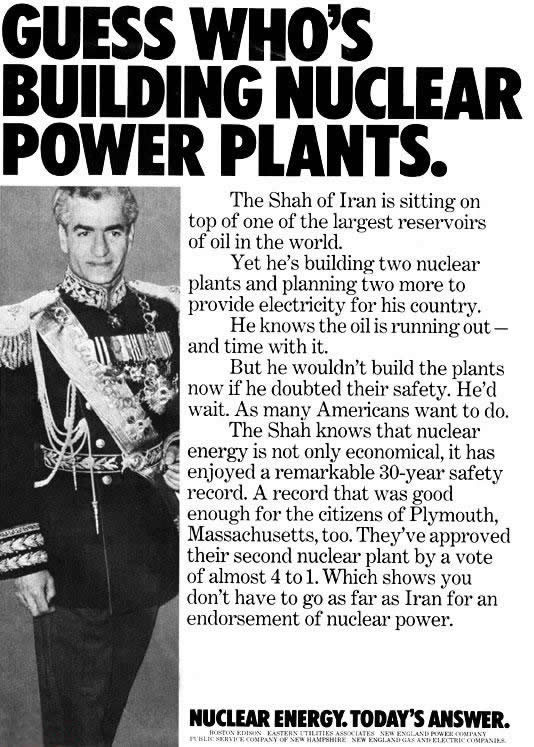
Oh and - look at the currency swap market. Could the DPRK be doing this to make some coin on the swing in values?
posted by rough ashlar at 1:29 PM on May 27, 2009
Pollomacho it is thought that the Taepodong-2 does indeed have a payload of only 1 metric tonne, which would fall short of the 4 tonnes of a Hiroshima-type bomb. However, the Taepodong-2 is a two-stage long-range missile. The second stage weighs 16 tonnes. If little Kim dumps the second stage, he has a short-range missile with enough oomph for no less than four old-school fission bombs.
As for all the Dong jokers: Jon Stewart was there before (a few times even).
posted by Skeptic at 1:40 PM on May 27, 2009
As for all the Dong jokers: Jon Stewart was there before (a few times even).
posted by Skeptic at 1:40 PM on May 27, 2009
I'd presume North Korea's targets for nuclear weapons would not be South Korea, which already is assured MAD by conventional artillery and/or chemical warfare, but rather Japan or China. Bear in mind that over half of S. Korea's population lives in the greater Seoul metropolitan area, which is reachable by long range artillery.
posted by BrotherCaine at 2:23 PM on May 27, 2009
posted by BrotherCaine at 2:23 PM on May 27, 2009
This is highly alarming, not only is Kim Jong Il a Great Warrior, he is also The People's Inspiration, Great General, Great Brilliant Commander, Great Dietician and Fashion Designer. We can never hope to defeat such a man!
posted by electroboy at 3:06 PM on May 27, 2009
posted by electroboy at 3:06 PM on May 27, 2009
He also was the "executive producer" of sorts of the North Korean monster flick Pulgasari. And when I say "executive producer" I mean that in the sense that he ordered the kidnapping of South Korean director Shin Sang-ok, who was then forced to film it in North Korea. You can watch this fascinating Godzilla rip-off in its entirety here.
posted by Marisa Stole the Precious Thing at 3:16 PM on May 27, 2009 [2 favorites]
posted by Marisa Stole the Precious Thing at 3:16 PM on May 27, 2009 [2 favorites]
I think the greatest danger the North Korean nuclear program poses (to anyoute outside of South Korea), is that it will speed up the ongoing process of nuclear proliferation. If North Korea shares test information with other countries like Iran (plus maybe Syria and who knows where else), that helps those other nations develop their bomb programs more quickly and covertly, without the need to do so many tests of their own. Then there's the issue of all the plutonium NK is making, which might be considered to be a cash crop of sorts if the ruling regime becomes desperate enough.
posted by Kevin Street at 3:43 PM on May 27, 2009 [1 favorite]
posted by Kevin Street at 3:43 PM on May 27, 2009 [1 favorite]
While we're on the subject of Korea, this provides me with another opportunity to ask one of my many questions prompted by watching Korean cinema. This time, my question is:
What the hell are all those great big stoneware pots with lids that people keep outside their houses? Do they keep Kimchi in them? (Not sure how I got this idea, but I clearly picked it up somewhere.) If so, wouldn't that be rather a lot of Kimchi?
posted by PeterMcDermott at 4:45 PM on May 27, 2009
What the hell are all those great big stoneware pots with lids that people keep outside their houses? Do they keep Kimchi in them? (Not sure how I got this idea, but I clearly picked it up somewhere.) If so, wouldn't that be rather a lot of Kimchi?
posted by PeterMcDermott at 4:45 PM on May 27, 2009
Yes Peter - Kimchi pots, and they are used to ferment enough for a long while.
posted by gman at 5:13 PM on May 27, 2009
posted by gman at 5:13 PM on May 27, 2009
"What the hell are all those great big stoneware pots with lids that people keep outside their houses? Do they keep Kimchi in them?"
Yes. But their existence is exaggerated for theatrical effect, since you can buy as much kimchi as you want at the 7-11 down the street. It's kind of a marker for "old-timey, down home" Korea.
posted by bardic at 5:15 PM on May 27, 2009 [1 favorite]
Yes. But their existence is exaggerated for theatrical effect, since you can buy as much kimchi as you want at the 7-11 down the street. It's kind of a marker for "old-timey, down home" Korea.
posted by bardic at 5:15 PM on May 27, 2009 [1 favorite]
Well I knew that they eat a lot of the stuff, but given that -- in the movies at least -- every house seems to have about half a dozen or ten, and each one seems to hold about 25 litres or so, that's a hell of a lot of Kimchi.
I did get the old-timey cues though. You only seem to see them in movies about the country, or if it's in Seoul it's when people are living in those rather grim little shacks, while the Kkangpae are in the process of illegally evicting them to make way for a modern development.
posted by PeterMcDermott at 5:35 PM on May 27, 2009
I did get the old-timey cues though. You only seem to see them in movies about the country, or if it's in Seoul it's when people are living in those rather grim little shacks, while the Kkangpae are in the process of illegally evicting them to make way for a modern development.
posted by PeterMcDermott at 5:35 PM on May 27, 2009
I think the greatest danger the North Korean nuclear program poses (to anyoute outside of South Korea), is that it will speed up the ongoing process of nuclear proliferation.
Well, this is the nub of the issue: South Korea joined the SPI program, which apparently allows them to assert a right to board any ship that is suspected of proliferating, and search it. North Korea is really saying "come near our ships and we'll blow you out of the fucking water."
That's actually kind of scary, because wars are very often escalations of simple incidents like that. The CIA says "this NK ship is carrying a nuke to Iran", so the SK navy, backed up by the US navy, moves to stop it....
posted by fatbird at 5:48 PM on May 27, 2009
Well, this is the nub of the issue: South Korea joined the SPI program, which apparently allows them to assert a right to board any ship that is suspected of proliferating, and search it. North Korea is really saying "come near our ships and we'll blow you out of the fucking water."
That's actually kind of scary, because wars are very often escalations of simple incidents like that. The CIA says "this NK ship is carrying a nuke to Iran", so the SK navy, backed up by the US navy, moves to stop it....
posted by fatbird at 5:48 PM on May 27, 2009
NK is just a bit nuts right now. Isolated and belligerent. Another war would be idiotic, but it wouldn't be Iraq idiotic, just plan war is idiotic, idiotic, China is a lot less sanguine about sticking it's neck out, Russia as well. I fail to see what NK is trying to gain by all of this, another war and they would fall pretty hard and fast and given current conditions I doubt there would be much population opposition to the overthrowers. No, I don't want it to go that route, that would be absolutely horrible, but the NK government is acting like that kid in the playground who keeps taunting the bigger kids despite repeated warnings not to.
NK government, Christ what an asshole.
posted by edgeways at 6:05 PM on May 27, 2009
NK government, Christ what an asshole.
posted by edgeways at 6:05 PM on May 27, 2009
PeterMcDermott: in the movies at least -- every house seems to have about half a dozen or ten, and each one seems to hold about 25 litres or so, that's a hell of a lot of Kimchi.
I did get the old-timey cues though. You only seem to see them in movies about the country, or if it's in Seoul it's when people are living in those rather grim little shacks
The number and size of them are often exaggerated. Apart from anything else, most city-slickers keep theirs in a kimchi fridge.
Having said that, Koreans eat kimchi with pretty much every meal and often a house contains more adults than Western dwellings do, since adult children frequently live with their parents. It's not hard under those circumstances to get through a heck of a lot of the stuff.
edgeways: I fail to see what NK is trying to gain by all of this, another war and they would fall pretty hard and fast
As noted above, it's not about war. It's about internal politics and trying to push the outside world into giving them more aid.
posted by Busy Old Fool at 9:01 PM on May 27, 2009
I did get the old-timey cues though. You only seem to see them in movies about the country, or if it's in Seoul it's when people are living in those rather grim little shacks
The number and size of them are often exaggerated. Apart from anything else, most city-slickers keep theirs in a kimchi fridge.
Having said that, Koreans eat kimchi with pretty much every meal and often a house contains more adults than Western dwellings do, since adult children frequently live with their parents. It's not hard under those circumstances to get through a heck of a lot of the stuff.
edgeways: I fail to see what NK is trying to gain by all of this, another war and they would fall pretty hard and fast
As noted above, it's not about war. It's about internal politics and trying to push the outside world into giving them more aid.
posted by Busy Old Fool at 9:01 PM on May 27, 2009
The number and size of them are often exaggerated. Apart from anything else, most city-slickers keep theirs in a kimchi fridge.
I wonder how the taste compares to space kimchi.
posted by Marisa Stole the Precious Thing at 4:09 AM on May 28, 2009
I wonder how the taste compares to space kimchi.
posted by Marisa Stole the Precious Thing at 4:09 AM on May 28, 2009
Wait, I forgot to pull-quote my favorite part of that article:
Ordinary kimchi is teeming with microbes, like lactic acid bacteria, which help fermentation. On Earth they are harmless, but scientists fear they could turn dangerous in space if cosmic rays cause them to mutate. Another problem is that kimchi has a short shelf life, especially when temperatures fluctuate rapidly, as they do in space.posted by Marisa Stole the Precious Thing at 4:12 AM on May 28, 2009
"Imagine if a bag of kimchi starts fermenting and bubbling out of control and bursts all over the sensitive equipment of the spaceship," Lee said.
Renouncing the cease-fire is not just the usual run of the mill threat.
One of the things they've just renounced is the existence of the DMZ. That's right. If they get peeved, they've given themselves permission to taunt us by moving troops right up to the border. If they were slow and careful about it they might not provoke a hot war, just rattle our cages. They are not known for being slow and careful.
Even if they don't nuke/gas/shell Seoul into oblivion anytime soon (and hopefully that's unlikely) they've just announced a whole list of new ways they can play games with us.
posted by justsomebodythatyouusedtoknow at 11:40 AM on May 28, 2009 [1 favorite]
One of the things they've just renounced is the existence of the DMZ. That's right. If they get peeved, they've given themselves permission to taunt us by moving troops right up to the border. If they were slow and careful about it they might not provoke a hot war, just rattle our cages. They are not known for being slow and careful.
Even if they don't nuke/gas/shell Seoul into oblivion anytime soon (and hopefully that's unlikely) they've just announced a whole list of new ways they can play games with us.
posted by justsomebodythatyouusedtoknow at 11:40 AM on May 28, 2009 [1 favorite]
The difference being that North Korea is a small nation-state, and the one thing that the United States military is indisputably good at doing is destroying the armies, navies, and air forces of small nation-states, and otherwise totally wrecking such places.
Like Panama and Grenada- other examples in recent history? North Vietnam was a small nation state, that didn't work out so well.
posted by mattoxic at 6:39 PM on May 28, 2009
Like Panama and Grenada- other examples in recent history? North Vietnam was a small nation state, that didn't work out so well.
posted by mattoxic at 6:39 PM on May 28, 2009
"To overcome the size/yeild ratio NK will need to develop a fusion weapon. That took the US in cold war mode about 7 years of work"
This is something I've often wondered about. Basic science is at a higher level than it was 65 years ago. Plus material science has advanced greatly, even in off the shelf areas. If, for example, Canada decided tomorrow that we're going to develop a fusion bomb how long would it take us? I imagine it would be at least partially controlled by budget however I'd bet with any reasonable sized budget it would take a lot less than seven years.
posted by Mitheral at 8:50 PM on May 28, 2009
This is something I've often wondered about. Basic science is at a higher level than it was 65 years ago. Plus material science has advanced greatly, even in off the shelf areas. If, for example, Canada decided tomorrow that we're going to develop a fusion bomb how long would it take us? I imagine it would be at least partially controlled by budget however I'd bet with any reasonable sized budget it would take a lot less than seven years.
posted by Mitheral at 8:50 PM on May 28, 2009
Why would some tin pot dictatorship ever need a fusion bomb? One fission bomb dropped on Seoul, Tokyo, or LA would provide sufficient terror. As I said upthread, NK already has the equivalent of a nuke in all its conventional weapons aimed at Seoul mere miles from its border.
posted by caddis at 9:58 PM on May 28, 2009
posted by caddis at 9:58 PM on May 28, 2009
If, for example, Canada decided tomorrow that we're going to develop a fusion bomb how long would it take us?
You could just borrow one of ours if you wanted (again). Just be sure to fill up the gas before you give it back.
Seriously though, Canada did develop a fusion bomb as part of and partner in the US Manhattan Project and later nuclear programs. Canada supplied the heavy water and some of the uranium too. Canada still sells us the plutonium we put in our current bombs.
Oh, yes, the US and Canada are conjoined nuclear twins. We may be the evil twin with the sinister goatee, but we are fused as one (probably at the ass) and our evil nuclear weapon holding heart beats the same blood blood as your supposedly nuke free one mwa-ha-ha-ha-ha-ha!
Ok, so that was a rather overly dramatic way of saying it would take Canada a couple of hours to have an all American hand made nuke crafted of the finest Canadian plutonium. Now if Canada were, say, Iran, it might take a couple of years to acquire raw materials and equipment, assemble a team of scientists and engineers, tell te world they are only enriching for peaceful power use, "borrow" some information from the Chinese and Pakistanis and develop a nuke. It helps to have billions of dollars in oil revenues and a preexisting atoms-for-peace reactor in your country.
North Korea on the other hand cannot afford food, much less nuclear technology or materials. They have to scrounge and bodger together bits from old Soviet era reactors and fuel rods they've got. The first fizzle tells folks that they aren't quite up to speed on their enrichment process. This latest test was supposedly a fizzled 20mt that shot for 4mt, but as moonbiter's link above says, maybe it was meant to be 4mt.
Personally, I think it was a fizzle. North Korea has it's citizens gather their feces which they mix with coal ash in public parks to form crude fertilizer called toebee and this is a country that can enrich plutonium properly? It was a show. They shot the poorly enriched fizzler to show that they could do it. To say, "we have the bomb!" Did the bomb work terribly well? No. Could they delver that bomb? Not likely. Will they test more crappily built "bombs" for attention? Yep.
posted by Pollomacho at 5:56 AM on May 29, 2009
You could just borrow one of ours if you wanted (again). Just be sure to fill up the gas before you give it back.
Seriously though, Canada did develop a fusion bomb as part of and partner in the US Manhattan Project and later nuclear programs. Canada supplied the heavy water and some of the uranium too. Canada still sells us the plutonium we put in our current bombs.
Oh, yes, the US and Canada are conjoined nuclear twins. We may be the evil twin with the sinister goatee, but we are fused as one (probably at the ass) and our evil nuclear weapon holding heart beats the same blood blood as your supposedly nuke free one mwa-ha-ha-ha-ha-ha!
Ok, so that was a rather overly dramatic way of saying it would take Canada a couple of hours to have an all American hand made nuke crafted of the finest Canadian plutonium. Now if Canada were, say, Iran, it might take a couple of years to acquire raw materials and equipment, assemble a team of scientists and engineers, tell te world they are only enriching for peaceful power use, "borrow" some information from the Chinese and Pakistanis and develop a nuke. It helps to have billions of dollars in oil revenues and a preexisting atoms-for-peace reactor in your country.
North Korea on the other hand cannot afford food, much less nuclear technology or materials. They have to scrounge and bodger together bits from old Soviet era reactors and fuel rods they've got. The first fizzle tells folks that they aren't quite up to speed on their enrichment process. This latest test was supposedly a fizzled 20mt that shot for 4mt, but as moonbiter's link above says, maybe it was meant to be 4mt.
Personally, I think it was a fizzle. North Korea has it's citizens gather their feces which they mix with coal ash in public parks to form crude fertilizer called toebee and this is a country that can enrich plutonium properly? It was a show. They shot the poorly enriched fizzler to show that they could do it. To say, "we have the bomb!" Did the bomb work terribly well? No. Could they delver that bomb? Not likely. Will they test more crappily built "bombs" for attention? Yep.
posted by Pollomacho at 5:56 AM on May 29, 2009
Update: China is ending the "Year of Friendship with North Korea" in the middle of the year by cutting diplomatic ties. Perhaps they're rolling with a "Year of Irony" instead?
My earlier question stands.
posted by mullingitover at 5:19 PM on June 1, 2009
My earlier question stands.
posted by mullingitover at 5:19 PM on June 1, 2009
mullingitover: The Bloomberg article you link to describes the Chinese halting government-level visits between the two countries. That is not, contrary to your link text, cutting diplomatic ties.
Cutting diplomatic ties is a far more serious step and generally refers to the closing of embassies and the withdrawal of the diplomatic corps. China's actions are interesting, but they have been badly described on Reddit and various blogs.
posted by Busy Old Fool at 3:12 AM on June 2, 2009
Cutting diplomatic ties is a far more serious step and generally refers to the closing of embassies and the withdrawal of the diplomatic corps. China's actions are interesting, but they have been badly described on Reddit and various blogs.
posted by Busy Old Fool at 3:12 AM on June 2, 2009
Ah yeah, I got all excited about getting teh scoop and this isn't all it's cracked up to be. Still, not a very friendly 'Year of Friendship."
posted by mullingitover at 11:22 AM on June 2, 2009
posted by mullingitover at 11:22 AM on June 2, 2009
Another problem is that kimchi has a short shelf life, especially when temperatures fluctuate rapidly, as they do in space.
It most assuredly does not. My favorite kimchi is the stuff that's been buried and fermenting for at least a couple of years. Done right, the flavour is both overwhelming and exquisite, and there's even a hint of effervescence to it. Although I do suppose that there's something to the rapid temperature fluctuation thing, so there's that.
posted by stavrosthewonderchicken at 9:57 PM on June 2, 2009
It most assuredly does not. My favorite kimchi is the stuff that's been buried and fermenting for at least a couple of years. Done right, the flavour is both overwhelming and exquisite, and there's even a hint of effervescence to it. Although I do suppose that there's something to the rapid temperature fluctuation thing, so there's that.
posted by stavrosthewonderchicken at 9:57 PM on June 2, 2009
OK, never mind: I guess it is true that if you actually keep kimchi on a shelf, it's going to go wonky pretty damn fast.
posted by stavrosthewonderchicken at 9:58 PM on June 2, 2009
posted by stavrosthewonderchicken at 9:58 PM on June 2, 2009
I guess a kimchi refrigerator is perhaps a bit of a luxury in space.
posted by caddis at 8:54 AM on June 3, 2009
posted by caddis at 8:54 AM on June 3, 2009
« Older This little homunculus | We were so free Newer »
This thread has been archived and is closed to new comments
posted by monkey!knife!fight! at 10:20 PM on May 26, 2009 [4 favorites]