Star light, star bright, how many stars can I see tonight?
June 13, 2009 11:51 PM Subscribe
"The arc of the Milky Way seen from a truly dark location is part of our planet's natural heritage," said Connie Walker, and astronomer from the U.S. National Optical Astronomy Observatory in Tucson, Arizona. Yet "more than one fifth of the world population, two thirds of the U.S. population and one half of the European Union population have already lost naked eye visibility of the Milky Way." In these areas, people are effectively living in perennial moonlight. They rarely realize it because they still experience the sky to be brighter under a full moon than under new moon conditions. "Reducing the number of lights on at night could help conserve energy, protect wildlife and benefit human health," astronomer Malcolm Smith of the Cerro Tololo Inter-American Observatory in Chile. One study found an increased risk of breast cancer for women living in areas with the most light pollution (abstract). Some communities are embracing their dark skies, such as the New Zealand community of Tekapo, possibly home to first "Starlight Reserve," waiting on UNESCO's official approval. Not sure where to look in the vast night sky? Follow some guidelines, or check the view in Chile, Queensland, Australia, or Texas.
Apparently it's not just breast cancer... prostate cancer as well.
I'm not sure what to do about this as a night owl type. I suppose rather than reading or using the computer, I could play the guitar in the dark...
posted by weston at 12:04 AM on June 14, 2009 [1 favorite]
I'm not sure what to do about this as a night owl type. I suppose rather than reading or using the computer, I could play the guitar in the dark...
posted by weston at 12:04 AM on June 14, 2009 [1 favorite]
Depressing, depressing, depressing. However, it has changed my vacation priorities somewhat; going somewhere I can see the milky way at night is now #1 on my list, as I've never seen it, in 38 years of living.
posted by davejay at 12:07 AM on June 14, 2009 [1 favorite]
posted by davejay at 12:07 AM on June 14, 2009 [1 favorite]
I've been out in the dark. The dark-dark. New Mexico dessert. Montana. South Dakota. Places literally hundreds of miles away from the nearest streetlight. And I've looked up at the sky.
What is this "arc" or "Milky Way" that people talk about? My wife talks about it, too. I mean, yeah, that's the name of our galaxy.
But the sky is full of stars. (Nearly) everything you see is the Milky Way.
posted by Netzapper at 12:09 AM on June 14, 2009 [1 favorite]
What is this "arc" or "Milky Way" that people talk about? My wife talks about it, too. I mean, yeah, that's the name of our galaxy.
But the sky is full of stars. (Nearly) everything you see is the Milky Way.
posted by Netzapper at 12:09 AM on June 14, 2009 [1 favorite]

Ack, I forgot to tribute the Cosmo Magazine link as coming via slashdot, which has some interesting stories of people seeing the Milky Way (or just a really star-filled sky) for the first time.
posted by filthy light thief at 12:23 AM on June 14, 2009
posted by filthy light thief at 12:23 AM on June 14, 2009
"I've never seen it, in 38 years of living"
Wow. At one level, that doesn't surprise me -- I've driven through Northern Hemisphere conurbations and noted that the sodium vapour glow drowns out the sky. But at another, I still find this amazing. I grew up in a town of about 100,000 in New Zealand, and we could see the milky way from our suburban back yard, and see Halley's comet when it was here, and so on. And you still can, decades later.
Netzapper: I know what you mean, but the Milky Way is a visible ribbon of more densely clustered stars with a glow behind it. I could easily drive a little way from where I am now and see it, and the Magellanic clouds as well, if it weren't pretty cloudy this evening.
posted by i_am_joe's_spleen at 12:54 AM on June 14, 2009
Wow. At one level, that doesn't surprise me -- I've driven through Northern Hemisphere conurbations and noted that the sodium vapour glow drowns out the sky. But at another, I still find this amazing. I grew up in a town of about 100,000 in New Zealand, and we could see the milky way from our suburban back yard, and see Halley's comet when it was here, and so on. And you still can, decades later.
Netzapper: I know what you mean, but the Milky Way is a visible ribbon of more densely clustered stars with a glow behind it. I could easily drive a little way from where I am now and see it, and the Magellanic clouds as well, if it weren't pretty cloudy this evening.
posted by i_am_joe's_spleen at 12:54 AM on June 14, 2009
I feel pretty strongly about this. It's an odd thing to care about, but I wish we had some laws about this. The second your business closes, the lights go off, and that includes your giant-ass sign. You can have little blinky red lights on your motion detectors, that's it. Enormous fines for leaving them on. Streetlights? We need about a quarter of what we've got. They might use LEDs (or maybe those nifty little plasma capsules) and more carefully aim the light downwards. Maybe put some of them on motion detectors.
I go for walks at night, usually four miles, sometimes at 2 a.m.. If I feel like it, I can read the whole way, and that's heading for the most lightless part of the area.
Not long back, the area had a huge power outage on a moonless night; I immediately went out to enjoy some real dark. I sometimes like to practice walking quietly, for fun, and this time it paid off: two deer surprised the heck out of me by walking right by, about five feet away from me, big black shapes up to my shoulder. These are deer who, when I normally see them in that area, disappear should someone get within a hundred feet.
Then a flash of realization transformed a magical moment into some kind of sick miracle: that's right — the deer were so used to the relative brightness they didn't even notice me.
posted by adipocere at 1:05 AM on June 14, 2009 [10 favorites]
I go for walks at night, usually four miles, sometimes at 2 a.m.. If I feel like it, I can read the whole way, and that's heading for the most lightless part of the area.
Not long back, the area had a huge power outage on a moonless night; I immediately went out to enjoy some real dark. I sometimes like to practice walking quietly, for fun, and this time it paid off: two deer surprised the heck out of me by walking right by, about five feet away from me, big black shapes up to my shoulder. These are deer who, when I normally see them in that area, disappear should someone get within a hundred feet.
Then a flash of realization transformed a magical moment into some kind of sick miracle: that's right — the deer were so used to the relative brightness they didn't even notice me.
posted by adipocere at 1:05 AM on June 14, 2009 [10 favorites]
The answer to light pollution is obvious.
Gentlemen, we must destroy the moon.
posted by obiwanwasabi at 1:13 AM on June 14, 2009 [10 favorites]
Gentlemen, we must destroy the moon.
posted by obiwanwasabi at 1:13 AM on June 14, 2009 [10 favorites]
I've never seen the northern lights, but I have seen the arc of the milky way (out in BFE Utah). Its amazing. I got out of the car around midnight to find our camp site, looked up, and said, "Wow, I never knew there were so many stars." It was amazing.
Living in Las Vegas, we have permanent moonlight of the Strip's glow (affecting the sky all the way out to Death Valley). Ugh I hate this fucking city...
posted by SirOmega at 1:16 AM on June 14, 2009
Living in Las Vegas, we have permanent moonlight of the Strip's glow (affecting the sky all the way out to Death Valley). Ugh I hate this fucking city...
posted by SirOmega at 1:16 AM on June 14, 2009
i think i might just drop everything and head to utah next week!
http://www.nps.gov/brca/planyourvisit/9thastrofest.htm
posted by joeblough at 1:20 AM on June 14, 2009
http://www.nps.gov/brca/planyourvisit/9thastrofest.htm
posted by joeblough at 1:20 AM on June 14, 2009
Wonderful post. I grew up in the far North where you could see meteor showers, the milky way, and the aurora borealis almost every night. It wasn't until I moved to more populated areas that I realized most urbanites have never actually seen the night sky.
We could definitely get rid of 3/4 of the nighttime lighting in most cities without compromising driving safety. There should also be fines for leaving business signage lighted after the close of business hours.
posted by benzenedream at 1:21 AM on June 14, 2009
We could definitely get rid of 3/4 of the nighttime lighting in most cities without compromising driving safety. There should also be fines for leaving business signage lighted after the close of business hours.
posted by benzenedream at 1:21 AM on June 14, 2009
The eponystericality of this post is matched only by its comprehensive radness.
posted by mhjb at 1:33 AM on June 14, 2009
posted by mhjb at 1:33 AM on June 14, 2009
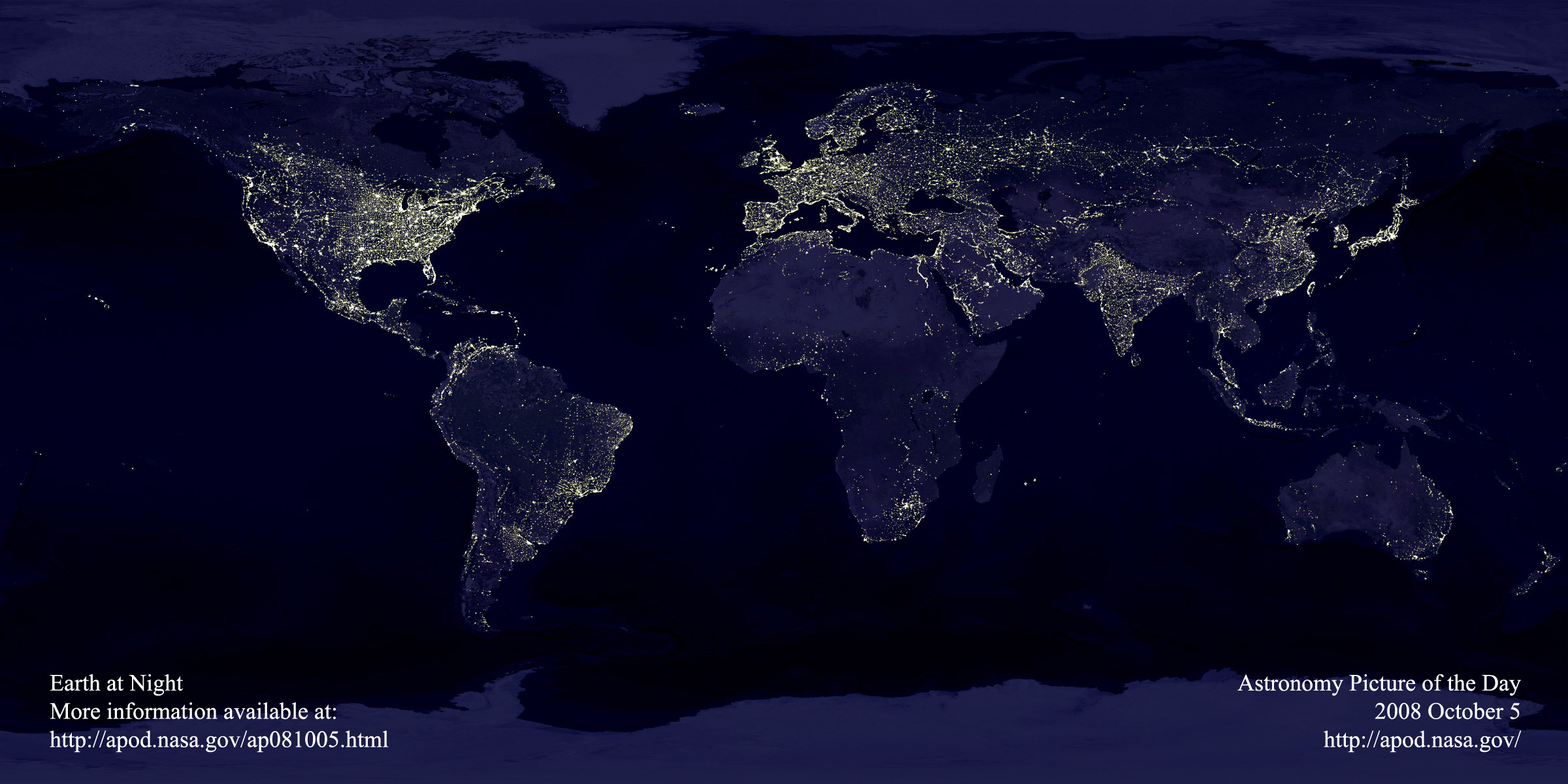
On a somewhat unrelated note, looking at the nighttime composite of Earth, it strikes me that western China seems completely bereft of permanent lights. Is rural China that uninhabited or undeveloped?
posted by Gyan at 1:36 AM on June 14, 2009
posted by Gyan at 1:36 AM on June 14, 2009
I've been out in the dark. The dark-dark. New Mexico dessert.
what did it taste like?
sorry
posted by slater at 2:01 AM on June 14, 2009 [1 favorite]
what did it taste like?
sorry
posted by slater at 2:01 AM on June 14, 2009 [1 favorite]
Another one.
From the photographer - The time-lapse sequence was taken with the simplest equipment that I brought to the star party. I put the Canon EOS-5D (AA screen modified to record hydrogen alpha at 656 nm) with an EF 15mm f/2.8 lens on a weighted tripod. Exposures were 20 seconds at f/2.8 ISO 1600 followed by 40 second interval. Exposures were controlled by an interval timer shutter release (Canon TC80N3). Power was provided by a Hutech EOS203 12v power adapter run off a 12v deep cycle battery. Large jpg files shot in custom white balance were batch processed in Photoshop (levels, curves, contrast, Noise Ninja noise reduction, resize) and assembled in Quicktime Pro. Editing/assembly was with Sony Vegas Movie Studio 9.
posted by blahblah at 2:13 AM on June 14, 2009 [2 favorites]
From the photographer - The time-lapse sequence was taken with the simplest equipment that I brought to the star party. I put the Canon EOS-5D (AA screen modified to record hydrogen alpha at 656 nm) with an EF 15mm f/2.8 lens on a weighted tripod. Exposures were 20 seconds at f/2.8 ISO 1600 followed by 40 second interval. Exposures were controlled by an interval timer shutter release (Canon TC80N3). Power was provided by a Hutech EOS203 12v power adapter run off a 12v deep cycle battery. Large jpg files shot in custom white balance were batch processed in Photoshop (levels, curves, contrast, Noise Ninja noise reduction, resize) and assembled in Quicktime Pro. Editing/assembly was with Sony Vegas Movie Studio 9.
posted by blahblah at 2:13 AM on June 14, 2009 [2 favorites]
In 2000 New York city had a very progressive bill to reduce light pollution - which only would have required downward shades on publicly funded outdoor lamps.
After 9-11, Giuliani, who had opposed the bill from the beginning, basically said "we have more important things to worry about".
That's how the terrorists took away your stars, children.
posted by twoleftfeet at 2:51 AM on June 14, 2009 [8 favorites]
After 9-11, Giuliani, who had opposed the bill from the beginning, basically said "we have more important things to worry about".
That's how the terrorists took away your stars, children.
posted by twoleftfeet at 2:51 AM on June 14, 2009 [8 favorites]
I've never understood people's fear of the night. My bride is one who has to have every light on if she's in a room, but that pales to the people who feel the need to hang one of those stupid mercury vapor lights in their rural yard to blaze away all night. My neighbors, for example.
posted by maxwelton at 2:59 AM on June 14, 2009
posted by maxwelton at 2:59 AM on June 14, 2009
It's convenient to blow glass in spherical forms, so traditionally most light bulbs have been able to radiate light omnidirectionally. However, most outdoor applications of light bulbs do not require a fully omnidirectional range. It's important to shield unnecessary light because night time luminescence interferes with basic human and animal interaction with the day/night cycle and because stray light paths directed upward create a reflective glare which masks the light from our surrounding cosmos, which we need to see to remind us that there is more to what is happening than what is happening here.
posted by twoleftfeet at 3:37 AM on June 14, 2009 [1 favorite]
posted by twoleftfeet at 3:37 AM on June 14, 2009 [1 favorite]
Light pollution is mainly caused by stupidity. Bad decisions in designing and using lighting equipment waste a lot of energy, and the glare actually makes it harder to see at night. Those backyard security lights ubiquitous in suburban and rural areas can make a property less secure in many situations. And there is no excuse for pointing outdoor lights upward: there is equipment for lighting signs, flags and buildings from the top down.
posted by tommyD at 4:24 AM on June 14, 2009
posted by tommyD at 4:24 AM on June 14, 2009
Gyan, a lot of western China is desert. Not that it's totally uninhabited, but it is one of the least forgiving areas on the planet, desert-wise.
Governor Dodge State Park, in Wisconsin, astounding view of the night sky. No artificial lights anywhere near by. I went there as a teenager, and was awed. Then again, when I returned home to the burbs of Chicago (45 minutes or so from the city), I was back to my room, south-facing, and never completely dark, due to the pink glow of Chicago and various other burbs.
Now, in Japan, living, again, in the burbs, this time outside Tokyo, I feel lucky if, on a clear night, I can see more than one or two stars.
I miss dark.
posted by Ghidorah at 5:54 AM on June 14, 2009
Governor Dodge State Park, in Wisconsin, astounding view of the night sky. No artificial lights anywhere near by. I went there as a teenager, and was awed. Then again, when I returned home to the burbs of Chicago (45 minutes or so from the city), I was back to my room, south-facing, and never completely dark, due to the pink glow of Chicago and various other burbs.
Now, in Japan, living, again, in the burbs, this time outside Tokyo, I feel lucky if, on a clear night, I can see more than one or two stars.
I miss dark.
posted by Ghidorah at 5:54 AM on June 14, 2009
Surely, living in "areas with light pollution" = living in "more urban areas". (Am I reading the methodology in the abstract wrong, or are they actually taking this into account?) And more urban areas offer many, many other factors that might lead to breast cancer etc. than "light at night".
Also, I don't know if these people are living in perpetual moonlight. I imagine many of them, like me, live in houses, with walls, and windows with blinds, and thus escape the harsh glare of moonlight most nights.
I like the stars and stargazing. Perhaps part of what I like about it is that it isn't something I can do everyday, and so it feels more urgent when I can do it; if they were always there, I doubt I'd care as much. I want there to be options: places that fight the night and places that embrace it. But I'm pretty happy that the cities I've lived in haven't been darker at night, even if it meant I couldn't see the Milky Way.
posted by Casuistry at 6:21 AM on June 14, 2009 [1 favorite]
Also, I don't know if these people are living in perpetual moonlight. I imagine many of them, like me, live in houses, with walls, and windows with blinds, and thus escape the harsh glare of moonlight most nights.
I like the stars and stargazing. Perhaps part of what I like about it is that it isn't something I can do everyday, and so it feels more urgent when I can do it; if they were always there, I doubt I'd care as much. I want there to be options: places that fight the night and places that embrace it. But I'm pretty happy that the cities I've lived in haven't been darker at night, even if it meant I couldn't see the Milky Way.
posted by Casuistry at 6:21 AM on June 14, 2009 [1 favorite]
For years, I'd tell anyone that would listen that the night sky - the milky way - was almost blinding out in Natural Bridges National Monument. Then they went and designated it a Dark Sky Park.
You know how if you face the sun with your eyes closed, you can see all the veins and stuff in your eyelids? It's like that only with stars instead of the sun. Actually makes it hard to sleep out there.
posted by notsnot at 6:29 AM on June 14, 2009 [3 favorites]
You know how if you face the sun with your eyes closed, you can see all the veins and stuff in your eyelids? It's like that only with stars instead of the sun. Actually makes it hard to sleep out there.
posted by notsnot at 6:29 AM on June 14, 2009 [3 favorites]
The night sky is a truly wondrous thing to see. One thing that really leaps out at you (or, at least it did to me) were the familiar constellations.
You see, when you grow-up in an urban/suburban area, you can see the big constellations...Big Dipper, Orion...But they just seem so unimpressive, really. A few dot in the sky. I always found myself asking why ancient cultures picked these seemingly random stars and drew constellations? What made them so important?
But, then I took a vacation away from the light pollution of my suburban upbringing. And I got to see what those people thousands of years ago were seeing. You find out very quickly that, when properly seen against the backdrop of the gajillions of lesser stars, those stars that draw the constellations are actually pretty darned bright and far more impressive than when seen against the empty urban sky. Context!
I miss that dark sky.
posted by Thorzdad at 6:41 AM on June 14, 2009 [3 favorites]
You see, when you grow-up in an urban/suburban area, you can see the big constellations...Big Dipper, Orion...But they just seem so unimpressive, really. A few dot in the sky. I always found myself asking why ancient cultures picked these seemingly random stars and drew constellations? What made them so important?
But, then I took a vacation away from the light pollution of my suburban upbringing. And I got to see what those people thousands of years ago were seeing. You find out very quickly that, when properly seen against the backdrop of the gajillions of lesser stars, those stars that draw the constellations are actually pretty darned bright and far more impressive than when seen against the empty urban sky. Context!
I miss that dark sky.
posted by Thorzdad at 6:41 AM on June 14, 2009 [3 favorites]
The second your business closes, the lights go off,
As others have noted, it isn't just the businesses but the home owners as well. My husband and I like to sit out on our porch at night in the dark and watch the fireflies but a couple of years ago our neighbor installed a security light over his garage-- why, I don't know, there haven't been any burglaries in our area. There is an 8 foot hedge between our houses but the light still floods our yard. An even greater irritation is the buzzing noise it emits which cuts through the calm of the evening and competes with the frog chorus. Finally, as a serious gardener, I find it irksome because artificial night light reduces or eliminates the blooms of some plants.
posted by Secret Life of Gravy at 6:47 AM on June 14, 2009 [1 favorite]
As others have noted, it isn't just the businesses but the home owners as well. My husband and I like to sit out on our porch at night in the dark and watch the fireflies but a couple of years ago our neighbor installed a security light over his garage-- why, I don't know, there haven't been any burglaries in our area. There is an 8 foot hedge between our houses but the light still floods our yard. An even greater irritation is the buzzing noise it emits which cuts through the calm of the evening and competes with the frog chorus. Finally, as a serious gardener, I find it irksome because artificial night light reduces or eliminates the blooms of some plants.
posted by Secret Life of Gravy at 6:47 AM on June 14, 2009 [1 favorite]
Gentlemen, we must destroy the moon.
Posted by obiwanwasabi at 4:13 AM.....
That's no moon!!
posted by zarq at 6:52 AM on June 14, 2009 [3 favorites]
Posted by obiwanwasabi at 4:13 AM.....
That's no moon!!
posted by zarq at 6:52 AM on June 14, 2009 [3 favorites]
Beautiful post.
I was born and raised in NY, but as a kid, I used to spend summers in the Texas panhandle. I remember laying on my back in the dark in my grandparents' backyard, watching the huge, colorful night sky. Hoping to spot a shooting star. Back East, it was barely worth looking at, thanks to the glow of the city. As someone said above, you can really only see the major constellations. A few dots here or there.
To me, a young boy who avidly devoured any tales he could lay his hands on about aliens and starships, those Texas nights were truly magical.
I only ever get that feeling here when I trek out to Jones Beach to catch meter showers. But still, it's not the same.
posted by zarq at 7:10 AM on June 14, 2009 [2 favorites]
I was born and raised in NY, but as a kid, I used to spend summers in the Texas panhandle. I remember laying on my back in the dark in my grandparents' backyard, watching the huge, colorful night sky. Hoping to spot a shooting star. Back East, it was barely worth looking at, thanks to the glow of the city. As someone said above, you can really only see the major constellations. A few dots here or there.
To me, a young boy who avidly devoured any tales he could lay his hands on about aliens and starships, those Texas nights were truly magical.
I only ever get that feeling here when I trek out to Jones Beach to catch meter showers. But still, it's not the same.
posted by zarq at 7:10 AM on June 14, 2009 [2 favorites]
Oh, I am completely down with the homeowners shutting off our lights, it's just that I think the best place for the thin edge of the wedge is businesses. If it happens in the business sector first, Americans might refrain from exploding into the "It's my home and it's my castle, I can have giant strobes running 24/7 if I want!" frenzy and the "the night means that we have an endless array of stealthy footpads and ninja assassins skulking through our streets — only light will protect us!"
I happen to suspect that the latter may not be all its cracked up to be, having, on a teenage dare, circumnavigated some five blocks stark naked one night. My surface albedo, owing to my pallor, is fairly high; no cops arrived. I imagine a thief, who would be wearing something significantly less reflective (or indeed anything at all) would tend to be less noticeable.
Once, out in the country, I had positioned myself on a pleasantly shaped, if somewhat chill, hillock, and was able to look up into the sky without seeing anything else at all around me, much less the works of humans. After a while, I felt as if I were falling upwards into the sky. So many stars were present that they felt like a texture rather than objects. I managed to do this for an hour before the cold got to me.
I went back there a few years ago, but the encroachment of development meant that everything had that sick orange-plum glow to it. I was able to pick out the Big Dipper. That's it.
posted by adipocere at 7:57 AM on June 14, 2009 [2 favorites]
I happen to suspect that the latter may not be all its cracked up to be, having, on a teenage dare, circumnavigated some five blocks stark naked one night. My surface albedo, owing to my pallor, is fairly high; no cops arrived. I imagine a thief, who would be wearing something significantly less reflective (or indeed anything at all) would tend to be less noticeable.
Once, out in the country, I had positioned myself on a pleasantly shaped, if somewhat chill, hillock, and was able to look up into the sky without seeing anything else at all around me, much less the works of humans. After a while, I felt as if I were falling upwards into the sky. So many stars were present that they felt like a texture rather than objects. I managed to do this for an hour before the cold got to me.
I went back there a few years ago, but the encroachment of development meant that everything had that sick orange-plum glow to it. I was able to pick out the Big Dipper. That's it.
posted by adipocere at 7:57 AM on June 14, 2009 [2 favorites]
One of the greatest things about the 2003 blackout was the stars. As this blackout affected some large urban areas, for a good amount of people it was the first time they saw a star filled sky. Even for those not so urban, the complete lack of light pollution allowed them to see just how many stars there are and that you could actually resolve the Milky Way or orbiting satellites. To everyone, it was a clear and dramatic demonstration that light pollution was stealing one of the oldest and most mystical of human past-times: staring at the starry sky.
There were small movements to make the blackout a tradition - and some tried to use the accidental demonstration to bring attention to how prevalent light pollution had become. But the truth is that nothing happened, and the cities glow a burning orange at night just the same. People now know there are stars beyond the bubble, but they seem to be just too afraid of the dark to shut the light, stop, and stare up at them.
posted by sloe at 8:01 AM on June 14, 2009 [1 favorite]
There were small movements to make the blackout a tradition - and some tried to use the accidental demonstration to bring attention to how prevalent light pollution had become. But the truth is that nothing happened, and the cities glow a burning orange at night just the same. People now know there are stars beyond the bubble, but they seem to be just too afraid of the dark to shut the light, stop, and stare up at them.
posted by sloe at 8:01 AM on June 14, 2009 [1 favorite]
What is this "arc" or "Milky Way" that people talk about? My wife talks about it, too. I mean, yeah, that's the name of our galaxy.
But the sky is full of stars. (Nearly) everything you see is the Milky Way.
I had this experience out with a friend who grew up in Northern MN, and it wasn't until we were traveling somewhere in I think the Southwest one night that we had a glimpse of the Milky Way - and she had no idea what it was, having never seen it before. Very few people actually see it anymore, because it is the combination of a clear sky, low moon and low light pollution that will allow it to be visible anywhere in the US.
I've posted about this before - didn't see these links above:
This NYer piece on the issue is full of details, including the reminder that a few hundred years ago, everyone saw the real night sky every night, at a level probably none of us have ever seen.
Take a look at the Bortle Scale - at the best level, you can see other galaxies and clusters with the naked eye, and the Milky Way casts shadows on the ground.
But in the modern age, in most places, people don't even know what the Milky Way is! Or at best, it's a wispy little trail. It is the spiral arm of our own galaxy stretching across one portion of the sky - it can look like a long cloud across the sky, which is where the name comes from, though at the best level you can still see the details of it, and the thesis that it was made up of distant stars was proposed at least as early as Democritus (c.400BCE).
posted by mdn at 8:02 AM on June 14, 2009 [2 favorites]
But the sky is full of stars. (Nearly) everything you see is the Milky Way.
I had this experience out with a friend who grew up in Northern MN, and it wasn't until we were traveling somewhere in I think the Southwest one night that we had a glimpse of the Milky Way - and she had no idea what it was, having never seen it before. Very few people actually see it anymore, because it is the combination of a clear sky, low moon and low light pollution that will allow it to be visible anywhere in the US.
I've posted about this before - didn't see these links above:
This NYer piece on the issue is full of details, including the reminder that a few hundred years ago, everyone saw the real night sky every night, at a level probably none of us have ever seen.
Take a look at the Bortle Scale - at the best level, you can see other galaxies and clusters with the naked eye, and the Milky Way casts shadows on the ground.
But in the modern age, in most places, people don't even know what the Milky Way is! Or at best, it's a wispy little trail. It is the spiral arm of our own galaxy stretching across one portion of the sky - it can look like a long cloud across the sky, which is where the name comes from, though at the best level you can still see the details of it, and the thesis that it was made up of distant stars was proposed at least as early as Democritus (c.400BCE).
posted by mdn at 8:02 AM on June 14, 2009 [2 favorites]
I wish we had some laws about this.
We do, sometimes. The town I used to work for (in Vermont) had zoning regulations about light spillage. They didn't go as far as they might -- they were just limited to putting downward facing deflectors on lights, banning interior-lit signs and controlling the power of indirect sign illumination. There is no reason those types of laws can't be extended, though.
posted by Rock Steady at 8:05 AM on June 14, 2009
We do, sometimes. The town I used to work for (in Vermont) had zoning regulations about light spillage. They didn't go as far as they might -- they were just limited to putting downward facing deflectors on lights, banning interior-lit signs and controlling the power of indirect sign illumination. There is no reason those types of laws can't be extended, though.
posted by Rock Steady at 8:05 AM on June 14, 2009
Once, out in the country, I had positioned myself on a pleasantly shaped, if somewhat chill, hillock...
like this? :P
cheers!
posted by kliuless at 8:16 AM on June 14, 2009
like this? :P
cheers!
posted by kliuless at 8:16 AM on June 14, 2009
I once spent the night stranded in the middle of the Mohave Desert with a busted U-Haul truck and a crusty auto mechanic. While looking at the Milky Way in all its glory, I remarked that I could barely see the stars at all back home in Atlanta. The mechanic didn't believe me--I mean, he literally did not believe me, and got a little angry, accusing me of trying to play some sort of big-city trick on a yokel or somesuch.
But I never really saw the Milky Way until I hiked across the lava fields of Kilauea at midnight, with no moon. I mean, damn.
posted by MrMoonPie at 8:42 AM on June 14, 2009
But I never really saw the Milky Way until I hiked across the lava fields of Kilauea at midnight, with no moon. I mean, damn.
posted by MrMoonPie at 8:42 AM on June 14, 2009
I remember the first time I saw the milky way. I thought, "has that really been here this whole time?"
posted by moonroof at 9:02 AM on June 14, 2009
posted by moonroof at 9:02 AM on June 14, 2009
Can I ask a possibly stupid question? On those videos, you see the milky way with definite variations in the colors. Reds and whites and purples, etc. If I were to go to these places...is that exactly what I would see? Or is it a consequence of these being timelapse?
I ask because where I grew up, I could, sometimes, on cloudless and moonless nights see something that I assume was the milky way...but it was rather subtle. More like a dull glow/cloud striping the sky. But I know it wasn't as dark as it could get there.
posted by Wink Ricketts at 9:30 AM on June 14, 2009
I ask because where I grew up, I could, sometimes, on cloudless and moonless nights see something that I assume was the milky way...but it was rather subtle. More like a dull glow/cloud striping the sky. But I know it wasn't as dark as it could get there.
posted by Wink Ricketts at 9:30 AM on June 14, 2009
I would so, so, so love to see streetlights utterly banned, along with the over-use of lighting in car dealership lots.
posted by five fresh fish at 10:08 AM on June 14, 2009
posted by five fresh fish at 10:08 AM on June 14, 2009
Oh, you poor, deprived people.
Go to the edge of any continent, away from a city, and wait for the sun to set. Let your eyes get used to the dark, and look up. The milky way will be really obvious -- It's really nothing special other than a reminder that Sol is located in a rather hick area of a rather common spiral galaxy. Yeah, there's a supermassive black hole at the center. SAME AS EVERY OTHER GALAXY IN THE NEIGHBORHOOD. BO -- RING!!
posted by longsleeves at 10:10 AM on June 14, 2009
Go to the edge of any continent, away from a city, and wait for the sun to set. Let your eyes get used to the dark, and look up. The milky way will be really obvious -- It's really nothing special other than a reminder that Sol is located in a rather hick area of a rather common spiral galaxy. Yeah, there's a supermassive black hole at the center. SAME AS EVERY OTHER GALAXY IN THE NEIGHBORHOOD. BO -- RING!!
posted by longsleeves at 10:10 AM on June 14, 2009
"the night means that we have an endless array of stealthy footpads and ninja assassins skulking through our streets — only light will protect us!" I happen to suspect that the latter may not be all its cracked up to be
I believe I've read studies that light increases crime rates. Because few people really want to stumble around in the dark, and flashlights become really noticeable.
Here's a sad thought that has never occurred to me before: a whole bunch of you probably didn't see the Hale-Bopp comet. Man, did you miss out.
posted by five fresh fish at 10:19 AM on June 14, 2009
I believe I've read studies that light increases crime rates. Because few people really want to stumble around in the dark, and flashlights become really noticeable.
Here's a sad thought that has never occurred to me before: a whole bunch of you probably didn't see the Hale-Bopp comet. Man, did you miss out.
posted by five fresh fish at 10:19 AM on June 14, 2009
I think having lights and no one outside probably increases crime rates, which is why I generally felt safer in, say, Manhattan at night than in suburban Queens where I grew up. But that's just one factor amongst many.
posted by Casuistry at 10:29 AM on June 14, 2009
posted by Casuistry at 10:29 AM on June 14, 2009
Previously.
One of the coolest ideas I've heard for dealing with light pollution is on demand street lights.
posted by homunculus at 10:44 AM on June 14, 2009
One of the coolest ideas I've heard for dealing with light pollution is on demand street lights.
posted by homunculus at 10:44 AM on June 14, 2009
Wink Rickets, according to the Bortle scale, the Milky Way is visible at levels 1-5 to varying degrees, and pretty much invisible from levels 6-9, which means that the distinction of the Milky Way can vary dramatically. According to the wiki, it is still "complex" at level 3, which is the "rural sky". According to that New Yorker piece I linked above, seeing skies like the ones our forefathers took for granted would require going to South American mountains or something.
I have never seen the milky way with any color, but I have seen it with shape and brighter / darker spots (I think in chile). I don't know how much better it gets, but I know it gets better than most places in the US that I've seen it, where it just looks kind of like a plume of smoke or something. I am sure there are good places in the US to see it, but I was disappointed by a lot of the spots I thought would have good visibility when I traveled, and in talking to people it seems like a lot of people living in rural areas are not aware of it, whereas at one time it was simply part of the night sky, not something one had to search out. Perhaps part of it is just how much is going on inside and in lit areas after dark, so why look up? IN other times, there would have only been a fire or a candle or oil lamp indoors, to light a conversation or game, so after sunset most people would notice the night sky more to start with.
This page has another scale that describes different levels of visibility and what you can expect to see at the best locations.
posted by mdn at 11:15 AM on June 14, 2009 [2 favorites]
I have never seen the milky way with any color, but I have seen it with shape and brighter / darker spots (I think in chile). I don't know how much better it gets, but I know it gets better than most places in the US that I've seen it, where it just looks kind of like a plume of smoke or something. I am sure there are good places in the US to see it, but I was disappointed by a lot of the spots I thought would have good visibility when I traveled, and in talking to people it seems like a lot of people living in rural areas are not aware of it, whereas at one time it was simply part of the night sky, not something one had to search out. Perhaps part of it is just how much is going on inside and in lit areas after dark, so why look up? IN other times, there would have only been a fire or a candle or oil lamp indoors, to light a conversation or game, so after sunset most people would notice the night sky more to start with.
This page has another scale that describes different levels of visibility and what you can expect to see at the best locations.
posted by mdn at 11:15 AM on June 14, 2009 [2 favorites]
For those saying "there should be a law..." please look into and support the efforts of IDA and IESNA to create and then foster adoption of the Model Lighting Ordinance. This document is designed to be a step in the right direction that can be implemented at the level of local zoning (rather than requiring state or national action). It doesn't address the two biggest single culprits (street lighting and advertising lighting), but I still see it as the first step on the path to a better policy to promote dark night skies.
posted by meinvt at 11:56 AM on June 14, 2009
posted by meinvt at 11:56 AM on June 14, 2009
What about if you're halfway across the Atlantic (on a boat)? Would you be able to look up and have a better view than the best spots on land? Would you have to go to the arctic circle?
posted by autodidact at 12:41 PM on June 14, 2009
posted by autodidact at 12:41 PM on June 14, 2009
Thanks muchly mdn that was very helpful.
posted by Wink Ricketts at 1:31 PM on June 14, 2009
posted by Wink Ricketts at 1:31 PM on June 14, 2009
I occasionally decide I'm going to organise a trip to somewhere with dark skies, but I never actually follow through on it. The last time I can remember actually seeing the Milky Way was when my dad drove me and my brother down to Devon to see the eclipse in 1999.
Looking at this light pollution map it seems like the best thing to do would be to take a boat out a few miles and switch off all the lights. I wonder if anyone does stargazing boat trips? With some good friends and booze, seems like it would be a helluva lot of fun.
posted by lucidium at 1:39 PM on June 14, 2009
Looking at this light pollution map it seems like the best thing to do would be to take a boat out a few miles and switch off all the lights. I wonder if anyone does stargazing boat trips? With some good friends and booze, seems like it would be a helluva lot of fun.

posted by lucidium at 1:39 PM on June 14, 2009
"There is no reason those types of laws can't be extended, though."
Yep, the hard work has been done, a Model Lighting Ordinance already exists it's just a matter of jurisdictions adopting it. I can hear the outrage and shouts of "Free Speech" and "It's my land" from here.
On preview I see meinvt got the link.
"The milky way will be really obvious -- It's really nothing special other than a reminder that Sol is located in a rather hick area of a rather common spiral galaxy. Yeah, there's a supermassive black hole at the center. SAME AS EVERY OTHER GALAXY IN THE NEIGHBORHOOD. BO -- RING!!"
I fear for your soul longsleeves as it appears to have left you.
posted by Mitheral at 1:53 PM on June 14, 2009 [1 favorite]
Yep, the hard work has been done, a Model Lighting Ordinance already exists it's just a matter of jurisdictions adopting it. I can hear the outrage and shouts of "Free Speech" and "It's my land" from here.
On preview I see meinvt got the link.
"The milky way will be really obvious -- It's really nothing special other than a reminder that Sol is located in a rather hick area of a rather common spiral galaxy. Yeah, there's a supermassive black hole at the center. SAME AS EVERY OTHER GALAXY IN THE NEIGHBORHOOD. BO -- RING!!"
I fear for your soul longsleeves as it appears to have left you.
posted by Mitheral at 1:53 PM on June 14, 2009 [1 favorite]
My favorite place on the planet, a bit west of Tucson, in the Saguaro National park, I head out there an hour before dusk, climb a big pile of rocks (being careful as hell as I climb, rattlesnakes start hunting at this time of day, pick up a stick both as walking/climbing support but also to rattle around on hand placements I can't see over, so as to not get bit) I climb that pile of rocks and cactus and it's quiet and it's beautiful and the sun sets slowly and majestically and I'm at peace, and off there in the distance, who knows how many miles off, some jagoff has a huge-ass light in his yard or whatever, and there's another one, and another, and another, mercury vapor lights, bright, greenish cast to tthem, I want to find these bastards and choke them.
My condo, yeah, you're going to have lights in a condo complex, but how about tasteful lights, right? Nope, two years ago our homeowners board decided we needed these hideous green cast lights, it's like I'm living in a prison or a factory yard -- nice. I'm real happy about it, I'm like "Oh, no, don't stop there, put up some concertina wire, post some Blackwater pricks around, with tasers and machine guns and stuff" etc and etc. I hope their legs grow together.
House-sitting, a couple years ago, my friend Alison, her nice little house over there in South Austin, a really nice back patio except her neighbor has put up this monstrous greenish-cast mercury vapor light high, high up in his back yard -- Why? And why hasn't he been struck down some devastating, horrific, drawn-out, painful affliction, cancer maybe, or polio, marriage, whatever -- I mean, where is Truth, Justice, The American Way?
West Texas. Alpine, visting Amy, and we've got a place WAY on the south edge of town, and it's gonna be jamming, except the border patrol has put this HUGE light shining straight up into the sky, a beacon, apparently to tell these poor, suffering Mexicans that we're here (um, they already know that, they're coming to wash our dishes and stuff ya dopes) and knocking the beauty of the sky out for miles around.
Hot, hot button issue for me -- perhaps you've noticed. Remarkably annoying. I HAVE seen the sky, I've seen it in northern Michigan, northern Minnesota, northern Illinois if you're far enough away from Chicago, I've seen it plenty in West Texas and Arizona, I want to see it more, I miss it, I love it.
posted by dancestoblue at 2:09 PM on June 14, 2009 [3 favorites]
My condo, yeah, you're going to have lights in a condo complex, but how about tasteful lights, right? Nope, two years ago our homeowners board decided we needed these hideous green cast lights, it's like I'm living in a prison or a factory yard -- nice. I'm real happy about it, I'm like "Oh, no, don't stop there, put up some concertina wire, post some Blackwater pricks around, with tasers and machine guns and stuff" etc and etc. I hope their legs grow together.
House-sitting, a couple years ago, my friend Alison, her nice little house over there in South Austin, a really nice back patio except her neighbor has put up this monstrous greenish-cast mercury vapor light high, high up in his back yard -- Why? And why hasn't he been struck down some devastating, horrific, drawn-out, painful affliction, cancer maybe, or polio, marriage, whatever -- I mean, where is Truth, Justice, The American Way?
West Texas. Alpine, visting Amy, and we've got a place WAY on the south edge of town, and it's gonna be jamming, except the border patrol has put this HUGE light shining straight up into the sky, a beacon, apparently to tell these poor, suffering Mexicans that we're here (um, they already know that, they're coming to wash our dishes and stuff ya dopes) and knocking the beauty of the sky out for miles around.
Hot, hot button issue for me -- perhaps you've noticed. Remarkably annoying. I HAVE seen the sky, I've seen it in northern Michigan, northern Minnesota, northern Illinois if you're far enough away from Chicago, I've seen it plenty in West Texas and Arizona, I want to see it more, I miss it, I love it.
posted by dancestoblue at 2:09 PM on June 14, 2009 [3 favorites]
Umm, Hello? Have none of you horrible, moronic fucking idiots ever read Isaac Azimov's Nightfall?
The only way our civilization can survive the awful horror of the naked heavens - pinning us into insignificance with the weight of their billion-light-year transendence - is if we blot out the starry infinite with our meager bulb-pollution.
I, for one, welcome the self-enforced ignorance of the vast and crushing span of the universe; the comprehension of which strangles the ego like an ant annihilated underfoot.
The rest of you can go have your heads popped open in the desert or whatever - although, you're probably too stoned to truly understand the terrifying magnificence of celestial eternity anyway, you hippy-hoppy losers.
posted by the quidnunc kid at 2:47 PM on June 14, 2009 [1 favorite]
The only way our civilization can survive the awful horror of the naked heavens - pinning us into insignificance with the weight of their billion-light-year transendence - is if we blot out the starry infinite with our meager bulb-pollution.
I, for one, welcome the self-enforced ignorance of the vast and crushing span of the universe; the comprehension of which strangles the ego like an ant annihilated underfoot.
The rest of you can go have your heads popped open in the desert or whatever - although, you're probably too stoned to truly understand the terrifying magnificence of celestial eternity anyway, you hippy-hoppy losers.
posted by the quidnunc kid at 2:47 PM on June 14, 2009 [1 favorite]
Add me to the list ... never seen MW in 51 years
posted by ElvisJesus at 4:04 PM on June 14, 2009
posted by ElvisJesus at 4:04 PM on June 14, 2009
I've grown up and spent nearly all of my adult life in a city where, not only can you not see the milky way at night, you cannot see Venus at night. Between haze, smog, bad weather, and any number of other things, the normal night sky is pink, rather than black.
I thought I had seen stars, having traveled out to the deserts of the southwest, and been to other famously dark places with good star viewing.
And then I spent an evening on Mauna Loa, in Hawaii, just below the elevation of the observatory. I had not seen stars. I had not seen night, until I had stood there on a new moon night, and couldn't find satellites and space junk for all the stars.
Now I have seen night. And stars.
And I hate the pinkness of my sky even more.
posted by strixus at 5:39 PM on June 14, 2009
I thought I had seen stars, having traveled out to the deserts of the southwest, and been to other famously dark places with good star viewing.
And then I spent an evening on Mauna Loa, in Hawaii, just below the elevation of the observatory. I had not seen stars. I had not seen night, until I had stood there on a new moon night, and couldn't find satellites and space junk for all the stars.
Now I have seen night. And stars.
And I hate the pinkness of my sky even more.
posted by strixus at 5:39 PM on June 14, 2009
I remember seeing the milky way when I was a kid in upstate new york but those days are long gone. And I realized recently that the night sky I saw as a kid was not the real sky - a recent trip to the Serengetti (Northern Tanzania) revealed a three dimensional sky with the stars twinkling almost rhythmically, there were so many of them. It was among the many highlights of the trip.
posted by bluesky43 at 5:49 PM on June 14, 2009
posted by bluesky43 at 5:49 PM on June 14, 2009
five fresh fish I sat on a deck somewhere north of Durham NC one night with a bunch of people watching Hale-Bopp. I couldn't take my eyes off of it. Very, very cool.
posted by yoga at 5:52 PM on June 14, 2009
posted by yoga at 5:52 PM on June 14, 2009
I spent much of my sixteenth summer hanging out on a farm outside a zero-stoplight town in the foothills of Pennsylvania. I was in a band with one of the guys who lived there, and we practiced in the barn. That summer was mythic: I lost my virginity; chased herds of deer through the field in a tomato-orange Chevette with no brakes, floorboards, or seat belts; smoked untold quantities of weed; swam in swimming holes; explored all the abandoned buildings full of weird shit on the property (it was a commune in the 60s); got happily lost in the endless mountains...
Around 4am each night, the band and all our friends and girlfriends would return to the creaky, labyrinthine old farmhouse and fall asleep in piles. Then we'd wake up, consume all of Paul's parents' coffee and bacon and toast, and do it all again.
And the skies. They were awesome. Not hot-dog awesome, but Biblically awesome—a great yawning arc of stars and nebulae stretching from horizon to horizon. I'd never seen the Milky Way before I visited that farm, and I spent hours just laying in the grass and staring at it in amazement.
(Granted, the weed probably helped with this.)
The place I live now is fairly rural, but I haven't seen the Milky Way since then.
The facts pointed out in this FPP are truly sad. I really wish more communities would take measures to reduce light pollution. Simply shielding fixtures to prevent light from being broadcast directly upward can make a big difference.
posted by ixohoxi at 7:34 PM on June 14, 2009
Around 4am each night, the band and all our friends and girlfriends would return to the creaky, labyrinthine old farmhouse and fall asleep in piles. Then we'd wake up, consume all of Paul's parents' coffee and bacon and toast, and do it all again.
And the skies. They were awesome. Not hot-dog awesome, but Biblically awesome—a great yawning arc of stars and nebulae stretching from horizon to horizon. I'd never seen the Milky Way before I visited that farm, and I spent hours just laying in the grass and staring at it in amazement.
(Granted, the weed probably helped with this.)
The place I live now is fairly rural, but I haven't seen the Milky Way since then.
The facts pointed out in this FPP are truly sad. I really wish more communities would take measures to reduce light pollution. Simply shielding fixtures to prevent light from being broadcast directly upward can make a big difference.
posted by ixohoxi at 7:34 PM on June 14, 2009
Growing up in Denver in the 50's, my grandpa used to take me out in the back yard on dark nights and show me the Milky Way and many many constellations. I would lie on the ground and have the feeling of falling upward into them. It was when I first thought about infinity - and blew my 5 year-old brain.
There were streetlights, but not the hideous vapor-based, orangey awful things they have now, and you could see a ton of stars in the night sky in city neighborhood in Denver.
Now, not so much - although I now live near Seattle, where the air has way more moisture and other stuff in it (like clouds, mostly).
The North and South Rims of the Grand Canyon are where I've seen the darkest skies in a long time - but it's getting harder and harder to find those places.
posted by dbmcd at 8:29 PM on June 14, 2009
There were streetlights, but not the hideous vapor-based, orangey awful things they have now, and you could see a ton of stars in the night sky in city neighborhood in Denver.
Now, not so much - although I now live near Seattle, where the air has way more moisture and other stuff in it (like clouds, mostly).
The North and South Rims of the Grand Canyon are where I've seen the darkest skies in a long time - but it's getting harder and harder to find those places.
posted by dbmcd at 8:29 PM on June 14, 2009
Ah, since it's reminiscing night on MeFi, my story is pretty similar. I was a teenager walking the beach of Port Washington, WI sometime in the early 90's. The beach is sort of down a bluff from the city proper, and got to be surprisingly dark that night. I don't really remember why I was there, aside from some random teenage get together, and a chance for some time alone in my head while I walked along the beach. I just remember hoofing it out until I couldn't see any lights, and looking up for the first time that night, and being shocked that I could see the milky way in a "what the hell is that?" sort of way. It really is amazing, and there's no mistaking it when you see it.
I saw the northern lights a year or so later, coming back from a midnight movie run and talking in the street with friends. Similarly mind blowing.
My dad has done a couple of cross-US bicycle rides, and he always rhapsodizes on seeing the MW when he gets sufficiently far enough out into the middle of nowhere. I sort of envy him.
posted by Kyol at 10:14 PM on June 14, 2009
I saw the northern lights a year or so later, coming back from a midnight movie run and talking in the street with friends. Similarly mind blowing.
My dad has done a couple of cross-US bicycle rides, and he always rhapsodizes on seeing the MW when he gets sufficiently far enough out into the middle of nowhere. I sort of envy him.
posted by Kyol at 10:14 PM on June 14, 2009
In about two weeks, I'll be heading back to Northern BC to visit my mom (who lives on the very long lake far from the small village center (which is itself completely remote from civilization)) for the first time in several years, and I already plan on at least a couple of nights when it's clear to hop into the boat with a bottle of scotch, head out a kilometer or two from shore, and just look at the sky for an hour or two and get my head straight.
I grew up with a big sky overhead completely unpolluted, by light or anything else, except during the summer forest fires, when the sunsets went glorious by way of compensation. At night, it is still spectacular 30 years later, and I can't wait to see it again.
posted by stavrosthewonderchicken at 10:34 PM on June 14, 2009
I grew up with a big sky overhead completely unpolluted, by light or anything else, except during the summer forest fires, when the sunsets went glorious by way of compensation. At night, it is still spectacular 30 years later, and I can't wait to see it again.
posted by stavrosthewonderchicken at 10:34 PM on June 14, 2009
Not being able to see the Milky Way from anywhere on Earth doesn't bother me. It's knowing I won't be around when/if humans are flying amongst all those stars, in the great galactic empire we'll some day build.
That's the part that really sucks.
posted by dopamine at 1:16 AM on June 15, 2009 [3 favorites]
That's the part that really sucks.
posted by dopamine at 1:16 AM on June 15, 2009 [3 favorites]
"hop into the boat with a bottle of scotch, head out a kilometer or two from shore, "
I hope someone else is going to be in charge then...
posted by i_am_joe's_spleen at 1:27 AM on June 15, 2009
I hope someone else is going to be in charge then...
posted by i_am_joe's_spleen at 1:27 AM on June 15, 2009
Not a goddamn chance.
Not picking on you, joe's_spleen, but my patience with the risk-averse, scaredy-cat, safety-first society we've made for ourselves is mighty thin. Life's meant to be lived, and living scared of taking a chance for a little bit of joy, well, that's not living at all.
But I'll throw a lifejacket in the boat, because, you know, I'm not stupid. Well, OK, I am kinda stupid. But I'm still alive, so I guess I'm lucky, too.
posted by stavrosthewonderchicken at 3:20 AM on June 15, 2009 [1 favorite]
Not picking on you, joe's_spleen, but my patience with the risk-averse, scaredy-cat, safety-first society we've made for ourselves is mighty thin. Life's meant to be lived, and living scared of taking a chance for a little bit of joy, well, that's not living at all.
But I'll throw a lifejacket in the boat, because, you know, I'm not stupid. Well, OK, I am kinda stupid. But I'm still alive, so I guess I'm lucky, too.
posted by stavrosthewonderchicken at 3:20 AM on June 15, 2009 [1 favorite]
Can I ask a possibly stupid question? On those videos, you see the milky way with definite variations in the colors. Reds and whites and purples, etc. If I were to go to these places...is that exactly what I would see? Or is it a consequence of these being timelapse?
Yes, it's because of timelapse. I was wondering that a bit myself. As noted in a comment on the Bad Astronomy blog: I think a lot of people don’t understand that we’ll never see it with our eyes the way it looks in pictures, simply for the fact that our eyes don’t take 20-second exposures!
posted by filthy light thief at 7:31 AM on June 15, 2009
Yes, it's because of timelapse. I was wondering that a bit myself. As noted in a comment on the Bad Astronomy blog: I think a lot of people don’t understand that we’ll never see it with our eyes the way it looks in pictures, simply for the fact that our eyes don’t take 20-second exposures!
posted by filthy light thief at 7:31 AM on June 15, 2009
Please wear the lifejacket, Stav. Here in my part of BC we just had two deaths, in two separate incidents, because drunks weren't wearing their lifejackets.
Frankly, I think you should skip the scotch and smoke some bud.
Which lake are you going to be on? Williston? Babine? The Nation Lakes chain?
Re: seeing stars 'cause you got out of the city: I've lived in Northern BC, many miles from any lights. And so you'd think I'd have seen stars.
But the stars you can see from habitable ground level are nothing compared to the stars you see when you get to the top of a mountain. Holy shit, you would not believe how much pollution is in our air even when you're not near a city. Mt. Whatever in Hawaii would be among the best, but even a good mountain in the Rockies would do the trick.
If you ever have the chance to get to a mountain peak to spend the night, do so. It will blow you away.
posted by five fresh fish at 9:05 AM on June 15, 2009
Frankly, I think you should skip the scotch and smoke some bud.
Which lake are you going to be on? Williston? Babine? The Nation Lakes chain?
Re: seeing stars 'cause you got out of the city: I've lived in Northern BC, many miles from any lights. And so you'd think I'd have seen stars.
But the stars you can see from habitable ground level are nothing compared to the stars you see when you get to the top of a mountain. Holy shit, you would not believe how much pollution is in our air even when you're not near a city. Mt. Whatever in Hawaii would be among the best, but even a good mountain in the Rockies would do the trick.
If you ever have the chance to get to a mountain peak to spend the night, do so. It will blow you away.
posted by five fresh fish at 9:05 AM on June 15, 2009
I moved a year ago, from an overlit neighborhood in a small city, to a more rural town. It's so great to have more stars. My neighbors have a bigass "security" light, but they mostly shut it off by midnight. Night is dark enough that that the glow of various electronics can be annoyingly bright. I haven't seen the Milky Way from home, but saw it on a clear night a few years ago, at a summer camp. I so want my son and his children to be bale to see the stars, the Milky Way, the aurora and the beauty of the night sky.
posted by theora55 at 10:43 AM on June 15, 2009
posted by theora55 at 10:43 AM on June 15, 2009
I've seen the Milky Way a few times (Arizona and Northern BC). Boring? No way.
posted by deborah at 3:08 PM on June 15, 2009
posted by deborah at 3:08 PM on June 15, 2009
Frankly, I think you should skip the scotch and smoke some bud.
Nah, never enjoyed the weed, though lord knows I tried enough, back in the days of yore. Scotch is more my style. Well, scotch and strong chemical stimulants, but again, back in the days of yore.
Which lake are you going to be on? Williston? Babine? The Nation Lakes chain?
Stuart. Visiting my mom, who lives right on the beach.
posted by stavrosthewonderchicken at 10:20 PM on June 15, 2009
Nah, never enjoyed the weed, though lord knows I tried enough, back in the days of yore. Scotch is more my style. Well, scotch and strong chemical stimulants, but again, back in the days of yore.
Which lake are you going to be on? Williston? Babine? The Nation Lakes chain?
Stuart. Visiting my mom, who lives right on the beach.
posted by stavrosthewonderchicken at 10:20 PM on June 15, 2009
Enjoy! If you swing through the Okanagan, I'll buy you beer.
posted by five fresh fish at 11:22 PM on June 15, 2009
posted by five fresh fish at 11:22 PM on June 15, 2009
Thanks! (I am actually in Kelowna very briefly to pick up an old buddy who'll be riding shotgun with me, but the schedule is planned to the very second, so I dunno if I'll be able to take you up on that.)
[/derail]
posted by stavrosthewonderchicken at 12:04 AM on June 16, 2009
[/derail]
posted by stavrosthewonderchicken at 12:04 AM on June 16, 2009
I live in rural Australia away from any light pollution. Later tonight, when the long low light of winter has finally left the sky, I will go outside and look at the stars. Right above me stretching from north to south like a huge brush stroke full of sparkles will be the Milky Way. Further east another galaxy will look like a ghostly cloud. Elsewhere tens of thousands of stars will be scattered across the huge sky. And I will think of you folk who have not yet seen the sky as our great-great-grandparents did and I will hope for you all that one day you do. It helps puts life, the universe and everything in perspective.
posted by Kerasia at 12:53 AM on June 16, 2009 [1 favorite]
posted by Kerasia at 12:53 AM on June 16, 2009 [1 favorite]
Really rural bits of New England have some great skies, plenty dark enough for a great view if you can get away from towns, traffic, and outdoor lighting. But they really do a great job on the Big Island of Hawaii. Lighting is reduced out of consideration for the observatories. The roads have embedded retro-reflectors instead of street lights (no good in snowy places, but just fine for the tropics). Up on the mountains you get above the clouds (and the densest air) and things really start looking good. There are some great dark skies on Maui too, when you're far from town.
I love the idea of lying on my back on a boat far from land on a moonless night. I wonder whether I'd love the actual experience.
posted by Songdog at 4:20 AM on June 16, 2009
I love the idea of lying on my back on a boat far from land on a moonless night. I wonder whether I'd love the actual experience.
posted by Songdog at 4:20 AM on June 16, 2009
I love the idea of lying on my back on a boat far from land on a moonless night. I wonder whether I'd love the actual experience.
First time I saw the Southern Cross rise just over the horizon was on a sailboat about 50 nm off the Pacific coast of Mexico. The experience is sublime. Even without the booze.
posted by stavrosthewonderchicken at 5:12 AM on June 16, 2009
First time I saw the Southern Cross rise just over the horizon was on a sailboat about 50 nm off the Pacific coast of Mexico. The experience is sublime. Even without the booze.
posted by stavrosthewonderchicken at 5:12 AM on June 16, 2009
The answer to light pollution is obvious.
Gentlemen, we must destroy the moon.
In recent news, NASA is preparing to fly a rocket booster into the moon, triggering a six-mile-high explosion that scientists hope will confirm the presence of water. (via /.)
Though not destroying the moon, Chairface Chippendale started to write his name on the moon. Later, The Tick went to erase the CHA, but only got as far as removing the C. Later still, Omnipotus, devourer of worlds, took a bite out of the moon, further damaging, but not removing, the moon.
posted by filthy light thief at 11:07 AM on June 16, 2009
Gentlemen, we must destroy the moon.
In recent news, NASA is preparing to fly a rocket booster into the moon, triggering a six-mile-high explosion that scientists hope will confirm the presence of water. (via /.)
Though not destroying the moon, Chairface Chippendale started to write his name on the moon. Later, The Tick went to erase the CHA, but only got as far as removing the C. Later still, Omnipotus, devourer of worlds, took a bite out of the moon, further damaging, but not removing, the moon.
posted by filthy light thief at 11:07 AM on June 16, 2009
We should organize a mass MeFi outing to Mauna Loa. Flights to Hawaii are cheap these days.
posted by five fresh fish at 2:09 PM on June 16, 2009
posted by five fresh fish at 2:09 PM on June 16, 2009
« Older Tread On Me | My prince has come - and gone Newer »
This thread has been archived and is closed to new comments
Bonus: National Geographic timelapse of the Northern Lights (4:25), from a single night in Norway.
posted by filthy light thief at 11:53 PM on June 13, 2009 [1 favorite]