Wayne Whipple's Peace Flag
July 5, 2009 9:33 AM Subscribe
A well-designed flag The US flag is made up of two distinct elements: Stars and Stripes. On June 14, 1777, the Continental Congress passed its Flag Resolution which described the flag only in general terms. "Resolved that the flag of the United States be 13 stripes alternate red and white, that the union be 13 stars white in a blue field representing a new constellation." Nothing in the resolution dictated how the stars and stripes were to be arranged, resulting in some interesting designs.
Among these are the Bennington flag, the Guilford Flag, the Easton Flag, and this unique "betsy-ross-like" design. Up until the 1920's, star arrangement was a varied and creative endeavor, but one of the most interesting designs is the Whipple Flag. Designed in 1912 by Wayne Whipple, and approved by President W.H. Taft, the Whipple was striking in design and symbolism. "Its 48 stars are arranged in a central six-pointed "Great Star" to symbolize the 13 original states similar to both the Great Seal and the 'Great Star' patterns of many early flags. The ring of stars around the "Great Star" represents the states admitted to the Union up to the time of the First Centennial exposition of 1876. An outer ring -- with space for future additions -- symbolizes the states admitted since the Centennial."
Unfortunately, the Whipple design quickly fell out of popularity. In 1923 the Flag Code was developed, codifying the rules for American flags. The Code became federal law in 1942, locking down the rectangular layout of the star field. We've held steady at 50 stars, and while the United States Army Institute of Heraldry has plans for flags with up to 56 stars (boring 51 star, alternate 51 star), the Whipple could have easily expanded to 65 or more.
Interested in getting your own Whipple? I think your only option is to stitch your own.
Among these are the Bennington flag, the Guilford Flag, the Easton Flag, and this unique "betsy-ross-like" design. Up until the 1920's, star arrangement was a varied and creative endeavor, but one of the most interesting designs is the Whipple Flag. Designed in 1912 by Wayne Whipple, and approved by President W.H. Taft, the Whipple was striking in design and symbolism. "Its 48 stars are arranged in a central six-pointed "Great Star" to symbolize the 13 original states similar to both the Great Seal and the 'Great Star' patterns of many early flags. The ring of stars around the "Great Star" represents the states admitted to the Union up to the time of the First Centennial exposition of 1876. An outer ring -- with space for future additions -- symbolizes the states admitted since the Centennial."
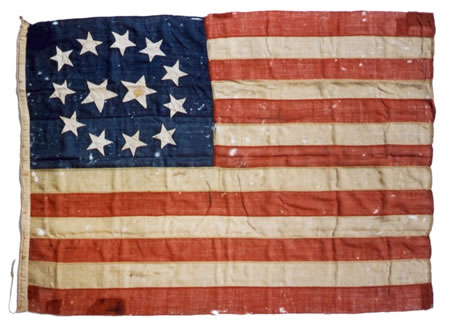
Unfortunately, the Whipple design quickly fell out of popularity. In 1923 the Flag Code was developed, codifying the rules for American flags. The Code became federal law in 1942, locking down the rectangular layout of the star field. We've held steady at 50 stars, and while the United States Army Institute of Heraldry has plans for flags with up to 56 stars (boring 51 star, alternate 51 star), the Whipple could have easily expanded to 65 or more.


Interested in getting your own Whipple? I think your only option is to stitch your own.
Of course, after the Whipple gets squeezed, you have to burn it.
posted by box at 9:48 AM on July 5, 2009 [3 favorites]
posted by box at 9:48 AM on July 5, 2009 [3 favorites]
Dear God, just when I thought you couldn't make the American Flag look worse. The individual elements are very strong (color choice, stripes, stars) but the result is a confused mess.
The Whipple is a good step, but I'd have the stripes take over the full field and place the stars in the center.
posted by The Whelk at 9:53 AM on July 5, 2009
The Whipple is a good step, but I'd have the stripes take over the full field and place the stars in the center.
posted by The Whelk at 9:53 AM on July 5, 2009
An interesting NPR piece aired recently about the designer of the current U.S. flag: In Defense Of The Flag (Sewn For History Class).
posted by acro at 10:01 AM on July 5, 2009 [1 favorite]
posted by acro at 10:01 AM on July 5, 2009 [1 favorite]
The Whipple is much nicer than the current one. How sad.
posted by Ingenting at 10:14 AM on July 5, 2009 [1 favorite]
posted by Ingenting at 10:14 AM on July 5, 2009 [1 favorite]
what a completely wonderful post.
i somehow find the whole anti-authoritarian concept of redesigning the american flag titillating
posted by ichthuz at 10:16 AM on July 5, 2009 [1 favorite]
i somehow find the whole anti-authoritarian concept of redesigning the american flag titillating
posted by ichthuz at 10:16 AM on July 5, 2009 [1 favorite]
The Easton Flag makes us look like a nation of ninja warriors, ready to unleash a torrent of flying shurikens upon any who dare oppose us.
posted by orme at 10:20 AM on July 5, 2009 [1 favorite]
posted by orme at 10:20 AM on July 5, 2009 [1 favorite]
Can you imagine the "OMG JOOOZ!!!" ruckus that would be made if we tried to go to the Whipple flag today?
posted by ArgentCorvid at 10:23 AM on July 5, 2009 [2 favorites]
posted by ArgentCorvid at 10:23 AM on July 5, 2009 [2 favorites]
dear the whelk,
do not question my work. just as i made you, i have also made america and the whipple flag in my image.
thanks,
god
posted by the aloha at 10:30 AM on July 5, 2009
do not question my work. just as i made you, i have also made america and the whipple flag in my image.
thanks,
god
posted by the aloha at 10:30 AM on July 5, 2009
I like the alternate 51 star flag quite a bit. The Guilford flag and the Easton Flag look like things Bizarro would salute. ME AM CANADIAN.
The American flag was plagiarized anyway.
posted by painquale at 10:30 AM on July 5, 2009
The American flag was plagiarized anyway.
posted by painquale at 10:30 AM on July 5, 2009
I think both the boring and non-boring 51-star versions are pretty classy.
Guilford wins, though.
posted by Neofelis at 10:35 AM on July 5, 2009
Guilford wins, though.
posted by Neofelis at 10:35 AM on July 5, 2009
also, you can't shit on it .
posted by yonation at 1:28 PM
I think of that skit just about any time the American flag is mentioned. I also can't think of Lincoln anymore without imagining him speaking in that voice!
posted by orme at 10:52 AM on July 5, 2009
posted by yonation at 1:28 PM
I think of that skit just about any time the American flag is mentioned. I also can't think of Lincoln anymore without imagining him speaking in that voice!
posted by orme at 10:52 AM on July 5, 2009
it's interesting to note that the flag was obviously inspired by the flag of the East India Trading Company.
posted by geos at 11:02 AM on July 5, 2009
posted by geos at 11:02 AM on July 5, 2009
I don't know, it seems to me that changing your flag everytime a new state joins is a bit confusing not to mention a waste of resources. When Puerto Rico is admitted, wouldn't it just be easier to ignore Wyoming? 'Hey, whereabouts you from?' 'I'm from Wyoming.' 'No way, I'm from Pennsylvania too!'
Anyway, you lot would have never had this problem if you'd stuck with the Grand Union Flag.
posted by Sova at 11:05 AM on July 5, 2009
Anyway, you lot would have never had this problem if you'd stuck with the Grand Union Flag.
posted by Sova at 11:05 AM on July 5, 2009
Anyway, you lot would have never had this problem if you'd stuck with the Grand Union Flag.
Them's teabaggin' words, Sova!
posted by orme at 11:16 AM on July 5, 2009
Them's teabaggin' words, Sova!
posted by orme at 11:16 AM on July 5, 2009
The Whipple is much nicer than the current one. How sad.
I know I cry myself to sleep over it several times a week.
posted by Solon and Thanks at 11:18 AM on July 5, 2009
I know I cry myself to sleep over it several times a week.
posted by Solon and Thanks at 11:18 AM on July 5, 2009
Whipple is overrated. There are many beautiful ways to arrange ~50 stars in "a new Constellation."
posted by lathrop at 11:55 AM on July 5, 2009
posted by lathrop at 11:55 AM on July 5, 2009
I SAY MAKE CUBA A STATE AND ADD ONE MORE STAR THAT IS RED MY DESIGN PRINCIPALS DEMAND IT
posted by Astro Zombie at 12:19 PM on July 5, 2009
posted by Astro Zombie at 12:19 PM on July 5, 2009
The guilford flag is one of the worst designs I've ever seen. Fail!
posted by joni. at 12:33 PM on July 5, 2009
posted by joni. at 12:33 PM on July 5, 2009
I really like the alternate 51-star version. Onward, DC or Puerto Rico!
posted by Conrad Cornelius o'Donald o'Dell at 12:48 PM on July 5, 2009 [1 favorite]
posted by Conrad Cornelius o'Donald o'Dell at 12:48 PM on July 5, 2009 [1 favorite]
The Whelk: I'd have the stripes take over the full field and place the stars in the center
Like this?
posted by raygirvan at 1:26 PM on July 5, 2009
Like this?

posted by raygirvan at 1:26 PM on July 5, 2009
Being a Vermonter, I'm partial to the Green Mountain Boys Flag.
posted by paddbear at 1:39 PM on July 5, 2009
posted by paddbear at 1:39 PM on July 5, 2009
That's purty, rygirvan. Is that an existing flag, or photoshop?
posted by njbradburn at 1:40 PM on July 5, 2009
posted by njbradburn at 1:40 PM on July 5, 2009
I think the Whipple design brings a lot of attention to the stars.
posted by rageagainsttherobots at 1:45 PM on July 5, 2009
posted by rageagainsttherobots at 1:45 PM on July 5, 2009
I've always been partial to the Flag of New England, myself.
posted by usonian at 1:51 PM on July 5, 2009
posted by usonian at 1:51 PM on July 5, 2009
Is that an existing flag, or photoshop?
Photoshopped from the Whipple flag.
posted by raygirvan at 1:51 PM on July 5, 2009
Photoshopped from the Whipple flag.
posted by raygirvan at 1:51 PM on July 5, 2009
I think 50'll be the high water mark and it's a good thing we have all of the less-than-50 star flags on deck in the historical record.
Time to get rid of a few states.
posted by codswallop at 2:13 PM on July 5, 2009
Time to get rid of a few states.
posted by codswallop at 2:13 PM on July 5, 2009
There are way too many stars; the flag is gaudy and busy. If it were up to me, we'd just go back to the circular field of 13 stars. The "every state gets a star" thing was fine when we had less than twenty states.
posted by spaltavian at 2:21 PM on July 5, 2009
posted by spaltavian at 2:21 PM on July 5, 2009
raygirvan, nice, but I took a more dramatic approach
13 colonies, and since adding a new star for every state seems silly (seriously, and a design headache) a triple star representing the 3 branches of government. A more important thing to be reminded of IMHO, than how many states their are.
I'll grant you that it does look like the flag of a Caribbean nation.
From the future.
Which is ruled by graphic designers.
posted by The Whelk at 2:29 PM on July 5, 2009 [4 favorites]

13 colonies, and since adding a new star for every state seems silly (seriously, and a design headache) a triple star representing the 3 branches of government. A more important thing to be reminded of IMHO, than how many states their are.
I'll grant you that it does look like the flag of a Caribbean nation.
From the future.
Which is ruled by graphic designers.
posted by The Whelk at 2:29 PM on July 5, 2009 [4 favorites]
a more dramatic approach
Nice too: although maybe a bit militaristic. It's like an extended USAF National Star insignia.
posted by raygirvan at 3:35 PM on July 5, 2009
Nice too: although maybe a bit militaristic. It's like an extended USAF National Star insignia.
posted by raygirvan at 3:35 PM on July 5, 2009
The Whipple flag is really interesting looking. I like the idea of the modern one, though, that the stars are all evenly spread out so that no one state can claim to be represented by the "center" star. You know that would be Texas...
posted by WhySharksMatter at 5:02 PM on July 5, 2009
posted by WhySharksMatter at 5:02 PM on July 5, 2009
The Whelk's flag is similar to a design that I believe is in the book A Thirty-Eight State U.S.A. It's star outlines alternating red, white, and blue on a white field, with only 3/4 of the largest star visible. I've always been partial to it even though it has a bit of a 1970s thing to it.
posted by dhartung at 7:00 PM on July 5, 2009
posted by dhartung at 7:00 PM on July 5, 2009
I'll be deep in the cold, cold ground before I recognize Missouri.
posted by Navelgazer at 7:53 PM on July 5, 2009

posted by Navelgazer at 7:53 PM on July 5, 2009
>I'll be deep in the cold, cold ground before I recognize Missouri.
Then we could return Maine to Massachusetts.
http://en.wikipedia.org/wiki/Missouri_Compromise
posted by evilelf at 6:36 AM on July 6, 2009
Then we could return Maine to Massachusetts.
http://en.wikipedia.org/wiki/Missouri_Compromise
posted by evilelf at 6:36 AM on July 6, 2009
I've only scanned the links above, so I'm not sure if it's been mentioned already, but when I was born (along with relatively few other Americans), this 49-star flag was the official flag of the United States.
Thanks for the interesting post!
posted by trip and a half at 7:56 AM on July 6, 2009
Thanks for the interesting post!
posted by trip and a half at 7:56 AM on July 6, 2009
The Whelk: raygirvan, nice, but I took a more dramatic approach
Well, since it's from the future, why not make the stars spin (in opposing directions) and the stripes strobe? HYPNOFLAG!
posted by hangashore at 12:39 PM on July 6, 2009
Well, since it's from the future, why not make the stars spin (in opposing directions) and the stripes strobe? HYPNOFLAG!
posted by hangashore at 12:39 PM on July 6, 2009
« Older Algorithmic Music | Let Your Fag Flag Fly Newer »
This thread has been archived and is closed to new comments
posted by Krrrlson at 9:41 AM on July 5, 2009 [5 favorites]