Not bad meaning bad but bad meaning good
July 30, 2009 2:18 PM Subscribe
The Big Bad Wolf won't howl no more. Busch Gardens Williamsburg, the Virginia amusement park with a friendly Western European theme, announced on July 24 that it was officially retiring The Big Bad Wolf, its iconic suspended roller coaster. The Wolf, which opened in 1984, was primarily built by Arrow Dynamics, the firm which also designed the world's first corkscrew inversion and the first coaster to top 200 feet in height. While not the world's first suspended roller coaster, the Big Bad Wolf could proudly lay claim to the fact that it was the first successful suspended coaster. Charmed though it is, the circumstances around its sudden September 7th closure date may make the ride the newest entry in the Williamsburg park's strange history.
Busch Gardens opened its Williamsburg park in 1975 and colorfully themed it to some of the more iconic aspects of European countries. Named The Old Country, the park featured historical aspects of England and France (with Quebec included as well for a "frontier" feel) and Germany across the river. It was the Busch brewery's fourth park historically: along with its African-themed Busch Gardens Tampa park, which opened in 1959 as The Dark Continent, the brewery also at one time had smaller, more sedate parks in Houston and Van Nuys.
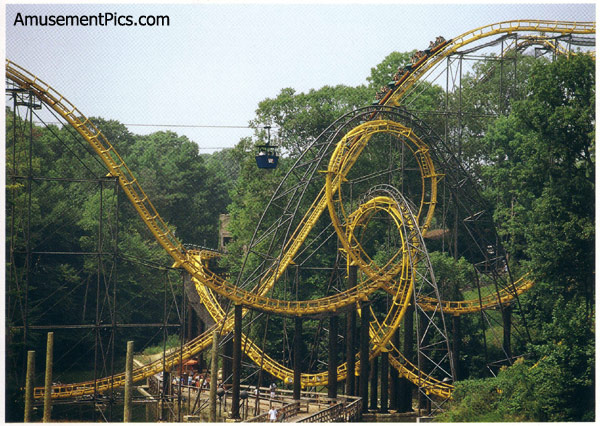
In 1978, the park opened the Loch Ness Monster, a thrilling ride by Arrow Dynamics whose centerpiece was its pair of interlocking loops, situated in such a way that it couldn't help but make for great postcard shots. The coaster's popularity prompted Busch to add another thrill ride in the early 80s, and they approached legendary German designer Anton Schwarzkopf to provide them with a new kind of coaster thrill. Schwarzkopf obliged and designed the Flugbahn, the "Flying Coaster" with cars suspended below the track. The cars would freely swing out as the train rounded the curves. Schwarzkopf's team started work on the ride but declared bankruptcy after they'd poured the concrete footers and started work on the supports. Busch then turned to Arrow, who stepped in and completed the work.
Busch opened The Big Bad Wolf in 1984 and it was an immediate hit. The freely-swinging cars could fly out up to 110 degrees (as this Arrow promotional video will breathlessly tell you) and charged around a twisty, turny course, narrowly dodging barrels and Barvarian houses and other scenic hazards. The ride ended in a quick 80-foot drop over the park's river, and zig-zagged over the water before finally reaching the station brakes. This fine POV video here shows off the entire ride from the front seat. (It may induce queasiness among some of you, so do watch with caution.)
Busch next tapped the Swiss firm Bolliger & Mabillard to design a coaster for both the Williamsburg and Tampa parks. This time the ride would feature more of a looping style like the Loch Ness Monster, but with more loops. A lot more loops. B&M decided it had too much on its plate and announced it had to back out of one of its projects. They left Williamsburg but stayed on the Tampa one. (One of the other projects that B&M was finishing at the time was Batman: The Ride at Six Flags Great America, the world's first inverted looping coaster.)
Once again Busch turned to Arrow, who came in to finish the job like they had before. They took B&M's concept and tried their best to adapt it to their standards. The result was Drachen Fire, which opened in 1992. The ride quickly earned a reputation for being way too rough (as seen in this potentially quease-inducing promotional footage) and started racking up the guest complaints. Among the many design problems was the fact that B&M designed their inversions with the rider's heart as the center of gravity; Arrow's track was designed with the center of the cars as the center of gravity and not all the modification they could do to the design would help.
To help combat the complaints of roughness Busch removed a corkscrew right after the midcourse brakes, replacing it instead with a flat slope of track. It didn't help, and the park mysteriously closed Drachen Fire without warning in late July 1998. The ride then sat dormant on the site until 2002, and the park embarked on an odd bit of revisionism, removing the clearly visible coaster from park maps, literature, and even the recorded spiel of the park's miniature train which went right past the structure.
At this point B&M signed a multi-coaster contract with Busch, and came back in 1997 with an inverted roller coaster called Alpengeist and then a 200-foot hypercoaster called Apollo's Chariot. It made its grand debut in 1999 with a train full of beautiful ladies in togas and romance novel model Fabio up in the front seat dressed up like a Roman god. On the first drop, a 210-foot plunge that goes past the park's river, the train hit a goose which had flown up directly over the track.
Fabio was struck at high speed, suffering only a small cut on his nose (the immediate results, as seen in this bloody picture, looked a bit more gruesome.) While the park had already put up netting and protection along the track to keep the birds away, they added more and the ride has run along goose-free since.
Ten years and another coaster later, the park has now announced that they will close the Big Bad Wolf after operation on September 7th. In an official FAQ, Busch explains that the decision to remove the ride was simply one of maintenance: it has "reached the end of its service life." The park also cannot keep the ride open during their post-season Hall-O-Scream event because they're itching to take it down real quick. But when asked about the ride's replacement, Busch's only response is that it's not unusual for a park to remove a ride without a replacement planned. But when the ride is a park favorite and they want it out of there quickly, you have to wonder what they're planning on putting up on what was formerly those Schwarzkopf footers. Surely it's going to be something big. Or weird. Given the park's odd luck when it comes to roller coasters, it'll probably be both.
Busch Gardens opened its Williamsburg park in 1975 and colorfully themed it to some of the more iconic aspects of European countries. Named The Old Country, the park featured historical aspects of England and France (with Quebec included as well for a "frontier" feel) and Germany across the river. It was the Busch brewery's fourth park historically: along with its African-themed Busch Gardens Tampa park, which opened in 1959 as The Dark Continent, the brewery also at one time had smaller, more sedate parks in Houston and Van Nuys.
In 1978, the park opened the Loch Ness Monster, a thrilling ride by Arrow Dynamics whose centerpiece was its pair of interlocking loops, situated in such a way that it couldn't help but make for great postcard shots. The coaster's popularity prompted Busch to add another thrill ride in the early 80s, and they approached legendary German designer Anton Schwarzkopf to provide them with a new kind of coaster thrill. Schwarzkopf obliged and designed the Flugbahn, the "Flying Coaster" with cars suspended below the track. The cars would freely swing out as the train rounded the curves. Schwarzkopf's team started work on the ride but declared bankruptcy after they'd poured the concrete footers and started work on the supports. Busch then turned to Arrow, who stepped in and completed the work.
Busch opened The Big Bad Wolf in 1984 and it was an immediate hit. The freely-swinging cars could fly out up to 110 degrees (as this Arrow promotional video will breathlessly tell you) and charged around a twisty, turny course, narrowly dodging barrels and Barvarian houses and other scenic hazards. The ride ended in a quick 80-foot drop over the park's river, and zig-zagged over the water before finally reaching the station brakes. This fine POV video here shows off the entire ride from the front seat. (It may induce queasiness among some of you, so do watch with caution.)
Busch next tapped the Swiss firm Bolliger & Mabillard to design a coaster for both the Williamsburg and Tampa parks. This time the ride would feature more of a looping style like the Loch Ness Monster, but with more loops. A lot more loops. B&M decided it had too much on its plate and announced it had to back out of one of its projects. They left Williamsburg but stayed on the Tampa one. (One of the other projects that B&M was finishing at the time was Batman: The Ride at Six Flags Great America, the world's first inverted looping coaster.)
Once again Busch turned to Arrow, who came in to finish the job like they had before. They took B&M's concept and tried their best to adapt it to their standards. The result was Drachen Fire, which opened in 1992. The ride quickly earned a reputation for being way too rough (as seen in this potentially quease-inducing promotional footage) and started racking up the guest complaints. Among the many design problems was the fact that B&M designed their inversions with the rider's heart as the center of gravity; Arrow's track was designed with the center of the cars as the center of gravity and not all the modification they could do to the design would help.
To help combat the complaints of roughness Busch removed a corkscrew right after the midcourse brakes, replacing it instead with a flat slope of track. It didn't help, and the park mysteriously closed Drachen Fire without warning in late July 1998. The ride then sat dormant on the site until 2002, and the park embarked on an odd bit of revisionism, removing the clearly visible coaster from park maps, literature, and even the recorded spiel of the park's miniature train which went right past the structure.
At this point B&M signed a multi-coaster contract with Busch, and came back in 1997 with an inverted roller coaster called Alpengeist and then a 200-foot hypercoaster called Apollo's Chariot. It made its grand debut in 1999 with a train full of beautiful ladies in togas and romance novel model Fabio up in the front seat dressed up like a Roman god. On the first drop, a 210-foot plunge that goes past the park's river, the train hit a goose which had flown up directly over the track.
Fabio was struck at high speed, suffering only a small cut on his nose (the immediate results, as seen in this bloody picture, looked a bit more gruesome.) While the park had already put up netting and protection along the track to keep the birds away, they added more and the ride has run along goose-free since.
Ten years and another coaster later, the park has now announced that they will close the Big Bad Wolf after operation on September 7th. In an official FAQ, Busch explains that the decision to remove the ride was simply one of maintenance: it has "reached the end of its service life." The park also cannot keep the ride open during their post-season Hall-O-Scream event because they're itching to take it down real quick. But when asked about the ride's replacement, Busch's only response is that it's not unusual for a park to remove a ride without a replacement planned. But when the ride is a park favorite and they want it out of there quickly, you have to wonder what they're planning on putting up on what was formerly those Schwarzkopf footers. Surely it's going to be something big. Or weird. Given the park's odd luck when it comes to roller coasters, it'll probably be both.
OH SNAP
posted by infinitywaltz at 2:22 PM on July 30, 2009
posted by infinitywaltz at 2:22 PM on July 30, 2009
One of the great things about Metafilter is its ability to make you interested in topics you've never been interested in before. Awesome.
posted by robocop is bleeding at 2:24 PM on July 30, 2009 [4 favorites]
posted by robocop is bleeding at 2:24 PM on July 30, 2009 [4 favorites]
Quasar was my favorite ride as a kid. I got TWO t-shirts and wore them out.
posted by GilloD at 2:27 PM on July 30, 2009 [1 favorite]
posted by GilloD at 2:27 PM on July 30, 2009 [1 favorite]
We need more posts with the "wheeee" tag.
posted by EvaDestruction at 2:28 PM on July 30, 2009 [6 favorites]
posted by EvaDestruction at 2:28 PM on July 30, 2009 [6 favorites]
I think we found a winner for the iPod contest.
posted by bunnytricks at 2:30 PM on July 30, 2009
posted by bunnytricks at 2:30 PM on July 30, 2009
Flagged as fantastic, and I frankly don't give a rat's ass about roller-coasters. Awesome job.
posted by nevercalm at 2:31 PM on July 30, 2009 [1 favorite]
posted by nevercalm at 2:31 PM on July 30, 2009 [1 favorite]
I feel very lucky in the "big roller coaster fan' sense to have gone on both Drachen Fire and Big Bad Wolf. it's true that DF was damn rough - I don't usually have complaints about rough coasters and I came away from that going "Ow. Aspirins, please."
Big Bad Wolf is just plain FUN. Despite being an early suspended design, it never felt gimmicky or cheap - it had enough ride time to get used to not seeing a track under you, and it was built into the landscape (or the landscape built around it, I'm not sure) in such a way that you really felt like you might careen off into a hill. Going on it once the sun had gone down was a regular staple of my trips to Busch Gardens, and riding it at night during their Halloween event when the fog machines were turned up to 11 was just even more fun.
Randomly about Apollo's Chariot being goose-free, I'm not so sure about that. At least in the sense of people doing the "I feel the need... the need for speed!" bit as though they were Mav and Goose from Top Gun while on the ride. I've been with friends twice when they did this and was totally baffled as to why until I heard the Fabio+Goose story years later.
posted by FritoKAL at 2:31 PM on July 30, 2009
Big Bad Wolf is just plain FUN. Despite being an early suspended design, it never felt gimmicky or cheap - it had enough ride time to get used to not seeing a track under you, and it was built into the landscape (or the landscape built around it, I'm not sure) in such a way that you really felt like you might careen off into a hill. Going on it once the sun had gone down was a regular staple of my trips to Busch Gardens, and riding it at night during their Halloween event when the fog machines were turned up to 11 was just even more fun.
Randomly about Apollo's Chariot being goose-free, I'm not so sure about that. At least in the sense of people doing the "I feel the need... the need for speed!" bit as though they were Mav and Goose from Top Gun while on the ride. I've been with friends twice when they did this and was totally baffled as to why until I heard the Fabio+Goose story years later.
posted by FritoKAL at 2:31 PM on July 30, 2009
Inverted coasters are the coolest. Me, I'd never ride one (I don't like that kind of thing) but I can appreciate them for what they are.
There's one I've seen film of that I can't remember the name of. The passengers get placed in seats, and they're facing backwards relative to the direction the car will go. Before the car leaves, all the seat backs move down, so that the passengers are laying down, head first. Then after the car leaves the station, it rolls over, and now the passengers are face down, stretched out, almost like they're flying.
That's absolutely inspired. I think I'd probably die of a heart attack if I rode it, though.
posted by Chocolate Pickle at 2:33 PM on July 30, 2009
There's one I've seen film of that I can't remember the name of. The passengers get placed in seats, and they're facing backwards relative to the direction the car will go. Before the car leaves, all the seat backs move down, so that the passengers are laying down, head first. Then after the car leaves the station, it rolls over, and now the passengers are face down, stretched out, almost like they're flying.
That's absolutely inspired. I think I'd probably die of a heart attack if I rode it, though.
posted by Chocolate Pickle at 2:33 PM on July 30, 2009
Honestly, out of all coaster types I've been on, suspended coasters are up there with bobsled coasters for not too interesting. True, I've never been on this specific ride, being most familiar with those at Cedar Point, but they just really don't hit the thrills nearly as hard as those that are fixed to the track.
(Side note - Cedar Point's latest coaster, Maverick, is INSANE. It doesn't look that serious, but riding it will show you otherwise. I LOVED it...)
posted by evilangela at 2:35 PM on July 30, 2009
(Side note - Cedar Point's latest coaster, Maverick, is INSANE. It doesn't look that serious, but riding it will show you otherwise. I LOVED it...)
posted by evilangela at 2:35 PM on July 30, 2009
There's one I've seen film of that I can't remember the name of. The passengers get placed in seats, and they're facing backwards relative to the direction the car will go. Before the car leaves, all the seat backs move down, so that the passengers are laying down, head first. Then after the car leaves the station, it rolls over, and now the passengers are face down, stretched out, almost like they're flying.
That's actually referred to as a flying coaster - haven't been on one of them yet myself, but as soon as I get the chance, I have to try it out.
posted by evilangela at 2:37 PM on July 30, 2009
That's actually referred to as a flying coaster - haven't been on one of them yet myself, but as soon as I get the chance, I have to try it out.
posted by evilangela at 2:37 PM on July 30, 2009
another post about williamsburg, huh? can we please stop talking about hipsters?
posted by shmegegge at 2:44 PM on July 30, 2009 [1 favorite]
posted by shmegegge at 2:44 PM on July 30, 2009 [1 favorite]
Am I the only one who feels bad for the Big Bad Wolf? I can't imagine that retirement will be good for it. After a career of exciting ups and downs how will it enjoy just hanging out?
posted by twoleftfeet at 2:47 PM on July 30, 2009 [1 favorite]
posted by twoleftfeet at 2:47 PM on July 30, 2009 [1 favorite]
See, for me, suspended coasters add the "hey, my feet are dangling free' factor, and (maybe it's because I'm short) I can't always see the track above my head, depending on the design of the ride and/or the car, but it adds that extra "I have NO IDEA where this thing is going! YIPPIE!" factor as well.
Dangling feets + no idea where the track is going = good times in my mind.
posted by FritoKAL at 2:48 PM on July 30, 2009
Dangling feets + no idea where the track is going = good times in my mind.
posted by FritoKAL at 2:48 PM on July 30, 2009
I prefer spinny things to roller coasters, but I loved The Bat. The year it opened, I was in 8th grade and I spent our annual family slog to King's Island riding The Bat and running back to get in line to ride it again. Roller coasters scare the crap out of me and I really don't enjoy them at all, but I love reading about their design. Great post!
posted by Heretic at 2:49 PM on July 30, 2009
posted by Heretic at 2:49 PM on July 30, 2009
My favorite-ever trip to Busch Gardens involved the Big Bad Wolf, a day with crummy weather, little-to-no line, and six or seven rides in the front seat in a row.
Fantastic post.
posted by alynnk at 2:50 PM on July 30, 2009 [1 favorite]
Fantastic post.
posted by alynnk at 2:50 PM on July 30, 2009 [1 favorite]
I was the first one suspended in my 2nd year in middle school.
posted by Postroad at 2:56 PM on July 30, 2009
posted by Postroad at 2:56 PM on July 30, 2009
See, for me, suspended coasters add the "hey, my feet are dangling free' factor, and (maybe it's because I'm short) I can't always see the track above my head, depending on the design of the ride and/or the car, but it adds that extra "I have NO IDEA where this thing is going! YIPPIE!" factor as well.
I think you're actually talking about an inverted coaster - yes, there are quite a few different types of coaster. :) The inverted is fixed to the track above, and has your feet dangling free. Suspended coasters are not as tightly fixed to the track - the cars swing back and forth freely, and the cars have bottoms to them. The swinging tends to ease the ride a bit as the train goes around corners and the like.
Inverted coasters are incredibly fun and popular, for good reason. As a comparison to the above videos of the Big Bad Wolf, here's the Raptor at Cedar Point, an inverted coaster. The train is firmly held perpendicular to the bottom of the track with no free swinging back and forth.
posted by evilangela at 3:02 PM on July 30, 2009
I think you're actually talking about an inverted coaster - yes, there are quite a few different types of coaster. :) The inverted is fixed to the track above, and has your feet dangling free. Suspended coasters are not as tightly fixed to the track - the cars swing back and forth freely, and the cars have bottoms to them. The swinging tends to ease the ride a bit as the train goes around corners and the like.
Inverted coasters are incredibly fun and popular, for good reason. As a comparison to the above videos of the Big Bad Wolf, here's the Raptor at Cedar Point, an inverted coaster. The train is firmly held perpendicular to the bottom of the track with no free swinging back and forth.
posted by evilangela at 3:02 PM on July 30, 2009
I think you're right. I got them mixed up in my head. Either way, zoom zoom zoom speedy zoom.
... it's possible I had a little too much sugar today.
posted by FritoKAL at 3:09 PM on July 30, 2009
... it's possible I had a little too much sugar today.
posted by FritoKAL at 3:09 PM on July 30, 2009
I don't remember if I rode on the Drachen Fire but it seems likely. If I did, I don't remember much about it. Or at least, I don't remember anything negative about it.
I remember riding the Big Bad Wolf at night. That was amazing fun.
At this point in my life, I don't know if I have any desire to get on a roller coaster again, but this post did bring back the memories of how awesome they can be.
(Busch Gardens Williamsburg is -- or at least, was about 15 years ago -- a really beautiful amusement park. I'd like to go back again some day.)
posted by darksong at 3:13 PM on July 30, 2009
I remember riding the Big Bad Wolf at night. That was amazing fun.
At this point in my life, I don't know if I have any desire to get on a roller coaster again, but this post did bring back the memories of how awesome they can be.
(Busch Gardens Williamsburg is -- or at least, was about 15 years ago -- a really beautiful amusement park. I'd like to go back again some day.)
posted by darksong at 3:13 PM on July 30, 2009
Chocolate Pickle: There was one called X-Flight, at Geauga Lake. I think it might be my favorite roller coaster ever. Because you are locked in at the legs, rather than with shoulder bars, your entire torso is free (there are shoulder belts, but they're nowhere near as restrictive as bars). Add that to the fact that you are, effectively, lying against the track, and suspended beneath it, and it makes for loads of awesome. Often there is nothing, totally nothing that you can see, between you and the ground. It feels more like flying than just jumping out of trees, that's for sure.
posted by Mister Moofoo at 3:19 PM on July 30, 2009
posted by Mister Moofoo at 3:19 PM on July 30, 2009
I go to Busch Gardens every weekend, and Big Bad Wolf is my favorite. As a kid, it was my first adult coaster I ever got to ride, and it scared the living crap out of me. I've ridden that coaster so many times I know it backwards, but the second to last curve always gets me - I always fall for thinking that the bottom of the car is going to hit the columns or the building or something. I'm going to miss it.
Drachen Fire on the other hand, can suck it. I couldn't wait for that thing to be removed. I hated how the guy with the mobile cart selling aspirin always had a smug look on his face...
posted by sephira at 3:21 PM on July 30, 2009
Drachen Fire on the other hand, can suck it. I couldn't wait for that thing to be removed. I hated how the guy with the mobile cart selling aspirin always had a smug look on his face...
posted by sephira at 3:21 PM on July 30, 2009
Wow. Fantastic post.
One of my fondest childhood memories was that coaster. I must have been about 10 or 11, and for one day that summer on our way to boring grandmas house we stayed at some crummy motel down the street from the park and spent the day. Me and my best friend hit that coaster 4 or 5 times during the day, depending on the line and between checking out the other rides. It was by far our favorite (with the log ride a second due to the summer heat).
What I didn't know was that after dark the park gets far less crowded. So we finish some ride, go to check on 'our' coaster, and find the line was empty. Not closed like some thing, just empty. So we race to the front of the line, first slot, and the coaster is waiting on us like we were VIPs. The guy running the ride checks us, belts us in, and sends us out. As soon as we stop the guy running the ride asks if we want to go again without getting up from his station. I don't think we finished screaming YES!PLEASE!YES! before we were off. And again. And again. He would barely let it stop before sending it out.
It felt like we must have ridden it dozens of times before the park shut down and he kicked us out. But each time the thrill of going over the big hill and down through the little village was amazing. I know at some point we both stopped cheering and waving our arms around but we kept yelling AGAIN to the guy running the coaster. I seriously never wanted it to end. I do remember after finally getting out how walking felt strange.
Man, I wonder if I could physically fit in it now (@6'4, 280#). If anyone can answer yes to that, I'm making a pilgrimage.
posted by anti social order at 3:33 PM on July 30, 2009 [2 favorites]
One of my fondest childhood memories was that coaster. I must have been about 10 or 11, and for one day that summer on our way to boring grandmas house we stayed at some crummy motel down the street from the park and spent the day. Me and my best friend hit that coaster 4 or 5 times during the day, depending on the line and between checking out the other rides. It was by far our favorite (with the log ride a second due to the summer heat).
What I didn't know was that after dark the park gets far less crowded. So we finish some ride, go to check on 'our' coaster, and find the line was empty. Not closed like some thing, just empty. So we race to the front of the line, first slot, and the coaster is waiting on us like we were VIPs. The guy running the ride checks us, belts us in, and sends us out. As soon as we stop the guy running the ride asks if we want to go again without getting up from his station. I don't think we finished screaming YES!PLEASE!YES! before we were off. And again. And again. He would barely let it stop before sending it out.
It felt like we must have ridden it dozens of times before the park shut down and he kicked us out. But each time the thrill of going over the big hill and down through the little village was amazing. I know at some point we both stopped cheering and waving our arms around but we kept yelling AGAIN to the guy running the coaster. I seriously never wanted it to end. I do remember after finally getting out how walking felt strange.
Man, I wonder if I could physically fit in it now (@6'4, 280#). If anyone can answer yes to that, I'm making a pilgrimage.
posted by anti social order at 3:33 PM on July 30, 2009 [2 favorites]
I will never forget Big Bad Wolf because it was the first roller coaster I ever went on. I was seated next to my dad, and as the cars pulled out of the station I asked him, "Has anyone ever died on this thing?" He half managed to stifle laughter. Naturally, by the time we pulled back into the station, I was ready to go again.
I've been on dozens of coasters, including the ones with the "biggest drop ever", "tallest ever", "most loops ever", "only coaster to do XYZ". Most of them were good, some were downright scary. In the end, most were imminently forgettable. Big Bad Wolf just made for a damn good time. You could ride it all day.
posted by cyclopticgaze at 3:34 PM on July 30, 2009
I've been on dozens of coasters, including the ones with the "biggest drop ever", "tallest ever", "most loops ever", "only coaster to do XYZ". Most of them were good, some were downright scary. In the end, most were imminently forgettable. Big Bad Wolf just made for a damn good time. You could ride it all day.
posted by cyclopticgaze at 3:34 PM on July 30, 2009
I never knew that about Drachen Fire; I remember it being my favorite Busch Gardens coaster by far. I don't remember enjoying the Big Bad Wolf quite as much as Drachen Fire or the Loch Ness Monster, but I do remember riding all three of them repeatedly.
Williamsburg was a reasonable drive from where I grew up, so Busch Gardens was a popular destination. "I Survived the Big Bad Wolf" T-shirts were probably as popular in my elementary school as Disney World or Hard Rock Cafe shirts.
posted by Metroid Baby at 3:46 PM on July 30, 2009
Williamsburg was a reasonable drive from where I grew up, so Busch Gardens was a popular destination. "I Survived the Big Bad Wolf" T-shirts were probably as popular in my elementary school as Disney World or Hard Rock Cafe shirts.
posted by Metroid Baby at 3:46 PM on July 30, 2009
Aww, the Big Bad Wolf was the first roller coaster I ever rode (other than the old Scooby Doo one at Kings Dominion, heh). I just rode it again about two months ago, and while I was saddened to see that I'd apparently invented a part where you briefly rode INTO one of the village houses, I still enjoyed the hell out of it. I'm sad to see it go although I'm excited to see what might take its place.
(A+ post, says this native Virginian!)
posted by sarahsynonymous at 4:28 PM on July 30, 2009 [1 favorite]
(A+ post, says this native Virginian!)
posted by sarahsynonymous at 4:28 PM on July 30, 2009 [1 favorite]
I don't like heights, or going fast. I get motion sick on the Metro if I'm not facing forward. And I really, really hate being upside down.
The only coaster I ever rode was the Big Bad Wolf and I will never ride another. The guy I went with basically told me that he paid for me to get in and if I didn't ride it with him I was going to find my own way home.
Still, great post! Please ignore my trauma.
posted by JoanArkham at 4:39 PM on July 30, 2009
The only coaster I ever rode was the Big Bad Wolf and I will never ride another. The guy I went with basically told me that he paid for me to get in and if I didn't ride it with him I was going to find my own way home.
Still, great post! Please ignore my trauma.
posted by JoanArkham at 4:39 PM on July 30, 2009
I love the kid laughing maniacally in the Big Bad Wolf POV vid at about 1:20.
Such a shame that brilliant roller coaster companies have been gone bankrupt or gotten bought out. RIP Schwarzkopf, and although Arrow Dynamics is now S&S Arrow, it's just not the same...
posted by JauntyFedora at 4:46 PM on July 30, 2009
Such a shame that brilliant roller coaster companies have been gone bankrupt or gotten bought out. RIP Schwarzkopf, and although Arrow Dynamics is now S&S Arrow, it's just not the same...
posted by JauntyFedora at 4:46 PM on July 30, 2009
sarahsynonymous, are you sure you aren't thinking of Escape from Pompeii?
Excellent post.
posted by Night_owl at 5:03 PM on July 30, 2009
Excellent post.
posted by Night_owl at 5:03 PM on July 30, 2009
"another coaster later" -- that would be Griffon, which is fucking awesome. That wide-not-deep car design offers a thrill I had yet to ever experience until I rode it the second time in the front row, far left seat. The five-second stop over the ninety degree drop straight down? There's not even TRACK underneath that seat. Oh, yeah.
great post.
posted by waraw at 5:41 PM on July 30, 2009
great post.
posted by waraw at 5:41 PM on July 30, 2009
Back in the late '90s, we had a guy here at the local university whom I referred to as the Wallpaper Bandit. The public access PCs on campus were all still running Windows 95, and there was just no way for IT to lock the settings down, en masse. So every couple of weeks or so, when someone would logout and walk away from an OPAC machine the first thing in the morning, the screaming face of Batboy would be clawing out at me, and I'd know that every computer in the building would have the same image centered on their desktops. I'd have to go around and set them all back to the default blue, one at a time. A week or two would pass, and the Bandit would strike again. Max Headroom. Boner, from Growing Pains. The red eye of the HAL 9000. I was just happy it wasn't porn (usually).
But after the opening of Apollo's Chariot, I left that shot of Fabio's shocked, goose-bloodied face up on all the computers, all day. That was awesome.
posted by steef at 5:46 PM on July 30, 2009 [1 favorite]
But after the opening of Apollo's Chariot, I left that shot of Fabio's shocked, goose-bloodied face up on all the computers, all day. That was awesome.
posted by steef at 5:46 PM on July 30, 2009 [1 favorite]
I am so sad.
I loved the Big Bad Wolf. That drop when you swing out over the water and your stomach clenches waiting for the splash is one of the best things I've ever experienced.
posted by winna at 5:57 PM on July 30, 2009
I loved the Big Bad Wolf. That drop when you swing out over the water and your stomach clenches waiting for the splash is one of the best things I've ever experienced.
posted by winna at 5:57 PM on July 30, 2009
I went on the Loch Ness Monster the summer it opened. I went on it a lot. Like a million times. Big Bad Wolf was great too, sorry to see it go.
posted by Mister_A at 6:48 PM on July 30, 2009
posted by Mister_A at 6:48 PM on July 30, 2009
Way to bring back memories of middle and high school. We took our senior high school trip to Busch Gardens, right before the Big Bad Wolf opened. I still have very clear memories of riding the Loch Ness Monster. I need to go find some roller coasters, I think....
posted by gingerbeer at 6:59 PM on July 30, 2009
posted by gingerbeer at 6:59 PM on July 30, 2009
The summer I was 12, my dad put me into a Richmond YMCA camp. Naturally, they shuttled us to Busch Gardens at some point. As soon as we arrived, my group of friends made it clear they wanted nothing more than to spend the entire day rifling through souvenir shops. So I ditched their asses.
Thus it was that the Big Bad Wolf was the first rollercoaster I rode alone.
posted by Coatlicue at 6:59 PM on July 30, 2009
Thus it was that the Big Bad Wolf was the first rollercoaster I rode alone.
posted by Coatlicue at 6:59 PM on July 30, 2009
A quick look at the photos in the link reveals this is basically the same coaster as Vortex, which opened in 1990 at Canada's Wonderland. (YT Ride Video). Very fast and smooth ride, you really feel like you're on a rocket. It also goes right up and over the top of Wonderland Mountain.
posted by autodidact at 8:14 PM on July 30, 2009
posted by autodidact at 8:14 PM on July 30, 2009
After years of being afraid of roller coasters, I took my first ride on the Drachen Fire. I can't remember the exact year and if this was pre- or post-removal of the corkscrew. So let's just assume it was pre- so I can feel tougher.
I didn't choose the Loch Ness Monster or the Big Bad Wolf as my first for a reason that's not very clear to me. Maybe because the names scared me the most. I had no idea what a "drachen" was. Or maybe it was because I had gone to Busch Gardens and always everyone raved about Big Bad Wolf so much that I figured it would kill me only after eating my soul.
Before I finally decided to ride The Wolf, my best friend had to explain everything about it, especially the last drop. We had to take the ferry that allowed me to see every angle of the coaster from the lake that it dipped and dived over. I just wish I could link to the howling sound they played when you flew through the fake village.
Thank you for this post. I've quickly relived many childhood/teenage trips down 64W to the only thing in Williamsburg that wasn't lame.
. to you Big Bad Wolf
posted by mjthomas at 8:31 PM on July 30, 2009
I didn't choose the Loch Ness Monster or the Big Bad Wolf as my first for a reason that's not very clear to me. Maybe because the names scared me the most. I had no idea what a "drachen" was. Or maybe it was because I had gone to Busch Gardens and always everyone raved about Big Bad Wolf so much that I figured it would kill me only after eating my soul.
Before I finally decided to ride The Wolf, my best friend had to explain everything about it, especially the last drop. We had to take the ferry that allowed me to see every angle of the coaster from the lake that it dipped and dived over. I just wish I could link to the howling sound they played when you flew through the fake village.
Thank you for this post. I've quickly relived many childhood/teenage trips down 64W to the only thing in Williamsburg that wasn't lame.
. to you Big Bad Wolf
posted by mjthomas at 8:31 PM on July 30, 2009
Great post, thanks for this!
I actually spent a summer as a ride attendant on the Big Bad Wolf during the summer of '89. Best $4.05 an hour I ever made. There's a set of brakes at the top of the downward slope of the final hill heading towards the river--it's there to keep the speed down when the train is loaded, and is turned off for empty trains, so they had enough speed to make it back up to the station. We used to ride at night after all of the guests had left, and the maintenance guys would turn those brakes off for us. That was even more awesome than it sounds.
Dan Quayle stopped by for a visit to the park once that summer, and rode the Wolf. We asked the vice president which coaster he liked better, the Big Bad Wolf or the Loch Ness Monster across the park. He told us he like the Loch Ness Monster better. We called up our cross-park rivals working there to graciously share his assessment. They told us they had asked him the same question, and he said he liked the Big Bad Wolf better. Political skill WIN.
I can still recite the boarding/unboarding spiels from memory.
posted by danorama at 9:59 PM on July 30, 2009 [2 favorites]
I actually spent a summer as a ride attendant on the Big Bad Wolf during the summer of '89. Best $4.05 an hour I ever made. There's a set of brakes at the top of the downward slope of the final hill heading towards the river--it's there to keep the speed down when the train is loaded, and is turned off for empty trains, so they had enough speed to make it back up to the station. We used to ride at night after all of the guests had left, and the maintenance guys would turn those brakes off for us. That was even more awesome than it sounds.
Dan Quayle stopped by for a visit to the park once that summer, and rode the Wolf. We asked the vice president which coaster he liked better, the Big Bad Wolf or the Loch Ness Monster across the park. He told us he like the Loch Ness Monster better. We called up our cross-park rivals working there to graciously share his assessment. They told us they had asked him the same question, and he said he liked the Big Bad Wolf better. Political skill WIN.
I can still recite the boarding/unboarding spiels from memory.
posted by danorama at 9:59 PM on July 30, 2009 [2 favorites]
I can still recite the boarding/unboarding spiels from memory.
We were mightily annoyed when the spiel was changed, and added back on "ThÉ Òllllllld Coûntryyyy!" every time.
posted by desuetude at 11:07 PM on July 30, 2009
We were mightily annoyed when the spiel was changed, and added back on "ThÉ Òllllllld Coûntryyyy!" every time.
posted by desuetude at 11:07 PM on July 30, 2009
Apologies for the rough approximation of intonation, there.
posted by desuetude at 11:08 PM on July 30, 2009
posted by desuetude at 11:08 PM on July 30, 2009
As strange as it may sound, I have only ever ridden coasters at Busch Gardens Williamsburg. With all things taken into account, I have to give Alpengeist my vote for favorite coaster there. As much as I want to like the Big Bad Wolf, that last bit of back-and-forth at the very end of the ride never fails to tweak my neck out, as I was reminded my last time there.
In any case, a fine post.
posted by skepticjack at 3:15 AM on July 31, 2009
In any case, a fine post.
posted by skepticjack at 3:15 AM on July 31, 2009
Mighty Fine Post.
The mere sight of Arrow Dynamics inspires a "Hell YES"!
(I had a heart attack 11 years ago, but I'll be dammed if I give up what I like to call "Amateur Astronaut Training". Coasters Forever Baby! )
posted by djrock3k at 7:20 AM on July 31, 2009
The mere sight of Arrow Dynamics inspires a "Hell YES"!
(I had a heart attack 11 years ago, but I'll be dammed if I give up what I like to call "Amateur Astronaut Training". Coasters Forever Baby! )
posted by djrock3k at 7:20 AM on July 31, 2009
Wow. I grew up in Virginia and went to Busch Gardens many times. I don't like roller coasters, but even I'm nostalgic at hearing that the Big Bad Wolf is shutting down.
posted by HeroZero at 8:58 AM on July 31, 2009
posted by HeroZero at 8:58 AM on July 31, 2009
Also, I like to refer to the Williamsburg in Brooklyn as "Postcolonial Williamsburg."
posted by HeroZero at 8:58 AM on July 31, 2009 [3 favorites]
posted by HeroZero at 8:58 AM on July 31, 2009 [3 favorites]
My first coaster was also Drachenfire. I was terrified, but I had to ride because of a magazine article I'd written about it. Cindy Sarko, the PR manager, met me at the front gate and insisted we go over and ride it right away. She cut us in line and we got right into the front seat. I got on terrified and got off exhilarated.
I rode that thing so many times that day I literally lost count. It may have been a rough ride, but it had great throughput.
posted by Camofrog at 4:46 PM on July 31, 2009 [1 favorite]
I rode that thing so many times that day I literally lost count. It may have been a rough ride, but it had great throughput.
posted by Camofrog at 4:46 PM on July 31, 2009 [1 favorite]
The Big Bad Wolf was the first "real" roller coaster I was allowed to go on - I was well under the Loch Ness Monster's eligible height requirement, so The Big Bad gets credit for hooking me on coasters. Plus, my Big Bad Wolf souvenir shirt (sleeveless and snarling) gave me major cul de sac cred back in the day. I wish I still had it (not that it'd fit) - with the current wolf shirt renaissance underway, I'd apparently have to beat the groupies off with 4 paws.
A co-worker just caught me wistfully reliving the ride on YouTube. I'd pay for an HD-quality recording of all my favorite coaster rides... one imagines projecting it on a large wall in public and seeing how many people need to lie down to make it stop.
I made a pilgrimage to 6 Flags Magic Mountain a month ago, and I have to say, the new coasters have really created new... sensations. Tatsu is a flying coaster, and it's really fun but requires front row seating for full effect. The X2... oh gruesome gravy. Extended exposure to the X2 could indeed induce psychosis. That ride does things to your body that it was not necessarily meant to endure - Enter Sandman blaring, you're being flipped in your seat whilst corkscrewing and looping, and then at the end frickin' flames shoot out at you like you're a mullet-sporting professional wrestler making a 60mph entrance. I heartily endorse it. My favorite, however, remains the Goliath. Even without inversion, that ride is just about perfect.
posted by krippledkonscious at 8:39 PM on July 31, 2009
A co-worker just caught me wistfully reliving the ride on YouTube. I'd pay for an HD-quality recording of all my favorite coaster rides... one imagines projecting it on a large wall in public and seeing how many people need to lie down to make it stop.
I made a pilgrimage to 6 Flags Magic Mountain a month ago, and I have to say, the new coasters have really created new... sensations. Tatsu is a flying coaster, and it's really fun but requires front row seating for full effect. The X2... oh gruesome gravy. Extended exposure to the X2 could indeed induce psychosis. That ride does things to your body that it was not necessarily meant to endure - Enter Sandman blaring, you're being flipped in your seat whilst corkscrewing and looping, and then at the end frickin' flames shoot out at you like you're a mullet-sporting professional wrestler making a 60mph entrance. I heartily endorse it. My favorite, however, remains the Goliath. Even without inversion, that ride is just about perfect.
posted by krippledkonscious at 8:39 PM on July 31, 2009
What memories this brought back. I remember hearing about the Loch Ness Monster in middle school from a lucky kid who went there in the summer. Then, in the mid 1980's I was stationed very close to Williamsburg and got a lot of chances to ride both the monster and the Big Bad Wolf. I must have went to Busch Garden's 50 times while living in Norfolk.
posted by UseyurBrain at 6:02 PM on August 1, 2009
posted by UseyurBrain at 6:02 PM on August 1, 2009
« Older Under a Nuclear Cloud | Right Here, Right Now, etc etc Newer »
This thread has been archived and is closed to new comments
posted by sleevener at 2:20 PM on July 30, 2009 [17 favorites]