The Wisdom of Salmon
September 24, 2009 9:33 AM Subscribe
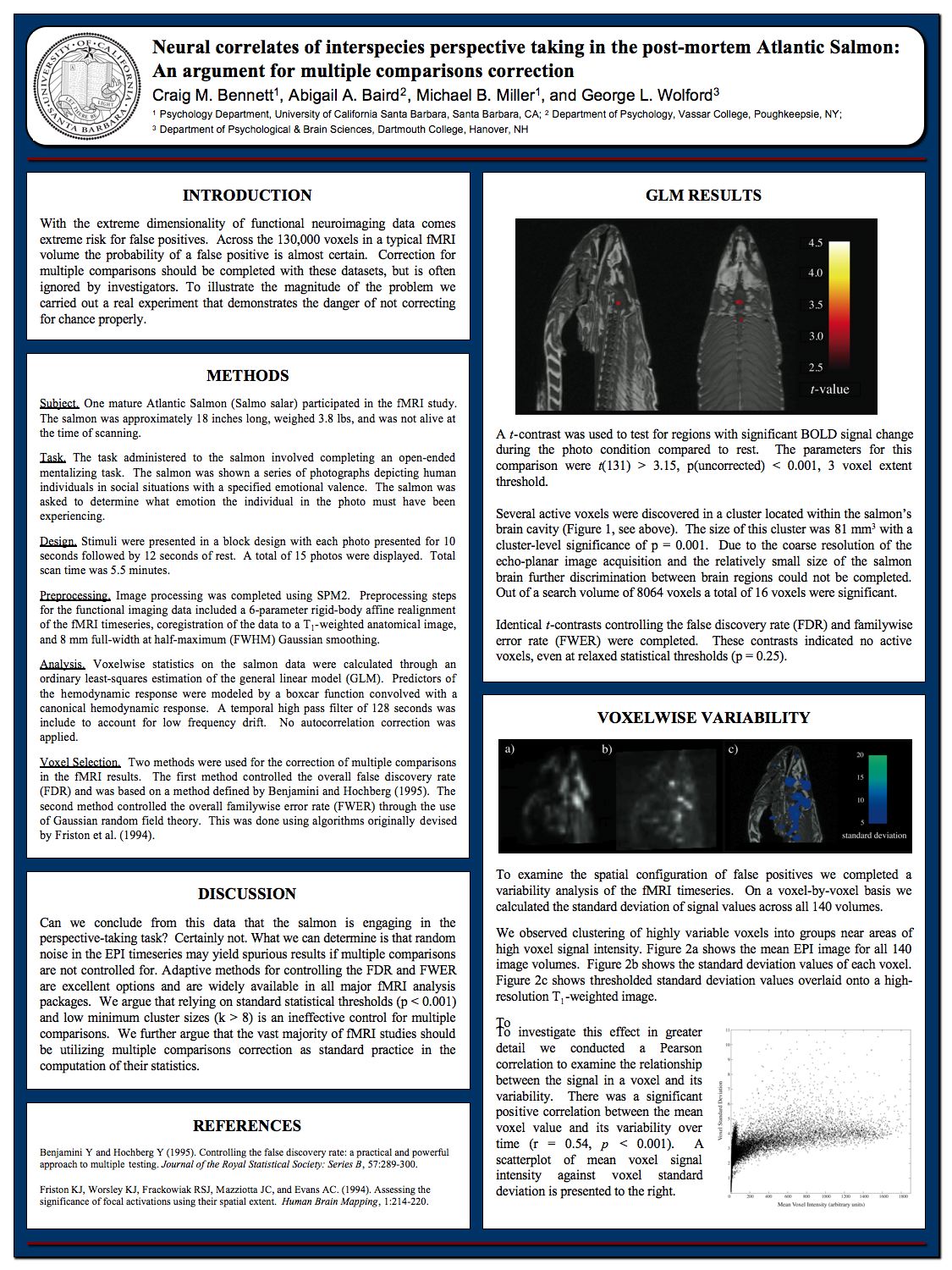
Functional MRI (fMRI) is a widely used technique of brain imaging in the cognitive sciences, allowing researchers to visualize what part of the brain is responding to certain stimuli, resulting in striking images of live brains. These days, fMRI is seeing more non-research use, such as forming the basis of controversial new lie detectors. Craig Bennett, a postdoctoral researcher at UCSB, submitted a whole Atlantic salmon to fMRI analysis, and found that this fish could apparently detect, and respond to, the the emotional state of human beings (poster). Remarkable science, especially considering the salmon was dead at the time.
Bennett's paper is an example of voodoo correlation in brain imaging studies, wherein some false positives cannot be statistically removed without removing real data as well. Basically, low probability events will occur if enough data are generated - and fMRI generates enormous amounts of data: "your average fMRI brain scan analysis can involve 40,000 comparisons, so even if there's nothing going on, some bits of the brain are going to seem active just through falsely detecting noise and measurement error as real effect." The issue seems to be that better data filtering and better reporting of raw and corrected data are needed in this field - less sexy a conclusion than emotional dead salmon, yet an important cautionary tale that the author found surprisingly difficult to get published, or even to present at a conference. [via John Hawks]

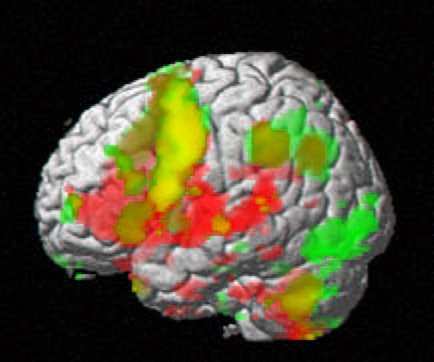
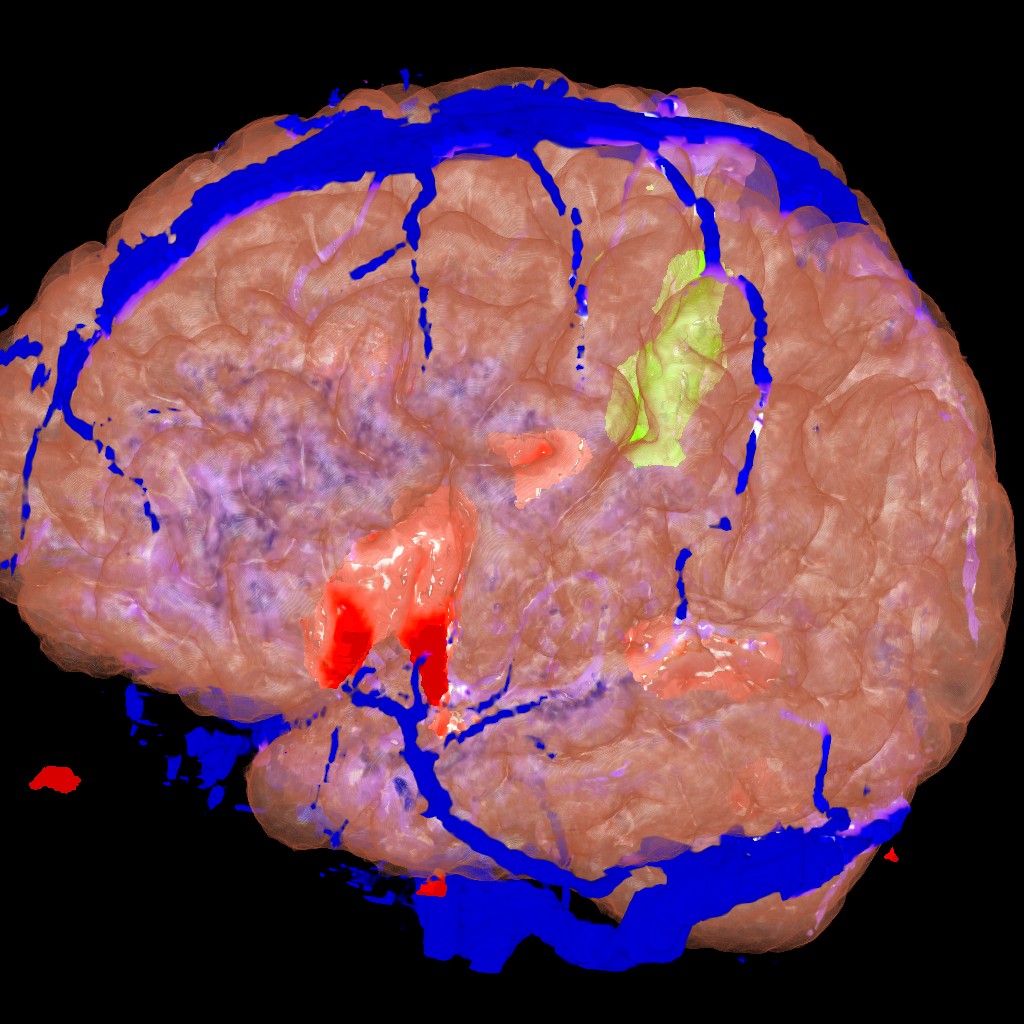

Bennett's paper is an example of voodoo correlation in brain imaging studies, wherein some false positives cannot be statistically removed without removing real data as well. Basically, low probability events will occur if enough data are generated - and fMRI generates enormous amounts of data: "your average fMRI brain scan analysis can involve 40,000 comparisons, so even if there's nothing going on, some bits of the brain are going to seem active just through falsely detecting noise and measurement error as real effect." The issue seems to be that better data filtering and better reporting of raw and corrected data are needed in this field - less sexy a conclusion than emotional dead salmon, yet an important cautionary tale that the author found surprisingly difficult to get published, or even to present at a conference. [via John Hawks]
my dad would be so proud
posted by It's Raining Florence Henderson at 9:37 AM on September 24, 2009 [1 favorite]
posted by It's Raining Florence Henderson at 9:37 AM on September 24, 2009 [1 favorite]
I bet they got that fish from Quonsar.
posted by St. Alia of the Bunnies at 9:39 AM on September 24, 2009 [1 favorite]
posted by St. Alia of the Bunnies at 9:39 AM on September 24, 2009 [1 favorite]
Why did he use a salmon?
Just for the halibut.
posted by Faint of Butt at 9:41 AM on September 24, 2009 [6 favorites]
Just for the halibut.
posted by Faint of Butt at 9:41 AM on September 24, 2009 [6 favorites]
Man, even dead fish are better with people than I am.
posted by allen.spaulding at 9:41 AM on September 24, 2009 [10 favorites]
posted by allen.spaulding at 9:41 AM on September 24, 2009 [10 favorites]
And I would venture to guess that the state that Bennett was referring to could be aptly described as 'hunger'.
posted by iamkimiam at 9:42 AM on September 24, 2009
posted by iamkimiam at 9:42 AM on September 24, 2009
This was an episode of House last season.
posted by srboisvert at 9:44 AM on September 24, 2009 [1 favorite]
posted by srboisvert at 9:44 AM on September 24, 2009 [1 favorite]
Rumple: "yet an important cautionary tale"
And why do so many of our cautionary tales* involve fish?
*Not gonna go there.
posted by iamkimiam at 9:44 AM on September 24, 2009 [1 favorite]
And why do so many of our cautionary tales* involve fish?
*Not gonna go there.
posted by iamkimiam at 9:44 AM on September 24, 2009 [1 favorite]
This is going to totally revise centuries of literary cold fish metaphors.
posted by ardgedee at 9:45 AM on September 24, 2009 [1 favorite]
posted by ardgedee at 9:45 AM on September 24, 2009 [1 favorite]
This seems like the kind of experiment I would have devised during an undergraduate bong session.
"Shit, man...we could like, put all kinds of shit in there, man. We could put a fuckin' whole fish in there, man, and look at its brain and shit."
posted by The Straightener at 9:50 AM on September 24, 2009
"Shit, man...we could like, put all kinds of shit in there, man. We could put a fuckin' whole fish in there, man, and look at its brain and shit."
posted by The Straightener at 9:50 AM on September 24, 2009
Functional Neuroimaging of Belief, Disbelief, and Uncertainty
posted by No Robots at 9:50 AM on September 24, 2009
posted by No Robots at 9:50 AM on September 24, 2009
This is really fascinating. Fish jokes aside, this seems like a huge problem for brain research, and from everything I've read, brain scientists have felt really really good and confident about fMRIs.
posted by OmieWise at 9:52 AM on September 24, 2009
posted by OmieWise at 9:52 AM on September 24, 2009
I had a meeting with my post-doc boss this week where this came up... thinking of that one time I had tried and failed to make salmon palatable (for me - I have a strong fish aversion), possibly using something like "Tuna Helper", I admitted that I, too, had done horrible things with a dead fish before and gotten surprising results.
My boss has a filthy mind, I can faithfully report.
posted by logicpunk at 9:52 AM on September 24, 2009
My boss has a filthy mind, I can faithfully report.
posted by logicpunk at 9:52 AM on September 24, 2009
logicpunk: "thinking of that one time I had tried and failed to make salmon palatable (for me - I have a strong fish aversion), possibly using something like "Tuna Helper", I admitted that I, too, had done horrible things with a dead fish before and gotten surprising results.
"
Wait, what?
posted by iamkimiam at 9:55 AM on September 24, 2009
"
Wait, what?
posted by iamkimiam at 9:55 AM on September 24, 2009
I'm a bit curious. Given an infinite budget and access to large amounts of electricity, LN2 and/or liquid helium, would it be technologically possible to build a small room (say, the size of a suburban home's bathroom) that could be cross-sectioned by an fMRI? The studies thus far show brain activity when people are inside an awkward, claustrophobic machine. It'd be interesting to get fMRI scans of people standing, talking, or exercising. Even if only one research hospital on Earth could afford it, I think it'd potentially be a real boon for neuroscience.
posted by mccarty.tim at 9:55 AM on September 24, 2009
posted by mccarty.tim at 9:55 AM on September 24, 2009
It's a bit of an overstatement to say that the Bennett has found these arguments "surprisingly difficult" to get published. As Bennett himself notes: "Some sites have played up how difficult it has been for us to get the Salmon published. We have received some, well, interesting feedback by a few editors in the course of our submission. Still, it has not been more difficult than average to get the Salmon commentary published (so far)." It's pretty normative for a paper to be rejected; getting published at a second-choice journal is a happy result for most papers. The fact that this paper may be published at all is pretty surprising, given that the issues surrounding the analysis of brain-imaging data have been hashed out pretty thoroughly both in peer-reviewed outlets and on blogs.
posted by anaphoric at 9:56 AM on September 24, 2009
posted by anaphoric at 9:56 AM on September 24, 2009
Yeah, it all started with that gateway fMRI bong hit, the pumpkin
The story begins during my first year in graduate school at Dartmouth College. I was working with Abigail Baird on fMRI studies investigating the maturation of decision-making and we were developing a large number of new MRI protocols to use with adolescents and adults. Not wanting to waste valuable magnet time imaging and reimaging a MRI phantom, we instead challenged ourselves to scan the most curious objects we could find at the local grocery store.
For our first attempt we scanned a pumpkin. One result of this endeavor can be seen here. This is a pretty standard fruit to scan, as just about every imaging center around the country obtains a T1-weighted image of them in late October. Still, it was exciting to us. During the next pilot testing session Abby brought in a Cornish game hen to be scanned. This really upped the ante, as we had now put a dead bird into the head coil. When pondering our next step the comment was made: “we should scan a whole fish”.
I picked up the salmon from our local supermarket early on an early Saturday morning in spring of 2005. The clerk behind the counter was a little shocked to be selling a full-length Atlantic salmon at 6:30 AM, especially when I told her what was about it happen to it
posted by Rumple at 9:57 AM on September 24, 2009
The story begins during my first year in graduate school at Dartmouth College. I was working with Abigail Baird on fMRI studies investigating the maturation of decision-making and we were developing a large number of new MRI protocols to use with adolescents and adults. Not wanting to waste valuable magnet time imaging and reimaging a MRI phantom, we instead challenged ourselves to scan the most curious objects we could find at the local grocery store.
For our first attempt we scanned a pumpkin. One result of this endeavor can be seen here. This is a pretty standard fruit to scan, as just about every imaging center around the country obtains a T1-weighted image of them in late October. Still, it was exciting to us. During the next pilot testing session Abby brought in a Cornish game hen to be scanned. This really upped the ante, as we had now put a dead bird into the head coil. When pondering our next step the comment was made: “we should scan a whole fish”.
I picked up the salmon from our local supermarket early on an early Saturday morning in spring of 2005. The clerk behind the counter was a little shocked to be selling a full-length Atlantic salmon at 6:30 AM, especially when I told her what was about it happen to it
posted by Rumple at 9:57 AM on September 24, 2009
I don't think it is a stretch. The conference committees initially refused to consider it, thinking it was a joke, while the first journal refused to send it for peer review, punting on the issue. The har har salmon may be part of it, but at heart, this is an explosive issue for fMRI studies, or at least their reportage, and a lot of people may end up looking pretty bad if it turns out the way they cleaned their data left a bunch of fishy voxels in the middle.
posted by Rumple at 9:59 AM on September 24, 2009
posted by Rumple at 9:59 AM on September 24, 2009
Fish jokes aside, this seems like a huge problem for brain research, and from everything I've read, brain scientists have felt really really good and confident about fMRIs.
Based on what I've read, they're really overplaying the extent to which current research fails to use multiple comparisons correction. It's apparently a default on most fMRI software and widely used throughout the field.
posted by mr_roboto at 9:59 AM on September 24, 2009
Based on what I've read, they're really overplaying the extent to which current research fails to use multiple comparisons correction. It's apparently a default on most fMRI software and widely used throughout the field.
posted by mr_roboto at 9:59 AM on September 24, 2009
These guys are obviously way high.
posted by The Straightener at 10:00 AM on September 24, 2009
posted by The Straightener at 10:00 AM on September 24, 2009
I guess I've been visualizing brain scans as a kind of radar, but maybe it isn't really like that. Here's why I say that: In radar (space radar anyway), you send a pulse and get a return. Some of the return is noise and some isn't. It's pretty iffy which is which in some cases. But you send another pulse and add it (literally ADD it) to the first. The noise, which is random, will tend to cancel out but the signal, which isn't, will add up. As you send more pulses, you automatically filter the noise out.
Why doesn't that work here? There's nothing really happening in the dead fish (presumably), so why won't integration filter the noise?
posted by DU at 10:02 AM on September 24, 2009 [1 favorite]
Why doesn't that work here? There's nothing really happening in the dead fish (presumably), so why won't integration filter the noise?
posted by DU at 10:02 AM on September 24, 2009 [1 favorite]
Given an infinite budget ...would it be technologically possible to build a small room ... that could be cross-sectioned by an fMRI?
In theory maybe, but not realistically right now. Getting a big, stable magnetic field in the whole volume is the hardest part. Setting that up is the semi-black art of shimming. It's too hard right now to get a volume that big, though the volume that can be handled is being enlarged all the time.
posted by bonehead at 10:13 AM on September 24, 2009
In theory maybe, but not realistically right now. Getting a big, stable magnetic field in the whole volume is the hardest part. Setting that up is the semi-black art of shimming. It's too hard right now to get a volume that big, though the volume that can be handled is being enlarged all the time.
posted by bonehead at 10:13 AM on September 24, 2009
So, they are telling me that a dead fish can read my wife's mood better than I can.
They may be right...
posted by HuronBob at 10:19 AM on September 24, 2009
They may be right...
posted by HuronBob at 10:19 AM on September 24, 2009
Fish heads, fish heads, rolly polly fish heads
Fish heads, fish heads, fMRI them up
Yumm!
They can't play baseball, they don't use Bonferroni
They generate lots of data, you can make Type Is
posted by benzenedream at 10:27 AM on September 24, 2009 [8 favorites]
Fish heads, fish heads, fMRI them up
Yumm!
They can't play baseball, they don't use Bonferroni
They generate lots of data, you can make Type Is
posted by benzenedream at 10:27 AM on September 24, 2009 [8 favorites]
omiewise - This is really fascinating. Fish jokes aside, this seems like a huge problem for brain research, and from everything I've read, brain scientists have felt really really good and confident about fMRIs.
Not really. fMRI, especially using BOLD (blood oxygen level dependent) haemodynamic response measurements isn't a direct correlate of neural activity but as it says on the tin it's a measure of metabolism. Presumably firing neurons are more metabolically active than non-firing neurons - synapses are chock full of mitochondria for a number of reasons, replenishing neurotransmitter-filled vesicles, local protein synthesis, &c. Release of neurotransmitter, itself, doesn't take a huge amount of energy.
BOLD fMRI gives decent correlative data but it's well accepted that there's a certain amount of voodoo to it, and with all brain imaging techniques, especially when one starts playing around with thresholding or morphing ROI (regions of interest) and other 'corrective' data manipulation. Also, since fMRI usually deals with human subjects and fMRI time is expensive, the n (number of subjects tested) tend to be much smaller than in vitro or mouse/rat studies.
posted by porpoise at 10:44 AM on September 24, 2009
Not really. fMRI, especially using BOLD (blood oxygen level dependent) haemodynamic response measurements isn't a direct correlate of neural activity but as it says on the tin it's a measure of metabolism. Presumably firing neurons are more metabolically active than non-firing neurons - synapses are chock full of mitochondria for a number of reasons, replenishing neurotransmitter-filled vesicles, local protein synthesis, &c. Release of neurotransmitter, itself, doesn't take a huge amount of energy.
BOLD fMRI gives decent correlative data but it's well accepted that there's a certain amount of voodoo to it, and with all brain imaging techniques, especially when one starts playing around with thresholding or morphing ROI (regions of interest) and other 'corrective' data manipulation. Also, since fMRI usually deals with human subjects and fMRI time is expensive, the n (number of subjects tested) tend to be much smaller than in vitro or mouse/rat studies.
posted by porpoise at 10:44 AM on September 24, 2009
I like the Wired headline: Scanning Dead Salmon in fMRI Machine Highlights Risk of Red Herrings.
posted by parudox at 10:49 AM on September 24, 2009
posted by parudox at 10:49 AM on September 24, 2009
DU: "I guess I've been visualizing brain scans as a kind of radar, but maybe it isn't really like that. Here's why I say that: In radar (space radar anyway), you send a pulse and get a return. Some of the return is noise and some isn't. It's pretty iffy which is which in some cases. But you send another pulse and add it (literally ADD it) to the first. The noise, which is random, will tend to cancel out but the signal, which isn't, will add up. As you send more pulses, you automatically filter the noise out.
Why doesn't that work here?"
The analysis is designed to detect signal among noise, but when there is no signal, some of the noise is erroneously detected as signal.
The issue is that brain-imaging data analysis usually requires a comparison of (at least) two conditions to decide what brain regions are active in response to particular stimuli. In the salmon study, brain activity (which I assume was nothing more than minor bits of measurement error; the fish was dead) was measured under two conditions: (1) the experimental condition, while the fish was shown photos of human faces, and (2) the control condition, while the fish was at rest (not "viewing" the faces; I'm having a hard time not laughing while writing this). To decide what brain regions were active during face-viewing, activation of small areas of the brain (voxels) were compared across the two conditions; if the difference in activation was large enough, the analysis would result in the conclusion that a particular voxel was uniquely more active during face-viewing. The problem arises that there are many thousands of voxels to compare, leading to false positives.
posted by anaphoric at 10:51 AM on September 24, 2009
Why doesn't that work here?"
The analysis is designed to detect signal among noise, but when there is no signal, some of the noise is erroneously detected as signal.
The issue is that brain-imaging data analysis usually requires a comparison of (at least) two conditions to decide what brain regions are active in response to particular stimuli. In the salmon study, brain activity (which I assume was nothing more than minor bits of measurement error; the fish was dead) was measured under two conditions: (1) the experimental condition, while the fish was shown photos of human faces, and (2) the control condition, while the fish was at rest (not "viewing" the faces; I'm having a hard time not laughing while writing this). To decide what brain regions were active during face-viewing, activation of small areas of the brain (voxels) were compared across the two conditions; if the difference in activation was large enough, the analysis would result in the conclusion that a particular voxel was uniquely more active during face-viewing. The problem arises that there are many thousands of voxels to compare, leading to false positives.
posted by anaphoric at 10:51 AM on September 24, 2009
Bennett's paper is an example of voodoo correlation in brain imaging studies, wherein some false positives cannot be statistically removed without removing real data as well.
That's an excellent point that a lot of scientists (and people generally) would do well to think about more.
When a scientist says they've found a relationship between two factors, it generally means that they've taken a bunch of repeat measurements and subjected them to a statistical test. This test gives a result called the "p value". Broadly speaking, it's the probability that the result you just saw was down to sheer fluke, and not produced by a real difference between your samples.
The standard in most scientific research is that anything with p<0>microarray and proteomics data) but it had never occurred to me in the context of fMRI stuff. That's fascinating.
mccarty.tim - Given an infinite budget and access to large amounts of electricity, LN2 and/or liquid helium, would it be technologically possible to build a small room (say, the size of a suburban home's bathroom) that could be cross-sectioned by an fMRI?
I think you'd have a very hard time building a magnet capable of creating a sufficiently uniform, controlled and powerful field that will fill a space that big. I'm sure it's physically possible, you'd just need mountains of cash and maybe a few years for the new magnet to be designed and built.
posted by metaBugs at 10:56 AM on September 24, 2009
That's an excellent point that a lot of scientists (and people generally) would do well to think about more.
When a scientist says they've found a relationship between two factors, it generally means that they've taken a bunch of repeat measurements and subjected them to a statistical test. This test gives a result called the "p value". Broadly speaking, it's the probability that the result you just saw was down to sheer fluke, and not produced by a real difference between your samples.
The standard in most scientific research is that anything with p<0>microarray and proteomics data) but it had never occurred to me in the context of fMRI stuff. That's fascinating.
mccarty.tim - Given an infinite budget and access to large amounts of electricity, LN2 and/or liquid helium, would it be technologically possible to build a small room (say, the size of a suburban home's bathroom) that could be cross-sectioned by an fMRI?
I think you'd have a very hard time building a magnet capable of creating a sufficiently uniform, controlled and powerful field that will fill a space that big. I'm sure it's physically possible, you'd just need mountains of cash and maybe a few years for the new magnet to be designed and built.
posted by metaBugs at 10:56 AM on September 24, 2009
This seems like the kind of experiment I would have devised during an undergraduate bong session...These guys are obviously way high.
I don't think so, Straightener (no disrespect to your baked aspirations). The cool thing about academic science is that you have a group of, generally, young and smart individuals working with insanely powerful equipment. Young, smart people are, by definition, playful. And scientists don't have any managers overseeing them. (That's what makes science so excellent).
Now, in most cases, the thing the expensive equipment can do is not that sexy ("Let's take some frozen yogurt and spin it down at 65,000 rpm in the vti65 ultracentrifuge rotor!").
But get access to an fMRI? Not a big stretch to imagine the dead salmon in there.
posted by Turtles all the way down at 10:57 AM on September 24, 2009 [1 favorite]
I don't think so, Straightener (no disrespect to your baked aspirations). The cool thing about academic science is that you have a group of, generally, young and smart individuals working with insanely powerful equipment. Young, smart people are, by definition, playful. And scientists don't have any managers overseeing them. (That's what makes science so excellent).
Now, in most cases, the thing the expensive equipment can do is not that sexy ("Let's take some frozen yogurt and spin it down at 65,000 rpm in the vti65 ultracentrifuge rotor!").
But get access to an fMRI? Not a big stretch to imagine the dead salmon in there.
posted by Turtles all the way down at 10:57 AM on September 24, 2009 [1 favorite]
One thing that's worth mentioning in passing when it comes to fMRI results and neuroscience in general is that the gap between what is shown by research and how those results are framed and presented outside of academic journals is probably even wider than most sciences. There's a level of anticipation and excitement about the brain and behavior/personhood/personality/etc. and a popular underestimation of how hard the problems are and how badly common sense misrepresents them. If most news sources have someone cover this at all, it's usually a "science reporter" who generically stands in to translate all specialities, usually based on some experience with a few of them. If I read one more "Dude!! They found happiness in the brain!! And it's right here!!" article... [supresses frustration, sighs deeply]... well, it'll be one further step away from non-specialists understanding it. I'm sure the folks working on this experiment were more driven by that than their most recent bong hits.
For someone interested in better sorting of information and critical but accessible reviews of some of these stories, two good blogs I sometimes check are Mind Hacks and Bad Science. Take those up critically, too, of course.
posted by el_lupino at 11:11 AM on September 24, 2009
For someone interested in better sorting of information and critical but accessible reviews of some of these stories, two good blogs I sometimes check are Mind Hacks and Bad Science. Take those up critically, too, of course.
posted by el_lupino at 11:11 AM on September 24, 2009
The cool thing about academic science is that you have a group of, generally, young and smart individuals working with insanely powerful equipment. ...by definition, playful.
Hell yeah. You should see some of the pictures I've taken of weird stuff on our lab's Huge Powerful Microscope (NB: not a technical term). In my defence, this was done in the dead of night when no-one else was waiting to use it and I was waiting for an actual experiment to finish running. I'm pretty sure that it's due to my playing around that I have a better understanding of the machine and its quirks than most (certainly not all) of the other users. Also, one of my less hair-brained but still wildly unfounded hunches actually paid off and led to the work that formed the bulk of my PhD thesis.
Given that our lab also has a machine designed and built to concentrate urine samples, it's probably good that I stuck to playing with the microscope.
...a group of, generally, young and smart individuals...
You forgot "sexy".
I'm in a weird mood today. I should post less.
posted by metaBugs at 11:17 AM on September 24, 2009
Hell yeah. You should see some of the pictures I've taken of weird stuff on our lab's Huge Powerful Microscope (NB: not a technical term). In my defence, this was done in the dead of night when no-one else was waiting to use it and I was waiting for an actual experiment to finish running. I'm pretty sure that it's due to my playing around that I have a better understanding of the machine and its quirks than most (certainly not all) of the other users. Also, one of my less hair-brained but still wildly unfounded hunches actually paid off and led to the work that formed the bulk of my PhD thesis.
Given that our lab also has a machine designed and built to concentrate urine samples, it's probably good that I stuck to playing with the microscope.
...a group of, generally, young and smart individuals...
You forgot "sexy".
I'm in a weird mood today. I should post less.
posted by metaBugs at 11:17 AM on September 24, 2009
There was a fish in the percolator fMRI!
posted by awenner at 12:36 PM on September 24, 2009 [1 favorite]
posted by awenner at 12:36 PM on September 24, 2009 [1 favorite]
Y'all excuse me - I gotta go examine the salmon, ifyouknowwhatImean....
posted by Greg_Ace at 12:39 PM on September 24, 2009 [1 favorite]
posted by Greg_Ace at 12:39 PM on September 24, 2009 [1 favorite]
Hey everybody. I know I am a little late to the party, but I am the first author of the Salmon poster. If anyone has any questions they would like answered just post them in the comments below and I will try to respond as quickly as I can.
posted by prefrontal at 2:09 PM on September 24, 2009 [9 favorites]
posted by prefrontal at 2:09 PM on September 24, 2009 [9 favorites]
Hi prefrontal,
Maybe you could expand on the question that arose up-thread -- can you characterize your difficulty in getting this published or being able to present it? Was it the LOL factor, or do you think there is also resistance to a fart at the fMRI party?
posted by Rumple at 2:14 PM on September 24, 2009
Maybe you could expand on the question that arose up-thread -- can you characterize your difficulty in getting this published or being able to present it? Was it the LOL factor, or do you think there is also resistance to a fart at the fMRI party?
posted by Rumple at 2:14 PM on September 24, 2009
Also, mefites should note prefrontal updated his blog on this topic.
posted by Rumple at 2:16 PM on September 24, 2009
posted by Rumple at 2:16 PM on September 24, 2009
Rumple - It seems to have been pretty average in terms of publication difficulty. The reviewers at the second journal explicitly stated that they liked the Salmon story and that it was a good commentary on the multiple comparisons problem. They wanted us to restructure the paper a bit and expand our literature search to be 12 months instead of 3 months. Part of our argument is that, while the majority of papers use proper correction techniques, there is still a sizable minority of papers (25-35%) that do not use correction at all. They wanted more evidence that this was truly the case.
posted by prefrontal at 2:25 PM on September 24, 2009 [1 favorite]
posted by prefrontal at 2:25 PM on September 24, 2009 [1 favorite]
Hi Prefrontal:
How long has it taken the fMRI community to get to the point where only "25-35%" are not using proper statistical analyses?
Just wondering if it's been better or worse than genomics, where it took around 5 years for journals to start policing gene expression papers for multiple comparison problems.
posted by benzenedream at 3:04 PM on September 24, 2009
How long has it taken the fMRI community to get to the point where only "25-35%" are not using proper statistical analyses?
Just wondering if it's been better or worse than genomics, where it took around 5 years for journals to start policing gene expression papers for multiple comparison problems.
posted by benzenedream at 3:04 PM on September 24, 2009
Rumple: "Craig Bennett, a postdoctoral researcher at UCSB, submitted a whole Atlantic salmon to fMRI analysis, and found that this fish could apparently detect, and respond to, the the emotional state of human beings (poster). Remarkable science, especially considering the salmon was dead at the time. "
Science has truly made some miraculous strides:
A scientist named Spalding brilliantly theorized that a baby chick's instinct to follow a mother hen originates in its brain. In an 1873 experiment, he removed the brains of baby chicks and placed the chicks a few yards from a mother hen. Spalding's groundbreaking paper, "Instinct," tells us: "Decerebrated chicks will not move towards a clucking or retreating object."
posted by Rhaomi at 3:31 PM on September 24, 2009 [17 favorites]
Science has truly made some miraculous strides:
A scientist named Spalding brilliantly theorized that a baby chick's instinct to follow a mother hen originates in its brain. In an 1873 experiment, he removed the brains of baby chicks and placed the chicks a few yards from a mother hen. Spalding's groundbreaking paper, "Instinct," tells us: "Decerebrated chicks will not move towards a clucking or retreating object."
posted by Rhaomi at 3:31 PM on September 24, 2009 [17 favorites]
I'm always on the lookout for stories about bad statistical inference, so I wonder if prefrontal or someone who knows bio can tell me if my cocktail-napkin version is sloppily correct(ish)...
Some people are through ignorance, laziness, or evil comparing their fMRI results to a null distribution of a single voxel or small set of voxels, but what they should be doing is comparing their data to a null distribution of lots of voxels, which will look very different.
That is, am I right(ish) in thinking that the problem here is that the offending researchers are using the wrong distribution (or the wrong parameters for the right distribution family) to characterize their null hypotheses?
posted by ROU_Xenophobe at 3:47 PM on September 24, 2009
Some people are through ignorance, laziness, or evil comparing their fMRI results to a null distribution of a single voxel or small set of voxels, but what they should be doing is comparing their data to a null distribution of lots of voxels, which will look very different.
That is, am I right(ish) in thinking that the problem here is that the offending researchers are using the wrong distribution (or the wrong parameters for the right distribution family) to characterize their null hypotheses?
posted by ROU_Xenophobe at 3:47 PM on September 24, 2009
Scientists like Kary Mullis, Carl Sagan, Stephen Jay Gould and Richard Feynman, all saw new connections to things while under the influence of pot or lsd. After testing those ideas scientifically, significant advances were made.
"(Dr Lester Grinspoon) shared the high-potency joints with Sagan and his wife Ann Druyan one evening. Afterwards Sagan said "Lester, I know you've only got one left, but could I have it? I've got serious work to do tomorrow and I could really use it.""
I need funding to start a scientific research foundation that will record the spoken ideas of a group of highly educated and intelligent people from the sciences (students, professionals, what have you) while under the influence, and a group of scientists to pick out the more interesting "what if you..?" questions it overhears and actually do the tests. Think of the patents! Hell, make a documentary show and put it on TV for additional funding.
A mix of Mythbusters, Mr. Wizard, The Nature of Things, Nova and Simon.
Wallace Shawn and Alan Arkin are the hosts in labcoats.
posted by chambers at 6:38 PM on September 24, 2009 [5 favorites]
"(Dr Lester Grinspoon) shared the high-potency joints with Sagan and his wife Ann Druyan one evening. Afterwards Sagan said "Lester, I know you've only got one left, but could I have it? I've got serious work to do tomorrow and I could really use it.""
I need funding to start a scientific research foundation that will record the spoken ideas of a group of highly educated and intelligent people from the sciences (students, professionals, what have you) while under the influence, and a group of scientists to pick out the more interesting "what if you..?" questions it overhears and actually do the tests. Think of the patents! Hell, make a documentary show and put it on TV for additional funding.
A mix of Mythbusters, Mr. Wizard, The Nature of Things, Nova and Simon.
Wallace Shawn and Alan Arkin are the hosts in labcoats.
posted by chambers at 6:38 PM on September 24, 2009 [5 favorites]
ROU_X, not really. There's no ignorance, laziness, or evil in this story. From TFA, the researcher's blog post:
posted by hattifattener at 6:51 PM on September 24, 2009 [2 favorites]
We were discussing false positives in MRI phantom data and I brought up the idea of processing the salmon fMRI data to look for some ‘active’ voxels. […] Sure, there were some false positives. Just about any volume with 65,000 voxels is going to have some false positives with uncorrected statistics. Rather, it was where the false positives occurred that really floored me. A cluster of three significant voxels were arranged together right along the midline of the salmon’s brain. If they would have been anywhere else the salmon would have been just a curious anecdote, but now we had a story.Notice that he started out looking for false positives. Basically, he's pointing out that a random, obviously inactive object happened to produce a result that might, in a real experiment, have been considered significant according to some commonly used statistical tools, and he's using the amusingness of the situation (lol dead salmon!) to keep people thinking about the importance of using better statistics.
[....]
The more I think about the affair the more I believe that the fish has the chance to impact the field of neuroimaging in a very positive way. Predefined significance thresholds with a specified cluster extent are a weak control to the problem of false positives in imaging data. […] In just one figure the salmon data illustrates exactly why we need stronger controls for the false positive problem in fMRI.
posted by hattifattener at 6:51 PM on September 24, 2009 [2 favorites]
A scientist named Spalding brilliantly theorized that a baby chick's instinct to follow a mother hen originates in its brain. In an 1873 experiment, he removed the brains of baby chicks and placed the chicks a few yards from a mother hen. Spalding's groundbreaking paper, "Instinct," tells us: "Decerebrated chicks will not move towards a clucking or retreating object."
It is very late at night and I'm trying not to laugh out loud. It must be my brain that's making me do that...
posted by limeonaire at 11:15 PM on September 24, 2009
It is very late at night and I'm trying not to laugh out loud. It must be my brain that's making me do that...
posted by limeonaire at 11:15 PM on September 24, 2009
I need funding to start a scientific research foundation that will record the spoken ideas of a group of highly educated and intelligent people from the sciences (students, professionals, what have you) while under the influence, and a group of scientists to pick out the more interesting "what if you..?" questions it overhears and actually do the tests. Think of the patents! Hell, make a documentary show and put it on TV for additional funding.
This is brilliant. Or maybe I just think so because I've had a similar train of thought before. When I was in college completing my psychology major, I noticed that I had a facility for coming up with things in need of testing—but a lack of willpower regarding actually carrying out said tests. This would be perfect.
posted by limeonaire at 11:19 PM on September 24, 2009
This is brilliant. Or maybe I just think so because I've had a similar train of thought before. When I was in college completing my psychology major, I noticed that I had a facility for coming up with things in need of testing—but a lack of willpower regarding actually carrying out said tests. This would be perfect.
posted by limeonaire at 11:19 PM on September 24, 2009
I need funding to start a scientific research foundation that will record the spoken ideas of a group of highly educated and intelligent people from the sciences (students, professionals, what have you) while under the influence, and a group of scientists to pick out the more interesting "what if you..?" questions it overhears and actually do the tests.
An oldie but...
posted by kersplunk at 12:01 AM on September 25, 2009
An oldie but...
posted by kersplunk at 12:01 AM on September 25, 2009
My previous snark aside, I took a deeper look at this stuff and wow, it's really great! Way to make a point! And always cool when the FPP's guest of honor shows up, too.
posted by iamkimiam at 12:29 AM on September 25, 2009
posted by iamkimiam at 12:29 AM on September 25, 2009
Given an infinite budget and access to large amounts of electricity, LN2 and/or liquid helium, would it be technologically possible to build a small room (say, the size of a suburban home's bathroom) that could be cross-sectioned by an fMRI?
In theory maybe, but not realistically right now. Getting a big, stable magnetic field in the whole volume is the hardest part. Setting that up is the semi-black art of shimming. It's too hard right now to get a volume that big, though the volume that can be handled is being enlarged all the time.
One of the instruments of the Large Hadron Collider (The CMS) contains a solenoid magnet capable of generating a very uniform 4 Tesla field over a space 13 metres long and 6 metres in diameter. MRI machines use something like 3 tesla. The technology is here. Just produce the money.
posted by Catfry at 7:36 AM on September 25, 2009
In theory maybe, but not realistically right now. Getting a big, stable magnetic field in the whole volume is the hardest part. Setting that up is the semi-black art of shimming. It's too hard right now to get a volume that big, though the volume that can be handled is being enlarged all the time.
One of the instruments of the Large Hadron Collider (The CMS) contains a solenoid magnet capable of generating a very uniform 4 Tesla field over a space 13 metres long and 6 metres in diameter. MRI machines use something like 3 tesla. The technology is here. Just produce the money.
posted by Catfry at 7:36 AM on September 25, 2009
ROU_X, not really. There's no ignorance, laziness, or evil in this story.
Yes, I know. The ignorance, laziness, or evil would be of the other researchers who don't apply the appropriate corrections. Sorry if that wasn't clear.
Basically, he's pointing out that a random, obviously inactive object happened to produce a result that might, in a real experiment, have been considered significant according to some commonly used statistical tools, and he's using the amusingness of the situation (lol dead salmon!) to keep people thinking about the importance of using better statistics.
Yes, I know.
What I'm asking is whether the underlying problem is one of the bad researchers applying the wrong null distribution for their actual null hypothesis of what boils down to "Ain't nothin' interesting happening in this here brain." I.E., the statistical tests they were using assumed a single draw from a normal distribution with mu1 and sigma1, but their null hypothesis actually implies a draw from, say, the hypergeometric or binomial, or a draw from a multivariate normal, or even just a normal with different sigma, or whatever.
Again, sorry if I wasn't clear. I'm just always on the lookout for cautionary examples of why you should stop and think about the data your null process would generate; about what a null dataset would actually look like.
posted by ROU_Xenophobe at 8:13 AM on September 25, 2009
Yes, I know. The ignorance, laziness, or evil would be of the other researchers who don't apply the appropriate corrections. Sorry if that wasn't clear.
Basically, he's pointing out that a random, obviously inactive object happened to produce a result that might, in a real experiment, have been considered significant according to some commonly used statistical tools, and he's using the amusingness of the situation (lol dead salmon!) to keep people thinking about the importance of using better statistics.
Yes, I know.
What I'm asking is whether the underlying problem is one of the bad researchers applying the wrong null distribution for their actual null hypothesis of what boils down to "Ain't nothin' interesting happening in this here brain." I.E., the statistical tests they were using assumed a single draw from a normal distribution with mu1 and sigma1, but their null hypothesis actually implies a draw from, say, the hypergeometric or binomial, or a draw from a multivariate normal, or even just a normal with different sigma, or whatever.
Again, sorry if I wasn't clear. I'm just always on the lookout for cautionary examples of why you should stop and think about the data your null process would generate; about what a null dataset would actually look like.
posted by ROU_Xenophobe at 8:13 AM on September 25, 2009
Oh, okay. Sorry for misinterpreting you, ROU_X; I've seen a number of posts of this story on the net followed by a stream of comments completely missing the tongue-in-cheek nature of the headline.
posted by hattifattener at 11:20 AM on September 25, 2009
posted by hattifattener at 11:20 AM on September 25, 2009
'moonMan and I joke about the ability of science to find data to fit any conclusion - he certainly finds that to be true in his field (electrical engineering).
This is a pretty effin' awesome illustration of that. Awesome stuff, prefrontal.
(I know nothing about scientific journals or fMRIs, but still, I think this is way neat.)
posted by grapefruitmoon at 12:30 PM on September 25, 2009
This is a pretty effin' awesome illustration of that. Awesome stuff, prefrontal.
(I know nothing about scientific journals or fMRIs, but still, I think this is way neat.)
posted by grapefruitmoon at 12:30 PM on September 25, 2009
ROU_Xenophobe -- I think every voxel (or is it group of adjacent voxels?) for the experimental condition gets compared to the activation in a control condition using a t-test, with the issue simply stemming from too many such comparisons, not anything about the actual comparison. The poster itself says, "Out of a search volume of 8064 voxels a total of 16 voxels were significant." At p < 0.001 and 8064 voxels, you'd expect to get some significant ones by chance. When the analysis made corrections for multiple comparisons, no "active voxels" were left.
Though if you think of each voxel comparison under the null hypothesis as a Bernoulli trial at p = 0.001, the probability of getting at least 16 successes out of 8064 trials works out to be less than 0.01. Wait, that wasn't supposed to happen....
posted by parudox at 8:43 PM on September 25, 2009
Though if you think of each voxel comparison under the null hypothesis as a Bernoulli trial at p = 0.001, the probability of getting at least 16 successes out of 8064 trials works out to be less than 0.01. Wait, that wasn't supposed to happen....
posted by parudox at 8:43 PM on September 25, 2009
A scientist named Spalding brilliantly theorized that a baby chick's instinct to follow a mother hen originates in its brain. In an 1873 experiment, he removed the brains of baby chicks and placed the chicks a few yards from a mother hen. Spalding's groundbreaking paper, "Instinct," tells us: "Decerebrated chicks will not move towards a clucking or retreating object."
This is a perfectly reasonable experiment for 1873. What's funny is that people have so internalized the results of this and other experiments so deeply that they think this experiment is "funny" and "obvious".
The fact that animals are meat robots controlled by a chemical/electrical system and that the brain is "the" central control system for the robot is absolutely not obvious at all. For example, the Greeks put the seat of consciousness in the belly - and why not, without evidence?
Moreover, it's absolutely the case that some lower animals, including chickens, can do all sorts of things without a brain. So it's extremely reasonable to run experiments to see which behaviours are controlled by the brain and which are not.
People have been doing such experiments for over a century and now we have much better ideas about how it all works. But this experiment was a very reasonable one for over 100 years ago and undoubtedly did in fact advance the cause of science at the time.
(NB: I find the experiment slightly distasteful but it's nothing compared to a chicken restaurant every Saturday night.)
posted by lupus_yonderboy at 9:18 PM on September 25, 2009 [4 favorites]
This is a perfectly reasonable experiment for 1873. What's funny is that people have so internalized the results of this and other experiments so deeply that they think this experiment is "funny" and "obvious".
The fact that animals are meat robots controlled by a chemical/electrical system and that the brain is "the" central control system for the robot is absolutely not obvious at all. For example, the Greeks put the seat of consciousness in the belly - and why not, without evidence?
Moreover, it's absolutely the case that some lower animals, including chickens, can do all sorts of things without a brain. So it's extremely reasonable to run experiments to see which behaviours are controlled by the brain and which are not.
People have been doing such experiments for over a century and now we have much better ideas about how it all works. But this experiment was a very reasonable one for over 100 years ago and undoubtedly did in fact advance the cause of science at the time.
(NB: I find the experiment slightly distasteful but it's nothing compared to a chicken restaurant every Saturday night.)
posted by lupus_yonderboy at 9:18 PM on September 25, 2009 [4 favorites]
so wait, prefrontal, i'm confused...on the poster it says you showed pictures of human faces to the dead fish and recorded the different activity levels, but here it sounds like you just scanned a dead fish and used the pictures later just to illustrate your point, in which case the activity level recorded isn't changing (ie the red dots represent a level of activity, not a change in activity level)
might i suggest that this isn't a false positive, but instead maybe how atlantic salmon navigate magnetically? would a magnetically organized tissue (say, one with its protein molecules lined up just so) register as an 'active region' on a fMRI? a big spot lined up with a small one would be a pretty good way of measuring field strength and direction of the earths magnetic field, like a small compass, no?
posted by sexyrobot at 1:13 AM on September 26, 2009 [1 favorite]
might i suggest that this isn't a false positive, but instead maybe how atlantic salmon navigate magnetically? would a magnetically organized tissue (say, one with its protein molecules lined up just so) register as an 'active region' on a fMRI? a big spot lined up with a small one would be a pretty good way of measuring field strength and direction of the earths magnetic field, like a small compass, no?
posted by sexyrobot at 1:13 AM on September 26, 2009 [1 favorite]
lupus_yonderboy: True dat, but doesn't mean it isn't funny.
posted by limeonaire at 3:32 PM on September 26, 2009 [1 favorite]
posted by limeonaire at 3:32 PM on September 26, 2009 [1 favorite]
« Older A Personal Journey with Martin Scorsese Through... | Falta unas cuantas horas para el despegue! Que... Newer »
This thread has been archived and is closed to new comments
posted by It's Raining Florence Henderson at 9:36 AM on September 24, 2009 [11 favorites]