Angels & Dirt
October 30, 2009 8:09 AM Subscribe
Sir Stanley Spencer (1891-1959) was a British painter.
Spencer studied at the Slade in London, but he spent most of his life in the village of his birth, Cookham in Berkshire. Deeply religious and obsessed by resurrection, Spencer viewed Cookham as a "village in heaven" where everything was invested with mystical significance. Inspired by his idol Giotto, he took scenes from the Bible and restaged them in this tiny village by the Thames. Christ carries the cross through Spencer's front garden. Jesus heals in the attic of his house. Stanley and his brother watch from behind the shed as Christ is betrayed at the bottom of the garden. He is crucified on telegraph poles in the high street. In the village churchyard, the dead are rising.
Spencer served in Macedonia during the First World War and, deeply affected by the experience, spent 9 years from 1923 onwards decorating the specially commissioned Sandham Memorial Chapel (inspired by Giotto's Scrovegni Chapel) with intricate murals documenting his experiences [photo gallery] [video tour.] He was officially commissioned as a war artist in the Second World War, and spent 7 years documenting the work at Lithgow's shipyard in Glasgow in a series of monumental canvasses.
An exquisite draughtsman who was equally at home painting everyday subjects, for too long his eccentricities overshadowed his art. The reputation of this "divine fool of British art," who turned up for his knighthood with a carrier bag, sketched on toilet paper, and pushed his easel around Cookham in a pram, has in recent decades been radically reappraised. The frank and intimate approach seen in his domestic works, often exposing his turbulent personal life, influenced a generation of artists. His astonishing nudes of the 1930's (nsfw - he was almost prosecuted for obscenity over these in the 1950's) provided the template for the work of Lucian Freud. He created an invaluable record of two World Wars.
"Half a century ago, Spencer seemed old-fashioned; today, art has caught up with him. It no longer seems outlandish to call him the most important British painter of the last century."
251 of his works.
Critical writings on Spencer by Kenneth Pople.
Peter Ackroyd on Spencer and the Thames (video.)
Spencer studied at the Slade in London, but he spent most of his life in the village of his birth, Cookham in Berkshire. Deeply religious and obsessed by resurrection, Spencer viewed Cookham as a "village in heaven" where everything was invested with mystical significance. Inspired by his idol Giotto, he took scenes from the Bible and restaged them in this tiny village by the Thames. Christ carries the cross through Spencer's front garden. Jesus heals in the attic of his house. Stanley and his brother watch from behind the shed as Christ is betrayed at the bottom of the garden. He is crucified on telegraph poles in the high street. In the village churchyard, the dead are rising.
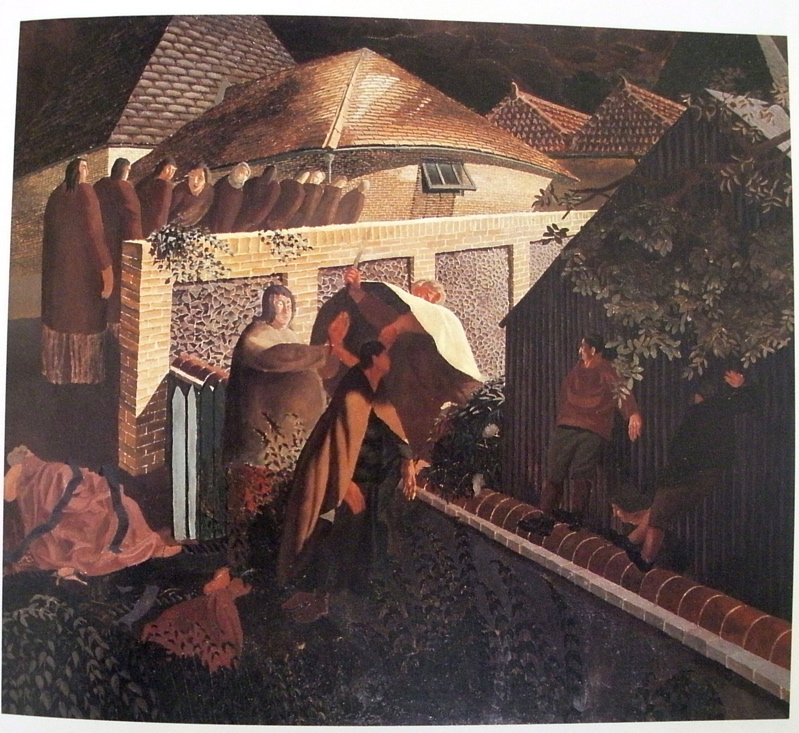
Spencer served in Macedonia during the First World War and, deeply affected by the experience, spent 9 years from 1923 onwards decorating the specially commissioned Sandham Memorial Chapel (inspired by Giotto's Scrovegni Chapel) with intricate murals documenting his experiences [photo gallery] [video tour.] He was officially commissioned as a war artist in the Second World War, and spent 7 years documenting the work at Lithgow's shipyard in Glasgow in a series of monumental canvasses.

An exquisite draughtsman who was equally at home painting everyday subjects, for too long his eccentricities overshadowed his art. The reputation of this "divine fool of British art," who turned up for his knighthood with a carrier bag, sketched on toilet paper, and pushed his easel around Cookham in a pram, has in recent decades been radically reappraised. The frank and intimate approach seen in his domestic works, often exposing his turbulent personal life, influenced a generation of artists. His astonishing nudes of the 1930's (nsfw - he was almost prosecuted for obscenity over these in the 1950's) provided the template for the work of Lucian Freud. He created an invaluable record of two World Wars.
jpg.jpg)
"Half a century ago, Spencer seemed old-fashioned; today, art has caught up with him. It no longer seems outlandish to call him the most important British painter of the last century."
251 of his works.
Critical writings on Spencer by Kenneth Pople.
Peter Ackroyd on Spencer and the Thames (video.)
Great post. I really enjoy "Christ Overturning the Moneychanger's Table" about halfway down here. It is my current favorite painting of the day.
posted by marxchivist at 8:18 AM on October 30, 2009
posted by marxchivist at 8:18 AM on October 30, 2009
Fantastic post, thank you.
I'm very much an amateur with painting but always loved what I've seen of Spencer's work. Despite being an atheist since earliest memory, just as with some of my favourite British poets of the past hundred years like RS Thomas and Hill, there's something about the way religious ideas are tackled in Spencer's work that makes the engagement very worthwhile for me - the themes remain those that matter is a big part of it I think.
posted by Abiezer at 8:23 AM on October 30, 2009
I'm very much an amateur with painting but always loved what I've seen of Spencer's work. Despite being an atheist since earliest memory, just as with some of my favourite British poets of the past hundred years like RS Thomas and Hill, there's something about the way religious ideas are tackled in Spencer's work that makes the engagement very worthwhile for me - the themes remain those that matter is a big part of it I think.
posted by Abiezer at 8:23 AM on October 30, 2009
Some really interesting compositions.
posted by weapons-grade pandemonium at 8:27 AM on October 30, 2009
posted by weapons-grade pandemonium at 8:27 AM on October 30, 2009
Though really, who among us hasn't betrayed Christ behind the potting shed?
posted by Abiezer at 8:44 AM on October 30, 2009
posted by Abiezer at 8:44 AM on October 30, 2009
I really enjoy "Christ Overturning the Moneychanger's Table"
I love Spencer's more naturalistic work. Actually, I consider it a deficit when you need to read the title of a painting to appreciate it as fully as the artist intended. For instance, the painting in question could just have easily been titled "Guy helping his wife rearrange the dining room in return for being allowed to enjoy the football game unmolested, afterward." You shouldn't do an anecdotal scene without supplying some emotional information.
posted by Faze at 8:49 AM on October 30, 2009
I love Spencer's more naturalistic work. Actually, I consider it a deficit when you need to read the title of a painting to appreciate it as fully as the artist intended. For instance, the painting in question could just have easily been titled "Guy helping his wife rearrange the dining room in return for being allowed to enjoy the football game unmolested, afterward." You shouldn't do an anecdotal scene without supplying some emotional information.
posted by Faze at 8:49 AM on October 30, 2009
Spamming the thread here a bit, but hadn't seen Sandham murals before, but even as digital representations the Resurrection of the Soldiers is just astounding. Will do my best to visit next time I'm back in the UK.
posted by Abiezer at 10:02 AM on October 30, 2009
posted by Abiezer at 10:02 AM on October 30, 2009
Good point faze, but I think in some cases a painting's title is essential to one (but not all) appreciation(s) of it. I can be kind of a backward hick when it comes to art appreciation, I think the title of that kind of added a Far Side element to it that appealed to me.
posted by marxchivist at 10:08 AM on October 30, 2009
posted by marxchivist at 10:08 AM on October 30, 2009
Great post, thanks!
posted by Benjamin Nushmutt at 10:18 AM on October 30, 2009
posted by Benjamin Nushmutt at 10:18 AM on October 30, 2009
Wow! What a tremendous post. The chapel mural alone is such a powerful piece. Thanks so much for putting this together. I now really want to see a show of Spencer's work.
posted by bearwife at 11:38 AM on October 30, 2009
posted by bearwife at 11:38 AM on October 30, 2009
I come from a town not far from Cookham and I've always loved "The Resurrection in Cookham Churchyard". Great post.
posted by athenian at 2:26 PM on October 30, 2009
posted by athenian at 2:26 PM on October 30, 2009
This reminds me a bit of Candian artist William Kurelek. Scroll down half way through this link to see 'In The Autumn of Life'.
posted by ovvl at 4:31 PM on November 2, 2009
posted by ovvl at 4:31 PM on November 2, 2009
« Older Dear Catherine, Hello, how are you? | Pantone pink No. 241 corona Newer »
This thread has been archived and is closed to new comments
posted by weapons-grade pandemonium at 8:17 AM on October 30, 2009