Anarchism or Barbarism
January 13, 2010 5:34 PM Subscribe
Who says anarcho-primitivists have no friends? Anarchist thinker John Zerzan will be the keynote speaker at January 15th's centenary meeting of the 100,000-member Spanish anarcho-syndicalist union Confederaction General del Trabajos. Zerzan, who has previously called syndicalism "self-management of alienation" will speak on the topic "Anarchism or Barbarism?". What will anarchy look like in the future?
I thought we were an autonomous collective...
SPLITTERS!
posted by Pirate-Bartender-Zombie-Monkey at 5:53 PM on January 13, 2010
SPLITTERS!
posted by Pirate-Bartender-Zombie-Monkey at 5:53 PM on January 13, 2010
Here's hoping that a bunch of international banking executives will blockade the conference and try to prevent him from getting in the doors.
posted by idiopath at 5:54 PM on January 13, 2010 [26 favorites]
posted by idiopath at 5:54 PM on January 13, 2010 [26 favorites]
As someone with syndicalist leanings, I don't think primitivists have much to offer.
posted by dunkadunc at 5:58 PM on January 13, 2010
posted by dunkadunc at 5:58 PM on January 13, 2010
Mr. Flintstone and Mr. Rubble would like a word with you, sir.
posted by jonmc at 6:16 PM on January 13, 2010
posted by jonmc at 6:16 PM on January 13, 2010
I could never figure out how people would transition to a primitivist society, especially in an anarchist manner. Take this interview with John Zerzan:
How can any such change come about unless there is change in policy at the level of the state and government, where all key decisions get made?
No, that's a dead end, that's the trap of the system. They want us to keep playing that shit, you know, keep on voting, which really means, vote for the slightly less awful person than the other. That guarantees that we're stuck in this shit. No, no, that can't be the answer, that just enables, legitimizes, and reproduces the lie of democracy. If we keep on doing that, then there really is no hope. The first and easiest thing is to drop out of that - don't vote, don't play the game the system sets up for us to play.
So you say the state has to be kept out of it?
Completely. You can't get rid of civilization by recourse to the state. You can look at it historically: when and why does the state appear? Or cities, or any institution, starting from division of labour and domestication. The state and all those things are part of the prison that holds it together.
What do you think of work?
This is another thing Marshall Sahlins pointed out: the more symbolic culture there is, the more work there is. And it's true. We are working more and more, I mean, what happened to the promise of technology? None of these things have worked out the way the way they were proclaimed. Now, in the US, if you take a couple, they are both working; often each is working more jobs than one; all stressed out, they've got no time for their kids, and all the rest of it.
So, state intervention is right out. I'm struggling to figure out how to detechnologize the world without an institution. So is he apparently, he pretty much dodged that last question.
Also, previously.
posted by zabuni at 6:25 PM on January 13, 2010
How can any such change come about unless there is change in policy at the level of the state and government, where all key decisions get made?
No, that's a dead end, that's the trap of the system. They want us to keep playing that shit, you know, keep on voting, which really means, vote for the slightly less awful person than the other. That guarantees that we're stuck in this shit. No, no, that can't be the answer, that just enables, legitimizes, and reproduces the lie of democracy. If we keep on doing that, then there really is no hope. The first and easiest thing is to drop out of that - don't vote, don't play the game the system sets up for us to play.
So you say the state has to be kept out of it?
Completely. You can't get rid of civilization by recourse to the state. You can look at it historically: when and why does the state appear? Or cities, or any institution, starting from division of labour and domestication. The state and all those things are part of the prison that holds it together.
What do you think of work?
This is another thing Marshall Sahlins pointed out: the more symbolic culture there is, the more work there is. And it's true. We are working more and more, I mean, what happened to the promise of technology? None of these things have worked out the way the way they were proclaimed. Now, in the US, if you take a couple, they are both working; often each is working more jobs than one; all stressed out, they've got no time for their kids, and all the rest of it.
So, state intervention is right out. I'm struggling to figure out how to detechnologize the world without an institution. So is he apparently, he pretty much dodged that last question.
Also, previously.
posted by zabuni at 6:25 PM on January 13, 2010
As someone with syndicalist leanings, I don't think primitivists have much to offer.
You're only saying that because you propose a program for ordering society which doesn't entail the near-extinction of humanity.
posted by Pope Guilty at 6:25 PM on January 13, 2010 [12 favorites]
You're only saying that because you propose a program for ordering society which doesn't entail the near-extinction of humanity.
posted by Pope Guilty at 6:25 PM on January 13, 2010 [12 favorites]
oh John Zerzan, world's greatest troll
posted by Juicy Avenger at 6:26 PM on January 13, 2010
posted by Juicy Avenger at 6:26 PM on January 13, 2010
*practices my mysterious Sufi laugh*
posted by hermitosis at 6:33 PM on January 13, 2010
posted by hermitosis at 6:33 PM on January 13, 2010
He's an interesting guy but I own a copy of Elements of Refusal and I have literally never read anything close to it in terms of "pulled bullshit out of my ass"
posted by p3on at 6:34 PM on January 13, 2010
posted by p3on at 6:34 PM on January 13, 2010
(I feel obligated to point out I have never read any Freud)
posted by p3on at 6:35 PM on January 13, 2010 [2 favorites]
posted by p3on at 6:35 PM on January 13, 2010 [2 favorites]
No, no, that can't be the answer, that just enables, legitimizes, and reproduces the lie of democracy.
I always love this sort of shit out of leftists because it shows the crazy-ass narcissism and self-important moralism of a lot of people who get involved in politics. A couple of thousand, even a couple of hundred thousand people refusing to vote doesn't deny anything legitimacy; there are three hundred fifty million people in this country, and this tiny segment of society thinks that their not voting somehow denies the system something it needs? Leftist non-voting does have an effect, and that's to deny the American political system a leftward pressure that can help to shield people from the worst effects of capitalist politics.
We live in a world in which people are starving, in which our infrastructure is crumbling around us, in which banks are foreclosing on homes and in which a person who loses his or her job is almost certain to lose their home as well. These are things that can, through the mechanism of voting, be pushed back against. Leftists have to ask ourselves whether our precious personal moral purity is worth allowing the right to claim ever-increasing amounts of political power. Voting may not be the way forward to the world we'd like, but this is world as it actually exists, and engagement with the government actually can lessen the burden on working-class people so that they have the actual time to, say, get interested in class consciousness.
But no, instead let's write articles for Anarchy: A Journal of Desire Armed and posting on RefLeft, that does way more to advance the cause of humanity than voting.
posted by Pope Guilty at 6:40 PM on January 13, 2010 [31 favorites]
I always love this sort of shit out of leftists because it shows the crazy-ass narcissism and self-important moralism of a lot of people who get involved in politics. A couple of thousand, even a couple of hundred thousand people refusing to vote doesn't deny anything legitimacy; there are three hundred fifty million people in this country, and this tiny segment of society thinks that their not voting somehow denies the system something it needs? Leftist non-voting does have an effect, and that's to deny the American political system a leftward pressure that can help to shield people from the worst effects of capitalist politics.
We live in a world in which people are starving, in which our infrastructure is crumbling around us, in which banks are foreclosing on homes and in which a person who loses his or her job is almost certain to lose their home as well. These are things that can, through the mechanism of voting, be pushed back against. Leftists have to ask ourselves whether our precious personal moral purity is worth allowing the right to claim ever-increasing amounts of political power. Voting may not be the way forward to the world we'd like, but this is world as it actually exists, and engagement with the government actually can lessen the burden on working-class people so that they have the actual time to, say, get interested in class consciousness.
But no, instead let's write articles for Anarchy: A Journal of Desire Armed and posting on RefLeft, that does way more to advance the cause of humanity than voting.
posted by Pope Guilty at 6:40 PM on January 13, 2010 [31 favorites]
I'm very much a statist liberal, but I have a lot of sympathy of the anarchist position, in that I really would prefer to not have to have this coercive institution with the power of violence; I just think it's necessary until we get some kind of science-fictional post-scarcity situation established. Anarcho-primitivists, though... I really can't get along with anarcho-primitivists for even a few minutes. Not that I fly into a killing rage as soon as they approach me, but... I sort of like civilization? I think it's really nifty and fun. Also symbolic culture is AWESOME, and I figure that even if there's some benefit to ditching it, we can't, because that would mean killing off somewhere between most of and all of the human race. Which I'm not really eager to do.
posted by Tomorrowful at 6:43 PM on January 13, 2010 [7 favorites]
posted by Tomorrowful at 6:43 PM on January 13, 2010 [7 favorites]
...and this tiny segment of society thinks that their not voting somehow denies the system something it needs?
If Zerzan were here, he might say that if everybody dropped out, man, then the whole capitalist system would be, like, up shit creek without a paddle, man.
Of course, I personally would not recommend entrusting the future to any ideology which, in order to work, requires everyone in the world to simultaneously assent to it's beliefs. I think Libertarianism also falls into this trap as well.
posted by Avenger at 6:48 PM on January 13, 2010 [4 favorites]
If Zerzan were here, he might say that if everybody dropped out, man, then the whole capitalist system would be, like, up shit creek without a paddle, man.
Of course, I personally would not recommend entrusting the future to any ideology which, in order to work, requires everyone in the world to simultaneously assent to it's beliefs. I think Libertarianism also falls into this trap as well.
posted by Avenger at 6:48 PM on January 13, 2010 [4 favorites]
Hmm, I was always a CNT guy.
posted by jsavimbi at 6:49 PM on January 13, 2010 [1 favorite]
posted by jsavimbi at 6:49 PM on January 13, 2010 [1 favorite]
I would think this could be pretty interesting, given that my outside observer status would seem to lead me to the conclusion that Spanish CNT-style anarchism and Zerzan's are needfully polar opposites. Spain! What a country.
posted by mwhybark at 6:52 PM on January 13, 2010
posted by mwhybark at 6:52 PM on January 13, 2010
Oops-filter. A key sentiment, below, is easily reversed to make a more sound argument, by simply adding negatives in front of the main ideas.
They want us to keep playing that shit, you know, keep on [not] voting.... That guarantees that we're stuck in this shit. No, no, that can't be the answer, that just enables, legitimizes, and reproduces the lie of [non-] democracy.
posted by Brian B. at 6:54 PM on January 13, 2010
They want us to keep playing that shit, you know, keep on [not] voting.... That guarantees that we're stuck in this shit. No, no, that can't be the answer, that just enables, legitimizes, and reproduces the lie of [non-] democracy.
posted by Brian B. at 6:54 PM on January 13, 2010
[NOT ANTI-PRIMITIVIST]
posted by joe lisboa at 6:58 PM on January 13, 2010
posted by joe lisboa at 6:58 PM on January 13, 2010
SPLITTERS!
There was a split in the old CNT shortly after the restoration of democracy then a court case over control of assets and the use of the historical name. Won't pretend to know all the ins and outs of it, but from what I do know (arguments about accepting money from the state and participation in state-sanctioned electoral processes) and conversations with Spanish comrades I tend to come down on the side of the CNT/AIT.
Primitivism I can't even be much bothered to engage with - it seems daft beyond belief and offers nothing I'm interested in. If it seems to fly in the face of the facts to remain loyal to a vision of social revolution in an era of class defeat and incipient crisis, to utterly reject modernity and imagine the genie can be put back in the bottle, or to think that to do so would be desirable, comes from a very different place to my own politics.
The purpose of the revolutionary working class movement was to make sure the bounty that modernity has brought is shared equally by us all (after all, we created it). The future of anarchy will look like ordinary women and men, you and me, controlling our own lives and living in solidarity with each other and the planet.
posted by Abiezer at 7:00 PM on January 13, 2010
There was a split in the old CNT shortly after the restoration of democracy then a court case over control of assets and the use of the historical name. Won't pretend to know all the ins and outs of it, but from what I do know (arguments about accepting money from the state and participation in state-sanctioned electoral processes) and conversations with Spanish comrades I tend to come down on the side of the CNT/AIT.
Primitivism I can't even be much bothered to engage with - it seems daft beyond belief and offers nothing I'm interested in. If it seems to fly in the face of the facts to remain loyal to a vision of social revolution in an era of class defeat and incipient crisis, to utterly reject modernity and imagine the genie can be put back in the bottle, or to think that to do so would be desirable, comes from a very different place to my own politics.
The purpose of the revolutionary working class movement was to make sure the bounty that modernity has brought is shared equally by us all (after all, we created it). The future of anarchy will look like ordinary women and men, you and me, controlling our own lives and living in solidarity with each other and the planet.
posted by Abiezer at 7:00 PM on January 13, 2010
Also symbolic culture is AWESOME, and I figure that even if there's some benefit to ditching it, we can't, because that would mean killing off somewhere between most of and all of the human race. Which I'm not really eager to do.
The funniest thing about primitivism is that it is absolutely unsustainable without somehow eliminating the bits of our brains that allowed us to develop language and culture. Where other ideologies can point to the external imposition of unfavorable conditions (capitalists can complain about the government imposing socialism, communists can complain about the rich imposing capitalism, etc), primitivists have as their ultimate enemy the human fucking brain. What comedian could have made such a joke?
I would think this could be pretty interesting, given that my outside observer status would seem to lead me to the conclusion that Spanish CNT-style anarchism and Zerzan's are needfully polar opposites.
Check out Murray Bookchin's Social Anarchism or Lifestyle Anarchism or LibCom's Primitivism, anarcho-primitivism and anti-civilisationism - criticism.
posted by Pope Guilty at 7:04 PM on January 13, 2010 [5 favorites]
The funniest thing about primitivism is that it is absolutely unsustainable without somehow eliminating the bits of our brains that allowed us to develop language and culture. Where other ideologies can point to the external imposition of unfavorable conditions (capitalists can complain about the government imposing socialism, communists can complain about the rich imposing capitalism, etc), primitivists have as their ultimate enemy the human fucking brain. What comedian could have made such a joke?
I would think this could be pretty interesting, given that my outside observer status would seem to lead me to the conclusion that Spanish CNT-style anarchism and Zerzan's are needfully polar opposites.
Check out Murray Bookchin's Social Anarchism or Lifestyle Anarchism or LibCom's Primitivism, anarcho-primitivism and anti-civilisationism - criticism.
posted by Pope Guilty at 7:04 PM on January 13, 2010 [5 favorites]
I thought we were an autonomous collective...
posted by ZenMasterThis at 5:48 PM on January 13 [+] [!]
I thought we were an autonomous collective...
SPLITTERS!
posted by Pirate-Bartender-Zombie-Monkey at 5:53 PM on January 13 [+] [!]
"Splitters" is from "Life of Brian". The "autonomous collective" quote is from "Monty Python and the Holy Grail." Sheesh.
posted by notmtwain at 7:14 PM on January 13, 2010 [3 favorites]
posted by ZenMasterThis at 5:48 PM on January 13 [+] [!]
I thought we were an autonomous collective...
SPLITTERS!
posted by Pirate-Bartender-Zombie-Monkey at 5:53 PM on January 13 [+] [!]
"Splitters" is from "Life of Brian". The "autonomous collective" quote is from "Monty Python and the Holy Grail." Sheesh.
posted by notmtwain at 7:14 PM on January 13, 2010 [3 favorites]
What comedian could have made such a joke?
Hanna. Fucking. Barbera.
posted by jonmc at 7:14 PM on January 13, 2010 [3 favorites]
Hanna. Fucking. Barbera.
posted by jonmc at 7:14 PM on January 13, 2010 [3 favorites]
I always love this sort of shit out of leftists because it shows the crazy-ass narcissism and self-important moralism of a lot of people who get involved in politics. A couple of thousand, even a couple of hundred thousand people refusing to vote doesn't deny anything legitimacy; there are three hundred fifty million people in this country, and this tiny segment of society thinks that their not voting somehow denies the system something it needs? Leftist non-voting does have an effect, and that's to deny the American political system a leftward pressure that can help to shield people from the worst effects of capitalist politics.
I love this shit from reformist liberals who think that the capitalist state stays its hand because of electoral programmes rather than a consideration of the balance of class forces in society. Naive and self-defeating, if you want to get into the sectarian mud-slinging.
Personally I have always voted when I could be bothered, as there may well be differences between candidates or policies that make one or the other marginally preferable, but to insult people who by their activity outside the current power framework can as likely be contributing to shifts in what are or aren't possible demands is to mistake the arena in which real politics takes place.
posted by Abiezer at 7:16 PM on January 13, 2010 [10 favorites]
I love this shit from reformist liberals who think that the capitalist state stays its hand because of electoral programmes rather than a consideration of the balance of class forces in society. Naive and self-defeating, if you want to get into the sectarian mud-slinging.
Personally I have always voted when I could be bothered, as there may well be differences between candidates or policies that make one or the other marginally preferable, but to insult people who by their activity outside the current power framework can as likely be contributing to shifts in what are or aren't possible demands is to mistake the arena in which real politics takes place.
posted by Abiezer at 7:16 PM on January 13, 2010 [10 favorites]
Anarchists are to the Left as libertarians are to the Right, and they deserve the same level of respect for their views. Which is to say: hard months after the Revolution, they'll be tilling a potato field. If they're lucky.
posted by aeschenkarnos at 7:22 PM on January 13, 2010
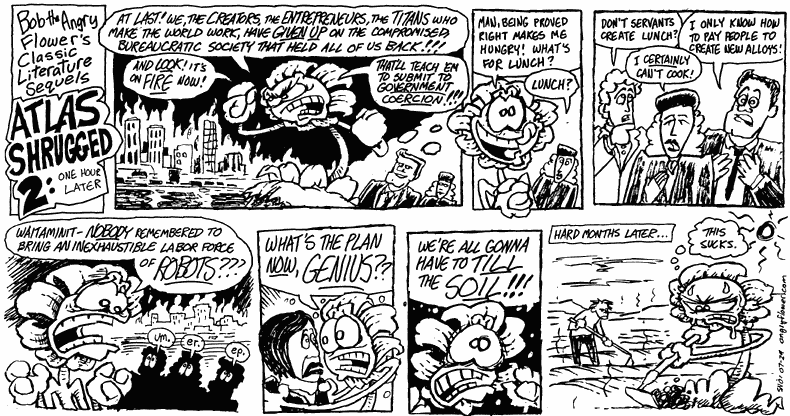
posted by aeschenkarnos at 7:22 PM on January 13, 2010
I always love this sort of shit out of leftists because it shows the crazy-ass narcissism and self-important moralism of a lot of people who get involved in politics.
I'm too tired to think of a Sarah Palin joke, but it probably wouldn't have been that funny anyway. Pope Guilty can supply one himself, I'm sure.
posted by uosuaq at 7:22 PM on January 13, 2010 [1 favorite]
I'm too tired to think of a Sarah Palin joke, but it probably wouldn't have been that funny anyway. Pope Guilty can supply one himself, I'm sure.
posted by uosuaq at 7:22 PM on January 13, 2010 [1 favorite]
I love this shit from reformist liberals
Whoa ho ho ho there, buddy, I take exception to the "reformist" and "liberal" epithets; that's just plain fightin' words. Voting is not in and of itself reformist; voting becomes a reformist act when it is seen as the means to the political end. I advocate voting not because I think it's the path to a desirable future (and think it's hilarious when people do think that), but because it's something which takes very close to zero effort and has the ability to actually have some benefits. I'm certainly not someone who will argue that we can vote out capitalism and liberal democracy.
posted by Pope Guilty at 7:24 PM on January 13, 2010 [6 favorites]
Whoa ho ho ho there, buddy, I take exception to the "reformist" and "liberal" epithets; that's just plain fightin' words. Voting is not in and of itself reformist; voting becomes a reformist act when it is seen as the means to the political end. I advocate voting not because I think it's the path to a desirable future (and think it's hilarious when people do think that), but because it's something which takes very close to zero effort and has the ability to actually have some benefits. I'm certainly not someone who will argue that we can vote out capitalism and liberal democracy.
posted by Pope Guilty at 7:24 PM on January 13, 2010 [6 favorites]
You can't get rid of civilization by recourse to the state.
Zerzan really is the ultimate seventeen year old bitching about "the system" to his friends on Facebook from the iphone his parents bought him.
posted by octobersurprise at 7:24 PM on January 13, 2010
Zerzan really is the ultimate seventeen year old bitching about "the system" to his friends on Facebook from the iphone his parents bought him.
posted by octobersurprise at 7:24 PM on January 13, 2010
that's just plain fightin' words
But mum, he started it!
I know, it's a larger and more complicated argument - I'm mostly saying don't stick the boot in unless you really think people are being counter-productive (or anti-human like the primitives). Better targets for our ire than the authors of some unread journal articles.
posted by Abiezer at 7:26 PM on January 13, 2010
But mum, he started it!
I know, it's a larger and more complicated argument - I'm mostly saying don't stick the boot in unless you really think people are being counter-productive (or anti-human like the primitives). Better targets for our ire than the authors of some unread journal articles.
posted by Abiezer at 7:26 PM on January 13, 2010
Anarchists are to the Left as libertarians are to the Right, and they deserve the same level of respect for their views. Which is to say: hard months after the Revolution, they'll be tilling a potato field. If they're lucky.
Anarchism is all about how to organize work so I'm not clear on how "Once you guys reorganize how work is done, you'll have to work!" is some kind of rhetorical point.
posted by Pope Guilty at 7:27 PM on January 13, 2010 [2 favorites]
Anarchism is all about how to organize work so I'm not clear on how "Once you guys reorganize how work is done, you'll have to work!" is some kind of rhetorical point.
posted by Pope Guilty at 7:27 PM on January 13, 2010 [2 favorites]
"Splitters" is from "Life of Brian". The "autonomous collective" quote is from "Monty Python and the Holy Grail." Sheesh.
I from the repertoire, not the routine.
:P
posted by Pirate-Bartender-Zombie-Monkey at 7:29 PM on January 13, 2010
posted by Pirate-Bartender-Zombie-Monkey at 7:29 PM on January 13, 2010
"I quote from..."
Oh, for the 3-minute edit window pony...
posted by Pirate-Bartender-Zombie-Monkey at 7:31 PM on January 13, 2010
Oh, for the 3-minute edit window pony...
posted by Pirate-Bartender-Zombie-Monkey at 7:31 PM on January 13, 2010
Pope Guilty Anarchism is all about how to organize work so I'm not clear on how "Once you guys reorganize how work is done, you'll have to work!" is some kind of rhetorical point.
The point is that once the State is Smashed, the capacity of humans to rely on each other diminishes down to small groups like families, friendship groups, tribes, and gangs. This removes the tertiary industry sector almost entirely (though you can now enslave someone to be your maid or driver), makes secondary industry (merchants and the like) extremely difficult, and isolates primary production to a defensible farm/homestead level. It would suck, as Bob points out in the cartoon.
I will give anarchists a little more credit than libertarians in that on the average they are a little more willing and able to actually do stuff like till the soil. Anarchists are more likely to have the sort of low-social-class job or business which actually might prepare one for self-sufficiency, unlike paper-shuffling libertarians. (Exceptions to both exist, of course.)
Both are kidding themselves. A State doesn't so much defend you from bad people, it organizes you to defend each other from bad people.
posted by aeschenkarnos at 7:45 PM on January 13, 2010 [1 favorite]
The point is that once the State is Smashed, the capacity of humans to rely on each other diminishes down to small groups like families, friendship groups, tribes, and gangs. This removes the tertiary industry sector almost entirely (though you can now enslave someone to be your maid or driver), makes secondary industry (merchants and the like) extremely difficult, and isolates primary production to a defensible farm/homestead level. It would suck, as Bob points out in the cartoon.
I will give anarchists a little more credit than libertarians in that on the average they are a little more willing and able to actually do stuff like till the soil. Anarchists are more likely to have the sort of low-social-class job or business which actually might prepare one for self-sufficiency, unlike paper-shuffling libertarians. (Exceptions to both exist, of course.)
Both are kidding themselves. A State doesn't so much defend you from bad people, it organizes you to defend each other from bad people.
posted by aeschenkarnos at 7:45 PM on January 13, 2010 [1 favorite]
The CGT is the "Confederación Nacional del Trabajo", not "Trabajos". My Spanish sensitivity would appreciate if a moderator could correct the FPP. Thanks!
posted by kandinski at 7:46 PM on January 13, 2010
posted by kandinski at 7:46 PM on January 13, 2010
aeschenkarnos, the reason there's innumerable factions and schools of thought and such within anarchism is that there's plenty of disagreement on what organizing means. Some people do believe in some kind of crazy let's just all work with our families nonsense, but a lot of the various factions do support large-scale organizing, usually starting at the local level and federating upward in an effort to accomplish the benefits of large organization without the nasty effects of organizing in power structures.
The idea that anarchy is the war of all against all- chaos- is a myth, and not in line with what anarchists have spent the last hundred and fifty years advocating.
posted by Pope Guilty at 7:53 PM on January 13, 2010 [2 favorites]
The idea that anarchy is the war of all against all- chaos- is a myth, and not in line with what anarchists have spent the last hundred and fifty years advocating.
posted by Pope Guilty at 7:53 PM on January 13, 2010 [2 favorites]
The point is that once the State is Smashed, the capacity of humans to rely on each other diminishes down to small groups like families, friendship groups, tribes, and gangs.
How on earth do you get this? Any pro-capitalist worth their salt will argue that the complex global economy with all its inter-linkages is more a construction of non-state actors (corporations and so on) than the result of accords between sovereign nations. Of course, they're a touch disingenuous there about the collusion between states and business, but the bulk of mainstream anarchist thought was always included debate about how to maintain large-scale organisation in the absence of the state - Kropotkin making analogies with the international postal union as an example of free cooperation on a global scale, etc.
posted by Abiezer at 7:53 PM on January 13, 2010 [1 favorite]
How on earth do you get this? Any pro-capitalist worth their salt will argue that the complex global economy with all its inter-linkages is more a construction of non-state actors (corporations and so on) than the result of accords between sovereign nations. Of course, they're a touch disingenuous there about the collusion between states and business, but the bulk of mainstream anarchist thought was always included debate about how to maintain large-scale organisation in the absence of the state - Kropotkin making analogies with the international postal union as an example of free cooperation on a global scale, etc.
posted by Abiezer at 7:53 PM on January 13, 2010 [1 favorite]
Urrrgh. Zerzan.
Seriously, to most anarchists I know, his name is somewhere between a joke and a curse word. Please do not feed the troll.
posted by regicide is good for you at 8:40 PM on January 13, 2010 [2 favorites]
Seriously, to most anarchists I know, his name is somewhere between a joke and a curse word. Please do not feed the troll.
posted by regicide is good for you at 8:40 PM on January 13, 2010 [2 favorites]
May be a bit of a sidetrack, but does anyone else think that the Internet has made the sustainability of an anarchist/syndicalist/mutualist society more possible?
I always felt like the biggest advantage capitalism/statism had over anarchism was that its entities had access to a greater pool of resources. The systems of finance and centralized stock markets provided far more efficient methods for sharing and acquiring resources and information than was available by any other means. With the advent of the internet, that's no longer true.
posted by Jon_Evil at 9:31 PM on January 13, 2010 [2 favorites]
I always felt like the biggest advantage capitalism/statism had over anarchism was that its entities had access to a greater pool of resources. The systems of finance and centralized stock markets provided far more efficient methods for sharing and acquiring resources and information than was available by any other means. With the advent of the internet, that's no longer true.
posted by Jon_Evil at 9:31 PM on January 13, 2010 [2 favorites]
The point is that once the State is Smashed, the capacity of humans to rely on each other diminishes down to small groups like families, friendship groups, tribes, and gangs.
So, wait, we go back to tribal/family level groups... which naturally form into larger groups for shared survival. These groups will, by nature, develop a basic hierarchy for efficiency and survival—to say nothing, of course, about the innate human desire to dominate others. Before you know it, we're back to the goddamn civilization they want to smash anyway!
posted by SansPoint at 9:36 PM on January 13, 2010 [3 favorites]
So, wait, we go back to tribal/family level groups... which naturally form into larger groups for shared survival. These groups will, by nature, develop a basic hierarchy for efficiency and survival—to say nothing, of course, about the innate human desire to dominate others. Before you know it, we're back to the goddamn civilization they want to smash anyway!
posted by SansPoint at 9:36 PM on January 13, 2010 [3 favorites]
notmtwain: ""Splitters" is from "Life of Brian". The "autonomous collective" quote is from "Monty Python and the Holy Grail." Sheesh."
Zerzan: "the more symbolic culture there is, the more work there is."
SYMBOLIC CULTURALIST!
posted by mwhybark at 9:39 PM on January 13, 2010
Zerzan: "the more symbolic culture there is, the more work there is."
SYMBOLIC CULTURALIST!
posted by mwhybark at 9:39 PM on January 13, 2010
regicide is good for you: "Seriously, to most anarchists I know, his name is somewhere between a joke and a curse word. Please do not feed the troll."
Well ok, so that's why it's interesting that this large, historically-important anarchist political organization has asked Zerzan over. I mean, we would all be pretty surprised to hear that Bob Black or Peter Lamborn Wilson had been invited, right? But Zerzan, well, he seems somehow more serious, right?
I think yeah, in the US, Zerzan is not well-regarded. But is this true over the pond? Abeizer? You don't sound much like a neo-caveman; what freight does Zerzan's name carry over yonder?
Please note: not an anarchist, not a Zerzan fan. Pretty much too much of a symbolic culturalist, when you get right down to it. Sometimes I do wonder what Bob Black's Netflix queue looks like.
posted by mwhybark at 9:46 PM on January 13, 2010 [1 favorite]
Well ok, so that's why it's interesting that this large, historically-important anarchist political organization has asked Zerzan over. I mean, we would all be pretty surprised to hear that Bob Black or Peter Lamborn Wilson had been invited, right? But Zerzan, well, he seems somehow more serious, right?
I think yeah, in the US, Zerzan is not well-regarded. But is this true over the pond? Abeizer? You don't sound much like a neo-caveman; what freight does Zerzan's name carry over yonder?
Please note: not an anarchist, not a Zerzan fan. Pretty much too much of a symbolic culturalist, when you get right down to it. Sometimes I do wonder what Bob Black's Netflix queue looks like.
posted by mwhybark at 9:46 PM on January 13, 2010 [1 favorite]
aeschenkarnos: "A State doesn't so much defend you from bad people, it organizes you to defend each other from bad people."
Except when, you know, the bad people self-select for control of the economy and enforcement appartus. Which is so rare and unheard of that there are no words in Newspeak for it.
posted by mwhybark at 9:49 PM on January 13, 2010 [5 favorites]
Except when, you know, the bad people self-select for control of the economy and enforcement appartus. Which is so rare and unheard of that there are no words in Newspeak for it.
posted by mwhybark at 9:49 PM on January 13, 2010 [5 favorites]
You don't sound much like a neo-caveman
I hide it well but occasionally get caught dragging a potential partner home by the hair.
As for Zerzan, I'd never heard of him before the Internet - I think he may have influenced the UK group Green Anarchist (that Wiki article seems to confirm that), who I disagreed with during the brief revival (in the minuscule terms of left politics) of interest in anarchism in the post-punk 80s but my own background has much more in common with the old left of working class organisation. Rather have a pint with a Trot (many very decent working class activists in the UK are) than a chillum with a dreadlocked harbinger of post-civilisation, as it were.
posted by Abiezer at 9:57 PM on January 13, 2010
I hide it well but occasionally get caught dragging a potential partner home by the hair.
As for Zerzan, I'd never heard of him before the Internet - I think he may have influenced the UK group Green Anarchist (that Wiki article seems to confirm that), who I disagreed with during the brief revival (in the minuscule terms of left politics) of interest in anarchism in the post-punk 80s but my own background has much more in common with the old left of working class organisation. Rather have a pint with a Trot (many very decent working class activists in the UK are) than a chillum with a dreadlocked harbinger of post-civilisation, as it were.
posted by Abiezer at 9:57 PM on January 13, 2010
SPANARCHISTS
posted by sgt.serenity at 10:03 PM on January 13, 2010
posted by sgt.serenity at 10:03 PM on January 13, 2010
ANARCHISTS IN FAVOR OF POWER VACCUM : COME TAKE OUR SHIT OVER, NAIVE IDEALISTS ASK WELL-ORGANIZED GUN-OWNING MILITIAS
posted by Afroblanco at 10:12 PM on January 13, 2010 [2 favorites]
posted by Afroblanco at 10:12 PM on January 13, 2010 [2 favorites]
Reading the links, I do enjoy a lot of the ideas, but so much of it sounds like someone pulled it right out of his little brown ideas factory. The problem I have is this: what's the point of an idea that can't possibly be put into practice? There's no way us monkeys are going to give up our toys- even if they make us miserable.
Humans are great at being deluded, but we're also pretty special at cutting through the bullshit. We're quite good at working out for ourselves that being a glorified domesticated animal isn't real swell.
Seems to me telling miserable people they're miserable is not an exercise to be undertaken with a straight face.
I make almost no sense. Wow.
posted by Gamien Boffenburg at 10:22 PM on January 13, 2010 [1 favorite]
Humans are great at being deluded, but we're also pretty special at cutting through the bullshit. We're quite good at working out for ourselves that being a glorified domesticated animal isn't real swell.
Seems to me telling miserable people they're miserable is not an exercise to be undertaken with a straight face.
I make almost no sense. Wow.
posted by Gamien Boffenburg at 10:22 PM on January 13, 2010 [1 favorite]

I could never figure out how people would transition to a primitivist society . . .
Oh, just keep doing what you're doing.
posted by mobunited at 10:51 PM on January 13, 2010 [3 favorites]
Oh, just keep doing what you're doing.
posted by mobunited at 10:51 PM on January 13, 2010 [3 favorites]
Balisong, where did that image come from? It's so many kinds of awesome.
posted by Jon_Evil at 11:16 PM on January 13, 2010
posted by Jon_Evil at 11:16 PM on January 13, 2010
The funniest thing about primitivism is that it is absolutely unsustainable without somehow eliminating the bits of our brains that allowed us to develop language and culture. Where other ideologies can point to the external imposition of unfavorable conditions (capitalists can complain about the government imposing socialism, communists can complain about the rich imposing capitalism, etc), primitivists have as their ultimate enemy the human fucking brain. What comedian could have made such a joke?
Every non-industrialized culture on Earth must be *hilarious.* Certainly, nobody has ever imposed destructive complexity on a culture from the outside. Nope; never happened.
I hope you think they're hilarious. The other option is that you think they don't have human brains. That's pretty fucked up. Then again, that's the ideology behind modernity for you. But I think you probably just said something off the top f your head and didn't mean to imply *that.*
I don't agree with anarcho-primitivism as a program. At the same time, it is a useful criticism of the underexamined values of modernity. For example, its existence prods people to say things with fucked up implications, like the quote above.
Personally, I take it on faith that there's a way to share the benefits of industrial civilization without some form of subjugation, but this has almost never happened. I'm not talking about some sort of Star Trek conceit where our benign intervention will inevitably screw things up because our stuff is so much better. I'm talking about the fact that the critical decision makers in virtually civilization with more technical resources has behaved like a pack of assholes. There's another way, and primitivism provides a critique that shows us that we have arbitrary stupid ideas that we fold in with technological advancements as if they're inextricably linked.
How does this apply to the internal project of our postindustrial culture? The same values affect how we treat each other, the kind of labour we value and where we're willing to devote critical resources. We can't pretend there aren't problems, but people like Zerzan can at least force us to look at them and ask ourselves how we can maintain the things we like while getting rid of those problems -- even if that's not what John Zerzan wants.
posted by mobunited at 11:19 PM on January 13, 2010 [9 favorites]
Every non-industrialized culture on Earth must be *hilarious.* Certainly, nobody has ever imposed destructive complexity on a culture from the outside. Nope; never happened.
I hope you think they're hilarious. The other option is that you think they don't have human brains. That's pretty fucked up. Then again, that's the ideology behind modernity for you. But I think you probably just said something off the top f your head and didn't mean to imply *that.*
I don't agree with anarcho-primitivism as a program. At the same time, it is a useful criticism of the underexamined values of modernity. For example, its existence prods people to say things with fucked up implications, like the quote above.
Personally, I take it on faith that there's a way to share the benefits of industrial civilization without some form of subjugation, but this has almost never happened. I'm not talking about some sort of Star Trek conceit where our benign intervention will inevitably screw things up because our stuff is so much better. I'm talking about the fact that the critical decision makers in virtually civilization with more technical resources has behaved like a pack of assholes. There's another way, and primitivism provides a critique that shows us that we have arbitrary stupid ideas that we fold in with technological advancements as if they're inextricably linked.
How does this apply to the internal project of our postindustrial culture? The same values affect how we treat each other, the kind of labour we value and where we're willing to devote critical resources. We can't pretend there aren't problems, but people like Zerzan can at least force us to look at them and ask ourselves how we can maintain the things we like while getting rid of those problems -- even if that's not what John Zerzan wants.
posted by mobunited at 11:19 PM on January 13, 2010 [9 favorites]
I always felt like the biggest advantage capitalism/statism had over anarchism was that its entities had access to a greater pool of resources. The systems of finance and centralized stock markets provided far more efficient methods for sharing and acquiring resources and information than was available by any other means. With the advent of the internet, that's no longer true.
Because the Internet is built and maintained by magic anarchist pixie faries spreading their magic internet pixie dust.
posted by rodgerd at 11:45 PM on January 13, 2010 [2 favorites]
Because the Internet is built and maintained by magic anarchist pixie faries spreading their magic internet pixie dust.
posted by rodgerd at 11:45 PM on January 13, 2010 [2 favorites]
Anarchy: A Journal of Desire Armed
Good lord, is that a blast from the past. My brother and I subscribed to Anarchy when I was in high school in the early '90s. It was 1/3 really well done collages, 1/3 articles about primitivism and 1/3 NAMBLA-style pro-pedophilia articles. Well, maybe not a third, but there was a lot more pro-kid-diddlin' talk in the magazines than I was expecting. (Which was "none".) So that sort of put me off anarchism for a while ...
posted by Bookhouse at 11:47 PM on January 13, 2010
Good lord, is that a blast from the past. My brother and I subscribed to Anarchy when I was in high school in the early '90s. It was 1/3 really well done collages, 1/3 articles about primitivism and 1/3 NAMBLA-style pro-pedophilia articles. Well, maybe not a third, but there was a lot more pro-kid-diddlin' talk in the magazines than I was expecting. (Which was "none".) So that sort of put me off anarchism for a while ...
posted by Bookhouse at 11:47 PM on January 13, 2010
NAMBLA-style pro-pedophilia articles
Oh, fuck me, is it that Hakim Bey character? Another one we blissfully ignorant of back in the day; we produced some loathsome cranks of our own but never anyone in his league AFAIK.
Because the Internet is built and maintained by magic anarchist pixie faries spreading their magic internet pixie dust.
This raised a smile, but as with any technology there's ways and ways it can be used. Same goes for roads and other infrastructure - it's a point that has occurred to the more serious thinkers.
posted by Abiezer at 11:55 PM on January 13, 2010
Oh, fuck me, is it that Hakim Bey character? Another one we blissfully ignorant of back in the day; we produced some loathsome cranks of our own but never anyone in his league AFAIK.
Because the Internet is built and maintained by magic anarchist pixie faries spreading their magic internet pixie dust.
This raised a smile, but as with any technology there's ways and ways it can be used. Same goes for roads and other infrastructure - it's a point that has occurred to the more serious thinkers.
posted by Abiezer at 11:55 PM on January 13, 2010
Every non-industrialized culture on Earth must be *hilarious.* Certainly, nobody has ever imposed destructive complexity on a culture from the outside. Nope; never happened.
I hope you think they're hilarious. The other option is that you think they don't have human brains. That's pretty fucked up. Then again, that's the ideology behind modernity for you. But I think you probably just said something off the top f your head and didn't mean to imply *that.*
Wow, you are totally mischaracterizing what I said to call me a racist. I don't think I'm going to make any response other to note that.
posted by Pope Guilty at 12:24 AM on January 14, 2010
I hope you think they're hilarious. The other option is that you think they don't have human brains. That's pretty fucked up. Then again, that's the ideology behind modernity for you. But I think you probably just said something off the top f your head and didn't mean to imply *that.*
Wow, you are totally mischaracterizing what I said to call me a racist. I don't think I'm going to make any response other to note that.
posted by Pope Guilty at 12:24 AM on January 14, 2010
This raised a smile, but as with any technology there's ways and ways it can be used. Same goes for roads and other infrastructure - it's a point that has occurred to the more serious thinkers.
Oh, for sure. It's a wise-arse answer, but I don't think it's totally unfair to give wise-arse answers to comments which may most charitably described as unreasonably naive.
posted by rodgerd at 12:46 AM on January 14, 2010
Oh, for sure. It's a wise-arse answer, but I don't think it's totally unfair to give wise-arse answers to comments which may most charitably described as unreasonably naive.
posted by rodgerd at 12:46 AM on January 14, 2010
Wow, you are totally mischaracterizing what I said to call me a racist. I don't think I'm going to make any response other to note that.
I don't think you're more racist than most people in you demographic (whatever it may be) but I think you probably partake of the same cultural id as it.
You said people can't refuse the ol' Ladder of Progress unless there was something wrong with their brains. Where did you think that thought was going?
posted by mobunited at 12:49 AM on January 14, 2010
I don't think you're more racist than most people in you demographic (whatever it may be) but I think you probably partake of the same cultural id as it.
You said people can't refuse the ol' Ladder of Progress unless there was something wrong with their brains. Where did you think that thought was going?
posted by mobunited at 12:49 AM on January 14, 2010
It's a wise-arse answer, but I don't think it's totally unfair to give wise-arse answers to comments which may most charitably described as unreasonably naive.
What I picked up from Jon_Evil's comment is something I've thought idly about myself: that one of the arguments for the necessity of markets has I believe been that commodity exchange and so on in modern societies is of a complexity that they are the least worst ways of allocating resources, with reference made to the failures of the planned economies. With the latter, as I understand it, it was to a great extent a problem of accurate and timely data (not exclusively so of course) so that we now have low-cost ways of sharing information may well open up new possibilities for alternative economies. As I say, not a question I've explored in depth, but of some worth for my money-substitute.
posted by Abiezer at 1:04 AM on January 14, 2010
What I picked up from Jon_Evil's comment is something I've thought idly about myself: that one of the arguments for the necessity of markets has I believe been that commodity exchange and so on in modern societies is of a complexity that they are the least worst ways of allocating resources, with reference made to the failures of the planned economies. With the latter, as I understand it, it was to a great extent a problem of accurate and timely data (not exclusively so of course) so that we now have low-cost ways of sharing information may well open up new possibilities for alternative economies. As I say, not a question I've explored in depth, but of some worth for my money-substitute.
posted by Abiezer at 1:04 AM on January 14, 2010
they are the least worst ways of allocating resources, with reference made to the failures of the planned economies[...]As I say, not a question I've explored in depth, but of some worth for my money-substitute.
For me the most interesting question is the degree to which large-scale capitalist countries resemble planned economies in the sense the term is used (by central government). The big 3 auto firms in the States would give any number of poorly-thought-out socialist nations a run for their money.
posted by rodgerd at 1:44 AM on January 14, 2010
For me the most interesting question is the degree to which large-scale capitalist countries resemble planned economies in the sense the term is used (by central government). The big 3 auto firms in the States would give any number of poorly-thought-out socialist nations a run for their money.
posted by rodgerd at 1:44 AM on January 14, 2010
You said people can't refuse the ol' Ladder of Progress unless there was something wrong with their brains. Where did you think that thought was going?
You are conflating anarcho-primitivism- an ideology held exclusively by spoiled, first-world assholes- with the actual lives of human beings who live outside of modern civilization. That is a frankly ridiculous and incredibly privileged claim, and if you actually believe it, and aren't simply talking out of your ass out of a desire to call names and get in fights, it's impossible to take you seriously. It's like the first-world kids who identify with third-world struggles in countries they can rarely name and have never been to. The ideas and ideals and behaviors of anarcho-primitivists have about as much to do with the lives and beliefs of people who actually live outside of modern civilization as Taco Bell has to do with Mexican food, and in pretty close to the same relationship.
posted by Pope Guilty at 1:49 AM on January 14, 2010 [8 favorites]
You are conflating anarcho-primitivism- an ideology held exclusively by spoiled, first-world assholes- with the actual lives of human beings who live outside of modern civilization. That is a frankly ridiculous and incredibly privileged claim, and if you actually believe it, and aren't simply talking out of your ass out of a desire to call names and get in fights, it's impossible to take you seriously. It's like the first-world kids who identify with third-world struggles in countries they can rarely name and have never been to. The ideas and ideals and behaviors of anarcho-primitivists have about as much to do with the lives and beliefs of people who actually live outside of modern civilization as Taco Bell has to do with Mexican food, and in pretty close to the same relationship.
posted by Pope Guilty at 1:49 AM on January 14, 2010 [8 favorites]
You are conflating anarcho-primitivism- an ideology held exclusively by spoiled, first-world assholes- with the actual lives of human beings who live outside of modern civilization.
When you make claims about neurons, it implicitly applies to both populations. Own your ridiculous statement and give account to why you think adopting our values for social-technological development is neurologically inevitable. I will probably think the result is silly, but at least it's backing yourself up.
Beyond that, this particular critique of anarcho-primitivism is pretty wack. You can't really hold onto an ideology that says it's preferable to return to a certain social system when you're actually living in it. That's why Republicans, having won most of their battles, say increasingly crazy things -- you *let* them to the crazy stuff they used to talk about, so they don't have to talk about it much any more. It's why liberals, who can't even get the Prez they voted for to be nice enough to queer folks, don't sound as crazy, because they hardly ever get what they want.
This doesn't mean that the idea of changing to a less industrially complex society isn't what has created groups that exist now a la Zomia.
That is a frankly ridiculous and incredibly privileged claim, and if you actually believe it, and aren't simply talking out of your ass out of a desire to call names and get in fights, it's impossible to take you seriously. It's like the first-world kids who identify with third-world struggles in countries they can rarely name and have never been to. The ideas and ideals and behaviors of anarcho-primitivists have about as much to do with the lives and beliefs of people who actually live outside of modern civilization as Taco Bell has to do with Mexican food, and in pretty close to the same relationship.
You're deflecting. You have not once addressed what you *meant.* It reads like the ability to speak and have a culture at all leads to Us, Glorious Us, when historically, we are Us because They came, beat the shit out of Us and coerced Us into being Them, whereupon We visited the same gifts upon some other poor bastards, etc, etc. While I think there are points where the spread of our type of technological culture springs from inherent desires, a lot of it comes from powerful people in our culture making utterly immoral choices. Their justifications have often been essentialist arguments like the one you laid down. That means you should account for why it's there.
Privilege? Shit. What's more privileged than saying your position is one healthy brains must hold? Back that up.
posted by mobunited at 3:40 AM on January 14, 2010 [6 favorites]
When you make claims about neurons, it implicitly applies to both populations. Own your ridiculous statement and give account to why you think adopting our values for social-technological development is neurologically inevitable. I will probably think the result is silly, but at least it's backing yourself up.
Beyond that, this particular critique of anarcho-primitivism is pretty wack. You can't really hold onto an ideology that says it's preferable to return to a certain social system when you're actually living in it. That's why Republicans, having won most of their battles, say increasingly crazy things -- you *let* them to the crazy stuff they used to talk about, so they don't have to talk about it much any more. It's why liberals, who can't even get the Prez they voted for to be nice enough to queer folks, don't sound as crazy, because they hardly ever get what they want.
This doesn't mean that the idea of changing to a less industrially complex society isn't what has created groups that exist now a la Zomia.
That is a frankly ridiculous and incredibly privileged claim, and if you actually believe it, and aren't simply talking out of your ass out of a desire to call names and get in fights, it's impossible to take you seriously. It's like the first-world kids who identify with third-world struggles in countries they can rarely name and have never been to. The ideas and ideals and behaviors of anarcho-primitivists have about as much to do with the lives and beliefs of people who actually live outside of modern civilization as Taco Bell has to do with Mexican food, and in pretty close to the same relationship.
You're deflecting. You have not once addressed what you *meant.* It reads like the ability to speak and have a culture at all leads to Us, Glorious Us, when historically, we are Us because They came, beat the shit out of Us and coerced Us into being Them, whereupon We visited the same gifts upon some other poor bastards, etc, etc. While I think there are points where the spread of our type of technological culture springs from inherent desires, a lot of it comes from powerful people in our culture making utterly immoral choices. Their justifications have often been essentialist arguments like the one you laid down. That means you should account for why it's there.
Privilege? Shit. What's more privileged than saying your position is one healthy brains must hold? Back that up.
posted by mobunited at 3:40 AM on January 14, 2010 [6 favorites]
[Insert comment about irony of primitivist wankings being posted on the web]
posted by Pollomacho at 4:04 AM on January 14, 2010 [1 favorite]
posted by Pollomacho at 4:04 AM on January 14, 2010 [1 favorite]
You're basically ascribing to me all number of noxious ideas not because I espoused or espouse them but because you want to yell at someone who holds them and your eyesight is poor enough to mistake me for that person. Enjoy your self-righteous declarations and ranting and raving, but leave me the fuck out of it.
posted by Pope Guilty at 4:29 AM on January 14, 2010 [1 favorite]
posted by Pope Guilty at 4:29 AM on January 14, 2010 [1 favorite]
You're deflecting. You have not once addressed what you *meant.*
He wasn't particularly clear about it, IMO, but I think Pope Guilty might have been referring specifically to an idea of Zerzan's that symbolic thought and symbolic culture- including language- are a foundation of oppression, and was basically claiming that this is a fundamental belief of anarcho-primitivism in general and attacking it based on that. That particular theory of Zerzan's is one I think is batshit insane, myself, and I don't see how it even makes sense in the context of Zerzan's other views- hunter-gatherers (obviously) have language and symbolic culture, just like the rest of humanity. I can see how you interpreted it the way you did, though- whatever one thinks of primitivism, a critique of it that assumes that they all believe in the abolishment of language just isn't really accurate. I don't think I've seen anyone advocate that other than Zerzan, and though he may be influential he's certainly not the entirety of primitivism. Anyway, I don't have time to really get into this, but I thought I'd try to clarify things a bit- I'm very much in agreement with your general points, though.
posted by a louis wain cat at 4:57 AM on January 14, 2010 [1 favorite]
He wasn't particularly clear about it, IMO, but I think Pope Guilty might have been referring specifically to an idea of Zerzan's that symbolic thought and symbolic culture- including language- are a foundation of oppression, and was basically claiming that this is a fundamental belief of anarcho-primitivism in general and attacking it based on that. That particular theory of Zerzan's is one I think is batshit insane, myself, and I don't see how it even makes sense in the context of Zerzan's other views- hunter-gatherers (obviously) have language and symbolic culture, just like the rest of humanity. I can see how you interpreted it the way you did, though- whatever one thinks of primitivism, a critique of it that assumes that they all believe in the abolishment of language just isn't really accurate. I don't think I've seen anyone advocate that other than Zerzan, and though he may be influential he's certainly not the entirety of primitivism. Anyway, I don't have time to really get into this, but I thought I'd try to clarify things a bit- I'm very much in agreement with your general points, though.
posted by a louis wain cat at 4:57 AM on January 14, 2010 [1 favorite]
For what it's worth, round table participant =! keynote speaker
posted by drlith at 5:30 AM on January 14, 2010 [1 favorite]
posted by drlith at 5:30 AM on January 14, 2010 [1 favorite]
I realise the irony of doing this in an anarchist thread but
> Voting is not in and of itself reformist; voting becomes a reformist act when it is seen as the means to the political end.
ZARGH SEMICOLON DOESNT WORK THAT WAY HERE HAVE A COLON ITS FREE ':'
posted by litleozy at 6:06 AM on January 14, 2010
> Voting is not in and of itself reformist; voting becomes a reformist act when it is seen as the means to the political end.
ZARGH SEMICOLON DOESNT WORK THAT WAY HERE HAVE A COLON ITS FREE ':'
posted by litleozy at 6:06 AM on January 14, 2010
but the bulk of mainstream anarchist thought was always included debate about how to maintain large-scale organisation in the absence of the state
The answer is always church and private estate feudalism, which mutually crown each other's domains, and where debate ends. The public state was an invention conceived to weaken or replace both.
posted by Brian B. at 6:25 AM on January 14, 2010
The answer is always church and private estate feudalism, which mutually crown each other's domains, and where debate ends. The public state was an invention conceived to weaken or replace both.
posted by Brian B. at 6:25 AM on January 14, 2010
If you are reading this comment then I did not die in agony around 11 years ago from a kidney stone due to medical advances impossible to develop or maintain under primitivism. This comment is not all that important, but my ability to make it suggests something I (for one) think is better than the alternative.
posted by eccnineten at 6:26 AM on January 14, 2010 [2 favorites]
posted by eccnineten at 6:26 AM on January 14, 2010 [2 favorites]
He wasn't particularly clear about it, IMO, but I think Pope Guilty might have been referring specifically to an idea of Zerzan's that symbolic thought and symbolic culture- including language- are a foundation of oppression, and was basically claiming that this is a fundamental belief of anarcho-primitivism in general and attacking it based on that.
This makes sense, even from my perspective as a privileged race-baiter with no respect for others or something. Honestly I didn't consider it because extrapolating this to the whole of anarcho-primitivist thought because that's so . . . inaccurate.
Zerzan believes the big project isn't Pol Pot+1 or anything. When you strip away the rhetorical excesses he seems to be in favour of gradual population shrinkage and deindustrialization at the behest of a popular movement. I think that's goofy, but he is right to say "Hey, these cities aren't going to last forever." This fact alone makes it somewhat more realistic than believing that we'll create an eternal transhuman paradise.
posted by mobunited at 6:38 AM on January 14, 2010 [1 favorite]
This makes sense, even from my perspective as a privileged race-baiter with no respect for others or something. Honestly I didn't consider it because extrapolating this to the whole of anarcho-primitivist thought because that's so . . . inaccurate.
Zerzan believes the big project isn't Pol Pot+1 or anything. When you strip away the rhetorical excesses he seems to be in favour of gradual population shrinkage and deindustrialization at the behest of a popular movement. I think that's goofy, but he is right to say "Hey, these cities aren't going to last forever." This fact alone makes it somewhat more realistic than believing that we'll create an eternal transhuman paradise.
posted by mobunited at 6:38 AM on January 14, 2010 [1 favorite]
The answer is always church and private estate feudalism, which mutually crown each other's domains, and where debate ends. The public state was an invention conceived to weaken or replace both.
Not sure I follow - anyway, here's a bit more classic Kropotkin, from Anarchism: Its Philosophy and ldeal which may not refute you but it's yer man in fine form (there's also his longer The State: Its Historic Role up there if you want to see how one of the classic theorists hardly fits your characterisation (if I understand you right).
Not sure I follow - anyway, here's a bit more classic Kropotkin, from Anarchism: Its Philosophy and ldeal which may not refute you but it's yer man in fine form (there's also his longer The State: Its Historic Role up there if you want to see how one of the classic theorists hardly fits your characterisation (if I understand you right).
...posted by Abiezer at 7:14 AM on January 14, 2010 [3 favorites]
It is often said that Anarchists live in a world of dreams to come, and do not see the things which happen today. We do see them only too well, and in their true colours, and that is what makes us carry the hatchet into the forest of prejudice that besets us.
Far from living in a world of visions and imagining men better than they are, we see them as they are; and that is why we affirm that the best of men is made essentially bad by the exercise of authority, and that the theory of the "balancing of powers" and "control of authorities" is a hypocritical formula, invented by those who have seized power, to make the "sovereign people," whom they despise, believe that the people themselves are governing. It is because we know men that we say to those who imagine that men would devour one another without those governors: "You reason like the king, who, being sent across the frontier, called out, 'What will become of my poor subjects without me?'"
...
The third element alone remains-the institution itself, acting in such a way as to make social acts a state of habit and instinct. This element-history proves it-has never missed its aim, never has it acted as a double-bladed sword; and its influence has only been weakened when custom strove to become immovable, crystallized, to become in its turn a religion not to be questioned when it endeavored to absorb the individual, taking all freedom of action from him and compelling him to revolt against that which had become, through its crystallization, an enemy to progress.
In fact, all that was an element of progress in the past or an instrument of moral and intellectual improvement of the human race is due to the practice of mutual aid, to the customs that recognized the equality of men and brought them to ally, to unite, to associate for the purpose of producing and consuming, to unite for purpose of defence to federate and to recognize no other judges in fighting out their differences than the arbitrators they took from their own midst.
Each time these institutions, issued from popular genius, when it had reconquered its liberty for a moment,-each time these institutions developed in a new direction, the moral level of society, its material well-being, its liberty, its intellectual progress, and the affirmation of individual originality made a step in advance. And, on the contrary, each time that in the course of history, whether following upon a foreign conquest, or whether by developing authoritarian prejudices men become more and more divided into governors and governed, exploiters and exploited, the moral level fell, the well-being of the masses decreased in order to insure riches to a few, and the spirit of the age declined.
History teaches us this, and from this lesson we have learned to have confidence in free Communist institutions to raise the moral level of societies, debased by the practice of authority.
ZARGH SEMICOLON DOESNT WORK THAT WAY HERE HAVE A COLON ITS FREE ':'
If your grammar teacher told you that semicolons aren't used to set off independent clauses, you were ill-served by the public school system.
posted by Pope Guilty at 7:21 AM on January 14, 2010 [4 favorites]
If your grammar teacher told you that semicolons aren't used to set off independent clauses, you were ill-served by the public school system.
posted by Pope Guilty at 7:21 AM on January 14, 2010 [4 favorites]
Well ok, so that's why it's interesting that this large, historically-important anarchist political organization has asked Zerzan over.
Historically important, sure. Large? Not anymore. The CNT's precipitous collapse began already when the shit hit the fan in '36, and it quickly became obvious that "self-organised workers' collectives" weren't a match to either a strongly hierarchical army (Franco's), or an equally hierarchical militia (the Communists') in the front, and could be even more arbitrarily bloody in the rearguard. The CNT never recovered from that shock.
These days the CNT is only a very pale shadow of what it once was. They have only a few thousand members (compared to the hundreds of thousands of the mainstream Spanish trade unions), mostly recruited from the squatter movement and student groups. And, quite frankly, the main reason why they identify with the historical CNT (which counted millions of members) is that because, hypocritically enough, they are after its property. In 1986 the democratic Spanish government passed a law returning the properties expropriated by Franco from political organisations to their original owners. This suddenly reactivated long-dormant organisations, like ERC and, to a lesser extent, CNT.
posted by Skeptic at 7:45 AM on January 14, 2010
Historically important, sure. Large? Not anymore. The CNT's precipitous collapse began already when the shit hit the fan in '36, and it quickly became obvious that "self-organised workers' collectives" weren't a match to either a strongly hierarchical army (Franco's), or an equally hierarchical militia (the Communists') in the front, and could be even more arbitrarily bloody in the rearguard. The CNT never recovered from that shock.
These days the CNT is only a very pale shadow of what it once was. They have only a few thousand members (compared to the hundreds of thousands of the mainstream Spanish trade unions), mostly recruited from the squatter movement and student groups. And, quite frankly, the main reason why they identify with the historical CNT (which counted millions of members) is that because, hypocritically enough, they are after its property. In 1986 the democratic Spanish government passed a law returning the properties expropriated by Franco from political organisations to their original owners. This suddenly reactivated long-dormant organisations, like ERC and, to a lesser extent, CNT.
posted by Skeptic at 7:45 AM on January 14, 2010
Pretty rigorous criticism of most of these ideas: Fifteen Anti-Primitivist Theses
Which are a direct response to mefi's own in-house primitivist Jason Godesky's 30 theses.
posted by symbollocks at 8:32 AM on January 14, 2010
Which are a direct response to mefi's own in-house primitivist Jason Godesky's 30 theses.
posted by symbollocks at 8:32 AM on January 14, 2010
Historically important, sure. Large? Not anymore. The CNT's precipitous collapse began already when the shit hit the fan in '36, and it quickly became obvious that "self-organised workers' collectives" weren't a match to either a strongly hierarchical army (Franco's), or an equally hierarchical militia (the Communists') in the front, and could be even more arbitrarily bloody in the rearguard. The CNT never recovered from that shock.
This is cobblers! Beevor's book makes the case that it was a failure of the republic to prosecute the war with enthusiasm and the inefficiencies of its hierarchies that lost a very winnable fight against Franco (and could perhaps have been cut off at the knees if the republic had promised independence for Morocco). Then the anarchists have the dilemma of putting the social revolution on hold after unity calls from leaders who proceed to sell them out. Not saying there were more than a few moments when further revolution was possible but I strongly dislike the idea they weren't "a match" for their opponents in the conventional sense; to quote from that last link:
Apart from that, good post though :p
posted by Abiezer at 8:43 AM on January 14, 2010
This is cobblers! Beevor's book makes the case that it was a failure of the republic to prosecute the war with enthusiasm and the inefficiencies of its hierarchies that lost a very winnable fight against Franco (and could perhaps have been cut off at the knees if the republic had promised independence for Morocco). Then the anarchists have the dilemma of putting the social revolution on hold after unity calls from leaders who proceed to sell them out. Not saying there were more than a few moments when further revolution was possible but I strongly dislike the idea they weren't "a match" for their opponents in the conventional sense; to quote from that last link:
Had the workers known how to act as masters in antifascist Spain, the war would have been won, and the revolution would not have had to endure so many deviations right from the start. We could have had the victory. But what we managed to gain with four handguns, we lost when we had whole arsenals full of arms. For those culpable for the defeat, we have to look past Stalinism's hired assassins, past the thieves like Prieto, past scum like Negrin and past the usual reformists: we bore the guilt for not having it in us to do away with all this riffraff...Also, it's the splinter CGT that's the subject of this post. Not the largest group in Spain, certainly, but if the 100,000 members in the FPP is right, that's well over double the size of the BNP who excite plenty of agitation and hand-wringing when they get a mention.
Apart from that, good post though :p
posted by Abiezer at 8:43 AM on January 14, 2010
More like eight times the membership of the BNP, looking it up.
posted by Abiezer at 9:08 AM on January 14, 2010
posted by Abiezer at 9:08 AM on January 14, 2010
Large? Not anymore. The CNT's precipitous collapse began already when the shit hit the fan in '36...
Well, they're still large for anarchists.
Mobunited, you're taking Pope Guilty's metaphors and critiques 1. far too literally and 2. as ad hominem attacks, which they are not.
Actually, this is one of the great examples of behaviors that prevent the Left from making progress: equating the attributes of an argument with personal attributes. It's the same with vegans calling omnivores "violent" or "militaristic," it's rhetoric that gets mistaken for earnestness. People love their own theories and arguments, and take critiques of them way too personally. Chill out, everybody; the revolution depends on our ability to be rational and not petty.
Because the Internet is built and maintained by magic anarchist pixie faries spreading their magic internet pixie dust.
Well, yes, clearly. The internet is a voluntarily connected network of otherwise-autonomous networks, with very little governance and oversight relative to the number of users. ICANN, ISOC, and the WC3 are (ostensibly) not-for-profit organizations staffed by human beings, whose best interest are served (again, ostensibly) by keeping the internet open and accessible to everyone.
But I'll bet magic internet pixie dust gets you high as shit.
posted by Jon_Evil at 9:24 AM on January 14, 2010
Well, they're still large for anarchists.
Mobunited, you're taking Pope Guilty's metaphors and critiques 1. far too literally and 2. as ad hominem attacks, which they are not.
Actually, this is one of the great examples of behaviors that prevent the Left from making progress: equating the attributes of an argument with personal attributes. It's the same with vegans calling omnivores "violent" or "militaristic," it's rhetoric that gets mistaken for earnestness. People love their own theories and arguments, and take critiques of them way too personally. Chill out, everybody; the revolution depends on our ability to be rational and not petty.
Because the Internet is built and maintained by magic anarchist pixie faries spreading their magic internet pixie dust.
Well, yes, clearly. The internet is a voluntarily connected network of otherwise-autonomous networks, with very little governance and oversight relative to the number of users. ICANN, ISOC, and the WC3 are (ostensibly) not-for-profit organizations staffed by human beings, whose best interest are served (again, ostensibly) by keeping the internet open and accessible to everyone.
But I'll bet magic internet pixie dust gets you high as shit.
posted by Jon_Evil at 9:24 AM on January 14, 2010
Abiezer, who should I believe, your quotes, our my own lying eyes? No matter who you try to pin the blame on with respect to the Spanish Civil War, the fact is that the Anarchosyndicalists, rightly or wrongly, were completely discredited in the eyes of just about everybody by half-time. Franco didn't even bother to try to demonise them much in the aftermath, and concentrating his propaganda rather against the Socialists and Communists. Sure, there was plenty of epic around the likes of Durruti, but even among the underground in the 50s-70s, the Anarchosyndicalists had very much the status of "crazy uncle living in the attic" (often quite literally enough). Quite a far cry from their former glory. They were then completely left behind when the left wing started getting organised again during the '60s, and never regained touch with the working classes.
And, quite frankly, if either the CGT or the CNT-AIT have anywhere near 100,000 real members, I'll eat my hat. I'd take their membership rolls with a ton of salt.
posted by Skeptic at 10:01 AM on January 14, 2010
And, quite frankly, if either the CGT or the CNT-AIT have anywhere near 100,000 real members, I'll eat my hat. I'd take their membership rolls with a ton of salt.
posted by Skeptic at 10:01 AM on January 14, 2010
Wait, wait, so the communists, under Stalin's direction, slaughtering the anarchosyndicalists rather than the fascists somehow discredits anarchosyndicalism?
posted by Pope Guilty at 10:28 AM on January 14, 2010
posted by Pope Guilty at 10:28 AM on January 14, 2010
As I pulled my way through that Zerzan interview, the lyric "where the slums got so much soul" kept recurring in my head.
posted by Marisa Stole the Precious Thing at 10:34 AM on January 14, 2010 [2 favorites]
posted by Marisa Stole the Precious Thing at 10:34 AM on January 14, 2010 [2 favorites]
Franco didn't even bother to try to demonise them much in the aftermath, and concentrating his propaganda rather against the Socialists and Communists. Sure, there was plenty of epic around the likes of Durruti, but even among the underground in the 50s-70s, the Anarchosyndicalists had very much the status of "crazy uncle living in the attic" (often quite literally enough). Quite a far cry from their former glory. They were then completely left behind when the left wing started getting organised again during the '60s, and never regained touch with the working classes.
Well, of course it's a comedown from the 30s and a very different Spain and wider world. Peirats in his intro to the more recent edition of his history of the anarchist movement touches on some of the failures of the CNT's reorganisation as the Franco regime first liberalised then fell. Part of that he assigns to the returning exiles who had been so steadfast in preserving their ideals trying to import them preserved in aspic when the socialists had the sense to develop cadre among the people living in Spain. But none of that's a refutation of the claims of those people from the time, before all that later sorry stuff came to pass.
Don't think your characterisation of the resistance was shared by everyone either (obviously I read things by anarchists, so I might well say that); the Sabates and the rest, nor those in exile who were so active in the French resistance in WWII.
posted by Abiezer at 10:43 AM on January 14, 2010
Well, of course it's a comedown from the 30s and a very different Spain and wider world. Peirats in his intro to the more recent edition of his history of the anarchist movement touches on some of the failures of the CNT's reorganisation as the Franco regime first liberalised then fell. Part of that he assigns to the returning exiles who had been so steadfast in preserving their ideals trying to import them preserved in aspic when the socialists had the sense to develop cadre among the people living in Spain. But none of that's a refutation of the claims of those people from the time, before all that later sorry stuff came to pass.
Don't think your characterisation of the resistance was shared by everyone either (obviously I read things by anarchists, so I might well say that); the Sabates and the rest, nor those in exile who were so active in the French resistance in WWII.
posted by Abiezer at 10:43 AM on January 14, 2010
Abiezer: "Oh, fuck me, is it that Hakim Bey character? Another one we blissfully ignorant of back in the day; we produced some loathsome cranks of our own but never anyone in his league AFAIK."
Hakim Bey == Peter Lamborn Wilson, originator of the TAZ theory.
posted by mwhybark at 11:43 AM on January 14, 2010
Hakim Bey == Peter Lamborn Wilson, originator of the TAZ theory.
posted by mwhybark at 11:43 AM on January 14, 2010
Pope Guilty: "ZARGH SEMICOLON DOESNT WORK THAT WAY HERE HAVE A COLON ITS FREE ':'
If your grammar teacher told you that semicolons aren't used to set off independent clauses, you were ill-served by the public school system."
The symbolist-cultural tendency creates its' own labor!
posted by mwhybark at 11:49 AM on January 14, 2010 [1 favorite]
If your grammar teacher told you that semicolons aren't used to set off independent clauses, you were ill-served by the public school system."
The symbolist-cultural tendency creates its' own labor!
posted by mwhybark at 11:49 AM on January 14, 2010 [1 favorite]
Hey, I think I just dredged up a reason Zerzan might get tapped to come to Spain. As I recall, (and it's been a loong time) wasn't the organic political base of the pre-Civil War CNT rural Basque cultural practices of agricultural production? If so, Zerzan's interest in pre-industrial modes of self-organization has a direct referent in the CGT/CNT's political and cultural heritage.
posted by mwhybark at 11:58 AM on January 14, 2010
posted by mwhybark at 11:58 AM on January 14, 2010
Oh, fuck me, is it that Hakim Bey character?
Maybe. Doing some Googling on that guy reveals a well-scrubbed wikipedia page and a roiling discussion page. I always find those so fascinating.
posted by Bookhouse at 12:38 PM on January 14, 2010
Maybe. Doing some Googling on that guy reveals a well-scrubbed wikipedia page and a roiling discussion page. I always find those so fascinating.
posted by Bookhouse at 12:38 PM on January 14, 2010
Hakim Bey == Peter Lamborn Wilson, originator of the TAZ theory.
Peter Lamborn Wilson == apologist for pedophilia.
Ick.
posted by jason's_planet at 12:43 PM on January 14, 2010
Peter Lamborn Wilson == apologist for pedophilia.
Ick.
posted by jason's_planet at 12:43 PM on January 14, 2010
Anarchy, a Journal of Desire Armed was the only magazine you could buy at Borders or Barnes and Noble that would publish a letter from an avowed pedophile. So their letters section was swamped with every crank who wanted to provide a political rationalization for their pedophelia. And yeah, Hakim Bey was definitely one of their favorite authors, and he was less explicitly along for that same ride (I too heard rumors that Bey got in some trouble abroad for some statutory rape charges, which I am of course in no position to verify or deny). But AJDA was a magazine, not a unified political platform, you cannot print everyone who was ever published in those pages with the same brush.
What I hazily recall of their letters section is that it was over half of the magazine and was equal parts flame war about "child sex" and Bookchin style green Anarchist vs. Zerzan style lifestyle Anarchist name calling.
posted by idiopath at 12:49 PM on January 14, 2010
What I hazily recall of their letters section is that it was over half of the magazine and was equal parts flame war about "child sex" and Bookchin style green Anarchist vs. Zerzan style lifestyle Anarchist name calling.
posted by idiopath at 12:49 PM on January 14, 2010
The Discussion tab is the only good thing about a Wikipedia article.
Danzig/Wolverine Connections?
I think Danzig looks like Wolverine. Shouldn't that be in the article? - Momofsix
No, it shouldn't, because I do think it should be mentioned his singing will cause skulls to bleed. - Elderberry
Pretty sure it's impossible for skulls to bleed. - RawkinDoc.
Dude looks like Wolverine. I put it in the article. - DarkWolf
No no no! Anyone putting anything in the Danzig article about similarities to Wolverine should at least cite something. We have standards here after all. - Thistleweed
I found a Google cached Angelfire page where a DJ in Cleveland compared his appearance to Wolverine, so it's back in the article. You're welcome. - magnoliafan
posted by Marisa Stole the Precious Thing at 1:01 PM on January 14, 2010 [2 favorites]
Danzig/Wolverine Connections?
I think Danzig looks like Wolverine. Shouldn't that be in the article? - Momofsix
No, it shouldn't, because I do think it should be mentioned his singing will cause skulls to bleed. - Elderberry
Pretty sure it's impossible for skulls to bleed. - RawkinDoc.
Dude looks like Wolverine. I put it in the article. - DarkWolf
No no no! Anyone putting anything in the Danzig article about similarities to Wolverine should at least cite something. We have standards here after all. - Thistleweed
I found a Google cached Angelfire page where a DJ in Cleveland compared his appearance to Wolverine, so it's back in the article. You're welcome. - magnoliafan
posted by Marisa Stole the Precious Thing at 1:01 PM on January 14, 2010 [2 favorites]
Leaving out the ugly part - Hakim Bey/Peter Lamborn Wilson
...
Peter Lamborn Wilson (who writes at least as often as Hakim Bey and makes no secret of the pseudonym), uses anarchism in an ethically warped, opportunistic way by pretending that adult-child sex is a natural freedom. It isn't, and not only would almost any anarchist disagree with him, but they'd also dispute a child-rapist's right to a non-violent remedy in many cases. As a person who is and always is, in both public and private life, as an anarchist, I feel the responsibility to simply put my disagreement on record....
Many of Hakim Bey's best-known anarchist pitches first saw print as paedophile apologies. NAMBLA published his "Association for Ontological Anarchism, communiqué #2" in July-Aug 1986, and a journal called Gayme ran "A Temporary Autonomous Zone" and "Pirate Utopias" in issues of 1993-95, along with his more obscure "Contemplation of the Unbearded."
Bey's best-known book Temporary Autonomous Zone (TAZ) describes spiritual zones in which anything goes, where the oppressive rules of the outside society need not interfere with what feels good to do. I realise that many honest people have read TAZ without taking any sleazy impression from it. I hope they'll forgive me for pointing out that paedophiles say these same things to children. In his essay "Obsessive Love" (Moorish Science Monitor, Vol. 7, #5, Summer 1995), in which he pretends to be quite the classical scholar, he talks about ancient religious views on romantic and obsessive love. "The Greco-Egypto-Islamic ferment adds a pederastic [i.e. paedophile] element... the ideal woman of romance is neither wife nor concubine but someone in the forbidden category..." He uses the term "spiritual alchemy" for witnessing the "Devine Beloved in certain beautiful boys," and remarks that, "since all homosexuality is forbidden in Islamic law, a boy-loving sufi has no 'safe' category for sensual realisation."
...
Hakim Bey is the pseudonym for 59-year old Peter Lamborn Wilson, who has been based in New York City for most of his life, but is now living upstate in New Paltz. The Brooklyn Rail's interviewer, has this mistakenly reversed, giving Bey as the original name, Wilson as the pseudonym. The guy was born a WASP, and perhaps became Sufi one day while prowling the mountains of Asia. He has no occupation, and in 1994 told an interviewer (Voice Literary Supplement, New York, Feb. 1994) that he "thanks God that a trickle of family money keeps him 'independently poor.'"[1] The name Lamborn is rare in New York, and it is where the Sugar industry magnate Ody Lamborn died in 1971. It's been my impression that Hakim Bey's trust fund was originally earned by tormented labourers on sugar plantations.posted by Pope Guilty at 2:06 PM on January 14, 2010 [4 favorites]
Yeah, I remember a line in "Pirate Utopias" where Wilson dismissed anti-pedophile opinions as "political correctness" or words to that effect.
Nice fucking guy.
posted by jason's_planet at 4:38 PM on January 14, 2010
Nice fucking guy.
posted by jason's_planet at 4:38 PM on January 14, 2010
Pirate Utopias should be italicized, not in quotes.
My mistake.
posted by jason's_planet at 5:28 PM on January 14, 2010
My mistake.
posted by jason's_planet at 5:28 PM on January 14, 2010
>: symbolic thought and symbolic culture- including language- are a foundation of oppression
I would say symbolic culture- including language- is actually a foundation of profound empowerment.
posted by dunkadunc at 5:36 PM on January 14, 2010 [2 favorites]
I would say symbolic culture- including language- is actually a foundation of profound empowerment.
posted by dunkadunc at 5:36 PM on January 14, 2010 [2 favorites]
Pope Guilty: "its'
*twitch*"
tendency was used to indicate a plural entity.
just sayin'
posted by mwhybark at 10:47 PM on January 14, 2010
*twitch*"
tendency was used to indicate a plural entity.
just sayin'
posted by mwhybark at 10:47 PM on January 14, 2010
Doesn't matter. There is no " its' ".
posted by Pope Guilty at 11:04 PM on January 14, 2010
posted by Pope Guilty at 11:04 PM on January 14, 2010
Because the Internet is built and maintained by magic anarchist pixie faries spreading their magic internet pixie dust.
Well, yes, clearly. The internet is a voluntarily connected network of otherwise-autonomous networks, with very little governance and oversight relative to the number of users. ICANN, ISOC, and the WC3 are (ostensibly) not-for-profit organizations staffed by human beings, whose best interest are served (again, ostensibly) by keeping the internet open and accessible to everyone.
ICANN would have a lot to do without DARPA Cisco, 3Com, AT&T, Sprint, British Telecom, and so on.
Oh, no, wait, they wouldn't.
posted by rodgerd at 12:21 AM on January 15, 2010
Well, yes, clearly. The internet is a voluntarily connected network of otherwise-autonomous networks, with very little governance and oversight relative to the number of users. ICANN, ISOC, and the WC3 are (ostensibly) not-for-profit organizations staffed by human beings, whose best interest are served (again, ostensibly) by keeping the internet open and accessible to everyone.
ICANN would have a lot to do without DARPA Cisco, 3Com, AT&T, Sprint, British Telecom, and so on.
Oh, no, wait, they wouldn't.
posted by rodgerd at 12:21 AM on January 15, 2010
Mobunited, you're taking Pope Guilty's metaphors and critiques 1. far too literally and 2. as ad hominem attacks, which they are not.
Well, to be fair, it seems they were both doing these things.
posted by symbollocks at 11:38 AM on January 15, 2010
Well, to be fair, it seems they were both doing these things.
posted by symbollocks at 11:38 AM on January 15, 2010
If you are reading this comment then I did not die in agony around 11 years ago from a kidney stone due to medical advances impossible to develop or maintain under primitivism. This comment is not all that important, but my ability to make it suggests something I (for one) think is better than the alternative.
These threads always have something to this effect posted, with the funny part being the disease in question is almost always a known disease of civilization.
I digress though, because while I may eat like a cavewoman , I am a techie and don't think it's realistic to throw away civilization.
I'm just here to remind everyone that the nasty, brutish, and short meme is wrong and there is much to be learned from the past: eat your veggies, your fish, your meat, get some sunlight, hold your babies close, eat dinner with friends, and play a game of tag.
I heard Zerzan speak a few years ago and when he said how many fewer close friends we have on average compared to 50 years, it made a big impact on me. He might be right that we can't mitigate all the bad effects of modern civilization, but though mimicry we can fight them. Ideally you can have many of the benefits of paleo life without downsides like dying of a random snake bite.
posted by melissam at 8:56 PM on January 15, 2010 [1 favorite]
These threads always have something to this effect posted, with the funny part being the disease in question is almost always a known disease of civilization.
I digress though, because while I may eat like a cavewoman , I am a techie and don't think it's realistic to throw away civilization.
I'm just here to remind everyone that the nasty, brutish, and short meme is wrong and there is much to be learned from the past: eat your veggies, your fish, your meat, get some sunlight, hold your babies close, eat dinner with friends, and play a game of tag.
I heard Zerzan speak a few years ago and when he said how many fewer close friends we have on average compared to 50 years, it made a big impact on me. He might be right that we can't mitigate all the bad effects of modern civilization, but though mimicry we can fight them. Ideally you can have many of the benefits of paleo life without downsides like dying of a random snake bite.
posted by melissam at 8:56 PM on January 15, 2010 [1 favorite]
These threads always have something to this effect posted, with the funny part being the disease in question is almost always a known disease of civilization.
I was born with legs that were turned severely inward; thanks to civilization, I can walk. A couple of hours after birth, I came down a horrible infection, and lived because I was born in a time and place where such things are treatable. Your claim is wrong and invalid.
I'm just here to remind everyone that the nasty, brutish, and short meme is wrong and there is much to be learned from the past: eat your veggies, your fish, your meat, get some sunlight, hold your babies close, eat dinner with friends, and play a game of tag.
Speaking of proper colon and semicolon use, the bits after the colon in this sentence are completely unrelated to the bits before. None of your examples of things "to be learned from the past" are particular to the past or lacking or devalued in the present. Connecting the concept of "we have much to learn from the past" with that list of values and actions is ridiculous and senseless.
I heard Zerzan speak a few years ago and when he said how many fewer close friends we have on average compared to 50 years, it made a big impact on me.
Did he offer the slightest shred of evidence for that claim, or did you simply accept it based on your evident nostalgia for a world you never experienced?
posted by Pope Guilty at 10:02 PM on January 15, 2010
I was born with legs that were turned severely inward; thanks to civilization, I can walk. A couple of hours after birth, I came down a horrible infection, and lived because I was born in a time and place where such things are treatable. Your claim is wrong and invalid.
I'm just here to remind everyone that the nasty, brutish, and short meme is wrong and there is much to be learned from the past: eat your veggies, your fish, your meat, get some sunlight, hold your babies close, eat dinner with friends, and play a game of tag.
Speaking of proper colon and semicolon use, the bits after the colon in this sentence are completely unrelated to the bits before. None of your examples of things "to be learned from the past" are particular to the past or lacking or devalued in the present. Connecting the concept of "we have much to learn from the past" with that list of values and actions is ridiculous and senseless.
I heard Zerzan speak a few years ago and when he said how many fewer close friends we have on average compared to 50 years, it made a big impact on me.
Did he offer the slightest shred of evidence for that claim, or did you simply accept it based on your evident nostalgia for a world you never experienced?
posted by Pope Guilty at 10:02 PM on January 15, 2010
This is utterly tangential, but it seems clear to me that there may be thematic overlap of interest between this thread and the comcom thread now in progress.
posted by mwhybark at 11:00 PM on January 15, 2010
posted by mwhybark at 11:00 PM on January 15, 2010
Hey, PG, ease up. melissam did not invite or engage grammar disputation; that was me, and I did so in jest (although we in the anti-prescripitivist bloc reject your analysis, mildly and without seroius intent or economic consequence). I offer you a syndicalist bit-hug, with pancakes or roast meat product as you choose.
posted by mwhybark at 11:07 PM on January 15, 2010
posted by mwhybark at 11:07 PM on January 15, 2010
mwhybark: "without seroius intent" ...or spel check, evidently
posted by mwhybark at 11:08 PM on January 15, 2010
posted by mwhybark at 11:08 PM on January 15, 2010
"Doing some Googling on that guy reveals a well-scrubbed wikipedia page and a roiling discussion page. I always find those so fascinating.
Eric Raymonds' is the same. He apparently has a small but dedicated army of friends covering for their god.
posted by rodgerd at 12:23 AM on January 16, 2010
Eric Raymonds' is the same. He apparently has a small but dedicated army of friends covering for their god.
posted by rodgerd at 12:23 AM on January 16, 2010
I was born with legs that were turned severely inward; thanks to civilization, I can walk. A couple of hours after birth, I came down a horrible infection, and lived because I was born in a time and place where such things are treatable. Your claim is wrong and invalid.
Also defects strongly connected to modern diet, though perhaps not in all cases. I have some myself, a jaw deformity and I was born pretty prematurely by C-section, and while I am grateful for modern treatment, I am hoping to avoid them in my own children by not eating the sort of diet my parents did. I am involved with people who are practicing this and their children do have better teeth and bones...pelvises wide enough to bear children without surgery is a big one.
I don't see how the ideas are completely unrelated, many of their proponents are part of the evolutionary nutrition/psych camp. Example include The Continuum Concept, The Vitamin D Council, Erwin Le Corre, The Paleo Diet, Gary Nabhan, and many others!
And actually lots of those things are devalued by the present. Those of us doing traditional nutrition, sleeping with our babies and not letting them cry, trying to actually get sunlight, and working hard to build communities are going against the grain and we encounter many many obstacles. Skeptical dismissive people like you are the tip of the iceburg.
And those are real studies about friendships.
posted by melissam at 12:07 PM on January 16, 2010 [1 favorite]
Also defects strongly connected to modern diet, though perhaps not in all cases. I have some myself, a jaw deformity and I was born pretty prematurely by C-section, and while I am grateful for modern treatment, I am hoping to avoid them in my own children by not eating the sort of diet my parents did. I am involved with people who are practicing this and their children do have better teeth and bones...pelvises wide enough to bear children without surgery is a big one.
I don't see how the ideas are completely unrelated, many of their proponents are part of the evolutionary nutrition/psych camp. Example include The Continuum Concept, The Vitamin D Council, Erwin Le Corre, The Paleo Diet, Gary Nabhan, and many others!
And actually lots of those things are devalued by the present. Those of us doing traditional nutrition, sleeping with our babies and not letting them cry, trying to actually get sunlight, and working hard to build communities are going against the grain and we encounter many many obstacles. Skeptical dismissive people like you are the tip of the iceburg.
And those are real studies about friendships.
posted by melissam at 12:07 PM on January 16, 2010 [1 favorite]
The especially interesting part is that bone defects are a major part of the evidence that the transition to agriculture was not so beneficial to our health.
posted by melissam at 12:21 PM on January 16, 2010 [1 favorite]
posted by melissam at 12:21 PM on January 16, 2010 [1 favorite]
« Older Another Peek Inside Facebook | The Americanization of Mental Illness Newer »
This thread has been archived and is closed to new comments
posted by ZenMasterThis at 5:48 PM on January 13, 2010 [2 favorites]