There was music in the cafes at night, And revolution in the air
April 7, 2010 4:18 PM Subscribe
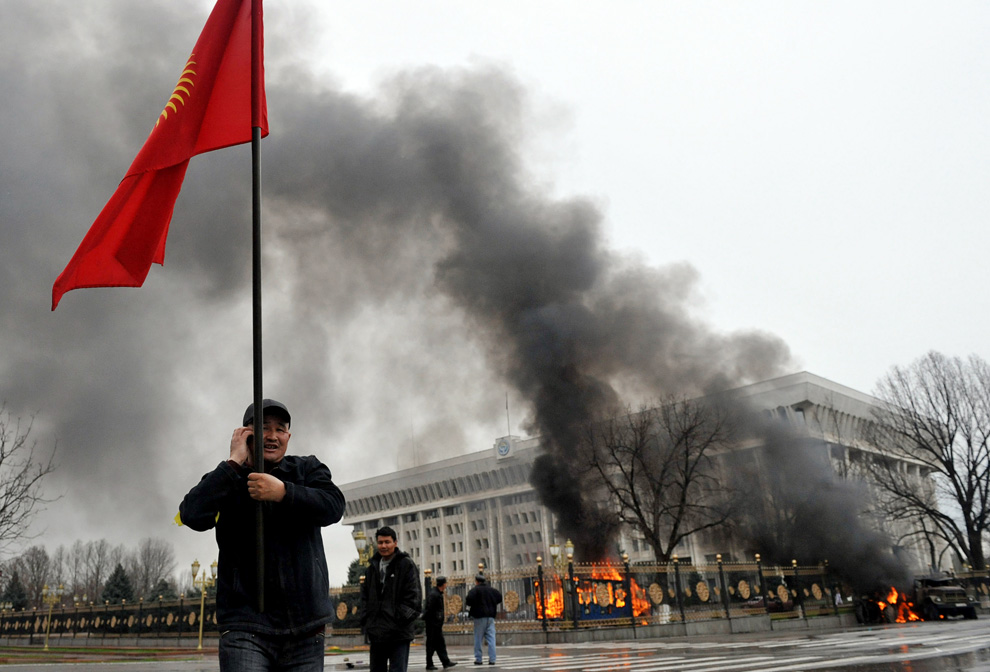
The Big Picture: Crisis in Kyrgyzstan
AP: Uprising in Kyrgyzstan leaves dozens killed... The opposition has called for the closure of the U.S. air base in Manas outside the capital of Bishkek that serves as a key transit point for supplies essential to the war in nearby Afghanistan.
Registan: The upheaval in Kyrgyzstan has seized the media’s attention, but it’s mostly just highlighted how little the major newspapers know about the region and how quick they are to put unsubstantiated facts up. The NY Times immediately reported that Kumanbek Bakiev had fled the country, which is a bold statement considering Cliff Levy is probably reporting from Moscow and not Bishkek. They’ve now taken a more tepid approach.
More analysis at Registan: During a visit to the United States from December 10 to 19, the leader the Kyrgyz Ata Meken opposition party, Omurbek Tekebayev, his colleagues, and representative of the For Justice movement repeatedly mentioned a plan to challenge President Kurmanbek Bakiyev this March by organizing crowds across the country.
Time: Kyrgyzstan: Did Moscow Subvert a U.S. Central Asian Ally?
See also: The Spektator - Your Monthly Guide to What's Happening In and Around Bishtek
AP: Uprising in Kyrgyzstan leaves dozens killed... The opposition has called for the closure of the U.S. air base in Manas outside the capital of Bishkek that serves as a key transit point for supplies essential to the war in nearby Afghanistan.
Registan: The upheaval in Kyrgyzstan has seized the media’s attention, but it’s mostly just highlighted how little the major newspapers know about the region and how quick they are to put unsubstantiated facts up. The NY Times immediately reported that Kumanbek Bakiev had fled the country, which is a bold statement considering Cliff Levy is probably reporting from Moscow and not Bishkek. They’ve now taken a more tepid approach.
More analysis at Registan: During a visit to the United States from December 10 to 19, the leader the Kyrgyz Ata Meken opposition party, Omurbek Tekebayev, his colleagues, and representative of the For Justice movement repeatedly mentioned a plan to challenge President Kurmanbek Bakiyev this March by organizing crowds across the country.
Time: Kyrgyzstan: Did Moscow Subvert a U.S. Central Asian Ally?
See also: The Spektator - Your Monthly Guide to What's Happening In and Around Bishtek
Perhaps I'm wrong about this, but the protestors look mostly Turkic. I realize that Turkics are approximately 70% of the Kyrgyzstan population, but is there any sort of ethnic divide between the protesters and the police?
posted by zarq at 4:26 PM on April 7, 2010
posted by zarq at 4:26 PM on April 7, 2010
#freekg is the hashtag (mostly being used by foreigns chatting about it a la Iranian Tweeting.)
posted by k8t at 4:26 PM on April 7, 2010
posted by k8t at 4:26 PM on April 7, 2010
Zarq: no.
posted by k8t at 4:27 PM on April 7, 2010 [1 favorite]
posted by k8t at 4:27 PM on April 7, 2010 [1 favorite]
A reader on Andrew Sullivan's blog writes: When President Akaev fled from Kyrgyzstan after similar protests in '05 there was an opportunity to support a broad-based coalition and democratic process for filling the vacuum.
The USG had actively intervened in the revolutions in both Georgia and Ukraine, making it clear that the US supported reform-minded opposition leaders. In a real sense, the US actively helped mid-wife these revolutions, providing moral support, logistics and, in some cases, political and technical advice to the reformers.
In 2005 when the revolution took place in Kyrgyzstan, many observers were expecting the State Department to take a similar role. It never happened.
Instead, under pressure from the Pentagon, the State Department caved in and the US stood by. The Tulip Revolution was still born and the reform-minded opposition was quickly marginalized by criminal elements.
The result was a regime even more corrupt and inept (if that is possible) than the one that preceded it.
posted by KokuRyu at 4:31 PM on April 7, 2010 [2 favorites]
The USG had actively intervened in the revolutions in both Georgia and Ukraine, making it clear that the US supported reform-minded opposition leaders. In a real sense, the US actively helped mid-wife these revolutions, providing moral support, logistics and, in some cases, political and technical advice to the reformers.
In 2005 when the revolution took place in Kyrgyzstan, many observers were expecting the State Department to take a similar role. It never happened.
Instead, under pressure from the Pentagon, the State Department caved in and the US stood by. The Tulip Revolution was still born and the reform-minded opposition was quickly marginalized by criminal elements.
The result was a regime even more corrupt and inept (if that is possible) than the one that preceded it.
posted by KokuRyu at 4:31 PM on April 7, 2010 [2 favorites]
Also check out neweurasia.net (SD: I am moderately affiliated with this blog.) But there is on-the-ground reporting in English.
globalvoices will likely have a good summary and quick translation too.
posted by k8t at 4:41 PM on April 7, 2010
globalvoices will likely have a good summary and quick translation too.
posted by k8t at 4:41 PM on April 7, 2010
Damn! Really amazing documentary photography in what is obviously an extremely intense and dangerous environment. I can't recall seeing anything recent that comes close to this in terms of compelling immediacy. These clashes look really vicious, and it's amazing to see so many shots of heavily armed police being overtaken by protesters: bloodied, chased over walls... the cops are up against a civilian populace that seems more than willing and able to kick their ass. Some of these protesters have got some pretty serious weaponry of their own, too: looks like some of the police aren't doing too good a job holding onto their guns.
Thanks for posting, KokuRyu.
posted by flapjax at midnite at 4:45 PM on April 7, 2010 [1 favorite]
Thanks for posting, KokuRyu.
posted by flapjax at midnite at 4:45 PM on April 7, 2010 [1 favorite]
Funny, KokuRyu, that your Dylan quote post title mentions music: a few months back I was introduced to Kyrgyz music in a concert by an amazing young woman from Kyrgystan who lives here in Tokyo. Very compelling, lovely traditiona music she plays, on a string instrument called the komuz, and on the jaw harp as well. I'm thinking maybe I'll do a Kyrgyz music post...
posted by flapjax at midnite at 4:49 PM on April 7, 2010 [2 favorites]
posted by flapjax at midnite at 4:49 PM on April 7, 2010 [2 favorites]
WOAH THAT DUDE STOLE A ROCKET LAUNCHER FROM THE COPS
posted by p3on at 4:57 PM on April 7, 2010 [6 favorites]
posted by p3on at 4:57 PM on April 7, 2010 [6 favorites]
and he has a fanny pack
posted by p3on at 4:58 PM on April 7, 2010 [1 favorite]
posted by p3on at 4:58 PM on April 7, 2010 [1 favorite]
flapjax at midnight, please do that. I imagine there is interesting music coming out of that area, both traditional and modern.
My boyfriend works with a woman from Kyrgyzstan. She lives here while her husband and child(ren?) live there. I believe he works for the government, but I am unsure where. I am hoping (that so does not sound like the right word) he had or will have an opportunity to talk to her about it. I am also hoping (right word this time) that her husband is safe. I have no real idea of the politics/lifestyle/anything really of Kyrgyzstan but now will learn all I can.
Thanks for the post.
posted by waitangi at 5:17 PM on April 7, 2010
My boyfriend works with a woman from Kyrgyzstan. She lives here while her husband and child(ren?) live there. I believe he works for the government, but I am unsure where. I am hoping (that so does not sound like the right word) he had or will have an opportunity to talk to her about it. I am also hoping (right word this time) that her husband is safe. I have no real idea of the politics/lifestyle/anything really of Kyrgyzstan but now will learn all I can.
Thanks for the post.
posted by waitangi at 5:17 PM on April 7, 2010
So basically everyone over the age of 1 has an automatic weapon, right.
Is that big rifle a Dragunov sniper rifle?
posted by parmanparman at 5:19 PM on April 7, 2010
Is that big rifle a Dragunov sniper rifle?
posted by parmanparman at 5:19 PM on April 7, 2010
delmoi I thought exactly the same thing. It's clearly an inferior copy though.
posted by Flashman at 6:04 PM on April 7, 2010
posted by Flashman at 6:04 PM on April 7, 2010
I once helped Rumsfeld choose between the sav blanc and the chardonnay at the Bishkek Hyatt.
To be serious for a moment Kyrgyzstan is one of the best places I have ever been. The people we met were friendly in a way westerners would be shocked by. I hope the worst is over and hope to go back as soon as I can. It seems like politically there is just so much going on in this part of world due to Stalin's arbitrary boundries, geopolitical value due to proximity to afghanistan, and lack of resources that this is unlikely to be the end of things.
Its also the only country I ever had to pay a bribe to get a boarding pass.
posted by JPD at 6:08 PM on April 7, 2010
To be serious for a moment Kyrgyzstan is one of the best places I have ever been. The people we met were friendly in a way westerners would be shocked by. I hope the worst is over and hope to go back as soon as I can. It seems like politically there is just so much going on in this part of world due to Stalin's arbitrary boundries, geopolitical value due to proximity to afghanistan, and lack of resources that this is unlikely to be the end of things.
Its also the only country I ever had to pay a bribe to get a boarding pass.
posted by JPD at 6:08 PM on April 7, 2010
What colour do I have to turn my Twitter icon this time?
posted by Nelson at 6:11 PM on April 7, 2010
posted by Nelson at 6:11 PM on April 7, 2010
Amazing pictures. And my first thought was for fuck's sake don't give RPG's and sniper rifles to your police force if they're going to lose them.
But maybe they're in better hands now.
posted by bardic at 6:18 PM on April 7, 2010
But maybe they're in better hands now.
posted by bardic at 6:18 PM on April 7, 2010
Over half of my life, I've watched the ugly, chaotic aftershocks of the death of the USSR and its zone of influence in Eastern Europe. I feel like I'll be seeing it for most of the rest of my life, too.
This must be what it was like to witness the slow death of Monarchy in Europe.
posted by TrialByMedia at 7:05 PM on April 7, 2010
This must be what it was like to witness the slow death of Monarchy in Europe.
posted by TrialByMedia at 7:05 PM on April 7, 2010
Wow. Amazing photos.
What was really interesting to me was not so much the clashes themselves as the aftermath - the dead and dying protestors, the brutality towards those (police or protesters) caught "behind the lines" of the other side, the strange little individual moments (that old woman apparently trying to halt the violence with nothing but an umbrella).
I hope when the dust settles, something real will emerge from this.
posted by AdamCSnider at 7:11 PM on April 7, 2010
What was really interesting to me was not so much the clashes themselves as the aftermath - the dead and dying protestors, the brutality towards those (police or protesters) caught "behind the lines" of the other side, the strange little individual moments (that old woman apparently trying to halt the violence with nothing but an umbrella).
I hope when the dust settles, something real will emerge from this.
posted by AdamCSnider at 7:11 PM on April 7, 2010
Ha! Last time this happened I got all excited thinking about democracy on the move and the power of the people and all that and also because we'd just had Navruz at my school and these two Kyrgyz women got up and did some Kyrgyz stuff and everyone congratulated them for what they thought was courage and progress in Kyrgyzstan and they were so full of hope and I posted this FPP and languagehat posted something about it all being more angry riots than political progress and Meatbomb posted a thing about some kids torching a nice car, and then a few months later Meatbomb posted this FPP about the aftermath.
Anyway, good luck to them. Keep on trying till you get it right, I guess.
posted by thirteenkiller at 7:37 PM on April 7, 2010 [2 favorites]
Anyway, good luck to them. Keep on trying till you get it right, I guess.
posted by thirteenkiller at 7:37 PM on April 7, 2010 [2 favorites]
parmanparman: It looks a hell of a lot like one, yeah: Exhibit A. The other possiblity is a PSL but the furniture and muzzle look much more like a Dragunov.
The mini-AKs are AKS-74Us.
posted by Skorgu at 8:17 PM on April 7, 2010 [1 favorite]

The mini-AKs are AKS-74Us.
posted by Skorgu at 8:17 PM on April 7, 2010 [1 favorite]
Some of the captions in the photo essay downplay what's going on in the accompanying photos. It's not a "riot" or a "protest" anymore when both sides are shooting at each other and the government changes hands. That's called a revolution.
posted by richyoung at 8:18 PM on April 7, 2010 [1 favorite]
posted by richyoung at 8:18 PM on April 7, 2010 [1 favorite]
And the rocket launcher is probably a RPG-26. Similar to the US M72 LAW.
posted by Skorgu at 8:21 PM on April 7, 2010
posted by Skorgu at 8:21 PM on April 7, 2010
I like the part where the granny with the umbrella takes pity on the (clearly outnumbered) police and brings (at least a moment of) sanity to the boys being boys.
"Who was that woman standing in front of those rocks?"
posted by Twang at 9:03 PM on April 7, 2010
"Who was that woman standing in front of those rocks?"
posted by Twang at 9:03 PM on April 7, 2010
That's not a rocket launcher, that's a camera.
</dark humor>
posted by amuseDetachment at 10:20 PM on April 7, 2010
</dark humor>
posted by amuseDetachment at 10:20 PM on April 7, 2010
While we're discussion the hardware; one thing struck me: If you look at pic #7, you see that the police's AKS-74Us are plain, with iron sights. But the protesters in #6 and #10 have an Eotech (or clone) holographic sight and rail mounts respectively, leading me to believe that they didn't just prior to the photograph yank these weapons out of the hands of police.
posted by Harald74 at 11:49 PM on April 7, 2010 [1 favorite]
posted by Harald74 at 11:49 PM on April 7, 2010 [1 favorite]
Which maybe supports the hypothesis that the Russian government supported this coup/revolution/disturbance by arming militias as it did in South Ossetia/Georgia. But, as Registan would probably emphatically point out, all of this is conjecture.
posted by KokuRyu at 12:06 AM on April 8, 2010
posted by KokuRyu at 12:06 AM on April 8, 2010
Oh, my. Not surprising to me in the least, but very sad. I hope you'll all keep my Kyrgyz ex-wife Burul and my beloved stepson Nursultan in your thoughts. They are in the outskirts of Bishkek, so unlikely to be in direct harm's way, but I am sure everything has been looted and immediate day-to-day supplies and comfort will be hard to come by for the short term.
This finally prodded me to upload my photos from the first revolution. It was pretty bloodless last time, but once the government fell every major shop was cleared out and most of them burned down as well.
I would also like to give a big "fuck you" shout out to all of the vampric elite of that country. The people there have suffered and been exploited beyond belief by the thieves above them at every turn.
posted by Meatbomb at 1:41 AM on April 8, 2010 [1 favorite]
This finally prodded me to upload my photos from the first revolution. It was pretty bloodless last time, but once the government fell every major shop was cleared out and most of them burned down as well.
I would also like to give a big "fuck you" shout out to all of the vampric elite of that country. The people there have suffered and been exploited beyond belief by the thieves above them at every turn.
posted by Meatbomb at 1:41 AM on April 8, 2010 [1 favorite]
This guy from Kyrgyzstan on reddit also has some insights on the cause of this revolution.
posted by JDHarper at 6:06 AM on April 8, 2010
posted by JDHarper at 6:06 AM on April 8, 2010
Thanks for the post; I came to MeFi hoping to find a wider range of analysis than I was getting, and I was not disappointed. (I wouldn't be too hopeful about anything good coming of this, but I imagine few people get all excited about People Power in these situations any more.)
posted by languagehat at 10:39 AM on April 8, 2010
posted by languagehat at 10:39 AM on April 8, 2010
Kyrgyzstan capital bloodied, looted and chaotic after overthrow of Bakiyev. US, Russia and China vie to influence coup leaders
posted by homunculus at 4:39 PM on April 8, 2010
posted by homunculus at 4:39 PM on April 8, 2010
Kyrgyzstan's head reveals overthrown president left only $80m in the budget
posted by homunculus at 9:50 PM on April 9, 2010 [1 favorite]
posted by homunculus at 9:50 PM on April 9, 2010 [1 favorite]
If you want to understand Kyrgyzstan, read this: The authoritative guide to understanding "the most insubordinate, rebellious, and mutinous nation" in Central Asia
posted by homunculus at 4:22 PM on April 10, 2010 [3 favorites]
posted by homunculus at 4:22 PM on April 10, 2010 [3 favorites]
Thanks very much for these updates; I urge everyone to read at least the last one (Salon).
posted by languagehat at 1:13 PM on April 11, 2010
posted by languagehat at 1:13 PM on April 11, 2010
Microsoft, piracy, and independent media in Kyrgyzstan
posted by homunculus at 8:39 AM on April 15, 2010
posted by homunculus at 8:39 AM on April 15, 2010
New Kyrgyz leaders vow to prosecute ex-president: Kurmanbek Bakiyev, driven from country last week, is accused of corruption, ordering shootings of protesters
posted by homunculus at 1:43 PM on April 16, 2010
posted by homunculus at 1:43 PM on April 16, 2010
Breaking point: why the Kyrgyz lost their patience.
posted by adamvasco at 4:59 AM on April 21, 2010 [1 favorite]
posted by adamvasco at 4:59 AM on April 21, 2010 [1 favorite]
That Madeleine Reeves piece is great. Here's the conclusion:
posted by languagehat at 9:11 AM on April 21, 2010
There has been a crisis of governance in Kyrgyzstan, certainly. But an analysis focused on state failure conceals the extent to which what has occurred is also the product of a glaring social and economic crisis – part of the “long-range” fall-out from the global financial crisis that has pushed many families to the brink. Moreover, a focus on internal state “failure” ignores the degree to which Kyrgyzstan, like other small, poor countries that suddenly find themselves hailed as strategic partners in a dubious “war on terror”, has also been consistently failed by the international community. The Obama administration, like its predecessor, has been too willing to take surface quiescence in Kyrgyzstan as an index of “stability”, whilst failing to ask how its base deals have propped up a deeply authoritarian government. In this sense, last week’s crisis should be read as a failure of realpolitik as much as a failure of state. As politicians and diplomats hurry to negotiate new partnerships with Kyrgyzstan’s interim government, they would do well to heed the lessons of this failure, and to enquire how their “strategic partnerships” either exacerbate or address the inequalities that brought people onto the street in their thousands last week.[I have corrected an error in the published article that repeated several lines and made for confusing reading.]
posted by languagehat at 9:11 AM on April 21, 2010
« Older turn me over play me again | "It's a unicorn" Newer »
This thread has been archived and is closed to new comments
posted by k8t at 4:24 PM on April 7, 2010