Parisian Art Theft
May 21, 2010 4:44 AM Subscribe
HEIST: Paintings by Pablo Picasso, Georges Braque, Henri Matisse, Amedeo Modigliani and Fernand Léger, worth ~$100 million, stolen! (Washington Post link)
A Heist Made for Hollywood
A Heist Made for Hollywood
This article spends a lot of words telling us how exciting it should be.
posted by fleacircus at 4:58 AM on May 21, 2010
posted by fleacircus at 4:58 AM on May 21, 2010
Girl Writing a Letter.
posted by (Arsenio) Hall and (Warren) Oates at 5:03 AM on May 21, 2010 [11 favorites]
posted by (Arsenio) Hall and (Warren) Oates at 5:03 AM on May 21, 2010 [11 favorites]
Outrageous. As a former Fine Art & Specie Underwriter I can tell you that having a 'partly functioning' alarm for over a month is not going to fly. One article suggested the entire alarm system had been off since the 30 March and that spare parts were being awaited.
Sounds like an inside element was involved somehow - someone who knew or heard the alarm system was switched off. Major embarrasment and it is not like Paris is new to Art Heists.
Hmmm sound like a case for Inspector Clouseau.
posted by numberstation at 5:20 AM on May 21, 2010 [1 favorite]
Sounds like an inside element was involved somehow - someone who knew or heard the alarm system was switched off. Major embarrasment and it is not like Paris is new to Art Heists.
Hmmm sound like a case for Inspector Clouseau.
posted by numberstation at 5:20 AM on May 21, 2010 [1 favorite]
Some mob boss wanted world-class art for his home, I presume. I'm sure the last thing this new owner of the art wants to do is sell them, and I bet the new owner has much better security than the Parisian museum.
posted by aught at 5:22 AM on May 21, 2010 [1 favorite]
posted by aught at 5:22 AM on May 21, 2010 [1 favorite]
Those guys are so cool, when sheep sleep, they dream of them.
posted by jquinby at 5:31 AM on May 21, 2010
posted by jquinby at 5:31 AM on May 21, 2010
Illicit Cultural Property is on the case.
Four reasons:
The first, is that a wealthy collector admires the works, and hired a thief. This is often referred to as the Dr. No situation...
Second, the thief may not have known that the object was so rare as to make its subsequent sale difficult...
Third, the thief may simply be trying to kidnap the object...
Finally, perhaps there is a market somewhere for these works...
posted by R. Mutt at 5:34 AM on May 21, 2010 [1 favorite]
Four reasons:
The first, is that a wealthy collector admires the works, and hired a thief. This is often referred to as the Dr. No situation...
Second, the thief may not have known that the object was so rare as to make its subsequent sale difficult...
Third, the thief may simply be trying to kidnap the object...
Finally, perhaps there is a market somewhere for these works...
posted by R. Mutt at 5:34 AM on May 21, 2010 [1 favorite]
They're probably stealing the paintings so they can get a good plea deal in exchange for the paintings in the event that they're caught doing some other illegal activity, such as gun, drug and people smuggling. Or maybe they're enterprising metacrooks who offer said service to other criminals.
posted by stavrogin at 5:35 AM on May 21, 2010
posted by stavrogin at 5:35 AM on May 21, 2010
"So, thieves, sirs, you are imbeciles. Now return them."
Psst, Pierre -- you catch more flies with honey than vinegar.
posted by stupidsexyFlanders at 5:36 AM on May 21, 2010
Psst, Pierre -- you catch more flies with honey than vinegar.
posted by stupidsexyFlanders at 5:36 AM on May 21, 2010
Dammit, I requested "sofa sized"!
Seriously, I hope whoever took them is taking care of them and they somehow find their way back.
posted by JoanArkham at 5:45 AM on May 21, 2010
Seriously, I hope whoever took them is taking care of them and they somehow find their way back.
posted by JoanArkham at 5:45 AM on May 21, 2010
Someone had identified the gated window, with its lone padlock, as a chink in the armor and had figured out how to evade the security guards.
Remember that scene in Goodfellas where Henry Hill and James 'Jimmy' Conway are first talking about the possibility of the Lufthansa heist, in the bar, with the guy who was the night security guard at the airport? And Jimmy said: "what about security?" And the security guard guy said: "Security? Ha! You're looking at it!"
Just sayin'.
posted by flapjax at midnite at 5:50 AM on May 21, 2010
Remember that scene in Goodfellas where Henry Hill and James 'Jimmy' Conway are first talking about the possibility of the Lufthansa heist, in the bar, with the guy who was the night security guard at the airport? And Jimmy said: "what about security?" And the security guard guy said: "Security? Ha! You're looking at it!"
Just sayin'.
posted by flapjax at midnite at 5:50 AM on May 21, 2010
I keep seeing statements to the effect of "there's no way to make money off these paintings because they're too well known", but if there weren't some way to do something with stolen paintings, even the best-known, people wouldn't keep stealing them.
posted by immlass at 6:07 AM on May 21, 2010
posted by immlass at 6:07 AM on May 21, 2010
When contacted, the officials from Maginot Security expressed regret for their apparent failure to take all contingencies into consideration.
posted by vapidave at 6:16 AM on May 21, 2010 [3 favorites]
posted by vapidave at 6:16 AM on May 21, 2010 [3 favorites]
I wouldn't pay a thief five cents for Modigliani's The Artist's Wife, although Picasso's The Pigeon with Peas is not bad.
"I may not know much about art but I know what I like."
posted by bwg at 6:29 AM on May 21, 2010
"I may not know much about art but I know what I like."
posted by bwg at 6:29 AM on May 21, 2010
I keep seeing statements to the effect of "there's no way to make money off these paintings because they're too well known"
I agree, this line of reasoning is stupid. If some collector would hire thieves to steal it for himself (the Dr. No example), that immediately implies a market for stolen art among collectors who want it. The existence of a market creates suppliers willing to supply it.
Also, there is an interesting tangential relationship between art theft and copyright infringement. Let's face it, the fact that these paintings were stolen means absolutely nothing to most of us. We still get to see them, because most of us only experience most of these great works of art as photographs. For example, I've never seen the actual Mona Lisa painting. But I've certainly seen very high resolution images of it--resolutions that show much more detail than would be possible given how the painting is displayed in the Louvre.
So what was actually stolen? Not the art. The art is linked right here in the post. It's on wikipedia, and blogs. In fact, the first time I've seen two of these works of art was after the paintings were stolen. So the art wasn't stolen. What was stolen was the painting. The original tangible medium on which the art was recorded. A medium, mind you, that decays and deteriorates with each passing moment.
Furthermore, who is really harmed here? Not the artists, they are long dead. Not their heirs - the paintings are all public domain works. The party harmed is the museum. But what role do museums play in our culture? Curators of our culture? We, collectively, already knew the history and provenance of these paintings before they arrived at that museum in the first place, so that role, at least for these paintings, is not served by them.
What museums do in our culture is limit access to great works of art for which copyright has long since expired. Any photo you've seen of a famous painting in a book had to be authorized by the museum. For example, only Corbis has the rights to digitally reproduce the works in the Louvre. And that digital reproduction of a public domain work creates a new copyrighted work that is owned by the museum. But why is this? Because the Louvre controls the access to the painting. Simply put, it's their building. They can permit or refuse photography to anyone they want.
But consider that I don't need a library's permission to photocopy Tom Sawyer or Les Miserables.
Museums control culture in a way that is wholly different from libraries, and given the way that museums rigidly and strictly exercise that control, I wonder if there is a case to be made that stealing a painting from a museum could constitute liberating it. Consider further the role that museums play in limiting access to those in a certain class, and grant special access to those in other classes.
For example, Foucault's Pendulum in Paris was recently damaged beyond repair when a cable snapped. Well, this is understandable. Metal fatigues, parts wear out, and cables snap. (Likewise, paintings crack and fade.) Nothing is forever. But buried in the story was this:
Consider the opposite scenario. What if, tomorrow, someone posted brand new ultra-high resolution scans of the five stolen paintings to the Pirate Bay and reddit. What if an anonymous editor updated the wikipedia photos of these works with these high resolution scans in .RAW format with no restriction on reproduction or distribution, thereby providing the world with a better and more accessible reproduction than what the museum had previously allowed.
In that context, would we still consider this a theft of art, or a theft of painting? And would we care as much. What was really stolen in that case? What is stolen if I copy the nth-generation digital copy of a film? If we are talking about works of art, what does "copy" or "theft" even mean?
posted by Pastabagel at 6:52 AM on May 21, 2010 [16 favorites]
I agree, this line of reasoning is stupid. If some collector would hire thieves to steal it for himself (the Dr. No example), that immediately implies a market for stolen art among collectors who want it. The existence of a market creates suppliers willing to supply it.
Also, there is an interesting tangential relationship between art theft and copyright infringement. Let's face it, the fact that these paintings were stolen means absolutely nothing to most of us. We still get to see them, because most of us only experience most of these great works of art as photographs. For example, I've never seen the actual Mona Lisa painting. But I've certainly seen very high resolution images of it--resolutions that show much more detail than would be possible given how the painting is displayed in the Louvre.
So what was actually stolen? Not the art. The art is linked right here in the post. It's on wikipedia, and blogs. In fact, the first time I've seen two of these works of art was after the paintings were stolen. So the art wasn't stolen. What was stolen was the painting. The original tangible medium on which the art was recorded. A medium, mind you, that decays and deteriorates with each passing moment.
Furthermore, who is really harmed here? Not the artists, they are long dead. Not their heirs - the paintings are all public domain works. The party harmed is the museum. But what role do museums play in our culture? Curators of our culture? We, collectively, already knew the history and provenance of these paintings before they arrived at that museum in the first place, so that role, at least for these paintings, is not served by them.
What museums do in our culture is limit access to great works of art for which copyright has long since expired. Any photo you've seen of a famous painting in a book had to be authorized by the museum. For example, only Corbis has the rights to digitally reproduce the works in the Louvre. And that digital reproduction of a public domain work creates a new copyrighted work that is owned by the museum. But why is this? Because the Louvre controls the access to the painting. Simply put, it's their building. They can permit or refuse photography to anyone they want.
But consider that I don't need a library's permission to photocopy Tom Sawyer or Les Miserables.
Museums control culture in a way that is wholly different from libraries, and given the way that museums rigidly and strictly exercise that control, I wonder if there is a case to be made that stealing a painting from a museum could constitute liberating it. Consider further the role that museums play in limiting access to those in a certain class, and grant special access to those in other classes.
For example, Foucault's Pendulum in Paris was recently damaged beyond repair when a cable snapped. Well, this is understandable. Metal fatigues, parts wear out, and cables snap. (Likewise, paintings crack and fade.) Nothing is forever. But buried in the story was this:
The museum regularly hosts cocktail parties in the chapel that houses the pendulum, and Mr Lalande admitted that several alarming incidents had occurred over the past year. In May 2009, for example, a partygoer grabbed the 28kg instrument and swung it into a security barrier.What is the role of the museum in relation to our culture? Does hosting cocktail parties serve that role? Was the reckless party goer charged with damaging a priceless cultural artifact? Had I visited that museum, would I have been permitted to mistreat the pendulum in this way, or is that a privileged reserved for those who (can) attend these private cocktail parties?
Consider the opposite scenario. What if, tomorrow, someone posted brand new ultra-high resolution scans of the five stolen paintings to the Pirate Bay and reddit. What if an anonymous editor updated the wikipedia photos of these works with these high resolution scans in .RAW format with no restriction on reproduction or distribution, thereby providing the world with a better and more accessible reproduction than what the museum had previously allowed.
In that context, would we still consider this a theft of art, or a theft of painting? And would we care as much. What was really stolen in that case? What is stolen if I copy the nth-generation digital copy of a film? If we are talking about works of art, what does "copy" or "theft" even mean?
posted by Pastabagel at 6:52 AM on May 21, 2010 [16 favorites]
Really? You don't see a difference between a digital representation of the Mona Lisa and the actual painting? Digital images of art are a good way to get the flavor of something, but there's no way it compares to seeing the real thing no matter how high-res.
I'm lucky enough to live in a city where there's a lot of free and accessible art, so maybe I'm spoiled. No, I know I'm spoiled.
posted by JoanArkham at 6:56 AM on May 21, 2010 [1 favorite]
I'm lucky enough to live in a city where there's a lot of free and accessible art, so maybe I'm spoiled. No, I know I'm spoiled.
posted by JoanArkham at 6:56 AM on May 21, 2010 [1 favorite]
Nopt to worry! I have those painting on postcards and can lend them to the museum if they want replacements.
posted by Postroad at 7:11 AM on May 21, 2010 [2 favorites]
posted by Postroad at 7:11 AM on May 21, 2010 [2 favorites]
Really? You don't see a difference between a digital representation of the Mona Lisa and the actual painting? Digital images of art are a good way to get the flavor of something, but there's no way it compares to seeing the real thing no matter how high-res.
as you release higher and higher hi res copies of art, you approach releasing all of the "information" that composes that piece of art, and if such information sharing were freely permitted, we'd have technology that could mimic the experience of "seeing the real thing." unless art truly has a soul, the only thing we'd lose is the exclusivity (which may be the point). would the mona lisa still be the mona lisa if you could duplicate it to the point that no person could ever differentiate?
posted by lulz at 7:15 AM on May 21, 2010 [1 favorite]
as you release higher and higher hi res copies of art, you approach releasing all of the "information" that composes that piece of art, and if such information sharing were freely permitted, we'd have technology that could mimic the experience of "seeing the real thing." unless art truly has a soul, the only thing we'd lose is the exclusivity (which may be the point). would the mona lisa still be the mona lisa if you could duplicate it to the point that no person could ever differentiate?
posted by lulz at 7:15 AM on May 21, 2010 [1 favorite]
So a holographic image of your lover is just as good as being in the room with him/her?
posted by R. Mutt at 7:17 AM on May 21, 2010
posted by R. Mutt at 7:17 AM on May 21, 2010
I have seen James Brown perform live, and CD's of his work, however brilliantly remastered, will never compare with that experience. Similarly, seeing a traveling exhibit of a large collection of Van Goghs almost forty years ago is etched into my emotional memory forever. High-resolution images on my computer screen will never affect me in that way.
posted by kozad at 7:22 AM on May 21, 2010 [3 favorites]
posted by kozad at 7:22 AM on May 21, 2010 [3 favorites]
So a holographic image of your lover is just as good as being in the room with him/her?
i know my lover has a soul. i don't know if art has a soul and thus i qualified my statement. i just meant that we have the ability to recreate paintings but "choose" not to. i don't know if this is good or bad and i don't care if it is either. i was just saying the choice has been made.
posted by lulz at 7:24 AM on May 21, 2010
i know my lover has a soul. i don't know if art has a soul and thus i qualified my statement. i just meant that we have the ability to recreate paintings but "choose" not to. i don't know if this is good or bad and i don't care if it is either. i was just saying the choice has been made.
posted by lulz at 7:24 AM on May 21, 2010
I have seen James Brown perform live, and CD's of his work, however brilliantly remastered, will never compare with that experience. Similarly, seeing a traveling exhibit of a large collection of Van Goghs almost forty years ago is etched into my emotional memory forever. High-resolution images on my computer screen will never affect me in that way.
duplicating paintings is not the same thing as duplicating experiences. perhaps duplicating paintings would enable more people to share the type of experience you value so much. and perhaps duplicating paintings would prevent anyone from ever having that type of experience again. this has already been decided but i don't know what the answer is.
posted by lulz at 7:28 AM on May 21, 2010
duplicating paintings is not the same thing as duplicating experiences. perhaps duplicating paintings would enable more people to share the type of experience you value so much. and perhaps duplicating paintings would prevent anyone from ever having that type of experience again. this has already been decided but i don't know what the answer is.
posted by lulz at 7:28 AM on May 21, 2010
High-resolution images on my computer screen will never affect me in that way.
Never is a long time.
Today, even the best digital scans are flat. Paintings are physical objects with mass and texture (and aroma if they're new enough).
Today a very high resolution image will reproduce a flat projection or impression of the texture - but of course the thickness of the frame, bulges or ripples in the canvas, and the way light might scatter across the surface or penetrate into layers of transparent glaze are lost.
But someday we will have reproduction technology that will reproduce those qualities well enough to be qualitatively the same.
So a holographic image of your lover is just as good as being in the room with him/her
Are you talking about one of those fuzzy rainbow images that are kind of 3d or one of those Star Trek holograms that talk and walk and respond to touch and can have the wind sweep through their hair?
posted by device55 at 7:31 AM on May 21, 2010 [2 favorites]
Never is a long time.
Today, even the best digital scans are flat. Paintings are physical objects with mass and texture (and aroma if they're new enough).
Today a very high resolution image will reproduce a flat projection or impression of the texture - but of course the thickness of the frame, bulges or ripples in the canvas, and the way light might scatter across the surface or penetrate into layers of transparent glaze are lost.
But someday we will have reproduction technology that will reproduce those qualities well enough to be qualitatively the same.
So a holographic image of your lover is just as good as being in the room with him/her
Are you talking about one of those fuzzy rainbow images that are kind of 3d or one of those Star Trek holograms that talk and walk and respond to touch and can have the wind sweep through their hair?
posted by device55 at 7:31 AM on May 21, 2010 [2 favorites]
One suggestion for why famous paintings are stolen that I read in one of the news reports about this was speculating that perhaps they're used as currency by high-level criminals when they need to carry around $500 million and don't want to lug suitcases full of cash.
If it's true, it does make me feel bad for the paintings that are doomed to spend the rest of their existences rolled up and occasionally stuck in some lackey's trench coat. At least if the mobsters were art lovers someone would be appreciating them.
posted by Copronymus at 7:33 AM on May 21, 2010
If it's true, it does make me feel bad for the paintings that are doomed to spend the rest of their existences rolled up and occasionally stuck in some lackey's trench coat. At least if the mobsters were art lovers someone would be appreciating them.
posted by Copronymus at 7:33 AM on May 21, 2010
One article suggested the entire alarm system had been off since the 30 March and that spare parts were being awaited.
If turns out to be true I may consider moving to France to become a cat burglar.
If I start posting under "monsieur robie the cat" you'll know why.
posted by device55 at 7:41 AM on May 21, 2010
If turns out to be true I may consider moving to France to become a cat burglar.
If I start posting under "monsieur robie the cat" you'll know why.
posted by device55 at 7:41 AM on May 21, 2010
as you release higher and higher hi res copies of art, you approach releasing all of the "information" that composes that piece of art
Nope. Whoever thinks that a 2D reproduction, however high-res, remotely approaches an original oil painting, clearly hasn't seen many oil paintings in his life.
For instance, for a long time I had a rather low concept of van Gogh. Frankly speaking, the ubiquitous posters and postcards of his paintings always left me seriously unimpressed. But the first time I saw a real van Gogh in person, it took my breath away. Old Vincent had a way with volume and texture that makes his paintings' colours literally vibrate as you look them from different viewpoints. He was more of a sculptor than a draughtsman, in fact.
As for 3D reproduction, it will take a long, long time until it can grasp all the nuances of such masterpieces. We aren't talking about "Avatar", people...
posted by Skeptic at 7:56 AM on May 21, 2010 [3 favorites]
Nope. Whoever thinks that a 2D reproduction, however high-res, remotely approaches an original oil painting, clearly hasn't seen many oil paintings in his life.
For instance, for a long time I had a rather low concept of van Gogh. Frankly speaking, the ubiquitous posters and postcards of his paintings always left me seriously unimpressed. But the first time I saw a real van Gogh in person, it took my breath away. Old Vincent had a way with volume and texture that makes his paintings' colours literally vibrate as you look them from different viewpoints. He was more of a sculptor than a draughtsman, in fact.
As for 3D reproduction, it will take a long, long time until it can grasp all the nuances of such masterpieces. We aren't talking about "Avatar", people...
posted by Skeptic at 7:56 AM on May 21, 2010 [3 favorites]
would the mona lisa still be the mona lisa if you could duplicate it to the point that no person could ever differentiate?
This debate has been held before, but there really is a difference between a reproduction of something, known to be a reproduction, and the original, known to be the original. The idea of standing before an actual canvas upon which Picasso laid brush is compelling in a way that simply looking at an image of that canvas on a monitor or even as a print.
I suppose theoretically one could imagine future 3-D printers that would reproduce even the height of the brush strokes and the patina of the acrylic, but it's still not going to be the real thing. There's something culturally and socially important about the whole operation of building a structure to specifically house actual examples of artwork from the past and preserving them over time.
It's the same with Foucault's Pendulum. Heck, there's a reproduction of it in the Museum of Science and Industry in Chicago, but it isn't the one that Foucault used. By preserving that one -- until this month -- humanity said something about how it values the advancement of human knowledge.
posted by dhartung at 7:57 AM on May 21, 2010 [2 favorites]
This debate has been held before, but there really is a difference between a reproduction of something, known to be a reproduction, and the original, known to be the original. The idea of standing before an actual canvas upon which Picasso laid brush is compelling in a way that simply looking at an image of that canvas on a monitor or even as a print.
I suppose theoretically one could imagine future 3-D printers that would reproduce even the height of the brush strokes and the patina of the acrylic, but it's still not going to be the real thing. There's something culturally and socially important about the whole operation of building a structure to specifically house actual examples of artwork from the past and preserving them over time.
It's the same with Foucault's Pendulum. Heck, there's a reproduction of it in the Museum of Science and Industry in Chicago, but it isn't the one that Foucault used. By preserving that one -- until this month -- humanity said something about how it values the advancement of human knowledge.
posted by dhartung at 7:57 AM on May 21, 2010 [2 favorites]
I don't think anything has a soul. I'm not sure what you would call it...but standing a foot away from something painted in the 1600s or by a true master or just something that resonates with me personally for some reason? That's something that affects me on a physical and emotional level.
posted by JoanArkham at 8:04 AM on May 21, 2010 [2 favorites]
posted by JoanArkham at 8:04 AM on May 21, 2010 [2 favorites]
There was talk on the news here that they could be used as 'currency' in the underworld...
I could spend the next half hour or so googling around Velázquez's greatest works or flicking through a book and it would be interesting... but when I went to the Velázquez exhibition the other year it was as close to a religious experience as you could get in secular situation. And seeing the Mona Lisa 'live' is nothing like seeing it any other way. I may be just the size/scale of some paintings or the fact you've amde a special journey to see them or, in the case of the Mona Lisa at least, fighting through a scrum of other tourists but there's nothing like seeing art in reality.
posted by fearfulsymmetry at 8:06 AM on May 21, 2010
I could spend the next half hour or so googling around Velázquez's greatest works or flicking through a book and it would be interesting... but when I went to the Velázquez exhibition the other year it was as close to a religious experience as you could get in secular situation. And seeing the Mona Lisa 'live' is nothing like seeing it any other way. I may be just the size/scale of some paintings or the fact you've amde a special journey to see them or, in the case of the Mona Lisa at least, fighting through a scrum of other tourists but there's nothing like seeing art in reality.
posted by fearfulsymmetry at 8:06 AM on May 21, 2010
I think PastaBagel's point is to question the true value of museums in this day and age.
When museums leave their security systems broken for weeks and host cocktail parties where rich idiots can break irreplaceable artifacts without fear of consequences, one can legitimately wonder if we're not better off keeping these items locked up in a vault somewhere and making really really high quality reproductions available everywhere to everyone.
Of course (today's) reproductions are not equivalent to the "real" thing (yet). But maybe that's not the point.
(if you doubt the cultural value of high quality reproductions, ask yourself if people from around the world would line up to catch a glimpse of the Mona Lisa behind a wall of tinted glass if there hadn't been billions of copies circulating the globe. See also: http://www.marcelduchamp.net/L.H.O.O.Q.php)
posted by device55 at 8:09 AM on May 21, 2010 [1 favorite]
When museums leave their security systems broken for weeks and host cocktail parties where rich idiots can break irreplaceable artifacts without fear of consequences, one can legitimately wonder if we're not better off keeping these items locked up in a vault somewhere and making really really high quality reproductions available everywhere to everyone.
Of course (today's) reproductions are not equivalent to the "real" thing (yet). But maybe that's not the point.
(if you doubt the cultural value of high quality reproductions, ask yourself if people from around the world would line up to catch a glimpse of the Mona Lisa behind a wall of tinted glass if there hadn't been billions of copies circulating the globe. See also: http://www.marcelduchamp.net/L.H.O.O.Q.php)
posted by device55 at 8:09 AM on May 21, 2010 [1 favorite]
Again, I'm spoiled. I live in a city where museums are free and public places. But don't most museums have "free days" at least? Museums are only as elitist as you think they are.
I've also been to a few museum "cocktail parties" in DC (and San Francisco) and never paid more than $20 to get in (and one was free).
posted by JoanArkham at 8:21 AM on May 21, 2010 [1 favorite]
I've also been to a few museum "cocktail parties" in DC (and San Francisco) and never paid more than $20 to get in (and one was free).
posted by JoanArkham at 8:21 AM on May 21, 2010 [1 favorite]
kozad--the van goghs you saw 40 years ago look as different today as you do. Van Gogh, painting at the start of the Age of Modern Colorants, used many fugitive colors. I saw a large Van Gogh exhibition at the MOMA about that time. I noticed then that many of the colors were simply wrong, then less than 100 years after they were painted.
Great art is fugitive and expensive. The fiction is that you can look at great, old, original art. You can't. It's gone, long gone.
You can look at a photographic reproduction, or (for more bux) look at a restorer's reproduction. That's what a 'restorer' does. He repaints old paintings. After he's done, you can look at the restorer's new painting, and a git in an expensive suit and a euro accent will make you believe you are looking at a Da Vinci, or Matisse, or whatever, and not a Sam Grobstein interpretation.
Is a restoration more accurate that a photograph? Is it more anything than a photograph, except expensive? You may find it more moving than a reproduction, but only if you believe it is somehow 'authentic'. But generally, it isn't. Maybe the frame is original.
If the thieves burn the paintings, they will be barely more 'gone' than they were before they were stolen. The only real damage will be to their resaleability.
posted by hexatron at 8:25 AM on May 21, 2010 [2 favorites]
Great art is fugitive and expensive. The fiction is that you can look at great, old, original art. You can't. It's gone, long gone.
You can look at a photographic reproduction, or (for more bux) look at a restorer's reproduction. That's what a 'restorer' does. He repaints old paintings. After he's done, you can look at the restorer's new painting, and a git in an expensive suit and a euro accent will make you believe you are looking at a Da Vinci, or Matisse, or whatever, and not a Sam Grobstein interpretation.
Is a restoration more accurate that a photograph? Is it more anything than a photograph, except expensive? You may find it more moving than a reproduction, but only if you believe it is somehow 'authentic'. But generally, it isn't. Maybe the frame is original.
If the thieves burn the paintings, they will be barely more 'gone' than they were before they were stolen. The only real damage will be to their resaleability.
posted by hexatron at 8:25 AM on May 21, 2010 [2 favorites]
Really? You don't see a difference between a digital representation of the Mona Lisa and the actual painting?
If the difference is as significant as you suggest, then art appreciation is the provenance of the wealthy alone. Given how many great paintings there are, and how dispersed they are around they world (some of them in private collections completely inaccessible to the public), it would be impossible for most of use to see a real painting. Therefore, for most of us, and by extension for our entire culture from this point on, our absorption of these great cultural works is limited to images only.
But much of this difference you mention is the "experience" of seeing the real painting in a museum. I'm not dismissing the power of that experience, I'm simply suggesting that it depends more on the setting and the context of the painting and not so much the particular painting itself. If you see any painting in a museum, you have this experience to a greater or lesser degree, because it is in a museum. If you saw the Mona Lisa at a McDonald's, you would not have nearly the same experience as seeing it in the Louvre.
But consider that the point of painting art was never for people to be in awe of the painting. It was for people to be in awe of the image that was painted. It is not a sculpture or a musical performance. It is a two dimensional image, and at the time painting was the only way to record images. Remember: we aren't talking about admiring the technique or the mechanics of painting (the brushstrokes, the thickness of the paint, etc.) We are talking about the art itself - the artist's choice of what to show us.
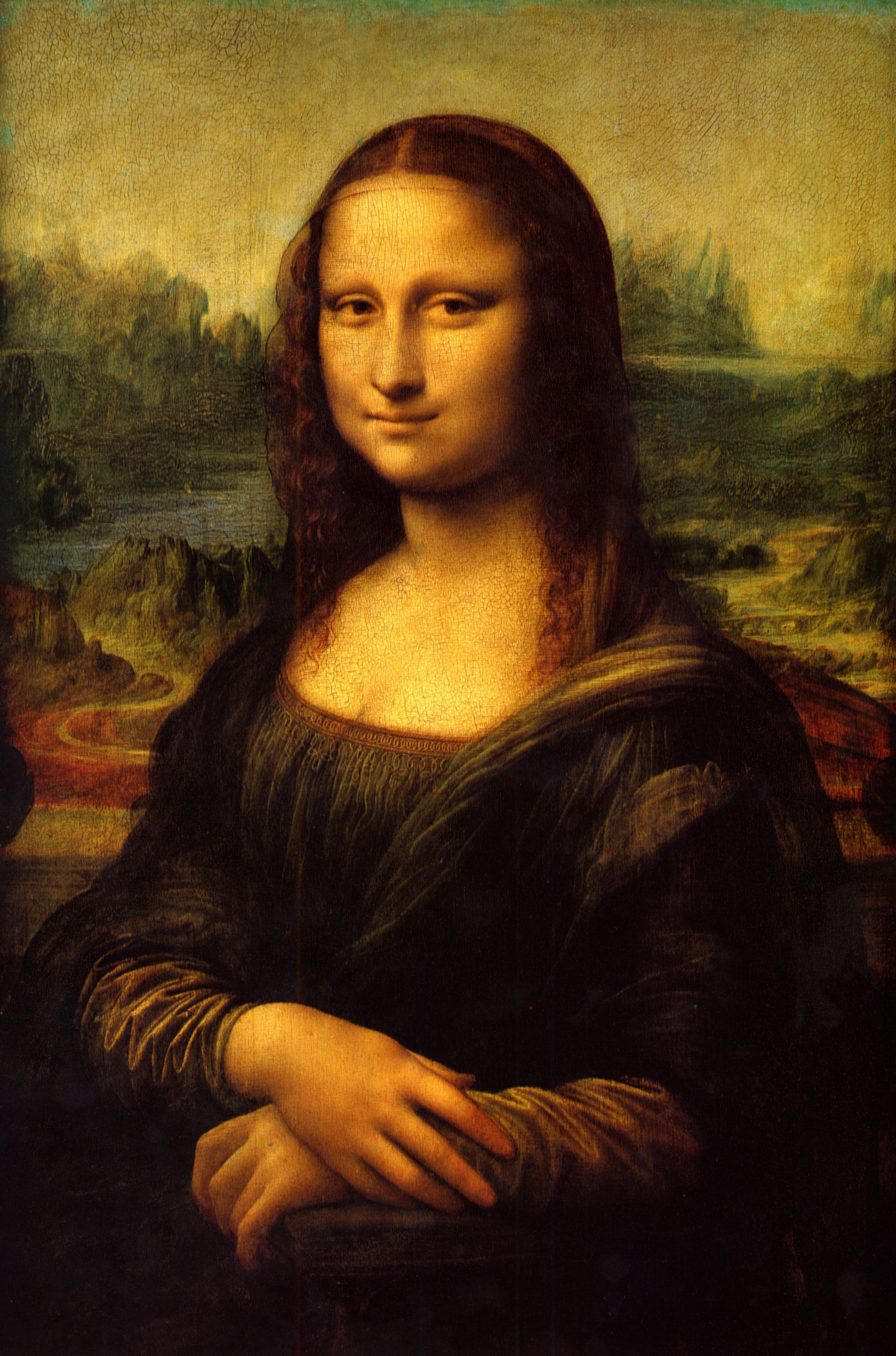
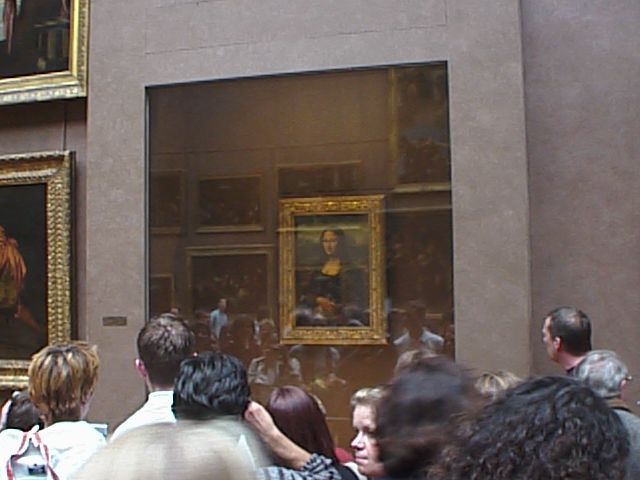
This is a reproduction of the Mona Lisa. (Warning: large jpg). And this is how the museum forces you to experience the real painting. The truth is that for many of us, the more intimate and awe-inspiring experience of this great cultural treasure will be through the digital reproduction than through the rigidly controlled encounter in a museum.
posted by Pastabagel at 8:28 AM on May 21, 2010 [2 favorites]
If the difference is as significant as you suggest, then art appreciation is the provenance of the wealthy alone. Given how many great paintings there are, and how dispersed they are around they world (some of them in private collections completely inaccessible to the public), it would be impossible for most of use to see a real painting. Therefore, for most of us, and by extension for our entire culture from this point on, our absorption of these great cultural works is limited to images only.
But much of this difference you mention is the "experience" of seeing the real painting in a museum. I'm not dismissing the power of that experience, I'm simply suggesting that it depends more on the setting and the context of the painting and not so much the particular painting itself. If you see any painting in a museum, you have this experience to a greater or lesser degree, because it is in a museum. If you saw the Mona Lisa at a McDonald's, you would not have nearly the same experience as seeing it in the Louvre.
But consider that the point of painting art was never for people to be in awe of the painting. It was for people to be in awe of the image that was painted. It is not a sculpture or a musical performance. It is a two dimensional image, and at the time painting was the only way to record images. Remember: we aren't talking about admiring the technique or the mechanics of painting (the brushstrokes, the thickness of the paint, etc.) We are talking about the art itself - the artist's choice of what to show us.
This is a reproduction of the Mona Lisa. (Warning: large jpg). And this is how the museum forces you to experience the real painting. The truth is that for many of us, the more intimate and awe-inspiring experience of this great cultural treasure will be through the digital reproduction than through the rigidly controlled encounter in a museum.

posted by Pastabagel at 8:28 AM on May 21, 2010 [2 favorites]
To suggest digital reproductions of artworks can be equal to the original is wrong. OK, 'equal' meaning having equal visceral impact, equal physical prescence, equal emotional resonance, historically/intellectually it could be an interesting thing in itself but it would always be a translation. It would only ever exist because of an 'original'. That original would always have precedence for the same reason fresh tomatoes taste more/better than ones that have been shipped from the other hemisphere.
posted by From Bklyn at 8:38 AM on May 21, 2010
posted by From Bklyn at 8:38 AM on May 21, 2010
I have a healthy level of outrage about this kind of thing. Navigating to a room of the museum only to see an empty surface with a small reproduction and the reason why the painting isn't there honestly sucks.
posted by ersatz at 8:40 AM on May 21, 2010
posted by ersatz at 8:40 AM on May 21, 2010
The idea of standing before an actual canvas upon which Picasso laid brush is compelling in a way that simply looking at an image of that canvas on a monitor or even as a print.
That's true, but that isn't the point of art. If it were, the great works of musical art would be long dead, as we cannot hear them as Mozart or Bach would have them performed (or would have performed them themselves).
And the talk about texture and volume and brushes is what I was getting at with the mechanics. The mechanics of painting isn't the art of the painting. The art of the painting is ripple on the water around the lilies, the smile on the face of the Mona Lisa. The art is that I the slop of green and blue paint looks to me like lilies drifting in a pond. The art is that I think that it is an actual woman smiling.
Every famous old painting you see was restored or has faded - it does not look the way the artists painted it. And again, this is the only way to experience the real Mona Lisa.
If you like museums, by all means go. But I am questioning the role of the museum not as guardian or curator of the great cultural artifact, but as gatekeeper. Why does the Louvre get to adulterate my viewing of the real painting by putting it behind glass 12 ft away under special--abnormal--light (not sunlight which is the light by which Leonardo painted it), and also get to limit or control the right to photograph and reproduce it? What is the public getting in exchange for giving all this up?
posted by Pastabagel at 8:47 AM on May 21, 2010 [1 favorite]
That's true, but that isn't the point of art. If it were, the great works of musical art would be long dead, as we cannot hear them as Mozart or Bach would have them performed (or would have performed them themselves).
And the talk about texture and volume and brushes is what I was getting at with the mechanics. The mechanics of painting isn't the art of the painting. The art of the painting is ripple on the water around the lilies, the smile on the face of the Mona Lisa. The art is that I the slop of green and blue paint looks to me like lilies drifting in a pond. The art is that I think that it is an actual woman smiling.
Every famous old painting you see was restored or has faded - it does not look the way the artists painted it. And again, this is the only way to experience the real Mona Lisa.

If you like museums, by all means go. But I am questioning the role of the museum not as guardian or curator of the great cultural artifact, but as gatekeeper. Why does the Louvre get to adulterate my viewing of the real painting by putting it behind glass 12 ft away under special--abnormal--light (not sunlight which is the light by which Leonardo painted it), and also get to limit or control the right to photograph and reproduce it? What is the public getting in exchange for giving all this up?
posted by Pastabagel at 8:47 AM on May 21, 2010 [1 favorite]
Eh, I'm sort of with you on the Mona Lisa, Pastabagel. It's more "famous for being famous."
I realize the painting I'm looking at isn't exactly as it appeared the day it dried. To me, that's kind of the point. It's transient. It changes. It's chemicals and physical matter and will never again look exactly the same way it does at the moment I'm looking at it.
I know there's some dispute in the art world about even conserving paintings or just letting them naturally age, but I don't know enough about it to address it here. The fashion for conservation seems to go back-and-forth over time.
posted by JoanArkham at 8:59 AM on May 21, 2010 [1 favorite]
I realize the painting I'm looking at isn't exactly as it appeared the day it dried. To me, that's kind of the point. It's transient. It changes. It's chemicals and physical matter and will never again look exactly the same way it does at the moment I'm looking at it.
I know there's some dispute in the art world about even conserving paintings or just letting them naturally age, but I don't know enough about it to address it here. The fashion for conservation seems to go back-and-forth over time.
posted by JoanArkham at 8:59 AM on May 21, 2010 [1 favorite]
That original would always have precedence for the same reason fresh tomatoes taste more/better than ones that have been shipped from the other hemisphere.
posted by From Bklyn at 11:38 AM on May 21
Please explain to me what the terms "original" means when applied to photography or writing.
You have never seen an original painting by a great master. The moment the artist sets down their brush, Nature picks up hers. Cracking, fading, changing, flaking, curing. Pigments don't merely fade, they change. And Pigments made from different ingredients but which looks the same when fresh will over centuries change to entirely different colors.
These works were painted by the light of the sun, and for centuries could only be seen when placed in sunlight. Look at what happens to house paint--chemically engineered to resist the effects of sunlight--after only a decade. Now imagine that sunlight beating on the Mona Lisa for hundreds of years before someone had the sense to move it where it could only be seen by candlelight or gaslight. At which point all those noxious vapors, waxes, and soot would condense on the surface of the paint, and those chemicals would leech into it.
See also, The Work of Art in the Age of Mechanical Reproduction:
posted by From Bklyn at 11:38 AM on May 21
Please explain to me what the terms "original" means when applied to photography or writing.
You have never seen an original painting by a great master. The moment the artist sets down their brush, Nature picks up hers. Cracking, fading, changing, flaking, curing. Pigments don't merely fade, they change. And Pigments made from different ingredients but which looks the same when fresh will over centuries change to entirely different colors.
These works were painted by the light of the sun, and for centuries could only be seen when placed in sunlight. Look at what happens to house paint--chemically engineered to resist the effects of sunlight--after only a decade. Now imagine that sunlight beating on the Mona Lisa for hundreds of years before someone had the sense to move it where it could only be seen by candlelight or gaslight. At which point all those noxious vapors, waxes, and soot would condense on the surface of the paint, and those chemicals would leech into it.
See also, The Work of Art in the Age of Mechanical Reproduction:
One might subsume the eliminated element in the term “aura” and go on to say: that which withers in the age of mechanical reproduction is the aura of the work of art. This is a symptomatic process whose significance points beyond the realm of art. One might generalize by saying: the technique of reproduction detaches the reproduced object from the domain of tradition. By making many reproductions it substitutes a plurality of copies for a unique existence. And in permitting the reproduction to meet the beholder or listener in his own particular situation, it reactivates the object reproduced. These two processes lead to a tremendous shattering of tradition which is the obverse of the contemporary crisis and renewal of mankind.posted by Pastabagel at 9:02 AM on May 21, 2010 [1 favorite]
Why does the Louvre get to adulterate my viewing of the real painting by putting it behind glass 12 ft away under special--abnormal--light (not sunlight which is the light by which Leonardo painted it), and also get to limit or control the right to photograph and reproduce it?
But this is exactly how my honey and I enjoy each other!
posted by Mental Wimp at 9:23 AM on May 21, 2010
But this is exactly how my honey and I enjoy each other!
posted by Mental Wimp at 9:23 AM on May 21, 2010
Matisse, Picaso and Modigliani?
The question of needing museums is irrelevant if they're all painted by the same person.
posted by paisley henosis at 9:24 AM on May 21, 2010 [2 favorites]
The question of needing museums is irrelevant if they're all painted by the same person.
posted by paisley henosis at 9:24 AM on May 21, 2010 [2 favorites]
We are talking about the art itself - the artist's choice of what to show us.
That is not my definition of "the art itself". As a painter myself, the art IS the brush strokes, the texture of the paint, every dot of color and it's specific depth, the way each color transitions, the specific color, the shiny-ness or matte-ness of particular areas of the painting, the thickness of some areas compared to the very thin application of paint in other areas. The subject matter, or the simple flat image as seen from one particular vantage point (as in a reproduction), is only one limited part of the story.
posted by asimplemouse at 9:27 AM on May 21, 2010
That is not my definition of "the art itself". As a painter myself, the art IS the brush strokes, the texture of the paint, every dot of color and it's specific depth, the way each color transitions, the specific color, the shiny-ness or matte-ness of particular areas of the painting, the thickness of some areas compared to the very thin application of paint in other areas. The subject matter, or the simple flat image as seen from one particular vantage point (as in a reproduction), is only one limited part of the story.
posted by asimplemouse at 9:27 AM on May 21, 2010
and also get to limit or control the right to photograph and reproduce it?
Very recently I was at my local museum and one of the wings of modern(ish) art was very well curated.
A long, deep hallway with a Picasso bust at one end and a Franz Klein at the other.
The space was just beautifully constructed, almost like a timeline of 50 years of art history, but also just very well designed. (it's the kind of museum exhibit you imagine moving into after the apocalypse)
I wanted to take a picture of the space (not even any of the works of art in particular)
One of the museum security staff informed me in a quick conversation that the museum, while it holds the original piece in its collection, does not have copyright or reproduction rights.
Can you imagine owning an original anything and not having the right to take a picture of it?
Weird. I understand that famous works of art and intellectual property laws are a tangle cluster, but still. Weird.
posted by device55 at 9:54 AM on May 21, 2010 [1 favorite]
Very recently I was at my local museum and one of the wings of modern(ish) art was very well curated.
A long, deep hallway with a Picasso bust at one end and a Franz Klein at the other.
The space was just beautifully constructed, almost like a timeline of 50 years of art history, but also just very well designed. (it's the kind of museum exhibit you imagine moving into after the apocalypse)
I wanted to take a picture of the space (not even any of the works of art in particular)
One of the museum security staff informed me in a quick conversation that the museum, while it holds the original piece in its collection, does not have copyright or reproduction rights.
Can you imagine owning an original anything and not having the right to take a picture of it?
Weird. I understand that famous works of art and intellectual property laws are a tangle cluster, but still. Weird.
posted by device55 at 9:54 AM on May 21, 2010 [1 favorite]
Wait, wasn't it the Woman with a fan that was stolen, not the Artist's wife?
posted by HumanComplex at 10:49 AM on May 21, 2010
posted by HumanComplex at 10:49 AM on May 21, 2010
Can you imagine owning an original anything and not having the right to take a picture of it?
Weird. I understand that famous works of art and intellectual property laws are a tangle cluster, but still. Weird.
posted by device55 at 12:54 PM on May 21
You have the right to take a picture. I guarantee you the museum has taken pictures. Thwey do not have the right to sell the pictures they took. And you do not have the right to sell the one's you take.
Nearly everything created after 1923 is still under copyright protect (with a few exceptions that don't apply here). So in the case of someone like Klein especially, those works are still under copyright, and those rights are owned by Klein's heirs or his estate. I also suspect that the museum does not own the paintings, but that they are merely on loan to them (I could be wrong).
But the real point here is that in your specific example, none of this matters. The photo you wanted to take would be fair use of the copyrighted work, assuming you wanted to take a photo of a copyrighted work for your own personal, and ostensibly educational, use.
The museum didn't want you to taking pictures, period.
posted by Pastabagel at 11:05 AM on May 21, 2010 [1 favorite]
Weird. I understand that famous works of art and intellectual property laws are a tangle cluster, but still. Weird.
posted by device55 at 12:54 PM on May 21
You have the right to take a picture. I guarantee you the museum has taken pictures. Thwey do not have the right to sell the pictures they took. And you do not have the right to sell the one's you take.
Nearly everything created after 1923 is still under copyright protect (with a few exceptions that don't apply here). So in the case of someone like Klein especially, those works are still under copyright, and those rights are owned by Klein's heirs or his estate. I also suspect that the museum does not own the paintings, but that they are merely on loan to them (I could be wrong).
But the real point here is that in your specific example, none of this matters. The photo you wanted to take would be fair use of the copyrighted work, assuming you wanted to take a photo of a copyrighted work for your own personal, and ostensibly educational, use.
The museum didn't want you to taking pictures, period.
posted by Pastabagel at 11:05 AM on May 21, 2010 [1 favorite]
The question of needing museums is irrelevant if they're all painted by the same person.
Heh, the first thing I thought after reading the article was that it sounded like a museum director figured out which parts of his collection were de Horys. The levels of deception associated with that man allow for this many back-plots and secret agendas.
posted by carsonb at 12:18 PM on May 21, 2010 [1 favorite]
Heh, the first thing I thought after reading the article was that it sounded like a museum director figured out which parts of his collection were de Horys. The levels of deception associated with that man allow for this many back-plots and secret agendas.
posted by carsonb at 12:18 PM on May 21, 2010 [1 favorite]
The theft - and whatever else happens subsequently - is part of the art. All the world's a stage.
Be pretty cool to get them back. That would be part of the art. A cool part. Then they can live on, adding more fun to their stifling provenance.
posted by Xoebe at 1:30 PM on May 21, 2010
Be pretty cool to get them back. That would be part of the art. A cool part. Then they can live on, adding more fun to their stifling provenance.
posted by Xoebe at 1:30 PM on May 21, 2010
Please explain to me what the terms "original" means when applied to photography or writing.
Yeah, I think you sum it up yourself with the W. Benjamin quote. (I haven't read that in so very long.)
My point was about the difference between a digital reproduction of an art work and the 'original' work itself. That the former will always be viewed as subservient to the latter.
posted by From Bklyn at 2:30 PM on May 21, 2010
Yeah, I think you sum it up yourself with the W. Benjamin quote. (I haven't read that in so very long.)
My point was about the difference between a digital reproduction of an art work and the 'original' work itself. That the former will always be viewed as subservient to the latter.
posted by From Bklyn at 2:30 PM on May 21, 2010
The good news is that this post led me to discover that the Cellini Salt Cellar has been recovered.
posted by StickyCarpet at 3:02 PM on May 21, 2010
posted by StickyCarpet at 3:02 PM on May 21, 2010
Pastabagel: So what was actually stolen? Not the art. The art is linked right here in the post. It's on wikipedia, and blogs. ... So the art wasn't stolen. What was stolen was the painting. The original tangible medium on which the art was recorded. A medium, mind you, that decays and deteriorates with each passing moment.Strictly speaking, everything you say here is correct. Years ago, I probably would have agreed with you.
I wouldn't call myself an art enthusiast. But I saw this in person when the Phillips Collection came to town. It's well known and I've seen it reproduced in many ways. And the original completely took my breath away.
Not because of some worshipful expectation on my part; I had really expected the visit to the crowded exhibit to be dull, unpleasant, a waste of money. Not because of some quasi-religious shock of actually being in the presence of something so famous; even now, I have to look up the painter's name because I can't remember it. I had been to the museum, and had seen famous paintings "in the flesh" many times, but I was floored by seeing that one, and it changed my mind about the real value of originals versus reproductions.
The difference is simultaneously technical and sensual. The colors, the contrast, the sheer size, the impact of it simply doesn't survive any current method of reproduction short of painting another copy. In person, you can see everything from the brush-strokes to the whole and everything in-between at the same time. Lit properly, it's dazzling, like a window into a real sun-dappled scene. After seeing the real thing, every reproduction I've seen looks like a crappy newspaper photo. Nothing I've ever seen on a monitor comes close.
If the difference is [so] significant ... then art appreciation is the provenance of the wealthy alone.It totally is. Or at least, it's for the affluent, travelling middle class and above. That's sad, maybe. But it is. It's the thesis of one John Berger's 1970s BBC series, Ways of Seeing that the tradition of oil painting specifically is very much about demonstrating one's wealth and power and perpetuating the cultural attitudes that made that wealth and power possible. I don't think he makes the world's clearest argument, but I don't think he's wrong, either.
posted by Western Infidels at 3:48 PM on May 21, 2010
I must also say that bringing the Mona Lisa into this argument is rather disingeneous. No disrespect to Leonardo, but that is a painting whose significance as a cultural icon has been, for a long time, completely out of proportion with respect to its artistic value. Artistic value which its fame has moreover made impossible to appreciate behind the layers of armoured glass and throngs of tourists. Meanwhile, just a few meters away, just across the corner in the same corridor of the Louvre, the most lovely, life-size Boticellis can be admired from breathing distance.
The Mona Lisa is a very particular case that has far less to do with art than with our modern mass media.
posted by Skeptic at 4:19 PM on May 21, 2010
The Mona Lisa is a very particular case that has far less to do with art than with our modern mass media.
posted by Skeptic at 4:19 PM on May 21, 2010
« Older You might not be looking for the promised land... | Girls to X-Men Newer »
This thread has been archived and is closed to new comments
posted by milestogo at 4:51 AM on May 21, 2010 [1 favorite]