Because We Don't Even Have the Right Not to Drill Anymore
June 22, 2010 11:47 AM Subscribe
Obama ban on deepwater drilling overturned. While many critics on the left have complained all along that the six month moratorium announced by the Obama Administration doesn't go far enough, and while polls still show nearly 60% of Americans supporting the temporary ban, the industry and its supporters meanwhile have gone into full-time spin mode, saturating all available bandwidth with opinions denouncing the moratorium, and now the courts have chosen to side with the industry.
District Judge Martin Feldman said the Interior Department failed to provide adequate reasoning and that the moratorium seems to assume that because one rig failed, all companies and rigs doing deepwater drilling pose an imminent danger.
In other news, the Nantional Rifle Association denies that letting kindergartners play with loaded revolvers put them in imminent danger just because a few kids have blown their own heads off. The District Federal Judge Martin Feldman agreed.
posted by Danf at 12:00 PM on June 22, 2010 [5 favorites]
In other news, the Nantional Rifle Association denies that letting kindergartners play with loaded revolvers put them in imminent danger just because a few kids have blown their own heads off. The District Federal Judge Martin Feldman agreed.
posted by Danf at 12:00 PM on June 22, 2010 [5 favorites]
Where's the conservative demagogue rant about "activist judges"?
posted by Mayor Curley at 12:02 PM on June 22, 2010 [2 favorites]
posted by Mayor Curley at 12:02 PM on June 22, 2010 [2 favorites]
exactly what I was thinking, XQUZYPHYR. apparently the courts now have the right to second guess the lawful decisions of legislatively mandated regulatory bodies? what a piece of crap our court system has become.
posted by saulgoodman at 12:02 PM on June 22, 2010 [1 favorite]
posted by saulgoodman at 12:02 PM on June 22, 2010 [1 favorite]
this is my shocked... and cetera, and cetera...
And I'm just anxious to hear how many conservatives are going to scream about activist judges here.
Let me rid you of that anxiety -- None.
posted by Devils Rancher at 12:05 PM on June 22, 2010
And I'm just anxious to hear how many conservatives are going to scream about activist judges here.
Let me rid you of that anxiety -- None.
posted by Devils Rancher at 12:05 PM on June 22, 2010
After healthcare I would have thought Obama was invincible. Weird to see a foreign company so easily turn Obama into an ineffectual Carter, simply through a thousand paper-cuts of bought-off senators and judges.
posted by Blazecock Pileon at 12:05 PM on June 22, 2010 [4 favorites]
posted by Blazecock Pileon at 12:05 PM on June 22, 2010 [4 favorites]
District Judge Martin Feldman said the Interior Department failed to provide adequate reasoning and that the moratorium seems to assume that because one rig failed, all companies and rigs doing deepwater drilling pose an imminent danger.
Totally not like how we gutted our rights and checks and balances in our laws because of one terrorist attack, right?
Bush it - declare offshore drilling a potential terrorist target, refuse to allow it to continue until adequate "security" can be set up, and then drag your feet. Make unreasonable security demands to make it nearly impossible for them to set up, and, later, push for the legislation you want, if you think you can pass it.
Or, at least, leave it to the next president and be glad you could have stemmed the tide for a few years.
posted by yeloson at 12:06 PM on June 22, 2010 [5 favorites]
Totally not like how we gutted our rights and checks and balances in our laws because of one terrorist attack, right?
Bush it - declare offshore drilling a potential terrorist target, refuse to allow it to continue until adequate "security" can be set up, and then drag your feet. Make unreasonable security demands to make it nearly impossible for them to set up, and, later, push for the legislation you want, if you think you can pass it.
Or, at least, leave it to the next president and be glad you could have stemmed the tide for a few years.
posted by yeloson at 12:06 PM on June 22, 2010 [5 favorites]
This is a single judge, not "the courts" yet. Let's see how long this TRO stands, because the administration says it is bringing an immediate appeal.
posted by bearwife at 12:10 PM on June 22, 2010 [3 favorites]
posted by bearwife at 12:10 PM on June 22, 2010 [3 favorites]
For those of us who do not like off-shore oil wells, the real challenge is to change our energy consumption patterns so that there won't be enough economic demand to warrant the drilling of further wells. Eleectric cars and nuclear power plants are among the useful alternatives to fossile fuel consumption.
posted by grizzled at 12:11 PM on June 22, 2010 [9 favorites]
posted by grizzled at 12:11 PM on June 22, 2010 [9 favorites]
Invincible in the sense that Republicans and the healthcare industry couldn't dismantle it altogether, despite a PR and lobbying onslaught that derailed attempts by the Clinton administration. It's so sad and weird to see corrupt parochialism so easily neuter the guy, when that's what he grew up with in Chicago.
posted by Blazecock Pileon at 12:11 PM on June 22, 2010
posted by Blazecock Pileon at 12:11 PM on June 22, 2010
Can anybody explain the judge's reasoning behind the granting of the restraining order? What's the legal standard at issue here? (not the prelim restrain standard; i mean on the merits)
posted by angrycat at 12:12 PM on June 22, 2010
posted by angrycat at 12:12 PM on June 22, 2010
It appears that technically, he didn't overturn the ban--he issued a preliminary restraining order preventing the ban from taking effect before a trial is held to decide whether or not to overturn the ban. I know in practice it looks like same, but in theory it's different. The ban could still be imposed if upheld at trial.
But this isn't a good sign.
posted by sallybrown at 12:14 PM on June 22, 2010
But this isn't a good sign.
posted by sallybrown at 12:14 PM on June 22, 2010
If that's the case, then can't the DOI just.... not grant any more permission?
You really want another part of the executive branch to just start deciding which laws and regulations it does and doesn't want to comply with? To just announce that, no matter how safe the next well will be, no matter how much better at it the next company is going to be, they're not even going to get the chance for... oh, let's say 180 days, just to pull a number out of thin air. The unitary executive is okay when it's doing things you agree with. That's an awesome slope to start down.
posted by Etrigan at 12:15 PM on June 22, 2010 [3 favorites]
You really want another part of the executive branch to just start deciding which laws and regulations it does and doesn't want to comply with? To just announce that, no matter how safe the next well will be, no matter how much better at it the next company is going to be, they're not even going to get the chance for... oh, let's say 180 days, just to pull a number out of thin air. The unitary executive is okay when it's doing things you agree with. That's an awesome slope to start down.
posted by Etrigan at 12:15 PM on June 22, 2010 [3 favorites]
I need to ask, because I read about this stuff and have come to the conclusion that I'm probably in some kind of delirium. This is all really unreal. Did I die and am just going through some weird world while waiting to pass into the light and we're all going to laugh about this later in the Cupcake Room?
From Judgepedia:
Martin Leach-Cross Feldman is an Article III federal judge for the United States District Court for the Eastern District of Louisiana. He joined the court in 1983 after being nominated by President Ronald Reagan. Born in St. Louis, Missouri, Feldman graduated from Tulane University in New Orleans, Louisiana with his Bachelor's degree in 1955 and his Juris Doctor degree in 1957.
posted by anniecat at 12:16 PM on June 22, 2010
From Judgepedia:
Martin Leach-Cross Feldman is an Article III federal judge for the United States District Court for the Eastern District of Louisiana. He joined the court in 1983 after being nominated by President Ronald Reagan. Born in St. Louis, Missouri, Feldman graduated from Tulane University in New Orleans, Louisiana with his Bachelor's degree in 1955 and his Juris Doctor degree in 1957.
posted by anniecat at 12:16 PM on June 22, 2010
apparently the courts now have the right to second guess the lawful decisions of legislatively mandated regulatory bodies
OK, more seriously now. The answer to this is that the standard of review of decisions by administrative agencies is "extreme deference". The famous "Chevron" Standard basically says that, in the absence of a clear Congressional intent to the contrary, a court should bend over backwards to uphold any permissible construction of a statute advanced by an agency. Back in my law school days, this essentially meant that judicial review of administrative decisions was very close to a rubber-stamp.
Important Caveats: IAAL; IANYL. It's been a long time since I took Ad Law, I don't practice it, it was taught by Cass Sunstein (who is largely incomprehensible) and it was my lowest grade in law school.
posted by The Bellman at 12:16 PM on June 22, 2010 [2 favorites]
OK, more seriously now. The answer to this is that the standard of review of decisions by administrative agencies is "extreme deference". The famous "Chevron" Standard basically says that, in the absence of a clear Congressional intent to the contrary, a court should bend over backwards to uphold any permissible construction of a statute advanced by an agency. Back in my law school days, this essentially meant that judicial review of administrative decisions was very close to a rubber-stamp.
Important Caveats: IAAL; IANYL. It's been a long time since I took Ad Law, I don't practice it, it was taught by Cass Sunstein (who is largely incomprehensible) and it was my lowest grade in law school.
posted by The Bellman at 12:16 PM on June 22, 2010 [2 favorites]
Is this a ban on granting permits, or on continuing to conduct drilling on operations where permits have already been granted? The latter I could understand, maybe. The former? That just seems like the courts taking over the job of permit-granting.
posted by verb at 12:17 PM on June 22, 2010 [1 favorite]
posted by verb at 12:17 PM on June 22, 2010 [1 favorite]
I have a few friends who try to tell me not to blame Obama, but what evidence do we have that he tried to clean out the MMS when it was known to be plagued by corruption under Bush appointees as recent as September '08?
posted by triceryclops at 12:21 PM on June 22, 2010
posted by triceryclops at 12:21 PM on June 22, 2010
Angrycat, I'm having a lot of trouble understanding why this dispute is justiciable at all. Why on earth is a trial the right place to decide the U.S. approach to offshore drilling?
In terms of the standard for a TRO, I'm also having difficulty tracking why there is a clear legal or equitable right to drill, or why the judge things that there is a substantial likelihood that the oil companies will prevail at trial on the merits, or for that matter why the oil companies that sued will suffer irreparable harm from the delay caused by the Interior Department ban -- seems like money damages is all that is arguably at issue.
The fifth circuit, where this district judge sits, is a conservative one, but I'll be interested to see what they think about these rather basic legal issues.
posted by bearwife at 12:21 PM on June 22, 2010
In terms of the standard for a TRO, I'm also having difficulty tracking why there is a clear legal or equitable right to drill, or why the judge things that there is a substantial likelihood that the oil companies will prevail at trial on the merits, or for that matter why the oil companies that sued will suffer irreparable harm from the delay caused by the Interior Department ban -- seems like money damages is all that is arguably at issue.
The fifth circuit, where this district judge sits, is a conservative one, but I'll be interested to see what they think about these rather basic legal issues.
posted by bearwife at 12:21 PM on June 22, 2010
I guess I'm confused about whether the moratorium was meant to apply to only new drilling applications (which seems pretty reasonable and straightforward) or whether it would also cover drilling projects already in progress (of which Interior seems to claim there are 33). The latter is the only way the industry's objections make any logical sense to me; it would basically be a stop-work order and I can see how they'd be annoyed (and I've heard reporting to the effect that once you start a drilling project, it's pretty problematic to just walk away from it). So I guess it's not clear to me whether it's a "moratorium" or a "freeze."
I heard a report this morning that mentioned that the industry the 6-month ban is "arbitrary and capricious." I'll give 'em arbitrary, maybe, but it sure doesn't strike me as capricious.
posted by nickmark at 12:23 PM on June 22, 2010
I heard a report this morning that mentioned that the industry the 6-month ban is "arbitrary and capricious." I'll give 'em arbitrary, maybe, but it sure doesn't strike me as capricious.
posted by nickmark at 12:23 PM on June 22, 2010
Invincible in the sense that Republicans and the healthcare industry couldn't dismantle it altogether, despite a PR and lobbying onslaught that derailed attempts by the Clinton administration. It's so sad and weird to see corrupt parochialism so easily neuter the guy, when that's what he grew up with in Chicago.Thats kind of a weird view to take. The HCR bill that passed was very pro corporate and not even universal. Certainly, the industry would have been better off for now if nothing passed, but not that much better off. And the democrats had a filibuster proof majority, something they didn't have in '93.
And besides, what would any of that have to do with motivating a federal judge, someone who has lifetime tenure and can't be fired?
posted by delmoi at 12:24 PM on June 22, 2010
I don't know why everyone is shocked. This is Louisiana after all. Also: Judge who overturned drilling moratorium holds stock in drilling companies
posted by govtdrone at 12:27 PM on June 22, 2010 [8 favorites]
posted by govtdrone at 12:27 PM on June 22, 2010 [8 favorites]
I have a few friends who try to tell me not to blame Obama, but what evidence do we have that he tried to clean out the MMS when it was known to be plagued by corruption under Bush appointees as recent as September '08?
Apparently a handful of people were fired, but the main mangers who oversaw all of this stayed in place. The Deepwater Horizon approval came about 2 months into the Obama administration.
I don't know that many people would have expected MMS corruption to lead to a catastrophic error like this but the real problem was that Obama was in favor of more offshore drilling. And he was out there promoting it just a month before this catastrophe.
posted by delmoi at 12:27 PM on June 22, 2010
Apparently a handful of people were fired, but the main mangers who oversaw all of this stayed in place. The Deepwater Horizon approval came about 2 months into the Obama administration.
I don't know that many people would have expected MMS corruption to lead to a catastrophic error like this but the real problem was that Obama was in favor of more offshore drilling. And he was out there promoting it just a month before this catastrophe.
posted by delmoi at 12:27 PM on June 22, 2010
I think people forget that courts are inherently conservative institutions, since as arbiters of justice (justice being defined by ancient law and the modern will of various power-brokers), they have a vested interest to protect the status quo -- oddball 9th Circut Court ruling notwithstanding.
I think this begins to get at the crux of What's Wrong With America: it's not a left-or-right divide, or even a religious or ethnic conflict -- it's just that our institutions have simply become stratified and moribund, and are incapable of coping with new challenges or trying new solutions. We're just not good at solving our problems anymore.
There is some precedent for this.
posted by Avenger at 12:27 PM on June 22, 2010 [1 favorite]
I think this begins to get at the crux of What's Wrong With America: it's not a left-or-right divide, or even a religious or ethnic conflict -- it's just that our institutions have simply become stratified and moribund, and are incapable of coping with new challenges or trying new solutions. We're just not good at solving our problems anymore.
There is some precedent for this.
posted by Avenger at 12:27 PM on June 22, 2010 [1 favorite]
Well, I guess I'll be the lone dissenter and say this is a good ruling (although I don't understand the legal basis behind it at all). It's a little crazy to shut down a whole industry because of one admittedly catastrophic failure. If a bridge collapses, do we close all the bridges? If a bank fails, do we shut down all the banks? Why destroy unbelievable amounts of eceonomic activity -- and put tens of thousands of people out of jobs overnight in a weak economy -- without proving that it's a net win to do so?
The judge's logic is solid. One failure does not mean every other rig presents an imminent catastrophic risk. If they turn up evidence that the Horizon rig had some critical fault common with all other deepwater rigs, yeah, shut 'em down. Until then, though... they're no more dangerous than they were the day before the well blew.
posted by zvs at 12:30 PM on June 22, 2010 [5 favorites]
The judge's logic is solid. One failure does not mean every other rig presents an imminent catastrophic risk. If they turn up evidence that the Horizon rig had some critical fault common with all other deepwater rigs, yeah, shut 'em down. Until then, though... they're no more dangerous than they were the day before the well blew.
posted by zvs at 12:30 PM on June 22, 2010 [5 favorites]
If that's the case, then can't the DOI just.... not grant any more permission?
You really want another part of the executive branch to just start deciding which laws and regulations it does and doesn't want to comply with?
It seems to me that the question of compliance depends whether the laws state that the DOI may issue or shall issue permits. Your comment seems to assume a "shall" construction; do you know if that's how the relevant law reads? (I certainly don't.)
posted by nickmark at 12:30 PM on June 22, 2010
You really want another part of the executive branch to just start deciding which laws and regulations it does and doesn't want to comply with?
It seems to me that the question of compliance depends whether the laws state that the DOI may issue or shall issue permits. Your comment seems to assume a "shall" construction; do you know if that's how the relevant law reads? (I certainly don't.)
posted by nickmark at 12:30 PM on June 22, 2010
Can anybody explain the judge's reasoning behind the granting of the restraining order? What's the legal standard at issue here? (not the prelim restrain standard; i mean on the merits)
Well, the legal standard here is the preliminary injuntion standard, which incorporates the merits (sort of) into the decision. The factors are:
(1) whether the plaintiffs are substantially likely to prevail on the merits
(2) whether, without the PI, the plaintiffs will incur immediate and irreparable harm
(3) whether plaintiffs' potential irreparable harm (if the court declines to issue the PI) outweighs any potential harm that issuing the PI would cause to defendants' legitimate interests
(4) whether issuing the PI would serve the public interest and the interests of justice
The actual order granting the preliminary injunction says:
"(1) that plaintiffs are substantially likely to prevail on the merits of their claim for the government defendants’ violations of the Outer Continental Shelf Lands Act and its implementing regulations; (2) that, in the absence of the relief requested, plaintiffs will incur immediate and irreparable harm to business including the irretrievable loss of vessels’ useful life, loss of crews that have long been associated with their particular vessels, loss of shore-side teams and disruption of longstanding contractual relationships with offshore service vendors and other satellite services for the operation of its fleet, all of which is not subject to calculation; (3) that the irreparable harm to plaintiffs should the Court decline to grant the application for the relief requested outweighs the harm which the granting of such relief may cause to any legitimate interests of defendants; and (4) that the entry of this Order will serve the interests of justice and the public interest."
posted by sallybrown at 12:30 PM on June 22, 2010 [1 favorite]
Well, the legal standard here is the preliminary injuntion standard, which incorporates the merits (sort of) into the decision. The factors are:
(1) whether the plaintiffs are substantially likely to prevail on the merits
(2) whether, without the PI, the plaintiffs will incur immediate and irreparable harm
(3) whether plaintiffs' potential irreparable harm (if the court declines to issue the PI) outweighs any potential harm that issuing the PI would cause to defendants' legitimate interests
(4) whether issuing the PI would serve the public interest and the interests of justice
The actual order granting the preliminary injunction says:
"(1) that plaintiffs are substantially likely to prevail on the merits of their claim for the government defendants’ violations of the Outer Continental Shelf Lands Act and its implementing regulations; (2) that, in the absence of the relief requested, plaintiffs will incur immediate and irreparable harm to business including the irretrievable loss of vessels’ useful life, loss of crews that have long been associated with their particular vessels, loss of shore-side teams and disruption of longstanding contractual relationships with offshore service vendors and other satellite services for the operation of its fleet, all of which is not subject to calculation; (3) that the irreparable harm to plaintiffs should the Court decline to grant the application for the relief requested outweighs the harm which the granting of such relief may cause to any legitimate interests of defendants; and (4) that the entry of this Order will serve the interests of justice and the public interest."
posted by sallybrown at 12:30 PM on June 22, 2010 [1 favorite]
The spill is happening. It still is.
Sure, and this ruling isn't about the current spill - it's about a moratorium to stop the possibility of more spills.
I'm not saying, "Do this and shit will be alright", I'm saying, this is utterly fucked, and the morons who built this tower of shit that is collapsing are not going to turn around after decades and go, "Oh, hey, we need to stop bending over for corporate money".
Slowing the tide of environmental collapse is not a solution, it is a defense mechanism and basically the best we got at the moment until we have a group in power that figures out that survival vs. profit is the choice on the table OR we're dead.
posted by yeloson at 12:31 PM on June 22, 2010 [1 favorite]
Sure, and this ruling isn't about the current spill - it's about a moratorium to stop the possibility of more spills.
I'm not saying, "Do this and shit will be alright", I'm saying, this is utterly fucked, and the morons who built this tower of shit that is collapsing are not going to turn around after decades and go, "Oh, hey, we need to stop bending over for corporate money".
Slowing the tide of environmental collapse is not a solution, it is a defense mechanism and basically the best we got at the moment until we have a group in power that figures out that survival vs. profit is the choice on the table OR we're dead.
posted by yeloson at 12:31 PM on June 22, 2010 [1 favorite]
This is a single judge, not "the courts" yet. Let's see how long this TRO stands, because the administration says it is bringing an immediate appeal.
This is a good point as far as it goes, but in practice, as of right now, the moratorium has been lifted through an application of the powers of the federal court system. That judge in his capacity as a judge, brings the full power of the court system to bear on his every decision.
Every day from today forward that this "restraining order" (goddamn, it seems like serious judicial overreach and a bad harbinger of things to come for the courts to be actively interfering with the lawful and prudent functioning of the government like this) is another opportunity for critics of the ban to argue, "See? We haven't had another spill, proving the ban is unnecessary."
Never mind that the gulf spill is still ongoing with flow estimates now approaching something like 60,000 BPD. Goddamn it. There's nothing these assholes can't get away with, apparently.
I don't know that many people would have expected MMS corruption to lead to a catastrophic error like this but the real problem was that Obama was in favor of more offshore drilling. And he was out there promoting it just a month before this catastrophe.
No, the real problem, if that's your logic, is that nearly 70% of Americans according to most polls were also in favor of more offshore drilling at the time. I guess my own perspective is a little different than yours, because I was living here in Florida and following the state news closely when the state legislature here was on the verge of approving expanded drilling within 3 miles of the Gulf Coast off of Florida (the area the state, not the federal government, controls). One way or another, come hell or high-water, these assholes are monomaniacally determined to get their goddamn off shore drilling on, even if it kills us and everything else in the process, apparently.
posted by saulgoodman at 12:34 PM on June 22, 2010
This is a good point as far as it goes, but in practice, as of right now, the moratorium has been lifted through an application of the powers of the federal court system. That judge in his capacity as a judge, brings the full power of the court system to bear on his every decision.
Every day from today forward that this "restraining order" (goddamn, it seems like serious judicial overreach and a bad harbinger of things to come for the courts to be actively interfering with the lawful and prudent functioning of the government like this) is another opportunity for critics of the ban to argue, "See? We haven't had another spill, proving the ban is unnecessary."
Never mind that the gulf spill is still ongoing with flow estimates now approaching something like 60,000 BPD. Goddamn it. There's nothing these assholes can't get away with, apparently.
I don't know that many people would have expected MMS corruption to lead to a catastrophic error like this but the real problem was that Obama was in favor of more offshore drilling. And he was out there promoting it just a month before this catastrophe.
No, the real problem, if that's your logic, is that nearly 70% of Americans according to most polls were also in favor of more offshore drilling at the time. I guess my own perspective is a little different than yours, because I was living here in Florida and following the state news closely when the state legislature here was on the verge of approving expanded drilling within 3 miles of the Gulf Coast off of Florida (the area the state, not the federal government, controls). One way or another, come hell or high-water, these assholes are monomaniacally determined to get their goddamn off shore drilling on, even if it kills us and everything else in the process, apparently.
posted by saulgoodman at 12:34 PM on June 22, 2010
After healthcare I would have thought Obama was invincible.
Hmmm...I seemed to have logged into BizzaroMetafilter by mistake.
posted by Thorzdad at 12:37 PM on June 22, 2010 [6 favorites]
Hmmm...I seemed to have logged into BizzaroMetafilter by mistake.
posted by Thorzdad at 12:37 PM on June 22, 2010 [6 favorites]
Can anybody explain the judge's reasoning behind the granting of the restraining order? What's the legal standard at issue here? (not the prelim restrain standard; i mean on the merits)
First, the relevant legal standard:
"The APA cautions that an agency action may only be set aside if it is “arbitrary, capricious, an abuse of discretion, or not otherwise not in accordance with law.” 5 U.S.C. §706(2)(A); see Citizens to Preserve Overton Park v. Volpe, 401 U.S. 402, 416 (1971). The reviewing court must decide whether the agency acted within the scope of its authority, “whether the decision was based on a consideration of the relevant factors and whether there has been a clear error of judgment.”
...
The Court is prohibited from substituting its judgment for that of the agency. Overton Park, 401 U.S. at 416. “Nevertheless, the agency must examine the relevant data and articulate a satisfactory explanation for its action including a ‘rational connection between the facts found and the choice made.’” State Farm, 463 U.S. at 43"
******
For me, the key is that the words "rationally" and "reasonably" are used throughout the standards language of the law. Generally, that's an extremely low standard for the government to meet. Indeed, in the context of equal protection, courts can make up a "rational basis" for a law, even if its not the government's actual reason for the law itself. Courts are typically very deferential to the determinations made by an agency whose entire existence is based on expertise in the area it administers.
Yet somehow, this judge couldn't find one:
"After reviewing the Secretary’s Report, the Moratorium Memorandum, and the Notice to Lessees, the Court is unable to divine or fathom a relationship between the findings and the immense scope of the moratorium. The Report, invoked by the Secretary, describes the offshore oil industry in the Gulf and offers many compelling recommendations to improve safety. But it offers no time line for implementation, though many of the proposed changes are represented to be implemented immediately. The Report patently lacks any analysis of the asserted fear of threat of irreparable injury or safety hazards posed by the thirty-three permitted rigs also reached by the moratorium. It is incident-specific and driven: Deepwater Horizon and BP only. None others.
.....
If some drilling equipment parts are flawed, is it rational to say all are? Are all airplanes a danger because one was? All oil tankers like Exxon Valdez? All trains? All mines? That sort of thinking seems heavy-handed, and rather overbearing."
********
This seems to me to be a classic example of true judicial activism, a conclusion in desperate search of reasons, reasoning focused on points irrelevant or directly contrary to the standards that should be applied. All the law requires here is that the Secretary of the Interior have a "rational connection between the facts found and the choice made" in order for the moratorium to withstand judicial scrutiny. The single worst environmental disaster in US history, caused in large part of the difficulties posed due to the fact that the disaster epicenter is on the ocean floor, seems like a obviously rational basis for the re-evaluation of the practice. But this judge does everything in his power to twist himself wildly out of the way of that conclusion, instead laboring to point out all the missing parts in the report's methodology, without bothering to note that the parts that are in the report are pretty fricking solid.
The opinion expressly notes that "The Court is prohibited from substituting its judgment for that of the agency." But that's exactly what it did here, second guess the hell out of the agency to validate a preliminary injunction ignoring the moratorium.
posted by shen1138 at 12:39 PM on June 22, 2010 [6 favorites]
First, the relevant legal standard:
"The APA cautions that an agency action may only be set aside if it is “arbitrary, capricious, an abuse of discretion, or not otherwise not in accordance with law.” 5 U.S.C. §706(2)(A); see Citizens to Preserve Overton Park v. Volpe, 401 U.S. 402, 416 (1971). The reviewing court must decide whether the agency acted within the scope of its authority, “whether the decision was based on a consideration of the relevant factors and whether there has been a clear error of judgment.”
...
The Court is prohibited from substituting its judgment for that of the agency. Overton Park, 401 U.S. at 416. “Nevertheless, the agency must examine the relevant data and articulate a satisfactory explanation for its action including a ‘rational connection between the facts found and the choice made.’” State Farm, 463 U.S. at 43"
******
For me, the key is that the words "rationally" and "reasonably" are used throughout the standards language of the law. Generally, that's an extremely low standard for the government to meet. Indeed, in the context of equal protection, courts can make up a "rational basis" for a law, even if its not the government's actual reason for the law itself. Courts are typically very deferential to the determinations made by an agency whose entire existence is based on expertise in the area it administers.
Yet somehow, this judge couldn't find one:
"After reviewing the Secretary’s Report, the Moratorium Memorandum, and the Notice to Lessees, the Court is unable to divine or fathom a relationship between the findings and the immense scope of the moratorium. The Report, invoked by the Secretary, describes the offshore oil industry in the Gulf and offers many compelling recommendations to improve safety. But it offers no time line for implementation, though many of the proposed changes are represented to be implemented immediately. The Report patently lacks any analysis of the asserted fear of threat of irreparable injury or safety hazards posed by the thirty-three permitted rigs also reached by the moratorium. It is incident-specific and driven: Deepwater Horizon and BP only. None others.
.....
If some drilling equipment parts are flawed, is it rational to say all are? Are all airplanes a danger because one was? All oil tankers like Exxon Valdez? All trains? All mines? That sort of thinking seems heavy-handed, and rather overbearing."
********
This seems to me to be a classic example of true judicial activism, a conclusion in desperate search of reasons, reasoning focused on points irrelevant or directly contrary to the standards that should be applied. All the law requires here is that the Secretary of the Interior have a "rational connection between the facts found and the choice made" in order for the moratorium to withstand judicial scrutiny. The single worst environmental disaster in US history, caused in large part of the difficulties posed due to the fact that the disaster epicenter is on the ocean floor, seems like a obviously rational basis for the re-evaluation of the practice. But this judge does everything in his power to twist himself wildly out of the way of that conclusion, instead laboring to point out all the missing parts in the report's methodology, without bothering to note that the parts that are in the report are pretty fricking solid.
The opinion expressly notes that "The Court is prohibited from substituting its judgment for that of the agency." But that's exactly what it did here, second guess the hell out of the agency to validate a preliminary injunction ignoring the moratorium.
posted by shen1138 at 12:39 PM on June 22, 2010 [6 favorites]
while polls still show nearly 60% of Americans supporting the temporary ban...
No, the real problem, if that's your logic, is that nearly 70% of Americans according to most polls were also in favor of more offshore drilling at the time.
So you've managed to identify which 10 percent of Americans are idiots? Or are you merely willing to take polls into account only when they support your own position?
posted by Etrigan at 12:39 PM on June 22, 2010
No, the real problem, if that's your logic, is that nearly 70% of Americans according to most polls were also in favor of more offshore drilling at the time.
So you've managed to identify which 10 percent of Americans are idiots? Or are you merely willing to take polls into account only when they support your own position?
posted by Etrigan at 12:39 PM on June 22, 2010
Apparently a handful of people were fired, but the main mangers who oversaw all of this stayed in place.
The head of MMS was fired and replaced by Elizabeth Birnbaum, a career environmental advocate who was specifically tasked with cleaning up the MMS (the agency responsible for monitoring the drill rigs). She resigned once it became clear that she did not do a thorough enough job housecleaning.
posted by saulgoodman at 12:40 PM on June 22, 2010 [2 favorites]
The head of MMS was fired and replaced by Elizabeth Birnbaum, a career environmental advocate who was specifically tasked with cleaning up the MMS (the agency responsible for monitoring the drill rigs). She resigned once it became clear that she did not do a thorough enough job housecleaning.
posted by saulgoodman at 12:40 PM on June 22, 2010 [2 favorites]
In terms of the standard for a TRO, I'm also having difficulty tracking why there is a clear legal or equitable right to drill, or why the judge things that there is a substantial likelihood that the oil companies will prevail at trial on the merits, or for that matter why the oil companies that sued will suffer irreparable harm from the delay caused by the Interior Department ban -- seems like money damages is all that is arguably at issue.
The answers to your first two questions are unclear from the order, but the answer to your third seems to be a few things: (1) that plaintiffs' vessels have a concrete useful life span, so any time spent not using them is irretrievable (which sounds like BS to me, but I know nothing about offshore drilling vessels); (2) that crews who had longstanding relationships with particular vessels will be rendered unable to work during the ban and will leave and not return to plaintiffs' employ after the ban is lifted; and (3) that the ban will disrupt longstanding contractual relationships plaintiffs had with certain service providers.
posted by sallybrown at 12:41 PM on June 22, 2010
The answers to your first two questions are unclear from the order, but the answer to your third seems to be a few things: (1) that plaintiffs' vessels have a concrete useful life span, so any time spent not using them is irretrievable (which sounds like BS to me, but I know nothing about offshore drilling vessels); (2) that crews who had longstanding relationships with particular vessels will be rendered unable to work during the ban and will leave and not return to plaintiffs' employ after the ban is lifted; and (3) that the ban will disrupt longstanding contractual relationships plaintiffs had with certain service providers.
posted by sallybrown at 12:41 PM on June 22, 2010
Slowing the tide of environmental collapse is not a solution, it is a defense mechanism and basically the best we got at the moment until we have a group in power that figures out that survival vs. profit is the choice on the table OR we're dead.
We now have open threads on oil spills, garbage bags, climate change and global warming and now this.
And we're still waiting for some short sighted, self centered, irresponsible, greedy gazillionaires to suddenly wake up to the long term consequences of their actions?
What about the current consequences of our inaction and inability to make any headway or change except to sit around and talk about it on the blue?
sheeple, I suddenly feel sick of myself, my helplessness and vulnerability in the face of this ongoing non stop rape (of the planet, of our ethics and integrity, of common humanity, of every other living being on earth? you choose)
Where is our big fat red button that lets us put a stop to this and change? Where's Madam DeFarge?
posted by infini at 12:42 PM on June 22, 2010
We now have open threads on oil spills, garbage bags, climate change and global warming and now this.
And we're still waiting for some short sighted, self centered, irresponsible, greedy gazillionaires to suddenly wake up to the long term consequences of their actions?
What about the current consequences of our inaction and inability to make any headway or change except to sit around and talk about it on the blue?
sheeple, I suddenly feel sick of myself, my helplessness and vulnerability in the face of this ongoing non stop rape (of the planet, of our ethics and integrity, of common humanity, of every other living being on earth? you choose)
Where is our big fat red button that lets us put a stop to this and change? Where's Madam DeFarge?
posted by infini at 12:42 PM on June 22, 2010
I have a few friends who try to tell me not to blame Obama, but what evidence do we have that he tried to clean out the MMS when it was known to be plagued by corruption under Bush appointees as recent as September '08?
Monday morning quarterbacking much? Or should I check your comments history to see how you've been harping about change at MMS for such a long, long, long time.
Of all the stuff the Bush Administration fucked up, this was the very first thing that President Obama should have had on his plate? Obviously he's just been dithering around this whole time and McCain and Palin and you and anybody else out there would be doing a much better job?
posted by anniecat at 12:42 PM on June 22, 2010 [3 favorites]
Monday morning quarterbacking much? Or should I check your comments history to see how you've been harping about change at MMS for such a long, long, long time.
Of all the stuff the Bush Administration fucked up, this was the very first thing that President Obama should have had on his plate? Obviously he's just been dithering around this whole time and McCain and Palin and you and anybody else out there would be doing a much better job?
posted by anniecat at 12:42 PM on June 22, 2010 [3 favorites]
Well, I guess I'll be the lone dissenter and say this is a good ruling (although I don't understand the legal basis behind it at all). It's a little crazy to shut down a whole industry because of one admittedly catastrophic failure.
I'm curious how many catastrophic failures do you think are necessary before it's not "crazy to shut down the whole industry"? Two? Seven?
posted by euphorb at 12:42 PM on June 22, 2010 [7 favorites]
I'm curious how many catastrophic failures do you think are necessary before it's not "crazy to shut down the whole industry"? Two? Seven?
posted by euphorb at 12:42 PM on June 22, 2010 [7 favorites]
Whether I agree or not with the judge's decision, I atleast feel a little more comfortable that the branches of government are working at keeping the balance. The problem however is what we already know...none of these oil companies have an an adequate disaster recovery plan...and probably won't for some time after BP fixes the leak months from now, using their methods as groundwork for responding to deep water drilling mishaps. The risk stems from corporate entities worried only about the bottom line, cutting costs while reducing safety. It's something that I'm certain is happening on nearly every rig, albeit Deep Water Horizon lost the gamble...along with lives, and livelihoods of many. And yet I see the other side of this too, where it would seem that this is an isolated incident, so the moratorium is an over-reaction. My only question is...did we know how bad the spill would get from the early onset of the disaster? My guess is no. It was a large unknown. I can only speculate that other companies in the gulf are just as prone to disaster, and equal difficulty responding to it...until there's proof that they're doing it right I suppose.
posted by samsara at 12:43 PM on June 22, 2010
posted by samsara at 12:43 PM on June 22, 2010
The opinion expressly notes that "The Court is prohibited from substituting its judgment for that of the agency." But that's exactly what it did here, second guess the hell out of the agency to validate a preliminary injunction ignoring the moratorium.
The court didn't say "No, you have to allow drilling, specifically here, here and here." It just said that a six-month absolute moratorium isn't the way to go forward. Make the next company that wants to drill show what it'll do to prevent the next catastrophe, sure. Make it set aside money for emergency remediation, absolutely. Hell, stop all the ones that are in the process of being approved and add some new rules. But what's not "arbitrary [or] capricious" about a six-month moratorium? What's so magical about that length of time?
posted by Etrigan at 12:44 PM on June 22, 2010
The court didn't say "No, you have to allow drilling, specifically here, here and here." It just said that a six-month absolute moratorium isn't the way to go forward. Make the next company that wants to drill show what it'll do to prevent the next catastrophe, sure. Make it set aside money for emergency remediation, absolutely. Hell, stop all the ones that are in the process of being approved and add some new rules. But what's not "arbitrary [or] capricious" about a six-month moratorium? What's so magical about that length of time?
posted by Etrigan at 12:44 PM on June 22, 2010
So you've managed to identify which 10 percent of Americans are idiots? Or are you merely willing to take polls into account only when they support your own position?
I don't follow you at all here. I didn't dispute the polls in either case. In the first case, before the spill, roughly 70% of people polled pretty consistently supported more domestic offshore oil drilling. After the spill, even now, around 60% of the people polled support a temporary moratorium on deep water drilling. So what the hell are you talking about? Sadly, the polls also appear to show that most people outside the Gulf area still support offshore drilling assuming it's done with better safety regulation in place. Personally, I think that kind of makes them idiots, yes, but then, they probably think I'm an idiot, too (and we're probably both right).
posted by saulgoodman at 12:47 PM on June 22, 2010 [1 favorite]
I don't follow you at all here. I didn't dispute the polls in either case. In the first case, before the spill, roughly 70% of people polled pretty consistently supported more domestic offshore oil drilling. After the spill, even now, around 60% of the people polled support a temporary moratorium on deep water drilling. So what the hell are you talking about? Sadly, the polls also appear to show that most people outside the Gulf area still support offshore drilling assuming it's done with better safety regulation in place. Personally, I think that kind of makes them idiots, yes, but then, they probably think I'm an idiot, too (and we're probably both right).
posted by saulgoodman at 12:47 PM on June 22, 2010 [1 favorite]
Also, the determination of a preliminary injunction is not a judgment on the merits of the case. Sure, it can be seen as a preview--"Here's what the judge could be thinking about the merits"--but this decision =/= the oil companies winning the case or the ban being overturned.
posted by sallybrown at 12:47 PM on June 22, 2010
posted by sallybrown at 12:47 PM on June 22, 2010
But what's not "arbitrary [or] capricious" about a six-month moratorium? What's so magical about that length of time?
Sorry. Activities that require license--permitted activities--can be subject to as much arbitrary or capricious regulation as the appropriate regulatory bodies see fit in my book, because those activities are by definition legal privileges not rights.
posted by saulgoodman at 12:48 PM on June 22, 2010
Sorry. Activities that require license--permitted activities--can be subject to as much arbitrary or capricious regulation as the appropriate regulatory bodies see fit in my book, because those activities are by definition legal privileges not rights.
posted by saulgoodman at 12:48 PM on June 22, 2010
It's a little crazy to shut down a whole industry because of one admittedly catastrophic failure.
First off, they weren't shutting a whole industry, they were temporarily shutting down 30-something out of hundreds of rigs. Secondly, this catastrophic failure also highlighted the catastrophic failure of the organization tasked with regulating these rigs. The MMS people were literally having meth-fueled sex parties with the people they were charged with regulating. There is absolutely no reason to believe that any of the other rigs are any safer than this one, because there has never been an adequate inspection of them. Furthermore, it's clear that an accident will cause months of uncontrolled oil leakage into the environment, with no way to stop it for months.
If a bridge collapses, do we close all the bridges?
If a bridge collapsed in a way that somehow spewed radioactive smog over the entire eastern seaboard for months before anyone could do anything about it, and futhermore that it brought to light the government organization tasked with regulating the bridge builders was wholly negligent in their duties for at least a decade, yes I would hope that the government would close all similar bridges until adequate inspections were in place.
posted by dirigibleman at 12:49 PM on June 22, 2010 [23 favorites]
First off, they weren't shutting a whole industry, they were temporarily shutting down 30-something out of hundreds of rigs. Secondly, this catastrophic failure also highlighted the catastrophic failure of the organization tasked with regulating these rigs. The MMS people were literally having meth-fueled sex parties with the people they were charged with regulating. There is absolutely no reason to believe that any of the other rigs are any safer than this one, because there has never been an adequate inspection of them. Furthermore, it's clear that an accident will cause months of uncontrolled oil leakage into the environment, with no way to stop it for months.
If a bridge collapses, do we close all the bridges?
If a bridge collapsed in a way that somehow spewed radioactive smog over the entire eastern seaboard for months before anyone could do anything about it, and futhermore that it brought to light the government organization tasked with regulating the bridge builders was wholly negligent in their duties for at least a decade, yes I would hope that the government would close all similar bridges until adequate inspections were in place.
posted by dirigibleman at 12:49 PM on June 22, 2010 [23 favorites]
Monday morning quarterbacking much? Or should I check your comments history to see how you've been harping about change at MMS for such a long, long, long time.
I'm not the President
Of all the stuff the Bush Administration fucked up, this was the very first thing that President Obama should have had on his plate? Obviously he's just been dithering around this whole time and McCain and Palin and you and anybody else out there would be doing a much better job?
Hindsight is 20/20 of course, however, Obama conceded to more exploratory drilling and for him to do that without ensuring the exitence of real, tested contingency plans either shows a significant amount of incompetence or apathy on his part.
posted by triceryclops at 12:49 PM on June 22, 2010
I'm not the President
Of all the stuff the Bush Administration fucked up, this was the very first thing that President Obama should have had on his plate? Obviously he's just been dithering around this whole time and McCain and Palin and you and anybody else out there would be doing a much better job?
Hindsight is 20/20 of course, however, Obama conceded to more exploratory drilling and for him to do that without ensuring the exitence of real, tested contingency plans either shows a significant amount of incompetence or apathy on his part.
posted by triceryclops at 12:49 PM on June 22, 2010
Obama conceded to more exploratory drilling and for him to do that without ensuring the exitence of real, tested contingency plans either shows a significant amount of incompetence or apathy on his part.
So how incompetent or apathetic does that make this judge?
posted by saulgoodman at 12:52 PM on June 22, 2010 [1 favorite]
So how incompetent or apathetic does that make this judge?
posted by saulgoodman at 12:52 PM on June 22, 2010 [1 favorite]
BP-Style Extreme Energy Nightmares to Come: Four Scenarios for the Next Energy Mega-Disaster
posted by homunculus at 12:53 PM on June 22, 2010 [2 favorites]
posted by homunculus at 12:53 PM on June 22, 2010 [2 favorites]
But what's not "arbitrary [or] capricious" about a six-month moratorium? What's so magical about that length of time?
Just because something is arbitrary doesn't mean its not also reasonable. For example, 21 is the age to legally drink in the US. That's an arbitrary age, because someone who's 20 years and 364 days old probably has just as good judgment as someone who's exactly 21 years and 1 hour old when it comes to drinking. But its not unreasonable to pick that day, because we do know that letting people drink who are too young is a bad thing, and we're pretty sure that around 21 is a good enough age. Some places have picked 18, and that's also arbitrary, but its also reasonable.
The legal standard here is not merely "arbitrary." Other decisions have clearly stated that so long as there's a "rational connection," that's enough. The Administration picked 6 months. Is that magical? No. Is that arbitrary? Maybe. Is it rationally connected to the facts? I'd say yes.
posted by shen1138 at 12:53 PM on June 22, 2010 [1 favorite]
Just because something is arbitrary doesn't mean its not also reasonable. For example, 21 is the age to legally drink in the US. That's an arbitrary age, because someone who's 20 years and 364 days old probably has just as good judgment as someone who's exactly 21 years and 1 hour old when it comes to drinking. But its not unreasonable to pick that day, because we do know that letting people drink who are too young is a bad thing, and we're pretty sure that around 21 is a good enough age. Some places have picked 18, and that's also arbitrary, but its also reasonable.
The legal standard here is not merely "arbitrary." Other decisions have clearly stated that so long as there's a "rational connection," that's enough. The Administration picked 6 months. Is that magical? No. Is that arbitrary? Maybe. Is it rationally connected to the facts? I'd say yes.
posted by shen1138 at 12:53 PM on June 22, 2010 [1 favorite]
I'm curious how many catastrophic failures do you think are necessary before it's not "crazy to shut down the whole industry"? Two? Seven?
Until they understand what's causing them and whether an imminent risk exists, do you really think that number is 1? Would you argue that we should outlaw Toyotas?
Think of an equivalent failure that could happen at your own job -- or, more likely, at some other company that does something similar to what you do, assuming it's possible to fuck it up really badly. Does it really justify shutting down everybody in the same business? If that happened to me, I'd say the policymakers were overreacting, and I'd be right.
If a bridge collapses, do we close all the bridges?
If a bridge collapsed in a way that somehow spewed radioactive smog over the entire eastern seaboard for months before anyone could do anything about it, and futhermore that it brought to light the government organization tasked with regulating the bridge builders was wholly negligent in their duties for at least a decade, yes I would hope that the government would close all similar bridges until adequate inspections were in place.
Hey, no defense of the MMS intended (nor do they deserve one). But what would 'adequate inspections' be here? Nobody knows what happened. We can send a million bureaucrats out to kick the tires of all the other offshore rigs, but it's not like it will help. There's absolutely no solid criterion in place for ending the moratorium, nor is it likely they'll be done investigating in six months.
First off, they weren't shutting a whole industry, they were temporarily shutting down 30-something out of hundreds of rigs.
Really? I was under the impression every offshore rig was shut down. I could be wrong. Either way, we are talking about tens of thousands of jobs.
posted by zvs at 12:53 PM on June 22, 2010 [1 favorite]
Until they understand what's causing them and whether an imminent risk exists, do you really think that number is 1? Would you argue that we should outlaw Toyotas?
Think of an equivalent failure that could happen at your own job -- or, more likely, at some other company that does something similar to what you do, assuming it's possible to fuck it up really badly. Does it really justify shutting down everybody in the same business? If that happened to me, I'd say the policymakers were overreacting, and I'd be right.
If a bridge collapses, do we close all the bridges?
If a bridge collapsed in a way that somehow spewed radioactive smog over the entire eastern seaboard for months before anyone could do anything about it, and futhermore that it brought to light the government organization tasked with regulating the bridge builders was wholly negligent in their duties for at least a decade, yes I would hope that the government would close all similar bridges until adequate inspections were in place.
Hey, no defense of the MMS intended (nor do they deserve one). But what would 'adequate inspections' be here? Nobody knows what happened. We can send a million bureaucrats out to kick the tires of all the other offshore rigs, but it's not like it will help. There's absolutely no solid criterion in place for ending the moratorium, nor is it likely they'll be done investigating in six months.
First off, they weren't shutting a whole industry, they were temporarily shutting down 30-something out of hundreds of rigs.
Really? I was under the impression every offshore rig was shut down. I could be wrong. Either way, we are talking about tens of thousands of jobs.
posted by zvs at 12:53 PM on June 22, 2010 [1 favorite]
Eleectric cars and nuclear power plants are among the useful alternatives to fossile fuel consumption.
I would buy an affordable electric car in a heartbeat. Unfortunately, they don't make any that fall into my income bracket yet.
posted by antifuse at 12:56 PM on June 22, 2010
I would buy an affordable electric car in a heartbeat. Unfortunately, they don't make any that fall into my income bracket yet.
posted by antifuse at 12:56 PM on June 22, 2010
Nobody knows what happened. We can send a million bureaucrats out to kick the tires of all the other offshore rigs, but it's not like it will help.
What a load of disingenuous crap. Here's some of the relevant stuff we know about what happened:
What a load of disingenuous crap. Here's some of the relevant stuff we know about what happened:
Earlier, I posted on how the top energy industry execs who testified before House lawmakers Tuesday came in with the game plan, judging from what they said, to distance themselves from BP.posted by saulgoodman at 12:59 PM on June 22, 2010 [3 favorites]
Which made it somewhat inconvenient that lawmakers kept harping on the fact that all the companies essentially had the same emergency oil-spill response plan for an accident in the Gulf of Mexico as BP.
They all apparently contracted with the same company for the plan, with its absurd reference to how the plan would handle affected walruses (there aren't any in the Gulf) and its inclusion of a scientist who's been dead for years as a go-to expert in the event of a spill.
But what would 'adequate inspections' be here? Nobody knows what happened.
Um.... that's not entirely true? I'm not digging back to research this, but my understanding is that many safety precautions were ignored by BP (who had managed to lull the MMS into complacency for the sake of not having to use expensive safety precautions), up to and including not maintaining the blowout preventer property (it had a dead battery), and there were reports that standard operating procedure of pumping drill mud down into the well shaft to stabilize it and prevent a catastrophic gas escape was ignored at the insistence of BP over the people they contracted to do the drilling. The lighter seawater was not able to hold the gas down in the pipe, it escaped into the drilling rig, and exploded.
I'm sure others have a better handle on the actual series of event, but I don't think its at all true to say that nobody knows what happened. It's been reported widely in the past 2 months and has been discussed here on the Blue as well.
posted by hippybear at 1:00 PM on June 22, 2010 [3 favorites]
Um.... that's not entirely true? I'm not digging back to research this, but my understanding is that many safety precautions were ignored by BP (who had managed to lull the MMS into complacency for the sake of not having to use expensive safety precautions), up to and including not maintaining the blowout preventer property (it had a dead battery), and there were reports that standard operating procedure of pumping drill mud down into the well shaft to stabilize it and prevent a catastrophic gas escape was ignored at the insistence of BP over the people they contracted to do the drilling. The lighter seawater was not able to hold the gas down in the pipe, it escaped into the drilling rig, and exploded.
I'm sure others have a better handle on the actual series of event, but I don't think its at all true to say that nobody knows what happened. It's been reported widely in the past 2 months and has been discussed here on the Blue as well.
posted by hippybear at 1:00 PM on June 22, 2010 [3 favorites]
Thank you, sallybrown. (3) sticks out like a sore thumb, to me.
To break it down to sort of layman's terms, then: Whether irreparable harm to big oil outweighs any potential harm that issuing the PI would cause to public land/resources/citizenry is the issue that we don't know the answer to, correct?
That MMS knew about earlier cracks and didn't act on shutting down the well does put us in a quandary: we may have been able to prevent this blowout, but damn this blowout is an uncontrollable mess with no good way of fixing things when it goes wrong. What is a sane compromise here? FFS.
posted by Sweetdefenestration at 1:00 PM on June 22, 2010
To break it down to sort of layman's terms, then: Whether irreparable harm to big oil outweighs any potential harm that issuing the PI would cause to public land/resources/citizenry is the issue that we don't know the answer to, correct?
That MMS knew about earlier cracks and didn't act on shutting down the well does put us in a quandary: we may have been able to prevent this blowout, but damn this blowout is an uncontrollable mess with no good way of fixing things when it goes wrong. What is a sane compromise here? FFS.
posted by Sweetdefenestration at 1:00 PM on June 22, 2010
What a load of disingenuous crap.
Please keep it civil, saulgoodman. I believe I've agreed with you in a lot of arguments on this site in the past, and there's no need to get nasty. Somebody's got to argue the other side.
Besides, I don't see anything at that link explaining what caused the rig to fail, which was my point. The moratorium isn't to allow people to develop better emergency handling, is it?
posted by zvs at 1:02 PM on June 22, 2010
Please keep it civil, saulgoodman. I believe I've agreed with you in a lot of arguments on this site in the past, and there's no need to get nasty. Somebody's got to argue the other side.
Besides, I don't see anything at that link explaining what caused the rig to fail, which was my point. The moratorium isn't to allow people to develop better emergency handling, is it?
posted by zvs at 1:02 PM on June 22, 2010
I'm sure others have a better handle on the actual series of event, but I don't think its at all true to say that nobody knows what happened. It's been reported widely in the past 2 months and has been discussed here on the Blue as well.
Just after preview: OK, guess I'm laboring under a misconception. So, do we have a reason to believe that'll happen on other rigs?
posted by zvs at 1:03 PM on June 22, 2010
Just after preview: OK, guess I'm laboring under a misconception. So, do we have a reason to believe that'll happen on other rigs?
posted by zvs at 1:03 PM on June 22, 2010
We also know this:
posted by saulgoodman at 1:04 PM on June 22, 2010 [1 favorite]
Yes, you heard that right. Drilling projects in the entire central and western Gulf of Mexico have what the government calls a “categorical exclusion” from detailed environmental studies. The Gulf, by the way, is where most of the nation’s offshore drilling takes place. (Here’s a handy flow chart from the government showing the approval process.)Remember Cheney's secret energy policy task force meetings? Wish we'd been allowed to learn what they were all about.
How such a broad exclusion was established is an enduring mystery.
On its website, the MMS says categorical exclusions are established “based on experience,” and only after “hundreds” of studies have been completed without showing significant impacts.
That raises the question: When did the MMS do so many studies in the Gulf that it decided they were no longer necessary? And who approved that decision and why?
posted by saulgoodman at 1:04 PM on June 22, 2010 [1 favorite]
Eleectric cars and nuclear power plants are among the useful alternatives to fossile fuel consumption
I would buy an affordable electric car in a heartbeat. Unfortunately, they don't make any that fall into my income bracket yet.
Sadly, polls say:
Overwhelmingly, Americans think the nation needs a fundamental overhaul of its energy policies, and most expect alternative forms to replace oil as a major source within 25 years. Yet a majority are unwilling to pay higher gasoline prices to help develop new fuel sources.
cake: eat OR have
posted by infini at 1:04 PM on June 22, 2010
Either way, we are talking about tens of thousands of jobs.
I wonder how many jobs oil spills create. Oh wait.
posted by anniecat at 1:06 PM on June 22, 2010
I wonder how many jobs oil spills create. Oh wait.
posted by anniecat at 1:06 PM on June 22, 2010
The problem however is what we already know...none of these oil companies have an an adequate disaster recovery plan...and probably won't for some time after BP fixes the leak months from now
Why do you feel so confident that BP is going to be able to fix the leak?
Why do you feel so confident that BP is going to be able to fix the leak?
posted by ennui.bz at 1:06 PM on June 22, 2010 [3 favorites]
What is likely to happen now?
Well...none of what is likely to happen is good, in fact...it's about as bad as it gets. I am convinced the erosion and compromising of the entire system is accelerating and attacking more key structural areas of the well, the blow out preventer and surrounding strata holding it all up and together. This is evidenced by the tilt of the blow out preventer and the erosion which has exposed the well head connection. What eventually will happen is that the blow out preventer will literally tip over if they do not run supports to it as the currents push on it. I suspect they will run those supports as cables tied to anchors very soon, if they don't, they are inviting disaster that much sooner.
Eventually even that will be futile as the well casings cannot support the weight of the massive system above with out the cement bond to the earth and that bond is being eroded away. When enough is eroded away the casings will buckle and the BOP will collapse the well. If and when you begin to see oil and gas coming up around the well area from under the BOP? or the area around the well head connection and casing sinking more and more rapidly? ...it won't be too long after that the entire system fails. BP must be aware of this, they are mapping the sea floor sonically and that is not a mere exercise. Our Gov't must be well aware too, they just are not telling us.
All of these things lead to only one place, a fully wide open well bore directly to the oil deposit...after that, it goes into the realm of "the worst things you can think of." The well may come completely apart as the inner liners fail. There is still a very long drill string in the well, that could literally come flying out...as I said...all the worst things you can think of are a possibility, but the very least damaging outcome as bad as it is, is that we are stuck with a wide open gusher blowing out 150,000 barrels a day of raw oil or more. There isn't any "cap dome" or any other suck fixer device on earth that exists or could be built that will stop it from gushing out and doing more and more damage to the gulf. While at the same time also doing more damage to the well, making the chance of halting it with a kill from the bottom up less and less likely to work, which as it stands now?....is the only real chance we have left to stop it all.
It's a race now...a race to drill the relief wells and take our last chance at killing this monster before the whole weakened, wore out, blown out, leaking and failing system gives up it's last gasp in a horrific crescendo.
do we have a reason to believe that'll happen on other rigs?
With the relevations of the past 2 months about
*lack of true oversight by the MMS,
*the lack of actual plans being filed by oil companies about the risks involved and safety features which will supposedly be implemented,
*the revelations that all of the big oil companies are using boilerplate text to file their plans (which are obviously going unread by the oversight agency), and
*the general lack of improvement in oil cleanup technology or safety equipment for basically the last 40 years,
I think it's safe to say that we should assume that there is a greater risk for repeat catastrophe than we heretofore realized and that a full review of everything should be undertaken before proceeding.
posted by hippybear at 1:07 PM on June 22, 2010 [7 favorites]
With the relevations of the past 2 months about
*lack of true oversight by the MMS,
*the lack of actual plans being filed by oil companies about the risks involved and safety features which will supposedly be implemented,
*the revelations that all of the big oil companies are using boilerplate text to file their plans (which are obviously going unread by the oversight agency), and
*the general lack of improvement in oil cleanup technology or safety equipment for basically the last 40 years,
I think it's safe to say that we should assume that there is a greater risk for repeat catastrophe than we heretofore realized and that a full review of everything should be undertaken before proceeding.
posted by hippybear at 1:07 PM on June 22, 2010 [7 favorites]
Does anyone know if Jimmy Carter placed a moratorium on nuclear energy production after the Three Mile Island accident? Were nuclear reactors in operation across the US forced to stop operating?
posted by otto42 at 1:08 PM on June 22, 2010
posted by otto42 at 1:08 PM on June 22, 2010
It's not a direct conflict of interest, but it still stinks:
"It's not surprising that Feldman, who is a judge for the Eastern District of Louisiana, has invested in the offshore drilling business—an AP investigation found earlier this month that more than half the federal judges in the districts affected by the BP spill have financial ties to the oil and gas industry.
The report discloses that in 2008, Judge Feldman held less than $15,000 worth of stock in Transocean, as well as similar amounts—federal rules only require that judges report a range of values—in Hercules Offshore, ATP Oil and Gas, and Parker Drilling. All of those companies offer contract offshore drilling services and operate offshore rigs in the Gulf of Mexico. Judge Feldman also owned between $15,000 and $50,000 in notes offered by Ocean Energy, Inc., a company that offers "concept design and manufacturing design of submersible drilling rigs," according to its web site. None of the companies were direct parties to the lawsuit seeking to overturn the ban."
posted by longdaysjourney at 1:09 PM on June 22, 2010
"It's not surprising that Feldman, who is a judge for the Eastern District of Louisiana, has invested in the offshore drilling business—an AP investigation found earlier this month that more than half the federal judges in the districts affected by the BP spill have financial ties to the oil and gas industry.
The report discloses that in 2008, Judge Feldman held less than $15,000 worth of stock in Transocean, as well as similar amounts—federal rules only require that judges report a range of values—in Hercules Offshore, ATP Oil and Gas, and Parker Drilling. All of those companies offer contract offshore drilling services and operate offshore rigs in the Gulf of Mexico. Judge Feldman also owned between $15,000 and $50,000 in notes offered by Ocean Energy, Inc., a company that offers "concept design and manufacturing design of submersible drilling rigs," according to its web site. None of the companies were direct parties to the lawsuit seeking to overturn the ban."
posted by longdaysjourney at 1:09 PM on June 22, 2010
Either way, we are talking about tens of thousands of jobs.
I wonder how many jobs oil spills create. Oh wait.
thousands as the current day jobholders' grandchildren try to pay off the costs of the sins of their fathers
posted by infini at 1:10 PM on June 22, 2010
I wonder how many jobs oil spills create. Oh wait.
thousands as the current day jobholders' grandchildren try to pay off the costs of the sins of their fathers
posted by infini at 1:10 PM on June 22, 2010
Besides, I don't see anything at that link explaining what caused the rig to fail, which was my point. The moratorium isn't to allow people to develop better emergency handling, is it?
Actually, yes, it's to allow for a complete review of the MMS process for reviewing these disaster plans, issuing permits and ensuring deep water drilling rig safety. The president has even said he'd be open to ending the moratorium early once their policy review was complete:
You're right. I'm sorry. I'm just sick of this. The beach where I practically grew up--where one of my best friends even now owns a pizza shop that depends on tourism revenue and countless other friends and family make a living--recently had tar balls wash up on it. It's a sore spot for me. Shouldn't let that get in the way of civility though. I'm sorry.
posted by saulgoodman at 1:10 PM on June 22, 2010 [3 favorites]
Actually, yes, it's to allow for a complete review of the MMS process for reviewing these disaster plans, issuing permits and ensuring deep water drilling rig safety. The president has even said he'd be open to ending the moratorium early once their policy review was complete:
Carol Browner, the president's top environmental advisor, said that President Barack Obama is hoping that the independent commission he had appointed to investigate the oil spill in the Gulf of Mexico is able to generate solutions as quickly as possible to recommend how to drill safely in deep water.Please keep it civil, saulgoodman. I believe I've agreed with you in a lot of arguments on this site in the past, and there's no need to get nasty. Somebody's got to argue the other side.
"We certainly hope so, but it is an independent commission," Browner said during an appearance on CNN of whether the administration expects solutions on drilling safer quickly, leading to them ending a moratorium on drilling more quickly than expected.
You're right. I'm sorry. I'm just sick of this. The beach where I practically grew up--where one of my best friends even now owns a pizza shop that depends on tourism revenue and countless other friends and family make a living--recently had tar balls wash up on it. It's a sore spot for me. Shouldn't let that get in the way of civility though. I'm sorry.
posted by saulgoodman at 1:10 PM on June 22, 2010 [3 favorites]
Either way, we are talking about tens of thousands of jobs.
Why should those jobs be sacrosanct? I'm sure we lost a lot of jobs in the lead additive industry, back in the day.
posted by Devils Rancher at 1:11 PM on June 22, 2010 [4 favorites]
Why should those jobs be sacrosanct? I'm sure we lost a lot of jobs in the lead additive industry, back in the day.
posted by Devils Rancher at 1:11 PM on June 22, 2010 [4 favorites]
I realize, as antifuse points out, that for some people it is not practical to reduce their personal fossil fuel consumption. If you can't afford an electric car, and if a bicycle or public transportation are not sufficient for your transportation needs, you pretty much are left with the old fashioned gas burning car. But society as a whole should make every effort to move in the direction of less fossil fuel consumption. We need to develop more affordable electric cars. And we need to do everything else in our power to remedy this problem. The use of fossil fuels, after all, brings with it a whole range of very serious problems, not just the risk of oil spills. There is the risk of global warming (and other problems of air pollution), which is a potentially catastrophic situation that we cannot take lightly. There is the risk of making the US vulnerable to nations that export oil, many of whom do not like the US or its policies. And although we don't know for certain how much oil there is buried in the ground, chances are that at some point the supply is going to decline and the economic fallout will be very big, unless we start preparing for it now.
posted by grizzled at 1:13 PM on June 22, 2010
posted by grizzled at 1:13 PM on June 22, 2010
Just after preview: OK, guess I'm laboring under a misconception. So, do we have a reason to believe that'll happen on other rigs?
We do know that the largest company involved in drilling in the gulf has taken shortcuts and ignored safety standards which substantially increases the danger of disaster. That alone is enough to warrant action.
posted by Zalzidrax at 1:14 PM on June 22, 2010
We do know that the largest company involved in drilling in the gulf has taken shortcuts and ignored safety standards which substantially increases the danger of disaster. That alone is enough to warrant action.
posted by Zalzidrax at 1:14 PM on June 22, 2010
The answers to your first two questions are unclear from the order, but the answer to your third seems to be a few things: (1) that plaintiffs' vessels have a concrete useful life span, so any time spent not using them is irretrievable (which sounds like BS to me, but I know nothing about offshore drilling vessels); (2) that crews who had longstanding relationships with particular vessels will be rendered unable to work during the ban and will leave and not return to plaintiffs' employ after the ban is lifted; and (3) that the ban will disrupt longstanding contractual relationships plaintiffs had with certain service providers.
Well, the fact that the order doesn't answer my first two questions well suggests that the Obama administration has a very fine chance on appeal.
And as for the answer to my third question -- doesn't all of that seem like BS to you, sallybrown? I've seen a fair number of business court cases in my time, and this is the first time I've seen a judge sold on the idea that there are no other workers who will be able or willing to perform the work in 6 months . . . or that an interruption in contractual relationships with service providers means they can't be resumed in said 6 months.
At bottom what we are really talking about is lost profits, not destruction of these plaintiff's businesses. And people don't get TROs for potential lost profits -- at most, they get money damages later.
Again, I await with interest the 5th circuit's response to the Obama administration's appeal, because this decision makes very little legal sense to me.
posted by bearwife at 1:14 PM on June 22, 2010
Well, the fact that the order doesn't answer my first two questions well suggests that the Obama administration has a very fine chance on appeal.
And as for the answer to my third question -- doesn't all of that seem like BS to you, sallybrown? I've seen a fair number of business court cases in my time, and this is the first time I've seen a judge sold on the idea that there are no other workers who will be able or willing to perform the work in 6 months . . . or that an interruption in contractual relationships with service providers means they can't be resumed in said 6 months.
At bottom what we are really talking about is lost profits, not destruction of these plaintiff's businesses. And people don't get TROs for potential lost profits -- at most, they get money damages later.
Again, I await with interest the 5th circuit's response to the Obama administration's appeal, because this decision makes very little legal sense to me.
posted by bearwife at 1:14 PM on June 22, 2010
I'm sorry.
Nah, we cool. It's easy for me to complain as I'm 3000 miles from the Gulf. I think we essentially disagree -- even with the MMS review, it seems dumb to furlough all the workers in the area.
OT: I think it's a very lousy political move. I bet that 60% support for the moratorium drops quickly as you approach some of those company towns. Not that this should be the overriding logic (I just think it's interesting).
Why should those jobs be sacrosanct? I'm sure we lost a lot of jobs in the lead additive industry, back in the day.
Hey, I mean, if you want to actually outlaw offshore drilling, knock yourself out. I have gas heat and a bike. But it should probably go through Congress rather than being handed down by fiat, no? But if we're going to bring it back in a few months, we're doing a hell of a job of dismantling the apparatus it's built on.
posted by zvs at 1:15 PM on June 22, 2010
Nah, we cool. It's easy for me to complain as I'm 3000 miles from the Gulf. I think we essentially disagree -- even with the MMS review, it seems dumb to furlough all the workers in the area.
OT: I think it's a very lousy political move. I bet that 60% support for the moratorium drops quickly as you approach some of those company towns. Not that this should be the overriding logic (I just think it's interesting).
Why should those jobs be sacrosanct? I'm sure we lost a lot of jobs in the lead additive industry, back in the day.
Hey, I mean, if you want to actually outlaw offshore drilling, knock yourself out. I have gas heat and a bike. But it should probably go through Congress rather than being handed down by fiat, no? But if we're going to bring it back in a few months, we're doing a hell of a job of dismantling the apparatus it's built on.
posted by zvs at 1:15 PM on June 22, 2010
*the revelations that all of the big oil companies are using boilerplate text to file their plans (which are obviously going unread by the oversight agency), and
This makes me wonder: What happens when the procedure of granting permits by an oversight agency is found to be flawed? I guess permits can't be revoked retroactively until the agency improves its procedure for granting them? And I'm guessing even then they can't be nulled or up for rereview until the permit expires?
posted by anniecat at 1:16 PM on June 22, 2010
This makes me wonder: What happens when the procedure of granting permits by an oversight agency is found to be flawed? I guess permits can't be revoked retroactively until the agency improves its procedure for granting them? And I'm guessing even then they can't be nulled or up for rereview until the permit expires?
posted by anniecat at 1:16 PM on June 22, 2010
Remember Cheney's secret energy policy task force meetings? Wish we'd been allowed to learn what they were all about.
2005, eh?
That's around when they learned about that trillion dollars of minerals in Afghanistan, wasn't it?
posted by Joe Beese at 1:21 PM on June 22, 2010
2005, eh?
That's around when they learned about that trillion dollars of minerals in Afghanistan, wasn't it?
posted by Joe Beese at 1:21 PM on June 22, 2010
But if we're going to bring it back in a few months, we're doing a hell of a job of dismantling the apparatus it's built on.
There are over 4,000 active drilling operations in the Gulf of Mexico. We're debating a ban on new drilling in deep waters that affects 33 or so rigs.
You really consider that the equivalent of "dismantling the apparatus it's built on"?
[I'm rolling my eyes as hard as I possibly can at this idea, in case you couldn't tell.]
posted by saulgoodman at 1:22 PM on June 22, 2010
There are over 4,000 active drilling operations in the Gulf of Mexico. We're debating a ban on new drilling in deep waters that affects 33 or so rigs.
You really consider that the equivalent of "dismantling the apparatus it's built on"?
[I'm rolling my eyes as hard as I possibly can at this idea, in case you couldn't tell.]
posted by saulgoodman at 1:22 PM on June 22, 2010
Judge who overturned drilling moratorium holds stock in drilling companies
Here’s a list of Feldman’s income in 2008 (amounts listed unless under $1,000):posted by ericb at 1:22 PM on June 22, 2010 [7 favorites]BlackRock ($12000- $36000)In his opinion today, Feldman wrote, “Oil and gas production is quite simply elemental to Gulf communities.” Indeed, it is so elemental that the justice system is invested in the oil and gas industry. As TP’s Ian Millhiser has written, “Industry ties among federal judges are so widespread that they are beginning to endanger the courts’ ability to conduct routine business. Last month, so many members of the right-wing Fifth Circuit were forced to recuse themselves from an appeal against various energy and chemical companies that there weren’t enough untainted judges left to allow the court to hear the case.”*
Ocean Energy ($1000 – $2500)
NGP Capital Resources ($1000 – $2500)
Quicksilver Resources ($5000 – $15000)
Hercules Offshore ($6000 – $17500)
Provident Energy
Peabody Energy
PenGrowth Energy
RPC Inc
Atlas Energy Resources
Parker Drilling
TXCO Resources
EV Energy Partners
Rowan Companies
BPZ Resources
El Paso Corp
KBR Inc
Chesapeake Energy
ATP Oil & Gas
Meanwhile, BP planning massive nearly experimental very deep well in Alaska region, and no halt put on that.
Plan: if judge says companies can drill, then let's pull out any and all govt aid to the Gulf region, noting that free enterprise will take care of all things.
posted by Postroad at 1:22 PM on June 22, 2010
Plan: if judge says companies can drill, then let's pull out any and all govt aid to the Gulf region, noting that free enterprise will take care of all things.
posted by Postroad at 1:22 PM on June 22, 2010
Either way, we are talking about tens of thousands of jobs.
It's unfortunate that a decade of corruption and malfeasance on the part of the oil companies has imperiled the jobs of so many of their own employees, just as the tens of thousand of fishing and tourist-related jobs have been not just temporarily imperiled, but wiped out (not to mention the eleven people who actually died) by this spill.
posted by dirigibleman at 1:23 PM on June 22, 2010
It's unfortunate that a decade of corruption and malfeasance on the part of the oil companies has imperiled the jobs of so many of their own employees, just as the tens of thousand of fishing and tourist-related jobs have been not just temporarily imperiled, but wiped out (not to mention the eleven people who actually died) by this spill.
posted by dirigibleman at 1:23 PM on June 22, 2010
Are all airplanes a danger because one was?
This is exactly the way the aerospace and air transport industry works - if one plane fails, the FAA spares no expense figuring out exactly why, and if there is an issue with a component, all planes that have that component are inspected and repaired, and grounded until this happens if the risk is high enough.
We have evidence that deepwater oil rigs are being operated in an unsafe fashion, with faulty or poorly maintenance safety equipment, and they must be shut down until their safety can be proven with extensive regulation and inspection to ensure compliance with the new safety standards.
posted by Slap*Happy at 1:24 PM on June 22, 2010 [6 favorites]
This is exactly the way the aerospace and air transport industry works - if one plane fails, the FAA spares no expense figuring out exactly why, and if there is an issue with a component, all planes that have that component are inspected and repaired, and grounded until this happens if the risk is high enough.
We have evidence that deepwater oil rigs are being operated in an unsafe fashion, with faulty or poorly maintenance safety equipment, and they must be shut down until their safety can be proven with extensive regulation and inspection to ensure compliance with the new safety standards.
posted by Slap*Happy at 1:24 PM on June 22, 2010 [6 favorites]
Mmmm...cupcake room.
posted by kirkaracha at 1:24 PM on June 22, 2010
posted by kirkaracha at 1:24 PM on June 22, 2010
Let's just go ahead and quit pretending there's any kind of separation between the government and the corporate world.
posted by Legomancer at 1:29 PM on June 22, 2010 [1 favorite]
posted by Legomancer at 1:29 PM on June 22, 2010 [1 favorite]
"Who could be in line to replace [McChrystal], if indeed the controversial Rolling Stone article proves to be his downfall."
posted by ericb at 1:34 PM on June 22, 2010
posted by ericb at 1:34 PM on June 22, 2010
I wonder how many jobs oil spills create. Oh wait.
I dated this lady once who used to throw garbage out of the car window.
I'd say "what the hell are you doing?"
She'd reply "every time I throw something onto the street, they have to pay somebody to clean it up."
This is a large part of why I stopped dating her.
posted by Joey Michaels at 1:38 PM on June 22, 2010 [3 favorites]
I dated this lady once who used to throw garbage out of the car window.
I'd say "what the hell are you doing?"
She'd reply "every time I throw something onto the street, they have to pay somebody to clean it up."
This is a large part of why I stopped dating her.
posted by Joey Michaels at 1:38 PM on June 22, 2010 [3 favorites]
To break it down to sort of layman's terms, then: Whether irreparable harm to big oil outweighs any potential harm that issuing the PI would cause to public land/resources/citizenry is the issue that we don't know the answer to, correct?
We know the judge felt the plaintiffs (big oil) made an adequate showing that they would incur irreparable harm (so, something that no amount of $$$ can repair) without the preliminary injunction, that plaintiffs made an adequate showing that that irreparable harm outweighs the harm potentially caused by the preliminary injunction to the "legitimate interests" of defendants (in this case, the Department of the Interior and Secretary Salazar, and the Minerals Management Service and Acting Director Abbey), and that defendants did not adequately refute plaintiffs' showings.
What we don't know is what that decision is built on--whether plaintiffs did a strong job arguing and defendants did a weak job refuting, whether the judge thinks there's a ton of potential irreparable harm to plaintiffs and slightly less than a ton to defendants or whether there's only a little to plaintiffs but even less to defendants, etc. Maybe the judge felt that Interior and the MMS didn't have much of a "legitimate interest." Another factor might be that PIs are immediately appealable, so the defendants can try and get the Order overturned ASAP, while the plaintiffs, had they lost, would have had to wait until trial (probably longer than the 6-month ban itself) to escape the ban.
posted by sallybrown at 1:40 PM on June 22, 2010
We know the judge felt the plaintiffs (big oil) made an adequate showing that they would incur irreparable harm (so, something that no amount of $$$ can repair) without the preliminary injunction, that plaintiffs made an adequate showing that that irreparable harm outweighs the harm potentially caused by the preliminary injunction to the "legitimate interests" of defendants (in this case, the Department of the Interior and Secretary Salazar, and the Minerals Management Service and Acting Director Abbey), and that defendants did not adequately refute plaintiffs' showings.
What we don't know is what that decision is built on--whether plaintiffs did a strong job arguing and defendants did a weak job refuting, whether the judge thinks there's a ton of potential irreparable harm to plaintiffs and slightly less than a ton to defendants or whether there's only a little to plaintiffs but even less to defendants, etc. Maybe the judge felt that Interior and the MMS didn't have much of a "legitimate interest." Another factor might be that PIs are immediately appealable, so the defendants can try and get the Order overturned ASAP, while the plaintiffs, had they lost, would have had to wait until trial (probably longer than the 6-month ban itself) to escape the ban.
posted by sallybrown at 1:40 PM on June 22, 2010
So, do we have a reason to believe that'll happen on other rigs?
many of the blowout preventers on other deepwater rigs have a known problem where the shears cannot cut thru the (heavier/thicker) drill string collars.
this may or may not have occurred on the deepwater horizon. but, 10% of the time, when the shears are blocked by the collars joining the segments, they will not work.
posted by kimyo at 1:49 PM on June 22, 2010
many of the blowout preventers on other deepwater rigs have a known problem where the shears cannot cut thru the (heavier/thicker) drill string collars.
this may or may not have occurred on the deepwater horizon. but, 10% of the time, when the shears are blocked by the collars joining the segments, they will not work.
posted by kimyo at 1:49 PM on June 22, 2010
This is exactly the way the aerospace and air transport industry works - if one plane fails, the FAA spares no expense figuring out exactly why, and if there is an issue with a component, all planes that have that component are inspected and repaired, and grounded until this happens if the risk is high enough.
Case in point.
posted by hippybear at 1:50 PM on June 22, 2010
Case in point.
posted by hippybear at 1:50 PM on June 22, 2010
doesn't all of that seem like BS to you, sallybrown? I've seen a fair number of business court cases in my time, and this is the first time I've seen a judge sold on the idea that there are no other workers who will be able or willing to perform the work in 6 months . . . or that an interruption in contractual relationships with service providers means they can't be resumed in said 6 months.
I agree with all of that. It does seem like BS. Even if plaintiffs' case looks at this point to be a slam dunk on the merits, the stuff he cites as irreparable harm seems like it would absolutely be compensable with money damages. My sneaking suspicion is that the plaintiffs did a stellar (snow) job arguing for the PI and defendants did a weak job arguing against it, and/or the Judge is a fan of Big Oil--not that he's twirling his mustache evilly, but that he knew how he'd decide the PI motion before he heard arguments.
posted by sallybrown at 1:52 PM on June 22, 2010 [1 favorite]
I agree with all of that. It does seem like BS. Even if plaintiffs' case looks at this point to be a slam dunk on the merits, the stuff he cites as irreparable harm seems like it would absolutely be compensable with money damages. My sneaking suspicion is that the plaintiffs did a stellar (snow) job arguing for the PI and defendants did a weak job arguing against it, and/or the Judge is a fan of Big Oil--not that he's twirling his mustache evilly, but that he knew how he'd decide the PI motion before he heard arguments.
posted by sallybrown at 1:52 PM on June 22, 2010 [1 favorite]
Nobody knows what happened.
There are some theories emerging: Why the Deepwater Horizon rig may have blown up.
posted by ericb at 1:58 PM on June 22, 2010 [1 favorite]
There are some theories emerging: Why the Deepwater Horizon rig may have blown up.
posted by ericb at 1:58 PM on June 22, 2010 [1 favorite]
does that mean there's now precedent for a class-action suit on behalf of, let's say, the collective population of about six states for destroying billions of dollars in revenue and jobs? Because I'm pretty sure that killing everything in the ocean constitutes "irreparable harm" to a lot of folks.
In an ideal world, there would be a mechanism for suing BP on behalf of the marine life itself.
posted by hippybear at 1:58 PM on June 22, 2010
In an ideal world, there would be a mechanism for suing BP on behalf of the marine life itself.
posted by hippybear at 1:58 PM on June 22, 2010
I have a feeling this is less of an issue that it might seem.
Specifically, if the concern is the (apparently) "arbitrary and capricious" nature of the ban, then the appeal should be fairly straightforward: First. show that other drilling platforms have been inspected as regularly as, and by the same agency as, the platform with the problem. Next, show that re-inspection to a different standard, and/or with an increased frequency, would have discovered the problem and allowed it to be prevented. Then, show that cessation of drilling on a given platform until such re-inspection can be done will significantly reduce the likelihood that a similar problem (if it exists) will reach critical mass. Finally, show a timeline for re-inspecting all platforms, and demand the moratorium for all platforms until each one can be cleared by such a re-inspection.
Alternatively, state that this is what you intend to show, but that it will take a certain amount of time to prepare those materials, and so you would initially want to see drilling stop until this material can be made available to justify a longer moratorium. Of course, it is entirely possible that the six-month moratorium is exactly that, a stoppage while the materials are being prepared -- in which case six months does seem like a long time.
Ultimately, it comes down (as it always does) to one group against the other, where one group benefits when the other suffers, and vice versa. This is the eternal struggle between groups of human beings, and it will exist as long as we do (despite occasional moratoriums when dictators are in charge.)
posted by davejay at 1:59 PM on June 22, 2010
Specifically, if the concern is the (apparently) "arbitrary and capricious" nature of the ban, then the appeal should be fairly straightforward: First. show that other drilling platforms have been inspected as regularly as, and by the same agency as, the platform with the problem. Next, show that re-inspection to a different standard, and/or with an increased frequency, would have discovered the problem and allowed it to be prevented. Then, show that cessation of drilling on a given platform until such re-inspection can be done will significantly reduce the likelihood that a similar problem (if it exists) will reach critical mass. Finally, show a timeline for re-inspecting all platforms, and demand the moratorium for all platforms until each one can be cleared by such a re-inspection.
Alternatively, state that this is what you intend to show, but that it will take a certain amount of time to prepare those materials, and so you would initially want to see drilling stop until this material can be made available to justify a longer moratorium. Of course, it is entirely possible that the six-month moratorium is exactly that, a stoppage while the materials are being prepared -- in which case six months does seem like a long time.
Ultimately, it comes down (as it always does) to one group against the other, where one group benefits when the other suffers, and vice versa. This is the eternal struggle between groups of human beings, and it will exist as long as we do (despite occasional moratoriums when dictators are in charge.)
posted by davejay at 1:59 PM on June 22, 2010
What went wrong at the well ? The NY Times did a very big investigative article yesterday, and now we have whistle blower testimony available too. But for why the judge overturned Obama? that is easy!
http://rawstory.com/rs/2010/0622/judge-holding-drilling-firm-stocks-overturns-drilling-moratorium/
posted by Postroad at 1:59 PM on June 22, 2010 [1 favorite]
http://rawstory.com/rs/2010/0622/judge-holding-drilling-firm-stocks-overturns-drilling-moratorium/
posted by Postroad at 1:59 PM on June 22, 2010 [1 favorite]
Go ride a bike.
posted by toekneebullard at 2:04 PM on June 22, 2010
posted by toekneebullard at 2:04 PM on June 22, 2010
Apparently BP is burning endangered sea turtles alive. (Apologies if this has already appeared in one of the various threads.)
As a Brit apparently I'm meant to be alarmed at the treatment BP is getting in the US (our dear leader said so), but I'd like to say that I see the company as a glassy-eyed bloodless transnational loyal to no country, no person and nothing, and more British than McDonalds or the moon, and I invite Americans to take it for every bloodstained cent they can. I smile at the thought.
posted by WPW at 2:08 PM on June 22, 2010 [4 favorites]
As a Brit apparently I'm meant to be alarmed at the treatment BP is getting in the US (our dear leader said so), but I'd like to say that I see the company as a glassy-eyed bloodless transnational loyal to no country, no person and nothing, and more British than McDonalds or the moon, and I invite Americans to take it for every bloodstained cent they can. I smile at the thought.
posted by WPW at 2:08 PM on June 22, 2010 [4 favorites]
Go ride a bike.
I just got my lovely ride more than you drive shirt today - thanks Matt! - and I'm off to do the same. People should join.
posted by Lemurrhea at 2:15 PM on June 22, 2010
I just got my lovely ride more than you drive shirt today - thanks Matt! - and I'm off to do the same. People should join.
posted by Lemurrhea at 2:15 PM on June 22, 2010
My sneaking suspicion is that . . .
I share your suspicion. And I'd add that this decision does not read persuasively.
posted by bearwife at 2:17 PM on June 22, 2010
I share your suspicion. And I'd add that this decision does not read persuasively.
posted by bearwife at 2:17 PM on June 22, 2010
But what would 'adequate inspections' be here? Nobody knows what happened.
There's a difference between 'I don't know' and 'nobody knows'. BPs mistakes and reckless disregard for warnings from subcontractors has been well documented.
posted by delmoi at 2:23 PM on June 22, 2010
There's a difference between 'I don't know' and 'nobody knows'. BPs mistakes and reckless disregard for warnings from subcontractors has been well documented.
posted by delmoi at 2:23 PM on June 22, 2010
please note that there are plenty of people who live along the gulf coast whose livelihoods depend on the rigs who are opposed to the ban.
posted by msconduct at 2:33 PM on June 22, 2010
posted by msconduct at 2:33 PM on June 22, 2010
What if Obama pulled a Bush and just locked down the gulf in the name of national security and let the courts fight with his lawyers until he eventually leaves office? What could the courts honestly do about it?
posted by psycho-alchemy at 2:38 PM on June 22, 2010
posted by psycho-alchemy at 2:38 PM on June 22, 2010
And? Folks whose livelihood depends on cutting the tusks off still-alive elephants no doubt oppose the ban on cutting the tusks off still-alive elephants. I'm not sure that's a meaningful point.
posted by Justinian at 2:39 PM on June 22, 2010 [2 favorites]
posted by Justinian at 2:39 PM on June 22, 2010 [2 favorites]
my only point, justinian, is that more is involved than bp. real people live here. it's already wiped out the fishing industry on a good portion of the coast, and tourism is most likely going to be hurting. people who work on the rigs are NOT cutting tusks off of elephants; they're engaged in legitimate business and they pay real taxes. they shouldn't be dismissed, nor should they be lumped in with mega-corporations. there are plenty of fingers to point if one wants to engage in that useless activity. please don't start pointing fingers at this group.
posted by msconduct at 2:45 PM on June 22, 2010
posted by msconduct at 2:45 PM on June 22, 2010
Activities that require license--permitted activities--can be subject to as much arbitrary or capricious regulation as the appropriate regulatory bodies see fit
Well, that can be your opinion all you want, but it's not the law, nor should it be. We entrust agencies to regulate vast areas of activity, and we want to make sure that they're doing in a way that is at least minimally sane. Consider a truly arbitrary and capricious regulation: to be given a permit to drill, your companies CEO must be named "Steve," wouldn't you want a court to be able to intervene and stop that?
The problem here isn't that regulatory bodies' decision are subject to judicial review, it's that this judge made a bad decision.
posted by Bulgaroktonos at 2:49 PM on June 22, 2010
Well, that can be your opinion all you want, but it's not the law, nor should it be. We entrust agencies to regulate vast areas of activity, and we want to make sure that they're doing in a way that is at least minimally sane. Consider a truly arbitrary and capricious regulation: to be given a permit to drill, your companies CEO must be named "Steve," wouldn't you want a court to be able to intervene and stop that?
The problem here isn't that regulatory bodies' decision are subject to judicial review, it's that this judge made a bad decision.
posted by Bulgaroktonos at 2:49 PM on June 22, 2010
please note that there are plenty of people who live along the gulf coast whose livelihoods depend on the rigs who are opposed to the ban.
yeah, I am honestly sympathetic to those people, at the same time I hold in my mind that if you give someone a paycheck they will defend some pretty horrible things. Should we allow mountain top removal to continue because jobs depend on it? Should we have allowed over fishing to continue in the NE which resulted in the collapse of the Cod industry because jobs and lively hoods depended on it?
Appeal to emotion because of loss of job and income is a pretty strong argument.... but it is not necessarily the best argument, nor doe sit lead to the best decisions.
posted by edgeways at 2:53 PM on June 22, 2010
people who work on the rigs are NOT cutting tusks off of elephantsRight, they're just involved in an industry that's cooking the entire planet.
they're engaged in legitimate business and they pay real taxesThat's a strange defense. I mean, presumably ivory dealers were involved in 'legitimate business' when it was legal too. It's just a strange point to make. It may be legal today, the question is whether or not it's a good idea for it to remain legal. And the answer is no.
posted by delmoi at 2:54 PM on June 22, 2010 [1 favorite]
my only point, justinian, is that more is involved than bp. real people live here. it's already wiped out the fishing industry on a good portion of the coast, and tourism is most likely going to be hurting.
msconduct, it's obvious that real people live there. but it can't be lost on you that the direction taken on this matter has to account for the future.
people who work on the rigs are NOT cutting tusks off of elephants; they're engaged in legitimate business and they pay real taxes.
there have been other examples in this thread, it's a shame when people lose their jobs and maybe it's BP's responsibility to retrain them to do other things. it's not a question of legitimate business vs. illegitimate business. nobody is overlooking who pays taxes and who doesn't.
please don't start pointing fingers at this group.
nobody is pointing fingers at this group. nobody is saying that, well, those rig workers have been doing too well for too long, let's get rid of the industry. nobody is lumping them in with transnationals.
didn't you say yesterday that your boss, who is retired Navy, suggested that this whole leak problem could be solved if the Navy parked a submarine over it?
posted by anniecat at 2:58 PM on June 22, 2010
msconduct, it's obvious that real people live there. but it can't be lost on you that the direction taken on this matter has to account for the future.
people who work on the rigs are NOT cutting tusks off of elephants; they're engaged in legitimate business and they pay real taxes.
there have been other examples in this thread, it's a shame when people lose their jobs and maybe it's BP's responsibility to retrain them to do other things. it's not a question of legitimate business vs. illegitimate business. nobody is overlooking who pays taxes and who doesn't.
please don't start pointing fingers at this group.
nobody is pointing fingers at this group. nobody is saying that, well, those rig workers have been doing too well for too long, let's get rid of the industry. nobody is lumping them in with transnationals.
didn't you say yesterday that your boss, who is retired Navy, suggested that this whole leak problem could be solved if the Navy parked a submarine over it?
posted by anniecat at 2:58 PM on June 22, 2010
Mod note: Nudged the placement of the </a> tag on a couple comments. Paragraphs of bold underlined yellow are hard to read—please just link a title or the first few words of a large quote in the future.
posted by cortex (staff) at 3:02 PM on June 22, 2010
posted by cortex (staff) at 3:02 PM on June 22, 2010
if BP, et. al. are getting this judge to state the case that there's "irreparable harm" in stopping them from building their rigs, does that mean there's now precedent for a class-action suit on behalf of, let's say, the collective population of about six states for destroying billions of dollars in revenue and jobs? Because I'm pretty sure that killing everything in the ocean constitutes "irreparable harm" to a lot of folks.
Irreparable harm is harm that cannot be repaired by any amount of money. So, lost revenue is not irreparable harm because losing $2 billion can be fixed by getting $2 billion back. In addition, irreparable harm is not required to file (or win!) a class action. It is only required when a party seeks equitable relief--like an injunction--and an injunction is used to prevent a harm from occurring in the future to the people who are suing. Among other things, it requires showing that there will be harm to the plaintiff in the future, and that the injunction will prevent the harm from occurring. Killing everything in the ocean might be irreparable harm if you're trying to prevent some activity that is likely to kill everything in the ocean (and you have standing, and it couldn't be fixed with $ damages, and the injunction would prevent the harm), but in this case any class action would be looking for $$$ damages rather than equitable relief, because they'd want compensation for the harm BP already caused.
The weird thing with this order is that losing a job or losing a particular employee is almost uniformly not considered irreparable harm. If you lose your job, you can get the wages ($$$ damages) you would have earned. In the law's eyes, that fixes your problem. (Whether it truly does is a different question.) But the judge here seemed to reason that the ban would cause irreparable harm to (hypothetical) Big Oil Co. because lots of its employees had longstanding relationships with particular rigs, and the ban would mean their leaving those jobs for other jobs with no guarantee that they would return. I have no effing clue how that's irreparable harm. Really, the harm that Big Oil Co. incurs when Sally leaves her underpaid and dangerous job on Big Rig, never to return, can't be compensated with any amount of money? Yeah right.
posted by sallybrown at 3:06 PM on June 22, 2010 [4 favorites]
Irreparable harm is harm that cannot be repaired by any amount of money. So, lost revenue is not irreparable harm because losing $2 billion can be fixed by getting $2 billion back. In addition, irreparable harm is not required to file (or win!) a class action. It is only required when a party seeks equitable relief--like an injunction--and an injunction is used to prevent a harm from occurring in the future to the people who are suing. Among other things, it requires showing that there will be harm to the plaintiff in the future, and that the injunction will prevent the harm from occurring. Killing everything in the ocean might be irreparable harm if you're trying to prevent some activity that is likely to kill everything in the ocean (and you have standing, and it couldn't be fixed with $ damages, and the injunction would prevent the harm), but in this case any class action would be looking for $$$ damages rather than equitable relief, because they'd want compensation for the harm BP already caused.
The weird thing with this order is that losing a job or losing a particular employee is almost uniformly not considered irreparable harm. If you lose your job, you can get the wages ($$$ damages) you would have earned. In the law's eyes, that fixes your problem. (Whether it truly does is a different question.) But the judge here seemed to reason that the ban would cause irreparable harm to (hypothetical) Big Oil Co. because lots of its employees had longstanding relationships with particular rigs, and the ban would mean their leaving those jobs for other jobs with no guarantee that they would return. I have no effing clue how that's irreparable harm. Really, the harm that Big Oil Co. incurs when Sally leaves her underpaid and dangerous job on Big Rig, never to return, can't be compensated with any amount of money? Yeah right.
posted by sallybrown at 3:06 PM on June 22, 2010 [4 favorites]
i did, indeed, say that. that would be germane to ... what, exactly?
the pointing fingers comment was made in response to the snark about people cutting tusks off of elephants. i'm on pain meds, and maybe i'm being obtuse, but if you folks honestly thought that the ban was not an overreaction (except for the fact that traffic in the area seriously needed to be kept to a minimum) and short-lived based on 1) panic induced by a very real catastrophe, which wasn't recognized as such until it was already way out of any hope of control and 2) an attempt at appeasing a vocal public, then i have no place in this conversation. sorry.
posted by msconduct at 3:15 PM on June 22, 2010
the pointing fingers comment was made in response to the snark about people cutting tusks off of elephants. i'm on pain meds, and maybe i'm being obtuse, but if you folks honestly thought that the ban was not an overreaction (except for the fact that traffic in the area seriously needed to be kept to a minimum) and short-lived based on 1) panic induced by a very real catastrophe, which wasn't recognized as such until it was already way out of any hope of control and 2) an attempt at appeasing a vocal public, then i have no place in this conversation. sorry.
posted by msconduct at 3:15 PM on June 22, 2010
I wonder if the horse industry felt the same way about the railways, the automobiles and the first industrial revolution
any books on the transition back then, be interesting to see if the debates were as furious and the protectionism as fierce
posted by infini at 3:26 PM on June 22, 2010
any books on the transition back then, be interesting to see if the debates were as furious and the protectionism as fierce
posted by infini at 3:26 PM on June 22, 2010
Oil And Gas Industry-Funded GOP Rep Can’t Give Safety Assurances For Lifting Drilling Moratorium.
posted by ericb at 3:42 PM on June 22, 2010
posted by ericb at 3:42 PM on June 22, 2010
if you folks honestly thought that the ban was not an overreaction...then i have no place in this conversation. sorry.
Who says we all have to agree for there to be a conversation?
posted by Go Banana at 4:07 PM on June 22, 2010 [2 favorites]
Who says we all have to agree for there to be a conversation?
posted by Go Banana at 4:07 PM on June 22, 2010 [2 favorites]
I wonder if the horse industry felt the same way about the railways, the automobiles and the first industrial revolutionI'm not sure the comparison is terribly apt. If the transition from horses to automobiles was being promoted as a way to escape from resource crash from grain shortages, and horse traders insisted that there was no such problem and that we just needed better horses, it might be a little better.
any books on the transition back then, be interesting to see if the debates were as furious and the protectionism as fierce
In the early years automobiles were novelty items rather than legitimate replacements for horses. The technology had to improve considerably before it took over.
posted by verb at 4:07 PM on June 22, 2010
What went wrong at the well ? The NY Times did a very big investigative article yesterday
Yes, it did. I would link it but don't have a subscription.
As Kimyo notes,
many of the blowout preventers on other deepwater rigs have a known problem where the shears cannot cut thru the (heavier/thicker) drill string collars.
this may or may not have occurred on the deepwater horizon. but, 10% of the time, when the shears are blocked by the collars joining the segments, they will not work.
This is why it has been recommended for a substantial amount of time that additional shears be installed in the BOPs. I believe that BP has resisted this.
The NYT article yesterday was damning, in terms of the potential for further disasters. I don't understand the judge's reasoning, although I've been out of the lawyer biz for some years and haven't read the opinion. Hopefully government lawyers didn't fuck up so that there will be a good record for appeal.
Hope that fucking judge sleeps well at night.
posted by angrycat at 4:19 PM on June 22, 2010
Judge who overturned drilling moratorium reported owning stock in drilling companies:
The federal judge who overturned Barack Obama's offshore drilling moratorium reported owning stock in numerous companies involved in the offshore oil industry — including Transocean, which leased the Deepwater Horizon drilling rig to BP prior to its April 20 explosion in the Gulf of Mexico — according to 2008 financial disclosure reports.posted by kirkaracha at 4:27 PM on June 22, 2010
Try the BP Firefox plug-in while reading this thread.
posted by gman at 4:54 PM on June 22, 2010 [5 favorites]
posted by gman at 4:54 PM on June 22, 2010 [5 favorites]
Sorry. Activities that require license--permitted activities--can be subject to as much arbitrary or capricious regulation as the appropriate regulatory bodies see fit in my book, because those activities are by definition legal privileges not rights.
So you'd be cool with it if the DMV told you "No driver's license for you," and when you asked why they just said, "Because."
This is exactly the way the aerospace and air transport industry works - if one plane fails, the FAA spares no expense figuring out exactly why, and if there is an issue with a component, all planes that have that component are inspected and repaired, and grounded until this happens if the risk is high enough.
Yeah, but see, that's not what happened here. There was a six month moratorium, not an indefinite moratorium until the proplem was fixed. An indefinite moratorium might have been more defensible here.
posted by Jahaza at 5:05 PM on June 22, 2010
So you'd be cool with it if the DMV told you "No driver's license for you," and when you asked why they just said, "Because."
This is exactly the way the aerospace and air transport industry works - if one plane fails, the FAA spares no expense figuring out exactly why, and if there is an issue with a component, all planes that have that component are inspected and repaired, and grounded until this happens if the risk is high enough.
Yeah, but see, that's not what happened here. There was a six month moratorium, not an indefinite moratorium until the proplem was fixed. An indefinite moratorium might have been more defensible here.
posted by Jahaza at 5:05 PM on June 22, 2010
but if you folks honestly thought that the ban was not an overreaction
The ban was on new wells being drilled. It was not an over reaction, and that's a FACT.
posted by delmoi at 5:24 PM on June 22, 2010
The ban was on new wells being drilled. It was not an over reaction, and that's a FACT.
posted by delmoi at 5:24 PM on June 22, 2010
Thanks for your thoughtful legal exegesis, sallybrown. What an incomprehensible ruling.
posted by clockzero at 5:54 PM on June 22, 2010
posted by clockzero at 5:54 PM on June 22, 2010
FWIW and inside baseball and all that, looks like Transocean will be (rightly, in my opinion) off the hook for nearly all damages, and I can tell you that all the offshore support folks down in the USG are rallying around Transocean and showing an uncharacteristically public venom for BP.
See various articles here.
posted by digitalprimate at 6:09 PM on June 22, 2010
See various articles here.
posted by digitalprimate at 6:09 PM on June 22, 2010
Just saw on MSN that Salazar (the sewer czar) will reimpose the ban.
posted by heathkit at 6:45 PM on June 22, 2010
posted by heathkit at 6:45 PM on June 22, 2010
Interior Secretary says he will impose new drilling moratorium
posted by Rube R. Nekker at 6:48 PM on June 22, 2010
posted by Rube R. Nekker at 6:48 PM on June 22, 2010
So you'd be cool with it if the DMV told you "No driver's license for you," and when you asked why they just said, "Because."
I wouldn't be happy about it, especially considering I don't live in a part of the world where I have many other commuting options, but I'd accept it. I would have to.
In fact, they will already effectively say "no license for you" if you don't renew your license on time (as my wife recently learned the hard way). Hate to break it to you, but having a driver's license is literally nothing more than a privilege granted to us by our government, and that's all it's ever been. That's why you have to pay to get one, and why it can be revoked for no reason more than your failure to pay to renew it. And for the same reasons you have to earn a pilot's license or a medical license: driving a car is an unnatural and potentially dangerous activity that can have bad consequences for others if engaged in improperly or without regard for the safety of others. You don't have a right to drive a car any more than you have a right to practice medicine or fly a plane. It's an activity that potentially puts others in harms way even in the best case. And you aren't born with a car, so there goes any natural right's based argument right out the window.
What's disturbing is the extent to which many of us in America seem to have lost sight of the distinction between privileges and basic rights, and the extent to which we seem to have internalized our expectations of privilege.
posted by saulgoodman at 7:49 PM on June 22, 2010 [2 favorites]
I wouldn't be happy about it, especially considering I don't live in a part of the world where I have many other commuting options, but I'd accept it. I would have to.
In fact, they will already effectively say "no license for you" if you don't renew your license on time (as my wife recently learned the hard way). Hate to break it to you, but having a driver's license is literally nothing more than a privilege granted to us by our government, and that's all it's ever been. That's why you have to pay to get one, and why it can be revoked for no reason more than your failure to pay to renew it. And for the same reasons you have to earn a pilot's license or a medical license: driving a car is an unnatural and potentially dangerous activity that can have bad consequences for others if engaged in improperly or without regard for the safety of others. You don't have a right to drive a car any more than you have a right to practice medicine or fly a plane. It's an activity that potentially puts others in harms way even in the best case. And you aren't born with a car, so there goes any natural right's based argument right out the window.
What's disturbing is the extent to which many of us in America seem to have lost sight of the distinction between privileges and basic rights, and the extent to which we seem to have internalized our expectations of privilege.
posted by saulgoodman at 7:49 PM on June 22, 2010 [2 favorites]
I don't know if this has been posted in any of the other threads, but apparently there is another well leaking in the gulf.
Wouldn't something like this be pertinent to the case at hand? Hmm seems that this story died after about June 9th. At least I haven't been able to find any follow up on this. Maybe some metafilter sleuths can get on the case and search for clues!!!
posted by AElfwine Evenstar at 10:27 PM on June 22, 2010
Wouldn't something like this be pertinent to the case at hand? Hmm seems that this story died after about June 9th. At least I haven't been able to find any follow up on this. Maybe some metafilter sleuths can get on the case and search for clues!!!
posted by AElfwine Evenstar at 10:27 PM on June 22, 2010
> Legendary Texas oil and gas executive T. Boone Pickens also said such a ban is not needed.
"The accident that BP has had could be likened to qualified pilots in an airliner and they have pilot error," he told CNN's "Campbell Brown" program Tuesday night. "(An) airliner crashes, starts a 50,000-acre forest fire and we shut down all flying? No more airlines until we have six months to see what happened?"
Ridiculous analogy. Banning all flights for six months versus banning all offshore drilling for six months? A bit of a difference, don't you think?
We are balancing the cost versus the potential risk here. When the potential risk is as devastating as Deepwater Horizon, then yes, we are willing to shut down a dozen or so drilling operations. Is a 50,000 acre forest fire worth shutting down all flights? No, but I can think of at least one potential risk where we did shut down all flights.
What in the world are all these people doing pandering to BP and the oil companies? I mean, people aren't even pretending they aren't in the pockets of Big Oil anymore. It's pretty goddamn depressing, but at least it's easier to tell where everybody stands.
posted by jabberjaw at 10:48 PM on June 22, 2010
"The accident that BP has had could be likened to qualified pilots in an airliner and they have pilot error," he told CNN's "Campbell Brown" program Tuesday night. "(An) airliner crashes, starts a 50,000-acre forest fire and we shut down all flying? No more airlines until we have six months to see what happened?"
Ridiculous analogy. Banning all flights for six months versus banning all offshore drilling for six months? A bit of a difference, don't you think?
We are balancing the cost versus the potential risk here. When the potential risk is as devastating as Deepwater Horizon, then yes, we are willing to shut down a dozen or so drilling operations. Is a 50,000 acre forest fire worth shutting down all flights? No, but I can think of at least one potential risk where we did shut down all flights.
What in the world are all these people doing pandering to BP and the oil companies? I mean, people aren't even pretending they aren't in the pockets of Big Oil anymore. It's pretty goddamn depressing, but at least it's easier to tell where everybody stands.
posted by jabberjaw at 10:48 PM on June 22, 2010
I don't follow you at all here. I didn't dispute the polls in either case. In the first case, before the spill, roughly 70% of people polled pretty consistently supported more domestic offshore oil drilling. After the spill, even now, around 60% of the people polled support a temporary moratorium on deep water drilling. So what the hell are you talking about?
Huh? Before the spill, 70% of people supported expanding offshore drilling. After the spill, 60% supported the deep water moratorium. Assuming the samples are representative of the same population, that means that 30% of people were opposed to more drilling back then, but now 40% think we should continue drilling without delay. Or, as Josh Lyman would put it:
Huh? Before the spill, 70% of people supported expanding offshore drilling. After the spill, 60% supported the deep water moratorium. Assuming the samples are representative of the same population, that means that 30% of people were opposed to more drilling back then, but now 40% think we should continue drilling without delay. Or, as Josh Lyman would put it:
JOSH: No one who's ever said they wanted bipartisanship has ever meant it. But the people are speaking. Because 68% think we give too much in foreign aid, and 59% think it should be cut.posted by zachlipton at 10:56 PM on June 22, 2010
WILL: You like that stat?
JOSH: I do.
WILL: Why?
JOSH: Because 9% think it's too high, and shouldn't be cut! 9% of respondents could not fully get their arms around the question. There should be another box you can check for, "I have utterly no idea what you're talking about. Please, God, don't ask for my input."
please note that there are plenty of people who live along the gulf coast whose livelihoods depend on the rigs who are opposed to the ban.
Obama wants BP to pay for lost wages as a result of the spill, which would include oil workers laid off as a result of the moratorium. Whether BP actually pays up, and whether they can be forced to do so through political and/or legal pressure, is an open question, but the stated goal is to have these people compensated.
Does anyone know if Jimmy Carter placed a moratorium on nuclear energy production after the Three Mile Island accident? Were nuclear reactors in operation across the US forced to stop operating?
Not quite the same thing. As I understand it, electricity is consumed more or less as soon as it is generated, and it's generated relatively near where it will be used. Nuclear power made up about 11.3% of electricity generation back then. Turning off 11.3% of the nation's power supply heading into Spring and Summer would have an enormous effect on electricity availability, especially in some areas of the country that relied even more on nuclear power. On the other hand, oil can be stored indefinitely and shipped all over the world with relative ease. Furthermore, gulf oil represents very tiny proportion of the world's oil supply, so the consequences of shutting it off for a little while are far less drastic.
posted by zachlipton at 11:21 PM on June 22, 2010
Obama wants BP to pay for lost wages as a result of the spill, which would include oil workers laid off as a result of the moratorium. Whether BP actually pays up, and whether they can be forced to do so through political and/or legal pressure, is an open question, but the stated goal is to have these people compensated.
Does anyone know if Jimmy Carter placed a moratorium on nuclear energy production after the Three Mile Island accident? Were nuclear reactors in operation across the US forced to stop operating?
Not quite the same thing. As I understand it, electricity is consumed more or less as soon as it is generated, and it's generated relatively near where it will be used. Nuclear power made up about 11.3% of electricity generation back then. Turning off 11.3% of the nation's power supply heading into Spring and Summer would have an enormous effect on electricity availability, especially in some areas of the country that relied even more on nuclear power. On the other hand, oil can be stored indefinitely and shipped all over the world with relative ease. Furthermore, gulf oil represents very tiny proportion of the world's oil supply, so the consequences of shutting it off for a little while are far less drastic.
posted by zachlipton at 11:21 PM on June 22, 2010
Apparently BP is burning endangered sea turtles alive.
WTF? Is BP Burning Endangered Sea Turtles Alive? (Videos)
posted by homunculus at 12:34 AM on June 23, 2010
WTF? Is BP Burning Endangered Sea Turtles Alive? (Videos)
posted by homunculus at 12:34 AM on June 23, 2010
So you'd be cool with it if the DMV told you "No driver's license for you," and when you asked why they just said, "Because." -- Jahaza
I wouldn't be happy about it, especially considering I don't live in a part of the world where I have many other commuting options, but I'd accept it. I would have to.I don't think you're thinking very clearly here. What you were replying to was this:
In fact, they will already effectively say "no license for you" if you don't renew your license on time (as my wife recently learned the hard way). Hate to break it to you, but having a driver's license is literally nothing more than a privilege bla bla bla bla -- saulgoodman
There is obviously a pretty big difference between "because you didn't renew in time" and "because". How would you feel if your wife had her license revoked because the person at the DMV was just in a bad mood and didn't like her face? There is a huge difference between following a rule (you have to reapply for a license if you don't renew in time) and simply revoking licenses 'capricious'ly. Which is what you were arguing for.
The other thing is that, obviously, all you have to do if your license expires is take the test again, they don't actually prevent you from getting your license.
and why it can be revoked for no reason more than your failure to pay to renew it.Again, that's a fairly reasonable reason. I don't see why you're saying 'for no more reason' as if it was some minor thing. I don't think there is anything unreasonable about having a rule that says you have to renew your license.
posted by delmoi at 3:05 AM on June 23, 2010 [1 favorite]
Furthermore, gulf oil represents very tiny proportion of the world's oil supply, so the consequences of shutting it off for a little while are far less drastic.And on top of that, no one "Shut Off" the gulf's oil supply. The only thing that was shut down was drilling for new wells . No oil stopped flowing. There are something like 4,000 wells in the gulf and 33 are on hold.
posted by delmoi at 3:08 AM on June 23, 2010 [1 favorite]
Does anyone know if Jimmy Carter placed a moratorium on nuclear energy production after the Three Mile Island accident?
That would have been a huge waste of capital -- rigs can be moved to do something else, reactors can't. Three Mile Island was a near miss, and scary, but no significant radiation release or explosion.
Thanks to the efforts of Jane Fonda and a well-timed movie release, there would soon be an effective moratorium on nuclear *plant* production in the U.S. due to general skittishness.
The incident did have the effect of improving nuclear safety, to the point where nuclear plants have better plans to deal with oil spills than oil companies have plans to deal with oil spills.
posted by RobotVoodooPower at 5:32 AM on June 23, 2010
That would have been a huge waste of capital -- rigs can be moved to do something else, reactors can't. Three Mile Island was a near miss, and scary, but no significant radiation release or explosion.
Thanks to the efforts of Jane Fonda and a well-timed movie release, there would soon be an effective moratorium on nuclear *plant* production in the U.S. due to general skittishness.
The incident did have the effect of improving nuclear safety, to the point where nuclear plants have better plans to deal with oil spills than oil companies have plans to deal with oil spills.
posted by RobotVoodooPower at 5:32 AM on June 23, 2010
How would you feel if your wife had her license revoked because the person at the DMV was just in a bad mood and didn't like her face? There is a huge difference between following a rule (you have to reapply for a license if you don't renew in time) and simply revoking licenses 'capricious'ly. Which is what you were arguing for.
I take your point, but my point is that I have no claim to any right whatsoever to a license, so it's moot. In the scenario you describe, yes, I would probably object to being personally singled out for special treatment on the basis that I have a right to be treated equally under the law, but not on the basis that I have any right to a license or to expect driving privileges. That's obviously not the kind of issue we're dealing with here though, because the moratorium order didn't specifically target any one particular company or rig--it targeted all rigs engaging in a particular kind of licensed operation (i.e., operations drilling in deep water where the challenges posed in responding to a failure are especially acute).
If the DMV were applying the rules for licensing unequally or capriciously on an individual level, or targeting me purely for my political beliefs, ethnicity, or other personal reasons, then the DMV would be impinging on other protected rights that I certainly do have. But as far as I'm concerned, if an order were issued tomorrow revoking everyone's drivers licenses simply because the government decided to forgo the expenses and hassles of building and maintaining roads--or even just because they felt like it--I'd personally be okay with that because I know I've never been entitled to drive; I'm only allowed to drive. It's a perk of citizenship, not a right.
Licensing bodies should be allowed to make any decisions they want that apply categorically is my point.
posted by saulgoodman at 7:39 AM on June 23, 2010
I take your point, but my point is that I have no claim to any right whatsoever to a license, so it's moot. In the scenario you describe, yes, I would probably object to being personally singled out for special treatment on the basis that I have a right to be treated equally under the law, but not on the basis that I have any right to a license or to expect driving privileges. That's obviously not the kind of issue we're dealing with here though, because the moratorium order didn't specifically target any one particular company or rig--it targeted all rigs engaging in a particular kind of licensed operation (i.e., operations drilling in deep water where the challenges posed in responding to a failure are especially acute).
If the DMV were applying the rules for licensing unequally or capriciously on an individual level, or targeting me purely for my political beliefs, ethnicity, or other personal reasons, then the DMV would be impinging on other protected rights that I certainly do have. But as far as I'm concerned, if an order were issued tomorrow revoking everyone's drivers licenses simply because the government decided to forgo the expenses and hassles of building and maintaining roads--or even just because they felt like it--I'd personally be okay with that because I know I've never been entitled to drive; I'm only allowed to drive. It's a perk of citizenship, not a right.
Licensing bodies should be allowed to make any decisions they want that apply categorically is my point.
posted by saulgoodman at 7:39 AM on June 23, 2010
Hey EPA: How Are Those Dispersant Tests Going? A month later, the agency's quest for a "tough on oil, gentle on the ocean" dispersant continues.
posted by homunculus at 8:52 AM on June 23, 2010
posted by homunculus at 8:52 AM on June 23, 2010
Maybe I'm confused. Are you're suggesting that the Obama administration has stopped granting licenses to companies whose faces it dislikes?
posted by verb at 9:30 AM on June 23, 2010 [1 favorite]
posted by verb at 9:30 AM on June 23, 2010 [1 favorite]
The idea of an oil soaked sea turtle being burnt alive is too disturbing for me to click on any link about it.
posted by garlic at 9:34 AM on June 23, 2010
posted by garlic at 9:34 AM on June 23, 2010
India fury over US 'double standards' on BP and Bhopal: Barack Obama's tough stand on Gulf oil spill contrasts with lack of action on Bhopal, campaigners say
posted by homunculus at 9:40 AM on June 23, 2010
posted by homunculus at 9:40 AM on June 23, 2010
MetaFilter: an unnatural and potentially dangerous activity that can have bad consequences for others if engaged in improperly or without regard for the safety of others.
posted by hippybear at 9:42 AM on June 23, 2010
posted by hippybear at 9:42 AM on June 23, 2010
This drivers license analogy is nonsense as well. The moratorium on new drilling does not result from "just because." It is a result of "hey, if we're going to drill new wells, we need to make sure all reasonable safety precautions are in place before they are finished, so WE DON'T HAVE A HUGE FUCKING OIL SPILL THAT NOBODY CAN FUCKING STOP AND IS CAUSING BILLIONS OF DOLLARS IN ECONOMIC DAMAGE NOT TO MENTION TONS OF KNOWN AND UNKNOWN ENVIRONMENTAL AND ECOLOGICAL DAMAGE AND I CAN'T GET MY SHRIMP AND THEY'RE BURNING SEA TURTLES ALIVE OMG OMG like with Deepwater Horizon, whose notorious cost-cutting led to pretty much the worst oil spill in the known history of the world."
Judge Feldman saying he sees no rational basis for the administrative decision, and anybody else here saying the same, is being kind of disingenuous.
Now then, if you're saying that on the balance, the cost of stopping all new drilling outweighs the potential risk of another Deepwater Horizon, then you're entitled to your opinion. And you may be correct! But that's not the judicial standard, that's not the executive standard. All you need is a good reason, and I'll be damned if BP hasn't given them a goddamn good reason.
posted by jabberjaw at 9:49 AM on June 23, 2010 [3 favorites]
Judge Feldman saying he sees no rational basis for the administrative decision, and anybody else here saying the same, is being kind of disingenuous.
Now then, if you're saying that on the balance, the cost of stopping all new drilling outweighs the potential risk of another Deepwater Horizon, then you're entitled to your opinion. And you may be correct! But that's not the judicial standard, that's not the executive standard. All you need is a good reason, and I'll be damned if BP hasn't given them a goddamn good reason.
posted by jabberjaw at 9:49 AM on June 23, 2010 [3 favorites]
BP oil leak setback: 'Top hat' removed, oil flow unhindered
posted by homunculus at 9:56 AM on June 23, 2010 [1 favorite]
posted by homunculus at 9:56 AM on June 23, 2010 [1 favorite]
.
posted by saulgoodman at 10:03 AM on June 23, 2010
posted by saulgoodman at 10:03 AM on June 23, 2010
BP oil leak setback: 'Top hat' removed, oil flow unhindered
Live video feed. Holy shit!
posted by ericb at 10:25 AM on June 23, 2010
Live video feed. Holy shit!
posted by ericb at 10:25 AM on June 23, 2010
^
The deaths reported Wednesday were not tied to the containment operation. The Coast Guard said the workers had been involved in cleanup operations but that their deaths did not appear to be work related.
One death was a boat captain who died of a gunshot wound, a Coast Guard spokesman said. Further details were not immediately available.
Odd.
posted by jabberjaw at 10:35 AM on June 23, 2010
The deaths reported Wednesday were not tied to the containment operation. The Coast Guard said the workers had been involved in cleanup operations but that their deaths did not appear to be work related.
One death was a boat captain who died of a gunshot wound, a Coast Guard spokesman said. Further details were not immediately available.
Odd.
posted by jabberjaw at 10:35 AM on June 23, 2010
TPM says one of the deaths was described only as a "swimming pool incident".
posted by dirigibleman at 10:52 AM on June 23, 2010
posted by dirigibleman at 10:52 AM on June 23, 2010
Locals overwhelmed by eight-mile gush of oil arriving on Pensacola Beach
posted by saulgoodman at 11:37 AM on June 23, 2010
posted by saulgoodman at 11:37 AM on June 23, 2010
Okay, what the fuck is going on? Why'd they remove the top hat?
posted by angrycat at 12:58 PM on June 23, 2010
posted by angrycat at 12:58 PM on June 23, 2010
Okay, what the fuck is going on? Why'd they remove the top hat?
The story, in summary, seems to be basically this: Something caused gas to get into a high pressure line that was supposed to be pumping water up from somewhere down there. The pressurized gas in the line created a serious risk of another explosion aboard one of the ships engaged in siphoning off the flow from the top hat. One possible immediate cause for the introduction of the gas may have been a buildup of frozen hydrocarbons in the top hat device; it's been suggested this buildup was possibly caused by one of the remote submersibles accidentally bumping into and obstructing one of the vents in the top hat.
It all kind of seems like nightmare-logic to me, but that's what's been established so far in the accounts I've seen. How can anyone possibly still believe there are fool-proof ways to do this? The tiniest little issues, at that depth and pressure, are compounded into major problems. And since it's a mile down under the ocean, it probably takes hours just to get equipment and materials down to the site to do the simplest things. And in that time, problems can get much further out of hand a lot quicker than we can even get tooled up to respond to them.
posted by saulgoodman at 1:16 PM on June 23, 2010
The story, in summary, seems to be basically this: Something caused gas to get into a high pressure line that was supposed to be pumping water up from somewhere down there. The pressurized gas in the line created a serious risk of another explosion aboard one of the ships engaged in siphoning off the flow from the top hat. One possible immediate cause for the introduction of the gas may have been a buildup of frozen hydrocarbons in the top hat device; it's been suggested this buildup was possibly caused by one of the remote submersibles accidentally bumping into and obstructing one of the vents in the top hat.
It all kind of seems like nightmare-logic to me, but that's what's been established so far in the accounts I've seen. How can anyone possibly still believe there are fool-proof ways to do this? The tiniest little issues, at that depth and pressure, are compounded into major problems. And since it's a mile down under the ocean, it probably takes hours just to get equipment and materials down to the site to do the simplest things. And in that time, problems can get much further out of hand a lot quicker than we can even get tooled up to respond to them.
posted by saulgoodman at 1:16 PM on June 23, 2010
yeah, saulgoodman, that's why i thought the judge's ruling re: the moritorium was such a crock of bananas. The analogy he made to grounding airplanes was so off-base I wonder what planet he's living on.
posted by angrycat at 1:19 PM on June 23, 2010
posted by angrycat at 1:19 PM on June 23, 2010
Boat captain, despondent over spill, commits suicide
posted by homunculus at 4:29 PM on June 23, 2010
posted by homunculus at 4:29 PM on June 23, 2010
I wonder how many Law and Economics junkets Feldman has gone on. I'm thinking there's a story there for an enterprising reporter.
posted by Jimmy Havok at 12:28 AM on June 24, 2010
posted by Jimmy Havok at 12:28 AM on June 24, 2010
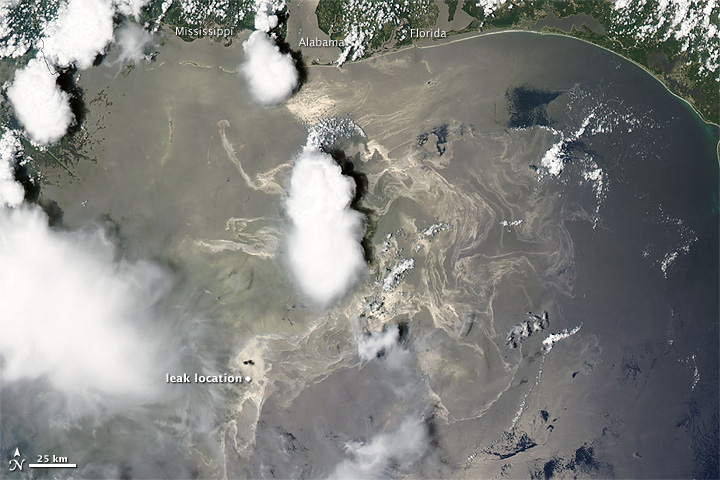
Breaking news:
New setback for administration on drilling curb: Judge denies request to stay order halting offshore drilling moratorium
posted by saulgoodman at 10:02 AM on June 24, 2010
New setback for administration on drilling curb: Judge denies request to stay order halting offshore drilling moratorium
posted by saulgoodman at 10:02 AM on June 24, 2010
NOAA has confirmed existence of large underwater Oil Plumes from the Deepwater Horizon spill with concentrations of oil in the range of 1 to 2 parts per million.
As noted elsewhere:
posted by saulgoodman at 10:49 AM on June 24, 2010
As noted elsewhere:
What's important to measure, Overton said, is the concentration of oil in the seawater. High concentrations of sub-surface oil have the effect of depleting oxygen, killing fish, microbes and other living things. "If it's parts per million, you are looking at a dead zone," Overton said. "If it's parts per billion then it's not so bad."In other words, we are probably now looking at a Dead Zone the size of the entire Gulf of Mexico.
posted by saulgoodman at 10:49 AM on June 24, 2010
we are probably now looking at a Dead Zone the size of the entire Gulf of Mexico.
it might not be possible to live next to that, even if one chose to try.
posted by kimyo at 12:10 PM on June 24, 2010
it might not be possible to live next to that, even if one chose to try.
posted by kimyo at 12:10 PM on June 24, 2010
BP's Next Disaster: The oil giant plans to start drilling in the Arctic this fall — and the Obama administration is doing nothing to stop it
posted by homunculus at 12:35 PM on June 24, 2010
posted by homunculus at 12:35 PM on June 24, 2010
Like I said on another thread, homunculus, what difference does it make? Right now, according to Judge Feldman, the administration has no authority to impose even an extremely circumspect moratorium on drilling in the Gulf. I can only imagine what legal challenges we could expect if we tried to stop a completely different kind of drilling operation, using different untested techniques, in a different part of the world.
The arctic project hasn't submitted a final plan yet for approval anyway, and the ProPublica reporting I read on it says the soonest any drilling is likely to start is Fall, so this operation is not about to start now; there's still plenty of time to scuttle it, if the courts will allow it. The relevant part is this:
I'm not sure this is really as big a deal yet as it's being hyped to be. There's no guarantee that the final application will be approved.
posted by saulgoodman at 2:08 PM on June 24, 2010
The arctic project hasn't submitted a final plan yet for approval anyway, and the ProPublica reporting I read on it says the soonest any drilling is likely to start is Fall, so this operation is not about to start now; there's still plenty of time to scuttle it, if the courts will allow it. The relevant part is this:
Drilling could begin as soon as the fall, assuming a final application is submitted by BP and approved by regulators.So there's still a final approval step pending, too.
I'm not sure this is really as big a deal yet as it's being hyped to be. There's no guarantee that the final application will be approved.
posted by saulgoodman at 2:08 PM on June 24, 2010
Here's an interesting find from over at KOS:
Bush administration reversed Clinton requirement to model deepwater spills
posted by saulgoodman at 2:10 PM on June 24, 2010
Bush administration reversed Clinton requirement to model deepwater spills
posted by saulgoodman at 2:10 PM on June 24, 2010
I don't know if this link (paywall protected) will come through, but per a National Law Journal article appearing in law.com today:
The judge who blocked the Obama administration's moratorium on deep-water oil drilling has a reputation as a stern jurist, but until now he has sparked little controversy during his 27-year judicial career.
With a reversal record since 2000 that is the second-lowest among the judges of the U.S. District Court for the Eastern District of Louisiana, Martin Feldman has navigated his position without much drama. Within the New Orleans legal community, the 1983 Reagan appointee has a reputation for demanding exactness and little tolerance for missteps from the attorneys who appear in his court.
And he doesn't get reversed a lot.
And on the good news side --- apparently besides appealing, the Obama administration also intends to re-enact its ban on drilling, in a way that addresses the judge's criticisms.
posted by bearwife at 2:44 PM on June 24, 2010
The judge who blocked the Obama administration's moratorium on deep-water oil drilling has a reputation as a stern jurist, but until now he has sparked little controversy during his 27-year judicial career.
With a reversal record since 2000 that is the second-lowest among the judges of the U.S. District Court for the Eastern District of Louisiana, Martin Feldman has navigated his position without much drama. Within the New Orleans legal community, the 1983 Reagan appointee has a reputation for demanding exactness and little tolerance for missteps from the attorneys who appear in his court.
And he doesn't get reversed a lot.
And on the good news side --- apparently besides appealing, the Obama administration also intends to re-enact its ban on drilling, in a way that addresses the judge's criticisms.
posted by bearwife at 2:44 PM on June 24, 2010
From a comment in a related thread that everyone should read and think about very carefully anytime these subjects come up:
Every two years or so, the United States Joint Forces Command publishes its “perspective on future trends, shocks, contexts and implications for… the national security field.” The latest version—the 2010 Joint Operating Environment (JOE) report [PDF] includes some rather disturbing precursors of impending doom.posted by saulgoodman at 8:45 PM on June 24, 2010
Like the 2008 version, it reiterates that “oil and coal will continue to drive the energy train” until 2030, though it warns that in order to do so, “the world would need to add roughly the equivalent of Saudi Arabia’s current production every seven years” (p. 24). Perhaps most significantly, the JOE includes a text box titled ‘Peak Oil,' which reads: “Assuming the most optimistic scenario for improved petroleum production through enhanced recovery means, the development of non-conventional oils (such as oil shales or tar sands) and new discoveries, petroleum production will be hard pressed to meet the expected future demand of 118 million barrels per day [in 2030].”
The JOE then warns, “A severe energy crunch is inevitable without a massive expansion of production and refining capacity” (p. 28) and emphasizes that “By 2012, surplus oil production capacity could entirely disappear, and as early as 2015, the shortfall in output could reach nearly 10 MBD”. (p.29) That's a 10 million barrel shortfall every day....within five years from now. Say it ain't so, JOE.
This claims in the report are consistent with other statements and reports issued over the past 18 months. A sampling:
Jeroen van de Veer, CEO of Shell: “Shell estimates that after 2015 supplies of easy-to-access oil and gas will no longer keep up with demand.”
Fatih Birol of the IEA: “From now to 2015, the market and the oil industry will be severely tested. In the next five to ten years, oil production from non-OPEC producers will reach a peak before starting to decline, for lack of sufficient reserves. As each day passes, new evidence of this fact appears. At the same time the peak of the economic expansion phase of China will take place. The two events will coincide: the explosion of the growth of the Chinese demand, and the fall in production of non-OPEC oil. Will our oil system be it able to answer this challenge, that is the question.”
I think I'll take...
...NPR's word for it...
and ..The Guardian's word for it...
...and the AP's word for it...
...over the word of a two-bit small town rag called the "bayou buzz," which begins it's story on the controversy with the unproven and specious assertion: "While many Americans undoubtedly agree with the decision of U.S. District Court Judge Martin Feldman to overturn the Obama administration’s moratorium on deep water drilling, not everyone is happy."
posted by saulgoodman at 8:58 PM on June 24, 2010 [1 favorite]
...NPR's word for it...
and ..The Guardian's word for it...
...and the AP's word for it...
...over the word of a two-bit small town rag called the "bayou buzz," which begins it's story on the controversy with the unproven and specious assertion: "While many Americans undoubtedly agree with the decision of U.S. District Court Judge Martin Feldman to overturn the Obama administration’s moratorium on deep water drilling, not everyone is happy."
posted by saulgoodman at 8:58 PM on June 24, 2010 [1 favorite]
Well, people live next to the Great Salt Lake in Utah, and that's to salty for anything but little brine shrimp and algae. You can live next to a "dead" Gulf.
living next to a dead sea is not the same as living next to a dying sea. it's not hurricane season in utah. the great salt lake is not brimming with toxins.
should gulf coast residents cover their air conditioners as storms approach? how do you clean a contaminated hvac system?
will oil-rain-slicked roadways be strewn with pile-ups? how will the highway departments cope with random road oilings?
Gulf Prepares for Possible Blackouts
this is getting to be the type of event wherein the people completely lose faith in their government.
posted by kimyo at 11:08 PM on June 24, 2010
living next to a dead sea is not the same as living next to a dying sea. it's not hurricane season in utah. the great salt lake is not brimming with toxins.
should gulf coast residents cover their air conditioners as storms approach? how do you clean a contaminated hvac system?
will oil-rain-slicked roadways be strewn with pile-ups? how will the highway departments cope with random road oilings?
Gulf Prepares for Possible Blackouts
this is getting to be the type of event wherein the people completely lose faith in their government.
posted by kimyo at 11:08 PM on June 24, 2010
Endangered sea turtles and other marine creatures are being corralled into 500 square-mile "burn fields" and burnt alive in operations intended to contain oil from BP's ruptured well in the Gulf of Mexico, the Obama administration confirmed today.
posted by homunculus at 1:44 PM on June 26, 2010
posted by homunculus at 1:44 PM on June 26, 2010
Beyond Prosecution: How the oil industry and Chamber of Commerce convinced La. lawmakers to go easy on BP.
posted by homunculus at 11:46 AM on June 30, 2010
posted by homunculus at 11:46 AM on June 30, 2010
Uniformed Cops on BP Payroll? Enter the ACLU
posted by homunculus at 11:47 AM on June 30, 2010 [1 favorite]
posted by homunculus at 11:47 AM on June 30, 2010 [1 favorite]
admiral thad allen, patriot, wishing america a happy independence day weekend:
Media, boaters could face criminal penalties by entering oil cleanup 'safety zone' (nola)
(story debunks an earlier rumor of gulf oil/dispersant related crop damage in tennessee)
BP Slick Covers Dolphins and Whales (latest john wathen overflight video)
Gulf air turns toxic after oil spill 'relief effort' (rt.com video)
posted by kimyo at 10:49 PM on July 1, 2010
Media, boaters could face criminal penalties by entering oil cleanup 'safety zone' (nola)
- The Coast Guard has put new restrictions in place across the Gulf Coast that prevent the public - including news photographers and reporters covering the BP oil spill - from coming within 65 feet of any response vessels or booms on the water or on beaches.
- ...violation of the "safety zone" rules can result in a civil penalty of up to $40,000, and could be classified as a Class D felony.
- The prominent US lawyer managing BP's 20-billion-dollar oil disaster fund said Wednesday not all claimants will be paid, especially some of those seeking compensation for falling houses prices.
- "There's not enough money in the world to pay every single small business that claims injury no matter where or when," Kenneth Feinberg told the House of Representatives Committee on Small Business.
- "You've got to decide in a principled way... and work out some definition in that regard," he said, while stating his determination to "pay every eligible claim."
- "There's no question that the property value has diminished as a result of the spill. That doesn't mean that every property is entitled to compensation," he said
- God only knows how many assets around the planet are dependent on credit and finance extended from BP. It is likely to dwarf any banking entity in multiples…. The price tag and resultant knock-on effects of a BP failure could easily be equal to that of a Lehman, if not more. It is surely, at the very least, Enron x10.”
- "That water can go completely anoxic [extremely low oxygen] and that is a pretty serious situation for any oxygen-requiring organism. We haven't seen zero-oxygen water but there is certainly enough gas in the water to draw oxygen down to zero," she said.
- "It could wreak havoc with those communities that require oxygen," Joye said, wiping out plankton and other organisms at the bottom of the food chain.
(story debunks an earlier rumor of gulf oil/dispersant related crop damage in tennessee)
BP Slick Covers Dolphins and Whales (latest john wathen overflight video)
Gulf air turns toxic after oil spill 'relief effort' (rt.com video)
posted by kimyo at 10:49 PM on July 1, 2010
BP Slick Covers Dolphins and Whales (latest john wathen overflight video)
New thread.
posted by homunculus at 12:56 AM on July 2, 2010
New thread.
posted by homunculus at 12:56 AM on July 2, 2010
Appeals court rejects U.S. request to restore drilling moratorium
Presidential commission unlikely to tackle deepwater drilling moratorium
posted by homunculus at 12:01 PM on July 9, 2010
Presidential commission unlikely to tackle deepwater drilling moratorium
posted by homunculus at 12:01 PM on July 9, 2010
« Older "Why is God making me paint her this way?" | The Ware Tetralogy Newer »
This thread has been archived and is closed to new comments
Once again, Obama made a rookie mistake by failing to declare the oil companies enemy combatants prior to exercising plenary executive authority over them.
posted by The Bellman at 11:58 AM on June 22, 2010 [20 favorites]