I'll Give You Stars and the Moon but not any sheet music
June 30, 2010 8:13 AM Subscribe
Theatre composer Jason Robert Brown (bio) tries to explain to a young fan why it’s wrong to download sheet music from the Internet for free. Via.
We are all better off when cultural artifacts are hoarded by the few and inaccessible to modification or the poor.
posted by DU at 8:28 AM on June 30, 2010 [47 favorites]
posted by DU at 8:28 AM on June 30, 2010 [47 favorites]
Metallica totally should have engaged in lengthy email discussions with each of their file-sharing fans instead of just closing Napster.
posted by 2bucksplus at 8:28 AM on June 30, 2010 [1 favorite]
posted by 2bucksplus at 8:28 AM on June 30, 2010 [1 favorite]
Interesting conversation, thanks for the post. It's a real shame though, that sheet music is typically poorly transcribed, overpriced, and sold through extremely user-unfriendly sites.
Give me a properly scored PDF I can download for $1.95 and my online sheet music expenditures would skyrocket.
posted by bowline at 8:28 AM on June 30, 2010 [16 favorites]
Give me a properly scored PDF I can download for $1.95 and my online sheet music expenditures would skyrocket.
posted by bowline at 8:28 AM on June 30, 2010 [16 favorites]
I don't have a problem with him wanting to protect his rights with regard to his sheet music, but his "examples" border on the insane.
His screwdriver story makes absolutely no sense whatsoever. Taking a screwdriver and not giving it back is theft, essentially. I once had a screwdriver; now my neighbor has a screwdriver, and I have no screwdriver. Shit sucks. But what's happening online with his sheet music is more akin to me having a screwdriver and then, instead of loaning it out physically copying it in some amazing 3D replicator and then giving it to my neighbor. Cue email chain from the screwdriver manufacturer telling me that I'm bankrupting them.
The Thornton Wilder story is even worse. He collects first editions of Thornton Wilder. He collects USED BOOKS. He is not supporting the Thornton Wilder estate unless he buys these books directly from the estate, he always buys new copies alongside his first editions, or he donates an appropriate amount to the estate every time he acquires a first edition.
posted by Sticherbeast at 8:29 AM on June 30, 2010 [15 favorites]
His screwdriver story makes absolutely no sense whatsoever. Taking a screwdriver and not giving it back is theft, essentially. I once had a screwdriver; now my neighbor has a screwdriver, and I have no screwdriver. Shit sucks. But what's happening online with his sheet music is more akin to me having a screwdriver and then, instead of loaning it out physically copying it in some amazing 3D replicator and then giving it to my neighbor. Cue email chain from the screwdriver manufacturer telling me that I'm bankrupting them.
The Thornton Wilder story is even worse. He collects first editions of Thornton Wilder. He collects USED BOOKS. He is not supporting the Thornton Wilder estate unless he buys these books directly from the estate, he always buys new copies alongside his first editions, or he donates an appropriate amount to the estate every time he acquires a first edition.
posted by Sticherbeast at 8:29 AM on June 30, 2010 [15 favorites]
The fan hits the nail on the head when she explains that "stealing" Brown's sheet music and performing it online, thus exposing his music to new fans, probably benefits Brown more than denying a fan access to the sheet music because she doesn't have access to a credit card.
Case in point :- I didn't know who Jason Robert Brown was before reading that exchange. I now know he's an obnoxious jerk.
posted by afx237vi at 8:30 AM on June 30, 2010 [47 favorites]
Case in point :- I didn't know who Jason Robert Brown was before reading that exchange. I now know he's an obnoxious jerk.
posted by afx237vi at 8:30 AM on June 30, 2010 [47 favorites]
Case in point :- I didn't know who Jason Robert Brown was before reading that exchange. I now know he's an obnoxious jerk.
People who insist on the use of all their given names statistically are more likely to be jerks.
posted by maxwelton at 8:36 AM on June 30, 2010 [15 favorites]
People who insist on the use of all their given names statistically are more likely to be jerks.
posted by maxwelton at 8:36 AM on June 30, 2010 [15 favorites]
pts: "Maybe he's making some good points, but he also said "arguing with teenagers is a zero-sum game," which does not mean what he thinks it means."
No he's right. See, when you argue with a person on the internet, only one of you can claim this ribbon at the end of the argument. So it's zero sum.
posted by mullingitover at 8:36 AM on June 30, 2010 [1 favorite]
No he's right. See, when you argue with a person on the internet, only one of you can claim this ribbon at the end of the argument. So it's zero sum.
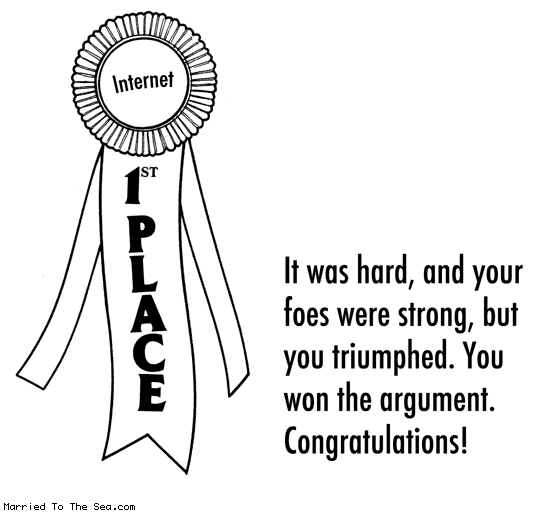
posted by mullingitover at 8:36 AM on June 30, 2010 [1 favorite]
Case in point :- I didn't know who Jason Robert Brown was before reading that exchange. I now know he's an obnoxious jerk.
Yeah, I'd never heard of him either. There's plenty of arguments to made against piracy but the ones he cooks up here and they way he goes about it makes Brown come over as some complete mentalist.
posted by fearfulsymmetry at 8:36 AM on June 30, 2010
Yeah, I'd never heard of him either. There's plenty of arguments to made against piracy but the ones he cooks up here and they way he goes about it makes Brown come over as some complete mentalist.
posted by fearfulsymmetry at 8:36 AM on June 30, 2010
People in theatre seem more likely to use more than 2 names, to avoid confusion with other similarly-named people. I imagine there was or is another Jason Brown out there somewhere.
posted by ThePinkSuperhero at 8:37 AM on June 30, 2010 [3 favorites]
posted by ThePinkSuperhero at 8:37 AM on June 30, 2010 [3 favorites]
I thought Brown was being really cool about the whole thing until I got to the "that's a stupid question" part of the exchange, and then things went rapidly downhill.
posted by Shepherd at 8:38 AM on June 30, 2010 [5 favorites]
posted by Shepherd at 8:38 AM on June 30, 2010 [5 favorites]
Is this a real conversation or just a collection of the canards promulgated by either side of the great filesharing debate since Metallica filed suit on Napster?
posted by Jakey at 8:39 AM on June 30, 2010 [2 favorites]
posted by Jakey at 8:39 AM on June 30, 2010 [2 favorites]
Well, that's a stupid question, Brenna.
Yeah I'm with Shephard, arguments about DRM aside, this is where he lost me.
posted by edbles at 8:39 AM on June 30, 2010
Yeah I'm with Shephard, arguments about DRM aside, this is where he lost me.
posted by edbles at 8:39 AM on June 30, 2010
I wouldn't say he's an obnoxious jerk for wanting to be compensated for his work. He may be an obnoxious jerk for other reasons, though, and it's probably good for him that he's in the music-writing business rather than, say, the analogy-constructing one.
posted by WalterMitty at 8:39 AM on June 30, 2010 [2 favorites]
posted by WalterMitty at 8:39 AM on June 30, 2010 [2 favorites]
He didn't want to teach her anything. He just wanted to be Right.
posted by Plutor at 8:41 AM on June 30, 2010 [17 favorites]
posted by Plutor at 8:41 AM on June 30, 2010 [17 favorites]
But I wasn't content to do it with just one user. I started systematically going through the pages, and eventually I wrote to about four hundred users.
Dude's got quite a bit of time on his hands, I see.
Well, that's a stupid question, Brenna.
That's tellin' the poor kid, composer guy! Wanting to expand her repertoire is exactly like wanting to go see a Broadway show.
posted by griphus at 8:43 AM on June 30, 2010 [1 favorite]
Dude's got quite a bit of time on his hands, I see.
Well, that's a stupid question, Brenna.
That's tellin' the poor kid, composer guy! Wanting to expand her repertoire is exactly like wanting to go see a Broadway show.
posted by griphus at 8:43 AM on June 30, 2010 [1 favorite]
Kudos for having his sheet music online and cheap, but the distribution site has some very serious usability problems.
The site requires a browser plugin to preview the score, that's fine, but youyou can only get the plugin if you submit your email address. Then (on a Mac) I get a dmg file I have to mount, then I have to run it. If it fails to run because I'm running a more current Mac, I apparently have to change Safari to run as 32-bit and not 64-bit.
It also says:
I'm sorry Jason Robert Brown, I have take away the kudos I initially gave you. Fire the idiots who currently sell your sheet music. They are not getting it done.
posted by artlung at 8:44 AM on June 30, 2010 [15 favorites]
The site requires a browser plugin to preview the score, that's fine, but youyou can only get the plugin if you submit your email address. Then (on a Mac) I get a dmg file I have to mount, then I have to run it. If it fails to run because I'm running a more current Mac, I apparently have to change Safari to run as 32-bit and not 64-bit.
It also says:
We advise you to check your printer setup now before you buy. You will only get one chance to print your music after you have purchased it. If you have difficulty printing, please see our print problems help pageDude, what? I'm buying it, to PRINT it, but if I screw up the printing I have to buy again?
I'm sorry Jason Robert Brown, I have take away the kudos I initially gave you. Fire the idiots who currently sell your sheet music. They are not getting it done.
posted by artlung at 8:44 AM on June 30, 2010 [15 favorites]
Give the poor guy a break. He's obviously a struggling musician trying to make ends meet while expressing himself through his art. Apparently his wife is a composer too, so they're probably making do in a little rent-controlled apartment in a shitty part of town and busking for spare change when they can. It's not like he's a rich privileged prick who just wants the plebs to give him more money for a solid gold backscratcher, right?
posted by rocket88 at 8:45 AM on June 30, 2010 [3 favorites]
posted by rocket88 at 8:45 AM on June 30, 2010 [3 favorites]
I like how ad-homs his correspondent ("because you're a teenager") and drops in three old-as-the-hills canards about how digital copying is just like physically stealing things and then doesn't show any further replies.
Stay classy composer dude.
posted by Happy Dave at 8:45 AM on June 30, 2010 [3 favorites]
Stay classy composer dude.
posted by Happy Dave at 8:45 AM on June 30, 2010 [3 favorites]
That was pretty entertaining. He should charge people to read it!
posted by XMLicious at 8:45 AM on June 30, 2010 [6 favorites]
posted by XMLicious at 8:45 AM on June 30, 2010 [6 favorites]
*Sorry, Shepherd. Now I get why people occasionally spell my id edibles.
posted by edbles at 8:46 AM on June 30, 2010
posted by edbles at 8:46 AM on June 30, 2010
The fan hits the nail on the head when she explains that "stealing" Brown's sheet music and performing it online, thus exposing his music to new fans, probably benefits Brown more than denying a fan access to the sheet music because she doesn't have access to a credit card.
I was sort of thinking this, too. Jason Robert Brown has a huge teen fanbase, a lot of whom don't live in NYC, who don't get to go see shows, and who don't have access to money or parents who will give it to them, but are still OBSESSED with anything and everything Broadway and will get there hands on whatever they can by whatever means necessary. I remember being that teen- those years sucked. He didn't seem to have any good way of addressing her point on not having access to money in the way that would help her pay for music online (i.e., a credit card).
posted by ThePinkSuperhero at 8:46 AM on June 30, 2010 [2 favorites]
I was sort of thinking this, too. Jason Robert Brown has a huge teen fanbase, a lot of whom don't live in NYC, who don't get to go see shows, and who don't have access to money or parents who will give it to them, but are still OBSESSED with anything and everything Broadway and will get there hands on whatever they can by whatever means necessary. I remember being that teen- those years sucked. He didn't seem to have any good way of addressing her point on not having access to money in the way that would help her pay for music online (i.e., a credit card).
posted by ThePinkSuperhero at 8:46 AM on June 30, 2010 [2 favorites]
I didn't know who Jason Robert Brown was before reading that exchange. I now know he's an obnoxious jerk.
Why, because he wants to earn a living from his hard work?
The fan hits the nail on the head when she explains that "stealing" Brown's sheet music and performing it online, thus exposing his music to new fans, probably benefits Brown more than denying a fan access to the sheet music
Not at all. This is the very sort of anecdotal horseshit propagated during the past fifteen years, as artists, publishing companies and record labels (both large and independent) find themselves going out of business as a result. An artist knows where his/her revenues come from – having someone attempt to legitimize their theft by outlining some insurmountable and totally hypothetical list of feasible benefits is absurd. Where does this sense of entitlement come from? If you truly appreciate someone’s art, for Godsake’s why wouldn’t you support the person who created it and help him/her continue making what you love?
posted by tiger yang at 8:47 AM on June 30, 2010 [12 favorites]
Why, because he wants to earn a living from his hard work?
The fan hits the nail on the head when she explains that "stealing" Brown's sheet music and performing it online, thus exposing his music to new fans, probably benefits Brown more than denying a fan access to the sheet music
Not at all. This is the very sort of anecdotal horseshit propagated during the past fifteen years, as artists, publishing companies and record labels (both large and independent) find themselves going out of business as a result. An artist knows where his/her revenues come from – having someone attempt to legitimize their theft by outlining some insurmountable and totally hypothetical list of feasible benefits is absurd. Where does this sense of entitlement come from? If you truly appreciate someone’s art, for Godsake’s why wouldn’t you support the person who created it and help him/her continue making what you love?
posted by tiger yang at 8:47 AM on June 30, 2010 [12 favorites]
He didn't seem to have any good way of addressing her point on not having access to money in the way that would help her pay for music online (i.e., a credit card).
He should have suggested the public library, if he allows his sheet music to be sold to public libraries. Library buys a legit copy of the sheet music, fan photocopies the song so that she can audition, problem solved.
posted by Sticherbeast at 8:50 AM on June 30, 2010
He should have suggested the public library, if he allows his sheet music to be sold to public libraries. Library buys a legit copy of the sheet music, fan photocopies the song so that she can audition, problem solved.
posted by Sticherbeast at 8:50 AM on June 30, 2010
Just curious, is sheet music normally not available at the local library?
posted by mullingitover at 8:51 AM on June 30, 2010 [2 favorites]
posted by mullingitover at 8:51 AM on June 30, 2010 [2 favorites]
I didn't know who Jason Robert Brown was before reading that exchange. I now know he's an obnoxious jerk.
Why, because he wants to earn a living from his hard work?
Uh, you read the post right? He would have had to try pretty hard to be more condescending. He actually congratulated her on spelling everything right ffs:
posted by Happy Dave at 8:51 AM on June 30, 2010 [8 favorites]
Why, because he wants to earn a living from his hard work?
Uh, you read the post right? He would have had to try pretty hard to be more condescending. He actually congratulated her on spelling everything right ffs:
I'm very much impressed by how passionately you've stood your ground, and how articulate you've been in doing so, and I can't tell you how excited I am that you didn't misspell anything, not once in this entire exchange. (Well, you wrote "you're" when you meant "your" once, but I'll let it go.)Regardless of who is right or wrong, his tone was resoundingly jerkish and condescending.
posted by Happy Dave at 8:51 AM on June 30, 2010 [8 favorites]
I quit reading this halfway through, but I'm going to guess this didn't come up. What he should say is this:
Dear Brenna/Eleanor,
Getting my sheet music for free = stealing, which means I don't make money from it, and that makes me sad. Please stop. But I realize that you're a teenager and you're going to do this anyway, unless you have another option that is still free. What you should do is go to your local public library or the library of a local college, if it's open to the public. They should have sheet music there. For free. Because it is a library. They may not have my music there, so ask the librarian what he/she can do for you. You may be able to get it through ILL, or they may even order it for their own collection. Now you and I can both get on with our lives, and I can stop arguing with some kid on the internet, which makes me look like a total cockbag.
Thanks,
J.
posted by phunniemee at 8:52 AM on June 30, 2010 [31 favorites]
Dear Brenna/Eleanor,
Getting my sheet music for free = stealing, which means I don't make money from it, and that makes me sad. Please stop. But I realize that you're a teenager and you're going to do this anyway, unless you have another option that is still free. What you should do is go to your local public library or the library of a local college, if it's open to the public. They should have sheet music there. For free. Because it is a library. They may not have my music there, so ask the librarian what he/she can do for you. You may be able to get it through ILL, or they may even order it for their own collection. Now you and I can both get on with our lives, and I can stop arguing with some kid on the internet, which makes me look like a total cockbag.
Thanks,
J.
posted by phunniemee at 8:52 AM on June 30, 2010 [31 favorites]
I quit reading this halfway through, but I'm going to guess this didn't come up.
Wrong:
If your parents really won't pony up the four bucks to buy a copy of the sheet music, then you can ask them to take you to the library and you can take out all the music you want, free, and pick the song you want to use for an audition or a talent show, and you can keep borrowing the book from the library until you're done with it or until the library demands it back. My song may not be in your library – you could ask them to get it from another library, through an interlibrary loan (this is common, standard library practice)
posted by ThePinkSuperhero at 8:53 AM on June 30, 2010 [6 favorites]
Wrong:
If your parents really won't pony up the four bucks to buy a copy of the sheet music, then you can ask them to take you to the library and you can take out all the music you want, free, and pick the song you want to use for an audition or a talent show, and you can keep borrowing the book from the library until you're done with it or until the library demands it back. My song may not be in your library – you could ask them to get it from another library, through an interlibrary loan (this is common, standard library practice)
posted by ThePinkSuperhero at 8:53 AM on June 30, 2010 [6 favorites]
Why, because he wants to earn a living from his hard work?
No, that part is fine. It's more because he's an obnoxious jerk.
posted by scrowdid at 8:54 AM on June 30, 2010 [2 favorites]
No, that part is fine. It's more because he's an obnoxious jerk.
posted by scrowdid at 8:54 AM on June 30, 2010 [2 favorites]
That's a lot of words spilt over four dollars.
posted by fantabulous timewaster at 8:55 AM on June 30, 2010
posted by fantabulous timewaster at 8:55 AM on June 30, 2010
I expected to side with him, but I sided with her, almost completely. She didn't come across as some dumb, amoral kid: She came across as sincere and game for discussion. He was belittling, dismissive, and patronizing in his tone. His version of what she should do if she couldn't buy the sheet music ("go the the library a billion times"/"perform something else") were simplistic, adult-to-kid solutions akin to "be nice to everyone and they'll have no reason to be mean to you." What if she had no transportation to the library? What if the sheet music she could attain for free was for songs that were inferior, and her audition went poorly because of that? Theater is a competitive thing--every little bit counts.
He promised to answer her question if she permitted him to post the correspondence on his website, she said yes, and then when she reminded him to answer her question, he got huffy and denied saying he'd answer her question.
I'm not saying downloading sheet music for free is awesome. But Jason Robert Brown comes off as a total dick here. He claims to be above arguing with a teenager, and then comes off looking awful having done so. I'm mystified that anyone could side with him after reading this exchange. The kind thing to do would have been to send Eleanor the sheet music she needed along with the lecture he decided she needed to hear. What is that $3.99 to him? What does he get for that, less than half? Would it really have been that onerous to do? He might have won her over that way, and she might have taken what he said seriously, because it would have come from someone who seemed like a decent guy and not a blowhard prick.
posted by millipede at 8:56 AM on June 30, 2010 [12 favorites]
He promised to answer her question if she permitted him to post the correspondence on his website, she said yes, and then when she reminded him to answer her question, he got huffy and denied saying he'd answer her question.
I'm not saying downloading sheet music for free is awesome. But Jason Robert Brown comes off as a total dick here. He claims to be above arguing with a teenager, and then comes off looking awful having done so. I'm mystified that anyone could side with him after reading this exchange. The kind thing to do would have been to send Eleanor the sheet music she needed along with the lecture he decided she needed to hear. What is that $3.99 to him? What does he get for that, less than half? Would it really have been that onerous to do? He might have won her over that way, and she might have taken what he said seriously, because it would have come from someone who seemed like a decent guy and not a blowhard prick.
posted by millipede at 8:56 AM on June 30, 2010 [12 favorites]
Aaaaand fail. Thanks, TPS. I'm glad he eventually got to that. Too bad he didn't say it first.
posted by phunniemee at 8:56 AM on June 30, 2010
posted by phunniemee at 8:56 AM on June 30, 2010
Why, because he wants to earn a living from his hard work?
No no no, he's not an obnoxious jerk for wanting to earn a living from his work. In fact that's a very admirable attitude. Truth be told I don't think he comes across as a real obnoxious jerk, it's just that his argument-making skills are maybe a little lacking in the relevance/ coherence department. Weird and not exactly relevant examples, sometimes, and I would have liked to see him give Brenna/ Eleanor the chance to reply to that last email instead of dismissing their argument as a 'zero-sum-game', but whatever.
But this is between a sheet-music composer and a stroppy theatre-loving teenager who thinks 'defiantly' is 'definitely', so it's not like we're going to be seeing particularly cogent arguments and innovative insights.
posted by WalterMitty at 8:56 AM on June 30, 2010
No no no, he's not an obnoxious jerk for wanting to earn a living from his work. In fact that's a very admirable attitude. Truth be told I don't think he comes across as a real obnoxious jerk, it's just that his argument-making skills are maybe a little lacking in the relevance/ coherence department. Weird and not exactly relevant examples, sometimes, and I would have liked to see him give Brenna/ Eleanor the chance to reply to that last email instead of dismissing their argument as a 'zero-sum-game', but whatever.
But this is between a sheet-music composer and a stroppy theatre-loving teenager who thinks 'defiantly' is 'definitely', so it's not like we're going to be seeing particularly cogent arguments and innovative insights.
posted by WalterMitty at 8:56 AM on June 30, 2010
>> I didn't know who Jason Robert Brown was before reading that exchange. I now know he's an obnoxious jerk.
> Why, because he wants to earn a living from his hard work?
No, because of the smug and patronising tone he employed throughout the entire exchange.
posted by afx237vi at 8:56 AM on June 30, 2010
> Why, because he wants to earn a living from his hard work?
No, because of the smug and patronising tone he employed throughout the entire exchange.
posted by afx237vi at 8:56 AM on June 30, 2010
Derp, I missed the bit about the library as well. A shame, because that's the logical solution to all of this.
That's what I get for skimming his jeremiad. At least I got to see the thrilling back and forth about whether she should be called Brenna or Eleanor, though.
posted by Sticherbeast at 8:56 AM on June 30, 2010
That's what I get for skimming his jeremiad. At least I got to see the thrilling back and forth about whether she should be called Brenna or Eleanor, though.
posted by Sticherbeast at 8:56 AM on June 30, 2010
XMLicious "That was pretty entertaining. He should charge people to read it!"
Great idea, but he would have to share the income withBrenna Eleanor, so that's that.
posted by omegar at 8:59 AM on June 30, 2010
Great idea, but he would have to share the income with
posted by omegar at 8:59 AM on June 30, 2010
So there are websites where people offer to "trade" PDF files of sheet music? Why pretend that there's any sort of exchange of a unique product? It's essentially a clunky form of torrenting.
That is kind of strange, it's more like the old tape-trading communities than most modern file-sharing setups. Aside from general public trackers, I know there is at least one private torrent tracker dedicated to sheet music specifically. I would think most non-torrent sheet music sites would use DDL links. The fact that he emailed all of the individual traders is kind of crazy, most small niche communities like that will voluntarily ban certain works from being traded if the rights holder complains.
posted by burnmp3s at 9:00 AM on June 30, 2010
That is kind of strange, it's more like the old tape-trading communities than most modern file-sharing setups. Aside from general public trackers, I know there is at least one private torrent tracker dedicated to sheet music specifically. I would think most non-torrent sheet music sites would use DDL links. The fact that he emailed all of the individual traders is kind of crazy, most small niche communities like that will voluntarily ban certain works from being traded if the rights holder complains.
posted by burnmp3s at 9:00 AM on June 30, 2010
The entire record business is in free-fall because people no longer feel the moral responsibility to buy music.
Mister Brown, I'd like you to meet my friends Steve Albini, Thom Yorke and Trent Reznor. They'd like to have a conversation with you about the music industry.
posted by griphus at 9:00 AM on June 30, 2010 [4 favorites]
Mister Brown, I'd like you to meet my friends Steve Albini, Thom Yorke and Trent Reznor. They'd like to have a conversation with you about the music industry.
posted by griphus at 9:00 AM on June 30, 2010 [4 favorites]
(Also, the whole Brenna/Eleanor thing seemed astoundingly passive aggressive -- like "you're a teenager, therefore how you would like to be addressed is totally irrelevant!" Yeesh. It's not like she asked to be called Miss Fawntelina, Queen of the Observable Universe.)
posted by en forme de poire at 9:01 AM on June 30, 2010 [5 favorites]
posted by en forme de poire at 9:01 AM on June 30, 2010 [5 favorites]
Most public libraries have very small sheet music collections (Wake County Public Library in NC has nothing by JRB; Cincinnati does, Brooklyn does, Phoenix has some CDs but no sheet music.) There's ILL, and there are college libraries, but it's a bit of a glib answer for a kid whose parents don't support her interest in theater.
posted by Jeanne at 9:01 AM on June 30, 2010 [2 favorites]
posted by Jeanne at 9:01 AM on June 30, 2010 [2 favorites]
Do libraries pay recurring costs for such material or a one-time cost? If the latter, how does it benefit the composer if she gets it at the library as compared to an illicit download. Either the library already has it or they'll borrow it from another one that does.
posted by daksya at 9:04 AM on June 30, 2010 [1 favorite]
posted by daksya at 9:04 AM on June 30, 2010 [1 favorite]
and you can keep borrowing the book from the library until you're done with it or until the library demands it back. My song may not be in your library – you could ask them to get it from another library, through an interlibrary loan (this is common, standard library practice)
Or you can just download the damn thing and not use 19th century technology.
posted by geoff. at 9:05 AM on June 30, 2010 [7 favorites]
Or you can just download the damn thing and not use 19th century technology.
posted by geoff. at 9:05 AM on June 30, 2010 [7 favorites]
He'd probably end up making more money from the sheet music if it was available to download for free from his website with a donation link.
posted by Elmore at 9:06 AM on June 30, 2010 [3 favorites]
posted by Elmore at 9:06 AM on June 30, 2010 [3 favorites]
TL;DNR:
Music writer: "YOUR WORLD SCARES ME."
posted by Threeway Handshake at 9:06 AM on June 30, 2010 [5 favorites]
Music writer: "YOUR WORLD SCARES ME."
posted by Threeway Handshake at 9:06 AM on June 30, 2010 [5 favorites]
The funny thing is that anyone who has heard the story of how Brown ripped off his wife's (now ex-wife's) personal life and story to "write" his musical "The Last Five Years" knows he's both an obnoxious jerk and someone who, ironically, doesn't respect other people's stuff! (He got sued and had to change his show.)
posted by Asparagirl at 9:07 AM on June 30, 2010 [25 favorites]
posted by Asparagirl at 9:07 AM on June 30, 2010 [25 favorites]
Unfrozen caveman composer
posted by 2bucksplus at 9:08 AM on June 30, 2010 [7 favorites]
posted by 2bucksplus at 9:08 AM on June 30, 2010 [7 favorites]
Library buys a legit copy of the sheet music, fan photocopies the song so that she can audition, problem solved.
If she's photocopying a library book, wouldn't that also violate the copyright in the same way as downloading a copy from the internet?
posted by ThePinkSuperhero at 9:08 AM on June 30, 2010 [2 favorites]
If she's photocopying a library book, wouldn't that also violate the copyright in the same way as downloading a copy from the internet?
posted by ThePinkSuperhero at 9:08 AM on June 30, 2010 [2 favorites]
There's also something weird about telling her to ILL the sheet music from a public library. Are the practical consequences of getting something by ILL all that different from downloading a copy? It's just slower and mediated by a human. It's not like the author gets paid royalties every time someone checks out a book. I guess there's some upper limit to how many people could have the music at once, but when you factor in ILL that number is probably hilariously large.
On preview, more or less what geoff. and daksya said.
posted by en forme de poire at 9:09 AM on June 30, 2010 [2 favorites]
On preview, more or less what geoff. and daksya said.
posted by en forme de poire at 9:09 AM on June 30, 2010 [2 favorites]
Maybe he's making some good points, but he also said "arguing with teenagers is a zero-sum game," which does not mean what he thinks it means.
Hi. I think you should probably go read up on the subject before making statements like that. JRB did use the term correctly, to indicate a situation where one person's gain necessarily resulted in the other person's loss. In particular, he noted that the overly defensive position of making "anyone who corrects you or tries to educate you otherwise [into] the enemy" makes cooperative results difficult or impossible. This is precisely what zero-sum means: a situation where cooperation for mutual gain (or costless unilateral gain) is impossible, such that no pareto efficient transfer can occur. What on earth do YOU think it means?
posted by thesmophoron at 9:09 AM on June 30, 2010 [3 favorites]
Hi. I think you should probably go read up on the subject before making statements like that. JRB did use the term correctly, to indicate a situation where one person's gain necessarily resulted in the other person's loss. In particular, he noted that the overly defensive position of making "anyone who corrects you or tries to educate you otherwise [into] the enemy" makes cooperative results difficult or impossible. This is precisely what zero-sum means: a situation where cooperation for mutual gain (or costless unilateral gain) is impossible, such that no pareto efficient transfer can occur. What on earth do YOU think it means?
posted by thesmophoron at 9:09 AM on June 30, 2010 [3 favorites]
Why is everyone blaming Brown for being the bad guy here? Sure, he wasn't as tactful as he could have been, but 99% of arguments about illegal downloading end in a stalemate. He had good intentions and went about it in a friendly way. Would you have preferred him to file a lawsuit or something?
posted by reductiondesign at 9:10 AM on June 30, 2010
posted by reductiondesign at 9:10 AM on June 30, 2010
The funny thing is that anyone who has heard the story of how Brown ripped off his wife's (now ex-wife's) personal life and story to "write" his musical "The Last Five Years" knows he's both an obnoxious jerk and someone who, ironically, doesn't respect other people's stuff! (He got sued and had to change his show.)
Can't believe I forgot that! More info: (In fact, O'Neill protested that the depiction of the couple's tempestuous relationship in "The Last Five Years" violated the terms of their divorce agreement, and she eventually filed a lawsuit. Brown subsequently took pains to differentiate Cathy from O'Neill, and the matter was settled just before the show's New York premiere.)
posted by ThePinkSuperhero at 9:10 AM on June 30, 2010 [4 favorites]
Can't believe I forgot that! More info: (In fact, O'Neill protested that the depiction of the couple's tempestuous relationship in "The Last Five Years" violated the terms of their divorce agreement, and she eventually filed a lawsuit. Brown subsequently took pains to differentiate Cathy from O'Neill, and the matter was settled just before the show's New York premiere.)
posted by ThePinkSuperhero at 9:10 AM on June 30, 2010 [4 favorites]
I got the sense she was still taking theater classes, so photocopying at a public library for a class would be "fair use" in absolutely every way.
posted by artlung at 9:11 AM on June 30, 2010
posted by artlung at 9:11 AM on June 30, 2010
He's not a jerk because of how he handles this interchange, or because he wants to earn a living from his composing. He's a jerk BECAUSE he makes a living from his composing. Get in a cube with the rest of us, there, happy guy! Quit shaking my cage!
posted by dirtdirt at 9:11 AM on June 30, 2010 [1 favorite]
posted by dirtdirt at 9:11 AM on June 30, 2010 [1 favorite]
Jason Robert Brown thinks arguing with teenagers is a zero-sum game.
He's right.
He just lost.
He turned this teenager into a lifelong enemy.
From here on out, anytime this teenager thinks of Jason Robert Brown and/or hears this music, she'll remember this exchange and tell people about it. Endlessly.
Way to go, Mr. Brown. Way to go.
posted by Cool Papa Bell at 9:12 AM on June 30, 2010 [11 favorites]
He's right.
He just lost.
He turned this teenager into a lifelong enemy.
From here on out, anytime this teenager thinks of Jason Robert Brown and/or hears this music, she'll remember this exchange and tell people about it. Endlessly.
Way to go, Mr. Brown. Way to go.
posted by Cool Papa Bell at 9:12 AM on June 30, 2010 [11 favorites]
He had good intentions and went about it in a friendly way.
You must have some shitty friends.
posted by enn at 9:13 AM on June 30, 2010 [5 favorites]
You must have some shitty friends.
posted by enn at 9:13 AM on June 30, 2010 [5 favorites]
Well that's a stupid question, Brenna
ATTENTION, EVERYONE! Go out and steal as much as this guy's music as you can.
posted by MattMangels at 9:13 AM on June 30, 2010 [3 favorites]
ATTENTION, EVERYONE! Go out and steal as much as this guy's music as you can.
posted by MattMangels at 9:13 AM on June 30, 2010 [3 favorites]
So this kid can get the fucking music for less than 2 Happy Meals but since her parents are assholes, she needs to steal. And you guys think he's being the jerk? He seems remarkably restrained. Basically his intellectual property, which translates into his mortgage payment, tires for his car, or college tuition, is being handed around the web like a roofied barfly.
This may just be a generational issue, but I hope all of you that subscribe to the "information wants to be free" camp someday get to experience your livelihood take a hit because society's intractable laziness and dishonesty happens to train its sights on you.
posted by docpops at 9:14 AM on June 30, 2010 [5 favorites]
This may just be a generational issue, but I hope all of you that subscribe to the "information wants to be free" camp someday get to experience your livelihood take a hit because society's intractable laziness and dishonesty happens to train its sights on you.
posted by docpops at 9:14 AM on June 30, 2010 [5 favorites]
rocket88: He's probably not rich, but he's definitely got clout in the theatre community — he's a Tony winner and has written multiple shows that have made it to Broadway and even more Off-Broadway.
I think it's worth noting that "trading" in the Broadway community is something of an unacknowledged phenomenon and has been occurring for decades. It's part of the nature of the beast — Broadway shows generally stay in New York City, so people outside NYC who love theatre (but can't get to the city) crave anything they can get their hands on about the latest productions. For years, copies of scores, audio recordings of shows, and even video bootlegs were traded around on tapes, third-generation VHSs, etc.
With the advent of the internet though, it all became a bit more visible — now you find DVD rips, audio bootlegs, and PDF scans populating the sharing sites. Search Megadownload for "Phantom of the Opera" for example — you'll find a copy of the score, audio bootlegs from Broadway and the West End, audio in Chinese and Dutch, video bootlegs, and stuff related to the film adaptation too.
Now the business-savvy MeFis out there might say "well why not make this stuff more readily available? Clearly people want to see it - so sell video (and audio) of each performance for a dollar or two. Maybe stream performances live like the National Theatre in London! Sell the EXACT score as a PDF download, not a terribly reduced version. In fact, sell the official scans, and offer a version [as most of these are] with composer or musical director's notes right on them from the original production and give them some cheesy name like 'archival edition'!"
Unfortunately, it's not that easy. Entertainment unions in New York City are incredibly powerful (not unfairly so) and demand big cuts, preventing this type of thing from happening regularly. Even a marketing promotion as simple as filming the on-stage dance at the end of the revival of Hair (the audience was allowed on stage at the end to join in a dance party — producers wanted to film it and post each night online so fans wouldn't bootleg it) could only come to be as a result of coordination between several different guilds and unions.
Ultimately though it limits how producers can generate profit, and I think everyone ends up hurting a little more in the end. As a consequence these works go on unsold and traded, and everyone (except Mr. Brown) continues to pretend to remain blissfully unaware of this seedy underworld where it all takes place.
But in reality, everyone knows about it, a lot of people partake in it (how else do you get to hear Bernstein and Lerner's failed musical 1600 Pennsylvania Avenue?). It's theatre's (unofficial) method of time- and place-shifting.
You may also be interested in his argument about why you should only produce his shows if you have a great pianist.
posted by cvp at 9:14 AM on June 30, 2010 [3 favorites]
I think it's worth noting that "trading" in the Broadway community is something of an unacknowledged phenomenon and has been occurring for decades. It's part of the nature of the beast — Broadway shows generally stay in New York City, so people outside NYC who love theatre (but can't get to the city) crave anything they can get their hands on about the latest productions. For years, copies of scores, audio recordings of shows, and even video bootlegs were traded around on tapes, third-generation VHSs, etc.
With the advent of the internet though, it all became a bit more visible — now you find DVD rips, audio bootlegs, and PDF scans populating the sharing sites. Search Megadownload for "Phantom of the Opera" for example — you'll find a copy of the score, audio bootlegs from Broadway and the West End, audio in Chinese and Dutch, video bootlegs, and stuff related to the film adaptation too.
Now the business-savvy MeFis out there might say "well why not make this stuff more readily available? Clearly people want to see it - so sell video (and audio) of each performance for a dollar or two. Maybe stream performances live like the National Theatre in London! Sell the EXACT score as a PDF download, not a terribly reduced version. In fact, sell the official scans, and offer a version [as most of these are] with composer or musical director's notes right on them from the original production and give them some cheesy name like 'archival edition'!"
Unfortunately, it's not that easy. Entertainment unions in New York City are incredibly powerful (not unfairly so) and demand big cuts, preventing this type of thing from happening regularly. Even a marketing promotion as simple as filming the on-stage dance at the end of the revival of Hair (the audience was allowed on stage at the end to join in a dance party — producers wanted to film it and post each night online so fans wouldn't bootleg it) could only come to be as a result of coordination between several different guilds and unions.
Ultimately though it limits how producers can generate profit, and I think everyone ends up hurting a little more in the end. As a consequence these works go on unsold and traded, and everyone (except Mr. Brown) continues to pretend to remain blissfully unaware of this seedy underworld where it all takes place.
But in reality, everyone knows about it, a lot of people partake in it (how else do you get to hear Bernstein and Lerner's failed musical 1600 Pennsylvania Avenue?). It's theatre's (unofficial) method of time- and place-shifting.
You may also be interested in his argument about why you should only produce his shows if you have a great pianist.
posted by cvp at 9:14 AM on June 30, 2010 [3 favorites]
Here is a list of things he said that set off my troll alarms.
You're getting an email from my actual email address, I don't know what else would convince you, but I can assure you that I really would like you to stop trading my songs online.
Like she knows what your e-mail address is. Make a post about this venture, point her to your blog, that’s proof.
Well, that's a stupid question, Brenna.
Yeah that’s a good faith approach right there. We should put that in the FAQ as a model on how to disagree with people on the internet, politely!
Eleanor asks: You know, you never actually answered my original question. Why are you doing this?
followed by a digression into theater love and support huggyness.
Brenna,
How are you supporting me by stealing my song off the Internet? Why are you entitled to get the sheet music for free?
J.
Note the continuing to use the name, she specifically asked him not to use if he was going to post this publicly. Because she’s some stupid teenager who’s stealing his music
What question of yours did I avoid answering? If the question is "Why am I doing this?"
Seriously, Dude? What other question has she asked? Other than “hey are you real? Because it doesn’t seem logical to me that respected famous theater composers would waste their time arguing with teenagers on the internet.”
I should think the answer is obvious: I think it's annoying and obnoxious that people think they're entitled to get the sheet music to my songs for free, and I'd like to make those people (you, for example) conscious of the immorality, illegality, and unfairness of their behavior.
He’s pulling out his word dick guys. It’s such a fancy word dick! It’s real big!
And your answer is sophistry, Brenna.
Word dick! It’s back! I had missed it. I thought it was leaving forever. He’s also continuing to use the name she specifically asked him not to use.
The sad part is that if he had come from a good faith argument place she might have been open to listening. He’s famous, she respects him and she’s not responding to his attempts to bait her as much as you would expect a teenager to.
Also his comment section is disgustingly fawning. I don’t know if he’s censoring or just isn’t getting that much non-fan traffic.
posted by edbles at 9:14 AM on June 30, 2010 [6 favorites]
You're getting an email from my actual email address, I don't know what else would convince you, but I can assure you that I really would like you to stop trading my songs online.
Like she knows what your e-mail address is. Make a post about this venture, point her to your blog, that’s proof.
Well, that's a stupid question, Brenna.
Yeah that’s a good faith approach right there. We should put that in the FAQ as a model on how to disagree with people on the internet, politely!
Eleanor asks: You know, you never actually answered my original question. Why are you doing this?
followed by a digression into theater love and support huggyness.
Brenna,
How are you supporting me by stealing my song off the Internet? Why are you entitled to get the sheet music for free?
J.
Note the continuing to use the name, she specifically asked him not to use if he was going to post this publicly. Because she’s some stupid teenager who’s stealing his music
What question of yours did I avoid answering? If the question is "Why am I doing this?"
Seriously, Dude? What other question has she asked? Other than “hey are you real? Because it doesn’t seem logical to me that respected famous theater composers would waste their time arguing with teenagers on the internet.”
I should think the answer is obvious: I think it's annoying and obnoxious that people think they're entitled to get the sheet music to my songs for free, and I'd like to make those people (you, for example) conscious of the immorality, illegality, and unfairness of their behavior.
He’s pulling out his word dick guys. It’s such a fancy word dick! It’s real big!
And your answer is sophistry, Brenna.
Word dick! It’s back! I had missed it. I thought it was leaving forever. He’s also continuing to use the name she specifically asked him not to use.
The sad part is that if he had come from a good faith argument place she might have been open to listening. He’s famous, she respects him and she’s not responding to his attempts to bait her as much as you would expect a teenager to.
Also his comment section is disgustingly fawning. I don’t know if he’s censoring or just isn’t getting that much non-fan traffic.
posted by edbles at 9:14 AM on June 30, 2010 [6 favorites]
Get in a cube with the rest of us, there, happy guy!
I would hesitate to call someone who has that sort of exchange with a teenager after sending out 400 "get off my lawn" emails a "happy guy."
posted by griphus at 9:16 AM on June 30, 2010 [1 favorite]
I would hesitate to call someone who has that sort of exchange with a teenager after sending out 400 "get off my lawn" emails a "happy guy."
posted by griphus at 9:16 AM on June 30, 2010 [1 favorite]
... having someone attempt to legitimize their theft by outlining some insurmountable and totally hypothetical list of feasible benefits is absurd. Where does this sense of entitlement come from?
My guess is that it's from the numerous studies showing that the frequent downloaders end up buying more music than non-frequent downloaders.
posted by Cool Papa Bell at 9:16 AM on June 30, 2010 [4 favorites]
My guess is that it's from the numerous studies showing that the frequent downloaders end up buying more music than non-frequent downloaders.
posted by Cool Papa Bell at 9:16 AM on June 30, 2010 [4 favorites]
In terms of promulgating his (or any) music across the culture, and possibly allowing it to last after he's gone, there is every reason to make his sheet music freely available.
In terms of protecting his revenue stream, sure, I can see why he wouldn't want to.
In terms of the utility of trying to prevent the widespread sharing of .pdf files, he might as well spend his time building a time machine and go back to the pre-computer age. Though he'd probably be dismayed by how much sheet music was pirated via printing press then, too.
posted by emjaybee at 9:18 AM on June 30, 2010 [2 favorites]
In terms of protecting his revenue stream, sure, I can see why he wouldn't want to.
In terms of the utility of trying to prevent the widespread sharing of .pdf files, he might as well spend his time building a time machine and go back to the pre-computer age. Though he'd probably be dismayed by how much sheet music was pirated via printing press then, too.
posted by emjaybee at 9:18 AM on June 30, 2010 [2 favorites]
It's interesting that no one has yet pointed out her completely backwards use of the "starving artist" concept—not even the composer himself:
[...] then I assume you know that Parade, Last Five Years, 13 The Musical, etc. are all genius pieces of work and that a lot of people who would love to have that sheet music can't afford it. Thus the term "starving artist." Performers really need quick and easy ways to attain good sheet music and you're stopping a lot of people from getting what they need.
The reason artists starve is because nobody will buy their work. That's the origin of the phrase. It is not about theater people not being able to afford sheet music, c'mon.
posted by interrobang at 9:18 AM on June 30, 2010 [1 favorite]
[...] then I assume you know that Parade, Last Five Years, 13 The Musical, etc. are all genius pieces of work and that a lot of people who would love to have that sheet music can't afford it. Thus the term "starving artist." Performers really need quick and easy ways to attain good sheet music and you're stopping a lot of people from getting what they need.
The reason artists starve is because nobody will buy their work. That's the origin of the phrase. It is not about theater people not being able to afford sheet music, c'mon.
posted by interrobang at 9:18 AM on June 30, 2010 [1 favorite]
You may also be interested in his argument about why you should only produce his shows if you have a great pianist.
That was interesting, thanks for the link.
posted by ThePinkSuperhero at 9:19 AM on June 30, 2010
That was interesting, thanks for the link.
posted by ThePinkSuperhero at 9:19 AM on June 30, 2010
While I probably think it's better for people to purchase sheet music than to find methods of getting it for free (I studied piano and played string bass for years, so I'm aware of the expense involved), looking at JRB's bio tells me that he's probably making quite a good living off his work, what with all the Tony awards and nominations, and the royalties he's paid for each and every performance of any work he's been involved with. Anyone who can afford to live in LA AND Italy isn't really hurting that bad.
posted by hippybear at 9:21 AM on June 30, 2010 [1 favorite]
posted by hippybear at 9:21 AM on June 30, 2010 [1 favorite]
Also, the people in this thread decrying his arguments as demonstrative of poor reasoning skills are truly baffling. Let me take one example:
His screwdriver story makes absolutely no sense whatsoever. Taking a screwdriver and not giving it back is theft, essentially. I once had a screwdriver; now my neighbor has a screwdriver, and I have no screwdriver. Shit sucks. But what's happening online with his sheet music is more akin to me having a screwdriver and then, instead of loaning it out physically copying it in some amazing 3D replicator and then giving it to my neighbor. Cue email chain from the screwdriver manufacturer telling me that I'm bankrupting them.
This is exactly wrong. The analogy he drew was not to his neighbor and the screwdriver manufacturer, but to the neighbor and to himself, the screwdriver owner; nor is the real situation that JRB is the trader of sheet music, but rather the creator. So the supply-chains are disanalogous. However, this analogy isn't about supply chains. They're about economic position. And the economic positions of the neighbor and the composer are quite analogous: They have invested resources (time, money) into an asset (a screwdriver, copyright of sheet music) out of which they expect a certain utility (being able to screw things, being able to sell sheet music exclusively); yet a person with whom they have an expectation of fair dealing (the neighbor, a customer) now wants to deprive them of the certain utility (being able to screw things, being able to sell sheet music exclusively) for the person's own benefit (building the rest of the house, free sheet music for trade).
Now, you may disagree that the free sheet music actually impacts the market for sheet music. It is in fact possible that the analogy is ultimately incorrect. However, assuming - as most people do and JRB definitely does - that it interferes with the market for his exclusive rights regarding sale of sheet music, it is emphatically correct; and the analogy is well-constructed, whether ultimately factually correct or incorrect.
posted by thesmophoron at 9:23 AM on June 30, 2010 [4 favorites]
His screwdriver story makes absolutely no sense whatsoever. Taking a screwdriver and not giving it back is theft, essentially. I once had a screwdriver; now my neighbor has a screwdriver, and I have no screwdriver. Shit sucks. But what's happening online with his sheet music is more akin to me having a screwdriver and then, instead of loaning it out physically copying it in some amazing 3D replicator and then giving it to my neighbor. Cue email chain from the screwdriver manufacturer telling me that I'm bankrupting them.
This is exactly wrong. The analogy he drew was not to his neighbor and the screwdriver manufacturer, but to the neighbor and to himself, the screwdriver owner; nor is the real situation that JRB is the trader of sheet music, but rather the creator. So the supply-chains are disanalogous. However, this analogy isn't about supply chains. They're about economic position. And the economic positions of the neighbor and the composer are quite analogous: They have invested resources (time, money) into an asset (a screwdriver, copyright of sheet music) out of which they expect a certain utility (being able to screw things, being able to sell sheet music exclusively); yet a person with whom they have an expectation of fair dealing (the neighbor, a customer) now wants to deprive them of the certain utility (being able to screw things, being able to sell sheet music exclusively) for the person's own benefit (building the rest of the house, free sheet music for trade).
Now, you may disagree that the free sheet music actually impacts the market for sheet music. It is in fact possible that the analogy is ultimately incorrect. However, assuming - as most people do and JRB definitely does - that it interferes with the market for his exclusive rights regarding sale of sheet music, it is emphatically correct; and the analogy is well-constructed, whether ultimately factually correct or incorrect.
posted by thesmophoron at 9:23 AM on June 30, 2010 [4 favorites]
The issue of transcribing (mentioned in the comments of the discussion) is an interesting one. Brown suggests that transcribing his music is fine, so long as you don't sell it, or distribute it.
I wonder if the tradeoffs between ease of distribution (selling pdfs and directly profiting), compared to selling physical sheet music from through a publisher who takes a cut, come close to balancing each other out.
posted by a womble is an active kind of sloth at 9:24 AM on June 30, 2010
I wonder if the tradeoffs between ease of distribution (selling pdfs and directly profiting), compared to selling physical sheet music from through a publisher who takes a cut, come close to balancing each other out.
posted by a womble is an active kind of sloth at 9:24 AM on June 30, 2010
The kind thing to do would have been to send Eleanor the sheet music she needed along with the lecture he decided she needed to hear.
I couldn't believe the story didn't end with him buying her the music or sending it to her for free.
Stay classy, JRB.
posted by mrgrimm at 9:24 AM on June 30, 2010 [1 favorite]
I couldn't believe the story didn't end with him buying her the music or sending it to her for free.
Stay classy, JRB.
posted by mrgrimm at 9:24 AM on June 30, 2010 [1 favorite]
Great idea, but he would have to share the income with Eleanor, so that's that.
I know, I was just kidding.
He was a jerk in some ways, and he's probably a rich dweeb, but what about her? She was just totally clueless and self-centered. That was like talking to a doorknob. I'm kinda surprised that the harshest thing he said was "That's a stupid question" when she basically sent an email saying "gimme gimme gimme" to him.
The difference is that it's forgivable on her part, especially if she's eleven or something (teenaged seems like a generous estimate to me) but man, it sounds like some of you are reading this and seeing him as the unusually selfish one. I totally don't believe in intellectual property and I can't see it that way. (Possibly because I knew that none of the stuff he said was going to literally make sense anyways and would just be unnecessarily complicated ways of saying "successful artists should be compensated for their creative efforts by the society that benefits from their work", so from the outset I expected what he said to basically gibberish tweaked slightly to try to sound nice and persuasive.)
Yeah he wasn't trying to see it from her point of view much... because she was a doorknob. It doesn't seem to me like the kind of situation in which he was obligated to be really nurturing or anything but he was basically polite and undemanding considering what he was trying to communicate with her being unable to see past her own nose.
posted by XMLicious at 9:26 AM on June 30, 2010
JRB from the comments section. As I said when I started, I'm not up to debating experts on these subjects, and I know that you deal academically and professionally in exactly this debate, so I'm going to bow out now and let someone else take over if they'd like.
If you're not debating then subject or educating yourself and anyone else on it what are you doing other than trolling a teenager on a low rent low volume pseudotorrent site?
posted by edbles at 9:29 AM on June 30, 2010 [4 favorites]
If you're not debating then subject or educating yourself and anyone else on it what are you doing other than trolling a teenager on a low rent low volume pseudotorrent site?
posted by edbles at 9:29 AM on June 30, 2010 [4 favorites]
I couldn't believe the story didn't end with him buying her the music or sending it to her for free.
Yeah. Because if you're trying to stop someone from stealing your stuff, giving it to them for nothing is totally the solution.
posted by Kit W at 9:29 AM on June 30, 2010 [1 favorite]
Yeah. Because if you're trying to stop someone from stealing your stuff, giving it to them for nothing is totally the solution.
posted by Kit W at 9:29 AM on June 30, 2010 [1 favorite]
JRB is also well known in the theatre community recently for defending the young writer's right to get paid fairly.
posted by roomthreeseventeen at 9:29 AM on June 30, 2010
posted by roomthreeseventeen at 9:29 AM on June 30, 2010
Reading this makes me hate adults. Even more.
posted by educatedslacker at 9:30 AM on June 30, 2010
posted by educatedslacker at 9:30 AM on June 30, 2010
It's hard to believe there is any money in selling sheet music. There are always going to be far fewer performers than consumers.
posted by smackfu at 9:31 AM on June 30, 2010
posted by smackfu at 9:31 AM on June 30, 2010
Would it be wrong for me to make a copy of some sheet music and give it to a close friend of mine for an audition?
I'd like him to answer that question.
I bought a fantastic new CD by my friend Michael Lowenstern. I then ripped that CD on to my hard drive so I can listen to it on my iPod in my car. Well, that's not FAIR, right? I should have to buy two copies?
No. There is in fact a part of the copyright law that allows exactly this; it's called the doctrine of fair use.
It's not that cut and dry, at least not according to the RIAA.
INFRINGER!
posted by mrgrimm at 9:31 AM on June 30, 2010
I'd like him to answer that question.
I bought a fantastic new CD by my friend Michael Lowenstern. I then ripped that CD on to my hard drive so I can listen to it on my iPod in my car. Well, that's not FAIR, right? I should have to buy two copies?
No. There is in fact a part of the copyright law that allows exactly this; it's called the doctrine of fair use.
It's not that cut and dry, at least not according to the RIAA.
INFRINGER!
posted by mrgrimm at 9:31 AM on June 30, 2010
Totally on JRB's side on this. Didn't think he was a jerk at all, although I agree that the final email should have been accompanied by a request for her address so he could send her his music for free.
posted by papercake at 9:33 AM on June 30, 2010
posted by papercake at 9:33 AM on June 30, 2010
a lot of musicians who want to learn a song just learn it by ear and don't bother with the sheet music, which is often inaccurate when it comes to the arrangement, and isn't terribly relevant to a musician who wants to create his own version of a song
and that's been going on long before there was an internet - or a music publishing industry for that matter
so jason, if i want to learn one of your songs, i won't be downloading your sheet music to do it, legally or illegally, i'll just use my brain, my ears and my hands
which pretty much makes this whole discussion irrelevant
posted by pyramid termite at 9:33 AM on June 30, 2010 [1 favorite]
and that's been going on long before there was an internet - or a music publishing industry for that matter
so jason, if i want to learn one of your songs, i won't be downloading your sheet music to do it, legally or illegally, i'll just use my brain, my ears and my hands
which pretty much makes this whole discussion irrelevant
posted by pyramid termite at 9:33 AM on June 30, 2010 [1 favorite]
thesmophoron: "However, assuming - as most people do and JRB definitely does - that it interferes with the market for his exclusive rights regarding sale of sheet music, it is emphatically correct; and the analogy is well-constructed, whether ultimately factually correct or incorrect."
I really don't see how destitute teens downloading his sheet music is depriving him of a sale. If anything it's depriving BP of a sale, since her alternative is to drive to the library.
I'd feel some sympathy for the guy if he were having an argument with a professional musician, but a starving student? Tacky. Sorry but Cool Papa Bell is dead right.
posted by mullingitover at 9:33 AM on June 30, 2010
I really don't see how destitute teens downloading his sheet music is depriving him of a sale. If anything it's depriving BP of a sale, since her alternative is to drive to the library.
I'd feel some sympathy for the guy if he were having an argument with a professional musician, but a starving student? Tacky. Sorry but Cool Papa Bell is dead right.
posted by mullingitover at 9:33 AM on June 30, 2010
So this kid can get the fucking music for less than 2 Happy Meals but since her parents are assholes, she needs to steal. And you guys think he's being the jerk?
You're being the jerks here, typing onto the internet like this. I am being remarkably restrained. My livelihood, which translates into my mortgage payment, tires for my car, and college tuition, is being torn asunder by the internet. Go fuck yourselves.
NB: I'm a typewriter repairman.
posted by Threeway Handshake at 9:34 AM on June 30, 2010 [9 favorites]
You're being the jerks here, typing onto the internet like this. I am being remarkably restrained. My livelihood, which translates into my mortgage payment, tires for my car, and college tuition, is being torn asunder by the internet. Go fuck yourselves.
NB: I'm a typewriter repairman.
posted by Threeway Handshake at 9:34 AM on June 30, 2010 [9 favorites]
Why, because he wants to earn a living from his hard work?
No, he wants to collect for work he's already done.
Hey, it's good work if you can get the government to enforce it. I'm sure bricklayers wish they came up with that scheme.
And yeah, sign me up for the "I had no idea who Jason Robert Brown was before I realized he was a jerk" club.
posted by ChurchHatesTucker at 9:35 AM on June 30, 2010 [1 favorite]
No, he wants to collect for work he's already done.
Hey, it's good work if you can get the government to enforce it. I'm sure bricklayers wish they came up with that scheme.
And yeah, sign me up for the "I had no idea who Jason Robert Brown was before I realized he was a jerk" club.
posted by ChurchHatesTucker at 9:35 AM on June 30, 2010 [1 favorite]
I sometimes see the IP debate as a contest between two classically irreconcilable ethical positions.
What's more Utilitarian than a torrent? A small action of negligible expense grants pleasure to thousands of people. If a creator or rights holder tries to prevent the mass dissemination of a work, they're in the wrong for privileging their own happiness over others' happiness.
A Deontological or Kantian view gives more weight to the creator's position. If they don't want their work distributed without their consent, then anyone who ignores those wishes does wrong in treating the creator as a means to the acquisition of content rather than an end in themselves.*
Of course, most people in the debate take a less abstract view of things. Content owners generally want to get paid, and most don't look beyond the rule of law to justify their position. You can recognize this stance by the constant use of the term "piracy." Heavy downloaders generally don't want to pay for content, and most don't look beyond an ill-defined radicalism to justify their position. Look for information wants to be free used as a pathetic fallacy rather than an economic argument.
*I'm omitting broader Consequentialist aspects of the issue. Whether file-sharing benefits or injures the creator and society in the long run is still unclear.
posted by Iridic at 9:35 AM on June 30, 2010 [15 favorites]
What's more Utilitarian than a torrent? A small action of negligible expense grants pleasure to thousands of people. If a creator or rights holder tries to prevent the mass dissemination of a work, they're in the wrong for privileging their own happiness over others' happiness.
A Deontological or Kantian view gives more weight to the creator's position. If they don't want their work distributed without their consent, then anyone who ignores those wishes does wrong in treating the creator as a means to the acquisition of content rather than an end in themselves.*
Of course, most people in the debate take a less abstract view of things. Content owners generally want to get paid, and most don't look beyond the rule of law to justify their position. You can recognize this stance by the constant use of the term "piracy." Heavy downloaders generally don't want to pay for content, and most don't look beyond an ill-defined radicalism to justify their position. Look for information wants to be free used as a pathetic fallacy rather than an economic argument.
*I'm omitting broader Consequentialist aspects of the issue. Whether file-sharing benefits or injures the creator and society in the long run is still unclear.
posted by Iridic at 9:35 AM on June 30, 2010 [15 favorites]
On reading, she did come off as a bit hostile, too. So maybe they're both jerks.
But yeah, a simple solution would have been to tell her "Here's my PO box. Send me 3.99 in cash and a letter specifiying what you want, and I'll send you the music." Most teenagers can come up with 3.99 (or whatever).
posted by emjaybee at 9:35 AM on June 30, 2010 [1 favorite]
But yeah, a simple solution would have been to tell her "Here's my PO box. Send me 3.99 in cash and a letter specifiying what you want, and I'll send you the music." Most teenagers can come up with 3.99 (or whatever).
posted by emjaybee at 9:35 AM on June 30, 2010 [1 favorite]
As has been said, I have no problem with this guy getting miffed about his work being used sans permission et al. The one that got me was a co-worker / Cellist was explaining to me that there is like a sheet music mafia out there and if you are performing Bach publicly, you had better have a purchased copy (and not a photocopy of your purchased copy) of the music you are performing for each musician present or Doom!
Whisky Tango Foxtrot? I am pretty certain the Sonny Bono copyright extension thingy does not go all the way back to 1725, and even if it did, who died and made a sheet music company somewhere the Prince of Anhalt-Cothen? If you are want to defend your 1725 copyright you should have to do so with rapier and dagger.
posted by Kid Charlemagne at 9:36 AM on June 30, 2010 [1 favorite]
Whisky Tango Foxtrot? I am pretty certain the Sonny Bono copyright extension thingy does not go all the way back to 1725, and even if it did, who died and made a sheet music company somewhere the Prince of Anhalt-Cothen? If you are want to defend your 1725 copyright you should have to do so with rapier and dagger.
posted by Kid Charlemagne at 9:36 AM on June 30, 2010 [1 favorite]
He's just scraping for pennies because 13 and Urban Cowboy were such utter, unthinkable failures.
posted by Lutoslawski at 9:37 AM on June 30, 2010 [1 favorite]
posted by Lutoslawski at 9:37 AM on June 30, 2010 [1 favorite]
Do libraries pay recurring costs for such material or a one-time cost? If the latter, how does it benefit the composer if she gets it at the library as compared to an illicit download. Either the library already has it or they'll borrow it from another one that does.
It would actually be relatively easy to create an online sharing system that could directly result in recurring sales. A book torrent tracker for instance could require that someone buy a copy of the book from Amazon before it could be added, and after X number of downloads the torrent for that particular book could be temporarily disabled until someone else buys a copy. They could have a referral link that would make the tracker money, and if people are buying books anyway they might as well do it that way so that their friends can easily get copies for free. I'm not sure how high the download limit would need to be to make it work, but it would be interesting to see how it would compare to the purchases per use ratio of a library. Of course it would still be completely illegal to run a site like that, so it's just going to stay the way it is now where torrent sites don't share any of their revenue with rights holders.
posted by burnmp3s at 9:37 AM on June 30, 2010 [2 favorites]
It would actually be relatively easy to create an online sharing system that could directly result in recurring sales. A book torrent tracker for instance could require that someone buy a copy of the book from Amazon before it could be added, and after X number of downloads the torrent for that particular book could be temporarily disabled until someone else buys a copy. They could have a referral link that would make the tracker money, and if people are buying books anyway they might as well do it that way so that their friends can easily get copies for free. I'm not sure how high the download limit would need to be to make it work, but it would be interesting to see how it would compare to the purchases per use ratio of a library. Of course it would still be completely illegal to run a site like that, so it's just going to stay the way it is now where torrent sites don't share any of their revenue with rights holders.
posted by burnmp3s at 9:37 AM on June 30, 2010 [2 favorites]
No, he wants to collect for work he's already done.
Artists don't get paid for 'work' like employees. If they did, they'd get paid by the hour and wouldn't have to do the garret thing because they'd have a wage. They make a living by selling a product they've created. And they create that work with no pay at all, living off whatever sales money they've made from previous work, or from second jobs. That's why it's so precarious a way to earn a living.
Working for an employer and selling a product are two completely different business models. If you refuse to pay an artist because they've 'already done' the work of writing something or painting it, they never get paid at all.
Dude's got quite a bit of time on his hands, I see.
Hey, if clicking 'forward' stopped me losing four dollars every time I did it, I'd think it was worth the time.
posted by Kit W at 9:41 AM on June 30, 2010 [7 favorites]
Artists don't get paid for 'work' like employees. If they did, they'd get paid by the hour and wouldn't have to do the garret thing because they'd have a wage. They make a living by selling a product they've created. And they create that work with no pay at all, living off whatever sales money they've made from previous work, or from second jobs. That's why it's so precarious a way to earn a living.
Working for an employer and selling a product are two completely different business models. If you refuse to pay an artist because they've 'already done' the work of writing something or painting it, they never get paid at all.
Dude's got quite a bit of time on his hands, I see.
Hey, if clicking 'forward' stopped me losing four dollars every time I did it, I'd think it was worth the time.
posted by Kit W at 9:41 AM on June 30, 2010 [7 favorites]
Whisky Tango Foxtrot? I am pretty certain the Sonny Bono copyright extension thingy does not go all the way back to 1725, and even if it did, who died and made a sheet music company somewhere the Prince of Anhalt-Cothen? If you are want to defend your 1725 copyright you should have to do so with rapier and dagger.
Yeah, the trick is that few people are using the original sheet music. There's usually some 'cleaning up pass' to a greater or lesser degree, and *that's* the basis for their copyright claim. It's arguable in court, but then you find yourself in court, and that's enough to be a cudgel for most people.
posted by ChurchHatesTucker at 9:43 AM on June 30, 2010
Yeah, the trick is that few people are using the original sheet music. There's usually some 'cleaning up pass' to a greater or lesser degree, and *that's* the basis for their copyright claim. It's arguable in court, but then you find yourself in court, and that's enough to be a cudgel for most people.
posted by ChurchHatesTucker at 9:43 AM on June 30, 2010
Kit W: "Artists don't get paid for 'work' like employees. "
what
posted by mullingitover at 9:45 AM on June 30, 2010
what
posted by mullingitover at 9:45 AM on June 30, 2010
Now, poor Eleanor will be ridiculed by her friends as she uses JRB's inane arguments to try to convince them not to download his sheet music and illegally distribute it. Oh wait, no she won't because he was condescending and unnecessarily wordy & pedantic.
I never had the urge to download his sheet music. legally or illegally. Still don't. Add to that: I will never knowingly go to a show that has music/lyrics by JRB. Not on principle, but rather because I already know I don't like being talked down to.
posted by beelzbubba at 9:46 AM on June 30, 2010
I never had the urge to download his sheet music. legally or illegally. Still don't. Add to that: I will never knowingly go to a show that has music/lyrics by JRB. Not on principle, but rather because I already know I don't like being talked down to.
posted by beelzbubba at 9:46 AM on June 30, 2010
Working for an employer and selling a product are two completely different business models. If you refuse to pay an artist because they've 'already done' the work of writing something or painting it, they never get paid at all.
Yeah, I've got a business model where I'm supported in my endeavors by a wealthy Italian patron. (MeMail me!)
Sometimes, just sometimes, you've got to adjust your 'business model' to, y'know, reality.
posted by ChurchHatesTucker at 9:46 AM on June 30, 2010 [1 favorite]
Yeah, I've got a business model where I'm supported in my endeavors by a wealthy Italian patron. (MeMail me!)
Sometimes, just sometimes, you've got to adjust your 'business model' to, y'know, reality.
posted by ChurchHatesTucker at 9:46 AM on June 30, 2010 [1 favorite]
He's a jerk because the only reason he kept the email exchange going was because all along he intended to put it on his blog to make himself look like a victim.
posted by digsrus at 9:49 AM on June 30, 2010 [1 favorite]
posted by digsrus at 9:49 AM on June 30, 2010 [1 favorite]
The sheet music industry is obviously trying its hardest to make print media look forward-thinking.
posted by Threeway Handshake at 9:53 AM on June 30, 2010
posted by Threeway Handshake at 9:53 AM on June 30, 2010
>>Why, because he wants to earn a living from his hard work?
>No, he wants to collect for work he's already done.
>Hey, it's good work if you can get the government to enforce it. I'm sure bricklayers wish they came up with that scheme.
This is a bogus argument I hear from a lot of people who don't understand intellectual property and want to justify pirating. The main difference between a composer and a bricklayer is context.
The bricklayer isn't really paid for the act of laying bricks. If that were true, then anyone could do it and it wouldn't be "skilled labor." Rather, the bricklayer earns money because he has acquired the knowledge of how to lay bricks and developed the skills of doing so. This knowledge and skill is, in essence, the bricklayer's "intellectual property." When he comes to the construction site and does the bricklaying, he is effectively producing a copy of his intellectual property.
If the composer had to hand-write every copy of his music, it would be the same thing as the bricklayer making a wall. The difference, in this case, is simply that the composer has sub-contracted out the job of copying his intellectual property to a printing or digital distribution company, whereas the bricklayer "copies" his intellectual property himself.
In both cases, the most meaningful work the customer is paying for has "already been done" as ChurchHatesTucker would put it: for the bricklayer, the work was the acquisition of the skills and knowledge necessary to lay bricks; for the composer, the work was the creation of the composition. The difference is actually quite minor: it is easy to copy and pirate a musical score; it is less easy to copy and pirate a brick wall. So, effectively, the composer is penalized for working in a medium that is easier to steal.
posted by slkinsey at 9:59 AM on June 30, 2010 [6 favorites]
>No, he wants to collect for work he's already done.
>Hey, it's good work if you can get the government to enforce it. I'm sure bricklayers wish they came up with that scheme.
This is a bogus argument I hear from a lot of people who don't understand intellectual property and want to justify pirating. The main difference between a composer and a bricklayer is context.
The bricklayer isn't really paid for the act of laying bricks. If that were true, then anyone could do it and it wouldn't be "skilled labor." Rather, the bricklayer earns money because he has acquired the knowledge of how to lay bricks and developed the skills of doing so. This knowledge and skill is, in essence, the bricklayer's "intellectual property." When he comes to the construction site and does the bricklaying, he is effectively producing a copy of his intellectual property.
If the composer had to hand-write every copy of his music, it would be the same thing as the bricklayer making a wall. The difference, in this case, is simply that the composer has sub-contracted out the job of copying his intellectual property to a printing or digital distribution company, whereas the bricklayer "copies" his intellectual property himself.
In both cases, the most meaningful work the customer is paying for has "already been done" as ChurchHatesTucker would put it: for the bricklayer, the work was the acquisition of the skills and knowledge necessary to lay bricks; for the composer, the work was the creation of the composition. The difference is actually quite minor: it is easy to copy and pirate a musical score; it is less easy to copy and pirate a brick wall. So, effectively, the composer is penalized for working in a medium that is easier to steal.
posted by slkinsey at 9:59 AM on June 30, 2010 [6 favorites]
Alright, "Mr. Brown" I have a problem and that problem is your fault.
He's obnoxious. So is she.
posted by iconomy at 10:00 AM on June 30, 2010
He's obnoxious. So is she.
posted by iconomy at 10:00 AM on June 30, 2010
So, effectively, the composer is penalized for working in a medium that is easier to steal.
Find me a bricklayer that'd send angry emails to a teenager that is trying to learn how to lay bricks, and I'll purchase sheet music from this asshole.
posted by Threeway Handshake at 10:03 AM on June 30, 2010 [3 favorites]
Find me a bricklayer that'd send angry emails to a teenager that is trying to learn how to lay bricks, and I'll purchase sheet music from this asshole.
posted by Threeway Handshake at 10:03 AM on June 30, 2010 [3 favorites]
The teenager in this analogy isn't trying to learn how to lay bricks, she wants to squat in an already constructed building.
posted by interrobang at 10:09 AM on June 30, 2010 [1 favorite]
posted by interrobang at 10:09 AM on June 30, 2010 [1 favorite]
The difference is actually quite minor: it is easy to copy and pirate a musical score; it is less easy to copy and pirate a brick wall. So, effectively, the composer is penalized for working in a medium that is easier to steal
Um, that's actually quite a huge difference. Trying to legislate that bits act like paper is a huge part of the problem.
To give you a real-world analogy, the fact that we can now patent seed genomes means that neighbors' cross-fertilized fields are subject to takedowns (seriously, see "Food, Inc.")
posted by ChurchHatesTucker at 10:10 AM on June 30, 2010 [1 favorite]
Um, that's actually quite a huge difference. Trying to legislate that bits act like paper is a huge part of the problem.
To give you a real-world analogy, the fact that we can now patent seed genomes means that neighbors' cross-fertilized fields are subject to takedowns (seriously, see "Food, Inc.")
posted by ChurchHatesTucker at 10:10 AM on June 30, 2010 [1 favorite]
I’ll admit Brown’s initial correspondences were a bit terse - I don't think he was necessarily being condescending or a jerk - by the end of the exchange I think he offered a reasonable case and at least made some attempts to end the discussion on a (somewhat) friendly note.
While we're at it, I’d like to bring to your attention these resounding claims of condescension for a second, since it seems to be the tenor of the overall response here. I find it odd (yet so typical) that so many people are quick (and defensive, almost) to assail anyone who dares questions the tenants of the “information wants to be free, blah blah, herber durber” idiocy that characterizes so much discussion on the web nowadays. The dude wants to make a living, people love his work, and he claims that half of his income comes from sheet music sales. Why is this a problem? I mean, we love the arts just as much as before (and we all think we’re “artists,” don’t we?) yet for some hilarious reason few of us anymore believe we should actually pay artists for works they create for our enjoyment, and anyone who dares question the technocracy’s skewed economic model has to field a storm of trained, parroting inanity that he/she is either a Luddite or stuck in the 19th century because they have the gall to want to make a living. Seriously, who's being condescending here?
Can some please explain to me (I’m being serious) why new technologies should give users carte blanche to simply take the works of others, and why there exists this resounding sense of entitlement that we should enjoy the fruits of someone’s hard work without supporting them? Where does this come from? And more importantly, what do think this will do for the state of future art, given that no one will be able to make a living from it? Oh, that’s right, art will be free. Because we’re all artists, right?
He wants to collect for work he's already done.
This is the dumbest thing I’ve read in a while. Does the author deserve no royalties for the film that’s being made from his/her book? Does the publishing house or the record label not owe the author or the musician sales percentages from purchases of the published work? Is the publishing company not owed money after one of its songs has been played on the radio? Is the publisher not owed a fee after he/she has signed away on exclusive reprint rights? How the fuck do you think these individuals make their money -
do you think Kevin Kelly descends from the blogging cloud to write them a check?
Mister Brown, I'd like you to meet my friends Steve Albini, Thom Yorke and Trent Reznor. They'd like to have a conversation with you about the music industry.
We’ve had this discussion a hundred times on Mefi - its logic is predicated on purely anecdotal talking points. There’s no bottom-up model that shows that what works for Radiohead or NiN works for an up-and-coming band, or what even works for an established rock band works for an established composer. The inability for artists to make money nowadays from the sales of their works (which has been affecting corporate labels as well as small ones – ask Albini), has forced acts to survive by being poached by corporate sponsor ‘package deal’ concert promoters or to enlist in cheesy reunion tour dinosaur packages. Ask anyone who works in the music industry today: the 'information is free' model is not working for anybody, not even the fan.
Waiting for the inevitable Web pig pile to commence.
posted by tiger yang at 10:14 AM on June 30, 2010 [8 favorites]
The teenager in this analogy isn't trying to learn how to lay bricks, she wants to squat in an already constructed building.
Seriously? What the hell do people do with sheet music when they're a teenager? Do you even know what sheet music is?
posted by Threeway Handshake at 10:15 AM on June 30, 2010
Seriously? What the hell do people do with sheet music when they're a teenager? Do you even know what sheet music is?
posted by Threeway Handshake at 10:15 AM on June 30, 2010
What the hell do people do with sheet music when they're a teenager?
Is that rhetorical or sarcastic?
posted by roomthreeseventeen at 10:16 AM on June 30, 2010
Is that rhetorical or sarcastic?
posted by roomthreeseventeen at 10:16 AM on June 30, 2010
Sheet music sales is more a revenue stream than a sole source of income. It's going to be inescapable for this model to change, and composers are going to have to eventually accept free distribution of sheet music and adapt economically.
Has anyone come up with a new business model for an artist whose work can be easily distributed for free? Musical acts have public performances (and there are fees which must be paid to composers whose work is used in a public performace), film has the movie theatre experience, but I can't think of an analogy for writers. Autographs and personal appearances aren't exactly moneymakers.
posted by GhostintheMachine at 10:18 AM on June 30, 2010 [1 favorite]
Has anyone come up with a new business model for an artist whose work can be easily distributed for free? Musical acts have public performances (and there are fees which must be paid to composers whose work is used in a public performace), film has the movie theatre experience, but I can't think of an analogy for writers. Autographs and personal appearances aren't exactly moneymakers.
posted by GhostintheMachine at 10:18 AM on June 30, 2010 [1 favorite]
Because we’re all artists, right?
Yeah. The kid being chided by the "artist" is trying to become one.
posted by Threeway Handshake at 10:21 AM on June 30, 2010
Yeah. The kid being chided by the "artist" is trying to become one.
posted by Threeway Handshake at 10:21 AM on June 30, 2010
Seriously? What the hell do people do with sheet music when they're a teenager? Do you even know what sheet music is?
Is this teenager using the sheet music to learn how to write sheet music? It doesn't sound like it. I don't know why people are using the "it's already been made, ergo it's been paid for" argument. What this guy is doing—no matter how rich he's perceived to be—is analogous to publishing short stories or novels. Some of you seem to think that all writers and artists are paid enormous, livable advances on their work, and that everything that's sold after that is some kind of lucky bonus.
Your hostility about this guy wanting to get paid for his work is really strange, like you have some kind of anti-artist hatred. Most artists don't have a punch-clock for when they work. The payment comes after the art is made.
posted by interrobang at 10:21 AM on June 30, 2010 [3 favorites]
Is this teenager using the sheet music to learn how to write sheet music? It doesn't sound like it. I don't know why people are using the "it's already been made, ergo it's been paid for" argument. What this guy is doing—no matter how rich he's perceived to be—is analogous to publishing short stories or novels. Some of you seem to think that all writers and artists are paid enormous, livable advances on their work, and that everything that's sold after that is some kind of lucky bonus.
Your hostility about this guy wanting to get paid for his work is really strange, like you have some kind of anti-artist hatred. Most artists don't have a punch-clock for when they work. The payment comes after the art is made.
posted by interrobang at 10:21 AM on June 30, 2010 [3 favorites]
Dude, what? I'm buying it, to PRINT it, but if I screw up the printing I have to buy again?
It's like they think that you're printing with magic ink that can't be photocopied or scanned and emailed to all your friends. I think the kids would call this a "DRM fail."
Jason Robert Brown has a product that can be digitally reproduced at no financial cost to him, or any other producer for that matter. The cost is in hosting and data transfer, and for scores, those are minimal costs per transfer. I understand the work that went into the initial creation isn't lessened by this fact, but JRB's ability to make money from this work is greatly increased thanks to the modern Digital Age.
$140 is the going rate for a ticket to see Wicked, but this is more or less a physical good. The experience is tied to the location, and those specific performers. But sheet music is ink on paper, which can be digitized as black and white. It is not his screwdriver, it is not his first edition of "The Bridge of San Luis Rey". Physical editions of limited quantities could net a higher cost, but digital copies are all the same, and can be copied forever. Even a physical copy could be reproduced with ease, given a bit more patience and access to a scanner or photocopier.
JRB pointed to a digital source for one song, priced at $3.99. That same site offers a "bulk discount" on four tracks for $9.99. By comparison, Amazon is selling 24 songs for a discounted price of $13.57 (MSRP: $19.99). How is it so much more expensive to sell digital copies? And why must the user install a new plugin, simply to view what I'm guessing is a preview of the song score?
Look again to Amazon and other online retailers in the efforts to promote digital music sales. They price their digital tracks at a total value less than retail CDs, not the other way around, as has been done with scores.
posted by filthy light thief at 10:22 AM on June 30, 2010 [3 favorites]
It's like they think that you're printing with magic ink that can't be photocopied or scanned and emailed to all your friends. I think the kids would call this a "DRM fail."
Jason Robert Brown has a product that can be digitally reproduced at no financial cost to him, or any other producer for that matter. The cost is in hosting and data transfer, and for scores, those are minimal costs per transfer. I understand the work that went into the initial creation isn't lessened by this fact, but JRB's ability to make money from this work is greatly increased thanks to the modern Digital Age.
$140 is the going rate for a ticket to see Wicked, but this is more or less a physical good. The experience is tied to the location, and those specific performers. But sheet music is ink on paper, which can be digitized as black and white. It is not his screwdriver, it is not his first edition of "The Bridge of San Luis Rey". Physical editions of limited quantities could net a higher cost, but digital copies are all the same, and can be copied forever. Even a physical copy could be reproduced with ease, given a bit more patience and access to a scanner or photocopier.
JRB pointed to a digital source for one song, priced at $3.99. That same site offers a "bulk discount" on four tracks for $9.99. By comparison, Amazon is selling 24 songs for a discounted price of $13.57 (MSRP: $19.99). How is it so much more expensive to sell digital copies? And why must the user install a new plugin, simply to view what I'm guessing is a preview of the song score?
Look again to Amazon and other online retailers in the efforts to promote digital music sales. They price their digital tracks at a total value less than retail CDs, not the other way around, as has been done with scores.
posted by filthy light thief at 10:22 AM on June 30, 2010 [3 favorites]
So who's next? People who can play by ear?
posted by cmoj at 10:22 AM on June 30, 2010 [2 favorites]
posted by cmoj at 10:22 AM on June 30, 2010 [2 favorites]
I can't think of an analogy for writers.
Yeah I can't think of anything either... oh wait: ""Millions of people now own Kindles," said Jeff Bezos, founder and CEO of Amazon.com. "And Kindle owners read, a lot. When we have both editions, we sell 6 Kindle books for every 10 physical books. This is year-to-date and includes only paid books -- free Kindle books would make the number even higher. It's been an exciting 27 months.""
posted by Threeway Handshake at 10:24 AM on June 30, 2010
Yeah I can't think of anything either... oh wait: ""Millions of people now own Kindles," said Jeff Bezos, founder and CEO of Amazon.com. "And Kindle owners read, a lot. When we have both editions, we sell 6 Kindle books for every 10 physical books. This is year-to-date and includes only paid books -- free Kindle books would make the number even higher. It's been an exciting 27 months.""
posted by Threeway Handshake at 10:24 AM on June 30, 2010
Yeah. The kid being chided by the "artist" is trying to become one.
Nice scare quotes. Actually, the e-mail exchange makes it sound like she's just a performer, not a budding composer.
posted by interrobang at 10:25 AM on June 30, 2010 [1 favorite]
Nice scare quotes. Actually, the e-mail exchange makes it sound like she's just a performer, not a budding composer.
posted by interrobang at 10:25 AM on June 30, 2010 [1 favorite]
While we're at it, I’d like to bring to your attention these resounding claims of condescension for a second, since it seems to be the tenor of the overall response here. I find it odd (yet so typical) that so many people are quick (and defensive, almost) to assail anyone who dares questions the tenants of the “information wants to be free, blah blah, herber durber” idiocy that characterizes so much discussion on the web nowadays. The dude wants to make a living, people love his work, and he claims that half of his income comes from sheet music sales.
The problem is that it’s not a fair fight. IP is complicated issue and this grown man sought out a minor who happened to be a fan of his to demonstrate that his position on IP was correct. Instead of having a conversation or debate with this teenage fan he spends the rest of the exchange mocking her intelligence, dismissing her admittedly weak arguments offhand, refusing to answer questions she poses. He then takes this discussion that his teenage foe was having with him in good faith and posts it to the internet to be ragged on by his legion of fans. Dude’s a troll.
His beef isn’t with this girl, it’s with his management and union for not adapting to reality.
posted by edbles at 10:26 AM on June 30, 2010 [7 favorites]
The problem is that it’s not a fair fight. IP is complicated issue and this grown man sought out a minor who happened to be a fan of his to demonstrate that his position on IP was correct. Instead of having a conversation or debate with this teenage fan he spends the rest of the exchange mocking her intelligence, dismissing her admittedly weak arguments offhand, refusing to answer questions she poses. He then takes this discussion that his teenage foe was having with him in good faith and posts it to the internet to be ragged on by his legion of fans. Dude’s a troll.
His beef isn’t with this girl, it’s with his management and union for not adapting to reality.
posted by edbles at 10:26 AM on June 30, 2010 [7 favorites]
♬ Christ, what an ass-hole! ♬
posted by ShawnStruck at 10:27 AM on June 30, 2010 [6 favorites]
posted by ShawnStruck at 10:27 AM on June 30, 2010 [6 favorites]
she's just a performer, not a budding composer.
I find this statement fascinatingly different from my own view on whether or not performer's are artists.
posted by edbles at 10:27 AM on June 30, 2010 [2 favorites]
I find this statement fascinatingly different from my own view on whether or not performer's are artists.
posted by edbles at 10:27 AM on June 30, 2010 [2 favorites]
Can some please explain to me (I’m being serious) why new technologies should give users carte blanche to simply take the works of others, and why there exists this resounding sense of entitlement that we should enjoy the fruits of someone’s hard work without supporting them?
That's actually the crux of the argument. Copyright Maximalists think that the only way to support an artist is to lock down all public and private communication, and only allow it once it passes some kind of check to see if you've passed along something that may be copyrighted (seriously, that's what it would take to make their world work. (Also, fuck that.))
The Minimalists, OTOH, think you should be free to send a song to a friend that you think they'd like, with the potential payoff (to the artist, and not necessarily to the distribution company) that they'll also become a fan and pay money for shows, t-shirts, and maybe some kind of other promotion.
Now Maximalists will decry that it's an abomination that artists should be reduced to playing for the groundlings. Guess what. You had about a 20 year window in all of human history where you could avoid doing that and still feed yourself. It's gone now. Back to work.
posted by ChurchHatesTucker at 10:28 AM on June 30, 2010 [8 favorites]
That's actually the crux of the argument. Copyright Maximalists think that the only way to support an artist is to lock down all public and private communication, and only allow it once it passes some kind of check to see if you've passed along something that may be copyrighted (seriously, that's what it would take to make their world work. (Also, fuck that.))
The Minimalists, OTOH, think you should be free to send a song to a friend that you think they'd like, with the potential payoff (to the artist, and not necessarily to the distribution company) that they'll also become a fan and pay money for shows, t-shirts, and maybe some kind of other promotion.
Now Maximalists will decry that it's an abomination that artists should be reduced to playing for the groundlings. Guess what. You had about a 20 year window in all of human history where you could avoid doing that and still feed yourself. It's gone now. Back to work.
posted by ChurchHatesTucker at 10:28 AM on June 30, 2010 [8 favorites]
just a performer
I didn't realize that performers were born, fully formed, being proficient at performing. Your hostility about this girl, and performers in general, wanting to get into performing is really strange
posted by Threeway Handshake at 10:30 AM on June 30, 2010
I didn't realize that performers were born, fully formed, being proficient at performing. Your hostility about this girl, and performers in general, wanting to get into performing is really strange
posted by Threeway Handshake at 10:30 AM on June 30, 2010
"This is the very sort of anecdotal horseshit propagated during the past fifteen years, as artists, publishing companies and record labels (both large and independent) find themselves going out of business as a result."
Oh, spare us. Record labels have had an increase in record sales since the advent of easy file sharing, they're just not making as much money as they think they could. And they're largely struggling now because everyone bought all their vinyl and cassettes on CDs during the late 80s and early 90s, and the big five/four/three thought that would continue forever. As for independent labels, some are struggling, some aren't, and it has been ever thus.
posted by klangklangston at 10:31 AM on June 30, 2010 [3 favorites]
Oh, spare us. Record labels have had an increase in record sales since the advent of easy file sharing, they're just not making as much money as they think they could. And they're largely struggling now because everyone bought all their vinyl and cassettes on CDs during the late 80s and early 90s, and the big five/four/three thought that would continue forever. As for independent labels, some are struggling, some aren't, and it has been ever thus.
posted by klangklangston at 10:31 AM on June 30, 2010 [3 favorites]
I put my plays online to download for free. With quite a few of them, I charge no licensing fee, and make no demand that people request permission -- all I ask is that they let me know they did the show and provide me with some documentation, for my own files and to put on my site.
I would love a Brenna in my life.
Here's the thing: Sheet music sales? Piddly. Production fees? Unless you're getting produced in a big theater, piddly.
Developing a devoted fan base that will see anything you do, actively learns your work, discusses it, cares enough to preserve it and share it and discuss it?
That's where the money is. Because, if you're the creator of original theatrical work, this is what you can sell to theaters, who are increasingly skittish about producing new work, because they don't think it will find an audience.
But go to them and say, hey, here's Brenna, and there are 10,000 more just like her?
You'll never lack for another production in your life.
He has at least one less Brenna. I suspect he has a lot less.
posted by Astro Zombie at 10:31 AM on June 30, 2010 [16 favorites]
I would love a Brenna in my life.
Here's the thing: Sheet music sales? Piddly. Production fees? Unless you're getting produced in a big theater, piddly.
Developing a devoted fan base that will see anything you do, actively learns your work, discusses it, cares enough to preserve it and share it and discuss it?
That's where the money is. Because, if you're the creator of original theatrical work, this is what you can sell to theaters, who are increasingly skittish about producing new work, because they don't think it will find an audience.
But go to them and say, hey, here's Brenna, and there are 10,000 more just like her?
You'll never lack for another production in your life.
He has at least one less Brenna. I suspect he has a lot less.
posted by Astro Zombie at 10:31 AM on June 30, 2010 [16 favorites]
He has at least one less Brenna. I suspect he has a lot less.
Yeah, I don't expect to hear from him again.
Brenna, OTOH, I have great hopes for.
posted by ChurchHatesTucker at 10:33 AM on June 30, 2010 [1 favorite]
Yeah, I don't expect to hear from him again.
Brenna, OTOH, I have great hopes for.
posted by ChurchHatesTucker at 10:33 AM on June 30, 2010 [1 favorite]
If he's cool with a person transcribing the music for his or herself, then what he's really angry about is that people without the requisite musical ability to figure it out for themselves are able to play his music without paying.
That's just plain discrimination. Plus, what a douche.
posted by Aquaman at 10:34 AM on June 30, 2010 [1 favorite]
That's just plain discrimination. Plus, what a douche.
posted by Aquaman at 10:34 AM on June 30, 2010 [1 favorite]
Record labels have had an increase in record sales since the advent of easy file sharing, they're just not making as much money as they think they could. And they're largely struggling now because everyone bought all their vinyl and cassettes on CDs during the late 80s and early 90s, and the big five/four/three thought that would continue forever. As for independent labels, some are struggling, some aren't, and it has been ever thus.
This is all absolutely, hilariously untrue.
posted by tiger yang at 10:35 AM on June 30, 2010
This is all absolutely, hilariously untrue.
posted by tiger yang at 10:35 AM on June 30, 2010
He has at least one less Brenna.
Of course he does. Her name is Eleanor. She told him twice, and he even stated it in the intro to his write-up.
posted by filthy light thief at 10:37 AM on June 30, 2010 [1 favorite]
Of course he does. Her name is Eleanor. She told him twice, and he even stated it in the intro to his write-up.
posted by filthy light thief at 10:37 AM on June 30, 2010 [1 favorite]
So he has one less Brenna he never had.
Actually, that sort of undermines my point. Let's go change my use of "Brenna" to "Eleanor."
posted by Astro Zombie at 10:40 AM on June 30, 2010
Actually, that sort of undermines my point. Let's go change my use of "Brenna" to "Eleanor."
posted by Astro Zombie at 10:40 AM on June 30, 2010
He asked for permission to post it, she said yes but requested that he change the name to Eleanor, and he just ignored her and posted it with the original name. Dick move, that was.
posted by smackfu at 10:41 AM on June 30, 2010 [1 favorite]
posted by smackfu at 10:41 AM on June 30, 2010 [1 favorite]
I'm never convinced by people who argue it is OK to steal music or sheet music for that matter. Go ahead an do it if you are ethically comfortable with stealing something that our current set of laws protect. Good for you. Lots of people steal things. But don't pretend that you are Jean Valjean and need bread for your content-starved family. Or that by breaking this copyright law it's some kind of civil disobedience and you are a patriot. Or that you are economically helping the owner by creating more fans or musicians or something and your actions are for the greater good. Have some mettle and just agree that you are stealing something because you want it, it's easy, you don't believe that you'll get caught, and you don't give a shit about the impact on anyone else including the author/owner. It's that simple.
posted by Tristram Shandy, Gentleman at 10:43 AM on June 30, 2010 [7 favorites]
posted by Tristram Shandy, Gentleman at 10:43 AM on June 30, 2010 [7 favorites]
If he's cool with a person transcribing the music for his or herself, then what he's really angry about is that people without the requisite musical ability to figure it out for themselves are able to play his music without paying.
Actually not an uncommon reaction from musicians that I've known. They place a great deal in (a) ear and (b) manual dexterity. So if you do an impromptu riff during a set, they're happy. If I run their performance through a computer and find some Cheap Trick song that mashes well with it, I'm a lame thieving dick.
I still don't understand the difference.
posted by ChurchHatesTucker at 10:43 AM on June 30, 2010 [1 favorite]
Actually not an uncommon reaction from musicians that I've known. They place a great deal in (a) ear and (b) manual dexterity. So if you do an impromptu riff during a set, they're happy. If I run their performance through a computer and find some Cheap Trick song that mashes well with it, I'm a lame thieving dick.
I still don't understand the difference.
posted by ChurchHatesTucker at 10:43 AM on June 30, 2010 [1 favorite]
This is all absolutely, hilariously untrue.
It's somewhat true.
posted by Astro Zombie at 10:44 AM on June 30, 2010 [2 favorites]
It's somewhat true.
posted by Astro Zombie at 10:44 AM on June 30, 2010 [2 favorites]
tiger yang: "This is all absolutely, hilariously untrue."
Illegal downloads continue to be a cause of Armageddon within the music industry and a source of endless fascination outside. Business leaders still regularly moan that illegal downloads are destroying their livelihood, especially if representatives of government are within hearing range. At the first Music 4.5 conference in London last week, speakers took it as read that "kids are not buying music anymore" and that they must look elsewhere for revenues. Evidence of the demise of purchased music is everywhere to be seen, except for one place: the statistics.posted by mullingitover at 10:45 AM on June 30, 2010 [5 favorites]
...
Overall, the music industry grew by an amazing 4.7% in recession-ridden 2008, according to PRS for Music, and will probably be resilient when the full 2009 figures come in. A key fact is that last year income from live music overtook that from recorded music for the first time. Don't think tracks, think music.
It seems to me there are two primary audiences for sheet music. The first is the professional theater company that needs to secure both the right to perform and the actual sheet music to stage one of Jason Brown's* shows. The second is the fan who wants to use the sheet music for an audition or maybe just to work on in voice lessons.
The first group has money. They are presumably putting on a show to generate more money. Sheet music is an investment for them.
The second group may or may not have money. They want the sheet music because they like the music and will probably not generate any income from performing it.
It would be cool if you could figure out a way to charge on a sliding scale. Putting up a show on Broadway? $50,000 please. Little community theater group in the middle of nowhere? $1,000 sounds about right. Teenage girl who wants to sing her favorite song at a talent show? Free, but donations kindly accepted.
* I know he prefers "Jason Robert Brown" but refusing to call people what they prefer to be called just because you disagree with them is fun and not at all condescending.
posted by turaho at 10:46 AM on June 30, 2010 [2 favorites]
The first group has money. They are presumably putting on a show to generate more money. Sheet music is an investment for them.
The second group may or may not have money. They want the sheet music because they like the music and will probably not generate any income from performing it.
It would be cool if you could figure out a way to charge on a sliding scale. Putting up a show on Broadway? $50,000 please. Little community theater group in the middle of nowhere? $1,000 sounds about right. Teenage girl who wants to sing her favorite song at a talent show? Free, but donations kindly accepted.
* I know he prefers "Jason Robert Brown" but refusing to call people what they prefer to be called just because you disagree with them is fun and not at all condescending.
posted by turaho at 10:46 AM on June 30, 2010 [2 favorites]
$140 is the going rate for a ticket to see Wicked
Christ, no wonder Musical Theatre is basically irrelevant in our culture nowadays.
Really though, with a 9.7% unemployment (national rate, way higher for people around my age and Eleanor's), a huge financial crisis where the people that fucked up got completely bailed out while the little people get screwed, an enormous and ever-growing income gap, my generation is simply not going to give a fuck about stealing music (printed or audio) for free of the internet. Of course, two wrongs don't make a right, and we should try to be good ethical people, but I think this is how many people of my generation see things. Yeah, stealing music is bad, but whatever, it's an unfair fucking world where the Big Money Boyz are assaulting the lower classes relentlessly. Not defending anyone here, just offering my point of view.
And no, I don't download sheet music for free off the internet in case you're wondering. I usually go to the SF Public Library or learn it by ear.
posted by MattMangels at 10:47 AM on June 30, 2010 [2 favorites]
Christ, no wonder Musical Theatre is basically irrelevant in our culture nowadays.
Really though, with a 9.7% unemployment (national rate, way higher for people around my age and Eleanor's), a huge financial crisis where the people that fucked up got completely bailed out while the little people get screwed, an enormous and ever-growing income gap, my generation is simply not going to give a fuck about stealing music (printed or audio) for free of the internet. Of course, two wrongs don't make a right, and we should try to be good ethical people, but I think this is how many people of my generation see things. Yeah, stealing music is bad, but whatever, it's an unfair fucking world where the Big Money Boyz are assaulting the lower classes relentlessly. Not defending anyone here, just offering my point of view.
And no, I don't download sheet music for free off the internet in case you're wondering. I usually go to the SF Public Library or learn it by ear.
posted by MattMangels at 10:47 AM on June 30, 2010 [2 favorites]
I'm never convinced by people who argue it is OK to steal music or sheet music for that matter.
Well, that's fine. That being said, speaking as somebody who is in the business, taking a moral stance doesn't really matter. Filesharing broke the business model. Is it wrong? Doesn't matter, from a practical point of view. Pandora is not going to get that particular box shut again. And the small loss of revenue that comes from not making a little bit of scratch here or there from printed copies of things might more than be counterbalanced by the extraordinary opportunity for audience building and self-promotion the Web provides.
I make most of my money as a playwright from commissions and work I do in collaboration. Making it easy for people to know about my work really helps this. Developing my own audience -- which I have just begun to work on, and is greatly facilitated by the Web -- helps even more. Exponentially more.
Maybe he's right. He'll be right and broke if he doesn't suck it up and start working on a new business model, and it's one that shouldn't involve browbeating your fans.
posted by Astro Zombie at 10:49 AM on June 30, 2010 [6 favorites]
Well, that's fine. That being said, speaking as somebody who is in the business, taking a moral stance doesn't really matter. Filesharing broke the business model. Is it wrong? Doesn't matter, from a practical point of view. Pandora is not going to get that particular box shut again. And the small loss of revenue that comes from not making a little bit of scratch here or there from printed copies of things might more than be counterbalanced by the extraordinary opportunity for audience building and self-promotion the Web provides.
I make most of my money as a playwright from commissions and work I do in collaboration. Making it easy for people to know about my work really helps this. Developing my own audience -- which I have just begun to work on, and is greatly facilitated by the Web -- helps even more. Exponentially more.
Maybe he's right. He'll be right and broke if he doesn't suck it up and start working on a new business model, and it's one that shouldn't involve browbeating your fans.
posted by Astro Zombie at 10:49 AM on June 30, 2010 [6 favorites]
Basically his intellectual property, which translates into his mortgage payment, tires for his car, or college tuition, is being handed around the web like a roofied barfly.
Really? So copyright infringement is like potential rape? I think you need to step back and gain a little perspective before you pop off telling people about generational differences.
posted by krinklyfig at 10:52 AM on June 30, 2010 [5 favorites]
Really? So copyright infringement is like potential rape? I think you need to step back and gain a little perspective before you pop off telling people about generational differences.
posted by krinklyfig at 10:52 AM on June 30, 2010 [5 favorites]
So how much money does JRB make from sheet music every year, it would be interesting to put a number to it. Or even if not the total amount, what fraction of his total income is this? I'm curious how much money he even makes from this, to be really upset about it, it must be substantial? It could be he doesn't even know?
An emotional reaction that I've heard from some local artists when I told them I had ripped their CD to my jukebox (a few years ago now). They had more of a moral reaction than really looking at the economics of the situation, I already bought their CD. Actually I've heard a few local music fans say they'd love to buy the album from the artist as a USB key, interesting idea.
posted by so_ at 10:53 AM on June 30, 2010
An emotional reaction that I've heard from some local artists when I told them I had ripped their CD to my jukebox (a few years ago now). They had more of a moral reaction than really looking at the economics of the situation, I already bought their CD. Actually I've heard a few local music fans say they'd love to buy the album from the artist as a USB key, interesting idea.
posted by so_ at 10:53 AM on June 30, 2010
I still don't understand the difference.
Eh ... it has to do with performance rights. Interestingly enough, different people (or companies) can own each the recording rights and the copyright to the song itself. So, it's common for a record label to own the recording rights to the songs they published, so the band can't take those exact recordings elsewhere and publish them, but the songwriter still gets royalties for performance (as in radio, live performance). It has to be of a certain length, IIRC 15 seconds. Most commercial hip-hop pays royalties now for sampling.
posted by krinklyfig at 10:57 AM on June 30, 2010
Eh ... it has to do with performance rights. Interestingly enough, different people (or companies) can own each the recording rights and the copyright to the song itself. So, it's common for a record label to own the recording rights to the songs they published, so the band can't take those exact recordings elsewhere and publish them, but the songwriter still gets royalties for performance (as in radio, live performance). It has to be of a certain length, IIRC 15 seconds. Most commercial hip-hop pays royalties now for sampling.
posted by krinklyfig at 10:57 AM on June 30, 2010
Confounded Knickerbockers hieing to the tubes with my sheet music; there's never a constable about when you need one.
posted by Esteemed Offendi at 10:58 AM on June 30, 2010 [2 favorites]
posted by Esteemed Offendi at 10:58 AM on June 30, 2010 [2 favorites]
Have some mettle and just agree that you are stealing something because you want it, it's easy, you don't believe that you'll get caught, and you don't give a shit about the impact on anyone else including the author/owner. It's that simple.
The problem with these arguments is that your browbeating will make zero difference. The cat is out of the bag, forever. All you're doing is spreading ill will and probably making yourself miserable thinking about all the people stealing. It might be painful to realize - this isn't going to change. There are productive ways you can make money as a creative person, but shaming random people (for something that is commonplace) isn't it.
posted by krinklyfig at 11:01 AM on June 30, 2010 [2 favorites]
The problem with these arguments is that your browbeating will make zero difference. The cat is out of the bag, forever. All you're doing is spreading ill will and probably making yourself miserable thinking about all the people stealing. It might be painful to realize - this isn't going to change. There are productive ways you can make money as a creative person, but shaming random people (for something that is commonplace) isn't it.
posted by krinklyfig at 11:01 AM on June 30, 2010 [2 favorites]
Can some please explain to me (I’m being serious) why new technologies should give users carte blanche to simply take the works of others, and why there exists this resounding sense of entitlement that we should enjoy the fruits of someone’s hard work without supporting them? Where does this come from?
It probably comes from somewhere near the point where 99.999999% of everything that could potentially be described as "intellectual property" is used carte blanche without paying for it. Even - gasp - the stuff that goes into new technologies! When was the last time you payed royalties for the invention of paper or gearshafts or for the word "fruit"?
There are reasons why creative people should be compensated but give us a break, don't pretend like the concept of not having to pay for an idea is somehow alien or really rare and unusual or something that inventors and artists don't do all the time themselves.
Up above slkinsey is talking about pirating a brick wall. Most of the time royalties and other aspects of intellectual property are "owned" and profited from by people who had nothing at all to do with the creation of said intellectual property and especially in the case of inventions the owners don't even understand the ideas they would claim to own. And get this - a song or an idea can be owned by a "corporation", which is kind of like a legal contract. Except it's a legal contract that can own stuff. And this all could potentially be happening 150 years after the song or idea was created, when anybody having anything to actually do with it is long since dead... unless it's a patent, which is a special kind of idea that is somehow innately short-lived and disappears as intellectual property after just a handful of years.
If you want to blame someone for the fact that it's very easy for people to believe this is all meaningless bullshit unconnected to reality in general, much less actual people working for a living, you really want to go after the architects of this whole system. Who, curiously enough, you aren't having to pay any royalties to for the invention of intellectual property.
posted by XMLicious at 11:01 AM on June 30, 2010 [5 favorites]
The fan hits the nail on the head when she explains that "stealing" Brown's sheet music and performing it online, thus exposing his music to new fans, probably benefits Brown more than denying a fan access to the sheet music
Not at all. This is the very sort of anecdotal horseshit propagated during the past fifteen years,
I agree with you for the most part. Sheet music is a little more of a gray area, because it's more a blueprint to recreate the music than the music itself. But still, it is sold and not given away. This guy certainly sounds like a dick. But that's so not the point.
Arguments like the one above offend me mostly just because they're such a weak, flimsy, thoughtless sort of argument. It reminds me of when I was a kid and my brother used to steal the money I had saved because "I wasn't going to spend it on anything good anyway." if you want to steal, fine. I do it fairly frequently. But don't steal AND try to tell the person you stole from it's for his own good.* Come on.
*This is not so much directed at this girl, who is still young and at least seemed interested in having a good faith discussion about it. But a lot of grown-ups use these kind of arguments too.
posted by drjimmy11 at 11:02 AM on June 30, 2010
Not at all. This is the very sort of anecdotal horseshit propagated during the past fifteen years,
I agree with you for the most part. Sheet music is a little more of a gray area, because it's more a blueprint to recreate the music than the music itself. But still, it is sold and not given away. This guy certainly sounds like a dick. But that's so not the point.
Arguments like the one above offend me mostly just because they're such a weak, flimsy, thoughtless sort of argument. It reminds me of when I was a kid and my brother used to steal the money I had saved because "I wasn't going to spend it on anything good anyway." if you want to steal, fine. I do it fairly frequently. But don't steal AND try to tell the person you stole from it's for his own good.* Come on.
*This is not so much directed at this girl, who is still young and at least seemed interested in having a good faith discussion about it. But a lot of grown-ups use these kind of arguments too.
posted by drjimmy11 at 11:02 AM on June 30, 2010
------------->
|
|
|
|
|
|
|
You must be this rich to be a fan of my work
posted by turaho at 11:02 AM on June 30, 2010 [8 favorites]
|
|
|
|
|
|
|
You must be this rich to be a fan of my work
posted by turaho at 11:02 AM on June 30, 2010 [8 favorites]
And get this - a song or an idea can be owned by a "corporation"
A song could also be owned by.... HITLER!!!!11
posted by drjimmy11 at 11:03 AM on June 30, 2010
A song could also be owned by.... HITLER!!!!11
posted by drjimmy11 at 11:03 AM on June 30, 2010
Why does audience-building matter if no one in that audience provides revenue?
They're not sneaking into the theater. People still pay to see live performances. Besides that, most theaters are non-profits for a reason: Ticket sales don't cover the costs. Most theater is paid for with donations and grants and fundraising. That model has worked for a long time and still seems to be working, and that model relies on a generous and involved audience. Which this teen is likely to grow up to be.
I used to record hip hop songs off the radio at 2am in the early 80s, because I didn't have the money to buy the albums, which weren't widely available anyway. Was I a thief, or a fan?
posted by Astro Zombie at 11:04 AM on June 30, 2010
They're not sneaking into the theater. People still pay to see live performances. Besides that, most theaters are non-profits for a reason: Ticket sales don't cover the costs. Most theater is paid for with donations and grants and fundraising. That model has worked for a long time and still seems to be working, and that model relies on a generous and involved audience. Which this teen is likely to grow up to be.
I used to record hip hop songs off the radio at 2am in the early 80s, because I didn't have the money to buy the albums, which weren't widely available anyway. Was I a thief, or a fan?
posted by Astro Zombie at 11:04 AM on June 30, 2010
And someone unwilling to pay $4 for an artist's work should never be referred to as a "fan," no matter how gushing their faint praise may be.
If she were going to perform the music and ask for money, yes, I can see the problem. Otherwise, she's trying to get into the business and is trying to learn. The vast majority of people involved in music or performance at that level are going to do some downloading. I did (back in the '90s), and I worked in the business and depended on it for my income for years. Now that I have a steady income in a different field, I pay for nearly everything, unless I need to hear it all the way through before deciding. You can call it what you like, but I sleep fine at night.
posted by krinklyfig at 11:05 AM on June 30, 2010 [1 favorite]
If she were going to perform the music and ask for money, yes, I can see the problem. Otherwise, she's trying to get into the business and is trying to learn. The vast majority of people involved in music or performance at that level are going to do some downloading. I did (back in the '90s), and I worked in the business and depended on it for my income for years. Now that I have a steady income in a different field, I pay for nearly everything, unless I need to hear it all the way through before deciding. You can call it what you like, but I sleep fine at night.
posted by krinklyfig at 11:05 AM on June 30, 2010 [1 favorite]
Christ, no wonder Musical Theatre is basically irrelevant in our culture nowadays.
Last time I went to the TKTS half price kiosk, they were offering $85 balcony seats. Crazy.
posted by smackfu at 11:07 AM on June 30, 2010 [1 favorite]
Last time I went to the TKTS half price kiosk, they were offering $85 balcony seats. Crazy.
posted by smackfu at 11:07 AM on June 30, 2010 [1 favorite]
People in theatre seem more likely to use more than 2 names, to avoid confusion with other similarly-named people. I imagine there was or is another Jason Brown out there somewhere.
The often have to. When you register yourself with Actors Equity (or one of the other unions), you can only do so under a name that hasn't already been registered. If your name is Gene Hackman, too bad.
That's why Philip Seymour Hoffman is Philip Seymour Hoffman. There was already a Philip Hoffman.
posted by grumblebee at 11:07 AM on June 30, 2010 [1 favorite]
The often have to. When you register yourself with Actors Equity (or one of the other unions), you can only do so under a name that hasn't already been registered. If your name is Gene Hackman, too bad.
That's why Philip Seymour Hoffman is Philip Seymour Hoffman. There was already a Philip Hoffman.
posted by grumblebee at 11:07 AM on June 30, 2010 [1 favorite]
And someone unwilling to pay $4 for an artist's work should never be referred to as a "fan," no matter how gushing their faint praise may be.
I think you don't realize this person may not have a credit/debit card, which is required for paying for stuff online. I had this problem too as a teenager; there was so much stuff I wanted to buy off the internet, and I had the money, but my parents wouldn't let me get a credit card until I was 18.
posted by MattMangels at 11:09 AM on June 30, 2010 [1 favorite]
I think you don't realize this person may not have a credit/debit card, which is required for paying for stuff online. I had this problem too as a teenager; there was so much stuff I wanted to buy off the internet, and I had the money, but my parents wouldn't let me get a credit card until I was 18.
posted by MattMangels at 11:09 AM on June 30, 2010 [1 favorite]
The often have to. When you register yourself with Actors Equity (or one of the other unions), you can only do so under a name that hasn't already been registered. If your name is Gene Hackman, too bad.
Hmm... so, I can see this becoming a problem as the number of registered actors grows. What happens when someone dies? Does the name go back into the "pool?"
posted by krinklyfig at 11:10 AM on June 30, 2010
Hmm... so, I can see this becoming a problem as the number of registered actors grows. What happens when someone dies? Does the name go back into the "pool?"
posted by krinklyfig at 11:10 AM on June 30, 2010
Philip Hoffman: Broadway actor, was in "Into the Woods."
There was also a Harrison Ford before Harrison Ford. Silent film star. It's his star that's on the Walk of Fame in front of Musso & Franks. Pretty dashing fellow, too. And that stupid Han Solo had to go steal his thunder.
posted by Astro Zombie at 11:11 AM on June 30, 2010
There was also a Harrison Ford before Harrison Ford. Silent film star. It's his star that's on the Walk of Fame in front of Musso & Franks. Pretty dashing fellow, too. And that stupid Han Solo had to go steal his thunder.

posted by Astro Zombie at 11:11 AM on June 30, 2010
I used to record hip hop songs off the radio at 2am in the early 80s, because I didn't have the money to buy the albums, which weren't widely available anyway. Was I a thief, or a fan?
You are the Whore of Babylon. THE MOTHER OF HARLOTS AND ABOMINATIONS OF THE EARTH.
posted by Threeway Handshake at 11:11 AM on June 30, 2010 [1 favorite]
You are the Whore of Babylon. THE MOTHER OF HARLOTS AND ABOMINATIONS OF THE EARTH.
posted by Threeway Handshake at 11:11 AM on June 30, 2010 [1 favorite]
Up above slkinsey is talking about pirating a brick wall.
it's all part of the high adventure of chartered accountancy
posted by pyramid termite at 11:12 AM on June 30, 2010 [2 favorites]
it's all part of the high adventure of chartered accountancy
posted by pyramid termite at 11:12 AM on June 30, 2010 [2 favorites]
How about this: Set up a need-based sheet music distribution non-profit organization, and people can submit applications substantiating that they really are so poor that they don't have $4 to buy the sheet music for the song they're going to sing in their high school talent show.
That sounds ridiculously complicated.
Sheet music distribution has the same problems music distribution did until Napster came along. Concentrating on how to thwart the thieves through lawsuits, DRM or wagging of fingers is the backwards approach and will always make less money (or at the least is futile). Concentrating on how to make the distribution work well for the people who are paying for it will generate far more revenue.
posted by krinklyfig at 11:12 AM on June 30, 2010 [2 favorites]
That sounds ridiculously complicated.
Sheet music distribution has the same problems music distribution did until Napster came along. Concentrating on how to thwart the thieves through lawsuits, DRM or wagging of fingers is the backwards approach and will always make less money (or at the least is futile). Concentrating on how to make the distribution work well for the people who are paying for it will generate far more revenue.
posted by krinklyfig at 11:12 AM on June 30, 2010 [2 favorites]
This reminded me of this Tiny Mix Tapes article, only the TMT article was better, and not written by an asshole. After reading this article, I started making regular trips to my local record shop and purchasing records. I doubt "Eleanor" will have this reaction after reading that.
posted by yeahwhatever at 11:12 AM on June 30, 2010
posted by yeahwhatever at 11:12 AM on June 30, 2010
So, it's worth it for him to give up half his income (sheet music revenue) so he can rely entirely on a business model that requires the businesses to operate as non-profits because they can't cover their costs? I'm not sold on the idea.
How much royalty is paid from those player-piano rolls? They're copyrighted, too.
Business models change all the time.
posted by krinklyfig at 11:13 AM on June 30, 2010
How much royalty is paid from those player-piano rolls? They're copyrighted, too.
Business models change all the time.
posted by krinklyfig at 11:13 AM on June 30, 2010
Now Maximalists will decry that it's an abomination that artists should be reduced to playing for the groundlings. Guess what. You had about a 20 year window in all of human history where you could avoid doing that and still feed yourself. It's gone now. Back to work.
Yeah, and if those damn Maximalists want to stop BP from appropriating (for free) your favorite band's song for their next "Gee we are really, really sorry about all that oil on the beaches" commercial, that's just too damn bad. After all, there might be a potential payoff for the artist, regardless of his objections. Gotta eat, right?
Developing a devoted fan base that will see anything you do, actively learns your work, discusses it, cares enough to preserve it and share it and discuss it?
This is an argument that I understand and empathize with. But does JRB have a right to control his creation as he sees fit; whether or not you agree with his economic or promotional model? If he doesn't, then who does?
posted by jabo at 11:13 AM on June 30, 2010
Yeah, and if those damn Maximalists want to stop BP from appropriating (for free) your favorite band's song for their next "Gee we are really, really sorry about all that oil on the beaches" commercial, that's just too damn bad. After all, there might be a potential payoff for the artist, regardless of his objections. Gotta eat, right?
Developing a devoted fan base that will see anything you do, actively learns your work, discusses it, cares enough to preserve it and share it and discuss it?
This is an argument that I understand and empathize with. But does JRB have a right to control his creation as he sees fit; whether or not you agree with his economic or promotional model? If he doesn't, then who does?
posted by jabo at 11:13 AM on June 30, 2010
So, it's worth it for him to give up half his income (sheet music revenue) so he can rely entirely on a business model that requires the businesses to operate as non-profits because they can't cover their costs? I'm not sold on the idea.
He hasn't lost half of his income, and there is no evidence that that's going to happen. He's lost a percent of his income, which he doesn't state, but I suspect it's small. Let's discuss what's happening in the real world, and not some apocalyptic fantasy of Jason Robert Brown wearing a cardboard belt and eating shoe leather because of teenage file sharers.
Should he lose any income? Dunno. Maybe not. He has, though, and he can beat up teenagers forever and still lose the money, or he can just understand that the world has changed and no matter how right he is, he's not going to win this fight.
posted by Astro Zombie at 11:13 AM on June 30, 2010 [2 favorites]
He hasn't lost half of his income, and there is no evidence that that's going to happen. He's lost a percent of his income, which he doesn't state, but I suspect it's small. Let's discuss what's happening in the real world, and not some apocalyptic fantasy of Jason Robert Brown wearing a cardboard belt and eating shoe leather because of teenage file sharers.
Should he lose any income? Dunno. Maybe not. He has, though, and he can beat up teenagers forever and still lose the money, or he can just understand that the world has changed and no matter how right he is, he's not going to win this fight.
posted by Astro Zombie at 11:13 AM on June 30, 2010 [2 favorites]
That cardboard belt line is from The Producers, by the way. Mr. Brooks, your check is in the mail. The shoe leather is from Charlie Chaplin, and I refuse to pay that commie one red cent.
posted by Astro Zombie at 11:16 AM on June 30, 2010 [3 favorites]
posted by Astro Zombie at 11:16 AM on June 30, 2010 [3 favorites]
All you're doing is spreading ill will and probably making yourself miserable thinking about all the people stealing
This is a total derail. I have nothing to do with it. I am neither a content owner nor thief. And "spreading ill will"? seriously?
posted by Tristram Shandy, Gentleman at 11:18 AM on June 30, 2010 [1 favorite]
This is a total derail. I have nothing to do with it. I am neither a content owner nor thief. And "spreading ill will"? seriously?
posted by Tristram Shandy, Gentleman at 11:18 AM on June 30, 2010 [1 favorite]
Look, here's what's important: I played "Stars and the Moon" in a revue in high school. Great song. My drama teacher photocopied the sheet music for me. PAPER PIRACY
posted by zvs at 11:19 AM on June 30, 2010
posted by zvs at 11:19 AM on June 30, 2010
But does JRB have a right to control his creation as he sees fit; whether or not you agree with his economic or promotional model?
He has that right. He can try to enforce it, if he enjoys wasting effort that could better be spent coming up with a business plan that works.
posted by Astro Zombie at 11:19 AM on June 30, 2010
He has that right. He can try to enforce it, if he enjoys wasting effort that could better be spent coming up with a business plan that works.
posted by Astro Zombie at 11:19 AM on June 30, 2010
How about this: Set up a need-based sheet music distribution non-profit organization, and people can submit applications substantiating that they really are so poor that they don't have $4 to buy the sheet music for the song they're going to sing in their high school talent show.
Surely it would make more sense to establish an organization that goes after the people who actually have money and collect fees from them and turn a generously blind eye to the teenage girl who is looking for a PDF of a song. We could even give that organization a catchy name like BMI or ASCAP.
posted by turaho at 11:20 AM on June 30, 2010 [1 favorite]
Surely it would make more sense to establish an organization that goes after the people who actually have money and collect fees from them and turn a generously blind eye to the teenage girl who is looking for a PDF of a song. We could even give that organization a catchy name like BMI or ASCAP.
posted by turaho at 11:20 AM on June 30, 2010 [1 favorite]
In what way is going to the library and getting the sheet music different than getting a copy from someone over the web? This guy is at least 15 years behind the times.
posted by reklus at 11:21 AM on June 30, 2010
posted by reklus at 11:21 AM on June 30, 2010
Yeah, and if those damn Maximalists want to stop BP from appropriating (for free) your favorite band's song for their next "Gee we are really, really sorry about all that oil on the beaches" commercial, that's just too damn bad. After all, there might be a potential payoff for the artist, regardless of his objections. Gotta eat, right?
Pick your battles. Does arguing with a teenage musical fan over email accomplish as much?
This is an argument that I understand and empathize with. But does JRB have a right to control his creation as he sees fit; whether or not you agree with his economic or promotional model? If he doesn't, then who does?
He does - whether or not he can accomplish this is another matter. He does not have the right to bend the entire legal system to make this work, however. There are practical limits to what the law can do, and the law of diminishing returns is in play. Pick your battles, and know that you cannot win them all.
posted by krinklyfig at 11:23 AM on June 30, 2010
Pick your battles. Does arguing with a teenage musical fan over email accomplish as much?
This is an argument that I understand and empathize with. But does JRB have a right to control his creation as he sees fit; whether or not you agree with his economic or promotional model? If he doesn't, then who does?
He does - whether or not he can accomplish this is another matter. He does not have the right to bend the entire legal system to make this work, however. There are practical limits to what the law can do, and the law of diminishing returns is in play. Pick your battles, and know that you cannot win them all.
posted by krinklyfig at 11:23 AM on June 30, 2010
This is a total derail. I have nothing to do with it. I am neither a content owner nor thief. And "spreading ill will"? seriously?
I'm not talking about you, specifically. Don't take it personally.
posted by krinklyfig at 11:25 AM on June 30, 2010
I'm not talking about you, specifically. Don't take it personally.
posted by krinklyfig at 11:25 AM on June 30, 2010
I hope all of you that subscribe to the "information wants to be free" camp someday get to experience your livelihood take a hit because society's intractable laziness and dishonesty happens to train its sights on you.
It's already happened (many times). We've dealt with it (or gotten different jobs).
I'm never convinced by people who argue it is OK to steal music or sheet music for that matter. ... Have some mettle and just agree that you are stealing something because you want it, it's easy, you don't believe that you'll get caught, and you don't give a shit about the impact on anyone else including the author/owner. It's that simple.
It's not stealing, it's infringement.
And, fwiw, the penalties for infringement are far, far heavier than even the penalities for multiple repeat theft offenses. The RIAA has claimed each unlawfully distributed music track is worth about $80,000 in damages.
And this composer seems like an cockbag. From cvp's link:
If your pianist can't play the show, then he should be fired and replaced. (It could be a she, of course.)
Why wouldn't you use "he/she" or "he or she" (or just "she") instead of adding in a gender comment as a parenthetical? Annoying.
His response to "The pianist is a little iffy in some spots... and overall I'm not satisfied with the sound"? is:
what your production probably sounds like right now is Panic
and
I didn't write this music to be performed badly
Gee, no pressure. Thanks for the vote of confidence and the constructive suggestions!
posted by mrgrimm at 11:26 AM on June 30, 2010
It's already happened (many times). We've dealt with it (or gotten different jobs).
I'm never convinced by people who argue it is OK to steal music or sheet music for that matter. ... Have some mettle and just agree that you are stealing something because you want it, it's easy, you don't believe that you'll get caught, and you don't give a shit about the impact on anyone else including the author/owner. It's that simple.
It's not stealing, it's infringement.
And, fwiw, the penalties for infringement are far, far heavier than even the penalities for multiple repeat theft offenses. The RIAA has claimed each unlawfully distributed music track is worth about $80,000 in damages.
And this composer seems like an cockbag. From cvp's link:
If your pianist can't play the show, then he should be fired and replaced. (It could be a she, of course.)
Why wouldn't you use "he/she" or "he or she" (or just "she") instead of adding in a gender comment as a parenthetical? Annoying.
His response to "The pianist is a little iffy in some spots... and overall I'm not satisfied with the sound"? is:
what your production probably sounds like right now is Panic
and
I didn't write this music to be performed badly
Gee, no pressure. Thanks for the vote of confidence and the constructive suggestions!
posted by mrgrimm at 11:26 AM on June 30, 2010
The business model for sale of player piano rolls didn't change. Demand dried up.
Stop fucking trolling. Demand didn't dry up for "music." People invented better ways of listening to it. The modern piano roll is an mpeg encoded file. These can be copied easily, but despite that, one company has essentially been printing its own money through the sale of these exact files, and devices to play them. You might have heard of them -Creative Labs Apple.
posted by Threeway Handshake at 11:28 AM on June 30, 2010
Stop fucking trolling. Demand didn't dry up for "music." People invented better ways of listening to it. The modern piano roll is an mpeg encoded file. These can be copied easily, but despite that, one company has essentially been printing its own money through the sale of these exact files, and devices to play them. You might have heard of them -
posted by Threeway Handshake at 11:28 AM on June 30, 2010
I hear he's well known in Mexico for his sheet music.
I'm sorry, I'll read that again.
posted by lucidium at 11:28 AM on June 30, 2010 [3 favorites]
I'm sorry, I'll read that again.
posted by lucidium at 11:28 AM on June 30, 2010 [3 favorites]
I agree. Let's talk about what's happening in the real world, and not pretend that increased theater ticket revenue based on free distribution of sheet music through filesharing is going to replace the lost revenue of composers.
OK, let's talk about the real world, in which file sharing is not going to stop. Even though this is true, iTunes and emusic, among many others, sell a lot of music. Money is being made as we speak in the music industry. I'm not interested in your sense of moral outrage - it's hardly a good topic for conversation.
Now, what sort of business model do you use? Do you use the whine and complain model, the browbeat model? That's what Metallica did. Or do you try to concentrate on your creative work instead? That's what most everyone else did.
posted by krinklyfig at 11:28 AM on June 30, 2010 [1 favorite]
OK, let's talk about the real world, in which file sharing is not going to stop. Even though this is true, iTunes and emusic, among many others, sell a lot of music. Money is being made as we speak in the music industry. I'm not interested in your sense of moral outrage - it's hardly a good topic for conversation.
Now, what sort of business model do you use? Do you use the whine and complain model, the browbeat model? That's what Metallica did. Or do you try to concentrate on your creative work instead? That's what most everyone else did.
posted by krinklyfig at 11:28 AM on June 30, 2010 [1 favorite]
Let's talk about what's happening in the real world, and not pretend that increased theater ticket revenue based on free distribution of sheet music through filesharing is going to replace the lost revenue of composers.
I said nothing about increased ticket revenue. I said increased awareness of an specific artist -- that filesharing would increase an artist's audience base, and therefore make that artist more attractive to theaters who might consider producing their new work and to potential collaborators who might want to hire them.
Is there a real-world model for this? Well, aside from the fact that it jibes with my experience -- I get a lot more work now that I have taken my stuff online, and make a lot more moeny as a playwright -- there are examples in the world of music, which was the first place to have this discussion about filesharing.
One famous example is Janis Ian. When he back catalogue began being actively filshared, she actually experienced an increase in sales.
The Harvard study I linked to above showed that most artists actually benefit from filesharing -- their sales increase as a result of additional awareness of their work. So, in the real world, people actually do recoup the income loss from filesharing thanks to the increased awareness of their catalogue. It can be thought of as theft, but, considering that all this does is make people angry, there just doesn't seem to be much use in this. I prefer to think of it as a loss leader that provides more business and opportunity in the long run, one that has repeatedly been demonstrated.
posted by Astro Zombie at 11:34 AM on June 30, 2010 [1 favorite]
I said nothing about increased ticket revenue. I said increased awareness of an specific artist -- that filesharing would increase an artist's audience base, and therefore make that artist more attractive to theaters who might consider producing their new work and to potential collaborators who might want to hire them.
Is there a real-world model for this? Well, aside from the fact that it jibes with my experience -- I get a lot more work now that I have taken my stuff online, and make a lot more moeny as a playwright -- there are examples in the world of music, which was the first place to have this discussion about filesharing.
One famous example is Janis Ian. When he back catalogue began being actively filshared, she actually experienced an increase in sales.
The Harvard study I linked to above showed that most artists actually benefit from filesharing -- their sales increase as a result of additional awareness of their work. So, in the real world, people actually do recoup the income loss from filesharing thanks to the increased awareness of their catalogue. It can be thought of as theft, but, considering that all this does is make people angry, there just doesn't seem to be much use in this. I prefer to think of it as a loss leader that provides more business and opportunity in the long run, one that has repeatedly been demonstrated.
posted by Astro Zombie at 11:34 AM on June 30, 2010 [1 favorite]
For what product? You are attacking me personally, apparently, but I have no idea what you're even asking me.
What is it that you want to see happen? You complain about the state of things, but you only blame the file-sharers, as if that were going to change anything. It's really not worth getting upset about, unless you like to tilt at windmills. Are you just contributing to this thread to vent your spleen, or have you thought about the practical side of music distribution as it exists today?
posted by krinklyfig at 11:34 AM on June 30, 2010
What is it that you want to see happen? You complain about the state of things, but you only blame the file-sharers, as if that were going to change anything. It's really not worth getting upset about, unless you like to tilt at windmills. Are you just contributing to this thread to vent your spleen, or have you thought about the practical side of music distribution as it exists today?
posted by krinklyfig at 11:34 AM on June 30, 2010
When her back catalogue, rather. Sorry, Janis.
posted by Astro Zombie at 11:36 AM on June 30, 2010
posted by Astro Zombie at 11:36 AM on June 30, 2010
The problem with these arguments is that your browbeating will make zero difference. The cat is out of the bag, forever. All you're doing is spreading ill will and probably making yourself miserable thinking about all the people stealing. It might be painful to realize - this isn't going to change. There are productive ways you can make money as a creative person, but shaming random people (for something that is commonplace) isn't it.
This is a real non-response, in my opinion. Tristram is bringing up an interesting point about how the morality of these arguments are framed that really is worth some examination. I would really like to hear a meaningful argument as to why Tristram is wrong, but this ain't it (not that you intended it to be, I understand that).
I know the cat's never going back in the bag. That is of zero relevance to the morality question.
I have a very emotional reaction to this stuff. My dad (a lifelong severe depressive) loved to argue that people were horribly selfish and would do whatever was self-serving if they could get away with it. I hated it when he would go off on this subject, because I wasn't really equipped (at that age) to articulate a counter-argument. He would always talk about the Ring of Gyges (from wikipedia - "It granted its owner the power to become invisible at will. Through the story of the ring, [Plato's] Republic discusses whether a typical person would be moral if he did not have to fear the consequences of his actions.")
I feel like piracy is that ring. I feel like all the pro-piracy people are proving my dad right, and, worse, they're clamoring about how the re-distribution of wealth is actually virtuous* (to carry the analogy back to the ring).
And I still want to argue, I still want to believe that people aren't like that, but I'm the only one of my peers I'm aware of who doesn't pirate music and movies. The best counter would be to convince me that it's not, actually, similar - that Tristram isn't right. Whether everyone has invisibility rings, whether we can ever go collect them all, is not what concerns me. What concerns me is that this seems to me to be very much a shitty thing to do, and no one cares.
I may have to bow out of this discussion because this carries all the weight for me of being a small child ranted at by a mentally ill father about the selfishness of people, but there's some context for you about why Tristram's argument matters to me.
*Obviously, in certain circumstances, the redistribution of wealth can be a good thing. Those circumstances need to be carefully considered on a case-by-case basis, and I'm convinced that piracy is absolutely not this.
posted by neuromodulator at 11:40 AM on June 30, 2010 [5 favorites]
This is a real non-response, in my opinion. Tristram is bringing up an interesting point about how the morality of these arguments are framed that really is worth some examination. I would really like to hear a meaningful argument as to why Tristram is wrong, but this ain't it (not that you intended it to be, I understand that).
I know the cat's never going back in the bag. That is of zero relevance to the morality question.
I have a very emotional reaction to this stuff. My dad (a lifelong severe depressive) loved to argue that people were horribly selfish and would do whatever was self-serving if they could get away with it. I hated it when he would go off on this subject, because I wasn't really equipped (at that age) to articulate a counter-argument. He would always talk about the Ring of Gyges (from wikipedia - "It granted its owner the power to become invisible at will. Through the story of the ring, [Plato's] Republic discusses whether a typical person would be moral if he did not have to fear the consequences of his actions.")
I feel like piracy is that ring. I feel like all the pro-piracy people are proving my dad right, and, worse, they're clamoring about how the re-distribution of wealth is actually virtuous* (to carry the analogy back to the ring).
And I still want to argue, I still want to believe that people aren't like that, but I'm the only one of my peers I'm aware of who doesn't pirate music and movies. The best counter would be to convince me that it's not, actually, similar - that Tristram isn't right. Whether everyone has invisibility rings, whether we can ever go collect them all, is not what concerns me. What concerns me is that this seems to me to be very much a shitty thing to do, and no one cares.
I may have to bow out of this discussion because this carries all the weight for me of being a small child ranted at by a mentally ill father about the selfishness of people, but there's some context for you about why Tristram's argument matters to me.
*Obviously, in certain circumstances, the redistribution of wealth can be a good thing. Those circumstances need to be carefully considered on a case-by-case basis, and I'm convinced that piracy is absolutely not this.
posted by neuromodulator at 11:40 AM on June 30, 2010 [5 favorites]
And someone unwilling to pay $4 for an artist's work should never be referred to as a "fan," no matter how gushing their faint praise may be.
Clueless.
But does JRB have a right to control his creation as he sees fit
Nope.
posted by mrgrimm at 11:41 AM on June 30, 2010 [1 favorite]
Clueless.
But does JRB have a right to control his creation as he sees fit
Nope.
posted by mrgrimm at 11:41 AM on June 30, 2010 [1 favorite]
Well, that's fine. That being said, speaking as somebody who is in the business, taking a moral stance doesn't really matter. Filesharing broke the business model. Is it wrong? Doesn't matter, from a practical point of view.
100% agree. The "realpolitik" here is kicking the ass of "de jure." So embrace the new stuff. Kindle books are selling like crazy, as are iTunes and Amazon MP3 sales. Make it easy for people and they'll do it. Torrenting something is a pain in the ass. Going to some web forum and asking around and relying on email to trade scores is also a pain in the ass. If Torrents and forums are kicking your ass, your distribution technique SUCKS.
So, improve it. How about an SMS shortcode someone could send a text to, say you send an sms to "search jasonrobertbrown" and you get a list of available titles. You sms "buy $song-title" and it replies "your closest kinko's is at $address, please allow X hours for printing"
SMS payments exist. Search by SMS exists. Print on demand exists. Geolocation to find local stuff exists. This stuff exists, but innovation like this sounds like INSANITY because 1. Change is difficult and 2. The folks who run much of show business have FOUGHT innovation like this TOOTH AND NAIL for 10 years. And that's just internet distribution. They also used to fight the CD, and the cassette tape, and VHS tapes.
I can't speak to the condescension or whether he was a jerk, or she was, it's a conversation on the internet, so a certain amount of that anonymous-assholism is normal. I also think people read the exchange and project a lot more animus onto it than was really there. But really, he needs to figure out why fans of his work would rather "be criminals" than get it legally, when the means to make it easier to get things legally are out there.
posted by artlung at 11:47 AM on June 30, 2010
100% agree. The "realpolitik" here is kicking the ass of "de jure." So embrace the new stuff. Kindle books are selling like crazy, as are iTunes and Amazon MP3 sales. Make it easy for people and they'll do it. Torrenting something is a pain in the ass. Going to some web forum and asking around and relying on email to trade scores is also a pain in the ass. If Torrents and forums are kicking your ass, your distribution technique SUCKS.
So, improve it. How about an SMS shortcode someone could send a text to, say you send an sms to "search jasonrobertbrown" and you get a list of available titles. You sms "buy $song-title" and it replies "your closest kinko's is at $address, please allow X hours for printing"
SMS payments exist. Search by SMS exists. Print on demand exists. Geolocation to find local stuff exists. This stuff exists, but innovation like this sounds like INSANITY because 1. Change is difficult and 2. The folks who run much of show business have FOUGHT innovation like this TOOTH AND NAIL for 10 years. And that's just internet distribution. They also used to fight the CD, and the cassette tape, and VHS tapes.
I can't speak to the condescension or whether he was a jerk, or she was, it's a conversation on the internet, so a certain amount of that anonymous-assholism is normal. I also think people read the exchange and project a lot more animus onto it than was really there. But really, he needs to figure out why fans of his work would rather "be criminals" than get it legally, when the means to make it easier to get things legally are out there.
posted by artlung at 11:47 AM on June 30, 2010
ChurchHatesTucker: . . .The Minimalists, OTOH, think you should be free to send a song to a friend that you think they'd like. . .
This used to be a great model, because you would either have to give them your sheet music/recording/whatever, in which case they would have to buy their own if they like it, or you had to rely upon somewhat time-consuming and lower quality reproduction. This was burdensome enough that it didn't significantly impact sales. Yes, you could photocopy an entire score or an entire paperback, but not many people were doing it. And, in many cases, it would be less expensive for your friend to buy the work. Now, however, digitization and the internet have removed all these barriers. You can quite easily give perfect copies of the sheet music/recording/whatever to the entire world (never mind just your friend) at no cost to yourself or your millions of "friends."
People will try to tell you that this hypothetical friend that only got that one song you sent him (never the whole album, right? no, never, I'm sure) will then turn around and buy that album for himself if he likes it -- but in reality this hardly if ever happens. Why would he? Well, I suppose he might do it if he felt morally obligated to pay for the music he consumes. But if this sort of person represented a significant demographic, then "file sharing" piracy wouldn't be the industry-killing problem it is today.
. . . with the potential payoff (to the artist, and not necessarily to the distribution company) that they'll also become a fan and pay money for shows, t-shirts, and maybe some kind of other promotion.
I should hasten to point out that not everyone who seeks to make money from his or her intellectual property is a member of a touring indy band hoping to make money selling t-shirts and posters to fifteen year old girls. Jason Robert Brown isn't going to make money selling t-shirts and that kind of crap. Never mind that the bottom will fall right out of the souvenir t-shirt market once someone figures how to inexpensively and conveniently pirate those.
turaho: It would be cool if you could figure out a way to charge [for sheet music of a musical] on a sliding scale. Putting up a show on Broadway? $50,000 please. Little community theater group in the middle of nowhere? $1,000 sounds about right. Teenage girl who wants to sing her favorite song at a talent show? Free, but donations kindly accepted.
They already do this. The owners of the work can charge whomever they want however much they would like to charge. To make the most concrete example, Eleanor can get the sheet music to one song from Brown's "Songs for a New World" for around 4 bucks. If someone wants to mount the whole show in a for-profit production on Broadway, they would have to pay much more than that. If, on the other hand, a community theater group in the middle of nowhere wanted to do it, then it would be up to the owners of that work (which consists of far more than just Jason Robert Brown) to determine whether and by how much they might be willing to discount the price. My experience is that sometimes they are, sometimes they aren't. But it's a bit like asking a grocer to give you a discount on tomatoes for the church's spaghetti dinner. Sometimes they will, sometimes they won't. But it's their own choice. I will point out that it gets much more complicated with the intellectual property of performance works once you start charging money.
posted by slkinsey at 11:50 AM on June 30, 2010 [1 favorite]
This used to be a great model, because you would either have to give them your sheet music/recording/whatever, in which case they would have to buy their own if they like it, or you had to rely upon somewhat time-consuming and lower quality reproduction. This was burdensome enough that it didn't significantly impact sales. Yes, you could photocopy an entire score or an entire paperback, but not many people were doing it. And, in many cases, it would be less expensive for your friend to buy the work. Now, however, digitization and the internet have removed all these barriers. You can quite easily give perfect copies of the sheet music/recording/whatever to the entire world (never mind just your friend) at no cost to yourself or your millions of "friends."
People will try to tell you that this hypothetical friend that only got that one song you sent him (never the whole album, right? no, never, I'm sure) will then turn around and buy that album for himself if he likes it -- but in reality this hardly if ever happens. Why would he? Well, I suppose he might do it if he felt morally obligated to pay for the music he consumes. But if this sort of person represented a significant demographic, then "file sharing" piracy wouldn't be the industry-killing problem it is today.
. . . with the potential payoff (to the artist, and not necessarily to the distribution company) that they'll also become a fan and pay money for shows, t-shirts, and maybe some kind of other promotion.
I should hasten to point out that not everyone who seeks to make money from his or her intellectual property is a member of a touring indy band hoping to make money selling t-shirts and posters to fifteen year old girls. Jason Robert Brown isn't going to make money selling t-shirts and that kind of crap. Never mind that the bottom will fall right out of the souvenir t-shirt market once someone figures how to inexpensively and conveniently pirate those.
turaho: It would be cool if you could figure out a way to charge [for sheet music of a musical] on a sliding scale. Putting up a show on Broadway? $50,000 please. Little community theater group in the middle of nowhere? $1,000 sounds about right. Teenage girl who wants to sing her favorite song at a talent show? Free, but donations kindly accepted.
They already do this. The owners of the work can charge whomever they want however much they would like to charge. To make the most concrete example, Eleanor can get the sheet music to one song from Brown's "Songs for a New World" for around 4 bucks. If someone wants to mount the whole show in a for-profit production on Broadway, they would have to pay much more than that. If, on the other hand, a community theater group in the middle of nowhere wanted to do it, then it would be up to the owners of that work (which consists of far more than just Jason Robert Brown) to determine whether and by how much they might be willing to discount the price. My experience is that sometimes they are, sometimes they aren't. But it's a bit like asking a grocer to give you a discount on tomatoes for the church's spaghetti dinner. Sometimes they will, sometimes they won't. But it's their own choice. I will point out that it gets much more complicated with the intellectual property of performance works once you start charging money.
posted by slkinsey at 11:50 AM on June 30, 2010 [1 favorite]
neuromodulator: "Tristram is bringing up an interesting point about how the morality of these arguments are framed that really is worth some examination."
No, not really interesting or noteworthy. Self-righteously framing a debate in dishonest terms to justify one's own position is just lazy and tired. It could be accurately paraphrased as 'fapfapfapfapfap.'
posted by mullingitover at 11:51 AM on June 30, 2010 [1 favorite]
No, not really interesting or noteworthy. Self-righteously framing a debate in dishonest terms to justify one's own position is just lazy and tired. It could be accurately paraphrased as 'fapfapfapfapfap.'
posted by mullingitover at 11:51 AM on June 30, 2010 [1 favorite]
pathetic unwillingness of musicians to learn to play and/or sing by ear
I guess that all music teachers should throw this whole writing shit out. Because they're doing it wrong.
And books? Who needs 'em? Back in my day, all the epic poems were retold by word of mouth. Not this fancy writin crap.
posted by Threeway Handshake at 11:52 AM on June 30, 2010 [1 favorite]
I guess that all music teachers should throw this whole writing shit out. Because they're doing it wrong.
And books? Who needs 'em? Back in my day, all the epic poems were retold by word of mouth. Not this fancy writin crap.
posted by Threeway Handshake at 11:52 AM on June 30, 2010 [1 favorite]
Just a data-point here from someone (sort of) in the biz: Broadway shows almost ALL lose money. It's a calculated loss, and investors are aware of it going in. That's because these shows are advertisements for touring, regional and international productions. The goal is to take the show to Japan (or wherever). But it can't be a "Broadway Tour" until its played on Broadway.
posted by grumblebee at 11:53 AM on June 30, 2010
posted by grumblebee at 11:53 AM on June 30, 2010
I feel like piracy is that ring.
And I feel like it's simply a reformulation of the way we think about culture. It's assumed we have the right to stuff we make, but, the truth is, we're all borrowers. We borrow from a vast cultural well that was created before we were ever born and will continue long after we're gone, and we are, for the most part, merely coming up with our own iteration of it. And there was a time when it was widely understood that while an artist might reasonably expect to make money off that for a little while, the amount of time they can expect to make that money has just increased and increased and increased, not because it benefits individual artists, but because it benefits corporations. Intellectual property is a cultural creation, not a moral absolute, and it is something that can be changed -- the idea that artists have the right to whatever they create forever is literally less than a hundred years old.
We can call it piracy and tut tut about the immorality of humans, or we can think of it more generously -- as people adoring our creation, and wanting to be able to enjoy it. And there's no real cost to us in file sharing. We haven't made a physical thing that they have stolen. They've just taken our story, or our song, and put it somewhere where they can get to it, because they love it. And we can rage because we think they should pay us for that, but that's not going to solve anything, or we can simply decide that we are now in a time when some of what we make we will not make money for, and decide to make that a gift. And we can decide that the people who love what we create are not thieves or our enemies, but our friends and our fans.
And we can realize that this sort of thing yields all sorts of benefits, many which are more profound -- and, in a real world way, stand to benefit us financially -- than the pennies we might make for trying to claim exclusive rights to ones and zeros on somebody's computer.
And we can realize that we have been gifted, again and again and again, and be glad to pay back in.
And make no mistake. I'm not some wide-eyed naif who doesn't believe artists should make money. I make money. I just know where I'm not going to make money. And that that place is not a world of pirates in eye-patches keel-hauling strangers, but people who love what I do, and, fuck it, they're welcome to it. They can have those ones and zeros. It's the least I can do to try to pay back some of what I have gotten.
posted by Astro Zombie at 11:53 AM on June 30, 2010 [18 favorites]
And I feel like it's simply a reformulation of the way we think about culture. It's assumed we have the right to stuff we make, but, the truth is, we're all borrowers. We borrow from a vast cultural well that was created before we were ever born and will continue long after we're gone, and we are, for the most part, merely coming up with our own iteration of it. And there was a time when it was widely understood that while an artist might reasonably expect to make money off that for a little while, the amount of time they can expect to make that money has just increased and increased and increased, not because it benefits individual artists, but because it benefits corporations. Intellectual property is a cultural creation, not a moral absolute, and it is something that can be changed -- the idea that artists have the right to whatever they create forever is literally less than a hundred years old.
We can call it piracy and tut tut about the immorality of humans, or we can think of it more generously -- as people adoring our creation, and wanting to be able to enjoy it. And there's no real cost to us in file sharing. We haven't made a physical thing that they have stolen. They've just taken our story, or our song, and put it somewhere where they can get to it, because they love it. And we can rage because we think they should pay us for that, but that's not going to solve anything, or we can simply decide that we are now in a time when some of what we make we will not make money for, and decide to make that a gift. And we can decide that the people who love what we create are not thieves or our enemies, but our friends and our fans.
And we can realize that this sort of thing yields all sorts of benefits, many which are more profound -- and, in a real world way, stand to benefit us financially -- than the pennies we might make for trying to claim exclusive rights to ones and zeros on somebody's computer.
And we can realize that we have been gifted, again and again and again, and be glad to pay back in.
And make no mistake. I'm not some wide-eyed naif who doesn't believe artists should make money. I make money. I just know where I'm not going to make money. And that that place is not a world of pirates in eye-patches keel-hauling strangers, but people who love what I do, and, fuck it, they're welcome to it. They can have those ones and zeros. It's the least I can do to try to pay back some of what I have gotten.
posted by Astro Zombie at 11:53 AM on June 30, 2010 [18 favorites]
Tristram is bringing up an interesting point about how the morality of these arguments are framed that really is worth some examination.
Not really. I think Iridic was much more on the right track with the "irreconcilable positions" comment. To me, the actual interesting discussion is his/her last throwaway.
Whether file-sharing benefits or injures the creator and society in the long run is still unclear.
People's answers to this question likely define the two irreconcilable positions more than Mill or Kant.
Regardless of who wants what for free and who wants to sell what for how much and in what fashion, those who (philosophically) promote file-sharing likely believe it fosters education and innovation, and those who (philosophically) fight against file-sharing insist that commercial artistic endeavor cannot exist alongside it.
I'd like to see a persuasive argument that copyright law furthers artistic innovation. I have never read one, and I don't much see the point of copyright law when it comes to art.
posted by mrgrimm at 11:53 AM on June 30, 2010
Not really. I think Iridic was much more on the right track with the "irreconcilable positions" comment. To me, the actual interesting discussion is his/her last throwaway.
Whether file-sharing benefits or injures the creator and society in the long run is still unclear.
People's answers to this question likely define the two irreconcilable positions more than Mill or Kant.
Regardless of who wants what for free and who wants to sell what for how much and in what fashion, those who (philosophically) promote file-sharing likely believe it fosters education and innovation, and those who (philosophically) fight against file-sharing insist that commercial artistic endeavor cannot exist alongside it.
I'd like to see a persuasive argument that copyright law furthers artistic innovation. I have never read one, and I don't much see the point of copyright law when it comes to art.
posted by mrgrimm at 11:53 AM on June 30, 2010
And someone unwilling to pay $4 for an artist's work should never be referred to as a "fan," no matter how gushing their faint praise may be.
This is silly. So if I loved a book that I got from the library, or bought second-hand, I can't be a 'fan' of it?
This guy, right though he may be, comes across as a cock. The comments are worse:
"I cannot just go to the store and buy it." I wonder if Eleanor steals other things she "needs" from Starbucks? Ralphs? Macys? Lattes, Haagen-Dasz and lip gloss all cost money, generally more than $3.99. I wonder what her cellphone bill is per month?
Her parents might not have $3.99 to hand over when she needs it, or they might want her to spend their money on law books than sheet music, or they might not even have a debit/credit card (my sister doesn't and she is the mother of teenagers). Also, it may have changed since I was a teenager, but it's difficult to get sheet music from ILL. When I ordered the Little Shop of Horrors score it took three months to be sent up from the British Library, which would have been no good if I needed it for an audition or exam, and although there was a music shop in my town, it couldn't stock everything.
posted by mippy at 11:54 AM on June 30, 2010
This is silly. So if I loved a book that I got from the library, or bought second-hand, I can't be a 'fan' of it?
This guy, right though he may be, comes across as a cock. The comments are worse:
"I cannot just go to the store and buy it." I wonder if Eleanor steals other things she "needs" from Starbucks? Ralphs? Macys? Lattes, Haagen-Dasz and lip gloss all cost money, generally more than $3.99. I wonder what her cellphone bill is per month?
Her parents might not have $3.99 to hand over when she needs it, or they might want her to spend their money on law books than sheet music, or they might not even have a debit/credit card (my sister doesn't and she is the mother of teenagers). Also, it may have changed since I was a teenager, but it's difficult to get sheet music from ILL. When I ordered the Little Shop of Horrors score it took three months to be sent up from the British Library, which would have been no good if I needed it for an audition or exam, and although there was a music shop in my town, it couldn't stock everything.
posted by mippy at 11:54 AM on June 30, 2010
the pathetic unwillingness of musicians to learn to play and/or sing by ear so they don't have to rely on sheet music for their high school talent show. I can understand an orchestra or large ensemble needing sheet music. But singing a single showtune with a piano accompaniment? Come on.
As someone who has worked as a piano accompanist for vocal auditions, you're crazy if you think I'm going to sit down in advance and transcribe every song I will need to play. And it's not because I'm pathetic.
posted by turaho at 11:55 AM on June 30, 2010
As someone who has worked as a piano accompanist for vocal auditions, you're crazy if you think I'm going to sit down in advance and transcribe every song I will need to play. And it's not because I'm pathetic.
posted by turaho at 11:55 AM on June 30, 2010
Broadway shows almost ALL lose money.
Oh, and the reason they lose money is because real-estate prices are so astronomical on Broadway that it's almost impossible to make money. The show would have to run for years with sold-out houses at every performance. So you try to make a big noise on Broadway and recoup your losses (and make a profit) via tours and merchandise (cast album, etc.)
The Toys R Us store in Times Square is similar. It looses buckets of money. But every time you see a movie with a Times Square scene, Toys R Us gets free advertising.
posted by grumblebee at 11:56 AM on June 30, 2010 [1 favorite]
Oh, and the reason they lose money is because real-estate prices are so astronomical on Broadway that it's almost impossible to make money. The show would have to run for years with sold-out houses at every performance. So you try to make a big noise on Broadway and recoup your losses (and make a profit) via tours and merchandise (cast album, etc.)
The Toys R Us store in Times Square is similar. It looses buckets of money. But every time you see a movie with a Times Square scene, Toys R Us gets free advertising.
posted by grumblebee at 11:56 AM on June 30, 2010 [1 favorite]
Maybe it is because I am 68 years old and simply do not understand or perhaps it is because I am 68 and do understand. But I am terribly saddened by so many of the posts that rationalize, dismiss and/or simply make fun of the arguments for the artist's control over their own products. It seems to me that it really is up to the artist (or his/her legal agent) to decide whether the product is free or compensated. I certainly have nothing against any artist who wants to make their work free--be it because of smart marketing, foolish marketing, largess, charity or personal wealth. I would point out that the considerations are very different for a 25 year old with no obligations building a career versus a 45 year old with an established tuition payments, health insurance, etc. If one wants to give it away fine--if the other values their product, and others value it, charge for it. I just do not understand the intensity ( and what I see as rationalizations ) for the "be free " advocates. Most disappointing are the arguments that "those who have" be they individuals or corporations have a duty to provide it free or have it taken from them. What a morally sad and economically empty argument that denies reality over time. As to those who say the old business models must go and technology makes them obsolete, It seems to me that is up to the corporations and individual owners to sort this out. If technology suddenly made some brick and mortar products relatively easy to steal(and invisible) that does not necessarily make brick and mortar products a failure. There are so many issues and such strong feelings. As I said, mine are a combination of dismay, sadness and confusion. It will sort itself out over the next several generations. I just hope that the successful models will support artists with a variety of personal, economic and artistic needs. Once again, regardless of the consumers feelings I deeply believe, and think one can vigorously defend, the right of the artist or their agent to make the decision as to how it should be accessed.
posted by rmhsinc at 11:57 AM on June 30, 2010 [7 favorites]
posted by rmhsinc at 11:57 AM on June 30, 2010 [7 favorites]
Yeah, and if those damn Maximalists want to stop BP from appropriating (for free) your favorite band's song for their next "Gee we are really, really sorry about all that oil on the beaches" commercial, that's just too damn bad. After all, there might be a potential payoff for the artist, regardless of his objections. Gotta eat, right?
Using a song for commercial purposes is not the same as downloading it for personal use. For one thing, there's a revenue stream "your favorite band's" lawyers could target if BP were using their music in a commercial. As opposed to Sally Sue Smith making a copy for her boy-crush of the week. These distinctions are not hard to see.
My husband is a musician. He doesn't make much of anything from recorded versions of his music, and has a tiny revenue stream from donations/live gigs/gigs w/other bands/doing work for other musicians. And in the past, dayjobs.
Yeah, it sucks, but here's the thing with the digital revolution--he can distribute his own stuff now. He can be heard. When it was all locked down, when there was no cheap way to record and distribute your own music--you know, in the 80s--he would not have made fans (who yes, send him money) in England/Europe/South America/etc.
You can make the argument that old guard musicians are definitely right to feel threatened; their revenue model is collapsing. And maybe it's too hard/late for them to change. But that's not something that ranting that we should imprison all copy-sharers will fix.
Short version: suffering of some currently fortunate creative types is regrettable but not as bad as the massive amounts of surveillance and oppression that would be required to make free digital copies of their works impossible.
posted by emjaybee at 11:58 AM on June 30, 2010 [1 favorite]
Using a song for commercial purposes is not the same as downloading it for personal use. For one thing, there's a revenue stream "your favorite band's" lawyers could target if BP were using their music in a commercial. As opposed to Sally Sue Smith making a copy for her boy-crush of the week. These distinctions are not hard to see.
My husband is a musician. He doesn't make much of anything from recorded versions of his music, and has a tiny revenue stream from donations/live gigs/gigs w/other bands/doing work for other musicians. And in the past, dayjobs.
Yeah, it sucks, but here's the thing with the digital revolution--he can distribute his own stuff now. He can be heard. When it was all locked down, when there was no cheap way to record and distribute your own music--you know, in the 80s--he would not have made fans (who yes, send him money) in England/Europe/South America/etc.
You can make the argument that old guard musicians are definitely right to feel threatened; their revenue model is collapsing. And maybe it's too hard/late for them to change. But that's not something that ranting that we should imprison all copy-sharers will fix.
Short version: suffering of some currently fortunate creative types is regrettable but not as bad as the massive amounts of surveillance and oppression that would be required to make free digital copies of their works impossible.
posted by emjaybee at 11:58 AM on June 30, 2010 [1 favorite]
Also, I'd never heard of this person before and the way he speaks to a fan of his - condescending, suggesting that because she's a teenager it doesn't matter if she can't perform well, and downright rude in the way he refuses to use her correct name - is outstandingly disrespectful.
posted by mippy at 11:59 AM on June 30, 2010
posted by mippy at 11:59 AM on June 30, 2010
Thanks for posting this. How often do you see an artist communicating (okay, arguing) directly with a fan about piracy, even if their arguments are familiar ones?
Brown links to a post by his wife on sheet music piracy:
A couple points:
Brown didn't initially know that Eleanor was a teenager (it only became clear when she started talking about her parents).
Two weeks elapsed between her telling him her name and his calling her "Brenna" again. The good-faith assumption is that he forgot, not that it's a deliberate sign of condescension.
She never said she wasn't willing to pay $4 for the sheet music, just that she couldn't use a credit card to buy it.
posted by russilwvong at 12:00 PM on June 30, 2010 [1 favorite]
Brown links to a post by his wife on sheet music piracy:
1. Many of the people who are trading or even selling sheet music do not know that they are doing anything wrong. It is our job to educate our fans, the people WHO LOVE THE SONGS WE CREATE, about why it is important to purchase the sheet music they sing.I think this is exactly right. It's not just about technology or economics; it's about social norms. The success of iTunes demonstrates that people are willing to pay for something they could download for free, if doing the right thing is convenient and not too expensive.
2. We have to make the sheet music that we write more readily available to the people who want to sing it. Just this week at a master class in Texas the students told me that they would be willing to pay $10 for a piece of sheet music written by a favorite composer but they just didn't know where to find it.
A couple points:
Brown didn't initially know that Eleanor was a teenager (it only became clear when she started talking about her parents).
Two weeks elapsed between her telling him her name and his calling her "Brenna" again. The good-faith assumption is that he forgot, not that it's a deliberate sign of condescension.
She never said she wasn't willing to pay $4 for the sheet music, just that she couldn't use a credit card to buy it.
posted by russilwvong at 12:00 PM on June 30, 2010 [1 favorite]
Sorry.
As someone who has worked as a piano accompanist for vocal auditions, you're crazy if you think I'm going to sit down in advance and "learn to play and/or sing by ear" every song I will need to play. And it's not because I'm pathetic.
posted by turaho at 12:10 PM on June 30, 2010 [2 favorites]
As someone who has worked as a piano accompanist for vocal auditions, you're crazy if you think I'm going to sit down in advance and "learn to play and/or sing by ear" every song I will need to play. And it's not because I'm pathetic.
posted by turaho at 12:10 PM on June 30, 2010 [2 favorites]
It seems to me that it really is up to the artist (or his/her legal agent) to decide whether the product is free or compensated.
But it’s not anymore. The means of production have changed hands, nothing is going to turn that tide back.* Producing a physical copy of an idea is not longer valuable in an economic sense. So following through on that model, even though the artist has that choice and that right is self-defeating.
*Well, zombie apocalypse might could.
posted by edbles at 12:11 PM on June 30, 2010
But it’s not anymore. The means of production have changed hands, nothing is going to turn that tide back.* Producing a physical copy of an idea is not longer valuable in an economic sense. So following through on that model, even though the artist has that choice and that right is self-defeating.
*Well, zombie apocalypse might could.
posted by edbles at 12:11 PM on June 30, 2010
Mister Brown, I'd like you to meet my friends Steve Albini, Thom Yorke and Trent Reznor. They'd like to have a conversation with you about the music industry.
I'm sorry, this really bothers me. That Steve Albini article from 20 years ago actually does not make music copyright law an open/shut case solved problem. And Thom Yorke's and Trent Reznor's experiences with online music distribution / flexible pricing / etc do not actually solve the problem for hundreds of thousands of more unknown artists.
posted by kingbenny at 12:11 PM on June 30, 2010 [1 favorite]
I'm sorry, this really bothers me. That Steve Albini article from 20 years ago actually does not make music copyright law an open/shut case solved problem. And Thom Yorke's and Trent Reznor's experiences with online music distribution / flexible pricing / etc do not actually solve the problem for hundreds of thousands of more unknown artists.
posted by kingbenny at 12:11 PM on June 30, 2010 [1 favorite]
The cat of "free redistribution of digital(ized) goods" is out of the bag, and and it is proliferating. It began before Napster, but P2P made it easy. No longer did you need to skulk around and collect GeoCities accounts to share an album (10mb per account), or pay for your own host and hope no one would care that you were sharing 200gb of Prodigy MP3s, or wait in line on IRC. Napster went down, and then there was Hotline, eDonkey, and other services. Bittorrent broke things wide open, and the surplus of one-click file hosting sites, and search engines for those sites and aggrigators for torrent trackers.
In short, trying to stop piracy is like trying to put millions of cats, now naturalized to their various environments, back into a very small bag. Sure, you'll catch a few, but there are still more cats out there. Sending personal emails to 400 people seems like an effective use of your time, but it's not - you just scolded 400 cats, you didn't even rope them in. They may stay away from your couch now, but what about your neighbor's ottoman and drapes?
So you either get better cat traps and hire more animal service goons, catching a few stray dogs who were minding their own business, you can try to make it harder for cats to get to your property by putting up fences and warning signs, but cats won't listen. Anyway, cats are often more intrigued by things they are denied, and you've wasted your time putting up that fancy fence. Maybe the fence will be spiky enough and high enough, and cats will choose other yards for good, but they're still out there, lurking around.
Or you can become a cat person. Many will pass you by, nibbling on your treats and going along their way, but others will become loyal. Some might even invite more cats your way, and you'll get a few more followers. They'll bring you dead mice and birds, enough to sustain your efforts in making more intriguing cat toys. Perhaps you craft play items for only the most refined of cat tastes, netting the best rewards, or maybe you pander to the masses, and getting more small gifts in return. But whatever you do, those cats have tasted freedom, and they won't be penned inside any more. Even if you teamed up with all the cat toy makers of the world and made a fortress to regain control over cats, you'll end up with some cat-holes and a whole lot of pissed off kitties. And some cat toy makers will keep making toys for free, just because they like to make cat toys and have their crafts be enjoyed, so your collective fortress is never completely secured from cats who want something for free.
posted by filthy light thief at 12:12 PM on June 30, 2010 [10 favorites]
In short, trying to stop piracy is like trying to put millions of cats, now naturalized to their various environments, back into a very small bag. Sure, you'll catch a few, but there are still more cats out there. Sending personal emails to 400 people seems like an effective use of your time, but it's not - you just scolded 400 cats, you didn't even rope them in. They may stay away from your couch now, but what about your neighbor's ottoman and drapes?
So you either get better cat traps and hire more animal service goons, catching a few stray dogs who were minding their own business, you can try to make it harder for cats to get to your property by putting up fences and warning signs, but cats won't listen. Anyway, cats are often more intrigued by things they are denied, and you've wasted your time putting up that fancy fence. Maybe the fence will be spiky enough and high enough, and cats will choose other yards for good, but they're still out there, lurking around.
Or you can become a cat person. Many will pass you by, nibbling on your treats and going along their way, but others will become loyal. Some might even invite more cats your way, and you'll get a few more followers. They'll bring you dead mice and birds, enough to sustain your efforts in making more intriguing cat toys. Perhaps you craft play items for only the most refined of cat tastes, netting the best rewards, or maybe you pander to the masses, and getting more small gifts in return. But whatever you do, those cats have tasted freedom, and they won't be penned inside any more. Even if you teamed up with all the cat toy makers of the world and made a fortress to regain control over cats, you'll end up with some cat-holes and a whole lot of pissed off kitties. And some cat toy makers will keep making toys for free, just because they like to make cat toys and have their crafts be enjoyed, so your collective fortress is never completely secured from cats who want something for free.
posted by filthy light thief at 12:12 PM on June 30, 2010 [10 favorites]
mrgrimm: I'd like to see a persuasive argument that copyright law furthers artistic innovation. I have never read one, and I don't much see the point of copyright law when it comes to art.
Get yourself a good history of Italian opera. Specifically, read up on Verdi. Most of the amazing stuff that happened in Italian opera starting in the mid-19th century would not have been possible without intellectual property protections.
Consider this: Without intellectual property protections, you could spend a year writing a musical for a local company in Peoria, IL for a small fee. The guy from Peoria has a rich uncle who takes a liking to the work. They decide to bring the musical to New York, where it goes on to be a smash hit on Broadway. But you don't get any money for this whatsoever, however, because once you handed the work to the guy in Peoria, your rights to the work ended. All this money goes to the guy from Peoria and his uncle. The guy from Peoria and his uncle also decide to sell sheet music for the popular show, as well as a cast recording. You don't see any of that money either. In addition, it turns out that the pianist from Peoria has a pretty strong memory. He writes out his own copy of the score and opens the show in London, as "Such and Such by Mr. Grimm" -- except that it's not really what you wrote. A bunch of the stuff has been either misremembered or changed by the pianist from Peoria, although it is of course still represented as your work. You don't see a dime of this money, needless to say. Soon another group is doing "Mr. Grimm's Such and Such" in Branson, MO -- only it has been reworked to include strong anti-gay, conservative evangelical Christian themes. You have no legal standing to prevent this, neither do you see a dime of this money. This sort of thing was absolutely commonplace in Italian opera before an early form of copyright began there in the mid 19th century. Giuseppe Verdi, whose monumental career spanned the "before" and "after" periods, was highly concerned with this throughout his artistic career -- and the positive benefits of intellectual copyright protections on the quality of Italian opera are quite clear.
posted by slkinsey at 12:13 PM on June 30, 2010 [2 favorites]
Get yourself a good history of Italian opera. Specifically, read up on Verdi. Most of the amazing stuff that happened in Italian opera starting in the mid-19th century would not have been possible without intellectual property protections.
Consider this: Without intellectual property protections, you could spend a year writing a musical for a local company in Peoria, IL for a small fee. The guy from Peoria has a rich uncle who takes a liking to the work. They decide to bring the musical to New York, where it goes on to be a smash hit on Broadway. But you don't get any money for this whatsoever, however, because once you handed the work to the guy in Peoria, your rights to the work ended. All this money goes to the guy from Peoria and his uncle. The guy from Peoria and his uncle also decide to sell sheet music for the popular show, as well as a cast recording. You don't see any of that money either. In addition, it turns out that the pianist from Peoria has a pretty strong memory. He writes out his own copy of the score and opens the show in London, as "Such and Such by Mr. Grimm" -- except that it's not really what you wrote. A bunch of the stuff has been either misremembered or changed by the pianist from Peoria, although it is of course still represented as your work. You don't see a dime of this money, needless to say. Soon another group is doing "Mr. Grimm's Such and Such" in Branson, MO -- only it has been reworked to include strong anti-gay, conservative evangelical Christian themes. You have no legal standing to prevent this, neither do you see a dime of this money. This sort of thing was absolutely commonplace in Italian opera before an early form of copyright began there in the mid 19th century. Giuseppe Verdi, whose monumental career spanned the "before" and "after" periods, was highly concerned with this throughout his artistic career -- and the positive benefits of intellectual copyright protections on the quality of Italian opera are quite clear.
posted by slkinsey at 12:13 PM on June 30, 2010 [2 favorites]
Addendum to the story of cats: there are those who prefer the reliability of confinement, while others relish with devilish glee the chance to nab a prime toy from its maker's hands. Not all cats are the same, even if they appear to have similar fur.
posted by filthy light thief at 12:15 PM on June 30, 2010
posted by filthy light thief at 12:15 PM on June 30, 2010
krinklyfig: He does not have the right to bend the entire legal system to make this work, however.
I'm not sure what you mean by "bend", but if it means preventing people from sharing his sheet music, I disagree.
There are practical limits to what the law can do, and the law of diminishing returns is in play. Pick your battles, and know that you cannot win them all.
I agree with you here. File sharing is here to stay and at some point it becomes a waste of time telling people to please not do this with your work. But as the trend grows, what kind of media will it produce?
In most of these discussions, folks tend to use the example of the music industry. But what about the self-published author, the photographer or illustrator? I see these smaller artists, publishers and musicians getting overwhelmed by the megalithic media corporations who can constantly churn out product and profit before it hits the file sharing sites.
I'm not a fan of the the whine and complain model, the browbeat model but I found OP article to be a reasoned plea to respect someone's copyright. He can pick his battles and I think he did by posting this on the web; I don't think it was just a case of arguing with a teenager (the number of comments in this post is proof of that).
In the end, we are not talking about piano player rolls, buggy whips, library books, etc., we are talking about creating art, having control over it to get some compensation for it and what that means for our society. Just as I think it's naive to think that all file sharing is inherently evil, I also think it's naive to think that it will necessarily be a boon to our media and art.
posted by jabo at 12:20 PM on June 30, 2010
I'm not sure what you mean by "bend", but if it means preventing people from sharing his sheet music, I disagree.
There are practical limits to what the law can do, and the law of diminishing returns is in play. Pick your battles, and know that you cannot win them all.
I agree with you here. File sharing is here to stay and at some point it becomes a waste of time telling people to please not do this with your work. But as the trend grows, what kind of media will it produce?
In most of these discussions, folks tend to use the example of the music industry. But what about the self-published author, the photographer or illustrator? I see these smaller artists, publishers and musicians getting overwhelmed by the megalithic media corporations who can constantly churn out product and profit before it hits the file sharing sites.
I'm not a fan of the the whine and complain model, the browbeat model but I found OP article to be a reasoned plea to respect someone's copyright. He can pick his battles and I think he did by posting this on the web; I don't think it was just a case of arguing with a teenager (the number of comments in this post is proof of that).
In the end, we are not talking about piano player rolls, buggy whips, library books, etc., we are talking about creating art, having control over it to get some compensation for it and what that means for our society. Just as I think it's naive to think that all file sharing is inherently evil, I also think it's naive to think that it will necessarily be a boon to our media and art.
posted by jabo at 12:20 PM on June 30, 2010
Most of the amazing stuff that happened in Italian opera starting in the mid-19th century would not have been possible without intellectual property protections.
Then you go on to contradict yourself. If this thing by the loser from Peoria is so great, then would it not stand that more greatness comes from that first great thing being heard by all?
Since we're on the subject of music here, what would have happened if the Velvet Underground were only heard by the aristocracy? I don't think music would be the same today. (Since, obviously, everybody who heard them went on to make their own band).
posted by Threeway Handshake at 12:21 PM on June 30, 2010
Then you go on to contradict yourself. If this thing by the loser from Peoria is so great, then would it not stand that more greatness comes from that first great thing being heard by all?
Since we're on the subject of music here, what would have happened if the Velvet Underground were only heard by the aristocracy? I don't think music would be the same today. (Since, obviously, everybody who heard them went on to make their own band).
posted by Threeway Handshake at 12:21 PM on June 30, 2010
Ok, but did he finally make a decent poster for her lost cat? I lost interest part way through, but everyone is talking about cats now so I'm optimistic.
posted by orme at 12:21 PM on June 30, 2010
posted by orme at 12:21 PM on June 30, 2010
"The report notes that there seems to be little indication whatsoever that copyright contributed to greater classical music output (its intended purpose). And, it's not as if the author was looking to make that point -- he was actually trying to prove the alternative. As part of the research, he pointed out (a point that has been raised by Levine and Boldrin as well) that Giuseppe Verdi composed in an era both without copyright and with copyright -- but as soon as copyright came into play, he drastically slowed down his production of new works, since he could live off the royalties from older works instead."
Also, it's worth noting that Verdi based almost every opera he wrote on other material. I'm pretty sure he didn't pay Shakespeare for Otello or Falstaff; and I'm pretty sure he didn't pay many of the playwrights whose source material he lifted for his opera. So he benefited artistically from the public domain, benefited financially from copyright, and produced less music as the result of the latter.
posted by Astro Zombie at 12:24 PM on June 30, 2010 [4 favorites]
Also, it's worth noting that Verdi based almost every opera he wrote on other material. I'm pretty sure he didn't pay Shakespeare for Otello or Falstaff; and I'm pretty sure he didn't pay many of the playwrights whose source material he lifted for his opera. So he benefited artistically from the public domain, benefited financially from copyright, and produced less music as the result of the latter.
posted by Astro Zombie at 12:24 PM on June 30, 2010 [4 favorites]
as a musician who doesn't have to rely on music for a living, i'm quite happy to make any of my incoherent ramblings freely available for anyone who's sad enough to want them. that's my decision and it's based on the premise that it doesn't really cost much for me to make music apart from my time, and i'd make it anyway. however, i have played on quite a few recordings made by people who are trying to make a living from music and have paid for studio time, mastering and duplication etc etc. when i see that stuff being 'shared' (such an innocent sounding term) i get a bit bent out of shape. i wouldn't mind if it resulted in more gigs or whatever, but that doesn't seem to be the case. so initially i had sympathy with our composer friend, but he'd thrown that all away in a few sentences by proving he was an utter cock and unable to construct a coherent argument. i'm surprised he would waste so much effort attempting to preserve what must be a very small income stream. clueless indeed.
posted by peterkins at 12:25 PM on June 30, 2010
posted by peterkins at 12:25 PM on June 30, 2010
filthy light thief: The cat of "free redistribution of digital(ized) goods" is out of the bag. . .
In short, trying to stop piracy is like trying to put millions of cats, now naturalized to their various environments, back into a very small bag. . .
So you either get better cat traps and hire more animal service goons. . .
Or you can become a cat person. . .
Or you can become a dog person. If illegal file sharing doesn't kill most intellectual property arts, eventually it will turn around to another model and we may find ourselves purchasing the rights to unlimited streaming of digital music, text, etc. rather than receiving the works in a form that can be kept, copied and distributed.
posted by slkinsey at 12:25 PM on June 30, 2010
In short, trying to stop piracy is like trying to put millions of cats, now naturalized to their various environments, back into a very small bag. . .
So you either get better cat traps and hire more animal service goons. . .
Or you can become a cat person. . .
Or you can become a dog person. If illegal file sharing doesn't kill most intellectual property arts, eventually it will turn around to another model and we may find ourselves purchasing the rights to unlimited streaming of digital music, text, etc. rather than receiving the works in a form that can be kept, copied and distributed.
posted by slkinsey at 12:25 PM on June 30, 2010
slkinsey: "If illegal file sharing doesn't kill most intellectual property arts, eventually it will turn around to another model and we may find ourselves purchasing the rights to unlimited streaming of digital music, text, etc. rather than receiving the works in a form that can be kept, copied and distributed."
If we can't use computers the way we're told, eventually we'll have all of our non-volatile memory taken away?
If a work can be experienced via sight or sound, it can be kept, copied, and distributed trivially. Nothing short of brain implants is going to change this. The analog hole is a cruel mistress.
posted by mullingitover at 12:30 PM on June 30, 2010 [1 favorite]
If we can't use computers the way we're told, eventually we'll have all of our non-volatile memory taken away?
If a work can be experienced via sight or sound, it can be kept, copied, and distributed trivially. Nothing short of brain implants is going to change this. The analog hole is a cruel mistress.
posted by mullingitover at 12:30 PM on June 30, 2010 [1 favorite]
>
So once you drop the pretense that it's even remotely about compensating artists and inventors for their work or about any actual people being wronged I'm out. Have fun begging for crumbs off the table, since that's apparently the way you wanted it to work all along. I don't download stuff illegally but because this is what's really behind it all I will never lift a finger to stop any of that.
posted by XMLicious at 12:32 PM on June 30, 2010
And get this - a song or an idea can be owned by a "corporation", which is kind of like a legal contract. Except it's a legal contract that can own stuff.
A song could also be owned by.... HITLER!!!!11
So once you drop the pretense that it's even remotely about compensating artists and inventors for their work or about any actual people being wronged I'm out. Have fun begging for crumbs off the table, since that's apparently the way you wanted it to work all along. I don't download stuff illegally but because this is what's really behind it all I will never lift a finger to stop any of that.
posted by XMLicious at 12:32 PM on June 30, 2010
I cannot BELIEVE some of you.
Okay, so the chick has no credit card. Can she get to walmart and buy a prepaid Visa card? Does she know any other adults who would order it for her if she paid for it? There are ways if she tried hard enough.
I am a songwriter myself. If you ask me, I will let you use my stuff for free, most likely (altho I do have at least one song registered with BMI with more to follow.) A chord sheet? I'll transcribe it for you myself.
But don't you DARE come into my house and snatch one, or trade my chord sheets online without my permission, or fileshare my mp3s without asking. Because that is STEALING. Just because today's technology makes it really easy to steal does not make it right and it doesn't make me an a--hole or a prick to have the right to be PAID or have CONTROL over MY WORK.
Do any of YOU work for free? I didn't think so.
Composers have the right to be compensated for their work. Because one day they might decide they too don't want to work for free, and then you are gonna have to compose your own music because the rest of us won't be doing it for you anymore.
posted by St. Alia of the Bunnies at 12:34 PM on June 30, 2010 [4 favorites]
Okay, so the chick has no credit card. Can she get to walmart and buy a prepaid Visa card? Does she know any other adults who would order it for her if she paid for it? There are ways if she tried hard enough.
I am a songwriter myself. If you ask me, I will let you use my stuff for free, most likely (altho I do have at least one song registered with BMI with more to follow.) A chord sheet? I'll transcribe it for you myself.
But don't you DARE come into my house and snatch one, or trade my chord sheets online without my permission, or fileshare my mp3s without asking. Because that is STEALING. Just because today's technology makes it really easy to steal does not make it right and it doesn't make me an a--hole or a prick to have the right to be PAID or have CONTROL over MY WORK.
Do any of YOU work for free? I didn't think so.
Composers have the right to be compensated for their work. Because one day they might decide they too don't want to work for free, and then you are gonna have to compose your own music because the rest of us won't be doing it for you anymore.
posted by St. Alia of the Bunnies at 12:34 PM on June 30, 2010 [4 favorites]
Do any of YOU work for free? I didn't think so.
Yes. Often. You don't seem to have read the entire thread. Four of my plays are available to be performed without licensing fees. One I put into the public domain. All of my scripts can be downloaded for free. And the entire MetaFilter music section is full of artists working for free.
posted by Astro Zombie at 12:36 PM on June 30, 2010 [7 favorites]
Yes. Often. You don't seem to have read the entire thread. Four of my plays are available to be performed without licensing fees. One I put into the public domain. All of my scripts can be downloaded for free. And the entire MetaFilter music section is full of artists working for free.
posted by Astro Zombie at 12:36 PM on June 30, 2010 [7 favorites]
The guy proves his jerkness and smallness with that name bullshit. And the whole sheet-music publishing thing is such a racket -- people have already mentioned copyrights on Bach's music.
There's only one thing to do: learn Lilypond, transcribe things composed before the twentieth century and upload them to Mutopia.
posted by phliar at 12:39 PM on June 30, 2010 [3 favorites]
There's only one thing to do: learn Lilypond, transcribe things composed before the twentieth century and upload them to Mutopia.
posted by phliar at 12:39 PM on June 30, 2010 [3 favorites]
Of course, the biggest benefit of all this is that I am listed in the Encyclopedia Dramatica under "examples" in their Creative Commons entry.
posted by Astro Zombie at 12:40 PM on June 30, 2010 [1 favorite]
posted by Astro Zombie at 12:40 PM on June 30, 2010 [1 favorite]
Yes. Often. ... Four of my plays are available to be performed without licensing fees. ... All of my scripts can be downloaded for free.
That's great, but is this what you do for a living? That is, is it your only constant, steady stream of revenue? I'm a journalist, and I'll be damned if I'm going to edit/report in my magazine free of charge.
And the entire MetaFilter music section is full of artists working for free.
Yes, and I think you'll find the quality speaks for itself.
posted by tiger yang at 12:42 PM on June 30, 2010
That's great, but is this what you do for a living? That is, is it your only constant, steady stream of revenue? I'm a journalist, and I'll be damned if I'm going to edit/report in my magazine free of charge.
And the entire MetaFilter music section is full of artists working for free.
Yes, and I think you'll find the quality speaks for itself.
posted by tiger yang at 12:42 PM on June 30, 2010
Astro Zombie, you have the choice to do that. I make similar choices with my music. But isn't control of your output worth something? If you decide you want to profit from your own work why should others have the right to rip you off without your consent?
And if your livelihood depended on your work, don't you think you might object to people feeling entitled to it when you WEREN't offering it yourself for free?
posted by St. Alia of the Bunnies at 12:42 PM on June 30, 2010
And if your livelihood depended on your work, don't you think you might object to people feeling entitled to it when you WEREN't offering it yourself for free?
posted by St. Alia of the Bunnies at 12:42 PM on June 30, 2010
Do any of YOU work for free?
I volunteer during most of my free time, yes. Why do you ask?
posted by Threeway Handshake at 12:42 PM on June 30, 2010
I volunteer during most of my free time, yes. Why do you ask?
posted by Threeway Handshake at 12:42 PM on June 30, 2010
Yes, and I think you'll find the quality speaks for itself.
Yes, I agree. Much of it is superlative.
And if your livelihood depended on your work, don't you think you might object to people feeling entitled to it when you WEREN't offering it yourself for free?
I understand. I'm simply saying the only actual result of this will be high blood pressure and ulcers, and we can kick and moan about it, or we can devote time to actually taking advantage of this seismic cultural shift. God never shuts a door without breaking a window, as they say.
posted by Astro Zombie at 12:44 PM on June 30, 2010
Yes, I agree. Much of it is superlative.
And if your livelihood depended on your work, don't you think you might object to people feeling entitled to it when you WEREN't offering it yourself for free?
I understand. I'm simply saying the only actual result of this will be high blood pressure and ulcers, and we can kick and moan about it, or we can devote time to actually taking advantage of this seismic cultural shift. God never shuts a door without breaking a window, as they say.
posted by Astro Zombie at 12:44 PM on June 30, 2010
One point some seem to be missing is this-creative output is WORK. We didn't just fart it into the universe. We put blood, sweat and tears into our creations. When people blithely steal it what is really being said is that our work really ISN'T "real work" worthy of compensation. And I find that an incredibly arrogant and wrong attitude.
posted by St. Alia of the Bunnies at 12:45 PM on June 30, 2010 [1 favorite]
posted by St. Alia of the Bunnies at 12:45 PM on June 30, 2010 [1 favorite]
St. Alia of the Bunnies: "Composers have the right to be compensated for their work. Because one day they might decide they too don't want to work for free, and then you are gonna have to compose your own music because the rest of us won't be doing it for you anymore. "
You're confusing artists with artisans. You couldn't stop artists from creating if you threatened them with prison time, but you can stop artisans from working by simply reducing their salary.
posted by mullingitover at 12:46 PM on June 30, 2010 [4 favorites]
You're confusing artists with artisans. You couldn't stop artists from creating if you threatened them with prison time, but you can stop artisans from working by simply reducing their salary.
posted by mullingitover at 12:46 PM on June 30, 2010 [4 favorites]
We didn't just fart it into the universe. We put blood, sweat and tears into our creations.
I don't appreciate you undervaluing the fine work of Le Petomaine.
posted by Astro Zombie at 12:46 PM on June 30, 2010 [7 favorites]
I don't appreciate you undervaluing the fine work of Le Petomaine.
posted by Astro Zombie at 12:46 PM on June 30, 2010 [7 favorites]
(Now notice I'm not saying that music companies aren't bloodsucking leeches or that we need a new model to get music to the masses but that is a different argument for a different day.)
posted by St. Alia of the Bunnies at 12:46 PM on June 30, 2010
posted by St. Alia of the Bunnies at 12:46 PM on June 30, 2010
I understand. I'm simply saying ... we can devote time to actually taking advantage of this seismic cultural shift.
Yes, but seriously (and out of genuine curiosity) I'd like it very much if you answered by initial question: do you make your living solely from the sale of your plays? This seems to me an important distinction, as Brown makes 100% of his living from his music, and thus handing out freebies is an entirely different matter, as any purloining of his work makes an absolute, indelible impact on his income.
posted by tiger yang at 12:53 PM on June 30, 2010
Yes, but seriously (and out of genuine curiosity) I'd like it very much if you answered by initial question: do you make your living solely from the sale of your plays? This seems to me an important distinction, as Brown makes 100% of his living from his music, and thus handing out freebies is an entirely different matter, as any purloining of his work makes an absolute, indelible impact on his income.
posted by tiger yang at 12:53 PM on June 30, 2010
Threeway Handshake: If this thing by the loser from Peoria is so great, then would it not stand that more greatness comes from that first great thing being heard by all?
What point are you making here? Having laws that help the creator of the work be compensated and have some control over how the work is presented doesn't prevent it from being heard.
Since we're on the subject of music here, what would have happened if the Velvet Underground were only heard by the aristocracy? I don't think music would be the same today. (Since, obviously, everybody who heard them went on to make their own band).
This is a strawman. There is no reason Velvet Underground's music would only have been heard by the aristocracy. Nor is there anything preventing anyone from giving away his or her intellectual property in any form they desire.
Astro Zombie: I think you, and the person whose blog you link to, miss the point. Or the points, rather. Copyright law may not have led to Verdi (or anyone else) writing more opera. And note that I never claimed that it did. What copyright laws did was allow Verdi to have more control over his musical works, and it allowed him to make a reasonable living from his artistic works. These things together meant that, yes, he could write fewer but greater works later in his career as he was sustained on income from his earlier compositions. Prior to the beginning of copyright law in Italy, opera composers were obliged to turn out opera after opera after opera as rapidly as possible, because they were only paid once for their works. This occasionally produced some great works, such as Il barbiere di Siviglia, which was famously composed in fewer than three weeks. But even for the great composers of the era, more often resulted in mediocrity. Donizetti wrote around 70 operas, of which only around 9 are good and perhaps 5 masterworks.
As for whether Verdi compensated Shakespeare for the use of Otello (ridiculous, since he was long dead by Verdi's time) or others for the use of their intellectual property... this becomes a bit complicated. Most, albeit not all, of the works on which his operas were based came from other works or well-known stories, etc. and were extensively reworked by the librettist. The librettists were most certainly compensated. Regardless, if the law had been that anyone else had to be compensated, I'm sure they would have been. And IMO (and most likely IM Verdi's O as well) that would have been a good thing.
posted by slkinsey at 12:55 PM on June 30, 2010
What point are you making here? Having laws that help the creator of the work be compensated and have some control over how the work is presented doesn't prevent it from being heard.
Since we're on the subject of music here, what would have happened if the Velvet Underground were only heard by the aristocracy? I don't think music would be the same today. (Since, obviously, everybody who heard them went on to make their own band).
This is a strawman. There is no reason Velvet Underground's music would only have been heard by the aristocracy. Nor is there anything preventing anyone from giving away his or her intellectual property in any form they desire.
Astro Zombie: I think you, and the person whose blog you link to, miss the point. Or the points, rather. Copyright law may not have led to Verdi (or anyone else) writing more opera. And note that I never claimed that it did. What copyright laws did was allow Verdi to have more control over his musical works, and it allowed him to make a reasonable living from his artistic works. These things together meant that, yes, he could write fewer but greater works later in his career as he was sustained on income from his earlier compositions. Prior to the beginning of copyright law in Italy, opera composers were obliged to turn out opera after opera after opera as rapidly as possible, because they were only paid once for their works. This occasionally produced some great works, such as Il barbiere di Siviglia, which was famously composed in fewer than three weeks. But even for the great composers of the era, more often resulted in mediocrity. Donizetti wrote around 70 operas, of which only around 9 are good and perhaps 5 masterworks.
As for whether Verdi compensated Shakespeare for the use of Otello (ridiculous, since he was long dead by Verdi's time) or others for the use of their intellectual property... this becomes a bit complicated. Most, albeit not all, of the works on which his operas were based came from other works or well-known stories, etc. and were extensively reworked by the librettist. The librettists were most certainly compensated. Regardless, if the law had been that anyone else had to be compensated, I'm sure they would have been. And IMO (and most likely IM Verdi's O as well) that would have been a good thing.
posted by slkinsey at 12:55 PM on June 30, 2010
I'd like it very much if you answered by initial question: do you make your living solely from the sale of your plays?
No. Very few theater professionals do, especially playwrights, and I prefer not to make decisions that affect large numbers of people based on how it will affect the fractional percentage of humanity that has been the most lucky.
posted by Astro Zombie at 12:55 PM on June 30, 2010 [1 favorite]
No. Very few theater professionals do, especially playwrights, and I prefer not to make decisions that affect large numbers of people based on how it will affect the fractional percentage of humanity that has been the most lucky.
posted by Astro Zombie at 12:55 PM on June 30, 2010 [1 favorite]
Just because today's technology makes it really easy to steal does not make it right and it doesn't make me an a--hole or a prick to have the right to be PAID or have CONTROL over MY WORK.
200 years ago you only had the right to be PAID or have CONTROL over YOUR WORK for 28 years.
150 years ago you only had the right to be PAID or have CONTROL over YOUR WORK for 42 years.
100 years ago you only had the right to be PAID or have CONTROL over YOUR WORK for 56 years.
25 years ago you only had the right to be PAID or have CONTROL over YOUR WORK for 100 years.
Now you only have the right to be PAID or have CONTROL over YOUR WORK for 150 years.
Of course, you won't live for 150 years, so it's more likely that a corporation has the right to be PAID or have CONTROL over YOUR WORK, soon to be in perpetuity.
You know what hasn't changed in the last 200 years? The fact that every artist stands on the shoulder of giants. It's just that artists in the past gave up their CONTROL after a period of time so the work could enter the public domain and serve as a basis for other artists.
What a lovely world it'd be if copying Shakespeare wasn't free.
posted by ryoshu at 12:56 PM on June 30, 2010 [7 favorites]
200 years ago you only had the right to be PAID or have CONTROL over YOUR WORK for 28 years.
150 years ago you only had the right to be PAID or have CONTROL over YOUR WORK for 42 years.
100 years ago you only had the right to be PAID or have CONTROL over YOUR WORK for 56 years.
25 years ago you only had the right to be PAID or have CONTROL over YOUR WORK for 100 years.
Now you only have the right to be PAID or have CONTROL over YOUR WORK for 150 years.
Of course, you won't live for 150 years, so it's more likely that a corporation has the right to be PAID or have CONTROL over YOUR WORK, soon to be in perpetuity.
You know what hasn't changed in the last 200 years? The fact that every artist stands on the shoulder of giants. It's just that artists in the past gave up their CONTROL after a period of time so the work could enter the public domain and serve as a basis for other artists.
What a lovely world it'd be if copying Shakespeare wasn't free.
posted by ryoshu at 12:56 PM on June 30, 2010 [7 favorites]
Ugh, Shakespeare. That hack. If his work wasn't free, nobody would do it.
posted by Astro Zombie at 1:00 PM on June 30, 2010 [1 favorite]
posted by Astro Zombie at 1:00 PM on June 30, 2010 [1 favorite]
The entire record business is in free-fall because people no longer feel the moral responsibility to buy music.
Mister Brown, I'd like you to meet my friends Steve Albini, Thom Yorke and Trent Reznor. They'd like to have a conversation with you about the music industry.
These are terrible examples. Megastars can make things work that others can't.
It's a terrible idea to try to get people to not download music or sheet music for free because you cannot stop them with arguments or isolated lawsuits. They want a thing, that thing is available for free with no consequences, so they'll get that thing. Musicians and composers need to accept that they are now at the mercy of consumers, whether they like it or not. That's just technological reality. Obsessing over how things should be won't help them.
However, the common argument that you're somehow helping the artist against their will is disgustingly disingenuous. First, prove that it will help. Second, if they don't want your "help" they're ethically entitled to deny your "help." I'm sure there's some business out there that would benefit from someone making and distributing flashy banner ads for them, but if they wanted them stopped, I don't think anyone would complain about that.
posted by ignignokt at 1:00 PM on June 30, 2010 [1 favorite]
Mister Brown, I'd like you to meet my friends Steve Albini, Thom Yorke and Trent Reznor. They'd like to have a conversation with you about the music industry.
These are terrible examples. Megastars can make things work that others can't.
It's a terrible idea to try to get people to not download music or sheet music for free because you cannot stop them with arguments or isolated lawsuits. They want a thing, that thing is available for free with no consequences, so they'll get that thing. Musicians and composers need to accept that they are now at the mercy of consumers, whether they like it or not. That's just technological reality. Obsessing over how things should be won't help them.
However, the common argument that you're somehow helping the artist against their will is disgustingly disingenuous. First, prove that it will help. Second, if they don't want your "help" they're ethically entitled to deny your "help." I'm sure there's some business out there that would benefit from someone making and distributing flashy banner ads for them, but if they wanted them stopped, I don't think anyone would complain about that.
posted by ignignokt at 1:00 PM on June 30, 2010 [1 favorite]
And the entire MetaFilter music section is full of artists working for free.
Yes, and I think you'll find the quality speaks for itself.
Fightin' words!
posted by kingbenny at 1:01 PM on June 30, 2010
Yes, and I think you'll find the quality speaks for itself.
Fightin' words!
posted by kingbenny at 1:01 PM on June 30, 2010
slkinsey: "Copyright law may not have led to Verdi (or anyone else) writing more opera. And note that I never claimed that it did. What copyright laws did was allow Verdi to have more control over his musical works, and it allowed him to make a reasonable living from his artistic works."
Well I'm glad that we agree that copyright has failed in its aims then.
posted by mullingitover at 1:01 PM on June 30, 2010 [1 favorite]
Well I'm glad that we agree that copyright has failed in its aims then.
posted by mullingitover at 1:01 PM on June 30, 2010 [1 favorite]
mullingitover: You're confusing artists with artisans. You couldn't stop artists from creating if you threatened them with prison time, but you can stop artisans from working by simply reducing their salary.
The notion that "artists don't do it for the money" is insulting, not to mention being bullshit. Plenty, indeed, I would daresay most of the greatest artists known produced their work for money.
posted by slkinsey at 1:03 PM on June 30, 2010
The notion that "artists don't do it for the money" is insulting, not to mention being bullshit. Plenty, indeed, I would daresay most of the greatest artists known produced their work for money.
posted by slkinsey at 1:03 PM on June 30, 2010
mullingitover: Well I'm glad that we agree that copyright has failed in its aims then.
Who says that the aims of copyright are to foster the production of more work?
posted by slkinsey at 1:08 PM on June 30, 2010
Who says that the aims of copyright are to foster the production of more work?
posted by slkinsey at 1:08 PM on June 30, 2010
You can say how great the shift in copyright law in the 19th century was for Verdi but I'll bet the guy in Peoria who was packing 'em in with his anti-gay Verdi ripoff was pissed that his business model changed. He probably spent a lot of time arguing that it wasn't right how a good, hard-working craftsman like himself was being denied an honest living.
But don't you DARE come into my house and snatch one, or trade my chord sheets online without my permission, or fileshare my mp3s without asking. Because that is STEALING.
Can I hum one of your songs for my friends?
posted by turaho at 1:09 PM on June 30, 2010 [2 favorites]
But don't you DARE come into my house and snatch one, or trade my chord sheets online without my permission, or fileshare my mp3s without asking. Because that is STEALING.
Can I hum one of your songs for my friends?
posted by turaho at 1:09 PM on June 30, 2010 [2 favorites]
slkinsey: "The notion that "artists don't do it for the money" is insulting, not to mention being bullshit. Plenty, indeed, I would daresay most of the greatest artists known produced their work for money."
I'm not saying art isn't made for money, or that 'artist' isn't a profession. I'm just pointing out that if you don't create art unless you're getting paid, you're not really an artist.
posted by mullingitover at 1:10 PM on June 30, 2010 [2 favorites]
I'm not saying art isn't made for money, or that 'artist' isn't a profession. I'm just pointing out that if you don't create art unless you're getting paid, you're not really an artist.
posted by mullingitover at 1:10 PM on June 30, 2010 [2 favorites]
Who says that the aims of copyright are to foster the production of more work?
Quite the opposite. The origins of copyright are quite squalid:
Printing allowed for multiple exact copies of a work, leading to a more rapid and widespread circulation of ideas and information. While governments and church encouraged printing in many ways, which allowed the dissemination of Bibles and government information, works of dissent and criticism could also circulate rapidly. As a consequence, governments established controls over printers across Europe, requiring them to have official licences to trade and produce books. The licenses typically gave printers the exclusive right to print particular works for a fixed period of years, and enabled the printer to prevent others from printing the same work during that period.
posted by Astro Zombie at 1:11 PM on June 30, 2010
Quite the opposite. The origins of copyright are quite squalid:
Printing allowed for multiple exact copies of a work, leading to a more rapid and widespread circulation of ideas and information. While governments and church encouraged printing in many ways, which allowed the dissemination of Bibles and government information, works of dissent and criticism could also circulate rapidly. As a consequence, governments established controls over printers across Europe, requiring them to have official licences to trade and produce books. The licenses typically gave printers the exclusive right to print particular works for a fixed period of years, and enabled the printer to prevent others from printing the same work during that period.
posted by Astro Zombie at 1:11 PM on June 30, 2010
I'd like it very much if you answered by initial question: do you make your living solely from the sale of your plays?
No. Very few theater professionals do, especially playwrights,
If you don't make your living from your plays, isn't it a tad immaterial to boast that you offer your works for free, given the party in question whom we’re discussing is one who makes his living *ahem* professionally, solely from the sale of his music?
This is not a swipe against you. If someday you produced a body of work that you were paid for (and I sincerely hope someday this happens) I would stand behind your right to make a living from it, and if I enjoyed your play, I'd do my part with my wallet to make sure you were able to make a living producing more. If you're good enough, if the world enjoys what you do, it would not be selfish of you to want to make a living from your work, or to collect from those who use or borrow or loan or broadcast what is rightfully the fruits of your labor and toil. As of yet however, this has not happened. But that's okay. If you're good enough, it will.
posted by tiger yang at 1:13 PM on June 30, 2010 [1 favorite]
No. Very few theater professionals do, especially playwrights,
If you don't make your living from your plays, isn't it a tad immaterial to boast that you offer your works for free, given the party in question whom we’re discussing is one who makes his living *ahem* professionally, solely from the sale of his music?
This is not a swipe against you. If someday you produced a body of work that you were paid for (and I sincerely hope someday this happens) I would stand behind your right to make a living from it, and if I enjoyed your play, I'd do my part with my wallet to make sure you were able to make a living producing more. If you're good enough, if the world enjoys what you do, it would not be selfish of you to want to make a living from your work, or to collect from those who use or borrow or loan or broadcast what is rightfully the fruits of your labor and toil. As of yet however, this has not happened. But that's okay. If you're good enough, it will.
posted by tiger yang at 1:13 PM on June 30, 2010 [1 favorite]
"To promote the Progress of Science and useful Arts, by securing for limited Times to Authors and Inventors the exclusive Right to their respective Writings and Discoveries." see Copyright Clause (Article I, Section 8, Clause 8 of the United States Constitution).
posted by artlung at 1:16 PM on June 30, 2010 [1 favorite]
posted by artlung at 1:16 PM on June 30, 2010 [1 favorite]
slkinsey: "Who says that the aims of copyright are to foster the production of more work?"
The Constitution. (Please, go ahead and argue that less creative output = progress.)
posted by mullingitover at 1:16 PM on June 30, 2010 [1 favorite]
The Constitution. (Please, go ahead and argue that less creative output = progress.)
posted by mullingitover at 1:16 PM on June 30, 2010 [1 favorite]
If you don't make your living from your plays, isn't it a tad immaterial to boast that you offer your works for free, given the party in question whom we’re discussing is one who makes his living *ahem* professionally, solely from the sale of his music?
I don't understand. I do work professionally as a playwright, and a significant portion of my income comes from theater. I work exclusively as a writer, and all of my writing goes online -- and much of that I give away for free as well. I get more plays produced per year than probably 90 percent of the playwrights in America. But there is a big jump from where I am to full-time professional Broadway writers, and they probably represent less than 1/2 of 1 percent of American theater writers.
Is it your view that only they get to make decisions? Or have opinions? Am I misreading that? And, if not, why do you get to have an opinion, since, as far as I can tell, you're not a theater professional in any way.
posted by Astro Zombie at 1:17 PM on June 30, 2010 [3 favorites]
I don't understand. I do work professionally as a playwright, and a significant portion of my income comes from theater. I work exclusively as a writer, and all of my writing goes online -- and much of that I give away for free as well. I get more plays produced per year than probably 90 percent of the playwrights in America. But there is a big jump from where I am to full-time professional Broadway writers, and they probably represent less than 1/2 of 1 percent of American theater writers.
Is it your view that only they get to make decisions? Or have opinions? Am I misreading that? And, if not, why do you get to have an opinion, since, as far as I can tell, you're not a theater professional in any way.
posted by Astro Zombie at 1:17 PM on June 30, 2010 [3 favorites]
mullingitover: I'm not saying art isn't made for money, or that 'artist' isn't a profession. I'm just pointing out that if you don't create art unless you're getting paid, you're not really an artist.
Suffice it to say that a great many of the greatest and most important artists throughout history would not agree with you, at least insofar as their primary and most significant output is/was concerned.
Of course, there's art and there is art. It's one thing to sit around the house and pen a few lieder for free. It's another thing entirely to write Die Rosenkavalier for free.
posted by slkinsey at 1:19 PM on June 30, 2010 [1 favorite]
Suffice it to say that a great many of the greatest and most important artists throughout history would not agree with you, at least insofar as their primary and most significant output is/was concerned.
Of course, there's art and there is art. It's one thing to sit around the house and pen a few lieder for free. It's another thing entirely to write Die Rosenkavalier for free.
posted by slkinsey at 1:19 PM on June 30, 2010 [1 favorite]
"People will try to tell you that this hypothetical friend that only got that one song you sent him (never the whole album, right? no, never, I'm sure) will then turn around and buy that album for himself if he likes it -- but in reality this hardly if ever happens. Why would he? Well, I suppose he might do it if he felt morally obligated to pay for the music he consumes. But if this sort of person represented a significant demographic, then "file sharing" piracy wouldn't be the industry-killing problem it is today."
Uh, I'm that guy that both downloads albums and gets albums for free from friends and churns out mixtapes and still buys more music than you do, and sees more live shows than you do. I do it because I do want the artists to be rewarded, even if I'm deeply conflicted about the idea of monetary utility and the arts. I can also tell the difference between a CD and an mp3 without much of a problem, especially after reconversion from mp3 to CD.
And again, because file-sharers buy more music than folks who don't file share, stop swallowing the industry bullshit and trying to lay this on us. I gave up buying blind when I was in high school—I buy too much music. So I try and buy and buy and buy.
posted by klangklangston at 1:19 PM on June 30, 2010 [3 favorites]
Uh, I'm that guy that both downloads albums and gets albums for free from friends and churns out mixtapes and still buys more music than you do, and sees more live shows than you do. I do it because I do want the artists to be rewarded, even if I'm deeply conflicted about the idea of monetary utility and the arts. I can also tell the difference between a CD and an mp3 without much of a problem, especially after reconversion from mp3 to CD.
And again, because file-sharers buy more music than folks who don't file share, stop swallowing the industry bullshit and trying to lay this on us. I gave up buying blind when I was in high school—I buy too much music. So I try and buy and buy and buy.
posted by klangklangston at 1:19 PM on June 30, 2010 [3 favorites]
If someday you produced a body of work that you were paid for (and I sincerely hope someday this happens)
Uhhh...
posted by turaho at 1:22 PM on June 30, 2010 [3 favorites]
Uhhh...
posted by turaho at 1:22 PM on June 30, 2010 [3 favorites]
Uhhh...
That resume is a little out of date as well. I have had two productions done this year, will have another in the fall, and am currently in talks with a New York director about a one-act. I will also be producing at least two of my own shows before the end of the year.
I might have underrepresented the amount of theater work I do in these posts. As I said, since putting my stuff online, the opportunities have increased, rather than decreased.
posted by Astro Zombie at 1:25 PM on June 30, 2010 [3 favorites]
That resume is a little out of date as well. I have had two productions done this year, will have another in the fall, and am currently in talks with a New York director about a one-act. I will also be producing at least two of my own shows before the end of the year.
I might have underrepresented the amount of theater work I do in these posts. As I said, since putting my stuff online, the opportunities have increased, rather than decreased.
posted by Astro Zombie at 1:25 PM on June 30, 2010 [3 favorites]
...should hasten to point out that not everyone who seeks to make money from his or her intellectual property is a member of a touring indy band hoping to make money selling t-shirts and posters to fifteen year old girls.
OK, fine. You don't have to tour and you don't have to appeal to demographics with disposable income. Just don't come bitching to me when what fans you have left aren't interested in your gorram sheet music!
posted by ChurchHatesTucker at 1:28 PM on June 30, 2010 [1 favorite]
OK, fine. You don't have to tour and you don't have to appeal to demographics with disposable income. Just don't come bitching to me when what fans you have left aren't interested in your gorram sheet music!
posted by ChurchHatesTucker at 1:28 PM on June 30, 2010 [1 favorite]
TWF, you said:
the only "state of things" that I have complained about is the pathetic unwillingness of musicians to learn to play and/or sing by ear so they don't have to rely on sheet music
I am merely saying that is a misguided thing to complain about.
posted by turaho at 1:29 PM on June 30, 2010
the only "state of things" that I have complained about is the pathetic unwillingness of musicians to learn to play and/or sing by ear so they don't have to rely on sheet music
I am merely saying that is a misguided thing to complain about.
posted by turaho at 1:29 PM on June 30, 2010
slkinsey: "Who says that the aims of copyright are to foster the production of more work?"
mullingitover: The Constitution. (Please, go ahead and argue that less creative output = progress.)
Yes, of course less creative output can equal progress. It doesn't necessarily have to equal progress, but it doesn't necessarily prevent progress either. Again, looking at 19th century Italian opera is a great case study. As we have seen, the roll out of copyright-like protections in Italy coincided with fewer compositions being written (I won't say it caused this phenomenon, because there were many factors that contributed to fewer compositions and productions). As one can also see, Italian opera as an artistic form progressed far more in the latter half of the 19th century than it did in the first half. To make an easy example, in 1851 we have Verdi's Rigoletto. A great work, but musically and dramatically not too terribly different from Rossini's Otello of 1816. Meanwhile, around 40 years after Rigoletto we have Verdi's Otello and compositions such as Mascagni's Cavalleria rusticana. The differences are huge compared to Rigoletto. More progress.
posted by slkinsey at 1:34 PM on June 30, 2010
mullingitover: The Constitution. (Please, go ahead and argue that less creative output = progress.)
Yes, of course less creative output can equal progress. It doesn't necessarily have to equal progress, but it doesn't necessarily prevent progress either. Again, looking at 19th century Italian opera is a great case study. As we have seen, the roll out of copyright-like protections in Italy coincided with fewer compositions being written (I won't say it caused this phenomenon, because there were many factors that contributed to fewer compositions and productions). As one can also see, Italian opera as an artistic form progressed far more in the latter half of the 19th century than it did in the first half. To make an easy example, in 1851 we have Verdi's Rigoletto. A great work, but musically and dramatically not too terribly different from Rossini's Otello of 1816. Meanwhile, around 40 years after Rigoletto we have Verdi's Otello and compositions such as Mascagni's Cavalleria rusticana. The differences are huge compared to Rigoletto. More progress.
posted by slkinsey at 1:34 PM on June 30, 2010
Is it your view that only they get to make decisions? Or have opinions?
Absolutely not. It’s my position that you should be paid for your work; it’s my position that the market should support those who are worth supporting, that consumers who enjoy your work should fork the dough to allow its inevitable continuation.
posted by tiger yang at 1:39 PM on June 30, 2010
Absolutely not. It’s my position that you should be paid for your work; it’s my position that the market should support those who are worth supporting, that consumers who enjoy your work should fork the dough to allow its inevitable continuation.
posted by tiger yang at 1:39 PM on June 30, 2010
it’s my position that the market should support those who are worth supporting
This has never been true in the world of theater. The market doesn't support most theater in America. Individual donors and grants do, supported by the not-for-profit tax system.
posted by Astro Zombie at 1:41 PM on June 30, 2010
This has never been true in the world of theater. The market doesn't support most theater in America. Individual donors and grants do, supported by the not-for-profit tax system.
posted by Astro Zombie at 1:41 PM on June 30, 2010
Mod note: Interesting discussion, thanks folks
posted by goodnewsfortheinsane (staff) at 1:48 PM on June 30, 2010
posted by goodnewsfortheinsane (staff) at 1:48 PM on June 30, 2010
In addition to the change of copyright duration ryoshu mentions there have been other massive changes - the shift from having to register copyright to copyright being presumed automatically on all works created, hence causing the majority of works that would have been public domain under the old rules to shift out of the public's hands. If intellectual property really existed this would represent a transfer of wealth out of the public trust on an unimaginable scale, Grand Theft IP by the industries that got the laws changed. It's comparable to the (monstrously illegal by any Western standards, half the country's wealth sold to industrialists for a pittance) privatization of the Soviet petroleum, gas, and mining industries during the nineties.
And that's on top of the bloodsucking leech music companies Alia mentions and Monsanto suing farmers because GMO pollen blew into their fields and biotech companies patenting human DNA to control breast cancer tests and patenting living organisms they didn't even invent but grabbed from some indigenous group living on an island somewhere. Plus smaller things like Vivendi buying and destroying the MP3.com archive as an anticompetitive measure, and on and on.
The whole intellectual property industry that spends a tiny, tiny fraction of its time and effort half-heartedly getting the artists and inventors compensation for their work and much of the rest of the time destroying or inhibiting in various ways other work is a big part of the problem here. Maybe not so big when you get specifically to downloading sheet music; with IP like music perhaps people's individual greed is dominating over any desire to compensate the artists, but it's pretty hard I think for the average person to feel much charity towards the system and the ideas it espouses. The industry creates this false dichotomy between itself and "stealing" which I think is against the interests of artists and inventors as a whole, though possibly not against the interests of wealthier artists and inventors. (I put stealing in scare quotes because I just do not believe in intellectual property but I don't in general download stuff because the normal mechanisms are usually the only way to compensate authors.)
But anyways, I think maybe there are alternatives out there somewhere that might be more appealing to both the public / consumers and the artists and inventors, without the many many middlemen involved.
posted by XMLicious at 1:59 PM on June 30, 2010
And that's on top of the bloodsucking leech music companies Alia mentions and Monsanto suing farmers because GMO pollen blew into their fields and biotech companies patenting human DNA to control breast cancer tests and patenting living organisms they didn't even invent but grabbed from some indigenous group living on an island somewhere. Plus smaller things like Vivendi buying and destroying the MP3.com archive as an anticompetitive measure, and on and on.
The whole intellectual property industry that spends a tiny, tiny fraction of its time and effort half-heartedly getting the artists and inventors compensation for their work and much of the rest of the time destroying or inhibiting in various ways other work is a big part of the problem here. Maybe not so big when you get specifically to downloading sheet music; with IP like music perhaps people's individual greed is dominating over any desire to compensate the artists, but it's pretty hard I think for the average person to feel much charity towards the system and the ideas it espouses. The industry creates this false dichotomy between itself and "stealing" which I think is against the interests of artists and inventors as a whole, though possibly not against the interests of wealthier artists and inventors. (I put stealing in scare quotes because I just do not believe in intellectual property but I don't in general download stuff because the normal mechanisms are usually the only way to compensate authors.)
But anyways, I think maybe there are alternatives out there somewhere that might be more appealing to both the public / consumers and the artists and inventors, without the many many middlemen involved.
posted by XMLicious at 1:59 PM on June 30, 2010
klangklangston: ...file-sharers buy more music than folks who don't file share...
Several points here:
First, I don't think I've ever seen this demonstrated in a way that didn't strike me as flawed. For example, asking file-sharers whether and to what extent they buy doesn't constitute a meaningful proof.
Second, of course there are some like you who file-share and are also big spenders. But that behavior is not generalizable to all, most, or even many file-sharers.
Third, even assuming that all file-sharers do spend more money than non file-sharers doesn't necessary mitigate the harm of the illegal downloading. Who is to say that people like yourself wouldn't buy more recordings than you do now if there were no such thing as file-sharing?
Fourth, it seems likely that this heavy file-sharing/music buying demographic may be a small group, and that overall purchasing may be more affected by lower levels of file-sharing reducing the purchasing behavior of more occasional buyers, thereby reducing what might have been 8 purchases a year to 1.
posted by slkinsey at 2:00 PM on June 30, 2010
Several points here:
First, I don't think I've ever seen this demonstrated in a way that didn't strike me as flawed. For example, asking file-sharers whether and to what extent they buy doesn't constitute a meaningful proof.
Second, of course there are some like you who file-share and are also big spenders. But that behavior is not generalizable to all, most, or even many file-sharers.
Third, even assuming that all file-sharers do spend more money than non file-sharers doesn't necessary mitigate the harm of the illegal downloading. Who is to say that people like yourself wouldn't buy more recordings than you do now if there were no such thing as file-sharing?
Fourth, it seems likely that this heavy file-sharing/music buying demographic may be a small group, and that overall purchasing may be more affected by lower levels of file-sharing reducing the purchasing behavior of more occasional buyers, thereby reducing what might have been 8 purchases a year to 1.
posted by slkinsey at 2:00 PM on June 30, 2010
Aside from the merits of trading sheet musc online, Eleanor seems both nicer and smarter than Jason Robert Brown.
posted by Jaltcoh at 2:02 PM on June 30, 2010
posted by Jaltcoh at 2:02 PM on June 30, 2010
Jason Robert Brown, fuck you. You have no class.
Eleanor (remember, she hates being called Brenna?) is a teenage fan who called you a genius and your work amazing.
How did you show your thanks for these compliments?
You called her a thief. You said she was obnoxious. You called her behavior immoral, illegal and unfair. You called her questions stupid and her answers sophistry. You publicly humiliated her and insisted on calling her Brenna despite her repeated wishes. You invited a teenage girl to talk in a public place but instead of talking you figuratively kicked the living shit out of her in front of all your friends.
You showed such hostility, contempt and pettiness toward a fan who adored you and your work.
And for what?
For $3.99? To win an argument? To gain some cheap link bait for your failing blog?
Compliments such as genius and amazing may not seem like much to you but these are words that some artists live for and others would die for.
No, really. People have died for lack of such compliments.
You are 39, yes? On 27 July 1890, a little appreciated 37 year old Post-Impressionist painter walked into a field, shot himself in the chest with a revolver and died two days later.
How much would the words genius and amazing have meant to him while he was still alive?
You ungrateful wretch.
It bears repeating so I will say it again:
Jason Robert Brown, fuck you. You have no class.
posted by stringbean at 2:04 PM on June 30, 2010 [13 favorites]
Eleanor (remember, she hates being called Brenna?) is a teenage fan who called you a genius and your work amazing.
How did you show your thanks for these compliments?
You called her a thief. You said she was obnoxious. You called her behavior immoral, illegal and unfair. You called her questions stupid and her answers sophistry. You publicly humiliated her and insisted on calling her Brenna despite her repeated wishes. You invited a teenage girl to talk in a public place but instead of talking you figuratively kicked the living shit out of her in front of all your friends.
You showed such hostility, contempt and pettiness toward a fan who adored you and your work.
And for what?
For $3.99? To win an argument? To gain some cheap link bait for your failing blog?
Compliments such as genius and amazing may not seem like much to you but these are words that some artists live for and others would die for.
No, really. People have died for lack of such compliments.
You are 39, yes? On 27 July 1890, a little appreciated 37 year old Post-Impressionist painter walked into a field, shot himself in the chest with a revolver and died two days later.
How much would the words genius and amazing have meant to him while he was still alive?
You ungrateful wretch.
It bears repeating so I will say it again:
Jason Robert Brown, fuck you. You have no class.
posted by stringbean at 2:04 PM on June 30, 2010 [13 favorites]
Speaking of class.
posted by kingbenny at 2:16 PM on June 30, 2010 [2 favorites]
posted by kingbenny at 2:16 PM on June 30, 2010 [2 favorites]
I would like to say that I think MeFi Music is pretty great. Thanks.
posted by Kwine at 2:17 PM on June 30, 2010 [3 favorites]
posted by Kwine at 2:17 PM on June 30, 2010 [3 favorites]
Just to be clear, if people want to try and maintain control over their work in the face of filesharing, I say go for it. I do think artists have the right to decide for themselves how much control they want to have over their own work. I simply think it's a Herculean and self-defeating task to take on Filesharing, based on the past decade with the music industry, and risks alienating rather than involving audiences, and so I won't be joining that fight, but instead trying to come up with some mechanism for making the accompanying windfall of self-promotional opportunities into some sort of business plan.
posted by Astro Zombie at 2:22 PM on June 30, 2010
posted by Astro Zombie at 2:22 PM on June 30, 2010
slkinsey: "Yes, of course less creative output can equal progress. "
Wow, you really went there. Have fun with your logical contortionism, I'm out.
posted by mullingitover at 2:28 PM on June 30, 2010 [1 favorite]
Wow, you really went there. Have fun with your logical contortionism, I'm out.
posted by mullingitover at 2:28 PM on June 30, 2010 [1 favorite]
I would like to say that I think MeFi Music is pretty great. Thanks.
Yes, the comment about 'the quality speaks for itself' was very rude.
posted by mippy at 2:32 PM on June 30, 2010 [1 favorite]
Yes, the comment about 'the quality speaks for itself' was very rude.
posted by mippy at 2:32 PM on June 30, 2010 [1 favorite]
Just to be clear, if people want to try and maintain control over their work in the face of filesharing, I say go for it. I do think artists have the right to decide for themselves how much control they want to have over their own work.
I don't.
It's like butting into a conversation and then bemoaning the fact that I quoted you.
If your shit is that special snowflake, keep it locked away and require any listeners to sign a NDA.
posted by ChurchHatesTucker at 2:33 PM on June 30, 2010 [1 favorite]
I don't.
It's like butting into a conversation and then bemoaning the fact that I quoted you.
If your shit is that special snowflake, keep it locked away and require any listeners to sign a NDA.
posted by ChurchHatesTucker at 2:33 PM on June 30, 2010 [1 favorite]
"Several points here:
First, I don't think I've ever seen this demonstrated in a way that didn't strike me as flawed. For example, asking file-sharers whether and to what extent they buy doesn't constitute a meaningful proof."
While self-reporting is obviously flawed, there hasn't been a single study that hasn't showed this and even the CRIA, the Canadian version of the RIAA, has stated that illegal downloaders buy more music. Currently, you're making an argument from ignorance—if there's proof that downloaders buy less music, let's see it.
Second, of course there are some like you who file-share and are also big spenders. But that behavior is not generalizable to all, most, or even many file-sharers.
See prior: Behavior is certainly generalizable.
Third, even assuming that all file-sharers do spend more money than non file-sharers doesn't necessary mitigate the harm of the illegal downloading. Who is to say that people like yourself wouldn't buy more recordings than you do now if there were no such thing as file-sharing?
Well, that's clearly nonsense: Who's to say that I wouldn't buy more albums than I do now if there was no file sharing? I am. I'd also buy less music if there was no such thing as radio stations or live shows or mixtapes or any of the other ways that I find out about new music and decide whether or not I want to buy it. Since I'm pretty well acquainted with my music buying history and habits, that's pretty easy.
Fourth, it seems likely that this heavy file-sharing/music buying demographic may be a small group, and that overall purchasing may be more affected by lower levels of file-sharing reducing the purchasing behavior of more occasional buyers, thereby reducing what might have been 8 purchases a year to 1."
Another argument from ignorance. Study after study finds no causal relationship between record buying and file sharing. You could more reasonably conclude that the record-buying demographic is simply spending their money on video games (whose rise coincides with music's fall) or that the large format switch bubble burst and that's the decline we're seeing.
posted by klangklangston at 2:35 PM on June 30, 2010
First, I don't think I've ever seen this demonstrated in a way that didn't strike me as flawed. For example, asking file-sharers whether and to what extent they buy doesn't constitute a meaningful proof."
While self-reporting is obviously flawed, there hasn't been a single study that hasn't showed this and even the CRIA, the Canadian version of the RIAA, has stated that illegal downloaders buy more music. Currently, you're making an argument from ignorance—if there's proof that downloaders buy less music, let's see it.
Second, of course there are some like you who file-share and are also big spenders. But that behavior is not generalizable to all, most, or even many file-sharers.
See prior: Behavior is certainly generalizable.
Third, even assuming that all file-sharers do spend more money than non file-sharers doesn't necessary mitigate the harm of the illegal downloading. Who is to say that people like yourself wouldn't buy more recordings than you do now if there were no such thing as file-sharing?
Well, that's clearly nonsense: Who's to say that I wouldn't buy more albums than I do now if there was no file sharing? I am. I'd also buy less music if there was no such thing as radio stations or live shows or mixtapes or any of the other ways that I find out about new music and decide whether or not I want to buy it. Since I'm pretty well acquainted with my music buying history and habits, that's pretty easy.
Fourth, it seems likely that this heavy file-sharing/music buying demographic may be a small group, and that overall purchasing may be more affected by lower levels of file-sharing reducing the purchasing behavior of more occasional buyers, thereby reducing what might have been 8 purchases a year to 1."
Another argument from ignorance. Study after study finds no causal relationship between record buying and file sharing. You could more reasonably conclude that the record-buying demographic is simply spending their money on video games (whose rise coincides with music's fall) or that the large format switch bubble burst and that's the decline we're seeing.
posted by klangklangston at 2:35 PM on June 30, 2010
slkinsey: "Yes, of course less creative output can equal progress. "
mullingitover : Wow, you really went there. Have fun with your logical contortionism, I'm out.
LOL. I gather that your philosophy is that more-but-crappier is progress whereas less-but-better isn't? Meanwhile, it's pretty amusing to be accused of "logical contortionism" by someone who is apparently interpreting "promote the Progress of Science and useful Arts" as meaning "encourage people to create more stuff" regardless of quality.
posted by slkinsey at 2:38 PM on June 30, 2010
mullingitover : Wow, you really went there. Have fun with your logical contortionism, I'm out.
LOL. I gather that your philosophy is that more-but-crappier is progress whereas less-but-better isn't? Meanwhile, it's pretty amusing to be accused of "logical contortionism" by someone who is apparently interpreting "promote the Progress of Science and useful Arts" as meaning "encourage people to create more stuff" regardless of quality.
posted by slkinsey at 2:38 PM on June 30, 2010
Aiming for less but "better" creative output, and claiming to know what 'better' is both paternalistic and arrogant. Hey, I know, why don't you put on an art show of true entartete Kunst to show us what you're talking about?
posted by mullingitover at 2:50 PM on June 30, 2010
posted by mullingitover at 2:50 PM on June 30, 2010
A song could also be owned by.... HITLER!!!!11
And under the current regieme we'd still be paying his estate.
So, just to be clear, ChurchHatesTucker, do you think that mechanical and synch licensing should be done away with, so that artists have no control over or remuneration for their compositions and/or performances being used in a commercial setting?
Personally? Yeah. I believe that re-legalizing the ability to riff on your predecessors ultimately has more benefits than drawbacks. Of course, there's a long way between there and here.
posted by ChurchHatesTucker at 2:51 PM on June 30, 2010
And under the current regieme we'd still be paying his estate.
So, just to be clear, ChurchHatesTucker, do you think that mechanical and synch licensing should be done away with, so that artists have no control over or remuneration for their compositions and/or performances being used in a commercial setting?
Personally? Yeah. I believe that re-legalizing the ability to riff on your predecessors ultimately has more benefits than drawbacks. Of course, there's a long way between there and here.
posted by ChurchHatesTucker at 2:51 PM on June 30, 2010
I hate to post without reading the thread in full, but come on guys, but its hard when 260 comments happen overnight. Late to the party as usual.
About music, and scores, though. The couple times I've been back to the States and checked out music shops, they've had maybe a half empty shelf of music books from the 70's, if anything at all. On the other hand, the RIAA is doing it's best to shut down sites that offer fan made tabs of songs that otherwise are totally unavailable, or, as mentioned above, available through websites that are incredibly difficult to use, and make it hard to access the notation. On the FAQ page of one of my favorite bands, someone asked if the band would ever release notation books for their songs, and the reply was "no, they're pretty simple, just figure them out for yourself."
A model that does work? Japan. The music shops here (and there are a lot of them) tend to have at least one wall that is sheet music books. There's more American music notation here than I've ever seen back home, and meanwhile, nearly every popular Japanese band has a book for each album with music and tab notation. While the books aren't cheap (about $20), they're sold alongside booklets for popular singles as well, and those are pretty cheap, about $2-4 a pop (song). Easily accessible, reasonably priced, and as a result, there really aren't any Japanese tab sites, as most young people trying to learn a song just buy the book. The system actually works because the demand is being met in a pretty reasonable way. If there's a demand, and it's not met, or in the process of being met, it becomes so restricted as to be truly difficult to access, labelling the people that take it on themselves (here, I mean mostly fan-made tabs) to meet the demand as criminals is pretty much a dick move.
posted by Ghidorah at 2:54 PM on June 30, 2010 [1 favorite]
About music, and scores, though. The couple times I've been back to the States and checked out music shops, they've had maybe a half empty shelf of music books from the 70's, if anything at all. On the other hand, the RIAA is doing it's best to shut down sites that offer fan made tabs of songs that otherwise are totally unavailable, or, as mentioned above, available through websites that are incredibly difficult to use, and make it hard to access the notation. On the FAQ page of one of my favorite bands, someone asked if the band would ever release notation books for their songs, and the reply was "no, they're pretty simple, just figure them out for yourself."
A model that does work? Japan. The music shops here (and there are a lot of them) tend to have at least one wall that is sheet music books. There's more American music notation here than I've ever seen back home, and meanwhile, nearly every popular Japanese band has a book for each album with music and tab notation. While the books aren't cheap (about $20), they're sold alongside booklets for popular singles as well, and those are pretty cheap, about $2-4 a pop (song). Easily accessible, reasonably priced, and as a result, there really aren't any Japanese tab sites, as most young people trying to learn a song just buy the book. The system actually works because the demand is being met in a pretty reasonable way. If there's a demand, and it's not met, or in the process of being met, it becomes so restricted as to be truly difficult to access, labelling the people that take it on themselves (here, I mean mostly fan-made tabs) to meet the demand as criminals is pretty much a dick move.
posted by Ghidorah at 2:54 PM on June 30, 2010 [1 favorite]
I once took a class with a renown Bach professor who worked with original manuscripts and edited several publications of Bach's music. There's actually a tremendous amount of work that goes into publishing posthumous sheet music, and most of the free stuff you find online (as well as a lot of the stuff you find for sale!) is out-of-copyright crap with tons of mistakes and bad editorial calls. It took a group of academics several years to research and compile the edition of the Well-Tempered Clavier that we used, partly due to the fact that there are so many different variants copied out by Bach's students. Unfortunately, the version that most musicians know (especially for part II) is an old version that's unfaithful to even Bach's "good" copies -- to say nothing of his later revisions!
This doesn't apply so much to modern music, but I thought I'd mention it anyway. You actually get a lot for your money if you buy quality sheet music.
posted by archagon at 3:02 PM on June 30, 2010
This doesn't apply so much to modern music, but I thought I'd mention it anyway. You actually get a lot for your money if you buy quality sheet music.
posted by archagon at 3:02 PM on June 30, 2010
I should also note that the version we used was ~$30 for each book. The Dover edition (for example) is much cheaper, but full of mistakes. Sometimes paying extra is worth it.
posted by archagon at 3:08 PM on June 30, 2010
posted by archagon at 3:08 PM on June 30, 2010
even assuming that all file-sharers do spend more money than non file-sharers doesn't necessary mitigate the harm of the illegal downloading. Who is to say that people like yourself wouldn't buy more recordings than you do now if there were no such thing as file-sharing?
At the risk of using yet another terrible analogy, what if this was drug manufacturing we were talking about instead of entertainment? If anyone could download the recipe for their prescription medication and manufacture it at home for no money, it would be terrible for the drug industry. They would need to find a new business model for R&D, because they currently depend on being able to sell the drug exclusively for a few years (not the life of the scientist who created the drug plus 70 years). But, the benefits of instantly allowing anyone to get medication for free would be obvious, so people as a society would probably come up with a way to take advantage of the fact that the manufacturing process was no longer needed but still pay people to create and test new medications. Government grants and non-profits might need to take over work that used to be done by for-profit corporations. There might even be less money spent on the drug industry overall, but most people would not want to go back to the old way of doing things.
Obviously, getting to listen to a song is not in the same league as getting to take heart medication. But my point is that there are benefits to giving everyone access to a huge amount of something for free that they would otherwise pay for, and that doing so does not necessarily mean that nobody is ever going to get paid to produce it anymore. I think most of Eleanor's generation see the the benefits of being able to instantly download millions of different things that would not have otherwise been able to read/listen to/watch, and won't be easily be convinced to give those benefits up and go back to the old system. I think they also realize that money needs to be spent to make sure that artists can spend their lives creating art. I have no idea how that will all shake out, but I know that the current business models that are based on physical manufacturing and distribution make absolutely no sense.
posted by burnmp3s at 3:10 PM on June 30, 2010 [1 favorite]
At the risk of using yet another terrible analogy, what if this was drug manufacturing we were talking about instead of entertainment? If anyone could download the recipe for their prescription medication and manufacture it at home for no money, it would be terrible for the drug industry. They would need to find a new business model for R&D, because they currently depend on being able to sell the drug exclusively for a few years (not the life of the scientist who created the drug plus 70 years). But, the benefits of instantly allowing anyone to get medication for free would be obvious, so people as a society would probably come up with a way to take advantage of the fact that the manufacturing process was no longer needed but still pay people to create and test new medications. Government grants and non-profits might need to take over work that used to be done by for-profit corporations. There might even be less money spent on the drug industry overall, but most people would not want to go back to the old way of doing things.
Obviously, getting to listen to a song is not in the same league as getting to take heart medication. But my point is that there are benefits to giving everyone access to a huge amount of something for free that they would otherwise pay for, and that doing so does not necessarily mean that nobody is ever going to get paid to produce it anymore. I think most of Eleanor's generation see the the benefits of being able to instantly download millions of different things that would not have otherwise been able to read/listen to/watch, and won't be easily be convinced to give those benefits up and go back to the old system. I think they also realize that money needs to be spent to make sure that artists can spend their lives creating art. I have no idea how that will all shake out, but I know that the current business models that are based on physical manufacturing and distribution make absolutely no sense.
posted by burnmp3s at 3:10 PM on June 30, 2010 [1 favorite]
I don't understand how this is a response to my question. How is putting a song that I wrote, performed, and recorded in your TV commercial to sell your product "riff[ing] on your predecessors?"
Well, presumably you wrote it first. Thus, you are, in this case, a predecessor.
"Riffing," in my view, includes performing it pretty straight (it's never going to be exact.) That's how we all learn to play, after all.
A separate issue is why you expect to be paid.
posted by ChurchHatesTucker at 3:28 PM on June 30, 2010
Well, presumably you wrote it first. Thus, you are, in this case, a predecessor.
"Riffing," in my view, includes performing it pretty straight (it's never going to be exact.) That's how we all learn to play, after all.
A separate issue is why you expect to be paid.
posted by ChurchHatesTucker at 3:28 PM on June 30, 2010
Yes, the comment about 'the quality speaks for itself' was very rude.
i think it was more than just rude. to equate 'quality' in music with success in the marketplace is just stupid. if he thinks the music there is crap, that's tiger yang's right. but to dismiss it because it's 'free'...doh.
unless he's really milton friedman, of course.
posted by peterkins at 3:29 PM on June 30, 2010
i think it was more than just rude. to equate 'quality' in music with success in the marketplace is just stupid. if he thinks the music there is crap, that's tiger yang's right. but to dismiss it because it's 'free'...doh.
unless he's really milton friedman, of course.
posted by peterkins at 3:29 PM on June 30, 2010
publishing companies and record labels (both large and independent) find themselves going out of business as a result.
And yet there is still no shortage of music being created. Fascinating.
posted by furiousxgeorge at 3:36 PM on June 30, 2010 [1 favorite]
And yet there is still no shortage of music being created. Fascinating.
posted by furiousxgeorge at 3:36 PM on June 30, 2010 [1 favorite]
JRB could have really turned this into a win if he wanted to.
Legally he is in the right. His douchebaggedness is irrelevant to the legal matter. Filesharing is not fair use.
From a business point of view, his approach is woefully short-sided. Taking the long view is scary, because it involves more risk and less confirmation of results in the short term.
Kevin Kelly (he of WIRED magazine fame and the inimitable kk.org) once said that to make a living you need about 1,000 true fans. 1,000 people who will buy anything you make, no matter the cost; 1,000 people who support you and evangelize for you passionately. Seems to me that if you want to make a living, especially as an artist, this is the best business model.
How much better would it go for JRB if he embraced the issue with his fan. What if he said: "Hey, it's not cool that you're stealing my work, but I get that it's not easy for you to get it in a legitimate manner. Let's work together to solve that problem.
In all likelihood the fan would appreciate the trust extended to her, would work with him to find a way to get some compensation back for the item, and then she'll go tell her other theater buddies how cool JRB is, and how he helped her find a way to pay him for his wonderful work.
Not saying the fan is in the right, or that she shouldn't be punished for theft. But it's all about context.
posted by jnrussell at 3:37 PM on June 30, 2010 [1 favorite]
Legally he is in the right. His douchebaggedness is irrelevant to the legal matter. Filesharing is not fair use.
From a business point of view, his approach is woefully short-sided. Taking the long view is scary, because it involves more risk and less confirmation of results in the short term.
Kevin Kelly (he of WIRED magazine fame and the inimitable kk.org) once said that to make a living you need about 1,000 true fans. 1,000 people who will buy anything you make, no matter the cost; 1,000 people who support you and evangelize for you passionately. Seems to me that if you want to make a living, especially as an artist, this is the best business model.
How much better would it go for JRB if he embraced the issue with his fan. What if he said: "Hey, it's not cool that you're stealing my work, but I get that it's not easy for you to get it in a legitimate manner. Let's work together to solve that problem.
In all likelihood the fan would appreciate the trust extended to her, would work with him to find a way to get some compensation back for the item, and then she'll go tell her other theater buddies how cool JRB is, and how he helped her find a way to pay him for his wonderful work.
Not saying the fan is in the right, or that she shouldn't be punished for theft. But it's all about context.
posted by jnrussell at 3:37 PM on June 30, 2010 [1 favorite]
A song could also be owned by.... HITLER!!!!11
Charles Manson still owns the rights to several songs. He still gets royalties, including ones from cover versions, but by court order, any money he makes goes to families of his victims.
posted by Cool Papa Bell at 3:39 PM on June 30, 2010
Charles Manson still owns the rights to several songs. He still gets royalties, including ones from cover versions, but by court order, any money he makes goes to families of his victims.
posted by Cool Papa Bell at 3:39 PM on June 30, 2010
this is the comment I entered on his site following all of the fan puke, "probably shouldn't do art for compensation." waiting for him to approve it.
posted by Raqin at 3:40 PM on June 30, 2010
posted by Raqin at 3:40 PM on June 30, 2010
So, it's worth it for him to give up half his income (sheet music revenue) so he can rely entirely on a business model that requires the businesses to operate as non-profits because they can't cover their costs? I'm not sold on the idea.
Maybe HE should be the non-profit for a while, and let the theaters make some money? They both need each other, you know.
posted by furiousxgeorge at 3:49 PM on June 30, 2010
Maybe HE should be the non-profit for a while, and let the theaters make some money? They both need each other, you know.
posted by furiousxgeorge at 3:49 PM on June 30, 2010
slkinsey: I gather that your philosophy is that more-but-crappier is progress whereas less-but-better isn't?
The World Famous: Or maybe your clumsy wording made him think that you meant that output that is not as creative can equal progress, rather than what I think you probably meant to say, which is that creative progress can still occur if the overall volume of output decreases.
Yes, your second statement is an accurate summary of what I was saying. Wording aside, I thought that was abundantly clear in the examples I made from 19th century Italian opera: volume output decreased, and yet progress of the form was greater compared to years with greater volume output.
The numbers would seem to show that there was smaller volume output from 1850-1900 compared to 1800-1849; and I don't think anyone sufficiently familiar with the form would disagree that there was much more progression in the form in the second half of the 19th century compared to the first half. Therefore, promoting progress does not necessarily mean encouraging greater volume. And, indeed, as others have pointed out, it seems quite clear that the people who wrote that passage in the Constitution did not have the idea that it meant encouraging greater volume output.
mullingitover: Aiming for less but "better" creative output, and claiming to know what 'better' is both paternalistic and arrogant. Hey, I know, why don't you put on an art show of true entartete Kunst to show us what you're talking about?
"Better" was a poor choice of words. I should have said that there is a difference between more progress and more volume, and that the two are not synonymous in this context. "Progress" in this context can be taken to mean "gradual improvement, growth or development." It does not mean "more." My point was that increased volume output in art or science is not needed for this "gradual improvement, growth or development" to take place. Indeed, I gave concrete examples where greater progress in an artistic form had taken place in an environment of reduced volume. This doesn't need to be so, but in this specific case it was so. So, while progress and increased volume can co-exist, the former does not depend upon the latter. More to the point, a policy designed with the fundamental aim of increasing volume production would likely do so to the detriment of quality and qualitative progress.
Again, that I was making this point seems reasonably clear from the context of my post above. You, on the other hand, seem to be making the assertion that "progress" in this context means "more volume." It seems quite clear that the passage from the constitution speaks to qualitative progress and not to increased volume. Increased volume without "improvement, growth or development" is not progress.
posted by slkinsey at 3:54 PM on June 30, 2010
The World Famous: Or maybe your clumsy wording made him think that you meant that output that is not as creative can equal progress, rather than what I think you probably meant to say, which is that creative progress can still occur if the overall volume of output decreases.
Yes, your second statement is an accurate summary of what I was saying. Wording aside, I thought that was abundantly clear in the examples I made from 19th century Italian opera: volume output decreased, and yet progress of the form was greater compared to years with greater volume output.
The numbers would seem to show that there was smaller volume output from 1850-1900 compared to 1800-1849; and I don't think anyone sufficiently familiar with the form would disagree that there was much more progression in the form in the second half of the 19th century compared to the first half. Therefore, promoting progress does not necessarily mean encouraging greater volume. And, indeed, as others have pointed out, it seems quite clear that the people who wrote that passage in the Constitution did not have the idea that it meant encouraging greater volume output.
mullingitover: Aiming for less but "better" creative output, and claiming to know what 'better' is both paternalistic and arrogant. Hey, I know, why don't you put on an art show of true entartete Kunst to show us what you're talking about?
"Better" was a poor choice of words. I should have said that there is a difference between more progress and more volume, and that the two are not synonymous in this context. "Progress" in this context can be taken to mean "gradual improvement, growth or development." It does not mean "more." My point was that increased volume output in art or science is not needed for this "gradual improvement, growth or development" to take place. Indeed, I gave concrete examples where greater progress in an artistic form had taken place in an environment of reduced volume. This doesn't need to be so, but in this specific case it was so. So, while progress and increased volume can co-exist, the former does not depend upon the latter. More to the point, a policy designed with the fundamental aim of increasing volume production would likely do so to the detriment of quality and qualitative progress.
Again, that I was making this point seems reasonably clear from the context of my post above. You, on the other hand, seem to be making the assertion that "progress" in this context means "more volume." It seems quite clear that the passage from the constitution speaks to qualitative progress and not to increased volume. Increased volume without "improvement, growth or development" is not progress.
posted by slkinsey at 3:54 PM on June 30, 2010
Maybe we're just talking past each other here. What I'm talking about is mechanical and synch licensing...
Yeah, these are just 'licenses' piled on to enable previous players in the market to keep getting paid. Not really necessary anymore.
And getting back to theater, let's say there's a new smash hit on Broadway - sold out every night for weeks. Do you see any problem with a theater down the street putting on the same show without permission and without paying the creators of the work?
You know who else had to deal with that problem? That's right.
posted by ChurchHatesTucker at 3:54 PM on June 30, 2010
Yeah, these are just 'licenses' piled on to enable previous players in the market to keep getting paid. Not really necessary anymore.
And getting back to theater, let's say there's a new smash hit on Broadway - sold out every night for weeks. Do you see any problem with a theater down the street putting on the same show without permission and without paying the creators of the work?
You know who else had to deal with that problem? That's right.
posted by ChurchHatesTucker at 3:54 PM on June 30, 2010
But don't you DARE come into my house and snatch one, or trade my chord sheets online without my permission, or fileshare my mp3s without asking. Because that is STEALING.
The last two examples aren't STEALING. They are INFRINGEMENT. Maybe.
And if your livelihood depended on your work, don't you think you might object to people feeling entitled to it when you WEREN't offering it yourself for free?
Anyone use ADBLOCK? Do you think all that WEB CONTENT is produced for FREE?
posted by mrgrimm at 3:54 PM on June 30, 2010
The last two examples aren't STEALING. They are INFRINGEMENT. Maybe.
And if your livelihood depended on your work, don't you think you might object to people feeling entitled to it when you WEREN't offering it yourself for free?
Anyone use ADBLOCK? Do you think all that WEB CONTENT is produced for FREE?
posted by mrgrimm at 3:54 PM on June 30, 2010
"Do you think that songwriters and artists should lose the ability to control, through licensing, who uses their work (whether their original recording or a cover version) for a commercial purpose?"
Actually, the compulsory licensing for cover songs works pretty well, even though the artists don't have ultimate control. As long as you pay and provide notice, you can pretty much cover anything.
posted by klangklangston at 4:06 PM on June 30, 2010
Actually, the compulsory licensing for cover songs works pretty well, even though the artists don't have ultimate control. As long as you pay and provide notice, you can pretty much cover anything.
posted by klangklangston at 4:06 PM on June 30, 2010
As for whether Verdi compensated Shakespeare for the use of Otello (ridiculous, since he was long dead by Verdi's time)
The current copyright term is 150 years. There were 197 years between the death of Shakespeare and the birth of Verdi. It is quite likely that if our current rate of copyright term extension continues, it will move to 200 and Shakespeare to Verdi will be within it.
Regardless, at 150 years there is no doubt artists who are long dead still have works under copyright in the US, so it is a relevant comparison.
posted by furiousxgeorge at 4:20 PM on June 30, 2010
The current copyright term is 150 years. There were 197 years between the death of Shakespeare and the birth of Verdi. It is quite likely that if our current rate of copyright term extension continues, it will move to 200 and Shakespeare to Verdi will be within it.
Regardless, at 150 years there is no doubt artists who are long dead still have works under copyright in the US, so it is a relevant comparison.
posted by furiousxgeorge at 4:20 PM on June 30, 2010
What market? If people, corporations, etc. can freely use the work of artists for commercial gain without any obligation to pay, how is it a market?
More like, if the market only exists because of externally imposed monopolies how is that a 'market' in any but the most artificial terms?
I'm not sure whether that was an answer to my question (that yes, you see a problem there) or whether you're trying to make some other point.
Really? You missed the whole Shakespeare-managed-to-create-great-art-without-copyright thing? Damn, and I thought I was being a bit too heavy-handed.
posted by ChurchHatesTucker at 4:24 PM on June 30, 2010
More like, if the market only exists because of externally imposed monopolies how is that a 'market' in any but the most artificial terms?
I'm not sure whether that was an answer to my question (that yes, you see a problem there) or whether you're trying to make some other point.
Really? You missed the whole Shakespeare-managed-to-create-great-art-without-copyright thing? Damn, and I thought I was being a bit too heavy-handed.
posted by ChurchHatesTucker at 4:24 PM on June 30, 2010
slkinsey: As for whether Verdi compensated Shakespeare for the use of Otello (ridiculous, since he was long dead by Verdi's time)
furiousxgeorge: The current copyright term is 150 years. There were 197 years between the death of Shakespeare and the birth of Verdi. It is quite likely that if our current rate of copyright term extension continues, it will move to 200 and Shakespeare to Verdi will be within it.
Regardless, at 150 years there is no doubt artists who are long dead still have works under copyright in the US, so it is a relevant comparison.
Verdi's Otello was written approximately 270 years after Shakespeare's death. Of course, Shakespeare's play was based on an earlier work, but Verdi was quite clear that he was basing his opera on Shakespeare. Regardless, Shakespeare's estate's intellectual property rights would have run out in 1686, long before Verdi's time.
Numbers aside, just because I believe in legal protections for intellectual property doesn't mean that I don't also believe the current copyright terms in the US are too long (for the record: life of the author plus 70 years for individuals, and the earliest of publication plus 95 years or creation plus 120 years for corporate authors). They should be shorter, especially for corporate authors. But it's not like it's an all-or-nothing proposition. In general, I think intellectual property rights are good and are good for artists and creators. People who like consuming creative works should support them, at least to the extent they can discern the creator's wishes. It's pretty low to pirate the works of an artist you like, who you know would like to be compensated for the consumption of the intellectual property he or she created.
posted by slkinsey at 4:41 PM on June 30, 2010
furiousxgeorge: The current copyright term is 150 years. There were 197 years between the death of Shakespeare and the birth of Verdi. It is quite likely that if our current rate of copyright term extension continues, it will move to 200 and Shakespeare to Verdi will be within it.
Regardless, at 150 years there is no doubt artists who are long dead still have works under copyright in the US, so it is a relevant comparison.
Verdi's Otello was written approximately 270 years after Shakespeare's death. Of course, Shakespeare's play was based on an earlier work, but Verdi was quite clear that he was basing his opera on Shakespeare. Regardless, Shakespeare's estate's intellectual property rights would have run out in 1686, long before Verdi's time.
Numbers aside, just because I believe in legal protections for intellectual property doesn't mean that I don't also believe the current copyright terms in the US are too long (for the record: life of the author plus 70 years for individuals, and the earliest of publication plus 95 years or creation plus 120 years for corporate authors). They should be shorter, especially for corporate authors. But it's not like it's an all-or-nothing proposition. In general, I think intellectual property rights are good and are good for artists and creators. People who like consuming creative works should support them, at least to the extent they can discern the creator's wishes. It's pretty low to pirate the works of an artist you like, who you know would like to be compensated for the consumption of the intellectual property he or she created.
posted by slkinsey at 4:41 PM on June 30, 2010
I am a musical theatre composer.
After reading (many of) the comments in this thread, I'm both impressed by the fascinating discussion and saddened by it.
I don't know what to say. I'm aware that by choosing a career in theatre, I'm sentencing myself to a modest (read: poor) life. However, the fact that I love it doesn't mean I don't want to get paid for it.
I know all of the arguments: "the system is broken," "there's gotta be a better business model," "put it out there for free," "fans are better than customers," etc etc... but when you add it all up, it's pretty depressing that so many people believe I don't have the right to decide if and how to sell my work.
posted by Zephyrial at 4:42 PM on June 30, 2010 [6 favorites]
After reading (many of) the comments in this thread, I'm both impressed by the fascinating discussion and saddened by it.
I don't know what to say. I'm aware that by choosing a career in theatre, I'm sentencing myself to a modest (read: poor) life. However, the fact that I love it doesn't mean I don't want to get paid for it.
I know all of the arguments: "the system is broken," "there's gotta be a better business model," "put it out there for free," "fans are better than customers," etc etc... but when you add it all up, it's pretty depressing that so many people believe I don't have the right to decide if and how to sell my work.
posted by Zephyrial at 4:42 PM on June 30, 2010 [6 favorites]
A question--there are numerous statements such as: the cat is out of the bag, it's to late now, the new technology makes some IP obsolete. if it is visual or auditory it will be freely distributed, etc. Is there an assumption by those of you who know more about this than I do that there will not be technological solutions available to those who recognize the reality of digitization but want to maintain control over distribution. While past efforts to digitally secure (protect) music and video have failed is it assumed that future efforts to secure it will fail. If there were a technical solution (software, means of production/distribution,etc) would there still be such strong feelings regarding IP. In my book 10-15 years is really not very long span of time to assume something is "forever"
posted by rmhsinc at 5:05 PM on June 30, 2010
posted by rmhsinc at 5:05 PM on June 30, 2010
I assume that you're applying the term "monopoly" to the situation where I alone can license a song that I wrote and recorded...
Yes. What would you call that?
Are you saying that, so long as it is no impossible for great art to be created, then artists should have no control over or remuneration for their compositions and/or performances being used in a commercial setting?
I'm saying that the one is not necessary for the other. I'm sorry if I'm being opaque.
posted by ChurchHatesTucker at 5:09 PM on June 30, 2010
Yes. What would you call that?
Are you saying that, so long as it is no impossible for great art to be created, then artists should have no control over or remuneration for their compositions and/or performances being used in a commercial setting?
I'm saying that the one is not necessary for the other. I'm sorry if I'm being opaque.
posted by ChurchHatesTucker at 5:09 PM on June 30, 2010
The World Famous: I assume that you're applying the term "monopoly" to the situation where I alone can license a song that I wrote and recorded...
ChurchHatesTucker: Yes. What would you call that?
I'd call it no different than you having a "monopoly" on selling your house. Notwithstanding, a residential real estate market does exist, despite these "externally imposed monopolies." And let's not forget that the notion you "own" your house and the land on which it sits is no less a "notion" than the one saying that artists "own" their intellectual property.
posted by slkinsey at 5:24 PM on June 30, 2010
ChurchHatesTucker: Yes. What would you call that?
I'd call it no different than you having a "monopoly" on selling your house. Notwithstanding, a residential real estate market does exist, despite these "externally imposed monopolies." And let's not forget that the notion you "own" your house and the land on which it sits is no less a "notion" than the one saying that artists "own" their intellectual property.
posted by slkinsey at 5:24 PM on June 30, 2010
A question--there are numerous statements such as: the cat is out of the bag, it's to late now, the new technology makes some IP obsolete. if it is visual or auditory it will be freely distributed, etc. Is there an assumption by those of you who know more about this than I do that there will not be technological solutions available to those who recognize the reality of digitization but want to maintain control over distribution. While past efforts to digitally secure (protect) music and video have failed is it assumed that future efforts to secure it will fail. If there were a technical solution (software, means of production/distribution,etc) would there still be such strong feelings regarding IP. In my book 10-15 years is really not very long span of time to assume something is "forever"
If you can see or hear a piece of intellectual property, most of us now have the ability to record it, many of us have that ability with us all day everyday in the form of a phone. How exactly do you solve the problem that most of us have access to a means of reproduction at all times always? (Without of course converting to a surveillance culture, which actually isn't entirely unlikely.)
posted by edbles at 5:32 PM on June 30, 2010
If you can see or hear a piece of intellectual property, most of us now have the ability to record it, many of us have that ability with us all day everyday in the form of a phone. How exactly do you solve the problem that most of us have access to a means of reproduction at all times always? (Without of course converting to a surveillance culture, which actually isn't entirely unlikely.)
posted by edbles at 5:32 PM on June 30, 2010
Yeah, basically agreeing with edbles:
I can't think of any scheme I would expect to work in a Western society because it would require extremely pervasive, coordinated control over all kinds of electronic devices, something akin to a limited form of continuous surveillance, and I would expect that to not be legal or at least not tolerated by the citizens in a Western society. But maybe somewhere like China it could be established?
posted by XMLicious at 5:34 PM on June 30, 2010
I can't think of any scheme I would expect to work in a Western society because it would require extremely pervasive, coordinated control over all kinds of electronic devices, something akin to a limited form of continuous surveillance, and I would expect that to not be legal or at least not tolerated by the citizens in a Western society. But maybe somewhere like China it could be established?
posted by XMLicious at 5:34 PM on June 30, 2010
Yes, yes, yes he's an eejit. The Last Five Years demonstrated that. But, dammit, it's also a testament to his powers as a composer.
He's largely misguided/wrong/insulting in his protestations.
That said, those songs are worth paying for.
posted by dumdidumdum at 5:35 PM on June 30, 2010
He's largely misguided/wrong/insulting in his protestations.
That said, those songs are worth paying for.
posted by dumdidumdum at 5:35 PM on June 30, 2010
Would you care to answer any of the questions I've asked you, then?
I'm trying.
Now, could you possibly answer my question and explain what you meant? Because eliminating the right of the artist to compensation for the product doesn't break the monopoly - it eliminates the market.
The 'market' there is artificial.
The market is the way that scarce goods are distributed. Things like ideas or speech (or songs) are non-scarce and the only way to create a market for extant works is to have the government bring its weight to bear on the situation.
OK, you say, so let's have the government do that. Well, in an age when it took a press to duplicate, say, a book, that was relatively easy and limited largely to commercial actors. But nowadays anyone who can read these words is doing so on a copying machine the likes of which neither Queen Anne nor Thomas Jefferson could have envisioned. To police all of them would require an enormous invasion of privacy (something that may help explain why the government is so eager to help prop up the failing business model of the *AAs.)
I'd call it no different than you having a "monopoly" on selling your house
You're confusing scarce and non-scarce goods. It's more like having a monopoly on building a house that looks like mine. Or dressing like me.
posted by ChurchHatesTucker at 5:39 PM on June 30, 2010
I'm trying.
Now, could you possibly answer my question and explain what you meant? Because eliminating the right of the artist to compensation for the product doesn't break the monopoly - it eliminates the market.
The 'market' there is artificial.
The market is the way that scarce goods are distributed. Things like ideas or speech (or songs) are non-scarce and the only way to create a market for extant works is to have the government bring its weight to bear on the situation.
OK, you say, so let's have the government do that. Well, in an age when it took a press to duplicate, say, a book, that was relatively easy and limited largely to commercial actors. But nowadays anyone who can read these words is doing so on a copying machine the likes of which neither Queen Anne nor Thomas Jefferson could have envisioned. To police all of them would require an enormous invasion of privacy (something that may help explain why the government is so eager to help prop up the failing business model of the *AAs.)
I'd call it no different than you having a "monopoly" on selling your house
You're confusing scarce and non-scarce goods. It's more like having a monopoly on building a house that looks like mine. Or dressing like me.
posted by ChurchHatesTucker at 5:39 PM on June 30, 2010
After reading numerous posts on his site, I am utterly unsurprised that he's been through a bitter divorce.
posted by clarknova at 5:51 PM on June 30, 2010 [1 favorite]
posted by clarknova at 5:51 PM on June 30, 2010 [1 favorite]
It’s not about whether or not artists have the right to control their work. The fact is they don’t have the ability to. And as long as there are 13 year olds in the world, easy access to reproduction and many to many broadcasting systems are cheap and readily available, you can no longer control IP by controlling its distribution.
posted by edbles at 6:03 PM on June 30, 2010
posted by edbles at 6:03 PM on June 30, 2010
I personally would write songs (and do!) without getting paid. (I have been paid in the past for my work so I do consider myself a professional.) But what I seem to be seeing over and over and over again is this entitlement attitude by some of you that I should automatically be creating-spending my time, my energy, and yes, my money-in coming up with creative compositions and then just sharing them out of the goodness of my heart.
Well, mostly I choose to do just that, but it is wrong to expect and demand it. I spend money on computers and keyboards and midi cords and paper to print my chord charts. It costs money to buy computer discs and programs and to have my songs mixed and mastered (this is a big one holding me back-right now I depend on church projects to get any of my work properly recorded.) When I do get the money to record for myself I imagine I'll have to reimburse any studio musicians I use, not to mention vocalists (I am not a soloist myself.)
So-after doing all that, and coming out with a cd, some of you think it's perfectly fine to swap and download and pass my work around for free without reimbursing me? Not only making sure I make no profit, but also effectively costing me money-because putting that cd costs money!!!! ....and not an insignificant sum either.
Well, guess what. With no money, I'm not putting out cds. And maybe I decide I'll just write and play in my own house, for my own pleasure. Because I can't afford to record, to mix, to master, to spend money on cds and cd cases and distribution and postage because people would rather get my work for free and let me hold the bag.
Hope that makes all you filesharers feel all warm and fuzzy inside. My own interior feeling is otherwise.
posted by St. Alia of the Bunnies at 6:08 PM on June 30, 2010
Well, mostly I choose to do just that, but it is wrong to expect and demand it. I spend money on computers and keyboards and midi cords and paper to print my chord charts. It costs money to buy computer discs and programs and to have my songs mixed and mastered (this is a big one holding me back-right now I depend on church projects to get any of my work properly recorded.) When I do get the money to record for myself I imagine I'll have to reimburse any studio musicians I use, not to mention vocalists (I am not a soloist myself.)
So-after doing all that, and coming out with a cd, some of you think it's perfectly fine to swap and download and pass my work around for free without reimbursing me? Not only making sure I make no profit, but also effectively costing me money-because putting that cd costs money!!!! ....and not an insignificant sum either.
Well, guess what. With no money, I'm not putting out cds. And maybe I decide I'll just write and play in my own house, for my own pleasure. Because I can't afford to record, to mix, to master, to spend money on cds and cd cases and distribution and postage because people would rather get my work for free and let me hold the bag.
Hope that makes all you filesharers feel all warm and fuzzy inside. My own interior feeling is otherwise.
posted by St. Alia of the Bunnies at 6:08 PM on June 30, 2010
Zephyrial--I completely agree with you. I have at least 7 good friends who are artist (three full time) and many more who create creative content as a sole means of support or essential salary supplementation. I do hope that you will see a solution that respects and appropriately rewards your ( and others) efforts and gives you control and a creative life over the years and changing demands of your life. Surely the future belongs to the young but I hope the youth of today can continue to create as their life changes
posted by rmhsinc at 6:14 PM on June 30, 2010
posted by rmhsinc at 6:14 PM on June 30, 2010
One way to try would be to quote my questions and then, below them, provide your answers. Any chance you could do that?
That's what I thought I was doing. We don't seem to be connecting here.
It seems like the conclusion that you're trying to hint at but not just come out and say is that there should not be a market for creative works of any kind. Is that correct?
Not 'of any kind.' Performances, for example, are scarce goods. But should the government be policing speech (or song?) No.
Is it an invasion of privacy for me to notice that a company is using my song in its TV advertisement and then seek compensation for the commercial use of my product?
No, it's not. Why would it be? You still have your privacy.
I agree. And, in the case of commercial use of music, scarcity is artificially created by imposition of a licensing regime. But you're just being descriptive of the thing I'm asking you about.
It's a a bad thing. I don't know how I can spell it out any clearer. It can't be enforced without a Chinese-style internet patrol (and probably not even then.) Sorry, but I thought that the downside there was obvious. At that point, I don't care what the upside is.
posted by ChurchHatesTucker at 6:21 PM on June 30, 2010
That's what I thought I was doing. We don't seem to be connecting here.
It seems like the conclusion that you're trying to hint at but not just come out and say is that there should not be a market for creative works of any kind. Is that correct?
Not 'of any kind.' Performances, for example, are scarce goods. But should the government be policing speech (or song?) No.
Is it an invasion of privacy for me to notice that a company is using my song in its TV advertisement and then seek compensation for the commercial use of my product?
No, it's not. Why would it be? You still have your privacy.
I agree. And, in the case of commercial use of music, scarcity is artificially created by imposition of a licensing regime. But you're just being descriptive of the thing I'm asking you about.
It's a a bad thing. I don't know how I can spell it out any clearer. It can't be enforced without a Chinese-style internet patrol (and probably not even then.) Sorry, but I thought that the downside there was obvious. At that point, I don't care what the upside is.
posted by ChurchHatesTucker at 6:21 PM on June 30, 2010
I don't understand. Can you explain how it is that commercial music licensing cannot be enforced without a Chinese-style internet patrol (and probably not even then)?
Well, I guess it depends what you mean by 'commercial.' Do you have a problem with fans trading, say, guitar tabs? Where do you draw the line? If I make a video to promote my fansite is that commercial?
Performances are not scarce goods.
What? Of course they are. Take it up with the Fire Marshall.
The experience of being present for the performance, rather than viewing or listening to a recording is the scarce good.
OK, now you're just being difficult.
... but I did so previously and I guess you didn't notice the questions.
I rather think you didn't notice my answers.
posted by ChurchHatesTucker at 6:58 PM on June 30, 2010
Well, I guess it depends what you mean by 'commercial.' Do you have a problem with fans trading, say, guitar tabs? Where do you draw the line? If I make a video to promote my fansite is that commercial?
Performances are not scarce goods.
What? Of course they are. Take it up with the Fire Marshall.
The experience of being present for the performance, rather than viewing or listening to a recording is the scarce good.
OK, now you're just being difficult.
... but I did so previously and I guess you didn't notice the questions.
I rather think you didn't notice my answers.
posted by ChurchHatesTucker at 6:58 PM on June 30, 2010
Although I think that artists and inventors should be compensated I don't think that they have a right to control their work, on a general principle along the lines of "ideas shouldn't be controlled".
I think that there ought to be some scheme to measure the value of a work and calibrate compensation based upon that, probably calculated based upon how widespread its usage is and a bunch of other factors. (I would expect this measurement and compensation scheme to take a while to set up as well as lots of money and I'd expect it to have flaws and inefficiencies just like the current intellectual property system.)
Another alternative that has occurred to me is some kind of tradeoff of compensation and control, so that an artist or inventor could choose to have less control and make more money (or maybe make money more quickly) or choose to have more control and make less money (or make money more slowly.) But like I said above I don't really think ideas should be controlled at all so I don't really like this idea.
It shouldn't be possible to separate an artist or creator's compensation / "royalties" from them. There shouldn't be any way for a company to pay a pittance for a work or invention and go off and make gazillions without a corresponding amount of compensation making it back to the artist or creator.
I also don't think that promoting invention or creativity needs to be an objective of the system: its primary goal ought to be ensuring that artists and authors are properly compensated. But you could have a separate project of society or government for promoting invention and creativity.
I don't expect anyone to actually implement an alternative system like this but in the same way that our current intellectual property system arose from church and government censorship of printing presses^ maybe whatever arises to remedy the shortcomings of the intellectual property system will incorporate ideas like these.
Writing all this down has given me another idea for a possible technological DRM-like scheme under our current intellectual property system: at some point you could probably have a brain implant that would actually prevent you from experiencing content you aren't licensed for. (That would be far-off science-fiction-like stuff obviously.) I think that could then be done without any surveillance, and would work more securely than a surveillance-based system. But again the same problem: in a free society who would ever allow that kind of device to be implanted in them? (If we all end up with brain implants I will consider it another black mark against the concept of intellectual property, be sure of it. ;^)
posted by XMLicious at 7:05 PM on June 30, 2010
I think that there ought to be some scheme to measure the value of a work and calibrate compensation based upon that, probably calculated based upon how widespread its usage is and a bunch of other factors. (I would expect this measurement and compensation scheme to take a while to set up as well as lots of money and I'd expect it to have flaws and inefficiencies just like the current intellectual property system.)
Another alternative that has occurred to me is some kind of tradeoff of compensation and control, so that an artist or inventor could choose to have less control and make more money (or maybe make money more quickly) or choose to have more control and make less money (or make money more slowly.) But like I said above I don't really think ideas should be controlled at all so I don't really like this idea.
It shouldn't be possible to separate an artist or creator's compensation / "royalties" from them. There shouldn't be any way for a company to pay a pittance for a work or invention and go off and make gazillions without a corresponding amount of compensation making it back to the artist or creator.
I also don't think that promoting invention or creativity needs to be an objective of the system: its primary goal ought to be ensuring that artists and authors are properly compensated. But you could have a separate project of society or government for promoting invention and creativity.
I don't expect anyone to actually implement an alternative system like this but in the same way that our current intellectual property system arose from church and government censorship of printing presses^ maybe whatever arises to remedy the shortcomings of the intellectual property system will incorporate ideas like these.
Writing all this down has given me another idea for a possible technological DRM-like scheme under our current intellectual property system: at some point you could probably have a brain implant that would actually prevent you from experiencing content you aren't licensed for. (That would be far-off science-fiction-like stuff obviously.) I think that could then be done without any surveillance, and would work more securely than a surveillance-based system. But again the same problem: in a free society who would ever allow that kind of device to be implanted in them? (If we all end up with brain implants I will consider it another black mark against the concept of intellectual property, be sure of it. ;^)
posted by XMLicious at 7:05 PM on June 30, 2010
It shouldn't be possible to separate an artist or creator's compensation / "royalties" from them. There shouldn't be any way for a company to pay a pittance for a work or invention and go off and make gazillions without a corresponding amount of compensation making it back to the artist or creator.
How do you think it works now?
posted by ChurchHatesTucker at 7:10 PM on June 30, 2010
How do you think it works now?
posted by ChurchHatesTucker at 7:10 PM on June 30, 2010
Right now it is definitely possible to separate an artist or creator's compensation / "royalties" from them by buying the full intellectual property, the entirety of all rights assigned by law, for a pittance or other fixed sum. Then you can definitely go make gazillions off of it without any compensation getting back to them. See for example Michael Jackson acquiring the rights to Beatles songs and Paul McCartney not making a cent off of the continuing sales of songs he had written.
posted by XMLicious at 7:23 PM on June 30, 2010
posted by XMLicious at 7:23 PM on June 30, 2010
Oh crap, I was wrong about that I guess, McCartney retained some rights and some portion of the royalties. But as far as I know it is possible to buy or sign away the full rights to a work, even things like the rights to derivative works. I don't think anything this explicit should be possible because I don't think intellectual property exists and hence I don't see there being anything transferable. I suppose an artist or inventor could do a financial transaction borrowing against projected future income but that would only be the same thing anyone else could do without involvement of any intellectual property.
posted by XMLicious at 7:32 PM on June 30, 2010
posted by XMLicious at 7:32 PM on June 30, 2010
I will quote: "So, just to be clear, ChurchHatesTucker, do you think that mechanical and synch licensing should be done away with, so that artists have no control over or remuneration for their compositions and/or performances being used in a commercial setting?"
Do you even read my responses?
Personally? Yeah. I believe that re-legalizing the ability to riff on your predecessors ultimately has more benefits than drawbacks. Of course, there's a long way between there and here.
I expanded upon that in later posts, but I'm sure you can manage search.
posted by ChurchHatesTucker at 7:32 PM on June 30, 2010
Do you even read my responses?
Personally? Yeah. I believe that re-legalizing the ability to riff on your predecessors ultimately has more benefits than drawbacks. Of course, there's a long way between there and here.
I expanded upon that in later posts, but I'm sure you can manage search.
posted by ChurchHatesTucker at 7:32 PM on June 30, 2010
Well, guess what. With no money, I'm not putting out cds. And maybe I decide I'll just write and play in my own house, for my own pleasure. Because I can't afford to record, to mix, to master, to spend money on cds and cd cases and distribution and postage because people would rather get my work for free and let me hold the bag.
Hope that makes all you filesharers feel all warm and fuzzy inside. My own interior feeling is otherwise.
Who are these filesharers you're talking to? No one is advocating the active piracy of copyrighted material. Well klang is but as a try and then buy methodology, not a steal-to-own methodology. What people are saying is that other people do fileshare, and that the number of people who fileshare is so large as to be unpoliceable w/o converting to a surveillance state, and that rather than e-mailing 4,000 teenagers perhaps a better method of dealing with the oceanic currents affecting the sale and distribution of his work, this composer should find a way to go with the flow.
posted by edbles at 8:03 PM on June 30, 2010
Hope that makes all you filesharers feel all warm and fuzzy inside. My own interior feeling is otherwise.
Who are these filesharers you're talking to? No one is advocating the active piracy of copyrighted material. Well klang is but as a try and then buy methodology, not a steal-to-own methodology. What people are saying is that other people do fileshare, and that the number of people who fileshare is so large as to be unpoliceable w/o converting to a surveillance state, and that rather than e-mailing 4,000 teenagers perhaps a better method of dealing with the oceanic currents affecting the sale and distribution of his work, this composer should find a way to go with the flow.
posted by edbles at 8:03 PM on June 30, 2010
The "surveillance state" bit is my and edbles's answer to rmhsinc's question about more effective DRM or anti-piracy technology. We were saying that we think any DRM technology with a fairly high success rate is probably in effect going to function like a form of surveillance. But it's a hypothetical related to the future of IP, not something applied to the situation in the OP.
posted by XMLicious at 8:20 PM on June 30, 2010
posted by XMLicious at 8:20 PM on June 30, 2010
I don't know what to say. I'm aware that by choosing a career in theatre, I'm sentencing myself to a modest (read: poor) life.
That's the first thing they should teach you in theater school.
posted by Astro Zombie at 8:53 PM on June 30, 2010
That's the first thing they should teach you in theater school.
posted by Astro Zombie at 8:53 PM on June 30, 2010
Maybe. But it seems like his initial approach of asking people nicely to stop worked really well, except with this one stubborn person who apparently was only distributing a limited number of his works.
I don't know that it did. Sounds like thy just slapped "not for trade" on their files and then continued trading them, in the same way that some music sharity sites will claim the music is just for listening and not downloading and head shops claim the bongs they sell are for tobacco use.
posted by Astro Zombie at 8:55 PM on June 30, 2010 [1 favorite]
I don't know that it did. Sounds like thy just slapped "not for trade" on their files and then continued trading them, in the same way that some music sharity sites will claim the music is just for listening and not downloading and head shops claim the bongs they sell are for tobacco use.
posted by Astro Zombie at 8:55 PM on June 30, 2010 [1 favorite]
I'm not saying it's possible to stop filesharing of copyright work. Believe it or not I would be satisfied personally if people would simply admit it's wrong. Even if they still continue to do it.
posted by St. Alia of the Bunnies at 8:59 PM on June 30, 2010
posted by St. Alia of the Bunnies at 8:59 PM on June 30, 2010
"but when you add it all up, it's pretty depressing that so many people believe I don't have the right to decide if and how to sell my work."
I'm sorry it depresses you, but I'd remind you of two things: first off, rights only exist to the extent that everyone agrees to respect them, and second, you do have a limited, not absolute, right to decide if and how to sell your work. Too many artists romanticize the control they have or believe they should have, when both common sense and practical life give powerful arguments to the contrary.
But I also believe that no work of art is complete without an audience, and that if you think otherwise, selling your work is not a concern you need to worry about.
posted by klangklangston at 9:01 PM on June 30, 2010
I'm sorry it depresses you, but I'd remind you of two things: first off, rights only exist to the extent that everyone agrees to respect them, and second, you do have a limited, not absolute, right to decide if and how to sell your work. Too many artists romanticize the control they have or believe they should have, when both common sense and practical life give powerful arguments to the contrary.
But I also believe that no work of art is complete without an audience, and that if you think otherwise, selling your work is not a concern you need to worry about.
posted by klangklangston at 9:01 PM on June 30, 2010
Also, I will say that Brown handled the initial step well—for the vast majority of instances, a request to stop from the rights holder would be enough for me to stop. There are certain points where I think other considerations would be more important (if I was writing a paper on Cremaster, I wouldn't necessarily feel myself bound by Barney's onerous restrictions on duplication), but in general, a note asking me to stop would pretty much curtail it—I know that on the rare occasions I post music on my blog, that's always the disclaimer, though I've never ever had anyone ask me to take anything down.
posted by klangklangston at 9:05 PM on June 30, 2010
posted by klangklangston at 9:05 PM on June 30, 2010
I'd like to make what amounts to a point of order. During these discussions, people (in this instance I'll quote St. Alia of the Bunnies, but it's not specifically about him.) will begin to use terms such as these:
Because that is STEALING.
When people blithely steal it
should others have the right to rip you off without your consent?
These terms tend to be used in a manner that is meant to imply "Let's call it what it is," or "Let's call a spade a spade," or "No more prevaricating about the bush."
In fact, "stealing" is NOT what it is. As mrgrimm has said twice earlier in this thread, "It's not stealing, it's infringement." When the Recording Industry Association of America brings legal action against people, it's for illegal distribution, or copyright infringement, or violation of intellectual property laws. They are not charged with theft.
The RIAA uses words like stealing and theft in its public relations campaigns all the time, but they don't use it in court.
"Stealing," in this discussion, is a metaphor. And it is a metaphor that is loaded to the gunwales with connotations and associations. Hell, it's even in the Bible!
We should know that when we use it, we're being hyperbolic, not frank.
posted by Trochanter at 9:09 PM on June 30, 2010 [5 favorites]
Because that is STEALING.
When people blithely steal it
should others have the right to rip you off without your consent?
These terms tend to be used in a manner that is meant to imply "Let's call it what it is," or "Let's call a spade a spade," or "No more prevaricating about the bush."
In fact, "stealing" is NOT what it is. As mrgrimm has said twice earlier in this thread, "It's not stealing, it's infringement." When the Recording Industry Association of America brings legal action against people, it's for illegal distribution, or copyright infringement, or violation of intellectual property laws. They are not charged with theft.
The RIAA uses words like stealing and theft in its public relations campaigns all the time, but they don't use it in court.
"Stealing," in this discussion, is a metaphor. And it is a metaphor that is loaded to the gunwales with connotations and associations. Hell, it's even in the Bible!
We should know that when we use it, we're being hyperbolic, not frank.
posted by Trochanter at 9:09 PM on June 30, 2010 [5 favorites]
St. Alia:
That's exactly what was making me cringe about Eleanor in the OP. Even if she'd just said something along the lines of "I'm sorry you feel that way but I still don't think what I'm doing is wrong" but his point of view was so totally beyond her, she seemed to just keep insisting that she was doing him a favor. Some of the things he was saying about IP made me cringe too but I just couldn't take how myopic her viewpoint was.
Again though she's probably a little kid so it's forgiveable and the way she wrote she did sound pretty bright so hopefully she'll start seeing beyond her own nose. As people have observed above she is already now or will probably soon be a much nicer person than he is.
posted by XMLicious at 9:21 PM on June 30, 2010
Believe it or not I would be satisfied personally if people would simply admit it's wrong. Even if they still continue to do it.
That's exactly what was making me cringe about Eleanor in the OP. Even if she'd just said something along the lines of "I'm sorry you feel that way but I still don't think what I'm doing is wrong" but his point of view was so totally beyond her, she seemed to just keep insisting that she was doing him a favor. Some of the things he was saying about IP made me cringe too but I just couldn't take how myopic her viewpoint was.
Again though she's probably a little kid so it's forgiveable and the way she wrote she did sound pretty bright so hopefully she'll start seeing beyond her own nose. As people have observed above she is already now or will probably soon be a much nicer person than he is.
posted by XMLicious at 9:21 PM on June 30, 2010
I'm not saying it's possible to stop filesharing of copyright work. Believe it or not I would be satisfied personally if people would simply admit it's wrong. Even if they still continue to do it.
If someone gets, say, a monopoly on granny smith apples, and you find one, is it wrong to eat it?
posted by ChurchHatesTucker at 9:31 PM on June 30, 2010
If someone gets, say, a monopoly on granny smith apples, and you find one, is it wrong to eat it?
posted by ChurchHatesTucker at 9:31 PM on June 30, 2010
If someone gets, say, a monopoly on granny smith apples, and you find one, is it wrong to eat it?
Noooooooo, but it would be wrong to swipe a whole bunch of them and hand them out to all my friends.
I think file sharing is wrong. But I also think that artists who don't find a way to work with the newer internet easy access functions are going to inevitably lose out.
posted by SLC Mom at 9:48 PM on June 30, 2010 [1 favorite]
Noooooooo, but it would be wrong to swipe a whole bunch of them and hand them out to all my friends.
I think file sharing is wrong. But I also think that artists who don't find a way to work with the newer internet easy access functions are going to inevitably lose out.
posted by SLC Mom at 9:48 PM on June 30, 2010 [1 favorite]
Awww he set you up! The next one is "but what if you own the tree, you just don't hold the patent on the Granny Smith species?"
Then comes something about grafting a branch from a Granny Smith tree onto a Bartlett pear tree owned by a sustainable farming co-op, at which point the analogy is off the rails.
posted by XMLicious at 10:51 PM on June 30, 2010 [1 favorite]
Then comes something about grafting a branch from a Granny Smith tree onto a Bartlett pear tree owned by a sustainable farming co-op, at which point the analogy is off the rails.
posted by XMLicious at 10:51 PM on June 30, 2010 [1 favorite]
Since this thread is having such fun with analogies, I just wanted to pick up slkinsey's bricklayer as IP owner one. While it's fair to say that a bricklayer's knowledge and skills are a kind of IP, his or her acquisition and sale of that IP isn't much like the case of the composer as presented.
The bricklayer acquires some skills through training, and some through experience. The level of polish and professionalism that makes him or her a particularly valuable, sought-after bricklayer comes almost entirely from experience: the experience of repeated acts of laying bricks. The bricklayer is only ever partly "copying" his knowledge and skills when laying bricks; he is also simultaneously creating them.
The analogy, then (if there is one that isn't too tortuous), isn't with a composer having to copy out scores by hand, but with a composer repeatedly applying his or her skills in repeated acts of composing. And here it's convenient that you were the one talking about 19th-century Italian opera composers, slkinsey, because they seem to be a case in point. When they were churning out dozens of operas of varying quality prior to the introduction of copyright, they were like the bricklayer: reapplying their skills again and again to create product after product for paying customers, and learning and refining their skills in the process.
You argue that Verdi's late period shows the benefits of copyright, but don't discuss the role that experience played in his artistic development. He learnt from his own work and his many acts of creation, and no doubt became more demanding of himself along the way. His own artistic development had to have benefited from the wide range of work he produced in his youth, trying things out and learning lessons along the way. At some point he would have taken those lessons on board and stopped producing (or at least publishing) lower-quality work whether or not copyright had been introduced.
You suggest that copyright benefited Verdi and therefore us because it gave him the chance to live off his previous work in later life and produce a smaller number of greater works. What if it had been introduced at the beginning of his artistic life? What if one or two early hits had effectively set him up for years, so that he didn't need to produce so much work? Would he then have learned the lessons that enabled him to produce the great works of his maturity?
Circumstances that force composers to compose more, or writers to write more, or performers to perform more, are over time going to lead them to produce better-quality work, even though they might also result in the creation of a lot of so-so work. It's possible for composers and writers, at least, to keep their so-so work to themselves, and for musicians and actors to practice in their bedrooms and learn to perform that way, but an audience makes a huge difference; audience feedback gives creators a sense of what really succeeds, the same way every wall tells its bricklayer a bit more about what stays up and looks good.
But too much acclaim can be as daunting as too little. When you have a system that makes it possible to heap enormous public acclaim on a single work, and to accompany that with enormous financial reward, you can as easily end up with an artist who produces nothing ever again as with the great works of Verdi's later life.
posted by rory at 6:43 AM on July 1, 2010 [2 favorites]
The bricklayer acquires some skills through training, and some through experience. The level of polish and professionalism that makes him or her a particularly valuable, sought-after bricklayer comes almost entirely from experience: the experience of repeated acts of laying bricks. The bricklayer is only ever partly "copying" his knowledge and skills when laying bricks; he is also simultaneously creating them.
The analogy, then (if there is one that isn't too tortuous), isn't with a composer having to copy out scores by hand, but with a composer repeatedly applying his or her skills in repeated acts of composing. And here it's convenient that you were the one talking about 19th-century Italian opera composers, slkinsey, because they seem to be a case in point. When they were churning out dozens of operas of varying quality prior to the introduction of copyright, they were like the bricklayer: reapplying their skills again and again to create product after product for paying customers, and learning and refining their skills in the process.
You argue that Verdi's late period shows the benefits of copyright, but don't discuss the role that experience played in his artistic development. He learnt from his own work and his many acts of creation, and no doubt became more demanding of himself along the way. His own artistic development had to have benefited from the wide range of work he produced in his youth, trying things out and learning lessons along the way. At some point he would have taken those lessons on board and stopped producing (or at least publishing) lower-quality work whether or not copyright had been introduced.
You suggest that copyright benefited Verdi and therefore us because it gave him the chance to live off his previous work in later life and produce a smaller number of greater works. What if it had been introduced at the beginning of his artistic life? What if one or two early hits had effectively set him up for years, so that he didn't need to produce so much work? Would he then have learned the lessons that enabled him to produce the great works of his maturity?
Circumstances that force composers to compose more, or writers to write more, or performers to perform more, are over time going to lead them to produce better-quality work, even though they might also result in the creation of a lot of so-so work. It's possible for composers and writers, at least, to keep their so-so work to themselves, and for musicians and actors to practice in their bedrooms and learn to perform that way, but an audience makes a huge difference; audience feedback gives creators a sense of what really succeeds, the same way every wall tells its bricklayer a bit more about what stays up and looks good.
But too much acclaim can be as daunting as too little. When you have a system that makes it possible to heap enormous public acclaim on a single work, and to accompany that with enormous financial reward, you can as easily end up with an artist who produces nothing ever again as with the great works of Verdi's later life.
posted by rory at 6:43 AM on July 1, 2010 [2 favorites]
In fact, "stealing" is NOT what it is.
Sure, but usually that line of discussion is just a semantic one. Copyright infringement may or may not be called stealing by any number of people, but it's not like 'stealing' has an incredibly narrow single definition in the globally accepted Dictionary of Correctness. It seems to me that people who get so upset about the use of the words 'stealing' or 'theft' in the copyright discussion do so because they'd like to place copyright infringement on a moral / ethical scale somewhere on the less problematic end than their definition of stealing / theft.
posted by kingbenny at 7:14 AM on July 1, 2010 [1 favorite]
Sure, but usually that line of discussion is just a semantic one. Copyright infringement may or may not be called stealing by any number of people, but it's not like 'stealing' has an incredibly narrow single definition in the globally accepted Dictionary of Correctness. It seems to me that people who get so upset about the use of the words 'stealing' or 'theft' in the copyright discussion do so because they'd like to place copyright infringement on a moral / ethical scale somewhere on the less problematic end than their definition of stealing / theft.
posted by kingbenny at 7:14 AM on July 1, 2010 [1 favorite]
Taking something without paying for it IS stealing. Of course there may be more legal and technical terms for the type of stealing it is, but it is what it is.
posted by St. Alia of the Bunnies at 7:22 AM on July 1, 2010
posted by St. Alia of the Bunnies at 7:22 AM on July 1, 2010
Interestingly put, rory. Insofar as Italian opera and Verdi are concerned, I'd say that the most obvious example against your hypothetical would be the career of Puccini. His entire career happened during the copyright era. Unlike Donizetti's 70 operas or Verdi's 27 operas, Puccini wrote 10 operas (for the purposes of this discussion, I'll consider Il trittico, a collection of three one-acts, to be one full-length opera). Of these ten operas, fully eight are masterworks which are part of the standard repertoire, and three or four of them could legitimately be considered among the greatest compositions of all Italian opera. For Verdi, the masterworks are around 9 out of 27, and for Donizetti it is perhaps 6 or 7 masterworks out of 70.
posted by slkinsey at 7:23 AM on July 1, 2010
posted by slkinsey at 7:23 AM on July 1, 2010
I should hasten to add, that I think it's a bit beside the point whether or not a certain system might or might not induce an artist to produce more work. The issue is whether or not an artist deserves to be compensated for his or her artistic creations, and along that is whether consumers have a moral obligation to compensate the creators of the art which they consume, however and to what extent compensation is sought by the creator. I would argue that the answer to both these questions is, "yes." It's noteworthy that creative artists almost unanimously fall on my side of this argument.
posted by slkinsey at 7:32 AM on July 1, 2010 [1 favorite]
posted by slkinsey at 7:32 AM on July 1, 2010 [1 favorite]
Awww he set you up! The next one is "but what if you own the tree, you just don't hold the patent on the Granny Smith species?"
Then comes something about grafting a branch from a Granny Smith tree onto a Bartlett pear tree owned by a sustainable farming co-op, at which point the analogy is off the rails.
Actually, next was something about Monsanto and patented genes.
Taking something without paying for it IS stealing.
Stealing is when I deprive you of something. If I copy it, you still have it. It's the difference between taking your clothes and dressing like you do.
posted by ChurchHatesTucker at 7:41 AM on July 1, 2010
Then comes something about grafting a branch from a Granny Smith tree onto a Bartlett pear tree owned by a sustainable farming co-op, at which point the analogy is off the rails.
Actually, next was something about Monsanto and patented genes.
Taking something without paying for it IS stealing.
Stealing is when I deprive you of something. If I copy it, you still have it. It's the difference between taking your clothes and dressing like you do.
posted by ChurchHatesTucker at 7:41 AM on July 1, 2010
It seems to me that people who get so upset about the use of the words 'stealing' or 'theft' in the copyright discussion do so because they'd like to place copyright infringement on a moral / ethical scale somewhere on the less problematic end than their definition of stealing / theft.
I suspect you're right. I would rather it be over there. There is a Biblical ordinance against stealing. There is none against infringing. And, seeing as the idea of infringing copyright is a relatively new one, and doesn't line up with what is historically thought of as stealing -- the taking, without remuneration, of a physical object so that the original owner can't use it -- and seeing that people have intense emotional reactions to theft that they may not have toward infringement, I prefer that we use the latter. It lends itself more to discuss and less to lectures.
posted by Astro Zombie at 7:49 AM on July 1, 2010
I suspect you're right. I would rather it be over there. There is a Biblical ordinance against stealing. There is none against infringing. And, seeing as the idea of infringing copyright is a relatively new one, and doesn't line up with what is historically thought of as stealing -- the taking, without remuneration, of a physical object so that the original owner can't use it -- and seeing that people have intense emotional reactions to theft that they may not have toward infringement, I prefer that we use the latter. It lends itself more to discuss and less to lectures.
posted by Astro Zombie at 7:49 AM on July 1, 2010
ChurchHatesTucker : Stealing is when I deprive you of something. If I copy it, you still have it. It's the difference between taking your clothes and dressing like you do.
My dictionary says: "Steal (transitive verb) 1 a : to take or appropriate without right or leave and with intent to keep or make use of wrongfully. . ."
If I own a composition or a performance or any intellectual property, and you copy that composition or performance or intellectual property without my permission, you have taken or appropriate it without right or leave and with intent to keep or make use of wrongfully. You have stolen it. Even if one accepts your definition of stealing, the something you have deprived me of when you copy my intellectual property without permission or compensation is my control of and compensation for my creative work. So, under your own definition, it is stealing to copy intellectual property without permission and against the wishes of the creator.
I am quite sure that, if you were to spend 5 years writing a novel which someone else subsequently took and published under their own name and to their own profit, you would feel that person had stolen from you.
posted by slkinsey at 7:54 AM on July 1, 2010
My dictionary says: "Steal (transitive verb) 1 a : to take or appropriate without right or leave and with intent to keep or make use of wrongfully. . ."
If I own a composition or a performance or any intellectual property, and you copy that composition or performance or intellectual property without my permission, you have taken or appropriate it without right or leave and with intent to keep or make use of wrongfully. You have stolen it. Even if one accepts your definition of stealing, the something you have deprived me of when you copy my intellectual property without permission or compensation is my control of and compensation for my creative work. So, under your own definition, it is stealing to copy intellectual property without permission and against the wishes of the creator.
I am quite sure that, if you were to spend 5 years writing a novel which someone else subsequently took and published under their own name and to their own profit, you would feel that person had stolen from you.
posted by slkinsey at 7:54 AM on July 1, 2010
Astro Zombie, I am curious about your take on some of these things because you are a creative artist and you have clearly given this plenty of thought... To what extent do you believe there should be legal protections for your creative works/intellectual property?
I see that you allow your works to be performed without compensation, but this is of course a choice that any creative artist is free to make under the current system should he choose to do so. Beyond remuneration, however, to what extent do you want to have legal protections for your creative output. For example, let's say I decide to mount a big-budget Broadway production of one of your plays, which runs for 5 years and makes a bundle of money. Do you feel like I should be able to keep all the money? What about if I wanted to make extensive changes to your work before presenting it on Broadway? Should I be able to do that and still present it as your work? Should I be able to publish and sell one of your scripts to profit myself only without consulting you? How about if I wanted to present your play unchanged as my work? Should I be able to do that? With no intellectual property protections, of course I would be able to do all these things and more with respect to all your creative work.
posted by slkinsey at 8:03 AM on July 1, 2010
I see that you allow your works to be performed without compensation, but this is of course a choice that any creative artist is free to make under the current system should he choose to do so. Beyond remuneration, however, to what extent do you want to have legal protections for your creative output. For example, let's say I decide to mount a big-budget Broadway production of one of your plays, which runs for 5 years and makes a bundle of money. Do you feel like I should be able to keep all the money? What about if I wanted to make extensive changes to your work before presenting it on Broadway? Should I be able to do that and still present it as your work? Should I be able to publish and sell one of your scripts to profit myself only without consulting you? How about if I wanted to present your play unchanged as my work? Should I be able to do that? With no intellectual property protections, of course I would be able to do all these things and more with respect to all your creative work.
posted by slkinsey at 8:03 AM on July 1, 2010
Taking something without paying for it IS stealing. Of course there may be more legal and technical terms for the type of stealing it is, but it is what it is.
The difference between theft and infringement is that, in the first case, Person A takes something from Person B, and then Person B doesn't have it anymore; in the second case, Person A makes an exact copy of something belonging to Person B instead of buying their own copy. You're arguing that this difference is just a matter of degree, but I think many people are arguing that this is actually a qualitative difference, because the consequences are not the same. It's easy to see the harm in the first case: now Person B doesn't have something that belonged to them. But in the second case you have to resort to counterfactuals -- if Person A hadn't been able to make a copy, they would have had to buy it -- which are naturally very difficult to reason about.
Imagine a future where 3D scanners and printers are cheap and readily available. You can either buy a coffee maker at the store, shoplift one, or download plans for a coffee maker someone else has scanned in and make one for yourself. The shoplifting case is clearly harmful: the store has one fewer thing in their inventory, and can't sell that lost coffee maker to anyone else. The scanning case, though, is a little more ambiguous. They might not sell you the coffee maker, but they can still sell that item to anybody else -- so whether or not it is harmful really depends on whether you would have bought one in the first place. If you didn't have the money to buy one, or did have the money but would never spend that much on an indulgence like a coffee maker, then it's hard to argue that the company that makes coffee makers has been harmed: in that case their bottom line is actually exactly the same, whether or not you infringed upon their patent.
I'm not trying to argue that copying is never harmful to Person B (in this case, the store -- or, really, Person C, the engineer that has the patent on the hypothetical coffee machine), or that there aren't people who can easily afford a coffee maker and would have bought one if it weren't so cheap to make a copy. But I do think that if you know the practical consequences of an act, then you must consider them to evaluate that act's morality. If you punch someone and they bruise, they will get better, but if you punch someone with equivalent force such that they fall off a building and die, that person is gone forever. And in fact, we have different words for these acts: assault and manslaughter (or murder). I don't think you have to be an apologist for downloading music to recognize that it has a very different outcome from shoplifting a CD.
posted by en forme de poire at 8:27 AM on July 1, 2010
The difference between theft and infringement is that, in the first case, Person A takes something from Person B, and then Person B doesn't have it anymore; in the second case, Person A makes an exact copy of something belonging to Person B instead of buying their own copy. You're arguing that this difference is just a matter of degree, but I think many people are arguing that this is actually a qualitative difference, because the consequences are not the same. It's easy to see the harm in the first case: now Person B doesn't have something that belonged to them. But in the second case you have to resort to counterfactuals -- if Person A hadn't been able to make a copy, they would have had to buy it -- which are naturally very difficult to reason about.
Imagine a future where 3D scanners and printers are cheap and readily available. You can either buy a coffee maker at the store, shoplift one, or download plans for a coffee maker someone else has scanned in and make one for yourself. The shoplifting case is clearly harmful: the store has one fewer thing in their inventory, and can't sell that lost coffee maker to anyone else. The scanning case, though, is a little more ambiguous. They might not sell you the coffee maker, but they can still sell that item to anybody else -- so whether or not it is harmful really depends on whether you would have bought one in the first place. If you didn't have the money to buy one, or did have the money but would never spend that much on an indulgence like a coffee maker, then it's hard to argue that the company that makes coffee makers has been harmed: in that case their bottom line is actually exactly the same, whether or not you infringed upon their patent.
I'm not trying to argue that copying is never harmful to Person B (in this case, the store -- or, really, Person C, the engineer that has the patent on the hypothetical coffee machine), or that there aren't people who can easily afford a coffee maker and would have bought one if it weren't so cheap to make a copy. But I do think that if you know the practical consequences of an act, then you must consider them to evaluate that act's morality. If you punch someone and they bruise, they will get better, but if you punch someone with equivalent force such that they fall off a building and die, that person is gone forever. And in fact, we have different words for these acts: assault and manslaughter (or murder). I don't think you have to be an apologist for downloading music to recognize that it has a very different outcome from shoplifting a CD.
posted by en forme de poire at 8:27 AM on July 1, 2010
The issue is whether or not an artist deserves to be compensated for his or her artistic creations
That's not really the issue at all. I'm sure there are a considerable number of freeloaders ("leechers" in a double sense of the word) who "share" music and don't compensate, but as others have said numerous times, that ain't gonna stop.
So the real focus should be on the majority of file-sharers, the people who download lots of media and also compensate artists by buying media, attending shows, donating, etc. and who are actually bummed because is isn't easier to compensate artists without buying something you don't want.
I think the vast majority of "file-sharers" (however you want to define that nebulous concept) certainly believe artists should be compensated for their work. Maybe I'm naive and there are tons of people out there saying "Oh yeah, fuck artists, I'm not paying for a single thing" ...
Taking something without paying for it IS stealing.
But it's not "taking something," it's making a non-degrading copy, meaning you're not injuring anyone (depending on your POV, I suppose). Making a copy of a (copyrighted) MP3 song is akin to taking a Polaroid picture (no flash of course) of téte de taureau at the Picasso museum instead of buying a postcard, and then photocopying it and sharing it with your friends. ... Except writ large. VERY large.
Of course (we know this after ~12 years of discussing it here), that that's where the problem has come in: few people will have a problem with copying an album and giving it to a friend; lots of people have a problem with copying an album and distributing it online to millions.
Both poles of opinion on file-sharing know that the extreme positions are probably untenable for artists:
The extreme pro-file-sharing position (Radical Copyright Minimalists): Let's say every song/movie/book even written or created in the past few centuries is available online for torrenting+streaming at 50mbps or whatever ridiculous speed. That's not gonna negatively affect artist income? (excluding some miraculous new business model)
The extreme anti-file-sharing position (Radical Copyright Maximalists): Albums/movies/books have digital fingerprints that restrict them to a single hardware device and a single consumer (through biometrics?) They also develop unbreakable digital encryption, and the only file sharing comes from analog recording. (Right.) And of course, all email/Internet file transfer/etc is monitored by ISPs and law organizations to spot check activity for any trading of unauthorized digital material. We return to the days of "buy to listen." But with an Internet police state.
I should hasten to add, that I think it's a bit beside the point whether or not a certain system might or might not induce an artist to produce more work. The issue is whether or not an artist deserves to be compensated for his or her artistic creations
So US copyright law is irrelevant? I thought that's what the main issue was. I was all set to talk about phonorecords.
I am quite sure that, if you were to spend 5 years writing a novel which someone else subsequently took and published under their own name and to their own profit, you would feel that person had stolen from you.
And yet (of course) that IS stealing. You don't see the difference between that and a reader making a copy of your (fully attributed) novel to give to a friend?
I'm not sure why IP law has to be all or nothing. Why can't we just more reasonably define fair use? Sure, there are plenty of problematic gray areas, but *that's* what copyright law should address: reality.
posted by mrgrimm at 8:31 AM on July 1, 2010 [3 favorites]
That's not really the issue at all. I'm sure there are a considerable number of freeloaders ("leechers" in a double sense of the word) who "share" music and don't compensate, but as others have said numerous times, that ain't gonna stop.
So the real focus should be on the majority of file-sharers, the people who download lots of media and also compensate artists by buying media, attending shows, donating, etc. and who are actually bummed because is isn't easier to compensate artists without buying something you don't want.
I think the vast majority of "file-sharers" (however you want to define that nebulous concept) certainly believe artists should be compensated for their work. Maybe I'm naive and there are tons of people out there saying "Oh yeah, fuck artists, I'm not paying for a single thing" ...
Taking something without paying for it IS stealing.
But it's not "taking something," it's making a non-degrading copy, meaning you're not injuring anyone (depending on your POV, I suppose). Making a copy of a (copyrighted) MP3 song is akin to taking a Polaroid picture (no flash of course) of téte de taureau at the Picasso museum instead of buying a postcard, and then photocopying it and sharing it with your friends. ... Except writ large. VERY large.

Of course (we know this after ~12 years of discussing it here), that that's where the problem has come in: few people will have a problem with copying an album and giving it to a friend; lots of people have a problem with copying an album and distributing it online to millions.
Both poles of opinion on file-sharing know that the extreme positions are probably untenable for artists:
The extreme pro-file-sharing position (Radical Copyright Minimalists): Let's say every song/movie/book even written or created in the past few centuries is available online for torrenting+streaming at 50mbps or whatever ridiculous speed. That's not gonna negatively affect artist income? (excluding some miraculous new business model)
The extreme anti-file-sharing position (Radical Copyright Maximalists): Albums/movies/books have digital fingerprints that restrict them to a single hardware device and a single consumer (through biometrics?) They also develop unbreakable digital encryption, and the only file sharing comes from analog recording. (Right.) And of course, all email/Internet file transfer/etc is monitored by ISPs and law organizations to spot check activity for any trading of unauthorized digital material. We return to the days of "buy to listen." But with an Internet police state.
I should hasten to add, that I think it's a bit beside the point whether or not a certain system might or might not induce an artist to produce more work. The issue is whether or not an artist deserves to be compensated for his or her artistic creations
So US copyright law is irrelevant? I thought that's what the main issue was. I was all set to talk about phonorecords.
I am quite sure that, if you were to spend 5 years writing a novel which someone else subsequently took and published under their own name and to their own profit, you would feel that person had stolen from you.
And yet (of course) that IS stealing. You don't see the difference between that and a reader making a copy of your (fully attributed) novel to give to a friend?
I'm not sure why IP law has to be all or nothing. Why can't we just more reasonably define fair use? Sure, there are plenty of problematic gray areas, but *that's* what copyright law should address: reality.
posted by mrgrimm at 8:31 AM on July 1, 2010 [3 favorites]
I am quite sure that, if you were to spend 5 years writing a novel which someone else subsequently took and published under their own name and to their own profit, you would feel that person had stolen from you.
But note that in this case that person would be a) taking credit for the work and b) making money off it, neither of which applies in the case of music downloading.
posted by en forme de poire at 8:34 AM on July 1, 2010
But note that in this case that person would be a) taking credit for the work and b) making money off it, neither of which applies in the case of music downloading.
posted by en forme de poire at 8:34 AM on July 1, 2010
For example, let's say I decide to mount a big-budget Broadway production of one of your plays, which runs for 5 years and makes a bundle of money.
I would demand a piece of that. With the exception of my play boyELROY, which is in the public domain, all of my works are copyrighted to me and, in some instances, to my writing partner as well. While I do not currently demand a production fee for those, I can, and will, if somebody else starts making a lot of money.
I do believe in copyright, inasmuch as it protects the financial interests of the artist. But I make differentiate between copies that are made for personal use and copies made for professional use -- I will never begrudge somebody making their own copy of one of my plays. I think the benefits I reap from gaining an audience member far outweigh the losses I might incur from whatever pennies I might have made from a sale. Additionally, on my licensing page for plays I do require be licensed, I don't charge for student productions, and I have a sliding scale for theaters based on how much money they can reasonably expect. If somebody is making money off something I have written, I expect to be part of that, to whatever extent I consider reasonable.
So I would not go after filesharers. If somebody was making copies of my work and selling it, rather than sharing it, I would go after them. And I am glad there are laws that allow that.
posted by Astro Zombie at 8:34 AM on July 1, 2010
I would demand a piece of that. With the exception of my play boyELROY, which is in the public domain, all of my works are copyrighted to me and, in some instances, to my writing partner as well. While I do not currently demand a production fee for those, I can, and will, if somebody else starts making a lot of money.
I do believe in copyright, inasmuch as it protects the financial interests of the artist. But I make differentiate between copies that are made for personal use and copies made for professional use -- I will never begrudge somebody making their own copy of one of my plays. I think the benefits I reap from gaining an audience member far outweigh the losses I might incur from whatever pennies I might have made from a sale. Additionally, on my licensing page for plays I do require be licensed, I don't charge for student productions, and I have a sliding scale for theaters based on how much money they can reasonably expect. If somebody is making money off something I have written, I expect to be part of that, to whatever extent I consider reasonable.
So I would not go after filesharers. If somebody was making copies of my work and selling it, rather than sharing it, I would go after them. And I am glad there are laws that allow that.
posted by Astro Zombie at 8:34 AM on July 1, 2010
I make differentiate? It's like Tarzan is speaking college talk.
posted by Astro Zombie at 8:36 AM on July 1, 2010 [1 favorite]
posted by Astro Zombie at 8:36 AM on July 1, 2010 [1 favorite]
If I own a composition or a performance or any intellectual property...
Stop right there. That's the whole problem; intellectual property is an artificial construct. Some people see it as a useful one (including, despite his misgivings on the matter, Thomas Jefferson.) Some, like myself, see the construct as being yet another way to introduce rent-seeking middle-men to what should be a simple matter.
I am quite sure that, if you were to spend 5 years writing a novel which someone else subsequently took and published under their own name and to their own profit, you would feel that person had stolen from you.
Well, I haven't written any novels, but if someone can profit off my works, more power to them. I'll take notes on how they did it. Publishing it under their own name would be a dick move, but I don't think it should be illegal to be a dick. I'd be content to call them out on it.
posted by ChurchHatesTucker at 8:37 AM on July 1, 2010
Stop right there. That's the whole problem; intellectual property is an artificial construct. Some people see it as a useful one (including, despite his misgivings on the matter, Thomas Jefferson.) Some, like myself, see the construct as being yet another way to introduce rent-seeking middle-men to what should be a simple matter.
I am quite sure that, if you were to spend 5 years writing a novel which someone else subsequently took and published under their own name and to their own profit, you would feel that person had stolen from you.
Well, I haven't written any novels, but if someone can profit off my works, more power to them. I'll take notes on how they did it. Publishing it under their own name would be a dick move, but I don't think it should be illegal to be a dick. I'd be content to call them out on it.
posted by ChurchHatesTucker at 8:37 AM on July 1, 2010
In this specific instance, if I went to a filesharing site and found 400 teenagers sharing my script for Chelsea (From A to B and Back Again), I'd be so thrilled I couldn't stand it.
But, then, I lifted the story for that, and some of the dialogue, from the making of Andy Warhol's Kitchen; Warhol was, himself, a notorious borrower from existing culture. So I probably come at this from a different perspective from Jason Robert Brown, who sounds like he mostly borrows from his own life and from email flamewars.
posted by Astro Zombie at 8:43 AM on July 1, 2010
But, then, I lifted the story for that, and some of the dialogue, from the making of Andy Warhol's Kitchen; Warhol was, himself, a notorious borrower from existing culture. So I probably come at this from a different perspective from Jason Robert Brown, who sounds like he mostly borrows from his own life and from email flamewars.
posted by Astro Zombie at 8:43 AM on July 1, 2010
I would demand a piece of that. With the exception of my play boyELROY, which is in the public domain, all of my works are copyrighted to me and, in some instances, to my writing partner as well. While I do not currently demand a production fee for those, I can, and will, if somebody else starts making a lot of money.
Astro Zombie: Can I ask you why you don't have the NC tag on your CC license?
posted by edbles at 9:00 AM on July 1, 2010
Astro Zombie: Can I ask you why you don't have the NC tag on your CC license?
posted by edbles at 9:00 AM on July 1, 2010
slkinsey, thanks for contributing to this thread! It's great to see detailed historical examples.
ChurchHatesTucker: The market is the way that scarce goods are distributed. Things like ideas or speech (or songs) are non-scarce and the only way to create a market for extant works is to have the government bring its weight to bear on the situation.
Sure, government involvement is important. In this case, Brown was able to get his fans to stop trading the sheet music he'd written by just contacting them directly (another example of Internet disintermediation), but of course he's also got copyright law on his side.
I'd like to point out, though, that there's a whole class of laws (and thus crimes) which involve information: privacy, insider trading, plagiarism, truth in advertising, espionage, blackmail, campaign finance limits, packaging. Copyright law is just a particular example of government regulation of information. The question isn't whether we should have government regulation or not; the question is what kind of regulation we should have.
I'd also like to point out that sheet music is a much smaller market than recorded music. The number of people who would want a copy of Brown's sheet music is much, much smaller than the number of people who might want a copy of Lady Gaga's latest single. I imagine nearly all of them would be fans of his, and would thus feel some conflict, at least, when Brown contacts them directly and says, hey, you're threatening to take away half my income and my ability to make a living! And you can download the sheet music legally for just $4!
As a parent, I'm a bit puzzled by the fact that Eleanor's parents aren't supportive of her theater work, not even to pay $4 for some sheet music. I'm guessing that Eleanor's situation isn't typical--extra-curricular activities like musical theater consume a lot of time and money, so there would usually be parental support.
Back to the general copyright argument (as applied to recorded music, for example). It seems that there's three or four different possible models for people who create content which can be digitized and reproduced easily:
1. The iTunes model. Make it easy and cheap to buy digital copies. (This is what Brown is doing, via Sheet Music Direct.) If it's cheap enough, most people won't bother trying to save a couple dollars.
2. Give it away, and make money through advertising, donations, live performances, and/or ancillary products like T-shirts. (Esther Dyson: "Free copies of content are going to be what you use to establish your fame. Then you go out and milk it.")
3. Give it away, period; the act of creation is its own reward. (A great deal of open source software is written this way.)
4. No protection whatsoever, not even attribution. (Ebaumsworld.)
I think (1) and (2) are both viable. (1) requires a really good infrastructure (iTunes and Amazon are the best examples).
(3) is viable for someone working on a hobby, but not full-time work.
I think most people here would object to (4). One of MetaFilter's strong social norms is to make sure to give attribution. And scody's plagiarism story is up to 556 favorites.
posted by russilwvong at 9:02 AM on July 1, 2010
ChurchHatesTucker: The market is the way that scarce goods are distributed. Things like ideas or speech (or songs) are non-scarce and the only way to create a market for extant works is to have the government bring its weight to bear on the situation.
Sure, government involvement is important. In this case, Brown was able to get his fans to stop trading the sheet music he'd written by just contacting them directly (another example of Internet disintermediation), but of course he's also got copyright law on his side.
I'd like to point out, though, that there's a whole class of laws (and thus crimes) which involve information: privacy, insider trading, plagiarism, truth in advertising, espionage, blackmail, campaign finance limits, packaging. Copyright law is just a particular example of government regulation of information. The question isn't whether we should have government regulation or not; the question is what kind of regulation we should have.
I'd also like to point out that sheet music is a much smaller market than recorded music. The number of people who would want a copy of Brown's sheet music is much, much smaller than the number of people who might want a copy of Lady Gaga's latest single. I imagine nearly all of them would be fans of his, and would thus feel some conflict, at least, when Brown contacts them directly and says, hey, you're threatening to take away half my income and my ability to make a living! And you can download the sheet music legally for just $4!
As a parent, I'm a bit puzzled by the fact that Eleanor's parents aren't supportive of her theater work, not even to pay $4 for some sheet music. I'm guessing that Eleanor's situation isn't typical--extra-curricular activities like musical theater consume a lot of time and money, so there would usually be parental support.
Back to the general copyright argument (as applied to recorded music, for example). It seems that there's three or four different possible models for people who create content which can be digitized and reproduced easily:
1. The iTunes model. Make it easy and cheap to buy digital copies. (This is what Brown is doing, via Sheet Music Direct.) If it's cheap enough, most people won't bother trying to save a couple dollars.
2. Give it away, and make money through advertising, donations, live performances, and/or ancillary products like T-shirts. (Esther Dyson: "Free copies of content are going to be what you use to establish your fame. Then you go out and milk it.")
3. Give it away, period; the act of creation is its own reward. (A great deal of open source software is written this way.)
4. No protection whatsoever, not even attribution. (Ebaumsworld.)
I think (1) and (2) are both viable. (1) requires a really good infrastructure (iTunes and Amazon are the best examples).
(3) is viable for someone working on a hobby, but not full-time work.
I think most people here would object to (4). One of MetaFilter's strong social norms is to make sure to give attribution. And scody's plagiarism story is up to 556 favorites.
posted by russilwvong at 9:02 AM on July 1, 2010
slkinsey: If I own a composition or a performance or any intellectual property...
ChurchHatesTucker: Stop right there. That's the whole problem; intellectual property is an artificial construct.
So is ownership of anything. And there have been any number of people over the years who have argued that a person doesn't own anything. You owning your car is no less an artificial construct than a composer owning his composision. And yet, I'm guessing you don't want anyone "sharing" your car.
mrgrimm: Maybe I'm naive and there are tons of people out there saying "Oh yeah, fuck artists, I'm not paying for a single thing" ...
Yea, that's naive. With respect to recorded music, for example, it's not coincidental that the bottom dropped out of the recorded music market at the same time that file sharing went mainstream. If it were really the case that all file-sharers (and not a small subset of heavy file-sharing recorded music fanatics) bought more recorded music, the advent of file-sharing should have caused a boom in the recorded music industry. Instead the opposite happened. Quite clearly there is a shitload of people out there who won't bother paying for content they can easily get for free, regardless of whether it is illegal. Those that bother thinking about morality and ethics and whether they're fucking their favorite artists out of income just invent some personal justification whereby it's A-okay to download their favorite artist's music and not pay for it (e.g., "Lady Gaga is rich already" or "I'm not paying for this because it only lines the pockets of corporate fatcats -- stick it to the Man!").
posted by slkinsey at 9:02 AM on July 1, 2010
ChurchHatesTucker: Stop right there. That's the whole problem; intellectual property is an artificial construct.
So is ownership of anything. And there have been any number of people over the years who have argued that a person doesn't own anything. You owning your car is no less an artificial construct than a composer owning his composision. And yet, I'm guessing you don't want anyone "sharing" your car.
mrgrimm: Maybe I'm naive and there are tons of people out there saying "Oh yeah, fuck artists, I'm not paying for a single thing" ...
Yea, that's naive. With respect to recorded music, for example, it's not coincidental that the bottom dropped out of the recorded music market at the same time that file sharing went mainstream. If it were really the case that all file-sharers (and not a small subset of heavy file-sharing recorded music fanatics) bought more recorded music, the advent of file-sharing should have caused a boom in the recorded music industry. Instead the opposite happened. Quite clearly there is a shitload of people out there who won't bother paying for content they can easily get for free, regardless of whether it is illegal. Those that bother thinking about morality and ethics and whether they're fucking their favorite artists out of income just invent some personal justification whereby it's A-okay to download their favorite artist's music and not pay for it (e.g., "Lady Gaga is rich already" or "I'm not paying for this because it only lines the pockets of corporate fatcats -- stick it to the Man!").
posted by slkinsey at 9:02 AM on July 1, 2010
I used to play in a band. One day we went to practise at the club we were playing and found that our almost-brand-new synthesizer was gone. It had been stolen. There was the keyboard stand, there were the power and midi cords, but the little alpha juno 106 was gone. All that was left was a little spot of empty on the stage. That afternoon we had to hurry down to the music store and buy a new synth to replace our stolen one so we could do our gig that night.
I couldn't get over how violated I felt. I thought I might be closer to understanding how a woman who'd been raped might feel.
But I hadn't been raped.
(I'm sorry if by introducing the "r" word I've commited something analogous to a Godwinism. But since my point is about analogues, I'm going to allow it.)
I am quite sure that, if you were to spend 5 years writing a novel which someone else subsequently took and published under their own name and to their own profit, you would feel that person had stolen from you.
I'm sure you very well could feel that person had stolen from you, but that wouldn't make it so.
You'll notice that in my little story, there are lots of mentions of things being gone, and things having to be replaced.
posted by Trochanter at 9:08 AM on July 1, 2010
I couldn't get over how violated I felt. I thought I might be closer to understanding how a woman who'd been raped might feel.
But I hadn't been raped.
(I'm sorry if by introducing the "r" word I've commited something analogous to a Godwinism. But since my point is about analogues, I'm going to allow it.)
I am quite sure that, if you were to spend 5 years writing a novel which someone else subsequently took and published under their own name and to their own profit, you would feel that person had stolen from you.
I'm sure you very well could feel that person had stolen from you, but that wouldn't make it so.
You'll notice that in my little story, there are lots of mentions of things being gone, and things having to be replaced.
posted by Trochanter at 9:08 AM on July 1, 2010
You owning your car is no less an artificial construct than a composer owning his composision. And yet, I'm guessing you don't want anyone "sharing" your car.
No, because I then don't have use of the car.
You're perfectly free to buy or build a car that looks just like mine, however. (Although I'd advise against getting the black one. It never looks clean.)
posted by ChurchHatesTucker at 9:16 AM on July 1, 2010
No, because I then don't have use of the car.
You're perfectly free to buy or build a car that looks just like mine, however. (Although I'd advise against getting the black one. It never looks clean.)
posted by ChurchHatesTucker at 9:16 AM on July 1, 2010
slkinsey: I think it's a bit beside the point whether or not a certain system might or might not induce an artist to produce more work. The issue is whether or not an artist deserves to be compensated
I don't see how or why we should disentangle the two. Whether compensation comes in the form of cash or applause, it induces many artists to produce more work to get more of it. Not all artists, by any means, but many.
My point was essentially that we shouldn't attribute to copyright what could equally be attributed to an individual creator's maturing sense of artistry (i.e. Verdi's fewer but better late works) - not without strong evidence, anyway.
posted by rory at 9:18 AM on July 1, 2010
I don't see how or why we should disentangle the two. Whether compensation comes in the form of cash or applause, it induces many artists to produce more work to get more of it. Not all artists, by any means, but many.
My point was essentially that we shouldn't attribute to copyright what could equally be attributed to an individual creator's maturing sense of artistry (i.e. Verdi's fewer but better late works) - not without strong evidence, anyway.
posted by rory at 9:18 AM on July 1, 2010
Trochanter: It may be nice to suppose that "stealing" must necessarily involve a physical object, but that doesn't make it so. In fact, this word has been used to denote the appropriation of non-physical things for centuries. A good common-language definition of "stealing" might be "[illegally] taking something that belongs to someone else without permission." In the case of intellectual property, the "thing" that is taken is the creator's right to control his own creative works.
posted by slkinsey at 9:20 AM on July 1, 2010
posted by slkinsey at 9:20 AM on July 1, 2010
Wiki
Courts have distinguished between copyright infringement and theft, holding, for instance, in the United States Supreme Court case Dowling v. United States (1985) that bootleg phonorecords did not (for the purpose of the case) constitute stolen property, and writing:
interference with copyright does not easily equate with theft, conversion, or fraud. The Copyright Act even employs a separate term of art to define one who misappropriates a copyright: ... 'an infringer of the copyright.' ...
The infringer invades a statutorily defined province guaranteed to the copyright holder alone. But he does not assume physical control over the copyright; nor does he wholly deprive its owner of its use. While one may colloquially link infringement with some general notion of wrongful appropriation, infringement plainly implicates a more complex set of property interests than does run-of-the-mill theft, conversion, or fraud.
—Dowling v. United States, 473 U.S. 207, pp. 217–218
posted by Trochanter at 9:32 AM on July 1, 2010
Courts have distinguished between copyright infringement and theft, holding, for instance, in the United States Supreme Court case Dowling v. United States (1985) that bootleg phonorecords did not (for the purpose of the case) constitute stolen property, and writing:
interference with copyright does not easily equate with theft, conversion, or fraud. The Copyright Act even employs a separate term of art to define one who misappropriates a copyright: ... 'an infringer of the copyright.' ...
The infringer invades a statutorily defined province guaranteed to the copyright holder alone. But he does not assume physical control over the copyright; nor does he wholly deprive its owner of its use. While one may colloquially link infringement with some general notion of wrongful appropriation, infringement plainly implicates a more complex set of property interests than does run-of-the-mill theft, conversion, or fraud.
—Dowling v. United States, 473 U.S. 207, pp. 217–218
posted by Trochanter at 9:32 AM on July 1, 2010
Apropos of interminable copyright debates, here's 3 TED talks which got me thinking differently on "intellectual property": Jennifer 8. Lee hunts for General Tso, Johanna Blakley: Lessons from fashion's free culture, Larry Lessig on laws that choke creativity.
I always like the thought experiment of someone patenting fire, or the wheel, and how humankind might have suffered or profited from intellectual property enforced on those patents.
posted by artlung at 9:35 AM on July 1, 2010 [1 favorite]
I always like the thought experiment of someone patenting fire, or the wheel, and how humankind might have suffered or profited from intellectual property enforced on those patents.
posted by artlung at 9:35 AM on July 1, 2010 [1 favorite]
I'm going to go ahead and forget that I read this so that I don't spoil my enjoyment of JRB's music.
posted by greekphilosophy at 9:36 AM on July 1, 2010
posted by greekphilosophy at 9:36 AM on July 1, 2010
slkinsey: I think it's a bit beside the point whether or not a certain system might or might not induce an artist to produce more work. The issue is whether or not an artist deserves to be compensated
rory: I don't see how or why we should disentangle the two. Whether compensation comes in the form of cash or applause, it induces many artists to produce more work to get more of it. Not all artists, by any means, but many.
My point was essentially that we shouldn't attribute to copyright what could equally be attributed to an individual creator's maturing sense of artistry (i.e. Verdi's fewer but better late works) - not without strong evidence, anyway.
Again, in Italian opera we have some good evidence to compare. Donizetti composed over 70 operas without any kind of intellectual property protections. In other words, he received one fee and one fee only for each work he composed. Although some of his operas had enduring popularity and received many subsequent productions, he was not compensated for any of these productions. Donizetti averaged a pretty steady 2.5 compositions per year throughout his career. His last 6 operas were composed over a 2 year period, and of these one is an enduring masterwork (Don Pasquale). Verdi, on the other hand, slowed down his rate of compositions considerably later in life. This was partly due to the fact that early copyright protections meant he could earn a living off of some of his "back catalog" but also because he was getting old and the economics of opera were changing. His last 6 operas were composed over a 34 year period, and every single one of them is a masterwork (Un ballo in maschera, La forza del destino, Don Carlos, Aida, Otello, Falstaff).
If Verdi, after having written 21 operas, had a "more mature sense of artistry" than Donizetti after having written around 65 operas, one has to understand that the economics he enjoyed compared to Donizetti, which were largely due to differences in copyright protections, made this maturity possible. In contrast to Verdi, Donizetti at the end of his compositional career still had to crank out several operas a year to put food on the table. It would not have been economically possible for him to spend 4 years on a composition, as Verdi did with Aida.
posted by slkinsey at 9:39 AM on July 1, 2010
rory: I don't see how or why we should disentangle the two. Whether compensation comes in the form of cash or applause, it induces many artists to produce more work to get more of it. Not all artists, by any means, but many.
My point was essentially that we shouldn't attribute to copyright what could equally be attributed to an individual creator's maturing sense of artistry (i.e. Verdi's fewer but better late works) - not without strong evidence, anyway.
Again, in Italian opera we have some good evidence to compare. Donizetti composed over 70 operas without any kind of intellectual property protections. In other words, he received one fee and one fee only for each work he composed. Although some of his operas had enduring popularity and received many subsequent productions, he was not compensated for any of these productions. Donizetti averaged a pretty steady 2.5 compositions per year throughout his career. His last 6 operas were composed over a 2 year period, and of these one is an enduring masterwork (Don Pasquale). Verdi, on the other hand, slowed down his rate of compositions considerably later in life. This was partly due to the fact that early copyright protections meant he could earn a living off of some of his "back catalog" but also because he was getting old and the economics of opera were changing. His last 6 operas were composed over a 34 year period, and every single one of them is a masterwork (Un ballo in maschera, La forza del destino, Don Carlos, Aida, Otello, Falstaff).
If Verdi, after having written 21 operas, had a "more mature sense of artistry" than Donizetti after having written around 65 operas, one has to understand that the economics he enjoyed compared to Donizetti, which were largely due to differences in copyright protections, made this maturity possible. In contrast to Verdi, Donizetti at the end of his compositional career still had to crank out several operas a year to put food on the table. It would not have been economically possible for him to spend 4 years on a composition, as Verdi did with Aida.
posted by slkinsey at 9:39 AM on July 1, 2010
Trochanter : interference with copyright does not easily equate with theft, conversion, or fraud. The Copyright Act even employs a separate term of art to define one who misappropriates a copyright: ... 'an infringer of the copyright.' ...
Now look up "term of art."
All this is saying is that, in legal courts of law in the US, the courts have decided that a certain kind of stealing is sufficiently complex and unique that it is useful to create a specific legal language when considering it.
posted by slkinsey at 9:44 AM on July 1, 2010
Now look up "term of art."
All this is saying is that, in legal courts of law in the US, the courts have decided that a certain kind of stealing is sufficiently complex and unique that it is useful to create a specific legal language when considering it.
posted by slkinsey at 9:44 AM on July 1, 2010
What it's saying is that a particular offence is different enough from theft to require a different term of art.
posted by Trochanter at 9:56 AM on July 1, 2010
posted by Trochanter at 9:56 AM on July 1, 2010
All this is saying is that, in legal courts of law in the US, the courts have decided that a certain kind of stealing is sufficiently complex and unique that it is useful to create a specific legal language when considering it.
All this is saying is that, in legal courts of law in the US, the courts are trying to reconcile two very distinct things that have been lumped together.
posted by ChurchHatesTucker at 9:58 AM on July 1, 2010
All this is saying is that, in legal courts of law in the US, the courts are trying to reconcile two very distinct things that have been lumped together.
posted by ChurchHatesTucker at 9:58 AM on July 1, 2010
You might as well argue that it's impossible to "remove" something from your pocket
Of course, if you argued that, you'd look like an idiot, whereas if you argued that copyright infringement and theft were different because the offended party wasn't deprived of anything, you'd have the court on your side.
posted by Trochanter at 10:30 AM on July 1, 2010 [1 favorite]
Of course, if you argued that, you'd look like an idiot, whereas if you argued that copyright infringement and theft were different because the offended party wasn't deprived of anything, you'd have the court on your side.
posted by Trochanter at 10:30 AM on July 1, 2010 [1 favorite]
Can I ask you why you don't have the NC tag on your CC license?
With the four plays for which I don't require licensing fees, I allow commercial productions.
posted by Astro Zombie at 10:31 AM on July 1, 2010
With the four plays for which I don't require licensing fees, I allow commercial productions.
posted by Astro Zombie at 10:31 AM on July 1, 2010
But in a broader discussion not restricted solely to legal causes of action, there's nothing wrong with using the broader and perfectly valid term.
Valid in the sense of, "we're still going to mock you because that term isn't even accepted in normal use by people who have a clue?" Then yes.
posted by ChurchHatesTucker at 10:48 AM on July 1, 2010
Valid in the sense of, "we're still going to mock you because that term isn't even accepted in normal use by people who have a clue?" Then yes.
posted by ChurchHatesTucker at 10:48 AM on July 1, 2010
The court makes this distinction because it finds the distinction to be just.
posted by Trochanter at 10:56 AM on July 1, 2010
posted by Trochanter at 10:56 AM on July 1, 2010
But in a broader discussion not restricted solely to legal causes of action, there's nothing wrong with using the broader and perfectly valid term.
In a broader discussion, you can call the monster Frankenstein, but it's still not his name.
posted by Astro Zombie at 11:01 AM on July 1, 2010 [2 favorites]
In a broader discussion, you can call the monster Frankenstein, but it's still not his name.
posted by Astro Zombie at 11:01 AM on July 1, 2010 [2 favorites]
I'm saying you're calling people thieves because it's a nice, weighty word to throw around when it really doesn't apply.
posted by Trochanter at 11:15 AM on July 1, 2010
posted by Trochanter at 11:15 AM on July 1, 2010
BTW Astro Zombie, I think I just got your joke. cheers.
posted by Trochanter at 11:19 AM on July 1, 2010
posted by Trochanter at 11:19 AM on July 1, 2010
I think you're just attacking me personally without actually reading my comments.
I think you've got me confused with someone else.
posted by Trochanter at 11:27 AM on July 1, 2010
I think you've got me confused with someone else.
posted by Trochanter at 11:27 AM on July 1, 2010
People who call file swapping theft. If you call an act theft, then you must be calling the perpetrator if the act a thief.
posted by Trochanter at 11:35 AM on July 1, 2010 [1 favorite]
posted by Trochanter at 11:35 AM on July 1, 2010 [1 favorite]
And that discussion won't be terribly productive if someone keeps going on and on about how people shouldn't call the monster Frankenstein because it's not technically correct.
I agree that arguing about the technical terminology is less interesting. What I (and others) were arguing above was that more typical theft vs. copyright infringement have different practical consequences, and maybe should therefore merit separate consideration in any moral or legal calculus.
posted by en forme de poire at 12:24 PM on July 1, 2010 [1 favorite]
I agree that arguing about the technical terminology is less interesting. What I (and others) were arguing above was that more typical theft vs. copyright infringement have different practical consequences, and maybe should therefore merit separate consideration in any moral or legal calculus.
posted by en forme de poire at 12:24 PM on July 1, 2010 [1 favorite]
With respect to recorded music, for example, it's not coincidental that the bottom dropped out of the recorded music market at the same time that file sharing went mainstream. If it were really the case that all file-sharers (and not a small subset of heavy file-sharing recorded music fanatics) bought more recorded music, the advent of file-sharing should have caused a boom in the recorded music industry. Instead the opposite happened.
Umm, :cough:
You're entitled to your own opinions, not your own facts. Record company profits are booming.
posted by ryoshu at 1:39 PM on July 1, 2010 [2 favorites]
Umm, :cough:
You're entitled to your own opinions, not your own facts. Record company profits are booming.
posted by ryoshu at 1:39 PM on July 1, 2010 [2 favorites]
Holy crap, ryoshu, your link kicked the ass of several academic arguments in this thread. Well done!
posted by artlung at 1:53 PM on July 1, 2010
posted by artlung at 1:53 PM on July 1, 2010
Er, ryoshu's link is to an alternate-history thought experiment, not what's actually happening.
GOOGLE FREDERICK STAMPHAMMER
posted by russilwvong at 3:13 PM on July 1, 2010
GOOGLE FREDERICK STAMPHAMMER
posted by russilwvong at 3:13 PM on July 1, 2010
"Chinese Democracy debuted at number three on the US Billboard 200 chart, selling 261,000 copies in its first week, well below expectations."
That first sentence should have been the biggest tipoff.
posted by mrgrimm at 4:09 PM on July 1, 2010
That first sentence should have been the biggest tipoff.
posted by mrgrimm at 4:09 PM on July 1, 2010
GOOGLE FREDERICK STAMPHAMMER
This Spanish-language article quotes him.
posted by mrgrimm at 4:22 PM on July 1, 2010
This Spanish-language article quotes him.
posted by mrgrimm at 4:22 PM on July 1, 2010
>
Okay, I guess, but at the very least possession is not an artificial construct. I think that something which cannot be possessed cannot be taken from anyone, so I think that something which cannot be possessed cannot be stolen.
I think that all of the Goldbergian intricacies of the intellectual property system make it even more absurd... with transfer of ownership of IP, in the case of something like a complicated invention you can have an idea being "stolen" from someone who not only doesn't have possession of anything and so does not lose possession of anything in the process but in fact does not even understand the idea which is putatively being "stolen".
And again I think the big problem in convincing people that thinking about or employing an idea without paying royalties or fees for doing so is stealing is that this happens all the time with ideas that are too old or are otherwise beyond the modern intellectual property system in some way. Indeed the very people who are venomously pointing and saying STEALING! are themselves constantly using ideas which they did not receive any explicit permission to use and are not paying royalties for.
posted by XMLicious at 4:51 PM on July 1, 2010
...intellectual property is an artificial construct.
So is ownership of anything.
Okay, I guess, but at the very least possession is not an artificial construct. I think that something which cannot be possessed cannot be taken from anyone, so I think that something which cannot be possessed cannot be stolen.
I think that all of the Goldbergian intricacies of the intellectual property system make it even more absurd... with transfer of ownership of IP, in the case of something like a complicated invention you can have an idea being "stolen" from someone who not only doesn't have possession of anything and so does not lose possession of anything in the process but in fact does not even understand the idea which is putatively being "stolen".
And again I think the big problem in convincing people that thinking about or employing an idea without paying royalties or fees for doing so is stealing is that this happens all the time with ideas that are too old or are otherwise beyond the modern intellectual property system in some way. Indeed the very people who are venomously pointing and saying STEALING! are themselves constantly using ideas which they did not receive any explicit permission to use and are not paying royalties for.
posted by XMLicious at 4:51 PM on July 1, 2010
> the bottom dropped out of the recorded music market
> Record company profits are booming.
I think both of these statements may be a little exaggerated. Record sales indeed dropped from '99 to '03 (how much depends on whether you look at total album sales or CDs only -- cassettes also experienced a dramatic decline during that time, of course, but that would have probably happened anyway). However, one economic study suggests that on average, infringers spent only 10-20% less on music than non-infringers. Another study [PDF] using the RIAA's data estimates the conversion rate at 5:1 or 6:1 (i.e., one lost CD sale per 5-6 illegal downloads), in the same ballpark.
I'm not an expert in this field by any means, but this implies that a) on average, infringement is not equivalent to, say, shoplifting (otherwise you'd expect a 1:1 conversion rate -- one album downloaded would really be equivalent to one not having been purchased), and b) infringement has had a (somewhat) quantifiable impact on, but does not entirely explain, the recent contraction in album sales.
(Finally, note that these are also, by necessity, averages. So, this lumps together people who infringe in a more measured way -- unauthorized "try before you buy", etc. -- and people who infringe only because it's cheaper than buying the music they're interested in.)
posted by en forme de poire at 5:13 PM on July 1, 2010
> Record company profits are booming.
I think both of these statements may be a little exaggerated. Record sales indeed dropped from '99 to '03 (how much depends on whether you look at total album sales or CDs only -- cassettes also experienced a dramatic decline during that time, of course, but that would have probably happened anyway). However, one economic study suggests that on average, infringers spent only 10-20% less on music than non-infringers. Another study [PDF] using the RIAA's data estimates the conversion rate at 5:1 or 6:1 (i.e., one lost CD sale per 5-6 illegal downloads), in the same ballpark.
I'm not an expert in this field by any means, but this implies that a) on average, infringement is not equivalent to, say, shoplifting (otherwise you'd expect a 1:1 conversion rate -- one album downloaded would really be equivalent to one not having been purchased), and b) infringement has had a (somewhat) quantifiable impact on, but does not entirely explain, the recent contraction in album sales.
(Finally, note that these are also, by necessity, averages. So, this lumps together people who infringe in a more measured way -- unauthorized "try before you buy", etc. -- and people who infringe only because it's cheaper than buying the music they're interested in.)
posted by en forme de poire at 5:13 PM on July 1, 2010
b) infringement has had a (somewhat) quantifiable impact on, but does not entirely explain, the recent contraction in album sales.
Correlation is not causation.
posted by ChurchHatesTucker at 5:19 PM on July 1, 2010
Correlation is not causation.
posted by ChurchHatesTucker at 5:19 PM on July 1, 2010
Correlation is not causation.
No, but in this case it is consistent with a causative model, especially when 1) the hypothesis was formulated ahead of time, not suggested by the data (particularly with the first study), 2) the hypothesis is at least plausible a priori, and 3) other potential factors do not do as good a job of explaining what we observe. But if you want to be completely rigorous, I could restate that sentence as "this implies that... infringement is a strong candidate to partially (but not completely) explain the recent contraction in album sales."
posted by en forme de poire at 6:00 PM on July 1, 2010 [1 favorite]
No, but in this case it is consistent with a causative model, especially when 1) the hypothesis was formulated ahead of time, not suggested by the data (particularly with the first study), 2) the hypothesis is at least plausible a priori, and 3) other potential factors do not do as good a job of explaining what we observe. But if you want to be completely rigorous, I could restate that sentence as "this implies that... infringement is a strong candidate to partially (but not completely) explain the recent contraction in album sales."
posted by en forme de poire at 6:00 PM on July 1, 2010 [1 favorite]
Bullet points are not causation either :P
It's equally easy to attach 'infringement' to the growing popularity of music (albeit not to shiny plastic disks.)
posted by ChurchHatesTucker at 6:16 PM on July 1, 2010
It's equally easy to attach 'infringement' to the growing popularity of music (albeit not to shiny plastic disks.)
posted by ChurchHatesTucker at 6:16 PM on July 1, 2010
The intricacies of real property law are actually similar in terms of the tangibility of various types of property rights. Do people who think that artists should not have enforceable IP rights in their works also think that easements and other intangible rights in real property should not exist?
Nope, I think that real property rights exist when real property is involved. (Although clearly even under the existing system land is not considered property in exactly the same sense that chattel is considered property... you can't simply pave over wetlands, for example, even if you "own" them and your real property can be involuntarily taken from you by the government through feats of eminent domain) It's just that no property rights exist in the case of non-existent property that cannot be lost or stolen.
posted by XMLicious at 7:11 PM on July 1, 2010
Bullet points are not causation either :P
Emoticons and opinion pieces are not valid rebuttals to a statistical argument. Correlation is evidence in favor of dependence: when you observe data that is consistent with a certain model of the world, that model should become more likely, relative to other models that predict different outcomes. Claiming that correlation gives no evidence about causation is also a fallacy.
If you really want to claim that infringement is responsible for growth in the music industry you would still need to explain why you saw an inverse relationship before. This means, for a start, identifying some other factor that affected growth in the music industry and demonstrating that it was stronger in the late 90s and early 00s than it is now. I'm not saying this is impossible, but I would need to see some convincing data.
Anyway, this is a huge derail. The point of what I wrote originally is that the data suggest that there is a relationship between lost sales and downloading, but that this relationship is much, much weaker than would be expected in a model where infringement is equivalent to, say, shoplifting. Put another way, the data suggest quite a bit, but not all, of the music being illegally downloaded is music that users wouldn't have paid for if they weren't getting it for free.
posted by en forme de poire at 8:36 PM on July 1, 2010
Emoticons and opinion pieces are not valid rebuttals to a statistical argument. Correlation is evidence in favor of dependence: when you observe data that is consistent with a certain model of the world, that model should become more likely, relative to other models that predict different outcomes. Claiming that correlation gives no evidence about causation is also a fallacy.
If you really want to claim that infringement is responsible for growth in the music industry you would still need to explain why you saw an inverse relationship before. This means, for a start, identifying some other factor that affected growth in the music industry and demonstrating that it was stronger in the late 90s and early 00s than it is now. I'm not saying this is impossible, but I would need to see some convincing data.
Anyway, this is a huge derail. The point of what I wrote originally is that the data suggest that there is a relationship between lost sales and downloading, but that this relationship is much, much weaker than would be expected in a model where infringement is equivalent to, say, shoplifting. Put another way, the data suggest quite a bit, but not all, of the music being illegally downloaded is music that users wouldn't have paid for if they weren't getting it for free.
posted by en forme de poire at 8:36 PM on July 1, 2010
"But in a broader discussion not restricted solely to legal causes of action, there's nothing wrong with using the broader and perfectly valid term."
Well, yes, there is, because there are totally moral forms of putatively or claimed illegally infringing acts. That's a big part of remix culture—Biz Markee's sampling of Gilbert O'Sullivan was held to be not fair use, when it was (to my ears) a transformative use. "Stealing" begs the question with moral presumption, and generally indicates that the speaker intends to bludgeon compromise or good sense.
Likewise, no matter how many times I'm told that my downloading adversely affects rights holders, I feel like that's a case based on individual rights in which the interests of each individual rights holder actually do work against the whole of rights holders in general. It's not even that I buy more music than folks who don't infringe (anecdotally), it's that I buy more music when I'm infringing more.
In my cups a little now, I'd say that a good model for describing my music buying would be micro-patronage. I don't have to buy any album ever, really, to get it at a mediocre level. I choose to buy or not buy in order to reward music that I enjoy and wish to encourage, and I really don't see anything morally wrong with that—the only drawback I admit is that I will never have enough money to make sure that every artist I like is adequately compensated. But that's why I'm a micro-patron. I would hope that there are enough of us out there that musicians can still do decently, but I also have no real desire to elevate them above my class, especially when so many other artists I enjoy labor below it.
posted by klangklangston at 10:28 PM on July 1, 2010
Well, yes, there is, because there are totally moral forms of putatively or claimed illegally infringing acts. That's a big part of remix culture—Biz Markee's sampling of Gilbert O'Sullivan was held to be not fair use, when it was (to my ears) a transformative use. "Stealing" begs the question with moral presumption, and generally indicates that the speaker intends to bludgeon compromise or good sense.
Likewise, no matter how many times I'm told that my downloading adversely affects rights holders, I feel like that's a case based on individual rights in which the interests of each individual rights holder actually do work against the whole of rights holders in general. It's not even that I buy more music than folks who don't infringe (anecdotally), it's that I buy more music when I'm infringing more.
In my cups a little now, I'd say that a good model for describing my music buying would be micro-patronage. I don't have to buy any album ever, really, to get it at a mediocre level. I choose to buy or not buy in order to reward music that I enjoy and wish to encourage, and I really don't see anything morally wrong with that—the only drawback I admit is that I will never have enough money to make sure that every artist I like is adequately compensated. But that's why I'm a micro-patron. I would hope that there are enough of us out there that musicians can still do decently, but I also have no real desire to elevate them above my class, especially when so many other artists I enjoy labor below it.
posted by klangklangston at 10:28 PM on July 1, 2010
With respect to recorded music, for example, it's not coincidental that the bottom dropped out of the recorded music market at the same time that file sharing went mainstream. ... Quite clearly there is a shitload of people out there who won't bother paying for content they can easily get for free, regardless of whether it is illegal.
Again, it's not always black and white. I certainly buy less music now than I did before 1999. Part of that is the fact that I can listen/preview before I buy, and I am much more critical. Also a *lot* of mainstream music and older catalog stuff is available online legally (last.fm, pandora) and semi-legally (YouTube, blip.fm).
The necessity of buying music to listen to it is no longer, whether it be legal or illegal. And yet there are still more new bands (and movies and books) than ever.
posted by mrgrimm at 12:02 AM on July 2, 2010
Again, it's not always black and white. I certainly buy less music now than I did before 1999. Part of that is the fact that I can listen/preview before I buy, and I am much more critical. Also a *lot* of mainstream music and older catalog stuff is available online legally (last.fm, pandora) and semi-legally (YouTube, blip.fm).
The necessity of buying music to listen to it is no longer, whether it be legal or illegal. And yet there are still more new bands (and movies and books) than ever.
posted by mrgrimm at 12:02 AM on July 2, 2010
But slkinsey, isn't it quite a leap to assume that Donizetti would have produced as large a proportion of masterworks as Verdi if the copyright conditions had been different? What if he just wasn't as great as Verdi under any conditions? I don't think we can really make any such assumptions about specific composers. It might be possible to show differences between copyright regimes in general, if you had a solid statistical study which tracked appropriate variables. Loading everything onto the shoulders of two or three cases doesn't cut it.
posted by rory at 1:57 AM on July 2, 2010
posted by rory at 1:57 AM on July 2, 2010
Kit W: "Artists don't get paid for 'work' like employees. "
what
For those who can't be bothered to click, this links to the "Work for Hire" article on Wikipedia.
The very first line of this article says: "A work made for hire (sometimes abbreviated as work for hire and WFH) is an exception to the general rule that the person who actually creates a work is the legally-recognized author of that work."
In other words, it proves Kit W's point. (In any case, this is not about a work-for-hire, as far as I know).
Personally, I'm more than a little surprised at posters who find his letters to be the ones that have a tone problem: hers are at least as rude in places, not to mention suffused with a sense of entitlement which verges on the grotesque.
posted by lucien_reeve at 3:34 AM on July 2, 2010 [2 favorites]
what
For those who can't be bothered to click, this links to the "Work for Hire" article on Wikipedia.
The very first line of this article says: "A work made for hire (sometimes abbreviated as work for hire and WFH) is an exception to the general rule that the person who actually creates a work is the legally-recognized author of that work."
In other words, it proves Kit W's point. (In any case, this is not about a work-for-hire, as far as I know).
Personally, I'm more than a little surprised at posters who find his letters to be the ones that have a tone problem: hers are at least as rude in places, not to mention suffused with a sense of entitlement which verges on the grotesque.
posted by lucien_reeve at 3:34 AM on July 2, 2010 [2 favorites]
Threeway Handshake, did you even read my question? I wasn't looking for a digital distribution model for writers, but a digital business model. That writers can now have their works distributed easily and without compensation was the entire point of my question. Sure, free downloads of music can increase interest in a band and therefore help them generate a higher income from their public performances. Free downloads of films might encourage people to check out an actor or director's next movie in the theatre. Free downloads of books - what spinoff economic effect would that have? More interest in their next free book?
posted by GhostintheMachine at 4:08 AM on July 2, 2010
posted by GhostintheMachine at 4:08 AM on July 2, 2010
hers are at least as rude in places, not to mention suffused with a sense of entitlement which verges on the grotesque.
I guess people rankle more when a millionaire bullies a child than vice versa.
posted by Astro Zombie at 5:04 AM on July 2, 2010 [1 favorite]
I guess people rankle more when a millionaire bullies a child than vice versa.
posted by Astro Zombie at 5:04 AM on July 2, 2010 [1 favorite]
rory: But slkinsey, isn't it quite a leap to assume that Donizetti would have produced as large a proportion of masterworks as Verdi if the copyright conditions had been different? What if he just wasn't as great as Verdi under any conditions? I don't think we can really make any such assumptions about specific composers. It might be possible to show differences between copyright regimes in general, if you had a solid statistical study which tracked appropriate variables. Loading everything onto the shoulders of two or three cases doesn't cut it.
Donizetti is revered as one of the greatest composers of all Italian opera. Whether he would have been as "great" as Verdi is hard to say. Verdi had advantages that allowed him to explore in his composing more than Donizetti did. But Donizetti's greatest operas certainly stand among the greatest in Italian opera. It's not rocket science to understand that, if you have 2 years to write an opera, there are a lot of things you can explore and do compared to having only 6 weeks to write an opera.
Donizetti and Verdi are simply two useful examples of the overall trend. What we see happening in 19th century Italian opera is that, as a general trend, composers in the latter half of the century composed fewer operas per year, but had a higher percentage of masterworks and that the evolution in complexity of harmony, drama, topicality, etc. progressed at a faster rate.
As an interesting (to me, anyway) aside, the extremely rapid compositional cycle in the early 19th century meant that composers recycled a lot of their material. If a composer wrote what he considered a really good aria (or musical theme or whatever) for a show that ultimately didn't turn out to be a hit, he might reuse that aria with different words in a different opera. Rosina's famous aria, "Una voce poco fa," from Il barbiere di Siviglia, for example, was originally written as a serious aria for the opera Elisabetta, regina d'Inghilterra.
posted by slkinsey at 5:33 AM on July 2, 2010
Donizetti is revered as one of the greatest composers of all Italian opera. Whether he would have been as "great" as Verdi is hard to say. Verdi had advantages that allowed him to explore in his composing more than Donizetti did. But Donizetti's greatest operas certainly stand among the greatest in Italian opera. It's not rocket science to understand that, if you have 2 years to write an opera, there are a lot of things you can explore and do compared to having only 6 weeks to write an opera.
Donizetti and Verdi are simply two useful examples of the overall trend. What we see happening in 19th century Italian opera is that, as a general trend, composers in the latter half of the century composed fewer operas per year, but had a higher percentage of masterworks and that the evolution in complexity of harmony, drama, topicality, etc. progressed at a faster rate.
As an interesting (to me, anyway) aside, the extremely rapid compositional cycle in the early 19th century meant that composers recycled a lot of their material. If a composer wrote what he considered a really good aria (or musical theme or whatever) for a show that ultimately didn't turn out to be a hit, he might reuse that aria with different words in a different opera. Rosina's famous aria, "Una voce poco fa," from Il barbiere di Siviglia, for example, was originally written as a serious aria for the opera Elisabetta, regina d'Inghilterra.
posted by slkinsey at 5:33 AM on July 2, 2010
Having thought about this a bit more, I am going to propose a theory that I suspect a lot of people will not like: I think that pirates and corporations are actually disturbingly alike, in that they both try to get the benefit of artists' talents, whilst depriving them of control over the things that they create.
Corporations, of course, tend to approach artists from a position of open strength. They say: give us the ownership of the product of your talent and hard work and in return we will give you money and a means of distribution. The deal that they offer may be good or bad, but it is usually one that strips the artist of a measure of control over something they have created. The creator of a work ceases to have absolute sway over what is to be done with it.
Because the bargain with the artist is usually made by a corporation in a position of strength, it is usually an unfair bargain, from the artist's point of view. I think that most people can think of instances where a character created by a particular writer went on to be wildly popular and the company passed the character on to somebody else - the Terminator, for example. Or Superman. And so on.
Pirates often present themselves as the enemies of corporations and as people who are undoing this sort of injustice. Sometimes that might be true. But in cases like the one described here, they are the ones who are disputing that a creator has the right to control what is done with their work.
Copying information is clearly not exactly the same thing as stealing a physical object. However, it may be an equally morally objectionable thing to do if it does an equal amount of harm.
The effect of copying on an artist's livelihood is difficult to judge. What is certain, however, is that by copying something you have deprived an artist of the right to choose whether or not you get to have it. You may not think that this is a right worth respecting; the artist may not know that this has happened or care if it does. But it is a mistake to deny that it happens at all. And some artists - as in this case - do care about being thus deprived.
Personally, I am of the opinion that artists should have a considerable degree of control over their own creations. A talented artist creates something unique, that has a strong connection to them and their way of looking at the world. That personal element in art should be respected.
posted by lucien_reeve at 6:17 AM on July 2, 2010 [1 favorite]
Corporations, of course, tend to approach artists from a position of open strength. They say: give us the ownership of the product of your talent and hard work and in return we will give you money and a means of distribution. The deal that they offer may be good or bad, but it is usually one that strips the artist of a measure of control over something they have created. The creator of a work ceases to have absolute sway over what is to be done with it.
Because the bargain with the artist is usually made by a corporation in a position of strength, it is usually an unfair bargain, from the artist's point of view. I think that most people can think of instances where a character created by a particular writer went on to be wildly popular and the company passed the character on to somebody else - the Terminator, for example. Or Superman. And so on.
Pirates often present themselves as the enemies of corporations and as people who are undoing this sort of injustice. Sometimes that might be true. But in cases like the one described here, they are the ones who are disputing that a creator has the right to control what is done with their work.
Copying information is clearly not exactly the same thing as stealing a physical object. However, it may be an equally morally objectionable thing to do if it does an equal amount of harm.
The effect of copying on an artist's livelihood is difficult to judge. What is certain, however, is that by copying something you have deprived an artist of the right to choose whether or not you get to have it. You may not think that this is a right worth respecting; the artist may not know that this has happened or care if it does. But it is a mistake to deny that it happens at all. And some artists - as in this case - do care about being thus deprived.
Personally, I am of the opinion that artists should have a considerable degree of control over their own creations. A talented artist creates something unique, that has a strong connection to them and their way of looking at the world. That personal element in art should be respected.
posted by lucien_reeve at 6:17 AM on July 2, 2010 [1 favorite]
Interestingly written, lucien_reeve.
One thing I will add to what you wrote is that a major difference between the corporation's relationship with the artist and the pirate's relationship with the artist is that the artist agrees to the relationship with the corporation. If an artist assigns certain intellectual property rights to a corporation, that is his decision to make. It may not be a good decision, but at least it is one he had the opportunity to make.
As a performing artist I don't have too much difficulty with the idea that someone else may ultimately make more money from my creative works than I do. This is the way it is with most creative works. For example, the person who usually gets the smallest fee for a painting is the painter. If the painting is subsequently sold to someone else, it is almost always for a higher price. But one would still like for it to be possible for the artist to get some compensation and/or have some measure of control over his creative works.
posted by slkinsey at 7:07 AM on July 2, 2010 [1 favorite]
One thing I will add to what you wrote is that a major difference between the corporation's relationship with the artist and the pirate's relationship with the artist is that the artist agrees to the relationship with the corporation. If an artist assigns certain intellectual property rights to a corporation, that is his decision to make. It may not be a good decision, but at least it is one he had the opportunity to make.
As a performing artist I don't have too much difficulty with the idea that someone else may ultimately make more money from my creative works than I do. This is the way it is with most creative works. For example, the person who usually gets the smallest fee for a painting is the painter. If the painting is subsequently sold to someone else, it is almost always for a higher price. But one would still like for it to be possible for the artist to get some compensation and/or have some measure of control over his creative works.
posted by slkinsey at 7:07 AM on July 2, 2010 [1 favorite]
I guess people rankle more when a millionaire bullies a child than vice versa.
How is having a mutually agreed e-mail conversation with a teenager, who thinks it's 'kind of cool' that it'll end up on a website, bullying her?
If he'd gotten after her with lawyers or gone round her house or called her folks then yes, that would have been excessive, but all he did was send her e-mails, same as she was doing with him. No threats, just conversation. His tone wasn't always impeccably polite, but neither was hers, and neither of them were as constructive as they might have been. (If the problem really was lack of access to a credit card, I'm surprised that neither of them thought of putting four dollar bills in an envelope, for instance.) But she seemed perfectly capable of asserting herself and far from intimidated.
He didn't employ any of his 'millionaire' resources. It was a battle of words and wits, which is something anyone old enough to be trading online is capable of. (Worth noting he didn't know her age until well into the exchange, either.) He set the terms of the conflict at a level where she could give as good as she got.
I really think it's going over the line to call it bullying.
posted by Kit W at 7:52 AM on July 2, 2010 [1 favorite]
How is having a mutually agreed e-mail conversation with a teenager, who thinks it's 'kind of cool' that it'll end up on a website, bullying her?
If he'd gotten after her with lawyers or gone round her house or called her folks then yes, that would have been excessive, but all he did was send her e-mails, same as she was doing with him. No threats, just conversation. His tone wasn't always impeccably polite, but neither was hers, and neither of them were as constructive as they might have been. (If the problem really was lack of access to a credit card, I'm surprised that neither of them thought of putting four dollar bills in an envelope, for instance.) But she seemed perfectly capable of asserting herself and far from intimidated.
He didn't employ any of his 'millionaire' resources. It was a battle of words and wits, which is something anyone old enough to be trading online is capable of. (Worth noting he didn't know her age until well into the exchange, either.) He set the terms of the conflict at a level where she could give as good as she got.
I really think it's going over the line to call it bullying.
posted by Kit W at 7:52 AM on July 2, 2010 [1 favorite]
Emoticons and opinion pieces are not valid rebuttals to a statistical argument.
Did you click through to the Harvard study? (Summary)
While album sales have generally fallen since 2000, the number of albums being created has exploded. In 2000, 35,516 albums were released. Seven years later, 79,695 albums (including 25,159 digital albums) were published (Nielsen SoundScan, 2008).
Remember that the putative point of copyright is to encourage the creation of new works. That seems to be going along swimmingly.
What is certain, however, is that by copying something you have deprived an artist of the right to choose whether or not you get to have it.
Why does she deserve that right, and not, say, a bricklayer?
posted by ChurchHatesTucker at 8:08 AM on July 2, 2010
Did you click through to the Harvard study? (Summary)
While album sales have generally fallen since 2000, the number of albums being created has exploded. In 2000, 35,516 albums were released. Seven years later, 79,695 albums (including 25,159 digital albums) were published (Nielsen SoundScan, 2008).
Remember that the putative point of copyright is to encourage the creation of new works. That seems to be going along swimmingly.
What is certain, however, is that by copying something you have deprived an artist of the right to choose whether or not you get to have it.
Why does she deserve that right, and not, say, a bricklayer?
posted by ChurchHatesTucker at 8:08 AM on July 2, 2010
I'm mystified that anyone could side with him after reading this exchange.
That's because you're taking it on an emotional level. His point is that this is illegal and hurts the artist. How he fails to charm you personally has nothing to do with the rightness or wrongness of his position.
Remember that the putative point of copyright is to encourage the creation of new works. That seems to be going along swimmingly.
Things were created long before copyright. The point of copyright protection is to get the creator his just rewards. Circumventing the law just deprives the creator of what the law says he deserves.
posted by IndigoJones at 9:24 AM on July 2, 2010
That's because you're taking it on an emotional level. His point is that this is illegal and hurts the artist. How he fails to charm you personally has nothing to do with the rightness or wrongness of his position.
Remember that the putative point of copyright is to encourage the creation of new works. That seems to be going along swimmingly.
Things were created long before copyright. The point of copyright protection is to get the creator his just rewards. Circumventing the law just deprives the creator of what the law says he deserves.
posted by IndigoJones at 9:24 AM on July 2, 2010
How is having a mutually agreed e-mail conversation with a teenager, who thinks it's 'kind of cool' that it'll end up on a website, bullying her?
That's a stupid question, Brenna.
posted by Astro Zombie at 9:26 AM on July 2, 2010 [3 favorites]
That's a stupid question, Brenna.
posted by Astro Zombie at 9:26 AM on July 2, 2010 [3 favorites]
Things were created long before copyright.
More importantly, they've continued to be created in spite of copyright.
The point of copyright protection is to get the creator his just rewards. Circumventing the law just deprives the creator of what the law says he deserves.
That's 'moral rights,' which is a different concept. Again, why do composers get them and not bricklayers? Why has the fashion industry managed such a creative outpouring all these years despite a lack of similar 'protection?'
posted by ChurchHatesTucker at 9:35 AM on July 2, 2010
More importantly, they've continued to be created in spite of copyright.
The point of copyright protection is to get the creator his just rewards. Circumventing the law just deprives the creator of what the law says he deserves.
That's 'moral rights,' which is a different concept. Again, why do composers get them and not bricklayers? Why has the fashion industry managed such a creative outpouring all these years despite a lack of similar 'protection?'
posted by ChurchHatesTucker at 9:35 AM on July 2, 2010
How is having a mutually agreed e-mail conversation with a teenager, who thinks it's 'kind of cool' that it'll end up on a website, bullying her?
That's a stupid question, Brenna.
I don't disagree that that's rude and counter-productive. But I still think it's overstating to call it bullying. That's a heavy charge, and I'm far from sure it's the right word in this context.
You began by implying, if I read you right, that even if they were being as rude as each other, it was bullying because of the status disparity - I guess people rankle more when a millionaire bullies a child than vice versa. I was pointing out that he wasn't employing any of the advantages that being a millionaire would supposedly give him over her*. And that hence it's a bit doubtful to accuse him of bullying on the grounds of status disparity when he explicitly wasn't taking advantage of it and was engaging her on grounds where she had access to the same resources he was using, to wit, time and mental energy.
If it's always bullying when someone with more money or status gets into an argument with someone who has less, however level the playing field they pick, then that's a serious problem: it means arguments get determined entirely on status grounds rather than on who has the better case.
Like I say, I think he could have been more constructive and so could she, and you could make the case that being older, he should have been better able to keep his poise than she was - but if you think this particular case was an instance of bullying ... well, so far I'm not convinced.
*Is he actually a millionaire, come to that?
posted by Kit W at 9:56 AM on July 2, 2010
That's a stupid question, Brenna.
I don't disagree that that's rude and counter-productive. But I still think it's overstating to call it bullying. That's a heavy charge, and I'm far from sure it's the right word in this context.
You began by implying, if I read you right, that even if they were being as rude as each other, it was bullying because of the status disparity - I guess people rankle more when a millionaire bullies a child than vice versa. I was pointing out that he wasn't employing any of the advantages that being a millionaire would supposedly give him over her*. And that hence it's a bit doubtful to accuse him of bullying on the grounds of status disparity when he explicitly wasn't taking advantage of it and was engaging her on grounds where she had access to the same resources he was using, to wit, time and mental energy.
If it's always bullying when someone with more money or status gets into an argument with someone who has less, however level the playing field they pick, then that's a serious problem: it means arguments get determined entirely on status grounds rather than on who has the better case.
Like I say, I think he could have been more constructive and so could she, and you could make the case that being older, he should have been better able to keep his poise than she was - but if you think this particular case was an instance of bullying ... well, so far I'm not convinced.
*Is he actually a millionaire, come to that?
posted by Kit W at 9:56 AM on July 2, 2010
Why has the fashion industry managed such a creative outpouring all these years despite a lack of similar 'protection?'
Fashion is not the same as intangible creative works. If you want a Chanel suit, you buy a Chanel suit. And Chanel can make more Chanel suits for more people to buy. Other companies might make knock-offs, and people who don't care about the quality or the brand name might buy the knock-offs. But each suit sold, whether a Chanel or a knock-off, is still an individual item that MUST be bought.
Conversely, intangible creative works -- songs, books, to a certain extent, pictures -- can be reproduced by anyone in exactly the same form as that created by the original artist. So there's no quality degradation (the reason knock-off Chanel suits aren't as good as Chanel suits is because if the knock-off company spent as much money as Chanel, the suit would be just as expensive, and why wouldn't you spend your money on the actual brand in that case?).
It's also worth noting that fabric patterns are copyrightable. As are sewing patterns, for that matter. So if you want to make a Chanel suit with Chanel fabric, you're still subject to intellectual property law when you buy the fabric and the pattern (you can't recreate the fabric and sell it commercially; you can't copy the pattern and sell it commercially or, one presumes, trade it online).
posted by devinemissk at 10:04 AM on July 2, 2010
Fashion is not the same as intangible creative works. If you want a Chanel suit, you buy a Chanel suit. And Chanel can make more Chanel suits for more people to buy. Other companies might make knock-offs, and people who don't care about the quality or the brand name might buy the knock-offs. But each suit sold, whether a Chanel or a knock-off, is still an individual item that MUST be bought.
Conversely, intangible creative works -- songs, books, to a certain extent, pictures -- can be reproduced by anyone in exactly the same form as that created by the original artist. So there's no quality degradation (the reason knock-off Chanel suits aren't as good as Chanel suits is because if the knock-off company spent as much money as Chanel, the suit would be just as expensive, and why wouldn't you spend your money on the actual brand in that case?).
It's also worth noting that fabric patterns are copyrightable. As are sewing patterns, for that matter. So if you want to make a Chanel suit with Chanel fabric, you're still subject to intellectual property law when you buy the fabric and the pattern (you can't recreate the fabric and sell it commercially; you can't copy the pattern and sell it commercially or, one presumes, trade it online).
posted by devinemissk at 10:04 AM on July 2, 2010
And on that note, here's a really good paragraph (from this post) that I think sums up my feelings on the IP issue:
(emphasis added)
posted by devinemissk at 10:09 AM on July 2, 2010
All of which leads to a caveat: Many of us have formed our opinion of the IP system – and property rules in general – by reference to new digital media and to the aggressive enforcement practices of certain IP owners. But just because we object to certain expansions or uses of IP doesn’t mean the entire concept of allowing creators to own their own work is evil. In fact, open source licenses are based on the idea that authors own their work, and may choose to release it into the public domain subject to restrictions of their choice (including noncommercial use, the type of restriction originally placed on the fabric for sale here). In industries where there is healthy competition, if you don’t like the restrictions placed on one thing, you can always buy another. Or create your own.
(emphasis added)
posted by devinemissk at 10:09 AM on July 2, 2010
More importantly, they've continued to be created in spite of copyright.
And will continue to be so. But not as much and not as well. Mastery of craft can be a full time job in and of itself. Deprive the creator of cash, which equals time, and he will not be able to bring his art to the best of his capabilities. Too busy drudging in the cubicle for the Man. Which a lot of them do, by the way, but at some cost to the artistic output.
That's 'moral rights,' which is a different concept. Again, why do composers get them and not bricklayers? Why has the fashion industry managed such a creative outpouring all these years despite a lack of similar 'protection?'
Come on, you're side tracking here. The Law entitles the creator to set the market for his work. Simple business proposition, take it or leave it. The Law does not entitle our Brenna to decide unilaterally that the deal on offer is too onerous and that therefore she should not have to pay. Clearly she can get away with it, but that doesn't make it right, much less legal.
Bricklayers? That's piece work, or salary work, fulfilling another person's design, taking no risk in the project. If, however, they create, say, a big brick bunny from their own imagination and copyright it, then sure, they too get copyright protection.
Fashion industry is interesting. There have been movements to get them similar protections under law, and certainly using a fake label or lookalike label is a crime. But for them, it's not quite such a pressing matter. Their market is seasonal, here today, gone tomorrow, in or out. This season is not worth ripping off for next season, the scene has already moved. They thrive on built in obsolescence. (On preview, see also the eloquent divinemissk above.)
This unlike a composer, or novelist, or painter who can spend years building up a body of lasting work and only latterly start reaping rewards. Patrick O'Brian is one of the more extreme examples of this, spending decades as a scribbler before the Aubrey Maturin books took off
posted by IndigoJones at 10:19 AM on July 2, 2010
And will continue to be so. But not as much and not as well. Mastery of craft can be a full time job in and of itself. Deprive the creator of cash, which equals time, and he will not be able to bring his art to the best of his capabilities. Too busy drudging in the cubicle for the Man. Which a lot of them do, by the way, but at some cost to the artistic output.
That's 'moral rights,' which is a different concept. Again, why do composers get them and not bricklayers? Why has the fashion industry managed such a creative outpouring all these years despite a lack of similar 'protection?'
Come on, you're side tracking here. The Law entitles the creator to set the market for his work. Simple business proposition, take it or leave it. The Law does not entitle our Brenna to decide unilaterally that the deal on offer is too onerous and that therefore she should not have to pay. Clearly she can get away with it, but that doesn't make it right, much less legal.
Bricklayers? That's piece work, or salary work, fulfilling another person's design, taking no risk in the project. If, however, they create, say, a big brick bunny from their own imagination and copyright it, then sure, they too get copyright protection.
Fashion industry is interesting. There have been movements to get them similar protections under law, and certainly using a fake label or lookalike label is a crime. But for them, it's not quite such a pressing matter. Their market is seasonal, here today, gone tomorrow, in or out. This season is not worth ripping off for next season, the scene has already moved. They thrive on built in obsolescence. (On preview, see also the eloquent divinemissk above.)
This unlike a composer, or novelist, or painter who can spend years building up a body of lasting work and only latterly start reaping rewards. Patrick O'Brian is one of the more extreme examples of this, spending decades as a scribbler before the Aubrey Maturin books took off
posted by IndigoJones at 10:19 AM on July 2, 2010
(the reason knock-off Chanel suits aren't as good as Chanel suits is because if the knock-off company spent as much money as Chanel, the suit would be just as expensive, and why wouldn't you spend your money on the actual brand in that case?).
Because of the brand. The quality isn't really that different (in most cases.)
It's also worth noting that fabric patterns are copyrightable.
No, although they are trademarkable. That can lead to different problems.
Sewing patterns appear to be copyrightable, but most designers don't release their patterns for obvious reasons.
The larger point is that the industry has been largely unencumbered/unhelped by copyright claims, and yet it's doing quite well. Maybe, just maybe, we should expand that (lack of) experiment.
posted by ChurchHatesTucker at 10:21 AM on July 2, 2010
Because of the brand. The quality isn't really that different (in most cases.)
It's also worth noting that fabric patterns are copyrightable.
No, although they are trademarkable. That can lead to different problems.
Sewing patterns appear to be copyrightable, but most designers don't release their patterns for obvious reasons.
The larger point is that the industry has been largely unencumbered/unhelped by copyright claims, and yet it's doing quite well. Maybe, just maybe, we should expand that (lack of) experiment.
posted by ChurchHatesTucker at 10:21 AM on July 2, 2010
ChurchHatesTucker: That's 'moral rights,' which is a different concept. Again, why do composers get them and not bricklayers?
I don't understand what point it is that you think you're making here. And who says the bricklayer doesn't have moral rights over his work product? The bricklayer can control whether or not you get his work product by deciding whether or not he sells it to you. He has the advantage of working in a medium that is more or less impossible to copy. So he doesn't have to worry about whether or not you take his work product, copy it and distribute it to a million of your closest friends on the internet. Of course the person who bought the brick wall from the bricklayer can sell it to someone else without consulting the bricklayer. But no copy has been made, and if you both want a brick wall someone has to buy another one from the bricklayer. Composers, meanwhile, have no problem whatsoever when scores of their compositions are sold this way.
posted by slkinsey at 10:25 AM on July 2, 2010
I don't understand what point it is that you think you're making here. And who says the bricklayer doesn't have moral rights over his work product? The bricklayer can control whether or not you get his work product by deciding whether or not he sells it to you. He has the advantage of working in a medium that is more or less impossible to copy. So he doesn't have to worry about whether or not you take his work product, copy it and distribute it to a million of your closest friends on the internet. Of course the person who bought the brick wall from the bricklayer can sell it to someone else without consulting the bricklayer. But no copy has been made, and if you both want a brick wall someone has to buy another one from the bricklayer. Composers, meanwhile, have no problem whatsoever when scores of their compositions are sold this way.
posted by slkinsey at 10:25 AM on July 2, 2010
The larger point is that the industry has been largely unencumbered/unhelped by copyright claims, and yet it's doing quite well. Maybe, just maybe, we should expand that (lack of) experiment.
It's really not comparable. The practical difficulties in fashion are very different from the practical difficulties of composition.
A fashion designer is, perhaps, more in the position of a painter or sculptor than a composer. People want to buy something that was created by the actual, original artist rather than a copy, either because there's a substantial qualitiative difference or because they admire the artist and want the satisfaction of owning a piece created by that particular person. Unauthorised poster sales of the latest Damien Hirst painting are not going to have much impact on the sale of his actual paintings, because they're bought by two very different markets: one market that wants an authentic Hirst and one that just wants a picture that looks like a Hirst picture. Unauthorised posters may cut into another of his profit revenues if he gets a royalty from authorised poster sales (I don't know how it works with paintings), but they're not going to target the main thing. The same applies to fashion: most people who buy Armani want an actual Armani; that's the whole point. Knock-offs are not going to divert that market because that's not what it's looking to buy: they can't supply what the consumer is demanding.
A composer who depends on sheet music for half his income, though, is in an entirely different position. A pirate can meet the demand just as easily as a legitimate sale. There isn't a big market for original, composer-brand sheet music; people just want the intangible, easily-reproduced stuff: the notes on the page. There's nothing to prefer in a legally downloaded piece of sheet music over an illegally downloaded piece of sheet music except the satisfaction of reflecting you've helped support the artist - which is to say, there's no self-interested reason to prefer legal over illegal, because in terms of the product they're exactly the same.
So you can't compare the position of a fashion designer to the position of a composer. There are too many differences in the markets that support them.
posted by Kit W at 10:35 AM on July 2, 2010
It's really not comparable. The practical difficulties in fashion are very different from the practical difficulties of composition.
A fashion designer is, perhaps, more in the position of a painter or sculptor than a composer. People want to buy something that was created by the actual, original artist rather than a copy, either because there's a substantial qualitiative difference or because they admire the artist and want the satisfaction of owning a piece created by that particular person. Unauthorised poster sales of the latest Damien Hirst painting are not going to have much impact on the sale of his actual paintings, because they're bought by two very different markets: one market that wants an authentic Hirst and one that just wants a picture that looks like a Hirst picture. Unauthorised posters may cut into another of his profit revenues if he gets a royalty from authorised poster sales (I don't know how it works with paintings), but they're not going to target the main thing. The same applies to fashion: most people who buy Armani want an actual Armani; that's the whole point. Knock-offs are not going to divert that market because that's not what it's looking to buy: they can't supply what the consumer is demanding.
A composer who depends on sheet music for half his income, though, is in an entirely different position. A pirate can meet the demand just as easily as a legitimate sale. There isn't a big market for original, composer-brand sheet music; people just want the intangible, easily-reproduced stuff: the notes on the page. There's nothing to prefer in a legally downloaded piece of sheet music over an illegally downloaded piece of sheet music except the satisfaction of reflecting you've helped support the artist - which is to say, there's no self-interested reason to prefer legal over illegal, because in terms of the product they're exactly the same.
So you can't compare the position of a fashion designer to the position of a composer. There are too many differences in the markets that support them.
posted by Kit W at 10:35 AM on July 2, 2010
Fashion is not the same as intangible creative works.
What?! What is an original design/pattern? It's derivative, yes, but so is ALL music. I don't see much difference between a fashion design and a song.
posted by mrgrimm at 10:37 AM on July 2, 2010
What?! What is an original design/pattern? It's derivative, yes, but so is ALL music. I don't see much difference between a fashion design and a song.
posted by mrgrimm at 10:37 AM on July 2, 2010
And who says the bricklayer doesn't have moral rights over his work product?
Well, the bricklayer doesn't get to veto whomever walks on his bricks, for starters.
A fashion designer is, perhaps, more in the position of a painter or sculptor than a composer.
That's how they'd style themselves. They're really industrial designers.
posted by ChurchHatesTucker at 10:48 AM on July 2, 2010
Well, the bricklayer doesn't get to veto whomever walks on his bricks, for starters.
A fashion designer is, perhaps, more in the position of a painter or sculptor than a composer.
That's how they'd style themselves. They're really industrial designers.
posted by ChurchHatesTucker at 10:48 AM on July 2, 2010
Fabric patterns (i.e., the print itself) are, in fact, copyrightable. You can't duplicate/replicate the print and sell it because the print itself is copyrighted. You can make something from the fabric and, provided your purchase of the fabric itself wasn't subject to a restrictive license, sell the something.
posted by devinemissk at 10:53 AM on July 2, 2010
Each of these fabric prints may qualify for copyright protection, in the U.S. and pretty much everywhere else. That's how DVF could bring her much-discussed lawsuit against Forever 21. New legislation won't change that in any way. Just like images created with ink on paper or paint on canvas, prints created with dye on fabric are subject to copyright protection -- and have been under U.S. law for over half a century.(Again, from Counterfeit Chic)
posted by devinemissk at 10:53 AM on July 2, 2010
That's how they'd style themselves. They're really industrial designers.
I think you're missing the point of what I was saying. I was talking about financial position and income streams, not about self-identification.
posted by Kit W at 10:53 AM on July 2, 2010
I think you're missing the point of what I was saying. I was talking about financial position and income streams, not about self-identification.
posted by Kit W at 10:53 AM on July 2, 2010
Fashion is not the same as intangible creative works.
When I said this I meant that fashion, as a product, is tangible -- you buy a dress, a suit. And though that dress or suit may be just like hundreds of other dresses or suits, it is itself a tangible item.
Conversely, sheet music, a digital recording of a song, or a printed sewing pattern -- those things are intangible. The physical representation of them (if it exists) is only that, a representation, of an idea or a concept. The idea can be reproduced infinitely without being degraded.
That's why fabric patterns/prints and sewing patterns ARE subject to intellectual property rights, because they are intangible. And IP is designed to protect intangibles, more or less. (That's sort of simplistic, but I think it holds for the purpose of this discussion.)
posted by devinemissk at 10:57 AM on July 2, 2010
When I said this I meant that fashion, as a product, is tangible -- you buy a dress, a suit. And though that dress or suit may be just like hundreds of other dresses or suits, it is itself a tangible item.
Conversely, sheet music, a digital recording of a song, or a printed sewing pattern -- those things are intangible. The physical representation of them (if it exists) is only that, a representation, of an idea or a concept. The idea can be reproduced infinitely without being degraded.
That's why fabric patterns/prints and sewing patterns ARE subject to intellectual property rights, because they are intangible. And IP is designed to protect intangibles, more or less. (That's sort of simplistic, but I think it holds for the purpose of this discussion.)
posted by devinemissk at 10:57 AM on July 2, 2010
I guess we'll have to chalk it up to different definitions of bullying then. Browbeating falls under that category for me.
If he a millionaire? If not, Broadway has started really sucking. I worked with a woman who designed projected collages as part of the lighting cues for Broadway shows, and they became popular, and those shows started hitting the road. At that point, she started describing her income as Monopoly money, because there was so much of it and it came in so fast she didn't know what to do with it.
posted by Astro Zombie at 11:02 AM on July 2, 2010
If he a millionaire? If not, Broadway has started really sucking. I worked with a woman who designed projected collages as part of the lighting cues for Broadway shows, and they became popular, and those shows started hitting the road. At that point, she started describing her income as Monopoly money, because there was so much of it and it came in so fast she didn't know what to do with it.
posted by Astro Zombie at 11:02 AM on July 2, 2010
Browbeating falls under that category for me.
Again, I really don't see it that way. How was it browbeating? He didn't download a massive rant on her out of nowhere; he began with a mild request not to do something, and got into a longer conversation with her when she specifically asked him why. If you ask somebody why they're doing something, you're giving your consent to getting an explanation. She then contacted him again when he didn't get back to her quick enough. None of which suggests that hearing from him was something she wanted to avoid, or that his explication of opinions was in any way intimidating.
So how is it browbeating? I'm hearing much more assertion than substantiation here.
posted by Kit W at 11:15 AM on July 2, 2010
Again, I really don't see it that way. How was it browbeating? He didn't download a massive rant on her out of nowhere; he began with a mild request not to do something, and got into a longer conversation with her when she specifically asked him why. If you ask somebody why they're doing something, you're giving your consent to getting an explanation. She then contacted him again when he didn't get back to her quick enough. None of which suggests that hearing from him was something she wanted to avoid, or that his explication of opinions was in any way intimidating.
So how is it browbeating? I'm hearing much more assertion than substantiation here.
posted by Kit W at 11:15 AM on July 2, 2010
I feel like you read a different discussion than me. In the one I read, he refused to answer her questions, refused to call her by the name she requested, lectured her incessantly using sketchy comparisons, used heavily moralized language, patted her little head for being able to spell, and eventually decided that you can't even have a worthwhile discussion, and then posted it to his blog while ignoring her one request.
This was not a good faith discussion. If it wasn't browbeating, I don't know what word I should use. But, you know, I'm not going to use another word. It's browbeating, it was bullying, it was unkind and alienating, and I'm going to stick by that.
posted by Astro Zombie at 11:20 AM on July 2, 2010
This was not a good faith discussion. If it wasn't browbeating, I don't know what word I should use. But, you know, I'm not going to use another word. It's browbeating, it was bullying, it was unkind and alienating, and I'm going to stick by that.
posted by Astro Zombie at 11:20 AM on July 2, 2010
slkinsey: And who says the bricklayer doesn't have moral rights over his work product?
ChurchHatesTucker: Well, the bricklayer doesn't get to veto whomever walks on his bricks, for starters.
So what? The bricklayer has different moral rights over his work product, because he makes a different work product. But just because the bricklayer's moral rights over his work product are different doesn't mean he doesn't have any.
posted by slkinsey at 11:20 AM on July 2, 2010
ChurchHatesTucker: Well, the bricklayer doesn't get to veto whomever walks on his bricks, for starters.
So what? The bricklayer has different moral rights over his work product, because he makes a different work product. But just because the bricklayer's moral rights over his work product are different doesn't mean he doesn't have any.
posted by slkinsey at 11:20 AM on July 2, 2010
A composer who depends on sheet music for half his income, though, is in an entirely different position.
Well then maybe he should depend upon something else.
Fabric patterns (i.e., the print itself) are, in fact, copyrightable. You can't duplicate/replicate the print and sell it because the print itself is copyrighted.
Yes, and yes. The trouble being that the lawyers get antsy even if you're being coy.
posted by ChurchHatesTucker at 11:26 AM on July 2, 2010
Well then maybe he should depend upon something else.
Fabric patterns (i.e., the print itself) are, in fact, copyrightable. You can't duplicate/replicate the print and sell it because the print itself is copyrighted.
Yes, and yes. The trouble being that the lawyers get antsy even if you're being coy.
posted by ChurchHatesTucker at 11:26 AM on July 2, 2010
I was just thinking about it, and she should issue him a take down notice based on his not complying with her terms re: changing the name. She could say, "It's totally not cool with me."
posted by Trochanter at 11:28 AM on July 2, 2010 [1 favorite]
posted by Trochanter at 11:28 AM on July 2, 2010 [1 favorite]
ChurchHatesTucker, I've looked at that link twice now and (notwithstanding the fact that you appear to have submitted the info to the author), I think you're making more of LVMH's cease & desist than you should. I'm not certain about Japanese law (and I don't have time to research this right now), but in many countries -- not the U.S., but certainly a lot of European countries and likely Japan as well -- it is illegal to even possess counterfeit goods. Chances are, the illegality of the counterfeit itself was the basis for LVMH's cease and desist.*
In the U.S., that piece of art would be protected under fair use laws, period, and every artist and gallery owner knows it. Of course, in the U.S., it is not illegal to possess counterfeit goods. (It's illegal to sell them and some would have it be illegal to "knowingly" buy them, but the law is not there yet, and there's no strong indication it's going to get there any time soon.) So LVMH wouldn't have had the same basis for a C&D in the U.S.
*(Even if my assumption is wrong that Japan makes possession of counterfeits illegal, what LVMH did is what pretty much everyone with a lawyer would have done. Someone damaging your brand? Use whatever tactics you can to make them stop. If the artist/gallery wanted to fight it, they could have. And chances are if LVMH's claim was't correct under Japanese law, the gallery owner would have pointed it out, and LVMH would have backed down.)
posted by devinemissk at 11:38 AM on July 2, 2010
In the U.S., that piece of art would be protected under fair use laws, period, and every artist and gallery owner knows it. Of course, in the U.S., it is not illegal to possess counterfeit goods. (It's illegal to sell them and some would have it be illegal to "knowingly" buy them, but the law is not there yet, and there's no strong indication it's going to get there any time soon.) So LVMH wouldn't have had the same basis for a C&D in the U.S.
*(Even if my assumption is wrong that Japan makes possession of counterfeits illegal, what LVMH did is what pretty much everyone with a lawyer would have done. Someone damaging your brand? Use whatever tactics you can to make them stop. If the artist/gallery wanted to fight it, they could have. And chances are if LVMH's claim was't correct under Japanese law, the gallery owner would have pointed it out, and LVMH would have backed down.)
posted by devinemissk at 11:38 AM on July 2, 2010
Kit W: A composer who depends on sheet music for half his income, though, is in an entirely different position.
Trochanter: Well then maybe he should depend upon something else.
And this kind of thinking, ladies and gentlemen, is one good way to identify someone who does not produce creative works or intellectual property.
You're right, Trochanter, I'm sure this composer shouldn't depend upon selling scores of his compositions as an income source. Perhaps t-shirts with witty sayings? Or he could tour 200 days a year, playing adaptations of his compositions in piano bars? Well, I suppose there's always a day-job at Starbucks. Hmm, except none of those things really leaves much time and energy for, you know, composing so that he can continue producing music that people apparently think is brilliant enough to pirate instead of forking over four bucks.
posted by slkinsey at 11:39 AM on July 2, 2010 [1 favorite]
Trochanter: Well then maybe he should depend upon something else.
And this kind of thinking, ladies and gentlemen, is one good way to identify someone who does not produce creative works or intellectual property.
You're right, Trochanter, I'm sure this composer shouldn't depend upon selling scores of his compositions as an income source. Perhaps t-shirts with witty sayings? Or he could tour 200 days a year, playing adaptations of his compositions in piano bars? Well, I suppose there's always a day-job at Starbucks. Hmm, except none of those things really leaves much time and energy for, you know, composing so that he can continue producing music that people apparently think is brilliant enough to pirate instead of forking over four bucks.
posted by slkinsey at 11:39 AM on July 2, 2010 [1 favorite]
And this kind of thinking, ladies and gentlemen, is one good way to identify someone who does not produce creative works or intellectual property.
No it doesn't. I agree that if a business model gets broken, even if it's genuinely immoral the way it gets broken (and I think there is a lot of gray area here that's being dismissed), then it is time to move on to a new model. I produce creative works and intellectual property. It's all I do for my income.
posted by Astro Zombie at 11:42 AM on July 2, 2010 [2 favorites]
No it doesn't. I agree that if a business model gets broken, even if it's genuinely immoral the way it gets broken (and I think there is a lot of gray area here that's being dismissed), then it is time to move on to a new model. I produce creative works and intellectual property. It's all I do for my income.
posted by Astro Zombie at 11:42 AM on July 2, 2010 [2 favorites]
@Astro Zombie: my point is, you began by asserting the problem was that he was a 'millionaire' and she was a 'child' in response to lucien_reeve saying that he didn't much care for her tone - which was in turn a response to people saying they didn't care for the composer's. You seemed to be saying, in effect, 'Tone schmone, he's bigger than her and should leave her alone.'
That neither of them were wildly polite or constructive is not, as far as I know, under debate here. I quite agree he could have been more constructive in his comments, and I think she could as well. But your latest answer is a crticism of his tone, which is basically reiterating the starting point of the debate.
You could make a case against her manners too - she began by infringing his copyright, then refusing to believe he was who he said he was, she implied he didn't care about aspiring performers, she blamed him for his 'little stunt' when she couldn't get what she wanted, she demanded he help her when she'd begun by infringing his copyright which he was clear he wasn't happy about, she called him a jerk, and so on - but none of that is germane to the point you seemed to be making, which was that the issue was the disparity in status between them.
If you simply think that his tone was meaner than hers, well, I guess we can agree to disagree, because I don't think either of them are in line for Diplomat Of The Year. But if the issues is millionaire versus child, tone isn't the point.
posted by Kit W at 11:45 AM on July 2, 2010
That neither of them were wildly polite or constructive is not, as far as I know, under debate here. I quite agree he could have been more constructive in his comments, and I think she could as well. But your latest answer is a crticism of his tone, which is basically reiterating the starting point of the debate.
You could make a case against her manners too - she began by infringing his copyright, then refusing to believe he was who he said he was, she implied he didn't care about aspiring performers, she blamed him for his 'little stunt' when she couldn't get what she wanted, she demanded he help her when she'd begun by infringing his copyright which he was clear he wasn't happy about, she called him a jerk, and so on - but none of that is germane to the point you seemed to be making, which was that the issue was the disparity in status between them.
If you simply think that his tone was meaner than hers, well, I guess we can agree to disagree, because I don't think either of them are in line for Diplomat Of The Year. But if the issues is millionaire versus child, tone isn't the point.
posted by Kit W at 11:45 AM on July 2, 2010
Yes. I actually think it's worse for an adult to belittle a child than for a child to be terse with an adult. I suspect I am not alone in these feelings.
Could she have behaved better? Yes. But he was working in a professional capacity, representing himself as a professional, sharing the discussion on his professional blog, and discussing the impact of her behavior on his profession. She was being a teenager. There is a difference of expectations of behavior here as well.
But who was meanest to who seems entirely beside the point.
posted by Astro Zombie at 11:50 AM on July 2, 2010 [1 favorite]
Could she have behaved better? Yes. But he was working in a professional capacity, representing himself as a professional, sharing the discussion on his professional blog, and discussing the impact of her behavior on his profession. She was being a teenager. There is a difference of expectations of behavior here as well.
But who was meanest to who seems entirely beside the point.
posted by Astro Zombie at 11:50 AM on July 2, 2010 [1 favorite]
But who was meanest to who seems entirely beside the point.
If you're using the word 'bullying', I don't think I agree with that.
But look, I think it's becoming plain we aren't going to convince each other. You've now explained your position in a way that makes it clear to me, and I suspect that anything else I say in response will just result in us going round the houses and exhausting each other, which I'm sure neither of us would enjoy. So thanks for taking the time to explain your thinking. Shall we shake hands and call it a day?
(And if that sounds too like a grab at the last word, please feel free to add something in your reply should you choose to make one, and I'll let it stand without argument.)
posted by Kit W at 12:03 PM on July 2, 2010
If you're using the word 'bullying', I don't think I agree with that.
But look, I think it's becoming plain we aren't going to convince each other. You've now explained your position in a way that makes it clear to me, and I suspect that anything else I say in response will just result in us going round the houses and exhausting each other, which I'm sure neither of us would enjoy. So thanks for taking the time to explain your thinking. Shall we shake hands and call it a day?
(And if that sounds too like a grab at the last word, please feel free to add something in your reply should you choose to make one, and I'll let it stand without argument.)
posted by Kit W at 12:03 PM on July 2, 2010
Last!
posted by Astro Zombie at 12:05 PM on July 2, 2010 [1 favorite]
posted by Astro Zombie at 12:05 PM on July 2, 2010 [1 favorite]
Kit W: A composer who depends on sheet music for half his income, though, is in an entirely different position.
Trochanter: Well then maybe he should depend upon something else.
And this kind of thinking, ladies and gentlemen, is one good way to identify someone who does not produce creative works or intellectual property.
Dude. Check your posts. I didn't say that.
posted by Trochanter at 2:29 PM on July 2, 2010
Trochanter: Well then maybe he should depend upon something else.
And this kind of thinking, ladies and gentlemen, is one good way to identify someone who does not produce creative works or intellectual property.
Dude. Check your posts. I didn't say that.
posted by Trochanter at 2:29 PM on July 2, 2010
As far as the grey area. I really don't know where I come down in terms of the amount of harm that is done. I've enjoyed the information that has been on this thread. It is helping me to think about it.
I used to be a musician. I think if I still was, and I needed to learn a song, what I would do is go to YouTube and capture the stream. I haven't thought about what that would mean morally.
When I was writing songs, twenty years ago, there was NO way to get your stuff out other than through a record company. None. I never made money writing songs. I had to gig. Everybody had to gig.
When folks say that it's harder to be an artist these days, I'd like to ask compared to when? I'm not being rhetorical, I'd seriously like to ask that.
I don't download much music at all, but I do download movies. I don't think of it as theft, and I don't really feel guilty about doing it. I just looked at the numbers for Alice in Wonderland and it has made four and a half billion dollars so far. How guilty should I feel for having downloaded a copy of it?
I buy movies that I like. I support those people who's work I want to encourage. I buy Nick Parks' stuff, Pixar's stuff, I like hearing Robert Rodriquez talk about making movies, so I buy his...
posted by Trochanter at 4:43 PM on July 2, 2010
I used to be a musician. I think if I still was, and I needed to learn a song, what I would do is go to YouTube and capture the stream. I haven't thought about what that would mean morally.
When I was writing songs, twenty years ago, there was NO way to get your stuff out other than through a record company. None. I never made money writing songs. I had to gig. Everybody had to gig.
When folks say that it's harder to be an artist these days, I'd like to ask compared to when? I'm not being rhetorical, I'd seriously like to ask that.
I don't download much music at all, but I do download movies. I don't think of it as theft, and I don't really feel guilty about doing it. I just looked at the numbers for Alice in Wonderland and it has made four and a half billion dollars so far. How guilty should I feel for having downloaded a copy of it?
I buy movies that I like. I support those people who's work I want to encourage. I buy Nick Parks' stuff, Pixar's stuff, I like hearing Robert Rodriquez talk about making movies, so I buy his...
posted by Trochanter at 4:43 PM on July 2, 2010
Even if my assumption is wrong that Japan makes possession of counterfeits illegal, what LVMH did is what pretty much everyone with a lawyer would have done. Someone damaging your brand? Use whatever tactics you can to make them stop
And it's so artfully done that we all come away with the impression that LVMH sucks ass through a cane chair. Whereas if they had done nothing most of us would never have heard of it.
Great job, guys! Way to put your billable hours to good use!
posted by ChurchHatesTucker at 6:26 PM on July 2, 2010
And it's so artfully done that we all come away with the impression that LVMH sucks ass through a cane chair. Whereas if they had done nothing most of us would never have heard of it.
Great job, guys! Way to put your billable hours to good use!
posted by ChurchHatesTucker at 6:26 PM on July 2, 2010
Trochanter: I don't download much music at all, but I do download movies. I don't think of it as theft, and I don't really feel guilty about doing it. I just looked at the numbers for Alice in Wonderland and it has made four and a half billion dollars so far. How guilty should I feel for having downloaded a copy of it?
Depends. Presumably watching it is worth something to you, or you wouldn't have bothered watching it. If downloading the pirate version wasn't an option, would you have rented it through iTunes for $5, i.e. was it worth at least $5 to you? If so, think of it as taking something worth $5, and not paying for it. A venial sin, but not a mortal one.
If you wouldn't have rented it at $5, how low would the iTunes price have to be before you would rent it? $3? $1?
slkinsey's been describing the history of Italian opera without and then with intellectual property protection. Another example would be the Hong Kong movie industry, before and after Video CDs were introduced in the mid-1990s (although piracy wasn't the only factor in the industry's decline). A 1998 story in the New York Times:
Of course, not everyone feels this way. It's a lot easier to pirate a movie produced by a giant corporation than it is to tell an individual to his face that you're pirating his work. Still, there's enough people willing to pay for downloaded music (and movies, and software) that the iTunes Store is now the largest music seller in the world, passing Wal-Mart in 2008.
posted by russilwvong at 7:15 PM on July 2, 2010
Depends. Presumably watching it is worth something to you, or you wouldn't have bothered watching it. If downloading the pirate version wasn't an option, would you have rented it through iTunes for $5, i.e. was it worth at least $5 to you? If so, think of it as taking something worth $5, and not paying for it. A venial sin, but not a mortal one.
If you wouldn't have rented it at $5, how low would the iTunes price have to be before you would rent it? $3? $1?
slkinsey's been describing the history of Italian opera without and then with intellectual property protection. Another example would be the Hong Kong movie industry, before and after Video CDs were introduced in the mid-1990s (although piracy wasn't the only factor in the industry's decline). A 1998 story in the New York Times:
The filmmakers left in Hong Kong are no less pessimistic. Sitting in the lobby of the Hyatt Hotel in the Wanchai neighborhood, Gordon Chan, a top Hong Kong director who has made movies with Jet Li ("Fist of Legend") and Jackie Chan ("Thunderbolt"), has all the time in the world, a fact that's very depressing to a director who once cranked out three films a year. Gordon Chan's most recent movie, the police action drama "Beast Cops," is generally acknowledged as one of the best Hong Kong films of 1998. But that apparently isn't going to do him any good. "I just talked to the company that released it, and they said they lost money on it," says Mr. Chan, a skinny man with a thin black goatee. "They told me it wasn't my fault, I did a good film. But still it lost money. So what's happening? It's really alarming."This is why I never download pirated movies; I hate what piracy has done to the Hong Kong film industry. I figure if it's worth my time to watch a movie (or to have a copy), I should be willing to pay for it.
"We're already cutting staff salary at a very quick rate," he continues. "I cut almost 75 percent of my salary. Remember the scene with the car chase between the Hummer and the bus? We're so poor that we borrowed the Hummer and we borrowed the bus, and there was no budget for any car chase and especially no budget for any car crash. So we had to use special effects to do the scene.
"We finished a film at a little more than 10 million Hong Kong dollars" -- $1.3 million in American dollars -- "and still it lost. It's very disappointing, especially when everybody came to me and said, 'Wow, that was great, I saw it on pirate VCD.' That really hurts."
In 1992, Hong Kong movies took in about $153 million in American dollars at the box office. Though ticket prices have practically doubled here since, annual income has dropped by more than half, to just under $72 million in 1997. As a result, average film budgets have shrunk from several million American dollars to as little as $200,000 or $300,000.
Of course, not everyone feels this way. It's a lot easier to pirate a movie produced by a giant corporation than it is to tell an individual to his face that you're pirating his work. Still, there's enough people willing to pay for downloaded music (and movies, and software) that the iTunes Store is now the largest music seller in the world, passing Wal-Mart in 2008.
posted by russilwvong at 7:15 PM on July 2, 2010
I hate what piracy has done to the Hong Kong film industry.
I don't know anything about this part of the industry, but from the bit you've quoted, it sounds like there's way more than piracy sinking that ship. (Yarr)
posted by Trochanter at 7:32 PM on July 2, 2010
I don't know anything about this part of the industry, but from the bit you've quoted, it sounds like there's way more than piracy sinking that ship. (Yarr)
posted by Trochanter at 7:32 PM on July 2, 2010
In general, any business that sells a product or service will have fixed costs and variable costs. When a company like Intel develops a new CPU, it needs to spend a lot of money on R&D, and then build a new fab, before it gets any money at all from selling the CPU. So it has a huge up-front fixed cost. In contrast, the cost to manufacture each additional CPU is relatively low, and the CPU is worth enough to customers that they're willing to pay considerably more than the manufacturing cost. So Intel has to make its fixed costs back through volume. If they sell as many as they expect, they make a reasonable profit; if they sell many more than expected, they make a much bigger profit; if they don't sell as many as expected, they lose money.
Note that a fair price for the CPU is not the manufacturing cost per CPU. It depends on what the CPU does--how fast it is, for example. If it's worth a lot to customers, they'll be willing to pay a lot for it.
When it comes to digitized music, movies, and books, the variable cost is zero (bandwidth and disk space are so cheap as to be free). All the costs are up front. But that doesn't mean that a fair price is zero. Considering how much time and money goes into making a movie, or how many months or years go into writing a book, I think the current prices through iTunes ($5 for a movie rental) and Amazon ($10 for a book) are pretty fair.
posted by russilwvong at 7:33 PM on July 2, 2010
Note that a fair price for the CPU is not the manufacturing cost per CPU. It depends on what the CPU does--how fast it is, for example. If it's worth a lot to customers, they'll be willing to pay a lot for it.
When it comes to digitized music, movies, and books, the variable cost is zero (bandwidth and disk space are so cheap as to be free). All the costs are up front. But that doesn't mean that a fair price is zero. Considering how much time and money goes into making a movie, or how many months or years go into writing a book, I think the current prices through iTunes ($5 for a movie rental) and Amazon ($10 for a book) are pretty fair.
posted by russilwvong at 7:33 PM on July 2, 2010
watching it is worth something to you
I'm really only thinking this through as we go, but how much should it cost to find out, or merely to confirm, that a movie sucks? Because so, so, so many of them do.
I don't matter to the movie industry. I'm fifty one years old and I value the written word. I don't even enter their thinking. I'm not on the map. They spit all over their screen writers. They aspire to the inane.
When a good movie, by some miracle, manages to sneak out of the system, I buy it.
I'm okay with that.
posted by Trochanter at 8:30 PM on July 2, 2010
I'm really only thinking this through as we go, but how much should it cost to find out, or merely to confirm, that a movie sucks? Because so, so, so many of them do.
I don't matter to the movie industry. I'm fifty one years old and I value the written word. I don't even enter their thinking. I'm not on the map. They spit all over their screen writers. They aspire to the inane.
When a good movie, by some miracle, manages to sneak out of the system, I buy it.
I'm okay with that.
posted by Trochanter at 8:30 PM on July 2, 2010
I'm really only thinking this through as we go, but how much should it cost to find out, or merely to confirm, that a movie sucks? Because so, so, so many of them do.
Good question. Say there's a 50/50 chance that the movie will suck, then about half of what you would pay for a good movie.
Of course there's always the reviews. Personally, I read James Berardinelli's Reelviews religiously. I don't have much free time, so I don't want to spend any of it watching a bad movie.
posted by russilwvong at 8:44 PM on July 2, 2010
Good question. Say there's a 50/50 chance that the movie will suck, then about half of what you would pay for a good movie.
Of course there's always the reviews. Personally, I read James Berardinelli's Reelviews religiously. I don't have much free time, so I don't want to spend any of it watching a bad movie.
posted by russilwvong at 8:44 PM on July 2, 2010
Subscription services are the way to go. Charge what you reasonably expect to make from the average customer in a month, give them access to everything.
Netflix is doing great, and could easily support independent film makers. iTunes would make way more money with a subscription service. (Rhapsody is the right idea but terrible implementation.)
Student sheet music subscription service, $5 a month or semester or whatever. Why wouldn't it work?
posted by furiousxgeorge at 11:32 PM on July 2, 2010 [1 favorite]
Netflix is doing great, and could easily support independent film makers. iTunes would make way more money with a subscription service. (Rhapsody is the right idea but terrible implementation.)
Student sheet music subscription service, $5 a month or semester or whatever. Why wouldn't it work?
posted by furiousxgeorge at 11:32 PM on July 2, 2010 [1 favorite]
I went to summer camp with Jason Brown for years (he uses "Robert" because there was another Jason Brown in the union, not to be pretentious). Even in his teens, he was an absolutely brilliant composer and pianist; a musical genius. He is also an astoundingly vile prick.
I don't begrudge him his desire to make money from his product. "Musical theater composer" isn't the gig where you get the big bucks (yes, there are a very, very few exceptions--but not modern ones). But holy crap, he's even more obnoxious as an adult than he was as a teen, and that's saying something.
posted by tzikeh at 11:48 AM on July 3, 2010 [1 favorite]
I don't begrudge him his desire to make money from his product. "Musical theater composer" isn't the gig where you get the big bucks (yes, there are a very, very few exceptions--but not modern ones). But holy crap, he's even more obnoxious as an adult than he was as a teen, and that's saying something.
posted by tzikeh at 11:48 AM on July 3, 2010 [1 favorite]
I just can't believe how many people on this thread come down against the artist. It's really sad. I don't know who is worse anymore - the big label's rationale's behind stealing and ripping off their artists, or the rationale's of the general public.
At least, in the label system, some bands could afford to have lawyers to help protect themselves.
All I do know is the more I partake in these discussions, the more I realize that there will never be agreement on the issue of morality surrounding the theft of intellectual property. It's like discussing the morality of abortion. Or legalizing marijuana. There will never be an answer that pleases everyone. And regardless, the public will just do whatever the hell it wants to do, regardless of the law, because of course, "we know what's best."
It's just so sad we come down on the artist so hard. And sadder still that we don't seem to know what we're doing.
posted by The3rdMan at 11:23 AM on July 4, 2010 [1 favorite]
At least, in the label system, some bands could afford to have lawyers to help protect themselves.
All I do know is the more I partake in these discussions, the more I realize that there will never be agreement on the issue of morality surrounding the theft of intellectual property. It's like discussing the morality of abortion. Or legalizing marijuana. There will never be an answer that pleases everyone. And regardless, the public will just do whatever the hell it wants to do, regardless of the law, because of course, "we know what's best."
It's just so sad we come down on the artist so hard. And sadder still that we don't seem to know what we're doing.
posted by The3rdMan at 11:23 AM on July 4, 2010 [1 favorite]
And one more thing - to those of you critical of Brown's tone, let me point out that it is not his job to be a perfect gentleman. It's not his job to be a nice guy. It also shouldn't be his job to have to defend his right to collect money for his work.
It IS his job to create great art. Period. "The Last Five Years" is an incredible, brilliant piece of art which you would do yourself a service to check out if you have the opportunity.
The best point I've read on this thread (lost track, so many posts) was along the lines of this: Brown should be the one who decides whether or not his work is allowed into the world for free. Not you. This is why we have things like the Creative Commons License, so artist's may CHOOSE to let their work out into the world.
It is not your right to make that choice for Brown, and then call him an asshole for being upset about it.
posted by The3rdMan at 11:31 AM on July 4, 2010 [1 favorite]
It IS his job to create great art. Period. "The Last Five Years" is an incredible, brilliant piece of art which you would do yourself a service to check out if you have the opportunity.
The best point I've read on this thread (lost track, so many posts) was along the lines of this: Brown should be the one who decides whether or not his work is allowed into the world for free. Not you. This is why we have things like the Creative Commons License, so artist's may CHOOSE to let their work out into the world.
It is not your right to make that choice for Brown, and then call him an asshole for being upset about it.
posted by The3rdMan at 11:31 AM on July 4, 2010 [1 favorite]
It IS his job to create great art. Period.
But he seems to have taken up a side line of policing the Internet. People don't like the way he's done it.
He probably should have gone about this whole thing by complaining to the appropriate professional association or government agency and letting them handle it.
posted by Trochanter at 11:50 AM on July 4, 2010 [1 favorite]
But he seems to have taken up a side line of policing the Internet. People don't like the way he's done it.
He probably should have gone about this whole thing by complaining to the appropriate professional association or government agency and letting them handle it.
posted by Trochanter at 11:50 AM on July 4, 2010 [1 favorite]
He probably should have gone about this whole thing by complaining to the appropriate professional association or government agency and letting them handle it.
Well he ought to that as well, certainly. But I feel he (and I, and all other musicians who feel the same way) DO need to start taking an active stance on this issue. So much of the thrust behind the "morality" of file sharing comes from the argument that the artists were screwed over for so long from the labels. But now that the artists are representing themselves, they are getting screwed over by the public.
Jason got out there and took a stand. Now it's personal. So if you're a fan, you're going directly up against the artist.
I hope as more artist's take these kind of stands there may be more people who understand the problem with their actions. Not that it will stop the obnoxious, hateful responses from thousands of people who refuse to acknowledge the consequences of their actions...
posted by The3rdMan at 12:07 PM on July 4, 2010
Well he ought to that as well, certainly. But I feel he (and I, and all other musicians who feel the same way) DO need to start taking an active stance on this issue. So much of the thrust behind the "morality" of file sharing comes from the argument that the artists were screwed over for so long from the labels. But now that the artists are representing themselves, they are getting screwed over by the public.
Jason got out there and took a stand. Now it's personal. So if you're a fan, you're going directly up against the artist.
I hope as more artist's take these kind of stands there may be more people who understand the problem with their actions. Not that it will stop the obnoxious, hateful responses from thousands of people who refuse to acknowledge the consequences of their actions...
posted by The3rdMan at 12:07 PM on July 4, 2010
Trochanter: He probably should have gone about this whole thing by complaining to the appropriate professional association or government agency and letting them handle it.
I'd disagree with that -- if you're a fan who thinks you're promoting the composer's work, being told directly by the composer that you're damaging his ability to make a living is going to have more of an impact than getting a form letter from a professional association.
Besides, there's no such thing as bad publicity, right? Since I'm not into musical theater, I'd never heard of Brown before. Now I'm curious about his music.
posted by russilwvong at 1:55 PM on July 4, 2010 [1 favorite]
I'd disagree with that -- if you're a fan who thinks you're promoting the composer's work, being told directly by the composer that you're damaging his ability to make a living is going to have more of an impact than getting a form letter from a professional association.
Besides, there's no such thing as bad publicity, right? Since I'm not into musical theater, I'd never heard of Brown before. Now I'm curious about his music.
posted by russilwvong at 1:55 PM on July 4, 2010 [1 favorite]
Besides, there's no such thing as bad publicity, right? Since I'm not into musical theater, I'd never heard of Brown before. Now I'm curious about his music.
I've never heard of him either, and I think he's a bit of a dick.
Seems there is such a thing as bad publicity, especially when you generate it yourself.
posted by ChurchHatesTucker at 6:45 PM on July 4, 2010 [1 favorite]
I've never heard of him either, and I think he's a bit of a dick.
Seems there is such a thing as bad publicity, especially when you generate it yourself.
posted by ChurchHatesTucker at 6:45 PM on July 4, 2010 [1 favorite]
Do you know what would kill the music industry far faster than filesharing? If everybody stopped listening to the music of any musician who is a bit of a dick.
I LOLed.
And then I checked whom I was listening to lately: Jonathan Coulton, Marian Call, MC Frontalot, and Beefy. None of whom are, as far as I can discern, dicks. Coincidently, neither are they on major labels.
So yeah, if you, like so many others, equate 'the music industry' with 'RIAA members' then your statement might be more advice than snark.
And pardons if you actually meant it that way. I'm a bit jaded.
posted by ChurchHatesTucker at 7:01 PM on July 5, 2010
I LOLed.
And then I checked whom I was listening to lately: Jonathan Coulton, Marian Call, MC Frontalot, and Beefy. None of whom are, as far as I can discern, dicks. Coincidently, neither are they on major labels.
So yeah, if you, like so many others, equate 'the music industry' with 'RIAA members' then your statement might be more advice than snark.
And pardons if you actually meant it that way. I'm a bit jaded.
posted by ChurchHatesTucker at 7:01 PM on July 5, 2010
Via a recent post:
iPod is Raping the Rapists Who Raped My Village by Terre Thaemlitz
posted by XMLicious at 1:11 AM on July 6, 2010
iPod is Raping the Rapists Who Raped My Village by Terre Thaemlitz
posted by XMLicious at 1:11 AM on July 6, 2010
Jason Robert Brown writes on the topic in the New York Times.
posted by kingbenny at 11:56 AM on July 15, 2010
posted by kingbenny at 11:56 AM on July 15, 2010
And he's still coming up with awful analogies:
Following on that logic, if it were as simple to reproduce a chicken online as it is to reproduce a copy of my song, everyone could just get free chicken whenever they wanted, provided they had enough ink in their chicken printer or whatever.
And the moral reprehensibility of this is...?
He's effectively implying that if we somehow discovered a way to feed the world for nothing, we should suppress that knowledge to protect an agricultural economy that just became irrelevant overnight, rather than saying "great, we've solved half the challenge of keeping the human race alive - now we can devote our collective energies to the rest".
It's an awful analogy, because raising a generic chicken is nothing like writing a unique song, but it's also awful rhetoric. Who's he hoping to convince? Showtune-loving poultry farmers?
posted by rory at 12:46 PM on July 15, 2010 [4 favorites]
Following on that logic, if it were as simple to reproduce a chicken online as it is to reproduce a copy of my song, everyone could just get free chicken whenever they wanted, provided they had enough ink in their chicken printer or whatever.
And the moral reprehensibility of this is...?
He's effectively implying that if we somehow discovered a way to feed the world for nothing, we should suppress that knowledge to protect an agricultural economy that just became irrelevant overnight, rather than saying "great, we've solved half the challenge of keeping the human race alive - now we can devote our collective energies to the rest".
It's an awful analogy, because raising a generic chicken is nothing like writing a unique song, but it's also awful rhetoric. Who's he hoping to convince? Showtune-loving poultry farmers?
posted by rory at 12:46 PM on July 15, 2010 [4 favorites]
It's an awful analogy, because raising a generic chicken is nothing like writing a unique song, but it's also awful rhetoric. Who's he hoping to convince? Showtune-loving poultry farmers?
Jesus H. Christ?
posted by ChurchHatesTucker at 11:03 PM on July 15, 2010
Jesus H. Christ?
posted by ChurchHatesTucker at 11:03 PM on July 15, 2010
His argument is like this one, only funnier because it's a chicken. And words with a "K" are funny. Chicken is funny. Pickle is funny.
(h/t) Sunshine Boys
posted by Trochanter at 11:13 AM on July 16, 2010

(h/t) Sunshine Boys
posted by Trochanter at 11:13 AM on July 16, 2010
Yeah, I don't understand that analogy at all.
If I were him, I'd emphasize that to him, composing is work. (How many months or years does he spend creating a single musical?) It's how he makes a living. Just like everyone else, he can't work for free.
And if someone is a fan of his work, he's not charging exorbitant rates for copies of his sheet music. Even for a teenager, $4 is not a huge amount of money.
posted by russilwvong at 10:13 AM on July 17, 2010
If I were him, I'd emphasize that to him, composing is work. (How many months or years does he spend creating a single musical?) It's how he makes a living. Just like everyone else, he can't work for free.
And if someone is a fan of his work, he's not charging exorbitant rates for copies of his sheet music. Even for a teenager, $4 is not a huge amount of money.
posted by russilwvong at 10:13 AM on July 17, 2010
« Older John Hubley & The Tijuana Brass | not those kind of mods Newer »
This thread has been archived and is closed to new comments
posted by muddgirl at 8:25 AM on June 30, 2010 [2 favorites]