A City for the Motor Age
August 6, 2010 3:30 PM Subscribe
New Urbanism (previously) is a hot topic these days, yet its core idea of building walkable cities that rely less on automobiles can be traced to a city plan created almost a century ago: the Radburn Design.
The Radburn design (PDF), created in the 1920s, was the brainchild of Clarence Stein and Henry Wright working in conjunction with the Regional Planning Association of America. This group of architects and planners wanted to develop a community that would minimize accidents caused by car/pedestrian contact.
The general idea of the plan was to create a hierarchical system of roads, each of which carried a different amount of traffic. The most traveled roads would run completely around the outside of the community, while those that entered the community would carry much less traffic. The least traffic of all would run on housing streets, and these streets would terminate in what is perhaps Radburn’s most lasting legacy: cul-de-sacs.
Houses in the Radburn design were built on superblocks of land in the middle of the housing streets. All houses were built with their backs to the roads, while the fronts faced other houses across common green areas. The original plan for Radburn was for a 30,000 person city, but the market crash of 1929 meant that only 10% of the city could be built. While a few other places in the US experimented with the Radburn design before WW2, it never became very widespread, perhaps due in part to a miscalculation by Stein and Wright as to how popular car travel would become.
Post-war city planners in Australia and the UK tried to combine ideas from the Radburn design with then-contemporary ideas about public housing, often seeming to use the worst of each system in their new creations. In Australia, it was implemented in a number of locations, such as Canberra (e.g., Charnwood), the Gold Coast, Sydney (Rosemeadow Estates), and near Melbourne. In recent years in both Australia and the UK demolitions have taken place to start over and erase old Radburn-design areas.
Radburn’s legacy seems to be a cautionary tale for unfettered planning optimism (PDF). Radburn, NJ, however, is still a working community and “a town for the motor age.”
The Radburn design (PDF), created in the 1920s, was the brainchild of Clarence Stein and Henry Wright working in conjunction with the Regional Planning Association of America. This group of architects and planners wanted to develop a community that would minimize accidents caused by car/pedestrian contact.
The general idea of the plan was to create a hierarchical system of roads, each of which carried a different amount of traffic. The most traveled roads would run completely around the outside of the community, while those that entered the community would carry much less traffic. The least traffic of all would run on housing streets, and these streets would terminate in what is perhaps Radburn’s most lasting legacy: cul-de-sacs.


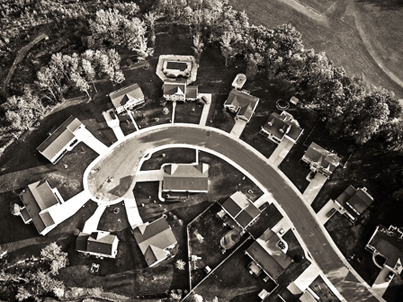

Houses in the Radburn design were built on superblocks of land in the middle of the housing streets. All houses were built with their backs to the roads, while the fronts faced other houses across common green areas. The original plan for Radburn was for a 30,000 person city, but the market crash of 1929 meant that only 10% of the city could be built. While a few other places in the US experimented with the Radburn design before WW2, it never became very widespread, perhaps due in part to a miscalculation by Stein and Wright as to how popular car travel would become.
Post-war city planners in Australia and the UK tried to combine ideas from the Radburn design with then-contemporary ideas about public housing, often seeming to use the worst of each system in their new creations. In Australia, it was implemented in a number of locations, such as Canberra (e.g., Charnwood), the Gold Coast, Sydney (Rosemeadow Estates), and near Melbourne. In recent years in both Australia and the UK demolitions have taken place to start over and erase old Radburn-design areas.
Radburn’s legacy seems to be a cautionary tale for unfettered planning optimism (PDF). Radburn, NJ, however, is still a working community and “a town for the motor age.”
It's interesting that this seems to blend some of the best ideas of new Urbanism (walkable cities and greenspace) with most of the worst ideas of Robert Moses-style, pre-Jane Jacobs city planning. No mixed use, hierarchical roads (rather than a simple grid), beltways, culs-de-sac, etc.
posted by condour75 at 3:47 PM on August 6, 2010
posted by condour75 at 3:47 PM on August 6, 2010
The City Project promotes a return to the forsaken Olmstead Plan for Los Angeles.
posted by snuffleupagus at 4:09 PM on August 6, 2010
posted by snuffleupagus at 4:09 PM on August 6, 2010
You can search Olmsted Research Archive for Job #5373 for available materials from work for the Los Angeles Traffic Commission.
Eden By Design is the most frequently mentioned book on this, and I believe it reprints the original report, but there are some good articles by scholars and activists floating around as well.
No 'a' in Olmsted.
posted by snuffleupagus at 4:27 PM on August 6, 2010
Eden By Design is the most frequently mentioned book on this, and I believe it reprints the original report, but there are some good articles by scholars and activists floating around as well.
No 'a' in Olmsted.
posted by snuffleupagus at 4:27 PM on August 6, 2010
There was also an Olmstead Plan (sort of) for Tacoma, WA, but the city fathers were like, "No grid? WTF, dude?" and instead built a city with two entirely different grids that meet at (at least one) bizarro intersection.
posted by epersonae at 4:29 PM on August 6, 2010
posted by epersonae at 4:29 PM on August 6, 2010
It was only recently that I realized that such neighborhoods were designed for ease of car access, and not for the safety of children. Cul-de-sac style subdivisions seem so small to me these days, like the furniture in a grade school classroom, but when I was little they were perfectly sized. And cul-de-sacs or the lazy corners of such suburbs are excellent places for children to play and be watched out of windows.
posted by Countess Elena at 4:50 PM on August 6, 2010
posted by Countess Elena at 4:50 PM on August 6, 2010
I grew up in an older, 1910's style suburb that was designed for showy houses to face front along the town's main boulevard, with a service alley bisecting the large block behind the houses. I'm not sure what the name of that style is, but it's still visible on Google map photos of the old sections of towns.
posted by Countess Elena at 4:52 PM on August 6, 2010
posted by Countess Elena at 4:52 PM on August 6, 2010
Fascinating to open the .pdf on one monitor and compare the original layout and pictures to the street level and aerial photos on GoogleEarth and GoogleMaps
posted by HyperBlue at 4:54 PM on August 6, 2010
posted by HyperBlue at 4:54 PM on August 6, 2010
The irony of it all is that by trying to hierarchize vehicle access, and to totally separate vehicles from pedestrians, Radburn also presaged the Radiant City, modern suburban arterials, and high-rise project housing on superblocks—in other words, Le Corbusier.
To be honest, I don't think many New Urbanists are talking about recreating Radburn. Today, you hear lots of talk about "traditional city streets," which usually means mixed-use streets with lots of heterogeneity of use and heterogeneity of access. For example, residential flats over commerce, on streets of various sizes, all of which is accessed on foot. Your front door is surely facing the street.
This is pretty much the opposite to "functionalist" city planning from the 20s to the 60s, which tried to move commerce, industry, and residences away from each other, and create arteries of different sizes to let people drive from one zone to another. This was the philosophy behind Radburn, but when you think about driving from a suburban house away from the cul-de-sac, onto the arterial road, and into the mall—it's also more or less the philosophy behind today's suburb!
Plus ça change, hm?
posted by cinoyter at 6:20 PM on August 6, 2010 [1 favorite]
To be honest, I don't think many New Urbanists are talking about recreating Radburn. Today, you hear lots of talk about "traditional city streets," which usually means mixed-use streets with lots of heterogeneity of use and heterogeneity of access. For example, residential flats over commerce, on streets of various sizes, all of which is accessed on foot. Your front door is surely facing the street.
This is pretty much the opposite to "functionalist" city planning from the 20s to the 60s, which tried to move commerce, industry, and residences away from each other, and create arteries of different sizes to let people drive from one zone to another. This was the philosophy behind Radburn, but when you think about driving from a suburban house away from the cul-de-sac, onto the arterial road, and into the mall—it's also more or less the philosophy behind today's suburb!
Plus ça change, hm?
posted by cinoyter at 6:20 PM on August 6, 2010 [1 favorite]
This is always a fun way to get to new urbanism.
posted by tarantula at 6:50 PM on August 6, 2010 [2 favorites]
posted by tarantula at 6:50 PM on August 6, 2010 [2 favorites]
The irony of it all is that by trying to hierarchize vehicle access, and to totally separate vehicles from pedestrians, Radburn also presaged the Radiant City, modern suburban arterials, and high-rise project housing on superblocks—in other words, Le Corbusier.
All That is Solid Melts Into Air: the Experience of Modernity is a prominent work in the criticism of modernization, written from '71 to '81 and published in '82. It was reissued this July. Here's an interview the New Statesman did with Marshall Berman to mark the occasion.
posted by snuffleupagus at 6:52 PM on August 6, 2010
All That is Solid Melts Into Air: the Experience of Modernity is a prominent work in the criticism of modernization, written from '71 to '81 and published in '82. It was reissued this July. Here's an interview the New Statesman did with Marshall Berman to mark the occasion.
posted by snuffleupagus at 6:52 PM on August 6, 2010
Berman being the author of the book.
posted by snuffleupagus at 6:54 PM on August 6, 2010
posted by snuffleupagus at 6:54 PM on August 6, 2010
I see a lot of "new urbanism"-type development trying to capitalize on the ideas of creating villages and pedestrian-friendly areas. While I understand how crucial sensible design is in creating usable environments, I still see most are driving to the closest space in front of the buildings and walking as little as possible.
Don't you get a little thrill when you see an open parking space right in front of where you want to go?
posted by Red Loop at 7:19 PM on August 6, 2010
Don't you get a little thrill when you see an open parking space right in front of where you want to go?
posted by Red Loop at 7:19 PM on August 6, 2010
I kind of hate new urbanism. The people that are into new urbanism are often the same ones advocating to plow over authentic, real, pedestrian-friendly, neighborhood-focused "old" urbanism. It's like Andres Duany wants to take credit for something that's been successfully implemented all over the world for centuries. Though I guess his version does have the advantage of mandatory picket fences, window boxes, and standardized setbacks. It's all so boring and leaves so little room for imagination. Some of the best turn of the century urban fabric would never have happened if the type of design guidelines and strict standards that new urbanism advocates were in place. Let's revitalize and re-invigorate the existing urbanism and not spend all this energy and money on nostalgic reinterpretations of the real thing.
posted by otherwordlyglow at 8:15 PM on August 6, 2010 [3 favorites]
posted by otherwordlyglow at 8:15 PM on August 6, 2010 [3 favorites]
Don't you get a little thrill when you see an open parking space right in front of where you want to go?
I tend to drive directly to the not-quite-back of the lot where I'm pretty sure there will be a space, park in the first open space I see, and walk from there. The little thrill I get is when I can see someone who was looking for a spot STILL looking for a close spot when I get to the building.
That tendency to choose a less-popular spot means that for places I go regularly, I often get the exact same spot. I start thinking of it as MY spot and get a little satisfaction when I drive right up and park in my spot. It's also fun to get mock-annoyed when someone is parked in my spot. (Especially if there are open spots on either side.)
The outdoor shopping centers with the walkable plan (University Village in Seattle, I'm looking at you), and especially downtown city blocks, don't work as well this way. Since the parking is spread all over instead of a few big lots, ALL of the spaces are desirable to somebody. I can't just drive to "my" spot and park. Counter-intuitively, maybe, I find parking more of a pain in the ass at places like this, and I notice that most of the traffic problem around these places is people circling around looking for a spot. They have no choice - there's no "back up" area where they know they can park if they don't get lucky on the first drive-by. They pretty much have to wait until a random spot opens up right in front of them that they can get before someone else does.
So while those type of places are much more pleasant to BE at, having to drive a car to get there sucks more.
posted by ctmf at 10:56 AM on August 7, 2010 [2 favorites]
I tend to drive directly to the not-quite-back of the lot where I'm pretty sure there will be a space, park in the first open space I see, and walk from there. The little thrill I get is when I can see someone who was looking for a spot STILL looking for a close spot when I get to the building.
That tendency to choose a less-popular spot means that for places I go regularly, I often get the exact same spot. I start thinking of it as MY spot and get a little satisfaction when I drive right up and park in my spot. It's also fun to get mock-annoyed when someone is parked in my spot. (Especially if there are open spots on either side.)
The outdoor shopping centers with the walkable plan (University Village in Seattle, I'm looking at you), and especially downtown city blocks, don't work as well this way. Since the parking is spread all over instead of a few big lots, ALL of the spaces are desirable to somebody. I can't just drive to "my" spot and park. Counter-intuitively, maybe, I find parking more of a pain in the ass at places like this, and I notice that most of the traffic problem around these places is people circling around looking for a spot. They have no choice - there's no "back up" area where they know they can park if they don't get lucky on the first drive-by. They pretty much have to wait until a random spot opens up right in front of them that they can get before someone else does.
So while those type of places are much more pleasant to BE at, having to drive a car to get there sucks more.
posted by ctmf at 10:56 AM on August 7, 2010 [2 favorites]
The Wikipedia article on Radburn refers to the Norwood Flats and Wildwood Park neighbourhoods of Winnipeg.
In a way, Norwood Flats is ideally suited to the idea behind Radburn and its international kin, as it's in walkable distance (decent bus service, too) from downtown jobs, the "French Quarter", a still-developing national park (The Forks), and entertainment venues. It's also located on a small "peninsula" of the Red River so can't get any bigger than it is. I once looked at moving there but found it too claustrophobic for my taste - I couldn't imagine having to cope with up-close neighbours. I know a few people who live in Norwood and they all have cars and use them, mostly every day.
Wildwood Park is no where near downtown where most jobs still are, although that's changing, hence you need a car to get to work (public transport is available but either a bit of a hike to a main artery or highly infrequent on side streets), not to mention to go shopping, even locally. However, the neighbourhood per se is entirely walkable - lots of green space, gentle paths, old trees, quietness. It's more upscale than Norwood Flats. Again, I once looked at houses there (nicely separated from the ones next door) but decided I'd likely use my car just as much as I was in the inner-suburb I was then living in.
So, ironically, I'm now living in the countryside outside Winnipeg - car a necessity here as there is no public transport at all, the nearest stores are a 12 km drive on gravel roads, and my neighbours are scores of metres away from my house (no picket fences to chat over but we do wave at each other). Still, there are wooded areas and overgrown abandoned rail lines to explore (on foot). I like Winnipeg but it could never have achieved a Radburn urban ideal - save for the car is king part.
posted by drogien at 12:28 PM on August 7, 2010
In a way, Norwood Flats is ideally suited to the idea behind Radburn and its international kin, as it's in walkable distance (decent bus service, too) from downtown jobs, the "French Quarter", a still-developing national park (The Forks), and entertainment venues. It's also located on a small "peninsula" of the Red River so can't get any bigger than it is. I once looked at moving there but found it too claustrophobic for my taste - I couldn't imagine having to cope with up-close neighbours. I know a few people who live in Norwood and they all have cars and use them, mostly every day.
Wildwood Park is no where near downtown where most jobs still are, although that's changing, hence you need a car to get to work (public transport is available but either a bit of a hike to a main artery or highly infrequent on side streets), not to mention to go shopping, even locally. However, the neighbourhood per se is entirely walkable - lots of green space, gentle paths, old trees, quietness. It's more upscale than Norwood Flats. Again, I once looked at houses there (nicely separated from the ones next door) but decided I'd likely use my car just as much as I was in the inner-suburb I was then living in.
So, ironically, I'm now living in the countryside outside Winnipeg - car a necessity here as there is no public transport at all, the nearest stores are a 12 km drive on gravel roads, and my neighbours are scores of metres away from my house (no picket fences to chat over but we do wave at each other). Still, there are wooded areas and overgrown abandoned rail lines to explore (on foot). I like Winnipeg but it could never have achieved a Radburn urban ideal - save for the car is king part.
posted by drogien at 12:28 PM on August 7, 2010
cinoyter beat me to the punch on Le Corbusier. The Radburn design reminded me of Chandigarh, India.
posted by Saxon Kane at 8:57 PM on August 7, 2010
posted by Saxon Kane at 8:57 PM on August 7, 2010
I had no idea that Rosemeadow was a Radburn thing. It explains a lot of things about the place (chiefly, that the locals call it RoseGhetto). The design would undoubtedly work better if it wasn't used in a low-income area with poor-to-nonexistent public transport that had bugger all public facilities and absolutely nothing to offer except cheap housing.
posted by ninazer0 at 1:48 AM on August 9, 2010
posted by ninazer0 at 1:48 AM on August 9, 2010
I think the problem with that design is that in a Radburn community you are showing guests the "loading dock" of the house first. A guest's first impression of the house is then tainted, even if you eventually see the front. The front of the house is really only experienced by the neighbors and the owner, who have no true "first impression" based on it.
I wonder if it would be more successful in a very localized society that doesn't use cars daily, like a semi-retirement community.
posted by the_aardvark at 5:13 PM on August 15, 2010
I wonder if it would be more successful in a very localized society that doesn't use cars daily, like a semi-retirement community.
posted by the_aardvark at 5:13 PM on August 15, 2010
« Older Plutonomy | Beaten to a pulp Newer »
This thread has been archived and is closed to new comments
HST was a bit more extreme. But the idea is solid.
posted by Splunge at 3:43 PM on August 6, 2010 [2 favorites]