William Hamilton and the Flaming Fields of Vesuvius
November 4, 2007 7:45 PM Subscribe
British diplomat William Hamilton (whose 2nd wife Emma is perhaps best known for having a scandalous public affair with Horatio Nelson) loved volcanoes. His 1776 book Campi Flegrei: Observations on the volcanoes of the two Sicilies* used stunning hand-coloured illustrations by Peter Fabris to demonstrate to the scientific world that volcanic processes can be beautifully creative as well as horribly destructive. [via this post at the nonist, which, in case you hadn't noticed, has been really great lately]
A 1779 supplement documented that year's Vesuvius eruption
8 pages of images
Still more images
*[click the images at the Georgetown site to enlarge, enlarge, and enlarge again]


A 1779 supplement documented that year's Vesuvius eruption

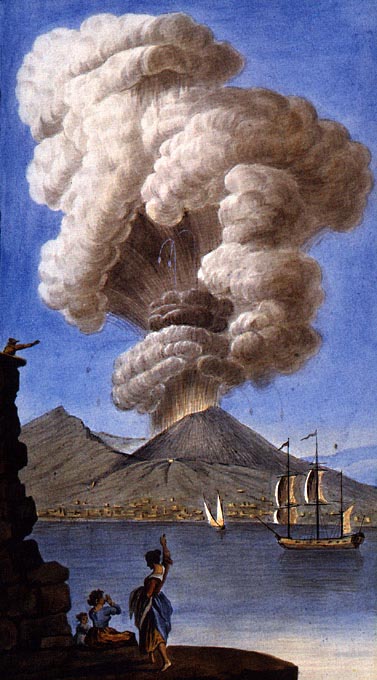
8 pages of images
Still more images
*[click the images at the Georgetown site to enlarge, enlarge, and enlarge again]
A pillar of fire by night and smoke by day. Hamilton's production of his speculative book (with so many coloured plates) helped drive him to financial ruin:
posted by cenoxo at 9:12 PM on November 4, 2007
...its readers were invited to share in the experience of witnessing Vesuvius erupting. This was primarily achieved by the outstanding illustrations that showed the eruptions from different vantage points and depicted various rock samples. The plates proved to be the book’s defining feature, more popular than the text itself. Landscape art was popular and many Grand Tourists commissioned paintings of their destinations as a way of commemorating their journey and proving themselves to be seasoned travellers. The plates of Campi Phlegraei provided ready made souvenirs and were often torn out and displayed in their own right. As such, complete copies are rare today.He also created a multimedia show to dramatize Vesuvius' eruptions:
The expense of commissioning such a large number of hand coloured plates for the work almost crippled Hamilton. Having funded the publication entirely without subscription, the undertaking put him under huge financial strain. Returning to Britain in 1801, his collection of pictures was sold at Christies for £6000 and his vases for £4000 - and yet his debts remained, many incurred by his second wife, Emma. The cumulative cost of the book, his collections and his entertaining were ruinous to Hamilton.
Hamilton's Vesuvian apparatus was a work of art, reinforced with machinery, purposely designed to convey the tremendous force, the rapidly changing aspect, and the terrific noise of a volcanic eruption in a manner far more realistic then would have been possible with a conventional painting. It was composed of a large colourful painted transparency showing the eruption of Vesuvius, lit up from behind by a complex mechanical device activated by clockwork. Replete with special effects, it produced the striking impression of a continuous stream of lava and sporadic outbursts from the crater, accompanied by thunderous blasts of eruptions.Pretty hot stuff for an 18th century audience. For 21st century readers, National Geographic Magazine recently published the online feature Vesuvius — Asleep for Now that describes its historical eruptions:
...the material in a pyroclastic surge is baked in a subterranean magma chamber to temperatures of up to 1650°F (899°C). The initial surge of the Avellino eruption [in 1780 BC], especially in the zones closest to Vesuvius, was instantly lethal. Hot, choking wind, advancing at about 240 miles (386 kilometers) an hour, reached temperatures of at least 900°F (482°C), and retained enough heat to bring water to a boil ten miles (16 kilometers) from the vent.NGM's interactive map — an interesting contrast to Peter Fabris' rather genteel gouaches — outlines the danger zones around the volcano.
"Below 200 degrees Fahrenheit (93°C), you can survive for several seconds, perhaps, if the wave passes quickly," Mastrolorenzo pointed out. "But even if you survive the temperature, you will suffocate on the fine powder in the air. The entire countryside surrounding Vesuvius was covered by foot upon foot of this powder, 65 feet (20 meters) deep at a distance of three miles (five kilometers) from the crater to about ten inches (25 centimeters) thick at a distance of 15 miles (24 kilometers). Eight inches (20 centimeters) of ash is enough to cause modern roofs to collapse."
posted by cenoxo at 9:12 PM on November 4, 2007
Wow, Willie Hamilton was popular! I can't remember the last time so many new links added to an already great post. Have only skimmed but favorited for an evening read tonight. Great post mediaeport, and excellent additional material guys (neutral),
MWAH!
posted by Wilder at 12:20 AM on November 5, 2007
MWAH!
posted by Wilder at 12:20 AM on November 5, 2007
An hour and a half ahead of you, msdiski. Must be daylight saving.
posted by Wolof at 2:13 AM on November 5, 2007
posted by Wolof at 2:13 AM on November 5, 2007
The Volcano Lover is a brilliant novel (even if it does plagiarise Brian Fothergill's biography, Sir William Hamilton: Envoy Extraordinary), and I strongly recommend it to anyone reading this post who wants to find out more about Hamilton's love-affair with Vesuvius. There was a fabulous exhibition at the British Museum a few years ago called Vases and Volcanoes, all about Hamilton and his collections (including the notorious wax phalluses).
Horace Rumpole: yes, the story is quite true. The etchings are by Gillray, published in 1807 and described as 'A new edition considerably enlarged'. They are a very clever, very cruel and very spiteful parody of Lady Hamilton's Attitudes, depicting Lady Hamilton as grotesquely ugly and overweight. (More on the Attitudes here and here, and another Gillray caricature of Lady Hamilton here.)
posted by verstegan at 2:13 AM on November 5, 2007 [1 favorite]
Horace Rumpole: yes, the story is quite true. The etchings are by Gillray, published in 1807 and described as 'A new edition considerably enlarged'. They are a very clever, very cruel and very spiteful parody of Lady Hamilton's Attitudes, depicting Lady Hamilton as grotesquely ugly and overweight. (More on the Attitudes here and here, and another Gillray caricature of Lady Hamilton here.)
posted by verstegan at 2:13 AM on November 5, 2007 [1 favorite]
Thanks for this, mediareport: I saw the post at the Nonist (which has indeed bene really great lately) but this all bears repeating here. Another tangential Hamilton link: he was the dedicatee of this peculiar set of engravings by Filippo Morghen which depict a fanciful 18th-century vision of a voyage to the moon.
posted by misteraitch at 2:49 AM on November 5, 2007
posted by misteraitch at 2:49 AM on November 5, 2007
An hour and a half ahead of you, msdiski. Must be daylight saving.
Nope, I failed to sign in to the NYT. The Banville article is good, eh?
posted by jennydiski at 4:23 AM on November 5, 2007
Nope, I failed to sign in to the NYT. The Banville article is good, eh?
posted by jennydiski at 4:23 AM on November 5, 2007
Dude, thanks for remembering me I live under an active volcano.
posted by darkripper at 5:18 AM on November 5, 2007
posted by darkripper at 5:18 AM on November 5, 2007
Coincidentally, the classic film That Hamilton Woman (1941) — starring Vivian Leigh as an irresistable Lady Emma Hamilton and Laurence Olivier (married to Leigh at the time) as a whittled-away Admiral Horatio Nelson — was on TCM last night.
Vesuvius had a difficult time playing against Miss Leigh, and was thus relegated to a minor role.
posted by cenoxo at 9:18 AM on November 5, 2007


Vesuvius had a difficult time playing against Miss Leigh, and was thus relegated to a minor role.

posted by cenoxo at 9:18 AM on November 5, 2007
Beautiful illustrations by Peter Fabris. Wonderful post mediareport. Thanks.
posted by nickyskye at 10:42 AM on November 5, 2007
posted by nickyskye at 10:42 AM on November 5, 2007

Nope, I failed to sign in to the NYT.
Gah, this computer is obviously permalogged on there. Apologies to anyone who had to register, although I think Banville will amply repay any temporary inconvenience.
posted by Wolof at 2:56 PM on November 5, 2007
Gah, this computer is obviously permalogged on there. Apologies to anyone who had to register, although I think Banville will amply repay any temporary inconvenience.
posted by Wolof at 2:56 PM on November 5, 2007
« Older Sullivan on Obama | The right man in the wrong place can make all the... Newer »
This thread has been archived and is closed to new comments
posted by Horace Rumpole at 8:08 PM on November 4, 2007 [2 favorites]