Leonard Bernstein: Miracle on 57th Street
December 28, 2005 10:41 AM Subscribe
Miracle on 57th Street. Thomas Wolfe said that America is not only the place where miracles happen, but where they happen all the time. This is the story of a miracle, a true-life fairy tale, and appropriately enough it begins with the intervention of the Almighty.
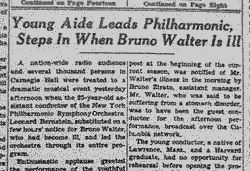
Artur Rodzinski, music director of the New York Philharmonic from 1943 to 1947, was an eccentric, a health nut who drank only milk from goats he raised himself and who kept a loaded revolver in his back pocket whenever he conducted. Rodzinski said that God told him to hire 24 year old Leonard Bernstein, to be his assistant conductor. In the fall of 1943 Rodzinski decided to take a vacation, spend a little time with his goats, and called in Bruno Walter to conduct seven concerts in ten days. Only hours before one of those concerts (in the program, works by Schumann, Rosza, Strauss and Wagner) Walter fell ill. Rodzinski was only four hours away, in his farm. But he declined to come back to Carnegie Hall: "Call Bernstein. That's why we hired him." The concert was broadcast over radio and a review appeared on page 1 of The New York Times the next day: "Young Aide Leads Philharmonic; Steps in When Bruno Walter is Ill". In the same size type as another that read, "Japanese Plane Transport Sunk." More inside.
Deutsche Grammophon has just released Bernstein's box set: Mahler - The Symphonies plus Das Lied von der Erde.
In Who is Gustav Mahler?, Bernstein says:
In Who is Gustav Mahler?, Bernstein says:
"No composer goes quite so far in each direction, so happy and so sad. When Mahler is said, it is a complete sadness; nothing can comfort him, like a weeping child. And when he's happy, he's happy the way a child is - all the way. And that's one of the keys to the Mahler puzzle - he is like a child; his feelings are extreme, exaggerated, like young people's feelings."posted by matteo at 10:53 AM on December 28, 2005
On November 16, 1943, two days after Bernstein's New York Philharmonic debut, this profile appeared in The New York Post, titled: "Youth Wears Mantle of Greatness in Music."
"In the world of music there are few sudden stars. The gift first must be guarded, nurtured, matured before it is acceptable. Consequently, most great names in music are in their middle years.posted by matteo at 10:58 AM on December 28, 2005
Yet on Sunday, a young man stepped on the podium of Carnegie Hall in place of the venerable Bruno Walter and welded the tones of the orchestra into a great surge of sound. The music lovers in excitement marked the date, Nov. 13 [sic], as the debut of Leonard Bernstein, 25.
They are remembering now that other date--June 15, 1886--in the opera house of Rio de Janeiro, when another youth, a 19-year-old cellist, was called upon to lead the orchestra. The name -- Arturo Toscanini".
Thanks Matteo, we needed a post like that in times like these.
posted by wheelieman at 11:32 AM on December 28, 2005
posted by wheelieman at 11:32 AM on December 28, 2005
I think this is all really interesting, but how is this a miracle? These are all very talented men who have responded well when called upon. Excellent, brilliant, talented, but no miracle.
posted by Red58 at 11:32 AM on December 28, 2005
posted by Red58 at 11:32 AM on December 28, 2005
Its a miracle because nobody connected with music the way Bernstein did. It was a differnt way of looking at the notes and conducting.
posted by wheelieman at 11:40 AM on December 28, 2005
posted by wheelieman at 11:40 AM on December 28, 2005
America is not only the place where miracles happen, but where they happen all the time.
Perhaps it should be phrased like this:
America is not the only place where miracles happen, but where they happen at an alarming rate because just about every mundane thing is construed as a miracle by some enterprising schmuck.
posted by C.Batt at 11:58 AM on December 28, 2005
Perhaps it should be phrased like this:
America is not the only place where miracles happen, but where they happen at an alarming rate because just about every mundane thing is construed as a miracle by some enterprising schmuck.
posted by C.Batt at 11:58 AM on December 28, 2005
Red58, it depends on your personal definition of 'miracle,' I suppose. Webster's defines it as:
n 1: any amazing or wonderful occurrence
2: a marvellous event manifesting a supernatural act of God
I find this story more the first definition than the second.
posted by NationalKato at 12:00 PM on December 28, 2005
n 1: any amazing or wonderful occurrence
2: a marvellous event manifesting a supernatural act of God
I find this story more the first definition than the second.
posted by NationalKato at 12:00 PM on December 28, 2005
I've been having a Bernsteiny day. I was just listening to some pop Bernstein this morning (West Side Story) and, now that I think of it, I was singing (in the shower) snatches of some choral music I think is by Bernstein. Does anyone know a piece with Hebrew (I think) lyrics that phonetically (don't ask me to spell this stuff) goes something like "La-ma rag-ah-shu, la-ma rag-ah-shu go-yem..." and something like "vrots-nim, no-sah-doo-oo=oo-ya-had... Ah-ah-ah-do-oh-nai [something thing]...? We sang it in choir a thousand years ago.
posted by pracowity at 12:01 PM on December 28, 2005
posted by pracowity at 12:01 PM on December 28, 2005
And how's this for a factoid:
[Before the concert,] Bernstein went down to the Carnegie Hall pharmacy for a cup of coffee. At the counter the druggist asked why he looked so pale. Bernstein later said the druggist gave him two little pills, a red one and a green one. The druggist said, "Before you go on, pop both of these into your mouth. One will calm you down; the other will give you energy." Bernstein's self-appointed Dr. Feelgood was prescribing a combination of a phenobarbital and Benzedrine. [He threw them away.]
That pharmacist probably took credit for Lenny's career for the rest of his life.
posted by rob511 at 12:09 PM on December 28, 2005
[Before the concert,] Bernstein went down to the Carnegie Hall pharmacy for a cup of coffee. At the counter the druggist asked why he looked so pale. Bernstein later said the druggist gave him two little pills, a red one and a green one. The druggist said, "Before you go on, pop both of these into your mouth. One will calm you down; the other will give you energy." Bernstein's self-appointed Dr. Feelgood was prescribing a combination of a phenobarbital and Benzedrine. [He threw them away.]
That pharmacist probably took credit for Lenny's career for the rest of his life.
posted by rob511 at 12:09 PM on December 28, 2005
the miracle is that FUCKING GOD TOLD RODZINSKI TO HIRE BERSTEIN. jesus christ, people.
matteo, this is incredible. thanks.
posted by shmegegge at 12:16 PM on December 28, 2005
matteo, this is incredible. thanks.
posted by shmegegge at 12:16 PM on December 28, 2005
Fantastic post. I recently attended a wonderful, lightly-staged concert/production of Candide, and rather than attempting to introduce the overture, the conductor chose to simply show a video of Bernstein himself introducing the piece. It was fantastic; what a presence he had.
posted by ulotrichous at 12:41 PM on December 28, 2005
posted by ulotrichous at 12:41 PM on December 28, 2005
As a young boy I once saw Bernstein conduct a concert during which he lost the baton as it shot out of his hand, zipped straight across and through the orchestra, and speared the timpanist right in the chest. No harm done, and no one missed a beat. I wonder if I was the only one who saw it.
On another note, be sure to rent the amazing video of Bernstein conducting the recording session for the West Side Story album. Riveting!
posted by Edward King at 12:47 PM on December 28, 2005
On another note, be sure to rent the amazing video of Bernstein conducting the recording session for the West Side Story album. Riveting!
posted by Edward King at 12:47 PM on December 28, 2005
Fucking God: Psst! Rodzinski! There's a guy I think youse oughta hire.
Anyway, here's the "first known photograph of Bernstein as a conductor. As a camp counselor he is conducting the Camp Onota Rhythm Band, 1937." (from The Leonard Bernstein Collection)
posted by pracowity at 12:49 PM on December 28, 2005
Anyway, here's the "first known photograph of Bernstein as a conductor. As a camp counselor he is conducting the Camp Onota Rhythm Band, 1937." (from The Leonard Bernstein Collection)
posted by pracowity at 12:49 PM on December 28, 2005
What, don't the goats get any credit? They so thoroughly hooked Rodzinski on their magical milk that he left NYC for the week on their account. Now that's genius.
Nice post, Matteo! I'm glad there are other classical music fans around here.
posted by Asparagirl at 1:21 PM on December 28, 2005
Nice post, Matteo! I'm glad there are other classical music fans around here.
posted by Asparagirl at 1:21 PM on December 28, 2005
I was never a huge Bernstein fan (but then he pressed unwanted attentions on a friend of mine, so I'm not an unbiased observer), but this is a classy post. One quibble: I think you may have mistaken a mockup for a genuine NY Times front page. From the "review appeared on page 1 of The New York Times the next day" link:
This mock version of a full front-page story, complete with photo and Olin Downes' review, was made for the conductor's scrap-book by Helen Coates (Bernstein's former piano teacher and future secretary).
posted by languagehat at 1:43 PM on December 28, 2005
This mock version of a full front-page story, complete with photo and Olin Downes' review, was made for the conductor's scrap-book by Helen Coates (Bernstein's former piano teacher and future secretary).
posted by languagehat at 1:43 PM on December 28, 2005
unwanted attentions on a friend of mine,
guy or doll?
posted by PenguinBukkake at 1:50 PM on December 28, 2005
guy or doll?
posted by PenguinBukkake at 1:50 PM on December 28, 2005
This is a great post, but I do not believe God told Rodiski to hire Bernstein. That part is humbug. Sorry.
posted by bukvich at 1:54 PM on December 28, 2005
posted by bukvich at 1:54 PM on December 28, 2005
"This is a great post, but I do not believe God told Rodiski to hire Bernstein.
No, actually, that part is true.
I know. God told me.
posted by Ayn Marx at 1:58 PM on December 28, 2005
No, actually, that part is true.
I know. God told me.
posted by Ayn Marx at 1:58 PM on December 28, 2005
Great post, Matteo.
" This is a great post, but I do not believe God told Rodiski to hire Bernstein. That part is humbug. Sorry."
This is why atheists come across as douchebags.
posted by klangklangston at 2:16 PM on December 28, 2005
" This is a great post, but I do not believe God told Rodiski to hire Bernstein. That part is humbug. Sorry."
This is why atheists come across as douchebags.
posted by klangklangston at 2:16 PM on December 28, 2005
Leonard Bernstein, A Total Embrace of Music: Rodzinsky later claimed that he had asked God whom to choose among eligible candidates and was told, "Take Bernstein." More likely, though, Bernstein had asthma rather than God to thank for his selection, as all his healthier competitors had been drafted.
Maybe both: God gave Bernstein asthma and sent the other poor bastards off to face the Nazis.
posted by pracowity at 3:07 PM on December 28, 2005
Maybe both: God gave Bernstein asthma and sent the other poor bastards off to face the Nazis.
posted by pracowity at 3:07 PM on December 28, 2005
And this, from a Moondog interview, touches on Bernstein, Rodzinsky, Rodzinsky's faith, and the famous (and almost literal, I suppose) passing of the baton:
Q: Halina Rodzinski recounts in her book that you approached her husband about sitting in on the rehearsal for Mahler's Second Symphony.posted by pracowity at 3:12 PM on December 28, 2005
MOONDOG: Well, that was the symphony they were rehearsing the week that I was there. It was very interesting: I came to New York early in November, and I took a taxi and came over to Carnegie Hall and got a ticket and I sat in the front row, center. And that was the day that Bruno Walter was taken ill and they had to get a quick substitute; unbeknownst to me, it was Leonard Bernstein. His debut, and I was sitting right behind him; just a few feet ahead of me, it was Bernstein, and I said to myself, "After the first number, I'm going to he the first to applaud, and be heard all over the country." And I was.
The cello soloist in Don Quixote was Joseph Schuster, and he was sitting very close to me there, being the soloist. A few days later, I was standing in the entrance to the stage door, and there was an intermission in the rehearsal. Apparently, Joseph Schuster saw me, and he came over to me and said, "I saw you Sunday. Would you like to come to rehearsal?" And I said, "Yes." He said, "Wait a minute", and in a few minutes he came back with Artur Rodzinski who put his arm around my shoulder and said, "Come with me. You can come to my rehearsal." He took me clear to the front of the hall and took me down the center aisle and said, "Sit down now and enjoy yourself." At lunch he took me up to his dressing room. Mrs. Rodzinski had brought some hot soup for him, and that's how I got to meet her. And then Bernstein came in and asked something about the contrabasses. I didn't know who it was, and I said, "Are you a bass player?" And he said, "No, I wish I were." So I got to meet Leonard Bernstein too.
Q: Were you aware that you'd made such a strong impression on Rodzinski, and that it was highly unusual for him to admit an outsider to his rehearsals?
MOONDOG: Yes. He was a very superstitious, spiritual-minded person, and for some reason he got the idea that I resembled the face of Christ. I had a beard and all that, so I think it was partly that, and some kind of intuition that he should be especially nice to me. He was lovely, and I owe a lot to him and his wife.
Chichester Psalms, Psalm 23, pracowity?
posted by horsewithnoname at 3:29 PM on December 28, 2005
posted by horsewithnoname at 3:29 PM on December 28, 2005
Crap. I misspelled Rodziński. Przepraszam, Artur.
> Chichester Psalms, Psalm 23, pracowity?
No, but you got so close that I quickly found it: Psalm 2 from the same work. A thousand thanks, horsewithnoname.
> Chichester Psalms, Psalm 23, pracowity?
No, but you got so close that I quickly found it: Psalm 2 from the same work. A thousand thanks, horsewithnoname.
Lamah rag'shu goyimposted by pracowity at 3:40 PM on December 28, 2005
Ul'umim yeh'gu rik?
Yit'yats'vu malchei erets,
V'roznim nos'du yachad
Al Adonai v'al m'shicho.
N'natkah et mos'roteimo,
V'nashlichah mimenu avoteimo.
Yoshev bashamayim
Yis'chak, Adonai
Yil'ag lamo!
Oops! Psalm 2 it is!
posted by horsewithnoname at 4:04 PM on December 28, 2005
posted by horsewithnoname at 4:04 PM on December 28, 2005
The Jets are in gear,
Our cylinders are clickin'!
The Sharks'll steer clear
'Cause ev'ry Puerto Rican's a lousy chicken!
I can hear his music still.
posted by JohnR at 4:28 PM on December 28, 2005
Our cylinders are clickin'!
The Sharks'll steer clear
'Cause ev'ry Puerto Rican's a lousy chicken!
I can hear his music still.
posted by JohnR at 4:28 PM on December 28, 2005
(Which, coincidentally, is the English translation of the Hebrew text I posted.)
posted by pracowity at 4:56 PM on December 28, 2005
posted by pracowity at 4:56 PM on December 28, 2005
Bernstein's Sonata for Clarinet and Piano has always in close contention for my favorite clarinet solo. He wrote it when he was 24. West Side Story buff should listen to it; it strongly foreshadows that work.
posted by gsteff at 5:11 PM on December 28, 2005
posted by gsteff at 5:11 PM on December 28, 2005
Oh this is lovely, thanks!
posted by CunningLinguist at 5:48 PM on December 28, 2005
posted by CunningLinguist at 5:48 PM on December 28, 2005
I wish I could say I were devout. Agnostic, I'm afraid. I suppose that's why I don't mind dropping God's other first name like that.
posted by shmegegge at 9:23 PM on December 28, 2005
posted by shmegegge at 9:23 PM on December 28, 2005
"" This is a great post, but I do not believe God told Rodiski to hire Bernstein. That part is humbug. Sorry.""
"This is why atheists come across as douchebags."
Funny!
Atheist or not, I'm sure we'll all agree that it was a pretty goddamn good call on Rodzinski's part.
posted by pkingdesign at 10:15 PM on December 28, 2005
"This is why atheists come across as douchebags."
Funny!
Atheist or not, I'm sure we'll all agree that it was a pretty goddamn good call on Rodzinski's part.
posted by pkingdesign at 10:15 PM on December 28, 2005
[This is good.] I've always read one- or two-sentence references to how Bernstein became famous, but never read the details until now. Much appreciated, matteo! :)
While I didn't read every link, I was surprised that none of the ones I did read mentioned a story I'd read: that Bernstein's "mentor" (Koussevitzky?) had advised him that if he really wanted to lead an orchestra, he'd have to give up "this foolishness" of writing for Broadway. I'm not sure if I liked that tradeoff...
languagehat, re your quibble: Read it closely and you'll see that it really was a front-page story, but below the fold. So, yes, the photo is of a mockup, but it also really was a front-page story.
posted by pmurray63 at 11:19 PM on December 28, 2005
While I didn't read every link, I was surprised that none of the ones I did read mentioned a story I'd read: that Bernstein's "mentor" (Koussevitzky?) had advised him that if he really wanted to lead an orchestra, he'd have to give up "this foolishness" of writing for Broadway. I'm not sure if I liked that tradeoff...
languagehat, re your quibble: Read it closely and you'll see that it really was a front-page story, but below the fold. So, yes, the photo is of a mockup, but it also really was a front-page story.
posted by pmurray63 at 11:19 PM on December 28, 2005
Great post matteo. Absolutely top notch.
A Bernstein joke I heard once.
Two ladies are talking in New York:
Lady 1: You know, I hear Leonard Bernstein is gay.
Lady 2: Is there nothing that man can't do?
*rimshot*
posted by Dagobert at 11:34 PM on December 28, 2005
A Bernstein joke I heard once.
Two ladies are talking in New York:
Lady 1: You know, I hear Leonard Bernstein is gay.
Lady 2: Is there nothing that man can't do?
*rimshot*
posted by Dagobert at 11:34 PM on December 28, 2005
This is a great post--has anyone else read any of his essays on music? He wrote about music very compellingly. He was also quite a brilliant teacher--a bit from one of his television scripts, on Beethoven's Fifth Symphony (printed in The Joy of Music), speaking about the famous opening four notes:
"People have wondered for years what it is that endows this musical figure with such potency. All kinds of fanciful music-appreciation theories have been advanced: that it is based on the song of a bird Beethoven heard in the Vienna woods; that it is Fate knocking at the door; that it's the trumpets announcing the Judgment Day. And more of the same.
"But none of these interpretations tells us anything. The truth is that the real meaning lies in all the notes that follow it, all the notes of all the five-hundred measures of music that follow it in this first movement. And Beethoven, more than any other composer before or after him, I think, had the ability to find exactly the right notes that had to follow his themes. But even he, with this great ability, had a gigantic struggle to achieve this rightness: not only the right notes, but hte right rhythms, the right climaxes, the right harmonies, the right instrumentation. And it's that struggle that we would like to investigate...."
Great, great stuff.
posted by LooseFilter at 2:42 AM on December 29, 2005
"People have wondered for years what it is that endows this musical figure with such potency. All kinds of fanciful music-appreciation theories have been advanced: that it is based on the song of a bird Beethoven heard in the Vienna woods; that it is Fate knocking at the door; that it's the trumpets announcing the Judgment Day. And more of the same.
"But none of these interpretations tells us anything. The truth is that the real meaning lies in all the notes that follow it, all the notes of all the five-hundred measures of music that follow it in this first movement. And Beethoven, more than any other composer before or after him, I think, had the ability to find exactly the right notes that had to follow his themes. But even he, with this great ability, had a gigantic struggle to achieve this rightness: not only the right notes, but hte right rhythms, the right climaxes, the right harmonies, the right instrumentation. And it's that struggle that we would like to investigate...."
Great, great stuff.
posted by LooseFilter at 2:42 AM on December 29, 2005
As a young boy I once saw Bernstein conduct a concert during which he lost the baton as it shot out of his hand, zipped straight across and through the orchestra, and speared the timpanist right in the chest. No harm done, and no one missed a beat. I wonder if I was the only one who saw it.
Given what a showboat, not to say showoff, that the man was as a conductor, one has to wonder if he did it on purpose.
posted by IndigoJones at 4:52 AM on December 29, 2005
Given what a showboat, not to say showoff, that the man was as a conductor, one has to wonder if he did it on purpose.
posted by IndigoJones at 4:52 AM on December 29, 2005
languagehat, re your quibble: Read it closely and you'll see that it really was a front-page story, but below the fold. So, yes, the photo is of a mockup, but it also really was a front-page story.
Yes, I got that; what I was responding to was matteo's:
In the same size type as another that read, "Japanese Plane Transport Sunk."
Which led me to think he thought he was looking at the actual front page. (I'm guessing the original front-page story was one of those tiny two-paragraph teasers in a little box in the lower right corner.)
guy or doll?
If you're asking, I suspect you already know the answer.
posted by languagehat at 5:23 AM on December 29, 2005
Yes, I got that; what I was responding to was matteo's:
In the same size type as another that read, "Japanese Plane Transport Sunk."
Which led me to think he thought he was looking at the actual front page. (I'm guessing the original front-page story was one of those tiny two-paragraph teasers in a little box in the lower right corner.)
guy or doll?
If you're asking, I suspect you already know the answer.
posted by languagehat at 5:23 AM on December 29, 2005
Truly wonderful post, matteo. For more Bernstein, listen to this memoir, which features examples of his conducting as well as interviews with people who played under him and knew him well.
posted by melissa may at 7:13 AM on December 29, 2005
posted by melissa may at 7:13 AM on December 29, 2005
> He was also quite a brilliant teacher
I'll throw in a Lenny reminiscence. Some time back in the day he was invited to Harvard to give the annual Norton Lectures (formally on poetry but in fact, looking at the list of invitees, they could be about pretty much anything artsy.) Around this time all the newstands and bookstores near the square (including, I cringe to say, the Coop) were inundated with copies of a huge red fake-leather book about Lenny, including many shots of him with wife, him with wife and kids, him with kids, etc., emphasizing what a wonderful paterfamilas, daddy, husband, and family man he was. At the same time, Bernstein himself was very much a visible presence around Cambridge, always accompanied by his gaggle of (very) much younger boyfriends. I was at that time a grad student at the H-school and I attended the Lectures. I was prepared to consider them trash, especially since B had then very recently fallen under the sway of Chomskyan linguistics, and the repeated, repeated, and repeated phrase "syntactic structures" accounts for roughly half the Lectures' spoken content. But on rereading my notes, I found...well, I found that the other half of the Lectures was bloody interesting stuff. The talk on the technical construction of l'Après-midi d'un faune was especially illuminating, and memorable lo these many years later. So I'm still not really sure what to think of Lenny. He was, I remain convinced, an unspeakably fake person qua person--but he was also undeniably gifted beyond the ordinary.
posted by jfuller at 3:15 PM on December 29, 2005
I'll throw in a Lenny reminiscence. Some time back in the day he was invited to Harvard to give the annual Norton Lectures (formally on poetry but in fact, looking at the list of invitees, they could be about pretty much anything artsy.) Around this time all the newstands and bookstores near the square (including, I cringe to say, the Coop) were inundated with copies of a huge red fake-leather book about Lenny, including many shots of him with wife, him with wife and kids, him with kids, etc., emphasizing what a wonderful paterfamilas, daddy, husband, and family man he was. At the same time, Bernstein himself was very much a visible presence around Cambridge, always accompanied by his gaggle of (very) much younger boyfriends. I was at that time a grad student at the H-school and I attended the Lectures. I was prepared to consider them trash, especially since B had then very recently fallen under the sway of Chomskyan linguistics, and the repeated, repeated, and repeated phrase "syntactic structures" accounts for roughly half the Lectures' spoken content. But on rereading my notes, I found...well, I found that the other half of the Lectures was bloody interesting stuff. The talk on the technical construction of l'Après-midi d'un faune was especially illuminating, and memorable lo these many years later. So I'm still not really sure what to think of Lenny. He was, I remain convinced, an unspeakably fake person qua person--but he was also undeniably gifted beyond the ordinary.
posted by jfuller at 3:15 PM on December 29, 2005
> the miracle is that FUCKING GOD TOLD RODZINSKI TO HIRE BERSTEIN. jesus christ, people.
What's so jesus christ about that? YHWH talks to Jews all the time--whether they listen or not. Sounds like Rodzinski was a listener.
posted by jfuller at 4:54 PM on December 29, 2005
What's so jesus christ about that? YHWH talks to Jews all the time--whether they listen or not. Sounds like Rodzinski was a listener.
posted by jfuller at 4:54 PM on December 29, 2005
Sounds like Rodzinski was a listener.
heh.
funnily enough, batshit insane (and excommunicated) Boston priest Father Feeney explained in the early Fifties, in his monkeyfuck insane newsletter "The Point" that
heh.
funnily enough, batshit insane (and excommunicated) Boston priest Father Feeney explained in the early Fifties, in his monkeyfuck insane newsletter "The Point" that
With the passing years, local Puritan concert-goers have watched the Jewish grip on their music tighten. And the process has been facilitated by the fact that Boston’s musical taste is of the sort which the Jews are most able to satisfy. For the city likes virtuosos — the kind of high-strung, high-paid soloist that every Jewish parent is planning on when he first straps his three-year-old offspring to a piano stool.posted by matteo at 7:31 AM on December 30, 2005
Example: Boston is much taken with keyboard performers like Artur Rubenstein, Myra Hess, Rudolph Serkin, Wanda Landowska, Artur Schnabel, William Kapell, Alexander Brailowsky, Leopold Godowsky, Vladimir Horowitz — all Jews. And with concert-violinists like Fritz Kreisler, Isaac Stern, Nathan Milstein, Mischa Mischakoff, Joseph Szigeti, Efrem Zimbalist, Joseph Fuchs, Mischa Elman, Michel Piastro, Erica Morini, Yehudi Menuhin, Jascha Heifitz — Jews who lend support to the Universal Jewish Encyclopedia ’s boast that “The entire history of violin-playing is virtually a Jewish art.”
Beyond this, Boston is a “symphony” rather than an “opera” town. Russell’s Boston Opera Company quickly faded, but Henschel’s Boston Symphony became world-famous. Among the Yankees, in fact, going to the Symphony took on all the aspects of a new form of worship. As one astute, out-of-town observer remarked: when a Boston lady walks down the center aisle of Symphony Hall, you fully expect a profound genuflection before she enters her seat.
The Boston Symphony Orchestra a few years ago sustained the loss of its most long-lived Jewish conductor, Serge Koussevitzky, the despot of local music for twenty-five years. And when devoted Bostonians were not actually in the presence of Koussevitzky (or his Jewish colleague, Arthur Fiedler) at Symphony Hall, they were home listening to recorded performances of the rest of the country’s symphony orchestras, directed by the rest of the country’s Jewish conductors. For, with about three notable exceptions, the men who gesticulate before the chief orchestras of the nation are all Jews.
The following is a partial list: Artur Rodzinski, Alfred Wallenstein, Leonard Bernstein, George Szell, Erich Leinsdorf, Otto Klemperer, Efrem Kurtz, Bruno Walter, Vladimir Golschmann, Walter Damrosch, Eugene Ormandy, Alexander Smallens, Fritz Reiner, Pierre Monteux, Josef Pasternak, Erich Kleiber, Max Reiter, Fabien Sevitzky, Andre Kostelanetz.
And what, in the face of all this, does The Point propose for a remedy? The situation is obviously critical. What do we recommend as a course of effective action for Bostonians? Shall we start a crusade to rescue the holy precincts of Symphony Hall from the sacrilegious hands of the Jews? Shall we picket the box-office? Shall we assault the place? Storm it in mid-season? Shall we sweat and bleed and die for the right to hear Beethoven conducted by a Mayflower descendant?
After proper consideration, we think not. We think that perhaps this time we will restrain our wrath, run the risk of being labeled “above it all,” and just contemplate with medieval, Romish satisfaction, the prospect of a stuffy hall-full of heretics being serenaded by a pit-full of infidels — for all eternity.
and re: the divine intervention. maybe it was HaShem, maybe it was Serge Koussevitzky, who knows
posted by matteo at 8:42 AM on December 30, 2005
posted by matteo at 8:42 AM on December 30, 2005

Excellent -- thanks!
posted by languagehat at 2:47 PM on December 30, 2005
posted by languagehat at 2:47 PM on December 30, 2005
« Older Foreigners Around the World | Barley for Harley Newer »
This thread has been archived and is closed to new comments
posted by matteo at 10:46 AM on December 28, 2005