Otto von Habsburg-Lothringen 1912-2011
July 5, 2011 4:40 PM Subscribe
Otto von Habsburg-Lothringen, son of Charles, last monarch of the Austro-Hungarian Empire,
died on July 4 at the age of 98.
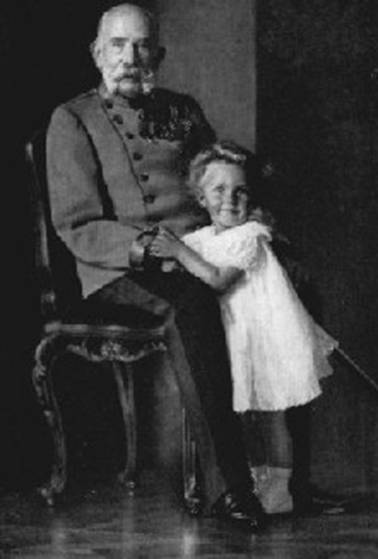
Otto, seen here with his great-granduncle Franz Joseph (ruler of the Habsburg Domains 1848-1916), was hurried forward in the line of succession when his father's uncle, Franz Ferdinand, was assassinated by Serbian ationalists during a state visit to Bosnia-Herzegovina in the summer of 1914, starting World War I and ultimately ending the power of a dynasty which had ruled in Europe for 700 years, including, in the 1500s, large chunks of Europe (the vast overseas empires of Habsburg Spain [1516-1700] and Habsburg Portugal [1580-1640] are not on this map).
While the Habsburg Empire is now seen as an "artificial" or "outdated" construction, which produced nationalist infighting (as recorded by Mark Twain in Harper's when he visited the "Austrian" parliament in the 1890s: Part I, Part II, Part III), more recent historians, such as Pieter Judson, are reconsidering the view of the Habsburg lands as a "prison of the peoples": listen to his podcast (49 minutes) on the subject. Some social science research has shown that Habsburg administration may have been more trustworthy, or at least perceived to be, than that of many of the surrounding polities: previously on the Blue.
Otto himself lived an interesting life, not only as a witness to but as an actor in history. Near the end of World War I, his father "renounced participation" in the Austro-Hungarian government, and briefly tried to return to power in Hungary without much success, dying in exile when Otto was not yet 10. The Emperor-King Charles was beatified by Pope John Paul II in 2004, for his attempts to broker peace in the Great War.
Otto went on to live in exile around various parts of Western Europe, including Switzerland and Belgium (itself largely a former Habsburg domain), where he received a degree in law. He was bitterly opposed to Hitler and the annexation of Austria, leading the Nazis to name the potential (unnecessary) armed invasion of Austria "Case Otto."
Otto, whose claim to the thrones of numerous lands occasionally made him persona non grata in same, later made a name for himself as a pan-Europeanist and member of the European Parliament from its founding in 1979 until 1999 (sitting as a member from the conservative Bavarian Christian Social Union). He was controversial, the Catholic prince apparently getting into fisticuffs with the ultra-Protestant Northern Irish MEP Ian Paisley in the chamber. He called for Europe to adopt mentions of God, while also calling for "interfaith" dialogue.
The Habsburgs are still going strong, inspiring nostalgia, and Otto's nephew Lorenz is continuing the tradition of marrying well, in this case a woman who would be Queen.
Otto, seen here with his great-granduncle Franz Joseph (ruler of the Habsburg Domains 1848-1916), was hurried forward in the line of succession when his father's uncle, Franz Ferdinand, was assassinated by Serbian ationalists during a state visit to Bosnia-Herzegovina in the summer of 1914, starting World War I and ultimately ending the power of a dynasty which had ruled in Europe for 700 years, including, in the 1500s, large chunks of Europe (the vast overseas empires of Habsburg Spain [1516-1700] and Habsburg Portugal [1580-1640] are not on this map).

While the Habsburg Empire is now seen as an "artificial" or "outdated" construction, which produced nationalist infighting (as recorded by Mark Twain in Harper's when he visited the "Austrian" parliament in the 1890s: Part I, Part II, Part III), more recent historians, such as Pieter Judson, are reconsidering the view of the Habsburg lands as a "prison of the peoples": listen to his podcast (49 minutes) on the subject. Some social science research has shown that Habsburg administration may have been more trustworthy, or at least perceived to be, than that of many of the surrounding polities: previously on the Blue.
Otto himself lived an interesting life, not only as a witness to but as an actor in history. Near the end of World War I, his father "renounced participation" in the Austro-Hungarian government, and briefly tried to return to power in Hungary without much success, dying in exile when Otto was not yet 10. The Emperor-King Charles was beatified by Pope John Paul II in 2004, for his attempts to broker peace in the Great War.
Otto went on to live in exile around various parts of Western Europe, including Switzerland and Belgium (itself largely a former Habsburg domain), where he received a degree in law. He was bitterly opposed to Hitler and the annexation of Austria, leading the Nazis to name the potential (unnecessary) armed invasion of Austria "Case Otto."
Otto, whose claim to the thrones of numerous lands occasionally made him persona non grata in same, later made a name for himself as a pan-Europeanist and member of the European Parliament from its founding in 1979 until 1999 (sitting as a member from the conservative Bavarian Christian Social Union). He was controversial, the Catholic prince apparently getting into fisticuffs with the ultra-Protestant Northern Irish MEP Ian Paisley in the chamber. He called for Europe to adopt mentions of God, while also calling for "interfaith" dialogue.
The Habsburgs are still going strong, inspiring nostalgia, and Otto's nephew Lorenz is continuing the tradition of marrying well, in this case a woman who would be Queen.
Wait - he was a butterfly?
posted by newdaddy at 5:16 PM on July 5, 2011 [1 favorite]
posted by newdaddy at 5:16 PM on July 5, 2011 [1 favorite]
I thought Pee-Wee Herman was the last Hapsburg.
posted by Sweetie Darling at 5:31 PM on July 5, 2011 [4 favorites]
posted by Sweetie Darling at 5:31 PM on July 5, 2011 [4 favorites]
I applaud the richness of his life, his anti-Nazi efforts, and his commitment to a united Europe. More aristocrats should be like him.
posted by Renoroc at 5:41 PM on July 5, 2011 [1 favorite]
posted by Renoroc at 5:41 PM on July 5, 2011 [1 favorite]
and his commitment to a united Europe
One of the professors I studied German under in Austria often brought up the idea that the European Union is an attempt to create a new, less authoritarian and militarized version of the interlocked pre-1914 Europe, with the new Brussels-based "Eurocracy" (at the time I thought this was his term, although apparently it's a game as well) taking the role of the old networks of intermarrying aristocrats and royalty.
A continent of semi-independent powers managed by a closely bound together continental elite. He'd never give us a straight answer on whether he thought this was a good thing or not, but it struck me as an interesting idea.
posted by AdamCSnider at 5:50 PM on July 5, 2011 [4 favorites]
One of the professors I studied German under in Austria often brought up the idea that the European Union is an attempt to create a new, less authoritarian and militarized version of the interlocked pre-1914 Europe, with the new Brussels-based "Eurocracy" (at the time I thought this was his term, although apparently it's a game as well) taking the role of the old networks of intermarrying aristocrats and royalty.
A continent of semi-independent powers managed by a closely bound together continental elite. He'd never give us a straight answer on whether he thought this was a good thing or not, but it struck me as an interesting idea.
posted by AdamCSnider at 5:50 PM on July 5, 2011 [4 favorites]
Great write up, dhens!
For Otto,
.
as any man who punched Ian Paisley can't be bad.
And for the Empire, it was a weird feeling when I realized that I had always just assumed that nationhood was the best thing, or at least certainly better than being stuck inside an empire. Reading history has shown me that, sometimes, as an empire isn't tied to one 'people', it can allow more diversity.
posted by benito.strauss at 6:25 PM on July 5, 2011 [1 favorite]
For Otto,
.
as any man who punched Ian Paisley can't be bad.
And for the Empire, it was a weird feeling when I realized that I had always just assumed that nationhood was the best thing, or at least certainly better than being stuck inside an empire. Reading history has shown me that, sometimes, as an empire isn't tied to one 'people', it can allow more diversity.
posted by benito.strauss at 6:25 PM on July 5, 2011 [1 favorite]
Who let him drink champagne? He cannot metabolize ze grapes! Someone call Dr. Spaceman!
posted by Rhomboid at 6:29 PM on July 5, 2011 [1 favorite]
posted by Rhomboid at 6:29 PM on July 5, 2011 [1 favorite]
as any man who punched Ian Paisley can't be bad.
Seconded.
posted by contessa at 7:21 PM on July 5, 2011 [2 favorites]
Seconded.
posted by contessa at 7:21 PM on July 5, 2011 [2 favorites]
It's insane to me that the last Hapsburg crown prince just died. That's just as weird to me as when I heard about Huguette Clark, whose father was born in 1839.
He seems to have lived a full life. Fuller, certainly, than most modern monarchs.
posted by Kattullus at 7:26 PM on July 5, 2011 [1 favorite]
He seems to have lived a full life. Fuller, certainly, than most modern monarchs.
posted by Kattullus at 7:26 PM on July 5, 2011 [1 favorite]
Excellent post on a very interesting subject; I'm looking forward to wading through the links. (And thirding that thought about Ian Paisley, which is exactly what I thought when I read that part of the post.)
posted by immlass at 7:31 PM on July 5, 2011
posted by immlass at 7:31 PM on July 5, 2011
.
Amazing post and how interesting that the a specific consequence of WWI was living with us for so long.
posted by dealing away at 8:01 PM on July 5, 2011
Amazing post and how interesting that the a specific consequence of WWI was living with us for so long.
posted by dealing away at 8:01 PM on July 5, 2011
Franz Joseph Otto Robert Maria Anton Karl Max Heinrich Sixtus Xavier Felix Renatus Ludwig Gaetan Pius Ignatius von Habsburg gives his biography of Ludwig von Mises; "The Mises I Knew", during The Manifesto of Liberty event, discussing Mises' seminal text, "Human Action" in February 1999.
posted by unliteral at 9:02 PM on July 5, 2011
posted by unliteral at 9:02 PM on July 5, 2011
benito.strauss, I know a specialist in East European Jewish history who says that Jews were treated better in the Habsburg domains than in nation-states, because there was not any one "state-making nation" which could paint Jews as the "other".
posted by dhens at 11:11 PM on July 5, 2011
posted by dhens at 11:11 PM on July 5, 2011
Indeed, some of the most virulent anti-Semites in the Habsburg domains were those who contested their multinational character, such as the "pan-German" Georg von Schönerer.
posted by dhens at 11:16 PM on July 5, 2011
posted by dhens at 11:16 PM on July 5, 2011
Great remembrance in today's Wall Street Journal by Seth Lipsky.
It will be written that Otto Habsburg lived and died a democrat, but sometimes I wonder. There is a story, perhaps apocryphal, that one morning one of Habsburg's aides in the European Parliament came to him and asked for the afternoon off. Habsburg asked why. The aide confessed somewhat sheepishly that he wanted to watch a soccer game.posted by BobbyVan at 5:34 AM on July 6, 2011 [10 favorites]
Habsburg consented, then inquired. "Who is playing?"
"Austria and Hungary," his staffer replied.
Habsburg is said to have looked up from his desk and asked: "Against whom?"
.
That is some mighty huge history passing, in the form of one man by the name of Habsburg.
So, Karl, what's up?
posted by Goofyy at 5:41 AM on July 6, 2011
That is some mighty huge history passing, in the form of one man by the name of Habsburg.
So, Karl, what's up?
posted by Goofyy at 5:41 AM on July 6, 2011
.
posted by bitter-girl.com at 10:03 AM on July 6, 2011
posted by bitter-girl.com at 10:03 AM on July 6, 2011
Also, he looks like my adorable Hungarian father-in-law in that first photo, so yay!
posted by bitter-girl.com at 10:04 AM on July 6, 2011
posted by bitter-girl.com at 10:04 AM on July 6, 2011
the idea that the European Union is an attempt to create a new, less authoritarian and militarized version of the interlocked pre-1914 Europe
This is not an uncommon view. The founders of the EC had very much this vision, at the very least that the destruction and consumption of resources by war was a cost no longer possible to be borne.
Brussels-based "Eurocracy" (at the time I thought this was his term
Eurocrat is a widely-used word, at least in headlines.
posted by dhartung at 12:36 PM on July 6, 2011
This is not an uncommon view. The founders of the EC had very much this vision, at the very least that the destruction and consumption of resources by war was a cost no longer possible to be borne.
Brussels-based "Eurocracy" (at the time I thought this was his term
Eurocrat is a widely-used word, at least in headlines.
posted by dhartung at 12:36 PM on July 6, 2011
« Older Cy Twombly, 1928-2011 | "There IS a thing called competitive birdwatching.... Newer »
This thread has been archived and is closed to new comments
posted by dhens at 4:40 PM on July 5, 2011 [1 favorite]