Deep space. The silence of the void. Shhh.
July 8, 2011 2:18 PM Subscribe
NOON, 22ND CENTURY. The research vessel Pegasus is getting ready for liftoff from a spaceport near Moscow. Its small crew of three comprises interplanetary zoologist Dr. Seleznev, his adventurous nine-year-old daughter Alisa, and the terminally pessimistic Captain Zeleny. As they search for rare animal specimens to expand the Moscow zoo's collection, they will discover which of the ferocious tigerat's two tails is longer, save a planet of robots from a paralyzing epidemic, and deliver a modestly sized birthday cake.
Released in the USSR in 1981, Союзмультфильм/Soyuzmultfilm's «Тайна третьей планеты»/"The Secret of the Third Planet" is an animated sci-fi adventure film for children. The unique soundtrack, combining influences from Krautrock and Tangerine Dream-style electronic music, is a particular prize.
Here is decent-quality video without subtitles: 1 | 2 | 3 | 4 | 5 | 6
Here is somewhat fuzzy video with occasionally inaccurate English subtitles: 1 | 2 | 3 | 4 | 5 | 6
Here is a bizarre dubbed (and heavily adapted) version with completely different music: 1 | 2 | 3 | 4 | 5 | 6 | 7 | 8 (IMDBclaims that Kirsten Dunst and James Belushi are among the voice actors who contributed to this dub.)
Here is an even more bizarro dubbed version, but this time with the original music intact: 1 | 2 | 3 | 4 | 5 | 6 | 7
Wikipedia notes that "there is currently no version which preserves the original Russian voices and music and also has English subtitles." The Russian original is widely available on PAL DVD.
The screenplay was adapted from author Kir Bulychev's 1974 novel «Путешествие Алисы»/Alisa's Journey (RU, with occasional b/w illustrations) by the author himself. Apart from several scenes that do not contribute to the main narrative, the screenplay is quite faithful to the original material. Perhaps Bulychev's best-known children's novel, Alisa's Journey was translated into English as Alice's Travels and issued as part of the omnibus Alice: The Girl from Earth. The translation is obscure and difficult to find, but seems to be available free from the publishers. The translation seems reasonable.
The world first met Alisa Selezneva as a toddler in the 1965 short story collection «Девочка, с которой ничего не случится»/The Girl That Nothing Ever Happens To. The character was named after the author's own daughter, who was born in 1960. The first, very short (RU), story has long since established itself in popular culture: Alisa doesn't want to go to bed, so her father dials a random videophone number in a mock effort to reach Baba Yaga. He gets the Martian consulate instead, where one of the puzzled employees kindly asks Alisa to go to sleep. The alien hangs up, but then calls back in the dead of night, pleading: "Everyone at the consulate is awake. We have pored over all the encyclopedias, studied all the videoreferences, and yet we still cannot seem to find out who exactly this Baba Yaga is and how she can be reached."
The Alisa novels proved enduringly popular. The entire series grew quite numerous before Bulychev's death in 2003 (previously). As the novels progressed, Alisa gradually grew from an inquisitive and petulant toddler into a clever and brave girl of 12-13, modeling all sorts of Soviet pioneer values. (Many of the stories and fragments from the cycle appeared in the «Пионерская правда»/Pionerskaya Pravda, a long-lasting Soviet newspaper for children and adolescents in the pioneer organization. At least one of the novels was written in collaboration with the young readers, who would send in plot points and story suggestions). As part of the research conducted by the (fictional) Moscow Institute of Time, Alisa traveled to an interglacial period when mythical creatures and heroes of Russian folktale roamed the Earth. She was shipwrecked on an uninhabited island patroled by rusting war machines from modern times. She traveled into the 20th-century Soviet past to stop time bandits, saved an alien planet from a space plague, witnessed the end of Atlantis, met a sentient spaceship, and accomplished a great deal of other stuff.
Several of these sequels were also adapted for the screen. In the first two live-action releases, the part of Alisa was played by first-time child actor Наташа Гусева/Natasha Guseva. An adaptation of the tale of Alisa's trip into the Soviet past, «Сто лет тому вперёд»/One Hundred Years from Now Ago (1977), was released in 1985 as the live-action miniseries «Гостья из будущего»/Guest (fem.) from the Future (1, 2, 3, and so on). No subtitles are available, but clips may be worth checking out for a peek at Soviet children's culture and the somewhat haunting closing song (if you're curious, the words are similar — in spirit — to The Road Ever Goes On). Alisa's adventures in mythical prehistory were filmed in live action as «Лиловый шар»/The Violet Orb in 1987 (fansubbed: 1 | 2 | 3 | 4 | 5 | 6 | 7).
A different young actress appeared in the 1988 «Остров ржавого генерала»/The Rusty General's Island. (Please enjoy a mashup of clips from the film with music by Kraftwerk. Those robots are practically Dalek-quality!). There also exists a late Soviet, puppet-animated version of «Узники Ямагири-мару»/The Prisoners of the Yamagiri-Maru (1988), about some thrilling hijinks involving deep-sea wrecks (fansubbed: 1 | 2 | 3). Perhaps some MeFites might appreciate its low-budget puppety charms.
Alisa and her world were reimagined for a new 2009 animated film based on the novel «День рождения Алисы»/Alisa's Birthday (1974). In part animated using Flash, this Alisa has a little more attitude. Check out one of the trailers. In a video interview, Guseva, the original live-action Alisa (who appears in a cameo role, voicing a starship captain drawn from Lucy Liu's facial appearance [embedded video link sadly verklempt]) was reported to have said «Хочется эту Алису поймать и всыпать ей…» ("You want to grab this Alisa and knock some sense into her…").
In 2008, a teaser trailer was produced for something called «Приключения Алисы: Пленники трех планет»/Alisa's Adventures: The Captives of Three Planets, but the production seems to have mercifully stalled some time ago. The plot is about some kind of interplanetary terrorists, very au courant. Here is a kind of creepy-looking teaser for a computer-animated 26-episode series that's apparently in the works (sorry, Googlish). Purists are complaining loudly (in Russian). Timur Bekmambetov (tangential previously) is involved with the project.
But back to Bulychev. Born Игорь Можейко/Igor Mozheyko in Moscow in 1934, the author published all of his fiction under pseudonyms. Кирилл (Cyril), but mostly simply Кир (Kir), was the primary pen name, combining his wife Kira's first name with his mother's maiden name.
Bulychev's father successfully concealed his family's szlachta roots and was eventually appointed to the law faculty of a university. Bulychev's mother came from the family of a career military officer and was for a time the commandant of the Shlisselburg fortress near Leningrad. Bulychev himself completed studies at МГЛУ, the USSR's largest academic institution dedicated to the study of foreign languages, thereafter working in Burma as a translator and correspondent for a Soviet news agency. Upon returning to the USSR, he began graduate studies at the Institute of Oriental Studies at the Russian Academy of Sciences, where he specialized in the history of Southeast Asia and defended a dissertation on the history of the Pagan Kingdom.
Simultaneously with the start of his graduate studies, Bulychev began to write fiction, using the pseudonym Maung San Ji for a few early stories. He kept his identity a secret until 1982 out of concern for his reputation as a scholar, only revealing his real name when he was awarded the USSR State Prize for his screenplay for «Через тернии к звёздам»/Per Aspera Ad Astra (somewhat previously). Bulychev went on to receive a number of other Russian-language awards (Googlish) for his fiction and essays.
Bulychev's oeuvre is extensive and largely unknown and unavailable in English. It seems that at least one small publisher tried putting out some translations, but has since folded. A smattering of other translations exists. In addition to novels about Alisa, Bulychev wrote a sequence of humorous novels set in a city reminiscent of Terry Pratchett's Ankh-Morpork (Гусляр/Gusliar cycle); tales of survival on alien planets (e.g., «Посёлок»/The Village); some space operas about the dangerous work of the Intergalactic Police (e.g., «Покушение на Тесея»/An Attempt on Theseus); and various Strugatsky-like tales about academics and scholars in weird and fantastical settings (e.g., «Вид на битву с высоты»/A View of the Battle from Above).
Here (EN) is a candid, if rather staccato, series of answers to reader-submitted questions Bulychev took during one of his public appearances in 1997. He talks about his background, his work, and his writing method. Here (EN) is a similar, somewhat longer one, translated somewhat less capably. Here is a more interesting interview, touching on Bulychev's opposition to the Americanization of Russian cinema and literature, his feelings about "self-justifying" violence in books, his attitude toward prying questions about his wartime childhood, his self-assessment as a mediocre writer and unremarkable human being, and so on (Googlish again, sorry).
By comparison to his earlier writing, which either featured typical Soviet sci-fi protagonists (moral, decent, hard-working) or was directed toward children, Bulychev's post-Soviet work was on the whole darker, more pessimistic and violent (e.g., his 1993 novel «Любимец»/Favorite, which describes a future in which humans are kept as docile pets by alien overlords). After the fall of USSR, Bulychev became a strident and outspoken critic of the old order, often clashing with fans suffering from childhood nostalgia for the socialist techno-utopias his earlier books were set in. Before his death, Bulychev became known among readers as something of a Harlan Ellison. This was not a total about-face, as can be seen from stories Bulychev wrote "for the desk drawer" ("в стол," i.e., without hope of publication) in the 60s and 70s and did not publish until much later (such as the explicitly critical short story «О страхе»/"On Fear" (sorry, RU)).
In addition to genre fiction, Bulychev/Mozheyko wrote under his real name as well, primarily history and accounts of Southeast Asia (including a biography of Burmese revolutionary Aung San). He has also translated some English-language science fiction into Russian, including Asimov, Clarke, Sturgeon, and Simak. Finally, Bulychev had an abiding interest in the history of medals and decorations, completing at least one volume on the emblems of Imperial Russia.
(1980s Russian sci-fi animation previously.)
Enjoy!


Released in the USSR in 1981, Союзмультфильм/Soyuzmultfilm's «Тайна третьей планеты»/"The Secret of the Third Planet" is an animated sci-fi adventure film for children. The unique soundtrack, combining influences from Krautrock and Tangerine Dream-style electronic music, is a particular prize.
Here is decent-quality video without subtitles: 1 | 2 | 3 | 4 | 5 | 6
Here is somewhat fuzzy video with occasionally inaccurate English subtitles: 1 | 2 | 3 | 4 | 5 | 6
Here is a bizarre dubbed (and heavily adapted) version with completely different music: 1 | 2 | 3 | 4 | 5 | 6 | 7 | 8 (IMDB
Here is an even more bizarro dubbed version, but this time with the original music intact: 1 | 2 | 3 | 4 | 5 | 6 | 7
Wikipedia notes that "there is currently no version which preserves the original Russian voices and music and also has English subtitles." The Russian original is widely available on PAL DVD.
The screenplay was adapted from author Kir Bulychev's 1974 novel «Путешествие Алисы»/Alisa's Journey (RU, with occasional b/w illustrations) by the author himself. Apart from several scenes that do not contribute to the main narrative, the screenplay is quite faithful to the original material. Perhaps Bulychev's best-known children's novel, Alisa's Journey was translated into English as Alice's Travels and issued as part of the omnibus Alice: The Girl from Earth. The translation is obscure and difficult to find, but seems to be available free from the publishers. The translation seems reasonable.
The world first met Alisa Selezneva as a toddler in the 1965 short story collection «Девочка, с которой ничего не случится»/The Girl That Nothing Ever Happens To. The character was named after the author's own daughter, who was born in 1960. The first, very short (RU), story has long since established itself in popular culture: Alisa doesn't want to go to bed, so her father dials a random videophone number in a mock effort to reach Baba Yaga. He gets the Martian consulate instead, where one of the puzzled employees kindly asks Alisa to go to sleep. The alien hangs up, but then calls back in the dead of night, pleading: "Everyone at the consulate is awake. We have pored over all the encyclopedias, studied all the videoreferences, and yet we still cannot seem to find out who exactly this Baba Yaga is and how she can be reached."

The Alisa novels proved enduringly popular. The entire series grew quite numerous before Bulychev's death in 2003 (previously). As the novels progressed, Alisa gradually grew from an inquisitive and petulant toddler into a clever and brave girl of 12-13, modeling all sorts of Soviet pioneer values. (Many of the stories and fragments from the cycle appeared in the «Пионерская правда»/Pionerskaya Pravda, a long-lasting Soviet newspaper for children and adolescents in the pioneer organization. At least one of the novels was written in collaboration with the young readers, who would send in plot points and story suggestions). As part of the research conducted by the (fictional) Moscow Institute of Time, Alisa traveled to an interglacial period when mythical creatures and heroes of Russian folktale roamed the Earth. She was shipwrecked on an uninhabited island patroled by rusting war machines from modern times. She traveled into the 20th-century Soviet past to stop time bandits, saved an alien planet from a space plague, witnessed the end of Atlantis, met a sentient spaceship, and accomplished a great deal of other stuff.


Several of these sequels were also adapted for the screen. In the first two live-action releases, the part of Alisa was played by first-time child actor Наташа Гусева/Natasha Guseva. An adaptation of the tale of Alisa's trip into the Soviet past, «Сто лет тому вперёд»/One Hundred Years from Now Ago (1977), was released in 1985 as the live-action miniseries «Гостья из будущего»/Guest (fem.) from the Future (1, 2, 3, and so on). No subtitles are available, but clips may be worth checking out for a peek at Soviet children's culture and the somewhat haunting closing song (if you're curious, the words are similar — in spirit — to The Road Ever Goes On). Alisa's adventures in mythical prehistory were filmed in live action as «Лиловый шар»/The Violet Orb in 1987 (fansubbed: 1 | 2 | 3 | 4 | 5 | 6 | 7).
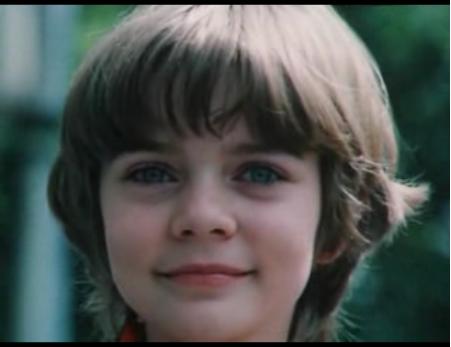

A different young actress appeared in the 1988 «Остров ржавого генерала»/The Rusty General's Island. (Please enjoy a mashup of clips from the film with music by Kraftwerk. Those robots are practically Dalek-quality!). There also exists a late Soviet, puppet-animated version of «Узники Ямагири-мару»/The Prisoners of the Yamagiri-Maru (1988), about some thrilling hijinks involving deep-sea wrecks (fansubbed: 1 | 2 | 3). Perhaps some MeFites might appreciate its low-budget puppety charms.
Alisa and her world were reimagined for a new 2009 animated film based on the novel «День рождения Алисы»/Alisa's Birthday (1974). In part animated using Flash, this Alisa has a little more attitude. Check out one of the trailers. In a video interview, Guseva, the original live-action Alisa (who appears in a cameo role, voicing a starship captain drawn from Lucy Liu's facial appearance [embedded video link sadly verklempt]) was reported to have said «Хочется эту Алису поймать и всыпать ей…» ("You want to grab this Alisa and knock some sense into her…").

In 2008, a teaser trailer was produced for something called «Приключения Алисы: Пленники трех планет»/Alisa's Adventures: The Captives of Three Planets, but the production seems to have mercifully stalled some time ago. The plot is about some kind of interplanetary terrorists, very au courant. Here is a kind of creepy-looking teaser for a computer-animated 26-episode series that's apparently in the works (sorry, Googlish). Purists are complaining loudly (in Russian). Timur Bekmambetov (tangential previously) is involved with the project.
But back to Bulychev. Born Игорь Можейко/Igor Mozheyko in Moscow in 1934, the author published all of his fiction under pseudonyms. Кирилл (Cyril), but mostly simply Кир (Kir), was the primary pen name, combining his wife Kira's first name with his mother's maiden name.

Bulychev's father successfully concealed his family's szlachta roots and was eventually appointed to the law faculty of a university. Bulychev's mother came from the family of a career military officer and was for a time the commandant of the Shlisselburg fortress near Leningrad. Bulychev himself completed studies at МГЛУ, the USSR's largest academic institution dedicated to the study of foreign languages, thereafter working in Burma as a translator and correspondent for a Soviet news agency. Upon returning to the USSR, he began graduate studies at the Institute of Oriental Studies at the Russian Academy of Sciences, where he specialized in the history of Southeast Asia and defended a dissertation on the history of the Pagan Kingdom.


Simultaneously with the start of his graduate studies, Bulychev began to write fiction, using the pseudonym Maung San Ji for a few early stories. He kept his identity a secret until 1982 out of concern for his reputation as a scholar, only revealing his real name when he was awarded the USSR State Prize for his screenplay for «Через тернии к звёздам»/Per Aspera Ad Astra (somewhat previously). Bulychev went on to receive a number of other Russian-language awards (Googlish) for his fiction and essays.
Bulychev's oeuvre is extensive and largely unknown and unavailable in English. It seems that at least one small publisher tried putting out some translations, but has since folded. A smattering of other translations exists. In addition to novels about Alisa, Bulychev wrote a sequence of humorous novels set in a city reminiscent of Terry Pratchett's Ankh-Morpork (Гусляр/Gusliar cycle); tales of survival on alien planets (e.g., «Посёлок»/The Village); some space operas about the dangerous work of the Intergalactic Police (e.g., «Покушение на Тесея»/An Attempt on Theseus); and various Strugatsky-like tales about academics and scholars in weird and fantastical settings (e.g., «Вид на битву с высоты»/A View of the Battle from Above).
Here (EN) is a candid, if rather staccato, series of answers to reader-submitted questions Bulychev took during one of his public appearances in 1997. He talks about his background, his work, and his writing method. Here (EN) is a similar, somewhat longer one, translated somewhat less capably. Here is a more interesting interview, touching on Bulychev's opposition to the Americanization of Russian cinema and literature, his feelings about "self-justifying" violence in books, his attitude toward prying questions about his wartime childhood, his self-assessment as a mediocre writer and unremarkable human being, and so on (Googlish again, sorry).
By comparison to his earlier writing, which either featured typical Soviet sci-fi protagonists (moral, decent, hard-working) or was directed toward children, Bulychev's post-Soviet work was on the whole darker, more pessimistic and violent (e.g., his 1993 novel «Любимец»/Favorite, which describes a future in which humans are kept as docile pets by alien overlords). After the fall of USSR, Bulychev became a strident and outspoken critic of the old order, often clashing with fans suffering from childhood nostalgia for the socialist techno-utopias his earlier books were set in. Before his death, Bulychev became known among readers as something of a Harlan Ellison. This was not a total about-face, as can be seen from stories Bulychev wrote "for the desk drawer" ("в стол," i.e., without hope of publication) in the 60s and 70s and did not publish until much later (such as the explicitly critical short story «О страхе»/"On Fear" (sorry, RU)).
In addition to genre fiction, Bulychev/Mozheyko wrote under his real name as well, primarily history and accounts of Southeast Asia (including a biography of Burmese revolutionary Aung San). He has also translated some English-language science fiction into Russian, including Asimov, Clarke, Sturgeon, and Simak. Finally, Bulychev had an abiding interest in the history of medals and decorations, completing at least one volume on the emblems of Imperial Russia.

(1980s Russian sci-fi animation previously.)
Enjoy!
Well, that's the weekend covered. Thanks for this awesome post, Nomyte!
posted by Kevin Street at 2:39 PM on July 8, 2011
posted by Kevin Street at 2:39 PM on July 8, 2011
What a post! Thank you for this!
posted by brundlefly at 2:42 PM on July 8, 2011
posted by brundlefly at 2:42 PM on July 8, 2011
that I just what wow
posted by CynicalKnight at 3:15 PM on July 8, 2011
posted by CynicalKnight at 3:15 PM on July 8, 2011
Fantastic post. Almost too much to figure out what to do with. (And Netflix, why do you never have cool stuff like Soviet SF children's animation on your list?)
posted by immlass at 3:50 PM on July 8, 2011
posted by immlass at 3:50 PM on July 8, 2011
Small note: Alice: The Girl From Earth can be ordered in hardcopy from the Xlibris print-on-demand company. The available free link above includes an old link to the Xlibris product page, which can be corrected by changing the www1 to www2.
Also, I found an English translation of The Girl Nothing Happens To, when looking for Evgeny Migunov illustrations. The PDF has some illustrations, which I think are from Migunov. It seems the PDF is OCR'd from a dead website, http://home.freeuk.com/russica2 (no access to Archive.org at the moment, or I'd see if the Wayback Machine has some more).
posted by filthy light thief at 4:03 PM on July 8, 2011 [4 favorites]
Also, I found an English translation of The Girl Nothing Happens To, when looking for Evgeny Migunov illustrations. The PDF has some illustrations, which I think are from Migunov. It seems the PDF is OCR'd from a dead website, http://home.freeuk.com/russica2 (no access to Archive.org at the moment, or I'd see if the Wayback Machine has some more).
posted by filthy light thief at 4:03 PM on July 8, 2011 [4 favorites]
It's really quite wonderful - thank you for posting this :) I am watching The Secret of the Third Planet now - for some reason the animation reminds me of Fantastic Planet.
posted by Poet_Lariat at 4:45 PM on July 8, 2011
posted by Poet_Lariat at 4:45 PM on July 8, 2011
Thank you thank you thank you
posted by a small part of the world at 4:56 PM on July 8, 2011
posted by a small part of the world at 4:56 PM on July 8, 2011
Growing up in the Soviet Union, Bulychev was *the* sci-fi author, both very light, fun, children's books and more mature ones in the style of Heinlein's juveniles (but more humorous). When I think of Russian sci-fi it's primarily Efremov for older, hard (philosophical/social/scientific) scifi and Bulychev for children, juvenile and also hard scifi - the dude could write anything! It's interesting that both were well regarded scientists and only then branched out into writing.
The main thing about Bulychev is that he's always *fun* to read - and that was pretty rare in Soviet literature, scifi or otherwise. And he's funny, even in most of his hard scifi.
The cartoon is quite famous and not bad at all, but the "Guest from the future" is the iconic adaptation, with some really talented actors in the roles of pirates.
I think his best works are "The Village", "The Last War", "Abduction of the sorcerer" and "The favorite", and I think a couple more novels with the same starship from "The Last War".
I was trying to think of the best way to relate him to western authors and I think I got it: Heinlein juveniles crossed over with J.K. Rowling (but much better!) It's a shame his translations are not more widely available, I think part of the problem is he had no choice but to push ideology every now and then and those bits are a bit odd to read in translation in 2011.
posted by rainy at 6:32 PM on July 8, 2011 [4 favorites]
The main thing about Bulychev is that he's always *fun* to read - and that was pretty rare in Soviet literature, scifi or otherwise. And he's funny, even in most of his hard scifi.
The cartoon is quite famous and not bad at all, but the "Guest from the future" is the iconic adaptation, with some really talented actors in the roles of pirates.
I think his best works are "The Village", "The Last War", "Abduction of the sorcerer" and "The favorite", and I think a couple more novels with the same starship from "The Last War".
I was trying to think of the best way to relate him to western authors and I think I got it: Heinlein juveniles crossed over with J.K. Rowling (but much better!) It's a shame his translations are not more widely available, I think part of the problem is he had no choice but to push ideology every now and then and those bits are a bit odd to read in translation in 2011.
posted by rainy at 6:32 PM on July 8, 2011 [4 favorites]
I think comparisons to Heinlein are very appropriate. Heinlein and Bulychev wrote at the same time, more or less, and the stuff the two of them wrote is clearly ideologically informed. It's not really programmatic ideology, in the sense of "woo, comrade Stalin!" (This is markedly unlike Yefremov, whose best-known work is heavily dogmatic.) It's more of an artistic choice to depict and valorize certain human ideals and traits. Their writing shared the concern with human destiny among the stars, the dignity of the individual, the inherent virtue of hard work, and so on.
I suspect Heinlein's juveniles would seem as peculiar and ideologically driven were they to be published today. Like Bulychev's Soviet novels, they're the stuff of a different time. It's also why we're very unlikely to see a successful translation of anything Bulychev wrote. It really takes a Soviet (or, more generally, Eastern European) background to read Bulychev the same way his fans read him.
posted by Nomyte at 6:55 PM on July 8, 2011 [1 favorite]
I suspect Heinlein's juveniles would seem as peculiar and ideologically driven were they to be published today. Like Bulychev's Soviet novels, they're the stuff of a different time. It's also why we're very unlikely to see a successful translation of anything Bulychev wrote. It really takes a Soviet (or, more generally, Eastern European) background to read Bulychev the same way his fans read him.
posted by Nomyte at 6:55 PM on July 8, 2011 [1 favorite]
SUPER FAVORITED! БОЛЬШОЕ СПАСИБО!!
posted by trip and a half at 7:47 PM on July 8, 2011
posted by trip and a half at 7:47 PM on July 8, 2011
Holy crap, wow. This sort of thing is why I love MetaFilter. Too bad I have to work tomorrow or I'd be doing nothing but going through this post link by link.
posted by 40 Watt at 8:08 PM on July 8, 2011
posted by 40 Watt at 8:08 PM on July 8, 2011
Efremov is an interesting case.. I think what he was trying to do was to say.. ok, so I *have* to write about ideology? Fine! -- and then he would embrace it, extend it and change it so that when taken in through the filter of his art, style and aesthetics, it has almost nothing to do with ideology of the time. It reminds you of how Microsoft takes a technology and then embraces and extends it in order to shut it down or to control it. Protagonists in his big space novels have much more in common with the ideals of classical Greece (or yogins he had in one of his non-scifi books) than contemporary Soviet ideals, their highest aspiration being the development of scientific mind, art and physical excellence.
There's a certain convergence there with western sci-fi set in the distant future: when someone needs a place to stay or a plane ride, they are not concerned whether they'll be able to afford it in his space novels exactly in the same way it's not a concern for citizens of the Culture in Iain Banks' books.
posted by rainy at 8:58 PM on July 8, 2011
There's a certain convergence there with western sci-fi set in the distant future: when someone needs a place to stay or a plane ride, they are not concerned whether they'll be able to afford it in his space novels exactly in the same way it's not a concern for citizens of the Culture in Iain Banks' books.
posted by rainy at 8:58 PM on July 8, 2011
Oh, sure. His Andromeda Nebula is about as much a manual on social engineering as Olaf Stapledon's Last and First Men is a handbook on eugenics. But it does have quite a bit of the spirit of Soviet technocracy: monumental public works, total subjugation of the natural environment (e.g., melting the polar ice caps, irrigating the Sahara, eliminating air travel, etc.).
posted by Nomyte at 9:06 PM on July 8, 2011
posted by Nomyte at 9:06 PM on July 8, 2011
I agree, when I was re-reading it recently it's shocking how resurfacing of Earth is given without a moment's reflection. Not just the ice caps, the whole temperate zone (both the north and the south ones) are turned into giant, apparently monotonously unchanging steppes for grazing animals and the mediterranean sea is extended all along the equator with corresponding climate to make a sort of a kiddie pool of the planet.
But I think it's more of a plain pre-ecological 50's techno-stupidity than anything natively Soviet, and the thing about world-wide trains vs. airplanes reminds of current preference for high speed trains in Europe and Japan for all the same reasons.
posted by rainy at 9:21 PM on July 8, 2011
But I think it's more of a plain pre-ecological 50's techno-stupidity than anything natively Soviet, and the thing about world-wide trains vs. airplanes reminds of current preference for high speed trains in Europe and Japan for all the same reasons.
posted by rainy at 9:21 PM on July 8, 2011
I was going to wholeheartedly agree and say that I can easily think of lots of US scifi written in the 1950s and early 1960s that subscribes to the same ideals, but… I can't. I'm sure the attitudes in Andromeda aren't terribly far from contemporary attitudes in the US in regards to the environment, the inevitable march of progress, and so on, but for whatever reason that kind of fiction doesn't come to mind readily. Maybe Yefremov was sui generis, even in the USSR. I don't think much "frivolous" fiction was being written around that time. I'm not claiming that "man conquers nature in the future" is a uniquely Soviet genre, it's just that techno-utopianism, for whatever reason, found expression in futuristic narrative in the USSR and not elsewhere.
To be honest, my grasp of the history of scifi is pretty tenuous. As far as prominent US authors working around that time, I can think of Asimov, Heinlein, Clarke, Poul Anderson, Cordwainer Smith, Fritz Leiber, Theodore Sturgeon, and then I peter out. Some of these authors are concerned with technological advances, but not on a global scale. Others are more concerned with systems of governance and other kinds of non-technological world-building. Although a few wrote "hard" or monumental scifi, others wrote human-scale stories about individuals. By comparison, Andromeda isn't even about individual characters and more about collectives of characters.
But maybe the reason I can think of these people, and possibly the reason their names are prominent, is that they rose above the schlock in some way. Maybe that schlock (that must've outnumbered them 10:1 or even 100:1) was full of the kinds of things one finds in Yefremov, and it just didn't survive to the present. Or maybe we need to look at US authors of the previous generation to find better analogs — A. E. van Vogt's stuff seems pretty close in sweep.
posted by Nomyte at 10:02 PM on July 8, 2011
To be honest, my grasp of the history of scifi is pretty tenuous. As far as prominent US authors working around that time, I can think of Asimov, Heinlein, Clarke, Poul Anderson, Cordwainer Smith, Fritz Leiber, Theodore Sturgeon, and then I peter out. Some of these authors are concerned with technological advances, but not on a global scale. Others are more concerned with systems of governance and other kinds of non-technological world-building. Although a few wrote "hard" or monumental scifi, others wrote human-scale stories about individuals. By comparison, Andromeda isn't even about individual characters and more about collectives of characters.
But maybe the reason I can think of these people, and possibly the reason their names are prominent, is that they rose above the schlock in some way. Maybe that schlock (that must've outnumbered them 10:1 or even 100:1) was full of the kinds of things one finds in Yefremov, and it just didn't survive to the present. Or maybe we need to look at US authors of the previous generation to find better analogs — A. E. van Vogt's stuff seems pretty close in sweep.
posted by Nomyte at 10:02 PM on July 8, 2011
I grew up with my parents and sister reading these books to me as a kid.
Guest from the future (also known as Visitor from the future) is available in its entirety online and, e.g., on YouTube, with English subtitles. It's a great movie and very much worth watching. The first part can be found here. In addition, it has a very catchy theme song.
Thanks for this wonderful post!
posted by zonem at 12:41 AM on July 9, 2011
Guest from the future (also known as Visitor from the future) is available in its entirety online and, e.g., on YouTube, with English subtitles. It's a great movie and very much worth watching. The first part can be found here. In addition, it has a very catchy theme song.
Thanks for this wonderful post!
posted by zonem at 12:41 AM on July 9, 2011
Best post of the year so far, as far as I'm concerned; I can't thank you enough.
> But it does have quite a bit of the spirit of Soviet technocracy: monumental public works, total subjugation of the natural environment (e.g., melting the polar ice caps, irrigating the Sahara, eliminating air travel, etc.).
This is reminiscent of Andrei Platonov, now universally acknowledged as one of the greatest Russian writers of the twentieth century. His masterpiece is The Foundation Pit, and as I wrote in my review:
It's going to take me a while to work through these links, but I will overfulfill the plan! I am a Stakhanovite link-follower!
posted by languagehat at 7:23 AM on July 9, 2011 [3 favorites]
> But it does have quite a bit of the spirit of Soviet technocracy: monumental public works, total subjugation of the natural environment (e.g., melting the polar ice caps, irrigating the Sahara, eliminating air travel, etc.).
This is reminiscent of Andrei Platonov, now universally acknowledged as one of the greatest Russian writers of the twentieth century. His masterpiece is The Foundation Pit, and as I wrote in my review:
Platonov has been called a natural Stalinist; what is meant by that is that he shared the Stalinist belief that life could be radically transformed, that nothing was impossible to truly conscious people who had thrown off the shackles of the bourgeois past. (Of course, in Platonov's case this came as much from Nikolai Fedorov, with his loony insistence that mankind must become immortal and bring everyone who ever lived back to life, as from Marx and Lenin.) Like a good Soviet citizen, filled with optimism and enthusiasm, Platonov gave up his early career as a writer after the famine of 1921 and spent the next years going around Russia supervising the digging of ponds and wells, the draining of swampland, and the building of power stations. ... That experience complicated his optimism. He seems still to have retained a belief that the shining communist future was a possibility, but having seen the stupidity, inefficiency, corruption, and brutality that were everywhere on the ground, no matter what the Kremlin planners might intend, he had to respond, to tell the truth as he saw it, and that response involved a complex and brilliant manipulation of the very language the Kremlin used to propagate its ideas.As a matter of fact, Platonov has something of the feel of a weird kind of science fiction, but a kind that has nothing to do with the Anglo-American tradition or with spaceships and alien creatures. Russia in the early twentieth century was a hotbed of what from our vantage point look like loony ideas, from Fedorov to Solovyov and Bogdanov (who actually wrote sf, publishing Red Star in 1908).
It's going to take me a while to work through these links, but I will overfulfill the plan! I am a Stakhanovite link-follower!
posted by languagehat at 7:23 AM on July 9, 2011 [3 favorites]
I can't think of a good example, either, I just feel that if most of western authors were asked about it in the 50s, they would say - in 3 thousand years? Sure, why not? I suspect in the 50s they would have thought it a good idea, but they were mostly writing smaller works in sweep and scale, and just 10 years later people were writing on wider range of subjects but at the same time were much more environmentally-minded. That said, the closest examples I can think of is Mars terraforming (if we do that in 200 years, doing the same on Earth in 3000 years isn't that far off) and Asimov's Trantor. I've read quite a bit of 60s-70s sci-fi but very little if any from the 50s, it may well be there were a few that covered this topic.
posted by rainy at 7:25 AM on July 9, 2011
posted by rainy at 7:25 AM on July 9, 2011
I agree, when I was re-reading it recently it's shocking how resurfacing of Earth is given without a moment's reflection. Not just the ice caps, the whole temperate zone (both the north and the south ones) are turned into giant, apparently monotonously unchanging steppes for grazing animals and the mediterranean sea is extended all along the equator with corresponding climate to make a sort of a kiddie pool of the planet.
Sounds good to me.
posted by Lovecraft In Brooklyn at 5:47 PM on July 12, 2011
Sounds good to me.
posted by Lovecraft In Brooklyn at 5:47 PM on July 12, 2011
« Older Tantalizing hints of the world beyond the virtual | What the hay was that about? Newer »
This thread has been archived and is closed to new comments
I admit I was lured in by the promise of cake.
posted by elizardbits at 2:20 PM on July 8, 2011 [5 favorites]