beanplating spatial geometry in The Shining
July 24, 2011 5:35 PM Subscribe
It was like I’d been here before. I mean we’ve all had feelings of déjà vu but this was ridiculous. It’s almost like I knew what was going to be around every corner.
Wow! Really, kbanas?
posted by This, of course, alludes to you at 5:54 PM on July 24, 2011
posted by This, of course, alludes to you at 5:54 PM on July 24, 2011
I... Kind of feel like this is going waaaay out of its way to ascribe meaning to simple inconsistencies?
posted by brennen at 6:01 PM on July 24, 2011 [7 favorites]
posted by brennen at 6:01 PM on July 24, 2011 [7 favorites]
Kind of feel like this is going waaaay out of its way to ascribe meaning to simple inconsistencies?
It injures our love of him to think of Kubrick as making continuity errors.
posted by Trurl at 6:02 PM on July 24, 2011 [3 favorites]
It injures our love of him to think of Kubrick as making continuity errors.
posted by Trurl at 6:02 PM on July 24, 2011 [3 favorites]
Where would the internet be without overblown analysis and pointless pop-culture scrutiny?
posted by Old Man McKay at 6:05 PM on July 24, 2011 [5 favorites]
posted by Old Man McKay at 6:05 PM on July 24, 2011 [5 favorites]
As a fellow Kubrick nerd, snark aside, this is pretty interesting.
posted by Blazecock Pileon at 6:06 PM on July 24, 2011 [1 favorite]
posted by Blazecock Pileon at 6:06 PM on July 24, 2011 [1 favorite]
That site is a little disturbing.
posted by chinston at 6:07 PM on July 24, 2011 [1 favorite]
posted by chinston at 6:07 PM on July 24, 2011 [1 favorite]
This is a really fun site and I think that given Stanley Kubrick's reputation as a meticulous million-takes-to-get-it director, his work tends to stand up well to this kind of beanplating. Where it falls apart for me is when the more obscure and tangental references get the neat, mathematical x=y treatment. It doesn't leave any room for relative or plural meanings that typify postmodern design and art. One would think someone like Kubrick would be hep to that.
posted by Thin Lizzy at 6:11 PM on July 24, 2011 [2 favorites]
posted by Thin Lizzy at 6:11 PM on July 24, 2011 [2 favorites]
Overlook Hotel Restaurant children's placemat
posted by Trurl at 6:13 PM on July 24, 2011 [28 favorites]
posted by Trurl at 6:13 PM on July 24, 2011 [28 favorites]
It might be overblown analysis — "beanplating" — except for the labyrinth scene at the end of the film that leads to a literal dead-end for Jack. And as he notes, Kubrick was so detail-oriented that it seems unlikely that this kind of set design was accidental.
To me, one question is how the idea of how this visualization of deception and illusion fits into the film's overarching theme of American empire. I have some thoughts about this, but I'd have liked to hear his views on it, and I think he falls short here, trying to explain why Kubrick would play these tricks...
posted by Blazecock Pileon at 6:19 PM on July 24, 2011 [5 favorites]
To me, one question is how the idea of how this visualization of deception and illusion fits into the film's overarching theme of American empire. I have some thoughts about this, but I'd have liked to hear his views on it, and I think he falls short here, trying to explain why Kubrick would play these tricks...
posted by Blazecock Pileon at 6:19 PM on July 24, 2011 [5 favorites]
This website made me want to rewatch Last Year at Marienbad. The Shining, not so much.
posted by nathancaswell at 6:19 PM on July 24, 2011 [3 favorites]
posted by nathancaswell at 6:19 PM on July 24, 2011 [3 favorites]
It's like when Chevy Chase is driving the station wagon smack dab in the middle of Sunset Boulevard and in the next shot he's pulling up to the locked entrance of Wally World. Everyone knows Wally World is in Santa Clarita, nearly thirty miles away!
posted by infinitewindow at 6:28 PM on July 24, 2011 [9 favorites]
posted by infinitewindow at 6:28 PM on July 24, 2011 [9 favorites]
He made it nonsensical on purpose to lend the hotel an otherworldly feeling. There, I retconned Kubrick's meticulousness for you.
posted by basicchannel at 6:29 PM on July 24, 2011 [6 favorites]
posted by basicchannel at 6:29 PM on July 24, 2011 [6 favorites]
The hotel manager's office window is impossible!?! That is so cool.
There are also spatial problems in 2001 — difficult to mentally fit the pod bay, the cockpit, the carousel, and all the various corridors into that sphere on Discovery One.
posted by gubo at 6:31 PM on July 24, 2011 [2 favorites]
There are also spatial problems in 2001 — difficult to mentally fit the pod bay, the cockpit, the carousel, and all the various corridors into that sphere on Discovery One.
posted by gubo at 6:31 PM on July 24, 2011 [2 favorites]
A certain amount of odd geometry could be disorienting, but if you have to find the oddness by drawing a map, I think it's probably not intentional.
...watch how the door swings in each shot. In the shot outside the freezer room he grabbed the handle of the door with his left hand, but when the shot cuts to inside he pulls the door open with his right hand … and the door swings open from the wrong side.
Now THIS is an "error" that probably means something. I found the mismatched helmet/suit colors in 2001 very interesting, for instance, if you take the helmet to mean "brain" or "intelligence" or "intellect".
Repeatedly in The Shining we see doors in the wrong places, impossible windows, and rooms that are too big.
On the one hand, I'd like to believe this was intentional (esp wrt to the hedge maze). OTOH, I'd like to see him make maps of all the other Kubrick films. If they are all air-tight, I'll believe it.
posted by DU at 6:32 PM on July 24, 2011 [1 favorite]
...watch how the door swings in each shot. In the shot outside the freezer room he grabbed the handle of the door with his left hand, but when the shot cuts to inside he pulls the door open with his right hand … and the door swings open from the wrong side.
Now THIS is an "error" that probably means something. I found the mismatched helmet/suit colors in 2001 very interesting, for instance, if you take the helmet to mean "brain" or "intelligence" or "intellect".
Repeatedly in The Shining we see doors in the wrong places, impossible windows, and rooms that are too big.
On the one hand, I'd like to believe this was intentional (esp wrt to the hedge maze). OTOH, I'd like to see him make maps of all the other Kubrick films. If they are all air-tight, I'll believe it.
posted by DU at 6:32 PM on July 24, 2011 [1 favorite]
All of the spatial problems in Eyes Wide Shut are at the orgy scene.
posted by shakespeherian at 6:32 PM on July 24, 2011 [2 favorites]
posted by shakespeherian at 6:32 PM on July 24, 2011 [2 favorites]
You don't need a map. Lots of folks noticed this for decades without one.
posted by basicchannel at 6:33 PM on July 24, 2011 [2 favorites]
posted by basicchannel at 6:33 PM on July 24, 2011 [2 favorites]
Before I saw The Shining, I didn't realize I could be in love with cinematography.
He made it nonsensical on purpose to lend the hotel an otherworldly feeling. There, I retconned Kubrick's meticulousness for you.
I thought this was 'canon'? I'm used to haunted houses/TARDISes rearranging their rooms. King even has a living house in The Dark Tower that's mentioned as being similar to The Overlook by one of the characters (which confused me, since a. this was before all the other metafictional weirdneess and b. King's character liked the movie more than he did).
posted by Lovecraft In Brooklyn at 6:39 PM on July 24, 2011 [3 favorites]
He made it nonsensical on purpose to lend the hotel an otherworldly feeling. There, I retconned Kubrick's meticulousness for you.
I thought this was 'canon'? I'm used to haunted houses/TARDISes rearranging their rooms. King even has a living house in The Dark Tower that's mentioned as being similar to The Overlook by one of the characters (which confused me, since a. this was before all the other metafictional weirdneess and b. King's character liked the movie more than he did).
posted by Lovecraft In Brooklyn at 6:39 PM on July 24, 2011 [3 favorites]
Two people with luggage emerge from a hallway that wraps around the back of the wall, but how can this be?
I live at the end of a 5 and a half minute hallway....
posted by Lovecraft In Brooklyn at 6:40 PM on July 24, 2011 [7 favorites]
I live at the end of a 5 and a half minute hallway....
posted by Lovecraft In Brooklyn at 6:40 PM on July 24, 2011 [7 favorites]
What's really interesting about this thing is all the screenshots. There's not a single even remotely disturbing visual...and yet I had to stop looking at them because I'm getting creeped out.
posted by DU at 6:40 PM on July 24, 2011 [22 favorites]
posted by DU at 6:40 PM on July 24, 2011 [22 favorites]
I... Kind of feel like this is going waaaay out of its way to ascribe meaning to simple inconsistencies?
Some of them, yes, likely. But some of them, like the windows where hallways should be, are definitely deliberate and really cool.
posted by The Devil Tesla at 6:48 PM on July 24, 2011 [2 favorites]
Some of them, yes, likely. But some of them, like the windows where hallways should be, are definitely deliberate and really cool.
posted by The Devil Tesla at 6:48 PM on July 24, 2011 [2 favorites]
To me, one question is how the idea of how this visualization of deception and illusion fits into the film's overarching theme of American empire. I have some thoughts about this, but I'd have liked to hear his views on it, and I think he falls short here, trying to explain why Kubrick would play these tricks...
It's a horror movie. It's goal is to scare the audience. The director will use whatever tools and skills they have to scare people. If the director doesn't have money but has skill you get Blair Witch style creepiness. If they've got skill but no subtly you get gross outs and fun jump scares (not a criticism - I liked Drag Me To Hell). If they've got no skill and no subtly you get random gore and cat scares.
Kubrick has nothing but skill and a good budget, so he could set up weird inconsistencies and spatial disorientation to the point where decades later people are still freaking out at a still shot of a hallway.
posted by Lovecraft In Brooklyn at 6:52 PM on July 24, 2011 [6 favorites]
I've been saying this a lot lately, but I basically don't believe that it's possible to overthink stuff in films. Everything you see reflects a conscious choice or an unconscious one. You begin to understand more about what the filmmakers/designers' priorities are, and you learn just as much from the ways in which they accidentally(?) betray their vision.
I'm a big rewatcher of movies, and while I am sad sometimes and wish I could see certain films through fresh eyes for the first time again, it's amazing to me what I've unlocked for myself.
As John Waters says, "If you’re bored, just watch the lamps. You get obsessive and you look for the details.”
posted by hermitosis at 6:55 PM on July 24, 2011 [17 favorites]
I'm a big rewatcher of movies, and while I am sad sometimes and wish I could see certain films through fresh eyes for the first time again, it's amazing to me what I've unlocked for myself.
As John Waters says, "If you’re bored, just watch the lamps. You get obsessive and you look for the details.”
posted by hermitosis at 6:55 PM on July 24, 2011 [17 favorites]
well, it is a haunted hotel ...
And, for what it's worth, I think you'll find almost every movie ever made has similar if not far more glaring errors of continuity. Because it's in the nature of cinematic language to collapse space and time. Done well (ie: with Kubrick's masterful and knowing sleight of hand) it's almost impossible to catch, certainly on first viewing. Done sloppily, you get the kind of brain-bruising willful crap that Michael Bay keeps foisting on the world.
posted by philip-random at 7:01 PM on July 24, 2011 [2 favorites]
And, for what it's worth, I think you'll find almost every movie ever made has similar if not far more glaring errors of continuity. Because it's in the nature of cinematic language to collapse space and time. Done well (ie: with Kubrick's masterful and knowing sleight of hand) it's almost impossible to catch, certainly on first viewing. Done sloppily, you get the kind of brain-bruising willful crap that Michael Bay keeps foisting on the world.
posted by philip-random at 7:01 PM on July 24, 2011 [2 favorites]
The 'Physical Cosmologies' articles linked to in the previous post on this subject are incredible. Hard to read and half crazy, but half brilliant.
Just looking at the screen shots gives me the willies.
posted by These Premises Are Alarmed at 7:09 PM on July 24, 2011 [1 favorite]
Just looking at the screen shots gives me the willies.
posted by These Premises Are Alarmed at 7:09 PM on July 24, 2011 [1 favorite]
By the time we get to Kubrik, subliminal messages and the Illuminati, we're way past crazy.
posted by DarlingBri at 7:17 PM on July 24, 2011
posted by DarlingBri at 7:17 PM on July 24, 2011
And as he notes, Kubrick was so detail-oriented that it seems unlikely that this kind of set design was accidental.
Kubrick built in a lot of visual disorientation to the Shining, it's very deliberate, the idea of the maze and so on, but too many critics of The Shining pick on such little changes in detail and positioning that are way more easily explained as common continuity errors.
Or, in a more generous reading, maybe the continuity errors were kept in to disorient the viewer. The bathroom scene deliberately violates the 180 degree rule in order to disorident the viewer and make a ghostly effect.
posted by The Whelk at 7:19 PM on July 24, 2011
Kubrick built in a lot of visual disorientation to the Shining, it's very deliberate, the idea of the maze and so on, but too many critics of The Shining pick on such little changes in detail and positioning that are way more easily explained as common continuity errors.
Or, in a more generous reading, maybe the continuity errors were kept in to disorient the viewer. The bathroom scene deliberately violates the 180 degree rule in order to disorident the viewer and make a ghostly effect.
posted by The Whelk at 7:19 PM on July 24, 2011
Everything you see reflects a conscious choice or an unconscious one.
On a certain level that's true of most everything.
Not that I mind counting the beans.
posted by ChurchHatesTucker at 7:21 PM on July 24, 2011
On a certain level that's true of most everything.
Not that I mind counting the beans.
posted by ChurchHatesTucker at 7:21 PM on July 24, 2011
I've known too many set designers to think inconsistencies like this are mistakes. There are too many people whose entire jobs are to obsess about this stuff for incongruous floor plans to show up in a major theatrical release with any kind of budget, major crises excepted.
King later did something about a house that rearranges itself (did this happen in The Talisman as well? I can't remember), although I can't recall this being featured in the original text of the novel (not that that should matter much; Kubrick deviated quite a bit from the original text).
posted by smirkette at 7:22 PM on July 24, 2011 [3 favorites]
King later did something about a house that rearranges itself (did this happen in The Talisman as well? I can't remember), although I can't recall this being featured in the original text of the novel (not that that should matter much; Kubrick deviated quite a bit from the original text).
posted by smirkette at 7:22 PM on July 24, 2011 [3 favorites]
Oh! And the spatially wrong door in the Torrence's apartment is a Known Feature in Kubrick crticism, it's too big and obvious to be a mistake, and considering what happens in that apartment, it's part of the bigger "disorientation, fantasy world maze" feeling.
Like the orientation of Room 217. It should logically be on the right but is seen on the left. It's bigger on the inside.
posted by The Whelk at 7:25 PM on July 24, 2011 [1 favorite]
Like the orientation of Room 217. It should logically be on the right but is seen on the left. It's bigger on the inside.
posted by The Whelk at 7:25 PM on July 24, 2011 [1 favorite]
(Also movies are commonly refereed to as a dream-like because people can walk into totally new environments or move down corridors that shouldn't be possible like you do in a dream, without commenting on it. Eternal Sunshine Of The Spotless Mind used this to good effect.)
posted by The Whelk at 7:27 PM on July 24, 2011 [2 favorites]
posted by The Whelk at 7:27 PM on July 24, 2011 [2 favorites]
Of course, it could also be that they used a combination of sets and a real location, and when these inconsistencies came up, they were like, "Fuck it, it's a horror movie about a guy who goes crazy. It's fine."
posted by smirkette at 7:27 PM on July 24, 2011 [6 favorites]
posted by smirkette at 7:27 PM on July 24, 2011 [6 favorites]
The conflict comes from the fact that Kubrick was so detail-oriented (He collected hundreds of photographs of doorways to find the "right one" for the prostitute to be lingering in for Eyes Wide Shut, for example) that such big technical mistakes from a famously technical director in telling a story about being disoriented may be deliberate.
I think a lot of it is, but not to the extent some people claim.
posted by The Whelk at 7:29 PM on July 24, 2011 [1 favorite]
I think a lot of it is, but not to the extent some people claim.
posted by The Whelk at 7:29 PM on July 24, 2011 [1 favorite]
(argh 237, book and film mixing badly in wine-soaked brain)
posted by The Whelk at 7:30 PM on July 24, 2011
posted by The Whelk at 7:30 PM on July 24, 2011
On the one hand, I'd like to believe this was intentional (esp wrt to the hedge maze). OTOH, I'd like to see him make maps of all the other Kubrick films. If they are all air-tight, I'll believe it.
2001 is probably his only other film which would be comparable in this regard, largely constrained to one location and with that location having such importance as to be a character on its own. I can't say off-hand how well everything fits together.
But I can say that Kubrick's meticulous nature was in full display in this one, intentionally driving Shelley Duvall to the point of a nervous breakdown in order to get what he wanted, and also doing small things like putting a paper-clip in her cigarette at the beginning so as to have the ash run crazy-long. The film is FULL of subtle effects to make the viewer feel uneasy without being able to point to exactly why.
He also got to play around with a steadicam for the first time here, and ran that sucker all over the overlook. It's harder for me to think that he didn't have a strong idea of the layout of the hotel than it is for me to think that these aren't just mistakes.
posted by Navelgazer at 7:32 PM on July 24, 2011 [3 favorites]
2001 is probably his only other film which would be comparable in this regard, largely constrained to one location and with that location having such importance as to be a character on its own. I can't say off-hand how well everything fits together.
But I can say that Kubrick's meticulous nature was in full display in this one, intentionally driving Shelley Duvall to the point of a nervous breakdown in order to get what he wanted, and also doing small things like putting a paper-clip in her cigarette at the beginning so as to have the ash run crazy-long. The film is FULL of subtle effects to make the viewer feel uneasy without being able to point to exactly why.
He also got to play around with a steadicam for the first time here, and ran that sucker all over the overlook. It's harder for me to think that he didn't have a strong idea of the layout of the hotel than it is for me to think that these aren't just mistakes.
posted by Navelgazer at 7:32 PM on July 24, 2011 [3 favorites]
Of course, it could also be that they used a combination of sets and a real location, and when these inconsistencies came up, they were like, "Fuck it, it's a horror movie about a guy who goes crazy. It's fine."
That's a cool uninformed opinion you have.
posted by codacorolla at 7:33 PM on July 24, 2011
That's a cool uninformed opinion you have.
posted by codacorolla at 7:33 PM on July 24, 2011
Be cool, it was just a thought. Jeez.
posted by smirkette at 7:34 PM on July 24, 2011 [8 favorites]
posted by smirkette at 7:34 PM on July 24, 2011 [8 favorites]
Alien and The Shining have a superficially simliar structure (as do many haunted house movies, I guess). They start off with a tour of the location so the audience can orient itself spacially - so they feel they 'know' the area like the characters do. Then everything goes to shit in the second half, so the audience and the characters need to use the knowledge of the location to survive.
I've got no idea if the ship in Alien is internally consistent, but knowing that the Overlook isn't means the feeling we had of safety, of knowledge, was just another trick. That's brilliant.
posted by Lovecraft In Brooklyn at 7:39 PM on July 24, 2011 [6 favorites]
I've got no idea if the ship in Alien is internally consistent, but knowing that the Overlook isn't means the feeling we had of safety, of knowledge, was just another trick. That's brilliant.
posted by Lovecraft In Brooklyn at 7:39 PM on July 24, 2011 [6 favorites]
There are also spatial problems in 2001 — difficult to mentally fit the pod bay, the cockpit, the carousel, and all the various corridors into that sphere on Discovery One.
That's always driven me nuts, trying to figure out how that sphere could work.
posted by COBRA! at 7:43 PM on July 24, 2011 [1 favorite]
That's always driven me nuts, trying to figure out how that sphere could work.
posted by COBRA! at 7:43 PM on July 24, 2011 [1 favorite]
I have no idea if the Nostromo is internally consistent either, but apparently some people have been trying to work that out. (pdf link -- pages seem to appear in reverse order)
posted by hippybear at 7:46 PM on July 24, 2011 [1 favorite]
posted by hippybear at 7:46 PM on July 24, 2011 [1 favorite]
double-dog dare anyone to read this thread while Music Has The Right To Children by Boards of Canada is playing in the background.
posted by Lipstick Thespian at 7:51 PM on July 24, 2011 [13 favorites]
posted by Lipstick Thespian at 7:51 PM on July 24, 2011 [13 favorites]
There are also spatial problems in 2001 — difficult to mentally fit the pod bay, the cockpit, the carousel, and all the various corridors into that sphere on Discovery One.
That's always driven me nuts, trying to figure out how that sphere could work.
Apparently people are trying to work that out, too, from several different approaches. Here are some basic blueprints (scroll about halfway down the page, or click link to the right) showing a possible configuration. And here is a website devoted to obsessional detail (de)construction of the Discovery and how it might all actually work if it were real.
posted by hippybear at 7:52 PM on July 24, 2011 [4 favorites]
That's always driven me nuts, trying to figure out how that sphere could work.
Apparently people are trying to work that out, too, from several different approaches. Here are some basic blueprints (scroll about halfway down the page, or click link to the right) showing a possible configuration. And here is a website devoted to obsessional detail (de)construction of the Discovery and how it might all actually work if it were real.
posted by hippybear at 7:52 PM on July 24, 2011 [4 favorites]
Lipstick Thespian, I couldn't agree more... Kubrick and Boards of Canada both resonate with me in a "70s existential dread" kinda way (in a good way)...definitely overlapping sets in the Venn diagram :)
posted by retronic at 8:06 PM on July 24, 2011
posted by retronic at 8:06 PM on July 24, 2011
Lipstick Thespian: "double-dog dare anyone to read this thread while Music Has The Right To Children by Boards of Canada is playing in the background"
Doing it. Wish I wasn't. CAN'T STOP.
posted by Roman Graves at 8:12 PM on July 24, 2011 [5 favorites]
Doing it. Wish I wasn't. CAN'T STOP.
posted by Roman Graves at 8:12 PM on July 24, 2011 [5 favorites]
Very cool find and many excellent links in the thread. Thank you!
posted by lord_wolf at 8:14 PM on July 24, 2011
posted by lord_wolf at 8:14 PM on July 24, 2011
here is a website devoted to obsessional detail (de)construction of the Discovery and how it might all actually work if it were real.With the movie version of Discovery, the biggest flaw in the design was deliberate. IIRC from Clarke's behind-the-scenes writing, they specifically discussed the problem of "How many square feet of radiating surface do you need to cool a fission-powered rocket of that performance level?", and came up with the movie-answer of "None. We don't want a million questions about why a space ship has wings."
posted by roystgnr at 8:18 PM on July 24, 2011 [2 favorites]
Dear Metafilter: I have never seen this film but I have just spent an hour reading about it, the Illuminati, and Woodrow Wilson. Will watching the film remedy my confusion or should I just skip it?
posted by cgk at 8:26 PM on July 24, 2011 [1 favorite]
posted by cgk at 8:26 PM on July 24, 2011 [1 favorite]
There's not a single even remotely disturbing visual
Says the guy who didn't make it to chapter 20, where a creepily in-depth analysis of the dead sisters shows them taking breaths (screecaps his, animated GIF mine).
posted by tapesonthefloor at 8:28 PM on July 24, 2011 [6 favorites]
Says the guy who didn't make it to chapter 20, where a creepily in-depth analysis of the dead sisters shows them taking breaths (screecaps his, animated GIF mine).

posted by tapesonthefloor at 8:28 PM on July 24, 2011 [6 favorites]
The GIF, by the way, loops forever, and ever, and ever.
posted by tapesonthefloor at 8:29 PM on July 24, 2011 [13 favorites]
posted by tapesonthefloor at 8:29 PM on July 24, 2011 [13 favorites]
The GIF, by the way, loops forever, and ever, and ever.
So far...
posted by Trochanter at 8:34 PM on July 24, 2011 [5 favorites]
So far...
posted by Trochanter at 8:34 PM on July 24, 2011 [5 favorites]
Says the guy who didn't make it to chapter 20
Wait what? Chapter 20 talks about sexual abuse of Danny? That is pretty outside the text, both in the movie script and the book.
At what point does beanplating become simply making shit up? If there's sexual abuse of Danny being discussed in the context of The Shining, it's pretty much entered the making shit up arena.
posted by hippybear at 8:41 PM on July 24, 2011
Wait what? Chapter 20 talks about sexual abuse of Danny? That is pretty outside the text, both in the movie script and the book.
At what point does beanplating become simply making shit up? If there's sexual abuse of Danny being discussed in the context of The Shining, it's pretty much entered the making shit up arena.
posted by hippybear at 8:41 PM on July 24, 2011
Dannny being physically abused is pretty HEAVILY IMPLIED in the movie, right down to the "he broke his arm".
posted by The Whelk at 8:43 PM on July 24, 2011
posted by The Whelk at 8:43 PM on July 24, 2011
Physical abuse != sexual abuse, which is what is overthought and (I believe) wrongly read-into the film via this chapter of the beanplating website.
The idea that Jack Torrance has a temper and a drinking problem which brings out that temper is highly central to the book, even if you take all the woo-woo psychic bits as psychological fugue or symbolic. But the idea that Jack Torrance is fucking Danny isn't part of any text attached to the story in book or movie form at all.
posted by hippybear at 8:46 PM on July 24, 2011 [2 favorites]
The idea that Jack Torrance has a temper and a drinking problem which brings out that temper is highly central to the book, even if you take all the woo-woo psychic bits as psychological fugue or symbolic. But the idea that Jack Torrance is fucking Danny isn't part of any text attached to the story in book or movie form at all.
posted by hippybear at 8:46 PM on July 24, 2011 [2 favorites]
One really good question in criticizing The Shining is: Are Ghosts Real? Kubrick would call King up in the middle of the night trying to answer this.
I think the movie says "Yes ghosts are real, but only in jack's head but the question of them being real or not doesn't matter cause they make him DO THINGS and are real enough to him to finally push him to the thought he's had in the back of mind for a long time now: Killing Danny and Wendy would solve all my problems."
posted by The Whelk at 8:49 PM on July 24, 2011 [2 favorites]
I think the movie says "Yes ghosts are real, but only in jack's head but the question of them being real or not doesn't matter cause they make him DO THINGS and are real enough to him to finally push him to the thought he's had in the back of mind for a long time now: Killing Danny and Wendy would solve all my problems."
posted by The Whelk at 8:49 PM on July 24, 2011 [2 favorites]
I think the movie says "Yes ghosts are real, but only in jack's head but the question of them being real or not doesn't matter cause they make him DO THINGS and are real enough to him
Making Danny's ability to shine... what exactly? Merely a super-sensitive ability to read someone else's mental state? What about how he can communicate across distances with others who also shine? Is that also only in Jack's head?
To JACK, the question is moot. The ghosts are making him do things, and that's what matters to him whether they're real or not. But to Danny, the ghosts are horrible external things which are directly threatening.
Not to mention that to the ghosts, Danny is the their doorway out of being trapped in the limbo of the Overlook and off to Elsewhere, whether that's the final step into the afterlife or simply out of their locked-in roles in the Overlook. Danny is central, his ability to Shine is central, and the idea that the ghosts are using Jack to kill Danny to put him at their disposal is also central.
That it's also a metaphor for Jack's alcoholism and abusive (but not sexually abusive) temper is entirely of Stephen King's genius.
posted by hippybear at 8:57 PM on July 24, 2011 [4 favorites]
Making Danny's ability to shine... what exactly? Merely a super-sensitive ability to read someone else's mental state? What about how he can communicate across distances with others who also shine? Is that also only in Jack's head?
To JACK, the question is moot. The ghosts are making him do things, and that's what matters to him whether they're real or not. But to Danny, the ghosts are horrible external things which are directly threatening.
Not to mention that to the ghosts, Danny is the their doorway out of being trapped in the limbo of the Overlook and off to Elsewhere, whether that's the final step into the afterlife or simply out of their locked-in roles in the Overlook. Danny is central, his ability to Shine is central, and the idea that the ghosts are using Jack to kill Danny to put him at their disposal is also central.
That it's also a metaphor for Jack's alcoholism and abusive (but not sexually abusive) temper is entirely of Stephen King's genius.
posted by hippybear at 8:57 PM on July 24, 2011 [4 favorites]
Anyway, this is probably a good point to mention that you can purchase Jack Torrance's literary masterpiece to put on your very own bookshelf.
posted by hippybear at 8:58 PM on July 24, 2011 [5 favorites]
posted by hippybear at 8:58 PM on July 24, 2011 [5 favorites]
I don't know. The movie sets it up to seem like they're only in Jack's head, but SOMETHING pushes the bolt out of the pantry door.
posted by codacorolla at 8:59 PM on July 24, 2011 [4 favorites]
posted by codacorolla at 8:59 PM on July 24, 2011 [4 favorites]
This is very interesting. While Kubrick's internal consisten--[AXE IN THE BACK]
posted by not_on_display at 9:01 PM on July 24, 2011 [20 favorites]
posted by not_on_display at 9:01 PM on July 24, 2011 [20 favorites]
I think the movie says "Yes ghosts are real, but only in jack's head but the question of them being real or not doesn't matter cause they make him DO THINGS and are real enough to him to finally push him to the thought he's had in the back of mind for a long time now: Killing Danny and Wendy would solve all my problems."
Except that a ghost unlocks the door of the Overlook, so I think they are real.
I haven't read the novel yet, but King loves the idea of the 'bad place', a location so infested by evil that it becomes almost sentient.
I think Kubrick and Nicholson's genius is such that I didn't recognize Jack Torrance as Yet Another Version of Steven King until 6 months after seeing the film. With that mindset, the ghosts are a metaphor for King's alcoholism, but they're also ghosts. I tend to take the supernatural in fiction as real unless told otherwise, though.
posted by Lovecraft In Brooklyn at 9:02 PM on July 24, 2011 [2 favorites]
I don't know. The movie sets it up to seem like they're only in Jack's head, but SOMETHING pushes the bolt out of the pantry door.
Holy shit. Never thought about this before, but:
'Poltergeists' are often theorized to be 'just' unconscious manifestations of the telekinetic powers of disturbed teenagers.
Danny starts the film as a telepath, but the Overlook amplifies his powers.
But why would Danny want his dad to escape?
posted by Lovecraft In Brooklyn at 9:04 PM on July 24, 2011
Holy shit. Never thought about this before, but:
'Poltergeists' are often theorized to be 'just' unconscious manifestations of the telekinetic powers of disturbed teenagers.
Danny starts the film as a telepath, but the Overlook amplifies his powers.
But why would Danny want his dad to escape?
posted by Lovecraft In Brooklyn at 9:04 PM on July 24, 2011
but SOMETHING pushes the bolt out of the pantry door.
Which, in the movie, corresponds with the total breakdown of reality.
I am speaking primarily of the movie in all of this, which I think takes a similar but different take of Danny's shining and Jack's mentality - and the Overlook Hotel is itself a rarefied mental place full of impossible rooms and windows in the wrong place - things that are off that you don't notice until your running down a hall from a guy with an axe
posted by The Whelk at 9:05 PM on July 24, 2011 [1 favorite]
Which, in the movie, corresponds with the total breakdown of reality.
I am speaking primarily of the movie in all of this, which I think takes a similar but different take of Danny's shining and Jack's mentality - and the Overlook Hotel is itself a rarefied mental place full of impossible rooms and windows in the wrong place - things that are off that you don't notice until your running down a hall from a guy with an axe
posted by The Whelk at 9:05 PM on July 24, 2011 [1 favorite]
The question "Are Ghosts Real?" hinges on that open door in the movie.
In the book, the ghosts are after Danny because he's a telepath, in the movie it's more ambiguous- Danny's ability doesn't help him, the ghosts are way more interested in Jack, because Jack/the Ghosts need to kill Wendy and Danny. Because the Overlook is a place for slaughter, and Jack is a killer.
posted by The Whelk at 9:08 PM on July 24, 2011 [1 favorite]
In the book, the ghosts are after Danny because he's a telepath, in the movie it's more ambiguous- Danny's ability doesn't help him, the ghosts are way more interested in Jack, because Jack/the Ghosts need to kill Wendy and Danny. Because the Overlook is a place for slaughter, and Jack is a killer.
posted by The Whelk at 9:08 PM on July 24, 2011 [1 favorite]
I haven't read the novel yet, but King loves the idea of the 'bad place', a location so infested by evil that it becomes almost sentient.
You should really really really read the book.
Kubrick somewhat unnecessarily adds this extra WTF layer that destructs the fairly straightforward (but still deeply disturbing) sequence of events of the book. In the book, Danny, Jack, and the Overlook's motivations are all very clear.
Plus, it's good.
posted by PhoBWanKenobi at 9:09 PM on July 24, 2011
You should really really really read the book.
Kubrick somewhat unnecessarily adds this extra WTF layer that destructs the fairly straightforward (but still deeply disturbing) sequence of events of the book. In the book, Danny, Jack, and the Overlook's motivations are all very clear.
Plus, it's good.
posted by PhoBWanKenobi at 9:09 PM on July 24, 2011
(Destruct? Destroys. Oy.)
posted by PhoBWanKenobi at 9:10 PM on July 24, 2011
posted by PhoBWanKenobi at 9:10 PM on July 24, 2011
At least they had more than one corridor, unlike Battlestar Galactica, which totally had just the same one corridor.
posted by tumid dahlia at 9:10 PM on July 24, 2011 [4 favorites]
posted by tumid dahlia at 9:10 PM on July 24, 2011 [4 favorites]
Kubrick somewhat unnecessarily adds this extra WTF layer that destructs the fairly straightforward (but still deeply disturbing) sequence of events of the book. In the book, Danny, Jack, and the Overlook's motivations are all very clear.
I dunno... I love the movie so much. I love King, too, but I don't want my favorite film to end up as just another Horror Tropes Are A Metaphor For Steven King's Life. Like how I can't watch Stand By Me without realizing that it's basically The Secret Origin of Steven King.
posted by Lovecraft In Brooklyn at 9:11 PM on July 24, 2011 [4 favorites]
I dunno... I love the movie so much. I love King, too, but I don't want my favorite film to end up as just another Horror Tropes Are A Metaphor For Steven King's Life. Like how I can't watch Stand By Me without realizing that it's basically The Secret Origin of Steven King.
posted by Lovecraft In Brooklyn at 9:11 PM on July 24, 2011 [4 favorites]
I tried reading the book again recently, and (probably because I'm not 14 any more) King's writing really doesn't hold up. I prefer the movie, definitely.
posted by codacorolla at 9:13 PM on July 24, 2011
posted by codacorolla at 9:13 PM on July 24, 2011
Of all the "writer working out his life problems" plots that King has written, The Shining is the most honest and brutal, dealing directly with the physical abuse of his own wife and child. It's worth reading.
I actually thought the "it's a bool! a blood bool!" plotline from Lisey's Story was nearly as good, but the rest of the book was fairly worthless. Whereas The Shining is tense and well-plotted, scary and sad from beginning to end.
posted by PhoBWanKenobi at 9:15 PM on July 24, 2011 [3 favorites]
I actually thought the "it's a bool! a blood bool!" plotline from Lisey's Story was nearly as good, but the rest of the book was fairly worthless. Whereas The Shining is tense and well-plotted, scary and sad from beginning to end.
posted by PhoBWanKenobi at 9:15 PM on July 24, 2011 [3 favorites]
Also I always just looked at the hotel as being a "booster signal" for Jack's creativity. His ideas, instead of being channeled into the book, are channeled into the hotel instead, which is why he can't write anything but a bunch of crazy shit goes down. His son has "the shining" and evidently didn't get it from his mum.
posted by tumid dahlia at 9:15 PM on July 24, 2011
posted by tumid dahlia at 9:15 PM on July 24, 2011
Physical abuse != sexual abuse, which is what is overthought and (I believe) wrongly read-into the film via this chapter of the beanplating website.
I think the sexual abuse insinuations are real and deliberate, but I don't think the insinuation is that Jack DID sexually abuse Danny -- just that in his altered state, he is a beast, capable of literally anything... and I think Kubrick wants the audience to imagine (if unconsciously) what sort of sick horrros that could include.
posted by hermitosis at 9:17 PM on July 24, 2011 [2 favorites]
I think the sexual abuse insinuations are real and deliberate, but I don't think the insinuation is that Jack DID sexually abuse Danny -- just that in his altered state, he is a beast, capable of literally anything... and I think Kubrick wants the audience to imagine (if unconsciously) what sort of sick horrros that could include.
posted by hermitosis at 9:17 PM on July 24, 2011 [2 favorites]
I also read it for the first time at 26, and I thought the prose was fine, the plotting messy and wild but in a way that matches the thematics. I actually like King when he experiments with female voices better--Gerald's Game might be my favorite of his, followed by Dolores Claiborne--but I can't help but shrug when people tell me his writing is for teenagers. I never read him as a teenager, but he was the best writer I took up reading while in graduate school.
posted by PhoBWanKenobi at 9:17 PM on July 24, 2011 [2 favorites]
posted by PhoBWanKenobi at 9:17 PM on July 24, 2011 [2 favorites]
Also I always just looked at the hotel as being a "booster signal" for Jack's creativity. His ideas, instead of being channeled into the book, are channeled into the hotel instead, which is why he can't write anything but a bunch of crazy shit goes down. His son has "the shining" and evidently didn't get it from his mum.
I love how Kubrick (and King, I guess) manages to make writer's block viscerally scary. The 'write about writer's block' is a student cliche, but Jack bouncing that ball against the wall and that shot of the manuscript are just so creepy.
posted by Lovecraft In Brooklyn at 9:20 PM on July 24, 2011
But the idea that Jack Torrance is fucking Danny isn't part of any text attached to the story in book or movie form at all.
I don't think that is relevant even if it were true. While watching the movie through the lens of sexual abuse I find this movie to be the most terrifying horror movie ever filmed. I literally screamed several times.
Even if Kubrick never intended to imply sexual abuse it is subjectively there and that doesn't make it any less potent than what was intended.
posted by munchingzombie at 9:24 PM on July 24, 2011 [4 favorites]
I don't think that is relevant even if it were true. While watching the movie through the lens of sexual abuse I find this movie to be the most terrifying horror movie ever filmed. I literally screamed several times.
Even if Kubrick never intended to imply sexual abuse it is subjectively there and that doesn't make it any less potent than what was intended.
posted by munchingzombie at 9:24 PM on July 24, 2011 [4 favorites]
I read (and re-read) King as a teenager and into my early adulthood, and I wish I could go revisit some of the books, but I really can't bear to. His voice presided over so many dark and horrible things in my own life at that time, and I learned about all sorts of things from his books -- sexual, social, etc. -- that drastically affected my curiosity about the world outside the tiny town I grew up in. He made me feel understood as an outsider... but only up to a point.
I was grimly fascinated with his references to and portrayals of homosexuality, nearly all of which revolved around child abuse and rape. Each book of his raised more questions in my mind than the one before it. I don't think I could bear to go back and read some of those now, tripping over sentences that I probably examined hundreds of times back when my brain was still forming. Even then I knew that some of it was trash and some of it was art, but I was often very mixed up about which part was which.
My parents never really talked to me about sex, so I first learned about masturbation from the scene in Cujo where Steve Kemp destroys the Trenton's home. I simply could not believe what I was reading. I am curious to look back at it all again, but I'm probably better off reading something else instead.
posted by hermitosis at 9:28 PM on July 24, 2011 [6 favorites]
I was grimly fascinated with his references to and portrayals of homosexuality, nearly all of which revolved around child abuse and rape. Each book of his raised more questions in my mind than the one before it. I don't think I could bear to go back and read some of those now, tripping over sentences that I probably examined hundreds of times back when my brain was still forming. Even then I knew that some of it was trash and some of it was art, but I was often very mixed up about which part was which.
My parents never really talked to me about sex, so I first learned about masturbation from the scene in Cujo where Steve Kemp destroys the Trenton's home. I simply could not believe what I was reading. I am curious to look back at it all again, but I'm probably better off reading something else instead.
posted by hermitosis at 9:28 PM on July 24, 2011 [6 favorites]
I meant to add in there that if there is no hinting in the text of the danger that Jack might rape Danny, it certainly is fair game if you look through the wider lens of King's entire body of work, where children were commonly raped or molested, commonly by people of the same sex.
posted by hermitosis at 9:31 PM on July 24, 2011
posted by hermitosis at 9:31 PM on July 24, 2011
His books still give me the same deeply uncomfortable feeling when I read them as an adult, hermitosis. There's this lurking sexual horror beneath most of it--not to mention other forms of abuse. What I've found most surprising about his books is how embraced they are in the mainstream. There's a psychological rawness there that's rare even for horror. I'm pretty relieved that I was so freaked up by my only preadolescent encounter with him (The Langoliers) that I avoided him until adulthood--even now, I have to be in a veeery particular mood to read him.
posted by PhoBWanKenobi at 9:34 PM on July 24, 2011
posted by PhoBWanKenobi at 9:34 PM on July 24, 2011
I haven't read the novel yet, but King loves the idea of the 'bad place', a location so infested by evil that it becomes almost sentient.
He's not alone.
"No live organism can continue for long to exist sanely under conditions of absolute reality; even larks and katydids are supposed, by some, to dream. Hill House, not sane, stood by itself against its hills, holding darkness within; it had stood so for eighty years and might stand for eighty more. Within, walls continued upright, bricks met neatly, floors were firm, and doors were sensibly shut; silence lay steadily against the wood and stone of Hill House, and whatever walked there, walked alone."
posted by winna at 9:36 PM on July 24, 2011 [3 favorites]
I haven't read the novel yet, but King loves the idea of the 'bad place', a location so infested by evil that it becomes almost sentient.
He's not alone.
"No live organism can continue for long to exist sanely under conditions of absolute reality; even larks and katydids are supposed, by some, to dream. Hill House, not sane, stood by itself against its hills, holding darkness within; it had stood so for eighty years and might stand for eighty more. Within, walls continued upright, bricks met neatly, floors were firm, and doors were sensibly shut; silence lay steadily against the wood and stone of Hill House, and whatever walked there, walked alone."
King loves that quote so much he used it as an epigram in Salem's Lot. Seems like cheating.
posted by Lovecraft In Brooklyn at 9:47 PM on July 24, 2011
He's not alone.
"No live organism can continue for long to exist sanely under conditions of absolute reality; even larks and katydids are supposed, by some, to dream. Hill House, not sane, stood by itself against its hills, holding darkness within; it had stood so for eighty years and might stand for eighty more. Within, walls continued upright, bricks met neatly, floors were firm, and doors were sensibly shut; silence lay steadily against the wood and stone of Hill House, and whatever walked there, walked alone."
King loves that quote so much he used it as an epigram in Salem's Lot. Seems like cheating.
posted by Lovecraft In Brooklyn at 9:47 PM on July 24, 2011
This is the only book I've ever had to just stop reading because it freaked me out so much. It was kind of a stressful period in my life, and the scene she's on the way back from town. Jack is starting to lose it and she's seriously weighing not going back, but just as she decides to return the snow starts to fall...
posted by belling at 9:59 PM on July 24, 2011
posted by belling at 9:59 PM on July 24, 2011
but Jack bouncing that ball against the wall
He's playing catch, a father son activity, with the hotel.
posted by The Whelk at 10:02 PM on July 24, 2011 [16 favorites]
He's playing catch, a father son activity, with the hotel.
posted by The Whelk at 10:02 PM on July 24, 2011 [16 favorites]
He's playing catch, a father son activity, with the hotel.
Huh. I took it as anger/frustration. Like when you're punching yourself in the head yelling 'THINK, MCFLY! THINK!' just to get the words to come out.
posted by Lovecraft In Brooklyn at 10:26 PM on July 24, 2011
Huh. I took it as anger/frustration. Like when you're punching yourself in the head yelling 'THINK, MCFLY! THINK!' just to get the words to come out.
posted by Lovecraft In Brooklyn at 10:26 PM on July 24, 2011
It can be both things, but that scene is connected to him looking out the window at his wife and kid with a very " well if I kill them I'll have no distractions!" fce.
posted by The Whelk at 10:41 PM on July 24, 2011 [1 favorite]
posted by The Whelk at 10:41 PM on July 24, 2011 [1 favorite]
I think I always understood on some level that scale in the movie was off, and that elements of the hotel were a deliberate metaphor devoid of relative spatial context - the the live overhead shot of the maze, for example, is clearly not realistic. Not ever formally critiquing the movie, I don't think I considered it more than in passing while watching the movie, however. I do remember discussing with a friend that the steadycam shots were deliberately intended to disorient, but in the greater context of the movie I don't think I pieced everything together consciously.
Kubrik hit it perfectly in that regard; in no way do I think for a minute that anything in that movie was unintentional. I feel like I just accepted the fact that this was an augmented reality.
posted by jimmythefish at 10:43 PM on July 24, 2011 [2 favorites]
Kubrik hit it perfectly in that regard; in no way do I think for a minute that anything in that movie was unintentional. I feel like I just accepted the fact that this was an augmented reality.
posted by jimmythefish at 10:43 PM on July 24, 2011 [2 favorites]
but SOMETHING pushes the bolt out of the pantry door.
Which, in the movie, corresponds with the total breakdown of reality.
The hotel is powerful enough to control forces within itself and on the grounds, but the whole point is it needs Danny and his abilities to break out into the wider world. It's like a cursed evil spirit that has been confined and isolated in the mountains. Jack is simply a character with inherent vices who also happens to be the father of the 'chosen one', so the hotel exploits his weak mental state to its advantage.
(That was always my interpretation anyways; and I love the movie but the book ties together a lot nicer in terms of plot. Amazing to think that King was so far into the depths of alcoholism that he claims not to remember writing it.)
posted by mannequito at 10:45 PM on July 24, 2011 [2 favorites]
Which, in the movie, corresponds with the total breakdown of reality.
The hotel is powerful enough to control forces within itself and on the grounds, but the whole point is it needs Danny and his abilities to break out into the wider world. It's like a cursed evil spirit that has been confined and isolated in the mountains. Jack is simply a character with inherent vices who also happens to be the father of the 'chosen one', so the hotel exploits his weak mental state to its advantage.
(That was always my interpretation anyways; and I love the movie but the book ties together a lot nicer in terms of plot. Amazing to think that King was so far into the depths of alcoholism that he claims not to remember writing it.)
posted by mannequito at 10:45 PM on July 24, 2011 [2 favorites]
Well the movie I always felt was hitting for broader themes, it's not just the breakdown of one family unit, it's a abort the murder instinct in mankind and hey wouldn't it be better if you could just kill people whenever you wanted it. Would be so much simpler, you could put a hotel on their graves!
posted by The Whelk at 10:50 PM on July 24, 2011 [1 favorite]
posted by The Whelk at 10:50 PM on July 24, 2011 [1 favorite]
People have said all sorts of things in the thread and I agree with a lot of them, but I mostly wanted to stop in to say King hated this film and I've always thought King was a loser for that.
When Miyazaki made Howl's Moving Castle he completely mixed things around, and the author, Dianne Wynn-Jones said:
"It's fantastic. No, I have no input—I write books, not films. Yes it will be different from the book—in fact it's likely to be very different, but that's as it should be. It will still be a fantastic film."
And I wish King had the same attitude.
posted by jscott at 11:08 PM on July 24, 2011 [9 favorites]
When Miyazaki made Howl's Moving Castle he completely mixed things around, and the author, Dianne Wynn-Jones said:
"It's fantastic. No, I have no input—I write books, not films. Yes it will be different from the book—in fact it's likely to be very different, but that's as it should be. It will still be a fantastic film."
And I wish King had the same attitude.
posted by jscott at 11:08 PM on July 24, 2011 [9 favorites]
I don't know. The movie sets it up to seem like they're only in Jack's head, but SOMETHING pushes the bolt out of the pantry door.
Abused wives go back to their abusing husbands so many times even though they know they will suffer further abuse.
My favorite reading of the movie is one that is completely devoid of the supernatural and so that is how I explain the bolt with that reading.
posted by munchingzombie at 11:14 PM on July 24, 2011 [2 favorites]
Abused wives go back to their abusing husbands so many times even though they know they will suffer further abuse.
My favorite reading of the movie is one that is completely devoid of the supernatural and so that is how I explain the bolt with that reading.
posted by munchingzombie at 11:14 PM on July 24, 2011 [2 favorites]
OK, one more thing.
A man who sent someone through the US looking at various ski lodges for exteriors, whose bathroom scene (Jack meets the caretaker) was in a bathroom based on a very specific room whose design was chosen from photographs, who enlists the use of a brand new steadicam technology specifically to go through these specially built hallways, hallways built on one of the largest movie sets at the time (I believe the largest)....
...no, I don't think he made the spatial issues (the freezer door, the hallways that are impossible) as a result of error. Everything in those scenes was built, all of it. He spent years on it. That scene with Scatman Crothers leaving the snowcat to walk across the road to get a phone? Around 100 takes.
Where I think the problem is, is that the writer of this thing has all this good observation, and then you realize he is crazy.
So it's mostly a case of agreeing with the "woah, look at how weird the set is" and less the "woah, this off-white sign represents the potential of the hymen in the realm of Jack's Ur-mind" that might as well have a machine next to my monitor shoot out pot smoke while I read it.
posted by jscott at 11:16 PM on July 24, 2011 [7 favorites]
A man who sent someone through the US looking at various ski lodges for exteriors, whose bathroom scene (Jack meets the caretaker) was in a bathroom based on a very specific room whose design was chosen from photographs, who enlists the use of a brand new steadicam technology specifically to go through these specially built hallways, hallways built on one of the largest movie sets at the time (I believe the largest)....
...no, I don't think he made the spatial issues (the freezer door, the hallways that are impossible) as a result of error. Everything in those scenes was built, all of it. He spent years on it. That scene with Scatman Crothers leaving the snowcat to walk across the road to get a phone? Around 100 takes.
Where I think the problem is, is that the writer of this thing has all this good observation, and then you realize he is crazy.
So it's mostly a case of agreeing with the "woah, look at how weird the set is" and less the "woah, this off-white sign represents the potential of the hymen in the realm of Jack's Ur-mind" that might as well have a machine next to my monitor shoot out pot smoke while I read it.
posted by jscott at 11:16 PM on July 24, 2011 [7 favorites]
Eh, I think King was upset cause it changed the focus from a small family unit into ...the whole of mankind and case Kubrick kept bugging him at two am about ghosts. Kings' complaint that Jack was too obviously crazy from the first scene misses the point, it's not about a normal family man going nuts, it's more hey! Normal family men! Aren't you just sacks of rage! Wouldn't it be great if you could just kill your simpering weak wife and useless child? God, that would fix Everything!
posted by The Whelk at 11:17 PM on July 24, 2011 [4 favorites]
posted by The Whelk at 11:17 PM on July 24, 2011 [4 favorites]
And you can both watch the movie as one man's breakdown into the supernatural murder instinct and as a abused wife who enables her husband's rage and madness cause it's a god movie.
posted by The Whelk at 11:19 PM on July 24, 2011 [2 favorites]
posted by The Whelk at 11:19 PM on July 24, 2011 [2 favorites]
Er, good.
There's no religion in The Shinging, odd for a haunted house movie.
posted by The Whelk at 11:21 PM on July 24, 2011
There's no religion in The Shinging, odd for a haunted house movie.
posted by The Whelk at 11:21 PM on July 24, 2011
In The Simpsons, the door at the back of the house sometimes leads down to the cellar, sometimes to a closet, depending on whether they need to go to the cellar or the closet.
Or perhaps it symbolizes the deep richness of their family life, sometimes operating on a superficial level, sometimes with access to deep reserves of emotion and subconscious knowledge...
posted by TheophileEscargot at 11:22 PM on July 24, 2011 [1 favorite]
Or perhaps it symbolizes the deep richness of their family life, sometimes operating on a superficial level, sometimes with access to deep reserves of emotion and subconscious knowledge...
posted by TheophileEscargot at 11:22 PM on July 24, 2011 [1 favorite]
I first saw the movie (several times) during Halloween parties when I was a teenager. Nevermind that it is fully inappropriate for that context, it was understood to be the scariest movie ever made, and thus was always the choice for the parties.
(As a quick footnote, I have a friend who doesn't like horror, but wants to try to get into it. A couple of mutual friends were trying to help get her started, and the husband asked me my own opinion of what DVDs they should get for her. "The Shining," I responded. "And then I guess Suspiria." Apparently that was word-for-word what his wife has said as well.)
Anyway, parties being parties, people would always be coming in and out of the screenings of The Shining, and eventually I just came to describe it thusly: "It is a long movie, and for the first two hours of it it feels like nothing is happening, and what does happen is out of nowhere and has no relevance to anything else. But if you miss even a minute of that nothing than the rest of it will make zero sense to you."
Being older now (and having seen it a dozen more times at least) to me the horror comes from the feeling that this is a family on paper only. Jack has no love for either Wendy or Danny and resents the hell out of them for forcing him onto the wagon and interfering with his work. Wendy and Danny seem like allies here, but both are so individually shell-shocked that they offer no real comfort to one another, rather simply amplifying eachother's fears. The terror starts before any elevator doors open - it begins with the three of them in the car, pretending to be a functioning family that just needs a winter together with no distractions to put the past behind them.
King's story is much neater, and while I love King's work, I think the film is stronger for being so messy and self-contradicting and ambiguous about every single aspect of reality, while spending so much time on what feels mundane.
Danny is definitely seeing something, getting some resonance from the past horrors of Room 237. He has to be - it's telling him things he wouldn't otherwise know and it's torturing him. Jack, though... what I like about Jack's encounters with the ghosts is that there's no reason not to believe that they are real, but he absolutely doesn't need them to be real, either. Everything they tell him is something he wants to believe, every little push they give him is towards something he wants to do already.
And Wendy, well... Wendy seems the sanest, for sure, but remember the Red Rum scene. It is she who sees the dozens of iterations when she looks in the mirror. Ghosts or in her head? The film plays so much with the line between what is supernatural and what is madness that when we see the old photo in the end, it's not a twist. It objectively doesn't make sense either way, really. What it does, however, is make us believe that there's something there to make us understand everything that came before it. Maybe if we were just a little bit more mad, maybe we could get it then...
posted by Navelgazer at 11:24 PM on July 24, 2011 [11 favorites]
(As a quick footnote, I have a friend who doesn't like horror, but wants to try to get into it. A couple of mutual friends were trying to help get her started, and the husband asked me my own opinion of what DVDs they should get for her. "The Shining," I responded. "And then I guess Suspiria." Apparently that was word-for-word what his wife has said as well.)
Anyway, parties being parties, people would always be coming in and out of the screenings of The Shining, and eventually I just came to describe it thusly: "It is a long movie, and for the first two hours of it it feels like nothing is happening, and what does happen is out of nowhere and has no relevance to anything else. But if you miss even a minute of that nothing than the rest of it will make zero sense to you."
Being older now (and having seen it a dozen more times at least) to me the horror comes from the feeling that this is a family on paper only. Jack has no love for either Wendy or Danny and resents the hell out of them for forcing him onto the wagon and interfering with his work. Wendy and Danny seem like allies here, but both are so individually shell-shocked that they offer no real comfort to one another, rather simply amplifying eachother's fears. The terror starts before any elevator doors open - it begins with the three of them in the car, pretending to be a functioning family that just needs a winter together with no distractions to put the past behind them.
King's story is much neater, and while I love King's work, I think the film is stronger for being so messy and self-contradicting and ambiguous about every single aspect of reality, while spending so much time on what feels mundane.
Danny is definitely seeing something, getting some resonance from the past horrors of Room 237. He has to be - it's telling him things he wouldn't otherwise know and it's torturing him. Jack, though... what I like about Jack's encounters with the ghosts is that there's no reason not to believe that they are real, but he absolutely doesn't need them to be real, either. Everything they tell him is something he wants to believe, every little push they give him is towards something he wants to do already.
And Wendy, well... Wendy seems the sanest, for sure, but remember the Red Rum scene. It is she who sees the dozens of iterations when she looks in the mirror. Ghosts or in her head? The film plays so much with the line between what is supernatural and what is madness that when we see the old photo in the end, it's not a twist. It objectively doesn't make sense either way, really. What it does, however, is make us believe that there's something there to make us understand everything that came before it. Maybe if we were just a little bit more mad, maybe we could get it then...
posted by Navelgazer at 11:24 PM on July 24, 2011 [11 favorites]
There's no religion in The Shinging, odd for a haunted house movie.
Yeah, the version of the story you keep referencing that I heard is that Kubrick called King at 2 in the morning, waking him up not to ask about ghosts, but...
ring ring
KING: "Hello?"
KUBRICK: "Stephen, do you believe in God?"
KING: "Um... yes, Stanley."
KUBRICK: "I don't think I do."
click
posted by Navelgazer at 11:27 PM on July 24, 2011 [6 favorites]
Yeah, the version of the story you keep referencing that I heard is that Kubrick called King at 2 in the morning, waking him up not to ask about ghosts, but...
ring ring
KING: "Hello?"
KUBRICK: "Stephen, do you believe in God?"
KING: "Um... yes, Stanley."
KUBRICK: "I don't think I do."
click
posted by Navelgazer at 11:27 PM on July 24, 2011 [6 favorites]
[from a previous thread] my most cherished memory of seeing the Shining in a packed theater on its initial release:
I hadn't read the book when I first saw The Shining but I remember very well the feeling of gut level horror that ripped through the theater when Scatman Crothers (Cook) took an axe in the chest. Only when I did read the book a year or so later did I really get it. Because in the book, the Cook character didn't travel all the way across America in a brutal snow storm just to get murdered by Mad Jack Torrence. No, he was actually a big part of saving the day. So when he got chopped to death in the movie, everyone who had read the book and was working through the movie's tension etc by reminding themselves "it's okay, Cook shows up and saves the day" -- well, let's just they lost their tethers.
That is, if Cook was dead, then anything was possible, including badly mangled little boy.
Ah, the horror. So delicious and assured.
posted by philip-random at 11:27 PM on July 24, 2011 [9 favorites]
I hadn't read the book when I first saw The Shining but I remember very well the feeling of gut level horror that ripped through the theater when Scatman Crothers (Cook) took an axe in the chest. Only when I did read the book a year or so later did I really get it. Because in the book, the Cook character didn't travel all the way across America in a brutal snow storm just to get murdered by Mad Jack Torrence. No, he was actually a big part of saving the day. So when he got chopped to death in the movie, everyone who had read the book and was working through the movie's tension etc by reminding themselves "it's okay, Cook shows up and saves the day" -- well, let's just they lost their tethers.
That is, if Cook was dead, then anything was possible, including badly mangled little boy.
Ah, the horror. So delicious and assured.
posted by philip-random at 11:27 PM on July 24, 2011 [9 favorites]
I saw The Shining once, about 18 years ago. I haven't read the book. This post and the linked article have me so creeped out I'm scared to get out of this chair to go to bed because then THINGS WILL BE BEHIND ME.
posted by KathrynT at 11:32 PM on July 24, 2011 [5 favorites]
posted by KathrynT at 11:32 PM on July 24, 2011 [5 favorites]
However, when I recently acquired a copy of the US version of The Shining, and watched the additional twenty three mins of footage that are not in the European release, I quickly noticed another set design flaw of a similar nature.Wait, the European release is that much shorter than the US? And from googling around, this isn't just the theatrical cuts -- the DVDs being sold in different markets are either 142 minutes or 113 minutes, depending on region. Huh.
posted by rollick at 11:37 PM on July 24, 2011
Lots if people sat oh The Shining movie has Jack be too crazy too quickly , like from the first scene we know he's crazy, and I don't buy that. Jack is a nutcase on the edge of murdering his family, that needs to be known right away, the caretaker finds someone with a ...history of violence to be the caretaker, it's not about someone being driven mad by a htel, it's someone who always had that idea, in the back of their head, that they should totally kill their wife Nd kids being given a perfect venue and reason and ghosts that really really want that to happen and Ja k is like the easiest prey ever, he so hates his wife and kid. He's halfway there already.
posted by The Whelk at 11:40 PM on July 24, 2011
posted by The Whelk at 11:40 PM on July 24, 2011
My dad made me draw frames from THE SHINING when I was little, showing me how it goes from 90-degree angles to off-kilter angles as Jack goes off-kilter and making me point out the face in every shot of the hotel (two windows and a door for a mouth, etc. -- only works in the widescreen, not the shitty Kubrick Collection pan-and-scan)
This is not the most obsessive you could get analyzing layout in THE SHINING. I guarantee it.
The book and the movie are two very different, but good in their own right, texts. But looking at the book to see Kubrick's intention is missing the point. There's no maze in the book. But in the movie, it's the key to the whole thing. It's the set up, the microcosm of what's happening.
Whereas the book includes evil snake fire extinguishers. Yeah.
I love the character of Danny Torrance. Of the psychic kid thread of King's work -- Charlie in Firestarter, Carrie in Carrie and the kid in the Talisman whose name I forget -- he's exploring the same themes when it comes to how kids deal with adult situations and their relationships with their parents who aren't as gifted as they are. I always thought the strength of the movie came from putting a lot more of it from Danny's POV. (It's a shame Firestarter didn't do more of that. Also, shitty execution all around.)
Awesome link. And anyone who thinks it's just continuity errors doesn't know Kubrick -- and hasn't had to hold a protractor up to the TV.
posted by Gucky at 12:24 AM on July 25, 2011 [14 favorites]
This is not the most obsessive you could get analyzing layout in THE SHINING. I guarantee it.
The book and the movie are two very different, but good in their own right, texts. But looking at the book to see Kubrick's intention is missing the point. There's no maze in the book. But in the movie, it's the key to the whole thing. It's the set up, the microcosm of what's happening.
Whereas the book includes evil snake fire extinguishers. Yeah.
I love the character of Danny Torrance. Of the psychic kid thread of King's work -- Charlie in Firestarter, Carrie in Carrie and the kid in the Talisman whose name I forget -- he's exploring the same themes when it comes to how kids deal with adult situations and their relationships with their parents who aren't as gifted as they are. I always thought the strength of the movie came from putting a lot more of it from Danny's POV. (It's a shame Firestarter didn't do more of that. Also, shitty execution all around.)
Awesome link. And anyone who thinks it's just continuity errors doesn't know Kubrick -- and hasn't had to hold a protractor up to the TV.
posted by Gucky at 12:24 AM on July 25, 2011 [14 favorites]
While Music Has the Right to Children does make a great companion to The Shining, I would have to suggest that one switch to listening to The Caretaker while reading the rest of this thread. He's an electronic musician inspired by the ghostly ballroom scenes in The Shining and the idea of Jack's ghost wandering through a permanent celebration there for eternity. Here's a sample. Oh man, that album creeps me right out.
posted by One Second Before Awakening at 12:38 AM on July 25, 2011 [2 favorites]
posted by One Second Before Awakening at 12:38 AM on July 25, 2011 [2 favorites]
Don't watch the 30 Seconds to Mars video based on The Shining. It's pretty bad.
People have said all sorts of things in the thread and I agree with a lot of them, but I mostly wanted to stop in to say King hated this film and I've always thought King was a loser for that.
King gives it modest praise in Danse Macbre, and talks lots about haunted houses. I still think he's wrong, but imagine if you saw a version of yourself portrayed by an obviously crazy Jack Nicholson.
posted by Lovecraft In Brooklyn at 2:48 AM on July 25, 2011
People have said all sorts of things in the thread and I agree with a lot of them, but I mostly wanted to stop in to say King hated this film and I've always thought King was a loser for that.
King gives it modest praise in Danse Macbre, and talks lots about haunted houses. I still think he's wrong, but imagine if you saw a version of yourself portrayed by an obviously crazy Jack Nicholson.
posted by Lovecraft In Brooklyn at 2:48 AM on July 25, 2011
For my part, I rather like the idea of making my own "Overlook Hotel" carpet.
posted by rongorongo at 3:16 AM on July 25, 2011
posted by rongorongo at 3:16 AM on July 25, 2011
Where would the internet be without overblown analysis and pointless pop-culture scrutiny?
Well, Susan Sontag is gone. Apparently we needed a replacement.
posted by Kirth Gerson at 3:27 AM on July 25, 2011
Well, Susan Sontag is gone. Apparently we needed a replacement.
posted by Kirth Gerson at 3:27 AM on July 25, 2011
My dad made me draw frames from THE SHINING when I was little . . .
Go on . . .
posted by jeremias at 4:05 AM on July 25, 2011 [9 favorites]
Go on . . .
posted by jeremias at 4:05 AM on July 25, 2011 [9 favorites]
the shitty Kubrick Collection pan-and-scan
The Kubrick Collection version uses the whole negative of the image-- Kubrick shot it in 4:3. Technically, the letterbox version is the pan-and-scan one.
posted by shakespeherian at 4:40 AM on July 25, 2011 [2 favorites]
The Kubrick Collection version uses the whole negative of the image-- Kubrick shot it in 4:3. Technically, the letterbox version is the pan-and-scan one.
posted by shakespeherian at 4:40 AM on July 25, 2011 [2 favorites]
Can anyone shed more light about the sexual abuse theme -- as that has totally escaped me -- with some scenes/dialogue citing? I'd love to re-view the movie with this in mind ...
posted by thinkpiece at 4:57 AM on July 25, 2011
posted by thinkpiece at 4:57 AM on July 25, 2011
It's always amazing to see just how far Kubrick brought the medium. I now think of him more and more as a kind of symphonist of genre, always true to form, like say a Johannes Brahms composition.
posted by Meatafoecure at 5:11 AM on July 25, 2011
posted by Meatafoecure at 5:11 AM on July 25, 2011
Wait what? Chapter 20 talks about sexual abuse of Danny? That is pretty outside the text, both in the movie script and the book.
Chapter 16.
posted by DU at 5:28 AM on July 25, 2011 [1 favorite]
Chapter 16.
posted by DU at 5:28 AM on July 25, 2011 [1 favorite]
He's halfway there already.
This. To me the real horror of The Shining is Wendy's final realization that she's been in such deep denial about Jack's alcoholism and abuse and general assholism that she's endangered her son and her self by agreeing to be locked in a isolated resort with him. She knew all along what a jerk he was, he got fired from his teaching job and dislocated Danny's arm in a fury but she didn't do anything about it. If he'd been a totally nice decent guy at the beginning of the movie, it would be shocking and surprising that he turned into a maniac but it wouldn't be horror. The turning point for her is when she reads the all the pages of "All Work and No Play" and it hits her that he's not the great undiscovered novelist that she's been trying to support, he's just a talentless want-to-be writer and this whole adventure in the mountains has no point at all.
posted by octothorpe at 5:43 AM on July 25, 2011 [9 favorites]
This. To me the real horror of The Shining is Wendy's final realization that she's been in such deep denial about Jack's alcoholism and abuse and general assholism that she's endangered her son and her self by agreeing to be locked in a isolated resort with him. She knew all along what a jerk he was, he got fired from his teaching job and dislocated Danny's arm in a fury but she didn't do anything about it. If he'd been a totally nice decent guy at the beginning of the movie, it would be shocking and surprising that he turned into a maniac but it wouldn't be horror. The turning point for her is when she reads the all the pages of "All Work and No Play" and it hits her that he's not the great undiscovered novelist that she's been trying to support, he's just a talentless want-to-be writer and this whole adventure in the mountains has no point at all.
posted by octothorpe at 5:43 AM on July 25, 2011 [9 favorites]
I remember wasting hours on that guy's site, it's great. I especially like the his theory that the movie is a metaphor for the genocide of the Native Americans. Kubrick is amazing, probably my favorite director, there's always more to see.
The first time I saw The Shining was at a late night showing in the auditorium connected with the University library. The thing that sticks with me is that in several places in the first half of the movie, many of us in the audience were laughing pretty hard - like at the shot where you just see Jack's zombie face staring out the window and then the title comes up DAY SIX or something. Kubrick's black comedy is really sharp, and he would eventually hone it to a razor's edge for Full Metal Jacket.
posted by chaff at 5:50 AM on July 25, 2011
The first time I saw The Shining was at a late night showing in the auditorium connected with the University library. The thing that sticks with me is that in several places in the first half of the movie, many of us in the audience were laughing pretty hard - like at the shot where you just see Jack's zombie face staring out the window and then the title comes up DAY SIX or something. Kubrick's black comedy is really sharp, and he would eventually hone it to a razor's edge for Full Metal Jacket.
posted by chaff at 5:50 AM on July 25, 2011
I spent like 3 hours reading that site this morning. Now I'm trying to code and I keep seeing creepy patterns. "Hmmm...I called this function 'noblock'--I wonder if that's a subconscious callback to the...wait, I'm not Kubrick."
posted by DU at 7:16 AM on July 25, 2011 [1 favorite]
posted by DU at 7:16 AM on July 25, 2011 [1 favorite]
Thanks again to everyone here for another awesome Shining thread. I've probably seen that movie 30 times. And every time I think I'm fully up to speed on analysis of that film, you guys blow my mind again. Great FPP and great commentary here.
A few months ago I went to Vegas and stayed at the Flamingo, whose hallways are both hypnotic and upsetting thanks to this film. The room wasn't far from the elevator, thank god.
posted by heatvision at 7:25 AM on July 25, 2011
A few months ago I went to Vegas and stayed at the Flamingo, whose hallways are both hypnotic and upsetting thanks to this film. The room wasn't far from the elevator, thank god.
posted by heatvision at 7:25 AM on July 25, 2011
mannequito: The hotel is powerful enough to control forces within itself and on the grounds, but the whole point is it needs Danny and his abilities to break out into the wider world. It's like a cursed evil spirit that has been confined and isolated in the mountains. Jack is simply a character with inherent vices who also happens to be the father of the 'chosen one', so the hotel exploits his weak mental state to its advantage.
Then how did you reconcile Jack being in the final shot photo?
posted by Theta States at 7:27 AM on July 25, 2011
Then how did you reconcile Jack being in the final shot photo?
posted by Theta States at 7:27 AM on July 25, 2011
Then how did you reconcile Jack being in the final shot photo?
That last shot is like so much of the movie-- there's a series of long, slow track-ins that bring you closer and closer to the photo until you can't miss seeing Jack's face right before the credits roll, which is filmic language that audiences have taken to mean 'here's an explanation/twist,' so immediately your conscious brain goes 'Ohhhh, Jack's in the photo of the July 4th 1921 party at the Overlook!' But then you aren't really sure what that means. Does it mean that Jack is the reincarnation of Charles/Delbert Grady? Does it mean that Jack has been absorbed into the hotel and has joined the ghosts? Inevitably its meaning is more about the attempt to chase down meaning, feeling lost, and confused.
posted by shakespeherian at 7:48 AM on July 25, 2011 [3 favorites]
That last shot is like so much of the movie-- there's a series of long, slow track-ins that bring you closer and closer to the photo until you can't miss seeing Jack's face right before the credits roll, which is filmic language that audiences have taken to mean 'here's an explanation/twist,' so immediately your conscious brain goes 'Ohhhh, Jack's in the photo of the July 4th 1921 party at the Overlook!' But then you aren't really sure what that means. Does it mean that Jack is the reincarnation of Charles/Delbert Grady? Does it mean that Jack has been absorbed into the hotel and has joined the ghosts? Inevitably its meaning is more about the attempt to chase down meaning, feeling lost, and confused.
posted by shakespeherian at 7:48 AM on July 25, 2011 [3 favorites]
Then how did you reconcile Jack being in the final shot photo?
It's one of the differences between the book and the movie. In the book the hotel uses Jack to get to Danny, while in the movie the hotel wants Jack, although that may not be the whole truth. Nothing fits neatly in Kubrick's Shining.
posted by The Devil Tesla at 7:51 AM on July 25, 2011
It's one of the differences between the book and the movie. In the book the hotel uses Jack to get to Danny, while in the movie the hotel wants Jack, although that may not be the whole truth. Nothing fits neatly in Kubrick's Shining.
posted by The Devil Tesla at 7:51 AM on July 25, 2011
Nevermind that it is fully inappropriate for that context, it was understood to be the scariest movie ever made, and thus was always the choice for the parties.
You've just jarred me into remembering my own first encounter with the movie: I was eight, at summer camp, and a counselor decided that retelling the plot of th emovie was an appropriate bedtime story. It wasn't. I didn't sleep for the whole week I was there, for fear of the "little boy with a ghost in his mouth" and the hedge mazes that eat people. Heh. Teenagers.
posted by PhoBWanKenobi at 8:04 AM on July 25, 2011
You've just jarred me into remembering my own first encounter with the movie: I was eight, at summer camp, and a counselor decided that retelling the plot of th emovie was an appropriate bedtime story. It wasn't. I didn't sleep for the whole week I was there, for fear of the "little boy with a ghost in his mouth" and the hedge mazes that eat people. Heh. Teenagers.
posted by PhoBWanKenobi at 8:04 AM on July 25, 2011
I have to say that the video analysis is a LOT more convincing than the text. When you see them walk past a door, around a corner, into a door and then the first door is missing...that can't be by accident.
(Also, Halloran opening the freezer door from the other side once you switch inside is probably another mirror/reflection reference.)
posted by DU at 8:16 AM on July 25, 2011
(Also, Halloran opening the freezer door from the other side once you switch inside is probably another mirror/reflection reference.)
posted by DU at 8:16 AM on July 25, 2011
Wow, I'm so deep into this site now, and yes, it really does make you start to think that the guy who made it is crazy. But for every observation that I think sounds like a stretch, there's another which seems perfectly worthy of consideration. I can't wait to rewatch the movie.
posted by hermitosis at 8:46 AM on July 25, 2011 [4 favorites]
posted by hermitosis at 8:46 AM on July 25, 2011 [4 favorites]
Weirdly topical.
I'm pretty sure I used to roller skate there when I was a kid. Wow.
posted by Big_B at 8:52 AM on July 25, 2011
I'm pretty sure I used to roller skate there when I was a kid. Wow.
posted by Big_B at 8:52 AM on July 25, 2011
OMG still reading. I can't believe I'm still reading this. And starting to feel extremely twitchy about deliberate furniture continuity errors. This sort of thing could be happening all around me IN REAL LIFE and I probably wouldn't ever notice.
posted by hermitosis at 10:35 AM on July 25, 2011 [8 favorites]
posted by hermitosis at 10:35 AM on July 25, 2011 [8 favorites]
(note to self: Gaslight hermitosis)
posted by The Whelk at 10:39 AM on July 25, 2011 [9 favorites]
posted by The Whelk at 10:39 AM on July 25, 2011 [9 favorites]
For all of the reasons discussed here and on Ager's page, The Shining is definitely my favorite movie that I can't really watch ever again. I utterly love all the psychological wankery, whether intentional or not, that Kubrick inflicted on his audience. It delights me to no end when a work of art -- be it theater, film, television, novel, whatever -- is substantial enough to stand up to such in-depth analysis.
But even now, just thinking about that bathtub scene makes me queasy. *shiver*
posted by shiu mai baby at 10:43 AM on July 25, 2011
But even now, just thinking about that bathtub scene makes me queasy. *shiver*
posted by shiu mai baby at 10:43 AM on July 25, 2011
Then how did you reconcile Jack being in the final shot photo?
I don't know what's to reconcile. Let's call Jack a consolation prize after Danny escapes.
posted by mannequito at 1:32 PM on July 25, 2011
I don't know what's to reconcile. Let's call Jack a consolation prize after Danny escapes.
posted by mannequito at 1:32 PM on July 25, 2011
Just wanted to jump in late and say that this is a great post - really interesting stuff! Almost in the vein of a magnificent obsession.
posted by arcticwoman at 2:30 PM on July 25, 2011
posted by arcticwoman at 2:30 PM on July 25, 2011
Ok, so on the chapter about the twins, Ager is talking about an EXIT sign, showing how two hallways connect. Except in the screenshots he provides, the wallpapers don't match. In the shot with the twins, the wallpaper in the connecting hallway is the same yellow/flower paper as the main hallway. In the shot with Wendy pushing a food cart, the wallpaper in the connecting hallway is blue and clearly extends all the way to the corner. I don't know how he could make that mistake, given the crazy levels of observation he's demonstrated throughout the rest of his site.
Unless he's trying to disorient the reader...
posted by owtytrof at 2:36 PM on July 25, 2011
Unless he's trying to disorient the reader...
posted by owtytrof at 2:36 PM on July 25, 2011
This sort of thing could be happening all around me IN REAL LIFE and I probably wouldn't ever notice.
In Peter Milligan's Enigma, there's a set of villains who break into houses and feng shui the apartment in a matter so as to drive the residents insane when they walk into the room.
posted by griphus at 3:00 PM on July 25, 2011 [1 favorite]
In Peter Milligan's Enigma, there's a set of villains who break into houses and feng shui the apartment in a matter so as to drive the residents insane when they walk into the room.
posted by griphus at 3:00 PM on July 25, 2011 [1 favorite]
Some of these intended, or unintended spatial errors may also be due to the set burning down in a fire mid-shoot. Whether Spielberg's tour of the set - he was shooting 'Raiders' next door at the time - are anything to do with the 'Well Of Souls' opening of the Covenant are left for you to decide.
Jeez, that was a good year for movies eh??
posted by Mintyblonde at 3:21 PM on July 25, 2011 [1 favorite]
Jeez, that was a good year for movies eh??
posted by Mintyblonde at 3:21 PM on July 25, 2011 [1 favorite]
I really like talking about The Shining. I posted this AskMe a few months ago, and here this seems like as good a place as any to say what I think about the book versus the movie. Also, I picked up the book again and realized I was too hard on it. I think I just haven’t read King in so long that it took me a few chapters to get used to his writing style again, but it’s much better than I gave it credit for up thread, and definitely one of the best horror novels ever written. Anyway…
The movie and the book have a few key differences which, at its release, were chalked up to bad film-making, or Kubrick not respecting the source material. Instead, I think that these divergences are key to the movie, and their contrast highlight the important themes and ideas in both works. In the end the book and movie tell the same basic story, but reveal vastly different things in the telling.
What sort of a person is Jack?
In the book the hotel is seen as a corrupting influence. This is immediately apparent with Jack’s interview. It’s antagonistic – Ulman is a pudgy, officious bastard, and Jack has reservations about accepting the job (just as Ulman has reservations in offering it). Throughout the course of the novel the Overlook cajoles and tempts Jack into becoming a beast capable of murdering his family. In the novel Jack is human, and this is likely a result of King fighting his own personal demons he was working through as he was writing.
In the film the hotel barely has to tempt Jack at all, and in fact, in the car scene the viewer already sees Jack as unhinged. He’s a man that transparently hates his family and blames them for his failures. The family dynamic, which at first blush might be called bad acting and directing, is stilted and manic. It’s distinctly uncomfortable, and you already get a bad feeling about what will happen before the Overlook even has a chance to start working its magic. It’s also telling that in the interview scene Jack and Ulman (game-show sleek, instead of pudgy) get along just fine. In the movie Jack arrives to the hotel already a fallen man, and it can be seen as like calling out to like.
What is Danny’s Role?
In the book he is the central character -- he's unabashedly the hero, and it's his power to fight the hotel that ultimately saves him and Wendy.
I think the main character in the movie is Jack as the antagonist, and the hero is Wendy. Danny's ability to shine does end up calling Halloran (and leads to their ultimate survival), but it's Wendy's desperate energy and determination to save her child that keeps Jack at bay long enough to escape. Danny is more like the viewer’s surrogate – his psychic power allows the viewer to see the ghostly elements that haunt the hotel, but it doesn’t do a whole lot to help or save the family.
Is the monster Jack, or is the monster the Overlook?
In the book the hotel is actively antagonistic. The topiary animals come to life, like something out of a B-movie. The Overlook uses Jack as a tool, but it’s not really Jack that it’s after, it’s Danny, who has the power it needs to extend its influence.
In the movie the ghosts might not even be real, and the Overlook plays a subdued role. Jack, Danny, and Wendy are hardly reliable view-points for the audience, and each instance of paranormal activity might be seen as nothing more than a hallucination brought on by mental illness (Jack and Danny) or stress and delirium (Wendy). Depending on how you read the movie the hotel has one moment where it acts: removing the bolt from the door and setting Jack free. If you take the inconsistencies in set design to be intentional (I do), then the hotel also acts by duping and beguiling its occupants – creating a shifting labyrinth that tricks the senses and attacks at a deeply psychological level. In any case, the Overlook doesn’t care about Danny’s psychic powers in any appreciable way. It wants slaughter and bloodshed, and the deranged character of Jack (that it’s called for this very purpose) is the man for the job.
These differences tell very different stories with the same principal building blocks:
Both works are basically: a man and his family enter a sick system, the system causes the man to lose control, he attempts to kill his family, but ultimately they manage to escape.
The book is the story of how pressures and disappointments in life lead average people to do terrible things. It’s the story of how addiction takes hold of an otherwise normal mind.
The novel is the story of how society deliberately exploits the base nature of the frustrated and emasculated, who will do the most heinous things for a small taste of power and prestige.
This essay contains a lot of what I’m talking about, but the key to all of this is the Native American imagery in the movie. In the novel it’s sort of like flavor-text: it gives the hotel a mystical and timeless edge to its power. In the movie it’s direct and deliberate symbolism. America is built by people like Jack – small, powerless men who are willing to do whatever a larger power tells them for a chance at respect and historical significance. This is the gift that the hotel offers Jack (the booze and the sex are just a small taste of what's to come): he enters that photo at the end of the movie, swallowed whole by the hotel, and he's rewarded with what he wanted to get out of writing a novel: significance and entry to the upper class. He’s immortalized in history as a reward for his brutality. America remembers the frontiersmen as heroes, not as soldiers on the winning side of a genocidal war.
Really it comes down to whether the story is a character study (the book), or a symbolic and political work (the film). The book looks at horror on a very personal level, examining cycles of addiction and abuse, and the movie looks at horror on a societal level, examining the ways that large powers get individuals to carry out their dirty work.
posted by codacorolla at 3:26 PM on July 25, 2011 [19 favorites]
The movie and the book have a few key differences which, at its release, were chalked up to bad film-making, or Kubrick not respecting the source material. Instead, I think that these divergences are key to the movie, and their contrast highlight the important themes and ideas in both works. In the end the book and movie tell the same basic story, but reveal vastly different things in the telling.
What sort of a person is Jack?
In the book the hotel is seen as a corrupting influence. This is immediately apparent with Jack’s interview. It’s antagonistic – Ulman is a pudgy, officious bastard, and Jack has reservations about accepting the job (just as Ulman has reservations in offering it). Throughout the course of the novel the Overlook cajoles and tempts Jack into becoming a beast capable of murdering his family. In the novel Jack is human, and this is likely a result of King fighting his own personal demons he was working through as he was writing.
In the film the hotel barely has to tempt Jack at all, and in fact, in the car scene the viewer already sees Jack as unhinged. He’s a man that transparently hates his family and blames them for his failures. The family dynamic, which at first blush might be called bad acting and directing, is stilted and manic. It’s distinctly uncomfortable, and you already get a bad feeling about what will happen before the Overlook even has a chance to start working its magic. It’s also telling that in the interview scene Jack and Ulman (game-show sleek, instead of pudgy) get along just fine. In the movie Jack arrives to the hotel already a fallen man, and it can be seen as like calling out to like.
What is Danny’s Role?
In the book he is the central character -- he's unabashedly the hero, and it's his power to fight the hotel that ultimately saves him and Wendy.
I think the main character in the movie is Jack as the antagonist, and the hero is Wendy. Danny's ability to shine does end up calling Halloran (and leads to their ultimate survival), but it's Wendy's desperate energy and determination to save her child that keeps Jack at bay long enough to escape. Danny is more like the viewer’s surrogate – his psychic power allows the viewer to see the ghostly elements that haunt the hotel, but it doesn’t do a whole lot to help or save the family.
Is the monster Jack, or is the monster the Overlook?
In the book the hotel is actively antagonistic. The topiary animals come to life, like something out of a B-movie. The Overlook uses Jack as a tool, but it’s not really Jack that it’s after, it’s Danny, who has the power it needs to extend its influence.
In the movie the ghosts might not even be real, and the Overlook plays a subdued role. Jack, Danny, and Wendy are hardly reliable view-points for the audience, and each instance of paranormal activity might be seen as nothing more than a hallucination brought on by mental illness (Jack and Danny) or stress and delirium (Wendy). Depending on how you read the movie the hotel has one moment where it acts: removing the bolt from the door and setting Jack free. If you take the inconsistencies in set design to be intentional (I do), then the hotel also acts by duping and beguiling its occupants – creating a shifting labyrinth that tricks the senses and attacks at a deeply psychological level. In any case, the Overlook doesn’t care about Danny’s psychic powers in any appreciable way. It wants slaughter and bloodshed, and the deranged character of Jack (that it’s called for this very purpose) is the man for the job.
These differences tell very different stories with the same principal building blocks:
Both works are basically: a man and his family enter a sick system, the system causes the man to lose control, he attempts to kill his family, but ultimately they manage to escape.
The book is the story of how pressures and disappointments in life lead average people to do terrible things. It’s the story of how addiction takes hold of an otherwise normal mind.
The novel is the story of how society deliberately exploits the base nature of the frustrated and emasculated, who will do the most heinous things for a small taste of power and prestige.
This essay contains a lot of what I’m talking about, but the key to all of this is the Native American imagery in the movie. In the novel it’s sort of like flavor-text: it gives the hotel a mystical and timeless edge to its power. In the movie it’s direct and deliberate symbolism. America is built by people like Jack – small, powerless men who are willing to do whatever a larger power tells them for a chance at respect and historical significance. This is the gift that the hotel offers Jack (the booze and the sex are just a small taste of what's to come): he enters that photo at the end of the movie, swallowed whole by the hotel, and he's rewarded with what he wanted to get out of writing a novel: significance and entry to the upper class. He’s immortalized in history as a reward for his brutality. America remembers the frontiersmen as heroes, not as soldiers on the winning side of a genocidal war.
Really it comes down to whether the story is a character study (the book), or a symbolic and political work (the film). The book looks at horror on a very personal level, examining cycles of addiction and abuse, and the movie looks at horror on a societal level, examining the ways that large powers get individuals to carry out their dirty work.
posted by codacorolla at 3:26 PM on July 25, 2011 [19 favorites]
I used to work for a TV station that had the rights to show all of Kubrick's movies. They came with a few pages of conditions specifying how they could be shown.
posted by Lovecraft In Brooklyn at 3:27 PM on July 25, 2011
posted by Lovecraft In Brooklyn at 3:27 PM on July 25, 2011
The movie really seizes on the Native American imagery, dressing Wendy in earth tones and long braided hair and then putting her son in a shirt celebrating the moon landing, The Indian and The Astronaut trapped in a house with the Pioneer.
posted by The Whelk at 3:35 PM on July 25, 2011 [1 favorite]
posted by The Whelk at 3:35 PM on July 25, 2011 [1 favorite]
And I think the movie's dynamic between Jack and Wendy is more interesting, he hates her for always loving him, for never fighting back, for being so weak, for agreeing to this crazy plan in the first place and staying with him. So much loathing!
posted by The Whelk at 3:36 PM on July 25, 2011
posted by The Whelk at 3:36 PM on July 25, 2011
Don't watch the 30 Seconds to Mars video based on The Shining. It's pretty bad.
Do, though, give a listen to Kate Bush's predictably frightening track inspired by the book, "Get Out of My House".
Back to the plate of beans, the one theory this guy presents that I totally buy (or, at the least, enjoy thinking about as I watch) is that nothing actually happens in room 237. The scene in which Jack enters 237 and the scene in which Danny enters the family's apartment to grab his toy are heavily reminiscent of each other. From chapter 8:
Do, though, give a listen to Kate Bush's predictably frightening track inspired by the book, "Get Out of My House".
Back to the plate of beans, the one theory this guy presents that I totally buy (or, at the least, enjoy thinking about as I watch) is that nothing actually happens in room 237. The scene in which Jack enters 237 and the scene in which Danny enters the family's apartment to grab his toy are heavily reminiscent of each other. From chapter 8:
Room 237 doesn’t exist. Its cartoonish décor, just like the surrounding hallways, is a figment of Danny’s imagination. It’s a symbolic representation of the Torrance apartment manifested in a dream sequence. This is why the rooms have a similar layout. It’s also why we see multiple aesthetic parallels with the fatherly love scene.posted by tapesonthefloor at 3:55 PM on July 25, 2011 [1 favorite]
One of the things that makes this so difficult to figure out is that the acceptance of room 237 as a dream sequence requires a change in the film’s narrative structure. But the answer is actually staring us in the face if we pay enough attention to both scenes.
There’s a really bizarre piece of editing. After Jack sees the rotting woman in the mirror he begins staggering out of the room, pursued by the woman with her hands reaching out in a strangling gesture. But this cuts back and forth to the woman lying in the bath tub, slowly sitting up. Remember also that Danny was told by his mother in the lobby not to wake up Jack while getting his fire engine from the bedroom. Have you made the connection yet?
Danny was strangled by Jack in the fatherly love scene for having woken him up. The conversation in the fatherly love scene was a false reassurance, and Kubrick ended the scene just as Jack was about to turn nasty. This's why the scene featured melancholy music that ended with a sudden jolt as we shifted to the next scene. It’s also why we are shown the rotting woman rising out of the bath tub – it’s a parallel of Jack being woken up in bed.
Todd Alcott argues the Overlook is the protagonist of the film
posted by Lovecraft In Brooklyn at 4:45 PM on July 25, 2011
posted by Lovecraft In Brooklyn at 4:45 PM on July 25, 2011
In the book the hotel is actively antagonistic. The topiary animals come to life, like something out of a B-movie. The Overlook uses Jack as a tool, but it’s not really Jack that it’s after, it’s Danny, who has the power it needs to extend its influence.
In the FPP's link, there's a chapter that argues that a lot of the movie is actually Jack's book. Several scenes have stilted dialog, like from a bad writer. Other scenes have inconsistencies that could be rewrites. Still others have a typewriter in the foreground as a hint. And so forth.
I mention this because as I read the above quote, it occurred to me that Jack in the movie might also tell you that the Overlook is to blame and he did his best to protect Danny but the hotel corrupted him. (He says something similar to this to Lloyd the bartender.) I guess what I'm saying is that The Shining book would be what Jack in the The Shining movie would write.
posted by DU at 4:59 PM on July 25, 2011 [7 favorites]
In the FPP's link, there's a chapter that argues that a lot of the movie is actually Jack's book. Several scenes have stilted dialog, like from a bad writer. Other scenes have inconsistencies that could be rewrites. Still others have a typewriter in the foreground as a hint. And so forth.
I mention this because as I read the above quote, it occurred to me that Jack in the movie might also tell you that the Overlook is to blame and he did his best to protect Danny but the hotel corrupted him. (He says something similar to this to Lloyd the bartender.) I guess what I'm saying is that The Shining book would be what Jack in the The Shining movie would write.
posted by DU at 4:59 PM on July 25, 2011 [7 favorites]
I should mention the excellent 6-hour television adaptation of the book, which is a very long slow build up to a really horrific final confrontation between Jack and his family. It's completely different from the Kubrick film, much more similar to the book, and the croquet mallet blows make me feel physical pain when I watch it.
posted by hippybear at 7:06 PM on July 25, 2011 [1 favorite]
posted by hippybear at 7:06 PM on July 25, 2011 [1 favorite]
They came with a few pages of conditions specifying how they could be shown.
Such as...? I'm guessing number of ad breaks, or, um... I dunno, nitpicky details? My curiousity about Kubrick & his control knows no bounds.
Thanks again everyone for yet another awesome Shining thread. I never get tired of thinking about the little details. Codacorolla's take on the movie is why I love it so much, although I'd add the patriachy to the power imbalance theme. It's never been *just* a horror film.
posted by harriet vane at 5:57 AM on July 26, 2011
Such as...? I'm guessing number of ad breaks, or, um... I dunno, nitpicky details? My curiousity about Kubrick & his control knows no bounds.
Thanks again everyone for yet another awesome Shining thread. I never get tired of thinking about the little details. Codacorolla's take on the movie is why I love it so much, although I'd add the patriachy to the power imbalance theme. It's never been *just* a horror film.
posted by harriet vane at 5:57 AM on July 26, 2011
Rather than being possessed by some evil force in the hotel, Jack’s murderous insanity is brought on by him writing about the Grady case, with himself in the lead role. He writes himself into insanity. [....] The scenes of Halloran making phone calls to the KDK 1 station and then making his way (via plane, car and snowcat) to the Overlook feature a variety of details that suggest they are also manifestations of Jack’s writing. The first thing to note is the almost deliberately lame dialogue. There’s too much narrative exposition, the typical sign of a bad writer.
Now I have to watch it again for this concept*. I'm solidly in the evil mirror-universe corner as far as Shining theories go, now I have to see if this can co-exist with it because it makes some sense... the stilted dialogue in some of the scenes has been the most hated part of the movie for me, now maybe I can find a reason to love it.
*Also this means that tonight monsters will be trying to eat my feet.
posted by L'Estrange Fruit at 9:16 AM on July 26, 2011 [1 favorite]
Now I have to watch it again for this concept*. I'm solidly in the evil mirror-universe corner as far as Shining theories go, now I have to see if this can co-exist with it because it makes some sense... the stilted dialogue in some of the scenes has been the most hated part of the movie for me, now maybe I can find a reason to love it.
*Also this means that tonight monsters will be trying to eat my feet.
posted by L'Estrange Fruit at 9:16 AM on July 26, 2011 [1 favorite]
Thank you all for this lovely thread. I love it. I love the book vs movie descriptions, and how the hotel consumes Jack.
Now, what about the guy in the animal outfit giving the blowjob? How did that fit in? Was that in the book? It always seemed waaay to non sequitur.
And I agree with the idea that for the movie they didn't need the kid to be psychic. Could make for an interesting stab at a remake/reinterpretation.
posted by Theta States at 10:22 AM on July 26, 2011
Now, what about the guy in the animal outfit giving the blowjob? How did that fit in? Was that in the book? It always seemed waaay to non sequitur.
And I agree with the idea that for the movie they didn't need the kid to be psychic. Could make for an interesting stab at a remake/reinterpretation.
posted by Theta States at 10:22 AM on July 26, 2011
Now, what about the guy in the animal outfit giving the blowjob? How did that fit in? Was that in the book? It always seemed waaay to non sequitur.
Yeah, that's explained in the book. In the novel, the gruesome woman and Grady and the twins aren't the only ghosts floating around. That's one of them, with his own back story.
posted by PhoBWanKenobi at 10:46 AM on July 26, 2011
Yeah, that's explained in the book. In the novel, the gruesome woman and Grady and the twins aren't the only ghosts floating around. That's one of them, with his own back story.
posted by PhoBWanKenobi at 10:46 AM on July 26, 2011
If I wanted to I could do a whole chili dinner's worth of beans on the Bear Suit Guy and his role with the established themes - literally sucking the rich's cock and the sudden reversal of all the teddy bear imagery - innocence lost etc. But a part of just thinks it's there because it's in the book and shocking and fits in neatly with some of the things without needing an explanation. Being suddently WTF out of context has it's place too.
posted by The Whelk at 10:59 AM on July 26, 2011 [1 favorite]
posted by The Whelk at 10:59 AM on July 26, 2011 [1 favorite]
The bear suit guy is covered in the FPP. In the continuum of convincingness on display there, it falls somewhere in the middle.
posted by DU at 11:06 AM on July 26, 2011
posted by DU at 11:06 AM on July 26, 2011
I have to say I've watched this movie like 28 times and I never noticed Wendy's head right next to a painting showing a HORSE RUNNING INTO AN ONCOMING TRAIN. Considering how heavily Wendy is tied into the Native American motifs this is a huge fucking anvil hidden neatly away in the background.
posted by The Whelk at 11:18 AM on July 26, 2011 [1 favorite]
posted by The Whelk at 11:18 AM on July 26, 2011 [1 favorite]
They came with a few pages of conditions specifying how they could be shown.
Such as...? I'm guessing number of ad breaks, or, um... I dunno, nitpicky details?
LiB may have different details, but Kubrick was against letterboxing his films, for whatever reason. That's why the unfortunate DVD Kubrick Collection box set from a few years back is all pan and scan 4:3 blah.
posted by Admiral Haddock at 5:20 PM on July 26, 2011 [1 favorite]
Such as...? I'm guessing number of ad breaks, or, um... I dunno, nitpicky details?
LiB may have different details, but Kubrick was against letterboxing his films, for whatever reason. That's why the unfortunate DVD Kubrick Collection box set from a few years back is all pan and scan 4:3 blah.
posted by Admiral Haddock at 5:20 PM on July 26, 2011 [1 favorite]
The Kubrick Collection version uses the whole negative of the image-- Kubrick shot it in 4:3. Technically, the letterbox version is the pan-and-scan one.
posted by shakespeherian at 5:28 PM on July 26, 2011
posted by shakespeherian at 5:28 PM on July 26, 2011
They came with a few pages of conditions specifying how they could be shown.
Such as...? I'm guessing number of ad breaks, or, um... I dunno, nitpicky details?
LiB may have different details, but Kubrick was against letterboxing his films, for whatever reason. That's why the unfortunate DVD Kubrick Collection box set from a few years back is all pan and scan 4:3 blah.
Sorry, I don't remember any of the details. Just that, say, Mythbusters would just be one page in a binder but all the Kubrick films were grouped together with instructions. This was before SBS showed ads but I think it would have specified technical details. Sorry for the vagueness.
posted by Lovecraft In Brooklyn at 5:48 PM on July 26, 2011
Such as...? I'm guessing number of ad breaks, or, um... I dunno, nitpicky details?
LiB may have different details, but Kubrick was against letterboxing his films, for whatever reason. That's why the unfortunate DVD Kubrick Collection box set from a few years back is all pan and scan 4:3 blah.
Sorry, I don't remember any of the details. Just that, say, Mythbusters would just be one page in a binder but all the Kubrick films were grouped together with instructions. This was before SBS showed ads but I think it would have specified technical details. Sorry for the vagueness.
posted by Lovecraft In Brooklyn at 5:48 PM on July 26, 2011
Thanks for the clarification; I may have that backwards. There's some interesting stuff here on the Wikipedia page about his aspect ratios, though it seems to suggest that he shot at 1.37:1, but shots were composed with 1.85:1 for theater projection in mind. Which is neither here nor there; I had long been under the impression that I was missing out with Kubrick collection, but that may not be the case. I do seem to recall that connoisseurs didn't love the transfer--but I have an older TV and probably couldn't tell the difference...
What's the treatment on the new blu rays?
posted by Admiral Haddock at 5:52 PM on July 26, 2011
What's the treatment on the new blu rays?
posted by Admiral Haddock at 5:52 PM on July 26, 2011
The new blurays (I believe, I haven't seen them) are widescreen with the framing that was used in theaters. Some of the image is cut off due to the letterboxing. I'd love to do a side-by-side to see how the composition is affected.
posted by shakespeherian at 7:49 PM on July 26, 2011
posted by shakespeherian at 7:49 PM on July 26, 2011
Yeah, that would be interesting. It's hard to say what's "right" here, in a way--whether you want to recreate the intended theater experience, or the expanded scene that it seems he shot so that no one else would make decisions on what to cut out. I guess you really can't go wrong either way, though, as I think of it, who wouldn't always want more Kubrick?
posted by Admiral Haddock at 8:16 PM on July 26, 2011 [1 favorite]
posted by Admiral Haddock at 8:16 PM on July 26, 2011 [1 favorite]
Yeah basically the point is that I am going to own two versions of all those movies.
posted by shakespeherian at 9:02 PM on July 26, 2011
posted by shakespeherian at 9:02 PM on July 26, 2011
Oh and the Blu-Ray of Eyes Wide Shut doesn't have the obnoxious digital people inserted into the frame to cover up the scene at the orgy. Fuck you Warner Brothers.
posted by shakespeherian at 9:03 PM on July 26, 2011 [1 favorite]
posted by shakespeherian at 9:03 PM on July 26, 2011 [1 favorite]
The first time I saw The Shining (a few years ago) was in a theatre, but the print was so washed out that the famous 'elevator of blood' scene barely made an impact because almost everything was red. I still fell in love with it, but I suspect Kubrick wouldn't approve.
posted by Lovecraft In Brooklyn at 9:04 PM on July 26, 2011
posted by Lovecraft In Brooklyn at 9:04 PM on July 26, 2011
I like how the studios freaking out over the sex stuff and ignoring the scathing, cynical subtext is in fact, the entire thrust of the movie.
posted by The Whelk at 9:04 PM on July 26, 2011 [1 favorite]
posted by The Whelk at 9:04 PM on July 26, 2011 [1 favorite]
Oh and the Blu-Ray of Eyes Wide Shut doesn't have the obnoxious digital people inserted into the frame to cover up the scene at the orgy. Fuck you Warner Brothers.
No shit? That's awesome. A welcome change. I couldn't believe they (partially) Bowdlerized that.
posted by Admiral Haddock at 7:53 AM on July 27, 2011
No shit? That's awesome. A welcome change. I couldn't believe they (partially) Bowdlerized that.
posted by Admiral Haddock at 7:53 AM on July 27, 2011
Thanks anyway LiB. It feels like ages since SBS had their Kubrick-fest but it probably wasn't all that long ago. I should just buy the movies on DVD so I've got them on tap.
posted by harriet vane at 8:17 AM on July 27, 2011
posted by harriet vane at 8:17 AM on July 27, 2011
OK, I finally read much of the main link and while I like a lot of it, he really lost me when he started talking about the triangles, furniture slightly moving from shot-to-shot, Woodrow Wilson and driftwood.
posted by Theta States at 12:22 PM on July 27, 2011
posted by Theta States at 12:22 PM on July 27, 2011
Cinematic geography and the problem of genius is a response.
Any film subjected to the kind of scrutiny applied here will reveal moments of spatial impossibility.posted by kirkaracha at 2:38 PM on July 27, 2011 [3 favorites]
Here are just three reasons why:
Cinematic geography is largely transient. The audience pays attention to where things are within a scene, which is why we worry about camera direction and crossing the line. But the minute you cut to another scene, our brains safely discard the perceived geography.
Sets are designed to do things real locations can't. Walls move, giving the director the choice (and decision) how much to bend reality in order to position a camera where it couldn't physically be.
Even when movies use real locations, they are often assembled from various pieces. The exterior of the Overlook Hotel is actually The Timberline Lodge in Oregon. And yes: the rooflines and windows don't match closely with Kubrick's sets.
I agree that a lot of this guys stuff sounds like EDUCATED STUPID. But a lot of it is really interesting. For instance, I think the "Jack is an abusive father and all the 'ghosts' are just him going crazy/justifying his actions to himself" theory is pretty airtight.1
And I'm not sure how much I buy the "transient cinematic geography" thing. In The Shining, the Overlook is almost a character itself, not mere geography, so it would make sense to make it as consistent as any of the human characters. There's certainly no reason to deliberately draw attention to impossibilities, as Kubrick seems to have done with, for example, the hallway to nowhere that apparently leads to the outside of the 5 big windows. If you must have that hallway, why have characters walk out of it at the *exact* moment that would reveal how impossible that is?
1The usual only exception being how he got out of the storeroom. But when that's the only exception, I think the answer has to be: Wendy did it. First of all, when she locked him in and then said "OK, I'm leaving now!" she actually walked *towards* the freezer, not away. She didn't sound very convinced she was going to leave him in there and when I watched it yesterday I actually thought she was about to let him out.
And second of all, given the theory that she's a battered woman, it isn't at all out of the question she'd let him out. If anything, the fact that it seems like a terribly stupid move makes it more believable. What's the first thing anyone says when an abused spouse doesn't run away/press charges/etc? "But why would they be so stupid?!" Jack has her under his spell. You can see him trying different strategies to control her: "Wendy, I'm hurt real bad. I need a doctor." he says and looks sly.
posted by DU at 5:38 PM on July 27, 2011 [1 favorite]
And I'm not sure how much I buy the "transient cinematic geography" thing. In The Shining, the Overlook is almost a character itself, not mere geography, so it would make sense to make it as consistent as any of the human characters. There's certainly no reason to deliberately draw attention to impossibilities, as Kubrick seems to have done with, for example, the hallway to nowhere that apparently leads to the outside of the 5 big windows. If you must have that hallway, why have characters walk out of it at the *exact* moment that would reveal how impossible that is?
1The usual only exception being how he got out of the storeroom. But when that's the only exception, I think the answer has to be: Wendy did it. First of all, when she locked him in and then said "OK, I'm leaving now!" she actually walked *towards* the freezer, not away. She didn't sound very convinced she was going to leave him in there and when I watched it yesterday I actually thought she was about to let him out.
And second of all, given the theory that she's a battered woman, it isn't at all out of the question she'd let him out. If anything, the fact that it seems like a terribly stupid move makes it more believable. What's the first thing anyone says when an abused spouse doesn't run away/press charges/etc? "But why would they be so stupid?!" Jack has her under his spell. You can see him trying different strategies to control her: "Wendy, I'm hurt real bad. I need a doctor." he says and looks sly.
posted by DU at 5:38 PM on July 27, 2011 [1 favorite]
I agree that a lot of this guys stuff sounds like EDUCATED STUPID. But a lot of it is really interesting. For instance, I think the "Jack is an abusive father and all the 'ghosts' are just him going crazy/justifying his actions to himself" theory is pretty airtight.
But why would you choose that theory? It sort of takes away a large part of the fun of the movie - watching a ghost/haunted house story.
posted by Lovecraft In Brooklyn at 5:41 PM on July 27, 2011
But why would you choose that theory? It sort of takes away a large part of the fun of the movie - watching a ghost/haunted house story.
posted by Lovecraft In Brooklyn at 5:41 PM on July 27, 2011
If you want some dumb-but-fun ghost stories, just read the original King books.
posted by DU at 6:29 PM on July 27, 2011
posted by DU at 6:29 PM on July 27, 2011
If you want some dumb-but-fun ghost stories, just read the original King books.
Where did I say I wanted the ghost story to be dumb? The ghosts and psychic powers can externalize the metaphor, or make what's happening hyper-real. As the narrative goes on Jack turns from being a 'normal', possibly abusive, husband to a fairy tale archtype, the Bad Wolf. And both Wendy and Danny channel some of that archetypical power for themselves to fight back. The base reality is the same, but its much BIGGER, in a cosmic/mythic sense.
posted by Lovecraft In Brooklyn at 6:35 PM on July 27, 2011
Where did I say I wanted the ghost story to be dumb? The ghosts and psychic powers can externalize the metaphor, or make what's happening hyper-real. As the narrative goes on Jack turns from being a 'normal', possibly abusive, husband to a fairy tale archtype, the Bad Wolf. And both Wendy and Danny channel some of that archetypical power for themselves to fight back. The base reality is the same, but its much BIGGER, in a cosmic/mythic sense.
posted by Lovecraft In Brooklyn at 6:35 PM on July 27, 2011
But why would you choose that theory? It sort of takes away a large part of the fun of the movie - watching a ghost/haunted house story.
I agree that it takes away the fun, but I believe the theory because I think Kubrick was far more interested in people than the paranormal.
posted by heatvision at 8:18 AM on July 28, 2011 [1 favorite]
I agree that it takes away the fun, but I believe the theory because I think Kubrick was far more interested in people than the paranormal.
posted by heatvision at 8:18 AM on July 28, 2011 [1 favorite]
I agree that it takes away the fun, but I believe the theory because I think Kubrick was far more interested in people than the paranormal.
This is the first time I've heard it argued that Kubrick was interested in people...
posted by Lovecraft In Brooklyn at 4:33 PM on July 28, 2011 [1 favorite]
I was curious what the actor who played Danny did with the rest of his life, and the answer is that he became a science teacher.
i also found out about the adaptation of battleship and watched half of the trailer for it.
posted by codacorolla at 5:39 PM on July 28, 2011
i also found out about the adaptation of battleship and watched half of the trailer for it.
posted by codacorolla at 5:39 PM on July 28, 2011
I read far too much of this essay, I think the theory of the abusive father seems reasonable and I love the idea of the continuity errors meaning something but I don't buy it, especially the furniture moving around. I think the often talked about fact that Kubrick would obsessively shoot hundreds of takes actually detracts from his argument rather. Filming tiny shots over and over across multiple days in sets that need a lot of dressing and even assembling things are bound to change. So decisions are made in the edit as to what reads best - if you have 99 shots where the continuity is spot on but the acting isn't alive and perfect but one where a chair is missing in the background and Nicholson nails it which are you going to choose?
The article kirkaracha linked to sums it up pretty well, except for the mentioning that it's possible that on a film with the atmosphere and subject matter like the Shining the parameters for what people will buy are that much fuzzier. So deciding that a set of individual shots, like corridors with many tightly packed doors followed by entering a much larger room than would be possible is on some level going to leave you feeling a little disoriented. Fridge door orientation though... that's crazy.
Plus, I seem to remember you could do that kind of thing in Duke Nukem, where one room would lead into a room on some other part of the map by assigning some kind of attribute to a wall... But from what I remember mirrors were a little complicated and you had to build an identical, mirrored room on the other side of the glass, just that would make the set into an impossible WAD (or whatever the 3Drealms equivalent was, I just like saying "impossible WAD").
posted by pmcp at 7:45 PM on July 28, 2011
The article kirkaracha linked to sums it up pretty well, except for the mentioning that it's possible that on a film with the atmosphere and subject matter like the Shining the parameters for what people will buy are that much fuzzier. So deciding that a set of individual shots, like corridors with many tightly packed doors followed by entering a much larger room than would be possible is on some level going to leave you feeling a little disoriented. Fridge door orientation though... that's crazy.
Plus, I seem to remember you could do that kind of thing in Duke Nukem, where one room would lead into a room on some other part of the map by assigning some kind of attribute to a wall... But from what I remember mirrors were a little complicated and you had to build an identical, mirrored room on the other side of the glass, just that would make the set into an impossible WAD (or whatever the 3Drealms equivalent was, I just like saying "impossible WAD").
posted by pmcp at 7:45 PM on July 28, 2011
From Chapter 20: The twins also represent Danny’s anticipation of his Mother being murdered. They have jet black hair like Wendy
They have what?
posted by Lexica at 9:53 PM on July 29, 2011
They have what?
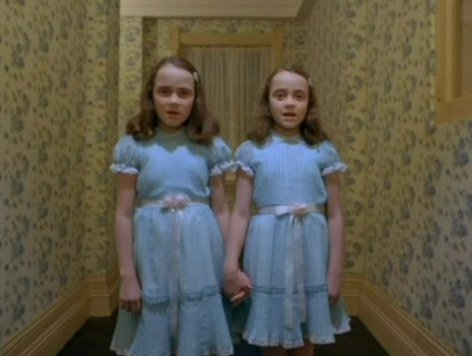
posted by Lexica at 9:53 PM on July 29, 2011
Dunno how I missed this thread before. I suppose you have all gone, but:
The thing that sticks with me is that in several places in the first half of the movie, many of us in the audience were laughing pretty hard - like at the shot where you just see Jack's zombie face staring out the window and then the title comes up DAY SIX or something.
I agree totally about his black humour, but nothing like what you suggest happens in The Shining. The interstitial date cards are notable for gradually picking up the pace: in the first half of the film, they all read things like OCTOBER but by the second half, we get things like FRIDAY.
Whether Spielberg's tour of the set - he was shooting 'Raiders' next door at the time - are anything to do with the 'Well Of Souls' opening of the Covenant are left for you to decide.
Jeez, that was a good year for movies eh??
Which year would that be? The Shining and Raiders came out more than a year apart. And given that Spielberg is pretty brisk when it comes to making movies, while Kubrick was meticulous and laboured over them for years, it seems unlikely that the two movies would have been being shot at the same time.
posted by ricochet biscuit at 3:26 PM on August 22, 2011
The thing that sticks with me is that in several places in the first half of the movie, many of us in the audience were laughing pretty hard - like at the shot where you just see Jack's zombie face staring out the window and then the title comes up DAY SIX or something.
I agree totally about his black humour, but nothing like what you suggest happens in The Shining. The interstitial date cards are notable for gradually picking up the pace: in the first half of the film, they all read things like OCTOBER but by the second half, we get things like FRIDAY.
Whether Spielberg's tour of the set - he was shooting 'Raiders' next door at the time - are anything to do with the 'Well Of Souls' opening of the Covenant are left for you to decide.
Jeez, that was a good year for movies eh??
Which year would that be? The Shining and Raiders came out more than a year apart. And given that Spielberg is pretty brisk when it comes to making movies, while Kubrick was meticulous and laboured over them for years, it seems unlikely that the two movies would have been being shot at the same time.
posted by ricochet biscuit at 3:26 PM on August 22, 2011
« Older Stewardess Uniform Collection | Mata-morose Newer »
This thread has been archived and is closed to new comments
posted by kbanas at 5:42 PM on July 24, 2011 [1 favorite]