U.S. Credit Rating Downgrade Expected This Weekend
August 5, 2011 3:38 PM Subscribe
Markets declined sharply this week in preparation for a U.S. credit downgrade by Standard & Poor's ABC news felt confident to break the news of the U.S. government preparing for an expected S&P down grade sometime after market close this weekend.
Asia markets today have tanked on several indices falling over 4% . China’s Dagong Global Credit Rating Co. has today downgraded the U.S. credit rating to A from it's former A+ rating.
MSNBC is also now reporting the same downgrade news.
Asia markets today have tanked on several indices falling over 4% . China’s Dagong Global Credit Rating Co. has today downgraded the U.S. credit rating to A from it's former A+ rating.
MSNBC is also now reporting the same downgrade news.
But don't worry guys, no new taxes for the rich.
posted by Wyatt at 3:40 PM on August 5, 2011 [128 favorites]
posted by Wyatt at 3:40 PM on August 5, 2011 [128 favorites]
From the article: "A source says Republicans saying that they refuse to accept any tax increases as part of a larger deal will be part of the reason cited."
Oh baby does this need to become a very loud, hard-to-avoid talking point.
Also, the comments on that article are cosmically awful, especially in the context of that quote that I just quoted.
posted by Sticherbeast at 3:41 PM on August 5, 2011 [22 favorites]
Oh baby does this need to become a very loud, hard-to-avoid talking point.
Also, the comments on that article are cosmically awful, especially in the context of that quote that I just quoted.
posted by Sticherbeast at 3:41 PM on August 5, 2011 [22 favorites]
angrycat, we raised the debt ceiling but we did so in a very bumbling manner and in such a way (ie no increases in revenue) that many were expecting a downgrade anyway which has now occurred.
posted by Wyatt at 3:42 PM on August 5, 2011 [2 favorites]
posted by Wyatt at 3:42 PM on August 5, 2011 [2 favorites]
The US avoided a default, but it seems some of the ratings agencies still want to express their displeasure that the situation happened at all.
posted by Kevin Street at 3:42 PM on August 5, 2011 [1 favorite]
posted by Kevin Street at 3:42 PM on August 5, 2011 [1 favorite]
The news reports I've been reading have said that the markets are reacting to fear of an imminent meltdown of the Eurozone because Italian finances are in terrible shape.
posted by Chocolate Pickle at 3:44 PM on August 5, 2011 [2 favorites]
posted by Chocolate Pickle at 3:44 PM on August 5, 2011 [2 favorites]
"A source says Republicans saying that they refuse to accept any tax increases as part of a larger deal will be part of the reason cited."
Oh baby does this need to become a very loud, hard-to-avoid talking point.
It needs to, but the talking-point counteroffensive has already started; some of my Republican acquaintances are already saying our only chance to avoid this was to adopt "cut cap and balance."
posted by weston at 3:45 PM on August 5, 2011
Oh baby does this need to become a very loud, hard-to-avoid talking point.
It needs to, but the talking-point counteroffensive has already started; some of my Republican acquaintances are already saying our only chance to avoid this was to adopt "cut cap and balance."
posted by weston at 3:45 PM on August 5, 2011
If there is a credit downgrade, Republicans will probably interpret it as markets responding to "unmanageable" (probably stronger language, I can't come up with anything) US debt, rather than what seems obvious.
posted by synaesthetichaze at 3:45 PM on August 5, 2011 [1 favorite]
posted by synaesthetichaze at 3:45 PM on August 5, 2011 [1 favorite]
The US avoided a default, but it seems some of the ratings agencies still want to express their displeasure that the situation happened at allaccurate view that the inability of Washington DC to keep its financial house operating smoothly in anything but crisis mode means that US debt carries slightly more default risk than otherwise assumed.
FTFY.
posted by The Bellman at 3:46 PM on August 5, 2011 [25 favorites]
FTFY.
posted by The Bellman at 3:46 PM on August 5, 2011 [25 favorites]
Yeah, the Eurozone crisis has been brewing for a while. It's a choose-your-own-apocalypse kind of summer, financially speaking.
posted by Kevin Street at 3:46 PM on August 5, 2011 [7 favorites]
posted by Kevin Street at 3:46 PM on August 5, 2011 [7 favorites]
So it's a pretty bad time to be entering the job market again, is what you're saying?
posted by codacorolla at 3:47 PM on August 5, 2011
posted by codacorolla at 3:47 PM on August 5, 2011
Wow. Monday's markets are going to be....interesting.
posted by longdaysjourney at 3:48 PM on August 5, 2011 [2 favorites]
posted by longdaysjourney at 3:48 PM on August 5, 2011 [2 favorites]
If there is a credit downgrade, Republicans will probably interpret it as markets responding to "unmanageable" (probably stronger language, I can't come up with anything) US debt, rather than what seems obvious.
Immoral, count on it.
posted by 2bucksplus at 3:48 PM on August 5, 2011
Immoral, count on it.
posted by 2bucksplus at 3:48 PM on August 5, 2011
S&P has been totally irresponsible--inserting themselves into the political process. As if the US will default on its debt if it actually votes to raise the ceiling.
posted by Ironmouth at 3:49 PM on August 5, 2011 [6 favorites]
posted by Ironmouth at 3:49 PM on August 5, 2011 [6 favorites]
Nah, the stuff on Wall Street doesn't map 100% onto local conditions. Not right away, at least. If you've a marketable skill or live in an area of high demand, things might not be too bad.
posted by Kevin Street at 3:49 PM on August 5, 2011 [2 favorites]
posted by Kevin Street at 3:49 PM on August 5, 2011 [2 favorites]
"A source says Republicans saying that they refuse to accept any tax increases as part of a larger deal will be part of the reason cited."
Wow. that's a bomb and a half.
posted by Ironmouth at 3:50 PM on August 5, 2011 [1 favorite]
Wow. that's a bomb and a half.
posted by Ironmouth at 3:50 PM on August 5, 2011 [1 favorite]
What if my degree is in a somewhat specialized field with most jobs being in federal, state, local, or city level government?
posted by codacorolla at 3:51 PM on August 5, 2011 [2 favorites]
posted by codacorolla at 3:51 PM on August 5, 2011 [2 favorites]
The US avoided a default, but it seems some of the ratings agencies still want to express their displeasure that the situation happened at all.
Kind of funny how an arbitrary, unaccountable ratings organization can play such havoc on world financial markets. S&P is playing politics, here, right? Bastards.
posted by KokuRyu at 3:51 PM on August 5, 2011 [8 favorites]
Kind of funny how an arbitrary, unaccountable ratings organization can play such havoc on world financial markets. S&P is playing politics, here, right? Bastards.
posted by KokuRyu at 3:51 PM on August 5, 2011 [8 favorites]
How the fuck did these few, tiny, ratings companies get the right to make these decisions and have them respected? And how the fuck do they think they have the right to start dictating political policy? They're just another fucking arm of the neoliberal octopus.
posted by Rumple at 3:52 PM on August 5, 2011 [20 favorites]
posted by Rumple at 3:52 PM on August 5, 2011 [20 favorites]
How's that compromise working out for you Obama?
also:
When did S&P become a branch of the government?
posted by dibblda at 3:53 PM on August 5, 2011 [3 favorites]
also:
When did S&P become a branch of the government?
posted by dibblda at 3:53 PM on August 5, 2011 [3 favorites]
Then, it might be a bit difficult to find a job, with all the budget cutting. But there's no way to tell until you're out there, doing interviews and sending resumes.
posted by Kevin Street at 3:54 PM on August 5, 2011
posted by Kevin Street at 3:54 PM on August 5, 2011
codacorolla : You probably already know the status of government jobs this past year. I believe half a million public sector jobs were lost this past year - something close to that. I was let go from a public sector job myself last year and when I call back my colleagues are overworked and overwrought at heir current impossible workloads. So I would guess that, unless Obama proposes a public works job program , that area of employment isn't going to get any better.
posted by Poet_Lariat at 3:54 PM on August 5, 2011
posted by Poet_Lariat at 3:54 PM on August 5, 2011
They're just another fucking arm of the neoliberal octopus.
Er, what?
posted by Godspeed.You!Black.Emperor.Penguin at 3:55 PM on August 5, 2011 [5 favorites]
Er, what?
posted by Godspeed.You!Black.Emperor.Penguin at 3:55 PM on August 5, 2011 [5 favorites]
Invisible hand of the markets, baby.
posted by aramaic at 3:55 PM on August 5, 2011 [2 favorites]
posted by aramaic at 3:55 PM on August 5, 2011 [2 favorites]
Meanwhile, investors are rushing to buy US government debt in a flight to safety.
This rating agency is unmoored from reality.
posted by dglynn at 3:56 PM on August 5, 2011 [12 favorites]
This rating agency is unmoored from reality.
posted by dglynn at 3:56 PM on August 5, 2011 [12 favorites]
How's that compromise working out for you Obama?
Criticize the results of the compromise all you want, but we'd be downgraded a hell of a lot worse if the debt ceiling wasn't raised at all.
posted by ignignokt at 3:56 PM on August 5, 2011 [2 favorites]
Criticize the results of the compromise all you want, but we'd be downgraded a hell of a lot worse if the debt ceiling wasn't raised at all.
posted by ignignokt at 3:56 PM on August 5, 2011 [2 favorites]
I can't get angry about this, sorry. We really did fumble the ball and the downrating seems fair.
posted by Antidisestablishmentarianist at 3:57 PM on August 5, 2011 [8 favorites]
posted by Antidisestablishmentarianist at 3:57 PM on August 5, 2011 [8 favorites]
Yeah, I know, I'm just hoping I'm plucky enough to wrangle something, or can manage a private sector job of some sort. It's depressing - even with scholarships the weight of my (IMO modest) student loans is already hanging over me.
posted by codacorolla at 3:57 PM on August 5, 2011
posted by codacorolla at 3:57 PM on August 5, 2011
oh yeah well let's downgrade S&P to even it out
posted by Sticherbeast at 3:58 PM on August 5, 2011 [2 favorites]
posted by Sticherbeast at 3:58 PM on August 5, 2011 [2 favorites]
People might be interested in this Planet Money podcast from last week about how the ratings are determined and much a downgrade will really matter.
tl:dl - Probably not much.
posted by grapesaresour at 3:58 PM on August 5, 2011 [3 favorites]
tl:dl - Probably not much.
posted by grapesaresour at 3:58 PM on August 5, 2011 [3 favorites]
I'm greeting this with the same detached, maniacal laughter as I did the last big stock market drop in 2008.
posted by hellojed at 4:00 PM on August 5, 2011 [2 favorites]
posted by hellojed at 4:00 PM on August 5, 2011 [2 favorites]
Meanwhile, investors are rushing to buy US government debt in a flight to safety.
This. How can you downgrade the form of security that people are seeking out in response to risk in other places without downgrading everything else at the same time? Is there adequate bonding available from remaining AAA sources to soak up all the capital that would be forced off U.S. Treasuries?
I've seen enough finance shenanigans in the last ten years to be pretty receptive to theories of deliberate, if indirect, rate manipulation.
posted by meinvt at 4:01 PM on August 5, 2011 [2 favorites]
This. How can you downgrade the form of security that people are seeking out in response to risk in other places without downgrading everything else at the same time? Is there adequate bonding available from remaining AAA sources to soak up all the capital that would be forced off U.S. Treasuries?
I've seen enough finance shenanigans in the last ten years to be pretty receptive to theories of deliberate, if indirect, rate manipulation.
posted by meinvt at 4:01 PM on August 5, 2011 [2 favorites]
I thought the markets were all rational and everything and ran on logic and analysis and foresight!
posted by rtha at 4:01 PM on August 5, 2011 [7 favorites]
posted by rtha at 4:01 PM on August 5, 2011 [7 favorites]
I've been struggling to figure out the nagging feeling I have about my place in our US economy, but amidst the summer heat it has come to me -
I have had this same feeling when I've lost control driving on icy, snowy roads in a winter storm. While I'm normally a very good winter driver, a few times I have gone a little too fast, taken a turn more sharply than I should have, or missed the black ice on the road. If you've ever had it happen to you, you know the sensation of the tires slipping, the car moving sideways as to the wheels, and the sharp panic that washes over you. All you can do is gentle correction as you hope you don't go in the ditch, hit another car, or smack a post or guard rail. In almost all instances you regain control in a few seconds and the panic subsides. The terrible feeling is being out of control with little you can do to stop your slide.
That's what I feel right now, the beginning of the fishtail. I didn't personally do much to start the slide, but I'm going to have to ride it out and just try to regain control where I can. I just hope that this time it all ends well.
posted by Muddler at 4:03 PM on August 5, 2011 [25 favorites]
I have had this same feeling when I've lost control driving on icy, snowy roads in a winter storm. While I'm normally a very good winter driver, a few times I have gone a little too fast, taken a turn more sharply than I should have, or missed the black ice on the road. If you've ever had it happen to you, you know the sensation of the tires slipping, the car moving sideways as to the wheels, and the sharp panic that washes over you. All you can do is gentle correction as you hope you don't go in the ditch, hit another car, or smack a post or guard rail. In almost all instances you regain control in a few seconds and the panic subsides. The terrible feeling is being out of control with little you can do to stop your slide.
That's what I feel right now, the beginning of the fishtail. I didn't personally do much to start the slide, but I'm going to have to ride it out and just try to regain control where I can. I just hope that this time it all ends well.
posted by Muddler at 4:03 PM on August 5, 2011 [25 favorites]
> I thought the markets were all rational and everything and ran on logic and analysis and foresight!
The problem is, the actors don't. Republicans doubly so.
posted by mrzarquon at 4:04 PM on August 5, 2011
The problem is, the actors don't. Republicans doubly so.
posted by mrzarquon at 4:04 PM on August 5, 2011
It doesn't actually mean anything.
Also current rumor is they notified the WH, who then talked them out of it. So no downgrade. But if you look at swap spreads the US has been trading as AA for years.
BTW the rating agencies are historically pretty inept.
posted by JPD at 4:05 PM on August 5, 2011 [3 favorites]
Also current rumor is they notified the WH, who then talked them out of it. So no downgrade. But if you look at swap spreads the US has been trading as AA for years.
BTW the rating agencies are historically pretty inept.
posted by JPD at 4:05 PM on August 5, 2011 [3 favorites]
Also Dagong? Come on only ZeroHedge think there's any value in their "analysis"
posted by JPD at 4:06 PM on August 5, 2011
posted by JPD at 4:06 PM on August 5, 2011
Kind of funny how an arbitrary, unaccountable ratings organization can play such havoc on world financial markets. S&P is playing politics, here, right? Bastards.
I'm not sure if they're playing politics or not, as the recent ridiculous manufactured crisis which legitimately risked a default does say something about the full faith & credit of the US.
On the other hand, I agree with the criticism of ratings orgs being unaccountable, since the inflated ratings of oh say home mortgages are largely responsible for our current shit river.
posted by shakespeherian at 4:06 PM on August 5, 2011 [14 favorites]
I'm not sure if they're playing politics or not, as the recent ridiculous manufactured crisis which legitimately risked a default does say something about the full faith & credit of the US.
On the other hand, I agree with the criticism of ratings orgs being unaccountable, since the inflated ratings of oh say home mortgages are largely responsible for our current shit river.
posted by shakespeherian at 4:06 PM on August 5, 2011 [14 favorites]
They're just another fucking arm of the neoliberal octopus.
Er, what?
Neo-liberalism, in this context, Godspeed.You!Black.Emperor.Penguin, probably refers to the Thatcherite/IMF/World Bank/Washington Consensus view of the role of governments in the world economy (socialism for the banksters, ashes for the rest of us).
Unless Rumple meant something else.
posted by notyou at 4:07 PM on August 5, 2011 [5 favorites]
Er, what?
Neo-liberalism, in this context, Godspeed.You!Black.Emperor.Penguin, probably refers to the Thatcherite/IMF/World Bank/Washington Consensus view of the role of governments in the world economy (socialism for the banksters, ashes for the rest of us).
Unless Rumple meant something else.
posted by notyou at 4:07 PM on August 5, 2011 [5 favorites]
It needs to, but the talking-point counteroffensive has already started; some of my Republican acquaintances are already saying our only chance to avoid this was to adopt "cut cap and balance."
Font size smaller and smaller now allcaps ON --
GODDAMMIT I AM INCREDIBLY SICK OF THESE SLOGANS AND THOUGHTLESS PARROTINGS OF IDIOTIC IDEAS RECITED ROTE FROM OFF OF FOX NEWS AND REPUBLICAN NEWSLETTERS I REFUSE EVEN JUST ONE MORE TIME TO HEAR ONE OF THOSE AND NOT IMMEDIATELY SHOUT DOWN WHOEVER THE HELL WAS SO CLUELESS AND LITERALLY THOUGHTLESS TO NOT ONLY BELIEVE SUCH A TERRIBLE AND MISGUIDED THING BUT TO SOMEHOW HAVE ENOUGH MISPLACED CONFIDENCE IN THEIR WOEFULLY ILL-INFORMED OPINIONS SO AS TO BELIEVE THAT OTHER PEOPLE NEED TO HEAR IT FROM THEIR OWN ACCURSED MOUTHS I AM SERIOUS GUYS I HAVE REACHED TOLERANCE LEVEL ZERO FROM THIS AND HAVE STARTED TROLLING THE FACEBOOK PAGE OF MY ELECTED REPRESENTATIVE SOME OF THE THINGS I READ THERE ARE STARTLING IN THEIR ULTIMATE PAUCITY OF INSIGHT THESE PEOPLE THINK THAT DISCUSSION IS JUST REPEATING WHAT SOMEONE TELLS THEM I CANT TAKE IT ANYMORE IF SOMEONE NEEDS ME I'LL BE IN MY ROOM SHOUTING AT THE WALLS GODDAMN RARRGFRAGH GRARAHFFGH DAMMIT I BIT MY TONGUE
posted by JHarris at 4:08 PM on August 5, 2011 [64 favorites]
Font size smaller and smaller now allcaps ON --
GODDAMMIT I AM INCREDIBLY SICK OF THESE SLOGANS AND THOUGHTLESS PARROTINGS OF IDIOTIC IDEAS RECITED ROTE FROM OFF OF FOX NEWS AND REPUBLICAN NEWSLETTERS I REFUSE EVEN JUST ONE MORE TIME TO HEAR ONE OF THOSE AND NOT IMMEDIATELY SHOUT DOWN WHOEVER THE HELL WAS SO CLUELESS AND LITERALLY THOUGHTLESS TO NOT ONLY BELIEVE SUCH A TERRIBLE AND MISGUIDED THING BUT TO SOMEHOW HAVE ENOUGH MISPLACED CONFIDENCE IN THEIR WOEFULLY ILL-INFORMED OPINIONS SO AS TO BELIEVE THAT OTHER PEOPLE NEED TO HEAR IT FROM THEIR OWN ACCURSED MOUTHS I AM SERIOUS GUYS I HAVE REACHED TOLERANCE LEVEL ZERO FROM THIS AND HAVE STARTED TROLLING THE FACEBOOK PAGE OF MY ELECTED REPRESENTATIVE SOME OF THE THINGS I READ THERE ARE STARTLING IN THEIR ULTIMATE PAUCITY OF INSIGHT THESE PEOPLE THINK THAT DISCUSSION IS JUST REPEATING WHAT SOMEONE TELLS THEM I CANT TAKE IT ANYMORE IF SOMEONE NEEDS ME I'LL BE IN MY ROOM SHOUTING AT THE WALLS GODDAMN RARRGFRAGH GRARAHFFGH DAMMIT I BIT MY TONGUE
posted by JHarris at 4:08 PM on August 5, 2011 [64 favorites]
how the ratings are determined and much a downgrade will really matter. ... Probably not much.
It will have major effects on your credit card bill, mortgage rates, state funding for decaying infrastructure, student loans and government pensions, and people's ability to get a job.
posted by Poet_Lariat at 4:08 PM on August 5, 2011 [5 favorites]
It will have major effects on your credit card bill, mortgage rates, state funding for decaying infrastructure, student loans and government pensions, and people's ability to get a job.
posted by Poet_Lariat at 4:08 PM on August 5, 2011 [5 favorites]
But if you look at swap spreads the US has been trading as AA for years.
More detail . . . need more detail. tell us! what does all that mean?
posted by Ironmouth at 4:10 PM on August 5, 2011
More detail . . . need more detail. tell us! what does all that mean?
posted by Ironmouth at 4:10 PM on August 5, 2011
From the article: "A source says Republicans saying that they refuse to accept any tax increases as part of a larger deal will be part of the reason cited."
Oh baby does this need to become a very loud, hard-to-avoid talking point.
"We have been spending beyond our means for too long".
Despite tax levels at remaining less than 30% of GDP while supporting the world's largest military complex. The United States has the lowest tax rates in the western world.
I look at the US economic situation and I god damn boggle.
posted by Talez at 4:12 PM on August 5, 2011 [2 favorites]
Oh baby does this need to become a very loud, hard-to-avoid talking point.
"We have been spending beyond our means for too long".
Despite tax levels at remaining less than 30% of GDP while supporting the world's largest military complex. The United States has the lowest tax rates in the western world.
I look at the US economic situation and I god damn boggle.
posted by Talez at 4:12 PM on August 5, 2011 [2 favorites]
P_L you assume that the market wasn't already aware of how ridiculous the current political situation. Normally the ratings agencies actions trail the market, not lead it.
(I mean historically the guys who get the jobs at S&P et al, only take those jobs because they cant get better jobs at actual investment firms and investment banks)
posted by JPD at 4:12 PM on August 5, 2011 [2 favorites]
(I mean historically the guys who get the jobs at S&P et al, only take those jobs because they cant get better jobs at actual investment firms and investment banks)
posted by JPD at 4:12 PM on August 5, 2011 [2 favorites]
I still don't quite understand how the government having to go to the markets for money isn't good for the market, since it's guaranteed business and at rates the market can dictate, given how desperate their customer is -- but I admit I'm no financial expert.
No doubt I'm missing some part of the problem.
posted by Capt. Renault at 4:14 PM on August 5, 2011
No doubt I'm missing some part of the problem.
posted by Capt. Renault at 4:14 PM on August 5, 2011
No doubt I'm missing some part of the problem.
Yeah, "The Markets" is really a bunch of ulcerated people who don't give a shit about 99% of the actual world.
posted by edgeways at 4:19 PM on August 5, 2011 [6 favorites]
Yeah, "The Markets" is really a bunch of ulcerated people who don't give a shit about 99% of the actual world.
posted by edgeways at 4:19 PM on August 5, 2011 [6 favorites]
Alphaville post on the move in bond prices (measured in 100ths of an interest rate point over the bench mark) in the 12-months post a downgrade from AAA for Japan, Italy, Spain, and Ireland- The average move is 0.
In other words this is closing the barn door after the cow has escaped.
posted by JPD at 4:19 PM on August 5, 2011 [5 favorites]
In other words this is closing the barn door after the cow has escaped.
posted by JPD at 4:19 PM on August 5, 2011 [5 favorites]
I don't understand why anyone even listens to the ratings agencies after the 2008 crash that was caused by them failing to perform their function at all.
I wouldn't be surprised at all to find out that head of S&P forced this out at the behest of one of his political buddies.
posted by TheJoven at 4:20 PM on August 5, 2011 [19 favorites]
I wouldn't be surprised at all to find out that head of S&P forced this out at the behest of one of his political buddies.
posted by TheJoven at 4:20 PM on August 5, 2011 [19 favorites]
The US government is not desperate. It is the safest investment available in the world, and US government can borrow money by auctioning bonds it issues on open markets and those market auctions price those bonds as having the lowest return of anything in the entire world right now. That is the opposite of desperate.
That is the free market deciding that it considers your debt the safest investment on the planet.
If US bonds are not AAA, then there is no such thing.
posted by dglynn at 4:21 PM on August 5, 2011 [7 favorites]
That is the free market deciding that it considers your debt the safest investment on the planet.
If US bonds are not AAA, then there is no such thing.
posted by dglynn at 4:21 PM on August 5, 2011 [7 favorites]
Thanks Tea Party.
posted by Bag Man at 4:22 PM on August 5, 2011 [6 favorites]
posted by Bag Man at 4:22 PM on August 5, 2011 [6 favorites]
Ratings agencies SUCK at public policy predictions.
posted by T.D. Strange at 4:25 PM on August 5, 2011 [1 favorite]
posted by T.D. Strange at 4:25 PM on August 5, 2011 [1 favorite]
CNN just emailed me this:
posted by codacorolla at 4:26 PM on August 5, 2011 [1 favorite]
Ratings agency Standard & Poor's served notice that it planned to downgrade the U.S. government's AAA credit rating but is reconsidering, a senior Obama administration official said.But I can't find a linkable story that corresponds.
The official said the agency acknowledged some errors after the administration challenged S&P's analysis of the government's revenue and deficit picture.
The source, a senior official involved in the discussions, insisted the agency was off by "trillions" in its economic model.
The AAA rating enables nations to borrow funds at lower costs because their governments are considered stable and their bonds safe.
posted by codacorolla at 4:26 PM on August 5, 2011 [1 favorite]
The US government is not desperate. It is the safest investment available in the world, and US government can borrow money by auctioning bonds it issues on open markets and those market auctions price those bonds as having the lowest return of anything in the entire world right now. That is the opposite of desperate.
That is the free market deciding that it considers your debt the safest investment on the planet.
If US bonds are not AAA, then there is no such thing.
posted by dglynn at 12:21 AM on August 6 [+] [!]
Several countries have lower yields.
posted by Jehan at 4:30 PM on August 5, 2011 [1 favorite]
That is the free market deciding that it considers your debt the safest investment on the planet.
If US bonds are not AAA, then there is no such thing.
posted by dglynn at 12:21 AM on August 6 [+] [!]
Several countries have lower yields.
posted by Jehan at 4:30 PM on August 5, 2011 [1 favorite]
The US avoided a default, but it seems some of the ratings agencies still want to express their displeasure that the situation happened at all.
Kind of funny how an arbitrary, unaccountable ratings organization can play such havoc on world financial markets. S&P is playing politics, here, right? Bastards.
posted by KokuRyu at 3:51 PM on August 5 [1 favorite +] [!]
I think the issue is that there are structural issues with the way the US Government is spending money that causes the rating agencies grief. Yes - the debt ceiling has been raised - but there are no real ongoing plans to attack the structural deficit issues plaguing the Government budget (either by tackling long term spending or looking for revenue sources).
And the rating agencies are hardly unaccountable - they were very much under attack during the 2008 collapse for not raising the alarm bells sooner. Investors and the markets use the ratings as a way to factor and price risk.
I think as a nation, the US has some real hard thinking to do about how government should be run, and how this crazy debt can be tackled. I hope the leadership is up to the task - this is no time for the political gamesmanship that seems to plaguing both sides of the aisle.
posted by helmutdog at 4:30 PM on August 5, 2011 [2 favorites]
Kind of funny how an arbitrary, unaccountable ratings organization can play such havoc on world financial markets. S&P is playing politics, here, right? Bastards.
posted by KokuRyu at 3:51 PM on August 5 [1 favorite +] [!]
I think the issue is that there are structural issues with the way the US Government is spending money that causes the rating agencies grief. Yes - the debt ceiling has been raised - but there are no real ongoing plans to attack the structural deficit issues plaguing the Government budget (either by tackling long term spending or looking for revenue sources).
And the rating agencies are hardly unaccountable - they were very much under attack during the 2008 collapse for not raising the alarm bells sooner. Investors and the markets use the ratings as a way to factor and price risk.
I think as a nation, the US has some real hard thinking to do about how government should be run, and how this crazy debt can be tackled. I hope the leadership is up to the task - this is no time for the political gamesmanship that seems to plaguing both sides of the aisle.
posted by helmutdog at 4:30 PM on August 5, 2011 [2 favorites]
I'm investing in AAA batteries instead then. When the shit hits the fan, you better believe I'll be strutting along, listening to my walkman while I pass people drying their eyes with soggy T-Bills and others hoarding their preciouuuus gold.
Just kidding... this is a proper mess (scary too).
posted by panaceanot at 4:31 PM on August 5, 2011 [2 favorites]
Just kidding... this is a proper mess (scary too).
posted by panaceanot at 4:31 PM on August 5, 2011 [2 favorites]
What I think needs to be brought up, repeatedly and loudly, is this: The GOP controlled the House and the Senate and the Presidency for six years and they didn't balance the budget, they didn't pay off any of the national debt, they started this whole super-expensive war business and cut taxes.
If debt is so bad, why weren't they paying it off back when we had the money to do that? When these same people actually had free reign, they chose, with eyes wide open, to spend that money, and not even to spend it developing our own resources, but to spend it meddling abroad.
If our credit rating were in any way related to either party's record with responsible use of money, it'd have tanked long since.
posted by gracedissolved at 4:32 PM on August 5, 2011 [17 favorites]
If debt is so bad, why weren't they paying it off back when we had the money to do that? When these same people actually had free reign, they chose, with eyes wide open, to spend that money, and not even to spend it developing our own resources, but to spend it meddling abroad.
If our credit rating were in any way related to either party's record with responsible use of money, it'd have tanked long since.
posted by gracedissolved at 4:32 PM on August 5, 2011 [17 favorites]
Only four now hold that [AAA Credit Rating] distinction: Automatic Data Processing, Exxon Mobil, Johnson & Johnson and Microsoft.
I really wish this chart was interactive and had the ability to compare the ratings of governments too.
posted by wcfields at 4:32 PM on August 5, 2011
I really wish this chart was interactive and had the ability to compare the ratings of governments too.
posted by wcfields at 4:32 PM on August 5, 2011
There's nothing like manufacturing a crisis, practicing brinksmanship, threatening to tank the entire world economy, getting your way nearly 100%, and then discovering that all your macho posturing about how you don't care about the consequences will force you to live with the consequences you thought you had avoided.
I look forward to seeing how all this plays out.
posted by hippybear at 4:33 PM on August 5, 2011 [8 favorites]
I look forward to seeing how all this plays out.
posted by hippybear at 4:33 PM on August 5, 2011 [8 favorites]
Also current rumor is they notified the WH, who then talked them out of it.
Yeah, I'm thinking that will be the end result. S&P seems like one of those organizations that is too susceptible to pressure by the White House. There is no way they'd let them downgrade our credit rating. Just like pressure is applied to keep the dollar the reserve currency.
If this happens, how will the rest of the world react when it's shown that S&P is just another instrument of US financial power. There have been a lot of international articles lately talking about decreased faith in the US political climate. If the move to downgrade was a valid one, and it's overridden based on US pressure, I assume that lowers faith in the system as a whole?
posted by formless at 4:33 PM on August 5, 2011
Yeah, I'm thinking that will be the end result. S&P seems like one of those organizations that is too susceptible to pressure by the White House. There is no way they'd let them downgrade our credit rating. Just like pressure is applied to keep the dollar the reserve currency.
If this happens, how will the rest of the world react when it's shown that S&P is just another instrument of US financial power. There have been a lot of international articles lately talking about decreased faith in the US political climate. If the move to downgrade was a valid one, and it's overridden based on US pressure, I assume that lowers faith in the system as a whole?
posted by formless at 4:33 PM on August 5, 2011
this may not have anything to do with this, but last night, i was reading a couple of stories saying the job reports were bad news
now this afternoon, i read that they were good news
oddly enough, the numbers cited didn't change
posted by pyramid termite at 4:34 PM on August 5, 2011 [2 favorites]
now this afternoon, i read that they were good news
oddly enough, the numbers cited didn't change
posted by pyramid termite at 4:34 PM on August 5, 2011 [2 favorites]
I'm going to admit that I don't really understand global finance, but maybe someone can humor me: what utility does the financial sector offer? What good does a hedge-fund that compensates its agents in the millions and billions give to society? If the financial sector disappeared tomorrow and was somehow replaced by a really effective "capital allocation" computer with no vested personal interest, then what would be lost? Because it feels like everything is in place to have a healthy economy, but there's this mystical veil of obstruction between people being able to work, buy needs, and spend extra on recreation and the reality of what's offered by our current system.
posted by codacorolla at 4:35 PM on August 5, 2011 [15 favorites]
posted by codacorolla at 4:35 PM on August 5, 2011 [15 favorites]
If debt is so bad, why weren't they paying it off back when we had the money to do that? When these same people actually had free reign, they chose, with eyes wide open, to spend that money, and not even to spend it developing our own resources, but to spend it meddling abroad.
Worse than that. Ten years ago, the pressing crisis was too little debt. The fact is these people are bald-faced liars; the only thing they care about is shrinking government spending and slashing taxes, regardless of the supposed reason.
posted by gerryblog at 4:35 PM on August 5, 2011 [8 favorites]
Worse than that. Ten years ago, the pressing crisis was too little debt. The fact is these people are bald-faced liars; the only thing they care about is shrinking government spending and slashing taxes, regardless of the supposed reason.
posted by gerryblog at 4:35 PM on August 5, 2011 [8 favorites]
Well if I were the current administration I'd be having a long hard inside talk about S&P's bogus ratings on various credit instrumentalities during the mortgage and how , you know, it would be a real shame if we started investigating that mess now wouldn't it?
posted by Poet_Lariat at 4:36 PM on August 5, 2011 [7 favorites]
posted by Poet_Lariat at 4:36 PM on August 5, 2011 [7 favorites]
wcfields -Because of how the ratings work comparing Corporate issuers and Sovereign issuers is apples and oranges.
posted by JPD at 4:38 PM on August 5, 2011
posted by JPD at 4:38 PM on August 5, 2011
last night, i was reading a couple of stories saying the job reports were bad news
now this afternoon, i read that they were good news
oddly enough, the numbers cited didn't change
More jobs created than expected -- good news.
Fewer jobs created than needed to keep up with population growth -- bad news.
Lower unemployment numbers -- good news.
Lower numbers because 200,000 people simply stopped looking for work and are no longer counted as job-seeking unemployed -- bad news.
posted by hippybear at 4:38 PM on August 5, 2011 [1 favorite]
now this afternoon, i read that they were good news
oddly enough, the numbers cited didn't change
More jobs created than expected -- good news.
Fewer jobs created than needed to keep up with population growth -- bad news.
Lower unemployment numbers -- good news.
Lower numbers because 200,000 people simply stopped looking for work and are no longer counted as job-seeking unemployed -- bad news.
posted by hippybear at 4:38 PM on August 5, 2011 [1 favorite]
Time to send the FBI in to raid s&P over the mortgage ratings fraud. Arrest a few of the key players there. They don't seem to have the proper respect for the power of the US government to settle its obligations.
posted by humanfont at 4:39 PM on August 5, 2011
posted by humanfont at 4:39 PM on August 5, 2011
If the financial sector disappeared tomorrow and was somehow replaced by a really effective "capital allocation" computer with no vested personal interest, then what would be lost?
Absolutely nothing, and a huge deadweight loss on all financial transactions would be eliminated. Now go write the code that does this.
Or take a look at how to Soviets tried to do this with math. Its really fucking hard.
posted by JPD at 4:40 PM on August 5, 2011 [7 favorites]
Absolutely nothing, and a huge deadweight loss on all financial transactions would be eliminated. Now go write the code that does this.
Or take a look at how to Soviets tried to do this with math. Its really fucking hard.
posted by JPD at 4:40 PM on August 5, 2011 [7 favorites]
If this happens, how will the rest of the world react when it's shown that S&P is just another instrument of US financial power. There have been a lot of international articles lately talking about decreased faith in the US political climate. If the move to downgrade was a valid one, and it's overridden based on US pressure, I assume that lowers faith in the system as a whole?
At least in the EU, ratings agencies have already lost a lot of the trust they used to have regarding sovereign debt. It's funny to read this discussion as many of the anti-ratings agency opinions have been common in Europe for a while.
posted by Jehan at 4:41 PM on August 5, 2011 [1 favorite]
At least in the EU, ratings agencies have already lost a lot of the trust they used to have regarding sovereign debt. It's funny to read this discussion as many of the anti-ratings agency opinions have been common in Europe for a while.
posted by Jehan at 4:41 PM on August 5, 2011 [1 favorite]
Oddly enough, as soon as serious talk about ending the dollar's role as THE reserve currency started, there was a global financial crisis.
Which currency will replace the dollar now? Not the Euro, it's all screwed up thanks to the PIIGS. The renminbi? "Everyone" knows the Chinese manipulate the hell out of their currency. The pound sterling? Britain's just as bad as the US is. Commonwealth financials are not only tied by tradition to the US, but they're currently based on resource extraction (oil and timber in Canada, minerals in AUS), which could run out at any time.
What are you going to buy to store your wealth, if not dollars? Rubles? Rupees? Reals? Gold?
Hey, I don't know jack about reserve currencies. But I do have a former co-worker who loved to create and prolong crises so he could show how indispensible he was.
posted by infinitewindow at 4:45 PM on August 5, 2011 [6 favorites]
Which currency will replace the dollar now? Not the Euro, it's all screwed up thanks to the PIIGS. The renminbi? "Everyone" knows the Chinese manipulate the hell out of their currency. The pound sterling? Britain's just as bad as the US is. Commonwealth financials are not only tied by tradition to the US, but they're currently based on resource extraction (oil and timber in Canada, minerals in AUS), which could run out at any time.
What are you going to buy to store your wealth, if not dollars? Rubles? Rupees? Reals? Gold?
Hey, I don't know jack about reserve currencies. But I do have a former co-worker who loved to create and prolong crises so he could show how indispensible he was.
posted by infinitewindow at 4:45 PM on August 5, 2011 [6 favorites]
If the financial sector disappeared tomorrow and was somehow replaced by a really effective "capital allocation" computer with no vested personal interest, then what would be lost?
Absolutely nothing, and a huge deadweight loss on all financial transactions would be eliminated. Now go write the code that does this.
Or take a look at how to Soviets tried to do this with math. Its really fucking hard.
Yeah, I'm not a fan of the huge power the financial industry has over us, but the system is fundamentally distributed from a systems viewpoint. And that's good. There may be some monopoly issues in our current instance, but the problem with a centralized system is it's too susceptible to corruption at the top. Some institution would have to control that computer at the top, and that institution would become the new problem.
posted by formless at 4:45 PM on August 5, 2011 [2 favorites]
Absolutely nothing, and a huge deadweight loss on all financial transactions would be eliminated. Now go write the code that does this.
Or take a look at how to Soviets tried to do this with math. Its really fucking hard.
Yeah, I'm not a fan of the huge power the financial industry has over us, but the system is fundamentally distributed from a systems viewpoint. And that's good. There may be some monopoly issues in our current instance, but the problem with a centralized system is it's too susceptible to corruption at the top. Some institution would have to control that computer at the top, and that institution would become the new problem.
posted by formless at 4:45 PM on August 5, 2011 [2 favorites]
Breaking.....
Oops! It was all a math mistake !
a two trillion dollar math mistake
posted by Poet_Lariat at 4:46 PM on August 5, 2011 [6 favorites]
Oops! It was all a math mistake !
a two trillion dollar math mistake
posted by Poet_Lariat at 4:46 PM on August 5, 2011 [6 favorites]
Man! That makes me feel a whole lot better about my typos lately
posted by Poet_Lariat at 4:48 PM on August 5, 2011 [3 favorites]
posted by Poet_Lariat at 4:48 PM on August 5, 2011 [3 favorites]
I'm investing in AAA batteries instead then. When the shit hits the fan, you better believe I'll be strutting along, listening to my walkman while I pass people drying their eyes with soggy T-Bills and others hoarding their preciouuuus gold.
You won't be laughing when someone beans you with two ounces of gold knotted into the end of a sock and steals your triple-As.
I bet they'll let you keep the walkman, though.
posted by codswallop at 4:49 PM on August 5, 2011 [2 favorites]
You won't be laughing when someone beans you with two ounces of gold knotted into the end of a sock and steals your triple-As.
I bet they'll let you keep the walkman, though.
posted by codswallop at 4:49 PM on August 5, 2011 [2 favorites]
Markets declined sharply this week in preparation for a U.S. credit downgrade by Standard & Poor's
This is staunchly incorrect. If the credit was going to be downgraded then T-Bills would have dropped and interest rates would have moved. Didn't happen.
The Markets declined due to a big combination of reports this week. Employment numbers, Eurozone Crisis issues (probably the biggest cause of this week), manufacturing reports, oil reports, just to name a few.
This week's "financial crisis" is also in the realm of a "market correction." The only thing a 500 point drop did was correct some market technicals and make for a pretty headline. S&P's rating doesn't mean shit and anyone who puts even the slightest effort into reading actual market news through the week should know this.
posted by Mister Fabulous at 4:51 PM on August 5, 2011 [7 favorites]
This is staunchly incorrect. If the credit was going to be downgraded then T-Bills would have dropped and interest rates would have moved. Didn't happen.
The Markets declined due to a big combination of reports this week. Employment numbers, Eurozone Crisis issues (probably the biggest cause of this week), manufacturing reports, oil reports, just to name a few.
This week's "financial crisis" is also in the realm of a "market correction." The only thing a 500 point drop did was correct some market technicals and make for a pretty headline. S&P's rating doesn't mean shit and anyone who puts even the slightest effort into reading actual market news through the week should know this.
posted by Mister Fabulous at 4:51 PM on August 5, 2011 [7 favorites]
S&P's rating doesn't mean shit
Seriously?????? not enough question marks in the world.....
posted by Poet_Lariat at 4:52 PM on August 5, 2011
Seriously?????? not enough question marks in the world.....
posted by Poet_Lariat at 4:52 PM on August 5, 2011
Looks like S&P is backpedaling on the downgrade. Almost like someone gave them a talking-to.
Corruption and incompetence of the rating agencies were partially to blame for the financial crisis in the first place. They had a really lucrative business slapping triple-a ratings on a whole pile of crappy mortgage backed bonds, and so far the government has done very little poking around in their end of the mess.
I'm not implying that US government bonds aren't worthy of whatever rating they slap on them, just that the ratings agencies hold a lot of power for a group that seems to be accountable to nobody, and has been so wrong so many times.
posted by freq at 4:54 PM on August 5, 2011 [4 favorites]
Corruption and incompetence of the rating agencies were partially to blame for the financial crisis in the first place. They had a really lucrative business slapping triple-a ratings on a whole pile of crappy mortgage backed bonds, and so far the government has done very little poking around in their end of the mess.
I'm not implying that US government bonds aren't worthy of whatever rating they slap on them, just that the ratings agencies hold a lot of power for a group that seems to be accountable to nobody, and has been so wrong so many times.
posted by freq at 4:54 PM on August 5, 2011 [4 favorites]
What an exciting day!
posted by reductiondesign at 4:54 PM on August 5, 2011
posted by reductiondesign at 4:54 PM on August 5, 2011
S&P's rating doesn't mean shit
Seriously?????? not enough question marks in the world.....
I think the qualifier is "...in relation to this week's events."
posted by Jehan at 4:55 PM on August 5, 2011
Seriously?????? not enough question marks in the world.....
I think the qualifier is "...in relation to this week's events."
posted by Jehan at 4:55 PM on August 5, 2011
Apparently this is not the first time S&P has screwed around with a country's credit rating and been wrong! ..... Previously...
posted by Poet_Lariat at 4:56 PM on August 5, 2011
posted by Poet_Lariat at 4:56 PM on August 5, 2011
Uh, thanks for breaking down all the financial news this week into one easily understood talking point.
posted by malocchio at 4:57 PM on August 5, 2011 [1 favorite]
posted by malocchio at 4:57 PM on August 5, 2011 [1 favorite]
I bet they'll let you keep the walkman, though.
My teleportation device, you mean? Mwaha... yeah I've got nothing. Comedic or fractional reserve bought trinkets sure.... but insurance against this shitstorm?
posted by panaceanot at 4:58 PM on August 5, 2011
My teleportation device, you mean? Mwaha... yeah I've got nothing. Comedic or fractional reserve bought trinkets sure.... but insurance against this shitstorm?
posted by panaceanot at 4:58 PM on August 5, 2011
Or take a look at how to Soviets tried to do this with math. Its really fucking hard. posted by JPD at 4:40 PM on August 5
Got any links? I found this Leonid Kantorovich dude, but it just seems to be a bunch of linear programming.
Yeah, I'm not a fan of the huge power the financial industry has over us, but the system is fundamentally distributed from a systems viewpoint. And that's good. There may be some monopoly issues in our current instance, but the problem with a centralized system is it's too susceptible to corruption at the top. Some institution would have to control that computer at the top, and that institution would become the new problem.
Maybe what we need is a Bitcoin style distributed capital allocation system.
posted by Joe Chip at 5:02 PM on August 5, 2011
Got any links? I found this Leonid Kantorovich dude, but it just seems to be a bunch of linear programming.
Yeah, I'm not a fan of the huge power the financial industry has over us, but the system is fundamentally distributed from a systems viewpoint. And that's good. There may be some monopoly issues in our current instance, but the problem with a centralized system is it's too susceptible to corruption at the top. Some institution would have to control that computer at the top, and that institution would become the new problem.
Maybe what we need is a Bitcoin style distributed capital allocation system.
posted by Joe Chip at 5:02 PM on August 5, 2011
Considering that the Republicans have promised more hostage crises in the future, this seems inevitable.
posted by homunculus at 5:03 PM on August 5, 2011 [5 favorites]
posted by homunculus at 5:03 PM on August 5, 2011 [5 favorites]
I'm not implying that US government bonds aren't worthy of whatever rating they slap on them, just that the ratings agencies hold a lot of power for a group that seems to be accountable to nobody, and has been so wrong so many times.
But the data actually shows that the market already attributes almost no value to the ratings themselves.
Where ratings matter - and this isn't a big deal from AAA to AA is when they are used as triggers for other things. That's where the ratings agencies are dangerous.
posted by JPD at 5:03 PM on August 5, 2011 [1 favorite]
But the data actually shows that the market already attributes almost no value to the ratings themselves.
Where ratings matter - and this isn't a big deal from AAA to AA is when they are used as triggers for other things. That's where the ratings agencies are dangerous.
posted by JPD at 5:03 PM on August 5, 2011 [1 favorite]
Or take a look at how to Soviets tried to do this with math. Its really fucking hard.
One of the things that I understand about the financial sector is that, with its starting compensations in six figures, and going up from there, it attracts the CS and math people that could actually be doing useful things like my impartial God-machine (patent pending). Anyway, it's a pipe dream. I know that. My main frustration is that it seems like society, and maybe the world, has been banging its head against the same fucking wall for decades, and there doesn't seem to be any other way to do it. At least partially because small amounts of people, who are good at game theory and don't regard other people as essential or even really desirable, get paid a lot of money in the process of the head banging.
Fuck it, I'm going to the beach next week, and I'm going to try not to read any news while I'm there. Wish me luck.
posted by codacorolla at 5:05 PM on August 5, 2011 [7 favorites]
One of the things that I understand about the financial sector is that, with its starting compensations in six figures, and going up from there, it attracts the CS and math people that could actually be doing useful things like my impartial God-machine (patent pending). Anyway, it's a pipe dream. I know that. My main frustration is that it seems like society, and maybe the world, has been banging its head against the same fucking wall for decades, and there doesn't seem to be any other way to do it. At least partially because small amounts of people, who are good at game theory and don't regard other people as essential or even really desirable, get paid a lot of money in the process of the head banging.
Fuck it, I'm going to the beach next week, and I'm going to try not to read any news while I'm there. Wish me luck.
posted by codacorolla at 5:05 PM on August 5, 2011 [7 favorites]
I really question any single explanation for major moves in the market, given that something like 80% of market activity is algorithmic.
posted by monju_bosatsu at 5:06 PM on August 5, 2011 [2 favorites]
posted by monju_bosatsu at 5:06 PM on August 5, 2011 [2 favorites]
Looks like S&P is backpedaling on the downgrade. Almost like someone gave them a talking-to.
"Mr. Treasury Department Contact, wanted to let you know that we're going to proceed with a downgrade after all."
"Ah, well. I remember that 2008 you were giving top-ratings to Mortgage securities. We are, after all, overdue for regulating your industry to make sure you're not inflating ratings."
"Um. Perhaps rating inflation isn't so bad, I think we made a math error on your sovereign debt outlook."
"Yes, perhaps it's not so bad. Good day, Mr S&P Guy."
posted by chimaera at 5:06 PM on August 5, 2011 [5 favorites]
"Mr. Treasury Department Contact, wanted to let you know that we're going to proceed with a downgrade after all."
"Ah, well. I remember that 2008 you were giving top-ratings to Mortgage securities. We are, after all, overdue for regulating your industry to make sure you're not inflating ratings."
"Um. Perhaps rating inflation isn't so bad, I think we made a math error on your sovereign debt outlook."
"Yes, perhaps it's not so bad. Good day, Mr S&P Guy."
posted by chimaera at 5:06 PM on August 5, 2011 [5 favorites]
Got any links? I found this Leonid Kantorovich dude, but it just seems to be a bunch of linear programming.
I don't most of what I've been told came from a conversation with a retired prof at Moscow State University, but yes linear programming/optimization was a big part of it.
posted by JPD at 5:06 PM on August 5, 2011
I don't most of what I've been told came from a conversation with a retired prof at Moscow State University, but yes linear programming/optimization was a big part of it.
posted by JPD at 5:06 PM on August 5, 2011
Corruption and incompetence of the rating agencies were partially to blame for the financial crisis in the first place. They had a really lucrative business slapping triple-a ratings on a whole pile of crappy mortgage backed bonds
This is a thing worth remembering.
posted by stavrosthewonderchicken at 5:06 PM on August 5, 2011 [4 favorites]
This is a thing worth remembering.
posted by stavrosthewonderchicken at 5:06 PM on August 5, 2011 [4 favorites]
Markets dropped, but the P/E is still kinda high compared to historical averages. Its hard to make sense of, or even figure out what to do. Sell stocks and move into Treasuries? Might as well bury the money at market rates. Or attempt to gamble on the commodities ETFs before that bubble bursts.
posted by pwnguin at 5:10 PM on August 5, 2011
posted by pwnguin at 5:10 PM on August 5, 2011
Seconding the Planet Money podcast.
I initially thought a downgrade would mean that some institutional investors would have to unload US treasuries. That isn't the case though. Some mutual funds have it in their charter that bonds must be investment grade (i.e. not junk), but going from AAA to AA isn't anywhere near that threshold.
That's not to say that we aren't screwed in lots of other ways.
posted by diogenes at 5:23 PM on August 5, 2011
I initially thought a downgrade would mean that some institutional investors would have to unload US treasuries. That isn't the case though. Some mutual funds have it in their charter that bonds must be investment grade (i.e. not junk), but going from AAA to AA isn't anywhere near that threshold.
That's not to say that we aren't screwed in lots of other ways.
posted by diogenes at 5:23 PM on August 5, 2011
Nate Silver tweeting that, in fact, S&P has downgraded the US to AA+.
posted by ofthestrait at 5:24 PM on August 5, 2011
posted by ofthestrait at 5:24 PM on August 5, 2011
ofthestrait: Oh frickity frick :( . Very bad news. I was really hoping that for a way out. Welcome to Black Monday . So not good .....
posted by Poet_Lariat at 5:32 PM on August 5, 2011
posted by Poet_Lariat at 5:32 PM on August 5, 2011
And so it begins. [cue portent-fraught orchestral music]
posted by stavrosthewonderchicken at 5:34 PM on August 5, 2011
posted by stavrosthewonderchicken at 5:34 PM on August 5, 2011
Oh, balls.
posted by malocchio at 5:38 PM on August 5, 2011 [1 favorite]
posted by malocchio at 5:38 PM on August 5, 2011 [1 favorite]
Reuters: United States loses AAA credit rating from S&P
posted by furiousxgeorge at 5:41 PM on August 5, 2011
posted by furiousxgeorge at 5:41 PM on August 5, 2011
Independent of the obvious corruption of the ratings agencies.
Political hostage taking pushed us to the absolute brink of default.
The hostage takers are empowered and threatening all manner of financial and political disasters if they don't get their way.
Why in the fuck are we surprised when someone says "Hey, maybe it's not a good bet to give the dude sitting next to the crazy motherfucker with the gun all of your money?"
posted by Lord_Pall at 5:41 PM on August 5, 2011 [3 favorites]
Political hostage taking pushed us to the absolute brink of default.
The hostage takers are empowered and threatening all manner of financial and political disasters if they don't get their way.
Why in the fuck are we surprised when someone says "Hey, maybe it's not a good bet to give the dude sitting next to the crazy motherfucker with the gun all of your money?"
posted by Lord_Pall at 5:41 PM on August 5, 2011 [3 favorites]
I sense a market for patriotic AAA+ flag bumper stickers.
posted by HLD at 5:41 PM on August 5, 2011 [5 favorites]
posted by HLD at 5:41 PM on August 5, 2011 [5 favorites]
The spin being handed out is that S&P is in fact downgrading the US political system for representing a threat to repayment of debts owed to holders of treasury bonds.
The payments for bond holders were stated to be paid off first in case the debt ceiling deal was not reached.
I would like to hear under what circumstances S&P sees holder of US bonds not receiving payment. If there is a real chance that there will be a day that there is not payment resolution on those bonds, then AAA or AA won't matter. You'll be interested in canned goods and shotguns.
This political judgement seems pretty far from S&P's area of expertise.
posted by dglynn at 5:43 PM on August 5, 2011 [1 favorite]
The payments for bond holders were stated to be paid off first in case the debt ceiling deal was not reached.
I would like to hear under what circumstances S&P sees holder of US bonds not receiving payment. If there is a real chance that there will be a day that there is not payment resolution on those bonds, then AAA or AA won't matter. You'll be interested in canned goods and shotguns.
This political judgement seems pretty far from S&P's area of expertise.
posted by dglynn at 5:43 PM on August 5, 2011 [1 favorite]
This is hilarious
When comparing the U.S. to sovereigns with ‘AAA’ long-term ratings that we view as relevant peers—Canada, France, Germany, and the U.K.—we also observe, based on our base case scenarios for each, that the trajectory of the U.S.’s net public debt is diverging from the others. Including the U.S., we estimate that these five sovereigns will have net general government debt to GDP ratios this year ranging from 34% (Canada) to 80% (the U.K.), with the U.S. debt burden at 74%. By 2015, we project that their net public debt to GDP ratios will range between 30% (lowest, Canada) and 83% (highest, France), with the U.S. debt burden at 79%. However, in contrast with the U.S., we project that the net public debt burdens of these other sovereigns will begin to decline, either before or by 2015.
So the ratios are better than other countries you are keeping at AAA because of your modeling post 2015? Awesome. And this is why the ratings agencies are crap.
posted by JPD at 5:45 PM on August 5, 2011 [9 favorites]
When comparing the U.S. to sovereigns with ‘AAA’ long-term ratings that we view as relevant peers—Canada, France, Germany, and the U.K.—we also observe, based on our base case scenarios for each, that the trajectory of the U.S.’s net public debt is diverging from the others. Including the U.S., we estimate that these five sovereigns will have net general government debt to GDP ratios this year ranging from 34% (Canada) to 80% (the U.K.), with the U.S. debt burden at 74%. By 2015, we project that their net public debt to GDP ratios will range between 30% (lowest, Canada) and 83% (highest, France), with the U.S. debt burden at 79%. However, in contrast with the U.S., we project that the net public debt burdens of these other sovereigns will begin to decline, either before or by 2015.
So the ratios are better than other countries you are keeping at AAA because of your modeling post 2015? Awesome. And this is why the ratings agencies are crap.
posted by JPD at 5:45 PM on August 5, 2011 [9 favorites]
As a recently laid-off small - no - tiny - roller, I am so proud of selling my old company stock last week. I've always been a conservative/hold it investor, but this looked bad, and I'll need that money. I'm just going to continue to ignore my 401s and stuff, however.
posted by rainbaby at 5:47 PM on August 5, 2011
posted by rainbaby at 5:47 PM on August 5, 2011
Unfortunately they 'take no position on the appropriate mix of spending cuts and revenue increases.'
Fucking hell.
posted by ofthestrait at 5:48 PM on August 5, 2011 [1 favorite]
Fucking hell.
posted by ofthestrait at 5:48 PM on August 5, 2011 [1 favorite]
So, what they're trying to tell us is that this is not a fucking game.
posted by jabberjaw at 5:48 PM on August 5, 2011 [3 favorites]
posted by jabberjaw at 5:48 PM on August 5, 2011 [3 favorites]
To paraphrase Seinfeld when discussing his Dentist pretending to be a Jew -
"It offends you as an American? No. It offends me as a financial analyst"
posted by JPD at 5:49 PM on August 5, 2011 [1 favorite]
"It offends you as an American? No. It offends me as a financial analyst"
posted by JPD at 5:49 PM on August 5, 2011 [1 favorite]
Right now, as we write, hundreds of thousands of small to mid sized investors are putting in sell orders for Monday morning.
posted by Poet_Lariat at 5:51 PM on August 5, 2011
posted by Poet_Lariat at 5:51 PM on August 5, 2011
Right now, as we write, hundreds of thousands of small to mid sized investors are putting in sell orders for Monday morning.
I was wondering about that. Is there any possibility that this has already been significantly priced in so that the schmucks will jump off the cliff Monday and then the sharks will jump in at some point and make a killing? (Glass half full, wishful thinking, etc.)
posted by carter at 5:54 PM on August 5, 2011
I was wondering about that. Is there any possibility that this has already been significantly priced in so that the schmucks will jump off the cliff Monday and then the sharks will jump in at some point and make a killing? (Glass half full, wishful thinking, etc.)
posted by carter at 5:54 PM on August 5, 2011
How is this going to effect high rollers/ultra rich/corporate CEOs etc. in the U.S.? Is this something that might make them reconsider how they manipulate Govt. and policy or are they so well shielded that their wealth isn't compromised?
Serious question.
posted by snsranch at 5:54 PM on August 5, 2011
Serious question.
posted by snsranch at 5:54 PM on August 5, 2011
So, was the blame being placed on the lack of revenue increases a rumor? Was it somehow removed by S&P as a response to something? So much conflicting information floating around.
posted by codacorolla at 5:55 PM on August 5, 2011
posted by codacorolla at 5:55 PM on August 5, 2011
Or, is this so beautifully crafted that they get to raise interest rates too, to divert cost back to the consumer?
posted by snsranch at 5:57 PM on August 5, 2011
posted by snsranch at 5:57 PM on August 5, 2011
It's still in the press release, codacorolla.
posted by gerryblog at 5:58 PM on August 5, 2011 [1 favorite]
posted by gerryblog at 5:58 PM on August 5, 2011 [1 favorite]
oh, the irony - washington fights and fights to avoid a default and a downgrade of its credit rating
and it happens anyway
well, it seems like the financial and political world have two choices - either to panic and lose all faith in the economy and run for safe harbor with their investments - if there is such a thing
or to laugh shrilly at s&p and lose all faith in them
this is bullshit - first they cause the 2008 bubble crash because they weren't exercising due diligence in what they considered to be AAA holdings in the debt markets
now they're going to cause another crash by being suddenly cautious about the state of our government's finances and politics
maybe people should start using their best judgment about such things instead of relying on these people
posted by pyramid termite at 5:58 PM on August 5, 2011
and it happens anyway
well, it seems like the financial and political world have two choices - either to panic and lose all faith in the economy and run for safe harbor with their investments - if there is such a thing
or to laugh shrilly at s&p and lose all faith in them
this is bullshit - first they cause the 2008 bubble crash because they weren't exercising due diligence in what they considered to be AAA holdings in the debt markets
now they're going to cause another crash by being suddenly cautious about the state of our government's finances and politics
maybe people should start using their best judgment about such things instead of relying on these people
posted by pyramid termite at 5:58 PM on August 5, 2011
I love the mix of indignant "How dare they! We're all dooomed!" in one breath, followed by "Ah they don't know what they're talking about, ratings agencies are crap!" in this thread.
posted by Jimbob at 5:59 PM on August 5, 2011 [7 favorites]
posted by Jimbob at 5:59 PM on August 5, 2011 [7 favorites]
> How is this going to effect high rollers/ultra rich/corporate CEOs etc. in the U.S.? Is this something that might make them reconsider how they manipulate Govt. and policy or are they so well shielded that their wealth isn't compromised?
A few might lose their shirts, but the handful of super mega rich will just go down to mega rich. And since they will have liquidity to float them through a major recession, they can reinvest in businesses and property as they plummet and hold onto them until the next rebound, surviving through the lose.
Now the folks who are leasing, financing, and loaning their way to appear rich are going to take a much harder hit.
posted by mrzarquon at 6:00 PM on August 5, 2011 [2 favorites]
A few might lose their shirts, but the handful of super mega rich will just go down to mega rich. And since they will have liquidity to float them through a major recession, they can reinvest in businesses and property as they plummet and hold onto them until the next rebound, surviving through the lose.
Now the folks who are leasing, financing, and loaning their way to appear rich are going to take a much harder hit.
posted by mrzarquon at 6:00 PM on August 5, 2011 [2 favorites]
Lately the sharks jump off the cliff in milliseconds.
"Compared with previous projections, our revised base case scenario now assumes that the 2001 and 2003 tax cuts, due to expire by the end of 2012, remain in place. We have changed our assumption on this because the majority of Republicans in Congress continue to resist any measure that would raise revenues, a position we believe Congress reinforced by passing the act."
So, Republicans being against the expiration of the 2001 and 2003 tax cuts is a new factor in their analysis. Interesting.
posted by dglynn at 6:07 PM on August 5, 2011
"Compared with previous projections, our revised base case scenario now assumes that the 2001 and 2003 tax cuts, due to expire by the end of 2012, remain in place. We have changed our assumption on this because the majority of Republicans in Congress continue to resist any measure that would raise revenues, a position we believe Congress reinforced by passing the act."
So, Republicans being against the expiration of the 2001 and 2003 tax cuts is a new factor in their analysis. Interesting.
posted by dglynn at 6:07 PM on August 5, 2011
@ JPD "I mean historically the guys who get the jobs at S&P et al, only take those jobs because they cant get better jobs at actual investment firms and investment banks"
This, I can personally vouch for. The ratings agencies are far, far more corrupt than even the wildest of leftist or rightest nightmares.
posted by digitalprimate at 6:08 PM on August 5, 2011 [3 favorites]
This, I can personally vouch for. The ratings agencies are far, far more corrupt than even the wildest of leftist or rightest nightmares.
posted by digitalprimate at 6:08 PM on August 5, 2011 [3 favorites]
> We have changed our assumption on this because the majority of Republicans in Congress continue to resist any measure that would raise revenues, a position we believe Congress reinforced by passing the act.
Man, I want to see how they can spin that sentence. Or just ignore it I guess.
posted by mrzarquon at 6:09 PM on August 5, 2011 [1 favorite]
Man, I want to see how they can spin that sentence. Or just ignore it I guess.
posted by mrzarquon at 6:09 PM on August 5, 2011 [1 favorite]
I love the mix of indignant "How dare they! We're all dooomed!" in one breath, followed by "Ah they don't know what they're talking about, ratings agencies are crap!" in this thread.
Assumptions about the competence of the people, organizations, and agencies that have hands on the levers of government and economy may be unwarranted. They may not be entirely competent, but they are no less powerful for all that.
posted by stavrosthewonderchicken at 6:10 PM on August 5, 2011 [1 favorite]
Assumptions about the competence of the people, organizations, and agencies that have hands on the levers of government and economy may be unwarranted. They may not be entirely competent, but they are no less powerful for all that.
posted by stavrosthewonderchicken at 6:10 PM on August 5, 2011 [1 favorite]
From the press release:
We lowered our long-term rating on the U.S. because we believe that the prolonged controversy over raising the statutory debt ceiling and the related fiscal policy debate indicate that further near-term progress containing the growth in public spending, especially on entitlements, or on reaching an agreement on raising revenues is less likely than we previously assumed
Notice that the bastards want more austerity. They mention revenues but emphasize "especially on entitlements
Disaster Capitalism at its finest.
posted by Poet_Lariat at 6:11 PM on August 5, 2011 [1 favorite]
We lowered our long-term rating on the U.S. because we believe that the prolonged controversy over raising the statutory debt ceiling and the related fiscal policy debate indicate that further near-term progress containing the growth in public spending, especially on entitlements, or on reaching an agreement on raising revenues is less likely than we previously assumed
Notice that the bastards want more austerity. They mention revenues but emphasize "especially on entitlements
Disaster Capitalism at its finest.
posted by Poet_Lariat at 6:11 PM on August 5, 2011 [1 favorite]
It's still in the press release, codacorolla.
Ah, thanks for correcting me. I think I misread something.
Black Humor bonus: the masses flail impotently against the will of their masters via tweet.
posted by codacorolla at 6:11 PM on August 5, 2011 [3 favorites]
Ah, thanks for correcting me. I think I misread something.
Black Humor bonus: the masses flail impotently against the will of their masters via tweet.
posted by codacorolla at 6:11 PM on August 5, 2011 [3 favorites]
Hahahahaha.
Here's something that's been puzzling me ever since serious talk of a ratings downgrade of US Treasuries started up: anyone who paid attention to the mortgage meltdown or read books like The Big Short is aware of what total, booger-eating clowns are employed at the ratings agencies. So why does anyone care what ratings agencies are saying about US sovereign debt? Surely anyone who matters (central banks, foreign governments, pension funds) have a much better understanding of the US fiscal situation than the bunch of droolers who rubber stamped 'AAA' on a bunch CDOs of no-doc mortgages.
posted by indubitable at 6:14 PM on August 5, 2011 [5 favorites]
Here's something that's been puzzling me ever since serious talk of a ratings downgrade of US Treasuries started up: anyone who paid attention to the mortgage meltdown or read books like The Big Short is aware of what total, booger-eating clowns are employed at the ratings agencies. So why does anyone care what ratings agencies are saying about US sovereign debt? Surely anyone who matters (central banks, foreign governments, pension funds) have a much better understanding of the US fiscal situation than the bunch of droolers who rubber stamped 'AAA' on a bunch CDOs of no-doc mortgages.
posted by indubitable at 6:14 PM on August 5, 2011 [5 favorites]
So why does anyone care what ratings agencies are saying about US sovereign debt?
Insurance. Structured instruments. In that order.
posted by digitalprimate at 6:16 PM on August 5, 2011 [2 favorites]
Insurance. Structured instruments. In that order.
posted by digitalprimate at 6:16 PM on August 5, 2011 [2 favorites]
S&P: Our last presentation comes from our most prestigious member: the United States of America. America?posted by Rhaomi at 6:22 PM on August 5, 2011 [12 favorites]
USA: Eh... just a second... just a second!
S&P: Pencils down, pruneface.
USA: Uh, yes, here I am. OK, now... hello there. Now, we all know Congress allows us to talk about deficit reduction. But what if we want to enact deficit reduction? Well now we can, thanks to my new invention: the SuperCongress! The cuts travel past this coffee stain here, around the olive pit and into this cigar burn. And this appears to be a... a doodle of myself as a cowboy...
[audience laughter]
USA: But the SuperCongress is brilliant, I tell you! Think of the astronomical savings you'll realize thanks to me!
[more laughter]
S&P: I've waited a hundred years for this, America. I give your credit rating the worst grade imaginable: An A-minus... minus!
[gasps, screams]
Right now, as we write, hundreds of thousands of small to mid sized investors are putting in sell orders for Monday morning.
Heh, I'll be setting my conditional buy orders for somewhere around 8:15 Eastern.
posted by Mister Fabulous at 6:22 PM on August 5, 2011 [1 favorite]
Heh, I'll be setting my conditional buy orders for somewhere around 8:15 Eastern.
posted by Mister Fabulous at 6:22 PM on August 5, 2011 [1 favorite]
I guess we'll find out soon enough how much weight S&P's opinion actually carries.
They sell bonds everywhere on a completely transparent market.
posted by dglynn at 6:32 PM on August 5, 2011
They sell bonds everywhere on a completely transparent market.
posted by dglynn at 6:32 PM on August 5, 2011
This. How can you downgrade the form of security that people are seeking out in response to risk in other places without downgrading everything else at the same time? Is there adequate bonding available from remaining AAA sources to soak up all the capital that would be forced off U.S. Treasuries?
Other countries don't have crazy situations like the one that just took place in the US. Neither did the US til recently either. S&P have essentially said "this is enough to make us say they're very, very, (very) likely to not default, rather than very, very, very likely to not default."
The interesting part's going to be around pension funds and the like which can only hold AAA investments.
posted by MattWPBS at 6:38 PM on August 5, 2011 [1 favorite]
Other countries don't have crazy situations like the one that just took place in the US. Neither did the US til recently either. S&P have essentially said "this is enough to make us say they're very, very, (very) likely to not default, rather than very, very, very likely to not default."
The interesting part's going to be around pension funds and the like which can only hold AAA investments.
posted by MattWPBS at 6:38 PM on August 5, 2011 [1 favorite]
I'd like to see evidence that there are pension funds that can only hold AAA investments. I believe they have only have to hold investment grade, and AA+ still qualifies.
posted by diogenes at 6:42 PM on August 5, 2011
posted by diogenes at 6:42 PM on August 5, 2011
Oh, boy! follow the money, folks! Who are the biggest borrowers and those most anxious about BIG risk? Who are the ones who stand to profit when interest rates go up, by leveraging margins higher than they need to be because of the psychology (perception) of the downgrade? LARGE CORPORATIONS AND GOVERNMENTS!!
Of course, this is going to cost the little guy more for her credit card, to buy a car, to get into a mortgage, etc. - all additional costs will get passed down to guess who? YOu and me.
S&P, Moody's, etc. etc. is just playing ball with the people who put meat on their plate. They did this prior to the financial crisis, and they're doing it now.
And, do you really think that short sellers (bets on drops in market equity, that result in profit even in a down market) are not going to have a field day with this? They make money coming and going!! How very convenient! Sleep tight, Warren (Buffet).
The politicians? Of course, the politicians will rattle their rhetorical sabers and blame everyone else, but the people who pay to get them elected will have been taken care of. Cozy, huh? Fundraising dinners, anyone?
There's not much more to say. The rich take care of themselves.. The rich are going to bed tonight, on their massively high thread count Egyptian cotton sheets (or silk, or linen), whispering the mantra they have always whispered - secure in the knowledge that they own you, and the people who are supposed to represent you - i.e. "YES, WE CAN!".
What to do? Stop playing their game. Your pocketbook is their game. That's your leverage, what's left of it. I won't get into the details about how American (and world) citizens might go about leveraging their own assets - including intellectual capital - because there are many good ideas already on the table. What it takes is people who are comfortable, but seeing that comfort slowly stripped away to get off their asses and take little steps - or big steps, if time and resources permit - to once and for all get money out of politics. Until that happens, we're going to be on a "rinse.wash.repeat" cycle until only the threads are left.
posted by Vibrissae at 6:53 PM on August 5, 2011 [3 favorites]
Of course, this is going to cost the little guy more for her credit card, to buy a car, to get into a mortgage, etc. - all additional costs will get passed down to guess who? YOu and me.
S&P, Moody's, etc. etc. is just playing ball with the people who put meat on their plate. They did this prior to the financial crisis, and they're doing it now.
And, do you really think that short sellers (bets on drops in market equity, that result in profit even in a down market) are not going to have a field day with this? They make money coming and going!! How very convenient! Sleep tight, Warren (Buffet).
The politicians? Of course, the politicians will rattle their rhetorical sabers and blame everyone else, but the people who pay to get them elected will have been taken care of. Cozy, huh? Fundraising dinners, anyone?
There's not much more to say. The rich take care of themselves.. The rich are going to bed tonight, on their massively high thread count Egyptian cotton sheets (or silk, or linen), whispering the mantra they have always whispered - secure in the knowledge that they own you, and the people who are supposed to represent you - i.e. "YES, WE CAN!".
What to do? Stop playing their game. Your pocketbook is their game. That's your leverage, what's left of it. I won't get into the details about how American (and world) citizens might go about leveraging their own assets - including intellectual capital - because there are many good ideas already on the table. What it takes is people who are comfortable, but seeing that comfort slowly stripped away to get off their asses and take little steps - or big steps, if time and resources permit - to once and for all get money out of politics. Until that happens, we're going to be on a "rinse.wash.repeat" cycle until only the threads are left.
posted by Vibrissae at 6:53 PM on August 5, 2011 [3 favorites]
Feeling awfully lucky about my decision 2 weeks ago to put my 401k into full-on defense mode. I get these feelings occasionally that shit's about to go down. Happened in late 2007 and now. What's weird is that I'm not a big financial guy. Just someone who pays attention to the news and occasionally feels like the spin can't contain the B.S. much longer. I guess i'm what you'd call an emotional investor.
I actually met with my (company-provided) financial investor 3 weeks ago because I had a bad feeling about the debt-ceiling hostage situation. He basically told me that I couldn't possibly understand the larger forces at work in the markets and that the best strategy was to hold tight and stay the course. To him I now say in my best Nelson voice, HA-HA!
posted by danherwig at 6:58 PM on August 5, 2011
I actually met with my (company-provided) financial investor 3 weeks ago because I had a bad feeling about the debt-ceiling hostage situation. He basically told me that I couldn't possibly understand the larger forces at work in the markets and that the best strategy was to hold tight and stay the course. To him I now say in my best Nelson voice, HA-HA!
posted by danherwig at 6:58 PM on August 5, 2011
This seems like as good a place as any to put this:
The Brokers With Hands On Their Faces Blog
posted by DaDaDaDave at 6:59 PM on August 5, 2011 [8 favorites]
The Brokers With Hands On Their Faces Blog
posted by DaDaDaDave at 6:59 PM on August 5, 2011 [8 favorites]
This looks to me like a bare-faced political move, a full-on endorsement of the Republicans, Tea Party crazies and all, by Standard & Poor. Of course, this will trigger the much-feared double-dip recession, a multi-hundred-point drop in the Dow and a landslide win for whatever Republican runs against Obama, because it IS the Economy, stupid.
posted by oneswellfoop at 7:06 PM on August 5, 2011
posted by oneswellfoop at 7:06 PM on August 5, 2011
Normally, I can read a thread on the blue and be significantly or at the very least somewhat more enlightened. This thread comes across as an example of economic theory generally: "We have no idea, but we're happy to [take your money and] pretend otherwise."
MetaFail.
posted by bigZLiLk at 7:09 PM on August 5, 2011 [4 favorites]
MetaFail.
posted by bigZLiLk at 7:09 PM on August 5, 2011 [4 favorites]
This looks to me like a bare-faced political move, a full-on endorsement of the Republicans, Tea Party crazies and all, by Standard & Poor.
Yeah, when you're a hammer, everything looks like a nail, right?
I thought this last week was a tough one to be an equities trader. I'm not looking forward to Monday.
posted by malocchio at 7:10 PM on August 5, 2011
Yeah, when you're a hammer, everything looks like a nail, right?
I thought this last week was a tough one to be an equities trader. I'm not looking forward to Monday.
posted by malocchio at 7:10 PM on August 5, 2011
Toxic CDOs with 50% default rate: AAA
US Treasury Bonds yielding 0.25%: AA+
Thanks S&P! You're impartial debt raters, not advocates for the interests of large lenders right?
posted by dave99 at 7:15 PM on August 5, 2011 [15 favorites]
US Treasury Bonds yielding 0.25%: AA+
Thanks S&P! You're impartial debt raters, not advocates for the interests of large lenders right?
posted by dave99 at 7:15 PM on August 5, 2011 [15 favorites]
When did S&P become a branch of the government?
To be fair, it's not just S&P, but entire financial sector. And I think it was around the same time that Journalism started handing over its "4th pillar of democracy" responsibilities to its idiot sibling Infotainment.
posted by treepour at 7:17 PM on August 5, 2011 [11 favorites]
To be fair, it's not just S&P, but entire financial sector. And I think it was around the same time that Journalism started handing over its "4th pillar of democracy" responsibilities to its idiot sibling Infotainment.
posted by treepour at 7:17 PM on August 5, 2011 [11 favorites]
Standard and Poors sure found a hell of a time to come to Jesus, that's for sure.
posted by malocchio at 7:17 PM on August 5, 2011
posted by malocchio at 7:17 PM on August 5, 2011
Is Standard and Poor’s Manipulating US Debt Rating to Escape Liability for the Mortgage Crisis?
posted by catchingsignals at 7:23 PM on August 5, 2011 [7 favorites]
posted by catchingsignals at 7:23 PM on August 5, 2011 [7 favorites]
relevant in my related posts: What ever happened to ultraprosperity? August 4, 2001
posted by wayofthedodo at 7:31 PM on August 5, 2011
posted by wayofthedodo at 7:31 PM on August 5, 2011
Haha - Kevin Kelly in 1999 predicting a 50,000 Dow by 2010.
posted by carter at 7:41 PM on August 5, 2011 [1 favorite]
posted by carter at 7:41 PM on August 5, 2011 [1 favorite]
This is what happens when stupid is in the house. Plenty of sayings attest to this outcome, let me see if I can remember any. A fool and his money are soon parted. Big oil just gave a cool million to Romney under the guise of WJ Spann who manages money for big energy. This is probably because the Koch Brothers can't bear to let the tea party see they are for Romney, and also because they haven't completely revealed lack of support for Gingrich, even though he came out of the chute with the promise to close the EPA. I see Romney and Rove, it would be just too pretty, and too icky sticky with Romney and Bachmann. Oh stupid is in the house, and this is what happens when big money is spent empowering stupid. The knot is too large to undo, even in the direst need. It is as if our politics has become a large rubber band ball, with an unpredictable bounce, and wouldn't it be nice if it were that. But, stupid is in the house, all the money on earth put it there. The Supremes made sure our politics will be just like any third world zoo, shadow managed by convenience and greed, enabled by invisible, armies of mercenary, steroidal skanks who work for nickels on the dollar, and dimes of whatever stimulant will get them through the rough patches. This downgrade is just another weapon in the ongoing robbery. We are being conditioned to bow down to our new overlords.
posted by Oyéah at 7:42 PM on August 5, 2011 [1 favorite]
posted by Oyéah at 7:42 PM on August 5, 2011 [1 favorite]
Well, at least we've priced this in, according to the FPP.
posted by malocchio at 7:46 PM on August 5, 2011
posted by malocchio at 7:46 PM on August 5, 2011
MISSION ACCOMPLISHED!
...
We couldn't afford a new banner.
posted by fuq at 7:46 PM on August 5, 2011 [8 favorites]
...
We couldn't afford a new banner.
posted by fuq at 7:46 PM on August 5, 2011 [8 favorites]
I agree with Krugman, these people are in no place to pass judgment. That being said, one cannot fault them for coming to this conclusion. Default was being used as a cudgel to score political points. How can default be thrown around as a potential outcome and the credit of the US government not to come into question? The status quo has changed and threatening default for political purposes has become the norm. Even if we all know that the administration promised they wouldn't allow default last time, how do we know this will be the case in the future? Letting those who would buy T-Bills know the risks of doing so is the correct thing to do.
That being said, we all know who decided to make a political issue of the debt ceiling and thus cause the downgrade. Unfortunately, I have a feeling that this will matter little at the polls next November.
posted by banal evil at 7:53 PM on August 5, 2011
That being said, we all know who decided to make a political issue of the debt ceiling and thus cause the downgrade. Unfortunately, I have a feeling that this will matter little at the polls next November.
posted by banal evil at 7:53 PM on August 5, 2011
we all know who decided to make a political issue of the debt ceiling and thus cause the downgrade
Mitt Romney, the former governor of Massachusetts and also a GOP presidential contender, echoed that statement, saying the downgrade "is a deeply troubling indicator of our country's decline under President Obama."
-CNN, as I type this.
One hopes people will wake up to who is orchestrating this, and see through the spin. But hope isn't what I'm feeling at the moment.
posted by bitmage at 8:01 PM on August 5, 2011 [2 favorites]
Mitt Romney, the former governor of Massachusetts and also a GOP presidential contender, echoed that statement, saying the downgrade "is a deeply troubling indicator of our country's decline under President Obama."
-CNN, as I type this.
One hopes people will wake up to who is orchestrating this, and see through the spin. But hope isn't what I'm feeling at the moment.
posted by bitmage at 8:01 PM on August 5, 2011 [2 favorites]
Let me also say this, Obama isn't absolved of his share of the blame. FDR didn't hesitate at probing the limits of the constitution when he believed it necessary for the welfare of the country. Obama did no such thing in this instance.
posted by banal evil at 8:04 PM on August 5, 2011 [4 favorites]
posted by banal evil at 8:04 PM on August 5, 2011 [4 favorites]
I've heard the saying, "If you don't vote, don't bitch."
I've been doing both for a while, and neither seems to be doing any good.
posted by azpenguin at 8:12 PM on August 5, 2011
I've been doing both for a while, and neither seems to be doing any good.
posted by azpenguin at 8:12 PM on August 5, 2011
Seems that the pro republicans in the comments use "LOL" instead of punctuation
posted by the noob at 8:15 PM on August 5, 2011
posted by the noob at 8:15 PM on August 5, 2011
Let me also say this, Obama isn't absolved of his share of the blame. FDR didn't hesitate at probing the limits of the constitution when he believed it necessary for the welfare of the country. Obama did no such thing in this instance.
The way it's been explained to me is that if Obama has used some sort of Constitutional magic to put the hammer down on the debt ceiling debate, the Tea Party would have loved it- Obama would spend the next year and a half in impeachment hearings.
posted by KokuRyu at 8:16 PM on August 5, 2011 [1 favorite]
The way it's been explained to me is that if Obama has used some sort of Constitutional magic to put the hammer down on the debt ceiling debate, the Tea Party would have loved it- Obama would spend the next year and a half in impeachment hearings.
posted by KokuRyu at 8:16 PM on August 5, 2011 [1 favorite]
well, we've gone from "obama's policies are bad for the country and they're going to cause economic pain" to "we're damn well going to cause economic pain until you get rid of that man and do our bidding"
the real problem is that they're going to miscalculate and give us much more pain then they ever bargained for
posted by pyramid termite at 8:17 PM on August 5, 2011 [5 favorites]
the real problem is that they're going to miscalculate and give us much more pain then they ever bargained for
posted by pyramid termite at 8:17 PM on August 5, 2011 [5 favorites]
Obama could have just allowed the Bush tax cuts to expire and there would have been no problem, S&P said as much.
posted by mek at 8:19 PM on August 5, 2011 [2 favorites]
posted by mek at 8:19 PM on August 5, 2011 [2 favorites]
The White House and others in the Democratic gang are right to point out that Standard and Poors a bunch of fakes...after all, they gave good ratings to a number of organizations that then went down the septic tank.
posted by Postroad at 8:23 PM on August 5, 2011
posted by Postroad at 8:23 PM on August 5, 2011
Perhaps I'll feel better if I imagine it's just a fairy tale. About the Republicans who have no heart, the Democrats who have no courage, and the Tea Party who has no brains.
Dorothy? She represents the independent voter, caught in a crazy world and trying to get back home.
posted by bitmage at 8:28 PM on August 5, 2011 [21 favorites]
Dorothy? She represents the independent voter, caught in a crazy world and trying to get back home.
posted by bitmage at 8:28 PM on August 5, 2011 [21 favorites]
Fuck you, Tea Baggers. Fuck you.
This is their fault. Let us never forget that.
posted by ged at 8:33 PM on August 5, 2011 [8 favorites]
This is their fault. Let us never forget that.
posted by ged at 8:33 PM on August 5, 2011 [8 favorites]
The real reason the stock market is tanking is world economic growth is slowing to stall speed with many economies nearing recession, the market is re-pricing to reflect this new reality. I'm afraid the S&P downgrade is being used as political fodder by left and right, but shouldn't cause much reaction in the markets since it's common knowledge we're living in an AA world since 2008.
Contrarian indicator: Market Indicator with Perfect Record Just Signaled 'Buy'
posted by stbalbach at 8:34 PM on August 5, 2011
Contrarian indicator: Market Indicator with Perfect Record Just Signaled 'Buy'
An indicator followed by veteran technical analyst John Roque that has perfect results for almost twenty years just flashed a buy signal.So if you sell sell sell, get ready for a possible face rip on Monday because things may be turning a corner. Perhaps we need another indicator, when the bears come out on MeFi the selling is done!
posted by stbalbach at 8:34 PM on August 5, 2011
Obama could have just allowed the Bush tax cuts to expire and there would have been no problem, S&P said as much.
And millions would have lost unemployment insurance, thee would there no payroll tax for ordinary citizens and who know how the tax cut expiration would play put politically, give that taxes would go up on everyone not just the wealthy.
posted by humanfont at 8:36 PM on August 5, 2011
And millions would have lost unemployment insurance, thee would there no payroll tax for ordinary citizens and who know how the tax cut expiration would play put politically, give that taxes would go up on everyone not just the wealthy.
posted by humanfont at 8:36 PM on August 5, 2011
The way it's been explained to me is that if Obama has used some sort of Constitutional magic to put the hammer down on the debt ceiling debate, the Tea Party would have loved it- Obama would spend the next year and a half in impeachment hearings.
They would have. And the GOP would have impeached (but not convicted) its second Democratic president in a row, again only for political reasons (because they play to win). And Obama would have looked double the fool for not setting up an inquisition against the Bush administration (because the Democrats don't).
I also remember from the debacle in '98 is that the Republican attempt at impeachment destroyed their legislative agenda until Bush was elected in '00.
posted by banal evil at 8:37 PM on August 5, 2011 [4 favorites]
They would have. And the GOP would have impeached (but not convicted) its second Democratic president in a row, again only for political reasons (because they play to win). And Obama would have looked double the fool for not setting up an inquisition against the Bush administration (because the Democrats don't).
I also remember from the debacle in '98 is that the Republican attempt at impeachment destroyed their legislative agenda until Bush was elected in '00.
posted by banal evil at 8:37 PM on August 5, 2011 [4 favorites]
From Naomi Klein's The Shock Doctrine:
posted by catchingsignals at 8:40 PM on August 5, 2011 [58 favorites]
In February 1993, Canada was in the midst of financial catastrophe, or so one would have concluded by reading the newspapers and watching TV. “Debt Crisis Looms,” screamed a banner front-page headline in the national newspaper, the Globe and Mail. A major national television special reported that “economists are predicting that sometime in the next year, maybe two years, the deputy minister of finance is going to walk into cabinet and announce that Canada’s credit has run out…. Our lives will change dramatically.(didn't type it up myself, text found here)
The phrase “debt wall” suddenly entered the vocabulary. What it meant was that, although life seemed comfortable and peaceful now, Canada was spending so far beyond its means that, very soon, powerful Wall Street firms like Moody’s and Standard and Poor’s would downgrade our national credit rating from its perfect Triple A status to something much lower. When that happened, hypermobile investors, liberated by the new rules of globalisation and free trade, would simply pull their money from Canada and take it somewhere safer. The only solution, we were told, was to radically cut spending on such programs as unemployment insurance and health care. Sure enough, the governing Liberal Party did just that, despite having just been elected on a platform of job creation.
Two years after the deficit hysteria peaked, the investigative journalist Linda McQuaig definitively exposed that a sense of crisis had been carefully stoked and manipulated by a handful of think tanks funded by the largest banks and corporations in Canada, particularly the C. D. Howe Institute and the Fraser Institute (which Milton Friedman had always actively and strongly supported). Canada did have a deficit problem, but it wasn’t caused by spending on unemployment insurance and other social programs. According to Statistics Canada, it was caused by high interest rates, which exploded the worth of the debt much as the Volcker Shock had ballooned the developing world’s debt in the eighties. McQuaig went to Moody’s Wall Street head office and spoke with Vincent Truglia, the senior analyst in charge of issuing Canada’s credit rating. He told her something remarkable: that he had come under constant pressure from Canadian corporate executives and bankers to issue damning reports about the country’s finances, something he refused to do because he considered Canada an excellent, stable investment. “It’s the only country that I handle where, usually, nationals from that country want the country downgraded even more – on a regular basis. They think it’s rated too highly.” He said he was used to getting calls from country representatives telling him he had issued too low a rating. “But Canadians usually, if anything, disparage their country far more than foreigners do.”
That’s because, for the Canadian financial community, the “deficit crisis” was a critical weapon in a pitched political battle. At the time Truglia was getting those strange calls, a major campaign was afoot to push the government to lower taxes by cutting spending on social programs such as health and education. Since these programs are supported by an overwhelming majority of Canadians, the only way the cuts could be justified was if the alternative was national economic collapse – a full blown crisis. The fact that Moody’s kept giving Canada the highest possible bond rating – the equivalent of an A++ – was making it extremely difficult to maintain the apocalyptic mood.
Investors, meanwhile, were getting confused by the mixed messages. Moody’s was upbeat about Canada, but the Canadian press constantly presented the national finances as catastrophic. Truglia got so fed up with the politicised statistics coming out of Canada, which he felt were calling his own research into question, that he took the extraordinary step of issuing a “special commentary” clarifying that Canada’s spending was “not out of control,” and he even aimed some veiled shots at the dodgy math practiced by right-wing think tanks. “Several recently published reports have grossly exaggerated Canada’s fiscal debt position. Some of them have double counted numbers, while others have made inappropriate international comparisons… These inaccurate measurements may have played a role in exaggerated evaluations of the severity of Canada’s debt problems.” With Moody’s special report, word was out that there was no looming “debt wall” – and Canada’s business community was not pleased. Truglia says that when he put out the commentary, “one Canadian… from a very large financial institution in Canada called me up on the telephone screaming at me, literally screaming at me. That was unique.”
By the time Canadians learned that the “deficit crisis” had been grossly manipulated by the corporate-funded think tanks, it hardly mattered – the budget cuts had already been made and locked in. As a direct result, social programs for the country’s unemployed were radically eroded and have never recovered, despite many subsequent surplus budgets. The crisis strategy was used again and again in this period. In September 1995, a video was leaked to the Canadian press of John Snobelen, Ontario’s minister of education, telling a closed-door meeting of civil servants that before cuts to education and other unpopular reforms could be announced, a climate of panic needed to be created by leaking information that painted a more dire picture than he “would be inclined to talk about”. He called it “creating a useful crisis."
posted by catchingsignals at 8:40 PM on August 5, 2011 [58 favorites]
This is a good time to reinvest that pile of cash.
posted by Ardiril at 8:42 PM on August 5, 2011 [1 favorite]
posted by Ardiril at 8:42 PM on August 5, 2011 [1 favorite]
My favorite quote so far is from RedState's Erick Erickson:
posted by Joey Michaels at 8:42 PM on August 5, 2011 [7 favorites]
Dear Mr. Obama, while you blame the GOP for the downgrade, your party controlled all of Washington for two years & extended the Bush cuts.That is awesome how suddenly he doesn't like the Bush Tax cuts.
posted by Joey Michaels at 8:42 PM on August 5, 2011 [7 favorites]
If the financial sector disappeared tomorrow and was somehow replaced by a really effective "capital allocation" computer with no vested personal interest, then what would be lost?
Absolutely nothing, and a huge deadweight loss on all financial transactions would be eliminated. Now go write the code that does this.
Or take a look at how to Soviets tried to do this with math. Its really fucking hard.
Red Plenty is a really fascinating little novel about this topic: Soviet attempts to central calculate prices by optimization algorithms. The upshot is that they never really tried, political corruption and Brezhnevian inertia stopped the attempt and the rest is history...
posted by ennui.bz at 8:44 PM on August 5, 2011 [4 favorites]
Absolutely nothing, and a huge deadweight loss on all financial transactions would be eliminated. Now go write the code that does this.
Or take a look at how to Soviets tried to do this with math. Its really fucking hard.
Red Plenty is a really fascinating little novel about this topic: Soviet attempts to central calculate prices by optimization algorithms. The upshot is that they never really tried, political corruption and Brezhnevian inertia stopped the attempt and the rest is history...
posted by ennui.bz at 8:44 PM on August 5, 2011 [4 favorites]
At some point, one must wonder whether their time is better spent filling sandbags or investing in a boat company. I tell you, I've been wondering that for a while.
posted by chimaera at 8:47 PM on August 5, 2011 [3 favorites]
posted by chimaera at 8:47 PM on August 5, 2011 [3 favorites]
Well, now, this is interesting. S&P is making a big, everything on the table bet with this. Either the US's credit rating suffers, or S&P's credibility is completely shot, and the firm found untrustworthy.
Greece, maybe, Spain, less likely, Italy... fucking Italy? People are starting to doubt.
The USA? The most undertaxed first world nation out there? The nation that won two world wars and rebuilt western Europe with its finances? That waged war in Afghanistan for ten years solid, when Alexander got the fuck out of Dodge after only two? The only superpower out there? Not good for its debts? Really?
S&P and any other rating agencies on board with this may be in for a very rude shock. The sub-prime fiacso was only three years ago, everyone still remembers it. I'd be willing S&P loses customers before the US Treasury does.
What's more: shenanigans.
This is designed to completely tank homebuying in the US - and indeed, rents are through the roof, and landlords can afford to be selective and cruel.
This is designed to destroy small investors who have hopped on the commodities train. What happened today? The gold bubble? POP! Oil? POP! Agriculture? POP! Lots of volatility, that means impending doom. So when you need to borrow to cover the losses or to short the sure thing - hey, look at that interest rate hike!
So, in summary, the SEC should be issuing chainsaw-swords to its regulators and legal staff over the weekend, or we're in for a solid week's worth of Mad Max on Wall Street.
posted by Slap*Happy at 8:56 PM on August 5, 2011 [4 favorites]
Greece, maybe, Spain, less likely, Italy... fucking Italy? People are starting to doubt.
The USA? The most undertaxed first world nation out there? The nation that won two world wars and rebuilt western Europe with its finances? That waged war in Afghanistan for ten years solid, when Alexander got the fuck out of Dodge after only two? The only superpower out there? Not good for its debts? Really?
S&P and any other rating agencies on board with this may be in for a very rude shock. The sub-prime fiacso was only three years ago, everyone still remembers it. I'd be willing S&P loses customers before the US Treasury does.
What's more: shenanigans.
This is designed to completely tank homebuying in the US - and indeed, rents are through the roof, and landlords can afford to be selective and cruel.
This is designed to destroy small investors who have hopped on the commodities train. What happened today? The gold bubble? POP! Oil? POP! Agriculture? POP! Lots of volatility, that means impending doom. So when you need to borrow to cover the losses or to short the sure thing - hey, look at that interest rate hike!
So, in summary, the SEC should be issuing chainsaw-swords to its regulators and legal staff over the weekend, or we're in for a solid week's worth of Mad Max on Wall Street.
posted by Slap*Happy at 8:56 PM on August 5, 2011 [4 favorites]
They would have. And the GOP would have impeached (but not convicted) its second Democratic president in a row, again only for political reasons (because they play to win). And Obama would have looked double the fool for not setting up an inquisition against the Bush administration (because the Democrats don't).
And- as one commentator I heard suggested- of course the House would sue the President. And then the Supreme Court would have to rule on whether all the debt issued beyond the debt ceiling was valid.
Who would touch that debt?
posted by BungaDunga at 8:57 PM on August 5, 2011
And- as one commentator I heard suggested- of course the House would sue the President. And then the Supreme Court would have to rule on whether all the debt issued beyond the debt ceiling was valid.
Who would touch that debt?
posted by BungaDunga at 8:57 PM on August 5, 2011
This is air cover.
The old line republicans (i.e. Republicans not in the tea party) know they have to raise taxes. Even the rich know that their taxes have to go up. But the tea party and the idiots on FOX and elsewhere are making it impossible for them to do so without being crucified by the tea party as democrats in disguise. So what is happening is that Wall Street (i.e. corporate America) is crafting a narrative which gives Republicans rhetorical cover. Corporate America, which controls the Republicans (but not the tea party), is saying "you have to raise taxes or we will make things worse."
So the republicans can raise taxes and claim that basically they had to do so because S&P, etc held America's credit rating hostage. But they are both on the same side. The reaganomics propaganda has been so effective that even Republicans themselves can't dismantle it.
What is truly sad here is that the field of Republican presidential contenders consists of the inept and the crazy. Mitt Romney isn't crazy or inept, but he's a Mormon, which to the south means he is a Satanist. But sweet Jesus Christ, Michelle Bachman is a frontrunner? How the fuck did anyone allow that to happen?
But democrats don't have it any better. Yes, they have Obama, but Obama just lost a major battle to people like Michelle Bachman. I cannot imagine either of the Clinton's losing that battle.
You know what needs to happen? This invisible committee or Congressional Politburo or whatever they are calling this secret group that will actually hash out the budget needs to meet in secret and swear a blood oath to one another that they are going to sacrifice their careers for the good of the country. That means the Democrats in the committee cut medicare and other entitlements, and the Republicans slash defense and raise taxes. They make these cuts and raise taxes ruthlessly and brutally.
Then they come out in public with the deal done. They agree never to reveal who proposed what cut or agreed to what. And they announce that the budget is entirely their responsibility, and that none of them are going to run for re-election. They tell the pundits and the public to blame them and only them for the budget and the hardship and not the other members of congress who did not craft it.
posted by Pastabagel at 9:05 PM on August 5, 2011 [6 favorites]
swear a blood oath to one another that they are going to sacrifice their careers for the good of the country
This should be a requirement of all politicians.
posted by reductiondesign at 9:13 PM on August 5, 2011 [7 favorites]
This should be a requirement of all politicians.
posted by reductiondesign at 9:13 PM on August 5, 2011 [7 favorites]
Yes, Standard & Poor is a bunch of droollers who fail their real Wall St. jobs. Yes, the U.S. has the ability to meet it's obligations. No, the U.S. has not been AAA for quite some time.
I'd argue that markets have already priced this in, but an AAA S&P rating, or lack there of, is pure symbolism anywho. And symbolism drives the stupid. And stupidity is priceless.
posted by jeffburdges at 9:14 PM on August 5, 2011 [1 favorite]
I'd argue that markets have already priced this in, but an AAA S&P rating, or lack there of, is pure symbolism anywho. And symbolism drives the stupid. And stupidity is priceless.
posted by jeffburdges at 9:14 PM on August 5, 2011 [1 favorite]
We could have avoided this downgrade if Obama had bought a few more rounds at Ulysses and taken a few people to Scores afterwards. Now is the time to use that expense account Obama!
posted by Ad hominem at 9:16 PM on August 5, 2011 [2 favorites]
posted by Ad hominem at 9:16 PM on August 5, 2011 [2 favorites]
That means the Democrats in the committee cut medicare and other entitlements, and the Republicans slash defense and raise taxes. They make these cuts and raise taxes ruthlessly and brutally.
Fuck that. I am sick to death and done with the notion that "Both Sides" are errant. No. Clearly, no, by the standards of any other first world nation, the wealthy do NOT pay their fair share. If Apple Computer is comfy with $75bln in cash on hand, something is broken, that money should either be paid to the investors or, you know, invested in future growth. Taxation is borked, and worse, industry knows it, so they won't hire until it's fixed - this means a substantial tax hike, with the rate locked in for 5-10 years. This isn't a "liberal" position, this is reality knocking hard at the door. If the GOP won't answer, we're all fucked.
posted by Slap*Happy at 9:22 PM on August 5, 2011 [7 favorites]
Fuck that. I am sick to death and done with the notion that "Both Sides" are errant. No. Clearly, no, by the standards of any other first world nation, the wealthy do NOT pay their fair share. If Apple Computer is comfy with $75bln in cash on hand, something is broken, that money should either be paid to the investors or, you know, invested in future growth. Taxation is borked, and worse, industry knows it, so they won't hire until it's fixed - this means a substantial tax hike, with the rate locked in for 5-10 years. This isn't a "liberal" position, this is reality knocking hard at the door. If the GOP won't answer, we're all fucked.
posted by Slap*Happy at 9:22 PM on August 5, 2011 [7 favorites]
From Naomi Klein's The Shock Doctrine
Oh PLEASE.
posted by falameufilho at 9:22 PM on August 5, 2011 [2 favorites]
Oh PLEASE.
posted by falameufilho at 9:22 PM on August 5, 2011 [2 favorites]
Let me also say this, Obama isn't absolved of his share of the blame. FDR didn't hesitate at probing the limits of the constitution when he believed it necessary for the welfare of the country. Obama did no such thing in this instance.
FDR locked up almost all Americans of Japanese ancestry. Let's not pine for the old days, they were not that good.
posted by humanfont at 9:23 PM on August 5, 2011 [2 favorites]
FDR locked up almost all Americans of Japanese ancestry. Let's not pine for the old days, they were not that good.
posted by humanfont at 9:23 PM on August 5, 2011 [2 favorites]
A propos of my earlier comment, this post on Marginal Revolution supports my statement that serious republicans (i.e. not the tea party dickheads) would have supported tax increases.
I'm not sure if Tyler Cowen is a republican or a democrat, but his website banner looks like it was designed by Martha Stewart, so I'm going to assume he's socially liberal and fiscally conservative.
posted by Pastabagel at 9:24 PM on August 5, 2011 [2 favorites]
I'm not sure if Tyler Cowen is a republican or a democrat, but his website banner looks like it was designed by Martha Stewart, so I'm going to assume he's socially liberal and fiscally conservative.
posted by Pastabagel at 9:24 PM on August 5, 2011 [2 favorites]
...People are focused on the market implications of the downgrade, but that isn’t what this is about. It’s about a President who will now be relentlessly tagged with responsibility for a rating given by a disgraced organization whose victims should have liquidated them long ago.
- April 18: Mitt Romney: “The Obama presidency was downgraded today.”
- April 20: Mitt Romney: “Standard & Poor’s, one of the rating agencies, just downgraded their view of the future for America…If you will, they downgraded the Obama presidency.”
- July 15: WSJ — “The Obama downgrade.”
Meanwhile, police raid Milan offices of Moody's and Standard & Poor's.
posted by catchingsignals at 9:31 PM on August 5, 2011 [4 favorites]
FDR locked up almost all Americans of Japanese ancestry.
I presume that we were referring to his economic policies. I'm sure Ghandi probably kicked a puppy or two in his life when no one was looking but that does not take away from his primary accomplishments. Same with FDR
Let's not pine for the old days, they were not that good.
Wrong. Some of the old days were awesome. Pensions that you could rely on. A job that you could keep for several decades. Strong labor unions . You could work an 8 hour day and a 40 hour week and your family was comfortable and , oh yeah - you actually had affordable health care and the doctor came to your house. Late at night if you needed him. I know . I was there.
posted by Poet_Lariat at 9:32 PM on August 5, 2011 [12 favorites]
I presume that we were referring to his economic policies. I'm sure Ghandi probably kicked a puppy or two in his life when no one was looking but that does not take away from his primary accomplishments. Same with FDR
Let's not pine for the old days, they were not that good.
Wrong. Some of the old days were awesome. Pensions that you could rely on. A job that you could keep for several decades. Strong labor unions . You could work an 8 hour day and a 40 hour week and your family was comfortable and , oh yeah - you actually had affordable health care and the doctor came to your house. Late at night if you needed him. I know . I was there.
posted by Poet_Lariat at 9:32 PM on August 5, 2011 [12 favorites]
FDR locked up almost all Americans of Japanese ancestry. Let's not pine for the old days, they were not that good.
You're right. I retract my statement. Let's only use history as a negative example.
posted by banal evil at 9:32 PM on August 5, 2011 [1 favorite]
You're right. I retract my statement. Let's only use history as a negative example.
posted by banal evil at 9:32 PM on August 5, 2011 [1 favorite]
Fuck that. I am sick to death and done with the notion that "Both Sides" are errant. No. Clearly, no, by the standards of any other first world nation, the wealthy do NOT pay their fair share.
Unless fair share means 99%, the math doesn't work if you only raise taxes. You have to do both raise taxes on the rich (and only the rich) and cut the huge entitlements. SS is basically paid for by people who are not retired. If they aren't working, then SS needs to be reduced accordingly. You can't pay out the same SS benefits as in 2004 but on a larger population of retirees when unemployment is now double what it was then.
Every major "first world nation" includes Japan and the countries of Southern Europe, which have serious financial problems as well.
If Apple Computer is comfy with $75bln in cash on hand, something is broken, that money should either be paid to the investors or, you know, invested in future growth.
Companies carry cash like that on their books for acquisitions in industries where growth is primarily driven through acquisition rather than organically. Companies in industries where the reverse is true don't carry cash and instead pay a dividend. The notable expection to this rule is microsoft, a tech company which both carries a huge amount of cash on its balance sheet AND pays a dividend. But the antitrust ruling against MSFT seriously limited their ability to acquire other companies to enter new markets, so they paid a dividend.
posted by Pastabagel at 9:35 PM on August 5, 2011 [3 favorites]
...People are focused on the market implications of the downgrade, but that isn’t what this is about. It’s about a President who will now be relentlessly tagged with responsibility for a rating given by a disgraced organization whose victims should have liquidated them long ago.
And when the Republicans grudgingly raise taxes and the rating is raised, who do you think will get the credit?
posted by Pastabagel at 9:36 PM on August 5, 2011
And when the Republicans grudgingly raise taxes and the rating is raised, who do you think will get the credit?
posted by Pastabagel at 9:36 PM on August 5, 2011
>Why in the fuck are we surprised when someone says "Hey, maybe it's not a good bet to give the dude sitting next to the crazy motherfucker with the gun all of your money?"<
Exactly. The Republicans having been working overtime to screw things up, blatantly, and they’ve said they’re going to keep working at screwing things up, specifically promising to not raise any money (even though they say there’s not enough) and not pay the bills, among other things. And despite this some think it’s weird that the US rating would go down.
Never mind that our whole system is running off the rails. If we don’t have a total meltdown and depression in the next couple of years I will be shocked. Of course I’ve been saying that for 6-8 years now, but back then it was just theoretical. Now I’m convinced.
posted by bongo_x at 9:41 PM on August 5, 2011
Exactly. The Republicans having been working overtime to screw things up, blatantly, and they’ve said they’re going to keep working at screwing things up, specifically promising to not raise any money (even though they say there’s not enough) and not pay the bills, among other things. And despite this some think it’s weird that the US rating would go down.
Never mind that our whole system is running off the rails. If we don’t have a total meltdown and depression in the next couple of years I will be shocked. Of course I’ve been saying that for 6-8 years now, but back then it was just theoretical. Now I’m convinced.
posted by bongo_x at 9:41 PM on August 5, 2011
Let's not pine for the old days, they were not that good.
What, when only one person needed to work to support a family of four? When tertiary education was something that was available without a house-sized debt being attached to it?
posted by rodgerd at 9:45 PM on August 5, 2011 [4 favorites]
What, when only one person needed to work to support a family of four? When tertiary education was something that was available without a house-sized debt being attached to it?
posted by rodgerd at 9:45 PM on August 5, 2011 [4 favorites]
Red Plenty is a really fascinating little novel about this topic: Soviet attempts to central calculate prices by optimization algorithms. The upshot is that they never really tried, political corruption and Brezhnevian inertia stopped the attempt and the rest is history...
Also related was Chile's Project Cybersyn (prevously).
posted by formless at 9:51 PM on August 5, 2011
Also related was Chile's Project Cybersyn (prevously).
posted by formless at 9:51 PM on August 5, 2011
Companies carry cash like that on their books for acquisitions in industries where growth is primarily driven through acquisition rather than organically.
Horseshit. Apple buys podunk little guys for a few hundy mil at most. Even in their darkest days in the '90s, they had enough cash on hand ($5 bln) to buy Sun outright. They didn't. They acquire little chipmakers or little GFX companies or puny little workstation companies for pocket change - even NeXT - everything else, they develop in-house.
$75bln? In cash? That right there is a fucking hoard. It's shameful.
posted by Slap*Happy at 10:13 PM on August 5, 2011
Horseshit. Apple buys podunk little guys for a few hundy mil at most. Even in their darkest days in the '90s, they had enough cash on hand ($5 bln) to buy Sun outright. They didn't. They acquire little chipmakers or little GFX companies or puny little workstation companies for pocket change - even NeXT - everything else, they develop in-house.
$75bln? In cash? That right there is a fucking hoard. It's shameful.
posted by Slap*Happy at 10:13 PM on August 5, 2011
What, when only one person needed to work to support a family of four? When tertiary education was something that was available without a house-sized debt being attached to it?
Maybe it's just me, but I'd rather be jobless these days than be myself (lesbian, non-white, not traditionally female) Back in the Good Old Days. (I wasn't there, but my mom was. She preferred being a divorced single parent in the 1970s and 80s and 90s to being footloose and fancy-free in the 50s.)
posted by rtha at 10:20 PM on August 5, 2011 [3 favorites]
Maybe it's just me, but I'd rather be jobless these days than be myself (lesbian, non-white, not traditionally female) Back in the Good Old Days. (I wasn't there, but my mom was. She preferred being a divorced single parent in the 1970s and 80s and 90s to being footloose and fancy-free in the 50s.)
posted by rtha at 10:20 PM on August 5, 2011 [3 favorites]
Well, it seems Dagong didn't get the attention they wanted when they also downgraded last year.
posted by Chipmazing at 10:26 PM on August 5, 2011
posted by Chipmazing at 10:26 PM on August 5, 2011
MICHAEL HUDSON: —the rules for the credit rating agencies were changed. The government was angry at them for giving AAA ratings on junk, and their defense in courts saying, “Well, yes, we gave AAA ratings on junk mortgages, but they’re legally only opinions.” So the Dodd-Frank bill said, “You rating agencies are liable for your opinions.” Well, then the rating agencies said, “We want to make money on selling our opinions, and we don’t want to have to take any responsibility for them, so we’re going to get you. We’re going to threaten to downgrade the U.S. government, until you say, ‘OK, we don’t want to hear your risk assessments anymore, because you’re hurting us.’”
But the proper response is to say, look, the rating agencies are just out to make money selling their opinions that are up for sale. The rating agencies are trying to get brownie points with Wall Street for opposing Social Security, for essentially yelling fire when there isn’t any fire. And at the same time, they want to weaken the Dodd-Frank bill so that they don’t have to ever be liable for making a warning about a country, and they can continue to go back to giving AAA ratings for junk, which is how they make their money.
posted by robbyrobs at 10:56 PM on August 5, 2011 [3 favorites]
But the proper response is to say, look, the rating agencies are just out to make money selling their opinions that are up for sale. The rating agencies are trying to get brownie points with Wall Street for opposing Social Security, for essentially yelling fire when there isn’t any fire. And at the same time, they want to weaken the Dodd-Frank bill so that they don’t have to ever be liable for making a warning about a country, and they can continue to go back to giving AAA ratings for junk, which is how they make their money.
posted by robbyrobs at 10:56 PM on August 5, 2011 [3 favorites]
How the fuck did these few, tiny, ratings companies get the right to make these decisions and have them respected?
They just started making ratings, and they in turn affect the market. Big Money cares only for the market, and Big Money runs congress.
posted by lubujackson at 11:01 PM on August 5, 2011
They just started making ratings, and they in turn affect the market. Big Money cares only for the market, and Big Money runs congress.
posted by lubujackson at 11:01 PM on August 5, 2011
Wrong. Some of the old days were awesome.
Small bands of hunter-gatherers frolicking in the woods.
posted by fuq at 11:02 PM on August 5, 2011 [1 favorite]
Small bands of hunter-gatherers frolicking in the woods.
posted by fuq at 11:02 PM on August 5, 2011 [1 favorite]
Couple more links.
PDF file with S&P's full report, from here.
Blogs: Redstate remains defiant, FrumForum says We Told You So.
posted by TheophileEscargot at 12:16 AM on August 6, 2011
PDF file with S&P's full report, from here.
Blogs: Redstate remains defiant, FrumForum says We Told You So.
posted by TheophileEscargot at 12:16 AM on August 6, 2011
So, I just want to check something:
S&P keeps track of all of the ratings they issue, and the actual related events (payment, default, etc) that subsequently occur, they record and publish this historical record and they explain how their ratings map to quantitative measures of risk.
Right?
Right?
Something like AAA maps to 1% default in 6 months, AA+ is 2%, etc.
Right?
Where do I find these numbers?
The ratings agencies are scum.
posted by Wood at 12:25 AM on August 6, 2011
S&P keeps track of all of the ratings they issue, and the actual related events (payment, default, etc) that subsequently occur, they record and publish this historical record and they explain how their ratings map to quantitative measures of risk.
Right?
Right?
Something like AAA maps to 1% default in 6 months, AA+ is 2%, etc.
Right?
Where do I find these numbers?
The ratings agencies are scum.
posted by Wood at 12:25 AM on August 6, 2011
Oh wait, actually it's on wikipedia, my bad.
posted by Wood at 12:29 AM on August 6, 2011 [1 favorite]
posted by Wood at 12:29 AM on August 6, 2011 [1 favorite]
Though, for what it's worth (not much), so far the AA+'s seem to be doing better than the AAA's. I can continue to ignore S&P's opinion.
http://en.wikipedia.org/wiki/Bond_credit_rating
posted by Wood at 12:32 AM on August 6, 2011
http://en.wikipedia.org/wiki/Bond_credit_rating
posted by Wood at 12:32 AM on August 6, 2011
Read my lips: No More Grover Nordquist!
posted by mrhappy at 12:34 AM on August 6, 2011 [2 favorites]
posted by mrhappy at 12:34 AM on August 6, 2011 [2 favorites]
The US doesn't have to sell debt to "raise money." We're a sovereign currency. All this crap about our debt losing its AAA rating is a crock of shit.
posted by wuwei at 1:33 AM on August 6, 2011
posted by wuwei at 1:33 AM on August 6, 2011
Ah, wuwei, but printing your way out of debt fuels inflation and devalues the currency, which, from the point of view of a lender (and the ratings agencies give their ratings from the point of view of a lender) is just another form of default. There is little difference between not being paid back, and being paid back in something that suddenly has less value than pocket lint.
Hmm, it's nice to see Americans suddenly take the full measure of ratings agencies, but for a Southern European like me, I must admit that, after months of LOL euro, LOL Greece, LOL Portugal, etc., this news provokes a tiny little bit of Schadenfreude.
posted by Skeptic at 2:22 AM on August 6, 2011 [7 favorites]
Hmm, it's nice to see Americans suddenly take the full measure of ratings agencies, but for a Southern European like me, I must admit that, after months of LOL euro, LOL Greece, LOL Portugal, etc., this news provokes a tiny little bit of Schadenfreude.
posted by Skeptic at 2:22 AM on August 6, 2011 [7 favorites]
Also, the agencies didn't downgrade US debt when it was virtually hours away from default, but only after a deal (however lousy) was found. WTF?!
posted by Skeptic at 3:16 AM on August 6, 2011
posted by Skeptic at 3:16 AM on August 6, 2011
Last year nobody seriously considered the possibility that the USA would default. Last week everyone acknowledged that this is precisely what would happen in the absence of a last-minute deal, and that the US legislature was potentially willing to let the country default for domestic political reasons. Of course the level of confidence in US debt has fallen. Of course this should be reflected in its rating. I'm just surprised it wasn't a bigger fall.
posted by Joe in Australia at 3:17 AM on August 6, 2011 [3 favorites]
posted by Joe in Australia at 3:17 AM on August 6, 2011 [3 favorites]
This new body-switching movie where the USA slowly turns into the third world is really starting to suck...
posted by Renoroc at 4:24 AM on August 6, 2011
posted by Renoroc at 4:24 AM on August 6, 2011
Hmm, it's nice to see Americans suddenly take the full measure of ratings agencies, but for a Southern European like me, I must admit that, after months of LOL euro, LOL Greece, LOL Portugal, etc., this news provokes a tiny little bit of Schadenfreude.
The main difference between the Greeks and the English-speaking world is that the Greeks cheat on their taxes and the government tries to cover it up, whereas in NZ, the US, the UK and so on, we've just voted our taxes down while not touching the biggest expenditures. The net effect is the same, but one group pretends that defying basic maths is going to work out just fine if you put the right paperwork around it.
posted by rodgerd at 4:28 AM on August 6, 2011 [1 favorite]
The main difference between the Greeks and the English-speaking world is that the Greeks cheat on their taxes and the government tries to cover it up, whereas in NZ, the US, the UK and so on, we've just voted our taxes down while not touching the biggest expenditures. The net effect is the same, but one group pretends that defying basic maths is going to work out just fine if you put the right paperwork around it.
posted by rodgerd at 4:28 AM on August 6, 2011 [1 favorite]
dglynn : If US bonds are not AAA, then there is no such thing.
Have you ever heard of a little country called the United Kingdom? And a nice aid package called "Lend-Lease", where we helped them out in WWII but expected them to repay us?
In 2006, they actually did.
And that tells you why they have a triple-A while we now have an AA+.
angrycat : wait -- what happened -- I thought we had avoided this by the skin of our teeth
We paid our rent this month by applying for another credit card. We didn't even come close to solving the underlying problem, and this same issue will come up in another two years (y'know, after the next presidential election).
Two trillion over ten years? HELLO? We needed to shave two trillion PER YEAR off the budget, and it would still take us 30 years (assuming zero growth in the budget during that period) to pay down our debt.
You want to fix the real problem? S&P told us exactly what to do:
One of S&P's explicit criticisms of the compromise was that it didn't address the biggest drivers of the nation's debt -- Social Security and Medicare -- and didn't allow for additional tax revenue. All this hand-waving about "possible" military budget cuts and doctor reimbursement rates doesn't just ignore the elephant in the room, it ignores the elephant that has solidly impaled us on its tusks and would it please stop thrashing around so much because gee it really kinda hurts.
We won't do any of that, however, because our "leaders" would rather have nice hair than spook the passengers about that pesky iceberg we "grazed" a while back.
wuwei : The US doesn't have to sell debt to "raise money." We're a sovereign currency. All this crap about our debt losing its AAA rating is a crock of shit.
Do you know what those ratings mean? They measure the odds that the US will fail to meet its financial obligation to its creditors. We seriously discussed defaulting as an option, rather than coming together as a responsible society to reassure the world that no, no matter what hardships we have to endure as a nation, we WILL pay our bills. If someone owed you $500 and bluntly told you that they might decide to just not pay you back because they wanted a new TV, would you loan them another $100 next month?
So AA-? You've let your emotions cloud your judgement (but have pretty good company in that) - If not for the implications to the world economy, I seriously suspect the ratings agencies would put us at BBB at the moment, just one point North of "junk". We have a 10-year plan that won't even put us in the short-term black. Explain why that should inspire confidence in our stability?
posted by pla at 4:43 AM on August 6, 2011 [5 favorites]
Have you ever heard of a little country called the United Kingdom? And a nice aid package called "Lend-Lease", where we helped them out in WWII but expected them to repay us?
In 2006, they actually did.
And that tells you why they have a triple-A while we now have an AA+.
angrycat : wait -- what happened -- I thought we had avoided this by the skin of our teeth
We paid our rent this month by applying for another credit card. We didn't even come close to solving the underlying problem, and this same issue will come up in another two years (y'know, after the next presidential election).
Two trillion over ten years? HELLO? We needed to shave two trillion PER YEAR off the budget, and it would still take us 30 years (assuming zero growth in the budget during that period) to pay down our debt.
You want to fix the real problem? S&P told us exactly what to do:
One of S&P's explicit criticisms of the compromise was that it didn't address the biggest drivers of the nation's debt -- Social Security and Medicare -- and didn't allow for additional tax revenue. All this hand-waving about "possible" military budget cuts and doctor reimbursement rates doesn't just ignore the elephant in the room, it ignores the elephant that has solidly impaled us on its tusks and would it please stop thrashing around so much because gee it really kinda hurts.
We won't do any of that, however, because our "leaders" would rather have nice hair than spook the passengers about that pesky iceberg we "grazed" a while back.
wuwei : The US doesn't have to sell debt to "raise money." We're a sovereign currency. All this crap about our debt losing its AAA rating is a crock of shit.
Do you know what those ratings mean? They measure the odds that the US will fail to meet its financial obligation to its creditors. We seriously discussed defaulting as an option, rather than coming together as a responsible society to reassure the world that no, no matter what hardships we have to endure as a nation, we WILL pay our bills. If someone owed you $500 and bluntly told you that they might decide to just not pay you back because they wanted a new TV, would you loan them another $100 next month?
So AA-? You've let your emotions cloud your judgement (but have pretty good company in that) - If not for the implications to the world economy, I seriously suspect the ratings agencies would put us at BBB at the moment, just one point North of "junk". We have a 10-year plan that won't even put us in the short-term black. Explain why that should inspire confidence in our stability?
posted by pla at 4:43 AM on August 6, 2011 [5 favorites]
I eagerly await the parade of conservative talking heads beating the drums for a balanced budget amendment and a return to the gold standard as the only rational fixes for this problem.
posted by Thorzdad at 5:10 AM on August 6, 2011
posted by Thorzdad at 5:10 AM on August 6, 2011
Explain why that should inspire confidence in our stability?
it doesn't - but what else does the world have for an (unofficial) reserve currency? - we could be downgraded to Z- and the world would still have to face the question of what would be used instead of dollars and how to manage the transition without economic chaos resulting
no, what we have here isn't a matter of confidence - it's an inability to conceive of any other basis for global commerce without great disruption and confusion
a willingness to have sane priorities and sufficient revenues would go a long way - cutting defense and raising taxes, for example
s&p has offered a political program disguised as an economic solution - so have i, but i'm admitting it - they aren't
posted by pyramid termite at 5:22 AM on August 6, 2011 [2 favorites]
it doesn't - but what else does the world have for an (unofficial) reserve currency? - we could be downgraded to Z- and the world would still have to face the question of what would be used instead of dollars and how to manage the transition without economic chaos resulting
no, what we have here isn't a matter of confidence - it's an inability to conceive of any other basis for global commerce without great disruption and confusion
a willingness to have sane priorities and sufficient revenues would go a long way - cutting defense and raising taxes, for example
s&p has offered a political program disguised as an economic solution - so have i, but i'm admitting it - they aren't
posted by pyramid termite at 5:22 AM on August 6, 2011 [2 favorites]
Looks like this thread could do with some cuts to entitlement.
posted by fullerine at 5:28 AM on August 6, 2011 [1 favorite]
posted by fullerine at 5:28 AM on August 6, 2011 [1 favorite]
From S&P's Research Update:
Compared with previous projections, our revised base case scenario now assumes that the 2001 and 2003 tax cuts, due to expire by the end of 2012,remain in place. We have changed our assumption on this because the majority of Republicans in Congress continue to resist any measure that would raise revenues, a position we believe Congress reinforced by passing the act.posted by Sticherbeast at 6:01 AM on August 6, 2011 [1 favorite]
Backed by the full faith and credit of the.... what? Why are you laughing? I HAVE GUNS.
posted by seanmpuckett at 6:16 AM on August 6, 2011 [2 favorites]
posted by seanmpuckett at 6:16 AM on August 6, 2011 [2 favorites]
Dozens of American Congressmen and presidential candidates loudly proclaim that default is a real (and their preferred) option. S&P decides that American default is a possibility. Seems like the right call to me.
posted by Pater Aletheias at 6:26 AM on August 6, 2011 [1 favorite]
posted by Pater Aletheias at 6:26 AM on August 6, 2011 [1 favorite]
pyramid termite : it doesn't - but what else does the world have for an (unofficial) reserve currency? - we could be downgraded to Z- and the world would still have to face the question of what would be used instead of dollars and how to manage the transition without economic chaos resulting
I wouldn't count on that for much longer.
no, what we have here isn't a matter of confidence - it's an inability to conceive of any other basis for global commerce without great disruption and confusion
The world could shift to Euro or Renminbi or any of a number of "basket" currencies Monday, and the only disruption would come from watching the US do a triple-take as it realized that with a single stroke of a pen, the IMF had effectively reduced us to a 2nd-world country.
a willingness to have sane priorities and sufficient revenues would go a long way - cutting defense and raising taxes, for example
We don't really disagree here - In fact, I'd say we all but echo each other, at least in spirit. But I've pointed this out before, and I'll no doubt have to do so again:
The budget deficit exceeds the entire military budget.
The budget deficit exceeds the ENTIRE budget ex pensions, Medic***, and Social Security.
We simply cannot balance the budget without cutting at least two of those three drastically, on top of cutting the military in half.
Yes, raising revenues (aka "taxes") would decrease the amount we need to cut. But - and I say this as a staunch opponent of "trickle-down" economic theories - At some point those paying the taxes say "okay, enough, I can live like a goddamned Roman Emperor in Monaco or Jamaica or just about any Eastern European country... See ya!". Yes, they take their money with them. No, we can't just seize their assets on the way out without starting WWIII. And don't think I just mean the uber-wealthy here - I could afford to live like... well, some lesser nobility... in Jamaica, if I liquidated all my assets. At present, I don't do so because I have more opportunities here than there; Once I start merely treading water, hey, I don't work for the fun of it.
I could afford to pay more in taxes. Could I afford to pay 50% more, the amount we realistically need to balance the budget? Technically, yes I could - And Bank of America would own yet another unsellable property in foreclosure.
s&p has offered a political program disguised as an economic solution
"Pay your damned bills and stop spending so much" doesn't disguise anything. It bluntly states what we need to do. The "political" part only comes into play in that doing so counts as very very politically unpopular.
posted by pla at 6:38 AM on August 6, 2011 [1 favorite]
I wouldn't count on that for much longer.
no, what we have here isn't a matter of confidence - it's an inability to conceive of any other basis for global commerce without great disruption and confusion
The world could shift to Euro or Renminbi or any of a number of "basket" currencies Monday, and the only disruption would come from watching the US do a triple-take as it realized that with a single stroke of a pen, the IMF had effectively reduced us to a 2nd-world country.
a willingness to have sane priorities and sufficient revenues would go a long way - cutting defense and raising taxes, for example
We don't really disagree here - In fact, I'd say we all but echo each other, at least in spirit. But I've pointed this out before, and I'll no doubt have to do so again:
The budget deficit exceeds the entire military budget.
The budget deficit exceeds the ENTIRE budget ex pensions, Medic***, and Social Security.
We simply cannot balance the budget without cutting at least two of those three drastically, on top of cutting the military in half.
Yes, raising revenues (aka "taxes") would decrease the amount we need to cut. But - and I say this as a staunch opponent of "trickle-down" economic theories - At some point those paying the taxes say "okay, enough, I can live like a goddamned Roman Emperor in Monaco or Jamaica or just about any Eastern European country... See ya!". Yes, they take their money with them. No, we can't just seize their assets on the way out without starting WWIII. And don't think I just mean the uber-wealthy here - I could afford to live like... well, some lesser nobility... in Jamaica, if I liquidated all my assets. At present, I don't do so because I have more opportunities here than there; Once I start merely treading water, hey, I don't work for the fun of it.
I could afford to pay more in taxes. Could I afford to pay 50% more, the amount we realistically need to balance the budget? Technically, yes I could - And Bank of America would own yet another unsellable property in foreclosure.
s&p has offered a political program disguised as an economic solution
"Pay your damned bills and stop spending so much" doesn't disguise anything. It bluntly states what we need to do. The "political" part only comes into play in that doing so counts as very very politically unpopular.
posted by pla at 6:38 AM on August 6, 2011 [1 favorite]
1) The deficit doesn't have to be paid back all at once, pla.
2) Most of the current deficit is a revenue problem -- effects of the Bush Tax cuts and smaller tax receipts due to a shrinking economy.
The way out requires some cuts (Defense, Medicare (unless Obamacare manages to make a dent in the spiraling up of healthcare costs) minor adjustments to SS) and some tax hikes.
But the real answer is a growing economy. Get that sorted, and the rest takes care of itself.
posted by notyou at 7:02 AM on August 6, 2011 [1 favorite]
2) Most of the current deficit is a revenue problem -- effects of the Bush Tax cuts and smaller tax receipts due to a shrinking economy.
The way out requires some cuts (Defense, Medicare (unless Obamacare manages to make a dent in the spiraling up of healthcare costs) minor adjustments to SS) and some tax hikes.
But the real answer is a growing economy. Get that sorted, and the rest takes care of itself.
posted by notyou at 7:02 AM on August 6, 2011 [1 favorite]
This new body-switching movie where the USA slowly turns into the third world is really starting to suck...
Asia Seeks to Cut Its Ties to Western Borrowers
India to post high growth despite weak global sentiment: FM
The World Bank's private-sector lending arm plans to invest more than half of its $340 million budget for east Africa into Kenya, the region's biggest economy, where it expects growth to remain steady at about 5 percent into 2012, a top official said.
Two years earlier, for the first time, the share of Africa's total trade with the group of developing countries - mainly emerging economies - surpassed Africa's share of trade with the European Union.
pssst... I have some rupees to sell
posted by infini at 7:03 AM on August 6, 2011 [1 favorite]
Asia Seeks to Cut Its Ties to Western Borrowers
India to post high growth despite weak global sentiment: FM
The World Bank's private-sector lending arm plans to invest more than half of its $340 million budget for east Africa into Kenya, the region's biggest economy, where it expects growth to remain steady at about 5 percent into 2012, a top official said.
Two years earlier, for the first time, the share of Africa's total trade with the group of developing countries - mainly emerging economies - surpassed Africa's share of trade with the European Union.
pssst... I have some rupees to sell
posted by infini at 7:03 AM on August 6, 2011 [1 favorite]
The world could shift to Euro or Renminbi or any of a number of "basket" currencies Monday, and the only disruption would come from watching the US do a triple-take as it realized that with a single stroke of a pen, the IMF had effectively reduced us to a 2nd-world country.
The Eurozone is shitting kittens right now. Not a great time to switch to the euro. The renminbi isn't such a hot idea, either - not for a long while. It's in transition, China does lots of tricks with its currency, and China itself is still in a state of flux.
Raising taxes on the top 1% will not cause all of them to run away screaming. Even if some do, we'll handily make up the difference. Many of those jobs where you earn in the top 1% are necessarily located in the US. You can't litigate in New York for White & Case from your crumbling manse in Timișoara.
posted by Sticherbeast at 7:15 AM on August 6, 2011 [4 favorites]
The Eurozone is shitting kittens right now. Not a great time to switch to the euro. The renminbi isn't such a hot idea, either - not for a long while. It's in transition, China does lots of tricks with its currency, and China itself is still in a state of flux.
Raising taxes on the top 1% will not cause all of them to run away screaming. Even if some do, we'll handily make up the difference. Many of those jobs where you earn in the top 1% are necessarily located in the US. You can't litigate in New York for White & Case from your crumbling manse in Timișoara.
posted by Sticherbeast at 7:15 AM on August 6, 2011 [4 favorites]
The world could shift to Euro or Renminbi or any of a number of "basket" currencies Monday
really? - the euro may be in worse shape than the dollar is - and the chinese, in spite of their having called for a new reserve currency today, don't want to be the ones who own it - they want to continue to manipulate the renminbi for their good
i suppose there's the yen - but i don't think japan's too eager to be top dog either
what else is there? - nothing
The budget deficit exceeds the entire military budget.
yes and what you owe on your house exceeds your annual salary
"Pay your damned bills and stop spending so much" doesn't disguise anything.
we are paying our damn bills - which is why we're not in default
posted by pyramid termite at 7:16 AM on August 6, 2011 [7 favorites]
really? - the euro may be in worse shape than the dollar is - and the chinese, in spite of their having called for a new reserve currency today, don't want to be the ones who own it - they want to continue to manipulate the renminbi for their good
i suppose there's the yen - but i don't think japan's too eager to be top dog either
what else is there? - nothing
The budget deficit exceeds the entire military budget.
yes and what you owe on your house exceeds your annual salary
"Pay your damned bills and stop spending so much" doesn't disguise anything.
we are paying our damn bills - which is why we're not in default
posted by pyramid termite at 7:16 AM on August 6, 2011 [7 favorites]
It is written into the constitution that we are obligated to repay our debts. Even during the non-sense surrounding the debt ceiling fight, it was clear that we were going to shut down certain government functions rather than default on any of our bond payments. Still, it would be one thing if S&P were referring to the fact that a major political party was mucking up the budgeting process as a reason for the downgrade - but they aren't. They are instead whipping up an unfounded hysteria - much like some in this thread are doing.
The United States entered this decade with a budget surplus. That surplus turned into a deficit on account of two wars, an unfunded extension of Medicare, a tax cut, and a recession that caused tax revenues to drop and payments to programs like unemployment insurance and medicaid to rise. If we were to simply wind down the wars (which we are planning on doing eventually), let the Bush tax cuts expire, and stimulate the economy to its full growth potential, which would also bring unemployment down, thus allowing formerly unemployed individuals to begin paying taxes again, much, if not all, of the short term deficit would disappear.
Components of the budget deficit to 2020 (note how much is caused by a combination of the wars, the tax cuts, and the economic downturn)
Our long term medium to long term deficit problems come from Social Security and Medicare. Social Security, as a program, ran a surplus for a long time. Right now it is running a small deficit (although it was forecast to return to a surplus this year, I suspect the continued deficit is a result of the continued weak economy), that will increase and become more permanent as more baby boomers retire. Due to past surpluses that were put into its trust fund, however, it will not find itself unable to meet its obligations under current law until the late 2030's. Lifting the cap on the amount of earnings subject to taxation for Social Security would fix this problem.
CBO report on Social Security
Medicare is harder, because rising costs associated with it are part of the rising costs of healthcare in general. Still, the Affordable Care Act contains measures designed to address these rising costs. It would prudent to see how these programs work before making an further alterations - especially medicare is by far the most cost efficient program we have in terms of dealing with medical costs.
Right now our debt burden is, depending on how you calculate it, between 75 and 100 percent of GDP. That is not out of line with other developed countries. Japan, for example, has roughly twice our debt burden. A household with a mortgage, meanwhile, when it acquires that mortgage usually has between 2 and 4 times the equivalent of its GDP, its yearly earnings, in debt. Like the household, we do not need to pay down our debts all at once. In fact, we have much longer to repay our debts, considering households are mortal, while our government has a much longer lifespan. When you add in the fact that the U.S. government basically controls the entity that prints the currency in which its debts are denominated, worrying about defaults becomes even more absurd. We are not Greece, Ireland, or any of the other countries who were basically locked into a currency that no longer made sense for them.
Finally, it should be noted that much of the concern about the unsustainability of the debt comes from fears of the spiraling interest payments required to service it as a percentage of GDP. The portion of our GDP dedicated to paying interest on our debt won't reach what it was in the early 90's until 2020. Much of the increase to that level is forecast to come as a result of rising interest rates associated with an economic recovery and the resulting interest rate hikes by the Federal Reserve to control inflation. With the economy as it is right now, such interest rate increases are impossible. In a way, that problem would be preferable to the one we are facing now, since it would indicate that the economy is growing.
Link to page with CBO report on interest payments on debt as percentage of GDP
In the end, the best and most humane way to reduce long term deficits and repay debt is to ensure that the economy is as large as possible. That means ensuring that the economy is growing. Right now, that means we need to invest in, stimulate, the economy in order to return it to normal growth and full employment. It is maddening that an organization whose malpractice resulting in it mislabeling worthless assets as AAA just 3 years ago, nearly destroying the world economy, is still able to stir up enough hysteria with its ridiculous pronouncements to actually make the "problem" it is commenting on worse, not better.
posted by eagles123 at 7:51 AM on August 6, 2011 [17 favorites]
The United States entered this decade with a budget surplus. That surplus turned into a deficit on account of two wars, an unfunded extension of Medicare, a tax cut, and a recession that caused tax revenues to drop and payments to programs like unemployment insurance and medicaid to rise. If we were to simply wind down the wars (which we are planning on doing eventually), let the Bush tax cuts expire, and stimulate the economy to its full growth potential, which would also bring unemployment down, thus allowing formerly unemployed individuals to begin paying taxes again, much, if not all, of the short term deficit would disappear.
Components of the budget deficit to 2020 (note how much is caused by a combination of the wars, the tax cuts, and the economic downturn)
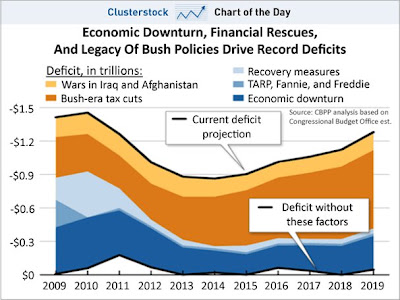
Our long term medium to long term deficit problems come from Social Security and Medicare. Social Security, as a program, ran a surplus for a long time. Right now it is running a small deficit (although it was forecast to return to a surplus this year, I suspect the continued deficit is a result of the continued weak economy), that will increase and become more permanent as more baby boomers retire. Due to past surpluses that were put into its trust fund, however, it will not find itself unable to meet its obligations under current law until the late 2030's. Lifting the cap on the amount of earnings subject to taxation for Social Security would fix this problem.
CBO report on Social Security
Medicare is harder, because rising costs associated with it are part of the rising costs of healthcare in general. Still, the Affordable Care Act contains measures designed to address these rising costs. It would prudent to see how these programs work before making an further alterations - especially medicare is by far the most cost efficient program we have in terms of dealing with medical costs.
Right now our debt burden is, depending on how you calculate it, between 75 and 100 percent of GDP. That is not out of line with other developed countries. Japan, for example, has roughly twice our debt burden. A household with a mortgage, meanwhile, when it acquires that mortgage usually has between 2 and 4 times the equivalent of its GDP, its yearly earnings, in debt. Like the household, we do not need to pay down our debts all at once. In fact, we have much longer to repay our debts, considering households are mortal, while our government has a much longer lifespan. When you add in the fact that the U.S. government basically controls the entity that prints the currency in which its debts are denominated, worrying about defaults becomes even more absurd. We are not Greece, Ireland, or any of the other countries who were basically locked into a currency that no longer made sense for them.
Finally, it should be noted that much of the concern about the unsustainability of the debt comes from fears of the spiraling interest payments required to service it as a percentage of GDP. The portion of our GDP dedicated to paying interest on our debt won't reach what it was in the early 90's until 2020. Much of the increase to that level is forecast to come as a result of rising interest rates associated with an economic recovery and the resulting interest rate hikes by the Federal Reserve to control inflation. With the economy as it is right now, such interest rate increases are impossible. In a way, that problem would be preferable to the one we are facing now, since it would indicate that the economy is growing.
Link to page with CBO report on interest payments on debt as percentage of GDP
In the end, the best and most humane way to reduce long term deficits and repay debt is to ensure that the economy is as large as possible. That means ensuring that the economy is growing. Right now, that means we need to invest in, stimulate, the economy in order to return it to normal growth and full employment. It is maddening that an organization whose malpractice resulting in it mislabeling worthless assets as AAA just 3 years ago, nearly destroying the world economy, is still able to stir up enough hysteria with its ridiculous pronouncements to actually make the "problem" it is commenting on worse, not better.
posted by eagles123 at 7:51 AM on August 6, 2011 [17 favorites]
Have you ever heard of a little country called the United Kingdom? And a nice aid package called "Lend-Lease", where we helped them out in WWII but expected them to repay us?Well, it may tell you why they have AAA, but if you want it to be used to distinguish between their AAA and our AA+, shouldn't you point out an instance in which we have not paid back our debts on schedule?
In 2006, they actually did.
And that tells you why they have a triple-A while we now have an AA+.
They may deserve to have a AAA and we may deserve not to, but "they have paid back their debts" doesn't seem to explain the difference.
posted by Flunkie at 8:09 AM on August 6, 2011
notyou : The deficit doesn't have to be paid back all at once, pla.
Deficit does not equal debt. The US has 14.3 trillion dollars in debt. If we had a solid plan to pay that back over the next century, I'd call it good. We don't.
The US has a deficit (as of the close of FY2010) of 1.3 trillion dollars - The federal government took in 2.16 trillion dollars, and spent 3.46 trillion.
The former we can pay back over time, if and only if we completely eliminate (and then some) the latter immediately.
Most of the current deficit is a revenue problem -- effects of the Bush Tax cuts and smaller tax receipts due to a shrinking economy.
Yes and no. Yes, if we raise taxes, we can spend more without incurring more debt.
Except, how much "should" we pay in taxes? We already pay a "real" tax rate comparable to (and in some cases higher than) all those "socialist" countries the Republicans like using as boogey-men. Except, look at what we get for that... Do you feel that you can safely get sick, or lose your job for a year or three, or retire comfortably on social security? (More on this - Including some hard numbers - Below).
Do you know what the Greeks rioted over in the recent financial mess? Having to retire a few years later than age 58, and having to work 50% more (41 hours per week) than the Germans do. Seriously. Their "austerity measures" sound like a frickin' vacation to many Americans.
Oh, and Greece has maximum tax rate of 45%. We have 45.5%.
But the real answer is a growing economy. Get that sorted, and the rest takes care of itself.
We have a deficit pretty close to one tenth of the debt. Not even in our glory days did we ever hit a growth rate of 10%, and we've never managed even 6% for a whole decade. "We lose money on each sale, but make it up in volume!"
I hate to say this (really, as an American, I really do hate to say this), but the days of growing our way out of debt have long since passed.
Sticherbeast : Not a great time to switch to the euro. The renminbi isn't such a hot idea, either - not for a long while.
I agree completely - Changing the world's reserve currency at the moment seems like a bad idea. But not even remotely impossible, and the practicality of switching improves with every dollar we spend that we don't take in.
Raising taxes on the top 1% will not cause all of them to run away screaming.
Okay, let's run with that figure.
The top 1% currently pay (as of 2010, again) an average effective tax rate (meaning what they really pay after all the games) 23.27%, which adds up to 38% of the federal government's tax revenues, or 392 billion dollars. Just from those last two numbers, I think you can see where this will lead.
If we raise that effective rate to 50%, the deficit drops to 0.85 trillion.
If we raise that effective rate to 70%, the deficit drops to 0.51 trillion.
If we raise that effective rate to 90%, the deficit drops to 0.18 trillion.
And if we raise that effective rate to 100% - Which corresponds to stripping the top 1% of earners of every penny they make - We still have a deficit of 7 billion dollars.
And if you think they wouldn't flee the country at that point...
Conclusion: Raising taxes on the top 1% will not realistically close the budget deficit.
pyramid termite : we are paying our damn bills - which is why we're not in default
Putting them on a new credit card does not equal "paying" them.
posted by pla at 8:17 AM on August 6, 2011 [3 favorites]
Deficit does not equal debt. The US has 14.3 trillion dollars in debt. If we had a solid plan to pay that back over the next century, I'd call it good. We don't.
The US has a deficit (as of the close of FY2010) of 1.3 trillion dollars - The federal government took in 2.16 trillion dollars, and spent 3.46 trillion.
The former we can pay back over time, if and only if we completely eliminate (and then some) the latter immediately.
Most of the current deficit is a revenue problem -- effects of the Bush Tax cuts and smaller tax receipts due to a shrinking economy.
Yes and no. Yes, if we raise taxes, we can spend more without incurring more debt.
Except, how much "should" we pay in taxes? We already pay a "real" tax rate comparable to (and in some cases higher than) all those "socialist" countries the Republicans like using as boogey-men. Except, look at what we get for that... Do you feel that you can safely get sick, or lose your job for a year or three, or retire comfortably on social security? (More on this - Including some hard numbers - Below).
Do you know what the Greeks rioted over in the recent financial mess? Having to retire a few years later than age 58, and having to work 50% more (41 hours per week) than the Germans do. Seriously. Their "austerity measures" sound like a frickin' vacation to many Americans.
Oh, and Greece has maximum tax rate of 45%. We have 45.5%.
But the real answer is a growing economy. Get that sorted, and the rest takes care of itself.
We have a deficit pretty close to one tenth of the debt. Not even in our glory days did we ever hit a growth rate of 10%, and we've never managed even 6% for a whole decade. "We lose money on each sale, but make it up in volume!"
I hate to say this (really, as an American, I really do hate to say this), but the days of growing our way out of debt have long since passed.
Sticherbeast : Not a great time to switch to the euro. The renminbi isn't such a hot idea, either - not for a long while.
I agree completely - Changing the world's reserve currency at the moment seems like a bad idea. But not even remotely impossible, and the practicality of switching improves with every dollar we spend that we don't take in.
Raising taxes on the top 1% will not cause all of them to run away screaming.
Okay, let's run with that figure.
The top 1% currently pay (as of 2010, again) an average effective tax rate (meaning what they really pay after all the games) 23.27%, which adds up to 38% of the federal government's tax revenues, or 392 billion dollars. Just from those last two numbers, I think you can see where this will lead.
If we raise that effective rate to 50%, the deficit drops to 0.85 trillion.
If we raise that effective rate to 70%, the deficit drops to 0.51 trillion.
If we raise that effective rate to 90%, the deficit drops to 0.18 trillion.
And if we raise that effective rate to 100% - Which corresponds to stripping the top 1% of earners of every penny they make - We still have a deficit of 7 billion dollars.
And if you think they wouldn't flee the country at that point...
Conclusion: Raising taxes on the top 1% will not realistically close the budget deficit.
pyramid termite : we are paying our damn bills - which is why we're not in default
Putting them on a new credit card does not equal "paying" them.
posted by pla at 8:17 AM on August 6, 2011 [3 favorites]
Is this the same S&P that kept giving the big banks/Wall Street and Lehman/Bear Stearns (No longer in existence) AAA ratings when they were trading in worthless toxic derivatives that sent the world's economy into shock and from which it's still suffering PTSD??
They think they have credibility?
That's pretty cheeky.
posted by Skygazer at 8:21 AM on August 6, 2011 [4 favorites]
They think they have credibility?
That's pretty cheeky.
posted by Skygazer at 8:21 AM on August 6, 2011 [4 favorites]
And if you think they wouldn't flee the country at that point...
The problem, as I see it, is that you people freely act in collaboration with one another to get your way, where-as nations are only too happy to be the cheapest option for robber barons to move their shit to. If nations could act in concert and impose a flat national tax on any person or corporate entity that made over X amount of dollars, then they'd have nowhere to run. The current situation, where financiers who do nothing useful, control the lion's share of wealth, and can dictate policy by shrugging and moving shop once things displease them? I'd call that ransom.
posted by codacorolla at 8:29 AM on August 6, 2011
The problem, as I see it, is that you people freely act in collaboration with one another to get your way, where-as nations are only too happy to be the cheapest option for robber barons to move their shit to. If nations could act in concert and impose a flat national tax on any person or corporate entity that made over X amount of dollars, then they'd have nowhere to run. The current situation, where financiers who do nothing useful, control the lion's share of wealth, and can dictate policy by shrugging and moving shop once things displease them? I'd call that ransom.
posted by codacorolla at 8:29 AM on August 6, 2011
@pla The fact that both you and S&P are a) attributing part of the deficit to Social Security, and b) calling for cuts to Social Security indicates that you're simply hiding a political program in an economic disguise.
Social Security is self funding, it is not a contributor to the deficit. It's good, unchanged, for the next 30 years, and good for the next several centuries if we just raise the cap a bit.
When you mention cuts to Social Security in the context of the deficit you are merely showing your political desires and illustrating that you don't give a damn about the economy, deficit, or debt.
Medicare I'll agree with, it's a problem. One that we can solve by instituting universal single payer and bringing down health care costs.
There are four major causes of the deficit: obscenely low taxes on the wealthy, ten fucking years of pointless wars, non-war military spending that is actually **HIGHER** than it was during the cold war, and healthcare.
Social Security is simply not a factor.
posted by sotonohito at 8:37 AM on August 6, 2011 [20 favorites]
Social Security is self funding, it is not a contributor to the deficit. It's good, unchanged, for the next 30 years, and good for the next several centuries if we just raise the cap a bit.
When you mention cuts to Social Security in the context of the deficit you are merely showing your political desires and illustrating that you don't give a damn about the economy, deficit, or debt.
Medicare I'll agree with, it's a problem. One that we can solve by instituting universal single payer and bringing down health care costs.
There are four major causes of the deficit: obscenely low taxes on the wealthy, ten fucking years of pointless wars, non-war military spending that is actually **HIGHER** than it was during the cold war, and healthcare.
Social Security is simply not a factor.
posted by sotonohito at 8:37 AM on August 6, 2011 [20 favorites]
codacorolla : The current situation, where financiers who do nothing useful, control the lion's share of wealth, and can dictate policy by shrugging and moving shop once things displease them? I'd call that ransom.
But you have no problem just taking their money from them by force when they choose to use it in a way you don't like? I'd call that extortion.
Real nice bank ya got there... Shame if the regulatory climate "changed" on ya. But my boss, see, he can help keep that from happening, he just asks for a "voluntary" donation to his fund for orphans...
sotonohito : Social Security is self funding
...As long as it takes in more than it pays out. Which ended last year.
Aka "an unfunded liability".
Or a bad joke, depending on your mood.
posted by pla at 8:48 AM on August 6, 2011 [1 favorite]
But you have no problem just taking their money from them by force when they choose to use it in a way you don't like? I'd call that extortion.
Real nice bank ya got there... Shame if the regulatory climate "changed" on ya. But my boss, see, he can help keep that from happening, he just asks for a "voluntary" donation to his fund for orphans...
sotonohito : Social Security is self funding
...As long as it takes in more than it pays out. Which ended last year.
Aka "an unfunded liability".
Or a bad joke, depending on your mood.
posted by pla at 8:48 AM on August 6, 2011 [1 favorite]
Hey S&P, Moody's and Fitch:
How'd that AAA+ rating for Lehman Bros. and Bear Stearns work out for you??
lulzlulzlulzlulzlulzlulzlulzlulzlulzlulzlulzlulzlulzlulzlulzlulzlulzlulzlulzlulzlulzlulzlulzlulzlulzlulzlulzlulzlulzlulz...
*Falls off chair laughing*
posted by Skygazer at 8:50 AM on August 6, 2011 [2 favorites]
How'd that AAA+ rating for Lehman Bros. and Bear Stearns work out for you??
lulzlulzlulzlulzlulzlulzlulzlulzlulzlulzlulzlulzlulzlulzlulzlulzlulzlulzlulzlulzlulzlulzlulzlulzlulzlulzlulzlulzlulzlulz...
*Falls off chair laughing*
posted by Skygazer at 8:50 AM on August 6, 2011 [2 favorites]
Social Security won't be unable to meet its liabilities under law until 2038, as one would discover if they clicked on the link from the CBO that I provided. It is a long term issue.
posted by eagles123 at 8:52 AM on August 6, 2011 [4 favorites]
posted by eagles123 at 8:52 AM on August 6, 2011 [4 favorites]
If you take the only solution that can succeed (sustained economic growth over time) off the table*, pla, then of course the problem is intractable.
Total Debt** is ~$14.2T
~$4.6T is Intra-governmental (Social Security Trust fund, various other trust funds)
~$9.6T is debt held by the public, which includes domestic savings (in the form of Treasuries) and Treasuries held by foreigners. Just over 50% of that is held by Americans.
One way to look at the debt is to see that big $14T and panic about never paying it back.
Another is to separate out the foreign held debt, which represents about a third of total debt, and try to understand how the remaining two-thirds benefits its holders.
---------------
*And doing so with a handwave.
**Thanks for the reminder.
posted by notyou at 8:53 AM on August 6, 2011 [4 favorites]
Total Debt** is ~$14.2T
~$4.6T is Intra-governmental (Social Security Trust fund, various other trust funds)
~$9.6T is debt held by the public, which includes domestic savings (in the form of Treasuries) and Treasuries held by foreigners. Just over 50% of that is held by Americans.
One way to look at the debt is to see that big $14T and panic about never paying it back.
Another is to separate out the foreign held debt, which represents about a third of total debt, and try to understand how the remaining two-thirds benefits its holders.
---------------
*And doing so with a handwave.
**Thanks for the reminder.
posted by notyou at 8:53 AM on August 6, 2011 [4 favorites]
But you have no problem just taking their money from them by force when they choose to use it in a way you don't like? I'd call that extortion.
Real nice bank ya got there... Shame if the regulatory climate "changed" on ya. But my boss, see, he can help keep that from happening, he just asks for a "voluntary" donation to his fund for orphans...
This tired cliche is the best you can come up with to defend yourself? Laughable.
posted by codacorolla at 9:00 AM on August 6, 2011 [4 favorites]
Real nice bank ya got there... Shame if the regulatory climate "changed" on ya. But my boss, see, he can help keep that from happening, he just asks for a "voluntary" donation to his fund for orphans...
This tired cliche is the best you can come up with to defend yourself? Laughable.
posted by codacorolla at 9:00 AM on August 6, 2011 [4 favorites]
Krugman wants to see S&P's Nobel, he'll show them his.
John Ford had this all figured out.
Meanwhile, the Republicans are still searching for the contemporary equivalent of the Smoot-Hawley Tariff Act.
The last global deflationary recession lasted about twenty years, was not fixed by government spending on war, and required establishing a new international monetary system (Bretton Woods), massive debt forgiveness, and the creation of new international credits via the Marshall Program. Note that the successful measures are of a kind and scale that can't even be raised in discussion, much less incorporated in legislation now.
It took twenty years and the largest global war ever to finally create the conditions to set things right.
I'm not expecting a quick fix here.
posted by warbaby at 9:27 AM on August 6, 2011 [4 favorites]
John Ford had this all figured out.
Meanwhile, the Republicans are still searching for the contemporary equivalent of the Smoot-Hawley Tariff Act.
The last global deflationary recession lasted about twenty years, was not fixed by government spending on war, and required establishing a new international monetary system (Bretton Woods), massive debt forgiveness, and the creation of new international credits via the Marshall Program. Note that the successful measures are of a kind and scale that can't even be raised in discussion, much less incorporated in legislation now.
It took twenty years and the largest global war ever to finally create the conditions to set things right.
I'm not expecting a quick fix here.
posted by warbaby at 9:27 AM on August 6, 2011 [4 favorites]
And if you think they wouldn't flee the country at that point...
you're aware that u s citizens abroad are still obligated to pay some taxes, right?
posted by pyramid termite at 9:42 AM on August 6, 2011
you're aware that u s citizens abroad are still obligated to pay some taxes, right?
posted by pyramid termite at 9:42 AM on August 6, 2011
Is there any realistic mechanism for making economic growth a serious option? Immigration perhaps?
There is one big difference between social security, medicare, etc. and our multi-trillion dollar wars, namely social security has not yet been paid out, while Bush's wars were "fully funded" using social security's taxes.
I'm content with social security 'taking the bullet' for Bush's occupations since the baby boomers backed those wars, broadly speaking. It's infinitely more important that Obamacare, Medicaid, and Medicare survive.
posted by jeffburdges at 9:53 AM on August 6, 2011 [1 favorite]
There is one big difference between social security, medicare, etc. and our multi-trillion dollar wars, namely social security has not yet been paid out, while Bush's wars were "fully funded" using social security's taxes.
I'm content with social security 'taking the bullet' for Bush's occupations since the baby boomers backed those wars, broadly speaking. It's infinitely more important that Obamacare, Medicaid, and Medicare survive.
posted by jeffburdges at 9:53 AM on August 6, 2011 [1 favorite]
Did war spending (and other programs associated with the war such as infrastructure programs and the GI Bill) end the global depression? No, but they played a huge part in ending the U.S. depression by allowing U.S. citizens to pay off their debts and otherwise improve their finances - thus setting the stage for the consumer based post war economy.
posted by eagles123 at 9:56 AM on August 6, 2011
posted by eagles123 at 9:56 AM on August 6, 2011
jeffburdges: I'm content with social security 'taking the bullet' for Bush's occupations
That's pretty easy to say when your a 20 or 30 - something living in France where the social safety net is all around you. Come back to me when you're 61 and living in Jacksonville Florida and you just lost your 401K in the latest crash. I'd like to hear what your opinion of social security is then.
. It's infinitely more important that Obamacare, Medicaid, and Medicare survive.
You do realize that Medicare actually costs a recipient about a three to four hundred a month, right? I mean in order to get it you actually have to have money enough to pay the premiums? Also there are deductibles that can easily run a recipient several hundred more dollars a year? I mean you do realize that Medicare is useless if you can not pay the monthly cost , right? So social security is kind of important, right?
posted by Poet_Lariat at 10:11 AM on August 6, 2011 [7 favorites]
That's pretty easy to say when your a 20 or 30 - something living in France where the social safety net is all around you. Come back to me when you're 61 and living in Jacksonville Florida and you just lost your 401K in the latest crash. I'd like to hear what your opinion of social security is then.
. It's infinitely more important that Obamacare, Medicaid, and Medicare survive.
You do realize that Medicare actually costs a recipient about a three to four hundred a month, right? I mean in order to get it you actually have to have money enough to pay the premiums? Also there are deductibles that can easily run a recipient several hundred more dollars a year? I mean you do realize that Medicare is useless if you can not pay the monthly cost , right? So social security is kind of important, right?
posted by Poet_Lariat at 10:11 AM on August 6, 2011 [7 favorites]
Meanwhile, the Republicans are still searching for the contemporary equivalent of the Smoot-Hawley Tariff Act.
i think they've found it - they'll just continue to obstruct the president and then blame the results all on him
posted by pyramid termite at 10:13 AM on August 6, 2011
i think they've found it - they'll just continue to obstruct the president and then blame the results all on him
posted by pyramid termite at 10:13 AM on August 6, 2011
S&P is already warning about another possible downgrade?
"Specifically, the report warns directly that a further downgrade to "AA" status could occur within the next two years if there is "less reduction in spending" than what was agreed in the debt ceiling agreement. S&P said one factor that could lead to this second downgrade is if the minimum $1.2 trillion in spending cuts under the debt ceiling agreement does not occur."
These folks are dangerous and hold way too much "invented" power. Simply astonishing.
posted by futz at 10:24 AM on August 6, 2011
"Specifically, the report warns directly that a further downgrade to "AA" status could occur within the next two years if there is "less reduction in spending" than what was agreed in the debt ceiling agreement. S&P said one factor that could lead to this second downgrade is if the minimum $1.2 trillion in spending cuts under the debt ceiling agreement does not occur."
These folks are dangerous and hold way too much "invented" power. Simply astonishing.
posted by futz at 10:24 AM on August 6, 2011
Federal Reserve Bank of New York Quarterly Review (1994) article on the founding of the credit rating industry (pdf).
posted by HLD at 10:37 AM on August 6, 2011
posted by HLD at 10:37 AM on August 6, 2011
If the financial sector disappeared tomorrow and was somehow replaced by a really effective "capital allocation" computer with no vested personal interest, then what would be lost?
JPD: "...take a look at how to Soviets tried to do this with math. Its really fucking hard."
Combine this with the messaging offered by the Bush administration, and the economic policies of the cold war superpowers are:
Russia: Math is hard!
USA: Let's go shopping!
posted by Riki tiki at 10:46 AM on August 6, 2011 [4 favorites]
JPD: "...take a look at how to Soviets tried to do this with math. Its really fucking hard."
Combine this with the messaging offered by the Bush administration, and the economic policies of the cold war superpowers are:
Russia: Math is hard!
USA: Let's go shopping!
posted by Riki tiki at 10:46 AM on August 6, 2011 [4 favorites]
I wonder if there is securities or other law that could be used to go after S&P. We shouldn't let these guys pun is around. They were part of the mortgage scam. Perhaps it is time to start looking backwards to move forward.
posted by humanfont at 10:49 AM on August 6, 2011
posted by humanfont at 10:49 AM on August 6, 2011
I've been reading up on 20th century history (The Age of Extremes and Postwar) to try and get a handle on what really happened between 1930 and 1960.
It was two totally different worlds. Before the Great Depression, the majority of employment was agricultural and most of that was subsistence. There were huge transitions in where people lived, how they worked, how they traveled, top to bottom.
The wars of the twentieth century were financed on credit. On the western side, the losers did better than the winners (the US and Britain.) The US became an enormous creditor, but had no short-term hope of getting loans repaid. Britain spent all of its capital reserves and borrowed more.
What saved the situation was the extension of more credits by the creditors, based on the expectation of growth ending the deflationary cycle that had been in place for twenty years.
I'm of the mind that turning around the US economy is going to require something similar - big demographic, economic and social changes. We could grow the economy enough to solve all of the debt and revenue problems, but it would require credit and social liberalization that the current political system can't countenance.
Why? Because one solution would be to eliminate the huge disparities of wealth. Not by destroying the upper classes, but by raising up the underclasses.
The current dog in the manger politics make this impossible. Give it twenty years of unsatisfied demand (same as the Great Depression) and sooner or later things will have to slide.
But not now and not with these greedy, selfish, racist, reactionary assholes running amok on the right and a bunch of smug, stand-pat, indifferent, economically secure centrists masquerading as the left side of the establishment.
There are no millionaires or Congressmen in foxholes.
posted by warbaby at 10:53 AM on August 6, 2011 [5 favorites]
It was two totally different worlds. Before the Great Depression, the majority of employment was agricultural and most of that was subsistence. There were huge transitions in where people lived, how they worked, how they traveled, top to bottom.
The wars of the twentieth century were financed on credit. On the western side, the losers did better than the winners (the US and Britain.) The US became an enormous creditor, but had no short-term hope of getting loans repaid. Britain spent all of its capital reserves and borrowed more.
What saved the situation was the extension of more credits by the creditors, based on the expectation of growth ending the deflationary cycle that had been in place for twenty years.
I'm of the mind that turning around the US economy is going to require something similar - big demographic, economic and social changes. We could grow the economy enough to solve all of the debt and revenue problems, but it would require credit and social liberalization that the current political system can't countenance.
Why? Because one solution would be to eliminate the huge disparities of wealth. Not by destroying the upper classes, but by raising up the underclasses.
The current dog in the manger politics make this impossible. Give it twenty years of unsatisfied demand (same as the Great Depression) and sooner or later things will have to slide.
But not now and not with these greedy, selfish, racist, reactionary assholes running amok on the right and a bunch of smug, stand-pat, indifferent, economically secure centrists masquerading as the left side of the establishment.
There are no millionaires or Congressmen in foxholes.
posted by warbaby at 10:53 AM on August 6, 2011 [5 favorites]
codacorolla : This tired cliche is the best you can come up with to defend yourself? Laughable.
Seriously? "Rob the rich" counts as the best you can come up with, and you want to accuse me of using cliches? :)
posted by pla at 11:08 AM on August 6, 2011
Seriously? "Rob the rich" counts as the best you can come up with, and you want to accuse me of using cliches? :)
posted by pla at 11:08 AM on August 6, 2011
China slams U.S. debt situation in fierce editorial
posted by homunculus at 11:10 AM on August 6, 2011 [1 favorite]
posted by homunculus at 11:10 AM on August 6, 2011 [1 favorite]
humanfont : I wonder if there is securities or other law that could be used to go after S&P.
Again - Seriously?
They have so much power because the US government (and indeed, most of the 1st-world) require certain classes of institutional investors (such as pension funds) to only invest in BBB- or better bonds.
In theory, that protects us.
In practice, as you point out, it puts a hell of a lot of power in the hands of a few companies - And companies paid by the seller, not the buyer (thus having an incentive to rate as high as they can justify).
As for those wondering "who the fuck S&P thinks it is", you might want to consider that Egan-Jones (a buyer-paid SEC-recognized ratings agency) downgraded the US to AA+ almost three weeks ago.
posted by pla at 11:19 AM on August 6, 2011 [1 favorite]
Again - Seriously?
They have so much power because the US government (and indeed, most of the 1st-world) require certain classes of institutional investors (such as pension funds) to only invest in BBB- or better bonds.
In theory, that protects us.
In practice, as you point out, it puts a hell of a lot of power in the hands of a few companies - And companies paid by the seller, not the buyer (thus having an incentive to rate as high as they can justify).
As for those wondering "who the fuck S&P thinks it is", you might want to consider that Egan-Jones (a buyer-paid SEC-recognized ratings agency) downgraded the US to AA+ almost three weeks ago.
posted by pla at 11:19 AM on August 6, 2011 [1 favorite]
Seriously? "Rob the rich" counts as the best you can come up with, and you want to accuse me of using cliches?
It's telling that you call fair taxation for the obscene profits gained by gambling with people's futures as robbery. But go on, live like lesser royalty in some post-colonial tropical fantasy land. Stamp your feet, cry, and run away as soon as your amazing life of luxury and opulence becomes slightly less luxurious and opulent.
posted by codacorolla at 11:25 AM on August 6, 2011 [3 favorites]
It's telling that you call fair taxation for the obscene profits gained by gambling with people's futures as robbery. But go on, live like lesser royalty in some post-colonial tropical fantasy land. Stamp your feet, cry, and run away as soon as your amazing life of luxury and opulence becomes slightly less luxurious and opulent.
posted by codacorolla at 11:25 AM on August 6, 2011 [3 favorites]
"Rob the rich" counts as the best you can come up with, and you want to accuse me of using cliches?
And the real purpose of this comes out again. "Rob the rich," "take rich people's money by force," "taxes are theft." This has nothing to do with the economic situation and is entirely about eliminating taxation, Social Security, Medicare and all the other non-miliary programs, and returning our country to a late-18th century style of government. This is purely political. You'd be screaming the same thing whether we had a deficit or a surplus.
posted by dirigibleman at 11:26 AM on August 6, 2011 [7 favorites]
And the real purpose of this comes out again. "Rob the rich," "take rich people's money by force," "taxes are theft." This has nothing to do with the economic situation and is entirely about eliminating taxation, Social Security, Medicare and all the other non-miliary programs, and returning our country to a late-18th century style of government. This is purely political. You'd be screaming the same thing whether we had a deficit or a surplus.
posted by dirigibleman at 11:26 AM on August 6, 2011 [7 favorites]
I've been thinking a lot lately about the enormous cultural shift that the U.S. has gone through since the end of the Depression.
When I was sorting through a bunch of stuff that had belonged to my grandmother, I came across her ration book from WWII, dozens of little notebooks where she recorded literally every penny she spent, and newspaper clippings, mainly from the 40s and early 50s. Nearly all of the clippings were op eds or essays or reprints of presidential speeches, and they were all on the subject of sacrifice: how it was the patriotic duty of Americans to sacrifice. Recycle; conserve fuel; knit socks; donate money or goods; those who had more were morally obliged to give more.
We've clearly lost that. I think it's a shame. Now it's one's patriotic duty to say "Fuck you, got mine," and we're all poorer for it (literally).
posted by rtha at 11:28 AM on August 6, 2011 [7 favorites]
When I was sorting through a bunch of stuff that had belonged to my grandmother, I came across her ration book from WWII, dozens of little notebooks where she recorded literally every penny she spent, and newspaper clippings, mainly from the 40s and early 50s. Nearly all of the clippings were op eds or essays or reprints of presidential speeches, and they were all on the subject of sacrifice: how it was the patriotic duty of Americans to sacrifice. Recycle; conserve fuel; knit socks; donate money or goods; those who had more were morally obliged to give more.
We've clearly lost that. I think it's a shame. Now it's one's patriotic duty to say "Fuck you, got mine," and we're all poorer for it (literally).
posted by rtha at 11:28 AM on August 6, 2011 [7 favorites]
Now it's one's patriotic duty to say "Fuck you, got mine," and we're all poorer for it (literally).
I don't think you got pla's memo: sacrifice is robbery (unless you're poor or disabled, in which case it's just the breaks). If you need a copy just email him at his tropical resort.
posted by codacorolla at 11:30 AM on August 6, 2011 [1 favorite]
I don't think you got pla's memo: sacrifice is robbery (unless you're poor or disabled, in which case it's just the breaks). If you need a copy just email him at his tropical resort.
posted by codacorolla at 11:30 AM on August 6, 2011 [1 favorite]
Nearly all of the clippings were op eds or essays or reprints of presidential speeches, and they were all on the subject of sacrifice: how it was the patriotic duty of Americans to sacrifice. Recycle; conserve fuel; knit socks; donate money or goods; those who had more were morally obliged to give more.
Rtha, I have the strongest suspicion that the "culture of sacrifice" that you are referring to probably was social engineering aimed at the poorer and former middle classes during the war. I'd bet that a brief review of the history of the times would show that the wealthy were not sacrificing all that much while the lesser economic classes were being instructed on doing without. I'm no historian of the period by any means by everything that I have learned about American history thus far leads me to believe that the wealthy rarely "do without" in any period.
posted by Poet_Lariat at 11:39 AM on August 6, 2011 [1 favorite]
Rtha, I have the strongest suspicion that the "culture of sacrifice" that you are referring to probably was social engineering aimed at the poorer and former middle classes during the war. I'd bet that a brief review of the history of the times would show that the wealthy were not sacrificing all that much while the lesser economic classes were being instructed on doing without. I'm no historian of the period by any means by everything that I have learned about American history thus far leads me to believe that the wealthy rarely "do without" in any period.
posted by Poet_Lariat at 11:39 AM on August 6, 2011 [1 favorite]
China has debt issues of its own, local debt issues, that aren't as widely talked about or hyped.
posted by raysmj at 11:40 AM on August 6, 2011 [2 favorites]
posted by raysmj at 11:40 AM on August 6, 2011 [2 favorites]
What's really missing from the comparisons between the Great Depression, the post WWII period, and the rest of the economic ups and downs of the 20th century, to today's situation, is that the private sector was nowhere near as flush, or as large, in comparison to the economic arms of governments, in any of those situations, as it is today. The world created a blue ton of new wealth in the last 20 years, much of it now in the treasuries of the top 1000 Fortune corporations, and in the hands of a world population that has grown from about 3 billion to nearly 7 billion in the last 30 years.
I, for one, don't think that the pure Keynesian model of government spending in times of recession to add demand to a flagging private sector, is likely to work, as once it might have, when governments could leverage sovereign borrowing power on future tax streams to pull the private sector out of a slump by increased government consumption. The balance between government borrowing power, and private sector size and mood is not the same as it once was. The base of the human pyramid is double what it was a generation ago, and the slope of the pyramids to the tops of human governments are accordingly just a lot flatter now, than they were once. I think something like a new public-private policy partnership has got to be forged, in which government lays down long term policy, and adheres to it, across changes of political administration, and the private sector invests, builds and grows the economy as a whole, based on those long term policies and promises of stable administration.
I think we need, worldwide, the return of various kinds of investment tax credits, accelerated or rationalized depreciation, and cooperative tax structures for long term investments and job creation, that encourage rapid capital formation and effective use. Taxes may need to go up, but should come from wealth generated, as it appears, not from punitive measures on existing wealth pools, which are needed as seed money for new growth. It should be far easier for capital to find and employ resources and labor productively, than to dodge regulation and taxes. Projects in energy, housing, transportation and agricultural development, that some have always assumed can only be achieved by nation states or regional groups of nations because of risk or scale, can be done by the private sector, with appropriate policy cooperation by governments involved, and due diligence and risk planning in the private sector.
But I really doubt that kind of thing has much chance of coming into being, in the real world. Political leaders are loath to give up management of economic engines, and in democracies, their voters are unwilling to see their political power further swamped by economic power. Moves to streamline and smooth economic development have frequently been opposed by political forces, to the point of stagnation, or failure. Boom and bust cycles are the economic reflection of human frailties, as much or more than they are acts of God. We have them, not because we like tulips, but because we get fascinated with the liking of tulips, itself, until we once again come to our senses, and start liking beaver hats, or vacation homes in faraway places, more.
Right now, with the world still dealing with the overhang of a worldwide real estate securitization collapse, and decades of expanding government, we're kind of foolish to expect to have gotten away from 2008 as lightly as it seemed we might have, in 2010. Unwilling and unable as they are, still, to fully revalue our past mistakes, our governments and banks are in no shape to lead us out of this by example of further deficit spending and monetary policy. If we could get the pools of private capital flowing from companies like Apple, Microsoft, Catepillar, some of the oil companies, and others that really are flush, not by punitive but productive measures and policies, we'd have some chance.
But that's a level of leadership, worldwide, we can't, I'm afraid, expect, any time soon.
posted by paulsc at 11:43 AM on August 6, 2011 [2 favorites]
I, for one, don't think that the pure Keynesian model of government spending in times of recession to add demand to a flagging private sector, is likely to work, as once it might have, when governments could leverage sovereign borrowing power on future tax streams to pull the private sector out of a slump by increased government consumption. The balance between government borrowing power, and private sector size and mood is not the same as it once was. The base of the human pyramid is double what it was a generation ago, and the slope of the pyramids to the tops of human governments are accordingly just a lot flatter now, than they were once. I think something like a new public-private policy partnership has got to be forged, in which government lays down long term policy, and adheres to it, across changes of political administration, and the private sector invests, builds and grows the economy as a whole, based on those long term policies and promises of stable administration.
I think we need, worldwide, the return of various kinds of investment tax credits, accelerated or rationalized depreciation, and cooperative tax structures for long term investments and job creation, that encourage rapid capital formation and effective use. Taxes may need to go up, but should come from wealth generated, as it appears, not from punitive measures on existing wealth pools, which are needed as seed money for new growth. It should be far easier for capital to find and employ resources and labor productively, than to dodge regulation and taxes. Projects in energy, housing, transportation and agricultural development, that some have always assumed can only be achieved by nation states or regional groups of nations because of risk or scale, can be done by the private sector, with appropriate policy cooperation by governments involved, and due diligence and risk planning in the private sector.
But I really doubt that kind of thing has much chance of coming into being, in the real world. Political leaders are loath to give up management of economic engines, and in democracies, their voters are unwilling to see their political power further swamped by economic power. Moves to streamline and smooth economic development have frequently been opposed by political forces, to the point of stagnation, or failure. Boom and bust cycles are the economic reflection of human frailties, as much or more than they are acts of God. We have them, not because we like tulips, but because we get fascinated with the liking of tulips, itself, until we once again come to our senses, and start liking beaver hats, or vacation homes in faraway places, more.
Right now, with the world still dealing with the overhang of a worldwide real estate securitization collapse, and decades of expanding government, we're kind of foolish to expect to have gotten away from 2008 as lightly as it seemed we might have, in 2010. Unwilling and unable as they are, still, to fully revalue our past mistakes, our governments and banks are in no shape to lead us out of this by example of further deficit spending and monetary policy. If we could get the pools of private capital flowing from companies like Apple, Microsoft, Catepillar, some of the oil companies, and others that really are flush, not by punitive but productive measures and policies, we'd have some chance.
But that's a level of leadership, worldwide, we can't, I'm afraid, expect, any time soon.
posted by paulsc at 11:43 AM on August 6, 2011 [2 favorites]
codacorolla : It's telling that you call fair taxation for the obscene profits gained by gambling with people's futures as robbery.
Okay, I intend to fairly and non-mockingly engage you on this point.
(The following numbers refer to my earlier link to 2010's actual tax revenues)
The top 1% of earners pay a "real" tax rate, after all the games, of 23.27%.
The top 5% of earners pay a "real" tax rate, after all the games, of 20.7%.
The top 10% of earners pay a "real" tax rate, after all the games, of 18.71%.
The top 25% of earners pay a "real" tax rate, after all the games, of 15.68%.
The top 50% of earners pay a "real" tax rate, after all the games, of 13.65%.
The bottom 50% of earners - Half the working US population - pay a "real" tax rate, after all the games, of 2.59%, and no I didn't miss a leading "1" there.
So tell me, all the BS and mockery between us aside - What rate do you consider "fair" for that top 1%? And I want a number, not sarcasm.
Make no mistake, we have those who abuse the system. I tend to consider corporations far worse abusers than individuals (*cough*NewsCorp*cough*), but the present discussion deals with personal incomes. So how much?
Keep in mind that you have 23.27%, already the single highest real rate among any group of Americans, as the number to beat; and that even picking a purely-punitive "100%" doesn't balance the budget.
posted by pla at 11:45 AM on August 6, 2011
Okay, I intend to fairly and non-mockingly engage you on this point.
(The following numbers refer to my earlier link to 2010's actual tax revenues)
The top 1% of earners pay a "real" tax rate, after all the games, of 23.27%.
The top 5% of earners pay a "real" tax rate, after all the games, of 20.7%.
The top 10% of earners pay a "real" tax rate, after all the games, of 18.71%.
The top 25% of earners pay a "real" tax rate, after all the games, of 15.68%.
The top 50% of earners pay a "real" tax rate, after all the games, of 13.65%.
The bottom 50% of earners - Half the working US population - pay a "real" tax rate, after all the games, of 2.59%, and no I didn't miss a leading "1" there.
So tell me, all the BS and mockery between us aside - What rate do you consider "fair" for that top 1%? And I want a number, not sarcasm.
Make no mistake, we have those who abuse the system. I tend to consider corporations far worse abusers than individuals (*cough*NewsCorp*cough*), but the present discussion deals with personal incomes. So how much?
Keep in mind that you have 23.27%, already the single highest real rate among any group of Americans, as the number to beat; and that even picking a purely-punitive "100%" doesn't balance the budget.
posted by pla at 11:45 AM on August 6, 2011
"Rob the rich" counts as the best you can come up with, and you want to accuse me of using cliches?
They should pay their fair share of a system that is built for them. Take the roads--corporations owned by the rich drive their trucks with the goods they sell on them. The courts enforce judgments on their behalf. The police protect property. The securities regulations allow for a fluid market in which the well-off can invest in securities with a low incedence of fraud. Our armies protect our trade relations and allow our corporations and capital to reach any market they choose. And--and, the social welfare systems bouy consumption and allow more persons to purchase goods and services sold by--you guessed it--corporations owned by the rich.
So all you John Galts out there, remember this system isn't attacking you--its been in your back pocket the entire time. And we need you to pay a larger share for it because the upper 2% has been claiming more and more of the total wealth of the country. So they need to be taxed more.
posted by Ironmouth at 11:47 AM on August 6, 2011 [14 favorites]
They should pay their fair share of a system that is built for them. Take the roads--corporations owned by the rich drive their trucks with the goods they sell on them. The courts enforce judgments on their behalf. The police protect property. The securities regulations allow for a fluid market in which the well-off can invest in securities with a low incedence of fraud. Our armies protect our trade relations and allow our corporations and capital to reach any market they choose. And--and, the social welfare systems bouy consumption and allow more persons to purchase goods and services sold by--you guessed it--corporations owned by the rich.
So all you John Galts out there, remember this system isn't attacking you--its been in your back pocket the entire time. And we need you to pay a larger share for it because the upper 2% has been claiming more and more of the total wealth of the country. So they need to be taxed more.
posted by Ironmouth at 11:47 AM on August 6, 2011 [14 favorites]
Taxes may need to go up, but should come from wealth generated, as it appears, not from punitive measures on existing wealth pools
We're just asking them to pay in relation to how the system benefits them. It makes economic sense.
posted by Ironmouth at 11:51 AM on August 6, 2011 [3 favorites]
We're just asking them to pay in relation to how the system benefits them. It makes economic sense.
posted by Ironmouth at 11:51 AM on August 6, 2011 [3 favorites]
Ironmouth : Take the roads--corporations owned by the rich drive their trucks with the goods they sell on them.
...As do you and I.
The courts enforce judgments on their behalf.
I'll agree hands-down that we have far too much corporate power in general, but ever gone to small claims court? The guy with the deeper pockets usually loses, unless the case has no merit at all.
The police protect property.
Umm, okay... We don't have property?
The securities regulations allow for a fluid market in which the well-off can invest in securities with a low incedence of fraud.
As can you and I... In fact, I got in on some great deals Friday, after the plunge Thursday, and I don't even make a mere six figures.
Our armies protect our trade relations and allow our corporations and capital to reach any market they choose.
Oh, and that little thing about keeping hostile entities (and make no mistake, our foreign policy leaves us with plenty of those) from blowing up our houses too...
And--and, the social welfare systems bouy consumption and allow more persons to purchase goods and services sold by--you guessed it--corporations owned by the rich.
So don't buy from Walmart. Buy from Farmer Brown down the road.
Look - I by no means count as one of these evil Capitalist Pigs we all like to rail against. I make an okay salary, and work for it. But I also understand that "fair" doesn't mean "the next guy pays more than I do". Sorry, but cookie jars just don't work that way.
posted by pla at 11:56 AM on August 6, 2011
...As do you and I.
The courts enforce judgments on their behalf.
I'll agree hands-down that we have far too much corporate power in general, but ever gone to small claims court? The guy with the deeper pockets usually loses, unless the case has no merit at all.
The police protect property.
Umm, okay... We don't have property?
The securities regulations allow for a fluid market in which the well-off can invest in securities with a low incedence of fraud.
As can you and I... In fact, I got in on some great deals Friday, after the plunge Thursday, and I don't even make a mere six figures.
Our armies protect our trade relations and allow our corporations and capital to reach any market they choose.
Oh, and that little thing about keeping hostile entities (and make no mistake, our foreign policy leaves us with plenty of those) from blowing up our houses too...
And--and, the social welfare systems bouy consumption and allow more persons to purchase goods and services sold by--you guessed it--corporations owned by the rich.
So don't buy from Walmart. Buy from Farmer Brown down the road.
Look - I by no means count as one of these evil Capitalist Pigs we all like to rail against. I make an okay salary, and work for it. But I also understand that "fair" doesn't mean "the next guy pays more than I do". Sorry, but cookie jars just don't work that way.
posted by pla at 11:56 AM on August 6, 2011
Life isn't fair.
posted by furiousxgeorge at 11:57 AM on August 6, 2011 [1 favorite]
posted by furiousxgeorge at 11:57 AM on August 6, 2011 [1 favorite]
The top 1% of earners pay a "real" tax rate, after all the games, of 23.27%.
The top 5% of earners pay a "real" tax rate, after all the games, of 20.7%.
But those aren't really the correct figures are they?
posted by Poet_Lariat at 12:00 PM on August 6, 2011 [2 favorites]
The top 5% of earners pay a "real" tax rate, after all the games, of 20.7%.
But those aren't really the correct figures are they?
posted by Poet_Lariat at 12:00 PM on August 6, 2011 [2 favorites]
Ironmouth already said it, but I don't want punitive tax rates, I just want something that makes sense. This chart on wikipedia suggests that the lowest rate between 1930 and 1980 was 68% until the dismantling of the public sector and the far right shift of the 80s and 90s. I'd be fine with 50%.
I'm sure that won't happen because of the ransom effect that I mentioned earlier - so long as there's a hidey hole that the rich can disappear down, or accountants that can weasel away their earnings in loop-holes it doesn't really matter. The system is set up for you, and yet you complain when someone makes you slightly less obscenely wealthy.
I have a feeling that it'll catch up at some point for your type, and the results won't be good for anybody.
The tax rates in the article that I posted, and the tax rates that you're asking me to take on faith don't mesh. If you want to tell me what the historical tax rates were by your metric then I'd pick a similar number out of those.
Let's just make it easy and say: double what it is now.
I don't know how much more revenue we'd bring in, but keeping the rates the same and improving collection would be a good start. But even this milk-sop approach to fair taxation is enough to spook the wealthy, causing them to wave the gun a little closer to the hostage's head. There'll always be somewhere cheaper and more desperate that you can go.
posted by codacorolla at 12:06 PM on August 6, 2011 [1 favorite]
I'm sure that won't happen because of the ransom effect that I mentioned earlier - so long as there's a hidey hole that the rich can disappear down, or accountants that can weasel away their earnings in loop-holes it doesn't really matter. The system is set up for you, and yet you complain when someone makes you slightly less obscenely wealthy.
I have a feeling that it'll catch up at some point for your type, and the results won't be good for anybody.
The tax rates in the article that I posted, and the tax rates that you're asking me to take on faith don't mesh. If you want to tell me what the historical tax rates were by your metric then I'd pick a similar number out of those.
Let's just make it easy and say: double what it is now.
I don't know how much more revenue we'd bring in, but keeping the rates the same and improving collection would be a good start. But even this milk-sop approach to fair taxation is enough to spook the wealthy, causing them to wave the gun a little closer to the hostage's head. There'll always be somewhere cheaper and more desperate that you can go.
posted by codacorolla at 12:06 PM on August 6, 2011 [1 favorite]
"look, just because i have a bigger bucket shouldn't mean that i have to bail more water than you do"
posted by pyramid termite at 12:07 PM on August 6, 2011 [8 favorites]
posted by pyramid termite at 12:07 PM on August 6, 2011 [8 favorites]
"Take the roads--corporations owned by the rich drive their trucks with the goods they sell on them."
posted by Ironmouth at 2:47 PM on August 6
Roads are a good example of how governments sort of muscled private capital out of the way, back as far the early 19th century in the U.S., to get economic expansion accelerated as governments wanted to see it. Before that, governments didn't always build roads in a big way, didn't use powers of eminent domain to condemn right-of-way, didn't assume the burden of maintenance, obsolescence, and modernization for the road networks, either. The Erie Canal was built by private funds. The bulk of railroads were built across America by private capital, across land grant right of way, before much settlement of the interior, and when they made the Erie Canal obsolete before it recovered its building costs, no governments were left holding the Erie Canal financing bag. It might have been nice if some governments had stepped in to smooth the transition by temporary regulation, but that is now, solidly, the 19th Century's problem, so none of us much remember or care who got hurt and who came out, in all that. Toll roads were common, until the automobile became the dominant means of personal transportation in America.
Maybe between WWI and the Eisenhower Presidency, having government use its sovereign powers to "pave Paradise" was the expedient way to proceed. But it was not the only way, nor need government involvement be the only way to make, maintain and modernize roads, going forward.
We have to recognize structural change, and this kind of turbulent political and economic environment is what we get, when we don't do it rationally. The tax code shouldn't be the only arrow in our quiver, facing an uncertain future.
posted by paulsc at 12:08 PM on August 6, 2011 [1 favorite]
posted by Ironmouth at 2:47 PM on August 6
Roads are a good example of how governments sort of muscled private capital out of the way, back as far the early 19th century in the U.S., to get economic expansion accelerated as governments wanted to see it. Before that, governments didn't always build roads in a big way, didn't use powers of eminent domain to condemn right-of-way, didn't assume the burden of maintenance, obsolescence, and modernization for the road networks, either. The Erie Canal was built by private funds. The bulk of railroads were built across America by private capital, across land grant right of way, before much settlement of the interior, and when they made the Erie Canal obsolete before it recovered its building costs, no governments were left holding the Erie Canal financing bag. It might have been nice if some governments had stepped in to smooth the transition by temporary regulation, but that is now, solidly, the 19th Century's problem, so none of us much remember or care who got hurt and who came out, in all that. Toll roads were common, until the automobile became the dominant means of personal transportation in America.
Maybe between WWI and the Eisenhower Presidency, having government use its sovereign powers to "pave Paradise" was the expedient way to proceed. But it was not the only way, nor need government involvement be the only way to make, maintain and modernize roads, going forward.
We have to recognize structural change, and this kind of turbulent political and economic environment is what we get, when we don't do it rationally. The tax code shouldn't be the only arrow in our quiver, facing an uncertain future.
posted by paulsc at 12:08 PM on August 6, 2011 [1 favorite]
You should ideally consider FICA as a tax ever since Johnson moved social security into the general pool, giving congress free reign on spending it, doubly so now that we're seriously discussing cutting benefits.
If you do so, then all Americans pay 6.2% of their first $106k, meaning the minimum tax rate bottoms out there for people making under $106k. And your take rate declines with additional income once you reach the highest tax bracket.
I doubt that FICA could be separated from income taxes again without drastic action like reassigning FICA, Social Security, Medicare, etc. to the states.
posted by jeffburdges at 12:10 PM on August 6, 2011
If you do so, then all Americans pay 6.2% of their first $106k, meaning the minimum tax rate bottoms out there for people making under $106k. And your take rate declines with additional income once you reach the highest tax bracket.
I doubt that FICA could be separated from income taxes again without drastic action like reassigning FICA, Social Security, Medicare, etc. to the states.
posted by jeffburdges at 12:10 PM on August 6, 2011
Poet_Lariat : But those aren't really the correct figures are they?
Uh... Yes, actually, unless you want to dispute the IRS's own numbers...
That link refers to AGI (line 37), not the far more tweakable "Taxable income" (line 43).
codacorolla : I'd be fine with 50%.
Okay, I'll take that as a fair answer... But where do you plan to get the remaining 850 billion dollars?
posted by pla at 12:11 PM on August 6, 2011
Uh... Yes, actually, unless you want to dispute the IRS's own numbers...
That link refers to AGI (line 37), not the far more tweakable "Taxable income" (line 43).
codacorolla : I'd be fine with 50%.
Okay, I'll take that as a fair answer... But where do you plan to get the remaining 850 billion dollars?
posted by pla at 12:11 PM on August 6, 2011
>I, for one, don't think that the pure Keynesian model of government spending in times >of recession to add demand to a flagging private sector, is likely to work, as once it might >have, when governments could leverage sovereign borrowing power on future tax streams to >pull the private sector out of a slump by increased government consumption. The balance >between government borrowing power, and private sector size and mood is not the same as it >once was. The base of the human pyramid is double what it was a generation ago, and the >slope of the pyramids to the tops of human governments are accordingly just a lot flatter >now, than they were once. I think something like a new public-private policy partnership has >got to be forged, in which government lays down long term policy, and adheres to it, across >changes of political administration, and the private sector invests, builds and grows the >economy as a whole, based on those long term policies and promises of stable administration.
>I think we need, worldwide, the return of various kinds of investment tax credits, accelerated >or rationalized depreciation, and cooperative tax structures for long term investments and job >creation, that encourage rapid capital formation and effective use. Taxes may need to go up, >but should come from wealth generated, as it appears, not from punitive measures on >existing wealth pools, which are needed as seed money for new growth. It should be far >easier for capital to find and employ resources and labor productively, than to dodge >regulation and taxes. Projects in energy, housing, transportation and agricultural >development, that some have always assumed can only be achieved by nation states or >regional groups of nations because of risk or scale, can be done by the private sector, with >appropriate policy cooperation by governments involved, and due diligence and risk planning >in the private sector.
I'm not sure if your point is that policies to stimulate demand during a recession won't work because wealth inequalities are lower today than they were in the 30's, or higher, or that the private sector is larger relative to the government than today, or lower. Either way the point is irrelevant. The idea behind using borrowing to stimulate the economy is to transfer debts in the private sector to the government, with the idea that those private sector debts are what is causing the high unemployment and below normal growth or outright contraction.
As to the rest of your post - In other words you just want to continue or double down on the policies of the last 30 years. Sorry, there might be a time in the future when moving in that direction is appropriate, but that time is not the present.
posted by eagles123 at 12:15 PM on August 6, 2011
>I think we need, worldwide, the return of various kinds of investment tax credits, accelerated >or rationalized depreciation, and cooperative tax structures for long term investments and job >creation, that encourage rapid capital formation and effective use. Taxes may need to go up, >but should come from wealth generated, as it appears, not from punitive measures on >existing wealth pools, which are needed as seed money for new growth. It should be far >easier for capital to find and employ resources and labor productively, than to dodge >regulation and taxes. Projects in energy, housing, transportation and agricultural >development, that some have always assumed can only be achieved by nation states or >regional groups of nations because of risk or scale, can be done by the private sector, with >appropriate policy cooperation by governments involved, and due diligence and risk planning >in the private sector.
I'm not sure if your point is that policies to stimulate demand during a recession won't work because wealth inequalities are lower today than they were in the 30's, or higher, or that the private sector is larger relative to the government than today, or lower. Either way the point is irrelevant. The idea behind using borrowing to stimulate the economy is to transfer debts in the private sector to the government, with the idea that those private sector debts are what is causing the high unemployment and below normal growth or outright contraction.
As to the rest of your post - In other words you just want to continue or double down on the policies of the last 30 years. Sorry, there might be a time in the future when moving in that direction is appropriate, but that time is not the present.
posted by eagles123 at 12:15 PM on August 6, 2011
"We're just asking them to pay in relation to how the system benefits them. It makes economic sense."
posted by Ironmouth at 2:51 PM on August 6
If you increase taxation, you're not "asking." And if you tax the only major reservoirs of wealth in the world to solve yesterdays problems, and guarantee your capability to continue to do the same indefinitely, you're eating the world's seed money.
Another flat decade, with respect to growth, is preferable to that, in the eyes of many. Turbulent economic and political times will result. 30% of human activity need not be governance, nor should anything like 30% of wealth be compelled to support it.
posted by paulsc at 12:19 PM on August 6, 2011 [1 favorite]
posted by Ironmouth at 2:51 PM on August 6
If you increase taxation, you're not "asking." And if you tax the only major reservoirs of wealth in the world to solve yesterdays problems, and guarantee your capability to continue to do the same indefinitely, you're eating the world's seed money.
Another flat decade, with respect to growth, is preferable to that, in the eyes of many. Turbulent economic and political times will result. 30% of human activity need not be governance, nor should anything like 30% of wealth be compelled to support it.
posted by paulsc at 12:19 PM on August 6, 2011 [1 favorite]
Hmm, maybe it's a problem to have only one reservoir of wealth.
posted by furiousxgeorge at 12:23 PM on August 6, 2011
posted by furiousxgeorge at 12:23 PM on August 6, 2011
"... As to the rest of your post - In other words you just want to continue or double down on the policies of the last 30 years. ..."
posted by eagles123 at 3:15 PM on August 6
Not at all. I really don't think we yet have a great model to replace the kind of divided governance/private sector capitalism that keeps failing to foresee and navigate around the boom/bust cycle of economics. It can't, I think, continue to be governance that tries to compel behavior by taxation and regulation, and a private sector that seeks to avoid that very taxation and regulation, as much as possible. We're getting government that is too big to fail, and capital that is too dynamic to understand fully, much less manage wisely.
posted by paulsc at 12:25 PM on August 6, 2011
posted by eagles123 at 3:15 PM on August 6
Not at all. I really don't think we yet have a great model to replace the kind of divided governance/private sector capitalism that keeps failing to foresee and navigate around the boom/bust cycle of economics. It can't, I think, continue to be governance that tries to compel behavior by taxation and regulation, and a private sector that seeks to avoid that very taxation and regulation, as much as possible. We're getting government that is too big to fail, and capital that is too dynamic to understand fully, much less manage wisely.
posted by paulsc at 12:25 PM on August 6, 2011
But where do you plan to get the remaining 850 billion dollars?
I've never been a person in here saying that taxing the rich was the sole way out of this problem, and I'm not smart enough to pretend to tell you where the remaining money comes from, although I can say that defense cuts, transaction taxes, inheritance taxes, reasonable entitlement reform are all good starting points. Instead of directly cutting money, maybe reinvest some savings into things that grow the demand side of the equation, like research, education, and infrastructure.
I was responding to your initial post:
And if you think they wouldn't flee the country at that point...
Conclusion: Raising taxes on the top 1% will not realistically close the budget deficit.
The idea that the rich will flee the country at the slightest request for them to pay what (in past times at least) isn't an unreasonable share to support a country that's made them fabulously wealthy disgusts me. I was registering that disgust.
I'm not asking for heads on pikes, I'm just asking for something sane that takes the pressure off the majority of the populace, and maybe even allows them to prosper a little.
We're getting government that is too big to fail, and capital that is too dynamic to understand fully, much less manage wisely.
You put the "lol" in lolbertarian, Paulie.
posted by codacorolla at 12:28 PM on August 6, 2011 [3 favorites]
I've never been a person in here saying that taxing the rich was the sole way out of this problem, and I'm not smart enough to pretend to tell you where the remaining money comes from, although I can say that defense cuts, transaction taxes, inheritance taxes, reasonable entitlement reform are all good starting points. Instead of directly cutting money, maybe reinvest some savings into things that grow the demand side of the equation, like research, education, and infrastructure.
I was responding to your initial post:
And if you think they wouldn't flee the country at that point...
Conclusion: Raising taxes on the top 1% will not realistically close the budget deficit.
The idea that the rich will flee the country at the slightest request for them to pay what (in past times at least) isn't an unreasonable share to support a country that's made them fabulously wealthy disgusts me. I was registering that disgust.
I'm not asking for heads on pikes, I'm just asking for something sane that takes the pressure off the majority of the populace, and maybe even allows them to prosper a little.
We're getting government that is too big to fail, and capital that is too dynamic to understand fully, much less manage wisely.
You put the "lol" in lolbertarian, Paulie.
posted by codacorolla at 12:28 PM on August 6, 2011 [3 favorites]
Afaik, there are only two problem with "the pure Keynesian model of government spending in times of recession ...", namely that politicians realize they'll make themselves popular by stimulous spending in good times too, and that all that spending creates a spectacular moral hazard.
Europe has adopted this non-Keynesian "austerity" approach only because Europeans are not one people and the Greeks really abused Northern Europe's lending to eliminate taxation.
posted by jeffburdges at 12:30 PM on August 6, 2011
Europe has adopted this non-Keynesian "austerity" approach only because Europeans are not one people and the Greeks really abused Northern Europe's lending to eliminate taxation.
posted by jeffburdges at 12:30 PM on August 6, 2011
Pla -
Just looking at the current deficit and plugging in numbers based on what you believe the government would be able to bring in if it enacted a certain level of taxation gives an inaccurate view of how government finances work. For one thing, you are ignoring the fact government spending is broken down into different components representing the different commitments that it has undertaken under law. Some of those commitments, such as Social Security, Medicare, and Medicaid, are ongoing. Others, such as the wars in Iraq and Afghanistan, are not. Only if you assume that the deficit needs to be cut to zero at this very moment, which it does not, would your argument make sense.
As I stated above, winding down the wars in Iraq and Afghanistan, which we are planning to do, along with repealing the Bush tax cuts, would close much of the current deficit. For some reason you refuse to even consider the fact that revenue shortfalls resulting from the recession, as well as temporary programs meant to cope with the recession, are also contributing to the deficit. Bringing the economy back to its normal growth and employment rate, along with the aforementioned measures, would pretty much close the short to medium term deficit. You simply cannot analyze a government budget, or any budget, without looking at fluctuations in revenue. No analysis does that.
As to the problems with the long term commitments of the government, we could fix the relatively temporary problem with social security by lifting the cap on payroll subject to social security taxation. Medicare and Medicaid are tougher, but those programs are the most efficient health insurers we have, it wouldn't make sense to cut them since it would only burden the plans set up under the Affordable Care Act.
posted by eagles123 at 12:41 PM on August 6, 2011 [2 favorites]
Just looking at the current deficit and plugging in numbers based on what you believe the government would be able to bring in if it enacted a certain level of taxation gives an inaccurate view of how government finances work. For one thing, you are ignoring the fact government spending is broken down into different components representing the different commitments that it has undertaken under law. Some of those commitments, such as Social Security, Medicare, and Medicaid, are ongoing. Others, such as the wars in Iraq and Afghanistan, are not. Only if you assume that the deficit needs to be cut to zero at this very moment, which it does not, would your argument make sense.
As I stated above, winding down the wars in Iraq and Afghanistan, which we are planning to do, along with repealing the Bush tax cuts, would close much of the current deficit. For some reason you refuse to even consider the fact that revenue shortfalls resulting from the recession, as well as temporary programs meant to cope with the recession, are also contributing to the deficit. Bringing the economy back to its normal growth and employment rate, along with the aforementioned measures, would pretty much close the short to medium term deficit. You simply cannot analyze a government budget, or any budget, without looking at fluctuations in revenue. No analysis does that.
As to the problems with the long term commitments of the government, we could fix the relatively temporary problem with social security by lifting the cap on payroll subject to social security taxation. Medicare and Medicaid are tougher, but those programs are the most efficient health insurers we have, it wouldn't make sense to cut them since it would only burden the plans set up under the Affordable Care Act.
posted by eagles123 at 12:41 PM on August 6, 2011 [2 favorites]
China's glorious leaders have issued a snarky little news item suggesting that the US address its debt problems. I strongly support a hefty tariff on all those crap Chinese imports.
Since they've built 65 million empty apartments, maybe they can sell those to pay for their losses at Xmas. Meantime we can hurry up that new rare earths mine in SE Nebraska.
posted by Twang at 12:45 PM on August 6, 2011 [1 favorite]
Since they've built 65 million empty apartments, maybe they can sell those to pay for their losses at Xmas. Meantime we can hurry up that new rare earths mine in SE Nebraska.
posted by Twang at 12:45 PM on August 6, 2011 [1 favorite]
After the (necessary though shady) measures we took to stabilize/save our financial system, I don't want to hear anything about moral hazard from anyone, especially if it means letting people remain unemployed and cutting benefits to people who can least afford to sacrifice. We managed to run our economy responsibly before, we not only can do it again, we must do it again.
oh and,
>Not at all. I really don't think we yet have a great model to replace the kind of divided >governance/private sector capitalism that keeps failing to foresee and navigate around the >boom/bust cycle of economics. It can't, I think, continue to be governance that tries to >compel behavior by taxation and regulation, and a private sector that seeks to avoid that very >taxation and regulation, as much as possible. We're getting government that is too big to fail, >and capital that is too dynamic to understand fully, much less manage wisely.
You say you don't, but you can't escape that, in effect, that is what your proposals would do. Markets are useful mechanisms for allocating resources. They are not perfect, however. There is an entire history behind how our society, and others, sorted out where markets work, where we wanted market logic to rule, where it didn't, where we wanted a public program governed by laws, and where a mixture of market logic and public programs/laws were appropriate.
For the last 30 years, we've been trying to inject markets and their logic into an ever increasing number of human activities, while simultaneously rolling back public programs and laws that earlier generations found preferable to pure market logic. Your proposal, so far as I can tell, would complete that process, something that, judging from your posts, you view as a historical mistake that began in the 19th century. Unfortunately, just as the experience of the Soviet Union and other command economies proved market logic was necessary to a modern economy, the experience of this country and others over the past 30 years reaffirms lessons learned during the 19th and early 20th century that taught us where pure market logic does not work.
posted by eagles123 at 12:53 PM on August 6, 2011 [5 favorites]
Keynes predicted that without aggregate demand (which should be provided by the government in times of economic downturn) an economy can stay in a low employment equilibrium state indefinitely.
Looks like the US is about to find out whether he was right.
posted by Talez at 12:56 PM on August 6, 2011
Looks like the US is about to find out whether he was right.
posted by Talez at 12:56 PM on August 6, 2011
At this point China, I would think borrowing is still preferable to stealing. (And two points for homunculus).
posted by HLD at 12:56 PM on August 6, 2011
posted by HLD at 12:56 PM on August 6, 2011
eagles123 : Just looking at the current deficit and plugging in numbers based on what you believe the government would be able to bring in if it enacted a certain level of taxation gives an inaccurate view of how government finances work.
I agree, and only did so to show that even the absolute best case non-iterated solution still doesn't solve the underlying problem.
Some of those commitments, such as Social Security, Medicare, and Medicaid, are ongoing. Others, such as the wars in Iraq and Afghanistan, are not.
I've already pointed out that cutting the entire military doesn't balance the budget. 100% of it, not just our current wars. Put simply, our revenues have dropped drastically, and only the most optimistic "unicorn farts cure cancer" models predict those revenues as recovering in our lifetimes.
Only if you assume that the deficit needs to be cut to zero at this very moment, which it does not, would your argument make sense.
Sorry, but this world plays by zero-sum rules. We do need the deficit to always equal zero (or less). Call me crazy, but I don't spend more than I have, nor do I think my town, state, or country should do the same.
Even the whole global warming thing boils down to the same exact argument, on a worldwide scale - Currently, we "spend" more energy than we take in, and slowly kill ourselves in the process by racking up "debt" in the form of excess CO2. We can either live within our means, or we can kill ourselves pretending we don't need to pay back what we owe.
posted by pla at 1:14 PM on August 6, 2011 [1 favorite]
I agree, and only did so to show that even the absolute best case non-iterated solution still doesn't solve the underlying problem.
Some of those commitments, such as Social Security, Medicare, and Medicaid, are ongoing. Others, such as the wars in Iraq and Afghanistan, are not.
I've already pointed out that cutting the entire military doesn't balance the budget. 100% of it, not just our current wars. Put simply, our revenues have dropped drastically, and only the most optimistic "unicorn farts cure cancer" models predict those revenues as recovering in our lifetimes.
Only if you assume that the deficit needs to be cut to zero at this very moment, which it does not, would your argument make sense.
Sorry, but this world plays by zero-sum rules. We do need the deficit to always equal zero (or less). Call me crazy, but I don't spend more than I have, nor do I think my town, state, or country should do the same.
Even the whole global warming thing boils down to the same exact argument, on a worldwide scale - Currently, we "spend" more energy than we take in, and slowly kill ourselves in the process by racking up "debt" in the form of excess CO2. We can either live within our means, or we can kill ourselves pretending we don't need to pay back what we owe.
posted by pla at 1:14 PM on August 6, 2011 [1 favorite]
Why S&P’s Downgrade is No Joke: The real impact of S&P’s downgrade is political, not economic.
posted by homunculus at 1:25 PM on August 6, 2011 [1 favorite]
posted by homunculus at 1:25 PM on August 6, 2011 [1 favorite]
We are in serious trouble if our economy is breaking the laws of thermodynamics, the SEC needs to get on top of this.
posted by furiousxgeorge at 1:25 PM on August 6, 2011 [3 favorites]
posted by furiousxgeorge at 1:25 PM on August 6, 2011 [3 favorites]
pla:We do need the deficit to always equal zero (or less).
would you be so kind as to indicate a single year in the last 100 years where the national deficit has ever been zero in this country? Alternatively could you please indicate a western European country whose national deficit has been zero in the same time period, please?
Economics: I do not think this word means what you think it means.
posted by Poet_Lariat at 1:26 PM on August 6, 2011 [1 favorite]
would you be so kind as to indicate a single year in the last 100 years where the national deficit has ever been zero in this country? Alternatively could you please indicate a western European country whose national deficit has been zero in the same time period, please?
Economics: I do not think this word means what you think it means.
posted by Poet_Lariat at 1:26 PM on August 6, 2011 [1 favorite]
"Unfortunately, just as the experience of the Soviet Union and other command economies proved market logic was necessary to a modern economy, the experience of this country and others over the past 30 years reaffirms lessons learned during the 19th and early 20th century that taught us where pure market logic does not work."
posted by eagles123 at 3:53 PM on August 6
History is replete with action/reaction governance and economic models, as you recognize. But not every possible structure for the regulation of human activity has been explored, to a practical reporting level. Particularly, the Japanese, under the pressure of their "lost" decade, were beginning to forge some new models of coopitition in some government/kiretsu partnerships that threatened U.S. companies so directly, in the 90s, that it created some blowback to trade agreements. Specialty steel stands out in my memory, as one American ox that was, for a time, threatened for deep goring by such Japanese structures. Autos and shipbuilding were others. To a lesser extent, within their national scope, the South Koreans have organized cooperations of bank finance/industry/government in certain sectors, to advance their ability to export and compete in the international marketplace. Regulation doesn't react to innovation in such structures, it is informed by innovation, and in turn, supports further innovation with long term, predictable policy, across political administration terms. Feedback loops between government/industry/capital develop in ways that aren't possible in societies where those interests are locked at arms length by anti-trust and other such legal structures.
On a related topic, one thing our forebearers really lacked, in which we have a new ability in spades (although it is not as well harnessed as it might be), is forecasting. We may not have been able to push weather forecasting with accuracy much past 15 minutes for tornadoes, but even 5 minutes warning saved lives in Alabama and Missouri, this spring. But economic forecasting, modeling, and other management science has come further in the last 50 years than most governments are willing to admit, in core policy matters. Within the Japanese and South Korean government/kiretsu structures, the influence and contribution of academia and of management science has been better exploited, than ever it was when government funded basic research, and hoped that its nationals could find some competitive advantage in the contributions to world knowledge thus made.
These kinds of structures aren't the finished product of the kind of thing we may need to get out of our current problems, more or less permanently. But they point to new ways of thinking, and new ways of working with one another, outside the traditional silos of human endeavor in governance, industry, and finance, for better outcomes at streamlined costs.
posted by paulsc at 1:26 PM on August 6, 2011
posted by eagles123 at 3:53 PM on August 6
History is replete with action/reaction governance and economic models, as you recognize. But not every possible structure for the regulation of human activity has been explored, to a practical reporting level. Particularly, the Japanese, under the pressure of their "lost" decade, were beginning to forge some new models of coopitition in some government/kiretsu partnerships that threatened U.S. companies so directly, in the 90s, that it created some blowback to trade agreements. Specialty steel stands out in my memory, as one American ox that was, for a time, threatened for deep goring by such Japanese structures. Autos and shipbuilding were others. To a lesser extent, within their national scope, the South Koreans have organized cooperations of bank finance/industry/government in certain sectors, to advance their ability to export and compete in the international marketplace. Regulation doesn't react to innovation in such structures, it is informed by innovation, and in turn, supports further innovation with long term, predictable policy, across political administration terms. Feedback loops between government/industry/capital develop in ways that aren't possible in societies where those interests are locked at arms length by anti-trust and other such legal structures.
On a related topic, one thing our forebearers really lacked, in which we have a new ability in spades (although it is not as well harnessed as it might be), is forecasting. We may not have been able to push weather forecasting with accuracy much past 15 minutes for tornadoes, but even 5 minutes warning saved lives in Alabama and Missouri, this spring. But economic forecasting, modeling, and other management science has come further in the last 50 years than most governments are willing to admit, in core policy matters. Within the Japanese and South Korean government/kiretsu structures, the influence and contribution of academia and of management science has been better exploited, than ever it was when government funded basic research, and hoped that its nationals could find some competitive advantage in the contributions to world knowledge thus made.
These kinds of structures aren't the finished product of the kind of thing we may need to get out of our current problems, more or less permanently. But they point to new ways of thinking, and new ways of working with one another, outside the traditional silos of human endeavor in governance, industry, and finance, for better outcomes at streamlined costs.
posted by paulsc at 1:26 PM on August 6, 2011
would you be so kind as to indicate a single year in the last 100 years where the national deficit has ever been zero in this country? Alternatively could you please indicate a western European country whose national deficit has been zero in the same time period, please?
Countries regularly operate without deficits. It's debts that are almost permanent and universal.
posted by Jehan at 1:28 PM on August 6, 2011
Countries regularly operate without deficits. It's debts that are almost permanent and universal.
posted by Jehan at 1:28 PM on August 6, 2011
Sorry, but this world plays by zero-sum rules.
> implying the planet is a closed system
> implying economics is a closed system
> implying capitalism could even function as a zero-sum game
> laughinggirls.jpg.gif.mp3.exe.rar.001
posted by Sticherbeast at 1:38 PM on August 6, 2011 [2 favorites]
> implying the planet is a closed system
> implying economics is a closed system
> implying capitalism could even function as a zero-sum game
> laughinggirls.jpg.gif.mp3.exe.rar.001
posted by Sticherbeast at 1:38 PM on August 6, 2011 [2 favorites]
"Keynes predicted that without aggregate demand (which should be provided by the government in times of economic downturn) an economy can stay in a low employment equilibrium state indefinitely. ..."
posted by Talez at 3:56 PM on August 6
Keynes was arguing strongly, in his time, for adopting policies he envisaged as part of a two pole, government - private sector model. He never really considered capital pooling, or its effects on aggregate demand, in parts of the private sector, which has been the driving force in the U.S. economy, for the last 20 years, or so. For at least the last decade, nearly 70% of the U.S. economy has been consumer demand driven. That's greatly reduced, since 2008, but cash has been pooling on corporate balance sheets for the last 2 to 3 years. As far as I know it, Keynesian theory doesn't speak to how you get corporations to create aggregate demand, except through the inefficient, and possibly ineffective mechanisms of taxation and wealth redistribution of corporate wealth by government.
But, in theory, with the right mix of incentives, corporations should be willing to spend directly, to create future profits, and, again in theory, in doing so, provide a more direct, efficient and immediate boost to an economy than the government could. That should create jobs, and quickly boost consumer demand, too.
But, at present, in the U.S., we really have few policy levers to encourage that.
posted by paulsc at 1:39 PM on August 6, 2011
posted by Talez at 3:56 PM on August 6
Keynes was arguing strongly, in his time, for adopting policies he envisaged as part of a two pole, government - private sector model. He never really considered capital pooling, or its effects on aggregate demand, in parts of the private sector, which has been the driving force in the U.S. economy, for the last 20 years, or so. For at least the last decade, nearly 70% of the U.S. economy has been consumer demand driven. That's greatly reduced, since 2008, but cash has been pooling on corporate balance sheets for the last 2 to 3 years. As far as I know it, Keynesian theory doesn't speak to how you get corporations to create aggregate demand, except through the inefficient, and possibly ineffective mechanisms of taxation and wealth redistribution of corporate wealth by government.
But, in theory, with the right mix of incentives, corporations should be willing to spend directly, to create future profits, and, again in theory, in doing so, provide a more direct, efficient and immediate boost to an economy than the government could. That should create jobs, and quickly boost consumer demand, too.
But, at present, in the U.S., we really have few policy levers to encourage that.
posted by paulsc at 1:39 PM on August 6, 2011
So...would this be a good time to invest in stocks? Serious question.
posted by Bukvoed at 1:43 PM on August 6, 2011
posted by Bukvoed at 1:43 PM on August 6, 2011
Sorry, but this world plays by zero-sum rules. We do need the deficit to always equal zero (or less). Call me crazy, but I don't spend more than I have, nor do I think my town, state, or country should do the same.
That's nuts.
Public debt = private savings
Modern Capitalist economies NEED government deficits to function properly.
Government bonds (Treasuries) are a place to park money safely and reliably while one finds more productive use for it. If the US stopped issuing debt, all sorts of important financial institutions and services (pensions, insurance) -- and clients of same -- would be screwed.
Government finances are not household finances.
posted by notyou at 1:43 PM on August 6, 2011 [5 favorites]
That's nuts.
Public debt = private savings
Modern Capitalist economies NEED government deficits to function properly.
Government bonds (Treasuries) are a place to park money safely and reliably while one finds more productive use for it. If the US stopped issuing debt, all sorts of important financial institutions and services (pensions, insurance) -- and clients of same -- would be screwed.
Government finances are not household finances.
posted by notyou at 1:43 PM on August 6, 2011 [5 favorites]
Call me crazy, but I don't spend more than I have, nor do I think my town, state, or country should do the same.
Did you pay cash for your house?
posted by i_am_joe's_spleen at 1:47 PM on August 6, 2011 [9 favorites]
Did you pay cash for your house?
posted by i_am_joe's_spleen at 1:47 PM on August 6, 2011 [9 favorites]
"So...would this be a good time to invest in stocks? Serious question."
posted by Bukvoed at 4:43 PM on August 6
Magic 8 ball of economic prophecy say: "Conditions turbulent, future unclear. Ask again later."
posted by paulsc at 1:48 PM on August 6, 2011
posted by Bukvoed at 4:43 PM on August 6
Magic 8 ball of economic prophecy say: "Conditions turbulent, future unclear. Ask again later."
posted by paulsc at 1:48 PM on August 6, 2011
Pla,
The laws of thermodynamics have no relation or bearing on the current discussion, except in the extended instance that natural resources play a role in economic productivity. Even granting that, it means nothing in the current debate. What the economic system, which is supposed to reflect inputs such as the scarcity of natural resources is telling us is that, despite the very real future problems we will have if we don't manage our natural resources and environment correctly correctly or switch to a more sustainable economy, is that worldwide there is a shortage of capital. Keeping the world and U.S. economy in such a depressed state will only make our future natural resource problems and environmental problems worse since it will hinder our transition to more efficient/advanced/powerful/renewable technologies.
That is just a digression from the current discussion though. You haven't pointed anything out about the budget. You've just made assertions about the budget that are unsupported by any factual connection to the world save the hand-waving objections you raise when someone tries to inject actual facts or methods of standard budgetary analysis into the discussion.
Paulsc,
I don't see how that fits into the framework you are proposing, which I see is still basically the same policies we've had for the past 30 years (and incidentally similar to policies proposed by the Obama administration). There is a completely different logic at work there which involves sustaining one's economy through exports to another. There needs to be a source of demand somewhere in that equation. I'm willing to revise this view if you spell out what "incentives" you believe would help, although unfortunately I can't promise I'll read it in the near future since I have another engagement I must go to and I still disagree with regard to applicably of "Keynesian" economics to the present situation.
posted by eagles123 at 1:48 PM on August 6, 2011
The laws of thermodynamics have no relation or bearing on the current discussion, except in the extended instance that natural resources play a role in economic productivity. Even granting that, it means nothing in the current debate. What the economic system, which is supposed to reflect inputs such as the scarcity of natural resources is telling us is that, despite the very real future problems we will have if we don't manage our natural resources and environment correctly correctly or switch to a more sustainable economy, is that worldwide there is a shortage of capital. Keeping the world and U.S. economy in such a depressed state will only make our future natural resource problems and environmental problems worse since it will hinder our transition to more efficient/advanced/powerful/renewable technologies.
That is just a digression from the current discussion though. You haven't pointed anything out about the budget. You've just made assertions about the budget that are unsupported by any factual connection to the world save the hand-waving objections you raise when someone tries to inject actual facts or methods of standard budgetary analysis into the discussion.
Paulsc,
I don't see how that fits into the framework you are proposing, which I see is still basically the same policies we've had for the past 30 years (and incidentally similar to policies proposed by the Obama administration). There is a completely different logic at work there which involves sustaining one's economy through exports to another. There needs to be a source of demand somewhere in that equation. I'm willing to revise this view if you spell out what "incentives" you believe would help, although unfortunately I can't promise I'll read it in the near future since I have another engagement I must go to and I still disagree with regard to applicably of "Keynesian" economics to the present situation.
posted by eagles123 at 1:48 PM on August 6, 2011
would you be so kind as to indicate a single year in the last 100 years where the national deficit has ever been zero in this country?
For a very long time this country ran without a yearly deficit and very recently had a major surplus.
posted by Revvy at 1:49 PM on August 6, 2011
For a very long time this country ran without a yearly deficit and very recently had a major surplus.
posted by Revvy at 1:49 PM on August 6, 2011
Revvy : heh - point taken :)
posted by Poet_Lariat at 1:53 PM on August 6, 2011
posted by Poet_Lariat at 1:53 PM on August 6, 2011
Poet_Lariat : would you be so kind as to indicate a single year in the last 100 years where the national deficit has ever been zero in this country?
I said zero OR LESS. And consider me delighted to accomodate your request:
1911, 1920, 1921, 1922, 1923, 1924, 1925, 1926, 1927, 1928, 1929, 1930, 1947, 1948, 1949, 1951, 1952, 1956, 1957, 1960, 1969, 1998, 1999, 2000, 2001.
And if you go back more than 100 years, the numbers get DRASTICALLY better, as in, we simply didn't run a deficit that we didn't correct within a decade, ever, until the 1930s.
I would also point out, on a related note, that only four times in US history has the deficit hit 10% of the GDP - 1865 (civil war, and), 1918/1919 (WWI), 1942-1945 (WWII)... And, 2009/2011. So morally, how would you compare the wars in Iraq and Afghanistan against Hitler and black slavery?
Sticherbeast : implying the planet is a closed system
Please name any 1% contributor to the Earth's energy input that doesn't come from within our solar system.
eagles123 : The laws of thermodynamics have no relation or bearing on the current discussion, except in the extended instance that natural resources play a role in economic productivity.
If "economics" doesn't tokenize energy inputs and outputs, it doesn't do anything. If you'd prefer to go back to "the guy with the bigger stick takes what he wants", though, just let me know.
posted by pla at 1:57 PM on August 6, 2011
I said zero OR LESS. And consider me delighted to accomodate your request:
1911, 1920, 1921, 1922, 1923, 1924, 1925, 1926, 1927, 1928, 1929, 1930, 1947, 1948, 1949, 1951, 1952, 1956, 1957, 1960, 1969, 1998, 1999, 2000, 2001.
And if you go back more than 100 years, the numbers get DRASTICALLY better, as in, we simply didn't run a deficit that we didn't correct within a decade, ever, until the 1930s.
I would also point out, on a related note, that only four times in US history has the deficit hit 10% of the GDP - 1865 (civil war, and), 1918/1919 (WWI), 1942-1945 (WWII)... And, 2009/2011. So morally, how would you compare the wars in Iraq and Afghanistan against Hitler and black slavery?
Sticherbeast : implying the planet is a closed system
Please name any 1% contributor to the Earth's energy input that doesn't come from within our solar system.
eagles123 : The laws of thermodynamics have no relation or bearing on the current discussion, except in the extended instance that natural resources play a role in economic productivity.
If "economics" doesn't tokenize energy inputs and outputs, it doesn't do anything. If you'd prefer to go back to "the guy with the bigger stick takes what he wants", though, just let me know.
posted by pla at 1:57 PM on August 6, 2011
I have to wonder when it will be that people will start to ask, "Who is benefiting from all of this nonsense?" While it's not a zero-sum game, if there are losers, surely there must be winners, right?
So, who is making money while the governments of the world (and the people of those countries) ostensibly lose it?
It's not hard to find out. I bet you're all smart enough to know without looking, too.
posted by Revvy at 2:02 PM on August 6, 2011
So, who is making money while the governments of the world (and the people of those countries) ostensibly lose it?
It's not hard to find out. I bet you're all smart enough to know without looking, too.
posted by Revvy at 2:02 PM on August 6, 2011
"... There is a completely different logic at work there which involves sustaining one's economy through exports to another. There needs to be a source of demand somewhere in that equation. ..."
posted by eagles123 at 4:48 PM on August 6
Well, as I said, the examples of modern Japanese and South Korean government/industry/finance cooperation were nascent, unfinished examples of new cooperative economic structures that I think deserve more effort. For one thing, as you point out, they were initially pointed at export activities, because there was a political will in both economies to allow some latitude with regulations governing banks and industry, if it meant new economic development in the greater world. Neither the Japanese or South Korean politicians would have had as much license, within their domestic economies to either allow, or participate in such partnerships. But as a tool for improving export competitive position, such mechanisms were politically popular, and worth their startup costs and risks to the domestic economies.
But I don't think that just because such groups weren't developed for internal economies, means that they couldn't be. You'd perhaps need different political reasons, and you'd be dismantling some regulatory silos to create more effective and efficient regulatory/industry/capital partnerships, but in the end, if such arrangements promote efficiency and effective governance, it shouldn't, in theory, matter whether they are done for internal or export economic sectors.
posted by paulsc at 2:04 PM on August 6, 2011
posted by eagles123 at 4:48 PM on August 6
Well, as I said, the examples of modern Japanese and South Korean government/industry/finance cooperation were nascent, unfinished examples of new cooperative economic structures that I think deserve more effort. For one thing, as you point out, they were initially pointed at export activities, because there was a political will in both economies to allow some latitude with regulations governing banks and industry, if it meant new economic development in the greater world. Neither the Japanese or South Korean politicians would have had as much license, within their domestic economies to either allow, or participate in such partnerships. But as a tool for improving export competitive position, such mechanisms were politically popular, and worth their startup costs and risks to the domestic economies.
But I don't think that just because such groups weren't developed for internal economies, means that they couldn't be. You'd perhaps need different political reasons, and you'd be dismantling some regulatory silos to create more effective and efficient regulatory/industry/capital partnerships, but in the end, if such arrangements promote efficiency and effective governance, it shouldn't, in theory, matter whether they are done for internal or export economic sectors.
posted by paulsc at 2:04 PM on August 6, 2011
If you increase taxation, you're not "asking." And if you tax the only major reservoirs of wealth. . .
What other reservoirs are there?
posted by Ironmouth at 2:08 PM on August 6, 2011 [1 favorite]
What other reservoirs are there?
posted by Ironmouth at 2:08 PM on August 6, 2011 [1 favorite]
would you be so kind as to indicate a single year in the last 100 years where the national deficit has ever been zero in this country?
1998, 1999 and 2000.
posted by empath at 2:15 PM on August 6, 2011
1998, 1999 and 2000.
posted by empath at 2:15 PM on August 6, 2011
would you be so kind as to indicate a single year in the last 100 years where the national deficit has ever been zero in this country?
For a very long time this country ran without a yearly deficit and very recently had a major surplus.
Yep. And that surplus was eaten up by Bush's tax cuts. So the answer of how to create a surplus is to raise taxes. And you know what happened? A sustained boom.
I was in grad school in the mid-90s and worked in the business reference section of the university library. I used to have to put the 'inside baseball' business periodicals in their binders. For all of 1995 the headlines were "Still No Recession!" They couldn't believe it.
The fact is this--when we were paying off our debts via the higher taxes of the Clinton years, we were better off. And we took a huge nose-dive when we stopped doing that under Bush.
In other words, scoreboard.
posted by Ironmouth at 2:17 PM on August 6, 2011 [10 favorites]
For a very long time this country ran without a yearly deficit and very recently had a major surplus.
Yep. And that surplus was eaten up by Bush's tax cuts. So the answer of how to create a surplus is to raise taxes. And you know what happened? A sustained boom.
I was in grad school in the mid-90s and worked in the business reference section of the university library. I used to have to put the 'inside baseball' business periodicals in their binders. For all of 1995 the headlines were "Still No Recession!" They couldn't believe it.
The fact is this--when we were paying off our debts via the higher taxes of the Clinton years, we were better off. And we took a huge nose-dive when we stopped doing that under Bush.
In other words, scoreboard.
posted by Ironmouth at 2:17 PM on August 6, 2011 [10 favorites]
Social Security won't be unable to meet its liabilities under law until 2038, as one would discover if they clicked on the link from the CBO that I provided. It is a long term issue.
Well, I guess given voting profiles, "Fuck you kids, me and the other Boomers get ours out of your taxes and the debt you inherit, but the whole lot collapses when you hit retirement age" is a winner for getting re-elected, but it doesn't really smack of sound economic management.
posted by rodgerd at 2:21 PM on August 6, 2011 [1 favorite]
Well, I guess given voting profiles, "Fuck you kids, me and the other Boomers get ours out of your taxes and the debt you inherit, but the whole lot collapses when you hit retirement age" is a winner for getting re-elected, but it doesn't really smack of sound economic management.
posted by rodgerd at 2:21 PM on August 6, 2011 [1 favorite]
Also, Japan and Korea are terrible comparators. They were export-oriented because they have few natural resources, mainly oil. Second, Japan paid the price for its ridiculous program of growth at the expense of its own people. They lent out money from banks at 3%, built up a huge, unsustainable industrial base that was bound to be passed by due to innovation and internal labor costs and then nose-dived.
Not the plan for us.
posted by Ironmouth at 2:24 PM on August 6, 2011
Not the plan for us.
posted by Ironmouth at 2:24 PM on August 6, 2011
What other reservoirs are there?
posted by Ironmouth at 5:08 PM on August 6
Vast oversimplification, but
Wealth = savings + cash flows
If you tax savings, i.e. cash or cash equivalents, in consumer accounts, or on corporate balance sheets, you're killing the future to cover sins of the past. You have to wait for, and maybe even stimulate new cash flows by current forbearance, at least, if you want sustainable income for governance from those flows. That's especially tough to do in a down economic cycle, for reasons that we've all seen play out in recent weeks, but it's the prudent course of action, if you don't want to powerdive the economy to worse straits. Of course, it would be nice if, while forbearing and waiting for new cash flows as revenue to tax, we could also increase the velocity of the cash flows, and reduce net governance at the same time, through elimination of ineffective governance structures, and creation of new economic/governance partnerships. If we did it right, we might find that the cash we didn't tax away and try to redistribute through governance, would jump back into the economy, off consumer savings and cash equivalents, and corporate balance sheets, quite productively and quickly, at first opportunity, as soon as it sees reasons/ways to do so. Capital does want to grow, pretty fiercely.
But with our current leadership, I'm not optimistic about that. However, in turbulent times, new ideas and new leaders have unusual chances for effect.
posted by paulsc at 2:30 PM on August 6, 2011
posted by Ironmouth at 5:08 PM on August 6
Vast oversimplification, but
Wealth = savings + cash flows
If you tax savings, i.e. cash or cash equivalents, in consumer accounts, or on corporate balance sheets, you're killing the future to cover sins of the past. You have to wait for, and maybe even stimulate new cash flows by current forbearance, at least, if you want sustainable income for governance from those flows. That's especially tough to do in a down economic cycle, for reasons that we've all seen play out in recent weeks, but it's the prudent course of action, if you don't want to powerdive the economy to worse straits. Of course, it would be nice if, while forbearing and waiting for new cash flows as revenue to tax, we could also increase the velocity of the cash flows, and reduce net governance at the same time, through elimination of ineffective governance structures, and creation of new economic/governance partnerships. If we did it right, we might find that the cash we didn't tax away and try to redistribute through governance, would jump back into the economy, off consumer savings and cash equivalents, and corporate balance sheets, quite productively and quickly, at first opportunity, as soon as it sees reasons/ways to do so. Capital does want to grow, pretty fiercely.
But with our current leadership, I'm not optimistic about that. However, in turbulent times, new ideas and new leaders have unusual chances for effect.
posted by paulsc at 2:30 PM on August 6, 2011
Our lowering of the rating was prompted by our view on the rising public debt burden and our perception of greater policymaking uncertainty, consistent with our criteria (see "Sovereign Government Rating Methodology and Assumptions," June 30, 2011, especially Paragraphs 36-41).
36. The political score assesses how a government's institutions and policymaking affect a sovereign's credit fundamentals by delivering sustainable public finances, promoting balanced economic growth, and responding to economic or political shocks.
So, in other words, the US credit rating has been downgraded because our government is made up of people who refuse to do their jobs.
posted by Revvy at 2:30 PM on August 6, 2011 [1 favorite]
36. The political score assesses how a government's institutions and policymaking affect a sovereign's credit fundamentals by delivering sustainable public finances, promoting balanced economic growth, and responding to economic or political shocks.
So, in other words, the US credit rating has been downgraded because our government is made up of people who refuse to do their jobs.
posted by Revvy at 2:30 PM on August 6, 2011 [1 favorite]
"... Not the plan for us."
posted by Ironmouth at 5:24 PM on August 6
Now you're just being disingenuous. Between them, in the last 20 years, the Japanese and Koreans nearly killed the U.S. steel industry, to the point of forcing protectionist U.S. steel policy, and pressured the U.S. auto industry to the brink of collapse, so that when credit dried up in 2008, the "Big 3" would have blown away in the wind, except for political interference. And GM still can't build a car at competitive rates to Korea, even outside its overhanging pension liabilities, even at reduced, new labor rates negotiated with the UAW as part of the U.S. government bailout. Also, they pretty much shut down U.S. memory chip manufacturing, and own the world market for some display technologies, and are now sub-licensing that to the Chinese.
Eh, one man's half full glass, is another man's half empty one, I guess, when it comes to new economic/governance models.
posted by paulsc at 2:42 PM on August 6, 2011
posted by Ironmouth at 5:24 PM on August 6
Now you're just being disingenuous. Between them, in the last 20 years, the Japanese and Koreans nearly killed the U.S. steel industry, to the point of forcing protectionist U.S. steel policy, and pressured the U.S. auto industry to the brink of collapse, so that when credit dried up in 2008, the "Big 3" would have blown away in the wind, except for political interference. And GM still can't build a car at competitive rates to Korea, even outside its overhanging pension liabilities, even at reduced, new labor rates negotiated with the UAW as part of the U.S. government bailout. Also, they pretty much shut down U.S. memory chip manufacturing, and own the world market for some display technologies, and are now sub-licensing that to the Chinese.
Eh, one man's half full glass, is another man's half empty one, I guess, when it comes to new economic/governance models.
posted by paulsc at 2:42 PM on August 6, 2011
falameufilho wrote: Oh PLEASE
Oh, please.
pla wrote: We needed to shave two trillion PER YEAR off the budget, and it would still take us 30 years (assuming zero growth in the budget during that period) to pay down our debt.
No, we need to add about a trillion or two a year for the next 3-4 years to our expenditures, with the Bush cuts expiring at the end of that period. The economic growth over the following 10 would solve our budget problem and then some.
pla wrote: ...As long as it takes in more than it pays out. Which ended last year.
Which ended last year because of a temporary reduction in the payroll tax. Don't be intentionally misleading, please.
pla wrote: The bottom 50% of earners - Half the working US population - pay a "real" tax rate, after all the games, of 2.59%, and no I didn't miss a leading "1" there.
Keep pulling those misleading "statistics" out of your ass. If you wanted to convey the real picture, you wouldn't have lumped a 50th percentile earner in with a 1st percentile earner. Nor would you have lumped the top 0.1% in with the 99th percentile folks. The difference in payments and ability to pay are vastly different. Quit while you're behind.
posted by wierdo at 2:52 PM on August 6, 2011 [4 favorites]
Oh, please.
pla wrote: We needed to shave two trillion PER YEAR off the budget, and it would still take us 30 years (assuming zero growth in the budget during that period) to pay down our debt.
No, we need to add about a trillion or two a year for the next 3-4 years to our expenditures, with the Bush cuts expiring at the end of that period. The economic growth over the following 10 would solve our budget problem and then some.
pla wrote: ...As long as it takes in more than it pays out. Which ended last year.
Which ended last year because of a temporary reduction in the payroll tax. Don't be intentionally misleading, please.
pla wrote: The bottom 50% of earners - Half the working US population - pay a "real" tax rate, after all the games, of 2.59%, and no I didn't miss a leading "1" there.
Keep pulling those misleading "statistics" out of your ass. If you wanted to convey the real picture, you wouldn't have lumped a 50th percentile earner in with a 1st percentile earner. Nor would you have lumped the top 0.1% in with the 99th percentile folks. The difference in payments and ability to pay are vastly different. Quit while you're behind.
posted by wierdo at 2:52 PM on August 6, 2011 [4 favorites]
in the last 20 years, the Japanese and Koreans nearly killed the U.S. steel industry, to the point of forcing protectionist U.S. steel policy, and pressured the U.S. auto industry to the brink of collapse, so that when credit dried up in 2008, the "Big 3" would have blown away in the wind, except for political interference. And GM still can't build a car at competitive rates to Korea, even outside its overhanging pension liabilities, even at reduced, new labor rates negotiated with the UAW as part of the U.S. government bailout. Also, they pretty much shut down U.S. memory chip manufacturing, and own the world market for some display technologies, and are now sub-licensing that to the Chinese.
And yet I'd rather be here than there. Sure, we have a bad recession, but they have lost the last 15 years with no sign of any light at the tunnel.
Putting it another way, the fact that the prior innovators, the US, got pushed aside in the global race to the bottom in manufacturing wages, doesn't mean anything. Those are mature industries which are going to move now to India and then Africa as they chase the lowest wages around the globe. The fact that Japan was their first stop means nothing.
And if you're into Japan, why don't we adopt their individual tax rates? Their top bracket is 40%.
http://www.worldwide-tax.com/japan/japan_tax.asp
posted by Ironmouth at 3:11 PM on August 6, 2011
And yet I'd rather be here than there. Sure, we have a bad recession, but they have lost the last 15 years with no sign of any light at the tunnel.
Putting it another way, the fact that the prior innovators, the US, got pushed aside in the global race to the bottom in manufacturing wages, doesn't mean anything. Those are mature industries which are going to move now to India and then Africa as they chase the lowest wages around the globe. The fact that Japan was their first stop means nothing.
And if you're into Japan, why don't we adopt their individual tax rates? Their top bracket is 40%.
http://www.worldwide-tax.com/japan/japan_tax.asp
posted by Ironmouth at 3:11 PM on August 6, 2011
Pastabagel wrote: I'm not sure if Tyler Cowen is a republican or a democrat, but his website banner looks like it was designed by Martha Stewart, so I'm going to assume he's socially liberal and fiscally conservative.
He ignores the present economic reality that inflation is not really possible to achieve with an output gap the size of the one we've got. The Fed dumped how much money into the economy and all we got was not-quite-deflation?
posted by wierdo at 3:11 PM on August 6, 2011
He ignores the present economic reality that inflation is not really possible to achieve with an output gap the size of the one we've got. The Fed dumped how much money into the economy and all we got was not-quite-deflation?
posted by wierdo at 3:11 PM on August 6, 2011
(I should have pointed out that all that money creation wasn't inflationary because it's not circulating, just sitting around as excess reserves)
posted by wierdo at 3:13 PM on August 6, 2011
posted by wierdo at 3:13 PM on August 6, 2011
wierdo : If you wanted to convey the real picture, you wouldn't have lumped a 50th percentile earner in with a 1st percentile earner.
Argue with the numbers, man. Argue with the numbers.
If the top one percent make only 1.6 trillion total, it just doesn't matter how you slice and dice that, it still only adds up to 1.6 trillion, and you can't get more than that 1.6 trillion out of them (and practically, not even half that).
Do you want to hear that the top 0.00027% pay nothing? Great! And if all five of those people paid their "fair" share, it would add up to a single DDG-1000. Congrats! You've solved... Uh... Well, nothing. Oh, and by the way, all five of those count as some of our country's greatest philanthropists, and have given literally BILLIONS each to silly things like curing malaria and ending world hunger. Those greedy bastards, cheating us out out of battleships!
As for deliberately "hiding" things in those numbers - If I could have confidently added "and a third of the country pays fuck-all", do you really think I would have skipped mentioning such a sweet little nugget?
posted by pla at 3:21 PM on August 6, 2011
Argue with the numbers, man. Argue with the numbers.
If the top one percent make only 1.6 trillion total, it just doesn't matter how you slice and dice that, it still only adds up to 1.6 trillion, and you can't get more than that 1.6 trillion out of them (and practically, not even half that).
Do you want to hear that the top 0.00027% pay nothing? Great! And if all five of those people paid their "fair" share, it would add up to a single DDG-1000. Congrats! You've solved... Uh... Well, nothing. Oh, and by the way, all five of those count as some of our country's greatest philanthropists, and have given literally BILLIONS each to silly things like curing malaria and ending world hunger. Those greedy bastards, cheating us out out of battleships!
As for deliberately "hiding" things in those numbers - If I could have confidently added "and a third of the country pays fuck-all", do you really think I would have skipped mentioning such a sweet little nugget?
posted by pla at 3:21 PM on August 6, 2011
You have to wait for, and maybe even stimulate new cash flows by current forbearance, at least, if you want sustainable income for governance from those flows.
We've foreborn 10 years on that model. It has not paid off. The idea that prosperity is only around the corner with the plan that has never worked in the first place is laughable. You had your chance. You speak of trying not to nosedive the economy. We are already there due to 10 years of undertaxation relative to spending. Once the recession hit we had no chance because what weak revenue was there dried up.
Corporations are sitting on cash. Raising taxes will demonstrate the country is going in the right direction and that stability is on the way. Wall Street wants higher taxes too. Don't believe me? Ask Standard and Poors. Only the wingnuts are on the no-new-taxes express. Its going nowhere.
posted by Ironmouth at 3:21 PM on August 6, 2011
We've foreborn 10 years on that model. It has not paid off. The idea that prosperity is only around the corner with the plan that has never worked in the first place is laughable. You had your chance. You speak of trying not to nosedive the economy. We are already there due to 10 years of undertaxation relative to spending. Once the recession hit we had no chance because what weak revenue was there dried up.
Corporations are sitting on cash. Raising taxes will demonstrate the country is going in the right direction and that stability is on the way. Wall Street wants higher taxes too. Don't believe me? Ask Standard and Poors. Only the wingnuts are on the no-new-taxes express. Its going nowhere.
posted by Ironmouth at 3:21 PM on August 6, 2011
Oh, and by the way, all five of those count as some of our country's greatest philanthropists, and have given literally BILLIONS each to silly things like curing malaria and ending world hunger. Those greedy bastards, cheating us out out of battleships!
Warren Buffet is on record saying his taxes need to be raised. This has zero to do with philanthropy. Its a great thing, but right now, we have a giant deficit which Wall Street says is best addressed by raising taxes. We have large cuts in play, let's balance them out with revenue.
posted by Ironmouth at 3:25 PM on August 6, 2011
Warren Buffet is on record saying his taxes need to be raised. This has zero to do with philanthropy. Its a great thing, but right now, we have a giant deficit which Wall Street says is best addressed by raising taxes. We have large cuts in play, let's balance them out with revenue.
posted by Ironmouth at 3:25 PM on August 6, 2011
Argue with the numbers....If the top one percent make only 1.6 trillion total, it just doesn't matter how you slice and dice that, it still only adds up to 1.6 trillion
You mean argue with your made up numbers? I think not. How much wealth does that top 1% hold? How much capital assets do they have? I also strongly doubt your numbers considering that since the top 400 earners own 1.3 trillion dollars , I so doubt that an additional hundred and fifty thousand earners in the top 1% only contribute an additional .3 trillion.
I think you're just making stuff up
posted by Poet_Lariat at 3:34 PM on August 6, 2011
You mean argue with your made up numbers? I think not. How much wealth does that top 1% hold? How much capital assets do they have? I also strongly doubt your numbers considering that since the top 400 earners own 1.3 trillion dollars , I so doubt that an additional hundred and fifty thousand earners in the top 1% only contribute an additional .3 trillion.
I think you're just making stuff up
posted by Poet_Lariat at 3:34 PM on August 6, 2011
Poet_Lariat :You mean argue with your made up numbers?
WTF? No kidding here - Did you not see me give a cite for those numbers, not once, but twice? Or do you just disagree with the IRS's own numbers?
posted by pla at 3:59 PM on August 6, 2011
WTF? No kidding here - Did you not see me give a cite for those numbers, not once, but twice? Or do you just disagree with the IRS's own numbers?
posted by pla at 3:59 PM on August 6, 2011
Feedback loops between government/industry/capital develop in ways that aren't possible in societies where those interests are locked at arms length by anti-trust and other such legal structures.
From a distance, those look like 'feedback loops'. Up close, here in Korea, they look like collusion, corruption and oligarchy. You don't want any more of that than you already have in America, trust me.
And yet I'd rather be here than there. Sure, we have a bad recession, but they have lost the last 15 years with no sign of any light at the tunnel.
Ah, yes, that is true of the Japanese. But the Korean economy has weathered the shocks of the past decade (since some hard lessons learned and changes half-heartedly made during the 'IMF Crisis' of 1998-2000) quite well. The point being, I suppose, that these things are eternally more complicated than they seem, and its ill-informed to a) lump Korea and Japan together and b) raise up either system (though they do share some few similarities) as a model to emulate.
posted by stavrosthewonderchicken at 4:06 PM on August 6, 2011 [2 favorites]
From a distance, those look like 'feedback loops'. Up close, here in Korea, they look like collusion, corruption and oligarchy. You don't want any more of that than you already have in America, trust me.
And yet I'd rather be here than there. Sure, we have a bad recession, but they have lost the last 15 years with no sign of any light at the tunnel.
Ah, yes, that is true of the Japanese. But the Korean economy has weathered the shocks of the past decade (since some hard lessons learned and changes half-heartedly made during the 'IMF Crisis' of 1998-2000) quite well. The point being, I suppose, that these things are eternally more complicated than they seem, and its ill-informed to a) lump Korea and Japan together and b) raise up either system (though they do share some few similarities) as a model to emulate.
posted by stavrosthewonderchicken at 4:06 PM on August 6, 2011 [2 favorites]
pla wrote: As for deliberately "hiding" things in those numbers - If I could have confidently added "and a third of the country pays fuck-all", do you really think I would have skipped mentioning such a sweet little nugget?
I would have if I were you, since it's not true. (at least for income earners)
Now, I guess if you said "a third of the country pays fuck-all in income tax" you'd be right, but that isn't what you claimed to want to say.
BTW, where are you getting 2010 data? IRS' website seems to only go out to 2008 or 2009, depending on the specific table you're looking at. When I was looking at this with then-current data late last year, the top 50% of income earners had more than enough income to pay for the entire federal budget, while the bottom 50% didn't even have enough over what they were already paying to close the deficit.
Amazing what a difference a year can make. Basing policy on extraordinary circumstances is just dumb. How about we base it on the typical year rather than the outlier?
posted by wierdo at 4:07 PM on August 6, 2011
I would have if I were you, since it's not true. (at least for income earners)
Now, I guess if you said "a third of the country pays fuck-all in income tax" you'd be right, but that isn't what you claimed to want to say.
BTW, where are you getting 2010 data? IRS' website seems to only go out to 2008 or 2009, depending on the specific table you're looking at. When I was looking at this with then-current data late last year, the top 50% of income earners had more than enough income to pay for the entire federal budget, while the bottom 50% didn't even have enough over what they were already paying to close the deficit.
Amazing what a difference a year can make. Basing policy on extraordinary circumstances is just dumb. How about we base it on the typical year rather than the outlier?
posted by wierdo at 4:07 PM on August 6, 2011
wierdo : I would have if I were you, since it's not true.
Jesus, you just playing obtuse? I DIDN'T say it because the data doesn't say that. Hello? NICE FUCKING SIMPLE TABLE. Go look at it before posting any more drivel. Please. It would really make this conversation flow a bit more smoothly.
BTW, where are you getting 2010 data?
I've posted this link three times now (pay attention, Poet_Lariat). Your failure to find data does not translate into my problem.
Amazing what a difference a year can make. Basing policy on extraordinary circumstances is just dumb. How about we base it on the typical year rather than the outlier?
Okay then - Post the past ten years' average, in a similar format to the link I gave. And just to save one pointless round of posting, consider this a proactive "citation needed".
posted by pla at 4:15 PM on August 6, 2011
Jesus, you just playing obtuse? I DIDN'T say it because the data doesn't say that. Hello? NICE FUCKING SIMPLE TABLE. Go look at it before posting any more drivel. Please. It would really make this conversation flow a bit more smoothly.
BTW, where are you getting 2010 data?
I've posted this link three times now (pay attention, Poet_Lariat). Your failure to find data does not translate into my problem.
Amazing what a difference a year can make. Basing policy on extraordinary circumstances is just dumb. How about we base it on the typical year rather than the outlier?
Okay then - Post the past ten years' average, in a similar format to the link I gave. And just to save one pointless round of posting, consider this a proactive "citation needed".
posted by pla at 4:15 PM on August 6, 2011
Pla: I dispute the source. Your link is meaningless. It points to a very conservative oriented money-making blog. Show me the actual IRS stats from the IRS site (or a known non-partisan source) and then make your point about it.
posted by Poet_Lariat at 4:23 PM on August 6, 2011
posted by Poet_Lariat at 4:23 PM on August 6, 2011
P.S. - your chart pla is being spammed all over the web to various conservative sites by taxfoundation.org - a conservative shill group that puts charts up there for people like you to see. It's annoying . It's about as legit as Rush Limbaugh
posted by Poet_Lariat at 4:29 PM on August 6, 2011 [1 favorite]
posted by Poet_Lariat at 4:29 PM on August 6, 2011 [1 favorite]
I also strongly doubt your numbers considering that since the top 400 earners own 1.3 trillion dollars , I so doubt that an additional hundred and fifty thousand earners in the top 1% only contribute an additional .3 trillion.
Dude, on the very same site you've just linked to, there is an article titled "An Investment Manager's View on the Top 1%". You may want to read it as it would clear up a lot of things for you.
Oh, and calling your opponent's links meaningless while citing Michael fucking Moor?! Pot, meet Kettle...
posted by c13 at 4:31 PM on August 6, 2011
Dude, on the very same site you've just linked to, there is an article titled "An Investment Manager's View on the Top 1%". You may want to read it as it would clear up a lot of things for you.
Oh, and calling your opponent's links meaningless while citing Michael fucking Moor?! Pot, meet Kettle...
posted by c13 at 4:31 PM on August 6, 2011
Poet_Lariat : Pla: I dispute the source.
Uh, sorry, no, it doesn't work like that. You disbelieve the data, so the burden rests on you to find better numbers. "Poisoning the well" does not validate.
"I don't like your numbers, please find me others I can then shit upon as equally unlikable". Sorry, not playing that that game.
P.S. - your chart pla is being spammed all over the web to various conservative sites by taxfoundation.org - a conservative shill group that puts charts up there for people like you to see.
Gee, ya think? Why the hell wouldn't they? It makes the situation all too clear. You argue with the numbers? You find something better.
posted by pla at 4:34 PM on August 6, 2011
Uh, sorry, no, it doesn't work like that. You disbelieve the data, so the burden rests on you to find better numbers. "Poisoning the well" does not validate.
"I don't like your numbers, please find me others I can then shit upon as equally unlikable". Sorry, not playing that that game.
P.S. - your chart pla is being spammed all over the web to various conservative sites by taxfoundation.org - a conservative shill group that puts charts up there for people like you to see.
Gee, ya think? Why the hell wouldn't they? It makes the situation all too clear. You argue with the numbers? You find something better.
posted by pla at 4:34 PM on August 6, 2011
I know that nothing will change your mind. You intend to believe what you believe. But for the record factcheck.org has some concerns about taxfoundation.com.
The sad thing is, that even as your own wealth id being taken from you, you are staunchly defending the conservatives and their policies who are screwing you over.
posted by Poet_Lariat at 4:36 PM on August 6, 2011
The sad thing is, that even as your own wealth id being taken from you, you are staunchly defending the conservatives and their policies who are screwing you over.
posted by Poet_Lariat at 4:36 PM on August 6, 2011
pla wrote: Uh, sorry, no, it doesn't work like that. You disbelieve the data, so the burden rests on you to find better numbers. "Poisoning the well" does not validate.
Uh, sorry, there are no official numbers for 2010 yet. Once again, most everyone who earns income pays something. That they do not pay income tax isn't really a useful data point.
And you're just as capable of going to irs.gov and loading their tables for the past 10 years into Excel as I am. I'm kinda busy right now, so I don't have an hour to spend on the project.
posted by wierdo at 4:47 PM on August 6, 2011
Uh, sorry, there are no official numbers for 2010 yet. Once again, most everyone who earns income pays something. That they do not pay income tax isn't really a useful data point.
And you're just as capable of going to irs.gov and loading their tables for the past 10 years into Excel as I am. I'm kinda busy right now, so I don't have an hour to spend on the project.
posted by wierdo at 4:47 PM on August 6, 2011
This looks to me like a bare-faced political move, a full-on endorsement of the Republicans, Tea Party crazies and all, by Standard & Poor.
I noticed a BBC piece quoting from the S&P report, and S&P actually calls out Republican crazy as part of the reason for the downgrade:
"It appears that for now, new revenues have dropped down on the menu of policy options... Compared with previous projections, our revised base case scenario now assumes that the 2001 and 2003 tax cuts, due to expire by the end of 2012, remain in place. We have changed our assumption on this because the majority of Republicans in Congress continue to resist any measure that would raise revenues."
posted by -harlequin- at 4:47 PM on August 6, 2011 [2 favorites]
I noticed a BBC piece quoting from the S&P report, and S&P actually calls out Republican crazy as part of the reason for the downgrade:
"It appears that for now, new revenues have dropped down on the menu of policy options... Compared with previous projections, our revised base case scenario now assumes that the 2001 and 2003 tax cuts, due to expire by the end of 2012, remain in place. We have changed our assumption on this because the majority of Republicans in Congress continue to resist any measure that would raise revenues."
posted by -harlequin- at 4:47 PM on August 6, 2011 [2 favorites]
c13: Michael Moore has shown a lot more responsibility in presenting facts than taxfoundation.org. His movies are insured, which means among other things they are generally fact-checked. Further, everyone knows his movies are works of opinion, while taxfoundation.org tries to position their material as facts -- and also, uses astroturf tactics to try to insert their misinformation into the public discourse.
From Wikipedia, on Tax Foundation, under "Criticisms":
Paul Krugman wrote in 2008 in his New York Times blog "The Tax Foundation is not a reliable source," drawing attention to a post by Greg Mankiw which cited foundation data and then linking to an post by Mark Thoma, which also included comments by Linda Beale and Dean Baker, at Economist's View.[...]
The Tax Foundation has received funding from Exxon Mobil and the Koch Family Foundations.
Boldface mine. Koch has given money to the ACLU and so their contributions are not necessarily indicative of evil. But it should give one pause.
posted by JHarris at 4:50 PM on August 6, 2011 [1 favorite]
From Wikipedia, on Tax Foundation, under "Criticisms":
Paul Krugman wrote in 2008 in his New York Times blog "The Tax Foundation is not a reliable source," drawing attention to a post by Greg Mankiw which cited foundation data and then linking to an post by Mark Thoma, which also included comments by Linda Beale and Dean Baker, at Economist's View.[...]
The Tax Foundation has received funding from Exxon Mobil and the Koch Family Foundations.
Boldface mine. Koch has given money to the ACLU and so their contributions are not necessarily indicative of evil. But it should give one pause.
posted by JHarris at 4:50 PM on August 6, 2011 [1 favorite]
By the way, pla, how is it exactly that nearly 13 trillion of personal income in the US this year can't be enough to fund the entirety of government operations, which total around 5 and a half trillion between state, local, and federal governments?
Might have something to do with the top effective total tax rate, including all taxes, not just income taxes, being a mere 31.6%. (in 2007)
posted by wierdo at 4:59 PM on August 6, 2011
Might have something to do with the top effective total tax rate, including all taxes, not just income taxes, being a mere 31.6%. (in 2007)
posted by wierdo at 4:59 PM on August 6, 2011
Tax the rich. The economics don't matter. Equality is good, greed sucks. Gorden Geckp was a villain not a role model. Avarice and extreme wealth is like alcoholism. We need to understand that when one gains that much power they are a danger and something has gone wrong.
posted by humanfont at 5:03 PM on August 6, 2011 [4 favorites]
posted by humanfont at 5:03 PM on August 6, 2011 [4 favorites]
Yes, yes, Moore. iPad's keyboard sucks.. But regardless, quoting one guy with an agenda to disprove another guy with an agenda is not very kosher. I watched and liked Moore's works, just sayin...
As for tax hikes in general, do we really want to give more money to people that sell weapons to foreign drug cartels, aloow them to bring in tons of heroin into US, and arrest people that drink raw milk at gunpoint (just remembering news of the last week)? Surely there is a way to rearrange the ways money that they already collect are spent.
posted by c13 at 5:05 PM on August 6, 2011
As for tax hikes in general, do we really want to give more money to people that sell weapons to foreign drug cartels, aloow them to bring in tons of heroin into US, and arrest people that drink raw milk at gunpoint (just remembering news of the last week)? Surely there is a way to rearrange the ways money that they already collect are spent.
posted by c13 at 5:05 PM on August 6, 2011
Tax the rich. The economics don't matter. Equality is good, greed sucks.
I happen to come from a country where this was taken seriously for a while. I'd tell you what came of it, but I think if you cared to find out, you would have already done so.
You'd also realise how idiotic it sounds.
posted by c13 at 5:27 PM on August 6, 2011
I happen to come from a country where this was taken seriously for a while. I'd tell you what came of it, but I think if you cared to find out, you would have already done so.
You'd also realise how idiotic it sounds.
posted by c13 at 5:27 PM on August 6, 2011
I happen to come from a country where this was taken seriously for a while.
I come from a time when all that was taken seriously for a while as well. It was 1997 and things were pretty damn sweet.
posted by Poet_Lariat at 5:31 PM on August 6, 2011 [1 favorite]
I come from a time when all that was taken seriously for a while as well. It was 1997 and things were pretty damn sweet.
posted by Poet_Lariat at 5:31 PM on August 6, 2011 [1 favorite]
Really? What color is the sky there, where you come from?
That country I mentioned, life was pretty shitty even in 1997...
posted by c13 at 5:38 PM on August 6, 2011
That country I mentioned, life was pretty shitty even in 1997...
posted by c13 at 5:38 PM on August 6, 2011
How much the poor pay in income tax is irrelevant. Revenue is needed. The money is in the the well-off. This isn't a moral case. This is pure math.
posted by Ironmouth at 5:42 PM on August 6, 2011 [1 favorite]
posted by Ironmouth at 5:42 PM on August 6, 2011 [1 favorite]
The well-off are not going to provide the revenue. It's also a fact.
And not to belabor the point, it's just too funny, "greed sucks" in 1997?! When even grannys were playing the stock market and investing in internets?
posted by c13 at 5:53 PM on August 6, 2011
And not to belabor the point, it's just too funny, "greed sucks" in 1997?! When even grannys were playing the stock market and investing in internets?
posted by c13 at 5:53 PM on August 6, 2011
The Bush tax cuts weren't just for the rich, so it's rather disingenuous to say that "taxing the rich" is going to get us out of this. It's just as disingenuous to say that "taxing the rich won't get us out of this" because those tax cuts benefited the rich far more than the average family.
So, quit throwing out your platitudes and opinions as if they gave weight to one argument or another. The fact remains that the Bush tax cuts were idiotic and have to go.
posted by Revvy at 6:00 PM on August 6, 2011 [1 favorite]
So, quit throwing out your platitudes and opinions as if they gave weight to one argument or another. The fact remains that the Bush tax cuts were idiotic and have to go.
posted by Revvy at 6:00 PM on August 6, 2011 [1 favorite]
It's just as disingenuous to say that "taxing the rich won't get us out of this" because those tax cuts benefited the rich far more than the average family.
You do realise that arguing about whether taxing " teh rich" will/will not get us out of the crisis, and who benefited the most from Bush's tax cuts are two different things, no?
posted by c13 at 6:08 PM on August 6, 2011
You do realise that arguing about whether taxing " teh rich" will/will not get us out of the crisis, and who benefited the most from Bush's tax cuts are two different things, no?
posted by c13 at 6:08 PM on August 6, 2011
The Meltdown’s True Villain: With a double-dip recession looming and attacks on Obama mounting, it’s amazing the GOP is still setting the U.S. agenda when its own George W. Bush ran up half the debt we’ve accumulated since Reagan.
posted by homunculus at 6:09 PM on August 6, 2011 [1 favorite]
posted by homunculus at 6:09 PM on August 6, 2011 [1 favorite]
The well-off are not going to pr
On December 31, 2012, they will. Nothing can stop that now.
posted by Ironmouth at 6:11 PM on August 6, 2011
On December 31, 2012, they will. Nothing can stop that now.
posted by Ironmouth at 6:11 PM on August 6, 2011
Time to get serious about the gov't spending levels and live within our means. Washington doesn't need new taxes, we need leadership that takes fiscal responsibility seriously. This does not mean leaders that decry opposing viewpoints in the news (Kerry), who irresponsibly call for general revolution because nobody takes their bullshit seriously (Gore), or who want to blame the guy who was there before for their reckless disregard for fiscal, foreign, and internal policies (Guess Who). It also does not mean parties that bicker endlessly, failing to put together a working budget until the entire thing becomes an overblown disaster. This is America, we can suck it up, take the flack, and get back on track if we want to do so. What I see coming from so many people is a constant backbiting and belittling of anyone who doesn't agree with their party line absolutely, who have to sense of reality regarding finances, and who do not believe that anyone has the right to criticize them for anything. Basically if this country falls and the lights go out, I can choose between two sets of people. One is going to come after me because I look like a rich person, and the other set will assume that I am one of those liberals. I find the characteristics of those that are some of the loudest voices in the recent times to be trite, petty, selfish, unknowlegable, lacking in basic respect, devoid of intellectual decency and generally ignorant regarding anything that does not immediately fit with their vision of how the world should be. I am tired of the fascist, intellectual, dishonest dogmatics that clothe themselves in rainbows and righteousness. Time to turn off the televisions, put down the gadgets, turn off the blaring music and go outside in the sun, get to know your neighbors as people, and clean up the damn mess together. Just FYI, people who have an extra five bucks to spend on a Metafilter account and the time and capability to post on it, are considered *rich* by a large portion of the world, if not of this nation.
posted by midnightscout at 6:15 PM on August 6, 2011 [1 favorite]
posted by midnightscout at 6:15 PM on August 6, 2011 [1 favorite]
Who is benefitting from this foolishness? Who is driving all this political theatre? Follow the money and see where it leads. (I don't have the answer!)
posted by seanmpuckett at 6:17 PM on August 6, 2011
posted by seanmpuckett at 6:17 PM on August 6, 2011
Washington doesn't need new taxes, we need leadership that takes fiscal responsibility seriously.
This is the start of where this comment goes off the rails.
I am tired of the fascist, intellectual, dishonest dogmatics that clothe themselves in rainbows and righteousness.
And this is the end. I think serious thinking on fiscal matters is going to require some taxation, we can debate the levels but it has to be done.
I don't think the best way to get people to come together and really iron this out is by calling people fascists though, and I hope that rainbow thing isn't meaning what I think it might.
posted by furiousxgeorge at 6:22 PM on August 6, 2011 [2 favorites]
This is the start of where this comment goes off the rails.
I am tired of the fascist, intellectual, dishonest dogmatics that clothe themselves in rainbows and righteousness.
And this is the end. I think serious thinking on fiscal matters is going to require some taxation, we can debate the levels but it has to be done.
I don't think the best way to get people to come together and really iron this out is by calling people fascists though, and I hope that rainbow thing isn't meaning what I think it might.
posted by furiousxgeorge at 6:22 PM on August 6, 2011 [2 favorites]
I am tired of the fascist, intellectual, dishonest dogmatics that clothe themselves in rainbows and righteousness.
Standard and Poor's--Wall Street, a bunch of facists?
The pros think we need to raise taxes. The main group saying no is the Tea Party. Got it?<
posted by Ironmouth at 6:50 PM on August 6, 2011
Standard and Poor's--Wall Street, a bunch of facists?
The pros think we need to raise taxes. The main group saying no is the Tea Party. Got it?<
posted by Ironmouth at 6:50 PM on August 6, 2011
So it appears that the so called "Bush tax cuts for the riches" are a sizable component of future projected deficit .Does anybody have the following handy: 1) income tax brackets, number of people x bracket before and/or after deduction/detraction 2) bush tax cut per bracket.
Intuitively, without having enough detail to pinpoint the situation, I guess that, even if higher tax brackets may have an higher tax rate per dollar earned, they probably have significant deductions/detractions/loopholes which reduce the amount of taxable earning.
posted by elpapacito at 6:51 PM on August 6, 2011
Intuitively, without having enough detail to pinpoint the situation, I guess that, even if higher tax brackets may have an higher tax rate per dollar earned, they probably have significant deductions/detractions/loopholes which reduce the amount of taxable earning.
posted by elpapacito at 6:51 PM on August 6, 2011
Who is driving all this political theatre? Follow the money and see where it leads. (I don't have the answer!)
Sean, you don't have to follow that money very far.
posted by Poet_Lariat at 6:54 PM on August 6, 2011
Sean, you don't have to follow that money very far.
posted by Poet_Lariat at 6:54 PM on August 6, 2011
I guess that, even if higher tax brackets may have an higher tax rate per dollar earned, they probably have significant deductions/detractions/loopholes which reduce the amount of taxable earning.
You may find this article enlightening. Very wealthy people do not make most of their income through a job, like you or I do. They make it through investments. Investment returns are called "capital gains" (keep that in mind when looking at the article) and are taxed at a much lower rate then wages a worker earns from a job. This is the main reason why a big CEO takes a smallish salary and gets large share of stock.
posted by Poet_Lariat at 6:59 PM on August 6, 2011 [1 favorite]
You may find this article enlightening. Very wealthy people do not make most of their income through a job, like you or I do. They make it through investments. Investment returns are called "capital gains" (keep that in mind when looking at the article) and are taxed at a much lower rate then wages a worker earns from a job. This is the main reason why a big CEO takes a smallish salary and gets large share of stock.
posted by Poet_Lariat at 6:59 PM on August 6, 2011 [1 favorite]
The pros that supposedly know are the ones that got us into this mess. You give Washington more taxes, they will just turn around and line the pockets of the pros again, or simply squander the money. If you raise the taxes more, the rich will simply take their money and go somewhere else. Nobody held a gun to anyone's head and made them sign a mortgage agreement. And nobody is standing at the border with guns to prevent the rich from leaving. I suppose that will be the next bright idea. We are standing at the same sort of crossroads that Germany was in back in the 1920s, so I am not using the phrase fascist for nothing. The political strata of America cannot manage themselves at all, so lets give them more money! That way we can have more wars and more prosperity!
posted by midnightscout at 7:20 PM on August 6, 2011
posted by midnightscout at 7:20 PM on August 6, 2011
The pros that supposedly know are the ones that got us into this mess.
what, those guys in wall street - and the republican spendthrifts they supported?
couldn't agree more
posted by pyramid termite at 7:34 PM on August 6, 2011 [1 favorite]
what, those guys in wall street - and the republican spendthrifts they supported?
couldn't agree more
posted by pyramid termite at 7:34 PM on August 6, 2011 [1 favorite]
If you raise the taxes more, the rich will simply take their money and go somewhere else.
Taxes in the United States are definitely on the correct side of the Laffer Curve. A moderate increase will not hugely increase migration (or any other form of not-paying) to the level that it's counter-productive. Yet even if they did leave, US citizens still have tax liabilities outside of the US which certainly could affect them. Threats from the wealthy to leave a given country are often quite hollow, but even more so in the US.
posted by Jehan at 7:35 PM on August 6, 2011 [1 favorite]
Taxes in the United States are definitely on the correct side of the Laffer Curve. A moderate increase will not hugely increase migration (or any other form of not-paying) to the level that it's counter-productive. Yet even if they did leave, US citizens still have tax liabilities outside of the US which certainly could affect them. Threats from the wealthy to leave a given country are often quite hollow, but even more so in the US.
posted by Jehan at 7:35 PM on August 6, 2011 [1 favorite]
I suppose that will be the next bright idea..
Would you really be suprized? People that say " equality is good" generally aspire to be equal to Bill Gates rather than some dude from Somalia.
posted by c13 at 7:37 PM on August 6, 2011 [1 favorite]
Would you really be suprized? People that say " equality is good" generally aspire to be equal to Bill Gates rather than some dude from Somalia.
posted by c13 at 7:37 PM on August 6, 2011 [1 favorite]
Would you really be suprized? People that say "equality is good" generally aspire to be equal to Bill Gates rather than some dude from Somalia.
Most people who seek equality do so in the legal and social senses. When they discuss economic equality there's mostly a clear distinction between equality of opportunity and equality of outcome. Few seek liquidation of the kulaks nowadays, and progressive taxation is not a weapon.
posted by Jehan at 7:44 PM on August 6, 2011 [2 favorites]
Most people who seek equality do so in the legal and social senses. When they discuss economic equality there's mostly a clear distinction between equality of opportunity and equality of outcome. Few seek liquidation of the kulaks nowadays, and progressive taxation is not a weapon.
posted by Jehan at 7:44 PM on August 6, 2011 [2 favorites]
wierdo : And you're just as capable of going to irs.gov and loading their tables for the past 10 years into Excel as I am
Yup, I could. Sorry dude, not gonna do your homework for you - You made the totally baseless claim that the numbers might look better when averaged over a few years, not me. Shit or get off the pot.
I'm kinda busy right now
Then perhaps you aught not waste time arguing online about how if we just blame the right people, we can make 2.16 look bigger than 3.46.
Poet_Lariat : Very wealthy people do not make most of their income through a job, like you or I do. They make it through investments. Investment returns are called "capital gains" (keep that in mind when looking at the article) and are taxed at a much lower rate then wages a worker earns from a job.
Actually, you and I and the vast majority of people in this discussion all most likely pay exactly the same rate as that "much lower" long-term capital gains rate of 15% on the majority of our income (anything between 8k and 34k, after deductions).
And, as long as we have this running thread about the rich dodging taxes via deductions, did you know that you can only offset $3k of capital gains, as opposed to (conceivably) the entirety of your "earned" income?
Funny, that.
posted by pla at 7:46 PM on August 6, 2011
Yup, I could. Sorry dude, not gonna do your homework for you - You made the totally baseless claim that the numbers might look better when averaged over a few years, not me. Shit or get off the pot.
I'm kinda busy right now
Then perhaps you aught not waste time arguing online about how if we just blame the right people, we can make 2.16 look bigger than 3.46.
Poet_Lariat : Very wealthy people do not make most of their income through a job, like you or I do. They make it through investments. Investment returns are called "capital gains" (keep that in mind when looking at the article) and are taxed at a much lower rate then wages a worker earns from a job.
Actually, you and I and the vast majority of people in this discussion all most likely pay exactly the same rate as that "much lower" long-term capital gains rate of 15% on the majority of our income (anything between 8k and 34k, after deductions).
And, as long as we have this running thread about the rich dodging taxes via deductions, did you know that you can only offset $3k of capital gains, as opposed to (conceivably) the entirety of your "earned" income?
Funny, that.
posted by pla at 7:46 PM on August 6, 2011
You should read the whole thread, Jehan, before commenting.
Statements like "Tax the rich", or "How much the poor pay in income tax is irrelevant. Revenue is needed. The money is in the the well-off. This isn't a moral case. This is pure math." very much smell like raskulachvanie.
posted by c13 at 7:52 PM on August 6, 2011
Statements like "Tax the rich", or "How much the poor pay in income tax is irrelevant. Revenue is needed. The money is in the the well-off. This isn't a moral case. This is pure math." very much smell like raskulachvanie.
posted by c13 at 7:52 PM on August 6, 2011
> If you raise the taxes more, the rich will simply take their money and go somewhere else.
What elsewhere? The super rich might go to Dubai or some Caribbean island, but among first world nations, the US is still one of the lowest taxers. So if we raise taxes, but not higher than the rest of Europe, most folks will probably stay here. They could go to lower taxed countries, but those usually have rampant poverty, unstable governments, and so on. I mean, the US is trying to become a low tax country like that, private security forces and private schools.
In a world with less "fuck you, got mine" folks might realize that by being taxed more to support better social services, health care, and education, they might end up paying less on personal security, houses in elite suburbs, private healthcare and education. They could still get those things if they want, but the general cost of those would even be less, because they couldn't charge you out the nose for providing just a step above already excellent public services (but since our public services suck now, if you want private, you gotta pay).
posted by mrzarquon at 7:56 PM on August 6, 2011 [2 favorites]
What elsewhere? The super rich might go to Dubai or some Caribbean island, but among first world nations, the US is still one of the lowest taxers. So if we raise taxes, but not higher than the rest of Europe, most folks will probably stay here. They could go to lower taxed countries, but those usually have rampant poverty, unstable governments, and so on. I mean, the US is trying to become a low tax country like that, private security forces and private schools.
In a world with less "fuck you, got mine" folks might realize that by being taxed more to support better social services, health care, and education, they might end up paying less on personal security, houses in elite suburbs, private healthcare and education. They could still get those things if they want, but the general cost of those would even be less, because they couldn't charge you out the nose for providing just a step above already excellent public services (but since our public services suck now, if you want private, you gotta pay).
posted by mrzarquon at 7:56 PM on August 6, 2011 [2 favorites]
Statements like "Tax the rich", or "How much the poor pay in income tax is irrelevant. Revenue is needed. The money is in the the well-off. This isn't a moral case. This is pure math." very much smell like raskulachvanie.
Most calls are simply for the expiration of Bush tax cuts and thus reinstatement of the previous levels. If you think that Clinton was effectively liquidating the kulaks, please state that openly.
posted by Jehan at 8:02 PM on August 6, 2011 [2 favorites]
Most calls are simply for the expiration of Bush tax cuts and thus reinstatement of the previous levels. If you think that Clinton was effectively liquidating the kulaks, please state that openly.
posted by Jehan at 8:02 PM on August 6, 2011 [2 favorites]
If we could only tax "stupid" the streets would be paved with gold.
posted by Poet_Lariat at 8:08 PM on August 6, 2011 [1 favorite]
posted by Poet_Lariat at 8:08 PM on August 6, 2011 [1 favorite]
midnightscout wrote: Just FYI, people who have an extra five bucks to spend on a Metafilter account and the time and capability to post on it, are considered *rich* by a large portion of the world, if not of this nation.
What does that have to do with a discussion about the burden of taxation in the US?
posted by wierdo at 8:29 PM on August 6, 2011 [1 favorite]
What does that have to do with a discussion about the burden of taxation in the US?
posted by wierdo at 8:29 PM on August 6, 2011 [1 favorite]
And which country would that be c13? I come from a country called the United States and after three decades of tax reduction on the wealthy and growing inequality what we have is economic depression, expensive housing, political gridlock, failing schools crumbling infrastructure, wars and corporations that have more rights than real live human beings. On top of this our economy is in shambles with 9-16% unemployment and growing deficits. No matter how many position papers out out by AEI and Cato the real world has shown that their ideology is as moronic as Soviet style communism. What worked really well for us in the past was the FDR to LBJ model of tax the rich, tax their inheritances, and build the middle class. The economy is a garden and it requires constant weeding and attention to grow, if you just let the "free market" of the planting beds take over and never wqter you will harvest weeds and dust.
For those that say the rich will go somewhere else, where are they going to go? When they get all scared, they throw their money into US t-bills. Do you think their fortune would be safe from the state in China or Russia? How do you think Putin would deal with the political activities of the Koch Brothers if they were messing with him, like they are trying to mess up Obama?
The United States is still a major hub of the global economy, our military might is unmatched. We can always send in the marines with our IRS agents.
posted by humanfont at 8:35 PM on August 6, 2011 [4 favorites]
For those that say the rich will go somewhere else, where are they going to go? When they get all scared, they throw their money into US t-bills. Do you think their fortune would be safe from the state in China or Russia? How do you think Putin would deal with the political activities of the Koch Brothers if they were messing with him, like they are trying to mess up Obama?
The United States is still a major hub of the global economy, our military might is unmatched. We can always send in the marines with our IRS agents.
posted by humanfont at 8:35 PM on August 6, 2011 [4 favorites]
pla wrote: Yup, I could. Sorry dude, not gonna do your homework for you - You made the totally baseless claim that the numbers might look better when averaged over a few years, not me. Shit or get off the pot.
No, I claimed that the numbers from 2007 looked drastically different, which they do. You're more than capable of looking this up yourself.
posted by wierdo at 8:39 PM on August 6, 2011
No, I claimed that the numbers from 2007 looked drastically different, which they do. You're more than capable of looking this up yourself.
posted by wierdo at 8:39 PM on August 6, 2011
If you think that Clinton was effectively liquidating the kulaks, please state that openly.
We gotta drag him into this also?
I'm saying that the only difference between a lot of people in this dicussion and the freepers or teabaggers is the boogeyman they choose to attack. "Tax the rich" is no different from "Get rid of the illegals who are stealing our jobs, or welfare mothers who use foodstamps to buy BMWs and crack". Who gave us NAFTA? Where's my change? Republicans are evil? Fine, but democrats had the presidency, the house and the senate, what did they accomplish? Did Bush bail out all those banks? Are QE2, expanded war in Afganistan, growing bases in Iraq, air war in Lybia also his fault? How much money does all that shit cost when only the coolong bill for the tents in Afganistan is 300 million per day? How much does it cost to spy on Americans?
But hey, who gives a shit about all this noise, right? All we gotta do is tax the hell out of teh rich and all will be fine.
Just one thing I don't understand, if "economics don't matter", why is there so much noise about taxes?
our military might is unmatched. We can always send in the marines with our IRS agents.
Seriously? Are we still on MeFi? Yes yes, we should send in marines to take the money from the rich so we can afford all those marines. Brilliant!
posted by c13 at 8:50 PM on August 6, 2011 [1 favorite]
We gotta drag him into this also?
I'm saying that the only difference between a lot of people in this dicussion and the freepers or teabaggers is the boogeyman they choose to attack. "Tax the rich" is no different from "Get rid of the illegals who are stealing our jobs, or welfare mothers who use foodstamps to buy BMWs and crack". Who gave us NAFTA? Where's my change? Republicans are evil? Fine, but democrats had the presidency, the house and the senate, what did they accomplish? Did Bush bail out all those banks? Are QE2, expanded war in Afganistan, growing bases in Iraq, air war in Lybia also his fault? How much money does all that shit cost when only the coolong bill for the tents in Afganistan is 300 million per day? How much does it cost to spy on Americans?
But hey, who gives a shit about all this noise, right? All we gotta do is tax the hell out of teh rich and all will be fine.
Just one thing I don't understand, if "economics don't matter", why is there so much noise about taxes?
our military might is unmatched. We can always send in the marines with our IRS agents.
Seriously? Are we still on MeFi? Yes yes, we should send in marines to take the money from the rich so we can afford all those marines. Brilliant!
posted by c13 at 8:50 PM on August 6, 2011 [1 favorite]
Perhaps we should also make their uniforms a tad darker brown..
posted by c13 at 8:53 PM on August 6, 2011
posted by c13 at 8:53 PM on August 6, 2011
And because I had a free moment, I calculated that, in 2009, the combined AGI of everyone earning $100,000 or more a year was greater than federal spending. That cohort actually paid $646 billion in 2009 income tax. Turns out we can pay for all spending merely by soaking the rich, counter to what pla stated.
That was an effective income tax rate of 17.16%, by the way.
posted by wierdo at 8:54 PM on August 6, 2011
That was an effective income tax rate of 17.16%, by the way.
posted by wierdo at 8:54 PM on August 6, 2011
I highly encourage any potential rich people scared of taxation to leave the country now, before you are rich, and renounce your citizenship. That way you won't have to pay taxes here. It should be just as easy to make your fortune in Somalia. Probably easier with the lack of regulation.
posted by furiousxgeorge at 9:07 PM on August 6, 2011 [4 favorites]
posted by furiousxgeorge at 9:07 PM on August 6, 2011 [4 favorites]
Maybe start a private firm and build some roads there, I hear there is a good market for that when government involvement is kept at the minimum.
posted by furiousxgeorge at 9:10 PM on August 6, 2011
posted by furiousxgeorge at 9:10 PM on August 6, 2011
"Tax the rich" is no different from "Get rid of the illegals who are stealing our jobs, or welfare mothers who use foodstamps to buy BMWs and crack".
sure it is - "the illegals who are stealing our jobs" and the "welfare mothers who use foodstamps to buy BMWs and crack" are mythical
the rich who can pay a bit more in taxes aren't
by the way, it beats the hell out of me why non-rich people spend so much time obsessing over the prospect that the rich will get their taxes raised - seems to me that there's a lot more kinds of people who need your compassion than someone who's affluent and might have their taxes raised
posted by pyramid termite at 9:12 PM on August 6, 2011 [2 favorites]
sure it is - "the illegals who are stealing our jobs" and the "welfare mothers who use foodstamps to buy BMWs and crack" are mythical
the rich who can pay a bit more in taxes aren't
by the way, it beats the hell out of me why non-rich people spend so much time obsessing over the prospect that the rich will get their taxes raised - seems to me that there's a lot more kinds of people who need your compassion than someone who's affluent and might have their taxes raised
posted by pyramid termite at 9:12 PM on August 6, 2011 [2 favorites]
furiousxgeorge wrote: I highly encourage any potential rich people scared of taxation to leave the country now, before you are rich, and renounce your citizenship.
Yes, it's important to keep in mind that if the consular officer before whom you renounce your citizenship believes the renunciation is motivated by a desire to avoid taxes, you have to cough up the next 10 years' income tax to do so. And I just now learned this, but apparently you now get taxed on the unrealized gains of all your worldwide property.
Yowza.
posted by wierdo at 9:12 PM on August 6, 2011 [2 favorites]
Yes, it's important to keep in mind that if the consular officer before whom you renounce your citizenship believes the renunciation is motivated by a desire to avoid taxes, you have to cough up the next 10 years' income tax to do so. And I just now learned this, but apparently you now get taxed on the unrealized gains of all your worldwide property.
Yowza.
posted by wierdo at 9:12 PM on August 6, 2011 [2 favorites]
, it beats the hell out of me why non-rich people spend so much time obsessing over the prospect that the rich will get their taxes raised - seems to me that there's a lot more kinds of people who need your compassion than someone who's affluent and might have their taxes raised
I will not talk for anybody else, I personally am not at all worried about the rich. Especially considering that most of the discussions about sticking it up to the rich amount to nothing more than fantazies of an impotent about how he's gonna do that chick he fancies. I'm just somewhat discouraged by the fact that people whom I consider to be smarter than the average population are apparently not. Because blaming what amounts to a civilizational crizis on a specific group of people, and charging them with the responsibility to correct all wrongs is pretty damn stupid.
By the way, they tax the rich more in europe, whats up with those guys then?
posted by c13 at 9:28 PM on August 6, 2011
I will not talk for anybody else, I personally am not at all worried about the rich. Especially considering that most of the discussions about sticking it up to the rich amount to nothing more than fantazies of an impotent about how he's gonna do that chick he fancies. I'm just somewhat discouraged by the fact that people whom I consider to be smarter than the average population are apparently not. Because blaming what amounts to a civilizational crizis on a specific group of people, and charging them with the responsibility to correct all wrongs is pretty damn stupid.
By the way, they tax the rich more in europe, whats up with those guys then?
posted by c13 at 9:28 PM on August 6, 2011
Did Bush bail out all those banks?
Errr, yeah, actually, he did.
Are QE2, expanded war in Afganistan, growing bases in Iraq, air war in Lybia also his fault?
I was told specifically in this thread that military expenditures are irrelevant to the debt and the deficit (which are apparently the same thing now). Only eliminating Medicare and Social Security and other non-military Federal spending matter. And QE2 was so awful, look at all the hyperinflation that resulted.
Perhaps we should also make their uniforms a tad darker brown.
And people who want to let the Bush tax cuts expire are now morally equivalent to people to tried to exterminate the Jews.
posted by dirigibleman at 9:29 PM on August 6, 2011 [3 favorites]
Errr, yeah, actually, he did.
Are QE2, expanded war in Afganistan, growing bases in Iraq, air war in Lybia also his fault?
I was told specifically in this thread that military expenditures are irrelevant to the debt and the deficit (which are apparently the same thing now). Only eliminating Medicare and Social Security and other non-military Federal spending matter. And QE2 was so awful, look at all the hyperinflation that resulted.
Perhaps we should also make their uniforms a tad darker brown.
And people who want to let the Bush tax cuts expire are now morally equivalent to people to tried to exterminate the Jews.
posted by dirigibleman at 9:29 PM on August 6, 2011 [3 favorites]
Especially considering that most of the discussions about sticking it up to the rich amount to nothing more than fantazies of an impotent about how he's gonna do that chick he fancies.
The President of the United States favors raising those taxes, and it is within his power to do so without any help from anyone else should he so choose.
Because blaming what amounts to a civilizational crizis on a specific group of people, and charging them with the responsibility to correct all wrongs is pretty damn stupid.
I want you to listen carefully here, the main case for raising the taxes isn't a matter of blame. It is, as some have pointed out above, just a matter of the math. We have bills, they are the only ones with the cash so they need to do a bit more to help paying them.
The deal the President recently attempted to make did not ask them to share that burden alone, it included cuts in the services for the rest of us. We are one country and we are all in this together.
posted by furiousxgeorge at 9:36 PM on August 6, 2011
The President of the United States favors raising those taxes, and it is within his power to do so without any help from anyone else should he so choose.
Because blaming what amounts to a civilizational crizis on a specific group of people, and charging them with the responsibility to correct all wrongs is pretty damn stupid.
I want you to listen carefully here, the main case for raising the taxes isn't a matter of blame. It is, as some have pointed out above, just a matter of the math. We have bills, they are the only ones with the cash so they need to do a bit more to help paying them.
The deal the President recently attempted to make did not ask them to share that burden alone, it included cuts in the services for the rest of us. We are one country and we are all in this together.
posted by furiousxgeorge at 9:36 PM on August 6, 2011
C13,
I'd encourage you to listen to Friday's "Planet Money", where they address that issue. Europe is not as monolithic as we like to think. For example. The current crop of states-doing-poorly in the Eurozone (Spain, Greece, Ireland, portugal) are lower tier states that all have tax loophole issues and non national banks that are under water. But, because they are lower tier their default actually has the markets less worried than when they kept borrowing.
The big one to be worried about is Italy, where cheating on your taxes is, according to the story, more of a national past time than soccer. And where debt to GDP is at 120%.
But, where I think this discussion is going wrong is in arguing for "taxing the rich". However, I don't think the "taxing" is wrong so much as it's "the rich". Sure, it's a nice target, and one I happen to support on moral grounds. But as other posters have stated, and I think deserves a fair amount of airing, The Corporations, according to 2009 tax filings, market share reports, investment reports and earnings reports, are sitting on SCADS of cash. Doing not a god damned thing with all that money. AFSCME and UAW and other major labor unions have it right. We don't have a problem so much with governmental cash flow so much as we have an ungodly HUGE problem with wage stagnation and loss of jobs due to "productivity enhancements". Employees get the shaft while employers enrich themselves.
And for all you people who say that "the rich will just leave if you tax them more". There have been studies, that I cannot remember right now, that refute this statement quite handily. A few might move. But, most folk live where they do for more powerful reasons than "taxes".
posted by Severian at 9:41 PM on August 6, 2011 [2 favorites]
I'd encourage you to listen to Friday's "Planet Money", where they address that issue. Europe is not as monolithic as we like to think. For example. The current crop of states-doing-poorly in the Eurozone (Spain, Greece, Ireland, portugal) are lower tier states that all have tax loophole issues and non national banks that are under water. But, because they are lower tier their default actually has the markets less worried than when they kept borrowing.
The big one to be worried about is Italy, where cheating on your taxes is, according to the story, more of a national past time than soccer. And where debt to GDP is at 120%.
But, where I think this discussion is going wrong is in arguing for "taxing the rich". However, I don't think the "taxing" is wrong so much as it's "the rich". Sure, it's a nice target, and one I happen to support on moral grounds. But as other posters have stated, and I think deserves a fair amount of airing, The Corporations, according to 2009 tax filings, market share reports, investment reports and earnings reports, are sitting on SCADS of cash. Doing not a god damned thing with all that money. AFSCME and UAW and other major labor unions have it right. We don't have a problem so much with governmental cash flow so much as we have an ungodly HUGE problem with wage stagnation and loss of jobs due to "productivity enhancements". Employees get the shaft while employers enrich themselves.
And for all you people who say that "the rich will just leave if you tax them more". There have been studies, that I cannot remember right now, that refute this statement quite handily. A few might move. But, most folk live where they do for more powerful reasons than "taxes".
posted by Severian at 9:41 PM on August 6, 2011 [2 favorites]
And people who want to let the Bush tax cuts expire are now morally equivalent to people to tried to exterminate the Jews.
Are you daft? People that want the military to enforce civillian laws are not far from those other people, yes. And since we're discissing America, I recall there used to be something in the Constitution specifically prohibiting that.
By the way, who pays for the military?
The President of the United States favors raising those taxes, and it is within his power to do so without any help from anyone else should he so choose.
What. The. Fuck? 16th Amendment rings a bell? Hello? You've obviously spent a lot more time on math than US studies, so maybe you can riddle me this: since interest is an exponential function, and we apparently gonna keep borrowing more and more, how long those extra taxes going to last us?
Severian, I'm not opposes to increasing taxes per se, I do however think there are a lot of things we can cut first before asking anyone to pay for our insatiable demands.
posted by c13 at 10:01 PM on August 6, 2011
Are you daft? People that want the military to enforce civillian laws are not far from those other people, yes. And since we're discissing America, I recall there used to be something in the Constitution specifically prohibiting that.
By the way, who pays for the military?
The President of the United States favors raising those taxes, and it is within his power to do so without any help from anyone else should he so choose.
What. The. Fuck? 16th Amendment rings a bell? Hello? You've obviously spent a lot more time on math than US studies, so maybe you can riddle me this: since interest is an exponential function, and we apparently gonna keep borrowing more and more, how long those extra taxes going to last us?
Severian, I'm not opposes to increasing taxes per se, I do however think there are a lot of things we can cut first before asking anyone to pay for our insatiable demands.
posted by c13 at 10:01 PM on August 6, 2011
What. The. Fuck? 16th Amendment rings a bell? Hello?
I'm sorry, could you please explain how the 16th amendment has any bearing on a discussion of whether the President will sign a bill extending tax cuts that are set to expire or not?
posted by furiousxgeorge at 10:09 PM on August 6, 2011 [1 favorite]
I'm sorry, could you please explain how the 16th amendment has any bearing on a discussion of whether the President will sign a bill extending tax cuts that are set to expire or not?
posted by furiousxgeorge at 10:09 PM on August 6, 2011 [1 favorite]
A lot of people benefit from these "insatiable demands". I wouldn't include wars in that statement. Or a whole host of other things. Isn't it nice that the govt pays for senior citizens access to healthcare? That benefit which they wouldn't otherwise get by virtue of having the preexisting condition of 'being old'. Or that poor children also get some of that access which they wouldn't get by virtue of being poor?
You say you don't want to ask anyone to pay for our insatiable demands. But, if they are "ours", doesn't that "our" include the wealthy and corporations who have lobbied their way out of using their "bigger bucket" (I like that metaphor) to help our nation in it's time of need?
Funny, I seem to hear that this "our" of yours does not seem to include these privileged entities. As if it's entirely the problem of the bottom 90% of the population of the USA. When, if you care to look around, you can see the result of years of stripping away of the powers and funds of public institutions. Big industrial, knowledge, financial, agribusiness and healthcare firms bemoan the lack of skilled American laborers. And yet they won't foot the bill for a robust public school system? Because poor people are poor and if they only tried harder at school they would succeed?
I call BS on this position of not asking "us" whomever that is to pay for "our" so called "insatiable appetites".
posted by Severian at 10:14 PM on August 6, 2011 [1 favorite]
You say you don't want to ask anyone to pay for our insatiable demands. But, if they are "ours", doesn't that "our" include the wealthy and corporations who have lobbied their way out of using their "bigger bucket" (I like that metaphor) to help our nation in it's time of need?
Funny, I seem to hear that this "our" of yours does not seem to include these privileged entities. As if it's entirely the problem of the bottom 90% of the population of the USA. When, if you care to look around, you can see the result of years of stripping away of the powers and funds of public institutions. Big industrial, knowledge, financial, agribusiness and healthcare firms bemoan the lack of skilled American laborers. And yet they won't foot the bill for a robust public school system? Because poor people are poor and if they only tried harder at school they would succeed?
I call BS on this position of not asking "us" whomever that is to pay for "our" so called "insatiable appetites".
posted by Severian at 10:14 PM on August 6, 2011 [1 favorite]
Sorry, I meant that last "appetites" to be "demands".
posted by Severian at 10:15 PM on August 6, 2011
posted by Severian at 10:15 PM on August 6, 2011
C13 What was the name of your mystery country? Svenborgia, Grenyarnia? I'm stumped by your geoquiz.
posted by humanfont at 10:19 PM on August 6, 2011
posted by humanfont at 10:19 PM on August 6, 2011
The President of the United States favors raising those taxes, and it is within his power to do so without any help from anyone else should he so choose.
What. The. Fuck? 16th Amendment rings a bell? Hello?
I'm sorry, could you please explain how the 16th amendment has any bearing on a discussion of whether the President will sign a bill extending tax cuts that are set to expire or not?
You're talking about being able to veto the Bush tax cuts when they next come up for renewal while c13, not realising this context, is talking about the actual text of the 16th amendment that says the power to raise taxes lies exclusively with Congress not the executive.
posted by Talez at 10:25 PM on August 6, 2011 [2 favorites]
What. The. Fuck? 16th Amendment rings a bell? Hello?
I'm sorry, could you please explain how the 16th amendment has any bearing on a discussion of whether the President will sign a bill extending tax cuts that are set to expire or not?
You're talking about being able to veto the Bush tax cuts when they next come up for renewal while c13, not realising this context, is talking about the actual text of the 16th amendment that says the power to raise taxes lies exclusively with Congress not the executive.
posted by Talez at 10:25 PM on August 6, 2011 [2 favorites]
C13 What was the name of your mystery country? Svenborgia, Grenyarnia? I'm stumped by your geoquiz.
He uses the correct Russian word for "dekulakization", so there's a big clue.
posted by Jehan at 10:27 PM on August 6, 2011
He uses the correct Russian word for "dekulakization", so there's a big clue.
posted by Jehan at 10:27 PM on August 6, 2011
You're talking about being able to veto the Bush tax cuts when they next come up for renewal while c13, not realising this context, is talking about the actual text of the 16th amendment that says the power to raise taxes lies exclusively with Congress not the executive.
Thanks, but I was waiting for him to realize that. The moral of the story is to try and do basic research on the topic you are talking about before deciding you are qualified enough to identify the commienazis in the conversation.
posted by furiousxgeorge at 10:28 PM on August 6, 2011 [3 favorites]
Thanks, but I was waiting for him to realize that. The moral of the story is to try and do basic research on the topic you are talking about before deciding you are qualified enough to identify the commienazis in the conversation.

posted by furiousxgeorge at 10:28 PM on August 6, 2011 [3 favorites]
c13 wrote: Severian, I'm not opposes to increasing taxes per se, I do however think there are a lot of things we can cut first before asking anyone to pay for our insatiable demands.
Pre-recession, federal discretionary spending was the lowest it's been relative to GDP since the 50s. It's still pretty low, but somewhat higher thanks to the drop in GDP.
Severian wrote: The Corporations, according to 2009 tax filings, market share reports, investment reports and earnings reports, are sitting on SCADS of cash.
I can't really fault companies for not spending money when there's no excess demand. I can fault policies which keep dumping more and more money in their pockets to not be used. Money that isn't used may as well not exist for all the good it does. Unused, it's just a number on a piece of paper or in a database.
mOAR STIMULUS, pLS.
posted by wierdo at 10:45 PM on August 6, 2011
Pre-recession, federal discretionary spending was the lowest it's been relative to GDP since the 50s. It's still pretty low, but somewhat higher thanks to the drop in GDP.
Severian wrote: The Corporations, according to 2009 tax filings, market share reports, investment reports and earnings reports, are sitting on SCADS of cash.
I can't really fault companies for not spending money when there's no excess demand. I can fault policies which keep dumping more and more money in their pockets to not be used. Money that isn't used may as well not exist for all the good it does. Unused, it's just a number on a piece of paper or in a database.
mOAR STIMULUS, pLS.
posted by wierdo at 10:45 PM on August 6, 2011
Comment:
Fuck that. I am sick to death and done with the notion that "Both Sides" are errant. No. Clearly, no, by the standards of any other first world nation, the wealthy do NOT pay their fair share.
Response:
Unless fair share means 99%, the math doesn't work if you only raise taxes. You have to do both raise taxes on the rich (and only the rich) and cut the huge entitlements. SS is basically paid for by people who are not retired. If they aren't working, then SS needs to be reduced accordingly. You can't pay out the same SS benefits as in 2004 but on a larger population of retirees when unemployment is now double what it was then.
SSI revenues have been consistently raided by both parties to pay for other stuff. If we had left that money alone we wouldn't be in this fix. Our collective penchant for sitting on our asses and not paying attention to how our elected whores have been manipulating our money is coming back to haunt us. Fool me once...
posted by Vibrissae at 10:48 PM on August 6, 2011
Fuck that. I am sick to death and done with the notion that "Both Sides" are errant. No. Clearly, no, by the standards of any other first world nation, the wealthy do NOT pay their fair share.
Response:
Unless fair share means 99%, the math doesn't work if you only raise taxes. You have to do both raise taxes on the rich (and only the rich) and cut the huge entitlements. SS is basically paid for by people who are not retired. If they aren't working, then SS needs to be reduced accordingly. You can't pay out the same SS benefits as in 2004 but on a larger population of retirees when unemployment is now double what it was then.
SSI revenues have been consistently raided by both parties to pay for other stuff. If we had left that money alone we wouldn't be in this fix. Our collective penchant for sitting on our asses and not paying attention to how our elected whores have been manipulating our money is coming back to haunt us. Fool me once...
posted by Vibrissae at 10:48 PM on August 6, 2011
So, stupid old Al Gore and his hilarious "lockbox" were actually a sensible thing in response to the federal surplus debate in the election of 2000?
You mean pay attention like that?
You can fool some of the people...
posted by dglynn at 12:09 AM on August 7, 2011 [2 favorites]
You mean pay attention like that?
You can fool some of the people...
posted by dglynn at 12:09 AM on August 7, 2011 [2 favorites]
Some more Mother Jone's Infographic: It's the Inequality, stupid.
Further numbers that just don't add up: Hollywoodnomics, or how Harry Potter and The Order of the Phoenix “lost” $167M, or creative accounting.
Damn cares about long term, I'm in the money now: the Istitutionalization of rentier capitalism.
We'are all in the same boat, but some less than others: The Real Housewifes of Wall Street previously on Mefi
But Chineses are getting richer, aka economic growth always benefits the peons argument: China's Ghost Cities and Malls (as in speculative bubble).
posted by elpapacito at 4:23 AM on August 7, 2011 [1 favorite]
Further numbers that just don't add up: Hollywoodnomics, or how Harry Potter and The Order of the Phoenix “lost” $167M, or creative accounting.
Damn cares about long term, I'm in the money now: the Istitutionalization of rentier capitalism.
We'are all in the same boat, but some less than others: The Real Housewifes of Wall Street previously on Mefi
But Chineses are getting richer, aka economic growth always benefits the peons argument: China's Ghost Cities and Malls (as in speculative bubble).
posted by elpapacito at 4:23 AM on August 7, 2011 [1 favorite]
all i can say is, please, USA stop with the bullshit. it has an effect on rest of the world as the first financial crisis showed. physically destroying countries isn't enough so you need to completely destroy the world economy now as well?
posted by canned polar bear at 5:23 AM on August 7, 2011
posted by canned polar bear at 5:23 AM on August 7, 2011
Brown blames US and Europe for 'throwing away' recovery
Former prime minister mounts an extraordinary attack on world leaders for mishandling economic crisis and risking 'a decade of joblessness'
posted by infini at 5:34 AM on August 7, 2011 [1 favorite]
Former prime minister mounts an extraordinary attack on world leaders for mishandling economic crisis and risking 'a decade of joblessness'
posted by infini at 5:34 AM on August 7, 2011 [1 favorite]
The 2,000,000,000,000.00 (2 trillion) USD mistake by S&P, details by the Treasury.
posted by elpapacito at 5:57 AM on August 7, 2011
posted by elpapacito at 5:57 AM on August 7, 2011
You give Washington more taxes, they will just turn around and line the pockets of the pros again, or simply squander the money.
Clinton tax rates balanced the budget.
posted by Ironmouth at 7:47 AM on August 7, 2011 [1 favorite]
Clinton tax rates balanced the budget.
posted by Ironmouth at 7:47 AM on August 7, 2011 [1 favorite]
wierdo : in 2009, the combined AGI of everyone earning $100,000 or more a year was greater than federal spending. That cohort actually paid $646 billion in 2009 income tax.
Okay, I agree with that, and our numbers match up so far (aggregating from the top AGIs down).
Turns out we can pay for all spending merely by soaking the rich, counter to what pla stated.
Aaand, here we go from "paying their fair share" to "robbery" (or if you prefer, "slavery"). Sorry, but when you start talking about 100% tax rates on the rich, you do mean "rob them", no loaded language involved. And, believe it or not, in a number of major US cities making $100k barely makes you lower middle class, never mind "rich".
From your own numbers, BTW, you must have noticed that that group corresponds to 12.4% of all taxpayers. What do you honestly think would happen if you took away any motivation whatsoever to work from the top 12% of earners?
Let me answer that for you - Assuming they don't flee the country or start another civil war - You would only do it once, because who the hell would bother working for nothing?
But as long as we want to draw absurd conclusions about things like 100% tax rates, I have another one for you - It also turns out we can pay the entire budget from the combined AGI of everyone making less than 100k (in fact, it looks like we could go all the way down to around $85k).
That was an effective income tax rate of 17.16%, by the way.
I agree with that number, as well - Though for the sake others in this thread not following along with the IRS data, I would point out that that number refers to what they pay now, not what they would have to pay (very nearly 100%) to balance the budget.
And to add to that, flip your aggregation around and look at "everyone else": 5.4%. Hey, whaddya know, 17% doesn't sound so bad in that context.
posted by pla at 7:51 AM on August 7, 2011
Okay, I agree with that, and our numbers match up so far (aggregating from the top AGIs down).
Turns out we can pay for all spending merely by soaking the rich, counter to what pla stated.
Aaand, here we go from "paying their fair share" to "robbery" (or if you prefer, "slavery"). Sorry, but when you start talking about 100% tax rates on the rich, you do mean "rob them", no loaded language involved. And, believe it or not, in a number of major US cities making $100k barely makes you lower middle class, never mind "rich".
From your own numbers, BTW, you must have noticed that that group corresponds to 12.4% of all taxpayers. What do you honestly think would happen if you took away any motivation whatsoever to work from the top 12% of earners?
Let me answer that for you - Assuming they don't flee the country or start another civil war - You would only do it once, because who the hell would bother working for nothing?
But as long as we want to draw absurd conclusions about things like 100% tax rates, I have another one for you - It also turns out we can pay the entire budget from the combined AGI of everyone making less than 100k (in fact, it looks like we could go all the way down to around $85k).
That was an effective income tax rate of 17.16%, by the way.
I agree with that number, as well - Though for the sake others in this thread not following along with the IRS data, I would point out that that number refers to what they pay now, not what they would have to pay (very nearly 100%) to balance the budget.
And to add to that, flip your aggregation around and look at "everyone else": 5.4%. Hey, whaddya know, 17% doesn't sound so bad in that context.
posted by pla at 7:51 AM on August 7, 2011
You're talking about being able to veto the Bush tax cuts when they next come up for renewal while c13, not realising this context, is talking about the actual text of the 16th amendment that says the power to raise taxes lies exclusively with Congress not the executive.
Ok, to clear up, in 2001, Congress lowered marginal tax rates for only 10 years. In other words, they expired. Obama, in the recession, only wanted the top cuts to expire and to continue the cuts for middle-class Americans. Because he saw that Republicans would filibuster that in the few weeks before they took over the house, he traded a 2-year extension on all the cuts in exchange for an agreement by the GOP not to filibuster key policy votes. That's how he got DADT repeal and a bunch of other things passed.
So Congress voted to extend the tax cuts until December 31, 2012 a date on which Obama will still be President. The 16th Amendment, which reserves the right to raise income taxes to Congress, does not come into play because the Congress has already voted to raise taxes on that date.
posted by Ironmouth at 7:57 AM on August 7, 2011 [2 favorites]
Ok, to clear up, in 2001, Congress lowered marginal tax rates for only 10 years. In other words, they expired. Obama, in the recession, only wanted the top cuts to expire and to continue the cuts for middle-class Americans. Because he saw that Republicans would filibuster that in the few weeks before they took over the house, he traded a 2-year extension on all the cuts in exchange for an agreement by the GOP not to filibuster key policy votes. That's how he got DADT repeal and a bunch of other things passed.
So Congress voted to extend the tax cuts until December 31, 2012 a date on which Obama will still be President. The 16th Amendment, which reserves the right to raise income taxes to Congress, does not come into play because the Congress has already voted to raise taxes on that date.
posted by Ironmouth at 7:57 AM on August 7, 2011 [2 favorites]
Aaand, here we go from "paying their fair share" to "robbery" (or if you prefer, "slavery"). Sorry, but when you start talking about 100% tax rates on the rich, you do mean "rob them", no loaded language involved.
Uh, he's just countering your point, not advocating for a 100% tax rate.
Listen, I'm just gonna come out and say it--if your big political talking point is gonna be that "its time those making over $100,000 pay their fair share," I don't think that's gonna fly as a political slogan. For good reason.
posted by Ironmouth at 8:03 AM on August 7, 2011
Uh, he's just countering your point, not advocating for a 100% tax rate.
Listen, I'm just gonna come out and say it--if your big political talking point is gonna be that "its time those making over $100,000 pay their fair share," I don't think that's gonna fly as a political slogan. For good reason.
posted by Ironmouth at 8:03 AM on August 7, 2011
Sorry "under 100,000"
Damn and it was such a good line!
posted by Ironmouth at 8:04 AM on August 7, 2011
Damn and it was such a good line!
posted by Ironmouth at 8:04 AM on August 7, 2011
in a number of major US cities making $100k barely makes you lower middle class, never mind "rich"
Which major cities would this be? (Hint: Winnetka, Scarsdale, Palm Beach, and Chevy Chase are not major cities.)
posted by one more dead town's last parade at 8:09 AM on August 7, 2011
Which major cities would this be? (Hint: Winnetka, Scarsdale, Palm Beach, and Chevy Chase are not major cities.)
posted by one more dead town's last parade at 8:09 AM on August 7, 2011
People that want the military to enforce civillian laws are not far from those other people, yes.
Nobody in the thread has said that they want that. You made up a strawman and are calling people fascists because of said strawman.
posted by thsmchnekllsfascists at 8:11 AM on August 7, 2011 [1 favorite]
Nobody in the thread has said that they want that. You made up a strawman and are calling people fascists because of said strawman.
posted by thsmchnekllsfascists at 8:11 AM on August 7, 2011 [1 favorite]
pyramid termite : by the way, it beats the hell out of me why non-rich people spend so much time obsessing over the prospect that the rich will get their taxes raised
Why? Because punishing those who succeed quite simply counts as a blatantly stupid approach to the problem of spending too much.
Because some people believe in paying our own fair share, and making those who already pay the most pay even more, so we can pay even less, does NOT count as "fair".
Because despite all the hyperbole (by both sides, I hardly count as blameless here), You really can't just arbitrarily raise taxes until the numbers look good, because doing so will have economic consequences (whether people flee the country, or just spend less, we all get to suffer). Maybe not rioting in the streets, and maybe the uber-wealth wouldn't even blink; But the real drivers of the economy, the middle class, will cut back when they have less in their pockets come April 15th.
Ironmouth : Listen, I'm just gonna come out and say it--if your big political talking point is gonna be that "its time those making [under] $100,000 pay their fair share," I don't think that's gonna fly as a political slogan.
Heh, You know perfectly well I meant that only to highlight the absurdity of saying that group X "can" pay the whole thing. :)
And realistically - You all ready for this? - I have no problem with raising taxes (on everybody) to help pay down the national debt (NOT the deficit). I do, however, have a problem with the nearly ubiquitous philosophy in this thread that the government "should" spend so much, and our current budget situation results from too little revenue rather than just too damned much spending.
We have a top marginal rate of 45.5% and still have a 50% shortfall. All joking aside, do you honestly think it makes sense for anyone, rich or poor, to pay up to half of their income just to lubricate the gears of society? A company with management accounting for 50% of its costs wouldn't last a week. Why do we think that makes more sense on a national level?
posted by pla at 8:18 AM on August 7, 2011
Why? Because punishing those who succeed quite simply counts as a blatantly stupid approach to the problem of spending too much.
Because some people believe in paying our own fair share, and making those who already pay the most pay even more, so we can pay even less, does NOT count as "fair".
Because despite all the hyperbole (by both sides, I hardly count as blameless here), You really can't just arbitrarily raise taxes until the numbers look good, because doing so will have economic consequences (whether people flee the country, or just spend less, we all get to suffer). Maybe not rioting in the streets, and maybe the uber-wealth wouldn't even blink; But the real drivers of the economy, the middle class, will cut back when they have less in their pockets come April 15th.
Ironmouth : Listen, I'm just gonna come out and say it--if your big political talking point is gonna be that "its time those making [under] $100,000 pay their fair share," I don't think that's gonna fly as a political slogan.
Heh, You know perfectly well I meant that only to highlight the absurdity of saying that group X "can" pay the whole thing. :)
And realistically - You all ready for this? - I have no problem with raising taxes (on everybody) to help pay down the national debt (NOT the deficit). I do, however, have a problem with the nearly ubiquitous philosophy in this thread that the government "should" spend so much, and our current budget situation results from too little revenue rather than just too damned much spending.
We have a top marginal rate of 45.5% and still have a 50% shortfall. All joking aside, do you honestly think it makes sense for anyone, rich or poor, to pay up to half of their income just to lubricate the gears of society? A company with management accounting for 50% of its costs wouldn't last a week. Why do we think that makes more sense on a national level?
posted by pla at 8:18 AM on August 7, 2011
A company with management accounting for 50% of its costs wouldn't last a week.
The analogy, such as it is, isn't government:management. It's government:maintenance and government:security. Government has necessary functions and these things cost money.
You give Washington more taxes, they will just turn around and line the pockets of the pros again, or simply squander the money.
This is what drives me nuts about the deficit hawks. The same people who insist we need to tighten government's belt go on mad spending binges whenever they get in power. As Ironmouth says, Clinton left office with a surplus. As the link says, the debt was scheduled to be paid down in full, around today, just ten years ago. Republicans lined the pockets of the pros and squandered all the money, at the same time they were massively slashing taxes. They created this false crisis on purpose, and they'll do it again the second they get power. This argument from the right is completely disingenuous.
Jonathan Chait:
The analogy, such as it is, isn't government:management. It's government:maintenance and government:security. Government has necessary functions and these things cost money.
You give Washington more taxes, they will just turn around and line the pockets of the pros again, or simply squander the money.
This is what drives me nuts about the deficit hawks. The same people who insist we need to tighten government's belt go on mad spending binges whenever they get in power. As Ironmouth says, Clinton left office with a surplus. As the link says, the debt was scheduled to be paid down in full, around today, just ten years ago. Republicans lined the pockets of the pros and squandered all the money, at the same time they were massively slashing taxes. They created this false crisis on purpose, and they'll do it again the second they get power. This argument from the right is completely disingenuous.
Jonathan Chait:
No other advanced country has a major political party influenced by supply-side economics and the moral teachings of Ayn Rand, and therefore, no other major political party can match the GOP's theological opposition to revenue. One result is that the Republican Party is always going to use its political power to reduce revenue, which means that the U.S. budget can never be stable for an extended period of time. If a center-left coalition succeeds in stabilizing the budget, Republicans will eventually destabilize it. It is difficult to imagine the GOP, as it's currently structured, encountering conditions in which they believe taxes are not too high.posted by gerryblog at 8:28 AM on August 7, 2011 [11 favorites]
We have a top marginal rate of 45.5% and still have a 50% shortfall. All joking aside, do you honestly think it makes sense for anyone, rich or poor, to pay up to half of their income just to lubricate the gears of society?
Do you know what a marginal tax rate is?
posted by empath at 9:01 AM on August 7, 2011 [3 favorites]
Do you know what a marginal tax rate is?
posted by empath at 9:01 AM on August 7, 2011 [3 favorites]
empath : Do you know what a marginal tax rate is?
Yup, I do.
Do you know what it means if you make significantly above the cutoff for the top rate?
posted by pla at 9:04 AM on August 7, 2011
Yup, I do.
Do you know what it means if you make significantly above the cutoff for the top rate?
posted by pla at 9:04 AM on August 7, 2011
Do you know what it means if you make significantly above the cutoff for the top rate?
You're making a shit-ton of money?
posted by thsmchnekllsfascists at 9:08 AM on August 7, 2011 [8 favorites]
You're making a shit-ton of money?
posted by thsmchnekllsfascists at 9:08 AM on August 7, 2011 [8 favorites]
You Got Gamified! How Our Government Runs Like Foursquare, Mike Barthel, The Awl, August 5, 2011
That's the thing about games: they're only as good as the rules allow them to be. And it's hard to introduce new rules into a game that's already ongoing. Instead of starting from behind the veil of ignorance, players know what position they already hold in the game. Thus, instead of striving for an abstract notion of fairness, they’re likely to only support new rules that benefit them in some way. And that’s where we are in politics right now. Faced with a game that seems to be dysfunctional, it’s understandable that we might want to change the rules (or even make up a new game entirely). That might work. But if history is any guide, it’s unlikely that such revisions will have their intended effect.posted by ob1quixote at 9:19 AM on August 7, 2011 [1 favorite]
Raise the minimum wage? More payroll taxes, more people paying more tax, more consumer spending.
posted by Talez at 9:23 AM on August 7, 2011 [2 favorites]
posted by Talez at 9:23 AM on August 7, 2011 [2 favorites]
There is a new sensibility that is emerging from this period of American exhaustion. It is inward-looking and profoundly protectionist. It is allergic to big government at home, and to the role that a strong America has been accustomed to playing abroad – as the fulcrum of the global order. It echoes the importance of frontier values like frugality and hard work. It is patriotic and, in its dangerous versions, xenophobic. It feeds off the old distrust for professional politicians and big business, and calls for the invigoration of grassroots movements. Its early impulses have been associated with the conservative Tea Party movement, but it would be a mistake to think that it does not have a wider social base.
This view of America as a great nation that has been betrayed and undermined by Washington and Wall Street fuels a recklessness of the kind that nearly caused the US government recently to default on its federal debts. At no other time has the country’s political class seemed more powerless to deploy the policy tools needed to avert an economic disaster. The debate over the debt ceiling exposed the inability of political parties to control their ranks. It illustrated in the worst possible way the pernicious outcomes of political gridlock, a phenomenon that used to be synonymous with Third World political systems.
But Americans can take comfort in the fact that these unsettling developments are not unique to their country. They are fast becoming the norm too in the euro zone economies, where similar credit bubbles conjured the illusion of an economic prosperity. The painful realization comes only after a period of profligate spending has already sunk the economy in debt. Greece was the first to go. Next in line are Spain, Ireland, Portugal and now, possibly, Italy. Their economic troubles show in no uncertain terms the powerlessness of governments to steer their national economies in a globalized world. Via
posted by infini at 9:26 AM on August 7, 2011
This view of America as a great nation that has been betrayed and undermined by Washington and Wall Street fuels a recklessness of the kind that nearly caused the US government recently to default on its federal debts. At no other time has the country’s political class seemed more powerless to deploy the policy tools needed to avert an economic disaster. The debate over the debt ceiling exposed the inability of political parties to control their ranks. It illustrated in the worst possible way the pernicious outcomes of political gridlock, a phenomenon that used to be synonymous with Third World political systems.
But Americans can take comfort in the fact that these unsettling developments are not unique to their country. They are fast becoming the norm too in the euro zone economies, where similar credit bubbles conjured the illusion of an economic prosperity. The painful realization comes only after a period of profligate spending has already sunk the economy in debt. Greece was the first to go. Next in line are Spain, Ireland, Portugal and now, possibly, Italy. Their economic troubles show in no uncertain terms the powerlessness of governments to steer their national economies in a globalized world. Via
posted by infini at 9:26 AM on August 7, 2011
Downgrade Heralds New Era, Mohamed El-Erian, The Financial Times, August 6, 2011
All of that said, there a sliver of a silver lining — and an important one. America’s downgrade may serve as a wakeup call for its policymakers. It is an unambiguous and loud signal of the country’s eroding economic strength and global standing. It renders urgent the need to regain the initiative through better economic policymaking and more coherent governance.posted by ob1quixote at 9:45 AM on August 7, 2011
There is a risk, of course, that different political factions will use S&P’s action as a vindication of their prior beliefs. Democrats would argue that it is recent Republican political sabotage that pushed S&P over the edge while Republicans would argue that we are here due to irresponsible government spending by the Democrats.
For the sake of their country and the wider global economy, both parties should resist the urge to begin bickering. Instead they should seize this potential “Sputnik Moment” — a visible shock to the national psyche that can unify Americans around a common vision and a renewed sense of purpose — that of halting gradual secular decline by putting the country back on the path of high growth, job creation and financial soundness.
in a number of major US cities making $100k barely makes you lower middle class, never mind "rich"
So if you make 50k you are living in extreme crushing poverty there. Maybe we need to worry about helping those folks first.
posted by furiousxgeorge at 9:47 AM on August 7, 2011 [2 favorites]
So if you make 50k you are living in extreme crushing poverty there. Maybe we need to worry about helping those folks first.
posted by furiousxgeorge at 9:47 AM on August 7, 2011 [2 favorites]
in a number of major US cities making $100k barely makes you lower middle class, never mind "rich"
$100,000 puts you in the top 20% of households in the US. That is by definition not middle class, and most certainly not lower middle class.
I pull down <$50,000 and I live in the city and I wouldn't consider myself lower middle class by any stretch of the definition. I was raised lower middle class. Lower middle class means you get hand me down clothes, and you have a used car, and you don't have an iphone and you don't have HBO because you can't afford it, and you eat a lot of mcdonalds and macaroni and cheese out of a box because you can't afford to shop at whole foods. There's no chance that's the case for anyone making $100k a year in any city in the US.
posted by empath at 10:09 AM on August 7, 2011 [5 favorites]
$100,000 puts you in the top 20% of households in the US. That is by definition not middle class, and most certainly not lower middle class.
I pull down <$50,000 and I live in the city and I wouldn't consider myself lower middle class by any stretch of the definition. I was raised lower middle class. Lower middle class means you get hand me down clothes, and you have a used car, and you don't have an iphone and you don't have HBO because you can't afford it, and you eat a lot of mcdonalds and macaroni and cheese out of a box because you can't afford to shop at whole foods. There's no chance that's the case for anyone making $100k a year in any city in the US.
posted by empath at 10:09 AM on August 7, 2011 [5 favorites]
Taxe are not punishment. They are the consequence of living well. You want to have the status that cones with wealth, you have to pay your dues. No one is talking about taxing the rich at 100%. It seems we are mostly talking about a few percentage point increase.
posted by humanfont at 10:38 AM on August 7, 2011 [1 favorite]
posted by humanfont at 10:38 AM on August 7, 2011 [1 favorite]
humanfont : Taxe are not punishment.
Cause: Fishing without a license.
Effect: Paying a fine.
Cause: Injuring someone in a car accident.
Effect: Paying their medical bills.
Cause: Making more than average.
Effect: Paying a higher tax rate.
You can call it "Fred" for all I care, it still counts as punitive.
No one is talking about taxing the rich at 100%. It seems we are mostly talking about a few percentage point increase.
As Wierdo (albeit unintentionally) and I pointed out, you would literally need to more than triple the "real" rate on the top 10% of the country to balance the budget by increasing revenue. Not talking about "a few percentage point increase".
Or, we can just stop spending so damned much.
posted by pla at 12:32 PM on August 7, 2011
Cause: Fishing without a license.
Effect: Paying a fine.
Cause: Injuring someone in a car accident.
Effect: Paying their medical bills.
Cause: Making more than average.
Effect: Paying a higher tax rate.
You can call it "Fred" for all I care, it still counts as punitive.
No one is talking about taxing the rich at 100%. It seems we are mostly talking about a few percentage point increase.
As Wierdo (albeit unintentionally) and I pointed out, you would literally need to more than triple the "real" rate on the top 10% of the country to balance the budget by increasing revenue. Not talking about "a few percentage point increase".
Or, we can just stop spending so damned much.
posted by pla at 12:32 PM on August 7, 2011
we can just stop spending so damned much
By how much would you propose the economy be shrunk?
posted by one more dead town's last parade at 12:35 PM on August 7, 2011
By how much would you propose the economy be shrunk?
posted by one more dead town's last parade at 12:35 PM on August 7, 2011
Cause: Wanted a hamburger.
Effect: Had to pay for hamburger.
STOP PUNISHING ME!
posted by furiousxgeorge at 12:38 PM on August 7, 2011 [12 favorites]
Effect: Had to pay for hamburger.
STOP PUNISHING ME!
posted by furiousxgeorge at 12:38 PM on August 7, 2011 [12 favorites]
You can call it "Fred" for all I care, it still counts as punitive.
Not according to the definition of "punitive." Progressive tax schemes exist on the repeatedly shown premise that wealthier people can afford to contribute more to the state in which they have the privilege of living so wealthily. A punitive tax scheme would be more along the lines of "sin taxes" that we have on cigarettes and such, or the disingenuous taxes that have been placed on illicit materials such as marijuana, but even those are stretches.
I don't know anyone who's saying we only need to raise the taxes on the rich in order to be more financially healthy. Increase revenue, cut spending.
posted by Sticherbeast at 12:40 PM on August 7, 2011 [1 favorite]
Not according to the definition of "punitive." Progressive tax schemes exist on the repeatedly shown premise that wealthier people can afford to contribute more to the state in which they have the privilege of living so wealthily. A punitive tax scheme would be more along the lines of "sin taxes" that we have on cigarettes and such, or the disingenuous taxes that have been placed on illicit materials such as marijuana, but even those are stretches.
I don't know anyone who's saying we only need to raise the taxes on the rich in order to be more financially healthy. Increase revenue, cut spending.
posted by Sticherbeast at 12:40 PM on August 7, 2011 [1 favorite]
Or, we can just stop spending so damned much.
Or...BOTH! Which is the only thing being seriously suggested, even the hardcore leftists want to cut spending, they just disagree on where.
Regardless, the idea we can't solve all the problems by returning to 90's tax rates does not mean we shouldn't take a large bite out of the problem that way.
posted by furiousxgeorge at 12:40 PM on August 7, 2011 [2 favorites]
Or...BOTH! Which is the only thing being seriously suggested, even the hardcore leftists want to cut spending, they just disagree on where.
Regardless, the idea we can't solve all the problems by returning to 90's tax rates does not mean we shouldn't take a large bite out of the problem that way.
posted by furiousxgeorge at 12:40 PM on August 7, 2011 [2 favorites]
Skeptic: Great, you agree with me that the US government isn't dependent on borrowing to fund spending. Sure inflation is the limit-- and we're not in danger of that now. If anything we're in debt deflation. Look at the numbers. There has been some asset inflation, but consumer prices are, if anything, sliding. Housing, durable goods, etc. By the way, your Southern European countries are currency users (like US states) and not currency issuers (like the US federal government).
pla:
Enough with "ZOMG US NOT PAYING" , here's a breakdown of the S&P report and what is REALLY in play:
pla:
Enough with "ZOMG US NOT PAYING" , here's a breakdown of the S&P report and what is REALLY in play:
To be fair to Mr. Beers, his agency did specifically cite the political brinkmanship of a number of US Congressmen, who seemed far too inclined to contemplate the option of default as a means of securing greater spending cuts on the part of the US government. But that wasn’t the full story. S&P placed particular emphasis on the size of the cuts, implicitly suggesting that larger cuts would have superseded the political questions. That’s intellectual dishonesty at its worst.posted by wuwei at 12:45 PM on August 7, 2011 [1 favorite]
Here are a few questions the S&P ought to have considered before it issued its debt downgrade:
Is government spending so high that it is competing with private sector spending plans? Certainly not – substantial amounts of plant and equipment remain idle, unemployment remains at depression like levels, and there is ample capacity for firms to expand if they want to do so. Businesses, however, are constrained by inadequate demand for their output, a phenomenon which would become even worse if the US were to follow the prescribed level of cuts advocated by S&P to retain its AAA rating with these economic blackmailers. That is a real cost (and it also drives those “horrible” government deficits higher, as tax revenues plunge and social welfare expenditures via the automatic stabilizers rise).
Link
I don't know anyone who's saying we only need to raise the taxes on the rich in order to be more financially healthy. Increase revenue, cut spending.
I'm saying exactly this. Being a rich American is an exclusive club or a private golf course. You think the fees are too high, you'd lime to pay the cadets and the groundskeeper less, well there are plenty of other options for you. You want privilege. you pay the price. You got no problem dropping a half mil on shiny baubles from Tiffanie, you should be willing to pay for first class government.
posted by humanfont at 1:09 PM on August 7, 2011 [2 favorites]
I'm saying exactly this. Being a rich American is an exclusive club or a private golf course. You think the fees are too high, you'd lime to pay the cadets and the groundskeeper less, well there are plenty of other options for you. You want privilege. you pay the price. You got no problem dropping a half mil on shiny baubles from Tiffanie, you should be willing to pay for first class government.
posted by humanfont at 1:09 PM on August 7, 2011 [2 favorites]
We have all been discussing income taxes, which historically have been 45% of federal revenue.
Payroll taxes such as Medicare and Social Security have made up another 45%, representing 7.5% taxes on the first dollar earned, and stop being assessed on income over $106k.
So 50% of people contribute nothing to the portion that makes up 45% of federal revenue.
And any money earned over $106k explicitly makes no contribution to a different 45% of federal revenues.
And seriously, for clarification, is the result of that Republican talking point supposed to be a proposal to raise taxes on the lower 50%, immediately cut the benefits from Medicare or Social Security, or both?
I'm guessing we don't have to worry about the bottom 50% fleeing to tax havens though, so there is that.
posted by dglynn at 1:13 PM on August 7, 2011
Payroll taxes such as Medicare and Social Security have made up another 45%, representing 7.5% taxes on the first dollar earned, and stop being assessed on income over $106k.
So 50% of people contribute nothing to the portion that makes up 45% of federal revenue.
And any money earned over $106k explicitly makes no contribution to a different 45% of federal revenues.
And seriously, for clarification, is the result of that Republican talking point supposed to be a proposal to raise taxes on the lower 50%, immediately cut the benefits from Medicare or Social Security, or both?
I'm guessing we don't have to worry about the bottom 50% fleeing to tax havens though, so there is that.
posted by dglynn at 1:13 PM on August 7, 2011
What the republicans want is an upper class which owns all the capital and all of the property, and a serf class of immigrants, debtors and prisoners which does all the physical labor. There's no need to pay a middle class wage for unskilled labor any more.
And there's increasingly less need for a skilled middle class work force.
Unfortunately for the wealthy, you've got a huge and growing class of overeducated and underemployed 20 somethings who expect a middle class lifestyle, rather that being saddled with a life time of debt and no security. At some point, they will rebel.
Unfortunately for the middle class, however, there's a large and increasingly militarized police force who is more than wiling to do the dirty work for the wealthy in return for the middle class lifestyle that the rest of us were promised.
So basically what I'm saying is that the US is in for dark times in the future, if we don't turn around the economics policies in this country and stop the inexorable black hole of wealth at the top sucking up the wealth and capital from everyone else through graft and courruption.
What's happening in Israel and Portugal is a preview of what's going to happen here, and when it happens here, it's going to be much, much uglier.
posted by empath at 1:31 PM on August 7, 2011 [6 favorites]
And there's increasingly less need for a skilled middle class work force.
Unfortunately for the wealthy, you've got a huge and growing class of overeducated and underemployed 20 somethings who expect a middle class lifestyle, rather that being saddled with a life time of debt and no security. At some point, they will rebel.
Unfortunately for the middle class, however, there's a large and increasingly militarized police force who is more than wiling to do the dirty work for the wealthy in return for the middle class lifestyle that the rest of us were promised.
So basically what I'm saying is that the US is in for dark times in the future, if we don't turn around the economics policies in this country and stop the inexorable black hole of wealth at the top sucking up the wealth and capital from everyone else through graft and courruption.
What's happening in Israel and Portugal is a preview of what's going to happen here, and when it happens here, it's going to be much, much uglier.
posted by empath at 1:31 PM on August 7, 2011 [6 favorites]
Raising the minimum wage is actually a great suggestion. We have corporations sitting on lots of cash they don't want to invest, we have skilled unemployed looking for well-paying jobs that don't exist, and a ton of companies looking for minimum wage hires. Make minimum wage livable and not only do you create a new consumer class, you massively increase payroll taxes and force corporations to return some of their productivity gains to their employees in the form of higher wages.
But of course "raising the minimum wage will hurt jobs" despite no proof it ever has, so the "middle class" can go ahead and rot in hell.
posted by mek at 1:35 PM on August 7, 2011
But of course "raising the minimum wage will hurt jobs" despite no proof it ever has, so the "middle class" can go ahead and rot in hell.
posted by mek at 1:35 PM on August 7, 2011
Regardless, the idea we can't solve all the problems by returning to 90's tax rates does not mean we shouldn't take a large bite out of the problem that way.
Here's what I don't get. All the econ braniacs I'm back and forth with, on facebook, especially, will gladly say it will help the problem--but then refuse, categorically to include it as an option. I don't get that.
posted by Ironmouth at 2:06 PM on August 7, 2011 [2 favorites]
Here's what I don't get. All the econ braniacs I'm back and forth with, on facebook, especially, will gladly say it will help the problem--but then refuse, categorically to include it as an option. I don't get that.
posted by Ironmouth at 2:06 PM on August 7, 2011 [2 favorites]
Here's what I don't get. All the econ braniacs I'm back and forth with, on facebook, especially, will gladly say it will help the problem--but then refuse, categorically to include it as an option. I don't get that.
Is it because they think a tax hike is politically nonviable? Because that would be...sad.
posted by Sticherbeast at 2:20 PM on August 7, 2011 [1 favorite]
Is it because they think a tax hike is politically nonviable? Because that would be...sad.
posted by Sticherbeast at 2:20 PM on August 7, 2011 [1 favorite]
Here's what I don't get. All the econ braniacs I'm back and forth with, on facebook, especially, will gladly say it will help the problem--but then refuse, categorically to include it as an option. I don't get that.
Is it because they think a tax hike is politically nonviable? Because that would be...sad.
Sorry, I was being facetious. The people I'm arguing with are not braniacs. They twist and turn and admit your point and won't concede the argument.
Eventually the revenues will come in.
posted by Ironmouth at 2:26 PM on August 7, 2011
Is it because they think a tax hike is politically nonviable? Because that would be...sad.
Sorry, I was being facetious. The people I'm arguing with are not braniacs. They twist and turn and admit your point and won't concede the argument.
Eventually the revenues will come in.
posted by Ironmouth at 2:26 PM on August 7, 2011
I heard we don't have the votes.
posted by mek at 2:27 PM on August 7, 2011 [2 favorites]
posted by mek at 2:27 PM on August 7, 2011 [2 favorites]
That is the big problem. We can see that revenues are the way out. No matter how much we gripe though the system us such that the ultrawealthy have too much power to allow tax increases to happen. Look at California. 2 trillion dollar economy and they can't get the 2/3 vote merest to pass even a modest revenue increase.
posted by humanfont at 2:44 PM on August 7, 2011
posted by humanfont at 2:44 PM on August 7, 2011
why don't you ask the dem senators Ironmouth?
they had a supermajority but couldn't let the tax cuts expire.
when the GOP had a much smaller majority they didn't care about filibusters.
maybe the country will have some hope when the dems discover the nuclear option
posted by moorooka at 2:46 PM on August 7, 2011
they had a supermajority but couldn't let the tax cuts expire.
when the GOP had a much smaller majority they didn't care about filibusters.
maybe the country will have some hope when the dems discover the nuclear option
posted by moorooka at 2:46 PM on August 7, 2011
I heard we don't have the votes.
We already had them in 2001. They need them this time.
posted by Ironmouth at 2:58 PM on August 7, 2011
We already had them in 2001. They need them this time.
posted by Ironmouth at 2:58 PM on August 7, 2011
pla wrote: Because some people believe in paying our own fair share, and making those who already pay the most pay even more, so we can pay even less, does NOT count as "fair".
You misunderstand, it's not about "us" paying less (my tax would go up in any scheme on the table, actually), it's about taxing those with means enough to help close the deficit. Clearly the budget shouldn't actually be balanced when our economy is the way it is, but when we return to growth, there should be a high enough tax rate to generate a small surplus.
pla wrote: We have a top marginal rate of 45.5%
And a top effective rate of 25.65%, and that doesn't even apply to the highest income earners. As you're aware, the greater than 10 million set only pay 22.4%. The sad part is that for that particular cohort, that's very close to the true tax rate, as the payroll tax cap makes the total payroll tax insignificant for someone with that income level. (an extra one tenth of one percent, presuming they're paying both halves) For the 100,000 to 200,000 set, that's clearly a much larger burden.
posted by wierdo at 3:10 PM on August 7, 2011
You misunderstand, it's not about "us" paying less (my tax would go up in any scheme on the table, actually), it's about taxing those with means enough to help close the deficit. Clearly the budget shouldn't actually be balanced when our economy is the way it is, but when we return to growth, there should be a high enough tax rate to generate a small surplus.
pla wrote: We have a top marginal rate of 45.5%
And a top effective rate of 25.65%, and that doesn't even apply to the highest income earners. As you're aware, the greater than 10 million set only pay 22.4%. The sad part is that for that particular cohort, that's very close to the true tax rate, as the payroll tax cap makes the total payroll tax insignificant for someone with that income level. (an extra one tenth of one percent, presuming they're paying both halves) For the 100,000 to 200,000 set, that's clearly a much larger burden.
posted by wierdo at 3:10 PM on August 7, 2011
they had a supermajority but couldn't let the tax cuts expire.
They didn't have a filibuster-proof majority at that point. Scott Brown was in the Senate by that point.
Listen, the President had mad a campaign promise to only raise taxes on those making over 250,000. He asked the Dems to vote for that and run on it in 2010. The House refused. Why? Because they aren't a monolithic bloc. Even the GOP isn't. People need to see that this isn't a chess game with black and white. Its real life, with as many factions and players as you can name.
But here's the thing. With the AAA rating gone Obama has no choice but to raise taxes for everyone. And gee, what are the Republicans gonna do?
posted by Ironmouth at 3:16 PM on August 7, 2011
They didn't have a filibuster-proof majority at that point. Scott Brown was in the Senate by that point.
Listen, the President had mad a campaign promise to only raise taxes on those making over 250,000. He asked the Dems to vote for that and run on it in 2010. The House refused. Why? Because they aren't a monolithic bloc. Even the GOP isn't. People need to see that this isn't a chess game with black and white. Its real life, with as many factions and players as you can name.
But here's the thing. With the AAA rating gone Obama has no choice but to raise taxes for everyone. And gee, what are the Republicans gonna do?
posted by Ironmouth at 3:16 PM on August 7, 2011
Unfortunately for the middle class, however, there's a large and increasingly militarized police force who is more than wiling to do the dirty work for the wealthy in return for the middle class lifestyle that the rest of us were promised.
Yes, police are paid so damned much, in every city and town in the nation. What are you talking about?
posted by raysmj at 3:40 PM on August 7, 2011
Yes, police are paid so damned much, in every city and town in the nation. What are you talking about?
posted by raysmj at 3:40 PM on August 7, 2011
OK, just one more: You do realize that police budgets have been cut in cities across the country as a result of federal budget cuts, right? Cities can't afford to hire more police. I would expect crime to rise if the budget is cut even more, with defense spending kept largely stable, not for their to be a police state crackdown. Unless you're referring to the FBI or Homeland Security or something, but you didn't make that clear.
posted by raysmj at 3:43 PM on August 7, 2011
posted by raysmj at 3:43 PM on August 7, 2011
The President can now raise taxes? Nice power.
/facepalm
posted by furiousxgeorge at 3:45 PM on August 7, 2011
/facepalm
posted by furiousxgeorge at 3:45 PM on August 7, 2011
The President can now raise taxes? Nice power.
This was explained upthread. Obama could have vetoed the extension of the Bush tax cuts, but instead he traded his signature for other gains. Agree or disagree with that strategy all yo like.
No one's saying that Obama could actually create a new tax through an executive order or anything like that.
posted by Sticherbeast at 3:47 PM on August 7, 2011
This was explained upthread. Obama could have vetoed the extension of the Bush tax cuts, but instead he traded his signature for other gains. Agree or disagree with that strategy all yo like.
No one's saying that Obama could actually create a new tax through an executive order or anything like that.
posted by Sticherbeast at 3:47 PM on August 7, 2011
one more dead town's last parade : By how much would you propose the economy be shrunk?
For the first round, 1.3 trillion. We can decide after that how much of what remains we really need.
wuwei : If anything we're in debt deflation. Look at the numbers. There has been some asset inflation, but consumer prices are, if anything, sliding.
1) How does 1.3% (the current GDP growth rate) exceed 9% (the current national debt growth rate)?
2) You realize, of course, that consumer deflation means debt inflation, not the other way around. The less everything else costs, the more our long-term debt costs us.
wierdo : it's not about "us" paying less [...], it's about taxing those with means enough to help close the deficit.
Okay, dumb-but-serious question time - Why?
Ironmouth : All the econ braniacs I'm back and forth with, on facebook, especially, will gladly say it will help the problem--but then refuse, categorically to include it as an option. I don't get that.
I would very much like to see us return to Clinton's last budget (actually, his second-to-last budget - He started to go a bit soft in his last year), exactly.
If that counts as the "compromise" that we can all agree on for this discussion, sign me up today!
No cheating, though, and trying to use his income with today's outflow...
posted by pla at 4:03 PM on August 7, 2011
For the first round, 1.3 trillion. We can decide after that how much of what remains we really need.
wuwei : If anything we're in debt deflation. Look at the numbers. There has been some asset inflation, but consumer prices are, if anything, sliding.
1) How does 1.3% (the current GDP growth rate) exceed 9% (the current national debt growth rate)?
2) You realize, of course, that consumer deflation means debt inflation, not the other way around. The less everything else costs, the more our long-term debt costs us.
wierdo : it's not about "us" paying less [...], it's about taxing those with means enough to help close the deficit.
Okay, dumb-but-serious question time - Why?
Ironmouth : All the econ braniacs I'm back and forth with, on facebook, especially, will gladly say it will help the problem--but then refuse, categorically to include it as an option. I don't get that.
I would very much like to see us return to Clinton's last budget (actually, his second-to-last budget - He started to go a bit soft in his last year), exactly.
If that counts as the "compromise" that we can all agree on for this discussion, sign me up today!
No cheating, though, and trying to use his income with today's outflow...
posted by pla at 4:03 PM on August 7, 2011
pla wrote: Okay, dumb-but-serious question time - Why?
That's where the money is.
posted by wierdo at 4:16 PM on August 7, 2011 [1 favorite]
That's where the money is.
posted by wierdo at 4:16 PM on August 7, 2011 [1 favorite]
If that counts as the "compromise" that we can all agree on for this discussion, sign me up today!
Including the Clinton era tax rates that made it possible?
posted by Ironmouth at 4:20 PM on August 7, 2011
Including the Clinton era tax rates that made it possible?
posted by Ironmouth at 4:20 PM on August 7, 2011
Ironmouth writes:"... Putting it another way, the fact that the prior innovators, the US, got pushed aside in the global race to the bottom in manufacturing wages, doesn't mean anything. Those are mature industries which are going to move now to India and then Africa as they chase the lowest wages around the globe. The fact that Japan was their first stop means nothing. ..."
Ayn Rand (nor any of her economic Darwinist alcolytes) couldn't have said it better, herself, in the spring of 2009, when Obama was trying to justify spending billions that the U.S. government was going to have to borrow, to bailout GM and Chrysler. But it doesn't really jive with the continuing, if deeply controversial, Administration narrative that the auto industry bailout was an important and successful act for the future health of the American economy, and means that the industry is deserving of further continuing support, like a new $250 million ExIm loan guarantee to Ford, to help with the export of 200,000 Ford vehicles to Canada and Mexico.
Whether or not the auto bailout was a success, I think is still a little early to say, either economically or politically. But I do think that it was a big missed opportunity for this Administration, in a much larger sense, and might be instructive as a study for some future economics grad student. What I think Obama missed, with the auto bailout, is the chance he had to refocus that step as a lead-in for active support of an improved vertical synthetic fuels policy, that could have, by the spring of 2011, put another million+ E85 FlexFuel vehicles on American roads, created a viable, growing market for E85 and higher fuel blends, and dealt a significant blow to escalating world oil prices, as we had in the spring of this year, which many economists cite as a major recent drag on the U.S. economy.
At that point, as a new President, with both House and Senate majorities, an expressed interest in promoting a green economy, and existing massive Federal subsidy programs in growing corn, building ethanol refineries, and blending ethanol into motor fuels, and 2 of the 3 largest American auto companies in which the government was the new majority owner, he certainly had the historical, regulatory and industrial basis for integrating these programs into a final push to make E85 fuels a real part of the American economy.
He could have pushed GM and Chrysler to make higher percentages of their fleets FlexFuel, as a condition of getting bailouts. He could have redirected some percentage of oil leasing revenues for highly sought after Gulf oil leases towards a program of financing E85 pumps and tanks for fuel retailers (particularly after the 2010 Deepwater oil spill), but he didn't, settling for an anemic "goal" of an additional 10,000 new E85 pumps, voluntarily installed, with some help from USDA financing, in the next 5 years.
But he and his Administration didn't do these things, because, I think, it never occurred to him or anyone else in his Administration to do so.
Both GM and Chrysler had been making E85 capable FlexFuel vehicles since the 1980s. There are hundreds of thousands of such vehicles on the road, and many of their drivers don't even know they own or are driving a FlexFuel vehicle. So, the technology existed, and was inexpensive enough that it was being made and sold in some percentage of vehicles, even absent a widespread availability of E85 fuel.
The U.S. government has been massively backing ethanol as a key to reduced energy dependence for years, and the political will for continuing to do so is pretty broad. I think we can assume Obama wasn't deterred by political opposition. But until retailers offer E85 widely, at reasonably competitive prices to the 10% ethanol mixes we now all burn in gas engine cars since MBTE use as an oxidizer additive as been curtailed in the U.S. market, E85 going to remain an oddity, and ethanol will continue as a subsidized semi-solution in the quest for significantly decreased dependence on foreign oil.
And it didn't have to be this way. No other President ever had, or likely will ever have the chance presented to him by events that Obama had, to make a rapid synthesis of existing programs and policy into a sensible component of a national energy policy, while saving hundreds of thousands of American jobs. It just would have taken continuing leadership, over issues to which he committed early, as events presented themselves. But instead of a national energy policy supported by a renewed American auto industry, we got the posturing and pomp of Obamacare, throughout much of 2009, and a pitiful 30 million barrel "release" from the Strategic Petroleum Reserve when gas prices were soaring to near $4 a gallon this spring. And that manufactured crisis over health insurance, probably did go a long way to shaping this last one over the debt ceiling, if only by winding folks up back then, to start the Tea Party.
I think many Americans are learning that Obama is not a bad leader, so much as a politically inept one. He talks of building consensus, and of compromise, but seems to stimulate controversy and create ill will. He seems willing to do the things that are necessary, but somehow, again and again, when he's done, obvious benefits that should have flowed from his efforts, don't seem to do so. And that's more than too bad. This country doesn't really succeed if its President and political leaders fail, and I think most of us understand that, and wish those we send to Washington the best, when we do it. But boy, month by month, as the calendar flips over, it doesn't seem we're getting back the best for ourselves, from Washington.
posted by paulsc at 4:26 PM on August 7, 2011
Ayn Rand (nor any of her economic Darwinist alcolytes) couldn't have said it better, herself, in the spring of 2009, when Obama was trying to justify spending billions that the U.S. government was going to have to borrow, to bailout GM and Chrysler. But it doesn't really jive with the continuing, if deeply controversial, Administration narrative that the auto industry bailout was an important and successful act for the future health of the American economy, and means that the industry is deserving of further continuing support, like a new $250 million ExIm loan guarantee to Ford, to help with the export of 200,000 Ford vehicles to Canada and Mexico.
Whether or not the auto bailout was a success, I think is still a little early to say, either economically or politically. But I do think that it was a big missed opportunity for this Administration, in a much larger sense, and might be instructive as a study for some future economics grad student. What I think Obama missed, with the auto bailout, is the chance he had to refocus that step as a lead-in for active support of an improved vertical synthetic fuels policy, that could have, by the spring of 2011, put another million+ E85 FlexFuel vehicles on American roads, created a viable, growing market for E85 and higher fuel blends, and dealt a significant blow to escalating world oil prices, as we had in the spring of this year, which many economists cite as a major recent drag on the U.S. economy.
At that point, as a new President, with both House and Senate majorities, an expressed interest in promoting a green economy, and existing massive Federal subsidy programs in growing corn, building ethanol refineries, and blending ethanol into motor fuels, and 2 of the 3 largest American auto companies in which the government was the new majority owner, he certainly had the historical, regulatory and industrial basis for integrating these programs into a final push to make E85 fuels a real part of the American economy.
He could have pushed GM and Chrysler to make higher percentages of their fleets FlexFuel, as a condition of getting bailouts. He could have redirected some percentage of oil leasing revenues for highly sought after Gulf oil leases towards a program of financing E85 pumps and tanks for fuel retailers (particularly after the 2010 Deepwater oil spill), but he didn't, settling for an anemic "goal" of an additional 10,000 new E85 pumps, voluntarily installed, with some help from USDA financing, in the next 5 years.
But he and his Administration didn't do these things, because, I think, it never occurred to him or anyone else in his Administration to do so.
Both GM and Chrysler had been making E85 capable FlexFuel vehicles since the 1980s. There are hundreds of thousands of such vehicles on the road, and many of their drivers don't even know they own or are driving a FlexFuel vehicle. So, the technology existed, and was inexpensive enough that it was being made and sold in some percentage of vehicles, even absent a widespread availability of E85 fuel.
The U.S. government has been massively backing ethanol as a key to reduced energy dependence for years, and the political will for continuing to do so is pretty broad. I think we can assume Obama wasn't deterred by political opposition. But until retailers offer E85 widely, at reasonably competitive prices to the 10% ethanol mixes we now all burn in gas engine cars since MBTE use as an oxidizer additive as been curtailed in the U.S. market, E85 going to remain an oddity, and ethanol will continue as a subsidized semi-solution in the quest for significantly decreased dependence on foreign oil.
And it didn't have to be this way. No other President ever had, or likely will ever have the chance presented to him by events that Obama had, to make a rapid synthesis of existing programs and policy into a sensible component of a national energy policy, while saving hundreds of thousands of American jobs. It just would have taken continuing leadership, over issues to which he committed early, as events presented themselves. But instead of a national energy policy supported by a renewed American auto industry, we got the posturing and pomp of Obamacare, throughout much of 2009, and a pitiful 30 million barrel "release" from the Strategic Petroleum Reserve when gas prices were soaring to near $4 a gallon this spring. And that manufactured crisis over health insurance, probably did go a long way to shaping this last one over the debt ceiling, if only by winding folks up back then, to start the Tea Party.
I think many Americans are learning that Obama is not a bad leader, so much as a politically inept one. He talks of building consensus, and of compromise, but seems to stimulate controversy and create ill will. He seems willing to do the things that are necessary, but somehow, again and again, when he's done, obvious benefits that should have flowed from his efforts, don't seem to do so. And that's more than too bad. This country doesn't really succeed if its President and political leaders fail, and I think most of us understand that, and wish those we send to Washington the best, when we do it. But boy, month by month, as the calendar flips over, it doesn't seem we're getting back the best for ourselves, from Washington.
posted by paulsc at 4:26 PM on August 7, 2011
E85 is just stupid. What kind of idiot thinks it's a good idea to take food crops and turn them into fuel when there are billions of people starving around the world? If E85 didn't essentially mean "corn," it wouldn't be so dumb, but that's what we make ethanol from here in the US.
posted by wierdo at 4:46 PM on August 7, 2011 [4 favorites]
posted by wierdo at 4:46 PM on August 7, 2011 [4 favorites]
The president would still be approving a tax increase approved by Congress, whether by extension or whatever. The wording is important. Congress could later send the president a bill that reinstates or creates a new middle tax cut, should it feel the need. I've heard and read people telling the president to take responsibility for the downgrade to let that pass, whether or not it was "explained" (quotes intentional) earlier in the thread. Congress holds most of the cards here, especially as regards revenue.
And one correction re one of my own statements: I was referring to budget cuts to federal community policing programs (COPS is one), and not to federal budgets per se.
posted by raysmj at 5:05 PM on August 7, 2011
And one correction re one of my own statements: I was referring to budget cuts to federal community policing programs (COPS is one), and not to federal budgets per se.
posted by raysmj at 5:05 PM on August 7, 2011
The president would still be approving a tax increase approved by Congress
No, in the case of letting them expire the president would be doing nothing. Absent a veto overrule with votes from his own party there is no way to prevent him from doing so.
posted by furiousxgeorge at 5:07 PM on August 7, 2011
No, in the case of letting them expire the president would be doing nothing. Absent a veto overrule with votes from his own party there is no way to prevent him from doing so.
posted by furiousxgeorge at 5:07 PM on August 7, 2011
Yes, correct. It's not the president raising taxes all alone, in any case. Not really a tax increase in the first place, but an end to supposedly temporary tax cuts.
posted by raysmj at 5:30 PM on August 7, 2011
posted by raysmj at 5:30 PM on August 7, 2011
pla:
Debt deflation, 2009 blog post from Naked Capitalism:
One caveat is that Fischer was writing when the US was still on the gold standard, which is different from the current fiat environment.
Of course deflation makes current consumer debt more expensive. But fears about how much it costs to "finance" the US government debt are , again, totally ill-founded. This is because the US does not have to sell debt to finance its operations. We're not on the gold standard anymore. The US government is not Greece, and it's not equivalent to a household.
In light of the actual operational reality of a fiat monetary system, your discussions about GDP growth versus national debt growth rate totally miss the point, as it is deflation that is the issue. Frankly, it's an attempt to use the rhetoric of mathematics to claim the argumentative high ground. Unfortunately, the actual math that's important is the sectoral balance accounting. Before you lecture me about numbers, I strongly suggest that you familiarize yourself with sectoral balance accounting. When you do, you will see why your comments about the GDP growth/national debt ratio are irrelevant and ignorant.
posted by wuwei at 5:57 PM on August 7, 2011
Debt deflation, 2009 blog post from Naked Capitalism:
Lesson 2: Deflation must be halted and reversed, and the credit system restarted. Today, as in the early 1930s, these two parts of the puzzle are tightly interrelated, as Fisher explained. Deflation will not stop if the collapse of the credit system is not contained, and the collapse of the credit system will not stop until the deflation of asset and goods prices is controlled. A trillion dollars of fiscal stimulus today will not avoid catastrophe if the financial stabilisation fails. Conversely, the sooner a credible, comprehensive, and effective financial stabilisation plan is implemented, the lower the actual cost of “true” fiscal support needed for the social safety net.Irving Fisher's thesis is that private sector indebtedness causes a bust, then deflation. Or if you'd rather, here he is in his own words, from "The Debt-Deflation Theory of Great Depressions" :
Link
[there are] two dominant factors [causing depressions], namely over-indebtedness to start with and de-flation following soon after; also that where any of the other factors do become conspicuous, they are often merely effects or symptoms of these two. In short, the big bad actors are debt disturbances and price- level disturbances.
While quite ready to change my opinion, I have, at present, a strong conviction that these two economic maladies, the debt disease and the price-level disease (or dollar disease), are, in the great booms and de- pressions, more important causes than all others put together."
One caveat is that Fischer was writing when the US was still on the gold standard, which is different from the current fiat environment.
Of course deflation makes current consumer debt more expensive. But fears about how much it costs to "finance" the US government debt are , again, totally ill-founded. This is because the US does not have to sell debt to finance its operations. We're not on the gold standard anymore. The US government is not Greece, and it's not equivalent to a household.
In light of the actual operational reality of a fiat monetary system, your discussions about GDP growth versus national debt growth rate totally miss the point, as it is deflation that is the issue. Frankly, it's an attempt to use the rhetoric of mathematics to claim the argumentative high ground. Unfortunately, the actual math that's important is the sectoral balance accounting. Before you lecture me about numbers, I strongly suggest that you familiarize yourself with sectoral balance accounting. When you do, you will see why your comments about the GDP growth/national debt ratio are irrelevant and ignorant.
posted by wuwei at 5:57 PM on August 7, 2011
Yes, correct. It's not the president raising taxes all alone, in any case. Not really a tax increase in the first place, but an end to supposedly temporary tax cuts.
The text of the law expires the tax cuts. The supposed is added via projection.
posted by Ironmouth at 8:13 PM on August 7, 2011
The text of the law expires the tax cuts. The supposed is added via projection.
posted by Ironmouth at 8:13 PM on August 7, 2011
E85 flex fuel cars are sold today because for the purposes of the corporate average fuel economy (CAFE) a portion (I think half) of the flex fuel vehicle's mileage is calculated using only the gasoline in the E85, subtracting out the ethanol. So a 10MPG E85 vehicle would go into the CAFE books as 60MPG. This is why all the full size SUVs were flex fuel capable. It allowed them to continue to sell bucketloads of them without busting their CAFE and receiving fines.
Also, corn ethanol is stupid and exists purely to give more subsidies to corn farmers, as if they don't get enough already.
posted by TheJoven at 8:46 PM on August 7, 2011 [2 favorites]
Also, corn ethanol is stupid and exists purely to give more subsidies to corn farmers, as if they don't get enough already.
posted by TheJoven at 8:46 PM on August 7, 2011 [2 favorites]
I said "supposedly" because the tax cuts, when passed, were supposedly always meant to be temporary, or were presented that way. The first of what are called the "Bush tax cuts" were enacted by Congress and President Bush after the dot-com bust, with supplemental legislation passing in 2003, as the nation was coming out of what some called a recession and heading into the housing bubble economy. Congress put "Jobs" and "Economic Growth" in the titles of the bills, in ever-so helpful fashion.
posted by raysmj at 9:06 PM on August 7, 2011
posted by raysmj at 9:06 PM on August 7, 2011
Ironmouth:
They didn't have a filibuster-proof majority at that point.
Filibuster-proof majorities are extremely rare. which is why in my next line I asked why the Democrats couldn't threaten the "nuclear option" like the Republicans did when they also "didn't have a filibuster-proof majority".
It seems like the even if the Democrats have 59 seats, the Republicans are still governing through the threat (which the Dems never actually make them follow through on) of a filibuster. The nuclear option debate proved that it doesn't have to be this way, it is only this way because lots of Dem senators actually think the Republicans should be allowed to govern even if they have less than half the seats.
posted by moorooka at 10:47 PM on August 7, 2011 [1 favorite]
They didn't have a filibuster-proof majority at that point.
Filibuster-proof majorities are extremely rare. which is why in my next line I asked why the Democrats couldn't threaten the "nuclear option" like the Republicans did when they also "didn't have a filibuster-proof majority".
It seems like the even if the Democrats have 59 seats, the Republicans are still governing through the threat (which the Dems never actually make them follow through on) of a filibuster. The nuclear option debate proved that it doesn't have to be this way, it is only this way because lots of Dem senators actually think the Republicans should be allowed to govern even if they have less than half the seats.
posted by moorooka at 10:47 PM on August 7, 2011 [1 favorite]
Krugman: Credibility, Chutzpah And Debt: America’s a mess, but Standard & Poor’s has no right to judge.
posted by homunculus at 11:57 PM on August 7, 2011
posted by homunculus at 11:57 PM on August 7, 2011
wuwei : Before you lecture me about numbers, I strongly suggest that you familiarize yourself with sectoral balance accounting. When you do, you will see why your comments about the GDP growth/national debt ratio are irrelevant and ignorant.
Wow, that one took balls, dude. Complaining about me about using math after actually putting hard numbers to the problem, and suggesting I learn a pseudo-numerical technique that pretends to connect the trade deficit to my personal savings?
You need look no further than last Thursday to see that "one sector's loss is" not" "another sector's gain".
At a first pass, the obvious flaw there comes from assuming a linear relationship between factors. Question: Why do you think people work in log transformed spaces when dealing with econometrics? Answer: Log transforms flatten multiplicative relationships down to linear ones. Caveat: You can (and do) have more complex interactions between terms than merely multiplicative.
And then to go on and talk about the virtues of fiat currency, in light of having just told me to learn about a zero-sum-across-sectors method of juggling numbers?
Sorry, I'll respect you as well read on the subject, but to put it bluntly - Quote less, and think more.
posted by pla at 3:47 AM on August 8, 2011
Wow, that one took balls, dude. Complaining about me about using math after actually putting hard numbers to the problem, and suggesting I learn a pseudo-numerical technique that pretends to connect the trade deficit to my personal savings?
You need look no further than last Thursday to see that "one sector's loss is" not" "another sector's gain".
At a first pass, the obvious flaw there comes from assuming a linear relationship between factors. Question: Why do you think people work in log transformed spaces when dealing with econometrics? Answer: Log transforms flatten multiplicative relationships down to linear ones. Caveat: You can (and do) have more complex interactions between terms than merely multiplicative.
And then to go on and talk about the virtues of fiat currency, in light of having just told me to learn about a zero-sum-across-sectors method of juggling numbers?
Sorry, I'll respect you as well read on the subject, but to put it bluntly - Quote less, and think more.
posted by pla at 3:47 AM on August 8, 2011
Sorry, that last post comes dangerously close to ad hominem - My apologies, wuwei.
Let me rephrase that to address my actual objection - If your car appears solidly on course to hit a bus load of orphans, the momentum of each individual part of the car doesn't much matter. The fact that the bottom of your tires remain stationary relative to the ground, or that the cam shaft moves perpendicular to your overall direction, won't stop you from hitting the bus.
Yes, you can break the whole out into the sum of its parts. But the sum of the parts still adds up to the whole.
posted by pla at 4:14 AM on August 8, 2011
Let me rephrase that to address my actual objection - If your car appears solidly on course to hit a bus load of orphans, the momentum of each individual part of the car doesn't much matter. The fact that the bottom of your tires remain stationary relative to the ground, or that the cam shaft moves perpendicular to your overall direction, won't stop you from hitting the bus.
Yes, you can break the whole out into the sum of its parts. But the sum of the parts still adds up to the whole.
posted by pla at 4:14 AM on August 8, 2011
Payroll taxes such as Medicare and Social Security have made up another 45%, representing 7.5% taxes on the first dollar earned, and stop being assessed on income over $106k.
Social security is capped because rich people don't need it to pay for their retirement.
posted by smackfu at 6:22 AM on August 8, 2011
Social security is capped because rich people don't need it to pay for their retirement.
posted by smackfu at 6:22 AM on August 8, 2011
The nuclear option debate proved that it doesn't have to be this way, it is only this way because lots of Dem senators actually think the Republicans should be allowed to govern even if they have less than half the seats.
So you think Democrats should act just as childish and in a manner similar to the GOP one that threatens to bring the Republic down right now? You're not clear here.
posted by raysmj at 6:48 AM on August 8, 2011
So you think Democrats should act just as childish and in a manner similar to the GOP one that threatens to bring the Republic down right now? You're not clear here.
posted by raysmj at 6:48 AM on August 8, 2011
http://www.reuters.com/article/2011/07/26/usa-treasuries-sifma-idUSN1E76P15120110726
Per the linked story the Teabagger Tantrum will wind up costing the USA about $100 billion in additional fees due to the lowered credit rating.
That works out to $322 for every man, woman, and child in the USA. My family of three, therefore, was bilked out of $966 by the Teabagger Tantrum of 2011 (which, I strongly suspect we'll soon be referring to as the First Teabagger Tantrum of 2011, or perhaps the Teabagger Tantrum of July 2011 because I'm dead certain they'll repeat this performance several times this year).
It is also worth noting that, now that the USA is no longer AAA rated, every single AAA rated nation on the planet has socialized medicine.
@Pla: The difference between taxes and fines is that a) fines are intended as a punishment, and much more important, b) you don't get anything out of the fines. You pay fines and you get a receipt. You pay taxes and you get a functional government and society.
You and the other Galtian Supermen can go live in Somalia if you don't like taxes.
posted by sotonohito at 7:26 AM on August 8, 2011 [4 favorites]
Per the linked story the Teabagger Tantrum will wind up costing the USA about $100 billion in additional fees due to the lowered credit rating.
That works out to $322 for every man, woman, and child in the USA. My family of three, therefore, was bilked out of $966 by the Teabagger Tantrum of 2011 (which, I strongly suspect we'll soon be referring to as the First Teabagger Tantrum of 2011, or perhaps the Teabagger Tantrum of July 2011 because I'm dead certain they'll repeat this performance several times this year).
It is also worth noting that, now that the USA is no longer AAA rated, every single AAA rated nation on the planet has socialized medicine.
@Pla: The difference between taxes and fines is that a) fines are intended as a punishment, and much more important, b) you don't get anything out of the fines. You pay fines and you get a receipt. You pay taxes and you get a functional government and society.
You and the other Galtian Supermen can go live in Somalia if you don't like taxes.
posted by sotonohito at 7:26 AM on August 8, 2011 [4 favorites]
Dude makes up a number like $100 billion, you take it personally.
posted by smackfu at 7:32 AM on August 8, 2011
posted by smackfu at 7:32 AM on August 8, 2011
You Maniacs! You blew it up! Ah, damn you! God damn you all to hell!
posted by mazola at 7:35 AM on August 8, 2011
posted by mazola at 7:35 AM on August 8, 2011
sotonohito : The difference between taxes and fines is that a) fines are intended as a punishment, and much more important, b) you don't get anything out of the fines.
What does someone who makes $10 million a year get from the government, as a result of paying not just "more" taxes but a higher rate, that you or I don't also get?
You and the other Galtian Supermen can go live in Somalia if you don't like taxes.
Lolz, best comeback EVAR. Because, y'know, not wanting to pay for wars of aggression or prop up a failing social support system totally equals living in a genocidal war-zone wasteland like Somalia, right?
posted by pla at 8:00 AM on August 8, 2011
What does someone who makes $10 million a year get from the government, as a result of paying not just "more" taxes but a higher rate, that you or I don't also get?
You and the other Galtian Supermen can go live in Somalia if you don't like taxes.
Lolz, best comeback EVAR. Because, y'know, not wanting to pay for wars of aggression or prop up a failing social support system totally equals living in a genocidal war-zone wasteland like Somalia, right?
posted by pla at 8:00 AM on August 8, 2011
What does someone who makes $10 million a year get from the government, as a result of paying not just "more" taxes but a higher rate, that you or I don't also get?
They get to live in a society that provides the infrastructure that makes it possible for them to make $10 million a year.
posted by shakespeherian at 8:01 AM on August 8, 2011 [10 favorites]
They get to live in a society that provides the infrastructure that makes it possible for them to make $10 million a year.
posted by shakespeherian at 8:01 AM on August 8, 2011 [10 favorites]
@pla What shakespherian said.
Also, our social support system isn't exactly failing. Seems to be working fine to me.
posted by sotonohito at 8:16 AM on August 8, 2011
Also, our social support system isn't exactly failing. Seems to be working fine to me.
posted by sotonohito at 8:16 AM on August 8, 2011
What does someone who makes $10 million a year get from the government, as a result of paying not just "more" taxes but a higher rate, that you or I don't also get?
Direct access to a congress person, input on key legislation, special briefings from government officials (all off the record of course). The privileges that come from this kind of wealth are very difficult to comprehend if you've never been close to it, or made that kind of money yourself.
posted by humanfont at 8:27 AM on August 8, 2011 [1 favorite]
Direct access to a congress person, input on key legislation, special briefings from government officials (all off the record of course). The privileges that come from this kind of wealth are very difficult to comprehend if you've never been close to it, or made that kind of money yourself.
posted by humanfont at 8:27 AM on August 8, 2011 [1 favorite]
shakespeherian : They get to live in a society that provides the infrastructure that makes it possible for them to make $10 million a year.
+5 Cute.
Now would you like to try for an actual answer?
posted by pla at 8:28 AM on August 8, 2011
+5 Cute.
Now would you like to try for an actual answer?
posted by pla at 8:28 AM on August 8, 2011
What about that isn't an actual answer? Someone making $10 million a year is benefiting more from the framework held in place by the state than someone making $30k.
posted by shakespeherian at 8:31 AM on August 8, 2011
posted by shakespeherian at 8:31 AM on August 8, 2011
Now would you like to try for an actual answer?
Answer? You've been given answers all through this thread and you do not listen so let me ask you a question: What exactly is the benefit to you in being the protector and defender of the wealthy vis a vis taxes? Because you are not wealthy yourself and it's likely that you never will be remotely wealthy.
Since any tax increases will not significantly affect you or your family and you will receive all the societal benefits of such increases, why do you so ardently defend that which can only hurt you further (specifically protecting the wealthy against taxation)? I'm very serious . What is you motivation here? How do you feel that keeping the wealthy safe from taxation is benefiting you personally?
posted by Poet_Lariat at 8:35 AM on August 8, 2011 [1 favorite]
Answer? You've been given answers all through this thread and you do not listen so let me ask you a question: What exactly is the benefit to you in being the protector and defender of the wealthy vis a vis taxes? Because you are not wealthy yourself and it's likely that you never will be remotely wealthy.
Since any tax increases will not significantly affect you or your family and you will receive all the societal benefits of such increases, why do you so ardently defend that which can only hurt you further (specifically protecting the wealthy against taxation)? I'm very serious . What is you motivation here? How do you feel that keeping the wealthy safe from taxation is benefiting you personally?
posted by Poet_Lariat at 8:35 AM on August 8, 2011 [1 favorite]
The also get a bunch of social support programs that stop the poor from being so desperate that they just kill and and take his stuff.
posted by empath at 8:41 AM on August 8, 2011 [1 favorite]
posted by empath at 8:41 AM on August 8, 2011 [1 favorite]
What the hell, that wasn't the right link. Here's Krugman: Credibility, Chutzpah And Debt
posted by homunculus at 8:41 AM on August 8, 2011
posted by homunculus at 8:41 AM on August 8, 2011
Someone making $10 million a year is benefiting more from the framework held in place by the state than someone making $30k.
Over 300 times more? And the person making $30k is probably getting at least 50% on top of that back as government benefits.
posted by smackfu at 8:54 AM on August 8, 2011
Over 300 times more? And the person making $30k is probably getting at least 50% on top of that back as government benefits.
posted by smackfu at 8:54 AM on August 8, 2011
Over 300 times more? And the person making $30k is probably getting at least 50% on top of that back as government benefits.
Yes. How do you think they made $10million. Each of those dollars is backed by the full faith and credit of the United States and is usable as legal tender. Without the government those fiat coins are worth nothing.
posted by humanfont at 9:04 AM on August 8, 2011
Yes. How do you think they made $10million. Each of those dollars is backed by the full faith and credit of the United States and is usable as legal tender. Without the government those fiat coins are worth nothing.
posted by humanfont at 9:04 AM on August 8, 2011
Over 300 times more? And the person making $30k is probably getting at least 50% on top of that back as government benefits.
Holy shit, apparently there's 10k in benefits that I could be receiving? Man, it'd be really sweet if that's how it worked.
posted by thsmchnekllsfascists at 9:05 AM on August 8, 2011
Holy shit, apparently there's 10k in benefits that I could be receiving? Man, it'd be really sweet if that's how it worked.
posted by thsmchnekllsfascists at 9:05 AM on August 8, 2011
Over 300 times more? And the person making $30k is probably getting at least 50% on top of that back as government benefits.
Certainly more than the ~8% higher taxation would indicate, I think.
posted by shakespeherian at 9:11 AM on August 8, 2011
Certainly more than the ~8% higher taxation would indicate, I think.
posted by shakespeherian at 9:11 AM on August 8, 2011
Poet_Lariat : You've been given answers all through this thread
Soundbites and class warfare BS does NOT equal "answers".
How do you feel that keeping the wealthy safe from taxation is benefiting you personally?
"You've been given [that] answer all through this thread and you do not listen."
So to repeat myself: Because I believe in fairness. You have it quite right, I probably never will make even six figures. That doesn't change the fact that I have absolutely no right to expect others to pay my way for me. And neither do you.
Some principles matter more than personal benefit. Some principles matter even more when they don't result in personal benefit.
posted by pla at 9:14 AM on August 8, 2011
Soundbites and class warfare BS does NOT equal "answers".
How do you feel that keeping the wealthy safe from taxation is benefiting you personally?
"You've been given [that] answer all through this thread and you do not listen."
So to repeat myself: Because I believe in fairness. You have it quite right, I probably never will make even six figures. That doesn't change the fact that I have absolutely no right to expect others to pay my way for me. And neither do you.
Some principles matter more than personal benefit. Some principles matter even more when they don't result in personal benefit.
posted by pla at 9:14 AM on August 8, 2011
202 point drop when the bell rang and down 315 right now.
Good work you bloody yanks.
Cause a second bloody world recession in 3 years.
posted by Talez at 9:15 AM on August 8, 2011 [3 favorites]
Good work you bloody yanks.
Cause a second bloody world recession in 3 years.
posted by Talez at 9:15 AM on August 8, 2011 [3 favorites]
So to repeat myself: Because I believe in fairness. You have it quite right, I probably never will make even six figures. That doesn't change the fact that I have absolutely no right to expect others to pay my way for me. And neither do you.
Good heavens, six figures? Be reasonable, you probably won't break 50, if indeed you are working now, which as we both know is highly unlikely. But you've answered my question. You are a person of low to low-middle income who thinks that he is receiving too much benefit from society and you believe that people who make much more than yourself deserve much more than you currently do vis a vis government benefits.
Look, that clears it up, tells me who you are and what you are about. There are over 300 million people in the country and everyone has an opinion, right ? Me, I see our society as fundamentally unequal and believe that I , and those like me, deserve more. You believe that you , and those like you deserve less. That's a fundamental difference between people like you and I and one that will probably never be reconciled. Good luck with all that though !
posted by Poet_Lariat at 9:21 AM on August 8, 2011 [1 favorite]
Good heavens, six figures? Be reasonable, you probably won't break 50, if indeed you are working now, which as we both know is highly unlikely. But you've answered my question. You are a person of low to low-middle income who thinks that he is receiving too much benefit from society and you believe that people who make much more than yourself deserve much more than you currently do vis a vis government benefits.
Look, that clears it up, tells me who you are and what you are about. There are over 300 million people in the country and everyone has an opinion, right ? Me, I see our society as fundamentally unequal and believe that I , and those like me, deserve more. You believe that you , and those like you deserve less. That's a fundamental difference between people like you and I and one that will probably never be reconciled. Good luck with all that though !
posted by Poet_Lariat at 9:21 AM on August 8, 2011 [1 favorite]
202 point drop when the bell rang and down 315 right now.
Good time to buy.
And hey, on the plus side, at least the poor aren't feeling this pain today...
posted by smackfu at 9:22 AM on August 8, 2011
Good time to buy.
And hey, on the plus side, at least the poor aren't feeling this pain today...
posted by smackfu at 9:22 AM on August 8, 2011
You heard it here first, kids! Fairness is one person buying $30,000 elephant foot umbrella stands while millions die early of treatable diseases because they don't have health care.
posted by entropicamericana at 9:23 AM on August 8, 2011
posted by entropicamericana at 9:23 AM on August 8, 2011
Frivolous spending is a lot better for the economy than not spending that money.
posted by smackfu at 9:25 AM on August 8, 2011
posted by smackfu at 9:25 AM on August 8, 2011
That doesn't change the fact that I have absolutely no right to expect others to pay my way for me. And neither do you.
I think that's fairly silly. Realistically, My life is better when the lives of those sharing a society with me are better. When more people around me are healthier, I will have shorter lines at the emergency room when I need to go there. When more people around me can pay their mortgage, my property value goes up. When more people around me receive a good education, I have less to fear from crime.
It's ridiculous to think that only those tax dollars that are directly spent on me benefit me. We're living in a society, not a series of isolated bubbles.
posted by shakespeherian at 9:25 AM on August 8, 2011 [14 favorites]
I think that's fairly silly. Realistically, My life is better when the lives of those sharing a society with me are better. When more people around me are healthier, I will have shorter lines at the emergency room when I need to go there. When more people around me can pay their mortgage, my property value goes up. When more people around me receive a good education, I have less to fear from crime.
It's ridiculous to think that only those tax dollars that are directly spent on me benefit me. We're living in a society, not a series of isolated bubbles.
posted by shakespeherian at 9:25 AM on August 8, 2011 [14 favorites]
entropicamericana : In all fairness pla is not alone. Surely you have seen the pictures and news articles of all the disabled and low to non-income people that the Tea-Bagger party is filled with. The feeling that one deserves less and that one's "betters" deserve more is apparently not uncommon and I do not pretend to understand it - but it obviously exists. I wonder what sort of PR campaign is needed to convince such people that it's OK to have nice things for yourself and that you deserve it. It's an interesting phenomenon.
posted by Poet_Lariat at 9:26 AM on August 8, 2011 [2 favorites]
posted by Poet_Lariat at 9:26 AM on August 8, 2011 [2 favorites]
The feeling that one deserves less and that one's "betters" deserve more is apparently not uncommon and I do not pretend to understand it - but it obviously exists.
You don't understand why people want to believe in a just society where people get ahead due to merit?
posted by smackfu at 9:29 AM on August 8, 2011
You don't understand why people want to believe in a just society where people get ahead due to merit?
posted by smackfu at 9:29 AM on August 8, 2011
You don't understand why people want to believe in a just society where people get ahead due to merit?
There's a lot of things that people use to get ahead. Merit is rarely one of them.
posted by Talez at 9:33 AM on August 8, 2011 [10 favorites]
There's a lot of things that people use to get ahead. Merit is rarely one of them.
posted by Talez at 9:33 AM on August 8, 2011 [10 favorites]
That doesn't change the fact that I have absolutely no right to expect others to pay my way for me. And neither do you.
Some principles matter more than personal benefit. Some principles matter even more when they don't result in personal benefit.
Which is why you refuse to use the internet, federally funded roads, police protection, fire protection, military protection, protection of your contracts in courts of law, the benefits and privileges associated with the ability of businesses to incorporate, the benefits and privileges associated with the ability of states to trade internationally, or any technology that has its origin in such public grants as from the NIH or the NSF.
posted by Sticherbeast at 9:44 AM on August 8, 2011 [4 favorites]
Some principles matter more than personal benefit. Some principles matter even more when they don't result in personal benefit.
Which is why you refuse to use the internet, federally funded roads, police protection, fire protection, military protection, protection of your contracts in courts of law, the benefits and privileges associated with the ability of businesses to incorporate, the benefits and privileges associated with the ability of states to trade internationally, or any technology that has its origin in such public grants as from the NIH or the NSF.
posted by Sticherbeast at 9:44 AM on August 8, 2011 [4 favorites]
Poet_Lariat : You are a person of low to low-middle income who thinks that he is receiving too much benefit from society and you believe that people who make much more than yourself deserve much more than you currently do vis a vis government benefits.
Heh, awesome. I can go from accusations of white upper middle class privileged elitism in one thread, to poverty-induced self-loathing in the next. DAMNIT, why won't you accept me as gay just because I have a female lover!?!?
Sticherbeast : Which is why you refuse to use the internet, federally funded roads, police protection [...snip]
You've inappropriately mixed contexts here. The fact that I don't think "the rich" should have to pay more for those, doesn't mean I don't think they shouldn't exist (to at least some degree).
Talez : There's a lot of things that people use to get ahead. Merit is rarely one of them.
Ah, and the dark side of this argument finally rears its head. If the rich somehow earned their status by working for it, then what does that leave the poor who haven't attained the same?
Make no mistake, the undeserving rich do indeed exist - But they have no income we could actually tax, and in fact do their damnedest to "redistribute the wealth" that Daddy (or perhaps Granddad) actually worked for.
posted by pla at 10:03 AM on August 8, 2011
Heh, awesome. I can go from accusations of white upper middle class privileged elitism in one thread, to poverty-induced self-loathing in the next. DAMNIT, why won't you accept me as gay just because I have a female lover!?!?
Sticherbeast : Which is why you refuse to use the internet, federally funded roads, police protection [...snip]
You've inappropriately mixed contexts here. The fact that I don't think "the rich" should have to pay more for those, doesn't mean I don't think they shouldn't exist (to at least some degree).
Talez : There's a lot of things that people use to get ahead. Merit is rarely one of them.
Ah, and the dark side of this argument finally rears its head. If the rich somehow earned their status by working for it, then what does that leave the poor who haven't attained the same?
Make no mistake, the undeserving rich do indeed exist - But they have no income we could actually tax, and in fact do their damnedest to "redistribute the wealth" that Daddy (or perhaps Granddad) actually worked for.
posted by pla at 10:03 AM on August 8, 2011
Soundbites and class warfare BS does NOT equal "answers".
Sometimes, at least from down here, it's looking more and more like class warfare is the only answer.
posted by thsmchnekllsfascists at 10:07 AM on August 8, 2011 [2 favorites]
Sometimes, at least from down here, it's looking more and more like class warfare is the only answer.
posted by thsmchnekllsfascists at 10:07 AM on August 8, 2011 [2 favorites]
You don't understand why people want to believe in a just society where people get ahead due to merit?
Which is not incompatible with a progressive income tax.
posted by dirigibleman at 10:10 AM on August 8, 2011 [2 favorites]
Which is not incompatible with a progressive income tax.
posted by dirigibleman at 10:10 AM on August 8, 2011 [2 favorites]
. The fact that I don't think "the rich" should have to pay more for those, doesn't mean I don't think they shouldn't exist (to at least some degree).
If they exist someone has to pay for them. If some people don't have money to spare, they can't be the ones to pay for them.
posted by furiousxgeorge at 10:11 AM on August 8, 2011
If they exist someone has to pay for them. If some people don't have money to spare, they can't be the ones to pay for them.
posted by furiousxgeorge at 10:11 AM on August 8, 2011
Ah, and the dark side of this argument finally rears its head. If the rich somehow earned their status by working for it, then what does that leave the poor who haven't attained the same?
What ah moment? You really think a CEO works 300 times as hard as the janitor? That hedge fund managers work 100 times as hard as a builder? If merit or hard work had anything to do with it the richest 1% of people in the world would solely be comprised of merit based positions instead of hedge fund managers and CEOs.
People like to trot our the odd individual entrepreneur starting out in a garage to perpetuate the myth of The American Dream. After all it's so convenient to convince the populous that they're not poor and downtrodden, they're just temporarily embarrassed millionaires and it'll be their turn soon.
posted by Talez at 10:19 AM on August 8, 2011 [3 favorites]
What ah moment? You really think a CEO works 300 times as hard as the janitor? That hedge fund managers work 100 times as hard as a builder? If merit or hard work had anything to do with it the richest 1% of people in the world would solely be comprised of merit based positions instead of hedge fund managers and CEOs.
People like to trot our the odd individual entrepreneur starting out in a garage to perpetuate the myth of The American Dream. After all it's so convenient to convince the populous that they're not poor and downtrodden, they're just temporarily embarrassed millionaires and it'll be their turn soon.
posted by Talez at 10:19 AM on August 8, 2011 [3 favorites]
Ah, and the dark side of this argument finally rears its head.
pla, I'm kind of tired of you saying things like this. You're positioning yourself not only as being correct about the argument, which is fine, but as correct about the people participating in the argument, which is condescending and stupid.
posted by shakespeherian at 10:20 AM on August 8, 2011 [3 favorites]
pla, I'm kind of tired of you saying things like this. You're positioning yourself not only as being correct about the argument, which is fine, but as correct about the people participating in the argument, which is condescending and stupid.
posted by shakespeherian at 10:20 AM on August 8, 2011 [3 favorites]
You've inappropriately mixed contexts here. The fact that I don't think "the rich" should have to pay more for those, doesn't mean I don't think they shouldn't exist (to at least some degree).
Those are examples of other people paying their way for you. You said you rejected that on principle, but obviously you don't.
Those are also examples of things that have been paid for by taxes - taxes which, until the Bush tax cuts, were at a higher rate for the rich than they are now. Were those projects unjust, because they were born and lived and breathed on money extracted from the rich?
posted by Sticherbeast at 10:33 AM on August 8, 2011 [2 favorites]
Those are examples of other people paying their way for you. You said you rejected that on principle, but obviously you don't.
Those are also examples of things that have been paid for by taxes - taxes which, until the Bush tax cuts, were at a higher rate for the rich than they are now. Were those projects unjust, because they were born and lived and breathed on money extracted from the rich?
posted by Sticherbeast at 10:33 AM on August 8, 2011 [2 favorites]
Pla are you really suggesting that there are no special privileges and government services for the super rich? Also since we have a fiat currency isn't there some cost / benefit associated with each dollar, as we must back that dollar with appropriate monetary policy?
posted by humanfont at 10:55 AM on August 8, 2011
posted by humanfont at 10:55 AM on August 8, 2011
Robert Reich: Slouching toward a double-dip, for no good reason: The eat-your-spinach media has bought into a manufactured "debt crisis" that has kept us from fixing the economy
posted by homunculus at 11:02 AM on August 8, 2011 [3 favorites]
posted by homunculus at 11:02 AM on August 8, 2011 [3 favorites]
...aaaaand Rick Santelli on Bloomberg is contending that the 400-point drop today has nothing to do with the downgrade.
posted by shakespeherian at 11:11 AM on August 8, 2011
posted by shakespeherian at 11:11 AM on August 8, 2011
...aaaaand Rick Santelli on Bloomberg is contending that the 400-point drop today has nothing to do with the downgrade.
I'm not in a place where there's a television. Is anyone calling him on this?
posted by Sticherbeast at 11:14 AM on August 8, 2011
I'm not in a place where there's a television. Is anyone calling him on this?
posted by Sticherbeast at 11:14 AM on August 8, 2011
No, Bloomberg loves Santelli. No one is necessarily agreeing with him, but no disagreement either.
posted by shakespeherian at 11:16 AM on August 8, 2011
posted by shakespeherian at 11:16 AM on August 8, 2011
Oh excuse me, 500 points.
posted by shakespeherian at 11:17 AM on August 8, 2011
posted by shakespeherian at 11:17 AM on August 8, 2011
shakespeherian : You're positioning yourself not only as being correct about the argument, which is fine, but as correct about the people participating in the argument, which is condescending and stupid.
Do you, or do you not, believe that the rich may not deserve what they have?
Sticherbeast : Those are examples of other people paying their way for you.
Sorry, come again? We have a discussion going on 500 posts, 28 rounds of which consist of me defending the idea that I (and you, and all of us) should pay my fair share.
If I don't pay my fair share, you've got a lot of damned gall trying to lay that on me.
humanfont : Pla are you really suggesting that there are no special privileges and government services for the super rich?
Name one law saying "you must make this much to play" from which any millionaire can benefit but you and I cannot.
Also since we have a fiat currency isn't there some cost / benefit associated with each dollar, as we must back that dollar with appropriate monetary policy?
You'll have to ask wuwei that one, s/he, not I, brought it up.
shakespeherian : aaaaand Rick Santelli on Bloomberg is contending that the 400-point drop today has nothing to do with the downgrade.
People in this very thread have called S&P everything from irrelevant to treasonous. Why, therefore, would we give them credit for today's drop? ;)
posted by pla at 11:28 AM on August 8, 2011
Do you, or do you not, believe that the rich may not deserve what they have?
Sticherbeast : Those are examples of other people paying their way for you.
Sorry, come again? We have a discussion going on 500 posts, 28 rounds of which consist of me defending the idea that I (and you, and all of us) should pay my fair share.
If I don't pay my fair share, you've got a lot of damned gall trying to lay that on me.
humanfont : Pla are you really suggesting that there are no special privileges and government services for the super rich?
Name one law saying "you must make this much to play" from which any millionaire can benefit but you and I cannot.
Also since we have a fiat currency isn't there some cost / benefit associated with each dollar, as we must back that dollar with appropriate monetary policy?
You'll have to ask wuwei that one, s/he, not I, brought it up.
shakespeherian : aaaaand Rick Santelli on Bloomberg is contending that the 400-point drop today has nothing to do with the downgrade.
People in this very thread have called S&P everything from irrelevant to treasonous. Why, therefore, would we give them credit for today's drop? ;)
posted by pla at 11:28 AM on August 8, 2011
I'd just like to note that my uninformed predictions way above were TOTALLY WRONG. Thank you.
posted by carter at 11:30 AM on August 8, 2011
posted by carter at 11:30 AM on August 8, 2011
...aaaaand Rick Santelli on Bloomberg is contending that the 400-point drop today has nothing to do with the downgrade.
Live posting about maddening cable TV talk on MetaFilter seems rather unproductive.
posted by smackfu at 11:31 AM on August 8, 2011
Live posting about maddening cable TV talk on MetaFilter seems rather unproductive.
posted by smackfu at 11:31 AM on August 8, 2011
The Business of Austerity, James Surowiecki, The New Yorker, August 15, 2011
[I]t’s time for business to realize that, on the question of managing the economy, House Republicans will let ideology trump economic interest. After all, it was proto-Tea Partiers in the House who, in 2008, voted down TARP the first time around, erasing more than a trillion dollars in stock-market value in a single day. Now, once again, House Republicans have pursued a strategy that business doesn’t want and that will damage investors. The grim truth is that, at this point, we’d be better off if the House Republicans really were the handmaidens of corporate America, rather than ideologues who prefer crisis to compromise.
How Bad Is It?, John Cassidy, The New Yorker, August 15, 2011
On Wall Street, unlike in Washington, there is general agreement that the 2009 stimulus package was one of the main reasons that the economy expanded, however slowly, in the past couple of years. So suggestions that a new jobs package would spook the markets are without foundation. Even now, after the bond downgrade, the markets and credit-ratings agencies would probably embrace a carefully costed package that is limited in duration, because it makes economic sense. The quickest way to reduce the budget deficit is to get potential taxpayers back to work.posted by ob1quixote at 11:34 AM on August 8, 2011 [1 favorite]
Sticherbeast : Those are examples of other people paying their way for you.
Sorry, come again? We have a discussion going on 500 posts, 28 rounds of which consist of me defending the idea that I (and you, and all of us) should pay my fair share.
If I don't pay my fair share, you've got a lot of damned gall trying to lay that on me.
Is there a typo here? If you don't pay your fair share, then we have every right to lay things on you, things such as ornate wreaths reading "DIDN'T PAY HIS FAIR SHARE."
posted by Sticherbeast at 11:36 AM on August 8, 2011
Sorry, come again? We have a discussion going on 500 posts, 28 rounds of which consist of me defending the idea that I (and you, and all of us) should pay my fair share.
If I don't pay my fair share, you've got a lot of damned gall trying to lay that on me.
Is there a typo here? If you don't pay your fair share, then we have every right to lay things on you, things such as ornate wreaths reading "DIDN'T PAY HIS FAIR SHARE."
posted by Sticherbeast at 11:36 AM on August 8, 2011
Do you, or do you not, believe that the poor may deserve what they don't have?
posted by furiousxgeorge at 11:37 AM on August 8, 2011
posted by furiousxgeorge at 11:37 AM on August 8, 2011
"10:44 am - Flight to Safety: The flight to safety in Treasuries continues as investors stampede into the complex amid today's heavy selling in equity markets around the globe. Safe-haven buying in the 2-yr has pushed its yield to a record low 0.236%. The latest leg lower in the major market averages has the 10-yr down 20 bps at 2.358%, a level not seen since mid-October. Today's buying has the 10-yr yield testing significant support with a breach of 2.33% possibly producing a retest of the 2.00% level. Further tightening of the yield curve has the 2-10-yr spread at 213 bps. Meanwhile, precious metals continue to hold gains with gold at $1705 and silver slipping to $38.90."
And since we let markets decide valuations, it appears that investors have decided that those downgraded US bonds are safer investments than stocks in profitable companies.
Not that the stories we tell ourselves need to be connected to facts.
posted by dglynn at 11:41 AM on August 8, 2011 [4 favorites]
And since we let markets decide valuations, it appears that investors have decided that those downgraded US bonds are safer investments than stocks in profitable companies.
Not that the stories we tell ourselves need to be connected to facts.
posted by dglynn at 11:41 AM on August 8, 2011 [4 favorites]
And by the way, a cite of sources for data might look like this;
Office of Management and Budget historical tables.
posted by dglynn at 11:58 AM on August 8, 2011
Office of Management and Budget historical tables.
posted by dglynn at 11:58 AM on August 8, 2011
Do you, or do you not, believe that the rich may not deserve what they have?
Whatever motivates a person's argument has no bearing on the substance of that person's argument.
posted by shakespeherian at 12:01 PM on August 8, 2011
Whatever motivates a person's argument has no bearing on the substance of that person's argument.
posted by shakespeherian at 12:01 PM on August 8, 2011
shakespeherian : Whatever motivates a person's argument has no bearing on the substance of that person's argument.
Excellent use of my own words against me (and I mean that, Kudos!).
I would, however, ask you to define "should" (in the context of "the rich should pay more"), without invoking the speaker's motivation.
posted by pla at 12:21 PM on August 8, 2011
Excellent use of my own words against me (and I mean that, Kudos!).
I would, however, ask you to define "should" (in the context of "the rich should pay more"), without invoking the speaker's motivation.
posted by pla at 12:21 PM on August 8, 2011
...aaaaand Rick Santelli on Bloomberg is contending that the 400-point drop today has nothing to do with the downgrade.
Having skimmed through this thread, I know better. Looks to me like a lot of people with little knowledge of things financial think it's a big deal. Not that the mostly-ignorant among you are alone in thinking it some kind of outrageous big thing, but I like to think that I do not underestimate your selling power, o you ordinary Americans who feel such offense at the idea the US might not be the most credit-worthy nation in all history.
It's gone far enough now I'm calling it a buying opportunity.
posted by sfenders at 12:21 PM on August 8, 2011
Having skimmed through this thread, I know better. Looks to me like a lot of people with little knowledge of things financial think it's a big deal. Not that the mostly-ignorant among you are alone in thinking it some kind of outrageous big thing, but I like to think that I do not underestimate your selling power, o you ordinary Americans who feel such offense at the idea the US might not be the most credit-worthy nation in all history.
It's gone far enough now I'm calling it a buying opportunity.
posted by sfenders at 12:21 PM on August 8, 2011
I would, however, ask you to define "should" (in the context of "the rich should pay more"), without invoking the speaker's motivation.
The rich should pay more because the federal budget requires a certain level of revenue that is not currently being met, and that revenue needs to come from somewhere; as one's gross income increases, one's ability to pay a higher percentage of gross income also increases, and thus this seems to be a pretty simple solution to the problem.
posted by shakespeherian at 12:32 PM on August 8, 2011 [2 favorites]
The rich should pay more because the federal budget requires a certain level of revenue that is not currently being met, and that revenue needs to come from somewhere; as one's gross income increases, one's ability to pay a higher percentage of gross income also increases, and thus this seems to be a pretty simple solution to the problem.
posted by shakespeherian at 12:32 PM on August 8, 2011 [2 favorites]
pla wrote: You have it quite right, I probably never will make even six figures. That doesn't change the fact that I have absolutely no right to expect others to pay my way for me.
I don't know, the lawyers I work for probably get more out of the government than I do. Were there no legal system, they'd be out of a job. The guy who runs a trucking company I sometimes do work for probably gets more out of the government than I do, too. His trucks log millions of miles annually on highways paid for by the government. The guy with the private jet also gets more out of the government. Were it not for that pesky FAA, he'd have a lot harder time flying that jet around safely. Hell, he'd have a much harder time making the money that gets one a jet if it weren't for the government regulations that enable said moneymaking.
They've also got a lot more to lose than I do should the state fail; more assets to be protected, more debts to be enforced.
posted by wierdo at 12:38 PM on August 8, 2011 [4 favorites]
I don't know, the lawyers I work for probably get more out of the government than I do. Were there no legal system, they'd be out of a job. The guy who runs a trucking company I sometimes do work for probably gets more out of the government than I do, too. His trucks log millions of miles annually on highways paid for by the government. The guy with the private jet also gets more out of the government. Were it not for that pesky FAA, he'd have a lot harder time flying that jet around safely. Hell, he'd have a much harder time making the money that gets one a jet if it weren't for the government regulations that enable said moneymaking.
They've also got a lot more to lose than I do should the state fail; more assets to be protected, more debts to be enforced.
posted by wierdo at 12:38 PM on August 8, 2011 [4 favorites]
Yeah, the bloodbath in the stock market is the culmination of a lot of factors, tipped over the brink by the S&P downgrade...
But investors are dumping money into US treasuries as a safe-haven as fast as they can. Yeilds are lower than at any time since early 2009. So much for S&P - not only did they trigger a global financial crisis by panicking already nervous equities investors, they've proved that actual buyers of US debt don't believe a word they say, trashing their own credibility beyond repair. Now that's an excellent day's work.
posted by Slap*Happy at 12:58 PM on August 8, 2011 [6 favorites]
But investors are dumping money into US treasuries as a safe-haven as fast as they can. Yeilds are lower than at any time since early 2009. So much for S&P - not only did they trigger a global financial crisis by panicking already nervous equities investors, they've proved that actual buyers of US debt don't believe a word they say, trashing their own credibility beyond repair. Now that's an excellent day's work.
posted by Slap*Happy at 12:58 PM on August 8, 2011 [6 favorites]
Santelli was on Bloomberg? He's a CNBC fixture.
posted by malocchio at 1:04 PM on August 8, 2011 [1 favorite]
posted by malocchio at 1:04 PM on August 8, 2011 [1 favorite]
shakespeherian : The rich should pay more because the federal budget requires a certain level of revenue that is not currently being met, and that revenue needs to come from somewhere
OR (all together now!) - We should stop spending so damned much.
Both solutions amount to mere opinions. Mine has the underlying assumption that we already pay for things we don't need and should eliminate them. Yours has the underlying assumption that we need everything we currently pay for and should find a way to fund them.
The real answer, of course, falls somewhere in the middle - Thus my willingness to compromise on going back to Clinton's 2nd-to-last budget. In fact, I think we need a new constitutional amendment - If the current government leaves things worse than they found it, everything they did gets reverted to the "last known good configuration". :)
posted by pla at 1:15 PM on August 8, 2011
OR (all together now!) - We should stop spending so damned much.
Both solutions amount to mere opinions. Mine has the underlying assumption that we already pay for things we don't need and should eliminate them. Yours has the underlying assumption that we need everything we currently pay for and should find a way to fund them.
The real answer, of course, falls somewhere in the middle - Thus my willingness to compromise on going back to Clinton's 2nd-to-last budget. In fact, I think we need a new constitutional amendment - If the current government leaves things worse than they found it, everything they did gets reverted to the "last known good configuration". :)
posted by pla at 1:15 PM on August 8, 2011
Tea Partiers Cheer the Downgrade of America's Credit Rating
posted by homunculus at 1:15 PM on August 8, 2011 [2 favorites]
posted by homunculus at 1:15 PM on August 8, 2011 [2 favorites]
Name one law saying "you must make this much to play" from which any millionaire can benefit but you and I cannot.
Just off the top of my head.
SEC Rule 501 of Section D. as created by the Securities Act of 1933. This grants specific rights to purchase and trade selected securities which are only only available to Accredited Investors
An accredited investor must have a net worth of over a million dollars (excluding their place of residence), or an income above 200K/year (individual) for the last 2 years.
posted by humanfont at 1:18 PM on August 8, 2011 [7 favorites]
Just off the top of my head.
SEC Rule 501 of Section D. as created by the Securities Act of 1933. This grants specific rights to purchase and trade selected securities which are only only available to Accredited Investors
An accredited investor must have a net worth of over a million dollars (excluding their place of residence), or an income above 200K/year (individual) for the last 2 years.
posted by humanfont at 1:18 PM on August 8, 2011 [7 favorites]
Santelli was on Bloomberg? He's a CNBC fixture.
Actually you're right, our teevees here at the office are usually on Bloomberg but this one was switched to CNBC for whatever reason. I AMEND MY PREVIOUS GRIPE
posted by shakespeherian at 1:33 PM on August 8, 2011
Actually you're right, our teevees here at the office are usually on Bloomberg but this one was switched to CNBC for whatever reason. I AMEND MY PREVIOUS GRIPE
posted by shakespeherian at 1:33 PM on August 8, 2011
I think that S&P's credibility is shot.
Their very name is indicative of our current status quo: standard and poor.
posted by futz at 1:36 PM on August 8, 2011
Their very name is indicative of our current status quo: standard and poor.
posted by futz at 1:36 PM on August 8, 2011
Both solutions amount to mere opinions. Mine has the underlying assumption that we already pay for things we don't need and should eliminate them. Yours has the underlying assumption that we need everything we currently pay for and should find a way to fund them.
I don't think I said that, and if I did I certainly didn't mean to. But you've come across in this thread as though the concept of progressive taxation is unjust; I believe the opposite is true.
posted by shakespeherian at 1:36 PM on August 8, 2011
I don't think I said that, and if I did I certainly didn't mean to. But you've come across in this thread as though the concept of progressive taxation is unjust; I believe the opposite is true.
posted by shakespeherian at 1:36 PM on August 8, 2011
as one's gross income increases, one's ability to pay a higher percentage of gross income also increases, and thus this seems to be a pretty simple solution to the problem.
I like this idea of higher tax rates for the people with more income.
posted by smackfu at 2:01 PM on August 8, 2011 [2 favorites]
I like this idea of higher tax rates for the people with more income.
posted by smackfu at 2:01 PM on August 8, 2011 [2 favorites]
We should stop spending so damned much.
This is an economy-shrinking, job-killing mantra.
posted by one more dead town's last parade at 2:30 PM on August 8, 2011 [8 favorites]
This is an economy-shrinking, job-killing mantra.
posted by one more dead town's last parade at 2:30 PM on August 8, 2011 [8 favorites]
Both solutions amount to mere opinions. Mine has the underlying assumption that we already pay for things we don't need and should eliminate them. Yours has the underlying assumption that we need everything we currently pay for and should find a way to fund them.
Let's work with the assumption that the cuts necessary to balance the budget aren't actually politically feasible. If we were to accept that assumption, we must start taxing the rich at a higher rate, right?
posted by furiousxgeorge at 2:42 PM on August 8, 2011
Let's work with the assumption that the cuts necessary to balance the budget aren't actually politically feasible. If we were to accept that assumption, we must start taxing the rich at a higher rate, right?
posted by furiousxgeorge at 2:42 PM on August 8, 2011
Thus my willingness to compromise on going back to Clinton's 2nd-to-last budget.
I see your willingness to answer the multiple-times posed question of whether or not you'd be willing to revert to the Clinton tax rates that made that budget possible hasn't changed, however.
posted by Ironmouth at 3:15 PM on August 8, 2011
I see your willingness to answer the multiple-times posed question of whether or not you'd be willing to revert to the Clinton tax rates that made that budget possible hasn't changed, however.
posted by Ironmouth at 3:15 PM on August 8, 2011
...aaaaand Rick Santelli on Bloomberg is contending that the 400-point drop today has nothing to do with the downgrade.
So is Krugman: "Once again: S&P declared that US debt is no longer a safe investment; yet investors are piling into US debt, not out of it, driving the 10-year interest rate below 2.4%. This amounts to a massive market rejection of S&P’s concerns."
posted by dirigibleman at 3:48 PM on August 8, 2011 [1 favorite]
So is Krugman: "Once again: S&P declared that US debt is no longer a safe investment; yet investors are piling into US debt, not out of it, driving the 10-year interest rate below 2.4%. This amounts to a massive market rejection of S&P’s concerns."
posted by dirigibleman at 3:48 PM on August 8, 2011 [1 favorite]
...aaaaand Rick Santelli on Bloomberg is contending that the 400-point drop today has nothing to do with the downgrade.
I agree with him. Its the general psychosis.
posted by Ironmouth at 3:52 PM on August 8, 2011
I agree with him. Its the general psychosis.
posted by Ironmouth at 3:52 PM on August 8, 2011
humanfont : An accredited investor must have a net worth of over a million dollars (excluding their place of residence), or an income above 200K/year (individual) for the last 2 years.
Daaamn! Well, you win that point hands-down.
In fairness, that rules exist to protect most of us - But I'll say without hesitation that it needs to go away as financially discriminatory ASA-frickin'-P.
posted by pla at 4:05 PM on August 8, 2011
Daaamn! Well, you win that point hands-down.
In fairness, that rules exist to protect most of us - But I'll say without hesitation that it needs to go away as financially discriminatory ASA-frickin'-P.
posted by pla at 4:05 PM on August 8, 2011
Tonight on his CNN program The Situation Room, Wolf Blitzer said that his staff had calculated that, counting today's losses, $2.9 trillion in equity valuation have been lost in U.S. markets, since July 22. The leader of a great nation ought to be able to see the predictable outcomes of his political actions, especially when he and the nation he leads were publicly warned about them, at the outset of that period, by institutions whose opinion has financial weight around the world. A sensible leader in that position should do the right thing to avoid a predictable financial debacle, when the wealth of a nation is at stake. But after the last weeks of controversy and political positioning, Obama spoke to the nation today, urging new taxes and blaming others for the Standard and Poor's rating downgrade, after which address, the Dow 30 index of the NYSE plunged another 200 points, or about $300 billion of that $2.9 trillion.
And make no mistake, this is coming out of pension funds, 401K accounts, and mutual fund investments, that the average American holds, much more than hedge funds, and double short ETFs (which cleaned up like mofos today). 499 out of the S&P 500 NYSE stocks lost money today, the sole winner being a gold mining outfit, as gold went up $61 a troy ounce, by the close of the metals market at 1:30 p.m. EDT, to $1721 the ounce.
My freakin' two back molar caps on the lower right bottom side, made of dental gold, which I've had for 37 years, are worth more tonight than the balance in my household transactions checking account.
Please God-or-whoever-runs-this-Universe, don't let Obama think another news conference, tomorrow, is a swell idea.
posted by paulsc at 4:13 PM on August 8, 2011
And make no mistake, this is coming out of pension funds, 401K accounts, and mutual fund investments, that the average American holds, much more than hedge funds, and double short ETFs (which cleaned up like mofos today). 499 out of the S&P 500 NYSE stocks lost money today, the sole winner being a gold mining outfit, as gold went up $61 a troy ounce, by the close of the metals market at 1:30 p.m. EDT, to $1721 the ounce.
My freakin' two back molar caps on the lower right bottom side, made of dental gold, which I've had for 37 years, are worth more tonight than the balance in my household transactions checking account.
Please God-or-whoever-runs-this-Universe, don't let Obama think another news conference, tomorrow, is a swell idea.
posted by paulsc at 4:13 PM on August 8, 2011
Ironmouth : I see your willingness to answer the multiple-times posed question of whether or not you'd be willing to revert to the Clinton tax rates that made that budget possible hasn't changed, however.
What part of "no exclusions allowed" did you find fuzzy? :)
I would revert the whole goddamned country to 1998 if I could. Not only did we have a budget surplus, no wars against brown people ("a few missiles up a camel's backside" not withstanding), and no DHS - But I personally did the best (relative to my experience level) I ever hope to attain in my entire career - 11 years after Bush "the usurper" II, I finally make more (inflation-adjusted) than I did right after graduating college.
posted by pla at 4:17 PM on August 8, 2011
What part of "no exclusions allowed" did you find fuzzy? :)
I would revert the whole goddamned country to 1998 if I could. Not only did we have a budget surplus, no wars against brown people ("a few missiles up a camel's backside" not withstanding), and no DHS - But I personally did the best (relative to my experience level) I ever hope to attain in my entire career - 11 years after Bush "the usurper" II, I finally make more (inflation-adjusted) than I did right after graduating college.
posted by pla at 4:17 PM on August 8, 2011
Obama spoke to the nation today, urging new taxes and blaming others for the Standard and Poor's rating downgrade, after which address, the Dow 30 index of the NYSE plunged another 200 points, or about $300 billion of that $2.9 trillion.
Sorry, post hoc ergo propter hoc doesn't cut it here. We know why investors are fleeing the uncertainty of the stock market, and we know it's not President Obama's fault.
posted by one more dead town's last parade at 4:27 PM on August 8, 2011 [3 favorites]
Sorry, post hoc ergo propter hoc doesn't cut it here. We know why investors are fleeing the uncertainty of the stock market, and we know it's not President Obama's fault.
posted by one more dead town's last parade at 4:27 PM on August 8, 2011 [3 favorites]
"post hoc ergo propter hoc"
Let me really try to laugh, however hollowly, over my newly valuable molars, as you strain to pull a camel through that needle's eye.
"...We know why investors are fleeing the uncertainty of the stock market, and we know it's not President Obama's fault."
posted by one more dead town's last parade at 7:27 PM on August 8
The Dow 30 was bouncing back from prior session lows, before he spoke. Investors except for shorts, options traders and institutional arbitragers, who made out big time today, were mostly out last Friday, and on the sidelines today, as program trading took over. Can we, the folk with long term investment-averaged mutual funds, 401K accounts with limited investment options, and stock portfolios that were out of the money, mainly after 2:00 p.m. just have back the $300 billion his pouty little "address" cost the market?
posted by paulsc at 4:39 PM on August 8, 2011
Let me really try to laugh, however hollowly, over my newly valuable molars, as you strain to pull a camel through that needle's eye.
"...We know why investors are fleeing the uncertainty of the stock market, and we know it's not President Obama's fault."
posted by one more dead town's last parade at 7:27 PM on August 8
The Dow 30 was bouncing back from prior session lows, before he spoke. Investors except for shorts, options traders and institutional arbitragers, who made out big time today, were mostly out last Friday, and on the sidelines today, as program trading took over. Can we, the folk with long term investment-averaged mutual funds, 401K accounts with limited investment options, and stock portfolios that were out of the money, mainly after 2:00 p.m. just have back the $300 billion his pouty little "address" cost the market?
posted by paulsc at 4:39 PM on August 8, 2011
the $300 billion his pouty little "address" cost the market
That's not how markets work.
posted by one more dead town's last parade at 4:43 PM on August 8, 2011
That's not how markets work.
posted by one more dead town's last parade at 4:43 PM on August 8, 2011
Why, pray tell, paulsc, did the market put all it's money in t bills today?
posted by empath at 4:45 PM on August 8, 2011
posted by empath at 4:45 PM on August 8, 2011
"That's not how markets work."
posted by one more dead town's last parade at 7:43 PM on August 8
Can we just hope he shuts up, and lets the markets work, unremarked, over whatever is left of the American economy?
posted by paulsc at 4:46 PM on August 8, 2011
posted by one more dead town's last parade at 7:43 PM on August 8
Can we just hope he shuts up, and lets the markets work, unremarked, over whatever is left of the American economy?
posted by paulsc at 4:46 PM on August 8, 2011
"Why, pray tell, paulsc, did the market put all it's money in t bills today?
posted by empath at 7:45 PM on August 8
You mean the money that was left, after the gold run up? Or the money the EU Central Bank was printing to shore up Italy, Greece, et al, and not talking about to avoid embarrassing France and Germany? Or the money that evaporated Sunday night from the world, in Asian markets? Because all that T-bill interest, today, wasn't exactly a flood, as high water marks go...
posted by paulsc at 4:50 PM on August 8, 2011
posted by empath at 7:45 PM on August 8
You mean the money that was left, after the gold run up? Or the money the EU Central Bank was printing to shore up Italy, Greece, et al, and not talking about to avoid embarrassing France and Germany? Or the money that evaporated Sunday night from the world, in Asian markets? Because all that T-bill interest, today, wasn't exactly a flood, as high water marks go...
posted by paulsc at 4:50 PM on August 8, 2011
Umm, we're not talking about T-Bill interest being paid out, we're talking about purchases of them, which broke records today, despite the S&P downgrade. Investor confidence in the Treasury remains extremely high.
posted by mek at 4:52 PM on August 8, 2011
posted by mek at 4:52 PM on August 8, 2011
"Sorry, we should be talking about treasury notes.
posted by mek at 7:53 PM on August 8
Yes, we should, and there is new auction coming up Wednesday, which I hope, not only for my country's sake, goes smoothly and well.
posted by paulsc at 4:55 PM on August 8, 2011
posted by mek at 7:53 PM on August 8
Yes, we should, and there is new auction coming up Wednesday, which I hope, not only for my country's sake, goes smoothly and well.
posted by paulsc at 4:55 PM on August 8, 2011
a stable, healthy stock market wouldn't drop at what was a fairly rote and predictable speech with no proposal outlined
posted by pyramid termite at 4:57 PM on August 8, 2011 [3 favorites]
posted by pyramid termite at 4:57 PM on August 8, 2011 [3 favorites]
Surely it's obvious that people didn't purchase US bonds because they think they are more secure than they were a month ago; it's because they think shares are riskier than they were a month ago.
posted by Joe in Australia at 4:58 PM on August 8, 2011
posted by Joe in Australia at 4:58 PM on August 8, 2011
"... a fairly rote and predictable speech with no proposal outlined"
posted by pyramid termite at 7:57 PM on August 8
Then, for God-or-whoever-runs-this-Universe's sake, why appear in a called news conference? Vanity? A desperate need for the sound of his own voice? The longings of his political base?
Because, in a moment where even 2000+ TV and political pundits could see was somewhat sensitive, he didn't have to speak at all.
posted by paulsc at 5:02 PM on August 8, 2011
posted by pyramid termite at 7:57 PM on August 8
Then, for God-or-whoever-runs-this-Universe's sake, why appear in a called news conference? Vanity? A desperate need for the sound of his own voice? The longings of his political base?
Because, in a moment where even 2000+ TV and political pundits could see was somewhat sensitive, he didn't have to speak at all.
posted by paulsc at 5:02 PM on August 8, 2011
Surely it's obvious that people didn't purchase US bonds because they think they are more secure than they were a month ago; it's because they think shares are riskier than they were a month ago.
Yep, and that's NOT because of S&P's rating, it's because the USA has signaled it will be pursuing deflationary policy instead of spending, and therefore the 10-year outlook for the USA economy is abysmal, while the value of currency will remain stable.
posted by mek at 5:05 PM on August 8, 2011 [3 favorites]
Yep, and that's NOT because of S&P's rating, it's because the USA has signaled it will be pursuing deflationary policy instead of spending, and therefore the 10-year outlook for the USA economy is abysmal, while the value of currency will remain stable.
posted by mek at 5:05 PM on August 8, 2011 [3 favorites]
From that NYTimes piece posted by homunculus:
posted by Rhaomi at 5:09 PM on August 8, 2011 [2 favorites]
Today the economy has 5 percent fewer jobs — or 6.8 million — than it had before the last recession began. [...] Even those Americans who are working are generally working less; the typical private sector worker has a shorter workweek today than four years ago.BUT DON'T WORRY:
Employers shed all the extra work shifts and weak or extraneous employees that they could during the last recession. As shown by unusually strong productivity gains, companies are now squeezing as much work as they can from their newly “lean and mean” work forces. [...]
Adjusted for inflation, personal income is down 4 percent, not counting payments from the government for things like unemployment benefits. Income levels are low, and moving in the wrong direction: private wage and salary income actually fell in June, the last month for which data was available.
Corporate profits are at record highs and, adjusted for inflation, were 22 percent greater in the first quarter of this year than they were in the last quarter of 2007.And people wonder where questions like this are coming from.
posted by Rhaomi at 5:09 PM on August 8, 2011 [2 favorites]
Ironmouth : I see your willingness to answer the multiple-times posed question of whether or not you'd be willing to revert to the Clinton tax rates that made that budget possible hasn't changed, however.
What part of "no exclusions allowed" did you find fuzzy? :)
I would revert the whole goddamned country to 1998 if I could. Not only did we have a budget surplus, no wars against brown people ("a few missiles up a camel's backside" not withstanding), and no DHS - But I personally did the best (relative to my experience level) I ever hope to attain in my entire career - 11 years after Bush "the usurper" II, I finally make more (inflation-adjusted) than I did right after graduating college.
Got you. OK. So you are for reversing the Bush Tax cuts.
We are in agreement on that.
posted by Ironmouth at 5:10 PM on August 8, 2011
What part of "no exclusions allowed" did you find fuzzy? :)
I would revert the whole goddamned country to 1998 if I could. Not only did we have a budget surplus, no wars against brown people ("a few missiles up a camel's backside" not withstanding), and no DHS - But I personally did the best (relative to my experience level) I ever hope to attain in my entire career - 11 years after Bush "the usurper" II, I finally make more (inflation-adjusted) than I did right after graduating college.
Got you. OK. So you are for reversing the Bush Tax cuts.
We are in agreement on that.
posted by Ironmouth at 5:10 PM on August 8, 2011
Those of you looking for logical explanations based on sound analysis of the implications of very recent events for the markets' moves today are on the wrong track. Especially Krugman who should know better. There's no possible rational reason that US stocks in general should be worth 7% less today than they were on Friday.
posted by sfenders at 5:11 PM on August 8, 2011 [1 favorite]
posted by sfenders at 5:11 PM on August 8, 2011 [1 favorite]
It was a terrible speech. It didn't help the market. As an Obama fan, I agree he needs to just shut or have something better to say or do next time. America is trioole a right now in that we've been demoted to the minor leagues. Hopefully it is just for a rehab stint, not a career ender.
Rick Perry isn't going to save us with a prayer conference, Michelle Bachman isn't going to straighten us out. Maybe Mitt Romney can have his friend write us anonymous million dollar checks.
posted by humanfont at 5:13 PM on August 8, 2011
Rick Perry isn't going to save us with a prayer conference, Michelle Bachman isn't going to straighten us out. Maybe Mitt Romney can have his friend write us anonymous million dollar checks.
posted by humanfont at 5:13 PM on August 8, 2011
There's no possible rational reason that US stocks in general should be worth 7% less today than they were on Friday.
yes, there is one
they were overpriced
posted by pyramid termite at 5:14 PM on August 8, 2011 [1 favorite]
yes, there is one
they were overpriced
posted by pyramid termite at 5:14 PM on August 8, 2011 [1 favorite]
they were overpriced
Some of them were. Others are under-priced now.
posted by sfenders at 5:18 PM on August 8, 2011
Some of them were. Others are under-priced now.
posted by sfenders at 5:18 PM on August 8, 2011
It wasn't a great speech, but it wasn't anything new either. His plan to address the economy is to take on the debt with spending cuts and tax revenue, as it has been. If it pissed off the market it's only because everyone knows the debt isn't the problem with the economy.
posted by furiousxgeorge at 5:22 PM on August 8, 2011
posted by furiousxgeorge at 5:22 PM on August 8, 2011
pyramid termite : a stable, healthy stock market wouldn't drop at what was a fairly rote and predictable speech with no proposal outlined
A stable, healthy stock market wouldn't trade at P/Es much over unity.
The stock market has never counted as anything even remotely representing the Economic State of the Union. On the list of things we could do to promote economic prosperity, "abolishing the stock market" comes close to the top. Yes, it makes it nice and easy to go IPO. And everything after that amounts to fiction; but not just any fiction - Fiction that leads both companies and investors alike to "turn the Earth to sand, and still commit no crime" in the name of making a fictional number go up a tick.
posted by pla at 5:28 PM on August 8, 2011 [2 favorites]
A stable, healthy stock market wouldn't trade at P/Es much over unity.
The stock market has never counted as anything even remotely representing the Economic State of the Union. On the list of things we could do to promote economic prosperity, "abolishing the stock market" comes close to the top. Yes, it makes it nice and easy to go IPO. And everything after that amounts to fiction; but not just any fiction - Fiction that leads both companies and investors alike to "turn the Earth to sand, and still commit no crime" in the name of making a fictional number go up a tick.
posted by pla at 5:28 PM on August 8, 2011 [2 favorites]
".. Some of them were. Others are under-priced now."
posted by sfenders at 8:18 PM on August 8
And my freakin' back molars, 37 years faithful service and all, aren't worth $1721 the ounce, less alloy weight, even inflation adjusted. Considering I paid $175 for the pair back then, complete with dental professional services, lab fees and temporaries, and that they probably approach 2 oz troy, I consider them as badly overpriced by recent market gyrations, as I consider the value of my July IRA statements to be now-fantasy, not to be recovered, realistically, in the market, until the current resident of 1600 Pennsylvania Avenue, Washington, D.C. has left that public housing address, if he can be persuaded to keep his unoriginal mouth shut in the meantime.
And knowing him, there is just no chance of that.
"... If it pissed off the market it's only because everyone knows the debt isn't the problem with the economy."
posted by furiousxgeorge at 8:22 PM on August 8
If by "everyone," you mean all us slobs who didn't hear about the S&P downgrade until after 9:00 p.m. Friday night, when our President and Treasury Secretary were both in contact with S&P, or should have been, for days and hours prior, and who, thus, as small guys, took the bath at market open our President and Treasury Secretary knew were coming, probably before market close Friday, a reasonable "bounce" day after last Thursday's big drop, then yeah, call me and all the other suckers that took an Obama haircut today "everyone."
And call that hollow shell of man sleeping in the White House tonight, I dunno...
I dunno.
posted by paulsc at 5:37 PM on August 8, 2011
posted by sfenders at 8:18 PM on August 8
And my freakin' back molars, 37 years faithful service and all, aren't worth $1721 the ounce, less alloy weight, even inflation adjusted. Considering I paid $175 for the pair back then, complete with dental professional services, lab fees and temporaries, and that they probably approach 2 oz troy, I consider them as badly overpriced by recent market gyrations, as I consider the value of my July IRA statements to be now-fantasy, not to be recovered, realistically, in the market, until the current resident of 1600 Pennsylvania Avenue, Washington, D.C. has left that public housing address, if he can be persuaded to keep his unoriginal mouth shut in the meantime.
And knowing him, there is just no chance of that.
"... If it pissed off the market it's only because everyone knows the debt isn't the problem with the economy."
posted by furiousxgeorge at 8:22 PM on August 8
If by "everyone," you mean all us slobs who didn't hear about the S&P downgrade until after 9:00 p.m. Friday night, when our President and Treasury Secretary were both in contact with S&P, or should have been, for days and hours prior, and who, thus, as small guys, took the bath at market open our President and Treasury Secretary knew were coming, probably before market close Friday, a reasonable "bounce" day after last Thursday's big drop, then yeah, call me and all the other suckers that took an Obama haircut today "everyone."
And call that hollow shell of man sleeping in the White House tonight, I dunno...
I dunno.
posted by paulsc at 5:37 PM on August 8, 2011
The stock market has never counted as anything even remotely representing the Economic State of the Union. On the list of things we could do to promote economic prosperity, "abolishing the stock market" comes close to the top. Yes, it makes it nice and easy to go IPO.
Could you possibly know less or be more wrong? It's a rhetorical question.
posted by Poet_Lariat at 5:38 PM on August 8, 2011 [1 favorite]
Could you possibly know less or be more wrong? It's a rhetorical question.
posted by Poet_Lariat at 5:38 PM on August 8, 2011 [1 favorite]
On the list of things we could do to promote economic prosperity, "abolishing the stock market" comes close to the top.
well, hmmm - ok, we have all these people, quite a few of them rich, i imagine, and they're going to have to cash in every stock certificate they have to be paid in cash, i presume, by ... well, i really don't know who has that much cash - well, i suppose rich people do ... or governments - or something ...?
now how you do this without putting the government more in debt - or causing rich people more pain and unfairness than say, raising their taxes, is something i'm afraid i'm just not smart enough to figure out
perhaps you could enlighten us?
posted by pyramid termite at 5:41 PM on August 8, 2011
well, hmmm - ok, we have all these people, quite a few of them rich, i imagine, and they're going to have to cash in every stock certificate they have to be paid in cash, i presume, by ... well, i really don't know who has that much cash - well, i suppose rich people do ... or governments - or something ...?
now how you do this without putting the government more in debt - or causing rich people more pain and unfairness than say, raising their taxes, is something i'm afraid i'm just not smart enough to figure out
perhaps you could enlighten us?
posted by pyramid termite at 5:41 PM on August 8, 2011
Yeah, if pla rejects the entire concept of the stock market, I think we can safely ignore him in economics threads from now on. Please resume googling Ron Paul.
posted by mek at 5:42 PM on August 8, 2011 [3 favorites]
posted by mek at 5:42 PM on August 8, 2011 [3 favorites]
If by "everyone," you mean all us slobs who didn't hear about the S&P downgrade until after 9:00 p.m. Friday night, when our President and Treasury Secretary were both in contact with S&P, or should have been, for days and hours prior, and who, thus, as small guys, took the bath at market open our President and Treasury Secretary knew were coming, probably before market close Friday, a reasonable "bounce" day after last Thursday's big drop, then yeah, call me and all the other suckers that took an Obama haircut today "everyone."
Well, then you shouldn't be day trading if you didn't see a downgrade coming from at least one of the agencies. But that's not what sent the stock market downward today—it's the (quasi-)religious fervor that makes a certain segment of the House of Representatives refuse to consider doing anything about unemployment or reduced aggregate demand.
posted by one more dead town's last parade at 5:46 PM on August 8, 2011 [4 favorites]
Well, then you shouldn't be day trading if you didn't see a downgrade coming from at least one of the agencies. But that's not what sent the stock market downward today—it's the (quasi-)religious fervor that makes a certain segment of the House of Representatives refuse to consider doing anything about unemployment or reduced aggregate demand.
posted by one more dead town's last parade at 5:46 PM on August 8, 2011 [4 favorites]
Another thing I noted about today's White House press conference was, that on a day he well knew, from TV and his own advisors, his own countrymen were taking a $1 trillion economic hit, our $400,000 a year salaried leader couldn't be bothered to take any questions about his view of the matter.
posted by paulsc at 5:47 PM on August 8, 2011
posted by paulsc at 5:47 PM on August 8, 2011
Did the Tea Partiers who actually caused this mess take questions today?
posted by one more dead town's last parade at 5:48 PM on August 8, 2011 [3 favorites]
posted by one more dead town's last parade at 5:48 PM on August 8, 2011 [3 favorites]
Paul, the theatrical bullshit is a little bit tiring. The market is up about 3000 points from when Obama took office. Give it a rest.
posted by empath at 5:55 PM on August 8, 2011
posted by empath at 5:55 PM on August 8, 2011
Your fillings will be unlikely to contain more than 1/10 of an ounce of gold. You might be able to get $100 out of them after the smelting fees at the current market prices.
posted by humanfont at 5:56 PM on August 8, 2011
posted by humanfont at 5:56 PM on August 8, 2011
".. Did the Tea Partiers who actually caused this mess take questions today?"
posted by one more dead town's last parade at 8:48 PM on August 8
Did they call a press conference today, and then wait a full hour after the initial schedule, to be sure as many networks as possible carried their remarks?
Answer, to save you the trouble of checking: No.
"Well, then you shouldn't be day trading if you didn't see a downgrade coming from at least one of the agencies. ..."
posted by one more dead town's last parade at 8:46 PM on August 8
Most U.S. citizens with IRA and 401K plans don't have infinite choices about their investments, or even the luxury of guaranteed overnight executions of their orders.
And this President, and his Treasury Secretary, both, undoubtably knew about the downgrade announcement prior to close of markets on Friday, and didn't say a damn thing, publically. But, today, this President felt his appearance on a called national press conference, in the midst of market turmoil, was not only warranted, but potentially of interest to the said badly roiled markets. As it turned out, it certainly was.
If he'd pulled this behavior as a corporate executive, he'd be subject to criminal prosecution, I think, on charges of market manipulation. As a politician, and President, he's just tone deaf, inept, and churlish enough, not to be worth praying for anymore.
posted by paulsc at 5:58 PM on August 8, 2011
posted by one more dead town's last parade at 8:48 PM on August 8
Did they call a press conference today, and then wait a full hour after the initial schedule, to be sure as many networks as possible carried their remarks?
Answer, to save you the trouble of checking: No.
"Well, then you shouldn't be day trading if you didn't see a downgrade coming from at least one of the agencies. ..."
posted by one more dead town's last parade at 8:46 PM on August 8
Most U.S. citizens with IRA and 401K plans don't have infinite choices about their investments, or even the luxury of guaranteed overnight executions of their orders.
And this President, and his Treasury Secretary, both, undoubtably knew about the downgrade announcement prior to close of markets on Friday, and didn't say a damn thing, publically. But, today, this President felt his appearance on a called national press conference, in the midst of market turmoil, was not only warranted, but potentially of interest to the said badly roiled markets. As it turned out, it certainly was.
If he'd pulled this behavior as a corporate executive, he'd be subject to criminal prosecution, I think, on charges of market manipulation. As a politician, and President, he's just tone deaf, inept, and churlish enough, not to be worth praying for anymore.
posted by paulsc at 5:58 PM on August 8, 2011
Most U.S. citizens with IRA and 401K plans don't have infinite choices about their investments, or even the luxury of guaranteed overnight executions of their orders.
Most citizens with a 401k are in it for the long term and aren't overly fussed about a 4% drop.
posted by empath at 6:01 PM on August 8, 2011
Most citizens with a 401k are in it for the long term and aren't overly fussed about a 4% drop.
posted by empath at 6:01 PM on August 8, 2011
(and if they aren't in it for the long term, they shouldn't be in stocks.)
posted by empath at 6:02 PM on August 8, 2011 [1 favorite]
posted by empath at 6:02 PM on August 8, 2011 [1 favorite]
Most U.S. citizens with IRA and 401K plans don't have infinite choices about their investments, or even the luxury of guaranteed overnight executions of their orders.
This is the thing that pisses me off. If you're about to retire you should be in safe, short positions like straight cash or treasuries. If you're young and thinking long the boom-bust cycle is a part of life.
I'm not sure why people gamble on shares when they're 60 and looking at retiring in 24-48 months.
posted by Talez at 6:04 PM on August 8, 2011 [4 favorites]
This is the thing that pisses me off. If you're about to retire you should be in safe, short positions like straight cash or treasuries. If you're young and thinking long the boom-bust cycle is a part of life.
I'm not sure why people gamble on shares when they're 60 and looking at retiring in 24-48 months.
posted by Talez at 6:04 PM on August 8, 2011 [4 favorites]
If he'd pulled this behavior as a corporate executive, he'd be subject to criminal prosecution, I think, on charges of market manipulation. As a politician, and President, he's just tone deaf, inept, and churlish enough, not to be worth praying for anymore.
There is literally nobody in the world who thinks what the president said today had a fucking thing to do with the market. What possible justification would a fund manager have to make a major move based on a non-news-making presidential press conference?
posted by empath at 6:04 PM on August 8, 2011 [2 favorites]
There is literally nobody in the world who thinks what the president said today had a fucking thing to do with the market. What possible justification would a fund manager have to make a major move based on a non-news-making presidential press conference?
posted by empath at 6:04 PM on August 8, 2011 [2 favorites]
nikkei 225 already down by 4%
posted by pyramid termite at 6:05 PM on August 8, 2011
posted by pyramid termite at 6:05 PM on August 8, 2011
Most U.S. citizens with IRA and 401K plans don't have infinite choices about their investments, or even the luxury of guaranteed overnight executions of their orders.
As has already been said, if today was make-or-break for your retirement, you've done it horribly wrong. If it wasn't, then you can wait it out for the next couple of decades.
posted by one more dead town's last parade at 6:12 PM on August 8, 2011
As has already been said, if today was make-or-break for your retirement, you've done it horribly wrong. If it wasn't, then you can wait it out for the next couple of decades.
posted by one more dead town's last parade at 6:12 PM on August 8, 2011
"Most citizens with a 401k are in it for the long term and aren't overly fussed about a 4% drop."
posted by empath at 9:01 PM on August 8 [+] [!]
"and if they aren't in it for the long term, they shouldn't be in stocks.)"
posted by empath at 9:02 PM on August 8 [+] [!]
"... I'm not sure why people gamble on shares when they're 60 and looking at retiring in 24-48 months."
posted by Talez at 9:04 PM on August 8
You'd be surprised how many qualified 401K plans are badly constructed, poorly optioned, and completely unadvised.
You know, today's S&P 500 drop was about 6%, and over the last eleven sessionsa, it's about 14%. No one, even a twenty one year old, shrugs off that kind of loss, utterly unscathed. Particularly, if your elected leaders could have forestalled some of that pain, just by being decent enough to mention that they failed to stave off the downgrade, some time before market close, last Friday. And particularly more, if those self-same leaders expect to be in charge of your country for another 17 months.
"As has already been said, if today was make-or-break for your retirement, you've done it horribly wrong. If it wasn't, then you can wait it out for the next couple of decades."
posted by one more dead town's last parade at 9:12 PM on August 8
Today cost me, at worst, a few percent of my worldly position. But if I'd faced the same loss from a mugger, and shot him dead, in self-defense, I'd have been better off, and probably, socially applauded.
But this is MetaFilter.
posted by paulsc at 6:15 PM on August 8, 2011
posted by empath at 9:01 PM on August 8 [+] [!]
"and if they aren't in it for the long term, they shouldn't be in stocks.)"
posted by empath at 9:02 PM on August 8 [+] [!]
"... I'm not sure why people gamble on shares when they're 60 and looking at retiring in 24-48 months."
posted by Talez at 9:04 PM on August 8
You'd be surprised how many qualified 401K plans are badly constructed, poorly optioned, and completely unadvised.
You know, today's S&P 500 drop was about 6%, and over the last eleven sessionsa, it's about 14%. No one, even a twenty one year old, shrugs off that kind of loss, utterly unscathed. Particularly, if your elected leaders could have forestalled some of that pain, just by being decent enough to mention that they failed to stave off the downgrade, some time before market close, last Friday. And particularly more, if those self-same leaders expect to be in charge of your country for another 17 months.
"As has already been said, if today was make-or-break for your retirement, you've done it horribly wrong. If it wasn't, then you can wait it out for the next couple of decades."
posted by one more dead town's last parade at 9:12 PM on August 8
Today cost me, at worst, a few percent of my worldly position. But if I'd faced the same loss from a mugger, and shot him dead, in self-defense, I'd have been better off, and probably, socially applauded.
But this is MetaFilter.
posted by paulsc at 6:15 PM on August 8, 2011
".. What possible justification would a fund manager have to make a major move based on a non-news-making presidential press conference?"
posted by empath at 9:04 PM on August 8
A pile of fund redemption orders, from people hoping to save themselves from worse, coming? Or is this some trick question?
posted by paulsc at 6:18 PM on August 8, 2011
posted by empath at 9:04 PM on August 8
A pile of fund redemption orders, from people hoping to save themselves from worse, coming? Or is this some trick question?
posted by paulsc at 6:18 PM on August 8, 2011
Paul, you are living in a fantasy world.
posted by empath at 6:18 PM on August 8, 2011 [1 favorite]
posted by empath at 6:18 PM on August 8, 2011 [1 favorite]
But if I'd faced the same loss from a mugger, and shot him dead, in self-defense, I'd have been better off, and probably, socially applauded.
Congratulations, you just not-so-subtly hinted that Obama should be assassinated. You need to take a walk.
posted by dirigibleman at 6:18 PM on August 8, 2011
Congratulations, you just not-so-subtly hinted that Obama should be assassinated. You need to take a walk.
posted by dirigibleman at 6:18 PM on August 8, 2011
Particularly, if your elected leaders could have forestalled some of that pain, just by being decent enough to mention that they failed to stave off the downgrade, some time before market close, last Friday.
If he'd done that -- and if your premise that this crash is due to the downgrade is true -- then the crash would have just happened last Friday. Other people have TVs too. You're not going to beat the news somehow; he's not going to call you personally.
posted by gerryblog at 6:22 PM on August 8, 2011 [1 favorite]
If he'd done that -- and if your premise that this crash is due to the downgrade is true -- then the crash would have just happened last Friday. Other people have TVs too. You're not going to beat the news somehow; he's not going to call you personally.
posted by gerryblog at 6:22 PM on August 8, 2011 [1 favorite]
Then, for God-or-whoever-runs-this-Universe's sake, why appear in a called news conference?
Yes, because if Obama hadn't made a speech today, you wouldn't be in this very thread complaining that he just stayed aloof instead of deigning to speak to the people in a time of crisis, and that a few choice words would surely, *surely* have tempered the market's plunge, and so on.
Yes, I totally, totally believe that. Now that I've taken off the tin foil.
posted by ROU_Xenophobe at 6:23 PM on August 8, 2011 [3 favorites]
Yes, because if Obama hadn't made a speech today, you wouldn't be in this very thread complaining that he just stayed aloof instead of deigning to speak to the people in a time of crisis, and that a few choice words would surely, *surely* have tempered the market's plunge, and so on.
Yes, I totally, totally believe that. Now that I've taken off the tin foil.
posted by ROU_Xenophobe at 6:23 PM on August 8, 2011 [3 favorites]
You'd be surprised how many qualified 401K plans are badly constructed, poorly optioned, and completely unadvised.
like my employer's?
re obama: you're overly obsessed with the man to the point that you're giving him superpowers
i don't think his speech was helpful - but i suspect the afternoon's downturn would have happened anyway
posted by pyramid termite at 6:23 PM on August 8, 2011
like my employer's?
re obama: you're overly obsessed with the man to the point that you're giving him superpowers
i don't think his speech was helpful - but i suspect the afternoon's downturn would have happened anyway
posted by pyramid termite at 6:23 PM on August 8, 2011
I like this new, fantastical view of Obama's powers of speech. Was it his announcement of Osama bin Laden's death that actually killed the man? Was it the unveiling of his birth certificate that actually birthed him? Did he gain the presidency itself as a direct result of his own inaugural speech?
posted by Sticherbeast at 6:27 PM on August 8, 2011 [4 favorites]
posted by Sticherbeast at 6:27 PM on August 8, 2011 [4 favorites]
Sticherbeast wrote: Was it his announcement of Osama bin Laden's death that actually killed the man? Was it the unveiling of his birth certificate that actually birthed him? Did he gain the presidency itself as a direct result of his own inaugural speech?
Borges Obama?
posted by Joe in Australia at 6:32 PM on August 8, 2011 [1 favorite]
Borges Obama?
posted by Joe in Australia at 6:32 PM on August 8, 2011 [1 favorite]
"like my employer's?"
"... i don't think his speech was helpful - but i suspect the afternoon's downturn would have happened anyway"
posted by pyramid termite at 9:23 PM on August 8
Well, tomorrow's Tuesday, tonight Asia is down something like 4%, Europe is still blissfully closed and mostly asleep, and tomorrow, you've got your 401K, IRA, money market, and mortgage to worry about, I guess. And I'm personally sorry if you didn't get into cash sometime last week, in your 401K, and have taken a 10% or greater hit, as a result. That kind of thing can take years to come back from, and frankly, you'll never get to where you would have been, had you been able to avoid such a hit, unless you work longer.
But I've got my own investments to watch. And if you think advance market affecting knowledge, unreleased to the public for political reasons for more than 48 hours, is fair trade, I don't want to be in markets that you trade.
posted by paulsc at 6:36 PM on August 8, 2011
"... i don't think his speech was helpful - but i suspect the afternoon's downturn would have happened anyway"
posted by pyramid termite at 9:23 PM on August 8
Well, tomorrow's Tuesday, tonight Asia is down something like 4%, Europe is still blissfully closed and mostly asleep, and tomorrow, you've got your 401K, IRA, money market, and mortgage to worry about, I guess. And I'm personally sorry if you didn't get into cash sometime last week, in your 401K, and have taken a 10% or greater hit, as a result. That kind of thing can take years to come back from, and frankly, you'll never get to where you would have been, had you been able to avoid such a hit, unless you work longer.
But I've got my own investments to watch. And if you think advance market affecting knowledge, unreleased to the public for political reasons for more than 48 hours, is fair trade, I don't want to be in markets that you trade.
posted by paulsc at 6:36 PM on August 8, 2011
What market affecting knowledge are you talking about? S&P had been saying for weeks that they were going to downgrade. In any case, S&P's downgrade hasn't had an iota of an effect on either the stock market or the price of US bonds.
posted by empath at 6:40 PM on August 8, 2011
posted by empath at 6:40 PM on August 8, 2011
"... In any case, S&P's downgrade hasn't had an iota of an effect on either the stock market or the price of US bonds."
posted by empath at 9:40 PM on August 8
Says, (drumroll, please) you.
In Asia, tonight, another $1 trillion or more is going by the wayside. Here's hoping Europe takes your long, disinterested view, in a few hours, and that Wall Street has your short memory and sunny disposition, come tomorrow.
posted by paulsc at 6:44 PM on August 8, 2011
posted by empath at 9:40 PM on August 8
Says, (drumroll, please) you.
In Asia, tonight, another $1 trillion or more is going by the wayside. Here's hoping Europe takes your long, disinterested view, in a few hours, and that Wall Street has your short memory and sunny disposition, come tomorrow.
posted by paulsc at 6:44 PM on August 8, 2011
I bet the market recovers half of what it lost today by the end of the week.
posted by empath at 6:47 PM on August 8, 2011 [1 favorite]
posted by empath at 6:47 PM on August 8, 2011 [1 favorite]
Says, (drumroll, please) you. the market.
FTFY.
posted by one more dead town's last parade at 6:48 PM on August 8, 2011
FTFY.
posted by one more dead town's last parade at 6:48 PM on August 8, 2011
Paulsc, you are a bit all over the place. First you plead the poverty of your bank book and contemplate selling your fillings. Now you want us to think that you have investments to watch. It isn't very compelling.
posted by humanfont at 6:53 PM on August 8, 2011
posted by humanfont at 6:53 PM on August 8, 2011
HONG KONG: Asian stock markets tumbled further Tuesday, deepening sharp losses brought on by the credit downgrade of the United States and the debt crisis in Europe.
As gold soared to record levels and crude oil prices fell, Asian stocks tumbled despite G7 and G20 pledges to bolster the global economy and European Central Bank action on eurozone debt.
In Japan, the benchmark Nikkei-225 index of the Tokyo Stock Exchange fell 4.07 percent, or 370.58 points, to 8,726.98 in midmorning trade, adding to a 2.18 percent plunge on Monday.
South Korean shares also shot lower, dropping more than five percent, with the benchmark Kospi index down at 1,775.78.
"The global sell-off in equities is likely to continue, but we are close to seeing a selling climax," Hiroichi Nishi, general manager at SMBC Nikko Securities, told Dow Jones Newswires.
As fear continued to dominate following Standard & Poor's unprecedented downgrade of the United States on Friday, Australian share prices fell 4.4 percent, losing 173.2 points to 3,812.9.
New Zealand, the first in the Asia-Pacific to open, dropped 3.1 percent. VIA
filing live from Singapore at 955am on Tuesday morning, while watching parents weep over losing their retirement
posted by infini at 6:56 PM on August 8, 2011
As gold soared to record levels and crude oil prices fell, Asian stocks tumbled despite G7 and G20 pledges to bolster the global economy and European Central Bank action on eurozone debt.
In Japan, the benchmark Nikkei-225 index of the Tokyo Stock Exchange fell 4.07 percent, or 370.58 points, to 8,726.98 in midmorning trade, adding to a 2.18 percent plunge on Monday.
South Korean shares also shot lower, dropping more than five percent, with the benchmark Kospi index down at 1,775.78.
"The global sell-off in equities is likely to continue, but we are close to seeing a selling climax," Hiroichi Nishi, general manager at SMBC Nikko Securities, told Dow Jones Newswires.
As fear continued to dominate following Standard & Poor's unprecedented downgrade of the United States on Friday, Australian share prices fell 4.4 percent, losing 173.2 points to 3,812.9.
New Zealand, the first in the Asia-Pacific to open, dropped 3.1 percent. VIA
filing live from Singapore at 955am on Tuesday morning, while watching parents weep over losing their retirement
posted by infini at 6:56 PM on August 8, 2011
Well at least the refrigerator-based part of my portfolio is doing okay: It's short of orange juice.
posted by sfenders at 6:59 PM on August 8, 2011
posted by sfenders at 6:59 PM on August 8, 2011
"... It isn't very compelling."
posted by humanfont at 9:53 PM on August 8
How much money, to you, is, uh, "compelling?" Anything approaching $100 gets my attention.
I keep saying this, but, um, this is Metafilter. If you want compelling, in multiple digits with well placed commas, you might need Anderson Cooper 360.
posted by paulsc at 7:03 PM on August 8, 2011
posted by humanfont at 9:53 PM on August 8
How much money, to you, is, uh, "compelling?" Anything approaching $100 gets my attention.
I keep saying this, but, um, this is Metafilter. If you want compelling, in multiple digits with well placed commas, you might need Anderson Cooper 360.
posted by paulsc at 7:03 PM on August 8, 2011
"I bet the market recovers half of what it lost today by the end of the week."
posted by empath at 9:47 PM on August 8
And are you going to make good to all of us that lost money today, if it doesn't? Even half?
'Cause, otherwise, as I say, this is just Metafilter...
posted by paulsc at 7:06 PM on August 8, 2011
posted by empath at 9:47 PM on August 8
And are you going to make good to all of us that lost money today, if it doesn't? Even half?
'Cause, otherwise, as I say, this is just Metafilter...
posted by paulsc at 7:06 PM on August 8, 2011
Wow, I thought maybe I was being a bit drastic in going with a fully liquid position in my 401k a couple weeks ago. I feel like a genius financial strategist right now.
posted by mullingitover at 7:07 PM on August 8, 2011 [1 favorite]
posted by mullingitover at 7:07 PM on August 8, 2011 [1 favorite]
'Cause, otherwise, as I say, this is just Metafilter...
So where do I sign up to get Anderson Cooper to top up my portfolio?
posted by one more dead town's last parade at 7:09 PM on August 8, 2011
So where do I sign up to get Anderson Cooper to top up my portfolio?
posted by one more dead town's last parade at 7:09 PM on August 8, 2011
"... I feel like a genius financial strategist right now."
posted by mullingitover at 10:07 PM on August 8
And you will be, until/unless Geithner convinces Bernanke to start printing money to buy Treasury notes, after Wednesday.
But I sure wish, for all our sakes, the Wednesday auction goes butter smooth (with the world lined up to buy Treasuries, as usual), instead, and you remain a financial wizard, to all who know you. Seriously, and really x10. Otherwise, cash is kindling, according to the most pessimisstic doomsayers.
I am not, yet, one of 'em.
posted by paulsc at 7:15 PM on August 8, 2011
posted by mullingitover at 10:07 PM on August 8
And you will be, until/unless Geithner convinces Bernanke to start printing money to buy Treasury notes, after Wednesday.
But I sure wish, for all our sakes, the Wednesday auction goes butter smooth (with the world lined up to buy Treasuries, as usual), instead, and you remain a financial wizard, to all who know you. Seriously, and really x10. Otherwise, cash is kindling, according to the most pessimisstic doomsayers.
I am not, yet, one of 'em.
posted by paulsc at 7:15 PM on August 8, 2011
"So where do I sign up to get Anderson Cooper to top up my portfolio?"
posted by one more dead town's last parade at 10:09 PM on August 8
Tomorrow? Somalia.
How's that for a strange loop of causation?
posted by paulsc at 7:16 PM on August 8, 2011
posted by one more dead town's last parade at 10:09 PM on August 8
Tomorrow? Somalia.
How's that for a strange loop of causation?
posted by paulsc at 7:16 PM on August 8, 2011
No, Rwanda.
Bank of Kigali Ltd., Rwanda’s biggest lender by assets, received offers for more than three times the amount of shares on sale in its initial public offering, Finance Minister John Rwangombwa said.
“We had applicants from all over the country and all over the region,” Rwangombwa told reporters today in Kigali, the capital. “It shows the appetite is far bigger than what we are able to offer to the market.”
Bank of Kigali said in June it would sell 300 million shares at 125 Rwanda francs each to raise 37.5 billion francs ($63 million). The stock will be listed on the Rwanda Stock Exchange on Aug. 29.
The initial public offering is Rwanda’s second, after Heineken NV’s Rwandan unit, Brassieries et Limonaderies du Rwanda SA, became the first company in the East African country to hold an IPO before its listing on the Rwandan Stock Exchange.
posted by infini at 7:19 PM on August 8, 2011
Bank of Kigali Ltd., Rwanda’s biggest lender by assets, received offers for more than three times the amount of shares on sale in its initial public offering, Finance Minister John Rwangombwa said.
“We had applicants from all over the country and all over the region,” Rwangombwa told reporters today in Kigali, the capital. “It shows the appetite is far bigger than what we are able to offer to the market.”
Bank of Kigali said in June it would sell 300 million shares at 125 Rwanda francs each to raise 37.5 billion francs ($63 million). The stock will be listed on the Rwanda Stock Exchange on Aug. 29.
The initial public offering is Rwanda’s second, after Heineken NV’s Rwandan unit, Brassieries et Limonaderies du Rwanda SA, became the first company in the East African country to hold an IPO before its listing on the Rwandan Stock Exchange.
posted by infini at 7:19 PM on August 8, 2011
and please expand further for this ignorant foreigner what is meant by "... this is just MetaFilter..." ~ I've seen it very often in the recent comments
posted by infini at 7:22 PM on August 8, 2011
posted by infini at 7:22 PM on August 8, 2011
Otherwise, cash is kindling, according to the most pessimisstic doomsayers.
The most pessimistic doomsayers have been saying that for decades.
posted by empath at 7:23 PM on August 8, 2011 [1 favorite]
The most pessimistic doomsayers have been saying that for decades.
posted by empath at 7:23 PM on August 8, 2011 [1 favorite]
and please expand further for this ignorant foreigner what is meant by "... this is just MetaFilter..." ~ I've seen it very often in the recent comments
He's accusing us of being elitist liberal jerkoff know-it-alls without having the stones to say it.
posted by Talez at 7:26 PM on August 8, 2011 [1 favorite]
He's accusing us of being elitist liberal jerkoff know-it-alls without having the stones to say it.
posted by Talez at 7:26 PM on August 8, 2011 [1 favorite]
"The most pessimistic doomsayers have been saying that for decades."
posted by empath at 10:23 PM on August 8
And you know what? In a pinch, you actually can start a fire with U.S. currency as kindling. The worst doomsayers have been right, all along.
posted by paulsc at 7:27 PM on August 8, 2011
posted by empath at 10:23 PM on August 8
And you know what? In a pinch, you actually can start a fire with U.S. currency as kindling. The worst doomsayers have been right, all along.
posted by paulsc at 7:27 PM on August 8, 2011
"He's accusing us of being elitist liberal jerkoff know-it-alls without having the stones to say it."
posted by Talez at 10:26 PM on August 8
Well, that's harsh.
I never comment on other people's sexual preferences or self-proclaimed social standing, if I can avoid doing so. I just don't know enough to comment knowledgeably, in most cases, and particularly when it comes to relative knowledge, or the lack thereof.
And besides, through Brandon Blatcher, I'm Internet spoused to about half y'all.
posted by paulsc at 7:33 PM on August 8, 2011
posted by Talez at 10:26 PM on August 8
Well, that's harsh.
I never comment on other people's sexual preferences or self-proclaimed social standing, if I can avoid doing so. I just don't know enough to comment knowledgeably, in most cases, and particularly when it comes to relative knowledge, or the lack thereof.
And besides, through Brandon Blatcher, I'm Internet spoused to about half y'all.
posted by paulsc at 7:33 PM on August 8, 2011
What exactly would you consider a failed treasury auction to be paulsc? I want details if the scenario you predict.
posted by humanfont at 7:37 PM on August 8, 2011
posted by humanfont at 7:37 PM on August 8, 2011
paulsc wrote: Today cost me, at worst, a few percent of my worldly position. But if I'd faced the same loss from a mugger, and shot him dead, in self-defense, I'd have been better off, and probably, socially applauded.
And you're mad at the President for stealing your money? Please elaborate.
paulsc wrote: That kind of thing can take years to come back from, and frankly, you'll never get to where you would have been, had you been able to avoid such a hit, unless you work longer.
It took about a year after the last time the 401k took a big dump for it to get back where it was (not counting contributions). It's true it'll probably be worse this time around, since "let them eat cake" has become the rallying cry of the chattering class.
posted by wierdo at 7:42 PM on August 8, 2011 [1 favorite]
And you're mad at the President for stealing your money? Please elaborate.
paulsc wrote: That kind of thing can take years to come back from, and frankly, you'll never get to where you would have been, had you been able to avoid such a hit, unless you work longer.
It took about a year after the last time the 401k took a big dump for it to get back where it was (not counting contributions). It's true it'll probably be worse this time around, since "let them eat cake" has become the rallying cry of the chattering class.
posted by wierdo at 7:42 PM on August 8, 2011 [1 favorite]
Look to Spain and Italy. It's when not enough private buyers show up to take all the bonds your sovereign government needs to sell, and either you have to mark up interest rates to Hell-and-gone, or reduce what you take in cash for higher face value bonds, to find any buyers of risk securities at any price, or get your central bank or buyer of last resort, like the ECB, to buy your junk, with printed fiat currency.
posted by paulsc at 7:43 PM on August 8, 2011
posted by paulsc at 7:43 PM on August 8, 2011
And when the auction sells out as normal, will you stop the chicken little bullshit? I'm guessing not.
posted by empath at 7:46 PM on August 8, 2011 [1 favorite]
posted by empath at 7:46 PM on August 8, 2011 [1 favorite]
"... It took about a year after the last time the 401k took a big dump for it to get back where it was (not counting contributions). ..."
posted by wierdo at 10:42 PM on August 8
You really don't understand the concepts of cash flows or compound interest over time, do you, wierdo? Because, once you set back a cash flow series in mid-stream with losses, your IRR never catches up, unless you subsequently get much higher returns, or contribute higher series payments, afterwards. Losing principal now, means that, if you want to retire on the same terms and schedule, you have to beat market returns, for years, to recover.
Nobody, except ex-Presidents and clued in Treasury Secretaries, really manage to do that, I think.
posted by paulsc at 7:49 PM on August 8, 2011
posted by wierdo at 10:42 PM on August 8
You really don't understand the concepts of cash flows or compound interest over time, do you, wierdo? Because, once you set back a cash flow series in mid-stream with losses, your IRR never catches up, unless you subsequently get much higher returns, or contribute higher series payments, afterwards. Losing principal now, means that, if you want to retire on the same terms and schedule, you have to beat market returns, for years, to recover.
Nobody, except ex-Presidents and clued in Treasury Secretaries, really manage to do that, I think.
posted by paulsc at 7:49 PM on August 8, 2011
"And when the auction sells out as normal, will you stop the chicken little bullshit? ..."
posted by empath at 10:46 PM on August 8
That depends. What do I win, if it doesn't? And how do I know that you're good for whatever you think I'd go for, if it doesnt't? Where do I have to go, to collect, if it doesn't? Who is paying my time and expenses? Etc., etc.
After all, this is Metafilter.
posted by paulsc at 7:53 PM on August 8, 2011
posted by empath at 10:46 PM on August 8
That depends. What do I win, if it doesn't? And how do I know that you're good for whatever you think I'd go for, if it doesnt't? Where do I have to go, to collect, if it doesn't? Who is paying my time and expenses? Etc., etc.
After all, this is Metafilter.
posted by paulsc at 7:53 PM on August 8, 2011
Italy and Greece need Euros, all we need are Dollars, which we happen to be able to create from nothing. Given the enormous piles of cash just piling up on balance sheets and the lack of attractive investment opportunities I suspect the treasury auction will be successful. If your scenario was going to play out the yeuod would be rising.
posted by humanfont at 7:59 PM on August 8, 2011
posted by humanfont at 7:59 PM on August 8, 2011
You really don't understand the concepts of cash flows or compound interest over time, do you, wierdo?
Do you get the concept of high-risk high-return? The stock market goes up, the stock market goes down. If you don't like it, buy a money market account.
posted by empath at 8:08 PM on August 8, 2011
Do you get the concept of high-risk high-return? The stock market goes up, the stock market goes down. If you don't like it, buy a money market account.
posted by empath at 8:08 PM on August 8, 2011
This is MetaFilter,
This is MetaFilter,
Snark feeds on snark feeds on snark feeds on snark feeds on...
posted by homunculus at 8:10 PM on August 8, 2011 [1 favorite]
This is MetaFilter,
Snark feeds on snark feeds on snark feeds on snark feeds on...
posted by homunculus at 8:10 PM on August 8, 2011 [1 favorite]
Actually you're right, our teevees here at the office are usually on Bloomberg but this one was switched to CNBC for whatever reason. I AMEND MY PREVIOUS GRIPE
Damnit, I'm jealous...we turn over to Bloomberg every now and then, though most of the time our desk is tuned to CNBC. Most of the anchors/pundits are pretty damned intolerable, but that little rat-faced, spittle-spewing Santelli is the worst of the lot.
Well, him and the ever-quacking Kudlow.
posted by malocchio at 8:11 PM on August 8, 2011
Damnit, I'm jealous...we turn over to Bloomberg every now and then, though most of the time our desk is tuned to CNBC. Most of the anchors/pundits are pretty damned intolerable, but that little rat-faced, spittle-spewing Santelli is the worst of the lot.
Well, him and the ever-quacking Kudlow.
posted by malocchio at 8:11 PM on August 8, 2011
Btw, whose responsibility is it that the stock market is up 3000 points since Obama took office?
Really, you should be kissing Obama's feet that the market has returned 12% annually since he took office (yes, even with today's dip), if he's responsible for what happens in the market.
posted by empath at 8:14 PM on August 8, 2011
Really, you should be kissing Obama's feet that the market has returned 12% annually since he took office (yes, even with today's dip), if he's responsible for what happens in the market.
posted by empath at 8:14 PM on August 8, 2011
After all, this is Metafilter.
And this is a link to MetaTalk where people can go if they want to have meta-discussions about the site or about site policies. Otherwise if folks could stop making stuff either meta or personal, it would help this thread go slightly better, thanks.
posted by jessamyn at 8:19 PM on August 8, 2011 [4 favorites]
And this is a link to MetaTalk where people can go if they want to have meta-discussions about the site or about site policies. Otherwise if folks could stop making stuff either meta or personal, it would help this thread go slightly better, thanks.
posted by jessamyn at 8:19 PM on August 8, 2011 [4 favorites]
See, now I've lost my place in this uber long thread and to actually load it up to see the latest [relevant comment on the topic of downgrade of the US credit ratings and its global impact]
posted by infini at 8:30 PM on August 8, 2011
posted by infini at 8:30 PM on August 8, 2011
"Italy and Greece need Euros, all we need are Dollars, which we happen to be able to create from nothing. ..."
posted by humanfont at 10:59 PM on August 8
The Chinese are really hip to such sleight of hand, and might never attend future auctions, which would be bad, given that we need to roll over billions in old debt, every month, for the foreseeable future. And Apple Corp. isn't likely to trade significant cash for Treasury paper, willingly, for anything less than double digit ironclad returns.
Steve Jobs is tough. Ask the Chinese.
posted by paulsc at 8:59 PM on August 8, 2011
posted by humanfont at 10:59 PM on August 8
The Chinese are really hip to such sleight of hand, and might never attend future auctions, which would be bad, given that we need to roll over billions in old debt, every month, for the foreseeable future. And Apple Corp. isn't likely to trade significant cash for Treasury paper, willingly, for anything less than double digit ironclad returns.
Steve Jobs is tough. Ask the Chinese.
posted by paulsc at 8:59 PM on August 8, 2011
China only holds 8% of USA's total debt. Most of it is actually owned by American states, banks, mutual funds, municipalities, etc... only 30% is foreign-owned. Even if they suddenly stopped buying bonds, there would be plenty of demand still. But they've been buying more since 2008, not less. In fact, their holdings have doubled in the past three years.
posted by mek at 9:06 PM on August 8, 2011 [1 favorite]
posted by mek at 9:06 PM on August 8, 2011 [1 favorite]
If he'd done that -- and if your premise that this crash is due to the downgrade is true -- then the crash would have just happened last Friday. Other people have TVs too. You're not going to beat the news somehow; he's not going to call you personally."
posted by gerryblog at 9:22 PM on August 8 [+] [!]
Market orders might have stacked heavily, last Friday, after such an announcement. Market circuit breakers might have tripped. Trading might have been halted, as a result. But order execution should have proceeded by time stamp, once trading resumed, against world markets and values, even if actual trades did not process until after normal close. Foreign markets wouldn't have opened, 36 hours later, after the news was public, but before U.S. markets reacted, and they might have taken steps to throttle moves to the downside, or not.
It might have made a difference, to many. We'll never really know. When news is manipulated for political gain, markets don't work as they might, and you can't ever wind the clock back, and make wrongs right.
posted by paulsc at 9:23 PM on August 8, 2011
posted by gerryblog at 9:22 PM on August 8 [+] [!]
Market orders might have stacked heavily, last Friday, after such an announcement. Market circuit breakers might have tripped. Trading might have been halted, as a result. But order execution should have proceeded by time stamp, once trading resumed, against world markets and values, even if actual trades did not process until after normal close. Foreign markets wouldn't have opened, 36 hours later, after the news was public, but before U.S. markets reacted, and they might have taken steps to throttle moves to the downside, or not.
It might have made a difference, to many. We'll never really know. When news is manipulated for political gain, markets don't work as they might, and you can't ever wind the clock back, and make wrongs right.
posted by paulsc at 9:23 PM on August 8, 2011
"... Really, you should be kissing Obama's feet that the market has returned 12% annually since he took office (yes, even with today's dip), if he's responsible for what happens in the market."
posted by empath at 11:14 PM on August 8
Opened at Dow 30 8,279.63 on Inauguration Day 2009. Closed at 10,809.85 today. Actually around 11.26% compounded, for a 2.5 year run, pre-tax. Not quite double digit, if you pay normal capital gains and/or dividend income out of earnings, on time, depending on your tax bracket. And ignores, entirely, of course, what the market thought of Obama between his election November 5, 2008 open at 9,139.37 and Inauguration, open at 8279.63, if we're being strict in attribution of personality on market effect.
posted by paulsc at 9:49 PM on August 8, 2011
posted by empath at 11:14 PM on August 8
Opened at Dow 30 8,279.63 on Inauguration Day 2009. Closed at 10,809.85 today. Actually around 11.26% compounded, for a 2.5 year run, pre-tax. Not quite double digit, if you pay normal capital gains and/or dividend income out of earnings, on time, depending on your tax bracket. And ignores, entirely, of course, what the market thought of Obama between his election November 5, 2008 open at 9,139.37 and Inauguration, open at 8279.63, if we're being strict in attribution of personality on market effect.
posted by paulsc at 9:49 PM on August 8, 2011
...and in the alternate universe where Obama does all that, your complaint is that he irresponsibly released news of the downgrade prematurely, precipitating a crash, when he should have been working behind the scenes to convince S&P not to downgrade.
I get that you're unhappy you lost money today. Everybody is. But your criticisms are purely emotive, and your anger irrational, misdirected, and disproportionate. It's also at odds with itself; your complaint above is not that "news was manipulated for political gain" -- as if Obama is somehow "gaining " from this debacle -- but that it wasn't manipulated properly in the way you might have liked.
posted by gerryblog at 9:52 PM on August 8, 2011 [2 favorites]
I get that you're unhappy you lost money today. Everybody is. But your criticisms are purely emotive, and your anger irrational, misdirected, and disproportionate. It's also at odds with itself; your complaint above is not that "news was manipulated for political gain" -- as if Obama is somehow "gaining " from this debacle -- but that it wasn't manipulated properly in the way you might have liked.
posted by gerryblog at 9:52 PM on August 8, 2011 [2 favorites]
You know an awful lot about what the market thinks, paulsc. Other people disagree with your assessment:
Once again: S&P declared that US debt is no longer a safe investment; yet investors are piling into US debt, not out of it, driving the 10-year interest rate below 2.4%. This amounts to a massive market rejection of S&P’s concerns.posted by gerryblog at 9:55 PM on August 8, 2011
But of course, they are only piling in now because the next auction is going to fail. This is metafilter.
posted by furiousxgeorge at 10:16 PM on August 8, 2011
posted by furiousxgeorge at 10:16 PM on August 8, 2011
investors are piling into US debt, not out of it, driving the 10-year interest rate below 2.4%. This amounts to a massive market rejection of S&P’s concerns.
Similarly, passengers piling into lifeboats amounts to a massive rejection of concerns about rowing across the Atlantic.
posted by Joe in Australia at 10:18 PM on August 8, 2011
Similarly, passengers piling into lifeboats amounts to a massive rejection of concerns about rowing across the Atlantic.
posted by Joe in Australia at 10:18 PM on August 8, 2011
It will be interesting this week to see how this all plays out and what, if any, backlask S&P receives for their rather haphazard treatment of the us debt (and their 2 trillion dollar error). Two interesting things caught my attention : the Italian raid on S&P offices, and the potential downgrade notice S&P gave to Buffet's hedge fund 2 hours after Buffet announced his disdain for S&P's activities. I wonder what would happen if anyone had the cajones to sue S&P (either Buffet of the Justice department) for intentional market manipulation /misrepresentation .
posted by Poet_Lariat at 10:29 PM on August 8, 2011 [1 favorite]
posted by Poet_Lariat at 10:29 PM on August 8, 2011 [1 favorite]
Similarly, passengers piling into lifeboats amounts to a massive rejection of concerns about rowing across the Atlantic.
Neat metaphor, but it doesn't say what you want it to. 10 year treasury notes : USA economy :: lifeboats : Atlantic. So my 10 year treasury note is a lifeboat, which will save me from the sinking ship that is the stock market. That's correct, and is itself also a massive rejection of S&Ps downrating as well - because what S&P was rating was the reliability of your lifeboat, which you just got into anyway. S&P's didn't sink the ship, it just claimed the lifeboats were less reliable than we previously expected. And this caused everyone to flee the ship and rush to those supposedly-unreliable lifeboats.
posted by mek at 10:30 PM on August 8, 2011 [1 favorite]
Neat metaphor, but it doesn't say what you want it to. 10 year treasury notes : USA economy :: lifeboats : Atlantic. So my 10 year treasury note is a lifeboat, which will save me from the sinking ship that is the stock market. That's correct, and is itself also a massive rejection of S&Ps downrating as well - because what S&P was rating was the reliability of your lifeboat, which you just got into anyway. S&P's didn't sink the ship, it just claimed the lifeboats were less reliable than we previously expected. And this caused everyone to flee the ship and rush to those supposedly-unreliable lifeboats.
posted by mek at 10:30 PM on August 8, 2011 [1 favorite]
Poet_Lariat: Could you possibly know less or be more wrong? It's a rhetorical question.
...
mek : Yeah, if pla rejects the entire concept of the stock market, I think we can safely ignore him in economics threads from now on.
Funny story.
My first year playing with a bit of spare cash in my brokerage account, I lost my shirt (well, 25% or so of my spare cash). Why? Because I treated the stock market as though it had an actual connection to reality - I did my research and invested only in healthy companies.
Since that time, I have done quite well, as high as 20% a year and "only" lost about 5-10% back in 2008. Why? Because I learned to treat the stock market as a complete work of fiction, which much like the fickle American public, responds far, far more to news of Snookie's latest misadventures than it does to actual core economic data.
And for the haters, yesterday's crash goes a long way toward demonstrating that. The US itself gets downgraded, and where do people flee? US treasuries.
If the market ever had any connection to reality, modern high-speed trading blew that out of the water forever.
Sorry folks, your 401k amounts to playing a positively biased lottery.
posted by pla at 3:37 AM on August 9, 2011 [1 favorite]
...
mek : Yeah, if pla rejects the entire concept of the stock market, I think we can safely ignore him in economics threads from now on.
Funny story.
My first year playing with a bit of spare cash in my brokerage account, I lost my shirt (well, 25% or so of my spare cash). Why? Because I treated the stock market as though it had an actual connection to reality - I did my research and invested only in healthy companies.
Since that time, I have done quite well, as high as 20% a year and "only" lost about 5-10% back in 2008. Why? Because I learned to treat the stock market as a complete work of fiction, which much like the fickle American public, responds far, far more to news of Snookie's latest misadventures than it does to actual core economic data.
And for the haters, yesterday's crash goes a long way toward demonstrating that. The US itself gets downgraded, and where do people flee? US treasuries.
If the market ever had any connection to reality, modern high-speed trading blew that out of the water forever.
Sorry folks, your 401k amounts to playing a positively biased lottery.
posted by pla at 3:37 AM on August 9, 2011 [1 favorite]
what the market thought of Obama between his election November 5, 2008 open at 9,139.37 and Inauguration, open at 8279.63, if we're being strict in attribution of personality on market effect
Who was president during that time, and what elected office did Obama hold during that time?
This is even sillier than claiming that President Obama is somehow responsible for a third of yesterday's drop.
posted by one more dead town's last parade at 4:38 AM on August 9, 2011 [1 favorite]
Who was president during that time, and what elected office did Obama hold during that time?
This is even sillier than claiming that President Obama is somehow responsible for a third of yesterday's drop.
posted by one more dead town's last parade at 4:38 AM on August 9, 2011 [1 favorite]
Ain't much risk of U.S. treasuries missing a coupon or whatever. S&P just acknowledged that the Tea party crazies exacerbate the risk that exists. Yet, that very economic risk creates an even greater risk for debt ridden American companies because economic instability might disrupt their cash flows. If the Tea party can mess up even treasuries, just imagine how badly they can mess up American companies.
Example : You realize that GE has half a trillion dollars in debt, right? Yes, all our nuclear power plants are falling apart, and only GE can build the replacement reactors, but that doesn't do them much good if austerity measures stay popular and environmental regulations stay unpopular.
posted by jeffburdges at 5:01 AM on August 9, 2011 [1 favorite]
Example : You realize that GE has half a trillion dollars in debt, right? Yes, all our nuclear power plants are falling apart, and only GE can build the replacement reactors, but that doesn't do them much good if austerity measures stay popular and environmental regulations stay unpopular.
posted by jeffburdges at 5:01 AM on August 9, 2011 [1 favorite]
Oh hey, look at that the market is up 200 points. WHO WOULD HAVE PREDICTED.
posted by empath at 7:10 AM on August 9, 2011 [1 favorite]
posted by empath at 7:10 AM on August 9, 2011 [1 favorite]
Oh hey, look at that the market is up 200 points. WHO WOULD HAVE PREDICTED.
So the good news is that the market is only down 900 points since last week???
posted by Poet_Lariat at 7:40 AM on August 9, 2011
So the good news is that the market is only down 900 points since last week???
posted by Poet_Lariat at 7:40 AM on August 9, 2011
Oh hey, look at that the market is up 200 points. WHO WOULD HAVE PREDICTED.
So the good news is that the market is only down 900 points since last week???
I'm a bit confused, would you prefer it to be down 1100 points?
posted by Ironmouth at 7:53 AM on August 9, 2011
So the good news is that the market is only down 900 points since last week???
I'm a bit confused, would you prefer it to be down 1100 points?
posted by Ironmouth at 7:53 AM on August 9, 2011
I'm a bit confused, would you prefer it to be down 1100 points?
I'd prefer that we keep perspective rather than listen to the sound bite of the moment. The perspective is that the market is currently highly volatile, the small gain s=we saw this morning was due to the Fed buying back it's own bonds in an effort to stabilize (influence) the market and we are still down 1200 points since last week.
I'd prefer people be honest, Ironmouth.
posted by Poet_Lariat at 8:11 AM on August 9, 2011
I'd prefer that we keep perspective rather than listen to the sound bite of the moment. The perspective is that the market is currently highly volatile, the small gain s=we saw this morning was due to the Fed buying back it's own bonds in an effort to stabilize (influence) the market and we are still down 1200 points since last week.
I'd prefer people be honest, Ironmouth.
posted by Poet_Lariat at 8:11 AM on August 9, 2011
So the good news is that the market is only down 900 points since last week???
Equities were overheated and due for a correction. The economic picture is too weak to support an extended bull run... once US unemployment and the Italian debt picture are improved, then we can talk about 12k DJIA.
The reason the investors piled into Treasuries is because S&P is not deemed trustworthy or credible... downgrading Berkeshire and Hathaway was a bridge too far. It became impossible to deny they were using their ratings to inflict harm on political opponents, and so their ratings are worthless. It will be interesting to see what happens to their business going forward.
posted by Slap*Happy at 8:13 AM on August 9, 2011 [2 favorites]
Equities were overheated and due for a correction. The economic picture is too weak to support an extended bull run... once US unemployment and the Italian debt picture are improved, then we can talk about 12k DJIA.
The reason the investors piled into Treasuries is because S&P is not deemed trustworthy or credible... downgrading Berkeshire and Hathaway was a bridge too far. It became impossible to deny they were using their ratings to inflict harm on political opponents, and so their ratings are worthless. It will be interesting to see what happens to their business going forward.
posted by Slap*Happy at 8:13 AM on August 9, 2011 [2 favorites]
The reason the investors piled into Treasuries is because S&P is not deemed trustworthy or credible... downgrading Berkeshire and Hathaway was a bridge too far. It became impossible to deny they were using their ratings to inflict harm on political opponents, and so their ratings are worthless. It will be interesting to see what happens to their business going forward.
They were crazy in inserting themselves into the fray in the week before the deal.
As for being realistic, that doesn't preclude me from being glad things are not going as the futures markets indicated last night.
I do want things to get better. I don't think there's anything wrong with hoping the country's economy gets better. I don't think there's a person here who hopes it will get worse.
posted by Ironmouth at 8:36 AM on August 9, 2011
They were crazy in inserting themselves into the fray in the week before the deal.
As for being realistic, that doesn't preclude me from being glad things are not going as the futures markets indicated last night.
I do want things to get better. I don't think there's anything wrong with hoping the country's economy gets better. I don't think there's a person here who hopes it will get worse.
posted by Ironmouth at 8:36 AM on August 9, 2011
paulsc wrote: You really don't understand the concepts of cash flows or compound interest over time, do you, wierdo?
Sure I do. That's a big reason I'm so incensed we can't get another stimulus done. This year's ridiculous gains more than made up for the missing year. Well, they had until yesterday. Still up, though, and still not worried. I have nearly 40 years until retirement, so ups and downs come with the territory.
Ironmouth, surely there's a short among us?
posted by wierdo at 9:20 AM on August 9, 2011
Sure I do. That's a big reason I'm so incensed we can't get another stimulus done. This year's ridiculous gains more than made up for the missing year. Well, they had until yesterday. Still up, though, and still not worried. I have nearly 40 years until retirement, so ups and downs come with the territory.
Ironmouth, surely there's a short among us?
posted by wierdo at 9:20 AM on August 9, 2011
I believe that everyone here knows that the today's small gain in the market is the result of the Fed buying back its own bonds so as to stabilize the market and result in a nice sound bite saying "the market closed over 11,000 today", which is of course a load of crap. Looking at the link you can see the discontinuity of the downward slope all this week then oddly flatlining in today's market with exactly enough buy-back to push the market just above 11K. It's market manipulation by the Fed to try to stop a full crash and , as such, it is merely a band-aid on what will eventually and inevitably happen in the next few weeks and months.
posted by Poet_Lariat at 9:21 AM on August 9, 2011
posted by Poet_Lariat at 9:21 AM on August 9, 2011
I believe that everyone here knows that the today's small gain in the market is the result of the Fed buying back its own bonds so as to stabilize the market and result in a nice sound bite saying "the market closed over 11,000 today", which is of course a load of crap. Looking at the link you can see the discontinuity of the downward slope all this week then oddly flatlining in today's market with exactly enough buy-back to push the market just above 11K. It's market manipulation by the Fed to try to stop a full crash and , as such, it is merely a band-aid on what will eventually and inevitably happen in the next few weeks and months.
I don't claim to know what will happen in the stock market. If I did, I'd be a hell of a lot richer.
I'm not certain what would cause a massive sell-off. We're basically in the same position we were before the debt ceiling fight. Unemployment is actually down this month. The only difference is what is happening in the Euro zone.
If you look at the market, it dove head first into Treasuries yesterday. It just shows how stupid S&P's downgrade was. The market disagrees with S&P and stills sees Treasuries as the gold standard.
I hope that you are like me and are hoping that we get more and quicker recovery. I can't imagine anyone here is hoping that the market tanks and that more are hurt and put out of work.
posted by Ironmouth at 9:37 AM on August 9, 2011
I don't claim to know what will happen in the stock market. If I did, I'd be a hell of a lot richer.
I'm not certain what would cause a massive sell-off. We're basically in the same position we were before the debt ceiling fight. Unemployment is actually down this month. The only difference is what is happening in the Euro zone.
If you look at the market, it dove head first into Treasuries yesterday. It just shows how stupid S&P's downgrade was. The market disagrees with S&P and stills sees Treasuries as the gold standard.
I hope that you are like me and are hoping that we get more and quicker recovery. I can't imagine anyone here is hoping that the market tanks and that more are hurt and put out of work.
posted by Ironmouth at 9:37 AM on August 9, 2011
Wow,
Democratic Party: Favorable 47%, Unfavorable 47%
Republican Party: Favorable 33%, Unfavorable 59%
The last poll before this one was from July 20th when the numbers were
Dem: Fav: 45%, Unfav 49% GOP: Fav: 41%, Unfav 55%
damn.
Amazing. Wow, America's listening.
posted by Ironmouth at 9:45 AM on August 9, 2011 [1 favorite]
Democratic Party: Favorable 47%, Unfavorable 47%
Republican Party: Favorable 33%, Unfavorable 59%
The last poll before this one was from July 20th when the numbers were
Dem: Fav: 45%, Unfav 49% GOP: Fav: 41%, Unfav 55%
damn.
Amazing. Wow, America's listening.
posted by Ironmouth at 9:45 AM on August 9, 2011 [1 favorite]
THANKS FOR THE DOWNGRADE. YOU SHOULD ALL BE FIRED.
posted by HLD at 9:51 AM on August 9, 2011 [1 favorite]
posted by HLD at 9:51 AM on August 9, 2011 [1 favorite]
I think the Democratic party base is holding together better than the Republicans. I think independents are displeased with Obamas performance, but they are angry at the Republicans.
posted by humanfont at 10:22 AM on August 9, 2011
posted by humanfont at 10:22 AM on August 9, 2011
Slap*Happy : The reason the investors piled into Treasuries is because S&P is not deemed trustworthy or credible
I wouldn't suggest trusting any seller-paid ratings agency.
How about Egan-Jones instead, buyer-paid SEC-approved ratings agency?
HLD : THANKS FOR THE DOWNGRADE. YOU SHOULD ALL BE FIRED.
Yeah, that plane might want to head down to DC instead.
Shooting the messenger might feel good, but it doesn't accomplish much.
posted by pla at 10:26 AM on August 9, 2011
I wouldn't suggest trusting any seller-paid ratings agency.
How about Egan-Jones instead, buyer-paid SEC-approved ratings agency?
HLD : THANKS FOR THE DOWNGRADE. YOU SHOULD ALL BE FIRED.
Yeah, that plane might want to head down to DC instead.
Shooting the messenger might feel good, but it doesn't accomplish much.
posted by pla at 10:26 AM on August 9, 2011
Shooting the messenger might feel good, but it doesn't accomplish much.
I wouldn't suggest trusting any seller-paid ratings agency.
whut
posted by thsmchnekllsfascists at 10:29 AM on August 9, 2011 [2 favorites]
I wouldn't suggest trusting any seller-paid ratings agency.
whut
posted by thsmchnekllsfascists at 10:29 AM on August 9, 2011 [2 favorites]
Shooting the messenger might feel good, but it doesn't accomplish much.
Not even worth wasting the bullet when the messenge, S & P, was more or less DOA from lack of credibility and an over-leveraged* toxic cloud of hubris it had OD-ed upon just before it pulled it's little stunt.
*Wall Street concerns really like to attribute themselves greater assets and importance and cock sizes than they really, do in fact, possess, don't they? It's like the collective finance industry is filled with the greatest concentration of emotionally crippled and ethically challenged douchebags in the world or something....
posted by Skygazer at 12:18 PM on August 9, 2011 [1 favorite]
Not even worth wasting the bullet when the messenge, S & P, was more or less DOA from lack of credibility and an over-leveraged* toxic cloud of hubris it had OD-ed upon just before it pulled it's little stunt.
*Wall Street concerns really like to attribute themselves greater assets and importance and cock sizes than they really, do in fact, possess, don't they? It's like the collective finance industry is filled with the greatest concentration of emotionally crippled and ethically challenged douchebags in the world or something....
posted by Skygazer at 12:18 PM on August 9, 2011 [1 favorite]
Democratic Party: Favorable 47%, Unfavorable 47%
Republican Party: Favorable 33%, Unfavorable 59%
The last poll before this one was from July 20th when the numbers were
Dem: Fav: 45%, Unfav 49% GOP: Fav: 41%, Unfav 55%
And the Tea Taliban continues to delight with it's corrosive, explosive, noninclusive, delusional rot-filled ways.
Picture if you will, the gripping scene from Jaws where Jaws is headed towards the sinking boat with the oxygen tank caught in it's mouth and the Sheriff is drawing a bead on it with his rifle just before he shoots the tank and the massive shark explodes into a thousand pieces of shark bits. The oxygen tank would be labeled "Tea Party" and the shark would be labelled "GOP." The caption would read "Election 2012."
/KA-BOOM!!!
posted by Skygazer at 12:31 PM on August 9, 2011
Republican Party: Favorable 33%, Unfavorable 59%
The last poll before this one was from July 20th when the numbers were
Dem: Fav: 45%, Unfav 49% GOP: Fav: 41%, Unfav 55%
And the Tea Taliban continues to delight with it's corrosive, explosive, noninclusive, delusional rot-filled ways.
Picture if you will, the gripping scene from Jaws where Jaws is headed towards the sinking boat with the oxygen tank caught in it's mouth and the Sheriff is drawing a bead on it with his rifle just before he shoots the tank and the massive shark explodes into a thousand pieces of shark bits. The oxygen tank would be labeled "Tea Party" and the shark would be labelled "GOP." The caption would read "Election 2012."
/KA-BOOM!!!
posted by Skygazer at 12:31 PM on August 9, 2011
The bisected corpse of Quint in the belly of the shark would be the economy, right?
posted by entropicamericana at 1:02 PM on August 9, 2011
posted by entropicamericana at 1:02 PM on August 9, 2011
wow the markets shot up. let's hope the economy gets better.
posted by Ironmouth at 1:24 PM on August 9, 2011
posted by Ironmouth at 1:24 PM on August 9, 2011
In Asia, tonight, another $1 trillion or more is going by the wayside. Here's hoping Europe takes your long, disinterested view, in a few hours, and that Wall Street has your short memory and sunny disposition, come tomorrow.
I guess they do, since the market is up 400 points today. Which of course Obama isn't responsible for.
posted by empath at 1:59 PM on August 9, 2011 [1 favorite]
I guess they do, since the market is up 400 points today. Which of course Obama isn't responsible for.
posted by empath at 1:59 PM on August 9, 2011 [1 favorite]
Th markets are over 200 points below what they closed at last Friday. Last Friday the markets shot up 200 points ... before dropping over 600 the very next day. The volatility of the market itself is cause for great concern.
posted by Poet_Lariat at 2:01 PM on August 9, 2011
posted by Poet_Lariat at 2:01 PM on August 9, 2011
Only if you're in it for the short term, which you shouldn't be.
posted by empath at 2:04 PM on August 9, 2011
posted by empath at 2:04 PM on August 9, 2011
Stop Sticking Our Heads in the Sand! A Plan for Action on Jobs
Suggestions from Joseph E. Gagnon of RealTime Economics on actions the Obama administration could take that don't require the approval or cooperation of the Teabaggers in Congress, or indeed anyone in Congress.
posted by sotonohito at 2:17 PM on August 9, 2011
Suggestions from Joseph E. Gagnon of RealTime Economics on actions the Obama administration could take that don't require the approval or cooperation of the Teabaggers in Congress, or indeed anyone in Congress.
posted by sotonohito at 2:17 PM on August 9, 2011
As several people already explained ( extensively) the money market rates of return for pension/retirement funds are affected immediately - and the final long term amount you will get back will be less - over any term.
Regarding long term investments, if you put $1000 into a 401K investment back in 1990 when the markets were at 11000, congratulations, as of today you've now made about $100 on your 20 year investment as of this weeks crash. If you socked that retirement cash away only ten years ago when the market's were at 11.7K you lost a few hundred. I have real world friends who's 401K's that they've been funding for 10 or 15 years are reduced to between 75 to 50% of what they were. One of them just had his company retirement pension because the aerospace company he worked 25 years for got bought out - because the economy failed. I'll tell them about your long term advice and see how they react.
It's nice and neat to be able to explain everything away with simple sound bites such as "Obama did this!" or "you have to be in it for the long term!" - but simple usually means wrong
posted by Poet_Lariat at 2:22 PM on August 9, 2011
Regarding long term investments, if you put $1000 into a 401K investment back in 1990 when the markets were at 11000, congratulations, as of today you've now made about $100 on your 20 year investment as of this weeks crash. If you socked that retirement cash away only ten years ago when the market's were at 11.7K you lost a few hundred. I have real world friends who's 401K's that they've been funding for 10 or 15 years are reduced to between 75 to 50% of what they were. One of them just had his company retirement pension because the aerospace company he worked 25 years for got bought out - because the economy failed. I'll tell them about your long term advice and see how they react.
It's nice and neat to be able to explain everything away with simple sound bites such as "Obama did this!" or "you have to be in it for the long term!" - but simple usually means wrong
posted by Poet_Lariat at 2:22 PM on August 9, 2011
The Dow was less than 3000 in 1990.
posted by empath at 2:26 PM on August 9, 2011 [4 favorites]
posted by empath at 2:26 PM on August 9, 2011 [4 favorites]
I'll tell them about your long term advice and see how they react.
If you're within a few years of retiring, you should not have much exposure to the market, as any 401k manager will tell you. If you ignore the advice of every competent financial advisor in the world, then that's more of a problem with you and less with the market. If your friends are not within a few years of retiring, then they will be just fine.
posted by empath at 2:29 PM on August 9, 2011
If you're within a few years of retiring, you should not have much exposure to the market, as any 401k manager will tell you. If you ignore the advice of every competent financial advisor in the world, then that's more of a problem with you and less with the market. If your friends are not within a few years of retiring, then they will be just fine.
posted by empath at 2:29 PM on August 9, 2011
Regarding long term investments, if you put $1000 into a 401K investment back in 1990 when the markets were at 11000, congratulations, as of today you've now made about $100 on your 20 year investment as of this weeks crash. If you socked that retirement cash away only ten years ago when the market's were at 11.7K you lost a few hundred.
On the contrary. If you had invested $1000 into a 401K investment back in 1990 when "the markets" (the DJIA) was 3000, congratulations, as of today you've now made 3.7 times on your 20 year investment as of this weeks crash which is about double the rate of inflation.
Putting an entire $1000 in 10 years ago exactly today would be a loss of maybe $30. But if I buy in 6 weeks later after 9/11 fallout I make double my money. But it doesn't even work like that because 401K contributions compound. You don't rock up after 50 years of working and say "here's $300,000 please put it in the stock market thanks" and bet the farm all in one go.
If you want to play the long game while reducing risk diversify. Reduce exposure to risk when you're coming closer to cashing out. My super back home for instance has multiple simple options for going cash heavy, stock growth heavy, diversification with detailed past performance for every fund I want to sink my money into.
But if you want to treat the stock market as your primary source of return for your post-retirement fund you may want to take some of that cash, get on the next flight to Vegas and put it all on red at the MGM Grand. You'd save yourself the agony of watching and obsessively analysing every little market report for the rest of your life. Because eventually the stock market goes down a bit.
I have real world friends who's 401K's that they've been funding for 10 or 15 years are reduced to between 75 to 50% of what they were. One of them just had his company retirement pension because the aerospace company he worked 25 years for got bought out - because the economy failed. I'll tell them about your long term advice and see how they react.
For a 401K to drop 50% using a DJIA tracker you would have had to buy in exactly on October 12 2007 and then sell out again on March 6th 2009. There are other areas that have performed this badly (i.e. property in certain US cities) but we're talking about the stock market exclusively.
posted by Talez at 2:58 PM on August 9, 2011 [1 favorite]
On the contrary. If you had invested $1000 into a 401K investment back in 1990 when "the markets" (the DJIA) was 3000, congratulations, as of today you've now made 3.7 times on your 20 year investment as of this weeks crash which is about double the rate of inflation.
Putting an entire $1000 in 10 years ago exactly today would be a loss of maybe $30. But if I buy in 6 weeks later after 9/11 fallout I make double my money. But it doesn't even work like that because 401K contributions compound. You don't rock up after 50 years of working and say "here's $300,000 please put it in the stock market thanks" and bet the farm all in one go.
If you want to play the long game while reducing risk diversify. Reduce exposure to risk when you're coming closer to cashing out. My super back home for instance has multiple simple options for going cash heavy, stock growth heavy, diversification with detailed past performance for every fund I want to sink my money into.
But if you want to treat the stock market as your primary source of return for your post-retirement fund you may want to take some of that cash, get on the next flight to Vegas and put it all on red at the MGM Grand. You'd save yourself the agony of watching and obsessively analysing every little market report for the rest of your life. Because eventually the stock market goes down a bit.
I have real world friends who's 401K's that they've been funding for 10 or 15 years are reduced to between 75 to 50% of what they were. One of them just had his company retirement pension because the aerospace company he worked 25 years for got bought out - because the economy failed. I'll tell them about your long term advice and see how they react.
For a 401K to drop 50% using a DJIA tracker you would have had to buy in exactly on October 12 2007 and then sell out again on March 6th 2009. There are other areas that have performed this badly (i.e. property in certain US cities) but we're talking about the stock market exclusively.
posted by Talez at 2:58 PM on August 9, 2011 [1 favorite]
Nickel and Dimed (2011 Version): On Turning Poverty into an American Crime
posted by homunculus at 8:02 PM on August 9, 2011
posted by homunculus at 8:02 PM on August 9, 2011
I have real world friends who's 401K's that they've been funding for 10 or 15 years are reduced to between 75 to 50% of what they were.
And as long as they don't panic sell, they should be OK. And as they get older, they should slowly move out of stocks and into bonds, so that the chance of their 401k getting knocked down right before they want to spend it is much decreased. This is Retirement Planning 101 here.
posted by smackfu at 8:15 PM on August 9, 2011 [2 favorites]
And as long as they don't panic sell, they should be OK. And as they get older, they should slowly move out of stocks and into bonds, so that the chance of their 401k getting knocked down right before they want to spend it is much decreased. This is Retirement Planning 101 here.
posted by smackfu at 8:15 PM on August 9, 2011 [2 favorites]
thsmchnekllsfascists : whut
"Whut" part of that confused you - The idea that you should trust a seller's agent (who works against you) less than a buyer's agent (who works for you)?
Or the subtlety of acknowledging that the messenger didn't cause/create the message, so shooting the messenger doesn't actually solve the problem (a concept that even even inbred royalty has grasped for thousands of years)?
Skygazer : S & P, was more or less DOA from lack of credibility and an over-leveraged* toxic cloud of hubris it had OD-ed upon just before it pulled it's little stunt.
Stunt? They gave us months of warning, and did exactly what they said they would, if we behaved exactly as we did.
"Hey, guys, you have a problem - Do this, this, and this, or we may have to downgrade you in a few months."
"Yeah, not making much progress and the partisan bickering doesn't help... Seriously, you've got about two, three weeks tops."
"Okay, no more chances, stop fucking around or lose your AAA Friday..."
"Bam!".
And as for their lack of credibility, the DOW would like to have a talk and a good cry in its beer with you...
posted by pla at 3:37 AM on August 10, 2011
"Whut" part of that confused you - The idea that you should trust a seller's agent (who works against you) less than a buyer's agent (who works for you)?
Or the subtlety of acknowledging that the messenger didn't cause/create the message, so shooting the messenger doesn't actually solve the problem (a concept that even even inbred royalty has grasped for thousands of years)?
Skygazer : S & P, was more or less DOA from lack of credibility and an over-leveraged* toxic cloud of hubris it had OD-ed upon just before it pulled it's little stunt.
Stunt? They gave us months of warning, and did exactly what they said they would, if we behaved exactly as we did.
"Hey, guys, you have a problem - Do this, this, and this, or we may have to downgrade you in a few months."
"Yeah, not making much progress and the partisan bickering doesn't help... Seriously, you've got about two, three weeks tops."
"Okay, no more chances, stop fucking around or lose your AAA Friday..."
"Bam!".
And as for their lack of credibility, the DOW would like to have a talk and a good cry in its beer with you...
posted by pla at 3:37 AM on August 10, 2011
I think it was that in the same post you said that nobody should trust S&P's ratings, and then saying that you shouldn't shoot the messenger?
And as for their lack of credibility, the DOW would like to have a talk and a good cry in its beer with you...
Again, the market entirely ignored the downgrade and plowed money into bonds.
posted by empath at 6:18 AM on August 10, 2011 [2 favorites]
And as for their lack of credibility, the DOW would like to have a talk and a good cry in its beer with you...
Again, the market entirely ignored the downgrade and plowed money into bonds.
posted by empath at 6:18 AM on August 10, 2011 [2 favorites]
Take that, Standard & Poor’s! The AA+ US government was just able to sell $32 billion in fresh 3-year debt at a AAA rate.
Treasury paid just 0.5% for the 3-year debt, lower than the market expected.
So can we put this bullshit about the S&P downgrade meaning anything at all to rest? It meant nothing, and had zero to do with the market drop.
posted by empath at 6:20 AM on August 10, 2011
Treasury paid just 0.5% for the 3-year debt, lower than the market expected.
So can we put this bullshit about the S&P downgrade meaning anything at all to rest? It meant nothing, and had zero to do with the market drop.
posted by empath at 6:20 AM on August 10, 2011
It's not like S&P were actually suggesting that the Treasury bond auctions were likely to fail this week. That's just crazy talk. It's a "long-term" ratings change, and I'm with those who think it a deserved one, long overdue. The real effects, if any, on the market for US debt won't be evident until things are otherwise back to something more resembling normal than they are in the current panic and craziness. It's unclear how much it had to do with the market drop, but probably more than zero. And it may have had a little more to do with gold getting a larger-than-usual portion of the "flight to safety" money this time around, though obviously there is still plenty to go around for Treasury bonds as well. In any case, this week's bond market action tells us exactly nothing about how much it meant, except to rule out the possibility that it was going to be some kind of catastrophic sudden-end-of-the-world disaster, which should've been obvious anyway.
posted by sfenders at 6:34 AM on August 10, 2011 [1 favorite]
posted by sfenders at 6:34 AM on August 10, 2011 [1 favorite]
Markets are volatile right now because the credibility of the S&P is in question. Volatility reflects uncertainty. If we knew the S&P was correct there would be more stability.
The Feds announcement that interest rates would stay near zero through 2013 is an indication that we face a real danger of deflation. It will likely never be cheaper for the government to borrow money than in the next couple of years. Rather than borrow and build, we're going to cut and let things crumble. The Republicans have put us into a poverty trap in the name of responsibility.
posted by humanfont at 7:00 AM on August 10, 2011 [2 favorites]
The Feds announcement that interest rates would stay near zero through 2013 is an indication that we face a real danger of deflation. It will likely never be cheaper for the government to borrow money than in the next couple of years. Rather than borrow and build, we're going to cut and let things crumble. The Republicans have put us into a poverty trap in the name of responsibility.
posted by humanfont at 7:00 AM on August 10, 2011 [2 favorites]
Oh look ... The Dow just fell 400 points this morning cancelling out yesterday's gains.
What are the rules now? If rises, it's Obama. If of falls , it's not.
Got any more bridges to sell us?
posted by Poet_Lariat at 7:18 AM on August 10, 2011
What are the rules now? If rises, it's Obama. If of falls , it's not.
Got any more bridges to sell us?
posted by Poet_Lariat at 7:18 AM on August 10, 2011
What are the rules now? If rises, it's Obama. If of falls , it's not.
C: Obama has nothing to do with the market.
posted by empath at 7:23 AM on August 10, 2011 [1 favorite]
C: Obama has nothing to do with the market.
posted by empath at 7:23 AM on August 10, 2011 [1 favorite]
In any case, the market isn't going to close down 400 points today.
posted by empath at 7:23 AM on August 10, 2011
posted by empath at 7:23 AM on August 10, 2011
For a 401K to drop 50% using a DJIA tracker you would have had to buy in exactly on October 12 2007 and then sell out again on March 6th 2009.
Seriously? Wow, My friend, Mark, will be overjoyed to hear that his retirement fund from the Aerospace company he worked for 25+ years didn't really lose 40% of it's value. He'll be overjoyed to learn that he won't have to work until he is seventy now because someone on the internet told him so. Thanks!
posted by Poet_Lariat at 7:24 AM on August 10, 2011
Seriously? Wow, My friend, Mark, will be overjoyed to hear that his retirement fund from the Aerospace company he worked for 25+ years didn't really lose 40% of it's value. He'll be overjoyed to learn that he won't have to work until he is seventy now because someone on the internet told him so. Thanks!
posted by Poet_Lariat at 7:24 AM on August 10, 2011
Seriously? Wow, My friend, Mark, will be overjoyed to hear that his retirement fund from the Aerospace company he worked for 25+ years didn't really lose 40% of it's value.
He's probably off 40% off it's peak, but I guarantee you he didn't lose 40% of what he put in.
posted by empath at 7:25 AM on August 10, 2011
He's probably off 40% off it's peak, but I guarantee you he didn't lose 40% of what he put in.
posted by empath at 7:25 AM on August 10, 2011
In any case, the market isn't going to close down 400 points today.
Because you've been so right before? Seriously you are so good at projecting you should be on Wall Street just like the guy in that movie.... instead of staying at home and giving us your analysis to everyone via some internet forum. You seem to be at least as good as those guys at S&P.
posted by Poet_Lariat at 7:27 AM on August 10, 2011
Because you've been so right before? Seriously you are so good at projecting you should be on Wall Street just like the guy in that movie.... instead of staying at home and giving us your analysis to everyone via some internet forum. You seem to be at least as good as those guys at S&P.
posted by Poet_Lariat at 7:27 AM on August 10, 2011
You don't have to be psychic. People take profits on the open after a run up like yesterday. The market is volatile right now, but it tends to return to the mean. It'll probably settle in somewhere around 11,000 by the end of the week.
posted by empath at 7:30 AM on August 10, 2011
posted by empath at 7:30 AM on August 10, 2011
He's probably off 40% off it's peak, but I guarantee you he didn't lose 40% of what he put in.
Oh Wow! You'll guarantee it ? Just like that guy in the suit commercial!! You're amazing!!! I can't wait to tel;l Mark and let him know that some guy on the internets tells him nearly half his retirement wasn't wiped out 2 years ago. And you'll guarantee it1 Woppeeee! Happy days are here again.....
posted by Poet_Lariat at 7:30 AM on August 10, 2011
Oh Wow! You'll guarantee it ? Just like that guy in the suit commercial!! You're amazing!!! I can't wait to tel;l Mark and let him know that some guy on the internets tells him nearly half his retirement wasn't wiped out 2 years ago. And you'll guarantee it1 Woppeeee! Happy days are here again.....
posted by Poet_Lariat at 7:30 AM on August 10, 2011
Seriously? Wow, My friend, Mark, will be overjoyed to hear that his retirement fund from the Aerospace company he worked for 25+ years didn't really lose 40% of it's value. He'll be overjoyed to learn that he won't have to work until he is seventy now because someone on the internet told him so. Thanks!
You stopped the quote there a little short there, chief. You can't complain about the markets and then provide an anecdotal case that doesn't really support the point being made without considering other more relevant external factors (i.e. massive US property crash that is probably the root cause of the fund's devaluation) that really haven't been brought up or relevant for this discussion.
You might as well be complaining about how the Chicago Cubs haven't won a World Series in a century simply because they wear unlucky underwear.
posted by Talez at 7:30 AM on August 10, 2011
You stopped the quote there a little short there, chief. You can't complain about the markets and then provide an anecdotal case that doesn't really support the point being made without considering other more relevant external factors (i.e. massive US property crash that is probably the root cause of the fund's devaluation) that really haven't been brought up or relevant for this discussion.
You might as well be complaining about how the Chicago Cubs haven't won a World Series in a century simply because they wear unlucky underwear.
posted by Talez at 7:30 AM on August 10, 2011
Well even if I was taking out of my ass (I'm not) I'm just trying to fit in with the general atmosphere of market analysis being done by a couple here.
Here's a clue ... making shit up and hearing what you want to hear is why the Dow has dropped 1000 points in a week and 380 points just this morning. I'm out of here for the morning... I'll leave it to the remaining financial geniuses here to tell us all about how great the market is really doing.
posted by Poet_Lariat at 7:35 AM on August 10, 2011
Here's a clue ... making shit up and hearing what you want to hear is why the Dow has dropped 1000 points in a week and 380 points just this morning. I'm out of here for the morning... I'll leave it to the remaining financial geniuses here to tell us all about how great the market is really doing.
posted by Poet_Lariat at 7:35 AM on August 10, 2011
I can't wait to tel;l Mark and let him know that some guy on the internets tells him nearly half his retirement wasn't wiped out 2 years ago.
Ask your friend how much money he actually put into the market. Not what his peak paper value was before the market took a dive, but how much money he actually invested. There is absolutely no chance that he has less money today than he actually put into the market. It's simply not possible over the past 25 years of market returns for that to be the case.
You do understand what I'm talking about right? If he invested $3000 in the Dow in 1990 (and never invested in anything else again), it would have been worth about $14,000 in 2008, and $11,000 now. He 'lost' 4000 from his peak, but he's still up $7000 from what he put in. That's a 6.5% annual return, not a loss by any calculation.
Anything he invested during Obama's presidency, btw would have generated HUGE returns-- the market ran up from 8000 to 13000 in the course of just a couple of years, and even with the recent losses is still up something like 20% from when he took office.
I think you don't understand finance in the slightest.
posted by empath at 7:43 AM on August 10, 2011 [2 favorites]
Ask your friend how much money he actually put into the market. Not what his peak paper value was before the market took a dive, but how much money he actually invested. There is absolutely no chance that he has less money today than he actually put into the market. It's simply not possible over the past 25 years of market returns for that to be the case.
You do understand what I'm talking about right? If he invested $3000 in the Dow in 1990 (and never invested in anything else again), it would have been worth about $14,000 in 2008, and $11,000 now. He 'lost' 4000 from his peak, but he's still up $7000 from what he put in. That's a 6.5% annual return, not a loss by any calculation.
Anything he invested during Obama's presidency, btw would have generated HUGE returns-- the market ran up from 8000 to 13000 in the course of just a couple of years, and even with the recent losses is still up something like 20% from when he took office.
I think you don't understand finance in the slightest.
posted by empath at 7:43 AM on August 10, 2011 [2 favorites]
The daily market price of a stock has very little to do with long term income potential and asset appreciation. The daily market price isn't the value of the holding. If you don't understand how to do this, you shouldn't be in the stock market. Put your money into some other instrument.
posted by humanfont at 7:58 AM on August 10, 2011
posted by humanfont at 7:58 AM on August 10, 2011
pla wrote: And as for their lack of credibility, the DOW would like to have a talk and a good cry in its beer with you...
Erm, one would expect that a US downgrade would make bonds less attractive, not more.
posted by wierdo at 8:55 AM on August 10, 2011
Erm, one would expect that a US downgrade would make bonds less attractive, not more.
posted by wierdo at 8:55 AM on August 10, 2011
wierdo : Erm, one would expect that a US downgrade would make bonds less attractive, not more.
A rating of AA+ still doesn't exactly suck.
With all indications pointing toward the "double dip" having started by early June, I'd call the downgrade just the last straw on the camel. It doesn't mean so much in isolation, but it does send a message that everyone has done their damnedest not to hear... Until now.
And despite the downgrade applying specifically to US treasuries, they still remain the best place for timid investors to protect their assets.
Me, I've gone on a mad buying spree over the past few days. Market volatility makes for a sweet, sweet roller-coaster ride, as long as you can avoid getting emotional over the temporary losses. :D
posted by pla at 9:41 AM on August 10, 2011
A rating of AA+ still doesn't exactly suck.
With all indications pointing toward the "double dip" having started by early June, I'd call the downgrade just the last straw on the camel. It doesn't mean so much in isolation, but it does send a message that everyone has done their damnedest not to hear... Until now.
And despite the downgrade applying specifically to US treasuries, they still remain the best place for timid investors to protect their assets.
Me, I've gone on a mad buying spree over the past few days. Market volatility makes for a sweet, sweet roller-coaster ride, as long as you can avoid getting emotional over the temporary losses. :D
posted by pla at 9:41 AM on August 10, 2011
Stephen Aftergood just posted some interesting Congressional Research Service reports on economic policy: (all pdfs)
posted by HLD at 10:23 AM on August 10, 2011 [2 favorites]
"Boosting U.S. Exports: Selected Issues for Congress," July 21, 2011
"Economic Recovery: Sustaining U.S. Economic Growth in a Post-Crisis Economy," July 18, 2011
"Inflation: Causes, Costs, and Current Status," July 26, 2011
"Treasury Securities and the U.S. Sovereign Credit Default Swap Market," July 25, 2011
"The Unemployment Trust Fund (UTF): State Insolvency and Federal Loans to States," July 8, 2011
"Can Contractionary Fiscal Policy Be Expansionary?," June 6, 2011
posted by HLD at 10:23 AM on August 10, 2011 [2 favorites]
So the Republican picks for the Super Congress have been announced.
The single most important fact is that every single one of them has signed Grover Norquist's pledge not to raise taxes.
The second most important fact is that all of them who were in office during the Bush years voted for the Bush tax cuts.
At least three of the six are also certifiably insane.
Rep. Jeb Hensarling swore that his mother, who was on Medicare, only survived her treatment for a benign tumor because there weren't any government bureaucrats involved.
Sen. Jon Kyl is the guy who first claimed that abortions accounted for "well over" 90% of Planned Parenthood's activity, then later said it wasn't intended as a factual statement.
And Sen. Pat Toomey argued against any increase in the debt ceiling under any circumstances whatsoever, and voted against the last deal.
I'm thinking it looks like the Super Congress is finished before it even got started.
posted by sotonohito at 1:16 PM on August 10, 2011 [2 favorites]
The single most important fact is that every single one of them has signed Grover Norquist's pledge not to raise taxes.
The second most important fact is that all of them who were in office during the Bush years voted for the Bush tax cuts.
At least three of the six are also certifiably insane.
Rep. Jeb Hensarling swore that his mother, who was on Medicare, only survived her treatment for a benign tumor because there weren't any government bureaucrats involved.
Sen. Jon Kyl is the guy who first claimed that abortions accounted for "well over" 90% of Planned Parenthood's activity, then later said it wasn't intended as a factual statement.
And Sen. Pat Toomey argued against any increase in the debt ceiling under any circumstances whatsoever, and voted against the last deal.
I'm thinking it looks like the Super Congress is finished before it even got started.
posted by sotonohito at 1:16 PM on August 10, 2011 [2 favorites]
U.S. Debt Deal Could Dramatically Slash Science Funding in 2013
posted by homunculus at 1:27 PM on August 10, 2011 [1 favorite]
posted by homunculus at 1:27 PM on August 10, 2011 [1 favorite]
I'm thinking it looks like the Super Congress is finished before it even got started.
Oh, they'll get through a deal with no revenues, because all it takes is one democrat to fold, and Reid appointed a bunch of 'moderates'.
posted by empath at 1:34 PM on August 10, 2011 [2 favorites]
Oh, they'll get through a deal with no revenues, because all it takes is one democrat to fold, and Reid appointed a bunch of 'moderates'.
posted by empath at 1:34 PM on August 10, 2011 [2 favorites]
FUCKING PAT TOOMEY is in the Super Congress.
Oh god, oh god, oh god, oh god.
posted by angrycat at 2:04 PM on August 10, 2011 [4 favorites]
Oh god, oh god, oh god, oh god.
posted by angrycat at 2:04 PM on August 10, 2011 [4 favorites]
“What remains to be seen is whether any discussion of taxes is appropriate,” Kyl said. “I think it’s pretty unlikely.”cite: http://www.washingtonpost.com/politics/senate-passes-debt-limit-bill/2011/08/02/gIQAIp2kpI_story.html
Note that Kyl is apparently not merely opposed to raising taxes on the rich, but seems to think even discussing such a thing is inappropriate.
Kyl also seems to think that cutting military spending might be unconstitutional, though he did not say for sure one way or the other. http://azstarnet.com/news/national/govt-and-politics/article_9d175672-bd3d-11e0-b50a-001cc4c03286.html
Pelosi said her picks were going to fight for social programs, Reid (predictably) said that he wanted to appoint people open to the possibility of slashing social programs.
I'm pretty sure that the only real question is who the designated villain for this is going to be. The vote by Super Congress is pretty much guaranteed to be 7 to 5, with no tax increases no military cuts and 100% social spending cuts. The only real question is which Democrat(s) will take their turn as the designated villain. I'm betting one of the Senators (note: none of Reid's picks are up for reelection next year), and possibly more than one just to add some extra bipartisan gravitas to the proceedings. I'm betting all of the House Democratic picks vote against it, they'll be up for reelection after all.
posted by sotonohito at 2:05 PM on August 10, 2011
In any case, the market isn't going to close down 400 points today.
hey, you were right!
posted by pyramid termite at 2:44 PM on August 10, 2011 [3 favorites]
hey, you were right!
posted by pyramid termite at 2:44 PM on August 10, 2011 [3 favorites]
Dylan Ratigan, Mad as Hell: His Epic, August 9, 2011NetworkMoment
And until we do that, we have to deal with the extraction that is at foot, it is the reason the financial markets are behaving the way they’re behaving, it is a mathematical fact! This is not some opinion; this is a mathematical fact. Tens of trillions of dollars are being extracted from the United States of America. Democrats aren’t doing it, Republicans are not doing it, an entire integrated system, financial system, trading system, taxing system, that was created by both parties over a period of two decades is at work on our entire country right now. And we’re sitting here arguing about whether we should do the $4 trillion plan that kicks the can down the road for the President for 2017, or burn the place to the ground, both of which are reckless, irresponsible, and stupid.posted by ob1quixote at 2:47 PM on August 10, 2011
Can the Middle Class Be Saved?, Don Peck, The Atlantic, Sep. 2011
In political speeches and in the media, the future of the middle class is often used as a stand-in for the future of America. Yet of course the two are not identical. The size of the middle class has waxed and waned throughout U.S. history, as has income inequality. The post-war decades of the 20th century were unusually hospitable to the American middle class—the result of strong growth, rapid gains in education, progressive tax policy, limited free agency at work, a limited pool of competing workers overseas, and other supportive factors. Such serendipity is anomalous in American history, and unlikely to be repeated.posted by ob1quixote at 4:36 PM on August 10, 2011
Yet if that period was unusually kind to the middle class, the one we are now in the midst of appears unusually cruel. The strongest forces of our time are naturally divisive; absent a wide-ranging effort to constrain them, economic and cultural polarization will almost surely continue. Perhaps the nonprofessional middle class is rich enough today to absorb its blows with equanimity. Perhaps plutonomy, in the 21st century, will prove stable over the long run.
But few Americans, no matter their class, will be eager for that outcome.
Al Franken: Maybe the Treasury Department should have supported my bill against ratings agencies.
posted by homunculus at 4:51 PM on August 10, 2011 [3 favorites]
posted by homunculus at 4:51 PM on August 10, 2011 [3 favorites]
Gov. Mitt Romney lobbied the credit ratings agency Standard & Poor’s in 2004 to raise his state’s credit rating in part because Massachusetts had raised taxes during an economic downturn two years earlier.
posted by furiousxgeorge at 9:17 AM on August 11, 2011
posted by furiousxgeorge at 9:17 AM on August 11, 2011
hey, you were right!
Meh, calling day to day movement is pretty dumb, I admit. I still think the market is going to settle down around 11,000 by the end of the week.
posted by empath at 9:51 AM on August 11, 2011
Meh, calling day to day movement is pretty dumb, I admit. I still think the market is going to settle down around 11,000 by the end of the week.
posted by empath at 9:51 AM on August 11, 2011
Sometimes I just want to hug Paul Krugman and have a good cry with him.
posted by angrycat at 3:33 PM on August 11, 2011 [6 favorites]
posted by angrycat at 3:33 PM on August 11, 2011 [6 favorites]
http://www.washingtonmonthly.com/political-animal/2011_08/tentoone_isnt_good_enough_for031484.php
During last night's Republican primary debates all Republican candidates for President said that if offered a deficit deal that was 10 to 1 spending cuts vs. tax increases they'd turn it down. 91% spending cuts and 9% tax hikes isn't good enough, apparently, for any of the Republican candidates.
I think it's time for everyone, including President Obama, to admit that it is now literally impossible to deal with the Republicans on this issue in good faith. I'd like it if he'd discuss this on national TV and explain to America just how bad the negotiating situation really is, because I think a lot of the lower information voters have the idea that somehow Obama just isn't trying hard enough at the negotiating table. Pointing out that a 90% victory for the Republicans would be rejected by the Republicans might help thosemorons er, "independent voters" make up their minds.
posted by sotonohito at 8:52 AM on August 12, 2011 [4 favorites]
During last night's Republican primary debates all Republican candidates for President said that if offered a deficit deal that was 10 to 1 spending cuts vs. tax increases they'd turn it down. 91% spending cuts and 9% tax hikes isn't good enough, apparently, for any of the Republican candidates.
I think it's time for everyone, including President Obama, to admit that it is now literally impossible to deal with the Republicans on this issue in good faith. I'd like it if he'd discuss this on national TV and explain to America just how bad the negotiating situation really is, because I think a lot of the lower information voters have the idea that somehow Obama just isn't trying hard enough at the negotiating table. Pointing out that a 90% victory for the Republicans would be rejected by the Republicans might help those
posted by sotonohito at 8:52 AM on August 12, 2011 [4 favorites]
"I bet the market recovers half of what it lost today by the end of the week."
posted by empath at 9:47 PM on August 8
And are you going to make good to all of us that lost money today, if it doesn't? Even half?
'Cause, otherwise, as I say, this is just Metafilter...
Just for the record, I was right, in fact it recovered more than half.
posted by empath at 1:46 PM on August 12, 2011 [1 favorite]
posted by empath at 9:47 PM on August 8
And are you going to make good to all of us that lost money today, if it doesn't? Even half?
'Cause, otherwise, as I say, this is just Metafilter...
Just for the record, I was right, in fact it recovered more than half.
posted by empath at 1:46 PM on August 12, 2011 [1 favorite]
Just for the record, I was right, in fact it recovered more than half.
Yeah...but you know, this is just Metafilter.
People are right about things all the time on just Metafilter, without being assholes about it.
Unlike me. Who enjoys rubbing it in a bit on people who put down Metafilter and get pwned for all to see.
Oops.
sorry paulsc. You put your foot in that one.
posted by Skygazer at 2:02 PM on August 12, 2011
Yeah...but you know, this is just Metafilter.
People are right about things all the time on just Metafilter, without being assholes about it.
Unlike me. Who enjoys rubbing it in a bit on people who put down Metafilter and get pwned for all to see.
Oops.
sorry paulsc. You put your foot in that one.
posted by Skygazer at 2:02 PM on August 12, 2011
frankly, my heart has been in my throat all this week with regards to whether or not empath was going to acknowledge that he'd been right on the internet
posted by angrycat at 2:06 PM on August 12, 2011
posted by angrycat at 2:06 PM on August 12, 2011
Warren Buffett: Stop Coddling the Super-Rich. We mega-rich should not continue to get extraordinary tax breaks while most Americans struggle to make ends meet.
posted by homunculus at 12:19 AM on August 15, 2011 [2 favorites]
posted by homunculus at 12:19 AM on August 15, 2011 [2 favorites]
How gloomy should we be about the economy? We aren't in a recession yet, but if that company crashes, everyone is going to get burned
The Timing of the Schneiderman Attack
posted by homunculus at 9:53 AM on August 25, 2011 [1 favorite]
The Timing of the Schneiderman Attack
posted by homunculus at 9:53 AM on August 25, 2011 [1 favorite]
« Older She was Jewish, but to live she needed a Christian... | The Siskel & Ebert Vault Newer »
This thread has been archived and is closed to new comments
posted by angrycat at 3:39 PM on August 5, 2011