We are the one percent. We stand with the 99 percent!
October 12, 2011 2:06 PM Subscribe
They said "leverage resources", therefore I despise them and everything they stand for.
posted by Decani at 2:14 PM on October 12, 2011 [13 favorites]
posted by Decani at 2:14 PM on October 12, 2011 [13 favorites]
That'll look fantastic on their resume when they are applying to McKinsey.
posted by Yowser at 2:19 PM on October 12, 2011 [2 favorites]
posted by Yowser at 2:19 PM on October 12, 2011 [2 favorites]
Groundbreaking. Rich kids join populist drum circle and go home to premium zip codes (or Barbados, by the photographs of their advisory board). Wow. The change has arrived. Please forgive the lack of exclamation points in this post. I really am inspired. Really.
posted by nickrussell at 2:21 PM on October 12, 2011 [16 favorites]
posted by nickrussell at 2:21 PM on October 12, 2011 [16 favorites]
Decani: "They said "leverage resources", therefore I despise them and everything they stand for."
I see a lot of disdain on this site for "meaningless business speak", but as someone who is fluent in it, as is required of me by my profession, code switching is useful.
posted by danny the boy at 2:22 PM on October 12, 2011 [12 favorites]
I see a lot of disdain on this site for "meaningless business speak", but as someone who is fluent in it, as is required of me by my profession, code switching is useful.
posted by danny the boy at 2:22 PM on October 12, 2011 [12 favorites]
Wow. The change has arrived.
Hey, I think they are great. I'd rather have socially responsible rich kids than a bunch of Paris Hilton types. It's not a crime to be rich. It's a crime to be an exploiter and a selfish fuck
posted by madamjujujive at 2:25 PM on October 12, 2011 [103 favorites]
Hey, I think they are great. I'd rather have socially responsible rich kids than a bunch of Paris Hilton types. It's not a crime to be rich. It's a crime to be an exploiter and a selfish fuck
posted by madamjujujive at 2:25 PM on October 12, 2011 [103 favorites]
nickrussell: "Groundbreaking. Rich kids join populist drum circle and go home to premium zip codes (or Barbados, by the photographs of their advisory board). Wow. The change has arrived. Please forgive the lack of exclamation points in this post. I really am inspired. Really."
Well unlike you and your snark, I'm not going to turn allies away from a cause I believe in (social justice generally, don't know yet about Occupy), just because they're not the same kind of people as me.
posted by danny the boy at 2:25 PM on October 12, 2011 [39 favorites]
Well unlike you and your snark, I'm not going to turn allies away from a cause I believe in (social justice generally, don't know yet about Occupy), just because they're not the same kind of people as me.
posted by danny the boy at 2:25 PM on October 12, 2011 [39 favorites]
Ah, all of my lefty background has trained me to hear "rich kid" and immediately question motivations, but I'm genuinely trying hard not to read this cynically. Some really important humanitarians in the past have come from very privileged backgrounds, and it's not like wealthy people are automatically devoid of compassion…
posted by LMGM at 2:28 PM on October 12, 2011 [1 favorite]
posted by LMGM at 2:28 PM on October 12, 2011 [1 favorite]
Um, so give your own damn money away.
But seriously, isn't there already (or didn't there used to be) a method by which one could pay more taxes voluntarily if they wanted to? I remember there being a line on some IRS form. . . I may be wrong.
posted by resurrexit at 2:28 PM on October 12, 2011 [2 favorites]
But seriously, isn't there already (or didn't there used to be) a method by which one could pay more taxes voluntarily if they wanted to? I remember there being a line on some IRS form. . . I may be wrong.
posted by resurrexit at 2:28 PM on October 12, 2011 [2 favorites]
So: thumbs up (unless this turns out to be a self-serving ploy, in which case I reserve my right to be all angry and stuff) ?
posted by LMGM at 2:29 PM on October 12, 2011
posted by LMGM at 2:29 PM on October 12, 2011
Groundbreaking. Rich kids join populist drum circle and go home to premium zip codes
So remember rich kids - advocating for the poor will mostly be met with snide contempt and people will probably doubt how genuine your allegiance to the movement will be. Best just keep your mouths shut and stay inside.
posted by windbox at 2:29 PM on October 12, 2011 [27 favorites]
So remember rich kids - advocating for the poor will mostly be met with snide contempt and people will probably doubt how genuine your allegiance to the movement will be. Best just keep your mouths shut and stay inside.
posted by windbox at 2:29 PM on October 12, 2011 [27 favorites]
We do not need to alter the capitalist pyramid of wealth distribution. Distribution is not the problem. The capitalist pyramid is the problem. Did you notice they say "tax me more" (in the country with one of the lowest tax regimes) rather than walking away from the wealth and really making a difference?
posted by nickrussell at 2:30 PM on October 12, 2011 [3 favorites]
posted by nickrussell at 2:30 PM on October 12, 2011 [3 favorites]
John D. Rockefeller giving a nice shiny dime to a poor baby.
It's a question of how much you're willing to have your wealth redistributed.
posted by twoleftfeet at 2:31 PM on October 12, 2011 [4 favorites]

It's a question of how much you're willing to have your wealth redistributed.
posted by twoleftfeet at 2:31 PM on October 12, 2011 [4 favorites]
i feel like some do it for attention, but i think that can be said of some of the 99%. i think kanye did it for self promotion (or going for ultimate irony). but, really, who cares - i've always been suspicious of authenticity tests. they're there, they say they support you, why can't that be good enough?
posted by nadawi at 2:32 PM on October 12, 2011 [4 favorites]
posted by nadawi at 2:32 PM on October 12, 2011 [4 favorites]
Ah, all of my lefty background has trained me to hear "rich kid" and immediately question motivations, but I'm genuinely trying hard not to read this cynically.
Wanting to avoid being eaten by the poor is a legitimate motive, but it's not going to work.
posted by Stagger Lee at 2:32 PM on October 12, 2011 [5 favorites]
OK, I'll bite. I was the bottom 10% of the US income brackets until last year, when I surprisingly became the top 1% because of an inheritance. Having been poor, I would like to see my money going to programs that work, programs like food stamps, which I relied on in the past. Hilariously, at the time I worked for a non-profit run by rich kids who treated me like dirt and paid me almost nothing. I felt like they wanted to feel better about themselves by doing things that sounded good, no matter how vain and ineffective.
I would be thrilled to unjoin their smug privileged ranks. I've been investing in sustainable agriculture and maybe I won't do well. I won't be sad, as long as I can keep the farm. I can survive off what I can grow and raise myself.
I have a feeling that if these kids were really investing their money in businesses that are socially responsible and can employ people and produce good things, they would be a little more pessimistic. Government regulations have been a thorn in my side since I started and have gotten worse and worse.
Being pessimistic, I feel like if they taxed me more they will use the additional money to fund crap like wars and bank bailouts. I'm not willing to stand behind more taxes unless you can tell me what they are going to use them for.
posted by melissam at 2:32 PM on October 12, 2011 [23 favorites]
I would be thrilled to unjoin their smug privileged ranks. I've been investing in sustainable agriculture and maybe I won't do well. I won't be sad, as long as I can keep the farm. I can survive off what I can grow and raise myself.
I have a feeling that if these kids were really investing their money in businesses that are socially responsible and can employ people and produce good things, they would be a little more pessimistic. Government regulations have been a thorn in my side since I started and have gotten worse and worse.
Being pessimistic, I feel like if they taxed me more they will use the additional money to fund crap like wars and bank bailouts. I'm not willing to stand behind more taxes unless you can tell me what they are going to use them for.
posted by melissam at 2:32 PM on October 12, 2011 [23 favorites]
why would you "hate the actions" your parents took in making money on the stock market. If they just invested well, its ethically fine.
Now if it was insider trading or something, well that's another story. . .
posted by Ironmouth at 2:34 PM on October 12, 2011 [2 favorites]
Now if it was insider trading or something, well that's another story. . .
posted by Ironmouth at 2:34 PM on October 12, 2011 [2 favorites]
why would you "hate the actions" your parents took in making money on the stock market. If they just invested well, its ethically fine.
Everybody that age hates their parents for everything. It's got nothing to do with money.
posted by GuyZero at 2:35 PM on October 12, 2011 [3 favorites]
Everybody that age hates their parents for everything. It's got nothing to do with money.
posted by GuyZero at 2:35 PM on October 12, 2011 [3 favorites]
Pretty much everyone was riding the real estate bubble and knowing it was what it was.
posted by furiousxgeorge at 2:37 PM on October 12, 2011 [4 favorites]
posted by furiousxgeorge at 2:37 PM on October 12, 2011 [4 favorites]
John D. Rockefeller giving a nice shiny dime to a poor baby.
It's a question of how much you're willing to have your wealth redistributed.
Rockefeller invented modern philanthropy and probably gave away more in real dollars than anyone else, ever. Billions in 1900 dollars, which would be many trillions today.
The modern definition of a non-philanthropic billionaire is Steve Jobs.
That's not to say that there should have not been laws against trusts like Standard Oil.
posted by Ironmouth at 2:39 PM on October 12, 2011 [8 favorites]
It's a question of how much you're willing to have your wealth redistributed.
Rockefeller invented modern philanthropy and probably gave away more in real dollars than anyone else, ever. Billions in 1900 dollars, which would be many trillions today.
The modern definition of a non-philanthropic billionaire is Steve Jobs.
That's not to say that there should have not been laws against trusts like Standard Oil.
posted by Ironmouth at 2:39 PM on October 12, 2011 [8 favorites]
I'm not willing to stand behind more taxes unless you can tell me what they are going to use them for.
I think we're all in the same boat on that one.
posted by Blazecock Pileon at 2:40 PM on October 12, 2011 [1 favorite]
I think we're all in the same boat on that one.
posted by Blazecock Pileon at 2:40 PM on October 12, 2011 [1 favorite]
We do not need to alter the capitalist pyramid of wealth distribution. Distribution is not the problem. The capitalist pyramid is the problem. Did you notice they say "tax me more" (in the country with one of the lowest tax regimes) rather than walking away from the wealth and really making a difference?
Perhaps the Soviet system?.
posted by Ironmouth at 2:40 PM on October 12, 2011
Perhaps the Soviet system?.
posted by Ironmouth at 2:40 PM on October 12, 2011
Being pessimistic, I feel like if they taxed me more they will use the additional money to fund crap like wars and bank bailouts. I'm not willing to stand behind more taxes unless you can tell me what they are going to use them for.
This is a democracy. You don't get to personally say where your taxes go. The community does. When the community spends it on stupid shit, that's on us.
You have now benefited greatly from the system, and you must pay more because of those benefits you have received.
posted by Ironmouth at 2:42 PM on October 12, 2011 [12 favorites]
This is a democracy. You don't get to personally say where your taxes go. The community does. When the community spends it on stupid shit, that's on us.
You have now benefited greatly from the system, and you must pay more because of those benefits you have received.
posted by Ironmouth at 2:42 PM on October 12, 2011 [12 favorites]
nickrussell: "We do not need to alter the capitalist pyramid of wealth distribution. Distribution is not the problem. The capitalist pyramid is the problem. Did you notice they say "tax me more" (in the country with one of the lowest tax regimes) rather than walking away from the wealth and really making a difference?"
If the choices you're giving me are
1. Tax more progressively, more aggressively regulate financial system
2. (Somehow?) dismantle the capitalist system
I'm going with 1. Happily.
posted by danny the boy at 2:42 PM on October 12, 2011 [5 favorites]
If the choices you're giving me are
1. Tax more progressively, more aggressively regulate financial system
2. (Somehow?) dismantle the capitalist system
I'm going with 1. Happily.
posted by danny the boy at 2:42 PM on October 12, 2011 [5 favorites]
Having worked with rich kids that wanted to change the world I can understand NickRussel's cynicism. Glad she is doing Resource Generation and marching but I would be less cynical if she and her organization did more than "challenged more than 1,000 of these affluent young adults to speak out against the system from which they benefit."
But, you know, good on her and stuff.
posted by munchingzombie at 2:43 PM on October 12, 2011
But, you know, good on her and stuff.
posted by munchingzombie at 2:43 PM on October 12, 2011
Oh, also I won't support any philanthropic organization that uses unpaid interns or does not pay each employee a living wage. You'd be surprised how few organizations that leaves for me to support. I figure if you can host a charity gala, you can afford to pay your graphic designer.
posted by melissam at 2:43 PM on October 12, 2011 [21 favorites]
posted by melissam at 2:43 PM on October 12, 2011 [21 favorites]
... walking away from the wealth
I'm gonna go out on a limb here and say that this is not an idea that will get traction.
posted by madamjujujive at 2:44 PM on October 12, 2011 [5 favorites]
I'm gonna go out on a limb here and say that this is not an idea that will get traction.
posted by madamjujujive at 2:44 PM on October 12, 2011 [5 favorites]
This is a democracy. You don't get to personally say where your taxes go. The community does. When the community spends it on stupid shit, that's on us. You have now benefited greatly from the system, and you must pay more because of those benefits you have received.
As far as I know, the US community does not support things like wars. Our system is broken. Support for wars and bank bailouts is low, but the elites have not only the wealth, but all the control.
"... walking away from the wealth" I'm gonna go out on a limb here and say that this is not an idea that will get traction.
Nope it won't. They want to have their safari vacations and big houses AND feel good about themselves and all progressive. God forbid you just give that up.
posted by melissam at 2:47 PM on October 12, 2011 [1 favorite]
As far as I know, the US community does not support things like wars. Our system is broken. Support for wars and bank bailouts is low, but the elites have not only the wealth, but all the control.
"... walking away from the wealth" I'm gonna go out on a limb here and say that this is not an idea that will get traction.
Nope it won't. They want to have their safari vacations and big houses AND feel good about themselves and all progressive. God forbid you just give that up.
posted by melissam at 2:47 PM on October 12, 2011 [1 favorite]
So remember rich kids - advocating for the poor will mostly be met with snide contempt
Right, because when they get older and actual get their paws on the money, there's a lot less redistribution.
posted by yerfatma at 2:47 PM on October 12, 2011
Right, because when they get older and actual get their paws on the money, there's a lot less redistribution.
posted by yerfatma at 2:47 PM on October 12, 2011
I'm actually kind of surprised they even give half a shit about "feelign good about themselves," or that it hinges on any sense of social responsibility, to be honest.
posted by adamdschneider at 2:48 PM on October 12, 2011
posted by adamdschneider at 2:48 PM on October 12, 2011
It's not just rich kids. There are plenty of 1%'ers who are in favor of increased taxation on the wealthy (themselves), universal healthcare, etc. These are definitely shared goals with many in the OWS movement. They're not likely to be in favor of outright socialism, but that doesn't mean there's nothing to talk about.
(of course, all the 1%'ers and top-couple-%'ers [like myself] that I know are in the tech industry, which has generally different views on this stuff than the Wall Street 1%'ers).
But no, most of them don't want to give up all their wealth. If thats the only way there could be agreement, it's not going to happen. But if changing the tax burden and improving the social safety net are goals, there is definitely a contingent of the wealthy thats interested in that.
posted by wildcrdj at 2:52 PM on October 12, 2011 [4 favorites]
(of course, all the 1%'ers and top-couple-%'ers [like myself] that I know are in the tech industry, which has generally different views on this stuff than the Wall Street 1%'ers).
But no, most of them don't want to give up all their wealth. If thats the only way there could be agreement, it's not going to happen. But if changing the tax burden and improving the social safety net are goals, there is definitely a contingent of the wealthy thats interested in that.
posted by wildcrdj at 2:52 PM on October 12, 2011 [4 favorites]
The two above comments are tied in together from my limited experience. Doing some 'good works' when you are young...like maybe working in an innercity school for a year...makes you feel less bad about making obscene amounts of money later. Having done your good works already and all that. /a bitter never to be rich person.
posted by bquarters at 2:53 PM on October 12, 2011
posted by bquarters at 2:53 PM on October 12, 2011
(the two comments above wildcrdj's comment, since I am a slow poster and probably should not post at all sometimes).
posted by bquarters at 2:54 PM on October 12, 2011
posted by bquarters at 2:54 PM on October 12, 2011
Guys, "I hate rich people" is supposed to be shorthand for "I hate evil* rich people". Applying a blanket hatred to all rich people, including those who are trying to do some good, isn't just tacky. It's counterproductive.
*(for definitions of "evil" including but not limited to: "conservative", "tyrannical", "octopodal")
posted by gurple at 2:54 PM on October 12, 2011 [12 favorites]
*(for definitions of "evil" including but not limited to: "conservative", "tyrannical", "octopodal")
posted by gurple at 2:54 PM on October 12, 2011 [12 favorites]
Yes, it's true that you can voluntarily pay down some of the national debt, but last I checked, Warren Buffet doesn't have enough money to pay down the entire debt.
So we need more effective ideas than "Try to guilt trip anyone who says the existing tax system isn't bringing in enough revenue." We've been doing it for a while, and it hasn't worked for anything but trying to shift the conversation to budget cuts.
posted by mccarty.tim at 2:55 PM on October 12, 2011 [3 favorites]
So we need more effective ideas than "Try to guilt trip anyone who says the existing tax system isn't bringing in enough revenue." We've been doing it for a while, and it hasn't worked for anything but trying to shift the conversation to budget cuts.
posted by mccarty.tim at 2:55 PM on October 12, 2011 [3 favorites]
I'd imagine these kids all support repealing the Bush tax cuts. Isn't that legit enough? Ain't nobody asking for vows of poverty here.
posted by jeffburdges at 2:57 PM on October 12, 2011 [6 favorites]
posted by jeffburdges at 2:57 PM on October 12, 2011 [6 favorites]
I don't have a problem with this. In my mind, the significance of "we are the 99%" is to draw attention to a system which creates such dramatic inequalities, not to attack the 1%. It is not a crime to be rich, the system itself is the criminal.
wildcrdj: But no, most of them don't want to give up all their wealth.
Oh OK, why not? Is it because they would have to experience the miserable conditions that they create for everyone else?
posted by AlsoMike at 2:57 PM on October 12, 2011 [3 favorites]
wildcrdj: But no, most of them don't want to give up all their wealth.
Oh OK, why not? Is it because they would have to experience the miserable conditions that they create for everyone else?
posted by AlsoMike at 2:57 PM on October 12, 2011 [3 favorites]
"To-day the Democratic party stands between two great forces, each inviting its support. On the one side stand the corporate interests of the nation, its institutions, its aggregations of wealth and capital, imperious, arrogant, compassionless. They demand special legislation, favors, privileges, and immunities .... On the other side stands that unnumbered throng which gave a name to the Democratic party and for which it has assumed to speak. Work-worn and dust-begrimed, they make their sad appeal .... This army, vast and daily vaster growing, begs the party to be its champion in the present conflict." -- William Jennings Bryan, 16 August 1893
posted by blucevalo at 2:58 PM on October 12, 2011 [6 favorites]
posted by blucevalo at 2:58 PM on October 12, 2011 [6 favorites]
Honestly I was rock hard cynical about this whole thing until I actually went down to Liberty plaza. Hugely diverse, packed, and so god damned well organized. It had infrastructure.
posted by The Whelk at 2:59 PM on October 12, 2011 [3 favorites]
posted by The Whelk at 2:59 PM on October 12, 2011 [3 favorites]
The problem is there is always a much richer person. Would these people like it if the .0001% pitied them and "stood with them". I bet most of these so called 1%ers can't even afford a decent yacht, let alone a plane.
posted by Ad hominem at 3:00 PM on October 12, 2011
posted by Ad hominem at 3:00 PM on October 12, 2011
Guys, "I hate rich people" is supposed to be shorthand for "I hate evil* rich people". Applying a blanket hatred to all rich people, including those who are trying to do some good, isn't just tacky. It's counterproductive.
The kind of restructuring of society that some of us have in mind does not rely upon the consent of the rich.
posted by Stagger Lee at 3:01 PM on October 12, 2011 [3 favorites]
The kind of restructuring of society that some of us have in mind does not rely upon the consent of the rich.
posted by Stagger Lee at 3:01 PM on October 12, 2011 [3 favorites]
Rockefeller invented modern philanthropy and probably gave away more in real dollars than anyone else
Philanthropy is great, but you can't get a good idea of the relative sacrifice by looking at absolute numbers. According to the same Wikipedia article you linked to (which doesn't say he donated billions, by the way), By the time of his death in 1937, Rockefeller's remaining fortune, largely tied up in permanent family trusts, was estimated at $1.4 billion, while the total national GDP was $92 billion. In terms of GDP, Rockefeller wasn't just part of the 1%, he was the 1%, all by himself.
Sure, he gave away unprecedented amounts of money, but it was still a pretty small part of what he actually had, relative to what other people had. Another problem with his form of targeted philanthropy is that sometimes he chose targets which in some way benefited himself. For example, donating to hospitals can be a way to increase profits for pharmaceutical companies, which in turn benefited his own enterprises. Targeted philanthropy won't necessarily spread the wealth where it is needed.
posted by twoleftfeet at 3:07 PM on October 12, 2011 [3 favorites]
Philanthropy is great, but you can't get a good idea of the relative sacrifice by looking at absolute numbers. According to the same Wikipedia article you linked to (which doesn't say he donated billions, by the way), By the time of his death in 1937, Rockefeller's remaining fortune, largely tied up in permanent family trusts, was estimated at $1.4 billion, while the total national GDP was $92 billion. In terms of GDP, Rockefeller wasn't just part of the 1%, he was the 1%, all by himself.
Sure, he gave away unprecedented amounts of money, but it was still a pretty small part of what he actually had, relative to what other people had. Another problem with his form of targeted philanthropy is that sometimes he chose targets which in some way benefited himself. For example, donating to hospitals can be a way to increase profits for pharmaceutical companies, which in turn benefited his own enterprises. Targeted philanthropy won't necessarily spread the wealth where it is needed.
posted by twoleftfeet at 3:07 PM on October 12, 2011 [3 favorites]
The yacht link confirms it: We are in the late stages of reality completely becoming a satire of itself.
posted by mccarty.tim at 3:07 PM on October 12, 2011 [3 favorites]
posted by mccarty.tim at 3:07 PM on October 12, 2011 [3 favorites]
Is it because they would have to experience the miserable conditions that they create for everyone else?
I'm not sure how, say, Facebook and Google engineers created the miserable conditions you're talking about.
posted by wildcrdj at 3:08 PM on October 12, 2011
I'm not sure how, say, Facebook and Google engineers created the miserable conditions you're talking about.
posted by wildcrdj at 3:08 PM on October 12, 2011
The problem is there is always a much richer person. Would these people like it if the .0001% pitied them and "stood with them". I bet most of these so called 1%ers can't even afford a decent yacht, let alone a plane.
It's the 1%'ers that would be most likely to benefit from a revolution anyway (or the bottom half of the 1%, anyway). Revolutions tend to just result in the younger, newer upper class folks taking power from the older upper class folks.
posted by empath at 3:09 PM on October 12, 2011 [2 favorites]
It's the 1%'ers that would be most likely to benefit from a revolution anyway (or the bottom half of the 1%, anyway). Revolutions tend to just result in the younger, newer upper class folks taking power from the older upper class folks.
posted by empath at 3:09 PM on October 12, 2011 [2 favorites]
Philanthropy is great, but you can't get a good idea of the relative sacrifice by looking at absolute numbers. According to the same Wikipedia article you linked to (which doesn't say he donated billions, by the way)
Add the numbers to the different sources. It is well over a billion and covers only a part of his giving.
posted by Ironmouth at 3:09 PM on October 12, 2011
Add the numbers to the different sources. It is well over a billion and covers only a part of his giving.
posted by Ironmouth at 3:09 PM on October 12, 2011
Sure, he gave away unprecedented amounts of money, but it was still a pretty small part of what he actually had, relative to what other people had. Another problem with his form of targeted philanthropy is that sometimes he chose targets which in some way benefited himself. For example, donating to hospitals can be a way to increase profits for pharmaceutical companies, which in turn benefited his own enterprises. Targeted philanthropy won't necessarily spread the wealth where it is needed.
Let me just get in here and say that I am 100% behind the tax increases that we are all talking about. (except Cain's 9% fucking sales tax--which GOP trickster Roger Stone called 9 Pizzas, 9 toppings, 9 Dollars on Twitter last night.)
posted by Ironmouth at 3:11 PM on October 12, 2011
Let me just get in here and say that I am 100% behind the tax increases that we are all talking about. (except Cain's 9% fucking sales tax--which GOP trickster Roger Stone called 9 Pizzas, 9 toppings, 9 Dollars on Twitter last night.)
posted by Ironmouth at 3:11 PM on October 12, 2011
I'm not sure how, say, Facebook and Google engineers created the miserable conditions you're talking about.
posted by wildcrdj at 3:08 PM on October 12 [+] [!]
It's a systemic problem, and you can't blame them as individuals. So the closest you'll get to an answer is: "by participating." That's not their fault as individuals, but to many people looking for change, an offer of charity is unnecessary or even insulting.
All snark aside it isn't about bringing down the rich, it's about building an economic and political system that empowers its membership. If it helps, you can think of the rich as potential casualties of that, they certainly will.
Charity is great, and helps a lot of people, but it's not a solution to problems that are actually inherent in the system. Often enough, it looks like it's being done to defuse the anger of the exploited at the bottom.
posted by Stagger Lee at 3:16 PM on October 12, 2011 [6 favorites]
Add the numbers to the different sources. It is well over a billion and covers only a part of his giving.
We must be reading the same sentence in two different ways. The way I'm reading it, Wikipedia already totaled his giving, hence the sentence: In total Rockefeller donated about $550 million. I don't see how he could have given away billions when his own personal fortune never reached two billion.
posted by twoleftfeet at 3:17 PM on October 12, 2011 [1 favorite]
We must be reading the same sentence in two different ways. The way I'm reading it, Wikipedia already totaled his giving, hence the sentence: In total Rockefeller donated about $550 million. I don't see how he could have given away billions when his own personal fortune never reached two billion.
posted by twoleftfeet at 3:17 PM on October 12, 2011 [1 favorite]
By the time of his death in 1937, Rockefeller's remaining fortune, largely tied up in permanent family trusts, was estimated at $1.4 billion, while the total national GDP was $92 billion. In terms of GDP, Rockefeller wasn't just part of the 1%, he was the 1%, all by himself
He wasn't making 1% of GDP in 1937 though, he was just worth an equivalent amount, its not the same.
posted by biffa at 3:24 PM on October 12, 2011 [1 favorite]
He wasn't making 1% of GDP in 1937 though, he was just worth an equivalent amount, its not the same.
posted by biffa at 3:24 PM on October 12, 2011 [1 favorite]
I'd just like to say how amazed I am that here, in the 21st century, we have developed a form of debate where we take a system of ingeniously networked digital devices and hold cardboard signs up to it. It truly is a wonderful time to be alive.
posted by hydrophonic at 3:25 PM on October 12, 2011 [34 favorites]
posted by hydrophonic at 3:25 PM on October 12, 2011 [34 favorites]
Good on her and all, but for some reason, the article reminded me of an Onion post.
posted by mariokrat at 3:26 PM on October 12, 2011
posted by mariokrat at 3:26 PM on October 12, 2011
I thought the $550 million was to the Laura Spelman foundation. Its unclear but I bet you're right.
Anyway, I don't mean to say that we should rely on St. Ron's "charity," just to point out that Rockefeller isn't the guy to point out as the non-charitable billionaire.
Taxes need to be raised ASAP.
posted by Ironmouth at 3:34 PM on October 12, 2011 [1 favorite]
Anyway, I don't mean to say that we should rely on St. Ron's "charity," just to point out that Rockefeller isn't the guy to point out as the non-charitable billionaire.
Taxes need to be raised ASAP.
posted by Ironmouth at 3:34 PM on October 12, 2011 [1 favorite]
Do the advertisers of the NFL care who wins or loses? No, as long as you watch the game. Fans will kill each other over team loyalties. Do the shareholders of Apple or Google care who dominates the smartphone market? No, because they are likely invested in both.
Do the rich care how the poor vent their anger and frustration? No, as long as they get up in the morning and work the till. What does it cost Buffett to give away half if that means he gets to keep the rest? What did it cost Rockerfeller to give away a chunk when it meant he got to keep a much bigger chunk?
BP committed to funding $20B to clean up the detritus from their debacle. Their profit was $17B. One year of profits to wipe clean the slate and protect the rest of the profits, both past and future.
I am all for social entrepreneurship and better capitalism, but just because a bunch of rich kids have a forest retreat, tell poor people how to go about their lives, toss some money around, and stand in a park, pardon me if I don't stare in admiration.
Even the Buffett/Gates axis of philanthropy in Africa. Yay anti-malarials all around! Africa wouldn't have an economic problem if it wasn't for Western military intervention and subsequent resource extraction. Yay Warren, you're giving money to the starving babies. Too bad it was us who starved them in the first place. But that's alright, because you personally didn't starve anyone. Only the entire economic system and its precursors. But you're clean. Have a lolly.
Philanthropy is but a band-aid on the soul to cover much greater sins. You can stand with the 90%, but that doesn't mean you are the 90%. The 90% are going home to bills and tough decisions. The 10% go home with a glowing sense of self-sacrifice and the feeling they did something good in the world.
My favourite example is that of the investment funds that reap massive benefits from water privatisation in South America and then fund water programmes in Africa. Just like Goldman. We don't care whether the markets go up and down bitches, we get paid in fees.
Why can't y'all just let the water be? Wait, wait, your tears for the environmentally crippled have left a spot on your Bentley... come back...
posted by nickrussell at 3:36 PM on October 12, 2011 [9 favorites]
Do the rich care how the poor vent their anger and frustration? No, as long as they get up in the morning and work the till. What does it cost Buffett to give away half if that means he gets to keep the rest? What did it cost Rockerfeller to give away a chunk when it meant he got to keep a much bigger chunk?
BP committed to funding $20B to clean up the detritus from their debacle. Their profit was $17B. One year of profits to wipe clean the slate and protect the rest of the profits, both past and future.
I am all for social entrepreneurship and better capitalism, but just because a bunch of rich kids have a forest retreat, tell poor people how to go about their lives, toss some money around, and stand in a park, pardon me if I don't stare in admiration.
Even the Buffett/Gates axis of philanthropy in Africa. Yay anti-malarials all around! Africa wouldn't have an economic problem if it wasn't for Western military intervention and subsequent resource extraction. Yay Warren, you're giving money to the starving babies. Too bad it was us who starved them in the first place. But that's alright, because you personally didn't starve anyone. Only the entire economic system and its precursors. But you're clean. Have a lolly.
Philanthropy is but a band-aid on the soul to cover much greater sins. You can stand with the 90%, but that doesn't mean you are the 90%. The 90% are going home to bills and tough decisions. The 10% go home with a glowing sense of self-sacrifice and the feeling they did something good in the world.
My favourite example is that of the investment funds that reap massive benefits from water privatisation in South America and then fund water programmes in Africa. Just like Goldman. We don't care whether the markets go up and down bitches, we get paid in fees.
Why can't y'all just let the water be? Wait, wait, your tears for the environmentally crippled have left a spot on your Bentley... come back...
posted by nickrussell at 3:36 PM on October 12, 2011 [9 favorites]
He wasn't making 1% of GDP in 1937 though, he was just worth an equivalent amount, its not the same.
Point well taken. But it's hard to get a sense of how much money he really had. He probably really was the richest person of all time, and when he died he was still probably the richest person in the world. So his charitable giving doesn't impress me as much as, say, Bill Gates' or Warren Buffet's will impress me, since they plan to give away the vast bulk of their fortunes.
posted by twoleftfeet at 3:38 PM on October 12, 2011 [1 favorite]
Point well taken. But it's hard to get a sense of how much money he really had. He probably really was the richest person of all time, and when he died he was still probably the richest person in the world. So his charitable giving doesn't impress me as much as, say, Bill Gates' or Warren Buffet's will impress me, since they plan to give away the vast bulk of their fortunes.
posted by twoleftfeet at 3:38 PM on October 12, 2011 [1 favorite]
And for the satirical take on this topic, why protest yourself when mturk can do it for you?
posted by juliapangolin at 3:38 PM on October 12, 2011
posted by juliapangolin at 3:38 PM on October 12, 2011
As far as I know, the US community does not support things like wars. Our system is broken. Support for wars and bank bailouts is low, but the elites have not only the wealth, but all the control.
I hate to point this out, but in February 2001, 52% of Americans supported a war against Iraq.
In fact Gallup's numbers never dipped below 50% support for a war to remove Saddam Hussein from power between 1993(!) and the date of the invasion.
And once you're in, you can't get out.
Hence my opposition from day 1.
Listen, I've been pointing this out for a long time. This is our problem. We made it. We do have the power. But we are easily distracted. Its on us to do this, nobody else.
posted by Ironmouth at 3:41 PM on October 12, 2011 [4 favorites]
I hate to point this out, but in February 2001, 52% of Americans supported a war against Iraq.
In fact Gallup's numbers never dipped below 50% support for a war to remove Saddam Hussein from power between 1993(!) and the date of the invasion.
And once you're in, you can't get out.
Hence my opposition from day 1.
Listen, I've been pointing this out for a long time. This is our problem. We made it. We do have the power. But we are easily distracted. Its on us to do this, nobody else.
posted by Ironmouth at 3:41 PM on October 12, 2011 [4 favorites]
I'm not sure how, say, Facebook and Google engineers created the miserable conditions you're talking about.
They probably don't. But since they typically don't have the household net worth above $6 million that would put them in the top 1%, I'm not sure how that's relevant.
The point is that "I want to keep my money because it sucks to be poor" is not much of an argument.
posted by AlsoMike at 3:52 PM on October 12, 2011
They probably don't. But since they typically don't have the household net worth above $6 million that would put them in the top 1%, I'm not sure how that's relevant.
The point is that "I want to keep my money because it sucks to be poor" is not much of an argument.
posted by AlsoMike at 3:52 PM on October 12, 2011
This is a weird analogue to the scorn heaped on celebrities when they try to do good - Brad Pitt's and Angelina Jolie's involvement in redevelopment of New Orleans, Jolie's involvement in the UN, Clooney's attempts at being Nick Kristof, etc.
So many people I know greet these things with derision, and yet they also meet Paris Hilton style cluelessness and lack of class with derision. If the goal is to deny these people all affirmation or respect and to demonstrate that they can do no right - well don't you want people with (yes our system shouldn't let it get to that, but thats the reality right now) enormous means to be on your side?
posted by tempythethird at 3:55 PM on October 12, 2011 [6 favorites]
So many people I know greet these things with derision, and yet they also meet Paris Hilton style cluelessness and lack of class with derision. If the goal is to deny these people all affirmation or respect and to demonstrate that they can do no right - well don't you want people with (yes our system shouldn't let it get to that, but thats the reality right now) enormous means to be on your side?
posted by tempythethird at 3:55 PM on October 12, 2011 [6 favorites]
Just an aside about giving away money when you're stinking rich. If you visit Seattle and do the usual tourist thing of going up the Space Needle, take a few minutes to walk over to the Experience Music Project and look across the street at the new Gates Foundation. It's mind-blowing. They need a whole city block consisting of four- or five-story buildings just to house the people who are figuring out how to give away the money Bill Gates has. There's just that much money there.
Then look back at the old Experience Music Project, which was built by Paul Allen as an homage to Jimmy Hendrix. I've wondered if Bill Gates decided to set up his foundation headquarters right across the street from Paul Allen to make a point. I know there's some resentment there, because Allen kind of became a billionaire without putting in the hours that Gates did, but it's an interesting contrast in how the money gets spent. Allen has rich man's toys (one of the biggest yachts, a private spaceship, a goofy museum) and Gates has been focused on eliminating malaria.
At one point I hated Bill Gates for things that Microsoft had done. But it's hard to hate somebody who really is trying to improve the lot of the 99% of the world's population that isn't getting enough help from anyone else.
posted by twoleftfeet at 3:56 PM on October 12, 2011 [20 favorites]
Then look back at the old Experience Music Project, which was built by Paul Allen as an homage to Jimmy Hendrix. I've wondered if Bill Gates decided to set up his foundation headquarters right across the street from Paul Allen to make a point. I know there's some resentment there, because Allen kind of became a billionaire without putting in the hours that Gates did, but it's an interesting contrast in how the money gets spent. Allen has rich man's toys (one of the biggest yachts, a private spaceship, a goofy museum) and Gates has been focused on eliminating malaria.
At one point I hated Bill Gates for things that Microsoft had done. But it's hard to hate somebody who really is trying to improve the lot of the 99% of the world's population that isn't getting enough help from anyone else.
posted by twoleftfeet at 3:56 PM on October 12, 2011 [20 favorites]
But since they typically don't have the household net worth above $6 million that would put them in the top 1%, I'm not sure how that's relevant.
The majority don't, but quite a few do. Not to mention the subset with hundreds or thousands of millions. $6M is not that much for a longtime (say a decade) employee to have accrued.
The Valley is full of engineers with over $6M from IPOs.
posted by wildcrdj at 3:57 PM on October 12, 2011
The majority don't, but quite a few do. Not to mention the subset with hundreds or thousands of millions. $6M is not that much for a longtime (say a decade) employee to have accrued.
The Valley is full of engineers with over $6M from IPOs.
posted by wildcrdj at 3:57 PM on October 12, 2011
It's a crime to be an exploiter and a selfish fuck
If only.
posted by It's Raining Florence Henderson at 4:01 PM on October 12, 2011 [2 favorites]
If only.
posted by It's Raining Florence Henderson at 4:01 PM on October 12, 2011 [2 favorites]
So, are they working to reform campaign finance so money no longer has any influence over politics?
Because that's really the first step to solving most of the problems.
posted by hippybear at 4:04 PM on October 12, 2011 [6 favorites]
Because that's really the first step to solving most of the problems.
posted by hippybear at 4:04 PM on October 12, 2011 [6 favorites]
Yup.
posted by It's Raining Florence Henderson at 4:04 PM on October 12, 2011
posted by It's Raining Florence Henderson at 4:04 PM on October 12, 2011
I'm not willing to stand behind more taxes unless you can tell me what they are going to use them for.
More domestic surveillance of the 99 percent, of course.
posted by ZenMasterThis at 4:11 PM on October 12, 2011 [2 favorites]
More domestic surveillance of the 99 percent, of course.
posted by ZenMasterThis at 4:11 PM on October 12, 2011 [2 favorites]
But seriously, isn't there already (or didn't there used to be) a method by which one could pay more taxes voluntarily if they wanted to? I remember there being a line on some IRS form. . . I may be wrong.
You're right: Here it is.
posted by ZenMasterThis at 4:14 PM on October 12, 2011 [1 favorite]
You're right: Here it is.
posted by ZenMasterThis at 4:14 PM on October 12, 2011 [1 favorite]
So, people who inherited wealth and have no income are willing to have their income tax raised?
Not clear if they just mean income tax. Certainly if it's to be meaningful any tax changes have to affect capital gains, which is the primary income source for people with inherited / lump sum wealth.
For example, eliminating "capital gains" as a separate income source and just adding to normal income, would be a huge change that would increase taxes primarily on heirs and the really rich (like Buffet, etc who get the vast majority of income from capital gains).
posted by wildcrdj at 4:15 PM on October 12, 2011 [5 favorites]
Not clear if they just mean income tax. Certainly if it's to be meaningful any tax changes have to affect capital gains, which is the primary income source for people with inherited / lump sum wealth.
For example, eliminating "capital gains" as a separate income source and just adding to normal income, would be a huge change that would increase taxes primarily on heirs and the really rich (like Buffet, etc who get the vast majority of income from capital gains).
posted by wildcrdj at 4:15 PM on October 12, 2011 [5 favorites]
Wall Street Spirit - song by Dan Bull [previously]
We Are The Awakening - speech by Slavoj Žižek [transcript] [Q&A] [previously]
occupystreams.org - live video from 40+ cities' Occupy Wall Street encampments
I made an fpp of the above but it was deleted so I am posting it here instead.
posted by finite at 4:21 PM on October 12, 2011 [2 favorites]
We Are The Awakening - speech by Slavoj Žižek [transcript] [Q&A] [previously]
occupystreams.org - live video from 40+ cities' Occupy Wall Street encampments
I made an fpp of the above but it was deleted so I am posting it here instead.
posted by finite at 4:21 PM on October 12, 2011 [2 favorites]
Great to know that as part of the 1% I'm automatically an evil, selfish fuck who made my money by exploiting poor people.
Thanks for the heads up. I'll try less hard next time.
posted by bpm140 at 4:25 PM on October 12, 2011 [2 favorites]
Thanks for the heads up. I'll try less hard next time.
posted by bpm140 at 4:25 PM on October 12, 2011 [2 favorites]
Great to know that as part of the 1% I'm automatically an evil, selfish fuck who made my money by exploiting poor people.
Nobody said that.
But I do enjoy IGN a lot, so thanks for that.
posted by empath at 4:32 PM on October 12, 2011 [1 favorite]
Nobody said that.
But I do enjoy IGN a lot, so thanks for that.
posted by empath at 4:32 PM on October 12, 2011 [1 favorite]
Although, if you spend your money donating to politicians that are preventing taxes from being raised and otherwise making things difficult for the less well off, etc, then you probably are selfish/greedy.
posted by empath at 4:33 PM on October 12, 2011 [1 favorite]
posted by empath at 4:33 PM on October 12, 2011 [1 favorite]
So how does one counter the Libertarian argument "Hey, if she wants to give her money away, she can Don't assume that means everyone, though!"? Recently I had a hard time coming up with a good response to that. A good, succinct response.
I have a friend who is a trust fund kid, and at the ripe age of 35, I'm pretty sure he's never worked a day in his life. (Well, he actually worked at a 7/11 for a while, but he only did that for the irony factor and he quit after a few weeks). Guess what movement has just grabbed his imagination--for he is a very very creative and talented guy--and has taken over his worldview? The fucking Tea Party. He is the embodiment of "Got mine (that my grandparents made), fuck you". That he is my friend makes it all the more difficult to get along with him, frankly.
posted by zardoz at 4:35 PM on October 12, 2011
I have a friend who is a trust fund kid, and at the ripe age of 35, I'm pretty sure he's never worked a day in his life. (Well, he actually worked at a 7/11 for a while, but he only did that for the irony factor and he quit after a few weeks). Guess what movement has just grabbed his imagination--for he is a very very creative and talented guy--and has taken over his worldview? The fucking Tea Party. He is the embodiment of "Got mine (that my grandparents made), fuck you". That he is my friend makes it all the more difficult to get along with him, frankly.
posted by zardoz at 4:35 PM on October 12, 2011
Are you really part of the 1%? That's what, just under $400,000 a year?
Based on the skewed demographics of metafilter, I'd guess that quite a bit more than 1% of metafilter users would have to be in 'the 1%'.
posted by empath at 4:38 PM on October 12, 2011 [1 favorite]
Based on the skewed demographics of metafilter, I'd guess that quite a bit more than 1% of metafilter users would have to be in 'the 1%'.
posted by empath at 4:38 PM on October 12, 2011 [1 favorite]
So how does one counter the Libertarian argument "Hey, if she wants to give her money away, she can Don't assume that means everyone, though!"? Recently I had a hard time coming up with a good response to that. A good, succinct response.
Because, while that would be nice, it's really not up to the rich to voluntarily give up more money. We as a country get to decide the tax rate, not the wealthy as individuals. That may not be what they want to hear, but quite frankly, it's tough shit.
posted by empath at 4:40 PM on October 12, 2011 [6 favorites]
Because, while that would be nice, it's really not up to the rich to voluntarily give up more money. We as a country get to decide the tax rate, not the wealthy as individuals. That may not be what they want to hear, but quite frankly, it's tough shit.
posted by empath at 4:40 PM on October 12, 2011 [6 favorites]
Hey, if she wants to give her money away, she can Don't assume that means everyone, though!"? Recently I had a hard time coming up with a good response to that. A good, succinct response.
Fuck you?
That's a little too succinct. How about "you got your money because people like me paid for your well-educated work force, the highways you need to transport your products, the army that keeps people like you from being overrun by people even more greedy than you." Or something like that.
posted by twoleftfeet at 4:40 PM on October 12, 2011 [6 favorites]
Fuck you?
That's a little too succinct. How about "you got your money because people like me paid for your well-educated work force, the highways you need to transport your products, the army that keeps people like you from being overrun by people even more greedy than you." Or something like that.
posted by twoleftfeet at 4:40 PM on October 12, 2011 [6 favorites]
I think the wealthy can get away with a lot more of that kind of libertarian 'freedom' argument when everybody is basically doing okay or feels like things are getting better, and that maybe someday they'll also be rich and want to keep the money. But fewer and fewer people feel that way, and the 'fuck you' answer is going to end up being a lot more popular than the 'you made a good point, let me formulate a coherent counter-argument'.
People don't decide these sorts of things based on logic and reason, really.
posted by empath at 4:44 PM on October 12, 2011
People don't decide these sorts of things based on logic and reason, really.
posted by empath at 4:44 PM on October 12, 2011
She might respond that people like her paid for those things, too.
Not as much as the rest of us did.
posted by twoleftfeet at 4:47 PM on October 12, 2011
Not as much as the rest of us did.
posted by twoleftfeet at 4:47 PM on October 12, 2011
So how does one counter the Libertarian argument...
I like to provoke them with "private property is theft." Less succinctly, the economy is not a farm (or other neutral, natural entity) that rewards the diligent and punishes the idle. It's built on a series of political decisions for allocating resources, and we can certainly contest what those decisions are and who benefits from them.
posted by AlsoMike at 4:47 PM on October 12, 2011 [4 favorites]
I like to provoke them with "private property is theft." Less succinctly, the economy is not a farm (or other neutral, natural entity) that rewards the diligent and punishes the idle. It's built on a series of political decisions for allocating resources, and we can certainly contest what those decisions are and who benefits from them.
posted by AlsoMike at 4:47 PM on October 12, 2011 [4 favorites]
private property is theft
Everybody's private property, or just other people's private property?
posted by It's Raining Florence Henderson at 4:50 PM on October 12, 2011
Everybody's private property, or just other people's private property?
posted by It's Raining Florence Henderson at 4:50 PM on October 12, 2011
Empath, the "eat the rich" meme has always been strong on the Blue, but it is starting to reach a fever pitch these days. Seriously, there really does seem to be a belief that "if you have money, you're immoral" on a number of threads.
After a while it gets tiresome.
It would be awesome if cap gains were taxed at the same rate as income - it would easily double my tax burden and occasionally increase it by an order of magnitude.
But you (as an empath, after all) gotta get that the vibe in here is fairly hostile to anyone with money.
posted by bpm140 at 4:55 PM on October 12, 2011 [7 favorites]
After a while it gets tiresome.
It would be awesome if cap gains were taxed at the same rate as income - it would easily double my tax burden and occasionally increase it by an order of magnitude.
But you (as an empath, after all) gotta get that the vibe in here is fairly hostile to anyone with money.
posted by bpm140 at 4:55 PM on October 12, 2011 [7 favorites]
That's just arguing that there are more of us than there are of them. It's not actually an argument.
I think it is an argument. When somebody who lives in a trailer park pays taxes that support an infrastructure that corporations use for free, and this leads to some people living in mansions, then I think that the mansion-dwellers should recognize that their wealth didn't come entirely from hard work or divine right, and that some thanks should be given to others.
posted by twoleftfeet at 4:55 PM on October 12, 2011 [2 favorites]
I think it is an argument. When somebody who lives in a trailer park pays taxes that support an infrastructure that corporations use for free, and this leads to some people living in mansions, then I think that the mansion-dwellers should recognize that their wealth didn't come entirely from hard work or divine right, and that some thanks should be given to others.
posted by twoleftfeet at 4:55 PM on October 12, 2011 [2 favorites]
No. Indeed, I meant that in aggregate the 99% pay more in aggregate taxes than the 1%. Do you disagree?
posted by twoleftfeet at 5:05 PM on October 12, 2011
posted by twoleftfeet at 5:05 PM on October 12, 2011
Hey, if she wants to give her money away, she can Don't assume that means everyone, though!"? Recently I had a hard time coming up with a good response to that. A good, succinct response.
Argue that if this country goes down the tubes it will really suck for the rich too. Maybe they can stay safe with a 3rd-world warlord style existence - walled compound, diesel generators, small private army, helicopters for transport, etc. But they won't like it, they won't like not having safe streets to walk down, nice cafes to sit at, culture to consume, they won't like having to send their kids far away to find a decent school, they won't like being isolated. Eventually they'll just move to a more civilized place with... wait for it... higher taxes.
posted by tempythethird at 5:08 PM on October 12, 2011 [2 favorites]
Argue that if this country goes down the tubes it will really suck for the rich too. Maybe they can stay safe with a 3rd-world warlord style existence - walled compound, diesel generators, small private army, helicopters for transport, etc. But they won't like it, they won't like not having safe streets to walk down, nice cafes to sit at, culture to consume, they won't like having to send their kids far away to find a decent school, they won't like being isolated. Eventually they'll just move to a more civilized place with... wait for it... higher taxes.
posted by tempythethird at 5:08 PM on October 12, 2011 [2 favorites]
It would be awesome if cap gains were taxed at the same rate as income - it would easily double my tax burden
True for me as well, but I still tend to think it's the right thing to do.
I mean you'd still have progressive taxation, so if someone makes a small amount of money from cap gains but thats most of their income, it should have little effect.
(of course I mean long-term capital gains, since short-term is already treated this way)
posted by wildcrdj at 5:11 PM on October 12, 2011 [1 favorite]
True for me as well, but I still tend to think it's the right thing to do.
I mean you'd still have progressive taxation, so if someone makes a small amount of money from cap gains but thats most of their income, it should have little effect.
(of course I mean long-term capital gains, since short-term is already treated this way)
posted by wildcrdj at 5:11 PM on October 12, 2011 [1 favorite]
Maybe they can stay safe with a 3rd-world warlord style existence - walled compound, diesel generators, small private army, helicopters for transport, etc. But they won't like it,...
This doesn't seem like a very strong argument because people actually do live this way in 3rd-world countries. It's hard for me to believe that they really like it as much as having a society that doesn't necessitate walled compounds, and so on, but I'm not sure people in walled compounds recognize that as much.
Overall happiness levels, measured scientifically, are higher in societies that have a more equal balance of income distribution. But try telling that to someone who has everything.
posted by twoleftfeet at 5:13 PM on October 12, 2011
This doesn't seem like a very strong argument because people actually do live this way in 3rd-world countries. It's hard for me to believe that they really like it as much as having a society that doesn't necessitate walled compounds, and so on, but I'm not sure people in walled compounds recognize that as much.
Overall happiness levels, measured scientifically, are higher in societies that have a more equal balance of income distribution. But try telling that to someone who has everything.
posted by twoleftfeet at 5:13 PM on October 12, 2011
the vibe in here is fairly hostile to anyone with money
I agree and I hate to see that. People need to be judged by their actions and their character not by their wallets.
posted by madamjujujive at 5:15 PM on October 12, 2011 [4 favorites]
I agree and I hate to see that. People need to be judged by their actions and their character not by their wallets.
posted by madamjujujive at 5:15 PM on October 12, 2011 [4 favorites]
Um, the 1% already have all of that. Literally.
I don't think most people making say $500k a year have private armys. Unless you're making some comment about police or something.
I don't even think Bill Gates has a private army.
(There are 3 million people in the 1%, after all... thats a lot of armies)
posted by wildcrdj at 5:15 PM on October 12, 2011
I don't think most people making say $500k a year have private armys. Unless you're making some comment about police or something.
I don't even think Bill Gates has a private army.
(There are 3 million people in the 1%, after all... thats a lot of armies)
posted by wildcrdj at 5:15 PM on October 12, 2011
People who make $300,000 a year (and are, therefore, part of that 99%) are, I assume, not the people in trailer parks you were talking about.
I'm missing your point. I didn't mean to suggest that people making $300,000 a year live in trailer parks. I meant that people making small amounts of money still pay taxes (sales taxes, etc.) and those taxes are contributing to an infrastructure that much wealthier people get to use for free. And that their usage, through corporate usage, might be quite a bit heavier than typical usage.
posted by twoleftfeet at 5:17 PM on October 12, 2011 [2 favorites]
I'm missing your point. I didn't mean to suggest that people making $300,000 a year live in trailer parks. I meant that people making small amounts of money still pay taxes (sales taxes, etc.) and those taxes are contributing to an infrastructure that much wealthier people get to use for free. And that their usage, through corporate usage, might be quite a bit heavier than typical usage.
posted by twoleftfeet at 5:17 PM on October 12, 2011 [2 favorites]
Oh, and Empath, thanks for the props on IGN. I liked it too :)
posted by bpm140 at 5:20 PM on October 12, 2011
posted by bpm140 at 5:20 PM on October 12, 2011
As part of the 99% I am being downtrodden by the anesthesiologist down the hall, When the revolution comes I am totally taking his calphalon cookware.
posted by Ad hominem at 5:26 PM on October 12, 2011 [1 favorite]
posted by Ad hominem at 5:26 PM on October 12, 2011 [1 favorite]
Dang. I thought this meant that these guys were joining in the ruckus.
posted by condor at 5:28 PM on October 12, 2011
posted by condor at 5:28 PM on October 12, 2011
Maybe they can stay safe with a 3rd-world warlord style existence
Speaking of walled compounds in third-world nations, I found this old comment about the author of the "Tiger Mother" book fascinating:
posted by benzenedream at 5:33 PM on October 12, 2011
Speaking of walled compounds in third-world nations, I found this old comment about the author of the "Tiger Mother" book fascinating:
What makes me sad is that in reading one of her interviews I know that she has experienced how the giant wealth gap in the Philippines poisons the culture. In short, her Aunt was murdered by one of her servants, apparently a revenge killing for the years of condescending treatment and little pay. In the Philippines, the majority of the wealth is controlled by ethnic Chinese people-- this was , as far as I can tell , a deliberate attempt by the Marcos regime to have clients who depended on him for their survival. Sure, the Chinese families could get rich, but Marcos also knew that since they were a minority, he would always be able to stoke ethnic resentment if they got out of line. She does say in one of her interviews "We need to find ways to redistribute the wealth, whether it's property title and giving poor people property, land reform .... Redistributive mechanisms are tough to have if you have so much corruption." I don't think that she understands that the very educational system and norms she is pushing with her children, are the very reason that we face the destruction of the middle class in the United States.If general levels of resentment are really high, it is very difficult to prevent others from harming you.
posted by benzenedream at 5:33 PM on October 12, 2011
I don't think that's true when you switch and start talking about "people making small amounts of money."
Well, of course you realize that the whole 99% vs. 1% thing wasn't chosen because of some absolute consideration of the numbers. You realize that "We are the 98.3%" doesn't make a good slogan. The point with these protests is that people perceive a growing inequality; the rich are getting richer, the poor are getting poorer. Where you draw the line between rich and poor isn't as important.
posted by twoleftfeet at 5:37 PM on October 12, 2011 [3 favorites]
Well, of course you realize that the whole 99% vs. 1% thing wasn't chosen because of some absolute consideration of the numbers. You realize that "We are the 98.3%" doesn't make a good slogan. The point with these protests is that people perceive a growing inequality; the rich are getting richer, the poor are getting poorer. Where you draw the line between rich and poor isn't as important.
posted by twoleftfeet at 5:37 PM on October 12, 2011 [3 favorites]
Maybe they can stay safe with a 3rd-world warlord style existence...
Around 7% of the US population will be imprisoned at some point in their life. The per capita incarceration rate is just slightly below that of the Soviet Union during the Gulag. It got that way by increasing 500% since 1970, a time where we saw the defeat of labor unions and the dismantling of the welfare state. The rich clearly have no problem with an ongoing policy of terror and intimidation against the working class after militarizing the civilian police force in the guise of prosecuting the war on drugs.
posted by AlsoMike at 5:38 PM on October 12, 2011 [12 favorites]
Around 7% of the US population will be imprisoned at some point in their life. The per capita incarceration rate is just slightly below that of the Soviet Union during the Gulag. It got that way by increasing 500% since 1970, a time where we saw the defeat of labor unions and the dismantling of the welfare state. The rich clearly have no problem with an ongoing policy of terror and intimidation against the working class after militarizing the civilian police force in the guise of prosecuting the war on drugs.
posted by AlsoMike at 5:38 PM on October 12, 2011 [12 favorites]
On one hand, this is... OK. But we need more than a kid holding a cardboard sign. (Although, love you, kid.)
We need more of the people who actually control the wealth to stand up and say that they recognize that the way the system of taxation has been heavily rigged in their favor is harmful. We need more of them to say we do need a progressive capital gains tax, we do need to repeal the Bush tax cuts, because we can afford these things - paying more tax to me is a mere inconvenience that could be a matter of life or death to someone who is in the lowest income bracket. We need them to support tighter regulations of the financial sector, we need them to speak out against corporate personhood, we need them to acknowledge that there is a huge wealth-based power imbalance that is destroying the middle class and undermining democracy. We need more of them to acknowledge that nothing has been "trickling down."
Kids with cardboard signs are good . But a kid with a cardboard sign is another kid with a cardboard sign to the camera, regardless of her acknowledgement of privliege. We a few more Warren Buffets up in here, saying "I got mine, and I've got plenty, so I've got plenty to share."
Get your parents to hold up some cardboard signs. Then I will be very, very impressed.
posted by louche mustachio at 5:39 PM on October 12, 2011 [1 favorite]
We need more of the people who actually control the wealth to stand up and say that they recognize that the way the system of taxation has been heavily rigged in their favor is harmful. We need more of them to say we do need a progressive capital gains tax, we do need to repeal the Bush tax cuts, because we can afford these things - paying more tax to me is a mere inconvenience that could be a matter of life or death to someone who is in the lowest income bracket. We need them to support tighter regulations of the financial sector, we need them to speak out against corporate personhood, we need them to acknowledge that there is a huge wealth-based power imbalance that is destroying the middle class and undermining democracy. We need more of them to acknowledge that nothing has been "trickling down."
Kids with cardboard signs are good . But a kid with a cardboard sign is another kid with a cardboard sign to the camera, regardless of her acknowledgement of privliege. We a few more Warren Buffets up in here, saying "I got mine, and I've got plenty, so I've got plenty to share."
Get your parents to hold up some cardboard signs. Then I will be very, very impressed.
posted by louche mustachio at 5:39 PM on October 12, 2011 [1 favorite]
We need more of the people who actually control the wealth to stand up and say that they recognize that the way the system of taxation has been heavily rigged in their favor is harmful.
I think what we're looking for are the Bizarro-world Koch brothers.
posted by benzenedream at 5:49 PM on October 12, 2011 [2 favorites]
I think what we're looking for are the Bizarro-world Koch brothers.
posted by benzenedream at 5:49 PM on October 12, 2011 [2 favorites]
I think what we're looking for are the Bizarro-world Koch brothers.
George Soros? That dude made 1bn in 1 day. If that aint 1% nothing is.
posted by Ad hominem at 5:54 PM on October 12, 2011
George Soros? That dude made 1bn in 1 day. If that aint 1% nothing is.
posted by Ad hominem at 5:54 PM on October 12, 2011
She might respond that people like her paid for those things, too.
SAM SEABORN: "Henry, last fall, every time your boss got on the stump, and said, ‘It’s time for the rich to pay their fair share,’ I hid under a couch and changed my name. I left Gage Whitney making $400,000 a year, which means I paid twenty-seven times the national average in income tax. I paid my fair share, and the fair share of twenty-six other people. And, I’m happy to, ’cause that’s the only way it’s gonna work, and it’s in my best interest that everybody be able to go to schools and drive on roads, but I don’t get twenty-seven votes on election day. The fire department doesn't come to my house twenty-seven times faster and the water doesn’t come out of my faucet twenty-seven times hotter. The top one percent of wage earners in this country pay for twenty-two percent of this country. Let’s not call them names while they’re doing it, is all I’m saying."
posted by gd779 at 5:56 PM on October 12, 2011 [2 favorites]
SAM SEABORN: "Henry, last fall, every time your boss got on the stump, and said, ‘It’s time for the rich to pay their fair share,’ I hid under a couch and changed my name. I left Gage Whitney making $400,000 a year, which means I paid twenty-seven times the national average in income tax. I paid my fair share, and the fair share of twenty-six other people. And, I’m happy to, ’cause that’s the only way it’s gonna work, and it’s in my best interest that everybody be able to go to schools and drive on roads, but I don’t get twenty-seven votes on election day. The fire department doesn't come to my house twenty-seven times faster and the water doesn’t come out of my faucet twenty-seven times hotter. The top one percent of wage earners in this country pay for twenty-two percent of this country. Let’s not call them names while they’re doing it, is all I’m saying."
posted by gd779 at 5:56 PM on October 12, 2011 [2 favorites]
Yes, the Bizarro World Koch Brothers, and maybe a Bizarro World Grover Norquist.
Get your parents to use their wealth and influence to actually support the political goals of the movement. The point is not to try and get the fat cats to come down and march with the protesters.
That is more along the lines of what I meant. I know literally holding cardboard signs is not going to do it, but perhaps talking directly to the media, as well as funding the cause, is more... it was a rhetorical cardboard sign. Like, symbolic, man.
posted by louche mustachio at 5:57 PM on October 12, 2011
Get your parents to use their wealth and influence to actually support the political goals of the movement. The point is not to try and get the fat cats to come down and march with the protesters.
That is more along the lines of what I meant. I know literally holding cardboard signs is not going to do it, but perhaps talking directly to the media, as well as funding the cause, is more... it was a rhetorical cardboard sign. Like, symbolic, man.
posted by louche mustachio at 5:57 PM on October 12, 2011
I'm not convinced these people are in the top 1%. It's pretty much impossible as a youngish single person unless your parents are actual robber barons (and remember that estates and gifts from parents are heavily taxed). Even two very successful doctors or lawyers, married to each other, won't make that much until late in their careers.
I consider myself quite wealthy and I'm not even in the top 10%!
posted by miyabo at 6:14 PM on October 12, 2011
I consider myself quite wealthy and I'm not even in the top 10%!
posted by miyabo at 6:14 PM on October 12, 2011
The fire department doesn't come to my house twenty-seven times faster and the water doesn’t come out of my faucet twenty-seven times hotter.
On the other hand, you get to have an ego twenty-seven times bigger.
posted by twoleftfeet at 6:16 PM on October 12, 2011 [3 favorites]
On the other hand, you get to have an ego twenty-seven times bigger.
posted by twoleftfeet at 6:16 PM on October 12, 2011 [3 favorites]
"....but I don’t get twenty-seven votes on election day. The fire department doesn't come to my house twenty-seven times faster and the water doesn’t come out of my faucet twenty-seven times hotter.
Well, maybe not in a directly measurable proportion, but yeah, he kind of does and yeah it kind of does.
In fact, there were times when I was in that reviled and near mythical no-tax paying bracket where hot water did not come out of the faucet at all. In fact, sometimes water did not come out of the faucets, period, and on one memorable occasion, roaches came out (I didn't touch the roaches, but I am pretty sure they weren't hot.) His water wasn't over 27 times hotter than mine or anything, because that would be unsafe. But I'm sure we yelled at our slumlord at least 27 times more.
But he has a good point about the name-calling.
posted by louche mustachio at 6:16 PM on October 12, 2011 [5 favorites]
Well, maybe not in a directly measurable proportion, but yeah, he kind of does and yeah it kind of does.
In fact, there were times when I was in that reviled and near mythical no-tax paying bracket where hot water did not come out of the faucet at all. In fact, sometimes water did not come out of the faucets, period, and on one memorable occasion, roaches came out (I didn't touch the roaches, but I am pretty sure they weren't hot.) His water wasn't over 27 times hotter than mine or anything, because that would be unsafe. But I'm sure we yelled at our slumlord at least 27 times more.
But he has a good point about the name-calling.
posted by louche mustachio at 6:16 PM on October 12, 2011 [5 favorites]
It's pretty much impossible as a youngish single person unless your parents are actual robber barons
Or you worked at the right tech company at the right time. Plenty of multi-millionaires in their 20's both in the late 90's tech boom (admittedly in their 30's now) and in subsequent special cases (Google, YouTube, etc).
Hell, I had well over a million on paper a year out of college in 1999 at a random dot com, but the stock dropped dramatically before my lockout period ended thanks to market crash in 2000.
Zuckerberg is 27, for example.
posted by wildcrdj at 6:21 PM on October 12, 2011
Or you worked at the right tech company at the right time. Plenty of multi-millionaires in their 20's both in the late 90's tech boom (admittedly in their 30's now) and in subsequent special cases (Google, YouTube, etc).
Hell, I had well over a million on paper a year out of college in 1999 at a random dot com, but the stock dropped dramatically before my lockout period ended thanks to market crash in 2000.
Zuckerberg is 27, for example.
posted by wildcrdj at 6:21 PM on October 12, 2011
Well maybe I'm just in the wrong part of the software industry then :)
posted by miyabo at 6:23 PM on October 12, 2011
posted by miyabo at 6:23 PM on October 12, 2011
Zuckerberg is 27, for example.
Yeah, dummy. Any sensible appraisal of the typical prospects of a young person has to take Zuckerberg into account!
posted by moxiedoll at 6:28 PM on October 12, 2011 [4 favorites]
Yeah, dummy. Any sensible appraisal of the typical prospects of a young person has to take Zuckerberg into account!
posted by moxiedoll at 6:28 PM on October 12, 2011 [4 favorites]
Well, there's definitely a right-place/right-time aspect to it. Join the right company early enough and millions isn't unusual. Although in my case this has more often been a hindsight thing ("Wow, if I had taken that job instead of this one....").
Any sensible appraisal of the typical prospects of a young person has to take Zuckerberg into account!
Obviously an extreme example, but the claim was that it was "pretty much impossible", and thats clearly wrong in the (Silicon) Valley, which is full of young (<30) millionaires who did not inherit their wealth.
posted by wildcrdj at 6:31 PM on October 12, 2011
Any sensible appraisal of the typical prospects of a young person has to take Zuckerberg into account!
Obviously an extreme example, but the claim was that it was "pretty much impossible", and thats clearly wrong in the (Silicon) Valley, which is full of young (<30) millionaires who did not inherit their wealth.
posted by wildcrdj at 6:31 PM on October 12, 2011
I'm Australian, so you may say I don't have a horse in this race, but it seems that every discredited US financial policy eventually gets rammed down our fucking throats by our myopic conservative party. Here is what I believe would solve the problem in three simple steps:
1. Get rid of this "Corporations are people" bullshit
2. Reform campaign finance, for God's sake. Limit donations to individuals. Make any donations public.
3. Put your damn election day on the weekend so poor people with shitty jobs can vote. Being Australian I'd also sincerely suggest you consider compulsory voting. It's not like the government doesn't already compel you to pay taxes, serve on duties, serve in wars etc.
Once poor people are properly represented in the system everything else will follow.
posted by smithsmith at 6:40 PM on October 12, 2011 [12 favorites]
1. Get rid of this "Corporations are people" bullshit
2. Reform campaign finance, for God's sake. Limit donations to individuals. Make any donations public.
3. Put your damn election day on the weekend so poor people with shitty jobs can vote. Being Australian I'd also sincerely suggest you consider compulsory voting. It's not like the government doesn't already compel you to pay taxes, serve on duties, serve in wars etc.
Once poor people are properly represented in the system everything else will follow.
posted by smithsmith at 6:40 PM on October 12, 2011 [12 favorites]
"I have a dream that my four little children will one day live in a nation where they will not be judged by the [content of their wallets] but by the content of their character."
posted by blue_beetle at 6:41 PM on October 12, 2011
posted by blue_beetle at 6:41 PM on October 12, 2011
* serve jury duties, that is.
posted by smithsmith at 6:42 PM on October 12, 2011
posted by smithsmith at 6:42 PM on October 12, 2011
And yet again all you mopes are all still talking about person income taxes. You still can't get beyond the language constructed for you back in the neoliberal think tanks of the 1960s. Seriously, even the (arguably) wealthiest (not by income, but real wealth) company in the world, Exxon Mobile Corp's entire sales for a year would only dent our national debt. You think a few Buffet's paying a little bit more is going to do more than make it angry?
A few somewhat high net worth individuals want to join in the 99% (along with their *real* wealth; their connections), what's the big deal?
But until you - all of you - realize that talking exclusively about personal income taxes is exactly the distraction the current system wants, the current system will remain firmly in place, with perhaps a few players switched around.
posted by digitalprimate at 6:43 PM on October 12, 2011 [2 favorites]
A few somewhat high net worth individuals want to join in the 99% (along with their *real* wealth; their connections), what's the big deal?
But until you - all of you - realize that talking exclusively about personal income taxes is exactly the distraction the current system wants, the current system will remain firmly in place, with perhaps a few players switched around.
posted by digitalprimate at 6:43 PM on October 12, 2011 [2 favorites]
Zuckerberg is 27, for example.The poster was responding to the claim that no one, not even self-professed rich people, in their 20s is in the top 1%.
Yeah, dummy. Any sensible appraisal of the typical prospects of a young person has to take Zuckerberg into account!
posted by !Jim at 6:50 PM on October 12, 2011 [1 favorite]
Seriously, even the (arguably) wealthiest (not by income, but real wealth) company in the world, Exxon Mobile Corp's entire sales for a year would only dent our national debt.
Wow. If this is how people actually think about economics, good luck to you.
Hey, buddy, General Electric paid NOTHING in Federal Income Taxes last year despite a 10.8 billion dollar profit. Not a cent. This isn't about making a dent, this is about not even swinging the damn bat.
posted by smithsmith at 6:51 PM on October 12, 2011 [3 favorites]
Wow. If this is how people actually think about economics, good luck to you.
Hey, buddy, General Electric paid NOTHING in Federal Income Taxes last year despite a 10.8 billion dollar profit. Not a cent. This isn't about making a dent, this is about not even swinging the damn bat.
posted by smithsmith at 6:51 PM on October 12, 2011 [3 favorites]
Put your damn election day on the weekend so poor people with shitty jobs can vote
OMG Yes. We need to make voting WAY easier. It's like a niche hobby at the moment. Ridiculous.
posted by sweetkid at 6:53 PM on October 12, 2011 [3 favorites]
OMG Yes. We need to make voting WAY easier. It's like a niche hobby at the moment. Ridiculous.
posted by sweetkid at 6:53 PM on October 12, 2011 [3 favorites]
I absolutely agree with you that charity is not the answer. Charity is poorly-focused (large sums of money need to be allocated centrally so that there is coordination and prioritization) and simply doesn't exist at a scale that's sufficient to tackle the problem.I'm not sure how, say, Facebook and Google engineers created the miserable conditions you're talking about.It's a systemic problem, and you can't blame them as individuals. So the closest you'll get to an answer is: "by participating." That's not their fault as individuals, but to many people looking for change, an offer of charity is unnecessary or even insulting.
posted by wildcrdj at 3:08 PM on October 12 [+] [!]
All snark aside it isn't about bringing down the rich, it's about building an economic and political system that empowers its membership. If it helps, you can think of the rich as potential casualties of that, they certainly will.
Charity is great, and helps a lot of people, but it's not a solution to problems that are actually inherent in the system. Often enough, it looks like it's being done to defuse the anger of the exploited at the bottom.
posted by Stagger Lee at 6:16 PM on October 12 [3 favorites +] [!]
That being said, I don't understand your assertion that people shouldn't work high-paying jobs. How does that go at all toward solving our problems, which largely revolve around high unemployment and the failure of real wages to keep up with cost of living?
I also don't believe that the linked organization are advocating only charity. If I read them right (and Warren Buffet has obviously said this), they are advocating a return to higher taxes on the wealthy, which I think is an important and necessary first step toward "fixing" the income and wealth distribution in the country.
posted by !Jim at 7:01 PM on October 12, 2011 [1 favorite]
Seconding moving voting to Saturday or Sunday (if Sunday pisses off fundamentalist Christians, that's fewer right-wing votes). I've worked in places where people below the "voting class" did not bother to vote because they couldn't take time off work or they had families and could not take time off after work.
Meanwhile, a number of U.S. states (guess which) are making it harder for poor people to vote. Xenophobia seems to be part of it.
posted by bad grammar at 7:01 PM on October 12, 2011 [1 favorite]
Meanwhile, a number of U.S. states (guess which) are making it harder for poor people to vote. Xenophobia seems to be part of it.
posted by bad grammar at 7:01 PM on October 12, 2011 [1 favorite]
And yet again all you mopes are all still talking about person income taxes. You still can't get beyond the language constructed for you back in the neoliberal think tanks of the 1960s. Seriously, even the (arguably) wealthiest (not by income, but real wealth) company in the world, Exxon Mobile Corp's entire sales for a year would only dent our national debt. You think a few Buffet's paying a little bit more is going to do more than make it angry?This is by no means a refutation of your claims, but I just want to point out the smallest bit of irony here: by using the national debt to frame your remarks, you yourself are repeating rhetoric cooked up by conservative think-tanks, namely the rhetoric that the national debt is our biggest problem right now, and that fixing it will fix the current economic problems.
I will stop serial-posting now.
posted by !Jim at 7:04 PM on October 12, 2011
Wow. If this is how people actually think about economics, good luck to you.
The problem is, I do think this is how most people in the US think about wealth: as something individual people have rather than as a resource used by (and hoarded by) corporate entities. That's the problem, IMHO. People just can't get their heads around the geometric differences between the wealth of corporations and the wealth of all but a tiny handful of individuals and how the tax regime protects the latter from paying their fair share to support the infrastructure and government that allows for and provides the means for the very existence of corporate entities of such magnitude.
As you point out, a very sad understanding of economics. I wonder how that could have happened...almost like it was a plan or something with public education. Naw, couldn't be.
posted by digitalprimate at 7:05 PM on October 12, 2011 [4 favorites]
The problem is, I do think this is how most people in the US think about wealth: as something individual people have rather than as a resource used by (and hoarded by) corporate entities. That's the problem, IMHO. People just can't get their heads around the geometric differences between the wealth of corporations and the wealth of all but a tiny handful of individuals and how the tax regime protects the latter from paying their fair share to support the infrastructure and government that allows for and provides the means for the very existence of corporate entities of such magnitude.
As you point out, a very sad understanding of economics. I wonder how that could have happened...almost like it was a plan or something with public education. Naw, couldn't be.
posted by digitalprimate at 7:05 PM on October 12, 2011 [4 favorites]
(Um, that should have been "protects the former." Sorry, it's late and I've beeb up since 0500)
posted by digitalprimate at 7:06 PM on October 12, 2011
posted by digitalprimate at 7:06 PM on October 12, 2011
You know there are also major religions that consider Saturday to be the Sabbath, right?
You know you live in a secular democracy, right?
posted by smithsmith at 7:08 PM on October 12, 2011 [4 favorites]
You know you live in a secular democracy, right?
posted by smithsmith at 7:08 PM on October 12, 2011 [4 favorites]
Seconding moving voting to Saturday or Sunday (if Sunday pisses off fundamentalist Christians, that's fewer right-wing votes).
You know there are also major religions that consider Saturday to be the Sabbath, right?
This is true. Also lots of people work weekends, especially non white collar job people, and some people work multiple jobs. But polls open BOTH weekend days would make things a lot better. Hell, making it a national holiday would make things a lot better. We used to get out of school on Election Day, I guess because there were a bunch of adults milling around school as it was used as a polling place. So I guess that's ANOTHER thing that might make it hard for people to vote, if their kids are out of school but they have to work AND vote AND figure out childcare...
posted by sweetkid at 7:11 PM on October 12, 2011 [2 favorites]
You know there are also major religions that consider Saturday to be the Sabbath, right?
This is true. Also lots of people work weekends, especially non white collar job people, and some people work multiple jobs. But polls open BOTH weekend days would make things a lot better. Hell, making it a national holiday would make things a lot better. We used to get out of school on Election Day, I guess because there were a bunch of adults milling around school as it was used as a polling place. So I guess that's ANOTHER thing that might make it hard for people to vote, if their kids are out of school but they have to work AND vote AND figure out childcare...
posted by sweetkid at 7:11 PM on October 12, 2011 [2 favorites]
This may have been mentioned upthread, so apologies if I missed it... I think it bodes well for the OWS/99% crowd if other groups are trying to co-opt the message as their own. The 53%ers and now this. I honestly hope those that are the subject of this FPP are well-intentioned and honest about their solidarity with, well, the rest of us. However, it's hard to take this as genuine. We have been burned by right-wing tactics -- ACORN, Sherri Sherod, and possible provocateurs.
It's honestly very hard for me to not be cynical.
posted by waitangi at 7:12 PM on October 12, 2011 [1 favorite]
It's honestly very hard for me to not be cynical.
posted by waitangi at 7:12 PM on October 12, 2011 [1 favorite]
You know there are also major religions that consider Saturday to be the Sabbath, right?
You know you live in a secular democracy, right?
smithsmith, for one thing we'd have no Orthodox Jewish votes, and I can't stand by that. No Saturday-only voting.
posted by sweetkid at 7:13 PM on October 12, 2011
why would you "hate the actions" your parents took in making money on the stock market. If they just invested well, its ethically fine.It's pretty unlikely.
Rockefeller invented modern philanthropy and probably gave away more in real dollars than anyone else, ever. Billions in 1900 dollars, which would be many trillions today.Inflation since 1900 has been 25 fold, not thousands fold. So $1 billion then would be $25 billion today. He wouldn't have given away anything near trillions of dollars.
He wasn't making 1% of GDP in 1937 though, he was just worth an equivalent amount, its not the same.Yeah, people need to learn the difference between GDP and wealth.
But you (as an empath, after all) gotta get that the vibe in here is fairly hostile to anyone with money.It's interesting, his name rarely matches his comments.
--
Zuckerberg is 27, for example.Wow, a guy who's parents could afford to send him to Harvard and exter would do well after graduation... Zuckerberg is actually a perfect example of how success comes to those who are rich and well connected to other rich people, not people who are smart or hard working
posted by delmoi at 7:15 PM on October 12, 2011 [7 favorites]
Voting should be mid-week. It should be a national holiday. Felons should be allowed to vote.
posted by It's Raining Florence Henderson at 7:15 PM on October 12, 2011 [5 favorites]
posted by It's Raining Florence Henderson at 7:15 PM on October 12, 2011 [5 favorites]
In Australia we vote on Saturday. Unless you want to vote early, of course. Then you just vote early.
Must it really all be done on one day? If it's just god-botherers who are the problem, wouldn't 'Saturday or Sunday' be simple enough?
posted by pompomtom at 7:17 PM on October 12, 2011 [1 favorite]
Must it really all be done on one day? If it's just god-botherers who are the problem, wouldn't 'Saturday or Sunday' be simple enough?
posted by pompomtom at 7:17 PM on October 12, 2011 [1 favorite]
Many states do let you vote early in the US now. In fact, you can actually have party members pass out absentee ballots and then go around and pick them up rather then having people mail them in.
posted by delmoi at 7:18 PM on October 12, 2011
posted by delmoi at 7:18 PM on October 12, 2011
Many states do let you vote early in the US now.
Precisely. We also have absentee ballots for people that can't attend the polls. The religious argument is a complete furphy.
I say let's put election day on a Wednesday and require employers to give their employees paid time off at their regular full-time rate for that entire day
Get real. That would never happen in a million years.
posted by smithsmith at 7:29 PM on October 12, 2011
Precisely. We also have absentee ballots for people that can't attend the polls. The religious argument is a complete furphy.
I say let's put election day on a Wednesday and require employers to give their employees paid time off at their regular full-time rate for that entire day
Get real. That would never happen in a million years.
posted by smithsmith at 7:29 PM on October 12, 2011
Guys, "I hate rich people" is supposed to be shorthand for "I hate evil* rich people". Applying a blanket hatred to all rich people, including those who are trying to do some good, isn't just tacky. It's counterproductive.
Exactly. Just like "Eat the Rich" is a way of poo-pooing idle revolutionary talk. No one really wants to eat the rich.
Obviously an extreme example, but the claim was that it was "pretty much impossible", and thats clearly wrong in the (Silicon) Valley, which is full of young (<30) millionaires who did not inherit their wealth.
Yeah, but weren't they all just the more or less economically accidental beneficiaries of the previous economic bubble that popped (the so-called Dot-com bubble)? In which case, yeah, no, they probably wouldn't have gotten that way in a normally functioning economy either. They just happened to be in the right place the last time lots of other people had more money than they knew what to do with on their hands and started getting sloppy with it.
posted by saulgoodman at 7:34 PM on October 12, 2011
Exactly. Just like "Eat the Rich" is a way of poo-pooing idle revolutionary talk. No one really wants to eat the rich.
Obviously an extreme example, but the claim was that it was "pretty much impossible", and thats clearly wrong in the (Silicon) Valley, which is full of young (<30) millionaires who did not inherit their wealth.
Yeah, but weren't they all just the more or less economically accidental beneficiaries of the previous economic bubble that popped (the so-called Dot-com bubble)? In which case, yeah, no, they probably wouldn't have gotten that way in a normally functioning economy either. They just happened to be in the right place the last time lots of other people had more money than they knew what to do with on their hands and started getting sloppy with it.
posted by saulgoodman at 7:34 PM on October 12, 2011
Hmm. Ok, I'll admit it I'm going to be in the 1% someday (from trust funds, inheritances, etc.) - for now I live an unusually comfortable life for a 20something. I strive to be a conscientious person (including being a conscientious voter, consumer, etc.), although I could always do more. I'm sure there are kids on there who haven't done much more for the 99% than hold a sign, but I also suspect that there are at least a few who think hard about this stuff and are trying to work for good in the world. Agonizing about how best to be responsible bearers of privilege is, of course, in itself a privileged position, and I don't particularly blame people for responding to all this with a sense of "fuck your phony solidarity," and I don't think these kids(or I) deserve a trophy or anything just for saying "tax me," but all that said, I think that there are more constructive ways to look at this than just pouring on the haterade.
posted by naoko at 7:36 PM on October 12, 2011 [2 favorites]
posted by naoko at 7:36 PM on October 12, 2011 [2 favorites]
Which argument? The argument that election day should be moved to Sunday so that right-wing Christians will be deterred from voting, or the argument that moving an election day for the purpose of disenfranchising voters you don't like is, um, a bad idea?
Huh? Read my post. If you have absentee ballots there is no deterrence. If you don't want to vote on a Sunday for whatever reason you can post in an absentee ballot. What is so difficult about this concept to understand?
posted by smithsmith at 7:44 PM on October 12, 2011 [1 favorite]
Huh? Read my post. If you have absentee ballots there is no deterrence. If you don't want to vote on a Sunday for whatever reason you can post in an absentee ballot. What is so difficult about this concept to understand?
posted by smithsmith at 7:44 PM on October 12, 2011 [1 favorite]
Tell me that and then I'll tell you why your assertion is ridiculous.
Fine. Tell me why weekend voting with the option to lodge a postal ballot prior to election day prevents a religious person from voting. This should be fascinating.
posted by smithsmith at 8:00 PM on October 12, 2011
Fine. Tell me why weekend voting with the option to lodge a postal ballot prior to election day prevents a religious person from voting. This should be fascinating.
posted by smithsmith at 8:00 PM on October 12, 2011
I don't think it's "pouring on the haterade" to point out to you and other people who have wealth without income that your suggestion of "tax me" seems a little out of place considering that your wealth is not taxable income and, therefore, falls outside of what most Americans think of when they hear "tax me."
They might mean instituting a wealth tax. They might mean raising estate taxes. They might mean raising capital gains taxes. They might mean all sorts of things. I'm not one of the kids in the pictures, so I can't speak for them, but I wouldn't assume that they all just think "raise my income taxes" = "inequality solved!"
posted by naoko at 8:01 PM on October 12, 2011 [1 favorite]
They might mean instituting a wealth tax. They might mean raising estate taxes. They might mean raising capital gains taxes. They might mean all sorts of things. I'm not one of the kids in the pictures, so I can't speak for them, but I wouldn't assume that they all just think "raise my income taxes" = "inequality solved!"
posted by naoko at 8:01 PM on October 12, 2011 [1 favorite]
2. Reform campaign finance, for God's sake. Limit donations to individuals. Make any donations public.
Of course, at the moment, that would probably require a constitutional amendment to fix, the probability of that happening is basically 0.
posted by thegears at 8:02 PM on October 12, 2011
Of course, at the moment, that would probably require a constitutional amendment to fix, the probability of that happening is basically 0.
posted by thegears at 8:02 PM on October 12, 2011
They will stand with me? Awesome! So you'll be there in court with me on October 28th for my foreclosure proceedings? DOUBLE-AWESOME!!
posted by KevinSkomsvold at 8:02 PM on October 12, 2011 [2 favorites]
posted by KevinSkomsvold at 8:02 PM on October 12, 2011 [2 favorites]
I love that, when I offer to tell you why your ridiculous assertion is ridiculous...
Okay. Here's what I think: I think you are deliberately muddying the waters of this debate because you know that your position against weekend voting is untenable. I repeat: the argument against weekend voting because it disenfranchises religious people is demonstrably false. If followers of a particular religion have a metaphysical objection to attending the polls in person, they can lodge an absentee ballot on a day that better suits those beliefs. End of discussion.
posted by smithsmith at 8:15 PM on October 12, 2011
Okay. Here's what I think: I think you are deliberately muddying the waters of this debate because you know that your position against weekend voting is untenable. I repeat: the argument against weekend voting because it disenfranchises religious people is demonstrably false. If followers of a particular religion have a metaphysical objection to attending the polls in person, they can lodge an absentee ballot on a day that better suits those beliefs. End of discussion.
posted by smithsmith at 8:15 PM on October 12, 2011
I repeat: the argument against weekend voting because it disenfranchises religious people is demonstrably false. If followers of a particular religion have a metaphysical objection to attending the polls in person, they can lodge an absentee ballot on a day that better suits those beliefs. End of discussion.
But how does that differ from the argument that weekday voting is problematic? If [employed people] have a [practical impediment] to attending the polls in person, they can lodge an absentee ballot on a day that better suits [their circumstances], right? Either election day matters or it doesn't.
posted by moxiedoll at 8:22 PM on October 12, 2011 [1 favorite]
But how does that differ from the argument that weekday voting is problematic? If [employed people] have a [practical impediment] to attending the polls in person, they can lodge an absentee ballot on a day that better suits [their circumstances], right? Either election day matters or it doesn't.
posted by moxiedoll at 8:22 PM on October 12, 2011 [1 favorite]
The argument against the person who specifically advocated weekend voting for the express purpose of disenfranchising people is what you still have not addressed at all.
Wow, sorry. I thought when you said "your assertion" I thought you meant, you know, my assertion. I didn't make the claim and I'm not going to defend it.
I mean, honestly, you would think this is some wackjob theory I'm pulling out of my ass. Listen to me: Australia votes on Saturday. Australia has compulsory voting. Orthodox Jews vote in Australia. Christians vote in Australia. How do they do it? They vote absentee prior to polling day, or they walk to the nearest polling station and vote with a pencil.
But how does that differ from the argument that weekday voting is problematic?
As I have said, you happen to live in a secular democracy. While the government can and should accommodate people's spiritual beliefs, there is a genuinely physical impediment to voting during the week - that is, most (not all) people happen to work Monday to Friday.
posted by smithsmith at 8:32 PM on October 12, 2011 [2 favorites]
Wow, sorry. I thought when you said "your assertion" I thought you meant, you know, my assertion. I didn't make the claim and I'm not going to defend it.
I mean, honestly, you would think this is some wackjob theory I'm pulling out of my ass. Listen to me: Australia votes on Saturday. Australia has compulsory voting. Orthodox Jews vote in Australia. Christians vote in Australia. How do they do it? They vote absentee prior to polling day, or they walk to the nearest polling station and vote with a pencil.
But how does that differ from the argument that weekday voting is problematic?
As I have said, you happen to live in a secular democracy. While the government can and should accommodate people's spiritual beliefs, there is a genuinely physical impediment to voting during the week - that is, most (not all) people happen to work Monday to Friday.
posted by smithsmith at 8:32 PM on October 12, 2011 [2 favorites]
I think the focus on wealth versus income as has been brought up here is important. I think that important related points to keep in mind are that in our current economic system:
(i) the unifying OWS complaint: a small proportion of people have essentially all of the (both economic and political) power and influence, while the rest of us have negligible amounts of power and influence (the concentration of economic power is part of economic injustice; the concentration of political power could be called corruption if it were an unintended consequence rather than a feature of the system, or could be called a failure of democracy);
(ii) wealth and economic power buy political power (thus giving those with economic power the ability to maintain and increase their wealth); and
(iii) the grossly unequal wealth distribution in the US is a result of this unequal power distribution (and this is a self-reinforcing dynamic).
Furthermore:
(iv) economic power comes, by and large, from control over corporations. As has been mentioned upthread, only a few individuals have wealth comparable to the wealth and resources controlled by large corporations.
(v) Corporate personhood means that corporations can accumulate economic and political power as well as real individuals.
(vi) But corporations aren't actually independent entities - there are real people on the boards of directors, who are the major shareholders, and who hold the CEO and other top administrative positions in corporations who make or influence the decisions about how a corporation uses its economic and political power and influence. These people are that small elite who have essentially all of the economic and political power and influence.
(Jim Stanford, in "Economics for Everyone", seems to indicate that this group actually comprises only an even smaller proportion of the top 1% of wealth holders. But the exact percentages are not really relevant - it's a subset of people, when economic and political power should be distributed more democratically amongst everyone.)
Personally, and from experience with a wide variety of people at a variety of socio-economic levels, I think that people are people pretty much everywhere. They make some mix of good and bad, pro-social and anti-social decisions, with a natural bias toward making more pro-social decisions since we are a social species. There will be a small tail of people who generally make good or pro-social decisions no matter what, and a smaller tail of people who generally make bad or anti-social decisions no matter what. But the vast majority of people make some balance of good and bad decisions based on the systems of incentives that structure their lives.
Currently, we have an economic system that incentivises anti-social decisions. This is a systemic problem.
(Some people believe that different regulation on the political side of things will change this balance of economic incentives. Personally, I think that we need a different economic system that provides structural, economic incentives for more pro-social decisions; I think that, with the propensity for wealth to accrue more wealth, and for economic power to buy political power, if we keep the current economic system then we will just have to keep re-fighting these same battles (1880s, 1930s, today) every other generation or so. But that's neither here nor there at present - something to worry about sorting out once there is space for everyone (and I do mean everyone) to be involved in an actual, substantive, democratic debate on these issues.)
That said, anti-social decisions are anti-social decisions, and I would say that someone making anti-social decisions has an ethical responsibility for that even when there are structural incentives for making such decisions. So for anyone who is in one of those positions of economic power (major shareholder in a major corporation, on the board of a major corporation, top management position at a major corporation), if they truly support a more egalitarian, just economy, then they should be actively working to re-distribute that economic power, for example by turning that corporation that they help control into one that is democratically controlled by all of the employees or has some other governance structure that is truly, substantively accountable to a much larger group of people in some way. Merely saying that they'd be ok with being taxed more, as in the fpp links, doesn't address the root problem, so doesn't quite cut it (for me; although it is a start at least, which is certainly better than nothing).
posted by eviemath at 8:35 PM on October 12, 2011 [7 favorites]
(i) the unifying OWS complaint: a small proportion of people have essentially all of the (both economic and political) power and influence, while the rest of us have negligible amounts of power and influence (the concentration of economic power is part of economic injustice; the concentration of political power could be called corruption if it were an unintended consequence rather than a feature of the system, or could be called a failure of democracy);
(ii) wealth and economic power buy political power (thus giving those with economic power the ability to maintain and increase their wealth); and
(iii) the grossly unequal wealth distribution in the US is a result of this unequal power distribution (and this is a self-reinforcing dynamic).
Furthermore:
(iv) economic power comes, by and large, from control over corporations. As has been mentioned upthread, only a few individuals have wealth comparable to the wealth and resources controlled by large corporations.
(v) Corporate personhood means that corporations can accumulate economic and political power as well as real individuals.
(vi) But corporations aren't actually independent entities - there are real people on the boards of directors, who are the major shareholders, and who hold the CEO and other top administrative positions in corporations who make or influence the decisions about how a corporation uses its economic and political power and influence. These people are that small elite who have essentially all of the economic and political power and influence.
(Jim Stanford, in "Economics for Everyone", seems to indicate that this group actually comprises only an even smaller proportion of the top 1% of wealth holders. But the exact percentages are not really relevant - it's a subset of people, when economic and political power should be distributed more democratically amongst everyone.)
Personally, and from experience with a wide variety of people at a variety of socio-economic levels, I think that people are people pretty much everywhere. They make some mix of good and bad, pro-social and anti-social decisions, with a natural bias toward making more pro-social decisions since we are a social species. There will be a small tail of people who generally make good or pro-social decisions no matter what, and a smaller tail of people who generally make bad or anti-social decisions no matter what. But the vast majority of people make some balance of good and bad decisions based on the systems of incentives that structure their lives.
Currently, we have an economic system that incentivises anti-social decisions. This is a systemic problem.
(Some people believe that different regulation on the political side of things will change this balance of economic incentives. Personally, I think that we need a different economic system that provides structural, economic incentives for more pro-social decisions; I think that, with the propensity for wealth to accrue more wealth, and for economic power to buy political power, if we keep the current economic system then we will just have to keep re-fighting these same battles (1880s, 1930s, today) every other generation or so. But that's neither here nor there at present - something to worry about sorting out once there is space for everyone (and I do mean everyone) to be involved in an actual, substantive, democratic debate on these issues.)
That said, anti-social decisions are anti-social decisions, and I would say that someone making anti-social decisions has an ethical responsibility for that even when there are structural incentives for making such decisions. So for anyone who is in one of those positions of economic power (major shareholder in a major corporation, on the board of a major corporation, top management position at a major corporation), if they truly support a more egalitarian, just economy, then they should be actively working to re-distribute that economic power, for example by turning that corporation that they help control into one that is democratically controlled by all of the employees or has some other governance structure that is truly, substantively accountable to a much larger group of people in some way. Merely saying that they'd be ok with being taxed more, as in the fpp links, doesn't address the root problem, so doesn't quite cut it (for me; although it is a start at least, which is certainly better than nothing).
posted by eviemath at 8:35 PM on October 12, 2011 [7 favorites]
(I don't know the demographics of the young people who contribute to Resource Generation, though, so they may or may not be in the group of people with most of the economic power as I've defined it. If they are not in that group, they're kind of more stuck with the rest of us at personal wealth redistribution and raising their voices with a large group of other people to try and influence the political system, though their wealth affords them a bit louder of a voice.)
posted by eviemath at 8:39 PM on October 12, 2011 [1 favorite]
posted by eviemath at 8:39 PM on October 12, 2011 [1 favorite]
Oh, okay. You think posting an absentee ballot is more difficult than actually physically going to the polls and lodging a vote and therefore will act as a deterrent. You're wrong. And even if I accept that false premise, what is worse: a) deterring the ridiculously low fraction of the electorate that would not attend a poll on a Sunday or b) deterring the ridiculously high fraction of people that work Monday to Friday by maintaining Tuesday voting?
posted by smithsmith at 8:51 PM on October 12, 2011
posted by smithsmith at 8:51 PM on October 12, 2011
The problem with absentee ballots (having voted this way on a number of occasions) is that they require a lot more advance planning, knowledge, and effort. Although with all of the requirements that some states are introducing for voters to register in advance or jump through all sorts of other hoops that amount to voter suppression, regular in-person voting in many states in the US is rapidly catching up to voting by absentee ballot for inconvenience factor.
posted by eviemath at 8:55 PM on October 12, 2011 [1 favorite]
posted by eviemath at 8:55 PM on October 12, 2011 [1 favorite]
Figuring in driving to a polling place and lining up (sometimes for hours) absentee voting is no more time consuming. In fact most Western governments have discovered that a strong system of early postal voting actually encourages rather than deters voter participation.
posted by smithsmith at 9:01 PM on October 12, 2011
posted by smithsmith at 9:01 PM on October 12, 2011
"Weekend voting, with an absentee ballot option" is a simple concept and could very well maximize voter turn out. Don't see much wrong with that.
I actually appreciate smithsmith's original suggestions (all three of them) ... thank for that, Sir. Props. Just thought you might appreciate that you made sense to somebody ...
posted by busillis at 9:16 PM on October 12, 2011
I actually appreciate smithsmith's original suggestions (all three of them) ... thank for that, Sir. Props. Just thought you might appreciate that you made sense to somebody ...
posted by busillis at 9:16 PM on October 12, 2011
It's awesome to see Resource Generation mentioned on the Blue. I met one of its past executive directors just a few months ago, and found it fascinating to learn more about the organization. So I am a bit disappointed to see the comment conversations veer so far away from the contents of this post...
This isn't just a bunch of rich kids jumping onto the Occupy bandwagon. RG has been around since 1998, and has done some great work. Can we stop for a moment and applaud the fact that this is a coordinated, growing youth movement to recognize privilege and leverage that privilege for social change? A quick perusal of their website would tell you that their projects include tax reform and quite an array of social impact investing projects. I know MeFites are a cynical bunch, but come on... These folks are trying really hard to make a difference. Personally, I think that's pretty awesome.
posted by ananda gale at 9:21 PM on October 12, 2011 [4 favorites]
This isn't just a bunch of rich kids jumping onto the Occupy bandwagon. RG has been around since 1998, and has done some great work. Can we stop for a moment and applaud the fact that this is a coordinated, growing youth movement to recognize privilege and leverage that privilege for social change? A quick perusal of their website would tell you that their projects include tax reform and quite an array of social impact investing projects. I know MeFites are a cynical bunch, but come on... These folks are trying really hard to make a difference. Personally, I think that's pretty awesome.
posted by ananda gale at 9:21 PM on October 12, 2011 [4 favorites]
Thanks for that post ananda. I think most people here who aren't knee jerk haters or embroiled in an arguement about weekend voting (seriously? Give it a rest y'all its a crazy derail) understand that it's a lot better to have rich kids using their wealth to enact positive social change rather than buying gold yachts and self-producing horrible electro records. Good for them!
posted by Potomac Avenue at 9:46 PM on October 12, 2011
posted by Potomac Avenue at 9:46 PM on October 12, 2011
It's hard to put my finger on why, exactly, but when the front-page promo video highlights "writing a book" and "making loans" and "organizing giving circles" as philanthropic acts, I'm just not sure what to think.
Much of me is all "Good for them. I'm sure they mean well."
But part of me feels like this just brings the private slime out in the open and holds it up as righteous. Next it's "I am RG. I helped organize a 'giving circle' for a local politician pushing for social change..." And then later "...state politician..." and then "national politician" and then "...President..." and I'm not sure where we've gotten. Except now I'm supposed to be proud of a President getting elected because a tight-knit group of wealthy people decided that's what they wanted? Because they said they meant well? Huh?
posted by dsword at 10:05 PM on October 12, 2011 [1 favorite]
Much of me is all "Good for them. I'm sure they mean well."
But part of me feels like this just brings the private slime out in the open and holds it up as righteous. Next it's "I am RG. I helped organize a 'giving circle' for a local politician pushing for social change..." And then later "...state politician..." and then "national politician" and then "...President..." and I'm not sure where we've gotten. Except now I'm supposed to be proud of a President getting elected because a tight-knit group of wealthy people decided that's what they wanted? Because they said they meant well? Huh?
posted by dsword at 10:05 PM on October 12, 2011 [1 favorite]
Re-appropriate the wealth of the rich.
Now, in many cases you don't necessarily have to eat or even kill them in order to accomplish this goal; although I will say that the former is very satisfying and the latter is very tasty.
posted by hamida2242 at 11:12 PM on October 12, 2011
Now, in many cases you don't necessarily have to eat or even kill them in order to accomplish this goal; although I will say that the former is very satisfying and the latter is very tasty.
posted by hamida2242 at 11:12 PM on October 12, 2011
Everybody talks about eating the rich, but few people share their recipes.
posted by twoleftfeet at 11:25 PM on October 12, 2011 [1 favorite]
posted by twoleftfeet at 11:25 PM on October 12, 2011 [1 favorite]
Smart rich people know sharing is good for business. As I type, I'm listening to a stupid woman on the radio, who is the very epitome of a konservative pundit - she earnestly used "the strict father" as a positive metaphor for government. It is very clear that even if she knows she will never be among the 1%, and she knows they are exploiting her, she is driven by the fantasy of becoming rich, and making a living from sharing that fantasy.
posted by mumimor at 12:36 AM on October 13, 2011 [1 favorite]
posted by mumimor at 12:36 AM on October 13, 2011 [1 favorite]
I'm not willing to stand behind more taxes unless you can tell me what they are going to use them for.
Personally, I've long been in favour of a system whereby we get to affect the budget collectively as we fill in our tax returns.
Personally, I've long been in favour of a system whereby we get to affect the budget collectively as we fill in our tax returns.
86: I want the funds I have contributed as
income tax this year allocated as follows:

* As govt sees fit ____%
* Defence          ____%
* Education        ____%
* Foreign aid      ____%
* Health care      ____%
* Research         ____%
* Welfare          ____%
* Other:
  ______________   ____%
  ______________   ____%
  ______________   ____%
  ______________   ____%
  ______________   ____%
  ______________   ____%
posted by flabdablet at 2:43 AM on October 13, 2011 [3 favorites]
I wish they didn't jump on the "99%" bandwagon so soon before having it properly vetted by someone with half a brain. Because there are plenty of people in that top 1% that are good, hard-working people.
They should have said We are the 99.9%. Or better yet, We are the 99.99%, though I admit it doesn't have quite the same ring to it. But in terms of accuracy, those top 0.01% are the real fuckers.
I've wondered if Bill Gates decided to set up his foundation headquarters right across the street from Paul Allen to make a point.
That is AWESOME. I don't care if it's the actual reason or not, that's what I'm going to believe.
posted by Civil_Disobedient at 4:33 AM on October 13, 2011 [1 favorite]
They should have said We are the 99.9%. Or better yet, We are the 99.99%, though I admit it doesn't have quite the same ring to it. But in terms of accuracy, those top 0.01% are the real fuckers.
I've wondered if Bill Gates decided to set up his foundation headquarters right across the street from Paul Allen to make a point.
That is AWESOME. I don't care if it's the actual reason or not, that's what I'm going to believe.
posted by Civil_Disobedient at 4:33 AM on October 13, 2011 [1 favorite]
I wish they didn't jump on the "99%" bandwagon so soon before having it properly vetted by someone with half a brain.
Who is 'they'?
posted by empath at 5:40 AM on October 13, 2011 [1 favorite]
Who is 'they'?
posted by empath at 5:40 AM on October 13, 2011 [1 favorite]
Personally, I've long been in favour of a system whereby we get to affect the budget collectively as we fill in our tax returns.
That sounds like a clusterfuck.
posted by krinklyfig at 6:14 AM on October 13, 2011 [1 favorite]
That sounds like a clusterfuck.
posted by krinklyfig at 6:14 AM on October 13, 2011 [1 favorite]
This is a democracy. You don't get to personally say where your taxes go. The community does.
We as a country get to decide the tax rate, not the wealthy as individuals. That may not be what they want to hear, but quite frankly, it's tough shit.
I am glad to see that mob rule is a strongly held belief in these circles.
posted by AndrewKemendo at 6:19 AM on October 13, 2011
We as a country get to decide the tax rate, not the wealthy as individuals. That may not be what they want to hear, but quite frankly, it's tough shit.
I am glad to see that mob rule is a strongly held belief in these circles.
posted by AndrewKemendo at 6:19 AM on October 13, 2011
I am glad to see that mob rule is a strongly held belief in these circles.
Do you mean democracy? How do you propose setting tax rates?
posted by empath at 6:23 AM on October 13, 2011
Do you mean democracy? How do you propose setting tax rates?
posted by empath at 6:23 AM on October 13, 2011
Being pessimistic, I feel like if they taxed me more they will use the additional money to fund crap like wars and bank bailouts. I'm not willing to stand behind more taxes unless you can tell me what they are going to use them for.
Yes, this is democracy.
posted by Flusty at 8:05 AM on October 13, 2011
Yes, this is democracy.
posted by Flusty at 8:05 AM on October 13, 2011
That sounds like a clusterfuck.
Really? To me, it sounds like a bunch of weighted additions.
posted by flabdablet at 10:39 AM on October 13, 2011 [1 favorite]
Really? To me, it sounds like a bunch of weighted additions.
posted by flabdablet at 10:39 AM on October 13, 2011 [1 favorite]
Report: 25 Percent Of Millionaires Pay Lower Taxes Than 10.4 Million Middle-Class Americans
posted by homunculus at 12:46 PM on October 13, 2011
posted by homunculus at 12:46 PM on October 13, 2011
CHART: Americans Support Occupy Wall Street, Oppose Tea Party
posted by homunculus at 12:46 PM on October 13, 2011 [1 favorite]
posted by homunculus at 12:46 PM on October 13, 2011 [1 favorite]
Kreider been down there and reports
posted by The Whelk at 12:48 PM on October 13, 2011 [2 favorites]
posted by The Whelk at 12:48 PM on October 13, 2011 [2 favorites]
So how does one counter the Libertarian argument "Hey, if she wants to give her money away, she can Don't assume that means everyone, though!"? Recently I had a hard time coming up with a good response to that. A good, succinct response.
The Social Contract is not now and never has been opt-in?
I wish they didn't jump on the "99%" bandwagon so soon before having it properly vetted by someone with half a brain. Because there are plenty of people in that top 1% that are good, hard-working people.
I thought the whole point was just to highlight the sheer scale of the problem--here we have literally 99% of the population--nearly all the people we see everyday--being disproportionately negatively impacted by recent changes to the tax code and the mistakes made by a few on Wall Street.
In a functioning Democratic Republic, it shouldn't be controversial (or evidence of "class warfare") for the public to complain about economic and social policy reforms that only benefit one out of every hundred people at the expense of all the rest when there's not even a decent social justice argument to be made for the reforms.
posted by saulgoodman at 1:30 PM on October 13, 2011 [1 favorite]
The Social Contract is not now and never has been opt-in?
I wish they didn't jump on the "99%" bandwagon so soon before having it properly vetted by someone with half a brain. Because there are plenty of people in that top 1% that are good, hard-working people.
I thought the whole point was just to highlight the sheer scale of the problem--here we have literally 99% of the population--nearly all the people we see everyday--being disproportionately negatively impacted by recent changes to the tax code and the mistakes made by a few on Wall Street.
In a functioning Democratic Republic, it shouldn't be controversial (or evidence of "class warfare") for the public to complain about economic and social policy reforms that only benefit one out of every hundred people at the expense of all the rest when there's not even a decent social justice argument to be made for the reforms.
posted by saulgoodman at 1:30 PM on October 13, 2011 [1 favorite]
Who is 'they'?
"They" are the people that use the 99% term in "their" phrases and slogans. I "thought" that was pretty obvious based on the "context."
I thought the whole point was just to highlight the sheer scale of the problem
Except it doesn't do the true scale of the problem any real justice. 1% of the population is 3 million people. Three million people aren't the problem. 400 people are the problem. See, this is the real issue: the distribution of wealth in the United States is so mind-bogglingly fucked up that the bottom half of the top 1% are further apart from the top half than the top 1% is from the rest of the population!
What does that mean? Figure the average bottom-half 1%-er is barely a millionaire. The average top 0.01%-er is a twenty five million-aire. The top 400 individuals have more wealth than half of the United States population (approximately 1.37 trillion dollars). 400 people.
THAT is the fucking problem. Here's a quote from a great article that basically says everything I've been saying, but with actual figures:
Here are a bunch more.
posted by Civil_Disobedient at 5:15 PM on October 13, 2011 [3 favorites]
"They" are the people that use the 99% term in "their" phrases and slogans. I "thought" that was pretty obvious based on the "context."
I thought the whole point was just to highlight the sheer scale of the problem
Except it doesn't do the true scale of the problem any real justice. 1% of the population is 3 million people. Three million people aren't the problem. 400 people are the problem. See, this is the real issue: the distribution of wealth in the United States is so mind-bogglingly fucked up that the bottom half of the top 1% are further apart from the top half than the top 1% is from the rest of the population!
What does that mean? Figure the average bottom-half 1%-er is barely a millionaire. The average top 0.01%-er is a twenty five million-aire. The top 400 individuals have more wealth than half of the United States population (approximately 1.37 trillion dollars). 400 people.
THAT is the fucking problem. Here's a quote from a great article that basically says everything I've been saying, but with actual figures:
Until recently, most studies just broke out the top 1% as a group. Data on net worth distributions within the top 1% indicate that one enters the top 0.5% with about $1.8M, the top 0.25% with $3.1M, the top 0.10% with $5.5M and the top 0.01% with $24.4M. Wealth distribution is highly skewed towards the top 0.01%, increasing the overall average for this group. The net worth for those in the lower half of the top 1% is usually achieved after decades of education, hard work, saving and investing as a professional or small business person. While an after-tax income of $175k to $250k and net worth in the $1.2M to $1.8M range may seem like a lot of money to most Americans, it doesn't really buy freedom from financial worry or access to the true corridors of power and money. That doesn't become frequent until we reach the top 0.1%.tl;dr: Here is a pretty infographic that basically summarizes everything you need to know.
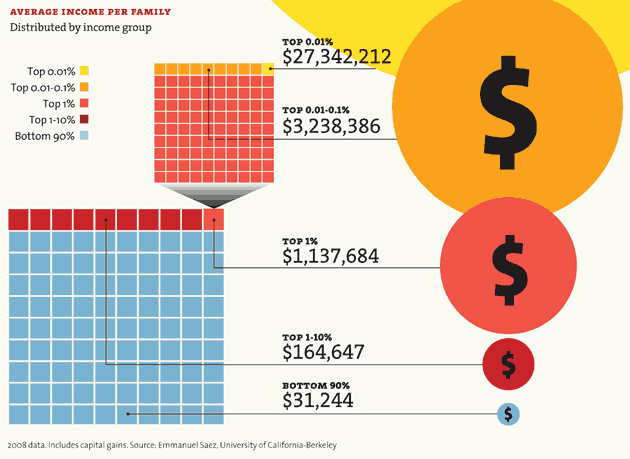
Here are a bunch more.
posted by Civil_Disobedient at 5:15 PM on October 13, 2011 [3 favorites]
Personally, I've long been in favour of a system whereby we get to affect the budget collectively as we fill in our tax returns.I don't really see this working. Getting things done requires long-term thinking and prioritization, and the resolve to do things that are unpopular for long-term gain. Not only that, but people already have drastically-skewed ideas of what the budget is, which to me does not suggest that they would do a good job of creating it.
I think California's government shows you what happened when a state experimented with direct government, and the result is not pretty.
posted by !Jim at 5:29 PM on October 13, 2011
Income distribution is a scale-free distribution -- that means the top 0.01% to the top 0.1% is about the same as the ratio from the top 0.1% to the top 1%. Income distributions pretty much always turn out to be scale-free, even in countries with a lot less income inequality than ours. So don't find the above too shocking.
posted by miyabo at 5:30 PM on October 13, 2011 [1 favorite]
posted by miyabo at 5:30 PM on October 13, 2011 [1 favorite]
Income distribution is a scale-free distribution
And that isn't because the people who make the most money are bad. It's a natural consequence of the positive wealth-generation feedback inherent in a free market which is, as Ted Trainer has observed, is an almost perfectly efficient system for allocating scarce resources to the wealthy.
I disagree with Trainer that the fix for this is a radical rethinking of the entire basis of our society, simply because I have yet to see any evidence that any revolution anywhere has ever actually made things work substantially differently; post-revolution, there will always be a small number of people with an iron grip on the distribution of some kind of important resource, and the social disruption caused by the revolution itself makes it harder, not easier, to implement any kind of effective counter-measure to that.
But I do think there needs to be an increased awareness that while a free market is a good and wonderful thing in many ways, it does have a natural wealth-concentrating side effect, and that such concentrations are socially toxic. It seems to me that there is nothing at all wrong or immoral or even inherently unworkable in a progressive income tax regime with a top marginal rate of 100%, and that such a scheme would in fact have considerable social benefit and go a long way toward achieving the kinds of equity goal that Trainer seems to advocate implementing by fiat.
posted by flabdablet at 6:19 PM on October 13, 2011 [1 favorite]
And that isn't because the people who make the most money are bad. It's a natural consequence of the positive wealth-generation feedback inherent in a free market which is, as Ted Trainer has observed, is an almost perfectly efficient system for allocating scarce resources to the wealthy.
I disagree with Trainer that the fix for this is a radical rethinking of the entire basis of our society, simply because I have yet to see any evidence that any revolution anywhere has ever actually made things work substantially differently; post-revolution, there will always be a small number of people with an iron grip on the distribution of some kind of important resource, and the social disruption caused by the revolution itself makes it harder, not easier, to implement any kind of effective counter-measure to that.
But I do think there needs to be an increased awareness that while a free market is a good and wonderful thing in many ways, it does have a natural wealth-concentrating side effect, and that such concentrations are socially toxic. It seems to me that there is nothing at all wrong or immoral or even inherently unworkable in a progressive income tax regime with a top marginal rate of 100%, and that such a scheme would in fact have considerable social benefit and go a long way toward achieving the kinds of equity goal that Trainer seems to advocate implementing by fiat.
posted by flabdablet at 6:19 PM on October 13, 2011 [1 favorite]
Forgot to add that in my ideal income tax world, the bottom marginal rate would be negative.
posted by flabdablet at 6:22 PM on October 13, 2011 [1 favorite]
posted by flabdablet at 6:22 PM on October 13, 2011 [1 favorite]
Really? To me, it sounds like a bunch of weighted additions.
You can't realistically budget any large organization like the government by popular consensus of taxpayers. Many projects require several years of budget outlays for completion. There's no way you could educate everyone enough to understand the implications of their decisions. How would legislation work? You could pass a bill into law but it could die on the vine or survive one year and die the next by nothing more than the choices of people who have no grasp of the kind of budgeting required to make government work, which is to say the vast majority of voters. It would almost all be budgeting year-by-year by people who are making nothing more than gut-check decisions without any deeper understanding. You can argue that government sometimes works like that anyway, but that's not how it works well.
posted by krinklyfig at 7:16 PM on October 13, 2011
You can't realistically budget any large organization like the government by popular consensus of taxpayers. Many projects require several years of budget outlays for completion. There's no way you could educate everyone enough to understand the implications of their decisions. How would legislation work? You could pass a bill into law but it could die on the vine or survive one year and die the next by nothing more than the choices of people who have no grasp of the kind of budgeting required to make government work, which is to say the vast majority of voters. It would almost all be budgeting year-by-year by people who are making nothing more than gut-check decisions without any deeper understanding. You can argue that government sometimes works like that anyway, but that's not how it works well.
posted by krinklyfig at 7:16 PM on October 13, 2011
Most large organizations have income that varies in not entirely predictable ways from year to year. You could certainly have people indicate what broad areas of expenditures they wanted taxes to go to on their tax returns. I expect this would have a reasonable degree of consistency from year to year. Organizations that prepare alternative budgets based on surveys of people's preferences seem to have fairly consistent results from year to year, at least. (Participation in such activities seems to be self-selecting, admittedly, skewing the outcomes of these surveys a little bit - I'm not sure if this would influence year-to-year consistency or not, though.)
The issue that would give me pause is the focus on citizens as taxpayers; I could see such a scheme resulting in some pressure to give more weight to the funding preferences of those who contributed more in income taxes.
posted by eviemath at 8:37 PM on October 13, 2011
The issue that would give me pause is the focus on citizens as taxpayers; I could see such a scheme resulting in some pressure to give more weight to the funding preferences of those who contributed more in income taxes.
posted by eviemath at 8:37 PM on October 13, 2011
You could certainly have people indicate what broad areas of expenditures they wanted taxes to go to on their tax returns.
I believe our version of that is called representative government. We don't expect every citizen to make all the decisions.
Organizations that prepare alternative budgets based on surveys of people's preferences seem to have fairly consistent results from year to year, at least.
Name one government which has done this.
One of the major problems I see is that there are times when a pretty large segment of the population favors no money for social programs. If you make it a budget by annual decree of the voters, it's a lot more like charity than a social safety net. And all budgets would suffer due to not knowing from one year to the next not knowing which way the voters would choose.
posted by krinklyfig at 9:21 PM on October 13, 2011
I believe our version of that is called representative government. We don't expect every citizen to make all the decisions.
Organizations that prepare alternative budgets based on surveys of people's preferences seem to have fairly consistent results from year to year, at least.
Name one government which has done this.
One of the major problems I see is that there are times when a pretty large segment of the population favors no money for social programs. If you make it a budget by annual decree of the voters, it's a lot more like charity than a social safety net. And all budgets would suffer due to not knowing from one year to the next not knowing which way the voters would choose.
posted by krinklyfig at 9:21 PM on October 13, 2011
Is there any place in the country that doesn't have mail-in/absentee voting? And doesn't one state (Washington, IIRC?) or more have voting exclusively through mail-in ballot now?
I like voting in person, as I get confirmation my vote made it into the machine, but if I can't get to the voting booth, I have no issue with mailing in a ballot. It's a pretty simple process. Although my friend once messed it up by not providing a stamp on his envelope, but maybe that's a sign we should pay 44 cents more a year in state taxes...
But then again, I am kind of a political junkie, and I am thinking about who to vote for in national elections months, sometimes even a year before the election starts. I can see someone getting interested in the election at the last minute (say, under a month) having trouble getting both registered and getting their ballot in the mail on time. So, I can definitely see that the date of the election is a big issue, and if I had my druthers, it'd be a national holiday.
Besides, holidays tend to come with strange rituals and feasts, which we really don't get enough of with touchscreen voting machines these days.
posted by mccarty.tim at 9:40 PM on October 13, 2011
I like voting in person, as I get confirmation my vote made it into the machine, but if I can't get to the voting booth, I have no issue with mailing in a ballot. It's a pretty simple process. Although my friend once messed it up by not providing a stamp on his envelope, but maybe that's a sign we should pay 44 cents more a year in state taxes...
But then again, I am kind of a political junkie, and I am thinking about who to vote for in national elections months, sometimes even a year before the election starts. I can see someone getting interested in the election at the last minute (say, under a month) having trouble getting both registered and getting their ballot in the mail on time. So, I can definitely see that the date of the election is a big issue, and if I had my druthers, it'd be a national holiday.
Besides, holidays tend to come with strange rituals and feasts, which we really don't get enough of with touchscreen voting machines these days.
posted by mccarty.tim at 9:40 PM on October 13, 2011
The United States government.
The US government does not create budgets based on surveys on tax forms. Although corruption exists and budgetary concerns are influenced by it, it's not the way it's supposed to be. I'm saying that creating budgets based on tax form surveys is an invitation to chaos and would make long-term planning extraordinarily difficult, which is something governments must do to function.
posted by krinklyfig at 9:55 PM on October 13, 2011
The US government does not create budgets based on surveys on tax forms. Although corruption exists and budgetary concerns are influenced by it, it's not the way it's supposed to be. I'm saying that creating budgets based on tax form surveys is an invitation to chaos and would make long-term planning extraordinarily difficult, which is something governments must do to function.
posted by krinklyfig at 9:55 PM on October 13, 2011
I've considered the 'budget by referendum' thing fairly seriously, krinklyfig . It's doable, imho, but yes you must prioritize long term legitimacy over initial stability.
Referenda rarely work outside weird homogenous cultures like Switzerland now, but that's only because people are basically ignorant. Ergo, you simply need referenda wherein the voters lose their ignorance before voting.
There is an idea backed by interesting research called deliberative democracy, which basically says "people who take part in the discussion vote". It motivates that human mic used by OperationWallStreet, for example. You'd usually imagine using statistical procedures to generalize the opinions of a random sample who watches a debate. Or you might simply require that all legislation pass some several hundred person jury trial, big enough that you need no jury selection statistically.
Could we do the budget by direct referenda even without people watching debates? I think yes. You'd design a highly modular government where each module competes for funding votes, but fundamentally the detail allocation happens inside the modules. You'd want various 'sanity checks' that dampen out short term silliness, like averaging the votes over several years, parliament controlling a small emergency percentage, and loaning money between the modules.
Would voters engage in longer term stupidity like abandoning social programs? Yes, people are ignorant, like I said. Yet, I think only temporarily so because ignorance is curable. If they held the reign of power so directly, then I'd conjecture people will learn how to wield them.
Imagine voters hammer some particular module one year, like say the military during an unpopular war. There is an immediate budget deficit, but averaging over multiple years reduces the immediate effects. Agencies under that module nevertheless must tighten their belts considerable. Anyone directly impacted either adapts or campaigns next year.
In short, poor people would actually vote if their votes had an obvious impact.
posted by jeffburdges at 10:13 PM on October 13, 2011
Referenda rarely work outside weird homogenous cultures like Switzerland now, but that's only because people are basically ignorant. Ergo, you simply need referenda wherein the voters lose their ignorance before voting.
There is an idea backed by interesting research called deliberative democracy, which basically says "people who take part in the discussion vote". It motivates that human mic used by OperationWallStreet, for example. You'd usually imagine using statistical procedures to generalize the opinions of a random sample who watches a debate. Or you might simply require that all legislation pass some several hundred person jury trial, big enough that you need no jury selection statistically.
Could we do the budget by direct referenda even without people watching debates? I think yes. You'd design a highly modular government where each module competes for funding votes, but fundamentally the detail allocation happens inside the modules. You'd want various 'sanity checks' that dampen out short term silliness, like averaging the votes over several years, parliament controlling a small emergency percentage, and loaning money between the modules.
Would voters engage in longer term stupidity like abandoning social programs? Yes, people are ignorant, like I said. Yet, I think only temporarily so because ignorance is curable. If they held the reign of power so directly, then I'd conjecture people will learn how to wield them.
Imagine voters hammer some particular module one year, like say the military during an unpopular war. There is an immediate budget deficit, but averaging over multiple years reduces the immediate effects. Agencies under that module nevertheless must tighten their belts considerable. Anyone directly impacted either adapts or campaigns next year.
In short, poor people would actually vote if their votes had an obvious impact.
posted by jeffburdges at 10:13 PM on October 13, 2011
What jeffburdges is talking about is at the very least an interesting idea. If I'm understanding correctly, this is already practiced at a small scale, e.g., in town councils and the like that require members to be present in order to vote. Since you have to be present, you have to hear the discussion and have the chance to participate before you vote. Also, only people who care enough to sit through a dry meeting get to actually vote.
Quite frankly, I think it's a bit hopeful to think this could work in the US. I feel like people already have the tools they need to become better-informed and hear multiple viewpoints, they just don't want to listen.
The other problem, of course, is getting there. I don't see anyone with any actual clout calling for a massive reform of the political system. It seems conceivable that new regulation could be introduced that would mitigate certain problems (like lobbying), but I just can't see broad-based support for anything this radical.
posted by !Jim at 10:22 PM on October 13, 2011
Quite frankly, I think it's a bit hopeful to think this could work in the US. I feel like people already have the tools they need to become better-informed and hear multiple viewpoints, they just don't want to listen.
The other problem, of course, is getting there. I don't see anyone with any actual clout calling for a massive reform of the political system. It seems conceivable that new regulation could be introduced that would mitigate certain problems (like lobbying), but I just can't see broad-based support for anything this radical.
posted by !Jim at 10:22 PM on October 13, 2011
There were two proposals for reduced-ignorance-referenda in my comment, !Jim. You're town councils example sounds closest to deliberative democracy, but it's fairly exclusionary for the lower classes. You could fix such town council meetings using deliberative opinion polls. Anyone may attend and speak at the town meeting. Voters are selected randomly form the whole town however, also they must attend and vote, like jury duty. There is considerable talk about measuring, not merely the voters final opinions, but how their opinions changed. I fear that's wide open to strategic manipulation however, probably better off spending more money hiring more voters in the first place.
posted by jeffburdges at 11:04 PM on October 13, 2011
posted by jeffburdges at 11:04 PM on October 13, 2011
Name one government which has done this.
The assertion that I was responding to asked more generally about large organizations:
You can't realistically budget any large organization like the government by popular consensus of taxpayers.
Concerns were additionally expressed that, for governments in particular, voter preferences for overall funding of different budget categories would vary too much from year to year. I am saying that there are large non-governmental organizations that have collected data that indicate this is a false assertion. As I mentioned, I, too, have concerns about using surveys on tax returns to set governmental budget priorities. Short term variation in priorities due to some imagined fickle and easily swayed public is not one of them, however.
People's broad budget priorities don't vary that much year to year.
There is a group (or multiple groups) that goes around, or used to go around, to all sorts of events where they can set up a table, and they have a jar of pennies, and people stopping at their table get a little cup with some number of pennies, and get to distribute their cupfull of pennies among various bins indicating the different general categories that the US federal government spends money on (military, education, health, etc.). They do (or did) this nation-wide, and produce (or produced) a report periodically on the results of this informal poll on people's priorities for the federal budget. Unfortunately, I haven't seen this group in a while (been living outside of the US for several years), and can't find it on the internet (so I don't know if they are still doing this).
As I recall, however, their results were quite consistent year after year. (I believe this sort of exercise is done by many groups on a smaller scale as well.) As I mentioned above, it's likely that some self-selection among the participants skews the budget priorities toward one end of the political spectrum (so the results may not be entirely accurate as a representation of the federal budget priorities of all US citizens), but their results were pretty consistent year to year. Given that the sample group of people polled was quite large, I see no reason why this consistency should be an artifact of self-selection among the participants.
In Canada, the Canadian Centre for Policy Alternatives does a similar survey, and puts out an Alternative Federal Budget for Canada each year. The funding priorities in this alternative budget are also remarkably stable year to year.
Democracy means respecting and facilitating your fellow people's decision-making abilities.
I find the profusion of comments in this last little section of the thread saying that regular people can't be trusted to make good general policy decisions about budget matters, or other general policy matters, rather sad and disturbing. It's an undemocratic view.
Yes, people are ignorant, like I said. Yet, I think only temporarily so because ignorance is curable. If they held the reign of power so directly, then I'd conjecture people will learn how to wield them.
jeffburdges makes an important point here, albeit differently than I would phrase it. In the current political system in the US, your average person gets to vote periodically, but this vote consists of selecting from two or sometimes more alternatives that they had no input in selecting in the first place, and so for many people comes down to selecting the lesser of two (or more) evils. And that's about the extent of democratic participation that most people in the US find themselves able to engage in. Political parties do everything in their power to ensure that citizens who do not support them are disengaged from public discourse and the political process. Those who currently wield political power have strong incentives to work to ensure that the average citizen is politically ill-informed, passive, and disengaged. And they have the money and power to actually act on this goal. As well, indications are that not even large public protest or other forms of demonstrating broad support or opposition to certain policies have much effect any more. How people behave under this system is not a good indication of how they would behave under a system with entirely different incentive structures for meaningful participation.
A system for group decision-making is a system for group-decision making, little matter the category of issues being decided upon.
We do not have to guess or blindly hypothesize that participatory democracy is entirely possible and that people will behave differently when given the opportunity to participate meaningfully in political discourse, since this has been experimentally verified many times at various small to medium scales, with groups of varying diversity. It has not yet been carried out on a scale as large as the entire US, but one could look at how the process scales up from the quite small to the medium scale to get some indication of what the challenges at the large scale might be, and how they might be resolved.
Like any political system, participatory democracy requires supporting structures, such as the deliberative democracy structures that jeffburdges mentions, old New England-style town meetings, Occupy Wall Street style general assemblies, council structures used in large anti-globalization protests and events like the World Social Forum, community-directed volunteer efforts such as some open source software projects, various decision-making models used by worker-run cooperative businesses, etc. (At it's essence, a government is just a structure for facilitating large group decision making about some set of issues. Thus one can look at non-governmental systems for large group decision making as well as other governments at various scales for evidence about how such systems work, or fail to work.)
Also, just as individual people need some knowledge of how the current political system works and certain types of communication skills to participate effectively, participatory democracy requires consensus-building communication skills. These skills could certainly be taught in grade school civics classes. It sounds like many people have been picking them up quickly and easily lately through participation with Occupy protests, as well. It's really not too challenging:
step 1: state your goals and your concerns; listen to other people's goals and concerns
step 2: propose, discuss, and modify proposals for how common goals can be met, and concerns avoided; participate respectfully (this is where the communication skills come in) and in good faith, brainstorm creatively
step 3: refine, refine, refine
step 3b: refine, refine, refine
step 3c: refine, refine, refine (the book (ironically, aimed largely at upper-level management types) "Breaking Robert's Rules: The New Way to Run Your Meeting, Build Consensus, and Get Results" describes this as "go slow to go fast" - the point is that if you lay the groundwork properly, you can solve an issue once, with particularly efficient and self-enforcing policies or programs, rather than never actually settling the issue because a dissatisfied minority keeps bringing it up again, and again, and again, and again, and...)
step 4: when it appears that consensus or something approaching it has been achieved, have a vote, to make sure
optional step 5: if there is still a strongly dissatisfied minority such that it will be difficult to implement the policy, or dissatisfaction with the policy will be an ongoing issue, return to step 3
posted by eviemath at 11:48 PM on October 13, 2011 [3 favorites]
The assertion that I was responding to asked more generally about large organizations:
You can't realistically budget any large organization like the government by popular consensus of taxpayers.
Concerns were additionally expressed that, for governments in particular, voter preferences for overall funding of different budget categories would vary too much from year to year. I am saying that there are large non-governmental organizations that have collected data that indicate this is a false assertion. As I mentioned, I, too, have concerns about using surveys on tax returns to set governmental budget priorities. Short term variation in priorities due to some imagined fickle and easily swayed public is not one of them, however.
People's broad budget priorities don't vary that much year to year.
There is a group (or multiple groups) that goes around, or used to go around, to all sorts of events where they can set up a table, and they have a jar of pennies, and people stopping at their table get a little cup with some number of pennies, and get to distribute their cupfull of pennies among various bins indicating the different general categories that the US federal government spends money on (military, education, health, etc.). They do (or did) this nation-wide, and produce (or produced) a report periodically on the results of this informal poll on people's priorities for the federal budget. Unfortunately, I haven't seen this group in a while (been living outside of the US for several years), and can't find it on the internet (so I don't know if they are still doing this).
As I recall, however, their results were quite consistent year after year. (I believe this sort of exercise is done by many groups on a smaller scale as well.) As I mentioned above, it's likely that some self-selection among the participants skews the budget priorities toward one end of the political spectrum (so the results may not be entirely accurate as a representation of the federal budget priorities of all US citizens), but their results were pretty consistent year to year. Given that the sample group of people polled was quite large, I see no reason why this consistency should be an artifact of self-selection among the participants.
In Canada, the Canadian Centre for Policy Alternatives does a similar survey, and puts out an Alternative Federal Budget for Canada each year. The funding priorities in this alternative budget are also remarkably stable year to year.
Democracy means respecting and facilitating your fellow people's decision-making abilities.
I find the profusion of comments in this last little section of the thread saying that regular people can't be trusted to make good general policy decisions about budget matters, or other general policy matters, rather sad and disturbing. It's an undemocratic view.
Yes, people are ignorant, like I said. Yet, I think only temporarily so because ignorance is curable. If they held the reign of power so directly, then I'd conjecture people will learn how to wield them.
jeffburdges makes an important point here, albeit differently than I would phrase it. In the current political system in the US, your average person gets to vote periodically, but this vote consists of selecting from two or sometimes more alternatives that they had no input in selecting in the first place, and so for many people comes down to selecting the lesser of two (or more) evils. And that's about the extent of democratic participation that most people in the US find themselves able to engage in. Political parties do everything in their power to ensure that citizens who do not support them are disengaged from public discourse and the political process. Those who currently wield political power have strong incentives to work to ensure that the average citizen is politically ill-informed, passive, and disengaged. And they have the money and power to actually act on this goal. As well, indications are that not even large public protest or other forms of demonstrating broad support or opposition to certain policies have much effect any more. How people behave under this system is not a good indication of how they would behave under a system with entirely different incentive structures for meaningful participation.
A system for group decision-making is a system for group-decision making, little matter the category of issues being decided upon.
We do not have to guess or blindly hypothesize that participatory democracy is entirely possible and that people will behave differently when given the opportunity to participate meaningfully in political discourse, since this has been experimentally verified many times at various small to medium scales, with groups of varying diversity. It has not yet been carried out on a scale as large as the entire US, but one could look at how the process scales up from the quite small to the medium scale to get some indication of what the challenges at the large scale might be, and how they might be resolved.
Like any political system, participatory democracy requires supporting structures, such as the deliberative democracy structures that jeffburdges mentions, old New England-style town meetings, Occupy Wall Street style general assemblies, council structures used in large anti-globalization protests and events like the World Social Forum, community-directed volunteer efforts such as some open source software projects, various decision-making models used by worker-run cooperative businesses, etc. (At it's essence, a government is just a structure for facilitating large group decision making about some set of issues. Thus one can look at non-governmental systems for large group decision making as well as other governments at various scales for evidence about how such systems work, or fail to work.)
Also, just as individual people need some knowledge of how the current political system works and certain types of communication skills to participate effectively, participatory democracy requires consensus-building communication skills. These skills could certainly be taught in grade school civics classes. It sounds like many people have been picking them up quickly and easily lately through participation with Occupy protests, as well. It's really not too challenging:
step 1: state your goals and your concerns; listen to other people's goals and concerns
step 2: propose, discuss, and modify proposals for how common goals can be met, and concerns avoided; participate respectfully (this is where the communication skills come in) and in good faith, brainstorm creatively
step 3: refine, refine, refine
step 3b: refine, refine, refine
step 3c: refine, refine, refine (the book (ironically, aimed largely at upper-level management types) "Breaking Robert's Rules: The New Way to Run Your Meeting, Build Consensus, and Get Results" describes this as "go slow to go fast" - the point is that if you lay the groundwork properly, you can solve an issue once, with particularly efficient and self-enforcing policies or programs, rather than never actually settling the issue because a dissatisfied minority keeps bringing it up again, and again, and again, and again, and...)
step 4: when it appears that consensus or something approaching it has been achieved, have a vote, to make sure
optional step 5: if there is still a strongly dissatisfied minority such that it will be difficult to implement the policy, or dissatisfaction with the policy will be an ongoing issue, return to step 3
posted by eviemath at 11:48 PM on October 13, 2011 [3 favorites]
Very interesting about the Canadian Alternative Federal Budget. I'd never have guessed that ordinary people agree upon the budget, although saying it that way sounds reasonable. I'd be curious about the pennies distribution itself though in the U.S., especially whether the standard deviation matches Canada, i.e. not secretly bimodal or something.
posted by jeffburdges at 12:41 AM on October 14, 2011
posted by jeffburdges at 12:41 AM on October 14, 2011
In Canada, the Canadian Centre for Policy Alternatives does a similar survey, and puts out an Alternative Federal Budget for Canada each year. The funding priorities in this alternative budget are also remarkably stable year to year.
Democracy means respecting and facilitating your fellow people's decision-making abilities.
I find the profusion of comments in this last little section of the thread saying that regular people can't be trusted to make good general policy decisions about budget matters, or other general policy matters, rather sad and disturbing. It's an undemocratic view.
Part of the problem today is that we are in debt yet require spending in the short term to get the economy rolling. Yet a significant amount of people feel the best solution is to slash spending until we have a balanced budget, even though this would be ruinous to the economy. Straightforward budgets aren't all that difficult to comprehend. However, Keynesian economics and quantitative easing play a role in our budget, which aren't that easy to explain.
I am cynical. I see you're Canadian. That could be a significant difference. For one thing you have a different government structure. We have a republic and a winner-take-all system. I used to do a lot of work in grassroots politics and have seen on the most rudimentary level what it takes to make change.
Have you ever seen Bowling for Columbine? There is a segment in the movie where Michael Moore compares the cultures of the US and Canada. One of the major hurdles to a better democracy in the US is our media. The amount of propaganda people swallow with no critical thinking is astonishing. I'm not saying it can't get better, but your optimism is greater than mine.
posted by krinklyfig at 12:53 AM on October 14, 2011
Democracy means respecting and facilitating your fellow people's decision-making abilities.
I find the profusion of comments in this last little section of the thread saying that regular people can't be trusted to make good general policy decisions about budget matters, or other general policy matters, rather sad and disturbing. It's an undemocratic view.
Part of the problem today is that we are in debt yet require spending in the short term to get the economy rolling. Yet a significant amount of people feel the best solution is to slash spending until we have a balanced budget, even though this would be ruinous to the economy. Straightforward budgets aren't all that difficult to comprehend. However, Keynesian economics and quantitative easing play a role in our budget, which aren't that easy to explain.
I am cynical. I see you're Canadian. That could be a significant difference. For one thing you have a different government structure. We have a republic and a winner-take-all system. I used to do a lot of work in grassroots politics and have seen on the most rudimentary level what it takes to make change.
Have you ever seen Bowling for Columbine? There is a segment in the movie where Michael Moore compares the cultures of the US and Canada. One of the major hurdles to a better democracy in the US is our media. The amount of propaganda people swallow with no critical thinking is astonishing. I'm not saying it can't get better, but your optimism is greater than mine.
posted by krinklyfig at 12:53 AM on October 14, 2011
I just realized something. I inherited a business that puts me in the top 1% of income earners. Why don't I feel like the elite? Well, it's because most of that money goes right back into the business. This business goes under and I immediately stop being the top 1%. In terms of accumulated wealth, well I'm probably not in the top 1% at all and probably quite mediocre in that respect, particularly since so much money is tied up in capital. I don't have much accumulated wealth, unlike the 1% trust fund babies here. It's pretty disingenuous of them to call for taxing income, since most of their wealth is accumulated. I wonder how they'd feel about a big fat estate tax.
posted by melissam at 10:27 AM on October 14, 2011
posted by melissam at 10:27 AM on October 14, 2011
Jeffburdges, somewhere on a broken computer, I have a lot of links to real life deliberative democracy projects, and succeses (and some interesting failures) because I was planning to write a book about alternative planning processes. It didn't happen for several reasons, but there is stuff out there. Porto Alegre did something really interesting - or probably still do - including thousands of citizens in the actual budget proces. Which I believe bridged the way for Lula. The developments in Brazil during the last decade, and not least the many different currents in Brazilian society that came together to form those radical developments, is something worth studying.
posted by mumimor at 2:47 PM on October 14, 2011 [1 favorite]
posted by mumimor at 2:47 PM on October 14, 2011 [1 favorite]
Oh, and that wasn't a derail, I just forgot my point, which was that part of the proces was the 1% in Brazil discovering how socialism could serve them better in the slightly longer run than authoritarian crony capitalism (not that the corruption in that country has magically disappeared).
posted by mumimor at 2:54 PM on October 14, 2011
posted by mumimor at 2:54 PM on October 14, 2011
(Clarification for folks who didn't read very carefully: I am originally from the US, not a Canadian; the penny budget poll process was also carried out by organizations in the US.)
posted by eviemath at 3:08 PM on October 14, 2011
posted by eviemath at 3:08 PM on October 14, 2011
I am glad to see that mob rule is a strongly held belief in these circles.
Funny how some folks use words like "Democracy" and "Will of the People" to get what they want politically (spreading Democracy at the barrel of a gun, for instance), but then, suddenly, it's all just "mob rule" when it looks like they might not get the outcomes they want from the process.
posted by saulgoodman at 8:21 AM on October 19, 2011 [2 favorites]
Funny how some folks use words like "Democracy" and "Will of the People" to get what they want politically (spreading Democracy at the barrel of a gun, for instance), but then, suddenly, it's all just "mob rule" when it looks like they might not get the outcomes they want from the process.
posted by saulgoodman at 8:21 AM on October 19, 2011 [2 favorites]
I think it is a good thing that the occupation movement is not making specific policy demands. If it did, the movement would become about those demands. If the demands were not met, the movement would be seen as having failed.
It seems to me that the OWS movement is moral in nature, that occupiers want the country to change its moral focus. It is easy to find useful policies; hundreds have been suggested. It is harder to find a moral focus and stick to it. If the movement is to frame itself, it should be on the basis of its moral focus, not a particular agenda or list of policy demands. If the moral focus of America changes, new people will be elected and the policies will follow. Without a change of moral focus, the conservative worldview that has brought us to the present disastrous and dangerous moment will continue to prevail.
How to Frame Yourself: A Memo for Occupy Wall Street by George Lakoff.
posted by mrgrimm at 9:39 AM on October 19, 2011
It seems to me that the OWS movement is moral in nature, that occupiers want the country to change its moral focus. It is easy to find useful policies; hundreds have been suggested. It is harder to find a moral focus and stick to it. If the movement is to frame itself, it should be on the basis of its moral focus, not a particular agenda or list of policy demands. If the moral focus of America changes, new people will be elected and the policies will follow. Without a change of moral focus, the conservative worldview that has brought us to the present disastrous and dangerous moment will continue to prevail.
How to Frame Yourself: A Memo for Occupy Wall Street by George Lakoff.
posted by mrgrimm at 9:39 AM on October 19, 2011
« Older The Black Death Revealed | For the rooster in your kitchen Newer »
This thread has been archived and is closed to new comments
posted by Slackermagee at 2:12 PM on October 12, 2011