Computers should work, people should think.
November 15, 2011 2:19 PM Subscribe
Google Verbatim Search. Last week Google disabled the '+' operator. In response to feedback, they have now created a search mode that doesn't try to out-think you.
I'm not seeing how this is an improvement over simply learning to use quote marks.
posted by Greg_Ace at 2:25 PM on November 15, 2011 [5 favorites]
posted by Greg_Ace at 2:25 PM on November 15, 2011 [5 favorites]
Because even in quote marks they'd constantly change up search terms for you. It was infuriating. I'm glad to see this move.
posted by Phire at 2:26 PM on November 15, 2011 [31 favorites]
posted by Phire at 2:26 PM on November 15, 2011 [31 favorites]
Now, if only they'd make "Instant" opt-in instead of opt-out
posted by infini at 2:27 PM on November 15, 2011 [8 favorites]
posted by infini at 2:27 PM on November 15, 2011 [8 favorites]
This announcement is such crap: they say "starting today you’ll be able to do just that through verbatim search" but then say further down "verbatim search, which will be rolling out to all users over the next few days." Well, I don't have it yet.
Anyone have a Firefox or Greasemonkey script to "add" "the" "stupid" "quote" "marks"?
posted by exogenous at 2:32 PM on November 15, 2011
Anyone have a Firefox or Greasemonkey script to "add" "the" "stupid" "quote" "marks"?
posted by exogenous at 2:32 PM on November 15, 2011
Now, if only they'd tie search preferences to one's Google account. Seriously, they can tie all kinds of personal information (both wanted and unwanted) to my account, but every time I log in anew I have to manually reset the search preferences to display 50 search results per page rather than 10???
posted by DevilsAdvocate at 2:34 PM on November 15, 2011 [14 favorites]
posted by DevilsAdvocate at 2:34 PM on November 15, 2011 [14 favorites]
Phire, I've never experienced that issue. So...who knows, either my search technique is different or I just didn't notice.
posted by Greg_Ace at 2:34 PM on November 15, 2011
posted by Greg_Ace at 2:34 PM on November 15, 2011
Hey, wait. Google buys Zagat, then "requires people" to use "quotes"? I'm "on to you", Google!
posted by zamboni at 2:36 PM on November 15, 2011 [19 favorites]
posted by zamboni at 2:36 PM on November 15, 2011 [19 favorites]
This is going to be my new favorite thing. For the last couple of years I've often needed to plus-sign every single term in my search queries.
posted by RogerB at 2:37 PM on November 15, 2011 [3 favorites]
posted by RogerB at 2:37 PM on November 15, 2011 [3 favorites]
In the meantime, if you want to search for a very specific term, be that [carosel] or the [etymology of sissors], give the verbatim tool a try.
I'll search on [snarky].
posted by Blazecock Pileon at 2:38 PM on November 15, 2011 [3 favorites]
I'll search on [snarky].
posted by Blazecock Pileon at 2:38 PM on November 15, 2011 [3 favorites]
I wish it was an option from the homepage under Search Settings rather than having to navigate to it after a normal search, and I'd like to be able to leave it toggled on.
posted by gimli at 2:40 PM on November 15, 2011 [5 favorites]
posted by gimli at 2:40 PM on November 15, 2011 [5 favorites]
I knew they would break when I bolted for DuckDuckGo.
Seriously now, good on them for listening to their users - I believe Slashdot uses the SuddenOutbreakOfCommonSense tag for this kind of thing.
posted by Dr Dracator at 2:42 PM on November 15, 2011 [1 favorite]
Seriously now, good on them for listening to their users - I believe Slashdot uses the SuddenOutbreakOfCommonSense tag for this kind of thing.
posted by Dr Dracator at 2:42 PM on November 15, 2011 [1 favorite]
Now, if only they'd tie search preferences to one's Google account.
A million times this. Also, if it's a search domain like news or image, does that mean I can set my browser's search bar to point there? If so, that is super awesome.
posted by Holy Zarquon's Singing Fish at 2:45 PM on November 15, 2011
A million times this. Also, if it's a search domain like news or image, does that mean I can set my browser's search bar to point there? If so, that is super awesome.
posted by Holy Zarquon's Singing Fish at 2:45 PM on November 15, 2011
I'm with Phire on Google's inconsistency with quotemarks. Sometimes it works, other times it fairs horribly. It's as if the algorithm would really rather just make shit up as it goes.
posted by Thorzdad at 2:49 PM on November 15, 2011 [2 favorites]
posted by Thorzdad at 2:49 PM on November 15, 2011 [2 favorites]
Thanks god. This has been getting infuriating for obscure technical searches lately. To the point where I almost wrote an FF search addon to quote every single word in every single fucking query I do.
posted by knave at 2:50 PM on November 15, 2011 [7 favorites]

posted by knave at 2:50 PM on November 15, 2011 [7 favorites]
This announcement is such crap: they say "starting today you’ll be able to do just that through verbatim search" but then say further down "verbatim search, which will be rolling out to all users over the next few days." Well, I don't have it yet.
You just described every new Google product or feature ever.
posted by birdherder at 2:53 PM on November 15, 2011 [5 favorites]
You just described every new Google product or feature ever.
posted by birdherder at 2:53 PM on November 15, 2011 [5 favorites]
Thank God for this! And thank you OP for bringing it to our attention.
posted by yoink at 2:53 PM on November 15, 2011
posted by yoink at 2:53 PM on November 15, 2011
"making some of your terms optional"
Least now I know why some of my searches go so wrong...
posted by aerotive at 2:55 PM on November 15, 2011 [2 favorites]
Least now I know why some of my searches go so wrong...
posted by aerotive at 2:55 PM on November 15, 2011 [2 favorites]
Google has suddenly and recently shifted away from a "cool company"/"do no evil" into something more and more like Apple and Microsoft (and Verizon etc). I would peg this around 3 months ago; did something change inside of Google around that time?
posted by Old'n'Busted at 3:00 PM on November 15, 2011 [1 favorite]
posted by Old'n'Busted at 3:00 PM on November 15, 2011 [1 favorite]
I was hoping it would be another button between "Google Search" and "I'm feeling lucky" that would say "Yes, really."
posted by RobotHero at 3:06 PM on November 15, 2011 [61 favorites]
posted by RobotHero at 3:06 PM on November 15, 2011 [61 favorites]
I don't understand why I would want to find floppy discs...
posted by srboisvert at 3:08 PM on November 15, 2011 [1 favorite]
posted by srboisvert at 3:08 PM on November 15, 2011 [1 favorite]
Maybe for some of that sweet, sweet Ultima IV.
posted by crapmatic at 3:14 PM on November 15, 2011 [2 favorites]
posted by crapmatic at 3:14 PM on November 15, 2011 [2 favorites]
You might not know the correct term for a soft vinyl record?
posted by LogicalDash at 3:14 PM on November 15, 2011
posted by LogicalDash at 3:14 PM on November 15, 2011
What about the "-" operator? Is that disabled as well? Christ, this is frustrating. I was wondering why I kept on getting results yesterday with the "+" that didn't include the added word.
posted by Red Loop at 3:17 PM on November 15, 2011 [1 favorite]
posted by Red Loop at 3:17 PM on November 15, 2011 [1 favorite]
I was hoping it would be another button between "Google Search" and "I'm feeling lucky" that would say "Yes, really."
As soon the new verbose feature gets rolled out to me, I promise to make a userscript that does exactly this.
posted by zsazsa at 3:20 PM on November 15, 2011 [20 favorites]
As soon the new verbose feature gets rolled out to me, I promise to make a userscript that does exactly this.
posted by zsazsa at 3:20 PM on November 15, 2011 [20 favorites]
I would peg this around 3 months ago; did something change inside of Google around that time
While I would disagree with your premise, Eric Schmidt was replaced by Larry Page as CEO about 6 months ago. Larry definitely has a different style and priorities than Eric did, and has not been shy about making changes.
posted by wildcrdj at 3:26 PM on November 15, 2011
While I would disagree with your premise, Eric Schmidt was replaced by Larry Page as CEO about 6 months ago. Larry definitely has a different style and priorities than Eric did, and has not been shy about making changes.
posted by wildcrdj at 3:26 PM on November 15, 2011
Wow. Lots of hate in here. People complained, Google fixed the problem the people were complaining about ergo... People complain some more! You all realize that your problems constitute a fraction of a percent of all of the search queries that Google handles, and yet they still went out and created a BRAND NEW FUNCTION just sos ya'll could be happy, right?
I consider myself a fairly powerful computer user/Internet searcher, and I can't think of a single time that my normal Google queries were not doing the job and I thought to myself I needed the + operator. Nor can I recall a time when I noticed that Google took a guess at what I meant by a search and I thought to myself "God dammit, I HATE IT when it does that."
posted by Inkoate at 3:27 PM on November 15, 2011 [3 favorites]
I consider myself a fairly powerful computer user/Internet searcher, and I can't think of a single time that my normal Google queries were not doing the job and I thought to myself I needed the + operator. Nor can I recall a time when I noticed that Google took a guess at what I meant by a search and I thought to myself "God dammit, I HATE IT when it does that."
posted by Inkoate at 3:27 PM on November 15, 2011 [3 favorites]
I was wondering why I kept on getting results yesterday with the "+" that didn't include the added word.
+ never did that, BTW. That was true on other search engines but not Google.
What + did on Google was turn off autocorrect and synonyms.
So if you searched for the word icnorrect , normally Google would search for incorrect instead. But +icnorrect would search for the exact word "icnorrect".
It never meant "must include this word". Although I admit even I thought it did that at one point, and I work here....
posted by wildcrdj at 3:29 PM on November 15, 2011 [3 favorites]
+ never did that, BTW. That was true on other search engines but not Google.
What + did on Google was turn off autocorrect and synonyms.
So if you searched for the word icnorrect , normally Google would search for incorrect instead. But +icnorrect would search for the exact word "icnorrect".
It never meant "must include this word". Although I admit even I thought it did that at one point, and I work here....
posted by wildcrdj at 3:29 PM on November 15, 2011 [3 favorites]
I'm glad they're offering this feature; the rewrites were driving me nuts, they are often wrong for me. But frankly the literal search is an expert feature, it's OK to have it hidden away a little bit. Also it gives some exposure to the Search Tools. There's some other good stuff hidden there, the date restricted searches are particularly awesome.
I'm totally going to hijack this post to highlight Google's other announcement today, a way to tell them not to map your wifi network location. All you have to do is rename your network, from ssid to ssid_nomap. What could be easier? All hail the great Google! Wags have already suggested changing your Twitter name to @name_noklout and your email address to name_nospam@gmail.com.
posted by Nelson at 3:30 PM on November 15, 2011 [3 favorites]
I'm totally going to hijack this post to highlight Google's other announcement today, a way to tell them not to map your wifi network location. All you have to do is rename your network, from ssid to ssid_nomap. What could be easier? All hail the great Google! Wags have already suggested changing your Twitter name to @name_noklout and your email address to name_nospam@gmail.com.
posted by Nelson at 3:30 PM on November 15, 2011 [3 favorites]
In the past, we provided users with the “+” operator to help you search for specific terms. However, we found that users typed the “+” operator in less than half a percent of all searches, and two thirds of the time, it was used incorrectly.
So, let's say one third of .4 percent, so, it was used correctly in 0.13 percent of all searches. For every 10,000 searches, thirteen people really needed that plus sign.
So, according to this Quora page, (It's the internet so Y veracity MMV) that's 3 billion searches per day, so that's 1.3 million disappointed, angry, frustrated people EVERY DAY.
Something something grumble premature optimization something grumble...
Anyway, here's to hoping they don't fuck this verbatim thing up.
posted by fnerg at 3:32 PM on November 15, 2011 [2 favorites]
So, let's say one third of .4 percent, so, it was used correctly in 0.13 percent of all searches. For every 10,000 searches, thirteen people really needed that plus sign.
So, according to this Quora page, (It's the internet so Y veracity MMV) that's 3 billion searches per day, so that's 1.3 million disappointed, angry, frustrated people EVERY DAY.
Something something grumble premature optimization something grumble...
Anyway, here's to hoping they don't fuck this verbatim thing up.
posted by fnerg at 3:32 PM on November 15, 2011 [2 favorites]
From TFA: We found that users typed the “+” operator in less than half a percent of all searches, and two thirds of the time, it was used incorrectly.
With that logic: I'm guessing Google Klingon will be going away real soon, too.
posted by rmxwl at 3:33 PM on November 15, 2011
With that logic: I'm guessing Google Klingon will be going away real soon, too.
posted by rmxwl at 3:33 PM on November 15, 2011
+ did not just turn off auto-correct,
It also guaranteed that the +'ed word would be in the results. That was really really useful for filtering searches on common phrases.
posted by rdr at 3:36 PM on November 15, 2011 [1 favorite]
It also guaranteed that the +'ed word would be in the results. That was really really useful for filtering searches on common phrases.
posted by rdr at 3:36 PM on November 15, 2011 [1 favorite]
It also guaranteed that the +'ed word would be in the results.
No, it did not. It forced it to look for an exact match, which is not the same thing. + and "" were synonyms.
That said, default search behavior is always AND, so you're sort of right.
Specifically the way to think about it is:
Google will always match all the words in your query unless you specify otherwise with OR or -. Normally however it will look for synonyms, partial words, etc so it may _seem_ like it's not doing that.
But if you force everything to exact, it's easy to see this in action.
Search for "incorrectt" (with the quotes). There are several hits. Now search for "incorrectt" "dnek" (both words, with quotes). No hits at all. Because no page has both words exactly as spelled.
But if you did incorectt "dnek" , you DO get results, because it looks for variations of "incorectt" and finds pages with those and the word dnek.
posted by wildcrdj at 3:47 PM on November 15, 2011
No, it did not. It forced it to look for an exact match, which is not the same thing. + and "" were synonyms.
That said, default search behavior is always AND, so you're sort of right.
Specifically the way to think about it is:
Google will always match all the words in your query unless you specify otherwise with OR or -. Normally however it will look for synonyms, partial words, etc so it may _seem_ like it's not doing that.
But if you force everything to exact, it's easy to see this in action.
Search for "incorrectt" (with the quotes). There are several hits. Now search for "incorrectt" "dnek" (both words, with quotes). No hits at all. Because no page has both words exactly as spelled.
But if you did incorectt "dnek" , you DO get results, because it looks for variations of "incorectt" and finds pages with those and the word dnek.
posted by wildcrdj at 3:47 PM on November 15, 2011
What the heck kind of crazy searches do you people make that require all these operators? The fanciest search I've made in my life is "how to remove mouse glue trap from dog's head". (answer: vegetable oil)
posted by joinks at 3:51 PM on November 15, 2011 [6 favorites]
posted by joinks at 3:51 PM on November 15, 2011 [6 favorites]
What the heck kind of crazy searches do you people make that require all these operators?
News articles for trends - the timeline helps in checking rapidly evolving areas such as mobile phone stats for eg
FPPs
Secondary research in specific fields
digging for gold
posted by infini at 3:57 PM on November 15, 2011 [6 favorites]
News articles for trends - the timeline helps in checking rapidly evolving areas such as mobile phone stats for eg
FPPs
Secondary research in specific fields
digging for gold
posted by infini at 3:57 PM on November 15, 2011 [6 favorites]
This is great. I say "stop helping me!" to some gadget every other day. It reminds me of Uncle Jed telling Jethro "stop helping me, boy" after Jethro messed everything up.
posted by resurrexit at 3:58 PM on November 15, 2011
posted by resurrexit at 3:58 PM on November 15, 2011
What the heck kind of crazy searches do you people make that require all these operators?
I found overzealous auto-correction problematic with anything software related. Many products share similar names, or names that are based on words but not containing actual words. For example, I used to frequently get "Showing Ubuntu" for Xubuntu searches. The correction wasn't even really the frustrating part, but the fact it showed the suggestion by default rather than offering a link to it.
I was never frustrated enough to change searches mind you, mostly because after years of using Google I found myself staring blankly at results on other search engines, unsure of what I was seeing. Anyways, happy to see this feature introduced.
posted by Lorin at 4:01 PM on November 15, 2011
I found overzealous auto-correction problematic with anything software related. Many products share similar names, or names that are based on words but not containing actual words. For example, I used to frequently get "Showing Ubuntu" for Xubuntu searches. The correction wasn't even really the frustrating part, but the fact it showed the suggestion by default rather than offering a link to it.
I was never frustrated enough to change searches mind you, mostly because after years of using Google I found myself staring blankly at results on other search engines, unsure of what I was seeing. Anyways, happy to see this feature introduced.
posted by Lorin at 4:01 PM on November 15, 2011
I'm pretty sure Google is still trying to out-think me.
posted by box at 4:04 PM on November 15, 2011
posted by box at 4:04 PM on November 15, 2011
I'm not seeing how this is an improvement over simply learning to use quote marks.
The problem is/was that "using quote marks" forces quotation marks to do double duty as the REQUIRED marker as well as their existing grouping functionality.
posted by rhizome at 4:20 PM on November 15, 2011 [1 favorite]
The problem is/was that "using quote marks" forces quotation marks to do double duty as the REQUIRED marker as well as their existing grouping functionality.
posted by rhizome at 4:20 PM on November 15, 2011 [1 favorite]
The problem is/was that "using quote marks" forces quotation marks to do double duty as the REQUIRED marker as well as their existing grouping functionality
The annoying thing is that you have to nest quotes to get both exact and grouping behaviors. (required is always true unless you say OR or use -, it's just that it's required without exactness, which means synonyms are OK. + has never had any effect on required, it just makes things be exact).
So to search for the phrase incorrectt stuff exactly, you have to use:
""incorrectt" stuff"
Which will find exactly that phrase with that spelling. Gets a little confusing for non-programmers.
posted by wildcrdj at 4:28 PM on November 15, 2011 [2 favorites]
The annoying thing is that you have to nest quotes to get both exact and grouping behaviors. (required is always true unless you say OR or use -, it's just that it's required without exactness, which means synonyms are OK. + has never had any effect on required, it just makes things be exact).
So to search for the phrase incorrectt stuff exactly, you have to use:
""incorrectt" stuff"
Which will find exactly that phrase with that spelling. Gets a little confusing for non-programmers.
posted by wildcrdj at 4:28 PM on November 15, 2011 [2 favorites]
Wonder why they didn't just let you type
verbatim:whatever it is you want to search for
in the same way that you can get definitions for words by entering
define:someword
Since you're already having to type in whatever it is you're searching for this seems a lot easier than the obscure buried menu item. Then again, maybe they'd prefer you don't use it.
posted by smcameron at 4:30 PM on November 15, 2011 [2 favorites]
verbatim:whatever it is you want to search for
in the same way that you can get definitions for words by entering
define:someword
Since you're already having to type in whatever it is you're searching for this seems a lot easier than the obscure buried menu item. Then again, maybe they'd prefer you don't use it.
posted by smcameron at 4:30 PM on November 15, 2011 [2 favorites]
Does anybody actually use Google's products regularly apart from the search engine and Gmail? It seems like these two are completely dominating every market, with a nod here or there to one or two shared documents. But, of course, this is just me.
Google's an interesting company -- it seems so long as they have their search engine, near generic-ified trade name, and Adwords, they'll be derping around with new products and ideas that never really catch on.
If I'm wrong, let me know though.
posted by phenylphenol at 4:34 PM on November 15, 2011 [2 favorites]
Google's an interesting company -- it seems so long as they have their search engine, near generic-ified trade name, and Adwords, they'll be derping around with new products and ideas that never really catch on.
If I'm wrong, let me know though.
posted by phenylphenol at 4:34 PM on November 15, 2011 [2 favorites]
They could start derping around with removing that annoying "and why don't you send this email to so and so as well" when I don't want to thank you very much Sergey
posted by infini at 4:44 PM on November 15, 2011
posted by infini at 4:44 PM on November 15, 2011
For a good time try searching with Google for the correct prefix strings for Google searches. It all gets a bit meta-confused after a few tries.
posted by mdoar at 4:46 PM on November 15, 2011 [1 favorite]
posted by mdoar at 4:46 PM on November 15, 2011 [1 favorite]
Does anybody actually use Google's products regularly apart from the search engine and Gmail?
*raises hand*
I use reader a fair amount:
From your 201 subscriptions, over the last 30 days you read 2,350 items, clicked 252 items, starred 19 items, and emailed 0 items.
"read 2,350 items" is probably deceptive...it just means I scanned the headline and maybe the first sentence in most cases, but it is my primary way of surfing the web: if a site I am following on RSS links to an interesting site, I go dig up the RSS for that site and add it to reader rather than, for instance, bookmarking.
I also use calendar and g+ regularly although not nearly as much as gmail/search/reader.
posted by juv3nal at 4:47 PM on November 15, 2011 [1 favorite]
*raises hand*
I use reader a fair amount:
From your 201 subscriptions, over the last 30 days you read 2,350 items, clicked 252 items, starred 19 items, and emailed 0 items.
"read 2,350 items" is probably deceptive...it just means I scanned the headline and maybe the first sentence in most cases, but it is my primary way of surfing the web: if a site I am following on RSS links to an interesting site, I go dig up the RSS for that site and add it to reader rather than, for instance, bookmarking.
I also use calendar and g+ regularly although not nearly as much as gmail/search/reader.
posted by juv3nal at 4:47 PM on November 15, 2011 [1 favorite]
Does anybody actually use Google's products regularly apart from the search engine and Gmail?
YouTube has quite a few users....
posted by wildcrdj at 4:50 PM on November 15, 2011 [2 favorites]
YouTube has quite a few users....
posted by wildcrdj at 4:50 PM on November 15, 2011 [2 favorites]
This announcement is such crap
everything's amazing and nobody's happy
posted by stupidsexyFlanders at 4:51 PM on November 15, 2011 [6 favorites]
everything's amazing and nobody's happy
posted by stupidsexyFlanders at 4:51 PM on November 15, 2011 [6 favorites]
People are buying the odd Android phone too.
posted by markr at 4:53 PM on November 15, 2011 [1 favorite]
posted by markr at 4:53 PM on November 15, 2011 [1 favorite]
What the heck kind of crazy searches do you people make that require all these operators?
Sometimes I spend hours at a time searching for scientific names of invertebrates.
posted by snofoam at 5:02 PM on November 15, 2011 [3 favorites]
Sometimes I spend hours at a time searching for scientific names of invertebrates.
posted by snofoam at 5:02 PM on November 15, 2011 [3 favorites]
It never meant "must include this word". Although I admit even I thought it did that at one point, and I work here....
Well, since + meant "don't include things that only have synonyms or variant spellings of this word rather than the word itself," then, to a user who has specified a precise search, it looks the same.
posted by zippy at 5:04 PM on November 15, 2011
Well, since + meant "don't include things that only have synonyms or variant spellings of this word rather than the word itself," then, to a user who has specified a precise search, it looks the same.
posted by zippy at 5:04 PM on November 15, 2011
I'm not so sure that google defaults to results that contain all the words in a query. Try these searches
bespoke shoemaking
bespoke shoemaking science
First bespoke shoemaking supposedly has about 29,500 results, and bespoke shoemaking science has about 274,000 results. I don't understand that but it's besides the point.
If you look at the fourth result, http://www.askandyaboutclothes.com/forum/showthread.php?49889-Bespoke-shoemakers, you'll notice that it doesn't contain the word science. Neither does the fourth result http://www.shoemakers.org.uk/. The Google cached pages don't contain the word either. Maybe there's a word on those pages that Google thinks is a misspelling of science but I'm not seeing it.
I could be wrong but my memory is that the plus operator filtered results that did not contain the +'ed word.
posted by rdr at 5:15 PM on November 15, 2011 [1 favorite]
bespoke shoemaking
bespoke shoemaking science
First bespoke shoemaking supposedly has about 29,500 results, and bespoke shoemaking science has about 274,000 results. I don't understand that but it's besides the point.
If you look at the fourth result, http://www.askandyaboutclothes.com/forum/showthread.php?49889-Bespoke-shoemakers, you'll notice that it doesn't contain the word science. Neither does the fourth result http://www.shoemakers.org.uk/. The Google cached pages don't contain the word either. Maybe there's a word on those pages that Google thinks is a misspelling of science but I'm not seeing it.
I could be wrong but my memory is that the plus operator filtered results that did not contain the +'ed word.
posted by rdr at 5:15 PM on November 15, 2011 [1 favorite]
Well, it's supposed to include synonyms. Looking up synonyms for science I see words like knowledge, which do appear on the page. Although I can't prove thats whats happening.
I could be wrong but my memory is that the plus operator filtered results that did not contain the +'ed word.
Everything I've seen from the Search team indicates this is not the case. Plus external documentation clearly says default behavior is AND, which would make that redundant.
But I agree with zippy: given that default behavior is AND, and + disables synonyms and spellcheck, that would make it look like + was "requires word". However, AND is always the default behavior regardless of + or "".
posted by wildcrdj at 5:23 PM on November 15, 2011
I could be wrong but my memory is that the plus operator filtered results that did not contain the +'ed word.
Everything I've seen from the Search team indicates this is not the case. Plus external documentation clearly says default behavior is AND, which would make that redundant.
But I agree with zippy: given that default behavior is AND, and + disables synonyms and spellcheck, that would make it look like + was "requires word". However, AND is always the default behavior regardless of + or "".
posted by wildcrdj at 5:23 PM on November 15, 2011
However, AND is always the default behavior regardless of + or "".
That doesn't seem to line up with what rdr is seeing:
First bespoke shoemaking supposedly has about 29,500 results, and bespoke shoemaking science has about 274,000 results.
If AND is the default behavior then adding more terms should only return fewer results and never more...or am I totally misunderstanding something?
posted by juv3nal at 5:33 PM on November 15, 2011 [2 favorites]
That doesn't seem to line up with what rdr is seeing:
First bespoke shoemaking supposedly has about 29,500 results, and bespoke shoemaking science has about 274,000 results.
If AND is the default behavior then adding more terms should only return fewer results and never more...or am I totally misunderstanding something?
posted by juv3nal at 5:33 PM on November 15, 2011 [2 favorites]
Thanks wildcrdj, that explanation has helped me understand how the search engine is treating my query. I've found a lot of the search behaviour really frustrating to use lately, especially when looking up information regarding specific software products.
Makes me wish Google had a button to explain how it will treat a particular query, especially where it's including synonyms.
posted by elephantday at 5:36 PM on November 15, 2011 [1 favorite]
Makes me wish Google had a button to explain how it will treat a particular query, especially where it's including synonyms.
posted by elephantday at 5:36 PM on November 15, 2011 [1 favorite]
wildcrdj: That said, default search behavior is always AND
I don't believe that's true any more. Try a search for [ZR2240w macos lion]. Many of the result pages do not have the string ZR2240w in them. They don't plausibly have [ZR2240w] in anchor text, either, nor do they contain synonyms for [ZR2240w]. In this case, the search algorithm seems to have decided there weren't enough useful pages with [ZR2240w] so it just broadened the search to [macos lion]. It matches the freakin Wikipedia page for Lion, of all things.
If you're working at Google, try to use the internal "why does this match?" tool, maybe you can figure it out. I no longer have access. And I think Matt's tired of hearing me bitch about this stuff.
It's this kind of bad expansion that makes Google so infuriating lately. I put the term [ZR2240w] in there for a reason, to make a very specific query. ["ZR2240w" macos lion] is way closer to what I'm looking for.
(Just to head off confusion: I'm not concerned about the [macos] → [mac os] rewrite; that's useful to me.)
posted by Nelson at 5:37 PM on November 15, 2011 [4 favorites]
I don't believe that's true any more. Try a search for [ZR2240w macos lion]. Many of the result pages do not have the string ZR2240w in them. They don't plausibly have [ZR2240w] in anchor text, either, nor do they contain synonyms for [ZR2240w]. In this case, the search algorithm seems to have decided there weren't enough useful pages with [ZR2240w] so it just broadened the search to [macos lion]. It matches the freakin Wikipedia page for Lion, of all things.
If you're working at Google, try to use the internal "why does this match?" tool, maybe you can figure it out. I no longer have access. And I think Matt's tired of hearing me bitch about this stuff.
It's this kind of bad expansion that makes Google so infuriating lately. I put the term [ZR2240w] in there for a reason, to make a very specific query. ["ZR2240w" macos lion] is way closer to what I'm looking for.
(Just to head off confusion: I'm not concerned about the [macos] → [mac os] rewrite; that's useful to me.)
posted by Nelson at 5:37 PM on November 15, 2011 [4 favorites]
(To the [bespoke shoemaking science] example, please ignore the count of estimated results from Google. That has never been accurate nor terribly useful.)
posted by Nelson at 5:38 PM on November 15, 2011 [1 favorite]
posted by Nelson at 5:38 PM on November 15, 2011 [1 favorite]
Yeah, I see different numbers from rdr.
bespoke shoemaking 375,000 results
bespoke shoemaking science 274,000 results
posted by event at 5:47 PM on November 15, 2011
bespoke shoemaking 375,000 results
bespoke shoemaking science 274,000 results
posted by event at 5:47 PM on November 15, 2011
Number of search results differ from country site to country site - I discovered this while ego surfing
posted by infini at 5:51 PM on November 15, 2011
posted by infini at 5:51 PM on November 15, 2011
The estimated count is not my main point. My main point is the results don't contain "science"
posted by rdr at 5:52 PM on November 15, 2011
posted by rdr at 5:52 PM on November 15, 2011
Does anybody actually use Google's products regularly apart from the search engine and Gmail?
Yes, I regularly use Google Maps, Blogger, and YouTube.
posted by John Cohen at 6:02 PM on November 15, 2011
Yes, I regularly use Google Maps, Blogger, and YouTube.
posted by John Cohen at 6:02 PM on November 15, 2011
My main point is the results don't contain "science"
Well, they do contain what other Google searches claim are synonyms for science. Basically it's stretching to find more results.
An easy example of when this is useful:
[car dealership], without quotes or +, will also return results for [auto dealership]. That makes sense.
In your case if it is doing this, it makes less sense because it doesn't use the synonyms in the same way you would use the word science.
posted by wildcrdj at 6:07 PM on November 15, 2011
Well, they do contain what other Google searches claim are synonyms for science. Basically it's stretching to find more results.
An easy example of when this is useful:
[car dealership], without quotes or +, will also return results for [auto dealership]. That makes sense.
In your case if it is doing this, it makes less sense because it doesn't use the synonyms in the same way you would use the word science.
posted by wildcrdj at 6:07 PM on November 15, 2011
And my example, wildcrdj? I'm pretty sure ZR2240w is not a synonym for anything.
posted by Nelson at 6:16 PM on November 15, 2011
posted by Nelson at 6:16 PM on November 15, 2011
So the verbatim version won't 'stretch' the results helpfully like a paper clip ?
posted by infini at 6:17 PM on November 15, 2011
posted by infini at 6:17 PM on November 15, 2011
I'm glad I made my comment upthread, because it has generated some very interesting and informative responses. And yet, I'm still left with the impression that the [+] vs. [quotes] vs. [verbatim] differences end up affecting a small minority of users. Not that those users don't have a very legitimate need for this or that behavior. But after 60-odd comments on this thread I've been able to decide that I'm not in the intended demographic for this feature and can blithely go on my merry way using [quotes] and being happy with the results. So hey, I learned something today!
posted by Greg_Ace at 6:27 PM on November 15, 2011
posted by Greg_Ace at 6:27 PM on November 15, 2011
And my example, wildcrdj? I'm pretty sure ZR2240w is not a synonym for anything.
Yeah trying to figure that one out. The "default and" behavior is what is documented externally and seems to be true in most cases.
At the very least, + would not have affected this behavior, it definitely only restricted things like synonyms, spelling, and stemming (like driving -> drive). Putting ZR2240w in quotes does change the results but still gives pages that don't seem to have it. (like this one)
Well, I think it's at least clear that the old behavior was confusing, and hopefully the verbatim thing will prove useful.
posted by wildcrdj at 6:31 PM on November 15, 2011
Yeah trying to figure that one out. The "default and" behavior is what is documented externally and seems to be true in most cases.
At the very least, + would not have affected this behavior, it definitely only restricted things like synonyms, spelling, and stemming (like driving -> drive). Putting ZR2240w in quotes does change the results but still gives pages that don't seem to have it. (like this one)
Well, I think it's at least clear that the old behavior was confusing, and hopefully the verbatim thing will prove useful.
posted by wildcrdj at 6:31 PM on November 15, 2011
This is great news. Most of my searches in work are for details of APIs and error messages, or protein/DNA/etc names and identifiers, or exact names of journal papers, for which the "did you mean" is insanely broad.
More generally, any mode in any application which assumes the user doesn't know what they're doing should be turnoffable.
posted by kersplunk at 6:39 PM on November 15, 2011 [2 favorites]
More generally, any mode in any application which assumes the user doesn't know what they're doing should be turnoffable.
posted by kersplunk at 6:39 PM on November 15, 2011 [2 favorites]
I wonder if this means it'll be case sensitive, too. That'd be pretty nice.
posted by curious nu at 6:42 PM on November 15, 2011
posted by curious nu at 6:42 PM on November 15, 2011
OMG, do you mean Google searches for specific information might actually be useful again instead of infuriating??? Please say it works.
posted by zennie at 6:43 PM on November 15, 2011
posted by zennie at 6:43 PM on November 15, 2011
The most infuriating thing google does is include as bolded "results" in your search words that are vaguely semantically related to the word you searched on.
posted by kenko at 6:52 PM on November 15, 2011
posted by kenko at 6:52 PM on November 15, 2011
Yeah trying to figure that one out. The "default and" behavior is what is documented externally and seems to be true in most cases.
At the very least, + would not have affected this behavior, it definitely only restricted things like synonyms, spelling, and stemming (like driving -> drive). Putting ZR2240w in quotes does change the results but still gives pages that don't seem to have it.
Sometimes search terms are "improved" by dropping a term that the computer thinks is superfluous. Incredibly frustrating sometimes, because I've found that the computer often thinks that the vital term in my search is optional. What really gets to me is having to figure out backward why the search results were so unhelpful.
posted by zennie at 6:55 PM on November 15, 2011 [2 favorites]
At the very least, + would not have affected this behavior, it definitely only restricted things like synonyms, spelling, and stemming (like driving -> drive). Putting ZR2240w in quotes does change the results but still gives pages that don't seem to have it.
Sometimes search terms are "improved" by dropping a term that the computer thinks is superfluous. Incredibly frustrating sometimes, because I've found that the computer often thinks that the vital term in my search is optional. What really gets to me is having to figure out backward why the search results were so unhelpful.
posted by zennie at 6:55 PM on November 15, 2011 [2 favorites]
I thought that it could match words on the page, but also match words on pages linking to a page. So in the ZR2240w instance, ZR2240w would be on pages linking to pages that are returned in your query. It is still AND'ing, but you won't necessarily see the word on the returned page. Using "" forces that to actually be on the page returned.
posted by markr at 7:01 PM on November 15, 2011
posted by markr at 7:01 PM on November 15, 2011
The "default and" behavior is what is documented externally and seems to be true in most cases.
Yeah but it's not true in a lot of cases and it's really damn annoying if you know how to use Google. I often write queries specifically hoping they only match a few obscure pages. This used to work, but about a year ago Google decided it knew better than me and started expanding the search to get lots of matches. It's like Altavista in 1999 and is terrible, at least for me.
I thought that it could match words on the page, but also match words on pages linking to a page.
Yes, but I think it's implausible that a bunch of pages link to the home page for Mac OS Lion or the Wikipedia article about Lion with the string [ZR2240w]. That's why I said I don't think it's an anchor text match. (And if it, it's a damn poor one.) For context, ZR2240w is the model number of an HP monitor that came out a few weeks ago. There's nothing Mac specific for it.
Google has an internal tool that lets engineers understand exactly why stuff matches. It would answer this mystery pretty quickly, at least if it still works the way it used to.
posted by Nelson at 7:21 PM on November 15, 2011
Yeah but it's not true in a lot of cases and it's really damn annoying if you know how to use Google. I often write queries specifically hoping they only match a few obscure pages. This used to work, but about a year ago Google decided it knew better than me and started expanding the search to get lots of matches. It's like Altavista in 1999 and is terrible, at least for me.
I thought that it could match words on the page, but also match words on pages linking to a page.
Yes, but I think it's implausible that a bunch of pages link to the home page for Mac OS Lion or the Wikipedia article about Lion with the string [ZR2240w]. That's why I said I don't think it's an anchor text match. (And if it, it's a damn poor one.) For context, ZR2240w is the model number of an HP monitor that came out a few weeks ago. There's nothing Mac specific for it.
Google has an internal tool that lets engineers understand exactly why stuff matches. It would answer this mystery pretty quickly, at least if it still works the way it used to.
posted by Nelson at 7:21 PM on November 15, 2011
Google has suddenly and recently shifted away from a "cool company"/"do no evil" into something more and more like Apple and Microsoft (and Verizon etc). I would peg this around 3 months ago; did something change inside of Google around that time?
Well, according to a long piece on Ars Technica (I'm pretty sure it was) a few months back, it wasn't too long before that that a major refocus towards social features (ie G+ etc) was being pushed, at a turn-the-company-upside-down level of intensity.
Their bread and butter is and always will be advertising, of course, but I was quite shocked and disheartened to read that suggested that the upper echelons at Google were setting the company on that path -- mostly because I find the whole social networking phenomenon not to my tastes.
posted by stavrosthewonderchicken at 7:42 PM on November 15, 2011
Well, according to a long piece on Ars Technica (I'm pretty sure it was) a few months back, it wasn't too long before that that a major refocus towards social features (ie G+ etc) was being pushed, at a turn-the-company-upside-down level of intensity.
Their bread and butter is and always will be advertising, of course, but I was quite shocked and disheartened to read that suggested that the upper echelons at Google were setting the company on that path -- mostly because I find the whole social networking phenomenon not to my tastes.
posted by stavrosthewonderchicken at 7:42 PM on November 15, 2011
LAFORGE: Computer, in the Holmesian style, create a [search engine] to confound Data with an opponent who has the ability to defeat him.
posted by blue_beetle at 8:00 PM on November 15, 2011
posted by blue_beetle at 8:00 PM on November 15, 2011
Google has an internal tool that lets engineers understand exactly why stuff matches.
Why don't ordinary users have access to such a useful tool, if one exists? Yes, I know the answer is "spammers," but still: the way Google has turned search into an indecipherable black box's attempt to read your mind, rather than a comprehensible approach to matching actual words against the string you typed, makes a tool like that all the more necessary for everyone — just so the rest of us can understand why the hell our searches aren't working the way we expect anymore.
posted by RogerB at 8:14 PM on November 15, 2011 [5 favorites]
Why don't ordinary users have access to such a useful tool, if one exists? Yes, I know the answer is "spammers," but still: the way Google has turned search into an indecipherable black box's attempt to read your mind, rather than a comprehensible approach to matching actual words against the string you typed, makes a tool like that all the more necessary for everyone — just so the rest of us can understand why the hell our searches aren't working the way we expect anymore.
posted by RogerB at 8:14 PM on November 15, 2011 [5 favorites]
I'm still waiting for their super secret 'verboten' search to go public.
posted by mazola at 8:16 PM on November 15, 2011
posted by mazola at 8:16 PM on November 15, 2011
The "default and" behavior is what is documented externally and seems to be true in most cases.
Andy Baio's article in the previous thread on this said that sometime a few years ago (2009?) the default search behavior changed to "OR".
posted by LobsterMitten at 9:37 PM on November 15, 2011 [1 favorite]
Andy Baio's article in the previous thread on this said that sometime a few years ago (2009?) the default search behavior changed to "OR".
[When Google first came on the scene, its defaulting to "AND" search] was a godsend for savvy users. Because every term appeared in results, you could continue to refine your queries by simply adding new words to the search bar until you found what you were looking for.Maybe Andy was just saying it was as if the default search had changed to "OR"?
As Google grew in popularity, this didn't scale. Non-technical users don't know what search terms to use or how to use search modifiers, and they shouldn't have to. Instead, Google needed to read minds to find what their mainstream audience was looking for, even if it meant ignoring what they actually wrote.
They started with the introduction of spelling suggestions, with "do you mean?" prompts introduced in 2003. By 2009, these were so successful that Google replaced the user's search with the corrected words by default, though they always explicitly explained the change.
In January 2009, however, Google began experimenting with silently ignoring search terms completely. For anyone deep-diving Google for the dark corners of the Internet, this change was hard to swallow. For the first time, searches were unreliable — an "or" search instead of an "and" search.
posted by LobsterMitten at 9:37 PM on November 15, 2011 [1 favorite]
And kudos to Google for giving us a way to get back to exact search, though like people above I'd love to be able to make it a general setting for my Google account.
posted by LobsterMitten at 9:38 PM on November 15, 2011
posted by LobsterMitten at 9:38 PM on November 15, 2011
Sometimes it works, other times it fairs horribly.
Did you mean: fares horribly
posted by webmutant at 10:01 PM on November 15, 2011 [3 favorites]
Did you mean: fares horribly
posted by webmutant at 10:01 PM on November 15, 2011 [3 favorites]
I thought that it could match words on the page, but also match words on pages linking to a page. So in the ZR2240w instance, ZR2240w would be on pages linking to pages that are returned in your query. It is still AND'ing, but you won't necessarily see the word on the returned page. Using "" forces that to actually be on the page returned.
Yeah, this. That's the primary behavior I used + to defeat, and to me, + is a better semantic match for that behavior than quotes are.
I mean, everyone here who's saying the search terms were always in the results: do you remember Googlebombing? Do you really think the words "miserable failure" were in George W. Bush's official bio?
posted by Kalthare at 10:25 PM on November 15, 2011
Yeah, this. That's the primary behavior I used + to defeat, and to me, + is a better semantic match for that behavior than quotes are.
I mean, everyone here who's saying the search terms were always in the results: do you remember Googlebombing? Do you really think the words "miserable failure" were in George W. Bush's official bio?
posted by Kalthare at 10:25 PM on November 15, 2011
I like it when there's the little link that goes "Showing results for ___
Search instead for ____" and I can just do one-click to get it to search for the uncorrected version.
I will admit, probably 99% of the time, the "correcting" works as intended, but it seems odd to me to treat searching for the actual words I typed in as a specialized search that needs to be relegated to the sidebar right below "translated foreign pages."
posted by RobotHero at 10:28 PM on November 15, 2011
Search instead for ____" and I can just do one-click to get it to search for the uncorrected version.
I will admit, probably 99% of the time, the "correcting" works as intended, but it seems odd to me to treat searching for the actual words I typed in as a specialized search that needs to be relegated to the sidebar right below "translated foreign pages."
posted by RobotHero at 10:28 PM on November 15, 2011
In January 2009, however, Google began experimenting with silently ignoring search terms completely. For anyone deep-diving Google for the dark corners of the Internet, this change was hard to swallow. For the first time, searches were unreliable — an "or" search instead of an "and" search.
Each day I think about monopolies
posted by infini at 10:33 PM on November 15, 2011
Each day I think about monopolies
posted by infini at 10:33 PM on November 15, 2011
They removed a useful feature that some people use so that people can view paid ads from their google+ social network easier, that sounds pretty damn evil to me. Using quotes is a severe reduction in functionality, and I am using this userscript. It's really weird, they've always been doing synonyms and stuff, it feels like they made a major change to their algorithms for the worse somewhat recently.
However, what royally pisses me off is I cannot find a way to make Google Instant disabled permanently. When I close the browser window, the settings get reset. There are no instructions online to keep suggestions enabled but instant disabled (so that when you're on the homepage it will suggest words to you but not autocomplete the words -- the autocomplete is beyond terrible for people who can type quickly). As far as I know, there is NO WAY to do this, any instructions are outdated and feels like they've purposefully removed the ability to do so.
Google Instant, the plus sign debacle, and Google Reader's UI are some serious mistakes. Did they put all their competent UX and product managers on Android or something, what the heck?
posted by amuseDetachment at 10:33 PM on November 15, 2011 [1 favorite]
However, what royally pisses me off is I cannot find a way to make Google Instant disabled permanently. When I close the browser window, the settings get reset. There are no instructions online to keep suggestions enabled but instant disabled (so that when you're on the homepage it will suggest words to you but not autocomplete the words -- the autocomplete is beyond terrible for people who can type quickly). As far as I know, there is NO WAY to do this, any instructions are outdated and feels like they've purposefully removed the ability to do so.
Google Instant, the plus sign debacle, and Google Reader's UI are some serious mistakes. Did they put all their competent UX and product managers on Android or something, what the heck?
posted by amuseDetachment at 10:33 PM on November 15, 2011 [1 favorite]
Do you really think the words "miserable failure" were in George W. Bush's official bio?
Yes?
posted by 6550 at 10:40 PM on November 15, 2011
Yes?
posted by 6550 at 10:40 PM on November 15, 2011
Here's a full list of the userscripts I'm running on google. It's getting beyond ridiculous. I've never had to do this even 6 months ago:
posted by amuseDetachment at 10:47 PM on November 15, 2011 [15 favorites]
- google - add quotes - Adds quotes to give you exactly what you want. If I don't want to do this, I just use the firefox google search, which won't have the userscript applied.
- Google Bar Classic Redone - The google layout is obnoxious. The red is beyond distracting, UX fail.
- Google Reader Compact Design
- Google Tracking-B-Gone - This gives you purple links for what you visited already.
- Remove Google +1 buttons from Google Search - Flashing/distracting +1 buttons for cross-marketing? No thanks.
- Resurrect Google Cache & Related Links - Are you serious Google? Why hide the Google Cache behind some annoying right arrow?
posted by amuseDetachment at 10:47 PM on November 15, 2011 [15 favorites]
Me: As soon the new verbose feature gets rolled out to me, I promise to make a userscript that does exactly this.
I promised and I deliver! This userscript, installable with Chrome or Firefox+Greasemonkey, gives you a nice ugly button to hit to enable Verbatim mode. It'd be less ugly but I don't feel like figuring out Google's CSS.
posted by zsazsa at 10:54 PM on November 15, 2011 [6 favorites]
I promised and I deliver! This userscript, installable with Chrome or Firefox+Greasemonkey, gives you a nice ugly button to hit to enable Verbatim mode. It'd be less ugly but I don't feel like figuring out Google's CSS.
posted by zsazsa at 10:54 PM on November 15, 2011 [6 favorites]
I consider myself a fairly powerful computer user/Internet searcher
ARE YOU A WIZARD
posted by obiwanwasabi at 12:47 AM on November 16, 2011 [1 favorite]
ARE YOU A WIZARD
posted by obiwanwasabi at 12:47 AM on November 16, 2011 [1 favorite]
Inkoate: I consider myself a fairly powerful computer user/Internet searcher, and I can't think of a single time that my normal Google queries were not doing the job and I thought to myself I needed the + operator. Nor can I recall a time when I noticed that Google took a guess at what I meant by a search and I thought to myself "God dammit, I HATE IT when it does that."
I'm sure you're familiar with the term 'Google Fu'?
I estimate that upwards of 50% of my google searches rely on considerable Google Fu.
This can include identifying the single archived neckbeard mailing list thread from 1998 discussing an esoteric error that occurs only in the most exact of circumstances - for instance, when using a specific version of Java installed on a specific build of Ubuntu in concert with a specific version of a specific XML-parser. This may include tracking down information on a specific individual with a common name - for instance, John Smith who attended the Altoona Midway High School in Buffalo Kansas in the late 1980's, was a member of the high school's track team, but did not play high school football, and who worked for Dell in the 1990's but never as a realtor.
I'm a curious, inquisitive, solution-oriented person, and I also work in the software field, so I often have occasion to reach for very specific searches, some of which are honed and fine-tuned over multiple iterations - query #1 doesn't work, refine it; query #2 doesn't work, refine it; query #X doesn't work, refine it; query #20 works!
I'm usually the go-to person when people I'm working with can't figure out the cause of or solution to a problem (alcohol!). If I had a dollar for every time one of the software engineers I've managed has come to me and said "what you're asking for is not possible", whereupon I promptly prove them wrong after 5 minutes of searching on Google, I'd be rich. Actually, I'm not rich, but I do earn a decent living, in part because my Google Fu is a very useful skill.
I'm also an early adopter and have been, in my role as a technology consultant, a proponent of using Google's various services. You might call me a Google evangelist, in that I've been responsible for bringing hundreds of people (and not a few companies) to Google's various services. I say this because the other 0.01% of Google users who also rely on their Google Fu to craft very specific searches are probably also overwhelmingly with me here. Sure, we're a small percentage of Google users, but we also tend to be the users who get our moms, our customers, our friends, our companies onto Google products - the kinds of power users you probably shouldn't alienate lightly.
Over the past few months, I've found that Google's searches are increasingly less relevant for me, when I'm looking for very specific information. Changing the "+" operator from a useful search tool to an advertising gimmick only made this worse.
I'll try verbatim, but I don't like the fact that it's buried, or that I'll need to play around with it to figure out how it works - it sucks that the default behavior, which used to work very well for my purposes, no longer does. It sucks that I have to do a few extra steps to turn verbatim on, and hope that it works as well as the old default behavior did.
Google should stop Fucking with the Fu.
posted by syzygy at 1:38 AM on November 16, 2011 [15 favorites]
I'm sure you're familiar with the term 'Google Fu'?
I estimate that upwards of 50% of my google searches rely on considerable Google Fu.
This can include identifying the single archived neckbeard mailing list thread from 1998 discussing an esoteric error that occurs only in the most exact of circumstances - for instance, when using a specific version of Java installed on a specific build of Ubuntu in concert with a specific version of a specific XML-parser. This may include tracking down information on a specific individual with a common name - for instance, John Smith who attended the Altoona Midway High School in Buffalo Kansas in the late 1980's, was a member of the high school's track team, but did not play high school football, and who worked for Dell in the 1990's but never as a realtor.
I'm a curious, inquisitive, solution-oriented person, and I also work in the software field, so I often have occasion to reach for very specific searches, some of which are honed and fine-tuned over multiple iterations - query #1 doesn't work, refine it; query #2 doesn't work, refine it; query #X doesn't work, refine it; query #20 works!
I'm usually the go-to person when people I'm working with can't figure out the cause of or solution to a problem (alcohol!). If I had a dollar for every time one of the software engineers I've managed has come to me and said "what you're asking for is not possible", whereupon I promptly prove them wrong after 5 minutes of searching on Google, I'd be rich. Actually, I'm not rich, but I do earn a decent living, in part because my Google Fu is a very useful skill.
I'm also an early adopter and have been, in my role as a technology consultant, a proponent of using Google's various services. You might call me a Google evangelist, in that I've been responsible for bringing hundreds of people (and not a few companies) to Google's various services. I say this because the other 0.01% of Google users who also rely on their Google Fu to craft very specific searches are probably also overwhelmingly with me here. Sure, we're a small percentage of Google users, but we also tend to be the users who get our moms, our customers, our friends, our companies onto Google products - the kinds of power users you probably shouldn't alienate lightly.
Over the past few months, I've found that Google's searches are increasingly less relevant for me, when I'm looking for very specific information. Changing the "+" operator from a useful search tool to an advertising gimmick only made this worse.
I'll try verbatim, but I don't like the fact that it's buried, or that I'll need to play around with it to figure out how it works - it sucks that the default behavior, which used to work very well for my purposes, no longer does. It sucks that I have to do a few extra steps to turn verbatim on, and hope that it works as well as the old default behavior did.
Google should stop Fucking with the Fu.
posted by syzygy at 1:38 AM on November 16, 2011 [15 favorites]
Well, thanks to this thread I really want an HP ZR2740w monitor (larger version of the ZR2240w).
Also I said in the other thread, I never used the + opperator.
posted by delmoi at 2:05 AM on November 16, 2011
Google has suddenly and recently shifted away from a "cool company"/"do no evil" into something more and more like Apple and Microsoft (and Verizon etc). I would peg this around 3 months ago; did something change inside of Google around that time?Well, they got rid of their CEO and replaced him with Larry Page, one of the founders. A lot of people at the time thought things would get better, but yeah it's brought a lot of crap. They also 'refocused' on 'social' at some point, with G+ and all of that. I don't think they've gotten to Verizon levels of suck lately.
Also I said in the other thread, I never used the + opperator.
Does anybody actually use Google's products regularly apart from the search engine and Gmail? It seems like these two are completely dominating every market, with a nod here or there to one or two shared documents. But, of course, this is just me.Docs, Reader, Youtube, Even G+. Oh, and Android.
posted by delmoi at 2:05 AM on November 16, 2011
Oh wow. Google has become more and more frustrating to use lately - it seems to just leave out half the search terms. Searching for '(topic) (subtopic) (author of book about subtopic)' will frequently just take you to the wiki page for (topic) that doesn't even mention (subtopic) or (author). Or the amazon page for a book about something completely unrelated written by the author. Seriously irritating. So I'll definitely be a happy user of the verbatim function.
I do appreciate Google trying to be helpful and improve their product, and if you don't really know what you're searching for, then the inclusion of synonyms or words with the same stem can be useful. But I do think that 'decide half my search terms are optional and/or misspelt and let Google do what it wants' should be opt-in rather than opt-out.
Also, oops, apparently I was one of the two thirds of people using + incorrectly. *hangs head in shame*
posted by badmoonrising at 4:05 AM on November 16, 2011
I do appreciate Google trying to be helpful and improve their product, and if you don't really know what you're searching for, then the inclusion of synonyms or words with the same stem can be useful. But I do think that 'decide half my search terms are optional and/or misspelt and let Google do what it wants' should be opt-in rather than opt-out.
Also, oops, apparently I was one of the two thirds of people using + incorrectly. *hangs head in shame*
posted by badmoonrising at 4:05 AM on November 16, 2011
So, yay, Verbatim is available to me. However...
It's only available after you've made your initial search. Then, you can click "Verbatim". WTF???? How is that helpful? And, your choice of Verbatim searches isn't stored as a search preference, the same way your SafeSearch preference is stored. You have to re-select Verbatim each time you re-visit Google. Only a room-full of Devs would think this is correct functionality. It's, essentially, a "Here's your damn function, users. Fuck you." move.
To me, this gets to the heart of where Google has strayed off the tracks. They've gone from "Geeks With A Great Tool Sharing It With The World" to "Geeks Who Think They Know Better Than You". There's a nasty arrogance underlying damned-near everything they do right now.
An aside...Am I wrong in thinking that, back in the mists of time, wasn't a verbatim search exactly what Google originally performed? In my recollection, it seems the substitutions are relatively recent developments.
posted by Thorzdad at 4:39 AM on November 16, 2011 [1 favorite]
It's only available after you've made your initial search. Then, you can click "Verbatim". WTF???? How is that helpful? And, your choice of Verbatim searches isn't stored as a search preference, the same way your SafeSearch preference is stored. You have to re-select Verbatim each time you re-visit Google. Only a room-full of Devs would think this is correct functionality. It's, essentially, a "Here's your damn function, users. Fuck you." move.
To me, this gets to the heart of where Google has strayed off the tracks. They've gone from "Geeks With A Great Tool Sharing It With The World" to "Geeks Who Think They Know Better Than You". There's a nasty arrogance underlying damned-near everything they do right now.
An aside...Am I wrong in thinking that, back in the mists of time, wasn't a verbatim search exactly what Google originally performed? In my recollection, it seems the substitutions are relatively recent developments.
posted by Thorzdad at 4:39 AM on November 16, 2011 [1 favorite]
the kinds of power users you probably shouldn't alienate lightly.
This.
"Google was my friend"
posted by infini at 4:52 AM on November 16, 2011
This.
"Google was my friend"
posted by infini at 4:52 AM on November 16, 2011
An aside...Am I wrong in thinking that, back in the mists of time, wasn't a verbatim search exactly what Google originally performed? In my recollection, it seems the substitutions are relatively recent developments.I think they've always done substitutions/synonyms and given you results when some of the terms didn't give good/relevant results. I think many people are noticing a decidedly worse change to the way it handles substitutions/synonyms that is independent of the plus operator debacle. Anecdotally, it seems like they've tweaked the algorithm to not favor inclusion of ALL the search terms as heavily. This is really frustrating, because in reality, what I actually want isn't forcing quotation-marks/plus-operators/Verbatim. I want it to handle synonyms as it did before, where it looked for synonyms only when it was contextually really obvious. An example would be the MacOS query Nelson made. Doing a search for MacOS along with an obscure product number a year ago would give good results without any quotes or whatever, if you use Verbatim Search it won't include "Mac OS" -- it will only look for "MacOS" without spaces. There's no way to have search behavior from a year ago because they've tweaked the algorithm for the worse, your choices are overeager dropping of search terms or rigid exclusivity. I'm not sure anyone can say that their search quality has increased recently. I suspect they're making this switch because their internal metrics are showing better results, but they're probably blinded by the multiple comparisons problem where they're testing both search metrics and interpreting what the metrics mean. I've heard from people inside Google how data driven they are, but they may be reaching the wrong conclusion when it comes to what the search behavior numbers means.
posted by amuseDetachment at 4:58 AM on November 16, 2011 [1 favorite]
And while we're on the subject, let me tell you something else that sucks about using quotation marks to get an exact match on a word.
If I need to put the marks around the last word in a query - let's assume this is a refinement iteration I'm doing, so not the first query I've tried - if I use the right arrow to go to the end of the last word while instant search (hate it) is turned on, guess what?
I LOSE MY GD QUERY - google replaces it with their first instance search suggested query.
Give me a MF break - not only do I have to surround a word with quotes now, if that word is the last one in a query, I have to use my mouse to get the cursor on the end of the word so I can add the closing quotation mark.
POOOOOOOOOR DESIGN.
The shark, google, you're jumping it.
posted by syzygy at 5:57 AM on November 16, 2011 [2 favorites]
If I need to put the marks around the last word in a query - let's assume this is a refinement iteration I'm doing, so not the first query I've tried - if I use the right arrow to go to the end of the last word while instant search (hate it) is turned on, guess what?
I LOSE MY GD QUERY - google replaces it with their first instance search suggested query.
Give me a MF break - not only do I have to surround a word with quotes now, if that word is the last one in a query, I have to use my mouse to get the cursor on the end of the word so I can add the closing quotation mark.
POOOOOOOOOR DESIGN.
The shark, google, you're jumping it.
posted by syzygy at 5:57 AM on November 16, 2011 [2 favorites]
I thought I was going crazy for thinking that Google has changed.
Not just the search - that, as many have said, is infuriating and bordering on useless and trivial. I think there are two reasons: The need to earn money and the necessary mediocrity caused by the swelling ranks of average users.
But it's gmail too - the tablet web version is useless and the android widget does not update.
And maps - my god have they f-ed up the maps - the squares keep blinking hence and forth instead of calmly waiting until the information downloads.
The CEO change could be it, but what now? Who'll be the next google?
posted by Laotic at 6:22 AM on November 16, 2011
Not just the search - that, as many have said, is infuriating and bordering on useless and trivial. I think there are two reasons: The need to earn money and the necessary mediocrity caused by the swelling ranks of average users.
But it's gmail too - the tablet web version is useless and the android widget does not update.
And maps - my god have they f-ed up the maps - the squares keep blinking hence and forth instead of calmly waiting until the information downloads.
The CEO change could be it, but what now? Who'll be the next google?
posted by Laotic at 6:22 AM on November 16, 2011
I cannot tell you how nice it has been to find people who were equally freaked out by all of this.
posted by aramaic at 6:35 AM on November 16, 2011 [3 favorites]
posted by aramaic at 6:35 AM on November 16, 2011 [3 favorites]
Here's a nice example of Google's change from a smart search engine to a smart-ass one: I just searched on knuckle range of motion
The results look totally useless, until you notice at the top of the screen that Google has 'helpfully' changed my search to ankle range of motion! WTF, Google? This isn't a misspelling or a synonym, this is deciding that the user doesn't want what they asked for and overriding it.
I'm really glad to see verbatim mode, but I don't understand what their search engineers are making the default these days.
posted by bitmage at 6:36 AM on November 16, 2011
The results look totally useless, until you notice at the top of the screen that Google has 'helpfully' changed my search to ankle range of motion! WTF, Google? This isn't a misspelling or a synonym, this is deciding that the user doesn't want what they asked for and overriding it.
I'm really glad to see verbatim mode, but I don't understand what their search engineers are making the default these days.
posted by bitmage at 6:36 AM on November 16, 2011
There's definitely been a big change at Google. I don't have inside info, but from the outside it looks like Larry Page (the new CEO) has aligned the whole company behind Google+. He's empowered a few new people to make changes (Vic Gundotra and Brad Horowitz in particular), and he's knocked heads together so literally every other major Google product is supporting Google+. When that black bar appeared above search results it was shocking to me: major UI changes like that just never happened at Google anymore. Now they're doing a bunch of them (with decidedly mixed results).
I mostly admire this change in focus. It's a company-turning-on-a-dime moment, much like how Bill Gates got Microsoft to realize the Internet was important in the mid-90s. Google+ has had way more innovation and support than previous Google social efforts and is doing a whole lot better as a result. Time will tell whether betting so much on Google+ is going to work, I'm a bit skeptical myself, but I think it's a deliberate and well informed strategic decision.
The repurposing of the + in search is one small example of the company aligning behind Google+. And oh, I bet they regret now not using @ like Twitter or some other non-conflicting syntax. But the problem of the search engine being too aggressive in rewriting queries that we're talking about here... That's got nothing to do with Google+. I think in the world of tuning algorithms between "show a lot of results for naive users" vs "give power users sharp tools" they've gone too far towards the naive users. Again, I imagine it's a well informed choice, but I think it's the wrong one. (I also question whether anyone would want a specific term like ZR2240w ignored in their searches: naive or power user.)
posted by Nelson at 7:43 AM on November 16, 2011 [1 favorite]
I mostly admire this change in focus. It's a company-turning-on-a-dime moment, much like how Bill Gates got Microsoft to realize the Internet was important in the mid-90s. Google+ has had way more innovation and support than previous Google social efforts and is doing a whole lot better as a result. Time will tell whether betting so much on Google+ is going to work, I'm a bit skeptical myself, but I think it's a deliberate and well informed strategic decision.
The repurposing of the + in search is one small example of the company aligning behind Google+. And oh, I bet they regret now not using @ like Twitter or some other non-conflicting syntax. But the problem of the search engine being too aggressive in rewriting queries that we're talking about here... That's got nothing to do with Google+. I think in the world of tuning algorithms between "show a lot of results for naive users" vs "give power users sharp tools" they've gone too far towards the naive users. Again, I imagine it's a well informed choice, but I think it's the wrong one. (I also question whether anyone would want a specific term like ZR2240w ignored in their searches: naive or power user.)
posted by Nelson at 7:43 AM on November 16, 2011 [1 favorite]
Given that they've also increased their investment in and their focus on bringing the next few billions on mobile online (6 new offices across Sub Sahara and an innovation incubator lab et al) the shift towards (and assumptions regarding) "naive" users is purely based on data and metrics.
However, as has been said, they shouldn't forget their power users and consider offering a "classic mode" option for those of us who want the search engine of a few years ago back. Please.
posted by infini at 9:02 AM on November 16, 2011 [2 favorites]
However, as has been said, they shouldn't forget their power users and consider offering a "classic mode" option for those of us who want the search engine of a few years ago back. Please.
posted by infini at 9:02 AM on November 16, 2011 [2 favorites]
Okay, one more step to implement regexp search and we'll have something I actually want to use.
posted by atbash at 9:03 AM on November 16, 2011 [2 favorites]
posted by atbash at 9:03 AM on November 16, 2011 [2 favorites]
Being as I spend a good portion of my work life fending off requests to make our online library catalogs work more like google, it is really nice to see that others have noticed that google returns way too much crap, assumes all users are stupid and doesn't even search for what I ask it to anymore.
If you can't find it easily, within the first few results, it doesn't exist.
posted by QIbHom at 9:50 AM on November 16, 2011
If you can't find it easily, within the first few results, it doesn't exist.
posted by QIbHom at 9:50 AM on November 16, 2011
Ditto to everything said about being able to save search preferences. You can customize, but it doesn't stick.
All the pieces are there, Google. We just need the glue. GIVE US THE GLUE.
Pretty please? It's not that hard. You seem to like sweets... I'll bake you a cake?
posted by zennie at 9:54 AM on November 16, 2011
All the pieces are there, Google. We just need the glue. GIVE US THE GLUE.
Pretty please? It's not that hard. You seem to like sweets... I'll bake you a cake?
posted by zennie at 9:54 AM on November 16, 2011
I wonder if there is a way to automate the judgment about whether a search term is likely to be coming from a naive user or a deliberate user. Eg, take some corpus and figure out which are the most common words - when a query includes the common words, offer results with synonyms. Figure out which words are very rare - when a query includes those rare words, keep them verbatim.
posted by LobsterMitten at 11:30 AM on November 16, 2011
posted by LobsterMitten at 11:30 AM on November 16, 2011
Okay, one more step to implement regexp search and we'll have something I actually want to use.
I think about this at least daily.
posted by wayland at 11:44 AM on November 16, 2011
I think about this at least daily.
posted by wayland at 11:44 AM on November 16, 2011
I wonder if there is a way to automate the judgment about whether a search term is likely to be coming from a naive user or a deliberate user.
The problem isn't naive vs. power users. The problem is that Google have their priorities swapped. I have no problem with an algorithm that does an alternate "do you really mean...?" search. The problem comes when Google decides to give you the alternate first and the literal as the option. That's backwards. Give the user exactly what they searched for first. The "Did you mean...?" should be the alternate return.
I don't know why that's so hard for them to grok. I keep coming back to it simply being a case of sheer geek arrogance masquerading as paternalism. Maybe mix-in a dose of doing-shit-because-we're-supposed-to-do-shit.
posted by Thorzdad at 12:40 PM on November 16, 2011 [1 favorite]
The problem isn't naive vs. power users. The problem is that Google have their priorities swapped. I have no problem with an algorithm that does an alternate "do you really mean...?" search. The problem comes when Google decides to give you the alternate first and the literal as the option. That's backwards. Give the user exactly what they searched for first. The "Did you mean...?" should be the alternate return.
I don't know why that's so hard for them to grok. I keep coming back to it simply being a case of sheer geek arrogance masquerading as paternalism. Maybe mix-in a dose of doing-shit-because-we're-supposed-to-do-shit.
posted by Thorzdad at 12:40 PM on November 16, 2011 [1 favorite]
The problem isn't naive vs. power users. The problem is that Google have their priorities swapped. I have no problem with an algorithm that does an alternate "do you really mean...?" search. The problem comes when Google decides to give you the alternate first and the literal as the option. That's backwards. Give the user exactly what they searched for first. The "Did you mean...?" should be the alternate return.
You know, it really wouldn't hurt Google to consider doing some human centered user research for a change... data bits and statistics are only one part of the whole picture
posted by infini at 1:00 PM on November 16, 2011
You know, it really wouldn't hurt Google to consider doing some human centered user research for a change... data bits and statistics are only one part of the whole picture
posted by infini at 1:00 PM on November 16, 2011
I have no problem with an algorithm that does an alternate "do you really mean...?" search. The problem comes when Google decides to give you the alternate first and the literal as the option.
Not that I don't agree with the general sentiment, but you have to remember that a large percentage of the audience is people who will type www.$WEBSITE.com in the google box. The kind of people that will throw their hands in the air and call the designated junior family member for help if the answer doesn't come up on the first try - I'm not surprised our algorithmic overlords don't trust them to write their own query.
posted by Dr Dracator at 2:58 PM on November 16, 2011
Not that I don't agree with the general sentiment, but you have to remember that a large percentage of the audience is people who will type www.$WEBSITE.com in the google box. The kind of people that will throw their hands in the air and call the designated junior family member for help if the answer doesn't come up on the first try - I'm not surprised our algorithmic overlords don't trust them to write their own query.
posted by Dr Dracator at 2:58 PM on November 16, 2011
+ never meant "must include this word". Although I admit even I thought it did that at one point, and I work here....--wildcrdj
Yeah, but it should.
Verbatim looks bad. I have to go deep into menus to completely switch Google's search behavior? I don't want to change it, I just want to help it out. I want to give Google hints.
Things like + (the way it should work) or smcameron's verbatim:word sound more useful.
Suppose I want to find a site that has to have the word 'fried', and any word similar to potato, and maybe something related to weather, and the word 'funny' not reinterpreted, but not absolutely required either.
I'd love to just search for +fried potato verbatim:funny
You can't quite do this in Google search or in Google Verbatim search.
Google, we want to be able to give you hints. Give us hinting powers!
posted by eye of newt at 9:27 PM on November 16, 2011
Yeah, but it should.
Verbatim looks bad. I have to go deep into menus to completely switch Google's search behavior? I don't want to change it, I just want to help it out. I want to give Google hints.
Things like + (the way it should work) or smcameron's verbatim:word sound more useful.
Suppose I want to find a site that has to have the word 'fried', and any word similar to potato, and maybe something related to weather, and the word 'funny' not reinterpreted, but not absolutely required either.
I'd love to just search for +fried potato verbatim:funny
You can't quite do this in Google search or in Google Verbatim search.
Google, we want to be able to give you hints. Give us hinting powers!
posted by eye of newt at 9:27 PM on November 16, 2011
I think we're hinting way too much to Google. I just had the weirdest experience with a search. Suddenly a map location popped up with some relevance to one of the keywords in my search term and totally threw me off - it was big and bright and on the right of the irrelevant search results. So I hit feedback and selected spam - wrote them a note: Please give me what I'm searching for. And it hasn't come back again.
Very odd.
posted by infini at 9:53 PM on November 16, 2011
Very odd.
posted by infini at 9:53 PM on November 16, 2011
What the heck kind of crazy searches do you people make that require all these operators?
I used to use boolean Alta Vista searches with something like four levels of nested parentheses to get me exactly the result I needed at the first go without having to go through 10 pages of other stuff. Sometimes even with Google you can have a problem with jargon overlapping between something popular and something obscure where you have to specifically eliminate some search phrase to get to what you want. I have on occasion appended - or NOT operators at the end of a search if it could overlap with something pornographic and I was at work. There was a time before Google's safe search when every 200th search had to have something like AND NOT ("swollen pussy lips" OR "throbbing cock") appended on the end to keep me from getting stuck in a pornado. I'll never forget the time searching for "micro-channel architecture" AND (fast NEAR "ethernet card") returned a gay porn site; I'm so glad I was the network admin at that company.
Does anybody actually use Google's products regularly apart from the search engine and Gmail?
Calendar every day, contacts (essential for android), docs, music, to do lists, youtube, G+, reader play, maps, places, android, chrome, chrome OS, the barcode/QR code reader app for android, and probably 1-4 products from google labs every year or so.
posted by BrotherCaine at 4:18 AM on November 17, 2011 [1 favorite]
I used to use boolean Alta Vista searches with something like four levels of nested parentheses to get me exactly the result I needed at the first go without having to go through 10 pages of other stuff. Sometimes even with Google you can have a problem with jargon overlapping between something popular and something obscure where you have to specifically eliminate some search phrase to get to what you want. I have on occasion appended - or NOT operators at the end of a search if it could overlap with something pornographic and I was at work. There was a time before Google's safe search when every 200th search had to have something like AND NOT ("swollen pussy lips" OR "throbbing cock") appended on the end to keep me from getting stuck in a pornado. I'll never forget the time searching for "micro-channel architecture" AND (fast NEAR "ethernet card") returned a gay porn site; I'm so glad I was the network admin at that company.
Does anybody actually use Google's products regularly apart from the search engine and Gmail?
Calendar every day, contacts (essential for android), docs, music, to do lists, youtube, G+, reader play, maps, places, android, chrome, chrome OS, the barcode/QR code reader app for android, and probably 1-4 products from google labs every year or so.
posted by BrotherCaine at 4:18 AM on November 17, 2011 [1 favorite]
Just this morning, a technically naive friend asked me how to get better results from her web searches, and I explained to her the use of + and -. Then, I explained to her this bs Google has pulled with using +.
She thought about it, and asked whether one could add -Google+ in order to eliminate any Google+ results.
I told her to try it and see if it explodes Google.
posted by Thorzdad at 5:32 AM on November 18, 2011
She thought about it, and asked whether one could add -Google+ in order to eliminate any Google+ results.
I told her to try it and see if it explodes Google.
posted by Thorzdad at 5:32 AM on November 18, 2011
Metafilter's own waxpancake posted a nice example of Google's lousy default search and how verbatim helps: [ice hip-hop websites].
posted by Nelson at 7:41 AM on November 18, 2011
posted by Nelson at 7:41 AM on November 18, 2011
Nelson, your link is incorrect.
posted by Four Flavors at 9:53 AM on November 18, 2011
posted by Four Flavors at 9:53 AM on November 18, 2011
Oops. Correct link, as seen in this tweet.
Interestingly, my [ZR2240w macos lion] example has changed since I posted it a few days ago. #1 result is this very thread, which is to be expected. But #2 and #3 are now reasonable results. 4, 5, and 6 are still garbage.
The gooverbatim user script adds a nice "Yes, really" button to the results page to make it easier to get a verbatim search.
posted by Nelson at 10:02 AM on November 18, 2011 [3 favorites]
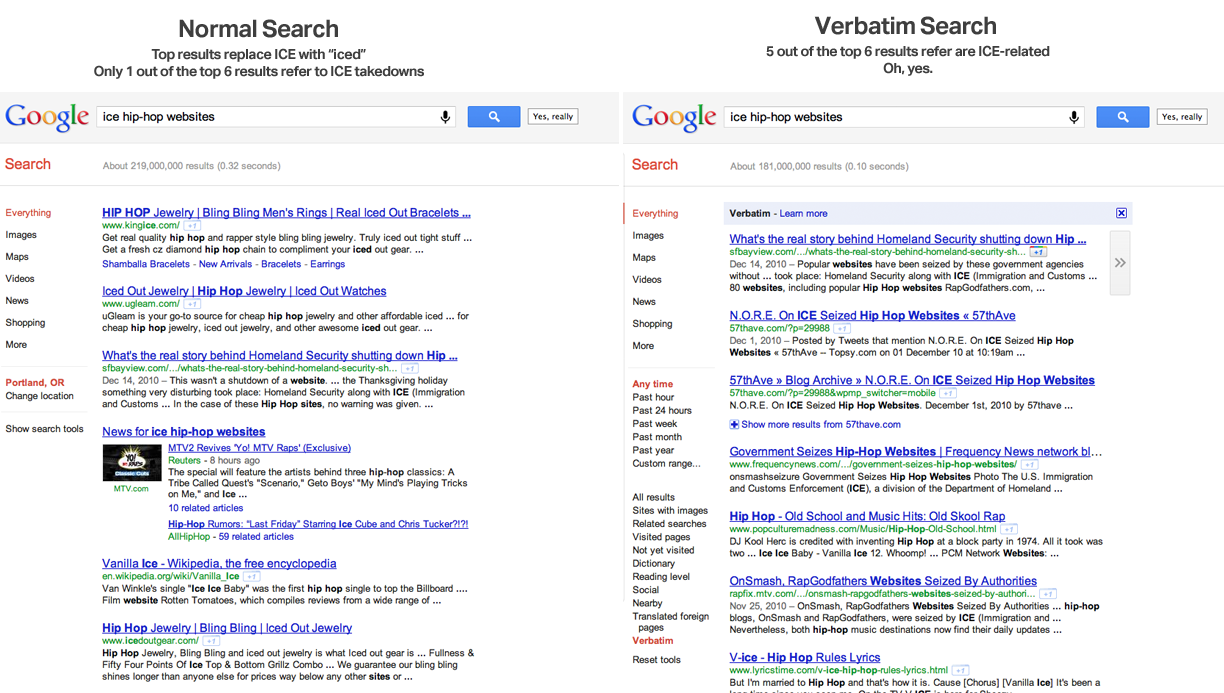
Interestingly, my [ZR2240w macos lion] example has changed since I posted it a few days ago. #1 result is this very thread, which is to be expected. But #2 and #3 are now reasonable results. 4, 5, and 6 are still garbage.
The gooverbatim user script adds a nice "Yes, really" button to the results page to make it easier to get a verbatim search.
posted by Nelson at 10:02 AM on November 18, 2011 [3 favorites]
« Older The Future of Energy, according to Daniel Yergin | May the odds be EVER in your favor... Newer »
This thread has been archived and is closed to new comments
posted by Renoroc at 2:23 PM on November 15, 2011