"Mr. Koch is survived by New York itself."
February 1, 2013 10:18 PM Subscribe
"He was fiercely proud of his Jewish faith. He fiercely defended the City of New York, and he fiercely loved its people. Above all, he loved his country, the United States of America, in whose armed forces he served in World War II." - a self-written epitaph by the former 105"Hizzoner" passed away on Friday morning at the age of 88, and the New York Times City Room blog spent the day collecting and posting stories about him.th Mayor of New York City: Edward Irving Koch.
More from the Times
* Video: Ed Koch Dead: Former New York City Mayor on Life and Career
* The Difference Between Koch’s City and Today.
* Slideshow: A Mayor to Remember
* Tales From the Pressroom About a Man Who Relished Publicity
* In New York, Echoes of a Talkative Mayor
* Archive: Edward I. Koch in His Own Words (A selection of Op-Ed articles and Letters to the Editor by the former mayor.)
* At the Table with Ed Koch
* Editorial: The King of New York
* Editorial: His Honor, Mr. Koch
The Times obituary linked above is quite extensive, but was revised on Friday after "several observers noticed that it lacked any mention of his controversial record on AIDS."
In His Own Words
* Ed Koch: Hizzoner. Interview with NY Magazine's Maer Roshan for their 30th anniversary issue in 1998.
Video
* ReasonTV: Mayor Ed Koch on rent control, his sexuality, Andrew Cuomo, and how he helped save New York.
* Talk to Al Jazeera: Ed Koch
* NYC Media: Ed Koch, Resurrecting the City
* NY Times: Ed Koch Dead: Former New York City Mayor on Life and Career
* Big Think Interview with Ed Koch (More at their website)
Other Obituaries
* New York Magazine: Ed Koch, the Mayor Who Saved New York From Bankruptcy, Dies at 88. Also see: Ed Koch and the AIDS Crisis: His Greatest Failure
* BuzzFeed.
* New York Daily News: Ed Koch dead: Mayor who became a symbol of New York City passes away at 88 and A Timeline of Ed Koch's Life and Career. Also: Slideshow.
* The Awl: Edward Irving Koch, 1924-2013
* Time Magazine
* The Forward
* New York Post: Former New York City Mayor Ed Koch dead at age 88 and New York politicians mourn death of former Mayor Ed Koch. Slideshow.
* National Review: ‘How’m I Doing?’ Ed Koch Leaves New York City’s Stage
* LA Times: Edward Koch dies at 88; outspoken mayor led New York City comeback
* BBC News: Obituary: Ed Koch
* New York Observer: How He Did: Mayor Bloomberg and Aspiring Mayors Fondly Remember Ed Koch’s Legacy. Full obit is here.
* Associated Press: Best Ed Koch Quotes
* Christian Science Monitor: Ed Koch: a collection of favorite New York minutes with the mayor.
Mayor Koch at the Movies
The Most Memorable Lines from Ed Koch’s Film Reviews: "Amid all the obituaries and remembrances of former New York City mayor Ed Koch, let us not forget his post-political career as an amateur movie critic, first for a small giveaway neighborhood newspaper, The Westside Spirit, and later in video installments on his own Web site, Mayor Koch at the Movies. Everyone has a beloved elderly relative who spouts off delightfully off-key, ill-informed opinions about popular culture, don’t they? (A beloved elderly relative of mine recently told me she had seen a really funny wedding picture: Melancholia.) Koch was like New York City’s—and the world’s—beloved (by some), elderly, off-key, ill-informed uncle.The Atlantic has an archive of some of Koch's movie review columns.
Documentary
A documentary about his life called Koch also opened in theaters nationwide today. Koch never got a chance to review it himself. New York Times review. New York Magazine's.
Miscellany
* As is fitting for a man who so doggedly sought the spotlight, his funeral will be open to the press.
* New York Observer's Politicker Blog: How Ed Koch Helped Make Nikki Finke a Reporter. Also: Reverend Al Sharpton Remembers How Ed Koch Led to His ‘First Arrest’, which includes this great quote:
"Although we argued about everything from my marching in Bensonhurst, to Florida and Trayvon Martin, and although we disagreed on politics from his views on President Obama to other matters, I have found that he was never a phony or a hypocrite. He would not patronize or deceive you. He said what he meant. He meant what he said. He fought for what he believed. May he rest in peace."Epitaph
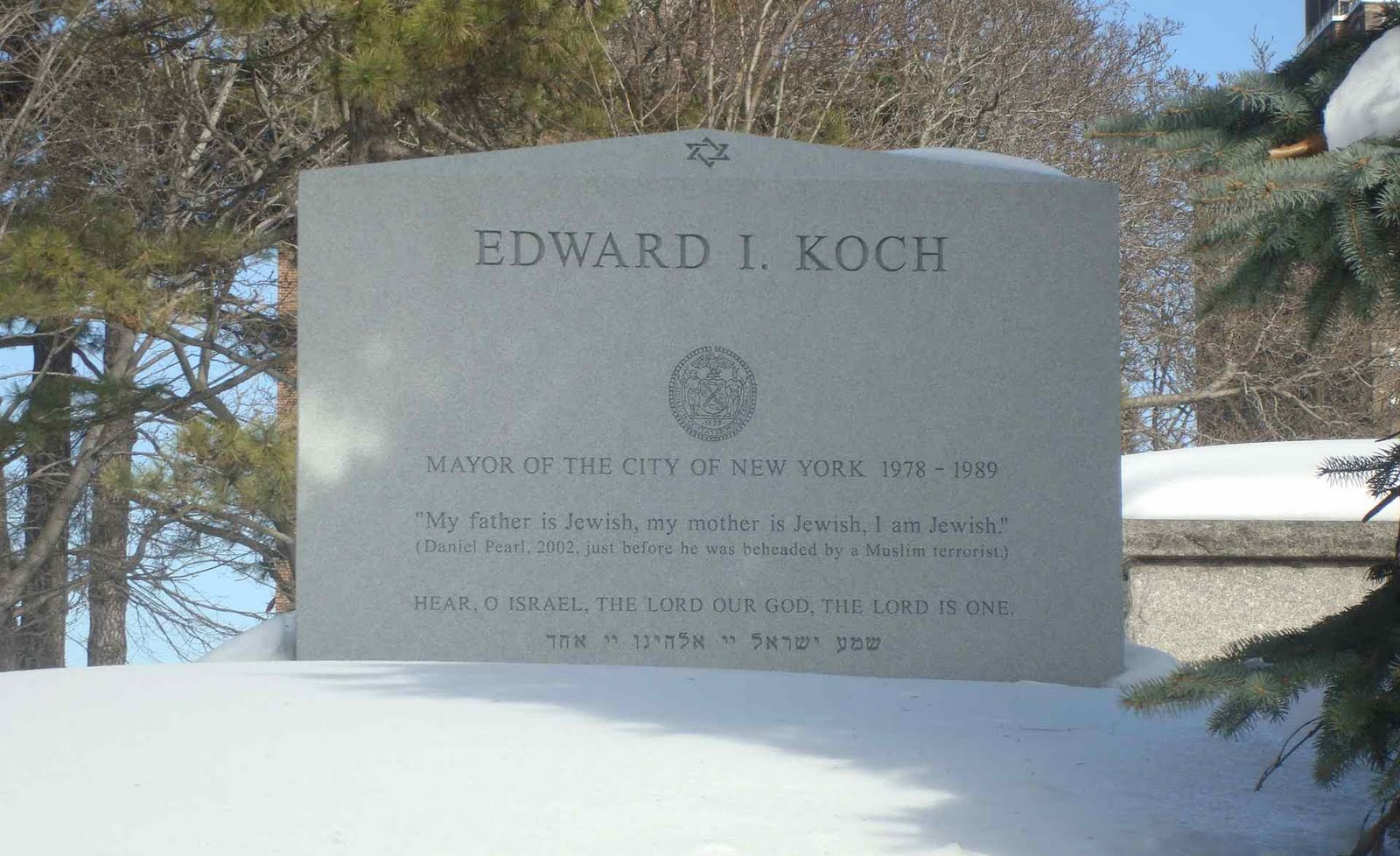
Finally, in an odd coincidence, the date of Mr. Koch's death, February 1, is also the eleventh anniversary of the death of WSJ journalist Daniel Pearl. Mr. Koch's grave marker, designed by the mayor himself and finished several months before his death, displays Mr. Pearl's last words: "My father is Jewish, my mother is Jewish, I am Jewish."
Didn't include it in the post, because it won't play outside the US: Ed Koch's 1983 monologue on SNL. He was the first mayor to host the show. Koch appeared on SNL several times in the 80's, more than once as a guest star in a segment where he tried to talk down a suicide jumper.
posted by zarq at 10:26 PM on February 1, 2013 [2 favorites]
posted by zarq at 10:26 PM on February 1, 2013 [2 favorites]
I found out by a Bobby Flay tweet today. As a child of the 80's, Mayor Koch was the first mayor of NYC that I can remember. And remembering him brings back memories of Crazy Eddie's (his prices are...IN-SAAAANE!!", Mr. Softee ice cream trucks, tokens that were only 90 cents, Italian Icee's, NYC Pizza (Jamaica ave. had a spot called Margherita's...it was always my favorite), the People's Court (with Judge Wapner)....
But I digress. Mayor Koch was always a cool dude, and he will be missed.
Outstanding post, Zarq.
.
posted by KillaSeal at 10:46 PM on February 1, 2013 [6 favorites]
But I digress. Mayor Koch was always a cool dude, and he will be missed.
Outstanding post, Zarq.
.
posted by KillaSeal at 10:46 PM on February 1, 2013 [6 favorites]
.
posted by fingers_of_fire at 10:48 PM on February 1, 2013
posted by fingers_of_fire at 10:48 PM on February 1, 2013
Koch’s failure in AIDS should be recalled as the single-most significant aspect of his public life. The memories of all we’ve lost deserve no less.
That. For those who died in hospital hallways: .
posted by rtha at 10:51 PM on February 1, 2013 [20 favorites]
That. For those who died in hospital hallways: .
posted by rtha at 10:51 PM on February 1, 2013 [20 favorites]
Great post.
Didn't always agree with hizzoner, but loved his style and willingness to call them as he saw them. The quintessential New Yorker.
.
posted by JohnnyGunn at 11:18 PM on February 1, 2013
Didn't always agree with hizzoner, but loved his style and willingness to call them as he saw them. The quintessential New Yorker.
.
posted by JohnnyGunn at 11:18 PM on February 1, 2013
NYC Pizza (Jamaica ave. had a spot called Margherita's...it was always my favorite),
They're still there. In the low 160's, I think. Still make great pizza with fresh ingredients. :)
posted by zarq at 11:21 PM on February 1, 2013
They're still there. In the low 160's, I think. Still make great pizza with fresh ingredients. :)
posted by zarq at 11:21 PM on February 1, 2013
You can add this to the list of his accomplishments: educator. He taught a semester at my college (well, co-taught). He always said being mayor was about finding the right people for the job, and he proved this by bringing in a lot of his old staff to talk about their experiences and challenges. What great lessons! I was amazed by the passion his staff had some 15-20 years after holding office. Koch had his faults for sure, but he certainly understood people.
.
posted by lubujackson at 11:24 PM on February 1, 2013 [1 favorite]
.
posted by lubujackson at 11:24 PM on February 1, 2013 [1 favorite]
.
posted by From Bklyn at 12:25 AM on February 2, 2013
posted by From Bklyn at 12:25 AM on February 2, 2013
.
posted by NordyneDefenceDynamics at 12:40 AM on February 2, 2013
posted by NordyneDefenceDynamics at 12:40 AM on February 2, 2013
.
I'll always remember him on SNL. I watched it with my parents for years, and it was my real window on the world as a kid growing up. I was too young, and a southerner, to really get all of this. But in retrospect... man, what a guy.
posted by strixus at 12:45 AM on February 2, 2013
I'll always remember him on SNL. I watched it with my parents for years, and it was my real window on the world as a kid growing up. I was too young, and a southerner, to really get all of this. But in retrospect... man, what a guy.
posted by strixus at 12:45 AM on February 2, 2013
That. For those who died in hospital hallways: .
Sure. But I found that Ed Koch and the AIDS Crisis: His Greatest Failure link surprisingly moving all the same.
posted by PeterMcDermott at 1:16 AM on February 2, 2013 [4 favorites]
Sure. But I found that Ed Koch and the AIDS Crisis: His Greatest Failure link surprisingly moving all the same.
posted by PeterMcDermott at 1:16 AM on February 2, 2013 [4 favorites]
New York is second only to the Atlantic ocean in pervasiveness of tug -- even if unvisited -- to those of us who grew up on the east coast within a certain proximity of several states. And Koch's turn as mayor dominated my idea of New York; that was ages 5-16 for me. Childhood to adulthood.
All of that plain-spoken frankness and humility and devotion to NYC and yet he wouldn't fucking acknowledge mistakes in the response to AIDS. Jesus. Wept. I'll gently toss another metaphorical pebble on their cairn instead.
.
posted by desuetude at 1:38 AM on February 2, 2013 [1 favorite]
All of that plain-spoken frankness and humility and devotion to NYC and yet he wouldn't fucking acknowledge mistakes in the response to AIDS. Jesus. Wept. I'll gently toss another metaphorical pebble on their cairn instead.
.
posted by desuetude at 1:38 AM on February 2, 2013 [1 favorite]
Just dropped in to say thanks for the epic post. This is metafilter.
posted by ShutterBun at 2:57 AM on February 2, 2013 [4 favorites]
posted by ShutterBun at 2:57 AM on February 2, 2013 [4 favorites]
Koch was Mayor of NYC for the entirety of my conscious childhood and adolescence. To a kid for whom he was omnipresent, he was "the guy in charge of New York," and would be until he died.
.
posted by tzikeh at 3:09 AM on February 2, 2013
.
posted by tzikeh at 3:09 AM on February 2, 2013
I think of Ed Koch every time I'm in a restaurant in NYC and see a CHOKING VICTIM poster. In 1981 he was eating lunch in Chinatown and choked on a piece of pork. The elections were coming up, and in order to change the focus from "What was Hizzoner eating?" (pork, potentially costing him the kashrut vote) the press conference talked about Koch being saved by the Heimlich maneuver.
posted by dubold at 4:44 AM on February 2, 2013 [1 favorite]
posted by dubold at 4:44 AM on February 2, 2013 [1 favorite]
I grew up on the west coast of Canada. I was a child and teen during his time as mayor. I think it says something about him, that even though he and NY were so far removed from my daily life, that I even I knew who he was and can recall hearing about things he did.
.
posted by Jalliah at 5:54 AM on February 2, 2013
dubold, Hizzoner shoulda tried the approach described this joke.
.
posted by .kobayashi. at 6:12 AM on February 2, 2013 [1 favorite]
.
posted by .kobayashi. at 6:12 AM on February 2, 2013 [1 favorite]
He also wrote an autobiography, called Mayor, a best-seller in the 80s, which ran briefly off-Broadway as a musical.
posted by still_wears_a_hat at 6:35 AM on February 2, 2013
posted by still_wears_a_hat at 6:35 AM on February 2, 2013
Zarq that is one heckuva of an obit post. I sort of kept expecting to see you work Giuliani's ferret weasel meltdown in there.
posted by bukvich at 7:09 AM on February 2, 2013
posted by bukvich at 7:09 AM on February 2, 2013
.
posted by lalochezia at 7:49 AM on February 2, 2013
posted by lalochezia at 7:49 AM on February 2, 2013
He also wrote an autobiography, called Mayor, a best-seller in the 80s, which ran briefly off-Broadway as a musical.
Koch also cracked wise and solved crimes in a series of murder mysteries.
posted by Iris Gambol at 8:01 AM on February 2, 2013 [1 favorite]
Koch also cracked wise and solved crimes in a series of murder mysteries.
posted by Iris Gambol at 8:01 AM on February 2, 2013 [1 favorite]
I find a lot of the worshipful revisionism about Koch's (terrible, right-wing) record in office loathsome, but most bizarre by far is how the obituaries have handled his closetedness. The Times obit practically treats his homosexuality as an unconfirmed rumor, almost as if it were a slander invented by the Cuomo campaign. Especially given that there's a solid argument that his denial about his own sexuality contributed to his denial about the AIDS crisis, allowing him to stay in the closet posthumously seems like a very strange attempt to whitewash a history that's indisputably messy.
posted by RogerB at 9:13 AM on February 2, 2013 [10 favorites]
posted by RogerB at 9:13 AM on February 2, 2013 [10 favorites]
.
posted by exlotuseater at 9:24 AM on February 2, 2013
posted by exlotuseater at 9:24 AM on February 2, 2013
Well, was he gay? Do we know for certain? I spent the morning googling (and did the same thing several years ago when I first heard the rumor) but was unable to find anything conclusive.
posted by PhoBWanKenobi at 9:40 AM on February 2, 2013 [1 favorite]
posted by PhoBWanKenobi at 9:40 AM on February 2, 2013 [1 favorite]
Well, was he gay? Do we know for certain?
Yes and yes. The documentary Outrage is all about this, but Andy Humm of Gay USA posted a nice response as a comment on the NYT obit itself:
Yes and yes. The documentary Outrage is all about this, but Andy Humm of Gay USA posted a nice response as a comment on the NYT obit itself:
"No proof was offered" that Koch was gay? PUH-leeze, as Koch himself might say. His own Human Rights Commissioner David Rothenberg has spoken publicly about Koch's late partner Dick Nathan, having been social friends with them in the Village. (Koch shut Dick out of his life after getting elected mayor.) My colleague, the late Dennis de Leon (Dinkins' Human Rights Commissioner) told me about Koch propositioning him when he was younger and working in the City Law Department. But Koch felt he was doing a public service by not acknowledging who he was because he believed such questions were out of bounds. Yet his closetedness contributed to his abysmal record on AIDS...Just for snarking on the topic, I also kind of liked this Don't Tell Anyone that Ed Koch Was Gay blog post:
It’s “inning” time! That time of the year when someone famous, and gay, dies and the media cures him.posted by RogerB at 9:51 AM on February 2, 2013 [4 favorites]
A lifelong bachelor, the former mayor had said it's unacceptable for people to ask if he's gay since the 70's, when placards surfaced in his mayoral race against Mario Cuomo that said "Vote for Cuomo, not the homo!"posted by ericb at 9:59 AM on February 2, 2013 [5 favorites]
At the time of the Cuomo allegations, Koch said: "No, I am not a homosexual. If I were a homosexual, I would hope I would have the courage to say so. What's cruel is that you are forcing me to say I am not a homosexual. This means you are putting homosexuals down. I don't want to do that."
Koch also expressed anger a year ago at how he was portrayed in Kirby Dick's film Outrage, which outed closeted politicians — not because the film said he's gay (which it did), but because he said the film defiled his record (the film claims his record on AIDS and gay rights was virtually nonexistent).
Said Koch to Page 6: "It's a [bleep]ing outrage. Bella Abzug and I, in the early '70s, introduced in Congress a bill that would outlaw discrimination based on sexual orientation...And when we later said the law applied to contractors doing business with the city, the Catholic Church and the Salvation Army sued me. In 1984, I was the first mayor to march in the Gay Pride Parade. I was the first mayor to appoint openly gay judges."
Late last year, Koch took the time to review How to Survive a Plague, but was blasted by AIDS activists featured in the film for not mentioning his own failed response to the AIDS crisis.
As part of the campaign to legalize same-sex marriage in New York in 2011, Koch recorded a video in support of New Yorkers for Marriage Equality. *
Just spent the better part of an hour watching his film reviews. So wry and insightful (yes, he's right--the reason Inception wasn't as successful as the Matrix was the lack of compelling story). Anyway, I forgot this upthread:
.
posted by PhoBWanKenobi at 11:20 AM on February 2, 2013
.
posted by PhoBWanKenobi at 11:20 AM on February 2, 2013
LGBT Community Weighs In On Late NYC Mayor's Polarizing Gay Rights Record.
posted by ericb at 12:13 PM on February 2, 2013
posted by ericb at 12:13 PM on February 2, 2013
displays Mr. Pearl's last words: "My father is Jewish, my mother is Jewish, I am Jewish."
I'm not sure what to think about the "just before he was beheaded by a Muslim terrorist" bit, but I thought it worth a mention.
posted by hot soup at 12:35 PM on February 2, 2013

I'm not sure what to think about the "just before he was beheaded by a Muslim terrorist" bit, but I thought it worth a mention.
posted by hot soup at 12:35 PM on February 2, 2013
.
posted by oneironaut at 1:26 PM on February 2, 2013
posted by oneironaut at 1:26 PM on February 2, 2013
.
Celebrity Death Haiku:
It's not a good day
For Ed Koch to be asking
"Hey, how'm I doin'?"
—Jeff Tiedrich
posted by Mental Wimp at 1:56 PM on February 2, 2013
Celebrity Death Haiku:
It's not a good day
For Ed Koch to be asking
"Hey, how'm I doin'?"
—Jeff Tiedrich
posted by Mental Wimp at 1:56 PM on February 2, 2013
and let's not forget his mention in the Beastie's classic Johnny Ryall circa 1989
.
posted by fatbaq at 2:26 PM on February 2, 2013
.
posted by fatbaq at 2:26 PM on February 2, 2013
I was walking past Trinity Cemetery a year or two ago, and saw the headstone. The Daniel Pearl inscription had not been added yet. My first thought was, "He can't be dead! I would have read about it. No, silly, there aren't any dates yet."
I moved to NYC the year Guiliani was elected, so I did not get a firsthand look at the Koch years. Many of my friends were, and they have tended to be less charitable in their assessments of his administration. His record on AIDS is very arguably an outrage, but to be fair, could there have been any politician willing to take action at that time?
posted by computech_apolloniajames at 2:33 PM on February 2, 2013
I moved to NYC the year Guiliani was elected, so I did not get a firsthand look at the Koch years. Many of my friends were, and they have tended to be less charitable in their assessments of his administration. His record on AIDS is very arguably an outrage, but to be fair, could there have been any politician willing to take action at that time?
posted by computech_apolloniajames at 2:33 PM on February 2, 2013
... could there have been any politician willing to take action at that time?
Um, yes.
Writer and filmmaker Dave France, director and co-writer of the Academy Award-nominated documentary How to Survive a Plague:
Um, yes.
Writer and filmmaker Dave France, director and co-writer of the Academy Award-nominated documentary How to Survive a Plague:
To be fair, no mayor could have stopped the virus from its diabolical campaigns in the bloodstream. But in the days before cell phones and the Internet, when the New York Times still refused to use the word gay and the hometown gay newspaper sold just 6,000 copies — a time when it was impossible to reach the at-risk community outside of the mainstream — he could have shown leadership. He could have promoted risk reduction and community education. This is what was done in San Francisco, where Dianne Feinstein was mayor. The money and the bully-pulpit worked. The epidemic there, while devastating, was nothing like it became in New York.posted by ericb at 2:44 PM on February 2, 2013 [3 favorites]
Koch’s failure in AIDS should be recalled as the single-most significant aspect of his public life. The memories of all we’ve lost deserve no less.
New York Magazine:
April 20, 1983posted by ericb at 2:49 PM on February 2, 2013 [2 favorites]
Mayor Ed Koch holds his first meeting with gay-community reps, agreeing to proclaim the last week of April “Aid AIDS Week”—and little else. “Gays did not have a seat at the political table in those days,” recalls longtime activist Bill Dobbs. “And so the anger over the way Koch and others treated us sparked a stunning activist movement.”
June 2 , 1987
Mayor Koch calls for mandatory HIV testing for visitors and immigrants to the U.S. Those with HIV should be denied entry, he says.
His record on AIDS is an outrage. There's no arguably about it. He was a major target of ACT UP/NY, as described in the David France piece linked above, for very good reason. I had the opportunity of seeing United in Anger, the other documentary about ACT UP/NY earlier this week, the day before Koch died, actually, and was reminded all over again how bad things were there. The huge outcry over that being left out of his NY Times obit resulted in them adding a few things, including a paragraph that just pissed me off even more.
'For years, Mr. Koch was upset and defensive about the criticism. In a 1994 interview with Adam Nagourney, a New York Times correspondent and co-author, with Dudley Clendinen, of “Out for Good: The Struggle to Build a Gay Rights Movement in America,” Mr. Koch said that New York had done more than San Francisco for people with AIDS. “But that never got through to the gay community,” Mr. Koch said. “They were brainwashed that they were getting shortchanged in New York City and in San Francisco they were getting everything. And it wasn’t true, but you could never convince them.”'
Because that is lie. Just straight up bullshit. San Francisco had an overwhelming response to the AIDS crisis. We built what is rightfully called the "San Francisco model of care." Our public hospital opened the first dedicated AIDS ward. Our elected officials got money in the state budget and the local budget for AIDS care. To say that activists in NY were "brainwashed" is the lowest form of insult to some of the smartest and most impassioned activists I've ever known. People were very literally dying in the hallways of hospitals in NYC while SF was opening hospital wards and dedicating all sorts of resources to fighting HIV. It could have been much, much better there.
It was better here in San Francisco. Ed Koch, even in death, is lying about AIDS. Fuck him.
posted by gingerbeer at 2:49 PM on February 2, 2013 [5 favorites]
'For years, Mr. Koch was upset and defensive about the criticism. In a 1994 interview with Adam Nagourney, a New York Times correspondent and co-author, with Dudley Clendinen, of “Out for Good: The Struggle to Build a Gay Rights Movement in America,” Mr. Koch said that New York had done more than San Francisco for people with AIDS. “But that never got through to the gay community,” Mr. Koch said. “They were brainwashed that they were getting shortchanged in New York City and in San Francisco they were getting everything. And it wasn’t true, but you could never convince them.”'
Because that is lie. Just straight up bullshit. San Francisco had an overwhelming response to the AIDS crisis. We built what is rightfully called the "San Francisco model of care." Our public hospital opened the first dedicated AIDS ward. Our elected officials got money in the state budget and the local budget for AIDS care. To say that activists in NY were "brainwashed" is the lowest form of insult to some of the smartest and most impassioned activists I've ever known. People were very literally dying in the hallways of hospitals in NYC while SF was opening hospital wards and dedicating all sorts of resources to fighting HIV. It could have been much, much better there.
It was better here in San Francisco. Ed Koch, even in death, is lying about AIDS. Fuck him.
posted by gingerbeer at 2:49 PM on February 2, 2013 [5 favorites]
I work in the HIV-care world in NYC, and we actually screened How to Survive A Plague along with a QA with some of the activists in the movie (sadly, one of them, Spencer Cox died shortly after).
Though many of my colleagues would disagree, I don't blame Koch. The dire financial situation coupled with the Catholic church and the conservative constituencies in NYC made it a pretty tough place to build a whole new hospital wing etc. And hindsight affords us the luxury of knowing what should have been done, but things were a lot less clear at the time. He should have done more, but I don't believe it would have been any better if he wasn't in office.
posted by rosswald at 3:25 PM on February 2, 2013 [1 favorite]
Though many of my colleagues would disagree, I don't blame Koch. The dire financial situation coupled with the Catholic church and the conservative constituencies in NYC made it a pretty tough place to build a whole new hospital wing etc. And hindsight affords us the luxury of knowing what should have been done, but things were a lot less clear at the time. He should have done more, but I don't believe it would have been any better if he wasn't in office.
posted by rosswald at 3:25 PM on February 2, 2013 [1 favorite]
Things were pretty clear at the time, if you knew where to look.
posted by gingerbeer at 3:29 PM on February 2, 2013
posted by gingerbeer at 3:29 PM on February 2, 2013
It was better here in San Francisco. Ed Koch, even in death, is lying about AIDS. Fuck him.
Yes, but he's really lying about his record and the numbers of people who died of AIDS while he was mayor, and in doing so is trying to steer attention away from his own screw-up. The man spent the last three decades curating and protecting his legacy, while maintaining his own relevance. Admitting to the damage caused by his inaction in any sort of detail would have been like writing the first sentence of his own obituary. It would have overshadowed the positive narrative. I can understand why he might have done it. Doesn't make it right, but still.
The huge outcry over that being left out of his NY Times obit resulted in them adding a few things, including a paragraph that just pissed me off even more.
When I think of Ed Koch, the AIDS crisis is not the first thing that comes to mind. Or even the fourth. But I'm also a straight guy. Even though I had friends who died of AIDS, and know a number of people living with HIV, I'm not part of the gay community which was utterly decimated by it. Knowing a tiny bit about his history with regard to the crisis, I never drew a direct mental line between his inaction and thousands of deaths. I've been far more pissed at Reagan, tbh.
I mention this for a couple of reasons:
1) I deliberately chose to ignore a few elements of his career while constructing this FPP because I was trying to keep it somewhat tight and focused. (I know that in a post with 50+ links that probably seems kinda laughable.) In retrospect (after reading the comments in this thread,) I know I should have devoted more links/space to his minimal handling of / support for the AIDS crisis. I did include a couple, but it deserved more attention.
2) Having made that mistake, I can see how someone else might have too. Even a NYT journalist. Worth noting as well that most of the other obits either didn't mention the AIDS crisis at all, (such as Buzzfeed) or barely noted it (such as Time, The Forward, BBC and the LA Times.)
Not to excuse any of them for not mentioning it or glossing over it. Or myself.
The dire financial situation coupled with the Catholic church and the conservative constituencies in NYC made it a pretty tough place to build a whole new hospital wing etc.
It would have killed him politically. Instantly. He probably would have lost huge swaths of all five boros in any subsequent election. There's a tremendous argument to be made for doing so on principle, but falling on his sword wasn't Koch's style.
Plus, if he had tried outing himself or pouring money and resources into the AIDS crisis in '82 (the latter is kind of unlikely since the federal government didn't properly step up until '83,) it would have killed his chances in the gubernatorial race far more quickly than that crack about the suburbs being sterile. New York outside of Manhattan was and still is quite conservative.
I mention all of this not as any sort of defense or justification, but to give my opinion about why he might have acted the way he did.
posted by zarq at 6:34 PM on February 2, 2013
Yes, but he's really lying about his record and the numbers of people who died of AIDS while he was mayor, and in doing so is trying to steer attention away from his own screw-up. The man spent the last three decades curating and protecting his legacy, while maintaining his own relevance. Admitting to the damage caused by his inaction in any sort of detail would have been like writing the first sentence of his own obituary. It would have overshadowed the positive narrative. I can understand why he might have done it. Doesn't make it right, but still.
The huge outcry over that being left out of his NY Times obit resulted in them adding a few things, including a paragraph that just pissed me off even more.
When I think of Ed Koch, the AIDS crisis is not the first thing that comes to mind. Or even the fourth. But I'm also a straight guy. Even though I had friends who died of AIDS, and know a number of people living with HIV, I'm not part of the gay community which was utterly decimated by it. Knowing a tiny bit about his history with regard to the crisis, I never drew a direct mental line between his inaction and thousands of deaths. I've been far more pissed at Reagan, tbh.
I mention this for a couple of reasons:
1) I deliberately chose to ignore a few elements of his career while constructing this FPP because I was trying to keep it somewhat tight and focused. (I know that in a post with 50+ links that probably seems kinda laughable.) In retrospect (after reading the comments in this thread,) I know I should have devoted more links/space to his minimal handling of / support for the AIDS crisis. I did include a couple, but it deserved more attention.
2) Having made that mistake, I can see how someone else might have too. Even a NYT journalist. Worth noting as well that most of the other obits either didn't mention the AIDS crisis at all, (such as Buzzfeed) or barely noted it (such as Time, The Forward, BBC and the LA Times.)
Not to excuse any of them for not mentioning it or glossing over it. Or myself.
The dire financial situation coupled with the Catholic church and the conservative constituencies in NYC made it a pretty tough place to build a whole new hospital wing etc.
It would have killed him politically. Instantly. He probably would have lost huge swaths of all five boros in any subsequent election. There's a tremendous argument to be made for doing so on principle, but falling on his sword wasn't Koch's style.
Plus, if he had tried outing himself or pouring money and resources into the AIDS crisis in '82 (the latter is kind of unlikely since the federal government didn't properly step up until '83,) it would have killed his chances in the gubernatorial race far more quickly than that crack about the suburbs being sterile. New York outside of Manhattan was and still is quite conservative.
I mention all of this not as any sort of defense or justification, but to give my opinion about why he might have acted the way he did.
posted by zarq at 6:34 PM on February 2, 2013
Yeah, 'cause the Mayor of San Francisco who put money for AIDS in her budget in 1983 had *such* a hard time winning statewide office. It's not like she's a sitting Senator or anything. New York City and New York State now have great programs and devote significant resources to HIV. It happened after Koch left office, under other Mayors who didn't lose anything for it.
Look, you're all welcome to come up with all the defenses and justifications you want to. I don't really get why you want to do that, but that's neither here nor there. But trying to pretend that he really couldn't have done anything, or that it wouldn't have made any difference, rings very oddly to me.
posted by gingerbeer at 7:12 PM on February 2, 2013 [2 favorites]
Look, you're all welcome to come up with all the defenses and justifications you want to. I don't really get why you want to do that, but that's neither here nor there. But trying to pretend that he really couldn't have done anything, or that it wouldn't have made any difference, rings very oddly to me.
posted by gingerbeer at 7:12 PM on February 2, 2013 [2 favorites]
Look, you're all welcome to come up with all the defenses and justifications you want to. I don't really get why you want to do that, but that's neither here nor there. But trying to pretend that he really couldn't have done anything, or that it wouldn't have made any difference, rings very oddly to me.
Out of curiosity, was that directed at me? Because if so, you're not characterizing my comment fairly.
posted by zarq at 7:42 PM on February 2, 2013
Out of curiosity, was that directed at me? Because if so, you're not characterizing my comment fairly.
posted by zarq at 7:42 PM on February 2, 2013
Ed Koch, even in death, is lying about AIDS. Fuck him.
It's worth exploring the above in more detail, not least because gingerbeer is 100% right: Ed Koch was a lying sack of shit when he claimed in that 1994 interview "New York had done more than San Francisco for people with AIDS."
That is complete garbage - a blatant attempt on Koch's part to whitewash his cowardly, closeted lack of action, easily disproved by a look at the investigative reporting in Randy Shilts' 1987 book And The Band Played On. Check chapter 27 for the details about Koch not only refusing to meet with the gay activists who were watching death spread for almost two years, but also refusing to allow his public health folks to make any public statements about the emergency or create any educational materials. Here are a few excerpts describing the early months of 1983, after Larry Kramer's bombshell article, "1,112 and Counting" appeared in the New York Native, and after zero activity from Koch, even after he lost the gubernatorial primary. His first action came after the New York AIDS Network released a statement coinciding with Kramer's angry polemic, saying the gay community was growing increasingly aroused and angry and, oh, by the way, calling for 3,000 volunteers to be trained in civil disobedience for sit-ins and traffic tie-ups:
The NYT had plenty of time to get this right but instead proudly showed us all a new stain on the paper's history with the gay community. In fucking 2013. Way to go, NYT.
Fuck Ed Koch's lies and cowardice. And fuck the NYT for its slapdash approach to covering gay issues, not only failing to integrate a minority community's perspective into its coverage in the first place but then spreading a blatant, lying smear as part of its attempt to make things right. I'm just....there are no.....ah, fuck. I'm going to bed.
posted by mediareport at 9:06 PM on February 2, 2013 [6 favorites]
It's worth exploring the above in more detail, not least because gingerbeer is 100% right: Ed Koch was a lying sack of shit when he claimed in that 1994 interview "New York had done more than San Francisco for people with AIDS."
That is complete garbage - a blatant attempt on Koch's part to whitewash his cowardly, closeted lack of action, easily disproved by a look at the investigative reporting in Randy Shilts' 1987 book And The Band Played On. Check chapter 27 for the details about Koch not only refusing to meet with the gay activists who were watching death spread for almost two years, but also refusing to allow his public health folks to make any public statements about the emergency or create any educational materials. Here are a few excerpts describing the early months of 1983, after Larry Kramer's bombshell article, "1,112 and Counting" appeared in the New York Native, and after zero activity from Koch, even after he lost the gubernatorial primary. His first action came after the New York AIDS Network released a statement coinciding with Kramer's angry polemic, saying the gay community was growing increasingly aroused and angry and, oh, by the way, calling for 3,000 volunteers to be trained in civil disobedience for sit-ins and traffic tie-ups:
p. 245: Two days later, on March 9, Mayor Ed Koch and Health Commissioner David Sencer hurriedly announced the formation of an Office of Gay and Lesbian Health Concerns....Of course, it was led by someone committed to a "low-key" approach to the crisis; i.e., someone who would do nothing. On April 10, Koch finally deigned to appear in public at a conference about AIDS, after months of pressure and only after a Catholic cardinal was also slated to appear:
p. 265: The mayor's nervous aides even refused to list the event in the standard schedule of mayoral public appearances routinely issued to the media.A week later, Koch finally agreed to a sit-down with "a maximum of 10" gay community leaders (Larry Kramer, who was almost single-handedly responsible for the meeting happening at all, was not allowed to participate and resigned the GMHC board). This is the key bit right here:
p. 275-6: There were two types of requests the New York AIDS Network took with them to their first and only meeting with Mayor Ed Koch at City Hall - the kind that cost money and the kind that didn't. Mayor Koch warmly embraced the requests that cost the city nothing. Yes, he would declare a "state of concern" about AIDS for the week of the GMHC circus fund-raiser and the candlelight march. Of course, he would join Diane Feinstein's AIDS Task Force of the U.S. Conference of Mayors...He'd talk to the city's lobbyist about pushing for more federal funds [for research].The evidence from folks who were there is very clear; if anyone has a better source than Shilts on the early years of the epidemic I'd love to know. It's difficult to decide what's worse: 1) Koch's despicable 1994 attempt to revise history and get folks to believe in an imaginary world where he "had done more" than officials in San Francisco for people with AIDS, or 2) the fact that once the NYT realized its obit completely left out one of the worst failures of Koch's career, it "corrected" the mistake by spreading the dead man's lies and smears - "my brilliant work never got through to those darn gays...they were brainwashed that they were getting shortchanged" - without any attempt to verify if the lies were actually true.
Then, there were the other, peskier, requests. No, the city would not provide housing or hospice space for AIDS patients kicked out into the street. That would be preceived as being 'special treatment' for gays. As for gay requests for a health center in Greenwich Village, that was impossible. On a general level, Koch said he would match San Francisco's spending on AIDS, "dollar for dollar," but he never indicated where that money would be spent...
[E]ven the ever-optimistic Paul Popham was disheartened by the visit. The mayor did not seem vaguely concerned about the epidemic. Every answer came to quickly, almost flippantly, Paul thought. And he could see that Health Commissioner David Sencer was not going to push the mayor on this issue...There was nobody in city government who had responsibility for the AIDS epidemic, Paul could see now; there was nobody who really cared.
It was during this month of April 1983 that the momentum of movement on the AIDS epidemic shifted from New York City to San Francisco, typified, as much as anything else, by that meeting in New York City Hall. For the next two years, AIDS policy in New York would be little more than a laundry list of unmet challenges, unheeded pleas, and programs not undertaken...the city's gay leadership pursued its policy of constructive engagement with a mayor who seemed petrified of being highly identified with any gay issue, perhaps because of his status as a perennial bachelor. The New York fight against AIDS would be left to a handful of doctors and overtaxed gay organizations, and many would die there, while AIDS came to be seen as a San Francisco phenomenon because that's where the action was.
The NYT had plenty of time to get this right but instead proudly showed us all a new stain on the paper's history with the gay community. In fucking 2013. Way to go, NYT.
Fuck Ed Koch's lies and cowardice. And fuck the NYT for its slapdash approach to covering gay issues, not only failing to integrate a minority community's perspective into its coverage in the first place but then spreading a blatant, lying smear as part of its attempt to make things right. I'm just....there are no.....ah, fuck. I'm going to bed.
posted by mediareport at 9:06 PM on February 2, 2013 [6 favorites]
>> When I think of Ed Koch, the AIDS crisis is not the first thing that comes to mind. Or even the fourth. But I'm also a straight guy. Even though I had friends who died of AIDS, and know a number of people living with HIV, I'm not part of the gay community which was utterly decimated by it. Knowing a tiny bit about his history with regard to the crisis, I never drew a direct mental line between his inaction and thousands of deaths.
It should be known by you and everyone; it should be part of his legacy regardless of his desire to bury his contribution to "Silence = Death." This widespread acceptance of his revisionist nonsense is horrific.
I'm not beating up on you, zarq. The personal is political, but what I'm beating up on is the pervasive idea that only the personal is political. I'm not offended by the omission of his record on AIDS because it killed my friends; I'm offended because it was a shamefully negligent way to treat human beings in this country, and it was tolerated out of prejudice and fear by someone who should have done better. Someone who could have later admitted that he could have done better, but dug in with denial instead.
I wasn't part of the gay community decimated by AIDS either, not really, not firsthand. In 1987, I was only a freshman in high school. Within the next couple of years, as I became more involved in community theater (yeah yeah stereotype), I did come to know people who had AIDS and died, and knew many more people who had suffered so very very many losses. And later, the heartbreaking hole in the middle of a population was even more obvious and relevant. But I was just a few years too young to get well and truly brutally punched in the gut by overwhelming personal loss.
I still feel punched in the gut by overwhelming loss, though.
To use an example closer to Mayor Koch's heart -- my reaction to the Holocaust (and that of pretty much everyone I know) has always been heartpangs of horror and grief. This is by no means a personal wound for me. No-one in my family is Jewish, I knew maybe five or six Jewish people growing up, and in fact I honestly did not know until maybe high school that Israel was so populated by European Jews. But yes, "Never Again," with horrified sympathy. horrible things are horrible and should have been stopped.
I'm not calling for an effigy to be burned. His legacy can be tarnished without negating his legit accomplishments or anyone's personal affection for him. Hell, he'll be in good company. We've got all kinds of complex hypocrisy in great politicians. (Hello, Thomas Jefferson.)
posted by desuetude at 10:49 PM on February 2, 2013 [3 favorites]
It should be known by you and everyone; it should be part of his legacy regardless of his desire to bury his contribution to "Silence = Death." This widespread acceptance of his revisionist nonsense is horrific.
I'm not beating up on you, zarq. The personal is political, but what I'm beating up on is the pervasive idea that only the personal is political. I'm not offended by the omission of his record on AIDS because it killed my friends; I'm offended because it was a shamefully negligent way to treat human beings in this country, and it was tolerated out of prejudice and fear by someone who should have done better. Someone who could have later admitted that he could have done better, but dug in with denial instead.
I wasn't part of the gay community decimated by AIDS either, not really, not firsthand. In 1987, I was only a freshman in high school. Within the next couple of years, as I became more involved in community theater (yeah yeah stereotype), I did come to know people who had AIDS and died, and knew many more people who had suffered so very very many losses. And later, the heartbreaking hole in the middle of a population was even more obvious and relevant. But I was just a few years too young to get well and truly brutally punched in the gut by overwhelming personal loss.
I still feel punched in the gut by overwhelming loss, though.
To use an example closer to Mayor Koch's heart -- my reaction to the Holocaust (and that of pretty much everyone I know) has always been heartpangs of horror and grief. This is by no means a personal wound for me. No-one in my family is Jewish, I knew maybe five or six Jewish people growing up, and in fact I honestly did not know until maybe high school that Israel was so populated by European Jews. But yes, "Never Again," with horrified sympathy. horrible things are horrible and should have been stopped.
I'm not calling for an effigy to be burned. His legacy can be tarnished without negating his legit accomplishments or anyone's personal affection for him. Hell, he'll be in good company. We've got all kinds of complex hypocrisy in great politicians. (Hello, Thomas Jefferson.)
posted by desuetude at 10:49 PM on February 2, 2013 [3 favorites]
It should be known by you and everyone; it should be part of his legacy regardless of his desire to bury his contribution to "Silence = Death." This widespread acceptance of his revisionist nonsense is horrific.
Completely agree.
posted by zarq at 4:52 AM on February 3, 2013
Completely agree.
posted by zarq at 4:52 AM on February 3, 2013
In addition to those linked above: Ed Koch, the Mayor Who Saved New York From Bankruptcy, Dies at 88 and Ed Koch and the AIDS Crisis: His Greatest Failure, New York Magazine has posted additional articles and links:
• The Perfect Mayor of Crazytown
• Mario Cuomo on His Old Foe
• The Legacy of the Koch Building Boom
• His Love for a Broken City That Loved Him Back
• Maer Roshan: My Dinners with Ed: "Pink Isn’t Really My Color"
• New York’s Last Mayor From Main Street
• A Life in Pictures
Older New York Magazine Articles about Koch
• January 26, 1970: "Hi There, I'm Ed Koch"
• February 5, 1979: Koch and the Blacks: The Feud Continues
• February 28, 1979: Temperamental Journey: Ed Koch vs. Everyone
• April 30, 1979: Lock 'Em Up Koch
• September 8, 1980: An In-Depth Look at Mayor Koch's Record
• March 16, 1981: Koch to Reagan: Look Before You Cut
• September 18, 1981: Last Gasps
• October 12, 1981: Ed Koch's Blind Spot
• February 18, 1982: Koch-22: The Great Scramble to Succeed Carey
• August 23, 1982: Koch and Cuomo Make the Issue Each Other
• February 10, 1986: The Manes Mess and the Mayor
• From the 30th Anniversary Issue: Ed Koch, Hizzoner
• September 27, 2008: In Conversation: Michael Bloomberg and Ed Koch
• The Complete "I'm Right, You're Wrong" Archive (Debates between Koch and Al D'Amato (and occasionally Mark Green))
posted by zarq at 5:36 AM on February 3, 2013
• The Perfect Mayor of Crazytown
• Mario Cuomo on His Old Foe
• The Legacy of the Koch Building Boom
• His Love for a Broken City That Loved Him Back
• Maer Roshan: My Dinners with Ed: "Pink Isn’t Really My Color"
• New York’s Last Mayor From Main Street
• A Life in Pictures
Older New York Magazine Articles about Koch
• January 26, 1970: "Hi There, I'm Ed Koch"
• February 5, 1979: Koch and the Blacks: The Feud Continues
• February 28, 1979: Temperamental Journey: Ed Koch vs. Everyone
• April 30, 1979: Lock 'Em Up Koch
• September 8, 1980: An In-Depth Look at Mayor Koch's Record
• March 16, 1981: Koch to Reagan: Look Before You Cut
• September 18, 1981: Last Gasps
• October 12, 1981: Ed Koch's Blind Spot
• February 18, 1982: Koch-22: The Great Scramble to Succeed Carey
• August 23, 1982: Koch and Cuomo Make the Issue Each Other
• February 10, 1986: The Manes Mess and the Mayor
• From the 30th Anniversary Issue: Ed Koch, Hizzoner
• September 27, 2008: In Conversation: Michael Bloomberg and Ed Koch
• The Complete "I'm Right, You're Wrong" Archive (Debates between Koch and Al D'Amato (and occasionally Mark Green))
posted by zarq at 5:36 AM on February 3, 2013
« Older Quest For Fire | Football has been in open beta for 144 years Newer »
This thread has been archived and is closed to new comments
posted by bz at 10:21 PM on February 1, 2013