Pontius Pilate contracted his brows, and his hand rose to his forehead...
June 24, 2004 11:26 AM Subscribe
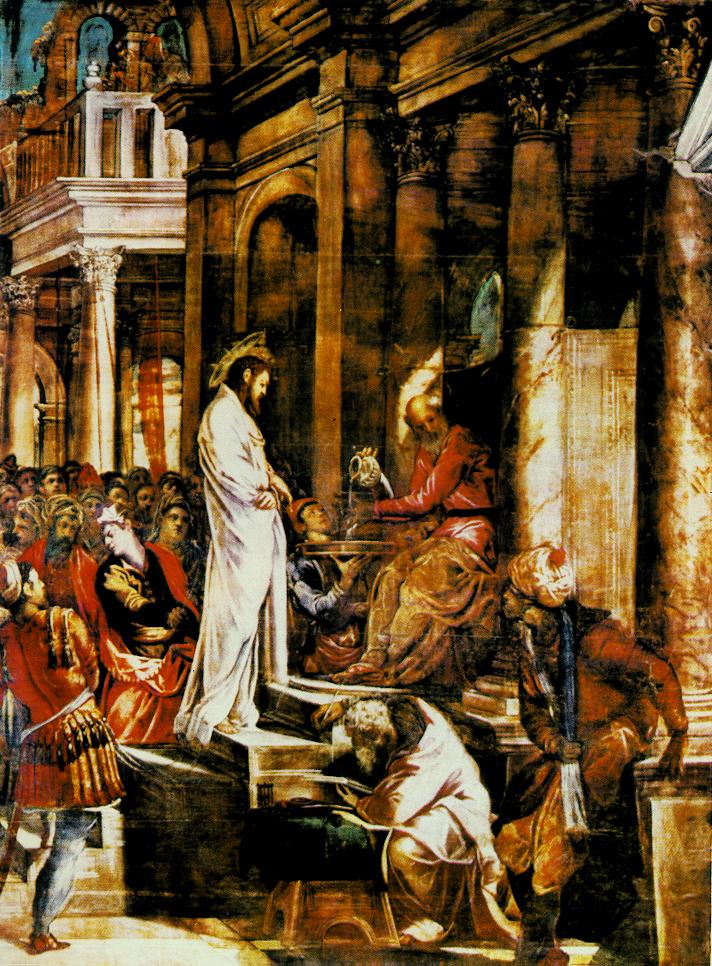
"Jesus?" he murmured, "Jesus -- of Nazareth?..." Pontius Pilate, prefect of Judea, is the only historical figure named in the Nicene Creed -- Coptic saint or eternally damned, his role in the greatest story ever told has been debated by many of history's greatest minds: St Augustine, Dante Alighieri, Tintoretto, John Ruskin, Mikhail Bulgakov, Monty Python. Unfortunately, there is very little historical evidence about him. His role in the death of a certain charismatic Galilean healer and apocalyptic preacher is still being debated today by theologians and historians alike. He is also, of course, the main character of The Procurator of Judea, the classic short story (complete text in main link) by Anatole France. (France's magnificent story has lately been tragically neglected by publishers, even if the author was one of his era's most acclaimed writers in the world -- he won the Nobel Prize in 1921 over Shaw, Yeats, Joyce, Thomas Hardy, D.H. Lawrence, and Proust, and when he died in 1924, hundreds of thousands of people followed his funeral procession through Paris). These last 2,000 years of fascination with Pilatus can be explained, some argue... (more inside, for those unwilling to wash their hands of this post)


.... and anyway, about that "blame" thing -- didn't Peter Jennings settle that, already?
posted by lodurr at 11:46 AM on June 24, 2004
posted by lodurr at 11:46 AM on June 24, 2004
... can be explained, some argue, by a very simple philosophical question: was Pilate really free? Had he freely decided not to crucify Jesus, there would have been no Golgotha, no death of the Messiah, no resurrection, no fulfilment of Scripture's prophesy. No "Kingdom which shall not be destroyed".
Now, the classic Christian angle is of course that "Jesus died in accord with the Scriptures as the expression of God's will (Matthew). Jesus died a sacrificial death for us and for our sins (Mark, Paul, and Hebrews). Jesus in his death gave us an example of fidelity in suffering (Luke). Jesus' death was part of his revelation of God and of his glorious return to the Father (John), and the pledge of his second coming (Revelation)".
Leaving quite open of course the old Determinism problem.
Those who don't really care about philosophy can anyway enjoy the late Rod Steiger's masterful portrayal of the Prefect.
posted by matteo at 11:52 AM on June 24, 2004
Now, the classic Christian angle is of course that "Jesus died in accord with the Scriptures as the expression of God's will (Matthew). Jesus died a sacrificial death for us and for our sins (Mark, Paul, and Hebrews). Jesus in his death gave us an example of fidelity in suffering (Luke). Jesus' death was part of his revelation of God and of his glorious return to the Father (John), and the pledge of his second coming (Revelation)".
Leaving quite open of course the old Determinism problem.
Those who don't really care about philosophy can anyway enjoy the late Rod Steiger's masterful portrayal of the Prefect.
posted by matteo at 11:52 AM on June 24, 2004
re Steiger: his Pilate (in the very smart adaption by Anthony Burgess) talks of mercy to Jesus just to needle the Jewish priests, an exquisitely sadistic touch from a true anti-Semite (Burgess was of course a fan of France's version of a rabidly anti-semitic Pilate)
___
lodurr, I'd be wary of getting my historical Jesus lessons from Disney News, but whatever
;)
posted by matteo at 11:58 AM on June 24, 2004
___
lodurr, I'd be wary of getting my historical Jesus lessons from Disney News, but whatever
;)
posted by matteo at 11:58 AM on June 24, 2004
"What is truth?" Whenever I'm tempted to save a losing argument by uttering those words (a lousy tactic in any case), I always catch myself. In any case, it's the boldest, most modern moment in the New Testament. What a stroke! There's nothing pat about that confrontation at all.
posted by Faze at 12:04 PM on June 24, 2004
posted by Faze at 12:04 PM on June 24, 2004
Pilate and a certain religious figure play an important role in Bulgakov's masterpiece The Master and Margarita, arguably one of the most popular works in all Russian literature. Sadly, the translation I link to here (as well as the four-something others out there) don't do the novel justice. So go learn Russian and read it.
Bulgakov, made quite the anti-Semite after his suffering at the hands of the Russian revolutionaries, largely Jewish, paints Pilate as sympathetic, forced to order the crucifixion by the bloodthirsty Jewish priests. Truly a talented author nonetheless.
posted by Krrrlson at 12:21 PM on June 24, 2004
Bulgakov, made quite the anti-Semite after his suffering at the hands of the Russian revolutionaries, largely Jewish, paints Pilate as sympathetic, forced to order the crucifixion by the bloodthirsty Jewish priests. Truly a talented author nonetheless.
posted by Krrrlson at 12:21 PM on June 24, 2004
Matteo: Sorry for stepping in front of your train; I thought the ellipsis was some kind of a sly come-on...
Anyway, what better place to get a simplistic answer from than Disney News? And a useful answer, too: it absolves the priests and the mob, and finds a simple, single source for the blame.
But it's an interesting question, and I feel it hovering in the background whenever I see someone in media or literature pondering their place in the chain of responsibility. As an atheist, I think I might be more dispassionate about it than some; I don't see any more intrinsic value in the life of a "Christ" than of one of the other radicals who were getting regularly nailed up in those days. And as an atheist, I can say that I truly believe Pilate is as responsible as anyone who takes a job with that level of responsibility -- like, say, a Governor (say, of Illinois, or Texas), or a President, or a Judge.
So, at a really simplistic level: Don't do the job if you won't do what the job requires. I will stipulate simplistically that I have never done that "job"... but I do a job every day that aids and abets in a lot of things I'm not comfortable, so I can hardly call myself "blameless."
Again, as an atheist, questions of "right" or "wrong" (good:bad or good:evil, take your pick) are not questions of ultimate punishment for me -- they're matters of ethics, and whether they matter to Pilate and to the aggrieved, is not necessarily related to whether they matter for the law. There's no necessary relation between ethics and law, after all.
posted by lodurr at 1:04 PM on June 24, 2004
Anyway, what better place to get a simplistic answer from than Disney News? And a useful answer, too: it absolves the priests and the mob, and finds a simple, single source for the blame.
But it's an interesting question, and I feel it hovering in the background whenever I see someone in media or literature pondering their place in the chain of responsibility. As an atheist, I think I might be more dispassionate about it than some; I don't see any more intrinsic value in the life of a "Christ" than of one of the other radicals who were getting regularly nailed up in those days. And as an atheist, I can say that I truly believe Pilate is as responsible as anyone who takes a job with that level of responsibility -- like, say, a Governor (say, of Illinois, or Texas), or a President, or a Judge.
So, at a really simplistic level: Don't do the job if you won't do what the job requires. I will stipulate simplistically that I have never done that "job"... but I do a job every day that aids and abets in a lot of things I'm not comfortable, so I can hardly call myself "blameless."
Again, as an atheist, questions of "right" or "wrong" (good:bad or good:evil, take your pick) are not questions of ultimate punishment for me -- they're matters of ethics, and whether they matter to Pilate and to the aggrieved, is not necessarily related to whether they matter for the law. There's no necessary relation between ethics and law, after all.
posted by lodurr at 1:04 PM on June 24, 2004
Krrrlson: Bulgakov anti-Semitic? That's a pretty serious charge, and I've never heard it before. Evidence?
matteo: Great post (as usual)!
posted by languagehat at 1:21 PM on June 24, 2004
matteo: Great post (as usual)!
posted by languagehat at 1:21 PM on June 24, 2004
I think the bottom line here is: how many of you know anything about the Governors of Puerto Rico?
As a wild guess, let us compare the importance of Judea to the Roman Empire as being that of modern Puerto Rico to the United States. Now, granted, the Puerto Ricans think highly of Puerto Rico, but 98% of the rest of the US would probably have to think before guessing where Puerto Rico is, much less know that it is a part of the United States.
So how much would be remembered about *a* Governor of Puerto Rico, several hundred years from now? Say, the Governor in 1927 who happened to be Governor when they executed, by hanging, the last person executed by that territory?
Judea was a nothing place, an unimportant hunk of barren desert with a small number of annoying and contentious people--which, from its very origins had never been more than that. Puerto Rico is far more to the US than Judea ever was to Rome.
posted by kablam at 2:04 PM on June 24, 2004
As a wild guess, let us compare the importance of Judea to the Roman Empire as being that of modern Puerto Rico to the United States. Now, granted, the Puerto Ricans think highly of Puerto Rico, but 98% of the rest of the US would probably have to think before guessing where Puerto Rico is, much less know that it is a part of the United States.
So how much would be remembered about *a* Governor of Puerto Rico, several hundred years from now? Say, the Governor in 1927 who happened to be Governor when they executed, by hanging, the last person executed by that territory?
Judea was a nothing place, an unimportant hunk of barren desert with a small number of annoying and contentious people--which, from its very origins had never been more than that. Puerto Rico is far more to the US than Judea ever was to Rome.
posted by kablam at 2:04 PM on June 24, 2004
France's story seemed to me to be somewhat overwritten ... a pity, as the ending is meaningful and poignant.
posted by pyramid termite at 2:19 PM on June 24, 2004
posted by pyramid termite at 2:19 PM on June 24, 2004
languagehat -- Several Russian literature professors I've spoken with believe that Bulgakov's work casts always casts Jewish characters in overwhelmingly negative light while being sympathetic to whatever their opponents may be (the high priest Caiaphas in M&M, or Schwonder in A Dog's Heart). Sadly, I can't find a good treatment of this topic that is freely available on the net (and even less so in English).
Such treatments do exist, however. Though I have not read it, a paper by one Mikhail Zolotonosov, entitled "The Master and Margarita and the Subculture of Russian Antisemitism" argues that the novel contains many anti-Semitic undertones (which were allegedly even stronger in the earlier versions of the novel). Naturally, there are dissenting opinions (some of which call this Zolotonosov fellow a paranoid quack, but I cannot make a judgement on that, or the credibility of those who do so).
From my own observations, I personally believe that Bulgakov did hold some anti-Semitic views, embittered by his persecution during and after the revolution. Given Russia's record with the Jews, this is unsurprising. I put this whole thing past me when I read his work, and enjoy it thoroughly.
posted by Krrrlson at 2:30 PM on June 24, 2004
Such treatments do exist, however. Though I have not read it, a paper by one Mikhail Zolotonosov, entitled "The Master and Margarita and the Subculture of Russian Antisemitism" argues that the novel contains many anti-Semitic undertones (which were allegedly even stronger in the earlier versions of the novel). Naturally, there are dissenting opinions (some of which call this Zolotonosov fellow a paranoid quack, but I cannot make a judgement on that, or the credibility of those who do so).
From my own observations, I personally believe that Bulgakov did hold some anti-Semitic views, embittered by his persecution during and after the revolution. Given Russia's record with the Jews, this is unsurprising. I put this whole thing past me when I read his work, and enjoy it thoroughly.
posted by Krrrlson at 2:30 PM on June 24, 2004
The Report of Pilate to the Emperor Claudius
(most likely a fake)
Acts of Pilate
Jesus was crucified, which was a roman thing, this suggests that Pilate had freely decided TO crucify Jesus.
good take on golgotha
posted by clavdivs at 5:54 PM on June 24, 2004
(most likely a fake)
Acts of Pilate
Jesus was crucified, which was a roman thing, this suggests that Pilate had freely decided TO crucify Jesus.
good take on golgotha
posted by clavdivs at 5:54 PM on June 24, 2004
What a thoughtful and interesting post. Thanks, Matteo.
Krrrlson, I don't mean to jump on you, but only the most out-of-touch, frothing lunatics could assert that Soviet revolutionaries were mostly Jewish; there just weren't enough of them in the Party, particularly in the 1930s.
There are negative images of Jews in Bulgakov to be sure, but most of his work is pretty dark. There are a couple of interest points of comparison-- two of my favourite Bulgakov works--the Cabal of Hypocrites, and the White Guard.
posted by gesamtkunstwerk at 6:22 PM on June 24, 2004
Krrrlson, I don't mean to jump on you, but only the most out-of-touch, frothing lunatics could assert that Soviet revolutionaries were mostly Jewish; there just weren't enough of them in the Party, particularly in the 1930s.
There are negative images of Jews in Bulgakov to be sure, but most of his work is pretty dark. There are a couple of interest points of comparison-- two of my favourite Bulgakov works--the Cabal of Hypocrites, and the White Guard.
posted by gesamtkunstwerk at 6:22 PM on June 24, 2004
Anti-semitism has been ingrained in Russian political culture for almost a century (since, really, the Okrona published the Protocols of the Elders of Zion sometime around 1903 if memory serves; though the Communists seized on it for a variety of reasons). I'm unfamiliar with the circumstances of Bulgakov's life (other than that he lived during the early 20th century), but if he was an anti-semite, he probably absorbed it during that time, especially if he was involved in the Russian political culture.
posted by Pseudoephedrine at 6:50 PM on June 24, 2004
posted by Pseudoephedrine at 6:50 PM on June 24, 2004
good point clav, the NYTines link I linked above explains that
Later Christian writers found Pilate an irresistible subject for narrative and biographical speculation. As early as the second century, the trickle began -- attempts to imagine the psychic reality and the later career of a man who, by the writers' lights, made the pivotal decision in all human history. Some of their earliest efforts were literal forgeries -- skillfully manufactured but spurious drafts of Pilate's inevitable report to Emperor Tiberius on the events of Jesus' trial and death. By the fourth century there were longer fictional first-person accounts, numerous variations on what came to be called the Acts of Pilate -- the dire events and their effect on Pilate's future.
As a literary impulse, the genre remained alive through the legends and folk plays of medieval Europe and in novels and stories by later respectable writers. As recently as 1970, the very secular English writer Dennis Potter published a play (''Son of Man'') in which Pilate appears prominently. Yet outside Christian worship and occasional scholarly study, the figure of Pilate now lives most visibly in the apparently never-ending stream of movies and television films about Jesus.
pyramid -- the "overwriting" is structural, so to speak -- France was writing in a way to replicate ancient texts style, the story itself had to be like old-fashioned that (note that the "in cauda venenum" closing is typical of late-19th century popular fiction)
____
I don't see any more intrinsic value in the life of a "Christ" than of one of the other radicals who were getting regularly nailed up in those days. And as an atheist
yes, but no 2,000-year, billions-of-faithful religion was born after all these other mystics (or zealots) executions. even atheists have to concede that point -- that historically, Pilate could have saved Jesus and killed Christianity in its cradle, all in one fell swoop.
as I said, no Golgotha = no Christianity
(some even argue that without Paul -- who never saw Jesus alive, btw -- Christianity would have remained a simple sect of Judaism). even if Jesus didn't really resurrect, the important fact is that dozens of faithfuls believed it, and managed to convince hundreds, then thousands of other Jews and then Gentiles. in less than 300 years, it was the official religion of the Empire
Pilate had the power to stop history in its tracks. it is a fact that Jesus' sacrifice crashed down on human history like an asteroid, splitting history wide open. Christianity and the West -- for better or worse, it's hard to separate them now
if you wanna erase Christianity from history, you either travel back in time & kill Jesus before he enrols his "fishers of men" and starts healing people. or you just go back in time and convince Pilate to spare that laborer's life.
Say, the Governor in 1927 who happened to be Governor when they executed, by hanging, the last person executed by that territory?
right on. "Mark" writes about 40 years after the facts happened , "Luke" and "Matthew" about 10 and 20 years later, John even later than that, maybe after 100 CE. it's like if we have only 4 books re FDR's first term, one came out in the 70's, one in the 80's and 90's each, one last week. and no other first-hand material to work on. a nightmare.
Paul writes earlier than Mark, but he is deeply uninterested in the living, historical Jesus. unless somebody finds some other scrolls soon, or we're stuck with the synoptics and Josephus.
Judea was a nothing place, an unimportant hunk of barren desert with a small number of annoying and contentious people
and a pain in the neck at that, it was a place full of people ready to secede, angry and tired of a long humiliating occupation that kept the people in poverty. not too mention Caligula's plan to desecrate the Temple (he died before he could). less than 40 years after Jesus' death, the Temple is destroyed, the sancta sanctorum annihilated (talk about torn veils)
posted by matteo at 6:52 PM on June 24, 2004
Later Christian writers found Pilate an irresistible subject for narrative and biographical speculation. As early as the second century, the trickle began -- attempts to imagine the psychic reality and the later career of a man who, by the writers' lights, made the pivotal decision in all human history. Some of their earliest efforts were literal forgeries -- skillfully manufactured but spurious drafts of Pilate's inevitable report to Emperor Tiberius on the events of Jesus' trial and death. By the fourth century there were longer fictional first-person accounts, numerous variations on what came to be called the Acts of Pilate -- the dire events and their effect on Pilate's future.
As a literary impulse, the genre remained alive through the legends and folk plays of medieval Europe and in novels and stories by later respectable writers. As recently as 1970, the very secular English writer Dennis Potter published a play (''Son of Man'') in which Pilate appears prominently. Yet outside Christian worship and occasional scholarly study, the figure of Pilate now lives most visibly in the apparently never-ending stream of movies and television films about Jesus.
pyramid -- the "overwriting" is structural, so to speak -- France was writing in a way to replicate ancient texts style, the story itself had to be like old-fashioned that (note that the "in cauda venenum" closing is typical of late-19th century popular fiction)
____
I don't see any more intrinsic value in the life of a "Christ" than of one of the other radicals who were getting regularly nailed up in those days. And as an atheist
yes, but no 2,000-year, billions-of-faithful religion was born after all these other mystics (or zealots) executions. even atheists have to concede that point -- that historically, Pilate could have saved Jesus and killed Christianity in its cradle, all in one fell swoop.
as I said, no Golgotha = no Christianity
(some even argue that without Paul -- who never saw Jesus alive, btw -- Christianity would have remained a simple sect of Judaism). even if Jesus didn't really resurrect, the important fact is that dozens of faithfuls believed it, and managed to convince hundreds, then thousands of other Jews and then Gentiles. in less than 300 years, it was the official religion of the Empire
Pilate had the power to stop history in its tracks. it is a fact that Jesus' sacrifice crashed down on human history like an asteroid, splitting history wide open. Christianity and the West -- for better or worse, it's hard to separate them now
if you wanna erase Christianity from history, you either travel back in time & kill Jesus before he enrols his "fishers of men" and starts healing people. or you just go back in time and convince Pilate to spare that laborer's life.
Say, the Governor in 1927 who happened to be Governor when they executed, by hanging, the last person executed by that territory?
right on. "Mark" writes about 40 years after the facts happened , "Luke" and "Matthew" about 10 and 20 years later, John even later than that, maybe after 100 CE. it's like if we have only 4 books re FDR's first term, one came out in the 70's, one in the 80's and 90's each, one last week. and no other first-hand material to work on. a nightmare.
Paul writes earlier than Mark, but he is deeply uninterested in the living, historical Jesus. unless somebody finds some other scrolls soon, or we're stuck with the synoptics and Josephus.
Judea was a nothing place, an unimportant hunk of barren desert with a small number of annoying and contentious people
and a pain in the neck at that, it was a place full of people ready to secede, angry and tired of a long humiliating occupation that kept the people in poverty. not too mention Caligula's plan to desecrate the Temple (he died before he could). less than 40 years after Jesus' death, the Temple is destroyed, the sancta sanctorum annihilated (talk about torn veils)
posted by matteo at 6:52 PM on June 24, 2004
Prominant Jews in the Bolshevik movement and
Lenin's Communist government:
Vladimir Ilich Ulyanov (Lenin), was 1/4th Jewish
Nadezhda Krupskaya, Lenin's wife, 1/4th Jewish
Leon Trotsky, real name Lev Bronstein
Gregory Zinoviev, real name Apfelbaum
Larine, real name Lourie
Ouritski
Volodarski
Lev Kamanev, real name Rosenfeld
Smidovitch
Schlichter
Lander
Anvelt
Isidore Goukovski
Volodarski
I. Steinberg
Fenigstein
Kauffman
V. Schmidt
Spitzberg
E. Lelina, real name Knigissen
Yakov Sverdlof, real name Yankel Solomon
Nakhamkes, real name Steklof
Karl Radek, real name Sobelsohn
Maxim Litvinov, real name Wallach
Sokolnikov
Moisei Uritsky
Yakov M. Yurovksy
Jews were, by far, the majority of the Bolshevik leaders.
But you are correct in saying "in the 1930s...", because when he became General Party Secretary, Stalin had almost all of the old Bolshevik leaders killed.
"An intelligent Russian is almost always a
Jew or someone with Jewish blood in his veins."
-- V.I. Lenin
posted by kablam at 7:01 PM on June 24, 2004
Lenin's Communist government:
Vladimir Ilich Ulyanov (Lenin), was 1/4th Jewish
Nadezhda Krupskaya, Lenin's wife, 1/4th Jewish
Leon Trotsky, real name Lev Bronstein
Gregory Zinoviev, real name Apfelbaum
Larine, real name Lourie
Ouritski
Volodarski
Lev Kamanev, real name Rosenfeld
Smidovitch
Schlichter
Lander
Anvelt
Isidore Goukovski
Volodarski
I. Steinberg
Fenigstein
Kauffman
V. Schmidt
Spitzberg
E. Lelina, real name Knigissen
Yakov Sverdlof, real name Yankel Solomon
Nakhamkes, real name Steklof
Karl Radek, real name Sobelsohn
Maxim Litvinov, real name Wallach
Sokolnikov
Moisei Uritsky
Yakov M. Yurovksy
Jews were, by far, the majority of the Bolshevik leaders.
But you are correct in saying "in the 1930s...", because when he became General Party Secretary, Stalin had almost all of the old Bolshevik leaders killed.
"An intelligent Russian is almost always a
Jew or someone with Jewish blood in his veins."
-- V.I. Lenin
posted by kablam at 7:01 PM on June 24, 2004
Was Pontius Pilate from Sctoland?
An odd oral tradition and certainly mythical, but it perhaps shows the tremendous hold on the imagination this bit-part player in the Gospel has always had.
(other, loopier, pages suggest that Pilate was an initiate in the Druidic mysteries and that the question "what is truth?" was a druidic password - there's some weird people out there)
posted by thatwhichfalls at 11:28 PM on June 24, 2004
An odd oral tradition and certainly mythical, but it perhaps shows the tremendous hold on the imagination this bit-part player in the Gospel has always had.
(other, loopier, pages suggest that Pilate was an initiate in the Druidic mysteries and that the question "what is truth?" was a druidic password - there's some weird people out there)
posted by thatwhichfalls at 11:28 PM on June 24, 2004
Krrrlson, I don't mean to jump on you, but only the most out-of-touch, frothing lunatics could assert that Soviet revolutionaries were mostly Jewish; there just weren't enough of them in the Party, particularly in the 1930s.
Hehe... funny guy. But seriously, what kablam said.
posted by Krrrlson at 12:33 AM on June 25, 2004
Hehe... funny guy. But seriously, what kablam said.
posted by Krrrlson at 12:33 AM on June 25, 2004
I've always wondered similar things about Judas. He was "entered by satan" and then betrayed Jesus. (Luke 22:3-6 / John 12:27)
Did he have a choice? Do any of us? :)
posted by woil at 12:46 AM on June 25, 2004
Did he have a choice? Do any of us? :)
posted by woil at 12:46 AM on June 25, 2004
" I've always wondered similar things about Judas. He was "entered by satan" and then betrayed Jesus." - woil
I think the final word on this is in "Three Versions of Judas" by Jorge Luis Borges, where a theologian comes to the conclusion that the betrayal by Judas (and his subsequent despatch to the lowest level of hell) represents a vastly greater sacrifice than that of Jesus. From this, it follows with remorseless logic, Judas must have been the true Redeemer.
This theory assumes, of course, that Judas was acting of his own volition, which brings us back to the free will question.
Borges, quite simply, rules.
posted by thatwhichfalls at 1:49 AM on June 25, 2004
I think the final word on this is in "Three Versions of Judas" by Jorge Luis Borges, where a theologian comes to the conclusion that the betrayal by Judas (and his subsequent despatch to the lowest level of hell) represents a vastly greater sacrifice than that of Jesus. From this, it follows with remorseless logic, Judas must have been the true Redeemer.
This theory assumes, of course, that Judas was acting of his own volition, which brings us back to the free will question.
Borges, quite simply, rules.
posted by thatwhichfalls at 1:49 AM on June 25, 2004
there's also a very interesting line of thought of Judas-as-zealot. ie, Judas is a political extremist who _knows_ that Jesus is the Messiah but he resents Jesus' pacifism and his unwillingness to annihilate the Romans -- hence betrays him to force him to defend himself. this Judas expects that Jesus will use his power to incinerate the Romans, free the Jewish people and become King of Israel
instead Jesus takes the punishment (Matthew 26):
"Put your sword back in its place," Jesus said to him, "for all who draw the sword will die by the sword. [53] Do you think I cannot call on my Father, and he will at once put at my disposal more than twelve legions of angels? [54] But how then would the Scriptures be fulfilled that say it must happen in this way?"
posted by matteo at 2:05 AM on June 25, 2004
instead Jesus takes the punishment (Matthew 26):
"Put your sword back in its place," Jesus said to him, "for all who draw the sword will die by the sword. [53] Do you think I cannot call on my Father, and he will at once put at my disposal more than twelve legions of angels? [54] But how then would the Scriptures be fulfilled that say it must happen in this way?"
posted by matteo at 2:05 AM on June 25, 2004
"...it's the boldest, most modern moment in the New Testament." - Faze
I agree, although I tend to read it anachronistically as being some kind of pomo, "all truth is subjective" statement. I half expect it to be followed by "the annexation of bithynia did not take place".
It's a chilling moment in many ways though.
posted by thatwhichfalls at 2:20 AM on June 25, 2004
I agree, although I tend to read it anachronistically as being some kind of pomo, "all truth is subjective" statement. I half expect it to be followed by "the annexation of bithynia did not take place".
It's a chilling moment in many ways though.
posted by thatwhichfalls at 2:20 AM on June 25, 2004
yes, but no 2,000-year, billions-of-faithful religion was born after all these other mystics (or zealots) executions. even atheists have to concede that point -- that historically, Pilate could have saved Jesus and killed Christianity in its cradle, all in one fell swoop
Well, no, "we" don't have to concede that point. For my own part, I don't see any credible evidence that the Jesus of the Bible ever actually existed. We have direct historical references to Paul, lots of indirect references to Peter, and some indirect references to Jesus's brother, James. So I'd say there was probably no "Jesus" to save.
There is no smoking gun that says that Jesus ever existed and was crucified -- there's just a tradition, and a pretty inconsistent one, that he existed, and a still more inconsistent tradition with regard to his death. Since the death story fits so nice and neatly with standard annihilation-resurrection myths, I've always found it a little suspect. As far as I know, the bulk of the apocrypha don't discuss the resurrection, which is interesting - it suggest that stories supporting the resurrection were selected for the canon, to support what had become the orthodox position.
In general, I think modern christians make the error of taking all this stuff far too literally, anyway. It works much better as a religion if you don't. But since I'm a story-making animal, here's the story I like: James had a psychotic brother who liked to spout sermons and stories, and James found him very useful as a front for his activities. When the man who'd inspire the idea of Jesus finally died, James promoted stories about his death that made the rounds, and that legend merged with legends from the many other syncretic jewish cults of the region and formed something that quickly got beyond him.
posted by lodurr at 5:59 AM on June 25, 2004
Well, no, "we" don't have to concede that point. For my own part, I don't see any credible evidence that the Jesus of the Bible ever actually existed. We have direct historical references to Paul, lots of indirect references to Peter, and some indirect references to Jesus's brother, James. So I'd say there was probably no "Jesus" to save.
There is no smoking gun that says that Jesus ever existed and was crucified -- there's just a tradition, and a pretty inconsistent one, that he existed, and a still more inconsistent tradition with regard to his death. Since the death story fits so nice and neatly with standard annihilation-resurrection myths, I've always found it a little suspect. As far as I know, the bulk of the apocrypha don't discuss the resurrection, which is interesting - it suggest that stories supporting the resurrection were selected for the canon, to support what had become the orthodox position.
In general, I think modern christians make the error of taking all this stuff far too literally, anyway. It works much better as a religion if you don't. But since I'm a story-making animal, here's the story I like: James had a psychotic brother who liked to spout sermons and stories, and James found him very useful as a front for his activities. When the man who'd inspire the idea of Jesus finally died, James promoted stories about his death that made the rounds, and that legend merged with legends from the many other syncretic jewish cults of the region and formed something that quickly got beyond him.
posted by lodurr at 5:59 AM on June 25, 2004
" I don't see any credible evidence that the Jesus of the Bible ever actually existed"
well, most historians (and scholars of the historical Jesus) disagree with you on that point. your Wells/Doherty position puts you in the minority of the field. a good amount of evidence that proves the existence of that incredibly popular mystic/prophet is there.
of course, to believe in the resurrection and the Son of God part is an act of faith. but the existence of that charismatic Yeshua is something most historians (even the ancient one, Josephus, Tacitus, Pliny, etc) agree on. he wasnt the only one Galilean mystic of that troubled era, OK, but still
the bulk of the apocrypha
yes and no. the Coptic Gospel of Thomas and other important documents don't discuss that -- but remember that, just like Q., most early documents were about sayings of the Living Jesus. and if Mark (65-70 CE) isn't close enough to the actual events, what about Paul? he's writing post-facto, but very close to the historical moments
posted by matteo at 8:06 AM on June 25, 2004
well, most historians (and scholars of the historical Jesus) disagree with you on that point. your Wells/Doherty position puts you in the minority of the field. a good amount of evidence that proves the existence of that incredibly popular mystic/prophet is there.
of course, to believe in the resurrection and the Son of God part is an act of faith. but the existence of that charismatic Yeshua is something most historians (even the ancient one, Josephus, Tacitus, Pliny, etc) agree on. he wasnt the only one Galilean mystic of that troubled era, OK, but still
the bulk of the apocrypha
yes and no. the Coptic Gospel of Thomas and other important documents don't discuss that -- but remember that, just like Q., most early documents were about sayings of the Living Jesus. and if Mark (65-70 CE) isn't close enough to the actual events, what about Paul? he's writing post-facto, but very close to the historical moments
posted by matteo at 8:06 AM on June 25, 2004
But seriously, what kablam said.
Now there's a line I never expected to see. But if we're going to take this shit seriously:
"An intelligent Russian is almost always a
Jew or someone with Jewish blood in his veins."
-- V.I. Lenin
Where did you get this "quote" -- Stormfront? Jew Watch? Got an actual citation (Collected Works, Volume whatever)? I thought not.
Jews were, by far, the majority of the Bolshevik leaders.
More bullshit. An actual scholarly source, Anna Geifman's "The Russian Intelligentsia, Terrorism and Revolution" (in Vladimir Brovkin's The Bolsheviks in Russian Society) says (p. 32) "about half of the members of revolutionary parties were Jewish," and the online History of the Jews in Russia and the Soviet Union says:
But of course the perception of "Jewish Bolshevism" didn't depend on actual facts. As Richard Pipes points out in his Concise History of the Russian Revolution (pp. 260-261):
posted by languagehat at 8:08 AM on June 25, 2004
Now there's a line I never expected to see. But if we're going to take this shit seriously:
"An intelligent Russian is almost always a
Jew or someone with Jewish blood in his veins."
-- V.I. Lenin
Where did you get this "quote" -- Stormfront? Jew Watch? Got an actual citation (Collected Works, Volume whatever)? I thought not.
Jews were, by far, the majority of the Bolshevik leaders.
More bullshit. An actual scholarly source, Anna Geifman's "The Russian Intelligentsia, Terrorism and Revolution" (in Vladimir Brovkin's The Bolsheviks in Russian Society) says (p. 32) "about half of the members of revolutionary parties were Jewish," and the online History of the Jews in Russia and the Soviet Union says:
While there were a significant number of Jews in the Bolshevik Party the percentage of Jewish party members among the rival Mensheviks was much higher. The vast majority of Russia's Jews weren't in any political party.(I might mention this is a subject it's hard to investigate online, since Google results are in the main dominated by crackpot anti-Semitic websites.) It's unquestionably true that Jews were far better represented in radical parties than in the population as a whole, but there are obvious reasons for this; as Edward Acton says in Rethinking the Russian Revolution, speaking of the pre-WWI period (pp. 99-100): "Official and unofficial anti-Semitism ensured that educated Jews faced the greatest obstacles to entering a satisfying career. This was one reason why, even when the State successfully cut back Jewish access to higher education, they furnished a wholly disproportionate number of radicals."
But of course the perception of "Jewish Bolshevism" didn't depend on actual facts. As Richard Pipes points out in his Concise History of the Russian Revolution (pp. 260-261):
In 1917 and the years immediately following, Jews for the first time in Russian history appeared as government functionaries both in and outside the old Pale of Settlement. Thus it happened that following the Revolution, Jews suddenly showed up in parts of the country where they had never been seen before, namely Russia proper, and in capacities they had ever before exercised. It was a fatal conjunction that for Russians the appearance of the Jews coincided with the miseries of communism. In the words of a contemporary Jewish intellectual:Sorry for the long comment, but while it's easy to create an oil spill of vile prejudice, it takes a lot longer to clean it up....Now the Jew is on every corner and on all rungs of power.... The Russian sees him now as judge and executioner. He encounters Jews at every step—not Communists, but people as hapless as he himself, yet giving orders, working for the Soviet regime; and this regime, after all, is everywhere, one cannot escape it... Is it any wonder that the Russian, comparing the past with the present, concludes that the present regime is Jewish and therefore so diabolical?The consequence of this identification was the outbreak of a virulent anti-Semitism, first in Russia and then abroad. Just as socialism was the ideology of the intelligentsia and nationalism that of the old civil and military establishment, so Judeophobia became the ideology of the masses. The connection between Jews and communism, made in the aftermath of the Revolution and exported from Russia to Weimar Germany by extreme nationalists and Baltic Germans was instantly assimilated by Hitler and made into a cardinal tenet of Nazism.
The paradox inherent in this situation was that although they were widely perceived as working for the benefit of their own people, Bolsheviks of Jewish origin not only did not think of themselves as Jews but resented any suggestions to this effect. They were renegades who saw in communism an escape from their Jewishness... Trotsky—the satanic "Bronstein" of Russian anti-Semites—reacted with unrestrained fury whenever anyone presumed to refer to him as a Jew. When a visiting Jewish delegation appealed to him to help fellow Jews, he responded angrily: "I am not a Jew but an internationalist." On another occasion he said that Jews interested him no more than Bulgarians... Another Jewish Communist, Karl Radek, went so far as to confide to a German journalist that he would like to "exterminate" all Jews.
posted by languagehat at 8:08 AM on June 25, 2004
btw lodurr, if you're right, then Christianity is all Paul's invention. it's a pretty bold stance. I'm not saying it's necessarily wrong, but academically it's very bold. you're postulating that Paul convinced thousands of people to go to slaughter on the basis of an urband legend / tall tale concocted by himself. it's no small feat
posted by matteo at 8:10 AM on June 25, 2004
posted by matteo at 8:10 AM on June 25, 2004
correction
"you're postulating that Paul"
no, you're postulating that _James_ etc
posted by matteo at 8:29 AM on June 25, 2004
"you're postulating that Paul"
no, you're postulating that _James_ etc
posted by matteo at 8:29 AM on June 25, 2004
The crucifixion was necessary mythologically to resemble similar practices across Europe - i.e. hanging the sacrifical man, the Year King, on a tree in order to appease the gods with his blood.
I've always found it ironic that Christianity - which is essentially a mishmash of mediterranean pagan fertility myths - took as its backstory Judaism, a monotheistic religion that explicitly rejects the practices of pagan fertility cults.
I like lodurr's theory about James. Stranger things have happened.
posted by junkbox at 8:37 AM on June 25, 2004
I've always found it ironic that Christianity - which is essentially a mishmash of mediterranean pagan fertility myths - took as its backstory Judaism, a monotheistic religion that explicitly rejects the practices of pagan fertility cults.
I like lodurr's theory about James. Stranger things have happened.
posted by junkbox at 8:37 AM on June 25, 2004
"took as its backstory Judaism,"
backstory?
the life (and deth) of Jesus is chin-deep in Judaism -- Jesus is called Rabbi, teaches in the Temple, makes references all the time to Scripture, his life story from birth to death dovetails with the Old Testament, and he goes to his death to make Daniel's prophesy and others
without Paul, Christianity would probably have remained a sect of Judaism
the influence of Jewish tradition is enormous, much more than other fertility myths
and since we metioned James, here's his burial box
http://www.cnn.com/2002/TECH/science/10/21/jesus.box/
Josephus on James' death:
so he assembled the sanhedrin of judges, and brought before them the brother of Jesus, who was called Christ, whose name was James, and some others, [or, some of his companions]; and when he had formed an accusation against them as breakers of the law, he delivered them to be stoned
http://www.religiousstudies.uncc.edu/jdtabor/james.html
posted by matteo at 8:42 AM on June 25, 2004
backstory?
the life (and deth) of Jesus is chin-deep in Judaism -- Jesus is called Rabbi, teaches in the Temple, makes references all the time to Scripture, his life story from birth to death dovetails with the Old Testament, and he goes to his death to make Daniel's prophesy and others
without Paul, Christianity would probably have remained a sect of Judaism
the influence of Jewish tradition is enormous, much more than other fertility myths
and since we metioned James, here's his burial box
http://www.cnn.com/2002/TECH/science/10/21/jesus.box/
Josephus on James' death:
so he assembled the sanhedrin of judges, and brought before them the brother of Jesus, who was called Christ, whose name was James, and some others, [or, some of his companions]; and when he had formed an accusation against them as breakers of the law, he delivered them to be stoned
http://www.religiousstudies.uncc.edu/jdtabor/james.html
posted by matteo at 8:42 AM on June 25, 2004
I like lodurr's theory about James. Stranger things have happened.
Kazantzakis had a similar "theory" but replaces james with judas. Remember, Judas was the only disciple not from galilee. And then there was Judas of Galilee. Galilee seems to have bred some pretty independent people, thus a good place for the "fisherman" to recruit. Reynolds Price states in a 1999 Time magazine article that Jesus appeared to all 12 disciples (from Paul) after the resurrection, which suggests that somehow Judas was redeemed or approached but made his own choice, perhaps his betrayal was to much for even Jesus to fix and this also shows the power of free-will.
I would not call Judea some plain backwater, it was the gate way to the east:
"Pliny the Elder, whose great work, the Natural History, aspired to present universal knowledge, wrote admiringly of Judeas' capital and religious center: "Jerusalem, by far the most illustrious city of the East, not merely of Judea."
Matteo, it is not quite the same as if FDRs story was told years after his death. It is safe to assume that many accounts of Jesus were written but destroyed. Also, historical collection is, as you know, much more advanced today. I see your analogy but do not quite understand the correlation.
here's the story I like: James had a psychotic brother who liked to spout sermons and stories, and James found him very useful as a front for his activities.
It is safe to assume that John the baptist lived?....He was related to jesus through jesus' mother, your story would collapse because The Baptist resisted all, including the zealots futile attempts at insurrection. And what about Barabbas, he was by far the most violent, part zealot, part bandit. According to the gospels, we know what happened there. (another fine role by Mr. Anthony Quinn)
posted by clavdivs at 10:39 AM on June 25, 2004
Kazantzakis had a similar "theory" but replaces james with judas. Remember, Judas was the only disciple not from galilee. And then there was Judas of Galilee. Galilee seems to have bred some pretty independent people, thus a good place for the "fisherman" to recruit. Reynolds Price states in a 1999 Time magazine article that Jesus appeared to all 12 disciples (from Paul) after the resurrection, which suggests that somehow Judas was redeemed or approached but made his own choice, perhaps his betrayal was to much for even Jesus to fix and this also shows the power of free-will.
I would not call Judea some plain backwater, it was the gate way to the east:
"Pliny the Elder, whose great work, the Natural History, aspired to present universal knowledge, wrote admiringly of Judeas' capital and religious center: "Jerusalem, by far the most illustrious city of the East, not merely of Judea."
Matteo, it is not quite the same as if FDRs story was told years after his death. It is safe to assume that many accounts of Jesus were written but destroyed. Also, historical collection is, as you know, much more advanced today. I see your analogy but do not quite understand the correlation.
here's the story I like: James had a psychotic brother who liked to spout sermons and stories, and James found him very useful as a front for his activities.
It is safe to assume that John the baptist lived?....He was related to jesus through jesus' mother, your story would collapse because The Baptist resisted all, including the zealots futile attempts at insurrection. And what about Barabbas, he was by far the most violent, part zealot, part bandit. According to the gospels, we know what happened there. (another fine role by Mr. Anthony Quinn)
posted by clavdivs at 10:39 AM on June 25, 2004
Anti-semitism has been ingrained in Russian political culture for almost a century
much longer then that.
A fair take on the tract and it's variations.
posted by clavdivs at 11:08 AM on June 25, 2004
much longer then that.
A fair take on the tract and it's variations.
posted by clavdivs at 11:08 AM on June 25, 2004
btw lodurr, if you're right, then Christianity is all [James]'s invention.
Well, that's a story, and it's a good one -- someone with more patience for the research than I could make a good novel out of it. But it's just a story; it could never be proven.
Now, if you'd meant "Paul", as you originally said, I'd have had a stronger answer for you, though it might have seemed weaker.
My continual argument around all of this hinges on some subtle use of language, that I do in fact mean to be taken subtly: When I say "the Jesus of the Bible", that's what I mean. I think the likelihood that the Jesus of the bible is based on one person is pretty small. I'd think there's probably a core set of actions that are attributable to one person (for which I like my "James story"), but a lot of details get fleshed out from myth or borrowed from other prophets.
There's an event horizon of sorts, I've always felt, beyond which a person becomes more myth than human. Jesus passed that horizon almost 2000 years ago. Mohammed passed it too, of course, but at least he casts a darker historical shadow.
Now, as for all those historians who concur on the historicity of Jesus -- recall that they are at least mostly christians, and probably all publishing in the christian west. From my reading in the area (admittedly, quite a bit less than yours), I've always had the distinct impression that most of the historical evidence sources back to two or three twice-removed accounts, at least one of which (that attributed to Josephus) has long been regarded as discredited.
ON PREV: clavidivs, I don't understand what the historicitiy of John the Baptist has to do with anything. If he existed...he existed. Whether he existed, and whether he's related by blood to Jesus or James, are different questions, which would be answered with different evidence. Am I missing the relation?
posted by lodurr at 11:12 AM on June 25, 2004
More bullshit. An actual scholarly source, Anna Geifman's "The Russian Intelligentsia, Terrorism and Revolution" (in Vladimir Brovkin's The Bolsheviks in Russian Society) says (p. 32) "about half of the members of revolutionary parties were Jewish," and the online History of the Jews in Russia and the Soviet Union says:
While there were a significant number of Jews in the Bolshevik Party the percentage of Jewish party members among the rival Mensheviks was much higher. The vast majority of Russia's Jews weren't in any political party.
Erm... who's bullshit here, the Harvard source? It seems to be supporting the general idea - a very significant amount of Jews among Bolsheviks. Where the majority of Russia's Jews resided is beside the point here.
But of course the perception of "Jewish Bolshevism" didn't depend on actual facts.
Again, the source you quote after this statement doesn't quite say that. There were a lot of unjustified perceptions stemming from the shock of seeing Jews in positions of power, and the myths have far outgrown the fact, but the fact remains that there were suddenly a lot of Jews in important positions - a lot of them fervent idealogues, who made life hell for "reactonaries" like Bulgakov.
Sorry for the long comment, but while it's easy to create an oil spill of vile prejudice, it takes a lot longer to clean it up.
I must have missed the oil spill of vile prejudice... was it in this thread? Surprising, considering that some here see me as a paranoiac who imagines anti-Semitism everywhere.
As for Bulgakov, keep in mind that he was also hounded by Soviet literary critics, with many Jews among them. The portrayals of the literary community in M&M reflect his sentiments well. Did it really matter whether or not they considered themselves Jews? After all, what the Jews considered themselves was never enough to save them from persecution as Jews.
Here is an editorial from a Jewish Russian publication (sadly, in Russian) entitled "The Jews of October and Mikhail Bulgakov." The author discusses Bulgakov's view of the Jews and the evidence in his works and journals. "Most often," he notes, "Bulgakov noticed Jews among his persecutors. Could it be because, prior to October, the Kiev-born Bulgakov saw the Jew as an insignificant, contemptible creature? Suddenly, this strange, poorly understood people gained strength and power."
posted by Krrrlson at 8:19 PM on June 25, 2004
While there were a significant number of Jews in the Bolshevik Party the percentage of Jewish party members among the rival Mensheviks was much higher. The vast majority of Russia's Jews weren't in any political party.
Erm... who's bullshit here, the Harvard source? It seems to be supporting the general idea - a very significant amount of Jews among Bolsheviks. Where the majority of Russia's Jews resided is beside the point here.
But of course the perception of "Jewish Bolshevism" didn't depend on actual facts.
Again, the source you quote after this statement doesn't quite say that. There were a lot of unjustified perceptions stemming from the shock of seeing Jews in positions of power, and the myths have far outgrown the fact, but the fact remains that there were suddenly a lot of Jews in important positions - a lot of them fervent idealogues, who made life hell for "reactonaries" like Bulgakov.
Sorry for the long comment, but while it's easy to create an oil spill of vile prejudice, it takes a lot longer to clean it up.
I must have missed the oil spill of vile prejudice... was it in this thread? Surprising, considering that some here see me as a paranoiac who imagines anti-Semitism everywhere.
As for Bulgakov, keep in mind that he was also hounded by Soviet literary critics, with many Jews among them. The portrayals of the literary community in M&M reflect his sentiments well. Did it really matter whether or not they considered themselves Jews? After all, what the Jews considered themselves was never enough to save them from persecution as Jews.
Here is an editorial from a Jewish Russian publication (sadly, in Russian) entitled "The Jews of October and Mikhail Bulgakov." The author discusses Bulgakov's view of the Jews and the evidence in his works and journals. "Most often," he notes, "Bulgakov noticed Jews among his persecutors. Could it be because, prior to October, the Kiev-born Bulgakov saw the Jew as an insignificant, contemptible creature? Suddenly, this strange, poorly understood people gained strength and power."
posted by Krrrlson at 8:19 PM on June 25, 2004
Krrrlson: That was aimed at kablam, not you. And I wasn't addressing a "general idea" but a specific statement: "Jews were, by far, the majority of the Bolshevik leaders." That's bullshit, and exactly the kind of bullshit that feeds anti-Semitism.
The editorial doesn't impress me. To me, statements like this are a red flag: "?? ????? ????????? ??, ??? ?????? ?? ???? ????????..." Right, we can see what those fools who call themselves "critics" can't! I don't imagine Bulgakov could have been unaffected by the anti-Semitism so prevalent in Russia, but to go beyond that and allege that he was particularly anti-Semitic requires a higher standard of proof that I don't think has been met. Compare, say, T.S. Eliot, whose clearly anti-Semitic statements have been made much of lately. If it's there, it's not hiding under a bushel. Anyway, please don't feel I'm attacking you; I think we're basically on the same side. I'm just sorry to see you taking kablam as an ally.
posted by languagehat at 8:26 AM on June 26, 2004
The editorial doesn't impress me. To me, statements like this are a red flag: "?? ????? ????????? ??, ??? ?????? ?? ???? ????????..." Right, we can see what those fools who call themselves "critics" can't! I don't imagine Bulgakov could have been unaffected by the anti-Semitism so prevalent in Russia, but to go beyond that and allege that he was particularly anti-Semitic requires a higher standard of proof that I don't think has been met. Compare, say, T.S. Eliot, whose clearly anti-Semitic statements have been made much of lately. If it's there, it's not hiding under a bushel. Anyway, please don't feel I'm attacking you; I think we're basically on the same side. I'm just sorry to see you taking kablam as an ally.
posted by languagehat at 8:26 AM on June 26, 2004
Heh... the quote shows up as question marks for me in both IE and Firebird, but I see the sentence you are talking about. I don't know that the statement itself bothers me so much, but I agree it's not the best editorial (the author is overly pretentious and speaks as though he is an absolute authority). I feel it does cover the basic idea, though.
I don't imagine Bulgakov could have been unaffected by the anti-Semitism so prevalent in Russia, but to go beyond that and allege that he was particularly anti-Semitic requires a higher standard of proof that I don't think has been met.
Well, what's your definition of "particularly" anti-Semitic? I'm not saying he was a rabid ball of hatred who went out on pogroms any chance he could, merely that he held what appears to be strong anti-Semitic views -- or at least strong enough to bleed into his work.
Anyway, please don't feel I'm attacking you; I think we're basically on the same side. I'm just sorry to see you taking kablam as an ally.
No offense taken, I realize that. I haven't paid attention to kablam's posting history, so I had no context to place his comments in.
posted by Krrrlson at 9:24 AM on June 26, 2004
I don't imagine Bulgakov could have been unaffected by the anti-Semitism so prevalent in Russia, but to go beyond that and allege that he was particularly anti-Semitic requires a higher standard of proof that I don't think has been met.
Well, what's your definition of "particularly" anti-Semitic? I'm not saying he was a rabid ball of hatred who went out on pogroms any chance he could, merely that he held what appears to be strong anti-Semitic views -- or at least strong enough to bleed into his work.
Anyway, please don't feel I'm attacking you; I think we're basically on the same side. I'm just sorry to see you taking kablam as an ally.
No offense taken, I realize that. I haven't paid attention to kablam's posting history, so I had no context to place his comments in.
posted by Krrrlson at 9:24 AM on June 26, 2004
I don't understand what the historicity of John the Baptist has to do with anything.
James had a psychotic brother who liked to spout sermons and stories, and James found him very useful as a front for his activities.
It would seem, in making a "story", that a figure like the baptist and judas and Barabbas would "use" jesus instead of James. We understand from the gospels, that jesus went to the baptist to be baptized, which hints to a sort of religious "nod". Of course the Historicity of jesus is difficult at best. If I recall correctly, there is only one secondary source with jesus' name, written 40-60 years after his death.
posted by clavdivs at 12:36 PM on June 26, 2004
James had a psychotic brother who liked to spout sermons and stories, and James found him very useful as a front for his activities.
It would seem, in making a "story", that a figure like the baptist and judas and Barabbas would "use" jesus instead of James. We understand from the gospels, that jesus went to the baptist to be baptized, which hints to a sort of religious "nod". Of course the Historicity of jesus is difficult at best. If I recall correctly, there is only one secondary source with jesus' name, written 40-60 years after his death.
posted by clavdivs at 12:36 PM on June 26, 2004
my confidence in the historicity of the scene in the Temple and its role in bringing Jesus to his death steadily diminished as I contemplated two of the few virtually indisputable facts that we have from the earliest movement. The first concerns his death. Jesus of Nazareth was crucified. His manner of death implies a context. Crucifixion was a mode of execution that Rome reserved particularly for political insurrectionists. If Jesus died on a cross, then he died in a situation where Pilate was concerned about the effect that Jesus and his message might have had on the crowds massed in Jerusalem that Passover. But this inference runs head-on into a second, equally undisputed fact about the earliest Christian movement: though Jesus died as an insurrectionist, none of his followers did.14
If Pilate, whether mistakenly or not, had truly considered Jesus guilty of spear-heading a seditious movement, more than just Jesus would have died. That fact that Jesus alone was killed suggests that Pilate knew perfectly well that he posed no political threat. But then that raises the more fundamental question: If Pilate knew Jesus were politically innocent, why crucifixion at all? If the prefect — or, as the Gospels depict, the priests — simply wanted Jesus dead, no public execution was necessary. They could have killed him by easier means. And the same Gospels’ insistence on Jesus’ very popularity that Passover (the priests resolve to have him killed, says Mark, "but not during the feast, lest there be a tumult of the people" 14:2) makes the choice of a public execution that much more mysterious.
These two anomalous facts — Jesus was crucified; those closest to him were left alone — compelled me to reevaluate both the traditions preserved in the New Testament canon and the various portraits of Jesus offered by current scholarship. The sort of chronology implied in the Gospel of John — currently out of favor in most academic reconstructions — emerged (to my surprise) as the key to resolving the dilemma posed by the facts of Jesus’ execution and his disciples’ survival. Only multiple trips to Jerusalem, such as John portrays, could explain how Pilate knew with such certainty that Jesus was politically harmless: so the disciples survived. And only what the pilgrim crowd thought about Jesus — not what Jesus thought about himself — can explain Pilate’s use of crucifixion. The necessary dependence on the gesture at the Temple to explain Jesus’ death, hardwired into any reconstruction that keeps to the outlines of Mark’s presentation of Jesus’ mission, diminished accordingly.
Undoubtably such a story circulated about Jesus: we have it attested in both Mark and John15 — though, significantly, not in Paul.16 But why would the story have started, if Jesus had not performed such an act? Absent evidence, speculations abound: I offer mine, briefly, here. I now incline to see the story of Jesus’ action in the Temple as a post-70 tradition, which harnessed the shock of the Temple’s destruction in such a way that it reinforced Christian belief. Jesus had disapproved of the Temple anyway (Mk 11); he predicted its destruction (Mk 13); what matters is the resurrection (Jn 2); its destruction means that the Kingdom, coupled with Jesus’ return, is at hand. When they see the Temple destroyed, Mark’s Jesus confides to his community, they will know that God "has already shortened the days," and that "this generation" — the generation straddling both Jesus’ lifetime and the Jewish War — "will not pass away before all these things take place" (Mk 13:29).
From Jesus to Christ.
The Origins of the New Testament Images of Jesus
By Paula Fredriksen
William Goodwin Aurelio
Professor of the Appreciation of Scripture
Boston University School of Theology
posted by matteo at 10:19 AM on July 6, 2004
« Older The current cinema | Things that go squish in the night Newer »
This thread has been archived and is closed to new comments
posted by lodurr at 11:45 AM on June 24, 2004