It's all in your head.
November 13, 2004 8:50 PM Subscribe
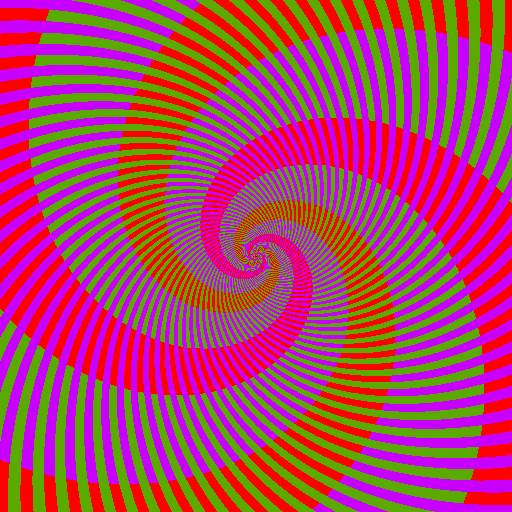
Interesting Optical Illusion - and explanation. {It's just a single page with an image. Go on, click it!}
To give proper credit, this is one of Akiyoshi Kitaoka's works. He maintains a huge web page of creations like this, including a sort of weblog, which is where I first saw this.
His copyright seems to have dropped off somewhere along the way...
posted by vacapinta at 9:21 PM on November 13, 2004
His copyright seems to have dropped off somewhere along the way...
posted by vacapinta at 9:21 PM on November 13, 2004
SHepd "please never do that again!" I need ne eyes now!!
posted by Elim at 9:39 PM on November 13, 2004
posted by Elim at 9:39 PM on November 13, 2004
can someone translate the explanation into small words for me?
I'll give it a shot. I could be wrong, but here's how I interpret it.
Using these mechanisms, retinal cells alter the activities of themselves and their neighbors until a steady state is reached. This takes several seconds, during which time small parts of the image seem to shift in brightness. This shift fools the motion-sensitive parts of visual cortex into thinking there's something that moved, and thence the illusion.
If I painted a big version of this in acrylics and put it on my wall, would it still work? Or does it have to be mathematically precise, do you think?
It should work even if you're sloppy (well, not Jackson Pollack sloppy). Depending on how big you make it, though, you may need to stand back for it to workposted by tss at 9:42 PM on November 13, 2004
I'll give it a shot. I could be wrong, but here's how I interpret it.
One account explained motion in the latter as arising from differential retinal processing times for bright and dim image regions (Faubert & Herbert, 1999). However, this account is not consistent with the observation that after fixation, apparent rotation slows to a stop over several seconds.Hypothesis: The brain "sees" bright parts of the image before it sees dark parts. Since two parts of a "snake segment" would then come after each other in rapid succession, it would give the illusion of movement. The problem is that this mechanism would make the snakes seem to jerk once and then stop, not slowly and smoothly roll to a halt. So another hypothesis is needed.
Slowing to a stop implies a saturating adaptive process.I.e. somewhere in your brain, the motion sensation is emerging from a mechanism that accumulates slowly, like water dripping into a bucket. When the bucket is full, or the neural adaptation mechanism saturated, the perception stops.
we show that three known visual mechanisms can predict the illusion: (1) nonlinear retinal adaptation to luminance, in which the light response and dark response adapt most rapidly at the lightest and darkest parts of the image, respectively; followed (optionally) by (2) contrast normalization; and then by (3) a standard motion detector ... operating at an appropriate scaleCells in the retina act in concert to filter the visual image in ways which are still under active research. Contrast adaptation is an ongoing modification of the sensitivity of retinal neurons/receptors that amplifies or reduces the contrast of the visual image, presumably to the benefit of the rest of the vision system. Nonlinear retinal adaptation to luminance refers vaguely to some additional modification of neural sensitivity based on the brightness of the image.
Using these mechanisms, retinal cells alter the activities of themselves and their neighbors until a steady state is reached. This takes several seconds, during which time small parts of the image seem to shift in brightness. This shift fools the motion-sensitive parts of visual cortex into thinking there's something that moved, and thence the illusion.
If I painted a big version of this in acrylics and put it on my wall, would it still work? Or does it have to be mathematically precise, do you think?
It should work even if you're sloppy (well, not Jackson Pollack sloppy). Depending on how big you make it, though, you may need to stand back for it to workposted by tss at 9:42 PM on November 13, 2004
But Dobbs! That still doesn't explain how John Ireland could go into the attorney's office and suddenly appear on his horse in the street! And don't tell me you just exist in one observable region in phased space and then simply realign your point of origin.
posted by ZachsMind at 9:43 PM on November 13, 2004
posted by ZachsMind at 9:43 PM on November 13, 2004
I should clarify that these mechanisms they're talking about are all local: that is, they modify the sensitivity for one small patch of the image based on the brightness (for example) at that patch and other nearby patches. It takes some time for these local interactions to stabilize across the retina, and that's why the motion illusion lasts for a few seconds. (It will seem to last longer if you allow your eyes to move the slightest bit.)
posted by tss at 9:50 PM on November 13, 2004
posted by tss at 9:50 PM on November 13, 2004

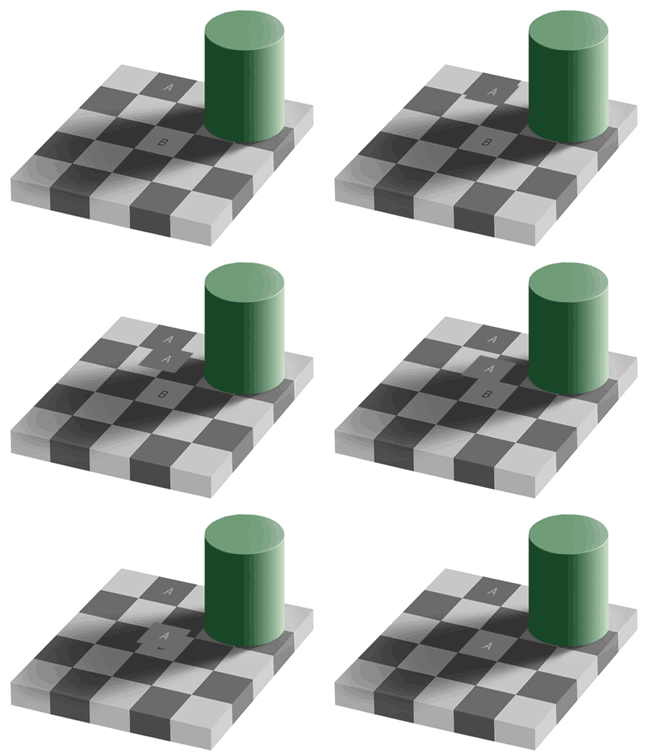
Hey, is this where we get to repost our favorite visual paradoxes from the classic You Think It's Moving But It's Not? Great. Cause this one is mine:
Good times.
posted by soyjoy at 10:21 PM on November 13, 2004
Good times.
posted by soyjoy at 10:21 PM on November 13, 2004
A==B, Louigi.
posted by five fresh fish at 9:49 AM on November 14, 2004
posted by five fresh fish at 9:49 AM on November 14, 2004
Louigi, the squares A and B are in fact the same shade of grey even though one appears darker than the other.
posted by dobbs at 10:38 AM on November 14, 2004
posted by dobbs at 10:38 AM on November 14, 2004
Soyjoy, that's the greatest! I sent this to some co-workers a few years ago and (predictably) they spent a whole lotta work time downloading colour pickers, etc., trying to prove that the two squares were not the same colour. My favourite response went something like, "Well, look at it! It's frickin' obvious! You can see that they're two different shades of grey!"
I shoulda bet money on it.
posted by 327.ca at 11:07 AM on November 14, 2004
I shoulda bet money on it.
posted by 327.ca at 11:07 AM on November 14, 2004
That's awesome. Like Wheel of Fortune for people on acid.
posted by Skygazer at 11:44 AM on November 14, 2004
posted by Skygazer at 11:44 AM on November 14, 2004
Thanks tss that explanation was great.
Hmm, my garage door needs painting.
posted by Mitheral at 8:12 AM on November 15, 2004
Hmm, my garage door needs painting.
posted by Mitheral at 8:12 AM on November 15, 2004
soyjoy, that's amazing! It actually appears that the small square marked "A" is floating down and landing on the square marked "B"!
posted by sonofsamiam at 8:51 AM on November 15, 2004
posted by sonofsamiam at 8:51 AM on November 15, 2004
Exactly - when in fact, the square marked "A" is actually floating upward toward the viewer, but getting smaller as it does, to creat the illusion that it's landed on top of "B!" It's all explained here.
wiseass.
posted by soyjoy at 12:18 PM on November 15, 2004
wiseass.
posted by soyjoy at 12:18 PM on November 15, 2004
Did anyone else see the gorilla in the middle of that?
posted by kindall at 2:39 PM on November 15, 2004
posted by kindall at 2:39 PM on November 15, 2004
I see gorillas everywhere now.
Shit, there goes another one!
posted by yhbc at 6:27 PM on November 15, 2004
Shit, there goes another one!
posted by yhbc at 6:27 PM on November 15, 2004
The board's a lot of false fronts, and the gorilla ran over there really fast.
posted by ZachsMind at 7:11 AM on November 18, 2004
posted by ZachsMind at 7:11 AM on November 18, 2004
« Older Ol' Dirty Bastard, dead at 35 | William Gibson Newer »
This thread has been archived and is closed to new comments
If I painted a big version of this in acrylics and put it on my wall, would it still work? Or does it have to be mathematically precise, do you think?
posted by CunningLinguist at 9:08 PM on November 13, 2004