A Tale of Two Christianities
November 19, 2004 8:08 PM Subscribe
Born-again liberal Christians. Do you think that mainline denominations are hemorraging members? Wrong. Fundamentalist Christianity is the way of the future and all US Evangelicals worship the same political party? Not so fast, buddy. Many scholars and theologians think that it's time for liberals to take Christianity back. Oregon State's Marcus J Borg, for example, argues that Christianity "still makes sense and is the most viable religious option for millions". He contends the earlier paradigm, based upon a punitive God, simply doesn't work anymore for too many people.
It is an argument for an alternative to the literalist and exclusivist tradition that has dominated Western Christianity in the modern era. According to Borg, "So different are these two views of Christianity that they almost produce two different religions, both using the same Bible and language. A time of two paradigms is virtually a tale of two Christianities."
There is, for example, an alternative view to the Resurrection Narrative not as report of an actual, physical event but as means for Jesus' early followers to express the miracle of his continuing spiritual presence among them, after his execution. It is in short an 'emerging paradigm which has been developing for over a hundred years and has recently become a major grass-roots movement within mainline denominations'.
Just don't be afraid to ask questions. Not even about the dogs beneath the Cross. More inside.
*clap* *clap* *clap*
That's quite a post. I'll comment on it later when I get the chance...
Largely, though, I'd say the difference in the 'two Christianities' is what they put as most important. Does Christ value morality more, or people?
posted by graventy at 8:13 PM on November 19, 2004
That's quite a post. I'll comment on it later when I get the chance...
Largely, though, I'd say the difference in the 'two Christianities' is what they put as most important. Does Christ value morality more, or people?
posted by graventy at 8:13 PM on November 19, 2004
Crossan also points out how "nonliteral" Christians can look into the very interesting fact that most of the Gospels Passion narratives turn out to be historicized prophecies.
Regarding the abuse of Jesus on the cross:
"Any mention of scourging, buffeting, and spitting comes from Isaiah 50:6; any mention of piercing, seeing, mourning comes from Zechariah 12:10; any mention of disrobing, rerobing or crowning comes from Zechariah 3:1-5."
____________
also of interest regarding the theory that the Romans would never have allowed a crucified criminal's friends to get his body back for burial:
Jewish Law, the Burial of Jesus, and the Third Day
posted by matteo at 8:16 PM on November 19, 2004
Regarding the abuse of Jesus on the cross:
"Any mention of scourging, buffeting, and spitting comes from Isaiah 50:6; any mention of piercing, seeing, mourning comes from Zechariah 12:10; any mention of disrobing, rerobing or crowning comes from Zechariah 3:1-5."
____________
also of interest regarding the theory that the Romans would never have allowed a crucified criminal's friends to get his body back for burial:
Jewish Law, the Burial of Jesus, and the Third Day
posted by matteo at 8:16 PM on November 19, 2004
on the other hand:
Paul's Belief in a Bodily Resurrection
(An argument against the contention that Jesus rose spiritually in Paul's thought).
posted by matteo at 8:18 PM on November 19, 2004
Paul's Belief in a Bodily Resurrection
(An argument against the contention that Jesus rose spiritually in Paul's thought).
posted by matteo at 8:18 PM on November 19, 2004
University of Durham: Department of Theology mp3 goodness
________
for more advanced readers:
Online Critical Pseudepigrapha
(doesn't work with Macs, sorry)
posted by matteo at 8:20 PM on November 19, 2004
________
for more advanced readers:
Online Critical Pseudepigrapha
(doesn't work with Macs, sorry)
posted by matteo at 8:20 PM on November 19, 2004
Notre Dame's (Father) John P Meier, author of the indispensable Marginal Jew series:
Q: What do you think happened to Jesus’ body?
A: The true Jesus who had died rose in the fullness of his humanity into the full presence of God. That is, I think, the essence of belief in the Resurrection. What the relationship of that risen body is to the body that was laid in the tomb is first of all not something that is historically verifiable. It is not subject to historical research at all.
Indeed, theologians among themselves disagree on that question. The fundamentalists would almost have a rather crass resuscitation view. Most traditional Christians have at least read Paul, First Corinthians 15 about the necessary transformation, as well as the Resurrection appearance narratives in the Gospels. They think in terms of transformation as well as continuity.
Thus the risen body of Jesus is indeed in continuity with the body laid to rest in the tomb. But nevertheless it has undergone radical transformation as a glorified, risen body. It is no longer of this world of time and space and not subject to its laws....There is a whole range of speculative possibilities about the precise relationship of the risen Jesus to the body laid in the tomb. As a person trying to pursue historical work, that is something beyond what I can investigate.
posted by matteo at 8:28 PM on November 19, 2004
Q: What do you think happened to Jesus’ body?
A: The true Jesus who had died rose in the fullness of his humanity into the full presence of God. That is, I think, the essence of belief in the Resurrection. What the relationship of that risen body is to the body that was laid in the tomb is first of all not something that is historically verifiable. It is not subject to historical research at all.
Indeed, theologians among themselves disagree on that question. The fundamentalists would almost have a rather crass resuscitation view. Most traditional Christians have at least read Paul, First Corinthians 15 about the necessary transformation, as well as the Resurrection appearance narratives in the Gospels. They think in terms of transformation as well as continuity.
Thus the risen body of Jesus is indeed in continuity with the body laid to rest in the tomb. But nevertheless it has undergone radical transformation as a glorified, risen body. It is no longer of this world of time and space and not subject to its laws....There is a whole range of speculative possibilities about the precise relationship of the risen Jesus to the body laid in the tomb. As a person trying to pursue historical work, that is something beyond what I can investigate.
posted by matteo at 8:28 PM on November 19, 2004
Are you having a spiritual experience this weekend, matteo? :-) Thanks for pointing out what many of us have long known, that Christians come in many flavors. But of course, most of the scholarship you reference isn't new, either. Just widely overlooked. Questions about the nature of the resurrection, for instance, are centuries old.
posted by ChrisTN at 8:31 PM on November 19, 2004
posted by ChrisTN at 8:31 PM on November 19, 2004
Nothing scares the powers more than liberation theology. Using the persuasive power of religion against them is looking more and more like the way to go.
posted by Space Coyote at 8:36 PM on November 19, 2004
posted by Space Coyote at 8:36 PM on November 19, 2004
Haiku for Pretty_Generic
Religion evolved:
Group adaptive fictions trump
Independent truths.
posted by weapons-grade pandemonium at 9:03 PM on November 19, 2004
Religion evolved:
Group adaptive fictions trump
Independent truths.
posted by weapons-grade pandemonium at 9:03 PM on November 19, 2004
is religion really something you should be able to pick and choose? i mean, if there was in fact an eight-armed, six eyed god that demanded virgin sacrifices every full moon, you couldnt just choose to be buddhist and ignore it. however, if in fact there is nothing out there that cares, feel free to pick and choose whatever belief system suits your personal temperment. if thats whats going on though, why even bother? this boils down to: i think "x", so im going to find a religion that supports "x" too. it seems to me if you truly beleived in your religion it would be: my religion says "x", so i think "x'". of course this leads to all sorts of horrible things, which is why i'm against most organized religion in the first place.
posted by sophist at 9:08 PM on November 19, 2004
posted by sophist at 9:08 PM on November 19, 2004
I was reading Crossan's Jesus: A Revolutionary Biography when Mel Gibson's The Passion According to Mad Max came out. The following quote leapt out at me then:
Great post.
posted by the_bone at 9:34 PM on November 19, 2004
It is hard... not only for those who have faith in Jesus, but also for those who have faith in humanity, to look closely at the terror of crucifixion in the ancient world. And when one does look closely, there is always the danger of prurient voyeurism, the vicarious thrill at another's horror.John Shelby Spong is another author who writes in the same vein as Borg and Crossan... I've read quite a few of his books, but have found Liberating the Gospels to be particularly worthy. And for a view of Jesus with a Buddhist feel, I recommend The Gospel According to Jesus by poet Stephen Mitchell.
Great post.
posted by the_bone at 9:34 PM on November 19, 2004
Actually, the primary cause for the increase in conservative Protestant churches compared to the mainline churches is that conservative Protestants have a higher fertility rate. Here's the academic study that goes into greater detail. (Two gratuitous Mike Hout references in 48 hours, heh heh.)
posted by jonp72 at 9:51 PM on November 19, 2004
posted by jonp72 at 9:51 PM on November 19, 2004
oddly, I was looking this morning at a site to which Borg was a contributor.
Meanwhile - "If we accept psychologically that possession by a sort of socially-maintained external personality, or daemon, is possible, then we have to seriously examine the long-term effects of a large part of the population giving itself over to a particular daemon - no matter what good things might be attributed to that daemon's assumed name by cultural tradition. The Greeks were clear that no single daemon alone could keep the balance, but that an individual was best off if conversant with an array of them, a pantheon, "multicultural" if you will. The early Christians rejected many of the Greek and Roman daemons, but incorporated many more of them into the guise of saints. It's only the more recent fundamentalists (both our own and the Wahabbis) who have insisted on a strict daemonic monoculture. Science tells us monoculture always makes for a weaker overall ecology than a richer, more sophisticated, more urbane and "coastal" in our political sense, mix.
So there several pressing questions for psychologists and sociologists: (1) Is "born againness" a form of daemonic possession? (2) If so, is the particular form of the daemon involved capable of integrating with modern knowledge and modes of life? (3) Whatever the answer to 2, what are the consequences and risk of this daemonic practice as a monoculture rather than as a richer ecology?
A close look at the statements of the Islamists will show that they hate us not for our freedom, but because they see us as polytheist and pagan - they even reject other Muslims for things like worshiping local saints at local shrines as being pagan. Our fundamentalists are also pursuing a monoculture based largely on a vengeful characterization of Jehovah from the Old Testament.
From the next stage of any culture, the previous stages' gods appear as demons (the negative version of the term). Look at Milton's Paradise Lost for an explicit discussion of the process, and particularly what was lost going from the Greko-Roman paganism to Christian monoculture (Shakespeare is also good on this). Also see James Hillman's Revisioning Psychology for the beginning of a (Jungian) treatment of these issues.
In short: The fundamentalist are daemonizing themselves - giving themselves over to possession. It's an old and dangerous practice, which often in history leads to blood being spilled in large amounts. Calling them daemonic may be scientifically accurate and fair, and necessary to apprehending and correcting a potentially very dangerous cultural turn towards the darkness, and even towards the apocalypse many of them explicitly conjure...."
Numbers mean little if liberal Christendom and other tolerant faith traditions have no organized response to right wing and "Dominionist" christian groups which advocate teological ethics in pursuit of worldy power towards imposing God's "dominion" over the Earth : such groups, at least for their relativism and cult-like tendencies, now exhibit a sort demonic energy - born in part from a fear of change and inchoate dread at impending events scarcely comprehended- which can only be countered by a force of equivalent vitality which is nonetheless positive.
GOD OF ANYTHING GOES : Religious Right becomes amoral relativist cult for Leviticus-based theocracy
"
posted by troutfishing at 10:14 PM on November 19, 2004
Meanwhile - "If we accept psychologically that possession by a sort of socially-maintained external personality, or daemon, is possible, then we have to seriously examine the long-term effects of a large part of the population giving itself over to a particular daemon - no matter what good things might be attributed to that daemon's assumed name by cultural tradition. The Greeks were clear that no single daemon alone could keep the balance, but that an individual was best off if conversant with an array of them, a pantheon, "multicultural" if you will. The early Christians rejected many of the Greek and Roman daemons, but incorporated many more of them into the guise of saints. It's only the more recent fundamentalists (both our own and the Wahabbis) who have insisted on a strict daemonic monoculture. Science tells us monoculture always makes for a weaker overall ecology than a richer, more sophisticated, more urbane and "coastal" in our political sense, mix.
So there several pressing questions for psychologists and sociologists: (1) Is "born againness" a form of daemonic possession? (2) If so, is the particular form of the daemon involved capable of integrating with modern knowledge and modes of life? (3) Whatever the answer to 2, what are the consequences and risk of this daemonic practice as a monoculture rather than as a richer ecology?
A close look at the statements of the Islamists will show that they hate us not for our freedom, but because they see us as polytheist and pagan - they even reject other Muslims for things like worshiping local saints at local shrines as being pagan. Our fundamentalists are also pursuing a monoculture based largely on a vengeful characterization of Jehovah from the Old Testament.
From the next stage of any culture, the previous stages' gods appear as demons (the negative version of the term). Look at Milton's Paradise Lost for an explicit discussion of the process, and particularly what was lost going from the Greko-Roman paganism to Christian monoculture (Shakespeare is also good on this). Also see James Hillman's Revisioning Psychology for the beginning of a (Jungian) treatment of these issues.
In short: The fundamentalist are daemonizing themselves - giving themselves over to possession. It's an old and dangerous practice, which often in history leads to blood being spilled in large amounts. Calling them daemonic may be scientifically accurate and fair, and necessary to apprehending and correcting a potentially very dangerous cultural turn towards the darkness, and even towards the apocalypse many of them explicitly conjure...."
Numbers mean little if liberal Christendom and other tolerant faith traditions have no organized response to right wing and "Dominionist" christian groups which advocate teological ethics in pursuit of worldy power towards imposing God's "dominion" over the Earth : such groups, at least for their relativism and cult-like tendencies, now exhibit a sort demonic energy - born in part from a fear of change and inchoate dread at impending events scarcely comprehended- which can only be countered by a force of equivalent vitality which is nonetheless positive.
GOD OF ANYTHING GOES : Religious Right becomes amoral relativist cult for Leviticus-based theocracy
"
posted by troutfishing at 10:14 PM on November 19, 2004
This thread makes a really important point that must be made. The religious right does not come anywhere close to representing Christianity as a whole. It's disappointing, however, that you immediately link this insight with a watered down view of the resurrection. If Jesus Christ did not rise from the dead, it turns Christianity from a religion into a philosophy. This is tantamount to reclaiming Christianity from the right, only to hand it back to them again. It sustains their claim that Christians who aren't right-wingers aren't Christians.
If you belive that Christ was not God, but was a great teacher, then I, as a Christian, am overjoyed to receive you as a friend and a brother and I'll happily talk about Christ's teaching with you into the early hours of the morning. But I will also defend the validity of the resurrection.
But arguments about the resurrection aside, nourishing says "In short: The fundamentalist are demonizing themselves - giving themselves over to possession." I couldn't agree more. For more on possession by idea, I refer you to Dostoyevsky.
For conservatives who aren't afraid to criticize the conservatives, may I offer The New Pantagruel
For people dedicated to the cause of life in all its forms, but unhappy with the GOP, I recommend Democrats for Life
posted by Orkboi at 10:44 PM on November 19, 2004
If you belive that Christ was not God, but was a great teacher, then I, as a Christian, am overjoyed to receive you as a friend and a brother and I'll happily talk about Christ's teaching with you into the early hours of the morning. But I will also defend the validity of the resurrection.
But arguments about the resurrection aside, nourishing says "In short: The fundamentalist are demonizing themselves - giving themselves over to possession." I couldn't agree more. For more on possession by idea, I refer you to Dostoyevsky.
For conservatives who aren't afraid to criticize the conservatives, may I offer The New Pantagruel
For people dedicated to the cause of life in all its forms, but unhappy with the GOP, I recommend Democrats for Life
posted by Orkboi at 10:44 PM on November 19, 2004
Or - to reframe what I just alluded to - this is not about theology per se : it is more about the threat that the most energetic will (temporarily and to disastrous effect ) triumph.
See : EQUIP
posted by troutfishing at 11:26 PM on November 19, 2004
See : EQUIP
posted by troutfishing at 11:26 PM on November 19, 2004
Thanks for the great post, Matteo. The Resurrection of Jesus in its Jewish Context was especially good; I have long found Crossan's writings to be more well-stated and rigorous than a lot of liberal writers like Spong, IMHO. For those who are interested in the historical Jesus aspects of these links, I would also highly recommend Walter Wink's "The Human Being: Jesus and the Enigma of the Son of the Man" (no, the second "the" isn't a typo). There is also the excellent "Birth of Christianity" by Crossan, which focuses (in part) on the question of "What was Christian Judaism before Paul and without Paul?" and the nature of Christianity in the 30s and 40s after Jesus' death.
' Course, we often forget the awkward elements of the early traditions, such as the apocalypticism:
WWJD?
posted by Planter at 12:32 AM on November 20, 2004
' Course, we often forget the awkward elements of the early traditions, such as the apocalypticism:
WWJD?
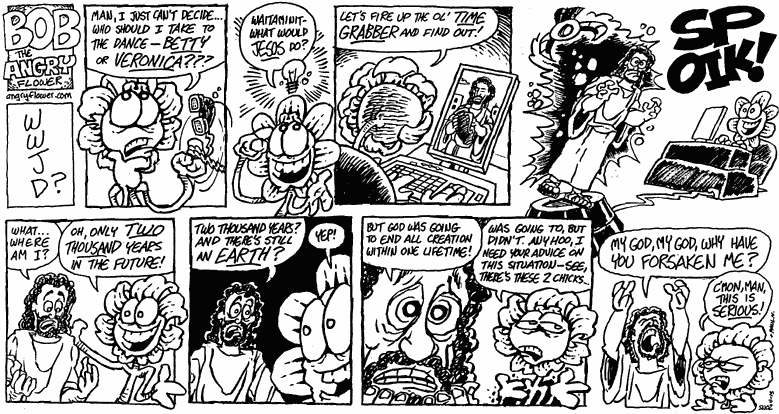
posted by Planter at 12:32 AM on November 20, 2004
I became a Christian at a Southern Baptist church in Houston. I went through a period, admittedly reactionary, of being a VERY right wing literal, fundamentalist Christian.
My background in Biology and research, however, led me to pretty much every buy the literal creationist view. I did think that could use dna as his legos and build us. After all, every model we have... the automobile and computers for example, have both homologous and analogous parts, go through periods of punctuated equilibrium, and evolve.
These models that we observe all share one thing... they are created. Natural selection does occur... take Commodore... (my favorite computer of all time was the C64, so I'm not bashing). Commodore didn't have the fitness to survive into this century and it's genes are largely nonexistent now (Damn I loved Gorf).
Anyway, that tangent aside...
Most fundamental, "right wing" Christians are not the nut job you think they are. They are some of the most genuine people I know. Many cling to Christianity not because of piety or stupidity... but they realize that human nature is evil, we are all pieces of shift unto ourselves, and need some guidance. They will not force you to convert, or decapitate you if you do not. Many biblical principles are very good for the individual and or group health of humans: The Golden Rule, Sexual purity, the Jewish and Muslim principle of not eating pork (pork parasites are hard to identify... and I'm sure presented a problem back in the day, altruism, marital fidelity, homosexuality (I'm not a homophobe... it is in there!), not getting std's / HIV, and on and on.
I understand the chasm. For instance... the Episcopalian homosexual priest issue. Do they just toss out parts of the bible for convenience???
Yes, Christianity has evolved... from it's lowest point, the Crusades (And now Islam is in it's analogous low point), to it's high point, which are todays evangelical churches that emphasize a relationship with god and not liturgical religion.
BTW if you want to know me and my outlook better, and you like retro-synth pop composed, arranged, performed by a burnt-out 33 year old doctor who cant sing, and why I am dancing baptist... look here
posted by dancingbaptist at 1:08 AM on November 20, 2004
My background in Biology and research, however, led me to pretty much every buy the literal creationist view. I did think that could use dna as his legos and build us. After all, every model we have... the automobile and computers for example, have both homologous and analogous parts, go through periods of punctuated equilibrium, and evolve.
These models that we observe all share one thing... they are created. Natural selection does occur... take Commodore... (my favorite computer of all time was the C64, so I'm not bashing). Commodore didn't have the fitness to survive into this century and it's genes are largely nonexistent now (Damn I loved Gorf).
Anyway, that tangent aside...
Most fundamental, "right wing" Christians are not the nut job you think they are. They are some of the most genuine people I know. Many cling to Christianity not because of piety or stupidity... but they realize that human nature is evil, we are all pieces of shift unto ourselves, and need some guidance. They will not force you to convert, or decapitate you if you do not. Many biblical principles are very good for the individual and or group health of humans: The Golden Rule, Sexual purity, the Jewish and Muslim principle of not eating pork (pork parasites are hard to identify... and I'm sure presented a problem back in the day, altruism, marital fidelity, homosexuality (I'm not a homophobe... it is in there!), not getting std's / HIV, and on and on.
I understand the chasm. For instance... the Episcopalian homosexual priest issue. Do they just toss out parts of the bible for convenience???
Yes, Christianity has evolved... from it's lowest point, the Crusades (And now Islam is in it's analogous low point), to it's high point, which are todays evangelical churches that emphasize a relationship with god and not liturgical religion.
BTW if you want to know me and my outlook better, and you like retro-synth pop composed, arranged, performed by a burnt-out 33 year old doctor who cant sing, and why I am dancing baptist... look here
posted by dancingbaptist at 1:08 AM on November 20, 2004
A time of two paradigms is virtually a tale of two Christianities.
It was the best of times, it was the worst of times,
it was the age of wisdom, it was the age of foolishness. . .
great post matteo
posted by three blind mice at 1:32 AM on November 20, 2004
It was the best of times, it was the worst of times,
it was the age of wisdom, it was the age of foolishness. . .
great post matteo
posted by three blind mice at 1:32 AM on November 20, 2004
d_b_,
Every Christian throws out parts of the Bible, even you. Taken as a whole, the Bible would make modern life near unliveable. I could list the passages I'm sure you and other Baptists ignore, but I'm sure you're also quite familiar with them and don't need the reminding.
As for fundamentalists, I grew up Southern Baptist and was sent through a Baptist school for most of my education. The fundamentalists I knew and still know (mum is very much a fundie) are people I love and respect. However, their view of the world has made me the born-again Secularist that I am today. My experiences in the Christian school especially reinforce the reasons why theology should never be used as a basis for government.
But this seems to be their desired goal. Individually, they're mostly nice people. Collectively, I think they're dangerous as they wish to have their beliefs made the law of the land and won't settle for anything less. They certainly have a strange view of what liberty means in this country.
Anecdotal case in point: In Sunday School last July, visiting Mum in Arkansas, the class teacher gave a short speech on how wonderful liberty was and how lucky we all were to live in a country as free as ours and how we should celebrate the 4th with gusto, etc. And then, he segued into a plea for us to call the two Arkansas senators to urge them to support the FMA, when then led into a segue about a recent gay pride parade (the first ever in Conway, Arkansas!), and eventually ended with these comments: "Why should we tolerate them?" In just ten minutes, we went from how great liberty was, to a plea for intolerance of those who have different beliefs and lifestyles.
I wish I could say this is just some small redneck church in the middle of nowhere, but I've seen essentially the same sentiments at every level of the Southern Baptist community. This sort of thing is why y'all scare those of us who believe God is a private matter and should be kept out of Government.
No, y'all haven't started the stoning or the decapitations. And, Handsmaid Tale fantasies to the contrary, I don't think you ever will. But the fundamentalists aren't content with simply rendering unto Caesar; they wish to be Caesar. Speaking of ignoring the parts of the Bible you don't like, they've completely ignored the apolitcal example of Jesus and his words "My Kingdom is not of this world."
posted by pandaharma at 3:26 AM on November 20, 2004
Every Christian throws out parts of the Bible, even you. Taken as a whole, the Bible would make modern life near unliveable. I could list the passages I'm sure you and other Baptists ignore, but I'm sure you're also quite familiar with them and don't need the reminding.
As for fundamentalists, I grew up Southern Baptist and was sent through a Baptist school for most of my education. The fundamentalists I knew and still know (mum is very much a fundie) are people I love and respect. However, their view of the world has made me the born-again Secularist that I am today. My experiences in the Christian school especially reinforce the reasons why theology should never be used as a basis for government.
But this seems to be their desired goal. Individually, they're mostly nice people. Collectively, I think they're dangerous as they wish to have their beliefs made the law of the land and won't settle for anything less. They certainly have a strange view of what liberty means in this country.
Anecdotal case in point: In Sunday School last July, visiting Mum in Arkansas, the class teacher gave a short speech on how wonderful liberty was and how lucky we all were to live in a country as free as ours and how we should celebrate the 4th with gusto, etc. And then, he segued into a plea for us to call the two Arkansas senators to urge them to support the FMA, when then led into a segue about a recent gay pride parade (the first ever in Conway, Arkansas!), and eventually ended with these comments: "Why should we tolerate them?" In just ten minutes, we went from how great liberty was, to a plea for intolerance of those who have different beliefs and lifestyles.
I wish I could say this is just some small redneck church in the middle of nowhere, but I've seen essentially the same sentiments at every level of the Southern Baptist community. This sort of thing is why y'all scare those of us who believe God is a private matter and should be kept out of Government.
No, y'all haven't started the stoning or the decapitations. And, Handsmaid Tale fantasies to the contrary, I don't think you ever will. But the fundamentalists aren't content with simply rendering unto Caesar; they wish to be Caesar. Speaking of ignoring the parts of the Bible you don't like, they've completely ignored the apolitcal example of Jesus and his words "My Kingdom is not of this world."
posted by pandaharma at 3:26 AM on November 20, 2004
It's disappointing, however, that you immediately link this insight with a watered down view of the resurrection.
watered-down? why would that be? do you really think that "not-flying-up-to-heaven-like-Superman" means "watered-down"?
"no-blue-ray-of-light-impregnating-a-virgin-girl" means watered down, too?
Oh, brother, why don't you want us at your table? seriously. you've read your Paul (a great guy who gets a raw deal most of the time in the mdoern world, but he hadn't met Jesus when he was alive, nor was he interested in discussing anything about Jesus' life in all those letters by the way -- how silly is that?). but come on, as I linked above, what does "taken up" mean in the 1st Century BC, among illiterate peasants or worried Jews or hard-assed Romans or perplexed Egyptians? what?
I dare to suggest in 2004 we can call a metaphor a metaphor, and an empty tomb an empty tomb
If Jesus Christ did not rise from the dead, it turns Christianity from a religion into a philosophy.
ah, "a philosophy", that old anti-Buddhist cheap crack.
again, that old Augustine thing of De Vera Religione. a marvelous Platonic thinker, but really -- why do you keep using litmus tests, just like the right-wingers do? again, why don't you want us at your table, or in your congregation? even Meier points out that so many modern men and women give a different, more intellectual reading to the Gospels, and one cannot invoke "ah, it's a mystery of Faith" every two minutes just to put them in their place. they'll leave your church, and go home read a book, or play with their kids. and you'll stay there in empty churches.
empty tomb, empty church. how bitterly ironic.
wanna talk about watered-down? let's talk about water. Jesus walking on water. even a 10-year-old today can figure out the metaphoric elephant in the room -- without Jesus, you'll catch no fish. try selling that line to an impoverished peasant living in a shack with the floor made of dirt with his sick wife and child. try selling them that. "without Jesus you'll catch no fish".
a crowd-pleaser, huh? wait a sec, let's use a metaphor, let's tell them that Jesus walked on water and reached the boat of his Church and only then they caught fish.
sounds better huh?
;)
This is tantamount to reclaiming Christianity from the right, only to hand it back to them again. It sustains their claim that Christians who aren't right-wingers aren't Christians.
no, I love you brother, but fuck that. fuck that. if you want to let them hijack a message of love for the outcasts and the unclean, and communal eating and healing of the sick and forgiving of sin, if you want to let hateful people hijack all that treasure in the name of a Middle Age view of God and of the world, go ahead. many of us won't let them.
I hope that you never lost a loved one. I did. I saw them in my dreams a lot right after they died, and they still come every once in a while. I ask for their guidance. they're still with me, I feel it. feel free to disregard that. but I think Jesus disciples experienced the same thing, in the terrible weeks and months after their Rabbi was taken away and murdered and thrown in a ditch like a common criminal -- and they fled Jerusalem fearing the same was going to happen to them.
he's still with us, though. I call that a miracle, no need for him to fly anywhere. or to meet again his disciples to eat broiled fish and then disappear again
______________
trouty: ironically enough, I was just the other day reading Bolt:
Peter G. Bolt's essay on "Jesus, the Daimons, and the Dead." The writer argues that unlike today, where almost none of us would think of interpreting the word "daimon" to mean the spirit of a deceased person, to a first century audience, this would have almost automatically have been interpreted to mean just that.
Mr. Bolt cites numerous examples of this concept in Greco-Roman literature from before, during and after the New Testament period. He also shows how the view fits well when interpreting passages involving daimons throughout scripture. The exorcisms in the book of Mark are then analyzed from this point of view to show us what the implications would have been if the audience had indeed viewed daimons as the spirits of deceased humans
posted by matteo at 3:31 AM on November 20, 2004
watered-down? why would that be? do you really think that "not-flying-up-to-heaven-like-Superman" means "watered-down"?
"no-blue-ray-of-light-impregnating-a-virgin-girl" means watered down, too?
Oh, brother, why don't you want us at your table? seriously. you've read your Paul (a great guy who gets a raw deal most of the time in the mdoern world, but he hadn't met Jesus when he was alive, nor was he interested in discussing anything about Jesus' life in all those letters by the way -- how silly is that?). but come on, as I linked above, what does "taken up" mean in the 1st Century BC, among illiterate peasants or worried Jews or hard-assed Romans or perplexed Egyptians? what?
I dare to suggest in 2004 we can call a metaphor a metaphor, and an empty tomb an empty tomb
If Jesus Christ did not rise from the dead, it turns Christianity from a religion into a philosophy.
ah, "a philosophy", that old anti-Buddhist cheap crack.
again, that old Augustine thing of De Vera Religione. a marvelous Platonic thinker, but really -- why do you keep using litmus tests, just like the right-wingers do? again, why don't you want us at your table, or in your congregation? even Meier points out that so many modern men and women give a different, more intellectual reading to the Gospels, and one cannot invoke "ah, it's a mystery of Faith" every two minutes just to put them in their place. they'll leave your church, and go home read a book, or play with their kids. and you'll stay there in empty churches.
empty tomb, empty church. how bitterly ironic.
wanna talk about watered-down? let's talk about water. Jesus walking on water. even a 10-year-old today can figure out the metaphoric elephant in the room -- without Jesus, you'll catch no fish. try selling that line to an impoverished peasant living in a shack with the floor made of dirt with his sick wife and child. try selling them that. "without Jesus you'll catch no fish".
a crowd-pleaser, huh? wait a sec, let's use a metaphor, let's tell them that Jesus walked on water and reached the boat of his Church and only then they caught fish.
sounds better huh?
;)
This is tantamount to reclaiming Christianity from the right, only to hand it back to them again. It sustains their claim that Christians who aren't right-wingers aren't Christians.
no, I love you brother, but fuck that. fuck that. if you want to let them hijack a message of love for the outcasts and the unclean, and communal eating and healing of the sick and forgiving of sin, if you want to let hateful people hijack all that treasure in the name of a Middle Age view of God and of the world, go ahead. many of us won't let them.
I hope that you never lost a loved one. I did. I saw them in my dreams a lot right after they died, and they still come every once in a while. I ask for their guidance. they're still with me, I feel it. feel free to disregard that. but I think Jesus disciples experienced the same thing, in the terrible weeks and months after their Rabbi was taken away and murdered and thrown in a ditch like a common criminal -- and they fled Jerusalem fearing the same was going to happen to them.
he's still with us, though. I call that a miracle, no need for him to fly anywhere. or to meet again his disciples to eat broiled fish and then disappear again
______________
trouty: ironically enough, I was just the other day reading Bolt:
Peter G. Bolt's essay on "Jesus, the Daimons, and the Dead." The writer argues that unlike today, where almost none of us would think of interpreting the word "daimon" to mean the spirit of a deceased person, to a first century audience, this would have almost automatically have been interpreted to mean just that.
Mr. Bolt cites numerous examples of this concept in Greco-Roman literature from before, during and after the New Testament period. He also shows how the view fits well when interpreting passages involving daimons throughout scripture. The exorcisms in the book of Mark are then analyzed from this point of view to show us what the implications would have been if the audience had indeed viewed daimons as the spirits of deceased humans
posted by matteo at 3:31 AM on November 20, 2004
DB:
"they realize that human nature is evil, we are all pieces of shift unto ourselves, and need some guidance"
First, Hitler, Pol Pot, Stalin and their ilk notwithstanding, human nature is not in and of itself "evil". I know mine isn't. Lazy, shiftless and self-indulgent - without a doubt. But evil? Speak for yourself.
Secondly, the notion that morality (or "guidance" if you will) is the sole province of religion, and that we're all in need of it, is, I'm afraid, a crock. I am an atheist, and my own behavior is quite moral, thank you very much, without the "guidance" of an "approved" religion such as the Christianity you describe.
Third - why is "religion" somehow "better" than "philosophy"? Is it related to the ability to believe six impossible things before breakfast?
posted by kcds at 4:04 AM on November 20, 2004
"they realize that human nature is evil, we are all pieces of shift unto ourselves, and need some guidance"
First, Hitler, Pol Pot, Stalin and their ilk notwithstanding, human nature is not in and of itself "evil". I know mine isn't. Lazy, shiftless and self-indulgent - without a doubt. But evil? Speak for yourself.
Secondly, the notion that morality (or "guidance" if you will) is the sole province of religion, and that we're all in need of it, is, I'm afraid, a crock. I am an atheist, and my own behavior is quite moral, thank you very much, without the "guidance" of an "approved" religion such as the Christianity you describe.
Third - why is "religion" somehow "better" than "philosophy"? Is it related to the ability to believe six impossible things before breakfast?
posted by kcds at 4:04 AM on November 20, 2004
Borg is good stuff; his books have been of great help to me.
posted by eustacescrubb at 4:55 AM on November 20, 2004
posted by eustacescrubb at 4:55 AM on November 20, 2004
In just ten minutes, we went from how great liberty was, to a plea for intolerance of those who have different beliefs and lifestyles.
a friend of mine once opined that the god of christianity was different in character than the god of judaism, because having become man, He realized just how bloody difficult it was for us to live up to His expectations.
unfortunately for man we have not enjoyed the experience of being god and for us acting like jesus is just too damned hard.
this is why instead of being the religion OF jesus, christianity is a religion ABOUT jesus.
in my view, it would probably be better if christians believed jesus were not god, but believed that jesus was simply a man inspired by god and that everyone has it in them to live like jesus.
posted by three blind mice at 4:57 AM on November 20, 2004
a friend of mine once opined that the god of christianity was different in character than the god of judaism, because having become man, He realized just how bloody difficult it was for us to live up to His expectations.
unfortunately for man we have not enjoyed the experience of being god and for us acting like jesus is just too damned hard.
this is why instead of being the religion OF jesus, christianity is a religion ABOUT jesus.
in my view, it would probably be better if christians believed jesus were not god, but believed that jesus was simply a man inspired by god and that everyone has it in them to live like jesus.
posted by three blind mice at 4:57 AM on November 20, 2004
True Christianity is not something that can be 'owned' or 'used' by any group of people. But throughout its history, this religion, like all others, has been twisted and perverted into just another tool for power and divisiveness. As long as people see and use religion in this context, all they are doing is stumbling blindly in a darkness of their own creation. How very sad.
posted by wadefranklin at 5:17 AM on November 20, 2004
posted by wadefranklin at 5:17 AM on November 20, 2004
This seems like the same stuff as the great book "Moral Politics" by linguist George Lakoff (first read about it on MeFi), although I think he'd say neither view is literal.
I grew up with conservative Christians whose idea of Christianity was in line with the "strict father" metaphor which has in my adult life seemed like pure evil. But I'm still shocked to have my abandonment of Christianity on moral grounds questioned after reading it interpreted in the "nurturing parent" metaphor - I'm suddenly seeing some wisdom in it. It reminds me of re-hearing the couple talk in the movie "The Conversation"... totally different meaning from same words. Buddhism still seems wiser but I'd love not to have to fight 80% of the country my whole life.
I like to think I'm seeing something good coming about from this last election - For the left to get some balls in reclaiming their rightful place on the moral high ground. I think we tend to function on a higher stage of moral development (Kohlberg's level 2 and 3) but that we tend to have the attitude of "I don't have the right to tell you what's right and wrong" while the conservatives (level 1 and 2) narcissistically want the moral high ground like a toddler saying "mine" (same level of moral development as many). I think the left could tap into tremendous power to take the world in the right direction and help the conservative adult-children develop if we speak out about this stuff.
posted by RemusLupin at 5:49 AM on November 20, 2004
I grew up with conservative Christians whose idea of Christianity was in line with the "strict father" metaphor which has in my adult life seemed like pure evil. But I'm still shocked to have my abandonment of Christianity on moral grounds questioned after reading it interpreted in the "nurturing parent" metaphor - I'm suddenly seeing some wisdom in it. It reminds me of re-hearing the couple talk in the movie "The Conversation"... totally different meaning from same words. Buddhism still seems wiser but I'd love not to have to fight 80% of the country my whole life.
I like to think I'm seeing something good coming about from this last election - For the left to get some balls in reclaiming their rightful place on the moral high ground. I think we tend to function on a higher stage of moral development (Kohlberg's level 2 and 3) but that we tend to have the attitude of "I don't have the right to tell you what's right and wrong" while the conservatives (level 1 and 2) narcissistically want the moral high ground like a toddler saying "mine" (same level of moral development as many). I think the left could tap into tremendous power to take the world in the right direction and help the conservative adult-children develop if we speak out about this stuff.
posted by RemusLupin at 5:49 AM on November 20, 2004
Matteo, thanks for this post. It's stuff like this, and the resulting discussion, that keeps me coming back to the blue.
posted by ninthart at 5:59 AM on November 20, 2004
posted by ninthart at 5:59 AM on November 20, 2004
..for our insistence that our faith is a fact and that others’ faith is a lie is, I think, a cancer that eats at the heart of Christianity..
He singles out Christianity, but it's an exclusionist belief common in a lot of religious facets that has resulted in the majority of the darkest hours of human history.
Excellent post and follow-up discussion, I'll keep coming back to this one all day.
posted by purephase at 6:37 AM on November 20, 2004
He singles out Christianity, but it's an exclusionist belief common in a lot of religious facets that has resulted in the majority of the darkest hours of human history.
Excellent post and follow-up discussion, I'll keep coming back to this one all day.
posted by purephase at 6:37 AM on November 20, 2004
Many scholars and theologians think that it's time for liberals to take Christianity back.
Maybe we could just give it up.
posted by orange clock at 6:49 AM on November 20, 2004
Maybe we could just give it up.
posted by orange clock at 6:49 AM on November 20, 2004
Orkboi has it exactly right -- liberal "Christianity" which rejects the core Concilliar dogmae, like the bodily resurrection of Christ, is going nowhere.
It delegitmizes any effort to advocate for the (left-friendly) social Gospel (you know, the Beatitudes, etc.) among the more conservatively-inclined churches.
It's also a dead end. There's no good reason to be a practicing Christian if one adopts a John Shelby Spong approach to the religion. There are lots more satisfying forms of recreation, political organization, and public service -- which is why you can fit the entire congregation of a typical Unitarian or Spong-style mainline congregation in the third overflow baby crying room of a typical thriving Evangelical church.
posted by MattD at 6:59 AM on November 20, 2004
It delegitmizes any effort to advocate for the (left-friendly) social Gospel (you know, the Beatitudes, etc.) among the more conservatively-inclined churches.
It's also a dead end. There's no good reason to be a practicing Christian if one adopts a John Shelby Spong approach to the religion. There are lots more satisfying forms of recreation, political organization, and public service -- which is why you can fit the entire congregation of a typical Unitarian or Spong-style mainline congregation in the third overflow baby crying room of a typical thriving Evangelical church.
posted by MattD at 6:59 AM on November 20, 2004
> If Jesus Christ did not rise from the dead, it turns Christianity from
> a religion into a philosophy.
It remains a religion. Philosophy is about what you think, and of course a great deal of philosophy has accreted to Christianity (dogmas, doctrines, supporting arguments, and so on) as it has to all but the most purely mystical religions. But religion itself is not about what you think but instead about who you are and what you do. Pace the opinion mongers, from Pharisees to Scholastics to [insert favorite modern doctrine-floggers] religion is not dialectical, not about discursive reason or truth versus falsehood. Can a color be true or false? Can a person be true or false? Can an action be true or false? The concept doesn't apply. Worse, it's pernicious to try to make religion dialectical, because that (together with plain old tribalism) is what generates most of the exclusionist doctrines over which so much blood has been shed.
Religion is the extended deed of journeying toward the most important [thing, subject , entity, focus, words don't work here, what's needed is the action of direct pointing] available to a human being. Among Christians, any one who accepts that the journey is worth undertaking and has set out on it is a religious person even if he doubts (or doesn't care about) the virgin birth or the bodily resurrection or that Jesus was begotten, not made. The point is not what your opinions on points of dogma may be but where you want to go.
> If you believe that Christ was not God, but was a great teacher...
I personally believe both--but then (being fresh from re-reading the NT) I believe you and I and matteo are also children of God, hence also God, in exactly the same sense Christ was, and am well armed with NT citations to back me up.
> ...then I, as a Christian, am overjoyed to receive you as a friend and a
> brother and I'll happily talk about Christ's teaching with you into the
> early hours of the morning. But I will also defend the validity of the
> resurrection.
"where two or three are gathered together in my name, there am I in the midst of them." That's the crucial resurrection, it happens every day, rubbing our noses in it was Christ's greatest gift (though it takes place for any who wish it, not just Christians) and it's enough of a taste of what's central and permanent to keep a lot of us (intermittently) alive enough to go on plodding through the world of--if Kierkegaard didn't call it distraction unto death, he ought to have. While an opinion pro or con the resurrection of the body (either Jesus' or my own) doesn't seem to help a bit.
n.b., fuller joins chorus thanking matteo for excellent post.
posted by jfuller at 7:07 AM on November 20, 2004
> a religion into a philosophy.
It remains a religion. Philosophy is about what you think, and of course a great deal of philosophy has accreted to Christianity (dogmas, doctrines, supporting arguments, and so on) as it has to all but the most purely mystical religions. But religion itself is not about what you think but instead about who you are and what you do. Pace the opinion mongers, from Pharisees to Scholastics to [insert favorite modern doctrine-floggers] religion is not dialectical, not about discursive reason or truth versus falsehood. Can a color be true or false? Can a person be true or false? Can an action be true or false? The concept doesn't apply. Worse, it's pernicious to try to make religion dialectical, because that (together with plain old tribalism) is what generates most of the exclusionist doctrines over which so much blood has been shed.
Religion is the extended deed of journeying toward the most important [thing, subject , entity, focus, words don't work here, what's needed is the action of direct pointing] available to a human being. Among Christians, any one who accepts that the journey is worth undertaking and has set out on it is a religious person even if he doubts (or doesn't care about) the virgin birth or the bodily resurrection or that Jesus was begotten, not made. The point is not what your opinions on points of dogma may be but where you want to go.
> If you believe that Christ was not God, but was a great teacher...
I personally believe both--but then (being fresh from re-reading the NT) I believe you and I and matteo are also children of God, hence also God, in exactly the same sense Christ was, and am well armed with NT citations to back me up.
> ...then I, as a Christian, am overjoyed to receive you as a friend and a
> brother and I'll happily talk about Christ's teaching with you into the
> early hours of the morning. But I will also defend the validity of the
> resurrection.
"where two or three are gathered together in my name, there am I in the midst of them." That's the crucial resurrection, it happens every day, rubbing our noses in it was Christ's greatest gift (though it takes place for any who wish it, not just Christians) and it's enough of a taste of what's central and permanent to keep a lot of us (intermittently) alive enough to go on plodding through the world of--if Kierkegaard didn't call it distraction unto death, he ought to have. While an opinion pro or con the resurrection of the body (either Jesus' or my own) doesn't seem to help a bit.
n.b., fuller joins chorus thanking matteo for excellent post.
posted by jfuller at 7:07 AM on November 20, 2004
Many biblical principles are very good for the individual and or group health of humans
Psalm 137
1 By the rivers of Babylon, there we sat down, yea, we wept, when we remembered Zion.
2 We hanged our harps upon the willows in the midst thereof.
3 For there they that carried us away captive required of us a song; and they that wasted us required of us mirth, saying, Sing us one of the songs of Zion.
4 How shall we sing the LORD's song in a strange land?
5 If I forget thee, O Jerusalem, let my right hand forget her cunning.
6 If I do not remember thee, let my tongue cleave to the roof of my mouth; if I prefer not Jerusalem above my chief joy.
7 Remember, O LORD, the children of Edom in the day of Jerusalem; who said, Rase it, rase it, even to the foundation thereof.
8 O daughter of Babylon, who art to be destroyed; happy shall he be, that rewardeth thee as thou hast served us.
9 Happy shall he be, that taketh and dasheth thy little ones against the stones.
posted by orange clock at 7:19 AM on November 20, 2004
Psalm 137
1 By the rivers of Babylon, there we sat down, yea, we wept, when we remembered Zion.
2 We hanged our harps upon the willows in the midst thereof.
3 For there they that carried us away captive required of us a song; and they that wasted us required of us mirth, saying, Sing us one of the songs of Zion.
4 How shall we sing the LORD's song in a strange land?
5 If I forget thee, O Jerusalem, let my right hand forget her cunning.
6 If I do not remember thee, let my tongue cleave to the roof of my mouth; if I prefer not Jerusalem above my chief joy.
7 Remember, O LORD, the children of Edom in the day of Jerusalem; who said, Rase it, rase it, even to the foundation thereof.
8 O daughter of Babylon, who art to be destroyed; happy shall he be, that rewardeth thee as thou hast served us.
9 Happy shall he be, that taketh and dasheth thy little ones against the stones.
posted by orange clock at 7:19 AM on November 20, 2004
Malachi 2
3 Behold, I will corrupt your seed, and spread dung upon your faces, even the dung of your solemn feasts; and one shall take you away with it.
Deuteronomy 21
18 If a man have a stubborn and rebellious son, which will not obey the voice of his father, or the voice of his mother, and that, when they have chastened him, will not hearken unto them:
19 Then shall his father and his mother lay hold on him, and bring him out unto the elders of his city, and unto the gate of his place;
20 And they shall say unto the elders of his city, This our son is stubborn and rebellious, he will not obey our voice; he is a glutton, and a drunkard.
21 And all the men of his city shall stone him with stones, that he die: so shalt thou put evil away from among you; and all Israel shall hear, and fear.
1 Timothy 2
11 Let the woman learn in silence with all subjection.
12 But I suffer not a woman to teach, nor to usurp authority over the man, but to be in silence.
posted by orange clock at 7:25 AM on November 20, 2004
3 Behold, I will corrupt your seed, and spread dung upon your faces, even the dung of your solemn feasts; and one shall take you away with it.
Deuteronomy 21
18 If a man have a stubborn and rebellious son, which will not obey the voice of his father, or the voice of his mother, and that, when they have chastened him, will not hearken unto them:
19 Then shall his father and his mother lay hold on him, and bring him out unto the elders of his city, and unto the gate of his place;
20 And they shall say unto the elders of his city, This our son is stubborn and rebellious, he will not obey our voice; he is a glutton, and a drunkard.
21 And all the men of his city shall stone him with stones, that he die: so shalt thou put evil away from among you; and all Israel shall hear, and fear.
1 Timothy 2
11 Let the woman learn in silence with all subjection.
12 But I suffer not a woman to teach, nor to usurp authority over the man, but to be in silence.
posted by orange clock at 7:25 AM on November 20, 2004
These links and the resulting comments underline to me the greatest dilemma faced by religion: do you allow Dogma to be challenged, or do you not? If you allow individual thought, this leads to splintering resulting in a weakening of your power base. If you do not allow individual thought, the result is stagnation and an accumulation of power by the authorized interpreters which can result in abuse.
Back when we all lived in small tribes, a shaman would do all the interpreting for us. Anyone who questioned the shaman would have to be destroyed or cast out, or the shaman would lose power. This is the model we see today in fundamental churches.
My father-in-law, Robert, must take everything his pastor tells him at face value, otherwise his faith might be utterly destroyed. He has told me this himself. If Robert allows himself to question the idea of creationism, then he would have to question other fundamental Baptist teachings concerning the Bible. The Southern Baptist Church teaches that the Bible is the divine word of God and as such it is not open to questioning or individual interpretation. (The Methodists, on the other hand, teach that the Bible is the written work of men inspired by God, therefore it is open to questioning and individual interpretation.) So Robert has a dilemma: ignore all scientific proof, or question the basic dogma of his religion? He chooses to turn his back on science.
Prior to Martin Luther, the Roman Catholic church was in the same position. But their Dogma went virtually unchallenged for 1500 years and the resultant power base was massive. The abuse of power also became massive: burning of heretics, excommunication of entire countries used as a power play, selling of indulgences, and such a tremendous accumulation of gold and real estate that peasants would beg for the scraps from the Priest's table.
By questioning the basic dogma of Roman Catholic church-- for example, the infallibility of the Pope-- Martin Luther opened a Pandora's box which has led to the resultant weakening of Christianity's power base. Which sect is right? Who has the direct pipeline to God? I, for one, hartily pray that Chrisitians never again recapture the power that once was the Holy Roman Empire.
posted by Secret Life of Gravy at 7:37 AM on November 20, 2004
Back when we all lived in small tribes, a shaman would do all the interpreting for us. Anyone who questioned the shaman would have to be destroyed or cast out, or the shaman would lose power. This is the model we see today in fundamental churches.
My father-in-law, Robert, must take everything his pastor tells him at face value, otherwise his faith might be utterly destroyed. He has told me this himself. If Robert allows himself to question the idea of creationism, then he would have to question other fundamental Baptist teachings concerning the Bible. The Southern Baptist Church teaches that the Bible is the divine word of God and as such it is not open to questioning or individual interpretation. (The Methodists, on the other hand, teach that the Bible is the written work of men inspired by God, therefore it is open to questioning and individual interpretation.) So Robert has a dilemma: ignore all scientific proof, or question the basic dogma of his religion? He chooses to turn his back on science.
Prior to Martin Luther, the Roman Catholic church was in the same position. But their Dogma went virtually unchallenged for 1500 years and the resultant power base was massive. The abuse of power also became massive: burning of heretics, excommunication of entire countries used as a power play, selling of indulgences, and such a tremendous accumulation of gold and real estate that peasants would beg for the scraps from the Priest's table.
By questioning the basic dogma of Roman Catholic church-- for example, the infallibility of the Pope-- Martin Luther opened a Pandora's box which has led to the resultant weakening of Christianity's power base. Which sect is right? Who has the direct pipeline to God? I, for one, hartily pray that Chrisitians never again recapture the power that once was the Holy Roman Empire.
posted by Secret Life of Gravy at 7:37 AM on November 20, 2004
MattD seems to be: A - arguing that because evangelicalism is more popular, it's helathier, in direct contradiction to Christ's contention that the least popular path is the one that leads to God; B - arguing that the theology of Spong (with whom I generally disagree), the theology of the Unitarians and the theology of Marcus Borg (with whom I generally agree) are all similar enough to be lumped together, which just shows he's not familiar enough with them to make arguments about them of any substance.
orange clock proves he can cherry-pick Bible verses pretty well, but that he doesn't understand the definition of many.
posted by eustacescrubb at 7:38 AM on November 20, 2004
orange clock proves he can cherry-pick Bible verses pretty well, but that he doesn't understand the definition of many.
posted by eustacescrubb at 7:38 AM on November 20, 2004
I'm well aware of born again liberals. I work with plenty. What I don't get is how so-called liberal Christianity is about non-literalism, religious diversity, or even liberation politics. It seems just to me yet another political schism, not a spiritual or even religious one. The real stumbling block is that there are no real Christians. On the right, there are truly evil false Pharisees of the type Christ warned about: praying on street corners, throwing stones at women at the wells, trying to shove camels through the eyes of needles, changing money in the temples, and bearing false witness on such a massive scale that it results in support for the craziest war machine ever. That what passes for conservative has laid mantle to the title "Christian" in these times either suggests a fulfillment of Jesus's prophecy concerning false prophets or just the inevitability of hypocrisy. I thought conservatism was supposed to be conserving the liberal philosophy of liberty, equality, and fraternity; not the greedy grab for empire. Yet, while the left talks a good game, I don't see liberals selling everything they own to give it all to the poor and leaving home and hearth to follow Jesus. I don't think the Sermon on the Mount was about getting a tenured appointment as a theologian and putting up a website about believing in the power of technology to cure ills or distributing wealth through mass politics, much as such goals are humanistically desirable. I'm Doubting Thomas here. Show me some flesh and blood liberal Christians who sell everything they own and give it away as reparations for slavery. Show me some liberal Christians who quit their jobs to join a general strike against Mammon. Show me the liberal Christians who die in Christ rather than everything going into raising kids. Show me some liberal Christians who are as the lilies of the fields and act as Christ, and I might take the claim of liberal Christianity seriously.
posted by 3.2.3 at 7:51 AM on November 20, 2004
posted by 3.2.3 at 7:51 AM on November 20, 2004
This thread seems to tilt more into revisionist Christian scholarship than into the world of evangelicals who want to reject the politicized right wing. The former is an interesting subject, but, the proportion of evangelicals of all stripes who really give a hoot about it is far tinier than the bloc of liberal evangelicals. If we wanted to talk about the social and political influence of Christians who base their worldview on a fairly reasoned, progressive, scholarly critique of history and theology, those Christians exist in much larger numbers than "progressive evangelicals" — they are called Episcopalians, Congregationalists, Lutherans, etc.
The people behind Sojourners Magazine seem to be the most interesting example of organized progressive evangelicals I've sifted from this thread. Call me cynical, but the very fact that they're old school leftists/liberationists is what makes me doubt their relevance to the political future of the US. (Do all the wonderful progressive Christian voices in this thread, added together, add up to the flock of a single suburban megachurch?)
Now, when Alabama Governor Bob Riley, a conservative Christian, used his own standards of decency to figure out how desperately Alabama needed tax reform, and got the local Christian Coalition on his side, that is a glimmer of what needs to be magnified if we're going to see a populist Red-State movement for social good under a Christian banner.
posted by Zurishaddai at 7:56 AM on November 20, 2004
The people behind Sojourners Magazine seem to be the most interesting example of organized progressive evangelicals I've sifted from this thread. Call me cynical, but the very fact that they're old school leftists/liberationists is what makes me doubt their relevance to the political future of the US. (Do all the wonderful progressive Christian voices in this thread, added together, add up to the flock of a single suburban megachurch?)
Now, when Alabama Governor Bob Riley, a conservative Christian, used his own standards of decency to figure out how desperately Alabama needed tax reform, and got the local Christian Coalition on his side, that is a glimmer of what needs to be magnified if we're going to see a populist Red-State movement for social good under a Christian banner.
posted by Zurishaddai at 7:56 AM on November 20, 2004
> By questioning the basic dogma of Roman Catholic church-- for example, the
> infallibility of the Pope-- Martin Luther opened a Pandora's box which has
> led to the resultant weakening of Christianity's power base.
It's possibly worth remembering that Christianity's future as a mass religion is not in places like this or this but rather here and here and here and here. The first two links are to places where it is dying out or at best doing no better than hanging on and making some political noise, while the other four links are typical of places where it is growing by the millions.
posted by jfuller at 7:56 AM on November 20, 2004
> infallibility of the Pope-- Martin Luther opened a Pandora's box which has
> led to the resultant weakening of Christianity's power base.
It's possibly worth remembering that Christianity's future as a mass religion is not in places like this or this but rather here and here and here and here. The first two links are to places where it is dying out or at best doing no better than hanging on and making some political noise, while the other four links are typical of places where it is growing by the millions.
posted by jfuller at 7:56 AM on November 20, 2004
Amazing post, Matteo- many thanks, 'cause this one is going into the permanent files.
but they realize that human nature is evil, we are all pieces of shift unto ourselves, and need some guidance.
TB's comment that people need religion to be good is a canard that is uncritically assumed and articulated constantly in our Evangelically-inflected culture. To quote Bobby Brown's misquote, it never seems to amaze me that us secular folk get through a day without succumbing to the ever-present temptation to rape and pillage.
If a religious moral code (and let's be clear on one thing- it's not always "moral") is what particular individuals need for guidance, I have no objection. But spare me the argument that the only way to lead an ethical life is finding God.
I think it's also worth noting that while American Protestantism has always had elements of Cotton Mather-style "hell in a handbasket" theology, contemporary Christian Evangelism is a departure from the the historical tradition of American revivalism (including but not limited to the Second Great Awakening of the 1820s and even the approach of Billy Graham in the 1950s), which was characterized by its **lack** of emphasis on Biblical dogma. That's what I find so frightening about the current Evangelical movement- it is far more preoccupied with casting stones and quoting Leviticus (with some strategic exceptions, of course) rather than encouraging genuine relflection on how an individual believer can lead an ethical and just life.
posted by foxy_hedgehog at 8:01 AM on November 20, 2004
but they realize that human nature is evil, we are all pieces of shift unto ourselves, and need some guidance.
TB's comment that people need religion to be good is a canard that is uncritically assumed and articulated constantly in our Evangelically-inflected culture. To quote Bobby Brown's misquote, it never seems to amaze me that us secular folk get through a day without succumbing to the ever-present temptation to rape and pillage.
If a religious moral code (and let's be clear on one thing- it's not always "moral") is what particular individuals need for guidance, I have no objection. But spare me the argument that the only way to lead an ethical life is finding God.
I think it's also worth noting that while American Protestantism has always had elements of Cotton Mather-style "hell in a handbasket" theology, contemporary Christian Evangelism is a departure from the the historical tradition of American revivalism (including but not limited to the Second Great Awakening of the 1820s and even the approach of Billy Graham in the 1950s), which was characterized by its **lack** of emphasis on Biblical dogma. That's what I find so frightening about the current Evangelical movement- it is far more preoccupied with casting stones and quoting Leviticus (with some strategic exceptions, of course) rather than encouraging genuine relflection on how an individual believer can lead an ethical and just life.
posted by foxy_hedgehog at 8:01 AM on November 20, 2004
Another beautiful post...
As soon as gay marriage is recognised in the UK matteo, I'm bringing you over and taking you up the aisle.
That's the aisle, alright?
posted by longbaugh at 8:03 AM on November 20, 2004
As soon as gay marriage is recognised in the UK matteo, I'm bringing you over and taking you up the aisle.
That's the aisle, alright?
posted by longbaugh at 8:03 AM on November 20, 2004
matteo, that's a hell of a post and I applaud you.
What's kind of freaky to me is that certain groups within Catholicism (the religion I was raised in) seem to be nervous about the supposed unstoppable growth of fundy and evangelical groups and appear to have co-opted some of the phraseology of that side of christianity to hang on to younger members.
About a month or so ago I was clicking around on cable and found myself watching a show hosted by a monk or Brother of some kind -- definitely a Catholic show, complete with crucifix and picture of the Pope on the set -- who was interviewing some 'youth leaders' who were exhorting watchers to go to World Youth Day. And they were using catchphrases like "personal relationship with Jesus" and "the fire" and...just wierd stuff that you never, ever, ever hear in normal everyday Catholicism because the church tends to use much more subtle (and less overtly-protestant) terminology when dicussing these things. The only thing that made it 100% clear to me that they were talking about a Catholic function at all was that they once or twice mentioned excitement over seeing the pontiff.
It was really disturbing, and even though I don't have much to do with the church anymore it kills me that some people think it has to go in that direction in order to survive. I can honestly think of nothing worse, even if it is just words. American Catholics, on the whole, are a lot more liberal than they are often given credit for being, and more often than not give only lip service to some of the social dogma. This return to literalism, in the US at least, is unsettling and - I hope - short-lived.
posted by contessa at 8:10 AM on November 20, 2004
What's kind of freaky to me is that certain groups within Catholicism (the religion I was raised in) seem to be nervous about the supposed unstoppable growth of fundy and evangelical groups and appear to have co-opted some of the phraseology of that side of christianity to hang on to younger members.
About a month or so ago I was clicking around on cable and found myself watching a show hosted by a monk or Brother of some kind -- definitely a Catholic show, complete with crucifix and picture of the Pope on the set -- who was interviewing some 'youth leaders' who were exhorting watchers to go to World Youth Day. And they were using catchphrases like "personal relationship with Jesus" and "the fire" and...just wierd stuff that you never, ever, ever hear in normal everyday Catholicism because the church tends to use much more subtle (and less overtly-protestant) terminology when dicussing these things. The only thing that made it 100% clear to me that they were talking about a Catholic function at all was that they once or twice mentioned excitement over seeing the pontiff.
It was really disturbing, and even though I don't have much to do with the church anymore it kills me that some people think it has to go in that direction in order to survive. I can honestly think of nothing worse, even if it is just words. American Catholics, on the whole, are a lot more liberal than they are often given credit for being, and more often than not give only lip service to some of the social dogma. This return to literalism, in the US at least, is unsettling and - I hope - short-lived.
posted by contessa at 8:10 AM on November 20, 2004
My background in Biology and research, however, led me to pretty much every buy the literal creationist view. I did think that could use dna as his legos and build us. After all, every model we have... the automobile and computers for example, have both homologous and analogous parts, go through periods of punctuated equilibrium, and evolve.
These models that we observe all share one thing... they are created.
dancingbaptist, let me see if I can figure out what you're saying. It looks like you're arguing that our artifacts show signs of evolution, but are in fact created, and you're analogizing this fact with our own evolution. Like other artifacts that show evidence of evolution, we are created.
I don't understand how far you want to take this. Did we evolve through natural selection, or didn't we? On one hand, you say that you take the direct creationist line, but on the other hand you analogize us to computers and artifacts which you say do evolve. Where does God's hand come into play in the creation of humanity? Did he just start the process off, or does he play a more direct role (as we play a more direct role in the creation of computers)? In any case, this doesn't sound like a literal creationist argument to me.
posted by painquale at 8:11 AM on November 20, 2004
These models that we observe all share one thing... they are created.
dancingbaptist, let me see if I can figure out what you're saying. It looks like you're arguing that our artifacts show signs of evolution, but are in fact created, and you're analogizing this fact with our own evolution. Like other artifacts that show evidence of evolution, we are created.
I don't understand how far you want to take this. Did we evolve through natural selection, or didn't we? On one hand, you say that you take the direct creationist line, but on the other hand you analogize us to computers and artifacts which you say do evolve. Where does God's hand come into play in the creation of humanity? Did he just start the process off, or does he play a more direct role (as we play a more direct role in the creation of computers)? In any case, this doesn't sound like a literal creationist argument to me.
posted by painquale at 8:11 AM on November 20, 2004
dancingbaptist, I think the issue most christians would take with your explanation of created evolution is that it would prove god's imperfection. Of course, it seems ridiculous to expect something "perfect" to actually exist, since existence is in a constant state of flux and change, and perfection is absolute, but that's where the whole platonic real/ideal split comes in.
Anyway, if god can't get it right the first time, he's not really god by traditional standards.
posted by mdn at 8:52 AM on November 20, 2004
Anyway, if god can't get it right the first time, he's not really god by traditional standards.
posted by mdn at 8:52 AM on November 20, 2004
Let's not forget that Fred Phelps picketed the funeral of Mr. Rogers because he thought that Mr. Rogers was a "man of the devil posing as a man of God."
For those who have never heard of Mr. Rogers--he was a Presbyterian minister and child psychologist who had a long-running US television show aimed at children 3-7 years old. The show was extraordinarily soothing and contained lots of upbeat, positive messages about how "everybody's different" and "co-operation is important", etc., generally delivered in song. One of my favorite songs from the show, which I remember today, was a little number that began, "Isn't it great to remember/As you put away your toys/That mothers were all little girls one day/And fathers were all little boys?"
posted by Sidhedevil at 9:05 AM on November 20, 2004
For those who have never heard of Mr. Rogers--he was a Presbyterian minister and child psychologist who had a long-running US television show aimed at children 3-7 years old. The show was extraordinarily soothing and contained lots of upbeat, positive messages about how "everybody's different" and "co-operation is important", etc., generally delivered in song. One of my favorite songs from the show, which I remember today, was a little number that began, "Isn't it great to remember/As you put away your toys/That mothers were all little girls one day/And fathers were all little boys?"
posted by Sidhedevil at 9:05 AM on November 20, 2004
Zurishaddai: Gov. Riley won the support of the national Christian Coalition. The Alabama organization, however, was a staunch opponent of his plan, which failed miserably and probably set back tax reform efforts in the state for a generation.
posted by raysmj at 9:09 AM on November 20, 2004
posted by raysmj at 9:09 AM on November 20, 2004
Contessa, I see the growing Santorumization of the US Catholic Church as only good news for my lovely denomination (the Episcopal Church USA) as well as the Unitarians, UCC, etc.
I was raised as a Catholic, but my quite-devout family was more in the Dorothy Day/Father Berrigan/Maryknoll nuns/liberation theology vein.
After it was clear to me that John Paul II was taking the church of my childhood in a quite different direction, I found the social justice concerns as well as the beautiful old ritual in the Episcopal Church (which was the religion of several of my great-grandparents, too). It's cool--we've got gorgeous hymns, Gothic Revival churches with stained-glass windows, AND gay bishops!
posted by Sidhedevil at 9:10 AM on November 20, 2004
I was raised as a Catholic, but my quite-devout family was more in the Dorothy Day/Father Berrigan/Maryknoll nuns/liberation theology vein.
After it was clear to me that John Paul II was taking the church of my childhood in a quite different direction, I found the social justice concerns as well as the beautiful old ritual in the Episcopal Church (which was the religion of several of my great-grandparents, too). It's cool--we've got gorgeous hymns, Gothic Revival churches with stained-glass windows, AND gay bishops!
posted by Sidhedevil at 9:10 AM on November 20, 2004
Whether there is a "second Christianity" or not is moot. Hypocritical Christians who mouth off about their "piety" should have had their tax-exempt status revoked when they became another arm of the current administration. Are there really any other Christians out there, by any reasonable definition of the word? Its like Marxist grad students rationalizing Communism by saying that Stalinist Russia wasn't a good example. Your religion has been taken over, whether you like it or not.
posted by AlexReynolds at 9:31 AM on November 20, 2004
posted by AlexReynolds at 9:31 AM on November 20, 2004
The only thing that made it 100% clear to me that they were talking about a Catholic function at all was that they once or twice mentioned excitement over seeing the pontiff.
There was a local firestorm a few years ago when a historian of religion pointed out in an op-ed that many American Catholics were, to all intents and purposes, essentially Protestants. (I live in a region of NY where the demographic is nearly 50% Catholic.) Near the beginning of my father's academic career, he once stunned a group of Catholic students merely by pointing out that, you know, they actually needed the priest for something. Like the kids contessa mentions, the students all understood their religious identities and beliefs in Protestant terms. Colleagues of mine at Catholic universities tell me that they've had similar experiences.
posted by thomas j wise at 9:31 AM on November 20, 2004
There was a local firestorm a few years ago when a historian of religion pointed out in an op-ed that many American Catholics were, to all intents and purposes, essentially Protestants. (I live in a region of NY where the demographic is nearly 50% Catholic.) Near the beginning of my father's academic career, he once stunned a group of Catholic students merely by pointing out that, you know, they actually needed the priest for something. Like the kids contessa mentions, the students all understood their religious identities and beliefs in Protestant terms. Colleagues of mine at Catholic universities tell me that they've had similar experiences.
posted by thomas j wise at 9:31 AM on November 20, 2004
MattD- the religion. There are lots more satisfying forms of recreation, political organization, and public service -- which is why you can fit the entire congregation of a typical Unitarian or Spong-style mainline congregation in the third overflow baby crying room of a typical thriving Evangelical church.
Zurishaddai -(Do all the wonderful progressive Christian voices in this thread, added together, add up to the flock of a single suburban megachurch?)
If anything, the fact that these megachurches are so popular is evidence against their spiritual rigor. But I wouldn't expect any of the types who attend these churches, with their cheap and easy religiosity (not to mention their absolutely horrid sing-along praise music) to be familiar enough with the ministry of Christ to actually know that.
Many of these are what Cornel West has termed "Constantinian Christians": Christians who have abandoned the prophetic tradition of Jesus Christ (to the extent that they were aware of or cared about it in the first place) and have adopted a perverse "christianity" which accomodates and supports the status quo, and which would likely have been unrecognizable to Jesus himself, who probably would've reached for the nearest leather strap and beat all these jokers out into the street.
The Constantinians defer to the empire. We see it today in the market Christianity, the gospels of prosperity, the prayers of let’s make a deal with god, spinning the wheel of fortune to keep up in the rat race. All the paraphernalia of the empire -– power, size, and might become the benchmarks of Constantinian Christian churches.
posted by Ty Webb at 9:42 AM on November 20, 2004
Zurishaddai -(Do all the wonderful progressive Christian voices in this thread, added together, add up to the flock of a single suburban megachurch?)
If anything, the fact that these megachurches are so popular is evidence against their spiritual rigor. But I wouldn't expect any of the types who attend these churches, with their cheap and easy religiosity (not to mention their absolutely horrid sing-along praise music) to be familiar enough with the ministry of Christ to actually know that.
Many of these are what Cornel West has termed "Constantinian Christians": Christians who have abandoned the prophetic tradition of Jesus Christ (to the extent that they were aware of or cared about it in the first place) and have adopted a perverse "christianity" which accomodates and supports the status quo, and which would likely have been unrecognizable to Jesus himself, who probably would've reached for the nearest leather strap and beat all these jokers out into the street.
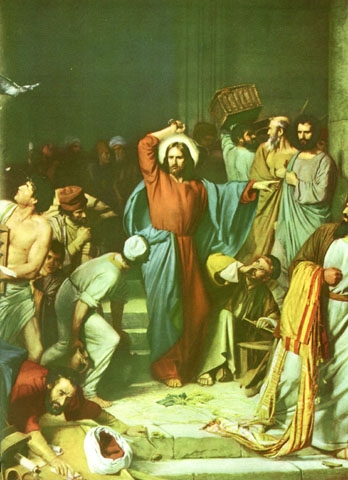
The Constantinians defer to the empire. We see it today in the market Christianity, the gospels of prosperity, the prayers of let’s make a deal with god, spinning the wheel of fortune to keep up in the rat race. All the paraphernalia of the empire -– power, size, and might become the benchmarks of Constantinian Christian churches.
posted by Ty Webb at 9:42 AM on November 20, 2004
I understand the chasm. For instance... the Episcopalian homosexual priest issue. Do they just toss out parts of the bible for convenience???
What about the "slavery is ok" issue? Do Christians just toss out parts of the bible for convenience???
Yeah, they do. They also toss out that and lots of the other parts of the bible, too.
posted by rajbot at 9:46 AM on November 20, 2004
What about the "slavery is ok" issue? Do Christians just toss out parts of the bible for convenience???
Yeah, they do. They also toss out that and lots of the other parts of the bible, too.
posted by rajbot at 9:46 AM on November 20, 2004
while the other four links are typical of places where it is growing by the millions.
that's an excellent point, jfuller. Meier -- sorry if I quote him again but the "Marginal Jew" series really is essential reading, and he is pretty centrist, too -- points out that the real beauty of it all is that Christianity's doors are open for the most simple people and the most learned, for those who have access to books and technology and for those who haven't. massively different groups of course end up experiencing Christianity in an essentially similar way -- there is only the difference of the legimitate questions that interest some and others aren't even aware of. there's no requirement to read, say, Aquinas or be familiar with the Septuagint or first century CE Palestinian history. some of us are into that, others aren't.
contessa: it is a classic case of re-branding. an attempt, and a clumsy one, to make Catholicism look more badass. fun but ultimately dumb and cheap -- the Christian version of MTV's Pimp My Ride
as the beautiful old ritual in the Episcopal Church
as opposed to that 2,000 year-old Catholic whippersnapper of a cult! no, seriously, if you're about 40 the Church of your
childhood was the direct product of a massive, much needed revolution (let us thank John XXIII and the vastly underrated Paul VI for that). a little Polish counterrevolution cannot stop what happened -- that's why the Church is so reluctant to change, because they know that real change in doctrine is there to stay. Wojtyla's war against condoms and stem cells shouldn't scare too many people off. he won't be there forever, as recent TV footage sadly underscores. and anyway under him the Church has become much more staunchly pacifist, and anti-death penalty, and he is so much anti-globalization to make many Seattle kids look like Republicans. so it's not all in one direction. but I agree that gay clergy won't be achieved by the Catholic Church in our lifetime, so everybody who doesn't like that is free to go, and go they should if they don't feel comfy. when it comes to stem cells, sadly, I'm afraid it'll always be too tightly linked to the abortion issue, and the Church will never be pro-choice, not even after a new Council. in some ways, many Protestants denominations will always be more liberal than the Catholic Church -- after all, they left exactly for that reason, didn't they? it makes it even more funny when -- in the case of fundys -- it's the Protestants who go Medieval, when the Catholic Church is slowly evolving. they've been there 2,000 years and they'll be there 2,000 more if earth is still there. of course they're allergic to change, for the most part. 25 years may look a long time to a Protestant. for the Vatican it is nothing.
Like the kids contessa mentions, the students all understood their religious identities and beliefs in Protestant terms.
it's a cultural, not religious phenomenon. I've attended to (Catholic) Mass in Nigeria, and in a small Senegal town. it was very different from, say, Italian or American or Danish Mass I've attended. they all worship the same God, after all.
MattD seems to be: A - arguing that because evangelicalism is more popular, it's helathier, in direct contradiction to Christ's contention that the least popular path is the one that leads to God; B - arguing that the theology of Spong (etc)
it can all be forgiven -- except for the truly unforgivable "dogmae". it's dogmata, MattD.
I only correct you so that you'll be able to show your Greek off at your next Church meeting (or abortion clinic/courthouse picket, whatever)
;)
What about the "slavery is ok" issue?
it's not dogma. it's not about faith. the New Testament has been written 1950-1895 years ago. by men. (inspired by the Holy Spirit, if you're Catholic or Eastern Orthodox mainline Protestant). unless one is a fundy Protestant, it is not an issue.
same for the anti-Jewish stuff in the Passion narratives, John's especially. Mel Gibson, thank God, is in the Christian Lefevrian minority
posted by matteo at 9:57 AM on November 20, 2004
that's an excellent point, jfuller. Meier -- sorry if I quote him again but the "Marginal Jew" series really is essential reading, and he is pretty centrist, too -- points out that the real beauty of it all is that Christianity's doors are open for the most simple people and the most learned, for those who have access to books and technology and for those who haven't. massively different groups of course end up experiencing Christianity in an essentially similar way -- there is only the difference of the legimitate questions that interest some and others aren't even aware of. there's no requirement to read, say, Aquinas or be familiar with the Septuagint or first century CE Palestinian history. some of us are into that, others aren't.
contessa: it is a classic case of re-branding. an attempt, and a clumsy one, to make Catholicism look more badass. fun but ultimately dumb and cheap -- the Christian version of MTV's Pimp My Ride
as the beautiful old ritual in the Episcopal Church
as opposed to that 2,000 year-old Catholic whippersnapper of a cult! no, seriously, if you're about 40 the Church of your
childhood was the direct product of a massive, much needed revolution (let us thank John XXIII and the vastly underrated Paul VI for that). a little Polish counterrevolution cannot stop what happened -- that's why the Church is so reluctant to change, because they know that real change in doctrine is there to stay. Wojtyla's war against condoms and stem cells shouldn't scare too many people off. he won't be there forever, as recent TV footage sadly underscores. and anyway under him the Church has become much more staunchly pacifist, and anti-death penalty, and he is so much anti-globalization to make many Seattle kids look like Republicans. so it's not all in one direction. but I agree that gay clergy won't be achieved by the Catholic Church in our lifetime, so everybody who doesn't like that is free to go, and go they should if they don't feel comfy. when it comes to stem cells, sadly, I'm afraid it'll always be too tightly linked to the abortion issue, and the Church will never be pro-choice, not even after a new Council. in some ways, many Protestants denominations will always be more liberal than the Catholic Church -- after all, they left exactly for that reason, didn't they? it makes it even more funny when -- in the case of fundys -- it's the Protestants who go Medieval, when the Catholic Church is slowly evolving. they've been there 2,000 years and they'll be there 2,000 more if earth is still there. of course they're allergic to change, for the most part. 25 years may look a long time to a Protestant. for the Vatican it is nothing.
Like the kids contessa mentions, the students all understood their religious identities and beliefs in Protestant terms.
it's a cultural, not religious phenomenon. I've attended to (Catholic) Mass in Nigeria, and in a small Senegal town. it was very different from, say, Italian or American or Danish Mass I've attended. they all worship the same God, after all.
MattD seems to be: A - arguing that because evangelicalism is more popular, it's helathier, in direct contradiction to Christ's contention that the least popular path is the one that leads to God; B - arguing that the theology of Spong (etc)
it can all be forgiven -- except for the truly unforgivable "dogmae". it's dogmata, MattD.
I only correct you so that you'll be able to show your Greek off at your next Church meeting (or abortion clinic/courthouse picket, whatever)
;)
What about the "slavery is ok" issue?
it's not dogma. it's not about faith. the New Testament has been written 1950-1895 years ago. by men. (inspired by the Holy Spirit, if you're Catholic or Eastern Orthodox mainline Protestant). unless one is a fundy Protestant, it is not an issue.
same for the anti-Jewish stuff in the Passion narratives, John's especially. Mel Gibson, thank God, is in the Christian Lefevrian minority
posted by matteo at 9:57 AM on November 20, 2004
Such a fine discussion of Christian religion and its implications. My heart is warmed. My thanks to all who have so constructively contributed. Especially you matteo.
Do they just toss out parts of the bible for convenience???
Depends on which "they" you're talking about. :-) Do you? Are you not equally guilty? Cannot science and religion both contain truths? Must one be invalid in order that the other be valid? Should the Bible be used (misused) as a history book?
On the matter (touched on above) of whether humankind is at root either evil or good, let me saythat if we are created in God's image, with God being perfect and good, would not humans be also basically good? Is that not a correct assumption?
As for Biblical literalism, did God print the edition on the table by me? No? People did that? Well then, who wrote all those words, God? No? People did that too? OK, OK, then who did the interpretations and the translations, God? No? Well then surely God enters the body and controls the mouths of Jerry Falwell and Pat Robertson when they deliver the messages of hatred and division! No? Gee, then maybe fundie belief system really is bushwa intended for something other than attaining godliness?
posted by nofundy at 10:00 AM on November 20, 2004
Do they just toss out parts of the bible for convenience???
Depends on which "they" you're talking about. :-) Do you? Are you not equally guilty? Cannot science and religion both contain truths? Must one be invalid in order that the other be valid? Should the Bible be used (misused) as a history book?
On the matter (touched on above) of whether humankind is at root either evil or good, let me saythat if we are created in God's image, with God being perfect and good, would not humans be also basically good? Is that not a correct assumption?
As for Biblical literalism, did God print the edition on the table by me? No? People did that? Well then, who wrote all those words, God? No? People did that too? OK, OK, then who did the interpretations and the translations, God? No? Well then surely God enters the body and controls the mouths of Jerry Falwell and Pat Robertson when they deliver the messages of hatred and division! No? Gee, then maybe fundie belief system really is bushwa intended for something other than attaining godliness?
posted by nofundy at 10:00 AM on November 20, 2004
The attraction of the fundamentalist church in this day and age is emotion. People like the way they feel. They like the hugging, the singing, the clapping and the waving around of their hands. And, somehow, they don't feel as if they have made a vital change in their lives unless the imagery of good vs evil is invoked with their own conversion being a 'close call'.
The world is so much easier to define when you have just two colors (black and white) and the things that scare you can be attributed to an evil being at work. My own stepdaughter (9) who spends summer with her die hard Southern Baptist father asked me if her 'soul was black' and was she 'going to hell'? I told her that God's love was the most powerful force in the universe and was much stronger than anything like evil. This seemed to be something she had never heard from her father and seemed to give her comfort.
There is another point of view and it has a very powerful message to counteract the mindless, punishing buckle of the Bible belt.
posted by UseyurBrain at 10:31 AM on November 20, 2004
The world is so much easier to define when you have just two colors (black and white) and the things that scare you can be attributed to an evil being at work. My own stepdaughter (9) who spends summer with her die hard Southern Baptist father asked me if her 'soul was black' and was she 'going to hell'? I told her that God's love was the most powerful force in the universe and was much stronger than anything like evil. This seemed to be something she had never heard from her father and seemed to give her comfort.
There is another point of view and it has a very powerful message to counteract the mindless, punishing buckle of the Bible belt.
posted by UseyurBrain at 10:31 AM on November 20, 2004
The Episcopalians feel that the Biblical proscriptions against homosexuality should be given the same weight as the (much larger number of, and much less ambiguous) Biblical proscriptions against divorce.
You may interpret that as you like.
In the 19th century, a divorced heterosexual man and an openly homosexual man were considered equally unfit to lead a Christian congregation. (There are tremendous agonizings in Trollope and other 19th-century authors about whether a clergyman who had been widowed was entitled to remarry!)
If it's okay for a divorced man (or woman) to serve as a pastor, why is it not okay for a homosexual man (or woman) to do so?
posted by Sidhedevil at 10:31 AM on November 20, 2004
You may interpret that as you like.
In the 19th century, a divorced heterosexual man and an openly homosexual man were considered equally unfit to lead a Christian congregation. (There are tremendous agonizings in Trollope and other 19th-century authors about whether a clergyman who had been widowed was entitled to remarry!)
If it's okay for a divorced man (or woman) to serve as a pastor, why is it not okay for a homosexual man (or woman) to do so?
posted by Sidhedevil at 10:31 AM on November 20, 2004
> If it's okay for a divorced man (or woman) to serve as a pastor, why is it
> not okay for a homosexual man (or woman) to do so?
I remain (formally) an Episcopalian because that church doesn't require that I believe anything in particular, which leaves me free to go my happy heretical way. That's lucky for me because, eccentric that I am, I expect that a voluntarily divorced person is most likely not qualified to serve as a pastor (except, of course, in cases where the divorced person has deeply and sincerely repented of the divorce.)
I feel a profound distrust of spiritual advice from an unrepentant oathbreaker.
posted by jfuller at 11:05 AM on November 20, 2004
> not okay for a homosexual man (or woman) to do so?
I remain (formally) an Episcopalian because that church doesn't require that I believe anything in particular, which leaves me free to go my happy heretical way. That's lucky for me because, eccentric that I am, I expect that a voluntarily divorced person is most likely not qualified to serve as a pastor (except, of course, in cases where the divorced person has deeply and sincerely repented of the divorce.)
I feel a profound distrust of spiritual advice from an unrepentant oathbreaker.
posted by jfuller at 11:05 AM on November 20, 2004
from today's Salon:
Losing my religion
In the aftermath of Bush's reelection, Democrats are doing a lot of soul-searching about how to break the Republican lock on the red states. They need to pay attention to a forgotten group: religious Democrats.
My fellow blue-staters may not understand evangelicals, but I do -- I was raised as one. My church's brand of evangelicalism was so strict women couldn't wear pants, makeup or jewelry. My church believed in speaking in tongues; believed that a good Christian went to Wednesday night prayer meeting and Thursday night Bible study, in addition to Sunday school, Sunday worship, Sunday dinner at the church and the two-hour Sunday fellowship that followed.
And I'm the bluest Democrat you ever saw.
posted by orange clock at 11:09 AM on November 20, 2004
Losing my religion
In the aftermath of Bush's reelection, Democrats are doing a lot of soul-searching about how to break the Republican lock on the red states. They need to pay attention to a forgotten group: religious Democrats.
My fellow blue-staters may not understand evangelicals, but I do -- I was raised as one. My church's brand of evangelicalism was so strict women couldn't wear pants, makeup or jewelry. My church believed in speaking in tongues; believed that a good Christian went to Wednesday night prayer meeting and Thursday night Bible study, in addition to Sunday school, Sunday worship, Sunday dinner at the church and the two-hour Sunday fellowship that followed.
And I'm the bluest Democrat you ever saw.
posted by orange clock at 11:09 AM on November 20, 2004
There's a good blog on progressive theology called, not surprisingly, Progressive Theology.
As a nontheist, I find it thoroughly depressing that any candidate for national office in the U.S. would commit political suicide if he or she were to admit to a lack of belief in a supernatural being. But I also don't see making secularism my primary political identity, because there's little correlation between lack of religious faith and political philosophy. Those who self-identify as rationalists or skeptics tend to be libertarian, often in an Ayn-Randish mode that is nearly as closed-minded as anything you'll see among Christian fundamentalists.
posted by Creosote at 11:17 AM on November 20, 2004
As a nontheist, I find it thoroughly depressing that any candidate for national office in the U.S. would commit political suicide if he or she were to admit to a lack of belief in a supernatural being. But I also don't see making secularism my primary political identity, because there's little correlation between lack of religious faith and political philosophy. Those who self-identify as rationalists or skeptics tend to be libertarian, often in an Ayn-Randish mode that is nearly as closed-minded as anything you'll see among Christian fundamentalists.
posted by Creosote at 11:17 AM on November 20, 2004
Many scholars and theologians think that it's time for liberals to take Christianity back.
As has already been mentioned in the thread, the recent US election may bring this debate to the fore. All I can say is hallelujah, bring it on. "Morality" that leads one to outrage over Janet Jackson's exposed boob while turning a blind eye to the dead civilians in an illegal war is not the least bit moral.
Thanks for an excellent post, matteo, and thanks to everyone for the great comments. Now if only I had time to read all of the links!
posted by whatnot at 12:08 PM on November 20, 2004
As has already been mentioned in the thread, the recent US election may bring this debate to the fore. All I can say is hallelujah, bring it on. "Morality" that leads one to outrage over Janet Jackson's exposed boob while turning a blind eye to the dead civilians in an illegal war is not the least bit moral.
Thanks for an excellent post, matteo, and thanks to everyone for the great comments. Now if only I had time to read all of the links!
posted by whatnot at 12:08 PM on November 20, 2004
Matteo, you accuse me of not wanting you at my table. Do you think I'd be posting here if I didn't want discussion with people who have a different view than me? No, I'd find a community of people who think exactly the way I do. Not that I've ever found such a community.
Seriously, just because I hold a faith that believes Christ rose, literally, from the dead, doesn't mean that I'm your enemy, or that you need to attack me, or that I'm spouting a "anti-Buddhist cheap crack".
You say "why do you keep using litmus tests, just like the right-wingers do?" I'm not using a litmus test, I'm simply stating that there are Christians who have literal interpretations of Christ's miracles but are nevertheless open to the understanding that the Bible is open to interpretation, that faith exists in the context of history, and that applying human intellect and debate to matters of faith is worthwhile. I happen to be one of them.
I don't deny that all the metaphoric depth of meaning you point out is there in everything that Christ did. I also think this is only part of the story. When I say "watered down", what I meant was that the metaphoric interpretation discounts what is one of the deepest parts of the story for me. Jesus' life isn't only a story about how we reach for God, seek truth and light, and try to love our neighbors, it's about how God reaches back and loves us. So please don't come down so hard on me, ok?
And yes, I have lost a loved one. We've all suffered in one way or another, but if people who happen to belive in a literal resurrection can't talk to people who don't, where are we? Why do you think religious people get driven to the right in the first place?
And I also meant to say, thanks for the post. It's something that needs to be talked about.
posted by Orkboi at 12:30 PM on November 20, 2004
Seriously, just because I hold a faith that believes Christ rose, literally, from the dead, doesn't mean that I'm your enemy, or that you need to attack me, or that I'm spouting a "anti-Buddhist cheap crack".
You say "why do you keep using litmus tests, just like the right-wingers do?" I'm not using a litmus test, I'm simply stating that there are Christians who have literal interpretations of Christ's miracles but are nevertheless open to the understanding that the Bible is open to interpretation, that faith exists in the context of history, and that applying human intellect and debate to matters of faith is worthwhile. I happen to be one of them.
I don't deny that all the metaphoric depth of meaning you point out is there in everything that Christ did. I also think this is only part of the story. When I say "watered down", what I meant was that the metaphoric interpretation discounts what is one of the deepest parts of the story for me. Jesus' life isn't only a story about how we reach for God, seek truth and light, and try to love our neighbors, it's about how God reaches back and loves us. So please don't come down so hard on me, ok?
And yes, I have lost a loved one. We've all suffered in one way or another, but if people who happen to belive in a literal resurrection can't talk to people who don't, where are we? Why do you think religious people get driven to the right in the first place?
And I also meant to say, thanks for the post. It's something that needs to be talked about.
posted by Orkboi at 12:30 PM on November 20, 2004
matteo, how in the hell (um, excuse the expression) did you do this? This is the first religion-oriented MeFi thread in years that has not instantly degenerated into an endless exchange of "religion sucks!" "no it doesn't!" Congrats to all, and I hope this is a harbinger of better threads now that we've got all these cute newcomers -- among whom I would like to give special props to RemusLupin for making a clever and apposite reference to The Conversation, one of the greatest American movies of the '70s.
On preview: Orkboi, matteo is fond of the harsh cutting edge of dialectic -- don't take it personally. He's actually showing his kinder, gentler side in this thread.
posted by languagehat at 12:49 PM on November 20, 2004
On preview: Orkboi, matteo is fond of the harsh cutting edge of dialectic -- don't take it personally. He's actually showing his kinder, gentler side in this thread.
posted by languagehat at 12:49 PM on November 20, 2004
Orkboi, it's totally cool: as I said, your point "If Jesus Christ did not rise from the dead, it turns Christianity from a religion into a philosophy" is a very strict Pauline interpretation. Some Christians are less Pauline than you. Just that. But Paul's cool: you could do much worse, after all :)
It's only that as you know there are very different traditions that ended up in the four texts that are at the basis of the Christian faith -- Paul's Christology's center is the Resurrection, 100% (allow me a cheap crack now: after all, he never met the living Jesus, so it's hardly surprising). Paul is all about the death tradition, and even if some of his letters are the oldest historical documents available on Jesus, he shows zero interest for Jesus' life. Zero. He goes to Jerusalem and meets Jesus' brother and Paul doesn't even want to go check out the Golgotha, the empty tomb! (some scholars argue that the reason behind this is that certain traditions weren't fully formed back then, and so he couldn't have knowledge of them). Sayings traditions, for example, put Jesus on a different plan. Mark's Jesus is an occasionally very pissed off apocalyptic prophet and faith healer. Luke's is much calmer. John's, well, you know how funny the Fourth Gospel is -- Raymond E. Brown even argues that Christians from the John community didn't even consider the faithful of the synoptic's communities as real Christians -- adding an element of tension inside of the Church from the beginning, ironically enough.
aside: Many Christians' favorite symbol is the Cross? Cool! But early christians actually did abhor the cross, it became a Christian symbol much later. Me? This is my favourite Jesus. Not a crucified one. I never liked the crucifix, actually.
but Orkboi, with no malice nor anger I'm still very much against your very clearly stated idea that
"This is tantamount to reclaiming Christianity from the right, only to hand it back to them again. It sustains their claim that Christians who aren't right-wingers aren't Christians.". I explained above why I think it isn't the case. Just that.
with only friendship toward you, I just stand behind my comment that your "philosophy" comment, however well-meaning, is a standard cheap crack. just ask a Buddhist. lots of Christians (and others, too) seem to have a problem with Buddhism because it has no Messiah and no clearly stated image of God. others above have explained why this isn't the case. if one does not believe in the actual bodily resurrection, you can't cheapen their belief calling it philosophy. it's just a different interpretation of the life -- and death -- of Jesus
Why do you think religious people get driven to the right in the first place?
because strict dogma is tough but in the end reassuring. soothing, in a scary way.
So please don't come down so hard on me, ok?
I never did man, I cherish your comments here. really. we're all in this together.
on preview: Orkboi, languagehat's right: I'm an asshole. don't feel hurt, you're a good boi
He's actually showing his kinder, gentler side in this thread.
ah, la capacità di dare uno schiaffo sorridendo, languagehat...
posted by matteo at 1:04 PM on November 20, 2004
It's only that as you know there are very different traditions that ended up in the four texts that are at the basis of the Christian faith -- Paul's Christology's center is the Resurrection, 100% (allow me a cheap crack now: after all, he never met the living Jesus, so it's hardly surprising). Paul is all about the death tradition, and even if some of his letters are the oldest historical documents available on Jesus, he shows zero interest for Jesus' life. Zero. He goes to Jerusalem and meets Jesus' brother and Paul doesn't even want to go check out the Golgotha, the empty tomb! (some scholars argue that the reason behind this is that certain traditions weren't fully formed back then, and so he couldn't have knowledge of them). Sayings traditions, for example, put Jesus on a different plan. Mark's Jesus is an occasionally very pissed off apocalyptic prophet and faith healer. Luke's is much calmer. John's, well, you know how funny the Fourth Gospel is -- Raymond E. Brown even argues that Christians from the John community didn't even consider the faithful of the synoptic's communities as real Christians -- adding an element of tension inside of the Church from the beginning, ironically enough.
aside: Many Christians' favorite symbol is the Cross? Cool! But early christians actually did abhor the cross, it became a Christian symbol much later. Me? This is my favourite Jesus. Not a crucified one. I never liked the crucifix, actually.

but Orkboi, with no malice nor anger I'm still very much against your very clearly stated idea that
"This is tantamount to reclaiming Christianity from the right, only to hand it back to them again. It sustains their claim that Christians who aren't right-wingers aren't Christians.". I explained above why I think it isn't the case. Just that.
with only friendship toward you, I just stand behind my comment that your "philosophy" comment, however well-meaning, is a standard cheap crack. just ask a Buddhist. lots of Christians (and others, too) seem to have a problem with Buddhism because it has no Messiah and no clearly stated image of God. others above have explained why this isn't the case. if one does not believe in the actual bodily resurrection, you can't cheapen their belief calling it philosophy. it's just a different interpretation of the life -- and death -- of Jesus
Why do you think religious people get driven to the right in the first place?
because strict dogma is tough but in the end reassuring. soothing, in a scary way.
So please don't come down so hard on me, ok?
I never did man, I cherish your comments here. really. we're all in this together.
on preview: Orkboi, languagehat's right: I'm an asshole. don't feel hurt, you're a good boi
He's actually showing his kinder, gentler side in this thread.
ah, la capacità di dare uno schiaffo sorridendo, languagehat...
posted by matteo at 1:04 PM on November 20, 2004
matteo is fond of the harsh cutting edge of dialectic
I blame the Jesuits
posted by matteo at 1:05 PM on November 20, 2004
I blame the Jesuits
posted by matteo at 1:05 PM on November 20, 2004
matteo, I got me some o' that Catholic eddycation once upon a time, so I've felt the catechistic flail meself. Sic et non, baby, sic et non!
posted by languagehat at 1:40 PM on November 20, 2004
posted by languagehat at 1:40 PM on November 20, 2004
Gov. Riley won the support of the national Christian Coalition. The Alabama organization, however, was a staunch opponent of his plan
Thanks for the correction, raysmj. I know those jokers don't deserve much hope for the future placed in them, but maybe something is afoot — even the Spirit at work??
posted by Zurishaddai at 3:31 PM on November 20, 2004
Thanks for the correction, raysmj. I know those jokers don't deserve much hope for the future placed in them, but maybe something is afoot — even the Spirit at work??
posted by Zurishaddai at 3:31 PM on November 20, 2004
Non-punitive?
If you want to get rid of penal substitution, you have to get rid of the Bible!
posted by aaronshaf at 4:31 PM on November 20, 2004
"21 But now the righteousness of God has been manifested apart from the law, although the Law and the Prophets bear witness to it— 22 the righteousness of God through faith in Jesus Christ for all who believe. For there is no distinction: 23 for all have sinned and fall short of the glory of God, 24 and are justified by his grace as a gift, through the redemption that is in Christ Jesus, 25 whom God put forward as a propitiation by his blood, to be received by faith. This was to show God's righteousness, because in his divine forbearance he had passed over former sins. 26 It was to show his righteousness at the present time, so that he might be just and the justifier of the one who has faith in Jesus." (Romans 3)
"6 He will render to each one according to his works: 7 to those who by patience in well-doing seek for glory and honor and immortality, he will give eternal life; 8 but for those who are self-seeking and do not obey the truth, but obey unrighteousness, there will be wrath and fury." (Romans 2)If that's not punitive, I don't know what is. Either Jesus pays for my sins on the cross (and his righteousness is credited to me), or I pay for my sins under the "wrath and fury" of God.
If you want to get rid of penal substitution, you have to get rid of the Bible!
posted by aaronshaf at 4:31 PM on November 20, 2004
So basically God has his or her hands tied because someone wrote it down that way? The Gospels are not about 'wrath and fury'. They are about good news. All is not warm and fuzzy, but to trying to jam the message into a black and white framework is kind of silly.
posted by UseyurBrain at 5:23 PM on November 20, 2004
posted by UseyurBrain at 5:23 PM on November 20, 2004
i have started attending services at st. james' episcopal
church in new haven,connecticut which combines evangelism and intercultural traditions from latino cultures
with episcopal traditions.
very warm,friendly congregation.
no need to deny who i am there.
i'm a christopagan and a universal life church minister
who's ministry has been mostly online.
the holy spirit is on fire in that church!
the new england traditions in urban churches
are very much alive there!
i'm so tired of people acting like all christians
are like that cpwboy from crawford,texas!
posted by bearybipolar at 6:04 PM on November 20, 2004
church in new haven,connecticut which combines evangelism and intercultural traditions from latino cultures
with episcopal traditions.
very warm,friendly congregation.
no need to deny who i am there.
i'm a christopagan and a universal life church minister
who's ministry has been mostly online.
the holy spirit is on fire in that church!
the new england traditions in urban churches
are very much alive there!
i'm so tired of people acting like all christians
are like that cpwboy from crawford,texas!
posted by bearybipolar at 6:04 PM on November 20, 2004
Liberal is a relative term. What is liberal for one person can be conservative to another. Accepting Jesus as one's personal Saviour is all that is needed to become a Christian (at least, according to my understanding of Christian theology). The rest comes down to doctrinal beliefs which can vary from church to church.
posted by livingsanctuary at 8:27 PM on November 20, 2004
posted by livingsanctuary at 8:27 PM on November 20, 2004
``...[I]t is impossible to argue with a christian, because they do not reason as humans - if you believe that snakes can talk, that virgins give birth, and that jesus lives up in the sky, then there is a "thought chasm" that separates you from me. i could not know what it is like to be a christian any more than i could know what it is like to be a bat. i am happy over on my side, and unless you are willing to cross over to sanity, we remain inexorably divided.'' - T. Martin
posted by AlexReynolds at 9:16 PM on November 20, 2004
posted by AlexReynolds at 9:16 PM on November 20, 2004
AlexReynolds's probably truthful (in my opinion) but also probably needlessly provocative quote aside, and with all due respect to Matteo, I think the credit for this wonderful, wonderful thread goes mostly to the newbies. This is so different from the thread last week where a few of us tried to talk about the reality of progressive evangelicals (among other types of progressive Christians) and what we got was mostly hostility, as if we were asserting the existence of Santa Claus.
But Zurishaddai wrote something that I think deserves to be quoted at (relative) length:
I mean, I hate to sound like some old-school liberationist Christian (which would be darn strange since I'm an atheist), but when I read the Gospels, especially, what I see is the opportunity for a religious belief that does take much of this literally and, nevertheless, is in many ways deeply radical and progressive in the political sense.
So I want to stand up for those folks that are literalist but also progressive. There's a long tradition of these people in Christianity and, okay, yeah, the culturally and politically conservative variety of evangelical Christianity is ascendent these days, but liberation theology is ancient, important, and still vital.
And I guess I'd also like to defend this (and other sorts) of literalism. From my perspective, as a thoughtful and educated unbeliever (and to jfuller who denies dialectical, rational, truth-seeking character of Christianity: man, you must not have suffered through Aquinas and some of the other scholastics like I did), an essential problem with religious belief is that both historically and among most people, a certain kind of, um, naive literalism is at least partly the point of the whole thing. But almost from the moment that the more thoughtful people start thinking about these things, then the stronger the pressure is to not be so literal. And that's a problem because this one larger group of people go one way, and this other goes another, and they both sort of make complete claims to "ownership" of the faith, often even when they're in the same congregation! It's almost like they're speaking two different languages. And I guess my point is that although I think obviously Matteo believes otherwise, it's simply not true that there's some historical inevitability toward a more rationalized, nuanced, "metaphorical" view of religious belief. There is a tension between the two views and that tension arises almost immediately and over time the balance goes one way and then the other, but neither side really wins. For example, Buddhism has been mentioned—and from what I've learned and in my opinion, the typical European or American view of Buddhism, particularly the equation of Zen with all of Buddhism, is, well, ignorant and also, I often think, a little too convenient. There are huge variations in Buddhism and there exist very literalist, moralistic varieties that resemble much more closely American conservative Christianity than they do what we typically think.
I'm pretty certain that in every religious tradition a common factor in its evolution is that an influential foundational person has a strong influence on it because he/she has a particular mode in which they experience their religious faith, and they articulate it very well to other people. But people have, I think, very, very different "modes" of religious faith and eventually, especially with the people who are born into a faith and not converted, the imposition of this one mode, be it intellectualism or ecstatic experience or whatever, on them becomes very uncomfortable and limiting. And within the community an "opposing" mode is advocated.
All that said, I guess I'm also trying to agree with sophist's (ha!) point that if we're assuming—and maybe we shouldn't but a whole bunch of people do and that's what faith is to them—that religious belief is asserting some facts about the universe...well, as I always say, it's not at all clear to me why people assume that whatever is particularly true about the universe is pleasing, or just, or in any way must necessarily conform to what we want to be true. This certainly isn't the case with the natural, non-theist universe as we've come to know it. There seems to me to be even less reason to assume that the supernatural universe, if we assume such a thing exists, must be anything at all like what we want, or could understand, or, well, anything. So the argument against literalist religious ideas has legitimacy to me only in the limited sense that any particular assumed version of such seems wildly unlikely but not that assuming such supposedly simplistic ideas is itself inherently invalid.
I guess what I've always been most suspicious about religion and what it seems (to me) to mean to most people is that it's smug, self-satisifed, self-serving. It's always so damn convenient. Rare is it (but not unheard of) that someone adopts a belief system that condemns themselves and everything they love. No, usually, the religious belief "confirms" most of their prejudices and self-interests. And so, in that context, a ubiquitous variety of liberal revisionist Christian theology that allows for everything, makes no stand on anything, and provides the warm, fuzzy feelings without responsibility or any of the hard truths...well, although I realize all sorts of people around the world adopt this sort of faith, it reeks to me what I dislike most about my fellow Americans. It's the consumer, fast-food, narcissistic and easy variety of religious belief.
My sister (an evangelical minister/missionary), predictably and like so many people, greatly favors John. But I've always loved Matthew because the Christ in Matthew seems to be saying, "hey, look people, this stuff is hard. You want easy answers, or at least answers that don't challenge you? You've come to the wrong guy". But see, I would say that because that and a certain kind of intellectualism is my personal "mode" of my relationship with the universe. One of the wisest things I've observed about my sister is that she has an intuitive sense that different people have different ways in which they can best comprehend Christ. Some are intellectual, some are emotional, whatever. And I guess what I'm saying here in this too-long comment, is that while so many people are very willing to throw overboard a universalist or absolutist stance with regard to the nature of the universe, they sadly and ironically often still insist that the way, the mode, they comprehend the universe, or their faith, is the only "correct" way. I think I see Matteo doing that. And, in the end, as I observe all the believers around me, I can't help but come to the somewhat cynical point of view that people adopt religious and political and other beliefs perhaps mostly only on how well it conforms to their temperment. So I'm not sure that, really, for most people, all this, including this discussion, is really about what it's ostensibly about.
posted by Ethereal Bligh at 3:54 AM on November 21, 2004
But Zurishaddai wrote something that I think deserves to be quoted at (relative) length:
This thread seems to tilt more into revisionist Christian scholarship than into the world of evangelicals who want to reject the politicized right wing. The former is an interesting subject, but, the proportion of evangelicals of all stripes who really give a hoot about it is far tinier than the bloc of liberal evangelicals. If we wanted to talk about the social and political influence of Christians who base their worldview on a fairly reasoned, progressive, scholarly critique of history and theology, those Christians exist in much larger numbers than "progressive evangelicals" — they are called Episcopalians, Congregationalists, Lutherans, etc.Matteo, as evidenced by his post and his conversation with Orkboi, seems to pretty much equate liberal Christianity with what Zurishaddai calls "revionist Christian scholarship". That bothers me a great deal, for some of the same reasons it bothers Orkboi, not for some others, and then also for a few particular reasons of my own.
I mean, I hate to sound like some old-school liberationist Christian (which would be darn strange since I'm an atheist), but when I read the Gospels, especially, what I see is the opportunity for a religious belief that does take much of this literally and, nevertheless, is in many ways deeply radical and progressive in the political sense.
So I want to stand up for those folks that are literalist but also progressive. There's a long tradition of these people in Christianity and, okay, yeah, the culturally and politically conservative variety of evangelical Christianity is ascendent these days, but liberation theology is ancient, important, and still vital.
And I guess I'd also like to defend this (and other sorts) of literalism. From my perspective, as a thoughtful and educated unbeliever (and to jfuller who denies dialectical, rational, truth-seeking character of Christianity: man, you must not have suffered through Aquinas and some of the other scholastics like I did), an essential problem with religious belief is that both historically and among most people, a certain kind of, um, naive literalism is at least partly the point of the whole thing. But almost from the moment that the more thoughtful people start thinking about these things, then the stronger the pressure is to not be so literal. And that's a problem because this one larger group of people go one way, and this other goes another, and they both sort of make complete claims to "ownership" of the faith, often even when they're in the same congregation! It's almost like they're speaking two different languages. And I guess my point is that although I think obviously Matteo believes otherwise, it's simply not true that there's some historical inevitability toward a more rationalized, nuanced, "metaphorical" view of religious belief. There is a tension between the two views and that tension arises almost immediately and over time the balance goes one way and then the other, but neither side really wins. For example, Buddhism has been mentioned—and from what I've learned and in my opinion, the typical European or American view of Buddhism, particularly the equation of Zen with all of Buddhism, is, well, ignorant and also, I often think, a little too convenient. There are huge variations in Buddhism and there exist very literalist, moralistic varieties that resemble much more closely American conservative Christianity than they do what we typically think.
I'm pretty certain that in every religious tradition a common factor in its evolution is that an influential foundational person has a strong influence on it because he/she has a particular mode in which they experience their religious faith, and they articulate it very well to other people. But people have, I think, very, very different "modes" of religious faith and eventually, especially with the people who are born into a faith and not converted, the imposition of this one mode, be it intellectualism or ecstatic experience or whatever, on them becomes very uncomfortable and limiting. And within the community an "opposing" mode is advocated.
All that said, I guess I'm also trying to agree with sophist's (ha!) point that if we're assuming—and maybe we shouldn't but a whole bunch of people do and that's what faith is to them—that religious belief is asserting some facts about the universe...well, as I always say, it's not at all clear to me why people assume that whatever is particularly true about the universe is pleasing, or just, or in any way must necessarily conform to what we want to be true. This certainly isn't the case with the natural, non-theist universe as we've come to know it. There seems to me to be even less reason to assume that the supernatural universe, if we assume such a thing exists, must be anything at all like what we want, or could understand, or, well, anything. So the argument against literalist religious ideas has legitimacy to me only in the limited sense that any particular assumed version of such seems wildly unlikely but not that assuming such supposedly simplistic ideas is itself inherently invalid.
I guess what I've always been most suspicious about religion and what it seems (to me) to mean to most people is that it's smug, self-satisifed, self-serving. It's always so damn convenient. Rare is it (but not unheard of) that someone adopts a belief system that condemns themselves and everything they love. No, usually, the religious belief "confirms" most of their prejudices and self-interests. And so, in that context, a ubiquitous variety of liberal revisionist Christian theology that allows for everything, makes no stand on anything, and provides the warm, fuzzy feelings without responsibility or any of the hard truths...well, although I realize all sorts of people around the world adopt this sort of faith, it reeks to me what I dislike most about my fellow Americans. It's the consumer, fast-food, narcissistic and easy variety of religious belief.
My sister (an evangelical minister/missionary), predictably and like so many people, greatly favors John. But I've always loved Matthew because the Christ in Matthew seems to be saying, "hey, look people, this stuff is hard. You want easy answers, or at least answers that don't challenge you? You've come to the wrong guy". But see, I would say that because that and a certain kind of intellectualism is my personal "mode" of my relationship with the universe. One of the wisest things I've observed about my sister is that she has an intuitive sense that different people have different ways in which they can best comprehend Christ. Some are intellectual, some are emotional, whatever. And I guess what I'm saying here in this too-long comment, is that while so many people are very willing to throw overboard a universalist or absolutist stance with regard to the nature of the universe, they sadly and ironically often still insist that the way, the mode, they comprehend the universe, or their faith, is the only "correct" way. I think I see Matteo doing that. And, in the end, as I observe all the believers around me, I can't help but come to the somewhat cynical point of view that people adopt religious and political and other beliefs perhaps mostly only on how well it conforms to their temperment. So I'm not sure that, really, for most people, all this, including this discussion, is really about what it's ostensibly about.
posted by Ethereal Bligh at 3:54 AM on November 21, 2004
> (and to jfuller who denies dialectical, rational, truth-seeking character of Christianity:
> man, you must not have suffered through Aquinas and some of the other scholastics like I did),
Oh, I did, to some extent anyway, even in Latin, while trying to learn medieval Latin--though I grant there's a big difference in the suffering quotient between dreadful stuff you assign to yourself and dreadful stuff you're forced to study by someone else. And I did put Aquinas and the Schoolmen down pretty quickly (contenting myself with the Cliff's Notes version by Etienne Gilson) and moved on for post-classical Latin practice to Roger Bacon, who was more fun, and Giordano Bruno, who was a lot more fun.
BTW, when I deny the dialectical portions of Christianity (and other formal religions), that's a recommendation, certainly not a description of what these entities have actually become. The core of religion is experiential, and in discussing and analyzing experience the best words can do is act as pointers or bookmarks to remind two people of an experience both have had. Experience can't be passed via words from person A, describing an experience he has had, to person B who has not had the experience. The moment you try, you've gone irretrievably wrong and are just generating phrases with the form of descriptions but which do not describe. Dogmas, in short.
BTW2, speaking of dialectical vs. experiential, you did I expect encounter the fact that the Summa Theologica is unfinished because in 1273 St. Thomas experienced an ecstacy during Mass after which he said "I can do no more. Such secrets have been revealed to me that all I have written now appears to be of little value."
> And, in the end, as I observe all the believers around me, I can't help but
> come to the somewhat cynical point of view that people adopt religious
> and political and other beliefs perhaps mostly only on how well it conforms
> to their temperment.
I see three parts to religion as it is commonly found: 1. a core of direct experience of [something], which is so compelling that people continue to seek it out generation after generation; 2. immense amounts of discussion and rationalization that gathers about the experiential core, all of which (in fuller's humble opinion) entirely misses the point and generates nothing but exclusivist confusion; and 3. finally plain old tribalism, where religion serves as just another us-vs-them tribal marker. My argument with typical mefi atheists is that they appear to believe that there's nothing to religion except 2. and 3. while I am convinced that not only does 1. exist but that it is the single most important destination available to humans--the source of the very notion of the "point of life." (My training is in biology, I certainly accept Darwinian evolution, but feedin'n'breedin' while we wait for the heat death of the universe doesn't provide much of a point to playing the game--at least not after that deadly moment when one first asks "Say, what is the point?")
> One of the wisest things I've observed about my sister is that she has an
> intuitive sense that different people have different ways in which they
> can best comprehend Christ. Some are intellectual, some are emotional,
> whatever.
That reminds me of William James's Varieties of Religious Experience, valuable for the great number of examples he collects and narrates. As one reads through them the impression grows that James really wished he himself might achieve the sort of enlightenment experience he was writing about. But he, Harvard arch-rationalist, was just not the sort of person to whom that kind of thing happens.
posted by jfuller at 6:44 AM on November 21, 2004
> man, you must not have suffered through Aquinas and some of the other scholastics like I did),
Oh, I did, to some extent anyway, even in Latin, while trying to learn medieval Latin--though I grant there's a big difference in the suffering quotient between dreadful stuff you assign to yourself and dreadful stuff you're forced to study by someone else. And I did put Aquinas and the Schoolmen down pretty quickly (contenting myself with the Cliff's Notes version by Etienne Gilson) and moved on for post-classical Latin practice to Roger Bacon, who was more fun, and Giordano Bruno, who was a lot more fun.
BTW, when I deny the dialectical portions of Christianity (and other formal religions), that's a recommendation, certainly not a description of what these entities have actually become. The core of religion is experiential, and in discussing and analyzing experience the best words can do is act as pointers or bookmarks to remind two people of an experience both have had. Experience can't be passed via words from person A, describing an experience he has had, to person B who has not had the experience. The moment you try, you've gone irretrievably wrong and are just generating phrases with the form of descriptions but which do not describe. Dogmas, in short.
BTW2, speaking of dialectical vs. experiential, you did I expect encounter the fact that the Summa Theologica is unfinished because in 1273 St. Thomas experienced an ecstacy during Mass after which he said "I can do no more. Such secrets have been revealed to me that all I have written now appears to be of little value."
> And, in the end, as I observe all the believers around me, I can't help but
> come to the somewhat cynical point of view that people adopt religious
> and political and other beliefs perhaps mostly only on how well it conforms
> to their temperment.
I see three parts to religion as it is commonly found: 1. a core of direct experience of [something], which is so compelling that people continue to seek it out generation after generation; 2. immense amounts of discussion and rationalization that gathers about the experiential core, all of which (in fuller's humble opinion) entirely misses the point and generates nothing but exclusivist confusion; and 3. finally plain old tribalism, where religion serves as just another us-vs-them tribal marker. My argument with typical mefi atheists is that they appear to believe that there's nothing to religion except 2. and 3. while I am convinced that not only does 1. exist but that it is the single most important destination available to humans--the source of the very notion of the "point of life." (My training is in biology, I certainly accept Darwinian evolution, but feedin'n'breedin' while we wait for the heat death of the universe doesn't provide much of a point to playing the game--at least not after that deadly moment when one first asks "Say, what is the point?")
> One of the wisest things I've observed about my sister is that she has an
> intuitive sense that different people have different ways in which they
> can best comprehend Christ. Some are intellectual, some are emotional,
> whatever.
That reminds me of William James's Varieties of Religious Experience, valuable for the great number of examples he collects and narrates. As one reads through them the impression grows that James really wished he himself might achieve the sort of enlightenment experience he was writing about. But he, Harvard arch-rationalist, was just not the sort of person to whom that kind of thing happens.
posted by jfuller at 6:44 AM on November 21, 2004
Well said, EB. Count me as another atheist who doesn't think it impossible for people to be "literalist but also progressive" (and, I would add, rational on all subjects but their faith). Those of you who think all believers are gibbering loonies with whom it is impossible to communicate don't get out enough.
On preview (and I can't believe someone snuck in before I could hit "Post" on this moribund thread): to say the "discussion and rationalization that gathers about the experiential core... entirely misses the point and generates nothing but exclusivist confusion" may be a "humble opinion" (though you'll permit me my doubts about the adjective) but it also reveals an unfortunate willingness to jettison everything that might add some complexity to a binary dialectic (primitive unanalyzable experience vs scientific thought) that makes life easier for you (apparently) but bizarrely assumes that you, jfuller, have seen through the foolishness of many of the great minds of the last two thousand years, who all unbeknownst to themselves were generating "nothing but exclusivist confusion." Want to work on that humility thing?
posted by languagehat at 6:57 AM on November 21, 2004
On preview (and I can't believe someone snuck in before I could hit "Post" on this moribund thread): to say the "discussion and rationalization that gathers about the experiential core... entirely misses the point and generates nothing but exclusivist confusion" may be a "humble opinion" (though you'll permit me my doubts about the adjective) but it also reveals an unfortunate willingness to jettison everything that might add some complexity to a binary dialectic (primitive unanalyzable experience vs scientific thought) that makes life easier for you (apparently) but bizarrely assumes that you, jfuller, have seen through the foolishness of many of the great minds of the last two thousand years, who all unbeknownst to themselves were generating "nothing but exclusivist confusion." Want to work on that humility thing?
posted by languagehat at 6:57 AM on November 21, 2004
> bizarrely assumes that you, jfuller, have seen through the foolishness of
> many of the great minds of the last two thousand years, who all unbeknownst
> to themselves were generating "nothing but exclusivist confusion."
A nasty job but somebody has to do it. Fuller humbly tips hat.
posted by jfuller at 7:50 AM on November 21, 2004
> many of the great minds of the last two thousand years, who all unbeknownst
> to themselves were generating "nothing but exclusivist confusion."
A nasty job but somebody has to do it. Fuller humbly tips hat.
posted by jfuller at 7:50 AM on November 21, 2004
ah, I second the William James' suggestion, a fantastic book.
jfuller, it's interesting how Aquinas started out his work because he considered Aristotle's Ethics to be incomplete -- after all, Aristotle considered a man's greatest accomplishment to be the complete activation of his intellectual capabilities. the Cardinal Virtues / Theological Virtues argument seems to be valid to this day, after all.
Me? I'm a "But the greatest of these is love" kinda guy.
EB, when you write that "the mode, they comprehend the universe, or their faith, is the only 'correct' way" you seem to forget that we live in a post-Galileo, post-Enlightenment era. dogmatic religion requires a suspension of disbelief that many, many people who obstinately believe in gravity and other laws of science aren't always ready to offer. that's all. with all due respect to fundys, creationists, flat-earthers, etc.
same for the Gospels -- intellectually, one cannot blind himself (for example) to the many baffling (for the modern, inquisitive mind) aspects of the narration, the editorial interventions, the changes on the textual sources, the theologically motivated corruptions of the NT text during the earliest fights (2nd and 3rd Century) against "heretics".
not to mention, the dozens of thousands of discrepancies between texts (I'm working on a FPP about these, too, by the way)
oh, EB: after high school, my dad, a centrist Catholic and tolerant young man, wasn't sure whether to go to Law School or to become an Engineer (this is 1951 Italy, remember). well, one of the reasons he chose Engineering is that the only good Law School in the city was a Catholic one, and all freshmen had to take Pope Pius X's (now infamous, and repealed) Anti-Modernist Oath. In good conscience, my dad just couldn't take that oath. I bet most of us here now couldn't, as well.
And I guess what I'm saying here in this too-long comment
OK, I stand corrected: miracles do happen, after all
posted by matteo at 9:10 AM on November 21, 2004
jfuller, it's interesting how Aquinas started out his work because he considered Aristotle's Ethics to be incomplete -- after all, Aristotle considered a man's greatest accomplishment to be the complete activation of his intellectual capabilities. the Cardinal Virtues / Theological Virtues argument seems to be valid to this day, after all.
Me? I'm a "But the greatest of these is love" kinda guy.
EB, when you write that "the mode, they comprehend the universe, or their faith, is the only 'correct' way" you seem to forget that we live in a post-Galileo, post-Enlightenment era. dogmatic religion requires a suspension of disbelief that many, many people who obstinately believe in gravity and other laws of science aren't always ready to offer. that's all. with all due respect to fundys, creationists, flat-earthers, etc.
same for the Gospels -- intellectually, one cannot blind himself (for example) to the many baffling (for the modern, inquisitive mind) aspects of the narration, the editorial interventions, the changes on the textual sources, the theologically motivated corruptions of the NT text during the earliest fights (2nd and 3rd Century) against "heretics".
not to mention, the dozens of thousands of discrepancies between texts (I'm working on a FPP about these, too, by the way)
oh, EB: after high school, my dad, a centrist Catholic and tolerant young man, wasn't sure whether to go to Law School or to become an Engineer (this is 1951 Italy, remember). well, one of the reasons he chose Engineering is that the only good Law School in the city was a Catholic one, and all freshmen had to take Pope Pius X's (now infamous, and repealed) Anti-Modernist Oath. In good conscience, my dad just couldn't take that oath. I bet most of us here now couldn't, as well.
And I guess what I'm saying here in this too-long comment
OK, I stand corrected: miracles do happen, after all
posted by matteo at 9:10 AM on November 21, 2004
I almost forgot:
THOMAS AQUINAS IN ENGLISH: A Bibliography
from Notre Dame's always good Maritain Center:
Of God and His Creatures
An Annotated Translation (With some Abridgement) of the Summa Contra Gentiles of Saint Thos Aquinas by Joseph Rickaby, S.J., M.A. Lond: B.Sc. Oxon., Author of "Aquinas Ethicus" etc. etc. (London: Burns and Oates, 1905).
posted by matteo at 9:15 AM on November 21, 2004
THOMAS AQUINAS IN ENGLISH: A Bibliography
from Notre Dame's always good Maritain Center:
Of God and His Creatures
An Annotated Translation (With some Abridgement) of the Summa Contra Gentiles of Saint Thos Aquinas by Joseph Rickaby, S.J., M.A. Lond: B.Sc. Oxon., Author of "Aquinas Ethicus" etc. etc. (London: Burns and Oates, 1905).
posted by matteo at 9:15 AM on November 21, 2004
> dogmatic religion requires a suspension of disbelief that many, many people
> who obstinately believe in gravity and other laws of science aren't always ready to offer.
That's perfectly understandable; I have no argument with it. I wish, though, that some of those who assume that any religious person must necessarily be stupid or ignorant or both would observe that they themselves very often slip into the unquestioning-believer mode of thought.
Take two individuals: one believes that Jesus Christ was both entirely human and entirely divine, and clings to that belief because it's part of his learned world-view, but can't explain how it can be so; the other believes that a photon is simultaneously a particle and a wave, and clings to that belief because it's part of his learned world-view, but can't give an explanation of how it can be so. I don't think the second person has any business pointing a finger at the first and claiming "I am rational, you are irrational."
I'm particularly thinking of Darwinism here. I often encounter folk who think it's hysterically funny that fundies "don't believe in Darwin." As someone who does accept the Darwin-based "modern synthesis" account of evolution and who knows a fair amount about it, having read all of Darwin (including the Letters and the book about earthworms) and most of Ernst Mayr (at the behest of Stephen Jay Gould, while a student at that godless H-school in Boston) it amuses me to question these Darwinian faithful. How much do they know about what they profess to believe? What can they tell me about evolution?
Not, as it happens, much. Penetrate beyond the "survival of the fittest" catch phrase, an awareness of dinosaurs, and a garbled belief that people are descended from monkeys or apes and there's nothing else to back up the belief. I conclude that for these persons the statement "I believe in evolution" is just another tribal marker. I'm in the reality-based tribe, we rule! It makes me a bit queazy to think such weak reeds are my allies in the struggle against creationism, just as it makes me a bit queazy to think that some of those same "creation science" Bible-pounders are my allies in resisting secularist absolutism.
posted by jfuller at 12:24 PM on November 21, 2004
> who obstinately believe in gravity and other laws of science aren't always ready to offer.
That's perfectly understandable; I have no argument with it. I wish, though, that some of those who assume that any religious person must necessarily be stupid or ignorant or both would observe that they themselves very often slip into the unquestioning-believer mode of thought.
Take two individuals: one believes that Jesus Christ was both entirely human and entirely divine, and clings to that belief because it's part of his learned world-view, but can't explain how it can be so; the other believes that a photon is simultaneously a particle and a wave, and clings to that belief because it's part of his learned world-view, but can't give an explanation of how it can be so. I don't think the second person has any business pointing a finger at the first and claiming "I am rational, you are irrational."
I'm particularly thinking of Darwinism here. I often encounter folk who think it's hysterically funny that fundies "don't believe in Darwin." As someone who does accept the Darwin-based "modern synthesis" account of evolution and who knows a fair amount about it, having read all of Darwin (including the Letters and the book about earthworms) and most of Ernst Mayr (at the behest of Stephen Jay Gould, while a student at that godless H-school in Boston) it amuses me to question these Darwinian faithful. How much do they know about what they profess to believe? What can they tell me about evolution?
Not, as it happens, much. Penetrate beyond the "survival of the fittest" catch phrase, an awareness of dinosaurs, and a garbled belief that people are descended from monkeys or apes and there's nothing else to back up the belief. I conclude that for these persons the statement "I believe in evolution" is just another tribal marker. I'm in the reality-based tribe, we rule! It makes me a bit queazy to think such weak reeds are my allies in the struggle against creationism, just as it makes me a bit queazy to think that some of those same "creation science" Bible-pounders are my allies in resisting secularist absolutism.
posted by jfuller at 12:24 PM on November 21, 2004
jfuller, I hear you, but it goes for both sides of the divide -- being in the "faith-based" side does not excuse those who simply are not informed about facts: let me explain. certainly not all Darwinists (anti-creationists, whatever) have your knowledge of Darwin's (or Gould's, etc) work. but what do you think, every Bible-thumper is familiar with Tischendorf? Do all of them know what the Codex Sinaiticus is? even something more basic like the Septuagint? have they actually read the NT in Greek? do they all have a clue about the debate on Markan Priority?
it is not necessary to know all that to be a Christian, of course. nor does a deep knowledge of Darwin is required if one decides to consider the "world-is-12,000-yrs-old-coz-Scripture-says-so" contigent quite clueless about science (like the flatearthers once were)
of course people should be better educated, on both sides of the divide.
faith is a beautiful thing, but it does not excuse the lack of knowledge of important facts, like how on earth the Book some keep thumping was actually put together, almost 2,000 years ago, and how it was redacted (corrupted?) later.
(especially if one wants to start playing the Bible-thumping, exclusionary game).
posted by matteo at 1:09 PM on November 21, 2004
it is not necessary to know all that to be a Christian, of course. nor does a deep knowledge of Darwin is required if one decides to consider the "world-is-12,000-yrs-old-coz-Scripture-says-so" contigent quite clueless about science (like the flatearthers once were)
of course people should be better educated, on both sides of the divide.
faith is a beautiful thing, but it does not excuse the lack of knowledge of important facts, like how on earth the Book some keep thumping was actually put together, almost 2,000 years ago, and how it was redacted (corrupted?) later.
(especially if one wants to start playing the Bible-thumping, exclusionary game).
posted by matteo at 1:09 PM on November 21, 2004
I conclude that for these persons the statement "I believe in evolution" is just another tribal marker.
Yes, this is my sense, too, and I am in agreement with your general point. I talk about St. John's a lot, but as I've mentioned elsewhere, for me the math and science portion was very important because I became well aquainted with both the foundational ideas and their development to modern ideas. And, the thing is, it gave me a perspective on how it's pretty much inevitable that at any given point in time the largest portion of "what is known" is essentially dogmatic and not actually understood. Contemporary scientists have come to seem quite ignorant to me in some ways, they often lack comprehension of some important foundational ideas because, as you've said, it was a fact that needed to be assimilated long ago in order to get to the stuff that they do truly comprehend and really work with.
Disclaimer: that's not to fault western empiricism and science. It's success has been to proceduralize and institutionalize the endeavor such that it's not so important that anyone, anywhere, really understand everything at all levels. This is certainly true in modern times. I just wish that more people, certainly includes scientists themselves, realized how little of what they think they comprehend they truly do. Much of it is simply accepted fact. And, as you point out, all other things being equal, that's not more rational than religious faith.
However, if you believe in the process and instutition, as I do, you've learned a bunch about it, and, also, frankly, don't ignore the clear success western empiricism has had in comprehending a portion of the universe, then it's pretty rational to trust it because you've evaluated it as a trustworthy authority. But then, isn't this what religious believers do with regard to the authorities they trust concerning their belief?
I'm moved to try to assert something that I think is a deep and rare insight on my part and I really wish other people understood (of course I could be wrong, I apologize for the implicit arrogance in this—but, really, don't we all believe we have insights?). I have come to very strongly believe that as individuals, humans are certainly not smarter than they've ever been (which, aside from the relationship between health and intelligence, is mostly uncontestable...even so, there is this weird tendency for people to think that we're actually smarter than those ignorant savages and cavemen), but I'm not convinced that we "know" much more, as individuals and in a relative sense, than we ever have. Like jfuller, my experience with other people is mostly that their knowledge of the world is casual and very "thin". If you were to somehow quantify the amount of "known" truths in the average human brain, I'm of the opinion that moderns don't "know" any more truths than anyone else...it's just different truths. Abstracted scientific truths to convulated urban social truths: these are things we didn't know before, but it doesn't mean that we still know all the things we used to know. A hunter/gatherer probably devotes a large portion of that quantified knowledge space in his/her brain to details and workings of their immediate natural world that a modern person thinks can be summarized in a few paragprahs. if they were to try to live of the land, they'd learn otherwise reall quick like.
I do think, though, that humanity as a whole knows much more about the universe than we did. I think this can only be understood at the cultural level, from the advent of written language on. I think I've made a personal and institutional organized effort to comprehensively understand the universe as much as possible in the most "real" sense possible, and I clearly "know" a lot of these sorts of things that other people don't know...but I'm not sure that it amounts to that much, really. Not so much that it makes so much sense to say that I understand the universe well and a superstitious theist or animist does not. But, as jfuller points out, there is a tremendous arrogance on the part of most people that think themselves "scientific" or empiricist, and don't get me started on the Randians. It looks to me not at all different in quality than the behavior of the people they so smugly criticize.
On Preview: we probably shouldn't go there, and especially if you personally were instructed by Gould, but I'm very definitely in the adaptionist camp that is quite critical of Gould and thinks he did as much damage in popularizing evolutionary theory as he was constructive. I like to recommend to people George Williams's 1966 book "Adapation and Natural Selection" as a primer on where evolutionary theory really is today.
posted by Ethereal Bligh at 1:16 PM on November 21, 2004
Yes, this is my sense, too, and I am in agreement with your general point. I talk about St. John's a lot, but as I've mentioned elsewhere, for me the math and science portion was very important because I became well aquainted with both the foundational ideas and their development to modern ideas. And, the thing is, it gave me a perspective on how it's pretty much inevitable that at any given point in time the largest portion of "what is known" is essentially dogmatic and not actually understood. Contemporary scientists have come to seem quite ignorant to me in some ways, they often lack comprehension of some important foundational ideas because, as you've said, it was a fact that needed to be assimilated long ago in order to get to the stuff that they do truly comprehend and really work with.
Disclaimer: that's not to fault western empiricism and science. It's success has been to proceduralize and institutionalize the endeavor such that it's not so important that anyone, anywhere, really understand everything at all levels. This is certainly true in modern times. I just wish that more people, certainly includes scientists themselves, realized how little of what they think they comprehend they truly do. Much of it is simply accepted fact. And, as you point out, all other things being equal, that's not more rational than religious faith.
However, if you believe in the process and instutition, as I do, you've learned a bunch about it, and, also, frankly, don't ignore the clear success western empiricism has had in comprehending a portion of the universe, then it's pretty rational to trust it because you've evaluated it as a trustworthy authority. But then, isn't this what religious believers do with regard to the authorities they trust concerning their belief?
I'm moved to try to assert something that I think is a deep and rare insight on my part and I really wish other people understood (of course I could be wrong, I apologize for the implicit arrogance in this—but, really, don't we all believe we have insights?). I have come to very strongly believe that as individuals, humans are certainly not smarter than they've ever been (which, aside from the relationship between health and intelligence, is mostly uncontestable...even so, there is this weird tendency for people to think that we're actually smarter than those ignorant savages and cavemen), but I'm not convinced that we "know" much more, as individuals and in a relative sense, than we ever have. Like jfuller, my experience with other people is mostly that their knowledge of the world is casual and very "thin". If you were to somehow quantify the amount of "known" truths in the average human brain, I'm of the opinion that moderns don't "know" any more truths than anyone else...it's just different truths. Abstracted scientific truths to convulated urban social truths: these are things we didn't know before, but it doesn't mean that we still know all the things we used to know. A hunter/gatherer probably devotes a large portion of that quantified knowledge space in his/her brain to details and workings of their immediate natural world that a modern person thinks can be summarized in a few paragprahs. if they were to try to live of the land, they'd learn otherwise reall quick like.
I do think, though, that humanity as a whole knows much more about the universe than we did. I think this can only be understood at the cultural level, from the advent of written language on. I think I've made a personal and institutional organized effort to comprehensively understand the universe as much as possible in the most "real" sense possible, and I clearly "know" a lot of these sorts of things that other people don't know...but I'm not sure that it amounts to that much, really. Not so much that it makes so much sense to say that I understand the universe well and a superstitious theist or animist does not. But, as jfuller points out, there is a tremendous arrogance on the part of most people that think themselves "scientific" or empiricist, and don't get me started on the Randians. It looks to me not at all different in quality than the behavior of the people they so smugly criticize.
On Preview: we probably shouldn't go there, and especially if you personally were instructed by Gould, but I'm very definitely in the adaptionist camp that is quite critical of Gould and thinks he did as much damage in popularizing evolutionary theory as he was constructive. I like to recommend to people George Williams's 1966 book "Adapation and Natural Selection" as a primer on where evolutionary theory really is today.
posted by Ethereal Bligh at 1:16 PM on November 21, 2004
...have they actually read the NT in Greek?
Perhaps not the laypeople, but far more of the, um, "professionals" than you might think. My sister and her cohort have learned some rudimentary Koine Greek and study the Gospels, mostly. So it's not the case that all evangelicals are like that (Georgia?) state senator who famously said, "If English was good enough for Jesus Christ, it's good enough for me." (Or whatever, corrections on the quote welcome.)
Even so, having spent a couple years intensively studying Homeric and Attic Greek, my own estimation of the competency of these folks with even Koine Greek is not very high. My observation is that their knowledge of the language is very deeply determined by the already assumed correct interpretation of the translation. This isn't fair to my sister, because it was years ago before she started any formal training, but I vividly recall a conversation where she insisted that λογοσ meant primarily "Word of God" or somesuch very particular, Christian, and biblical. My response was that λογοσ is possibly the single most important word in the context of Greek culture and thought, and it has a great many meanings and I wouldn't put hers in the top ten. In the context of the scriptures? Okay, sure. But if you don't know the larger linguistic context, then you're going to be misleading yourself.
posted by Ethereal Bligh at 1:29 PM on November 21, 2004
Perhaps not the laypeople, but far more of the, um, "professionals" than you might think. My sister and her cohort have learned some rudimentary Koine Greek and study the Gospels, mostly. So it's not the case that all evangelicals are like that (Georgia?) state senator who famously said, "If English was good enough for Jesus Christ, it's good enough for me." (Or whatever, corrections on the quote welcome.)
Even so, having spent a couple years intensively studying Homeric and Attic Greek, my own estimation of the competency of these folks with even Koine Greek is not very high. My observation is that their knowledge of the language is very deeply determined by the already assumed correct interpretation of the translation. This isn't fair to my sister, because it was years ago before she started any formal training, but I vividly recall a conversation where she insisted that λογοσ meant primarily "Word of God" or somesuch very particular, Christian, and biblical. My response was that λογοσ is possibly the single most important word in the context of Greek culture and thought, and it has a great many meanings and I wouldn't put hers in the top ten. In the context of the scriptures? Okay, sure. But if you don't know the larger linguistic context, then you're going to be misleading yourself.
posted by Ethereal Bligh at 1:29 PM on November 21, 2004
but far more of the, um, "professionals" than you might think.
well, I certainly hope that fundy pastors have studied at least koiné and have knowledge biblical textual criticism available to them -- even if, frankly, watching TV preachers (in small doses) is a guilty pleasure of mine whenever I'm in the US -- I remember a few moments of embarrassingly bad Greek in their quotes. I have almost zero Hebrew, but I hope their Hebrew was better than their Greek.
the point jfuller made, as I understand it, is about the laypeople -- bot in the secular and in the strict-religious camp would probably need more knowledge.
whenever I hear a strictly religious, exclusionary person (Catholic, evangelical, whatever) talk about the Gospels being direct eyewitness accounts, I shudder. they haven't read very well the books they're thumping, let alone reading up a little of criticism. nothing revolutionary, Brown after all has nihil obstat for all his books and would laugh out loud hearing the eyewitness account thing.
posted by matteo at 1:45 PM on November 21, 2004
well, I certainly hope that fundy pastors have studied at least koiné and have knowledge biblical textual criticism available to them -- even if, frankly, watching TV preachers (in small doses) is a guilty pleasure of mine whenever I'm in the US -- I remember a few moments of embarrassingly bad Greek in their quotes. I have almost zero Hebrew, but I hope their Hebrew was better than their Greek.
the point jfuller made, as I understand it, is about the laypeople -- bot in the secular and in the strict-religious camp would probably need more knowledge.
whenever I hear a strictly religious, exclusionary person (Catholic, evangelical, whatever) talk about the Gospels being direct eyewitness accounts, I shudder. they haven't read very well the books they're thumping, let alone reading up a little of criticism. nothing revolutionary, Brown after all has nihil obstat for all his books and would laugh out loud hearing the eyewitness account thing.
posted by matteo at 1:45 PM on November 21, 2004
Well, I hope this thread gets matteo's imprimatur at least. Having a civil conversation with you is a novel and pleasant experience.
posted by jfuller at 3:03 PM on November 21, 2004
posted by jfuller at 3:03 PM on November 21, 2004
...have they actually read the NT in Greek?
FWIW, these days plenty of the best philological work on Biblical Hebrew and Greek is done by evangelicals. Granted, there's a big gulf between competent evangelical Biblical scholars and, say, these yahoos. But "evangelicals" are no monolith.
posted by Zurishaddai at 3:53 PM on November 21, 2004
FWIW, these days plenty of the best philological work on Biblical Hebrew and Greek is done by evangelicals. Granted, there's a big gulf between competent evangelical Biblical scholars and, say, these yahoos. But "evangelicals" are no monolith.
posted by Zurishaddai at 3:53 PM on November 21, 2004
is Waltke an evangelical minister? I didn't know that, cool. as I said above, I have almost zero Hebrew so I can only speak with some competence of what I do know at least a little because of my studies, ie the New Testament (luckily enough, since I'm personally much more interested in the New than the Old Testament) BUT please don't misunderstand me -- I never said Evangelical scholarship sucks, I'd never dream of that (just to name one scholar, I immensely like Ben Witherington's work, and I guess he truly is 100% Evangelical, so...). I mentioned a few tv preachers bad Greek, just that.
posted by matteo at 4:26 PM on November 21, 2004
posted by matteo at 4:26 PM on November 21, 2004
by the way, Witherington himself explains that
I am not a geologist or any other kind of scientist, but I do have a problem with arguments that fossils and other such evidence only make it appear as if the earth is millions of years old. I have a problem with the notion that God would deceive us about the age of things by "planting" fossils and other evidence to fool us about the age of Creation. More importantly, the Bible does not try to tell us how old the Earth is. One cannot derive an age for the earth by adding up years in the genealogies in Genesis, for the very good reason that those genealogies are partial and piecemeal. They are not exhaustive or complete. We must always keep in mind that the Bible is not intended to be a scientific textbook. It was written for people who lived long before the rise of modern science.
so, of course Evangelicals are no monolith. as I stated in this very thread's FPP ;)
posted by matteo at 4:53 PM on November 21, 2004
I am not a geologist or any other kind of scientist, but I do have a problem with arguments that fossils and other such evidence only make it appear as if the earth is millions of years old. I have a problem with the notion that God would deceive us about the age of things by "planting" fossils and other evidence to fool us about the age of Creation. More importantly, the Bible does not try to tell us how old the Earth is. One cannot derive an age for the earth by adding up years in the genealogies in Genesis, for the very good reason that those genealogies are partial and piecemeal. They are not exhaustive or complete. We must always keep in mind that the Bible is not intended to be a scientific textbook. It was written for people who lived long before the rise of modern science.
so, of course Evangelicals are no monolith. as I stated in this very thread's FPP ;)
posted by matteo at 4:53 PM on November 21, 2004
matteo - this level of acknowledgement, very helpful, will not divert the daemons of zealotry from their apocalypse : fattening towards that end, they feast on other fare - on ignorance.
posted by troutfishing at 9:32 PM on November 21, 2004
posted by troutfishing at 9:32 PM on November 21, 2004
I'm sorry to say this, but the real problem in this conversation so far is jfuller.
1. Philosophy is about what you think, and religion is about who you are and what you believe.
2. The core of religion is experiential.
These two statements are basically a summary of all that is wrong with western civilization, and religion world wide.
In his first point, he misses the meaning of philosophy (love of wisdom - both human and divine [read a book]), but I think this is commonly done for a reason. People find it more convenient not to think critically about religion. religious lunatics, who are drag down western civ and religion, don't want to be rationally accountable. They want to talk about "faith" and "how they feel". They don't want to make arguments, because they don't have any, they don't know how to argue. They have convinced everyone that there is nothing rational to say about God, which is, pardon me, a big bunch of crap.
In the second statement more of the same, but from a different direction. Experience is what rational thinkers must distrust, because we are often fooled by experience. We are fooled because our senses make mistakes, we are fooled by dreams and stage magicians, we are gullable. The critical thinker takes care to test and retest, but the religious lunatics accept as true single experiences and unfounded assumptions and dreams and portents and cloud formations and tarot cards and faith healing and poorly translated books written by people who had no idea what was going on most of the time.
At the turn of the century Vive Kananda commented that religion had got nowhere because, unlike science, it had no mechanism to reject [lunacy] in the form of superstition, irrationality, and ignorance. Well, it was true then, and its true now.
posted by ewkpates at 9:25 AM on November 22, 2004
1. Philosophy is about what you think, and religion is about who you are and what you believe.
2. The core of religion is experiential.
These two statements are basically a summary of all that is wrong with western civilization, and religion world wide.
In his first point, he misses the meaning of philosophy (love of wisdom - both human and divine [read a book]), but I think this is commonly done for a reason. People find it more convenient not to think critically about religion. religious lunatics, who are drag down western civ and religion, don't want to be rationally accountable. They want to talk about "faith" and "how they feel". They don't want to make arguments, because they don't have any, they don't know how to argue. They have convinced everyone that there is nothing rational to say about God, which is, pardon me, a big bunch of crap.
In the second statement more of the same, but from a different direction. Experience is what rational thinkers must distrust, because we are often fooled by experience. We are fooled because our senses make mistakes, we are fooled by dreams and stage magicians, we are gullable. The critical thinker takes care to test and retest, but the religious lunatics accept as true single experiences and unfounded assumptions and dreams and portents and cloud formations and tarot cards and faith healing and poorly translated books written by people who had no idea what was going on most of the time.
At the turn of the century Vive Kananda commented that religion had got nowhere because, unlike science, it had no mechanism to reject [lunacy] in the form of superstition, irrationality, and ignorance. Well, it was true then, and its true now.
posted by ewkpates at 9:25 AM on November 22, 2004
> religion is about who you are and what you believe.
I very carefully did not say "...and what you believe," because, according to me, beliefs are not the core of religion. They are common, but distinctly secondary and dispensible, verbal accretions that gather about the initial encounter, which is nonverbal and not communicable in words any more than the taste of Worcestershire sauce is communicable in words.
Certainly beliefs are subject to rational criticism, whether they are beliefs about God or the Absolute or the Empyrian or a tree frog. Any proposition about anything may be examined and disputed. Nevertheless such criticism is a mere distraction if one wishes to approach the crux of the matter, the ding an sich. In point of fact, having beliefs is a distraction.
posted by jfuller at 3:57 PM on November 22, 2004
I very carefully did not say "...and what you believe," because, according to me, beliefs are not the core of religion. They are common, but distinctly secondary and dispensible, verbal accretions that gather about the initial encounter, which is nonverbal and not communicable in words any more than the taste of Worcestershire sauce is communicable in words.
Certainly beliefs are subject to rational criticism, whether they are beliefs about God or the Absolute or the Empyrian or a tree frog. Any proposition about anything may be examined and disputed. Nevertheless such criticism is a mere distraction if one wishes to approach the crux of the matter, the ding an sich. In point of fact, having beliefs is a distraction.
posted by jfuller at 3:57 PM on November 22, 2004
I tend to side with jfuller here.
But.....is this discussion political ?
posted by troutfishing at 9:32 PM on November 22, 2004
But.....is this discussion political ?
posted by troutfishing at 9:32 PM on November 22, 2004
Sorry, "what you do"...
This idea that one understands through experience rather than through cognition, that somehow the experience of Worcestershire sauce and the experience of God are similar experiences... well fine.
As long as we don't say that the Worcestershire sauce God talks to us, writes books, and wants us to live lives then we are fine.
But once the experience of the divine becomes meaningful in some human cognitive way, then we are thrown back on the rocks of rational criticism and philosophy. And religion, when it communicates anything at all, is properly philosophical.
posted by ewkpates at 7:46 AM on November 23, 2004
This idea that one understands through experience rather than through cognition, that somehow the experience of Worcestershire sauce and the experience of God are similar experiences... well fine.
As long as we don't say that the Worcestershire sauce God talks to us, writes books, and wants us to live lives then we are fine.
But once the experience of the divine becomes meaningful in some human cognitive way, then we are thrown back on the rocks of rational criticism and philosophy. And religion, when it communicates anything at all, is properly philosophical.
posted by ewkpates at 7:46 AM on November 23, 2004
OK, I've just taken this test: What's Your Spiritual Type?
I scored 57/100
50 - 59
Spiritual Straddler – One foot in traditional religion, one foot in free-form spirituality
posted by matteo at 1:12 PM on November 23, 2004
I scored 57/100
50 - 59
Spiritual Straddler – One foot in traditional religion, one foot in free-form spirituality
posted by matteo at 1:12 PM on November 23, 2004
I scored 43. Which is pretty interesting considering that I'm an atheist. Not a surprise, though, I suppose.
posted by Ethereal Bligh at 5:29 PM on November 23, 2004
posted by Ethereal Bligh at 5:29 PM on November 23, 2004
What do you think needs to happen now?-- John Dominic Crossan interview, The Oregonian, Friday, December 03, 2004
We Christians need to take back Christianity and the Bible and morality [from those who would reduce it]. We have to make morality as broad as we can, to include poverty, gun control, capital punishment, a whole spectrum of issues if you're pro-life. Life begins and ends. Those are all moral values.
The theology of Paul is a theology for Democrats. If there is a monopoly on the Bible, on Christianity, on Jesus and Paul by right-wing Republicans, we can't deny them their integrity. That is one way of understanding it, but there is another way, a more fundamental way, from the Bible.
A Christian must do everything to lower the decibel level of violence and think of it really, really, really as a last resort. We've sort of reduced Christianity to a percentage of people who attend church every Sunday, but the level of biblical literacy and Christian knowledge is very low.
Is your book, with its "you-are-there" approach, an effort to get people to read Paul?
Yes, but only accidentally. Something happens when you read the epistles of Paul in the Mediterranean sunlight amid the ruins.
The titles Paul uses for Christ are not innocent. They are not even Christian. Paul is taking one of the titles of Caesar, son of God, and applying it to Christ. He was committing treason.
Now you stand in the midst of these ruins and realize that Rome's claim to be the savior of the world is empty now, broken, in ruins. Since 9/11, Americans look at ruins differently. They now sense that we are an empire and that this is how empires end. They've all ended like this. The Romans said they were destined to last forever, too.
posted by matteo at 10:23 AM on December 9, 2004
« Older | Go From Here? Newer »
This thread has been archived and is closed to new comments
Mainline denominations have seen a membership decline of roughly 40% over the last 35 years. But most of the people leaving mainline denominations have not joined more conservative churches. They’ve simply dropped out. Presumably, a major reason many of them dropped out is that the form of Christianity they learned growing up ceased to make compelling sense to them. If it had made sense, they still would be in the church.
Another example: The vast majority of Americans, according to polls taken in 2002, cannot be religious exclusivists. Only 18% of people surveyed in two different polls taken in 2002 said yes to “My religion is the only true religion.” Another example: In a Gallup poll taken in 1963, 65% of the sample were biblical literalists. By 2001 that figure had gone down to 21%.
_____________
Borg again (from the main link):
Salvation is about light in the darkness, liberation from bondage, return from exile, or reconnection with God. It’s about our hunger being satisfied, our thirst being quenched, and so forth. The identification of salvation with “going to heaven” in much of popular Christianity not only impoverishes the meaning of salvation but I also think really distorts what being a Christian is all about.
Whenever the afterlife is made central to being Christian, it invariably turns Christianity into a religion of requirements. If there is an afterlife, it doesn’t seem fair that everyone gets to go there regardless of what they do before death , so there must be something you have to do or believe. And then suddenly Christianity ceases to be a religion of grace and instead becomes a religion of measuring up to what God requires.
The Roman Catholic church during Vatican II essentially declared there is saving truth in all the major world religions. I think the majority of Episcopalians, Methodists, and Presbyterians would say that.
Is Christianity one of the world’s great religions, or the only true religion? This is the difference between the old paradigm and the emerging paradigm.
And John Dominic Crossan argues that
When I look a Buddhist friend in the face, I cannot say with integrity, “Our story about Jesus’ virginal birth is true and factual. Your story that when the Buddha came out of his mother’s womb, he was walking, talking, teaching and preaching (which I must admit is even better than our story)---that’s a myth. We have the truth; you have a lie.” I don’t think that can be said any longer, for our insistence that our faith is a fact and that others’ faith is a lie is, I think, a cancer that eats at the heart of Christianity
posted by matteo at 8:11 PM on November 19, 2004