Barlow's War
December 10, 2004 2:22 PM Subscribe
Is John Barlow, cofounder of the Electronic Frontier Foundation and Grateful Dead lyricist, a threat to national security? "On September 15, 2003, I boarded Delta Flight 310, scheduled to depart San Francisco International Airport for JFK at 7:20 that morning. I was still feeling slightly singed from Burning Man and the hour was one I prefer to see from the other side. I was almost back to sleep when, roughly two minutes before pull-back, I was approached by a Delta employee who informed me that there was 'a problem' of some sort and that it would be necessary to get off the aircraft..."
Neither is a frightened American people giving up all notion of what is an inappropriate search.
posted by digaman at 2:28 PM on December 10, 2004
posted by digaman at 2:28 PM on December 10, 2004
I think that's a completely separate issue, and one that was made to cover the stupidity of the situation. I do not consider Mr. Barlow to be "a frightened American people," nor representative of most people.
I don't know if it was inappropriate or not (the search), but I think that's a secondary issue to the idea that if you bring drugs on a plane, something isn't working in your brain.
posted by Captaintripps at 2:33 PM on December 10, 2004
I don't know if it was inappropriate or not (the search), but I think that's a secondary issue to the idea that if you bring drugs on a plane, something isn't working in your brain.
posted by Captaintripps at 2:33 PM on December 10, 2004
When people who call themselves "captaintripps" online roll over and don't recognize that searching to the bottom of an Advil bottle is overreaching, when a search of the "wiring" in question obviously would have revealed it as harmless, we really are in trouble.
posted by digaman at 2:36 PM on December 10, 2004
posted by digaman at 2:36 PM on December 10, 2004
Barlow may be is a narcissist, but he tends to use his narcissism towards good ends. I think that's the case here. He may be overly self involved, but he still has a point. And we're all better off because of his forcing the issue.
posted by alms at 2:42 PM on December 10, 2004
posted by alms at 2:42 PM on December 10, 2004
Wow, digiman, way to deal with Captaintripps's points. You completely kept your cool and reacted in a mature fashion.
Jeezus.
posted by xmutex at 2:44 PM on December 10, 2004
Jeezus.
posted by xmutex at 2:44 PM on December 10, 2004
I don't know if it was inappropriate or not (the search), but I think that's a secondary issue to the idea that if you bring drugs on a plane, something isn't working in your brain.
Dude, he says was coming home from Burning Man, and hadn't slept the night before. I don't think he's hiding the fact he wasn't thinking rationally. This isn't him rationalizing away his idiocy.
While I agree with you that it was incredibly stupid of him, I also think that it's critical we get a definitive answer on this issue, one way or the other. When TSA searches your bags, do they have the right to search for things besides weapons? Cuz right now, and from what Barlow's been able to find out since, there is simply no answer. Hell, they won't even say whether or not it's their policy to look for drugs, let alone if the machines detect them. Hopefully, Barlow's case will lead to a firm yes or no on whether or not A: searchers have the right to look for evidence of crimes besides terrorism and B: whether or not they in fact are doing so on a regular basis.
posted by jbrjake at 2:45 PM on December 10, 2004
Dude, he says was coming home from Burning Man, and hadn't slept the night before. I don't think he's hiding the fact he wasn't thinking rationally. This isn't him rationalizing away his idiocy.
While I agree with you that it was incredibly stupid of him, I also think that it's critical we get a definitive answer on this issue, one way or the other. When TSA searches your bags, do they have the right to search for things besides weapons? Cuz right now, and from what Barlow's been able to find out since, there is simply no answer. Hell, they won't even say whether or not it's their policy to look for drugs, let alone if the machines detect them. Hopefully, Barlow's case will lead to a firm yes or no on whether or not A: searchers have the right to look for evidence of crimes besides terrorism and B: whether or not they in fact are doing so on a regular basis.
posted by jbrjake at 2:45 PM on December 10, 2004
A) All we really have is his side of the story on that one. I don't know the guy personally, so why should I just believe what he has to say?
B) What about the ketamine and mushrooms? Where was that? Mr. Barlow pleasantly does not explain this. Why leave that out but tell us in detail about where the mary jane was?
C) Perhaps they had a good reason to look in the Advil bottle. Maybe they had a drug dog sniff the bag. I don't really know.
So there's little compelling reason for me to either disbelieve or believe outright what Mr. Barlow says. And separate from illegal searches (which I completely agree would be the case if this is true), he simply shouldn't have brought drugs onto an airplane in his luggage or carry-on.
A friend wanted me to carry marijuana for her on a plane a few years back and I gave it about three seconds' thought before I said no because it was an invitation for fate to grab me and put me in federal pound-me-in-the-ass prison.
posted by Captaintripps at 2:46 PM on December 10, 2004
B) What about the ketamine and mushrooms? Where was that? Mr. Barlow pleasantly does not explain this. Why leave that out but tell us in detail about where the mary jane was?
C) Perhaps they had a good reason to look in the Advil bottle. Maybe they had a drug dog sniff the bag. I don't really know.
So there's little compelling reason for me to either disbelieve or believe outright what Mr. Barlow says. And separate from illegal searches (which I completely agree would be the case if this is true), he simply shouldn't have brought drugs onto an airplane in his luggage or carry-on.
A friend wanted me to carry marijuana for her on a plane a few years back and I gave it about three seconds' thought before I said no because it was an invitation for fate to grab me and put me in federal pound-me-in-the-ass prison.
posted by Captaintripps at 2:46 PM on December 10, 2004
All they have to do is claim they smelled something and it's case closed.
posted by o0o0o at 2:48 PM on December 10, 2004
posted by o0o0o at 2:48 PM on December 10, 2004
Captaintripps, you are precisely part of the problem. At no point has it been proven or admitted that the drugs were found in Barlow's luggage. The most basic principle of our legal system is "innocent until proven guilty". To that end, all evidence procured from illegal search or forced self-incrimination is disallowed in a court of law.
I, for one, couldn't give a flying fart whether Barlow actually put drugs in his luggage or not. Stupidity is not illegal, (though I agree that it often should be), and your judgements are just so much support for a system that is becoming increasingly totalitarian. I would rather a hundred misdemeanor drug users get away with the crime than that any attack against the 4th amendment prove successful.
posted by Wulfgar! at 2:49 PM on December 10, 2004
I, for one, couldn't give a flying fart whether Barlow actually put drugs in his luggage or not. Stupidity is not illegal, (though I agree that it often should be), and your judgements are just so much support for a system that is becoming increasingly totalitarian. I would rather a hundred misdemeanor drug users get away with the crime than that any attack against the 4th amendment prove successful.
posted by Wulfgar! at 2:49 PM on December 10, 2004
A more ominous example of the drug war's impact on freedom is the DEA's targeting doctors who prescribe pain killers.
posted by homunculus at 2:49 PM on December 10, 2004
posted by homunculus at 2:49 PM on December 10, 2004
What wulfgar! said, for the most part. One addition:
The interesting part of the 'slippery slope' culture that we're in right now ... and that, in many cases, we're sliding down right now ... is that with the amount of information the government collects surrounding people it doesn't like, I actually found myself hesitant to add my name to his email list.
posted by SpecialK at 2:56 PM on December 10, 2004
The interesting part of the 'slippery slope' culture that we're in right now ... and that, in many cases, we're sliding down right now ... is that with the amount of information the government collects surrounding people it doesn't like, I actually found myself hesitant to add my name to his email list.
posted by SpecialK at 2:56 PM on December 10, 2004
homunculus: I was talking to a neurosurgery nurse last night at a party. He said that most of the doctors he works with on a regular basis have had to go through drug treatment programs because they had managed to get addicted to prescription medications that they've written for themselves, or written extra for patients and skimmed some. That's why we're seeing that kind of crackdown...
posted by SpecialK at 2:57 PM on December 10, 2004
posted by SpecialK at 2:57 PM on December 10, 2004
There are a couple of interesting points there:
1. If there were drugs (which, knowing Barlow, is probable), can the case still stand since it could potentially be an illegal search based on a 4th amendment issue. The 4th amendment states (emphasis mine):
The right of the people to be secure in their persons, houses, papers, and effects, against unreasonable searches and seizures, shall not be violated, and no Warrants shall issue, but upon probable cause, supported by Oath or affirmation, and particularly describing the place to be searched, and the persons or things to be seized.
From a constitutional standpoint, this could be the post-9/11 equivalent to Miranda vs. Arizona. JPB may be guilty as charged but might get it thrown out of court on the technicality of illegal search.
2. The second issue, which is more interesting to me, is that he was charged locally and not federally. I thought airports were considered federal property. Anyone knows if that's the case or not?
posted by TNLNYC at 3:08 PM on December 10, 2004
1. If there were drugs (which, knowing Barlow, is probable), can the case still stand since it could potentially be an illegal search based on a 4th amendment issue. The 4th amendment states (emphasis mine):
The right of the people to be secure in their persons, houses, papers, and effects, against unreasonable searches and seizures, shall not be violated, and no Warrants shall issue, but upon probable cause, supported by Oath or affirmation, and particularly describing the place to be searched, and the persons or things to be seized.
From a constitutional standpoint, this could be the post-9/11 equivalent to Miranda vs. Arizona. JPB may be guilty as charged but might get it thrown out of court on the technicality of illegal search.
2. The second issue, which is more interesting to me, is that he was charged locally and not federally. I thought airports were considered federal property. Anyone knows if that's the case or not?
posted by TNLNYC at 3:08 PM on December 10, 2004
I have as much sympathy for someone who brings drugs on a plane as someone who "forgets" to remove their pistol from their carry-on baggage.
Wulfgar!, "On the counter lay small quantities of marijuana (for which I have a physician's recommendation), mushrooms, and ketamine that had allegedly been encountered in my suitcase". Seems pretty clear that they were his drugs to me.
posted by fenriq at 3:08 PM on December 10, 2004
Wulfgar!, "On the counter lay small quantities of marijuana (for which I have a physician's recommendation), mushrooms, and ketamine that had allegedly been encountered in my suitcase". Seems pretty clear that they were his drugs to me.
posted by fenriq at 3:08 PM on December 10, 2004
The three factors that should jump out at you from this story are:
A) people that the "Faceless They" don't like get hounded every time they get on an airplane and there is no easy way to get off the "Special" list, or even get to see the damned thing
B) the tendency for law enforcement types to fall into what Barlow calls "mission creep", that is, the tendency to use overly vague terror laws to pursue the miscreant de jour, whatever his stripe, needs to be stopped before it runs over us all
C) the fallback excuse of "National Security" is not a good enough reason to hide the truth - any truth - from the people of this country. The Government is the servant of the people and needs to be reminded of it occasionally, no matter how many sheeple want to turn over their responsibility to Big Daddy in the White House.
posted by Enron Hubbard at 3:13 PM on December 10, 2004
A) people that the "Faceless They" don't like get hounded every time they get on an airplane and there is no easy way to get off the "Special" list, or even get to see the damned thing
B) the tendency for law enforcement types to fall into what Barlow calls "mission creep", that is, the tendency to use overly vague terror laws to pursue the miscreant de jour, whatever his stripe, needs to be stopped before it runs over us all
C) the fallback excuse of "National Security" is not a good enough reason to hide the truth - any truth - from the people of this country. The Government is the servant of the people and needs to be reminded of it occasionally, no matter how many sheeple want to turn over their responsibility to Big Daddy in the White House.
posted by Enron Hubbard at 3:13 PM on December 10, 2004
Hmm, perhaps it's just me but it seems to me that at the core of all civil liberties comes the axiom of personal responsibility. Was the seizure of the contaband illegal? Yeah probably, and speaks to a very uncomfortable state of our law enforcement mentality. Was this chap a retard for trying to carry it on a plane? Hell ya! He should spend some time in the clink just for being stupid.
For pete's sake, at what point does a cogent argument for civil liberties descend into "They found my smuggled drugs but they should let me go because I didnt hide them well enough?" Give me a break. Based on his description alone there seems to be a clear line of reasoning for probable cause and he sure isnt a doctor prescribing needed painkillers.
He's a grandstanding chump and deserves every second of legal unpleasantness he endures, if only that he undermines the very real battle against our civil rights that is being perpetrated.
posted by elendil71 at 3:16 PM on December 10, 2004
For pete's sake, at what point does a cogent argument for civil liberties descend into "They found my smuggled drugs but they should let me go because I didnt hide them well enough?" Give me a break. Based on his description alone there seems to be a clear line of reasoning for probable cause and he sure isnt a doctor prescribing needed painkillers.
He's a grandstanding chump and deserves every second of legal unpleasantness he endures, if only that he undermines the very real battle against our civil rights that is being perpetrated.
posted by elendil71 at 3:16 PM on December 10, 2004
Wulfgar! said: At no point has it been proven or admitted that the drugs were found in Barlow's luggage.
Did the TSA magically pull the drugs out of thin air? Did it take them from its ready stash of frame-the-EFF-guy contraband? I don't think anybody seriously disputes that Barlow was carrying the drugs. Even Barlow comes close to conceding that he was carrying them, half-heartedly throwing in the word "allegedly" on occasion.
Barlow said: Fortunately, precedent appears to be on my side. The controlling Ninth Circuit case in such matters is US v. Davis (482 F.2d 893) which authorizes warrantless airport searches only for the purpose of detecting weapons and explosives.
It's unfortunate that there is no readily available online source for older cases. Everybody should really read U.S. v. Davis, because it throws a lot of light on these issues. Barlow massively over simplifies the holding of that case. In order to facilitate discussion, I will quote the relevant excerpts here:
posted by monju_bosatsu at 3:16 PM on December 10, 2004
Did the TSA magically pull the drugs out of thin air? Did it take them from its ready stash of frame-the-EFF-guy contraband? I don't think anybody seriously disputes that Barlow was carrying the drugs. Even Barlow comes close to conceding that he was carrying them, half-heartedly throwing in the word "allegedly" on occasion.
Barlow said: Fortunately, precedent appears to be on my side. The controlling Ninth Circuit case in such matters is US v. Davis (482 F.2d 893) which authorizes warrantless airport searches only for the purpose of detecting weapons and explosives.
It's unfortunate that there is no readily available online source for older cases. Everybody should really read U.S. v. Davis, because it throws a lot of light on these issues. Barlow massively over simplifies the holding of that case. In order to facilitate discussion, I will quote the relevant excerpts here:
The appropriate standards for evaluating the airport search program under the Fourth Amendment are found in a series of Supreme Court cases relating to "administrative" searches and in two Court of Appeals decisions applying these precedents.United States v. Davis, 482 F.2d 893, 908-911 (9th Cir. 1973) (most footnotes and citations omitted).
The essence of these decisions is that searches conducted as part of a general regulatory scheme in furtherance of an administrative purpose, rather than as part of a criminal investigation to secure evidence of crime, may be permissible under the Fourth Amendment though not supported by a showing of probable cause directed to a particular place or person to be searched.
As we have seen, screening searches of airline passengers are conducted as part of a general regulatory scheme in furtherance of an administrative purpose, namely, to prevent the carrying of weapons or explosives aboard aircraft, and thereby to prevent hijackings. The essential purpose of the scheme is not to detect weapons or explosives or to apprehend those who carry them, but to deter persons carrying such material from seeking to board at all.
Of course, routine airport screening searches will lead to discovery of contraband and apprehension of law violators. This practical consequence does not alter the essentially administrative nature of the screening process, however, or render the searches unconstitutional. One purpose of the searches authorized in United States v. Biswell, 406 U.S. 311, 92 S.Ct. 1593, 32 L.Ed.2d 87 (1972); Camara v. Municipal Court, 387 U.S. 523, 87 S.Ct. 1727, 18 L.Ed.2d 930 (1967), and See v. City of Seattle, 387 U.S. 541, 87 S.Ct. 1737, 18 L.Ed.2d 943 (1967), was to discover continuing violations of regulatory codes.
There is an obvious danger, nonetheless, that the screening of passengers and their carry-on luggage for weapons and explosives will be subverted into a general search for evidence of crime. If this occurs, the courts will exclude the evidence obtained. [FN44] Appellant does not argue that airport searches are currently being used as a subterfuge for the prohibited "general search."FN44. See, e. g., Abel v. United States, 362 U.S. 217, 229-230, 240, 80 S.Ct. 683, 4 L.Ed.2d 668 (1960); Montana v. Tomich, 332 F.2d 987, 989 (9th Cir. 1964); Taglavore v. United States, 291 F.2d 262, 265- 266 (9th Cir. 1961). It has been suggested that in order to avoid the danger of abuse, any evidence unrelated to the legitimate purpose of the regulatory search should be excluded. See Note, Skyjacking: Constitutional Problems Raised by Anti-Hijacking Systems, supra note 33, at 365; see also McGinley & Downs, supra, note 33, at 323, n. 198; quoting Note, The Supreme Court, 1967 Term, 82 Harv.L.Rev. 63, 186 (1968). Although we impliedly rejected this suggestion as applied to the facts of United States v. Schafer, 461 F.2d 856 (9th Cir. 1972), the Supreme Court expressly reserved the question in Wyman v. James, 400 U.S. 309, 323, 91 S.Ct. 381, 27 L.Ed.2d 408 (1971). However, the evidence uncovered in the search of appellant's briefcase could hardly be called unrelated to the justification for the search.To pass constitutional muster, an administrative search must meet the Fourth Amendment's standard of reasonableness. "Unfortunately, there can be no ready test for determining reasonableness other than by balancing the need to search against the invasion which the search entails." Camara v. Municipal Court, supra, 387 U.S. at 536-537, 87 S.Ct. at 1735.
The need to prevent airline hijacking is unquestionably grave and urgent. The potential damage to person and property from such acts is enormous. The disruption of air traffic is severe. There is serious risk of complications in our foreign relations.
A pre-boarding screening of all passengers and carry-on articles sufficient in scope to detect the presence of weapons or explosives is reasonably necessary to meet the need. Little can be done to balk the malefactor after such material is successfully smuggled aboard, and as yet there is no foolproof method of confining the search to the few who are potential hijackers.
It is not fatal that the search of appellant's briefcase was conducted without a warrant. Under the indiscriminate screening procedures required by current regulations and applied in this case, the decision to search the carry-on luggage of a particular passenger is not "subject to the discretion of the official in the field," Camara, supra, 387 U.S. at 532, 87 S.Ct. at 1733; and the practical effect of a warrant requirement would be to "frustrate the governmental purpose behind the search." Id. at 533, 87 S.Ct. at 1733.
In this and other relevant respects, the airport search program is indistinguishable, for Fourth Amendment purposes, from the warrantless screening inspection of air passengers and their luggage for plant pests and disease approved in United States v. Schafter, 461 F.2d 856 (9th Cir. 1972).
One important caveat should be stressed, however. To meet the test of reasonableness, an administrative screening search must be as limited in its intrusiveness as is consistent with satisfaction of the administrative need that justifies it. It follows that airport screening searches are valid only if they recognize the right of a person to avoid search by electing not to board the aircraft.
...
In sum, airport screening searches of the persons and immediate possessions of potential passengers for weapons and explosives are reasonable under the Fourth Amendment provided each prospective boarder retains the right to leave rather than submit to the search.
posted by monju_bosatsu at 3:16 PM on December 10, 2004
Wait... you mean a Grateful Dead lyricist was found with drugs? No way!
posted by kindall at 3:22 PM on December 10, 2004
posted by kindall at 3:22 PM on December 10, 2004
"But randomly searching people's homes against the possibility that someone might have a bio-warfare lab in his basement would reveal a lot of criminal activity. And it is certainly true that such searches would reduce the possibility of anthrax attacks and enhance public safety. Still, I doubt you're ready to go there."
I bet if asked something like 75% of the public would be more than happy to go there.
posted by photoslob at 3:26 PM on December 10, 2004
I bet if asked something like 75% of the public would be more than happy to go there.
posted by photoslob at 3:26 PM on December 10, 2004
The TSA is going to look at people flying to and from Burning Man the same way the FBI and DEA look at people who make frequent weekend trips to Bogota
So pretty much everyone flying into and out of San Francisco in Aug/Sept should be suspected of going to Burning Man?
a smarter person would have . . . tossed the leftovers in a porta-potti or into the hands of a fellow burner
As if that helps, you're just advocating more rule breaking here: "if it doesn't come out of your body, it doesn't go in the potty." Where will this lawlessness end?
posted by donovan at 3:29 PM on December 10, 2004
So pretty much everyone flying into and out of San Francisco in Aug/Sept should be suspected of going to Burning Man?
a smarter person would have . . . tossed the leftovers in a porta-potti or into the hands of a fellow burner
As if that helps, you're just advocating more rule breaking here: "if it doesn't come out of your body, it doesn't go in the potty." Where will this lawlessness end?
posted by donovan at 3:29 PM on December 10, 2004
Regardless of the drug issue, which is irrelevant, how do you all like the fact that the TSA's side of the case amounts basically to a statement of "trust us, because we're the government"?
posted by breath at 3:37 PM on December 10, 2004
posted by breath at 3:37 PM on December 10, 2004
You never hear about illegal searches where they don't find anything, because they don't find anything. So it's not an issue.
Sure he had the drugs. But if we don't follow the 4th amendment even when it lets someone gets away with something they shouldn't have, then we don't have much of a constitution left.
posted by ook at 3:40 PM on December 10, 2004
Sure he had the drugs. But if we don't follow the 4th amendment even when it lets someone gets away with something they shouldn't have, then we don't have much of a constitution left.
posted by ook at 3:40 PM on December 10, 2004
Did the TSA magically pull the drugs out of thin air? Did it take them from its ready stash of frame-the-EFF-guy contraband? I don't think anybody seriously disputes that Barlow was carrying the drugs. Even Barlow comes close to conceding that he was carrying them, half-heartedly throwing in the word "allegedly" on occasion.
That is an absolutely vacuous observation. Innocent until PROVEN guilty, remember. If the doubt exists, then there is no crime committed. As what you posted clearly shows:
There is an obvious danger, nonetheless, that the screening of passengers and their carry-on luggage for weapons and explosives will be subverted into a general search for evidence of crime. If this occurs, the courts will exclude the evidence obtained. [FN44]
If the evidence is disallowed by the 4th amendment, than your allusions to a possible crime are meaningless. So which do you choose, that people aren't often framed and if they're probably guilty then ... what the hell ... or do you choose that an illegal search is evidence of nothing? Probabilities don't count here.
As a meaningless slug on a meaningless website, I'll say "sure he was probably guilty and so fucking what?". That's not the point, is it?
posted by Wulfgar! at 3:48 PM on December 10, 2004
That is an absolutely vacuous observation. Innocent until PROVEN guilty, remember. If the doubt exists, then there is no crime committed. As what you posted clearly shows:
There is an obvious danger, nonetheless, that the screening of passengers and their carry-on luggage for weapons and explosives will be subverted into a general search for evidence of crime. If this occurs, the courts will exclude the evidence obtained. [FN44]
If the evidence is disallowed by the 4th amendment, than your allusions to a possible crime are meaningless. So which do you choose, that people aren't often framed and if they're probably guilty then ... what the hell ... or do you choose that an illegal search is evidence of nothing? Probabilities don't count here.
As a meaningless slug on a meaningless website, I'll say "sure he was probably guilty and so fucking what?". That's not the point, is it?
posted by Wulfgar! at 3:48 PM on December 10, 2004
Barlow is an idiot, for numerous reasons. End of story. I hope they throw the book at him.
posted by davidmsc at 3:48 PM on December 10, 2004
posted by davidmsc at 3:48 PM on December 10, 2004
Barlow is an idiot, for numerous reasons. End of story.
posted by davidmsc at 3:48 PM PST on December 10
And you are without any issues. Good to know Davie.
posted by rough ashlar at 3:58 PM on December 10, 2004
posted by davidmsc at 3:48 PM PST on December 10
And you are without any issues. Good to know Davie.
posted by rough ashlar at 3:58 PM on December 10, 2004
Throw the book at him for being an idiot?
I'd duck if I were you, davidmsc, 'cuz there's a whole LIBRARY comin' your way....
posted by Floydd at 3:59 PM on December 10, 2004
I'd duck if I were you, davidmsc, 'cuz there's a whole LIBRARY comin' your way....
posted by Floydd at 3:59 PM on December 10, 2004
I bet if asked something like 75% of the public would be more than happy to go there [randomly search homes for bioweapons] - photoslob
Is this really where things are at? I realize photoslob's just grabbing a random number here (I think), but it does cut to the core of the larger question at play:
What price for freedom?
There was a purpose for the 4th Amendment - it was written for important reasons and defended rigorously over the years. Are we OK with throwing it out now, or at least pushing it aside, in the interests of national security - or even, as in this case, when security isn't even at stake, because someone has shown a high degree of stupidity?
posted by lirio at 4:06 PM on December 10, 2004
Is this really where things are at? I realize photoslob's just grabbing a random number here (I think), but it does cut to the core of the larger question at play:
What price for freedom?
There was a purpose for the 4th Amendment - it was written for important reasons and defended rigorously over the years. Are we OK with throwing it out now, or at least pushing it aside, in the interests of national security - or even, as in this case, when security isn't even at stake, because someone has shown a high degree of stupidity?
posted by lirio at 4:06 PM on December 10, 2004
davidmsc, as one who knows you better than most here, I ask you to explain and expound on what you wrote ...'cause it makes no more sense than a fascist would offer. Why is Barlow an idiot? On what basis do you favor his prosecution? You took an oath, to uphold the Constitution, which is "the book", my friend. On what do you base your opinion?
posted by Wulfgar! at 4:07 PM on December 10, 2004
posted by Wulfgar! at 4:07 PM on December 10, 2004
You took an oath, to uphold the Constitution,
Funny how little that Oath seems to mean to many eh?
posted by rough ashlar at 4:16 PM on December 10, 2004
Funny how little that Oath seems to mean to many eh?
posted by rough ashlar at 4:16 PM on December 10, 2004
Barlow is an idiot, for numerous reasons. End of story. I hope they throw the book at him.
posted by davidmsc
I wish I could make people pay to use the name David or variations thereof, even if only in America. First prerequisite: pass a very tough test, carefully designed by me (to favor me alone, of course).
posted by davy at 4:19 PM on December 10, 2004
posted by davidmsc
I wish I could make people pay to use the name David or variations thereof, even if only in America. First prerequisite: pass a very tough test, carefully designed by me (to favor me alone, of course).
posted by davy at 4:19 PM on December 10, 2004
I'm sorry, but if you're enough of an idiot to take drugs (or weapons or anything of the ilk) on a flight, then you'll get the cavity search you so richly deserve. Now, that search may have been unjustified, but that doesn't make the man any less stupid.
There is such a thing as common sense in the world. And common sense dictates that when everyone is flailing around in a half-baked state of paranoia over terrorism (never mind the war on drugs), you don't give the "troglodytes" ammunition by being enough of a retard to take your stash with you. I guess if he wants to fight "the man" and send some lawyer's kid through college, then more power to him. But the whole article reeks of self-aggrandizing narcissism to me.
posted by mstefan at 4:24 PM on December 10, 2004
There is such a thing as common sense in the world. And common sense dictates that when everyone is flailing around in a half-baked state of paranoia over terrorism (never mind the war on drugs), you don't give the "troglodytes" ammunition by being enough of a retard to take your stash with you. I guess if he wants to fight "the man" and send some lawyer's kid through college, then more power to him. But the whole article reeks of self-aggrandizing narcissism to me.
posted by mstefan at 4:24 PM on December 10, 2004
a smarter person would have used the drugs at Burning Man, and tossed the leftovers in a porta-potti
So fucking what? Given that the majority of Americans have shown themselves to be bloody morons, the Constitution has to protect them too.
Oh, and "what price freedom?" is a silly question: the more freedoms you give up the less free you are. It's simple arithmetic, dammit.
posted by davy at 4:24 PM on December 10, 2004
So fucking what? Given that the majority of Americans have shown themselves to be bloody morons, the Constitution has to protect them too.
Oh, and "what price freedom?" is a silly question: the more freedoms you give up the less free you are. It's simple arithmetic, dammit.
posted by davy at 4:24 PM on December 10, 2004
He's a grandstanding chump and deserves every second of legal unpleasantness he endures, if only that he undermines the very real battle against our civil rights that is being perpetrated.
We'll see how you squeal when it's YOU.
posted by davy at 4:28 PM on December 10, 2004
We'll see how you squeal when it's YOU.
posted by davy at 4:28 PM on December 10, 2004
JPB is a loveable old character, but this reads a bit like "Bonfire of the Vanities". Ouch, being cuffed pinched my shoulder. Yuk, county jail food is terrible.
This is still a McCarthyite environment for stoners. If you play you must be prepared to pay. That means being cautious in every possible way. It means behaving like an adult.
And it means questioning our country's system of jails and prisons even when they don't affect you individually.
How do you smoke pot and stay out of jail?
If you get caught.
Avoiding and defending pot busts.
Bustcard
posted by xowie at 4:32 PM on December 10, 2004
This is still a McCarthyite environment for stoners. If you play you must be prepared to pay. That means being cautious in every possible way. It means behaving like an adult.
And it means questioning our country's system of jails and prisons even when they don't affect you individually.
How do you smoke pot and stay out of jail?
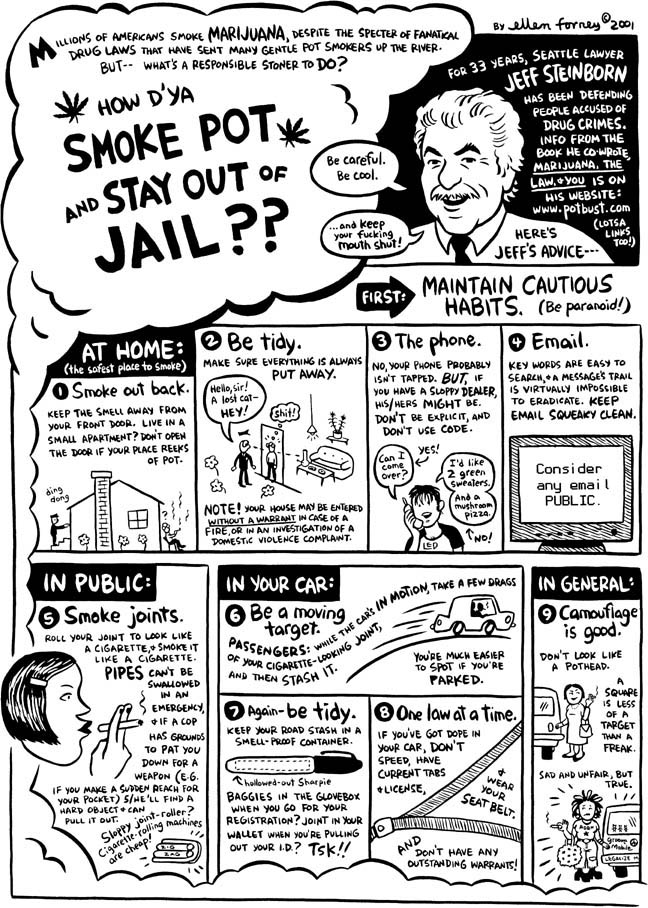
If you get caught.

Avoiding and defending pot busts.
Bustcard
posted by xowie at 4:32 PM on December 10, 2004
Folks, lay off David. He has some things to offer, if you don't force him into trolling. I suspect that that's what he did in this thread, but at least give him a chance to respond.
On preview:
I'm sorry, but if you're enough of an idiot to take drugs (or weapons or anything of the ilk) on a flight,
Prove he did it. Come on, asshole, you know, so prove it! Listen up, mstefan, you dick, there is no such thing as common sense, only common will. If you support the common will by supporting illegal searches then you get what you deserve. Whimper under your desk, as they take more and more rights away from you. "Don't provoke them", you advocate! Your cowardice pisses me off. Did he do it? You can't prove it. Try. I dare you.
posted by Wulfgar! at 4:34 PM on December 10, 2004
On preview:
I'm sorry, but if you're enough of an idiot to take drugs (or weapons or anything of the ilk) on a flight,
Prove he did it. Come on, asshole, you know, so prove it! Listen up, mstefan, you dick, there is no such thing as common sense, only common will. If you support the common will by supporting illegal searches then you get what you deserve. Whimper under your desk, as they take more and more rights away from you. "Don't provoke them", you advocate! Your cowardice pisses me off. Did he do it? You can't prove it. Try. I dare you.
posted by Wulfgar! at 4:34 PM on December 10, 2004
" ... nor representative of most people."
When one of us is vulnerable, all of us are vulnerable.
You can, when you're in power, slice the population thin enough to abuse that slice without complaint from the remainder.
That is the danger here.
That's one of the precepts of living in a representative democracy. It is set up by, for, and around the people and their will.
There are certain ground rules that are set up in the beginning that are very hard to change, and very easy to violate (supposedly with heavy penalties), and with good reason.
One of the ground rules in America is you defer to the individual. That what you have before you at almost any given time, is an innocent person, who is safe and secure in themselves and in their belongings.
If you cross that line, you better have a damn good reason.
If that reason is good enough this time, it will be good enough another time. Maybe the time YOU'RE going through a check point at a ________.
posted by Relay at 4:36 PM on December 10, 2004
When one of us is vulnerable, all of us are vulnerable.
You can, when you're in power, slice the population thin enough to abuse that slice without complaint from the remainder.
That is the danger here.
That's one of the precepts of living in a representative democracy. It is set up by, for, and around the people and their will.
There are certain ground rules that are set up in the beginning that are very hard to change, and very easy to violate (supposedly with heavy penalties), and with good reason.
One of the ground rules in America is you defer to the individual. That what you have before you at almost any given time, is an innocent person, who is safe and secure in themselves and in their belongings.
If you cross that line, you better have a damn good reason.
If that reason is good enough this time, it will be good enough another time. Maybe the time YOU'RE going through a check point at a ________.
posted by Relay at 4:36 PM on December 10, 2004
monju: Thanks for posting the relevant legal arguments in the midst of all this he-was-asking-for-it nonsense.
A question, as I'm not well versed in such matters. This passage seems pretty unequivocal to me:
There is an obvious danger, nonetheless, that the screening of passengers and their carry-on luggage for weapons and explosives will be subverted into a general search for evidence of crime. If this occurs, the courts will exclude the evidence obtained.
Doesn't this support Barlow's argument that the fact that the security people found illicit substances is irrelevant to the Fourth Amendment issue at stake? (And, by extension, doesn't it render moot the numerous postings in this thread accusing Barlow of being guilty of the crime of stupidity for bringing the stuff on the plane in the first place?)
posted by gompa at 4:44 PM on December 10, 2004
A question, as I'm not well versed in such matters. This passage seems pretty unequivocal to me:
There is an obvious danger, nonetheless, that the screening of passengers and their carry-on luggage for weapons and explosives will be subverted into a general search for evidence of crime. If this occurs, the courts will exclude the evidence obtained.
Doesn't this support Barlow's argument that the fact that the security people found illicit substances is irrelevant to the Fourth Amendment issue at stake? (And, by extension, doesn't it render moot the numerous postings in this thread accusing Barlow of being guilty of the crime of stupidity for bringing the stuff on the plane in the first place?)
posted by gompa at 4:44 PM on December 10, 2004
Now, that search may have been unjustified,
And this is the part that should trouble us all.
But some Americians do not uphold their oaths, and others hate The Constitution.
posted by rough ashlar at 4:45 PM on December 10, 2004
And this is the part that should trouble us all.
But some Americians do not uphold their oaths, and others hate The Constitution.
posted by rough ashlar at 4:45 PM on December 10, 2004
gompa, it does support Barlow's argument, but it must be weighed against this pronouncement from the court:
posted by monju_bosatsu at 4:53 PM on December 10, 2004
Of course, routine airport screening searches will lead to discovery of contraband and apprehension of law violators. This practical consequence does not alter the essentially administrative nature of the screening process, however, or render the searches unconstitutional.In order to reconcile this passage with the one you cited, you must focus on the scope of the search. If the scope of the search is sufficiently broad to suggest that the searching authorities intended it as a general search, the evidence will be excluded. If the scope of the search is only broad enough to search for weapons, but also happens to find the contraband, the evidence will not be excluded. I don't think we can answer that question in this case by hearing only one side of the story.
posted by monju_bosatsu at 4:53 PM on December 10, 2004
As a sign of how quickly US citizens are losing the protections from governmental intrusion that guarantee and define our freedom, in 2003 John Gilmore was able to bail out John Barlow without identifying himself. He would not have that "luxury" today.
posted by McGuillicuddy at 4:54 PM on December 10, 2004
posted by McGuillicuddy at 4:54 PM on December 10, 2004
Hey Davy, you don't even want to guess what my first name is. :-D
I agree, this man is stupid. And, you know what? Someone this dumb was going to go to jail for this anyways in the future. It's just one of those things where, by being an idiot, you will just end up screwed. Barlow should consider himself lucky that he might get away with this in a small part, because he might learn something from this (however, from his attitude, I find that extremely unlikely):
DOING ILLEGAL SHIT WHEN YOU KNOW YOU'RE UNDER SURVEILLANCE IS REALLY DUMB.
Seriously, this reminds me of all those "Stupid Criminals Caught On Camera" shows you see on TV.
posted by shepd at 4:57 PM on December 10, 2004
I agree, this man is stupid. And, you know what? Someone this dumb was going to go to jail for this anyways in the future. It's just one of those things where, by being an idiot, you will just end up screwed. Barlow should consider himself lucky that he might get away with this in a small part, because he might learn something from this (however, from his attitude, I find that extremely unlikely):
DOING ILLEGAL SHIT WHEN YOU KNOW YOU'RE UNDER SURVEILLANCE IS REALLY DUMB.
Seriously, this reminds me of all those "Stupid Criminals Caught On Camera" shows you see on TV.
posted by shepd at 4:57 PM on December 10, 2004
Sure, shepd. Maybe the next show you'll see on TV will be called "Stupid Terrorists Caught in Guantanamo."
"After all, he was wearing a turban. In this day and age, isn't that practically asking for it?"
posted by digaman at 5:04 PM on December 10, 2004
"After all, he was wearing a turban. In this day and age, isn't that practically asking for it?"
posted by digaman at 5:04 PM on December 10, 2004
whatever you feel about this guy (and i agree he sounds like a jerk) doesn't alter the basic problem, which is:
- you can't be searched without reasonable cause. most people think that's a good idea, because it stops the police from abusing their powers.
- on the other hand, we want to search luggage because we're afraid of being blown out of the sky.
- but if we can search everyone's luggage then the "reasonable cause" bit just went out the window. so we need a compromise.
- compromise is - you can search for things that threaten aeroplanes, but that's all.
- that doesn't mean you can't search people for drugs. it just means that you have to follow the same rules as always. with the usual checks and balances.
- ok, so we have a compromise. we hope it works.
- the unfortunate thing is, the only way you find out it isn't working is when you get someone (allegedly) breaking the law.
- so if you start saying "yeah well, he was breaking the law anyway" you're never going to enforce the compromise decided on by the courts to balance liberty and safety.
in other words, you need to worry about the arseholes, because they're the ones that show up the flaw in the system. or, in yet other words, whoever it was going to be, it would be someone who looked bad. that doesn't alter the importance of this.
so moan about the guy, or how stupid he was, but remember that it's essentially irrelevant to whether or not this is important. it's important because there was a balance chose, by the courts, between safety and liberty, and the airport security are not following that.
yes, this guy is stupid. but you should be a lot more worried about a bunch of security people doing what they want without the appropriate checks and balances.
posted by andrew cooke at 5:08 PM on December 10, 2004
- you can't be searched without reasonable cause. most people think that's a good idea, because it stops the police from abusing their powers.
- on the other hand, we want to search luggage because we're afraid of being blown out of the sky.
- but if we can search everyone's luggage then the "reasonable cause" bit just went out the window. so we need a compromise.
- compromise is - you can search for things that threaten aeroplanes, but that's all.
- that doesn't mean you can't search people for drugs. it just means that you have to follow the same rules as always. with the usual checks and balances.
- ok, so we have a compromise. we hope it works.
- the unfortunate thing is, the only way you find out it isn't working is when you get someone (allegedly) breaking the law.
- so if you start saying "yeah well, he was breaking the law anyway" you're never going to enforce the compromise decided on by the courts to balance liberty and safety.
in other words, you need to worry about the arseholes, because they're the ones that show up the flaw in the system. or, in yet other words, whoever it was going to be, it would be someone who looked bad. that doesn't alter the importance of this.
so moan about the guy, or how stupid he was, but remember that it's essentially irrelevant to whether or not this is important. it's important because there was a balance chose, by the courts, between safety and liberty, and the airport security are not following that.
yes, this guy is stupid. but you should be a lot more worried about a bunch of security people doing what they want without the appropriate checks and balances.
posted by andrew cooke at 5:08 PM on December 10, 2004
I don't think we can answer that question in this case by hearing only one side of the story.
Fair enough. But how could you argue that opening and sorting through a bottle of ibuprofen was part of a routine weapons search?
posted by gompa at 5:12 PM on December 10, 2004
Fair enough. But how could you argue that opening and sorting through a bottle of ibuprofen was part of a routine weapons search?
posted by gompa at 5:12 PM on December 10, 2004
Is there anything a man don't stand to lose,
When the devil wants to take it all away?
i can tell on this thread that some are just champing at the bit to honor our new fascist overlords
posted by pyramid termite at 5:17 PM on December 10, 2004
When the devil wants to take it all away?
i can tell on this thread that some are just champing at the bit to honor our new fascist overlords
posted by pyramid termite at 5:17 PM on December 10, 2004
Someone this dumb was going to go to jail for this anyways in the future.
But not during a constitutionally-questionable search on an airplane when they're supposed to be looking for weapons. Got that?
I tellya what: all you people who want to give up YOUR rights and freedoms are free to move to North fucking Korea. Leave MINE alone, thank you.
posted by davy at 5:23 PM on December 10, 2004
But not during a constitutionally-questionable search on an airplane when they're supposed to be looking for weapons. Got that?
I tellya what: all you people who want to give up YOUR rights and freedoms are free to move to North fucking Korea. Leave MINE alone, thank you.
posted by davy at 5:23 PM on December 10, 2004
MeFi - a hotdog-guardless buzzsaw
posted by sp dinsmoor at 5:31 PM on December 10, 2004
posted by sp dinsmoor at 5:31 PM on December 10, 2004
The search may or may not have been legal. No real sympathies for him, since you know that airports are high security areas, and you just don't fuck around in them.
But what about when granny gets searched for an explosive walker, and they find "Drugs" (Percosets) that she didn't have a prescription for...
Or worse, someone like me!! Long hair, but dressed in camo.
Is that enough? Just because someone has a Pantera shirt on, or a Harley hat, or long hair, or a walker shouldn't be a security flag. (or a turban, or a suit...)
Random searches within the guidelines allowed by the 4th ammendment are fine. Anything to where they are searching at the bottom of your Advil bottle, and ripping out the sideboards on your luggage, they better have a warrant describing what it is they are looking for.
What if it's the grandma who, every time she gets on the plane, gets all her Advil bottles emptied, and her Gold Bond Medicated Powder confiscated for analysis.
"It's all just to protect the country, ma'am."
(As she ties her tired old shoes, with her frail, wrinkly, liver spotted fingers)
"Thank's Bud! Go America!"
Won't someone think of the Grandmothers!!
posted by Balisong at 5:32 PM on December 10, 2004
But what about when granny gets searched for an explosive walker, and they find "Drugs" (Percosets) that she didn't have a prescription for...
Or worse, someone like me!! Long hair, but dressed in camo.
Is that enough? Just because someone has a Pantera shirt on, or a Harley hat, or long hair, or a walker shouldn't be a security flag. (or a turban, or a suit...)
Random searches within the guidelines allowed by the 4th ammendment are fine. Anything to where they are searching at the bottom of your Advil bottle, and ripping out the sideboards on your luggage, they better have a warrant describing what it is they are looking for.
What if it's the grandma who, every time she gets on the plane, gets all her Advil bottles emptied, and her Gold Bond Medicated Powder confiscated for analysis.
"It's all just to protect the country, ma'am."
(As she ties her tired old shoes, with her frail, wrinkly, liver spotted fingers)
"Thank's Bud! Go America!"
Won't someone think of the Grandmothers!!
posted by Balisong at 5:32 PM on December 10, 2004
yes, this guy is stupid.
I'm not sure why it's taken me so long to relate this event. Embarrassment certainly played no part. Generally, I like to be fully disclosed, no matter how far I may wander beyond the normative fringe. I suppose that, for legal reasons, I wanted to avoid any apparent admission of guilt, and only now do I realize that it's possible to tell this tale without making one.
On December 15, at 2:00 pm, I will pay yet another visit to the North San Mateo County Courthouse in South San Francisco. This time I expect I will actually get a chance to plead my case.
Being that his case is open, should he be talking publicly about it. Thought it was wise discussing an open case with only your lawyer.
posted by thomcatspike at 5:37 PM on December 10, 2004
I'm not sure why it's taken me so long to relate this event. Embarrassment certainly played no part. Generally, I like to be fully disclosed, no matter how far I may wander beyond the normative fringe. I suppose that, for legal reasons, I wanted to avoid any apparent admission of guilt, and only now do I realize that it's possible to tell this tale without making one.
On December 15, at 2:00 pm, I will pay yet another visit to the North San Mateo County Courthouse in South San Francisco. This time I expect I will actually get a chance to plead my case.
Being that his case is open, should he be talking publicly about it. Thought it was wise discussing an open case with only your lawyer.
posted by thomcatspike at 5:37 PM on December 10, 2004
(But I DID go through the extra patdown check and STILL got through with a carbon fiber knife on me...) 8=)
posted by Balisong at 5:40 PM on December 10, 2004
posted by Balisong at 5:40 PM on December 10, 2004
John Gilmore was able to bail out John Barlow without identifying himself. He would not have that "luxury" today.
Your mixing apples with oranges here. Pretty sure it was a county/city clerk that asked his name, not a cop. Notably here for the purpose of a bail receipt. Who would hand over $25grand and not want a personal receipt back insuring its possible return? Because the money would be returned to Gilmore if Barlow was found not guilty.
Sheesh, I know my way a round the police station too well.
posted by thomcatspike at 5:48 PM on December 10, 2004
Your mixing apples with oranges here. Pretty sure it was a county/city clerk that asked his name, not a cop. Notably here for the purpose of a bail receipt. Who would hand over $25grand and not want a personal receipt back insuring its possible return? Because the money would be returned to Gilmore if Barlow was found not guilty.
Sheesh, I know my way a round the police station too well.
posted by thomcatspike at 5:48 PM on December 10, 2004
I have to agree with many of the people here: taking drugs onto an airplane is monumentally, colossally, terminally stupid.
Whether the search is eventually ruled illegal or not, the guy was being an idiot.
Hell... I had to give away half an ounce of... oregano once, because I forgot it was in my bag, and was taking a flight at rather short notice. Boy, did the Swedish (or something Euro-hairy-face-backpacker, anyway) backpacker kids outside the airport that morning get a great welcome to Canada!
Point being, taking drugs with you on an airplane is like walking through security making jokes about having guns with you. You deserve to get slapped around a bit.
posted by dirtynumbangelboy at 5:56 PM on December 10, 2004
Whether the search is eventually ruled illegal or not, the guy was being an idiot.
Hell... I had to give away half an ounce of... oregano once, because I forgot it was in my bag, and was taking a flight at rather short notice. Boy, did the Swedish (or something Euro-hairy-face-backpacker, anyway) backpacker kids outside the airport that morning get a great welcome to Canada!
Point being, taking drugs with you on an airplane is like walking through security making jokes about having guns with you. You deserve to get slapped around a bit.
posted by dirtynumbangelboy at 5:56 PM on December 10, 2004
Those of you who think he was asking for it seem to imply that the TSA was within their rights to conduct such an intrusive search and, having found no evidence of anything that would be a safety/terrorist threat, bust him for an unrelated crime?
So I assume you'd also be cool with the following scenario:
The TSA, after swiping a passenger's laptop for explosive residue and booting it up to see if it was actually an operable computer (this has happened to me) also checks and see if any of the software was pirated or if the HD contained child porn.
I mean, really, if you're breaking the law and you know you're under survelliance, you're asking for it, right?
posted by donovan at 5:59 PM on December 10, 2004
So I assume you'd also be cool with the following scenario:
The TSA, after swiping a passenger's laptop for explosive residue and booting it up to see if it was actually an operable computer (this has happened to me) also checks and see if any of the software was pirated or if the HD contained child porn.
I mean, really, if you're breaking the law and you know you're under survelliance, you're asking for it, right?
posted by donovan at 5:59 PM on December 10, 2004
There should be a CLEAR distinction... But who do you want writing the legislation that lays the distinction line?
posted by Balisong at 6:05 PM on December 10, 2004
posted by Balisong at 6:05 PM on December 10, 2004
Hmmm. The law in the UK is pretty incoherent on ket, shrooms and weed, but I'm not going to prove the point by taking them on a plane from London to Portugal (where consumption of recreational drugs has been de-criminalised).
Most people who travel through the States are aware just how oppressive the airport security regime is there, but, hey, nobody's making you go on that plane. I was much more offended when travelling through Central America last year by the unidentified 'North Americans' conducting complete searches of Ticabus coaches, assisted by sniffer dogs and the Honduran military. Unbelievable...
posted by runkelfinker at 6:06 PM on December 10, 2004
Most people who travel through the States are aware just how oppressive the airport security regime is there, but, hey, nobody's making you go on that plane. I was much more offended when travelling through Central America last year by the unidentified 'North Americans' conducting complete searches of Ticabus coaches, assisted by sniffer dogs and the Honduran military. Unbelievable...
posted by runkelfinker at 6:06 PM on December 10, 2004
" ... but, hey, nobody's making you go on that plane."
Sure.
You can just take that BOAT from Honolulu to San Francisco.
posted by Relay at 6:15 PM on December 10, 2004
Sure.
You can just take that BOAT from Honolulu to San Francisco.
posted by Relay at 6:15 PM on December 10, 2004
No, your drugs can take the boat. You can take the plane.
posted by runkelfinker at 6:18 PM on December 10, 2004
posted by runkelfinker at 6:18 PM on December 10, 2004
Having drugs is against the law. Searching airline passengers' baggage for anything other than explosives and weapons is also against the law.
posted by aeschenkarnos at 6:20 PM on December 10, 2004
posted by aeschenkarnos at 6:20 PM on December 10, 2004
No, at no point am I saying that the TSA should have done what it did-- but Barlow did deserve a smackdown for his stupidity.
It's an unpleasant Catch-22.
posted by dirtynumbangelboy at 6:21 PM on December 10, 2004
It's an unpleasant Catch-22.
posted by dirtynumbangelboy at 6:21 PM on December 10, 2004
The answer here is to ban BurningMan.
...
No, the answer here is to ban hippies.
No, no. The answer here is to ban airplanes.
The chorus of croaky authoritarian voices calling JPB "stupid" for not fully expecting and accepting that every micrometer of his luggage would be searched for anything illicit on a domestic airline flight is amusing. He's old enough to know people who've been carrying contraband chemicals on airplanes for decades without any trouble. Not long ago it wasn't much more dangerous than carrying the stuff anywhere else. Still isn't, in most of the civilized world. Is it equally "stupid" to slink through airport security with a briefcase containing business documents which could be construed to provide evidence of improper accounting, insider trading, or anything secret for that matter? I suppose carrying a copy of the Koran on board is also "stupid" now that the public consensus is that entering an airport involves abandoning all expectation of respect for liberty from anyone who claims to act on behalf of "security."
Since this so-called "fourth amendment" is, among other freedoms we have come to expect in the non-airport world, clearly incompatible with the new realities of air travel, we have the choice of abandoning one or the other. Since air travel is uncomfortable, expensive, environmentally damaging, noisy, crowded, and contrary to God's will, I say it should be the one to go. Who really needs to travel so quickly anyway? Such haste seems suspicious... is it a coincidence that "flight" is also the word we use to describe the action of a criminal on the run from justice? Ban air travel today, America, before it corrodes your soul beyond the point of redemption.
posted by sfenders at 6:34 PM on December 10, 2004
...
No, the answer here is to ban hippies.
No, no. The answer here is to ban airplanes.
The chorus of croaky authoritarian voices calling JPB "stupid" for not fully expecting and accepting that every micrometer of his luggage would be searched for anything illicit on a domestic airline flight is amusing. He's old enough to know people who've been carrying contraband chemicals on airplanes for decades without any trouble. Not long ago it wasn't much more dangerous than carrying the stuff anywhere else. Still isn't, in most of the civilized world. Is it equally "stupid" to slink through airport security with a briefcase containing business documents which could be construed to provide evidence of improper accounting, insider trading, or anything secret for that matter? I suppose carrying a copy of the Koran on board is also "stupid" now that the public consensus is that entering an airport involves abandoning all expectation of respect for liberty from anyone who claims to act on behalf of "security."
Since this so-called "fourth amendment" is, among other freedoms we have come to expect in the non-airport world, clearly incompatible with the new realities of air travel, we have the choice of abandoning one or the other. Since air travel is uncomfortable, expensive, environmentally damaging, noisy, crowded, and contrary to God's will, I say it should be the one to go. Who really needs to travel so quickly anyway? Such haste seems suspicious... is it a coincidence that "flight" is also the word we use to describe the action of a criminal on the run from justice? Ban air travel today, America, before it corrodes your soul beyond the point of redemption.
posted by sfenders at 6:34 PM on December 10, 2004
Worth reading is the Washington Post article on the subject from a former Baltimore police officer, which appears in the comments on Barlow's blog.
He suggests the common sense solution: that the TSA has no justifiable reason to do anything with things they find in searched luggage that don't have any relevance to the reason why they're allowed to search it in the first place. They should simply ignore anything not relating to air travel security.
Also of note:
Using security and terrorism as justification, the government is beginning to extend airport-like implied consent zones to more and more of the public sphere, including the entire Boston subway system.
posted by sfenders at 6:55 PM on December 10, 2004
He suggests the common sense solution: that the TSA has no justifiable reason to do anything with things they find in searched luggage that don't have any relevance to the reason why they're allowed to search it in the first place. They should simply ignore anything not relating to air travel security.
Also of note:
Using security and terrorism as justification, the government is beginning to extend airport-like implied consent zones to more and more of the public sphere, including the entire Boston subway system.
posted by sfenders at 6:55 PM on December 10, 2004
Wow. I lurk here for what seems like forever, pay my $5 at the first possible moment, and I never realized how petty so many of you could be.
I've typed and deleted dozens of paragraphs. It just isn't worth it.
I remember when the Constitution and the Bill of Rights were taught in schools. It wasn't that long ago. It saddens me that so few seem to know what the fourth amendment is, and are willing to ignore it when it suits their purpose.
If Metafilter is a representative sample of the informed populace, I now consider the Bill of Rights dead.
Wow.
posted by bh at 6:55 PM on December 10, 2004
I've typed and deleted dozens of paragraphs. It just isn't worth it.
I remember when the Constitution and the Bill of Rights were taught in schools. It wasn't that long ago. It saddens me that so few seem to know what the fourth amendment is, and are willing to ignore it when it suits their purpose.
If Metafilter is a representative sample of the informed populace, I now consider the Bill of Rights dead.
Wow.
posted by bh at 6:55 PM on December 10, 2004
Actually, sfenders, 'most of the civilized world' has had much more stringent airport security than America for a lot longer. Don't you remember Macca?
posted by runkelfinker at 6:55 PM on December 10, 2004
posted by runkelfinker at 6:55 PM on December 10, 2004
This is alot like saying "I have a bomb" in an airport, getting arrested, and then saying your 1st ammendment right was violated. There are limits to evey right, and he ran headlong into one of them. Though shit. If, after years of touring with the Dead, Mr. Barlow can't figure out that you NEVER EVER EVER bring drugs on an airplane, then that's his problem.
If he was trying to prove a point by forcing an unjust arrest (viz. lunch counter sit-ins) by stashing a bunch of shitake mushrooms at the bottom of his bottle of ibuprofin, that'd be one thing. But he didn't. He knowingly broke the law, and he got caught.
And so to cover his ass he puts on this violate-my-rights whats-next-they-search-your-house-without-cause slippery slope act. In my opinion, using transparent righteos indignation bullshit to cover your tracks is just as bad as using transparent national security bullshit.
Mr. Barlow is hiding behind the letter of the law to in order cover up his illegal activities, just as the TSA is. Far from "exposing" their hypocricity for what it is, he engages in it himself. Not, in my opinion, a convincing stance.
posted by ChasFile at 7:02 PM on December 10, 2004
If he was trying to prove a point by forcing an unjust arrest (viz. lunch counter sit-ins) by stashing a bunch of shitake mushrooms at the bottom of his bottle of ibuprofin, that'd be one thing. But he didn't. He knowingly broke the law, and he got caught.
And so to cover his ass he puts on this violate-my-rights whats-next-they-search-your-house-without-cause slippery slope act. In my opinion, using transparent righteos indignation bullshit to cover your tracks is just as bad as using transparent national security bullshit.
Mr. Barlow is hiding behind the letter of the law to in order cover up his illegal activities, just as the TSA is. Far from "exposing" their hypocricity for what it is, he engages in it himself. Not, in my opinion, a convincing stance.
posted by ChasFile at 7:02 PM on December 10, 2004
The essence of these decisions is that searches conducted as part of a general regulatory scheme in furtherance of an administrative purpose, rather than as part of a criminal investigation to secure evidence of crime, may be permissible under the Fourth Amendment though not supported by a showing of probable cause directed to a particular place or person to be searched.
I think the point is that random searches are acceptable provided they are actually random, and not unfairly targetting someone, because if you're targetting someone, clearly you're looking for something to convict.
This line of thinking isn't reserved for airlines, nor is it limited to explosives. Where I live, we have random car stops after midnight on weekends because drunk driving is more likely to occur at those times, and this helps ensure the general public's safety.
The problem I have is that the reasoning seems specious. "Provided we're not actually looking for anything in particular, anything we find is OK." This doesn't address the reasoning behind the search, however. The fourth amendment is pretty clear on this: "The right of the people to be secure in their persons, houses, papers, and effects, against unreasonable searches and seizures, shall not be violated[...]"
This, of course, begs the question, "What is reasonable?"
posted by Civil_Disobedient at 7:10 PM on December 10, 2004
I think the point is that random searches are acceptable provided they are actually random, and not unfairly targetting someone, because if you're targetting someone, clearly you're looking for something to convict.
This line of thinking isn't reserved for airlines, nor is it limited to explosives. Where I live, we have random car stops after midnight on weekends because drunk driving is more likely to occur at those times, and this helps ensure the general public's safety.
The problem I have is that the reasoning seems specious. "Provided we're not actually looking for anything in particular, anything we find is OK." This doesn't address the reasoning behind the search, however. The fourth amendment is pretty clear on this: "The right of the people to be secure in their persons, houses, papers, and effects, against unreasonable searches and seizures, shall not be violated[...]"
This, of course, begs the question, "What is reasonable?"
posted by Civil_Disobedient at 7:10 PM on December 10, 2004
No, at no point am I saying that the TSA should have done what it did-- but Barlow did deserve a smackdown for his stupidity.
It's an unpleasant Catch-22.
not at all. barlow is the exception. he had drugs.
there exists probable cause the TSA goonage broke the law many many times pawing through the luggage of people who did not have drugs and they continue to do so, and all involved should be prosecuted accordingly.
posted by quonsar at 7:14 PM on December 10, 2004
This is alot like saying "I have a bomb" in an airport, getting arrested, and then saying your 1st ammendment right was violated. There are limits to evey right, and he ran headlong into one of them. Though shit. If, after years of touring with the Dead, Mr. Barlow can't figure out that you NEVER EVER EVER bring drugs on an airplane, then that's his problem.
Uh no, not at all. Unlike your "I have a bomb" example" there is nothing about this case that presented even a hint of a threat to the safety of the aircraft and passengers, which is the whole reason we have airport security.
I'm stunned that so many people are willing to give carte blanche to the security apparatus and allow a reasonable violation of privacy (preventing harm) to be extended to an open-ended hunt for legal violations, of which drugs are just one. I have to assume that you and the others trumpeting this line of reasoning are fine with being detained for having illeagl MP3s on your computer or as sfenders notes, having documents in your briefcase which might indicate insider trading.
What I'm hearing is that there is no zone of privacy once I leave my house and I find that completely frightening and Orwellian.
bh: Don't despair, you're getting more than your $5 worth in this thread alone! ;-)
posted by donovan at 7:17 PM on December 10, 2004
Uh no, not at all. Unlike your "I have a bomb" example" there is nothing about this case that presented even a hint of a threat to the safety of the aircraft and passengers, which is the whole reason we have airport security.
I'm stunned that so many people are willing to give carte blanche to the security apparatus and allow a reasonable violation of privacy (preventing harm) to be extended to an open-ended hunt for legal violations, of which drugs are just one. I have to assume that you and the others trumpeting this line of reasoning are fine with being detained for having illeagl MP3s on your computer or as sfenders notes, having documents in your briefcase which might indicate insider trading.
What I'm hearing is that there is no zone of privacy once I leave my house and I find that completely frightening and Orwellian.
bh: Don't despair, you're getting more than your $5 worth in this thread alone! ;-)
posted by donovan at 7:17 PM on December 10, 2004
Donovan: Thanks for phrasing it better than I did during my many attempts.
Civil_Disobedient: So what are your feelings on prior restraint?
posted by bh at 7:24 PM on December 10, 2004
Civil_Disobedient: So what are your feelings on prior restraint?
posted by bh at 7:24 PM on December 10, 2004
Actually, sfenders, 'most of the civilized world' has had much more stringent airport security than America for a lot longer.
Oh, I didn't mean to suggest that America's airport security was actually all that strong compared to the rest of the world. Not at all. I suspect that the USA is a world leader in finding small quantities of particular banned substances on domestic flights, as well as somewhat below average for actual security. Admittedly, I should have have written "most of the places I've been" which is in no way anywhere close to a representative sample of the civilized world.
Don't you remember Macca?
Not really, but that wasn't airport security, it was customs officials. Ascertaining the nature of all the stuff you're carrying into the country is among their primary raisons d'etre. Carrying that much pot across national borders is dangerous no matter what your mode of travel.
posted by sfenders at 7:25 PM on December 10, 2004
Oh, I didn't mean to suggest that America's airport security was actually all that strong compared to the rest of the world. Not at all. I suspect that the USA is a world leader in finding small quantities of particular banned substances on domestic flights, as well as somewhat below average for actual security. Admittedly, I should have have written "most of the places I've been" which is in no way anywhere close to a representative sample of the civilized world.
Don't you remember Macca?
Not really, but that wasn't airport security, it was customs officials. Ascertaining the nature of all the stuff you're carrying into the country is among their primary raisons d'etre. Carrying that much pot across national borders is dangerous no matter what your mode of travel.
posted by sfenders at 7:25 PM on December 10, 2004
Uh no, not at all. Unlike your "I have a bomb" example" there is nothing about this case that presented even a hint of a threat to the safety of the aircraft and passengers, which is the whole reason we have airport security.
Um, hi. Did you even read the FPP article? The TSA has x-ray detectors that can screen for drugs. Also, while I appreciate your ability to pick out the most inflamatory part of my argument, please read the whole thing before you criticize me.
They were both wrong. I have no problem with Mr. Barlow saying "I got caught, but it was an illegal search, so I shouldn't go to jail." Instead he glosses over the fact that he was, in fact carrying narcotics ("recomended by my physician") and presents his case as an exemplar of the travesty of the overzealous TSA. I believe that this type of defense is a travesty of an overzealous perpetrator; they both did something illegal, and now both seek to wash that fact under two seperate pretenses, one uses "national security," the other uses "civil rights." This whole thing is fucked and everybody was wrong, but nobody is resolved of culpability because thier illegal activity cloaked under a moral indignation is better than anyone else's. Civil disobedience for the sake of social change is noble. Civil disobedience for the sake of covering your own ass is at best selfish and at worst the most insidious kind of guile. Fuck the TSA, and fuck Mr. Barlow. Good night, everyone.
posted by ChasFile at 7:41 PM on December 10, 2004
Um, hi. Did you even read the FPP article? The TSA has x-ray detectors that can screen for drugs. Also, while I appreciate your ability to pick out the most inflamatory part of my argument, please read the whole thing before you criticize me.
They were both wrong. I have no problem with Mr. Barlow saying "I got caught, but it was an illegal search, so I shouldn't go to jail." Instead he glosses over the fact that he was, in fact carrying narcotics ("recomended by my physician") and presents his case as an exemplar of the travesty of the overzealous TSA. I believe that this type of defense is a travesty of an overzealous perpetrator; they both did something illegal, and now both seek to wash that fact under two seperate pretenses, one uses "national security," the other uses "civil rights." This whole thing is fucked and everybody was wrong, but nobody is resolved of culpability because thier illegal activity cloaked under a moral indignation is better than anyone else's. Civil disobedience for the sake of social change is noble. Civil disobedience for the sake of covering your own ass is at best selfish and at worst the most insidious kind of guile. Fuck the TSA, and fuck Mr. Barlow. Good night, everyone.
posted by ChasFile at 7:41 PM on December 10, 2004
"...contrary to God's will..."
*sells car, buys donkey, climbs hill and makes burnt offering*
posted by mr_crash_davis at 7:57 PM on December 10, 2004
*sells car, buys donkey, climbs hill and makes burnt offering*
posted by mr_crash_davis at 7:57 PM on December 10, 2004
ChasFile: To be clear, I'm not criticizing you (we've just met, nice to meet ya). I'm criticizing your argument. I did read your whole post and in fact every link in this thread and I'm not seeing your point.
You seem to suggest that if he had pretended to have drugs (shitakke mushrooms) then he'd have a case but the fact that they allegedly found actual drugs somehow undermines his position. I think that's wrong.
This is about the power we are willing to grant to law enforcement bodies to (a) conduct a search and (b) do something with what they find in the search. JPB's defense isn't "my doctor said I could have pot so you shouldn't arrest me" it's "WTF are you doing searching for bombs and digging into my Advil bottle and deciding you want to bust me on a drug charge." They are totally different arguments. He is very clearly not arguing for a relaxtion in drug laws (though he would, and I'd support this, but that's a different topic).
This is all about how much power and authority we want to grant to law enforcement.
My vote: Just enough to make us safe. So Chasfile, I assume that if I scrutinize your laptop, MP3 player, or briefcase/backpack while your going through an airport there will be nothing that might trigger a detention and search as you miss your plane while I investigate whether you're breaking any laws (you might not be but I want to be sure since I've been given the chance to break into what you might have thought was your private sphere). You're cool with that, right?
posted by donovan at 8:05 PM on December 10, 2004
You seem to suggest that if he had pretended to have drugs (shitakke mushrooms) then he'd have a case but the fact that they allegedly found actual drugs somehow undermines his position. I think that's wrong.
This is about the power we are willing to grant to law enforcement bodies to (a) conduct a search and (b) do something with what they find in the search. JPB's defense isn't "my doctor said I could have pot so you shouldn't arrest me" it's "WTF are you doing searching for bombs and digging into my Advil bottle and deciding you want to bust me on a drug charge." They are totally different arguments. He is very clearly not arguing for a relaxtion in drug laws (though he would, and I'd support this, but that's a different topic).
This is all about how much power and authority we want to grant to law enforcement.
My vote: Just enough to make us safe. So Chasfile, I assume that if I scrutinize your laptop, MP3 player, or briefcase/backpack while your going through an airport there will be nothing that might trigger a detention and search as you miss your plane while I investigate whether you're breaking any laws (you might not be but I want to be sure since I've been given the chance to break into what you might have thought was your private sphere). You're cool with that, right?
posted by donovan at 8:05 PM on December 10, 2004
John Gilmore was able to bail out John Barlow without identifying himself. He would not have that "luxury" today.
Your [sic] mixing apples with oranges here. Pretty sure it was a county/city clerk that asked his name, not a cop.
From the article: [Gilmore posting bail] very nearly turned south when [Gilmore] would not produce a government-issued ID for the deputy at the desk.
More to the point, this thread is about the government's policy of limiting the protections of the 4th Amendment. The link I posted was about the government's policy of limiting the protections of the 5th Amendment, which protects us from self-incrimination. That's comparing apples and oranges only if you think the important aspect of this case is another dope smoker getting busted, instead focusing on the larger issue of our government's campaign to weaken the Constitutional rights that guarantee your privacy and freedom.
posted by McGuillicuddy at 8:06 PM on December 10, 2004
Your [sic] mixing apples with oranges here. Pretty sure it was a county/city clerk that asked his name, not a cop.
From the article: [Gilmore posting bail] very nearly turned south when [Gilmore] would not produce a government-issued ID for the deputy at the desk.
More to the point, this thread is about the government's policy of limiting the protections of the 4th Amendment. The link I posted was about the government's policy of limiting the protections of the 5th Amendment, which protects us from self-incrimination. That's comparing apples and oranges only if you think the important aspect of this case is another dope smoker getting busted, instead focusing on the larger issue of our government's campaign to weaken the Constitutional rights that guarantee your privacy and freedom.
posted by McGuillicuddy at 8:06 PM on December 10, 2004
Crash: thanks for puttin' it all in perspective, I have my lighter out now . . .
posted by donovan at 8:07 PM on December 10, 2004
posted by donovan at 8:07 PM on December 10, 2004
Stuffing drugs in the bottom of your bags became passe with the arrest of Aaron Sorkin at Burbank airport for possession of mostly the same stuff Barlow had. That was three years ago, Barlow knows it, so do all of you. He could've easily bought pot and mushrooms upon his arrival. Instead, he did something stupid and immature, and is now compounding his legal problems by calling attention to himself in the name of political action. Nothing good can possibly come of that from his perspective. A person with daughters ought to hire a connected, expensive lawyer and quietly cut a deal, rather than risk spending the rest of his life in jail in the mistaken belief that he is doing something important for the rest of us. I also agree, posting about a pending criminal case is not very bright (even for a civil libertarian).
posted by xowie at 8:32 PM on December 10, 2004
posted by xowie at 8:32 PM on December 10, 2004
xomie, thanks for describing a scenario that makes it kosher for well off drug users to avoid dealing with fundamental legal issues. Would your advice had differed if JPB had sons rather than daughters?
I don't understand how fundamental rights of privacy are being quickly turned under by arguments that hinge on "well he had drugss." Help me here.
posted by donovan at 8:39 PM on December 10, 2004
I don't understand how fundamental rights of privacy are being quickly turned under by arguments that hinge on "well he had drugss." Help me here.
posted by donovan at 8:39 PM on December 10, 2004
If Metafilter is a representative sample of the informed populace, I now consider the Bill of Rights dead.
Many Mefites often use bigger words and wordier rationalizations to the same effect as the rest of the majority of Americans, to wit: "We don't need no steenking rights! And anybody who says they do is a big dumb weenie! (Spank me Daddy, spank me HARD.)"
Millions of North Koreans would benefit greatly from a wee smidgen of those rights and freedoms reg'lar Merkins are happy to give up at the drop of a hat. It's even worse when you get them to think about it: then they come up with "better" "reasons" for giving up even more.
That might be okay, maybe, if they were giving consent only for themselves to gratify their own masochism; I see nothing inherently wrong with a Slave List of Americans who gladly voluntarily give up every shred of dignity, or maybe they could put SLAVE stickers on their driver's licenses or get themselves tattooed. But when they start bleating "Daddy spank them too!" that's where I draw the line. People, BDSM is supposed to be consensual, and I do NOT consent. I never have, and I guarantee I never will.
Will all you pain-loving dweebs with no self-respect please leave the Land of the FREE? Go away already! The rest of the planet is full of tyrants who will gladly gratify you.
posted by davy at 8:43 PM on December 10, 2004
Many Mefites often use bigger words and wordier rationalizations to the same effect as the rest of the majority of Americans, to wit: "We don't need no steenking rights! And anybody who says they do is a big dumb weenie! (Spank me Daddy, spank me HARD.)"
Millions of North Koreans would benefit greatly from a wee smidgen of those rights and freedoms reg'lar Merkins are happy to give up at the drop of a hat. It's even worse when you get them to think about it: then they come up with "better" "reasons" for giving up even more.
That might be okay, maybe, if they were giving consent only for themselves to gratify their own masochism; I see nothing inherently wrong with a Slave List of Americans who gladly voluntarily give up every shred of dignity, or maybe they could put SLAVE stickers on their driver's licenses or get themselves tattooed. But when they start bleating "Daddy spank them too!" that's where I draw the line. People, BDSM is supposed to be consensual, and I do NOT consent. I never have, and I guarantee I never will.
Will all you pain-loving dweebs with no self-respect please leave the Land of the FREE? Go away already! The rest of the planet is full of tyrants who will gladly gratify you.
posted by davy at 8:43 PM on December 10, 2004
I'm old enough to have flown with pot a thousand times. I wouldn't do it now, though. I also stop my friends from smoking out in a motor vehicle. It's needlessly dangerous.
You want some advice? If you are stupid enough to carry drugs on a commercial flight, at least bring along a good lawyer's phone number, a bondsman's card and plenty of change. Prosecutors don't have a sense of humor. Drug sniffing dogs cannot be fooled. Tommy Chong, who had a son, not a daughter, in the glassware business, just finished 9 months in federal prison. You have to choose your battles. This seems like an exceptionally ill-advised battle for Barlow.
When the Grateful Dead were illegally busted in New Orleans, the last thing they did was wage a media campaign about the violation of their fourth amendment rights, hell, no, they had lawyers pay money to the D.A., and then they held a big concert and dropped acid with all the cops. Doesn't that sound like a more sensible way to handle things?
posted by xowie at 9:15 PM on December 10, 2004
You want some advice? If you are stupid enough to carry drugs on a commercial flight, at least bring along a good lawyer's phone number, a bondsman's card and plenty of change. Prosecutors don't have a sense of humor. Drug sniffing dogs cannot be fooled. Tommy Chong, who had a son, not a daughter, in the glassware business, just finished 9 months in federal prison. You have to choose your battles. This seems like an exceptionally ill-advised battle for Barlow.
When the Grateful Dead were illegally busted in New Orleans, the last thing they did was wage a media campaign about the violation of their fourth amendment rights, hell, no, they had lawyers pay money to the D.A., and then they held a big concert and dropped acid with all the cops. Doesn't that sound like a more sensible way to handle things?
posted by xowie at 9:15 PM on December 10, 2004
I'm old enough to have flown with pot a thousand times. I wouldn't do it now, though.
What's changed? An acknowledgement that times are tough and we all need to keep our head down? I just can't sign on to that.
posted by donovan at 9:25 PM on December 10, 2004
What's changed? An acknowledgement that times are tough and we all need to keep our head down? I just can't sign on to that.
posted by donovan at 9:25 PM on December 10, 2004
Absolutely times have changed. It cuts both ways. In SFO, you can now safely buy and consume all the medical marijuana you want. I'd rather keep that, and pass on the rather dubious right of sneaking a bit of hash through baggage check.
It was hugely naive for JPB to carry around something like ketamine without preparing ahead for the consequences.
A class action suit against airport goons is a good idea. Encouraging criminal probes of this is also a good idea. Using your own life and liberty as a test case? When you're a famous hippie caught red-handed with weird drugs? Bad idea jeans!
posted by xowie at 9:52 PM on December 10, 2004
It was hugely naive for JPB to carry around something like ketamine without preparing ahead for the consequences.
A class action suit against airport goons is a good idea. Encouraging criminal probes of this is also a good idea. Using your own life and liberty as a test case? When you're a famous hippie caught red-handed with weird drugs? Bad idea jeans!
posted by xowie at 9:52 PM on December 10, 2004
In SFO, you can now safely buy and consume all the medical marijuana you want.
What terminal do you depart from?
posted by donovan at 9:58 PM on December 10, 2004
What terminal do you depart from?
posted by donovan at 9:58 PM on December 10, 2004
focusing on the larger issue of our government's campaign to weaken the Constitutional rights that guarantee your privacy and freedom. - McGuillicuddy
Hear, hear!
***
A person with daughters ought to hire a connected, expensive lawyer and quietly cut a deal, rather than risk spending the rest of his life in jail in the mistaken belief that he is doing something important for the rest of us.
Xowie, how about "a person with daughters" who cannot afford a "connected and expensive" deal-cutting lawyer and/or who'd be ashamed to show herself as a coward to her children?
***
What's changed? An acknowledgement that times are tough and we all need to keep our head down? I just can't sign on to that.
Nor can I, Donovan. Yes, times are tough, but this habit of kowtowing people have gotten into, and insist the rest of us join them in, only makes it worse.
I'm beginning to believe that democracy is incompatible with liberty, that people who have so little care for freedom should not be allowed to speak for those who do -- nor even to appear to do so. Let them admit they cannot handle freedom and take the brand of SLAVE, leaving the rest of us the hell out of their "compact with the devil".
posted by davy at 10:00 PM on December 10, 2004
Hear, hear!
***
A person with daughters ought to hire a connected, expensive lawyer and quietly cut a deal, rather than risk spending the rest of his life in jail in the mistaken belief that he is doing something important for the rest of us.
Xowie, how about "a person with daughters" who cannot afford a "connected and expensive" deal-cutting lawyer and/or who'd be ashamed to show herself as a coward to her children?
***
What's changed? An acknowledgement that times are tough and we all need to keep our head down? I just can't sign on to that.
Nor can I, Donovan. Yes, times are tough, but this habit of kowtowing people have gotten into, and insist the rest of us join them in, only makes it worse.
I'm beginning to believe that democracy is incompatible with liberty, that people who have so little care for freedom should not be allowed to speak for those who do -- nor even to appear to do so. Let them admit they cannot handle freedom and take the brand of SLAVE, leaving the rest of us the hell out of their "compact with the devil".
posted by davy at 10:00 PM on December 10, 2004
It was hugely naive for JPB to carry around something like ketamine without preparing ahead for the consequences.
What's ketamien got to do with it . . . I could have an 8.5 X 11 sheet of acid tucked in my Franklin Covey organizer . . . I must be missing some major point here, but I believe this about what sort of searches should be permissable not what kind of drugs I might be carrying or what sorts of other laws I might be breaking that would be uncovered by a search that goes beyond "making sure my plane won't explode or be hijacked."
posted by donovan at 10:03 PM on December 10, 2004
What's ketamien got to do with it . . . I could have an 8.5 X 11 sheet of acid tucked in my Franklin Covey organizer . . . I must be missing some major point here, but I believe this about what sort of searches should be permissable not what kind of drugs I might be carrying or what sorts of other laws I might be breaking that would be uncovered by a search that goes beyond "making sure my plane won't explode or be hijacked."
posted by donovan at 10:03 PM on December 10, 2004
OK, OK, I get the message: you all want me to give a reason or two for stating that Barlow is an idiot. Honestly, I wasn't just trying to "troll" -- I just wanted it known that not EVERYBODY on MeFi is on the Barlow bandwagon, and I was running late for my wife's office xmas party.
But on to the reasons: pretty much what others have said here. If Barlow wants to crash his brain via drugs, that's fine -- the libertarian in me is cool with that, even though I consider it a collosal waste of energy, resources, etc, and borderline morally bankrupt. But if he wants to smoke some weed in the privacy of his home, for instance, I can understand that. But fercryinoutloud -- attempting to take your illegal drugs onto a plane?! If stupid was a crime, well...
Regarding the legality of the search: yeah, it sounds pretty flimsy to me, and if it happened to me I'd be mad as hell, too. But it WOULDN'T happen to me, because I wouldn't be attempting to sneak illegal drugs through security screeners in an airport in the post-9/11 world.
Bottom line: probably illegal search, but possibly outweighed by Barlow's stupidity and arrogance in the court of public opinion.
posted by davidmsc at 10:09 PM on December 10, 2004
But on to the reasons: pretty much what others have said here. If Barlow wants to crash his brain via drugs, that's fine -- the libertarian in me is cool with that, even though I consider it a collosal waste of energy, resources, etc, and borderline morally bankrupt. But if he wants to smoke some weed in the privacy of his home, for instance, I can understand that. But fercryinoutloud -- attempting to take your illegal drugs onto a plane?! If stupid was a crime, well...
Regarding the legality of the search: yeah, it sounds pretty flimsy to me, and if it happened to me I'd be mad as hell, too. But it WOULDN'T happen to me, because I wouldn't be attempting to sneak illegal drugs through security screeners in an airport in the post-9/11 world.
Bottom line: probably illegal search, but possibly outweighed by Barlow's stupidity and arrogance in the court of public opinion.
posted by davidmsc at 10:09 PM on December 10, 2004
[T]his habit of kowtowing people have gotten into, and insist the rest of us join them in, only makes it worse.
I.e., you only encourage tyrants when you submit and grovel. If you don't believe me, check out the "Founding Fathers". Was this republic born of the American Deal-Cutting of 1776? Was independence from the House of Hanover won by those who kept their heads down? Of course it was not, nor could it have been.
Pride is patriotic.
posted by davy at 10:09 PM on December 10, 2004
I.e., you only encourage tyrants when you submit and grovel. If you don't believe me, check out the "Founding Fathers". Was this republic born of the American Deal-Cutting of 1776? Was independence from the House of Hanover won by those who kept their heads down? Of course it was not, nor could it have been.
Pride is patriotic.
posted by davy at 10:09 PM on December 10, 2004
Bottom line: probably illegal search, but possibly outweighed by Barlow's stupidity and arrogance in the court of public opinion.
So you admit your "judgment" is based on resentment of those who have more guts than you, illustrating why the opinions of voluntary submissives should not bind free people. Gotcha.
posted by davy at 10:13 PM on December 10, 2004
So you admit your "judgment" is based on resentment of those who have more guts than you, illustrating why the opinions of voluntary submissives should not bind free people. Gotcha.
posted by davy at 10:13 PM on December 10, 2004
What I'm hearing is that there is no zone of privacy once I leave my house and I find that completely frightening and Orwellian.
Hey Donovan, what makes you think these people would allow you a zone of privacy inside your house? Home is where you're most likely to keep anything that can be construed as "evidence" of any kind. If the Authorities come looking for plans to assassinate the President and instead find mp3s you can't prove ain't pirated, well, that's still something!
posted by davy at 10:25 PM on December 10, 2004
Hey Donovan, what makes you think these people would allow you a zone of privacy inside your house? Home is where you're most likely to keep anything that can be construed as "evidence" of any kind. If the Authorities come looking for plans to assassinate the President and instead find mp3s you can't prove ain't pirated, well, that's still something!
posted by davy at 10:25 PM on December 10, 2004
So what are your feelings on prior restraint?
Generally, I'm for the ban on prior restraint, because I feel it's too easily abused (very pragmatic answer, I know). I can't help but look at Great Britain with their absurd libel laws, and be thankful that we are basically given the freedom to fuck up. Since prior restraint doesn't change any of the legal consequences of libel (for instance), I don't think the claim can be made that it protects the citizens for their own good. Prior restraint prejudges without due process.
posted by Civil_Disobedient at 10:32 PM on December 10, 2004
Generally, I'm for the ban on prior restraint, because I feel it's too easily abused (very pragmatic answer, I know). I can't help but look at Great Britain with their absurd libel laws, and be thankful that we are basically given the freedom to fuck up. Since prior restraint doesn't change any of the legal consequences of libel (for instance), I don't think the claim can be made that it protects the citizens for their own good. Prior restraint prejudges without due process.
posted by Civil_Disobedient at 10:32 PM on December 10, 2004
Searches and seizures are certainly the legal point, but as a practical matter if you are going to carry around a Schedule III substance (which ketamine is, unlike the other stuff), you have to also be able to afford a good lawyer because you are in big trouble no matter how they found the drugs.
posted by xowie at 10:35 PM on December 10, 2004
posted by xowie at 10:35 PM on December 10, 2004
"Sir, yes sir. No, uh, all of my MP3s, uh, I mean AACs have been legally purchased from the iTunes music store and well, you're right there are some MP3s on my iPod but I swear that they are the result of legally purchasing music in a secure proprietary format and then burning it to a CD in MP3 format and transferring it back to my portable music device--no, you're right sir, i really shouldn't be using unsecured devices--so anyway, uh no sir, uh, I can't prove that that I own these music tracks and--no, really, I do understand how important intellectual property is and YES, I do remember 4/28 when the those Canadians clearly violated a patent to slip Echinecea into the US water supply, and no, you're right I do need to have Apple issue me a certificate of ownership but hey, I'm just trying to board a plane and my music collection won't blow anything up, and--wait! what are you doing you're hurting my shoulder! . . .
posted by donovan at 10:42 PM on December 10, 2004
posted by donovan at 10:42 PM on December 10, 2004
DOING ILLEGAL SHIT WHEN YOU KNOW YOU'RE UNDER SURVEILLANCE IS REALLY DUMB.
Given so many things ARE illegal these days, exactly what are you to do?
Did you go over the speed limit? Not use your turn signal? Rolling stop? (may be legal elsewhere) How about your MP3/vidoe collection? Your VCR tape collection? Said "Wish person X was dead"? Swore an Oath to protect The Constitution, yet allow violations? Been legally drunk on the street? Wolf whistled at someone? Not told the state about your internet purchase - AKA didn't pay the sales tax?
The legal system is one giant game of GOTCHA! these days.
posted by rough ashlar at 11:35 PM on December 10, 2004
Given so many things ARE illegal these days, exactly what are you to do?
Did you go over the speed limit? Not use your turn signal? Rolling stop? (may be legal elsewhere) How about your MP3/vidoe collection? Your VCR tape collection? Said "Wish person X was dead"? Swore an Oath to protect The Constitution, yet allow violations? Been legally drunk on the street? Wolf whistled at someone? Not told the state about your internet purchase - AKA didn't pay the sales tax?
The legal system is one giant game of GOTCHA! these days.
posted by rough ashlar at 11:35 PM on December 10, 2004
If Metafilter is a representative sample of the informed populace, I now consider the Bill of Rights dead.
The rantings of Filterites should not be why parts of the Bill of Rights should be considered mortally wounded if not dead. Instead, you should look at how courts are ruling.
As the pot links say about property seziure - if you got nothing, you have nothing to loose. Perhaps the American sheeple will grow a spine once they have nothing to loose. To GET to that state is going to be VERY painful, VS growing a spine X years ago. (Where X is however long ago you might feel the whole thing jumped the shark)
*sigh*
posted by rough ashlar at 11:44 PM on December 10, 2004
The rantings of Filterites should not be why parts of the Bill of Rights should be considered mortally wounded if not dead. Instead, you should look at how courts are ruling.
As the pot links say about property seziure - if you got nothing, you have nothing to loose. Perhaps the American sheeple will grow a spine once they have nothing to loose. To GET to that state is going to be VERY painful, VS growing a spine X years ago. (Where X is however long ago you might feel the whole thing jumped the shark)
*sigh*
posted by rough ashlar at 11:44 PM on December 10, 2004
Bottom line: probably illegal search, but possibly outweighed by Barlow's stupidity and arrogance in the court of public opinion.
posted by davidmsc at 10:09 PM PST on December 10
Where in The Constitution is outlined "court of public opinion." for conviction?
You did swear an Oath to uphold The Constitution - what part of law establishes this 'court of public opinion.'? Cuz, if 'stupidity and arrogance' is a crime, I've got a list of criminals I'd like tried and locked up.
posted by rough ashlar at 11:50 PM on December 10, 2004
posted by davidmsc at 10:09 PM PST on December 10
Where in The Constitution is outlined "court of public opinion." for conviction?
You did swear an Oath to uphold The Constitution - what part of law establishes this 'court of public opinion.'? Cuz, if 'stupidity and arrogance' is a crime, I've got a list of criminals I'd like tried and locked up.
posted by rough ashlar at 11:50 PM on December 10, 2004
Yet another reason to carry a copy of the Bill of Rights (Security Edition).
posted by Vidiot at 11:54 PM on December 10, 2004
posted by Vidiot at 11:54 PM on December 10, 2004
Wow. I may have missed it, but I don't think I've seen anyone yet bring up the point that it's insane that we (for the government is, after all, us) are spending all of this money to prosecute anyone for possessing personal-use quantities of those three drugs at all, no matter where they were discovered. With all the back-and-forth between "He is stupid and deserves to be punished for being caught breaking a law most of us are clever enough to break without being caught" and "We have a consititution in this country that says those drugs don't even exist" I thought I'd wave the flag of "these drug laws are retarded in the first place."
Prohibition: Didn't work then, isn't working now.
posted by rusty at 11:54 PM on December 10, 2004
Prohibition: Didn't work then, isn't working now.
posted by rusty at 11:54 PM on December 10, 2004
I thought I'd wave the flag of "these drug laws are retarded in the first place."
Prohibition: Didn't work then, isn't working now.
But 'why' didn't it work?
Lots of drinkers before prohibition. They 'wanted' their booze, so they made it. Such 'public' flaunting of the law lead to the laws downfall.
Yet, the reasons for the laws inital passing still exist.
For the laws VS weed to be overthrown, you would have to have massive breaking of the law. Civil disobedience on a massive scale isn't getting the legal position of MP3's improved, so I'm doubtful 'weed laws' are going to be changed based on the Prohibition model.
posted by rough ashlar at 12:21 AM on December 11, 2004
Prohibition: Didn't work then, isn't working now.
But 'why' didn't it work?
Lots of drinkers before prohibition. They 'wanted' their booze, so they made it. Such 'public' flaunting of the law lead to the laws downfall.
Yet, the reasons for the laws inital passing still exist.
For the laws VS weed to be overthrown, you would have to have massive breaking of the law. Civil disobedience on a massive scale isn't getting the legal position of MP3's improved, so I'm doubtful 'weed laws' are going to be changed based on the Prohibition model.
posted by rough ashlar at 12:21 AM on December 11, 2004
Wulfgar, in the throes of stupidity, wrote:
Prove he did it. Come on, asshole, you know, so prove it!
Hey smart guy, he admitted he had the drugs on him. I don't have to prove a damn thing.
Whimper under your desk, as they take more and more rights away from you. "Don't provoke them", you advocate! Your cowardice pisses me off. Did he do it? You can't prove it. Try. I dare you.
The man wasn't busted because he had a copy of Catcher in the Rye in his backpack. He was busted because they found illegal drugs on him. You see, I being a responsible adult, don't believe that "provoking" the law over one's stash of grass and shrooms is a mark of heroism or a stand for personal liberty.
It's simple. If you want to get on a plane, don't take your dope or anything that could be construed as a weapon. What is so incredibly hard to understand about that?
But I'll tell you what, all you budding civil libertarians who think that your rights are being abridged because you can't bring your baggie on board, I say "fight the man!" When TSA stops you, tell them what fascists they are. As the guard is giving you that cavity search, let him know that you just did the same thing to his mother the previous evening. Fight back. Let them know that they're not going to get over on you. You have rights! That way, if your stupidity is genetic, you'll be doing the rest of us a favor by sitting out of the gene pool for the next 20 years or so.
posted by mstefan at 3:26 AM on December 11, 2004
Prove he did it. Come on, asshole, you know, so prove it!
Hey smart guy, he admitted he had the drugs on him. I don't have to prove a damn thing.
Whimper under your desk, as they take more and more rights away from you. "Don't provoke them", you advocate! Your cowardice pisses me off. Did he do it? You can't prove it. Try. I dare you.
The man wasn't busted because he had a copy of Catcher in the Rye in his backpack. He was busted because they found illegal drugs on him. You see, I being a responsible adult, don't believe that "provoking" the law over one's stash of grass and shrooms is a mark of heroism or a stand for personal liberty.
It's simple. If you want to get on a plane, don't take your dope or anything that could be construed as a weapon. What is so incredibly hard to understand about that?
But I'll tell you what, all you budding civil libertarians who think that your rights are being abridged because you can't bring your baggie on board, I say "fight the man!" When TSA stops you, tell them what fascists they are. As the guard is giving you that cavity search, let him know that you just did the same thing to his mother the previous evening. Fight back. Let them know that they're not going to get over on you. You have rights! That way, if your stupidity is genetic, you'll be doing the rest of us a favor by sitting out of the gene pool for the next 20 years or so.
posted by mstefan at 3:26 AM on December 11, 2004
I hate people who take drugs.
Like customs officers.
posted by riviera at 3:49 AM on December 11, 2004
Like customs officers.
posted by riviera at 3:49 AM on December 11, 2004
"On the counter lay small quantities of marijuana (for which I have a physician's recommendation), mushrooms, and ketamine that had allegedly been encountered in my suitcase."
Er, John, do you need a physician's "recommendation" (note: not a prescription...this sounds more like a note from Dr. Spliff saying "This shit is GOOD, mun!") for pot you only allegedly had in your suitcase?
This Barlow is really dumb. I really hope my civil liberties don't depend on geniuses like him.
posted by Skeptic at 3:59 AM on December 11, 2004
Er, John, do you need a physician's "recommendation" (note: not a prescription...this sounds more like a note from Dr. Spliff saying "This shit is GOOD, mun!") for pot you only allegedly had in your suitcase?
This Barlow is really dumb. I really hope my civil liberties don't depend on geniuses like him.
posted by Skeptic at 3:59 AM on December 11, 2004
rough ashlar: You did swear an Oath to uphold The Constitution - what part of law establishes this 'court of public opinion.'?
Oh, please -- my military service has nothing to do with my statement. I was referring to the public perception of this whole incident -- what I said was not some sort of Grand, End-All, Final Pronouncement of Justice. I'm not smart enough to know the intricacies of the various laws & rights involved in this situation, but overall, I suspect that most people will assess Barlow's case as being just as I said above: probably an illegal search, but outweighed by Barlow's stupidity.
My opinion as to how this will be perceived by "the public" has no legal bearing on the case, ya know.
posted by davidmsc at 4:23 AM on December 11, 2004
Oh, please -- my military service has nothing to do with my statement. I was referring to the public perception of this whole incident -- what I said was not some sort of Grand, End-All, Final Pronouncement of Justice. I'm not smart enough to know the intricacies of the various laws & rights involved in this situation, but overall, I suspect that most people will assess Barlow's case as being just as I said above: probably an illegal search, but outweighed by Barlow's stupidity.
My opinion as to how this will be perceived by "the public" has no legal bearing on the case, ya know.
posted by davidmsc at 4:23 AM on December 11, 2004
Also:
Barlow had some weird-looking wires in his suitcase. So, it was reasonable for the security people to search it. And I'd call it unreasonable to ask from them to stop at the wires. They are trained to search thoroughly when they search.
Now, I'm not sure whether it's everywhere like this, but medicine bottles are usually clear. If a security man looks at the bottle and notices mushrooms, pot and different-looking pills through the glass, I think it would be quite reasonable for him to report that. Indeed, I'm pretty sure that the opposite would be illegal.
So, there is a strong argument that this kind of search is legal. And there is no doubt that those were illegal drugs, and it seems quite clear from Barlow's own account that those were his drugs.
Now, that's the legal case. As for the moral case, one can argue whether drug laws are stupid or whether the US Constitution represents the absolute good. But what there is no doubt about is that John Barlow was and is being incredibly dumb in this case. And don't forget: the public writes, changes and repeals laws and constitutions. Don't base a defence of civil liberties on such a dumb case, please, it will ultimately only backfire.
posted by Skeptic at 4:45 AM on December 11, 2004
Barlow had some weird-looking wires in his suitcase. So, it was reasonable for the security people to search it. And I'd call it unreasonable to ask from them to stop at the wires. They are trained to search thoroughly when they search.
Now, I'm not sure whether it's everywhere like this, but medicine bottles are usually clear. If a security man looks at the bottle and notices mushrooms, pot and different-looking pills through the glass, I think it would be quite reasonable for him to report that. Indeed, I'm pretty sure that the opposite would be illegal.
So, there is a strong argument that this kind of search is legal. And there is no doubt that those were illegal drugs, and it seems quite clear from Barlow's own account that those were his drugs.
Now, that's the legal case. As for the moral case, one can argue whether drug laws are stupid or whether the US Constitution represents the absolute good. But what there is no doubt about is that John Barlow was and is being incredibly dumb in this case. And don't forget: the public writes, changes and repeals laws and constitutions. Don't base a defence of civil liberties on such a dumb case, please, it will ultimately only backfire.
posted by Skeptic at 4:45 AM on December 11, 2004
Passenger, don't you hear me?
Destination seen unclearly.
What is a man deep down inside,
What a raging beast with nothing to hide.
posted by fixedgear at 5:16 AM on December 11, 2004
Destination seen unclearly.
What is a man deep down inside,
What a raging beast with nothing to hide.
posted by fixedgear at 5:16 AM on December 11, 2004
Skeptic, go to your medicine cabinet and tell me whether or not your ibuprofen, otherwise known as Advil, is bottled in glass.
posted by digaman at 5:36 AM on December 11, 2004
posted by digaman at 5:36 AM on December 11, 2004
I can't believe so many MeFites seem to think only smart people should be protected by the Bill of Rights.
posted by languagehat at 7:08 AM on December 11, 2004
posted by languagehat at 7:08 AM on December 11, 2004
Yep. And only speech that everyone agrees with is worth protecting, too.
posted by Vidiot at 7:37 AM on December 11, 2004
posted by Vidiot at 7:37 AM on December 11, 2004
Digaman:
a) Ibuprofen comes in all sorts of guises, brands and packages.
b) Most medicine bottles (and Barlow clearly says it was a bottle: I've usually seen Advil in blister packages) are transparent, if tinted, so that one knows when one is running out.
c) I don't have ibuprofen at home...
Languagehat:
Me not being a US citizen, or resident, I frankly don't care so much about whom your Bill of Rights applies or ceases to apply to. It certainly doesn't apply to me, anyway.
The argument about whether it means that the TSA should stop searching at half-baggage or is allowed to continue to the bottom, of whether they are or not allowed to open a medicine bottle or whether one can be arrested for possession of drugs found in a search for bombs sounds quite quaint to me. In fact, when fundamental rights are being much more clearly denied to thousands in, for instance, Guantánamo, it sounds like arguing about the gender of the angels. Worse than that, by using civil liberties for the legalistic defence of a self-indulgent dummy who was breaking the law and knew he was breaking the law, you are making it far easier for those trying to abolish them to convince a public scared to death of "terrah" that they can't trust "fluffy-headed liberals" to protect them.
posted by Skeptic at 7:41 AM on December 11, 2004
a) Ibuprofen comes in all sorts of guises, brands and packages.
b) Most medicine bottles (and Barlow clearly says it was a bottle: I've usually seen Advil in blister packages) are transparent, if tinted, so that one knows when one is running out.
c) I don't have ibuprofen at home...
Languagehat:
Me not being a US citizen, or resident, I frankly don't care so much about whom your Bill of Rights applies or ceases to apply to. It certainly doesn't apply to me, anyway.
The argument about whether it means that the TSA should stop searching at half-baggage or is allowed to continue to the bottom, of whether they are or not allowed to open a medicine bottle or whether one can be arrested for possession of drugs found in a search for bombs sounds quite quaint to me. In fact, when fundamental rights are being much more clearly denied to thousands in, for instance, Guantánamo, it sounds like arguing about the gender of the angels. Worse than that, by using civil liberties for the legalistic defence of a self-indulgent dummy who was breaking the law and knew he was breaking the law, you are making it far easier for those trying to abolish them to convince a public scared to death of "terrah" that they can't trust "fluffy-headed liberals" to protect them.
posted by Skeptic at 7:41 AM on December 11, 2004
there's around 600 - 700 people at guatanamo, not thousands, fyi.
more importantly, the idea isn't, once some rights have been lost, to roll over on the floor, wave your legs in the air and whine about "numbers of angels". you do what you can, where you can. and as i explained earlier, this has to be about someone who looks bad.
this isn't about sympathy for some arsehole, it's about losing even more rights. get over the trivial personality issues and look the underlying legal problems.
you're being side-tracked by a celebrity and personality politics, which makes you world-weary tone look particularly silly.
posted by andrew cooke at 8:05 AM on December 11, 2004
more importantly, the idea isn't, once some rights have been lost, to roll over on the floor, wave your legs in the air and whine about "numbers of angels". you do what you can, where you can. and as i explained earlier, this has to be about someone who looks bad.
this isn't about sympathy for some arsehole, it's about losing even more rights. get over the trivial personality issues and look the underlying legal problems.
you're being side-tracked by a celebrity and personality politics, which makes you world-weary tone look particularly silly.
posted by andrew cooke at 8:05 AM on December 11, 2004
I have Ibuprofen at home. You can't see through the bottle.
posted by sonofsamiam at 8:09 AM on December 11, 2004
posted by sonofsamiam at 8:09 AM on December 11, 2004
It's nothing about personality politics, andrew, it's just that it looks as if your Bill of Rights is being turned here into a legalistic, how-many-angels-can-dance-on-this-pinhead defence. The thing looks like this:
a) They saw cables in the X-ray scan of his luggage (BTW, is anybody considering whether X-ray scans constitute an unlawful search?). So, they had reasonable grounds to search his luggage.
b) They searched his luggage and found something illegal. Period.
Now, if we start arguing about how much of the luggage they should have searched, what should they have opened, etc., etc., etc., we just trivialize civil liberties.
And please, don't start the slippery slope argument on me. Intrusive searches of passenger baggage have been quite normal in other democratic countries for a long time and we aren't goosestepping yet.
However I must also admit that the behaviour of the TSA staff also seems to have been quite amateurish. Elsewhere, if a suitcase is suspected of hiding a bomb, its owner is called first and asked to open it himself. Or the suitcase is destroyed directly. Even a half-witted terrorist would think of booby-trapping his luggage...
posted by Skeptic at 8:22 AM on December 11, 2004
a) They saw cables in the X-ray scan of his luggage (BTW, is anybody considering whether X-ray scans constitute an unlawful search?). So, they had reasonable grounds to search his luggage.
b) They searched his luggage and found something illegal. Period.
Now, if we start arguing about how much of the luggage they should have searched, what should they have opened, etc., etc., etc., we just trivialize civil liberties.
And please, don't start the slippery slope argument on me. Intrusive searches of passenger baggage have been quite normal in other democratic countries for a long time and we aren't goosestepping yet.
However I must also admit that the behaviour of the TSA staff also seems to have been quite amateurish. Elsewhere, if a suitcase is suspected of hiding a bomb, its owner is called first and asked to open it himself. Or the suitcase is destroyed directly. Even a half-witted terrorist would think of booby-trapping his luggage...
posted by Skeptic at 8:22 AM on December 11, 2004
This Barlow is really dumb. I really hope my civil liberties don't depend on geniuses like him.
Spoken like someone who obviously has no idea who John Perry Barlow is other than a former lyricist for the Grateful Dead.
Do a little research before calling someone dumb or stupid. This man has been fighting for the civil liberties of Americans--both on and off the Internet--for a long time. He is brilliant, and he is one of the few people fighting for your civil liberties.
In fact, what many in this thread fail to realise is that he is fighting for your (Americans at least) civil liberties just by fighting this case. He isn't denying he had a lapse in judgement in bringing drugs on the airplane. But that isn't the charge he is fighting. He is defending the 4th Amendment. He isn't trying to get off a drug charge. He is trying to make sure the scenarios other have suggested here don't come true. That you don't have to worry about someone searching your laptop at a routine traffic stop to see if you posted "Bush is a dick" on MetaFilter, or have a copy of a piece of software you can't prove you own even when you do in fact own it. He is fighting this charge to make sure the government can't hide evidence (real or not) with a blanket "excuse" of national security. He is fighting this case so that a loving couple (gay or straight) can engage in any form of consensual sex they want in the privacy of their own home without worrying about the cops dragging them off to jail for putting one part of their anatomy on another part of someone else anatomy. And he fights hard for the 1st Amendment as well.
Anyone still focusing on the drugs in this story doesn't fucking get it, and probably won't until they find themselves in a similar situation (maybe one I described above).
One of my favourite JPB quotes:
"Relying on the government to protect your privacy is like asking a peeping tom to install your window blinds."
posted by terrapin at 8:22 AM on December 11, 2004
Spoken like someone who obviously has no idea who John Perry Barlow is other than a former lyricist for the Grateful Dead.
Do a little research before calling someone dumb or stupid. This man has been fighting for the civil liberties of Americans--both on and off the Internet--for a long time. He is brilliant, and he is one of the few people fighting for your civil liberties.
In fact, what many in this thread fail to realise is that he is fighting for your (Americans at least) civil liberties just by fighting this case. He isn't denying he had a lapse in judgement in bringing drugs on the airplane. But that isn't the charge he is fighting. He is defending the 4th Amendment. He isn't trying to get off a drug charge. He is trying to make sure the scenarios other have suggested here don't come true. That you don't have to worry about someone searching your laptop at a routine traffic stop to see if you posted "Bush is a dick" on MetaFilter, or have a copy of a piece of software you can't prove you own even when you do in fact own it. He is fighting this charge to make sure the government can't hide evidence (real or not) with a blanket "excuse" of national security. He is fighting this case so that a loving couple (gay or straight) can engage in any form of consensual sex they want in the privacy of their own home without worrying about the cops dragging them off to jail for putting one part of their anatomy on another part of someone else anatomy. And he fights hard for the 1st Amendment as well.
Anyone still focusing on the drugs in this story doesn't fucking get it, and probably won't until they find themselves in a similar situation (maybe one I described above).
One of my favourite JPB quotes:
"Relying on the government to protect your privacy is like asking a peeping tom to install your window blinds."
posted by terrapin at 8:22 AM on December 11, 2004
He's also trying to get off a drug charge.
today's show:
JGB 3-18-78 Bethezda, Maryland, Warner Theatre
harder they come
mission in the rain
simple twist
Midnight Moonlight
Gomorrah
Cats under the stars
Ill be with thee
posted by xowie at 8:31 AM on December 11, 2004
today's show:
JGB 3-18-78 Bethezda, Maryland, Warner Theatre
harder they come
mission in the rain
simple twist
Midnight Moonlight
Gomorrah
Cats under the stars
Ill be with thee
posted by xowie at 8:31 AM on December 11, 2004
rough ashlar: drug laws are being violated on a massive scale. Visit any suburban high school. Talk to ten adults and (if they were honest) you'll probably find one who smokes pot at least occasionally, and four or five who don't care whether anyone else does. We just seem to have so internalized the criminalization of drugs in the US that we have the bizarre situation that you can read above, where even the people who use drugs scorn those who get caught, and laugh at their "deserved" punishment, while congratulating themselves for being so much cleverer.
Why does the US have proportionally the largest prison population of any industrialized nation? Drug laws, and mandatory jail time. Where did our drug prohibition come from in the first place? Early twentieth century racism and fear of the hopped-up Negro run amok with white women. And its main effect today continues to be keeping black men in prison.
I think you do approach the truth in your comment about why prohibition failed, but we still have drug prohibition. It's because alcohol prohibition took away the favorite drug of the powerful. If you're powerful today, and you want a good recreational drug, you just get a prescription for it. Today's prohibition only hurts the powerless -- i.e. the rest of us.
posted by rusty at 9:00 AM on December 11, 2004
Why does the US have proportionally the largest prison population of any industrialized nation? Drug laws, and mandatory jail time. Where did our drug prohibition come from in the first place? Early twentieth century racism and fear of the hopped-up Negro run amok with white women. And its main effect today continues to be keeping black men in prison.
I think you do approach the truth in your comment about why prohibition failed, but we still have drug prohibition. It's because alcohol prohibition took away the favorite drug of the powerful. If you're powerful today, and you want a good recreational drug, you just get a prescription for it. Today's prohibition only hurts the powerless -- i.e. the rest of us.
posted by rusty at 9:00 AM on December 11, 2004
"these drug laws are retarded in the first place."
Hey Rusty, I thought that was so obvious it went without saying.
[Not that I currently indulge in illegal substances, Mr./Ms. Snooping Agent, though that's mainly because your silly laws have made decent pot too damn expensive.]
posted by davy at 9:02 AM on December 11, 2004
Hey Rusty, I thought that was so obvious it went without saying.
[Not that I currently indulge in illegal substances, Mr./Ms. Snooping Agent, though that's mainly because your silly laws have made decent pot too damn expensive.]
posted by davy at 9:02 AM on December 11, 2004
davidmsc: "I just wanted it known that not EVERYBODY on MeFi is on the Barlow bandwagon."
Translation: "Oh no suh, not me, I ain't one of dem uppity Mefites what's concerned with civil rights and all. I stay in my place!"
posted by davy at 9:12 AM on December 11, 2004
Translation: "Oh no suh, not me, I ain't one of dem uppity Mefites what's concerned with civil rights and all. I stay in my place!"
posted by davy at 9:12 AM on December 11, 2004
I frankly don't care so much about whom your Bill of Rights applies or ceases to apply to. It certainly doesn't apply to me, anyway.
Now I understand why you know so little about the history of those who have defended it. Context is good.
posted by digaman at 9:50 AM on December 11, 2004
Now I understand why you know so little about the history of those who have defended it. Context is good.
posted by digaman at 9:50 AM on December 11, 2004
Eh, anyway, insulting people is no way to defend it either. Sorry about that last post. I have the flu, which is no excuse.
posted by digaman at 9:52 AM on December 11, 2004
posted by digaman at 9:52 AM on December 11, 2004
I'd like to give people the benefit of the doubt, but I can't help but feel that those who blow this off as the result of Barlow's stupidity (and in doing so presume his guilt) are speaking from one of the basest of emotions: the pleasure of seeing someone else punished, the thrill of knowing Authority is being applied.
I guess it's the same low instinct that keeps COPS on the air.
posted by sonofsamiam at 10:05 AM on December 11, 2004
I guess it's the same low instinct that keeps COPS on the air.
posted by sonofsamiam at 10:05 AM on December 11, 2004
Digaman: I hear you, I'm not feeling so well right now either.
In case I sounded too flippant: what I meant is that we shouldn't give more importance to the letter than to the spirit of the law. And frankly, I don't get the impression that this search violated the spirit of the Fourth Amendment, unlike some other practices (say, mandatory drug tests) which are somehow accepted. The US Constitution, admirable as it is, is a document produced by very fallible humans over 200 years ago. It needs as much questioning and reexamination as any other human endeavour. Some parts are very good, others even lack a correct syntax (see the blasted Second Amendment) and the worst thing you could do to it would be to treat it the same as the fundies treat the Bible. We are not in court here, and we have only been presented one version of the facts, so I don't think it's reasonable to argue about the legality or illegality of it. But what if, rather than just pushing forward the Fourth as some kind of trump card, we considered the (very solid) reasons for which it was written and whether they apply here?
posted by Skeptic at 10:15 AM on December 11, 2004
In case I sounded too flippant: what I meant is that we shouldn't give more importance to the letter than to the spirit of the law. And frankly, I don't get the impression that this search violated the spirit of the Fourth Amendment, unlike some other practices (say, mandatory drug tests) which are somehow accepted. The US Constitution, admirable as it is, is a document produced by very fallible humans over 200 years ago. It needs as much questioning and reexamination as any other human endeavour. Some parts are very good, others even lack a correct syntax (see the blasted Second Amendment) and the worst thing you could do to it would be to treat it the same as the fundies treat the Bible. We are not in court here, and we have only been presented one version of the facts, so I don't think it's reasonable to argue about the legality or illegality of it. But what if, rather than just pushing forward the Fourth as some kind of trump card, we considered the (very solid) reasons for which it was written and whether they apply here?
posted by Skeptic at 10:15 AM on December 11, 2004
Kids, if you're smuggling ketamine, DO NOT keep it in the original container, which is just asking for trouble. As a clear liquid, it can be put in innumerable other containers. Yes, you
will lose sterility, but you can always re-sterilize when you get there.
posted by telstar at 10:49 AM on December 11, 2004
will lose sterility, but you can always re-sterilize when you get there.
posted by telstar at 10:49 AM on December 11, 2004
He isn't denying he had a lapse in judgement in bringing drugs on the airplane. But that isn't the charge he is fighting. He is defending the 4th Amendment. He isn't trying to get off a drug charge.
Sorry, but I call bullshit on this one.
posted by mstefan at 12:08 PM on December 11, 2004
Sorry, but I call bullshit on this one.
posted by mstefan at 12:08 PM on December 11, 2004
Sorry, but I call bullshit on this one.
Call it all you want, but I know JPB has dedicated his life to protecting civil liberties.
posted by terrapin at 12:30 PM on December 11, 2004
Call it all you want, but I know JPB has dedicated his life to protecting civil liberties.
posted by terrapin at 12:30 PM on December 11, 2004
xowie: Warner Theater isn't in Bethesda. Your show is mislabeled ;) It is in downtown, DC
posted by terrapin at 12:31 PM on December 11, 2004
posted by terrapin at 12:31 PM on December 11, 2004
Call it all you want, but I know JPB has dedicated his life to protecting civil liberties.
That's fine, but right now it's pretty clear that's he's trying to protect his own dope-smoking ass.
posted by mstefan at 12:34 PM on December 11, 2004
That's fine, but right now it's pretty clear that's he's trying to protect his own dope-smoking ass.
posted by mstefan at 12:34 PM on December 11, 2004
Given so many things ARE illegal these days, exactly what are you to do?
Re: Speeding. Look, let's frame this properly. Bringing drugs into an airport is like speeding when:
- You see a dozen cruisers lining the road
- There's 5 AAA signs warning you of speed traps beside you
- Half of those dozen cruisers are writing tickets for people
- There's signs saying "Helicoper enforced speed limit", "Photo enforced speed limit", "Community safety zone -- Speeders will go to JAIL", "Speeders caugut today: 106", "Speeding fines: 1 km/h over: $100, 2 km/h over: $500, 3 km/h over: 1 month jail time"
- There's speedbumps large enough to make you think they could be a natural occurrence
- Every single car coming in the opposite direction is flashing their lights at you
That's what airports scream to me. The "don't leave your luggage unattended" signs and audible warnings, the special anti-bomb garbage cans, the hundreds of police officers giving me the evil eye, the SECURITY gate that you KNOW they will screen you at, the zillions of traffic signs outside the airport, etc, etc... They all scream to me "WE WON'T TOLERATE ANY BULLSHIT TONITE".
If you're too dumb to understand that doing illegal things in noted high security zones will get you in jail, well, good luck with life. He sounds like the kind of guy who would try to smuggle a 9mm in to school just to see if he can bitch about what happens to people who break the law.
WHINE! I BROKE THE LAW IN FRONT OF POLICE OFFICERS WHO I KNEW WERE WATCHING ME BREAK IT AND I WAS CAUGHT! WHINE WHINE WHINE!
Cry me a river...
If this guy had his personal belongings ripped open by police officers while he was walking on the street, we'd have an entirely different story indeed. But to piss off cops when you *know* they're scrutinizing you? It's not just stupid, it's insulting to their profession.
posted by shepd at 1:12 PM on December 11, 2004
Re: Speeding. Look, let's frame this properly. Bringing drugs into an airport is like speeding when:
- You see a dozen cruisers lining the road
- There's 5 AAA signs warning you of speed traps beside you
- Half of those dozen cruisers are writing tickets for people
- There's signs saying "Helicoper enforced speed limit", "Photo enforced speed limit", "Community safety zone -- Speeders will go to JAIL", "Speeders caugut today: 106", "Speeding fines: 1 km/h over: $100, 2 km/h over: $500, 3 km/h over: 1 month jail time"
- There's speedbumps large enough to make you think they could be a natural occurrence
- Every single car coming in the opposite direction is flashing their lights at you
That's what airports scream to me. The "don't leave your luggage unattended" signs and audible warnings, the special anti-bomb garbage cans, the hundreds of police officers giving me the evil eye, the SECURITY gate that you KNOW they will screen you at, the zillions of traffic signs outside the airport, etc, etc... They all scream to me "WE WON'T TOLERATE ANY BULLSHIT TONITE".
If you're too dumb to understand that doing illegal things in noted high security zones will get you in jail, well, good luck with life. He sounds like the kind of guy who would try to smuggle a 9mm in to school just to see if he can bitch about what happens to people who break the law.
WHINE! I BROKE THE LAW IN FRONT OF POLICE OFFICERS WHO I KNEW WERE WATCHING ME BREAK IT AND I WAS CAUGHT! WHINE WHINE WHINE!
Cry me a river...
If this guy had his personal belongings ripped open by police officers while he was walking on the street, we'd have an entirely different story indeed. But to piss off cops when you *know* they're scrutinizing you? It's not just stupid, it's insulting to their profession.
posted by shepd at 1:12 PM on December 11, 2004
To all the posters who are focused on the fact that drugs were found in Barlow's luggage and that he's dumb, trying to get off a conviction or similar, here's the question:
When would somebody be in a position to fight a 4th Amendment violation unless the disputed search found something illegal?
posted by billsaysthis at 5:53 PM on December 11, 2004
When would somebody be in a position to fight a 4th Amendment violation unless the disputed search found something illegal?
posted by billsaysthis at 5:53 PM on December 11, 2004
The problem in discussing this is that we have no idea if the search was actually unwarranted. If drug-sniffing dogs were doing a spot-check or were just hanging around and started barking at Barlow's bag, then the authorities have legal warrant to search those bags through and through (though drug-sniffing is currently under investigation by the Supreme Court). Skeptic, a few comments up, tried to outline another way that a legal search could have led to finding the drugs. Here's another possibility: Barlow says that the wires protruding from his bag were from a "laser glove." I have no idea what that is; maybe the searchers didn't either, thought it could have been a trigering mechanism of some sort, and that gave them probable cause to do a full-bag search for explosives that could be wired to it.
If the authorities had just dug in randomly or on a hunch, then that's a serious violation. But that might not have been what happened.
posted by painquale at 10:27 PM on December 11, 2004
If the authorities had just dug in randomly or on a hunch, then that's a serious violation. But that might not have been what happened.
posted by painquale at 10:27 PM on December 11, 2004
When would somebody be in a position to fight a 4th Amendment violation unless the disputed search found something illegal?
If someone were searched and arrested for having certain literature or art (let's say the "Anarchist's Cookbook" or a print one of Mapplethorpe's "pornographic" pieces) then I'd say you'd have a more sympathetic audience. But when it's someone trying to get out of a drug beef because they were too stupid to dump their stash before boarding a plane, well... they were just too stupid to dump their stash.
And, as I wrote previously, his whole take on the thing comes off (to me, anyway) as self-aggrandizing. And personally, if I'm looking to a champion for my civil rights, some pot-smoking hippy who likes to freak out in the desert and dose on mescaline would not be it.
posted by mstefan at 12:14 AM on December 12, 2004
If someone were searched and arrested for having certain literature or art (let's say the "Anarchist's Cookbook" or a print one of Mapplethorpe's "pornographic" pieces) then I'd say you'd have a more sympathetic audience. But when it's someone trying to get out of a drug beef because they were too stupid to dump their stash before boarding a plane, well... they were just too stupid to dump their stash.
And, as I wrote previously, his whole take on the thing comes off (to me, anyway) as self-aggrandizing. And personally, if I'm looking to a champion for my civil rights, some pot-smoking hippy who likes to freak out in the desert and dose on mescaline would not be it.
posted by mstefan at 12:14 AM on December 12, 2004
I recently was on a flight out of Kansas City, and got randomly selected for the full body patdown. Since I had nothing to hide, I (presumably) had nothing to worry about, and in fact, no further hassles. Even though that was the end of it, I was still pretty pissed off. It was all just so invasive, and any marginal increase in feeling safe was more than offset by the overwhelming feeling of "f***, I HATE flying...why didn't we drive the 1500 miles from KC to Seattle instead?" Seeing what appeared to be an 80+ year old women also getting the same patdown only fueled my indignation.
I think being in possession of drugs while flying is more than a little stupid. However, it would be nice to be able to get around this country with reasonable speed without having ones effects or person thoroughly pawed through by TSA personnel or for that matter, anyone. I'd be willing to bet that even counting the land casualties of Sep 11 or any other airplane crash, that more people die as a result of the drive to the airport than anything about the airplane itself. We should really rethink whether any alleged safety created by making airports into mini police states is worth it.
posted by robla at 12:45 AM on December 12, 2004
I think being in possession of drugs while flying is more than a little stupid. However, it would be nice to be able to get around this country with reasonable speed without having ones effects or person thoroughly pawed through by TSA personnel or for that matter, anyone. I'd be willing to bet that even counting the land casualties of Sep 11 or any other airplane crash, that more people die as a result of the drive to the airport than anything about the airplane itself. We should really rethink whether any alleged safety created by making airports into mini police states is worth it.
posted by robla at 12:45 AM on December 12, 2004
The Constitution applies equally to the stupid and the smart, the Mapplethorpe lover and the pot smoker whose belongings were found during searches which were not undertaken with proper legal authority.
Arguing Barlow's stupidity as justification for an overreaching search and arrest on charges that are well outside of the scope of the organization involved is just nonsense. It's taking schaudenfreude to an unbelievable new level.
posted by Dreama at 1:01 AM on December 12, 2004
Arguing Barlow's stupidity as justification for an overreaching search and arrest on charges that are well outside of the scope of the organization involved is just nonsense. It's taking schaudenfreude to an unbelievable new level.
posted by Dreama at 1:01 AM on December 12, 2004
(self-link warning)
Mr. Barlow e-mailed me regarding my earlier comment in which I called him an idiot. My reply, and his subsequent response, are posted here.
posted by davidmsc at 2:46 AM on December 12, 2004
Mr. Barlow e-mailed me regarding my earlier comment in which I called him an idiot. My reply, and his subsequent response, are posted here.
posted by davidmsc at 2:46 AM on December 12, 2004
Pretty interesting exchange there, davidmsc. Note that Barlow admits in the e-mail that the drugs were his - no more 'allegedlys' fogging up the narrative. He was careful to try to cloak that fact on his web site... I guess he doesn't feel it's necessary any more.
He sounds like a bright guy and I wish him luck (but not because he sounds like a bright guy).
posted by painquale at 3:05 AM on December 12, 2004
He sounds like a bright guy and I wish him luck (but not because he sounds like a bright guy).
posted by painquale at 3:05 AM on December 12, 2004
And, as I wrote previously, his whole take on the thing comes off (to me, anyway) as self-aggrandizing.
mstefan (and your "stupid people don't have rights and besides he's just trying to 'get out of a drug beef'" comrades), did you bother to read the court documents? There's a link in the FPP article. I mean, I would think that you'd want to at least take a quick peek at the actual charges before you declare that he's just putting up a civil liberties smoke-screen to escape his impending "life in jail." He's charged with nothing but misdemeanors. He could plead guilty and get, oh, a couple of months probation if he wanted. A defense attorney would certainly advise such a decision as the pragmatic choice.
However, the TSA statement included in the complaint--the *government's* statement--states that the search was conducted *after* the wires were determined to be harmless, i.e., it was precisely the kind of over-reaching search the 4th Amendment is supposed to protect us from. Your theory that we should only try to defend our rights when we can wave a cute and fuzzy bunny in front of the court is interesting, but I am glad that the groups and lawyers who actually put forth some effort to protect our rights don't share your faint-heartedness. (And I am still using the collective "you" for you and your comrades.)
I'm going to save this thread and point to it every time someone says that MeFi is a bunch of liberals. What a pathetic display of obsequence to state power.
posted by Planter at 3:46 AM on December 12, 2004
mstefan (and your "stupid people don't have rights and besides he's just trying to 'get out of a drug beef'" comrades), did you bother to read the court documents? There's a link in the FPP article. I mean, I would think that you'd want to at least take a quick peek at the actual charges before you declare that he's just putting up a civil liberties smoke-screen to escape his impending "life in jail." He's charged with nothing but misdemeanors. He could plead guilty and get, oh, a couple of months probation if he wanted. A defense attorney would certainly advise such a decision as the pragmatic choice.
However, the TSA statement included in the complaint--the *government's* statement--states that the search was conducted *after* the wires were determined to be harmless, i.e., it was precisely the kind of over-reaching search the 4th Amendment is supposed to protect us from. Your theory that we should only try to defend our rights when we can wave a cute and fuzzy bunny in front of the court is interesting, but I am glad that the groups and lawyers who actually put forth some effort to protect our rights don't share your faint-heartedness. (And I am still using the collective "you" for you and your comrades.)
I'm going to save this thread and point to it every time someone says that MeFi is a bunch of liberals. What a pathetic display of obsequence to state power.
posted by Planter at 3:46 AM on December 12, 2004
mstefan (and your "stupid people don't have rights and besides he's just trying to 'get out of a drug beef'" comrades), did you bother to read the court documents?
A couple of points. First, I never said that stupid people don't have rights. And I'm aware that he would not be "going to prison" for the amount of drugs that he had on him, but there are still negative consequences for being convicted.
As far as the fuzzy bunny comment is concerned, I guess that's just my own personal bias. I don't have a whole lot of respect for people who abuse drugs and/or alcohol. That respect is subsequently lessened further when said person behaves in an abjectly stupid fashion and then tries to use the consquence of that stupidity as a soapbox.
What a pathetic display of obsequence to state power.
I'll raise you: What a pathetic display of juvenile, counter-culture "the man is keeping me down" bullshit.
posted by mstefan at 5:07 AM on December 12, 2004
A couple of points. First, I never said that stupid people don't have rights. And I'm aware that he would not be "going to prison" for the amount of drugs that he had on him, but there are still negative consequences for being convicted.
As far as the fuzzy bunny comment is concerned, I guess that's just my own personal bias. I don't have a whole lot of respect for people who abuse drugs and/or alcohol. That respect is subsequently lessened further when said person behaves in an abjectly stupid fashion and then tries to use the consquence of that stupidity as a soapbox.
What a pathetic display of obsequence to state power.
I'll raise you: What a pathetic display of juvenile, counter-culture "the man is keeping me down" bullshit.
posted by mstefan at 5:07 AM on December 12, 2004
if I'm looking to a champion for my civil rights, some pot-smoking hippy who likes to freak out in the desert and dose on mescaline would not be it.
I know this an amazing fact that you would never have suspected, but "champions for civil rights" in the relevant sense -- people whose illegal arrests are successfully fought, establishing our rights more securely -- are almost never pillars of the community. You would probably not have chosen Ernesto Miranda or Norma McCorvey as your paladin either. Funny how life is different from movie scripts.
posted by languagehat at 6:12 AM on December 12, 2004
I know this an amazing fact that you would never have suspected, but "champions for civil rights" in the relevant sense -- people whose illegal arrests are successfully fought, establishing our rights more securely -- are almost never pillars of the community. You would probably not have chosen Ernesto Miranda or Norma McCorvey as your paladin either. Funny how life is different from movie scripts.
posted by languagehat at 6:12 AM on December 12, 2004
To all the posters who are focused on the fact that drugs were found in Barlow's luggage and that he's dumb, trying to get off a conviction or similar, here's the question:
When would somebody be in a position to fight a 4th Amendment violation unless the disputed search found something illegal?
For desegregation to happen "those people" had to go where they were not wanted. Has everybody seen that old film clip (I dimly recall it from a PBS documentary I must have seen one February, I think it was actually shown on TV news when it happened) where this quiet black man in a suit is "sitting in" at a segregated lunch counter patiently enduring a white man pouring slimy garbage on him (but not getting up, not giving in)? "Oh," some said, "he broke the law against coloreds being in Whites Only places, and furthermore he broke the law where people could see him do it. What a moron! He deserved what he got. Don't talk to me about Civil Rights; stupid lawbreakers like that don't deserve any damn rights. It's not about rights anyway, it's about breaking the law: the sign clearly said Whites Only."
posted by davy at 8:44 AM on December 12, 2004
When would somebody be in a position to fight a 4th Amendment violation unless the disputed search found something illegal?
For desegregation to happen "those people" had to go where they were not wanted. Has everybody seen that old film clip (I dimly recall it from a PBS documentary I must have seen one February, I think it was actually shown on TV news when it happened) where this quiet black man in a suit is "sitting in" at a segregated lunch counter patiently enduring a white man pouring slimy garbage on him (but not getting up, not giving in)? "Oh," some said, "he broke the law against coloreds being in Whites Only places, and furthermore he broke the law where people could see him do it. What a moron! He deserved what he got. Don't talk to me about Civil Rights; stupid lawbreakers like that don't deserve any damn rights. It's not about rights anyway, it's about breaking the law: the sign clearly said Whites Only."
posted by davy at 8:44 AM on December 12, 2004
xowie: If you are stupid enough to carry drugs on a commercial flight, at least bring along a good lawyer's phone number, a bondsman's card and plenty of change. [...]
apparently you don't realize that carrying 25Gs in cash is a pseudo-crime itself and if detected (especially if you have drugs too) will be treated as a crime itself. The cash, having committed a crime and not having any rights, will be seized and you'll _never_ see it again.
xowie: Tommy Chong, who had a son, not a daughter, in the glassware business, just finished 9 months in federal prison.
Another travesty of justice but let's not get off topic.
davidmsc: Regarding the legality of the search: yeah, it sounds pretty flimsy to me, and if it happened to me I'd be mad as hell, too. But it WOULDN'T happen to me, because I wouldn't be attempting to sneak illegal drugs through security screeners in an airport in the post-9/11 world.
Point being your bags have probably been searched illegally but you never know until they charge you with something.
skeptic in my experience most over the counter stuff sold in bottles is sold in opaque (usually white) bottles.
robla maybe that should be police city states.
posted by Mitheral at 8:50 AM on December 12, 2004
apparently you don't realize that carrying 25Gs in cash is a pseudo-crime itself and if detected (especially if you have drugs too) will be treated as a crime itself. The cash, having committed a crime and not having any rights, will be seized and you'll _never_ see it again.
xowie: Tommy Chong, who had a son, not a daughter, in the glassware business, just finished 9 months in federal prison.
Another travesty of justice but let's not get off topic.
davidmsc: Regarding the legality of the search: yeah, it sounds pretty flimsy to me, and if it happened to me I'd be mad as hell, too. But it WOULDN'T happen to me, because I wouldn't be attempting to sneak illegal drugs through security screeners in an airport in the post-9/11 world.
Point being your bags have probably been searched illegally but you never know until they charge you with something.
skeptic in my experience most over the counter stuff sold in bottles is sold in opaque (usually white) bottles.
robla maybe that should be police city states.
posted by Mitheral at 8:50 AM on December 12, 2004
I said bring change, not cash. (For the pay phone and vending machines in jail. ) But since we're correcting me, some salty friends advise that mushrooms are Schedule I and thus even worse to have at the airport than ket. Who knew?
The zone of privacy in luggage at the airport is obviously evolving to zero and with that goes any fourth amendment arguments against unlawful search. Is that an unexpected or even a bad thing? Not to me.
If you are going to travel by air with contraband, you should carry an "emergency kit" for jail, just as if you were going out to a war protest. That means bringing along a lawyer's card, following simple rules if you are stopped, and remembering not to compound your crime (i.e., by carrying a weapon).
posted by xowie at 9:25 AM on December 12, 2004
The zone of privacy in luggage at the airport is obviously evolving to zero and with that goes any fourth amendment arguments against unlawful search. Is that an unexpected or even a bad thing? Not to me.
If you are going to travel by air with contraband, you should carry an "emergency kit" for jail, just as if you were going out to a war protest. That means bringing along a lawyer's card, following simple rules if you are stopped, and remembering not to compound your crime (i.e., by carrying a weapon).
posted by xowie at 9:25 AM on December 12, 2004
And I'm glad to hear he's facing only misdemeanors. (A sentence of 3-5 is quite possibly the rest of your life for an old man such as me.) .
posted by xowie at 9:34 AM on December 12, 2004
posted by xowie at 9:34 AM on December 12, 2004
I'll raise you: What a pathetic display of juvenile, counter-culture "the man is keeping me down" bullshit.
Well, I don't have a whole hell of a lot of tolerance for the hackneyed hippie demagogue bit, either, but I don't see any of that in Barlow's blog post on this. What I do see is a violation of the 4th amendment followed up by a lot of "we don't have to tell you that because the bugaboo of national security allows us to completely ignore any of your rights." If I was the judge I'd have already dismissed the charges based on the government's deliberate interference with his right to mount a defense. Your insistence that this is just an attempt to get out of "legal consequences" of a misdemeanor charge is bordering on deliberate obtuseness.
By the way, Davy, thanks for carrying the water on this thread. You, terrapin, rusty, etc. This kind of government crap is unnacceptable...
posted by Planter at 11:04 AM on December 12, 2004
Wow, you all are really still talking about this...
As I missed the last two days of this post, and it has spread into so many other things, I can't even begin to form the words in my head as what I would like to add to this topic. I can, however, let you know that this question on askmefi is about me. Similar experience, yet different. My rights were completely violated for a bar of shampoo. Where does this kind of action take us? It makes me want to leave the US, for good.
posted by immer geradeaus at 12:51 PM on December 12, 2004
As I missed the last two days of this post, and it has spread into so many other things, I can't even begin to form the words in my head as what I would like to add to this topic. I can, however, let you know that this question on askmefi is about me. Similar experience, yet different. My rights were completely violated for a bar of shampoo. Where does this kind of action take us? It makes me want to leave the US, for good.
posted by immer geradeaus at 12:51 PM on December 12, 2004
From languagehat:
You would probably not have chosen Ernesto Miranda or Norma McCorvey as your paladin either.
A poor, uneducated thief and a uneducated woman who was an alcoholic and liked to sleep around aren't nearly as offensive to me. Why? Simple. While they certainly made bad choices and should be responsible for them, they also (to some extent) had their circumstances thrust upon them. I can feel some compassion for them, even if I don't particularly like what they did. On the other hand, Barlow is by all accounts an educated, very intelligent person who has indeed made positive contributions to society. And yet, he makes the choice to abuse drugs (obstensibly justified as some kind of bullshit "lifestyle" choice) and act irresponsibly, and then comes out to the world to moan about it and use that as a soapbox to lament the ills of government encroachment. Sympathy factor? Zero.
From Planter :
Well, I don't have a whole hell of a lot of tolerance for the hackneyed hippie demagogue bit, either, but I don't see any of that in Barlow's blog post on this.
Actually, I was referring more to the comments posted here. :)
And you may be right that I overstated his pushing this just to get out of the legal consequences of it, but I still object to being busted for illegal drugs as the platform for championing civil rights. A peeve of mine, I suppose.
posted by mstefan at 1:16 PM on December 12, 2004
You would probably not have chosen Ernesto Miranda or Norma McCorvey as your paladin either.
A poor, uneducated thief and a uneducated woman who was an alcoholic and liked to sleep around aren't nearly as offensive to me. Why? Simple. While they certainly made bad choices and should be responsible for them, they also (to some extent) had their circumstances thrust upon them. I can feel some compassion for them, even if I don't particularly like what they did. On the other hand, Barlow is by all accounts an educated, very intelligent person who has indeed made positive contributions to society. And yet, he makes the choice to abuse drugs (obstensibly justified as some kind of bullshit "lifestyle" choice) and act irresponsibly, and then comes out to the world to moan about it and use that as a soapbox to lament the ills of government encroachment. Sympathy factor? Zero.
From Planter :
Well, I don't have a whole hell of a lot of tolerance for the hackneyed hippie demagogue bit, either, but I don't see any of that in Barlow's blog post on this.
Actually, I was referring more to the comments posted here. :)
And you may be right that I overstated his pushing this just to get out of the legal consequences of it, but I still object to being busted for illegal drugs as the platform for championing civil rights. A peeve of mine, I suppose.
posted by mstefan at 1:16 PM on December 12, 2004
mstefan, this does not compute to me:
A poor, uneducated thief . . . certainly made bad choices and should be responsible for them, they also (to some extent) had their circumstances thrust upon them.
and
he makes the choice to abuse drugs (ostensibly justified as some kind of bullshit "lifestyle" choice) and act irresponsibly, and then comes out to the world to moan about it and use that as a soapbox to lament the ills of government encroachment.
I don't share your sympathy with a poor, uneducated thief who had his circumstances "thrust" upon him. First, Miranda was found guilty of kidnapping and rape. Still have more sympathy than for Barlow? Second, even if he had just been a thief, do you honestly put an individual who takes drugs (probably a stupid decision for himself, but not one which creates a victim) over someone who breaks into another persons house or who robs someone on the street, where there is a clearly identifiable victim? Plenty of people are poor and uneducated but don't victimize other people; I don't think that is "thrust" upon him.
I am also not quite sure what act you refer to when you say he "acted irresponsibly". You mean by carrying a non-dangerous substance that he owned? Foolish, probably, but "irresponsible"? That implies that he did something that endangered people around him.
Finally, getting busted for possession of drugs is probably one of the most ideal examples of a platform for championing civil rights at this time in this country, at least when someone is carrying quantities that are clearly not for resale. The "war on drugs" has been a significant excuse for whittling away all sorts of rights and for the expansion of state power in America. Asset forfeiture, a "zone of privacy approaching zero", a record prison population that would make even dictators blush--all over a "crime" that victimizes only the users. I would much rather have someone who has committed a victimless crime be my test case than a frigging rapist, or even for that matter a plain old thief.
Yeah, drugs are a waste of your life, but so's getting drunk or watching tv all day. Or, for that matter, all kinds of other activities, at least subjectively. Drugs are unhealthy, but so are trans-fats. Isn't the whole idea of due process and individual rights supposed to protect people from having the subjective judgments of others imposed on them, and leave us to learn from our own bad choices so long as they don't harm others?
Xowie: your point about the shrinking zone of privacy only proves my argument: The government says they will search somewhere, therefore you don't have a right to assert against such a search. Where do you propose that the fourth amendment is effective? Remember, the zone of privacy is shrinking because they say it's shrinking.
On preview: Yeesh what a long post, but Immer, if you are still around, I would suggest getting a hold of people at the ACLU and the Cato Institute. You may have a good fact pattern for attacking these abuses, and doing so will probably let you get back your sense of personal agency. Those groups could help you figure that out.
posted by Planter at 2:19 PM on December 12, 2004
A poor, uneducated thief . . . certainly made bad choices and should be responsible for them, they also (to some extent) had their circumstances thrust upon them.
and
he makes the choice to abuse drugs (ostensibly justified as some kind of bullshit "lifestyle" choice) and act irresponsibly, and then comes out to the world to moan about it and use that as a soapbox to lament the ills of government encroachment.
I don't share your sympathy with a poor, uneducated thief who had his circumstances "thrust" upon him. First, Miranda was found guilty of kidnapping and rape. Still have more sympathy than for Barlow? Second, even if he had just been a thief, do you honestly put an individual who takes drugs (probably a stupid decision for himself, but not one which creates a victim) over someone who breaks into another persons house or who robs someone on the street, where there is a clearly identifiable victim? Plenty of people are poor and uneducated but don't victimize other people; I don't think that is "thrust" upon him.
I am also not quite sure what act you refer to when you say he "acted irresponsibly". You mean by carrying a non-dangerous substance that he owned? Foolish, probably, but "irresponsible"? That implies that he did something that endangered people around him.
Finally, getting busted for possession of drugs is probably one of the most ideal examples of a platform for championing civil rights at this time in this country, at least when someone is carrying quantities that are clearly not for resale. The "war on drugs" has been a significant excuse for whittling away all sorts of rights and for the expansion of state power in America. Asset forfeiture, a "zone of privacy approaching zero", a record prison population that would make even dictators blush--all over a "crime" that victimizes only the users. I would much rather have someone who has committed a victimless crime be my test case than a frigging rapist, or even for that matter a plain old thief.
Yeah, drugs are a waste of your life, but so's getting drunk or watching tv all day. Or, for that matter, all kinds of other activities, at least subjectively. Drugs are unhealthy, but so are trans-fats. Isn't the whole idea of due process and individual rights supposed to protect people from having the subjective judgments of others imposed on them, and leave us to learn from our own bad choices so long as they don't harm others?
Xowie: your point about the shrinking zone of privacy only proves my argument: The government says they will search somewhere, therefore you don't have a right to assert against such a search. Where do you propose that the fourth amendment is effective? Remember, the zone of privacy is shrinking because they say it's shrinking.
On preview: Yeesh what a long post, but Immer, if you are still around, I would suggest getting a hold of people at the ACLU and the Cato Institute. You may have a good fact pattern for attacking these abuses, and doing so will probably let you get back your sense of personal agency. Those groups could help you figure that out.
posted by Planter at 2:19 PM on December 12, 2004
It's too bad there's really too much to cover here, after the weekend, but I would point out that I never once made an equation involving Barlow's stupidity in bringing drugs on a plane with a therefore perceived right by the government to go through all of his belongings.
I just didn't feel that sorry for him because he did something clearly stupid, regardless of how one feels about the situation in America with the War on Drugs and Civil Liberties. I don't want anyone grabbing my balls at the airport (unless she's the HFM), but seeing as they might be grabbed I'm not going to put a baggie of green delight in my trousers until the situation is different.
However, you're welcome to put a foreign ideas into my statements and make me say something I didn't say. It is, after all, the Interconnected Network.
Looking at david's post above, Mr. Barlow at least admits his stupidity in their exchange. He gets points for that (apart from all the other things he's done). Respect does not equal uncritical acceptance.
posted by Captaintripps at 3:07 PM on December 12, 2004
I just didn't feel that sorry for him because he did something clearly stupid, regardless of how one feels about the situation in America with the War on Drugs and Civil Liberties. I don't want anyone grabbing my balls at the airport (unless she's the HFM), but seeing as they might be grabbed I'm not going to put a baggie of green delight in my trousers until the situation is different.
However, you're welcome to put a foreign ideas into my statements and make me say something I didn't say. It is, after all, the Interconnected Network.
Looking at david's post above, Mr. Barlow at least admits his stupidity in their exchange. He gets points for that (apart from all the other things he's done). Respect does not equal uncritical acceptance.
posted by Captaintripps at 3:07 PM on December 12, 2004
Our expectation of privacy at the airport, specifically as to our luggage and persons, has been shrinking, but the airport is an exceptional place because there the web of trust we all place in each other stretches thin. Limitations on speech and privacy at the airport are as old as commercial aviation and don't of themselves create a "slippery slope" for the loss of rights elsewhere in society.
If you fly to Cali from Hawaii, they go through your bags for 'agricultural inspection'. If you joke about bombs, they prosecute you. omfg! These things have been true for forty years.
Maybe I'm prejudiced because I think air travel is wasteful, elitist, and environmentally unsound. If the feds required airline luggage to be see-through to allow better inspections, that would be OK with me.
posted by xowie at 3:51 PM on December 12, 2004
If you fly to Cali from Hawaii, they go through your bags for 'agricultural inspection'. If you joke about bombs, they prosecute you. omfg! These things have been true for forty years.
Maybe I'm prejudiced because I think air travel is wasteful, elitist, and environmentally unsound. If the feds required airline luggage to be see-through to allow better inspections, that would be OK with me.
posted by xowie at 3:51 PM on December 12, 2004
How about this scenario: I get pulled aside because while looking for explosives they found some prescription pills with the potential for recreational use in an ibuprophen bottle, or an unmarked container in my luggage. After some query and follow-up with my pharmacy, they discover that I do have a prescription for all of the medications in the bottle (BTW, this is an entirely plausible scenario as I often put all of my medications into one container, on occasion an empty prescription pill bottle). How do you feel about the search now? Do you think it is reasonable? Or do you think, as I do, that it is an outrageous violation of my right to keep my own personal business private?
posted by echolalia67 at 8:04 PM on December 12, 2004
posted by echolalia67 at 8:04 PM on December 12, 2004
Suppose Barlow had been able to carry his stash on the plane in the ibuprophen bottle, and that they stayed stashed away the entire flight. How would that have endangered his fellow passengers or interfered with the flight?
posted by davy at 8:55 PM on December 12, 2004
posted by davy at 8:55 PM on December 12, 2004
Xowie, is Boston public transportation wasteful, elitist and environmentally unsound? Nice how people who can afford to drive cars everywhere get more privacy (at least for now) than folks who have to take public transport. Is any public place where more than three people spend time together a place where "the web of trust we all place in each other stretches thin" enough to justify abdication of the 4th amendment? The "special exposure" to danger can really be applied to any public gathering, and I think you have let the camel's nose under the tent without making sure in advance that you can assure that only the nose gets in.
Tripps, I understand the difficulty of making it through 150 posts and commenting sensibly. I pointed out above that Barlow is only facing five misdemeanor charges, and in an email to davidmsc Barlow stated that he wouldn't face any jail time even if convicted. Yet you repeat that you "don't feel sorry for him". Given that he has refused to simply plead guilty and receive a penalty that is essentially painless in favor of standing up to a violation of the 4th amendment, I am not sure where you get the idea that he is pleading for sympathy, or for some narrow right to carry recreational drugs on airplanes. Your position analogizes to the Miranda case as "I don't care if he didn't know his rights because he was accused of rape, so find me a sympathetic defendant to get excited over." I stand by my statement that the "he he did something dumb so let's not get worked up about what he's trying to do" position is a stunning display of obsequence to state power.
posted by Planter at 11:12 PM on December 12, 2004
Tripps, I understand the difficulty of making it through 150 posts and commenting sensibly. I pointed out above that Barlow is only facing five misdemeanor charges, and in an email to davidmsc Barlow stated that he wouldn't face any jail time even if convicted. Yet you repeat that you "don't feel sorry for him". Given that he has refused to simply plead guilty and receive a penalty that is essentially painless in favor of standing up to a violation of the 4th amendment, I am not sure where you get the idea that he is pleading for sympathy, or for some narrow right to carry recreational drugs on airplanes. Your position analogizes to the Miranda case as "I don't care if he didn't know his rights because he was accused of rape, so find me a sympathetic defendant to get excited over." I stand by my statement that the "he he did something dumb so let's not get worked up about what he's trying to do" position is a stunning display of obsequence to state power.
posted by Planter at 11:12 PM on December 12, 2004
Planter, on the point of sympathy, I don't think posting it on his web log is non-indicative of his seeking sympathy. However, that's in his head and I won't claim to know what he's thinking. So, on the point of sympathy, I'm merely proclaiming that I have little for him on the account of his getting caught under the circumstances.
So, seeing as my original comment essentially bypassed the 4th amendment features of the situation, I don't know why that kept getting read into it. I can remain fully cognizant of the fact that something fishy may be going on (I think this is debatable) and that we certainly do not want rights trampled while at the same time thinking initially that this guy was a doofus. I just put it in more words than simply posting "this guy is a doofus" and then responded to the reading of my wordy "this guy is a doofus" post.
I'm sure we're all versed in Mr. Barlow's curriculum vitae and know that he isn't, in fact, just a doofus. I still feel justified in calling him on that. And he may not have asked for sympathy; but the bOING bOING, MetaFilter and other web log posts on the world wide web certainly seem to be seeking sympathy for him, of which I have little.
The two can be separate (doofus/illegal search), but I'm not entirely convinced that airport authorities were outside their rights on this one. That also means that I'm not entirely convinced that they were within their rights, but seeing as this is the interconnected network, I'm obviously for a fascist dictatorship which can search our undies at will.
I'm a musician with long hair who travels quite frequently. I neither use nor transport drugs, but guess who gets stopped at LaGuardia each and every time he travels? Did you guess me? You're right. I'm well aware of what's going on and would like it to be shifted down in a major way. On an annoyance level, I'm tired of being asked if my saxophone can be taken apart. On a privacy level, I don't really want them going through my condoms and lubricant or my underwear, pictures of my girlfriend and touching my balls (I'm focused on the balls) when I go to the airport.
I hope I've proven that I can still focus on the issue of inanity in bringing drugs to the airport instead of the illegal search aspect. I find that one important as well. You've all done an excellent job forming arguments, citing sources and discussing the constitutional aspects. As a long-time user of the phone lines, I expected nothing less. I already have another forum to argue such things and I felt comfortable coming out and saying he was being stupid here.
What he chooses to do with the results of his stupidity may well be valuable and honourable. I don't see anyone arguing otherwise (at least not well).
posted by Captaintripps at 11:58 PM on December 12, 2004
So, seeing as my original comment essentially bypassed the 4th amendment features of the situation, I don't know why that kept getting read into it. I can remain fully cognizant of the fact that something fishy may be going on (I think this is debatable) and that we certainly do not want rights trampled while at the same time thinking initially that this guy was a doofus. I just put it in more words than simply posting "this guy is a doofus" and then responded to the reading of my wordy "this guy is a doofus" post.
I'm sure we're all versed in Mr. Barlow's curriculum vitae and know that he isn't, in fact, just a doofus. I still feel justified in calling him on that. And he may not have asked for sympathy; but the bOING bOING, MetaFilter and other web log posts on the world wide web certainly seem to be seeking sympathy for him, of which I have little.
The two can be separate (doofus/illegal search), but I'm not entirely convinced that airport authorities were outside their rights on this one. That also means that I'm not entirely convinced that they were within their rights, but seeing as this is the interconnected network, I'm obviously for a fascist dictatorship which can search our undies at will.
I'm a musician with long hair who travels quite frequently. I neither use nor transport drugs, but guess who gets stopped at LaGuardia each and every time he travels? Did you guess me? You're right. I'm well aware of what's going on and would like it to be shifted down in a major way. On an annoyance level, I'm tired of being asked if my saxophone can be taken apart. On a privacy level, I don't really want them going through my condoms and lubricant or my underwear, pictures of my girlfriend and touching my balls (I'm focused on the balls) when I go to the airport.
I hope I've proven that I can still focus on the issue of inanity in bringing drugs to the airport instead of the illegal search aspect. I find that one important as well. You've all done an excellent job forming arguments, citing sources and discussing the constitutional aspects. As a long-time user of the phone lines, I expected nothing less. I already have another forum to argue such things and I felt comfortable coming out and saying he was being stupid here.
What he chooses to do with the results of his stupidity may well be valuable and honourable. I don't see anyone arguing otherwise (at least not well).
posted by Captaintripps at 11:58 PM on December 12, 2004
I stand by my statement that the "he he did something dumb so let's not get worked up about what he's trying to do" position is a stunning display of obsequence to state power. - Planter
Seconded.
I still object to being busted for illegal drugs as the platform for championing civil rights. -mstefan
So I take it you yourself do not use illegal drugs, and that you support their prohibition?
Me, I don't even know what that big poker game -- "Texas Hold 'Em", is it? -- might look like, but I don't favor forbidding people to play it. I don't even favor making it illegal to watch Fox or CNN.
posted by davy at 11:59 PM on December 12, 2004
Seconded.
I still object to being busted for illegal drugs as the platform for championing civil rights. -mstefan
So I take it you yourself do not use illegal drugs, and that you support their prohibition?
Me, I don't even know what that big poker game -- "Texas Hold 'Em", is it? -- might look like, but I don't favor forbidding people to play it. I don't even favor making it illegal to watch Fox or CNN.
posted by davy at 11:59 PM on December 12, 2004
I eagerly await the RIAA getting in on the airport search action so that laptops, MP3 players, CDs, and any other storage devices get searched for any copyright violations. Obviously, anyone carrying illegal materials across state lines is likely involved in some kind of distribution, and they probably have enough illegal tracks for possession alone to be a felony. We will all be safe, and artists will all be so happy to have their work protected! And, since they are scanning all this stuff anyways, I am sure the BSA will be able to add in some checks for illegal software and unregistered shareware, the MPAA can check for movies - and maybe we could get companies to make some guides for checking for counterfeit clothing and handbags and shoes? I mean, while we are being searched anyways, right? Illegal stuff is illegal stuff, you shouldn't be bringing it through an airport! I can't wait.
Sorry, couldn't avoid the slippery slope there.
So maybe the RIAA won't lead the way, but I bet the CIA and FBI would love to do a quick keyword scan through people's laptop, PDA, or cellphone address books and message archives. And that actually would have a "legitimate security purpose." Would that be OK to everyone? If it is OK before you fly, shouldn't it be OK at any time? What exactly is not OK, again? I forget sometimes since I am so busy trying not to break any laws or associate with any potential terrorist groups so I won't be added to any watch lists...
posted by babar at 1:03 AM on December 13, 2004
Sorry, couldn't avoid the slippery slope there.
So maybe the RIAA won't lead the way, but I bet the CIA and FBI would love to do a quick keyword scan through people's laptop, PDA, or cellphone address books and message archives. And that actually would have a "legitimate security purpose." Would that be OK to everyone? If it is OK before you fly, shouldn't it be OK at any time? What exactly is not OK, again? I forget sometimes since I am so busy trying not to break any laws or associate with any potential terrorist groups so I won't be added to any watch lists...
posted by babar at 1:03 AM on December 13, 2004
Cars, trains and buses simply don't present the massive public safety threat that airplanes do, not only to air passengers themselves but also to those on the ground (and in towers).
Of course there will be always be overzealous law enforcement types who want to extend that argument to the subway or freeway, but they are easily shot down. For example, earlier this year Sf transit cops began runs with drug-sniffing dogs on BART, but they were forced to put an stop to that within a month due to the huge public outcry.
posted by xowie at 1:06 AM on December 13, 2004
Of course there will be always be overzealous law enforcement types who want to extend that argument to the subway or freeway, but they are easily shot down. For example, earlier this year Sf transit cops began runs with drug-sniffing dogs on BART, but they were forced to put an stop to that within a month due to the huge public outcry.
posted by xowie at 1:06 AM on December 13, 2004
Tripps, you post on a thread about an expansive luggage search at an airport. Your comment: how not smart to carry drugs onto an airplane. Response to you: how not smart of America to abandon the notion of an inappropriate search. Your response: i don't know if the search was inappropriate or not, but that's secondary to the fact that this guy wasn't smart. You say "the bOING bOING, MetaFilter and other web log posts on the world wide web certainly seem to be seeking sympathy for him," but they seem to universally be seeking something more like outrage that the government has decided to ignore the bill of rights--with some of them echoing your comments of "sheesh how dumb to carry drugs onto a plane". So:
MeFi, BoingBoing, all the blogs on trackback from Barlow's site: "Holy crap! Let's talk about this flaming violation of the fourth amendment..."
CaptainTripps: "No, what is primary is that this guy is a doofus."
And then, in the midst of this Chewbacca defense--"why are you talking about the constitution? look at the monkey! He carried drugs on a plane!"--you get offended when people tell you that you are part of the problem.
Of course doofus/illegal search can be treated separately. But why is it so important that we not discuss the illegal search, but rather focus on the doofusness of carrying recreational drugs onto a plane?
posted by Planter at 1:48 AM on December 13, 2004
MeFi, BoingBoing, all the blogs on trackback from Barlow's site: "Holy crap! Let's talk about this flaming violation of the fourth amendment..."
CaptainTripps: "No, what is primary is that this guy is a doofus."
And then, in the midst of this Chewbacca defense--"why are you talking about the constitution? look at the monkey! He carried drugs on a plane!"--you get offended when people tell you that you are part of the problem.
Of course doofus/illegal search can be treated separately. But why is it so important that we not discuss the illegal search, but rather focus on the doofusness of carrying recreational drugs onto a plane?
posted by Planter at 1:48 AM on December 13, 2004
1. They seem to be quite separately seeking sympathy for him as well. You've ignored this. Which is fine, I've ignored the other.
2. Primary? No. Of more interest to me? Yes. There are other people our there who have cases in much the same situation. There's leeway to poke fun without bringing us to a police state. Clearly you missed paragraphs three and four above and I must remain serious and dour at all times. Please send me a list of the things I should not find laughable or stupid.
3. I just looked over the thread. Nope, no offense taken by me anywhere. I'm certainly surprised that finding the guy laughable and not laudable makes me a fascist slut, but I think the last time something offended me or got on my nerves in this medium was 1997.
4. You seriously said "you are part of the problem." Can I have the NBC station identifier play and the rainbow comet fly by? If comments on an internet forum make one part of a problem, I have a few thousand web pages to show you. Since my comments clearly bug the bejesus out of you, cool. If you want to be bothered by a faceless handle, be my guest.
5. Point me to where I told anyone not to discuss the illegal search or to focus solely on the doofusness of carrying illegal drugs onto a plane. You can't.
I do see plenty of people telling me what not to find interesting, you being Exhibit B.
John Barlow was being stupid in bringing illegal drugs on an airplane. If that sentence with no qualifiers or expansions bothers you, don't read it.
posted by Captaintripps at 8:20 AM on December 13, 2004
2. Primary? No. Of more interest to me? Yes. There are other people our there who have cases in much the same situation. There's leeway to poke fun without bringing us to a police state. Clearly you missed paragraphs three and four above and I must remain serious and dour at all times. Please send me a list of the things I should not find laughable or stupid.
3. I just looked over the thread. Nope, no offense taken by me anywhere. I'm certainly surprised that finding the guy laughable and not laudable makes me a fascist slut, but I think the last time something offended me or got on my nerves in this medium was 1997.
4. You seriously said "you are part of the problem." Can I have the NBC station identifier play and the rainbow comet fly by? If comments on an internet forum make one part of a problem, I have a few thousand web pages to show you. Since my comments clearly bug the bejesus out of you, cool. If you want to be bothered by a faceless handle, be my guest.
5. Point me to where I told anyone not to discuss the illegal search or to focus solely on the doofusness of carrying illegal drugs onto a plane. You can't.
I do see plenty of people telling me what not to find interesting, you being Exhibit B.
John Barlow was being stupid in bringing illegal drugs on an airplane. If that sentence with no qualifiers or expansions bothers you, don't read it.
posted by Captaintripps at 8:20 AM on December 13, 2004
Xowie, subways arguably present a much richer target than airplanes. As for people on the ground, an attack on a DC metro train at rush hour would kill more people than would be on an airplane. Attacking a station at rush hour could probably kill as many as on 9/11 (and could be done with less attackers than on 9/11), while also disrupting the agencies that would need to be able to respond to such an attack. And there are a much greater number of points of access than at an airport. And just think how many more crimes they'll be able to unearth with random, warrantless searches on mass transit! I mean, so long as they can say that they are worried about our safety. This is where the concern with letting the government dictate where we have a right to privacy or not comes from. And if you're thinking that the RIAA example babar gave is too far-fetched, remember that copyright infringement is also a felony with stiff fines and jail time.
Tripps, I asked you a simple question: Why do you think it is more important to discuss the doofusness of carrying recreational drugs on an airplane? So you have once again repeated that statement, not answered my question. Nobody is saying it was a clever thing to do, and nobody is telling you what not to find interesting--I would just like to know why you think we should care that you find it more interesting. If you just want to make fun of people and throw out random comments with no context, perhaps Fark would be more your speed?
posted by Planter at 3:48 PM on December 13, 2004
Tripps, I asked you a simple question: Why do you think it is more important to discuss the doofusness of carrying recreational drugs on an airplane? So you have once again repeated that statement, not answered my question. Nobody is saying it was a clever thing to do, and nobody is telling you what not to find interesting--I would just like to know why you think we should care that you find it more interesting. If you just want to make fun of people and throw out random comments with no context, perhaps Fark would be more your speed?
posted by Planter at 3:48 PM on December 13, 2004
After it's too late for preview: that last clause was intended to be a bit less dismissive than it reads, more like: perhaps you could exercise that impulse somewhere more appropriate, like Fark?
posted by Planter at 3:59 PM on December 13, 2004
posted by Planter at 3:59 PM on December 13, 2004
Come now. During the Vietnam War, fourth amendment violations were a pervasive fact of daily life. If you mouthed off, the cops would beat the living shit out of you. If you were even remotely political, your phones would be bugged and your every move scrutinized. If you were political and black, they might shoot you in your bed.
Do you really think times are more repressive and dangerous now than then? That TSA and J. Edgar Hoover are even remotely comparable?
posted by xowie at 4:53 PM on December 13, 2004
Do you really think times are more repressive and dangerous now than then? That TSA and J. Edgar Hoover are even remotely comparable?
posted by xowie at 4:53 PM on December 13, 2004
Cars, trains and buses simply don't present the massive public safety threat that airplanes do, not only to air passengers themselves but also to those on the ground (and in towers).
In addition to what Plantar said, the DC Metro (aka, subway) runs very close to the Pentagon and practically under the National Institutes of Health.
Yeah, only airplanes and big buildings are targets.
posted by terrapin at 1:26 PM on December 14, 2004
In addition to what Plantar said, the DC Metro (aka, subway) runs very close to the Pentagon and practically under the National Institutes of Health.
Yeah, only airplanes and big buildings are targets.
posted by terrapin at 1:26 PM on December 14, 2004
There is no train on earth that can fly over or crash on my house, your house or the White House. Every single airplane can, and that's the quite obvious distinction
posted by xowie at 1:54 PM on December 14, 2004
posted by xowie at 1:54 PM on December 14, 2004
I think I explained it rather well and that MeFi was a fine place for me to put such an emphasis.
posted by Captaintripps at 2:44 PM on December 15, 2004
posted by Captaintripps at 2:44 PM on December 15, 2004
Xowie,
I am not sure where you are going with the Vietnam era reference. I did not live through J. Edgar's reign of snoopery, but I know that intrusions into people's rights have recurred throughout the history of the US. I don't think I said this was the worst it's ever been. I also don't believe that Hoover was conducting legal surveillance; he didn't concern himself with the niceties of warrants. The problem now, or at least that has been under discussion, is that the government is trying to whittle away 4th amendment protections so that their snooping would be perfectly legal. People who are familiar with the Nixon era are concerned about the direction we are going. I don't think you're arguing that we should rest easy until the government has gotten as bad as Hoover, are you? I would think we'd want to try to nip things in the bud before they get nearly that far.
As for the trains, planes and automobiles, I don't spend 24/7 in my house. I can get killed in lots of places other than my house, including the metro, which is my main source of transportation, and which transports hundreds of thousands of people to and from work every day. In fact, most of the folks in DC that I have discussed the matter with are a hell of a lot more worried about a suitcase nuke on the metro than about planes crashing into the city. That concern is what the government will use to say that Metro should be just as subject to random searches as airports.
Tripps, I'm happy to let it stand on my statements, as well.
posted by Planter at 3:45 PM on December 15, 2004
I am not sure where you are going with the Vietnam era reference. I did not live through J. Edgar's reign of snoopery, but I know that intrusions into people's rights have recurred throughout the history of the US. I don't think I said this was the worst it's ever been. I also don't believe that Hoover was conducting legal surveillance; he didn't concern himself with the niceties of warrants. The problem now, or at least that has been under discussion, is that the government is trying to whittle away 4th amendment protections so that their snooping would be perfectly legal. People who are familiar with the Nixon era are concerned about the direction we are going. I don't think you're arguing that we should rest easy until the government has gotten as bad as Hoover, are you? I would think we'd want to try to nip things in the bud before they get nearly that far.
As for the trains, planes and automobiles, I don't spend 24/7 in my house. I can get killed in lots of places other than my house, including the metro, which is my main source of transportation, and which transports hundreds of thousands of people to and from work every day. In fact, most of the folks in DC that I have discussed the matter with are a hell of a lot more worried about a suitcase nuke on the metro than about planes crashing into the city. That concern is what the government will use to say that Metro should be just as subject to random searches as airports.
Tripps, I'm happy to let it stand on my statements, as well.
posted by Planter at 3:45 PM on December 15, 2004
I have to agree with many of the people here: taking drugs onto an airplane is monumentally, colossally, terminally stupid.
It didn't used to be, and the manner it in which it came to become such a a bad idea has nothing to do with drugs. BY all appearances, the gov't is cleverly using pursuit of weapons and now explosives as a convenient excuse to search for drugs in ways it would not have dared to even 10 years ago. "Oops we found some drugs by accident, so now you're busted." Its useful to again restate what a hopelss waste of time and billions of dollars the WOD is, to put this all into proper perpective.
That they coyly refuse to answer questions about their search procedures is a measure of their blatant guile. Not that any of this is surprising in the post 911 America
posted by Fupped Duck at 4:17 PM on December 17, 2004
It didn't used to be, and the manner it in which it came to become such a a bad idea has nothing to do with drugs. BY all appearances, the gov't is cleverly using pursuit of weapons and now explosives as a convenient excuse to search for drugs in ways it would not have dared to even 10 years ago. "Oops we found some drugs by accident, so now you're busted." Its useful to again restate what a hopelss waste of time and billions of dollars the WOD is, to put this all into proper perpective.
That they coyly refuse to answer questions about their search procedures is a measure of their blatant guile. Not that any of this is surprising in the post 911 America
posted by Fupped Duck at 4:17 PM on December 17, 2004
« Older I | The poetry of patents Newer »
This thread has been archived and is closed to new comments
posted by Captaintripps at 2:26 PM on December 10, 2004