Political killing in the cold war [and thereafter]
August 24, 2005 4:42 PM Subscribe
Modern history is replete with assassinations that have a dramatic impact on national and international politics: the killing of Alexander II by anarchists in 1881 unleashed repression and anti-semitism in the Russian empire; the shooting of Archduke Franz Ferdinand of Austria in June 1914 in Sarajevo sparked the "great war" that drowned Europe in blood and inaugurated what Eric Hobsbawm calls "the short 20th century"; the assassination of the liberal Colombian politician Jorge Gaitan in 1948 (a day after he had met a Latin American youth delegation that included the 21-year-old Fidel Castro) helped spark a civil war – the violencia – that continues to this day and the shooting down on 6 April 1994 of the plane carrying Rwanda's and Burundi's presidents, Juvenal Habyarimana and Cyprien Ntaryamira precipitated the Rwandan genocide.
Political killing in the cold war [& thereafter] provides an outline of the aftereffects of assassinations, covert killings, state and judicial executions.
Political killing in the cold war [& thereafter] provides an outline of the aftereffects of assassinations, covert killings, state and judicial executions.
was last seen being bundled into a Volkswagen by revolutionary army officers in 1974: it is now known that his successor as head of state, Mengistu Haile-Mariam, had him killed in captivity and his body buried underneath the palace lavatory the military dictator used.
Oh yeah! Crap on your enemy for the remainder of your days. Brilliant.
posted by lundman at 5:31 PM on August 24, 2005
Stephanopoulos apparently advocated assassinating Saddam back in 1997.
posted by caddis at 5:42 PM on August 24, 2005
posted by caddis at 5:42 PM on August 24, 2005
These assassinations are so onesey-twosey, so inefficient. I back the christian-neocon-mandated apocalypse so we can do away with humanity once and for all. Have a nice day!
posted by snsranch at 5:55 PM on August 24, 2005
posted by snsranch at 5:55 PM on August 24, 2005
I don't know, the Rapture Index isn't at its highest right now.
posted by caddis at 6:17 PM on August 24, 2005
posted by caddis at 6:17 PM on August 24, 2005
(Bit of a derail) Interestingly, the back story of the assassination of Franz Ferdinand has some parallels to the complexities of the current geopolitical world order. The Hapsburgs ruled in Bosnia only after Serbian objections to that annexation were dropped in return for tacit approval for Serb troops and guerillas to flood into Macedonia, then controlled by the Ottoman Turks and contested by the (essentially Russian-controlled) Bulgarians and many others (eventually leading to the Balkan Wars). The Macedonian resistance (essentially the first modern organized resistance, you could go so far as to call it the blueprint on which modern insurgency/terrorism is based), which later developed into IMRO, which was essentially the model for Young Bosnia and Black Hand, the organizations responsible for the death of Ferdinand and Sophie.
Consider this passage:
IMRO spread rapidly in the 1890's, raising its money though bank robberies and kidnappings for ransom. By the turn of the century, Macedonia was a power vacuum of sectarian violence. The absence of a viable central government or a defining concept of nationhood permitted various outside powers - all soon to disappear as a result of what Macedonia would unleash - to play out their rivalries ... In Macedonia, Christian militias fought Muslim militias, and fought each other as well; bearded and bandoliered terrorists like Gotse Delchev planted bombs at cafes, open-air theatres, and railway stations; splinter groups murdered members of rival groups, conducted secret tribunals, executed civilians accused of collaboration with the "enemy" and took hostages [including American missionaries]. Macedonia was to become the original seedground not only of modern warfare and political conflict, but of modern terrorism and clerical fanaticism as well. (Kaplan)
And also the conflict from which Gavrilo Princip emerged, and the first world war started. Sound familiar?
posted by loquax at 6:23 PM on August 24, 2005
Consider this passage:
IMRO spread rapidly in the 1890's, raising its money though bank robberies and kidnappings for ransom. By the turn of the century, Macedonia was a power vacuum of sectarian violence. The absence of a viable central government or a defining concept of nationhood permitted various outside powers - all soon to disappear as a result of what Macedonia would unleash - to play out their rivalries ... In Macedonia, Christian militias fought Muslim militias, and fought each other as well; bearded and bandoliered terrorists like Gotse Delchev planted bombs at cafes, open-air theatres, and railway stations; splinter groups murdered members of rival groups, conducted secret tribunals, executed civilians accused of collaboration with the "enemy" and took hostages [including American missionaries]. Macedonia was to become the original seedground not only of modern warfare and political conflict, but of modern terrorism and clerical fanaticism as well. (Kaplan)
And also the conflict from which Gavrilo Princip emerged, and the first world war started. Sound familiar?
posted by loquax at 6:23 PM on August 24, 2005
y2karl's link offers a compelling practical case against assassination, but I do think there's danger in asserting against Robertson a strict moral argument against assassination in general (like some knee-jerk lefties are probably doing right now). I'm inclined to believe the Stephanopoulos quote was more the product of a young pundit blustering to make a quick name for himself, but still, it's out there, and I'm willing to admit there may be *theoretical* cases, at least, where assassination would be a defensible moral option.
The key point in the Robertson flap, though, is that for all his faults, Chavez is nowhere *near* the kind of murdering, torturing butcher Saddam was, which makes it crystal clear that Robertson's call for murder is nothing but an attempt to avoid dealing humanely with economic and philosophical differences among world leaders. And *that's* disgusting no matter who says it.
posted by mediareport at 6:47 PM on August 24, 2005
The key point in the Robertson flap, though, is that for all his faults, Chavez is nowhere *near* the kind of murdering, torturing butcher Saddam was, which makes it crystal clear that Robertson's call for murder is nothing but an attempt to avoid dealing humanely with economic and philosophical differences among world leaders. And *that's* disgusting no matter who says it.
posted by mediareport at 6:47 PM on August 24, 2005
Didn't you want this to be a comment in the Pat Robertson thread?
posted by spock at 6:49 PM on August 24, 2005
posted by spock at 6:49 PM on August 24, 2005
Now I'm confused: was somebody on Metafilter threatening to assassinate Pat Robertson?
posted by davy at 7:09 PM on August 24, 2005
posted by davy at 7:09 PM on August 24, 2005
Wonder what would have happened if the planned assassination of Hitler worked.
(It was a biggassed door or something that saved him?)
posted by uncanny hengeman at 8:40 PM on August 24, 2005
(It was a biggassed door or something that saved him?)
It was a table.
posted by loquax at 9:00 PM on August 24, 2005
It was a table.
posted by loquax at 9:00 PM on August 24, 2005
It was a biggassed door or something that saved him?
A thick wooden table leg, if I recall correctly.
It's interesting that I can't think of a single historical situation in which a killing has improved the world.
Well, how would we know, really? It's hard to predict what would have happened if we'd done something we didn't do, or vice-versa. And it's hard to believe that things would have been worse if Hitler had been assassinated, for example. But who knows? Perhaps they would have been.
That said, I don't think that governments should condone or allow assassinations unless they're already in a state of open war against their target, and even then it should probably be avoided for practical if not moral reasons.
The key point in the Robertson flap, though, is that for all his faults, Chavez is nowhere *near* the kind of murdering, torturing butcher Saddam was ...
You know, even if Chavez were a world-class murdering, torturing butcher, would you expect a self-proclaimed "man of God" to recommend the use of lethal force? I mean, whatever happened to "thou shalt not kill?" What's next, the Pope's Swiss Guards become a hit squad? I'm really surprised no one in the mainstream religious community is calling this out more - or maybe they are, and I'm just not seeing it because I'm not in that community.
And thanks, y2karl, for posting this. Perfect timing!
posted by me & my monkey at 9:16 PM on August 24, 2005
A thick wooden table leg, if I recall correctly.
It's interesting that I can't think of a single historical situation in which a killing has improved the world.
Well, how would we know, really? It's hard to predict what would have happened if we'd done something we didn't do, or vice-versa. And it's hard to believe that things would have been worse if Hitler had been assassinated, for example. But who knows? Perhaps they would have been.
That said, I don't think that governments should condone or allow assassinations unless they're already in a state of open war against their target, and even then it should probably be avoided for practical if not moral reasons.
The key point in the Robertson flap, though, is that for all his faults, Chavez is nowhere *near* the kind of murdering, torturing butcher Saddam was ...
You know, even if Chavez were a world-class murdering, torturing butcher, would you expect a self-proclaimed "man of God" to recommend the use of lethal force? I mean, whatever happened to "thou shalt not kill?" What's next, the Pope's Swiss Guards become a hit squad? I'm really surprised no one in the mainstream religious community is calling this out more - or maybe they are, and I'm just not seeing it because I'm not in that community.
And thanks, y2karl, for posting this. Perfect timing!
posted by me & my monkey at 9:16 PM on August 24, 2005
The biggest I can imagine. Some quotes regarding assassination from the Widerstand.
I'm not sure that I agree with the word "assassination" (or political killing) in conjunction with some of the examples cited by the article. For example, Che Guevara was actively leading a rebellion attempting to overthrow the Bolivian government when he was captured and killed by the Bolivians with American support (or vice versa, either way). Presumably, had he not been "assassinated" or politically killed, he would have wiped out the Bolivian leadership, no? Is that really a political assassination? If Bin Laden or al-Zarqawi are killed in a battle with US troops hunting them, would that be considered a political killing?
posted by loquax at 9:29 PM on August 24, 2005
I'm not sure that I agree with the word "assassination" (or political killing) in conjunction with some of the examples cited by the article. For example, Che Guevara was actively leading a rebellion attempting to overthrow the Bolivian government when he was captured and killed by the Bolivians with American support (or vice versa, either way). Presumably, had he not been "assassinated" or politically killed, he would have wiped out the Bolivian leadership, no? Is that really a political assassination? If Bin Laden or al-Zarqawi are killed in a battle with US troops hunting them, would that be considered a political killing?
posted by loquax at 9:29 PM on August 24, 2005
think cheney's had and thoughts run through his sick head?
posted by specialk420 at 9:56 PM on August 24, 2005
posted by specialk420 at 9:56 PM on August 24, 2005
Wonder what would have happened if the planned assassination of Hitler worked.
(It was a biggassed door or something that saved him?)
Typo. Biggassed. Big gassed. Gassed. Hitler. Gassed. Geddit?
No pun intended, actually.
/sorry to shit on your thread, y2karl.
posted by uncanny hengeman at 10:24 PM on August 24, 2005
(It was a biggassed door or something that saved him?)
Typo. Biggassed. Big gassed. Gassed. Hitler. Gassed. Geddit?
No pun intended, actually.
/sorry to shit on your thread, y2karl.
posted by uncanny hengeman at 10:24 PM on August 24, 2005
It's hard to predict what would have happened if we'd done something we didn't do, or vice-versa.
What m&mm said.
posted by uncanny hengeman at 10:25 PM on August 24, 2005
What m&mm said.
posted by uncanny hengeman at 10:25 PM on August 24, 2005
According to a Smithsonian article a few years back Gavrilo Princip spent the night previous to killing Ferdinand in a park trying to get lucky with his girlfriend. He was considered pretty unreliable by the other plotters and added only as they needed another person. Leaving the park the next day he wandered the streets morosely (and probably a bit sexually frustrated), he walked around corner and there was Ferdinand's car taking evasive action from an earlier attempt on the Duke's life. So... Princip was not where he was suppose to be, had pretty much forgotten about the whole assassination thing, but suddenly there he was, pulled the gun and shot.
I think the course of history is a mixture of inevitable and linchpin events. WWI in some form in my mind was inevitable by the time of the assassination, it was the result of many culminating events. WWII was more of a linchpin event (again IMO), arising out of the conditions put down at the end of WWI. Sure there where contributing factors, but I think the handling of the end of WWI was what precipitated the next one.
Some think that Hitler was actually pretty ineffective as a military strategist beyond the opening stage of the war, so his assassination might have allowed someone less batshitinsane and better at fighting a protracted war to take over *shrug* who knows. At the least it may have slowed down the holocaust. Pure speculation tho.
posted by edgeways at 10:34 PM on August 24, 2005
I think the course of history is a mixture of inevitable and linchpin events. WWI in some form in my mind was inevitable by the time of the assassination, it was the result of many culminating events. WWII was more of a linchpin event (again IMO), arising out of the conditions put down at the end of WWI. Sure there where contributing factors, but I think the handling of the end of WWI was what precipitated the next one.
Some think that Hitler was actually pretty ineffective as a military strategist beyond the opening stage of the war, so his assassination might have allowed someone less batshitinsane and better at fighting a protracted war to take over *shrug* who knows. At the least it may have slowed down the holocaust. Pure speculation tho.
posted by edgeways at 10:34 PM on August 24, 2005
Didn't you want this to be a comment in the Pat Robertson thread?
If that's directed to me, then no, in my brain it fit perfectly here. Or did you not think y2 was referencing the current Robertson flap with this post? Seemed pretty direct a connection, but sorry if that wasn't the case and I leaped a few steps ahead without explaining.
posted by mediareport at 10:56 PM on August 24, 2005
If that's directed to me, then no, in my brain it fit perfectly here. Or did you not think y2 was referencing the current Robertson flap with this post? Seemed pretty direct a connection, but sorry if that wasn't the case and I leaped a few steps ahead without explaining.
posted by mediareport at 10:56 PM on August 24, 2005
A side-note: a huge difference between the Muslim world and the west at the moment seems to be different views toward political killing, 'assassination' if you wish to call it that. Muslims differ on whether or not it's a good thing to do in a particular case, but all of them understand what it would mean, even if they're the most peace-loving Sufi around and would never advocate such a thing. They understand why an angry young man would get a weapon and kill a political leader, or even a busload of civilians or something. To us, such an act isn't so much immoral or unconscionable as it is inconcievable. It would take an amount of balls that we simply can't really summon up, and therefore don't understand. Maybe that's a good thing; maybe that's what's called 'civilization,' this fear of political upheaval and personal harm. But it's still interesting to note that it really isn't scruples or some sort of moral high ground that keeps us from assassinating political leaders we disagree with-- the absolute lack of any moral high ground in our political culture proves that. It's simply that, paralyzed by our fear of the repercussions and our own selfishness, we cannot imagine what it would mean to kill someone else for an idea. Even when we mutter something about "doing this for FREEDOM and DEMOCRACY," we know that (in the best-case scenario) we're doing it to save our own asses and the asses of the people back home, and those 'abstract concepts' sort of become parodies of themselves.
I don't know if I want that to change; it wouldn't necessarily be nice if we all started growing the cojones it would take to off our political opponents. Like I said, I just find it interesting.
posted by koeselitz at 10:56 PM on August 24, 2005
I don't know if I want that to change; it wouldn't necessarily be nice if we all started growing the cojones it would take to off our political opponents. Like I said, I just find it interesting.
posted by koeselitz at 10:56 PM on August 24, 2005
Sorry, I feel like I should clarify just a little. This is a really good post, and a nice opportunity to think further about what assassination really means. My only point is this: there have been times and places when people would have been offended by someone saying, "yes, well, but killing Mr. Evil Dictator wouldn't produce concrete results." The reply would have been: "That's nice, but he's a monster, and he deserves to die for what he's done." So: whether or not assassinations work, although it's probably an important question for a cynical atheist like Pat Robertson, might not be the most important question in the long run. I don't know.
posted by koeselitz at 11:04 PM on August 24, 2005
posted by koeselitz at 11:04 PM on August 24, 2005
Miles Hudson's Assassination looks at the history and political effectiveness of assassination.
(Cribbed from my comment in this earlier thread about the US attempts to assassinate Saddam Hussein at the beginning of the Iraq War.)
posted by kirkaracha at 11:55 PM on August 24, 2005
(Cribbed from my comment in this earlier thread about the US attempts to assassinate Saddam Hussein at the beginning of the Iraq War.)
posted by kirkaracha at 11:55 PM on August 24, 2005
It's interesting that I can't think of a single historical situation in which a killing has improved the world.
Assassination of Archduke Ferdinand led to the peaceful Union of Europe. Eventually. That's not so bad.
posted by biffa at 4:02 AM on August 25, 2005
Assassination of Archduke Ferdinand led to the peaceful Union of Europe. Eventually. That's not so bad.
posted by biffa at 4:02 AM on August 25, 2005
biffa: Perhaps if the Archduke (great title, the world needs more Archdukes) hadn't been killed, he might have negotiated a European cultural union WITHOUT the need for two world wars?
On the one hand, looking back at the past, it's fairly clear that every single event that has happened was absolutely necessary in order to get us here.
If anything different had happened at any point in history, then we wouldn't be us, and we wouldn't be here talking about it.
The path of History, in other words, is unique, from the present right back to the Big Bang.
The future, on the other hand, opens before each one of us as a forest of possibilities.
Each of us has many opportunities to kill or injure other people, should we wish to do so.
It seems to me that the best path for each of us to choose - the path leading to the most peaceful and happy world - is that path which involves the fewest possible killings and the minimum possible injuries.
Any injury or killing we commit (however we justify it) will tend to result in an unpredictably large number of "revenge" killings and injuries, escalating unfathomably into the future.
To me, that seems fairly clear; yet to many others, even professional "spiritual leaders" like Pat Robertson, it seems to be incomprehensible.
Truly, brothers and sisters, the stupidity of "leaders" can be almost as profound as the beauty of the sky.
posted by cleardawn at 4:38 AM on August 25, 2005
On the one hand, looking back at the past, it's fairly clear that every single event that has happened was absolutely necessary in order to get us here.
If anything different had happened at any point in history, then we wouldn't be us, and we wouldn't be here talking about it.
The path of History, in other words, is unique, from the present right back to the Big Bang.
The future, on the other hand, opens before each one of us as a forest of possibilities.
Each of us has many opportunities to kill or injure other people, should we wish to do so.
It seems to me that the best path for each of us to choose - the path leading to the most peaceful and happy world - is that path which involves the fewest possible killings and the minimum possible injuries.
Any injury or killing we commit (however we justify it) will tend to result in an unpredictably large number of "revenge" killings and injuries, escalating unfathomably into the future.
To me, that seems fairly clear; yet to many others, even professional "spiritual leaders" like Pat Robertson, it seems to be incomprehensible.
Truly, brothers and sisters, the stupidity of "leaders" can be almost as profound as the beauty of the sky.
posted by cleardawn at 4:38 AM on August 25, 2005
Here is Hitler's table in the aftermath. Ah, the goodness of the german table. . .
Our family used to have such a table, and a good, sturdy table it was. I'm sure it would have protected many families if there were ever any assisination attempts made against them. . .
posted by mk1gti at 5:57 AM on August 25, 2005
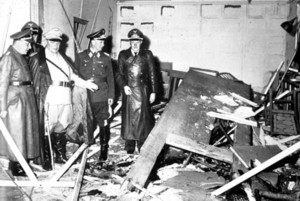
Our family used to have such a table, and a good, sturdy table it was. I'm sure it would have protected many families if there were ever any assisination attempts made against them. . .
posted by mk1gti at 5:57 AM on August 25, 2005
Is this why most of today's furnature is cheap chipboard with a thin oak veneer?
You never know how important buying quality can be.
posted by Balisong at 9:04 AM on August 25, 2005
You never know how important buying quality can be.
posted by Balisong at 9:04 AM on August 25, 2005
I think my Ikea table would fold like wet cardboard....
posted by R. Mutt at 9:35 AM on August 25, 2005
posted by R. Mutt at 9:35 AM on August 25, 2005
Speaking of Pat Robertson:
Al-Sadr is a rebel whose breaking the law. He's a murderer, there's a warrant out for his arrest. He should be killed, it's just that simple. They should execute him and they should take care of those people. He's holding up the most powerful army on Earth and he's thumbing his nose at the authority of the new government, and it's time the forces took action against him and stop the play. I hope this news says they're going after him.The news yesterday said, well. he'd agreed to some kind of a deal, but he's a liar, he's not going to do a deal and it's time we move in and do it swiftly and get this sore out of the way.
Pat Robertson, 700 Club, Thursday, August 19, 2004
posted by y2karl at 9:53 AM on August 25, 2005
Al-Sadr is a rebel whose breaking the law. He's a murderer, there's a warrant out for his arrest. He should be killed, it's just that simple. They should execute him and they should take care of those people. He's holding up the most powerful army on Earth and he's thumbing his nose at the authority of the new government, and it's time the forces took action against him and stop the play. I hope this news says they're going after him.The news yesterday said, well. he'd agreed to some kind of a deal, but he's a liar, he's not going to do a deal and it's time we move in and do it swiftly and get this sore out of the way.
Pat Robertson, 700 Club, Thursday, August 19, 2004
posted by y2karl at 9:53 AM on August 25, 2005
God Angrily Clarifies 'Don't Kill' Rule
And to Franz Fredinand.
posted by kirkaracha at 10:45 AM on August 25, 2005
Assassination of Archduke Ferdinand led to the peaceful Union of Europe. Eventually.
And to Franz Fredinand.
posted by kirkaracha at 10:45 AM on August 25, 2005
Assassination of Archduke Ferdinand led to the peaceful Union of Europe. Eventually.
So by that logic, the atomic bomb led to modern japan ?
posted by R. Mutt at 11:44 AM on August 25, 2005
So by that logic, the atomic bomb led to modern japan ?
posted by R. Mutt at 11:44 AM on August 25, 2005
While freely conceding that the bombing of civilians exhibits certain features which the humanitarian may be inclined to deplore, we must, I think, agree that the rigors which the Japanese people have been called upon to undergo have been amply justified in the sphere of concrete achievement.
posted by Floydd at 11:56 AM on August 25, 2005
posted by Floydd at 11:56 AM on August 25, 2005
Funny, just after reading this thread I hit the following passage in Alan Taylor's American Colonies: The Settling of North America:
posted by languagehat at 12:22 PM on August 25, 2005
Only one governor, Daniel Parke of the Leeward Islands, was foolish enough to employ troops to intimidate his assembly. For this, Parke suffered a brutal assassination by the leading sugar planters in 1710. No culprits were ever prosecuted. No other royal governor was assassinated, because none repeated Parke's folly.So there you go, sometimes it works.
posted by languagehat at 12:22 PM on August 25, 2005
Good Article.
I disagree with koeselitz tho. We still do assassination & political killing. Balls, no balls, taste or no.
I suspect we do less because we have the resources to be more effective at pushing forward our agenda.
Typically that means kicking over tea wagons (destroying infrastructure).
It's a broader spoon to stir the pot with. Assassination is like stirring with a stick. Less broad a surface to act on.
Killing one man, Hitler for example, doesn't stop the wave. Doesn't stop the direction of fluid in the pot (to overuse the metaphor)
We bomb instead of assassinate because it's more effective politically.
Tough one to wrap around I know, but jump back from the 20th centrury & all the intrigue with (mostly ineffective) countermeasures and consider the struggle between the Templars and the Hashshashin.
http://www.freerepublic.com/focus/news/746809/posts
http://www.freemasonrywatch.org/knightstemplar.html
http://www.friesian.org/outremer.htm
Lots of tinfoil hat fodder there.
But the instructive truth of the situation is this: while the two groups were engaged in a struggle for wealth & territory using assassination and counter-assassination techniques, a third group (the Mongols) smashed the assassins at Alamut because they were willing to destroy instead of consume.
Just tactics. Destroy the opponant's base and he loses balance. Someone off balance is easier to control. The more people this involves the more effective it is.
One might well be willing to die by blowing oneself up, but there are very few who will simply sit there and starve.
(The Sicarii come to mind.)
And it's nearly impossible to terrorize someone who is starving into doing something other than seeking food.
posted by Smedleyman at 12:43 PM on August 25, 2005
I disagree with koeselitz tho. We still do assassination & political killing. Balls, no balls, taste or no.
I suspect we do less because we have the resources to be more effective at pushing forward our agenda.
Typically that means kicking over tea wagons (destroying infrastructure).
It's a broader spoon to stir the pot with. Assassination is like stirring with a stick. Less broad a surface to act on.
Killing one man, Hitler for example, doesn't stop the wave. Doesn't stop the direction of fluid in the pot (to overuse the metaphor)
We bomb instead of assassinate because it's more effective politically.
Tough one to wrap around I know, but jump back from the 20th centrury & all the intrigue with (mostly ineffective) countermeasures and consider the struggle between the Templars and the Hashshashin.
http://www.freerepublic.com/focus/news/746809/posts
http://www.freemasonrywatch.org/knightstemplar.html
http://www.friesian.org/outremer.htm
Lots of tinfoil hat fodder there.
But the instructive truth of the situation is this: while the two groups were engaged in a struggle for wealth & territory using assassination and counter-assassination techniques, a third group (the Mongols) smashed the assassins at Alamut because they were willing to destroy instead of consume.
Just tactics. Destroy the opponant's base and he loses balance. Someone off balance is easier to control. The more people this involves the more effective it is.
One might well be willing to die by blowing oneself up, but there are very few who will simply sit there and starve.
(The Sicarii come to mind.)
And it's nearly impossible to terrorize someone who is starving into doing something other than seeking food.
posted by Smedleyman at 12:43 PM on August 25, 2005
Smedleyman: "I disagree with koeselitz tho. We still do assassination & political killing. Balls, no balls, taste or no."
I don't mean we don't kill people. Hell, we certainly do it more than ever before. I only mean that we hardly ever have much reason beyond 'national security' or some such. We wouldn't die for our families, or for a religion, or for "freedom" or "democracy" even, not if it didn't involve our own survival.
posted by koeselitz at 1:11 PM on August 25, 2005
I don't mean we don't kill people. Hell, we certainly do it more than ever before. I only mean that we hardly ever have much reason beyond 'national security' or some such. We wouldn't die for our families, or for a religion, or for "freedom" or "democracy" even, not if it didn't involve our own survival.
posted by koeselitz at 1:11 PM on August 25, 2005
Note: I wrote none of the tags and cannot delete them. Which is what I want to do. If I want to add tags, I will add them. For now, I do not. So, whoever is adding tags to my post, please stop. Fuck with your own posts. Leave mine alone. Or else give me the right to tweak yours unannounced. This Mother Knows Best-ism really rankles.
posted by y2karl at 9:09 PM on August 25, 2005
posted by y2karl at 9:09 PM on August 25, 2005
« Older Nanotechnology to power F1 cars. | Ghost Web Photo Gallery Newer »
This thread has been archived and is closed to new comments
It seems that assassinations rarely lead to improved situations, either locally or globally, in either the short or long term.
It's interesting that I can't think of a single historical situation in which a killing has improved the world.
I wonder if there's some kind of moral to be drawn from that ... ?
posted by cleardawn at 5:13 PM on August 24, 2005