Arbëresh - Albanians Without the Albania
July 27, 2006 6:22 AM Subscribe
Ever heard of the Arbëresh? Regis Philbin's mother was one. Even if you're not a fan of Regis or his morning show, you might find the Arbëresh interesting. They are ethnic Albanians who had fought under the great Albanian general George Kastrioti, better known as Skanderbeg (The Russians even made a movie about him). Six hundred years ago, they were invited to settle in Southern Italy and Sicily and became one the one many forgotten groups of Europe. If you have the time, listen to some Arbëresh music.
This is awesome. Thanks.
posted by huskerdont at 7:46 AM on July 27, 2006
posted by huskerdont at 7:46 AM on July 27, 2006
Great post, I love this sort of thing.
posted by Falconetti at 8:02 AM on July 27, 2006
posted by Falconetti at 8:02 AM on July 27, 2006
I join the chorus of enthusiastic responses to this link. I've heard lots and lots (I'm from Serbia- otherwise I wouldn't even have a vague knowledge that someone named Skenderbeg was significant to Albanian history) about Skenderbeg here and there but I never took the time to actually, you know, figure out who he actually was. This was really interesting, thank you.
posted by Oobidaius at 8:06 AM on July 27, 2006
posted by Oobidaius at 8:06 AM on July 27, 2006
The forgotten groups link is fascinating. And I think the name of one of the groups, the "Slavonic Sorbs" would be a great name for a band, or a perscription drug.
posted by blahblahblah at 8:38 AM on July 27, 2006
posted by blahblahblah at 8:38 AM on July 27, 2006
As interesting as the Arbereshe are, I no longer wish to hear ay of their music after hearing that CDBaby link.
Italy has some pretty wild minority music - the Grikos of Calabria and Puglia for example, or the Resiani ethnic group (isolated from Slovenians for about a thousand years, and they don't like being lumped into the Italian Slovene minorty) in the Northeast who play wonderful, wild fiddle the way drunks in the late middle ages would have sounded.
Incidentally, reading that Austrian article, they mention the group called "Degesi" and state that The ‘Degesi,’ Hungarian for “dog eaters,” live mainly in isolated slums and in many places have lost all remnants of their living culture and family histories."
"Dög eszi" means "he eats carrion" in Hungarian, not dogs. (I can't get the Hungarian long umlaut on my keyboard...) . A common epithet used against Roma by Hungarians is "Dög evö" (Eaters of carrion.) There is no special minority group in Slovakia called "Degesi." There are, however, lots of poor Gypsies.
Which is why people trained in Anthropology, Roma studies, Sociology or just simple literacy are usually better qualified to make EU-funded pronouncements on Roma culture than photographers.
posted by zaelic at 9:15 AM on July 27, 2006 [1 favorite]
Italy has some pretty wild minority music - the Grikos of Calabria and Puglia for example, or the Resiani ethnic group (isolated from Slovenians for about a thousand years, and they don't like being lumped into the Italian Slovene minorty) in the Northeast who play wonderful, wild fiddle the way drunks in the late middle ages would have sounded.
Incidentally, reading that Austrian article, they mention the group called "Degesi" and state that The ‘Degesi,’ Hungarian for “dog eaters,” live mainly in isolated slums and in many places have lost all remnants of their living culture and family histories."
"Dög eszi" means "he eats carrion" in Hungarian, not dogs. (I can't get the Hungarian long umlaut on my keyboard...) . A common epithet used against Roma by Hungarians is "Dög evö" (Eaters of carrion.) There is no special minority group in Slovakia called "Degesi." There are, however, lots of poor Gypsies.
Which is why people trained in Anthropology, Roma studies, Sociology or just simple literacy are usually better qualified to make EU-funded pronouncements on Roma culture than photographers.
posted by zaelic at 9:15 AM on July 27, 2006 [1 favorite]
Way cool! Just 2 months ago I was in Sicily and drove through Piana degli Albanesi on the way from Palermo to Sciacca. Beautiful country, and here's the pitcure I took of Piana degli Albanesi from across the lake:
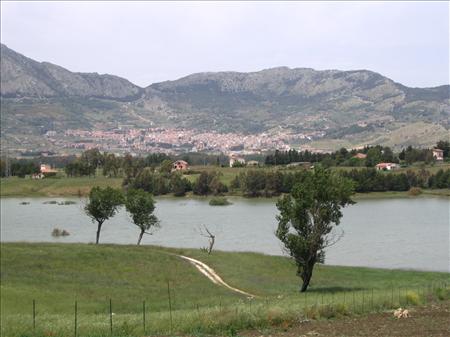
I have a larger version if anyone is interested, pm me...
posted by joecacti at 9:19 AM on July 27, 2006
I have a larger version if anyone is interested, pm me...
posted by joecacti at 9:19 AM on July 27, 2006
Nice post, and I'm glad zaelic came along to add his unique perspective. Just for him: Dőg.
posted by languagehat at 9:43 AM on July 27, 2006
posted by languagehat at 9:43 AM on July 27, 2006
very cool, i love this sort of stuff. the genetics of these populations would be very interesting to look into.
posted by wilky at 11:54 AM on July 27, 2006
posted by wilky at 11:54 AM on July 27, 2006
Too bad the Austrians left out the Kashubes of Poland, who figure in Guenter Grass's Danzig trilogy. Kashubian is still spoken by a few thousand in Poland and a handful in Canada, but once they were estimable enough to have their own parish in Chicago, St. Josaphat.
Too bad, for that matter, they left out the Muslim Tartars of Poland.
posted by Rutherford B. Hatch at 1:59 PM on July 27, 2006
Too bad, for that matter, they left out the Muslim Tartars of Poland.
posted by Rutherford B. Hatch at 1:59 PM on July 27, 2006
Heh. I know a 1/2 Kashubian-American, as it happens, Rutherford (in Detroit, though).
I was actually a little unsettled by the pronouncement that the Roma are the "first Europeans", because they operate as a clan rather than a nation. I had long argued that a European Union would ease problems such as Northern Ireland, because everybody would be just another ethnic group, and it would be less threatening if a region within Europe wanted cultural autonomy. But lately I've been wondering -- a continent of intermixed clans, potentially warring, wouldn't be pretty.
posted by dhartung at 7:06 PM on July 27, 2006
I was actually a little unsettled by the pronouncement that the Roma are the "first Europeans", because they operate as a clan rather than a nation. I had long argued that a European Union would ease problems such as Northern Ireland, because everybody would be just another ethnic group, and it would be less threatening if a region within Europe wanted cultural autonomy. But lately I've been wondering -- a continent of intermixed clans, potentially warring, wouldn't be pretty.
posted by dhartung at 7:06 PM on July 27, 2006
Atreides, Wonderful post. Can't stand Regis. His being half Arbëresh is the best thing I ever heard about him.
Some folk music clips from Sicily in the early 1950's.
Interesting also to read about: "Athena ( the Latin Minerva), the goddess of wisdom as expressed in speech, would evidently owe its derivation to the Albanian "E Thena," which simply means "speech." Thetis, the goddess of waters and seas, would seem to be but Albanian "Det" which means "sea." It would be interesting to note that the word "Ulysses,"whether in its Latin or Greek form "Odysseus," means "traveler" in the Albanian language".
zaelic, Thanks for adding your insight.
posted by nickyskye at 12:07 AM on July 28, 2006
Some folk music clips from Sicily in the early 1950's.
Interesting also to read about: "Athena ( the Latin Minerva), the goddess of wisdom as expressed in speech, would evidently owe its derivation to the Albanian "E Thena," which simply means "speech." Thetis, the goddess of waters and seas, would seem to be but Albanian "Det" which means "sea." It would be interesting to note that the word "Ulysses,"whether in its Latin or Greek form "Odysseus," means "traveler" in the Albanian language".
zaelic, Thanks for adding your insight.
posted by nickyskye at 12:07 AM on July 28, 2006
"Athena ( the Latin Minerva), the goddess of wisdom as expressed in speech, would evidently owe its derivation to the Albanian "E Thena," which simply means "speech." Thetis, the goddess of waters and seas, would seem to be but Albanian "Det" which means "sea." It would be interesting to note that the word "Ulysses,"whether in its Latin or Greek form "Odysseus," means "traveler" in the Albanian language".
That's pure crackpottery, just so you know.
posted by languagehat at 6:27 AM on July 28, 2006
That's pure crackpottery, just so you know.
posted by languagehat at 6:27 AM on July 28, 2006
languagehat, I didn't know. It seemed like an interesting etymology. Thanks for clarifying.
Googled "Athena Albanian" and came up with Chekrezi, Constantine, Albania Past and Present (1919), in which he cites " that Athena, the goddess of wisdom and speech appears as the Albanian ‘E thena’ meaning ‘speech’". Must have been his crackpot idea.
However, "Her occaisional appearance as a bird (especially an owl) also points to a very prehistoric bird-goddess found across a large area of the Near East and into Balkan Europe dating from Neolithic times."
posted by nickyskye at 11:52 AM on July 28, 2006
Googled "Athena Albanian" and came up with Chekrezi, Constantine, Albania Past and Present (1919), in which he cites " that Athena, the goddess of wisdom and speech appears as the Albanian ‘E thena’ meaning ‘speech’". Must have been his crackpot idea.
However, "Her occaisional appearance as a bird (especially an owl) also points to a very prehistoric bird-goddess found across a large area of the Near East and into Balkan Europe dating from Neolithic times."
posted by nickyskye at 11:52 AM on July 28, 2006
For some reason, people who speak little-known languages like Albanian and Basque are particularly prone to this form of crackpottery: going through dictionaries and "proving" that everything comes from their language, which was spoken in the Garden of Eden. A harmless eccentricity.
posted by languagehat at 3:22 PM on July 28, 2006
posted by languagehat at 3:22 PM on July 28, 2006
« Older I'm going to make you squeal like a scruffy nerf... | Man of Honor Newer »
This thread has been archived and is closed to new comments
posted by Devils Rancher at 7:25 AM on July 27, 2006