Photos from Hiroshima
February 6, 2007 6:41 PM Subscribe
Photos from Hiroshima in August of 1945. Long supressed by the occupying U.S. forces, a highly unsettling (and decidedly NSFW) collection of photos from the days immediately after August 6th. Via.
I came across this via mental floss earlier today, and it shook me up for the rest of the day. The comments on that post are nuts...hopefully that doesn't happen here.
posted by SassHat at 6:58 PM on February 6, 2007
posted by SassHat at 6:58 PM on February 6, 2007
Within seconds, 75,000 people had been killed or fatally injured with 65% of the casualties nine years of age and younger.
If you'll excuse me, I'm going to go pluck my infant son out of his crib now and hold him until morning comes or I can somehow feel better.
This photo and this woman too are going to stay with me for the rest of my life.
posted by anastasiav at 7:03 PM on February 6, 2007 [2 favorites]
If you'll excuse me, I'm going to go pluck my infant son out of his crib now and hold him until morning comes or I can somehow feel better.
This photo and this woman too are going to stay with me for the rest of my life.

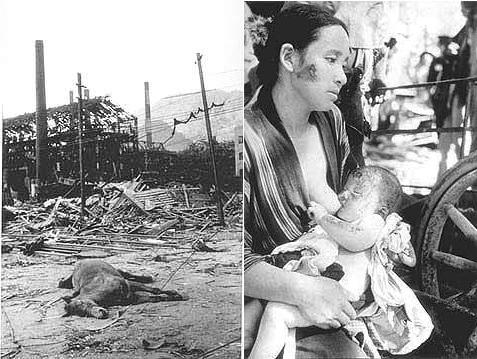
posted by anastasiav at 7:03 PM on February 6, 2007 [2 favorites]
There is no god and no devil. We are both.
posted by Brandon Blatcher at 7:08 PM on February 6, 2007 [8 favorites]
posted by Brandon Blatcher at 7:08 PM on February 6, 2007 [8 favorites]
I'd like to preempt the inevitable debate over the justification for these acts and just ask, does it appear reasonable to expect that there can be a sufficiently open and honest evaluation of this issue among Americans? It seems to me that those with pacifist tendencies are almost immune to acknowledging the possibility of a justification and those on the other side, are almost immune to accepting that the USA, self-appointed world leader and self-anointed morally right society could commit such a massive atrocity (if it were unjustified). There seems to be just too much cognitive comfort at stake here for a detached dispassionate look. The other point is that even if one became sincerely committed to such an examination, the sources available today have already been filtered by generations and governments not similarly inclined, or so it would seem.
posted by Gyan at 7:11 PM on February 6, 2007
posted by Gyan at 7:11 PM on February 6, 2007
Thanks for the post, jonson.
I came across this via mental floss...The comments on that post are nuts...hopefully that doesn't happen here.
I suppose it's somewhat likely that there'll be the trotting out of the old "but many more would have died if we hadn't..." argument, but I too sincerely hope not.
It's devastating to think of those ordinary people going about their lives, lives suddenly ended or shattered in one inconceivably hellish moment. I'd say it's one of the great shames of the US, one of it's very darkest moments. And the fact that Japanese troops inflicted horrible suffering on civilians at Nanjing and elsewhere doesn't make Hiroshima and Nagasaki even one little tiny bit right.
posted by flapjax at midnite at 7:17 PM on February 6, 2007
I came across this via mental floss...The comments on that post are nuts...hopefully that doesn't happen here.
I suppose it's somewhat likely that there'll be the trotting out of the old "but many more would have died if we hadn't..." argument, but I too sincerely hope not.
It's devastating to think of those ordinary people going about their lives, lives suddenly ended or shattered in one inconceivably hellish moment. I'd say it's one of the great shames of the US, one of it's very darkest moments. And the fact that Japanese troops inflicted horrible suffering on civilians at Nanjing and elsewhere doesn't make Hiroshima and Nagasaki even one little tiny bit right.
posted by flapjax at midnite at 7:17 PM on February 6, 2007
and just ask, does it appear reasonable to expect that there can be a sufficiently open and honest evaluation of this issue among Americans?
For me, it comes down to this: Our forefathers did this, and it may have been the best of a bundle of bad moral choices or it might have been an awful, misguided mistake, but we can't unring the bell. I can't undo the suffering of these people any more than I can make up somehow for the slaves my ancestors packed into ships and brought back to New England.
All I can do now is learn the lessons of history, and work hard to make sure that this never, ever happens again - lest me and my son be the people it happens to.
But really the answer is no - not so long as there are WWII vets and their children and widows alive ... not to mention survivors of acts like this and the firebombing of Dresden - not for many generations will there be sufficient distance to honestly evaluate the issues involved. The emotions are still too raw.
For the record, I do believe that Truman et al were honestly doing the thing they thought was best - the thing that would end the war quickly and save tens of thousands of American lives. And I do honestly and truly believe that the true decision makers had no freaking idea how different atomic bombing would be from "regular" bombing. They just thought of it as an ultra powerful bomb, and believed that anyone who was close enough to the center of the blast to die of radiation burns would die first from fire or shrapnel.
But I also think that, knowing what we know now, they made the worst decision possible. They were simply dead wrong. And all those babies paid for it.....
God, my baby perfect and cute when he's sleeping. I feel so strongly for those people. Those little babies. *cries*
posted by anastasiav at 7:21 PM on February 6, 2007 [2 favorites]
For me, it comes down to this: Our forefathers did this, and it may have been the best of a bundle of bad moral choices or it might have been an awful, misguided mistake, but we can't unring the bell. I can't undo the suffering of these people any more than I can make up somehow for the slaves my ancestors packed into ships and brought back to New England.
All I can do now is learn the lessons of history, and work hard to make sure that this never, ever happens again - lest me and my son be the people it happens to.
But really the answer is no - not so long as there are WWII vets and their children and widows alive ... not to mention survivors of acts like this and the firebombing of Dresden - not for many generations will there be sufficient distance to honestly evaluate the issues involved. The emotions are still too raw.
For the record, I do believe that Truman et al were honestly doing the thing they thought was best - the thing that would end the war quickly and save tens of thousands of American lives. And I do honestly and truly believe that the true decision makers had no freaking idea how different atomic bombing would be from "regular" bombing. They just thought of it as an ultra powerful bomb, and believed that anyone who was close enough to the center of the blast to die of radiation burns would die first from fire or shrapnel.
But I also think that, knowing what we know now, they made the worst decision possible. They were simply dead wrong. And all those babies paid for it.....
God, my baby perfect and cute when he's sleeping. I feel so strongly for those people. Those little babies. *cries*
posted by anastasiav at 7:21 PM on February 6, 2007 [2 favorites]
I think we can all agree that war is less than pleasant. The point of the post is, I'm assuming, not to point the finger and assign blame, but to show just how terrible the end result is. Justified or not, the price is high.
posted by lekvar at 7:23 PM on February 6, 2007
posted by lekvar at 7:23 PM on February 6, 2007
does it appear reasonable to expect that there can be a sufficiently open and honest evaluation of this issue among Americans?
Americans aren't the only ones who can discuss this.
Sure. This was a terrible thing to do and a lot of people needlessly died. But the Allies won and that beats the alternative. The goal was to win and let the loser and anyone else know that America had one. Thats an ugly pill swallow but even if people don't like it, it's still there.
Wars are for killing people. Whoever kills the most or kills the quickest wins. The only solution is to avoid war.
posted by Brandon Blatcher at 7:25 PM on February 6, 2007
Americans aren't the only ones who can discuss this.
Sure. This was a terrible thing to do and a lot of people needlessly died. But the Allies won and that beats the alternative. The goal was to win and let the loser and anyone else know that America had one. Thats an ugly pill swallow but even if people don't like it, it's still there.
Wars are for killing people. Whoever kills the most or kills the quickest wins. The only solution is to avoid war.
posted by Brandon Blatcher at 7:25 PM on February 6, 2007
One of the things that sets us apart from all other nations, certainly in the twentieth century, is that we did not experience war in our own homeland. Unlike the Europeans, we were not savaged by war, and I think therefore it’s easy for us still to have a very romantic notion of what war involves. But there is this terrible moment in every war where one side or the other, and sometimes both, begin to be taken over by what can only be called a killing momentum, where all questions of honor and restraint and humanity go out the window and savage acts of violence take over. That’s the story of warfare. And even the United States of America, even in the good war, that happened to us. I track that to Roosevelt’s mistake of adopting a policy of unconditional surrender.The American War Machine
But what I’m talking about is what happened really in the last six months of the war, against Germany and Japan. The United States has never reckoned with the havoc we caused in the cities of Germany and Japan in those last six months when the war was all but won, when there was no question anymore of our ever being defeated by either Germany or Japan. We took off on bombing campaigns that were horrible beyond any American’s ability to reckon with, then or now. We killed something like a million civilians in the last seven months of the war. We haven’t reckoned with that kind of violence, that kind of brute inhumanity. The kinds of crimes that we would never ever ever commit on the ground, we committed routinely from the air. We didn’t even pretend to distinguish between military and civilian targets in Japan, so that by the time the decision to drop the bomb on Hiroshima and then Nagasaki was made, we were morally blind, paralyzed. We no longer had the capacity to understand exactly what it was that we were doing. So of course we dropped the atomic bomb. That was almost anti-climactic considering what we had done to fifty or sixty other Japanese cities.
World War II is not the good war. And the more Americans cling to that myth, the more dangerous we are as a people in the world. It’s only because we cling to such a myth that we could think that going to war in Afghanistan and Iraq was a reasonable and even humane thing to do. Look at what’s happened. Afghanistan is a shambles, the Taliban are coming back, the people are more impoverished than ever, and al-Qaeda is as much a threat to us as it ever was. And now Iraq—the disaster of Iraq, the threat of violence spilling over into Iran. I began by talking about realism. We Americans have to be realistic about what warfare is. And if we are, or if we could be, we’d be much less quick to leap in.
posted by y2karl at 7:26 PM on February 6, 2007 [14 favorites]
"...in [July] 1945... Secretary of War Stimson, visiting my headquarters in Germany, informed me that our government was preparing to drop an atomic bomb on Japan. I was one of those who felt that there were a number of cogent reasons to question the wisdom of such an act. ...the Secretary, upon giving me the news of the successful bomb test in New Mexico, and of the plan for using it, asked for my reaction, apparently expecting a vigorous assent.
"During his recitation of the relevant facts, I had been conscious of a feeling of depression and so I voiced to him my grave misgivings, first on the basis of my belief that Japan was already defeated and that dropping the bomb was completely unnecessary, and secondly because I thought that our country should avoid shocking world opinion by the use of a weapon whose employment was, I thought, no longer mandatory as a measure to save American lives. It was my belief that Japan was, at that very moment, seeking some way to surrender with a minimum loss of 'face'. The Secretary was deeply perturbed by my attitude..."
- Dwight Eisenhower, Mandate For Change, pg. 380
In a Newsweek interview, Eisenhower again recalled the meeting with Stimson:
"...the Japanese were ready to surrender and it wasn't necessary to hit them with that awful thing."
- Ike on Ike, Newsweek, 11/11/63
More here.
posted by j-urb at 7:30 PM on February 6, 2007
"During his recitation of the relevant facts, I had been conscious of a feeling of depression and so I voiced to him my grave misgivings, first on the basis of my belief that Japan was already defeated and that dropping the bomb was completely unnecessary, and secondly because I thought that our country should avoid shocking world opinion by the use of a weapon whose employment was, I thought, no longer mandatory as a measure to save American lives. It was my belief that Japan was, at that very moment, seeking some way to surrender with a minimum loss of 'face'. The Secretary was deeply perturbed by my attitude..."
- Dwight Eisenhower, Mandate For Change, pg. 380
In a Newsweek interview, Eisenhower again recalled the meeting with Stimson:
"...the Japanese were ready to surrender and it wasn't necessary to hit them with that awful thing."
- Ike on Ike, Newsweek, 11/11/63
More here.
posted by j-urb at 7:30 PM on February 6, 2007
So painful and sad to see those photographs.
An excellent site about Hiroshima and atomic warfare.
Previously on MetaFilter, some pictures taken at Tinian during that time.
More images of Hiroshima. A few recent statistics about Hiroshima.
Images from the site of an angry American World War II soldier. Images from an angry American Iraq War soldier.
posted by nickyskye at 7:31 PM on February 6, 2007
An excellent site about Hiroshima and atomic warfare.
Previously on MetaFilter, some pictures taken at Tinian during that time.
More images of Hiroshima. A few recent statistics about Hiroshima.
Images from the site of an angry American World War II soldier. Images from an angry American Iraq War soldier.
posted by nickyskye at 7:31 PM on February 6, 2007
It wasn't done to force a Japanese surrender. The Japanese were ready to surrender, and even had they not been, a non-lethal demonstration off the coast, in a harbor, would have more than sufficed.
Hiroshima and Nagasaki weren't about ending the Second World War, they were intended as an object lesson for the Soviets.
And they were inexcusable war crimes.
posted by stenseng at 7:37 PM on February 6, 2007 [1 favorite]
Hiroshima and Nagasaki weren't about ending the Second World War, they were intended as an object lesson for the Soviets.
And they were inexcusable war crimes.
posted by stenseng at 7:37 PM on February 6, 2007 [1 favorite]
One of the things that sets us apart from all other nations, certainly in the twentieth century, is that we did not experience war in our own homeland.
As a continental European I have to say: I think that's true y2karl.
Good quote.
posted by jouke at 7:40 PM on February 6, 2007
As a continental European I have to say: I think that's true y2karl.
Good quote.
posted by jouke at 7:40 PM on February 6, 2007
These were repressed? I have seen a bunch of them before in This book
posted by mkb at 7:40 PM on February 6, 2007
posted by mkb at 7:40 PM on February 6, 2007
The Japanese were ready to surrender
Bullshit.
posted by Kraftmatic Adjustable Cheese at 7:42 PM on February 6, 2007
Bullshit.
posted by Kraftmatic Adjustable Cheese at 7:42 PM on February 6, 2007
Oh, I'm sure that your judgment is far superior to that of the Supreme Allied Commander of the Allied Expeditionary Force and later President Dwight Eisenhower, so I'll defer to you, Kraftmatic adjustable whatever...
posted by stenseng at 7:46 PM on February 6, 2007
posted by stenseng at 7:46 PM on February 6, 2007
Thank you for posting this.
posted by localroger at 7:46 PM on February 6, 2007
posted by localroger at 7:46 PM on February 6, 2007
Or how about Bill Leahy? He was only an Admiral and chief of staff to two wartime presidents...
""It is my opinion that the use of this barbarous weapon at Hiroshima and Nagasaki was of no material assistance in our war against Japan. The Japanese were already defeated and ready to surrender because of the effective sea blockade and the successful bombing with conventional weapons."
posted by stenseng at 7:47 PM on February 6, 2007 [1 favorite]
""It is my opinion that the use of this barbarous weapon at Hiroshima and Nagasaki was of no material assistance in our war against Japan. The Japanese were already defeated and ready to surrender because of the effective sea blockade and the successful bombing with conventional weapons."
posted by stenseng at 7:47 PM on February 6, 2007 [1 favorite]
Or Herbert Hoover?
"...the Japanese were prepared to negotiate all the way from February 1945...up to and before the time the atomic bombs were dropped; ...if such leads had been followed up, there would have been no occasion to drop the [atomic] bombs."
Or how about Douglas MacArthur?
In early May of 1946 Hoover met with General Douglas MacArthur. Hoover recorded in his diary, "I told MacArthur of my memorandum of mid-May 1945 to Truman, that peace could be had with Japan by which our major objectives would be accomplished. MacArthur said that was correct and that we would have avoided all of the losses, the Atomic bomb, and the entry of Russia into Manchuria."
Norman Cousins was a consultant to General MacArthur during the American occupation of Japan. Cousins writes of his conversations with MacArthur, "MacArthur's views about the decision to drop the atomic bomb on Hiroshima and Nagasaki were starkly different from what the general public supposed." He continues, "When I asked General MacArthur about the decision to drop the bomb, I was surprised to learn he had not even been consulted. What, I asked, would his advice have been? He replied that he saw no military justification for the dropping of the bomb. The war might have ended weeks earlier, he said, if the United States had agreed, as it later did anyway, to the retention of the institution of the emperor."
posted by stenseng at 7:49 PM on February 6, 2007
"...the Japanese were prepared to negotiate all the way from February 1945...up to and before the time the atomic bombs were dropped; ...if such leads had been followed up, there would have been no occasion to drop the [atomic] bombs."
Or how about Douglas MacArthur?
In early May of 1946 Hoover met with General Douglas MacArthur. Hoover recorded in his diary, "I told MacArthur of my memorandum of mid-May 1945 to Truman, that peace could be had with Japan by which our major objectives would be accomplished. MacArthur said that was correct and that we would have avoided all of the losses, the Atomic bomb, and the entry of Russia into Manchuria."
Norman Cousins was a consultant to General MacArthur during the American occupation of Japan. Cousins writes of his conversations with MacArthur, "MacArthur's views about the decision to drop the atomic bomb on Hiroshima and Nagasaki were starkly different from what the general public supposed." He continues, "When I asked General MacArthur about the decision to drop the bomb, I was surprised to learn he had not even been consulted. What, I asked, would his advice have been? He replied that he saw no military justification for the dropping of the bomb. The war might have ended weeks earlier, he said, if the United States had agreed, as it later did anyway, to the retention of the institution of the emperor."
posted by stenseng at 7:49 PM on February 6, 2007
I first saw some of these photos by accident as a teenager in the 1970's. They have been set in my mind ever since.
Someone I knew had a set of US government/ military books on the effects on buildings of nuclear weapons. The plain brown paper covered books were issued to structural engineers who were required to include fallout shelter design as part of their engineering certifcation. One book included a plastic calculation dial that was used to determine damage and fatalities by distance from the bombing.
After pages and pages of nuclear test site photos, the photographs of the dead and the wounded from Japan were included at the end of one of the books.
posted by R. Mutt at 7:51 PM on February 6, 2007
Someone I knew had a set of US government/ military books on the effects on buildings of nuclear weapons. The plain brown paper covered books were issued to structural engineers who were required to include fallout shelter design as part of their engineering certifcation. One book included a plastic calculation dial that was used to determine damage and fatalities by distance from the bombing.
After pages and pages of nuclear test site photos, the photographs of the dead and the wounded from Japan were included at the end of one of the books.
posted by R. Mutt at 7:51 PM on February 6, 2007
Or GENERAL CARL "TOOEY" SPAATZ?
(In charge of Air Force operations in the Pacific)
"If we were to go ahead with the plans for a conventional invasion with ground and naval forces, I believe the Japanese thought that they could inflict very heavy casualties on us and possibly as a result get better surrender terms. On the other hand if they knew or were told that no invasion would take place [and] that bombing would continue until the surrender, why I think the surrender would have taken place just about the same time." (Herbert Feis Papers, Box 103, N.B.C. Interviews, Carl Spaatz interview by Len Giovannitti, Library of Congress).
posted by stenseng at 7:51 PM on February 6, 2007
(In charge of Air Force operations in the Pacific)
"If we were to go ahead with the plans for a conventional invasion with ground and naval forces, I believe the Japanese thought that they could inflict very heavy casualties on us and possibly as a result get better surrender terms. On the other hand if they knew or were told that no invasion would take place [and] that bombing would continue until the surrender, why I think the surrender would have taken place just about the same time." (Herbert Feis Papers, Box 103, N.B.C. Interviews, Carl Spaatz interview by Len Giovannitti, Library of Congress).
posted by stenseng at 7:51 PM on February 6, 2007
We, the undersigned scientists, have been working in the field of atomic power for a number of years. Until recently we have had to reckon with the possibility that the United States might be attacked by atomic bombs during this war and that her only defense might lie in a counterattack by the same means. Today with this danger averted we feel impelled to say what follows:Leo Szilard and 58 co-signers
The war has to be brought speedily to a successful conclusion and the destruction of Japanese cities by means of atomic bombs may very well be an effective method of warfare. We feel, however, that such an attack on Japan could not be justified in the present circumstances. We believe that the United States ought not to resort to the use of atomic bombs in the present phase of the war, at least not unless the terms which will be imposed upon Japan after the war are publicly announced and subsequently Japan is given an opportunity to surrender.
If such public announcement gave assurance to the Japanese that they could look forward to a life devoted to peaceful pursuits in their homeland and if Japan still refused to surrender, our nation would then be faced with a situation which might require a re-examination of her position with respect to the use of atomic bombs in the war.
Atomic bombs are primarily a means for the ruthless annihilation of cities. Once they were introduced as an instrument of war it would be difficult to resist for long the temptation of putting them to such use.
The last few years show a marked tendency toward increasing ruthlessness. At present our Air Forces, striking at the Japanese cities, are using the same methods of warfare which were condemned by American public opinion only a few years ago when applied by the Germans to the cities of England. Our use of atomic bombs in this war would carry the world a long way further on this path of ruthlessness.
posted by y2karl at 7:52 PM on February 6, 2007
... Terrorism, if it means anything, is a method by which civilians are the targets of violence for the purpose of achieving political goals. Having Imperial Japan surrender, even if a worthy goal, was nevertheless a political one, and the targeting of innocents to achieve that goal was an act of terrorism.Targeting Civilians at Hiroshima and Nagasaki
Indeed, it was terrorism on an incredibly large scale. Hundreds of thousands of innocent Japanese were instantaneously wiped off the earth on August 6 and August 9, 1945. Many more died in the following years from the radioactive climate left behind by the bombings.
So the questions remain: Was this a case where terrorism was justified? Can there be other circumstances where the overt targeting of civilians can be justified, so as to bring about a greater good?
In the case of Hiroshima, no substantive evidence exists that the bombing was “necessary” to make Japan surrender. In fact, the Japanese had already attempted to sue for peace in July and were only hesitant because they distrusted the terms of unconditional surrender that the Allies demanded. They specifically wanted to keep their emperor, which, after the atomic bombings, they were allowed to, anyway. The military estimated before Hiroshima that invasion would cost as many as 20,000 or 30,000 American lives, but not nearly the half million lives that Truman later claimed had been the estimate. Even without invasion, Japan was utterly defeated by the war and U.S. blockades prevented the island nation from getting the necessary food to survive, much less maintain any type of threat against America...
Instead of making excuses for past U.S. war crimes, we need to remember them for the great evils that they indeed were. We cannot undo history, but with determination, we might possibly prevent such horrendous crimes from ever again being done in our name. The worst way to guarantee a brighter future is to look at Hiroshima and Nagasaki and draw the lesson that sometimes the government needs to kill hundreds of thousands of civilians for the sake of humanity. Indeed, it is that conventional lesson that has helped solidify the United States in a state of perpetual war since the end of World War II, and that dangerously faulty lesson might still one day be invoked to facilitate such terror and atrocity that we can now hardly imagine.
posted by y2karl at 8:00 PM on February 6, 2007
Good quote-digging there, stenseng, and y2karl. Those should all be required reading for the legions of knee-jerk swallowers of the received wisdom that the A-bombing was a justifiable course of action.
posted by flapjax at midnite at 8:00 PM on February 6, 2007
posted by flapjax at midnite at 8:00 PM on February 6, 2007
Now, that's not to say that you can't make an argument that such a demonstration to the Soviets of the seriousness (or craziness) of American foreign policy didn't do wonders to keep the cold war cold, and *may* have saved a lot of lives in the long run, but it's a tenuous connection to make, and a darker, more Machiavellian choice than I could have made.
posted by stenseng at 8:05 PM on February 6, 2007
posted by stenseng at 8:05 PM on February 6, 2007
I'd like to preempt the inevitable debate over the justification for these acts and just ask, does it appear reasonable to expect that there can be a sufficiently open and honest evaluation of this issue among Americans?
Of course not. Not among Americans or anyone else.
Almost any argument is eventually going to devolve into a discussion of counterfactual history. And it's awfully hard to say what would have happened if the bomb hadn't been dropped. Maybe Japan was about to surrender. Maybe they'd have surrendered after a demonstration drop in Tokyo Bay. Or maybe they'd have seen that as weakness and forced a full land invasion, killing far more people. Or maybe they'd see the error of their ways after a demonstration drop, convert en masse to Quakerism, and spend their days toiling endlessly for peace and justice, praising the Lord every day for using such a terrible instrument to forge them into a mighty tool for His work.
The only possible way to find out is to go back in time and run WW2 again, thousands and thousands and thousands of times, and build up the probability density of various things. I put it to you that this is difficult. In the absence of this density of outcomes, any discussion of whether the bomb was "necessary" or even just the lesser evil is completely pointless. Nobody knows. Nobody can know.
In the meantime, I win, because I am more sensitive and caring than all of you motherfuckers put together. I am so sensitive and caring and against violence in all its forms that even just thinking about Hiroshima and Nagasaki makes me vomit with anguish and have several coronaries.
posted by ROU_Xenophobe at 8:08 PM on February 6, 2007 [4 favorites]
Of course not. Not among Americans or anyone else.
Almost any argument is eventually going to devolve into a discussion of counterfactual history. And it's awfully hard to say what would have happened if the bomb hadn't been dropped. Maybe Japan was about to surrender. Maybe they'd have surrendered after a demonstration drop in Tokyo Bay. Or maybe they'd have seen that as weakness and forced a full land invasion, killing far more people. Or maybe they'd see the error of their ways after a demonstration drop, convert en masse to Quakerism, and spend their days toiling endlessly for peace and justice, praising the Lord every day for using such a terrible instrument to forge them into a mighty tool for His work.
The only possible way to find out is to go back in time and run WW2 again, thousands and thousands and thousands of times, and build up the probability density of various things. I put it to you that this is difficult. In the absence of this density of outcomes, any discussion of whether the bomb was "necessary" or even just the lesser evil is completely pointless. Nobody knows. Nobody can know.
In the meantime, I win, because I am more sensitive and caring than all of you motherfuckers put together. I am so sensitive and caring and against violence in all its forms that even just thinking about Hiroshima and Nagasaki makes me vomit with anguish and have several coronaries.
posted by ROU_Xenophobe at 8:08 PM on February 6, 2007 [4 favorites]
Google up all the opinions you want, stenseng, but the Japanese had clearly lost their collective mind, as evidenced by the insanity that raged at places like Nanking, Manchuria and finally Okinawa.
The only way to stop the military from walking Japan into complete and utter destruction was to get Hirohito to wake up and tell the people to stop. Burning most of Tokyo to the ground wasn't enough for him, but setting off a bomb at sea would change his mind?
The sea blockade made little difference because there were something like 5 million Japanese troops overseas at the time the bombs fell and plans to smuggle the emperor out of the country and establish a new seat of the empire in China.
posted by Kraftmatic Adjustable Cheese at 8:09 PM on February 6, 2007
The only way to stop the military from walking Japan into complete and utter destruction was to get Hirohito to wake up and tell the people to stop. Burning most of Tokyo to the ground wasn't enough for him, but setting off a bomb at sea would change his mind?
The sea blockade made little difference because there were something like 5 million Japanese troops overseas at the time the bombs fell and plans to smuggle the emperor out of the country and establish a new seat of the empire in China.
posted by Kraftmatic Adjustable Cheese at 8:09 PM on February 6, 2007
"Long supressed by the occupying U.S. forces"
I've always wondered this because I remember seeing these exact same photos when I visited the musuems in Hiroshima many years ago. In fact, they had actual carved-out skin samples with radiation scars saved in jars.
posted by drstein at 8:13 PM on February 6, 2007
I've always wondered this because I remember seeing these exact same photos when I visited the musuems in Hiroshima many years ago. In fact, they had actual carved-out skin samples with radiation scars saved in jars.
posted by drstein at 8:13 PM on February 6, 2007
once ralphie got his red ryder, there was no way some sparrows weren't gonna die.
posted by quonsar at 8:16 PM on February 6, 2007 [2 favorites]
posted by quonsar at 8:16 PM on February 6, 2007 [2 favorites]
That's a great theory, or at least it would be, were it not for the established historical evidence through intelligence channels, intercepted diplomatic cables, transmissions, etc, that the Japanese were open to surrender, and working through various means to sue for peace in mid July of that year.
That's totally disregarding all of the evidence and testimony from US military experts at the time and since, who felt that dropping of the bomb (moral issues aside) had a net zero impact on the timeliness of Japanese surrender.
posted by stenseng at 8:16 PM on February 6, 2007
That's totally disregarding all of the evidence and testimony from US military experts at the time and since, who felt that dropping of the bomb (moral issues aside) had a net zero impact on the timeliness of Japanese surrender.
posted by stenseng at 8:16 PM on February 6, 2007
Fleet Admiral Chester W. Nimitz, Commander in Chief of the Pacific Fleet stated in a public address given at the Washington Monument on October 5, 1945:
The Japanese had, in fact, already sued for peace before the atomic age was announced to the world with the destruction of Hiroshima and before the Russian entry into the war. (See p. 329, Chapter 26) . . . [Nimitz also stated: "The atomic bomb played no decisive part, from a purely military standpoint, in the defeat of Japan. . . ."]
Admiral William F. Halsey, Jr., Commander U.S. Third Fleet, stated publicly in 1946:
The first atomic bomb was an unnecessary experiment. . . . It was a mistake to ever drop it. . . . [the scientists] had this toy and they wanted to try it out, so they dropped it. . . . It killed a lot of Japs, but the Japs had put out a lot of peace feelers through Russia long before. (See p. 331, Chapter 26)
* Time-Life editor Henry R. Luce later recalled that during a May-June 1945 tour of the Pacific theater:
. . . I spent a morning at Cavite in the Philippines with Admiral Frank Wagner in front of huge maps. Admiral Wagner was in charge of air search-and-patrol of all the East Asian seas and coasts. He showed me that in all those millions of square miles there was literally not a single target worth the powder to blow it up; there were only junks and mostly small ones at that.
Similarly, I dined one night with Admiral [Arthur] Radford [later Joint Chiefs Chairman, 1953-57] on the carrier Yorktown leading a task force from Ulithi to bomb Kyushu, the main southern island of Japan. Radford had invited me to be alone with him in a tiny room far up the superstructure of the Yorktown, where not a sound could be heard. Even so, it was in a whisper that he turned to me and said: "Luce, don't you think the war is over?" My reply, of course, was that he should know better than I. For his part, all he could say was that the few little revetments and rural bridges that he might find to bomb in Kyushu wouldn't begin to pay for the fuel he was burning on his task force. (See pp. 331-332, Chapter 26)
* The Under-Secretary of the Navy, Ralph Bard, formally dissented from the Interim Committee's recommendation to use the bomb against a city without warning. In a June 27, 1945 memorandum Bard declared:
Ever since I have been in touch with this program I have had a feeling that before the bomb is actually used against Japan that Japan should have some preliminary warning for say two or three days in advance of use. The position of the United States as a great humanitarian nation and the fair play attitude of our people generally is responsible in the main for this feeling.
During recent weeks I have also had the feeling very definitely that the Japanese government may be searching for some opportunity which they could use as a medium of surrender. Following the three-power conference emissaries from this country could contact representatives from Japan somewhere on the China Coast and make representations with regard to Russia's position and at the same time give them some information regarding the proposed use of atomic power, together with whatever assurances the President might care to make with regard to the Emperor of Japan and the treatment of the Japanese nation following unconditional surrender. It seems quite possible to me that this presents the opportunity which the Japanese are looking for.
I don't see that we have anything in particular to lose in following such a program. The stakes are so tremendous that it is my opinion very real consideration should be given to some plan of this kind. I do not believe under present circumstances existing that there is anyone in the country whose evaluation of the chances of the success of such a program is worth a great deal. The only way to find out is to try it out. (See pp. 225-226, Chapter 18)
* Rear Admiral L. Lewis Strauss, special assistant to the Secretary of the Navy from 1944 to 1945 (and later chairman of the Atomic Energy Commission), replaced Bard on the Interim Committee after he left government on July 1. Subsequently, Strauss repeatedly stated his belief that the use of the atomic bomb "was not necessary to bring the war to a successful conclusion. . . ." (See p. 332, Chapter 26) Strauss recalled:
I proposed to Secretary Forrestal at that time that the weapon should be demonstrated. . . . Primarily, it was because it was clear to a number of people, myself among them, that the war was very nearly over. The Japanese were nearly ready to capitulate. . . . My proposal to the Secretary was that the weapon should be demonstrated over some area accessible to the Japanese observers, and where its effects would be dramatic. I remember suggesting that a good place--satisfactory place for such a demonstration would be a large forest of cryptomaria [sic] trees not far from Tokyo. The cryptomaria tree is the Japanese version of our redwood. . . . I anticipated that a bomb detonated at a suitable height above such a forest . . . would [have] laid the trees out in windrows from the center of the explosion in all directions as though they had been matchsticks, and of course set them afire in the center. It seemed to me that a demonstration of this sort would prove to the Japanese that we could destroy any of their cities, their fortifications at will. . . . (See p. 333, Chapter 26)
* In a private letter to Navy historian Robert G. Albion concerning a clearer assurance that the Emperor would not be displaced, Strauss observed:
This was omitted from the Potsdam declaration and as you are undoubtedly aware was the only reason why it was not immediately accepted by the Japanese who were beaten and knew it before the first atomic bomb was dropped. (See p. 393, Chapter 31)
* In his "third person" autobiography (co-authored with Walter Muir Whitehill) the commander in chief of the U.S. Fleet and chief of Naval Operations, Ernest J. King, stated:
The President in giving his approval for these [atomic] attacks appeared to believe that many thousands of American troops would be killed in invading Japan, and in this he was entirely correct; but King felt, as he had pointed out many times, that the dilemma was an unnecessary one, for had we been willing to wait, the effective naval blockade would, in the course of time, have starved the Japanese into submission through lack of oil, rice, medicines, and other essential materials. (See p. 327, Chapter 26)
* Private interview notes taken by Walter Whitehill summarize King's feelings quite simply as: "I didn't like the atom bomb or any part of it." (See p. 329, Chapter 26; See also pp. 327-329)
* As Japan faltered in July an effort was made by several top Navy officials--almost certainly including Secretary Forrestal himself--to end the war without using the atomic bomb. Forrestal made a special trip to Potsdam to discuss the issue and was involved in the Atlantic Charter broadcast. Many other top Admirals criticized the bombing both privately and publicly. (Forrestal, see pp. 390-392, Chapter 31; p. 398, Chapter 31) (Strauss, see p. 333, Chapter 26; pp. 393-394, Chapter 31) (Bard, see pp. 225-227, Chapter 18; pp. 390-391, Chapter 31)
posted by stenseng at 8:19 PM on February 6, 2007
The Japanese had, in fact, already sued for peace before the atomic age was announced to the world with the destruction of Hiroshima and before the Russian entry into the war. (See p. 329, Chapter 26) . . . [Nimitz also stated: "The atomic bomb played no decisive part, from a purely military standpoint, in the defeat of Japan. . . ."]
Admiral William F. Halsey, Jr., Commander U.S. Third Fleet, stated publicly in 1946:
The first atomic bomb was an unnecessary experiment. . . . It was a mistake to ever drop it. . . . [the scientists] had this toy and they wanted to try it out, so they dropped it. . . . It killed a lot of Japs, but the Japs had put out a lot of peace feelers through Russia long before. (See p. 331, Chapter 26)
* Time-Life editor Henry R. Luce later recalled that during a May-June 1945 tour of the Pacific theater:
. . . I spent a morning at Cavite in the Philippines with Admiral Frank Wagner in front of huge maps. Admiral Wagner was in charge of air search-and-patrol of all the East Asian seas and coasts. He showed me that in all those millions of square miles there was literally not a single target worth the powder to blow it up; there were only junks and mostly small ones at that.
Similarly, I dined one night with Admiral [Arthur] Radford [later Joint Chiefs Chairman, 1953-57] on the carrier Yorktown leading a task force from Ulithi to bomb Kyushu, the main southern island of Japan. Radford had invited me to be alone with him in a tiny room far up the superstructure of the Yorktown, where not a sound could be heard. Even so, it was in a whisper that he turned to me and said: "Luce, don't you think the war is over?" My reply, of course, was that he should know better than I. For his part, all he could say was that the few little revetments and rural bridges that he might find to bomb in Kyushu wouldn't begin to pay for the fuel he was burning on his task force. (See pp. 331-332, Chapter 26)
* The Under-Secretary of the Navy, Ralph Bard, formally dissented from the Interim Committee's recommendation to use the bomb against a city without warning. In a June 27, 1945 memorandum Bard declared:
Ever since I have been in touch with this program I have had a feeling that before the bomb is actually used against Japan that Japan should have some preliminary warning for say two or three days in advance of use. The position of the United States as a great humanitarian nation and the fair play attitude of our people generally is responsible in the main for this feeling.
During recent weeks I have also had the feeling very definitely that the Japanese government may be searching for some opportunity which they could use as a medium of surrender. Following the three-power conference emissaries from this country could contact representatives from Japan somewhere on the China Coast and make representations with regard to Russia's position and at the same time give them some information regarding the proposed use of atomic power, together with whatever assurances the President might care to make with regard to the Emperor of Japan and the treatment of the Japanese nation following unconditional surrender. It seems quite possible to me that this presents the opportunity which the Japanese are looking for.
I don't see that we have anything in particular to lose in following such a program. The stakes are so tremendous that it is my opinion very real consideration should be given to some plan of this kind. I do not believe under present circumstances existing that there is anyone in the country whose evaluation of the chances of the success of such a program is worth a great deal. The only way to find out is to try it out. (See pp. 225-226, Chapter 18)
* Rear Admiral L. Lewis Strauss, special assistant to the Secretary of the Navy from 1944 to 1945 (and later chairman of the Atomic Energy Commission), replaced Bard on the Interim Committee after he left government on July 1. Subsequently, Strauss repeatedly stated his belief that the use of the atomic bomb "was not necessary to bring the war to a successful conclusion. . . ." (See p. 332, Chapter 26) Strauss recalled:
I proposed to Secretary Forrestal at that time that the weapon should be demonstrated. . . . Primarily, it was because it was clear to a number of people, myself among them, that the war was very nearly over. The Japanese were nearly ready to capitulate. . . . My proposal to the Secretary was that the weapon should be demonstrated over some area accessible to the Japanese observers, and where its effects would be dramatic. I remember suggesting that a good place--satisfactory place for such a demonstration would be a large forest of cryptomaria [sic] trees not far from Tokyo. The cryptomaria tree is the Japanese version of our redwood. . . . I anticipated that a bomb detonated at a suitable height above such a forest . . . would [have] laid the trees out in windrows from the center of the explosion in all directions as though they had been matchsticks, and of course set them afire in the center. It seemed to me that a demonstration of this sort would prove to the Japanese that we could destroy any of their cities, their fortifications at will. . . . (See p. 333, Chapter 26)
* In a private letter to Navy historian Robert G. Albion concerning a clearer assurance that the Emperor would not be displaced, Strauss observed:
This was omitted from the Potsdam declaration and as you are undoubtedly aware was the only reason why it was not immediately accepted by the Japanese who were beaten and knew it before the first atomic bomb was dropped. (See p. 393, Chapter 31)
* In his "third person" autobiography (co-authored with Walter Muir Whitehill) the commander in chief of the U.S. Fleet and chief of Naval Operations, Ernest J. King, stated:
The President in giving his approval for these [atomic] attacks appeared to believe that many thousands of American troops would be killed in invading Japan, and in this he was entirely correct; but King felt, as he had pointed out many times, that the dilemma was an unnecessary one, for had we been willing to wait, the effective naval blockade would, in the course of time, have starved the Japanese into submission through lack of oil, rice, medicines, and other essential materials. (See p. 327, Chapter 26)
* Private interview notes taken by Walter Whitehill summarize King's feelings quite simply as: "I didn't like the atom bomb or any part of it." (See p. 329, Chapter 26; See also pp. 327-329)
* As Japan faltered in July an effort was made by several top Navy officials--almost certainly including Secretary Forrestal himself--to end the war without using the atomic bomb. Forrestal made a special trip to Potsdam to discuss the issue and was involved in the Atlantic Charter broadcast. Many other top Admirals criticized the bombing both privately and publicly. (Forrestal, see pp. 390-392, Chapter 31; p. 398, Chapter 31) (Strauss, see p. 333, Chapter 26; pp. 393-394, Chapter 31) (Bard, see pp. 225-227, Chapter 18; pp. 390-391, Chapter 31)
posted by stenseng at 8:19 PM on February 6, 2007
From the James Carroll quote above:
. We killed something like a million civilians in the last seven months of the war. We haven’t reckoned with that kind of violence, that kind of brute inhumanity. The kinds of crimes that we would never ever ever commit on the ground, we committed routinely from the air....posted by y2karl at 8:20 PM on February 6, 2007
.
posted by Alvy Ampersand at 8:20 PM on February 6, 2007
posted by Alvy Ampersand at 8:20 PM on February 6, 2007
Yes, there were factions in the military who were ready to give up, but by citing evidence from those in the minority it's easy to ignore the fact that publicly the Japanese had clearly and repeatedly and defiantly refused to surrender until the bombs were dropped.
"Moreover, the enemy has begun to employ a new and most cruel bomb, the power of which to do damage is, indeed, incalculable, taking the toll of many innocent lives." - Hirohito's surrender speech.
Seems pretty clear the bomb had some impact on the timeless of the Japanese surrender.
posted by Kraftmatic Adjustable Cheese at 8:23 PM on February 6, 2007
"Moreover, the enemy has begun to employ a new and most cruel bomb, the power of which to do damage is, indeed, incalculable, taking the toll of many innocent lives." - Hirohito's surrender speech.
Seems pretty clear the bomb had some impact on the timeless of the Japanese surrender.
posted by Kraftmatic Adjustable Cheese at 8:23 PM on February 6, 2007
But, hey, those are all Navy guys - let's see what the Air Force thought!
* The commanding general of the U.S. Army Air Forces, Henry H. "Hap" Arnold, gave a strong indication of his views in a public statement only eleven days after Hiroshima was attacked. Asked on August 17 by a New York Times reporter whether the atomic bomb caused Japan to surrender, Arnold said:
The Japanese position was hopeless even before the first atomic bomb fell, because the Japanese had lost control of their own air. (See p. 334, Chapter 27)
In his 1949 memoirs Arnold observed that "it always appeared to us that, atomic bomb or no atomic bomb, the Japanese were already on the verge of collapse." (See p. 334, Chapter 27)
* Arnold's deputy, Lieutenant General Ira C. Eaker, summed up his understanding this way in an internal military history interview:
Arnold's view was that it [the dropping of the atomic bomb] was unnecessary. He said that he knew the Japanese wanted peace. There were political implications in the decision and Arnold did not feel it was the military's job to question it. (See p. 335, Chapter 27)
Eaker reported that Arnold told him:
When the question comes up of whether we use the atomic bomb or not, my view is that the Air Force will not oppose the use of the bomb, and they will deliver it effectively if the Commander in Chief decides to use it. But it is not necessary to use it in order to conquer the Japanese without the necessity of a land invasion. (See p. 335, Chapter 27)
[Eaker also recalled: "That was the representation I made when I accompanied General Marshall up to the White House" for a discussion with Truman on June 18, 1945.]
* On September 20, 1945 the famous "hawk" who commanded the Twenty-First Bomber Command, Major General Curtis E. LeMay (as reported in The New York Herald Tribune) publicly:
said flatly at one press conference that the atomic bomb "had nothing to do with the end of the war." He said the war would have been over in two weeks without the use of the atomic bomb or the Russian entry into the war. (See p. 336, Chapter 27)
The text of the press conference provides these details:
LeMay: The war would have been over in two weeks without the Russians entering and without the atomic bomb.
The Press: You mean that, sir? Without the Russians and the atomic bomb?
. . .
LeMay: The atomic bomb had nothing to do with the end of the war at all.
(See p. 336, Chapter 27)
On other occasions in internal histories and elsewhere LeMay gave even shorter estimates of how long the war might have lasted (e.g., "a few days"). (See pp. 336-341, Chapter 27)
* Personally dictated notes found in the recently opened papers of former Ambassador to the Soviet Union Averell Harriman describe a private 1965 dinner with General Carl "Tooey" Spaatz, who in July 1945 commanded the U.S. Army Strategic Air Force (USASTAF) and was subsequently chief of staff of U.S. Air Forces. Also with them at dinner was Spaatz's one-time deputy commanding general at USASTAF, Frederick L. Anderson. Harriman privately noted:
Both men . . . felt Japan would surrender without use of the bomb, and neither knew why the second bomb was used. (See p. 337, Chapter 27)
Harriman's notes also recall his own understanding:
I know this attitude is correctly described, because I had it from the Air Force when I was in Washington in April '45. (See p. 337, Chapter 27)
* In an official 1962 interview Spaatz stated that he had directly challenged the Nagasaki bombing:
I thought that if we were going to drop the atomic bomb, drop it on the outskirts--say in Tokyo Bay--so that the effects would not be as devastating to the city and the people. I made this suggestion over the phone between the Hiroshima and Nagasaki bombings and I was told to go ahead with our targets. (See p. 345, Chapter 27)
* Spaatz insisted on receiving written orders before going forward with the atomic bombings in 1945. Subsequently, Lieutenant General Thomas Handy, Marshall's deputy chief of staff, recalled:
Well, Tooey Spaatz came in . . . he said, "They tell me I am supposed to go out there and blow off the whole south end of the Japanese Islands. I've heard a lot about this thing, but my God, I haven't had a piece of paper yet and I think I need a piece of paper." "Well," I said, "I agree with you, Tooey. I think you do," and I said, "I guess I'm the fall guy to give it to you." (pp. 344-345, Chapter 27)
In 1962 Spaatz himself recalled that he gave "notification that I would not drop an atomic bomb on verbal orders--they had to be written--and this was accomplished." (p. 345, Chapter 27)
Spaatz also stated that
The dropping of the atomic bomb was done by a military man under military orders. We're supposed to carry out orders and not question them. (See p. 345, Chapter 27)
In a 1965 Air Force oral history interview Spaatz stressed: "That was purely a political decision, wasn't a military decision. The military man carries out the order of his political bosses." (See p. 345, Chapter 27)
* Air Force General Claire Chennault, the founder of the American Volunteer Group (the famed "Flying Tigers")--and Army Air Forces commander in China--was even more blunt: A few days after Hiroshima was bombed The New York Times reported Chennault's view that:
Russia's entry into the Japanese war was the decisive factor in speeding its end and would have been so even if no atomic bombs had been dropped. . . . (See pp. 335-336, Chapter 27)
posted by stenseng at 8:24 PM on February 6, 2007
* The commanding general of the U.S. Army Air Forces, Henry H. "Hap" Arnold, gave a strong indication of his views in a public statement only eleven days after Hiroshima was attacked. Asked on August 17 by a New York Times reporter whether the atomic bomb caused Japan to surrender, Arnold said:
The Japanese position was hopeless even before the first atomic bomb fell, because the Japanese had lost control of their own air. (See p. 334, Chapter 27)
In his 1949 memoirs Arnold observed that "it always appeared to us that, atomic bomb or no atomic bomb, the Japanese were already on the verge of collapse." (See p. 334, Chapter 27)
* Arnold's deputy, Lieutenant General Ira C. Eaker, summed up his understanding this way in an internal military history interview:
Arnold's view was that it [the dropping of the atomic bomb] was unnecessary. He said that he knew the Japanese wanted peace. There were political implications in the decision and Arnold did not feel it was the military's job to question it. (See p. 335, Chapter 27)
Eaker reported that Arnold told him:
When the question comes up of whether we use the atomic bomb or not, my view is that the Air Force will not oppose the use of the bomb, and they will deliver it effectively if the Commander in Chief decides to use it. But it is not necessary to use it in order to conquer the Japanese without the necessity of a land invasion. (See p. 335, Chapter 27)
[Eaker also recalled: "That was the representation I made when I accompanied General Marshall up to the White House" for a discussion with Truman on June 18, 1945.]
* On September 20, 1945 the famous "hawk" who commanded the Twenty-First Bomber Command, Major General Curtis E. LeMay (as reported in The New York Herald Tribune) publicly:
said flatly at one press conference that the atomic bomb "had nothing to do with the end of the war." He said the war would have been over in two weeks without the use of the atomic bomb or the Russian entry into the war. (See p. 336, Chapter 27)
The text of the press conference provides these details:
LeMay: The war would have been over in two weeks without the Russians entering and without the atomic bomb.
The Press: You mean that, sir? Without the Russians and the atomic bomb?
. . .
LeMay: The atomic bomb had nothing to do with the end of the war at all.
(See p. 336, Chapter 27)
On other occasions in internal histories and elsewhere LeMay gave even shorter estimates of how long the war might have lasted (e.g., "a few days"). (See pp. 336-341, Chapter 27)
* Personally dictated notes found in the recently opened papers of former Ambassador to the Soviet Union Averell Harriman describe a private 1965 dinner with General Carl "Tooey" Spaatz, who in July 1945 commanded the U.S. Army Strategic Air Force (USASTAF) and was subsequently chief of staff of U.S. Air Forces. Also with them at dinner was Spaatz's one-time deputy commanding general at USASTAF, Frederick L. Anderson. Harriman privately noted:
Both men . . . felt Japan would surrender without use of the bomb, and neither knew why the second bomb was used. (See p. 337, Chapter 27)
Harriman's notes also recall his own understanding:
I know this attitude is correctly described, because I had it from the Air Force when I was in Washington in April '45. (See p. 337, Chapter 27)
* In an official 1962 interview Spaatz stated that he had directly challenged the Nagasaki bombing:
I thought that if we were going to drop the atomic bomb, drop it on the outskirts--say in Tokyo Bay--so that the effects would not be as devastating to the city and the people. I made this suggestion over the phone between the Hiroshima and Nagasaki bombings and I was told to go ahead with our targets. (See p. 345, Chapter 27)
* Spaatz insisted on receiving written orders before going forward with the atomic bombings in 1945. Subsequently, Lieutenant General Thomas Handy, Marshall's deputy chief of staff, recalled:
Well, Tooey Spaatz came in . . . he said, "They tell me I am supposed to go out there and blow off the whole south end of the Japanese Islands. I've heard a lot about this thing, but my God, I haven't had a piece of paper yet and I think I need a piece of paper." "Well," I said, "I agree with you, Tooey. I think you do," and I said, "I guess I'm the fall guy to give it to you." (pp. 344-345, Chapter 27)
In 1962 Spaatz himself recalled that he gave "notification that I would not drop an atomic bomb on verbal orders--they had to be written--and this was accomplished." (p. 345, Chapter 27)
Spaatz also stated that
The dropping of the atomic bomb was done by a military man under military orders. We're supposed to carry out orders and not question them. (See p. 345, Chapter 27)
In a 1965 Air Force oral history interview Spaatz stressed: "That was purely a political decision, wasn't a military decision. The military man carries out the order of his political bosses." (See p. 345, Chapter 27)
* Air Force General Claire Chennault, the founder of the American Volunteer Group (the famed "Flying Tigers")--and Army Air Forces commander in China--was even more blunt: A few days after Hiroshima was bombed The New York Times reported Chennault's view that:
Russia's entry into the Japanese war was the decisive factor in speeding its end and would have been so even if no atomic bombs had been dropped. . . . (See pp. 335-336, Chapter 27)
posted by stenseng at 8:24 PM on February 6, 2007
Your atomic Google powers are overwhelming, stenseng.
posted by Kraftmatic Adjustable Cheese at 8:26 PM on February 6, 2007
posted by Kraftmatic Adjustable Cheese at 8:26 PM on February 6, 2007
And your ignorance of history, willful or otherwise, is equally underwhelming.
posted by stenseng at 8:27 PM on February 6, 2007
posted by stenseng at 8:27 PM on February 6, 2007
You did manage to info-dump this thread into oblivion, though, so congratulations.
posted by Kraftmatic Adjustable Cheese at 8:30 PM on February 6, 2007
posted by Kraftmatic Adjustable Cheese at 8:30 PM on February 6, 2007
I think you all have to take a walk into the time tunnel. Britain and the US and Poland and a bunch of other countries had been bombed. Some were unprovoked (Pearl Harbor). Some were targeted at civilians (the London Blitz). The world had only recently seen millions of people killed in the first World war and the numbers were higher in the second. Luckily for them the Germans were defeated before the bomb was finished (although I doubt that the European allied leaders would have allowed it to be used in Germany). Japan was going through major internal turmoil with the Emperor leaning toward surrender, and the military not so interested. The US had a choice. Continue fighting island by island and blockade the whole of Japan, or use The Gadget. War in that time was War. People, even civilians got killed in War. As sour a taste as it may have been it was not unusual to use any weapon available, or any tactic in a War. Gas agents and nerve agents were used in WWI and after the horrendous results were seen they were banned from future use. And so has the Atomic bomb. The US now has a no first strike doctrin. We saw what it can do and we were as horrified at that as an earlier generation was of mustard gas. Sure it is easy in retrospect to call the bombings barbaric or political (vis the Russians), but the facts of the times, and the recent history of warfare made the use of the bomb no more different (well perhaps more efficient) than the thousand bomber raids over Germany, or the hundreds ov V2 rockets and buzzbombs shot into London.
posted by Gungho at 8:34 PM on February 6, 2007
posted by Gungho at 8:34 PM on February 6, 2007
.
It's impossible not to be moved by both the individual and indiscriminate scale of this attack. Those pictures are not something that will easily fade from my memory.
Has the US ever officially apologized for this act? Even when considering the historical context, this brutality is especially offensive.
posted by peeedro at 8:40 PM on February 6, 2007
It's impossible not to be moved by both the individual and indiscriminate scale of this attack. Those pictures are not something that will easily fade from my memory.
Has the US ever officially apologized for this act? Even when considering the historical context, this brutality is especially offensive.
posted by peeedro at 8:40 PM on February 6, 2007
I really wanted to stay out of this dick size comparison, but I just have to say that I am truly impressed by your quick research stenseng!
In any case, I'm not going to start arguing military strategy. Fuck that. Killing 75,000 people is just wrong. Call me a simpleton, but any fancy words you want to put to it can't take away the fact that our bombs killed that many people. And of course,powers Hiroshima was not an isolated incident.
posted by serazin at 8:41 PM on February 6, 2007
In any case, I'm not going to start arguing military strategy. Fuck that. Killing 75,000 people is just wrong. Call me a simpleton, but any fancy words you want to put to it can't take away the fact that our bombs killed that many people. And of course,powers Hiroshima was not an isolated incident.
posted by serazin at 8:41 PM on February 6, 2007
My great-uncle worked at Los Alamos developing the A-bombs. From what I gather, many of the scientists involved had grave misgivings about dropping them because of the indiscriminate nature of such a huge blast. The effects of the atomic explosion were known (to those privy to the tests) but the lingering effects of radiation sickness were not yet understood or not well-considered (after the first tests, US soldiers and scientists went unprotected into the test area; most of them developed radiation sickness and/or died of radiation-related cancers, but these effects were mostly seen after Fat Man and Little Boy were deployed).
Strategic bombing of civilian centers had been pursued by all sides in both theaters. The Allies were the best at it: the Dresden firebombing, which left 30,000 civilian dead, was in effect a test run for the incendiary raid on Tokyo, the most devastating single bombing attack of the war, which killed 100,000 civilians outright and burned 16 mostly residential square miles of Tokyo. Kobe and Yokohama were also shattered by bombing raids, and as many as 150,000 civilians were killed in Allied operations to capture the islands of Okinawa (most of these last were not due to aerial bombardment).
I've listed just American and Allied destruction here; during the ten years of Japan's imperial domination of East Asia, from Korea to Indochina and the Phillipines, civilians were slaughtered and enslaved in staggering numbers, and in Europe the Germans and Russians wiped out civilians at an unparallelled rate, leaving death tolls in the millions.
It's staggering; the backdrop of civilian death the Hiroshima and Nagasaki bombs played out before was unprecedented and unimaginable.
The scientists at Los Alamos knew they were building a bomb that would kill a tremendous number of individuals. They had been in a race with the Nazis, but had far outpaced them, and by the time they succeeded in detonating a test yield in Alamagordo, Germany was in ruins and the race was now against the Soviets. The US won, we bombed Hiroshima and Nagasaki, the US occupied Japan before the Soviets could, and the cautious folks in the State Department had a buffer state in Japan for the duration of the Cold War.
A great deal can be argued over the intentions of US high command in the waning months of the Pacific War. A horrible decade of total war came to a close, and took with it millions of lives in the final accounting. There is little doubt that dropping the A-bombs did little to hasten the end of hostilities, and did much to encourage the arms race of the Cold War, and the many little wars it sponsored.
After the Hiroshima bomb was dropped, my great-uncle, who had been under a great deal of pressure, started having horrible dreams, so bad that he refused to sleep out of terror. He gradually lost his grip on reality; his fiancee left him, and he was institutionalized and died in a psych ward before he was fifty.
When I moved to Tokyo in the mid-nineties, I asked my grandfather about him, and about the war. He said he was a good man, and full of hope. He said he guessed we all were.
posted by breezeway at 8:43 PM on February 6, 2007 [33 favorites]
Strategic bombing of civilian centers had been pursued by all sides in both theaters. The Allies were the best at it: the Dresden firebombing, which left 30,000 civilian dead, was in effect a test run for the incendiary raid on Tokyo, the most devastating single bombing attack of the war, which killed 100,000 civilians outright and burned 16 mostly residential square miles of Tokyo. Kobe and Yokohama were also shattered by bombing raids, and as many as 150,000 civilians were killed in Allied operations to capture the islands of Okinawa (most of these last were not due to aerial bombardment).
I've listed just American and Allied destruction here; during the ten years of Japan's imperial domination of East Asia, from Korea to Indochina and the Phillipines, civilians were slaughtered and enslaved in staggering numbers, and in Europe the Germans and Russians wiped out civilians at an unparallelled rate, leaving death tolls in the millions.
It's staggering; the backdrop of civilian death the Hiroshima and Nagasaki bombs played out before was unprecedented and unimaginable.
The scientists at Los Alamos knew they were building a bomb that would kill a tremendous number of individuals. They had been in a race with the Nazis, but had far outpaced them, and by the time they succeeded in detonating a test yield in Alamagordo, Germany was in ruins and the race was now against the Soviets. The US won, we bombed Hiroshima and Nagasaki, the US occupied Japan before the Soviets could, and the cautious folks in the State Department had a buffer state in Japan for the duration of the Cold War.
A great deal can be argued over the intentions of US high command in the waning months of the Pacific War. A horrible decade of total war came to a close, and took with it millions of lives in the final accounting. There is little doubt that dropping the A-bombs did little to hasten the end of hostilities, and did much to encourage the arms race of the Cold War, and the many little wars it sponsored.
After the Hiroshima bomb was dropped, my great-uncle, who had been under a great deal of pressure, started having horrible dreams, so bad that he refused to sleep out of terror. He gradually lost his grip on reality; his fiancee left him, and he was institutionalized and died in a psych ward before he was fifty.
When I moved to Tokyo in the mid-nineties, I asked my grandfather about him, and about the war. He said he was a good man, and full of hope. He said he guessed we all were.
posted by breezeway at 8:43 PM on February 6, 2007 [33 favorites]
I don't know how that 'powers' got in there. Guess I'm a simpleton after all.
posted by serazin at 8:43 PM on February 6, 2007
posted by serazin at 8:43 PM on February 6, 2007
"When you see something that is technically sweet, you go ahead and do it and you argue about what to do about it only after you have had your technical success. That is the way it was with the atomic bomb. "
-Oppenheimer
Talk about a pickle.
posted by phaedon at 8:47 PM on February 6, 2007
-Oppenheimer
Talk about a pickle.
posted by phaedon at 8:47 PM on February 6, 2007
One of the best books I've ever read is Hiroshima by John R. Hersey, and readers may find it somewhat shorter than some of the posts on this link
posted by mattoxic at 8:50 PM on February 6, 2007
posted by mattoxic at 8:50 PM on February 6, 2007
Within seconds, 75,000 people had been killed or fatally injured with 65% of the casualties nine years of age and younger.
I do not believe the second part of that sentence. That would put the under-18 population at something approaching 90%. It's simply not feasible.
stenseng, you are being profoundly naive in overlooking one crucial factor:
The military leaders of the day would NEVER say that the war could not have been won without the bomb. NEVER EVER EVER. That would be saying that conventional forces could not have won that war.
The US Commanders were declaring victory before Berlin fell, too. And it wasn't us who did it, it was primarily the Russians.
Remember a few years ago, our current Commander in Chief flying out a huge "Mission Accomplished" banner, when casual observation by anyone proved that to be nowhere near the truth?
That's what military people do. They insist that we were always on top, there was never any chance that we would not have won, and given any set of circumstances, any foreseeable scenario, we would have come out victorious.
Expecting someone like Eisenhower to say "Thank God above they dropped the bomb, we didn't have a chance otherwise" is idiotic. It displays a fundamental misunderstanding of military mindsets and the image they attempt to portray.
Remember the spokesman for the Iraqi army? He was speaking on television of how the Iraqi army was beating back the Americans practically as tanks rolled in to town behind him.
Giving the bomb credit would undermine the strength of the armed forces. Having to rely on "magic" to finish the job did not set very well with ANYONE in command.
I can't understand how you would expect any military leaders of the day to say anything EXCEPT "the japanese had already lost".
posted by Ynoxas at 8:52 PM on February 6, 2007 [6 favorites]
I do not believe the second part of that sentence. That would put the under-18 population at something approaching 90%. It's simply not feasible.
stenseng, you are being profoundly naive in overlooking one crucial factor:
The military leaders of the day would NEVER say that the war could not have been won without the bomb. NEVER EVER EVER. That would be saying that conventional forces could not have won that war.
The US Commanders were declaring victory before Berlin fell, too. And it wasn't us who did it, it was primarily the Russians.
Remember a few years ago, our current Commander in Chief flying out a huge "Mission Accomplished" banner, when casual observation by anyone proved that to be nowhere near the truth?
That's what military people do. They insist that we were always on top, there was never any chance that we would not have won, and given any set of circumstances, any foreseeable scenario, we would have come out victorious.
Expecting someone like Eisenhower to say "Thank God above they dropped the bomb, we didn't have a chance otherwise" is idiotic. It displays a fundamental misunderstanding of military mindsets and the image they attempt to portray.
Remember the spokesman for the Iraqi army? He was speaking on television of how the Iraqi army was beating back the Americans practically as tanks rolled in to town behind him.
Giving the bomb credit would undermine the strength of the armed forces. Having to rely on "magic" to finish the job did not set very well with ANYONE in command.
I can't understand how you would expect any military leaders of the day to say anything EXCEPT "the japanese had already lost".
posted by Ynoxas at 8:52 PM on February 6, 2007 [6 favorites]
If you're ever in that part of the world, it is well worth a trip to the Hiroshima Peace Memorial Park and nearby museum. The watch and bank steps pictured in jonson's link are there, along with many other exhibits. Seeing the place in person is incredibly powerful, and the feelings of sorrow and general human goodwill shared among the visitors are immune to any language barrier.
posted by zakj at 8:55 PM on February 6, 2007
posted by zakj at 8:55 PM on February 6, 2007
Ynoxas, your argument doesn't wash. Not every military commander then or now, is unscrupulous with the truth regarding capability to project force, accomplish logistical goals, etc.
If that were the case, why would we have so many military figures today retired or otherwise, be so vocal in questioning the "winnability" of Iraq?
Good military leaders, (and there are and were quite a few) know that their job is to accurately assess the military logistical situation, and make decisions, recommendations, etc. accordingly.
posted by stenseng at 8:57 PM on February 6, 2007
If that were the case, why would we have so many military figures today retired or otherwise, be so vocal in questioning the "winnability" of Iraq?
Good military leaders, (and there are and were quite a few) know that their job is to accurately assess the military logistical situation, and make decisions, recommendations, etc. accordingly.
posted by stenseng at 8:57 PM on February 6, 2007
well, someone backed their shit up, huh?
posted by exlotuseater at 8:59 PM on February 6, 2007
posted by exlotuseater at 8:59 PM on February 6, 2007
oh shit, ambiguity alert!
By the above comment, I mean stenseng backed his shit up. Not, like, the U.S. backing their shit up or anything like that.
posted by exlotuseater at 9:01 PM on February 6, 2007
By the above comment, I mean stenseng backed his shit up. Not, like, the U.S. backing their shit up or anything like that.
posted by exlotuseater at 9:01 PM on February 6, 2007
stenseng: I know only of retired military officials questioning our progress in Iraq.
Are there current military leaders saying publicly that Iraq is an unwinnable mess? I'm not being a smart-alek, it's a serious question, because I find that simply unbelievable.
I can't imagine that this administration would tolerate a current active leader saying Iraq was anything other than exactly what the Emperor says.
You cannot examine this part of history without taking America's culture of the time and the Cold War to follow into deep consideration.
I'll put it this way... no military leader would ever have said in 1945 or in 1955 or in 1965 or in 1975 or in 1985 that WWII was unwinnable without the atomic bomb. Saying that we were incapable of winning a conventional war would have been incredibly inflammatory and possibly viewed as treasonous.
Seriously stenseng, you really think the current commander in Iraq is going to go on national television and say "Jesus we're getting our asses handed to us and we have no fuckin' idea how to fix this mess. France, please come help us". It's lunacy.
The military will always, always, always display strength, confidence, and unshakable resolve. That's sort of their job.
posted by Ynoxas at 9:07 PM on February 6, 2007
Are there current military leaders saying publicly that Iraq is an unwinnable mess? I'm not being a smart-alek, it's a serious question, because I find that simply unbelievable.
I can't imagine that this administration would tolerate a current active leader saying Iraq was anything other than exactly what the Emperor says.
You cannot examine this part of history without taking America's culture of the time and the Cold War to follow into deep consideration.
I'll put it this way... no military leader would ever have said in 1945 or in 1955 or in 1965 or in 1975 or in 1985 that WWII was unwinnable without the atomic bomb. Saying that we were incapable of winning a conventional war would have been incredibly inflammatory and possibly viewed as treasonous.
Seriously stenseng, you really think the current commander in Iraq is going to go on national television and say "Jesus we're getting our asses handed to us and we have no fuckin' idea how to fix this mess. France, please come help us". It's lunacy.
The military will always, always, always display strength, confidence, and unshakable resolve. That's sort of their job.
posted by Ynoxas at 9:07 PM on February 6, 2007
also stenseng: despite being somewhat forceful I'm not trying to strike an "argumentative" tone, I think the bombing of those cities was unfortunate, as was all of WWII. I would have strongly preferred Japan never bombed Pearl Harbor.
But I truly think you are not viewing those people's quotes in the proper context.
I would absolutely expect every military commander of the day to say "of course we would have beat Japan without the bomb".
posted by Ynoxas at 9:13 PM on February 6, 2007
But I truly think you are not viewing those people's quotes in the proper context.
I would absolutely expect every military commander of the day to say "of course we would have beat Japan without the bomb".
posted by Ynoxas at 9:13 PM on February 6, 2007
And it wasn't us who did it, it was primarily the Russians.
So... you fought in WWII?
posted by poweredbybeard at 9:25 PM on February 6, 2007 [1 favorite]
So... you fought in WWII?
posted by poweredbybeard at 9:25 PM on February 6, 2007 [1 favorite]
I've always understood the Hiroshima decsion to (perhaps) being open to debate. But Nagasaki? Dave Barry, of all people, summed it up best in his book Dave Barry Slept Here: "Truman also made the decision to drop the second atomic bomb on Nagasaki, the rationale being that, hey, we had another bomb." This is essentially the truth of the matter, however else you wish to frame the argument.
Whatever you wish to argue about the "need" to bomb Hiroshima, it's much more difficult to justify the bombing of Nagasaki.
posted by maxwelton at 9:29 PM on February 6, 2007 [3 favorites]
Whatever you wish to argue about the "need" to bomb Hiroshima, it's much more difficult to justify the bombing of Nagasaki.
posted by maxwelton at 9:29 PM on February 6, 2007 [3 favorites]
Hibakusha is the term widely used in Japan referring to victims of the atomic bombings of Hiroshima and Nagasaki. The Japanese word translates literally to "explosion-affected people".Damn.
They and their children were (and still are) victims of severe discrimination due to lack of knowledge about the consequences of radiation sickness, which people believed to be hereditary or even contagious.
Many of them were fired from their jobs. Hibakusha women never got married, as many feared they would give birth to deformed children. Men suffered discrimination too. "Nobody wanted to marry someone who might die in a couple of years".
posted by Potsy at 9:30 PM on February 6, 2007
Ynoxas, I think you're taking the simplistic view here, in thinking that projection of military capability from a PR perspective would be the overriding motivating factor.
Firstly, I think that greatly discounts the honor, candidness, and professionalism of these men, and secondly, your theory doesn't take into account the fact that much of these quotes and accounts come from private correspondence from one insider to another, from the remembrances of relatively disinterested third parties, etc.
It's not as if this stuff all came from some official US Army press release.
Further, if you're at all a student of military history, you'll find that true tacticians, good military leaders, tend to be brutally frank, honest, and self critical about their failures, and their side's failures and shortcomings, particularly after the fact.
That's how you become a better tactician. By learning from past mistakes. Yourselves, and others'.
posted by stenseng at 9:31 PM on February 6, 2007
Firstly, I think that greatly discounts the honor, candidness, and professionalism of these men, and secondly, your theory doesn't take into account the fact that much of these quotes and accounts come from private correspondence from one insider to another, from the remembrances of relatively disinterested third parties, etc.
It's not as if this stuff all came from some official US Army press release.
Further, if you're at all a student of military history, you'll find that true tacticians, good military leaders, tend to be brutally frank, honest, and self critical about their failures, and their side's failures and shortcomings, particularly after the fact.
That's how you become a better tactician. By learning from past mistakes. Yourselves, and others'.
posted by stenseng at 9:31 PM on February 6, 2007
Scared off by the "decidedly NSFW" & wondering why?
Isn't it in our culture to say that boobies are bad but there is nothing wrong with ultraviolence?
posted by UbuRoivas at 9:33 PM on February 6, 2007
Isn't it in our culture to say that boobies are bad but there is nothing wrong with ultraviolence?
posted by UbuRoivas at 9:33 PM on February 6, 2007
Thanks for the link jonson. This is so sad. I used to get all riled up like stenseng too, and debate anyone who didn’t share my horror and injustice of what had happened to the Japanese people. I think what was eternally more horrifying to me, at that time, was that prior to having acquired the knowledge about this incident, I was resolutely in the Kraftmatic Adjustable Cheese camp. I didn’t think that the US could do any harm, willfully, and always had everyone’s best interest at hand. Not saying that Kraftmatic believes this, but I did. (This was before Iraq happened.) The Americans had just dropped into Afghanistan, and the Taliban were being kicked out. I saw a Taliban fighter, or what I assumed to be a Taliban fighter, get the living daylights being smacked out of him by some local Afghani fighters, and couldn’t help but rejoice in their victory over the invaders who had infiltrated their country. And the Americans had helped them do this, so much of it was thanks to them.
And then Iraq happened, and the whole world turned upside down. I had to rethink everything. And in the midst of those days when I had my heated debates with my father, I saw the foolishness of what I’d say—that Hiroshima and Nagasaki were necessary (and I didn’t have any factual evidence of this at the time either; it was just a gut feeling) because they were industrial sites and were less likely to have more civilian casualties. I would try and justify it by any means I can, and then be faced with the news on TV, with an illegal war being waged, in the name of fighting something that was supposed to be of a far greater threat than the war it self, and it would turn my stomach to be fed these lies. And that’s when I turned.
posted by hadjiboy at 9:34 PM on February 6, 2007
And then Iraq happened, and the whole world turned upside down. I had to rethink everything. And in the midst of those days when I had my heated debates with my father, I saw the foolishness of what I’d say—that Hiroshima and Nagasaki were necessary (and I didn’t have any factual evidence of this at the time either; it was just a gut feeling) because they were industrial sites and were less likely to have more civilian casualties. I would try and justify it by any means I can, and then be faced with the news on TV, with an illegal war being waged, in the name of fighting something that was supposed to be of a far greater threat than the war it self, and it would turn my stomach to be fed these lies. And that’s when I turned.
posted by hadjiboy at 9:34 PM on February 6, 2007
I am in no way a military historian. I'm not competent to render a verdict on whether the use of the atomic bomb saved more lives than it took. But I do think, in the end, it's a moot point for me.
I was in my third year of seminary when the September 11th attacks took place. The faculty at my alma mater tend to be social and political progressives, especially at the graduate level. So there was a lot of conversation about the ethics of a military response. One prof, a Harvard-trained Ancient Near East specialist, had a reputation for being a pacifist, and I dropped by his office that month to ask what his thoughts were. "After all," I said, "wouldn't it be wrong to leave open the possibility of future civilian deaths if we can stop it? Isn't it possible that refusing to take military action would lead to a worse result than a completely pacifist response?"
(Understand that, of course, the Iraq debacle didn't even seem like a possibility at the time. The US hadn't even gone into Afghanistan yet.)
I was really struck by what he said, and I wish I could remember the exact wording, but the essence of it was that, yes, there were circumstances where war was the best of a field of bad choices. His personal brand of pacifism meant always honoring peace as the ideal toward which we strive, and always remembering, even as we engage in battle, that we could not do so without accepting some blood on our own hands. To him, it was nonsense to say that because something was the least-bad choice it was therefore morally acceptable. Sometimes there is simply not a moral option left. As a Christian theologian he felt that this was affirmed by the primary strands of our faith tradition--it is impossible to live in this messed up world without doing things that are morally problematic, if not reprehensible. A kind of cost-benefit analysis that lets us say that because more might have died if we took another path should never, ever be used to diminish the horror, the atrociousness, and (in Christian terms) sinfulness inherent in the path we did choose. To do so would be reduce the victims of war to some phrase that lets us live with ourselves, like "acceptable losses." To whom is acceptable when even one Japanese child is obliterated in an atomic inferno? And do we want to give up any kind of nuanced notion of moral agency and go about saying that the whole-sale slaughter of innocents that we brought about should in no way be held against us?
To him, this was the genius of the Christian view of grace and atonement. Having the assurance of forgiveness for the crimes we commit gives us the freedom to stop playing games with ourselves and just admit the ways that we have hurt others and been hurt. Maybe we did the cost-benefit analysis with unfailing perfection in 1945, and made the best possible choice. That still doesn't mean it was a good one.
posted by Pater Aletheias at 9:38 PM on February 6, 2007 [9 favorites]
I was in my third year of seminary when the September 11th attacks took place. The faculty at my alma mater tend to be social and political progressives, especially at the graduate level. So there was a lot of conversation about the ethics of a military response. One prof, a Harvard-trained Ancient Near East specialist, had a reputation for being a pacifist, and I dropped by his office that month to ask what his thoughts were. "After all," I said, "wouldn't it be wrong to leave open the possibility of future civilian deaths if we can stop it? Isn't it possible that refusing to take military action would lead to a worse result than a completely pacifist response?"
(Understand that, of course, the Iraq debacle didn't even seem like a possibility at the time. The US hadn't even gone into Afghanistan yet.)
I was really struck by what he said, and I wish I could remember the exact wording, but the essence of it was that, yes, there were circumstances where war was the best of a field of bad choices. His personal brand of pacifism meant always honoring peace as the ideal toward which we strive, and always remembering, even as we engage in battle, that we could not do so without accepting some blood on our own hands. To him, it was nonsense to say that because something was the least-bad choice it was therefore morally acceptable. Sometimes there is simply not a moral option left. As a Christian theologian he felt that this was affirmed by the primary strands of our faith tradition--it is impossible to live in this messed up world without doing things that are morally problematic, if not reprehensible. A kind of cost-benefit analysis that lets us say that because more might have died if we took another path should never, ever be used to diminish the horror, the atrociousness, and (in Christian terms) sinfulness inherent in the path we did choose. To do so would be reduce the victims of war to some phrase that lets us live with ourselves, like "acceptable losses." To whom is acceptable when even one Japanese child is obliterated in an atomic inferno? And do we want to give up any kind of nuanced notion of moral agency and go about saying that the whole-sale slaughter of innocents that we brought about should in no way be held against us?
To him, this was the genius of the Christian view of grace and atonement. Having the assurance of forgiveness for the crimes we commit gives us the freedom to stop playing games with ourselves and just admit the ways that we have hurt others and been hurt. Maybe we did the cost-benefit analysis with unfailing perfection in 1945, and made the best possible choice. That still doesn't mean it was a good one.
posted by Pater Aletheias at 9:38 PM on February 6, 2007 [9 favorites]
but by citing evidence from those in the minority it's easy to ignore the fact that publicly the Japanese had clearly and repeatedly and defiantly refused to surrender until the bombs were dropped.
...at which point we actually gave them the only condition they had been holding out for.
Really, there was no excuse for bombing Hiroshima, and absolutely none for Nagasaki. We knew by the time of the Postdam Proclamation that the Japanese would surrender if we allowed them to keep the Emperor. They had already said as much to the Russians, and Truman's own diary from Potsdam mentions that Stalin had told him about their request. Yet we demanded unconditional surrender at Potsdam, with lots of threatening language toward the Emperor. Then we dropped the bombs when the answer was "no" (as Truman admits that he fully expected it would be), and then after the bombs we said, "whoops, we actually meant conditional surrender but 'on our terms', our bad, you can keep the Emperor!"
Sorry, but I have yet to be convinced that the Japanese -- a people who have since proved to be wholly capable of decency -- were all insane, barbaric animal-beasts until 2.5 seconds after we bombed Nagasaki, when they suddenly transformed into normal human beings capable of diplomacy. A much more likely explanation is that we were not particularly interested in a diplomatic solution, and conducted ourselves accordingly.
Seriously, those of you who are still going on about how the Japanese would never surrender and the bomb prevented an American invasion, please read Truman's papers. Truman, at least, knew damn well that there would be no American invasion, and he knew it at least 3 weeks before the bomb was dropped. The invasion idea was off the table at Potsdam -- the only ones seriously thinking about invasion by that time were the Russians.
And as for this:
I'd like to preempt the inevitable debate over the justification for these acts and just ask, does it appear reasonable to expect that there can be a sufficiently open and honest evaluation of this issue among Americans? It seems to me that those with pacifist tendencies are almost immune to acknowledging the possibility of a justification
I'm no damn pacifist, and I'm certainly not "immune to acknowledging the possibility of a justification". It's just that, while studying this issue, I learned what the main justification was at the time (intimidation of Russia, essentially). I don't find that sufficient, not when the choice was made, twice, to bomb civilian centers in what amounts to cold blood.
Had we somehow lost the war, we would be hearing about the terrible, terrible things done at Dresden and Hiroshima, not those done at Nanjing and Auschwitz. That's the way of the world, and when it comes down to it, our only real justification is simple -- we won. That's actually a rather good justification, but just the same, I don't much like the company we keep when we make it.
posted by vorfeed at 9:43 PM on February 6, 2007
...at which point we actually gave them the only condition they had been holding out for.
Really, there was no excuse for bombing Hiroshima, and absolutely none for Nagasaki. We knew by the time of the Postdam Proclamation that the Japanese would surrender if we allowed them to keep the Emperor. They had already said as much to the Russians, and Truman's own diary from Potsdam mentions that Stalin had told him about their request. Yet we demanded unconditional surrender at Potsdam, with lots of threatening language toward the Emperor. Then we dropped the bombs when the answer was "no" (as Truman admits that he fully expected it would be), and then after the bombs we said, "whoops, we actually meant conditional surrender but 'on our terms', our bad, you can keep the Emperor!"
Sorry, but I have yet to be convinced that the Japanese -- a people who have since proved to be wholly capable of decency -- were all insane, barbaric animal-beasts until 2.5 seconds after we bombed Nagasaki, when they suddenly transformed into normal human beings capable of diplomacy. A much more likely explanation is that we were not particularly interested in a diplomatic solution, and conducted ourselves accordingly.
Seriously, those of you who are still going on about how the Japanese would never surrender and the bomb prevented an American invasion, please read Truman's papers. Truman, at least, knew damn well that there would be no American invasion, and he knew it at least 3 weeks before the bomb was dropped. The invasion idea was off the table at Potsdam -- the only ones seriously thinking about invasion by that time were the Russians.
And as for this:
I'd like to preempt the inevitable debate over the justification for these acts and just ask, does it appear reasonable to expect that there can be a sufficiently open and honest evaluation of this issue among Americans? It seems to me that those with pacifist tendencies are almost immune to acknowledging the possibility of a justification
I'm no damn pacifist, and I'm certainly not "immune to acknowledging the possibility of a justification". It's just that, while studying this issue, I learned what the main justification was at the time (intimidation of Russia, essentially). I don't find that sufficient, not when the choice was made, twice, to bomb civilian centers in what amounts to cold blood.
Had we somehow lost the war, we would be hearing about the terrible, terrible things done at Dresden and Hiroshima, not those done at Nanjing and Auschwitz. That's the way of the world, and when it comes down to it, our only real justification is simple -- we won. That's actually a rather good justification, but just the same, I don't much like the company we keep when we make it.
posted by vorfeed at 9:43 PM on February 6, 2007
I'm glad we Americans can have such a vigorous debate about our actions during WWII, I really am. Which is more than the Japanese can say.
posted by Scoo at 9:51 PM on February 6, 2007
posted by Scoo at 9:51 PM on February 6, 2007
I just want to point out, arrogantly and succinctly, that there's nothing that can come out of this thread that Thucydides didn't already write about. Buy the History of the Peloponnesian War. Read about the Melian Dialogue.
I personally think it is totally asinine to criticize the decision to employ a weapon that was developed for one thing only - ultimate destruction - on such factors as timeliness, or proportion, or location. Furthermore, I think it is petty to judge said decision as being "wrong" - whatever that means - simply because it was controversial within military ranks (as stenseng's quotes indicate), or put more strongly, because it resulted in massive casualties.
It was, in a sense, a necessary act; and the necessity of it cannot be diminished by questioning its quality as a military tactic imposed by the US on Japan.
posted by phaedon at 10:07 PM on February 6, 2007 [1 favorite]
I personally think it is totally asinine to criticize the decision to employ a weapon that was developed for one thing only - ultimate destruction - on such factors as timeliness, or proportion, or location. Furthermore, I think it is petty to judge said decision as being "wrong" - whatever that means - simply because it was controversial within military ranks (as stenseng's quotes indicate), or put more strongly, because it resulted in massive casualties.
It was, in a sense, a necessary act; and the necessity of it cannot be diminished by questioning its quality as a military tactic imposed by the US on Japan.
posted by phaedon at 10:07 PM on February 6, 2007 [1 favorite]
if you'll recall, our century or so with the movie camera and cheap, practical photography was the bloodiest century of them all - just be happy that the circumstances of your life will probably never place you in a similar situation.
as far as the decision to drop the bomb, i think two nukes was excessive, but not the product of malice beyond what is inherent in war, or a stratagem to intimidate the reds. my guess would be that our intention to end the war as quickly as possible, while disregarding all other consequence, guided all of our reasoning in the latter stages of the war against japan. the axis powers had effectively lost the war by 1944. following this, all further allied casualties seemed punitive and pointless. call it an act of frustration. war may or may not be hell, but it sure as hell is unfair.
posted by breakfast_yeti at 10:09 PM on February 6, 2007
as far as the decision to drop the bomb, i think two nukes was excessive, but not the product of malice beyond what is inherent in war, or a stratagem to intimidate the reds. my guess would be that our intention to end the war as quickly as possible, while disregarding all other consequence, guided all of our reasoning in the latter stages of the war against japan. the axis powers had effectively lost the war by 1944. following this, all further allied casualties seemed punitive and pointless. call it an act of frustration. war may or may not be hell, but it sure as hell is unfair.
posted by breakfast_yeti at 10:09 PM on February 6, 2007
Had we somehow lost the war, we would be hearing about the terrible, terrible things done at Dresden and Hiroshima, not those done at Nanjing and Auschwitz.
Hold on a minute, are you suggesting these things are similar? That somehow the motives behind the Holocaust have something in common with the motives behind the bombing of Dresden?
posted by Kraftmatic Adjustable Cheese at 10:13 PM on February 6, 2007
Hold on a minute, are you suggesting these things are similar? That somehow the motives behind the Holocaust have something in common with the motives behind the bombing of Dresden?
posted by Kraftmatic Adjustable Cheese at 10:13 PM on February 6, 2007
I was slogging through the comments on the blog post where the photos were published - let me tell you, reading two different comment threads about the bombing in one night is enough to make one lose his faith in humanity all over again.
Anyway, halfway down the original post's comment page, there's a deleted comment, and in the next comment, the following from the blogger:
"Note from the author: Every single justification of the bombing will be deleted. Thanks."
Awesome.
posted by bicyclefish at 10:14 PM on February 6, 2007
Anyway, halfway down the original post's comment page, there's a deleted comment, and in the next comment, the following from the blogger:
"Note from the author: Every single justification of the bombing will be deleted. Thanks."
Awesome.
posted by bicyclefish at 10:14 PM on February 6, 2007
I'm glad we Americans can have such a vigorous debate about our actions during WWII, I really am. Which is more than the Japanese can say.
Wow! Our cultural values sure are different! Man, what a revelation!
And even then, if you think Japanese people don't discuss this issue quite vigorously from time to time, you're insane. I've had Japanese people actually THANK ME, IN JAPANESE, FOR MY COUNTRY HAVING STOPPED THEIR COUNTRY. Debates over Nanjing, comfort women, Hiroshima, and other WWII issues are printed openly in Japan, shown on mainstream television, etc. These have all been huge issues there over the last 15 years or so. If anything, the main reason why the Japanese don't have a more "vigorous debate" about WWII is because they are near-unanimous in their shame and sorrow over what their country did.
Which is more than the Americans can say.
posted by vorfeed at 10:15 PM on February 6, 2007 [2 favorites]
Wow! Our cultural values sure are different! Man, what a revelation!
And even then, if you think Japanese people don't discuss this issue quite vigorously from time to time, you're insane. I've had Japanese people actually THANK ME, IN JAPANESE, FOR MY COUNTRY HAVING STOPPED THEIR COUNTRY. Debates over Nanjing, comfort women, Hiroshima, and other WWII issues are printed openly in Japan, shown on mainstream television, etc. These have all been huge issues there over the last 15 years or so. If anything, the main reason why the Japanese don't have a more "vigorous debate" about WWII is because they are near-unanimous in their shame and sorrow over what their country did.
Which is more than the Americans can say.
posted by vorfeed at 10:15 PM on February 6, 2007 [2 favorites]
Stopped reading after the first sentence -- The Atomic Bombings of Hiroshima and Nagasaki killed about 250.000 people and became the most dreadful slaughter of civilians in modern history. Subjectively dreadful? Don't know, but being incinerated by an atom bomb doesn't seem much worse than dying from conventional/fire bombing. Objectively dreadful? Demonstrably not the case -- the bombings of Tokyo killed more people. Nanjing? We'll never know how many were raped and slaughtered there. Auschwitz? You get the picture. Further, I've seen almost all of these pictures before -- "covered up" by the US military? That wouldn't surprise me, but these pics ain't it.
Crap framing of the post, and a crap link IMO. I was about to type "more heat than light" on the debate, but that wouldn't be very tasteful. Point stands though. To offer one anecdote out of many, many possible -- Japanese civilians threw themselves off of cliffs at Okinawa rather than allow themselves to be taken prisoner by US forces. Ready to surrender? Bullshit.
posted by bardic at 10:19 PM on February 6, 2007
Crap framing of the post, and a crap link IMO. I was about to type "more heat than light" on the debate, but that wouldn't be very tasteful. Point stands though. To offer one anecdote out of many, many possible -- Japanese civilians threw themselves off of cliffs at Okinawa rather than allow themselves to be taken prisoner by US forces. Ready to surrender? Bullshit.
posted by bardic at 10:19 PM on February 6, 2007
Why do you feel it wasn't necessary to drop the atomic bombs at Hiroshima and Nagasaki ?House of War: James Carroll on the Pentagon and the Disastrous Rise of American Power
James Carroll: Well, obviously, it's a complicated question about which historians are still in argument. My conclusion is that the issue of unconditional surrender was the blinder that prevented American leaders at that crucial moment of fully taking in the messages they were getting from Japan.
Japan was all but defeated in the spring of 1945. We had savaged 60 Japanese cities with firebombing. There were signals from the Japanese that they wanted to surrender, and we were willfully blocked in taking those signals in, especially under the leadership of Secretary of State Burns, and the irony is that we re-asserted our demand for unconditional surrender at the crucial point, the Potsdam Declaration at the end of July, yet again saying “unconditional surrender.” All the Japanese wanted by then was assurances about the emperor, which we refused to give them.
When the Japanese did surrender after Nagasaki, they still didn't surrender unconditionally. They included a condition about the emperor, which at that point we accepted. My conclusion is: If we had accepted the condition on the emperor – the emperor was a divine being to the Japanese. They couldn't tolerate the thought that what happened to Mussolini and Hitler would happen to him. If we had accepted that condition ahead of the atomic bombings, there would have been no need for those bombings. That's the conclusion I came to.
posted by y2karl at 10:21 PM on February 6, 2007
vorfeed, I had a different experience living in Japan. Among college-age kids my age at the time, they simply didn't give a fuck about the past. In some ways I couldn't blame them, and I doubt many American kids are hip to their own history, but at times the silence/ignorance did feel deliberate and willful. Among older Japanese, I think you're being disingenuous. Sure, you can talk about WWII, but it's not exactly the least sensitive of topics. The consensus I received was along the lines of "Our leaders and people were bad and crazy then, but now we're a modern country just like America." But you didn't just bring the subject up with someone you just met. Let's just say that Japan never had something as open as the South African Truth and Reconciliation Committees.
posted by bardic at 10:24 PM on February 6, 2007
posted by bardic at 10:24 PM on February 6, 2007
because they are near-unanimous in their shame and sorrow over what their country did.
Which Japan are you talking about? You mean the one that is at this very moment lobbying to block a resolution in the US Congress calling for Japan to atone for their sexual enslavement of thousands of Asian women during WWII? Because that doesn't sound like shame and sorrow to me.
posted by Kraftmatic Adjustable Cheese at 10:24 PM on February 6, 2007
Which Japan are you talking about? You mean the one that is at this very moment lobbying to block a resolution in the US Congress calling for Japan to atone for their sexual enslavement of thousands of Asian women during WWII? Because that doesn't sound like shame and sorrow to me.
posted by Kraftmatic Adjustable Cheese at 10:24 PM on February 6, 2007
More words and pictures:
Voice of Hibakusha — eyewitness accounts of the bombing of Hiroshima. One of these fifteen accounts is from newspaper photographer Yoshito Matsushige, who was so shocked by what he saw that he could only take five photographs of the bombing's aftermath. With some scenes, he could not bring himself to press the shutter:
.n
posted by cenoxo at 10:25 PM on February 6, 2007
Voice of Hibakusha — eyewitness accounts of the bombing of Hiroshima. One of these fifteen accounts is from newspaper photographer Yoshito Matsushige, who was so shocked by what he saw that he could only take five photographs of the bombing's aftermath. With some scenes, he could not bring himself to press the shutter:
...I saw a burnt streetcar which had just turned the corner at Kamiya-cho. There were passengers still in the car. I put my foot onto the steps of the car and I looked inside. There were perhaps 15 or 16 people in front of the car. They laid dead one on top of another. Kamiya-cho was very close to the hypocenter, about 200 meters away. The passengers had stripped them of all their clothes. They say that when you are terrified, you tremble and your hair stands on end. And I felt just this tremble when I saw this scene. I stepped down to take a picture and I put my hand on my camera. But I felt so sorry for these dead and naked people whose photo would be left to posterity that I couldn't take the shot.Art of the Hibakusha — ...created by the Japanese who were at the cities of Hiroshima and Nagasaki. One couple's vision of Hell:
Their one year old son was burned to death on that day (August 6th). At Sakae-bashi (bridge) the couple saw tens of thousands of people jumping into the river to avoid the fire storms raging through the city. Many were blind, horribly maimed, and in shock from the bomb blast. Most were naked since their clothes had been burned off of them. The rivers running through Hiroshima and Nagasaki were like a magnet to the bomb victims, who sought relief from their horrific burns and a refuge from the choking smoke of the devastated city. Too weak to swim or survive their fatal wounds, untold thousands perished in the river waters. Bodies filled the waterways for days... until the tide took them all out to sea.Barefoot Gen is a vivid autobiographical story. Artist Keiji Nakazawa was only seven years old when the Atomic Bomb destroyed his beautiful home city of Hiroshima. The artist's manga ... tells the tale of one family's struggle to survive in the dreadful shadow of atomic war. Some video clips are on YouTube.
.n
posted by cenoxo at 10:25 PM on February 6, 2007
The expression in the resolution is much stronger than that of the previous one. The resolution reads, "The Japanese government should formally acknowledge, apologize, and accept historical responsibility in a clear and unequivocal manner for its Imperial Armed Force’s coercion of young women into sexual slavery, known to the world as 'comfort women,' during its colonial and wartime occupation of Asia and the Pacific Islands from the 1930s through the duration of World War II." The resolution states that more than 200,000 such women suffered gang rape, forced abortions, and other humiliations during that time. It also urges the Japanese government to emphasize human and women's rights so as not to engage in human trafficking as their ancestors did.Japan is now making aggressive efforts to prevent this resolution from passing Congress, employing former House Speaker Tom Foley and others as lobbyists.
posted by Kraftmatic Adjustable Cheese at 10:29 PM on February 6, 2007
"Japanese civilians threw themselves off of cliffs at Okinawa rather than allow themselves to be taken prisoner by US forces."
Oh please. There were many incidents of hardline Nazi holdouts committing suicide or fighting in isolated pockets well after the war in Europe was decisively won by the Allies. Didn't really stop us from marching to Berlin, did it?
posted by stenseng at 10:29 PM on February 6, 2007
Oh please. There were many incidents of hardline Nazi holdouts committing suicide or fighting in isolated pockets well after the war in Europe was decisively won by the Allies. Didn't really stop us from marching to Berlin, did it?
posted by stenseng at 10:29 PM on February 6, 2007
"Note from the author: Every single justification of the bombing will be deleted. Thanks."
Awesome.
No. Childish.
posted by UbuRoivas at 10:32 PM on February 6, 2007
Awesome.
No. Childish.
posted by UbuRoivas at 10:32 PM on February 6, 2007
There were many incidents of hardline Nazi holdouts committing suicide or fighting in isolated pockets well after the war in Europe was decisively won by the Allies.
stenseng, you're willfully and woefully ignorant if you believe these situations were similar.
posted by Kraftmatic Adjustable Cheese at 10:32 PM on February 6, 2007
stenseng, you're willfully and woefully ignorant if you believe these situations were similar.
posted by Kraftmatic Adjustable Cheese at 10:32 PM on February 6, 2007
What exactly is your point, Kraftmatic? That because the Japanese did reprehensible things during WWII, that justifies the US doing equally reprehensible things?
posted by stenseng at 10:33 PM on February 6, 2007
posted by stenseng at 10:33 PM on February 6, 2007
Which point are you speaking about stenseng? I've made several comments.
posted by Kraftmatic Adjustable Cheese at 10:40 PM on February 6, 2007
posted by Kraftmatic Adjustable Cheese at 10:40 PM on February 6, 2007
similar in ultimate outcome. The difference was timeframe, and a willingness to engage diplomacy when the time was ripe.
Okay, forget basic human decency, forget the horror that is the atomic bomb.
From a pure strategic standpoint, the US government failed.
They failed to comprehend, or willfully ignored the cultural importance of the position of Emperor.
They failed to seize the opportunity to engage a Japan ready to begin negotiating surrender, and that needless failure cost the lives of hundreds of thousands of Japanese civilians.
And the shitter is, they accepted conditional surrender ANYWAY.
Sticking to unconditional surrender was a pretense to drop the bomb, and demonstrate it's power to an emergent Soviet Russia - which it was clear would become the only other major global superpower post WWII.
posted by stenseng at 10:42 PM on February 6, 2007
Okay, forget basic human decency, forget the horror that is the atomic bomb.
From a pure strategic standpoint, the US government failed.
They failed to comprehend, or willfully ignored the cultural importance of the position of Emperor.
They failed to seize the opportunity to engage a Japan ready to begin negotiating surrender, and that needless failure cost the lives of hundreds of thousands of Japanese civilians.
And the shitter is, they accepted conditional surrender ANYWAY.
Sticking to unconditional surrender was a pretense to drop the bomb, and demonstrate it's power to an emergent Soviet Russia - which it was clear would become the only other major global superpower post WWII.
posted by stenseng at 10:42 PM on February 6, 2007
Here's what historians think (according to Eric Rauchway).
I'd have to disagree with stenseng's argument that the Japanese government was ready to surrender before Hiroshima and Nagasaki. I won't try to match stenseng's quotes, but here's a long account by Joseph Alsop of the Japanese decision to surrender after Nagasaki. Briefly, the war minister (who had an effective veto) and other military members of the cabinet wanted to keep fighting, even after Hiroshima and Nagasaki, until the unprecedented personal intervention of the Emperor; even afterward, junior military officers attempted a coup in order to prevent the Emperor's speech from being broadcast.
Alsop: Foreign Minister Togo, Navy Minister Yonai, and the prime minister all spoke for accepting the Potsdam terms with the sole proviso of the preservation of the imperial house. The army minister, General Anami, and the two service chiefs of staff, General Umezu and Admiral Toyoda, burst forth in bitter opposition.
This was after Nagasaki. As I understand it, General Anami had an effective veto: if he resigned from cabinet, the government would have collapsed.
posted by russilwvong at 10:47 PM on February 6, 2007 [2 favorites]
I'd have to disagree with stenseng's argument that the Japanese government was ready to surrender before Hiroshima and Nagasaki. I won't try to match stenseng's quotes, but here's a long account by Joseph Alsop of the Japanese decision to surrender after Nagasaki. Briefly, the war minister (who had an effective veto) and other military members of the cabinet wanted to keep fighting, even after Hiroshima and Nagasaki, until the unprecedented personal intervention of the Emperor; even afterward, junior military officers attempted a coup in order to prevent the Emperor's speech from being broadcast.
Alsop: Foreign Minister Togo, Navy Minister Yonai, and the prime minister all spoke for accepting the Potsdam terms with the sole proviso of the preservation of the imperial house. The army minister, General Anami, and the two service chiefs of staff, General Umezu and Admiral Toyoda, burst forth in bitter opposition.
This was after Nagasaki. As I understand it, General Anami had an effective veto: if he resigned from cabinet, the government would have collapsed.
posted by russilwvong at 10:47 PM on February 6, 2007 [2 favorites]
They failed to seize the opportunity to engage a Japan ready to begin negotiating surrender, and that needless failure cost the lives of hundreds of thousands of Japanese civilians.
wtf? Because Hirohito didn't make an overt surrender it was America's fault that the Japanese died? All he had to do was call up FDR and give up, there was no need for backroom suggestions of a possibility of perhaps a surrender with some conditions as meanwhile we prepare our defenses.
posted by Kraftmatic Adjustable Cheese at 10:47 PM on February 6, 2007
wtf? Because Hirohito didn't make an overt surrender it was America's fault that the Japanese died? All he had to do was call up FDR and give up, there was no need for backroom suggestions of a possibility of perhaps a surrender with some conditions as meanwhile we prepare our defenses.
posted by Kraftmatic Adjustable Cheese at 10:47 PM on February 6, 2007
I'd have to disagree with stenseng's argument that the Japanese government was ready to surrender before Hiroshima and Nagasaki.
But it was just a faction of the Japanese government, as you make clear, it wasn't unanimous by any means. So who were the Allies to believe? The ones who wanted to surrender or the ones who kept on fighting?
posted by Kraftmatic Adjustable Cheese at 10:50 PM on February 6, 2007
But it was just a faction of the Japanese government, as you make clear, it wasn't unanimous by any means. So who were the Allies to believe? The ones who wanted to surrender or the ones who kept on fighting?
posted by Kraftmatic Adjustable Cheese at 10:50 PM on February 6, 2007
They failed to comprehend, or willfully ignored the cultural importance of the position of Emperor.
Not so sure about his. He was a war criminal of the highest order, and the cult of personality around him was not something that could really be dealt with rationally or diplomatically. Ideally, he would have been assasinated by one of his own people and the world would have been saved a lot of trouble.
To say "Well, the Japanese accepted unconditional surrender anyways" is a double-edged sword so to speak. They didn't unconditionally surrender after Hiroshima. (Personally, I think Nagasaki was excessive, but given another 6 months of conventional bombing, it might have prevented Japanese civilian deaths.)
As for the "demonstration of power," well, I don't think anybody can deny that.
posted by bardic at 10:50 PM on February 6, 2007
Not so sure about his. He was a war criminal of the highest order, and the cult of personality around him was not something that could really be dealt with rationally or diplomatically. Ideally, he would have been assasinated by one of his own people and the world would have been saved a lot of trouble.
To say "Well, the Japanese accepted unconditional surrender anyways" is a double-edged sword so to speak. They didn't unconditionally surrender after Hiroshima. (Personally, I think Nagasaki was excessive, but given another 6 months of conventional bombing, it might have prevented Japanese civilian deaths.)
As for the "demonstration of power," well, I don't think anybody can deny that.
posted by bardic at 10:50 PM on February 6, 2007
Some more comments from a previous thread on Hiroshima.
Kraftmatic Adjustable Cheese: All he had to do was call up FDR and give up--
Read the Alsop article. It was much more complicated than that. In the Japanese system of government, it was the Cabinet which was supposed to make decisions (they were only supposed to present unanimous advice to the Emperor). And the war minister, with an effective veto, wanted to continue fighting.
posted by russilwvong at 10:51 PM on February 6, 2007
Kraftmatic Adjustable Cheese: All he had to do was call up FDR and give up--
Read the Alsop article. It was much more complicated than that. In the Japanese system of government, it was the Cabinet which was supposed to make decisions (they were only supposed to present unanimous advice to the Emperor). And the war minister, with an effective veto, wanted to continue fighting.
posted by russilwvong at 10:51 PM on February 6, 2007
russilwvong, of course I know it was more complicated than that, but the point I was making is that it wasn't America's fault that the Japanese didn't surrender before they were bombed.
posted by Kraftmatic Adjustable Cheese at 10:54 PM on February 6, 2007
posted by Kraftmatic Adjustable Cheese at 10:54 PM on February 6, 2007
The Japanese were ready to surrender
Except that they weren't. They were demanding at least four concessions from the Allies, even as late as August 9th, 1945, so you're bending the truth at best. (And repeating it several times in the thread doesn't make it true.)
Don't present Imperial Japan as an innocent nation. Japan's government still hasn't apologized for starting the war in the Pacific.
Burning most of Tokyo to the ground wasn't enough for [Hirohito]
Didn't the bombings of Tokyo kill more people than both atomic bombings combined?
If that were the case, why would we have so many military figures today retired or otherwise, be so vocal in questioning the "winnability" of Iraq?
For the same reason that men don't wear hats outside, the censor's office doesn't open and redact our mail, and we have a serious candidate for president who is a woman. These are different times, and now, a lot of the military leaders' statements (on both sides) are given how and when they are given to be as politically expedient as possible, as is too much these days.
"Truman also made the decision to drop the second atomic bomb on Nagasaki, the rationale being that, hey, we had another bomb." This is essentially the truth of the matter, however else you wish to frame the argument.
No. Japan was not ready to accept the Allies' terms until after the second bomb was dropped. I think if they'd waited a week, Japan would have surrendered, so they were probably too quick in using the second one, but it's not like Japan was ready to surrender until after Nagasaki.
...at which point we actually gave them the only condition they had been holding out for.
That's conditions. Four conditions, not one.
I'm glad we Americans can have such a vigorous debate about our actions during WWII, I really am. Which is more than the Japanese can say.
Yep, still waiting for a nostra culpa.
"Note from the author: Every single justification of the bombing will be deleted. Thanks."
At least we know how intellectually dishonest he is.
If anything, the main reason why the Japanese don't have a more "vigorous debate" about WWII is because they are near-unanimous in their shame and sorrow over what their country did....Which is more than the Americans can say.
And properly so.
posted by oaf at 10:56 PM on February 6, 2007 [1 favorite]
Except that they weren't. They were demanding at least four concessions from the Allies, even as late as August 9th, 1945, so you're bending the truth at best. (And repeating it several times in the thread doesn't make it true.)
Don't present Imperial Japan as an innocent nation. Japan's government still hasn't apologized for starting the war in the Pacific.
Burning most of Tokyo to the ground wasn't enough for [Hirohito]
Didn't the bombings of Tokyo kill more people than both atomic bombings combined?
If that were the case, why would we have so many military figures today retired or otherwise, be so vocal in questioning the "winnability" of Iraq?
For the same reason that men don't wear hats outside, the censor's office doesn't open and redact our mail, and we have a serious candidate for president who is a woman. These are different times, and now, a lot of the military leaders' statements (on both sides) are given how and when they are given to be as politically expedient as possible, as is too much these days.
"Truman also made the decision to drop the second atomic bomb on Nagasaki, the rationale being that, hey, we had another bomb." This is essentially the truth of the matter, however else you wish to frame the argument.
No. Japan was not ready to accept the Allies' terms until after the second bomb was dropped. I think if they'd waited a week, Japan would have surrendered, so they were probably too quick in using the second one, but it's not like Japan was ready to surrender until after Nagasaki.
...at which point we actually gave them the only condition they had been holding out for.
That's conditions. Four conditions, not one.
I'm glad we Americans can have such a vigorous debate about our actions during WWII, I really am. Which is more than the Japanese can say.
Yep, still waiting for a nostra culpa.
"Note from the author: Every single justification of the bombing will be deleted. Thanks."
At least we know how intellectually dishonest he is.
If anything, the main reason why the Japanese don't have a more "vigorous debate" about WWII is because they are near-unanimous in their shame and sorrow over what their country did....Which is more than the Americans can say.
And properly so.
posted by oaf at 10:56 PM on February 6, 2007 [1 favorite]
because they are near-unanimous in their shame and sorrow over what their country did.
You're thinking of Germany.
posted by oaf at 10:57 PM on February 6, 2007
You're thinking of Germany.
posted by oaf at 10:57 PM on February 6, 2007
Why are there still arguments about all this? You're arguing over whether or not two plus two equals four.
We did not drop the bomb to stop Japan. We dropped the bomb to stop Russia, and any other potential military threat that might want to cause trouble in the future.
This does not make it right. It also does not make it wrong. Such monikers are absurd and worthless in light of war.
The bombings of Hiroshima and Nagasaki led to The Cold War: half a century of fear where the threat of dropping the bomb was very very real, for all sides. The fear of a war that'd end in twelve minutes with massive casualties and years of radioactive landmasses on both sides lessened the chances of actually facing such horror, but only so long as the fear won out, only so long as the belief in that possibility was tangible.
Had Hiroshima and Nagasaki not been such demonstrations, the threat would have been less real in the minds of humanity.
The reason we are facing a potential third world war now (and if Iran gets nukes, and if US attacks Iran, we will be facing WW3) is because people in places of power in many countries have forgotten about the lessons learned during and after WW2.
GW Bush was born in 1946. He was not even a fetus when the bombs fell, and it's not largely believed the guy's cracked many history books himself.
It's not real to him. It's a threat that he's come to take as a given, as have many Boomers, GenXers, and Millenium babies. We've lived under this looming mushroom cloud. We take the threat of armageddon as we take the idea of man walking on the moon. We've never known humanity without it.
Reprehensible things? Justice? WAR is reprehensible. There's no moral justice in war. Anyone who tells you otherwise is trying to sell you something.
There are no winners in war. There are survivors. The US were not more morally right because they won. The japanese were not more morally wrong because they lost. There's no correlation. There's no right. There's no wrong. There's might. There's blood. There's pain and fear. There's survival. There's faith. There's hope. There's gains and losses.
It's football but with higher stakes. Are the Colts any better than The Bears? No. They just got more points, is all.
The only way anyone wins a war is when you stop trying to kill each other, which is what we shoulda done in the first place. We won't. We're human. We're stupid. We're pathetic. We will continue to beat the ever loving crap out of each other, and no doubt we will inevitably drop bombs on one another until we cause our own extinction, so long as we cling to this reprehensible belief that there are rights and wrongs - that there is justice - in war.
There's a lot of things in war. Right and wrong? Not relevant.
posted by ZachsMind at 10:58 PM on February 6, 2007 [8 favorites]
We did not drop the bomb to stop Japan. We dropped the bomb to stop Russia, and any other potential military threat that might want to cause trouble in the future.
This does not make it right. It also does not make it wrong. Such monikers are absurd and worthless in light of war.
The bombings of Hiroshima and Nagasaki led to The Cold War: half a century of fear where the threat of dropping the bomb was very very real, for all sides. The fear of a war that'd end in twelve minutes with massive casualties and years of radioactive landmasses on both sides lessened the chances of actually facing such horror, but only so long as the fear won out, only so long as the belief in that possibility was tangible.
Had Hiroshima and Nagasaki not been such demonstrations, the threat would have been less real in the minds of humanity.
The reason we are facing a potential third world war now (and if Iran gets nukes, and if US attacks Iran, we will be facing WW3) is because people in places of power in many countries have forgotten about the lessons learned during and after WW2.
GW Bush was born in 1946. He was not even a fetus when the bombs fell, and it's not largely believed the guy's cracked many history books himself.
It's not real to him. It's a threat that he's come to take as a given, as have many Boomers, GenXers, and Millenium babies. We've lived under this looming mushroom cloud. We take the threat of armageddon as we take the idea of man walking on the moon. We've never known humanity without it.
Reprehensible things? Justice? WAR is reprehensible. There's no moral justice in war. Anyone who tells you otherwise is trying to sell you something.
There are no winners in war. There are survivors. The US were not more morally right because they won. The japanese were not more morally wrong because they lost. There's no correlation. There's no right. There's no wrong. There's might. There's blood. There's pain and fear. There's survival. There's faith. There's hope. There's gains and losses.
It's football but with higher stakes. Are the Colts any better than The Bears? No. They just got more points, is all.
The only way anyone wins a war is when you stop trying to kill each other, which is what we shoulda done in the first place. We won't. We're human. We're stupid. We're pathetic. We will continue to beat the ever loving crap out of each other, and no doubt we will inevitably drop bombs on one another until we cause our own extinction, so long as we cling to this reprehensible belief that there are rights and wrongs - that there is justice - in war.
There's a lot of things in war. Right and wrong? Not relevant.
posted by ZachsMind at 10:58 PM on February 6, 2007 [8 favorites]
One additional point:
Unfortunately I don't have a copy of Ruth Benedict's The Chrysanthemum and the Sword handy (it was basically the US attempt to understand Japanese culture during WWII). Benedict makes the point that Japanese military tradition didn't include the Western tradition of honorable surrender. A Western military unit would surrender once it had taken casualties of about 30%. A Japanese military unit would continue fighting until it taken 90% casualties or more. To Westerners, this was appalling and frightening. (This is also one reason that Japanese treatment of prisoners of war was so brutal.)
ZachsMind: We did not drop the bomb to stop Japan. We dropped the bomb to stop Russia--
The consensus among historians is that this is false. See the Eric Rauchway article.
posted by russilwvong at 11:00 PM on February 6, 2007
Unfortunately I don't have a copy of Ruth Benedict's The Chrysanthemum and the Sword handy (it was basically the US attempt to understand Japanese culture during WWII). Benedict makes the point that Japanese military tradition didn't include the Western tradition of honorable surrender. A Western military unit would surrender once it had taken casualties of about 30%. A Japanese military unit would continue fighting until it taken 90% casualties or more. To Westerners, this was appalling and frightening. (This is also one reason that Japanese treatment of prisoners of war was so brutal.)
ZachsMind: We did not drop the bomb to stop Japan. We dropped the bomb to stop Russia--
The consensus among historians is that this is false. See the Eric Rauchway article.
posted by russilwvong at 11:00 PM on February 6, 2007
The bombings of Hiroshima and Nagasaki led to The Cold War
And if the Soviets had kept rolling west of Berlin, we'd probably all be dead.
There are no winners in war.
History begs to differ. The people who should win don't always, and civilians always suffer, but c'mon -- this is pure blather.
posted by bardic at 11:04 PM on February 6, 2007
And if the Soviets had kept rolling west of Berlin, we'd probably all be dead.
There are no winners in war.
History begs to differ. The people who should win don't always, and civilians always suffer, but c'mon -- this is pure blather.
posted by bardic at 11:04 PM on February 6, 2007
"wtf? Because Hirohito didn't make an overt surrender it was America's fault that the Japanese died? All he had to do was call up FDR and give up, there was no need for backroom suggestions of a possibility of perhaps a surrender with some conditions as meanwhile we prepare our defenses."
Would've been tough to do, as FDR was dead by April, and a bit counterproductive... President Truman would have been the cat to get on the blower...
posted by stenseng at 11:05 PM on February 6, 2007
Would've been tough to do, as FDR was dead by April, and a bit counterproductive... President Truman would have been the cat to get on the blower...
posted by stenseng at 11:05 PM on February 6, 2007
Hiroshima and Nagasaki's apocalyptic precedents: 67 Japanese Cities Firebombed in World War II.
Robert MacNamara, in the 2003 film The Fog of War: Eleven Lessons from the Life of Robert S. McNamara [full transcript and YT video excerpt], discussing General Curtis LeMay and the firebombing:
posted by cenoxo at 11:06 PM on February 6, 2007
Robert MacNamara, in the 2003 film The Fog of War: Eleven Lessons from the Life of Robert S. McNamara [full transcript and YT video excerpt], discussing General Curtis LeMay and the firebombing:
Lesson #5: Proportionality should be a guideline in war.Imagine for a moment that the list of Japanese and American cities were reversed.
EM: The choice of incendiary bombs, where did that come from?
McNamara: I think the issue is not so much incendiary bombs. I think the issue is: in order to win a war should you kill 100,000 people in one night, by firebombing or any other way? LeMay's answer would be clearly "Yes."
"McNamara, do you mean to say that instead of killing 100,000, burning to death 100,000 Japanese civilians in that one night, we should have burned to death a lesser number or none? And then had our soldiers cross the beaches in Tokyo and been slaughtered in the tens of thousands? Is that what you're proposing? Is that moral? Is that wise?"
Why was it necessary to drop the nuclear bomb if LeMay was burning up Japan? And he went on from Tokyo to firebomb other cities. 58% of Yokohama. Yokohama is roughly the size of Cleveland. 58% of Cleveland destroyed. Tokyo is roughly the size of New York. 51% percent of New York destroyed. 99% of the equivalent of Chattanooga, which was Toyama. 40% of the equivalent of Los Angeles, which was Nagoya. This was all done before the dropping of the nuclear bomb, which by the way was dropped by LeMay's command.
Proportionality should be a guideline in war. Killing 50% to 90% of the people of 67 Japanese cities and then bombing them with two nuclear bombs is not proportional, in the minds of some people, to the objectives we were trying to achieve.
I don't fault Truman for dropping the nuclear bomb. The U.S.—Japanese War was one of the most brutal wars in all of human history ? kamikaze pilots, suicide, unbelievable. What one can criticize is that the human race prior to that time ? and today ? has not really grappled with what are, I'll call it, "the rules of war." Was there a rule then that said you shouldn't bomb, shouldn't kill, shouldn't burn to death 100,000 civilians in one night?
LeMay said, "If we'd lost the war, we'd all have been prosecuted as war criminals." And I think he's right. He, and I'd say I, were behaving as war criminals. LeMay recognized that what he was doing would be thought immoral if his side had lost. But what makes it immoral if you lose and not immoral if you win?
posted by cenoxo at 11:06 PM on February 6, 2007
Aha, good point, stenseng. But then the Japanese could have surrendered when FDR was still alive, could they not? And in doing saved all those lives?
posted by Kraftmatic Adjustable Cheese at 11:07 PM on February 6, 2007
posted by Kraftmatic Adjustable Cheese at 11:07 PM on February 6, 2007
Every year during the first two weeks of August the mass news media and many politicians at the national level trot out the "patriotic" political myth that the dropping of the two atomic bombs on Japan in August of 1945 caused them to surrender, and thereby saved the lives of anywhere from five hundred thousand to one million American soldiers, who did not have to invade the islands. Opinion polls over the last fifty years show that American citizens overwhelmingly (between 80 and 90%) believe this false history which, of course, makes them feel better about killing hundreds of thousands of Japanese civilians (mostly women and children) and saving American lives to accomplish the ending of the war.posted by y2karl at 11:10 PM on February 6, 2007
The best book, in my opinion, to explode this myth is The Decision to Use the Bomb by Gar Alperovitz, because it not only explains the real reasons the bombs were dropped, but also gives a detailed history of how and why the myth was created that this slaughter of innocent civilians was justified, and therefore morally acceptable. The essential problem starts with President Franklin Roosevelt’s policy of unconditional surrender, which was reluctantly adopted by Churchill and Stalin, and which President Truman decided to adopt when he succeeded Roosevelt in April of 1945. Hanson Baldwin was the principal writer for The New York Times who covered World War II and he wrote an important book immediately after the war entitled Great Mistakes of the War. Baldwin concludes that the unconditional surrender policy ". . . was perhaps the biggest political mistake of the war . . . . Unconditional surrender was an open invitation to unconditional resistance; it discouraged opposition to Hitler, probably lengthened the war, costs us lives, and helped to lead to the present aborted peace."
The stark fact is that the Japanese leaders, both military and civilian, including the Emperor, were willing to surrender in May of 1945 if the Emperor could remain in place and not be subjected to a war crimes trial after the war. This fact became known to President Truman as early as May of 1945... Since President Truman, in effect, accepted the conditional surrender offered by the Japanese as early as May of 1945, the question is posed, "Why then were the bombs dropped?"
The author Alperovitz gives us the answer in great detail which can only be summarized here, but he states, "We have noted a series of Japanese peace feelers in Switzerland which OSS Chief William Donovan reported to Truman in May and June [1945]. These suggested, even at this point, that the U.S. demand for unconditional surrender might well be the only serious obstacle to peace. At the center of the explorations, as we also saw, was Allen Dulles, chief of OSS operations in Switzerland (and subsequently Director of the CIA). In his 1966 book The Secret Surrender, Dulles recalled that ‘On July 20, 1945, under instructions from Washington, I went to the Potsdam Conference and reported there to Secretary [of War] Stimson on what I had learned from Tokyo – they desired to surrender if they could retain the Emperor and their constitution as a basis for maintaining discipline and order in Japan after the devastating news of surrender became known to the Japanese people.’" It is documented by Alperovitz that Stimson reported this directly to Truman. Alperovitz further points out in detail the documentary proof that every top presidential civilian and military advisor, with the exception of James Byrnes, along with Prime Minister Churchill and his top British military leadership, urged Truman to revise the unconditional surrender policy so as to allow the Japanese to surrender and keep their Emperor. All this advice was given to Truman prior to the Potsdam Proclamation which occurred on July 26, 1945. This proclamation made a final demand upon Japan to surrender unconditionally or suffer drastic consequences...The Hiroshima Myth
Hold on a minute, are you suggesting these things are similar? That somehow the motives behind the Holocaust have something in common with the motives behind the bombing of Dresden?
On the macro level, there's absolutely something in common with the motives behind the Holocaust and the motives behind the bombing of Dresden. To put it simply: "now it's Us Versus Them, and We have a chance to make Them pay." But the main thing I'm suggesting is that the justifications for these actions are usually similar, especially after the fact.
Among older Japanese, I think you're being disingenuous. Sure, you can talk about WWII, but it's not exactly the least sensitive of topics. The consensus I received was along the lines of "Our leaders and people were bad and crazy then, but now we're a modern country just like America."
Well, yes, but this thread doesn't exactly show that WWII isn't a sensitive topic in America! As for the consensus you got, that's about what I've heard from most Japanese I've talked to about this... and I would say it's an honest and reasonable party-line to have, especially considering the Japanese cultural reluctance to share true feelings, about anything, with people who aren't close friends. The couple of people I've gotten past tatemae with were a lot more emotional.
But you didn't just bring the subject up with someone you just met. Let's just say that Japan never had something as open as the South African Truth and Reconciliation Committees.
Again, you don't exactly start a discussion about Hiroshima with "someone you just met", either. I think you're holding the Japanese to an unfair standard, there. As for the latter, there are political and cultural considerations here that don't apply to South Africa; see the mefi thread I linked to below.
Which Japan are you talking about? You mean the one that is at this very moment lobbying to block a resolution in the US Congress calling for Japan to atone for their sexual enslavement of thousands of Asian women during WWII? Because that doesn't sound like shame and sorrow to me.
Please allow me to direct you to this thread, among others.
But it was just a faction of the Japanese government, as you make clear, it wasn't unanimous by any means. So who were the Allies to believe? The ones who wanted to surrender or the ones who kept on fighting?
Well, if we'd made any attempt at diplomacy, maybe we'd have been able to find out. I don't think anybody is saying that Japan would have certainly surrendered without a single moment of hesitation, but either way, we should have at least tried diplomacy when we had the chance. As for fear that they would "build up their defenses", they had nothing to build them with, and both sides knew it. Our main time-related fear was that Russia would enter the war.
Yep, still waiting for a nostra culpa.
Oh, bullshit.
posted by vorfeed at 11:13 PM on February 6, 2007
On the macro level, there's absolutely something in common with the motives behind the Holocaust and the motives behind the bombing of Dresden. To put it simply: "now it's Us Versus Them, and We have a chance to make Them pay." But the main thing I'm suggesting is that the justifications for these actions are usually similar, especially after the fact.
Among older Japanese, I think you're being disingenuous. Sure, you can talk about WWII, but it's not exactly the least sensitive of topics. The consensus I received was along the lines of "Our leaders and people were bad and crazy then, but now we're a modern country just like America."
Well, yes, but this thread doesn't exactly show that WWII isn't a sensitive topic in America! As for the consensus you got, that's about what I've heard from most Japanese I've talked to about this... and I would say it's an honest and reasonable party-line to have, especially considering the Japanese cultural reluctance to share true feelings, about anything, with people who aren't close friends. The couple of people I've gotten past tatemae with were a lot more emotional.
But you didn't just bring the subject up with someone you just met. Let's just say that Japan never had something as open as the South African Truth and Reconciliation Committees.
Again, you don't exactly start a discussion about Hiroshima with "someone you just met", either. I think you're holding the Japanese to an unfair standard, there. As for the latter, there are political and cultural considerations here that don't apply to South Africa; see the mefi thread I linked to below.
Which Japan are you talking about? You mean the one that is at this very moment lobbying to block a resolution in the US Congress calling for Japan to atone for their sexual enslavement of thousands of Asian women during WWII? Because that doesn't sound like shame and sorrow to me.
Please allow me to direct you to this thread, among others.
But it was just a faction of the Japanese government, as you make clear, it wasn't unanimous by any means. So who were the Allies to believe? The ones who wanted to surrender or the ones who kept on fighting?
Well, if we'd made any attempt at diplomacy, maybe we'd have been able to find out. I don't think anybody is saying that Japan would have certainly surrendered without a single moment of hesitation, but either way, we should have at least tried diplomacy when we had the chance. As for fear that they would "build up their defenses", they had nothing to build them with, and both sides knew it. Our main time-related fear was that Russia would enter the war.
Yep, still waiting for a nostra culpa.
Oh, bullshit.
posted by vorfeed at 11:13 PM on February 6, 2007
Sure, and we could have gotten involved in helping the allies prior to 1941 and potentially saved millions of lives, if you want to extend your argument to further absurdity.
I'm talking concretes here. It was clear, in many quarters, by early 1945 that Japan was beaten, and willing to talk surrender, with conditions regarding the Emperor.
posted by stenseng at 11:14 PM on February 6, 2007
I'm talking concretes here. It was clear, in many quarters, by early 1945 that Japan was beaten, and willing to talk surrender, with conditions regarding the Emperor.
posted by stenseng at 11:14 PM on February 6, 2007
Not sure what the North Korea abduction thread has to do with Japan's lobbying against the Congressional resolution, vorfeed.
posted by Kraftmatic Adjustable Cheese at 11:15 PM on February 6, 2007
posted by Kraftmatic Adjustable Cheese at 11:15 PM on February 6, 2007
"...consensus among historians is that this is false..."
Historians are still arguing over whether or not George Washington had splinters for teeth. I think they've come to consensus about the cherry tree, but I'm sure there's a guy somewhere with evidence that'll blow the door off those hinges any day now.
"And Barton J. Bernstein of Stanford said as early as 1974,
The administration did not decide to use the bomb against Japan in
order to stop Soviet entry into the Pacific war or to gain advantages over
the Soviets in Eastern Europe or in the Pacific. Rather, the Truman
administration acted upon the inherited [i.e., from FDR] assumption that
the bomb was a legitimate weapon for combat use against an enemy.... "
...and...
"The bomb's developers didn't think of it as a deterrent threat
rather than a combat weapon. The notion that it belonged to a special
category only emerged after people could see what instant, awful and
lasting damage it could do."
Well these revisionist assumptions are even more dark and disturbing than what I postulated. This indicates that the Truman administration just followed through on the tide of FDR's administration, and didn't check any findings for themselves. Surely by this time it was known what terrible wrath the atom bomb wrought. We had set off these explosions previously under careful conditions in the desert. Was there no logical extrapolating of what that would do in an actual populated city? Were we so naive? I have trouble swallowing that.
They honestly didn't know how much pain and destruction it would cause? Just thought "hey we'll drop a couple of these and that'll be the end of it." Had NO contemplation to the consequences? To the message it would send the rest of the world?
That doesn't ring of fault or guilt. It just sounds like incompetence, and it sounds highly unlikely.
Personally, I'd prefer to just blame it all on WAR. It goes down easier, and the aftertaste, while saccarhine, doesn't cause me to want to throw up.
posted by ZachsMind at 11:15 PM on February 6, 2007
Historians are still arguing over whether or not George Washington had splinters for teeth. I think they've come to consensus about the cherry tree, but I'm sure there's a guy somewhere with evidence that'll blow the door off those hinges any day now.
"And Barton J. Bernstein of Stanford said as early as 1974,
The administration did not decide to use the bomb against Japan in
order to stop Soviet entry into the Pacific war or to gain advantages over
the Soviets in Eastern Europe or in the Pacific. Rather, the Truman
administration acted upon the inherited [i.e., from FDR] assumption that
the bomb was a legitimate weapon for combat use against an enemy.... "
...and...
"The bomb's developers didn't think of it as a deterrent threat
rather than a combat weapon. The notion that it belonged to a special
category only emerged after people could see what instant, awful and
lasting damage it could do."
Well these revisionist assumptions are even more dark and disturbing than what I postulated. This indicates that the Truman administration just followed through on the tide of FDR's administration, and didn't check any findings for themselves. Surely by this time it was known what terrible wrath the atom bomb wrought. We had set off these explosions previously under careful conditions in the desert. Was there no logical extrapolating of what that would do in an actual populated city? Were we so naive? I have trouble swallowing that.
They honestly didn't know how much pain and destruction it would cause? Just thought "hey we'll drop a couple of these and that'll be the end of it." Had NO contemplation to the consequences? To the message it would send the rest of the world?
That doesn't ring of fault or guilt. It just sounds like incompetence, and it sounds highly unlikely.
Personally, I'd prefer to just blame it all on WAR. It goes down easier, and the aftertaste, while saccarhine, doesn't cause me to want to throw up.
posted by ZachsMind at 11:15 PM on February 6, 2007
Oh, bullshit.
Which one of those is an apology for attacking the United States without provocation?
Good luck—you'll need it.
posted by oaf at 11:16 PM on February 6, 2007
Which one of those is an apology for attacking the United States without provocation?
Good luck—you'll need it.
posted by oaf at 11:16 PM on February 6, 2007
Stenseng, the point is that it's absurd of you to blame America for Japan's failure to surrender.
posted by Kraftmatic Adjustable Cheese at 11:17 PM on February 6, 2007
posted by Kraftmatic Adjustable Cheese at 11:17 PM on February 6, 2007
The stark fact is that the Japanese leaders, both military and civilian, including the Emperor, were willing to surrender in May of 1945 if the Emperor could remain in place and not be subjected to a war crimes trial after the war.
Not a fact, and hardly "stark." As has been pointed out, there was no consensus among the Japanese war cabinet themselves. Further, "remain in place" kind of defeats the whole point of "surrender" in the first place. Could a deal have been cut if the US had been more flexible? Possibly, possibly not.
Also, as I've pointed out, would six months to two more years of conventional bombing have been "kinder" to the Japanese?
posted by bardic at 11:20 PM on February 6, 2007
Not a fact, and hardly "stark." As has been pointed out, there was no consensus among the Japanese war cabinet themselves. Further, "remain in place" kind of defeats the whole point of "surrender" in the first place. Could a deal have been cut if the US had been more flexible? Possibly, possibly not.
Also, as I've pointed out, would six months to two more years of conventional bombing have been "kinder" to the Japanese?
posted by bardic at 11:20 PM on February 6, 2007
"the point is that it's absurd of you to blame America for Japan's failure to surrender."
No, it's perfectly legitimate for me to blame the US government for failing to seize an opportunity to shift gears from military means to diplomatic means, when it's clear that such an opportunity was present.
Particularly when such a failure carries such an incredible human cost.
posted by stenseng at 11:22 PM on February 6, 2007
No, it's perfectly legitimate for me to blame the US government for failing to seize an opportunity to shift gears from military means to diplomatic means, when it's clear that such an opportunity was present.
Particularly when such a failure carries such an incredible human cost.
posted by stenseng at 11:22 PM on February 6, 2007
63 million people died in world war II. shut up already.
posted by phaedon at 11:24 PM on February 6, 2007
posted by phaedon at 11:24 PM on February 6, 2007
Apparently it's also absurd to look for Eponystericity in a dictionary. It's not there.
posted by ZachsMind at 11:24 PM on February 6, 2007
posted by ZachsMind at 11:24 PM on February 6, 2007
Those Japanese are so bizarre, the way they stick their heads in the sand regarding their WW2 atrocities.
In the west, we are lucky to be able to be more clear-minded & honest about the past, given that we behaved so honourably.
As an example, I caught the end of the movie Memphis Belle last night. To paraphrase the climax:
Bombardier: "Captain, I can't see the target through the clouds. You'll just have to wheel around & make another approach"
Captain: "But the squadron is under heavy flak fire and we are already far too low on fuel! That would be suicide!"
Bombardier: "But the targetted factory is right next door to a school! We risk blowing a bunch of children to smithereens!"
Captain: "OK then. [on radio] Squadron, wheel around. We are gonna have to make a second target approach"
[squadron - nay, entire fucking wing - of precision-bombing flying fortresses performs a massive arc through flak as thick as pea soup & drops bombs on factory, to the cheers of grateful German schoolchildren]
posted by UbuRoivas at 11:26 PM on February 6, 2007
In the west, we are lucky to be able to be more clear-minded & honest about the past, given that we behaved so honourably.
As an example, I caught the end of the movie Memphis Belle last night. To paraphrase the climax:
Bombardier: "Captain, I can't see the target through the clouds. You'll just have to wheel around & make another approach"
Captain: "But the squadron is under heavy flak fire and we are already far too low on fuel! That would be suicide!"
Bombardier: "But the targetted factory is right next door to a school! We risk blowing a bunch of children to smithereens!"
Captain: "OK then. [on radio] Squadron, wheel around. We are gonna have to make a second target approach"
[squadron - nay, entire fucking wing - of precision-bombing flying fortresses performs a massive arc through flak as thick as pea soup & drops bombs on factory, to the cheers of grateful German schoolchildren]
posted by UbuRoivas at 11:26 PM on February 6, 2007
when it's clear that such an opportunity was present.
Right, except it wasn't clear.
posted by Kraftmatic Adjustable Cheese at 11:28 PM on February 6, 2007
Right, except it wasn't clear.
posted by Kraftmatic Adjustable Cheese at 11:28 PM on February 6, 2007
Not sure what the North Korea abduction thread has to do with Japan's lobbying against the Congressional resolution, vorfeed.
Maybe that's because you didn't actually read the thread.
Which one of those is an apology for attacking the United States without provocation?
In what way is a full naval blockade and material support for enemy states not "provocation"? Please, we knew very well that we were close to war with Japan before Pearl Harbor happened. Or are you actually arguing that we had all those ships in the Pacific just for shits-and-grins, when suddenly Japan just freaked out and attacked the strongest country in the region for no reason?
And one other thing about the myth of the unrepentant Japanese -- funny how they haven't actually gone on to start any new wars and new atrocities. Maybe some don't like how they talk the talk, but in terms of actually walking the walk, they have been pretty damn good over the last fifty years. Much better than either the UK or America.
posted by vorfeed at 11:28 PM on February 6, 2007
Maybe that's because you didn't actually read the thread.
Which one of those is an apology for attacking the United States without provocation?
In what way is a full naval blockade and material support for enemy states not "provocation"? Please, we knew very well that we were close to war with Japan before Pearl Harbor happened. Or are you actually arguing that we had all those ships in the Pacific just for shits-and-grins, when suddenly Japan just freaked out and attacked the strongest country in the region for no reason?
And one other thing about the myth of the unrepentant Japanese -- funny how they haven't actually gone on to start any new wars and new atrocities. Maybe some don't like how they talk the talk, but in terms of actually walking the walk, they have been pretty damn good over the last fifty years. Much better than either the UK or America.
posted by vorfeed at 11:28 PM on February 6, 2007
No, it's perfectly legitimate for me to blame the US government for failing to seize an opportunity to shift gears from military means to diplomatic means, when it's clear that such an opportunity was present.
stenseng, the Iraq thread is over there...
(waves vaguely in some direction other than here)
posted by UbuRoivas at 11:30 PM on February 6, 2007
stenseng, the Iraq thread is over there...
(waves vaguely in some direction other than here)
posted by UbuRoivas at 11:30 PM on February 6, 2007
Maybe that's because you didn't actually read the thread.
I'm sorry, I don't see the point in reading what appears to be a totally unrelated thread. Perhaps you could explain what's relevant about it.
posted by Kraftmatic Adjustable Cheese at 11:31 PM on February 6, 2007
I'm sorry, I don't see the point in reading what appears to be a totally unrelated thread. Perhaps you could explain what's relevant about it.
posted by Kraftmatic Adjustable Cheese at 11:31 PM on February 6, 2007
I'm sorry, I don't see the point in reading what appears to be a totally unrelated thread. Perhaps you could explain what's relevant about it.
It's relevant because the entire "Japan is denying the comfort women thing"/"No they're not"/"Yes they are"/"No they're not"/"Are!"/"Not!"/"ARE!"/"NOT!"/etc. argument was already done to death in that thread, just a few weeks ago, and I don't think it will improve this thread to do it over again.
posted by vorfeed at 11:37 PM on February 6, 2007
It's relevant because the entire "Japan is denying the comfort women thing"/"No they're not"/"Yes they are"/"No they're not"/"Are!"/"Not!"/"ARE!"/"NOT!"/etc. argument was already done to death in that thread, just a few weeks ago, and I don't think it will improve this thread to do it over again.
posted by vorfeed at 11:37 PM on February 6, 2007
hadjiboy says: And in the midst of those days when I had my heated debates with my father, I saw the foolishness of what I’d say—that Hiroshima and Nagasaki were necessary (and I didn’t have any factual evidence of this at the time either; it was just a gut feeling) because they were industrial sites and were less likely to have more civilian casualties. I would try and justify it by any means I can, and then be faced with the news on TV, with an illegal war being waged, in the name of fighting something that was supposed to be of a far greater threat than the war it self, and it would turn my stomach to be fed these lies. And that’s when I turned.
I think this is exactly what is going on worldwide. People are reconsidering just who the 'good guys' are at the moment; they've accepted the US as the positive force unthinkingly for many years. After the Iraq abomination, it's hard for many(most?) people to continue to think of the US in the same light. We are, in the present day, most emphatically not a force for truth and progress; we are a profound force for deceit, subterfuge, and violence.
But that wasn't true in the 1940s. People are taking their present rethink of what the US is and how it works and projecting it backwards to the 1940s, two generations ago. We weren't like that then. They're looking at Hiroshima and Nagasaki with eyes used to looking at President Bush.
It's false revisionism. Because of how nasty we have become, we will retroactively be hated for Hiroshima and Nagasaki. For at least two more generations, the atomic bombings will be considered A Great Evil... because we're doing evil now.
In another century, the opinion will swing back...those who still follow history and actually care about it will, by and large, accept that the US decision to drop the atomic bomb was the correct one under the circumstances.
But for the next fifty years, it's going to The Great Crime, because people seem incapable of separating the past from the present.
posted by Malor at 11:41 PM on February 6, 2007
I think this is exactly what is going on worldwide. People are reconsidering just who the 'good guys' are at the moment; they've accepted the US as the positive force unthinkingly for many years. After the Iraq abomination, it's hard for many(most?) people to continue to think of the US in the same light. We are, in the present day, most emphatically not a force for truth and progress; we are a profound force for deceit, subterfuge, and violence.
But that wasn't true in the 1940s. People are taking their present rethink of what the US is and how it works and projecting it backwards to the 1940s, two generations ago. We weren't like that then. They're looking at Hiroshima and Nagasaki with eyes used to looking at President Bush.
It's false revisionism. Because of how nasty we have become, we will retroactively be hated for Hiroshima and Nagasaki. For at least two more generations, the atomic bombings will be considered A Great Evil... because we're doing evil now.
In another century, the opinion will swing back...those who still follow history and actually care about it will, by and large, accept that the US decision to drop the atomic bomb was the correct one under the circumstances.
But for the next fifty years, it's going to The Great Crime, because people seem incapable of separating the past from the present.
posted by Malor at 11:41 PM on February 6, 2007
Missed that argument. But still, it doesn't seem like unanimous sorrow and shame when Japan is lobbying against the Congressional resolution.
posted by Kraftmatic Adjustable Cheese at 11:41 PM on February 6, 2007
posted by Kraftmatic Adjustable Cheese at 11:41 PM on February 6, 2007
Missed that argument. But still, it doesn't seem like unanimous sorrow and shame when Japan is lobbying against the Congressional resolution.
Please read that thread. Really. In it, I explained some of the reasons why Japan often opposes resolutions like this, even while the average Japanese person feels really badly about what happened, and even while the Japanese government has apologized repeatedly and has set up a fund to compensate the former sex slaves. This is a huge political can o' worms between China, Korea, and Japan, even more so than the slave reparation issue is in the US, and so things like this resolution are not as politically simple as they first appear to be.
posted by vorfeed at 11:51 PM on February 6, 2007
Please read that thread. Really. In it, I explained some of the reasons why Japan often opposes resolutions like this, even while the average Japanese person feels really badly about what happened, and even while the Japanese government has apologized repeatedly and has set up a fund to compensate the former sex slaves. This is a huge political can o' worms between China, Korea, and Japan, even more so than the slave reparation issue is in the US, and so things like this resolution are not as politically simple as they first appear to be.
posted by vorfeed at 11:51 PM on February 6, 2007
An embargo is not a blockade.
You're right, I mis-spoke.
posted by vorfeed at 11:51 PM on February 6, 2007
You're right, I mis-spoke.
posted by vorfeed at 11:51 PM on February 6, 2007
"Within seconds, 75,000 people had been killed or fatally injured with 65% of the casualties nine years of age and younger."
I do not believe the second part of that sentence. That would put the under-18 population at something approaching 90%. It's simply not feasible.
I don't know whether those numbers are accurate, but I can see how that disparity might arise. The bomb wouldn't necessarily affect all people equally. Young children are smaller and having a higher surface-to-volume ratio, so they're more susceptible to the penetrating gamma radiation, the searing heat, and the massive shock waves. They'd also suffer relatively more from the ensuing fallout.
Naturally they'd also be much less adept than adults at escaping fire and safely evacuating. And a likely deficit of military-age males in the city could also have skewed the numbers. But I suspect surface-to-volume ratio would be the primary factor. If that's right, it means the worst weapon on earth is even more terrible. It kills the youngest first.
posted by H-Bar at 12:06 AM on February 7, 2007
I do not believe the second part of that sentence. That would put the under-18 population at something approaching 90%. It's simply not feasible.
I don't know whether those numbers are accurate, but I can see how that disparity might arise. The bomb wouldn't necessarily affect all people equally. Young children are smaller and having a higher surface-to-volume ratio, so they're more susceptible to the penetrating gamma radiation, the searing heat, and the massive shock waves. They'd also suffer relatively more from the ensuing fallout.
Naturally they'd also be much less adept than adults at escaping fire and safely evacuating. And a likely deficit of military-age males in the city could also have skewed the numbers. But I suspect surface-to-volume ratio would be the primary factor. If that's right, it means the worst weapon on earth is even more terrible. It kills the youngest first.
posted by H-Bar at 12:06 AM on February 7, 2007
vorfeed writes funny how they haven't actually gone on to start any new wars and new atrocities.
Vorfeed, you obviously know a lot about Japan, so this is pretty weak. The constitution that the US drew up for them explicitly didn't let them have a military. (And no, I don't think there's some genetic tendency for the Japanese to be more warlike, but America wasn't alone in thinking that after decades of military imperial rule, not letting them have an organized army was probably a good idea. JDF issues are still complicated by this today. More anecdotally, there's a reason why the Japanese are pretty much reviled to this day by the Chinese, the Koreans (North and South), the Thais, Fillipinos, etc.)
posted by bardic at 12:20 AM on February 7, 2007
Vorfeed, you obviously know a lot about Japan, so this is pretty weak. The constitution that the US drew up for them explicitly didn't let them have a military. (And no, I don't think there's some genetic tendency for the Japanese to be more warlike, but America wasn't alone in thinking that after decades of military imperial rule, not letting them have an organized army was probably a good idea. JDF issues are still complicated by this today. More anecdotally, there's a reason why the Japanese are pretty much reviled to this day by the Chinese, the Koreans (North and South), the Thais, Fillipinos, etc.)
posted by bardic at 12:20 AM on February 7, 2007
No, it's perfectly legitimate for me to blame the US government for failing to seize an opportunity to shift gears from military means to diplomatic means, when it's clear that such an opportunity was present.
knock yourself out on that, champ.
Bottomline was that in 1945, after the clearing a path across the Pacific against suicidal Japanese resistance, the recovery of some of our horribly treated POWs from the Phillipines, the Chinese people entering the 8th year of their brutal conflict with the Japanese invaders, not to mention a horrificly bloody 2 1/2 year campaign to liberate Europe from the Hitlerists, the life of a enemy -- soldier, sailor, civilian, or child, wasn't worth spit.
You may find the events and decisions as they evolved off-putting. Here's a hanky. . .
posted by Heywood Mogroot at 12:20 AM on February 7, 2007
knock yourself out on that, champ.
Bottomline was that in 1945, after the clearing a path across the Pacific against suicidal Japanese resistance, the recovery of some of our horribly treated POWs from the Phillipines, the Chinese people entering the 8th year of their brutal conflict with the Japanese invaders, not to mention a horrificly bloody 2 1/2 year campaign to liberate Europe from the Hitlerists, the life of a enemy -- soldier, sailor, civilian, or child, wasn't worth spit.
You may find the events and decisions as they evolved off-putting. Here's a hanky. . .
posted by Heywood Mogroot at 12:20 AM on February 7, 2007
they were intended as an object lesson for the Soviets
[the scientists] had this toy and they wanted to try it out, so they dropped it
Both of these things are true, but look at concerns about the project at the time, and the considerations regarding target selection -- this was more than just "using it because we had it". It was an important trial of both weapons. One of the most diabolical aspects of the time was the provision of scientists and medical personnel to study the aftereffects while providing aid the Japanese certainly could not afford to refuse. What good is a trial without data, eh?
posted by dreamsign at 12:32 AM on February 7, 2007
[the scientists] had this toy and they wanted to try it out, so they dropped it
Both of these things are true, but look at concerns about the project at the time, and the considerations regarding target selection -- this was more than just "using it because we had it". It was an important trial of both weapons. One of the most diabolical aspects of the time was the provision of scientists and medical personnel to study the aftereffects while providing aid the Japanese certainly could not afford to refuse. What good is a trial without data, eh?
posted by dreamsign at 12:32 AM on February 7, 2007
funny how they haven't actually gone on to start any new wars and new atrocities
that's largely because the USAAF extracted a bloody payment for their recidivist military adventurism in 1945, overwhelmingly shaming the militarists by exposing their impotence in protecting their people and beloved civil institutions.
The Imperial Japanese Army was one fucked up institution. Read Ienaga's history for some of the details. The modern Japanese Army, excuse me JGSDF, is a different, reformed animal.
Those asserting the Japanese were ready to surrender in August 1945 are not counting the people with the votes -- the Japanese Army. They got the Japanese Nation into this mess and they felt institutionally obligated to retrieve the situation, or die in the attempt.
Plenty of Japanese military and civil authorities felt the war was lost, especially after the fall of Saipan in mid-1944, and that Japan should seek surrender.
The Americans were reading the diplomatic traffic through Russia and knew who the doves were, and also knew these doves were NOT part of the power bloc -- the military government -- that was running the country in the name of the Emperor.
While in Japan's Longest Day the vote to surrender comes out to the climactic "tie" vote, with the Emperor taking initiative to break the deadlock in favor of surrender, I personally suspect the military chiefs knew what the vote was going to be, and knew what the outcome was going to be of this meeting, and thus voted for their Institutional Honor.
posted by Heywood Mogroot at 12:33 AM on February 7, 2007
that's largely because the USAAF extracted a bloody payment for their recidivist military adventurism in 1945, overwhelmingly shaming the militarists by exposing their impotence in protecting their people and beloved civil institutions.
The Imperial Japanese Army was one fucked up institution. Read Ienaga's history for some of the details. The modern Japanese Army, excuse me JGSDF, is a different, reformed animal.
Those asserting the Japanese were ready to surrender in August 1945 are not counting the people with the votes -- the Japanese Army. They got the Japanese Nation into this mess and they felt institutionally obligated to retrieve the situation, or die in the attempt.
Plenty of Japanese military and civil authorities felt the war was lost, especially after the fall of Saipan in mid-1944, and that Japan should seek surrender.
The Americans were reading the diplomatic traffic through Russia and knew who the doves were, and also knew these doves were NOT part of the power bloc -- the military government -- that was running the country in the name of the Emperor.
While in Japan's Longest Day the vote to surrender comes out to the climactic "tie" vote, with the Emperor taking initiative to break the deadlock in favor of surrender, I personally suspect the military chiefs knew what the vote was going to be, and knew what the outcome was going to be of this meeting, and thus voted for their Institutional Honor.
posted by Heywood Mogroot at 12:33 AM on February 7, 2007
The actual use of the bombs is facinating in a Mengele-like way. We were in fact "saving" Hiroshima for the a-bomb, yet we apparently tried dropping leaflets warning the Japanese to vacate these target areas. By 1945 it should have been clear to the Japanese, after the firebombings of Tokyo and every other built-up area within range of the B-29s (save Kyoto), that being in a city wasn't a viable survival strategy.
posted by Heywood Mogroot at 12:39 AM on February 7, 2007
posted by Heywood Mogroot at 12:39 AM on February 7, 2007
I think we can all agree that war is less than pleasant. The point of the post is, I'm assuming, not to point the finger and assign blame, but to show just how terrible the end result is. Justified or not, the price is high.
The unfortunate part is that we never seem to learn this.
posted by sharpener at 12:43 AM on February 7, 2007
The unfortunate part is that we never seem to learn this.
posted by sharpener at 12:43 AM on February 7, 2007
The constitution that the US drew up for them explicitly didn't let them have a military.
True, but they do have a self-defense force. One that is the fifth-largest military spender in the world. They have a fine military, they just don't call it that or explicitly outfit it for offense... and you'll note that it is perfectly legal for them to change that part of their constitution. They've been talking about it more and more, especially with regards to UN peacekeeping, which Self-Defense forces have participated in without carrying any weaponry(!). Also, Japan has the technology and supplies to create nuclear weapons, yet they don't have any despite North Korean nuclear saber-rattling.
In short, if they wanted war, they could certainly have as much of it as they liked. Japan's massive anti-war sentiment has even kept them from fighting in conflicts they would have been welcome in, and would have gained from politically (Iraq, for one), so I don't think it's fair to say that the constitution is the only reason they've had a long period of peace. If it were, they'd have either changed it or broken it.
More anecdotally, there's a reason why the Japanese are pretty much reviled to this day by the Chinese, the Koreans (North and South), the Thais, Fillipinos, etc.
Yes, and that reason happened sixty years ago. That's my point. Both the UK and America have made new enemies within the last couple of decades, yet Japan is the one that hasn't done enough for the cause of peace? Even though they have kept their nose clean for over sixty years? I don't get that. I mean, they are more peaceful than Switzerland. Their navy is known throughout the country for coordinated dance. What more can be expected of them?
posted by vorfeed at 1:01 AM on February 7, 2007 [1 favorite]
True, but they do have a self-defense force. One that is the fifth-largest military spender in the world. They have a fine military, they just don't call it that or explicitly outfit it for offense... and you'll note that it is perfectly legal for them to change that part of their constitution. They've been talking about it more and more, especially with regards to UN peacekeeping, which Self-Defense forces have participated in without carrying any weaponry(!). Also, Japan has the technology and supplies to create nuclear weapons, yet they don't have any despite North Korean nuclear saber-rattling.
In short, if they wanted war, they could certainly have as much of it as they liked. Japan's massive anti-war sentiment has even kept them from fighting in conflicts they would have been welcome in, and would have gained from politically (Iraq, for one), so I don't think it's fair to say that the constitution is the only reason they've had a long period of peace. If it were, they'd have either changed it or broken it.
More anecdotally, there's a reason why the Japanese are pretty much reviled to this day by the Chinese, the Koreans (North and South), the Thais, Fillipinos, etc.
Yes, and that reason happened sixty years ago. That's my point. Both the UK and America have made new enemies within the last couple of decades, yet Japan is the one that hasn't done enough for the cause of peace? Even though they have kept their nose clean for over sixty years? I don't get that. I mean, they are more peaceful than Switzerland. Their navy is known throughout the country for coordinated dance. What more can be expected of them?
posted by vorfeed at 1:01 AM on February 7, 2007 [1 favorite]
"they have kept their nose clean for over sixty years... they are more peaceful than Switzerland. What more can be expected of them?"
While certainly not wanting to appear an apologist for Japanese war crimes of WW2, I think vorfeed has made a valid point here. I don't think it's untrue to say that China routinely overplays it's "Japan-is-guilty-forever card". It's a card that certainly plays well to their domestic populace, though: a convenient diversion for the ruling class to use in a country where more righteous indignation should be levelled by the people at their own government rather than Japan's. I do think the politicians here in Japan should stop kowtowing to the domestic right-wing and stop going to visit Yasukuni shrine, fer chrissakes. And I do wish they'd get their school textbook thing together and start 'fessing up to the youner generations about some of the awful shit that went down in WW2.
posted by flapjax at midnite at 1:12 AM on February 7, 2007
While certainly not wanting to appear an apologist for Japanese war crimes of WW2, I think vorfeed has made a valid point here. I don't think it's untrue to say that China routinely overplays it's "Japan-is-guilty-forever card". It's a card that certainly plays well to their domestic populace, though: a convenient diversion for the ruling class to use in a country where more righteous indignation should be levelled by the people at their own government rather than Japan's. I do think the politicians here in Japan should stop kowtowing to the domestic right-wing and stop going to visit Yasukuni shrine, fer chrissakes. And I do wish they'd get their school textbook thing together and start 'fessing up to the youner generations about some of the awful shit that went down in WW2.
posted by flapjax at midnite at 1:12 AM on February 7, 2007
they have kept their nose clean for over sixty years... they are more peaceful than Switzerland
in a running-out-the-clock, "let's not bicker and argue over who killed who" way. If FrontLine is to be believed, the average Chinese student today does not recognize the "tank man" photo for what it is; the Japanese populace has by now received 3 generations of this blank-spot ahistoricity.
And I say this as one who is going to eagerly watch Volume 1 of my Zipang DVD this week. . .
posted by Heywood Mogroot at 1:29 AM on February 7, 2007
in a running-out-the-clock, "let's not bicker and argue over who killed who" way. If FrontLine is to be believed, the average Chinese student today does not recognize the "tank man" photo for what it is; the Japanese populace has by now received 3 generations of this blank-spot ahistoricity.
And I say this as one who is going to eagerly watch Volume 1 of my Zipang DVD this week. . .
posted by Heywood Mogroot at 1:29 AM on February 7, 2007
.
posted by lester's sock puppet at 5:47 AM on February 7, 2007
posted by lester's sock puppet at 5:47 AM on February 7, 2007
Wow, we keep having these same debates in the blue, don't we?
This was terrible. So was the Blitz. So was what happened to Cologne and Dresden. And Stalingrad. And..and...and.
I'd've rather the '29s went on dropping leaflets while SUBPAC and SUBSOWESPAC enforced a maritime exclusion zone around the Home Islands. A hell of a lot of Marines and sailors and Japanese troops and civilians, plus various Chinese, Indonesians, Vietnamese etc. were going to die, meanwhile. This was two final instances of horror that made a lot of other horror stop.
And plenty of people were still pissed about Pearl Harbor and the kamikazes and found it easy to view the enemy as other than human, so that likely figured into the decision loop to use the weapons. Harder to imagine dropping one on Berlin trying nail der Führer, although I wouldn't be surprised to learn if that was considered at some point too.
I don't know that Hiroshima and Nagasaki were an intended message to the Sovs or anybody else -- anybody with half a brain should've realized that once the US figured out how to make a fission device work, others would as well. The Rosenbergs seemingly just hastened the inevitable.
And now we seem to have a propective new member of the club knockin' on the door, probably because they're somewhat afraid that someone might want to attack them -- a self-fulfilling prophecy if I ever saw one.
I don't completely trust the Japanese despite their apparently innocuous SDFs, but then, China's an effective deterrent in case they ever get a bad case of the red-ass again. It won't be like 1937; it'll be political and economic ju-jitsu, and China won't be the moribund helpless baby giant it was then anyway.
posted by pax digita at 6:23 AM on February 7, 2007
This was terrible. So was the Blitz. So was what happened to Cologne and Dresden. And Stalingrad. And..and...and.
I'd've rather the '29s went on dropping leaflets while SUBPAC and SUBSOWESPAC enforced a maritime exclusion zone around the Home Islands. A hell of a lot of Marines and sailors and Japanese troops and civilians, plus various Chinese, Indonesians, Vietnamese etc. were going to die, meanwhile. This was two final instances of horror that made a lot of other horror stop.
And plenty of people were still pissed about Pearl Harbor and the kamikazes and found it easy to view the enemy as other than human, so that likely figured into the decision loop to use the weapons. Harder to imagine dropping one on Berlin trying nail der Führer, although I wouldn't be surprised to learn if that was considered at some point too.
I don't know that Hiroshima and Nagasaki were an intended message to the Sovs or anybody else -- anybody with half a brain should've realized that once the US figured out how to make a fission device work, others would as well. The Rosenbergs seemingly just hastened the inevitable.
And now we seem to have a propective new member of the club knockin' on the door, probably because they're somewhat afraid that someone might want to attack them -- a self-fulfilling prophecy if I ever saw one.
I don't completely trust the Japanese despite their apparently innocuous SDFs, but then, China's an effective deterrent in case they ever get a bad case of the red-ass again. It won't be like 1937; it'll be political and economic ju-jitsu, and China won't be the moribund helpless baby giant it was then anyway.
posted by pax digita at 6:23 AM on February 7, 2007
I doubt the A-Bombing was nessisary, if we really wanted stalin to know about our weapons we could have invited him to navada and shown it too him in person.
If we had been willing to accept a negotiated surrender, we could have avoided droping the bomb, IMO.
Still, is it any worse then firebombing whole cities?
posted by delmoi at 6:28 AM on February 7, 2007
If we had been willing to accept a negotiated surrender, we could have avoided droping the bomb, IMO.
Still, is it any worse then firebombing whole cities?
posted by delmoi at 6:28 AM on February 7, 2007
Let's consider what was going on in U.S. at the time the government decided to drop the bomb
1. japanese or japanese likes in U.S. were sent to internment camps. The proposed reason for this action was , as far as I remember, that of reducing spionage, sabotage. At the same time the the propaganda against the Japanese was ruthless and misguiding by design, so the internment camp made sense both from a military and a propaganda point of view.
2.it wasn't hard to paint whole nations as either subhumans or tolerating and supporting the rule of "evil". Just show how blindly stupid human can be (with adequate direction) and then say they all behave the same
As evidence, look at how Americans are easily painted as egocentrical, psycopatic assholes with delusion of grandeur leaded by the greatest elected (?) idiot in recent history.
Or look at how "Muslims" is a word describing MILLIONS, but the simple word is associated with "religious freak, mysoginist, anchored to a thousand years old book of bullshit".
3. wide generalizations can be so misleading it is not difficult to imagine the extension of its effects to some people in government and even easier to imagine how the military were affected as well , maybe the first ones.
Even today I think you would find some people in the military and among the officials rank wishing they could just raze Baghdad and get the hell out of the place, justifying this horror by the easily acceptable "save many american lifes" argument.
The frustation is probably even higher then in WW2 , as the painted enemy , Saddam, has been in prison for a long while. Clearly another enemy, teh terrorist or Osama, is kept to keep the people rallied , as in the past Mussolini, Hitler and HiroHito.
4. Now the humanitarian+pragmatic+wellacceptable reason of saving thousand of american lives..what about the japanese lives ?
Not U.S. business, U.S. didn't attack first, the Japs are evil anyway and if the Prez says turd is patriotic then turd is ok..all nice and fine, BUT the bloody sociopaths could also have tought about starving the japs, beat them back to middle age, carpet bomb the factories.
Painful and pain inserts intolerance of emperors among populations...and the Japs deserve that anyway, didn't they ? And it also was good for military business, wasn't it ?
So why drop the bomb ? Maybe to just show Russia they meant business, life of enemy wasn't a consideration. Yet that was already abundantly clear to anybody.
posted by elpapacito at 6:37 AM on February 7, 2007
1. japanese or japanese likes in U.S. were sent to internment camps. The proposed reason for this action was , as far as I remember, that of reducing spionage, sabotage. At the same time the the propaganda against the Japanese was ruthless and misguiding by design, so the internment camp made sense both from a military and a propaganda point of view.
2.it wasn't hard to paint whole nations as either subhumans or tolerating and supporting the rule of "evil". Just show how blindly stupid human can be (with adequate direction) and then say they all behave the same
As evidence, look at how Americans are easily painted as egocentrical, psycopatic assholes with delusion of grandeur leaded by the greatest elected (?) idiot in recent history.
Or look at how "Muslims" is a word describing MILLIONS, but the simple word is associated with "religious freak, mysoginist, anchored to a thousand years old book of bullshit".
3. wide generalizations can be so misleading it is not difficult to imagine the extension of its effects to some people in government and even easier to imagine how the military were affected as well , maybe the first ones.
Even today I think you would find some people in the military and among the officials rank wishing they could just raze Baghdad and get the hell out of the place, justifying this horror by the easily acceptable "save many american lifes" argument.
The frustation is probably even higher then in WW2 , as the painted enemy , Saddam, has been in prison for a long while. Clearly another enemy, teh terrorist or Osama, is kept to keep the people rallied , as in the past Mussolini, Hitler and HiroHito.
4. Now the humanitarian+pragmatic+wellacceptable reason of saving thousand of american lives..what about the japanese lives ?
Not U.S. business, U.S. didn't attack first, the Japs are evil anyway and if the Prez says turd is patriotic then turd is ok..all nice and fine, BUT the bloody sociopaths could also have tought about starving the japs, beat them back to middle age, carpet bomb the factories.
Painful and pain inserts intolerance of emperors among populations...and the Japs deserve that anyway, didn't they ? And it also was good for military business, wasn't it ?
So why drop the bomb ? Maybe to just show Russia they meant business, life of enemy wasn't a consideration. Yet that was already abundantly clear to anybody.
posted by elpapacito at 6:37 AM on February 7, 2007
Wow, we keep having these same debates in the blue, don't we?
Yeah, but this one makes for a good read. "Truth" about whether Japan was ready for surrender and the reasons for dropping the bombs remains elusive. This thread highlights the various viewpoints on these issues very well.
posted by caddis at 7:18 AM on February 7, 2007
Yeah, but this one makes for a good read. "Truth" about whether Japan was ready for surrender and the reasons for dropping the bombs remains elusive. This thread highlights the various viewpoints on these issues very well.
posted by caddis at 7:18 AM on February 7, 2007
Is it too late to goggle up a bunch of stuff on the 2,500 American troops who were murdered in Pearl Harbor - thereby leading us into WW2?
And if we had the addition of some gruesome, incredibly sad photos, would it pull the hearstrings of mefites a little more to imbrace how cruel the Japanese were to do this?
posted by tiger yang at 7:56 AM on February 7, 2007
And if we had the addition of some gruesome, incredibly sad photos, would it pull the hearstrings of mefites a little more to imbrace how cruel the Japanese were to do this?
posted by tiger yang at 7:56 AM on February 7, 2007
Or, if we googled some stuff about the Japanese massacre at Nanking (and, of course, added some grizzly photos for emotional effect) would it widen the scope of historical understanding for you knee-jerk revisionists a bit more?
posted by tiger yang at 8:02 AM on February 7, 2007
posted by tiger yang at 8:02 AM on February 7, 2007
How about the Japanese occupation of Burma during WW2?
Or the WW2 Japanese occupation of Hong Kong?
Or how about the Japanese occupation of Indonesia during WW2, or their 50 year occupation of Korea, which only ended after the war?
C'mon - let's have a historically-innacurate google-off!
posted by tiger yang at 8:08 AM on February 7, 2007
Or the WW2 Japanese occupation of Hong Kong?
Or how about the Japanese occupation of Indonesia during WW2, or their 50 year occupation of Korea, which only ended after the war?
C'mon - let's have a historically-innacurate google-off!
posted by tiger yang at 8:08 AM on February 7, 2007
Hearts and minds. Burnt, scarred, rotting hearts and minds.
posted by tehloki at 9:09 AM on February 7, 2007
posted by tehloki at 9:09 AM on February 7, 2007
Murdering civilians in order to potentially save the lives of an equal number of soldiers is not exactly a fair trade, no matter how you slice it.
posted by hermitosis at 9:24 AM on February 7, 2007
posted by hermitosis at 9:24 AM on February 7, 2007
How about the Japanese occupation of Burma during WW2?
Or the WW2 Japanese occupation of Hong Kong?
Or how about the Japanese occupation of Indonesia during WW2, or their 50 year occupation of Korea, which only ended after the war?
All truly horrible, but ultimately, you'll need to do better than that. Trying to justify heinous acts by their relative placement on some morally slippery "well they did it too" cosmic laundry list is one of the problems here, not a solution.
posted by jalexei at 10:10 AM on February 7, 2007
Or the WW2 Japanese occupation of Hong Kong?
Or how about the Japanese occupation of Indonesia during WW2, or their 50 year occupation of Korea, which only ended after the war?
All truly horrible, but ultimately, you'll need to do better than that. Trying to justify heinous acts by their relative placement on some morally slippery "well they did it too" cosmic laundry list is one of the problems here, not a solution.
posted by jalexei at 10:10 AM on February 7, 2007
You're right - World War II was a couscous-sharing, hand-holding orgy of bearded liberal sensitivity before we got involved.
posted by tiger yang at 10:23 AM on February 7, 2007 [1 favorite]
posted by tiger yang at 10:23 AM on February 7, 2007 [1 favorite]
This is why calling the WTC atrocity "ground zero" is such bullshit. Hopefully, nothing again will ever be comparable to Hiroshima & Nagasaki.
.
posted by Rumple at 10:50 AM on February 7, 2007
.
posted by Rumple at 10:50 AM on February 7, 2007
Uh, tiger yang, did you see the quotes from that couscous-sharing, hand-holding bearded liberal Eisenhower? Did you read the quote delineating the last 7 months of the war from what preceded them? Just wondering.
posted by Mental Wimp at 11:01 AM on February 7, 2007
posted by Mental Wimp at 11:01 AM on February 7, 2007
The argument that "they were more evil before we did therefore they deserve the evil I did them" easily spirals down in mutual annihilation.
But to same sequence of event is absolutely important : if you did me evil (killing the yanks at perl harbor) then I can do you evil (killing the japs at hiroshima).It's the mentality of some afghan tribes, that you _must_ retaliate or lose honor/face ; what escapes them is that retaliatory mentality leads only to more destruction, but who cares about destruction and death , I did the same to you. HA HA.
Little did they care to stop for a minute, notice that Japs were already reduced to impotence..and instead of making examples of the atrocities commited by Japs they commited one , killing thousand of civilians in a cowardly surprise attack.
Pot, meet kettle. But then again everybody was detached and brainwashed enough to think ANY evil is ok at anytime, if they are the ones who pay.
posted by elpapacito at 11:30 AM on February 7, 2007
But to same sequence of event is absolutely important : if you did me evil (killing the yanks at perl harbor) then I can do you evil (killing the japs at hiroshima).It's the mentality of some afghan tribes, that you _must_ retaliate or lose honor/face ; what escapes them is that retaliatory mentality leads only to more destruction, but who cares about destruction and death , I did the same to you. HA HA.
Little did they care to stop for a minute, notice that Japs were already reduced to impotence..and instead of making examples of the atrocities commited by Japs they commited one , killing thousand of civilians in a cowardly surprise attack.
Pot, meet kettle. But then again everybody was detached and brainwashed enough to think ANY evil is ok at anytime, if they are the ones who pay.
posted by elpapacito at 11:30 AM on February 7, 2007
Visiting Hiroshima was one of the most powerful experiences of my life. In particular, and not shown in these photos, was a tricycle charred with the remains of the child who had been riding it. You can almost see his smile at 8:15 moment when the watches stopped. Also noteworthy is the fact that a great number of the victims, if not the majority, were Korean workers, enslaved for war production. So much for justified revenge. I'll leave off the political arguments, because visiting the sight opened an internal discourse as well, one that forces the question: what can I do from here?
posted by sarcasman at 11:36 AM on February 7, 2007
posted by sarcasman at 11:36 AM on February 7, 2007
You guys still arguing about this, huh? With all those people still dead and all, you're still trying to figure out who was wrong or convince someone else that a certain side was right, eh?
Rationality and war don't mix. Never have, never will. Our memories are short and history is long. All of this has happened before and all of this will happen again.
posted by Brandon Blatcher at 11:43 AM on February 7, 2007
Rationality and war don't mix. Never have, never will. Our memories are short and history is long. All of this has happened before and all of this will happen again.
posted by Brandon Blatcher at 11:43 AM on February 7, 2007
One critical difference between pre-WWII and after: we have the capacity to annihilate ourselves. So far, not, though.
posted by Mental Wimp at 11:49 AM on February 7, 2007
posted by Mental Wimp at 11:49 AM on February 7, 2007
if we really wanted stalin to know about our weapons we could have invited him to navada and shown it too him in person.
Well, he knew about it anyway.
posted by oaf at 11:53 AM on February 7, 2007
Well, he knew about it anyway.
posted by oaf at 11:53 AM on February 7, 2007
Also noteworthy is the fact that a great number of the victims, if not the majority, were Korean workers, enslaved for war production.
One in seven. Not a majority by any stretch of the imagination.
posted by oaf at 11:54 AM on February 7, 2007
One in seven. Not a majority by any stretch of the imagination.
posted by oaf at 11:54 AM on February 7, 2007
elpapacito: The argument that "they were more evil before we did therefore they deserve the evil I did them" easily spirals down in mutual annihilation.
A quote that comes to mind (from Dower's War Without Mercy), shortly after Pearl Harbor: "After this war, Japanese will be a language spoken only in Hell."
I think a stronger argument is simply that the Japanese were not willing to surrender prior to Hiroshima: in the war cabinet, the hawks had the upper hand. Again, they did not surrender after the destruction of Hiroshima, and even after Nagasaki, it took the unprecedented personal intervention of the Emperor before the hawks gave in.
posted by russilwvong at 12:09 PM on February 7, 2007 [1 favorite]
A quote that comes to mind (from Dower's War Without Mercy), shortly after Pearl Harbor: "After this war, Japanese will be a language spoken only in Hell."
I think a stronger argument is simply that the Japanese were not willing to surrender prior to Hiroshima: in the war cabinet, the hawks had the upper hand. Again, they did not surrender after the destruction of Hiroshima, and even after Nagasaki, it took the unprecedented personal intervention of the Emperor before the hawks gave in.
posted by russilwvong at 12:09 PM on February 7, 2007 [1 favorite]
John Dower's War Without Mercy is worth reading if you're interested in how governments and armies mold civilians' and soldiers' minds to the point where they accept or commit atrocities. It focuses on the Pacific War, zeroing in on the racially and nationalistically motivated subjugation and slaughter of Japan's "allies" in the "Greater East Asia Co-prosperity Sphere" and on the dehumanization and demonization of the Japanese population by American propagandists in the War Department and the popular press. It doesn't have all the answers, but an understanding of the minds making the decisions is paramount if we are to make any judgment on the decisions themselves. War Without Mercy sheds some light, as do many of the useful quotes and links upthread.
And tiger yang, you make an important point, but clothe it in such base posturing and uninformative thread-shitting as to render it a worthless contribution to a worthwhile thread. Do the legwork and explain your points and you might find a receptive ear. Nobody wants to listen to an ass.
On preview, russilwvong beat me to the Dower citation; good book, great quote. My landlady was a teenager in Nazi Germany, and she told me about practicing French with her friend when a local Nazi came up and said, "Why are you speaking that filth? In five years it will be a dead language."
posted by breezeway at 12:20 PM on February 7, 2007
And tiger yang, you make an important point, but clothe it in such base posturing and uninformative thread-shitting as to render it a worthless contribution to a worthwhile thread. Do the legwork and explain your points and you might find a receptive ear. Nobody wants to listen to an ass.
On preview, russilwvong beat me to the Dower citation; good book, great quote. My landlady was a teenager in Nazi Germany, and she told me about practicing French with her friend when a local Nazi came up and said, "Why are you speaking that filth? In five years it will be a dead language."
posted by breezeway at 12:20 PM on February 7, 2007
Rationality and war don't mix.
This statement leaped out at me and stabbed me in the face, because I'm not sure I've ever read anything so at odds with my beliefs. War requires rationality; everything about war represents the exercise of human reason.
It's certainly possible to use reason to support the idea of pacifism, or any other idea, because that's how reasons work. We use them to justify our ideas. Unfortunately, reason doesn't have any necessary relationship to decency or to justice or to any other sort of "good" quality. Reason's neutral all the way to its core.
I'm adding this comment near the end of a thread about atrocity in war, but I'm doing it because I was jarred by Brandon Blatcher's declaration of immiscibility, and wanted to pipe up before I forgot, not because I'm picking a fight.
posted by cgc373 at 12:32 PM on February 7, 2007
This statement leaped out at me and stabbed me in the face, because I'm not sure I've ever read anything so at odds with my beliefs. War requires rationality; everything about war represents the exercise of human reason.
It's certainly possible to use reason to support the idea of pacifism, or any other idea, because that's how reasons work. We use them to justify our ideas. Unfortunately, reason doesn't have any necessary relationship to decency or to justice or to any other sort of "good" quality. Reason's neutral all the way to its core.
I'm adding this comment near the end of a thread about atrocity in war, but I'm doing it because I was jarred by Brandon Blatcher's declaration of immiscibility, and wanted to pipe up before I forgot, not because I'm picking a fight.
posted by cgc373 at 12:32 PM on February 7, 2007
The framing of this debate is absurd.
What do you think you are arguing about? Why and how do you think that your argument matters?
posted by voltairemodern at 12:49 PM on February 7, 2007
What do you think you are arguing about? Why and how do you think that your argument matters?
posted by voltairemodern at 12:49 PM on February 7, 2007
.
posted by Smedleyman at 12:57 PM on February 7, 2007
posted by Smedleyman at 12:57 PM on February 7, 2007
The framing of this debate is absurd.
You're telling me! It's largely been framed in cost-benefit terms using human lives as the measure, when the real measure would have probably been monetary cost. The Pacific war must have been incredibly expensive to wage, and the folks back home were already way sick of years of hardship & rationing.
posted by UbuRoivas at 2:05 PM on February 7, 2007
You're telling me! It's largely been framed in cost-benefit terms using human lives as the measure, when the real measure would have probably been monetary cost. The Pacific war must have been incredibly expensive to wage, and the folks back home were already way sick of years of hardship & rationing.
posted by UbuRoivas at 2:05 PM on February 7, 2007
cgc373 said: Unfortunately, reason doesn't have any necessary relationship to decency or to justice or to any other sort of "good" quality. Reason's neutral all the way to its core.
Measurement and management is the way of the industrial warrior. Another lesson from Robert McNamara, The Fog of War:
posted by cenoxo at 2:45 PM on February 7, 2007
Measurement and management is the way of the industrial warrior. Another lesson from Robert McNamara, The Fog of War:
Lesson #4: Maximize Efficiency.It's not personal, it's accounting.
...
LeMay was focused on only one thing: target destruction. Most Air Force Generals can tell you how many planes they had, how many tons of bombs they dropped, or whatever the hell it was.
But, he was the only person that I knew in the senior command of the Air Force who focused solely on the loss of his crews per unit of target destruction. I was on the island of Guam in his command in March of 1945. In that single night, we burned to death 100,000 Japanese civilians in Tokyo: men, women, and children.
EM: Were you aware this was going to happen?
McNamara: Well, I was part of a mechanism that in a sense recommended it. I analyzed bombing operations, and how to make them more efficient. i.e. Not more efficient in the sense of killing more, but more efficient in weakening the adversary.
I wrote one report analyzing the efficiency of the B—29 operations. The B—29 could get above the fighter aircraft and above the air defense, so the loss rate would be much less. The problem was the accuracy was also much less.
Now I don't want to suggest that it was my report that led to, I'll call it, the firebombing. It isn't that I'm trying to absolve myself of blame. I don't want to suggest that it was I who put in LeMay's mind that his operations were totally inefficient and had to be drastically changed. But, anyhow, that's what he did. He took the B—29s down to 5,000 feet and he decided to bomb with firebombs.
I participated in the interrogation of the B—29 bomber crews that came back that night. A room full of crewmen and intelligence interrogators. A captain got up, a young captain said: "Goddammit, I'd like to know who the son of a bitch was that took this magnificent airplane, designed to bomb from 23,000 feet and he took it down to 5,000 feet and I lost my wingman. He was shot and killed."
LeMay spoke in monosyllables. I never heard him say more than two words in sequence. It was basically "Yes," "No," "Yup," or "The hell with it." That was all he said. And LeMay was totally intolerant of criticism. He never engaged in discussion with anybody.
He stood up. "Why are we here? Why are we here? You lost your wingman; it hurts me as much as it does you. I sent him there. And I've been there, I know what it is. But, you lost one wingman, and we destroyed Tokyo."
50 square miles of Tokyo were burned. Tokyo was a wooden city, and when we dropped these firebombs, it just burned it.
posted by cenoxo at 2:45 PM on February 7, 2007
think a stronger argument is simply that the Japanese were not willing to surrender prior to Hiroshima
And yes as far as a I know part of hawk government wanted to bring everybody down with them. I guess they feared more retribution then dishonor, or maybe both so they didn't see a way out other then unconditional surrender. I don't remember what alternatives were offered them, probably just surrendering.
As for Hirohito , he said
We have ordered our Government to communicate to the Governments of the United States, Great Britain, China and the Soviet Union that our empire accepts the provisions of their joint declaration.
Which somehow, I guess, saved the military from dishonor. So either the hawks reverted to chicken after the bombs, but as you say some didn't want to, or Hiro managed to overrule them while offering some kind of "honorable not surrendering" ?
But what was the point of using the bombs if the hawks were undeterred ? Also, why couldn't they have used at least the first bomb on a lesser target, something maybe scarcely habitated, to make an evident enough unsettling show ?
Ok they only had 2 bombs avaiable afaik and the need to have one explode on a city may have made sense if they looked for carnage as a sufficient unmistakeable display of determination..but why two on two cities ? What is the reason in increasing carnage if they knew, and I think they did, the hawks were not going to be deterred.
on preview:
It's not personal, it's accounting.
Quite a necessary detachment if you are going to destroy a city and its inhabitants, reminds me of one person is a tragedy a million is statistics , that is just some show of how much "freudian" rationalization one employs to avoid thinking at what was _really_ done.
posted by elpapacito at 3:05 PM on February 7, 2007
And yes as far as a I know part of hawk government wanted to bring everybody down with them. I guess they feared more retribution then dishonor, or maybe both so they didn't see a way out other then unconditional surrender. I don't remember what alternatives were offered them, probably just surrendering.
As for Hirohito , he said
We have ordered our Government to communicate to the Governments of the United States, Great Britain, China and the Soviet Union that our empire accepts the provisions of their joint declaration.
Which somehow, I guess, saved the military from dishonor. So either the hawks reverted to chicken after the bombs, but as you say some didn't want to, or Hiro managed to overrule them while offering some kind of "honorable not surrendering" ?
But what was the point of using the bombs if the hawks were undeterred ? Also, why couldn't they have used at least the first bomb on a lesser target, something maybe scarcely habitated, to make an evident enough unsettling show ?
Ok they only had 2 bombs avaiable afaik and the need to have one explode on a city may have made sense if they looked for carnage as a sufficient unmistakeable display of determination..but why two on two cities ? What is the reason in increasing carnage if they knew, and I think they did, the hawks were not going to be deterred.
on preview:
It's not personal, it's accounting.
Quite a necessary detachment if you are going to destroy a city and its inhabitants, reminds me of one person is a tragedy a million is statistics , that is just some show of how much "freudian" rationalization one employs to avoid thinking at what was _really_ done.
posted by elpapacito at 3:05 PM on February 7, 2007
russilwvong writes I think a stronger argument is simply that the Japanese were not willing to surrender prior to Hiroshima: in the war cabinet, the hawks had the upper hand. Again, they did not surrender after the destruction of Hiroshima, and even after Nagasaki, it took the unprecedented personal intervention of the Emperor before the hawks gave in.
Typically spot-on.
breezeway writes And tiger yang, you make an important point, but clothe it in such base posturing and uninformative thread-shitting as to render it a worthless contribution to a worthwhile thread. Do the legwork and explain your points and you might find a receptive ear. Nobody wants to listen to an ass.
Funny, I'm glad he said what he did when he did. As mentioned up-thread, this was basically a crappily framed axe-grinder post. Covered up by the US military? No, these are photos you'll find in any cursory look through books about Hiroshima and Nagasaki. Horrible pictures, no doubt, but readily available ones. "Worst Attrocity EVAR!!!"? No, demonstrably not.
As horrible as what happened to the people in those two cities was, I'd argue that either a) a US ground invasion of the main island, or b) continued conventional bombing lasting possibly years, would have lead to the deaths of many more Japanese civilians (in addition to US and Japanese soldiers). As Brandon Blatcher points out, in addition to being hell, war is pretty fucking irrational. But not as irrational as the leaders of Japan ca. 1945. Do you think they gave much of a damn about their own civilian populace? Most of them expected the women and children to die for the Emperor, period.
posted by bardic at 3:49 PM on February 7, 2007
Typically spot-on.
breezeway writes And tiger yang, you make an important point, but clothe it in such base posturing and uninformative thread-shitting as to render it a worthless contribution to a worthwhile thread. Do the legwork and explain your points and you might find a receptive ear. Nobody wants to listen to an ass.
Funny, I'm glad he said what he did when he did. As mentioned up-thread, this was basically a crappily framed axe-grinder post. Covered up by the US military? No, these are photos you'll find in any cursory look through books about Hiroshima and Nagasaki. Horrible pictures, no doubt, but readily available ones. "Worst Attrocity EVAR!!!"? No, demonstrably not.
As horrible as what happened to the people in those two cities was, I'd argue that either a) a US ground invasion of the main island, or b) continued conventional bombing lasting possibly years, would have lead to the deaths of many more Japanese civilians (in addition to US and Japanese soldiers). As Brandon Blatcher points out, in addition to being hell, war is pretty fucking irrational. But not as irrational as the leaders of Japan ca. 1945. Do you think they gave much of a damn about their own civilian populace? Most of them expected the women and children to die for the Emperor, period.
posted by bardic at 3:49 PM on February 7, 2007
elpapacito: --part of hawk government wanted to bring everybody down with them.
Kind of. The war party's plan was to fight a US invasion fiercely enough to force the US to negotiate terms. Alsop describes "the forces that were being mustered to resist an American landing": "2,350,000 soldiers of the regular army backed up by 250,000 garrison troops; the entire remnants of the navy and all the airplanes in Japan, including training planes and numbering about seven thousand; 4 million civilian employees of the two services; and the whole civilian militia of 28 million men, women, and boys."
So either the hawks reverted to chicken after the bombs, but as you say some didn't want to, or Hiro managed to overrule them while offering some kind of "honorable not surrendering"?
The Alsop article provides a good description of the final decision. Anami, the war minister, committed ritual suicide that night. "... the hotheads among the army officers had already decided to proceed with their coup without any higher support. Their strongest leader was Major Hatanaka Kenji, but key lieutenant colonels and others were also involved. One was Lieutenant Colonel Takeshita Masahiko, who had close family links to the war minister. Hatanaka telephoned him to request he make one last attempt to persuade General Anami to continue the war. Instead, Lt. Colonel Takeshita found the war minister cheerfully preparing to commit seppuku, and was too polite to interrupt; so he remained with the minister, talking and drinking sake, until General Anami's ritual suicide in the early hours after dawn of August 15."
Ok they only had 2 bombs avaiable afaik and the need to have one explode on a city may have made sense if they looked for carnage as a sufficient unmistakeable display of determination..but why two on two cities?
Because Japan didn't surrender after Hiroshima. The US destroyed Nagasaki three days after Hiroshima.
posted by russilwvong at 4:04 PM on February 7, 2007
Kind of. The war party's plan was to fight a US invasion fiercely enough to force the US to negotiate terms. Alsop describes "the forces that were being mustered to resist an American landing": "2,350,000 soldiers of the regular army backed up by 250,000 garrison troops; the entire remnants of the navy and all the airplanes in Japan, including training planes and numbering about seven thousand; 4 million civilian employees of the two services; and the whole civilian militia of 28 million men, women, and boys."
So either the hawks reverted to chicken after the bombs, but as you say some didn't want to, or Hiro managed to overrule them while offering some kind of "honorable not surrendering"?
The Alsop article provides a good description of the final decision. Anami, the war minister, committed ritual suicide that night. "... the hotheads among the army officers had already decided to proceed with their coup without any higher support. Their strongest leader was Major Hatanaka Kenji, but key lieutenant colonels and others were also involved. One was Lieutenant Colonel Takeshita Masahiko, who had close family links to the war minister. Hatanaka telephoned him to request he make one last attempt to persuade General Anami to continue the war. Instead, Lt. Colonel Takeshita found the war minister cheerfully preparing to commit seppuku, and was too polite to interrupt; so he remained with the minister, talking and drinking sake, until General Anami's ritual suicide in the early hours after dawn of August 15."
Ok they only had 2 bombs avaiable afaik and the need to have one explode on a city may have made sense if they looked for carnage as a sufficient unmistakeable display of determination..but why two on two cities?
Because Japan didn't surrender after Hiroshima. The US destroyed Nagasaki three days after Hiroshima.
posted by russilwvong at 4:04 PM on February 7, 2007
Thanks, bardic. I thought this was a good post, actually (I didn't see it as axe-grinding); it's good to be reminded of the horrors of nuclear weapons. We're extremely lucky that nuclear weapons have never been used since then (considering that thousands of warheads are now sitting on the tips of ballistic missiles). And part of the reason is that we now know very well what happens when you use them.
posted by russilwvong at 4:12 PM on February 7, 2007
posted by russilwvong at 4:12 PM on February 7, 2007
Because Japan didn't surrender after Hiroshima. The US destroyed Nagasaki three days after Hiroshima.
Yes I know I didn't express myself clearly. My point was, if Hiroshima wasn't enough (and it was quite a carnage, hard to ignre) , if the hawks were undeterred and some even delusional thinking it was a natural event, what was the rationale behind bombing more of the same kind of target ?
Nagasaki was, afaik, an important port so bombing its industry was certainly a reasonable move, but why all the city ?
Why not a military target, maybe some ammo dump or some more isolated place ? After all Hirsoshima was "enough" of a carnage.
It seems more like terrorism, annihilate 50k+ people to have the remaining millions go after the government, as they didn't have any place to escape to and the whole world was after them.
posted by elpapacito at 4:37 PM on February 7, 2007
Yes I know I didn't express myself clearly. My point was, if Hiroshima wasn't enough (and it was quite a carnage, hard to ignre) , if the hawks were undeterred and some even delusional thinking it was a natural event, what was the rationale behind bombing more of the same kind of target ?
Nagasaki was, afaik, an important port so bombing its industry was certainly a reasonable move, but why all the city ?
Why not a military target, maybe some ammo dump or some more isolated place ? After all Hirsoshima was "enough" of a carnage.
It seems more like terrorism, annihilate 50k+ people to have the remaining millions go after the government, as they didn't have any place to escape to and the whole world was after them.
posted by elpapacito at 4:37 PM on February 7, 2007
Like I said, bardic, tiger yang made an important point, but poorly and rudely. The post itself may have been poor, but there was a worthwhile discussion going on. Tiger insulted every participant with a series of snide rhetorical questions, which is a shame because s/he's right, and probably smarter than that.
posted by breezeway at 4:44 PM on February 7, 2007
posted by breezeway at 4:44 PM on February 7, 2007
"The Emperor had been told that the war could not be won as early as February 1942. In 1943 the navy had reached the conclusion that defeat was inevitable. In 1944 Tojo had been thrown out by a navy putsch. None of this made any difference.
[...]
On 6 June the Japanese Supreme Council approved a document, 'Fundamental Policy to be Followed henceforth in the Conduct of the War', which asserted 'we shall... prosecute the war to the bitter end'. The final plan for the defense of Japan itself, 'Operation Decision', provided for 10,000 suicide planes (mostly converted trainers), fifty-three infantry divisions and twenty-five brigades: 2,350,000 trained troops would fight on the beaches, backed by 4 million army and navy civil employees and a civilian militia of 28 million. They were to have weapons which included muzzle-loaders, bamboo spears and bows and arrows. Special legislation was passed by the Diet to form this army. The Allied commanders assumed that their own forces must expect up to a million casualties if an invasion of Japan became necessary. How many Japanese lives would be lost? Asuuming comparable ratios to those already experienced, it would be in the range of 10-20 million."
Johnson, Modern Times.
posted by Civil_Disobedient at 4:54 PM on February 7, 2007
[...]
On 6 June the Japanese Supreme Council approved a document, 'Fundamental Policy to be Followed henceforth in the Conduct of the War', which asserted 'we shall... prosecute the war to the bitter end'. The final plan for the defense of Japan itself, 'Operation Decision', provided for 10,000 suicide planes (mostly converted trainers), fifty-three infantry divisions and twenty-five brigades: 2,350,000 trained troops would fight on the beaches, backed by 4 million army and navy civil employees and a civilian militia of 28 million. They were to have weapons which included muzzle-loaders, bamboo spears and bows and arrows. Special legislation was passed by the Diet to form this army. The Allied commanders assumed that their own forces must expect up to a million casualties if an invasion of Japan became necessary. How many Japanese lives would be lost? Asuuming comparable ratios to those already experienced, it would be in the range of 10-20 million."
Johnson, Modern Times.
posted by Civil_Disobedient at 4:54 PM on February 7, 2007
elpapacito: --if Hiroshima wasn't enough (and it was quite a carnage, hard to ignore), if the hawks were undeterred and some even delusional thinking it was a natural event, what was the rationale behind bombing more of the same kind of target?
The threat was that the United States would continue destroying Japanese cities one by one until Japan surrendered. (The Japanese didn't know that the US had only built two bombs.) And as it turned out, after the destruction of Nagasaki, the Emperor did personally intervene to order the war cabinet to surrender. Again, please read the Alsop article.
Alsop: Fortunately, however, 'the Voice of the Crane'—as the Japanese then called their emperor's voice—was heard at the end of the meeting in the first really important and direct political intervention by any Japanese emperor since the time of the ambitious Emperor Go-Daigo in the fourteenth century. Hirohito declared, in effect that he would rather give his own life forthwith than share in the responsibility for the destruction of his people, and he gave his emphatic approval to Prime Minister Suzuki, Foreign Minister Togo, and Navy Minister Yonai [the peace party]. The emperor had spoken, and there could be no more argument—at least in the imperial presence. The meeting broke up with great emotion.
posted by russilwvong at 5:09 PM on February 7, 2007
The threat was that the United States would continue destroying Japanese cities one by one until Japan surrendered. (The Japanese didn't know that the US had only built two bombs.) And as it turned out, after the destruction of Nagasaki, the Emperor did personally intervene to order the war cabinet to surrender. Again, please read the Alsop article.
Alsop: Fortunately, however, 'the Voice of the Crane'—as the Japanese then called their emperor's voice—was heard at the end of the meeting in the first really important and direct political intervention by any Japanese emperor since the time of the ambitious Emperor Go-Daigo in the fourteenth century. Hirohito declared, in effect that he would rather give his own life forthwith than share in the responsibility for the destruction of his people, and he gave his emphatic approval to Prime Minister Suzuki, Foreign Minister Togo, and Navy Minister Yonai [the peace party]. The emperor had spoken, and there could be no more argument—at least in the imperial presence. The meeting broke up with great emotion.
posted by russilwvong at 5:09 PM on February 7, 2007
elpapacito said: It seems more like terrorism, annihilate 50k+ people to have the remaining millions go after the government, as they didn't have any place to escape to and the whole world was after them.
It could be argued that the strategic value of the Hiroshima and Nagasaki atomic bombs was not any significant reduction in Japan's overall war-making ability, but as terror weapons. From the United States Strategic Bombing Survey — Summary Report (Pacific War), July 1, 1946 [long excerpt for context — emphasis mine]:
posted by cenoxo at 5:09 PM on February 7, 2007
It could be argued that the strategic value of the Hiroshima and Nagasaki atomic bombs was not any significant reduction in Japan's overall war-making ability, but as terror weapons. From the United States Strategic Bombing Survey — Summary Report (Pacific War), July 1, 1946 [long excerpt for context — emphasis mine]:
THE AIR ATTACK AGAINST THE JAPANESE HOME ISLANDS*Perhaps it's some salve to our national conscience to know that 24% of the survivors thought America did a commendable job of it.
...
The total tonnage of bombs dropped by Allied planes in the Pacific war was 656,400. Of this, 160,800 tons, or 24 percent, were dropped on the home islands of Japan. Navy aircraft accounted for 6,800 tons, Army aircraft other than B-29s for 7,000 tons, and the B-29s for 147,000 tons. By contrast, the total bomb tonnage in the European theater was 2,700,000 tons of which 1,360,000 tons were dropped within Germany's own borders.
...
On 9 March 1945, a basic revision in the method of B-29 attack was instituted. It was decided to bomb the four principal Japanese cities at night from altitudes averaging 7,000 feet. Japanese weakness in night fighters and antiaircraft made this program feasible. Incendiaries were used instead of high-explosive bombs and the lower altitude permitted a substantial increase in bomb load per plane. One thousand six hundred and sixty-seven tons of bombs were dropped on Tokyo in the first attack. The chosen areas were saturated.
Fifteen square miles of Tokyo's most densely populated area were burned to the ground. The weight and intensity of this attack caught the Japanese by surprise. No subsequent urban area attack was equally destructive. Two days later, an attack of similar magnitude on Nagoya destroyed 2 square miles. In a period of 10 days starting 9 March, a total of 1,595 sorties delivered 9,373 tons of bombs against Tokyo, Nagoya, Osake, and Kobe destroying 31 square miles of those cities at a cost of 22 airplanes. The generally destructive effect of incendiary attacks against Japanese cities had been demonstrated.
...
THE EFFECTS OF THE ATOMIC BOMBS
...
[In Hiroshima] Approximately 60,000 to 70,000 people were killed, and 50,000 were injured. Of approximately 90,000 buildings in the city, 65,000 were rendered unusable and almost all the remainder received at least light superficial damage. The underground utilities of the city were undamaged except where they crossed bridges over the rivers cutting through the city. All of the small factories in the center of the city were destroyed. However, the big plants on the periphery of the city were almost completely undamaged and 94 percent of their workers unhurt. These factories accounted for 74 percent of the industrial production of the city. It is estimated that they could have resumed substantially normal production within 30 days of the bombing, had the war continued. The railroads running through the city were repaired for the resumption of through traffic on 8 August, 2 days after the attack.
...
[In Nagasaki] Approximately 40,000 persons were killed or missing and a like number injured. Of the 52,000 residential buildings in Nagasaki 14,000 were totally destroyed and a further 5,400 badly damaged. Ninety-six percent of the industrial output of Nagasaki was concentrated in the large plants of the Mitsubishi Co. which completely dominated the town. The arms plant and the steel works were located within the area of primary damage. It is estimated that 58 percent of the yen value of the arms plant and 78 percent of the value of the steel works were destroyed. The main plant of the Mitsubishi electric works was on the periphery of the area of greatest destruction. Approximately 25 percent of its value was destroyed. The dockyard, the largest industrial establishment in Nagasaki and one of the three plants previously damaged by high-explosive bombs, was located down the bay from the explosion. It suffered virtually no new damage. The Mitsubishi plants were all operating, prior to the attack, at a fraction of their capacity because of a shortage of raw materials. Had the war continued, and had the raw material situation been such as to warrant their restoration, it is estimated that the dockyard could have been in a position to produce at 80 percent of its full capacity within 3 to 4 months; that the steel works would. have required a year to get into substantial production; that the electric works could have resumed some production within 2 months and been back at capacity within 6 months; and that restoration of the arms plant to 60 to 70 percent of former capacity would have required 15 months.
...
The Survey has estimated that the damage and casualties caused at Hiroshima by the one atomic bomb dropped from a single plane would have required 220 B-29s carrying 1,200 tons of incendiary bombs, 400 tons of high-explosive bombs, and 500 tons of anti-personnel fragmentation bombs, if conventional weapons, rather than an atomic bomb, had been used.
One hundred and twenty-five B-29s carrying 1,200 tons of bombs would have been required to approximate the damage and casualties at Nagasaki. This estimate pre-supposed bombing under conditions similar to those existing when the atomic bombs were dropped and bombing accuracy equal to the average attained by the Twentieth Air Force during the last 3 months of the war.
...
As might be expected, the primary reaction of the populace to the bomb was fear, uncontrolled terror, strengthened by the sheer horror of the destruction and suffering witnessed and experienced by the survivors. Prior to the dropping of the atomic bombs, the people of the two cities had fewer misgivings about the war than people in other cities and their morale held up after it better than might have been expected. Twenty-nine percent of the survivors interrogated indicated that after the atomic bomb was dropped they were convinced that victory for Japan was impossible. Twenty-four percent stated that because of the bomb they felt personally unable to carry on with the war. Some 40 percent testified to various degrees of defeatism. A greater number (24 percent) expressed themselves as being impressed with the power and scientific skill which underlay the discovery and production of the atomic bomb than expressed anger at its use (20 percent) [*]. In many instances, the reaction was one of resignation.
The effect of the atomic bomb on the confidence of the Japanese civilian population outside the two cities was more restricted. This was in part due to the effect of distance, lack of understanding of the nature of atomic energy, and the impact of other demoralizing experiences. The role of the atomic bomb in the surrender must be considered along with all the other forces which bore upon that question with Japan.
posted by cenoxo at 5:09 PM on February 7, 2007
The Atlantic Charter was the declaration of peace aims set forth by Roosevelt and Churchill on August 14, 1941 and later affirmed by representatives of twenty-six nations (in January 1942). Its key passage and promise lay in the third point--a declaration that the signatory nationsA Guide To Gar Alperovitz's THE DECISION TO USE THE ATOMIC BOMB: PART I
respect the right of all peoples to choose the form of government under which they will live; and they wish to see sovereign rights and self-government restored to those who have been forcibly deprived of them.
A July 23 Associated Press report from Potsdam authorized and allowed to stand by the Little White House in Germany stated that the Atlantic Charter broadcast to Japan "was known to have been made with the President's full knowledge."
On July 25 (reported in MAGIC on July 26), an intercepted message from Japanese Foreign Minister Togo to Ambassador Sato in Moscow cited the radio broadcast--and stated without reservation:
The fact that the Americans alluded to the Atlantic Charter is particularly worthy of attention at this time. It is impossible for us to accept unconditional surrender, no matter in what guise, but it is our idea to inform them by some appropriate means that there is no objection to the restoration of peace on the basis of the Atlantic Charter.
Three days before Hiroshima was bombed President Truman and his top advisers agreed Japan was seeking peace, but the President feared Tokyo would negotiate a surrender through Russia:
The diary of Walter Brown--an assistant to Secretary of State James F. Byrnes-- records that aboard ship returning from Potsdam on August 3, 1945 the President, Byrnes and Admiral William D. Leahy, Chief of Staff to the President, "agrred [sic] Japas [sic] looking for peace. (Leahy had another report from Pacific) President afraid they will sue for peace through Russia instead of some country like Sweden."...
The Joint Chiefs of Staff never formally studied the decision and never made an official recommendation to the President. Brief informal discussions may have occurred, but no record even of these exists. There is no record whatsoever of the usual extensive staff work and evaluation of alternative options by the Joint Chiefs, nor did the Chiefs ever claim to be involved.
In official internal military interviews, diaries and other private as well as public materials, literally every top U.S. military leader involved subsequently stated that the use of the bomb was not dictated by military necessity...
Curtis E. LeMay... said flatly at one press conference that the atomic bomb "had nothing to do with the end of the war." He said the war would have been over in two weeks without the use of the atomic bomb or the Russian entry into the war.
The text of the press conference provides these details:
LeMay: The war would have been over in two weeks without the Russians entering and without the atomic bomb.
The Press: You mean that, sir? Without the Russians and the atomic bomb?
LeMay: The atomic bomb had nothing to do with the end of the war at all.
Which is from Hiroshima: Was It Necessary?
posted by y2karl at 9:01 PM on February 7, 2007
In his article A Postwar Myth: 500,000 U.S. Lives Saved, Barton Bernstein challenged the popular belief of how many Americans would have been killed in an invasion of Japan... Bernstein documented that:Hiroshima: Was it Necessary? - Random Ramblings
1) such a high estimate was not believed by U.S. leaders prior to the Hiroshima bombing;
2) it was specifically rejected by General Marshall and others; and
3) U.S. leaders guessed before Hiroshima was A-bombed that American invasion deaths would be between 20,000 - 46,000. Some have twisted Bernstein's meaning to be that we should have sacrificed 46,000 Americans to avoid using a-bombs on Japan. This was not Bernstein's position at all.
Rather, the post-war need to exaggerate how many lives the A-bombs "saved", once the emotionalism of war was over, indicated possible doubts by U.S. leaders as to whether the atomic bombings had really been necessary:
"Perhaps in the aftermath of Hiroshima and Nagasaki, Truman developed a need to exaggerate the number of U.S. lives that the bombs might have saved... Believing ultimately in the myth of 500,000 lives saved may have been a way of concealing ambivalence, even from himself. The myth also helped deter Americans from asking troubling questions about the use of the atomic bombs."
(from A Postwar Myth).
As I've noted in my article, the choice in 1945 was not as simple as either invasion or a-bombs.
posted by y2karl at 9:18 PM on February 7, 2007
Photos from Hiroshima in August of 1945. Long supressed by the occupying U.S. forces...
More about the Hiroshima and Nagasaki imagery that the U.S. classified for many years is in the article Hiroshima Film Cover-up Exposed [originally from Editor & Publisher Online, August 5, 2005]:
posted by cenoxo at 11:40 PM on February 7, 2007
More about the Hiroshima and Nagasaki imagery that the U.S. classified for many years is in the article Hiroshima Film Cover-up Exposed [originally from Editor & Publisher Online, August 5, 2005]:
In the weeks following the atomic attacks on Japan almost 60 years ago, and then for decades afterward, the United States engaged in airtight suppression of all film shot in Hiroshima and Nagasaki after the bombings. This included footage shot by U.S. military crews and Japanese newsreel teams. In addition, for many years all but a handful of newspaper photographs were seized or prohibited.One wonders what's being classified now, and why.
The public did not see any of the newsreel footage for 25 years, and the U.S. military film remained hidden for nearly four decades.
...
...E&P broke the story that articles written by famed Chicago Daily News war correspondent George Weller about the effects of the atomic bomb dropped on Nagasaki were finally published, in Japan, almost six decades after they had been spiked by U.S. officials. This drew national attention, but suppressing film footage shot in Hiroshima and Nagasaki was even more significant, as this country rushed into the nuclear age with its citizens having neither a true understanding of the effects of the bomb on human beings, nor why the atomic attacks drew condemnation around the world.
posted by cenoxo at 11:40 PM on February 7, 2007
The Doug Long article quoted by y2karl is pretty good--it goes into a lot of details. Long quotes Barton Bernstein:
Edward Linenthal's article on the controversial Enola Gay exhibit discusses the issue of casualty estimates:
If it came down to a choice between using the atomic bomb and launching an invasion, an invasion would have been worse. Bernstein argues that in hindsight, it should have been possible to convince the Japanese to surrender without resorting to either--but as he says, the intransigence of the militarists, even after Hiroshima and Nagasaki, makes it difficult to say this with conviction.
posted by russilwvong at 12:14 AM on February 8, 2007
Long-time historian of the atomic bombings Barton Bernstein has taken a cautious view of what might have been: "Taken together, some of these alternatives [to dropping atomic bombs on Japan] - promising to retain the Japanese monarchy, awaiting the Soviets' entry, and even more conventional bombing - very probably could have ended the war before the dreaded invasion [of the Japanese mainland by the Allies]. Still, the evidence - to borrow a phrase from F.D.R. - is somewhat 'iffy', and no one who looks at the intransigence of the Japanese militarists should have full confidence in those other strategies. But we may well regret that these alternatives were not pursued and that there was not an effort to avoid the use of the first A-bomb - and certainly the second." (Barton Bernstein, The Atomic Bombings Reconsidered, Foreign Affairs, Jan./Feb. 1995, pg. 150).Long doesn't shy away from describing the intransigence of the militarists:
Japan had received what would seem to have been overwhelming shocks. Yet, after two atomic bombings, massive conventional bombings, and the Soviet invasion, the Japanese government still refused to surrender.One point I'm curious about:
The Potsdam Proclamation had called for "Japan to decide whether she will continue to be controlled by those self-willed militaristic advisers" (U.S. Dept. of State, Potsdam 2, pg. 1475). On the 13th, the Supreme Council For the Direction of the War (known as the "Big 6") met to address the Potsdam Proclamation's call for surrender. Three members of the Big 6 favored immediate surrender; but the other three - (War Minister Anami, Army Chief of Staff Umezu, and Navy Chief of Staff Toyoda - adamantly refused. The meeting adjourned in a deadlock, with no decision to surrender (Butow, pg. 200-202).
Later that day the Japanese Cabinet met. It was only this body - not the Big 6, not even the Emperor - that could rule as to whether Japan would surrender. And a unanimous decision was required (Butow, pg. 176-177, 208(43n)). But again War Minister Anami led the opponents of surrender, resulting in a vote of 12 in favor of surrender, 3 against, and 1 undecided. The key concern for the Japanese military was loss of honor, not Japan's destruction. Having failed to reach a decision to surrender, the Cabinet adjourned (Sigal, pg. 265-267).
U.S. leaders guessed before Hiroshima was A-bombed that American invasion deaths would be between 20,000 - 46,000.That doesn't seem right. At the Battle of Okinawa alone--not even considered part of Japan at the time--more than 12,000 American soldiers died (plus 70,000 Japanese soldiers and between 62,000 and 150,000 Okinawan civilians, out of a population of 460,000).
Edward Linenthal's article on the controversial Enola Gay exhibit discusses the issue of casualty estimates:
... a text in the first script read: 'After the war, estimates of the number of casualties to be expected in an invasion of Japan were as high as half a million or more American dead. . . . In fact, military staff studies in the spring of 1945 estimated thirty to fifty thousand casualties -- dead and wounded -- in "Olympic," the invasion of Kyushu. Based on the Okinawa campaign, that would have meant perhaps ten thousand American dead. Military planners made no firm estimates for "Coronet," the second invasion [of Honshu], but losses would clearly have been higher . . . . Early U.S. studies . . . underestimated Japanese defenses . . . . On June 18, 1945, Admiral Leahy pointed out that, if the 'Olympic' invasion force took casualties at the same rate as Okinawa [about 35 percent] that could mean 268,000 casualties (about 50,000 dead) on Kyushu.'And Kyushu was only the southernmost of the home islands.
If it came down to a choice between using the atomic bomb and launching an invasion, an invasion would have been worse. Bernstein argues that in hindsight, it should have been possible to convince the Japanese to surrender without resorting to either--but as he says, the intransigence of the militarists, even after Hiroshima and Nagasaki, makes it difficult to say this with conviction.
posted by russilwvong at 12:14 AM on February 8, 2007
Okay, here's a collection of primary sources on this issue from the National Security Archive. Also provides a good overview of some of the arguments between historians.
posted by russilwvong at 12:20 AM on February 8, 2007
posted by russilwvong at 12:20 AM on February 8, 2007
"My Comments" is all in small again - Matt, what the h?
*closing small tag
posted by caddis at 4:30 AM on February 8, 2007
*closing small tag
posted by caddis at 4:30 AM on February 8, 2007
russilwvong cited: The key concern for the Japanese military was loss of honor, not Japan's destruction.
Pride goes before a fall. Pride goeth before destruction, and an haughty spirit before a fall. Better it is to be of an humble spirit with the lowly, than to divide the spoil with the proud. — Proverbs 16: 18-19 (KJV)
posted by cenoxo at 2:08 PM on February 8, 2007
posted by cenoxo at 2:08 PM on February 8, 2007
"Reason's neutral all the way to its core."
Some believe so. Others don't. I don't; I think the assertion is plain stupid.
First of all, reason is not essentially antagonistic to morality because it isn't essentially antagonistic to metaphysics. But even if the utilization of reason leads one to be be antagonistic to metaphysics and to refute the assertion of an absolutism which defines a morality, it's simply not the case that a rational materialism must necessarily eschew the idea of right and wrong. A sufficiently developed ethics can work as morality and be rationally supported.
If you intended to say that reason, as an instrument, has no morality as a postulate, well, of course it doesn't. But that doesn't mean that reason cannot say anything about morality. It can say something about morality just as it can say something about whatever else it examines. It may be neutral at its outset. Neutral with regard to morality as an essential characteristic? Nonsense. Such an assertion is ignorant of much of the entire history of moral philosophy.
And the debate here about whether the Japanese would have surrendered or not is missing the point. The decisions to use that bomb on either city were wrong in themselves. They were war crimes on their own terms, just as were many of the other atrocities that were committed during that war and others. The deliberate mass killing of civilians as an instrument of war is, in my opinion, in its essence a war crime. No matter the offered justification. The bombings of Hiroshima and Nagasaki were no more war crimes than were the deliberate firebombings of Tokyo and Dresden (Hamburg was accidental). That is to say, those firebombings were also war crimes and killed more people just as horribly.
A culture can decide that such a thing isn't evil and justified. Especially if they are the victors. So what? As someone said, had the Japanese won the war, no doubt history would view the Rape of Nanking as justified. Rarely does the victorious culture have the re-examine its actions and declare them crimes. People in the US are still apologizing for the Indian Wars, for crying out loud.
And this weird idea that a condemnation of the US's decision to use the atomic bomb is somehow ignorant of the evil the Japanese committed is incredibly simple-minded to me. Is it possible that in WWII none of the major players were truly the good guys and morally spotless? Of course it is. What the US did was bad. What both the Germans and the Japanese did was worse.
Some people seem to think that the latter excuses the former. Did they never reach the moral development of "two wrongs don't make a right?" Perhaps not. Many don't.
Let me put it another way. I recently found myself doing something awful to someone who had done something awful first, and who had done such things many times prior. No one is blaming me for what I did. Except myself. Because what I did was wrong in itself. Provoked? Certainly. Did that make it right? Not at all. I was weaker than I ought to have been, I wasn't the person I want to be. I took the low road, I answered in kind. It was wrong. And it is those occasions more than any other which measure our souls (not that I believe we have souls, but allow me poetic license). It's when we are certain we are righteous that our true nature reveals itself. And it's often not pretty.
posted by Ethereal Bligh at 3:45 AM on February 10, 2007
Some believe so. Others don't. I don't; I think the assertion is plain stupid.
First of all, reason is not essentially antagonistic to morality because it isn't essentially antagonistic to metaphysics. But even if the utilization of reason leads one to be be antagonistic to metaphysics and to refute the assertion of an absolutism which defines a morality, it's simply not the case that a rational materialism must necessarily eschew the idea of right and wrong. A sufficiently developed ethics can work as morality and be rationally supported.
If you intended to say that reason, as an instrument, has no morality as a postulate, well, of course it doesn't. But that doesn't mean that reason cannot say anything about morality. It can say something about morality just as it can say something about whatever else it examines. It may be neutral at its outset. Neutral with regard to morality as an essential characteristic? Nonsense. Such an assertion is ignorant of much of the entire history of moral philosophy.
And the debate here about whether the Japanese would have surrendered or not is missing the point. The decisions to use that bomb on either city were wrong in themselves. They were war crimes on their own terms, just as were many of the other atrocities that were committed during that war and others. The deliberate mass killing of civilians as an instrument of war is, in my opinion, in its essence a war crime. No matter the offered justification. The bombings of Hiroshima and Nagasaki were no more war crimes than were the deliberate firebombings of Tokyo and Dresden (Hamburg was accidental). That is to say, those firebombings were also war crimes and killed more people just as horribly.
A culture can decide that such a thing isn't evil and justified. Especially if they are the victors. So what? As someone said, had the Japanese won the war, no doubt history would view the Rape of Nanking as justified. Rarely does the victorious culture have the re-examine its actions and declare them crimes. People in the US are still apologizing for the Indian Wars, for crying out loud.
And this weird idea that a condemnation of the US's decision to use the atomic bomb is somehow ignorant of the evil the Japanese committed is incredibly simple-minded to me. Is it possible that in WWII none of the major players were truly the good guys and morally spotless? Of course it is. What the US did was bad. What both the Germans and the Japanese did was worse.
Some people seem to think that the latter excuses the former. Did they never reach the moral development of "two wrongs don't make a right?" Perhaps not. Many don't.
Let me put it another way. I recently found myself doing something awful to someone who had done something awful first, and who had done such things many times prior. No one is blaming me for what I did. Except myself. Because what I did was wrong in itself. Provoked? Certainly. Did that make it right? Not at all. I was weaker than I ought to have been, I wasn't the person I want to be. I took the low road, I answered in kind. It was wrong. And it is those occasions more than any other which measure our souls (not that I believe we have souls, but allow me poetic license). It's when we are certain we are righteous that our true nature reveals itself. And it's often not pretty.
posted by Ethereal Bligh at 3:45 AM on February 10, 2007
Rarely does the victorious culture have the virtue to re-examine its actions and declare them crimes.
posted by Ethereal Bligh at 3:49 AM on February 10, 2007
posted by Ethereal Bligh at 3:49 AM on February 10, 2007
What Ethereal Bligh said. Which is also essentially what I said.
Been a long thread...
posted by flapjax at midnite at 4:41 AM on February 10, 2007
Been a long thread...
posted by flapjax at midnite at 4:41 AM on February 10, 2007
It [reason] can say something about morality just as it can say something about whatever else it examines.—Ethereal Bligh
This is closer to what I mean about reason's essential neutrality, EB. I wasn't trying to make a moral claim whereby reason's neutrality becomes a moral good; rather, I'm saying reason can be used to support any arguments, lined up in any number of ways, and you can't suppose somebody's ordered arguments make them just. I responded to the statement, "Rationality and war don't mix," and I meant to say, "Yes, yes they do. They're as mixed as batter. Nobody goes to war without reasons." To me, unless I'm misreading you, you're saying the same thing I tried to say.
posted by cgc373 at 7:31 AM on February 10, 2007
This is closer to what I mean about reason's essential neutrality, EB. I wasn't trying to make a moral claim whereby reason's neutrality becomes a moral good; rather, I'm saying reason can be used to support any arguments, lined up in any number of ways, and you can't suppose somebody's ordered arguments make them just. I responded to the statement, "Rationality and war don't mix," and I meant to say, "Yes, yes they do. They're as mixed as batter. Nobody goes to war without reasons." To me, unless I'm misreading you, you're saying the same thing I tried to say.
posted by cgc373 at 7:31 AM on February 10, 2007
Ah. Okay.
posted by Ethereal Bligh at 8:25 AM on February 10, 2007
posted by Ethereal Bligh at 8:25 AM on February 10, 2007
But:
"I'm saying reason can be used to support any arguments, lined up in any number of ways, and you can't suppose somebody's ordered arguments make them just."
This, I disagree with. That's equating reason with sophistry, which I think is a sophistry itself. I suppose that if you are an extreme relativist then, as was (supposedly) the case with the Sophists themselves and many other besides, you might see "reason" as a sort of formalized rhetoric, a tool for persuasion of any view.
You may assert such a thing just as I may assert otherwise. But it's wrong for either of us to give the impression that the matter is widely settled one way or the other. A lot of people, including myself, believe that reason is closely related to truth, which exists in some form, and which itself has a relationship with morality and justice...even in the absence of a metaphysics.
Furthermore, your statement above conflates sophistry with earnest falsehood. The two ought to be distinguished. Indeed, it seems to me that a carelessness with regard to the difference is a kind of sophistry, a denial that there's much of a difference between convenient artifice and error.
What exactly is your point? That an apparently convincing and rational argument on a historical matter like this cannot stand alone? Well, of course it can't. So many understandings in this world are cumulative, the combination of many arguments, experience, intuition and judgment. Who doesn't realize this, at least minimally? Who reads a summarized argument on a web site and believes that they've aquired the truth about the moral correctness of the bombing of Hiroshima? Few.
But where there's documentation and evidence, reason can answer these sorts of questions, if one makes the effort and has the eyes to see. It won't come from a single argument. It'll come from a lot of investigation and careful thought. It won't be indisputable because few but the simplest things are, and human history and morality are anything but simple. But that doesn't mean that truth isn't attainable or that reason isn't the principal tool for discovering it. It is. Or rather, it is sometimes to some degree of minimalized acceptable uncertainty.
It occurs to me that the stunning clarity, elegance, and beauty of reason as it is revealed in its expression in geometry sort of misleads many people into unrealistic expectations for reason's utility as applied to examining the rest of the universe. But on almost nothing are we going to get the simplicity of a mathematical proof. Certainty is a very rare thing in this universe. If there is a truth, we glimpse it mostly from a distance, in obscurity. That's life. Don't blame reason, it's not to blame. It's very good at minimizing this—it's just that it doesn't minimize it very much. Only a little. But, even so, I think I know things about the universe. Don't you?
And I think I know that the bombings of Hiroshima and Nagasaki were wrong and were war crimes. Thoughtful and earnest people disagree. I can live with that. But I won't go along with a claim that all articulate and rational arguments one way or another are in some sense equal. They're not.
posted by Ethereal Bligh at 8:56 AM on February 10, 2007
"I'm saying reason can be used to support any arguments, lined up in any number of ways, and you can't suppose somebody's ordered arguments make them just."
This, I disagree with. That's equating reason with sophistry, which I think is a sophistry itself. I suppose that if you are an extreme relativist then, as was (supposedly) the case with the Sophists themselves and many other besides, you might see "reason" as a sort of formalized rhetoric, a tool for persuasion of any view.
You may assert such a thing just as I may assert otherwise. But it's wrong for either of us to give the impression that the matter is widely settled one way or the other. A lot of people, including myself, believe that reason is closely related to truth, which exists in some form, and which itself has a relationship with morality and justice...even in the absence of a metaphysics.
Furthermore, your statement above conflates sophistry with earnest falsehood. The two ought to be distinguished. Indeed, it seems to me that a carelessness with regard to the difference is a kind of sophistry, a denial that there's much of a difference between convenient artifice and error.
What exactly is your point? That an apparently convincing and rational argument on a historical matter like this cannot stand alone? Well, of course it can't. So many understandings in this world are cumulative, the combination of many arguments, experience, intuition and judgment. Who doesn't realize this, at least minimally? Who reads a summarized argument on a web site and believes that they've aquired the truth about the moral correctness of the bombing of Hiroshima? Few.
But where there's documentation and evidence, reason can answer these sorts of questions, if one makes the effort and has the eyes to see. It won't come from a single argument. It'll come from a lot of investigation and careful thought. It won't be indisputable because few but the simplest things are, and human history and morality are anything but simple. But that doesn't mean that truth isn't attainable or that reason isn't the principal tool for discovering it. It is. Or rather, it is sometimes to some degree of minimalized acceptable uncertainty.
It occurs to me that the stunning clarity, elegance, and beauty of reason as it is revealed in its expression in geometry sort of misleads many people into unrealistic expectations for reason's utility as applied to examining the rest of the universe. But on almost nothing are we going to get the simplicity of a mathematical proof. Certainty is a very rare thing in this universe. If there is a truth, we glimpse it mostly from a distance, in obscurity. That's life. Don't blame reason, it's not to blame. It's very good at minimizing this—it's just that it doesn't minimize it very much. Only a little. But, even so, I think I know things about the universe. Don't you?
And I think I know that the bombings of Hiroshima and Nagasaki were wrong and were war crimes. Thoughtful and earnest people disagree. I can live with that. But I won't go along with a claim that all articulate and rational arguments one way or another are in some sense equal. They're not.
posted by Ethereal Bligh at 8:56 AM on February 10, 2007
I'm pretty sure we're in agreement, Ethereal Bligh, especially on the point that human history and morality are complex subjects, nearly impossible to summarize without fatal inaccuracy.
I don't know where I stand on the question of whether the U.S. military's use of atomic weapons in Hiroshima and Nagasaki count as war crimes, because I don't know enough about all the tangled elements to make any uncontested claim. For any claim I might make, I feel as if I could make other, more or less valid claims, mostly due to my own ignorance, and mostly based on rhetoric rather than on evidence.
The events are atrocities, horrors, and I feel their wrongness and their misery, but I don't feel I understand enough to condemn them—or those responsible for perpetrating them—in the same way I can condemn a person who does something bad to me or to my family or friends. My imagination doesn't extend far enough for me to feel confident in claiming I understand.
To be clear, though, I guess I am claiming that reason—in the sense I'm using the word, at least—is a sort of sophistry. It's an instrument, and people who understand its use can use it to claim anything, just as other people can use it to refute or to confirm such claims. Its use has been refined over time so that, yes, reason has become perhaps humanity's best tool for understanding our world, our problems, etc. But I'm not convinced that reason has developed enough to settle such questions as who bears responsibility for horrors like firebombings or nuclear attacks.
(Also, as a caveat to what I'm saying here, I want to say I don't feel 100% certain of my statements; I hardly ever do; and I'm definitely not saying, "You're wrong! I'm right! Deal with it!" It's pretty rare for me to feel "right" in quite that way, and this is not one of those times.)
posted by cgc373 at 9:34 AM on February 10, 2007
I don't know where I stand on the question of whether the U.S. military's use of atomic weapons in Hiroshima and Nagasaki count as war crimes, because I don't know enough about all the tangled elements to make any uncontested claim. For any claim I might make, I feel as if I could make other, more or less valid claims, mostly due to my own ignorance, and mostly based on rhetoric rather than on evidence.
The events are atrocities, horrors, and I feel their wrongness and their misery, but I don't feel I understand enough to condemn them—or those responsible for perpetrating them—in the same way I can condemn a person who does something bad to me or to my family or friends. My imagination doesn't extend far enough for me to feel confident in claiming I understand.
To be clear, though, I guess I am claiming that reason—in the sense I'm using the word, at least—is a sort of sophistry. It's an instrument, and people who understand its use can use it to claim anything, just as other people can use it to refute or to confirm such claims. Its use has been refined over time so that, yes, reason has become perhaps humanity's best tool for understanding our world, our problems, etc. But I'm not convinced that reason has developed enough to settle such questions as who bears responsibility for horrors like firebombings or nuclear attacks.
(Also, as a caveat to what I'm saying here, I want to say I don't feel 100% certain of my statements; I hardly ever do; and I'm definitely not saying, "You're wrong! I'm right! Deal with it!" It's pretty rare for me to feel "right" in quite that way, and this is not one of those times.)
posted by cgc373 at 9:34 AM on February 10, 2007
On the subject of conflating sophistry and earnest falsehood, I got a little lost as I tried to make clear what I was saying. You are correct in my view that there's a distinction between people who make claims that are false due to ignorance or perhaps playfulness (in order to see what follows from a particular claim) and people who make false claims because they hope to convince others to concede their claims. The latter sorts of "reason" are still reasonable, but they are different, as you say, from disinterested reason.
posted by cgc373 at 9:45 AM on February 10, 2007
posted by cgc373 at 9:45 AM on February 10, 2007
I understand you better, I think. We are largely in agreement.
My personal philosophy is that I must be careful in making moral judgments, but that it's generally better that I make them than allowing the inevitable uncertainty to stymie me. My threshold for nearness to certainty allowing a judgment is probably lower than many or most other people who are as careful and thoughtful as I am in analysis. I don't see it as a bug, but a feature. It's tempered, I hope and always aspire, by a willingness to admit error and reassess.
posted by Ethereal Bligh at 10:52 AM on February 10, 2007
My personal philosophy is that I must be careful in making moral judgments, but that it's generally better that I make them than allowing the inevitable uncertainty to stymie me. My threshold for nearness to certainty allowing a judgment is probably lower than many or most other people who are as careful and thoughtful as I am in analysis. I don't see it as a bug, but a feature. It's tempered, I hope and always aspire, by a willingness to admit error and reassess.
posted by Ethereal Bligh at 10:52 AM on February 10, 2007
« Older Roses are not always red | Spotted dick will never stop being funny. Newer »
This thread has been archived and is closed to new comments
posted by lekvar at 6:55 PM on February 6, 2007