American Bald Eagle Information
August 19, 2007 9:16 PM Subscribe
Recovering nicely, the American Bald Eagle was delisted (pdf) as an endangered species this summer by the Department of the Interior. Only a handful of species have fought their way back from the endangered species list. Credit the ban on DDT for the bald eagle's remarkable resurgence.
They taste like freedom.
posted by Poolio at 9:28 PM on August 19, 2007 [2 favorites]
posted by Poolio at 9:28 PM on August 19, 2007 [2 favorites]
Until I saw one close up at the Bird Park in Singapore, I had no idea how enormous these guys are. The one I saw was over 3 ft tall and was all beak and claws - long sharp claws that looked like they could tear anything apart.
The problem is that all photos and videos I have seen (even now) show them against a scale-less background, usually against a vast sky or by some trees of indeterminate size. These guys are less birds than they are monsters.
posted by vacapinta at 9:31 PM on August 19, 2007
The problem is that all photos and videos I have seen (even now) show them against a scale-less background, usually against a vast sky or by some trees of indeterminate size. These guys are less birds than they are monsters.
posted by vacapinta at 9:31 PM on August 19, 2007
While it is great to see the eagle's resurgence and the DDT ban was important, it would be a disservice to the environment to think that "now that DDT is gone there are no more problems". Birds are incredibly sensitive to chemicals, for a variety of reasons, and DDT isn't the only danger out there. Not only that, but there is no ban on DDT worldwide. It is still used in many parts of the world.
posted by spock at 9:37 PM on August 19, 2007
posted by spock at 9:37 PM on August 19, 2007
You fools don't know what you've done! I hope you've got enough ammo stockpiled for when the birds come for us again.
posted by Justinian at 9:38 PM on August 19, 2007
posted by Justinian at 9:38 PM on August 19, 2007
I just had a closer look and was surprised to see that they aren't actually bald! It's just an optical illusion.
posted by pracowity at 9:43 PM on August 19, 2007 [1 favorite]
posted by pracowity at 9:43 PM on August 19, 2007 [1 favorite]
Gee, I wonder by so much emphasis was put on saving the American bald eagle. It's not as if it's one of the oldest symbols of the United States...
I was honestly pretty sad when I heard about this.
I'm no environmentalist, I don't go on Greenpeace crusades. But the thought that the natural life of the world is dying off and we really could prevent that from happening and we aren't doing as much as we can disheartens me.
posted by deacon_blues at 9:50 PM on August 19, 2007
I was honestly pretty sad when I heard about this.
I'm no environmentalist, I don't go on Greenpeace crusades. But the thought that the natural life of the world is dying off and we really could prevent that from happening and we aren't doing as much as we can disheartens me.
posted by deacon_blues at 9:50 PM on August 19, 2007
They're breathtaking birds. The dramatic coloration and heavy yellow beak are unmistakable, even from a distance; seeing one soaring overhead is quite thrilling. Any large bird is impressive but bald eagles are just magnificent, to me. Luckily they are still protected so their comeback should last for a while.
Cool factoid I just learned: bald eagles can swim! (if they have to)
Poolio, they probably taste like fish. I've heard that their nests are pretty stinky, too.
posted by Quietgal at 9:56 PM on August 19, 2007
Cool factoid I just learned: bald eagles can swim! (if they have to)
Poolio, they probably taste like fish. I've heard that their nests are pretty stinky, too.
posted by Quietgal at 9:56 PM on August 19, 2007
vacapinta writes "Until I saw one close up at the Bird Park in Singapore, I had no idea how enormous these guys are. The one I saw was over 3 ft tall and was all beak and claws - long sharp claws that looked like they could tear anything apart.... These guys are less birds than they are monsters."
America!!!
posted by mr_roboto at 9:57 PM on August 19, 2007
America!!!
posted by mr_roboto at 9:57 PM on August 19, 2007
They mostly eat fish, which they're not above stealing from ospreys.
Also, juvenile bald eagles like to jump on trampolines.
posted by rtha at 10:02 PM on August 19, 2007 [1 favorite]
Also, juvenile bald eagles like to jump on trampolines.
posted by rtha at 10:02 PM on August 19, 2007 [1 favorite]
Not only that, but there is no ban on DDT worldwide. It is still used in many parts of the world.
Not as pretty as American bald eagles, maybe, but there's a bunch of people in malarial regions who are quite happy to not have a complete worldwide ban - charismatic first world megafauna or no charismatic first world megafauna.
posted by pompomtom at 10:10 PM on August 19, 2007
Not as pretty as American bald eagles, maybe, but there's a bunch of people in malarial regions who are quite happy to not have a complete worldwide ban - charismatic first world megafauna or no charismatic first world megafauna.
posted by pompomtom at 10:10 PM on August 19, 2007
We got the bald eagle back, but we shouldn't ever forget the very high price we paid for discouraging the use of DDT. It's the most effective weapon yet developed against the spread of malaria, and its use (both historical and ongoing) has saved countless millions of lives. That malaria is considered virtually extinct in the U.S. is directly attributable to the use of DDT.
The U.S. and the UN (via production controls) has continually pressured poorer nations to discontinue DDT use, even though eliminating it has been linked to malaria epidemics in South Africa and Mozambique, and there are few alternative insecticides that are as effective. Even as the number of people dying from malaria have increased, First World countries have cut DDT production allowances.
It's an irony that so many people in the First World today, particularly in the U.S., view DDT as a bad thing, when so many of us are only alive, and the areas we choose to live in are safely habitable, because of its use in the past.
posted by Kadin2048 at 10:11 PM on August 19, 2007 [3 favorites]
The U.S. and the UN (via production controls) has continually pressured poorer nations to discontinue DDT use, even though eliminating it has been linked to malaria epidemics in South Africa and Mozambique, and there are few alternative insecticides that are as effective. Even as the number of people dying from malaria have increased, First World countries have cut DDT production allowances.
It's an irony that so many people in the First World today, particularly in the U.S., view DDT as a bad thing, when so many of us are only alive, and the areas we choose to live in are safely habitable, because of its use in the past.
posted by Kadin2048 at 10:11 PM on August 19, 2007 [3 favorites]
Quietgal, I've been told that all animals can swim, at least clumsily. I believe humans are the only ones that need to be taught. This may be just an urban legend, but I heard it a lot in my youth.
Bald eagles are magnificent-looking birds, but they have somewhat unpleasant eating habits, being perfectly happy to steal food from other birds and to feed on carrion. Ben Franklin didn't like them very much, preferring the wild turkey. It's a very clever critter, good at hiding and avoiding hunters. (quite unlike the domesticated turkey, which is so stupid that it will die of thirst if its water source is moved.)
This is what he had to say about the two:
posted by Malor at 10:16 PM on August 19, 2007
Bald eagles are magnificent-looking birds, but they have somewhat unpleasant eating habits, being perfectly happy to steal food from other birds and to feed on carrion. Ben Franklin didn't like them very much, preferring the wild turkey. It's a very clever critter, good at hiding and avoiding hunters. (quite unlike the domesticated turkey, which is so stupid that it will die of thirst if its water source is moved.)
This is what he had to say about the two:
For my own part I wish the Bald Eagle had not been chosen the Representative of our Country. He is a Bird of bad moral character. He does not get his Living honestly. You may have seen him perched on some dead Tree near the River, where, too lazy to fish for himself, he watches the Labour of the Fishing Hawk; and when that diligent Bird has at length taken a Fish, and is bearing it to his Nest for the Support of his Mate and young Ones, the Bald Eagle pursues him and takes it from him.(source: Wikipedia's entry on wild turkeys.)
With all this Injustice, he is never in good Case but like those among Men who live by Sharping & Robbing he is generally poor and often very lousy. Besides he is a rank Coward: The little King Bird not bigger than a Sparrow attacks him boldly and drives him out of the District. He is therefore by no means a proper Emblem for the brave and honest Cincinnati of America who have driven all the King birds from our Country...
I am on this account not displeased that the Figure is not known as a Bald Eagle, but looks more like a Turkey. For the Truth the Turkey is in Comparison a much more respectable Bird, and withal a true original Native of America... He is besides, though a little vain & silly, a Bird of Courage, and would not hesitate to attack a Grenadier of the British Guards who should presume to invade his Farm Yard with a red Coat on.
posted by Malor at 10:16 PM on August 19, 2007
errr Spock theres a bit of a dilemma with banning DDT worldwide, especially on the African Continent.
Its Catch-22 essentially, Do u let poor people die from Malaria or let the wildlife get wiped out from the chemical?
posted by ItsaMario at 10:56 PM on August 19, 2007
Its Catch-22 essentially, Do u let poor people die from Malaria or let the wildlife get wiped out from the chemical?
posted by ItsaMario at 10:56 PM on August 19, 2007
Two classic DDT pictures. I'd like to see a "where are they now" special on the people in these pictures.
posted by Mr_Zero at 11:00 PM on August 19, 2007
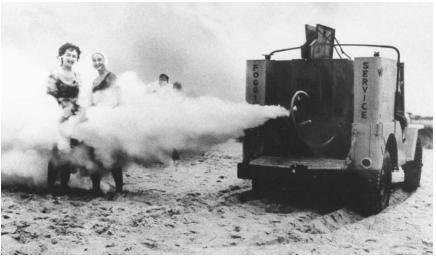

posted by Mr_Zero at 11:00 PM on August 19, 2007
Malor: most large primates such as gorillas and orangutans cannot swim.
posted by tellurian at 11:05 PM on August 19, 2007
posted by tellurian at 11:05 PM on August 19, 2007
woops didnt see Kadin2048 post, as yeah Kadin2048 hit the nail on the head with this issue.
posted by ItsaMario at 11:05 PM on August 19, 2007
posted by ItsaMario at 11:05 PM on August 19, 2007
Hmm, tellurian, that doesn't look that conclusive, but I'll accept it tentatively, pending further information. :)
posted by Malor at 11:08 PM on August 19, 2007
posted by Malor at 11:08 PM on August 19, 2007
Until I saw one close up at the Bird Park in Singapore, I had no idea how enormous these guys are.
Those are the same birds I thought of when I saw this post. The cage at the Singapore Bird Park is rather shallow, so you can get pretty close to the eagles. They are magnificent, cruel looking animals.
posted by Kraftmatic Adjustable Cheese at 11:11 PM on August 19, 2007
Those are the same birds I thought of when I saw this post. The cage at the Singapore Bird Park is rather shallow, so you can get pretty close to the eagles. They are magnificent, cruel looking animals.
posted by Kraftmatic Adjustable Cheese at 11:11 PM on August 19, 2007
Nice to see that mefi has strong representation from the DDT ban = malaria outbreak myth contingent.
posted by srboisvert at 1:09 AM on August 20, 2007
posted by srboisvert at 1:09 AM on August 20, 2007
Srboisvert: Is there a warrant to your "myth" claim, or are you just trying to get a rise out of people?
posted by dismas at 1:13 AM on August 20, 2007
posted by dismas at 1:13 AM on August 20, 2007
Is there a warrant to your "myth" claim, or are you just trying to get a rise out of people?
Try here, for starters, and he has a whole bunch of other posts on the subject here. I would regard most pro-DDT claims with great skepticism, as there are a bunch of right-wing anti-environmentalists who are downright obsessed with this issue and have poured a great deal of money and effort into spreading the gospel of DDT. And they are not people who tend to have much of a track record for honesty and good science, shall we say...
posted by a louis wain cat at 1:54 AM on August 20, 2007 [1 favorite]
Try here, for starters, and he has a whole bunch of other posts on the subject here. I would regard most pro-DDT claims with great skepticism, as there are a bunch of right-wing anti-environmentalists who are downright obsessed with this issue and have poured a great deal of money and effort into spreading the gospel of DDT. And they are not people who tend to have much of a track record for honesty and good science, shall we say...
posted by a louis wain cat at 1:54 AM on August 20, 2007 [1 favorite]
alwc: thanks for the info. That's helpful.
I wonder by so much emphasis was put on saving the American bald eagle
deacon_blues: The Yangtze River dolphins are in Chinese waters. American Bald Eagles are on American territory. It makes more sense for the American government to pass laws that affect the preservation of animals on its territory rather than pass laws concerning regions in which the U.S. Gov't has no authority.
While you correctly identify that Americans are concerned about taking action to preserve our own wildlife, there is nothing shocking here. It would be more shocking for the U.S. Gov't to regulate Chinese companies.
posted by honest knave at 2:47 AM on August 20, 2007
I wonder by so much emphasis was put on saving the American bald eagle
deacon_blues: The Yangtze River dolphins are in Chinese waters. American Bald Eagles are on American territory. It makes more sense for the American government to pass laws that affect the preservation of animals on its territory rather than pass laws concerning regions in which the U.S. Gov't has no authority.
While you correctly identify that Americans are concerned about taking action to preserve our own wildlife, there is nothing shocking here. It would be more shocking for the U.S. Gov't to regulate Chinese companies.
posted by honest knave at 2:47 AM on August 20, 2007
I would regard most pro-DDT claims with great skepticism, as there are a bunch of right-wing anti-environmentalists who are downright obsessed with this issue and have poured a great deal of money and effort into spreading the gospel of DDT.
The information you have linked is all from a single personal blog which although the blogger involved is a scientist(computer) it really doesnt make a convincing case that the whole DDT Malaria issue is a big evil conspiracy.
When you have large government organisations such as the World Health Organization supporting the use of DDT and other large humanitarian organizations supporting the cause i think its best to show us a bit more substantial evidence for those people like myself sitting on the fence.
The blog you linked also seems to have a very anti right wing chip on their shoulder which does nothing to help it seem apolitical, neutral and unbiased when its articles attack numerous establishments and the current mainstream view that DDT is effective at stopping malaria.
posted by ItsaMario at 4:02 AM on August 20, 2007 [2 favorites]
The information you have linked is all from a single personal blog which although the blogger involved is a scientist(computer) it really doesnt make a convincing case that the whole DDT Malaria issue is a big evil conspiracy.
When you have large government organisations such as the World Health Organization supporting the use of DDT and other large humanitarian organizations supporting the cause i think its best to show us a bit more substantial evidence for those people like myself sitting on the fence.
The blog you linked also seems to have a very anti right wing chip on their shoulder which does nothing to help it seem apolitical, neutral and unbiased when its articles attack numerous establishments and the current mainstream view that DDT is effective at stopping malaria.
posted by ItsaMario at 4:02 AM on August 20, 2007 [2 favorites]
For anyone doubtful on the DDT thing, if you trust Malcolm Gladwell in the New Yorker, and have the time to read and understand the article, there’s no reason to believe srboisvert.
posted by Aidan Kehoe at 5:51 AM on August 20, 2007
posted by Aidan Kehoe at 5:51 AM on August 20, 2007
Well, the "single personal blog" isn't just ranting opinion: he quotes extensively from books like Gordon Harrison's Mosquitoes, malaria, and man: A history of the hostilities since 1880; in places like Sri Lanka, DDT was used in such a way that resistant populations of mosquitoes arose, so please don't lay the bodies of malaria-killed people at the talons of bald eagles. Used correctly, DDT can both cut malaria rates and be not harmful to the environment; when it starts getting sprayed willy-nilly, or in a stop-start-stop fashion, you get trouble.
On preview: when DDT is sprayed on and in buildings, and when other vector control methods are used (e.g. elimination of standing water in gutters, etc.), it works and is not unnecessarily destructive. When it is oversprayed - in ponds, lakes, streams, etc - or sprayed intermittently or inconsistently, you run the risk (oddly) of not killing every malaria-killing mosquito, and thus creating a resistant population. Actually, you'd probably get a resistant population anyway, but if the reservoir of malaria is small enough, it might not matter too much.
Those most responsible for the crackdown on DDT, though, are probably farmers in the non-malarial areas of the West (i.e., the U.S.), who tended to spray it everywhere to elminated pests that ate their crops. Bald eagles, after all, didn't die off because of DDT sprayed in Sri Lanka - they died off here, in the U.S., because of indiscriminate use of it by Americans.
posted by rtha at 6:12 AM on August 20, 2007
On preview: when DDT is sprayed on and in buildings, and when other vector control methods are used (e.g. elimination of standing water in gutters, etc.), it works and is not unnecessarily destructive. When it is oversprayed - in ponds, lakes, streams, etc - or sprayed intermittently or inconsistently, you run the risk (oddly) of not killing every malaria-killing mosquito, and thus creating a resistant population. Actually, you'd probably get a resistant population anyway, but if the reservoir of malaria is small enough, it might not matter too much.
Those most responsible for the crackdown on DDT, though, are probably farmers in the non-malarial areas of the West (i.e., the U.S.), who tended to spray it everywhere to elminated pests that ate their crops. Bald eagles, after all, didn't die off because of DDT sprayed in Sri Lanka - they died off here, in the U.S., because of indiscriminate use of it by Americans.
posted by rtha at 6:12 AM on August 20, 2007
Anyone arguing 100 percent for or against DDT will be wrong. The WHO is now in favor of more DDT use after widespread worries about DDT's effects on humans were alleviated -- people aren't dropping dead of cancer or anything else due to DDT, as far as we can tell, after many years of use. That doesn't mean it isn't harmful to the environment in general, or that we won't discover that DDT does indeed do horrible things to people. No one wants farmers indiscriminately spraying it on crops just for the sake of a few bucks more. The WHO says that DDT is one of several insecticides that could be used in moderation, indoors, and in combination with other methods to respond to public health threats, and not, for example, for a tobacco farmer to spray all over his crops to increase yield and profit.
It is true that "there are a bunch of right-wing anti-environmentalists who are downright obsessed with this issue" lately, mainly because the right can't stand anything that gets in the way of unfettered buck-making. We wouldn't be talking about DDT here if it weren't for the right-wing PR machine trying to make a careful shift in DDT policy look like a giant, deadly failing of environmentalism and the left in general. (And if environmentalists are wrong here, well, can't they be wrong on global warming, too?! And about everything else that they keep saying we can't convert into dollars and smoke?!)
What is weird in all of this is that you would expect the right to be posing for PR pictures next to the American bald eagle and the left to be posing next to the sick African kids, but they've switched TV-ready symbols for this round.
posted by pracowity at 6:25 AM on August 20, 2007 [1 favorite]
It is true that "there are a bunch of right-wing anti-environmentalists who are downright obsessed with this issue" lately, mainly because the right can't stand anything that gets in the way of unfettered buck-making. We wouldn't be talking about DDT here if it weren't for the right-wing PR machine trying to make a careful shift in DDT policy look like a giant, deadly failing of environmentalism and the left in general. (And if environmentalists are wrong here, well, can't they be wrong on global warming, too?! And about everything else that they keep saying we can't convert into dollars and smoke?!)
What is weird in all of this is that you would expect the right to be posing for PR pictures next to the American bald eagle and the left to be posing next to the sick African kids, but they've switched TV-ready symbols for this round.
posted by pracowity at 6:25 AM on August 20, 2007 [1 favorite]
I don't think anyone is seriously advocating that people bathe in the stuff, or that we dump it every river in Africa. But malaria is such a stupid, devastating, and manageable disease. Something like 90% of the people it kills are in Africa, most of them children.
DDT isn't going to stop malaria in Africa - access to (cheap and effective) anti-malarial drugs are obviously key to at least managing the disease. But to pretend that the use of DDT wouldn't make an impact is disingenuous at best.
posted by dismas at 8:42 AM on August 20, 2007
DDT isn't going to stop malaria in Africa - access to (cheap and effective) anti-malarial drugs are obviously key to at least managing the disease. But to pretend that the use of DDT wouldn't make an impact is disingenuous at best.
posted by dismas at 8:42 AM on August 20, 2007
I don't think anyone's pretending that DDT wouldn't make an impact. But for it to be effective, it would have to be managed much more carefully than it was in the past.
From today's NYT:
From today's NYT:
The remaining concern has been that the greater use of DDT in Africa would only lead mosquitoes to develop resistance to it. Decades ago, such resistance developed wherever DDT crop spraying was common. After the DDT bans went into effect in the United States and elsewhere, it continued to be used extensively for agriculture in Africa, and this exerted a powerful pressure on mosquitoes there to develop resistance. Although DDT is now prohibited for crop spraying in Africa, a few mosquito species there are still resistant to it. But DDT has other mechanisms of acting against mosquitoes beyond killing them. It also functions as a "spatial repellent," keeping mosquitoes from entering areas where it has been sprayed, and as a "contact irritant," making insects that come in contact with it so irritated they leave.posted by rtha at 11:00 AM on August 20, 2007
As opposed to anti-malaria drugs, bed nets, and other efforts with little down side, DDT, when used irresponsibly, has an enormous down side -- the elimination of whole species of birds. Several other species - peregrine falcons, brown pelicans, e.g. - have bounced back since DDT was banned here.
There are pesticides in use in South American in particular that are having a major impact on migratory bird species, including song birds and raptors.
DDT CAN be used responsibly, sure, and I am not opposed to it being used under certain circumstances, but as a race we don't have a very good track record with being able to use things like pesticides in a way that doesn't cause more damage than it prevents. Even so, there are certainly other pesticides that are in use in North America on mosquitos. Ironically, for purposes of this discussion, to avoid mosquito-borne West Nile, which kills huge numbers of birds, including Bald Eagles...
posted by gingerbeer at 11:03 AM on August 20, 2007
There are pesticides in use in South American in particular that are having a major impact on migratory bird species, including song birds and raptors.
DDT CAN be used responsibly, sure, and I am not opposed to it being used under certain circumstances, but as a race we don't have a very good track record with being able to use things like pesticides in a way that doesn't cause more damage than it prevents. Even so, there are certainly other pesticides that are in use in North America on mosquitos. Ironically, for purposes of this discussion, to avoid mosquito-borne West Nile, which kills huge numbers of birds, including Bald Eagles...
posted by gingerbeer at 11:03 AM on August 20, 2007
Two classic DDT pictures. I'd like to see a "where are they now" special on the people in these pictures.
Since they aren't birds or laying any eggs, I'd say they probably came out OK.
That said, anyone in the DC area, please try and make it by the National Wildlife Visitors' Center and Patuxent Research Refuge on October 13th for the one day a year that visitors are allowed to enter (on guided tours) the areas where Rachel Carson conducted her "Silent Spring" research and currently the whooping crane is being saved from extinction.
At one point you get to see a spot where an entire drum of DDT was dumped into a 20x20 (lined) square by Carson and fellows and measurements are still regularly conducted to test the halflife of the stuff and it's long term effects on wildlife.
posted by Pollomacho at 11:24 AM on August 20, 2007
Since they aren't birds or laying any eggs, I'd say they probably came out OK.
That said, anyone in the DC area, please try and make it by the National Wildlife Visitors' Center and Patuxent Research Refuge on October 13th for the one day a year that visitors are allowed to enter (on guided tours) the areas where Rachel Carson conducted her "Silent Spring" research and currently the whooping crane is being saved from extinction.
At one point you get to see a spot where an entire drum of DDT was dumped into a 20x20 (lined) square by Carson and fellows and measurements are still regularly conducted to test the halflife of the stuff and it's long term effects on wildlife.
posted by Pollomacho at 11:24 AM on August 20, 2007
Yesterday, John Quiggin had a post on Crooked Timber that was very interesting. It concerns an idea I had been rather vaguely aware of, but hadn't really focussed in on: that Rachel Carson and the environmentalist movement were responsible for the deaths of thousands, maybe millions, even "tens of millions" from malaria. This is completely untrue (I'll say why below the fold), not that that has stopped people from saying that it is in places like the WSJ, the National Review Online, and even the US Senate.
As Quiggin notes, there's a mystery about this, namely: where did it come from? It has all the hallmarks of a coordinated campaign -- editorials placed in prominent newspapers, all citing the same dubious examples, for instance, and its very own website -- but it's not clear why anyone would undertake such a campaign.
[quote from Scienceblogs]
So, in a nutshell: the WHO was about to undertake an initiative that would have harmed the tobacco companies. The tobacco companies, in turn, hired shills to attack the WHO. They presumably hired some to attack the WHO's tobacco initiative, but they also hired people to attack other things the WHO was doing in order to discredit it more generally. Thus, the attack on Rachel Carson.-- Obsidian Wings
Links back to the earlier material, but also a long detailed post of its own merit. This "Carson killed millions!" cant is a lie of the first order, and anyone believing it should be ashamed of themselves. Limiting agricultural use of DDT helps malaria control efforts.
posted by dhartung at 12:05 PM on August 20, 2007 [1 favorite]
As Quiggin notes, there's a mystery about this, namely: where did it come from? It has all the hallmarks of a coordinated campaign -- editorials placed in prominent newspapers, all citing the same dubious examples, for instance, and its very own website -- but it's not clear why anyone would undertake such a campaign.
[quote from Scienceblogs]
So, in a nutshell: the WHO was about to undertake an initiative that would have harmed the tobacco companies. The tobacco companies, in turn, hired shills to attack the WHO. They presumably hired some to attack the WHO's tobacco initiative, but they also hired people to attack other things the WHO was doing in order to discredit it more generally. Thus, the attack on Rachel Carson.-- Obsidian Wings
Links back to the earlier material, but also a long detailed post of its own merit. This "Carson killed millions!" cant is a lie of the first order, and anyone believing it should be ashamed of themselves. Limiting agricultural use of DDT helps malaria control efforts.
posted by dhartung at 12:05 PM on August 20, 2007 [1 favorite]
Eagles may look pretty cool, but they are gross! Or should I say, do gross things? They are mostly scavengers, not the majestic hunter that people like to present them as. That's great, that's a good role to play in the environment, but try walking down the street and getting fish guts dropped on your head because clumsy claws dropped they haul he made from the cannery outflow. Not to mention their amazing ability to shoot their poop twelve feet away from their bodies when standing. When they are about to do it, I swear to you, they look over their shoulder, hunch to build up pressure and shoot the poop with deadly accuracy. This is not some little bird spot either, it is about a quart of super potant fish stank. Oh god it's disgusting. One more thing, the sun comes up in my part of the world in summer at about 3:30am, and that when the eagles start keaning. I've been woken up by the bastards, screaming their heads off. I never thought I would be yelling, STFU eagles!! before I came here.
posted by Belle O'Cosity at 1:44 PM on August 20, 2007 [2 favorites]
posted by Belle O'Cosity at 1:44 PM on August 20, 2007 [2 favorites]
Belle, your description of the perfect symbol of America brought tears to my eyes:
try walking down the street and getting fish guts dropped on your head because clumsy claws dropped they haul he made from the cannery outflow
When they are about to do it, I swear to you, they look over their shoulder, hunch to build up pressure and shoot the poop with deadly accuracy.
I never thought I would be yelling, STFU eagles!! before I came here.
America, the beautiful... *cue flapping Stars and Stripes*
For amber waves of grain... *segue into soldiers kissing babies*
For purple mountain majesty...*fade into grandmothers at a quilting bee*
Above the fruited...*on into eagle projectile shitting onto a Hybrid foreign car*
posted by Pollomacho at 2:02 PM on August 20, 2007
try walking down the street and getting fish guts dropped on your head because clumsy claws dropped they haul he made from the cannery outflow
When they are about to do it, I swear to you, they look over their shoulder, hunch to build up pressure and shoot the poop with deadly accuracy.
I never thought I would be yelling, STFU eagles!! before I came here.
America, the beautiful... *cue flapping Stars and Stripes*
For amber waves of grain... *segue into soldiers kissing babies*
For purple mountain majesty...*fade into grandmothers at a quilting bee*
Above the fruited...*on into eagle projectile shitting onto a Hybrid foreign car*
posted by Pollomacho at 2:02 PM on August 20, 2007
For those who were dismissing the last link I posted because the blogger is a computer scientist, here's some posts on the subject by an entomologist. Some interesting things there, including a link to a summary of a Lancet article indicating that it's not exactly that good for humans, either.
Neither I nor the bloggers I linked to are saying that DDT should never be used under any circumstances, but there are a bunch of half-truths and flat out lies surrounding the whole issue, some of which have become widely believed, and they quite overwhelmingly come from the pro-DDT side. (I found it rather interesting to discover that Philip Morris, that bastion of honesty and morality, had played a significant role in getting the whole pro-DDT movement going.)
posted by a louis wain cat at 5:23 PM on August 20, 2007
Neither I nor the bloggers I linked to are saying that DDT should never be used under any circumstances, but there are a bunch of half-truths and flat out lies surrounding the whole issue, some of which have become widely believed, and they quite overwhelmingly come from the pro-DDT side. (I found it rather interesting to discover that Philip Morris, that bastion of honesty and morality, had played a significant role in getting the whole pro-DDT movement going.)
posted by a louis wain cat at 5:23 PM on August 20, 2007
For anyone doubtful on the DDT thing, if you trust Malcolm Gladwell in the New Yorker, and have the time to read and understand the article, there’s no reason to believe srboisvert.
The myth is this: DDT was not banned - it is still in use. DDT was already failing in the areas we are now concerned about for reasons other than the ban (resistance, remoteness, improper application, etc..). It's all there in Gladwell's article. So is the fact that Malaria is cropping up in the areas that were once cleared with DDT.
I'd agree there is no reason to believe me. People should definitely do their own reading and thinking. Just don't stop at Gladwell simply because he is very skilled and persuasive writer. He conspicuously slants his stories and pushes simple narratives that ignore the complexity of issues in favour of a good read. In much the same way the DDT ban = Malaria Outbreak meme ignores the complexity of Malaria & DDT in favour of the all too common right wing agenda of pushing the notion that good intentions are bad and lead to unintended consequences (as if somehow there is a logical corollary that inhumanity is good because the negative consequences are intended).
posted by srboisvert at 5:12 AM on August 21, 2007
The myth is this: DDT was not banned - it is still in use. DDT was already failing in the areas we are now concerned about for reasons other than the ban (resistance, remoteness, improper application, etc..). It's all there in Gladwell's article. So is the fact that Malaria is cropping up in the areas that were once cleared with DDT.
I'd agree there is no reason to believe me. People should definitely do their own reading and thinking. Just don't stop at Gladwell simply because he is very skilled and persuasive writer. He conspicuously slants his stories and pushes simple narratives that ignore the complexity of issues in favour of a good read. In much the same way the DDT ban = Malaria Outbreak meme ignores the complexity of Malaria & DDT in favour of the all too common right wing agenda of pushing the notion that good intentions are bad and lead to unintended consequences (as if somehow there is a logical corollary that inhumanity is good because the negative consequences are intended).
posted by srboisvert at 5:12 AM on August 21, 2007
I had understood that the main thing about DDT was that it breaks down in the environment to DDE, which, like Dioxin, accumulates in the food chain and sticks around in body lipids and fats. According to the current wikipedia entry on DDE,
I am also skeptical, without any particular evidence, about the claim that DDT is the most effective bug/mosquito killer. Do they mean when they say that, cost-effective? It is a very simple little molecule, and it's been known how to make it a long time, and therefore, probably, is not expensive to make. Especially when considering use in the third world, where manufacturing technologies may be more limited, this may be the described effectiveness.
If that's true, a counterargument would be that while cost effectiveness is very important, the value of the environment and uncontaminated food supplies is such that once included in the consideration, using a somewhat more expensive pesticide which has a better track record for health and environmental safety is overall the wiser choice.
posted by nervousfritz at 12:00 PM on August 21, 2007
one of the more common breakdown products.[1] DDE is fat soluble which tends to build up in the fat of animals. Due to its stability in fat, DDE is rarely excreted from the body, and body levels tend to increase throughout life. The major exception is the excretion of DDE in breast milk, which delivers a substantial portion of the mother's DDE burden to the young animal.I'm personally somewhat wary of the pattern, "previous studies said X, more recent studies said Y, therefore, Y" because I do not think that the quality and integrity of our science has improved over the last several years. But that's political.
Some studies have indicated that DDE is an endocrine disruptor[7] and contributes to breast cancer, but more recent studies provide strong evidence that there is no relationship between DDE exposure and breast cancer.[8] What is more clear is that DDE is a weak antiandrogen[9].
While widely publicized, DDE's effects on eggshell thinning represent the tip of the iceberg for DDE's toxicity. There is substantial and growing evidence showing that DDE is a potent endocrine disruptor and xenoestrogen. Our Stolen Future, the watershed book on endocrine disruptors, chronicles Theo Colborn's development of the hypothesis as she waded through thousands of studies on toxins, many on DDE.
I am also skeptical, without any particular evidence, about the claim that DDT is the most effective bug/mosquito killer. Do they mean when they say that, cost-effective? It is a very simple little molecule, and it's been known how to make it a long time, and therefore, probably, is not expensive to make. Especially when considering use in the third world, where manufacturing technologies may be more limited, this may be the described effectiveness.
If that's true, a counterargument would be that while cost effectiveness is very important, the value of the environment and uncontaminated food supplies is such that once included in the consideration, using a somewhat more expensive pesticide which has a better track record for health and environmental safety is overall the wiser choice.
posted by nervousfritz at 12:00 PM on August 21, 2007
« Older Interviews and performances from Austin's KGSR | The best in indy gaming Newer »
This thread has been archived and is closed to new comments
posted by Civil_Disobedient at 9:21 PM on August 19, 2007 [1 favorite]