Apple to NUblog: Drop Dead
May 4, 2001 1:46 PM Subscribe
As Deborah Branscum writes: Weblogs and webloggers may not get respect at Edelman or, perhaps, at Apple. But they should. Time to wake up, folks, and get a clue. [found via NetworkWorldFusion]
Just because you're funny and clever doesn't mean they won't sue your ass. Lawyers *love* clever smartasses.
This is why I think it should be legal to slap lawyers in the face every once in a while.
"Further, your manipulation of the formal correspondence that was sent to....." SLAP!!!
</ offtopic >
posted by y6y6y6 at 2:09 PM on May 4, 2001
posted by andrewraff at 2:09 PM on May 4, 2001
one moment denied for not being a 'proper journalist', then the next minute scolded for not knowing 'proper journalistic behaviour'.
that's awesome. big corporations are the
posted by jcterminal at 2:32 PM on May 4, 2001
posted by m.polo at 2:34 PM on May 4, 2001
posted by fleener at 2:48 PM on May 4, 2001
Journalists bitch a lot, but they don’t bitch about their sources to their sources. That’s not professional, and I’m not surprised Edelman acted in the way they did. No individual is entitled to private information, as Clark apparently thinks he is.
posted by capt.crackpipe at 2:53 PM on May 4, 2001
posted by Zeldman at 3:01 PM on May 4, 2001
Sorry, but Joe is being completely rude and obnoxious here and showed no respect for the PR people he was dealing with. It's no wonder they denied his requests for an interview and information.
posted by camworld at 3:07 PM on May 4, 2001
I've written and edited local newspapers and national magazines, and I've never had (or been asked for) a "press pass". Sure, I've needed passes to access certain areas of a sports arena, and the like, but it's not as if a journalist (or his publication) need a license to conduct business.
I agree, though, that Clark should not have expected anything different than what he got. No individual or media company has any "right" to an interview. Any dumbass would know that.
posted by jpoulos at 3:19 PM on May 4, 2001
Anyway, here's Joe's get an ISSN for your weblog information.
posted by bjennings at 3:20 PM on May 4, 2001
The sad thing is that there are most likely people at Apple who'd love to talk about MacOS X's localisation features, but they're stuck behind a wall of marketroids.
cam: PR people don't deserve respect. They're spin doctors, turd polishers, bridge sellers, Phineas Barnum's sad shadows.
posted by holgate at 3:20 PM on May 4, 2001
Seriously - Joe is playing his game. The PR people are playing theirs. I have no doubt both sides are sore from giggling over how funny they are.
My site has an ISSN. Any one who considered me a journalist...... well..... they would be pretty cool. But that's not the point.
It's all a big game and both sides are playing as expected. Maybe now the lawyers can join in the fun.
posted by y6y6y6 at 3:36 PM on May 4, 2001
It is unreasonable to get snippy with someone who is not familiar with your situation and is dealing with you entirely via e-mail.It is, however, reasonable to read the actual E-mails.
It is obvious Joe Clark doesn’t know how to handle sources.Funny, I managed to swing a few small exclusives over the years, and committed almost no errors to print in a decade's work, and received almost no complaints from sources.
And – whoopsy! – the Apple OS X engineers were the source, not the PR agent.
No individual is entitled to private information, as Clark apparently thinks he is.As the AOL kidz write these days, WTF? OS X's new approach to language resources was not private information. (The code might be, but the approach isn't.) And the whole discussion concerned approach.
actually, joe clark's weblog has an ISSN number, which makes it a "credentialed" publication in the eyes ofNational Library of Canada, shurely?!the U.S. government.
Joe Clark has a history of stirring up trouble just to make himself look cool and to feed his ego.Big surprise for they hefty Cam here, but since I'm the one living the life, I can advise simply that I do get into scrapes from time to time, but I do not seek them out. Plopped onto a scale opposite some other Webloggers, I have the ego of a Buddhist monk.
(BTW, I'm all in favour of ego. And id and superego!)
This is simply another example of Joe playing the same old game: "Look at me. I am cool Joe Clark. I like to cause trouble. Whoo. Whee."I deny being cool. God, do I ever deny it. You have no idea.
Seriously - Joe is playing his game. The PR people are playing theirs. I have no doubt both sides are sore from giggling over how funny they are.BZZT. Wrong answer. Thank you for playing.
It is very simple. The response to a request for comment is on the record.
Also, I note that no one has pointed out that I thoroughly documented my own half of the conversation. In the eyes of some readers, both of us might look stoopid. And I had no hesitation at all in putting myself out there.
So much for feeding my ego. I think someone needs an ice-cream break.
posted by joeclark at 3:55 PM on May 4, 2001
First of all, an ISSN number most emphatically does not make your publication "credentialed" in the eyes of the US government. The Library of Congress's ISSN web pages make it clear that the advantages of having an ISSN are mostly centered around simplified identification purposes, and that anyone can get one for any sort of publication whatsoever so long as that publication comes out indefinitely. They mean absolutely nothing when it comes to journalistic legitimacy. And the First Amendment makes it clear that the United States Government does not have the right to go around "credentialing" media at all.
Second, ISSNs are, well, International. There's nothing particularly American about them.
Anyway, "credentials" only exist in the eye of the beholder. An ISSN number does not make your publication any more or less worthy than a non-ISSN-holding publication. In the end, all that matters is whether anyone's heard of you and respects you. (Compare to Matt Drudge, for example, who everyone's heard of but who plenty of PR types will refuse to deal with on the grounds that he's not a "real publication", when in reality they're just afraid of or annoyed by him. Also compare to, say, John C. Dvorak, who could get these same flaks to lick Cheez Whiz off his ass for no purpose other than his own pleasure, simply because they're afraid if they don't, he'll turn around and make them look bad somewhere down the line in one of his numerous columns in "legitimate" publications.)
posted by aaron at 4:10 PM on May 4, 2001
Current events seem to be contrary to that statement.
OS X's new approach to language resources was not private information.
Then what do you need to talk to someone about it for? If it's public information cite white papers. Is there any sense in requesting an interview to have someone repeat public information?
posted by capt.crackpipe at 4:13 PM on May 4, 2001
"NEW! Read the superspecial threat from Edelman!"
Okay......... But you sure *seem* to be having much fun with it. And they sure *seem* to be enjoying flipping you the bird.
I didn't mean to imply it was stoopid. Just childish.
posted by y6y6y6 at 4:13 PM on May 4, 2001
PR flacks use the bogus "lack of credentials" line for the same reason employers put "college degree required" in help wanted ads for positions that do not in any way require a college education: To eliminate huge numbers of people from the potential pool of {writers | applicants } without the {flacks | employers } having to go to the trouble of actually dealing with them. It cuts down on the number of people they have to deal with; it saves them time. And, in the flacks cases' at least, they'd rather spend their time sucking up to a writer from The Industry Standard, who might then write something glowing about their client that they know lots of people will see (including their client), then some guy from Bob's Web Page whose work will only be seen by a few hundred no matter how good or bad it is. They just don't give a damn about peons, and pulling the "you have no credentials" BS is a more elegant way of dismissing someone than saying the much more truthful, "You're not worth my time. Go away."
posted by aaron at 4:17 PM on May 4, 2001
posted by y6y6y6 at 4:19 PM on May 4, 2001
Last summer, three semi-pro sites (the guys working there get paid but also have other jobs) working together forced Intel to recall the fastest CPU they had on the market.
The three were [H]ardOCP, Anandtech and in particular Tom's Hardware. The part was the 1.13GHz Pentium III. Each of the three was given a sample by Intel, and also Intel started selling them. Tom did rigorous testing of his and determined that it didn't run reliably even using a reference mother board from Intel itself. Anand's part, on the other hand, seemed to work fine. Kyle's part ([H]) was sort of in the middle.
Tom kept raising cain about it on his page, and took a lot of static for that. Kyle finally wrote to Tom (for publication) a note saying that he was having trouble, too.
What ended up happening was that Tom and Anand both sent their parts to Kyle in Texas, and an Intel engineer came to visit Kyle and observe as Kyle demonstrated the problems with those three parts and also with one that the Intel engineer himself brought. Again, Tom Pabst came through because he sent a hard disk which contained what ended up being the killer: a Linux compile. None of the four processors could finish it without crashing, though a slower PIII that Kyle had finished it with flying colors.
The Intel engineer went away looking troubled, and three days later Intel announced a recall. And to this day they don't sell a 1.13 GHz PIII, though they're promising one for this coming summer (a year later).
Also, sites like this have a particularly large amount of influence on the DIY crowd, the leading edge, the early adopters. Such people are important all out of proportion to their numbers because other people who are less knowledgeable tend to rely on them for advice on "What should I buy?"
So at least in the PC world, those kinds of sites get a lot of credibility. But I can't say I'm surprised that Apple is less careful about that kind of thing. It's just more of the traditional Apple arrogance.
posted by Steven Den Beste at 4:21 PM on May 4, 2001
The first reaction -- and the one that seems to have been employed here (albeit poorly) -- is to cut out people without ties to offline media, which aaron just brought up.
The problem with such an inflexible response as that, is that the folks employing it will undoubtedly snub all the legitimate web pure-plays... and, in turn, their loyal readers -- who are legion.
Any ideas? Should a third party (a MediaMap, for example) screen web pure-plays for legitimacy? There has to be _some_ way for us to limit the scope of our communication to improve its quality...
Comments?
posted by silusGROK at 4:47 PM on May 4, 2001
Beyond that, however, I'd like to ask everyone who thinks Joe has any right to be granted this interview a question: are you wearing rose colored glasses? Just because you have a website does not make you a journalist. I'm sorry, it doesnt. Nor does having a degree does not make you a journalist.
Journalism in a void doesnt matter, and for most personal websites out there the traffic we pull is nothing compared to the volume that interests large coaporations. Audience matters, and more specifically, having an audience makes the difference between being no one and being someone.
Aaron makes the critical point when he reminds everyone that credentials are subjective. No one has any obligation to tell you anything, and you have no right to whine about it when they reject you... especially when you ask in such a flagrant manner. You get access to such information in two ways: knowing people, and people knowing you. Last time I checked, the name of even the best known webloggers (jason, meg, matt, &c.) was at best a fleeting memory in the minds of most people who would be in corporate PR positions. If you want to get an interview with someone, do it like the rest of the world and kiss ass (or wave your Time Warner business card...)
Joe, I'm not going to ask you to get off your high horse because I know it won't happen, but, please, saddle up and ride the hell out of here.
posted by bryanboyer at 5:08 PM on May 4, 2001
I find it very interesting that Joe has left out the first email that he sent to Apple.Because I couldn't find the damn thing. I'm pretty sure I hit a public-relations
mailto: link in Lynx, which lets me send a message but doesn't keep them. I know, however, that all I said was "Who do I talk to about Mac OS X localization?"; there were no substantive details.
Given the unreasonable self-important tone of his later emails, it's hard to believe that his (or "your," if you're reading, Joe) initial request was as benign as he claims.I don't find it hard to believe. I'm the one who sent it.
Just because you have a website does not make you a journalist.Hey! Quit plagiarizing me! I wrote that back in June!
Nor does having a degree does not make you a journalist.How you say, in English?
Ten years of paid published articles (pushing 400 of them) in a couple of dozen periodicals, plus paid editing, plus being invited to speak at journalism conferences, plus published editorial photography – at what point do I officially become a journalist? I was not aware that we required a license from Bryan Boyer.
No one has any obligation to tell you anything, and you have no right to whine about it when they reject you.Within given legal constraints, we can write whatever the heck we want. A request for comment is on the record. And so was my side of the conversation. Full disclosure.
I just love you kids!
posted by joeclark at 5:25 PM on May 4, 2001
What I find interesting is that Apple no longer has to fight of Amiga/Corel/Amazon type rumors of impending doom and destruction -- now they're officially in the IBM/Microsoft/AOL ballpark of being big meanies that everyone hates.
Good for them. I'd much rather be hated because I succeeded (Apple of today) than hated because I was failing so miserably (Apple in the mid 90s).
posted by jragon at 5:44 PM on May 4, 2001
Who cares, Joe? The "article" you're writing is for your website, not a professional publication. Apple has no obligation to extend the professional courtesy of granting you an interview because in this situation you are an individual who does not happen to be representing a professional publication.
The problem is that you fail to seperate Joe Clark the individual from Joe Clark the quote-professional-endquote freelance journalist. You are not your website, Joe, nor are you the magazines you write for. No one cares about Joe Clark as nublog writer because nublog is less than a blip on the PR radar, as would be most, if not all, personal web sites. As I said above, it's an issue of audience.
When publications grant interviews they most often grant them to people as representatives of publications not individuals. Don't misconstrue interests or hobbies as "credentials."
But then again... you're Joe Clark... from Canada no less, and a professional, and highly respected, and friend to all, and influential, and and and...
...digging yourself into a hole.
posted by bryanboyer at 5:54 PM on May 4, 2001
Can't this thread be less about Joe, et al... and more about the issue that idolect raises (by quoting Deborah) in the initial post: Weblogs and webloggers may not get respect at Edelman or, perhaps, at Apple. But they should. Time to wake up, folks, and get a clue.
_How_ do they get a clue?
Let's say that I'm a PR professional with a software firm that wants to get the word out to people of a certain demographic... say, well-educated 20 and 30 somethings with a high technology comfort level. Now, the demographics of web usership are changing, but I'd be willing to bet that the blogging community is probably still right around there somewhere.
Where do I go to reach these people... people with an uncanny ability for getting the word out to others about things they like (a very nice trait in a target audience). Do I go to Blogger and start reading each of these sites one at a time? Do I stick to the MeFi "A-List"? Do I approach the one or two folks I read for help (and come of looking like a dolt)? No. I need some way of reaching the "legitimate" voices for their respective communities -- journalists in their own right -- who might, in turn, introduce my widget to their audience.
Similarly, how do I react when someone comes to me and proclaims that they are the voice of their respective community and want to get my word to their audience(s)... such a dialogue would be resource consuming (time, money...), and I have to have some way of verifying their claim and legitimating their pull on my resources.
It's not like the number of such voices, or their role in opinion making, is going to diminish.
posted by silusGROK at 5:55 PM on May 4, 2001
I suppose the point is that if you want the real story, you don't go through the official channels. You talk to the mate who has a mate who works in Cupertino. And that's actually the way the "fact" side of the game is played (as Joe, I assume, knows from experience), as opposed to the "hack" side, which is conducted through "the official channels", and through junkets and launches and lunches, and pretty PR girls with degrees from Wellesley.
(Vis10n: think about the publicity that's been generated through the pure-play web campaign for AI. That's how you work it. "Legitimacy" asserts itself.)
posted by holgate at 6:02 PM on May 4, 2001
Smart manipulations of the medium are all around. Nick mentions the AI murder mystery, and I think the survivor "leak" from last year was another great example. Though I don't know if that has been confirmed as serendipity or purposeful manipulation...
posted by bryanboyer at 6:10 PM on May 4, 2001
Of course even AI had to be seen somewhere first... a really early poster/trailer somewhere ...someone had to make "first contact" and start the conversation.
What I was asking is how a PR professional might engage a web pure-play in just such a conversation without "wasting" a lot of time/resources on folks in the community without a voice; who lack pathos/logos.
And you're right, Bryan... it is often who you know, but the question is whether who _I_ know is really who I think they are. As voices proliferate, and niches increase, online communities will be a wonderful access point to one's audience... but if credentials don't mean much (and they don't, really), how are people sift through the growing tangle?
Maybe this isn't the place... but I saw ideolect's post and thought "Hey! Edelman could have been me! How would I have reacted (aside from being rude) to Joe's claims to my attention?". So I came inside to find some answers.
Thanks Bryan, Holgate for listening, at least...
posted by silusGROK at 6:28 PM on May 4, 2001
posted by silusGROK at 6:31 PM on May 4, 2001
SXSW: Whom do you represent?
ME: A List Apart, a web magazine.
SXSW: You're in, baby.
Admittedly, SXSW is more web-savvy than many organizations, and has a certain vested interest in recognizing / validating web publications. But theoretically, Apple should be hip to this too. They've run web publications themselves (for years), and web design / publishing is one of their key markets.
So like I said, and like Aaron said, the "lack of credentials" line was probably an excuse.
posted by Zeldman at 6:32 PM on May 4, 2001
As an mid-early adopter of OS X (no public-betas, thank you), I got all my early news about OS X from Ric Ford's Macintouch and nowhere else. When the news he collected and published on the web indicated that OS X was stable enough for my level of (dis)comfort, I went ahead and played with it. It's been years since I bought a Mac magazine (or used the web versions).
I would hate to think that if Apple's PR agency is giving short shrift to Joe Clark, they may also be doing it to my main information resource just because it's on the Web and run by one guy.
posted by idiolect at 6:44 PM on May 4, 2001
Apple embodies that disconnect. It has essentially survived through its lean spells because of a committed base of enthusiasts and advocates. But it always prefers to do things with the gala launch, with its symbiotic relationship to the (niche) Mac press, slapping down the rumour sites whenever they depart from the party line. Probably because they know it'd take nothing short of physical violence to separate those followers from their Macs.
posted by holgate at 6:49 PM on May 4, 2001
Wait... didn't someone write in with the remark “Just because you have a website does not make you a journalist. I'm sorry, it doesnt. Nor does having a degree does not make you a journalist”? I brazenly assumed that someone cared what the definition of a journalist was.Ten years of paid published articles (pushing 400 of them) in a couple of dozen periodicals, plus paid editing, plus being invited to speak at journalism conferences, plus published editorial photography – at what point do I officially become a journalist?Who cares, Joe?
I just hate being wrong like this!
posted by joeclark at 7:05 PM on May 4, 2001
[H]ow do I react when someone comes to me and proclaims that they are the voice of their respective community and want to get my word to their audience(s)... such a dialogue would be resource consuming (time, money...), and I have to have some way of verifying their claim and legitimating their pull on my resources.Very easy online: Just read the Weblog archives.
Notably tedious in print: Sometimes you actually do have to send over clips of your previous work. You want bureaucracy? I’ll give you bureaucracy.
In the online case, we would need PR agents who can actually read the source E-mail and double-click on a URL provided. This species is even rarer than employers who can do the same.
My approach has always been the following:
- Small site
- Highly detailed topic, which the source is probably disappointed to find is not getting much press (e.g., OS X localization)
- Small effort required to set up E-interview justified in light of the foregoing
posted by joeclark at 7:11 PM on May 4, 2001
That's not at all a fair comparison. Ford is well known in the Macintosh community as a Macintosh guru and dispenser of wisdom and has been doing so on the Internet continually for something like half a dozen years. I seriously doubt that a request from Ford for more information would have resulted in a refusal, although honestly, I can't imagine Ford bothering with a PR agency when it's clear from the content of his site that he has multiple deep contacts inside Apple engineering. Ford's entire output has been of the Mac world, for the Mac world and by the Mac world and as you said yourself, you turn to Macintouch for the real dope. And Joe Clark is...?
(OT: I was told recently that Ford was no longer doing the day-to-day for Macintouch, though his name is still on it; anybody confirm this?)
posted by m.polo at 7:55 PM on May 4, 2001
posted by machaus at 8:08 PM on May 4, 2001
I can't imagine Ford bothering with a PR agency when it's clear from the content of his site that he has multiple deep contacts inside Apple engineering. Ford's entire output has been of the Mac world, for the Mac world and by the Mac world and as you said yourself, you turn to Macintouch for the real dope. And Joe Clark is...?A legitimate journo, whether anyone's heard of me or not. Also tired after a long day. I love you, too.
I have since heard from sources deep within Apple suggesting I contact other sources deep within Apple, who would of course not be permitted to talk to me. An existing source deep within Apple confides that Cupertino has many smart people at work, except that I never get to deal with any of them.
Ric Ford was listed as Number 5 on Macintosh Weekly Journal's compilation of the 25 most powerful luminaries of the Macintosh demimonde. That same issue (E-mail only, and paid at that, but you can get a sample at MacJournals) explicates a legal exchange Ford had with Apple. Yes, they actually threatened to sue him. He didn't take it lying down, and they fucked off.
(Looking at the reportage, it's too lengthy to quote here.)
Moral of story? As Quark is to customers, Apple is to the press.
And telephoning a PR agent? OMIGOSH. How ancien régime. What was I gonna do, dictate a URL to her voicemail, which is what I would inevitably have reached? Maybe our friend at Edelman should have suggested the telephone. Takes two to tango.
posted by joeclark at 8:46 PM on May 4, 2001
posted by owillis at 9:14 PM on May 4, 2001
I find it interesting that it isn't only PR firms, but a lot of people in the web community who seem to simply be saying "Web sites don't get traffic, that's all that matters. You should know that, not be angry about it, and settle for it."
A phenomena like the Mastercard parodies probably started from someone's tiny little website. And even if it were a huge website, the best ones I've seen were obviously by people who were doing it for the fun of it.
The "Napster Bad" Metallica parodies were seen all over the place, and while professionally done I'd certainly never heard of the website nor media company who did it.
Slashdot was started by two geeks. Ain't It Cool News was started by a guy who loves movies and talked about them on his website.
MetaFilter itself is becomming known to the mainstream tech media, and we're all about personal commentary. The personal web has power to influence the corporate world. It's small, but whoo boy is it growing.
I don't think Joe was entitled to an interview merely because he has a website and has journalistic experience. I think Joe probably did his chances serious damage by being rude.
But his writing influenced me. I'm quite happy to bet that if it influenced me, which it did, it influenced others. How did it influence me? It made me think Apple's less cool, by pure association. If Apple had had some engineer do the interview, that would be cool.
Game developers have been doing it for some time, letting interested parties talk to the developers, and allowing developers a place to spout off. Typically through .plan files. It encourages community growth. It's slightly more important for game developers because most start out without the customer base Apple has, but even succesful companies like iD continue permitting access to employees.
But what would make Apple even cooler is, imagine for a second being that employee. You're some geek grunt, who's got a solid job at Apple, that in itself is pretty cool. But then you're told that the company wants you to do an interview with someone? You get to spout off about all the work you've being doing to someone who's actually interested in it.
I mean, the internationalization thingy's pretty low on the feature popularity tree.
Plus you get to represent your company! And your company is Apple. Man, that'd freakin' rock.
By publicising the goings-on, Joe's changed the way I feel about Apple. Joe has influence, even to a minor degree. I just think that it's a damn shame people are so willing to dismiss that influence because he's just some cranky guy.
(note that I didn't even get into the decent possiblity of Joe being linked by Slashdot and Apple having a media frenzy on their hands, which would have been a good angle, too)
posted by cCranium at 9:20 PM on May 4, 2001
Yes, but I would argue that most of the success of the sites you mention only occurred after members of the ::cough:: "legitimate" media decided to start publicizing them. The power to make a site truly popular is still largely theirs.
posted by aaron at 9:37 PM on May 4, 2001
A little ticked off, I did a little searching, and found their PR firm for Office, which was Waggner Edstrom. Anyway, after exchanging voice mails for about 2 days, back and forth discussing the issue. I was blunt, yet professional. Stated I was with SurfStart (back when I actually updated that site I run on a decent basis) and that I was seeking information.
The rep asked about the web site. I basically told him "we" (is that a royal we?) were a start-up (and wasn't everyone in 1999?) and a direct competitor to news.com (guess who won...). After that explanation, he said, "let me call you back in a day."
He calls me back, and says he can put me under an NDA, and ship me a beta of version 2 which is circulating to the press. I say cool, and return the copy I bought to the store (before stores had suck ass return policies). The next day FedEx comes with my beta, complete with "confidential" manual and press kit. cool.
3 months pass, and the NDA expires. This being 1 day before the actual release of the version 2 product. So I think, what the heck... I shoot an e-mail off to the person I dealt with, basically saying, 'now that it is out, i would like a review copy'. He writes back that afternoon, 'sure thing'. Next morning, full, boxed copy overnighted via FedEx. A post it, 'just e-mail me the link to your final review, thanks.' and a little smiley.
I figure the PR rep was thinking one of two things... (1) cool, press coverage is good, or (2) damn, this little piss-on web site runner might go to the real news. better shut him up. i know an easy way to shut him up, just give him something.
All around, an interesting little experience.
posted by benjh at 9:41 PM on May 4, 2001
posted by benjh at 10:04 PM on May 4, 2001
Whoa, there goes the knee. Apple wasn't even involved. You know all the names of all the people who were involved. Blaming vaguely defined corporate moods should really be a strategy of last resort.
holgate: The sad thing is that there are most likely people at Apple who'd love to talk about MacOS X's localisation features, but they're stuck behind a wall of marketroids.
Fortunately, the localization features (which allow for applications to be elegantly decked out in multiple languages, and packaged into what appears to be a single binary) don't have a hill of beans to do with web server interaction. If you want to send web pages in multiple languages, get thee to O'Reilly already. Edelman's people may have flown off the handle, but the article was a pipe dream in any case because Mr. Clark was wrong on the facts.
posted by bumppo at 1:11 AM on May 5, 2001
It's a nasty tangle figuring out which came first, I'll agree with you that much.
I remember when /. got featured in Wired. A Picture of CmdrTaco and Hemos, and a small blurb probably isn't a "feature" but I can't think of another word.
That certainly boosted /.'s popularity and cred in the business world, but was Wired creating popularity or reporting on it? Some of both.
That's a good point though, aaron. I'm going to have to chew on it for a bit.
posted by cCranium at 6:08 AM on May 5, 2001
den beste: "It's just more of the traditional Apple arrogance."Untrue. Bill Evans of Apple personally intervened and was Cc:ed on various snatchmails.
Whoa, there goes the knee. Apple wasn't even involved. You know all the names of all the people who were involved. Blaming vaguely defined corporate moods should really be a strategy of last resort.
Fortunately, the localization features (which allow for applications to be elegantly decked out in multiple languages, and packaged into what appears to be a single binary) don't have a hill of beans to do with web server interaction. If you want to send web pages in multiple languages, get thee to O'Reilly already. Edelman's people may have flown off the handle, but the article was a pipe dream in any case because Mr. Clark was wrong on the facts.Also untrue. I made no factual errors. There was scarcely enough information to get wrong in the first place! The dream was to talk to the International Herald Tribune Web team (never could get an E-mail address that worked!) and the OS X localizationistas to compare notes on preloading as a localization approach. IHT does preloading on the Web, but only of English-language articles; OS X preloads multiple languages in the operating system, but not on the Web. I wanted to marry the two.
posted by joeclark at 6:19 AM on May 5, 2001
Does this make us bad people? Probably, but after doing it for more than 10 years, I don't think there's any other way to get the stories.
posted by rcade at 8:08 AM on May 5, 2001
You must be joking. This OS has been in active development for two years, and the package/localization features go back to NeXT, which has been around for more than a decade. You may not have known enough about the subject, but to claim the information didn't exist is ludicrous and unsupportable.
IHT does preloading on the Web, but only of English-language articles; OS X preloads multiple languages in the operating system, but not on the Web. I wanted to marry the two.
What is it you think you mean by "OS X preloads multiple languages"? What's preloaded are good support for Unicode, fonts for a plethora of script types, and the hardcoded strings in the OS itself, like the word "Trash". Localization and translation of arbitrary applications require work; localizing documents is a strategy for which Mac OS X makes no provisions whatsoever.
If you want to localize web pages, look into Apache's HTTP content negotiation and use a browser that supports the extremely common HTTP_ACCEPT_LANGUAGE header. Do not redundantly send along copies of a given page in multiple languages and depend on DHTML and/or OS-level trickery to exclude most of them.
posted by bumppo at 11:43 AM on May 5, 2001
You must be joking. This OS has been in active development for two years, and the package/localization features go back to NeXT, which has been around for more than a decade. You may not have known enough about the subject, but to claim the information didn't exist is ludicrous and unsupportable.I didn't make that claim. There wasn't enough information at my disposal to flub.
What is it you think you mean by "OS X preloads multiple languages"?English, French, Dutch, German, Japanese, and Spanish are installed with OS X. You can select whichever one you wish (actually, you can list them in order of preference) and the interface instantly changes. In the olden days, you had to buy a separate OS in the target language and/or do a custom install.
How is this not clearly a case of preloading?
Have you ever tried to buy a copy of Dutch Mac OS outside of Holland or Belgium, or even outside Europe? In X, you just dial it up.
If you want to localize web pages, look into Apache's HTTP content negotiation and use a browser that supports the extremely common HTTP_ACCEPT_LANGUAGE header. Do not redundantly send along copies of a given page in multiple languages and depend on DHTML and/or OS-level trickery to exclude most of them.I am not unfamiliar with the mechanics. The mechanics of a new preloading approach to localized Web pages would have been the subject of the discussion. We're not necessarily going to refuse to "redundantly send along copies of a given page" just kuz you tell us to. Under certain circumstances it may be appropriate, just as under certain circumstances Flash is appropriate.
posted by joeclark at 1:17 PM on May 5, 2001
Well gosh, Apple pushes its technical documentation for free, or else developers don't know the stuff exists. Google knew right where to learn about localization. Any Mac developer on any OS X mailing list could have told you where to find it. How did basic research fail to turn it up?
As formulated, your questions were technically complex but so burdened by mistaken assumptions as to be unintelligible to a nontechnical audience -- which is exactly where you sent your request. That deck was stacked, and by you.
English, French, Dutch, German, Japanese, and Spanish are installed with OS X. You can select whichever one you wish (actually, you can list them in order of preference) and the interface instantly changes.
You mean, like this (only not applicable to the Web)?
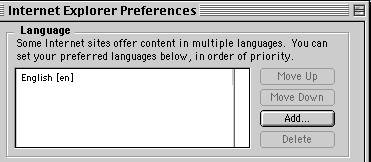
How is this not clearly a case of preloading?
Preloading what? Fonts? Or the OS X equivalent of menu resources? How do they help you, aside from telling the browser to flip the same HTTP_ACCEPT_LANGUAGE switch you seem determined to avoid?
I am not unfamiliar with the mechanics.
Neither am I -- so please, oblige me with the briefest explanation of how a "preloading" scheme, if it existed and even if it weren't platform-specific, would be in any way preferable to the HTTP content negotiation that's been widely supported, on every platform, for years. Because after reading your essay, your correspondence, and your comments here, you come across to me almost entirely unacquainted with the mechanics, and without justifying their rudeness, that sinks your complaint against Edelman.
posted by bumppo at 3:10 PM on May 5, 2001
so please, oblige me with the briefest explanation of how a "preloading" scheme, if it existed and even if it weren't platform-specific, would be in any way preferable to the HTTP content negotiation that's been widely supported, on every platform, for yearsSomeone seems to equate pursuing an idea with advocating it. As the story clearly stated, for sites that must be completely bilingual on every page (not uncommon, e.g., with the government of Canada), is this newfangled approach actually useful, or more of a pain in the arse?
And about those technical white papers and whatnot: I very often contact a scientific source, ask where to look to get basic information, and then come back with intelligent questions. To locate that source, I went through PR. And then the journey got interesting. People have since mailed me vast lists of URLs, many of which I've looked at and many of which would not have answered my queries.
On this specific topic, give me a break. The exercise was exploratory.
posted by joeclark at 6:21 PM on May 5, 2001
Performing a simple Google search reveals pointers to the information Joe wanted, instantly, and would have shown him, had he read it, that his idea is way off base. Mac OS X includes multiple localized versions of the OS and applciations in a single binary package; it does not provide for multiple language versions of documents, nor does it translate, nor does any of this affect how a Web browser or server would show you a page.
Disclaimer: I publish MWJ. I think the self-link is appropriate because Joe mentioned MWJ earlier as support for his (correct) assertion that Ric Ford is a credible online journalist despite having a Web-only publication, and that he was #5 on last year's "Power 25" list of most influential people in the Macintosh community. Where Joe was wrong was to expect Apple PR or its agency to accommodate him just because he's been writing for ten years. Where Edelman was wrong was to get snitty about their responses being printed.
Joe: Contact me offline and I'll send you past MWJ coverage of this localization issue (MWJ 2000.09.16, from Mac OS X Public Beta) for your own use. And please revise your Web page on the subject to make it clear you're the author; we couldn't find your name anywhere except "Mr. Clark" in the final Edelman letter. Perhaps we missed something. Don't journalists usually want bylines?
posted by mdeatherage at 2:34 PM on May 6, 2001
What kind of reporter compliments a company for not talking to other reporters? That's astonishingly unprofessional behavior.
posted by rcade at 7:01 AM on May 7, 2001
Baloney. What's unprofessional, and unrealistic, and keeps reporters on the fringe of society is their belief that they're gods unto themselves, that they have no responsibility except to each other, and that the fraternity always comes above the truth.
I cover Apple Computer for a living, and I probably pay more attention to it than most of the reporters that do so for mainstream media. To argue that Apple has to spend PR dollars to accommodate every request from a writer, no matter how large or small the venue, is a fatuous and self-serving argument that no one but a reporter could ever believe is wise. The media love to write about Apple, good or bad, and the company could spend tens of millions per quarter in PR without affecting the quality or quantity of coverage. Reporters have shown a remarkable resistance to the truth about Apple, describing the company as doomed at every downturn and overlooking any potential problems when sales are up. If any national, mainstream publication printed a consistently balanced look at Apple, either in print or online, I'd be happy to recommend it to you. Notice there are no recommendations here.
By the way, as we stated in this weekend's article, Apple often doesn't answer our PR requests either, even though Apple PR and higher-up executives read our journals. I understand that. We find our information without Apple PR 99.5% of the time, and we understand that small fish like us have to do that. We're not entitled to a PR contact just because we have subscribers.
posted by mdeatherage at 7:09 AM on May 7, 2001
« Older Happy Birthday, | "Rosen said she expected the relative costs of... Newer »
This thread has been archived and is closed to new comments
posted by tranquileye at 2:02 PM on May 4, 2001